


Abstract
Biochar mineral complex (BMC) can improve nutrient use efficiency (NUE) and reduce nutrient leaching, but the optimal application form and rate of application in soilless cropping systems remain unclear. This study evaluated co-applying BMC, either in solid form and placed to form a horizontal laminar layer approximately halfway up the potting media column, or as a liquid BMC suspension combined with reduced fertiliser rates in a protected ginger cropping system using pine bark potting media. Six treatments were examined: full-rate (15 t ha−1) and half-rate (7.5 t ha−1) organic fertiliser blend, BMC at high-rate (1 t ha−1) and low-rate (0.5 t ha−1) co-applied with half-rate fertiliser, BMC at high-rate without fertiliser, and BMC suspension at high-rate co-applied with half-rate fertiliser. Aboveground biomass, rhizome yield, nitrogen (N) and phosphorus (P) leaching, NUE, and net income were assessed. Fertiliser costs were reduced by 28% to 30% by applying half-rate fertiliser with or without BMC, respectively, and without decreasing rhizome yield, aboveground biomass, and NUE, compared to applying full-rate fertiliser. Co-applying solid BMC as a layer and at a low rate with half-rate fertiliser reduced N and P leaching without affecting yield or profitability. The BMC suspension showed no significant difference from full-rate fertiliser in yield and leaching outcomes while offering advantages for mechanised application in labour-intensive cropping systems. Overall, co-applying BMC either as a solid layer or as a liquid suspension with reduced fertiliser rates offers an economically and environmentally sustainable alternative to conventional fertiliser use in soilless cropping systems.
1. Introduction
Global crop production relies significantly on fertilisers [1]. However, both chemical and organic fertilisers are only partially effective because crops utilise less than 50%, 10%, and 40% of applied nitrogen (N), phosphorus (P), and potassium (K), respectively [2]. The unutilised fertiliser is lost through volatilisation, runoff, and leaching, leading to environmental problems such as soil acidification, eutrophication, and groundwater pollution [3]. In addition to environmental impacts, fertiliser losses impose a significant financial burden on farmers and negatively affect crop quality, yield, and overall income [4]. Consequently, there is an urgent need to develop nutrient-efficient fertilisers that are environmentally friendly, cost-effective, and suitable for modern crop production.
Improving fertiliser use efficiency can be achieved through practices such as co-applying fertilisers with organic matter, compost, or biochar [5,6]. However, adding high rates of biochar or other organic amendments can increase input costs and may not always be cost-effective or practical for farmers [7,8]. Biochar-based fertilisers have therefore emerged as a more convenient alternative as they can deliver the benefit of biochar without the need for high application rates or additional organic inputs [9,10,11]. Moreover, the economic feasibility of applying biochar-based fertiliser remains uncertain, especially in systems where input costs are a major constraint. Novel biochar mineral complex (BMC) is one type of biochar-based fertiliser, produced by pyrolysing organic feedstock with mineral additives [12,13,14,15]. BMCs have been developed to be nutrient-efficient and shown to improve crop yield [13,16]. BMC improves nutrient use efficiency (NUE) by improving nutrient retention and release mechanisms, including: (1) increased cation exchange capacity (CEC) and anion exchange capacity (AEC), (2) development of functional groups in rhizosphere, (3) improved nutrient availability, (4) decreased nutrient leaching, and (5) increased negative zeta potential [11,14]. BMCs still remain relatively expensive; however, co-applying BMC with fertiliser at low rates can reduce costs and increase yields [15]. However, it is still unclear how much the BMC application rate can be reduced to minimise nutrient inputs and leaching without compromising yield.
BMCs are generally produced and applied in solid form; however, recent advancements in BMC technology have introduced liquefied BMC formulations or BMC liquid suspensions, expanding application options for farmers [11,15,17]. Liquid BMCs enable foliar application and more uniform integration into potting media, offering practical advantages over solid BMC that must be physically layered or incorporated into the potting media. Although liquid BMC has been shown to improve NUE and pasture yield in soil-based systems, when co-applied with fertiliser, research on BMC performance in soilless cropping systems is lacking [15]. Previous study in a soilless cropping system demonstrated that solid-form BMC applied as a layer at 1 t ha−1 with half-rate fertiliser can improve nutrient retention and optimise NUE without compromising crop yield [11]. However, no study has directly compared the agronomic performance and effects on nutrient retention or leaching of solid versus BMC liquid suspensions under soilless cropping systems.
Protected cropping systems rely on intensive and high levels of inputs, and therefore, are also high in cost and limited to higher value crops [18]. Ginger (Zingiber officinale) is a high-value cash crop grown in tropical and subtropical regions of the world and selected as the model system because Australian farmers are moving towards protected cropping following a higher incidence of soil-borne diseases [19,20,21]. Soilless cropping is now practiced in more than 119 countries, driven by advantages in sustainable intensification, precise water and nutrient management, and the ability to avoid soil-borne diseases [22,23]. Growers worldwide are turning to soilless substrates such as potting media to ensure return on investment [24,25]. Pine bark potting medium is commonly used due to its low cost and high permeability; however, its low CEC leads to significant nutrient leaching during irrigation [26,27]. High input requirements combined with nutrient leaching can reduce the profitability of cost-intensive systems, emphasising the need to improve NUE. Our complementary studies have shown that co-applying BMC as a solid layer with half-rate fertiliser can reduce N and P leaching and improve NUE without affecting yield [11,14]. Building on our previous findings, the present study compared applying BMC as a solid layer and as a liquid suspension to determine whether nutrient inputs can be further reduced to maximise farmers’ economic return. Specifically, we examined how different BMC forms and application rates would affect crop yield, N and P leaching, NUE, and economic return. We hypothesised that co-applying BMC at an optimised rate, in either solid or liquid suspension, would improve NUE and economic returns without compromising rhizome yield [11,14,15]. Ultimately, co-applying BMC with a reduced rate of fertiliser may offer an economically and environmentally sustainable approach for cost-intensive cropping systems.
2. Materials and Methods
2.1. Site Description and Climate Information
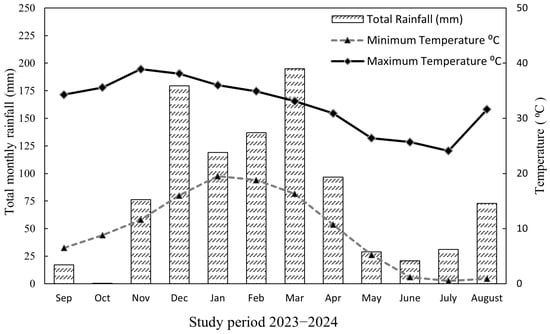
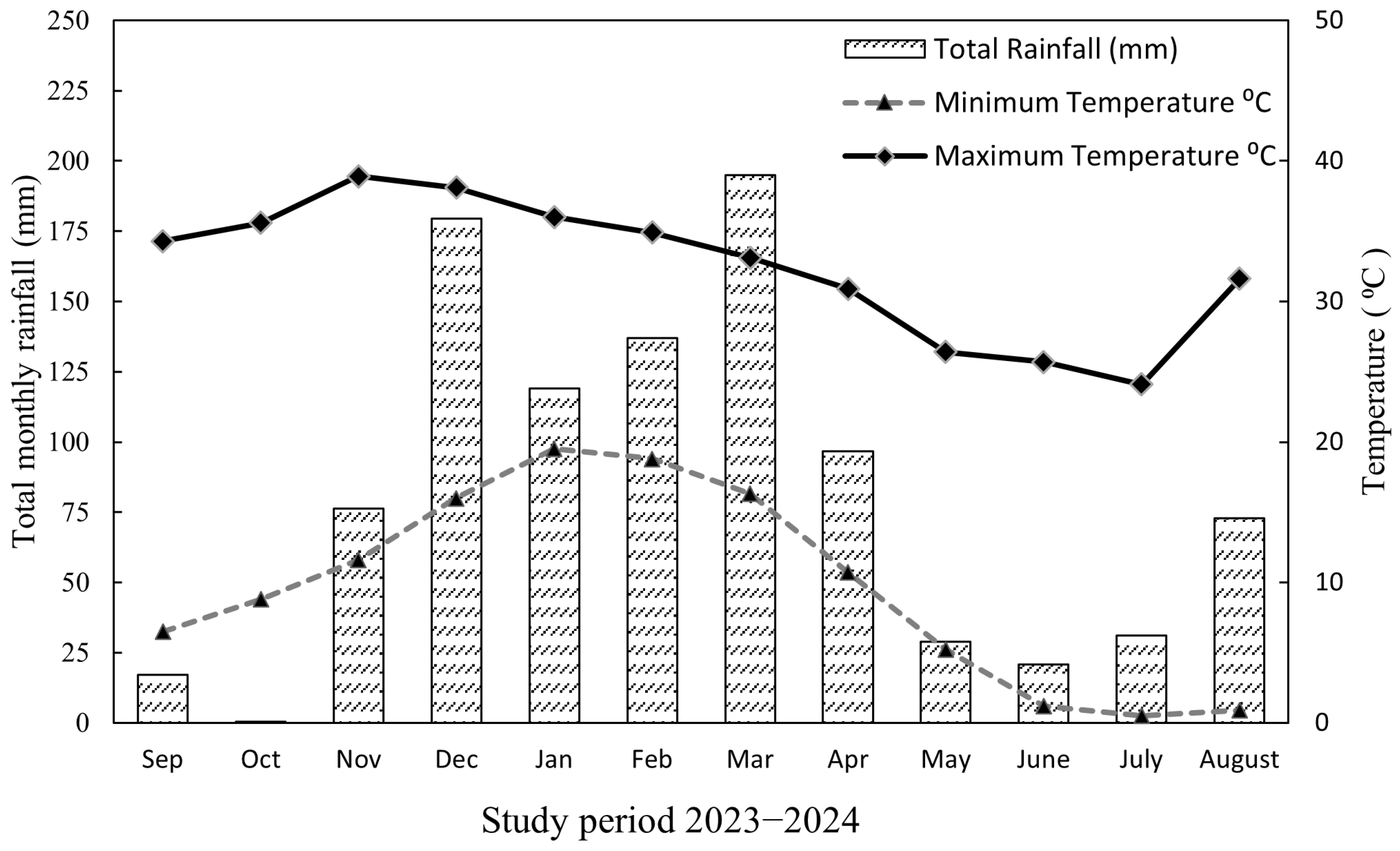
This experiment was conducted in a certified organic ginger farm in Kandanga, Queensland, Australia. The farm grows seed rhizomes in soilless potting media to receive seeds free from soil-borne pathogens for field planting. The study was conducted during the period from September 2023 to August 2024. During the study period, mean monthly rainfall was 87 mm, mean monthly minimum and maximum temperatures were 0.5 and 38.9 °C, respectively, relative humidity ranged between 41–97%, and mean monthly solar radiation was 18.4 MJ m−1 (Figure 1).
Figure 1.
Total monthly rainfall (mm) and minimum and maximum temperatures (°C) during the study period.
2.2. Biochar Mineral Complex Production and Characterisation
The BMC applied in this study was prepared by co-pyrolysing a blend of chicken manure, wheat straw, minerals, and clays using an already reported method [11,14]. Apatite, basalt, diatomite, magnetite, ferrous sulphate, manganese dioxide, titanium dioxide, and zeolite were used as minerals, while bentonite and kaolinite were the clays in the blend. Details on chemical properties and manufacturing process of the BMC used in this study can be found in a previous complementary research [14]. In brief, the blend was co-pyrolysed at 400 °C at a rate of 5 °C per minute for 1 h and allowed to cool inside the furnace for 15 h. After pyrolysis, the produced BMC was quenched with 200 mL of water, and then a solution of commercial fish fertiliser and wood vinegar solution (32:1) was added.
2.3. Treatment Preparation and Protected Cropping Trial Establishment
A commercially available pine bark potting medium served as the base for all treatments. The organic fertiliser blend used in this study consisted of certified, commercially available products, including a pelletised chicken-manure fertiliser, lime in the form of CaCO3−, dolomite, rock minerals, and trace metal additives. This study included six treatments and six replicates. The full-rate fertiliser (O15) served as the control and received the organic fertiliser blend at a rate of 15 t ha−1. High-rate and low-rate BMC applications were equivalent to 1 t ha−1 and 0.5 t ha−1 of biochar (dry weight basis), respectively. The six treatments were: full-rate fertiliser control (O15), half-rate fertiliser (O7.5), high-rate BMC with half-rate fertiliser (B1-O7.5), low-rate BMC with half-rate fertiliser (B0.5-O7.5), high-rate BMC without fertiliser (B1), and high-rate BMC liquid suspension with half-rate fertiliser (BL1-O7.5). All solid BMC treatments were applied as a layer in the middle of the potting media. The organic fertiliser blend was applied to the base potting media according to the manufacturer’s recommendations. A summary of treatments and the compositions of BMC, the organic fertiliser blend, and the pine bark potting medium is presented in Table 1 and Supplementary Table S1.
Table 1.
Description of treatments used in the experiment.
All treatments were applied at the time of establishment following regular farmer practice for fertiliser use, except for BMC, which required modified steps. Organic fertiliser blend at 15 t ha−1 and 7.5 t ha−1 rates were applied to full-rate and half-rate fertiliser treatments, respectively. The fertiliser blend was incorporated into the base potting medium using a compost spinner and then filled into ~20 L black plastic pots (250 mm diameter) [11,14]. For treatments receiving low-rate or high-rate BMC with half-rate fertiliser, BMC was applied as a layer in the middle of each pot, positioned above the bottom half of the potting media. The remaining half-rate fertiliser was then incorporated into the top half of the media. In the treatment where BMC was applied at a high rate without fertiliser, only the BMC layer was placed in the middle of the pot, with no fertiliser mixed into the base potting media. For the BMC suspension at high-rate treatment, the half-rate fertiliser was incorporated throughout the entire vertical column of potting media before the BMC suspension was applied. BMC suspension was prepared by blending high-rate solid BMC (equivalent to 1 t ha−1 biochar) with 250 mL of hot water. Seed rhizomes were dipped into the BMC suspension before planting in the centre of the pot, and the remaining solution was poured over the potting media where the ginger (Zingiber officinale) seeds were placed.
The ginger seeds for planting were obtained from the previous growing season (September 2023). Each pot was planted with 60−80 g of seed rhizome placed in the centre and covered with approximately 5 cm of the top half of the treated potting media. Pots were placed in the nursery in a randomised complete block design. During hot days, pots were irrigated three times daily for 20 min with overhead sprinklers (Super Green Spin, NaanDanJain, Tel Aviv, Israel), delivering water at a rate of 1.75 L min−1. Pots were re-randomised at each sampling interval (14 and 22 weeks after planting). After collecting the aboveground biomass in week 32, all treated pots were top-dressed with pine sawdust to cover rhizomes until harvest in week 41.
2.4. Leachate and Leaf Sample Collection and Analysis
Leachate samples were collected at weeks 14 and 22 after planting, corresponding to the rapid growth phase of ginger shoots and roots [28]. The pots were elevated inside 40 L basins, and 4 L of water was poured over the pot surface within 1 min using a watering can [29]. The pots were allowed to drain for 20 min, and a 50-mL leachate sample was collected. The samples were taken to the laboratory, filtered through a 0.45 micrometre syringe filter, and stored at 4 °C for analysis. An undiluted 10 mL subsample was analysed for NH4+, NO3−, and PO43− concentrations using DCA analyser (Gallery Plus, Thermo Fisher Scientific, Vantaa, Finland) [30].
Leaf samples were also collected at the same sampling weeks as the leachate samples. The youngest fully opened leaf from the tallest tiller was collected for nutrient analysis, as this tissue is considered the most practical indicator of critical nutrient status in ginger. Leaf samples were dried at 60 °C in an oven until a constant dry mass was obtained, then ground to a fine powder. A 20 mg subsample was weighed into a tin capsule and analysed for total C and N concentrations using isotope ratio mass spectrometry (IRMS) (Hydra 20–22 IRMS, Sercon, Cheshire, UK) [31]. Another subsample of 0.5 g was digested using 3 mL of nitric acid (70% w/w) and 9 mL hydrochloric acid (37% w/w) using a microwave digester (ETHOS UP, Milestone, Sorisole, Italy) and analysed for total nutrient concentrations using ICP-OES (Optima 8300, PerkinElmer, Waltham, MA, USA). Specifically, the concentrations of P, K, calcium (Ca), magnesium (Mg), sulphur (S), boron (B), copper (Cu), iron (Fe), manganese (Mn), molybdenum (Mo), silicon (Si), and zinc (Zn).
2.5. Vegetative Growth and Yield Measurements
Vegetative growth measurements included the number of stems and aboveground dry biomass. The number of stems was counted at the time of collecting the aboveground biomass at week 37 [32]. The aboveground biomass was removed from the stem junction and dried in an oven at 60 °C until a constant dry mass was obtained. After removing the aboveground biomass, pot surfaces were covered using dry sawdust until rhizome harvesting. Fresh rhizomes were harvested at week 45 after planting by removing the whole rhizomes from pots and brushing off the potting media. The seed rhizome was separated, and the remaining rhizome was weighed to determine the Fresh Rhizome Weight (FRW) as g pot−1. A subsample of 50−60 g was randomly taken from the new seed rhizome to calculate moisture concentration. The subsample was dried at 60 °C until a constant dry mass was obtained. Moisture concentration (MC) as % and Dry Rhizome Weight (DRW) as g pot−1 were calculated using the following formulas [11]:
2.6. Benefit-Cost Ratio and Nutrient Use Efficiency Calculation
All calculations were performed on a per-pot basis, reflecting how commercial ginger farmers assess benefits and costs in protected cropping systems. Therefore, values have not been converted to a hectare scale due to substantial differences in cost structure. The benefit-cost ratio was calculated using the following formula [33,34]:
The benefit-cost ratio > 1 demonstrates that the practice is economically advantageous [33]. Gross income was determined by multiplying FRW in kilograms by the prevailing market price for organic rhizomes. The market price for organic ginger was obtained from market information services in Brisbane (Market Information Services, Brisbane Market, Rocklea, Australia). The total cost of production per pot included expenses for seed, potting bag, fertiliser, potting media, power (for irrigation), labour, and plant house based on current market prices and rates in Queensland, Australia. The net income per pot was derived by subtracting the total cost of production from the total income.
Nutrient use efficiency (NUE) as g gN−1 pot−1 for each treatment was calculated using FRW as g pot−1 according to Govindasamy et al. [35] and Ciampitti and Vyn [36]:
where N refers to grams of specific nutrient applied per pot.
2.7. Data Collection and Statistical Analysis
The distribution of all quantitative variables was assessed for normality and homogeneity of variance using histograms and the Shapiro-Wilk test, and Levene’s test, respectively [16]. Variables meeting normality assumptions were analysed using one-way analysis of variance (ANOVA), and treatment means were compared using Duncan’s new multiple range test at p < 0.05. Variables that did not meet normality assumptions were log10-transformed prior to analysis. All statistical analyses were performed using R software version 4.3.0 [37] within the R Studio environment version 2023.06.0-421 [38].
Principal component analysis (PCA) was performed to visualise the relationship among dry rhizome yield, net income, and N, P, and K use efficiencies [39]. Data with complete cases were standardised using z-scores to ensure comparability across variables prior to PCA. The analysis was conducted in R using the “stats” package, and results were visualised as a bi-plot generated with “ggplot2” [37,38,40].
3. Results
3.1. Reduced Fertiliser Rates and BMC Co-Application on Ginger Growth, Yield, Nutrient Input, and Costs
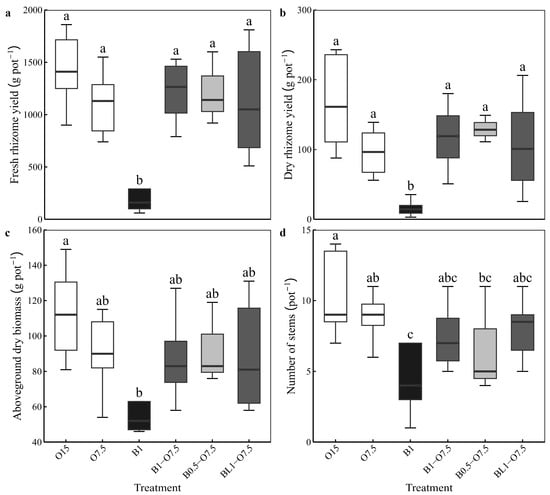
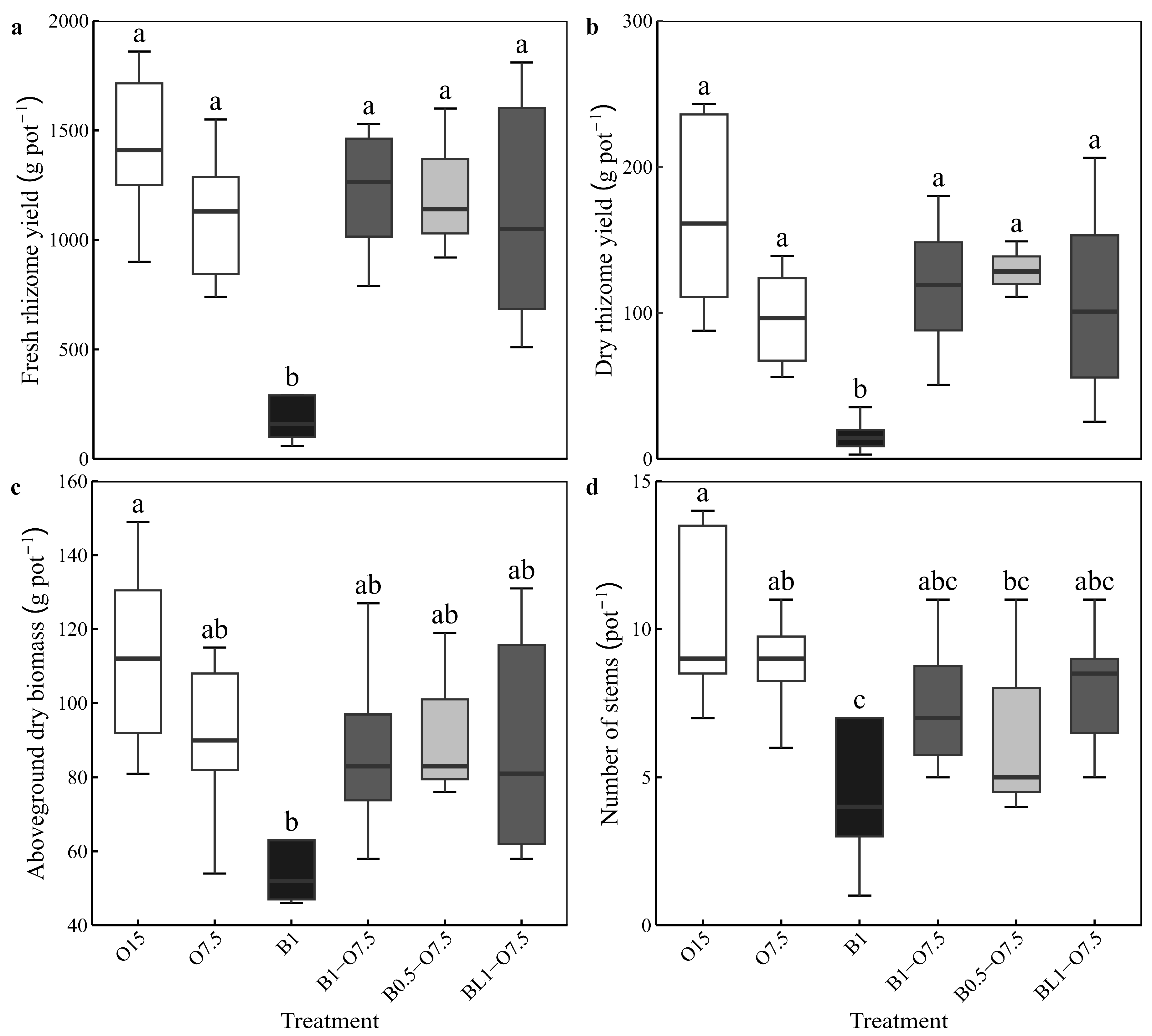
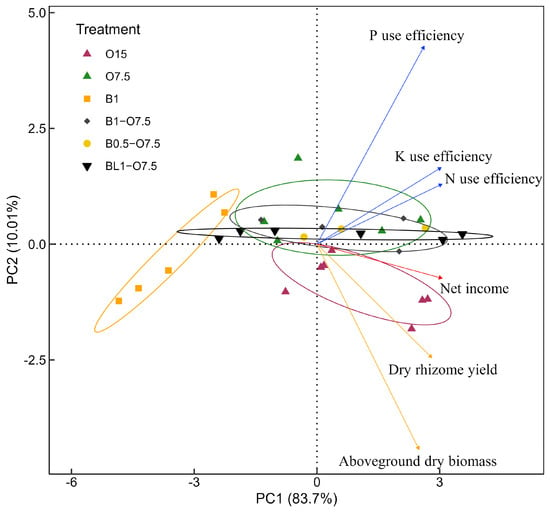
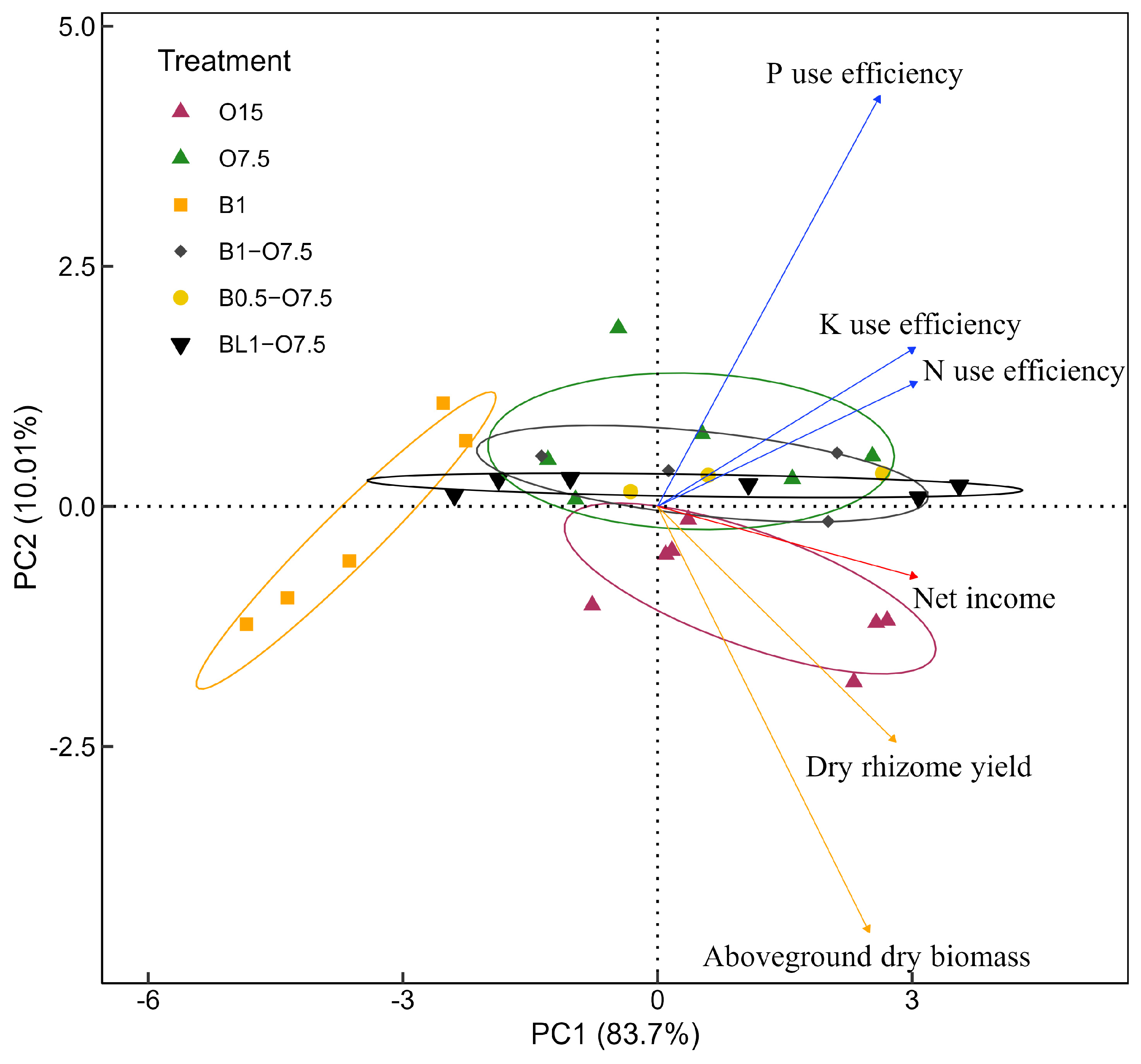
Applying half-rate fertiliser, with or without BMC co-application, resulted in no significant difference in the number of stems, aboveground dry biomass, and fresh and dry rhizome yields compared with full-rate fertiliser control (Figure 2). Moreover, treatments that co-applied high-rate or low-rate BMC with half-rate fertiliser did not increase aboveground biomass or rhizome yield compared with half-rate fertiliser treatment (Figure 2). Interestingly, applying half-rate fertiliser reduced fertiliser costs by 30.5%, leading to a 2.5% decrease in total production cost while maintaining no significant differences in gross income, net income, and benefit-cost ratio to full-rate fertiliser control (Table 2). The half-rate fertiliser application also lowered N, P, K, S, Mn, and Si inputs by more than 30% compared with the full-rate fertiliser control (Table 3). Foliar nutrient concentrations for all nutrients, except Si at week 22, showed no significant difference among half-rate fertiliser treatments with or without BMC co-application and the full-rate fertiliser application (Table 4). Moreover, applying half-rate fertiliser with or without BMC maintained NUE for all nutrients with no significant difference compared with full-rate fertiliser control (Table 5). The PCA bi-plot integrating N, P, and K use efficiencies with aboveground dry biomass, dry rhizome yield, and net income revealed distinct treatment groupings (Figure 3). Applying half-rate fertiliser with or without BMC clustered along vectors associated with higher N, P, and K use efficiencies as well as rhizome yield and net income (Figure 3). In contrast, full-rate fertiliser control projected closer to rhizome yield and net income vectors but remained distant from N, P, and K use efficiencies (Figure 3).
Figure 2.
Fresh rhizome yield (a), dry rhizome yield (b), aboveground dry biomass (c), and number of stems (d) of different fertiliser treatments. O: organic fertiliser; B: layer-applied biochar–mineral complex, BL: suspension form of biochar–mineral complex application. Numerals in treatment names represent respective application rates. Lowercase letters indicate significant differences among treatments at p < 0.05 (n = 6), as determined by Duncan’s new multiple range test.
Table 2.
Economic and benefit-cost analysis of applying the different fertiliser treatments to a soilless cropping system.
Table 3.
Nutrient input of different fertiliser treatments as a percentage fraction of the full-rate fertiliser control.
Table 4.
Foliar nutrient concentration of the youngest fully opened leaf from the tallest tiller in pots applied different fertiliser treatments (n = 6).
Table 5.
Nutrient use efficiencies of different fertiliser treatments were calculated using total rhizome production per unit grams of each applied nutrient per pot.
Figure 3.
Principal component analysis (PCA) bi-plot consisting of N, P, and K use efficiencies and aboveground dry biomass, dry rhizome yield, and net income of different fertiliser treatments. Different coloured circles represent fertiliser treatments, as indicated in the legend. O: organic fertiliser; B: layer-applied biochar–mineral complex, BL: suspension form of biochar–mineral complex application. Numerals in treatment names represent respective application rates.
3.2. Rate of BMC Co-Application on Nutrient Leaching, Input, and Costs
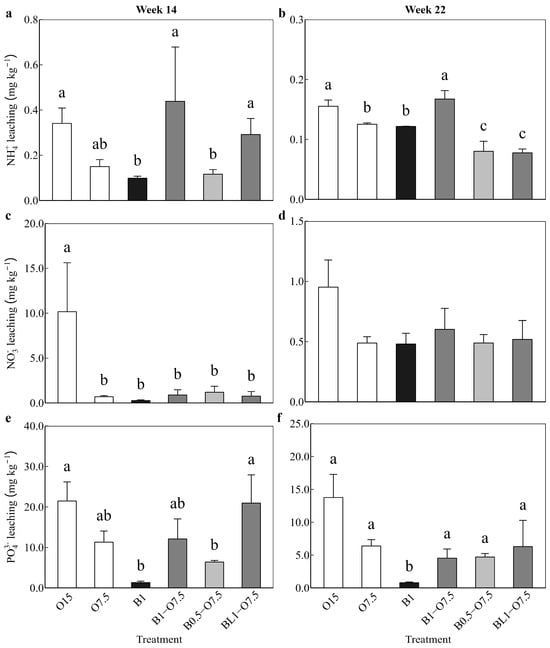
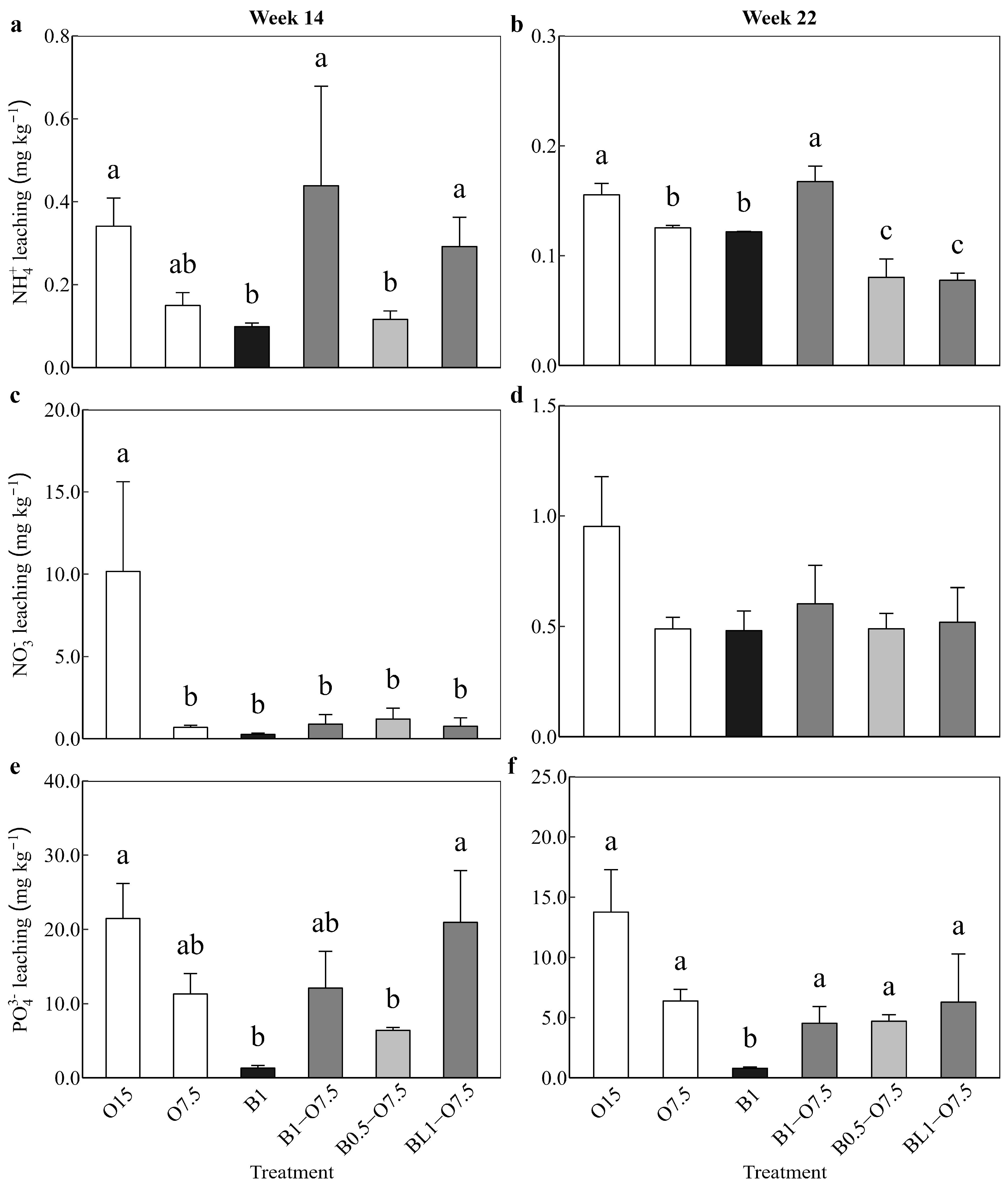
Pots treated with BMC layered at low-rate with half-rate fertiliser decreased NH4+, NO3−, and PO43− leaching at week 14, and reduced NH4+ leaching at week 22, compared with full-rate fertiliser control (p < 0.05) (Figure 4). In contrast, applying BMC layered at a high rate with half-rate fertiliser, either in solid or liquid form, did not decrease NH4+ or PO43− leaching at week 14 and week 22, nor NO3− leaching at week 22, compared with applying full-rate fertiliser (Figure 4). In addition, co-applying BMC layered at a high rate with half-rate fertiliser decreased N, P, and K inputs by 24.2%, 43.5%, and 30.2%, respectively, whereas BMC layered at low-rate treatment decreased the inputs by 27.4%, 46.8% and 31.8%, respectively, compared with full-rate fertiliser control (Table 3). Co-applying BMC as a layer and at either the high-rate or low-rate treatment with half-rate fertiliser reduced fertiliser cost by 28.0% and 29.3%, respectively, and lowered total production cost by 2.2% and 2.4%, compared with full-rate fertiliser control (Table 2). Moreover, co-applied BMC with half-rate fertiliser treatments showed no significant differences in gross income, net income, and benefit-cost ratio compared to the full-rate fertiliser control (Table 2).
Figure 4.
Leaching of NH4+ (a,b), NO3− (c,d), and PO43− (e,f) from potting media during the rapid growth phase of shoot and root at 14 and 22 weeks after application of different fertiliser treatments. O: organic fertiliser; B: layer-applied biochar–mineral complex, BL: suspension form of biochar–mineral complex application. Numerals in treatment names represent application rates. Lowercase letters indicate significant differences among treatments at p < 0.05 (n = 6), as determined by Duncan’s new multiple range test.
3.3. BMC Suspension as an Alternative Form of BMC for Co-Application with Fertiliser
Co-applying high-rate BMC suspension with half-rate fertiliser resulted in no significant difference in the number of stems, aboveground dry biomass, and fresh and dry rhizome yields compared with full-rate fertiliser control and co-applied BMC layered treatments (Figure 2). Co-applying high-rate BMC suspension with half-rate fertiliser reduced fertiliser cost by 28.0% compared with full-rate fertiliser, lowering the total cost of production by 2.5% (Table 2). Fertiliser cost and total cost of production of co-applied BMC suspension and BMC layered at a high rate with half-rate fertiliser were not significantly different between the treatments because of the same rate of nutrient input (Table 2 and Table 3). However, high-rate BMC suspension co-applied with half-rate fertiliser showed no significant difference in NH4+ and PO43− leaching compared with the full-rate fertiliser control (Figure 4).
3.4. Comparing BMC Application with and Without Fertiliser on Ginger Growth and Yield
Applying BMC as a layer and at the high rate without fertiliser significantly reduced fresh and dry rhizome yields, aboveground dry biomass, and number of stems compared with full-rate fertiliser control (p < 0.05) (Figure 2). In contrast, co-applying BMC with half-rate fertiliser treatments significantly increased fresh and dry rhizome yield regardless of form and rate of application, compared with applying BMC layered at a high rate without fertiliser (p < 0.05) (Figure 2). Pots treated with BMC layered at a high rate without fertiliser recorded the lowest gross income, net income, benefit-cost ratio, and NUE for all nutrients, except Mn and Si, among all treatments (p < 0.05) (Table 2 and Table 5). The PCA bi-plot indicated BMC layered at a high rate without fertiliser aligned with vectors, representing lower N, P, and K use efficiencies and poor yield and net income (Figure 3). In contrast, BMC co-applied with half-rate fertiliser treatments clustered along vectors associated with higher N, P, and K use efficiencies as well as rhizome yield and net income (Figure 3).
Applying BMC layered at a high rate without fertiliser reduced N, P, and K inputs by 54.9%, 93.5%, and 63.2%, respectively, and decreased Ca, S, and Si by more than 50% compared with full-rate fertiliser control (Table 3). However, BMC layered at a high rate without fertiliser maintained foliar nutrient concentrations for all nutrients, except K in week 14, with no significant difference compared with full-rate fertiliser control (Table 4). Furthermore, pots treated with BMC layered at a high rate without fertiliser decreased NH4+, NO3−, and PO43− leaching compared with full-rate fertiliser control (p < 0.05) (Figure 4).
4. Discussion
Applying fertiliser at half-rate with and without BMC in either solid or liquid suspension form resulted in no statistically significant differences in rhizome yield and aboveground biomass compared with the full-rate fertiliser control. Co-applying BMC at a low rate with half-rate fertiliser reduced N and P leaching compared with full-rate fertiliser control, while resulting in a similar economic return. Co-applying BMC with a reduced rate of fertiliser is more effective in terms of yield, NUE, and economic return than applying BMC without fertiliser in a nutrient-intensive soilless cropping system.
4.1. Effect of Co-Applying Different BMC Forms and Rates on Rhizome Yield
Applying half-rate fertiliser with or without BMC in either solid or suspension form resulted in no significant differences in aboveground biomass, rhizome yield, and NUE compared with the full-rate fertiliser control. BMC is often reported to improve nutrient availability and NUE when co-applied with fertilisers [16,41]. Co-applied BMC treatments in this study maintained foliar nutrient concentrations within a sufficiency range, indicating that both BMC and half-rate fertiliser supplied adequate nutrients [42]. However, BMC did not lead to additional improvements in this study for two reasons: First, nutrient input and lime amendment supplied by half-rate fertiliser were sufficient to support ginger growth and may have masked the additional effects of biochar in BMC [43,44]; Second, the effect of BMC on yield and NUE depends on the application method (e.g., spot application, incorporation, or layered application) and its specific physicochemical properties [11,14,45]. Localised application of BMC within the rhizosphere can improve NUE by increasing CEC and AEC, introducing functional groups, correcting pH, facilitating microbially mediated nutrient cycling, and increasing negative zeta potential [15,45,46]. Both solid and suspension forms of BMC were applied locally rather than being mixed. Additionally, colloidal particles can move readily into the rhizosphere and support nutrient uptake [15,47]. In this study, BMCs were also micronised and enriched with clays and minerals to increase surface area and nutrient binding capacity. Together, both application method and BMC properties ensured high nutrient availability in the rhizosphere in all BMC treatments, masking the effect of applied BMC. A complementary study showed that applying a layer of BMC within potting media can maintain higher nutrient concentrations than standard synthetic fertiliser practice until completion of the ginger growth cycle at harvest [11]. Despite the fact that ginger farmers discard potting media following harvest to reduce disease risk, the remaining substrate still contains high nutrient contents and can be reused or sold for reuse in other crops. For example, the nutrient-rich media can be reused to grow other crops that are not susceptible to the same disease as ginger, such as turf grass or strawberries [48]. Furthermore, previous research has demonstrated that soilless media, such as peat, can be reused multiple times without reducing yield, suggesting that BMC-enriched media may also support long-term reuse [49,50]. Beyond supplying unused nutrients, BMC applied media can also contribute to C-sequestration and long-term negative priming effects when reused in crops being grown in soils, which are benefits that cannot be provided by media amended with fertiliser alone [51]. Therefore, we suggest that BMC can be co-applied either as a solid layer or suspension with half-rate fertiliser, which can be an effective alternative to applying half-rate fertiliser alone.
Co-applying BMC with half-rate fertiliser, regardless of form and rate, significantly increased fresh and dry rhizome yields compared with applying BMC layered at a high rate without additional fertiliser. Reduced rhizome yield for BMC layered at a high rate without fertiliser can be explained by three main reasons. First, incorporating BMC at 5 t ha−1 rates has been shown to increase herbage yield without fertiliser in soil-based systems [52]. However, using high rates is costly and can be impractical for systems using potting media. In the current study, applying BMC at 1 t ha−1 without fertiliser reduced N, P, and K inputs by approximately 55%, 94%, and 63%, respectively, compared with the full-rate fertiliser control. Moreover, the base-blend potting media used in this study did not contain any fertiliser, exacerbating the nutrient-poor condition and limiting plant growth and rhizome development. Second, high biochar application rates can decrease crop yield by reducing the pool of plant-available nutrients through microbial immobilisation and chemical absorption [53,54]. In this study, concentrating a high rate of BMC in the middle of the potting media, combined with reduced N, P, and K inputs, has exacerbated nutrient retention and further suppressed rhizome yield. Third, a previous study has found that spot applying fertiliser-enriched biochar at a low rate (0.3 t ha−1) to a nutrient-rich soil can produce rhizome yield not significantly different from fertiliser applied alone [45]. The rate that BMC was applied in our study was three times higher than that applied by Joseph et al. [45]; however, unlike nutrient-rich soil, the potting medium used in this study was nutrient-poor; therefore, applying the BMC as a layer and in the middle of the potting medium fostered a nutrient-poor rhizosphere for emerging roots and early plant development [55]. Therefore, applying BMC at low rates and as a layer without fertiliser is not recommended under nutrient-poor conditions.
4.2. Effect of Co-Applying Different BMC Forms and Rates on N and P Leaching
Co-applying BMC layered at a low rate with half-rate fertiliser reduced NH4+, NO3−, and PO43− leaching at week 14 and NH4+ leaching at week 22, during the rapid growth phase of ginger, compared with the full-rate fertiliser control. The reduction of NO3− and PO43− leaching (20–40 mg kg−1) was substantially greater than that of NH4+ (maximum 0.8 mg kg−1), and NO3− and PO43− leaching are more environmentally significant [56]. Applying half-rate fertiliser alone also reduced NH4+ leaching at week 22 and NO3− leaching at week 14, but did not reduce PO43− leaching compared with full-rate fertiliser control. A complementary study showed that applying BMC as a layer at a 50% rate (equivalent to a high-rate, in this study) with half-rate organic fertiliser resulted in N and P leaching that was not significantly different from the full-rate fertiliser control due to the intensive leaching method used [11]. This present study used the same intensive leaching method, applying water at rates exceeding regular irrigation or heavy rainfall, flushing all nutrients retained in the potting media [29]. Applying BMC as a layer retains N and P by increasing CEC, AEC, facilitating physical entrapment and surface bonding within the potting media, and reducing nutrient leaching [11,14]. Therefore, low-rate BMC layered with half-rate fertiliser retained more nutrients within the BMC matrix, despite this treatment supplying more N and P than half-rate fertiliser, which reduced N leaching primarily because of reduced nutrient input. Based on our findings, we recommend co-applying BMC at a low rate with half-rate fertiliser for farmers seeking to minimise nutrient leaching from soilless cropping systems.
4.3. Effect of Co-Applying Different BMC Forms and Rates on Economic Return
Co-applying BMC with half-rate fertiliser regardless of form and rate resulted in benefit-cost ratios greater than 1.5, indicating that co-applying BMC is economically advantageous [33]. Importantly, the benefit-cost ratio for co-applying BMC with half-rate fertiliser showed no significant difference from applying full-rate fertiliser, representing current best practice. Our findings indicate that co-applying BMC with half-rate fertiliser is an economically viable alternative to a full-rate fertiliser regime. Recent studies also report that co-applying BMC with fertiliser/s is an economically viable practice for farmers to consider in place of applying high rates of biochar or fertiliser/s alone [14,15]. In this study, PCA analysis indicated that co-applying BMC with half-rate fertiliser was associated with net income and NUE more so than the full-rate of fertiliser control. Previous complementary studies found that applying BMC at 50% (equivalent to high-rate BMC in this study) with half-rate fertiliser increased NUE by improving nutrient retention and reducing leaching within a soilless system [11,14]. In this study, we showed that the BMC rate can be reduced even further, to as low as 0.5 t ha−1 (equivalent to low-rate BMC), while maintaining no significant difference in economic and environmental benefits. Co-applying BMC layered at low-rate with half-rate fertiliser has resulted in AUD 2.5 pot−1 higher gross income compared with O7.5. A relatively small difference at the pot scale may translate into a substantial increase in farmer income when extrapolated to farm-scale production. However, it is important to note that this economic analysis is specific to protected cropping systems using a soilless medium and was conducted on a per-pot basis that differs from hectare-scale production in soil. Therefore, the results cannot be extrapolated to conventional cropping systems or hectare-scale calculations, as costs for potting, plant-house, and crop maintenance cannot be translated to commercial field operations. Overall, applying BMC with reduced fertiliser rate is an economically viable alternative to both full-rate and half-rate fertiliser applications for farmers interested in adopting BMC in soilless cropping systems.
The BMC examined in this study is not yet commercially available; however, producers have indicated that the solid form BMC that was used to formulate the BMC suspension in this study costs AUD 1.2 kg−1, while the BMC suspension used in a previous study is ~AUD 1.5 kg−1 [15]. In this study, co-applying BMC at the high rate (1 t ha−1 equivalent biochar) during establishment cost AUD 0.06 pot−1, and applying half-rate fertiliser cost AUD 0.52 pot−1, resulting in a combined cost of AUD 0.58 pot−1 (top dressing cost was AUD 0.62 pot−1 for all treatments). In comparison, applying full-rate fertiliser at seed establishment cost AUD 1.04 pot−1. Therefore, co-applying BMC with half-rate fertiliser conceded a small additional cost of only 0.35% to the total cost per pot and still maintained a benefit-cost ratio not significantly different from applying full-rate fertiliser. Beyond fertiliser cost savings, applying BMC suspension can offer practical advantages, as it can be applied to the surface and infiltrate the potting media without manual incorporation, which reduces labour costs in an already labour-intensive cropping system [18,57]. In contrast, incorporating solid BMC as a layer required additional handling because the BMC must be placed at a specific depth within each pot. Therefore, BMC suspension may ultimately be a more feasible option than applying solid BMC in cropping systems that use pots and soilless media. BMC suspension also provides a foliar spray option for cropping systems [17]. Overall, co-applying low-rate BMC with reduced fertiliser provides farmers with a practical option to incorporate BMC into a labour-intensive, soilless cropping system without compromising economic returns.
5. Conclusions
Our study showed that co-applying BMC with half-rate fertiliser has the potential to reduce nutrient leaching in soilless cropping systems while maintaining crop productivity. Co-applying BMC at the low rate was particularly effective at reducing N and P leaching during key growth stages without negatively affecting yield. The BMC suspension also showed potential as an alternative application method, offering operational flexibility within soilless systems. However, the economic conclusions should be interpreted cautiously. The BMC product used in this study is not yet commercially available, and several cost components, particularly labour associated with BMC preparation and application, were not directly measured. Overall, this study provides evidence that co-applying BMC with a reduced fertiliser rate, in either solid or suspension form, offers an alternative option to improve NUE and reduce nutrient losses in soilless cropping systems.
Supplementary Materials
The following supporting information can be downloaded at: https://www.mdpi.com/article/10.3390/agronomy16070720/s1, Table S1: Physical and chemical characteristics of BMC, pine-bark potting media, and full-rate organic fertiliser blend with potting media used in the study; Figure S1: Scanning electron microscopic (SEM) of solid BMC before application at establishment (a) and after application as a layer in the middle of potting media at harvest (b), showing physically entrapped minerals on the biochar matrix.
Author Contributions
L.D.: Conceptualisation, Methodology, Investigation, Writing; M.B.F.: Conceptualisation, Methodology, Investigation, Funding acquisition, Reviewing, Supervision; N.O.: Conceptualisation, Methodology, Investigation, Reviewing, Supervision; S.J.: Conceptualisation, Methodology, Investigation, Funding acquisition, Reviewing, Supervision; K.T.; Conceptualisation, Methodology, Investigation, Writing; L.G.; Methodology, Investigation, Writing; Z.X.; Funding acquisition, Reviewing, Supervision; S.H.B.; Project administration, Conceptualisation, Methodology, Investigation, Funding acquisition, Reviewing, Supervision. All authors have read and agreed to the published version of the manuscript.
Funding
LD was funded by a Griffith University scholarship (GUIPRS and GUPRS) to conduct this study. Funding for the project was provided by ARC LP210200708.
Data Availability Statement
Data will be available and can be provided upon request.
Conflicts of Interest
The authors declare no conflicts of interest. The author(s) declare that no Generative AI was used in developing this manuscript.
References
- FAO. Inorganic Fertilizers 1990–2020; Food and Agriculture Organization of the United Nations: Rome, Italy, 2022. [Google Scholar]
- Baligar, V.C.; Fageria, N.K.; He, Z.L. Nutrient use efficiency in plants. Commun. Soil Sci. Plant Anal. 2001, 32, 921–950. [Google Scholar] [CrossRef] [Scilit]
- Baligar, V.C.; Bennett, O.L. NPK-fertilizer efficiency—A situation analysis for the tropics. Fertil. Res. 1986, 10, 147–164. [Google Scholar] [CrossRef] [Scilit]
- Kanter, D.R.; Zhang, X.; Mauzerall, D.L. Reducing Nitrogen Pollution while Decreasing Farmers’ Costs and Increasing Fertilizer Industry Profits. J. Environ. Qual. 2015, 44, 325–335. [Google Scholar] [CrossRef] [Scilit] [PubMed]
- Ferdous, J.; Mumu, N.J.; Hossain, M.B.; Hoque, M.A.; Zaman, M.; Müller, C.; Jahiruddin, M.; Bell, R.W.; Jahangir, M.M.R. Co-application of biochar and compost with decreased N fertilizer reduced annual ammonia emissions in wetland rice. Front. Sustain. Food Syst. 2023, 6, 1067112. [Google Scholar] [CrossRef] [Scilit]
- Omidvar, N.; Hosen, M.H.A.; Farrar, M.B.; Dissanayake, L.; Burns, G.L.; Das, S.; Chaki, A.K.; Neogi, M.G.; Rahman, M.W.; Nguyen, T.T.N.; et al. Co-application of biochar and organic matter with synthetic fertilisers improves nitrogen use efficiency, rice yield and benefit–cost ratio: A meta-analysis. Glob. Change Biol. Bioenergy 2026, 18, e70105. [Google Scholar] [CrossRef] [Scilit]
- Campion, L.; Bekchanova, M.; Malina, R.; Kuppens, T. The costs and benefits of biochar production and use: A systematic review. J. Clean. Prod. 2023, 408, 137138. [Google Scholar] [CrossRef] [Scilit]
- Ren, Z. Effects of risk perception and agricultural socialized services on farmers’ organic fertilizer application behavior: Evidence from Shandong Province, China. Front. Public Health 2023, 11, 1056678. [Google Scholar] [CrossRef] [Scilit]
- Abiola, W.A.; Diogo, R.V.C.; Tovihoudji, P.G.; Mien, A.K.; Schalla, A. Research trends on biochar-based smart fertilizers as an option for the sustainable agricultural land management: Bibliometric analysis and review. Front. Soil Sci. 2023, 3, 1136327. [Google Scholar] [CrossRef] [Scilit]
- Han, M.; Zhang, J.; Zhang, L.; Wang, Z. Effect of biochar addition on crop yield, water and nitrogen use efficiency: A meta-analysis. J. Clean. Prod. 2023, 420, 138425. [Google Scholar] [CrossRef] [Scilit]
- Dissanayake, L.; Farrar, M.; Omidvar, N.; Joseph, S.; Trubenbacher, K.; Hosen, M.H.; Guo, L.; Liu, W.; Bai, Y.; Xu, Z.; et al. Biochar-based fertilizer is cost effective, reduces nutrient input and improves nutrient use efficiency without decreasing yield. Glob. Change Biol. Bioenergy 2026, 18, e70104. [Google Scholar] [CrossRef] [Scilit]
- Joseph, S.; Graber, E.R.; Chia, C.; Munroe, P.; Donne, S.; Thomas, T.; Nielsen, S.; Marjo, C.; Rutlidge, H.; Pan, G.X.; et al. Shifting paradigms: Development of high-efficiency biochar fertilizers based on nano-structures and soluble components. Carbon Manag. 2013, 4, 323–343. [Google Scholar] [CrossRef] [Scilit]
- Nguyen, T.T.N.; Wallace, H.M.; Xu, C.Y.; Xu, Z.; Farrar, M.B.; Joseph, S.; Van Zwieten, L.; Bai, S.H. Short-term effects of organo-mineral biochar and organic fertilisers on nitrogen cycling, plant photosynthesis, and nitrogen use efficiency. J. Soils Sediments 2017, 17, 2763–2774. [Google Scholar] [CrossRef] [Scilit]
- Trubenbacher, K.; Hosseini Bai, S.; Dissanayake, L.; Omidvar, N.; Joseph, S.; Farrar, M. Effects of biochar-based fertilizer on root zeta potential, nutrient leaching and yield in an intensive protected cropping system. Land 2025, 14, 2036. [Google Scholar] [CrossRef] [Scilit]
- Omidvar, N.; Joseph, S.; Dissanayake, L.; Farrar, M.B.; Reverchon, F.; Burnett, R.; Rezaei Rashti, M.; Amarasinghe, A.; Tahery, S.; Xu, Z.; et al. Combination of biochar-based fertilisers and reactive barriers improved soil carbon storage, soil moisture retention, and crop yield in short term. Glob. Change Biol. Bioenergy 2025, 17, e70021. [Google Scholar] [CrossRef] [Scilit]
- Farrar, M.B.; Wallace, H.M.; Xu, C.Y.; Joseph, S.; Nguyen, T.T.N.; Dunn, P.K.; Bai, S.H. Biochar compound fertilisers increase plant potassium uptake 2 years after application without additional organic fertiliser. Environ. Sci. Pollut. Res. 2022, 29, 7170–7184. [Google Scholar] [CrossRef] [Scilit] [PubMed]
- Joseph, S.; Taylor, P. A Farmer’s Guide to the Production, Use, and Application of Biochar, 1st ed.; Joseph, S., Taylor, P., Eds.; ANZ Biochar Industry Group (ANZBIG): Newcastle West, Australia, 2024. [Google Scholar]
- Chavan, S.G.; Chen, Z.-H.; Ghannoum, O.; Cazzonelli, C.I.; Tissue, D.T. Current technologies and target crops: A review on Australian protected cropping. Crops 2022, 2, 172–185. [Google Scholar] [CrossRef] [Scilit]
- Camacho, H.E.; Brescia, A. The Australian Ginger Industry—Overview of Market Trends and Opportunities; Economic Development and Innovation: The State of Queensland: Brisbane, Australia, 2009. [Google Scholar]
- Pattison, T.; Cobon, J.; Nicholls, Z.; Abbas, R.; Smith, M. Improving Soil Health to Suppress Soil Borne Diseases of Ginger; Charles Sturt University: Wagga Wagga, Australia, 2016. [Google Scholar]
- Ginger. AgriFutures Ginger Program Research, Development and Extension Plan (2022–2027); AgriFutures Australia: Wagga Wagga, Australia, 2022. [Google Scholar]
- Blok, C.; Eveleens, B.; van Winkel, A. Growing media for food and quality of life in the period 2020–2050. Acta Hortic. 2021, 1305, 341–356. [Google Scholar] [CrossRef] [Scilit]
- Tong, X.; Zhang, X.; Fensholt, R.; Jensen, P.R.D.; Li, S.; Larsen, M.N.; Reiner, F.; Tian, F.; Brandt, M. Global area boom for greenhouse cultivation revealed by satellite mapping. Nat. Food 2024, 5, 513–523. [Google Scholar] [CrossRef] [Scilit]
- Gautam, D.K.; Warang, O.; Ranganna, G.; Sameer; Vikki; Yadav, H.C.; Singh, B.P.; Verma, S. An insightful exploration of protected cultivation in horticultural crops: A comprehensive review. Int. J. Environ. Clim. Change 2024, 14, 818–827. [Google Scholar] [CrossRef] [Scilit]
- Singh, R.P.; Sahu, R.; Bagora, R.; Moharana, R.L.; Tiwari, N.J.; Sahu, P.; Sahu, A. Protected cultivation of horticultural crops: A comprehensive review. Int. J. Environ. Clim. Change 2024, 14, 16–25. [Google Scholar] [CrossRef] [Scilit]
- Shaw, N.L.; Cantliffe, D.J.; Funes, J.; Shine, C. Successful beit alpha cucumber production in the greenhouse using pine bark as an alternative soilless media. HortTechnology 2004, 14, 289–294. [Google Scholar] [CrossRef] [Scilit]
- Hoskins, T.C.; Owen, J.S., Jr.; Fields, J.S.; Altland, J.E.; Easton, Z.M.; Niemiera, A.X. Solute transport through a pine bark-based substrate under saturated and unsaturated conditions. J. Am. Soc. Hortic. Sci. 2014, 139, 634–641. [Google Scholar] [CrossRef] [Scilit]
- Nair, K.P.P. Ginger physiology. In The Agronomy and Economy of Turmeric and Ginger; Nair, K.P.P., Ed.; Elsevier: Gurgaon, India, 2013; pp. 340–345. [Google Scholar]
- Liao, W.; Drake, J.; Thomas, S.C. Biochar granulation, particle size, and vegetation effects on leachate water quality from a green roof substrate. J. Environ. Manag. 2022, 318, 115506. [Google Scholar] [CrossRef] [Scilit]
- Bai, S.H.; Dempsey, R.; Reverchon, F.; Blumfield, T.J.; Ryan, S.; Cernusak, L.A. Effects of forest thinning on soil-plant carbon and nitrogen dynamics. Plant Soil 2017, 411, 437–449. [Google Scholar] [CrossRef] [Scilit]
- Bai, S.H.; Marta, G.; Singh, K.; Hannet, G.; Komolong, B.; Yinil, D.; Field, D.J.; Muqaddas, B.; Wallace, H.M. Leaf litter species affects decomposition rate and nutrient release in a cocoa plantation. Agric. Ecosyst. Environ. 2022, 324, 107705. [Google Scholar] [CrossRef] [Scilit]
- Farrar, M.B.; Wallace, H.M.; Xu, C.-Y.; Nguyen, T.T.N.; Tavakkoli, E.; Joseph, S.; Bai, S.H. Short-term effects of organo-mineral enriched biochar fertiliser on ginger yield and nutrient cycling. J. Soils Sediments 2019, 19, 668–682. [Google Scholar] [CrossRef] [Scilit]
- Kahraman, C.; Tolga, E.; Ulukan, Z. Justification of manufacturing technologies using fuzzy benefit/cost ratio analysis. Int. J. Prod. Econ. 2000, 66, 45–52. [Google Scholar] [CrossRef] [Scilit]
- Sarwar, N.; Abbas, N.; Farooq, O.; Akram, M.; Hassan, M.W.; Mubeen, K.; Rehman, A.-u.; Shehzad, M.; Ahmad, M.; Khaliq, A. Biochar integrated nutrient application improves crop productivity, sustainability and profitability of maize–wheat cropping system. Sustainability 2023, 15, 2232. [Google Scholar] [CrossRef] [Scilit]
- Govindasamy, P.; Muthusamy, S.K.; Bagavathiannan, M.; Mowrer, J.; Jagannadham, P.T.K.; Maity, A.; Halli, H.M.; Sujayanand, G.K.; Vadivel, R.; Das, T.K.; et al. Nitrogen use efficiency-a key to enhance crop productivity under a changing climate. Front. Plant Sci. 2023, 14, 1121073. [Google Scholar] [CrossRef] [Scilit]
- Ciampitti, I.A.; Vyn, T.J. A comprehensive study of plant density consequences on nitrogen uptake dynamics of maize plants from vegetative to reproductive stages. Field Crops Res. 2011, 121, 2–18. [Google Scholar] [CrossRef] [Scilit]
- R Core Team. R: A Language and Environment for Statistical Computing; R Foundation for Statistical Computing: Vienna, Austria, 2025. [Google Scholar]
- Posit Team RStudio. Integrated Development Environment for R; PBC: Boston, MA, USA, 2025. [Google Scholar]
- Jolliffe, I.T. Principal Component Analysis, 2nd ed.; Springer: New York, NY, USA, 2002; p. 518. [Google Scholar]
- Wickham, H. ggplot2: Elegant Graphics for Data Analysis; Springer: New York, NY, USA, 2016. [Google Scholar]
- Ye, J.; Zhang, R.; Nielsen, S.; Joseph, S.D.; Huang, D.; Thomas, T. A combination of biochar-mineral complexes and compost improves soil bacterial processes, soil quality, and plant properties. Front. Microbiol. 2016, 7, 372. [Google Scholar] [CrossRef] [Scilit]
- Asher, C.J.; Lee, M.T. Diagnosis and Correction of Nutritional Disorders in Ginger (Zingiber officinale); University of Queensland, Department of Agriculture: Saint Lucia, Australia, 1975. [Google Scholar]
- Fontes, G.P.; Greer, K.D.; Pittelkow, C.M. Does biochar improve nitrogen use efficiency in maize? Glob. Change Biol. Bioenergy 2023, 16, e13122. [Google Scholar] [CrossRef] [Scilit]
- Jeffery, S.; Abalos, D.; Prodana, M.; Bastos, A.C.G.; van Groenigen, J.W.; Hungate, B.A.; Verheijen, F. Biochar boosts tropical but not temperate crop yields. Environ. Res. Lett. 2017, 12, 053001. [Google Scholar] [CrossRef] [Scilit]
- Joseph, S.; Xu, C.Y.; Wallace, H.M.; Farrar, M.; Nguyen, T.T.N.; Bai, S.H.; Solaiman, Z.M. Biochar production from agricultural and forestry wastes and microbial interactions. In Current Developments in Biotechnology and Bioengineering, 1st ed.; Wong, J.W.C., Tyagi, R.D., Pandey, A., Eds.; Elsevier: Amsterdam, The Netherlands, 2017; pp. 443–473. [Google Scholar]
- Farhangi-Abriz, S.; Ghassemi-Golezani, K. Improving electrochemical characteristics of plant roots by biochar is an efficient mechanism in increasing cations uptake by plants. Chemosphere 2023, 313, 137365. [Google Scholar] [CrossRef] [Scilit]
- Wang, Y.; Zhang, W.; Shang, J.; Shen, C.; Joseph, S.D. Chemical aging changed aggregation kinetics and transport of biochar colloids. Environ. Sci. Technol. 2019, 53, 8136–8146. [Google Scholar] [CrossRef] [Scilit]
- Shen, S.; Pan, S.; Hu, J.; Yu, J.; Yang, Z. Effects of biochar combined with different nitrogen fertilization rates on turf quality and carbon footprint in a turf system. Environ. Technol. Innov. 2025, 39, 104249. [Google Scholar] [CrossRef] [Scilit]
- Feng, Q.; Wang, L.; Pei, Q.; Yin, Y.; Lu, L.; Pan, S.; Tian, J.; Lu, S.; Li, S. Reused substrates in soilless culture greenhouse strawberry production. Int. J. Agric. Biol. Eng. 2025, 18, 44–50. [Google Scholar] [CrossRef] [Scilit]
- Vandecasteele, B.; Claerbout, J.; Denaeghel, H.; Craeye, S. The repeatability of reusing peat as horticultural substrate and the role of fertigation for optimal reuse. Waste Manag. 2024, 190, 296–305. [Google Scholar] [CrossRef] [Scilit]
- Zheng, H.; Wang, X.; Luo, X.; Wang, Z.; Xing, B. Biochar-induced negative carbon mineralization priming effects in a coastal wetland soil: Roles of soil aggregation and microbial modulation. Sci. Total Environ. 2018, 610–611, 951–960. [Google Scholar] [CrossRef] [Scilit] [PubMed]
- Basak, B.B.; Saha, A.; Sarkar, B.; Kumar, B.P.; Gajbhiye, N.A.; Banerjee, A. Repurposing distillation waste biomass and low-value mineral resources through biochar-mineral-complex for sustainable production of high-value medicinal plants and soil quality improvement. Sci. Total Environ. 2021, 760, 143319. [Google Scholar] [CrossRef] [Scilit]
- Nguyen, B.T.; Nguyen, V.N.; Nguyen, T.X.; Nguyen, M.H.; Dong, H.P.; Dinh, G.D.; Van Nguyen, N.; Pham, T.V. High biochar rates may suppress rice (Oryza sativa) growth by altering the ratios of C to N and available N to P in paddy soils. Soil Use Manag. 2022, 39, 415–428. [Google Scholar] [CrossRef] [Scilit]
- Clough, T.; Condron, L.; Kammann, C.; Müller, C. A review of biochar and soil nitrogen dynamics. Agronomy 2013, 3, 275–293. [Google Scholar] [CrossRef] [Scilit]
- Owino, T.O.; Chastain, J.P.; Massey, H.F. Using composted cow manure to improve nutrient content, aeration, porosity, and water retention of pine bark-based potting media. In Proceedings of the 15th International Congress on Agricultural Mechanization and Energy in Agriculture, Antalya, Türkiye, 29 October–1 November 2023; Springer: Cham, Switzerland, 2023. [Google Scholar]
- Shuman, L.M. Fertilizer source effects on phosphate and nitrate leaching through simulated golf greens. Environ. Pollut. 2003, 125, 413–421. [Google Scholar] [CrossRef] [Scilit]
- Schmidt, H.-P.; Pandit, B.H.; Cornelissen, G.; Kammann, C.I. Biochar-based fertilization with liquid nutrient enrichment: 21 field trials covering 13 crop species in Nepal. Land Degrad. Dev. 2017, 28, 2324–2342. [Google Scholar] [CrossRef] [Scilit]

Disclaimer/Publisher’s Note: The statements, opinions and data contained in all publications are solely those of the individual author(s) and contributor(s) and not of MDPI and/or the editor(s). MDPI and/or the editor(s) disclaim responsibility for any injury to people or property resulting from any ideas, methods, instructions or products referred to in the content. |
© 2026 by the authors. Licensee MDPI, Basel, Switzerland. This article is an open access article distributed under the terms and conditions of the Creative Commons Attribution (CC BY) license.