


Abstract
(1) Background: In recent years, new pests have been constantly emerging in tea trees, posing a significant threat to tea production. Therefore, it is necessary to monitor and investigate whether new pests have emerged in tea trees. (2) Methods: A new tea pest discovered in a tea garden was identified through mitochondrial cytochrome-c oxidase subunit I (COI) gene sequence analysis and observation of morphological characteristics. Its occurrence pattern was also analyzed in detail, and preliminary control methods were proposed. (3) Results: During the 2023 tea garden pest investigation, we discovered a new tea pest for the first time in a tea garden in Jiepai Town, Hengyang County, Hengyang City, Hunan Province, and identified it as Nysius ericae (Schilling). The results indicated that N. ericae was mainly fed on the upper leaves of tea trees, and high temperature and drought were suitable for its occurrence. Furthermore, various concentrations (1~16 mg/L) of matrine showed significant toxicity against N. ericae under laboratory conditions. (4) Conclusions: Our research has discovered for the first time a new pest of tea trees, providing an important scientific foundation for the monitoring, early warning, and prevention and control of N. ericae in tea gardens, which is of great significance for ensuring the ecological security and tea quality of tea gardens.
1. Introduction
Tea [Camellia sinensis (L.) Kuntze] is widely planted in Asia, Africa, the Americas, Europe, and Oceania, playing an important role in the local agricultural economy [1,2]. It is often used as a beverage, contains a variety of beneficial ingredients, and has health benefits [3,4]. However, during the growth process, tea is often attacked by a variety of pests, leading to reduced tea yield and quality and seriously restricting the sustainable development of the tea industry [5]. Various parts of the tea plant may be affected by pests, especially the bud and leaf, which have the greatest variety and damage of pests [6]. Driven by climate change, shifting cultivation practices such as planting structures, and the excessive use of chemical pesticides, tea pests have undergone succession in competition, while new pests continue to emerge, posing significant challenges to tea production [7].
To face these challenges, one powerful measure is to conduct pest monitoring of the tea plant, promptly detect new pests, and provide effective solutions. In April 2023, during a pest investigation in Jiepai Town, Hengyang County, Hengyang City, Hunan Province, we discovered for the first time that a type of stink bug was causing damage to tea trees. The survey showed that in some areas, the proportion of affected branches was as high as 100%, and the maximum number of pests per branch could reach hundreds, seriously affecting the normal growth of tea trees and the quality of tea.
Among the numerous tea pests, Hemiptera is an important group with 287 recorded species, mainly including cicadas, aphids, and stink bugs [5]. After a preliminary assessment, the new pest we discovered in the tea garden may be Nysius ericae (Schilling). This pest is widely distributed in many countries and regions of Eurasia, causing damage by piercing and sucking on plant leaves and having multiple host plants. Its harmful symptoms include leaf withering or even death, delayed plant growth and development, and ultimately reduced crop yield [8,9].
To determine the classification status of the new pest found in the tea garden, deoxyribonucleic acid (DNA) barcode technology combined with observation of morphological characteristics is needed for identification. In recent years, taxonomists have typically combined these two methods for species delimitation of pests [10,11,12]. DNA barcode technology is a molecular biology method based on standard short gene fragments, which has been widely used in insect taxonomy and phylogenetic studies [13,14]. Hebert et al. proposed the notion of DNA barcode and utilized the mitochondrial cytochrome-c oxidase subunit I (COI) gene for animal species identification [15]. The COI gene has rapidly become an important tool for species identification due to its moderate evolutionary rate and strong universality of primers [16]. Through COI gene sequence analysis, it is possible to quickly and accurately identify insect species, providing a scientific basis for insect classification research [17,18]. However, for species with limited genome sequence databases and small intraspecific differences, it is necessary to combine species morphological characteristics to more accurately identify them [10,17].
This study, for the first time, discovered a new pest in a tea garden in Jiepai Town, Hengyang County, Hengyang City, Hunan Province. Through COI gene sequence analysis and observation of morphological characteristics, its taxonomic status was clarified. Furthermore, its occurrence in the tea garden was investigated, and preliminary prevention and control measures were also proposed. The results of this study aim to provide a scientific foundation for the monitoring, early warning, and control of this pest and to provide ideas and methods for the integrated management of this pest.
2. Materials and Methods
2.1. Insect and Chemical
The test insects were collected from a tea garden in Jiepai Town, Hengyang County, Hengyang City, Hunan Province (112°33′2.484″ E, 27°13′17.076″ N) in 2023, and the tea variety was Anji white tea. No pesticides were used before the investigation. After being collected and brought back to the laboratory, the test insects were fed with leaves of tea seedlings of the same variety. The feeding conditions were under controlled temperature (25~27 °C), relative humidity (70~80%), and photoperiod (16:8 L:D). The insects fed in the laboratory had similar life histories to those living in the tea garden.
Matrine standard product (content > 98%) was purchased from Shanghai Yuanye Biotechnology Co., Ltd. (Shanghai, China) and dissolved in a small amount of acetone. The solution was diluted to 16 mg/L in water and acetone (v/v = 30:70), and standard solutions of matrine with concentrations of 8, 4, 2, 1, and 0.5 mg/L were obtained through gradient dilution. All solutions were freshly prepared.
2.2. Molecular Identification
The collected live pests were treated with liquid nitrogen, and 4 adult insects were randomly selected using an animal tissue DNA extraction kit to extract DNA, respectively. The COI gene of mitochondrial DNA (mtDNA) was amplified by PCR using the universal primers LCO1490(5′-GGTCAACAAATCATAAAGATATTG-3′)/HCO2198(5′-TAAACTTCAGGGTGACCAAAAAATCA-3′). The PCR reaction system was 25 μL (see Table 1 for details). The PCR reaction conditions were 35 cycles (see Table 2 for details). And the product was stored at −20 °C.
Table 1.
PCR amplification system of the COI gene of the insect.
Table 2.
PCR amplification reaction conditions.
The PCR product was detected by 1% agarose gel electrophoresis. The PCR product containing the target fragment was purified using a DNA gel extraction kit. The purified PCR fragment was ligated into the pMD18-T vector (TakaRa) and sent to Sangon Biotech (Shanghai, China) Co., Ltd. for sequencing. The sequencing results were spliced and compared in Geneious 8.0.4 software.
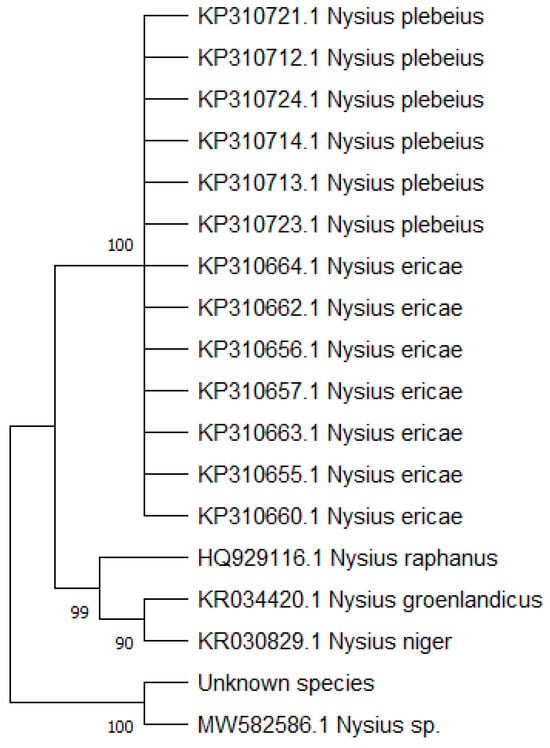
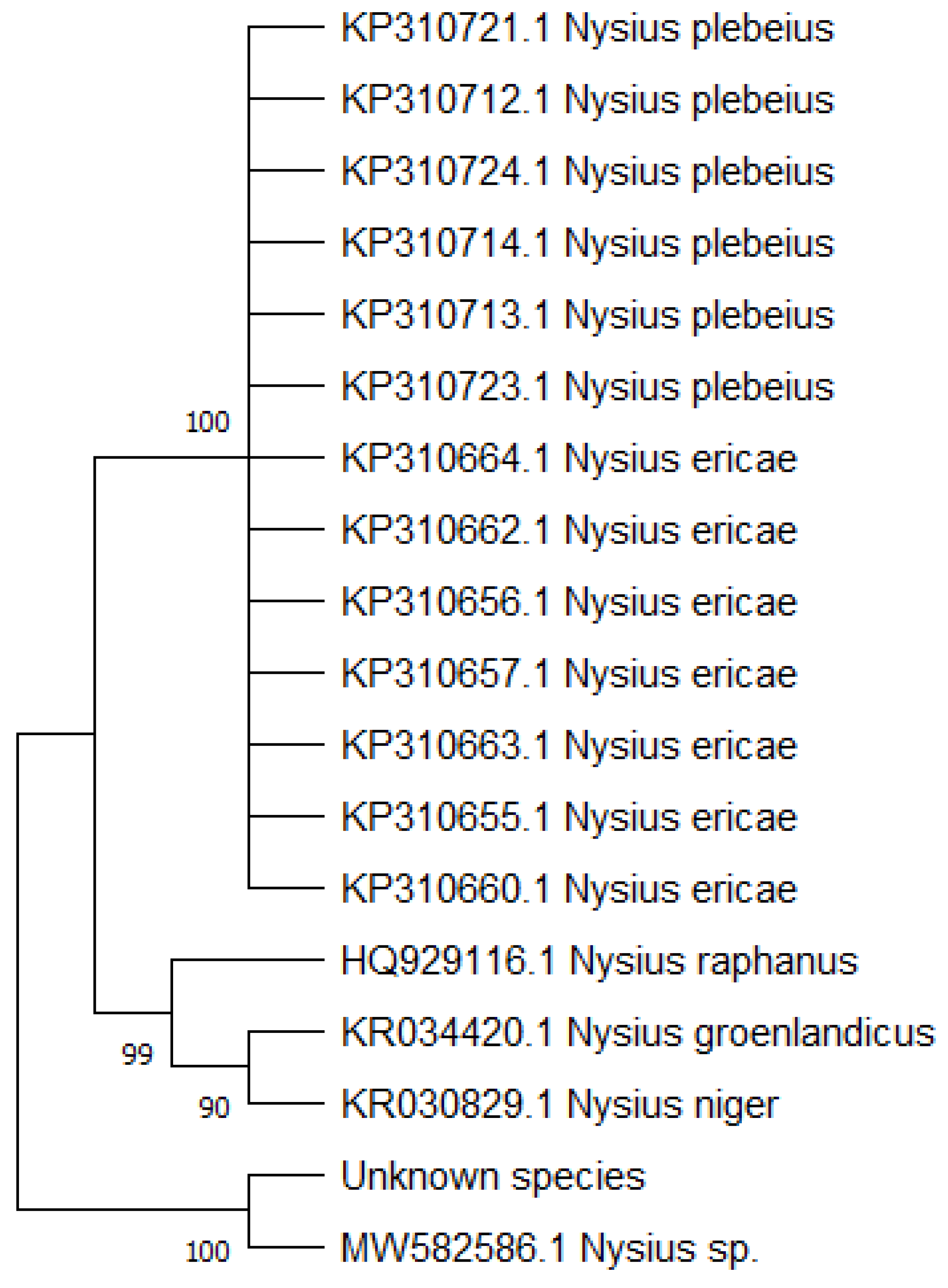
The COI gene sequence was used to construct a phylogenetic tree. The gene sequence of the unknown species sequenced in this experiment was selected, and related sequences were downloaded from the NCBI database (NCBI accession numbers KP310721.1, KP310712.1, KP310724.1, KP310714.1, KP310713.1, KP310723.1, KP310664.1, KP310662.1, KP310656.1, KP310657.1, KP310663.1, KP310655.1, KP310660.1, HQ929116.1, KR034420.1, KR030829.1, and MW582586.1) to construct a phylogenetic tree.
2.3. Morphological Characteristic Observation
Based on the collected specimens, dissection was carried out under a Leica S6 dissecting microscope, the manufacturer is Leica Microsystems (Wetzlar, Germany). And the morphological characteristics were photographed using a KEYENCE CORPORATION super-depth-of-field microscope imaging system, the manufacturer is Genesis Co., Ltd. (Shanghai, China). All the photos were stitched together using Photoshop software 2024 (25.0).
2.4. Investigation of N. ericae in the Field
The field investigation site was an Anji white tea garden in Jiepai Town, Hengyang County, Hengyang City, Hunan Province. The investigation was conducted every ten days from 10 April 2023. The tea trees at the survey site were divided into lower (0–40 cm), middle (40–80 cm), and upper (80–120 cm) parts. Three repeated survey communities were set up, each with an area of 1 acre. And the communities were independent of each other and did not interfere with each other. The five-point sampling method was used to conduct surveys in each community, with 10 tea trees surveyed at each point [19].
2.5. Laboratory Toxicity Assay of Matrine on N. ericae
Fresh tea leaves were soaked in different concentrations of matrine solution for 10 s and dried naturally, with 70% acetone aqueous solution taken as the control. And then the tea leaves soaked in different concentrations of matrine were put into a culture dish (9 cm in diameter and 1.5 cm in height), respectively. Finally, nymphs and adults of N. ericae with consistent growth status after 2 h of starvation treatment were placed in the culture dish immediately. The nymphs were at the 3rd instar and had a body length of approximately 2 mm. Each treatment tested 20 insects and was repeated 3 times. 24 h after exposure, the survival state of the insects in each treatment was examined. If the brush touched the surface of the insects, no reaction was judged as death. The number of dead insects was recorded, and the mortality of N. ericae was calculated based on the equation below:
where m1 = the number of dead insects and m2 = the number of total insects measured [20].
Mortality rate (%) = (m1/m2) × 100%
2.6. Data Analysis
The data from the aforementioned experiments (2.4 and 2.5) were organized using Microsoft Excel 2016, and the graphs were drawn and stitched together using Microsoft Excel and Photoshop 2024 (25.0). And the differences in data in experiments (2.4 and 2.5) were analyzed using SPSS Statistics, Version 17.0, 2009 (International Business Machines Corporation, Armonk, NY, USA).
3. Results
3.1. Molecular Identification
The specific information of the bug sample was shown in Table 3. In April 2023, adult samples were collected from Jiepai Town, Hengyang County, Hengyang City, Hunan Province, for COI gene sequencing. After splicing and removing the forward and reverse primer sequences, the length of the sequence was 678 bp. The sequence has been uploaded to NCBI, and the accession number is PX931116. The base sequence was complete, without any insertions or deletions. The proportions of each base were as follows: A = 33.67%, C = 15.23%, G = 15.08%, and T = 36.02%. The average content of A + T was 69.69%, and the average content of G + C was 30.31%, showing a clear preference for A + T bases. The sequencing result indicated that the sample classification status was Nysius sp.
Table 3.
Related information of the sample.
As shown in Figure 1, the phylogenetic tree constructed using the maximum likelihood method in MEGA11 showed that our unknown samples clustered together with Nysius sp. (NW582586.1). The closely related species N. plebeius (KP310721.1, KP310712.1, KP310724.1, KP310714.1, KP310713.1, KP310723.1) and N. ericae (KP310664.1, KP310662.1, KP310656.1, KP310657.1, KP310663.1, KP310655.1, KP310660.1) also clustered together, indicating a high degree of similarity between these two species. It is difficult to distinguish them based solely on the COI gene sequence comparison. The pest samples collected from the tea garden may belong to N. plebeius or N. ericae through molecular identification.
Figure 1.
Tree based on the analysis of COI.
3.2. Identificationof Morphological Characteristic
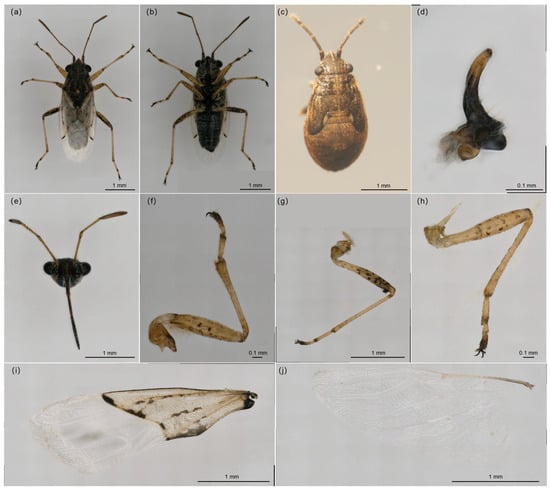
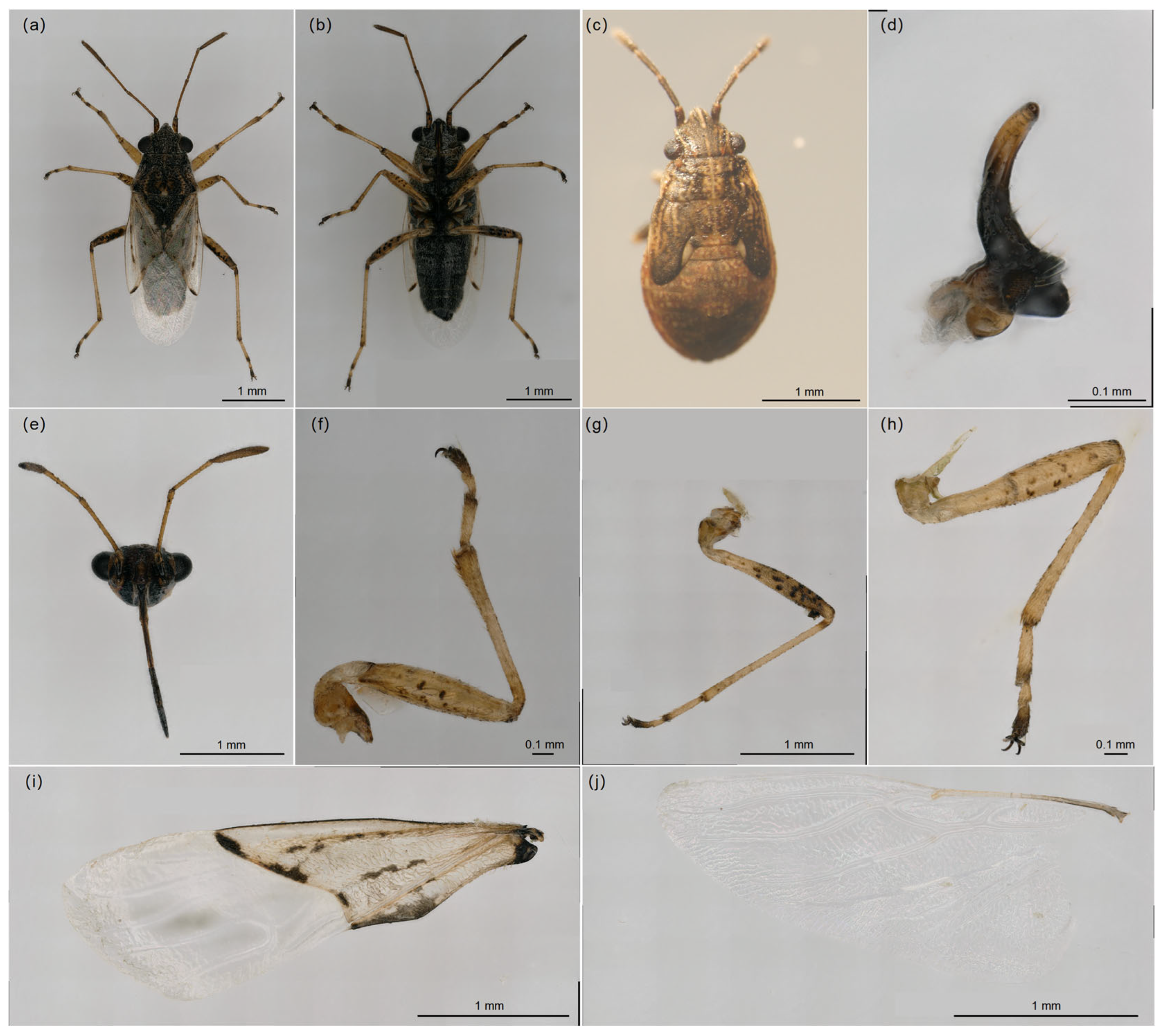
As shown in Figure 2, the adult’s body shape was slightly rectangular, with a length of 3.9–4.8 mm and a width of 1.4–1.7 mm. The body color was brown, and it had 2 antennae and 6 legs (Figure 2a,b). The head was triangular, with a lighter base at the top of the head. The anterior thoracic dorsal plate was relatively short and wide, with dense, uniform, and large points (Figure 2c). Inner projection of genitalia with a broad concave blade, and the blade is obviously curved (Figure 2d). The antennae had 4 segments, densely covered with hairs. The first segment was thick and short, the remaining 3 segments were almost equal in length, and the fourth segment was rod-shaped (Figure 2e). The feet had white fur and multiple large purple-brown spots (Figure 2f–h). The leathery part of the forewings was densely covered with hairs, with black markings at the ends; the membranous wing was gray-white and transparent, while the hindwings were transparent, with the ends extending much beyond the abdomen (Figure 2a,i,j). And the nymphs had a similar appearance to adults. After comparing the morphological characteristics (such as genitalia) with relevant literature, the morphological characteristics of the bug were identified as N. ericae (Schilling, 1829) [9].
Figure 2.
Morphological characteristics of the sample include the dorsal (a) and anterior (b) sides of the adult, the dorsal side of the head thorax (c), and the genital (d), antennae (e), forelimbs (f), midlegs (g), and hindlegs (h), as well as forewings (i) and hindwings (j).
3.3. Field Investigation on the Damage of N. ericae
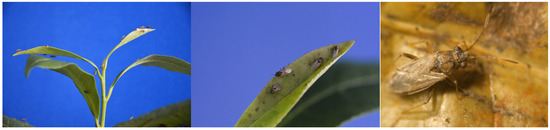
We observed for the first time in a tea garden that N. ericae damaged the tender branches and leaves of tea trees, mainly through the sucking of sap from tea plant tissues by adults and nymphs, causing damage in clusters. The population density of N. ericae was high, and the number on a single branch could reach dozens or even hundreds. The affected tea leaves curl, yellow, and wither, and in severe cases, even fall off, hindering growth and ultimately failing to sprout (Figure 3). N. ericae liked to move towards the sunny side of the tea tree bushes and was most active on sunny days with no wind and high temperatures. After moving the branch, it fell down and appeared to be pretending to be dead. Its traces could also be found in the weed bushes next to the tea garden. In addition, investigation has found that the damage caused by N. ericae was also accompanied by the occurrence of sooty mold.
Figure 3.
N. ericae feeds on tea leaves.
3.4. Spatial and Temporal Dynamic Distribution of N. ericae in the Field
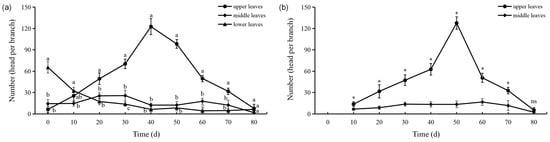
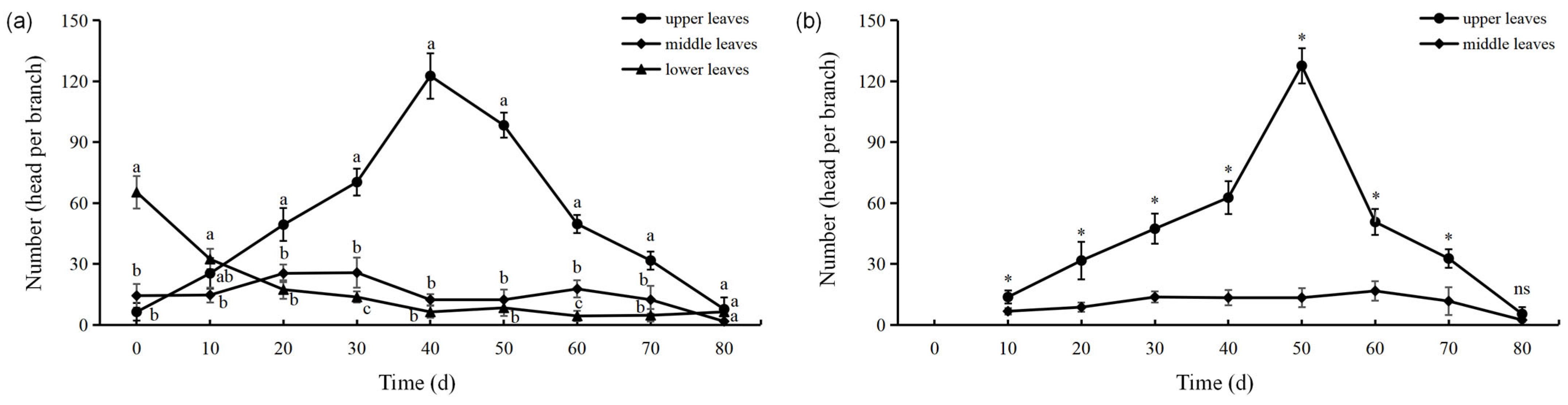
The field dynamic investigation results of N. ericae were shown in Figure 4. From the perspective of spatial dynamic distribution, N. ericae had the highest distribution in the upper leaves, indicating that it mainly fed on the upper leaves of tea trees. And from the perspective of temporal dynamic distribution, the nymphs of N. ericae began to appear on 10 April (i.e., day 0), and the adults of N. ericae began to occur on 20 April (i.e., day 10). Then the number continued to rise; the number of nymphs reached its peak on 20 May (i.e., day 40), with 122.67 ± 11.14 heads per branch of upper leaves, and the number of adults reached its peak on 30 May (i.e., day 50), with 127.67 ± 8.74 heads per branch of upper leaves. Finally, the number of nymphs and adults rapidly decreased, and the traces were difficult to find by 29 June (i.e., day 80).
Figure 4.
Spatial and temporal dynamic distribution of nymphs (a) and adults (b) of N. ericae in the field. Data are presented as mean ± standard error (SE). In Figure 4a, different letters above bars indicate significant differences in the number of nymphs at the same time point due to different parts of tea trees at the p < 0.05 level based on Duncan’s multiple range test (n = 3). In Figure 4b, ‘*’ represents a significant difference in the number of adults at the same time point between two parts of tea trees at p < 0.05 level based on Tukey’s HSD test, and ‘ns’ represents no significant difference in the number of adults at the same time point between two parts of tea trees (n = 3).
3.5. Laboratory Toxicity Assay of Matrine on N. ericae
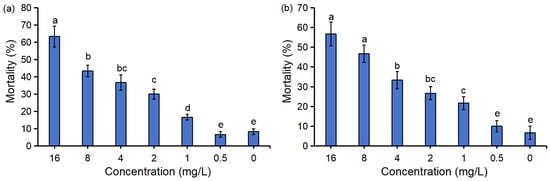
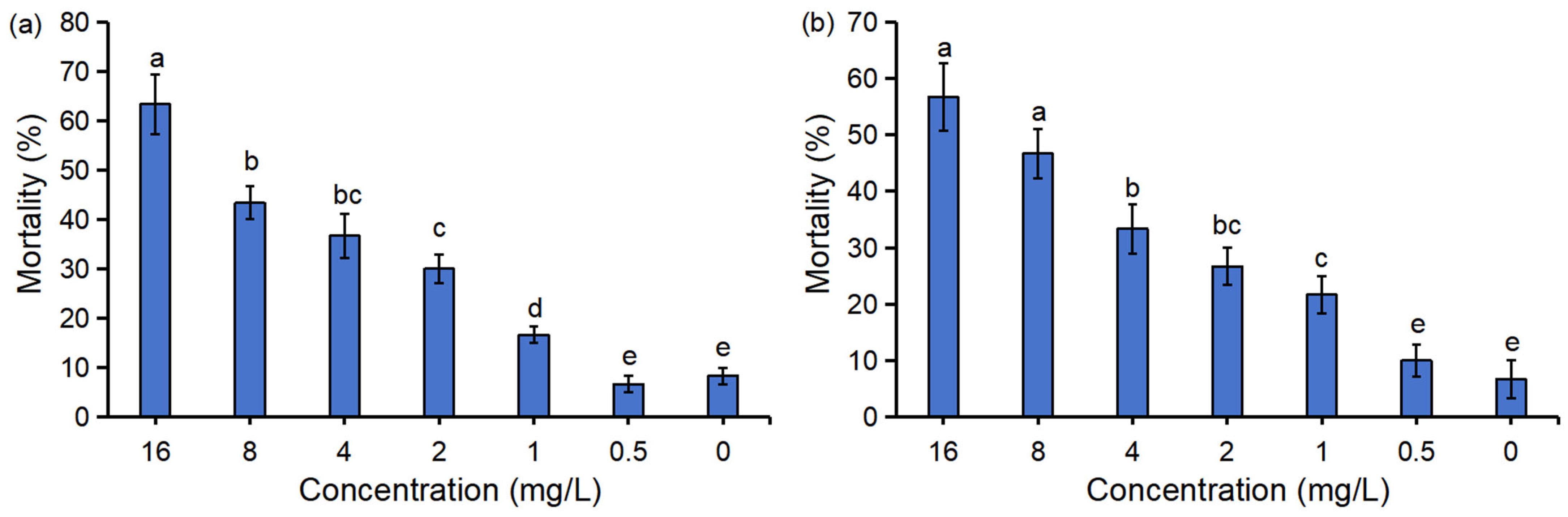
The laboratory toxicity results of matrine exposure to N. ericae for 24 h are shown in Figure 5. It can be seen that after feeding tea leaves treated with different concentrations of matrine (0.5~16 mg/L), the mortality rates varied significantly with respective concentrations. Mortality rates of 63.33 ± 6.01% and 56.67 ± 6.01% were evident when the nymphs and adults were fed with tea leaves treated with matrine at 16 mg/L. The mortality rates of nymphs and adults gradually decreased with the concentration decrease and became only 6.67 ± 1.67% and 10.00 ± 2.89% at the concentration of 0.5 mg/L. On the contrary, the mortality rates of nymphs and adults fed with tea leaves without matrine were only 8.33 ± 1.67% and 6.67 ± 3.33%, which were significantly lower than the matrine (1~16 mg/L) treatment group.
Figure 5.
Mortality rates of the nymphs (a) and adults (b) of N. ericae after 24 h of feeding with tea leaves treated with different concentrations of matrine. The ‘0’ on the x-axis was the control, which means tea leaves without matrine. Data are presented as mean ± SE. Different letters above bars indicate significant differences in mortality among treatments due to concentration effects at the p < 0.05 level based on Duncan’s multiple range test (n = 3).
Through further calculations, we calculated that the LC50 values of matrine to nymph and adult N. ericae after 24 h of exposure were 11.96 mg/L and 13.54 mg/L, respectively; the 95% confidence limit was 7.39~19.36 mg/L and 7.36~24.90 mg/L, respectively; and the correlation coefficients were 0.9784 and 0.9930, respectively (Table 4). The above results indicated that matrine (1~16 mg/L) had significant laboratory toxicity against both nymphs and adults of N. ericae.
Table 4.
Toxicity of matrine against nymphs and adults of N. ericae after 24 h of exposure.
4. Discussion
In 2023, during a pest monitoring survey in tea gardens, we discovered a new tea pest that has caused significant losses to local tea production. The new pest was identified as Nysius sp. through COI gene sequence comparison (Figure 1 and Table 3). At present, the study of molecular identification in Nysius sp. is still in its infancy; the mitochondrial genome sequence database of the Nysius sp. genus is limited, and the intraspecific differences within the genus are relatively small [21,22,23]. For example, N. plebeius has a very close genetic relationship with N. ericae, so relying solely on COI gene sequence analysis cannot accurately identify the species. Observation of morphological characteristics is needed to ensure accurate species identification. After observation, this new pest was identified as N. ericae (Figure 2).
This was the first discovery of the damage caused by N. ericae on tea trees. However, the cause of the damage to tea trees still requires further clarification. Firstly, the host range of N. ericae is wide, which can not only damage various economic crops such as mulberry trees, but also feed on surrounding weeds [24]. The host switching ability makes the dispersal ability of N. ericae stronger, and it is also a possible reason for the outbreak in tea gardens. Secondly, we found that the outbreak may be related to environmental factors such as temperature and humidity. N. ericae was more prevalent on windless days with high temperatures, whereas its activity was reduced on rainy days (Figure 3). After entering April 2023, temperatures increased, and rainfall was low. Nymphs of N. ericael appeared in early April, mixed with adults in mid-April, and reached their peak in mid to late May. After late June, as rainfall increased, N. ericae gradually disappeared, and only a very small number of insect strikes were found in tea gardens and weeds (Figure 4). Previous study has also observed the same phenomenon in mulberry orchards [24,25], and the investigation period was during a period of high temperature and drought, which may also be one of the reasons for the outbreak of N. ericae. The temporal dynamic distribution results of N. ericae and weather data showed that the occurrence of N. ericae may be closely related to temperature and humidity, and the environment of high temperature and drought was conducive to the occurrence of N. ericae.
Nysius ericae has multiple hosts, strong reproductive ability, and is prone to outbreaks and damage under suitable climatic conditions [26]. Thus, the prevention and control of N. ericae should adopt the plant protection policy of “prevention comes first and with comprehensive approach”, combined with various means such as agricultural control and biological control [27,28]. Weeds are important wintering grounds for N. ericae; timely removal of weeds in autumn, winter, or early spring, deep plowing, and soil turning can reduce the number of N. ericae infections [24]. As a popular beverage, tea has very strict Maximum Residue Limits (MRLs) [29]. Therefore, the application of biopesticides to prevent tea pests is in line with the Farm to Fork Strategy under the European Green Deal and the United Nations’ 2030 Agenda for Sustainable Development, enabling the transition to more sustainable tea production [19,20]. The results showed that matrine had significant laboratory toxicity to N. ericae (Figure 5 and Table 4), and N. ericae was mainly distributed in the upper leaves of tea trees (Figure 4). Hence, in severe infestations of N. ericae, spraying matrine onto the upper leaves of tea trees could be used for prevention and control. And in mild cases of N. ericae, strengthening agricultural management and using natural enemies for prevention and control could be considered. In addition, during the investigation, we also found that N. ericae was infected by Beauveria bassiana, and the tea garden had not used this microbial agent for a long time, indicating the existence of Beauveria bassiana in nature that controls this insect. We can also consider using biological agents such as Beauveria bassiana to prevent and control N. ericae.
5. Conclusions
Our study for the first time discovered a new pest of tea trees and identified it as N. ericae through COI gene sequence analysis and morphological characteristics identification. The field investigation results showed that the occurrence dynamics of this pest in tea gardens had obvious temporal and spatial characteristics. The climate of high temperature and drought was conducive to the occurrence of N. ericae, and this pest mainly fed on the upper leaves of tea trees. Moreover, matrine had significant laboratory toxicity to N. ericae. Our research results provide an important scientific foundation for the monitoring, early warning, and control of N. ericae in tea gardens, which is of great significance for ensuring the ecological security and tea quality of tea gardens.
Author Contributions
Conceptualization, S.L. and L.X.; methodology, L.X.; software, W.Y.; validation, H.Y. and L.Z.; formal analysis, Q.B.; investigation, Z.W.; resources, Y.W.; data curation, Q.B.; writing—original draft preparation, S.L.; writing—review and editing, S.L. and Q.B.; visualization, L.X.; supervision, Q.B.; project administration, L.X.; funding acquisition, Q.B. and Y.W. All authors have read and agreed to the published version of the manuscript.
Funding
This research was funded by the National Key Research and Development Program of China (2022YFD1600803), the Hunan Agricultural Science and Technology Innovation Project Funding (2024CX21), the Key Research and Development Program of Hunan Province (2023NK2013), and Major Scientific and Technological Innovation Projects in Hunan Province (2021NK1020).
Data Availability Statement
The data presented in this study are available from the corresponding author on reasonable request.
Acknowledgments
The authors thank Shi Kai from Inner Mongolia University for Nationalities for the verification and identification of the specimens.
Conflicts of Interest
The authors declare no conflicts of interest.
References
- Li, M.R.; Ho, C.T.; Wang, J.; Hu, Y.M.; Zhai, X.T.; Zhang, L.; Wan, X.C.; Yang, X.G. Formation of volatile heterocyclic compounds and open-chain amides of theanine in model systems with glucose, tea leaves, and tea extract under tea-roasting conditions. J. Agric. Food Chem. 2022, 70, 6737–6746. [Google Scholar] [CrossRef] [Scilit]
- Chen, Z.; Wang, Z.; Yuan, H.; He, N. From tea leaves to factories: A review of research progress in l-theanine biosynthesis and production. J. Agric. Food Chem. 2021, 69, 1187–1196. [Google Scholar] [CrossRef] [Scilit]
- Wang, L.G.; Liu, D.D.; Jiao, X.Y.; Wu, Q.; Wang, W.J. The serine acetyltransferase (SAT) gene family in tea plant (Camellia sinensis): Identification, classification and expression analysis under salt stress. Int. J. Mol. Sci. 2024, 25, 9794. [Google Scholar] [CrossRef] [Scilit]
- Sharma, E.; Joshi, R.; Gulati, A. l-theanine: An astounding sui generis integrant in tea. Food Chem. 2018, 242, 601–610. [Google Scholar] [CrossRef] [Scilit]
- Chen, Z.M.; Luo, Z.X. Management of insect pests on tea plantations: Safety, sustainability, and efficiency. Annu. Rev. Entomol. 2025, 70, 359–377. [Google Scholar] [CrossRef] [Scilit] [PubMed]
- Zhu, J.Y.; He, Y.X.; Yan, X.M.; Liu, L.; Guo, R.; Xia, X.; Cheng, D.J.; Mi, X.Z.; Samarina, L.; Liu, S.R.; et al. Duplication and transcriptional divergence of three Kunitz protease inhibitor genes that modulate insect and pathogen defenses in tea plant (Camellia sinensis). Hortic. Res. 2019, 6, 126. [Google Scholar] [CrossRef] [Scilit]
- Wang, Y.N.; Tang, L.; Hou, Y.; Wang, P.; Yang, H.; Wei, C.L. Differential transcriptome analysis of leaves of tea plant (Camellia sinensis) provides comprehensive insights into the defense responses to Ectropis oblique attack using RNA-Seq. Funct. Integr. Genom. 2016, 16, 383–398. [Google Scholar] [CrossRef] [Scilit]
- Yan, S.; Yu, J.; Han, M.; Michaud, J.P.; Guo, L.L.; Li, Z.; Zeng, B.; Zhang, Q.W.; Liu, X.X. Intercrops can mitigate pollen-mediated gene flow from transgenic cotton while simultaneously reducing pest densities. Sci. Total Environ. 2020, 711, 134855. [Google Scholar] [CrossRef] [Scilit] [PubMed]
- Ge, X.; Li, J. Review of the genus Nysius Dallas from Mongolian Plateau (Hemiptera: Heteroptera: Orsillidae). Zootaxa 2019, 4560, 171–183. [Google Scholar] [CrossRef] [Scilit]
- Zhao, P.; Chen, S.; Liu, Y.; Wang, J.; Chen, Z.; Li, H.; Cai, W. Review of the genus Sycanus Amyot & Serville, 1843 (Heteroptera:Reduviidae: Harpactorinae), from China based on DNA barcoding and morphological evidence. Insects 2024, 15, 165. [Google Scholar] [PubMed]
- Jiang, Z.; Wang, J.; Xu, Z.; Kitching, I.; Huang, C.; Hu, S.; Xiao, Y. Revision of the genus Rhagastis Rothschild & Jordan, 1903 (Lepidoptera: Sphingidae) from China, based on morphological and phylogenetic analyses. Insects 2024, 15, 359. [Google Scholar] [CrossRef] [Scilit]
- Liu, J.; Xu, H.; Wang, Z.; Li, P.; Yan, Z.; Bai, M.; Li, J. Phylogenetics, molecular species delimitation and geometric morphometrics of all reddish-brown species in the genus Neotriplax Lewis, 1887 (Coleoptera: Erotylidae: Tritomini). Insects 2024, 15, 508. [Google Scholar] [CrossRef] [Scilit]
- Gostel, M.; Kress, W. The expanding role of DNA barcodes: Indispensable tools for ecology, evolution, and conservation. Diversity 2022, 14, 213. [Google Scholar] [CrossRef] [Scilit]
- Liang, F.; Zeng, W.; Li, S.; Liu, X. Species Delimitation in the Bark Louse Genus Neostenopsocus Liang & Liu, 2024 (Psocodea: Stenopsocidae) Based on DNA Barcoding. Insects 2025, 16, 1147. [Google Scholar] [CrossRef] [Scilit]
- Hebert, P.; Cywinska, A.; Ball, S.; deWaard, J. Biological identifications through DNA barcodes. Proc. R. Soc. B-Biol. Sci. 2003, 270, 313–321. [Google Scholar] [CrossRef] [Scilit] [PubMed]
- Yakimenko, E.V.; Romanovich, A.E.; Lukhtanov, V.A. Questionable Species Names for Distinct Species Clusters: An Empirical Test of the BOLD Molecular Identification Engine. Insects 2025, 16, 1172. [Google Scholar] [CrossRef] [Scilit] [PubMed]
- Liu, Y.; Triapitsyn, S.V.; Zhang, D.; Wang, J.; Aishan, Z. Integrative Taxonomy of Polynema (Doriclytus) (Hymenoptera: Mymaridae) from Oriental China: Three New Species and Five New Records Revealed by Morphological and Molecular Analyses. Insects 2025, 16, 1166. [Google Scholar] [CrossRef] [Scilit]
- Li, X.; Zhang, X.; Zhai, J.; Lei, R.; Li, H. DNA barcode-targeted triplex droplet digital PCR for three high-risk soybean fungal pathogens in soybean seeds. Pest Manag. Sci. 2025. early view. [Google Scholar] [CrossRef] [Scilit]
- Lin, S.; Hu, X.; Ye, X.; Zhang, Z.; Xu, H. Promoted Growth of Sweet Potato Root by Bacillus amyloliquefaciens HN11 and Enhanced Uptake of Fosthiazate. Agronomy 2025, 15, 1098. [Google Scholar] [CrossRef] [Scilit]
- Lin, S.; Qin, D.; Zhang, Y.; Zheng, Q.; Yang, L.; Cheng, D.; Huang, S.; Chen, Q.; Zhang, Z. Toxicity and Sublethal Effects of Autumn Crocus (Colchicum autumnale) Bulb Powder on Red Imported Fire Ants (Solenopsis invicta). Toxins 2020, 12, 731. [Google Scholar] [CrossRef] [Scilit]
- Golub, N.V.; Anokhin, B.A.; Kuznetsova, V.G. Karyotype diversity in the genus Nysius Dallas, 1852 (Hemiptera, Heteroptera, Lygaeidae) is much greater than you might think. Comp. Cytogenet. 2023, 17, 287–293. [Google Scholar] [CrossRef] [Scilit]
- Noer, N.K.; Nielsen, K.L.; Sverrisdóttir, E.; Kristensen, T.N.; Bahrndorff, S. Temporal regulation of temperature tolerances and gene expression in an arctic insect. J. Exp. Biol. 2023, 226, jeb245097. [Google Scholar] [CrossRef] [Scilit]
- Carapelli, A.; Brunetti, C.; Cucini, C.; Cardaioli, E.; Soltani, A.; Amri, M.; Mediouni Ben Jemâa, J.; Fanciulli, P.P.; Nardi, F. The mitogenome of the true bug Nysius cymoides (Insecta, Heteroptera) and the phylogeny of Lygaeoidea. Mitochondrial DNA B Resour. 2021, 6, 2366–2368. [Google Scholar] [CrossRef] [Scilit] [PubMed]
- Yang, B.; Shi, S. New pest in mulberry fields-Nysius ericae. Seric. Notif. 1999, 3, 44. [Google Scholar]
- Zhou, Z.; Shi, K. Research on the Diversity and Biological Characteristics of the Entomophthorales in Tongliao City. J. Inn. Mong. Univ. Natl. 2017, 6, 526–529. [Google Scholar] [CrossRef]
- Xie, Y.; Zhang, C.; Pu, J.; An, H.; Lian, Y.; Liu, Y. Preliminary study on the occurrence and damage of the new pest of wolfberry, Nysius ericae. J. Agron. 2018, 11, 27–30. [Google Scholar]
- Adjei, M.O.; Yu, R.; Cao, X.; Fan, B. The Mechanisms of Bacillus subtilis as a Plant-Beneficial Rhizobacterium in Plant-Microbe Interactions. Microorganisms 2025, 13, 2823. [Google Scholar] [CrossRef] [Scilit]
- Paiu, M.; Favier, L.; Gavrilescu, M. Assessing the Ecotoxicological Effects of Emerging Drug and Dye Pollutants on Plant-Soil Systems Pre- and Post-Photocatalytic Wastewater Treatment. Plants 2025, 14, 3835. [Google Scholar] [CrossRef] [Scilit]
- Li, P.; Chen, M.; Yao, T.; Wu, L.; Wang, S.; Han, Y.; Song, Y.; Yin, J. Research Progress of Biosensors in the Detection of Pesticide Residues and Heavy Metals in Tea Leaves. Biosensors 2025, 15, 778. [Google Scholar] [CrossRef] [Scilit]

Disclaimer/Publisher’s Note: The statements, opinions and data contained in all publications are solely those of the individual author(s) and contributor(s) and not of MDPI and/or the editor(s). MDPI and/or the editor(s) disclaim responsibility for any injury to people or property resulting from any ideas, methods, instructions or products referred to in the content. |
© 2026 by the authors. Licensee MDPI, Basel, Switzerland. This article is an open access article distributed under the terms and conditions of the Creative Commons Attribution (CC BY) license.