1. Introduction
Mollisols represent one of the most critical agricultural soil resources, characterized by a humus-rich plow layer, high organic carbon (C) content, and diverse microbial communities that collectively underpin soil fertility, food production, and global C cycling [
1,
2,
3]. However, prolonged intensive cultivation and excessive use of chemical fertilizers have resulted in substantial declines in soil organic C (SOC), disruption of aggregate structure, and degradation of biological functions [
4,
5]. The incorporation of organic residue into croplands has been recognized as an effective strategy to restore soil fertility and enhance C sequestration capacity [
6,
7,
8]. Nevertheless, the transformation and stabilization of organic residue in soil vary widely with their source and degree of decomposition, and the microbial molecular mechanisms governing these C sequestration processes remain insufficiently understood.
Recently, with the advancement of metagenomics, stable isotope probing (SIP), quantitative SIP (qSIP), and multi-omics integrative analyses, it has become increasingly recognized that C sequestration in agricultural soils is not solely dependent on plant photosynthetic inputs but also involves autotrophic and mixotrophic C assimilation processes mediated by bacteria, archaea, and fungi [
9,
10,
11,
12]. In particular, during the decomposition of organic residue, the formation of reductive microenvironments within the soil—such as anaerobic microsites and Fe
3+, SO
42− reduction zones—creates favorable conditions for diverse autotrophic metabolic pathways [
13,
14,
15]. Through multiple metabolic routes, including the Wood–Ljungdahl pathway (WLP, also known as the acetyl-CoA pathway), the 3-hydroxypropionate (3-HP) cycle, the reverse tricarboxylic acid (rTCA) cycle, and the Calvin-Benson cycle, these microorganisms fix CO
2 and synthesize organic C [
16,
17,
18,
19]. The resulting products, after cell death, contribute to microbial necromass C (MNC) and are preserved in soil mineral-organic associations and aggregate structures [
20,
21,
22,
23].
However, substantial knowledge gaps remain regarding the molecular mechanisms governing microbial C sequestration during the decomposition of organic residues in Mollisols. Critical questions include how variation in residue types and chemical complexity shapes the selection of microbial metabolic pathways and energy-coupling modes; how redox conditions and specific electron acceptors regulate microbial ecology across distinct C sequestration pathways; and how the long-term stabilization of microbial metabolites and necromass is controlled by mineral interfaces and aggregate protection. To address these scientific questions, this paper systematically synthesizes recent advances on organic residue decomposition, microbial C sequestration, molecular ecological networks, and their effects on soil C pools. It focuses on elucidating the molecular mechanisms and key regulatory factors of microbial C sequestration in Mollisols, as well as its ecological significance in enhancing soil C sinks.
2. Research Background and Problem Statement
2.1. Ecological Characteristics of Organic Residue Decomposition in Mollisols
Mollisols are characterized by a high cation exchange capacity and a stable organic matter structure, in which abundant humic acids and minerals together form a complex C pool system [
1,
3]. However, under long-term agricultural management, soil structural disruption and frequent redox fluctuations have rendered the decomposition of organic residue highly heterogeneous [
24,
25]. In Mollisols, organic residue undergo a multi-stage transformation process from the rapid mineralization of soluble fractions to the slow degradation of recalcitrant components such as lignin and phenolic compounds during which distinct microbial communities respond at different temporal scales [
26,
27,
28]. Recent studies have revealed that in the early stages of organic residue decomposition, heterotrophic microorganisms dominate the breakdown of exogenous C and the releases of energy, providing substrates and electron donors for autotrophic and mixotrophic microorganisms [
29,
30]. Heterotrophic microorganisms constitute a central pathway of microbially mediated C sequestration, operating through the anabolic processing of organic matter constituents rather than direct CO
2 fixation. This process begins with the extracellular depolymerization of complex plant and microbe-derived polymers (e.g., cellulose, hemicellulose, lignin, proteins) into low molecular weight substrates that microorganisms can assimilate [
7,
18]. These substrates are subsequently partitioned between mineralization to CO
2 and incorporation into microbial biomass, with C use efficiency acting as a primary control on the fraction of substrate C entering biosynthetic pathways. At later, more reduced stages of organic residue decomposition, acetogenic bacteria (e.g.,
Acetobacterium) fix CO
2 via the WLP to produce acetate, while autotrophic sulfate (SO
42−) reducers (e.g.,
Desulfobacter,
Desulfobacterium lineages) can fix CO
2 via rTCA under SO
42− reducing conditions. Concurrently, methanogens become increasingly active, with hydrogenotrophic taxa reducing CO
2 to CH
4, and acetoclastic taxa such as
Methanothrix converting acetate to CH
4 as redox potential declines [
19]. This sequence is consistent with the prevalence of anaerobic microsites in soils and field evidence that management modulates methanogenic activity in Mollisols [
13,
31].
2.2. Key Pathways in Microbial C Sequestration Research
In recent years, research on soil microbial C sequestration has progressively shifted from the ecological process level to the molecular mechanism level [
12,
32,
33]. Studies based on
13C-SIP, transcriptomics, and metagenome-assembled genomes (MAGs) have revealed the presence of multiple active non-photosynthetic C sequestration pathways in soils [
9,
34,
35]. Among these, the WLP, characterized by its minimal Adenosine Triphosphate (ATP) requirement and broad substrate adaptability, is recognized as the most important autotrophic sequestration mechanism under anaerobic conditions [
19,
36]. In Mollisols, genes associated with the 3-HP cycle are commonly detected alongside those encoding other CO
2 sequestration pathways, while the rTCA cycle represents a key reductive CO
2 assimilation route often linked to nitrate (NO
3−) respiring chemolithoautotrophs such as
Campylobacterota and
Epsilonproteobacteria [
11,
16,
18,
37].
3. Theoretical Framework and Scientific Significance
3.1. From “Decomposition-Dominated” to “Biosynthesis-Driven” C Dynamics
Traditional studies of the SOC cycle have largely focused on organic C decomposition and CO
2 emissions, while overlooking the role of microorganisms in C sequestration and synthetic stabilization [
10,
16,
38]. It would be useful to know, relative to plant derived inputs, how much CO
2 fixation contributes to C sequestration. The microbial C pump (MCP) theory provides a new paradigm for understanding C sequestration mechanisms in Mollisols [
1,
10]. This concept posits that during microbial assimilation of CO
2 and exogenous organic C, microorganisms produce high-molecular weight, recalcitrant cellular residues and extracellular polymeric substances (EPS) [
39,
40]. Once these compounds are adsorbed onto minerals or encapsulated within microaggregates, they can persist over long timescales, forming a persistent soil C pool [
41]. The MCP framework not only emphasizes the dynamic balance between decomposition and synthesis but also highlights the central role of structurally stable microbial metabolites in long-term C storage [
42]. In Mollisol systems, the efficiency of the MCP is jointly regulated by the composition of organic inputs, microenvironmental redox conditions, and mineral protection mechanisms [
16,
22,
43]. Fourier-Transformed Cyclotron Resonance Mass Spectrometry (FT-ICR MS) and
13C-labeling experiments have demonstrated a significant accumulation of highly oxidized, microbially derived organic C fractions under long-term organic fertilization, suggesting that modulating microbial metabolic fluxes may effectively enhance the MCP effect [
44,
45,
46].
3.2. The Four-Dimensional Framework of “Substrate-Microenvironment-Metabolic Pathway-Residue Stabilization”
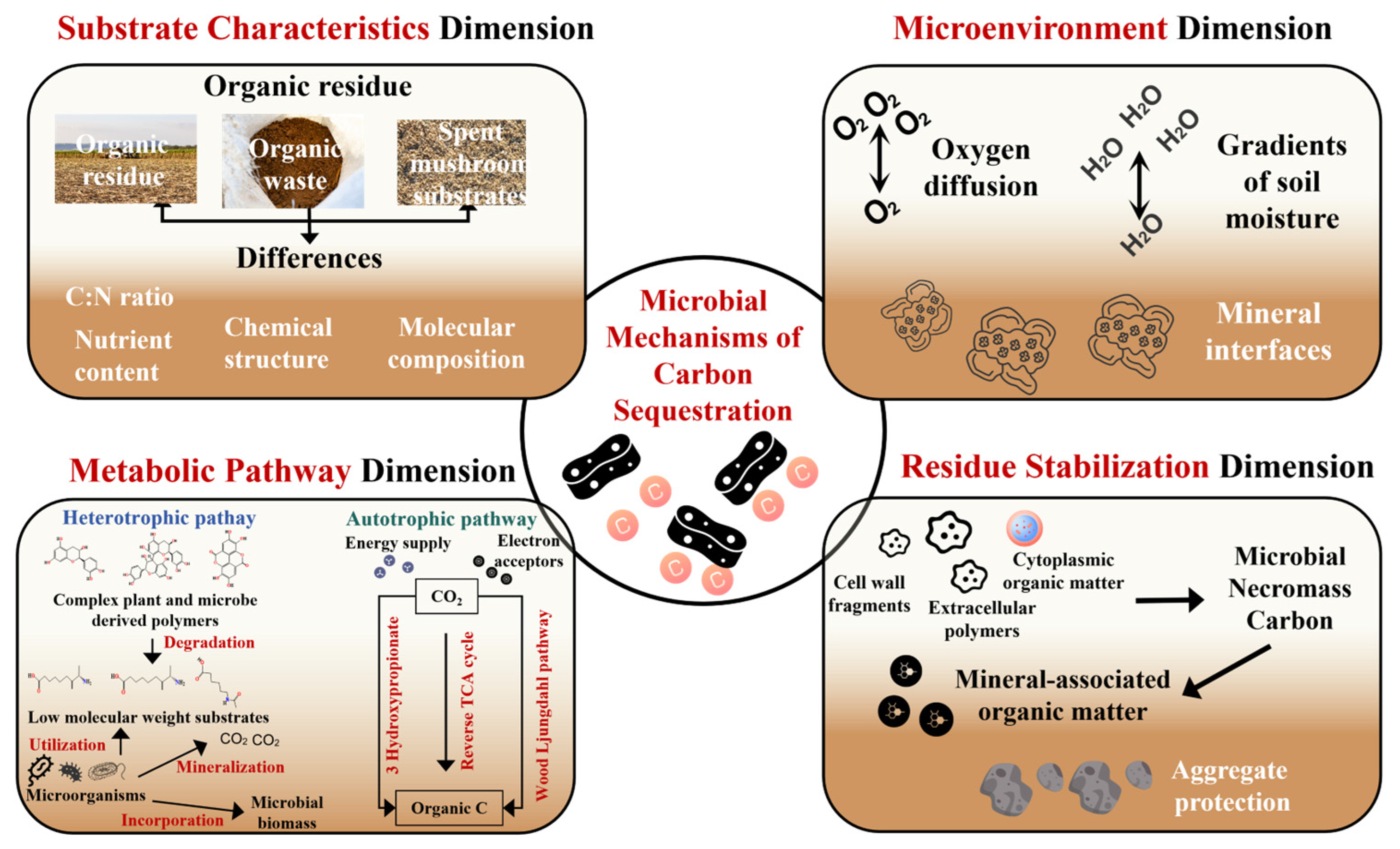
The diverse mechanisms involved in microbial C sequestration during the degradation of organic residues in Mollisols can be conceptualized within four interlinked dimensions (
Figure 1) and include: Substrate characteristics dimension, the characteristics of organic inputs (e.g., the C:N ratio, aromaticity, phenolic content) determines the initial decomposition rate and specific electron donors involved. Microenvironment dimension, gradients of soil moisture, O
2 diffusion, and mineral interfaces define the redox potential that drives metabolism of microorganisms. Metabolic pathway dimension, heterotrophic microorganisms form a major pathway of microbially mediated C sequestration by assimilating low molecular weight substrates generated through the extracellular depolymerization of complex organic polymers, with these substrates ultimately directed either toward CO
2 release or incorporation into microbial biomass. Complementing this heterotrophic mode of C assimilation, distinct autotrophic CO
2 fixation pathways which including the WLP, 3-HP, and the rTCA cycles also contribute to organic C accrual, with their relative importance governed by energy supply and the availability of suitable electron acceptors. Residue stabilization dimension, microbial metabolites such as EPS and cell wall fragments become stabilized through adsorption, encapsulation, and aggregate protection, contributing to the formation of stable C pools. This framework emphasizes the cross-scale coupling between molecular level reaction mechanisms and ecosystem scale C fate, providing a coherent theoretical basis for elucidating C sequestration processes in Mollisols.
3.3. The Significance of Studying Microbial C Sequestration in Mollisols
Systematically elucidating the molecular mechanisms underpinning microbial C sequestration during the degradation of organic residues in cropland soils represents not only a frontier question in understanding the formation of soil C sinks but also a critical theoretical basis for developing C neutral agriculture. Such research advances our ability to clarify how autotrophic and mixotrophic microorganisms cooperate in driving C sequestration through distinct metabolic fluxes, and how the molecular composition and chemical structure of microbial residues determine their stabilization via mineral association and aggregate protection processes essential for establishing robust indicators of SOC quality and for guiding the optimization of residue management strategies. It is important to note, however, that the microbial processes highlighted in this review which including microbial necromass formation, mineral-associated organic C (MAOC) stabilization, and aggregate-mediated protection are not unique to Mollisols. These mechanisms operate across diverse mineral soils and climatic regions. Mollisols are emphasized here because their large SOC stocks and pivotal role in temperate agroecosystems make them an especially informative and vulnerable model system. Our intention is therefore not to suggest exclusivity but to use Mollisols as a focal soil order through which microbial C sequestration pathways can be systematically synthesized.
4. Coupled Mechanisms Linking Organic Residue Composition, Microenvironment, Microbial Metabolism, and C Stabilization
4.1. Chemical Composition and Degradation Dynamics of Organic Residue
The chemical composition and degradation kinetics of different organic residues have been widely investigated, and converging evidence shows that these properties fundamentally shape the nutrient and energy fluxes that support microbial C sequestration pathways. Studies across Mollisols consistently report that crop residues, organic waste, and spent mushroom substrates differ markedly in their structural complexity and decomposition derived metabolites, leading to distinct microbial responses and C transformation pathways [
47]. Crop residues, enriched in cellulose, hemicellulose, and lignin, exhibit high C:N ratios and slow initial decay, yet their later stage release of aromatic and phenolic compounds can suppress oxidative enzyme activity and extend organic C residence times [
48,
49]. In contrast, organic waste with high N and soluble C contents rapidly stimulate heterotrophic metabolism and can transiently enhance the activity of autotrophic C fixing microorganisms [
50,
51]. Spent mushroom substrates, characterized by chitin and chitosan rich fungal residues, generate unique decomposition products that increasingly are recognized as important precursors of microbial necromass [
52,
53,
54]. Synthesizing these findings can find that the chemical structure of organic residues not only determines their decomposition pathways but also governs the formation of key microbial metabolites, including EPS and necromass that contribute to aggregate stabilization and mineral-organic association [
55,
56]. Importantly, comparative studies reveal substantial variation in how different residue types regulate substrate quality, energy availability, and electron donor supply, thereby modulating the relative contributions of heterotrophic and autotrophic microorganisms to soil C sequestration. These collective insights demonstrate that residue chemistry acts as a primary ecological filter shaping the microbial mechanisms of C stabilization in Mollisols.
4.2. Microenvironment Redox Heterogeneity and Electron-Acceptor Control
Mollisols possess a high specific surface area and strong water retention capacity, resulting in pronounced spatial heterogeneity in their internal redox environment. The distribution of electron acceptors across microenvironments directly determines the dominant microbial C sequestration pathways [
57,
58]. Under oxygen-rich conditions, chemolithoautotrophic microorganisms oxidize ammonium (NH
4+), S
2−, or Fe
2+ to release energy that drives CO
2 sequestration [
59]. In anaerobic or microaerobic soils, NO
3− often serves as the primary electron acceptor, facilitating the rTCA cycle. Under strongly reducing conditions, where Fe
3+, SO
42−, or CO
2 act as terminal electron acceptors, the WLP becomes the predominant route [
60]. Such microenvironmental heterogeneity gives rise to a characteristic vertical metabolic stratification in Mollisols, with oxidative conditions prevailing in surface layers, reductive processes dominating in deeper layers, and anaerobic niches developing within soil aggregates [
13,
61]. Over temporal scales, wet–dry cycles, and freeze–thaw processes dynamically alter the redox distribution, thereby periodically activating distinct C sequestration pathways [
62,
63]. This dynamic turnover maintains a long-term “C equilibrium” within the soil system.
4.3. Metabolic Mechanisms of Microbial C Sequestration Under Organic Residue Amendments
4.3.1. Metabolic Pathways
The WLP is the most energy efficient microbial autotrophic C sequestration route, primarily mediated by anaerobic bacteria and archaea [
19,
36,
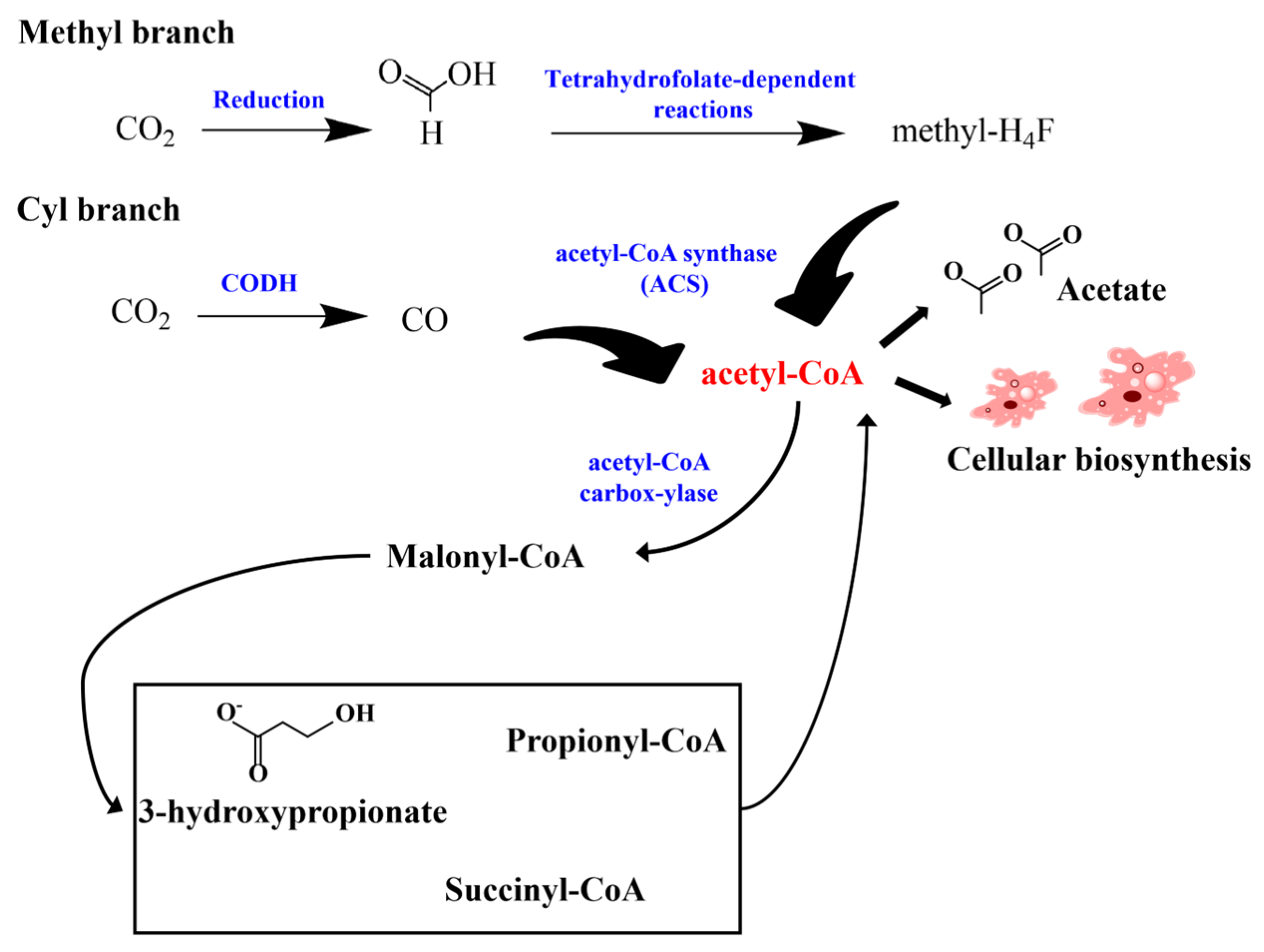
64]. This pathway comprises two complementary branches: the methyl branch and the Cyl branch (
Figure 2) [
65]. In the methyl branch, CO
2 is first reduced to formate and subsequently converted into methyl-H
4F through a series of tetrahydrofolate-dependent reactions [
66]. In the Cyl branch, CO
2 is reduced to CO by C monoxide dehydrogenase (CODH) [
67]. Finally, acetyl-CoA synthase (ACS) combines the products of both branches to generate acetyl-CoA, which can be used for cellular biosynthesis or released as acetate [
68]. During the degradation of organic residue in cropland Mollisols, the activity of the WLP is closely linked to the presence of reducing microenvironments. In the later stages of crop residues and organic waste decomposition, substantial oxygen consumption creates localized anaerobic microsites that provide favorable niches for WLP utilizing bacteria such as
Clostridium and
Acetobacterium [
15,
65,
69]. In Mollisols, acetate can serve both as a substrate for autotrophic biosynthesis and as a precursor transformed by microbial communities into EPS and microbial residue C, constituting an important source of the long-term C pool [
22,
55,
70,
71].
The 3-HP cycle was first identified and elucidated in
Chloroflexus (phylum
Chloroflexi), and is notable for its oxygen-insensitive enzyme [
72]. This pathway initiates with acetyl-CoA, which is carboxylated by acetyl-CoA carboxylase to form malonyl-CoA [
73,
74]. Through a series of reductive reactions, intermediates such as 3-hydroxypropionate, propionyl-CoA, and succinyl-CoA are generated, ultimately regenerating acetyl-CoA to complete the cyclic C assimilation process [
74,
75]. Although the 3-HP cycle requires higher energy input than the WLP, it can function efficiently in the presence of oxygen and exhibits strong tolerance to oxidative stress [
76]. Under agricultural management in Mollisols, surface soils (0–20 cm) frequently experience alternating redox conditions, particularly under crop residue mulching or no-tillage practices, which drive stratified microbial metabolic differentiation across soil depths [
77,
78,
79]. Moreover, the 3-HP cycle or the related 4-hydroxybutyrate cycle is widely distributed among soil archaea, whose key enzymes including 4-hydroxybutyryl-CoA dehydratase (
Hbd) and acetyl-CoA transferase (
Acs) exhibit high stability under low-oxygen and high-temperature conditions [
11,
80]. These biochemical properties indicate that 3-HP related pathways have the potential to contribute to C assimilation in oxidative microenvironments. However, direct evidence for their ecological functioning in Mollisols remains limited and requires further investigation.
The rTCA cycle represents a core C sequestration pathway that functions under strongly reducing conditions through metal-dependent electron transfer [
17,
81]. As one of the most ancient CO
2 assimilation mechanisms, it is primarily facilitated by soil bacteria inhabiting anaerobic or microaerophilic environments [
82]. In this pathway, the conventional TCA cycle operates in reverse, progressively reducing CO
2 to form acetyl-CoA. This process is catalyzed by key enzymes which are ATP-citrate lyase (
ACL), 2-oxoglutarate: ferredoxin oxidoreductase (
OGOR), and succinate dehydrogenase (
SDH) that require potent reductants, such as molecular hydrogen (H
2) or reduced metal ions to drive electron flow [
83]. Iron reduction has been increasingly recognized as a process that not only mediates organic matter decomposition but may also indirectly promote CO
2 assimilation by generating reduced electron donors [
84]. The organic acid intermediates produced by the rTCA cycle, such as succinate and pyruvate, can subsequently provide electron equivalents and C skeletons that fuel the WLP, whereas acetate generated through the WLP can re-enter the rTCA cycle to support continued C turnover [
85]. This reciprocal metabolic interaction suggests that rTCA and WLP-mediated CO
2 assimilation may operate synergistically within redox stratified microhabitats of Mollisols. Such coordination between reductive chemolithoautotrophic pathways likely contributes to the persistence of microbially derived C pools, thereby reinforcing long-term soil C sequestration in these high-C agroecosystems.
4.3.2. Interactions Among C Sequestration Pathways
In agricultural Mollisols, multiple C sequestration pathways do not operate in isolation but rather exhibit complementary and synergistic interactions across spatial, temporal, and energetic dimensions. During the initial stages of organic residue decomposition, when oxygen is abundant and labile C fractions such as dissolved organic C (DOC) are enriched, the 3-HP pathways are highly active [
47,
80,
86]. As the soil microenvironment becomes increasingly reduced, the WLP and rTCA pathways gradually dominate C sequestration and the reutilization of metabolic intermediates [
13,
18]. At the interfaces of soil aggregates and the rhizosphere, alternating redox conditions promote interactions among multiple C sequestration routes, forming complex metabolic networks [
87,
88]. This metabolic division of labor not only enhances the efficiency of C sequestration in Mollisols but also strengthens microbial functional redundancy and community stability. From the perspective of soil environmental heterogeneity, the 3-HP pathways represent “oxidative advantage” strategies adapted to energy-rich surface soils, whereas the WLP and rTCA pathways function as “reductive energy-conserving” strategies that sustain basal anabolic metabolism under energy-limited conditions [
13,
59]. The coexistence of these mechanisms ensures the continuity of C cycling in Mollisols under fluctuating moisture and redox regimes.
4.3.3. Molecular Mechanisms of C Sequestration Through “Reaction-Function-Coupling”
During the degradation of organic residue such as crop residue, organic waste, and spent mushroom substrates returned to cropland, soil microorganisms not only assimilate “input C” through heterotrophic pathways but also convert exogenous organic substrates into microbial biomass via a series of autotrophic C sequestration processes, which may subsequently contribute to the formation of persistent soil C pools [
46,
89]. In cropland Mollisols, long-term chemical fertilization has been shown to alter autotrophic microbial communities and reduce C sequestration rates significantly [
16,
90]. In contrast, the co-application of organic residue can mitigate this inhibitory effect.
- (1)
Fermentation-autotrophy Coupling Driven by Returned Organic residue
At the early stage of organic residue degradation, the fermentation-driven release of small molecules such as H
2, formate, acetate, and CO provide both reducing power and substrates for autotrophic C sequestration [
91]. Hydrogen and formate-producing bacteria co-metabolize with acetate-generating or acetate-consuming taxa, driving acetyl-CoA formation and reassimilation, and establishing syntrophic linkages with acetotrophic and hydrogenotrophic autotrophs [
30,
92]. In the cultivated layer of Mollisols (0–20 cm), this “fermentation–autotrophy” coupling is expected to be stronger under organic residue amendment and moderately moist or aerated microenvironments. In contrast, long-term chemical fertilization induced decreases in soil pH and increases in NO
3− concentration suppress the competitiveness of certain hydrogenotrophic autotrophic groups, thereby reducing the overall CO
2 sequestration potential [
16].
- (2)
Nitrifying Autotrophs: Concurrent N Oxidation and C Assimilation
In agricultural soils, ammonia (NH
3)-oxidizing bacteria (
AOB), NH
3-oxidizing archaea (
AOA), and complete NH
3-oxidizing Nitrospira (comammox Nitrospira) drive chemolithoautotrophic metabolism in oxygenated microzones by using inorganic electron donors such as NH
3 and NH
2OH [
93,
94,
95]. Through autotrophic C assimilation, these nitrifiers incorporate dissolved inorganic C (DIC) into microbial biomass, contributing to CO
2 sequestration [
11,
96]. Fertilizer N inputs, wet–dry alternation, and nitrification inhibitors modify the ecological niches of these autotrophic guilds and alter their contributions to C assimilation [
11,
93,
97,
98].
Extensive evidence shows that these environmental and management factors reorganize nitrifier communities by modifying substrate availability, local oxygen demand, and the energetic landscape of NH
3 oxidation [
99,
100]. Increased N fertilizer inputs elevate NH
4+ concentrations and steepen microscale oxygen gradient as intensified nitrification accelerates O
2 consumption [
101]. This shift creates ecological conditions that selectively favor
AOB over
AOA, a pattern consistently reported in Mollisols, where
AOB dominate nitrification under fertilization [
93].
AOA, by contrast, exhibit a broader biogeographic distribution but preferentially occupy low N or acidic microhabitats where substrate supply and redox constraints differ [
97]. Such niche partitioning directly influences autotrophic C assimilation, because
AOB and
AOA differ in their kinetics of NH
3 oxidation, in their tolerance to fluctuating oxygen availability, and in the expression of RuBisCO-mediated CO
2 fixation pathways [
11,
102]. Wet-dry alternation adds a further layer of ecological restructuring by periodically collapsing and re-establishing aerated channels within aggregates, thereby shifting competitive advantages between
AOB,
AOA and comammox-dominated microsites. Nitrification inhibitors impose yet another constrain by suppressing NH
3 oxidation and limiting energy supply for autotrophic biomass production, leading to measurable reductions in nitrifier abundance and activity in Mollisols [
98].
In Mollisols, the combined effect of elevated N inputs and aggregate structure intensifies
AOB-dominated microzones, which may reorganize RuBisCO-bearing autotrophic networks by shifting CO
2 assimilation toward
AOB-enriched hotspots at the expense of more spatially diffuse
AOA and comammox populations [
93,
97,
102]. This spatial reconfiguration has implications for soil C sequestration because it modifies where, and by which guilds, autotrophic C is fixed, and influencing the stabilization of microbial necromass and the embedding of autotroph derived C within mineral-associated and aggregate-protected pools.
4.3.4. From Microhabitats to Mineral-Associated Persistence
Recent studies have identified mixotrophic microorganisms in soils that can switch between utilizing DOC and DIC, such “autotrophic–heterotrophic” amphibious taxa may expand their ecological niches upon the input of exogenous organic residue, enhancing their fitness along redox gradients and mineral interfaces [
103,
104]. Soil aggregates and mineral surfaces (e.g., Fe–Al oxides) create microenvironments characterized by low oxygen, weakly reducing conditions, and high cation concentrations [
61,
88,
105,
106]. Following the death of autotrophic or heterotrophic microbes, their residues interact with minerals to form mineral-associated organic matter (MAOM), a key pool of persistent C [
22,
107,
108,
109]. Under organic residue inputs, the high diversity and micro-scale heterogeneity of aggregate domains in cropland Mollisols provide favorable habitats for microbial C sequestration [
110,
111,
112].
4.3.5. Microbial Niche Differentiation
Understanding microbial niche differentiation is fundamental to elucidating how microbial communities coexist through both competition and cooperation [
113,
114]. In Mollisols amended with organic residue, microorganisms differentiate along several interrelated ecological dimensions.
- (1)
Spatial dimension: Soil is inherently heterogeneous, with aggregates, particle-size fractions, and pore networks forming a mosaic of microhabitats for microbial colonization [
58,
87,
115]. Microorganisms often adopt distinct C sequestration strategies across spatial scales. The interiors of soil aggregates characterized by lower oxygen availability and higher organic matter content favor anaerobic or facultative CO2-fixing microorganisms [
33,
116,
117]. In contrast, aggregate surfaces are typically more oxidized and enriched with labile C, supporting fast-growing and metabolically active taxa [
118,
119]. Moreover, soil pore architecture regulates microbial dispersal, substrate diffusion, and C transport [
120]. Structural heterogeneity can thus constrain microbial expansion and shape spatial organization [
121]. During organic residue incorporation, microorganisms are likely to establish spatial stratification across aggregate components, pore sizes, and redox gradients, thereby reducing competitive overlap and enhancing functional specialization.
- (2)
Substrate dimension: During the decomposition of organic amendments, microorganisms encounter diverse substrates such as cellulose, hemicellulose, lignin, simple sugars, oligosaccharides, and phenolic acids [
122,
123]. Different microbial taxa exhibit specific substrate preferences, metabolic pathways, and enzymatic capacities, leading to niche partitioning and metabolic cross-feeding [
124,
125]. For instance, certain taxa preferentially hydrolyze cellulose or hemicellulose into oligosaccharides and organic acids, which are subsequently assimilated by secondary fermenters [
126]. Community composition during this process is strongly influenced by soil properties, including pH, SOC, total N (TN), and phosphorus (P) availability, which jointly regulate substrate utilization patterns and functional assembly.
- (3)
Temporal dimension: Microbial C sequestration strategies also shift over time in response to the progressive degradation of organic residue. In the early stages, when residues are rich in primary carbohydrates, hydrolytic and cellulolytic microorganisms dominate [
47,
127,
128]. As decomposition advances, fermentative taxa capable of metabolizing organic acids and alcohols become prevalent [
129,
130]. In the later stages, when labile C sources are depleted, re-assimilating microorganisms contribute substantially to C stabilization [
66,
131]. Future studies integrating time-series sampling with 13C isotope tracing, metatranscriptomics, and metabolomics could provide deeper insights into the dominant microbial groups responsible for C sequestration at successive decomposition stages.
4.4. Coupling Between Nutrient Elements and Metabolic Processes
C-N coupling: In Mollisols, the incorporation of organic residue returns both C and N sources, such as small amounts of proteinaceous compounds, amino sugars, and nitrogenous substances in crop residues while also promoting N release from fertilizers [
132,
133]. During decomposition, microorganisms must maintain an appropriate C:N ratio to support biomass synthesis and physiological adaptation. Under nutrient-limited conditions, microorganisms may accelerate the mineralization of exogenous organic C to meet their N demand, thereby reducing C sequestration. However, studies have shown that organic waste application promotes C sequestration more effectively than mineral fertilization alone, likely because organic waste supplies a more balanced C:N:P ratio, supporting greater microbial production of necromass C and extracellular polymeric substances [
55,
134,
135]. Other evidence indicates that organic waste slows C decomposition and enhances microbial community stability [
8]. Changes in microbial necromass C further demonstrate that combined organic–inorganic fertilization results in significantly higher microbial-derived C accumulation than either unfertilized or purely mineral-fertilized soils [
136,
137]. From a metabolic energy perspective, microbes derive energy from decomposing crop-derived C substrates; however, under N or P limitation, additional metabolic investment is required for the synthesis of amino acids, extracellular enzymes, and polymers, thereby reducing the net efficiency of C sequestration, microbial quotient increases [
107,
138]. Therefore, in the management and utilization of Mollisols, the coordinated supply of N, P, and sulfur (S) nutrients with organic residue inputs is essential to enhance microbial C sequestration efficiency.
P-S coupling and energy metabolism: As a vital element in extracellular enzymes, ATP synthesis, and phospholipid membrane composition, P deficiency constrains microbial metabolic capacity and extracellular enzyme activity, thereby limiting the degradation of complex organic substrates such as cellulose and lignin [
139,
140]. In Mollisols, organic fertilizers (e.g., animal manure and crop residues) usually introduce small amounts of P and S, enhancing microbial metabolic fluxes and the synthesis of extracellular polymeric substances, which in turn promote C sequestration. S, involved in amino acid synthesis, aldehyde reductase activity, and both S reduction and oxidation pathways, is another key component of microbial metabolic networks [
141]. Although S coupling has been less examined in Mollisols, several mechanistic pathways suggest that S availability may exert important controls over microbial processing of organic matter. First, thiol-rich active sites are integral to many hydrolases and oxidoreductases involved in depolymerizing lignocellulosic substrates; thus, increases in S inputs can directly stimulate the synthesis and turnover of these extracellular enzymes [
142,
143]. Second, S inputs may regulate microbial polymer production through the formation of thiopolysaccharides and extracellular S compounds, which contribute to cellular redox buffering and serve as precursors for EPS [
144,
145]. These polymers enhance microaggregate formation and strengthen organo-mineral interactions, thereby, facilitating the stabilization of microbial transformation products. Third, the redox cycling of S provides an additional energetic pathway that supports the degradation and transformation of complex organic matter, especially under micro-oxic conditions common in aggregate interiors [
15,
88]. Collectively, these mechanisms indicate that S availability is likely to influence not only enzymatic depolymerization but also EPS mediated physical protection of organic C, ultimately shaping the pathways through which microbial products are incorporated into stable C pools.
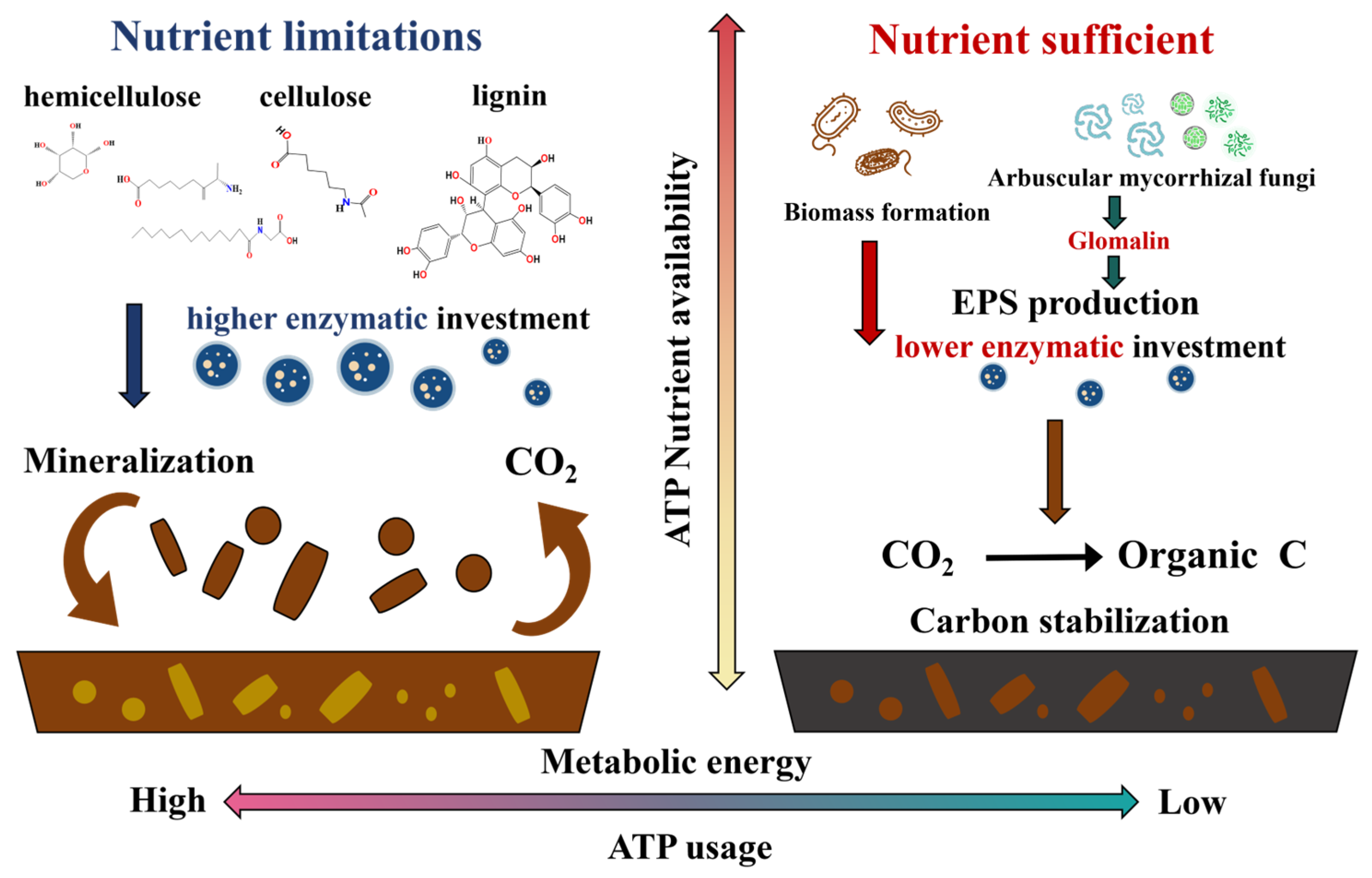
From an energetic perspective, the microbial degradation of complex organic compounds such as cellulose, hemicellulose, and lignin requires higher enzymatic investment and greater ATP expenditure [
146]. Under nutrient limitations (e.g., P, N, or S), microorganisms tend to prioritize mineralization over polymer synthesis, leading to increased C loss as CO
2 [
138] (
Figure 3). In contrast, when nutrients are sufficient, microorganisms allocate a larger proportion of C to biomass formation and extracellular polymeric substance production, which consumes less energy and contributes to long-term C stabilization [
55] (
Figure 3). In addition to bacterial-derived EPS, fungal contributions, particularly those mediated by arbuscular mycorrhizal fungi through the production of glomalin-related soil protein are explicitly illustrated to reflect their established role in EPS formation and soil aggregate stabilization. Therefore, the coupling between nutrient availability and metabolic energy is a key determinant of microbial C sequestration mechanisms in Mollisols.
4.5. Formation of Microbial Necromass and Long-Term C Stabilization
The outcome of microbial C sequestration is not merely biomass synthesis, and the formation and stabilization of microbial necromass is more important. Microbial necromass C primarily originates from cell wall fragments, extracellular polymers, and cytoplasmic organic matter released into the environment following cell death or lysis. Isotopic and molecular-level analyses of Mollisols have revealed that microbial necromass C exhibits a distinctly high oxidation state (nominal oxidation state of C, NOSC > 0.3) and is enriched in N, and S-containing functional groups. These polar molecules possess strong mineral affinity and can associate with Fe- and Al-oxides through cation bridging or hydrogen bonding, forming MAOM [
147]. Moreover, microbial necromass can act as a nucleation core for microaggregates (<0.25 mm), enhancing soil structural stability [
147]. Studies have shown that once microbial residues are bound to silt and clay fractions, their mineralization rate decreases significantly. Therefore, microbial C sequestration is tightly coupled with soil structural evolution, jointly determining the long-term stability of SOC [
148].
4.6. Conceptual Framework and Ecological Implications
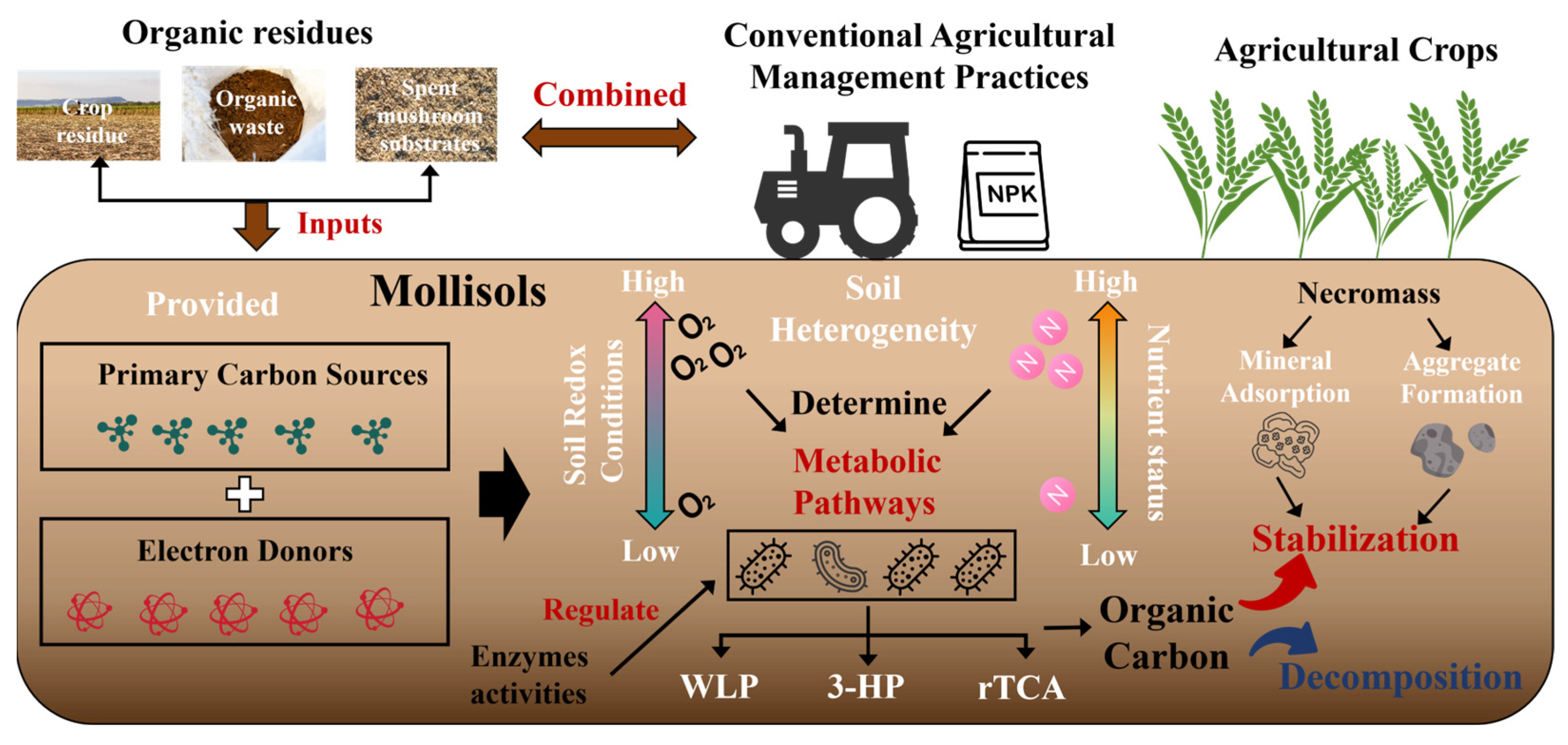
Integrating the above elements, this study establishes a conceptual model linking organic inputs, soil environment, metabolic pathways, microbial necromass formation, and long-term C stabilization (
Figure 4). Organic residue inputs provide the primary C sources and electron donors, while soil redox conditions and nutrient status determine the metabolic pathways selected by microorganisms. Phenolic compounds regulate enzyme activities, thereby directing C fluxes toward either “decomposition” or “stabilization” (
Figure 4). Microbial metabolites and necromass achieve long-term C persistence through mineral adsorption and the formation of microaggregates (
Figure 4). This conceptual framework illustrates the multi-scale feedback mechanisms underlying C sequestration in Mollisols which from molecular reactions to ecosystem processes, and from short-term energy flow to long-term C sink formation, and theses all driven by microorganisms and their metabolic networks. Importantly, this framework provides explicit leverage points for directing management practices in Mollsiols. For example, selecting organic residues with contrasting chemical complexity can be used to regulate decomposition processes and microbial C use efficiency. Tillage intensity, residue mulching, and irrigation management can be adjusted to manipulate oxygen diffusion and redox heterogeneity, thereby favoring microbial pathways associated with higher C retention rather than rapid mineralization. Similarly, management strategies that promote microbial biomass growth and extracellular polymer production, such as balanced nutrient supply and reduced physical disturbance, can enhance residue stabilization through aggregate formation and mineral association.
5. Methodological Advances in Studying Microbial C Sequestration Mechanism
5.1. Applications of Isotopic Tracing and Multi-Omics Approaches
Over the past decade, SIP and qSIP have emerged as pivotal approaches for elucidating microbial C sequestration processes [
149]. By introducing
13CO
2 or
13C-labeled substrates into soil systems and integrating these with high-throughput sequencing and transcriptomic analyses, researchers can accurately identify the microorganisms actively assimilating C [
150]. Unlike conventional SIP, qSIP enables quantitative assessment of taxon-specific assimilation rates through DNA density fractionation, thereby allowing precise estimation of C flux contributions [
149]. Furthermore, coupling SIP with transcriptomics has uncovered the temporal dynamics of microbial C assimilation. For instance, during the initial stages of straw incorporation,
13C is predominantly incorporated by heterotrophic microbial communities, whereas in the later stages, the relative enrichment of
13C-labeled anaerobic C-fixing microorganisms increases markedly [
150]. These temporal patterns provide mechanistic evidence supporting a three-phase process of “decomposition–C sequestration–stabilization” that underpins C cycling and persistence in Mollisols.
13C-DNA-SIP has been applied in in situ Mollisol systems, including intact soil cores and microcosms, to trace straw-derived C assimilators and the succession of functional groups, thereby identifying bacterial taxa actively incorporating C and characterizing their temporal dynamics [
150]. Research using Mollisols from Hailun, Heilongjiang Province, has demonstrated that coupling
13C-SIP with high-throughput sequencing enables precise differentiation of prokaryotic communities assimilating C from soybean and maize residues, as well as their adaptive responses under environmental stress [
150]. In long-term or high-resolution tracing studies, coupling
13C-SIP with metagenomic analyses of functional genes and metabolic pathways provides powerful means to elucidate C assimilation processes, C fluxes, and the organization of microbial metabolic networks. Metagenomic evidence from long-term fertilized maize rhizospheres indicates that variations in SOC within Mollisol topsoil are jointly shaped by microbial community assembly and functional potential [
37]. This finding underscores the importance of integrating transcriptomic, proteomic, and metabolomic analyses into SIP-based frameworks to capture coordinated C flow and regulatory mechanism. Moreover, qSIP decouples population abundance changes from isotope incorporation efficiency, thereby enhancing the accuracy of community-level C assimilation rate estimates. Future work in Mollisols should integrate qSIP with time-series experimental designs and modeling approaches to minimize biases caused by cross-feeding and density overlap, enabling a more precise understanding of microbially mediated C fluxes [
151].
5.2. Organic Matter Fractionation and Microbial C Sequestration
The C sequestration capacity of Mollisols largely depends on the proportion of C partitioned between particulate organic matter (POM) and MAOM. Soil organic matter (SOM) fractionation by density (light and heavy fractions; occluded POM, free POM, MAOM) or by chemical oxidation provides critical insights into C turnover and molecular composition [
108]. Recent methodological advances recommend adopting standardized density thresholds and quality control procedures, emphasizing that simultaneous quantification of both POM and MAOM in long-term monitoring offers a more accurate assessment of soil C stability [
152]. In long-term straw return and biochar amendment experiments in Northeast China’s Mollisols, increases in MAOC and microbial necromass C are positively correlated with enhanced aggregate stability, highlighting that microbe–mineral interactions play a pivotal role in long-term C sequestration [
153].
5.3. High-Resolution Techniques for Organic Matter Characterization
Ultra-high-resolution analytical techniques, including Fourier transform ion cyclotron resonance mass spectrometry (FT-ICR MS), solid-state
13C nuclear magnetic resonance (
13C-NMR), Fourier transform infrared spectroscopy (FTIR), and three-dimensional excitation–emission matrix fluorescence (3D-EEM) spectroscopy, provide powerful tools for elucidating the molecular composition and chemical structures of microbial C sequestration products [
154,
155,
156]. In particular, FT-ICR MS enables detailed characterization of the molecular composition, oxidation state, and aromaticity of soil dissolved organic matter (DOM) and MAOM [
157], thereby offering critical chemical insights into the continuum of “organic residue degradation–microbial metabolic transformation–mineral association.”
Recent advances have underscored the importance of integrating FT-ICR MS with C fractionation and microbiome analyses to trace microbial-derived molecular transformations and to identify the compositional features of stable C pools [
158]. For example, liquid chromatography–FT-ICR MS analyses of long-term manure-amended Mollisols revealed that organic waste inputs shift SOM toward more bioavailable, highly oxidized, and energy-depleted compounds, suggesting that the application of organic waste may stimulate the priming effects of SOM [
159]. Under simulated erosion conditions in Mollisols, FT-ICR MS analyses further demonstrated that changes in DOM chemical diversity and C sequestration potential are primarily regulated by soil physicochemical properties rather than microbial traits [
160]. The degree of DOM degradation, expressed by the degradation index and Gibbs free energy, exhibited a strong positive correlation with the accumulation of lignin-like compounds, indicating that even chemically recalcitrant molecules can undergo oxidative transformation. Collectively, these findings highlight that combined organic–inorganic amendments can enhance the C sequestration potential of erosion-prone Mollisols by promoting the stabilization of microbially transformed organic matter within mineral matrices [
160].
13C-NMR results further revealed that long-term organic residue applied decreased the proportion of aromatic C while increasing the relative abundance of carboxyl and hydroxyl C [
161,
162,
163,
164], indicating that microbially derived organic compounds possess greater mineral affinity and are more prone to forming stable organo–mineral complexes [
165,
166,
167]. In addition, 3D-EEM fluorescence analysis of Mollisols revealed enhanced humic-like fluorophore peaks (Ex/Em ≈ 330/440 nm) under long-term organic amendment, indicating an intensified humification process [
168,
169,
170].
6. Future Directions
To comprehensively elucidate microbial C sequestration mechanisms and translate them into optimized agricultural practices, future research should advance along multiple dimensions which including methodological refinement, spatiotemporal scaling, management coupling, microbial functional ecology, soil structural dynamics, and system-level feedbacks. Based on the current limitations, this review further outlines the key directions for future research.
6.1. Precise Elucidation of Microbial Necromass C Sources and Formation Pathways in Mollisols
Future research should strengthen investigations into the spatiotemporal dynamics of microbial amino sugar markers (e.g., GluN, MurN, GalN) in long-term field experiments across Mollisols to elucidate the sequential pathway of organic residue return → microbial biomass accumulation → microbial necromass transformation → C stabilization. In addition, coupling isotopic labeling with microbial necromass tracing techniques should be applied to quantify the proportion of microbial residue-derived C in total SOC during the decomposition of organic amendments in representative Mollisols. Finally, distinguishing the relative contributions and controlling factors (e.g., organic residue type, C:N ratio, amendment rate, and tillage practice) of bacterial versus fungal necromass to C sequestration in agricultural Mollisols will be essential for constructing a region specific microbial necromass C pool model for Mollisols.
6.2. Regulation of Microbial Ecological Strategies, C Use Efficiency, and Priming Effects in Mollisols
Future studies in agricultural Mollisols should focus on elucidating the dynamics of microbial biomass growth, CUE, and microbial turnover rates during organic residue incorporation and decomposition, and on quantifying their contributions to C sequestration and SOC stabilization. Moreover, the intensity and duration of priming effects following organic amendment warrant further investigation. For instance, does the addition of easily decomposable organic matter markedly accelerate the mineralization of native SOC? How do these responses relate to microbial CUE, nutrient availability, and soil structural properties? In addition, long-term (>10 years) organic amendment field experiments integrated with continuous monitoring of microbial indicators are essential to reveal the sustained impacts of microbial C sequestration mechanisms beyond the short-term evidence provided by incubation studies.
6.3. Coupled Mechanisms of “Microbial Necromass-Aggregate Protection-Mineral Association”
Mollisols are enriched in 2:1 clay minerals, which provide high surface area and reactive interlayer sites that promote the association and stabilization of organic C on mineral surfaces [
171,
172]. Future research should focus on elucidating how microbial necromass C, particularly proteins and amino sugar, derived compounds, achieve long-term stabilization through mineral adsorption and aggregate protection in Mollisols. High-resolution microscopic and spectroscopic imaging techniques, such as confocal Raman microscopy and nanoscale secondary ion mass spectrometry (NanoSIMS), provide powerful tools for tracing how microbial residues derived from or formed during the decomposition of organic residue become embedded within soil aggregate structures. In addition, further attention should be given to how different tillage practices (e.g., no-tillage, deep tillage) and organic residue types (e.g., crop residue, organic waste, spent mushroom substrates, biochar) influence aggregate formation, macroaggregate protection, and their associations with microbial necromass C. Advancing research in this direction will provide a mechanistic understanding of microbial C sequestration in Mollisols from a coupled “physical–chemical–biological” perspective.
6.4. Coupled Regulation of Soil Mineral Chemical Properties, Microbial Processes, and C Sequestration Efficiency
Mollisols exhibit distinctive characteristics in mineral composition, redox status, organic matter content, and microbial enzyme activity. Future studies should systematically investigate how these factors influence the stability and transformation efficiency of microbial necromass. Moreover, the roles of trace elements (e.g., Fe, Mn, Zn) in microbial metabolism and necromass accumulation warrant further attention, as these elements may alter the chemical structure and stability of microbial residues during cell lysis and decay. In addition, microbial C sequestration efficiency (MCSE) is the proportion of externally introduced organic C that is microbially processed and subsequently retained in relatively stable soil C pools, rather than lost as CO2 during decomposition. These stable pools include MAOC, microaggregate-protected C, and MNC. It is essential to explore how soil fertility parameters (e.g., initial SOC, TN, and moisture status) regulate MCSE in Mollisols.
6.5. Large-Scale Feedbacks of Tillage Management and Climate Change on Microbial C Sequestration Mechanisms
Agricultural Mollisols are more sensitive than other soil types to climate change factors (e.g., rising temperature, altered precipitation, freeze–thaw cycles) and tillage practices (e.g., conservation tillage, deep plowing). Existing studies indicate that soil C dynamics in these systems are jointly regulated by climate warming and management practices through their effects on microbial physiology and necromass accumulation. Therefore, future research should focus on developing microbial C sequestration models tailored to Mollisols under organic amendment scenarios. Such models should integrate parameters including organic input rates, microbial CUE dynamics, community succession, necromass accumulation rate, aggregate protection efficiency, mineral association degree, and the combined influences of climate and tillage. These efforts will enable more accurate predictions of SOC sequestration potential. Moreover, attention should be directed toward management and policy implications, particularly in quantifying the contribution of the “organic amendment–microbial C sequestration” pathway to C neutrality and food security, thereby providing a scientific basis for the sustainable management and conservation of agricultural Mollisols.
7. Concluding Remarks
Organic residue inputs and their progressive decomposition fundamentally restructure the C cycling dynamics of agricultural Mollisols, shifting the system from a decomposition-dominated state toward a biosynthesis-driven equilibrium. The evidence synthesized herein indicates that microbial C sequestration in Mollisols emerges from a tightly integrated cascade that links substrate chemistry, redox microenvironments, metabolic pathways, and residue stabilization processes. Microorganisms mediate the transformation of exogenous organic substrates and CO2 into microbial biomass, necromass, and extracellular polymers via multiple autotrophic and mixotrophic pathways which including the WLP, 3-HP, and rTCA cycles. These metabolic processes operate within a highly heterogeneous soil matrix, where microscale gradients of oxygen availability, electron acceptors, and mineral interfaces define ecological niches and drive metabolic interactions. The resulting microbial products, enriched in oxidized, N, and S-containing compounds, are subsequently stabilized through mineral adsorption and aggregate encapsulation. Collectively, these interactions establish the biochemical foundation for the long-term persistence of SOC in Mollisols.
Conceptually, the “substrate-microenvironment-metabolic pathway-residue stabilization” framework offers an integrative perspective for understanding microbial C sequestration in Mollisols across molecular, organismal, and ecosystem scales. Within this framework, the type and degradation stage of organic inputs determine energy fluxes and electron donor availability, redox heterogeneity and nutrient stoichiometry particularly N, P, S coupling, govern enzymatic efficiency and metabolic allocation, and phenolic compounds impose an “enzyme-latch” regulation that suppresses oxidative decomposition while promoting C retention. The dynamic balance between oxidative (e.g., 3-HP) and reductive (e.g., WLP, rTCA) metabolic strategies enables sustained C assimilation under fluctuating moisture and redox regimes. Meanwhile, microbial necromass and extracellular polymeric substances facilitate the transition of labile metabolites into MAOM. Collectively, these interconnected processes constitute the microbial C pump that underpins the long-term stabilization and persistence of SOC in Mollisols.
Recent methodological advances including qSIP, multi-omics integration, and ultra-high resolution molecular characterization techniques (e.g., FT-ICR MS, 13C-NMR) have greatly enhanced our ability to directly link microbial taxa, metabolic functions, and stabilized C pools. Despite this progress, significant knowledge gaps remain. Standardized protocols are still lacking for quantifying microbial CUE, necromass formation rates, and the relative contributions of bacterial and fungal residues to mineral-associated organic C. Future research should incorporate long-term field experiments, spatiotemporal isotope tracing, and advanced microscale imaging approaches (e.g., NanoSIMS, confocal Raman microscopy) to unravel the interactive mechanisms by which microbial necromass, soil aggregates, and mineral phases jointly regulate C stabilization. Integrating these empirical findings into process-based predictive models that explicitly consider organic input type, redox dynamics, nutrient coupling, and agricultural management regimes will be essential for accurately projecting soil C sequestration potential under changing climatic conditions.
From an applied perspective, developing biologically regulated C management strategies for Mollisols requires aligning microbial processes with agronomic practices. Optimizing organic residue composition, ensuring balanced nutrient supply, maintaining aggregate integrity through reduced tillage, and enhancing mineral reactivity via biochar or other amendments can collectively strengthen both microbial and mineral C pumps. These strategies not only increase SOC persistence but also improve fertility and resilience, contributing to C-neutral and sustainable agriculture. Ultimately, unraveling and harnessing the microbial C sequestration mechanisms operating during organic residue decomposition offers a mechanistic and practical pathway to restore and sustain the ecological and productive capacity of Mollisols.
Author Contributions
Conceptualization, M.S.; formal analysis, M.S.; writing—original draft preparation, M.S.; writing—review and editing, M.S., W.H., L.W., S.Z. and M.N.; visualization, M.S.; funding acquisition, M.S. All authors have read and agreed to the published version of the manuscript.
Funding
This work was supported by the Natural Science Foundation of Jilin Province of China (grant number: 20250102174JC), China Postdoctoral Science Foundation (grant number: 2024M763245), and Postdoctoral Fellowship Program of China Postdoctoral Science Foundation (grant number: GZB20250574).
Data Availability Statement
No new data were created or analyzed in this study.
Acknowledgments
We thank all the authors for their contributions to this article and for the support of the Foundation Program. We also thank the State Key Laboratory of Mollisols Conservation and Utilization for providing the platform. During the preparation of this manuscript, the authors utilized OpenAI’s ChatGPT (version GPT-5) for language polishing and improving the readability of the text. The AI tool was used solely for refining the language and did not contribute to the research design, data analysis, or interpretation of the results. All content generated by the AI tool was carefully reviewed and edited by the authors to ensure accuracy and adherence to the scientific context.
Conflicts of Interest
The authors declare that they have no known competing financial interests or personal relationships that could have appeared to influence the work reported in this paper.
References
- Labaz, B.; Hartemink, A.E.; Zhang, Y.; Stevenson, A.; Kabała, C. Organic C in Mollisols of the world—A review. Geoderma 2024, 447, 116937. [Google Scholar] [CrossRef]
- Robertson, G.P.; Allen, V.G.; Boody, G.; Boose, E.R.; Creamer, N.G.; Drinkwater, L.E.; Gosz, J.R.; Lynch, L.; Havlin, J.L.; Jackson, L.E.; et al. Long-term agricultural research: A research, education, and extension imperative. BioScience 2008, 58, 640−645. [Google Scholar] [CrossRef]
- Liu, X.; Lee Burras, C.; Kravchenko, Y.S.; Duran, A.; Huffman, T.; Morras, H.; Studdert, G.; Zhang, X.; Cruse, R.M.; Yuan, X. Overview of Mollisols in the world: Distribution, land use and management. Can. J. Soil Sci. 2012, 92, 383−402. [Google Scholar] [CrossRef]
- Cambardella, C.A.; Elliott, E.T. Carbon and nitrogen distribution in aggregates from cultivated and native grassland soils. Soil Sci. Soc. Am. J. 1993, 57, 1071−1076. [Google Scholar] [CrossRef]
- Wang, S.; Wang, Z.; Heinonsalo, J.; Zhang, Y.; Liu, G. Soil organic C stocks and dynamics in a mollisol region: A 1980s–2010s study. Sci. Total Environ. 2022, 807, 150910. [Google Scholar] [CrossRef] [PubMed]
- Lian, H.; Wang, Z.; Li, Y.; Xu, H.; Zhang, H.; Gong, X.; Qi, H.; Jiang, Y. Straw strip return increases soil organic C sequestration by optimizing organic and humus C in aggregates of mollisols in Northeast China. Agronomy 2022, 12, 784. [Google Scholar] [CrossRef]
- Six, J.; Conant, R.T.; Paul, E.A.; Paustian, K. Stabilization mechanisms of soil organic matter: Implications for C-saturation of soils. Plant Soil 2002, 241, 155−176. [Google Scholar] [CrossRef]
- Maillard, É.; Angers, D.A. Animal manure application and soil organic C stocks: A meta-analysis. Glob. Change Biol. 2014, 20, 666–679. [Google Scholar] [CrossRef]
- Greenlon, A.; Sieradzki, E.; Zablocki, O.; Koch, B.J.; Foley, M.M.; Kimbrel, J.A.; Hungate, B.A.; Blazewicz, S.J.; Nuccio, E.E.; Sun, C.L.; et al. Quantitative stable-isotope probing (qSIP) with metagenomics links microbial physiology and activity to soil moisture in Mediterranean-climate grassland ecosystems. Msystems 2022, 7, e00417-22. [Google Scholar] [CrossRef]
- Liao, H.; Hao, X.; Qin, F.; Delgado-Baquerizo, M.; Liu, Y.; Zhou, J.; Cai, P.; Chen, W.; Huang, Q. Microbial autotrophy explains large-scale soil CO2 fixation. Glob. Change Biol. 2023, 29, 231–242. [Google Scholar] [CrossRef]
- Pratscher, J.; Dumont, M.G.; Conrad, R. Ammonia oxidation coupled to CO2 fixation by archaea and bacteria in an agricultural soil. Proc. Natl. Acad. Sci. USA 2011, 108, 4170–4175. [Google Scholar] [CrossRef]
- Garritano, A.N.; Song, W.; Thomas, T. C fixation pathways across the bacterial and archaeal tree of life. Proc. Natl. Acad. Sci. USA 2022, 1, pgac226. [Google Scholar] [CrossRef]
- Keiluweit, M.; Wanzek, T.; Kleber, M.; Nico, P.; Fendorf, S. Anaerobic microsites have an unaccounted role in soil C stabilization. Nat. Commun. 2017, 8, 1771. [Google Scholar] [CrossRef] [PubMed]
- Chen, C.; Hall, S.J.; Coward, E.; Thompson, A. Iron-mediated organic matter decomposition in humid soils can counteract protection. Nat. Commun. 2020, 11, 2255. [Google Scholar] [CrossRef]
- Lacroix, E.M.; Aeppli, M.; Boye, K.; Brodie, E.; Fendorf, S.; Keiluweit, M.; Naughton, H.R.; Noël, V.; Sihi, D. Consider the anoxic microsite: Acknowledging and appreciating spatiotemporal redox heterogeneity in soils and sediments. ACS Earth Space Chem. 2023, 7, 1592–1609. [Google Scholar] [CrossRef]
- Liao, H.; Qin, F.; Wang, K.; Zhang, Y.; Hao, X.; Chen, W.; Huang, Q. Long-term chemical fertilization-driving changes in soil autotrophic microbial community depresses soil CO2 fixation in a Mollisol. Sci. Total Environ. 2020, 748, 141317. [Google Scholar] [CrossRef] [PubMed]
- Fuchs, G. Alternative pathways of carbon dioxide fixation: Insights into the early evolution of life? Annu. Rev. Microbiol. 2011, 65, 631–658. [Google Scholar] [CrossRef] [PubMed]
- Luo, S.; Jia, Z.; Tian, L.; Wang, S.; Chang, C.; Ji, L.; Chang, J.; Zhang, J.; Tian, C. Potential functional differentiation from microbial perspective under dryland-paddy conversion in black soils. Agric. Ecosyst. Environ. 2023, 353, 108562. [Google Scholar] [CrossRef]
- Ragsdale, S.W.; Pierce, E. Acetogenesis and the Wood–Ljungdahl pathway of CO2 fixation. Biochim. Biophys. Acta Proteins Proteom. 2008, 1784, 1873–1898. [Google Scholar] [CrossRef]
- Berg, I.A.; Kockelkorn, D.; Ramos-Vera, W.H.; Say, R.F.; Zarzycki, J.; Hügler, M.; Alber, B.E.; Fuchs, G. Autotrophic carbon fixation in archaea. Nat. Rev. Microbiol. 2010, 8, 447–460. [Google Scholar] [CrossRef]
- Ding, X.; Han, X.; Zhang, X.; Qiao, Y. Effects of contrasting agricultural management on microbial residues in a Mollisol in China. Soil Tillage Res. 2013, 130, 13–17. [Google Scholar] [CrossRef]
- Rui, Y.; Jackson, R.D.; Cotrufo, M.F.; Sanford, G.R.; Spiesman, B.J.; Deiss, L.; Culman, S.W.; Liang, C.; Ruark, M.D. Persistent soil C enhanced in Mollisols by well-managed grasslands but not annual grain or dairy forage cropping systems. Proc. Natl. Acad. Sci. USA 2022, 119, e2118931119. [Google Scholar] [CrossRef]
- Angst, G.; Angst, Š.; Frouz, J.; Jabinski, S.; Jílková, V.; Kukla, J.; Li, M.; Meador, T.B.; Angel, R. Stabilized microbial necromass in soil is more strongly coupled with microbial diversity than the bioavailability of plant inputs. Soil Biol. Biochem. 2024, 190, 109323. [Google Scholar] [CrossRef]
- Zheng, H.; Liu, W.; Zheng, J.; Luo, Y.; Li, R.; Wang, H.; Qi, H. Effect of long-term tillage on soil aggregates and aggregate-associated C in black soil of Northeast China. PLoS ONE 2018, 13, e0199523. [Google Scholar] [CrossRef]
- Husson, O. Redox potential (Eh) and pH as drivers of soil/plant/microorganism systems: A transdisciplinary overview pointing to integrative opportunities for agronomy. Plant Soil 2013, 362, 389–417. [Google Scholar] [CrossRef]
- Grandy, A.S.; Neff, J.C. Molecular C dynamics downstream: The biochemical decomposition sequence and its impact on soil organic matter structure and function. Sci. Total Environ. 2008, 404, 297–307. [Google Scholar] [CrossRef] [PubMed]
- Cotrufo, M.F.; Soong, J.L.; Horton, A.J.; Campbell, E.E.; Haddix, M.L.; Wall, D.H.; Parton, W.J. Formation of soil organic matter via biochemical and physical pathways of litter mass loss. Nat. Geosci. 2015, 8, 776–779. [Google Scholar] [CrossRef]
- Kallenbach, C.M.; Frey, S.D.; Grandy, A.S. Direct evidence for microbial-derived soil organic matter formation and its ecophysiological controls. Nat. Commun. 2016, 7, 13630. [Google Scholar] [CrossRef]
- Lee, C.G.; Watanabe, T.; Sato, Y.; Murase, J.; Asakawa, S.; Kimura, M. Bacterial populations assimilating C from 13C-labeled plant residue in soil: Analysis by a DNA-SIP approach. Soil Biol. Biochem. 2011, 43, 814–822. [Google Scholar] [CrossRef]
- Piché-Choquette, S.; Constant, P. Molecular hydrogen, a neglected key driver of soil biogeochemical processes. Appl. Environ. Microbiol. 2019, 85, e02418-18. [Google Scholar] [CrossRef]
- Nie, T.; Huang, J.; Zhang, Z.; Chen, P.; Li, T.; Dai, C. The inhibitory effect of a water-saving irrigation regime on CH4 emission in Mollisols under straw incorporation for 5 consecutive years. Agric. Water Manag. 2023, 278, 108163. [Google Scholar] [CrossRef]
- An, T.; Schaeffer, S.; Zhuang, J.; Radosevich, M.; Li, S.; Li, H.; Pei, J.; Wang, J. Dynamics and distribution of 13C-labeled straw C by microorganisms as affected by soil fertility levels in the Black Soil region of Northeast China. Biol. Fertil. Soils 2015, 51, 605–613. [Google Scholar] [CrossRef]
- Wilpiszeski, R.L.; Aufrecht, J.A.; Retterer, S.T.; Sullivan, M.B.; Graham, D.E.; Pierce, E.M.; Zablocki, O.D.; Palumbo, A.V.; Elias, D.A. Soil aggregate microbial communities: Towards understanding microbiome interactions at biologically relevant scales. Appl. Environ. Microbiol. 2019, 85, e00324-19. [Google Scholar] [CrossRef]
- Zhou, S.; Lie, Z.; Lei, C.; Zhang, Q.; Liu, X.; Wu, G.; Neilson, R.; Huang, F.-Y.; Chu, G.; Meng, Z.; et al. Multi-scale evidence for declining microbial C fixation along forest succession gradients. ISME J. 2025, 19, wraf191. [Google Scholar] [CrossRef]
- Starr, E.P.; Shi, S.; Blazewicz, S.J.; Koch, B.J.; Probst, A.J.; Hungate, B.A.; Pett-Ridge, J.; Firestone, M.K.; Banfield, J.F. Stable-isotope-informed, genome-resolved metagenomics uncovers potential cross-kingdom interactions in rhizosphere soil. Msphere 2021, 6, e00085-21. [Google Scholar] [CrossRef] [PubMed]
- Schuchmann, K.; Müller, V. Autotrophy at the thermodynamic limit of life: A model for energy conservation in acetogenic bacteria. Nat. Rev. Microbiol. 2014, 12, 809–821. [Google Scholar] [CrossRef]
- Könneke, M.; Schubert, D.M.; Brown, P.C.; Hügler, M.; Standfest, S.; Schwander, T.; von Borzyskowski, L.S.; Erb, T.J.; Stahl, D.A.; Berg, I.A. Ammonia-oxidizing archaea use the most energy-efficient aerobic pathway for CO2 fixation. Proc. Natl. Acad. Sci. USA 2014, 111, 8239–8244. [Google Scholar] [CrossRef] [PubMed]
- Wu, H.; Cui, H.; Fu, C.; Li, R.; Qi, F.; Liu, Z.; Yang, G.; Xiao, K.; Qiao, M. Unveiling the crucial role of soil microorganisms in C cycling: A review. Sci. Total Environ. 2024, 909, 168627. [Google Scholar] [CrossRef] [PubMed]
- Jiao, N.; Zheng, Q. The microbial C pump: From genes to ecosystems. Appl. Environ. Microbiol. 2011, 77, 7439–7444. [Google Scholar] [CrossRef]
- Lehmann, J.; Kleber, M. The contentious nature of soil organic matter. Nature 2015, 528, 60–68. [Google Scholar] [CrossRef]
- Liang, C.; Schimel, J.P.; Jastrow, J.D. The importance of anabolism in microbial control over soil C storage. Nat. Microbiol. 2017, 2, 17105. [Google Scholar] [CrossRef]
- Liang, C.; Balser, T.C. Microbial production of recalcitrant organic matter in global soils: Implications for productivity and climate policy. Nat. Rev. Microbiol. 2011, 9, 75. [Google Scholar] [CrossRef] [PubMed]
- Huang, W.; Wang, K.; Ye, C.; Hockaday, W.C.; Wang, G.; Hall, S.J. High C losses from oxygen-limited soils challenge biogeochemical theory and model assumptions. Glob. Change Biol. 2021, 27, 6166–6180. [Google Scholar] [CrossRef] [PubMed]
- Simon, C.; Miltner, A.; Mulder, I.; Kaiser, K.; Lorenz, M.; Thiele-Bruhn, S.; Lechtenfeld, O. Long-term effects of manure addition on soil organic matter molecular composition: C transformation as a major driver of energetic potential. Soil Biol. Biochem. 2025, 205, 109755. [Google Scholar] [CrossRef]
- Haddix, M.L.; Paul, E.A.; Cotrufo, M.F. Dual, differential isotope labeling shows the preferential movement of labile plant constituents into mineral-bonded soil organic matter. Glob. Change Biol. 2016, 22, 2301–2312. [Google Scholar] [CrossRef] [PubMed]
- Ding, X.; Ling, N.; Zhang, W.; Lu, M.; Wen, J.; He, H.; Zhang, X. Distinct C incorporation from 13C-labelled rice straw into microbial amino sugars in soils applied with manure versus mineral fertilizer. Geoderma 2023, 436, 116537. [Google Scholar] [CrossRef]
- Xu, Y.; Chen, Z.; Fontaine, S.; Wang, W.; Luo, J.; Fan, J.; Ding, W. Dominant effects of organic C chemistry on decomposition dynamics of crop residues in a Mollisol. Soil Biol. Biochem. 2017, 115, 221–232. [Google Scholar] [CrossRef]
- Tian, P.; Sui, P.; Lian, H.; Wang, Z.; Meng, G.; Sun, Y.; Wang, Y.; Su, Y.; Ma, Z.; Qi, H.; et al. Maize straw returning approaches affected straw decomposition and soil C and nitrogen storage in Northeast China. Agronomy 2019, 9, 818. [Google Scholar] [CrossRef]
- Yang, L.; Muhammad, I.; Chi, Y.X.; Wang, D.; Zhou, X.B. Straw return and nitrogen fertilization to maize regulate soil properties, microbial community, and enzyme activities under a dual cropping system. Front. Microbiol. 2022, 13, 823963. [Google Scholar] [CrossRef]
- Wei, W.; Shi, X.; Wang, M.; Zhou, Z. Manure application maintained the CO2 fixation activity of soil autotrophic bacteria but changed its ecological characteristics in an entisol of China. Sci. Total Environ. 2024, 913, 169630. [Google Scholar] [CrossRef]
- Chen, Z.; Ding, W.; Luo, Y.; Yu, H.; Xu, Y.; Müller, C.; Xu, X.; Zhu, T. Nitrous oxide emissions from cultivated black soil: A case study in Northeast China and global estimates using empirical model. Glob. Biogeochem. Cycles 2014, 28, 1311–1326. [Google Scholar] [CrossRef]
- Wang, Y.; Wang, J.; Qian, K.; Feng, Y.; Ao, J.; Zhai, Y.; Li, Y.; Li, X.; Zhang, B.; Yu, H. Effects of Auricularia heimuer Residue Amendment on Soil Quality, Microbial Communities, and Maize Growth in the Black Soil Region of Northeast China. Agriculture 2025, 15, 879. [Google Scholar] [CrossRef]
- Gow, N.A.; Latge, J.-P.; Munro, C.A. The fungal cell wall: Structure, biosynthesis, and function. Microbiol. Spectr. 2017, 5, 10-1128. [Google Scholar] [CrossRef] [PubMed]
- Meibom, K.L.; Li, X.B.; Nielsen, A.T.; Wu, C.-Y.; Roseman, S.; Schoolnik, G.K. The Vibrio cholerae chitin utilization program. Proc. Natl. Acad. Sci. USA 2004, 101, 2524–2529. [Google Scholar] [CrossRef] [PubMed]
- Redmile-Gordon, M.; Gregory, A.; White, R.; Watts, C. Soil organic C, extracellular polymeric substances (EPS), and soil structural stability as affected by previous and current land-use. Geoderma 2020, 363, 114143. [Google Scholar] [CrossRef]
- Zhang, M.; Peacock, C.L.; Cai, P.; Xiao, K.-Q.; Qu, C.; Wu, Y.; Huang, Q. Selective retention of extracellular polymeric substances induced by adsorption to and coprecipitation with ferrihydrite. Geochim. Cosmochim. Acta 2021, 299, 15–34. [Google Scholar] [CrossRef]
- Liu, B.; Fan, H.; Han, W.; Zhu, L.; Zhao, X.; Zhang, Y.; Ma, R. Linking soil water retention capacity to pore structure characteristics based on X-ray computed tomography: Chinese Mollisol under freeze-thaw effect. Geoderma 2021, 401, 115170. [Google Scholar] [CrossRef]
- Peng, J.; Wu, Y.; Geng, T.; Zhang, C.; Wang, J.; Cai, C. Soil pore dynamics and infiltration characteristics as affected by cultivation duration for Mollisol in northeast China. Geoderma 2024, 449, 117021. [Google Scholar] [CrossRef]
- Berg, I.A. Ecological aspects of the distribution of different autotrophic CO2 fixation pathways. Appl. Environ. Microbiol. 2011, 77, 1925–1936. [Google Scholar] [CrossRef]
- Strittmatter, A.W.; Liesegang, H.; Rabus, R.; Decker, I.; Amann, J.; Andres, S.; Henne, A.; Fricke, W.F.; Martinez-Arias, R.; Bartels, D.; et al. Genome sequence of Desulfobacterium autotrophicum HRM2, a marine sulfate reducer oxidizing organic C completely to C dioxide. Environ. Microbiol. 2009, 11, 1038–1055. [Google Scholar] [CrossRef] [PubMed]
- Sexstone, A.J.; Revsbech, N.P.; Parkin, T.B.; Tiedje, J.M. Direct measurement of oxygen profiles and denitrification rates in soil aggregates. Soil Sci. Soc. Am. J. 1985, 49, 645–651. [Google Scholar] [CrossRef]
- Patel, K.F.; Myers-Pigg, A.; Bond-Lamberty, B.; Fansler, S.J.; Norris, C.G.; McKever, S.A.; Zheng, J.; Rod, K.A.; Bailey, V.L. Soil carbon dynamics during drying vs. rewetting: Importance of antecedent moisture conditions. Soil Biol. Biochem. 2021, 156, 108165. [Google Scholar] [CrossRef]
- Rooney, E.C.; Bailey, V.L.; Patel, K.F.; Possinger, A.R.; Gallo, A.C.; Bergmann, M.; SanClements, M.; Lybrand, R.A. The Impact of Freeze-Thaw History on Soil Carbon Response to Experimental Freeze-Thaw Cycles. J. Geophys. Res.-Biogeosciences 2022, 127, e2022JG006889. [Google Scholar] [CrossRef]
- Correa, S.S.; Schultz, J.; Lauersen, K.J.; Rosado, A.S. Natural C fixation and advances in synthetic engineering for redesigning and creating new fixation pathways. J. Adv. Res. 2023, 47, 75–92. [Google Scholar] [CrossRef]
- Ragsdale, S.W. Enzymology of the Wood–Ljungdahl pathway of acetogenesis. Ann. N. Y. Acad. Sci. 2008, 1125, 129–136. [Google Scholar] [CrossRef]
- Jiao, J.-Y.; Fu, L.; Hua, Z.-S.; Liu, L.; Salam, N.; Liu, P.-F.; Lv, A.-P.; Wu, G.; Xian, W.-D.; Zhu, Q.; et al. Insight into the function and evolution of the Wood–Ljungdahl pathway in Actinobacteria. ISME J. 2021, 15, 3005–3018. [Google Scholar] [CrossRef]
- Biester, A.; Marcano-Delgado, A.N.; Drennan, C.L. Structural insights into microbial one-C metabolic enzymes Ni–Fe–S-dependent C monoxide dehydrogenases and acetyl-CoA synthases. Biochemistry 2022, 61, 2797–2805. [Google Scholar] [CrossRef] [PubMed]
- Jeoung, J.-H.; Goetzl, S.; Hennig, S.E.; Fesseler, J.; Wörmann, C.; Dendra, J.; Dobbek, H. The extended reductive acetyl-CoA pathway: ATPases in metal cluster maturation and reductive activation. Biol. Chem. 2014, 395, 545–558. [Google Scholar] [CrossRef]
- Hall, S.J.; Huang, W.; Napieralski, S.A.; Roden, E. Shared microbial taxa respond predictably to cyclic time-varying oxygen limitation in two disparate soils. Front. Microbiol. 2022, 13, 866828. [Google Scholar] [CrossRef] [PubMed]
- Redmile-Gordon, M.; Brookes, P.; Evershed, R.; Goulding, K.; Hirsch, P. Measuring the soil-microbial interface: Extraction of extracellular polymeric substances (EPS) from soil biofilms. Soil Biol. Biochem. 2014, 72, 163–171. [Google Scholar] [CrossRef]
- Redmile-Gordon, M.; Evershed, R.; Hirsch, P.; White, R.P.; Goulding, K. Soil organic matter and the extracellular microbial matrix show contrasting responses to C and N availability. Soil Biol. Biochem. 2015, 88, 257–267. [Google Scholar] [CrossRef]
- Herter, S.; Farfsing, J.; Gad’On, N.; Rieder, C.; Eisenreich, W.; Bacher, A.; Fuchs, G. Autotrophic CO2 fixation by Chloroflexus aurantiacus: Study of glyoxylate formation and assimilation via the 3-hydroxypropionate cycle. J. Bacteriol. 2001, 183, 4305–4316. [Google Scholar] [CrossRef] [PubMed]
- Zarzycki, J.; Brecht, V.; Müller, M.; Fuchs, G. Identifying the missing steps of the autotrophic 3-hydroxypropionate CO2 fixation cycle in Chloroflexus aurantiacus. Proc. Natl. Acad. Sci. USA 2009, 106, 21317–21322. [Google Scholar] [CrossRef] [PubMed]
- Hügler, M.; Fuchs, G. Assaying for the 3-hydroxypropionate cycle of C fixation. Meth. Enzymol. 2005, 397, 212–221. [Google Scholar] [CrossRef]
- Alber, B.; Olinger, M.; Rieder, A.; Kockelkorn, D.; Jobst, B.; Hügler, M.; Fuchs, G. Malonyl-coenzyme A reductase in the modified 3-hydroxypropionate cycle for autotrophic C fixation in archaeal Metallosphaera and Sulfolobus spp. J. Bacteriol. 2006, 188, 8551–8559. [Google Scholar] [CrossRef]
- Mattozzi, M.; Ziesack, M.; Voges, M.J.; Silver, P.A.; Way, J.C. Expression of the sub-pathways of the Chloroflexus aurantiacus 3-hydroxypropionate C fixation bicycle in E. coli: Toward horizontal transfer of autotrophic growth. Metab. Eng. 2013, 16, 130–139. [Google Scholar] [CrossRef] [PubMed]
- Sun, B.; Jia, S.; Zhang, S.; McLaughlin, N.B.; Zhang, X.; Liang, A.; Chen, X.; Wei, S.; Liu, S. Tillage, seasonal and depths effects on soil microbial properties in black soil of Northeast China. Soil Tillage Res. 2016, 155, 421–428. [Google Scholar] [CrossRef]
- Li, M.; He, P.; Guo, X.-L.; Zhang, X.; Li, L.-J. Fifteen-year no tillage of a Mollisol with residue retention indirectly affects topsoil bacterial community by altering soil properties. Soil Tillage Res. 2021, 205, 104804. [Google Scholar] [CrossRef]
- Liu, C.; Li, L.; Xie, J.; Coulter, J.A.; Zhang, R.; Luo, Z.; Cai, L.; Wang, L.; Gopalakrishnan, S. Soil bacterial diversity and potential functions are regulated by long-term conservation tillage and straw mulching. Microorganisms 2020, 8, 836. [Google Scholar] [CrossRef]
- Bei, Q.; Reitz, T.; Schädler, M.; Hodgskiss, L.H.; Peng, J.; Schnabel, B.; Buscot, F.; Eisenhauer, N.; Schleper, C.; Heintz-Buschart, A. Metabolic potential of Nitrososphaera-associated clades. ISME J. 2024, 18, wrae086. [Google Scholar] [CrossRef]
- Xiao, K.Q.; Ge, T.D.; Wu, X.H.; Peacock, C.L.; Zhu, Z.K.; Peng, J.; Bao, P.; Wu, J.S.; Zhu, Y.G. Metagenomic and 14C tracing evidence for autotrophic microbial CO2 fixation in paddy soils. Environ. Microbiol. 2021, 23, 924–933. [Google Scholar] [CrossRef]
- Steffens, L.; Pettinato, E.; Steiner, T.M.; Eisenreich, W.; Berg, I.A. Tracking the reversed oxidative tricarboxylic acid cycle in bacteria. Bio-Protocol 2022, 12, e4364. [Google Scholar] [CrossRef]
- Nunoura, T.; Chikaraishi, Y.; Izaki, R.; Suwa, T.; Sato, T.; Harada, T.; Mori, K.; Kato, Y.; Miyazaki, M.; Shimamura, S.; et al. A primordial and reversible TCA cycle in a facultatively chemolithoautotrophic thermophile. Science 2018, 359, 559–563. [Google Scholar] [CrossRef]
- Bryce, C.; Blackwell, N.; Schmidt, C.; Otte, J.; Huang, Y.M.; Kleindienst, S.; Tomaszewski, E.; Schad, M.; Warter, V.; Peng, C.; et al. Microbial anaerobic Fe (II) oxidation–ecology, mechanisms and environmental implications. Environ. Microbiol. 2018, 20, 3462–3483. [Google Scholar] [CrossRef]
- He, Z.; Xu, M.; Deng, Y.; Kang, S.; Kellogg, L.; Wu, L.; Van Nostrand, J.D.; Hobbie, S.E.; Reich, P.B.; Zhou, J. Metagenomic analysis reveals a marked divergence in the structure of belowground microbial communities at elevated CO2. Ecol. Lett. 2010, 13, 564–575. [Google Scholar] [CrossRef]
- Zhao, Z.; Geng, P.; Wang, X.; Li, X.; Cai, P.; Zhan, X.; Han, X. Improvement of active organic C distribution and soil quality with the combination of deep tillage and no-tillage straw returning mode. Agronomy 2023, 13, 2398. [Google Scholar] [CrossRef]
- Kuzyakov, Y.; Blagodatskaya, E. Microbial hotspots and hot moments in soil: Concept & review. Soil Biol. Biochem. 2015, 83, 184–199. [Google Scholar] [CrossRef]
- Keiluweit, M.; Gee, K.; Denney, A.; Fendorf, S. Anoxic microsites in upland soils dominantly controlled by clay content. Soil Biol. Biochem. 2018, 118, 42–50. [Google Scholar] [CrossRef]
- Hao, X.; Han, X.; Wang, S.; Li, L.-J. Dynamics and composition of soil organic C in response to 15 years of straw return in a Mollisol. Soil Tillage Res. 2022, 215, 105221. [Google Scholar] [CrossRef]
- Wang, Q.; Chu, C.; Zhao, Z.; Zhou, D.; Wu, S. A study of different agricultural practices over a dozen years: Influence on soil CO2 fixation rates and soil autotrophic microbial communities. Soil Tillage Res. 2024, 239, 106067. [Google Scholar] [CrossRef]
- Conrad, R. Methane production in soil environments—Anaerobic biogeochemistry and microbial life between flooding and desiccation. Microorganisms 2020, 8, 881. [Google Scholar] [CrossRef]
- Sieber, J.R.; Le, H.M.; McInerney, M.J. The importance of hydrogen and formate transfer for syntrophic fatty, aromatic and alicyclic metabolism. Environ. Microbiol. 2014, 16, 177–188. [Google Scholar] [CrossRef] [PubMed]
- Bai, X.; Hu, X.; Liu, J.; Wei, D.; Zhu, P.; Cui, X.A.; Zhou, B.; Chen, X.; Liu, J.; Jin, J.; et al. Ammonia oxidizing bacteria dominate soil nitrification under different fertilization regimes in black soils of northeast China. Eur. J. Soil Biol. 2022, 111, 103410. [Google Scholar] [CrossRef]
- Ding, J.; Ma, M.; Jiang, X.; Liu, Y.; Zhang, J.; Suo, L.; Wang, L.; Wei, D.; Li, J. Effects of applying inorganic fertilizer and organic manure for 35 years on the structure and diversity of ammonia-oxidizing archaea communities in a Chinese Mollisols field. Microbiologyopen 2020, 9, e00942. [Google Scholar] [CrossRef] [PubMed]
- Li, C.; Hu, H.-W.; Chen, Q.-L.; Chen, D.; He, J.-Z. Comammox Nitrospira play an active role in nitrification of agricultural soils amended with nitrogen fertilizers. Soil Biol. Biochem. 2019, 138, 107609. [Google Scholar] [CrossRef]
- Xia, W.; Zhang, C.; Zeng, X.; Feng, Y.; Weng, J.; Lin, X.; Zhu, J.; Xiong, Z.; Xu, J.; Cai, Z.; et al. Autotrophic growth of nitrifying community in an agricultural soil. ISME J. 2011, 5, 1226–1236. [Google Scholar] [CrossRef]
- Liu, J.; Yu, Z.; Yao, Q.; Sui, Y.; Shi, Y.; Chu, H.; Tang, C.; Franks, A.E.; Jin, J.; Liu, X.; et al. Ammonia-oxidizing archaea show more distinct biogeographic distribution patterns than ammonia-oxidizing bacteria across the black soil zone of Northeast China. Front. Microbiol. 2018, 9, 171. [Google Scholar] [CrossRef]
- Cui, L.; Li, D.; Wu, Z.; Xue, Y.; Song, Y.; Xiao, F.; Zhang, L.; Gong, P.; Zhang, K. Effects of nitrification inhibitors on nitrogen dynamics and ammonia oxidizers in three black agricultural soils. Agronomy 2022, 12, 294. [Google Scholar] [CrossRef]
- Kelly, J.J.; Policht, K.; Grancharova, T.; Hundal, L.S. Distinct responses in ammonia-oxidizing archaea and bacteria after addition of biosolids to an agricultural soil. Appl. Environ. Microbiol. 2011, 77, 6551–6558. [Google Scholar] [CrossRef]
- Sedlacek, C.J.; Giguere, A.T.; Dobie, M.D.; Mellbye, B.L.; Ferrell, R.V.; Woebken, D.; Sayavedra-Soto, L.A.; Bottomley, P.J.; Daims, H.; Wagner, M.; et al. Transcriptomic response of Nitrosomonas europaea transitioned from ammonia-to oxygen-limited steady-state growth. Msystems 2000, 5, 10-1128. [Google Scholar] [CrossRef]
- Venterea, R.T.; Coulter, J.A.; Clough, T.J. Nitrite accumulation and nitrogen gas production increase with decreasing temperature in urea-amended soils: Experiments and modeling. Soil Biol. Biochem. 2020, 142, 107727. [Google Scholar] [CrossRef]
- Utåker, J.B.; Andersen, K.; Aakra, A.; Moen, B.; Nes, I.F. Phylogeny and functional expression of ribulose 1, 5-bisphosphate carboxylase/oxygenase from the autotrophic ammonia-oxidizing bacterium Nitrosospira sp. isolate 40KI. J. Bacteriol. 2002, 184, 468–478. [Google Scholar] [CrossRef]
- Braun, A.; Spona-Friedl, M.; Avramov, M.; Elsner, M.; Baltar, F.; Reinthaler, T.; Herndl, G.J.; Griebler, C. Reviews and syntheses: Heterotrophic fixation of inorganic C–significant but invisible flux in environmental C cycling. Biogeosciences 2021, 18, 3689–3700. [Google Scholar] [CrossRef]
- Yuan, H.; Ge, T.; Chen, C.; O’DOnnell, A.G.; Wu, J. Significant role for microbial autotrophy in the sequestration of soil C. Appl. Environ. Microbiol. 2012, 78, 2328–2336. [Google Scholar] [CrossRef]
- Totsche, K.U.; Amelung, W.; Gerzabek, M.H.; Guggenberger, G.; Klumpp, E.; Knief, C.; Lehndorff, E.; Mikutta, R.; Peth, S.; Prechtel, A.; et al. Microaggregates in soils. J. Plant Nutr. Soil Sci. 2018, 181, 104–136. [Google Scholar] [CrossRef]
- Zeng, J.; Fang, H.; Shi, R.; Zhang, H.; Wang, J.; Tan, L.; Guo, Z. Erosion and deposition regulate soil C by mediating Fe-C fixation mode in a typical catchment in the black soil region of Northeastern China. Catena 2024, 235, 107704. [Google Scholar] [CrossRef]
- Cotrufo, M.F.; Wallenstein, M.D.; Boot, C.M.; Denef, K.; Paul, E. The Microbial Efficiency-Matrix Stabilization (MEMS) framework integrates plant litter decomposition with soil organic matter stabilization: Do labile plant inputs form stable soil organic matter? Glob. Change Biol. 2013, 19, 988–995. [Google Scholar] [CrossRef]
- Kleber, M.; Bourg, I.C.; Coward, E.K.; Hansel, C.M.; Myneni, S.C.B.; Nunan, N. Dynamic interactions at the mineral–organic matter interface. Nat. Rev. Earth Environ. 2021, 2, 402–421. [Google Scholar] [CrossRef]
- Buckeridge, K.M.; Creamer, C.; Whitaker, J. Deconstructing the microbial necromass continuum to inform soil C sequestration. Funct. Ecol. 2022, 36, 1396–1410. [Google Scholar] [CrossRef]
- Gan, J.; Qiu, C.; Han, X.; Kwaw-Mensah, D.; Chen, X.; Yan, J.; Lu, X.; Zou, W. Effects of 10 years of the return of corn straw on soil aggregates and the distribution of organic C in a Mollisol. Agronomy 2022, 12, 2374. [Google Scholar] [CrossRef]
- Xu, C.; Liu, W.; Li, J.; Wu, J.; Zhou, Y.; Kader, R. Dynamic change of soil aggregate stability and infiltration properties during crop growth under four tillage measures in Mollisols region of northeast China. Front. Earth Sci. 2024, 12, 1357467. [Google Scholar] [CrossRef]
- Duan, Y.; Chen, L.; Li, Y.; Wang, Q.; Zhang, C.; Ma, D.; Li, J.; Zhang, J. N, P and straw return influence the accrual of organic C fractions and microbial traits in a Mollisol. Geoderma 2021, 403, 115373. [Google Scholar] [CrossRef]
- Tiemann, L.K.; Grandy, A.S.; Atkinson, E.E.; Marin-Spiotta, E.; McDaniel, M.D. Crop rotational diversity enhances belowground communities and functions in an agroecosystem. Ecol. Lett. 2015, 18, 761–771. [Google Scholar] [CrossRef]
- Prosser, J.I.; Bohannan, B.J.; Curtis, T.P.; Ellis, R.J.; Firestone, M.K.; Freckleton, R.P.; Green, J.L.; Green, L.E.; Killham, K.; Lennon, J.J.; et al. The role of ecological theory in microbial ecology. Nat. Rev. Microbiol. 2007, 5, 384–392. [Google Scholar] [CrossRef]
- Nunan, N. The microbial habitat in soil: Scale, heterogeneity and functional consequences. J. Plant Nutr. Soil Sci. 2017, 180, 425–429. [Google Scholar] [CrossRef]
- Lacroix, E.M.; Mendillo, J.; Gomes, A.; Dekas, A.; Fendorf, S. Contributions of anoxic microsites to soil C protection across soil textures. Geoderma 2022, 425, 116050. [Google Scholar] [CrossRef]
- Schlüter, S.; Sammartino, S.; Koestel, J. Exploring the relationship between soil structure and soil functions via pore-scale imaging. Geoderma 2020, 370, 114370. [Google Scholar] [CrossRef]
- Six, J.; Elliott, E.T.; Paustian, K. Soil structure and soil organic matter II. A normalized stability index and the effect of mineralogy. Soil Sci. Soc. Am. J. 2000, 64, 1042–1049. [Google Scholar] [CrossRef]
- Chen, X.; Han, X.-Z.; You, M.-Y.; Yan, J.; Lu, X.-C.; Horwath, W.R.; Zou, W.-X. Soil macroaggregates and organic-matter content regulate microbial communities and enzymatic activity in a Chinese Mollisol. J. Integr. Agric. 2019, 18, 2605–2618. [Google Scholar] [CrossRef]
- Erktan, A.; Or, D.; Scheu, S. The physical structure of soil: Determinant and consequence of trophic interactions. Soil Biol. Biochem. 2020, 148, 107876. [Google Scholar] [CrossRef]
- Peng, J.; Yang, Q.; Zhang, C.; Ni, S.; Wang, J.; Cai, C. Aggregate pore structure, stability characteristics, and biochemical properties induced by different cultivation durations in the Mollisol region of Northeast China. Soil Tillage Res. 2023, 233, 105797. [Google Scholar] [CrossRef]
- Liu, L.; Cheng, M.; Yang, L.; Gu, X.; Jin, J.; Fu, M. Regulation of straw decomposition and its effect on soil function by the amount of returned straw in a cool zone rice crop system. Sci. Rep. 2023, 13, 15673. [Google Scholar] [CrossRef]
- Ge, Z.; An, T.; Bol, R.; Li, S.; Zhu, P.; Peng, C.; Xu, Y.; Cheng, N.; Li, T.; Wu, Y.; et al. Distributions of straw-derived C in Mollisol’s aggregates under different fertilization practices. Sci. Rep. 2021, 11, 17899. [Google Scholar] [CrossRef] [PubMed]
- Goldfarb, K.C.; Karaoz, U.; Hanson, C.A.; Santee, C.A.; Bradford, M.A.; Treseder, K.K.; Wallenstein, M.D.; Brodie, E.L. Differential growth responses of soil bacterial taxa to C substrates of varying chemical recalcitrance. Front. Microbiol. 2011, 2, 94. [Google Scholar] [CrossRef]
- Nuccio, E.E.; Starr, E.; Karaoz, U.; Brodie, E.L.; Zhou, J.; Tringe, S.G.; Malmstrom, R.R.; Woyke, T.; Banfield, J.F.; Firestone, M.K.; et al. Niche differentiation is spatially and temporally regulated in the rhizosphere. ISME J. 2020, 14, 999–1014. [Google Scholar] [CrossRef]
- Zahar Haichar, F.; Achouak, W.; Christen, R.; Heulin, T.; Marol, C.; Marais, M.F.; Mougel, C.; Ranjard, L.; Balesdent, J.; Berge, O. Identification of cellulolytic bacteria in soil by stable isotope probing. Environ. Microbiol. 2007, 9, 625–634. [Google Scholar] [CrossRef]
- Kimeklis, A.K.; Gladkov, G.V.; Orlova, O.V.; Afonin, A.M.; Gribchenko, E.S.; Aksenova, T.S.; Kichko, A.A.; Pinaev, A.G.; Andronov, E.E. The succession of the cellulolytic microbial community from the soil during oat straw decomposition. Int. J. Mol. Sci. 2023, 24, 6342. [Google Scholar] [CrossRef] [PubMed]
- Zhang, Q.; Lu, X.; Chen, G.; Luo, N.; Sun, J.; Li, X.; Ngozi, E.A. The priming effect patterns linked to the dominant bacterial keystone taxa during different straw tissues incorporation into Mollisols in Northeast China. Appl. Soil Ecol. 2024, 197, 105330. [Google Scholar] [CrossRef]
- Rui, J.; Peng, J.; Lu, Y. Succession of bacterial populations during plant residue decomposition in rice field soil. Appl. Environ. Microbiol. 2009, 75, 4879–4886. [Google Scholar] [CrossRef]
- Fan, F.; Yin, C.; Tang, Y.; Li, Z.; Song, A.; Wakelin, S.A.; Zou, J.; Liang, Y. Probing potential microbial coupling of C and nitrogen cycling during decomposition of maize residue by 13C-DNA-SIP. Soil Biol. Biochem. 2014, 70, 12–21. [Google Scholar] [CrossRef]
- Liang, C.; Amelung, W.; Lehmann, J.; Kästner, M. Quantitative assessment of microbial necromass contribution to soil organic matter. Glob. Change Biol. 2019, 25, 3578–3590. [Google Scholar] [CrossRef]
- Quan, Z.; Li, S.; Zhu, F.; Zhang, L.; He, J.; Wei, W.; Fang, Y. Fates of 15N-labeled fertilizer in a black soil-maize system and the response to straw incorporation in Northeast China. J. Soils Sediments 2018, 18, 1441–1452. [Google Scholar] [CrossRef]
- Kumar, K.; Goh, K. Crop residues and management practices: Effects on soil quality, soil nitrogen dynamics, crop yield, and nitrogen recovery. Adv. Agron. 1999, 68, 197–319. [Google Scholar] [CrossRef]
- Xie, H.; Li, J.; Zhu, P.; Peng, C.; Wang, J.; He, H.; Zhang, X. Long-term manure amendments enhance neutral sugar accumulation in bulk soil and particulate organic matter in a Mollisol. Soil Biol. Biochem. 2014, 78, 45–53. [Google Scholar] [CrossRef]
- Wang, X.; Zhang, H.; Cao, D.; Wu, C.; Wang, X.; Wei, L.; Guo, B.; Wang, S.; Ding, J.; Chen, H.; et al. Microbial C and phosphorus metabolism regulated by C: N: P stoichiometry stimulates organic C accumulation in agricultural soils. Soil Till. Res. 2024, 242, 106152. [Google Scholar] [CrossRef]
- Liu, X.; Zhou, F.; Hu, G.; Shao, S.; He, H.; Zhang, W.; Zhang, X.; Li, L. Dynamic contribution of microbial residues to soil organic matter accumulation influenced by maize straw mulching. Geoderma 2019, 333, 35–42. [Google Scholar] [CrossRef]
- Zhou, R.; Liu, Y.; Dungait, J.A.J.; Kumar, A.; Wang, J.; Tiemann, L.K.; Zhang, F.; Kuzyakov, Y.; Tian, J. Microbial necromass in cropland soils: A global meta-analysis of management effects. Glob. Change Biol. 2023, 29, 1998–2014. [Google Scholar] [CrossRef]
- Manzoni, S.; Taylor, P.; Richter, A.; Porporato, A.; Ågren, G.I. Environmental and stoichiometric controls on microbial C-use efficiency in soils. New Phytol. 2012, 196, 79–91. [Google Scholar] [CrossRef]
- Cui, J.; Song, D.; Dai, X.; Xu, X.; He, P.; Wang, X.; Liang, G.; Zhou, W.; Zhu, P. Effects of long-term cropping regimes on SOC stability, soil microbial community and enzyme activities in the Mollisol region of Northeast China. Appl. Soil Ecol. 2021, 164, 103941. [Google Scholar] [CrossRef]
- Ullah, S.; Raza, M.M.; Abbas, T.; Guan, X.; Zhou, W.; He, P. Responses of soil microbial communities and enzyme activities under nitrogen addition in fluvo-aquic and black soil of North China. Front. Microbiol. 2023, 14, 1249471. [Google Scholar] [CrossRef]
- Demin, K.A.; Prazdnova, E.V.; Minkina, T.M.; Gorovtsov, A.V. Sulfate-reducing bacteria unearthed: Ecological functions of the diverse prokaryotic group in terrestrial environments. Appl. Environ. Microbiol. 2024, 90, e01390-23. [Google Scholar] [CrossRef]
- Prietzel, J. Arylsulfatase activities in soils of the Black Forest/Germany—Seasonal variation and effect of (NH4) 2SO4 fertilization. Soil Biol. Biochem. 2001, 33, 1317–1328. [Google Scholar] [CrossRef]
- Baldrian, P. Distribution of extracellular enzymes in soils: Spatial heterogeneity and determining factors at various scales. Soil Sci. Soc. Am. J. 2014, 78, 11–18. [Google Scholar] [CrossRef]
- Hemkemeyer, M.; Schwalb, S.A.; Heinze, S.; Joergensen, R.G.; Wichern, F. Functions of elements in soil microorganisms. Microbiol. Res. 2021, 252, 126832. [Google Scholar] [CrossRef] [PubMed]
- Cron, B.; Macalady, J.L.; Cosmidis, J. Organic stabilization of extracellular elemental sulfur in a sulfurovum-rich biofilm: A new role for extracellular polymeric substances? Front. Microbiol. 2021, 12, 720101. [Google Scholar] [CrossRef] [PubMed]
- Herman, J.; Moorhead, D.; Berg, B. The relationship between rates of lignin and cellulose decay in aboveground forest litter. Soil Biol. Biochem. 2008, 40, 2620–2626. [Google Scholar] [CrossRef]
- Sokol, N.W.; Whalen, E.D.; Jilling, A.; Kallenbach, C.; Pett-Ridge, J.; Georgiou, K. Global distribution, formation and fate of mineral-associated soil organic matter under a changing climate: A trait-based perspective. Funct. Ecol. 2022, 36, 1411–1429. [Google Scholar] [CrossRef]
- Buckeridge, K.M.; Mason, K.E.; Ostle, N.; McNamara, N.P.; Grant, H.K.; Whitaker, J. Microbial necromass C and nitrogen persistence are decoupled in agricultural grassland soils. Commun. Earth Environ. 2022, 3, 114. [Google Scholar] [CrossRef]
- Hungate, B.A.; Mau, R.L.; Schwartz, E.; Caporaso, J.G.; Dijkstra, P.; van Gestel, N.; Koch, B.J.; Liu, C.M.; McHugh, T.A.; Marks, J.C.; et al. Quantitative microbial ecology through stable isotope probing. Appl. Environ. Microbiol. 2015, 81, 7570–7581. [Google Scholar] [CrossRef] [PubMed]
- Wang, Y.; Yu, Z.; Li, Y.; Wang, G.; Tang, C.; Liu, X.; Liu, J.; Xie, Z.; Jin, J. 13C-DNA-SIP distinguishes the prokaryotic community that metabolizes soybean residues produced under different CO2 concentrations. Front. Microbiol. 2019, 10, 2184. [Google Scholar] [CrossRef]
- Wang, J.; Yao, H.; Zhang, X. The effect of the 13C abundance of soil microbial DNA on identifying labelled fractions after ultracentrifugation. Appl. Microbiol. Biotechnol. 2024, 108, 318. [Google Scholar] [CrossRef]
- Pierson, D.; Lajtha, K.; Peter-Contesse, H.; Mayedo, A. Utilizing soil density fractionation to separate distinct soil C pools. J.Vis. Exp. 2022, 190, e64759. [Google Scholar] [CrossRef]
- Sun, J.; Lu, X.; Chen, G.; Luo, N.; Zhang, Q.; Li, X. Biochar promotes soil aggregate stability and associated organic C sequestration and regulates microbial community structures in Mollisols from northeast China. Soil 2023, 9, 261–275. [Google Scholar] [CrossRef]
- Tfaily, M.M.; Chu, R.K.; Tolić, N.; Roscioli, K.M.; Anderton, C.R.; Paša-Tolić, L.; Robinson, E.W.; Hess, N.J. Advanced solvent based methods for molecular characterization of soil organic matter by high-resolution mass spectrometry. Anal. Chem. 2015, 87, 5206–5215. [Google Scholar] [CrossRef]
- Mathers, N.J.; Xu, Z. Solid-state 13C NMR spectroscopy: Characterization of soil organic matter under two contrasting residue management regimes in a 2-year-old pine plantation of subtropical Australia. Geoderma 2003, 114, 19–31. [Google Scholar] [CrossRef]
- Rinot, O.; Osterholz, W.R.; Castellano, M.J.; Linker, R.; Liebman, M.; Shaviv, A. Excitation-emission-matrix fluorescence spectroscopy of soil water extracts to predict nitrogen mineralization rates. Soil Sci. Soc. Am. J. 2018, 82, 126–135. [Google Scholar] [CrossRef]
- Cates, A.M.; Jilling, A.; Tfaily, M.M.; Jackson, R.D. Temperature and moisture alter organic matter composition across soil fractions. Geoderma 2022, 409, 115628. [Google Scholar] [CrossRef]
- Zhang, X.; Chen, Z.; Huo, X.; Kang, J.; Zhao, S.; Peng, Y.; Deng, F.; Shen, J.; Chu, W. Application of Fourier transform ion cyclotron resonance mass spectrometry in deciphering molecular composition of soil organic matter: A review. Sci. Total Environ. 2021, 756, 144140. [Google Scholar] [CrossRef] [PubMed]
- Stumpf, K.; Simon, C.; Miltner, A.; Maskow, T.; Lechtenfeld, O.J. Deciphering the energy use channels in soil organic Matter: Impacts of long-term manure addition and necromass revealed by LC-FT-ICR-MS. Soil Biol. Biochem. 2025, 208, 109857. [Google Scholar] [CrossRef]
- Zhou, M.; Xiao, Y.; Li, Y.; Liu, J.; Sui, Y.; Zhang, X.; Liu, X. Simulated erosion of A horizon influences the dissolved organic matter chemodiversity and C sequestration of B horizon in Mollisols. Soil Biol. Biochem. 2025, 201, 09648. [Google Scholar] [CrossRef]
- Mustafa, A.; Frouz, J.; Naveed, M.; Ping, Z.; Nan, S.; Minggang, X.; Núñez-Delgado, A. Stability of soil organic C under long-term fertilization: Results from 13C NMR analysis and laboratory incubation. Environ. Res. 2022, 205, 112476. [Google Scholar] [CrossRef]
- Zheng, S.; Zhang, J.; Chi, F.; Zhou, B.; Wei, D.; Kuang, E.; Jiang, Y.; Mi, G.; Chen, Y.P. Response of the chemical structure of soil organic C to modes of maize straw return. Sci. Rep. 2021, 11, 6574. [Google Scholar] [CrossRef] [PubMed]
- Zhang, J.; Chi, F.; Wei, D.; Zhou, B.; Cai, S.; Li, Y.; Kuang, E.; Sun, L.; Li, L.-J. Impacts of long-term fertilization on the molecular structure of humic acid and organic C content in soil aggregates in black soil. Sci. Rep. 2019, 9, 11908. [Google Scholar] [CrossRef]
- Zhou, M.; Xiao, Y.; Zhang, X.; Xiao, L.; Ding, G.; Cruse, R.M.; Liu, X. Fifteen years of conservation tillage increases soil aggregate stability by altering the contents and chemical composition of organic C fractions in Mollisols. Land Degrad. Dev. 2022, 33, 2932–2944. [Google Scholar] [CrossRef]
- Li, Z.; Zhao, B.; Wang, Q.; Cao, X.; Zhang, J. Differences in chemical composition of soil organic C resulting from long-term fertilization strategies. PLoS ONE 2015, 10, e0124359. [Google Scholar] [CrossRef]
- Sharaf, A.; Wu, J.; Fan, W.; Hu, J.; Opoku-Kwanowaa, Y.; El-Rahim, M.A.; Moussa, A.A. Changes in Soil Humic Acid Composition after Nine Years of Repeated Application of Organic Wastes in Black Soil: A Study Using Solid-State FT-IR and (13C-NMR) Analysis. Pol. J. Environ. Stud. 2021, 30, 5211–5223. [Google Scholar] [CrossRef] [PubMed]
- Angst, G.; Mueller, K.E.; Castellano, M.J.; Vogel, C.; Wiesmeier, M.; Mueller, C.W. Unlocking complex soil systems as C sinks: Multi-pool management as the key. Nat. Commun. 2023, 14, 2967. [Google Scholar] [CrossRef]
- Zhang, J.; Li, Y.; Yuan, J.; Chi, F.; Kuang, E.; Zhu, Y.; Sun, L.; Wei, D.; Liu, J. Analysis of the fluorescence spectral characteristics of dissolved organic matter in a black soil with different straw return amounts. Sci. Rep. 2024, 14, 1–10. [Google Scholar] [CrossRef]
- Jin, L.; Wei, D.; Li, Y.; Zou, G.; Wang, L.; Ding, J.; Zhang, Y.; Sun, L.; Wang, W.; Ma, X.; et al. Effects of biochar on the fluorescence spectra of water-soluble organic matter in black soil profile after application for six years. Plants 2023, 12, 831. [Google Scholar] [CrossRef] [PubMed]
- Wei, D.; Li, Y.; Cai, S.-S.; Jin, L.; Li, Y.-M.; Wang, W.; Bai, Y.; Hu, Y.; Clarke, N. Fluorescence Characteristics of Humic Acid in Chinese Black Soil under Long-Term Fertilization. Adv. Polym. Technol. 2019, 1, 5627575. [Google Scholar] [CrossRef]
- Saidy, A.R.; Smernik, R.J.; Baldock, J.A.; Kaiser, K.; Sanderman, J. The sorption of organic carbon onto differing clay minerals in the presence and absence of hydrous iron oxide. Geoderma 2013, 209, 15–21. [Google Scholar] [CrossRef]
- Wattel-Koekkoek, E.J.W.; Buurman, P.; Van Der Plicht, J.; Wattel, E.; Van Breemen, N. Mean residence time of soil organic matter associated with kaolinite and smectite. Eur. J. Soil Sci. 2003, 54, 269–278. [Google Scholar] [CrossRef]
| Disclaimer/Publisher’s Note: The statements, opinions and data contained in all publications are solely those of the individual author(s) and contributor(s) and not of MDPI and/or the editor(s). MDPI and/or the editor(s) disclaim responsibility for any injury to people or property resulting from any ideas, methods, instructions or products referred to in the content. |