


Abstract
The fall armyworm (FAW) Spodoptera frugiperda is a polyphagous pest that causes significant damage to various crops and rapidly develops resistance to insecticides. Broflanilide, a novel meta-diamide insecticide, has shown effectiveness against lepidopteran pests, but the risk of resistance and associated fitness costs in FAW remain unclear. This study evaluated the development of resistance to broflanilide over nine generations of selection using the diet incorporation method at the 70% lethal concentration (LC70) concentration. Following nine generations of selection, the LC50 value increased from 0.134 mg/kg to 0.232 mg/kg, showing a 1.73-fold increase in resistance ratio (RR). The calculated heritability of resistance (h2) was 0.084, which suggested that resistance of FAW against broflanilide is evolving at a slow rate. Based on the projected rate of resistance progression, a 10-fold increase in LC50 would take between 30.1 and 66.4 generations, assuming selection mortality rates of 90% and 50%, respectively. Fitness costs were evaluated using age-stage, two-sex life table analysis, revealing reduced fecundity and pupal weight in the broflanilide-selected (Brof-SEL) strain compared to the wild-type. The relative fitness of the Brof-SEL strain was 0.38, indicating trade-offs in biological traits. These findings suggested a low risk of rapid resistance development against broflanilide. However, effective integrated pest management strategies against FAW require the judicious use of this insecticide in combination with biological control measures, including the deployment of parasitoids and predators, to promote a more environmentally sustainable approach.
1. Introduction
The fall armyworm (FAW), Spodoptera frugiperda Smith & Abbot, 1797 (Lepidoptera: Noctuidae), is a highly destructive lepidopteran pest that has significantly impacted agriculture worldwide [1,2]. Originally confined to the Americas, FAW has rapidly expanded its range to Africa, Asia, up to Oceania or Australia [3,4]. The combination of its wide host range, high reproductive capacity, and its rapid dispersal makes FAW to be a serious global agricultural threat [5,6]. Since its initial detection in Asia in 2018, FAW has become one of the region’s most economically significant agricultural pests, threatening food security across multiple countries [7,8]. In China alone, FAW infestations have caused substantial economic losses, with estimates ranging from hundreds of millions to billions of yuan annually [9,10,11]. The pest primarily attacks economically important crops including maize, rice, sorghum, sugarcane, and various vegetable crops, with maize being the most severely affected host plant across Asian countries [12,13,14,15].
In response to FAW invasion, Chinese agricultural authorities have implemented comprehensive management strategies combining chemical control, biological control agents, and monitoring systems [16,17]. At present, application of insecticides remains the critical measure to prevent outbreaks of agricultural pests [18,19], with commonly used compounds including pyrethroids, organophosphates, and diamide insecticides forming the backbone of FAW management programs [9,20]. Large-scale usage of insecticides typically leads to insecticide resistance development, and FAW has demonstrated a remarkable ability to develop resistance to multiple classes of insecticides, further complicating its management [21,22]. Resistance has been documented to commonly used insecticides such as pyrethroids, organophosphates, and diamide insecticides [6,23]. For example, resistance ratio (RR) against a chlorantraniliprole-resistant strain selected from a field-collected population reached up to 237-fold [24]. This growing resistance, coupled with concerns over environmental impact and human health risks, highlights the urgent need for integrated pest management (IPM) strategies and the introduction of insecticides with novel modes of action to effectively control FAW populations and delay further resistance development.
Broflanilide is a novel meta-diamide insecticide, discovered by Mitsui Chemicals Agro Inc. (Tokyo, Japan) [25,26], and is classified into the Insecticide Resistance Action Committee, Group 30. It functions as a GABA-gated chloride channel allosteric modulator [27], differs from and exhibits no cross-resistance with other insecticides, such as fipronil and dieldrin, which bind at distinct sites of the GABA receptor [28]. Importantly, broflanilide is considered a promising tool for IPM [29,30].
Transgenerational screening studies have provided valuable insights into the heritability of insecticide resistance in FAW, offering key parameters for predicting the rate of resistance evolution [31]. Moderate heritability estimates, such as those reported for lambda-cyhalothrin and various diamide insecticides, indicate that resistance traits can be effectively inherited across generations [32]. Resistance to chlorantraniliprole has been shown to follow an autosomal, incompletely recessive, and monogenic inheritance pattern, while fluxametamide resistance develop rapidly under laboratory selection [31,33]. These findings highlight the importance of heritability estimates for designing resistance management strategies, including insecticide rotation and refuge deployment [34]. The substantial genetic variation observed across insecticide classes suggests that FAW populations are highly adaptable under sustained selection pressure.
Fitness cost analyses further reveal that resistance often affects biological performance, with outcomes depending on resistance mechanisms, host plants, and environmental conditions [35]. Resistant populations frequently show reduced development, fecundity, or survival, particularly under unfavorable temperatures or on specific host crops [36]. Similar trade-offs have been documented in other pests, indicating that resistance commonly involves biological costs [37,38,39]. However, when fitness penalties are minimal, resistant populations may persist even without selection pressure, complicating long-term resistance management efforts [35,40].
In this study, the broflanilide-selected (Brof-SEL) strain was established by exposing the third instar larvae of FAW for nine continuous generations against the 70% lethal concentration (LC70) of broflanilide. Additionally, comparative life table analysis was employed to evaluate the potential fitness costs between the laboratory (WT) and Brof-SEL strains using the age-stage two-sex life table method. These findings provide valuable knowledge into the sustainable deployment of broflanilide contributing to informed pest management strategies for effective FAW management.
2. Materials and Methods
2.1. Insects and Insecticides
Under controlled conditions, the WT and Brof-SEL strains of FAW were raised in the laboratory on an artificial diet [41,42]. The artificial diet was formulated using soybean flour, wheat germ powder, yeast, casein, agar, and distilled water, with the addition of vitamins, cholesterol, preservatives, and antibiotics [30]. The mass-rearing procedures were performed at 26 ± 2 °C, 60–70% relative humidity under a 16:8 light/dark photoperiod [30,43]. The WT strain was not exposed to any insecticide for several consecutive years during the rearing process. Broflanilide (purity ≥ 98%) was obtained from Mitsui Chemicals Agro, Inc. (Tokyo, Japan).
2.2. Toxicity of Broflanilide Against FAW
The toxicity of broflanilide against FAW was evaluated using a slightly adapted version of the diet incorporation bioassay technique [30]. Specifically, the median lethal concentration (LC50) values were established based on the agricultural standard NY/T1154.10-2008 (Guideline for Laboratory Bioassay of Pesticides, Part 10: Diet Incorporation Method) [44]. To prepare the test solutions, broflanilide was dissolved in acetone and subsequently diluted 1:1 (v/v) with distilled water that included 0.1% (v/v) Tween-80, yielding a range of concentrations from 0.1 to 0.5 mg/L. These dilutions were then uniformly incorporated into 20 g portions of fresh artificial diet, which were divided among three replicate culture plates per treatment. Control plates received only a mixture of acetone and 0.1% Tween-80 (1:1 v/v). Third-instar FAW larvae were individually placed into separate wells on the plates, with each replicate consisting of 12 larvae. The complete setup was performed in three independent replicates for every concentration tested. After a 96-h exposure period under controlled conditions, the number of dead larvae was counted to determine mortality rates [31]. The selected time point ensured adequate insecticide absorption and accommodated the potential stabilization of physiological responses in surviving larvae.
2.3. Resistance Selection and Realized Heritability
The selection of FAW for resistance to broflanilide was performed using the diet incorporation method. Third-instar larvae from the initial WT strain (designated as F0) were exposed to broflanilide over nine successive generations. For each generation, selection pressure was applied at the LC70 dose, which was calculated based on the bioassay results from the preceding generation. After 96 h of exposure, larval mortality was recorded, and the surviving larvae were allowed to mate and produce the next generation. The realized heritability (h2) of resistance to broflanilide was subsequently estimated according to standard methods previously described in the literature [23,45,46].
2.4. Life Table Construction
Individual life tables were constructed to evaluate and compare fitness costs between WT and the Brof-SEL strain. For each strain, 150 eggs were randomly collected to determine egg duration and hatching percentage. Upon hatching, neonates were individually transferred to sterile plastic cups containing artificial diet, with fresh diet provided every two days. Daily monitoring was performed to record larval development time, progression through all developmental stages, and age-stage specific survival rates. Additional parameters calculated included larval growth, pupal duration, average pupal weight, and pupation success rate.
To assess reproductive parameters, new adults that emerged on the same day were paired with one male and one female in disposable mating cups. Each cup was provided with a cotton ball soaked in 10% (w/v) honey solution (refreshed every two days) for adult nutrition, and a small piece of folded, ridged sulfate paper (length × width: 7.5 mm × 7.5 mm) served as an oviposition substrate. Daily records were kept of adult survival, oviposition period, and total fecundity.
2.5. Data Analysis
The median lethal concentration (LC50) along with its 95% confidence limits (CL) was determined by using a toxicity regression equation using IBM SPSS Statistics version 22.0 software (SPSS Inc., Chicago, IL, USA) [47]. Life table parameters were analyzed with the age-stage, two-sex life table method implemented in the TWOSEX-MS Chart (version 10/06/2023). This approach was used to estimate key biological traits, such as developmental durations of each life stage, pupal weight, and female fecundity [48,49,50]. Post-hoc comparisons (at p < 0.05 significance level) were performed using Tukey’s multiple comparison tests followed by one-way analysis of variance, with all analyses conducted in IBM SPSS Statistics version 22.0 software (SPSS Inc., Chicago, IL, USA) [38,41]. Population growth parameters, including the finite rate of increase (λ), intrinsic rate of increase (r), net reproduction rate (R0), and mean generation time (T), were calculated using the paired bootstrap technique with 100,000 random resampling iterations to provide robust estimates and confidence intervals [51,52]. All the graphs were prepared using Sigma Plot software (version 14.0, Systat Software Inc., San Jose, CA, USA). The resistance risk of FAW to broflanilide was evaluated using the threshold trait analysis method [45,46].
3. Results
3.1. Selection of Resistant Strain
The LC50 of broflanilide for third-instar FAW varied from 0.134 to 0.232 mg/kg following nine generations of selection. Resistance exhibited dynamic shifts across generations, with the RR increasing by 1.73 times in the F9 generation (Table S1).
3.2. Development of Broflanilide Resistance
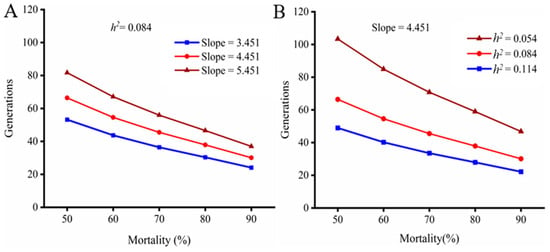
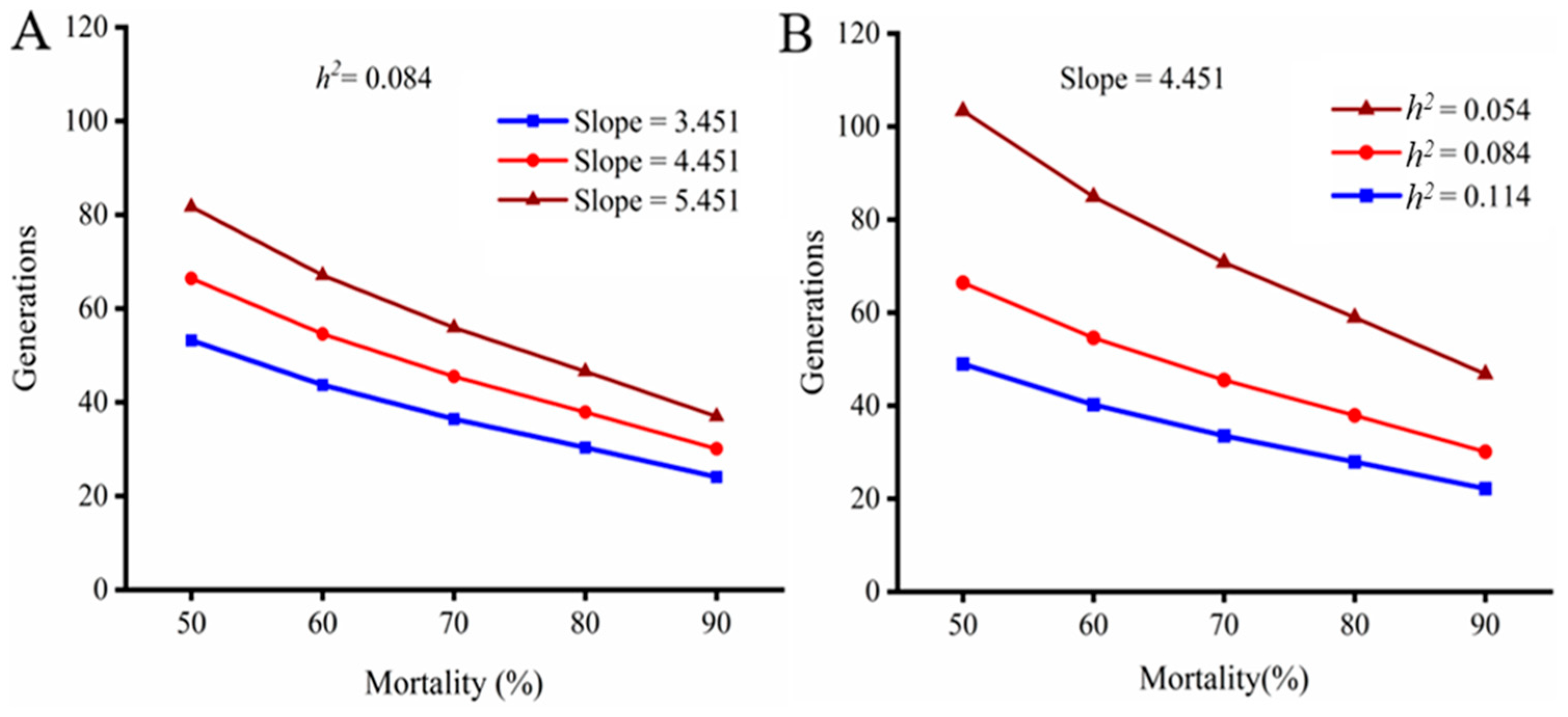
Resistance in FAW was found to have an h2 of 0.084, a selection response (R) of 0.024, and a selection differential (S) of 0.283 (Table S2). A ten-fold increase in resistance would take 30 to 66 generations with 90% and 50% selection mortalities, respectively, assuming an h2 of 0.084 and a slope of 4.451. However, for a slope of 3.451, the required number of generations would increase from 24 to 53 for the same mortality with constant h2. In contrast, at 90% and 50% selection mortalities, respectively, it would take 37 to 82 generations to achieve a ten-fold increase in LC50 if the slope were 5.451 (Figure 1A). Achieving the same ten-fold rise in LC50 would also take 47 to 103 generations, assuming a slope of 4.451 and an h2 of 0.054. In contrast, it would only take 22 to 48 generations to get the same result with an h2 of 0.114 at the same slope (Figure 1B).
Figure 1.
Effect of realized heritability (h2) (A) and slope (B) on the number of generations of FAW required for a 10-fold increase in LC50 of broflanilide at different mortality.
3.3. Impact of Broflanilide Selection on FAW Biological Parameters
Table 1 presents the life table parameters for the WT and Brof-SEL strains of FAW. Following nine generations of selection, the total larval duration in the Brof-SEL strain was significantly extended by 6.13 d compared to WT. In addition, the mean longevity of male and female, as well as the adult and total pre-oviposition periods, were increased significantly by 2.66, 1.03, 1.17, and 9.17 d, respectively, in the Brof-SEL strain. Furthermore, the female mean pupal weight and mean fecundity in the Brof-SEL strain were notably reduced by 24.61 mg and 1077.63 eggs per female compared to the WT, respectively. However, no significant difference was observed in pupal duration, male mean pupal weight, and oviposition duration (Table 1).
Table 1.
Life table parameters of WT and Brof-SEL strains of FAW.
3.4. Effect of Broflanilide on the Population Parameters of FAW
The population parameters of the WT and Brof-SEL strains of FAW are shown in Table 2. In contrast to the WT strain, the Brof-SEL strain showed a decline of 0.049 d−1 in the r and 8.49 d in the T, along with a reduction of 495.71 in the net reproduction rate (R0). No significant difference was found in the λ. After 9 generations of selection, the relative fitness of FAW to broflanilide was 0.38.
Table 2.
Population parameters of the WT and the Brof-SEL strains of FAW.
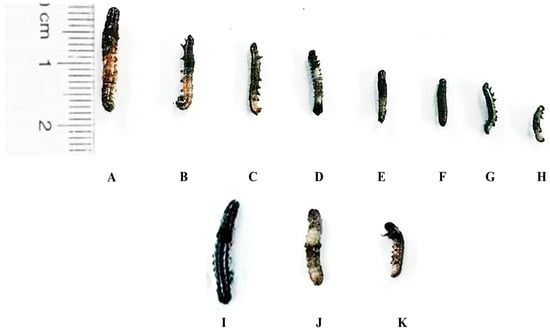
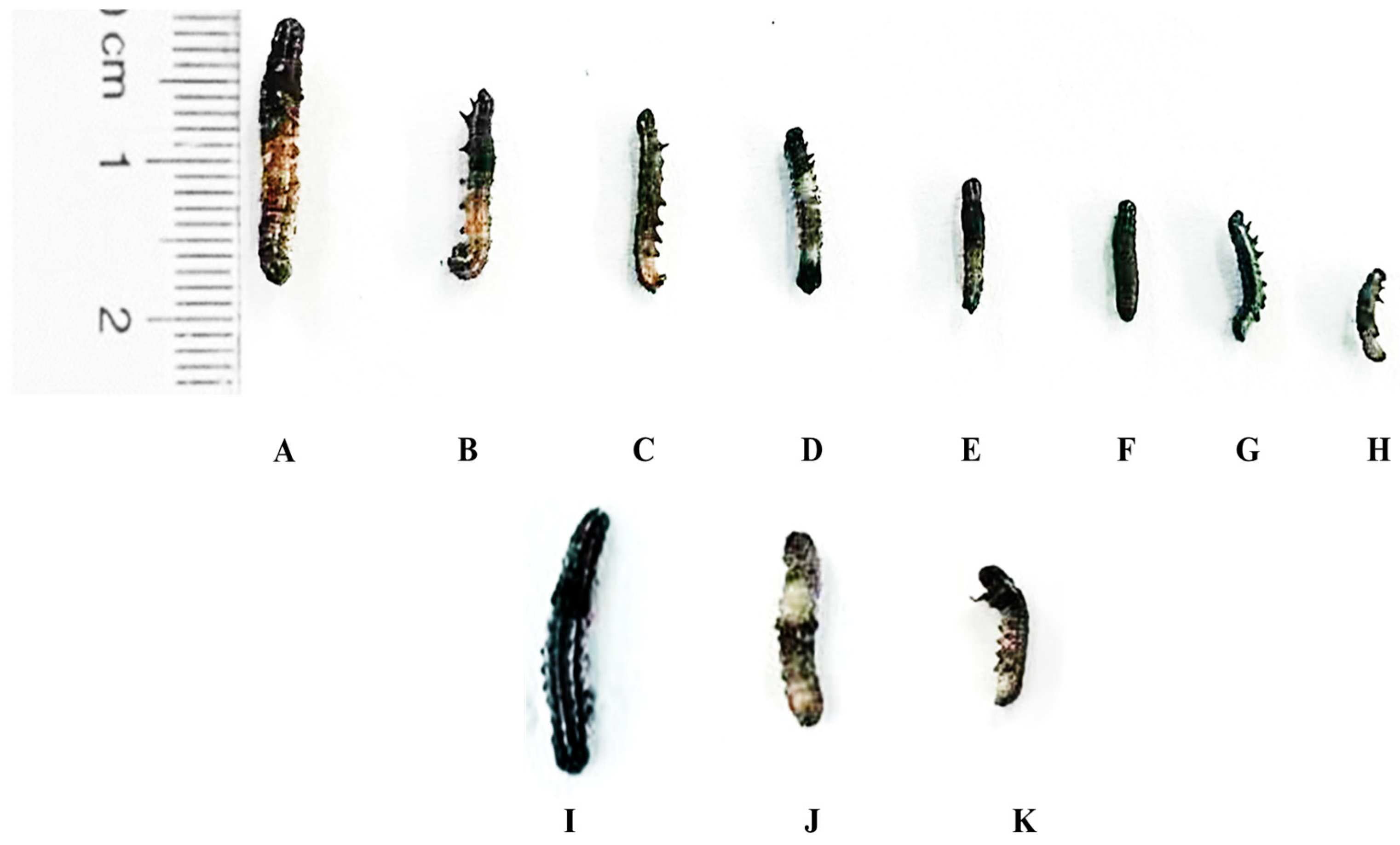
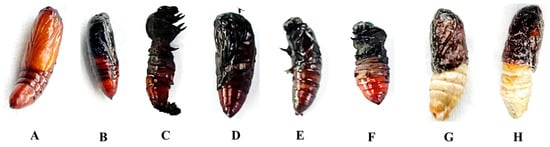
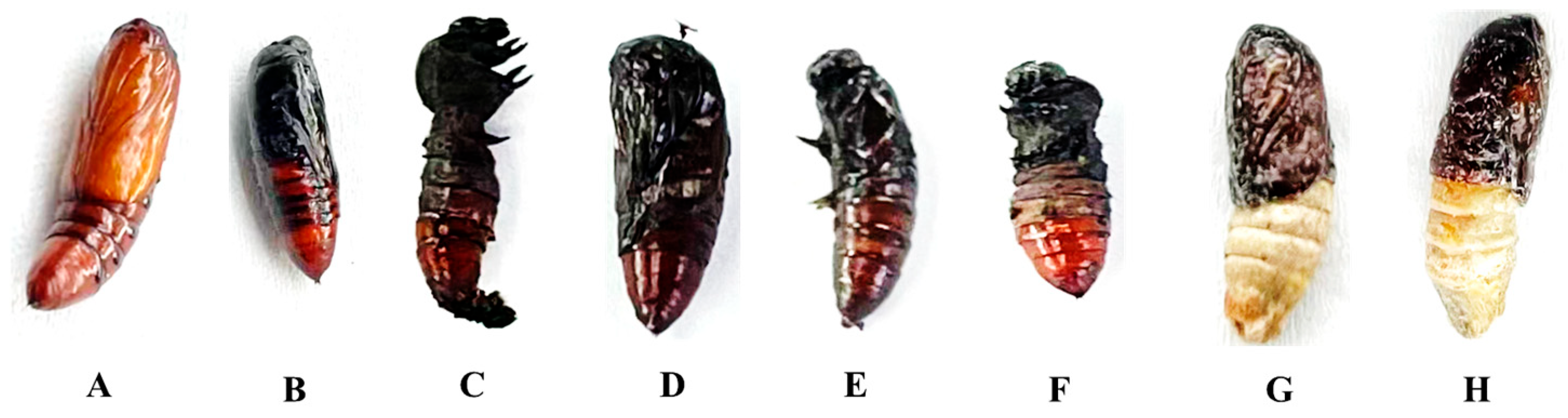
Exposure to broflanilide induced poisoning symptoms in FAW, including reduced feeding, stunted growth, and weight loss, which subsequently delayed their development (Figure 2A–K). Eclosion failure was observed in some individuals, where only the posterior portion of the pupal shell (near the head–abdomen junction) detached, while the anterior end remained intact (Figure 3G,H). Additionally, some FAWs failed to pupate entirely, whereas others successfully pupated but showed deformities at the junction between the head and abdomen (Figure 3B–F).
Figure 2.
Effects of broflanilide on molting of FAW larvae. (A–H) Molting, length, and morphology of FAW larvae. (I–K) Larval molting failure.
Figure 3.
Effects of broflanilide on the pupal morphology of FAW. (A) Normal pupa; (B–F) Deformed pupae/Insects that failed to emerge; (G,H) Intermediate pupal-adult deformity/adults that failed to emerge.
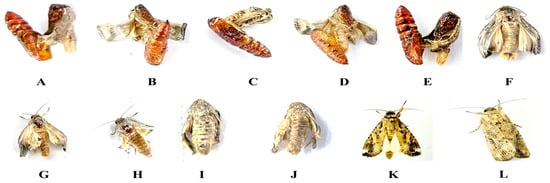
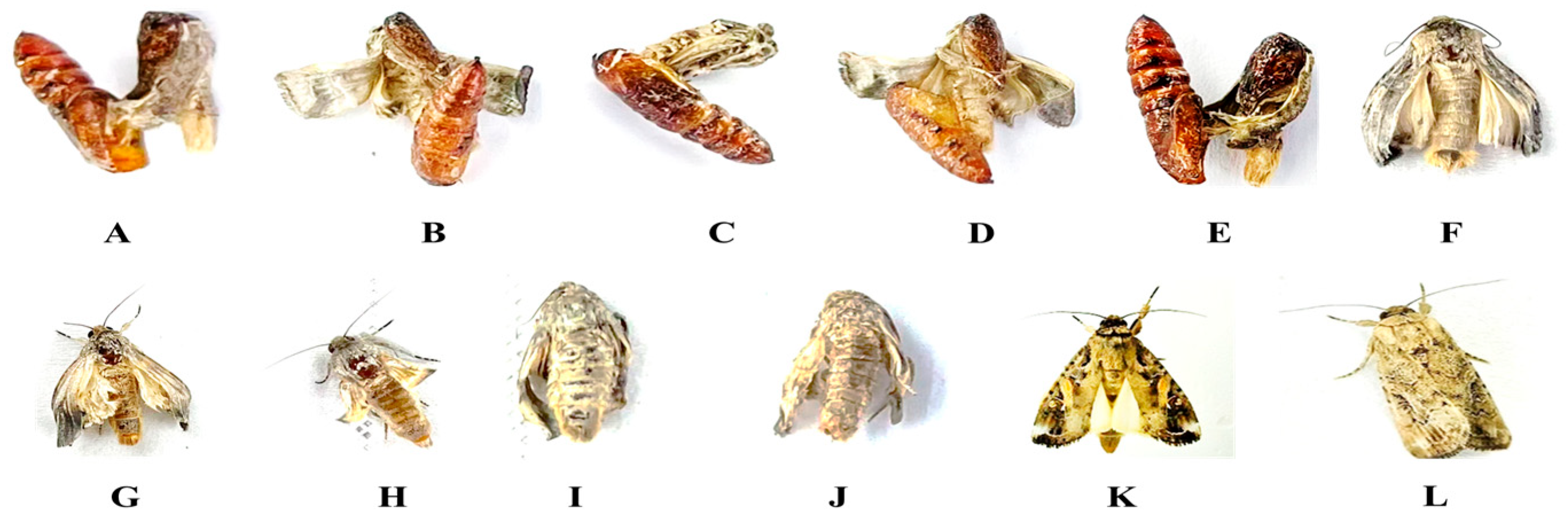
As shown in Figure 4, normal adult FAWs in the control group exhibited fully developed, ridge-shaped wings (Figure 4K,L). In contrast, some adults died after their pupal shells cracked at the head, preventing successful emergence. Similarly, some adults experienced incomplete emergence, where only the pupal shells on the head and tail fell off, but those covering the wings remained (Figure 4A–E). Some individuals failed to develop fully after emerging from the pupal shell and remained in an incomplete emergence state, rendering them incapable of flight. Similarly, others displayed wrinkled, deformed wings, preventing normal flight, while some still had their wings stuck to the pupal shell (Figure 4A–E). Furthermore, FAWs with wing deformities were unable to mate properly, ultimately impacting adult reproduction.
Figure 4.
Effect of broflanilide on the emergence and morphology of FAW adults. (A–E) Wingspans still attached to the pupal shells after opening; (F–J) Wrinkled wings; (K,L) Normal adults male and female FAW.
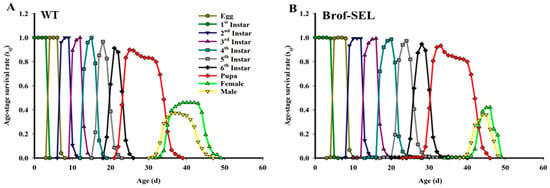
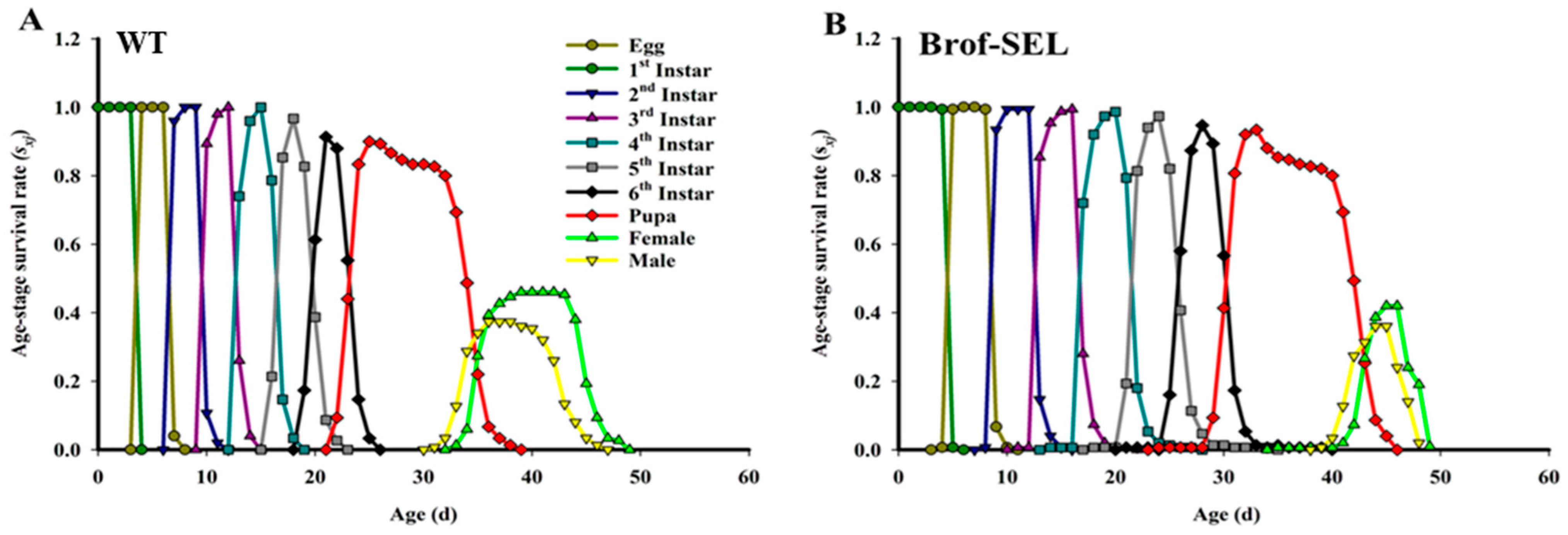
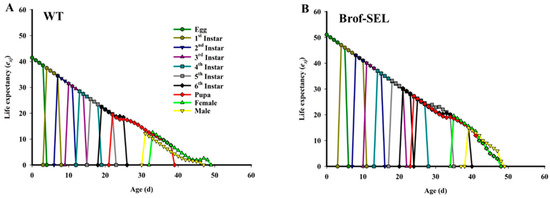
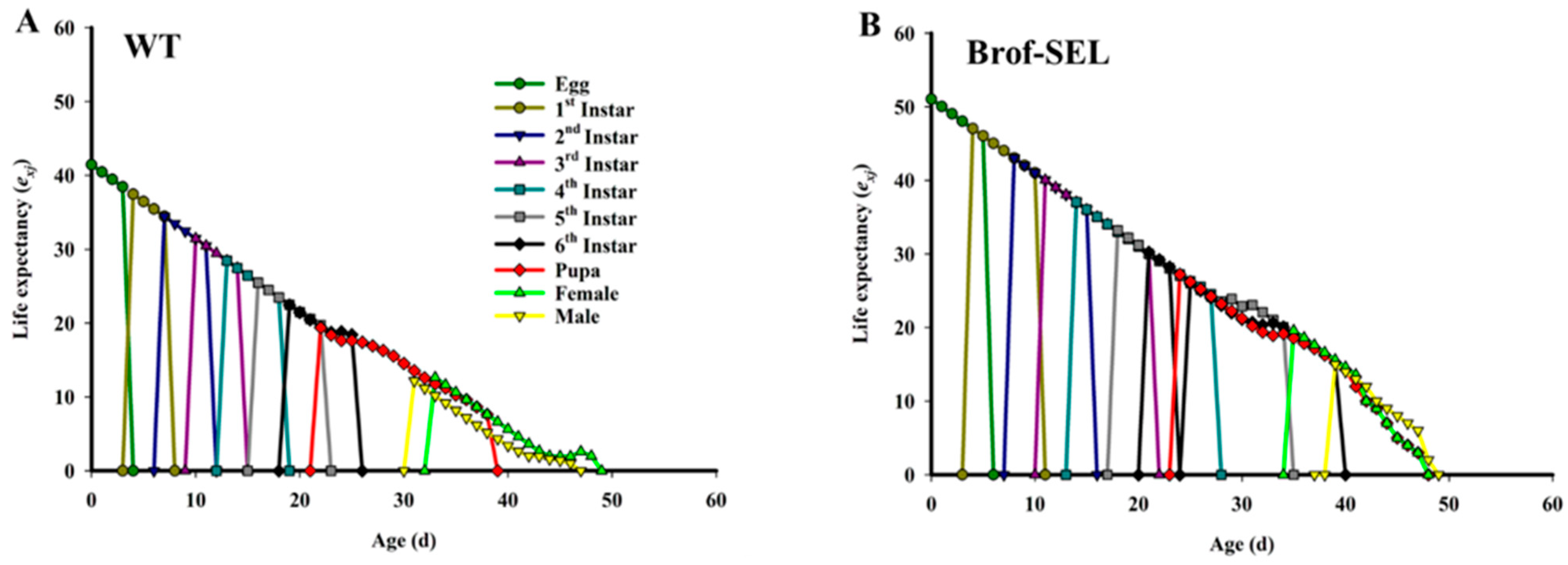
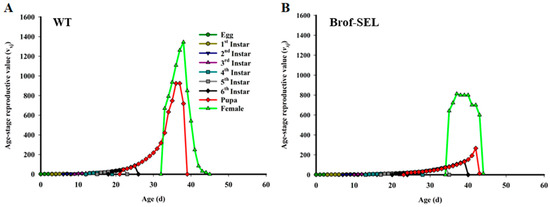
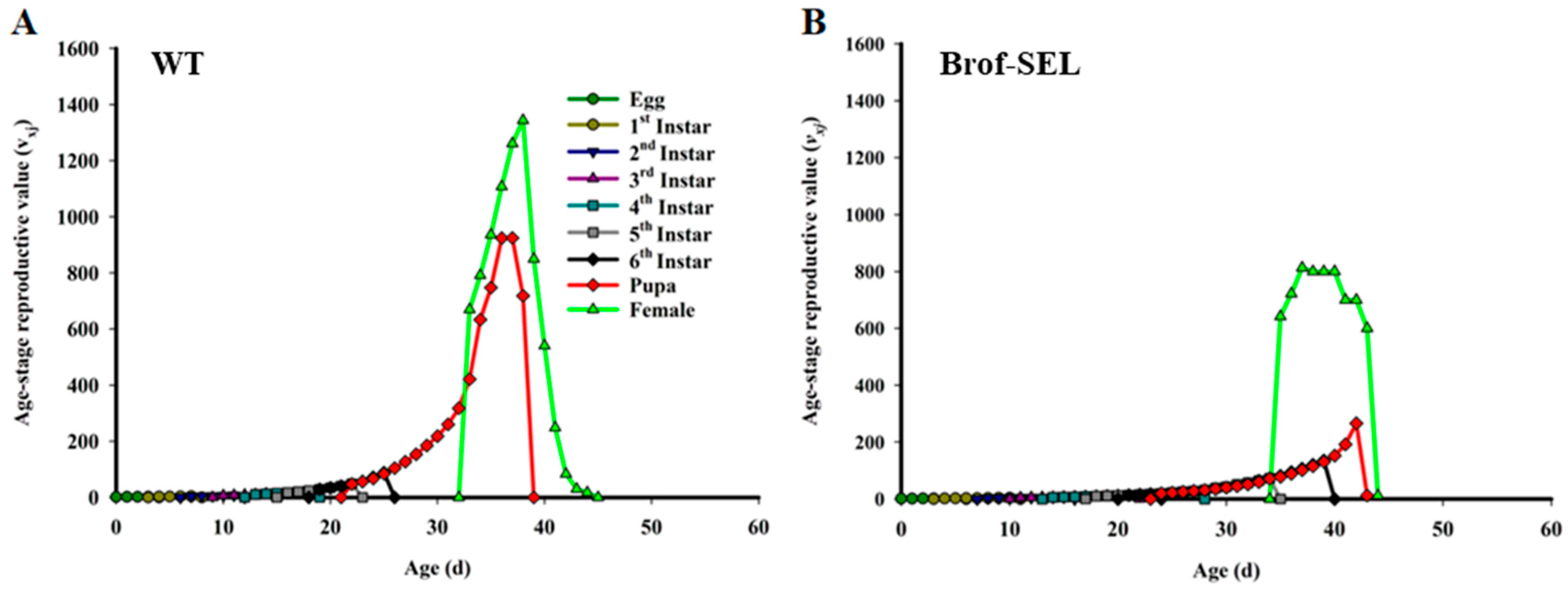
The age-stage specific survival rate (sxj) curves for all developmental and adult stages of both strains were overlapped, with the higher peaks observed for female than male adults. Additionally, the curve for female stages was dropped later than the curve of male stages, reflecting that female had a slightly longer survival rate than males in both strains (Figure 5). The age-stage specific life expectancy (exj) exhibited overlaps across all life stages, concluding on the 47th day for the WT strain and on the 48th day for the Brof-SEL strain (Figure 6). The highest peak of the age-stage reproductive value (vxj) was recorded as 1349.49 on the 30th day in the WT strain, followed by the Brof-SEL strain, which reached 669.71 on the 35th day (Figure 7).
Figure 5.
Age-stage specific survival rate (sxj) of (A) WT and (B) Brof-SEL strains of FAW.
Figure 6.
Age-stage specific life expectancy (exj) of (A) WT and (B) Brof-SEL strains of FAW.
Figure 7.
Age-stage reproductive value (vxj) of (A) WT and (B) Brof-SEL strains of FAW.
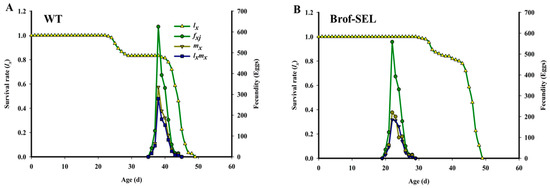
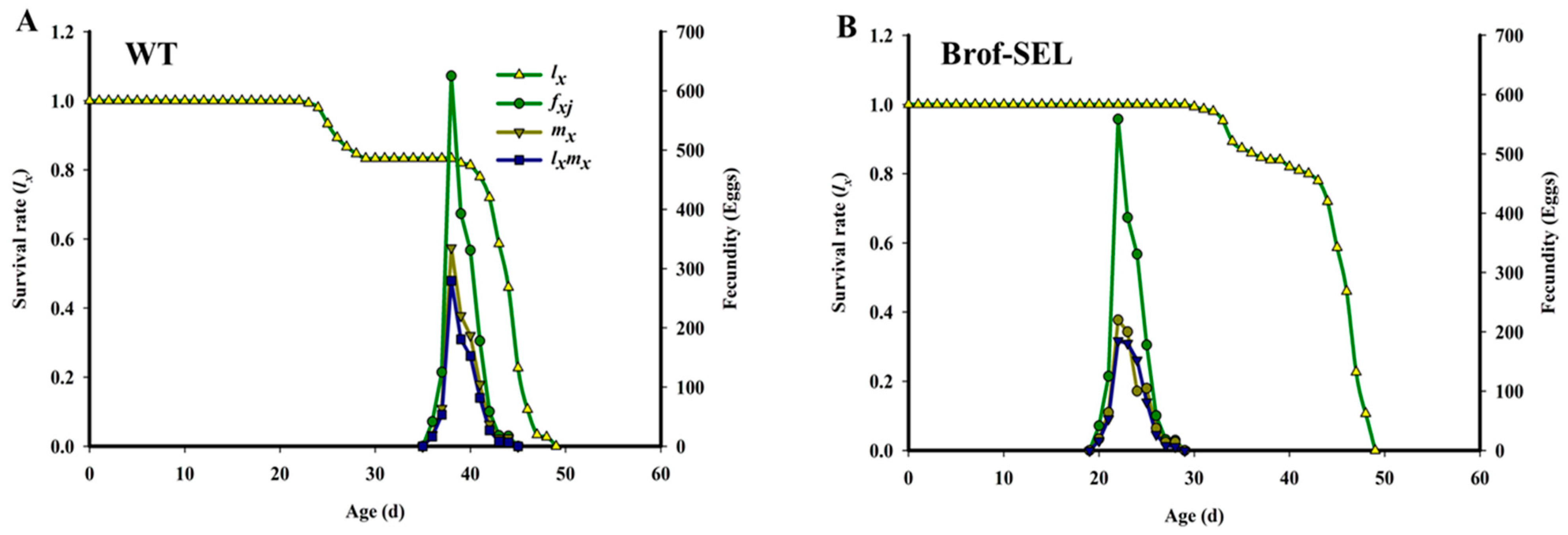
The survival rate (lx) was completed on the 48th day for the WT strain and on the 49th day for the Brof-SEL strain. The highest age-specific fecundity of the total population (mx) was observed in the WT strain (mx = 340.2), followed by the Brof-SEL strain (mx = 227.8). Similarly, the maximum age-specific net maternity (lxmx) was recorded in the WT strain (lxmx = 286.21), with the Brof-SEL strain exhibiting a lower value (lxmx = 222.4). Additionally, the peak female age-specific fecundity (fxj) was highest in the WT strain (fxj = 636), compared to the Brof-SEL strain (fxj = 565.2) (Figure 8).
Figure 8.
Survival rate (lx), female age-specific fecundity (fxj), age-specific fecundity of the entire population (mx), and age-specific maternity (lxmx) of (A) WT and (B) Brof-SEL strains of FAW.
4. Discussion
Insecticide application remains the primary strategy for managing FAW, but the rapid development of resistance has significantly reduced the effectiveness of many products [4,54]. Establishing appropriate application standards for novel active chemicals in the worldwide market requires a detailed risk evaluation of pesticide resistance. Broflanilide, which targets a unique binding site on the GABA receptor, has demonstrated high efficacy in controlling FAW and other insect pests [30,55].
After nine generations of selection under laboratory condition, FAW exposed to broflanilide did not develop a significant level of resistance. The RR was 1.73, indicating minimal resistance to broflanilide. Similarly low levels of resistance were observed in Plutella xylostella (Linnaeus, 1758) (Lepidoptera: Plutellidae) (RR = 1.4) and Helicoverpa armigera (Hübner, 1808) (Lepidoptera: Noctuidae) (RR = 3.3) following selection with broflanilide [29,55]. The development of insecticide resistance is closely linked to several factors, including the active ingredient used, the baseline resistance frequency in the pest population, the biological traits of the pest, and the level of insecticide pressure applied [24,33,56]. In the case of FAW, the slower rate of resistance evolution, observed during broflanilide selection in this study, could be attributed to the initially low resistance frequency in the tested population [17,21]. To prevent or delay the emergence of insecticide resistance in FAW, it is crucial to implement careful strategies when selecting and applying insecticides in the field.
The estimation of h2 provides a consistent approach for assessing the outcomes of selection experiments by integrating the estimate of selection intensity and the rate at which resistance evolves [45,46]. This method also contextualizes the results of selection experiments within the broader framework of theoretical and experimental research in evolutionary biology [29,41]. In this study, the h2 of broflanilide in FAW was found to be 0.084 throughout the selection process, which is relatively low. The low h2 value of 0.084 indicated limited genetic variation and greater phenotypic influence, suggesting that environmental factors played a more significant role in resistance development than genetic factors, and that the potential for genetic resistance to broflanilide is reduced compared other insecticides such as tetraniliprole and lambda-cyhalothrin [29,32,57]. These findings were aligned with previous studies reporting low h2 values for resistance of isooxazoline and meta-diamide insecticides targeting GABA receptor, such as FAW selected with fluxametamide (h2 = 0.084) [31] and Spodoptera litura (Fabricius, 1775) (Lepidoptera: Noctuidae) selected with cyproflanilide (h2 = 0.09) [41]. The anticipated rate of broflanilide resistance progression in FAW is directly influenced by the h2 and inversely related to the slope [23,31]. However, the field conditions differ from laboratory settings in multiple aspects, including pest migration, variations in weather conditions, and common insecticide practices [58]. Consequently, the risk of resistance evolving in the field may differ from laboratory predictions [11]. Although the current study clearly showed that the FAW population developed broflanilide resistance at a slow rate and had low h2 in the laboratory, further research on susceptibility and monitoring of field resistance to broflanilide in FAW is necessary.
The life table parameters of insect populations are commonly analyzed using the age-stage life table method, which provides valuable information into their demographic patterns, survival probabilities, and reproductive potential [19,35]. Understanding the fitness cost of insecticide resistance is essential for assessing the trade-offs associated with resistance [37]. These costs often manifest as reduced survival, prolonged development, decreased fecundity, and shorter lifespans, ultimately influencing the spread of resistance alleles within a population [29,39]. Our study showed that broflanilide exposure caused developmental defects, including failed pupation, wing deformities, and impaired eclosion, leading to reduced flight, mating, and reproduction. It also disrupted larval molting, often preventing exuviae detachment. Furthermore, some adults of the Brof-SEL strain died during eclosion or emerged with deformed wings, potentially limiting resistance allele spread due to reduced fitness. These findings indicated that broflanilide not only caused mortality but also disrupted molting and development in surviving insects. The life table analysis revealed significant developmental delays, and reproductive impairments in the Brof-SEL strain compared to the WT strain. The total larval duration, adult longevity, and pre-oviposition periods were extended in the resistant strain, while female pupal weight and overall fecundity were notably reduced that were similar to previous studies [23,31,41]. Moreover, the Brof-SEL strain exhibited a decrease in the r, T, and the R0 like other studies [29,39,57].
The sxj curves showed overlapping trends across the developmental stages, with a higher peak occurring for the female stage than the male stage. Females had a longer lifespan than males in both strains. The exj analysis further confirmed a slightly extended survival period in the resistant strain. The reproductive values peaked earlier in the WT strain, reflecting its higher reproductive potential. Similarly, the WT strain exhibited higher age-specific fecundity and net maternity values, confirming that resistance selection imposes reproductive disadvantages. These findings align with previous studies on transgenerationally selected populations of FAW against fluxametamide [31], Chilo suppressalis (Walker, 1863) (Lepidoptera: Pyralidae) exposed to tetraniliprole and cyproflanilide [57,59], S. litura with cyproflanilide [41], and P. xylostella with fluxametamide [29], where insecticide resistance was shown to impose substantial physiological costs, including reduced fecundity, extended developmental times, and decreased survival. Moreover, our final relative fitness value (Rf = 0.38) further supports that resistance to broflanilide imposes a substantial fitness cost on FAW, like other studies [23,39]. Our findings reinforced the well-established concept that while resistance provides a survival advantage under insecticide pressure, it often comes with trade-offs that may limit its persistence in natural populations.
5. Conclusions
This study highlights the slow development of resistance to broflanilide in FAW, with a minimal RR at1.73-fold and low h2 value of 0.084. Despite this, the presence of fitness costs associated with resistance including extended development times and reduced fecundity suggest that broflanilide is effective for managing FAW in the long term. The observed fitness trade-offs also emphasize the need for IPM strategies to delay resistance development. However, a limitation of our study is the absence of molecular biology experiments which are necessary to strengthen the robustness and explanatory power of our results. Furthermore, our study is laboratory-based which is not enough to give a broader picture of potential resistance development in FAW against broflanilide in actual field conditions. Therefore, ongoing field monitoring and future research should focus on the molecular mechanisms behind these fitness costs which are crucial for ensuring the sustainable use of broflanilide integrated with biological control.
Supplementary Materials
The following supporting information can be downloaded at: https://www.mdpi.com/article/10.3390/agronomy16030308/s1, Table S1: Toxicity of broflanilide to different generations of FAW during the selection process.; Table S2: Realized heritability (h2) of resistance to broflanilide in FAW.
Author Contributions
P.A.: Conceptualization; Methodology; Investigation; Data curation; Validation; Visualization; Writing—original draft. A.H., Q.H., Y.Z. and Z.W.: Writing—review & editing. C.Z., X.C. and Y.G.: Funding acquisition; Project administration; Supervision; Conceptualization; Validation; Writing—review & editing. All authors have read and agreed to the published version of the manuscript.
Funding
This research was financially supported by the National Key R&D Program of China (2022YFD1400900), State Key Laboratory for Biology of Plant Diseases and Insect Pests (SKLOF202504), Postgraduate Research Practice Innovation Program of Jiangsu Province (KYCX25_0984).
Data Availability Statement
The original contributions presented in the study are included in the article/Supplementary Materials; further inquiries can be directed to the corresponding author.
Acknowledgments
We would also like to thank Hsin Chi for providing the free software TWOSEX-MS Chart program. Priscilla Amponsah and Ali Hasnain are grateful to the Chinese Scholarship Council (CSC) for offering the opportunity to study in China.
Conflicts of Interest
The authors declare no conflicts of interest.
Abbreviations
The following abbreviations are used in this manuscript:
| FAW | fall armyworm |
| WT | laboratory |
| Brof-SEL | broflanilide-selected |
| GABA | γ-aminobutyric acid |
| h2 | realized heritability |
| LC30 | 30% lethal concentration |
| LC50 | median lethal concentration |
| LC70 | 70% lethal concentration |
| CL | confidential limits |
| SE | standard error |
| r | intrinsic rate of increase |
| R0 | net reproductive rate |
| Rf | relative fitness |
| T | mean generation time |
| λ | finite rate of increase |
| TPOP | total pre-oviposition period |
| APOP | adult pre-oviposition period |
| RR | resistance ratio |
| IPM | integrated pest management |
| CL | confidence limit |
References
- Goergen, G.; Kumar, P.L.; Sankung, S.B.; Togola, A.; Tamò, M. First report of outbreaks of the fall armyworm Spodoptera frugiperda (J E Smith) (Lepidoptera, Noctuidae), a new alien invasive pest in West and Central Africa. PLoS ONE 2016, 11, e0165632. [Google Scholar] [CrossRef] [Scilit]
- Montezano, D.; Specht, A.; Sosa Gómez, D.; Roque Specht, V.; Sousa Silva, J.; Paula Moraes, S.V.; Peterson, J.A.; Hunt, T.E. Host plants of Spodoptera frugiperda (Lepidoptera: Noctuidae) in the Americas. Afr. Entomol. 2018, 26, 286–300. [Google Scholar] [CrossRef] [Scilit]
- Adhikari, K.; Bhandari, S.; Dhakal, L.; Shrestha, J. Fall armyworm (Spodoptera frugiperda): A threat in crop production in Africa and Asia. Peruv. J. Agron. 2020, 4, 121–133. [Google Scholar] [CrossRef] [Scilit]
- Kenis, M.; Benelli, G.; Biondi, A.; Calatayud, P.A.; Day, R.; Desneux, N.; Harrison, R.D.; Kriticos, D.; Rwomushana, I.; Berg, J.v.D.; et al. Invasiveness, biology, ecology, and management of the fall armyworm, Spodoptera frugiperda. Entomol. Gen. 2023, 43, 187–241. [Google Scholar] [CrossRef] [Scilit]
- Zhou, Y.; Wu, Q.L.; Zhang, H.W.; Wu, K.M. Spread of invasive migratory pest Spodoptera frugiperda and management practices throughout China. J. Integr. Agric. 2021, 20, 637–645. [Google Scholar] [CrossRef] [Scilit]
- Chen, H.L.; Hasnain, A.; Cheng, Q.H.; Xia, L.J.; Cai, Y.H.; Hu, R.; Gong, C.-W.; Liu, X.-M.; Pu, J.; Zhang, L.; et al. Resistance monitoring and mechanism in the fall armyworm Spodoptera frugiperda (Lepidoptera: Noctuidae) for chlorantraniliprole from Sichuan Province, China. Front. Physiol. 2023, 14, 1180655. [Google Scholar] [CrossRef] [Scilit] [PubMed]
- Jing, D.P.; Guo, J.F.; Jiang, Y.Y.; Zhao, J.Z.; Sethi, A.; He, K.L.; Wang, Z.Y. Initial detections and spread of invasive Spodoptera frugiperda in China and comparisons with other noctuid larvae in cornfields using molecular techniques. Insect Sci. 2020, 27, 780–790. [Google Scholar] [CrossRef] [Scilit]
- Sun, X.X.; Hu, C.X.; Jia, H.R.; Wu, Q.L.; Shen, X.J.; Zhao, S.Y.; Jiang, Y.Y.; Wu, K.M. Case study on the first immigration of fall armyworm, Spodoptera frugiperda invading into China. J. Integr. Agric. 2021, 20, 664–672. [Google Scholar] [CrossRef] [Scilit]
- Wan, J.; Huang, C.; Li, C.Y.; Zhou, H.X.; Ren, Y.L.; Li, Z.Y.; Xing, L.-S.; Zhang, B.; Qiao, X.; Liu, B.; et al. Biology, invasion and management of the agricultural invader: Fall armyworm, Spodoptera frugiperda (Lepidoptera: Noctuidae). J. Integr. Agric. 2021, 20, 646–663. [Google Scholar] [CrossRef] [Scilit]
- Anilkumar, G.; LakshmiSoujanya, P.; Kumar, D.V.S.R.; Kumar, V.M.; Yathish, K.R.; Sekhar, J.C.; Jat, H.S. Integrated approaches for the management of invasive fall armyworm, Spodoptera frugiperda (J. E. Smith) in maize. J. Plant Dis. Prot. 2024, 131, 793–803. [Google Scholar] [CrossRef] [Scilit]
- Urhausen, S.; Bradshaw, C.D.; Davie, J.; Eyre, D.; Hemming, D.; Li, H.; Taylor, B.; Zhang, F. Climate-related risk to maize crops in China from Fall Armyworm, Spodoptera frugiperda. J. Pest Sci. 2025, 98, 959–972. [Google Scholar] [CrossRef] [Scilit]
- Chimweta, M.; Nyakudya, I.W.; Jimu, L.; Bray Mashingaidze, A. Fall armyworm [Spodoptera frugiperda (J.E. Smith)] damage in maize: Management options for flood-recession cropping smallholder farmers. Int. J. Pest Manag. 2020, 66, 142–154. [Google Scholar] [CrossRef] [Scilit]
- He, L.M.; Wu, Q.L.; Gao, X.W.; Wu, K.M. Population life tables for the invasive fall armyworm, Spodoptera frugiperda fed on major oil crops planted in China. J. Integr. Agric. 2021, 20, 745–754. [Google Scholar] [CrossRef] [Scilit]
- Early, R.; González-Moreno, P.; Murphy, S.T.; Day, R. Forecasting the global extent of invasion of the cereal pest Spodoptera frugiperda, the fall armyworm. NeoBiota 2018, 40, 25–50. [Google Scholar] [CrossRef] [Scilit]
- Westbrook, J.K.; Nagoshi, R.N.; Meagher, R.L.; Fleischer, S.J.; Jairam, S. Modeling seasonal migration of fall armyworm moths. Int. J. Biometeorol. 2016, 60, 255–267. [Google Scholar] [CrossRef] [Scilit]
- Jiang, Y.Y.; Liu, J.; Xie, M.C.; Li, Y.H.; Yang, J.J.; Zhang, M.L.; Qiu, K. Observation on law of diffusion damage of Spodoptera frugiperda in China in 2019. Plant Prot. 2019, 45, 10–19. [Google Scholar]
- Zhang, L.; Liu, B.; Zheng, W.; Liu, C.; Zhang, D.; Zhao, S.; Li, Z.; Xu, P.; Wilson, K.; Withers, A.; et al. Genetic structure and insecticide resistance characteristics of fall armyworm populations invading China. Mol. Ecol. Resour. 2020, 20, 1682–1696. [Google Scholar] [CrossRef] [Scilit]
- Bass, C.; Denholm, I.; Williamson, M.S.; Nauen, R. The global status of insect resistance to neonicotinoid insecticides. Pestic. Biochem. Physiol. 2015, 121, 78–87. [Google Scholar] [CrossRef] [Scilit]
- Gul, H.; Gadratagi, B.G.; Güncan, A.; Tyagi, S.; Ullah, F.; Desneux, N.; Liu, X. Fitness costs of resistance to insecticides in insects. Front. Physiol. 2023, 14, 1238111. [Google Scholar] [CrossRef] [Scilit]
- Sparks, T.C.; Nauen, R. IRAC: Mode of action classification and insecticide resistance management. Pestic. Biochem. Physiol. 2015, 121, 122–128. [Google Scholar] [CrossRef] [Scilit]
- Carvalho, R.A.; Omoto, C.; Field, L.M.; Williamson, M.S.; Bass, C. Investigating the molecular mechanisms of organophosphate and pyrethroid resistance in the fall armyworm Spodoptera frugiperda. PLoS ONE 2013, 8, e62268. [Google Scholar] [CrossRef] [Scilit]
- Gutiérrez-Moreno, R.; Mota-Sanchez, D.; Blanco, C.A.; Whalon, M.E.; Terán-Santofimio, H.; Rodriguez-Maciel, J.C.; DiFonzo, F. Field-evolved resistance of the fall armyworm (Lepidoptera: Noctuidae) to synthetic insecticides in Puerto Rico and Mexico. J. Econ. Entomol. 2019, 112, 792–802. [Google Scholar] [CrossRef] [Scilit]
- Abbas, A.; Hafeez, F.; Hasnain, A.; Iftikhar, A.; Khan, M.H.; Ullah, F.; Elkady, A.M.M.; Zhao, C.R.; Sun, X. Chlorantraniliprole resistance and associated fitness costs in fall armyworm (Spodoptera frugiperda): Implications for resistance management. Insects 2025, 16, 1232. [Google Scholar] [CrossRef] [Scilit]
- Bolzan, A.; Padovez, F.E.; Nascimento, A.R.; Kaiser, I.S.; Lira, E.C.; Amaral, F.S.; Kanno, R.H.; Malaquias, J.B.; Omoto, C. Selection and characterization of the inheritance of resistance of Spodoptera frugiperda (Lepidoptera: Noctuidae) to chlorantraniliprole and cross-resistance to other diamide insecticides. Pest Manag. Sci. 2019, 75, 2682–2689. [Google Scholar] [CrossRef] [Scilit]
- Nakao, T.; Banba, S. Broflanilide: A meta-diamide insecticide with a novel mode of action. Bioorganic Med. Chem. 2016, 24, 372–377. [Google Scholar] [CrossRef] [Scilit]
- Katsuta, H.; Nomura, M.; Wakita, T.; Daido, H.; Kobayashi, Y.; Kawahara, A.; Banba, S. Discovery of broflanilide, a novel insecticide. J. Pestic. Sci. 2019, 44, 120–128. [Google Scholar] [CrossRef] [Scilit]
- Nakao, T.; Katsuta, H.; Nomura, M.; Wakita, T.; Daido, H.; Kobayashi, Y.; Kawahara, A.; Banba, S. Chapter 7—Discovery and optimization of a novel insecticide, broflanilide. In Recent Highlights in the Discovery and Optimization of Crop Protection Products; Maienfisch, P., Mangelinckx, S., Eds.; Academic Press: Cambridge, MA, USA, 2021; pp. 145–155. [Google Scholar] [CrossRef] [Scilit]
- Wu, J.; Dang, S.; Zhang, Y.; Zhou, S. Novel meta-diamide compounds containing sulfide derivatives were designed and synthesized as potential pesticides. Molecules 2024, 29, 1337. [Google Scholar] [CrossRef] [Scilit]
- Sun, X.; Wei, R.; Li, L.; Zhu, B.; Liang, P.; Gao, X. Resistance and fitness costs in diamondback moths after selection using broflanilide, a novel meta-diamide insecticide. Insect Sci. 2022, 29, 188–198. [Google Scholar] [CrossRef] [Scilit] [PubMed]
- Zhan, E.L.; Wang, Y.; Jiang, J.; Jia, Z.Q.; Tang, T.; Song, Z.J.; Han, Z.J.; Zhao, C.Q. Influence of three insecticides targeting GABA receptor on fall armyworm Spodoptera frugiperda: Analyses from individual, biochemical and molecular levels. Pestic. Biochem. Physiol. 2021, 179, 104973. [Google Scholar] [CrossRef] [Scilit] [PubMed]
- Roy, D.; Biswas, S.; Sarkar, S.; Adhikary, S.; Chakraborty, G.; Sarkar, P.K.; Al-Shuraym, L.A.; Sayed, S.; Gaber, A.; Hossain, A. Risk assessment of fluxametamide resistance and fitness costs in fall armyworm (Spodoptera frugiperda). Toxics 2023, 11, 307. [Google Scholar] [CrossRef] [Scilit] [PubMed]
- Guo, Z.; Tang, J.; Ma, H.; Wu, M.; He, S.; Wan, H.; Ma, K.; Li, J. Investigation of lambda-cyhalothrin resistance in Spodoptera frugiperda: Heritability, cross-resistance, and mechanisms. Pestic. Biochem. Physiol. 2024, 202, 105916. [Google Scholar] [CrossRef] [Scilit]
- Boaventura, D.; Martin, M.; Pozzebon, A.; Mota-Sanchez, D.; Nauen, R. Monitoring of target-site mutations conferring insecticide resistance in Spodoptera frugiperda. Insects 2020, 11, 545. [Google Scholar] [CrossRef] [Scilit] [PubMed]
- Posos-Parra, O.; Mota-Sanchez, D.; Pittendrigh, B.R.; Wise, J.C.; DiFonzo, C.D.; Patterson, E. Characterization of the inheritance of field-evolved resistance to diamides in the fall armyworm (Spodoptera frugiperda) (Lepidoptera: Noctuidae) population from Puerto Rico. PLoS ONE 2024, 19, e0295928. [Google Scholar] [CrossRef] [Scilit]
- Ullah, F.; Murtaza, G.; Li, X.; Gul, H.; Wang, Y.; Zhao, S.; Abbas, A.; Zhang, Z.; Huang, J.; Desneux, N.; et al. Selection-induced spinosad resistance and associated fitness costs in Tuta absoluta: A key invasive tomato pest. Agronomy 2025, 15, 358. [Google Scholar] [CrossRef] [Scilit]
- Padovez, F.E.O.; Kanno, R.H.; Zambon, G.Z.; Omoto, C.; Guidolin, A.S. The cost of resistance to diamide insecticide varies with the host plant in Spodoptera frugiperda (Lepidoptera: Noctuidae). J. Econ. Entomol. 2022, 115, 2041–2050. [Google Scholar] [CrossRef] [Scilit]
- Gul, H.; Güncan, A.; Abbas, A.; Ullah, Z.; Yuqing, X.; Ullah, F.; Desneux, N.; Liu, X. Insecticide resistance evolution negatively affects the fitness of Aphis gossypii Glover during selection on cotton plants under laboratory conditions. Plants 2025, 14, 2527. [Google Scholar] [CrossRef] [Scilit] [PubMed]
- Hasnain, A.; Amponsah, P.; Mao, X.; Pu, Q.; Zhan, E.; Luo, G.; Zhao, C. Intergenerational effect of cyproflanilide at sublethal level to Chilo suppressalis (Walker) (Lepidoptera: Pyralidae). Crop Prot. 2025, 193, 107184. [Google Scholar] [CrossRef] [Scilit]
- Amponsah, P.; Hasnain, A.; Wang, Y.; Zhan, E.; Luo, G.; Zhu, B.; Zhao, C. Resistance risk assessment and associated fitness cost of fluxametamide in the rice stem borer, Chilo suppressalis Walker (Lepidoptera: Pyralidae). Crop Prot. 2025, 197, 107297. [Google Scholar] [CrossRef] [Scilit]
- Zanzana, K.; Dannon, E.A.; Sinzogan, A.A.; Toffa, J.M. Fall armyworm management in a changing climate: An overview of climate-responsive integrated pest management (IPM) strategies for long-term control. Egypt. J. Biol. Pest Control 2024, 34, 54. [Google Scholar] [CrossRef] [Scilit]
- Zhan, E.; Lu, H.; Tian, H.; Wang, J.; Xu, L.; Zhao, C. Resistance risk assessment and fitness cost of cyproflanilide in the common cutworm, Spodoptera litura (Lepidoptera: Noctuidae). Crop Prot. 2025, 188, 107033. [Google Scholar] [CrossRef] [Scilit]
- Elvira, S.; Gorría, N.; Muñoz, D.; Williams, T.; Caballero, P. A simplified low-cost diet for rearing Spodoptera exigua (Lepidoptera: Noctuidae) and its effect on S. exigua nucleopolyhedrovirus production. J. Econ. Entomol. 2010, 103, 17–24. [Google Scholar] [CrossRef] [Scilit]
- Peng, Y.; Wang, K.; Zhu, G.; Han, Q.; Chen, J.; Elzaki, M.E.A.; Sheng, C.; Zhao, C.; Palli, S.R.; Han, Z. Identification and characterization of multiple dsRNases from a lepidopteran insect, the tobacco cutworm, Spodoptera litura (Lepidoptera: Noctuidae). Pestic. Biochem. Physiol. 2020, 162, 86–95. [Google Scholar] [CrossRef] [Scilit]
- NY/T1154.10-2008; Guideline for Laboratory Bioassay of Pesticides—Part 10: Diet Incorporation Method. Ministry of Agriculture China: Beijing, China, 2008. Available online: https://www.codeofchina.com/standard/NYT1154.10-2008.html (accessed on 18 January 2026).
- Tabashnik, B.E. Resistance risk assessment: Realized heritability of resistance to Bacillus thuringiensis in diamondback moth (Lepidoptera: Plutellidae), Tobacco budworm (Lepidoptera: Noctuidae), and Colorado potato beetle (Coleoptera: Chrysomelidae). J. Econ. Entomol. 1992, 85, 1551–1559. [Google Scholar] [CrossRef] [Scilit]
- Tabashnik, B.E.; McGaughey, W.H. Resistance risk assessment for single and multiple insecticides: Responses of Indianmeal moth (Lepidoptera: Pyralidae) to Bacillus thuringiensis. J. Econ. Entomol. 1994, 87, 834–841. [Google Scholar] [CrossRef] [Scilit]
- Shen, N.; Liu, H.Y.; Mou, T.Y.; Ma, Y.B.; Li, Y.; Song, Z.J.; Tang, T.; Han, Z.; Zhao, C. Novel meta-diamide insecticide, broflanilide, suppresses the population of common cutworm Spodoptera litura through its lethal and sublethal effects. Pest Manag. Sci. 2022, 78, 1081–1089. [Google Scholar] [CrossRef] [Scilit] [PubMed]
- Chi, H.; Güncan, A.; Kavousi, A.; Gholamhossein, G.; Atlıhan, R.; Özgökçe, M.; Shirazi, J.; Amir-Maafi, M.; Maroufpoor, M.; Roya, T. TWOSEX-MSChart: The key tool for life table research and education. Entomol. Gen. 2022, 42, 845–849. [Google Scholar] [CrossRef] [Scilit]
- Chi, H. TWOSEX-MSChart: A Computer Program for the Age-Stage, Two-Sex Life Table Analysis. 2025. Available online: https://www.faas.cn/cms/sitemanage/index.shtml?siteId=810640925913080000 (accessed on 22 November 2024).
- Chi, H.; Kavousi, A.; Gholamhossein, G.; Atlıhan, R.; Özgökçe, M.; Güncan, A.; Gökçe, A.; Smith, C.L.; Benelli, G.; Guedes, R.N.C.; et al. Advances in theory, data analysis, and application of the age-stage, two-sex life table for demographic research, biological control, and pest management. Entomol. Gen. 2023, 43, 705–732. [Google Scholar] [CrossRef] [Scilit]
- Wei, M.; Chi, H.; Guo, Y.; Li, X.; Zhao, L.; Ma, R. Demography of Cacopsylla chinensis (Hemiptera: Psyllidae) reared on four cultivars of Pyrus bretschneideri (Rosales: Rosaceae) and P. communis Pears with estimations of confidence intervals of specific life table statistics. J. Econ. Entomol. 2020, 113, 2343–2353. [Google Scholar] [CrossRef] [Scilit] [PubMed]
- Chi, H.; Kara, H.; Özgökçe, M.; Atlıhan, R.; Güncan, A.; Rişvanlı, M.R. Innovative application of set theory, Cartesian product, and multinomial theorem in demographic research. Entomol. Gen. 2022, 42, 863–874. [Google Scholar] [CrossRef] [Scilit]
- Cao, G.; Han, Z. Tebufenozide resistance selected in Plutella xylostella and its cross-resistance and fitness cost. Pest Manag. Sci. 2006, 62, 746–751. [Google Scholar] [CrossRef] [Scilit]
- Xiao, Y.; Wang, X.; Li, Z.; Lei, C.; Wang, S. Insecticidal potential and risk assessment of diamide pesticides against Spodoptera frugiperda in maize crops. Ecotoxicol. Environ. Saf. 2024, 282, 116682. [Google Scholar] [CrossRef] [Scilit]
- Wang, X.; Shi, T.; Tang, P.; Liu, S.; Hou, B.; Jiang, D.; Lu, J.; Yang, Y.; Carrière, Y.; Wu, Y. Baseline susceptibility of Helicoverpa armigera, Plutella xylostella, and Spodoptera frugiperda to the meta-diamide insecticide broflanilide. Insect Sci. 2023, 30, 1118–1128. [Google Scholar] [CrossRef] [Scilit] [PubMed]
- Nascimento, A.R.; Farias, J.R.; Bernardi, D.; Horikoshi, R.J.; Omoto, C. Genetic basis of Spodoptera frugiperda (Lepidoptera: Noctuidae) resistance to the chitin synthesis inhibitor lufenuron. Pest Manag. Sci. 2016, 72, 810–815. [Google Scholar] [CrossRef] [Scilit]
- Sun, H.; Wang, S.; Liu, C.; Hu, W.K.; Liu, J.W.; Zheng, L.J.; Gao, M.; Guo, F.; Qiao, S.; Liu, J.; et al. Risk assessment, fitness cost, cross-resistance, and mechanism of tetraniliprole resistance in the rice stem borer, Chilo suppressalis. Insect Sci. 2024, 31, 835–846. [Google Scholar] [CrossRef] [Scilit]
- Yan, X.R.; Wang, Z.Y.; Feng, S.Q.; Zhao, Z.H.; Li, Z.H. Impact of temperature change on the fall armyworm, Spodoptera frugiperda under global climate change. Insects 2022, 13, 981. [Google Scholar] [CrossRef] [Scilit] [PubMed]
- Zhang, K.; Zhan, E.; Chang, X.; Fouad, E.A.; Zhao, C. Resistance realized heritability and fitness cost of cyproflanilide in rice stem borer, Chilo suppressalis (Lepidoptera: Pyralidae). Agronomy 2024, 14, 2249. [Google Scholar] [CrossRef] [Scilit]

Disclaimer/Publisher’s Note: The statements, opinions and data contained in all publications are solely those of the individual author(s) and contributor(s) and not of MDPI and/or the editor(s). MDPI and/or the editor(s) disclaim responsibility for any injury to people or property resulting from any ideas, methods, instructions or products referred to in the content. |
© 2026 by the authors. Licensee MDPI, Basel, Switzerland. This article is an open access article distributed under the terms and conditions of the Creative Commons Attribution (CC BY) license.