Article

Functional Biofertilizer with Microbial and Enzyme Complex Improves Nutrients, Microbial Characteristics, and Crop Yield in Albic Soil of Heilongjiang Province, China

1
College of Land and Environment, Shenyang Agricultural University, Shenyang 110866, China
2
CAS Key Laboratory of Forest Ecology and Silviculture, Institute of Applied Ecology, Chinese Academy of Sciences, Shenyang 110016, China
3
Shenyang Runliao Green Agricultural Science and Technology Co., Ltd., Shenyang 110200, China
4
National Field Observation and Research Station of Shenyang Agro-Ecosystems, Shenyang 110107, China
5
Beidahuang Group, Heilongjiang 852 Farm Co., Ltd., Baoqing 155620, China
*
Authors to whom correspondence should be addressed.
These authors contributed equally to the work.
Agronomy 2026, 16(3), 307; https://doi.org/10.3390/agronomy16030307

Submission received: 12 December 2025 / Revised: 20 January 2026 / Accepted: 22 January 2026 / Published: 26 January 2026
(This article belongs to the Special Issue Conventional and Alternative Fertilization of Crops)

Abstract

Soils with an albic horizon (characterized by a bleached, nutrient-poor eluvial layer), classified primarily as Albic Planosols and associated groups (e.g., Albic Luvisols and Retisols) in the World Reference Base for Soil Resources (WRB), are widespread in Northeast China and suffer from inherent poor nutrient availability and low crop productivity. The present study aimed to evaluate the efficacy of novel microbial–enzyme composite biofertilizers in ameliorating Albic soils. This comprehensive assessment investigated their effects on soil nutrient availability, microbial community structure, and the activities of key enzymes involved in nutrient cycling (e.g., dehydrogenase and phosphatase). Concurrently, the impact on maize crop performance was determined by measuring changes in agronomic traits, including chlorophyll content, stem diameter, and final grain yield. A field experiment was conducted in Heilongjiang Province during the 2023 maize growing season using a randomized block design with six treatments: CF (conventional chemical fertilizer, 330 kg·ha−1 NPK), OF (chemical fertilizer + 1500 kg·ha−1 organic carrier), BF1 (OF + 75 kg·ha−1 marine actinomycetes), BF2 (OF + 75 kg·ha−1 actinomycetes + 45 kg·ha−1 phytase), BF3 (OF + 75 kg·ha−1 actinomycetes + 45 kg·ha−1 mycorrhizal fungi + 45 kg·ha−1 phytase), and BF4 (OF + 75 kg·ha−1 actinomycetes + 45 kg·ha−1 mycorrhizal fungi + 45 kg·ha−1 phytase + 45 kg·ha−1 β–glucosidase). The results showed that biofertilizers significantly increased microbial abundance and enzyme activity. The integrated treatment BF4 notably enhanced topsoil fungal abundance by 188.1% and dehydrogenase activity in the 0–20 cm layer, while also increasing available phosphorus by 92.6% at maturity. Although BF4 improved soil properties the most, BF3 produced the highest maize yield—boosting grain output by 18.3% over CF—and improved stem diameter and chlorophyll content. Strong correlations between microbial parameters and enzyme activities indicated a nutrient-cycling mechanism driven by microorganisms, with topsoil fungal abundance positively linked to alkaline phosphatase activity (r = 0.72) and subsoil bacterial abundance associated with available phosphorus (r = 0.65), demonstrating microbial–mediated carbon–phosphorus coupling. In conclusion, microbial–enzyme biofertilizers, particularly BF4, provide a sustainable strategy for enhancing Albic soil fertility and crop productivity.

1. Introduction

Albic soils, more precisely defined as soils featuring a prominent albic horizon (a bleached, eluvial layer), are globally distributed in 32 countries across Europe, North America, Russia, and China, and are particularly prevalent in Northeast China’s Heilongjiang and Jilin provinces [1]. Under the World Reference Base for Soil Resources (WRB), soils with this diagnostic feature are commonly classified as Planosols, but may also be labeled as Luvisols, Lixisols, or Retisols with the ‘Albic’ qualifier [1]. In Northeast China’s Heilongjiang and Jilin provinces, these soils are predominantly Albic Planosols. The surface horizon exhibits a light texture, low organic matter content, and poor water and nutrient retention capacity, resulting in generally low productivity. The underlying albic horizon, composed of 70% silt and sand particles with only 30% clay, forms a dense, compacted structure with soil hardness ranging from 25 to 50 kg·cm−2, significantly exceeding the 10–15 kg·cm−2 threshold for optimal root growth [2]. This layer has high bulk density, strong mechanical resistance, poor aeration, and restricted hydraulic conductivity, functioning as a “barrier layer” that impedes vertical water and nutrient movement while restricting root penetration [2]. Consequently, crops grown in Albic soils are highly susceptible to both drought and waterlogging stress [3]. Comparative studies have shown that the total nutrient content in the upper 50 cm of Albic soils is only 50–33% of that in adjacent Chernozems, correlating with 20% lower crop yields. Intensive cultivation has further exacerbated these limitations by depleting carbon (C), nitrogen (N), phosphorus (P), and other essential nutrients, degrading soil structure, and reducing microbial activity, thereby impairing nutrient cycling efficiency [4]. Additionally, some Albic soils exhibit low pH, which further restricts nutrient uptake by crops, while traditional chemical fertilizers may worsen soil acidification [5]. The microbial community structure in these soils is often simplistic, leading to inefficient organic matter decomposition and nutrient cycling [6]. Consequently, exploring effective strategies for ameliorating Albic soil and enhancing its productivity is crucial for ensuring sustainable agriculture and food security in this region.
Traditional amendment methods exist; however, they can be costly or unsustainable. Current amelioration strategies for Albic soils include physical and chemical approaches [4,5]. Tillage-based amelioration, such as deep plowing with specialized implements (e.g., three-stage subsoil mixing plows, four-stage variants, and interval subsoil plows), has demonstrated efficacy in blending the albic and illuvial horizons while incorporating straw residues [7]. These treatments have been shown to increase cation exchange capacity (CEC) in the 20–40 cm layer by 14.73%, 15.70%, and 10.85%, respectively. However, their effects are generally transient compared to chemical amendments [4]. Chemical amelioration relies on organic amendments such as manure, straw, biochar [5,8,9,10], and inorganic and organic fertilizers [4,5]. These applications enhance soil organic matter content, nutrient reserves, aggregate stability, and physicochemical properties, ultimately improving crop productivity [4,5,11]. However, the long-term sustainability of these methods remains uncertain, particularly given the increasing demand for environmentally friendly agricultural practices.
Biological improvement strategies have gained increasing attention [12,13]. These approaches focus on systematically regulating the soil micro-ecosystem through the exogenous application of functional organic materials and beneficial microorganisms to fundamentally improve soil physicochemical and biological properties. Within this context, bio-organic fertilizers—produced by scientifically combining specific microbial agents with organic carrier materials—offer a highly promising new pathway for the green improvement of Albic soils [14]. The application of organic and microbial fertilizers demonstrates universal advantages in enhancing soil health and productivity. On one hand, organic fertilization directly amends the impoverished topsoil of Albic soils by supplementing abundant organic matter and nutrients, improving soil aggregate structure, and enhancing water and nutrient retention capacity [15]. On the other hand, the functional microbial strains introduced by microbial fertilizers (e.g., phosphate-solubilizing bacteria, potassium-releasing bacteria, and nitrogen-fixing bacteria) can colonize and proliferate in the rhizosphere. Through their metabolic activities, they mobilize immobilized nutrients in the soil, enhance crop nutrient uptake, and secrete beneficial substances such as growth stimulants. More importantly, these beneficial microbes can suppress the proliferation of soil-borne pathogens through competition and antagonism, thereby reshaping a healthy soil microbiota and enhancing the stability and resilience of the soil ecosystem [16].
In recent years, bio-organic fertilizers—produced by combining beneficial microbial agents with organic materials—have emerged as a promising alternative for sustainable soil improvement. Substantial research affirms their effectiveness. A meta-analysis of studies conducted between 2010 and 2020 has shown that applying microbial inoculants significantly increases crop productivity [17]. These fertilizers integrate the advantages of microbial inoculants and organic amendments, offering a multifaceted approach to enhancing soil health. Microorganisms introduced via biofertilizers can proliferate in the soil [18], facilitating nutrient release, improving crop nutrient uptake, and regulating metabolic activity. They not only increase crop yield and quality but also enhance soil fertility, balance microbial community structure, and suppress soil-borne pathogens [19]. The evolution of microbial fertilizers from single-strain formulations to composite microbial–enzyme systems has further expanded their functionality, enabling improvements in both soil physicochemical properties and microbiological characteristics. For instance, soil microorganisms, particularly fungi, play a crucial role in macroaggregate formation and stabilization through hyphal entanglement and extracellular polysaccharide secretion [20].
To address the unique constraints of Albic soils, recent advances highlight the potential of integrated approaches combining mechanical, chemical, and biological strategies [21]. This biofertilizer leverages synergistic interactions between microbial metabolism and enzymatic catalysis to enhance nutrient availability, improve soil structure, and boost crop growth. For example, phosphate-solubilizing bacteria can mobilize insoluble soil phosphorus, while nitrogen-fixing bacteria reduce dependence on synthetic N fertilizers. Enzymes such as cellulase and protease accelerate the decomposition of organic matter, releasing immobilized nutrients and improving soil fertility. Additionally, microbial-secreted polysaccharides promote soil aggregation, mitigating compaction, while growth hormones (e.g., indole–3–acetic acid) enhance crop stress resistance [20]. Despite these advantages, the efficacy of microbial–enzyme biofertilizers is highly context-dependent, influenced by soil type, climate, and management practices, necessitating localized validation before large-scale adoption [18,21,22]. However, challenges persist, particularly regarding microbial viability and soil-specific adaptation. Environmental factors such as temperature, humidity, and pH can significantly impact microbial activity during production, storage, and field application [5]. Moreover, the selection of microbial strains must align with soil conditions and crop requirements to optimize performance.
Current Albic soil quality assessments predominantly rely on physical and chemical indicators. Soil enzymes and other biological indicators, however, are particularly valuable for evaluating soil quality given their vital role in sustaining soil fertility and their rapid response to environmental changes [23]. The present research will focus on investigating the comprehensive effects of this fertilizer on the physico-chemical properties, nutrient availability, soil enzymes activity, microbial community abundance, and crop growth in Albic soil. We developed a novel microbial–enzyme composite biofertilizer incorporating functional microorganisms (e.g., phosphate-solubilizing bacteria and nitrogen-fixing bacteria) and enzyme preparations (e.g., cellulase and protease). Our objectives were to (1) evaluate the efficacy of novel microbial–enzyme biofertilizers in improving Albic soil physicochemical properties, microbial abundance, and the activities of key nutrient-cycling enzymes; (2) assess the subsequent agronomic response of maize, focusing on chlorophyll content, stem diameter, biomass accumulation, and grain yield; and (3) elucidate the correlations between the improved soil biological activity and crop productivity. The findings are expected to provide a solid theoretical foundation and an effective technical product for the biological amelioration of Albic soils.

2. Materials and Methods

2.1. Description of the Study Area and Experimental Site Preparation

The field plot experiment was initiated in April 2023 at the experimental field of the 852 Farm Management Zone (132°18′ E–132°54′ E, 46°06′30″ N–46°37′30″ N), located in Baoqing County, Shuangyashan City, Heilongjiang Province, within the Sanjiang Plain (43°49′55″–48°27′20″ N, 129°11′20″–135°05′10″ E). The Sanjiang Plain is the main distribution area of Albic soils in China, covering approximately 884,000 hectares, with soybean, corn, and rice as the dominant crops. The experimental zone features gently undulating terrain with elevations ranging from 57 to 686 m. This area is characterized by extensive alluvial low plains, terraces, and river-dissected floodplains. The topography slopes gently from southwest to northeast, with broad and relatively flat landforms. The soils are predominantly Albic soils developed from Quaternary fluvio-lacustrine clay deposits. Although Albic soils are generally characterized by poor nutrient availability and physical constraints, the study area represents a region where these soils have been under long-term agricultural management and have demonstrated potential for fertility improvement under appropriate amendments. The total area of typical Albic soils in this zone reaches about 4070 km2. The region experiences a temperate humid to semi–humid continental monsoon climate. The multi-year average temperature is 3.2 °C, and annual precipitation averages 548 mm. The ≥10 °C accumulated temperature is approximately 2700 °C, and the frost-free period typically lasts 140–150 days [24,25,26]. The selected field exhibited homogeneous characteristics. Windbreak forest belts were established to mitigate potential spring wind erosion.
Surface soil samples (0–20 cm depth) were collected for preliminary analysis of pH and available nitrogen/phosphorus to ensure uniform baseline conditions across experimental plots. At the initiation of the experimental period, surface soil samples (0–20 cm depth) were collected for preliminary analysis of pH and available nitrogen/phosphorus to ensure uniform baseline conditions across experimental plots. Soil analysis revealed the following nutrient concentrations: organic matter content measured 21.3 g·kg−1, total nitrogen (TN) 1.79 g·kg−1, total phosphorus (TP) 0.68 g·kg−1, and total potassium (TK) 17.1 g·kg−1. Regarding available nutrients, the soil contained 165.3 mg·kg−1 of alkali-hydrolyzable nitrogen (AN), 16.5 mg·kg−1 of Olsen-extractable phosphorus (AP), and 89.0 mg·kg−1 of exchangeable potassium (AK). The initial soil pH was measured to be 5.89, indicating slightly acidic conditions.

2.2. Experimental Design and Field Management

Based on the nutrient-transformation-promoting effects of microbial inoculants and enzymatic preparations, we selected a combination of marine-derived actinomycetes (with a focus on commonly applied genera such as Streptomyces and Micromonospora for their proven phosphate-solubilizing and plant-growth-promoting traits), Bacillus subtilis, arbuscular mycorrhizal fungi (AMF), and phytase to formulate a composite functional biofertilizer. These components collectively possess phosphorus-solubilizing and growth-promoting properties that can alleviate phosphorus fixation in Albic soils.
A randomized complete block design was implemented with six treatments and three replications, totaling 18 plots (65 m2 each: 10 m × 6.5 m). Each block maintained consistent soil conditions, avoiding slope or moisture gradients.
CF: control, chemical fertilizer;
OF: Organic materials amended as inoculant carrier;
BF1: Biofertilizer containing a single microbial inoculant;
BF2: Biofertilizer containing a single microbial inoculant (marine actinomycetes) and one enzyme (phytase);
BF3: Biofertilizer containing two microbial inoculants (marine actinomycetes and mycorrhizae) and one enzyme (phytase);
BF4: Biofertilizer containing two microbial inoculants (marine actinomycetes and mycorrhizae) and two enzymes (phytase and β–glucosidase).
The details of all treatments are presented in Table 1.
This study systematically designed five critical comparative experimental groups to evaluate treatment effects: (1) the CF vs. OF comparison between chemical fertilizer and organic fertilizer assessed organic amendment efficacy; (2) the OF vs. BF1 comparison of basic organic fertilizer with marine actinomycete-enriched formulation elucidated inoculant-specific effects; (3) the BF1 vs. BF2 comparison of single actinomycete inoculation with phytase-integrated treatment confirmed enhanced phosphorus activation; (4) the BF2 vs. BF3 comparison between single marine actinomycetes inoculant and dual inoculants (mycorrhizal fungi) investigated interspecies synergism; and (5) the BF3 vs. BF4 comparison of complex microbial consortia with multifunctional microbiome validated integrated microbial functionality.
The rice husk–cattle manure mixture was fully composted (C/N ratio ≤ 25) to prevent secondary fermentation affecting microbial activity. The microbial inoculants and enzymatic preparations were commercially procured from established suppliers. The microbial inoculants (Inoculant No. BCRC 12345) and phytase (EC 3.1.3.8) were obtained from Xin Dayang Neiqiu Biotechnology Co., Ltd. (Baoding, China). Compound fertilizers (the ratio of nitrogen, phosphorus, and potassium is 26:10:12) in the study region predominantly were applied by smallholder farmers, procured through local agricultural cooperatives.
The organic fertilizer (1500 kg · ha−1) was uniformly broadcasted and incorporated through tillage. Basal fertilizers were applied once; microbial inoculants were administered 3–5 days pre-sowing (avoiding direct mixing with chemical fertilizers). The present study adopted a single basal application of the multifunctional biofertilizer to better align with conventional farming practices, although stratified application (shallow and deep application of mycorrhizal fungi and actinomycetes) might be preferable to address potential competitive interactions between AMF and actinomycetes. Despite possessing dual functionality in phosphate mobilization and growth enhancement, marine actinomycetes must undergo acid tolerance assessment for use in acidic Albic soils (pH 5.89).
All fertilizers, except for urea as topdressing, were used as base fertilizers for one–time application to a depth of 15–20 cm in the soil during spring. The tested crop was maize (Zea mays L.) of the variety Demeiya 3, sown in May and harvested in October, with a planting density of 70,000 plants/ha in 2023. The ridge width for planting maize is 130 cm. There was no irrigation during the crop growth period, and other management measures were consistent with local conventional production.

2.3. Soil and Plant Sampling

Composite soil samples were collected during critical growth stages: June 2023 (maize jointing stage) and October 2023 (post-harvest maturity). The maize jointing stage (50 ± 3 day, V6–V7) was strategically selected as the optimal sampling time point. The acidic conditions of Albic soil may inhibit certain microbial inoculants before the jointing stage.
Five randomized sampling points per plot were selected. Soil samples (0–20 cm and 20–40 cm depth) were collected using a soil auger.
Following a randomized spatial distribution pattern, five sampling points per plot were georeferenced. Undisturbed soil cores were collected using an auger (5 cm diameter × 40 cm depth) and subsequently partitioned into 0–20 cm (rhizosphere zone) and 20–40 cm (subsurface horizon) fractions. Soil samples collected during the maize jointing stage were analyzed for soil physicochemical properties, enzyme activities, and microbial abundance, while samples from the maturity stage were only tested for physicochemical properties.
Following surface debris removal, soil samples were homogenized, sieved through a 2 mm mesh, and divided into three aliquots: (1) stored at −80 °C for molecular analysis (DNA extraction), (2) preserved at −4 °C for enzymatic activity assays, and (3) air-dried for soil physicochemical characterization. The air-dried aliquot was further processed with one portion analyzed for soil pH and available nutrients, while another portion was ball-milled (0.149 mm) for total nitrogen and phosphorus determination.

2.4. Analytical Methods

2.4.1. Microbial Community Analysis (DNA Extraction, Sequencing, and qPCR)

Total genomic DNA was extracted from 0.25 g of fresh soil using the MoBio PowerSoil® Pro Kit (QIAGEN GmbH, Hilden, Germany, Cat. No. 47014)), with homogenization performed by bead-beating for 45 s at 6.0 m/s. DNA integrity was verified via electrophoresis on a 1% Synergel™–agarose gel (run at 100 V for 45 min in 1× TAE buffer). Multiplexed amplicon libraries were constructed targeting (i) the prokaryotic 16S rRNA V4 region using modified primers 515F–Y/806RB to reduce host–organism interference, and (ii) the fungal ITS1 region using primers ITS1F–KYO2/ITS2–KYO3. Sequencing was performed on an Illumina MiSeq platform (v3 chemistry, 2 × 300 bp paired-end) by Personal Biotechnology Co. (Shanghai, China), with a 15% PhiX control spike-in. Absolute quantification of 16S rRNA and ITS gene copy numbers was carried out by quantitative PCR (qPCR) using SYBR™ Select Master Mix on an Applied Biosystems QuantStudio 5 system (Applied Biosystems, Waltham, MA, USA). Standard curves were generated using linearized pGEM–T plasmids (R2 > 0.99, amplification efficiency 90–110%), with three technical replicates per sample.

2.4.2. Enzyme Activity Assays

All soil enzyme assays were performed on fresh <2 mm sieved samples with triplicate technical replicates. Dehydrogenase activity was measured via TTC (2, 3, 5–triphenyltetrazolium chloride) reduction, quantifying formazan production at 485 nm after 24 h incubation at 37 °C. Phosphatase activities were determined using p–nitrophenyl phosphate (pNPP) as substrate: acid phosphatase at pH 6.5 and alkaline phosphatase at pH 11, both measured at 410 nm. Phosphodiesterase activity was assayed with bis–p–nitrophenyl phosphate (bis–pNPP) at pH 8 (410 nm). Glycosidase activities included (i) α/β–glucosidase using p–nitrophenyl–β–D–glucopyranoside (pNPG) at pH 6 (400 nm), and (ii) N–acetylglucosaminidase with p–nitrophenyl–N–acetyl–β–D–glucosaminide (pNAG) at pH 5.5 (400 nm). Protease activity was evaluated via casein–azocoll hydrolysis followed by ninhydrin reaction at 570 nm.

2.4.3. Physicochemical Properties

The soil physicochemical properties were determined using the following methods: pH was measured potentiometrically (Mettler Toledo FE28, Greifensee, Switzerland; soil-to-water ratio of 1:2.5); soil organic carbon (SOC) content was analyzed by the potassium dichromate volumetric method; total nitrogen (TN) content was determined using an elemental analyzer (Vario EL Cube); total phosphorus (TP) and total potassium (TK) were measured by sodium hydroxide fusion followed by inductively coupled plasma optical emission spectrometry (ICP–OES, Perkin Elmer Optima 8000 Waltham, MA, USA); alkaline hydrolyzable nitrogen (AN) was determined by the alkaline diffusion method; available phosphorus (AP) was extracted using the Olsen method; available potassium was extracted with ammonium acetate and measured by flame photometry; and the moisture content was determined gravimetrically (dried at 105 °C for 24 h). All analytical procedures followed standard methods described in previous studies [27].

2.4.4. Measurement of Maize Growth Traits and Yield

  • Plant height was measured from the base of the stem to the tip of the top leaf using a measuring ruler.
  • Stem diameter was determined at the midpoint of the second fully developed internode above the ground using a Vernier caliper (Mitutoyo, Kawasaki, Japan).
  • Leaf chlorophyll content was measured using a portable chlorophyll meter (SPAD–502, Konica Minolta, Tokyo, Japan) on the third fully expanded leaf from the top. Three readings were taken per leaf and averaged.
  • Dry matter weight was obtained with fresh and dry weight, i.e., maize seedlings were washed with clean water, surface moisture was removed, and fresh weight was recorded; samples were oven-dried at 105 °C for 30 min (enzyme deactivation), then dried at 65 °C for approximately 24 h until a constant weight was achieved.
  • Maize grain yield was determined at harvest from 6.5 m2 subplots in triplicate, and the actual standardized grain yields were calculated based on a moisture content of 14%.

2.5. Statistical Analysis

The data were processed through multiple analytical stages to ensure robust statistical evaluation. Initial organization and preliminary analyses were performed using Microsoft Excel 2022. Statistical comparisons were conducted via one-way ANOVA followed by Duncan’s post hoc test (significance set at p < 0.05) in SPSS (version 27.0, IBM, Armonk, NY, USA) to assess group differences. For non-parametric datasets, Spearman’s rank correlation analysis was applied to evaluate relationships between variables. Multivariate statistical analysis was carried out in R (v3.3.2) using the vegan and GGally packages to explore complex interactions within the data. Visualization was performed using Origin 2021 to generate high-quality graphs. Results are presented as mean ± standard error (SE).

3. Results

3.1. Impact of Biofertilizer Application on Soil Physicochemical Properties in Albic Soil

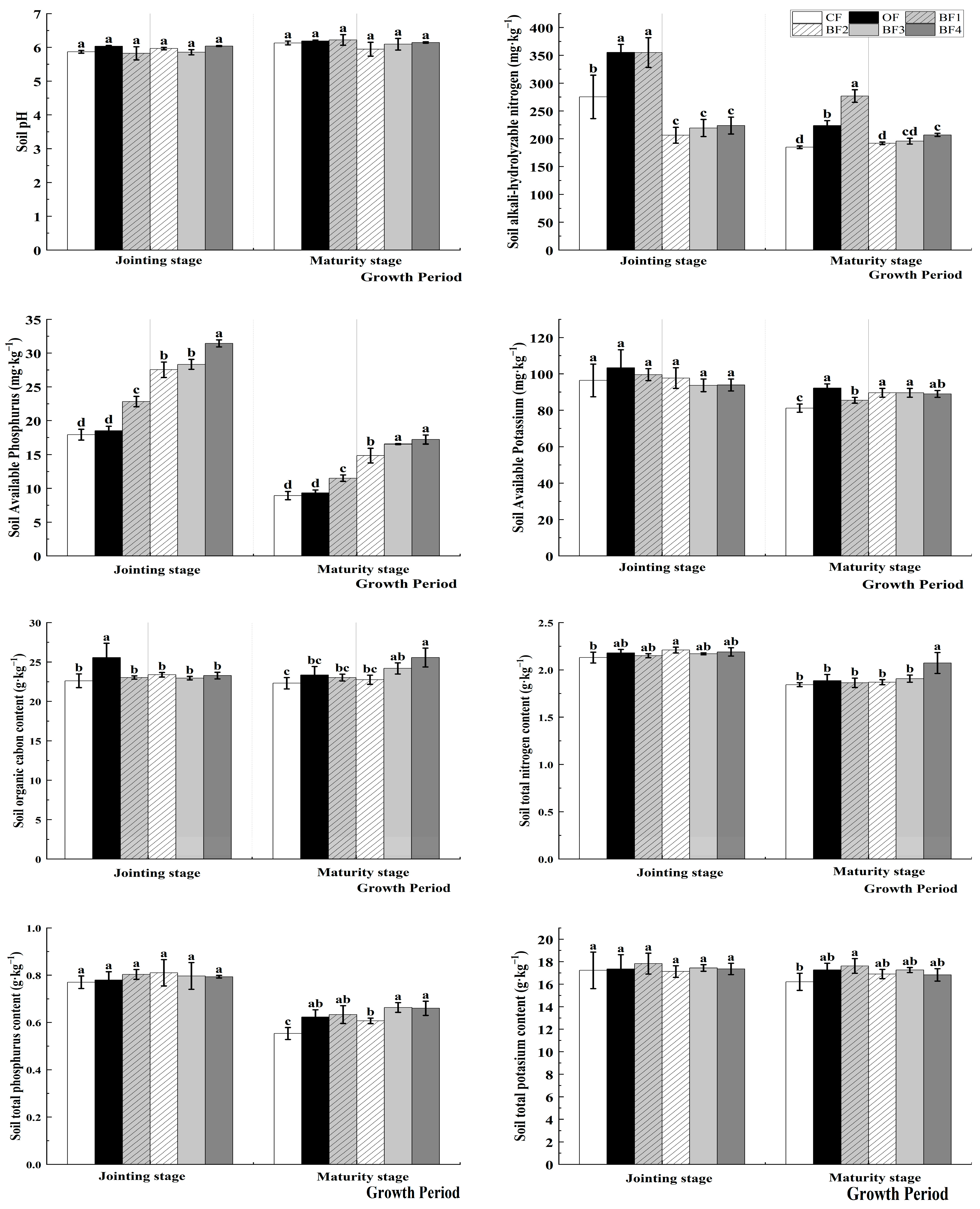
Soil pH showed no significant differences among treatments in either growth stage (Figure 1). During the corn jointing stage, compared with chemical fertilizer alone (CF), the treatments with fertilizer supplemented with carrier (OF) and single-inoculant biofertilizer (BF1) significantly increased soil alkali-hydrolyzable nitrogen content (by 29.09% and 28.94%, respectively), whereas the single-inoculant single-enzyme (BF2), double-inoculant single-enzyme (BF3), and double-inoculant double-enzyme (BF4) treatments significantly reduced alkali-hydrolyzable nitrogen content (by 25.03%, 20.35%, and 18.72%, respectively). At the maturity stage, the OF, BF1, and BF4 treatments showed a significant increase in alkali-hydrolyzable nitrogen (by 21.41%, 50.14%, and 12.38%, respectively). In terms of available phosphorus, at the jointing stage, all biofertilizer treatments (BF1, BF2, BF3, and BF4) were significantly higher than CF, with increases of 27.37%, 53.64%, 58.08%, and 75.42%, respectively. Among them, BF4 had the highest content, BF2 and BF3 showed no significant difference but were higher than BF1, while OF and CF did not differ significantly. At the maturity stage, available phosphorus content remained higher than at the jointing stage, and all biofertilizer treatments remained significantly higher than CF (BF1, BF2, BF3, and BF4 increased by 28.84%, 66.35%, 85.16%, and 92.61%, respectively). BF4 and BF3 had the highest levels with no significant difference between them, BF2 was higher than BF1, and OF did not differ from CF. For available potassium, no significant differences were observed at the jointing stage, though OF, BF1, and BF2 treatments showed slight increases (7.22%, 3.28%, and 1.31%, respectively), while BF3 and BF4 had minor decreases (2.84% and 2.62%). At the maturity stage, OF and all biofertilizer treatments significantly increased available potassium by 13.67%, 5.34%, 10.41%, 10.43%, and 9.66%, respectively.
Soil organic carbon (SOC) was significantly increased by 13.04% under the OF treatment compared to CF treatment at the jointing stage, whereas the dual-microbial inoculant dual-enzyme biofertilizer treatment (BF4) exhibited the most pronounced effect at maturity, enhancing SOC by 14.61% (Figure 1). Soil total nitrogen (TN) dynamics revealed that only the single-microbial inoculant single-enzyme biofertilizer treatment (BF2) significantly elevated TN by 3.91% relative to CF at the jointing stage. In contrast, BF4 demonstrated the highest efficacy at maturity, increasing TN by 12.48% compared to CF treatment. Notably, soil TN concentrations were generally lower at maturity than at the jointing stage. Soil total phosphorus (TP) exhibited modest increases (1.3–5.19%) across treatments at the jointing stage, though differences were not statistically significant. By maturity, all amended treatments significantly surpassed CF treatment in TP content. The dual-microbial inoculant single-enzyme biofertilizer treatment (BF3) achieved the highest TP increase (19.88%), whereas the single-microbial inoculant single-enzyme BF2 showed the lowest improvement (9.64%) and was significantly outperformed by other biofertilizers.
Soil total potassium (TK) showed no significant differences among treatments at the jointing stage. Compared with chemical fertilizer alone (CF), the changes in other treatments ranged from −0.6% to +3.48%. By the maturity stage, total potassium content had increased compared to the jointing stage across all treatments. Among them, the fertilizer supplemented with carrier (OF), single-inoculant single-enzyme biofertilizer (BF1), and single-inoculant single-enzyme biofertilizer (BF2) treatments were significantly higher than CF, with increases of 6.57%, 8.70%, and 4.26%, respectively. In contrast, the double-inoculant single-enzyme (BF3) and double-inoculant double-enzyme (BF4) treatments showed no significant difference from CF, with increases of 3.49% and 2.99%, respectively. These results indicate that the organic carrier and some biofertilizer treatments have a certain promoting effect on soil total potassium accumulation, though the increases are relatively limited.
In summary, biofertilizers—particularly the dual-microbial inoculant dual-enzyme BF4—significantly improved SOC and TN over time, while the organic material carrier (OF) was most effective in enhancing soil potassium. Furthermore, the positive effects on TP and TK were more pronounced at maturity than at the jointing stage, underscoring the need for stage-specific nutrient management strategies in maize cultivation.

3.2. Impact of Compound Biofertilizer Application on Soil Microbial Activity, Abundance, and Soil Enzyme Activities

3.2.1. Impact of Compound Biofertilizers on Soil Microbial Activity and Abundance

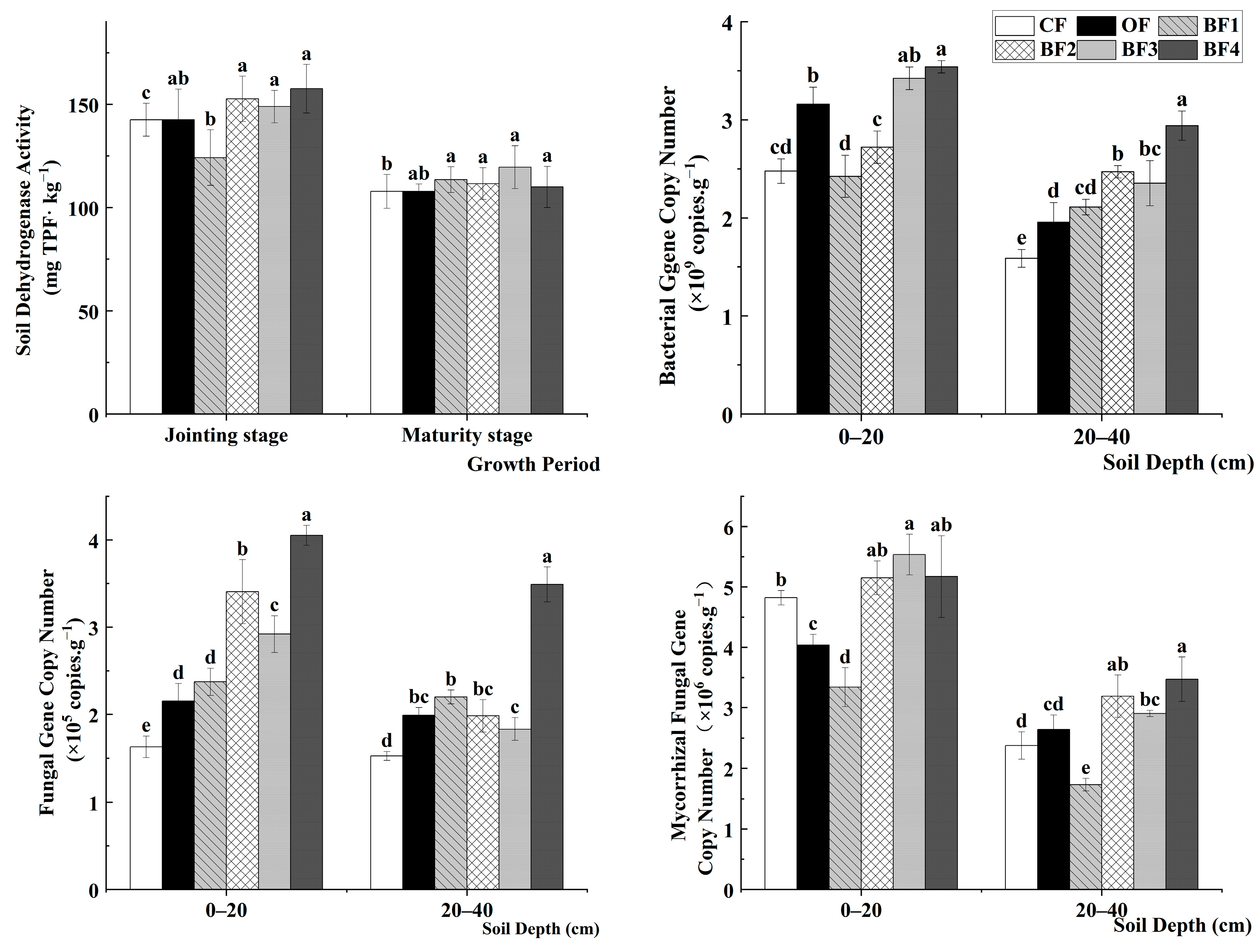
In the 0–20 cm topsoil layer, compared with chemical fertilizer alone (CF), the application of organic fertilizer (OF) and biofertilizers (BF1, BF2, BF3, and BF4) significantly increased dehydrogenase activity by 41.11%, 22.93%, 51.11%, 47.40%, and 55.97%, respectively (Figure 2). Among them, OF, BF2, BF3, and BF4 showed no significant differences but were all significantly higher than BF1. In the 20–40 cm soil layer, dehydrogenase activity decreased overall, but biofertilizer treatments remained significantly higher than CF (BF1, BF2, BF3, and BF4 increased by 20.20%, 18.16%, 26.57%, and 16.47%, respectively), with no significant differences among biofertilizer treatments, while OF did not differ significantly from CF.
Regarding bacterial gene copy numbers, in the 0–20 cm layer, the control (CF) treatment showed initial average abundances of approximately 2.48 × 10⁶ copies·g−1 for bacteria, 1.63 × 10⁶ copies·g−1 for fungi, and 4.82 × 10⁶ copies·g−1 for arbuscular mycorrhizal (AM) fungi.
Compared with CF, the OF, BF3, and BF4 treatments significantly increased bacterial gene copy numbers (by 27.59%, 38.33%, and 42.93%, respectively), with BF4 being the highest and showing no difference from BF3 but significantly exceeding other treatments. BF2 was significantly higher than BF1, but neither differed significantly from CF. In the 20–40 cm layer, bacterial gene copy numbers decreased overall, yet OF, BF1, BF2, BF3, and BF4 were all significantly higher than CF (increases ranging from 23.32% to 85.29%), with BF4 being the highest and significantly surpassing the other treatments.
For fungal gene copy numbers, in the 0–20 cm layer, all treatments were significantly higher than CF (OF, BF1, BF2, BF3, and BF4 increased by 32.11%, 45.60%, 109%, 79.14%, and 148.67%, respectively), with the ranking BF4 > BF2 > BF3 > BF1 ≈ OF. In the 20–40 cm layer, fungal gene copy numbers also declined, but all treatments remained significantly higher than CF (increases ranging from 20.09% to 128.60%), with BF4 being the highest. BF1 was significantly higher than BF3, while OF showed no difference from BF1 and BF2, and BF2 did not differ significantly from BF3.
In terms of arbuscular mycorrhizal (AM) fungal gene copy numbers, in the 0–20 cm layer, OF and BF1 were significantly lower than CF (decreasing by 16.25% and 30.71%, respectively), with BF1 being the lowest. In contrast, BF3 increased significantly by 14.87%, showing no difference from BF2 and BF4, and all three were significantly higher than other treatments. In the 20–40 cm layer, BF1 remained the lowest, while BF2, BF3, and BF4 were significantly higher than CF (increasing by 22.16% to 46%), with BF4 being the highest and significantly exceeding BF3 but showing no difference from BF2. CF and OF did not differ significantly.
In summary, compound biofertilizers (especially the double-inoculant double-enzyme BF4) significantly enhanced soil microbial activity and abundance, though the effects diminished with soil depth. Fungal and bacterial responses were the most pronounced, while AM fungal gene copy numbers varied considerably among treatments.

3.2.2. Effects of Compound Biofertilizers on Soil Microbial Activity and Abundance

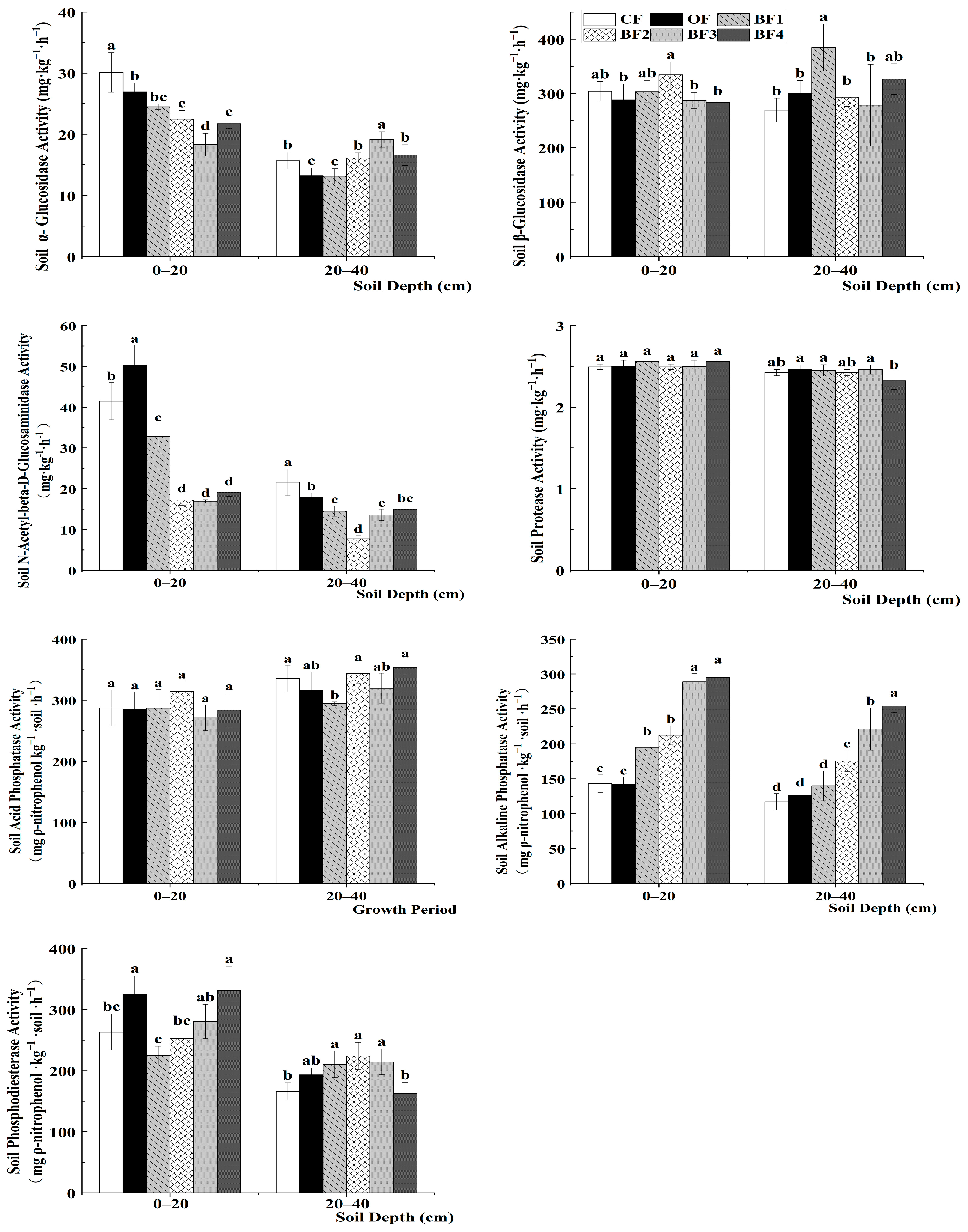
In the 0–20 cm topsoil layer, compared with chemical fertilizer alone (CF), organic fertilizer (OF) and biofertilizer treatments (BF1–BF4) all inhibited α–glucosidase activity, with reductions ranging from 10.51% to 39.22%, where BF3 showed the strongest suppression (Figure 3). In contrast, β–glucosidase activity was highest under BF2, significantly exceeding OF, BF3, and BF4 (reductions of 13.73–15.21%). Cellulase activity increased significantly by 42.95% under BF1 in the 20–40 cm layer, while alkaline phosphatase activity rose by 21.33% under OF in the 0–20 cm layer but decreased by 20.95–59.18% under biofertilizers. Phosphodiesterase activity peaked under BF4 (25.85% increase, 0–20 cm), and N–acetylglucosaminidase and arylsulfatase activities performed best under the double-inoculant double-enzyme treatment (BF4), increasing by 106.39% and 117.64%, respectively (0–20 cm and 20–40 cm).
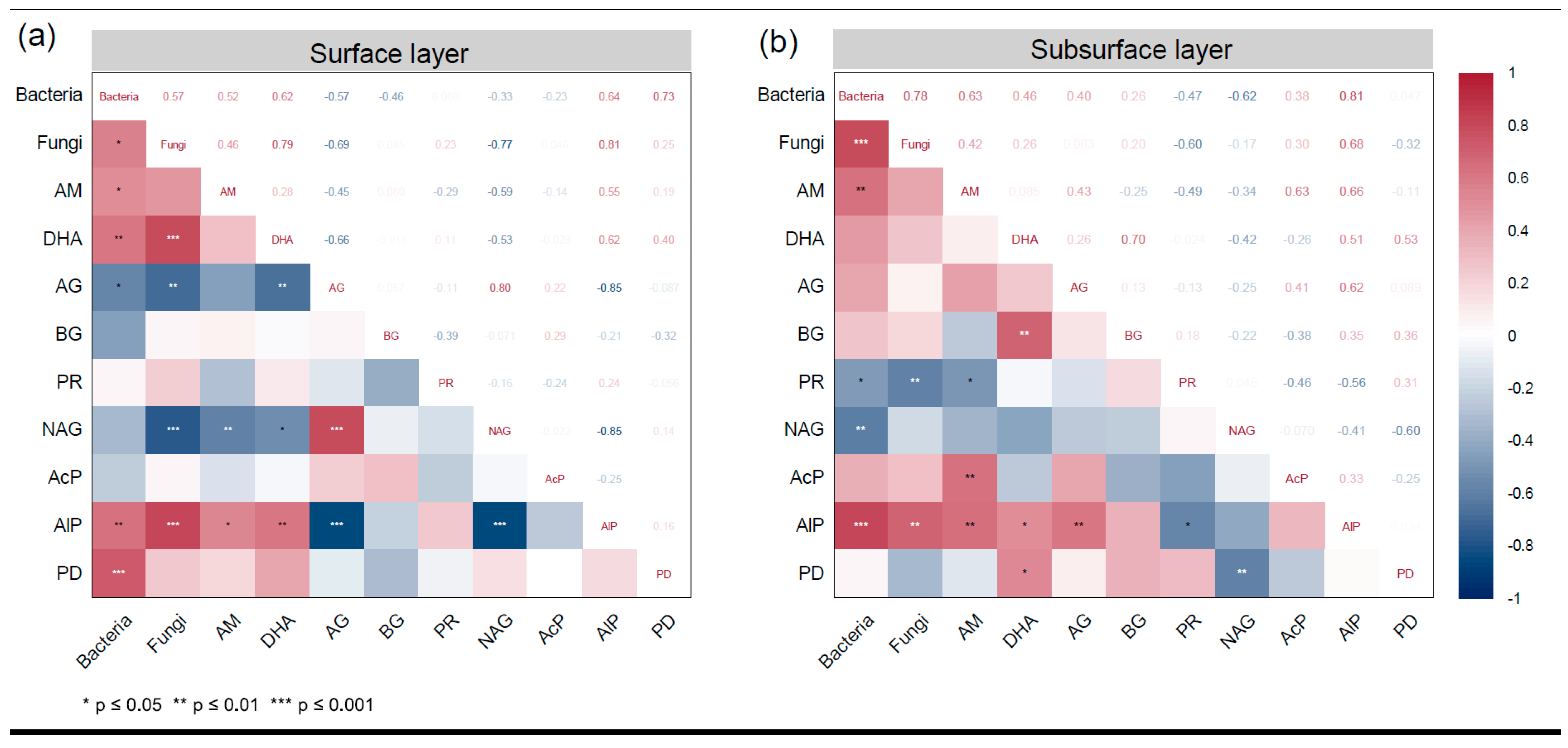
Correlation analysis (Pearson) revealed strong linkages between microbial activity and enzyme systems (Figure 4): Dehydrogenase activity showed highly significant positive correlations (p < 0.01) with fungal and bacterial gene abundance and alkaline phosphatase, while alkaline phosphatase also correlated significantly (p < 0.05) with arbuscular mycorrhizal (AM) fungal genes. Additionally, phosphodiesterase was strongly associated with bacterial abundance, and α–glucosidase activity was closely linked to N–acetylglucosaminidase (p < 0.01). These findings indicate that compound biofertilizers (especially BF4) modulate microbial community structure, significantly influencing key enzyme activities in carbon, nitrogen, and phosphorus cycling. Fungal and bacterial proliferation played the most prominent role in enhancing enzyme activity, while the association between AM fungi and phosphatase activity highlights their potential role in phosphorus transformation.
In summary, the effects of biofertilizers varied by enzyme type and soil depth: The double-inoculant double-enzyme biofertilizer (BF4) was most effective in boosting hydrolase activities (e.g., phosphodiesterase and N–acetylglucosaminidase). Single-inoculant or single-enzyme treatments (BF1 and BF2) showed stronger promotion of specific enzymes (e.g., β–glucosidase and cellulase). The strong correlations between microbial abundance (especially bacteria and fungi) and key enzyme activities further confirm that biofertilizers optimize soil ecological processes by regulating microbial functionality.

3.3. Effects of Compound Biofertilizer on Maize Growth and Yield

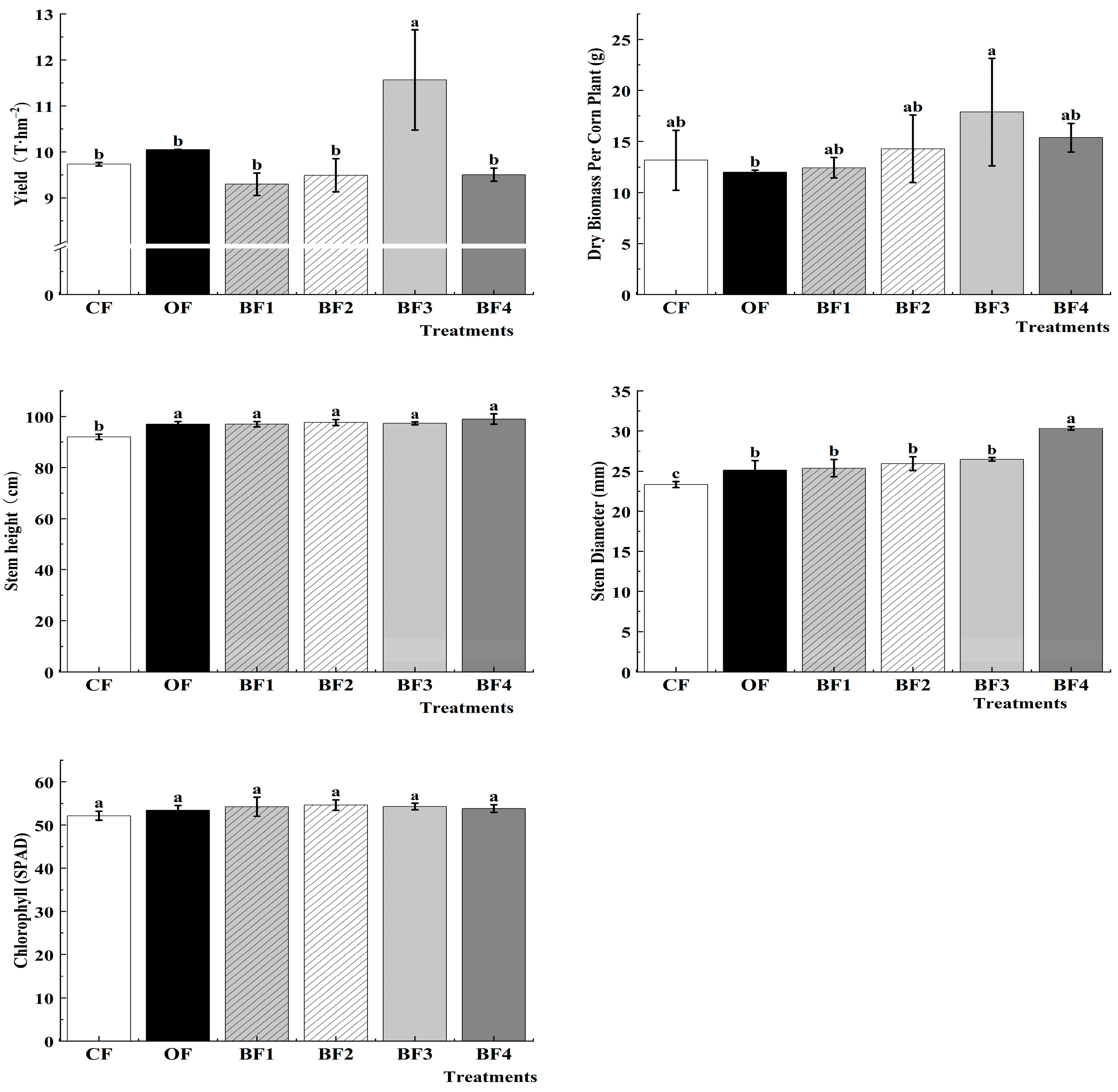
The analysis of agronomic parameters under different fertilization treatments reveals distinct patterns (Figure 5). For yield, the BF3 treatment achieved the highest average output at 11.56 T·hm−2, which was significantly greater than all other treatments. Plant height was significantly increased by the OF, BF1, BF2, BF3, and BF4 treatments compared to the CF control. Stem diameter was greatest under the BF4 treatment (30.34 mm, group ‘a’), with the other organic and biofertilizer treatments (OF, BF1-BF3) also outperforming the CF control. Dry biomass per plant was highest for BF3, forming a statistical group that overlapped with several other treatments (CF, BF1, BF2, BF4; group ‘ab’) but was significantly higher than OF. Notably, no significant differences were observed in chlorophyll content (SPAD values) across all treatments. In summary, the BF3 treatment demonstrated the most comprehensive benefits, particularly for yield and biomass, while BF4 was especially effective for stem thickening.

4. Discussion

The application of microbial–enzyme composite biofertilizers significantly enhanced the physicochemical and biological properties of Albic soil, with the multi-inoculant and multi-enzyme treatment (BF4) demonstrating the most pronounced improvements. Specifically, BF4 led to remarkable increases in TN (12.48%), AP (92.61%), and SOC (14.61%) at the maturity stage. These results align with previous findings that synergistic interactions between mycorrhizal fungi and extracellular enzymes enhance nutrient mineralization and availability [28]. Similarly, the BF3 treatment (marine actinomycetes + Bacillus + phytase) exhibited strong phosphorus-solubilizing effects (85.16% increase), likely due to the combined action of phosphate-solubilizing bacteria and phytase activity [21]. These outcomes underscore the importance of tailored microbial–enzyme combinations in optimizing nutrient availability in nutrient-poor soils such as Albic soils [14].
A key mechanism behind the improved phosphorus availability is the role of phytase-producing microorganisms. Organic phosphorus constitutes 20–50% of total soil phosphorus, yet its plant-available forms are limited. Phytase, secreted by microorganisms such as actinomycetes and fungi, catalyzes the hydrolysis of phytate into inorganic phosphate, significantly enhancing phosphorus uptake efficiency [6,29]. Our results support earlier studies showing that phytase amendments not only boost short-term phosphorus availability but also sustain crop growth in subsequent planting cycles [30]. This highlights the long-term benefits of phytase-integrated biofertilizers in reducing dependence on chemical phosphorus fertilizers while maintaining soil health [17].
In the 20–40 cm soil layer, dehydrogenase activity and bacterial/fungal gene copy numbers decreased significantly compared to the topsoil (0–20 cm). This vertical stratification pattern, with diminished microbial abundance and activity in subsurface layers, is consistent with well-established ecological observations of soil microbial communities [31]. Dehydrogenase and alkaline phosphatase activities were strongly correlated with microbial gene abundance (p < 0.01), indicating their sensitivity to microbial inputs and their potential as indicators of soil biological activity [32]. In contrast, N–acetylglucosaminidase activity was consistently suppressed across treatments, possibly due to competitive inhibition among chitin-degrading microorganisms [33]. Similarly, protease activity declined in deeper soil layers under BF4, suggesting microbial competition for nitrogen sources [8,34]. These findings highlight the need for depth-specific biofertilizer formulations—for instance, using dual-inoculant combinations (BF3) in topsoil and single-inoculant–enzyme pairs (BF2) in subsoil to activate nutrient cycling at different depths.
Notably, the relative abundances of dominant bacterial phyla such as Proteobacteria, Acidobacteria, and Actinobacteria remained stable across treatments, suggesting functional resilience and niche conservatism among these taxa. Proteobacteria are often copiotrophic, thriving in nutrient-rich conditions, while Acidobacteria are more oligotrophic, adapted to nutrient-poor environments. This functional stratification may explain their stability under varying fertilization regimes [13].
Marine-derived actinomycetes emerged as a critical component of the biofertilizer consortium, contributing not only to nutrient transformation but also to disease suppression. Unlike terrestrial strains, marine actinomycetes are adapted to extreme environments and produce unique secondary metabolites with antibiotic and plant-growth-promoting properties [35]. In addition to producing unique antimicrobial metabolites, they can secrete plant growth stimulants that directly promote crop growth, which is consistent with the plant-growth-promoting effects of Streptomyces reported by Gopalakrishnan et al. [36]. For instance, the actinomycete strain MB–97 has been shown to suppress Fusarium and Penicillium populations by up to 80%, mitigating challenges associated with soybean monoculture [37]. Additionally, actinomycetes can enhance urease activity, facilitating nitrogen mineralization [36]. These dual roles—nutrient cycling and pathogen suppression—make marine actinomycetes a versatile tool for the remediation of degraded soils.
The BF3 treatment achieved the highest maize yield, showing an 18.3% increase over the CF treatment and a significant increase compared to the OF treatment (which contained the same organic carrier but without the specific microbial–enzyme consortium). While the organic carrier in OF provided essential improvements in soil structure and a baseline nutrient supply through mineralization [4], the additional yield gain in BF3 is attributed to the targeted, microbially mediated processes. Specifically, the synergistic action of phosphate-solubilizing marine actinomycetes and phytase in BF3 enhanced phosphorus availability (as evidenced by the 85.16% increase in available P compared to CF, and a [Y]% increase compared to OF) [38], leading to more efficient nutrient uptake and utilization by maize. This demonstrates that the agronomic efficacy of the microbial–enzyme composite extends beyond the general benefits of organic amendment, offering a precision bioenhancement strategy for nutrient-poor Albic soils [39]. This result is consistent with the findings of Ye et al. [19], who reported that supplementing chemical fertilizers with bio-organic fertilizers enhanced tomato yield and quality by improving soil fertility. Similarly, Chen et al. [40] reported that the application of organic fertilizer significantly enhanced crop yield and quality by synergistically improving soil physicochemical properties.
Despite these promising results, several challenges remain. The absence of significant changes in soil pH contrasts with some previous studies, possibly due to the short duration of the experiment or the buffering capacity of organic matter [41]. Long-term monitoring is essential to assess the stability of microbial communities and avoid potential risks associated with over-inoculation [42]. Future research should integrate metagenomic and metatranscriptomic approaches to elucidate functional gene responses (e.g., glycoside hydrolase families, and phosphatase genes) [43] and evaluate biofertilizer performance under diverse environmental conditions, such as drought and low pH [22]. By addressing these gaps, we can advance the design of precision biofertilizers tailored to the specific constraints of Albic soils [21].
Furthermore, while the fully composted organic carrier was used specifically to minimize risks from labile phytotoxins, this study did not explicitly assess the potential for phytotoxic effects arising from organic amendments or microbial metabolites. Such effects, whether from allelopathic compounds or decomposition byproducts, could influence plant–soil interactions and represent an uncontrolled variable in field studies. Future research should incorporate standardized phytotoxicity bioassays (e.g., using Lepidium sativum) to comprehensively evaluate the ecological safety and compatibility of novel biofertilizer formulations. Therefore, the positive outcomes reported here should be interpreted within the context of using stabilized organic materials, and the observed benefits of the microbial–enzyme consortium (BF3/BF4) are attributed to their targeted functional activities beyond the baseline improvement provided by the organic carrier.

5. Conclusions

Based on a systematic field experiment in the Albic soil region of Northeast China, this study demonstrates that microbial–enzyme composite biofertilizers, particularly the BF4 formulation (containing marine actinomycetes, mycorrhizal fungi, phytase, and β-glucosidase), provide an effective strategy for sustainably ameliorating Albic soil and enhancing maize productivity. The key findings are as follows:
(1)
The BF4 treatment most effectively improved soil nutrient availability and biological activity, leading to remarkable increases in available phosphorus, fungal abundance, and soil organic carbon at the maize maturity stage.
(2)
The BF3 formulation (containing marine actinomycetes, Bacillus, and phytase) achieved the highest maize grain yield, significantly outperforming conventional chemical fertilizer.
(3)
The synergistic interactions within the microbial–enzyme consortium were decisive for enhancing nutrient cycling efficiency and crop performance, extending beyond the benefits provided by the organic carrier alone.
In conclusion, tailored microbial–enzyme biofertilizers represent a promising approach for the green improvement of Albic soils. Future research should focus on optimizing application protocols under diverse field conditions and conducting comprehensive safety assessments, including phytotoxicity screening, to facilitate their sustainable adoption in agriculture.

Author Contributions

Z.C. (Zhuoran Chen), Y.W., and X.Z.: Formal analysis, visualization, and writing—original draft. Y.Z.: Conceptualization, funding acquisition, project administration, supervision, and writing—review and editing. Z.C. (Zhenhua Chen): Conceptualization, project administration, resources, and supervision. M.Z., Y.L., and S.W.: Methodology, investigation, and data curation. L.W. and N.J.: Conceptualization and resources. L.T., Y.P., and R.J.: Investigation and resources. All authors have read and agreed to the published version of the manuscript.

Funding

This work was financially supported by the National Key Research and Development Program of China (2022YFD1500800) and the Strategic Priority Research Program of the Chinese Academy of Sciences (XDA28090100).

Data Availability Statement

The datasets presented in this study can be found in online repositories. The names of the repository/repositories and accession number(s) can be found in the article.

Conflicts of Interest

Author Xianying Zhang was employed by the company Shenyang Runliao Green Agricultural Science and Technology Co., Ltd. Authors Libin Tian, Yongjie Piao and Rui Jiang were employed by the company Heilongjiang 852 Farm Co., Ltd. The remaining authors declare that the research was conducted in the absence of any commercial or financial relationships that could be construed as a potential conflict of interest.

References

  1. IUSS Working Group WRB. World Reference Base for Soil Resources 2014, Update 2015; International Soil Classification System for Naming Soils and Creating Legends for Soil Maps, World Soil Resources Reports No. 106; FAO: Rome, Italy, 2015. [Google Scholar]
  2. Liu, Z.J.; Zhou, W.; Shen, J.B.; Li, S.T.; He, P.; Liang, G.Q. Soil quality assessment of Albic soils with different productivities for eastern China. Soil Tillage Res. 2014, 140, 74–81. [Google Scholar] [CrossRef]
  3. Wang, X.J. The characteristic and influence factors of extinction depth of shallow groundwater on the high-latitude region: A case study on the Sanjiang Plain, northeast China. Environ. Sci. Pollut. Res. 2018, 25, 6695–6706. [Google Scholar] [CrossRef]
  4. Meng, Q.Y.; Zou, H.T.; Zhang, C.F.; Zhu, B.G.; Wang, N.N.; Yang, X.H.; Gai, Z.J.; Han, Y.Y. Soil mixing with organic matter amendment improves albic soil physicochemical properties and crop yield in Heilongjiang province, China. PLoS ONE 2020, 15, e0239788. [Google Scholar] [CrossRef]
  5. Xiu, L.Q.; Zhang, W.M.; Sun, Y.Y.; Wu, D.; Meng, J.; Chen, W.F. Effects of biochar and straw returning on the key cultivation limitations of albic soil and soybean growth over 2 years. Catena 2019, 173, 481–493. [Google Scholar] [CrossRef]
  6. Pan, X.; Yu, H.J.; Zhang, B.; Guan, Y.Q.; Zhang, N.; Du, H.L.; Liu, F.M.; Yu, J.; Wang, Q.J.; Liu, J. Effects of organic fertilizer replacement on the microbial community structure in the rhizosphere soil of soybeans in albic soil. Sci. Rep. 2025, 15, 12271. [Google Scholar] [CrossRef] [PubMed]
  7. Schneider, F.; Don, A.; Hennings, I.; Schmittmann, O.; Seidel, S.J. The effect of deep tillage on crop yield—What do we really know? Soil Tillage Res. 2017, 174, 193–204. [Google Scholar] [CrossRef]
  8. Yin, D.; Li, H.; Wang, H.; Guo, X.; Wang, Z.; Lv, Y.; Ding, G.; Jin, L.; Lan, Y. Impact of different biochars on microbial community structure in the rhizospheric soil of rice grown in albic soil. Molecules 2021, 26, 4783. [Google Scholar] [CrossRef]
  9. Irfan, M.F.; Mirara, F. Biochar application in improving soil health and sustainability. Bull. Biol. Allied Sci. Res. 2024, 9, 81. [Google Scholar] [CrossRef]
  10. Bekchanova, M.; Campion, L.; Bruns, S.; Kapp, G.; Lehmann, L.; Klerkx, L.; Mottaleb, K.A.; Yadav, S.; Sander, B.O.; de Vries, J.R. Biochar improves the nutrient cycle in sandy-textured soils and increases crop yield: A systematic review. Environ. Evid. 2024, 13, 3. [Google Scholar] [CrossRef]
  11. Xiu, L.Q.; Zhang, W.M.; Wu, D.; Sun, Y.Y.; Zhang, H.G.; Gu, W.Q.; Meng, J.; Chen, W.F. Heat storage capacity and temporal-spatial response in the soil temperature of albic soil amended with maize-derived biochar for 2 years. Soil Tillage Res. 2021, 205, 104762. [Google Scholar] [CrossRef]
  12. Rashid, M.I.; Mujawar, L.H.; Shahzad, T.; Almeelbi, T.; Ismail, I.M. Bacteria and fungi can contribute to nutrients bioavailability and aggregate formation in degraded soils. Microbiol. Res. 2016, 183, 26–41. [Google Scholar] [CrossRef]
  13. Du, T.Y.; He, H.Y.; Zhang, L.L.; Mao, W.J.; Zhai, M.Z. Positive effects of organic fertilizers and bio-fertilizers on soil microbial community composition and walnut yield. Appl. Soil Ecol. 2022, 175, 104457. [Google Scholar] [CrossRef]
  14. Chen, A.; Wang, Q.; Zhang, H.; Liang, Y.; Qi, Z.; Zhou, W.; Li, J.; Tu, H. Changes in tillage characteristics of albic soil with various soil amendment materials. Soil Use Manag. 2024, 40, e13152. [Google Scholar] [CrossRef]
  15. Wang, J.; Zhao, Y.; Ruan, Y. Effects of bio-organic fertilizers produced by four Bacillus amyloliquefaciens inoculants on banana Fusarium wilt disease. Compost Sci. Util. 2015, 23, 185–198. [Google Scholar] [CrossRef]
  16. Mendes, R.; Kruijt, M.; de Bruijn, I.; Dekkers, E.; van der Voort, M.; Schneider, J.H.M.; Piceno, Y.M.; DeSantis, T.Z.; Andersen, G.L.; Bakker, P.A.H.M.; et al. Deciphering the rhizosphere microbiome for disease-suppressive bacteria. Science 2011, 332, 1097–1100. [Google Scholar] [CrossRef]
  17. Li, J.; Wang, J.; Liu, H.; Macdonald, C.A.; Singh, B.K. Application of microbial inoculants significantly enhances crop productivity: A meta-analysis of studies from 2010 to 2020. J. Sustain. Agric. Environ. 2022, 1, 216–225. [Google Scholar] [CrossRef]
  18. Herrmann, L.; Lesueur, D. Challenges of formulation and quality of biofertilizers for successful inoculation. Appl. Microbiol. Biotechnol. 2013, 97, 8859–8873. [Google Scholar] [CrossRef]
  19. Ye, L.; Zhao, X.; Bao, E.; Li, J.; Zou, Z.; Cao, K. Bio-organic fertilizer with reduced rates of chemical fertilization improves soil fertility and enhances tomato yield and quality. Sci. Rep. 2020, 10, 177. [Google Scholar] [CrossRef]
  20. Guggenberger, G.; Elliott, E.T.; Frey, S.D.; Six, J.; Paustian, K. Microbial contributions to the aggregation of a cultivated grassland soil amended with starch. Soil Biol. Biochem. 1999, 31, 407–419. [Google Scholar] [CrossRef]
  21. Singh, S.K.; Pachauri, R.K.; Khatoon, H.; Katiyar, D.; Agnihotri, G. The role of biofertilizers in enhancing soil and productivity—A review. Int. J. Plant Soil Sci. 2025, 37, 141–161. [Google Scholar] [CrossRef]
  22. Classen, A.T.; Sundqvist, M.K.; Henning, J.A.; Newman, G.S.; Moore, J.A.M.; Cregger, M.A.; Moorhead, L.C. Direct and indirect effects of climate change on soil microbial and soil microbial-plant interactions: What lies ahead? Ecosphere 2015, 6, 1–21. [Google Scholar] [CrossRef]
  23. Dick, R.P.; Breakwell, D.P.; Turco, R.F. Soil enzyme activities as indicators of soil quality. In Defining Soil Quality for a Sustainable Environment; SSSA Special Publication 35; Doran, J.W., Coleman, D.C., Bezdicek, D.F., Stewart, B.A., Eds.; Soil Science Society of America: Madison, WI, USA, 1994; pp. 107–124. [Google Scholar] [CrossRef]
  24. Lin, N.; Jiang, R.Z.; Liu, Q.; Guo, X.D.; Yang, H.; Chen, S. Spatiotemporal characteristics and driving factors of surface evapotranspiration in Sanjiang Plain in recent 20 years. Geol. China 2021, 48, 1392–1407. (In Chinese) [Google Scholar] [CrossRef]
  25. Liu, D.; Chen, W.F.; Li, L.N. Disentangling the relative effects of climate change and anthropogenic activities on paddy expansion in the northern Sanjiang Plain of China. Ecol. Indic. 2023, 154, 110543. [Google Scholar] [CrossRef]
  26. Gao, R.; Yan, J.; Han, X.; Chen, X.; Zou, W.; Lu, X.; Xu, M.; Yang, S.; Jiang, R.; Piao, Y. Effects of returning organic materials to field on physical properties of albic soil and maize yield. Soils Crops 2024, 13, 305–313. (In Chinese) [Google Scholar] [CrossRef]
  27. Lu, R.K. Analytical Methods of Soil Agrochemistry; China Agricultural Science and Technology Press: Beijing, China, 2000. [Google Scholar]
  28. Zhang, L.; Xu, M.; Liu, Y.; Zhang, F.; Hodge, A.; Feng, G. Carbon and phosphorus exchange may enable cooperation between an arbuscular mycorrhizal fungus and a phosphate-solubilizing bacterium. New Phytol. 2016, 210, 1022–1032. [Google Scholar] [CrossRef]
  29. George, T.S.; Richardson, A.E.; Simpson, R.J. Behaviour of plant-derived extracellular phytase upon addition to soil. Soil Biol. Biochem. 2005, 37, 977–988. [Google Scholar] [CrossRef]
  30. Giles, C.D.; Cade-Menun, B.J.; Hill, J.E. The inositol phosphates in soils and manures: Abundance, cycling, and measurement. Can. J. Soil Sci. 2011, 91, 397–416. [Google Scholar] [CrossRef]
  31. Fierer, N.; Schimel, J.P.; Holden, P.A. Variations in microbial community composition through two soil depth profiles. Soil Biol. Biochem. 2003, 35, 167–176. [Google Scholar] [CrossRef]
  32. Nannipieri, P.; Trasar-Cepeda, C.; Dick, R.P. Soil enzyme activity: A brief history and biochemistry as a basis for appropriate interpretations and meta-analysis. Biol. Fertil. Soils 2018, 54, 11–19. [Google Scholar] [CrossRef]
  33. Beier, S.; Bertilsson, S. Bacterial chitin degradation-mechanisms and ecophysiological strategies. Front. Microbiol. 2013, 4, 149. [Google Scholar] [CrossRef] [PubMed]
  34. Geisseler, D.; Horwath, W.R. Relationship between carbon and nitrogen availability and extracellular enzyme activities in soil. Pedobiologia 2009, 53, 87–98. [Google Scholar] [CrossRef]
  35. Subramani, R.; Sipkema, D. Marine rare actinomycetes: A promising source of structurally diverse and unique novel natural products. Mar. Drugs 2019, 17, 249. [Google Scholar] [CrossRef]
  36. Gopalakrishnan, S.; Srinivas, V.; Sree Vidya, M.; Rathore, A. Plant growth-promoting activities of Streptomyces spp. in sorghum and rice. SpringerPlus 2013, 2, 574. [Google Scholar] [CrossRef] [PubMed]
  37. Hu, J.; Xue, D.; Wang, S. Obstacles of soybean continuous cropping, III. Mechanism of soybean yield increment by marine actinomyces MB-97. Chin. J. Appl. Ecol. 2002, 13, 1095–1098. (In Chinese) [Google Scholar]
  38. Jorquera, M.A.; Hernández, M.T.; Rengel, Z.; Marschner, P.; de la Luz Mora, M. Isolation of culturable phosphobacteria with both phytate-mineralization and phosphate-solubilization activity from the rhizosphere of plants grown in a volcanic soil. Biol. Fertil. Soils 2008, 44, 1025–1034. [Google Scholar] [CrossRef]
  39. Adetunji, A.T.; Lewu, F.B.; Mulidzi, R.; Ncube, B. The biological activities of β-glucosidase, phosphatase and urease as soil quality indicators: A review. J. Soil Sci. Plant Nutr. 2017, 17, 794–807. [Google Scholar] [CrossRef]
  40. Chen, L.; Li, X.; Peng, Y.; Xiang, P.; Zhou, Y.; Yao, B.; Zhou, Y.; Sun, C.J.C. Co-application of biochar and organic fertilizer promotes the yield and quality of red pitaya (Hylocereus polyrhizus) by improving soil properties. Chemosphere 2022, 294, 133619. [Google Scholar] [CrossRef] [PubMed]
  41. Kemmitt, S.J.; Wright, D.; Goulding, K.W.T.; Jones, D.L. pH regulation of carbon and nitrogen dynamics in two agricultural soils. Soil Biol. Biochem. 2006, 38, 898–911. [Google Scholar] [CrossRef]
  42. Hartmann, M.; Frey, B.; Mayer, J.; Mäder, P.; Widmer, F. Distinct soil microbial diversity under long-term organic and conventional farming. ISME J. 2015, 9, 1177–1194. [Google Scholar] [CrossRef]
  43. Jansson, J.K.; Hofmockel, K.S. Soil microbiomes and climate change. Nat. Rev. Microbiol. 2018, 18, 35–46. [Google Scholar] [CrossRef] [PubMed]
Figure 1. Effects of biofertilizer treatments on soil physicochemical properties in Albic soil (0–20 cm). Note: CF: conventional chemical fertilizer alone; OF: organic fertilizer supplemented with biofertilizer carrier; BF1: organic fertilizer supplemented with carrier-based single-inoculant biofertilizer (marine actinomycetes); BF2: organic fertilizer supplemented with carrier-based single-inoculant and single-enzyme biofertilizer (marine actinomycetes + phytase); BF3: organic fertilizer supplemented with carrier-based multi-inoculant and single-enzyme biofertilizer (marine actinomycetes + mycorrhizal fungi + phytase); BF4: organic fertilizer supplemented with carrier-based multi-inoculant and multi-enzyme biofertilizer (marine actinomycetes + mycorrhizal fungi + phytase + β–glucosidase). Different lowercase letters above bars indicate significant differences among treatments (p < 0.05, Duncan’s test). Error bars represent ± standard error (SE).
Agronomy 16 00307 g001
Figure 2. Impact of compound biofertilizer treatments on soil microbial activity and abundance. Note: CF: conventional chemical fertilizer alone; OF: organic fertilizer supplemented with biofertilizer carrier; BF1: organic fertilizer supplemented with carrier-based single-inoculant biofertilizer (marine actinomycetes); BF2: organic fertilizer supplemented with carrier-based single-inoculant and single-enzyme biofertilizer (marine actinomycetes + phytase); BF3: organic fertilizer supplemented with carrier-based multi-inoculant and single-enzyme biofertilizer (marine actinomycetes + mycorrhizal fungi + phytase); BF4: organic fertilizer supplemented with carrier-based multi-inoculant and multi-enzyme biofertilizer (marine actinomycetes + mycorrhizal fungi + phytase + β–glucosidase). Different lowercase letters above bars indicate significant differences among treatments (p < 0.05, Duncan’s test). Error bars represent ± standard error (SE).
Agronomy 16 00307 g002
Figure 3. Effects of compound biofertilizer treatments on Albic soil enzyme activity. Note: CF: conventional chemical fertilizer alone; OF: organic fertilizer supplemented with biofertilizer carrier; BF1: organic fertilizer supplemented with carrier-based single-inoculant biofertilizer (marine actinomycetes); BF2: organic fertilizer supplemented with carrier-based single-inoculant and single-enzyme biofertilizer (marine actinomycetes + phytase); BF3: organic fertilizer supplemented with carrier-based multi-inoculant and single-enzyme biofertilizer (marine actinomycetes + mycorrhizal fungi+ phytase); BF4: organic fertilizer supplemented with carrier-based multi-inoculant and multi-enzyme biofertilizer (marine actinomycetes + mycorrhizal fungi + phytase + β–glucosidase). Different lowercase letters above bars indicate significant differences among treatments (p < 0.05, Duncan’s test). Error bars represent ± standard error (SE).
Agronomy 16 00307 g003
Figure 4. Correlation analysis between soil enzyme activity, crop yield, and soil available nutrients. Variable acronyms: (a) surface layer; (b) subsurface layer. ***, **, and * denote significance at p < 0.001, <0.01, and <0.05, respectively.
Agronomy 16 00307 g004
Figure 5. Effects of compound biofertilizer on yield and agronomic characteristics of maize at the jointing phase and the correlation analysis of maize yield and soil available nutrients. Note: CF: conventional chemical fertilizer alone; OF: organic fertilizer supplemented with biofertilizer carrier; BF1: organic fertilizer supplemented with carrier-based single-inoculant biofertilizer (marine actinomycetes); BF2: organic fertilizer supplemented with carrier-based single-inoculant and single-enzyme biofertilizer (marine actinomycetes + phytase); BF3: organic fertilizer supplemented with carrier-based multi-inoculant and single-enzyme biofertilizer (marine actinomycetes + mycorrhizal fungi + phytase); BF4: organic fertilizer supplemented with carrier-based multi-inoculant and multi-enzyme biofertilizer (marine actinomycetes + mycorrhizal fungi + phytase + β–glucosidase). Different lowercase letters indicate significant differences among treatments (p < 0.05).
Agronomy 16 00307 g005
Table 1. Experimental treatments, variables and fertilization rates.
TreatmentsKey VariableAmendments Application Rate (kg·ha−1)
CFChemical fertilizerConventional compound fertilizer, containing NPK 330 kg·ha−1
OFOrganic materials carrierConventional fertilizer containing 330 NPK kg·ha−1 + biofertilizer carrier 1500 kg·ha−1
BF1Single microbial inoculant biofertilizerConventional fertilizer containing 330 NPK kg·ha−1 + marine actinomycetes 75 kg·ha−1 with carrier 1500 kg·ha−1
BF2Single microbial inoculant, one enzymeConventional fertilizer containing 330 NPK kg·ha−1 + biofertilizer (marine actinomycetes 75 kg·ha−1 + phytase 45 kg·ha−1) with carrier 1500 kg·ha−1
BF3Dual microbial inoculant, single enzymeConventional fertilizer containing 330 NPK kg·ha−1 + biofertilizer (actinomycetes 75 kg·ha−1 + AMF 45 kg·ha−1 + phytase 45 kg·ha−1) with carrier 1500 kg·ha−1
BF4Dual microbial inoculant, dual enzymeConventional fertilizer containing NPK 330 kg·ha−1 + biofertilizer (marine actinomycetes 75 kg·ha−1+ AMF 45 kg·ha−1 + phytase 45 kg·ha−1 + glucosidase 45 kg·ha−1) with carrier 1500 kg·ha−1
Disclaimer/Publisher’s Note: The statements, opinions and data contained in all publications are solely those of the individual author(s) and contributor(s) and not of MDPI and/or the editor(s). MDPI and/or the editor(s) disclaim responsibility for any injury to people or property resulting from any ideas, methods, instructions or products referred to in the content.