


Abstract
Pre-harvest desiccation is widely used in sunflower (Helianthus annuus L.) production to accelerate harvest and improve crop management; however, comparative information on the effects of different desiccant herbicides applied at distinct phenological stages on seed physiological quality under Brazilian Cerrado conditions remains limited. This study evaluated the effects of glufosinate-ammonium and diquat applied at the R8 and R9 growth stages on the physiological quality of seeds from the sunflower hybrid BRS 323. A completely randomized design with five treatments and four replications was used. Seeds exhibited primary dormancy after harvest; therefore, initial viability was confirmed by the tetrazolium test, and physiological quality was assessed after 30 days of dry storage using germination, accelerated aging, electrical conductivity, seedling dry mass after accelerated aging, and field seedling emergence tests. Data were subjected to analysis of variance, Tukey’s test (p ≤ 0.05), and principal component analysis (PCA). All treatments produced seed lots with germination percentages above the 75% minimum standard required for sunflower seed commercialization in Brazil. Glufosinate-ammonium applied at R8 significantly reduced seed germination and vigor, whereas diquat applied at the same stage maintained high physiological performance comparable to that of the untreated control. Applications at R9 preserved seed physiological quality regardless of the herbicide. The first two principal components of the PCA jointly explained 63.2% of the total variation and supported the univariate findings. Pre-harvest desiccation proved to be a technically viable strategy for sunflower seed production, with applications at R9 providing the greatest preservation of seed vigor; when desiccation at R8 is required, diquat was superior to glufosinate-ammonium.
1. Introduction
Sunflower (Helianthus annuus L.) is one of the world’s three major oilseed crops [1], cultivated primarily for edible oil production and biofuel production [2]. Seed quality is a key determinant of germination, crop establishment, and final productivity; therefore, the use of high-quality seeds is essential to achieve adequate plant stands, vigorous seedling growth, and high yields [3].
Although Brazil remains a relatively small sunflower producer compared with the world’s leading producers, the crop has considerable expansion potential, particularly in the Brazilian Cerrado, where it is widely grown as a second crop following soybean. In this production system, sunflower contributes to crop diversification and enhances the utilization of the second growing season [4,5]. Among the hybrids available for cultivation in Brazil, BRS 323, developed by the Brazilian Agricultural Research Corporation (Embrapa), is distinguished by its high yield potential, early maturity, and broad adaptation to the edaphoclimatic conditions of the Cerrado, making it suitable for cultivation across different producing regions of the country [6]. Given its wide adaptation and commercial importance, understanding the response of this hybrid to pre-harvest management practices is essential for developing technical recommendations aimed at producing seeds with high physiological quality.
Seed quality for propagation improves during the final stages of maturation. Physiological maturity is a critical stage in seed development because it corresponds to maximum dry matter accumulation and the highest physiological potential, serving as a prerequisite for successful germination and seedling emergence [7]. Correctly identifying physiological maturity is therefore essential, as both premature and delayed harvesting may reduce seed viability and vigor. In sunflower, harvesting is recommended when seed moisture content ranges from 14% to 16% [8].
Another important aspect affecting sunflower seed physiological quality is the occurrence of primary dormancy immediately after harvest. Depending on the genotype and environmental conditions during seed maturation, freshly harvested seeds may exhibit little or no germination despite remaining viable [9]. This phenomenon results from physiological and hormonal mechanisms that temporarily inhibit germination and is naturally overcome during dry storage through the after-ripening process [10,11]. Consequently, seed quality evaluations performed immediately after harvest may underestimate the actual physiological potential of the seeds, making a period of dry storage necessary before germination and vigor testing.
In addition to post-harvest dormancy, the natural lack of uniformity in capitulum maturation prolongs the period during which sunflower seeds remain exposed in the field after physiological maturity, increasing the risk of deterioration. Therefore, management strategies that accelerate harvest and reduce seed exposure to adverse environmental conditions are important for maintaining high seed quality [8,12,13].
Pre-harvest desiccation is widely used to synchronize seed maturation, reduce field deterioration, and accelerate harvest. Desiccant herbicides accelerate and uniformize plant drying and can be applied after physiological maturity in sunflower [14,15,16]. Although this practice is commonly adopted in several crops, including sunflower [17,18,19,20], inappropriate herbicide selection or application at unsuitable growth stages may impair seed physiological quality [14].
In addition to application timing, herbicide selection has become increasingly important following the prohibition of paraquat in Brazil. Resolution RDC No. 177/2017, issued by the Brazilian Health Regulatory Agency (ANVISA), established the prohibition of the active ingredient paraquat in agricultural pesticides in Brazil due to concerns about risks associated with human exposure [21]. After a three-year transition period, the production, importation, commercialization, and use of paraquat-based products were prohibited in Brazil in 2020. Consequently, identifying effective alternatives for pre-harvest desiccation has become a priority. In this context, glufosinate-ammonium and diquat have been investigated as alternative desiccant options, particularly in soybean production; however, information regarding their effects on the physiological quality of sunflower seeds remains limited [22,23].
The effects of pre-harvest desiccation depend on both the growth stage at application and the herbicide used. Although previous studies have investigated desiccant herbicides in sunflower [17,18,19,20], available information remains limited regarding the comparative effects of different desiccants on the physiological quality of seeds produced under Brazilian Cerrado conditions. Existing studies have focused primarily on individual traits, such as germination, grain yield, drying rate, or agronomic performance, generally evaluating only a single active ingredient and providing a limited assessment of seed physiological quality. Consequently, studies comparing different desiccant herbicides applied near physiological maturity and evaluating seed performance through both germination and multiple vigor tests after dormancy release remain scarce. Given the expanding sunflower production in the Brazilian Cerrado, such information is essential to support technical recommendations aimed at producing seeds with high physiological quality.
We hypothesized that pre-harvest desiccation performed at the R9 growth stage would better preserve sunflower seed physiological quality than applications at R8 and that this response would depend on the herbicide used. Therefore, this study evaluated the effects of glufosinate-ammonium and diquat applied at the R8 and R9 growth stages on the germination and vigor of sunflower hybrid BRS 323 seeds by comparing desiccation treatments with one another and with a non-desiccated control.
2. Materials and Methods
2.1. Experimental Site and Growing Conditions
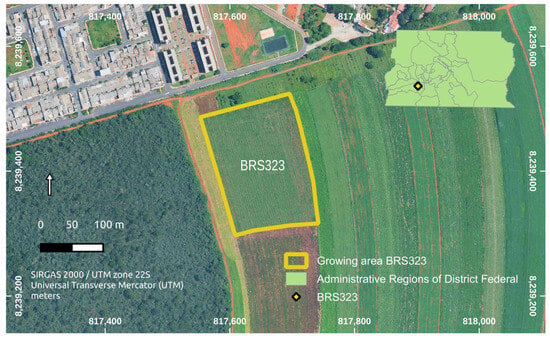
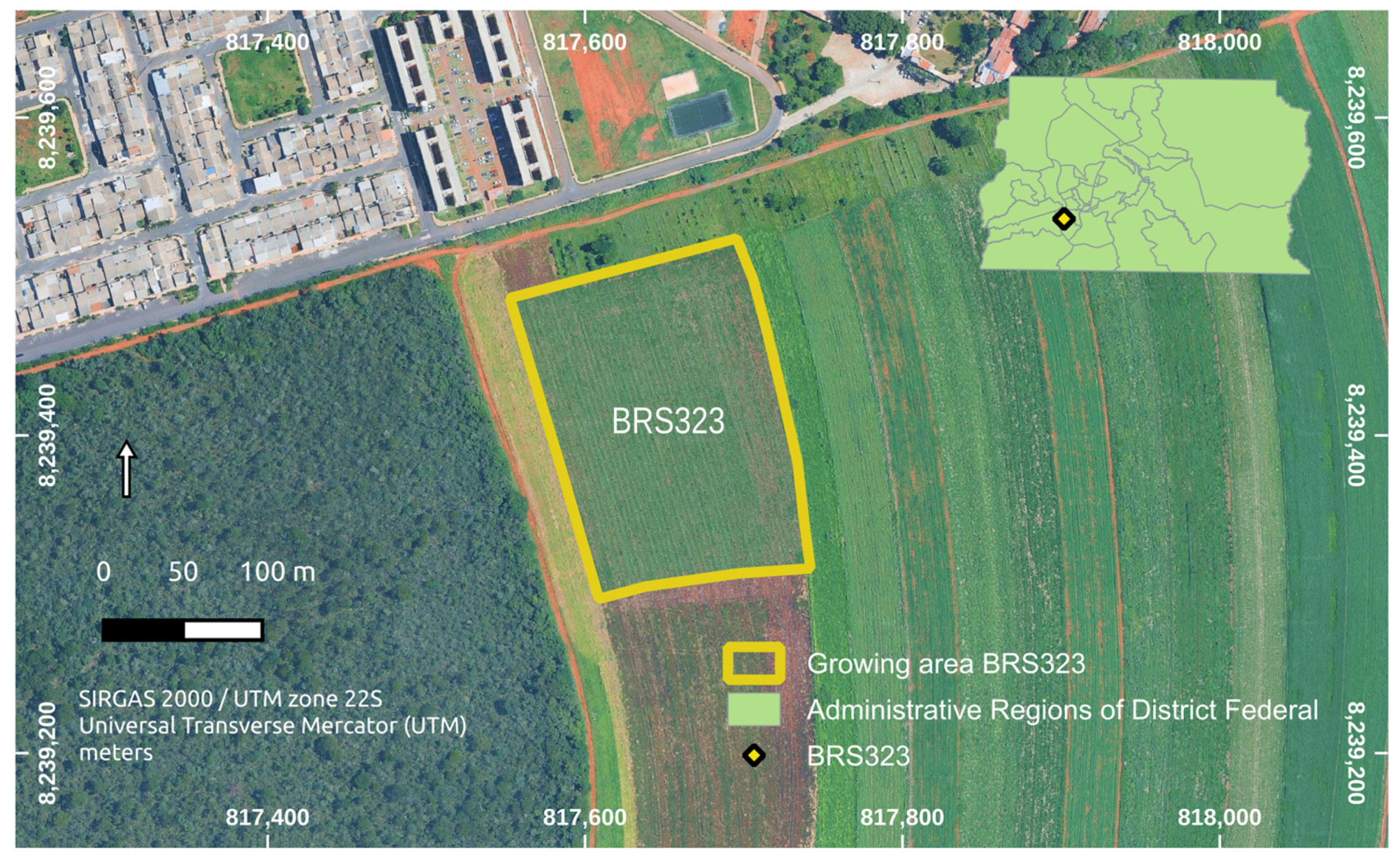
The experiment was conducted at the Plant Genetic Innovation Center (CIGV) of Embrapa Cerrados, located in Riacho Fundo II, Federal District, Brazil (15°54′14″ S, 48°02′01″ W; 1250 m above sea level), during the 2024 growing season (Figure 1).
Figure 1.
Location of the experimental area at the Plant Genetic Innovation Center (CIGV), Riacho Fundo II, Federal District, Brazil. The yellow polygon indicates the experimental planting area where sunflower hybrid BRS 323 was cultivated. The green area in the inset map represents the administrative boundaries of the Federal District, and the black diamond indicates the location of the experimental area within the Federal District.
According to the Köppen climate classification, the region has an Aw climate, characterized by a rainy summer and a dry winter [24]. The soil is classified as a clayey Dystrophic Red Oxisol [25].
The CIGV is a reference experimental station for the development and evaluation of agricultural technologies for the Brazilian Cerrado. Consequently, the experiment was conducted under environmental conditions representative of regional sunflower production systems, allowing the effects of pre-harvest desiccation on seed physiological quality to be evaluated under agronomically relevant field conditions.
Meteorological data recorded during the crop cycle (February to May 2024) were obtained from the automatic weather station of the Brazilian National Institute of Meteorology (INMET) [26], located in Brasília, Federal District. Monthly mean air temperature, cumulative precipitation, and mean relative humidity are presented in Table 1 to characterize the environmental conditions during the experimental period.
Table 1.
Meteorological conditions during the experimental period (February–May 2024) recorded at the automatic weather station of the Brazilian National Institute of Meteorology (INMET), Brasília, Federal District, Brazil.
The experimental area was managed under a no-tillage system with 0.50 m row spacing and a target plant population of approximately 60,000 plants ha−1. The sunflower hybrid BRS 323 was used throughout the experiment.
2.2. Experimental Design and Treatments
The experiment was conducted in a completely randomized design (CRD) consisting of five treatments with four replications. Treatments comprised glufosinate-ammonium applied at the R8 growth stage (GR8), diquat applied at R8 (DR8), glufosinate-ammonium applied at R9 (GR9), diquat applied at R9 (DR9), and an untreated control without pre-harvest desiccation (CONTROL).
Sowing was performed on 9 February 2024 using seeds treated with Standak Top (BASF SE, Ludwigshafen, Germany) at a rate of 600 mL per 100 kg of seed. Basal and topdressing fertilization followed the recommendations for sunflower cultivation proposed by Embrapa Soja [27]. Basal fertilization consisted of 200 kg ha−1 monoammonium phosphate (MAP; 50% P2O5 and 10% N; Mosaic Fertilizantes, Tampa, FL, USA) and 200 kg ha−1 potassium chloride (KCl; 58% K2O; Mosaic Fertilizantes, Tampa, FL, USA). Nitrogen topdressing was applied 31 days after seedling emergence using 100 kg ha−1 urea (Heringer S.A., Cachoeira Dourada, MG, Brazil).
Pre-harvest desiccation was performed using glufosinate-ammonium (Finale; UPL Brasil Ltda., São Paulo, SP, Brazil),1.5 L ha−1, and diquat (Venia BR; Adama Brasil S.A., São Paulo, SP, Brazil), 2.0 L ha−1, at the label-recommended rates for soybean [28,29], since no specific recommendations are available for sunflower seed production. These application rates were selected to evaluate herbicide performance under conditions representative of current agricultural practices; therefore, the results should be interpreted within the range of doses evaluated.
Herbicides were applied using a ground sprayer delivering 250 L ha−1 of spray solution at the R8 (before physiological maturity) and R9 (physiological maturity) growth stages according to the scale proposed by Schneiter and Miller [30].
2.3. Seed Harvest, Storage, and Sampling
Harvesting was performed between 13 and 15 May 2024, approximately 95 days after sowing (DAS). Harvest readiness was determined based on achene moisture content, measured using a portable moisture meter (model G610i; Gehaka, São Paulo, SP, Brazil), with values close to 15% considered appropriate for harvest, together with a visual assessment of plant maturity. Although desiccated treatments reached harvest maturity earlier than the untreated control, all plots were harvested on the same date to ensure uniform conditions for treatment comparisons.
Following harvest, sunflower heads were manually threshed, and the seeds were cleaned to remove impurities and minimize mechanical damage.
Immediately after seed processing, a germination test was conducted to assess the germination potential of freshly harvested seeds. Because no germination was observed in any treatment, a tetrazolium test was subsequently performed to confirm seed viability.
Seeds were then packaged in paper bags and stored for 30 days in a non-climate-controlled storage facility under an average ambient temperature of approximately 21 °C and 50–60% relative humidity. At the end of the storage period, a preliminary germination test confirmed that dormancy had been released before physiological quality assessments were initiated. The observed germination indicated that the seeds were suitable for subsequent evaluations. This storage period was adopted to promote the release of post-harvest physiological dormancy, a characteristic commonly observed in sunflower seeds, thereby allowing the full expression of their physiological potential during subsequent analyses. Consequently, seed storage was not considered an experimental factor related to seed quality preservation but rather a methodological procedure required before physiological testing.
2.4. Seed Physiological Quality Assessment
Following the storage period, seed physiological quality was evaluated at the Seed Laboratory of the School of Agronomy and Veterinary Medicine, University of Brasília, using seeds from all five experimental treatments.
Seed viability was assessed using the tetrazolium test according to the Rules for Seed Testing [31]. Four replicates of 50 seeds per treatment were preconditioned in distilled water for 18 h at 20 °C. The embryos were then stained in a 1% 2,3,5-triphenyl tetrazolium chloride solution for 3 h at 30 °C and classified according to viability.
After dormancy release, seeds were evaluated for germination (G), accelerated aging (AA), electrical conductivity (EC), seedling dry mass after accelerated aging (SDM), and field seedling emergence (FSE).
The germination test was performed according to the Rules for Seed Testing [31] using four replicates of 50 seeds placed on germination paper moistened with distilled water at 2.5 times the dry paper weight and supplemented with nystatin (EMS S/A, Hortolândia, SP, Brazil), 2 mL L−1, following Pereira et al. [32]. Paper rolls were incubated in a germination chamber at 25 °C, and normal seedlings were counted 7 days after sowing. Results were expressed as the percentage of normal seedlings [33].
The accelerated aging test was conducted according to Marcos Filho [34], using four replicates per treatment. Seeds were distributed on a wire mesh suspended inside Gerbox plastic boxes (JP Selecta, São Paulo, SP, Brazil) containing 40 mL of distilled water and incubated in a BOD (model LUCA-161/02; Grupo Lucadema, São José do Rio Preto, SP, Brazil) chamber at 42 °C for 48 h. After the aging period, a germination test was performed, and the results were expressed as the percentage of normal seedlings.
Electrical conductivity was determined according to Vieira and Krzyzanowski [35]. Four replicates of 50 previously weighed seeds were soaked in 75 mL of distilled water for 24 h at 25 °C. Electrical conductivity was measured using a digital conductivity meter (TEC-4MP; Tecnal Equipamentos para Laboratórios, Piracicaba, SP, Brazil), and the results were expressed as μS cm−1 g−1.
Seedling dry mass after accelerated aging was determined using the normal seedlings obtained from the germination test performed after the accelerated aging treatment. Seedlings from each replicate were dried in a forced-air oven (model SL-100; Solab Científica, Piracicaba, SP, Brazil) at 65 °C for 48 h and then weighed [36]. Results were expressed as the mean dry mass per normal seedling (g seedling−1), calculated by dividing the total dry mass of the normal seedlings in each replicate by the corresponding number of normal seedlings.
Field seedling emergence was evaluated at the CIGV experimental station using four replicates of 25 seeds per treatment. Seeds were sown in field beds containing Dystrophic Red Oxisol, and emerged seedlings were counted 10 days after sowing. Results were expressed as the percentage of seedling emergence.
2.5. Statistical Analysis
The data were subjected to analysis of variance (ANOVA) using the following statistical model:
where is the observed value for the ith treatment and jth replicate, μ is the overall mean, is the fixed effect of treatment, and is the experimental error, assumed to be independently and identically distributed.
Prior to ANOVA, the assumptions of normality of residuals and homogeneity of variances were assessed using the Shapiro–Wilk [37] and Levene’s tests [38], respectively. Variables that did not fully satisfy the normality assumption were further evaluated using the non-parametric Kruskal–Wallis [39] test to verify the consistency of the conclusions. For field seedling emergence (FSE), arcsine square-root [40] transformation was applied before ANOVA because the variable consisted of percentage data. Means and standard errors presented in the tables are reported on the original (non-transformed) scale to facilitate biological interpretation.
When treatment effects were significant, means were compared using Tukey’s [41] honestly significant difference test at the 5% significance level (p ≤ 0.05). The coefficient of variation (CV, %) was calculated from the residual mean square.
In addition, multivariate analyses were performed using a scatterplot matrix and principal component analysis (PCA). PCA was conducted in R (version 4.5.1; R Foundation for Statistical Computing, Vienna, Austria) [42] using the prcomp function from the stats package (version 4.5.1, included in base R) after centering and scaling the variables to zero mean and unit variance. The scatterplot matrix and PCA biplot were generated using the GGally package (version 2.4.0; available at https://CRAN.R-project.org/package=GGally, (accessed on 2 July 2026); ggpairs function) and ggplot2 package (version 4.0.3, available at https://ggplot2.tidyverse.org), respectively. The scatterplot matrix was constructed using 20 independent observations (five treatments × four experimental replicates per treatment), with each point representing one laboratory replicate.
The analysis was based on the correlation matrix of the seed physiological quality variables: germination (G), accelerated aging (AA), seedling dry mass after accelerated aging (SDM), electrical conductivity (EC), and field seedling emergence (FSE). The first two principal components (PC1 and PC2) were used to construct the PCA biplot. Eigenvalues, principal component scores, the proportion of explained variance, and variable loadings were obtained directly from the PCA.
3. Results
3.1. Harvest Advancement
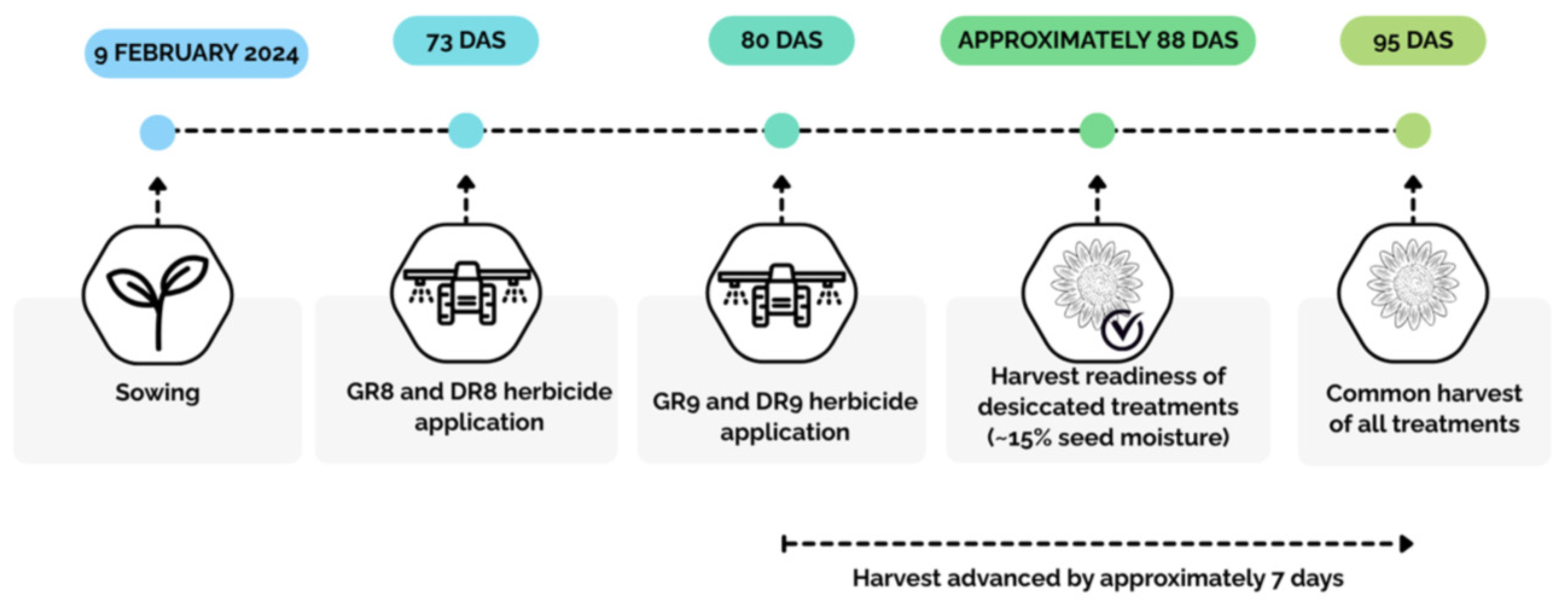
Pre-harvest desiccation advanced harvest readiness by approximately 7 days relative to the untreated control. Although all plots were harvested simultaneously at 95 days after sowing (DAS) to standardize seed quality assessments, desiccated treatments reached harvest maturity earlier, based on seed moisture content (approximately 15%) and plant morphological characteristics.
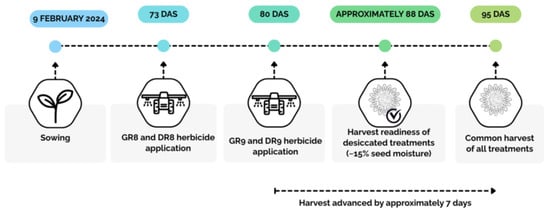
A schematic timeline illustrating harvest progression and the advancement in harvest readiness promoted by the pre-harvest desiccation treatments is presented in Figure 2.
Figure 2.
Experimental timeline illustrating herbicide application and advancement of harvest readiness promoted by pre-harvest desiccation in sunflower. DAS, days after sowing; GR8, glufosinate-ammonium applied at the R8 growth stage; DR8, diquat applied at the R8 growth stage; GR9, glufosinate-ammonium applied at the R9 growth stage; DR9, diquat applied at the R9 growth stage.
3.2. Initial Germination and Seed Viability
The germination test performed immediately after seed processing showed no germination in any treatment, indicating the presence of primary physiological dormancy. However, the tetrazolium test confirmed seed viability, as embryos from all treatments exhibited the characteristic staining pattern associated with metabolic activity, demonstrating that the seeds remained viable despite the absence of initial germination.
3.3. Seed Physiological Quality
The assumptions of ANOVA were generally satisfied (Table S1). Germination (G), accelerated aging (AA), and electrical conductivity (EC) met the assumptions of normality and homogeneity of variances. Slight departures from normality were observed for seedling dry mass after accelerated aging (SDM) and field seedling emergence (FSE); however, complementary Kruskal–Wallis analyses confirmed the same conclusions obtained by ANOVA. Treatment significantly affected germination (G), accelerated aging (AA), seedling dry mass after accelerated aging (SDM), and electrical conductivity (EC) (Table 2). In contrast, field seedling emergence (FSE) was not significantly affected by the treatments (Table 3).
Table 2.
Germination (G), accelerated aging (AA), seedling dry mass after accelerated aging (SDM), and electrical conductivity (EC) of sunflower (Helianthus annuus L.) hybrid BRS 323 seeds subjected to different pre-harvest desiccation treatments.
Table 3.
Field seedling emergence (FSE) of sunflower (Helianthus annuus L.) hybrid BRS 323 seeds subjected to different pre-harvest desiccation treatments.
Germination ranged from 84% to 97% (Table 2). Treatments DR8, GR9, DR9, and CONTROL showed the highest germination percentages and did not differ significantly from one another, whereas GR8 exhibited significantly lower germination than the other treatments.
A similar pattern was observed in the accelerated aging test, with values ranging from 71% to 89%. The highest percentages were recorded for DR8 and CONTROL, both of which differed significantly from GR8. Treatments GR9 and DR9 showed intermediate performance and did not differ significantly from the highest-performing treatments.
Seedling dry mass after accelerated aging ranged from 0.0403 to 0.0455 g. The highest value was observed in DR9, which differed significantly from GR8, whereas the remaining treatments showed intermediate values.
Electrical conductivity differed significantly among treatments, ranging from 33.48 to 43.22 μS cm−1 g−1. Treatment DR8 exhibited the highest electrical conductivity, differing significantly from all other treatments, which did not differ significantly from one another.
Field seedling emergence was uniformly high across treatments, ranging from 96% to 100%, with no significant differences detected among treatments (Table 3).
3.4. Multivariate Analysis of Seed Physiological Quality
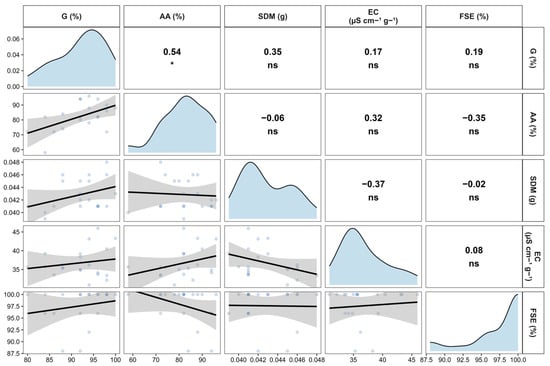
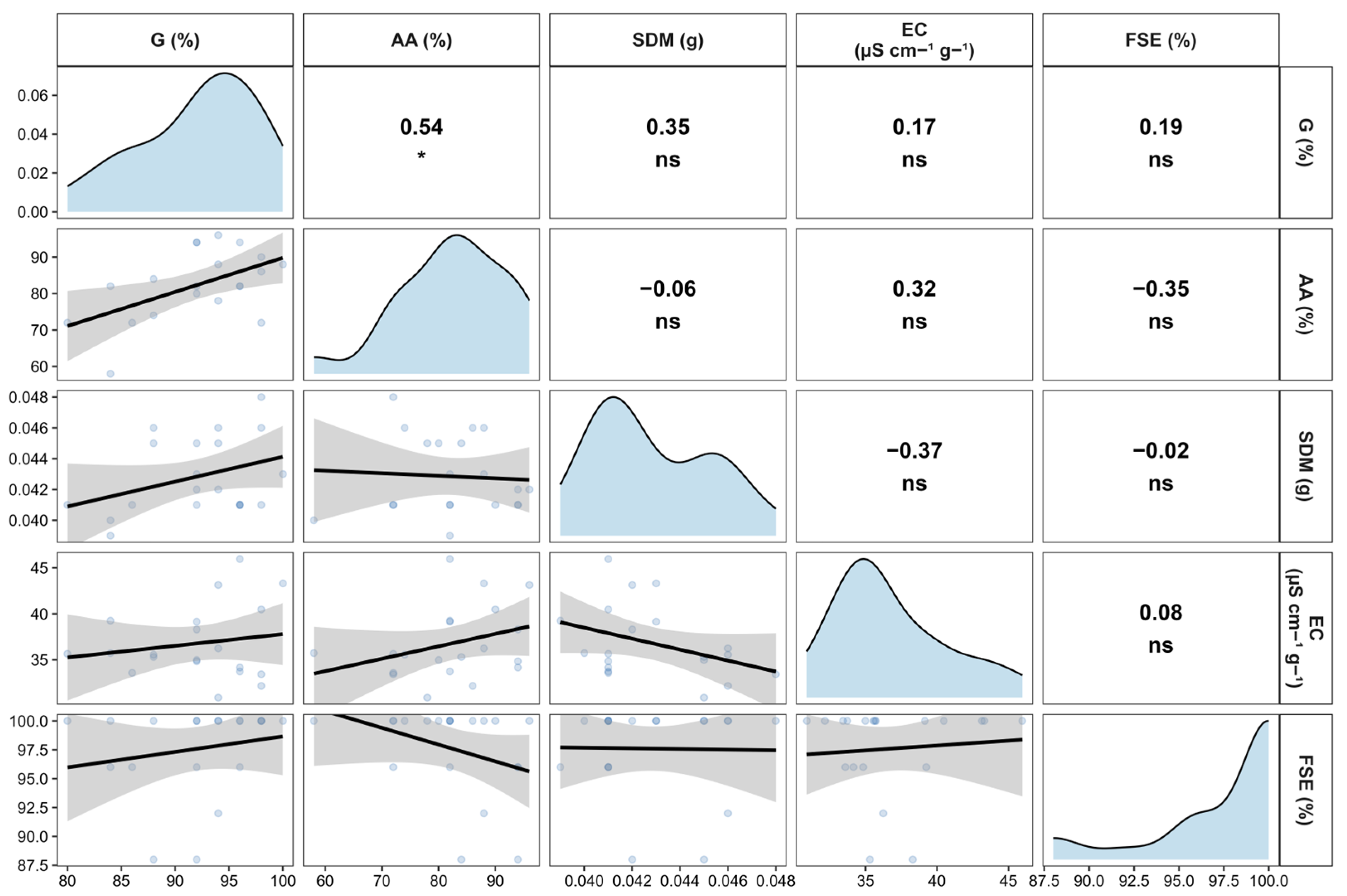
The relationships among the evaluated seed physiological quality variables were explored using a scatterplot matrix and principal component analysis (PCA). The scatterplot matrix revealed distinct patterns of association among the seed physiological quality variables (Figure 3).
Figure 3.
Scatterplot matrix showing the relationships among germination (G), accelerated aging (AA), seedling dry mass after accelerated aging (SDM), electrical conductivity (EC), and field seedling emergence (FSE) of sunflower (Helianthus annuus L.) hybrid BRS 323 seeds. The lower panels show scatter plots with fitted linear regression lines and 95% confidence intervals (gray shaded areas), whereas the upper panels present Pearson correlation coefficients (r) and significance levels. The diagonal panels show the kernel density distributions of each variable (light blue shaded areas). The analysis included 20 observations (n = 20), with each point representing one independent laboratory replicate. * p < 0.05; ns, not significant.
A significant positive correlation was observed between germination (G) and accelerated aging (AA) (r = 0.54, p < 0.05), indicating that seed lots with higher germination also exhibited greater vigor according to the accelerated aging test. The remaining correlations among the evaluated variables were not significant (p > 0.05), suggesting that seedling dry mass after accelerated aging (SDM), electrical conductivity (EC), and field seedling emergence (FSE) represent complementary and largely independent dimensions of seed physiological quality.
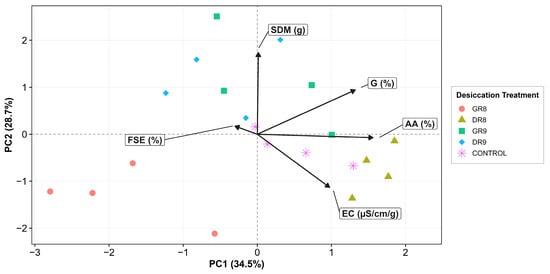
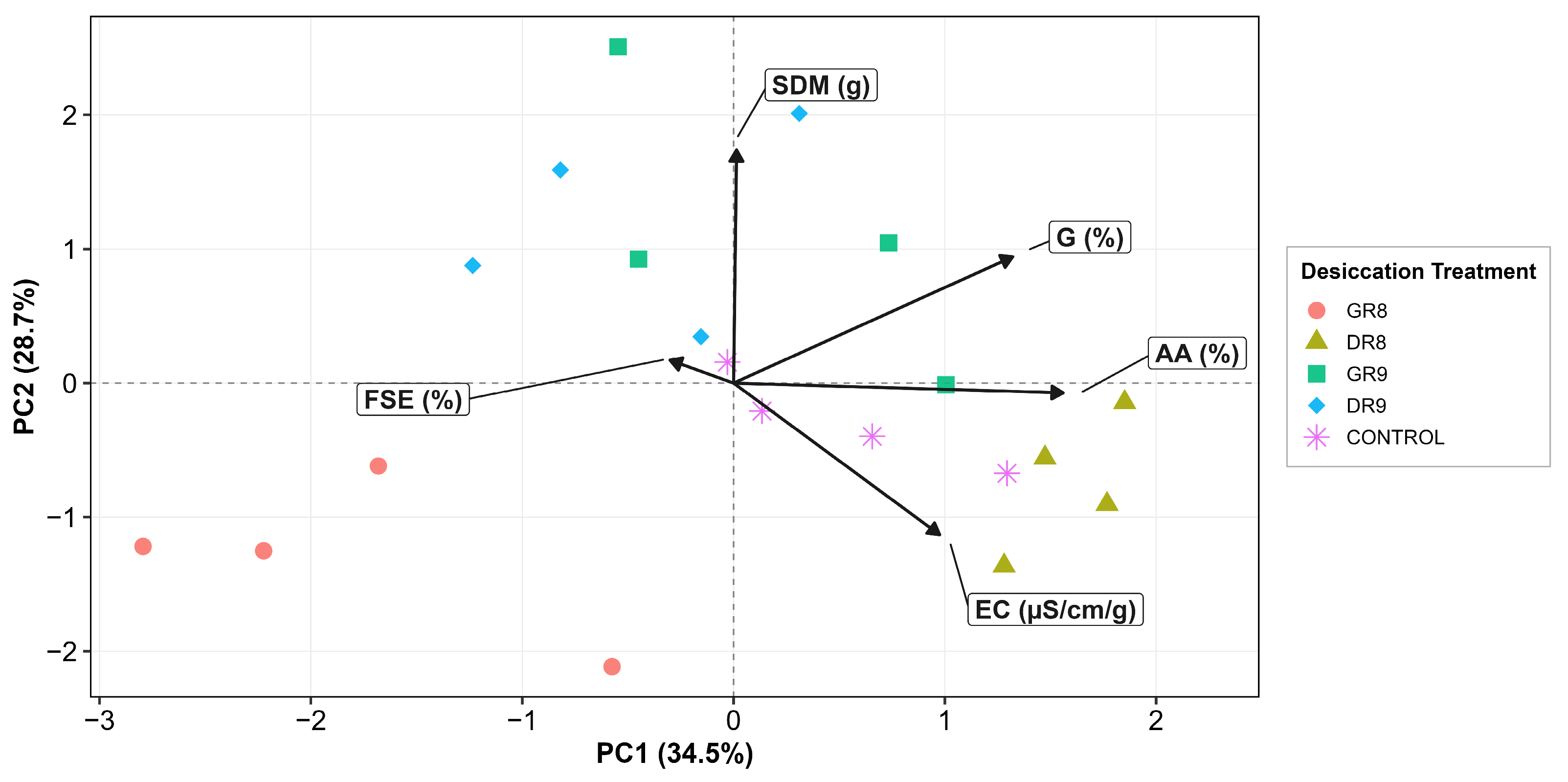
These relationships were further explored using principal component analysis (PCA) (Figure 4).
Figure 4.
Principal component analysis (PCA) biplot of the physiological quality of sunflower (Helianthus annuus L.) hybrid BRS 323 seeds subjected to different pre-harvest desiccation treatments and application growth stages. Each point represents one experimental replicate (n = 4 per treatment). Point colors and shapes identify the desiccation treatment, as indicated in the legend. Arrows represent the loading vectors of each physiological variable, indicating the direction and magnitude of their contribution to the principal components. Dashed lines indicate the PC1 and PC2 origin axes. PC1 and PC2 represent the first and second principal components, explaining 34.5% and 28.7% of the total variance, respectively (cumulative: 63.2%). GR8: glufosinate-ammonium at R8; DR8: diquat at R8; GR9: glufosinate-ammonium at R9; DR9: diquat at R9; CONTROL: untreated control. G: germination; AA: accelerated aging; EC: electrical conductivity; SDM: seedling dry mass after accelerated aging; FSE: field seedling emergence.
The first two principal components together explained 63.2% of the total data variance (PC1 = 34.5% and PC2 = 28.7%) and were therefore retained for graphical interpretation. The eigenvalues and variance explained by all principal components are presented in Supplementary Table S2, whereas the complete loading matrix is provided in Supplementary Table S3.
PC1 was primarily associated with AA (loading = 0.683) and G (loading = 0.578), with EC (loading = 0.427) also contributing positively to this component. In contrast, FSE (loading = −0.132) showed a weak negative contribution to PC1. The positive loadings of G and AA are consistent with the significant positive correlation observed between these variables (r = 0.54). PC2 was mainly influenced by SDM (loading = 0.761) in the positive direction, whereas EC (loading = −0.495) showed the strongest negative contribution to this component. Germination (loading = 0.412) also contributed positively to PC2, whereas AA (loading = −0.032) and FSE (loading = 0.075) had only minor contributions.
The distribution of treatments in the PCA biplot was consistent with the results of the univariate analyses (Table 2 and Table 3). Treatment DR8 was located in the lower-right quadrant of the biplot, close to the EC vector, consistent with its significantly higher electrical conductivity (43.22 μS cm−1 g−1) compared with the other treatments. Treatments GR9 and DR9 were positioned in the upper region of the biplot, near the SDM vector, reflecting the highest values for this variable (0.0450 and 0.0455 g, respectively). In contrast, GR8 was positioned in the lower-left quadrant, opposite to the G and AA vectors, consistent with its significantly lower germination (84%) and accelerated aging (71%) values. The untreated control (CONTROL) occupied an intermediate position in the biplot and showed no clear association with any single physiological attribute, which agrees with its intermediate performance across most of the evaluated physiological quality variables.
4. Discussion
4.1. Harvest Advancement, Initial Seed Viability, and Dormancy Release
The results demonstrated that chemical desiccation advanced harvest readiness by approximately 7 days compared with the untreated control, based on achene moisture content and plant morphological characteristics. Although all plots were harvested on the same date to standardize the experiment and allow the untreated control to reach the target harvest moisture content, this estimated advancement confirms the potential of pre-harvest desiccation as a strategy to reduce the duration of seed exposure in the field. From an agronomic perspective, earlier harvest is advantageous because it reduces seed exposure to rainfall, fluctuations in temperature and relative humidity, pathogen infection, and the natural deterioration processes that occur after physiological maturity [12].
Similar results have been reported in other crops. In rice, the application of desiccants such as diquat and paraquat accelerated grain drying, allowing harvest to be advanced within a few days after application [43]. In soybean, diquat applied at the R7 growth stage reduced grain moisture content and enabled earlier harvest without affecting grain yield [44]. Likewise, in grain sorghum, chemical desiccation advanced harvest by up to 14 days under certain conditions while maintaining seed germination [15]. In sunflower, Silva [45] also reported an approximately 7-day reduction in the interval between diquat application and harvest without compromising seed physiological quality. Collectively, these studies indicate that the effectiveness of pre-harvest desiccation depends primarily on the timing of application, with treatments performed close to physiological maturity advancing harvest while minimizing potential adverse effects on seed quality.
The absence of germination immediately after seed processing, together with the high viability confirmed by the tetrazolium test, demonstrates the occurrence of post-harvest primary physiological dormancy, a characteristic commonly observed in sunflower seeds. Under this type of dormancy, the embryo is fully developed and viable; however, germination is temporarily inhibited by physiological mechanisms regulated primarily by the balance between abscisic acid (ABA) and gibberellins (GAs) [11,46,47]. In addition to the embryo itself, surrounding tissues, including the seed coat and endosperm, may also contribute to the maintenance of dormancy [10,48].
Following 30 days of dry storage, seed dormancy was released, allowing the physiological potential of the seeds to be fully expressed. This response is consistent with the after-ripening process, in which seeds exhibiting non-deep physiological dormancy, such as those of several species within the Asteraceae, gradually lose dormancy during dry storage [11]. In sunflower, after-ripening progressively broadens the temperature range within which seeds are capable of germinating, extending from 5 to 40 °C, and its effectiveness is influenced by storage conditions [9,10]. Therefore, the lack of germination immediately after harvest did not indicate a loss of seed viability caused by pre-harvest desiccation but rather reflected the inherent physiological characteristic of freshly harvested sunflower seeds. Consequently, the subsequent evaluations accurately reflected the effects of the desiccation treatments on seed physiological quality.
4.2. Seed Germination and Vigor
The acquisition of seed physiological quality occurs progressively during maturation and reaches its maximum at physiological maturity (R9), when dry matter, oil, and protein accumulation are completed, cellular membranes undergo structural reorganization, and seeds acquire maximum longevity and vigor [7,49]. Although all treatments exhibited germination percentages above the 75% minimum standard required for sunflower seed commercialization in Brazil [50], the vigor tests demonstrated that seed physiological quality was more sensitive to the timing of desiccant application than germination itself. These findings reinforce that vigor tests provide a more sensitive indicator of seed physiological status than the standard germination test alone, with greater discriminatory power for detecting differences in physiological potential [51,52].
The maintenance of high germination percentages, including in seeds desiccated at the R8 growth stage, may be associated with the anatomical characteristics of the sunflower achene. The pericarp contains highly lignified mechanical tissues and a phytomelanin layer that forms a physical barrier protecting the embryo against mechanical damage and environmental stress [53]. In addition to its structural role, this anatomical organization may partially reduce the direct exposure of embryonic tissues to herbicides applied during pre-harvest desiccation [54], thereby contributing to the preservation of germination capacity, particularly when applications are performed close to physiological maturity. However, this protective effect appears insufficient to prevent more subtle physiological changes, as revealed by the vigor tests.
This response is consistent with previous studies in sunflower. Szemruch et al. [17,18] reported that desiccant applications performed near physiological maturity advanced harvest without reducing seed germination, whereas Čanak et al. [19] found that applications performed at the physiologically appropriate stage for each genotype maintained high germination percentages even after prolonged storage. Similarly, Farias et al. [20] observed that paraquat applications at the R9 growth stage preserved seed physiological quality, whereas earlier applications reduced germination, demonstrating that seed responses depend primarily on the growth stage at which desiccation is performed.
The accelerated aging test proved particularly effective in discriminating among treatments by detecting differences in seed vigor that were not fully identified by the germination test. This test exposes seeds to high temperature and relative humidity, accelerating the natural deterioration process and providing an estimate of storage potential and performance under stressful conditions [51]. The lower percentages observed for treatment GR8 indicate a reduced capacity to maintain physiological quality after stress, suggesting that early desiccation with glufosinate-ammonium partially impaired the protective mechanisms acquired during the final stages of seed maturation. Overall, treatments desiccated at R9 exhibited superior physiological performance compared with those treated at R8, indicating that the processes associated with vigor acquisition were more advanced at physiological maturity. These findings support the hypothesis that early desiccation may partially interrupt metabolic processes that remain active during the final stages of seed maturation, thereby limiting the complete acquisition of physiological quality and seed longevity, as previously discussed by Chamma et al. [55] for soybean seeds.
This response was particularly evident for glufosinate-ammonium applied at R8 (GR8), which produced the lowest values for germination, accelerated aging, and seedling dry mass after accelerated aging. The poorer performance observed after accelerated aging further supports this interpretation, indicating that premature interruption of seed maturation reduced the ability of seeds to tolerate stressful conditions, a characteristic directly associated with seed vigor. Glufosinate-ammonium inhibits the enzyme glutamine synthetase, leading to ammonia accumulation in plant tissues, disruption of nitrogen metabolism, and the intense production of reactive oxygen species (ROS) [56,57]. Application of this herbicide before the completion of physiological maturity may therefore have restricted metabolic processes required for the full establishment of seed physiological quality, particularly those involved in vigor acquisition. Although the present study does not directly identify the mechanisms responsible for these responses, this hypothesis is consistent with the lower physiological performance observed for treatment GR8.
In contrast, diquat applied at R8 maintained high germination and accelerated aging values, suggesting less interference with the final stages of seed maturation. Diquat is a contact herbicide that promotes the rapid generation of reactive oxygen species (ROS) through electron transfer in photosystem I, resulting in rapid desiccation of exposed tissues [58,59]. Because the rapid destruction of plant tissues limits herbicide translocation [60], its effects were likely confined primarily to directly exposed tissues, thereby reducing interference with reproductive structures compared with glufosinate-ammonium. Similar findings were reported by Čanak et al. [19] and Albrecht et al. [22], who also concluded that seed physiological quality is influenced more strongly by the interaction between growth stage and herbicide mode of action than by the use of desiccants alone.
Electrical conductivity complemented these findings by revealing changes in membrane integrity that were not fully detected by the other vigor tests. The higher electrical conductivity observed for DR8 indicates greater electrolyte leakage during seed imbibition, a characteristic associated with lower membrane structural integrity and, consequently, reduced seed vigor [35,61]. Although DR8 maintained high germination and accelerated aging values, its higher electrical conductivity suggests that early changes in membrane integrity had already occurred, although they were insufficient to impair seed performance in the other vigor assessments.
Seedling dry mass after accelerated aging corroborated the results obtained in the other vigor tests. The higher values observed in the treatments desiccated at R9, particularly DR9, indicate greater efficiency in the mobilization and utilization of seed reserves for early seedling growth following the stress imposed by accelerated aging. In contrast, the lower value recorded for GR8 reinforces that the early application of glufosinate-ammonium impaired physiological processes related to seedling performance. This result is consistent with the concept that seedling dry mass is an important indicator of seed vigor, as it reflects the efficiency with which seed reserves are mobilized and utilized for biomass production during early seedling growth [62].
Despite the differences observed under laboratory conditions, field seedling emergence remained high and did not differ significantly among treatments, indicating that physiological changes detected under controlled conditions do not necessarily translate into differences in field performance under favorable environmental conditions. According to Marcos Filho [51], differences in seed vigor are more likely to be expressed during seedling emergence under unfavorable environmental conditions, such as under water deficit, low temperatures, or high soil compaction.
4.3. Multivariate Integration of Physiological Tests Using Principal Component Analysis
The PCA corroborated and complemented the univariate analyses by summarizing 63.2% of the total data variance into the first two principal components (PC1 = 34.5% and PC2 = 28.7%) (Figure 4). PC1 was primarily associated with AA (loading = 0.683) and G (loading = 0.578), representing the main axis of seed vigor-related traits. Electrical conductivity (EC) also contributed positively to PC1 (loading = 0.427), although to a lesser extent. In contrast, PC2 was mainly defined by SDM (loading = 0.761) in the positive direction and EC (loading = −0.495) in the negative direction, representing an independent gradient associated with membrane integrity and post-stress seedling growth. Field seedling emergence (FSE) exhibited low loadings on both components, indicating that it contributed little to the variability explained by the two-dimensional PCA. Overall, the multivariate analysis provided an integrated assessment of seed physiological quality by simultaneously considering multiple vigor-related attributes [63,64].
The distribution of treatments in the PCA biplot was consistent with the results obtained in the physiological tests. GR8 was clearly separated on the negative side of PC1, opposite the germination and accelerated aging vectors, indicating lower physiological performance. DR8 was positioned closer to the electrical conductivity vector, indicating a stronger association with electrical conductivity than the other treatments. In contrast, GR9 and DR9 were located in the positive region of PC2, near the SDM vector, reflecting greater seedling dry mass after accelerated aging and, consequently, superior seed vigor following stress. The untreated control occupied an intermediate position in the biplot, showing no strong association with any individual variable, consistent with its intermediate physiological performance observed in the univariate analyses.
From a physiological perspective, these results can be explained by the gradual acquisition of seed vigor during seed maturation. Throughout this process, seeds progressively accumulate dry matter and reserves, acquire desiccation tolerance, and undergo coordinated hormonal regulation, all of which contribute to the development of maximum physiological potential, achieved during late seed maturation and near the optimal harvest stage [7]. The application of desiccant herbicides before physiological maturity may partially interrupt this natural process, producing seeds that maintain adequate germination but exhibit reduced performance under stressful conditions or during storage [55].
Based on the present results, desiccant application at the R8 growth stage can be considered technically feasible because it meets minimum germination standards established by Brazilian seed legislation. However, when maximizing seed vigor and physiological stability is the primary objective, application at R9 provides greater reliability. This finding is consistent with both the physiological principles of seed maturation and the results obtained from the vigor tests and multivariate analyses. Similar responses have been reported in soybean, where early pre-harvest desiccation did not affect immediate germination but reduced the complete acquisition of seed vigor and longevity during storage [55]. Likewise, in common bean, applications performed at earlier developmental stages reduced both vigor and germination, whereas later applications better preserved seed physiological quality [65].
Some limitations of the present study should be considered when interpreting these findings. The experiment was conducted using a single hybrid (BRS 323), at one location, and during a single growing season, which limits the extrapolation of the results to other genotypes, production environments, and interannual climatic conditions. Future studies should include multiple hybrids, representative production regions, and at least two growing seasons to validate and broaden these findings. In addition, evaluating seed yield and oil content together with physiological quality would provide a more comprehensive agronomic basis for decision-making regarding pre-harvest desiccation management.
5. Conclusions
Pre-harvest desiccation with diquat and glufosinate-ammonium applied at the R8 and R9 growth stages produced germination percentages above the 75% minimum standard required by Brazilian seed regulations (Normative Instruction No. 25/2005), confirming the technical feasibility of this practice from both regulatory and commercial perspectives. However, vigor tests showed that seed physiological quality was influenced by both the herbicide and the growth stage at the time of application, indicating that germination alone is insufficient to assess the effects of pre-harvest desiccation on seed physiological potential.
Overall, applications performed at the R9 growth stage resulted in superior physiological performance, with responses comparable to those of the untreated control for most of the evaluated variables, regardless of the desiccant used. At the R8 growth stage, diquat maintained higher germination and vigor than glufosinate-ammonium, whereas glufosinate-ammonium applied at this stage caused a greater reduction in seed physiological quality, suggesting greater interference with the seed maturation processes that were still in progress. The multivariate analysis supported these findings by clearly separating the treatments according to the evaluated physiological attributes and confirming the consistency of the differences observed in the univariate analyses.
Therefore, pre-harvest desiccation should preferably be performed at the R9 growth stage, where both diquat and glufosinate-ammonium can be used with greater confidence to preserve seed physiological quality. When earlier desiccation at the R8 growth stage is required, diquat should be preferred. These findings highlight the importance of selecting both the appropriate growth stage and the appropriate desiccant herbicide to preserve the physiological quality of sunflower seeds intended for commercial seed production.
Supplementary Materials
The following supporting information can be downloaded at: https://www.mdpi.com/article/10.3390/agronomy16212187/s1, Table S1: Detailed analysis of variance (ANOVA) statistics, including coefficients of variation (CV), F statistics, degrees of freedom (df), exact p-values, and complementary non-parametric analyses for the evaluated seed physiological quality variables; Table S2: Eigenvalues, percentage of variance explained, and cumulative variance of the principal components obtained from the principal component analysis (PCA); Table S3: Principal component loadings for the evaluated seed physiological quality variables.
Author Contributions
Conceptualization, C.C.d.S. and R.F.A.; methodology, C.C.d.S. and M.F.; software, C.C.d.S. and J.V.M.; validation, C.C.d.S., R.F.A., B.S.A.F. and M.F.; formal analysis, C.C.d.S. and J.V.M.; investigation, C.C.d.S., B.S.A.F. and A.R.F.; data curation, C.C.d.S.; writing—original draft preparation, C.C.d.S.; writing—review and editing, C.C.d.S., R.F.A., O.J.S. and M.F.; visualization, C.C.d.S.; supervision, R.F.A. and M.F.; project administration, C.C.d.S. and R.F.A. All authors have read and agreed to the published version of the manuscript.
Funding
This research was supported by the Conselho Nacional de Desenvolvimento Científico e Tecnológico (CNPq), grant number 131733/2024-9. Funding for the article processing charge (APC) was provided by the Fundação de Apoio à Pesquisa do Distrito Federal (FAPDF) under Call N°. 01/2026, FAPDF Publica (Scientific Dissemination Program), Process N°. 00193-00001283/2026-06.
Data Availability Statement
The data presented in this study are available upon request from the corresponding author.
Acknowledgments
The authors thank Embrapa Cerrados for the technical support and infrastructure used in conducting the experiment.
Conflicts of Interest
The authors declare no conflicts of interest. The funders had no role in the design of the study; in the collection, analyses, or interpretation of data; in the writing of the manuscript; or in the decision to publish the results.
Abbreviations
The following abbreviations are used in this manuscript:
| ANVISA | Brazilian Health Regulatory Agency |
| CIGV | Plant Genetic Innovation Center |
| INMET | Brazilian National Institute of Meteorology |
| CRD | Completely randomized design |
| GR8 | Glufosinate-ammonium applied at the R8 growth stage |
| GR9 | Glufosinate-ammonium applied at the R9 growth stage |
| DR8 | Diquat applied at the R8 growth stage |
| DR9 | Diquat applied at the R9 growth stage |
| CONTROL | Untreated control without pre-harvest desiccation |
| R8 | growth stage before physiological maturity |
| R9 | growth stage on physiological maturity |
| DAS | Days after sowing |
| G | germination |
| AA | Accelerated aging |
| EC | Electrical conductivity |
| SDM | Seedling dry mass after accelerated aging |
| FSE | Field seedling emergence |
| ANOVA | Analysis of variance |
| CV | Coefficient of variation |
| PCA | Principal component analysis |
| PC1 | Principal component 1 |
| PC2 | Principal component 2 |
| HSD | Honestly significant difference test |
| ABA | Abscisic acid |
| GAs | Gibberellins |
| ROS | Reactive oxygen species |
References
- USDA Foreign Agricultural Service. Production, Supply and Distribution—Oilseeds: Sunflower Seed. Available online: https://www.fas.usda.gov/data/production/commodity-group/oilseeds (accessed on 27 August 2025).
- Dantas, M.S.M.; Rolim, M.M.; Duarte, A.S.; Lima, L.E.; Silva, M.M. Production and morphological components of sunflower on soil fertilized with cassava wastewater. Rev. Ceres 2017, 64, 77–82. [Google Scholar] [CrossRef] [Scilit]
- Das, R.; Biswas, S.; Mandal, A.K. Quality parameters of sunflower (Helianthus annuus L.) seeds and seedlings under various storage duration and seed invigoration. Int. J. Curr. Microbiol. Appl. Sci. 2020, 9, 76–87. [Google Scholar] [CrossRef] [Scilit]
- Castro, C.; Leite, R.M.V.B.C. Main aspects of sunflower production in Brazil. OCL 2018, 25, D104. [Google Scholar] [CrossRef] [Scilit]
- CONAB. Acompanhamento da Safra Brasileira de Grãos: Safra 2024/25, Quarto Levantamento; CONAB: Brasília, Brazil, 2025. Available online: https://www.conab.gov.br/info-agro/safras/graos (accessed on 18 March 2025).
- Carvalho, C.G.P.; Oliveira, A.C.B.; Oliveira, M.F.; Carvalho, H.W.L.; Godinho, V.P.C.; Amabile, R.F.; Oliveira, I.R.; Ramos, N.P.; Gonçalves, S.L.; Leite, R.M.V.B.C.; et al. BRS 323: Híbrido com Produtividade e Precocidade; Folder Técnico; Embrapa Soja: Londrina, Brazil, 2013; Available online: https://www.infoteca.cnptia.embrapa.br/bitstream/doc/964171/1/folderBRS323copy.pdf (accessed on 5 October 2025).
- Sripathy, K.V.; Groot, S.P.C. Seed development and maturation. In Seed Science and Technology; Dadlani, M., Yadava, D.K., Eds.; Springer: Singapore, 2023; pp. 17–38. [Google Scholar] [CrossRef] [Scilit]
- Castro, C.; Castiglioni, V.B.R.; Balla, A.; Leite, R.M.V.B.C.; Karam, D.; Mello, C.H.; Guedes, L.C.A.; Farias, J.R.B. A Cultura do Girassol; Circular Técnica 13; Embrapa-CNPSo: Londrina, Brazil, 1996; Available online: https://www.infoteca.cnptia.embrapa.br/infoteca/handle/doc/951393 (accessed on 27 March 2026).
- Xia, Q.; Saux, M.; Ponnaiah, M.; Gilard, F.; Perreau, F.; Huguet, S.; Balzergue, S.; Langlade, N.; Bailly, C.; Meimoun, P.; et al. One way to achieve germination: Common molecular mechanism induced by ethylene and after-ripening in sunflower seeds. Int. J. Mol. Sci. 2018, 19, 2464. [Google Scholar] [CrossRef] [Scilit] [PubMed]
- Corbineau, F.; Bagniol, S.; Côme, D. Sunflower (Helianthus annuus L.) seed dormancy and its regulation by ethylene. Isr. J. Bot. 1990, 39, 313–325. [Google Scholar]
- Baskin, C.C.; Baskin, J.M. Breaking seed dormancy during dry storage: A useful tool or major problem for successful restoration via direct seeding? Plants 2020, 9, 636. [Google Scholar] [CrossRef] [Scilit] [PubMed]
- França Neto, J.B. Testes de tetrazólio para determinação do vigor de sementes. In Vigor de Sementes: Conceitos e Testes; Krzyznowski, F.C., Vieira, R.D., França Neto, J.B., Eds.; ABRATES: Londrina, Brazil, 1999; pp. 8.1–8.5. [Google Scholar]
- Lacerda, A.L.S.; Lazarini, E.; Sá, M.E.; Valério Filho, W.V. Efeitos da dessecação de plantas de soja no potencial fisiológico e sanitário das sementes. Bragantia 2005, 64, 447–457. [Google Scholar] [CrossRef] [Scilit]
- Botelho, F.J.E.; Oliveira, J.A.; Von Pinho, É.V.D.R.; Carvalho, E.R.; Figueiredo, Í.B.D.; Andrade, V. Qualidade de sementes de soja obtidas de diferentes cultivares submetidas à dessecação com diferentes herbicidas e épocas de aplicação. Agro@Mbiente-Line 2016, 10, 137–144. [Google Scholar] [CrossRef] [Scilit]
- Barros, A.F.; Pimentel, L.D.; Freitas, F.C.L.; Cecon, P.R.; Tomaz, A.C.; Sousa, E.A.M.; Ladeira, L.M.; Biesdorf, E.M. Dessecação pré-colheita em sorgo granífero: Qualidade fisiológica das sementes e efeito sobre a rebrota. Rev. Agrár. Acad. 2019, 2, 1–8. [Google Scholar] [CrossRef] [Scilit]
- Nowatski, J. Harvesting. In Sunflower Production Guide; North Dakota State University Extension; North Dakota Agricultural Experiment Station: Fargo, ND, USA, 2020. [Google Scholar]
- Szemruch, C.L.; Cantamutto, M.A.; García, F.A.; Aguirre, M.; Rentería, S.J.; Rondanini, D.P. Hybrid sunflower seed yield, composition and deterioration after chemical desiccation. Int. J. Plant Prod. 2017, 11, 225–240. [Google Scholar]
- Szemruch, C.L.; García, F.; Zuil, S.; Teysseire, C.; Renzi, J.P.; Cantamutto, M.A.; Rondanini, D.P. Dynamics of dry-down in seed, head and stalk from sunflower genotypes sprayed with chemical desiccants after physiological maturity. Turk. J. Agric. Food Sci. Technol. 2019, 7, 192–201. [Google Scholar] [CrossRef] [Scilit]
- Čanak, P.; Jocković, M.; Vujošević, B.; Babić, M.; Mitrović, B.; Stanisavljević, D.; Miklič, V. Sunflower seed germination and storability response to chemical desiccation. Sel. I Semen. 2020, 26, 53–60. [Google Scholar] [CrossRef] [Scilit]
- Farias, J.P.; Amabile, R.F.; Brige, F.A.A.; Loures, L.M.R.; Carvalho, C.G.P.; Melo, J.V.P.; Ramos, S.D.R.; Santos, G.B.C. Paraquat action in reproductive phases of sunflower on agronomic behavior and seed quality. DELOS Desarro. Local Sosten. 2023, 16, 2942–2951. [Google Scholar] [CrossRef] [Scilit]
- Brasil. Resolução RDC n.° 177, de 21 de Setembro de 2017: Dispõe Sobre a Proibição do Ingrediente Ativo Paraquate em Produtos Agrotóxicos no País e Sobre as Medidas Transitórias de Mitigação de Riscos; Diário Oficial da União; ANVISA: Brasília, Brazil, 2017. Available online: https://www.agricultura.rs.gov.br/upload/arquivos/201710/19161001-rdc-n-177-de-2017-anvisa-paraquat.pdf (accessed on 27 August 2025).
- Albrecht, L.P.; Yokoyama, A.S.; Albrecht, A.J.P.; Kosinski, R.; Milleo, R.; Silva, A.F.M. Glufosinate and diquat in pre-harvest desiccation of soybean at four phenological stages, and their impact on seed quality. Chil. J. Agric. Res. 2022, 82, 448–456. [Google Scholar] [CrossRef] [Scilit]
- Silva, G.F.; Chamma, L.; Luperini, B.C.O.; Chaves, P.P.N.; Calonego, J.C.; Nakagawa, J.; Silva, E.A.A. Physiological quality of soybean seeds as a function of soil management systems and pre-harvest desiccation. Agronomy 2023, 13, 847. [Google Scholar] [CrossRef] [Scilit]
- Ribeiro, J.F.; Walter, B.M.T. As principais fitofisionomias do Bioma Cerrado. In Cerrado: Ecologia e Flora; Sano, S.M., Almeida, S.P., Ribeiro, J.F., Eds.; Embrapa Informação Tecnológica: Brasília, Brazil, 2008; pp. 151–212. [Google Scholar]
- Santos, H.G.; Jacomine, P.K.T.; Anjos, L.H.C.; Oliveira, V.A.; Lumbreras, J.F.; Coelho, M.R.; Almeida, J.A.; Araújo Filho, J.C.; Oliveira, J.B.; Cunha, T.J.F. Sistema Brasileiro de Classificação de Solos, 6th ed.; Embrapa: Brasília, Brazil, 2025. [Google Scholar]
- INMET. Meteorological Database for Education and Research (BDMEP); Instituto Nacional de Meteorologia: Brasília, Brazil, 2024. Available online: https://bdmep.inmet.gov.br (accessed on 2 July 2026).
- Leite, R.M.V.B.D.C.; Castro, C.; Brighenti, A.M.; Oliveira, F.A.; Carvalho, C.G.P.; Oliveira, A.C.B. Indicações para o Cultivo de Girassol nos Estados do Rio Grande do Sul, Paraná, Mato Grosso do Sul, Mato Grosso, Goiás e Roraima; Comunicado Técnico 78; Embrapa Soja: Londrina, Brazil, 2007; Available online: https://www.infoteca.cnptia.embrapa.br/bitstream/doc/470731/1/comtec78girassol.pdf (accessed on 21 February 2026).
- Adapar. Finale: Bula de Herbicida à Base de Glufosinato de Amônio; Adapar: Curitiba, Brazil, 2026. Available online: https://www.adapar.pr.gov.br/sites/adapar/arquivos_restritos/files/documento/2026-07/finale.pdf? (accessed on 21 February 2026).
- Adapar. Venia BR: Bula de Herbicida à Base de Diquat; Adapar: Curitiba, Brazil, 2024. Available online: https://www.adapar.pr.gov.br/sites/adapar/arquivos_restritos/files/documento/2024-12/veniabr.pdf?utm_source=chatgpt.com (accessed on 21 February 2026).
- Schneiter, A.A.; Miller, J.F. Description of sunflower growth stages. Crop Sci. 1981, 21, 901–903. [Google Scholar] [CrossRef] [Scilit]
- Ministério da Agricultura, Pecuária e Abastecimento (MAPA). Regras para Análise de Sementes; MAPA: Brasília, Brazil, 2009. Available online: https://www.gov.br/agricultura/pt-br/assuntos/lfda/arquivos-publicacoes-laboratorio/regras-para-analise-de-sementes.pdf (accessed on 27 March 2026).
- Pereira, M.D.; Reis, J.A.; Ferrari, C.S.; Vale, A.M.P.G. Processamento digital de imagens de plântulas na avaliação do vigor de sementes de Moringa oleifera Lam. Ciênc. Florest. 2020, 30, 291–306. [Google Scholar] [CrossRef] [Scilit]
- Caldeira, C.M. Testes Rápidos para a Avaliação da Qualidade de Sementes de Girassol. Master’s Thesis, Universidade Federal de Lavras, Lavras, Brazil, 2010. Available online: https://repositorio.ufla.br/items/45edb30b-2648-40a3-91b3-e61f7744cafa (accessed on 27 March 2026).
- Marcos Filho, J. Teste de envelhecimento acelerado. In Vigor de Sementes: Conceitos e Testes; Krzyzanowski, F.C., Vieira, R.D., França Neto, J.B., Eds.; ABRATES: Londrina, Brazil, 1999; pp. 3.1–3.24. [Google Scholar]
- Vieira, R.D.; Krzyzanowski, F.C. Teste de condutividade elétrica. In Vigor de Sementes: Conceitos e Testes; Krzyzanowski, F.C., Vieira, R.D., França Neto, J.B., Eds.; ABRATES: Londrina, Brazil, 1999; pp. 4.1–4.26. [Google Scholar]
- Haj Sghaier, A.; Khaeim, H.M.; Tarnawa, Á.; Kovács, G.P.; Gyuricza, C.; Kende, Z. Germination and Seedling Development Responses of Sunflower (Helianthus annuus L.) Seeds to Temperature and Different Levels of Water Availability. Agriculture 2023, 13, 608. [Google Scholar] [CrossRef] [Scilit]
- Shapiro, S.S.; Wilk, M.B. An analysis of variance test for normality (complete samples). Biometrika 1965, 52, 591–611. [Google Scholar] [CrossRef] [Scilit]
- Levene, H. Robust tests for equality of variances. In Contributions to Probability and Statistics: Essays in Honor of Harold Hotelling; Olkin, I., Ed.; Stanford University Press: Stanford, CA, USA, 1960; pp. 278–292. [Google Scholar]
- Kruskal, W.H.; Wallis, W.A. Use of ranks in one-criterion variance analysis. J. Am. Stat. Assoc. 1952, 47, 583–621. [Google Scholar] [CrossRef]
- Zar, J.H. Biostatistical Analysis, 5th ed.; Pearson Prentice Hall: Upper Saddle River, NJ, USA, 2010. [Google Scholar]
- Tukey, J.W. Comparing individual means in the analysis of variance. Biometrics 1949, 5, 99–114. [Google Scholar] [CrossRef] [Scilit]
- R Core Team. R: A Language and Environment for Statistical Computing; R Foundation for Statistical Computing: Vienna, Austria, 2024; Available online: https://www.r-project.org/ (accessed on 22 February 2026).
- He, Y.Q.; Cheng, J.P.; Liu, L.F.; Li, X.D.; Yang, B.; Zhang, H.S.; Wang, Z.F. Effects of pre-harvest chemical application on rice desiccation and seed quality. J. Zhejiang Univ. Sci. B 2015, 16, 813–823. [Google Scholar] [CrossRef] [Scilit] [PubMed]
- Silva, A.R.; Scaramal, A.; Gomes, G.R.; Machineski, G. Dessecação química da soja em diferentes estádios fenológicos para antecipação da colheita. UNICIÊNCIAS 2021, 25, 125–129. [Google Scholar] [CrossRef] [Scilit]
- Silva, H.P. Dessecação de Plantas de Girassol e Qualidade de Sementes Armazenadas. Master’s Thesis, Universidade Federal de Lavras, Lavras, Brazil, 2011. Available online: https://repositorio.ufla.br/items/14668ffe-4fc7-419a-8be1-0a2cfafbee86 (accessed on 27 March 2026).
- Xia, Q.; Ponnaiah, M.; Thanikathansubramanian, K.; Corbineau, F.; Bailly, C.; Nambara, E.; Meimoun, P.; El-Maarouf-Bouteau, H. Re-localization of hormone effectors is associated with dormancy alleviation by temperature and after-ripening in sunflower seeds. Sci. Rep. 2019, 9, 4861. [Google Scholar] [CrossRef] [Scilit] [PubMed]
- Lachabrouilli, A.-S.; Rigal, K.; Corbineau, F.; Bailly, C. Effects of agroclimatic conditions on sunflower seed dormancy at harvest. Eur. J. Agron. 2021, 124, 126209. [Google Scholar] [CrossRef] [Scilit]
- Ferreira, A.G.; Borghetti, F. (Eds.) Germinação: Do Básico ao Aplicado; Artmed: Porto Alegre, Brazil, 2004; 323p. [Google Scholar]
- Cai, S.; Xu, H.; Wu, L.; Wang, G.; Liu, J.; Song, J. Physiological changes involved in the acquisition of seed vigor during maturation of sunflower seed. Acta Physiol. Plant. 2023, 45, 51. [Google Scholar] [CrossRef] [Scilit]
- Ministério da Agricultura, Pecuária e Abastecimento (MAPA). Instrução Normativa n.° 25, de 16 de dezembro de 2005: Padrões Nacionais de Sementes. Diário Oficial da União: Brasília, Brazil, 2005. Available online: https://abrasem.com.br/wp-content/uploads/2012/10/Instru%C3%A7%C3%A3o-Normativa-n%C2%BA-25-de-16-de-dezembro-de-2005-Padr%C3%B5es-Nacionais-de-Sementes.pdf (accessed on 23 January 2026).
- Marcos Filho, J. Seed vigor testing: An overview of the past, present and future perspective. Sci. Agric. 2015, 72, 363–374. [Google Scholar] [CrossRef] [Scilit]
- Basu, S.; Groot, S.P.C. Seed Vigour and Invigoration. In Seed Science and Technology; Dadlani, M., Yadava, D.K., Eds.; Springer: Singapore, 2023; pp. 67–89. [Google Scholar] [CrossRef] [Scilit]
- Jocković, J.; Rajčević, N.; Terzić, S.; Zorić, L.; Jocković, M.; Miladinović, D.; Luković, J. Pericarp features of wild perennial Helianthus L. species as a potential source for improvement of technical and technological properties of cultivated sunflower. Ind. Crops Prod. 2020, 144, 112030. [Google Scholar] [CrossRef] [Scilit]
- Ovuka, J.; Jocković, J.; Jocković, M.; Jocić, S.; Gvozdenac, S.; Krstić, M.; Jovičić, D. Biophysical and morphometric characteristics of sunflower achenes: Implications for industrial processing and byproduct utilization. Agronomy 2025, 15, 1035. [Google Scholar] [CrossRef] [Scilit]
- Chamma, L.; Silva, G.F.; Perissato, S.M.; Alievi, C.; Chaves, P.P.N.; Giandoni, V.C.R.; Calonego, J.C.; Silva, E.A.A. Does forced plant maturation by applying herbicide with desiccant action influence seed longevity in soybean? Plants 2023, 12, 2769. [Google Scholar] [CrossRef] [Scilit] [PubMed]
- Bernard, S.M.; Habash, D.Z. The importance of cytosolic glutamine synthetase in nitrogen assimilation and recycling. New Phytol. 2009, 182, 608–620. [Google Scholar] [CrossRef] [Scilit] [PubMed]
- Takano, H.K.; Beffa, R.; Preston, C.; Westra, P.; Dayan, F.E. Reactive oxygen species trigger the fast action of glufosinate. Planta 2019, 249, 1837–1849. [Google Scholar] [CrossRef] [Scilit] [PubMed]
- Hess, F.D. Light-dependent herbicides: An overview. Weed Sci. 2000, 48, 160–170. [Google Scholar] [CrossRef] [Scilit]
- Marchi, G.; Marchi, E.C.S.; Guimarães, T.G. Herbicidas: Mecanismos de Ação e Uso; Documentos 227; Embrapa Cerrados: Planaltina, Brazil, 2008; Available online: https://www.infoteca.cnptia.embrapa.br/bitstream/doc/571939/1/doc227.pdf (accessed on 25 January 2026).
- Baldwin, B.C. Translocation of diquat in plants. Nature 1963, 198, 872–873. [Google Scholar] [CrossRef] [Scilit]
- Prado, J.P.; Krzyzanowski, F.C.; Martins, C.C.; Vieira, R.D. Physiological potential of soybean seeds and its relationship to electrical conductivity. J. Seed Sci. 2019, 41, 407–415. [Google Scholar] [CrossRef] [Scilit]
- Nakagawa, J. Testes de vigor baseados no desempenho das plântulas. In Vigor de Sementes: Conceitos e Testes; ABRATES: Londrina, Brazil, 1999; pp. 2.1–2.24. [Google Scholar]
- Ding, W.; Lin, J.; Li, C.; Zhu, Z.; Wu, C.; Cao, J.; Liu, D.; Zhang, Y.; Yang, Q.; Xing, A.; et al. Development of a comprehensive evaluation system and models to determine soybean seed vigor. Ind. Crops Prod. 2025, 224, 120329. [Google Scholar] [CrossRef] [Scilit]
- da Silva, P.C.; Lima, N.D.; Masetto, T.E.; Gonçalves, M.C.; Cândido, L.S. Multivariate analysis applied to the evaluation of genetic variability for the physiological quality trait of common bean seeds. J. Seed Sci. 2023, 45, e202345031. [Google Scholar] [CrossRef] [Scilit]
- Rosado, C.B.; Pereira, G.A.M.; Capobiango, N.P.; Moreira, R.P.L.; Freitas, F.C.L.; Teixeira, M.F.F.; Silva, A.A. Physiological quality of bean seeds after application of desiccant herbicides. Ciênc. Rural 2019, 49, e20180228. [Google Scholar] [CrossRef] [Scilit]

Disclaimer/Publisher’s Note: The statements, opinions and data contained in all publications are solely those of the individual author(s) and contributor(s) and not of MDPI and/or the editor(s). MDPI and/or the editor(s) disclaim responsibility for any injury to people or property resulting from any ideas, methods, instructions or products referred to in the content. |
© 2026 by the authors. Licensee MDPI, Basel, Switzerland. This article is an open access article distributed under the terms and conditions of the Creative Commons Attribution (CC BY) license.