


Abstract
Long-term crop diversification can alter soil functioning and crop performance in the Brazilian Cerrado, but the extent to which these responses persist across cropping systems remains unclear. This study assessed four soybean-based systems maintained under no-tillage from 2017 to 2025: soybean–maize, soybean–millet, soybean–palisadegrass, and soybean–maize + palisadegrass. Soil was sampled once after the 2025 harvest at 0–0.10 m, with four field replicates per system, and evaluated for chemical attributes, enzyme activity, and soil quality indices using the BioAS framework. Soybean and maize grain yields were evaluated annually, and cumulative yields were calculated over eight growing seasons. Soil P and K were higher in the maize-based systems, whereas organic carbon was greater under palisadegrass and maize + palisadegrass. β-Glucosidase activity was 27% higher under palisadegrass and 42% higher under maize + palisadegrass than under sole maize. IQS Biological was also higher in the palisadegrass-based systems, while IQS Chemical did not differ among treatments. Annual soybean yield differed among cropping systems and growing seasons, but the system × season interaction was not significant. Cumulative soybean yield was 6.8% higher under palisadegrass and 6.5% higher under maize + palisadegrass than under soybean–maize. Maize yield did not differ between sole maize and maize + palisadegrass. These results indicate that including palisadegrass in soybean-based systems was associated with improved biological soil quality and greater soybean productivity, while intercropping maize with palisadegrass maintained maize yield.
1. Introduction
Soil quality is essential for maintaining productive and sustainable agricultural systems, especially in highly weathered tropical regions such as the Brazilian Cerrado. The Cerrado covers approximately one-quarter of Brazil and has become one of the country’s main agricultural regions, accounting for a substantial share of national soybean, maize, cotton, and livestock production. Its importance extends beyond Brazil because the biome plays a major role in global food and commodity supply. Cerrado soils are generally highly weathered, acidic, naturally poor in nutrients, and often have low organic matter contents, while the marked seasonality of rainfall strongly influences physical, chemical, and biological soil processes. Comparable conditions occur in other tropical and subtropical savanna regions, including parts of sub-Saharan Africa, northern Australia, and tropical regions of South America, where highly weathered soils, seasonal rainfall, and nutrient limitations also constrain agricultural production. Under these conditions, soil management plays a central role in maintaining fertility, improving soil functioning, and sustaining crop production over time [1,2,3].
No-tillage has become one of the main strategies used to improve soil conditions in the Cerrado. Crop rotation, reduced soil disturbance, and the maintenance of crop residues on the soil surface help conserve organic matter, improve soil structure and water retention, stimulate microbial activity, and favor nutrient cycling [1,4]. Even so, maintaining adequate soil cover is a challenge because plant residues decompose rapidly under tropical conditions. For this reason, crop diversification and the inclusion of grasses are important for increasing biomass production and prolonging the presence of straw on the soil surface [5,6].
Soybean (Glycine max L.) followed by corn (Zea mays L.) is one of the most common production systems in the Cerrado [7]. Corn may also be intercropped with Urochloa spp., while millet (Pennisetum glaucum) can be used as an alternative in the second growing season because of its biomass production, nutrient cycling, and greater tolerance to water deficit [8,9]. In general, grasses produce residues that decompose more slowly than soybean residues, which can contribute to maintaining soil moisture, improving aggregate stability, increasing organic carbon, and supporting microbial activity and nutrient cycling [6,10].
Changes caused by these production systems are not limited to conventional chemical soil properties. Many processes related to organic matter decomposition and nutrient release depend on biological activity, and soil enzymes are closely involved in these processes [11,12]. Among them, β-glucosidase and arylsulfatase are particularly useful because they are linked to the carbon and sulfur cycles, respectively. β-Glucosidase participates in cellulose decomposition, whereas arylsulfatase contributes to the release of sulfate from organic compounds, making sulfur available in the soil [11,12].
Although the effects of crop diversification and residue management on soil chemical and biological properties are well recognized [13,14,15], less is known about how these changes develop over time and whether they are consistently associated with the cumulative productive performance of cropping systems [16,17]. This question is especially relevant in long-term experiments under Cerrado conditions, where repeated crop sequences, residue inputs, and root activity can gradually alter nutrient availability and soil biological functioning [18]. In this context, integrating soil chemical attributes and the activities of β-glucosidase and arylsulfatase with cumulative crop yield can provide a more complete understanding of whether improvements in soil functioning are effectively reflected in the agronomic performance of the production system [19,20].
This study aimed to assess how long-term soybean-based cropping systems affect soil functioning and crop performance under no-tillage conditions in the Brazilian Cerrado. Specifically, we evaluated differences in soil chemical conditions, biological functioning, soil quality indices, and annual and cumulative grain yield among contrasting cropping systems. We also examined whether the biological and chemical indicators were associated with cumulative soybean yield. We hypothesized that systems with greater crop diversification and a larger contribution of grass residues would promote more favorable soil conditions and sustain higher crop productivity over time.
2. Materials and Methods
2.1. Location and Characterization of the Experimental Area
The experiment has been conducted since 2017 at the experimental area of the Federal University of Jataí (UFJ), located in Jataí, Goiás State, Brazil (17°53′ S, 52°43′ W; 670 m above sea level). The soil at the site was classified according to the Brazilian Soil Classification System as a dystrophic Red Latosol [21], corresponding to a Rhodic Ferralsol (Dystric) according to the World Reference Base for Soil Resources (WRB). The texture is considered clayey, consisting of 175 g kg−1 sand, 240 g kg−1 silt, and 585 g kg−1 clay.
The regional climate is classified as Aw according to the Köppen–Geiger system, characterized as a tropical savanna climate with rainy summers and dry winters [22]. Meteorological data on precipitation and temperatures during the experiment period (2017–2025) were obtained from the Automatic Surface Observation Meteorological Station located at UFJ and operated by the Brazilian National Institute of Meteorology [23] (Supplementary Figure S1).
Prior to the establishment of the experiment, soil samples were collected from the 0–20 cm layer for chemical and particle-size analyses. The following results were obtained: pH (CaCl2) = 5.10; soil organic matter = 36 g kg−1; available P (resin) = 14.10 mg dm−3; exchangeable K+ = 0.21 cmolc dm−3; exchangeable Ca2+ = 2.76 cmolc dm−3; exchangeable Mg2+ = 1.02 cmolc dm−3; and base saturation (BS) = 40.96%.
2.2. Experimental Design
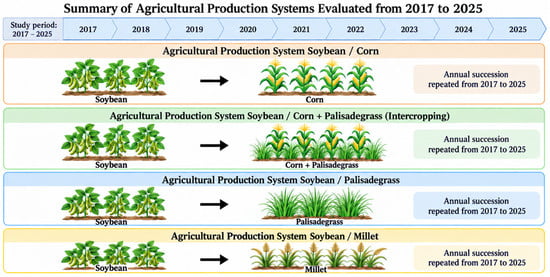
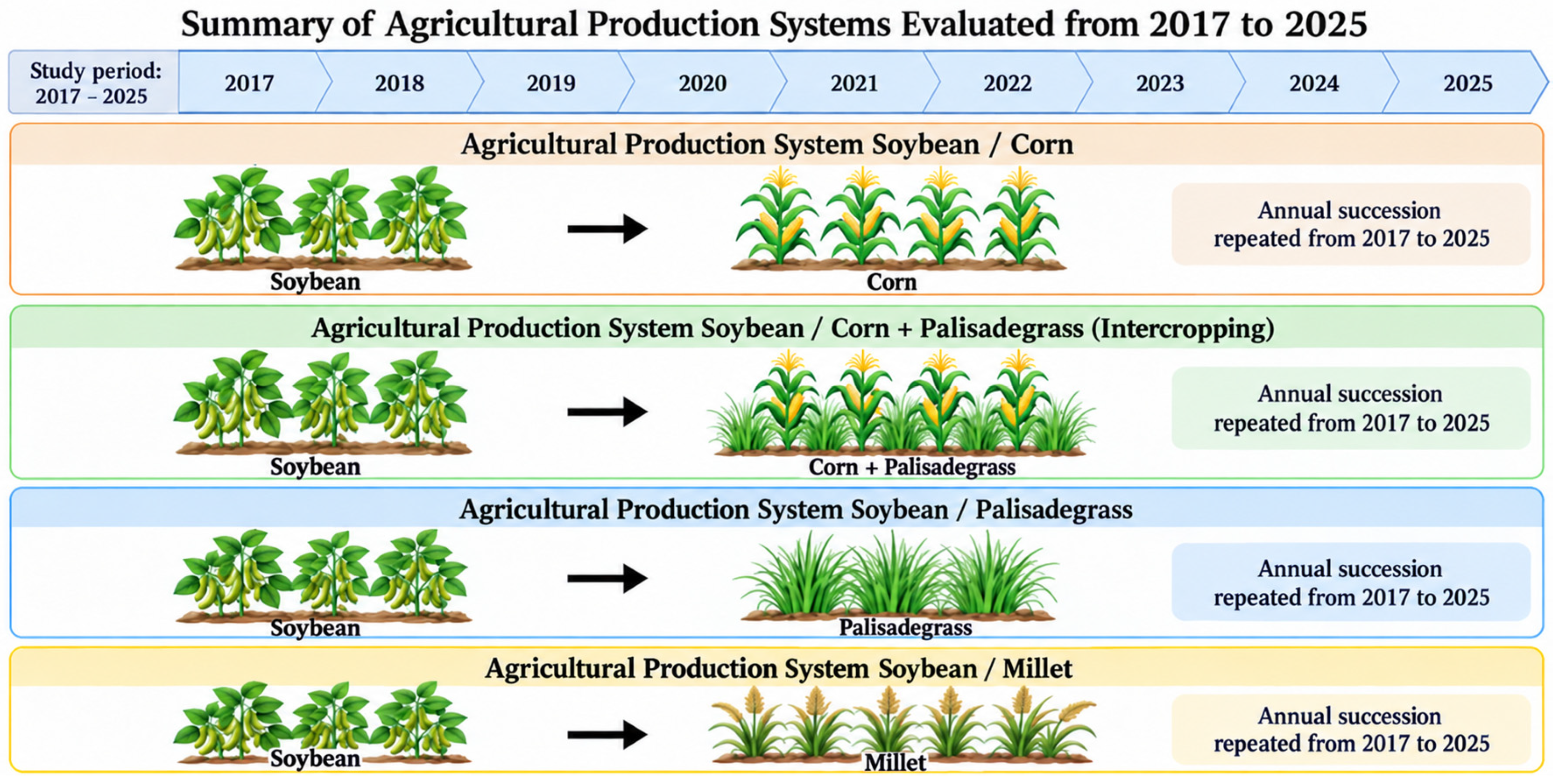
The experiment was arranged in a randomized complete block design with four replications. Each experimental unit measured 22.5 m2 (4.5 m × 5.0 m). The treatments consisted of four agricultural succession systems: T1—soybeans in the first harvest and single corn (Zea mays) in the second harvest (considered as a control); T2—soybeans in the first harvest and millet (Pennisetum glaucum) in the second harvest; T3—soybeans in the first harvest and palisadegrass (Urochloa ruziziensis) in the second harvest; and T4—soybeans in the first harvest and corn intercropped with palisadegrass in the second harvest (Figure 1). Detailed information on the cultivars and hybrids used, fertilization management, plant density, and row spacing adopted throughout the experimental period is provided in Supplementary Table S1.
Figure 1.
Schematic representation of the crop succession systems and experimental timeline from 2017 to 2025. The figure was originally created by the authors, with AI-assisted visual refinement using ChatGPT (GPT-6, OpenAI, San Francisco, CA, USA). All scientific content was provided and verified by the authors.
2.3. Evaluations
2.3.1. Soil Sampling and Preparation
Soil sampling was performed once, after the 2025 crop harvest, from the 0–0.10 m layer, which is the diagnostic depth recommended for bioanalysis assays, as described by Mendes et al. [24]. Soil samples from each experimental plot were obtained by collecting five subsamples within the usable area of the plot. The subsamples were combined and homogenized to form one composite sample per plot. The samples were then prepared for chemical and biological analyses by air-drying, gently disaggregating, and sieving them through a 2 mm mesh.
For the BioAS analysis, the samples were sent to a soil analysis laboratory (Grupo Exata Brasil, Jataí Unit), where the laboratory determinations were performed. The resulting data were subsequently submitted to the Embrapa BioAS Network, where the Chemical Soil Quality Index (IQS Chemical), Biological Soil Quality Index (IQS Biological), and FertBio Soil Quality Index (IQS FertBio) were calculated.
2.3.2. Soil Enzymatic Activity
The activities of β-glucosidase, arylsulfatase, and acid phosphatase were determined according to Tabatabai [25], Tabatabai and Bremner [26], and Mendes et al. [24].
All enzymatic assays were performed in 50 mL Erlenmeyer flasks using 1.0 ± 0.005 g of soil. Enzyme assays were performed in analytical triplicate for each field sample, and the analytical replicates were averaged before statistical analysis.
β-glucosidase and arylsulfatase
The determination of β-glucosidase and arylsulfatase followed similar procedures, differing in buffer solution, substrate, and wavelength.
For β-glucosidase, 4 mL of modified universal buffer (MUB, pH 6.0) and 1 mL of p-nitrophenyl-β-D-glucopyranoside (PNG) were added. For arylsulfatase, 4 mL of acetate buffer (pH 5.8) and 1 mL of p-nitrophenyl sulfate (PNS) were used. Control flasks received all reagents except the substrate at the beginning of incubation.
Samples were incubated at 37 °C for 1 h. The reaction was stopped by adding 1 mL of 0.5 M CaCl2 and 4 mL of alkaline solution (THAM buffer, pH 12, for β-glucosidase; 0.5 M NaOH for arylsulfatase). The substrate was then added to the control treatment to correct for non-enzymatic hydrolysis.
After filtration, absorbance was measured using a UV–Vis spectrophotometer at 420 nm (β-glucosidase) and 410 nm (arylsulfatase). Enzyme activities were quantified using calibration curves prepared with p-nitrophenol (pNP) and expressed as µg pNP g−1 h−1.
2.3.3. Soil Chemical Analyses
Soil pH (active acidity) was determined in a 0.01 mol L−1 CaCl2 suspension according to Raij et al. [27], using a glass electrode immersed in the soil–solution mixture.
Potential acidity (H+ + Al3+) was estimated using the SMP buffer method. After determining the pH in CaCl2, SMP buffer solution was added, and the equilibrium pH was measured. The H+ + Al3+ values were calculated using a region-specific calibration curve, as described by Raij et al. [27].
Exchangeable Al3+, Ca2+, and Mg2+ were extracted with ammonium chloride (NH4Cl) solution and quantified by inductively coupled plasma optical emission spectrometry (ICP-OES).
Available P, K, Cu, Fe, Mn, Zn, Na, and B were extracted using the Mehlich-1 solution and determined by ICP-OES. The Mehlich-1 method is based on nutrient solubilization and displacement reactions promoted by dilute acid extractants.
Soil organic carbon (OC) was determined by the colorimetric dichromate oxidation method described by Raij et al. [27], using sodium dichromate (Na2Cr2O7) and sulfuric acid (H2SO4), with spectrophotometric quantification of the oxidized organic carbon. From the OC content, the soil organic matter (SOM) was estimated using the Van Bemmelen factor (1.724) [28].
2.3.4. Soil Quality Indices (BioAS)
Soil quality was evaluated using the soil quality indices of the Embrapa Soil Bioanalysis technology (BioAS, Embrapa, Brasília, Brazil), Brasília, Federal District, Brazil which integrates the biological dimension into the routine chemical analysis of soils [24,29]. The FertBio Soil Quality Index (IQS FertBio) is calculated from the joint set of chemical fertility attributes (pH, H + Al, exchangeable Ca, Mg, and K, available P, and SOM) and the activities of the enzymes β-glucosidase (GLI) and arylsulfatase (Aril), associated with the carbon and sulfur cycles, respectively [24,29,30]. The IQS FertBio is decomposed into two subindices: the chemical soil quality index (IQS Chemical) and the biological soil quality index (IQS Biological).
The calculation of the three indices follows the conceptual framework proposed by Karlen and Stott [31], in which soil quality is expressed through the capacity of the soil to perform key functions. Based on the chemical and biological determinations, three functions related to the capacity of the soil to promote plant nutrition are scored (Mendes et al. [32]): (F1) the capacity of the soil to cycle nutrients, which estimates the performance of the biological activity and of the processes directly or indirectly derived from it, such as nutrient cycling and the formation and decomposition of SOM; (F2) the capacity of the soil to store nutrients, which quantifies the soil nutrient “reservoir”, mainly related to soil texture, clay quality, and the amount and quality of SOM; and (F3) the capacity of the soil to supply nutrients, which evaluates the quality of the reservoir contents, involving soil acidity and the supply of the main macronutrients.
The partial scores of the individual indicators were combined into the function scores F1–F3 as follows:
where Si is the unitless partial score of indicator Xi (ranging from 0 to 1), fi is the scoring algorithm defined for the soil texture class, and T is the soil texture class (Equation (1)).
where SGLI and SAril are the partial scores of β-glucosidase and arylsulfatase activities, respectively (Equation (2)).
where F2 aggregates the partial scores of SOM and potential cation exchange capacity (CEC = SB + H+Al, with SB obtained from exchangeable Ca, Mg, and K), and F3 aggregates the partial scores of active and potential acidity (pH, H + Al), exchangeable bases (Ca, Mg, K; SB), and available P (Equations (3) and (4)).
Here, the IQSFertBio integrates the chemical and biological subindices into a single 0–1 value expressing overall soil quality/health (Equation (5)).
Si = fi(Xi;T)
IQSBiological = F1 = fcycl(SGLI,SAril)
F2 = fstor(SSOM,SCEC); F3 = fsup(SpH,SH+Al,SSB,SP)
IQSChemical = fchem(F2,F3)
IQSFertBio = ffb(IQSBiological,IQSChemical)
The normalization of each indicator follows the scoring approach of the soil quality framework of Karlen and Stott [31]: every attribute is individually transformed into a unitless partial score ranging from 0 (worst) to 1 (best), using algorithms parameterized for the soil texture class, following a “more is better” relationship for most indicators (e.g., GLI, Aril, SOM, CEC, SB, P) and an optimum/less-is-better relationship for acidity-related attributes (pH, H + Al). The scoring algorithms were calibrated for Cerrado Oxisols against relative grain yield and SOM so that index values are directly related to the agronomic performance and sustainability of the production system [32]. The partial scores and function scores are interpreted in five classes (very low, low, intermediate, high, and very high), based on interpretation tables established for clayey Latosols under annual crops in the Cerrado [24].
The scoring curves, class limits, and aggregation rules are implemented in the Soil Quality Interpretation Module (MIQS), a web platform developed by Embrapa Cerrados in partnership with Embrapa Agrobiologia [30]. In this study, the soil chemical and enzymatic determinations (Section 2.3.2 and Section 2.3.3) were submitted to the MIQS platform through a commercial laboratory accredited by the Embrapa BioAS Network (Grupo Exata Brasil, Jataí unit, Goiás State), and all index values (IQS Biological, IQS Chemical, and IQS FertBio) and function scores (F1—nutrient cycling; F2—nutrient storage; F3—nutrient supply) were retrieved from the platform reports. All indices and function scores range from 0 to 1, with values closest to 1 indicating better performance of the function or higher soil quality [24,30]. The enzymatic determinations follow the FertBio soil sample concept, in which a single post-harvest sample collected at the 0–0.10 m layer and air-dried serves both the chemical and the enzymatic determinations [24,29].
2.3.5. Cumulative Grain Yield of Soybean and Corn
Grain yield was evaluated annually from 2017 to 2025. At physiological maturity, all plants within the usable area of each experimental unit were harvested, mechanically threshed, and weighed. Grain mass was converted to kg ha−1 and adjusted to a standard moisture content of 13% (wet basis).
Cumulative grain yield was calculated as the sum of annual yields over the evaluation period for soybean and corn.
2.3.6. Statistical Analysis
Residuals were examined for normality using the Shapiro–Wilk test and for homogeneity of variances using Levene’s test. Soil chemical attributes, enzyme activities, soil quality indices, and cumulative soybean grain yield were subjected to analysis of variance (ANOVA) according to a randomized complete block design, with cropping system considered as the fixed treatment factor and block accounting for spatial variation within the experimental area. When a significant effect of cropping system was detected by the F-test, treatment means were compared using Tukey’s honestly significant difference (HSD) test at the 5% probability level. Cumulative corn grain yield was compared only between the corn and corn + palisadegrass systems, as corn was not grown in the other crop sequences. Pearson’s correlation coefficients were calculated to assess relationships among soil chemical attributes, enzyme activities, soil quality indices, and cumulative soybean grain yield. Annual soybean and corn grain yields were additionally analyzed using a repeated-measures approach, with cropping system, growing season, and the cropping system × growing season interaction included in the model. Because the same experimental plots were evaluated over successive growing seasons, the repeated structure of the observations was accounted for, while block was included to preserve the randomized complete block design. When a significant cropping-system effect was detected, means were compared using Tukey’s HSD test at p ≤ 0.05.
Pearson’s correlation coefficients were calculated using plot-level observations (n = 16; four cropping systems × four blocks) to assess relationships among soil chemical attributes, enzyme activities, soil quality indices, and cumulative soybean grain yield. Because observations were grouped within cropping systems, these correlations were considered exploratory and interpreted cautiously. All statistical analyses were performed using R software (version 4.5.1; R Core Team, Vienna, Austria) [33].
2.3.7. AI-Assisted Figure Preparation
Figure 1 and the Graphical Abstract were originally designed and developed by the authors. ChatGPT (GPT-6, OpenAI) was subsequently used to assist with visual refinement, including improvements in graphical layout, organization, and overall presentation. The scientific content, original data, and interpretation were provided and verified by the authors. No scientific data or experimental results were generated using artificial intelligence.
3. Results
3.1. Soil Chemical Attributes
The cropping systems affected only a subset of the soil chemical attributes evaluated after the long-term experiment (Table 1). Soil pH, potential acidity (H + Al), cation exchange capacity (CEC), base saturation (BS), and exchangeable Ca and Mg did not differ among systems.
Table 1.
Soil chemical attributes under long-term cropping systems.
In contrast, significant differences were observed for K, P, and organic carbon (OC). Soil K was higher under corn and corn + palisadegrass, both reaching 0.3 cmolc dm−3, whereas palisadegrass and millet showed 0.2 cmolc dm−3. A similar response was observed for soil P. The highest P concentrations were found under corn + palisadegrass (58.1 mg dm−3) and corn (53.2 mg dm−3), while markedly lower values were recorded under palisadegrass (30.7 mg dm−3) and millet (29.9 mg dm−3).
Organic carbon showed a different pattern. Palisadegrass and corn + palisadegrass had the highest values, 18.0 and 17.9 g kg−1, respectively. Millet showed an intermediate value of 17.7 g kg−1, while the lowest OC content was observed under corn, at 16.7 g kg−1. These differences indicate that the long-term crop sequence had a stronger effect on specific nutrient pools and soil C than on general indicators of soil acidity and charge balance.
3.2. Soil Enzyme Activity and Soil Quality
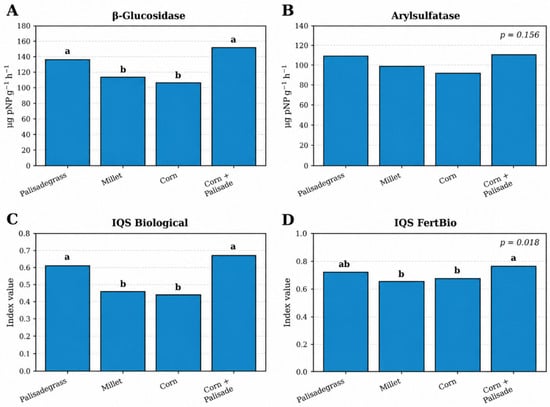
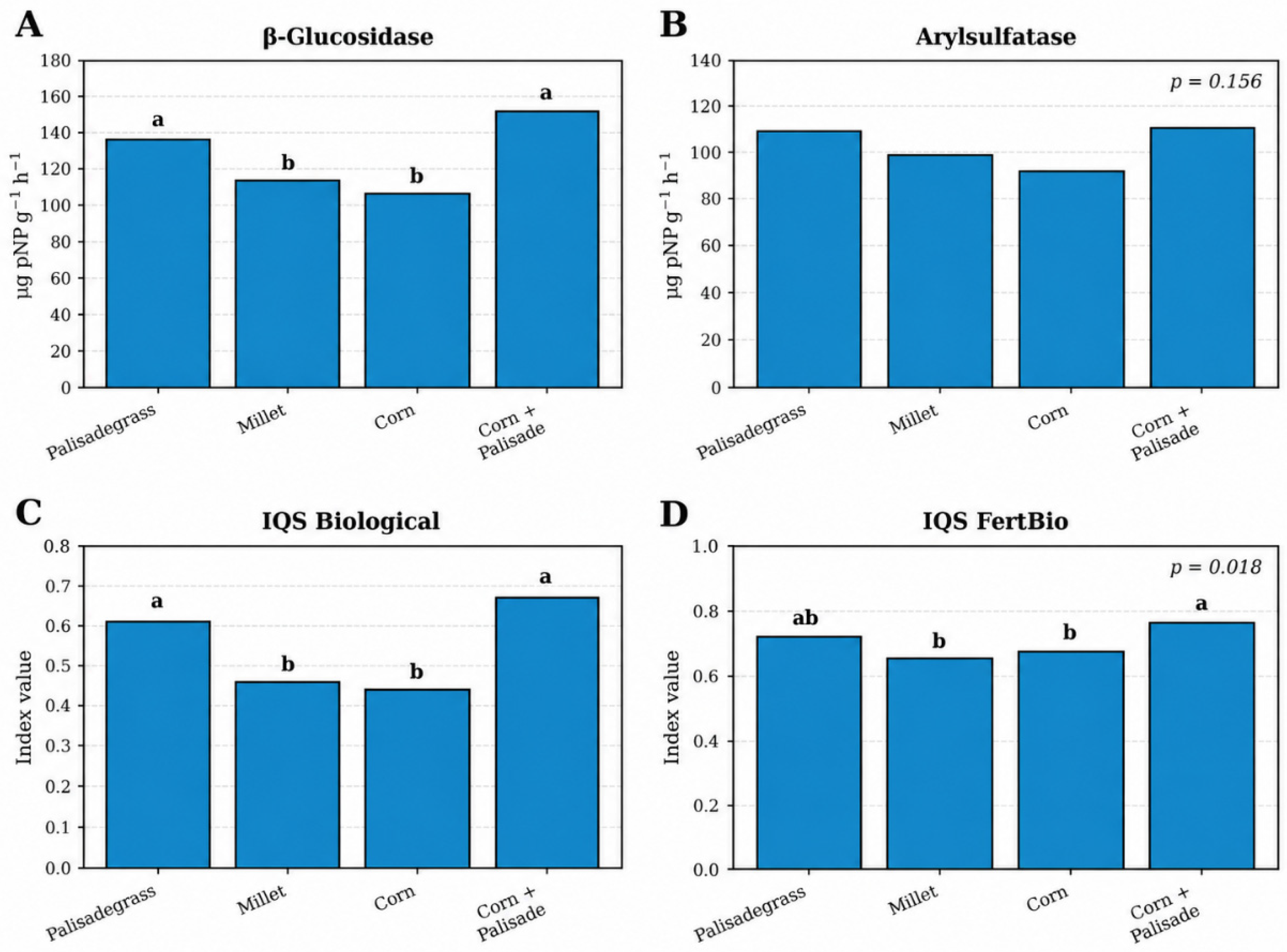
Clear differences among cropping systems were observed for β-glucosidase activity (Figure 2A). The highest activities occurred under corn + palisadegrass and palisadegrass, with mean values of 151.5 and 135.7 µg pNP g−1 h−1, respectively. Both systems were statistically superior to millet and corn, which showed activities of 113.7 and 106.6 µg pNP g−1 h−1. Relative to sole corn, β-glucosidase activity was approximately 27% higher under palisadegrass and 42% higher under corn + palisadegrass.
Figure 2.
Soil enzyme activities and soil quality indices under long-term cropping systems. (A) β-glucosidase, (B) arylsulfatase, (C) IQS Biological, and (D) IQS FertBio. Values are means of four field replicates (n = 4). Different lowercase letters indicate significant differences by Tukey’s test at p ≤ 0.05.
Arylsulfatase was not statistically significant (p = 0.156; Figure 2B). The biological soil quality index also differed among production systems (Figure 2C). Corn + palisadegrass had the highest IQS Biological value (0.67), followed by palisadegrass (0.61). Millet and corn had substantially lower values, 0.46 and 0.44, respectively. The statistical grouping closely followed the response observed for β-glucosidase, with the two systems containing palisadegrass showing the highest biological performance.
A significant response was also observed for IQS FertBio (p = 0.018; Figure 2D). Corn + palisadegrass had the highest value (0.76) and was statistically superior to millet (0.65) and corn (0.67). Palisadegrass presented an intermediate value of 0.72 and did not differ from either group. This pattern suggests that the advantages observed in the biological component were partly reflected in the integrated soil quality index.
The additional soil quality indicators showed contrasting responses to the cropping systems (Supplementary Table S2). IQS Chemical did not differ among treatments, ranging from 0.75 under millet to 0.80 under corn + palisadegrass. Nutrient cycling also showed no significant differences. Nutrient storage varied little among systems and was likewise unaffected by treatment.
Nutrient supply, however, differed significantly among systems (p = 0.003). Corn and corn + palisadegrass showed the highest values, 0.85 and 0.84, respectively, whereas palisadegrass and millet showed lower values of 0.75 and 0.77. This response was consistent with the higher soil K and P concentrations observed in the corn-based systems.
3.3. Annual and Cumulative Grain Yield of Soybean and Corn
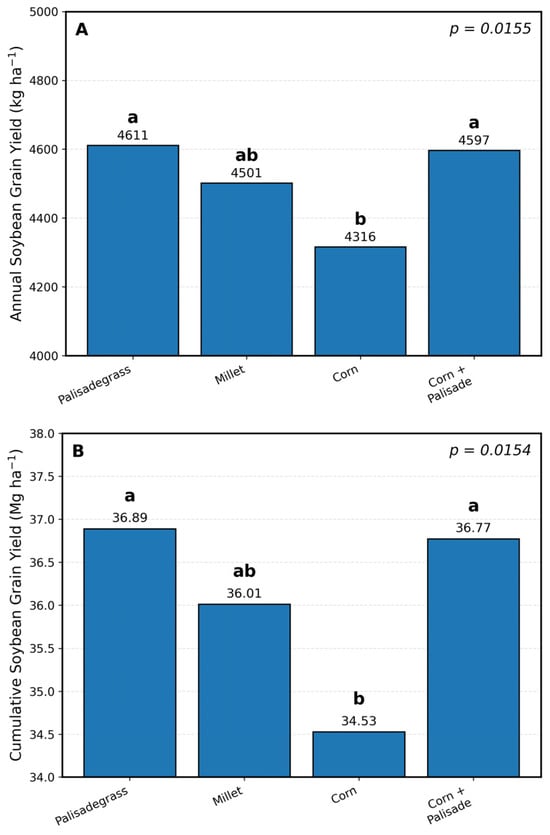
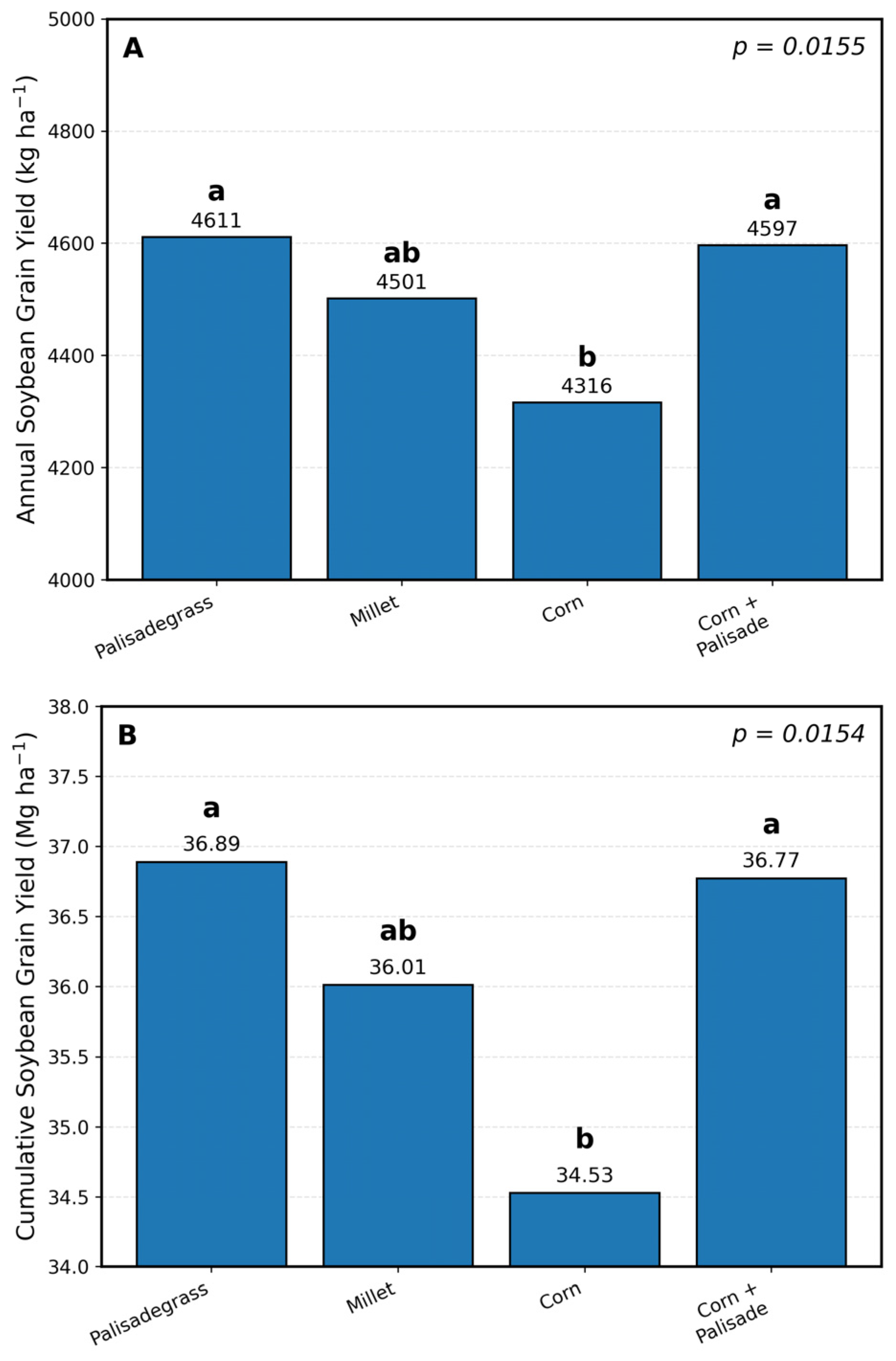
Annual soybean grain yield differed among cropping systems (p = 0.0155) and growing seasons (p < 0.001). The cropping system × growing season interaction was not significant (p = 0.6901). Across growing seasons, soybean yield was highest under palisadegrass and corn + palisadegrass, with mean values of 4611 and 4597 kg ha−1, respectively. Millet had an intermediate yield of 4501 kg ha−1, while sole corn had the lowest mean yield, 4316 kg ha−1 (Figure 3A). Since the interaction was not significant, the differences among cropping systems were broadly similar over the evaluated seasons.
Figure 3.
Soybean grain yield under long-term cropping systems: (A) Mean annual grain yield from 2017/2018 to 2024/2025. (B) Cumulative grain yield over the same period. Values are means of four field replicates (n = 4). Different lowercase letters indicate significant differences among cropping systems by Tukey’s test at p ≤ 0.05.
Cumulative soybean grain yield from 2017 to 2025 was significantly affected by the cropping system (p = 0.0154; Figure 3B). The highest accumulated yields were obtained under palisadegrass and corn + palisadegrass, reaching 36.89 and 36.77 Mg ha−1, respectively. Millet showed an intermediate accumulated yield of 36.01 Mg ha−1, whereas corn had the lowest value, 34.53 Mg ha−1. Compared with the soybean–corn system, cumulative soybean yield was approximately 6.8% higher under palisadegrass and 6.5% higher under corn + palisadegrass.
Annual corn grain yield varied among growing seasons (p < 0.001), but no differences were found between cropping systems (p = 0.5046). The cropping system × growing season interaction was also not significant (p = 0.1372). Across the evaluated years, corn yield averaged 6393 kg ha−1 under corn + palisadegrass and 6361 kg ha−1 under sole corn (Supplementary Table S3). These results show that corn yield was maintained when palisadegrass was included in the intercropping system. Cumulative corn grain yield did not differ between corn and corn + palisadegrass systems (p = 0.504). The accumulated yields were 50.89 Mg ha−1 for sole corn and 51.15 Mg ha−1 for corn + palisadegrass (Supplementary Table S3).
3.4. Relationships Among Soil Attributes, Biological Indicators, and Yield
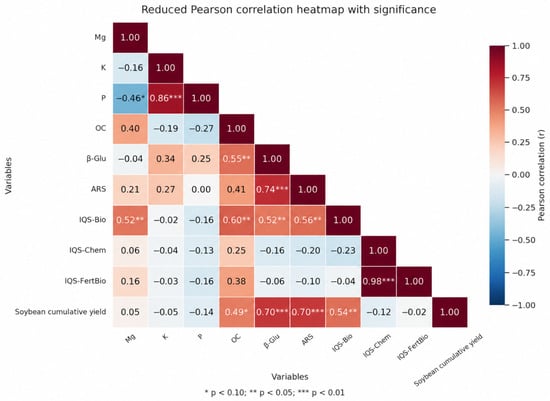
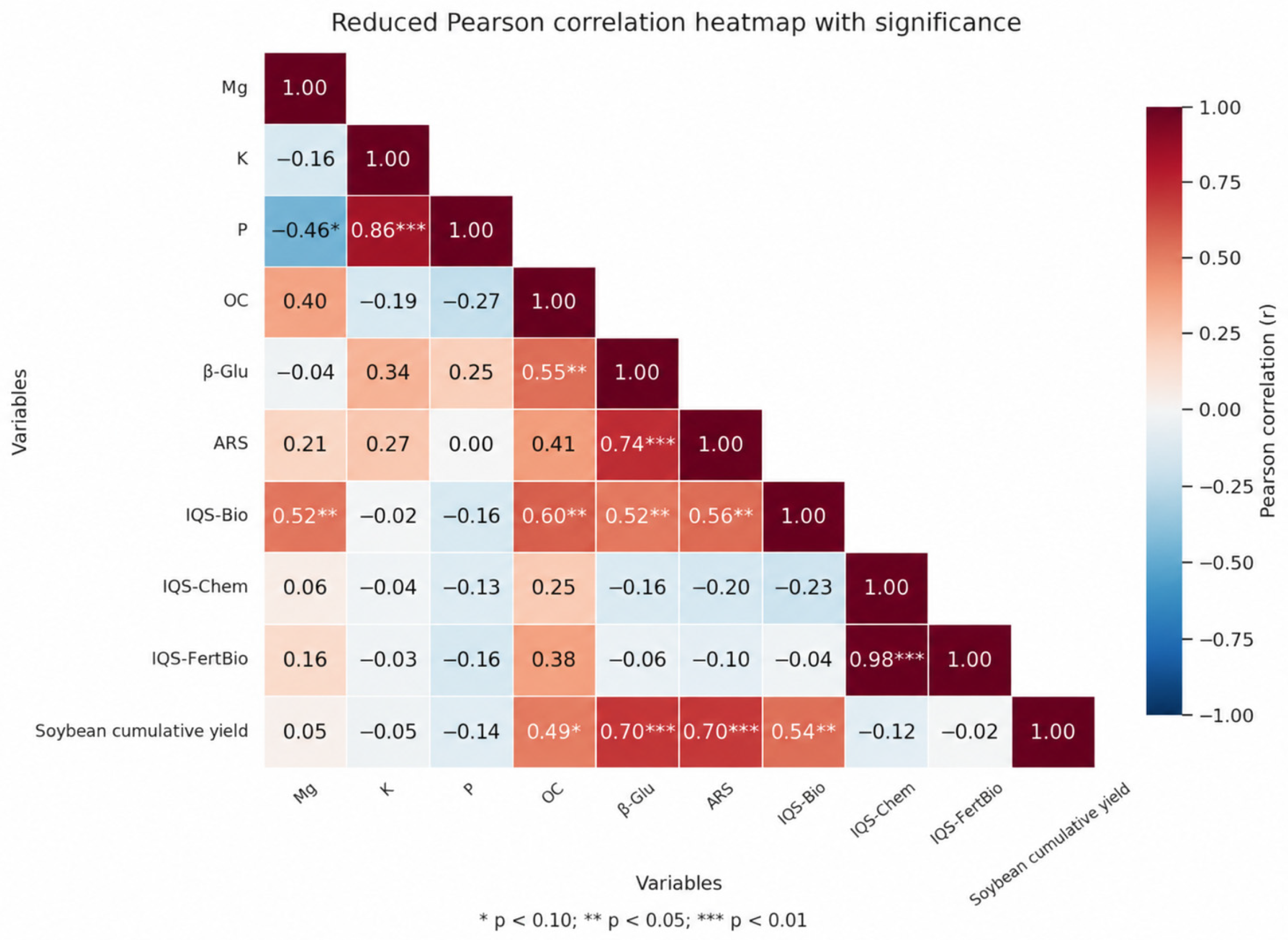
The correlation analysis, based on plot-level observations (n = 16), revealed several associations among chemical, biological, and agronomic variables (Figure 4). β-Glucosidase and arylsulfatase were positively correlated with IQS Biological. However, because these enzymatic variables contribute to the construction of the biological index, these associations partly reflect mathematical dependence and were not interpreted as independent relationships. IQS FertBio was strongly associated with IQS Chemical, reflecting the integrated nature of this indicator.
Figure 4.
Pearson correlation heatmap among soil chemical attributes, biological indicators, and cumulative soybean grain yield.
Cumulative soybean yield was positively associated with organic carbon and with biological indicators, particularly β-glucosidase, arylsulfatase, and IQS Biological. In contrast, its relationship with IQS Chemical was weak. These correlations support the pattern observed across treatments, in which the systems showing greater biological activity also tended to maintain higher cumulative soybean productivity.
4. Discussion
After eight cropping seasons under no-tillage, the most consistent contrast among the systems was biological rather than chemical. Systems containing palisadegrass showed a more favorable biological response and higher cumulative soybean yield than the sole corn system, while pH, potential acidity, and base saturation remained similar among treatments. Previous studies suggest that deep rooting, rhizodeposition, and slowly decomposing residues may contribute to more favorable biological conditions in Urochloa-based systems, while the chemical indicators of acidity and charge balance respond slowly, or not at all, when the base status is already managed through liming and fertilization [4,34]. A similar dissociation between the biological and chemical compartments has been observed in other conservation systems of the Cerrado [1,3].
The differences observed for K and P were closely associated with the contrasting nutrient inputs among cropping systems. Both nutrients were higher under corn and corn + palisadegrass, the two systems in which the off-season corn crop received annual mineral fertilization (Supplementary Table S1). Thus, the greater K and P availability in these treatments likely reflects, at least in part, the repeated fertilizer inputs associated with corn cultivation rather than crop diversification alone. In contrast, palisadegrass and millet did not receive the same level of nutrient addition, and a larger proportion of the nutrients taken up during the growing season remained temporarily immobilized in plant biomass before being returned to the soil after residue decomposition. Under long-term no-till, P availability is strongly influenced by the balance between fertilizer inputs, plant uptake, and immobilization in crop residues, which helps explain the contrast observed between fertilized corn-based systems and systems dominated by cover crops [2,10]. Given the tendency of P to become partially fixed and stratified in highly weathered Oxisols, the P concentration measured at a single sampling date may therefore reflect recent fertilizer inputs more strongly than a cumulative effect of the crop sequence itself [2].
Organic carbon followed a different pattern, with higher values in the palisadegrass-based systems. This response is consistent with the greater contribution of belowground C inputs associated with perennial grasses, whose dense root systems have been associated with greater soil carbon inputs in tropical agroecosystems [6,34]. The absence of differences in pH, H + Al, cation exchange capacity, base saturation and exchangeable Ca was expected in a clayey soil, under a no-till condition, where the buffering capacity of the soil and the uniform amendments applied across treatments tend to override any modest effect of the crop sequence on acidity [1,3].
β-Glucosidase activity was higher in the palisadegrass-based systems than in millet and sole corn. β-Glucosidase catalyzes the final step of cellulose degradation, and its activity is closely linked to the supply and turnover of plant-derived carbon. This may help explain the higher β-glucosidase activity observed in systems containing palisadegrass [35]. The pattern found here is consistent with the use of β-glucosidase as a sensitive indicator of changes in C cycling in highly weathered tropical soils, including Cerrado Oxisols [35,36]. The activity values observed in the present study also fall within the range reported for cultivated Oxisols under conservation management [29,37], reinforcing the favorable biological condition of the grass-based systems.
Arylsulfatase did not differ significantly among cropping systems (p = 0.156). Unlike β-glucosidase, which responded clearly to differences in residue and root C inputs, arylsulfatase may be more strongly influenced by soil S status, pH, and short-term environmental conditions at the time of sampling [12,36]. This may have reduced its sensitivity to the differences among crop sequences in the present study. In addition, soil sampling was performed at a single time point, in the 0–10 cm layer after the 2025 corn harvest. Because enzyme activities can vary seasonally with soil moisture, temperature, and residue quality, a single sampling event may not fully capture temporal differences among systems [11].
IQS Biological, which is strongly influenced by microbial indicators, clearly separated the palisadegrass systems (0.67 and 0.61) from millet (0.46) and corn (0.44), following the same pattern observed for β-glucosidase. This result was expected given the close relationship between the biological index and enzyme activity. IQS Chemical, in contrast, did not differ statistically, suggesting that the chemical component was less responsive to the differences observed among crop sequences after the experimental period [3,29]. The function-based scores were more discriminating: nutrient supply was higher under corn and corn + palisadegrass (0.85 and 0.84) than under the palisadegrass and millet systems (0.75 and 0.77). This response was consistent with the higher K and P concentrations measured in the corn-based systems and likely reflects, at least in part, the recurrent nutrient inputs associated with corn fertilization [2,10]. The integrated IQS FertBio occupied an intermediate position, being higher under corn + palisadegrass than under millet and corn, indicating that the biological contribution of the grass-based system was sufficient to influence the integrated index even when IQS Chemical remained relatively stable.
Soybean followed by off-season corn is one of the most widespread grain production systems in the Brazilian Cerrado, and the economic return provided by corn often makes it difficult to replace this second crop with species grown exclusively for soil cover. In this context, intercropping corn with palisadegrass represents a particularly attractive strategy, as it allows farmers to maintain grain production while simultaneously increasing residue inputs and strengthening the biological component of the production system. This practical aspect is especially relevant in regions where the opportunity cost of allocating the off-season solely to cover crops can limit their adoption. The productive response observed in the present study supports this approach. The higher cumulative soybean yield observed in the palisadegrass-based systems suggests that the biological advantages associated with these systems were accompanied by agronomic benefits over the evaluation period.
Previous studies have associated the beneficial legacy effects of grasses on soybean with greater residue persistence, improved soil cover, more gradual nutrient release, and more favorable conditions for root development [4,6,38]. Prado et al. [38], for example, reported a 23% increase in soybean yield when the crop was grown after palisadegrass biomass in integrated systems of the Cerrado. The smaller yield differences observed in the present study are reasonable considering that the response was evaluated cumulatively over eight years and under contrasting second-season arrangements, with palisadegrass grown either alone or intercropped with corn. In addition, the high clay content of the soil (585 g kg−1) and the relatively narrow range of organic carbon among treatments (16.7–18.0 g kg−1) may have contributed to buffering differences in water availability and soil functioning, thereby reducing the magnitude of the yield response among cropping systems.
The annual yield followed the same general pattern observed for cumulative yield. Soybean yield changed considerably among growing seasons, but the cropping system × growing season interaction was not significant, indicating that the relative response of the systems was similar over time. For corn, yield also varied among years, while sole corn and corn + palisadegrass showed similar performance across the evaluation period. These results indicate that the differences observed among cropping systems were not restricted to isolated growing seasons.
Millet also remained a viable off-season alternative. Its drought tolerance and rapid biomass production are valuable under the pronounced dry season of the Cerrado [8,9], and cumulative soybean yield under millet was intermediate among the systems evaluated. However, under the conditions of this experiment, millet did not produce the same response in organic carbon, β-glucosidase activity, or IQS Biological as the systems containing palisadegrass. This distinction suggests that the identity, persistence, and root contribution of the grass species may be important in determining the biological legacy left for the following soybean crop. The stronger response observed under palisadegrass is consistent with the greater continuity of residue and belowground C inputs provided by Urochloa, which can sustain microbial activity and nutrient cycling for longer periods than rapidly decomposing residues.
Importantly, the inclusion of palisadegrass in the corn crop did not reduce cumulative corn grain yield. Importantly, intercropping maize with palisadegrass did not reduce cumulative maize grain yield. From an agronomic perspective, it shows that the biological benefits associated with palisadegrass can be incorporated into a commercially important second-season crop without compromising corn productivity. Similar responses have been reported when competition between corn and forage grasses is adequately managed through appropriate sowing arrangement and crop management [7,39]. From an agronomic perspective, this combination is particularly attractive because it reduces the need to choose between economic return and soil cover: corn production is maintained, while palisadegrass contributes residues and root biomass that may favor soil functioning and the subsequent soybean crop.
The correlation analysis showed positive associations between cumulative soybean yield and organic carbon, β-glucosidase, arylsulfatase, and IQS Biological, while the relationship with IQS Chemical remained weak. Correlations between the individual enzyme activities and IQS Biological were not interpreted as independent biological relationships because these variables contribute to the construction of the index. In contrast, their associations with cumulative soybean yield involve an external agronomic variable and were therefore considered separately. These associations suggest that biological soil indicators may be related to part of the yield differences observed among cropping systems. Once major chemical constraints are adequately managed, differences in biological functioning may become increasingly important in distinguishing the performance of long-term cropping systems [3,35,36]. In addition, because observations were grouped within cropping systems, part of the correlation structure may reflect treatment-level differences rather than independent relationships among variables. Other mechanisms that were not measured in the present study, including soil aggregation, water infiltration, root distribution, and soil water retention, may also have contributed to the differences in cumulative soybean yield [4]. Soil sampling was also restricted to the 0–10 cm layer and performed at a single time point after the 2025 harvest, meaning that the enzymatic measurements represent only one stage of the annual cycle. Future assessments including deeper soil layers, repeated seasonal sampling, P fractionation, and microbial community characterization would help distinguish nutrient redistribution from long-term accumulation and clarify the biological processes underlying the enzyme responses [5,11]. Even with these limitations, the results obtained after the long-term field experiment show that incorporating palisadegrass into the second season, either as a sole grass or intercropped with corn, was associated with greater biological soil functioning and higher cumulative soybean yield, while intercropping did not reduce cumulative corn productivity.
After eight years, the clearest difference among the diversified systems was the combination of higher biological indicators and greater cumulative crop performance. This is particularly relevant for production systems dominated by the soybean–corn sequence, in which replacing a profitable second-season crop with a sole cover crop may be difficult in practice. Under these conditions, corn–palisadegrass intercropping emerges as a promising compromise between production and soil conservation: corn yield was maintained, while the system showed stronger biological indicators and supported greater cumulative soybean yield. The results therefore reinforce the importance of evaluating cropping systems over long periods and through integrated chemical, biological, and productive indicators, since the differences among cropping systems become clearer when soil functioning and cumulative yield are considered together. The results indicate that grain production and soil conservation do not need to be treated as competing goals when corn is intercropped with palisadegrass.
5. Conclusions
After eight growing seasons, the four soybean-based cropping systems differed mainly in soil biological responses and soybean productivity. Palisadegrass and corn + palisadegrass showed the highest organic carbon contents, β-glucosidase activity, and IQS Biological values, whereas sole corn generally showed the lowest biological performance. Corn + palisadegrass also had the highest IQS FertBio value, while corn and corn + palisadegrass had greater soil P and K availability, partly reflecting the repeated fertilizer inputs associated with maize cultivation. Millet showed an intermediate response for most soil and yield variables. Annual and cumulative soybean yields were higher under palisadegrass and corn + palisadegrass than under sole corn, whereas maize grain yield did not differ between sole maize and maize + palisadegrass. Overall, the inclusion of palisadegrass, either alone or intercropped with maize, was associated with better biological soil quality and greater soybean productivity, while maize + palisadegrass maintained maize yield and combined the most favorable biological and agronomic responses among the evaluated systems.
Supplementary Materials
The following supporting information can be downloaded at: https://www.mdpi.com/article/10.3390/agronomy16212184/s1, Supplementary Figure S1: Monthly rainfall (mm) and mean air temperature (°C) recorded from 2017 to 2025 in the experimental area. Rainfall is represented by bars, and temperature by a line; Supplementary Table S1: Cultivars/hybrids, fertilization management, plant density and row spacing adopted since the establishment; Supplementary Table S2: Soil quality indices (IQS Biological, IQS Chemical, and IQS FertBio) and soil functions related to nutrient cycling, storage, and supply under long-term cropping systems; Supplementary Table S3: Corn grain yield averaged and accumulated yield under long-term cropping systems from 2018 to 2025.
Author Contributions
Conceptualization, C.H.M.d.C., S.C.S.C. and T.M.G.; methodology, T.A.B., H.M.S., U.S.d.C.F. and C.H.M.d.C.; validation, C.H.M.d.C., S.C.S.C., T.M.G., L.M. and E.R.C.L.; C.H.M.d.C., S.C.S.C., T.M.G. and L.M.; investigation, T.A.B., H.M.S., U.S.d.C.F. and C.H.M.d.C.; resources, C.H.M.d.C., S.C.S.C. and T.M.G.; data curation, C.H.M.d.C., S.C.S.C., P.I. and T.M.G.; writing—original draft preparation, C.H.M.d.C., S.C.S.C., T.M.G., L.M., P.I. and E.R.C.L.; writing—review and editing, C.H.M.d.C., S.C.S.C., T.M.G., P.I. and L.M.; supervision, C.H.M.d.C., S.C.S.C. and T.M.G.; project administration, C.H.M.d.C. and S.C.S.C.; funding acquisition, C.H.M.d.C. and S.C.S.C. All authors have read and agreed to the published version of the manuscript.
Funding
This study received funding from the Agrisus Foundation—Sustainable Agricuture through financial support (Registry Number: 2508/18; 3150/21), FAPEG (Registry Numbers: 202510267000573 and 202310267001358), the National Council for Scientific and Technological Development (CNPq) through an awards for excellence in research granted to CHMC, and Coordenação de Aperfeiçoamento de Pessoal de Nível Superior—Brasil (CAPES)—Finance Code 001.
Data Availability Statement
The data presented in this study are available on request from the corresponding author due to the data are not publicly available because they are part of an ongoing long-term field experiment and are currently being used for complementary analyses and related scientific publications.
Acknowledgments
The authors acknowledge the National Council for Scientific and Technological Development (CNPq) for the research productivity award granted to CHMC. The second author acknowledges the Coordenação de Aperfeiçoamento de Pessoal de Nível Superior—Brasil (CAPES)—Finance Code 001 for financial support. The authors also acknowledge the use of ChatGPT (GPT-6, OpenAI) for assistance with the visual refinement of Figure 2 and the Graphical Abstract.
Conflicts of Interest
The authors declare no conflicts of interest.
References
- Pires, M.F.M.; Medeiros, J.C.; Souza, H.A.; Rosa, J.D.; Boechat, C.L.; Mafra, Á.L.; Nolêto, K.C.; Rocha, A.G. Conservation system improves soil microbial quality and increases soybean yield in the Northeastern Cerrado. Bragantia 2020, 79, 599–611. [Google Scholar] [CrossRef] [Scilit]
- Nunes, R.S.; de Sousa, D.M.G.; Goedert, W.J.; de Oliveira, L.E.Z.; Pavinato, P.S.; Pinheiro, T.D. Distribution of soil phosphorus fractions as a function of long-term soil tillage and phosphate fertilization management. Front. Earth Sci. 2020, 8, 350. [Google Scholar] [CrossRef] [Scilit]
- Pinto, L.A.S.R.; de Lima, S.S.; da Silva, C.F.; Gonçalves, R.G.M.; Morais, I.S.; Ferreira, R.; Silva Junior, W.F.; Torres, J.L.R.; Pereira, M.G. Soil quality indicators in conventional and conservation tillage systems in the Brazilian Cerrado. Environ. Earth Sci. 2022, 81, 306. [Google Scholar] [CrossRef] [Scilit]
- Torres, J.L.R.; Silva, V.R.; Costa, D.D.A.; Pereira, M.G.; Assunção, S.A.; Gonzalez, A.P.; Pinto, L.A.S.R.; Loss, A. Aggregation and dynamics of soil organic matter under different management systems in the Brazilian Cerrado. Soil Res. 2021, 59, 715–726. [Google Scholar] [CrossRef] [Scilit]
- Praharaj, S.; Lal, B.; Gouda, H.S.; Pandey, A.K.; Acharya, S.; Kumari, A. Conservation agriculture for sustainable food system: Current insights and emerging perspectives. Reg. Sustain. 2025, 6, 100264. [Google Scholar] [CrossRef] [Scilit]
- Souza, V.S.; Schiebelbein, B.E.; Pinheiro Junior, C.R.; Ruiz, F.; Canisares, L.P.; dos Santos, D.C.; Pacheco, L.P.; Ferreira, T.O.; Cherubin, M.R. Cover crops enhance aboveground biomass, soil biological activity and soil organic carbon in tropical agroecosystems. Soil Use Manag. 2026, 42, e70277. [Google Scholar] [CrossRef] [Scilit]
- Zuffo, A.M.; Ratke, R.F.; Okla, M.K.; Al-Hashimi, A.; Aguilera, J.G.; Trento, A.C.S.; Silva, N.P.; Souza, E.D.; Nogueira, B.K.A.; Coutinho, J.H.; et al. Understanding the contribution of soybean crop residues inoculated with Bradyrhizobium spp. and not harvested on nitrogen supply in off-season corn cultivars. PLoS ONE 2022, 17, e0269799. [Google Scholar] [CrossRef] [Scilit]
- Araújo, F.C.D.; Nascente, A.S.; Guimarães, J.L.N.; Sousa, V.S.; DE Freitas, M.A.M.; Santos, F.L.D.S. Cover crops in the off-season in the weed management at no-tillage area. Rev. Caatinga 2021, 34, 1. [Google Scholar] [CrossRef] [Scilit]
- Nascente, A.S.; Ferreira, I.V.L.; Oliveira, R.B.; Cruz, D.R.C.; Monteiro, N.O.C.; Souza, V.G.M.; Caetano, E.J.M.; Façanha, A.C.M.; Costa, E.I. Effects of irrigated cover crop cultivation period on common bean and soybean yield. Crop Forage Turfgrass Manag. 2026, 12, e70151. [Google Scholar] [CrossRef] [Scilit]
- Rigon, J.P.G.; Vilela, R.G.; Teles, A.P.B.; Bernart, L.; Pavinato, P.S.; Calonego, J.C.; Crusciol, C.A.C. Soil phosphorus dynamics under long-term no-till with offseason intercropping systems. J. Soil Sci. Plant Nutr. 2024, 24, 5449–5461. [Google Scholar] [CrossRef] [Scilit]
- Ferreira, A.S.; Pinheiro, R.B.; Mendonça, R.S.; Ázara, J.P.V.; Campos, M.R.C. Soil microbial indicators and bacterial co-occurrence networks reveal early changes under no-tillage and cover crops in a tropical Oxisol. An. Acad. Bras. Ciênc. 2026, 98, e20260015. [Google Scholar] [CrossRef] [Scilit]
- de Oliveira, B.L.; de Souza, L.C.F.; Mauad, M.; Masetto, T.E.; Mendes, I.d.C. Effects of cover crop species on soil quality and maize yield. Rev. Caatinga 2026, 39, e12462. [Google Scholar] [CrossRef] [Scilit]
- Chen, X.; Chen, J.; Cao, J. Intercropping increases soil N-targeting enzyme activities: A meta-analysis. Rhizosphere 2023, 26, 100686. [Google Scholar] [CrossRef] [Scilit]
- Prairie, A.M.; King, A.E.; Cotrufo, M.F. Restoring particulate and mineral-associated organic carbon through regenerative agriculture. Proc. Natl. Acad. Sci. USA 2023, 120, e2217481120. [Google Scholar] [CrossRef] [Scilit]
- Von Cossel, M.; Scordia, D.; Altieri, M.; Gresta, F. Spotlight on agroecological cropping practices to improve the resilience of farming systems: A qualitative review of meta-analytic studies. Front. Agron. 2025, 7, 1495846. [Google Scholar] [CrossRef] [Scilit]
- Oliveira, G.G.; Gontijo Neto, M.M.; Silva, P.H.d.P.; Pinto, L.C.; de Faria, V.L.; Severiano, E.d.C.; Nunes, M.R.; Silva, B.M. Long-term cropping system diversification under no-till improves soil structure, carbon stocks, and crop yield in tropical environments. J. Soil Sci. Plant Nutr. 2026, 26, 8878–8892. [Google Scholar] [CrossRef] [Scilit]
- Rosa, V.C.S.; Ferreira, C.J.B.; Braz, G.B.P.; Solino, A.J.S. Cover crop diversity boosts soil health and yields in the Brazilian Cerrado. Bragantia 2026, 85, e20250164. [Google Scholar] [CrossRef] [Scilit]
- Santos, F.C.; Albuquerque Filho, M.R.; Soares, J.R.; Jesmin, T.; Manirakiza, N.; Silveira, M.; Mendes, I.; Oliveira, M.; Melkani, S.; Freitas, A.; et al. Organic matter: A critical soil health indicator in agrosystems within the Cerrado of Bahia, Brazil and South Florida, USA. Front. Soil Sci. 2025, 5, 1524550. [Google Scholar] [CrossRef] [Scilit]
- Rintzel, R.D.D.; Simões, V.J.L.P.; Carneiro, M.A.C.; Brauwers, L.P.; Tavares, D.S.; Silva, A.O.; de Souza, E.G.T.; Martins, A.P. Impact of soil biochemical properties on yield and sustainability of integrated crop-livestock production systems without mineral fertilization. Rev. Bras. Ciênc. Solo 2025, 49, e0240123. [Google Scholar] [CrossRef] [Scilit]
- Camilo, E.L.; Fuentes-Guevara, M.D.; Borecki, R.A.M.; Rampim, L.; Pott, C.A.; Muller, M.M.L. Assessing soil and management quality indexes in a rural watershed under long-term no-tillage in southern Brazil. Land Degrad. Dev. 2026, 37, 10217–10231. [Google Scholar] [CrossRef] [Scilit]
- Santos, H.G.; Jacomine, P.K.T.; Anjos, L.H.C.; Oliveira, V.A.; Lumbreras, J.F.; Coelho, M.R.; Almeida, J.A.; Araújo Filho, J.C.; Lima, H.N.; Marques, F.A.; et al. Sistema Brasileiro de Classificação de Solos, 6th ed.; Embrapa: Brasília, Brazil, 2025; 393p. [Google Scholar]
- Alvares, C.A.; Stape, J.L.; Sentelhas, P.C.; de Moraes Gonçalves, J.L.; Sparovek, G. Köppen’s climate classification map for Brazil. Meteorol. Z. 2013, 22, 711–728. [Google Scholar] [CrossRef] [Scilit]
- Instituto Nacional de Meteorologia (INMET). Banco de Dados Meteorológicos Para Ensino e Pesquisa; INMET: Brasília, Brazil, 2025. Available online: https://portal.inmet.gov.br/ (accessed on 10 September 2026).
- Mendes, I.C.; Sousa, D.M.G.; Reis Junior, F.B.; Lopes, A.A.C. Bioanálise de Solo: Como Acessar e Interpretar a Saúde do Solo; Circular Técnica 38; Embrapa Cerrados: Planaltina, Brazil, 2018; 23p, Available online: https://www.infoteca.cnptia.embrapa.br/infoteca/handle/doc/1110832 (accessed on 10 September 2026).
- Tabatabai, M.A. Soil enzymes. In Methods of Soil Analysis: Part 2—Microbiological and Biochemical Properties; Weaver, R.W., Angle, J.S., Bottomley, P.S., Eds.; SSSA Book Series 5; American Society of Agronomy: Madison, WI, USA, 1994; pp. 775–833. [Google Scholar]
- Tabatabai, M.A.; Bremner, J.M. Use of p-nitrophenyl phosphate for assay of soil phosphatase activity. Soil Biol. Biochem. 1969, 1, 301–307. [Google Scholar] [CrossRef] [Scilit]
- van Raij, B.; Andrade, J.C.; Cantarella, H.; Quaggio, J.A. Análise Química Para Avaliação da Fertilidade de Solos Tropicais; Instituto Agronômico: Campinas, Brazil, 2001; p. 285. [Google Scholar]
- Nelson, D.W.; Sommers, L.E. Total carbon, organic carbon, and organic matter. In Methods of Soil Analysis: Part 3—Chemical Methods; Sparks, D.L., Ed.; SSSA Book Series 5; American Society of Agronomy: Madison, WI, USA, 1996; pp. 961–1010. [Google Scholar]
- Mendes, I.C.; Souza, L.M.; Sousa, D.M.G.; Lopes, A.A.C. Critical limits for microbial indicators in tropical Oxisols at post-harvest: The FERTBIO soil sample concept. Appl. Soil Ecol. 2019, 139, 85–93. [Google Scholar] [CrossRef] [Scilit]
- Mendes, I.C.; Chaer, G.M.; Reis Junior, F.B.; Sousa, D.M.G.; da Silva, O.D.D.; Oliveira, M.I.; Malaquias, J.V. Tecnologia BioAS: Uma Maneira Simples e Eficiente de Avaliar a Saúde do Solo; Documentos 369; Embrapa Cerrados: Planaltina, Brazil, 2021; 50p, Available online: https://www.infoteca.cnptia.embrapa.br/infoteca/handle/doc/1133109 (accessed on 6 October 2026).
- Karlen, D.L.; Stott, D.E. A framework for evaluating physical and chemical indicators of soil quality. In Defining Soil Quality for a Sustainable Environment; Doran, J.W., Coleman, D.C., Bezdicek, D.F., Stewart, B.A., Eds.; SSSA Special Publication 35; ASA/SSSA: Madison, WI, USA, 1994; pp. 123–142. [Google Scholar]
- Mendes, I.C.; Sousa, D.M.G.; Dantas, O.D.; Lopes, A.A.C.; Reis Junior, F.B.; Oliveira, M.I.L.; Chaer, G.M. Soil quality and grain yield: A win–win combination in clayey tropical Oxisols. Geoderma 2021, 388, 114880. [Google Scholar] [CrossRef] [Scilit]
- R Core Team. R: A Language and Environment for Statistical Computing; R Foundation for Statistical Computing: Vienna, Austria, 2025; Available online: https://www.R-project.org/ (accessed on 6 October 2026).
- Baptistella, J.L.C.; de Andrade, S.A.L.; Favarin, J.L.; Mazzafera, P. Urochloa in tropical agroecosystems. Front. Sustain. Food Syst. 2020, 4, 119. [Google Scholar] [CrossRef] [Scilit]
- Stott, D.E.; Andrews, S.S.; Liebig, M.A.; Wienhold, B.J.; Karlen, D.L. Evaluation of β-glucosidase activity as a soil quality indicator for the Soil Management Assessment Framework. Soil Sci. Soc. Am. J. 2010, 74, 107–119. [Google Scholar] [CrossRef] [Scilit]
- Chaer, G.M.; Mendes, I.C.; Dantas, O.D.; Malaquias, J.V. Evaluating C trends in clayey Cerrado Oxisols using a four-quadrant model based on specific arylsulfatase and β-glucosidase activities. Appl. Soil Ecol. 2023, 183, 104742. [Google Scholar] [CrossRef] [Scilit]
- Lopes, A.A.C.; Sousa, D.M.G.; dos Reis, F.B., Jr.; Figueiredo, C.C. Temporal variation and critical limits of microbial indicators in Oxisols in the Cerrado, Brazil. Geoderma Reg. 2018, 12, 72–82. [Google Scholar] [CrossRef] [Scilit]
- Prado, L.G.; Costa, K.A.P.; da Silva, L.M.; Severiano, E.C.; Vilela, L.; Costa, J.V.C.P.; Costa, A.C.; Habermann, E.; Marques, B.S.; Martinez, C.A. Management of Brachiaria ruziziensis biomass affects soybean productivity in integrated crop-livestock system. J. Agric. Food Res. 2025, 20, 101792. [Google Scholar] [CrossRef] [Scilit]
- dos Santos, S.F.C.B.; de Souza, H.A.; de Araújo Neto, R.B.; Sagrilo, E.; Ferreira, A.C.M.; Carvalho, S.P.; de Brito, L.C.R.; Leite, L.F.C. Soil microbiological attributes and soybean grain yield in succession to corn intercropped with forage in the Maranhão Eastern Cerrado. Int. J. Plant Prod. 2021, 15, 669–677. [Google Scholar] [CrossRef] [Scilit]

Disclaimer/Publisher’s Note: The statements, opinions and data contained in all publications are solely those of the individual author(s) and contributor(s) and not of MDPI and/or the editor(s). MDPI and/or the editor(s) disclaim responsibility for any injury to people or property resulting from any ideas, methods, instructions or products referred to in the content. |
© 2026 by the authors. Licensee MDPI, Basel, Switzerland. This article is an open access article distributed under the terms and conditions of the Creative Commons Attribution (CC BY) license.