


Abstract
The rapid evolution of insecticide and acaricide resistance in arthropod pests threatens crop protection and sustainable pest management, while the supporting evidence is dispersed across tens of thousands of papers. Existing curated databases are manually maintained and taxon-narrow, and they rarely link case-level monitoring with mechanistic evidence. Here, we developed Arthropod Pesticide Resistance Scholar (APRS), a large language model-assisted extraction framework that progressively extracts resistance evidence section by section. APRS confirms species, pesticide, and gene or population relationships step by step and retains only records with quantitative or experimental support, generating two evidence tracks: monitoring (species, pesticide, population, and resistance phenotype) and mechanism (species, pesticide, gene, and supporting method). The released knowledge base contains 40,950 structured cases from 4094 publications, covering 359 species, 313 pesticides, and 2563 genes, with resistance evidence spanning 1936 to 2025. Against a fixed 100-paper expert gold set comprising 696 manually curated cases, case-level extraction achieved precision, recall, and F1 scores of 0.94, 0.91, and 0.93, respectively. APRS provides structured filtering and a case-level retrieval-augmented assistant, supporting resistance monitoring, mechanism discovery, resistance management, and integrated pest management.
1. Introduction
Arthropods play central roles in agricultural ecosystems, including beneficial functions such as pollination [1]. However, many arthropods are major constraints on crop production as agricultural pests, while others also affect public health as disease vectors [2,3]. Chemical pesticides have long been a major component of crop protection and arthropod pest management [4]. By September 2025, 57,460 and 50,723 pesticide products had been registered in the United States and China, respectively, with hundreds of new products approved annually [5,6]. The intensive and repeated use of chemical pesticides has imposed strong selection for pesticide resistance in target pests [7,8] while simultaneously impairing the biodiversity of non-target arthropods [9,10]. Pesticide resistance now occurs in more than 500 arthropod species, undermining the efficacy of chemical control, costing billions of dollars in the agricultural sector, and threatening to reverse public-health gains against insect-vectored diseases [11,12].
Two complementary lines of evidence document the emergence and spread of resistance. The first is phenotypic monitoring, in which field or laboratory populations are bioassayed to quantify resistance levels, such as resistance ratios and lethal concentrations, and to follow their geographic and temporal dynamics [13,14]. The second is mechanistic characterization, which resolves the molecular basis of resistance, including target-site changes such as kdr mutations in the voltage-gated sodium channel and ace-1 substitutions in acetylcholinesterase [15,16,17], and metabolic detoxification mediated by cytochrome P450s, glutathione S-transferases, carboxylesterases, UDP-glycosyltransferases and ABC transporters [18,19,20,21]. Together, these two streams underpin insecticide resistance management within integrated pest management programs, from mode-of-action rotation to molecular diagnostics [12].
This evidence, however, is dispersed across tens of thousands of primary publications and is reported in heterogeneous formats, in running text, tables, and figures, and with inconsistent terminology for species, chemicals, and genes. Curated resources have been built to consolidate parts of it: the Arthropod Pesticide Resistance Database compiles documented resistance cases across species and compounds [22]; the Insecticide Resistance Action Committee maintains a mode-of-action classification that standardizes the chemical dimension [12]; and domain-specific tools such as IR Mapper aggregate and map published resistance data for Anopheles malaria vectors [23]. These resources are valuable, but because they depend on expert hand-entry, they are difficult to scale to the full and rapidly growing literature, are typically restricted to particular taxa or to monitoring records, and rarely link population-level monitoring with case-level mechanistic evidence and its supporting experiments.
To date, a literature-scale, evidence-grade resource that couples monitoring and mechanistic resistance records with explicit experimental support and full traceability to the source text remains lacking [24], largely because manual curation cannot keep pace with publication volume. Recent large language models (LLMs) can read full text and extract structured records at scale [25,26], offering a route to such a resource; however, naive extraction tends to equate the mere co-occurrence of a species and a pesticide with a resistance case, to overlook the strength of the supporting evidence, and to lose provenance. It also struggles with heterogeneous species and pesticide names and with complex species–pesticide–population or species–pesticide–gene relationships that are often distributed across different sections, tables, and figures, so that unconstrained LLM outputs may contain inconsistent entity names and poorly organized records that are not reliable enough for downstream resistance research.
In this study, we developed Arthropod Pesticide Resistance Scholar (APRS), a progressive, section-level LLM extraction framework that converts the arthropod pesticide resistance literature into an evidence-grade, queryable knowledge base. Rather than extracting entities in a single pass, the extraction framework confirms species, pesticide, and, where applicable, gene or population relationships step by step, and retains a record only when it carries a real quantitative value or a documented experimental method, thereby distinguishing genuine resistance evidence from incidental co-occurrence. Applying this extraction framework to a compiled full-text corpus of arthropod pesticide resistance literature, we assembled an evidence-grade knowledge base of monitoring and mechanistic resistance cases, benchmarked its extraction accuracy against an expert-curated gold set, and released it through a web database with a case-level retrieval-augmented assistant. The aims of this study were to (1) develop and benchmark an LLM-based extraction framework for constructing evidence-grade monitoring and mechanistic resistance records from full-text literature, and (2) establish the resulting knowledge base as a web resource with structured filtering and a case-level retrieval-augmented assistant for resistance research.
2. Materials and Methods
2.1. Literature Retrieval and Inclusion
Bibliographic metadata for publications related to insecticide, acaricide, and other pesticide resistance in insects and other arthropods were collected from PubMed and Crossref. PubMed records were retrieved through the NCBI E-utilities API using resistance- and chemical-control-related query terms. Crossref records were retrieved through title-field searches using curated resistance phrases, pesticide-class terms, pesticide names, and Cry-toxin resistance phrases. PubMed provided curated biomedical metadata and PMID-linked records, whereas Crossref improved recall for publisher-indexed journal articles outside PubMed. The complete query strings and search fields are provided in Supplementary Table S1.
The metadata layer recorded title, abstract, publication year, journal, publication type, DOI, PMID, language, and authors. After metadata collection, accessible full texts were obtained from publisher APIs, publisher full-text pages, open-access article pages, and institutionally accessible subscribed content. Publisher XML or HTML was converted into Markdown. PDF-only or image-based articles were processed with OCR (optical character recognition) and converted into OCR-derived Markdown while retaining tables, figure captions, and image references when possible.
The final online release used a strict case-bearing subset rather than the complete metadata pool. Each retained publication was assigned a stable internal identifier and linked to structured mechanism and monitoring records through this identifier. Publications for which no release-grade structured mechanism or monitoring case remained after filtering were excluded from the final release dataset. In total, 12,363 candidate publications were identified after deduplication, of which 8391 (67.9%) had accessible full texts and entered the extraction workflow. Of these, 4094 publications yielded valid resistance records and were retained in the final database.
2.2. Full-Text Standardization and Section Segmentation
Full-text articles were first converted into article-level Markdown files according to the source format. Publisher XML or HTML files were parsed with project-specific Python (version 3.10) scripts and converted into Markdown while retaining the main text, tables, figure captions, and image references. PDF-only articles were processed with PaddleOCR-VL-1.5 and converted into OCR-derived Markdown [27]. Before knowledge extraction, all Markdown files were normalized into a consistent article-level text representation.
Species names were standardized during full-text normalization. Abbreviated binomial names were expanded when they could be resolved using predefined high-confidence mappings; for example, ‘An. stephensi’ was expanded to ‘Anopheles stephensi’ and ‘Cx. quinquefasciatus’ to ‘Culex quinquefasciatus’. High-confidence common names were also supplemented with their corresponding scientific names when a stable species-level mapping was available, for example, ‘diamondback moth’ to ‘Plutella xylostella’ and ‘house fly’ to ‘Musca domestica’.
Pesticide names were normalized with a project pesticide registry derived from the Pesticide Properties Database (PPDB) insecticide A-Z list [28]. The registry provided canonical pesticide names for downstream species–pesticide matching and relation extraction.
Each normalized article was then segmented according to its original section hierarchy. Materials and Methods, Results, Results-and-discussion, and figure-related sections were retained, while abstracts, introductions, acknowledgments, references, and supplementary sections were not used as direct sources for relation extraction. The retained content was split into heading-defined Markdown sections based on the article heading structure.
2.3. Progressive Knowledge Extraction
For each article, candidate species and pesticide names were first compiled from heading-defined Markdown sections by deterministic matching. Species names were matched against an arthropod species dictionary derived from the NCBI Taxonomy database and a high-confidence common-name registry [29]. Pesticide names were matched against the pesticide registry derived from the Pesticide Properties Database (PPDB). These candidate lists were used only as entity constraints for downstream extraction; co-occurrence of species and pesticide names alone was not treated as evidence for a resistance case.
Monitoring extraction used a five-step section-level LLM chain. Within each step, heading-defined Markdown sections were processed sequentially, with each model call receiving one section together with candidate entities and records confirmed in the previous step. This design kept the extraction context local and avoided passing the full Methods, Results, or Results-and-discussion part to the model in a single call. First, the model confirmed species–pesticide pairs from heading-defined Results or Results-and-discussion sections. Second, strain, population, line, colony, field population, selected strain, or generation labels were attached only to confirmed species–pesticide pairs. Third, location and year were added to the confirmed species–pesticide–strain frames using heading-defined sections from Methods and Results. Fourth, quantitative and marker evidence was added for each monitoring record. ‘resistance_factor’ captured source-reported resistance ratios or fold-change values, usually relative to a susceptible or reference strain. ‘LC50/LD50′ captured lethal concentration or lethal dose values as reported in the source article. ‘mutation’ captured target-site or resistance-associated marker mutations explicitly linked to the monitored population or strain. Fifth, the model annotated three interpretation fields for each monitoring record. ‘resistance_status’ captured explicit qualitative resistance descriptions in the source article and was not used to infer susceptibility when no such statement was present. ‘cross’ captured reported cross-resistance evidence, indicating whether resistance or reduced susceptibility was linked to another pesticide or pesticide class. ‘study_context’ described the origin and experimental context of the monitored population, distinguishing field surveillance of collected populations from laboratory selection, constructed strains, and other experimental monitoring settings. Each step used only records confirmed by the previous step.
Mechanistic extraction used a three-round section-level LLM chain. Within each round, heading-defined Markdown sections from Results or Results-and-discussion were processed sequentially, with each model call receiving one section together with candidate entities and records confirmed in the previous round. This design kept the extraction context local and avoided passing the full Results or Results-and-discussion part to the model in a single call. In the first round, the model confirmed supported species–pesticide pairs from the candidate lists. In the second round, the model added individual genes only to the confirmed species–pesticide pairs. In the third round, the model annotated method labels only for confirmed species–pesticide–gene records. The allowed method labels were omics upregulation, resistant overexpression, in vitro validation, Drosophila validation, RNAi validation, and CRISPR validation. Candidate records without a supported method label were not retained as mechanism cases.
Figure matching was performed after text-derived monitoring and mechanism cases had been generated. A vision-language model (VLM) read figure Markdown files, captions, and associated image blocks and matched figure evidence only to existing cases. For monitoring cases, matching used the species–pesticide–strain key; for mechanism cases, matching used the species–pesticide–gene key. The figure step added ‘figure_note’ to matched cases but did not create new cases or overwrite text-derived records.
The LLM was accessed through the DashScope compatible-mode API with temperature set to 0 and thinking disabled. Text extraction used qwen3.5-27b. Figure matching used qwen3.5-plus through the same compatible-mode API.
2.4. Result Cleaning and Database Integration
The final release was produced by passing the raw per-paper model outputs through a series of deterministic, rule-based cleaning steps, rather than by aggregating or merging separate output branches. For each paper, the mechanism and monitoring records were cleaned and filtered step by step to yield the final online records.
Mechanism cases were retained only when the methods field was present, where the methods field was the experimental method label assigned during mechanistic extraction (for example, RNAi validation or in vitro validation). Cases containing only species, pesticide, and gene but no method label were removed, as such records were regarded as citation-derived or insufficiently supported evidence. Monitoring cases were retained only when at least one evidence field was present among resistance status, cross, resistance factor, LC50/LD50, and mutation. Species, pesticide, strain, location, or year alone were not sufficient for retaining a monitoring record. This rule made the release a structured evidence database rather than a simple entity co-occurrence table.
After case-level filtering, records were normalized at the field level. Empty strings and whitespace were standardized. Monitoring records sharing the same strain within the same paper were allowed to share mutation, location, and year information when the original article indicated that they referred to the same monitored population. Resistance-factor values were normalized to numeric values; when a range was reported, the maximum value was taken, and unusable non-numeric values were marked as missing. Heterologous Drosophila validation records were also reviewed so that Drosophila was not incorrectly treated as the pest species when it only served as the validation system.
Duplicate literature records were organized before release. When duplicate source records represented the same article or a preprint–journal article pair, one representative record was retained for the official online release. Publications that yielded no mechanism or monitoring case after cleaning, often articles that were not genuine arthropod pesticide resistance reports, were excluded from the release rather than retained as empty records. For backend integration, the cleaned release was stored internally as one JSON file per retained publication.
2.5. Extraction Accuracy Evaluation
Extraction accuracy was evaluated against a fixed 100-paper gold set. The gold set was curated at the case level by seven annotators with a background in plant protection, of whom five independently extracted records from the corresponding full text and two cross-checked and proofread them against the source, aligning all records to the final release schema. The selection of the 100 publications for the gold-standard dataset took into account both the overall case-level composition of monitoring and mechanistic resistance evidence and the publication-year distribution of the full database. Accordingly, the gold set comprised 584 monitoring cases (83.91%) and 112 mechanistic cases (16.09%), broadly comparable to the corresponding proportions in the full database (89.30% and 10.70%, respectively). The selected publications also covered a diverse range of taxa and pesticides, encompassing 50 species across 10 taxonomic orders and 66 pesticides spanning 15 classes. In terms of temporal coverage, publication years ranged from 1982 to 2026, with a distribution broadly similar to that of the full database. Specifically, the proportions of publications in the gold set and full database were 0% and 0.29% before 1980, 1% and 0.88% in 1980–1989, 3% and 3.47% in 1990–1999, 13% and 13.83% in 2000–2009, 45% and 40.57% in 2010–2019, and 38% and 35.42% in 2020–2026, respectively. Matching used lenient semantic criteria, under which a predicted value was accepted when its meaning agreed with the gold value even if the surface form differed; this was necessary because a single attribute often has several equally valid representations, for example, a location reported at different administrative granularities, or a gene given as a full name, an abbreviation, or a species-prefixed symbol (such as nlCYP6ER1 and CYP6ER1). The gold set contained both monitoring and mechanism records and was fixed before the final metric calculation. The evaluation used the official release JSON files as prediction input.
Evaluation was separated into a case level and a field level. At the case level, a predicted record was counted as a true positive when its case key matched a gold record: the species–pesticide–strain key for monitoring cases and the species–pesticide–gene key for mechanism cases. Matching was performed manually and leniently, so that acceptable naming variants and biologically equivalent boundaries were aligned when supported by the source article.
At the field level, the individual attribute fields were compared only within case-level matched true positives. Monitoring field evaluation covered ‘resistance_status’, cross, ‘resistance_factor’, ‘LC50/LD50′, mutation, location, and year. Mechanism field evaluation focused on method labels, including omics upregulation, resistant overexpression, in vitro validation, Drosophila validation, RNAi validation, and CRISPR validation. Precision (P), recall (R), and F1-score were calculated as P = TP/(TP + FP), R = TP/(TP + FN), and F1 = 2PR/(P + R), where TP, FP, and FN represent true positives, false positives, and false negatives, respectively [30]. These metrics were calculated for both case-level and field-level evaluations.
2.6. Web Database and RAG Implementation
The web database was implemented with a Vue 3 frontend and a Django REST Framework backend. The released publication records and structured resistance cases were imported into backend data models and exposed to the frontend through REST APIs. Publication records and case records were linked through the internal paper identifier, allowing each mechanism or monitoring case to be traced back to the source publication.
The frontend provided separate entry points for publication browsing, mechanism records, and monitoring records. Users could filter records by species, pesticide, gene, evidence method, study context, location, year, and resistance-related annotations. Paper detail pages linked metadata, mechanism evidence, and monitoring evidence in the same view.
The AI assistant used a case-level retrieval-augmented generation design [31]. Structured case records were exported as evidence cards and embedded with qwen3-text-embedding-v4. FAISS was used for vector indexing and retrieval [32]. Retrieved evidence cards were passed to qwen3.5-27b to generate answers with source-linked evidence.
2.7. Generative AI Use and Verification
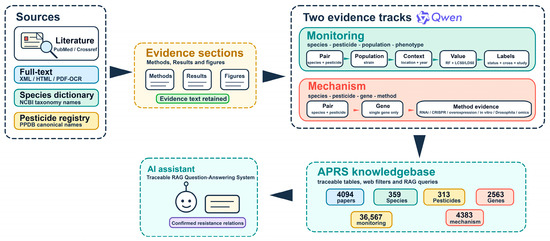
Generative AI tools were integrated into the APRS workflow for document processing, evidence extraction, and information retrieval, as detailed in Section 2.2, Section 2.3 and Section 2.6. ChatGPT (OpenAI, GPT-5.6 Sol) was additionally used only to generate the visual elements of the workflow schematic (Figure 1). The scientific content and workflow structure were determined by the authors, and the figure was reviewed and refined to ensure consistency with the implemented methodology. To mitigate potential errors and biases, AI-extracted records underwent rule-based filtering, and their accuracy was evaluated against an expert-curated gold-standard dataset, as described in Section 2.4 and Section 2.5.
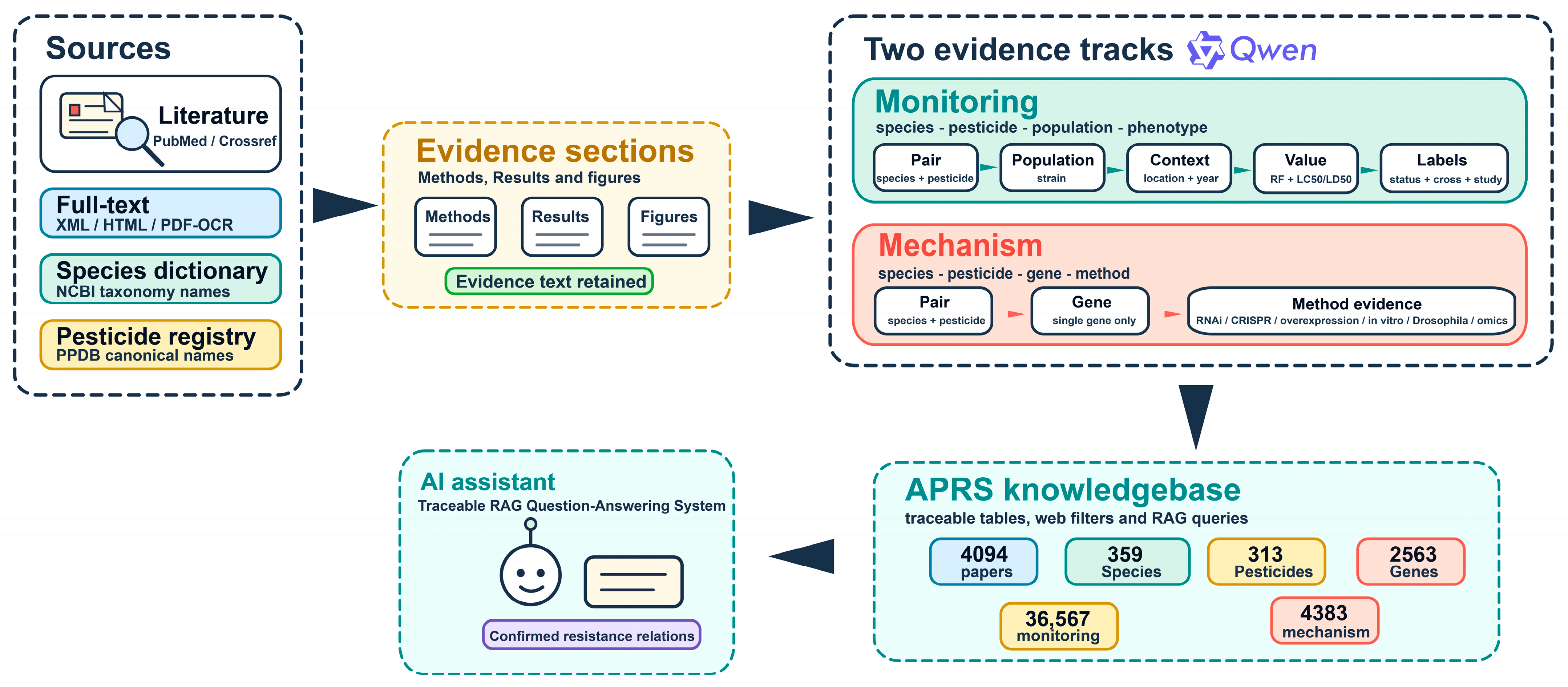
Figure 1.
Overview schematic of the APRS extraction framework and pipeline.
3. Results
3.1. Overview of the APRS Extraction Framework and Resource
We developed an end-to-end LLM-assisted extraction framework for constructing an arthropod pesticide resistance knowledge base from scientific literature (Figure 1). The workflow connected literature retrieval, full-text standardization, section-level reading, progressive knowledge extraction, result cleaning, and web database deployment into a single data production pipeline. This section-level, progressive design was motivated by the way resistance evidence is distributed within a paper: species, pesticide, and location are often stated in the Methods, whereas quantitative values such as resistance factors and LC50/LD50 appear only in the Results, so extracting from the full text in a single pass exposes the model to extraneous context that can confound a given species–pesticide relationship. The workflow therefore read heading-defined article sections sequentially and assembled records progressively, first confirming a species–pesticide pair and then completing its fields within the relevant section, so that each step operated in a short, fixed context and a paired record was not confounded by unrelated information.
The final output was organized around two evidence tracks. Monitoring records captured species–pesticide-population relationships together with location, year, and resistance phenotype fields. Mechanism records captured species–pesticide–gene relationships and their supporting experimental methods. Figure evidence was used as supplementary support for existing text-derived cases rather than as an independent source of new cases.
The curated records were released as structured database tables and served through a web database. The database supports literature browsing, case-level filtering, paper-detail views, and a case-level RAG (retrieval-augmented generation) assistant for querying resistance evidence.
3.2. Database Scale and Composition
The official release was generated through a multi-step post-processing workflow rather than direct aggregation of raw model outputs (Table 1). The raw merged outputs contained 76,409 entity combinations. Case-level filtering removed records without retained mechanistic or monitoring evidence, reducing the dataset to 42,729 cleaned cases across 4245 non-empty literature records. The remaining records were normalized at the case-field level, including within-strain propagation of shared fields and normalization of resistance-factor values, and duplicate literature records were curated by DOI and record identity. After final manual patches, the official release contained 4094 literature records and 40,950 structured resistance cases.
Table 1.
Database core statistics.
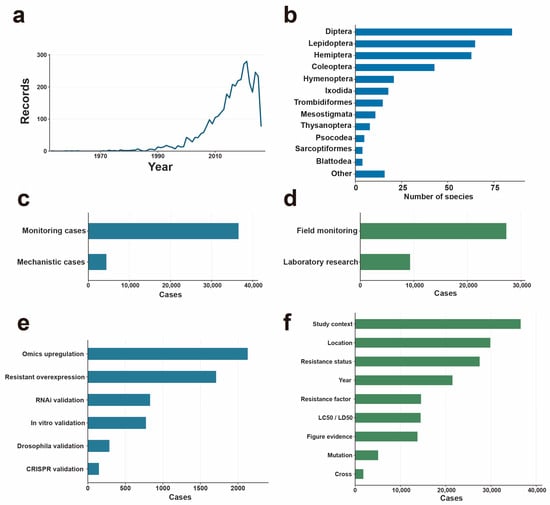
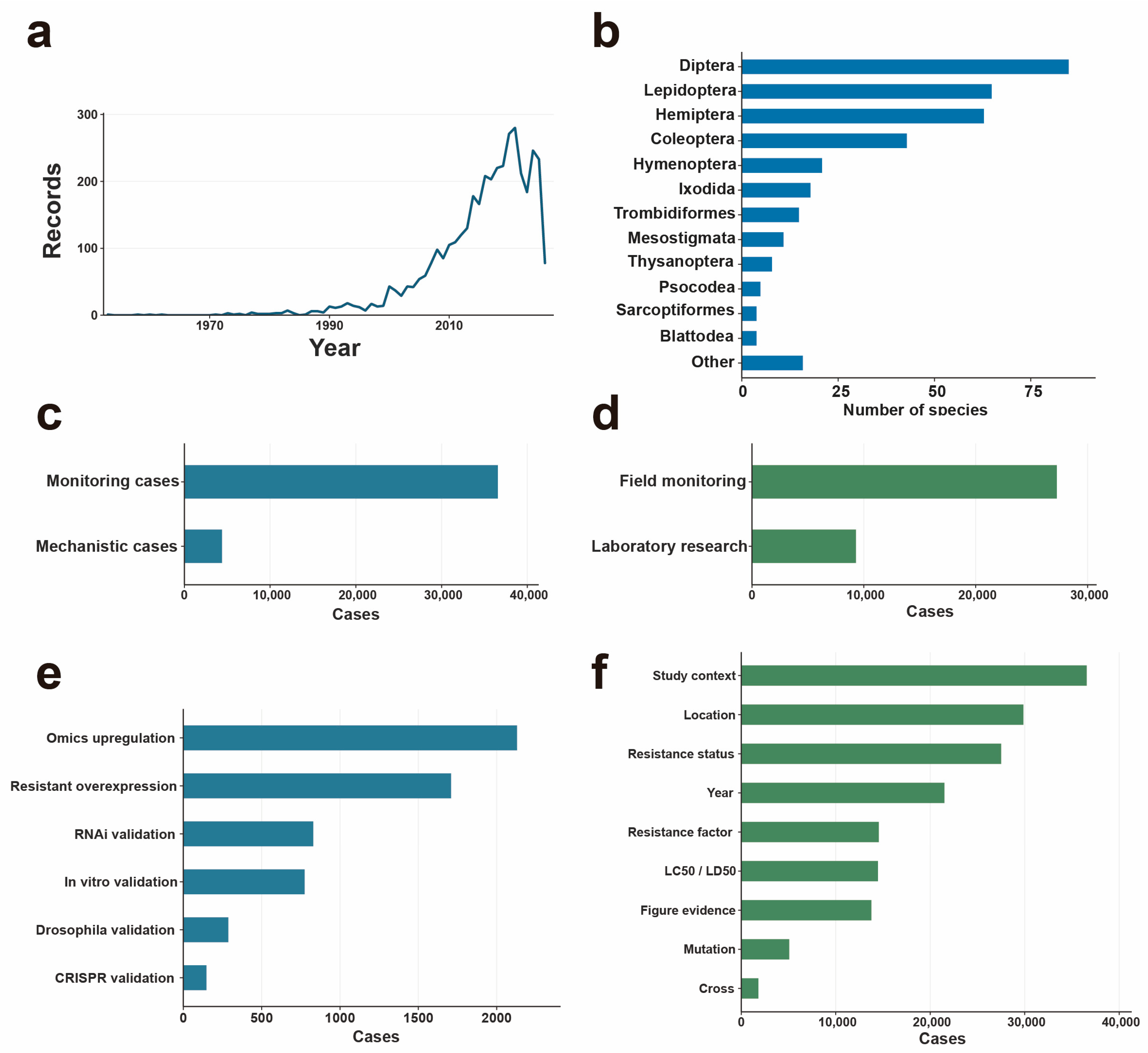
The contributing literature accumulated over time, rising from sparse early reports to a peak within the last decade (Figure 2a). The release covered 359 extracted species names, 313 pesticides, and 2563 genes, with the order-level taxonomic distribution calculated from these normalized species names (Figure 2b). Of the 40,950 cases, 36,567 were monitoring cases and 4383 were mechanistic cases (Figure 2c); monitoring records formed the major component, whereas mechanistic records provided gene-level evidence for resistance-associated mechanisms. Among monitoring cases, 27,249 were annotated as field-monitoring and 9290 as laboratory-research records, with only 28 (26 unclear and 2 blank) lacking a clearly assigned study context (Figure 2d).
Figure 2.
Database scale and composition ((a), contributing literature over time; (b), species per arthropod order; (c), monitoring vs. mechanistic cases; (d), field-monitoring vs. laboratory-research records; (e), mechanistic method-label coverage; (f), monitoring field coverage).
Mechanistic records were summarized by evidence attributes (Figure 2e) and monitoring records by field-level evidence coverage, including study context, location, resistance status and year (Figure 2f). Valid year fields were available for 21,505 monitoring records, covering resistance evidence from 1936 to 2025. In addition, 16,830 cases (41.1% of all cases) contained figure-note evidence, indicating that a substantial fraction of records was supported by information extracted from result figures.
3.3. Extraction Accuracy
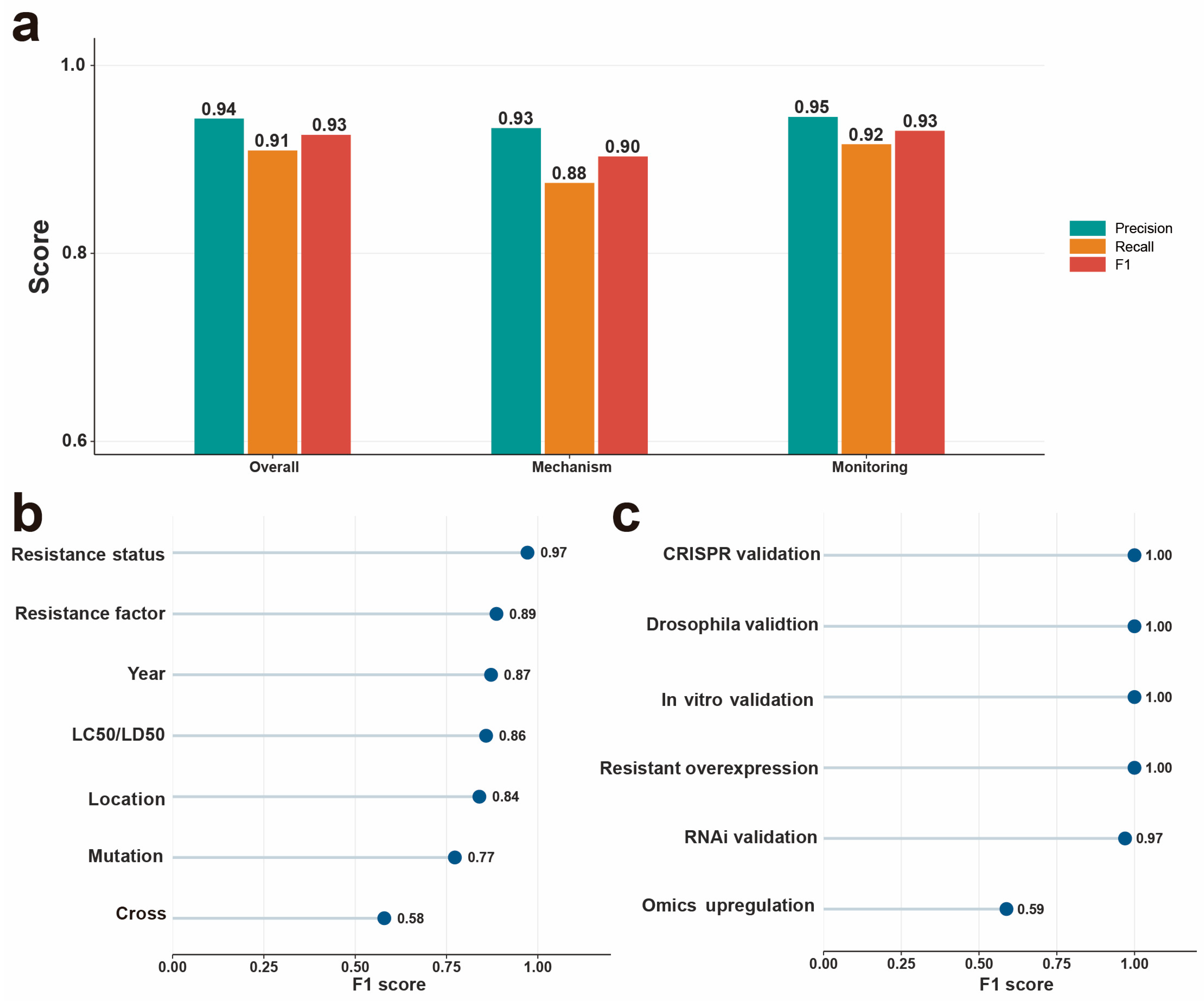
The extraction accuracy was evaluated using a fixed 100-paper gold set (Figure 3; Table 2). The final gold set contained 696 manually curated case records for case-level comparison, including 584 monitoring cases and 112 mechanistic cases.
Figure 3.
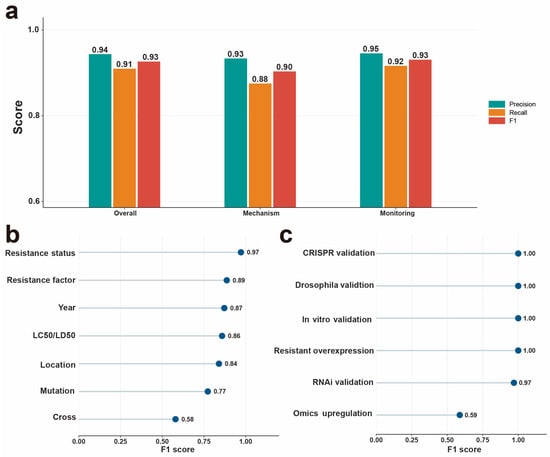
Extraction accuracy ((a), case-level precision/recall/F1; (b), monitoring field F1; (c), mechanism method-label F1).
Table 2.
Case- and field-level extraction metrics.
At the case level, the released database achieved an overall precision of 0.94, recall of 0.91, and an F1 score of 0.93 across 671 predicted cases and 696 gold cases (Figure 3a). Monitoring cases reached a precision of 0.95, recall of 0.92, and an F1 score of 0.93. Mechanistic cases reached a precision of 0.93, recall of 0.88, and an F1 score of 0.90. These results show that most retained structured records corresponded to valid resistance-related evidence in the source literature.
Field-level performance was evaluated on matched case-level true positives (Figure 3b,c). Monitoring fields showed strong performance for resistance status, resistance factor, and LC50/LD50 (Figure 3b). The resistance_status field reached an F1 score of 0.97, resistance_factor reached 0.89, and LC50/LD50 reached 0.86. The location and year fields had high precision but lower recall, indicating that missing values rather than unsupported values were the main limitation. The mutation and cross-resistance fields were more difficult, with F1 scores of 0.77 and 0.58, respectively, mainly because these fields were often reported at the strain, table, or paragraph level rather than repeated for every case row.
Mechanistic method labels were highly reliable for experimentally supported evidence types (Figure 3c): resistant overexpression, in vitro validation, Drosophila validation, and CRISPR validation all reached an F1 score of 1.00, and RNAi validation reached an F1 score of 0.97. The weakest mechanistic label was omics upregulation, with a recall of 0.44 and an F1 score of 0.59, reflecting the difficulty of separating broad transcriptomic candidates from explicit resistance-associated genes.
The main residual errors were incomplete propagation of shared monitoring fields, table-structure mismatch, missed multi-row monitoring records, and boundary ambiguity in omics-based mechanism evidence. The evaluation supports the reliability of the progressive extraction workflow for case-level database construction, while identifying mutation, cross-resistance, and omics upregulation labels as priority targets for future curation.
3.4. Monitoring Evidence Composition and Quantitative Case Study
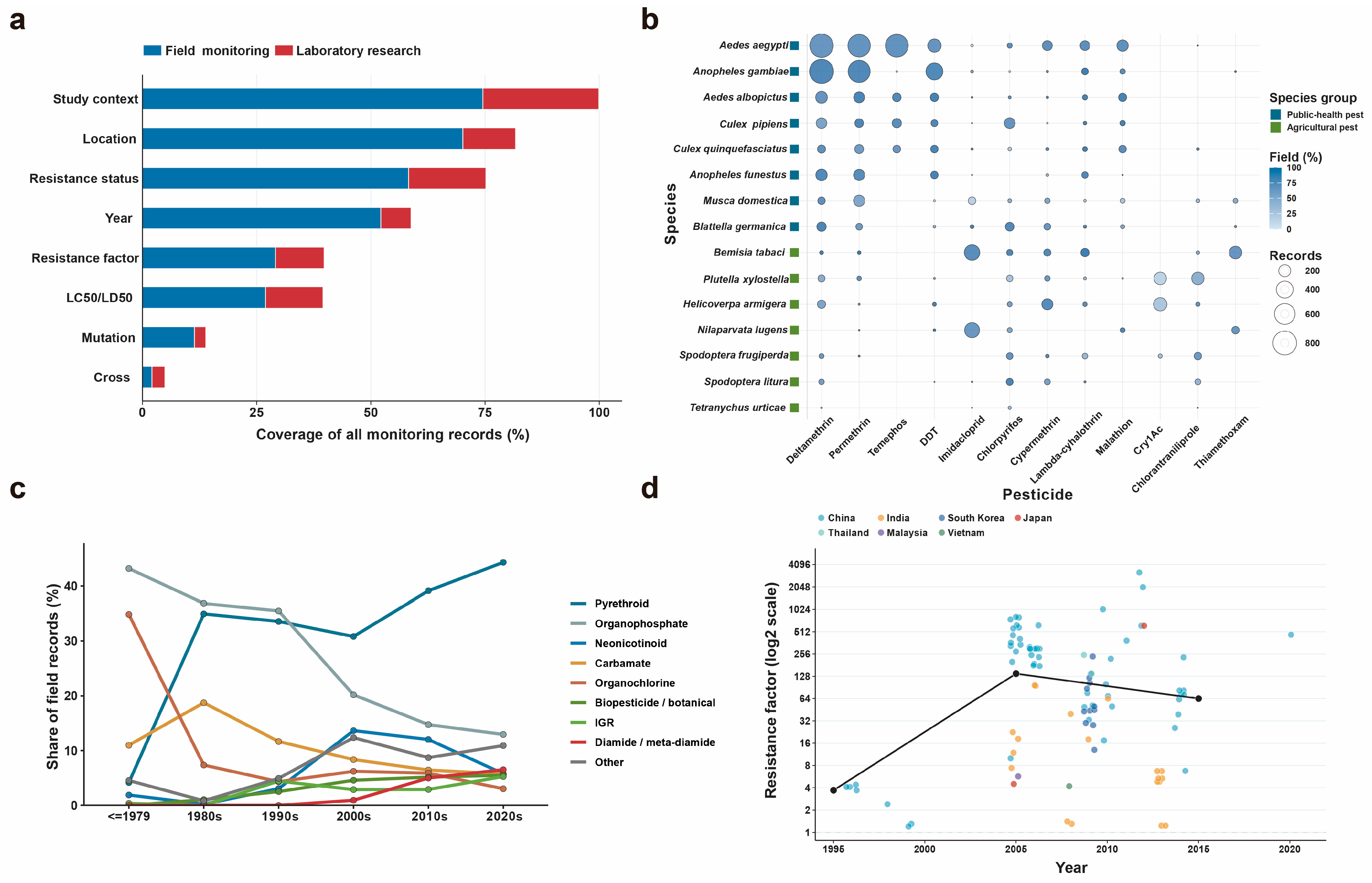
Monitoring evidence records captured population-level pesticide resistance observations (Figure 4; Table 3). The final release contained 36,567 monitoring cases from 3858 papers, covering 345 of the 359 species and 304 of the 313 pesticides in the release, together with 14,370 population labels and 6878 unique location labels, providing broad geographic and temporal coverage of resistance monitoring evidence.
Figure 4.
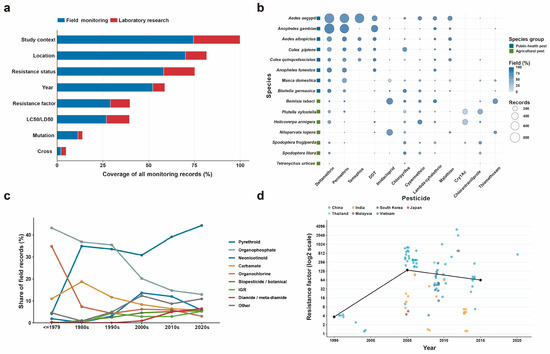
Monitoring evidence composition and geography ((a), field coverage by study context; (b), top species–pesticide associations; (c), pesticide-class share of field records over time; (d), year-resolved resistance-factor records for field-reported Nilaparvata lugens resistance to imidacloprid across countries).
Table 3.
Monitoring field coverage.
The monitoring records contained several phenotype and marker fields (Table 3). resistance_status, cross-resistance labels, resistance_factor, LC50/LD50, and mutation fields were available for subsets of cases, allowing users to filter records by qualitative resistance calls, cross-resistance evidence, quantitative toxicity values, or target-site mutation markers. The resistance_status field was the most widely populated (27,507 cases, 75.2%), while quantitative toxicity fields were available for comparable subsets (resistance_factor 14,548 cases, 39.8%; LC50/LD50 14,464 cases, 39.6%). Of the 16,830 figure-supported cases, 13,764 (37.6% of monitoring cases) were monitoring records.
The monitoring-context classifier assigned most records to field monitoring, while a smaller subset represented laboratory selection, constructed strains, or other experimental monitoring contexts (Figure 4a). The most frequently represented species and pesticides were dominated by mosquito vectors and major agricultural pests, together with commonly monitored insecticides (Figure 4b). Across the 1936–2025 span, the share of field-monitoring records contributed by each pesticide class shifted over successive decades (Figure 4c). To illustrate the value of quantitative monitoring fields, extracted resistance-factor values were used to compare the magnitude of field-reported Nilaparvata lugens resistance to imidacloprid across years, countries, and monitored populations (Figure 4d). This example shows that APRS captures not only whether resistance was reported, but also how strong the reported resistance was, revealing order-of-magnitude variation among countries and populations. These results show that the monitoring track provides broad, field-anchored, and quantitatively annotated coverage of arthropod pesticide resistance observations.
3.5. Functionally Validated Detoxification-Related Mechanisms
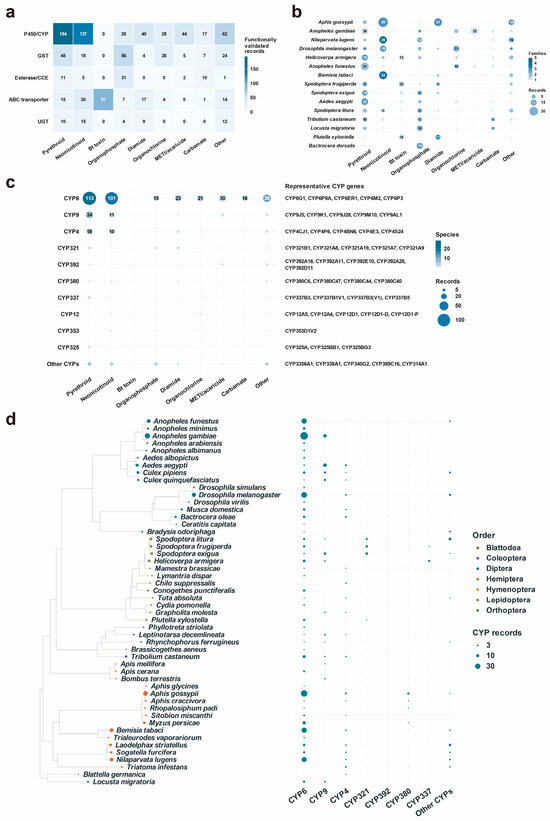
From the mechanism cases, which the release retains whenever the source article provides an explicit method linking a gene to resistance regardless of gene family, we drew a functionally validated subset restricted to detoxification and detoxification-related families (cytochrome P450s, glutathione S-transferases, esterases/carboxylesterases, UDP-glycosyltransferases and ABC transporters) and to records carrying at least one functional-validation method label (RNAi validation, in vitro validation, Drosophila validation or CRISPR validation). This subset comprised 1024 records from 389 papers, covering 77 species, 110 pesticides and 520 unique gene strings. Cytochrome P450s contributed the most records (547), followed by glutathione S-transferases (188), ABC transporters (179), esterases/carboxylesterases (60) and UDP-glycosyltransferases (50) (Figure 5).
Figure 5.
Functionally validated detoxification-related mechanisms ((a), detoxification-related family by pesticide-class heatmap, including ABC transporters; (b), species by pesticide-class associations; (c), CYP family by pesticide-class associations; (d), CYP evidence across the insect phylogeny).
The functionally validated detoxification evidence was not evenly distributed across pesticide classes (Figure 5a). Cytochrome P450 evidence was concentrated in pyrethroids and neonicotinoids, glutathione S-transferase and esterase evidence contributed more visibly to organophosphate-related records, and ABC transporter evidence spanned several pesticide classes. The species-by-pesticide-class associations for the most evidence-rich species are shown in Figure 5b. Because cytochrome P450s dominated the validated evidence, we further resolved the CYP records by CYP family across pesticide classes (Figure 5c) and across the insect phylogeny (Figure 5d); pyrethroid- and neonicotinoid-associated CYP evidence was concentrated in the CYP6 and CYP9 families and in dipteran and hemipteran lineages. These results suggest that the database can support mechanism-level comparisons across detoxification-related families and pesticide classes, rather than only listing resistance-associated genes. Because the underlying evidence reflects research and surveillance effort, these family- and lineage-level patterns should be read as features of the documented literature rather than as direct measures of the biological distribution of resistance.
3.6. Web Database and AI Assistant
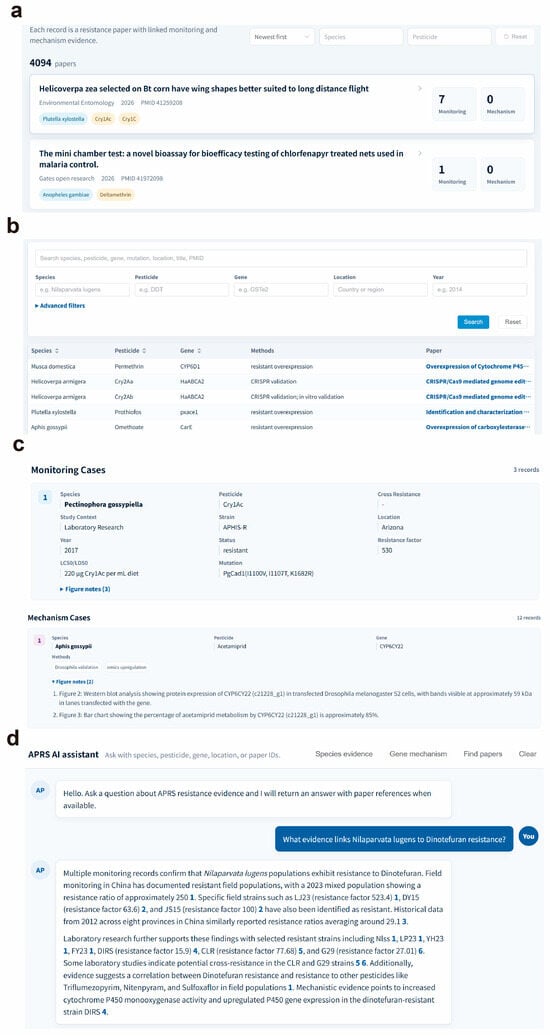
To make the extracted pesticide resistance knowledge base usable beyond static tables, we implemented an interactive web database that links paper-level metadata with case-level monitoring and mechanistic records (Figure 6). The interface allows users to browse publications, search structured fields, filter resistance cases, and inspect the evidence cards associated with each paper. This design preserves the connection between database records and source publications, enabling users to move from summary-level patterns to the underlying literature evidence.
Figure 6.
APRS web database and AI assistant. (a) Literature browsing interface; (b) monitoring case explorer with structured filtering functions; (c) publication detail page linking literature metadata with extracted resistance evidence; (d) evidence-grounded AI assistant providing source-linked responses.
The web interface provides separate entry points for literature records, monitoring cases, and mechanistic evidence (Figure 6a,b). Users can query species, pesticides, genes, evidence types, study context, locations, years, and resistance-related annotations. Paper detail pages connect metadata, extracted monitoring records, and mechanistic records within the same view, allowing individual records to be checked against their source paper rather than treated as isolated rows in a table (Figure 6c).
We further integrated an AI assistant for evidence-grounded retrieval (Figure 6d). Instead of answering directly from unstructured article text alone, the assistant retrieves relevant structured evidence cards and uses them to generate responses with traceable paper identifiers. This links natural-language questions to curated species–pesticide–gene and species–pesticide-monitoring relationships, providing an interactive route for exploring the resistance evidence base.
Together, the web database and AI assistant convert the released knowledge base into a practical resource for pesticide resistance research, surveillance and management. The system supports both targeted lookup, such as finding records for a given species, pesticide, or gene, and broader exploratory queries, such as identifying evidence-rich resistance systems or locating papers that support a specific mechanism or monitoring observation.
4. Discussion
Effective pesticide resistance management is essential for maintaining the sustainability of chemical control within modern crop-protection programs. Decades of resistance monitoring and mechanistic research have generated an enormous but fragmented literature, and curated resources such as the Arthropod Pesticide Resistance Database [22] and the IRAC mode-of-action classification [12] have been valuable in organizing parts of it. These resources, however, depend on expert hand-entry, are difficult to scale to the full and rapidly growing literature, and rarely couple population-level monitoring with case-level mechanistic evidence and its experimental support. Here, we showed that a progressive, section-level large language model extraction framework can build an evidence-grade arthropod pesticide resistance knowledge base at literature scale, linking monitoring and mechanistic evidence within a single resource while preserving traceability to the source text. The released knowledge base, comprising 40,950 structured cases from 4094 publications, is, to our knowledge, the first large-scale, automatically curated and accuracy-benchmarked resource of its kind for arthropod pesticide resistance; manually curated databases such as the Arthropod Pesticide Resistance Database remain more complete for documented species and monitoring records, and our contribution is the automated, scalable construction of an evidence-grade resource rather than the largest record count.
A defining feature of APRS is that extraction was constrained by explicit relationship and evidence requirements rather than by entity co-occurrence. By progressively confirming species–pesticide relationships and linking them to genes or populations with supporting evidence, the framework helps reduce unsupported associations and improve the reliability of structured records. Previous studies, including ChatExtract and CatMiner, have demonstrated the benefits of iterative prompting and follow-up verification for structured information extraction from scientific literature [33,34], providing methodological support for our progressive extraction strategy. The high case-level precision and recall obtained against the expert gold set (Figure 3a) suggest that this progressive, evidence-tiered design, rather than the underlying language model alone, contributed to making literature-scale extraction reliable enough for downstream use. Because the same recipe of relationship-constrained chaining, evidence-tier filtering, and gold-set benchmarking is not specific to resistance data, it may be transferable to other agricultural and biomedical problems that require structured curation of a large primary literature [25,26].
Beyond its scale, the knowledge base revealed structure that may help to prioritize future work. Functionally validated detoxification evidence was unevenly distributed across pesticide classes, with cytochrome P450 evidence concentrated in pyrethroids and neonicotinoids and glutathione S-transferase and esterase evidence more prominent for organophosphates. This pattern is broadly consistent with the established roles of these gene families in metabolic resistance [35] and suggests that the resource can support mechanism-level comparison rather than the simple listing of resistance-associated genes. Monitoring evidence, in turn, was concentrated in mosquito vectors, major agricultural pests, and particular regions and decades, which may partly reflect research and surveillance priorities rather than the true global distribution of resistance; a systematic comparison of these distributions with previously reported resistance trends will help to establish how representative the current release is [36]. The database also makes knowledge gaps explicit: under-studied taxa and regions, together with weakly populated fields such as cross-resistance and target-site mutation, could be targeted by future monitoring and curation.
As a queryable resource, APRS can support several practical tasks in resistance research and management. The structured monitoring track lends itself to literature-scale meta-analysis of resistance phenotypes across species, compounds, and regions, whereas the mechanistic track allows rapid retrieval of the genes and experimental evidence associated with a given species–pesticide combination. The case-level assistant further supports natural-language queries over these relationships while retaining links to the source publications. Because the extraction framework can be re-run as new papers appear, the knowledge base can be maintained as a living resource rather than a one-off snapshot.
Several limitations should be acknowledged. Extraction accuracy was field-dependent: the omics upregulation label was the least reliable (F1 0.59), in contrast to the near-perfect performance of the functionally validated labels (Figure 3c), and it was for this reason that the mechanistic analysis was deliberately restricted to functionally validated evidence. Cross-resistance and target-site mutation were likewise more difficult fields, most likely because such information is often reported at the strain, table, or paragraph level rather than repeated for every record. For location and year, the main limitation was missing rather than incorrect values, so that recall, but not precision, was reduced. Another limitation concerns literature coverage. Our PubMed- and Crossref-based retrieval strategy and the availability of full texts may favor readily accessible or English-language publications. In addition, technical reports, government surveillance documents, and other non-journal sources were not systematically captured, potentially resulting in the omission of relevant resistance monitoring evidence. Future releases should incorporate additional literature and reliable monitoring sources while preserving source traceability and quality control. The present work should therefore be regarded primarily as a reusable extraction tool and an initial release rather than a complete census of the literature. The pipeline was also text-first, using figure evidence only as corroborating support rather than as an independent source of cases, and it relied on a single language model and a predominantly English-language corpus. Finally, the assistant is presented here as an evidence-card retrieval interface and has not yet been benchmarked against a dedicated question-answering test set, so its quantitative evaluation will require further work.
APRS demonstrates that agentic, evidence-constrained extraction can convert the scattered arthropod pesticide resistance literature into a large-scale, accuracy-benchmarked and queryable evidence base. Because it is designed as a reusable tool, the knowledge base can be expanded and kept up to date as coverage improves, through continued scaling, periodic updates, gene-symbol normalization, community contribution and quantitative evaluation of the assistant. By making monitoring and mechanistic resistance evidence findable and comparable at scale, resources of this kind can strengthen evidence-based insecticide-resistance management and support more sustainable arthropod pest control.
Supplementary Materials
The following supporting information can be downloaded at: https://www.mdpi.com/article/10.3390/agronomy16212094/s1, Table S1: Literature search strategies and query terms used for PubMed and Crossref retrieval.
Author Contributions
H.W., Y.M., F.J. and R.P. conceived and designed the study. H.W. and Y.M. developed the extraction framework and performed the main analyses. C.D., S.W. (Suhang Wang), S.W. (Shiqi Wang), Z.Z., D.T., X.L. and X.X. contributed to data collection, curation, evaluation, visualization and/or web resource development. F.J. and R.P. supervised the study. H.W. drafted the manuscript. All authors have read and agreed to the published version of the manuscript.
Funding
This study was supported by the Guangdong S&T Program (2026B0202180002), Earmarked Fund for Modern Agro-industry Technology Research System (nycytx-001) and Specific university discipline construction project (2023B10564004).
Data Availability Statement
The APRS web database is accessible at http://www.pesticideresistance.net (accessed on 21 October 2026). The structured APRS datasets used in this study, including monitoring records and mechanism records, can be downloaded from the database download page. The extraction scripts, production prompts, and related documentation are available in the GitHub repository at https://github.com/WHXFIGHTING/Arthropod-Pesticide-Resistance-Scholar (accessed on 21 October 2026).
Acknowledgments
During the preparation of this manuscript, the authors used ChatGPT (model: GPT-5.6 Sol; OpenAI, San Francisco, CA, USA) for the following purposes: (1) generating visual elements used in Figure 1, which were subsequently manually assembled and edited by the authors; and (2) language polishing of the manuscript text. The authors have reviewed and edited the output and take full responsibility for the content of this publication.
Conflicts of Interest
The authors declare no conflicts of interest.
References
- Rader, R.; Bartomeus, I.; Garibaldi, L.A.; Garratt, M.P.D.; Howlett, B.G.; Winfree, R.; Cunningham, S.A.; Mayfield, M.M.; Arthur, A.D.; Andersson, G.K.S.; et al. Non-Bee Insects Are Important Contributors to Global Crop Pollination. Proc. Natl. Acad. Sci. USA 2016, 113, 146–151. [Google Scholar] [CrossRef] [Scilit] [PubMed]
- Savary, S.; Willocquet, L.; Pethybridge, S.J.; Esker, P.; McRoberts, N.; Nelson, A. The Global Burden of Pathogens and Pests on Major Food Crops. Nat. Ecol. Evol. 2019, 3, 430–439. [Google Scholar] [CrossRef] [Scilit] [PubMed]
- Socha, W.; Kwasnik, M.; Larska, M.; Rola, J.; Rozek, W. Vector-Borne Viral Diseases as a Current Threat for Human and Animal Health—One Health Perspective. J. Clin. Med. 2022, 11, 3026. [Google Scholar] [CrossRef] [Scilit] [PubMed]
- Carvalho, F.P. Pesticides, Environment, and Food Safety. Food Energy Secur. 2017, 6, 48–60. [Google Scholar] [CrossRef] [Scilit]
- U.S. Environmental Protection Agency (EPA). Pesticides. Available online: https://www.epa.gov/pesticides (accessed on 15 July 2025).
- China Pesticide Information Network Data Center 2025. Available online: http://www.chinapesticide.org.cn/zwb/dataCenter (accessed on 15 July 2025).
- Hawkins, N.J.; Bass, C.; Dixon, A.; Neve, P. The Evolutionary Origins of Pesticide Resistance. Biol. Rev. 2019, 94, 135–155. [Google Scholar] [CrossRef] [Scilit] [PubMed]
- Thia, J.A.; Maino, J.; Kelly, A.; Hoffmann, A.A.; Umina, P.A. Expanding Risk Predictions of Pesticide Resistance Evolution in Arthropod Pests with a Proxy for Selection Pressure. J. Pest Sci. 2023, 96, 1199–1212. [Google Scholar] [CrossRef] [Scilit]
- Song, R.; Zhang, Y.; Lu, P.; Wu, J.; Li, Q.X.; Song, B. Status and Perspective on Green Pesticide Utilizations and Food Security. Annu. Rev. Food Sci. Technol. 2024, 15, 473–493. [Google Scholar] [CrossRef] [Scilit] [PubMed]
- Wan, N.-F.; Fu, L.; Dainese, M.; Kiær, L.P.; Hu, Y.-Q.; Xin, F.; Goulson, D.; Woodcock, B.A.; Vanbergen, A.J.; Spurgeon, D.J.; et al. Pesticides Have Negative Effects on Non-Target Organisms. Nat. Commun. 2025, 16, 1360. [Google Scholar] [CrossRef] [Scilit] [PubMed]
- Gould, F.; Brown, Z.S.; Kuzma, J. Wicked Evolution: Can We Address the Sociobiological Dilemma of Pesticide Resistance? Science 2018, 360, 728–732. [Google Scholar] [CrossRef] [Scilit] [PubMed]
- Sparks, T.C.; Nauen, R. IRAC: Mode of Action Classification and Insecticide Resistance Management. Pestic. Biochem. Physiol. 2015, 121, 122–128. [Google Scholar] [CrossRef] [Scilit] [PubMed]
- Roush, R.T.; Miller, G.L. Considerations for Design of Insecticide Resistance Monitoring Programs. J. Econ. Entomol. 1986, 79, 293–298. [Google Scholar] [CrossRef] [Scilit]
- Whalon, M.E.; Mota-Sanchez, D.; Hollingworth, R.M. (Eds.) Global Pesticide Resistance in Arthropods; CABI: Wallingford, UK, 2008; ISBN 978-1-84593-353-1. [Google Scholar]
- Weill, M.; Malcolm, C.; Chandre, F.; Mogensen, K.; Berthomieu, A.; Marquine, M.; Raymond, M. The Unique Mutation in Ace-1 Giving High Insecticide Resistance Is Easily Detectable in Mosquito Vectors. Insect Mol. Biol. 2004, 13, 1–7. [Google Scholar] [CrossRef] [Scilit] [PubMed]
- Dong, K.; Du, Y.; Rinkevich, F.; Nomura, Y.; Xu, P.; Wang, L.; Silver, K.; Zhorov, B.S. Molecular Biology of Insect Sodium Channels and Pyrethroid Resistance. Insect Biochem. Mol. Biol. 2014, 50, 1–17. [Google Scholar] [CrossRef] [Scilit] [PubMed]
- Feyereisen, R.; Dermauw, W.; Van Leeuwen, T. Genotype to Phenotype, the Molecular and Physiological Dimensions of Resistance in Arthropods. Pestic. Biochem. Physiol. 2015, 121, 61–77. [Google Scholar] [CrossRef] [Scilit] [PubMed]
- Dermauw, W.; Van Leeuwen, T. The ABC Gene Family in Arthropods: Comparative Genomics and Role in Insecticide Transport and Resistance. Insect Biochem. Mol. Biol. 2014, 45, 89–110. [Google Scholar] [CrossRef] [Scilit] [PubMed]
- Pavlidi, N.; Vontas, J.; Van Leeuwen, T. The Role of Glutathione S-Transferases (GSTs) in Insecticide Resistance in Crop Pests and Disease Vectors. Curr. Opin. Insect Sci. 2018, 27, 97–102. [Google Scholar] [CrossRef] [Scilit] [PubMed]
- Nauen, R.; Bass, C.; Feyereisen, R.; Vontas, J. The Role of Cytochrome P450s in Insect Toxicology and Resistance. Annu. Rev. Entomol. 2022, 67, 105–124. [Google Scholar] [CrossRef] [Scilit] [PubMed]
- Logan, R.A.E.; Mäurer, J.B.; Wapler, C.; Ingham, V.A. Uridine Diphosphate (UDP)-Glycosyltransferases (UGTs) Are Associated with Insecticide Resistance in the Major Malaria Vectors Anopheles Gambiae s.l. and Anopheles Funestus. Sci. Rep. 2024, 14, 19821. [Google Scholar] [CrossRef] [Scilit] [PubMed]
- Mota-Sanchez, D.; Wise, J.C. The Arthropod Pesticide Resistance Database. 2020. Available online: https://www.pesticideresistance.org/ (accessed on 12 March 2026).
- Knox, T.B.; Juma, E.O.; Ochomo, E.O.; Pates Jamet, H.; Ndungo, L.; Chege, P.; Bayoh, N.M.; N’Guessan, R.; Christian, R.N.; Hunt, R.H.; et al. An Online Tool for Mapping Insecticide Resistance in Major Anopheles Vectors of Human Malaria Parasites and Review of Resistance Status for the Afrotropical Region. Parasit. Vectors 2014, 7, 76. [Google Scholar] [CrossRef] [Scilit] [PubMed]
- Hirschman, L.; Burns, G.A.P.C.; Krallinger, M.; Arighi, C.; Cohen, K.B.; Valencia, A.; Wu, C.H.; Chatr-Aryamontri, A.; Dowell, K.G.; Huala, E.; et al. Text Mining for the Biocuration Workflow. Database 2012, 2012, bas020. [Google Scholar] [CrossRef] [Scilit] [PubMed]
- Dagdelen, J.; Dunn, A.; Lee, S.; Walker, N.; Rosen, A.S.; Ceder, G.; Persson, K.A.; Jain, A. Structured Information Extraction from Scientific Text with Large Language Models. Nat. Commun. 2024, 15, 1418. [Google Scholar] [CrossRef] [Scilit] [PubMed]
- Xu, D.; Chen, W.; Peng, W.; Zhang, C.; Xu, T.; Zhao, X.; Wu, X.; Zheng, Y.; Wang, Y.; Chen, E. Large Language Models for Generative Information Extraction: A Survey. Front. Comput. Sci. 2024, 18, 186357. [Google Scholar] [CrossRef] [Scilit]
- Cui, C.; Sun, T.; Liang, S.; Gao, T.; Zhang, Z.; Liu, J.; Wang, X.; Zhou, C.; Liu, H.; Lin, M.; et al. PaddleOCR-VL-1.5: Towards a Multi-Task 0.9B VLM for Robust In-the-Wild Document Parsing. 2026. Available online: https://arxiv.org/html/2601.21957v2 (accessed on 12 March 2026).
- Lewis, K.A.; Tzilivakis, J.; Warner, D.J.; Green, A. An International Database for Pesticide Risk Assessments and Management. Hum. Ecol. Risk Assess. Int. J. 2016, 22, 1050–1064. [Google Scholar] [CrossRef] [Scilit]
- Schoch, C.L.; Ciufo, S.; Domrachev, M.; Hotton, C.L.; Kannan, S.; Khovanskaya, R.; Leipe, D.; Mcveigh, R.; O’Neill, K.; Robbertse, B.; et al. NCBI Taxonomy: A Comprehensive Update on Curation, Resources and Tools. Database 2020, 2020, baaa062. [Google Scholar] [CrossRef] [Scilit] [PubMed]
- Sokolova, M.; Lapalme, G. A Systematic Analysis of Performance Measures for Classification Tasks. Inf. Process. Manag. 2009, 45, 427–437. [Google Scholar] [CrossRef] [Scilit]
- Lewis, P.; Perez, E.; Piktus, A.; Petroni, F.; Karpukhin, V.; Goyal, N.; Küttler, H.; Lewis, M.; Yih, W.; Rocktäschel, T.; et al. Retrieval-Augmented Generation for Knowledge-Intensive NLP Tasks. In Proceedings of the Advances in Neural Information Processing Systems; Larochelle, H., Ranzato, M., Hadsell, R., Balcan, M.F., Lin, H., Eds.; Curran Associates, Inc.: Red Hook, NY, USA, 2020; Volume 33, pp. 9459–9474. [Google Scholar]
- Johnson, J.; Douze, M.; Jégou, H. Billion-Scale Similarity Search with GPUs. IEEE Trans. Big Data 2021, 7, 535–547. [Google Scholar] [CrossRef] [Scilit]
- Polak, M.P.; Morgan, D. Extracting Accurate Materials Data from Research Papers with Conversational Language Models and Prompt Engineering. Nat. Commun. 2024, 15, 1569. [Google Scholar] [CrossRef] [Scilit] [PubMed]
- Walls, B.W.; Linic, S. Use of Large Language Models for Extracting and Analyzing Data from Heterogeneous Catalysis Literature. ACS Catal. 2025, 15, 14751–14763. [Google Scholar] [CrossRef] [Scilit]
- Li, X.; Schuler, M.A.; Berenbaum, M.R. Molecular Mechanisms of Metabolic Resistance to Synthetic and Natural Xenobiotics. Annu. Rev. Entomol. 2007, 52, 231–253. [Google Scholar] [CrossRef] [Scilit] [PubMed]
- Hancock, P.A.; Hendriks, C.J.M.; Tangena, J.-A.; Gibson, H.; Hemingway, J.; Coleman, M.; Gething, P.W.; Cameron, E.; Bhatt, S.; Moyes, C.L. Mapping Trends in Insecticide Resistance Phenotypes in African Malaria Vectors. PLoS Biol. 2020, 18, e3000633. [Google Scholar] [CrossRef] [Scilit] [PubMed]

Disclaimer/Publisher’s Note: The statements, opinions and data contained in all publications are solely those of the individual author(s) and contributor(s) and not of MDPI and/or the editor(s). MDPI and/or the editor(s) disclaim responsibility for any injury to people or property resulting from any ideas, methods, instructions or products referred to in the content. |
© 2026 by the authors. Licensee MDPI, Basel, Switzerland. This article is an open access article distributed under the terms and conditions of the Creative Commons Attribution (CC BY) license.