


Abstract
Pineapple is widely cultivated in tropical regions, but intensive management and improper residue disposal can accelerate soil degradation and yield decline. To evaluate under-ridge residue burial (URRB) as a soil improvement practice, parallel field experiments were conducted from 2023 to 2024 at two sites in tropical southern China. A two-factor randomized complete block design was used, with two burial rates (half- and full-rate, i.e., 10 and 20 t ha−1) and three burial depths (10, 20, and 30 cm), plus a residue removal control (CK). Compared with CK, URRB generally increased soil pH and the stocks of soil organic carbon and available nitrogen (N), phosphorus (P), and potassium (K), accompanied by higher leaf area index (LAI), total root surface area (TRSA), photosynthetic pigment contents, fruit vitamin C content, and plant N, P, and K accumulation. Increasing burial rate significantly enhanced plant P and K accumulation and fruit yield, while burial at 30 cm produced greater improvements in soil pH, soil organic carbon (SOC), and available N, P, and K stocks than burial at 10 cm and 20 cm. Compared with other treatments, full-rate residue burial at 30 cm depth under the ridge (FD30) most effectively promoted canopy growth, root development, fruit yield, and chlorophyll a content. On average across the two sites, FD30 increased LAI and TRSA by 20.9% and 34.0%, respectively, compared with CK, with significant increases of 20.1% in fruit yield and 25.3% in fruit vitamin C content. Partial least squares path modeling identified positive indirect associations of soil pH and nutrient availability with yield. Although pineapple yield did not differ significantly between FD30 and FD10, SOC, available N, P, and K stocks were significantly greater under FD30 than under FD10. Thus, FD30 is a more promising strategy for improving both soil fertility and pineapple production under the present experimental conditions. This study also provides new insights into crop residue management in tropical cultivation systems.
1. Introduction
Pineapple (Ananas comosus (L.) Merr.) is an important fruit crop worldwide, widely cultivated in tropical regions, and valued for its rich nutritional profile [1]. The global annual production is approximately 29.3 million tons, with an estimated global export value of US$3.24 billion in 2024 [2], highlighting its substantial economic significance. Nevertheless, traditional pineapple production is typically managed under intensive, high-input systems with a continuous monocropping mode [3,4]. Such practices have contributed to widespread soil degradation: up to 78% of pineapple plantation soils have a pH < 4.5, and more than half contain <2% soil organic matter in tropical South China [5]. Relative to conditions three decades ago, soil pH has declined by approximately 0.3 units and soil organic carbon has decreased by 20% in Hainan Island [6]. Moreover, pineapple harvesting generates substantial amounts of aboveground biomass residues that contain approximately 1.0% N, 1.0–2.0% K, and 0.1–0.4% P, along with other micronutrients [7,8]. However, as excessive residue accumulation can hinder subsequent field operations, these residues are usually removed from fields or burned in situ, resulting in resource waste and environmental risks [9]. These challenges collectively constrain soil fertility and the sustainability of pineapple production. Therefore, it is necessary to develop a management strategy for tropical pineapple cultivation that restores soil fertility and enhances productivity.
Residue return is a widely adopted conservation practice that can improve soil quality and fertility, with potential benefits for crop yield and quality. Evidence indicates that it can increase soil organic matter, regulate soil acid-base status [10,11], increase nutrient availability [12], and improve soil physical properties related to aeration and water infiltration [13]. It can also promote root development and increase biomass production, nitrogen accumulation, and photosynthetic efficiency, thereby increasing yield [14,15,16]. However, these effects are influenced by multiple factors, such as climate conditions, soil properties, cropping systems, and the method of residue return [17]. It has been reported that compared with incorporation or burial, residue mulch is more effective in increasing soil moisture and water storage [18] and enhancing the availability of nitrogen, phosphorus, and potassium [19]. In contrast, compared with residue mulch, residue burial is more conducive to the accumulation of soil organic carbon (SOC) and total nitrogen [19], and increases maize yield by 22.7% and wheat yield stability by 6.7% [14,20]. In addition, plow-tillage incorporation can outperform rotary-tillage incorporation by increasing mineral N stocks and water use efficiency, resulting in an average 6.4% increase in maize yield in two growth seasons [21]. However, residue burial, especially ditch burial, has been regarded as a more efficient residue return strategy for enhancing soil fertility and crop yield [22,23]. Compared with conventional residue incorporation, deep burial return has been reported to significantly reduce soil bulk density (BD) in the 20–40 cm soil layer by 8.1% and to increase soil porosity, SOC, and total nitrogen by 10.3%, 67.5%, and 61.3%, respectively [24]. Moreover, residue burial was reported to promote root growth by alleviating excess soil moisture in the root zone and enhancing plant N uptake, resulting in a yield increase of 24.5% [25]. Hence, these findings suggest that residue burial management may have greater potential to enhance both crop productivity and soil fertility.
Previous studies have shown that residue burial at 25 cm resulted in a greater yield increase than burial at 15 cm and 40 cm in maize–wheat rotation systems [26]. Straw incorporation at a subsoil depth of 20–30 cm delivered favorable overall benefits, particularly by maximizing topsoil SOC stock while also promoting crop yield [27]. Moreover, increasing straw return rates can further improve soil quality [28], but higher residue amounts may also increase the risk of pathogen proliferation [29]. Likewise, a previous study reported that higher straw return rates did not lead to a monotonic improvement in soil quality or crop yield; instead, the treatment with a two-thirds return rate outperformed that with a full return rate for certain soil indicators [30]. These results highlight that both the burial depth and burial rate are key determinants in residue return management.
However, the applicability of residue burial to tropical cultivation systems remains insufficiently documented. Although a recent study showed that ditch-buried straw return coupled with ridge–furrow plastic mulching enhances pineapple straw decomposition and soil quality [31], it remains unclear whether pineapple residue burial can improve pineapple productivity and which combination of burial depth and burial rate is optimal. Here, therefore, parallel field experiments were conducted at two sites to evaluate a residue return practice defined as under-ridge residue burial (URRB), in which two residue burial rates (10 and 20 t ha−1) and three burial depths (10, 20, and 30 cm under the ridge) were implemented, plus a residue removal control (CK). The objectives were to (1) determine how the residue input rate and its spatial placement regulate soil physicochemical properties and nutrient availability; (2) explore potential pathways linking URRB-induced changes in soil properties to pineapple growth and yield formation; and (3) identify an optimal URRB regime for pineapple cultivation, thereby providing a practical reference for developing high-yielding, resource-efficient, and sustainable crop production systems in tropical regions.
2. Materials and Methods
2.1. Experimental Sites
Parallel field experiments were conducted from January 2023 to April 2024 at two sites in Hainan Province, China: Lingao County (109°44′24″ E, 19°55′48″ N; 35 m a.s.l.) and Ledong County (108°46′22″ E, 18°39′06″ N; 66.8 m a.s.l.). Both sites are located in major tropical pineapple-producing areas and have a tropical monsoon climate. The soils at Lingao and Ledong were classified as a Ferralsol and a Lixisol, respectively, according to the WRB classification system [32]. Detailed soil physicochemical properties are provided in Table S1. The data of air temperature and precipitation throughout the pineapple growth period at each site were recorded by an in-field automatic weather station (HX-3000; Hengxing Technology Co., Ltd., Handan, China) and are shown in Figure S1. The mean daily air temperature and cumulative precipitation at Lingao were 24.7 °C and 1291 mm, respectively, and those at Ledong were 25.8 °C and 818 mm, respectively.
2.2. Experimental Design
Field experiments were conducted using a two-factor randomized complete block design. The residue burial rate included two levels: 10 t ha−1 (half-rate residue, H) and 20 t ha−1 (full-rate residue, F), calculated on a dry weight basis. Burial depth included three levels: 10 cm (D10), 20 cm (D20), and 30 cm (D30). Residue removal was used as the control (CK). In total, seven treatments were established: HD10, HD20, HD30, FD10, FD20, FD30, and CK. At each site, each treatment was replicated three times, resulting in 21 plots per site. Each plot covered 20 m2 (5 m × 4 m).
After the previous crop was harvested, all aboveground pineapple residues, consisting mainly of stems and leaves, were collected and weighed. The leaves were mechanically cut into pieces approximately 20 cm long and 5 cm wide, and the stems into blocks approximately 5 × 5 × 5 cm in size. Before transplanting, ditches (30 cm wide) were excavated at the center of the intended ridge positions to the designated depths, and residue was applied at the calculated rates. After the ditches were backfilled, ridges were formed along the ditches (ridge height 10 cm, width 90 cm, and ridge spacing 30 cm). Pineapples were transplanted on these ridges in two rows per ridge, with 40 cm between rows and 33 cm between plants, resulting in a planting density of 49,500 plants ha−1 (Figure S2). Pineapple was transplanted at both sites on 1 January 2023 and harvested on 26 April 2024 (481 days). All plots received the same fertilizer regime, with total application rates of 450 kg N ha−1, 120 kg P2O5 ha−1, and 600 kg K2O ha−1. The local dominant cultivar ‘Tainong 17’ was used, and field management followed locally recommended high-yield practices.
2.3. Sampling and Measurement
2.3.1. Plant Sampling and Measurement
At five key growth stages of pineapple (early vegetative growth, active vegetative growth, inflorescence emergence, fruit expansion, and maturity), three plants were randomly selected from the central rows in each plot. The plants were subsequently separated into stems, leaves, peduncles, fruits, and crowns, and then subsamples were oven-dried at 80 °C to estimate total aboveground dry matter accumulation (ADMA). Leaf number was defined as the total number of leaves per plant, including senesced leaves, and leaf area index (LAI) was calculated following a previously described equation [33]. Dried tissues were ground and digested using an H2SO4–H2O2 system for determination of total N, P, and K [34]. Total N and total P were quantified colorimetrically using the indophenol blue method and the molybdenum blue method, respectively, and K was measured by flame photometry [35]. Plant N, P, and K accumulation was calculated as the sum of organ dry mass multiplied by the corresponding nutrient concentration across all plant organs.
At the stage of active vegetative growth, three D-leaves (a group of fully expanded young leaves) from three plant samples were randomly selected, and a tissue subsample was excised from the middle section. Fresh leaf tissue was ground in 96% ethanol to extract photosynthetic pigments. The absorbance of the extract was measured at 470, 649, and 665 nm, and the contents of chlorophyll a (Chl a), chlorophyll b (Chl b), and carotenoids (Car) were calculated using the equations described in [36]. Results are expressed as mg 100 g−1 fresh weight.
At harvest, two plants were randomly selected from each plot, and a soil block (60 cm × 60 cm × 40 cm) centered on each target plant was excavated and carefully broken apart by hand to remove loosely attached soil, and the remaining soil–root complex was placed in a nylon mesh bag and rinsed with a gentle stream of water. After being washed, all the roots from each plant were clipped and spread flat without overlap on the scanning tray. Roots were scanned at 600 dpi (Microtek ScanMaker i800 Plus, Zhongjing Technology Co., Ltd., Shanghai, China) and analyzed using WinRHIZO 2022a (Regent Instruments Inc., Quebec City, QC, Canada) to obtain the mean root diameter (MRD), total root length (TRL), and total root surface area (TRSA). The scanned root samples were then oven-dried at 80 °C to constant weight to determine root dry matter accumulation (RDMA).
2.3.2. Fruit Yield and Quality Determination
At pineapple harvest, all fruits from the central area of the four middle rows of each plot were harvested and weighed to calculate yield per unit area. Three fruits were then randomly subsampled from the harvested fruits in each plot for fruit quality analysis. Total soluble solids (TSSs, °Brix) were measured with a digital refractometer (PAL-1, Atago Co., Ltd., Tokyo, Japan). Vitamin C was determined by 2,6-dichloroindophenol titration according to AOAC official method 967.21 [37]. Titratable acidity (TA) was determined by titration with NaOH to an endpoint of pH 8.1 and expressed as citric acid equivalents according to AOAC official method 942.15 [37]. Soluble sugars were determined by the anthrone-sulfuric acid colorimetric method according to a published method [38]. The sugar-to-acid ratio was calculated as the TSS/TA ratio.
2.3.3. Soil Sampling and Analysis
At harvest, three equidistant sampling points were established on the ridges along the diagonal of each plot. Soil samples were collected using a spiral steel auger from five soil layers: 0–10, 10–20, 20–30, 30–40, and 40–60 cm. For each layer, the three soil cores within a plot were composited to form one sample for subsequent analyses. The NH4+-N and NO3–-N were extracted with 2 M KCl and determined using a continuous-flow analyzer (Alliance-Futura/Proxima, Alliance Instruments, Frépillon, France) [39], and available N content was calculated as their sum. The soil pH was determined in a 1:2.5 (w/v) soil–water suspension using a pH meter (AB33M1-F, Ohaus Co., Ltd., Changzhou, China). Available P was extracted with Bray-1 extractant and quantified using the molybdenum blue method, while available K was extracted with 1 M NH4OAc (pH 7.0) and measured by flame photometry. SOC content was determined using the H2SO4–K2Cr2O7 oxidation method [35]. Soil bulk density (BD) was determined using undisturbed soil cores collected from an excavated soil profile (0–60 cm) with a steel core ring of known volume. The stocks of SOC and available N, P, and K were calculated as follows:
where is the SOC or available N, P, and K content (g kg−1) in soil layer , is soil bulk density (g cm−3), is soil layer thickness (cm), and is the number of soil layers. The factor 0.1 is a unit conversion coefficient.
2.4. Statistical Analysis
Data from each site were analyzed separately using SPSS Statistics v28.0 (IBM Corp., Armonk, NY, USA). Each plot was treated as an experimental unit, and subsample measurements within each plot were averaged before statistical analysis. Two-way ANOVA (excluding CK) was performed to test the main effects of residue burial rate and depth and their interaction. One-way ANOVA was used to compare CK with individual treatments and with treatment means at each level of burial depth or burial rate. All mean comparisons were performed using the least significant difference (Fisher’s LSD) test at α = 0.05. Pearson correlation analysis was used to assess the relationships among the variables. Additionally, partial least squares path modeling (PLS-PM) was conducted in R (v4.5.2) using the plspm package to evaluate the hypothesized pathways linking soil pH, nutrient availability, root growth, nutrient uptake, photosynthetic pigments, and yield. All latent variables were specified as reflective constructs (Mode A), and the input data were standardized using z-scores. Bootstrap standard errors and percentile 95% confidence intervals were calculated for standardized direct, indirect and total effects using 5000 bootstrap resamples. Effects were considered statistically significant when their 95% confidence intervals excluded zero.
3. Results
3.1. Soil Physicochemical Properties
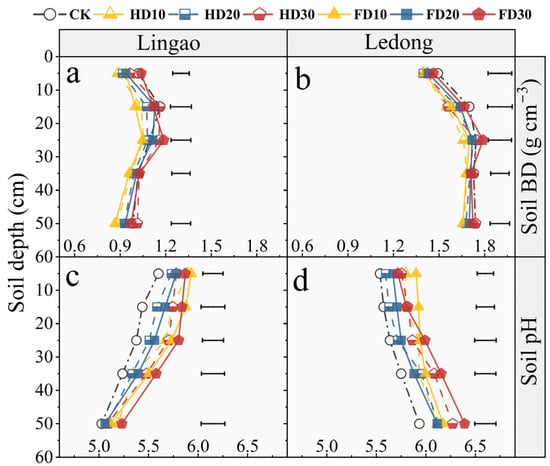
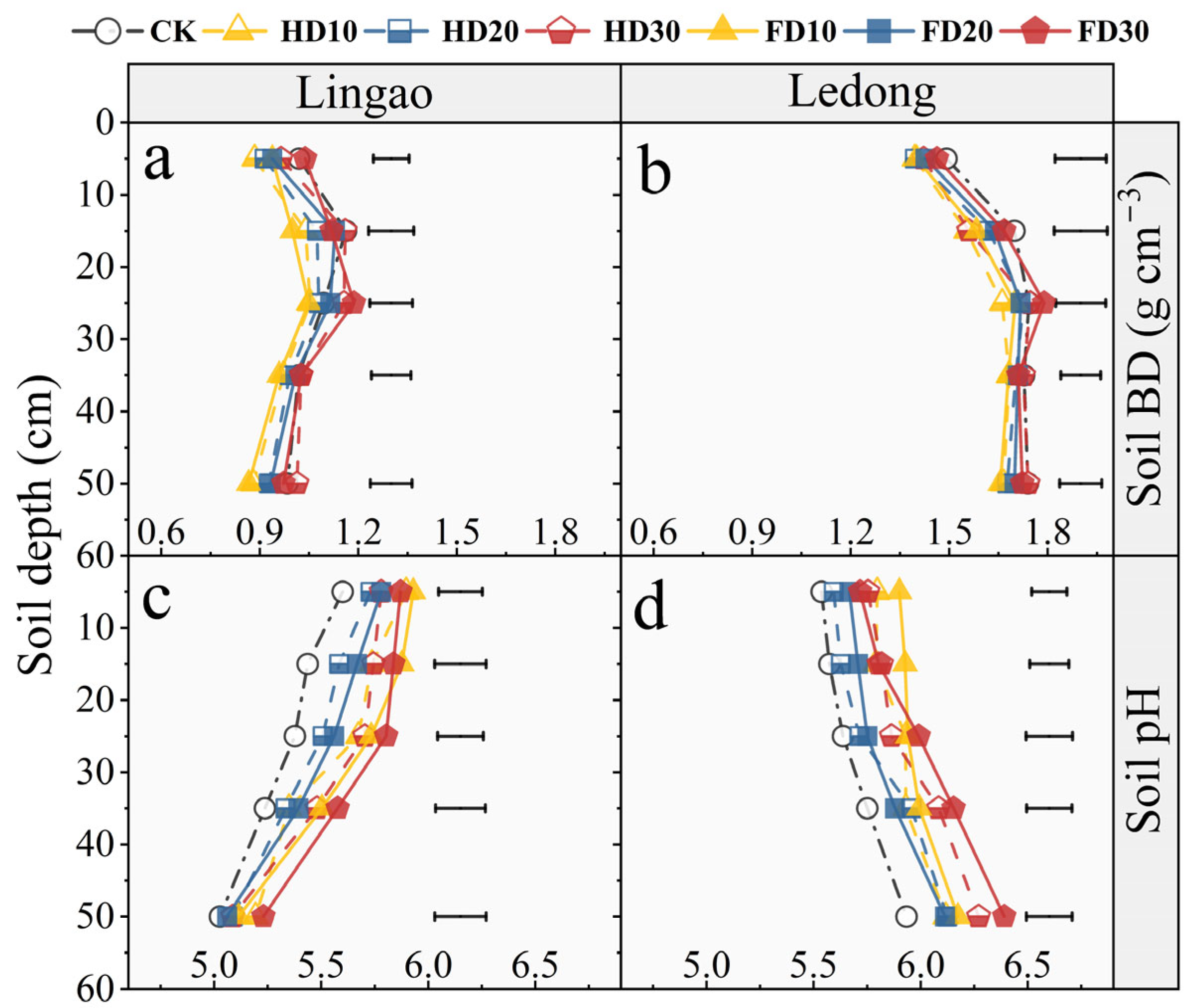
Across both sites, the URRB treatments tended to reduce the soil BD in multiple soil layers relative to CK (Figure 1a,b). At Lingao, compared with the CK, the FD10 treatment significantly reduced the bulk density by 14.0% in the 10–20 cm soil layer, whereas no significant differences were detected in the other layers. URRB also increased the soil pH throughout the 0–60 cm profile. The soil pH values were highest under FD10 in the 0–20 cm soil layers, whereas the highest values shifted to FD30 in the 20–40 cm soil layers (Figure 1c,d). The soil pH under FD30 was on average (across sites and layers) 0.24 units higher than that under FD20 in the 20–40 cm soil layers.
Figure 1.
Soil bulk density (BD) and soil pH in different soil layers at pineapple harvest under different treatments at two sites. (a) BD at Lingao; (b) BD at Ledong; (c) pH at Lingao; (d) pH at Ledong. Data are presented as means ± SD (n = 3). CK, residue removal; HD10, HD20, and HD30 denote half-rate residue burial at 10, 20, and 30 cm depths under the ridge, respectively; FD10, FD20, and FD30 denote full-rate residue burial at 10, 20, and 30 cm depths under the ridge, respectively. Horizontal bars in each panel indicate the least significant differences at p ≤ 0.05 (Fisher’s LSD).
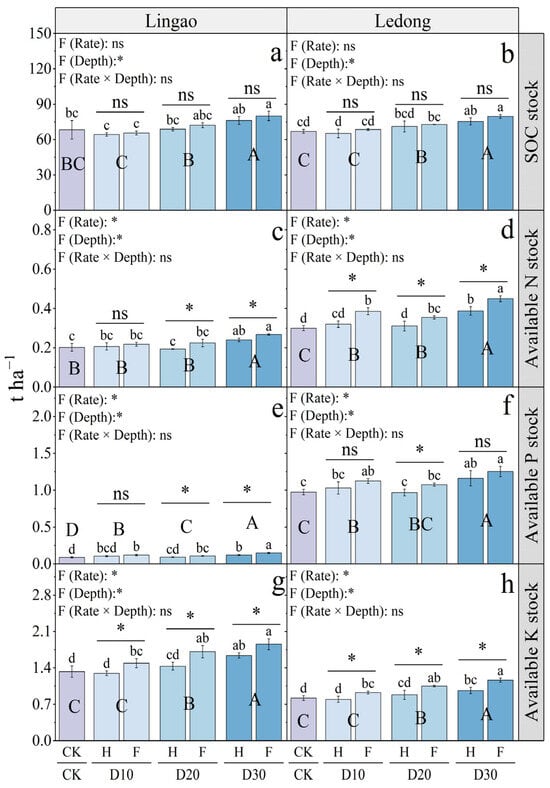
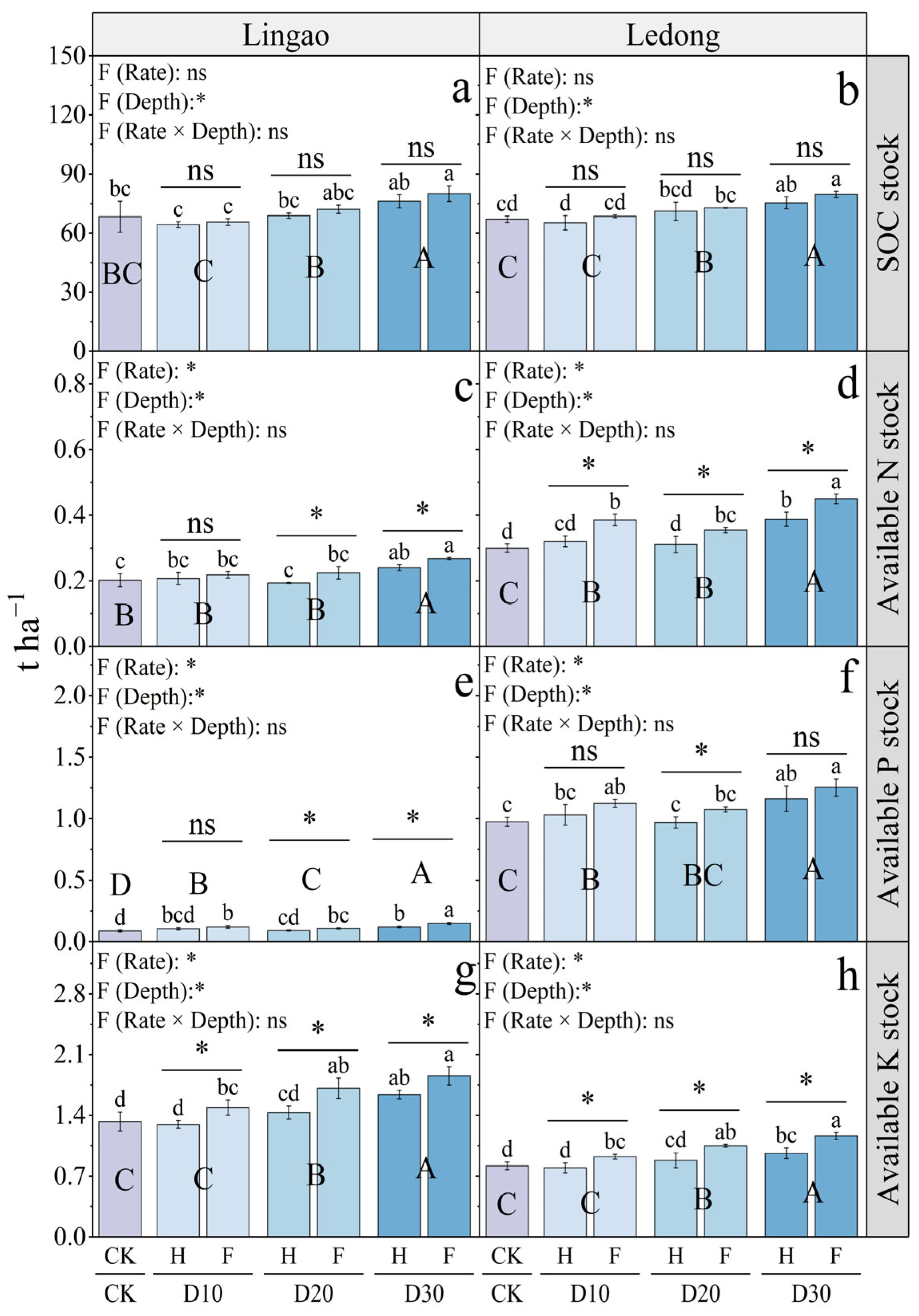
The burial depth had a significant main effect across both sites on SOC stock, following the pattern of D30 > D20 > D10, with differences being significant, whereas the burial rate had no significant effect (Figure 2a,b). The SOC stock at the D30 level was significantly greater than that at the D10 level and in CK. FD30 resulted in the greatest SOC stock, which differed significantly from that in the other treatments except for HD30 and FD20 in two sites; it was, on average, 19.1% and 18.0% greater than those in FD10 and the CK, respectively.
Figure 2.
The stocks of soil organic carbon (SOC) and available nutrients (N, P, and K) in the 0–60 cm soil profile at pineapple harvest under different treatments at two sites. (a) SOC stock at Lingao; (b) SOC stock at Ledong; (c) available N stock at Lingao; (d) available N stock at Ledong; (e) available P stock at Lingao; (f) available P stock at Ledong; (g) available K stock at Lingao; (h) available K stock at Ledong. Data are presented as means ± SD (n = 3). CK, residue removal; H and F denote half-rate and full-rate residue burial, respectively; D10, D20, and D30 denote burial depths of 10, 20, and 30 cm under the ridge, respectively. The two-way ANOVA results are shown in the upper-left corner of each panel; * indicates p ≤ 0.05; ns, not significant. Rate, burial rate (R); Depth, burial depth (D); R × D, interaction between R and D. For statistical comparisons (Fisher’s LSD), * indicates significant differences between burial rates (p ≤ 0.05); different uppercase letters indicate significant differences among burial depths and the CK (p ≤ 0.05); different lowercase letters indicate significant differences among all treatments (p ≤ 0.05). The horizontal lines above the bars indicate comparisons between different burial rates at the same burial depth (p ≤ 0.05).
The available N stock at the D30 level was significantly greater than that at the D20 and D10 levels and in the CK. FD30 had the highest available N stock and differed significantly from all the other treatments except for HD30 (Figure 2c,d). Compared with the CK, both D30 and D10 significantly increased the available P stock, and the available P stock was significantly greater at the F level than at the H level. FD30 resulted in the highest available P stock, which was significantly higher than that in the CK, HD10, HD20, and FD20 (Figure 2e,f). The FD30 also resulted in the highest available K content and stock, which were significantly higher than those under the CK, HD10, and FD10. The stock under FD30 was 24.9% greater on average than that under FD10 (Figure 2g,h).
3.2. Pineapple Morphology and Physiological Characteristics
As shown in Table 1, the burial rate had significant effects on multiple pineapple morphological traits across both sites. Compared with the CK, almost all URRB treatments increased pineapple leaf number, LAI, RDMA, TRL, and TRSA, and most indices at the F level were significantly higher than those at the H level and in the CK. The burial depth also significantly affected several morphological traits, following an overall pattern of D30 > D10 > D20, while the interaction between the burial rate and burial depth was not significant. At the F level, the LAI, RDMA, and TRL under FD30 were on average 10.2%, 26.0%, and 17.3% greater than those under FD20, respectively.
Table 1.
Aboveground and underground morphological indices of pineapple under different treatments at two sites.
The mean MRD at the F level was significantly greater than that at the H level and in the CK at Ledong; the mean MRD under D30 was significantly higher than that under D10 and D20, whereas no significant differences were observed at Lingao. In addition, the MRD at Ledong was lower overall than that at Lingao.
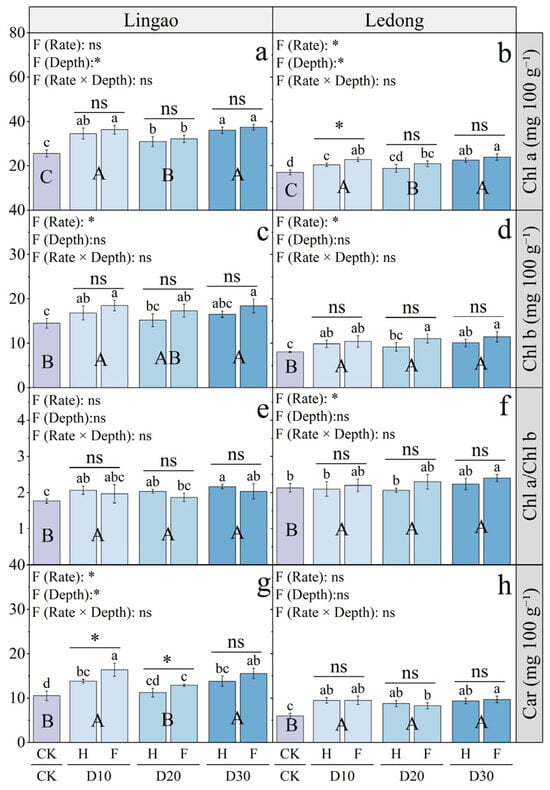
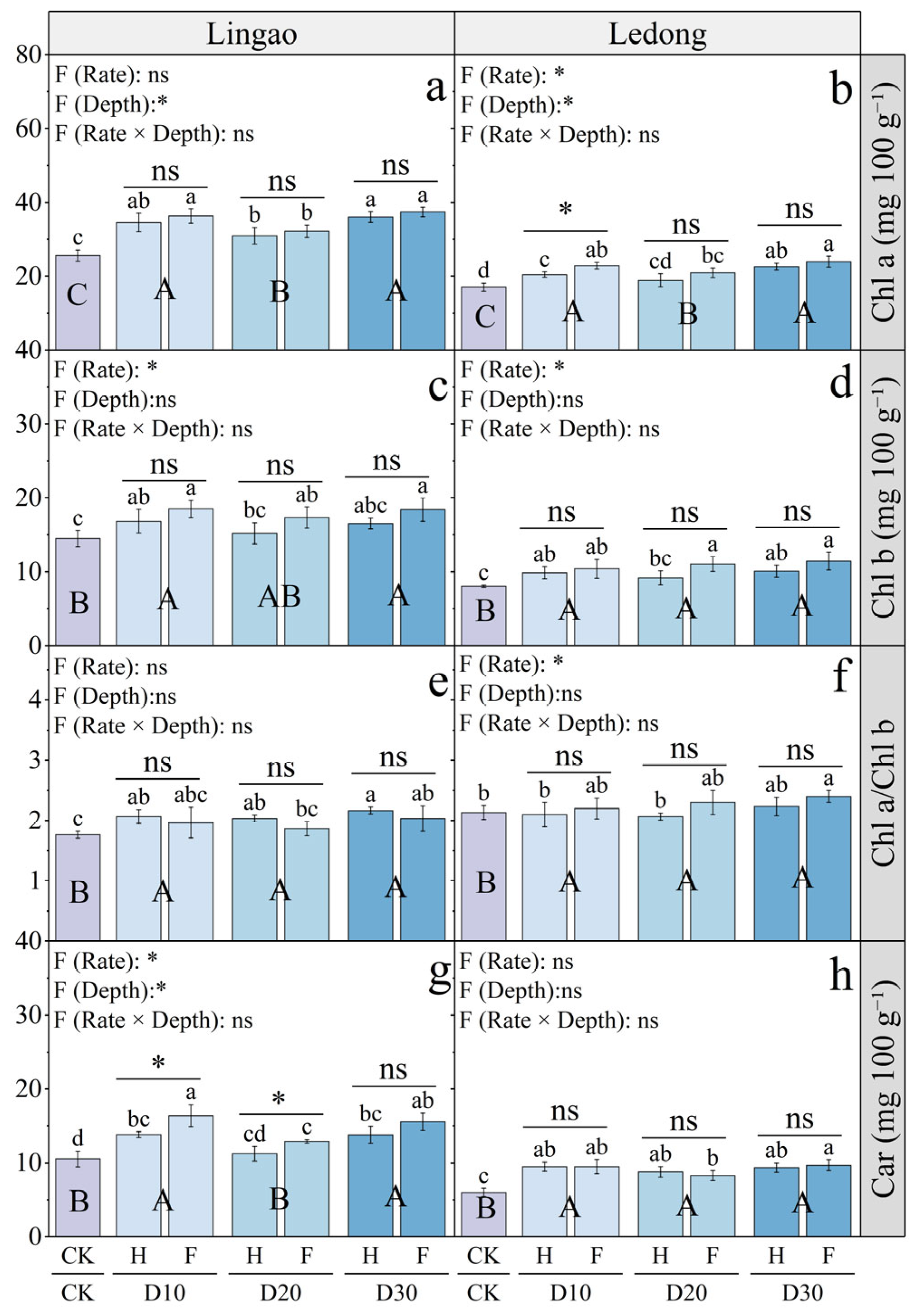
As shown in Figure 3, at both sites, the burial depth significantly affected the Chl a content, generally following a pattern of D30 ≈ D10 > D20; the burial rate significantly affected the Chl b content, with a pattern of full-rate > half-rate. Compared with the CK, nearly all URRB treatments significantly increased Chl a, Chl b, Car, and the Chl a/Chl b ratio. Chl a content at D30 was significantly higher than that at D20 and in CK, but did not differ significantly from that at D10. Across two sites, FD30 resulted in the greatest increase in Chl a and Chl b, and Chl a content under FD30 was significantly greater than that under FD20, HD20, and the CK. Notably, photosynthetic pigment contents were higher at Lingao than at Ledong.
Figure 3.
Photosynthetic pigment contents (based on fresh weight) in pineapple leaves at the active vegetative growth stage at two sites under different treatments. (a) Chl a at Lingao; (b) Chl a at Ledong; (c) Chl b at Lingao; (d) Chl b at Ledong; (e) Chl a/Chl b ratio at Lingao; (f) Chl a/Chl b ratio at Ledong; (g) Carotenoids at Lingao; (h) Carotenoids at Ledong. Data are presented as means ± SD (n = 3). Chl a, chlorophyll a; Chl b, chlorophyll b; Car, carotenoids. The two-way ANOVA results are shown in the upper-left corner of each panel. Rate, burial rate (R); Depth, burial depth (D); R × D, interaction between R and D. * indicates p ≤ 0.05; ns, not significant. CK, residue removal; HD10, HD20, and HD30 denote half-rate residue burial at 10, 20, and 30 cm depth under the ridge, respectively; FD10, FD20, and FD30 denote full-rate residue burial at 10, 20, and 30 cm depth under the ridge, respectively. For statistical comparisons (Fisher’s LSD), different uppercase letters indicate significant differences among burial depths and CK (p ≤ 0.05); different lowercase letters indicate significant differences among all treatments (p ≤ 0.05). The horizontal lines above the bars indicate comparisons between different burial rates at the same burial depth (p ≤ 0.05).
3.3. Dry Matter and Nutrient Accumulation
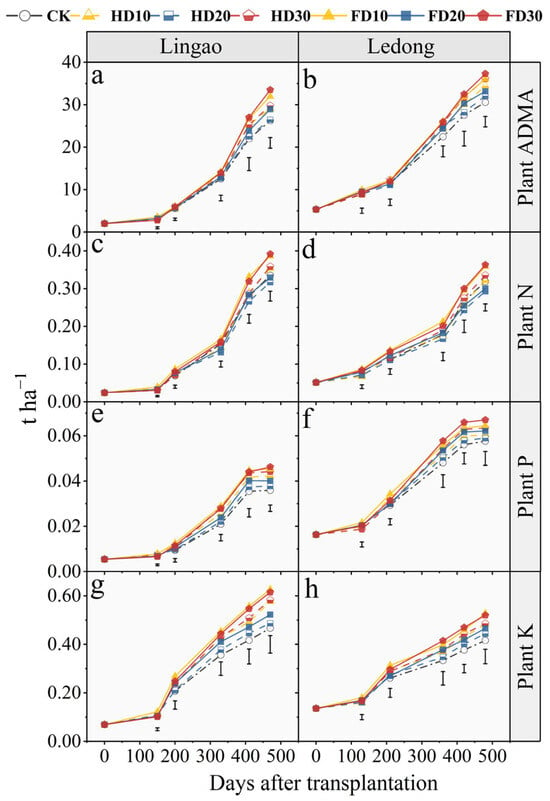
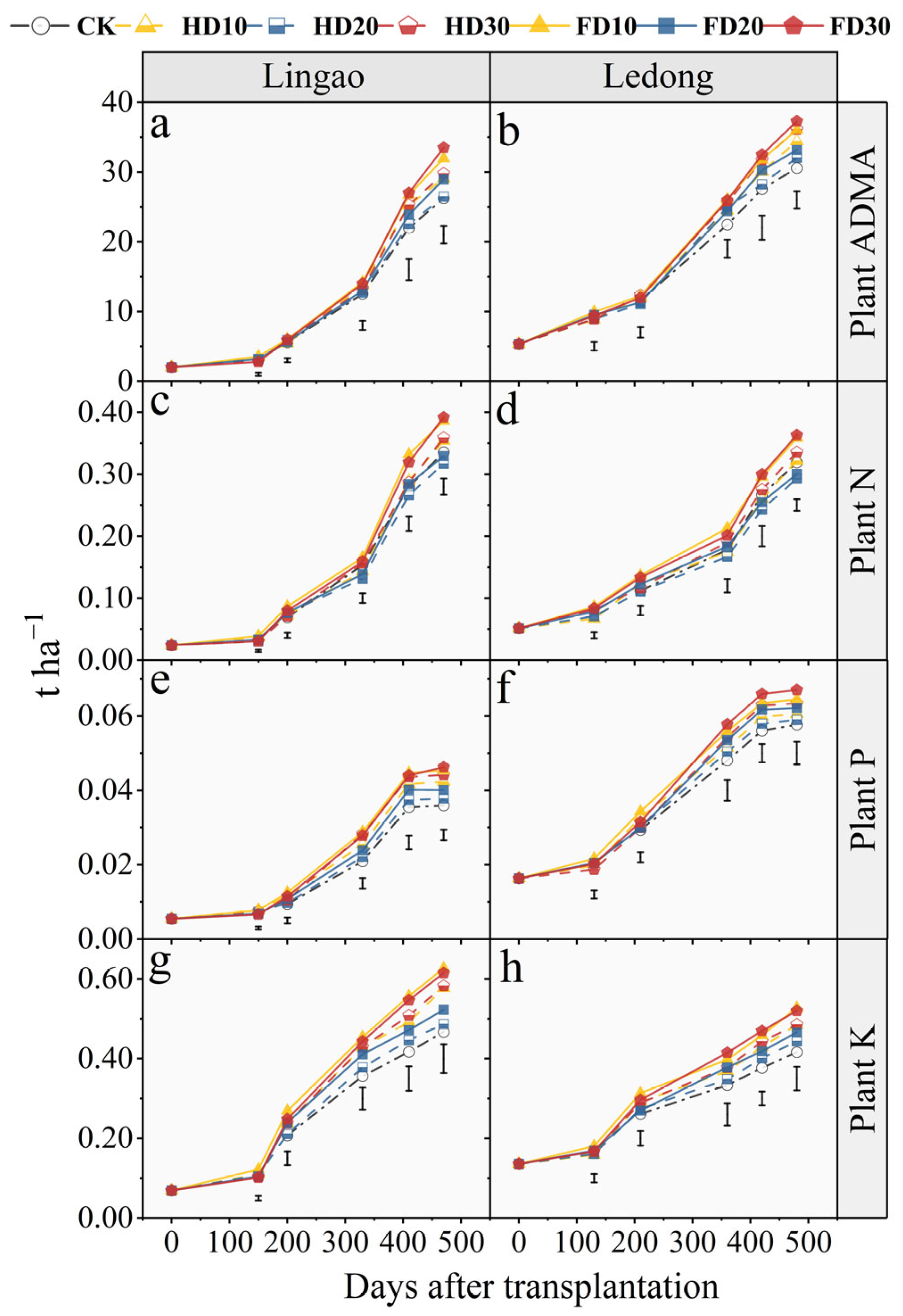
As shown in Figure 4, compared with the CK, almost all URRB treatments increased ADMA and N, P, and K accumulation at both sites, and these responses generally strengthened with increasing burial rate. At maturity, both ADMA and N accumulation were significantly greater under FD30 than under FD20, HD20 and the CK. Notably, compared with the CK, both HD20 and FD20 resulted in lower N accumulation, although the differences were not significant. FD30 exhibited the highest P and K accumulation, which were significantly higher than those in the CK, HD20, and FD20, exceeding those under FD20 by 10.8% and 14.8% on average for P and K accumulation, respectively. In addition, K accumulation was greater at Lingao than at Ledong, whereas P accumulation was lower at Lingao than at Ledong.
Figure 4.
Dynamics of aboveground dry matter and nutrient accumulation in pineapple plants at different growth stages under different treatments at two sites. (a) ADMA at Lingao; (b) ADMA at Ledong; (c) plant N at Lingao; (d) plant N at Ledong; (e) plant P at Lingao; (f) plant P at Ledong; (g) plant K at Lingao; (h) plant K at Ledong. Data are presented as means ± SD (n = 3). ADMA, N, P, and K denote the accumulation of aboveground dry matter, nitrogen, phosphorus, and potassium, respectively. CK, residue removal; HD10, HD20, and HD30 denote half-rate residue burial at 10, 20, and 30 cm depth under the ridge, respectively; FD10, FD20, and FD30 denote full-rate residue burial at 10, 20, and 30 cm depth under the ridge, respectively. Vertical bars in each panel indicate the least significant differences at p ≤ 0.05 (Fisher’s LSD).
3.4. Fruit Yield and Quality
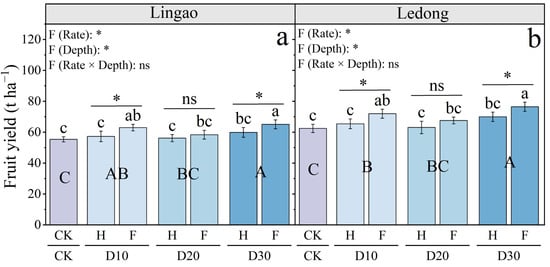
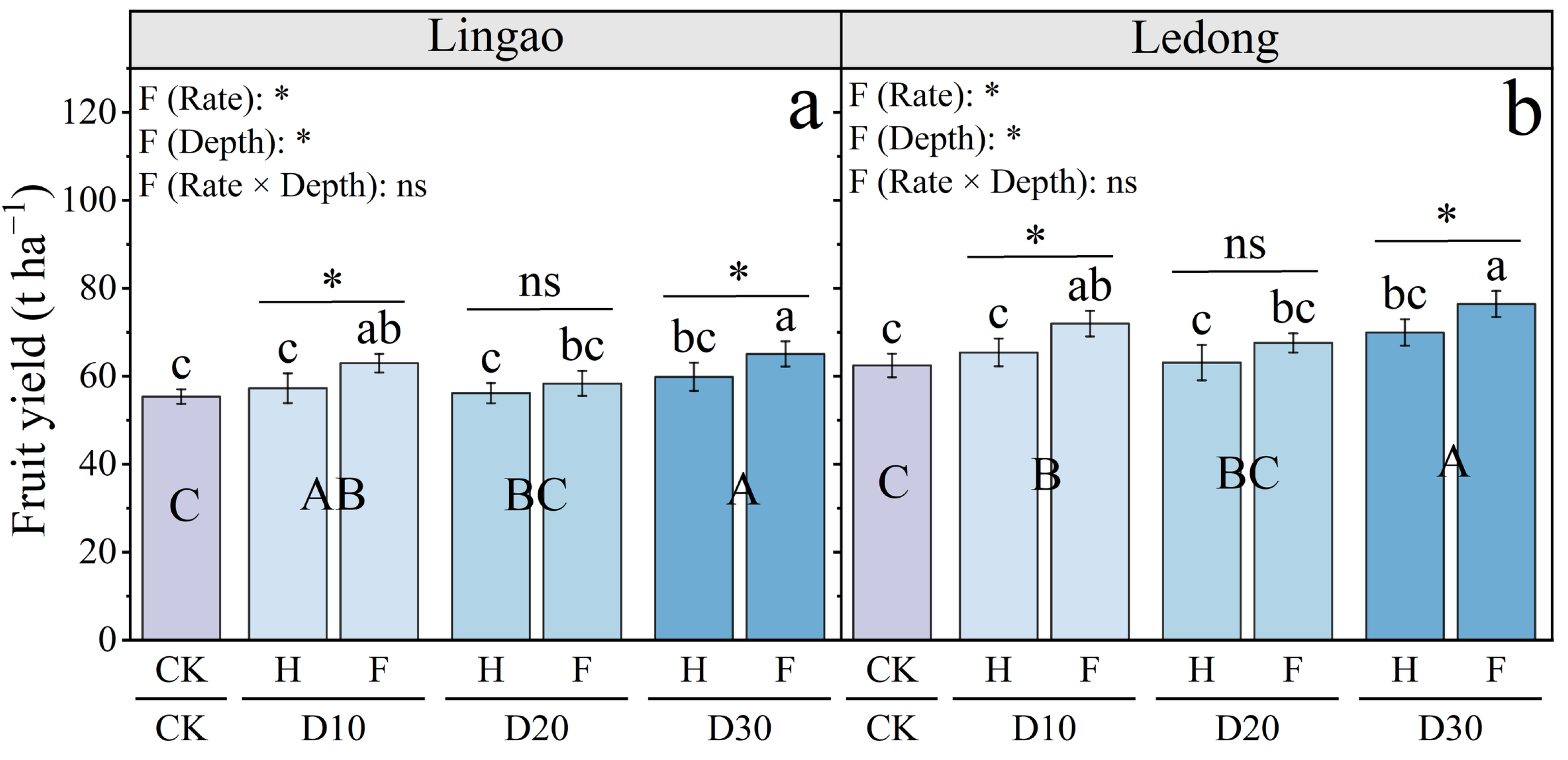
At both sites, both the burial rate and burial depth had significant main effects on yield (Figure 5). The yields at the D30 and D10 levels were significantly greater than those in the CK. Compared with the CK, D30 significantly increased the yield by 15.1% on average. With respect to the burial rates, the yield at the F level was significantly greater than that at the H level and in CK, with average increases of 8.2% and 13.8%, respectively. FD30 resulted in the greatest yield, which was significantly greater than in the other treatments except for FD10. Compared with FD20 and CK, FD30 significantly increased yield by 12.3% and 20.1%, respectively, on average.
Figure 5.
Pineapple fruit yield under different treatments at Lingao (a) and Ledong (b). Data are presented as means ± SD (n = 3). CK, residue removal; H and F denote half-rate and full-rate residue burial, respectively; D10, D20, and D30 denote burial depths of 10, 20, and 30 cm under the ridge, respectively. The two-way ANOVA results are shown in the upper-left corner of each panel; * indicates p ≤ 0.05; ns, not significant. Rate, burial rate (R); Depth, burial depth (D); R × D, interaction between R and D. For statistical comparisons (Fisher’s LSD), * indicates significant differences between burial rates (p ≤ 0.05); different uppercase letters indicate significant differences among burial depths and the CK (p ≤ 0.05); different lowercase letters indicate significant differences among all treatments (p ≤ 0.05). The horizontal lines above the bars indicate comparisons among different burial rates at the same burial depth (p ≤ 0.05).
With respect to fruit quality, although the main effects of most factors were not significant, separate mean comparisons revealed that compared with their respective values in CK, the soluble sugar content at Lingao and the TSSs at Ledong increased significantly at the F level (Table 2). Both half- and full-rate residue burial significantly increased fruit vitamin C concentration relative to the CK, with an average increase of 21.1%; FD30 showed the largest increase, at 25.3%.
Table 2.
Quality indicators of pineapple fruits under different treatments at two sites.
3.5. Correlation and Path Analysis
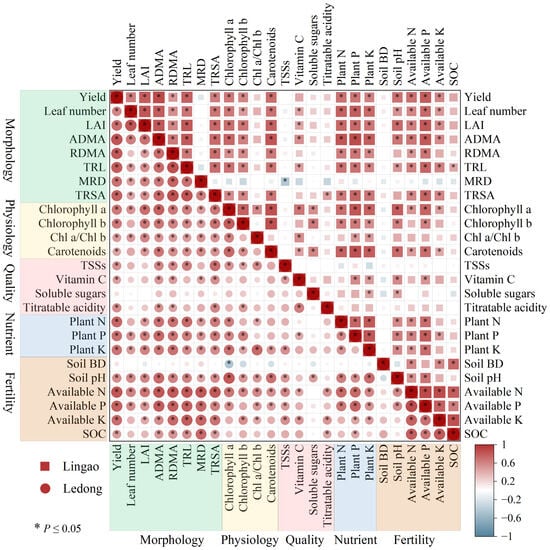
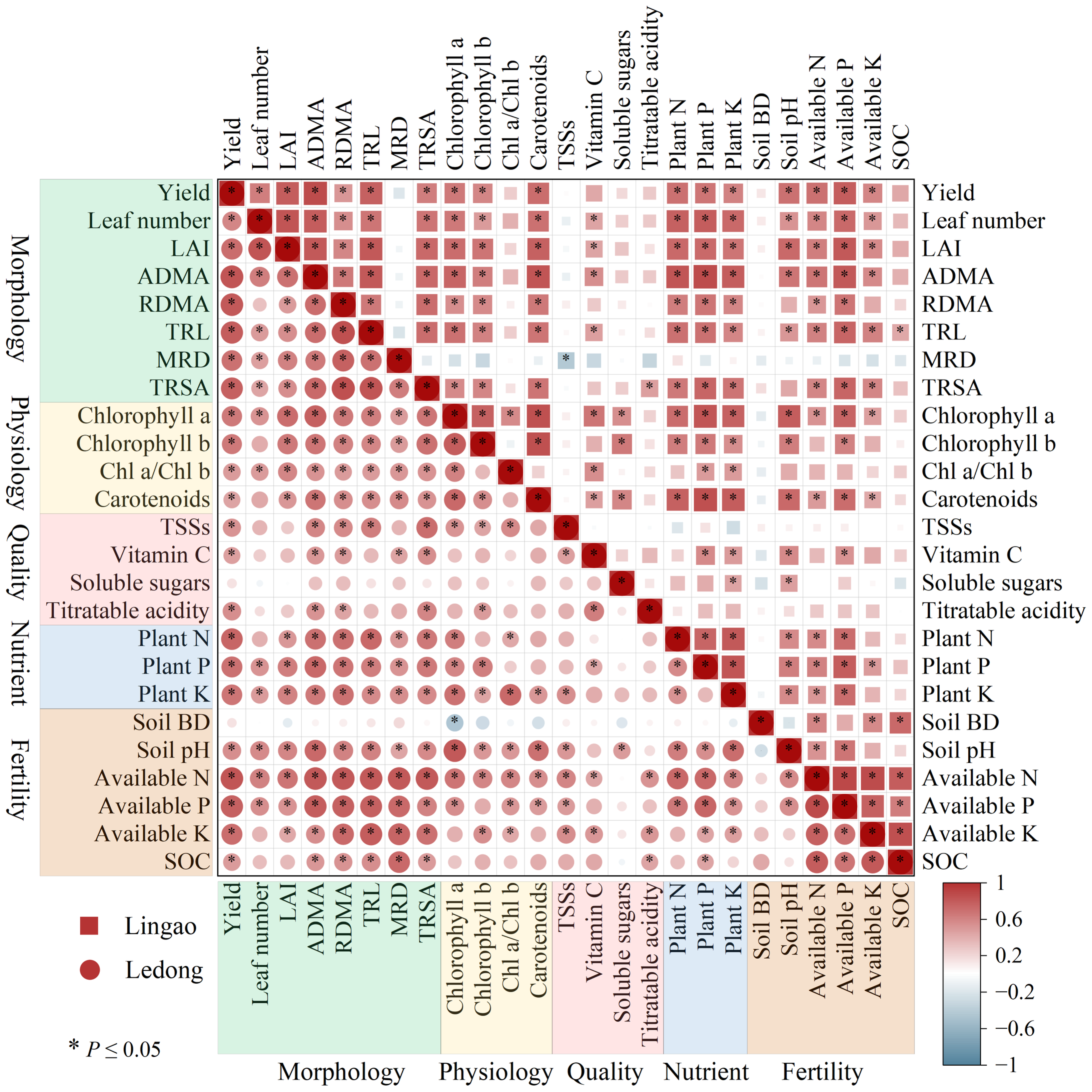
At both sites, both the yield and ADMA were significantly positively correlated with RDMA, TRL, TRSA, LAI, Chl a, Chl b, Car, plant N, P, and K (Figure 6). In turn, plant N, P, and K were positively correlated with soil available N, P, and K, whereas soil available N and available P were significantly positively correlated with soil pH and SOC.
Figure 6.
Heatmap of Pearson correlations among pineapple growth traits and soil properties at two sites (n = 21). LAI, leaf area index; ADMA, aboveground dry matter accumulation; RDMA, root dry matter accumulation; TRL, total root length; MRD, mean root diameter; TRSA, total root surface area; TSSs, total soluble solids; Plant N, P, and K denote plant nitrogen, phosphorus, and potassium accumulation, respectively; soil BD and soil pH denote mean soil bulk density and pH across the soil profile; available N, P, K, and SOC denote the stocks of available nitrogen, phosphorus, potassium, and soil organic carbon, respectively.
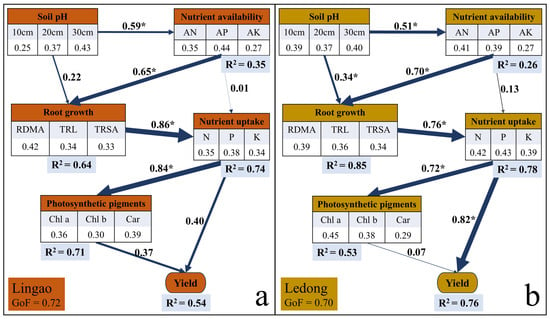
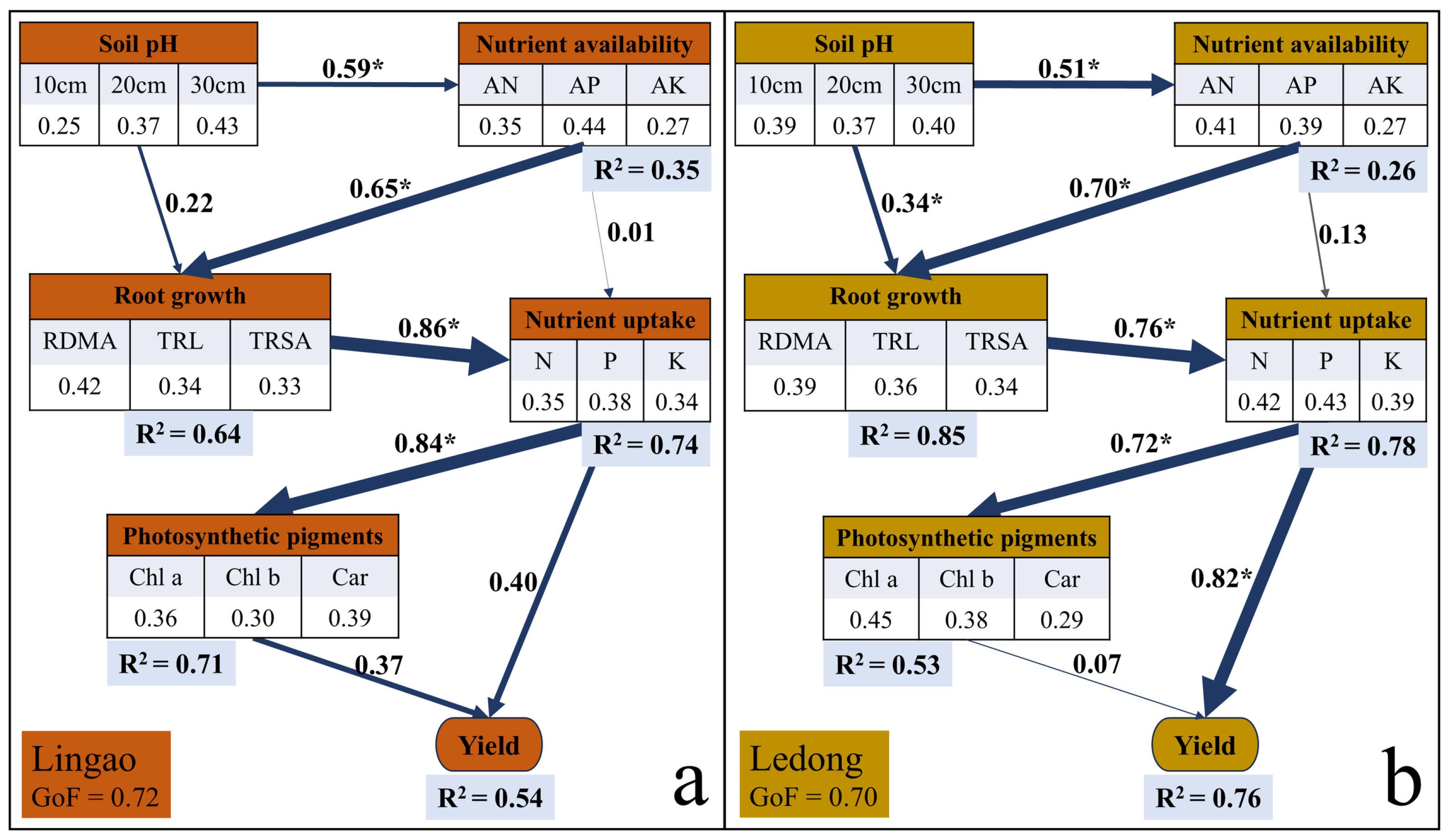
The PLS-PM yielded goodness-of-fit (GoF) values of 0.72 and 0.70 at Lingao and Ledong and explained 54% and 76% of the variation in yield at Lingao and Ledong, respectively (Figure 7). Significant positive direct associations were identified between soil pH and nutrient availability, nutrient availability and root growth, root growth and nutrient uptake, and nutrient uptake and photosynthetic pigments at both sites (Table S2). At both sites, the indirect association between soil pH and nutrient uptake was significant. The direct association between nutrient uptake and yield was significant at Ledong, but not at Lingao. Nevertheless, the total effects of nutrient uptake on yield were positive and significant at both sites (Lingao: β = 0.706, 95% CI [0.417, 0.883]; Ledong: β = 0.869, 95% CI [0.750, 0.935]). The direct association between photosynthetic pigments and yield was not significant at either site.
Figure 7.
Partial least squares path model (PLS-PM) linking soil pH, nutrient availability, root growth, photosynthetic pigments, nutrient uptake, and yield (n = 21) at Lingao (a) and Ledong (b). Rectangles represent latent variables, with corresponding manifest variables and their weights listed inside. The arrows indicate hypothesized pathways. The numbers on the arrows indicate standardized path coefficients (β). * indicates a direct path whose bootstrap 95% confidence interval excludes zero. Arrow width is proportional to the value of β. Indirect effects and total effects on yield are reported in Table S2. AN, AP, and AK denote the stocks of available nitrogen, phosphorus, and potassium, respectively. RDMA, root dry matter accumulation; TRL, total root length; TRSA, total root surface area; N, P, and K denote total nitrogen, phosphorus, and potassium accumulation in pineapple plants, respectively; Chl a, Chl b, and Car denote chlorophyll a, b, and carotenoids, respectively.
4. Discussion
When residue is incorporated into soil, its low density can dilute the mineral soil matrix and thereby reduce soil bulk density [24,40], a pattern also observed here, especially in the 0–20 cm soil layers (Figure 1). However, this physical effect is likely to weaken as the incorporated residue decomposes. Given the rapid decomposition of pineapple residue under tropical conditions [31], differences in bulk density were already minimal at pineapple maturity (480 days after residue burial), particularly at the warmer Ledong site. As the residue decomposed, it released base cations (e.g., Ca2+, Mg2+, and K+) [11] and supplied organic inputs, increasing the dissolved organic carbon and the abundance of negatively charged functional groups (e.g., –COO– and R–O–) that neutralize H+ [41]. Consistent with these mechanisms, nearly all treatments increased the soil pH and SOC across the 0–60 cm profile (Figure 1 and Figure S3). Notably, full-rate residue burial did not result in significantly higher soil pH or SOC content than half-rate residue return did. One plausible explanation is that greater residue inputs may trigger a positive priming effect, thereby accelerating native SOC mineralization and ultimately offsetting part of the added C [42], but further verification is needed. Increasing the residue burial rate did not lead to a further significant increase in soil pH, and the underlying mechanisms warrant further investigation.
In contrast, burial depth influenced both the magnitude of the soil property responses and their distribution across soil layers. At the 30 cm depth, temperature fluctuations may be smaller and O2 diffusion more restricted, which could in turnslow mineralization and favor SOC stabilization [43,44]. Deep placement may also disrupt the plow pan, reduce penetration resistance, and promote deeper rooting, thereby increasing root biomass and root-derived C inputs [45,46]. In this study, SOC content and SOC stock increased with burial depth, with the D30 level (particularly FD30) showing the highest values (Figure 2 and Figure S3), in line with reports that deep residue incorporation enhances subsoil C stabilization [47,48]. However, the reasons for the consistently lowest soil pH at D20 warrant further investigation. Overall, soil properties were more sensitive to the burial depth than the burial rate. Notably, the vertical distribution of available nutrients differed between Ledong and Lingao (Figure S3). These spatial patterns may be associated with differences in soil texture and nutrient retention characteristics between the sites (Table S1) [49,50].
In addition to improving soil conditions, pineapple residue is a potential source of essential nutrients, including N, P, K and other secondary and micronutrients [7]. After incorporation, these nutrients are progressively released during residue decomposition, thereby increasing available nutrients in the soil [51]. Residue burial may also reduce nutrient leaching by increasing soil pH and physical retention and chemical sorption, thereby enhancing soil nutrient retention and availability [52,53]. Although this process was not directly assessed in the present study, URRB increased the contents of available N, P, and K within the residue-incorporated soil layers (10–30 cm) at harvest at both sites, with full-rate residue return generally exceeding half-rate (Figure S3). Nutrient stocks followed the same pattern, and soil pH was positively correlated with available N, P, and K (Figure 6). Across burial-depth levels, the D30 level resulted in significantly higher N, P, and K contents and stocks than the D10 and D20 levels did. This depth effect may be related to differences in residue decomposition and nutrient release under contrasting burial conditions, because changes in the soil environment with burial depth could influence residue decomposition rate and thus may affect nutrient release [54]. If deeper burial slowed these processes, nutrient supply might be prolonged and better aligned with crop demand. However, decomposition and nutrient release dynamics were not measured in this study, so this explanation remains hypothetical. In contrast, at the 20 cm depth, soil temperature and aeration may have been relatively favorable for microbial activity, potentially accelerating residue decomposition and nutrient cycling, while also increasing microbial N immobilization [55,56]. This provides a plausible explanation for the lower available N and the relatively constrained pineapple growth and nutrient accumulation at the D20 level (Table 1 and Figure 4), with plant N accumulation even lower than that in the CK. Overall, these depth-dependent responses suggest that the effects of residue burial management are site- and system-specific. In tropical cultivation systems, distinct climate and soil conditions may reshape decomposition dynamics and nutrient release patterns, whereas cultivation systems that have a long growth duration may be better matched to regimes that promote slower decomposition and a more sustained nutrient supply.
Residue return not only directly supplies additional nutrients carried by the residue, but also can improve the availability of native soil nutrients such as phosphorus [12,57]. In this study, compared with residue removal, URRB generally increased soil pH, and soil pH was positively correlated with the soil available P stock across the two sites (r > 0.5, p ≤ 0.05) (Figure 6). Path analysis also identified a significant positive association between soil pH and nutrient availability at both sites (β = 0.591 and 0.515 at Lingao and Ledong, respectively (Figure 7; Table S2). These findings are consistent with a potential role of soil pH in nutrient availability under URRB, although the underlying mechanism was not directly tested.
Residue return has been reported to improve root growth and root system architecture and increase mycorrhiza-mediated nitrogen uptake [16,25,58]. Consistent with this, we observed that at the full-rate level, the RDMA, TRL, and TRSA were significantly higher than those in CK. Notably, the RDMA was comparable between the two sites, whereas the TRL and MRD differed markedly (Table 1), which may be related to the difference in soil texture [59,60]. In addition, lower P availability at Lingao may have induced root extension to enhance P acquisition, thereby resulting in greater TRL [61].
The D30 level likely facilitated loosening of the plow pan, enabling a deeper and more extensive root distribution and producing the greatest increases in root traits [45]. These traits were significantly positively correlated with available N, P, and K stocks and with plant N, P, and K accumulation (Figure 6). Within the specified model, nutrient availability showed a significant positive indirect association with plant nutrient uptake through root growth at both sites, whereas the corresponding direct associations were not significant (Figure 7; Table S2). These results support a statistical pathway linking nutrient availability, root growth and nutrient uptake, but do not establish root growth as a causal mediator. In this study, plant N, P, and K accumulation was generally greater under full-rate residue burial than under half-rate (Figure 4). Accordingly, the full-rate residue burial resulted in significant increases in the leaf number, LAI, and Chl a, Chl b, and Car contents, compared with CK (Table 1; Figure 3). Similar responses have been reported in related studies [15,62,63]. In addition, residue burial significantly increased the vitamin C content without affecting the TSS/TA ratio (Table 2), further suggesting that URRB has the potential to enhance pineapple nutritional quality.
Correlation analysis revealed that leaf traits and photosynthetic pigment contents were significantly positively correlated with plant nutrient accumulation, dry matter accumulation, and yield (Figure 6). Path analysis further identified significant positive direct associations between soil nutrient availability and root growth and between root growth and plant nutrient uptake, together with a significant positive total effect of nutrient uptake on yield (Figure 7; Table S2). Taken together, these results suggest that URRB may stimulate root growth, promote nutrient uptake and support pigment synthesis and leaf area expansion. This, in turn, may enhance light interception and carbon assimilation efficiency, resulting in greater biomass production and yield, although the increases in photosynthetic pigment concentrations do not necessarily mean greater carbon assimilation efficiency. The observed improvements in plant growth and yield are consistent with previous studies [62,64].
Overall, slower residue decomposition, a more sustained nutrient supply and reduced nutrient leaching are potential explanations for the favorable soil and plant responses under FD30. However, residue decomposition, nutrient release dynamics and leaching losses were not measured in this study, and these mechanisms require direct verification in the future. Regardless, FD30 resulted in the greatest dry matter accumulation and yield. Therefore, under the conditions of the present study, full-rate residue burial at the 30 cm depth under the ridge appears to be the most promising sustainable residue management option for improving both crop productivity and soil fertility.
5. Conclusions
Our results indicate that URRB is an effective practice for improving soil fertility and pineapple yield in tropical pineapple fields. The burial rate and burial depth had significant main effects on several soil properties and plant traits, but their interaction was not significant. The full-rate return generally outperformed the half-rate return, and the 30 cm depth under the ridge was the optimal burial depth under the conditions of the present study. Full-rate residue burial at a 30 cm depth under the ridge can be considered an effective strategy for improving soil fertility and sustaining pineapple productivity in tropical production systems. These findings highlight the importance of both the burial rate and burial depth for maximizing the benefits of residue burial management.
Supplementary Materials
The following supporting information can be downloaded at: https://www.mdpi.com/article/10.3390/agronomy16212095/s1, Figure S1: Air temperature and precipitation during the pineapple growth period at two sites; Figure S2: Schematic diagram of under-ridge residue burial and representative field photographs of pineapple under different treatments; Figure S3: Soil organic carbon and available nutrient contents in different soil layers under different treatments at two sites; Table S1: Initial soil physicochemical properties at two sites; Table S2: Standardized direct and indirect effects and total effects on yield from the PLS-PM at two sites.
Author Contributions
Conceptualization, C.L. (Changjiang Li) and S.L.; methodology, S.L. and X.J.; software, X.J. and M.C.; validation, X.M. and X.D.; formal analysis, X.J.; investigation, M.S., X.W., X.M. and X.D.; resources, J.L.; data curation, M.S. and X.W.; writing—original draft preparation, S.L.; writing—review and editing, C.L. (Changzhen Li) and C.L. (Changjiang Li); visualization, M.C.; supervision, C.L. (Chaojie Lan), C.L. (Changjiang Li) and J.L.; project administration, C.L. (Chaojie Lan) and C.L. (Changzhen Li); funding acquisition, C.L. (Changjiang Li). All authors have read and agreed to the published version of the manuscript.
Funding
This work was supported by the National Natural Science Foundation of China (32260724), the Natural Science Foundation of Hainan Province (323RC424), the Key Research and Development Program of Hainan Province (ZDYF2025XDNY064), and the Collaborative Innovation Centre Research Program of Hainan University (XTCX2022NYC18).
Data Availability Statement
The raw data supporting the conclusions of this article will be made available by the authors on request.
Conflicts of Interest
Author Jian Luo was employed by the company Hainan Tian-Di-Ren Ecological Agriculture Incorporated Company. The remaining authors declare that the research was conducted in the absence of any commercial or financial relationships that could be construed as a potential conflict of interest.
References
- Mohd Ali, M.; Hashim, N.; Abd Aziz, S.; Lasekan, O. Pineapple (Ananas comosus): A comprehensive review of nutritional values, volatile compounds, health benefits, and potential food products. Food Res. Int. 2020, 137, 109675. [Google Scholar] [CrossRef] [Scilit] [PubMed]
- FAO. FAOSTAT: Production: Crops and Livestock Products. Available online: https://www.fao.org/faostat/en/#data (accessed on 11 January 2026).
- Liang, Z.; Jin, X.; Li, C.; Zhai, P.; Zhao, Y.; Cai, J.; Li, S.; Yang, S.; Li, C. Combination of organic fertilizer and slow-release fertilizer increases pineapple yields, agronomic efficiency and reduces greenhouse gas emissions under reduced fertilization conditions in tropical areas. J. Clean. Prod. 2022, 343, 131054. [Google Scholar] [CrossRef] [Scilit]
- Yan, C.; An, D.; Liu, Y.; Zhao, B.; Zhao, Q.; Ma, Z.; Ma, H. Rotation and organic fertilization alleviate soil microbial phosphorus limitation and improve soil health and productivity in a continuous cropping pineapple orchard. Eur. J. Agron. 2026, 174, 127980. [Google Scholar] [CrossRef] [Scilit]
- Guo, J.; Zhang, H.; Yang, Y.; Yang, J.; Tang, H.; Deng, Y.; Ruan, Y.; Zhao, Y. Soil nutrient evaluation of pineapple orchards based on factor and cluster analysis. Chin. J. Soil Sci. 2019, 50, 137–143. [Google Scholar] [CrossRef]
- Li, T.; Hong, X.; Liu, S.; Wu, X.; Fu, S.; Liang, Y.; Li, J.; Li, R.; Zhang, C.; Song, X.; et al. Cropland degradation and nutrient overload on Hainan Island: A review and synthesis. Environ. Pollut. 2022, 313, 120100. [Google Scholar] [CrossRef] [Scilit] [PubMed]
- Vásquez-Jiménez, J.; Bartholomew, D.P. Plant nutrition. In The Pineapple: Botany, Production and Uses, 2nd ed.; Sanewski, G.M., Bartholomew, D.P., Paull, R.E., Eds.; CABI: Wallingford, UK, 2018; pp. 175–202. [Google Scholar] [CrossRef] [Scilit]
- Liao, A.Y.; Spizzirri, E.; Rodriguez-Vasquez, M.J.; Bustamante-Roman, M.; Rojas-Sossa, J.-P.; Toscano, A.; Valenti, F. Powering pineapple industry with pineapple residues—A circular bioenergy strategy for Costa Rica. Renew. Energy 2026, 266, 125709. [Google Scholar] [CrossRef] [Scilit]
- Liao, C.Y.; Guan, Y.J.; Bustamante-Román, M. Techno-Economic Analysis and Life Cycle Assessment of Pineapple Leaves Utilization in Costa Rica. Energies 2022, 15, 5784. [Google Scholar] [CrossRef] [Scilit]
- Jin, Z.; Shah, T.; Zhang, L.; Liu, H.; Peng, S.; Nie, L. Effect of straw returning on soil organic carbon in rice-wheat rotation system: A review. Food Energy Secur. 2020, 9, e200. [Google Scholar] [CrossRef] [Scilit]
- Sukitprapanon, T.S.; Jantamenchai, M.; Tulaphitak, D.; Prakongkep, N.; Gilkes, R.J.; Vityakon, P. Influence of application of organic residues of different biochemical quality on phosphorus fractions in a tropical sandy soil. Agronomy 2021, 11, 248. [Google Scholar] [CrossRef] [Scilit]
- Tang, X.; Zhou, Y.; Wu, R.; Wu, K.; Zhao, H.; Wang, W.; Zhang, Y.; Huang, R.; Wu, Y.; Li, B.; et al. Long-term straw returning enhances phosphorus uptake by Zea mays L. through mediating microbial biomass phosphorus turnover and root functional traits. Plants 2024, 13, 2389. [Google Scholar] [CrossRef] [Scilit] [PubMed]
- Yang, J.; Liu, H.; Lei, T.; Rahma, A.E.; Liu, C.; Zhang, J. Effect of straw-incorporation into farming soil layer on surface runoff under simulated rainfall. Catena 2021, 199, 105082. [Google Scholar] [CrossRef] [Scilit]
- Li, S.; Wu, X.; Liang, G.; Gao, L.; Wang, B.; Lu, J.; Abdelrhman, A.A.; Song, X.; Zhang, M.; Zheng, F.; et al. Is least limiting water range a useful indicator of the impact of tillage management on maize yield? Soil Tillage Res. 2020, 199, 104602. [Google Scholar] [CrossRef] [Scilit]
- Dang, K.; Ran, C.; Tian, H.; Gao, D.; Mu, J.; Zhang, Z.; Geng, Y.; Zhang, Q.; Shao, X.; Guo, L. Combined effects of straw return with nitrogen fertilizer on leaf ion balance, photosynthetic capacity, and rice yield in saline-sodic paddy fields. Agronomy 2023, 13, 2274. [Google Scholar] [CrossRef] [Scilit]
- Chen, M.; Wang, G.; Jing, Y.; Zhou, J.; Song, J.; Chang, F.; Yu, R.; Wang, J.; Wang, W.; Sun, X.; et al. Straw interlayer improves sunflower root growth: Evidence from moisture and salt migration and the microbial community in saline-alkali soil. J. Integr. Agric. 2024, 23, 3870–3881. [Google Scholar] [CrossRef] [Scilit]
- Ul Islam, M.; Guo, Z.; Jiang, F.; Peng, X. Does straw return increase crop yield in the wheat-maize cultivation system in China? A meta-analysis. Field Crops Res. 2022, 279, 108447. [Google Scholar] [CrossRef] [Scilit]
- Xing, S.; Zhang, G.; Zhang, N.; Zhang, Y.; Zhang, Y. Effects of straw returning methods on seasonal variation in soil moisture and water storage in Mollisols with different degradation degrees. Agric. Water Manag. 2025, 319, 109796. [Google Scholar] [CrossRef] [Scilit]
- Huang, T.; Yang, N.; Lu, C.; Qin, X.; Siddique, K.H.M. Soil organic carbon, total nitrogen, available nutrients, and yield under different straw returning methods. Soil Tillage Res. 2021, 214, 105171. [Google Scholar] [CrossRef] [Scilit]
- Li, Y.; Abalos, D.; Arthur, E.; Feng, H.; Siddique, K.H.M.; Chen, J. Different straw return methods have divergent effects on winter wheat yield, yield stability, and soil structural properties. Soil Tillage Res. 2024, 238, 105992. [Google Scholar] [CrossRef] [Scilit]
- Sui, P.; Tian, P.; Lian, H.; Wang, Z.; Ma, Z.; Qi, H.; Mei, N.; Sun, Y.; Wang, Y.; Su, Y.; et al. Straw incorporation management affects maize grain yield through regulating nitrogen uptake, water use efficiency, and root distribution. Agronomy 2020, 10, 324. [Google Scholar] [CrossRef] [Scilit]
- Yang, H.; Zhou, J.; Feng, J.; Zhai, S.; Chen, W.; Liu, J.; Bian, X. Ditch-buried straw return: A novel tillage practice combined with tillage rotation and deep ploughing in rice-wheat rotation systems. In Advances in Agronomy; Sparks, D.L., Ed.; Elsevier: Amsterdam, The Netherlands, 2019; Volume 154, pp. 257–290. [Google Scholar] [CrossRef] [Scilit]
- Zhang, M.; Han, X.; Dang, P.; Wang, H.; Chen, Y.; Qin, X.; Siddique, K.H.M. Decreased carbon footprint and increased grain yield under the ridge–furrow plastic film mulch with ditch-buried straw returning: A sustainable option for spring maize production in China. Sci. Total Environ. 2022, 838, 156412. [Google Scholar] [CrossRef] [Scilit] [PubMed]
- Wu, G.; Ling, J.; Zhao, D.; Xu, Y.; Liu, Z.; Wen, Y.; Zhou, S. Deep-injected straw incorporation improves subsoil fertility and crop productivity in a wheat-maize rotation system in the North China Plain. Field Crops Res. 2022, 286, 108612. [Google Scholar] [CrossRef] [Scilit]
- Zhang, X.; Li, L.; Zhang, G.; Jiu, A.; Chen, C.; Zhou, J.; Li, F. Straw burial increased wheat yield by decreasing soil moisture levels in a lower Yangtze River field. Field Crops Res. 2025, 331, 110006. [Google Scholar] [CrossRef] [Scilit]
- Liu, N.; Li, Y.; Cong, P.; Wang, J.; Guo, W.; Pang, H.; Zhang, L. Depth of straw incorporation significantly alters crop yield, soil organic carbon and total nitrogen in the North China Plain. Soil Tillage Res. 2021, 205, 104772. [Google Scholar] [CrossRef] [Scilit]
- Zhang, M.M.; Yang, N.; Han, X.Q.; Lal, R.; Huang, T.T.; Dang, P.F.; Xue, J.Q.; Qin, X.L.; Siddique, K.H.M. Effects of straw returning depth on soil organic carbon sequestration and crop yield in China: A meta-analysis. Agric. Ecosyst. Environ. 2025, 393, 109799. [Google Scholar] [CrossRef] [Scilit]
- Wang, Y.; Ji, Y.; Ma, J.; Elena, M.; Assiya, A.; Ding, R.; Jia, Z.; Siddique, K.H.M.; Liu, E.; He, J.; et al. Evaluate the impacts of different straw returning rates on soil quality and field environmental sustainability of film mulching or non-mulching farmland in semiarid region. Environ. Res. 2025, 285, 122483. [Google Scholar] [CrossRef] [Scilit] [PubMed]
- Zhou, J.; Li, Y.; Lou, J.; Wang, Y.; Kan, Z.; Neugschwandtner, R.W.; Li, F.; Liu, J.; Dong, K.; Xue, Y.; et al. Fungal saprotrophic promotion and plant pathogenic suppression under ditch-buried straw return with appropriate burial amount and depth. Plants 2024, 13, 1738. [Google Scholar] [CrossRef] [Scilit] [PubMed]
- Che, Y.; Zhang, B.; Liu, B.; Wang, J.; Zhang, H. Effects of straw return rate on soil physicochemical properties and yield in paddy fields. Agronomy 2024, 14, 1668. [Google Scholar] [CrossRef] [Scilit]
- Jia, R.; Shi, D.; Ye, J.; Wang, X.; Sun, M.; Wang, X.; Yang, S.; Li, C.; Li, C. Ditch-buried straw return coupled with ridge-furrow plastic mulching enhances pineapple straw decomposition and soil quality in tropics. J. Agric. Food Res. 2025, 23, 102263. [Google Scholar] [CrossRef] [Scilit]
- IUSS Working Group WRB. World Reference Base for Soil Resources: International Soil Classification System for Naming Soils and Creating Legends for Soil Maps, 4th ed.; International Union of Soil Sciences (IUSS): Vienna, Austria, 2022. [Google Scholar]
- Yan, C.; Zhang, J.; Shi, W. The effect of drip irrigation fertilization technology on the growth and development of pineapples. South China Fruits 2014, 43, 78–81. [Google Scholar] [CrossRef]
- Jones, J.B., Jr.; Case, V.W. Sampling, handling, and analyzing plant tissue samples. In Soil Testing and Plant Analysis, 3rd ed.; Westerman, R.L., Ed.; Soil Science Society of America: Madison, WI, USA, 1990; pp. 389–427. [Google Scholar] [CrossRef] [Scilit]
- Sparks, D.L.; Page, A.L.; Helmke, P.A.; Loeppert, R.H.; Soltanpour, P.N.; Tabatabai, M.A.; Johnston, C.T.; Sumner, M.E. Methods of Soil Analysis. Part 3: Chemical Methods; Soil Science Society of America: Madison, WI, USA, 1996. [Google Scholar] [CrossRef] [Scilit]
- Lichtenthaler, H.K.; Wellburn, A.R. Determinations of total carotenoids and chlorophylls a and b of leaf extracts in different solvents. Biochem. Soc. Trans. 1983, 11, 591–592. [Google Scholar] [CrossRef] [Scilit]
- Latimer, G.W., Jr. (Ed.) Official Methods of Analysis of AOAC INTERNATIONAL, 22nd ed.; Oxford University Press: New York, NY, USA, 2023. [Google Scholar] [CrossRef] [Scilit]
- Yemm, E.W.; Willis, A.J. The estimation of carbohydrates in plant extracts by anthrone. Biochem. J. 1954, 57, 508–514. [Google Scholar] [CrossRef] [Scilit] [PubMed]
- Yu, H.; Le Roux, J.J.; Jiang, Z.; Sun, F.; Peng, C.; Li, W. Soil nitrogen dynamics and competition during plant invasion: Insights from Mikania micrantha invasions in China. New Phytol. 2021, 229, 3440–3452. [Google Scholar] [CrossRef] [Scilit] [PubMed]
- Getahun, G.T.; Kätterer, T.; Munkholm, L.J.; Parvage, M.M.; Keller, T.; Rychel, V.; Kirchmann, H. Short-term effects of loosening and incorporation of straw slurry into the upper subsoil on soil physical properties and crop yield. Soil Tillage Res. 2018, 184, 62–67. [Google Scholar] [CrossRef] [Scilit]
- de Wit, J.C.M.; van Riemsdijk, W.H.; Koopal, L.K. Proton binding to humic substances. 1. Electrostatic effects. Environ. Sci. Technol. 1993, 27, 2005–2014. [Google Scholar] [CrossRef] [Scilit]
- Shahbaz, M.; Kuzyakov, Y.; Heitkamp, F. Decrease of soil organic matter stabilization with increasing inputs: Mechanisms and controls. Geoderma 2017, 304, 76–82. [Google Scholar] [CrossRef] [Scilit]
- Alcántara, V.; Don, A.; Vesterdal, L.; Well, R.; Nieder, R. Stability of buried carbon in deep-ploughed forest and cropland soils—Implications for carbon stocks. Sci. Rep. 2017, 7, 5511. [Google Scholar] [CrossRef] [Scilit] [PubMed]
- Kirschbaum, M.U.F.; Don, A.; Beare, M.H.; Hedley, M.J.; Pereira, R.C.; Curtin, D.; McNally, S.R.; Lawrence-Smith, E.J. Sequestration of soil carbon by burying it deeper within the profile: A theoretical exploration of three possible mechanisms. Soil Biol. Biochem. 2021, 163, 108432. [Google Scholar] [CrossRef] [Scilit]
- Tian, P.; Lian, H.; Wang, Z.; Jiang, Y.; Li, C.; Sui, P.; Qi, H. Effects of deep and shallow tillage with straw incorporation on soil organic carbon, total nitrogen and enzyme activities in Northeast China. Sustainability 2020, 12, 8679. [Google Scholar] [CrossRef] [Scilit]
- Burger, D.J.; Bauke, S.L.; Schneider, F.; Kappenberg, A.; Gocke, M.I. Root-derived carbon stocks in formerly deep-ploughed soils—A biomarker-based approach. Org. Geochem. 2024, 190, 104756. [Google Scholar] [CrossRef] [Scilit]
- Wang, S.; Lu, C.; Huai, S.; Yan, Z.; Wang, J.; Sun, J.; Raza, S. Straw burial depth and manure application affect the straw-C and N sequestration: Evidence from 13C & 15N-tracing. Soil Tillage Res. 2021, 208, 104884. [Google Scholar] [CrossRef] [Scilit]
- Button, E.S.; Pett-Ridge, J.; Murphy, D.V.; Kuzyakov, Y.; Chadwick, D.R.; Jones, D.L. Deep-C storage: Biological, chemical and physical strategies to enhance carbon stocks in agricultural subsoils. Soil Biol. Biochem. 2022, 170, 108697. [Google Scholar] [CrossRef] [Scilit]
- Andersson, H.; Bergström, L.; Djodjic, F.; Ulén, B.; Kirchmann, H. Topsoil and subsoil properties influence phosphorus leaching from four agricultural soils. J. Environ. Qual. 2013, 42, 455–463. [Google Scholar] [CrossRef] [Scilit] [PubMed]
- Ye, C.; Zheng, G.; Tao, Y.; Xu, Y.; Chu, G.; Xu, C.; Chen, S.; Liu, Y.; Zhang, X.; Wang, D. Effect of soil texture on soil nutrient status and rice nutrient absorption in paddy soils. Agronomy 2024, 14, 1339. [Google Scholar] [CrossRef] [Scilit]
- Wu, G.; Chen, Z.; Jiang, N.; Jiang, H.; Chen, L. Effects of long-term no-tillage with different residue application rates on soil nitrogen cycling. Soil Tillage Res. 2021, 212, 105044. [Google Scholar] [CrossRef] [Scilit]
- Yang, H.; Xu, M.; Koide, R.T.; Liu, Q.; Dai, Y.; Liu, L.; Bian, X. Effects of ditch-buried straw return on water percolation, nitrogen leaching and crop yields in a rice-wheat rotation system. J. Sci. Food Agric. 2016, 96, 1141–1149. [Google Scholar] [CrossRef] [Scilit] [PubMed]
- Zhang, Y.; Liu, S.; Wang, J.; Di, H.J.; Han, L.; Li, P.; Shen, J.; Han, B.; Zhang, L. The effects and mechanisms of deep straw incorporation and denitrifying bacterial agents on mitigating nitrate leaching and N2O emissions in four soil types in the North China Plain. Agric. Ecosyst. Environ. 2024, 366, 108958. [Google Scholar] [CrossRef] [Scilit]
- Han, Y.; Yao, S.-H.; Jiang, H.; Ge, X.-l.; Zhang, Y.; Mao, J.; Dou, S.; Zhang, B. Effects of mixing maize straw with soil and placement depths on decomposition rates and products at two cold sites in the mollisol region of China. Soil Tillage Res. 2020, 197, 104519. [Google Scholar] [CrossRef] [Scilit]
- Jensen, E.S. Nitrogen immobilization and mineralization during initial decomposition of 15N-labelled pea and barley residues. Biol. Fertil. Soils 1997, 24, 39–44. [Google Scholar] [CrossRef]
- Dong, W.; Yang, Q.; George, T.S.; Yin, H.; Wang, S.; Bi, J.; Zhang, J.; Liu, X.; Song, A.; Fan, F. Investigating bacterial coupled assimilation of fertilizer-nitrogen and crop residue-carbon in upland soils by DNA-qSIP. Sci. Total Environ. 2022, 845, 157279. [Google Scholar] [CrossRef] [Scilit] [PubMed]
- Wang, M.; Fu, Q.; Hou, R.; Li, T.; Xue, P. Effects of cultivation modes and straw returning on soil phosphorus composition and soybean yield in the Songnen Plain of China. Trans. Chin. Soc. Agric. Eng. 2024, 40, 114–126. (In Chinese) [Google Scholar] [CrossRef]
- Yang, H.; Zhou, J.; Weih, M.; Li, Y.; Zhai, S.; Zhang, Q.; Chen, W.; Liu, J.; Liu, L.; Hu, S. Mycorrhizal nitrogen uptake of wheat is increased by earthworm activity only under no-till and straw removal conditions. Appl. Soil Ecol. 2020, 155, 103672. [Google Scholar] [CrossRef] [Scilit]
- Jabro, J.D.; Evans, R.G.; Kim, Y.; Iversen, W.M. Estimating in situ soil–water retention and field water capacity in two contrasting soil textures. Irrig. Sci. 2009, 27, 223–229. [Google Scholar] [CrossRef] [Scilit]
- Tracy, S.R.; Black, C.R.; Roberts, J.A.; Sturrock, C.; Mairhofer, S.; Craigon, J.; Mooney, S.J. Quantifying the impact of soil compaction on root system architecture in tomato (Solanum lycopersicum) by X-ray micro-computed tomography. Ann. Bot. 2012, 110, 511–519. [Google Scholar] [CrossRef] [Scilit] [PubMed]
- Niu, Y.; Chai, R.; Jin, G.; Wang, H.; Tang, C.; Zhang, Y. Responses of root architecture development to low phosphorus availability: A review. Ann. Bot. 2013, 112, 391–408. [Google Scholar] [CrossRef] [Scilit] [PubMed]
- Zhang, H.; Gao, J.; Yu, X.; Ma, D.; Hu, S.; Shen, T. Effect of deep straw return under saline conditions on soil nutrient and maize growth in saline–alkali land. Agronomy 2023, 13, 707. [Google Scholar] [CrossRef] [Scilit]
- Fan, Y.; He, X.; Liu, J.; Chen, W.; Cheng, Y.; Zhao, Y. Impact of straw return and nitrogen fertilizer on photosynthesis and yield of red kidney beans. Sci. Rep. 2025, 15, 28621. [Google Scholar] [CrossRef] [Scilit] [PubMed]
- Ling, J.; Zhou, J.; Wu, G.; Zhao, D.; Wang, Z.; Wen, Y.; Zhou, S. Deep-injected straw incorporation enhances subsoil quality and wheat productivity. Plant Soil 2024, 499, 207–220. [Google Scholar] [CrossRef] [Scilit]

Disclaimer/Publisher’s Note: The statements, opinions and data contained in all publications are solely those of the individual author(s) and contributor(s) and not of MDPI and/or the editor(s). MDPI and/or the editor(s) disclaim responsibility for any injury to people or property resulting from any ideas, methods, instructions or products referred to in the content. |
© 2026 by the authors. Licensee MDPI, Basel, Switzerland. This article is an open access article distributed under the terms and conditions of the Creative Commons Attribution (CC BY) license.