


Abstract
Paralipsa gularis (Zeller) (Lepidoptera: Pyralidae) is a storage pest native to Southeast Asia that has now become a major agricultural pest affecting maize during the late growth stage in the border regions of southern Yunnan, China, adjacent to Southeast Asia. The typical tropical monsoon climate of this region defines distinct rainy and dry seasons with marked differences in ambient humidity; however, the effects of ambient humidity on the growth and development of P. gularis remain unclear. Therefore, we evaluated the effects of five relative humidity (RH) levels on the development, survival, and reproduction of P. gularis under controlled laboratory conditions. The results indicated that RH significantly affected parameters such as the developmental duration of P. gularis at various life stages and the reproductive capacity of adults. Specifically, the response to RH on the developmental duration of P. gularis was stage-specific. Within the range of 45–90% RH, the larval developmental duration gradually shortened, with the shortest duration of 15.48 days observed at 90% RH. The developmental durations of the pupa and adult increased as RH rose. At 90% RH, the developmental durations of the pupa and adult were longest, at 6.68 days and 8.58 days, respectively. The pupation rate and pupal eclosion rate of P. gularis initially increased and then decreased as RH rose, but they did not differ significantly among RH levels. At 75% RH, the pupation rate, pupal eclosion rate, and the weights of fifth-instar larvae and pupae were numerically highest. In addition, unmated females showed the highest observed fecundity at 90% RH. Overall, P. gularis exhibited better developmental status and higher egg-laying capacity in intermediate-to-high RH (75–90%). Our results may help optimize laboratory rearing conditions for P. gularis, provide parameters for future population models, and improve integrated management strategies for this pest.
1. Introduction
Paralipsa gularis (Zeller) (Lepidoptera, Pyralidae) is a storage pest native to Southeast Asia that has spread through food trade to Northern Europe, North America, and other regions in Asia, including India, North Korea, and Japan [1,2,3]. In the 1980s, this pest was reported in multiple Chinese provinces, including Jilin, Liaoning, Hebei, Henan, Shandong, Jiangsu, Zhejiang, Jiangxi, Sichuan, Fujian, Guizhou, and Yunnan [4]. It primarily damages stored crops such as maize, wheat, barley, rice, soybeans, flour, flax, and dried fruits by boring into them as larvae, affecting the food quality of these stored crops [1]. In the 21st century, P. gularis has expanded its ecological niche from infesting stored grain to damaging field ecosystems, gradually becoming a major pest in the maize field and posing a serious threat to the safe production of maize. In 2008–2009, P. gularis infested maize fields in Mangshi, Yunnan Province, China, damaging maize silks and boring into maize kernels, cobs, and stalks. The infestation covered an area of 4300 hm2 and caused maize yield losses of 20–50% [5]. In 2013–2015, P. gularis infested maize fields in Dehong Prefecture, Yunnan Province, China. During severe outbreaks, the number of pests per ear reached 20, the plant damage rate reached 62.0%, and the infestation triggered outbreaks of ear rot [6]. Subsequently, the pest’s distribution gradually expanded, causing severe damage to maize crops in Baoshan and Pu’er in Yunnan Province, as well as in Guangxi and Guizhou Provinces in China, and even in Laos, Vietnam, and Myanmar. The highest pest density and plant damage rate reached 670.6 individuals per 100 plants and 94.4%, respectively, resulting in maize yield losses as high as 71.7% [7,8,9]. In addition, it has been reported that P. gularis has emerged as a new pest affecting stored sweet potatoes. In 2019, P. gularis was first detected in Guangdong Province, China, causing damage to sweet potatoes during storage; the resulting loss rate for sweet potato storage in the Guangzhou area reached as high as 30–50% [10].
Insects are extremely sensitive to climate change (such as global warming, extreme rainfall, and drought). Generally, insects require high humidity for their growth, development, and reproduction, and drought conditions are detrimental to these processes. For example, high temperatures and drought caused the egg masses of pests such as Ostrinia furnacalis (Guenée) and Chilo infuscatellus to shrivel and fall off, thereby reducing their population density [11]. However, there are also opposite cases. For example, Aphis gossypii Glover requires low humidity for growth and development, with an RH below 75% being optimal. Therefore, outbreaks of A. gossypii are often severe during dry years [12]. Long-term drought led to a decrease in ambient humidity, creating favorable conditions for the reproduction of Locusta migratoria manilensis and subsequently triggering an outbreak of this species [13]. However, excessively high ambient humidity can also suppress insect populations. For example, when rainfall caused ambient humidity to become too high, large numbers of Helicoverpa armigera (Hübner) eggs, larvae, and pupae died, thereby reducing population occurrence [14]. Rainfall increased soil moisture content while reducing oxygen levels in the soil, causing subsurface pests to die due to difficulty breathing or an inability to tolerate the high humidity [15].
Southern Yunnan, China, borders Southeast Asian countries including Myanmar, Laos, and Vietnam. The region has a predominantly tropical monsoon climate, and its annual climate cycle can be divided into two distinct seasons: the dry season and the rainy season [16]. During the rainy season, rainfall is abundant, and the air and soil remain persistently humid; during the dry season, precipitation is scarce, evaporation is intense, and ambient humidity drops significantly, creating two distinctly different habitat conditions throughout the year. The alternation between the dry and rainy seasons is often accompanied by ecological phenomena such as insect migration and changes in community structure [11,17,18]. Furthermore, in recent years, the severity of droughts during the dry season and the frequency of extreme rainfall during the rainy season have continued to rise globally, particularly in Southeast Asia. This has led to even greater fluctuations in humidity between the rainy and dry seasons, with the rainy season becoming wetter and the dry season drier. Consequently, these changes are altering the patterns of pest populations and even triggering pest outbreaks, posing a serious threat to grain production safety [11,17,18,19,20].
Studies indicate that in the 1980s, P. gularis demonstrated a strong ability to adapt to environmental changes, and its population appeared to be expanding [1]. Currently, P. gularis has expanded from stored-product habitats into maize fields, where high temperatures and high humidity favor population reproduction and damage [5]. This change in habitat may result from a combination of factors, such as environmental conditions (temperature, humidity, etc.), changes in planting patterns, and natural enemy activity [6]. However, we currently have only a limited understanding of P. gularis, which is confined to its biological characteristics, such as its host plants and distribution; its biological and demographic responses to environmental conditions, particularly changes in ambient humidity caused by the rainy and dry seasons, remain unclear [5,6,7,8,10]. Therefore, to improve the capacity to identify environmental conditions associated with increased population performance or pest risk, it is necessary to assess the impact of ambient humidity on P. gularis.
The age-stage, two-sex life table is an important method and technique for investigating the effects of environmental factors on insect population dynamics; it plays a key role in elucidating the patterns of pest population dynamics, predicting population trends, and implementing integrated pest management strategies [21,22]. Therefore, this study evaluated the effects of five constant RH levels (30%, 45%, 60%, 75%, and 90% RH) on the development, survival, reproduction, and demographic performance of P. gularis under controlled laboratory conditions. Using an age-stage, two-sex life table approach, we further quantified population parameters under each experimental RH regime to identify humidity conditions associated with enhanced or reduced population performance. We hypothesized that RH would differentially affect the life-history traits of P. gularis, with intermediate-to-high RH conditions enhancing survival and reproductive performance relative to low-RH conditions. These findings may help improve laboratory rearing protocols for P. gularis and provide theoretical guidance and scientific basis for formulating integrated population control measures.
2. Materials and Methods
2.1. Test Insects
The test insects were collected from Baozang Town, Jiangcheng County, Pu’er City, Yunnan Province, China (22°40′55.82″ N, 101°38′51.44″ E) in June 2025. Approximately 150 female P. gularis attracted overnight by a high-altitude insect trap (Model JLZ1000BT; Shanghai Yaming Lighting Co., Ltd., Shanghai, China) were collected and placed evenly in five cylindrical plastic containers (3000 mL) to lay eggs. The bottom of each cylindrical plastic container was lined with cotton balls soaked in a 10% (v/v) honey solution to provide nutrition for the adults. A layer of sterile, non-woven gauze was placed on top to facilitate the collection of the adults’ eggs. The next day, the five pieces of gauze containing the eggs (first generation) were cut and placed randomly in 50 mL centrifuge tubes for testing. Adults were reared under environmental conditions of (26 ± 1) °C, 75% ± 10% RH, and a light/dark cycle of 16 h/8 h.
2.2. Experimental Design
In five climate chambers (RXZ-500D, temperature fluctuation: ±1 °C, humidity fluctuation: ±7% RH, Ningbo Jiangnan Instrument Factory, Ningbo, China), different RH conditions were set using the chamber’s RH control systems to observe the growth, development, survival, and reproduction of P. gularis under these conditions. Additionally, one independent temperature and humidity monitor (GSP-6G, temperature accuracy: ±0.5 °C, humidity accuracy: ±3% RH, Jiangsu Jingchuang Electric Co., Ltd., Xuzhou, China) was placed in each climate chamber to verify whether the conditions inside the chambers achieved the target environmental conditions. During the experiments, the humidity level in each climate chamber was observed daily within the target range of ±2% RH. The experiment included five treatments: 30% RH, 45% RH, 60% RH, 75% RH, and 90% RH, with a temperature of 28 °C and a light-dark cycle of 16:8 h. Each RH treatment was conducted in a single climate chamber.
The first-generation eggs laid by captured female P. gularis were randomly placed in 15 50 mL centrifuge tubes and then randomly placed in five climate chambers with different RH conditions, with three centrifuge tubes per chamber. Each centrifuge tube contained approximately 150 eggs; 90 newly hatched larvae were randomly selected to serve as a biological subsample. Each RH treatment was set up with three biological subsamples, for a total of 270 larvae. The time elapsed between oviposition and the placement of the eggs into the chambers with different RH conditions was less than 12 h. The hatched larvae were placed individually in 25 mL cylindrical plastic containers, which were covered with a layer of 120-mesh nylon netting to prevent the larvae from escaping, and were numbered sequentially. The larvae were fed an artificial diet (approximately 1.5 cm in length, width, and height) made primarily from soybean meal and wheat bran [23]. The freshness of the artificial diet was checked daily, and to prevent mold, spoilage, or dehydration of the artificial diet from influencing the trial results, it was replaced every 2–3 days. We observed and recorded the growth, development, and mortality of P. gularis larvae daily. The larval instar was determined by observing the number of head capsules (molts) in the plastic containers each day using a stereomicroscope (TS-75X, Beijing Lao Shangguang Instrument Co., Ltd., Beijing, China); head capsules (molts) were removed after observation. The larval instar was equal to the number of head capsules plus one, i.e., newly hatched larvae were at the first instar, larvae entered the second instar after the first head capsule was observed, and the third instar after the second head capsule, etc. On the first day of the fifth instar, the larvae were weighed using an electronic balance (AR124CN, accuracy: 0.0001 g, Ohaus Instruments (Changzhou) Co., Ltd., Changzhou, China). After pupation, the artificial diet was removed; we observed and recorded whether any pupae were deformed, and weighed the pupae on the third day.
After adult emergence, we observed and recorded the sex and deformities of the adults. We then prioritized pairing adults that emerged on the same day from the same treatment and centrifuge tube (♀:♂ = 1:1). If extra females or males remained after pairing, we paired them with unpaired adults that had emerged at the closest time, for example, the previous day. If a paired male died before the female, the male was replaced with a similar-aged male from the same centrifuge tube. We placed them in 450 mL transparent cylindrical plastic cups and covered the openings with sterile gauze to collect eggs daily. We placed cotton balls soaked in a 10% (v/v) honey solution at the bottom of the plastic cups to provide nutrition for the adults, replaced them daily, and observed and recorded the daily number of eggs laid and the survival of adults. We collected the eggs laid by the adults into transparent plastic bags measuring 6 cm × 8.5 cm, placed them in the climate chamber, and observed eggs hatching daily. Overall, we recorded the following data for each female: the pre-oviposition period (the duration from emergence to the first egg laid), daily egg production, egg hatching rate, the oviposition period (the duration from the first egg to the last egg), and survival. Finally, the dead females were collected, and the bursa copulatrix was dissected from their reproductive systems under a stereomicroscope (TS-75X, Beijing Lao Shangguang Instrument Co., Ltd., Beijing, China). A shriveled bursa copulatrix containing no spermatophore indicated that the female was unmated; if the bursa copulatrix contained spermatophores, the female was mated, and the number of spermatophores indicated mating frequency.
2.3. Relationship Analysis of the Development Rate and Reproductive Capacity of P. gularis in Relation to RH
Linear regression was used to explore the relationships between the average developmental rate for larvae, pupae, and adults, the fecundity, and RH. The quality of the fit was determined by the coefficient of determination (R2) and the p-value (<0.05) from the ANOVA in the regression equation. Developmental rate = 1/developmental duration.
2.4. Data Analysis
We used TWOSEX-MSChart (Version 07/06/2024) to calculate the developmental duration, survival rate, adult fecundity, and life table parameters for each stage of P. gularis under different RH conditions. The age-stage survival rate (Sxj), age-specific survival rate (lx), age-specific fecundity of female adults (fx), age-specific fecundity (mx), age-specific maternity (lxmx), age-stage specific life expectancy (exj), and age-stage specific reproductive value (vxj) of the P. gularis experimental populations were calculated according to the following equations [21,24,25]:
where x is the time interval in days (d), k is the number of stages, Sxj is the survival rate of P. gularis from egg development to x (age) days old and developmental stage j, lx is the survival rate of P. gularis from egg to x days old, fxj (fab) is the age-specific fecundity at age x (a) and developmental stage j (b), mx is the average population fecundity from egg to x days old, and lxmx is the product of lx and mx. is the probability that an individual of age x and stage j will survive to age a and stage b. In this study, the three biological subsamples (270 individuals in total) were pooled into a single cohort for analysis in TWOSEX-MSChart. Eggs laid by unmated females were also included in the calculation of life table parameters.
Statistical analysis of the data was performed using SPSS 27.0 (IBM, Armonk, NY, USA). The Shapiro–Wilk test was used to assess data normality, and Levene’s test was used to assess variance homogeneity. The Kruskal–Wallis nonparametric test was used to analyze significant differences in the developmental duration, larval and pupal weights, pre-oviposition period, oviposition period, and fecundity parameters of P. gularis under different RH conditions; where significant differences were found, Dunn-Bonferroni multiple comparisons were performed. The Mann–Whitney U nonparametric test was used to analyze sex differences in developmental duration and the weights of larvae and pupae under the same RH. A generalized linear model was used to analyze the interactions between RH and sex (with RH and sex as the fixed effects and Type III model effects) on the larval stage, pupal stage, adult stage, generation, larval weight, and pupal weight of P. gularis. Where significant differences were found, pairwise comparisons of estimated marginal means were performed using t-contrasts. One-way ANOVA was used to analyze significant differences in the pupation rate, the pupal eclosion rate, the pupal deformity rate, the adult deformity rate, and sex ratio of P. gularis among different RH conditions. To meet the assumptions of normality and homoscedasticity, proportional data were arcsine square-root transformed before one-way ANOVA. When analyzing differences in developmental traits of P. gularis across RH conditions, each RH condition served as the experimental unit. Specifically, when analyzing differences in developmental duration at each stage, larval and pupal weights, pre-oviposition period, oviposition period, and fecundity across RH conditions, the individual insects within each RH condition served as the observation unit. When analyzing differences in the pupation rate, the pupal eclosion rate, the pupal deformity rate, the adult deformity rate, and sex ratio across RH conditions, the three subsamples within each RH condition served as the observation unit. The Log-rank test was performed in GraphPad Prism 10.1 (GraphPad Software Inc., San Diego, CA, USA) to analyze differences in survival curves and their linear trends for P. gularis under different RH conditions.
3. Results
3.1. The Effect of RH on Developmental Duration of P. gularis
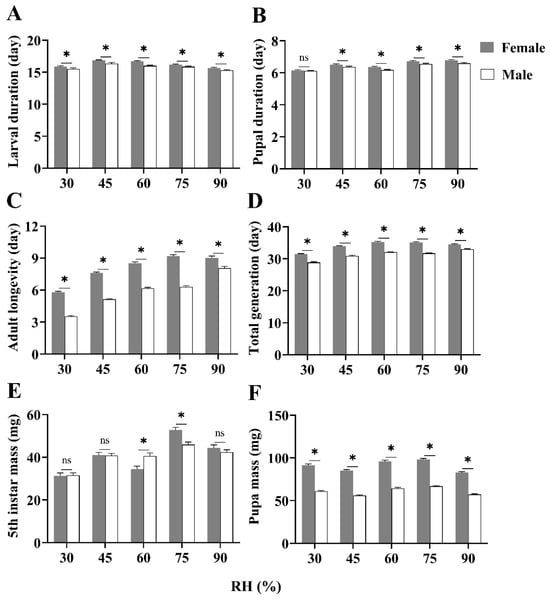
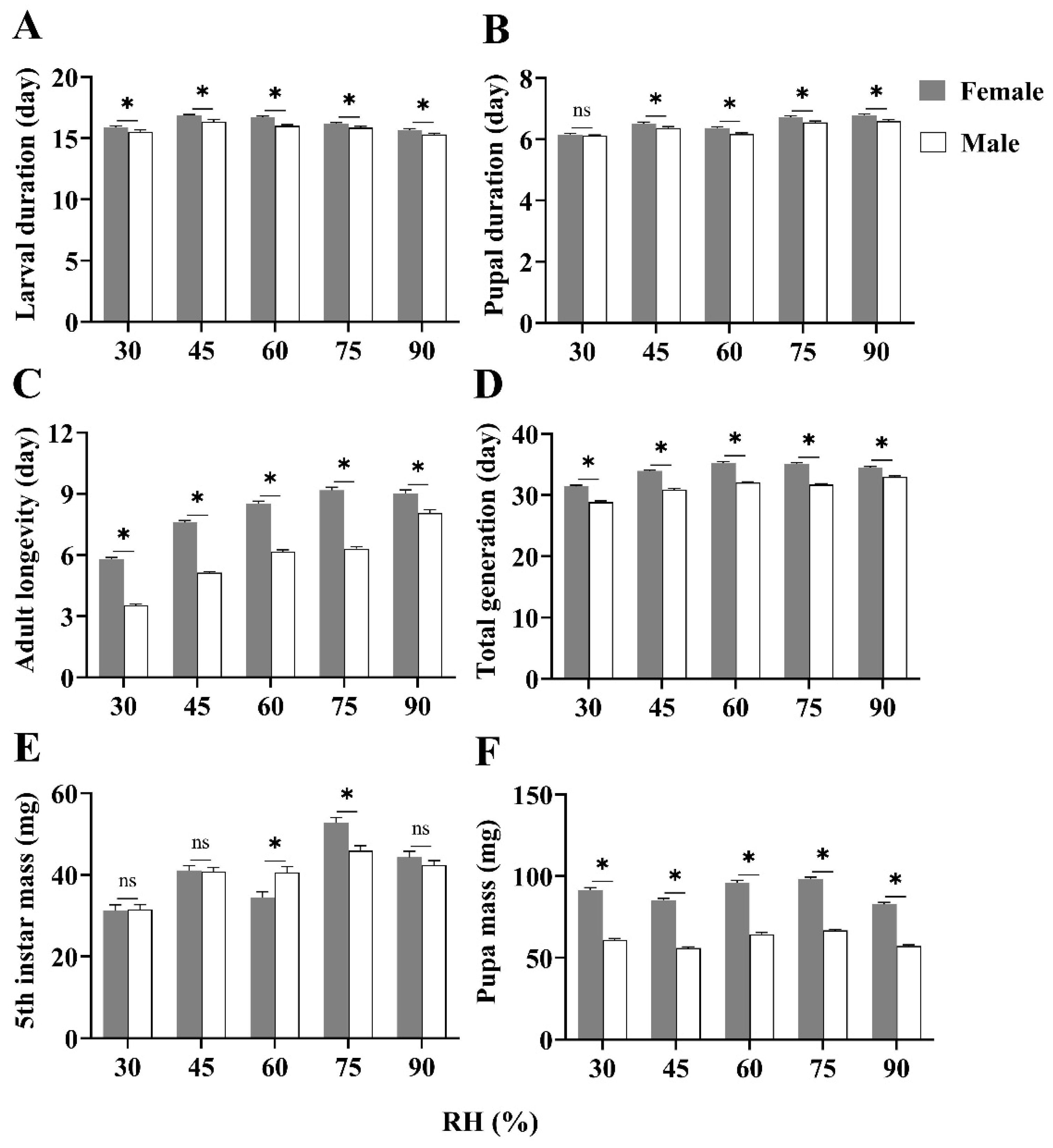
The results showed that P. gularis was able to develop to the adult stage in all RH treatments, but RH had a significant effect on the developmental duration of each life stage of P. gularis (egg: H = 736.829, df = 4, p < 0.001; first instar larvae: H = 355.927, df = 4, p < 0.001; second instar larvae: H = 73.235, df = 4, p < 0.001; third instar larvae: H = 30.568, df = 4, p < 0.001; fourth instar larvae: H = 50.163, df = 4, p < 0.001; fifth instar larvae: H = 145.391, df = 4, p < 0.001; sixth instar larvae: H = 39.099, df = 4, p < 0.001; fifth-eighth instar larvae: H = 83.216, df = 4, p < 0.001; larval stage: H = 164.477, df = 4, p < 0.001; pupal stage: H = 194.766, df = 4, p < 0.001; adult stage: H = 461.591, df = 4, p < 0.001; egg-pupa stage: H = 125.040, df = 4, p < 0.001; total generation: H = 301.387, df = 4, p < 0.001; Table S1, Figure 1). Specifically, Larval developmental duration at 30% RH and 90% RH was significantly shorter than at other RH conditions; within the range of 45–90% RH, larval developmental duration gradually decreased. Larval developmental duration was shortest at 90% RH and longest at 45% RH, at 15.48 and 16.60 days, respectively. The developmental durations of the pupa, adult, and generation increased as RH rose. At 90% RH, the developmental durations of the pupa, adult, and generation were longest, at 6.68, 8.58, and 33.60 days, respectively; at 30% RH, the developmental durations were shortest, at 6.13, 4.49, and 29.93 days, respectively. At 90% RH, the pupal developmental duration showed no significant difference from that at 75% RH (6.64 days); the generation developmental duration showed no significant difference from that at 60% RH (33.74 days) and 75% RH (33.47 days). The adult developmental duration at 75% RH was only slightly shorter than that at 90% RH, at 7.80 days (Table S1). Female larval stage (χ2 = 32.518, df = 1, p < 0.001), pupal stage (χ2 = 29.617, df = 1, p < 0.001), adult stage (χ2 = 829.554, df = 1, p < 0.001), and generation (χ2 = 587.362, df = 1, p < 0.001) were significantly longer than those of male individuals (Figure 1A–D). There were no significant interactions between RH and sex during the larval stage (χ2 = 3.138, df = 4, p = 0.535) and pupal stage (χ2 = 4.625, df = 4, p = 0.328); however, a significant interaction was observed during the adult stage (χ2 = 73.760, df = 4, p < 0.001) and generation (χ2 = 36.460, df = 4, p < 0.001). In addition, at 30% RH, two eighth-instar larvae and four seventh-instar larvae were observed, while at 45% RH, two seventh-instar larvae were observed. When RH rose to 75%, most larvae developed to the fifth instar and began pupation, with only 24 larvae developing to the sixth instar. At 90% RH, 30 larvae developed to the sixth instar (Table S1).
Figure 1.
Mean duration (± SE) of developmental stages ((A) larval duration; (B) pupal duration; (C) adult longevity; (D) total generation), fifth instar mass (E), and pupal mass (F) of female and male Paralipsa gularis (Zeller) at different relative humidities. *: Significant differences between females and males were found at the same relative humidity (p < 0.05, Mann–Whitney U test); ns: no significant differences between females and males were found at the same relative humidity (p > 0.05, Mann–Whitney U test).
3.2. Effects of RH on the Body Weight, Survival, and Reproduction of P. gularis
RH significantly affected both fifth-instar larval weight and pupal weight (fifth-instar mass: H = 213.096, df = 4, p < 0.001; pupa mass: H = 98.867, df = 4, p < 0.001), and there was a significant interaction between RH and sex in these two traits (fifth instar mass: χ2 = 27.846, df = 4, p < 0.001; pupa mass: χ2 = 10.922, df = 4, p = 0.027; Table S1, Figure 1E,F). Fifth-instar larvae and pupae reached their maximum weights at 75% RH, at 49.53 mg and 82.82 mg, respectively. Fifth-instar larvae were lightest at 30% RH (30.90 mg), while pupae were lightest at 90% RH (68.13 mg) (Table S1). There was no significant difference in fifth-instar larval weight between the sexes (χ2 = 0.399, df = 1, p = 0.528; Figure 1E), but female pupae were significantly heavier than male pupae (χ2 = 1924.527, df = 1, p < 0.001; Figure 1F).
Although there were no significant differences in pupation rate (F4, 10 = 1.354, p = 0.317) and pupal eclosion rate (F4, 10 = 2.048, p = 0.163) under different RH conditions, both the pupation rate and the pupal eclosion rate showed a trend of first increasing and then decreasing within the range of 30–90% RH. At 75% RH, both the pupation rate and the pupal eclosion rate were numerically highest, at 93.68% and 99.21%, respectively; at 30% RH, they were numerically lowest, at 84.81% and 95.94%, respectively. There were also no significant differences in the deformity rates of pupae (F4, 10 = 0.562, p = 0.696) and adults (F4, 10 = 1.068, p = 0.422) under different RH conditions (Table 1).
Table 1.
Developmental variables of Paralipsa gularis (Zeller) at different relative humidities.
RH significantly affected the reproductive characteristics of unmated females (pre-oviposition period: H = 48.125, df = 4, p < 0.001; oviposition period: H = 21.862, df = 4, p < 0.001; fecundity: H = 114.300, df = 4, p < 0.001; Table 1). Unmated females showed the highest observed fecundity at 90% RH, at 71.86. There was no significant difference in the sex ratio among different RH conditions (F4, 10 = 3.268, p = 0.059; Table 1).
3.3. The Effect of RH on Life Table Parameters
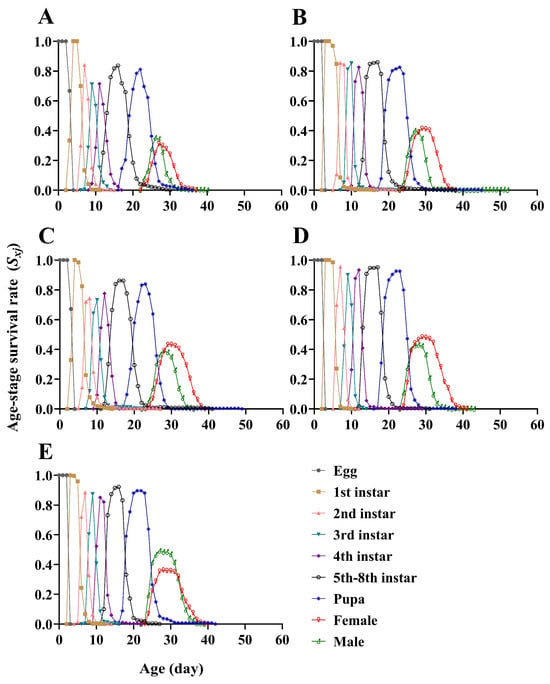
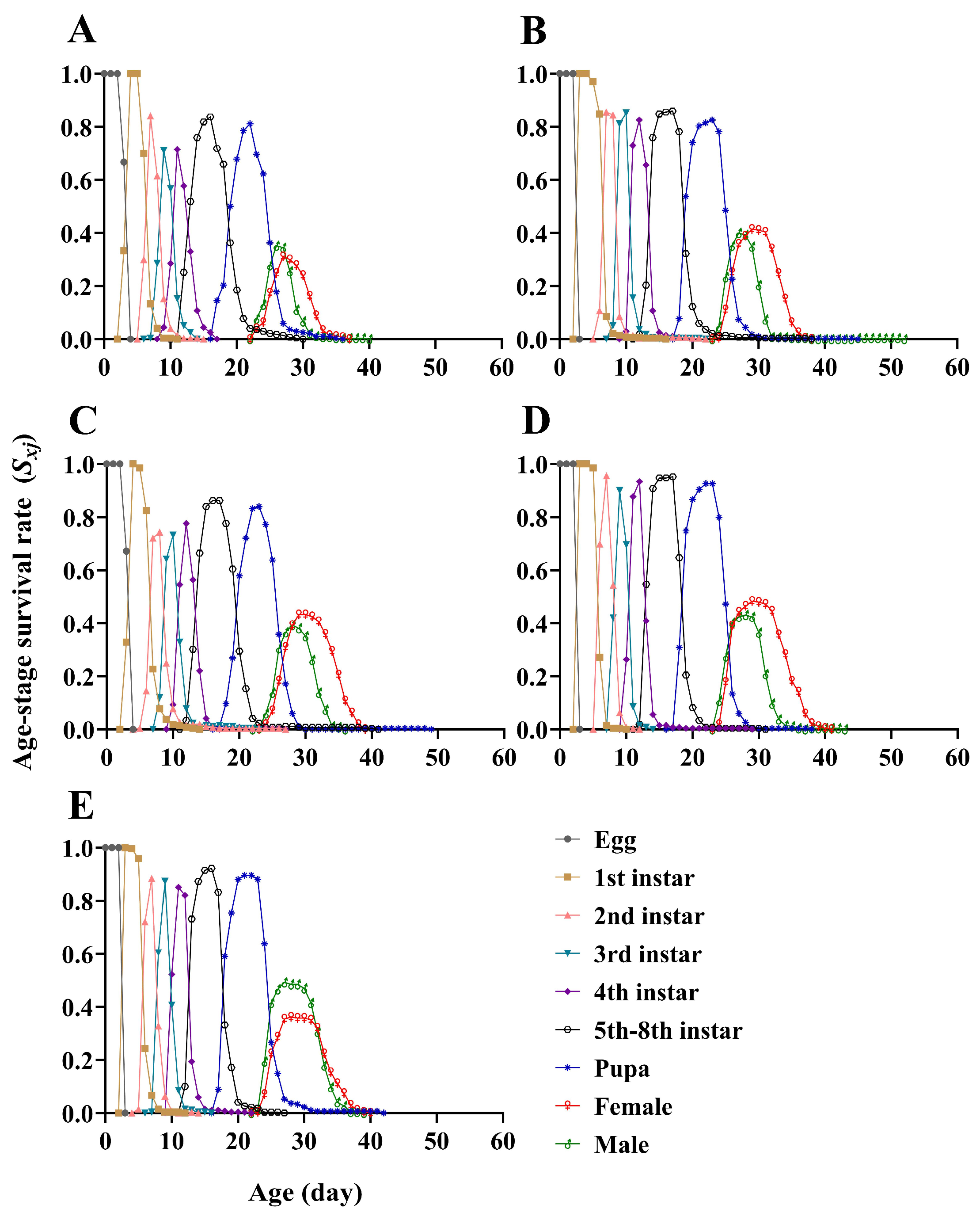
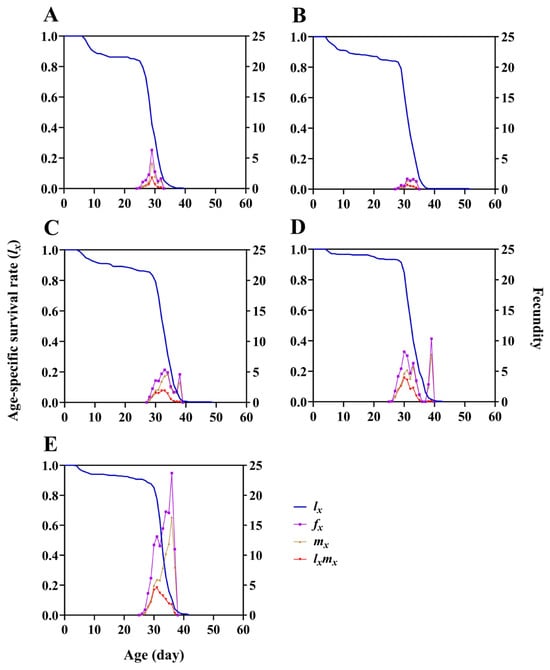
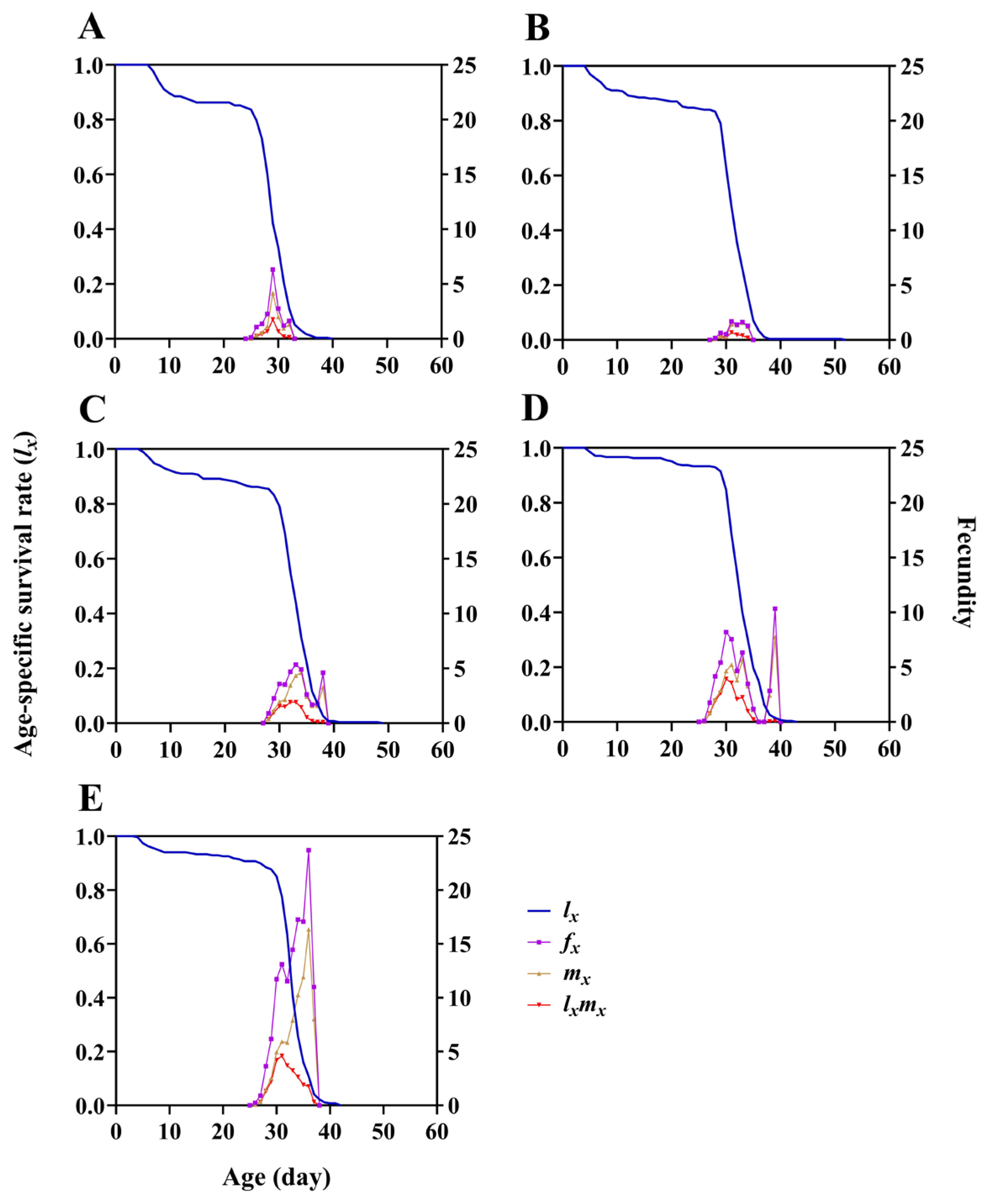
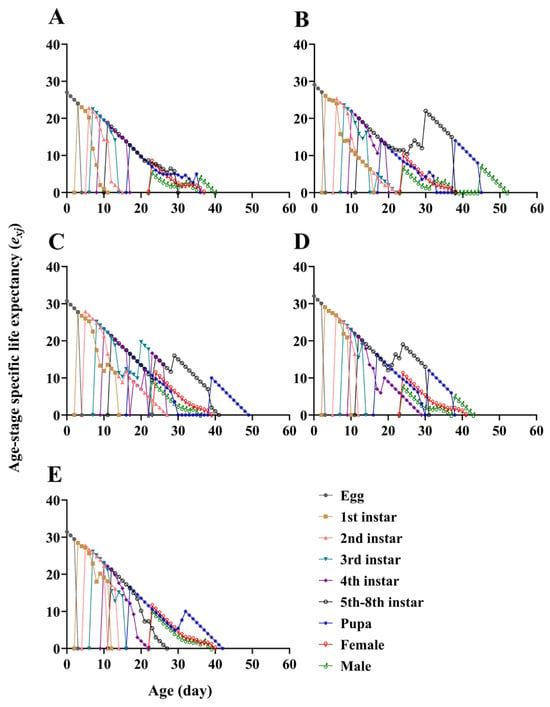
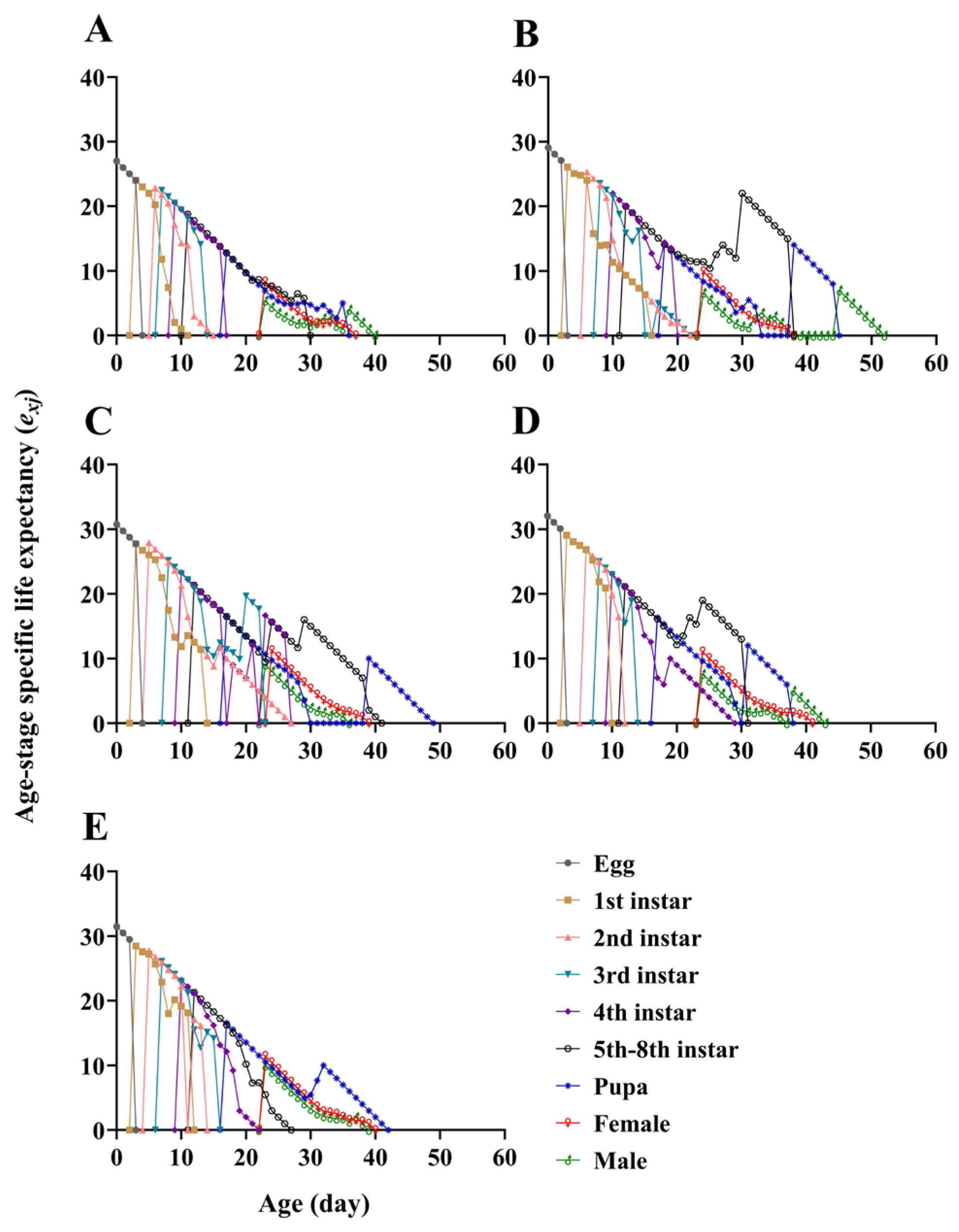
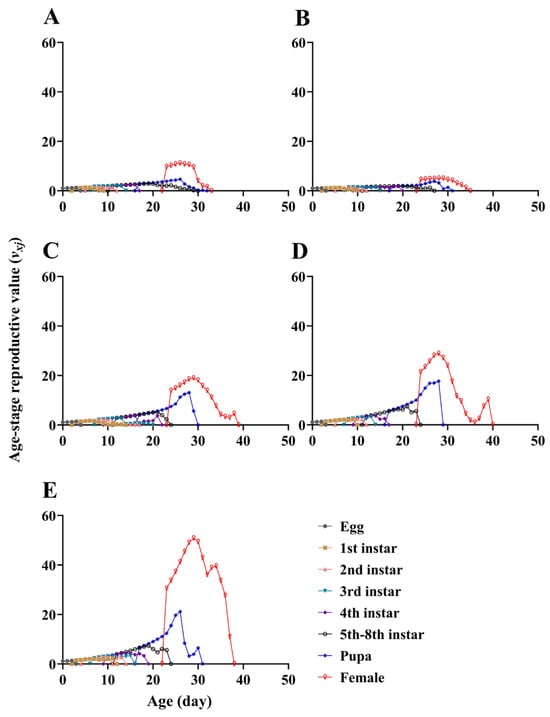
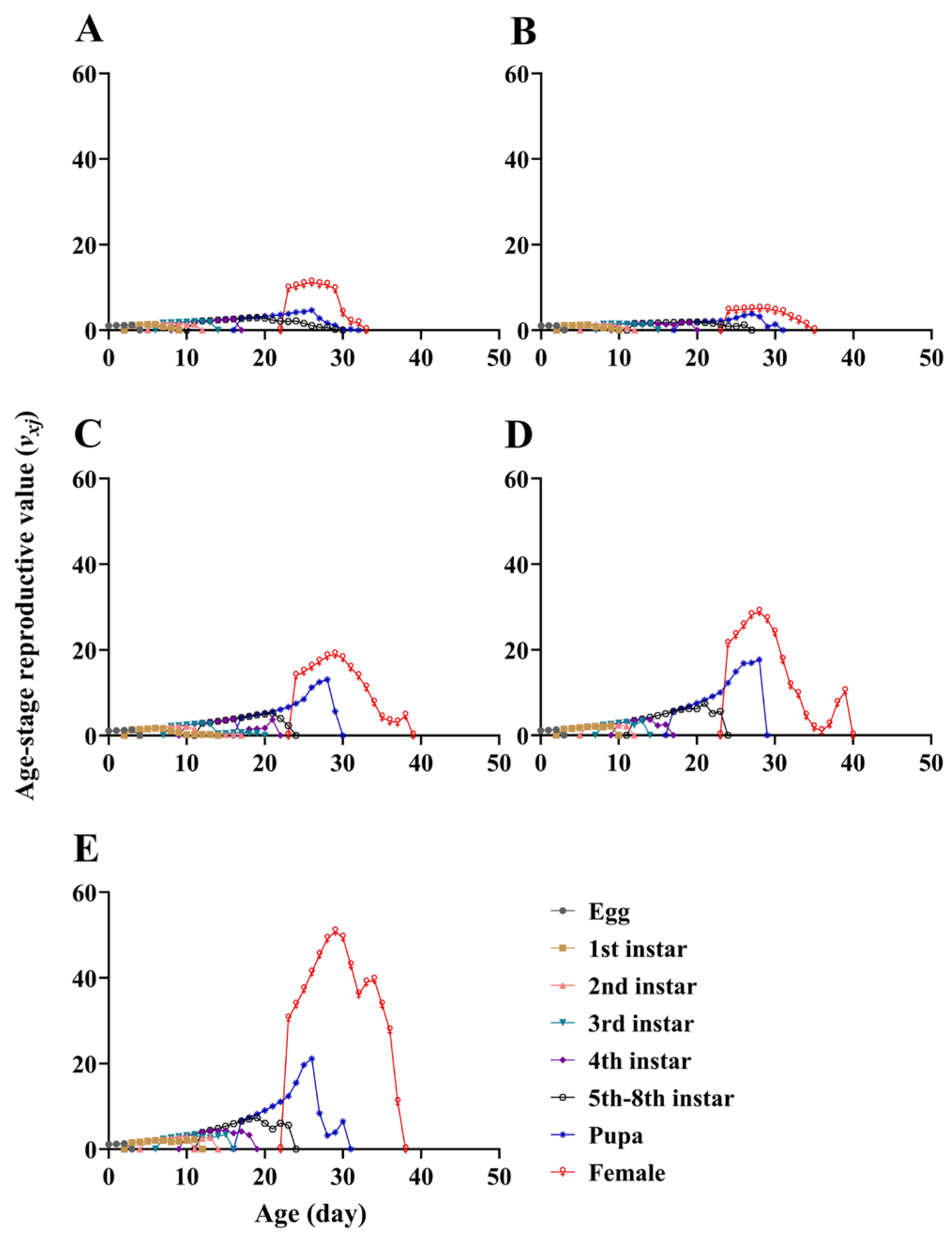
The age-stage survival rate (Sxj) of P. gularis showed marked differences at different RH treatments (Figure 2). Survival analysis revealed highly significant differences in the age-specific survival rates (lx) at different RH conditions (χ2 = 297.9, df = 4, p < 0.0001), as well as a significant linear trend (χ2 = 172.5, df = 1, p < 0.0001). The curve lx indicated that the survival rate at 75–90% RH was higher than that at 30–60% RH, which was clearly observed on the 20th–30th days (Figure 3). At RH conditions of 30%, 45%, 60%, 75%, and 90%, the fx peaked at 6.32, 1.70, 5.33, 10.33, and 23.70, respectively (Figure 3). The maximum values of mx occurred on days 29, 33, 34, 39, and 36, respectively, while the maximum values of lxmx occurred on days 29, 31, 33, 30, and 31, respectively (Figure 3). The exj curve showed that the maximum life expectancy of P. gularis occurred at the egg stage under the various RH conditions, with the highest value at 75% RH, followed by 90% RH, and the lowest at 30% RH. The life expectancy of P. gularis decreased with increasing age, while it showed an increase during the fifth-eighth instar larval stage, the pupal stage, and the adult stage (Figure 4). The vxj curve showed that the reproductive value of unmated female P. gularis was highest at 90% RH, followed by 75% RH, and lowest at 45% RH (Figure 5).
Figure 2.
Age-stage survival rate (Sxj) of Paralipsa gularis (Zeller) at different relative humidities. (A) 30% RH; (B) 45% RH; (C) 60% RH; (D) 75% RH; (E) 90% RH.
Figure 3.
Age-specific survival rate (lx), age-specific fecundity of female adults (fx), age-specific fecundity (mx), and age-specific maternity (lxmx) of Paralipsa gularis (Zeller) individuals at different relative humidities. (A) 30% RH; (B) 45% RH; (C) 60% RH; (D) 75% RH; (E) 90% RH.
Figure 4.
Age-stage specific life expectancy (exj) of Paralipsa gularis (Zeller) at different relative humidities. (A) 30% RH; (B) 45% RH; (C) 60% RH; (D) 75% RH; (E) 90% RH.
Figure 5.
Age-stage-specific reproductive value (vxj) of Paralipsa gularis (Zeller) at different relative humidities. (A) 30% RH; (B) 45% RH; (C) 60% RH; (D) 75% RH; (E) 90% RH.
3.4. Exploring the Relationship Between RH and Developmental Indicators of P. gularis
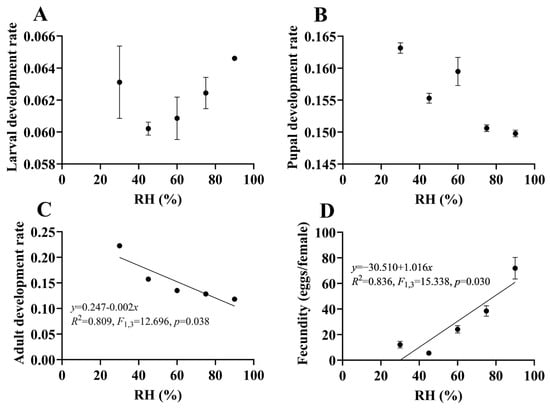
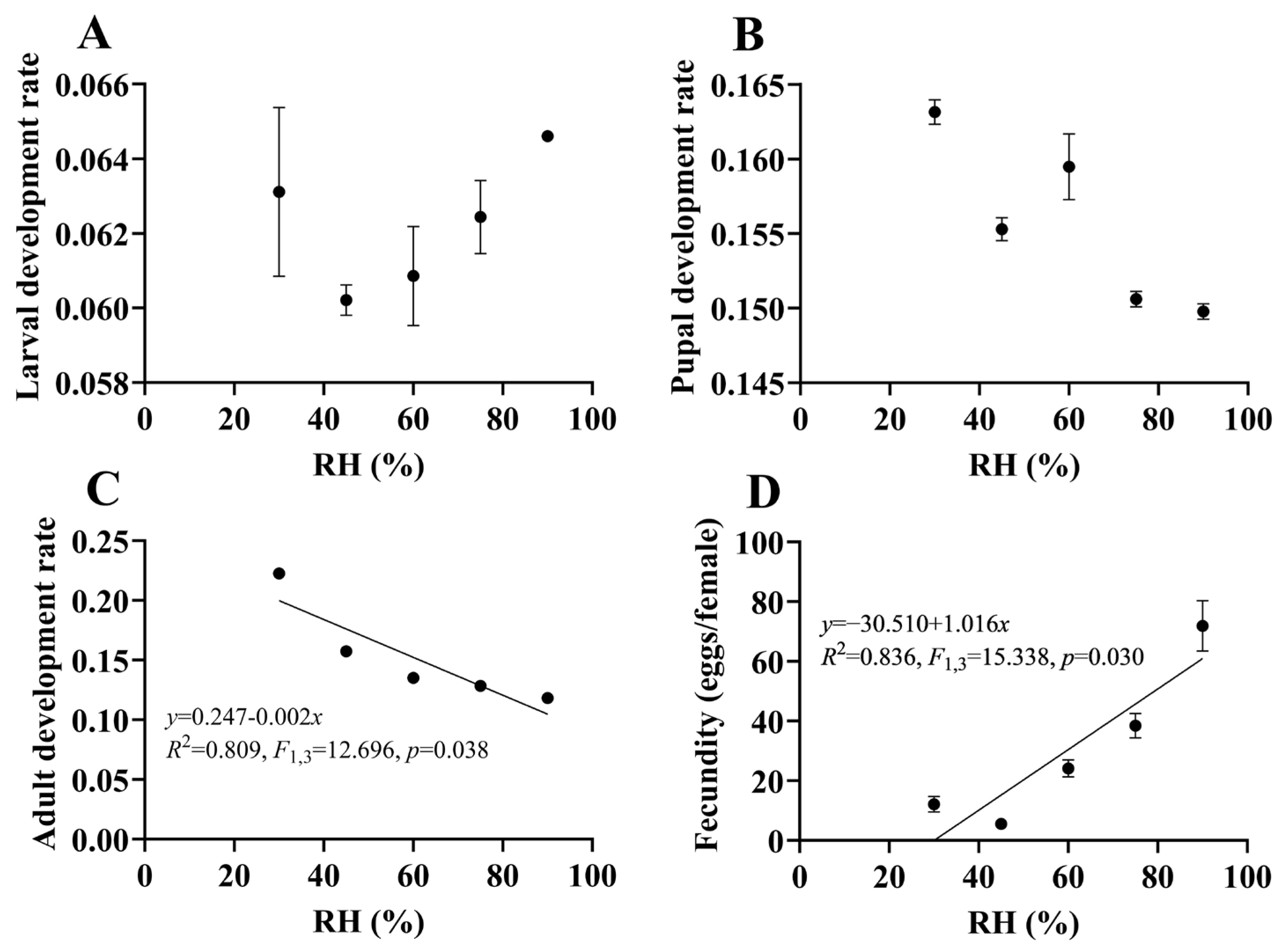
At RH levels ranging from 30% to 90%, the adult development rate and fecundity (eggs/female) of P. gularis showed a linear relationship with RH: adult development rate gradually decreased, while fecundity (eggs/female) gradually increased (Figure 6C,D). Larval and pupal development rates showed no linear trend, as indicated by low R2 values and p > 0.05. At 30–45% RH, both larval and pupal development rates gradually decreased; at 45–90% RH, larval development rate gradually increased, while pupal development rate first increased and then decreased (Figure 6A,B).
Figure 6.
Exploration of the relationship between developmental indicators of Paralipsa gularis (Zeller) and relative humidity. The data in the figure are the mean ± SE. (A) Larval development rate; (B) pupal development rate; (C) adult development rate; (D) fecundity (eggs/female).
4. Discussion
Insects are characterized by small body size, rapid growth rates, and short generation intervals; their growth, development, survival, and reproduction are easily influenced by environmental factors [26]. In our study, the developmental duration of P. gularis eggs at 75% RH and 90% RH was significantly shorter than at 30% RH, indicating that RH can influence egg developmental duration. This finding is consistent with previous results showing that the developmental duration of the eggs of Hermetia illucens shortened as RH increased [27]. Overall, the developmental duration of the larvae decreased as RH increased, and the larvae developed most rapidly at 90% RH. This finding is consistent with the phenomenon observed in most lepidopteran larvae, such as Spodoptera frugiperda (J. E. Smith) and Dendrolimus tabulaeformis, which developed more rapidly in humid environments [28,29]. However, the developmental duration of the generation increased with rising RH. This is primarily because RH significantly affected the developmental duration of pupae and adults; high RH prolonged the developmental duration of both stages. This is consistent with the observation that higher humidity prolonged the longevity of pupae and adults of Grapholitha molesta and Tuta absoluta (Meyrick) [30,31]. When environmental conditions are unsuitable for insect growth and development, the number of instars increases [32,33]. The number of instars of P. gularis increased at low RH, indicating that low RH may be unsuitable for its growth and development. In addition, under all RH conditions, the developmental duration of female insects was longer than that of males, resulting in the earlier emergence of males. This phenomenon was also observed at different temperatures [34] and was similar to that seen in other pyralid insects, such as O. furnacalis and Loxostege sticticalis [22,35], but contrasted with that of noctuid insects, such as Spodoptera litura, H. armigera, and S. frugiperda [36,37,38]. This may be due to differences in how insects respond to their environment [38,39].
Insects experience severe water loss during pupation and are quite sensitive to ambient humidity. For example, when ambient humidity is too low, the insects lose a significant amount of body water, leading to massive mortality among most mature larvae and pupae of Mythimna separata [40]. The higher the ambient humidity, the lower the pupal eclosion rate of Conopomorpha sinensis, and the mortality rate of H. armigera pupae and adults increased significantly [41,42]. This study found that, within the range of 30–90% RH, the pupation and eclosion rates of P. gularis first increased and then decreased; they peaked at 75% RH, followed by 90% RH, with the lowest rates observed at 30% RH. However, statistically, RH showed no significant effect on pupation or eclosion rates. We hypothesize that our study used an artificial diet for the larvae, which has a high moisture content sufficient to compensate for the water lost by the larvae due to low ambient humidity. This phenomenon has also been confirmed in nocturnal moths such as M. separata, Athetis lepigone, and S. frugiperda; when ambient humidity is too low and the larvae suffer severe water loss, they can compensate by increasing their food intake to absorb more water [29,43,44].
The reproductive capacity of female insects is related to their body weight; the heavier the insect, the greater the reproductive capacity and adaptability of the adult that emerges, and the higher the number of eggs laid [45]. For example, the egg-laying rate of Plutella xylostella (Linnaeus) was positively correlated with pupal weight [46]; heavier and medium-sized female Copitarsia decolora (Guenée) laid more eggs [47], while smaller Frankliniella occidentalis laid fewer eggs [48]. Our findings showed that, at 75% RH, both larvae and pupae reached their maximum body weight, and the number of eggs laid by unmated females was second highest. The reproductive capacity of unmated adults was highest at 90% RH but variable at lower RH levels, indicating that RH was associated with differences in the number of eggs laid by unmated females. This has also been confirmed in S. frugiperda [29].
Courtship and mating are essential stages in the reproductive behavior of insects, and ambient humidity can influence their mating behavior. For example, high humidity could promote courtship and mating in Agrotis ipsilon [49], and low humidity reduced the mating of Drosophila suzukii Matsumura [50]. In our study, although high RH enhanced the number of eggs laid by females, it failed to induce mating. Previous studies have found that P. gularis also failed to mate in various temperature treatments [34]. However, the interaction between temperature and humidity on P. gularis remains understudied. Previous studies have shown that interactions of temperature and humidity regimes significantly change incubation period, adult longevity, mating frequency, pre-mating period, egg-mass size, and egg hatchability in insects [51]. In addition to temperature and humidity, the mating behavior of insects is influenced by other factors such as photoperiod, host plants and their volatiles, rearing conditions, sex ratio, and sex pheromones [52,53,54,55]. Accordingly, when artificially rearing P. gularis, we need to simulate its natural environment as closely as possible, taking into account factors such as temperature, humidity, and air circulation, as well as the interactions among these factors. Furthermore, there is an urgent need for further research on the sex pheromones of P. gularis to provide scientific guidance for population forecasting and integrated pest management of this species.
Field pests generally prefer humid environments, which promote their growth and development [29,31]. Although most storage pests live in relatively dry storage environments, humid storage conditions can promote the occurrence and damage caused by these pests. For example, high-humidity environments promote egg-laying by storage pests such as storage mites, Sitophilus oryzae, and Tribolium castaneum, and increase their survival rates [56,57,58,59]. When grain crops are first stored, pest infestations are rare; however, changes in the storage environment cause the stored crops to undergo quality changes, which in turn lead to pest infestations. A closed storage environment can reduce humidity, thereby effectively controlling storage pests [60,61,62]. Previous studies have indicated that, compared to a closed, dry storage environment, an open, humid storage environment is more conducive to the growth and development of P. gularis [1]. The results of this study indicated that high-humidity conditions were conducive to the population development of P. gularis, while dry conditions were detrimental to growth and development. This is consistent with the observation that P. gularis was most prevalent in the field during periods of high temperature and humidity, and that rainfall exacerbated maize damage [5,6]. Therefore, we hypothesize that the high humidity in the field may be one of the reasons why P. gularis has shifted from infesting storage facilities to damaging field maize; further verification is needed [6].
Southern Yunnan, China, borders the Southeast Asian countries of Myanmar, Laos, and Vietnam. Due to the influence of the East Asian monsoon climate, numerous lepidopteran pests migrate from these Southeast Asian countries into southern Yunnan, China, annually in the spring [63]. At the same time, the monsoon brings rainfall; the local rainy season spans from May through September, and the frequent rainfall results in a warm and humid climate [64]. Warm, humid climates and ample rainfall can increase plant species richness and diversity, providing migratory pest populations with ample food sources and suitable humidity conditions, thereby increasing the risk of pest outbreaks. Currently, P. gularis has been causing damage in southern Yunnan, China, for many years. It thrives in high-humidity environments, and the field population of its larvae is higher in the rainy season than in the dry season [5,6,7]. Furthermore, the high humidity may prolong the adult’s longevity and egg-laying period, resulting in complex population dynamics and overlapping generations, which exacerbate the damage [5,34]. Therefore, integrated management of P. gularis is urgently needed.
Studies have shown that populations of P. gularis migrate from Southeast Asian countries across the border into southern Yunnan, China, in the spring [65]. Thus, southern Yunnan, China, faces significant selection pressure from P. gularis, making the integrated management of this pest a top priority. P. gularis possesses migratory capabilities; trajectory analysis has revealed that it primarily migrates northward and exhibits a distinct tendency to land following rainfall [65]. Therefore, we should also establish and improve robust pest monitoring and early warning systems in other regions in advance, and strengthen the monitoring and early warning of P. gularis populations. Our laboratory data provide preliminary information on RH-associated responses of P. gularis that may be useful for developing hypotheses and parameterizing future population models, subject to validation under fluctuating and field conditions.
In this study, three subsamples were set up for each RH condition within the same climate chamber; we were unable to assign multiple independent climate chambers to each RH condition, which could lead to pseudoreplicates. Therefore, we recommend that future studies increase the number of climate chambers to further validate the results of this study. In addition, the response patterns of P. gularis to RH were observed under constant laboratory conditions (temperature, light, food, etc.) and cannot be equated with actual field conditions. Complex field habitat conditions—such as diurnal fluctuations in temperature and humidity, host plants, and natural enemies—are likely to alter the insects’ developmental, survival, and reproductive characteristics. For example, while adults of P. gularis in the laboratory do not mate, those in the field do. Therefore, further field studies are needed to investigate the effects of environmental humidity on P. gularis.
5. Conclusions
In southern Yunnan, China—a region bordering Southeast Asia characterized by high temperature and humidity—Paralipsa gularis (Zeller), previously recorded as a storage pest, has shifted its damage to agricultural ecosystems, posing a serious threat to local maize production. Under controlled laboratory conditions, RH significantly influenced several traits of P. gularis, including development, survival, body weight, and reproduction. Intermediate-to-high RH (75–90%) generally supported higher performance for several measured traits, whereas lower RH reduced survival and number of eggs laid. However, because females failed to mate and produced no viable offspring, the reproductive implications of the life table estimates should be interpreted cautiously. These results provide baseline information on the RH sensitivity of P. gularis and may support future studies evaluating population responses under fluctuating field conditions.
Supplementary Materials
The following supporting information can be downloaded at: https://www.mdpi.com/article/10.3390/agronomy16191949/s1, Table S1: Duration of developmental stages of Paralipsa gularis (Zeller) at different relative humidities.
Author Contributions
Conceptualization, K.W. and S.C.; methodology, K.W.; software, S.C.; validation, K.W., X.Y. and X.Z.; formal analysis, S.C.; investigation, S.C., X.M. and L.Y.; resources, K.W.; data curation, S.C.; writing—original draft preparation, S.C., X.M., L.Y. and G.K.; writing—review and editing, K.W., X.Y. and X.Z.; visualization, K.W.; supervision, K.W., X.Y. and X.Z.; project administration, K.W.; funding acquisition, K.W. All authors have read and agreed to the published version of the manuscript.
Funding
This study was funded by the Science & Technology Fundamental Resources Investigation Program of China (2023FY100500).
Data Availability Statement
The original contributions presented in this study are included in the article/Supplementary Material. Further inquiries can be directed to the corresponding author.
Conflicts of Interest
The authors declare no conflicts of interest.
References
- Trematerra, P. Distribution and activity of Paralipsa gularis (Zeller) (Lep., Galleriidae) in Italy. J. Appl. Entomol. 1987, 104, 227–233. [Google Scholar] [CrossRef] [Scilit]
- Kageyama, D.; Narita, S.; Imamura, T.; Miyanoshita, A. Detection and identification of Wolbachia endosymbionts from laboratory stocks of stored-product insect pests and their parasitoids. J. Stored Prod. Res. 2010, 46, 13–19. [Google Scholar] [CrossRef] [Scilit]
- Hong, K.J.; Lee, J.H.; Lee, G.; Lee, S. The status quo of invasive alien insect species and plant quarantine in Korea. J. Asia-Pac. Entomol. 2012, 15, 521–532. [Google Scholar] [CrossRef] [Scilit]
- Wang, P.Y. Economic Insect Fauna of China; Science Press: Beijing, China, 1980; pp. 33–34. [Google Scholar]
- Feng, X.F.; An, Z.Y.; Liu, E.L.; Cun, D.A. Characteristics and control of Paralipsa gularis (Zeller) on maize. Yunnan Agric. 2026, 40, 55–58. [Google Scholar]
- Tai, H.K.; Bai, S.X.; Han, Y.L.; Liu, Z.; Zhang, F.; Wang, Z.Y. Biological characteristics of the stored nut moth Paralipsa gularis (Zeller) and its damage on corn in Dehong Prefecture of Yunnan Province. J. Plant Prot. 2018, 45, 251–256. [Google Scholar]
- Xie, X.B.; Meng, J.Z.; Li, H.H.; Zhao, G.A.; Xu, J.B.; Shen, Y.F. A preliminary report on the occurrence and damage caused by Paralipsa gularis (Zeller) in summer corn fields in Baoshan, Yunnan. China Plant Prot. 2023, 43, 38–40. [Google Scholar]
- Chen, S.; Wang, W.H.; Kang, G.D.; Yang, X.M.; Wu, K.M. Toxic effects of Bt-(Cry1Ab+Vip3Aa) maize on storage pest Paralipsa gularis (Zeller). Toxins 2024, 16, 92. [Google Scholar] [CrossRef] [Scilit]
- Wang, Z.Y.; Wang, X.M. Current status and management strategies for corn pests and diseases in China. Plant Prot. 2019, 45, 1–11. [Google Scholar]
- Tang, F.J.; Zhou, S.X.; Huang, L.F.; Wang, Z.Y.; Zou, H.D.; Ke, J.; Chen, X.L.; Zhang, S.R. Identification and mitochondrial genome analysis of a new stored pest of sweetpotato: Paralipsa gularis (Zeller). Chin. Agric. Sci. Bull. 2026, 42, 197–206. [Google Scholar]
- Dang, Z.H.; Chen, F.J. Responses of insects to rainfall and drought. Chin. J. Appl. Entomol. 2011, 48, 1161–1169. [Google Scholar]
- Ge, F. Challenges facing entomologists in a changing global climate. Chin. J. Appl. Entomol. 2011, 48, 1117–1122. [Google Scholar]
- Lei, Z.R.; Wen, J.Z.; Wang, Y. Patterns of locusts occurrence and integrated pest management measures. Bull. Agric. Sci. Technol. 2000, 24–25. [Google Scholar]
- Li, D.Y.; Xu, D.W.; Qian, D.J.; Cheng, C.L. A study on the relationship between the severity of Helicoverpa armigera infestations and rainfall in cotton fields in the Fuyang region. China Cotton 1996, 23, 17–18. [Google Scholar]
- Fitt, G.P. The Ecology of Heliothis species in relation to agroecosystems. Annu. Rev. Entomol. 1989, 34, 17–52. [Google Scholar] [CrossRef] [Scilit]
- Zhu, H.; Tan, Y.H. Flora and vegetation of Yunnan, Southwestern China: Diversity, origin and evolution. Diversity 2022, 14, 340. [Google Scholar] [CrossRef] [Scilit]
- Maicher, V.; Sáfián, S.; Murkwe, M.; Przybyłowicz, Ł.; Janeček, Š.; Fokam, E.B.; Pyrcz, T.; Tropek, R. Flying between raindrops: Strong seasonal turnover of several lepidoptera groups in lowland rainforests of Mount Cameroon. Ecol. Evol. 2018, 8, 12761–12772. [Google Scholar] [CrossRef] [Scilit]
- Huberty, A.F.; Denno, R.F. Plant water stress and its consequences for herbivorous insects: A new synthesis. Ecology 2004, 85, 1383–1398. [Google Scholar] [CrossRef] [Scilit]
- Sujayanand, G.K.; Karuppaiah, V. Aftermath of climate change on insect migration: A review. Agric. Rev. 2016, 37, 221–227. [Google Scholar] [CrossRef] [Scilit]
- Hariadi, M.H.; Sutanto, S.J.; Schrier, G.V.D.; Supit, I.; Ratri, D.N.; Steeneveld, G.J.; Sopaheluwakan, A.; Tank, A.K. Unravelling the impact of changing rainy seasons on rice production in Southeast Asia: A climate change high-resolution perspective. Clim. Change 2026, 179, 60. [Google Scholar] [CrossRef] [Scilit]
- Chi, H. Life-table analysis incorporating both sexes and variable development rates among individuals. Environ. Entomol. 1988, 17, 26–34. [Google Scholar] [CrossRef] [Scilit]
- Hu, X.H.; Wang, Z.H.; He, K.L.; Xie, H.C.; Wang, Y.Q. Age-stage, two-sex life table, and population projection of Ostrinia furnacalis (Lepidoptera: Crambidae) at different temperatures. J. Econ. Entomol. 2024, 117, 800–808. [Google Scholar] [CrossRef] [Scilit]
- Ge, S.S.; Chu, B.; He, W.; Jiang, S.; Lv, C.Y.; Gao, L.Y.; Sun, X.T.; Yang, X.M.; Wu, K.M. Wheat-bran-based artificial diet for mass culturing of the fall armyworm, Spodoptera frugiperda Smith (Lepidoptera: Noctuidae). Insects 2022, 13, 1177. [Google Scholar] [CrossRef] [Scilit]
- Tuan, S.J.; Lee, C.C.; Chi, H. Population and damage projection of Spodoptera litura (F.) on peanuts (Arachis hypogaea L.) under different conditions using the age-stage, two-sex life table. Pest Manag. Sci. 2014, 70, 805–813. [Google Scholar] [CrossRef] [Scilit]
- Chi, H. TWOSEX-MSChart: A Computer Program for the Age-Stage, Two-Sex Life Table Analysis. 2026. Available online: https://www.faas.cn/cms/sitemanage/index.shtml?siteId=810640925913080000 (accessed on 20 June 2026).
- Hoffmann, A.A.; Hercus, M.J. Environmental stress as an evolutionary force. Bioscience 2000, 50, 217–226. [Google Scholar] [CrossRef] [Scilit]
- Holmes, L.A.; Vanlaerhoven, S.L.; Tomberlin, J.K. Relative humidity effects on the life history of Hermetia illucens (Diptera: Stratiomyidae). Environ. Entomol. 2012, 41, 971–978. [Google Scholar] [CrossRef] [Scilit]
- Han, R.D.; Parajulee, M.; He, Z.; Ge, F. Effects of environmental humidity on the survival and development of pine caterpillars, Dendrolimus tabulaeformis (Lepidoptera: Lasiocampidae). Insect Sci. 2008, 15, 147–152. [Google Scholar] [CrossRef] [Scilit]
- He, L.M.; Zhao, S.Y.; Ali, A.; Ge, S.S.; Wu, K.M. Ambient humidity affects development, survival, and reproduction of the invasive fall armyworm, Spodoptera frugiperda (Lepidoptera: Noctuidae), in China. J. Econ. Entomol. 2021, 114, 1145–1158. [Google Scholar] [CrossRef] [Scilit]
- Yu, Q.; Feng, Y.T.; Guo, X.J.; Guo, G.M.; Hao, C.; Fan, R.J. Effects of humidity on the survival and fecundity of Grapholitha molesta (Lepidoptera: Tortricidae). Acta Entomol. Sin. 2017, 60, 659–665. [Google Scholar]
- Zhang, B.C.; Xu, S.Y.; Wu, Z.Q.; Zhang, R.; Zheng, W.F.; Li, Y.; Hao, C.; Yu, Q. Age-stage, two-sex life table of Tuta absoluta (Lepidoptera: Gelechiidae) at different humidities. Acta Entomol. Sin. 2024, 67, 78–89. [Google Scholar]
- Daimon, T. How many times to molt? Endocrine control of moltinism in lepidopteran insects. Curr. Opin. Insect Sci. 2026, 74, 101482. [Google Scholar] [CrossRef] [Scilit]
- Esperk, T.; Tammaru, T.; Nylin, S. Intraspecific variability in number of larval instars in insects. J. Econ. Entomol. 2007, 100, 627–645. [Google Scholar] [CrossRef] [Scilit]
- Chen, S.; He, L.M.; Yang, X.M.; Kang, G.D.; Yang, L.; Phalakhone, S.; Zhao, X.C.; Wu, K.M. Effects of temperature on life-history traits of Paralipsa gularis (Zeller) (Lepidoptera: Pyralidae), a newly emerged maize pest from the border areas between China and Southeast Asian Countries. Insects 2026, 17, 485. [Google Scholar] [CrossRef] [Scilit]
- Xu, Z.; Zhou, J.X.; Li, D.J.; Lv, C.N.; Ailifeila, A.; Wan, G.J.; Chen, F.J. Effects of daily temperature fluctuation on the growth, development, and reproduction of Loxostege sticticalis. Chin. J. Appl. Ecol. 2025, 36, 2497–2505. [Google Scholar] [CrossRef] [Scilit]
- Li, Y.Y.; Yu, J.F.; Lu, Q.; Xu, J.; Ye, H. Development and emergence patterns of the tobacco cutworm Spodoptera litura (Lepidoptera: Noctuidae). GSTF J. Biosci. 2014, 3, 18. [Google Scholar] [CrossRef] [Scilit]
- Nunes, M.L.S.; Figueiredo, L.L.; Andrade, R.D.S.; Rezende, J.M.; Czepak, C.; Albernaz-Godinho, K.C. Biology of Helicoverpa armigera (Hübner) (Lepidoptera: Noctuidae) rearing on artificial or natural diet in laboratory. J. Entomol. 2017, 14, 168–175. [Google Scholar] [CrossRef] [Scilit]
- Huang, L.L.; Xue, F.S.; Chen, C.; Guo, X.; Tang, J.J.; Zhong, L.; He, H.M. Effects of temperature on life-history traits of the newly invasive fall armyworm, Spodoptera frugiperda in Southeast China. Ecol. Evol. 2021, 11, 5255–5264. [Google Scholar] [CrossRef] [Scilit]
- Damos, P.; Savopoulou-Soultani, M. Temperature-driven models for insect development and vital thermal requirements. Psyche J. Entomol. 2012, 2012, 123405. [Google Scholar] [CrossRef] [Scilit]
- Jin, C.X.; He, Z.; Ma, S.J. Relationship between the development and survival of the armyworm (Leucania separata Walker) and environmental humidity-II. Pre-pupae and pupae. Acta Entomol. Sin. 1965, 14, 239–249. [Google Scholar]
- Li, Z.Q.; Qiu, Y.P.; Xiang, X.; Ou, L.X.; Yuan, P.Y.; Chen, J.Z. A preliminary study on the effects of humidity on growth and development of Conopomorpha sinensis Bladley. Guangdong Agric. Sci. 2009, 36, 63–64. [Google Scholar]
- Chen, F.J.; Zhai, B.P.; Zhang, X.X. Effects of soil moisture during pupal stage on population development of cotton bollworm, Helicoverpa armigera (Hübner). Acta Ecol. Sin. 2003, 23, 112–121. [Google Scholar]
- Qin, J.D. A study on the nutrition of the armyworm: The effects of moisture in food and the environment on larval growth. Acta Entomol. Sin. 1964, 13, 659–670. [Google Scholar]
- Yang, Y.H.; Zhang, H.J.; Shi, J.; Liu, S.S.; Guo, N. Effects of food, temperature and humidity on feeding of Athetis lepigone (Lepidoptera: Noctuidae) larvae and their injury to maize seedlings. Acta Entomol. Sin. 2019, 62, 1065–1071. [Google Scholar]
- Xiao, L.; He, H.M.; Huang, L.L.; Geng, T.; Fu, S.; Xue, F.S. Variation of life-history traits of the Asian corn borer, Ostrinia furnacalis in relation to temperature and geographical latitude. Ecol. Evol. 2016, 6, 5129–5143. [Google Scholar] [CrossRef] [Scilit]
- Garrad, R.; Booth, D.T.; Furlong, M.J. The effect of rearing temperature on development, body size, energetics and fecundity of the diamondback moth. Bull. Entomol. Res. 2016, 106, 175–181. [Google Scholar] [CrossRef] [Scilit]
- Callado-Galindo, M.M.; Villa-Ayala, P.; Castrejón-Ayala, F.; Jiménez-Pérez, A. Effect of age, body weight and multiple mating on Copitarsia decolora (Lepidoptera: Noctuidae) reproductive potential and longevity. J. Insect Behav. 2013, 26, 860–872. [Google Scholar] [CrossRef] [Scilit]
- De Kogel, W.J.; Bosco, D.; Van Der Hoek, M.; Mollema, C. Effect of host plant on body size of Frankliniella occidentalis (Thysanoptera: Thripidae) and its correlation with reproductive capacity. Eur. J. Entomol. 2013, 96, 365–368. [Google Scholar]
- Xiang, Y.Y.; Liu, T.X.; Zhang, S.Z. Effects of temperature, humidity, photoperiod and host plants on the calling and mating behavior of female moths of black cutworm Agrotis ipsilon (Hüfnagel). J. Plant Prot. 2018, 45, 235–242. [Google Scholar]
- Krüger, A.P.; Vieira, J.G.A.; Scheunemann, T.; Nava, D.E.; Garcia, F.R.M. Effects of temperature and relative humidity on mating and survival of sterile Drosophila suzukii. J. Appl. Entomol. 2021, 145, 789–799. [Google Scholar] [CrossRef] [Scilit]
- Chanthy, P.; Martin, R.J.; Gunning, R.V.; Andrew, N.R. Influence of temperature and humidity regimes on the developmental stages of green vegetable bug, Nezara viridula (L.) (Hemiptera: Pentatomidae) from inland and coastal populations in Australia. Gen. Appl. Ent. 2015, 43, 37–55. [Google Scholar]
- Kelly, C.D. The causes and evolutionary consequences of variation in female mate choice in insects: The effects of individual state, genotypes and environments. Curr. Opin. Insect Sci. 2018, 27, 1–8. [Google Scholar] [CrossRef] [Scilit]
- Di, X.Y.; Yan, B.; Wu, C.X.; Yu, X.F.; Liu, J.F.; Yang, M.F. Does larval rearing diet lead to premating isolation in Spodoptera litura (Fabricius) (Lepidoptera: Noctuidae)? Insects 2021, 12, 203. [Google Scholar] [CrossRef] [Scilit]
- Dhanyakumar, O.; Srinivasan, R.; Mohan, M.; Venkatesan, T.; Murali Mohan, K.; Nagesha, N.; Sotelo-Cardona, P. Effect of pheromone-mediated mating disruption on pest population density of Maruca vitrata (Fabricius) (Crambidae: Lepidoptera). Insects 2020, 11, 558. [Google Scholar] [CrossRef] [Scilit]
- Gaston, L.K.; Shorey, H.H.; Saario, C.A. Insect population control by the use of sex pheromones to inhibit orientation between the sexes. Nature 1967, 213, 1155. [Google Scholar] [CrossRef] [Scilit]
- Sánchez-Ramos, I.; Álvarez-Alfageme, F.; Castañera, P. Effects of relative humidity on development, fecundity and survival of three storage mites. Exp. Appl. Acarol. 2007, 41, 87–100. [Google Scholar] [CrossRef] [Scilit]
- Mansoor-ul-Hasan; Aslam, A.; Jafir, M.; Javed, M.W.; Shehzad, M.; Chaudhary, M.Z.; Aftab, M. Effect of temperature and relative humidity on development of Sitophilus oryzae L. (Coleoptera: Curculionidae). J. Entomol. Zool. Stud. 2017, 5, 85–90. [Google Scholar]
- Falah, A.S.; Azher, M.A. Effect of different levels of relative humidity and impurities in three stored insects. Plant Arch. 2020, 20, 257–261. [Google Scholar]
- Khan, M.A. Effect of relative humidity on adults of 10 different species of stored product beetles. Z. Angew. Entomol. 1983, 95, 217–227. [Google Scholar] [CrossRef] [Scilit]
- Jay, E.G.; Arbogast, R.T.; Pearman, G.C., Jr. Relative humidity: Its importance in the control of stored-product insects with modified atmospheric gas concentrations. J. Stored Prod. Res. 1971, 6, 325–329. [Google Scholar] [CrossRef] [Scilit]
- Carvalho, M.O.; Fradinho, P.; Martins, M.J.; Magro, A.; Raymundo, A.; de Sousa, I. Paddy rice stored under hermetic conditions: The effect of relative humidity, temperature and storage time in suppressing Sitophilus zeamais and impact on rice quality. J. Stored Prod. Res. 2019, 80, 21–27. [Google Scholar] [CrossRef] [Scilit]
- Fourar-Belaifa, R.; Fleurat-Lessard, F.; Bouznad, Z. A systemic approach to qualitative changes in the stored-wheat ecosystem: Prediction of deterioration risks in unsafe storage conditions in relation to relative humidity level, infestation by Sitophilus oryzae (L.), and wheat variety. J. Stored Prod. Res. 2011, 47, 48–61. [Google Scholar] [CrossRef] [Scilit]
- Hu, G.; Feng, H.Q.; Otuka, A.; Reynolds, D.R.; Drake, V.A.; Chapman, J.W. The East Asian insect flyway: Geographical and climatic factors driving migration among diverse crop pests. Annu. Rev. Entomol. 2025, 70, 1–22. [Google Scholar] [CrossRef] [Scilit]
- Loo, Y.Y.; Billa, L.; Singh, A. Effect of climate change on seasonal monsoon in Asia and its impact on the variability of monsoon rainfall in Southeast Asia. Geosci. Front. 2015, 6, 817–823. [Google Scholar] [CrossRef] [Scilit]
- Liu, D.Z. Radar Monitoring and Path Analysis of the Migration of Important Pests in Yunnan Border Areas. Ph.D. Thesis, China Academy of Agricultural Sciences, Beijing, China, 2023. [Google Scholar]

Disclaimer/Publisher’s Note: The statements, opinions and data contained in all publications are solely those of the individual author(s) and contributor(s) and not of MDPI and/or the editor(s). MDPI and/or the editor(s) disclaim responsibility for any injury to people or property resulting from any ideas, methods, instructions or products referred to in the content. |
© 2026 by the authors. Licensee MDPI, Basel, Switzerland. This article is an open access article distributed under the terms and conditions of the Creative Commons Attribution (CC BY) license.