


Abstract
Moisture deficit is a primary limiting factor in field floriculture, necessitating the adoption of highly efficient irrigation strategies. This three-year field study (2019–2021) evaluated the impact of surface drip, subsurface drip (SDI), and a prototype pulse injection irrigation system against a non-irrigated control on the biometry, corm yield, and mineral profile of Gladiolus × hybridus. Subsurface drip (SDI) and surface drip irrigation provided the most favorable and stable agronomic outcomes, particularly for daughter corm yield and quality. Conversely, pulse injection irrigation showed a highly nuanced response; while it significantly increased generative spike length by 68.5% under severe late-season drought in 2021, it failed to improve overall daughter corm mass and significantly increased plant lodging (15–20%). This performance is hypothesized to stem from localized soil structural disturbance and mechanical stress on the shallow, fibrous root system under high-pressure water delivery (4 bar). Furthermore, chemical analyses revealed that irrigation increased leaf calcium accumulation while simultaneously causing a dilution of nitrogen, phosphorus, and potassium due to increased biomass. In conclusion, SDI is highly recommended for professional gladiolus production to stabilize root-zone moisture and ensure superior commercial quality of both aerial and underground organs, while pressurized pulse injection requires further pressure-nozzle optimization to mitigate physical crop disturbance.
1. Introduction
Climate change and the progressive growth of the human population are generating unprecedented pressure on global freshwater resources, making moisture deficit the primary factor limiting agricultural production worldwide [1,2,3]. As the largest consumer of water, the agricultural sector must implement innovative irrigation technologies to increase water-use efficiency (WUE) and minimize losses resulting from surface evaporation and deep percolation [4,5,6]. In the face of unpredictable rainfall patterns, precision irrigation management is becoming a key element of sustainable floriculture, allowing for yield stabilization and maintenance of high-quality plant parameters [7,8,9,10].
Garden gladiolus (Gladiolus × hybridus) holds a leading position in the global cut flower trade and is valued for its decorative inflorescences and vase life [9,11]. However, this species is extremely sensitive to soil water deficiency, particularly during spike formation and flowering stages [4,12,13]. Even moderate water stress can reduce flower quality and yield by 30%, leading to shorter stems, a reduced number of flowers per inflorescence, and a shortened vase life [8,9]. Maintaining tissue turgor is essential not only for cellular elongation and photosynthesis but also for the proper translocation of assimilates to daughter corms after flowering [13,14].
Modern gladiolus production is shifting away from inefficient flood methods toward drip systems, among which subsurface drip irrigation (SDI) is particularly important as it delivers water directly to the rhizosphere. Recent studies confirm that maintaining appropriate soil moisture through drip systems significantly improves floral stem quality, increasing stem length, diameter, and the final floret count [15], while also optimizing fertilizer use efficiency by preventing nutrient leaching [16]. Although precision application methods, such as mobile pulse injection irrigation—which applies precise doses of water under high pressure directly into the soil profile [17]—are used in many crop species, their effectiveness in field gladiolus production remains debatable. The research problem of this study focuses on the hypothesis that pulse injection irrigation, by delivering large water volumes (approx. 600 mL) directly into the shallow root zone of gladiolus, may cause hydraulic scouring of the soil. This mechanism could lead to rapid nutrient leaching and physical destabilization of the plants, thereby inhibiting growth rather than stimulating it [13].
Understanding plant responses to diverse irrigation systems requires a comprehensive approach that combines biometric measurements with physiological and chemical analyses [9,11]. Furthermore, water availability determines the mineral profile of the leaves, and intense transpiration facilitates the passive transport of Ca by mass flow, whereas a decrease in the concentration of other macronutrients in irrigated plants may result from the dilution effect [3,18,19].
This study aimed to determine the effects of selected irrigation methods on the morphological parameters, chemical composition, and commercial quality of the flowers and corms of garden gladiolus. The present study aimed to identify the system that most effectively optimizes plant water management under field conditions, ensuring the highest decorative quality of spikes and maximum mass increase in storage organs.
2. Materials and Methods
2.1. Location and Soil Conditions
The field experiment was conducted during the years 2019–2021 at the Research and Didactic Station in Psary (51°19′ N, 17°03′ E), belonging to the Wrocław University of Environmental and Life Sciences. The study was located on degraded black earth (bonitation class IIIa, light loam transitioning to sand) characterized by a humus content of 1.8% in the arable layer. The experimental field was managed under a sustainable crop rotation system with forage mustard (Sinapis alba L.) grown and incorporated into the soil in the preceding autumn as green manure, followed by regular deep moldboard winter plowing to a depth of 30 cm. In the spring of each experimental year, the soil was prepared using a rotary cultivator and harrowed to achieve a uniform, leveled tilth.
Prior to the establishment of the experiment, a chemical analysis of the soil was performed. Based on the results, nutrient deficiencies were supplemented to optimal levels using triple superphosphate and potassium salt. The experiment was conducted on soil with available nutrient levels established at 80 mg P dm−3 and 250 mg K dm−3. Nitrogen fertilization was applied annually at a dose of 200 kg N ha−1 split into two equal portions applied pre-planting and as a top dressing. During the vegetative seasons, weed control was achieved through systematic manual hand weeding. Due to the absence of thrips (Taeniothrips simplex Haliday) or other major pest infestations throughout the three-year study, no chemical insecticide applications were required.
2.2. Experimental Design and Plant Material
The experiment was established in a Randomized Complete Block Design (RCBD) with four replications. To evaluate the long-term impact and potential cumulative or carry-over effects of the irrigation systems on the soil–plant system, the study was conducted using a permanent plot layout. The experimental plots and the subsurface drip lines remained in the exact physical locations throughout the entire three-year experimental period (2019–2021).
The area of a single plot was 10.8 m2 (4 × 2.7 m). The plant material consisted of corms of the garden gladiolus (Gladiolus × hybridus L.) cultivar ‘Amsterdam’. To ensure physiological and genetic uniformity, healthy, uniform mother-corms of the same caliber (grade I, circumference 10–12 cm, average diameter 3.5–4.0 cm, mean fresh mass 22.5 ± 1.2 g) were purchased annually from the ‘Królik’ horticultural enterprise (Chrzypsko Wielkie, Poland). Prior to planting, the mother-corms were randomly distributed among treatments.
To control soil-borne pathogens, all mother-corms were chemically disinfected one day prior to planting by soaking in a Captan fungicide suspension. Planting was conducted manually on a fixed date, 25 May, at a depth equal to three times corm height. The total number of corms planted in the experiment was 1920 (120 plants per plot). Each plot consisted of 6 rows with a length of 4 m. The spacing was established at 45 cm between rows and 20 cm between plants within the row. To eliminate the edge effect, the two outer rows of each plot were excluded from all biometrical measurements and chemical analyses. Data collection was restricted to the 4 inner rows, resulting in a reliable sample size of 80 plants per plot (approx. 11 plants m−2). Lodging incidence (plant collapse) was monitored weekly throughout the vegetative and generative stages, with incidence of lodging recorded exclusively in the pulse injection irrigation treatment.
The experimental factor was the irrigation method, comprising four distinct variants:
- Control (IV): non-irrigated cultivation, dependent solely on natural precipitation.
- Surface drip irrigation (I): drip lines placed directly along the plant rows on the soil surface.
- Sub-surface drip irrigation (SDI) (II): drip lines buried at a depth of 10 cm, positioned 10 cm away from the plant row.
- Pulse injection irrigation (III): precise, point-wise water application directly to the active root zone using an innovative prototype handheld injector.
2.3. Irrigation Protocol
The physical and hydraulic properties of the degraded black earth (bonitation class IIIa, light loam transitioning to sand with an average bulk density of 1.26 g cm−3) were determined on intact soil cores (100 and 250 cm3 cylinders) using the Hyprop 2 apparatus (METER Group Inc., Pullman, WA, USA) and pressure extractors. The total water capacity (at pF 0) in the active 40 cm root zone was established at 171 mm, field water capacity (at pF 2.0) at 120.1 mm, and the depletion threshold of readily available water for gladiolus was set at pF 2.7 (corresponding to 96 mm of water storage or a critical VWC of 0.24 cm3). The permanent wilting point (at pF 4.2) was determined at 45 mm. The effective useful retention (EUR), representing the readily available water pool, was 3.2% by volume.
Soil water dynamics were monitored continuously in real-time using Time Domain Reflectometry (TDR) technology. For each experimental treatment, four dedicated LP/ms (laboratory probe/moisture salinity) sensors (body length: 5.0 cm, diameter: 0.8 cm, rod length: 5.3 cm; manufactured by E-Test, Lublin, Poland) were horizontally installed in representative soil profiles. To capture the spatial-temporal water distribution and root uptake patterns, the probes were installed at depths of 10, 20, 30, and 40 cm, at a horizontal distance of 10 cm from the plant rows (directly adjacent to the subsurface drip lines and injection points). Volumetric Water Content (VWC, θ in %) was recorded at 10 min intervals using a d-Log MUX Multi-Interface Data Logger (E-Test, Lublin, Poland) with a measurement accuracy of ±2.0%.
Irrigation was triggered independently for each irrigated treatment when the average VWC in the active 0–40 cm soil profile fell below the pF 2.7 threshold. For the surface (I) and subsurface (SDI) (II) drip systems, a fixed irrigation dose of 20 mm was applied per event.
For the pulse injection system (III), water was applied using a mobile prototype handheld injector designed and manufactured under the National Centre for Research and Development project (grant number: BIOSTRATEG3/343547/8/NCBR/2017). The device consists of a 150 cm-tall metal frame equipped with a digital flowmeter, an electromagnetic solenoid valve, and a 20 cm-long stainless-steel pin featuring an exchangeable conical nozzle with side-outlet apertures. Water was delivered under an operating pressure of 4.0 bar directly into the rhizosphere. The side-outlet nozzle ensured that water was ejected horizontally at a depth of 10–20 cm to prevent deep percolation and soil scouring.
To prevent confounding effects between the water application method and the total water quantity, the individual water dose (D, in liters) applied per plot in the injection treatment was dynamically calculated at each irrigation event using the following soil water deficit equation to restore the root-zone moisture to field capacity (pF 2.0):
where
D—irrigation dose per plot [L],
θpF2.0—target volumetric water content (field capacity) [%],
θ—actual volumetric water content measured by TDR [%],
Z—root zone depth [cm],
F—plot area [m2],
0.1—conversion factor
The resulting irrigation dose for the injection treatment ranged from 550 to 750 cm3 per plant (equivalent to approximately 14–19 mm of water depth per event), ensuring a highly comparable volume of total applied water across all irrigated treatments.
The actual irrigation schedule was driven by seasonal meteorological conditions and soil water depletion. In 2019, to mitigate significant water deficits combined with high temperatures, irrigation interventions were carried out in the third decade of June, the first, second, and third decades of July, and the second decade of August. In 2020, despite a generally high total rainfall, the uneven distribution of precipitation necessitated irrigation in the first, second, and third decades of July, as well as in the second decade of August. In 2021, when weather conditions more closely reflected typical rainfall deficit periods, the plants were irrigated during the second and third decades of July, the first and second decades of August, and in early September [17,20].
2.4. Biometric, Physiological, and Nutritional Measurements
Systematic observations of plant growth and development were conducted during the growing season.
- Vegetative growth dynamics (leaf AUC): An assessment of vegetative vigor was performed based on weekly leaf counts on a representative sample of plants until inflorescence formation. Based on the obtained growth curves, a synthetic AUC (Area Under the Curve) index was calculated, illustrating the vegetative potential of plants during this developmental phase.
- Plant height: Measured at the peak of full bloom (when approximately 50% of florets were open), from the soil surface to the top of the inflorescence.
Leaf samples were collected at the pre-flowering stage for laboratory analysis to assess the nutritional status of the plants. The following macroelement contents were determined in the plant material:
- Nitrates (N–NO3): By the colorimetric method with salicylic acid.
- Phosphorus and magnesium: By the colorimetric method using a Spectroquant Pharo 100 spectrophotometer (Merck).
- Potassium and calcium: By flame photometry (Carl Zeiss Jena).
2.5. Post-Harvest Flower Durability Assessment
As an auxiliary, complementary screening to evaluate whether field irrigation treatments subtly modified the post-harvest performance of garden gladiolus, a vase-life ornamental durability assessment was carried out annually. Spikes were harvested manually at the stage of the first bud cracking (when the lowest three flower buds showed sepals cracking and color but remained closed). A representative sample of 16 uniform stems per year (4 stems per irrigation treatment, each representing one of the four block replicates) was collected. The harvested stems were initially placed in a cold room (5 °C) for 1 h to stabilize.
Subsequently, the base of each stem was recut under water (removing 1 cm of the base) to eliminate potential air embolisms. To ensure uniform transpiration conditions, the stems were standardized to a length of 60 cm and stripped of all leaves except for the two lowest leaves. Each stem was then placed individually in an identical glass vase containing 500 mL of pure tap water, establishing each individual vase-stem system as an independent biological replicate (n = 4 replicates per treatment). Vases were arranged in a completely randomized design in an air-conditioned laboratory room maintained at a stable temperature of 20 ± 1 °C under natural daylight conditions.
To eliminate any local micro-environmental or shelf effects, the positions of the vases on the laboratory benches were randomly rotated daily. Tap water was renewed every two days, and stem bases were recut by 1 cm at each water change. The number of open, attractive flowers was recorded every two days. Flowers were considered open when their petals were fully expanded and aesthetically appealing, while senesced florets (showing petal wilting, rolling, or browning) were systematically excluded from the count. Based on these temporal count series, the cumulative post-harvest ornamental durability index (AUC) was calculated for each individual vase utilizing the trapezoidal rule:
where yi is the number of open flowers at the i-th measurement, ti is the day of the measurement, and n is the total number of measurements.
2.6. Corm Yield
Harvesting was carried out in October. The yield of daughter corms was evaluated. After cleaning and drying, the mass and diameter of the corms were determined.
2.7. Statistical Analysis
Data analysis was performed in the R environment (R Core Team). A two-way analysis of variance (ANOVA) for a randomized block design was applied, considering the effects of the irrigation method, the year of study, and their interaction. Prior to ANOVA, the assumptions of normality (Shapiro–Wilk test) and homogeneity of variances (Levene’s test) were verified. The parametric assumptions were violated only for corm circumference in the global 3-year model (Levene’s p = 0.049), although its year-specific slicing analyses fully conformed to the assumptions. For the count-based variables, minor deviations from normality occurred only twice: total floret count in 2020 (Shapiro–Wilk p = 0.046) and leaf count AUC in 2019 (Shapiro–Wilk p = 0.039).
The analytical procedure depended on the significance of the interaction (year × method)
- In case of a significant interaction (p < 0.05), a detailed analysis for individual years was performed.
- In the absence of a significant interaction, the main effects were interpreted for the entire study period.
The significance of differences between means was verified using Tukey’s HSD test at a significance level of α = 0.05, using the agricolae package. Results were visualized using the ggplot2 package [21,22,23,24].
3. Results
3.1. Weather Conditions
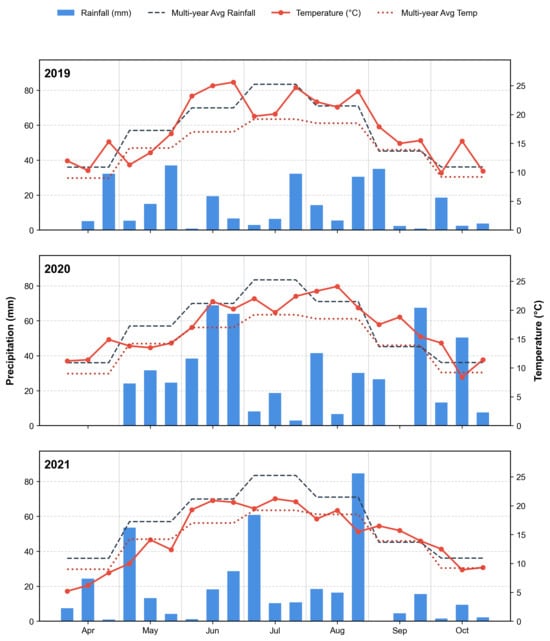
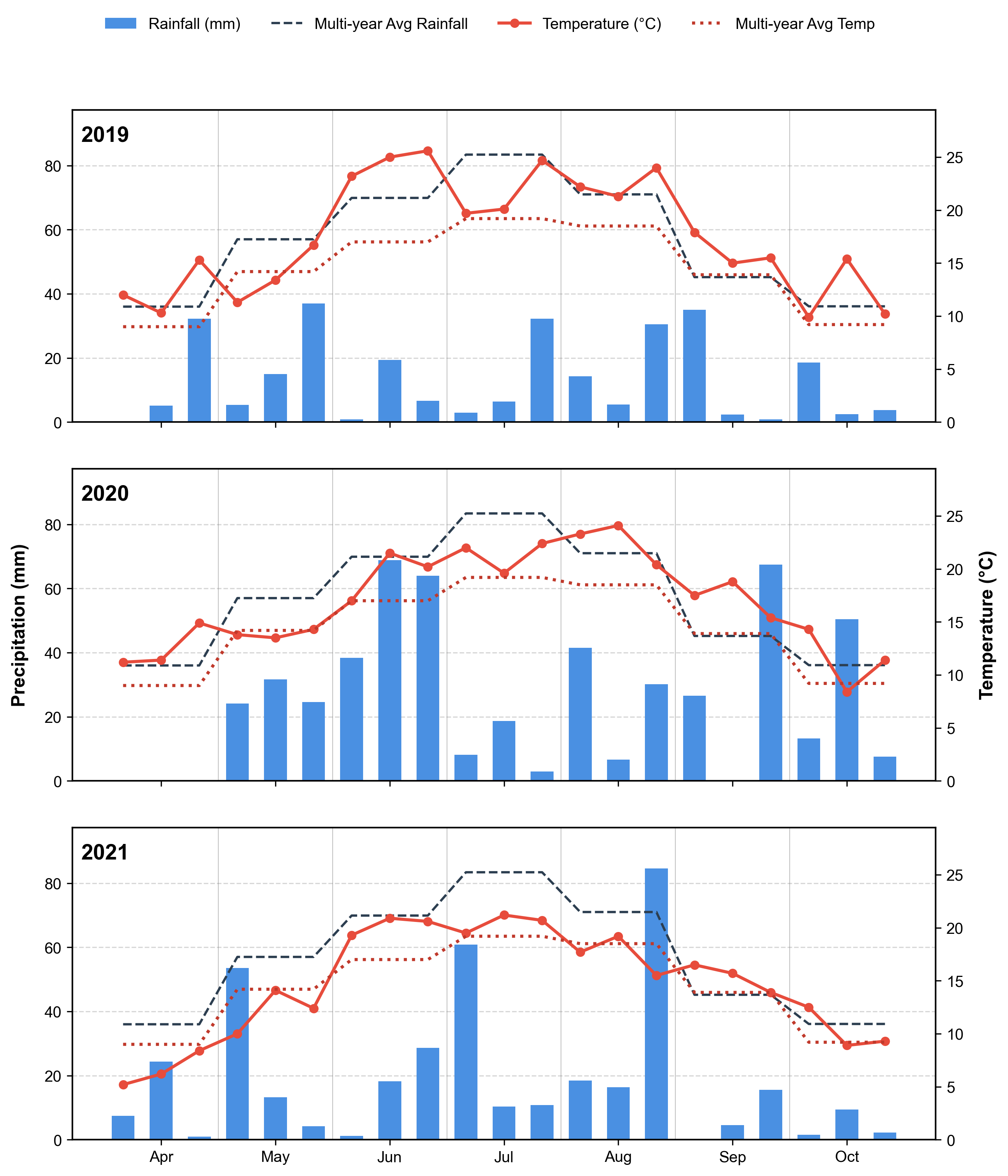
The field experiment conducted during the 2019–2021 growing seasons experienced significant variability in hydrothermal parameters (Figure 1). Given the late planting date (25 May) and peak flowering occurring in September, the meteorological conditions from June to September were critical for plant development. The most extreme conditions were recorded in 2019, which was characterized by a severe, continuous four-month water deficit, with notably low precipitation in June (26.9 mm) and August (50.3 mm). Conversely, the 2020 season exhibited an atypical precipitation distribution, featuring an extremely wet June (171.2 mm of rainfall) followed by high precipitation during the flowering period in September (94.1 mm). The 2021 season also presented challenging conditions, particularly a significant rainfall deficit (20.2 mm) during the peak flowering month of September, which substantially impacted final reproductive quality.
Figure 1.
Average temperature and precipitation distribution during the 2019–2021 growing seasons.
3.2. Plant Biometry and Morphological Parameters
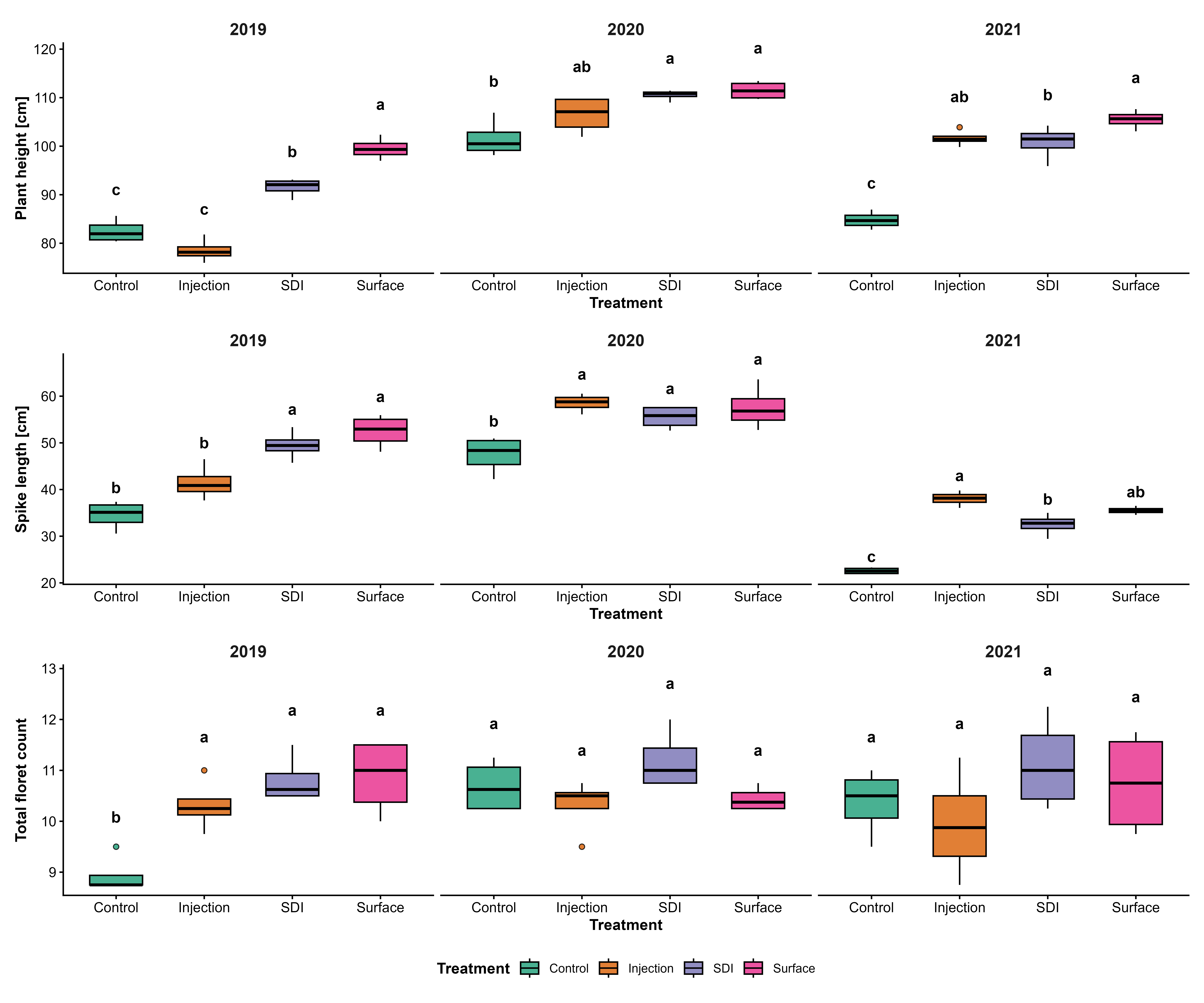
The application of different irrigation methods significantly modulated the vegetative and generative growth of garden gladiolus, with highly pronounced seasonal variations. Plant height was significantly influenced by the irrigation treatment (F = 83.92, p < 0.001), the year of study (F = 246.88, p < 0.001), and their interaction (F = 16.73, p < 0.001; Table S1, Figure 2).
Year-specific slicing analysis revealed that in the dry year of 2019, surface drip irrigation was the most effective method, producing the tallest plants (99.51 cm, group ‘a’), while subsurface drip irrigation (SDI) resulted in intermediate heights (91.53 cm, group ‘b’). In contrast, pulse injection (78.52 cm, group ‘c’) failed to improve height, yielding results comparable to the non-irrigated control (82.48 cm, group ‘c’; Table S1). In 2020, Surface (111.49 cm, ‘a’) and SDI (110.53 cm, ‘a’) treatments stimulated maximum height, whereas Control plants (101.52 cm, ‘b’) were significantly shorter. In 2021, Surface drip maintained its superiority (105.50 cm, ‘a’), while SDI (100.78 cm, ‘b’) and Injection (101.65 cm, ‘ab’) did not significantly differ (Table S1).
Generative spike length was similarly affected by a highly significant treatment × year interaction (F = 6.07, p < 0.001; Table S1, Figure 2). Slicing analysis showed that in 2019, Surface drip (52.48 cm, ‘a’) and SDI (49.49 cm, ‘a’) produced the longest flower spikes, whereas Control plants exhibited severe shortening (34.54 cm, ‘b’). In the favorable 2020 season, Surface (57.50 cm, ‘a’), SDI (55.48 cm, ‘a’), and Injection (58.55 cm, ‘a’) treatments performed equally, significantly outperforming the Control (47.48 cm, ‘b’). Crucially, in the dry 2021 season, the pulse injection treatment produced the longest spikes (38.04 cm, ‘a’), significantly exceeding SDI (32.50 cm, ‘b’) and the Control (22.58 cm, ‘c’; Table S1).
In contrast, total floret count per spike was not significantly affected by the year (F = 1.68, p = 0.207) or the treatment × year interaction (F = 2.39, p = 0.059; Table S3, Figure 2). However, the main effect of irrigation treatment was significant (F = 5.39, p = 0.014; Table S3). Main effect analysis over the three-year period showed that SDI maximized the total floret count (11.04 florets per spike, group ‘a’), which was significantly higher than in the non-irrigated Control (10.00 florets, group ‘b’). Plants under Surface drip (10.69 florets) and pulse injection (10.19 florets) did not significantly differ from either the SDI or Control treatments (group ‘ab’; Table S3).
Field observations revealed structural instability in the pulse injection treatment. While gladiolus plants in the control, surface drip, and subsurface drip (SDI) treatments remained completely upright (0% lodging) across all three experimental years, approximately 15–20% of the plants in the pulse injection treatment exhibited lodging (physical collapse of the flowering spikes) during the peak blooming phase. This phenomenon was consistently observed following high-pressure water application events.
Figure 2.
Effect of different irrigation methods on the biometric and morphological parameters of gladiolus (plant height, inflorescence length, and total floret count) during the 2019–2021 growing seasons.
3.3. Corm Yield Parameters
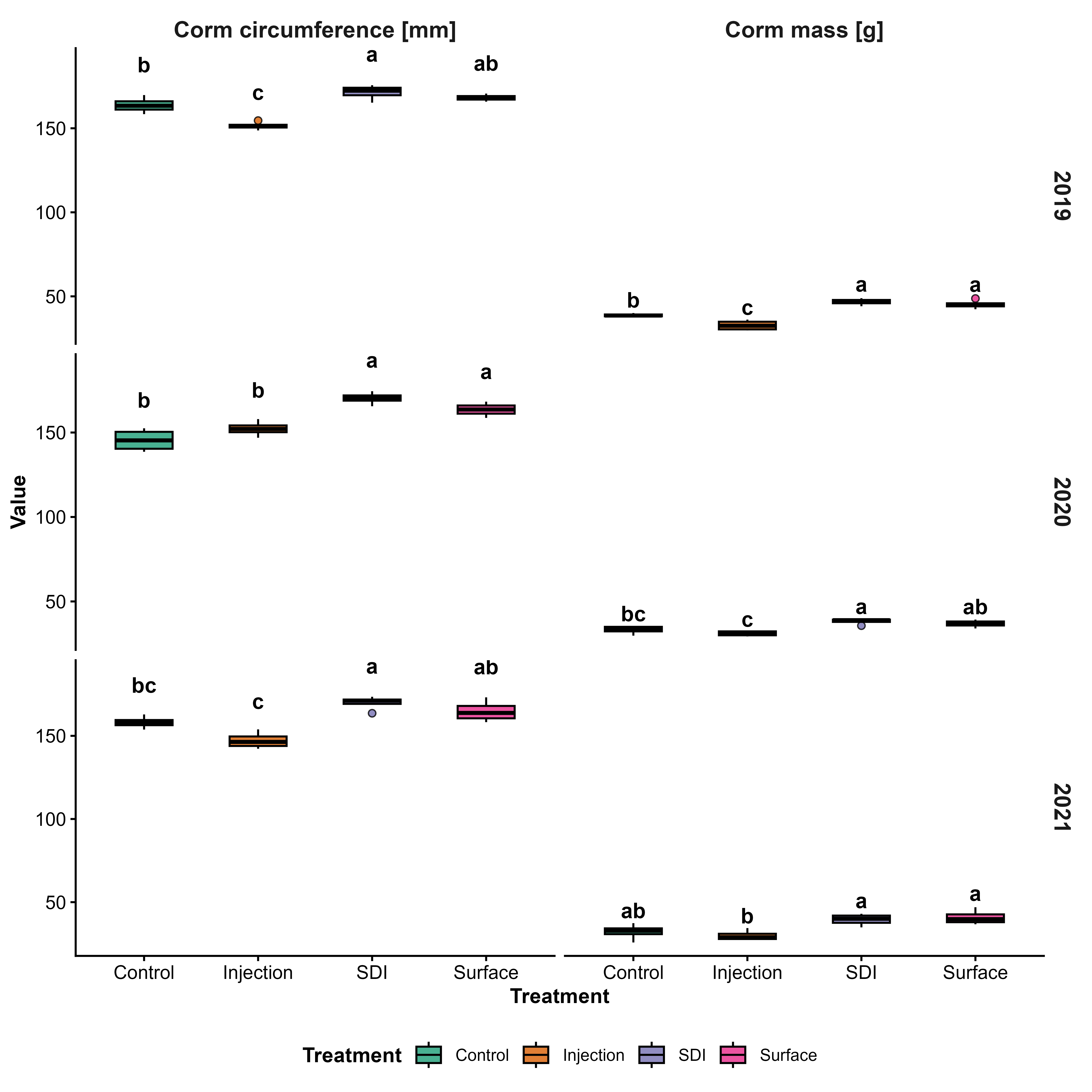
Daughter corm production was highly dependent on the irrigation strategy applied. Corm fresh mass was significantly affected by both the irrigation method (F = 29.14, p < 0.001) and the study year (F = 21.41, p < 0.001), while the interaction effect was non-significant (F = 1.68, p = 0.168; Table S3). Across the three-year study, the subsurface drip (SDI) and surface drip systems consistently produced the heaviest daughter corms, with overall 3-year means of 41.48 g and 40.94 g, respectively (group ‘a’). These values were significantly higher than the Control (34.74 g) and the pulse injection treatment (31.24 g), which did not differ significantly from each other and belonged to the same homogeneous group (group ‘b’; Table S3). Regarding the main effect of years, the highest daughter corm mass was recorded in the 2019 season (40.84 g, group ‘a’), while significantly lower values were obtained in 2020 (34.84 g) and 2021 (35.61 g), which formed a single homogeneous group (group ‘b’; Table S3, Figure 3).
Corm circumference exhibited a highly significant treatment × year interaction (F = 4.29, p = 0.002; Table S1). Slicing analysis indicated that SDI consistently maximized corm circumference across all seasons, reaching 171.40 mm (‘a’) in 2019, 170.28 mm (‘a’) in 2020, and 169.85 mm (‘a’) in 2021 (Table S1). In 2019, Surface drip (168.17 mm, ‘ab’) did not significantly differ from SDI, while Control corms were smaller (163.75 mm, ‘b’), and Injection corms were significantly the smallest (151.40 mm, ‘c’). This negative impact of the pulse injection treatment was maintained in 2020 (152.27 mm, ‘b’) and 2021 (147.20 mm, ‘c’), lagging significantly behind the SDI system (Table S1, Figure 3).
Figure 3.
Impact of applied irrigation strategies on daughter corm yield parameters (corm mass and circumference) across the 2019–2021 growing seasons.
3.4. Leaf Mineral Composition
The availability of soil moisture significantly modified the macronutrient profile of gladiolus leaves.
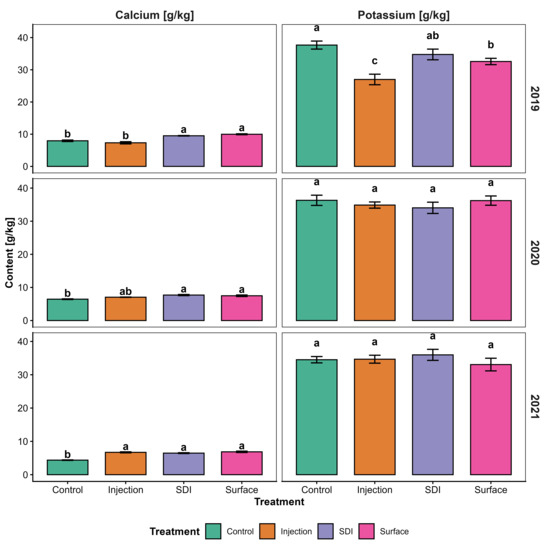
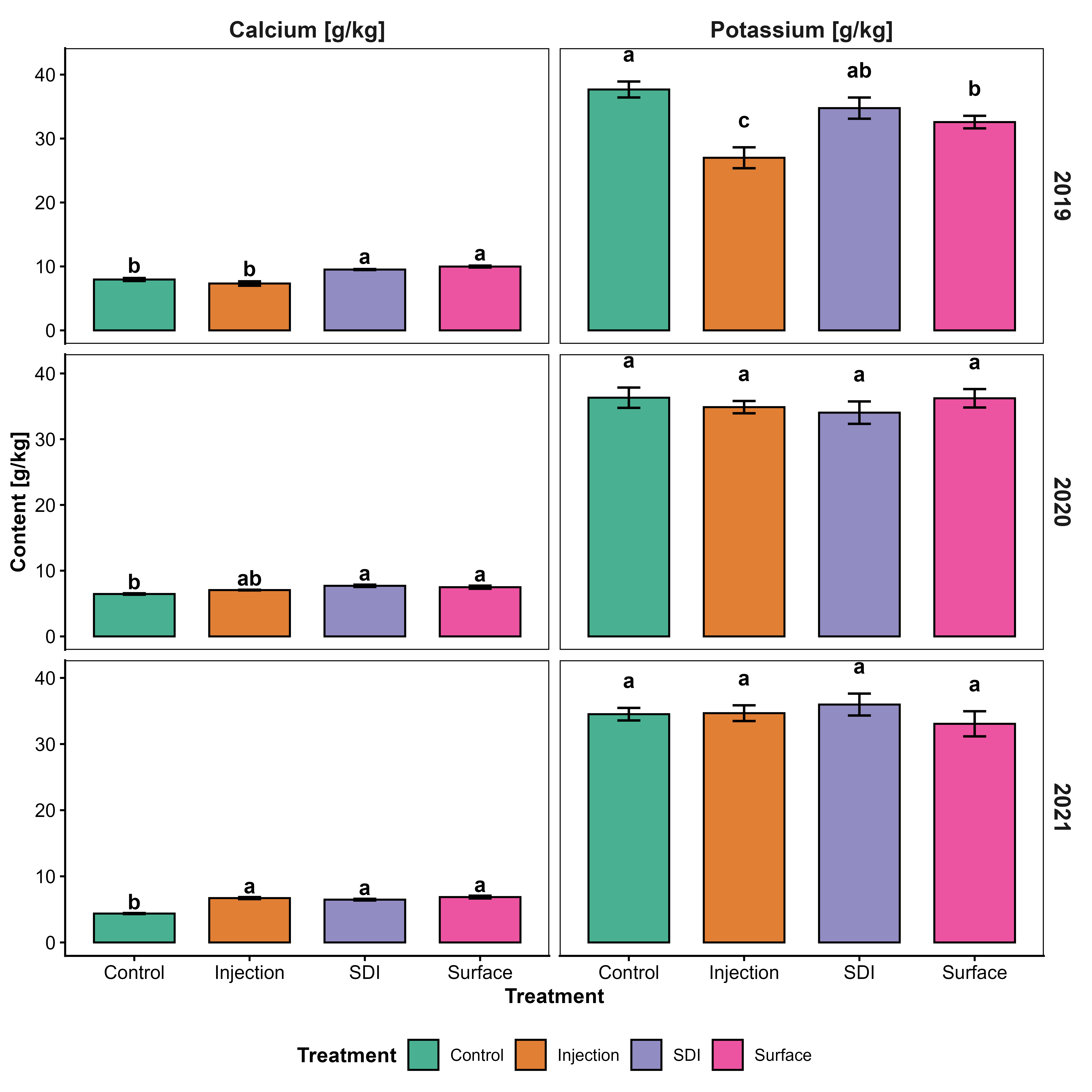
Calcium (Ca) concentration was subject to highly significant main effects and treatment × year interaction (F = 23.13, p < 0.001; Table S2). Under severe drought in 2019, Surface drip (9.98 g/kg, ‘a’) and SDI (9.51 g/kg, ‘a’) maximized Ca accumulation, while the Control (7.95 g/kg, ‘b’) and Injection (7.33 g/kg, ‘b’) treatments were significantly lower (Table S2, Figure 4). In the moderately wet year of 2020, SDI (7.70 g/kg) and Surface drip (7.49 g/kg) maintained the highest Ca concentrations (group ‘a’), pulse injection had intermediate levels (7.05 g/kg, ‘ab’), while the Control exhibited the lowest concentration (6.45 g/kg, ‘b’; Table S2). In 2021, all irrigated treatments significantly increased Ca concentrations (ranging from 6.47 to 6.86 g/kg, group ‘a’) compared to the severely water-stressed Control (4.37 g/kg, group ‘b’; Table S2).
Figure 4.
Leaf mineral composition (calcium, potassium) of gladiolus under various irrigation treatments during the 2019–2021 growing seasons.
Potassium (K) content exhibited a significant treatment × year interaction (F = 3.60, p = 0.012; Table S2). In 2019, K concentration peaked in the Control (37.67 g/kg, ‘a’) and was lowest in the pulse injection treatment (27.00 g/kg, ‘c’; Table S2, Figure 4). However, in the wet year of 2020 and the dry year of 2021, no significant differences in potassium content were observed among any treatments (Table S2).
Leaf nitrate (N–NO3) concentrations were significantly affected by the irrigation method (F = 17.49, p < 0.001), whereas the study year (p = 0.384) and interaction (p = 0.156) were non-significant (Table S3). Over the three-year period, the highest nitrate concentrations were found in the pulse injection (2793.48 ppm, group ‘a’) and non-irrigated Control (2776.38 ppm, group ‘a’) plants. In contrast, SDI (2620.78 ppm) and Surface drip (2535.07 ppm) resulted in significantly lower foliar nitrate concentrations (group ‘b’), indicating a classic biomass dilution effect (Table S3).
Magnesium (Mg) concentrations also exhibited a highly significant treatment × year interaction (F = 11.64, p < 0.001; Table S2). Slicing analysis revealed that in the dry year of 2019, pulse injection (9.17 g/kg) and Surface drip (8.67 g/kg) maximized Mg concentrations (group ‘a’), while the Control had the lowest concentration (7.33 g/kg, ‘b’). In 2020, a sharp drop in Mg was observed across all treatments; however, the Control remained significantly highest (4.39 g/kg, ‘a’), whereas pulse injection resulted in the lowest Mg concentration (2.31 g/kg, ‘c’). In the dry year of 2021, no significant differences in Mg concentrations were found among any of the treatments, ranging from 5.29 to 6.17 g/kg (all in group ‘a’; Table S2).
Foliar phosphorus (P) concentrations were affected by a highly significant treatment × year interaction (F = 52.12, p < 0.001; Table S2). Slicing analysis showed that in 2019, Surface drip resulted in the highest P concentration (1.72 g/kg, ‘a’), whereas SDI and Injection had the lowest values (1.56 and 1.58 g/kg, respectively, group ‘b’). In 2020, P concentrations were maximized in the Control (1.80 g/kg) and Injection (1.78 g/kg) treatments (group ‘a’), while SDI exhibited the lowest value (1.41 g/kg, ‘c’). Crucially, in the dry year of 2021, SDI (1.79 g/kg) showed no significant difference from the Control (1.83 g/kg) and Injection (1.87 g/kg) treatments (all in group ‘a’), while Surface drip was significantly lower (1.60 g/kg, ‘b’; Table S2).
3.5. Temporal Analysis and Post-Harvest Longevity
Vegetative leaf growth dynamics, expressed as the Area Under the Curve (AUC) of leaf counts, were significantly affected by the irrigation treatment (F = 16.69, p < 0.001) and year (F = 73.04, p < 0.001), with no significant interaction (F = 1.05, p = 0.413; Table S3). Main effect analysis revealed that non-irrigated Control plants consistently exhibited the highest overall leaf AUC values (14.44, group ‘a’), significantly exceeding all irrigated treatments (Table S3). The plants under Surface drip (13.02), pulse injection (12.90), and SDI (12.29) treatments did not differ significantly from each other and formed a single homogeneous group (group ‘b’; Table S3), showing a more balanced vegetative growth pattern. Regarding the main effect of years, the leaf count AUC index systematically and significantly increased over the study period, peaking in 2021 (14.97, group ‘a’), reaching intermediate values in 2020 (12.77, group ‘b’), and being lowest in the dry year of 2019 (11.75, group ‘c’; Table S3).
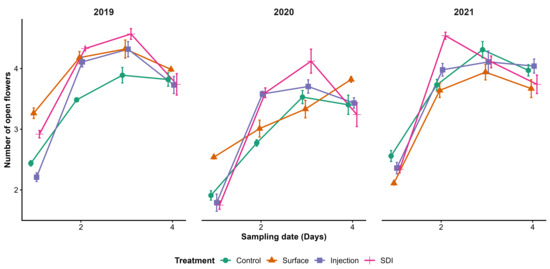
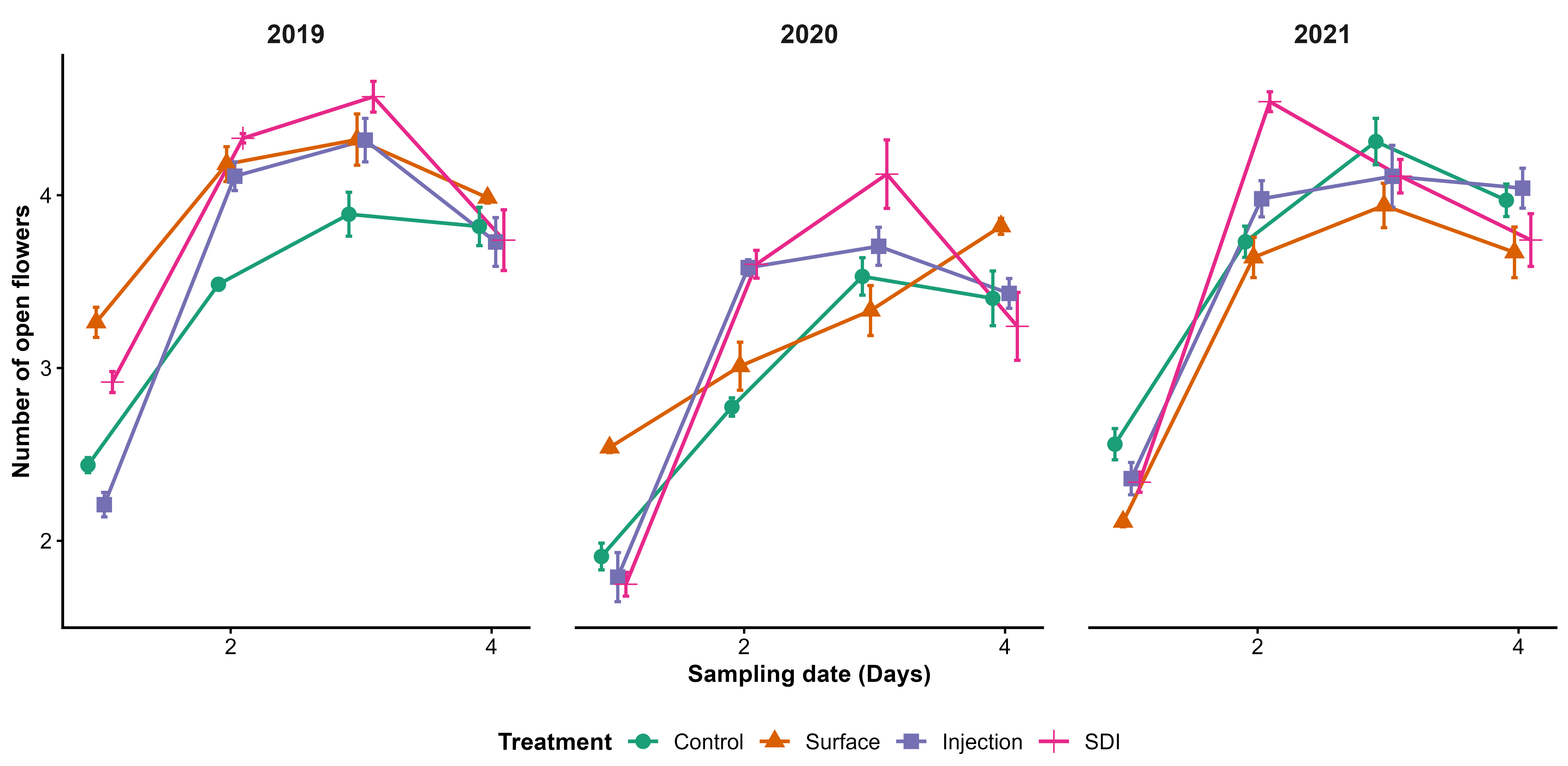
Post-harvest ornamental longevity in vases, evaluated by the open flower AUC index, was significantly affected by a highly significant treatment × year interaction (F = 7.76, p < 0.001; Table S1). Slicing analysis showed that in the dry season of 2019, SDI (12.23, ‘a’) and Surface drip (12.13, ‘a’) maintained a significantly higher number of attractive open flowers over time compared to the non-irrigated Control (10.50, ‘c’). In 2020, SDI (10.22, ‘a’) was significantly superior to the Control (8.96, ‘b’). In 2021, SDI (11.69, ‘a’) performed equally to the Control (11.31, ‘ab’) and Injection (11.29, ‘ab’), while Surface drip exhibited a lower floret longevity AUC (10.47, ‘b’; Table S1). Across all three years, the SDI system consistently maintained the highest post-harvest flower longevity (Table S1, Figure 5).
Figure 5.
Post-harvest longevity and blooming dynamics of gladiolus inflorescences, expressed as the number of open, attractive flowers over time during the vase life evaluation (2019–2021). Withered florets were excluded from the daily counts to represent the actual ornamental value of the spikes.
4. Discussion
4.1. Biometric Parameters and Vegetative Growth
In the present study, water deficit restricted the biometric parameters of Gladiolus, particularly plant height and spike length. Similar trends were observed indicated that water stress significantly reduces growth and flower stalk dimensions [25]. This phenomenon is governed by a physiological mechanism wherein water shortage leads to an interruption of flow from the xylem to the surrounding cells, thereby inhibiting the process of cell elongation [1]. A decrease in turgor within plant tissues during the intensive growth phase limits cell division and expansion, which directly translates to smaller stem and inflorescence sizes [9].
Concurrently, it was demonstrated that subsurface drip irrigation (SDI) was the most effective method for stimulating aerial growth parameters, attributed to the precise delivery of water directly to the plant root zone [26]. Such an application system allows for maintaining a dry soil surface, which practically eliminates water losses resulting from surface evaporation and runoff, while ensuring high moisture within the rhizosphere and minimizing plant water stress [26,27]. Furthermore, the high frequency of water application in the subsurface system maintains an optimal soil matric potential, which favors uninterrupted transpiration and photosynthesis, consequently leading to the production of taller stems with longer spikes [27].
4.2. Growth Dynamics
In the present study, an atypical trend was observed in the growth dynamics analyzed using the Area Under the Curve (AUC). Plants in the control treatment, subjected to drought stress, exhibited higher AUC values for leaf increment during the early vegetative phase; however, this resulted in the formation of inflorescences with inferior qualitative parameters. Similar patterns of rapid response to adverse environmental conditions have been described [3,28], suggesting that plants can modify their developmental dynamics to survive under stress. The physiological basis for this trend is stress-induced accelerated development. Water deficit triggers early maturity strategies, characterized by a shortened vegetative phase and rapid leaf senescence. Decreasing the fraction of transpirable soil water forces early stomatal closure and reduces the leaf appearance rate in gladiolus. Furthermore, the tolerance to water deficit and the onset of stomatal closure vary depending on the developmental stage, with plants adopting a more conservative strategy during the reproductive phase [25]. While this response allows the plant to complete its life cycle before lethal desiccation, it occurs at the expense of biomass accumulation and reproductive quality, resulting in shorter spikes and fewer florets. Furthermore, the reduced leaf longevity observed in non-irrigated plants limits the period available for assimilate production, which is vital for the filling of storage organs [3]. This strategy is implemented at the expense of generative quality, which in our study was manifested by shortened spikes and a reduced floret count, resulting from insufficient accumulation of biomass and energy reserves necessary for full inflorescence development [9,29].
Concurrently, irrigated plants were characterized by significantly greater post-harvest longevity than those cultivated under water deficit conditions. This correlation confirms the findings [4,9], proving that optimal irrigation during the vegetation period is a key factor extending the vase life of gladiolus. The superior longevity of irrigated plants is directly linked to their improved water status and high tissue turgor at the time of harvest, which prevents early vascular blockages [9]. Furthermore, owing to a longer and uninterrupted vegetative period, these plants accumulate a significantly larger reserve of assimilates. These reserves serve as essential metabolics for the development of subsequent buds and the maintenance of cellular respiration after cutting, whereas in stressed plants, sugar deficiency accelerates senescence processes [9,30].
The severe rainfall deficit recorded in September 2021 (only 20.2 mm of precipitation) during the peak flowering phase further exacerbated the quality gap between irrigated and control plants, confirming that water availability during the reproductive stage is crucial for final spike quality [4,12].
4.3. Corm Yield
In the present study, the pulse injection irrigation method did not produce the anticipated results, generating corm yield parameters, such as weight and circumference, at levels comparable to those of the non-irrigated control and significantly lower than those of the drip irrigation treatments. Such poor performance contrasts with general trends [27,31], which indicate that precision water delivery should theoretically stimulate the growth of storage organs. Interestingly, while Adamczewska-Sowińska et al. reported a 57% yield increase in celeriac using the same injection system at the same experimental site, our study on gladiolus showed no significant benefit [20]. The parameters of this mobile injection system, applying rapid water pulses at an operating pressure of 4 bar [17], highlight the serious role of root system architecture. Unlike celeriac, which possesses a dense, water-seeking root system, gladiolus has a shallow, fibrous root system. Consequently, we hypothesize that delivering water as rapid, high-pressure pulses directly into this shallow rhizosphere likely induced localized mechanical disturbance. This is strongly supported by our qualitative field observations, which revealed a 15–20% lodging incidence of flowering spikes exclusively in the pulse injection plots following irrigation events. The rapid application of large water volumes (approx. 600 mL) may have also caused localized soil erosion and nutrient leaching from the rhizosphere, potentially negating the cost-effectiveness and precise nutrient delivery typically achieved by modern drip fertigation systems [16]. Furthermore, this saturation pulse could physically destabilize the soil structure around the corms, contributing to the observed plant lodging and inhibiting the stable development of storage organs.
In contrast to the injection method, subsurface drip irrigation (SDI) resulted in the highest increase in daughter corm weight and circumference. This aligns with findings [6] demonstrating that stable root zone moisture is crucial for maximizing underground yield. The success of this method stems from the fact that, in gladiolus, following the full bloom phase, the newly forming corm becomes the primary sink for photosynthates. By maintaining an optimal soil matric potential, the subsurface system prevents moisture fluctuations, allowing for uninterrupted and intensive translocation of carbohydrates from leaves to the daughter corm during its filling phase [14,27,31]. Water delivery directly below the soil surface minimizes evaporative losses, ensuring that the plant maintains the water status necessary for optimal biomass partitioning between aerial parts and perennating organs [32].
4.4. Mineral Nutrition
In the present study, irrigation treatments significantly increased calcium content in gladiolus leaves. This phenomenon is governed by the biological mechanism of mass flow, where calcium, as an element with limited phloem mobility, is transported to aerial parts almost exclusively via the transpiration stream in xylem vessels [19,33]. Higher water availability in the rhizosphere stimulates stomatal conductance and intensifies transpiration in irrigated plants, which naturally forces a greater passive influx of water along with dissolved calcium ions into leaf tissues [9].
Conversely, the observed decrease in nitrogen, phosphorus, and potassium concentrations in irrigated plants relative to the drought control aligns with the dilution driven by increased biomass accumulation. This stands in contrast to the concentration effect, where nutrient concentrations artificially rise in stunted plants grown under drought conditions due to growth inhibition [19,34]. In our study, irrigated plants produced substantially more biomass, causing the absorbed pool of elements to be dispersed within a larger tissue volume, whereas in stressed plants, the same nutrients accumulated in smaller, stunted organs [27,35].
5. Conclusions
Subsurface drip (SDI) and surface drip irrigation represent the most stable and effective strategies for field gladiolus cultivation, consistently maximizing daughter corm yield and improving overall vegetative and floral quality.
The prototype pulse injection irrigation method exhibited contrasting, year-specific agronomic effects. While it successfully mitigated late-season drought to maximize generative spike length, it failed to improve underground corm production and led to a high incidence of plant lodging (15–20%). This drawback is hypothesized to result from physical soil disturbance and mechanical stress on the shallow fibrous root system of gladiolus under high-pressure (4 bar) water application.
Enhanced soil water availability significantly modifies the foliar mineral profile through two distinct mechanisms: it intensifies the transpiration-driven mass flow of calcium to the leaves while simultaneously causing a dilution effect for nitrogen, phosphorus, and potassium within the substantially increased plant biomass.
Unmitigated water deficit induces an accelerated maturity response and early leaf senescence. This stress-avoidance strategy reduces the duration of the vegetative phase and limits biomass accumulation, which ultimately compromises the decorative quality and post-harvest longevity of the inflorescences.
For professional and sustainable gladiolus production, the implementation of an SDI system is highly recommended. It optimizes water resource utilization while maximizing the agronomic quality and reproductive potential of the plants.
In the face of progressive climate change and the increasing frequency of prolonged drought periods, the adoption of highly efficient irrigation technologies like SDI represents a vital pillar of climate-resilient agriculture. Future research should focus on integrating precision irrigation with other agronomic optimizations to establish comprehensive cultivation protocols. For instance, combining SDI with staggered planting dates could help extend harvest windows and adapt production to shifting climatic zones [36]. Additionally, exploring the synergistic effects of optimized irrigation with the use of appropriate soil mulching [15] and advanced growing media—which enhance water holding capacity and aeration while limiting soil-borne pathogens [37]—will be essential. Developing such integrated strategies will secure the sustainable and profitable future of the global floriculture industry under changing environmental conditions.
Supplementary Materials
The following supporting information can be downloaded at: https://www.mdpi.com/article/10.3390/agronomy16171648/s1, TableS1: Effect of irrigation methods on the agronomic parameters, daughter corm yield, leaf count AUC, and floret vase longevity AUC of gladiolus (2019–2021); Table S2: Effect of irrigation methods on the foliar macronutrient and nitrate concentration of gladiolus leaves (2019–2021); Table S3: Main effects of irrigation methods and years on the gladiolus parameters with non-significant Treatment × Year interaction (2019–2021).
Author Contributions
Conceptualization, M.R.. and J.K..; methodology, M.R.; software, K.P.; validation, M.R., K.P. and J.K.; formal analysis, K.P.; investigation, M.R.; resources, J.K.; data curation, M.R.; writing—original draft preparation, M.R.; writing—review and editing, K.P. and J.K.; visualization, K.P.; supervision, J.K.; project administration, M.R.; funding acquisition, M.R. All authors have read and agreed to the published version of the manuscript.
Funding
Financed by the National Centre for Research and Development as part of the project “A mobile system for precision injection irrigation and fertilisation meeting the individual requirements of plants”. MSINiN—project acronym. Grant number: BIOSTRATEG3/343547/8/NCBR/2017.
Data Availability Statement
The raw data supporting the conclusions of this article will be made available by the authors on request.
Acknowledgments
During the preparation of this manuscript, the authors used Gemini Notebook (formerly known as Google NotebookLM, Google, August 2026) for the purposes of English language editing, grammatical corrections, and structural refinement. The authors have reviewed and edited the output and take full responsibility for the content of this publication.
Conflicts of Interest
The authors declare no conflicts of interest.
References
- Adam, A. Studies the Response of Gladiolus Plants to Humic Acid, Potassium and Water Irrigation Intervals. Sci. J. Agric. Sci. 2021, 3, 23–37. [Google Scholar] [CrossRef] [Scilit]
- Aydinsakir, K.; Tepe, A.; Buyuktas, D. Effects of Saline Irrigation Water Applications on Quality Characteristics of Freesia Grown in Greenhouse. Akdeniz Üniversitesi Ziraat Fakültesi Derg. 2010, 23, 41–46. [Google Scholar]
- Wahab, A.; Abdi, G.; Saleem, M.H.; Ali, B.; Ullah, S.; Shah, W.; Mumtaz, S.; Yasin, G.; Muresan, C.C.; Marc, R.A. Plants’ Physio-Biochemical and Phyto-Hormonal Responses to Alleviate the Adverse Effects of Drought Stress: A Comprehensive Review. Plants 2022, 11, 1620. [Google Scholar] [CrossRef] [Scilit] [PubMed]
- Ahmad, A.; Ahmad, I. Performance of Exotic Gladiolus Cultivars under Various Irrigation Regimes. J. Hortic. Sci. Technol. 2019, 2, 113–118. [Google Scholar] [CrossRef] [Scilit]
- Yadav, U.; Agrawal, N.; Katre, P.; Tamrakar, S.K.; Tripathi, M.P. Effect of Irrigation and Fertigation on Gladiolus Crop Water Requirement, Yield and Water Use Efficiency in Chhattisgarh Plain. Int. J. Curr. Microbiol. App. Sci. 2020, 9, 2913–2923. [Google Scholar] [CrossRef] [Scilit]
- Yazar, A.; Gökçel, F.; Sezen, M.S. Corn Yield Response to Partial Rootzone Drying and Deficit Irrigation Strategies Applied with Drip System. Plant Soil Environ. 2009, 55, 494–503. [Google Scholar] [CrossRef] [Scilit]
- Bhardwaj, R.; Sharma, P.; Sharma, A.; Kumar, M. Economic Evaluation of Gladiolus (Gladiolus L.) Genotypes for off Season Cultivation in Sub Temperate Zone. Int. J. Plant Soil Sci. 2025, 37, 811–819. [Google Scholar] [CrossRef] [Scilit]
- Salma, Z.; Kumar, K.S.; Ahalawat, V.P. Effect of Mulching and Irrigation Methods on Weed Growth and Soil Moisture Percentage in Gladiolus. Int. J. Agric. Sci. Res. 2016, 6, 75–80. [Google Scholar]
- Santos, J.J.S.D.; Pêgo, R.G.; Couto, B.R.M.; Bueno, M.M.; Carvalho, D.F.D. Evaluation of Water Requirement, Commercial Quality, and Yield Response Factor of Gladiolus Produced with Automated Irrigation in Different Growing Periods. Ciênc. Agrotec. 2020, 44, e017220. [Google Scholar] [CrossRef] [Scilit]
- Sapkota, A.; Haghverdi, A.; Merhaut, D. Effects of Deficit Irrigation on Canopy Temperature Dynamics and Physiology of Landscape Groundcovers. HortScience 2023, 58, 1321–1331. [Google Scholar] [CrossRef] [Scilit]
- Ahmad, I.; Saeed, T.; Khan, S.A.; Wahid, A.; Ahmad, T.; Akhtar, G.; Ashraf, S.; Hussnain, H. Assessment of Four Gladiolus Cultivars for the Best Production under Multan’s Agro-Climatic Conditions. J. Pure Appl. Agric. 2023, 8. Available online: http://jpaa.aiou.edu.pk/ (accessed on 14 July 2026).
- Bastug, R.; Karaguzel, O.; Aydinsakir, K.; Buyuktas, D. The Effects of Drip Irrigation on Flowering and Flower Quality of Glasshouse Gladiolus Plant. Agric. Water Manag. 2006, 81, 132–144. [Google Scholar] [CrossRef] [Scilit]
- Mazzini-Guedes, R.B.; Guedes Filho, O.; Bonfim-Silva, E.; Couto, J.; Pereira, M.; Silva, T. Management of Corm Size and Soil Water Content for Gladiolus Flower Production. Ornam. Hortic. 2017, 23, 152–159. [Google Scholar] [CrossRef] [Scilit]
- Tomiozzo, R.; Uhlmann, L.O.; Becker, C.C.; Schwab, N.T.; Streck, N.A.; Balest, D.S. How to Produce Gladiolus Corms? Ornam. Hortic. 2019, 25, 299–306. [Google Scholar] [CrossRef] [Scilit]
- Lima, E.F.; Streck, N.A.; Petry, M.T.; Martins, J.D.; Buffon, P.A.; Netto, J.F.; Schwab, N.T.; Uhlmann, L.O.; Dos Santos, M.S.; Da Silva, C.M. Irrigation and Soil Mulching Can Improve the Quality of Flower Stems of Gladiolus. Irrig. Drain. 2022, 71, 926–937. [Google Scholar] [CrossRef] [Scilit]
- Prasad, S.S.; Kurubar, A.R.; Hugar, A.; Ramesh, G.; Umesh, M.R.; Meena, M.K. Cost Effectiveness of Gladiolus Production under Drip Fertigation and Planting Geometry. Indian J. Hortic. 2022, 79, 353–362. [Google Scholar] [CrossRef] [Scilit]
- Walczak, A.; Lipiński, M.; Janik, G. Application of the TDR Sensor and the Parameters of Injection Irrigation for the Estimation of Soil Evaporation Intensity. Sensors 2021, 21, 2309. [Google Scholar] [CrossRef] [Scilit] [PubMed]
- Gloser, V.; Dvorackova, M.; Mota, D.H.; Petrovic, B.; Gonzalez, P.; Geilfus, C.M. Early Changes in Nitrate Uptake and Assimilation Under Drought in Relation to Transpiration. Front. Plant Sci. 2020, 11, 602065. [Google Scholar] [CrossRef] [Scilit] [PubMed]
- Hosseini, A. Comparison of Variability in Leaves and Roots Nutrient Contents of Persian Oak (Quercus brantii Lindl.) in Drought Affected Declining Forests. BioResources 2023, 18, 3885–3894. [Google Scholar] [CrossRef] [Scilit]
- Adamczewska-Sowińska, K.; Sowiński, J.; Pęczkowski, G.; Krężel, J. The Efficiency of Precision Injection Irrigation Methods on Growth and Celeriac Yielding (Apium graveolens L. Var. Rapaceum (Mill. Gaudi). Sci. Hortic. 2024, 336, 113426. [Google Scholar] [CrossRef] [Scilit]
- De Mendiburu, F. Agricolae: Statistical Procedures for Agricultural Research. R Package Version 1.3-7. 2023. Available online: https://CRAN.R-project.org/package=agricolae (accessed on 1 May 2026).
- R Core Team. R: A Language and Environment for Statistical Computing; R Foundation for Statistical Computing: Vienna, Austria, 2025. [Google Scholar]
- Wickham, H. Tidyverse: Easily Install and Load the “Tidyverse”. R Package Version 2.0.0. 2023. Available online: https://CRAN.R-project.org/package=tidyverse (accessed on 1 May 2026).
- Wickham, H.; Chang, W.; Henry, L.; Pedersen, T.L.; Takahashi, K.; Wilke, C.; Woo, K.; Yutani, H.; Dunnington, D.; Van Den Brand, T. Ggplot2: Create Elegant Data Visualisations Using the Grammar of Graphics. R Package Version 4.0.1. 2025. Available online: https://CRAN.R-project.org/package=ggplot2 (accessed on 1 May 2026).
- Becker, C.C.; Gubiani, P.I.; Streck, N.A.; Uhlmann, L.O.; Tomiozzo, R. How Does Water Deficit Affect Gladiolus Growth and Development? Eng. Agríc. 2021, 41, 517–525. [Google Scholar] [CrossRef] [Scilit]
- Payero, J.O.; Yonts, C.D.; Irmak, S.; Tarkalson, D. Advantages and Disadvantages of Subsurface Drip Irrigation; Extension Circular EC05-776; University of Nebraska–Lincoln Extension: Lincoln, NE, USA, 2005. [Google Scholar]
- Khanam, R.; Patra, S.K. Effect of Gravity Drip Irrigation on Growth, Yield and Water Use Efficiency of Gladiolus in Lower Gangetic Plain of West Bengal, India. Int. J. Ecosyst. 2015, 5, 132–137. [Google Scholar]
- Pecka, J.; Kraus, K.; Zelený, M.; Hniličková, H. Exogenous Proline Modulates Physiological Responses and Induces Stress Memory in Wheat under Repeated and Delayed Drought Stress. Agronomy 2025, 15, 1370. [Google Scholar] [CrossRef] [Scilit]
- Sousa, L.D.C.D.; Fonseca, K.S.; Silva, L.F.D.; Silva, T.G.F.D.; Andrada, L.V.P.D.; Santos, A.R.M.D.; Apolinário, P.L.M.F.; Souza, J.F.D.N.; Simões, A.D.N. Growth and Vase Life of Gladiolus Plants Cultivated under Different Conditions in the Semi-Arid Region of Brazil. Ornam. Hortic. 2021, 27, 398–407. [Google Scholar] [CrossRef] [Scilit]
- Elansary, H.O. Tree Bark Phenols Regulate the Physiological and Biochemical Performance of Gladiolus Flowers. Processes 2020, 8, 71. [Google Scholar] [CrossRef] [Scilit]
- Patra, S.K.; Sengupta, S. Effect of Gravity-Fed Drip Irrigation and Nitrogen Management on Flowering Quality, Yield, Water and Nutrient Dynamics of Gladiolus in an Indian Inceptisol. J. Plant Nutr. 2022, 45, 2049–2067. [Google Scholar] [CrossRef] [Scilit]
- Lei, H.; Yu, J.; Zang, M.; Pan, H.; Liu, X.; Zhang, Z.; Du, J. Effects of Water-Fertilizer-Air-Coupling Drip Irrigation on Soil Health Status: Soil Aeration, Enzyme Activities and Microbial Biomass. Agronomy 2022, 12, 2674. [Google Scholar] [CrossRef] [Scilit]
- Hasanuzzaman, M.; Bhuyan, M.; Nahar, K.; Hossain, M.; Mahmud, J.; Hossen, M.; Masud, A.; Moumita; Fujita, M. Potassium: A Vital Regulator of Plant Responses and Tolerance to Abiotic Stresses. Agronomy 2018, 8, 31. [Google Scholar] [CrossRef] [Scilit]
- Sardans, J.; Peñuelas, J. Drought Changes Phosphorus and Potassium Accumulation Patterns in an Evergreen Mediterranean Forest. Funct. Ecol. 2007, 21, 191–201. [Google Scholar] [CrossRef] [Scilit]
- Silveira, J.A.G.D.; Costa, R.C.L.D.; Oliveira, J.T.A. Drought-Induced Effects and Recovery of Nitrate Assimilation and Nodule Activity in Cowpea Plants Inoculated with Bradyrhizobium Spp. Under Moderate Nitrate Level. Braz. J. Microbiol. 2001, 32, 187–194. [Google Scholar] [CrossRef] [Scilit]
- Javaid, A.; Pandey, R.K.; Shah, A.H.; Bakshi, P.; Nazki, I.T.; Kaushal, N.; Chand, G.; Dogra, S.; Kumar, R.; Singh, A.K.; et al. Response of Gladiolus grandiflorus Varieties to Planting Date: Effects on Growth, Flowering, and Vase Life. BMC Plant Biol. 2025, 25, 481. [Google Scholar] [CrossRef] [Scilit] [PubMed]
- Karagüzel, Ü.Ö. Assessment of Different Growing Media on Cut Flower Performance of Two Gladiolus (Gladiolus grandiflorus) Cultivars. Hortic. Stud. 2023, 40, 36–42. [Google Scholar] [CrossRef] [Scilit]
Disclaimer/Publisher’s Note: The statements, opinions and data contained in all publications are solely those of the individual author(s) and contributor(s) and not of MDPI and/or the editor(s). MDPI and/or the editor(s) disclaim responsibility for any injury to people or property resulting from any ideas, methods, instructions or products referred to in the content. |
© 2026 by the authors. Licensee MDPI, Basel, Switzerland. This article is an open access article distributed under the terms and conditions of the Creative Commons Attribution (CC BY) license.