


Abstract
Fusarium verticillioides is a maize pathogenic fungus that produces the mycotoxin fumonisin B1 (FB1) and causes significant losses in grain quality and yield. In addition, the insect Sitophilus zeamais damages the grains and contributes to the dispersal of the fungus. Although synthetic pesticides provide effective pest control, their excessive use has raised concerns regarding environmental contamination and human health. Therefore, safer alternatives with biopesticide potential are being explored. The aim of this study was to identify an oxygenated volatile compound capable of protecting maize grains against fungal infection and fungal dispersal by the insect vector. The antifungal activity of 1,4-cineole, 1,8-cineole, α-terpineol, terpinen-4-ol, and 1-decen-3-ol against F. verticillioides was evaluated through the fumigant method. Among the tested compounds, 1-decen-3-ol and terpinen-4-ol showed the highest antifungal activity with minimum inhibitory concentration values of 0.5 and 0.9 mM, respectively, significantly affecting fungal growth rate and lag phase. The compound 1-decen-3-ol was selected for further evaluation in stored grains. The application of 1-decen-3-ol effectively prevented maize weight loss and reduced the accumulation of ergosterol and FB1. These findings suggest that 1-decen-3-ol could represent a potential candidate for the development of biocontrol strategies in grain storage systems.
1. Introduction
A large percentage of food products are contaminated with mycotoxins, representing a major global public health problem, particularly in developing countries [1]. In maize, fungi can colonize grains both in the field and during storage, producing various mycotoxins that cause toxic effects in humans and animals upon ingestion [2,3]. Among the mycotoxins commonly associated with maize worldwide, fumonisins (FBs) are the most prevalent [4,5,6], particularly fumonisin B1 (FB1) due to its immunotoxic, neurotoxic, hepatotoxic, nephrotoxic and carcinogenic effects [7,8,9,10]. Global surveys have reported high occurrences and elevated levels of FB1 in maize and maize-based food products [11,12]. Fusarium verticillioides (Sacc.) Nirenberg (teleomorph: Gibberella moniliformis) is the main fumonisin-producing fungus associated with maize. Even though the fungus primarily infects maize in the field, it may persist and develop during postharvest storage under favorable environmental conditions [13,14,15]. One of the main mechanisms involved in fungal development in stored maize is the activity of insect vectors. The continuous movement of Sitophilus zeamais Motschulsky (Coleóptera: Curculionidae) favors the propagation of fungal spores, hyphae and mycotoxins from contaminated to healthy grains. Additionally, the maize weevil breaks the grain wall, facilitating fungal colonization [16]. Thus, the control of both F. verticillioides and S. zeamais is necessary to prevent the contamination of maize with FB1. Currently, synthetic agrochemicals are widely used for pest control because they are highly effective [17]. However, there is growing evidence on the relationship between the excessive use of these chemicals with human health problems, environmental contamination as well as the development of resistant pest populations [18,19,20]. Consequently, the search for alternative pest control strategies has become increasingly important. In this context, natural products derived from plants have emerged as promising alternatives. Among the volatile constituents of essential oils, oxygenated compounds are well recognized for their broad range of biological activities [21,22,23,24], making them valuable candidates for the development of safe, effective and biodegradable pesticides [25]. Accordingly, the objective of this study was to evaluate the antifungal activity of oxygenated volatile compounds against F. verticillioides in order to identify the most effective compound and determine its grain-protecting effect against fungal infection and its dispersal mediated by the insect vector S. zeamais.
2. Materials and Methods
2.1. Chemical Products
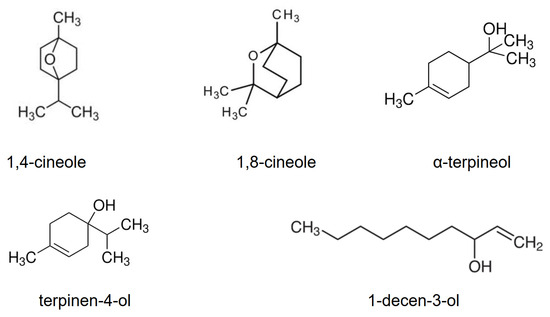
The selection of oxygenated volatile compounds was based on data from the literature reporting antifungal activity against other phytopathogenic fungi. The compounds were purchased from Sigma Aldrich (Buenos Aires, Argentina) and consisted of 1,4-Cineole (95%); 1,8-Cineole (99%); α-Terpineol (90%); Terpinen-4-ol (95%); and 1-Decen-3-ol (98%) (Figure 1).
Figure 1.
Chemical structures of oxygenated volatile compounds used in the antifungal bioassays (ChemDraw, v. 23.1).
2.2. Maize Grains
The maize grains (Zea mays L.) used in the bioassays were free of pesticides and obtained from Manfredi Experimental Station (INTA, Córdoba, Argentina). The grains were kept in closed and dry containers at 4 °C and 65–75% RH.
2.3. Fungal Strain and Inoculum Preparation
The fungal strain used in the experiments was Fusarium verticillioides M3125, provided by Dr. Robert Proctor (United States Department of Agriculture, Agricultural Research Service, National Center for Agricultural Utilization Research, Peoria, IL, USA). It was isolated from maize in California and is a fumonisin-producing strain [26]. To prepare the inoculum, F. verticillioides was incubated in Petri dishes with Czapek–Dox agar for 7 days at 28 °C. Then, sterile distilled water was added to the strongly sporulated cultures, and a suspension of conidia was obtained. After homogenizing the conidial suspension, the concentration was adjusted to 1 × 10⁶ conidia/mL using a Neubauer chamber (Boeco, Marienfeld, Germany).
2.4. Insects
Sitophilus zeamais obtained from Córdoba, Argentina, were reared under controlled conditions of temperature and humidity (27 ± 1 °C and 65 ± 2%, respectively) in darkness, using whole maize grains free of insecticides and kept in sealed containers. Adult weevils without differentiation of sex and age were used in all assays.
Prior to the assay, the selected insects were subjected to a surface disinfection process. Briefly, insects were immersed in sodium hypochlorite–water (90:10) and shaken on a vortex mixer for 1 min. Then, the residual sodium hypochlorite was removed by rinsing the insects in sterile water for 30 s.
2.5. Effect of Oxygenated Volatile Compounds on Fusarium verticillioides Growth
To evaluate the antifungal activity of oxygenated volatile compounds, the radial growth of the colony was determined through the fumigant methodology described by Brito et al. [16]. Briefly, Petri dishes (90 mm) with Czapek–Dox agar culture medium were centrally inoculated with 10 µL of the conidial suspension. Aluminum foil and filter paper were placed on the lids of Petri dishes, and different concentrations (0.06; 0.13; 0.26; 0.53; 1.06; 2.12; and 4.24 mM per dish volume) of oxygenated volatile compounds were placed on the filter paper. No compound was added to the filter paper for the control treatment. The plates were incubated at 28 °C. Two perpendicular diameters (mm) of the fungal colonies were measured daily until radial growth filled the plate. The formula π.r2 was used to calculate the area of the colony. The radii of the colonies were represented as a function of time and linear regression was applied, where the slope of the line is considered to be the rate of fungal growth. The effect of each oxygenated volatile compound on the lag phase was defined as the time (days) in which each colony reaches 5 mm in diameter [27]. The percentage of inhibition of the different concentrations of oxygenated volatile compounds against F. verticillioides was determined after five days of incubation, compared to the control. The minimum inhibitory concentration (MIC) was defined as the lowest concentration of compounds without fungal growth and was calculated by interpolation in the aforementioned linear regression. All treatments were performed using five repetitions carried out twice per concentration.
2.6. Protective Effect of 1-Decen-3-ol on Stored Maize Grains
Considering the results from the antifungal activity of oxygenated volatile compounds, and their repellency against S. zeamais reported by Cano et al. [28], 1-decen-3-ol was selected to evaluate its protective effect on stored maize grains. The experimental conditions used in this study attempted to simulate, in a simplified and controlled manner, some aspects present in real grain storage systems. The assay was carried out using a closed system consisting of two 100 mL amber-colored bottles (bottle A and bottle B) connected by a glass tube of 30 cm in length and 1 cm in diameter. Before assembling the system, 25 g of maize and 7.5 mL of distilled water were added to each bottle. The bottles were autoclaved at 120 °C for 20 min. The experiment included seven treatments. Each closed system was inoculated with F. verticillioides (0.5 mL of fungal inoculum), S. zeamais (20 insects) and/or 1-decen-3-ol (0.37 mM per bottle volume), according to Table 1. The assembled system was incubated at 28 °C. All treatments were performed twice in quintuplicate.
Table 1.
Treatments applied to stored maize grains to evaluate the protective effect of 1-decen-3-ol.
After 28 days of incubation, the dry weight of maize grains, ergosterol and FB1 content from all bottles were determined.
2.6.1. Maize Grain Dry Weight
The bottles with maize grains were autoclaved for 20 min at 120 °C and dried in an oven at 60 °C until constant weight. All samples were reweighed to determine possible weight losses resulting from fungal growth and insect feeding activity.
Then, the grain samples were ground prior to the extraction and quantification of ergosterol and FB1.
2.6.2. Extraction and Quantification of Ergosterol
Ergosterol was determined as an indicator of fungal biomass according to the methodology described by Brito et al. [16]. Briefly, 100 mg of ground maize samples was suspended in 2 mL of methanol and 0.5 mL of sodium hydroxide (2 M) in tightly closed test tubes with a Teflon-lined screw cap. The tubes were heated twice at 50% power for 20 s in a domestic microwave at 2450 MHz and 750 W. After the samples were cold, ergosterol was extracted with 2 mL of n-hexane, and the procedure was repeated twice. The n-hexane extracts were evaporated to dryness and then resuspended in 1 mL of methanol for subsequent analysis using high-pressure liquid chromatography (HPLC). The samples were analyzed using a Perkin Elmer HPLC (MA, USA) equipped with a UV detector set at 282 nm. A C18 reversed phase column (internal diameter of 150-4.6 mm and particle size of 5 µm) was used. The mobile phase was acetonitrile:methanol (80:20 v/v) at a flow rate of 1.8 mL/min. Ergosterol confirmation was completed by comparing retention times with the external standard. Ergosterol quantification was performed through a comparison of the peak areas of the samples with that from the analytical standard.
2.6.3. Fumonisin B1 Extraction and Quantification
Next, 30 mL of distilled water was added to 10 g of ground maize samples, shaken at 200 rpm for 2 h and then centrifuged at 5000 rpm for 10 min. Subsequently, 1 mL of the supernatant was centrifuged at 14,000 rpm for 10 min. After that, 500 µL of the supernatant was taken and diluted with 500 µL of acetonitrile. The aqueous extract was centrifuged at 14,000 rpm for 10 min. The samples were analyzed by Perkin Elmer HPLC, equipped with a fluorescence detector. The conditions of the chromatographic run were as follows: for the mobile phase, methanol: 0.1 M dehydrogenated sodium phosphate (75:25 v/v) at pH 3.35 (adjusted with orthophosphoric acid) at a flow of 1.5 mL/min was used; C18 reverse phase column (internal diameter 150-4.6 mm and particle size 5 μm); fluorescence detector: λ excitation 335 nm, λ emission 440 nm. A calibration curve was made with FB1 standards (Sigma-Aldrich, Buenos Aires, Argentina). Mycotoxin quantification was performed by comparing the peak areas of samples with that from the analytical standard (Sigma-Aldrich). The samples were derivatized prior to injection: 50 µL of sample + 200 µL of derivatizing solution [40 mg orthophthaldehyde (OPA), 5 mL of 0.1 M sodium tetraborate, and 50 µL of 2-mercaptoethanol and 1 mL of methanol]. The sample was stirred with the derivatizing solution for 30 s in a vortex, allowed to stand in the dark for 3 min, and injected into the HPLC for quantification [29].
2.7. Statistical Analysis
The results obtained were analyzed using InfoStat Professional 2010 p [30]. Normality and homogeneity of variances were assessed using the Shapiro–Wilk and Levene tests, respectively.
To evaluate the effect of oxygenated volatile compounds on the growth of F. verticillioides, the experiments were conducted using a randomized complete block design. The experimental data was analyzed using a parametric analysis of variance (ANOVA). In the antifungal assay, p and R2 values were used to assess the validity of the regression analysis. Analyses of growth rates and lag phase were analyzed using block analysis of variance, followed by a Di Rienzo, Guzmán, and Casanoves multiple comparison test (DGC test) [31]. Percentage inhibition was determined by comparing the fungal growth areas between the different treatments with respect to the control, using the DGC test. Differences were considered statistically significant at p-values < 0.05.
Data obtained from the assay evaluating the protective effect of 1-decen-3-ol on stored maize grains was subjected to an ANOVA, followed by the DGC test. Differences were considered statistically significant at p-values < 0.05.
3. Results
3.1. Effect of Oxygenated Volatile Compounds on Fusarium verticillioides Growth
The antifungal effect of oxygenated volatile compounds against F. verticillioides radial growth was evaluated at concentrations ranging from 0.06 to 4.24 mM (Table 2). The inhibitory activity depended on both the compound tested and its concentration. The most bioactive compounds were 1-decen-3-ol, terpinen-4-ol, and α-terpineol, with MIC values of 0.5, 0.9, and 1.8 mM, respectively. On the other hand, 1,4-cineole and 1,8-cineole did not completely inhibit fungal growth at the tested concentrations, showing MIC values of 6.2 and 6.0 mM, respectively. In addition, fungal growth parameters were affected differently by each compound (Table 3 and Table 4). The presence of 1-decen-3-ol significantly increased the lag phase compared to the control at all concentrations where fungal growth was detected. Likewise, exposure to terpinen-4-ol resulted in a significant increase in the lag phase, followed by α-terpineol and 1,4-cineole, at concentration ranges of 0.53–0.13 mM, 1.06–0.13 mM, and 4.24–0.13 mM, respectively. In the case of 1,8-cineole, the least active compound, significant differences in the lag phase were only observed at the highest concentrations tested, 1.06–4.24 mM. Furthermore, 1-decen-3-ol was the most effective compound in reducing fungal growth rate, showing significant decreases at concentrations ranging from 0.06 to 0.26 mM, followed by terpinen-4-ol and α-terpineol. In contrast, neither 1,4-cineole nor 1,8-cineole significantly affect the growth rate of F. verticillioides at any of the tested concentrations.
Table 2.
Antifungal activity of oxygenated volatile compounds against Fusarium verticillioides.
Table 3.
Effect of oxygenated volatile compounds on Fusarium verticillioides lag phase.
Table 4.
Effect of oxygenated volatile compounds on Fusarium verticillioides growth rate.
Regarding the isomers α-terpineol and terpinen-4-ol, no significant differences were observed between them at lower concentrations. However, as concentration increased α-terpineol showed a stronger antifungal effect, prolonging the lag phase and reducing the growth rate of F. verticillioides. In contrast, the isomers 1,4-cineole and 1,8-cineole exhibited low antifungal activity against F. verticillioides.
3.2. Protective Effect of 1-Decen-3-ol on Stored Maize Grains
The results obtained in the present study revealed that 1-decen-3-ol was the most bioactive oxygenated volatile compound against F. verticillioides. Furthermore, this compound has previously been reported to act as a repellent against the insect vector, S. zeamais [28]. Based on these findings, 1-decen-3-ol at 0.37 mM was selected for further evaluation. This concentration, corresponding to three-quarters of the MIC value, was chosen because it repels the insect vector, while still allowing fungal growth. The use of a subinhibitory concentration allowed for the evaluation of the potential of 1-decen-3-ol as a protective agent for maize grains against fungal infection and its dispersal by the insect vector S. zeamais. As presented in Table 5, in bottle A, both pests caused a reduction in maize grain dry weight, with F. verticillioides being the primary contributor. Furthermore, in the fungus–insect interaction, the weight loss increased significantly. In bottle B, no significant reduction in dry weight was detected in the presence of the fungus alone; however, a decrease was observed with the presence of the insect, which increased considerably in the fungus–insect interaction. Notably, the presence of 1-decen-3-ol in the maize grains prevented dry weight losses caused by both the fungus and the insect (Table 5).
Table 5.
Dry weight loss of maize grains stored for 28 days.
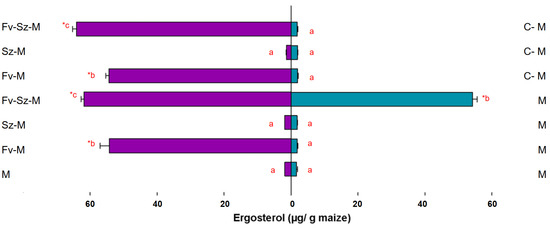
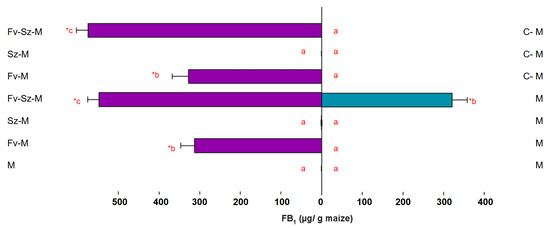
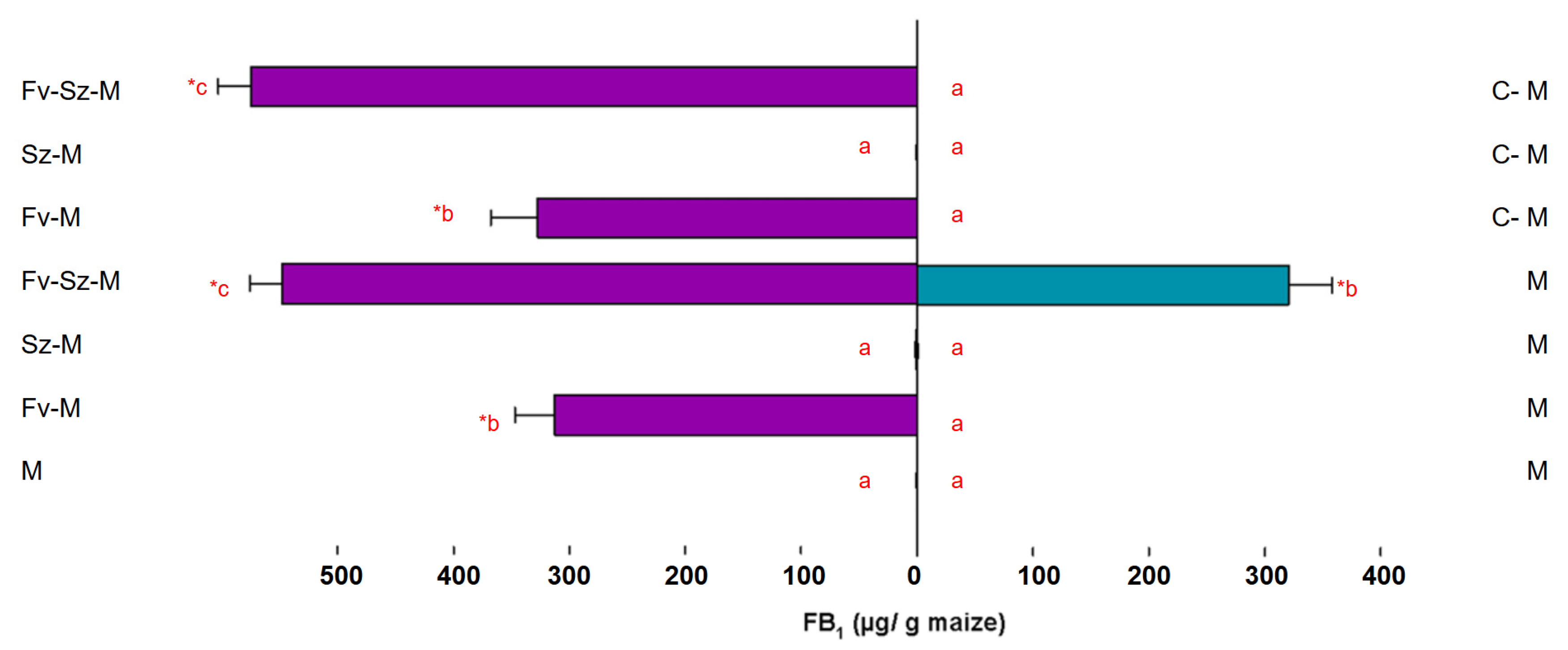
In bottle A, containing S. zeamais, ergosterol and FB1 levels were comparable to those detected in the control bottles (maize alone). In contrast, both parameters increased in the presence of F. verticillioides and showed a significant rise with the fungus–insect interaction. In bottle B, ergosterol and FB1 levels did not increase when F. verticillioides was present as the only pest. However, with the fungus–insect interaction, both ergosterol and FB1 levels increased significantly. Notably, in the treatment containing maize supplemented with 1-decen-3-ol, ergosterol and FB1 levels were similar to those of the control (Figure 2 and Figure 3).
Figure 2.
Ergosterol content in stored maize grains. The purple bars correspond to ergosterol determined in maize grains in bottle A and the blue bars correspond to ergosterol determined in maize grains in bottle B. FV: Fusarium verticillioides; SZ: Sitophilus zeamais; M: maize; C: compound (1-decen-3-ol). Values are expressed as mean ± standard deviation. * Significant differences with the control according to the DGC test (p < 0.05). The ergosterol values with different letters correspond to treatments that present significant differences. All treatments were performed with five repetitions carried out twice per concentration.
Figure 3.
FB1 content in stored maize grains. The purple bars correspond to FB1 determined in maize grains in bottle A and the blue bars correspond to FB1 determined in maize grains in bottle B. FV: Fusarium verticillioides; SZ: Sitophilus zeamais; M: maize; C: compound (1-decen-3-ol). Values are expressed as mean ± standard deviation. * Significant differences with the control according to the DGC test (p < 0.05). The FB1 values with different letters correspond to treatments that present significant differences. All treatments were performed with five repetitions carried out twice per concentration.
4. Discussion
In the present study, the antifungal activities of several oxygenated volatile compounds against F. verticillioides were evaluated. The results showed that the inhibitory effects on fungal growth depended on both the compound tested and its concentration. Some compounds showed relatively high variability in fungal inhibition percentages, as well as in the lag phase and growth rate values, particularly at intermediate concentrations. This variability may be associated with differences in the physiological sensitivity of F. verticillioides to the compounds, together with the transient adaptive responses of the fungus during the early stages of fungal growth. Previous studies have reported that subinhibitory or intermediate concentrations of antifungal compounds often produce less uniform responses due to phenomena of partial tolerance, metabolic adaptation, or fungistatic effects that may differ among experimental replicates [32,33,34]. However, despite the observed variability, the general trends were consistent across the biological replicates, supporting both the reproducibility of the assay and the reliability of the antifungal effects detected.
Previous studies have reported the antifungal effect of oxygenated volatile compounds against several plant pathogenic fungi [35,36,37,38]. These compounds are lipophilic molecules that interact with cell membranes, disrupting its integrity and altering fungal metabolism, thus preventing the growth and proliferation of fungal pathogens [39,40,41]. Some oxygenated volatile compounds have also been shown to inhibit the synthesis of pectin methyl esterase (PME) [37], an enzyme that modifies the degree of methyl esterification of pectins, which are major components of fungal cell walls. Alterations in pectin structure can affect the cell adhesion, plasticity, pH, and ionic content of the cell wall, influencing fungal development, membrane integrity, and permeability. Furthermore, oxygenated volatile compounds may inhibit the synthesis of fungal cellulase [37], enzymes responsible for the degradation of the host cell wall during infection, affecting both fungal development and the pathogenesis process [42]. Interestingly, some synthetic fungicides exert their antifungal activity through the inhibition of fungal cellulase activity [43].
In this study, there were no significant differences between the isomers α-terpineol and terpinen-4-ol at low concentrations. However, at higher concentrations, terpinen-4-ol exhibited a stronger inhibitory effect on F. verticillioides. These oxygenated compounds have previously been reported to inhibit the growth of several pathogenic fungi, including F. verticillioides [44,45,46]. Their antifungal activity has been associated with alterations in membrane integrity and the disruption of key metabolic pathways [44]. In contrast, the isomers 1,4-cineole and 1,8-cineole showed low antifungal activity against F. verticillioides, with 1,4-cineole being the least bioactive compound. Kordali et al. [45] reported that 1,8-cineole is less effective against F. verticillioides than α-terpineol and terpinen-4-ol. Among the evaluated compounds, 1-decen-3-ol exhibited the strongest inhibitory effect against F. verticillioides, significantly affecting all fungal growth parameters. Notably, 1-decen-3-ol, the only acyclic compound with a linear carbon chain among those tested, displayed the greatest antifungal activity against F. verticillioides, followed by terpinen-4-ol and α-terpineol, both of which contain a double bond within the ring structure. The least active compounds were 1,4-cineole and 1,8-cineole, both characterized by the presence of an oxygen atom within the aromatic ring. Although the biological mechanism underlying the antifungal activity of 1-decen-3-ol was not investigated in this study, and no previous reports addressing this mechanism are currently available, its activity may be associated with both the presence and the position of the hydroxyl group [47], as well as the allyl functional group. Together, these structural features may influence the physicochemical properties of the molecule and its interaction with fungal cells. In particular, the allyl group and the linear chain may enhance the lipophilicity of the compound, thereby facilitating its penetration through fungal cell membranes. This interaction could alter membrane permeability and integrity, affecting essential cellular processes and thus contributing to the observed toxic effect [48,49]. These results are in agreement with a previous study that reported strong antifungal activity of different linear and cyclic alcohols against F. verticillioides [50].
The dynamics of agricultural ecosystems depend on the interactions between multiple organisms. In this context, microorganisms, plants, and insects interact through the release and perception of a wide range of chemical signals [51]. The interaction between F. verticillioides and S. zeamais is particularly relevant from an ecological and productive perspective, since both organisms contribute synergistically to grain deterioration and quality losses during storage. In many agricultural systems, phytopathogen dissemination is mediated by insect vectors. In this context, the presence and continuous movement of S. zeamais in stored grain contribute to the dispersal of F. verticillioides among grains. This association may also benefit the insect, as fungal colonization increases the availability of important nutritional compounds in grains, such as ergosterol. This compound plays a key role in insect growth and development, and since insects cannot synthesize this sterol de novo, they must obtain it through their diet [52]. Therefore, the colonization of grains by F. verticillioides may indirectly enhance the development and survival of S. zeamais. In addition, mycotoxins produced by the fungus, such as fumonisins, do not significantly affect insect fitness, which may favor the persistence of this interaction in storage systems [53].
The closed system, consisting of two interconnected bottles, was designed to reproduce an environment with limited air and volatile compounds exchange, similar to conditions that may occur in silos, storage bags, or hermetic containers. The connection between both bottles via a glass tube was intended to simulate the potential movement of insects and the diffusion of volatile compounds between different sections of a stored grain mass. Distilled water was added to adjust humidity levels, a critical factor in grain storage due to its direct influence on insect and fungal development, as well as on mycotoxin production. Although this experimental setup represents a simplified small-scale model and does not fully reproduce the complexity of industrial storage systems, it provides a useful approach to evaluate biological interactions and the potential efficacy of biocontrol compounds under controlled conditions.
Cano et al. [28] reported that 1-decen-3-ol caused less than 26% mortality in S. zeamais at 0.27 mM after 24 h of exposure without food. In addition, the authors observed that this compound exerted a repellent effect on S. zeamais, with repellency percentages ranging from 29% to 71% at doses between 0.28 and 56 μM. Considering that S. zeamais acts as a vector for F. verticillioides, these effects on insect behavior could influence fungal dispersal, grain colonization, and consequently FB1 production.
Although insect migration was not evaluated during the assay, the movement of S. zeamais between bottles was evidenced by the higher dry weight loss of maize grains compared with the maize–maize treatment, as well as by the increase in ergosterol and fumonisin levels compared with the maize-F. verticillioides treatment in bottle B. Furthermore, insects remained alive at the end of the assay, suggesting that they were active and potentially able to move between the two bottles during the experimental period.
Our results demonstrated that both pests are capable of consuming maize grains. Furthermore, grain dry weight loss increased significantly when fungus–insect interaction occurred. Sitophilus zeamais not only damages the grains through its feeding activity, but also facilitates fungal dispersal, promoting fungal development and subsequent grain deterioration caused by F. verticillioides, the main contributor to maize dry weight loss [16,53]. In this context, the simultaneous control of both organisms is a key aspect for the development of effective grain protection strategies. Several studies have shown that oxygenated volatile compounds play a fundamental role in plant–pathogen–insect interactions, acting both as inhibitors of fungal growth and modulators of insect behavior [21].
In treatments where the maize grains were impregnated with 1-decen-3-ol, the reduction in ergosterol and FB1 levels suggests a protective effect of the compound against the development of F. verticillioides. Since ergosterol is a structural component of the fungal cell membrane and is commonly used as an indicator of fungal biomass, its decrease suggests reduced fungal growth. Consequently, the lower FB1 production observed in treated grains could be associated with a reduction in the active fungal biomass. However, the present results do not allow us to determine whether the compound acts solely by inhibiting fungal growth or whether it also affects a specific metabolic pathway involved in FB1 biosynthesis. In addition, the repellent effect of 1-decen-3-ol on S. zeamais may have contributed to limiting the dispersal of F. verticillioides within the storage system and, consequently, reduced the ergosterol and FB1 content in the maize. Furthermore, 1-decen-3-ol prevented dry weight loss caused by both the fungus and the insect. By inhibiting the growth of F. verticillioides and exerting a repellent effect on S. zeamais, this compound demonstrated a clear protective effect under storage conditions, reducing both grain deterioration and FB1 accumulation. Previous studies support the observed effect of 1-decen-3-ol, suggesting that medium-chain alcohols represent important compounds for the chemical defense of grains [54]. More recently, structurally related alcohols, such as 1-octyn-3-ol, were also reported to inhibit fungal development under storage conditions and significantly reduced FB1 accumulation in maize grains [55].
Previous studies have demonstrated that several oxygenated volatile compounds exhibit insecticidal and repellent activities against stored grain pests, including S. zeamais [21,25,56,57,58,59,60]. García et al. [61] suggest that the hydroxyl group positively affects the repellent activity of oxygenated volatile compounds. The compound 1-decen-3-ol has been identified as a major or minor constituent of different essential oils with diverse bioactivities [62,63,64,65,66]. In addition, patent records have documented the incorporation of 1-decen-3-ol into biofilms [67], coated particles [68], and mouthwashes [69], highlighting its technological versatility and potential for commercial applications. However, the present study provides the first evidence of the bioactivity of 1-decen-3-ol against important storage pests, demonstrating antifungal effects against F. verticillioides.
In conclusion, 1-decen-3-ol represents a biocontrol agent capable of acting simultaneously against F. verticillioides and S. zeamais, highlighting its potential as an alternative strategy for grain protection in storage systems. Further studies are necessary to better understand its mechanisms of action on both organisms. In this context, the findings reported by Schramm et al. [70] demonstrate that volatile organic compounds can be metabolized through specific biotransformation pathways, suggesting that the bioactivity, persistence, and efficacy of 1-decen-3-ol could be influenced by biological or chemical degradation processes. Therefore, further studies should assess effective and safe application doses, the stability of the compound during prolonged storage periods, and its potential effects on grain quality, seed viability, and food safety. A deeper understanding of these processes will contribute to optimizing its application in biocontrol strategies and provide a stronger basis for its potential use in storage systems.
Author Contributions
V.D.B.: Writing, Methodology, Investigation, Formal analysis. F.A.: Methodology, Investigation, Formal analysis. M.P.Z.: Writing—review & editing, Project administration, Funding acquisition. R.P.P.: Writing—review & editing, Project administration, Funding acquisition, Conceptualization. All authors have read and agreed to the published version of the manuscript.
Funding
The authors gratefully acknowledge CONICET, PIP-CONICET 11220200102478, FonCyT (PICT 2019-2703) and UNC (SECyT-RESOL-2026-54-E-UNC) for financial support.
Data Availability Statement
The raw data supporting the conclusions of this article will be made available by the authors on request.
Acknowledgments
We would like to thank Damián Barrionuevo for technical support and María José Martinez for maize provision. GenAI (Gemini 3.5 Flash) was used to generate the Graphical Abstract. This image was subsequently modified by the authors.
Conflicts of Interest
The authors declare no conflicts of interest.
References
- Goda, A.A.; Shi, J.; Xu, J.; Liu, X.; Zhou, Y.; Xiao, L.; Abdel-Galil, M.; Salem, S.H.; Ayad, E.G.; Deabes, M.; et al. Global health and economic impacts of mycotoxins: A comprehensive review. Environ. Sci. Eur. 2025, 37, 122. [Google Scholar] [CrossRef] [Scilit]
- Brito, V.D.; Achimón, F.; Zunino, M.P.; Zygadlo, J.A.; Pizzolitto, R.P. Fungal diversity and mycotoxins detected in maize stored in silo-bags: A review. J. Sci. Food Agric. 2022, 102, 2640–2650. [Google Scholar] [CrossRef] [Scilit]
- Camardo Leggieri, M.; Giorni, P.; Pietri, A.; Battilani, P. Aspergillus flavus and Fusarium verticillioides interaction: Modeling the impact on mycotoxin production. Front. Microbiol. 2019, 10, 2653. [Google Scholar] [CrossRef] [Scilit] [PubMed]
- Bryła, M.; Pierzgalski, A.; Zapaśnik, A.; Uwineza, P.A.; Ksieniewicz-Woźniak, E.; Modrzewska, M.; Waśkiewicz, A. Recent research on Fusarium mycotoxins in maize—A review. Foods 2022, 11, 3465. [Google Scholar] [CrossRef] [Scilit]
- Chen, X.; Abdallah, M.F.; Landschoot, S.; Audenaert, K.; De Saeger, S.; Chen, X.; Rajkovic, A. Aspergillus flavus and Fusarium verticillioides and their main mycotoxins: Global distribution and scenarios of interactions in maize. Toxins 2023, 15, 577. [Google Scholar] [CrossRef] [Scilit]
- Logrieco, A.; Battilani, P.; Leggieri, M.C.; Jiang, Y.; Haesaert, G.; Lanubile, A.; Mahuku, G.; Mesterházy, A.; Ortega-Beltran, A.; Pasti, M.; et al. Perspectives on global mycotoxin issues and management from the MycoKey Maize Working Group. Plant Dis. 2021, 105, 525–537. [Google Scholar] [CrossRef] [Scilit]
- Anumudu, C.K.; Ekwueme, C.T.; Uhegwu, C.C.; Ejileugha, C.; Augustine, J.; Okolo, C.A.; Onyeaka, H. A review of the mycotoxin family of fumonisins, their biosynthesis, metabolism, methods of detection and effects on humans and animals. Int. J. Mol. Sci. 2024, 26, 184. [Google Scholar] [CrossRef] [Scilit] [PubMed]
- Chen, J.; Wei, Z.; Wang, Y.; Long, M.; Wu, W.; Kuca, K. Fumonisin B1: Mechanisms of toxicity and biological detoxification progress in animals. Food Chem. Toxicol. 2021, 149, 111977. [Google Scholar] [CrossRef] [Scilit]
- Platts, J.R. A Review of Reproductive and Congenital Diseases with Treatment Options in Friesian Horses. Doctoral Dissertation, University of Zagreb Faculty of Veterinary Medicine, Zagreb, Croatia, 2024. Available online: https://urn.nsk.hr/urn:nbn:hr:178:373877 (accessed on 9 February 2026).
- Tsouloufi, T.K. An overview of mycotoxicoses in rabbits. J. Vet. Diagn. Investig. 2024, 36, 638–654. [Google Scholar] [CrossRef] [Scilit]
- Mihalcea, A.; Amariei, S. Study on contamination with some mycotoxins in maize and maize-derived foods. Appl. Sci. 2022, 12, 2579. [Google Scholar] [CrossRef] [Scilit]
- Ponce-García, N.; Serna-Saldivar, S.O.; Garcia-Lara, S. Fumonisins and their analogues in contaminated corn and its processed foods—A review. Food Addit. Contam. Part A 2018, 35, 2183–2203. [Google Scholar] [CrossRef] [Scilit]
- Achar, P.N.; Sreenivasa, M.Y. Current perspectives of biocontrol agents for management of Fusarium verticillioides and its fumonisin in cereals—A review. J. Fungi 2021, 7, 776. [Google Scholar] [CrossRef] [Scilit]
- Bennett, J.S.; Isakeit, T.; Borrego, E.J.; Odvody, G.; Murray, S.; Kolomiets, M.V. Identification of naturally occurring atoxigenic strains of Fusarium verticillioides and their potential as biocontrol agents of mycotoxins and ear rot pathogens of maize. Crop Prot. 2023, 167, 106197. [Google Scholar] [CrossRef] [Scilit]
- Blacutt, A.A.; Gold, S.E.; Voss, K.A.; Gao, M.; Glenn, A.E. Fusarium verticillioides: Advancements in understanding the toxicity, virulence, and niche adaptations of a model mycotoxigenic pathogen of maize. Phytopathology 2018, 108, 312–326. [Google Scholar] [CrossRef] [Scilit]
- Brito, V.D.; Achimón, F.; Dambolena, J.S.; Pizzolitto, R.P.; Zygadlo, J.A. Trans-2-hexen-1-ol as a tool for the control of Fusarium verticillioides in stored maize grains. J. Stored Prod. Res. 2019, 82, 123–130. [Google Scholar] [CrossRef] [Scilit]
- Jalal, M.A.; Bondarenko, S. Agrochemicals: Definition and regulation. In Radiochemical Analysis of Agrochemicals: Environmental Fate and Metabolism; Springer Nature: Cham, Switzerland, 2025; pp. 1–50. [Google Scholar] [CrossRef] [Scilit]
- Devi, P.I.; Manjula, M.; Bhavani, R.V. Agrochemicals, environment, and human health. Annu. Rev. Environ. Resour. 2022, 47, 399–421. [Google Scholar] [CrossRef] [Scilit]
- Pathak, V.M.; Verma, V.K.; Rawat, B.S.; Kaur, B.; Babu, N.; Sharma, A.; Dewali, S.; Yadav, M.; Kumari, R.; Singh, S.; et al. Current status of pesticide effects on environment, human health and it’s eco-friendly management as bioremediation: A comprehensive review. Front. Microbiol. 2022, 13, 962619. [Google Scholar] [CrossRef] [Scilit]
- Zhou, W.; Li, M.; Achal, V. A comprehensive review on environmental and human health impacts of chemical pesticide usage. Emerg. Contam. 2025, 11, 100410. [Google Scholar] [CrossRef] [Scilit]
- Abdelgaleil, S.A.M.; Gad, H.A.; Ramadan, G.R.; El-Bakry, A.M.; El-Sabrout, A.M. Monoterpenes: Chemistry, insecticidal activity against stored product insects and modes of action—A review. Int. J. Pest Manag. 2021, 70, 267–289. [Google Scholar] [CrossRef] [Scilit]
- Mołdoch, J.; Agacka-Mołdoch, M.; Jóźwiak, G.; Wojtunik-Kulesza, K. Biological activity of monoterpene-based scaffolds: A natural toolbox for drug discovery. Molecules 2025, 30, 1480. [Google Scholar] [CrossRef] [Scilit]
- Salakhutdinov, N.F.; Volcho, K.P.; Yarovaya, O.I. Monoterpenes as a renewable source of biologically active compounds. Pure Appl. Chem. 2017, 89, 1105–1117. [Google Scholar] [CrossRef] [Scilit]
- Zielińska-Błajet, M.; Feder-Kubis, J. Monoterpenes and their derivatives—Recent development in biological and medical applications. Int. J. Mol. Sci. 2020, 21, 7078. [Google Scholar] [CrossRef] [Scilit]
- Yıldırım, E.; Emsen, B.; Kordalı, S. Insecticidal effects of monoterpenes on Sitophilus zeamais Motschulsky (Coleoptera: Curculionidae). J. Appl. Bot. Food Qual. 2013, 86, 198–204. [Google Scholar] [CrossRef] [Scilit]
- Leslie, J.; Summerel, B.A. Species concepts in Fusarium. Fusarium Lab. Man. 2006, 88–95. [Google Scholar]
- Pizzolitto, R.P.; Herrera, J.M.; Zaio, Y.P.; Dambolena, J.S.; Zunino, M.P.; Gallucci, M.N.; Zygadlo, J.A. Bioactivities of ketones terpenes: Antifungal effect on F. verticillioides and repellents to control insect fungal vector, S. zeamais. Microorganisms 2015, 3, 851–865. [Google Scholar] [CrossRef] [Scilit]
- Cano, M.C.; Beato, M.; Usseglio, V.L.; Merlo, C.; Zunino, M.P. Bioactive paints with volatile organic alcohols for the control of Sitophilus zeamais. J. Stored Prod. Res. 2024, 109, 102423. [Google Scholar] [CrossRef] [Scilit]
- Shephard, G.S.; Sydenham, E.W.; Thiel, P.G.; Gelderblom, W.C.A. Quantitative determination of fumonisins B1 and B2 by high-performance liquid chromatography with fluorescence detection. J. Liq. Chromatogr. 1990, 13, 2077–2087. [Google Scholar] [CrossRef] [Scilit]
- Di Rienzo, J.A.; Casanoves, F.; Balzarini, M.G.; González, L.; Tablada, M.; Robledo, Y.C. InfoStat versión 2011; Grupo InfoStat, FCA, Universidad Nacional de Córdoba: Córdoba, Argentina, 2011; Volume 8, pp. 195–199. [Google Scholar]
- Di Rienzo, J.A.; Guzmán, A.W.; Casanoves, F. A multiple-comparisons method based on the distribution of the root node distance of a binary tree. J. Agric. Biol. Environ. Stat. 2002, 7, 129–142. [Google Scholar] [CrossRef] [Scilit]
- Franconi, I.; Lupetti, A. In vitro susceptibility tests in the context of antifungal resistance: Beyond minimum inhibitory concentration in Candida spp. J. Fungi 2023, 9, 1188. [Google Scholar] [CrossRef] [Scilit]
- Rosenberg, A.; Ene, I.V.; Bibi, M.; Zakin, S.; Segal, E.S.; Ziv, N.; Dahan, A.M.; Colombo, A.L.; Bennett, R.J.; Berman, J. Antifungal tolerance is a subpopulation effect distinct from resistance and is associated with persistent candidemia. Nat. Commun. 2018, 9, 2470. [Google Scholar] [CrossRef] [Scilit]
- Serrano Bacallao, R. Expanding Chemical Diversity in Fungi and Evaluation of its Application for Discovering New Antifungal Agents. Doctoral Dissertation, Universidad de Granada, Granada, Spain, 2025. Available online: https://hdl.handle.net/10481/103737 (accessed on 11 February 2026).
- Elshafie, H.S.; Crescenzi, A.; Camele, I. Investigating the Biological Effects of Plant Essential Oils on Plant-Decaying Pathogens. Plants 2026, 15, 542. [Google Scholar] [CrossRef] [Scilit] [PubMed]
- Liu, Z.; Li, Q.X.; Song, B. Pesticidal activity and mode of action of monoterpenes. J. Agric. Food Chem. 2022, 70, 4556–4571. [Google Scholar] [CrossRef] [Scilit]
- Marei, G.I.; Abdelgaleil, S. Antifungal Potential and Biochemical Effects of Monoterpenes and Phenylpropenes on Plant Pathogenic Fungi. Plant Prot. Sci. 2018, 54, 9–16. [Google Scholar] [CrossRef] [Scilit]
- Wang, K.; Jiang, S.; Pu, T.; Fan, L.; Su, F.; Ye, M. Antifungal activity of phenolic monoterpenes and structure-related compounds against plant pathogenic fungi. Nat. Prod. Res. 2019, 33, 1423–1430. [Google Scholar] [CrossRef] [Scilit]
- Nourbakhsh, F.; Lotfalizadeh, M.; Badpeyma, M.; Shakeri, A.; Soheili, V. From plants to antimicrobials: Natural products against bacterial membranes. Phytother. Res. 2022, 36, 33–52. [Google Scholar] [CrossRef] [Scilit] [PubMed]
- Qasim, M.; Islam, W.; Rizwan, M.; Hussain, D.; Noman, A.; Khan, K.A.; Ghramh, H.A.; Han, X. Impact of plant monoterpenes on insect pest management and insect-associated microbes. Heliyon 2024, 10, e39120. [Google Scholar] [CrossRef] [Scilit]
- Wojtunik-Kulesza, K.A. Toxicity of selected monoterpenes and essential oils rich in these compounds. Molecules 2022, 27, 1716. [Google Scholar] [CrossRef] [Scilit]
- Mehdizadeh, L.; Moghaddam, M. Essential oils: Biological activity and therapeutic potential. In Therapeutic, Probiotic, and Unconventional Foods; Academic Press: Cambridge, MA, USA, 2018; pp. 167–179. [Google Scholar] [CrossRef] [Scilit]
- Moharram, A.M.; Abdel-Hafez, S.I.I.; El-Said, A.H.M.; Salee, A. Effect of two systemic fungicides on cellulose decomposing fungi of tomato plants and on some enzymatic activities. Acta Microbiol. Immunol. Hung. 2004, 51, 403–430. [Google Scholar] [CrossRef] [Scilit]
- An, P.; Yang, X.; Yu, J.; Qi, J.; Ren, X.; Kong, Q. α-terpineol and terpene-4-ol, the critical components of tea tree oil, exert antifungal activities in vitro and in vivo against Aspergillus niger in grapes by inducing morphous damage and metabolic changes of fungus. Food Control 2019, 98, 42–53. [Google Scholar] [CrossRef] [Scilit]
- Kordali, S.; Kotan, R.; Cakir, A. Screening of antifungal activities of 21 oxygenated monoterpenes in-vitro as plant disease control agents. Allelopath. J. 2007, 19, 373. [Google Scholar]
- Yadav, E.; Rao, R. A promising bioactive component terpinen-4-ol: A review. Int. J. Pharmacogn. 2016, 36, 336–345. [Google Scholar] [CrossRef]
- Kocić-Tanackov, S.D.; Dimić, G.R. Antifungal activity of essential oils in the control of food-borne fungi growth and mycotoxin biosynthesis in food. Metabolism 2013, 4, 838–849. [Google Scholar]
- Tabanca, N.; Demirci, B.; Ali, A.; Ali, Z.; Blythe, E.K.; Khan, I.A. Essential oils of green and red Perilla frutescens as potential sources of compounds for mosquito management. Ind. Crops Prod. 2015, 65, 36–44. [Google Scholar] [CrossRef] [Scilit]
- Tabanca, N.; Masi, M.; Epsky, N.D.; Nocera, P.; Cimmino, A.; Kendra, P.E.; Niogret, J.; Evidente, A. Laboratory evaluation of natural and synthetic aromatic compounds as potential attractants for male Mediterranean fruit fly, Ceratitis capitata. Molecules 2019, 24, 2409. [Google Scholar] [CrossRef] [Scilit]
- Achimón, F.; Pizzolitto, R.P. Volatilome of the maize phytopathogenic fungus Fusarium verticillioides: Potential applications in diagnosis and biocontrol. Pest Manag. Sci. 2025, 81, 357–371. [Google Scholar] [CrossRef] [Scilit]
- Zhang, W.; Stelinski, L.L.; Mohamed, A.; Wang, G.; Tettamanti, G.; Chen, M.; Hong, M.; Daly, E.Z.; Bruin, J.; Renault, D.; et al. Unlocking agro-ecosystem sustainability: Exploring the bottom-up effects of microbes, plants, and insect herbivores. Integr. Zool. 2025, 20, 465–484. [Google Scholar] [CrossRef] [Scilit]
- Wen, D.; Chen, Z.; Wen, J.; Jia, Q. Sterol regulation of development and 20-hydroxyecdysone biosynthetic and signaling genes in Drosophila melanogaster. Cells 2023, 12, 1739. [Google Scholar] [CrossRef] [Scilit]
- Usseglio, V.L.; Dambolena, J.S.; Martinez, M.J.; Zunino, M.P. The role of fumonisins in the biological interaction between Fusarium verticillioides and Sitophilus zeamais. J. Chem. Ecol. 2020, 46, 1059–1068. [Google Scholar] [CrossRef] [Scilit] [PubMed]
- Usseglio, V.L.; Pizzolitto, R.P.; Rodriguez, C.; Zunino, M.P.; Zygadlo, J.A.; Areco, V.A.; Dambolena, J.S. Volatile organic compounds from the interaction between Fusarium verticillioides and maize kernels as a natural repellents of Sitophilus zeamais. J. Stored Prod. Res. 2017, 73, 109–114. [Google Scholar] [CrossRef] [Scilit]
- Brito, V.D.; Achimón, F.; Zunino, M.P.; Pizzolitto, R.P. Control of Fusarium verticillioides in maize stored in silo bags with 1-octyn-3-ol. J. Stored Prod. Res. 2024, 106, 102279. [Google Scholar] [CrossRef] [Scilit]
- Cao, J.Q.; Guo, S.S.; Wang, Y.; Pang, X.; Geng, Z.F.; Du, S.S. Toxicity and repellency of essential oil from Evodia lenticellata Huang fruits and its major monoterpenes against three stored-product insects. Ecotoxicol. Environ. Saf. 2018, 160, 342–348. [Google Scholar] [CrossRef] [Scilit] [PubMed]
- Reis, S.L.; Mantello, A.G.; Macedo, J.M.; Gelfuso, E.A.; Da Silva, C.P.; Fachin, A.L.; Cardoso, A.M.; Beleboni, R.O. Typical monoterpenes as insecticides and repellents against stored grain pests. Molecules 2016, 21, 258. [Google Scholar] [CrossRef] [Scilit] [PubMed]
- Saad, M.M.; El-Deeb, D.A.; Abdelgaleil, S.A. Insecticidal potential and repellent and biochemical effects of phenylpropenes and monoterpenes on the red flour beetle, Tribolium castaneum Herbst. Environ. Sci. Pollut. Res. 2019, 26, 6801–6810. [Google Scholar] [CrossRef] [Scilit]
- Saad, M.M.; Abou-Taleb, H.K.; Abdelgaleil, S.A. Insecticidal activities of monoterpenes and phenylpropenes against Sitophilus oryzae and their inhibitory effects on acetylcholinesterase and adenosine triphosphatases. Appl. Entomol. Zool. 2018, 53, 173–181. [Google Scholar] [CrossRef] [Scilit]
- Sierra-Quitian, A.G.; Prieto-Rodríguez, J.A.; Patiño-Ladino, O.J. Insecticidal Activity of Monoterpenoids Against Sitophilus zeamais Motschulsky and Tribolium castaneum Herbst: Preliminary Structure–Activity Relationship Study. Int. J. Mol. Sci. 2025, 26, 3407. [Google Scholar] [CrossRef] [Scilit]
- García, M.; Donadel, O.J.; Ardanaz, C.E.; Tonn, C.E.; Sosa, M.E. Toxic and repellent effects of Baccharis salicifolia essential oil on Tribolium castaneum. Pest Manag. Sci. Former. Pestic. Sci. 2005, 61, 612–618. [Google Scholar] [CrossRef] [Scilit] [PubMed]
- Fellahi, M.; el Houda Ziane, S.N.; Dib, M.E.A.; Bensaid, O.; Muselli, A. Synergistic Anti-Inflammatory, Antidiabetic, and Hemolytic Effects of Essential Oil of Eryngium triquetrum and its Falcarinol-Rich Fraction in Comparison with Reference Compounds. Curr. Chem. Biol. 2025, 19, 212–219. [Google Scholar] [CrossRef] [Scilit]
- Ha, N.X.; Thang, T.D.; Tuan, N.H.; Giang, L.D.; Tran-Trung, H.; Trang, D.T.H.; Chung, N.T.; Van, S.V.; Thu, N.N.A.; An, N.T.G. Cytotoxic activity of Sphaeranthus africanus essential oil from Vietnam, molecular docking and molecular dynamics studies of its major components. J. Essent. Oil Bear. Plants 2025, 28, 273–280. [Google Scholar] [CrossRef] [Scilit]
- Hoi, T.M.; Satyal, P.; Huong, L.T.; Hau, D.V.; Binh, T.D.; Duyen, D.T.H.; Dai, D.N.; Huy, N.G.; Van Chinh, H.; Van Hoa, V.; et al. Essential oils from Vietnamese Asteraceae for environmentally friendly control of Aedes mosquitoes. Molecules 2022, 27, 7961. [Google Scholar] [CrossRef] [Scilit]
- Medbouhi, A.; Merad, N.; Khadir, A.; Bendahou, M.; Djabou, N.; Costa, J.; Muselli, A. Chemical composition and biological investigations of Eryngium triquetrum essential oil from Algeria. Chem. Biodivers. 2018, 15, e1700343. [Google Scholar] [CrossRef] [Scilit]
- Al-Snai, A.E. A review on Lycopus europaeus: A potential medicinal plant. IOSR J. Pharm. 2019, 9, 80–88. Available online: https://www.researchgate.net/profile/Ali-Al-Snafi/publication/335082739_A_Review_on_Lycopus_europaeus_A_Potential_Medicinal_Plant/links/5d4dacfa4585153e5949de94/A-Review-on-Lycopus-europaeus-A-Potential-Medicinal-Plant.pdf (accessed on 25 March 2026).
- Mordas, C.J.; Gambogi, R.J. Biofilm Disruptive Compositions. U.S. Patent No. 9,591,852, 14 March 2017. [Google Scholar]
- Gambogi, R.; Petersen, L.; Peterson, S.; Glowacki, A.; Patel, M. Coated Particles and Their Uses. U.S. Patent No. 11,291,613, 5 April 2022. [Google Scholar]
- Gambogi, R.; Mordas, C.J. Methods of Preparing Non-Alcohol Bioactive Essential Oil Mouth Rinses. U.S. Patent No. 9,763,863, 19 September 2017. [Google Scholar]
- Schramm, K.; Skopec, M.; Dearing, D. Metabolomic evidence of independent biotransformation pathways for terpenes in two specialist mammalian herbivores (genus Neotoma). Integr. Zool. 2024, 19, 143–155. [Google Scholar] [CrossRef] [Scilit] [PubMed]


Disclaimer/Publisher’s Note: The statements, opinions and data contained in all publications are solely those of the individual author(s) and contributor(s) and not of MDPI and/or the editor(s). MDPI and/or the editor(s) disclaim responsibility for any injury to people or property resulting from any ideas, methods, instructions or products referred to in the content. |
© 2026 by the authors. Licensee MDPI, Basel, Switzerland. This article is an open access article distributed under the terms and conditions of the Creative Commons Attribution (CC BY) license.