


Abstract
Environmental contamination by potentially toxic elements (PTEs) originating from industrial activities represents a major global challenge, necessitating the development of sustainable remediation strategies. While remediation of legacy (post-industrial) contamination has been relatively well studied, the remediation of ecosystems surrounding operating facilities subjected to increasing PTE loads remains insufficiently investigated. Therefore, the present study evaluated the efficacy of biochar derived from post-phytoremediation Miscanthus × giganteus (M×g) biomass to optimise the phytoremediation process using soil from an operating facility in a pot system. Valorisation of 29.0 kg of waste biomass yielded 12.8 kg of biochar (44.2%) with a high specific surface area (672 m2 g−1). Despite PTE enrichment during pyrolysis, the biochar was classified safe according to IBI thresholds. A pot experiment was conducted using contaminated and local background soils, amended with 3% (w/w) Miscanthus-derived biochar. Biochar application significantly improved plant performance in contaminated soil, increasing plant height, aboveground biomass, and root parameters by up to 208%, while restoring chlorophyll content and reducing stress indicators such as proline. Furthermore, biochar reduced PTE accumulation in plant tissues and supported the production of less contaminated biomass. These findings demonstrate that post-phytoremediation biomass-derived biochar enhances phytomanagement efficiency and supports sustainable biomass valorisation within a circular economy framework.
1. Introduction
Environmental contamination by chemical pollutants is a global concern. Industrial activities represent the primary source of pollution; depending on the industrial sector, soils may contain various potentially toxic elements (PTEs) [1]. For instance, soil contamination assessments conducted near industrial facilities in Western Kazakhstan revealed extremely high concentrations of toxic elements, with chromium (Cr) levels reaching 7.33 g kg−1, nickel (Ni) 2.21 g kg−1, and arsenic (As) 19 mg kg−1 [2]. These findings highlight the urgent need for effective remediation strategies aimed at mitigating the adverse environmental and health impacts of PTE-contaminated soils.
Over the past 35 years, phytoremediation, first introduced and coined as a term in 1991 in a proposal by Raskin submitted to the Superfund programme [3,4,5], has progressively become a promising approach for sustainable remediation. In general, this approach represents an eco-friendly and cost-effective method for alleviating the chemical burden of various types of contaminants, not only in soil but also in other types of environmental matrices [6,7,8,9,10]. Undoubtedly, the efficiency of phytoremediation largely depends on plant characteristics, particularly the ability to tolerate, accumulate, and/or degrade target contaminants in soil, as well as to produce a sufficient amount of biomass [11,12,13]. Consequently, appropriate plant selection represents a critical determinant of phytoremediation efficiency, and improving the performance of this technology remains a strategically important research objective. In this regard, energy crops possess both ecological restoration and economic value through biomass production [14,15]. Miscanthus × giganteus (M×g) Greef et Deu, a well-established representative of energy crops and phytoagents, is capable of tolerating elevated concentrations of PTEs and petroleum hydrocarbons [16,17]. Furthermore, this crop has been shown to produce sufficiently high biomass when cultivated on marginal lands [15]. Consequently, M×g represents a valuable resource for energy generation and a range of industrial applications [18].
In recent years, the prolonged time required for soil recovery via phytoremediation and the challenge of managing contaminated plant biomass have driven research efforts toward converting phytoremediation residues into value-added bioproducts, particularly biochar [19,20]. Biochar is a carbonaceous material produced under oxygen-limited or anaerobic pyrolysis conditions and has been widely recognised as an effective soil amendment for the enhancement of phytoremediation by supporting plant growth, enriching soil with carbon and nitrogen, and stabilising PTEs in soils [21,22,23,24]. These positive effects of biochar are largely attributed to its mineral composition (K, Ca, P, Na, Mg, etc.), which contributes to soil pH neutralisation, stress alleviation, and improved plant development. Furthermore, biochar exhibits strong sorption capacity for PTEs, thereby reducing their mobility and bioavailability and ultimately decreasing soil toxicity [20,25]. Nevertheless, the majority of the available literature has not evaluated biochars produced from post-phytoremediation feedstock, and studies addressing these materials remain limited [26,27,28,29,30]. In general, biochar can be produced from various types of waste (plant, animal, and sewage sludge), which determine its physicochemical properties and effectiveness in the immobilisation of PTEs [31]. The effectiveness of biochar application depends on its key functional and structural properties, including surface area, high porosity, the capacity to accommodate functional groups, enhanced stability, and favourable electrical and mechanical characteristics [32]. Conversion of post-phytoremediation biomass into biochar via pyrolysis has been reported to be the most preferable approach, owing to the minimised transfer of PTEs into the resulting product material [33]. Fan et al. [28] summarised the behaviour of different types of contaminants present in post-phytoremediation biomass during pyrolysis into biochar. Another study investigating the processing of post-phytoremediation biomass of Brassica napus L., Pennisetum sinese, and Lolium perenne L. grown in Cd-contaminated farmland soil (9.3 mg Cd kg−1) into biochar via pyrolysis at 400, 500, 600 and 700 °C demonstrated that biochars produced at temperatures ≥ 600 °C might be considered environmentally acceptable [29]. Valorisation of Populus nigra biomass cultivated on Pb-contaminated industrial soil at 465 °C resulted in a 2.75-fold and 2.71-fold increase in Zn and Pb concentrations in the resulting biochar, respectively [26]. However, this increase in PTE content did not inhibit biomass yield; on the contrary, aboveground and belowground biomass increased by 1.5–6.0-fold when cultivated in soil amended with 3% (w/w) biochar [26]. In general, evaluation of the applicability of returning post-phytoremediation biochar to the remediation process, particularly through the conversion of biomass into biochar via pyrolysis, has been considered economically feasible [30]. Thus, it can be concluded that the valorisation or disposal of post-phytoremediation biomass represents an emerging research direction requiring further attention, particularly with respect to contamination transfer from feedstock to biochar, physicochemical characteristics, stabilisation of PTEs, and carbon sequestration potential [10,26,28,34].
Therefore, the effectiveness of phytoremediation of PTE-contaminated soil at an operating mining complex using M×g in combination with the application of biochar derived from Miscanthus waste biomass was evaluated in the present study. Particular attention was devoted to assessing the role of biochar in reducing the mobility and bioavailability of PTEs, as well as its influence on plant growth and soil properties.
The novelty of this study lies in the integration of phytoremediation and biochar-based soil amendment within a “zero-waste” framework, in which contaminated plant biomass may be further valorised into environmentally beneficial bioproducts. The study findings contribute to the development of sustainable and resource-efficient strategies for the remediation of contaminated soils and the management of phytoremediation residues.
2. Materials and Methods
2.1. Soil Collection
Studied soil, referred to as legacy contaminated (LC) soil, was collected from the territory of operating mining complex JSC “KazZinc” located in Tekeli, Zhetysu region, Kazakhstan (GPS coordinates: 44°51′35.6″ N, 78°45′48″ E). Local background (LBG) soil was sampled in the distance of 5 km (GPS coordinates: 44°51′22.4″ N 78°42′13.1″ E) from the mining complex. According to Köppen–Geiger classification [35], site climate was classified as BSk (arid–steppe–cold).
Soil sampling adhered to the ISO 18400–203:2018 [36] for chemical analyses. Five samples were procured from investigated areas, with each sample taken from a 5 × 5 m2 area at a depth of 0–0.6 m. Following sampling, collected soil was sieved (d = 3 mm) to remove the plant materials and stones, thoroughly homogenised, air-dried, and stored at 4 °C before agrochemical (Table 1) and chemical analyses (Table 2).
Table 1.
Agrochemical profiles of studied soils. Different letters indicate significant difference between soils within one parameter at p < 0.05.
Table 2.
Elemental composition (mg kg−1) of studied soils. Different letters indicate significant difference between soils within one element.
Given the contamination detected in the LBG soil intended to serve as the control, it is important to note that ISO 19258:2018 [42], which is applied, inter alia, in contaminated land assessment and remediation decision-making, specifies that control (background) soil should be selected from the same local area as the contaminated soil to ensure comparability. Moreover, the Interstate Technology and Regulatory Council (ITRC) recommends site-specific background selection when contaminant concentrations exceed risk-based thresholds to guide appropriate remediation decisions [43]. Accordingly, the selected LBG soil can be considered suitable for subsequent comparative analyses.
2.2. Biochar Production
2.2.1. Feedstock Characterisation
Stems of Miscanthus × giganteus Greef et Deu (M×g) harvested from long-term plantations established in 2017 on marginal land (GPS coordinates: 43°13′38.161″ N 76°54′59.443″ E; Almaty, Kazakhstan) were used as the feedstock for biochar production [15]. The total contamination coefficient (Zci) was determined to be 3.24 [44], with 3.30-fold elevated Cr concentration in relation to MPC threshold [41], as reported in Table S1. The plantation was divided into plots of 5 m2 (n = 3) with a planting density of four rhizomes (or plants; pl) per 1 m2, corresponding to 40,000 pl ha−1 [15].
In September 2024, M×g aboveground biomass was harvested according to ISO/TS 23105:2021 [45] at the BBCH 95 growth stage [46]. The harvested M×g biomass was subjected to stepwise drying to a moisture of 25%—initially in the open air and subsequently in a drying oven at 105 ± 2 °C until the target residual moisture content was achieved. Thereafter, the leaves were removed, and the remaining 29 kg of dry matter (DM) stems were chopped into fragments of 25–50 mm for subsequent use in pyrolysis. Feedstock material samples were prepared in accordance with ISO 6869:2000 [47] and analysed for PTE content in accordance with ISO 17225-8:2023 [48]. The resulting raw material was packaged in five boxes, labelled with the batch and harvesting date, and stored at room temperature until thermal processing.
2.2.2. Pyrolysis Regime
Carbonisation of M×g stems was performed by slow pyrolysis at 600 °C, with a feed rate of 2.1 kg h−1, a heating rate of 5 °C min−1, and a retention time of 1 h under an argon (Ar) atmosphere [20,34]. Thermal processing was carried out in a high-temperature horizontal tubular furnace (model BS-HTF-1700 °C, TMAXCN, Xiamen, China; maximum operating temperature 1700 °C; ceramic tube diameter 60 mm; working heating zone length 250 mm; total tube length 800 mm). Biochar samples were prepared in accordance with US EPA Method 3051A [49] for the analysis of PTE content by AES. The PTE content in the feedstock material was evaluated in accordance with ISO 17225-8:2023 [48].
2.3. Design of Experiment
Both soils (LBG and LC) were thoroughly mixed with 3% (w/w) biochar produced from post-phytoremediation M×g biomass (in particular, stems) and transferred into pots. Mixing of biochar with soil was performed for the entire treatment as follows: 270 g of biochar was added to 8.73 kg of the respective soil and mixed manually using a drill mixer for 15 min. Subsequently, three pots per treatment were prepared, each filled with 1 kg of keramzite (for drainage), 1 kg of sieved sand, and 3 kg of the respective soil or soil–biochar mixture. Homogeneity of the mixture was verified by collecting soil samples from each of the three pots per treatment and analysing them using AAS to determine PTE concentrations. Biochar incorporation represented the only fertilisation applied. The experimental design included two (2) soil types (LBG and LC), two (2) biochar treatments (0% and 3%), and two (2) plant conditions (planted and unplanted). In total, the experiment comprised 24 pots.
Rhizomes of M×g were sourced from a research plantation (GPS coordinates: 43°13′38.161″ N, 76°54′59.443″ E; Almaty, Kazakhstan). This plantation was established in 2017 using planting material obtained from Slovenské trvalky, s.r.o. (Suchá nad Parnou, Slovakia; www.poniveni.sk, assessed on 15 April 2026). Each pot was planted with a single rhizome (2–3 buds; 15.2 ± 1.12 g per rhizome). Throughout the experimental period, the pots were maintained in a greenhouse at a temperature of 28–30 °C.
2.4. Plant Analysis During Experiment
The content of chlorophyll pigments, protein content, proline content, and enzymatic activity were measured monthly from the third (May) to the fifth (July) months of the experiment. The most representative data were obtained in July 2025 and are presented in the Section 3.
2.4.1. Chlorophyll Pigments Content
The content of chlorophyll pigments (chlorophyll a (Chl a), chlorophyll b (Chl b), and carotenoids (Car)) was determined in accordance with the protocol described by Nurzhanova et al. [9]. Pigment content was initially determined in mg L−1 [9] and subsequently recalculated to mg FW g−1.
2.4.2. Protein, Proline, and Antioxidant Enzymes
Enzyme extraction and biochemical analyses were performed as described in our previous studies [9,50]. The activities of catalase (CAT), ascorbate peroxidase (APX), glutathione reductase (GR), and superoxide dismutase (SOD), as well as protein content, were determined spectrophotometrically (at 240, 290, 412, 560, and 595 nm, respectively).
Free proline content was determined using the acidic ninhydrin method [50,51], with absorbance measured at 520 nm and concentrations calculated from a calibration curve [50].
2.5. Sample Collection After Experiment Completion
Collection of M×g samples (aboveground biomass and roots) was carried out on September 2025, in accordance with ISO/TS 23105:2021 [45]. Collection of rhizosphere soil was performed following the procedure described in GOST 17.4.4.02-2017 [52], specifically: M×g roots were first removed from the pot, with soil attached, then roots were gently shaken over a clean white sheet of paper. After collection of rhizosphere soil, roots were thoroughly washed under tap water and kept for drying under room temperature. Similarly, samples of aboveground biomass and rhizosphere soil were air-dried until a constant weight was achieved. The dry weight (DW) was recorded for aboveground and root samples. All samples were individually collected into labelled plastic zip-lock bags and stored at room temperature until chemical analysis was conducted.
2.6. Chemical and Physical Analyses
2.6.1. Potentially Toxic Elements Content
Determination of PTEs (Cr, Co, Ni, Cu, Zn, As, Cd, and Pb) in soil, biochar, and plant samples was performed using an Agilent 4200 Microwave Plasma Atomic Emission Spectrometer (Agilent Technologies, Santa Clara, CA, USA) in accordance with ST RK ISO 11047–2008 [53] and GD 52.18.721-2009 [54]. Sample digestion was carried out using a Speedwave Four (Berghof Products + Instruments Ltd., Eningen, Germany) following US EPA 3051A [49] for soil and biochar, and ISO 6869:2000 [47] for plant material. Detailed sample preparation and analytical procedures were described in our previous studies [9,50].
2.6.2. Proximate Analysis
Moisture (W) content was determined using a laboratory drying oven (SHS-40-02 SPU, Smolenskoe SKTB SPU, Smolensk, Russian Federation). Volatile matter (VM) and ash (A) content was determined using a Nabertherm LE2/11 muffle furnace (Nabertherm, Bahnhofstr, Germany). All parameters were measured in accordance with ASTM D1762-84 [55].
The percentage of fixed carbon (FC) in biochar was calculated as follows [55]:
where W—the moisture content of the sample, %; VM—the volatile matter content of the sample, %; A—the ash content of the sample, %.
2.6.3. Ultimate Analysis
The elemental contents of carbon (C), nitrogen (N), hydrogen (H), and sulphur (S) were determined using a Unicube automated CNHS/O analyser (Elementar, Langenselbold, Germany) in accordance with ASTM D5373-21 [56]. Oxygen (O) content was calculated by difference as 100% minus the sum of the elemental concentrations determined by the direct method.
2.6.4. pH (H2O) Determination
pH was determined using a Bante 900 laboratory multiparameter meter (Bante Instruments Co., Ltd., Shanghai, China) equipped with a pH electrode and automatic temperature compensation, in accordance with ISO 10390:2021 [57].
2.6.5. Electrical Conductivity (EC)
Electrical conductivity (EC) was determined using a Bante 900 laboratory multiparameter meter (Bante Instruments Co., Ltd., Shanghai, China) equipped with a CON-1 electrode and automatic temperature compensation, in accordance with ISO 11265:1994 [58].
2.6.6. Biochar Surface Area and Porosity
The specific surface area and pore structure of biochar were determined using a Quantachrome Autosorb IQ gas sorption analyser (Anton Paar QuantaTec Inc., Boynton Beach, FL, USA), with nitrogen (N2) as the sorbate gas. Measurements were performed by low-temperature N2 adsorption–desorption, and the specific surface area and pore volume were calculated using the standard Brunauer–Emmett–Teller (BET) multilayer adsorption model. Pore structure was analysed using the t-plot method for micropore volume determination and the QSDFT method for mesopore volume and pore size distribution, applying a slit-pore model [59].
2.7. Statistical Analysis
To evaluate the PTE accumulation capacity of M×g under increased Zn and Pb concentrations and biochar application, bioconcentration (BCF) and translocation (TLF) factors were calculated according to the formulas described in previously published studies [9,50].
Statistical data processing for all analysed parameters was performed using RStudio desktop software (version 2026.01.0 Build 392, RStudio PBC, 2026). Initially, the dataset was assessed for outliers, followed by testing for normality using the Shapiro–Wilk test and for homogeneity of variances using Levene’s test.
If the normality assumption was not met, non-parametric tests were applied: the Kruskal–Wallis test for one-factor analysis or the Wilcoxon test for two or more factors, followed by pairwise comparisons with Bonferroni adjustment. If the homogeneity assumption was violated, Welch’s correction was applied, followed by Welch’s analysis of variance (ANOVA).
When both normality and homoscedasticity assumptions were satisfied, one- to three-way ANOVA was performed to identify statistically significant differences between treatments, followed by Tukey’s honestly significant difference (HSD) test, where appropriate. In all cases, pairwise comparisons resulted in statistical groupings denoted by letter annotations, and the corresponding graphs and/or tables were generated.
3. Results and Discussion
The present research arose from the urgent necessity to optimise strategies for the cultivation of M×g in mining soils subjected to increasing PTE loads. In particular, since 2021, the potential for M×g cultivation at the territory of the operating mining complex JSC “KazZinc” has been investigated [60]. Following the establishment of a stable yield period of three years, the biomass yield and stem height of M×g cultivated at the mining complex territory were 57% and 40% lower, respectively, than the first-year biomass yield obtained under control soil conditions. Soil chemical analyses further elucidated the weakened adaptive capacity of M×g to increasing PTE loads in soil. In particular, during the period of 2021–2025, the concentrations of Cu, Zn, and Pb increased gradually on an almost twofold annual basis, whereas concentrations of Cr, Ni, and As exhibited sharp increases in 2024 by factors of 4.18, 1.74, and 4.28, respectively [60]. These results indicate that continuous increases in soil element concentrations, driven by wind erosion, prevented full plant adaptation. Consequently, biomass yields suitable for effective remediation remained insufficient, highlighting the necessity for optimisation of cultivation strategies prior to large-scale phytoremediation.
3.1. Valorisation of Post-Phytoremediation Biomass into Value-Added Product (Biochar)
3.1.1. Proximate and Ultimate Analyses of Feedstock and Biochar
Pyrolysis of 29.0 kg of M×g stems yielded 12.8 kg of biochar, corresponding to a product yield of 44.2%. Notably, the biochar yield obtained in the present study was higher than values reported in the literature. Considering biochar produced from the aboveground biomass of M×g grown near a former Pb smelter and produced under the same temperature and heating rate but with a different residence time (45 and 90 min vs. 60 min), the biochar yield obtained in the present study was approximately twice as high as the reported values (27.8–28.5%) [61]. When M×g biomass was processed at 600 °C, the biochar yield ranged between 18% and 24% [62,63,64]. Similarly, the conversion of M×g biomass into biochar at 400–500 °C demonstrated a gradual decrease in biochar yield from 38% to 19% [65]. Higher yields have been reported at lower pyrolysis temperatures, including 73% at 360 °C [66] and 70% at 272 °C [67]. Furthermore, the yield obtained in the present study exceeded that reported for conversion of M×g rhizomes into biochar (29.7–31.0%) [34,68]. The results of proximate and ultimate analyses are presented in Table 3.
Table 3.
Feedstock and biochar physico-chemical characterisation.
Proximate analysis of the feedstock revealed that M×g stems had higher moisture (24.6%) and ash (19.6%) contents compared with values reported for M×g biomass produced in PTE-contaminated soils, specifically 8.12–10.4% and 3.18–4.92%, respectively [69], and for biomass produced in marginal soils (5.05% and 3.99%, respectively) [70]. These values were also outside the range of standard fuel quality expectations [71]. In the case of volatile matter content (87.3%), the obtained value fell within the generally reported range of 77.2–88.3% [69,70].
The results of the ultimate analysis of the feedstock were generally consistent with data in the literature, with the exception of a higher N content. In particular, M×g stems contained 47.5% C, 7.02% H, and 44.1% O, which fall within the reported ranges of 47.4–49.9%, 5.37–6.57%, and 41.5–42.8%, respectively [69,70]. Interestingly, the N content (1.34%) in the stems was higher than that reported for M×g rhizomes (0.74–0.87%) [34,68] and considerably higher than values determined in aboveground biomass (0.05–0.10%) [69] and 0.45% [70]; however, it remained within the broader reported range of 0.10–2.15% [72,73,74,75]. Nevertheless, although elevated N content may be considered detrimental, the very low residual concentrations of S (below the limit of detection) compensate for potential greenhouse gas emission concerns [69,76].
The proximate and ultimate characteristics of the biochar were almost identical to those reported for biochar produced from aboveground waste biomass of M×g cultivated in marginal soil in the Czech Republic, with deviations observed in moisture (4.27% vs. 0.93%), H (0.82% vs. 1.83%), and O (16.3% vs. 3.52%) contents [70]. Another study reported lower moisture (1.70%), volatile matter (8.61%), fixed carbon (66.9%), C (70.0%), N (0.92%), and O (2.78%) contents [10]. Furthermore, the biochar obtained in the present study exhibited similar values for volatile matter (14.2% vs. 14.4%) compared with biochar produced from M×g “contaminated” rhizomes and for ash content (11.3% vs. 12.3%) compared with biochar produced from M×g “clean” rhizomes [34]. Notably, the biochar pH values fell within the widely reported range of 9.27–10.4 [20,34,67,70].
The low-temperature N2 sorption isotherm (Figure S1), corresponded to type I according to the IUPAC classification and did not exhibit pronounced hysteresis, indicating a micro-/mesoporous structure with slit-type pores. A key advantage of the present study is the high surface area of the produced biochar (SBET of 672 m2 g−1). In comparison, the surface area of biochar produced from chips of M×g grown in marginal soil ranged from 419 to 563 m2 g−1 [62]. Biochar produced from M×g waste biomass exhibited a surface area of 262 m2 g−1 [10], whereas biochar derived from “clean” M×g rhizomes reached 217 m2 g−1 [34], and that from “contaminated” M×g rhizomes reached 133 m2 g−1 [34]. Biochar produced from M×g aboveground biomass exhibited a surface area of 112 m2 g−1 [61], while biochar derived from M×g waste biomass reached 109 m2 g−1 [70]. Similarly, biochar produced from M×g aboveground biomass under comparable pyrolysis conditions exhibited a surface area of 103 m2 g−1 [61]. When M×g chips were pyrolysed under a N atmosphere, the resulting biochar surface area ranged between 50.9 and 51.1 m2 g−1 [63,77]. In contrast, biochar produced from M×g biomass under similar pyrolysis conditions, except for a N atmosphere and a residence time of 10 min, exhibited a very low surface area of 0.72 m2 g−1 [78].
The porosity of the biochar was difficult to compare due to the limited data available in the literature. The Vmicro values of biochar derived from “clean” and “contaminated” M×g rhizomes were slightly higher (0.106 and 0.061 cm3 g−1, respectively) than the value obtained in the present study (0.069 cm3 g−1) [34]. In contrast, the same parameter reported for biochar produced under similar pyrolysis conditions, but with a residence time of 10 min and under a N atmosphere, differed drastically, being approximately 200 times lower [78].
3.1.2. Potentially Toxic Elements Content in Feedstock and Biochar
According to the results obtained, the feedstock was contaminated with Pb, exceeding the established thresholds by 6.2-fold (Table 4). In addition, a study reporting comparable soil concentrations of Zn (2672 mg kg−1) and Pb (1088 mg kg−1) was considered for comparison [69]. Under these comparable soil PTE concentrations, the accumulation of these elements in M×g stems was approximately twofold lower than the reported values (Zn—168 mg kg−1; Pb—109 mg kg−1) [69]. Furthermore, almost identical concentrations of Zn (56.0 vs. 57.0 mg kg−1), with Cr and Pb concentrations below the limit of detection, were detected in M×g waste biomass cultivated in marginal soil [70].
Table 4.
PTE content in feedstock and biochar produced (mg kg−1).
Considering the PTE concentrations in the produced biochar, according to the thresholds established by the International Biochar Initiative (IBI) [79], the biochar can be regarded as non-contaminated and safe. However, according to the European Biochar Certificate (EBC) [80] and the World Biochar Certificate (WBC) [81], the biochar is considered contaminated, with Cr, Cu, and Zn concentrations exceeding the respective thresholds by factors of 1.46, 1.70, and 1.76, respectively. Consequently, rough calculations indicate that the magnification of the above-mentioned PTEs during the pyrolysis process was approximately 20.9-fold for Cr and 30.8-fold for Zn. For Cu, the magnification factor could not be calculated due to the very low concentration in the feedstock material (below the limit of detection), and a similar limitation applied to Pb, which was present at residual concentrations in the biochar. In comparison, rough estimations reported in another study indicated that Cu concentration increased by 109-fold and Zn concentration by 71.8-fold during the pyrolysis process [70].
In general, the application of threshold values defined by the EBC and the WBC is not appropriate for this specific biochar or for its intended use. The biochar was produced from post-phytoremediation waste biomass and was not intended for commercial distribution, but rather for application within phytoremediation systems, i.e., in contaminated soils, rather than in agricultural soils for which these standards were originally developed. Thus, it can be concluded that the physicochemical characteristics of the produced biochar were comparable to those reported in the literature, ensuring biochar suitability for further valorisation as a soil amendment to support the phytoremediation process.
3.2. Influence of Soil Contamination and Biochar Incorporation on M×g Development
Considering soil inorganic contamination, drastic differences between studied soils were observed for Zn and Pb concentrations, specifically LC soil had 2.41- and 4.37-fold higher concentrations of these elements compared to LBG soil (Table 2). Furthermore, these concentrations were 5.78 and 6.47 times higher than MPC. Whereas differences between the concentrations in studied soils of other PTEs ranged between 1.23 and 1.72-fold. Therefore, the further evaluations tested the influence of soil contamination on plant growth and development and whether biochar impacts the plant development similarly, irrespective of soil contamination levels.
3.2.1. Influence on M×g Growth Indicators
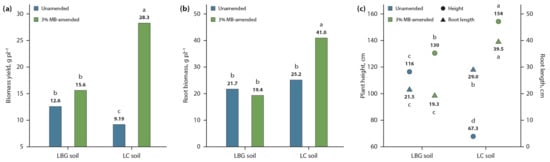
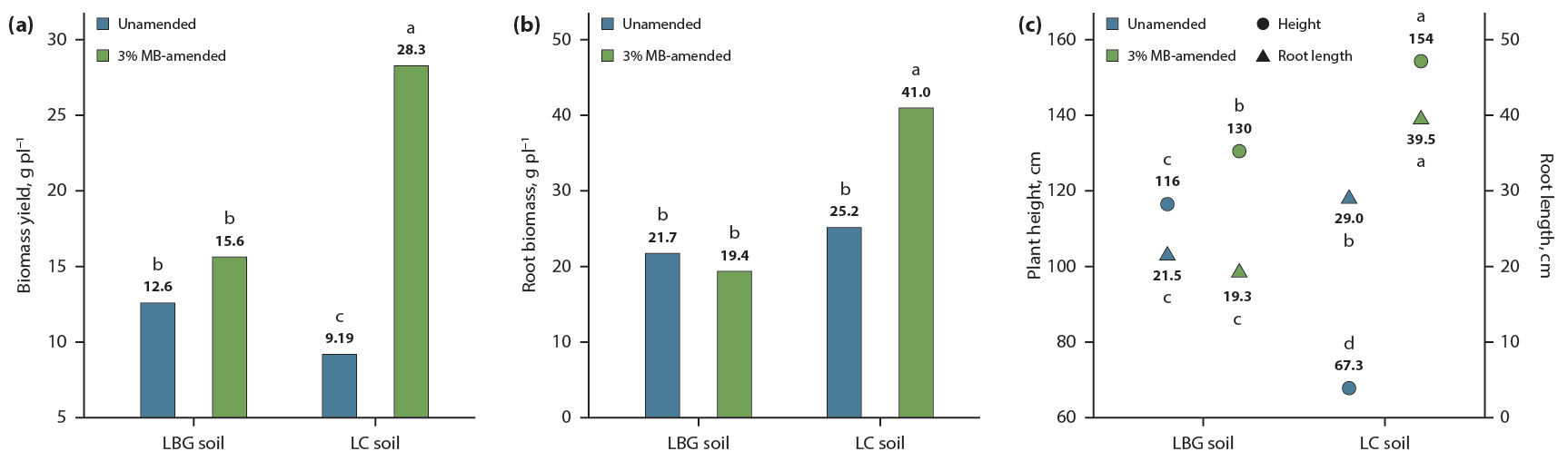
Evaluation of soil contamination influence on plant parameters revealed expected tendencies of reducing aboveground parts (plant height and biomass yield) and increasing belowground parts (root length) as a substitutive adaptation mechanism [9,34,50]. In particular, the height and aboveground biomass of plants grown in unamended LC soil decreased by 42.0% and 27.0%, respectively, compared to those grown in unamended LBG soil (Figure 1). Whereas 34.9% root elongation and 15.7% root biomass increases were observed as well.
Figure 1.
M×g biomass production capacity under different soil and amendment conditions: (a) aboveground biomass; (b) root biomass; (c) plant height and root length. Notes: LBG—local background; LC—legacy contaminated. Different letters indicate significant difference between soils within one parameter at p < 0.05.
Similar findings have been reported for M×g cultivated in soil spiked with Cu, where the element concentration increased from 69.9 ± 13.8 mg kg−1 to 416 ± 16.8 mg kg−1 [34]. Under these conditions, plant height and stem biomass were reduced by 31.8% and 34.7%, respectively, compared with control values [34]. Nevertheless, an artificial increase in Zn concentrations in soil from 202 ± 11.4 mg kg−1 to 580 ± 15.2 mg kg−1 did not result in any statistically significant reductions in aboveground biomass or plant height [34]. Another study reported reductions in both aboveground and belowground biomass of M×g grown in soil spiked with diesel [10].
The incorporation of 3% biochar produced from M×g stems into soil–plant systems resulted in an improvement only in plant height (by 12.1%) under LBG soil conditions. In contrast, in LC soil, all growth indicators were improved by 128%, 208%, 62.9%, and 36.2% for plant height, aboveground biomass yield, root biomass, and root length, respectively (Figure 1). Furthermore, the influence of biochar not only restored growth indicator values to control levels but exceeded them by 32.6%, 125%, 88.4%, and 83.7%, respectively. The results obtained in the present study are consistent with findings reported in the literature, where biochar produced from M×g rhizomes was incorporated at application rates of 1.67% and 5.00% into Cu- or Zn-spiked soils and led to significant increases in all M×g growth parameters [34]. In contrast, a study utilising biochar derived from M×g waste biomass at application rates of 3.5% and 7.0% in diesel-spiked soils demonstrated no positive effect on M×g growth parameters [10].
Thus, the determined positive impact of waste-derived biochar on M×g adaptation to PTE contamination in soil emphasises the successful optimisation of phytomanagement.
3.2.2. Influence on Chlorophyll Content in M×g Leaves
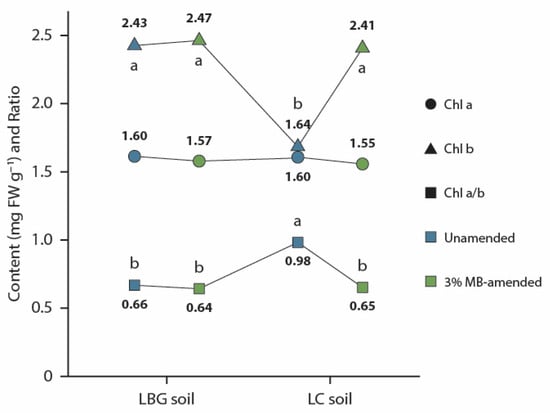
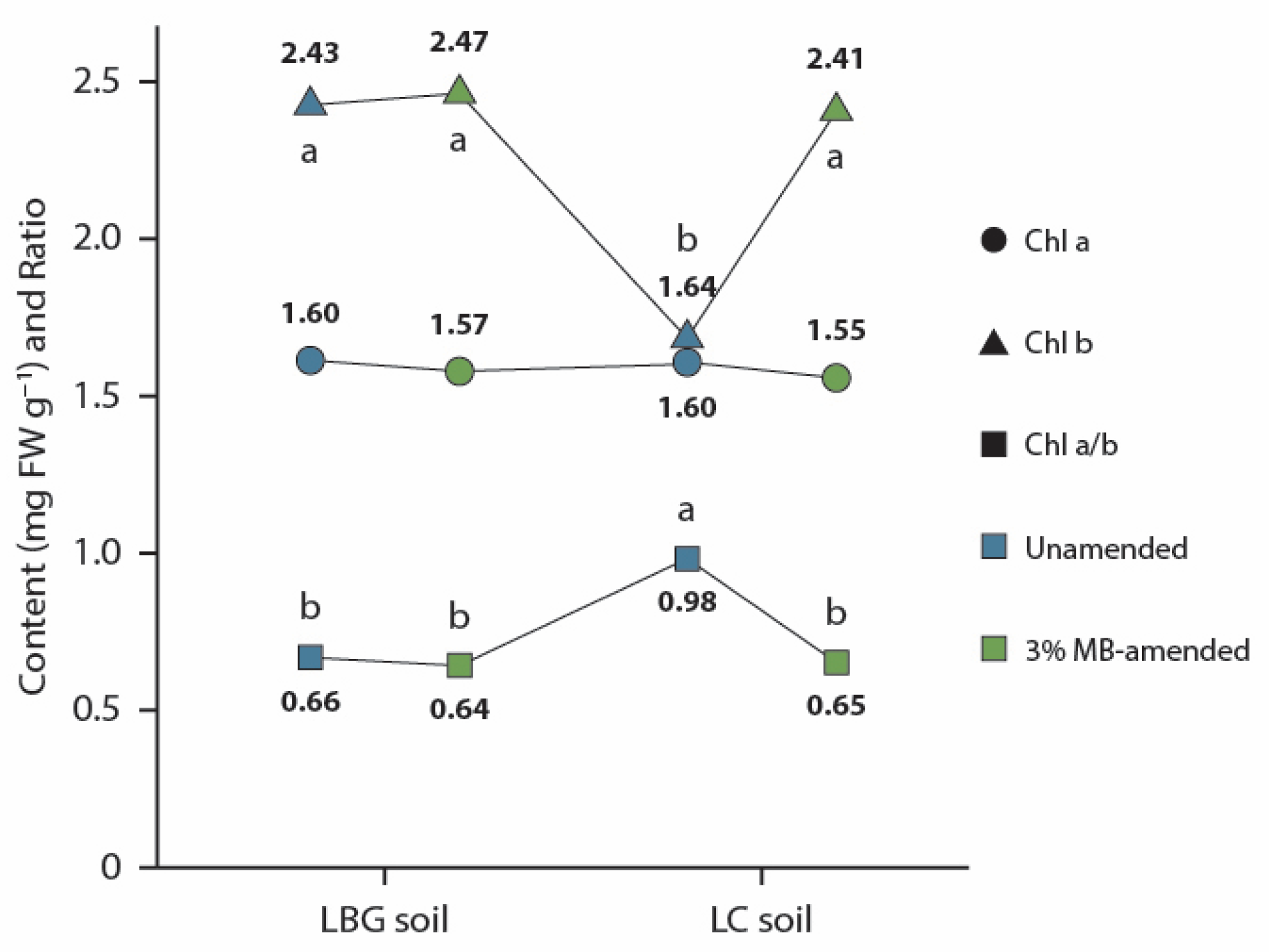
Assessment of the impact of soil PTE contamination on chlorophyll pigment content in M×g leaves revealed a reduction in Chl b content by 32.6%. Consequently, the total chlorophyll content (Chl (a+b)) and the Chl a/b ratio were also significantly altered (Figure 2), being 19.8% lower and 47.4% higher, respectively, compared with control levels.
Figure 2.
Chlorophyll content in M×g leaves and pigments ratio. Different letters indicate significant difference between soils within one parameter at p < 0.05.
Interestingly, no effect of biochar on chlorophyll content in M×g leaves was observed when it was incorporated into LBG soil. In contrast, when biochar was incorporated into LC soil, the values of Chl b content, total chlorophyll content, and the Chl a/b ratio were restored to control levels. In particular, biochar application resulted in increases in Chl b and Chl (a+b) by 47.2% and 22.4%, respectively, and a decrease in the Chl a/b ratio by 33.8%. The results of the two-way ANOVA for the aforementioned three parameters indicated significant p-values for soil contamination, biochar incorporation, and their interaction, evidencing a selective impact of biochar depending on soil contamination. In addition, the content of Chl a was not influenced by either soil contamination (p = 0.613) or biochar incorporation (p = 0.132), remaining within the range of 1.55 ± 0.05 to 1.60 ± 0.07 mg FW g−1.
A global synthesis (74 publications with 347 pairwise comparisons) evaluating the influence of biochar incorporation on photosynthesis and biomass indicated that, overall, biochar significantly increased the photosynthetic rate by 27.1% and chlorophyll concentration by 16.1% [82]. Notably, a more pronounced and measurable effect of biochar was observed in C3 plants than in C4 plants, which may explain the limited impact detected in the present study [82]. Nevertheless, it can be concluded that, in heavily PTE-contaminated soil, biochar derived from post-phytoremediation M×g biomass effectively mitigated the adverse effects of PTE contamination on M×g development, restoring chlorophyll pigment concentrations to control levels.
3.2.3. Influence on M×g Biochemical Parameters
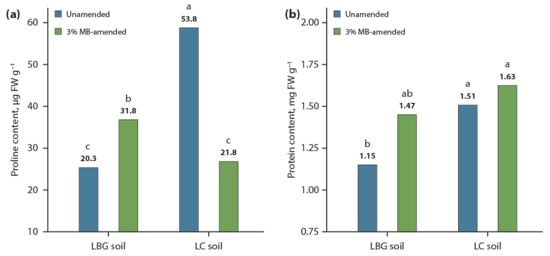
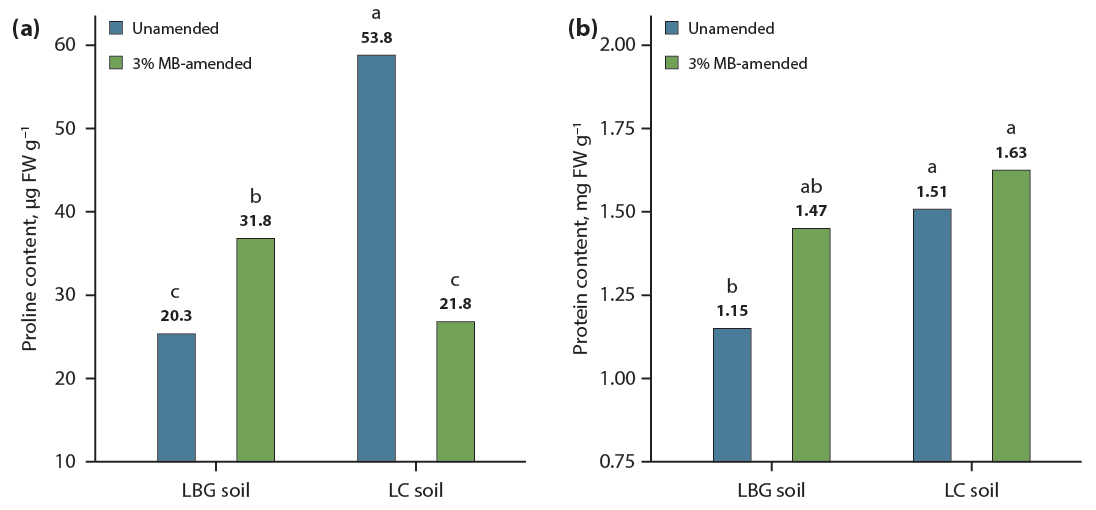
The contents of proline and protein were used as indicators of plant stress, supplemented by measurements of antioxidant enzyme activity. The analysis demonstrated that proline was more sensitive than protein to both soil contamination and biochar incorporation, with a significant interaction effect also observed (p < 0.001). Specifically, proline content increased markedly by 164% when M×g was grown in LC soil compared with values obtained under LBG soil conditions (Figure 3a).
Figure 3.
Proline (a) and protein (b) content in M×g leaves. Different letters indicate significant difference between soils within one parameter at p < 0.05.
Biochar incorporation induced contrasting responses depending on soil contamination status. In particular, a 56.2% increase in proline content was detected in leaves of M×g grown in LBG soil compared with the corresponding unamended soil, whereas a 59.4% reduction was observed in leaves of M×g grown in LC soil compared with the corresponding unamended soil. Moreover, relative to control values, biochar incorporation into LC soil mitigated the effect of soil contamination, restoring proline content in M×g leaves to control levels. As a key osmoprotectant and marker of abiotic stress, a reduction in proline content upon biochar addition suggests decreased toxic pressure and reduced oxidative stress. This effect may be attributed to reduced bioavailability of pollutants due to their sorption onto the biochar surface, as well as to improvements in water and ion balance within the rhizosphere [83,84,85].
Considering protein content as an indicator of plant adaptive response to chemical stress, a significant effect of soil contamination (p < 0.01) was identified (Figure 3b). Protein content increased by 31.0% in LC soil. Although the effect of biochar was also statistically significant (p < 0.05), the observed 28.2% increase in protein content in amended LBG soil was not statistically significant. Furthermore, no significant interaction between soil contamination and biochar incorporation was detected for protein content in M×g leaves (p = 0.202).
Thus, the observed tendency towards increased protein content under LBG soil conditions following biochar incorporation, together with the increase in proline content under the same conditions, suggests that plants may require time to adapt to biochar. In contrast to the clearly demonstrated negative impact of biochar on M. sinensis [9], the observed increases in these indicators in the present study are most likely associated with adaptive responses of M×g, with proline being particularly indicative due to its higher sensitivity.
In addition to protein and proline contents in M×g leaves, the activities of antioxidant enzymes (APX, CAT, GR, and SOD) were analysed. Soil PTE contamination induced increases in the activities of APX, GR, and SOD by 35.6%, 78.1%, and 57.7%, respectively, indicating the sensitivity of these enzymes to increased chemical load (Table 5). In contrast, incorporation of biochar into LBG soil did not influence the activities of APX, GR, and SOD, while it increased CAT activity by 44.8% compared with the corresponding unamended soil. Hence, CAT may be considered more responsive to carbon or nitrogen inputs associated with biochar application.
Table 5.
Antioxidant enzymes activity in M×g leaves (U mg−1 protein).
When biochar was incorporated into LC soil, enzyme activities were reduced to control levels (for GR) or to levels below control values (for the remaining enzymes). Specifically, the activities of APX, CAT, GR, and SOD decreased by 42.8%, 51.8%, 45.6%, and 55.1%, respectively, compared with the corresponding unamended LC soil, and by 22.4%, 49.2%, 3.13%, and 29.2%, respectively, compared with unamended LBG soil conditions.
Changes in antioxidant enzyme activity reflect a restructuring of the plant defence system against reactive oxygen species (ROS). Biochar application reduces the influx of toxicants and, consequently, the level of oxidative stress, leading to the normalisation or optimisation of antioxidant system function. A decrease in antioxidant enzyme activity indicates a reduction in the formation of ROS associated with diminished toxic pressure [86,87,88]. Thus, post-phytoremediation biomass-derived biochar neutralised the negative impact of soil PTE contamination on M×g adaptive potential, bringing antioxidant enzymes activities to control levels or even lower.
In LC soil, biochar application contributes to a reduction in the ROS formation, leading to normalisation or reduction in excessive antioxidant enzyme activity. At the same time, moderate activation of the antioxidant system may indicate an adaptive response and enhanced plant stress resistance. Thus, biochar exerts a complex effect on plant redox homeostasis by stabilising the balance between the formation and ROS detoxification. Overall, biochar functions as a multifunctional regulator of the soil–plant system, transforming it from a stress-induced state to a more stable and metabolically active condition, thereby significantly enhancing the potential for phytoremediation of contaminated soils.
3.3. Influence of Biochar Incorporation on Soil Elemental Composition
Chemical analysis indicated that, in the M×g rhizosphere soil after the experiment (final, F), Co, Ni, As, and Cd were below the limit of detection, whereas Ni and As had been present in both LBG and LC soils prior to the experiment (initial, I).
Comparison of initial and final PTE concentrations in unamended LBG soil revealed significant reductions in Cr, Cu, Zn, and Pb, reaching up to 42.8%, indicating plant uptake (Table 6). Similarly, in unamended LC soil, significant reductions in PTE concentrations were observed, reaching up to 51.8%. The decrease in concentrations was more pronounced in LC soil, particularly for Zn and Pb (35.1% and 46.3%, respectively), compared with 11.6% and 8.39% in unamended LBG soil.
Table 6.
Changes in soil elemental composition. Different letters indicate significant differences in PTE concentrations between initial and final values at p < 0.05. Percentage increases or decreases in PTE concentrations are presented only where statistically significant changes were observed.
Incorporation of biochar into LBG soil did not significantly affect the reduction in Cu concentrations, which remained at levels comparable to the corresponding unamended soil; however, the p-value suggests a tendency towards reduced Cu depletion. In addition, biochar amendment resulted in smaller decreases in Cr concentration, indicating reduced plant uptake. For Zn and Pb, no significant differences were observed between initial and final concentrations in amended soil, suggesting effective stabilisation in soil and minimal phytoavailability.
The stabilising effect of biochar was more pronounced in LC soil. No significant differences were observed between initial and final concentrations of Cr, Cu, and Zn in amended LC soil. Only Pb exhibited a significant decrease (by 14.9%) in final concentration compared with the initial value, suggesting reduced plant uptake. Thus, biochar incorporation into heavily PTE-contaminated soil promotes stabilisation of PTEs, reducing their availability to plants and, consequently, chemical stress. This effect was more pronounced at higher levels of soil contamination.
The mechanisms of PTE immobilisation by biochar, including adsorption, ion exchange, complexation, and pH-induced precipitation, are consistent with current research findings. In fact, the decrease in Pb mobility following biochar addition may be attributed to the formation of lead phosphate precipitates [89]. In addition to biochar type and modification, the conversion process is also important; for example, the efficiency of Cu ion removal by biochar follows the descending order: carbonisation (300 °C) > slow pyrolysis > hydrothermal carbonisation [90]. Similarly, an increase in pH and the formation of insoluble hydroxides and carbonates are considered dominant mechanisms for reducing PTE bioavailability and mobility in soil [91].
3.4. Influence of Soil Contamination and Biochar Incorporation on Phytoremediation Potential
Chemical analysis of the aboveground biomass and roots of M×g revealed no accumulation of Co, Ni, As, and Cd, with Pb detected only in plant roots (Table 7).
Table 7.
PTE concentration in M×g aboveground and belowground tissues (mg kg−1). Different letters within one element and plant part indicate significant differences in PTE concentrations.
3.4.1. PTE Accumulation in M×g Tissues
In M×g roots cultivated in LBG soil, the measured concentrations of PTEs followed the descending order: Zn > Cu > Cr > Pb (Table 7). A similar order was observed for concentrations in aboveground biomass: Zn > Cu > Cr. Under cultivation in LC soil, the order in roots changed to Zn > Cr > Cu > Pb, while in aboveground biomass they remained similar to those observed under LBG soil.
As expected, the accumulation of PTEs (except Pb) in both plant tissues was higher when M×g was grown in LC soil. Specifically, the accumulation of Cr, Cu, and Zn in the aboveground biomass and roots of M×g grown in unamended LC soil was higher by 83.3%, 110%, 382%, 14.3%, 128%, and 62.5%, respectively, compared with values obtained in unamended LBG soil (Table 7).
Amendment of LBG soil with biochar resulted in a significant reduction in PTE accumulation in plant tissues, with the exception of Cu concentration, which increased in aboveground biomass by 63.1%, and Cr concentration, which remained at a level comparable to that in the corresponding unamended soil. In particular, biochar incorporation into LBG soil led to a 46.4% decrease in Zn accumulation in M×g aboveground biomass and reductions of 73.5%, 24.2%, 34.1%, and 70.3% in Cr, Cu, Zn, and Pb accumulation in roots, respectively (Table 7).
A similar effect was observed following biochar incorporation into LC soil, where the accumulation of PTEs in M×g tissues was substantially reduced, with the exception of Zn accumulation in roots, which remained at a level comparable to that in unamended LC soil (Table 7). Specifically, biochar amendment resulted in reductions of 32.7%, 66.1%, and 28.4% in Cr, Cu, and Zn accumulation in aboveground biomass, and reductions of 90.0%, 12.5%, and 61.3% in Cr, Cu, and Pb accumulation in roots, respectively, compared with the corresponding unamended soil.
In light of the expected reduction in the phytoavailability of PTEs induced by biochar, accompanied by decreased accumulation in plant tissues, it is important to evaluate the extent of the stabilising effect of biochar in relation to PTEs and its supportive effect on plant performance. Accordingly, a comparison of M×g accumulation activity in amended LC soil and unamended LBG soil was performed. Statistical analysis revealed that, although biochar reduced the accumulation of Cr, Cu, and Zn in the aboveground biomass of M×g, their concentrations remained significantly higher (by 23.3%, 63.1%, and 63.0%, respectively) than those observed in unamended LBG soil. In contrast, biochar application reduced the accumulation of Cr, Cu, and Pb in M×g roots to control levels or even to significantly lower values (by 54.5–79.0%). However, Zn accumulation in M×g roots remained 39.7% higher than control levels.
3.4.2. Phytoremediation Coefficients
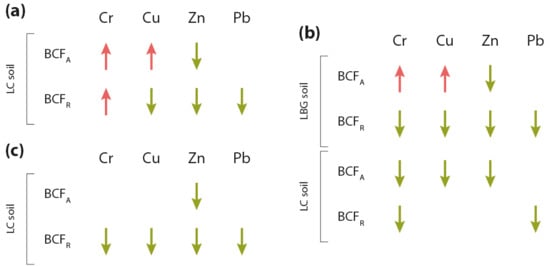
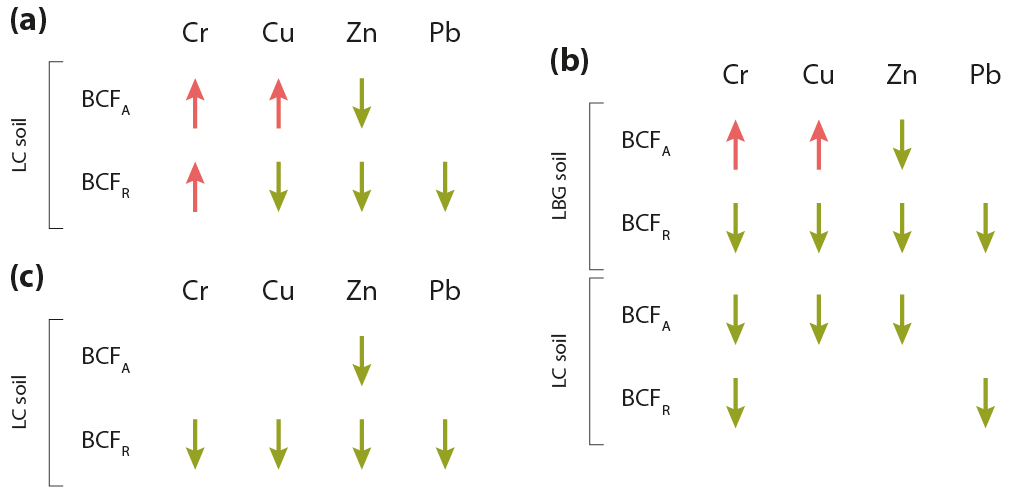
When M×g was cultivated in unamended LBG soil, the bioconcentration factors for aboveground biomass (BCFA) and roots (BCFR) were 0.13 and 0.80 for Cr, 1.65 and 4.25 for Cu, 7.51 and 5.51 for Zn, and 0.38 for Pb, respectively (Table S2). Following the transition to contaminated soil, both BCF values generally decreased. Specifically, BCFA and BCFR values for Cr increased by 28.0% and 46.2%, respectively, whereas the corresponding values for Zn decreased by 48.0% and 62.9%, respectively (Figure 4a). These trends suggest that M×g might be capable of tolerating Cr concentrations in soil of 163 ± 8.70 mg kg−1, while approaching critical thresholds for Zn at 318 ± 13.4 mg kg−1.
Figure 4.
Influence of biochar on BCF values, presented as (a) unamended LC soil relative to unamended LBG soil; (b) amended LBG and LC soils relative to the corresponding unamended soils; and (c) amended LC soil relative to unamended LBG soil.
Incorporation of biochar into LBG soil resulted in significant increases in BCFA values by 19.7% and 63.1% for Cr and Cu, respectively, and a decrease of 46.4% for Zn (Figure 4b). Simultaneously, BCFR values for all tested PTEs decreased by 73.5%, 24.2%, 34.1%, and 70.2% for Cr, Cu, Zn, and Pb, respectively. These reductions in PTE accumulation may be associated with toxicity threshold effects.
In LC soil, no increases in BCF values were observed, suggesting a possible minor release of Cr and Cu from biochar when incorporated into LBG soil, which remained within toxicity thresholds and permitted increased accumulation. In contrast, biochar incorporation into LC soil did not affect BCFR values for Cu and Zn, which remained at levels comparable to those in the corresponding unamended soil (Figure 4b; Table S2). For the remaining cases, significant decreases in both BCFA and BCFR values were observed, specifically by 33.1% and 90.0% for Cr, by 66.1% for Cu, by 28.4% for Zn, and by 61.5% for Pb, respectively. Furthermore, evaluation of biochar as a PTE-stabilising agent demonstrated that, under LC soil conditions, BCFR values for Cr, Cu, Zn, and Pb were significantly lower than those obtained under unamended LBG soil conditions, by 85.4%, 37.8%, 68.1%, and 81.2%, respectively, indicating a strong stabilisation effect. In addition, biochar reduced the BCFA value for Zn by 62.8% compared with unamended LBG soil conditions.
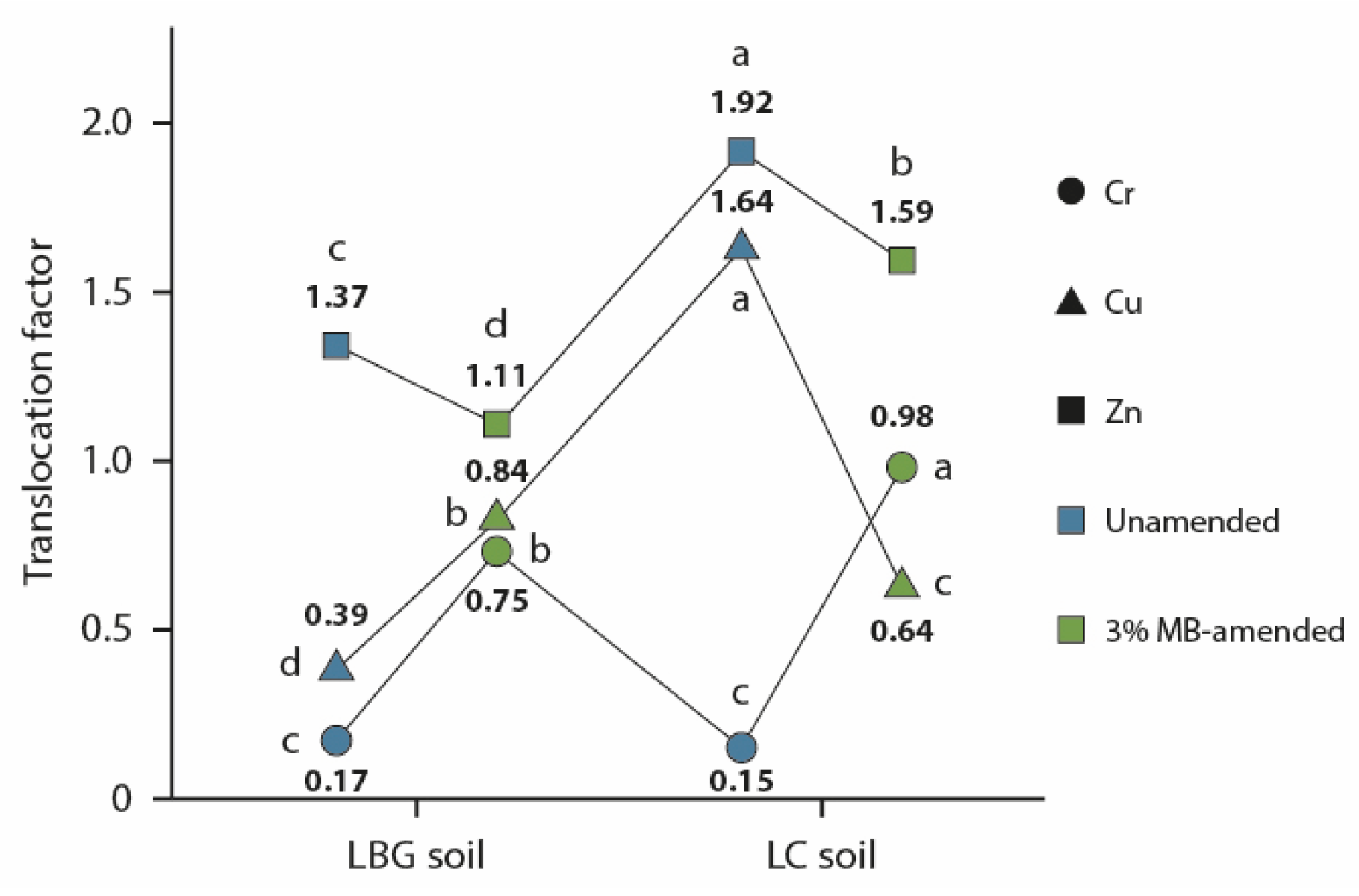
Considering the influence of soil contamination and biochar incorporation on PTE distribution within the M×g organism, TLF values were calculated for Cr, Cu, and Zn (Figure 5). When grown in unamended LBG soil, M×g exhibited phytostabilisation mechanisms for Cr and Cu, with TLF values of 0.17 and 0.39, respectively, whereas a phytoextraction mechanism was observed for Zn, with a TLF of 1.37. These values were considered as control. Increasing the level of soil contamination did not alter the accumulation pattern of Cr (TLF of 0.15), shifted Cu accumulation towards phytoextraction (TLF of 1.64), and enhanced Zn phytoextraction, increasing the TLF to 1.92.
Figure 5.
Translocation factors for Cr, Cu, and Zn accumulated in M×g tissues. Different letters indicate significant difference between soils within one elemenentat p < 0.05.
Incorporation of biochar into background soil resulted in a more uniform distribution pattern (equally within the plant parts) of the examined PTEs, increasing TLF values for Cr and Cu to 0.75 (by 352%) and 0.84 (by 115%), respectively, while reducing the Zn TLF to 1.11 (by 18.9%). Incorporation of biochar into LC soil demonstrated a similar trend for Cr, with the distribution pattern shifting towards an approximately equal distribution within plant tissues (TLF increased to 0.98, by 572%), and for Zn, with a reduction in TLF to 1.59 (by 16.8%). In contrast, the effect of biochar on Cu distribution in M×g tissues differed from that observed in LBG soil, resulting in a reduction in TLF to 0.64 (by 61.2%), approaching control values (Figure 5).
Thus, although biochar incorporation resulted in a significant reduction in PTE accumulation, thereby diminishing the chemical stress imposed on the plant, further investigations are required to achieve complete mitigation of chemical stress and to reduce PTE accumulation in plant tissues to safe threshold levels. Furthermore, the reduction in BCF values following biochar incorporation indicates that the produced biomass became less contaminated and more suitable for subsequent valorisation.
In light of the findings obtained, it is important to acknowledge that the experiment was conducted under controlled conditions, which limits the direct extrapolation of the results to field scale, where soil properties, climatic factors, and contamination heterogeneity may significantly influence biochar efficacy and the stability of the soil–plant–microbiome system. Nevertheless, the use of a fixed biochar application rate provides a clear understanding of the mechanisms governing biochar interactions within the soil–plant system under controlled conditions, thereby establishing a basis for further optimisation of the technology.
Taking into account the aforementioned limitations and the findings obtained, further investigations should address the following:
- (i)
- Whether biochar exhibits a toxicity threshold of approximately 50.0 mg kg−1 for Cu in soil, since in the present study the influence of biochar on Cu distribution within M×g tissues differed depending on soil Cu concentration (31.2 vs. 50.1 mg kg−1). Consequently, it may be inferred that the produced biochar should be applied in soils with Cu concentrations above 50.1 ± 2.92 mg kg−1, resulting in the production of less contaminated biomass.
- (ii)
- Whether biochar exhibits a toxicity threshold of <130 mg kg−1 for Zn in soil, as a similar effect to Cu was observed for Zn, with reduced accumulation in aboveground biomass and, consequently, improved biomass quality. Accordingly, this biochar may be recommended for use in soils with Zn concentrations above 318 ± 13.4 mg kg−1. However, considering the behaviour observed for Cu, a threshold concentration for Zn may also exist, below which biochar could exert an opposite effect; this threshold is likely to be below 132 ± 1.99 mg kg−1.
4. Conclusions
Valorisation of M×g post-phytoremediation biomass (in particular stems) via pyrolysis to produce biochar represents a viable approach, achieving a yield of 44.2%. The produced biochar exhibited suitable physicochemical characteristics, including an essentially high surface area of 672 m2 g−1. Its suitability is dependent on the intended use, the contamination context of the soil, the target element, and the applicable regulatory framework. Under, the conditions and duration of the present pot experiment, no evidence of secondary contamination was observed. Application of Miscanthus-derived biochar at a rate of 3% effectively neutralised the negative impact of soil PTE contamination on M×g development and reduced the accumulation of PTEs in plant tissues. However, the observed trends cannot be generalised, and prior to application of this waste-derived biochar, assessment of soil inorganic contamination is essential. Thus, the use of waste-derived biochar facilitated the production of less contaminated (or relatively “clean”) biomass in relation to Cu, Zn, and Cr, supporting its further conversion into value-added products within a circular economy framework and in alignment with Sustainable Development Goals. Nevertheless, future research should include a range of biochar application rates and field trials aimed at establishing dose–response relationships, as well as evaluating the long-term stability of biochar effects under real agroecological conditions.
Supplementary Materials
The following supporting information can be downloaded at: https://www.mdpi.com/article/10.3390/agronomy16111115/s1, Table S1. Elemental composition of marginal soil. Figure S1. Low-temperature gas sorption–desorption isotherm of an inert gas on the biochar sample (a) and pore size distribution in the range of 3–150 nm together with total pore volume (b). Table S2. Bioconcentration factor values calculated for M×g above- (BCFA) and belowground (BCFR) tissues. Different letters within one element and plant part indicate significant differences in PTE concentrations.
Author Contributions
Conceptualisation, A.A.N. and A.M.; methodology, A.M.; software, A.M.; validation, A.M., A.S.N., A.Z. and Z.Z.; formal analysis, A.M. and A.Z.; investigation, A.S.N. and Z.Z.; resources, A.A.N.; data curation, A.M. and A.Z.; writing—original draft preparation, A.M. and A.A.N.; writing—review and editing, A.M., A.A.N., A.S.N., A.Z. and Z.Z.; visualisation, A.M.; supervision, A.A.N. and A.M.; project administration, A.A.N.; funding acquisition, A.A.N. All authors have read and agreed to the published version of the manuscript.
Funding
This research was funded by the Committee of Science of the Ministry of Science and Higher Education, the Republic of Kazakhstan, grant number AP23487419.
Data Availability Statement
The original contributions presented in this study are included in the article. Further inquiries can be directed to the corresponding authors.
Conflicts of Interest
The authors declare no conflicts of interest.
Abbreviations
The following abbreviations are used in this manuscript:
| BCFA | Bioconcentration factor (aboveground biomass) |
| BCFR | Bioconcentration factor (roots) |
| BET | Brunauer–Emmett–Teller |
| EBC | European Biochar Certificate |
| FST | Feedstock suitability thresholds |
| IBI | International Biochar Initiative |
| LBG | Local background |
| LC | Legacy contaminated |
| WBC | World Biochar Certificate |
References
- Gololobova, A.; Legostaeva, Y. An Assessment of the Impact of the Mining Industry on Soil and Plant Contamination by Potentially Toxic Elements in Boreal Forests. Forests 2023, 14, 1641. [Google Scholar] [CrossRef] [Scilit]
- Kakimzhanov, Y.K.; Kyrgyzbay, K.T.; Zhumatayev, S.M.; Bazarbayeva, T.A.; Kunypiyaeva, G.T. Assessment of Soil Contamination of the West Kazakhstan Region with Heavy Metals as a Result of Industrial Activity. News Natl. Acad. Sci. Repub. Kazakhstan Ser. Geol. Tech. Sci. 2025, 1, 72–90. [Google Scholar] [CrossRef] [Scilit]
- USEPA. Summary of the Phytoremediation State of the Science Conference; United States Environmental Protection Agency: Boston, MA, USA, 2000; p. 70.
- USEPA. Introduction to Phytoremediation; U.S. Environmental Protection Agency: Washington, DC, USA, 2000; p. 105.
- Salt, D.E.; Blaylock, M.; Kumar, N.P.B.A.; Dushenkov, V.; Ensley, B.D.; Chet, I.; Raskin, I. Phytoremediation: A Novel Strategy for the Removal of Toxic Metals from the Environment Using Plants. Bio/Technology 1995, 13, 468–474. [Google Scholar] [CrossRef] [Scilit]
- Cunningham, S.D.; Ow, D.W. Promises and Prospects of Phytoremediation. Plant Physiol. 1996, 110, 715–719. [Google Scholar] [CrossRef] [Scilit]
- Lekshmi, S.; Lekshmi, A.A.; Achuthavarier, D.; Chandran, S.S. Critical Analysis of Sustainable Ways of Removing Insidious Pollutants from the Environment through Phytoremediation Techniques. Chem. Ecol. 2024, 40, 892–917. [Google Scholar] [CrossRef] [Scilit]
- Mamirova, A.; Pidlisnyuk, V.; Hrabak, P.; Shapoval, P.; Nurzhanova, A. Biochar-Supported Phytoremediation of Dredged Sediments Contaminated by HCH Isomers and Trace Elements Using Paulownia Tomentosa. Sustainability 2024, 16, 9080. [Google Scholar] [CrossRef] [Scilit]
- Nurzhanova, A.; Pidlisnyuk, V.; Nurmagambetova, A.; Zhumasheva, Z.; Naizabayeva, L.; Mamirova, A. Biochar as a Tool to Optimise Miscanthus Sinensis Resilience and Phytoremediation Efficiency: Case Study of Contamination by Mixture of Ni and 4.4′-DDE. Environ. Chem. Ecotoxicol. 2025, 7, 802–818. [Google Scholar] [CrossRef] [Scilit]
- Pidlisnyuk, V.; Newton, R.A.; Ust’ak, S.; Al Souki, K.S.; Burdová, H.; Trögl, J.; Grycová, B.; Klemencová, K.; Leštinsky, P.; Mamirova, A. Assessing the Potential of Different Biochars to Support Miscanthus × giganteus Phytoremediation in Petroleum Hydrocarbons-Contaminated Soil. Ind. Crops Prod. 2025, 229, 120971. [Google Scholar] [CrossRef] [Scilit]
- Kafle, A.; Timilsina, A.; Gautam, A.; Adhikari, K.; Bhattarai, A.; Aryal, N. Phytoremediation: Mechanisms, Plant Selection and Enhancement by Natural and Synthetic Agents. Environ. Adv. 2022, 8, 100203. [Google Scholar] [CrossRef] [Scilit]
- Huang, W.; Zhang, C.; Zhu, B.; Liu, X.; Xiao, H.; Liu, S.; Shao, H. Systematic Evaluation of Plant Metals/Metalloids Accumulation Efficiency: A Global Synthesis of Bioaccumulation and Translocation Factors. Front. Plant Sci. 2025, 16, 1602951. [Google Scholar] [CrossRef] [Scilit] [PubMed]
- Feng, Z.; Ji, S.; Ping, J.; Cui, D. Recent Advances in Metabolomics for Studying Heavy Metal Stress in Plants. TrAC Trends Anal. Chem. 2021, 143, 116402. [Google Scholar] [CrossRef] [Scilit]
- Pidlisnyuk, V.; Newton, R.A.; Mamirova, A.; Rouhani, A.; Vana, V.; Ust’ak, S. Multiyear Miscanthus Biomass Production at the Marginal and Post-Mining Areas with Soil Amendments: Case of Chomutov, Czech Republic; Pude, R., Ed.; CentMa GmbH: Lohne, Germany, 2024; pp. 97–102. [Google Scholar]
- Mamirova, A.; Pidlisnyuk, V. The Economic and Environmental Aspects of Miscanthus × giganteus Phytomanagement Applied to Non-Agricultural Land. Agronomy 2024, 14, 791. [Google Scholar] [CrossRef] [Scilit]
- Al Souki, K.S.; Liné, C.; Moravec, J.; Douay, F.; Pourrut, B. Response of Three Miscanthus × Giganteus Cultivars to Toxic Elements Stress: Part 2, Comparison between Two Growing Seasons. Plants 2022, 11, 945. [Google Scholar] [CrossRef] [Scilit]
- Burdová, H.; Nebeská, D.; Suhail Al Souki, K.; Pilnaj, D.; Kwoczynski, Z.; Kříženecká, S.; Auer Malinská, H.; Vaněk, M.; Kuráň, P.; Pidlisnyuk, V.; et al. Miscanthus x Giganteus Stress Tolerance and Phytoremediation Capacities in Highly Diesel Contaminated Soils. J. Environ. Manag. 2023, 344, 118475. [Google Scholar] [CrossRef] [Scilit]
- Chapman, G.P. The Biology of Grasses; CAB International: Wallingford, UK, 1996. [Google Scholar]
- Maaß, O.; Grundmann, P. Governing Transactions and Interdependences between Linked Value Chains in a Circular Economy: The Case of Wastewater Reuse in Braunschweig (Germany). Sustainability 2018, 10, 1125. [Google Scholar] [CrossRef] [Scilit]
- Pidlisnyuk, V.; Newton, R.A.; Mamirova, A. Miscanthus Biochar Value Chain—A Review. J. Environ. Manag. 2021, 290, 112611. [Google Scholar] [CrossRef] [Scilit]
- Ahakey, N.; Gothalwal, R. Magnificent Bio-Management of Pesticides in Agriculture Soil. Int. J. Life Sci. Agric. Res. 2024, 3, 746–760. [Google Scholar] [CrossRef] [Scilit]
- Boorboori, M.R.; Lackóová, L. Biochar; an Effective Factor in Improving Phytoremediation of Metal(Iod)s in Polluted Sites. Front. Environ. Sci. 2023, 11, 1253144. [Google Scholar] [CrossRef] [Scilit]
- Muzammal, S.; Akram, A.; Shakoor, M.B.; Ahmad, S.R.; Farid, M.; Shakoor, M.H. Biochar-Assisted Phytoremediation for Heavy Metals-Contaminated Soils. In New Frontiers in Plant-Environment Interactions: Innovative Technologies and Developments; Aftab, T., Ed.; Springer Nature: Cham, Switzerland, 2023; pp. 359–384. [Google Scholar]
- Ouyang, P.; Narayanan, M.; Shi, X.; Chen, X.; Li, Z.; Luo, Y.; Ma, Y. Integrating Biochar and Bacteria for Sustainable Remediation of Metal-Contaminated Soils. Biochar 2023, 5, 63. [Google Scholar] [CrossRef] [Scilit]
- He, L.; Zhong, H.; Liu, G.; Dai, Z.; Brookes, P.C.; Xu, J. Remediation of Heavy Metal Contaminated Soils by Biochar: Mechanisms, Potential Risks and Applications in China. Environ. Pollut. 2019, 252, 846–855. [Google Scholar] [CrossRef] [Scilit]
- Pinna, M.V.; Diquattro, S.; Garau, M.; Grottola, C.M.; Giudicianni, P.; Roggero, P.P.; Castaldi, P.; Garau, G. Combining Biochar and Grass-Legume Mixture to Improve the Phytoremediation of Soils Contaminated with Potentially Toxic Elements (PTEs). Heliyon 2024, 10, e26478. [Google Scholar] [CrossRef] [Scilit]
- Devito, P.; Carnimeo, C.; Loffredo, E.; Borello, D.; Ancona, V.; Pantaleo, A. Biochar from Plant-Assisted Bioremediation: Potential Applications for Sorptive Removal of Phenolic Pollutants from Water. In Proceedings of the 16th Conference on Sustainable Development of Energy, Water and Environmental Systems (SDEWES), Dubrovnik, Croatia, 10–15 October 2021. [Google Scholar]
- Fan, X.; Du, C.; Zhou, L.; Fang, Y.; Zhang, G.; Zou, H.; Yu, G.; Wu, H. Biochar from Phytoremediation Plant Residues: A Review of Its Characteristics and Potential Applications. Environ. Sci. Pollut. Res. 2024, 31, 16188–16205. [Google Scholar] [CrossRef] [Scilit] [PubMed]
- Zhang, Y.; Chen, Z.; Xu, W.; Liao, Q.; Zhang, H.; Hao, S.; Chen, S. Pyrolysis of Various Phytoremediation Residues for Biochars: Chemical Forms and Environmental Risk of Cd in Biochar. Bioresour. Technol. 2020, 299, 122581. [Google Scholar] [CrossRef] [Scilit]
- Ghosh, D.; Maiti, S.K. Biochar Assisted Phytoremediation and Biomass Disposal in Heavy Metal Contaminated Mine Soils: A Review. Int. J. Phytoremediation 2021, 23, 559–576. [Google Scholar] [CrossRef] [Scilit] [PubMed]
- Viotti, P.; Marzeddu, S.; Antonucci, A.; Décima, M.A.; Lovascio, P.; Tatti, F.; Boni, M.R. Biochar as Alternative Material for Heavy Metal Adsorption from Groundwaters: Lab-Scale (Column) Experiment Review. Materials 2024, 17, 809. [Google Scholar] [CrossRef] [Scilit]
- Himanshu; Awasthi, D.; Chauhan, P.R.; Deepti; Godara, R.; Pal, K.; Vijay, V. Biochar for Sustainable Applications: Advances in Characterization, Activation, and Life Cycle Assessment. Biomass Bioenergy 2026, 213, 109435. [Google Scholar] [CrossRef] [Scilit]
- Mukherjee, S.; Leri, A.C.; Bandaranayaka, C.; Vázquez-Núñez, E.; Barros, R.; Khan, A.H.A.; Zhou, P.; Zhang, T.; Bernal, M.P.; Clemente, R.; et al. Sustainable Management of Post-Phytoremediation Biomass. Energy Ecol. Environ. 2025, 10, 675–709. [Google Scholar] [CrossRef] [Scilit]
- Pidlisnyuk, V.; Mamirova, A.; Newton, R.A.; Grycová, B.; Klemencová, K.; Leštinský, P.; Ust’ak, S.; Shapoval, P. Miscanthus Phytotechnology of Cu- or Zn-Spiked Soils Supported by Contaminated Miscanthus Biochar—Is This a Viable Option for Valorization? Environ. Sci. Pollut. Res. 2025, 32, 7737–7759. [Google Scholar] [CrossRef] [Scilit]
- Beck, H.E.; Zimmermann, N.E.; McVicar, T.R.; Vergopolan, N.; Berg, A.; Wood, E.F. Present and Future Köppen-Geiger Climate Classification Maps at 1-Km Resolution. Sci. Data 2018, 5, 180214. [Google Scholar] [CrossRef] [Scilit] [PubMed]
- ISO 18400-203:2018; Soil Quality—Sampling—Part 203: Investigation of Potentially Contaminated Sites. International Organization for Standardization: Geneva, Switzerland, 2018.
- GOST 26423-85; Soils. Methods for Determination of Specific Electric Conductivity, pH and Solid Residue of Water Extract. Russian Gost: Moscow, Russia, 2011.
- ST RK 3477-2019; Soils. Determination of Organic Matter by Tyurin Method. Kazakhstan Institute of Standardization and Metrology: Astana, Kazakhstan, 2019.
- ISO 10694:1995; Soil Quality—Determination of Organic and Total Carbon After Dry Combustion (Elementary Analysis). International Organization for Standardization: Geneva, Switzerland, 1995.
- GOST 26205-91; Soils. Determination of Mobile Compounds of Phosphorus and Potassium by Machigin Method Modified by CRIAAS. Russian Gost: Moscow, Russia, 1993.
- RK DSM-32; Hygienic Standards for the Safety of the Environment (Soil). Ministry of Health of the Republic of Kazakhstan: Astana, Kazakhstan, 2021.
- ISO 19258:2018; Soil Quality—Guidance on the Determination of Background Values. International Organization for Standardization: Geneva, Switzerland, 2018.
- ITRC. Establishing Soil Background. In Soil Background and Risk Assessment; Interstate Technology & Regulatory Council: Washington, DC, USA, 2022; pp. 22–52. [Google Scholar]
- Vodyanitskii, Y.N. Equations for Assessing the Total Contamination of Soils with Heavy Metals and Metalloids. Eurasian Soil Sci. 2010, 43, 1184–1188. [Google Scholar] [CrossRef] [Scilit]
- ISO/TS 23105:2021; Biotechnology—Biobanking—Requirements for the Biobanking of Plant Biological Material for Research and Development. International Organization for Standardization: Geneva, Switzerland, 2021.
- Meier, U. BBCH-Monograph: Growth Stages of Mono-and Dicotyledonous Plants, 2nd ed.; Technical Report; Federal Biological Research Centre for Agriculture: Braunschweig, Germany, 2001. [Google Scholar]
- ISO 6869:2000; Animal Feeding Stuffs—Determination of the Contents of Calcium, Copper, Iron, Magnesium, Manganese, Potassium, Sodium and Zinc—Method Using Atomic Absorption Spectrometry. International Organization for Standardization: Geneva, Switzerland, 2022.
- ISO 17225-8:2023; Solid Biofuels—Fuel Specifications and Classes. Part 8: Graded Thermally Treated and Densified Biomass Fuels for Commercial and Industrial Use. International Organization for Standardization: Geneva, Switzerland, 2023.
- US EPA 3051A; Method 3051A (SW-846): Microwave Assisted Acid Digestion of Sediments, Sludges, and Oils. US Environmental Protection Agency, Office of Research and Development: Washington, DC, USA, 2007.
- Nurzhanova, A.A.; Pidlisnyuk, V.; Berzhanova, R.; Nurmagambetova, A.S.; Terletskaya, N.; Omirbekova, N.; Berkinbayev, G.; Mamirova, A. PGPR-Driven Phytoremediation and Physiobiochemical Response of Miscanthus × giganteus to Stress Induced by the Trace Elements. Environ. Sci. Pollut. Res. 2023, 30, 96098–96113. [Google Scholar] [CrossRef] [Scilit]
- Carillo, P.; Gibon, Y. Protocol: Extraction and Determination of Proline. PrometheusWiki 2014, 2011, 1–5. [Google Scholar]
- GOST 17.4.4.02-2017; Nature Protection. Soils. Methods for Sampling and Preparation of Soil for Chemical, Bacteriological, Helmintological Analysis. Russian Gost: Moscow, Russia, 2019.
- ST RK ISO 11047-2008; Soil quality. Determination of cadmium, chromium, cobalt, copper, lead, manganese, nickel, and zinc in aqua regia extracts of soil. Flame and electrothermal atomic absorption spectrometric methods (IDT). Kazakhstan’s Committee for Technical Regulation and Metrology: Astana, Kazakhstan, 2009.
- GD 52.18.721-2009; Arsenic in Soil, Sediment, Biological Material, and Water Samples. Measurement Methodology by Hydride Generation Atomic Absorption Spectrophotometry. Federal State Budgetary Institution “All-Russian Research Institute of Hydrometeorological Information—World Data Center”: Kaluga Oblast, Russia, 2010.
- ASTM D1762-84; Standard Test Method for Chemical Analysis of Wood Charcoal. American Society for Testing and Materials: West Conshohocken, PA, USA, 2021.
- ASTM D5373-21; Standard Test Methods for Determination of Carbon, Hydrogen and Nitrogen in Analysis Samples of Coal and Carbon in Analysis Samples of Coal and Coke. American Society for Testing and Materials: West Conshohocken, PA, USA, 2021.
- ISO 10390:2021; Soil Quality—Soil, Treated Biowaste and Sludge—Determination of pH. International Organization for Standardization: Geneva, Switzerland, 2021.
- ISO 11265:1994; Soil Quality—Determination of the Specific Electrical Conductivity. International Organization for Standardization: Geneva, Switzerland, 1994.
- ASTM D6556-21; Standard Test Method for Carbon Black—Total and External Surface Area by Nitrogen Adsorption. American Society for Testing and Materials: West Conshohocken, PA, USA, 2021.
- Nurzhanova, A.; Nurmagambetova, A.; Zhumasheva, Z.; Mamirova, A. Three-Year Field-Scale Assessment of Miscanthus × giganteus Adaptation and Phytoremediation Performance under Increasing Metal Loads in Soils of an Active Mining Complex. Environ. Chem. Ecotoxicol. 2026; in press.
- Janus, A.; Pelfrêne, A.; Sahmer, K.; Heymans, S.; Deboffe, C.; Douay, F.; Waterlot, C. Value of Biochars from Miscanthus × giganteus Cultivated on Contaminated Soils to Decrease the Availability of Metals in Multicontaminated Aqueous Solutions. Environ. Sci. Pollut. Res. 2017, 24, 18204–18217. [Google Scholar] [CrossRef] [Scilit] [PubMed]
- Pidlisnyuk, V.V.; Stefanovska, T.R.; Borysenko, L.I.; Klius, V.P.; Chetveryk, H.O.; Medkov, A.I.; Lisnyak, V.V. Influence of the Initial Biomass State and Pyrolysis Conditions on the Properties of Biochar Produced from Miscanthus х Giganteus Waste. Chem. Phys. Technol. Surf. 2025, 16, 385–405. [Google Scholar] [CrossRef] [Scilit]
- Kwapinski, W.; Byrne, C.M.; Kryachko, E.; Wolfram, P.; Adley, C.; Leahy, J.J.; Novotny, E.H.; Hayes, M.H. Biochar from Biomass and Waste. Waste Biomass Valorization 2010, 1, 177–189. [Google Scholar] [CrossRef] [Scilit]
- Mokrzycki, J.; Magdziarz, A.; Rutkowski, P. The Influence of the Miscanthus giganteus Pyrolysis Temperature on the Application of Obtained Biochars as Solid Biofuels and Precursors of High Surface Area Activated Carbons. Biomass Bioenergy 2022, 164, 106550. [Google Scholar] [CrossRef] [Scilit]
- Singh, A.; Nanda, S.; Guayaquil-Sosa, J.F.; Berruti, F. Pyrolysis of Miscanthus and Characterization of Value-Added Bio-Oil and Biochar Products. Can. J. Chem. Eng. 2021, 99, S55–S68. [Google Scholar] [CrossRef] [Scilit]
- Mimmo, T.; Panzacchi, P.; Baratieri, M.; Davies, C.A.; Tonon, G. Effect of Pyrolysis Temperature on Miscanthus (Miscanthus × giganteus) Biochar Physical, Chemical and Functional Properties. Biomass Bioenergy 2014, 62, 149–157. [Google Scholar] [CrossRef] [Scilit]
- Budai, A.; Wang, L.; Gronli, M.; Strand, L.T.; Antal, M.J.; Abiven, S.; Dieguez-Alonso, A.; Anca-Couce, A.; Rasse, D.P. Surface Properties and Chemical Composition of Corncob and Miscanthus Biochars: Effects of Production Temperature and Method. J. Agric. Food Chem. 2014, 62, 3791–3799. [Google Scholar] [CrossRef] [Scilit]
- Klemencova, K.; Grycova, B.; Lestinsky, P. Influence of Miscanthus Rhizome Pyrolysis Operating Conditions on Products Properties. Sustainability 2022, 14, 6193. [Google Scholar] [CrossRef] [Scilit]
- Angelova, V.; Zapryanova, V. Miscanthus × giganteus as a Biofuel Crop for Phytoremediation of Heavy Metal Contaminated Soils. Sci. Pap. 2021, X, 192–203. [Google Scholar]
- Kononchuk, O.; Pidlisnyuk, V.; Mamirova, A.; Khomenchuk, V.; Herts, A.; Grycová, B.; Klemencová, K.; Leštinský, P.; Shapoval, P. Evaluation of the Impact of Varied Biochars Produced from M. × giganteus Waste and Application Rate on the Soil Properties and Physiological Parameters of Spinacia oleracea L. Environ. Technol. Innov. 2022, 28, 102898. [Google Scholar] [CrossRef] [Scilit]
- ISO 17225-6:2021; Solid Biofuels—Fuel Specifications and Classes. Part 6: Graded Non-Woody Pellets. International Organization for Standardization: Geneva, Switzerland, 2021.
- Jeguirim, M.; Dorge, S.; Trouvé, G. Thermogravimetric Analysis and Emission Characteristics of Two Energy Crops in Air Atmosphere: Arundo Donax and Miscanthus Giganthus. Bioresour. Technol. 2010, 101, 788–793. [Google Scholar] [CrossRef] [Scilit]
- García, R.; Pizarro, C.; Lavín, A.G.; Bueno, J.L. Characterization of Spanish Biomass Wastes for Energy Use. Bioresour. Technol. 2012, 103, 249–258. [Google Scholar] [CrossRef] [Scilit] [PubMed]
- Mos, M.; Banks, S.W.; Nowakowski, D.J.; Robson, P.R.H.; Bridgwater, A.V.; Donnison, I.S. Impact of Miscanthus × giganteus Senescence Times on Fast Pyrolysis Bio-Oil Quality. Bioresour. Technol. 2013, 129, 335–342. [Google Scholar] [CrossRef] [Scilit]
- Bilandžija, N.; Jurišić, V.; Voća, N.; Leto, J.; Matin, A.; Grubor, M.; Krička, T. Energy Valorization of Miscanthus × giganteus Biomass: A Case Study in Croatia. J. Process. Energy Agric. 2017, 21, 32–36. [Google Scholar] [CrossRef] [Scilit]
- Obernberger, I.; Thek, G. Physical Characterisation and Chemical Composition of Densified Biomass Fuels with Regard to Their Combustion Behaviour. Biomass Bioenergy 2004, 27, 653–669. [Google Scholar] [CrossRef] [Scilit]
- Kwapinski, W.; Wolfram, P.; Byrne, C.; Melligan, F.; Novotny, E.; Leahy, J.; Hayes, M. Properties of Biochar Produced from Miscanthus × giganteus and Its Influence the Growth of Maize (Zea mays L.). In Proceedings of the Fifteenth Meeting of the International Humic Substances Society, Humic Substances and the Maintenance of Ecosystem Services, Canary Islands, Spain, 27 June–2 July 2010; Volume 27, p. 95e99. [Google Scholar]
- Cibati, A.; Foereid, B.; Bissessur, A.; Hapca, S. Assessment of Miscanthus × giganteus Derived Biochar as Copper and Zinc Adsorbent: Study of the Effect of Pyrolysis Temperature, pH and Hydrogen Peroxide Modification. J. Clean. Prod. 2017, 162, 1285–1296. [Google Scholar] [CrossRef] [Scilit]
- IBI. IBI Biochar Standards: Standardized Product Definition and Product Testing; Version 2.1; International Biochar Initiative: Norfolk, VA, USA, 2015; p. 61. [Google Scholar]
- EBC (2012–2025); European Biochar Certificate—Guidelines for a Sustainable Production of Biochar. Carbon Standards International (CSI): Frick, Switzerland; p. 702025.
- WBC (2023); World Biochar Certificate—Guidelines for a Sustainable Production of Biochar and Its Certification. Carbon Standards International: Frick, Switzerland, 2024.
- He, Y.; Yao, Y.; Ji, Y.; Deng, J.; Zhou, G.; Liu, R.; Shao, J.; Zhou, L.; Li, N.; Zhou, X.; et al. Biochar Amendment Boosts Photosynthesis and Biomass in C3 but Not C4 Plants: A Global Synthesis. GCB Bioenergy 2020, 12, 605–617. [Google Scholar] [CrossRef] [Scilit]
- Almaroai, Y.A.; Eissa, M.A. Effect of Biochar on Yield and Quality of Tomato Grown on a Metal-Contaminated Soil. Sci. Hortic. 2020, 265, 109210. [Google Scholar] [CrossRef] [Scilit]
- Ataya, S.M.M.; Mansour, N.; Saudy, H.S. Combined Effects of Biochar and 2–Hydroxybenzoic Acid on Ameliorating the Nutritional Status, Productivity and Fruit Quality of Salt Stress-Imposed Mango Trees. J. Soil Sci. Plant Nutr. 2025, 25, 5740–5750. [Google Scholar] [CrossRef] [Scilit]
- Chi, W.; Nan, Q.; Liu, Y.; Dong, D.; Qin, Y.; Li, S.; Wu, W. Stress Resistance Enhancing with Biochar Application and Promotion on Crop Growth. Biochar 2024, 6, 43. [Google Scholar] [CrossRef] [Scilit]
- Lee, B.-R.; Park, S.-H.; Muchlas, M.; Bae, D.-W.; Kim, T.-H. Biochar Application Alleviates Drought-Induced Oxidative Stress by Activating the Salicylic Acid-Mediated Glutathione Synthesis Pathway in Brassica Napus. BMC Plant Biol. 2025, 25, 1582. [Google Scholar] [CrossRef] [Scilit] [PubMed]
- Ye, Y.; Zhou, Q.; Yao, T.; Cui, C.; Yue, W.; Chan, Q.; Jiao, Y.; Sun, H.; Huang, Q.; Zhiying, E.; et al. Biochar Modulates the Antioxidant System and Hormonal Signaling in Tobacco under Continuous-Cropping Conditions. J. Plant Interact. 2024, 19, 2395884. [Google Scholar] [CrossRef] [Scilit]
- Wang, F.; Wang, X.; Song, N. Biochar and Vermicompost Improve the Soil Properties and the Yield and Quality of Cucumber (Cucumis sativus L.) Grown in Plastic Shed Soil Continuously Cropped for Different Years. Agric. Ecosyst. Environ. 2021, 315, 107425. [Google Scholar] [CrossRef] [Scilit]
- Qin, P.; Wang, H.; Yang, X.; He, L.; Müller, K.; Shaheen, S.M.; Xu, S.; Rinklebe, J.; Tsang, D.C.W.; Ok, Y.S.; et al. Bamboo- and Pig-Derived Biochars Reduce Leaching Losses of Dibutyl Phthalate, Cadmium, and Lead from Co-Contaminated Soils. Chemosphere 2018, 198, 450–459. [Google Scholar] [CrossRef] [Scilit]
- Nadarajah, K.; Asharp, T.; Jeganathan, Y. Biochar from Waste Biomass, Its Fundamentals, Engineering Aspects, and Potential Applications: An Overview. Water Sci. Technol. 2024, 89, 1211–1239. [Google Scholar] [CrossRef] [Scilit]
- Ghorbani, M.; Amirahmadi, E. Optimizing Biochar for Heavy Metal Remediation: A Meta-Analysis of Modification Methods and Pyrolysis Conditions. Environments 2025, 12, 399. [Google Scholar] [CrossRef] [Scilit]

Disclaimer/Publisher’s Note: The statements, opinions and data contained in all publications are solely those of the individual author(s) and contributor(s) and not of MDPI and/or the editor(s). MDPI and/or the editor(s) disclaim responsibility for any injury to people or property resulting from any ideas, methods, instructions or products referred to in the content. |
© 2026 by the authors. Licensee MDPI, Basel, Switzerland. This article is an open access article distributed under the terms and conditions of the Creative Commons Attribution (CC BY) license.