


Abstract
The rapid global expansion of genetically modified (GM) crops requires fast, on-site detection methods. Clustered Regularly Interspaced Short Palindromic Repeats/CRISPR-associated (CRISPR/Cas) systems offer a promising platform for decentralized GM organism (GMO) monitoring. This review focuses specifically on the application of this technology in agriculture and food supply chains, diverging from previous reviews centered on clinical diagnostics. We examine the mechanisms of key CRISPR effectors (e.g., Cas12a, Cas13a) and their integration into diagnostic platforms (e.g., DETECTR, SHERLOCK) for detecting transgenic elements (e.g., CaMV35S promoter). A dedicated comparison of signal readout modalities, including fluorescence, lateral flow, and electrochemical sensing, highlights their suitability for different GMO detection scenarios, from field screening to laboratory confirmation. Finally, we discuss current challenges, including multiplexing and standardization, and outline future directions, such as the engineering of novel Cas variants and integration with smartphone technology. CRISPR-based diagnostics are poised to become indispensable tools for decentralized, efficient, and reliable GMO detection.
1. Introduction: The Imperative for Rapid On-Site GMO Detection
The widespread adoption of genetically modified (GM) crops and the increase in their international trade have created a need for robust, efficient, and reliable detection methods. These technologies are indispensable for several key purposes: enforcing stringent biosecurity protocols, ensuring compliance with international regulations and labeling mandates, and upholding consumer rights to transparency and informed choice [1,2]. Conventional detection paradigms predominantly rely on immunoassays targeting protein biomarkers and nucleic acid-based amplification techniques. Among these, quantitative real-time polymerase chain reaction (qPCR) is universally regarded as the benchmark methodology for regulatory compliance. This status is attributable to its unparalleled sensitivity, exceptional reproducibility, and capacity for absolute quantification [3,4].
Despite its established status as the gold standard in nucleic acid detection, qPCR technology is encumbered by intrinsic limitations that fundamentally constrain its utility in rapid, on-site diagnostic applications. The technique’s core dependence on precision thermal cycling instrumentation necessitates sophisticated and costly equipment, while its stringent requirements for a controlled laboratory environment and highly trained personnel further compromise operational flexibility. Moreover, the multi-stage workflow includes nucleic acid extraction, amplification, and real-time fluorescence detection. This process typically takes over two hours, which substantially prolongs the result turnaround time and impedes timely decision-making in critical scenarios [5]. These inherent technical and operational constraints make conventional qPCR unsuitable for point-of-care testing (POCT). POCT demands high portability, rapidity, and user-friendliness. These are critical in applications such as field-based agricultural monitoring, border inspections, and real-time market surveillance [6].
Clustered Regularly Interspaced Short Palindromic Repeats/CRISPR-associated (CRISPR/Cas) systems represent a significant advance in molecular diagnostics. This technology addresses key limitations of conventional nucleic acid detection methods. By coupling isothermal amplification techniques with CRISPR-based detection, such as Recombinase Polymerase Amplification (RPA) or Loop-Mediated Isothermal Amplification (LAMP) [7,8,9], target transgenic elements (e.g., CaMV35S promoter) can be identified at attomolar (aM) concentrations within minutes [10]. Following their initial characterization as genome-editing tools, the discovery of nonspecific collateral trans-cleavage activity in CRISPR effectors (e.g., Cas12a and Cas13a) unveiled their potential as efficient catalytic signal amplifiers for molecular sensing [11,12,13]. Further refinements have enabled a major leap in the analytical performance of CRISPR diagnostics. For instance, engineering multi-enzyme cascades (e.g., Cas13-Csm6) and discovering enhanced variants like Cas13d (CasRx) have pushed detection sensitivity to the zeptomolar (zM) range, which is on par with or even exceeds that of optimized qPCR (Table 1) [14,15]. This progressive technological maturation has culminated in a novel class of biosensing platforms characterized by the integration of ultrahigh sensitivity with streamlined operational workflows, rapid results acquisition, and minimal instrumental dependencies, thereby establishing a new benchmark for decentralized, field-deployable genetically modified organism (GMO) identification and regulatory analysis. Given these effective capabilities, this review therefore systematically examines the molecular mechanisms of key CRISPR effectors, the emerging diagnostic platforms built upon them, their signal readout methods, and the future outlook for this promising technology in GMO monitoring. It aims to fill a critical gap by synthesizing the developments of CRISPR diagnostics specifically for agricultural and food safety applications, contrasting with the existing literature that predominantly emphasizes human health and pathogen detection.
Table 1.
Comparative Analysis: qPCR vs. CRISPR-Based Diagnostics for GMO Detection.
2. CRISPR/Cas-Based Transgenic Detection: A Standard Core Workflow
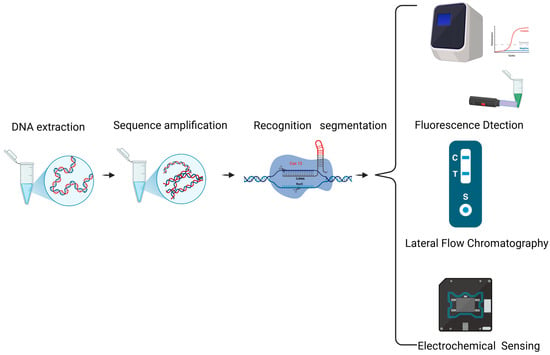
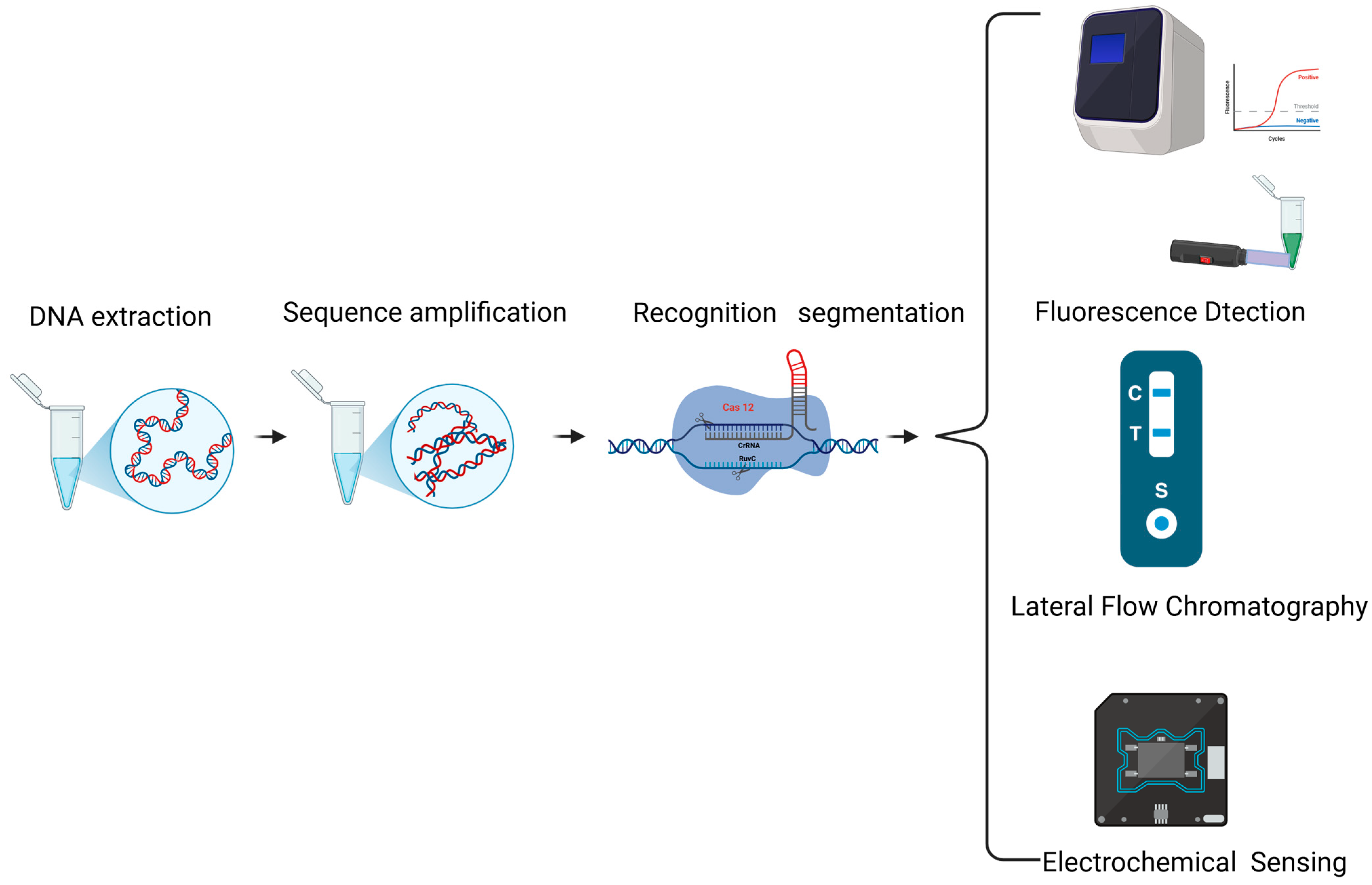
The application of CRISPR-Cas systems for GMO detection typically follows a streamlined, three-step protocol that transitions from sample preparation to specific nucleic acid identification (Figure 1). This standardized workflow underscores the practical simplicity and efficiency of the technology compared to conventional methods.
Figure 1.
Schematic diagram of the integrated nucleic acid detection workflow. The workflow proceeds from left to right, demonstrating a cohesive analytical pipeline. DNA Extraction: the initial step involves isolating DNA from a sample, represented by a tube containing purified DNA strands. Sequence Amplification: the extracted DNA is then subjected to a target amplification step (e.g., LAMP, RPA or PCR) to increase the concentration of the specific nucleic acid sequence of interest. Recognition and Cleavage: the amplified products are incubated with a sequence-specific recognition system (e.g., a CRISPR-Cas system), where the target nucleic acid is identified and precisely cleaved. Detection Modalities: the final step demonstrates three parallel methods for detecting the cleavage event or the presence of the target: (1) Fluorescence Detection—the recognition event triggers a fluorescent signal, which can be quantified using a fluorometer; (2) Lateral Flow Chromatography—the reaction products are applied to a lateral flow strip, yielding a visual band (e.g., at Control (C) and Test (T) lines) for rapid, point-of-care interpretation; (3) Electrochemical Sensing—the biochemical reaction generates an electrochemical signal, which is transduced and measured by a sensor, providing a digital output.
(i) Nucleic Acid Extraction. The initial step involves isolating high-purity genomic DNA from test samples (e.g., seeds, leaves, or processed commodities) using validated methodologies, such as the cetyltrimethylammonium bromide (CTAB) protocol or commercial extraction kits [24]. This step is crucial for removing PCR-inhibitory compounds present in plant tissues and yielding DNA of sufficient integrity and purity for downstream amplification and detection.
(ii) Isothermal Amplification. Target transgenic sequences, such as the ubiquitous CaMV35S promoter, NOS terminator, or event-specific junction sequences, are pre-amplified using isothermal techniques. RPA or LAMP are most commonly employed, enabling rapid (typically 15–30 min) and equipment-free nucleic acid amplification at a constant temperature (37–65 °C). This step replaces the thermocycling-dependent amplification in qPCR, dramatically simplifying the instrumental requirements.
(iii) CRISPR-Mediated Detection. The amplified products are then incubated with a pre-assembled reaction mixture containing a CRISPR effector protein (e.g., Cas12a for DNA targets or Cas13a for RNA targets) complexed with a sequence-specific guide RNA (crRNA) and a reporter molecule (e.g., a fluorescent/quenched probe or a labeled oligonucleotide for lateral flow readout). Upon specific binding to the target amplicon, the Cas effector is activated and cleaves the reporter molecule, generating a measurable signal (fluorescence, colorimetric change, or a visible band on a strip) that confirms the presence of the transgenic element.
This streamlined workflow, often completed within 60 min, encapsulates the key advantages of CRISPR-based detection: minimal instrumentation, operational simplicity, and rapid turnaround. The following sections will delve into the molecular machinery that powers the crucial final step, examining the distinct CRISPR effectors that can be plugged into this versatile diagnostic framework.
3. The Molecular Mechanisms, Classification, and Diagnostic Applications of the CRISPR/Cas System
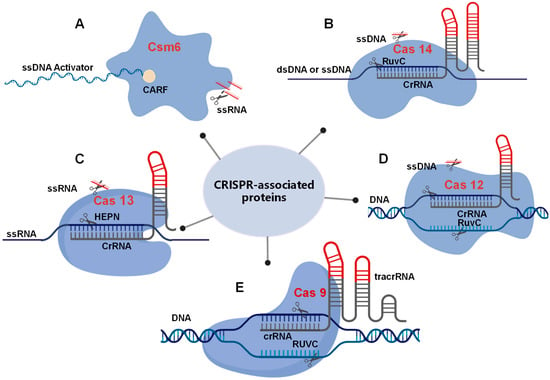
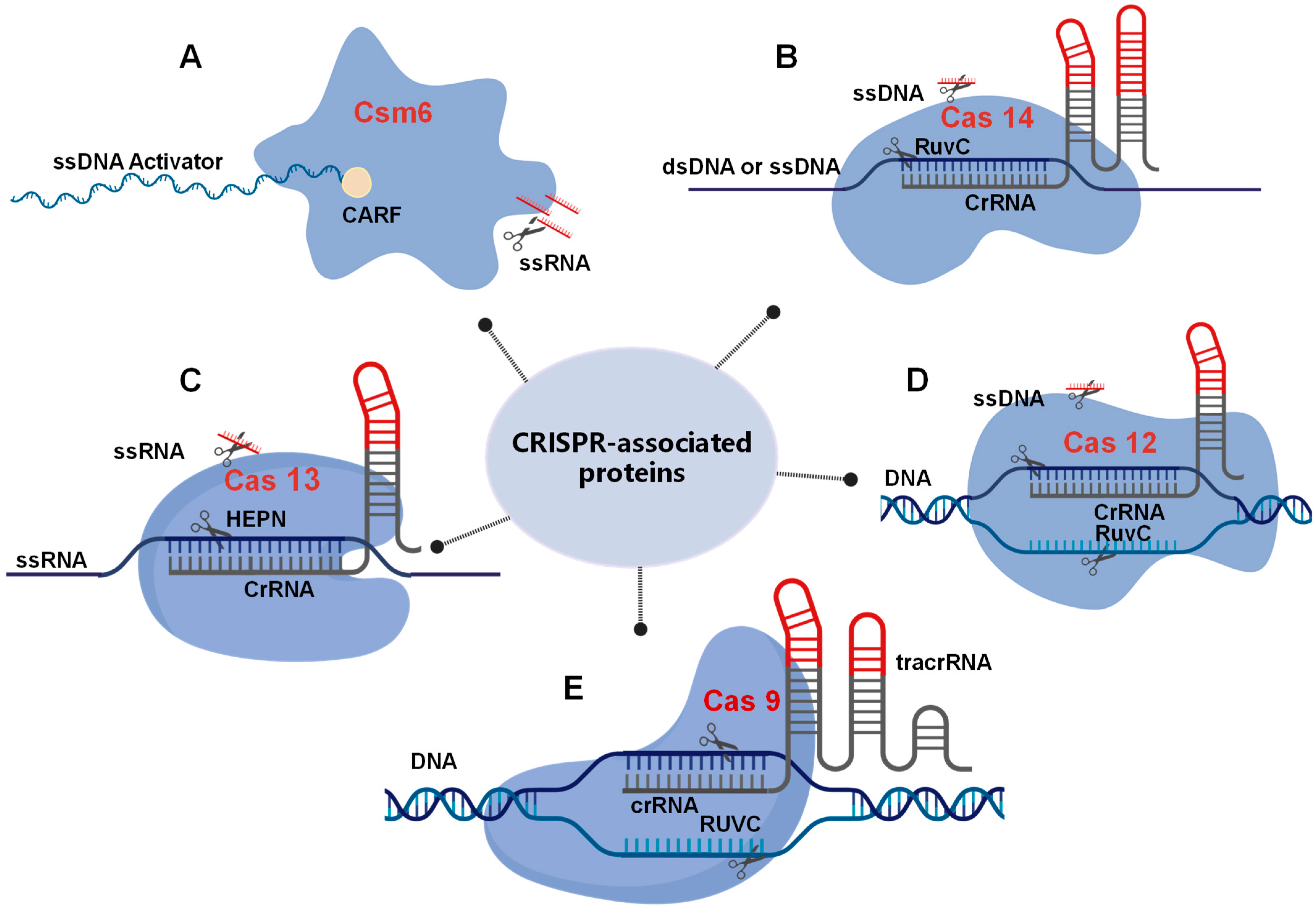
The diagnostic power of CRISPR-Cas systems stems from their programmable nucleic acid recognition and, crucially, their collateral cleavage activity [5,14]. This section systematically examines the molecular mechanisms of key effector proteins, which are classified based on their structural and functional attributes, with a dedicated focus on their operational principles and applications in GMO detection (Figure 2).
Figure 2.
Classification and functional mechanisms of CRISPR-associated effector proteins. Schematic representation of the diversity and nucleic acid targeting activities of representative CRISPR-Cas effector proteins. Each protein complex is depicted as a blue molecular structure, with specific functional domains (e.g., RuvC, HNH, HEPN) highlighted. (A) Csm6, Ancillary ribonuclease activated by signaling molecules, often involved in signal amplification pathways. (B) Cas14, Compact DNA-targeting enzyme with single-stranded DNA cleavage capability. (C) Cas13, RNA-guided RNA nuclease that demonstrates non-specific collateral RNA cleavage upon activation. (D) Cas12, DNA-targeting effector that exhibits collateral cleavage activity against single-stranded DNA following target recognition. (E) Cas9, RNA-guided DNA endonuclease that uses a crRNA:tracrRNA guide complex to create double-strand breaks in target DNA via its HNH and RuvC nuclease domains.
3.1. Cas12: The DNA-Activated ssDNase for Ultrasensitive DNA Detection
Cas12a (Cpf1), a Class 2 Type V CRISPR effector protein, requires a protospacer adjacent motif (PAM), typically 5′-TTTV (where V denotes A, G, or C), for target DNA recognition and utilizes a single CRISPR RNA (crRNA) to form its DNA-targeting ribonucleoprotein complex. When Cas12a binds to its target double-stranded DNA (dsDNA), its RuvC domain cuts the DNA. This activity, known as cis-cleavage, produces cohesive ends via staggered double-strand breaks [25]. A key feature is its target-induced allosteric activation. When Cas12a recognizes its target, it changes shape. This exposes a nuclease site that can cleave any nearby single-stranded DNA (ssDNA), a process called trans-cleavage [12,26]. This permits a single Cas12a-crRNA complex to sustain indiscriminate ssDNA degradation at high catalytic turnover rates, functioning as a sequence-agnostic molecular shredder that amplifies detection signals via collateral cleavage of reporter molecules [4,27]. These properties—sustained activity, sequence-independent cleavage, and high efficiency—make Cas12a highly effective for sensitive diagnostics. It enables detection in under 60 min without thermocycling [19,28,29,30]. For example, field-deployable assays targeting the CaMV35S promoter and NOS terminator, integrated with RPA and lateral flow readout, achieved visual, equipment-free detection of genetically modified maize and soybean, reliably identifying 0.1% transgenic content within 25 min in situ [31]. The DNA Endonuclease-Targeted CRISPR Trans Reporter (DETECTR) platform discriminated high-risk HPV subtypes (HPV16/18) in clinical specimens using E6/E7-targeting crRNAs, demonstrating >95% sensitivity and specificity versus PCR within 60 min [32]. Additionally, Cas12a biosensors coupled with isothermal amplification (RPA/LAMP) of the invA gene detected Salmonella enterica contamination at 10 CFU/mL in <50 min, providing critical compliance verification [33]. These implementations collectively underscore Cas12a’s diagnostic triad: operational versatility across matrices, analytical specificity for target discrimination, and practical robustness in resource-limited settings.
3.2. Cas13: The RNA-Targeting RNase for Direct Transcript and Viral RNA Detection
Cas13 effectors, representing Class 2 Type VI systems, constitute the foundational programmable RNA-targeting CRISPR tools. Both Cas13a (Type VI-A) and its variant Cas13d (Type VI-D, RfxCas13d) operate via crRNA-guided hybridization to complementary single-stranded RNA (ssRNA), leading to the Mg2+-dependent cis-cleavage of the target transcript by their HEPN domains [34,35]. However, they exhibit distinct operational features and diagnostic applications. Cas13a, the first of its kind, functions independently of a PAM but typically requires a protospacer flanking site (PFS), often a non-guanine nucleotide (A/C/U), adjacent to the target RNA [13,36]. Its hallmark is the robust collateral trans-cleavage activity, where target binding allosterically activates a promiscuous RNase domain, enabling nonspecific degradation of proximal ssRNA molecules. This process amplifies the signal by turning a single recognition event into the cleavage of many reporter molecules. It forms the basis for highly sensitive RNA diagnostics, enabling detection at attomolar (10−18 M) levels without the need for reverse transcription [4,15,37,38]. This mechanism has been successfully applied in detecting SARS-CoV-2 with high sensitivity/specificity [30], identifying transgenic CP4-EPSPS transcripts in soybeans [39], and monitoring tumor mutations in cell-free RNA [40]. In contrast, Cas13d is notably more compact (930–950 aa) and operates without a PFS requirement, allowing for more flexible target selection [41]. A defining feature of Cas13d is its suppressed collateral activity, which minimizes nonspecific RNA degradation and effectively reduces false positives in complex samples [42]. This high-fidelity cleavage profile, combined with its small size, makes Cas13d particularly ideal for point-of-care GMO detection, especially in challenging matrices like processed foods where RNA integrity is often compromised, as demonstrated in its application for rapid virus detection [43].
3.3. Csm6: The Auxiliary Amplification Ribonuclease
Csm6, a Type III-B CRISPR-associated ancillary ribonuclease, functions as a cyclic oligoadenylate (cOA)-dependent effector that amplifies CRISPR-mediated RNA interference [44]. Unlike primary nucleases such as Cas13a, Csm6 lacks intrinsic RNA-targeting capability but is allosterically activated by cyclic tetra-adenylate (cA4) synthesized by Cas10 upon target RNA recognition [45]. Upon cA4 binding, its C-terminal HEPN domain undergoes conformational activation, enabling nonspecific degradation of proximate ssRNA molecules through Mg2+-dependent hydrolysis [46]. A key feature of Csm6 is that its collateral RNA-cleaving activity depends on the concentration of cOA. When the Cas10 complex recognizes a target, it produces cA4 molecules. These molecules then spread and activate many Csm6 enzymes, amplifying a local RNA detection signal into a widespread cleavage event across many RNA molecules. This signal amplification cascade establishes a foundational mechanism for ultrasensitive RNA diagnostics [47,48]. For instance, Cas13a-Csm6 tandem nuclease probe capable of the one-pot detection of viable microorganisms during fermentation, eliminating the need for nucleic acid preamplification. This approach completes detection within 30 min and improves sensitivity for bacterial profiling by 16-fold compared with using Cas13 alone [49]. CRISPR/Cas13a was integrated with CRISPR/Csm6 and a chemically stabilized activator to provide both direct RNA sensing and rapid signal generation [50].
3.4. Cas14: The Ultra-Compact ssDNA-Specific Nuclease
Cas14, a Class 2 Type V-F CRISPR effector identified through metagenomic mining of uncultivated archaea, represents the smallest reported Cas nuclease to date (sub-700 amino acids). Despite its minimal architecture, it retains the core functional hallmarks of RNA-guided DNA-targeting nucleases. Analogous to Cas12a, Cas14 specifically recognizes and cleaves ssDNA targets while exhibiting robust trans-cleavage activity upon target activation. Its compact size and archaeal origin confer distinct advantages, including enhanced heterologous expression efficiency, superior thermodynamic stability and reduced production costs, making it particularly suited for large-scale diagnostics and in vivo delivery systems [28]. A defining feature of Cas14 is its ultracompact molecular architecture, which enables high-yield recombinant production in bacterial systems while significantly improving protein solubility and refolding efficiency [28]. Moreover, Cas14 demonstrates exceptional specificity for ssDNA, enabling precise discrimination of single-nucleotide polymorphisms (SNPs) with single-base resolution. Specifically, the researchers showed that Cas14 is robustly capable of distinguishing single-nucleotide polymorphisms, such as variants of human HERC2 responsible for eye color [28,51].
3.5. Cas9: The Cis-Cleavage Effector and Its Diagnostic Adaptations
In contrast to the trans-cleaving effectors above, Cas9 is primarily a cis-cleavage enzyme. Its DNA targeting requires two molecular prerequisites: formation of a guide RNA complex (crRNA:tracrRNA or sgRNA) and the presence of a protospacer adjacent motif (PAM, e.g., 5′-NGG-3′) [10]. While it is the archetypal CRISPR tool for genome editing [52,53], its diagnostic application is inherently limited because its DNA cleavage activity is confined strictly to the specific target sequence bound by its guide RNA; it lacks collateral cleavage activity for signal amplification [54]. Despite this, Cas9 has been adapted for diagnostics by linking target binding to alternative readouts. For instance, dCas9-based ELISA enabled detection of the CaMV35S promoter in GM crops [55], and a Cas9-mediated lateral flow assay (CASLFA) detected GMOs and pathogens with high specificity down to hundreds of copies within 1 h [56]. While valuable, these approaches generally lack the inherent amplification power of Cas12 or Cas13-based systems.
3.6. The Advantages and Limitations of Different Cas Effectors in GMO Detection
The transition from mechanistic understanding to practical application in CRISPR-based GMO detection necessitates a comparative assessment of the key Cas effector proteins, as their distinct characteristics directly dictate optimal use cases (Table 2). While Cas9 can be adapted for detection (e.g., via dCas9-fused systems), its reliance on additional signal transduction steps, owing to the lack of collateral cleavage activity, often renders it less suitable for rapid, field-deployable diagnostics compared to trans-cleaving effectors [4,12,57]. In contrast, the nonspecific trans-cleavage activities of Cas12 and Cas13 underpin the premier diagnostic platforms DETECTR and SHERLOCK, respectively, by simplifying signal amplification [4,27]. Cas12 is inherently suited for detecting DNA targets, such as integrated transgenes, though its PAM requirement and the susceptibility of DNA to degradation in processed samples can be limiting [28]. Cas13, targeting RNA, offers an alternative route for transcript detection but is challenged by the inherent lability of RNA and the efficiency of coupled amplification steps in complex matrices [38]. Emerging effectors provide further options. The compact, PAM-independent Cas14 shows promise for detecting short or single-stranded DNA targets but requires more validation for robustness [58]. Conversely, the ancillary nuclease Csm6 excels as a signal amplifier in cascade systems (e.g., with Cas13), significantly boosting sensitivity for low-abundance targets [10]. Therefore, the strategic selection of a Cas effector is not universal but must be guided by a holistic consideration of the sample type (e.g., fresh leaf vs. processed commodity), the nature and integrity of the target nucleic acid (DNA vs. RNA, intact vs. degraded), and the desired balance between sensitivity, specificity, and operational simplicity for point-of-care use (Table 2).
Table 2.
Comparative analysis of major CRISPR-Cas effector proteins for GMO detection.
4. Integrated CRISPR-Cas Platforms for GMO Detection: From Mechanism to Application
The molecular mechanisms described above are integrated into streamlined diagnostic platforms. This section highlights the most prominent platforms and their concrete applications in GMO analysis.
4.1. The DETECTR System
The DNA Endonuclease-Targeted CRISPR Trans Reporter (DETECTR) system leverages the trans-cleavage activity of Cas12a for DNA target detection [12]. Its workflow typically integrates rapid isothermal amplification (e.g., RPA or LAMP) with Cas12a/crRNA recognition: upon binding a target transgenic sequence, activated Cas12a cleaves a reporter molecule, yielding a visual signal on a lateral flow strip within minutes [14]. This system has been effectively applied in GM crop detection for common transgenic elements with high specificity. For example, it has enabled the detection of the CaMV35S promoter and NOS terminator in GM soybean and maize, achieving PCR-comparable sensitivity with faster turnaround and without the need for thermocycling equipment [59]. DETECTR’s ability to discriminate single-nucleotide polymorphisms (SNPs) enables precise identification of specific GM events, such as the unique junction sequences in GM rice event TT51-1, underscoring its utility in event-specific detection, a gold standard in GMO regulation [27]. The platform has also been adapted for quantitative detection, as evidenced by a CRISPR/Cas12a-mediated entropy-driven electrochemiluminescence (ECL) biosensor for MON810 maize [60].
Presently, detection kits based on the DETECTR principle have reached a semi-commercialized stage. For instance, several companies have introduced lyophilized reagent pellets designed to significantly streamline operational workflows for point-of-care applications. Despite its promise for decentralized GMO monitoring, the practical application of the DETECTR platform faces notable challenges that primarily stem from its foundational components. Its diagnostic sensitivity is contingent upon a highly efficient pre-amplification step, which can be compromised by PCR-inhibitory compounds commonly found in plant tissues, potentially leading to false-negative results. Furthermore, the targeting scope of the Cas12a effector is intrinsically limited by its protospacer adjacent motif (PAM) requirement, which may restrict the design of optimal guide RNAs for certain transgenic elements. Ongoing efforts to develop robust inhibitor-resistant amplification methods and engineer Cas variants with relaxed PAM specificity are therefore crucial to fully realizing the platform’s potential for robust, field-deployable GMO detection [30].
4.2. The SHERLOCK/SHERLOCKv2 Platform
The Specific High-sensitivity Enzymatic Reporter unLOCKing (SHERLOCK) platform is built upon the RNA-targeting Cas13a effector, utilizing its collateral RNase activity for signal amplification [38]. Upon binding to complementary RNA, Cas13a cleaves quenched fluorescent reporters, generating a quantifiable signal. For DNA targets, an in vitro T7 transcription step converts amplicons into RNA, enabling sensitive identification of transgenic elements such as the 35S promoter or bar gene [38]. A hallmark of SHERLOCK is its exceptional specificity, allowing discrimination of single-nucleotide polymorphisms (SNPs), which is critical for differentiating authorized and unauthorized GMO events and highly homologous sequences. Although its use in GMO detection remains limited, the platform has been validated in plant pathology. For example, it enables rapid diagnosis of Tomato brown rugose fruit virus (ToBRFV) in tomato leaf and seed tissues within one hour, highlighting its potential for high-throughput agricultural biosurveillance [38].
The SHERLOCKv2 system represents a significant enhancement through the incorporation of the auxiliary enzyme Csm6, forming a multi-stage catalytic cascade that markedly improves detection sensitivity. Cas13a-mediated cleavage liberates specific RNA activators that stimulate cyclic oligoadenylate (cOA) synthesis, allosterically activating Csm6 to degrade additional RNA reporters. This engineered signal amplification boosts sensitivity by up to 100-fold, enabling zeptomolar (zM) detection of trace targets such as degraded nucleic acids in processed foods [14,15]. SHERLOCKv2 has been rigorously validated in diverse applications, including detection of Dengue or Zika virus RNA and mutations in liquid biopsy samples via lateral flow [14], demonstrating ultra-high sensitivity and operational robustness for nucleic acid detection in food safety and agricultural monitoring.
Despite its high sensitivity and success in clinical diagnostics, the SHERLOCK platform is not widely used for GMO detection. Most applications are proof-of-concept studies targeting specific transgenic transcripts [38,39]. This stands in contrast to DNA-based CRISPR assays, and the underlying reasons are rooted in a fundamental misalignment between the platform’s operational principle and the typical requirements of GMO analysis. The primary bottleneck is the inherent lability of RNA. Regulatory detection standards predominantly target stable, integrated DNA sequences (e.g., promoters, terminators), whereas RNA is notoriously susceptible to degradation by RNases present in plant tissues and processed commodities (e.g., oils, flours), leading to rapid target loss and potential false-negative results in real-world samples. Secondly, the requisite in vitro transcription (IVT) step to convert amplified DNA into a Cas13-readable RNA substrate introduces an additional point of failure. This not only increases operational complexity and assay time but also heightens the method’s susceptibility to inhibition by co-extracted plant compounds, thereby compromising robustness and reproducibility, especially with crude nucleic acid extracts [10,38]. While SHERLOCK technology itself has reached commercial maturity for human health applications (e.g., via Sherlock Biosciences), the development of dedicated, robust kits for agricultural or food GMO testing is still nascent [61].
Future advancements focusing on direct DNA detection or improved sample processing protocols may help bridge this gap and unlock the platform’s high-sensitivity potential for the agri-food sector.
4.3. The HOLMES Platform
The HOLMES (One-Hour Low-cost Multipurpose Highly Efficient System) platform employs the DNA-targeting Cas12b effector, which exhibits optimal activity at elevated temperatures (37–45 °C). This thermal profile enhances reaction specificity by reducing non-specific binding and improving the signal-to-noise ratio, facilitating precise identification of GM traits in crops such as rice and maize. Next-generation HOLMES variants incorporating Cas12a further extend utility by enabling rapid operation at room temperature, significantly enhancing field-deployability [28,30,62]. The platform has demonstrated robust performance across diverse applications in GMO detection: combining thermostable Cas12b with LAMP in a customized one-pot vessel to detect the CaMV35S promoter in GM soybean [63]; employing Cas-pfLAMP (CRISPR/Cas12a cleavage coupled with LAMP) for sensitive and specific detection of three GM events—maize DBN9936 and MON810 and soybean GTS40-3-2 [64]; and using a CRISPR/Cas12a-based system in a designed reaction vessel to distinguish specific and non-specific amplification, detecting transgenic contents as low as 0.05% in soybean powder [65]. Additionally, HOLMES has been applied in viral diagnostics, achieving rapid detection of African Swine Fever Virus (ASFV) in blood samples with high sensitivity and specificity at 40 °C within 45 min, demonstrating its utility in field-based animal disease surveillance [66]. These implementations collectively underscore HOLMES’s versatility, high specificity, and adaptability for deployment in both controlled laboratories and resource-limited field settings.
Now Core biochemical reagents for HOLMES are commercially available, yet integrated, standardized kit solutions dedicated to GMO detection remain under development, with current applications predominantly relying on laboratory-assembled formulations. Despite these successful demonstrations, the platform’s limitations stem from its dependence on isothermal amplification and the operational constraints of Cas12a. Beyond the shared challenge of amplification inhibition by plant-derived compounds (e.g., polysaccharides and polyphenols), HOLMES faces a temperature compatibility issue: the optimal activity temperature for Cas12a (~37 °C) may misalign with thermophilic isothermal methods like LAMP (requiring 60–65 °C). This discrepancy often necessitates a two-step reaction or the use of engineered Cas12b variants (as in HOLMESv2) to enable one-pot assays, inadvertently increasing operational complexity. Furthermore, the “one-pot” reactions need to be stable and resistant to interference for practical use. However, these critical properties must be systematically validated with a variety of food samples. Such validation is necessary to guarantee that the assay works reliably and accurately in real-world settings. These technical hurdles currently limit its scalability for standardized GMO monitoring [12,29].
5. CRISPR Diagnostic Signal Readout Methods
The activation of CRISPR effectors must be converted into a readable signal. The choice of readout method critically determines the platform’s applicability in field or laboratory settings. Contemporary CRISPR-based diagnostic platforms predominantly utilize three distinct signal readout modalities, each exhibiting inherent advantages optimized for specific application contexts (Table 3).
Table 3.
Comparison of Three Primary CRISPR Diagnostic Signal Readout Methods.
5.1. Fluorescence Detection
This method exploits the target-activated collateral cleavage activity of CRISPR effector proteins (e.g., Cas12a, Cas13a, or Cas13d) to hydrolyze quenched fluorescent oligonucleotide reporters. These reporters typically consist of single-stranded DNA or RNA molecules dual-labeled with a fluorophore (e.g., FAM or HEX) and a corresponding quencher (e.g., BHQ1 or Iowa Black). Target recognition triggers Cas effector activation, initiating collateral cleavage that dissociates the fluorophore–quencher pair. This dissociation ablates Förster resonance energy transfer (FRET), resulting in a quantifiable increase in fluorescence intensity. Detection can be performed quantitatively or semi-quantitatively using portable real-time fluorometers or benchtop microplate readers, accommodating both kinetic monitoring and endpoint measurement. The assay achieves exceptional sensitivity, with detection limits spanning the attomolar (aM, 10−18 M) to zeptomolar (zM, 10−21 M) range within 30–60 min. This combination of high sensitivity, rapid turnaround, and minimal instrumental demands renders the platform suitable for both laboratory validation and field-deployable point-of-care screening [4,12,68]. For example, a Cas12a-based fluorescence assay was developed for quantitative detection of the 35S promoter in genetically modified soybean and maize, demonstrating a detection limit of 10 aM directly from crude leaf extracts without DNA purification [69]. Similarly, Cas13a-mediated SHERLOCK systems employ poly-U RNA reporters for transgene detection, enabling strain identification and SNP genotyping [70]. Additional developments include the HARRY (highly sensitive aptamer-regulated Cas14 R-loop for bioanalysis) system, where target absence activates Cas14a’s trans-cleavage of a fluorescent reporter [71], and a CRISPR/Cas12a-mediated system optimized for visible nucleic acid detection in gene-edited rice [72]. Furthermore, an ultrasensitive fluorescent biosensor combining CRISPR/Cpf1 with proximity extension-mediated amplification achieved a detection limit down to 14.4 fM for the CaMV 35S promoter [10]. In GMO detection, fluorescence readout is primarily suited for centralized laboratory settings where quantitative results and high sensitivity are paramount, such as for regulatory validation or testing processed food commodities with complex matrices. The key trade-off is the dependency on relatively expensive portable fluorometers, which requires a higher level of technical skill and investment compared to visual methods, making it less ideal for resource-limited field use.
5.2. Lateral Flow Chromatography
Lateral flow chromatography integrates CRISPR-mediated detection with immunochromatographic strips to provide a visual, instrument-free readout. In this format, the cleavage products are applied to the strip. Cleaved reporters, bearing exposed epitopes (e.g., FAM or biotin), are captured at the test line (T line) by immobilized antibodies, while intact reporters are captured at the control line (C line) to confirm assay validity. Results are visually interpreted within 10–15 min based on the presence or intensity of colored bands [14,15]. This user-friendly, portable format is ideally suited for POCT and field applications where simplicity and speed are paramount. A notable application is the development of a novel Cas13a/Cas12a-mediated ‘one-pot’ dual detection assay, which utilized lateral flow strips for the simultaneous detection of CaMV35S and NOS terminators in genetically modified crops, with CaMV35S detected using an anti-digoxin antibody (blue line) and NOS identified using an anti-FITC antibody (red line) [73]. For GMO monitoring, lateral flow strips are the ideal choice for field inspectors and border control agents, enabling rapid on-site screening of raw agricultural commodities (e.g., seeds, grains) without any equipment. The primary trade-offs are the largely qualitative nature of the result and the potential for slightly lower sensitivity compared to fluorescence-based methods, which may limit the detection of very low-level GMO contamination.
5.3. Electrochemical Sensing
Electrochemical sensing is a highly sensitive and miniaturization-compatible strategy for CRISPR-based diagnostics. This approach converts the nucleic acid cleavage activity into quantifiable electrical signals via functionalized electrodes, measuring alterations in interfacial properties such as charge, impedance, or faradaic current resulting from the cleavage event [67,74]. Characterized by rapid response times, high signal stability, and minimal instrumentation requirements, ECS is particularly well-suited for field deployment and continuous monitoring. For GMO screening, a CRISPR/Cas12a-mediated dual-mode electrochemical biosensor was designed for the PCR-free detection of genetically modified soybean SHZD32-1 [75]. Another platform utilized a color change in gold nanorods (GNRs), induced by an enzyme cascade reaction (invertase-glucose oxidase) and the Fenton reaction, for the visible detection of the NOS terminator [59]. Furthermore, a CRISPR/Cas12a-mediated entropy-driven electrochemiluminescence (ECL) biosensor was developed for the sensitive and specific detection of MON810 maize, exhibiting a wide linear range (1–106 fM) and a low detection limit (3.3 fM) [76]. The utility of ECS is also demonstrated in clinical settings, such as a Cas13a-electrochemical sensor that detected SARS-CoV-2 RNA at concentrations as low as 1.66 aM [60], underscoring the versatility and sensitivity of this readout method. Electrochemical sensing holds great promise for future automated sensor networks in food processing facilities or for continuous monitoring in supply chains, due to its potential for miniaturization and integration with digital platforms. However, the current trade-off involves a higher technical development barrier and the need for specialized electrodes and readers, which hinders its widespread adoption and necessitates further engineering for routine use.
6. Conclusions and Perspectives
6.1. Application and Prospects of CRISPR-Cas Systems in GMO Detection
The global commercialization of genetically modified crops has heightened the demand for rapid, accurate, and on-site detection technologies to support regulatory oversight, trade compliance, and environmental monitoring. While PCR remains the gold standard for GMO detection, its reliance on thermal cycling, sophisticated instrumentation, and laboratory settings limits its applicability for field use [77]. CRISPR-Cas systems have emerged as a promising solution, leveraging programmable nucleic acid recognition and collateral nuclease activity (e.g., of Cas12a and Cas13) to enable highly specific and sensitive detection [12]. By coupling isothermal amplification techniques (e.g., RPA, LAMP) with CRISPR-based detection, target transgenic elements, such as the CaMV35S promoter, can be identified at attomolar (aM) concentrations within minutes [78]. The activated Cas proteins cleave reporter molecules (e.g., fluorescent or biotin-labeled probes), generating visible signals on lateral flow strips without specialized equipment. For example, a recent study achieved visual detection of 0.1% GM content in Bt-11 maize using a cascade reaction system combined with DNAzyme-based signal amplification [28]. Looking ahead, future efforts should focus on standardizing detection protocols, enhancing multiplexing capabilities, and developing lyophilized reagents for long-term storage and portability [14]. The convergence of CRISPR diagnostics with emerging technologies, such as smartphone-based imaging and artificial intelligence, holds promise for automated, high-throughput GMO screening [10].
6.2. Limitations and Challenges of CRISPR-Cas Systems in GMO Detection
Despite the significant advantages of CRISPR-Cas systems in GMO detection, several technical and practical limitations remain to be addressed. A primary challenge is the potential for off-target effects, where Cas proteins may cleave non-target DNA or RNA sequences with high similarity, leading to false-positive results [79]. This issue is particularly critical in detecting GMOs with complex genetic backgrounds or stacked traits. Additionally, the reliance on pre-amplification steps (e.g., RPA or LAMP) introduces variability, as inhibitors in plant samples (e.g., polysaccharides or polyphenols) can compromise amplification efficiency and detection accuracy [80]. Furthermore, most current CRISPR-Cas detection platforms struggle with multiplexing capacity. While PCR-based methods can simultaneously amplify multiple targets, CRISPR-Cas systems typically require complex optimization to detect more than two targets in a single reaction, limiting their efficiency in screening GMOs with multiple transgenic elements [14]. Another practical constraint is the lack of standardized protocols and quantitative benchmarks. Variations in crRNA design, reporter molecules, and reaction conditions across studies hinder the reproducibility and cross-platform validation of assays. Finally, the dependency on cold chains for Cas enzyme storage and the relatively high cost of synthetic crRNAs may impede large-scale deployment in resource-limited settings [23]. Addressing these limitations through engineering of high-fidelity Cas variants, development of inhibitor-resistant amplification methods, and creation of lyophilized reagent kits will be crucial for advancing CRISPR-Cas systems into reliable tools for routine GMO monitoring.
6.3. Future Research Directions for CRISPR-Cas Systems in GMO Detection
To advance the application of CRISPR-Cas systems in GMO detection, several key research directions warrant further investigation. First, the engineering of novel Cas effectors with enhanced specificity is crucial. While Cas12a and Cas13a are widely used, their off-target effects remain a concern. Developing high-fidelity variants through protein engineering could significantly improve detection accuracy [30]. Second, the development of robust, inhibitor-resistant isothermal amplification methods is essential for practical applications. Current RPA and LAMP protocols are often inhibited by plant-derived compounds, leading to false-negative results [59]. For multiplex detection, innovative strategies combining multiple crRNAs with microfluidic technologies show promise. However, achieving high-order multiplexing while maintaining sensitivity and specificity requires further optimization of reaction conditions and signal detection systems [23]. Moreover, a concerted effort towards standardization is urgently needed. This includes the establishment of universally accepted reference materials, validation guidelines, and quantitative models to ensure inter-laboratory reproducibility and regulatory compliance [81]. On the practical front, the creation of stable, lyophilized reagent formulations will eliminate cold-chain dependencies and enhance portability [14]. The integration of these advanced diagnostics with smartphone-based imaging, cloud computing, and artificial intelligence for automated data analysis presents a promising pathway toward developing fully automated, user-friendly, and high-throughput field-deployable systems [10,59]. Comprehensive cost–benefit analyses and technology transfer studies will be the final step in translating these laboratory innovations into commercially viable and routine tools for agricultural biosecurity [82].
In conclusion, CRISPR-Cas technology has undeniably set a new benchmark for nucleic acid detection, offering a powerful and versatile alternative to conventional methods for GMO analysis. The journey from a revolutionary gene-editing tool to a practical diagnostic platform exemplifies the potential of interdisciplinary innovation. By systematically addressing the current challenges through focused engineering, standardization, and integration efforts, CRISPR-based diagnostics are poised to become indispensable, reliable tools for ensuring transparency, safety, and compliance in the global agricultural supply chain.
Author Contributions
Conceptualization, J.Y., L.N. and J.W.; data curation, J.Y. and Y.Z.; formal analysis, J.S.; visualization, S.W.; funding acquisition, J.Y. and Z.D.; project administration, J.Y.; writing—original draft, J.Y., Y.Z., J.S. and S.W.; writing—review and editing, Z.D., L.N. and J.W. All authors have read and agreed to the published version of the manuscript.
Funding
This work was supported by the National Natural Science Foundation of China (Grant No. 31970272 and 32000195), and the Experimental Technology Research Project of Zhejiang University (Grant No. SYB202138).
Data Availability Statement
Not applicable.
Conflicts of Interest
The authors declare no conflicts of interest.
References
- ISAAA. Global Status of Commercialized Biotech/GM Crops; ISAAA: Ithaca, NY, USA, 2023. [Google Scholar]
- Wang, Z.; Ren, P.; Wu, Y.; He, Q. Recent advances in analytical techniques for the detection of adulteration and authenticity of bee products—A review. Food Addit. Contam. Part A Chem. Anal. Control Expo. Risk Assess 2021, 38, 533–549. [Google Scholar] [CrossRef] [Scilit] [PubMed]
- Yan, J.T.; Chen, G.W.; Miao, Q.M.; Peng, C.; Yang, L.; Chen, X.Y.; Xu, X.L.; Wei, W.; Xu, J.F.; Wang, X.F. On site rapid detection method for genetically modified maize and soybean based on recombinase polymerase amplification. Yi Chuan 2025, 47, 694–707. [Google Scholar] [PubMed]
- Gootenberg, J.S.; Abudayyeh, O.O.; Lee, J.W.; Essletzbichler, P.; Dy, A.J.; Joung, J.; Verdine, V.; Donghia, N.; Daringer, N.M.; Freije, C.A.; et al. Nucleic acid detection with CRISPR-Cas13a/C2c2. Science 2017, 356, 438–442. [Google Scholar] [CrossRef] [Scilit]
- Craw, P.; Balachandran, W. Isothermal nucleic acid amplification technologies for point-of-care diagnostics: A critical review. Lab Chip 2012, 12, 2469–2486. [Google Scholar] [CrossRef] [Scilit] [PubMed]
- Zhou, J.; Li, Z.; Seun Olajide, J.; Wang, G. CRISPR/Cas-based nucleic acid detection strategies: Trends and challenges. Heliyon 2024, 10, e26179. [Google Scholar] [CrossRef] [Scilit]
- Srivastava, P.; Prasad, D. Isothermal nucleic acid amplification and its uses in modern diagnostic technologies. 3 Biotech 2023, 13, 200. [Google Scholar] [CrossRef] [Scilit]
- Fu, J.; Mo, R.; Li, Z.; Xu, S.; Cheng, X.; Lu, B.; Shi, S. An extraction-free one-pot assay for rapid detection of Klebsiella pneumoniae by combining RPA and CRISPR/Cas12a. Biosens Bioelectron. 2025, 267, 116740. [Google Scholar] [CrossRef] [Scilit]
- Atçeken, N.; Yigci, D.; Ozdalgic, B.; Tasoglu, S. CRISPR-Cas-Integrated LAMP. Biosensors 2022, 12, 1035. [Google Scholar] [CrossRef] [Scilit]
- Liu, Y.; Zhou, S.; Sun, H.; Dong, J.; Deng, L.; Qi, N.; Wang, Y.; Huo, D.; Hou, C. Ultrasensitive fluorescent biosensor for detecting CaMV 35S promoter with proximity extension mediated multiple cascade strand displacement amplification and CRISPR/Cpf 1. Anal. Chim. Acta 2022, 1215, 339973. [Google Scholar] [CrossRef] [Scilit]
- Jinek, M.; Chylinski, K.; Fonfara, I.; Hauer, M.; Doudna, J.A.; Charpentier, E. A programmable dual-RNA-guided DNA endonuclease in adaptive bacterial immunity. Science 2012, 337, 816–821. [Google Scholar] [CrossRef] [Scilit]
- Chen, J.S.; Ma, E.; Harrington, L.B.; Da Costa, M.; Tian, X.; Palefsky, J.M.; Doudna, J.A. CRISPR-Cas12a target binding unleashes indiscriminate single-stranded DNase activity. Science 2018, 360, 436–439. [Google Scholar] [CrossRef] [Scilit]
- Abudayyeh, O.O.; Gootenberg, J.S.; Konermann, S.; Joung, J.; Slaymaker, I.M.; Cox, D.B.; Shmakov, S.; Makarova, K.S.; Semenova, E.; Minakhin, L.; et al. C2c2 is a single-component programmable RNA-guided RNA-targeting CRISPR effector. Science 2016, 353, aaf5573. [Google Scholar] [CrossRef] [Scilit]
- Gootenberg, J.S.; Abudayyeh, O.O.; Kellner, M.J.; Joung, J.; Collins, J.J.; Zhang, F. Multiplexed and portable nucleic acid detection platform with Cas13, Cas12a, and Csm6. Science 2018, 360, 439–444. [Google Scholar] [CrossRef] [Scilit]
- Myhrvold, C.; Freije, C.A.; Gootenberg, J.S.; Abudayyeh, O.O.; Metsky, H.C.; Durbin, A.F.; Kellner, M.J.; Tan, A.L.; Paul, L.M.; Parham, L.A.; et al. Field-deployable viral diagnostics using CRISPR-Cas13. Science 2018, 360, 444–448. [Google Scholar] [CrossRef] [Scilit] [PubMed]
- Gronowski, A.M. Who or What is SHERLOCK? EJIFCC 2018, 29, 201–204. [Google Scholar] [PubMed]
- Hajian, R.; Balderston, S.; Tran, T.; deBoer, T.; Etienne, J.; Sandhu, M.; Wauford, N.A.; Chung, J.Y.; Nokes, J.; Athaiya, M.; et al. Detection of unamplified target genes via CRISPR-Cas9 immobilized on a graphene field-effect transistor. Nat. Biomed. Eng. 2019, 3, 427–437. [Google Scholar] [CrossRef] [Scilit]
- Kaminski, M.M.; Alcantar, M.A.; Lape, I.T.; Greensmith, R.; Huske, A.C.; Valeri, J.A.; Marty, F.M.; Klämbt, V.; Azzi, J.; Akalin, E.; et al. A CRISPR-based assay for the detection of opportunistic infections post-transplantation and for the monitoring of transplant rejection. Nat. Biomed. Eng. 2020, 4, 601–609. [Google Scholar] [CrossRef] [Scilit] [PubMed]
- Broughton, J.P.; Deng, X.; Yu, G.; Fasching, C.L.; Servellita, V.; Singh, J.; Miao, X.; Streithorst, J.A.; Granados, A.; Sotomayor-Gonzalez, A.; et al. CRISPR-Cas12-based detection of SARS-CoV-2. Nat. Biotechnol. 2020, 38, 870–874. [Google Scholar] [CrossRef] [Scilit]
- Ghouneimy, A.; Mahas, A.; Marsic, T.; Aman, R.; Mahfouz, M. CRISPR-Based Diagnostics: Challenges and Potential Solutions toward Point-of-Care Applications. ACS Synth. Biol. 2023, 12, 1–16. [Google Scholar] [CrossRef] [Scilit]
- Ackerman, C.M.; Myhrvold, C.; Thakku, S.G.; Freije, C.A.; Metsky, H.C.; Yang, D.K.; Ye, S.H.; Boehm, C.K.; Kosoko-Thoroddsen, T.F.; Kehe, J.; et al. Massively multiplexed nucleic acid detection with Cas13. Nature 2020, 582, 277–282. [Google Scholar] [CrossRef] [Scilit]
- Bhardwaj, P.; Nanaware, N.S.; Behera, S.P.; Kulkarni, S.; Deval, H.; Kumar, R.; Dwivedi, G.R.; Kant, R.; Singh, R. CRISPR/Cas12a-Based Detection Platform for Early and Rapid Diagnosis of Scrub Typhus. Biosensors 2023, 13, 1021. [Google Scholar] [CrossRef] [Scilit]
- Jiao, J.; Kong, K.; Han, J.; Song, S.; Bai, T.; Song, C.; Wang, M.; Yan, Z.; Zhang, H.; Zhang, R.; et al. Field detection of multiple RNA viruses/viroids in apple using a CRISPR/Cas12a-based visual assay. Plant Biotechnol. J. 2021, 19, 394–405. [Google Scholar] [CrossRef] [Scilit]
- Schenk, J.J.; Becklund, L.E.; Carey, S.J.; Fabre, P.P. What is the “modified” CTAB protocol? Characterizing modifications to the CTAB DNA extraction protocol. Appl. Plant Sci. 2023, 11, e11517. [Google Scholar] [CrossRef] [Scilit]
- Zetsche, B.; Gootenberg, J.S.; Abudayyeh, O.O.; Slaymaker, I.M.; Makarova, K.S.; Essletzbichler, P.; Volz, S.E.; Joung, J.; van der Oost, J.; Regev, A.; et al. Cpf1 is a single RNA-guided endonuclease of a class 2 CRISPR-Cas system. Cell 2015, 163, 759–771. [Google Scholar] [CrossRef] [Scilit] [PubMed]
- Swarts, D.C.; Jinek, M. Mechanistic Insights into the cis- and trans-Acting DNase Activities of Cas12a. Mol. Cell 2019, 73, 589–600.e4. [Google Scholar] [CrossRef] [Scilit]
- Li, S.Y.; Cheng, Q.X.; Wang, J.M.; Li, X.Y.; Zhang, Z.L.; Gao, S.; Cao, R.B.; Zhao, G.P.; Wang, J. CRISPR-Cas12a-assisted nucleic acid detection. Cell Discov. 2018, 4, 20. [Google Scholar] [CrossRef] [Scilit] [PubMed]
- Harrington, L.B.; Burstein, D.; Chen, J.S.; Paez-Espino, D.; Ma, E.; Witte, I.P.; Cofsky, J.C.; Kyrpides, N.C.; Banfield, J.F.; Doudna, J.A. Programmed DNA destruction by miniature CRISPR-Cas14 enzymes. Science 2018, 362, 839–842. [Google Scholar] [CrossRef] [Scilit] [PubMed]
- Li, L.; Li, S.; Wu, N.; Wu, J.; Wang, G.; Zhao, G.; Wang, J. HOLMESv2: A CRISPR-Cas12b-Assisted Platform for Nucleic Acid Detection and DNA Methylation Quantitation. ACS Synth. Biol. 2019, 8, 2228–2237. [Google Scholar] [CrossRef] [Scilit]
- Lee, H.Y.; Min, Y.H.; Lee, D.G.; Lee, K.H.; Kim, J.; Lee, M.K.; Byun, J.Y.; Shin, Y.B. CRISPR/Cas12a Collateral Cleavage-Driven Transcription Amplification for Direct Nucleic Acid Detection. Anal. Chem. 2024, 96, 12270–12276. [Google Scholar] [CrossRef] [Scilit]
- Wang, J.; Hu, X.; Wang, Y.; Zeng, H.; Liu, X.; Liu, H. Rapid detection of genetically modified products based on CRISPR-Cas12a combined with recombinase polymerase amplification. Curr. Res. Food Sci. 2022, 5, 2281–2286. [Google Scholar] [CrossRef] [Scilit]
- Zhang, K.; Li, Q.; Wang, K.; Zhang, Q.; Ma, C.; Yang, G.; Xie, Y.; Mauk, M.G.; Fu, S.; Chen, L. RPA-CRISPR-Cas-Mediated Dual Lateral Flow Assay for the of HPV16 and HPV18. Bioconjug. Chem. 2024, 35, 1797–1804. [Google Scholar] [CrossRef] [Scilit]
- Mao, X.; Zhao, Y.; Jiang, J.; Du, Q.; Tu, B.; Li, J.; Wang, F. Sensitive and hPoint-of-Care Testing igh-accuracy detection of Salmonella based on CRISPR/Cas12a combined with recombinase polymerase amplification. Lett. Appl. Microbiol. 2022, 75, 899–907. [Google Scholar] [CrossRef] [Scilit]
- Liu, L.; Li, X.; Ma, J.; Li, Z.; You, L.; Wang, J.; Wang, M.; Zhang, X.; Wang, Y. The Molecular Architecture for RNA-Guided RNA Cleavage by Cas13a. Cell 2017, 170, 714–726.e10. [Google Scholar] [CrossRef] [Scilit]
- Yan, W.X.; Chong, S.; Zhang, H.; Makarova, K.S.; Koonin, E.V.; Cheng, D.R.; Scott, D.A. Cas13d Is a Compact RNA-Targeting Type VI CRISPR Effector Positively Modulated by a WYL-Domain-Containing Accessory Protein. Mol. Cell 2018, 70, 327–339.e5. [Google Scholar] [CrossRef] [Scilit]
- Smargon, A.A.; Cox, D.B.T.; Pyzocha, N.K.; Zheng, K.; Slaymaker, I.M.; Gootenberg, J.S.; Abudayyeh, O.A.; Essletzbichler, P.; Shmakov, S.; Makarova, K.S.; et al. Cas13b Is a Type VI-B CRISPR-Associated RNA-Guided RNase Differentially Regulated by Accessory Proteins Csx27 and Csx28. Mol. Cell 2017, 65, 618–630.e7. [Google Scholar] [CrossRef] [Scilit]
- Konermann, S.; Lotfy, P.; Brideau, N.J.; Oki, J.; Shokhirev, M.N.; Hsu, P.D. Transcriptome Engineering with RNA-Targeting Type VI-D CRISPR Effectors. Cell 2018, 173, 665–676.e14. [Google Scholar] [CrossRef] [Scilit]
- Kellner, M.J.; Koob, J.G.; Gootenberg, J.S.; Abudayyeh, O.O.; Zhang, F. SHERLOCK: Nucleic acid detection with CRISPR nucleases. Nat. Protoc. 2019, 14, 2986–3012. [Google Scholar] [CrossRef] [Scilit] [PubMed]
- Saifullah Sakari, M.; Suzuki, T.; Yano, S.; Tsukahara, T. Effective RNA Knockdown Using CRISPR-Cas13a and Molecular Targeting of the EML4-ALK Transcript in H3122 Lung Cancer Cells. Int. J. Mol. Sci. 2020, 21, 8904. [Google Scholar] [CrossRef] [Scilit] [PubMed]
- Palacín-Aliana, I.; García-Romero, N.; Carrión-Navarro, J.; Puig-Serra, P.; Torres-Ruiz, R.; Rodríguez-Perales, S.; Viñal, D.; González-Rumayor, V.; Ayuso-Sacido, Á. ddPCR Overcomes the CRISPR-Cas13a-Based Technique for the Detection of the BRAF p.V600E Mutation in Liquid Biopsies. Int. J. Mol. Sci. 2024, 25, 10902. [Google Scholar] [CrossRef] [Scilit] [PubMed]
- Konermann, S.; Brigham, M.D.; Trevino, A.E.; Joung, J.; Abudayyeh, O.O.; Barcena, C.; Hsu, P.D.; Habib, N.; Gootenberg, J.S.; Nishimasu, H.; et al. Genome-scale transcriptional activation by an engineered CRISPR-Cas9 complex. Nature 2015, 517, 583–588. [Google Scholar] [CrossRef] [Scilit]
- Tong, H.; Huang, J.; Xiao, Q.; He, B.; Dong, X.; Liu, Y.; Yang, X.; Han, D.; Wang, Z.; Wang, X.; et al. High-fidelity Cas13 variants for targeted RNA degradation with minimal collateral effects. Nat. Biotechnol. 2023, 41, 108–119. [Google Scholar] [CrossRef] [Scilit]
- Wang, Y.M.; Xu, T.; Duan, J.Q.; Zhao, L.; You, D.; Lai, S.Y.; Qing, Y.; Ge, L.P.; Liu, Z.H.; Sun, J.; et al. An Integrated One-Tube RPA-CRISPR/Cas13d Assay Coupled with Lateral Flow for Rapid PRRSV-1 Detection. J. Agric. Food Chem. 2025, 73, 27080–27088. [Google Scholar] [CrossRef] [Scilit]
- Niewoehner, O.; Garcia-Doval, C.; Rostøl, J.T.; Berk, C.; Schwede, F.; Bigler, L.; Hall, J.; Marraffini, L.A.; Jinek, M. Type III CRISPR-Cas systems produce cyclic oligoadenylate second messengers. Nature 2017, 548, 543–548. [Google Scholar] [CrossRef] [Scilit]
- Foster, K.; Grüschow, S.; Bailey, S.; White, M.F.; Terns, M.P. Regulation of the RNA and DNA nuclease activities required for Pyrococcus furiosus Type III-B CRISPR-Cas immunity. Nucleic Acids Res. 2020, 48, 4418–4434. [Google Scholar] [CrossRef] [Scilit]
- Du, L.; Zhu, Q.; Lin, Z. Molecular mechanism of allosteric activation of the CRISPR ribonuclease Csm6 by cyclic tetra-adenylate. EMBO J. 2024, 43, 304–315. [Google Scholar] [CrossRef] [Scilit]
- Kolesnik, M.V.; Fedorova, I.; Karneyeva, K.A.; Artamonova, D.N.; Severinov, K.V. Type III CRISPR-Cas Systems: Deciphering the Most Complex Prokaryotic Immune System. Biochemistry 2021, 86, 1301–1314. [Google Scholar] [CrossRef] [Scilit] [PubMed]
- McQuarrie, S.; Athukoralage, J.S.; McMahon, S.A.; Graham, S.; Ackermann, K.; Bode, B.E.; White, M.F.; Gloster, T.M. Activation of Csm6 ribonuclease by cyclic nucleotide binding: In an emergency, twist to open. Nucleic Acids Res. 2023, 51, 10590–10605. [Google Scholar] [CrossRef] [Scilit]
- Xu, C.; Zhang, Y.; Zhu, X.; Hua, D.; Yang, L.; Huang, X.; Gao, H.; Luo, A.; Deng, R.; Xia, X. Preamplification-Free Detection of Viable Microorganisms in Fermentation Using Tandem CRISPR Nuclease Probe. J. Agric. Food Chem. 2025, 73, 12488–12496. [Google Scholar] [CrossRef] [Scilit] [PubMed]
- Liu, T.Y.; Knott, G.J.; Smock, D.C.J.; Desmarais, J.J.; Son, S.; Bhuiya, A.; Jakhanwal, S.; Prywes, N.; Agrawal, S.; Díaz de León Derby, M.; et al. Accelerated RNA detection using tandem CRISPR nucleases. Nat. Chem. Biol. 2021, 17, 982–988. [Google Scholar] [CrossRef] [Scilit]
- Savage, D.F. Cas14: Big Advances from Small CRISPR Proteins. Biochemistry 2019, 58, 1024–1025. [Google Scholar] [CrossRef] [Scilit] [PubMed]
- Nishimasu, H.; Ran, F.A.; Hsu, P.D.; Konermann, S.; Shehata, S.I.; Dohmae, N.; Ishitani, R.; Zhang, F.; Nureki, O. Crystal structure of Cas9 in complex with guide RNA and target DNA. Cell 2014, 156, 935–949. [Google Scholar] [CrossRef] [Scilit] [PubMed]
- Sternberg, S.H.; Redding, S.; Jinek, M.; Greene, E.C.; Doudna, J.A. DNA interrogation by the CRISPR RNA-guided endonuclease Cas9. Nature 2014, 507, 62–67. [Google Scholar] [CrossRef] [Scilit]
- Li, S.; Chen, Z.; Huang, Y.X.; Zhao, G.J.; Jiang, T. Application of CRISPR/Cas-based Electrochemical Biosensors for Tumor Detection. Prog. Biochem. Biophys. 2024, 51, 1771–1787. [Google Scholar]
- Zhai, S.; Yang, Y.; Wu, Y.; Li, J.; Li, Y.; Wu, G.; Liang, J.; Gao, H. A visual CRISPR/dCas9-mediated enzyme-linked immunosorbent assay for nucleic acid detection with single-base specificity. Talanta 2023, 257, 124318. [Google Scholar] [CrossRef] [Scilit]
- Wang, X.; Xiong, E.; Tian, T.; Cheng, M.; Lin, W.; Wang, H.; Zhang, G.; Sun, J.; Zhou, X. Clustered Regularly Interspaced Short Palindromic Repeats/Cas9-Mediated Lateral Flow Nucleic Acid Assay. ACS Nano 2020, 14, 2497–2508. [Google Scholar] [CrossRef] [Scilit]
- Wang, M.; Zhang, R.; Li, J.M. CRISPR/cas systems redefine nucleic acid detection: Principles and methods. Biosens. Bioelectron. 2020, 165, 112430. [Google Scholar] [CrossRef] [Scilit]
- Masi, A.; Antonacci, A.; Moccia, M.; Frisulli, V.; De Felice, M.; De Falco, M.; Scognamiglio, V. CRISPR-Cas assisted diagnostics: A broad application biosensing approach. TrAC-Trend Anal. Chem. 2023, 162, 117028. [Google Scholar] [CrossRef] [Scilit]
- Ge, H.; Wang, X.; Xu, J.; Lin, H.; Zhou, H.; Hao, T.; Wu, Y.; Guo, Z. A CRISPR/Cas12a-Mediated Denetically Modified Soybean. Anal. Chem. 2021, 93, 14885–14891. [Google Scholar] [CrossRef] [Scilit]
- Zhu, X.; Zhang, J.; Pan, R.; Zhang, K.; Dai, H. CRISPR/Cas12a-mediated entropy-driven electrochemical biosensor for detection of genetically modified maize Mon810. Anal. Chim. Acta 2024, 1296, 342290. [Google Scholar] [CrossRef] [Scilit] [PubMed]
- Tezcan, G.; Khan, S.U.; Stolbunova, K.A.; Shnakhova, L.M.; Kabwe, E. CRISPR: A Diagnostic Tool for Diseases. Bionanoscience 2024, 14, 3799–3810. [Google Scholar] [CrossRef] [Scilit]
- Mushtaq, M.; Dar, A.A.; Basu, U.; Bhat, B.A.; Mir, R.A.; Vats, S.; Dar, M.S.; Tyagi, A.; Ali, S.; Bansal, M.; et al. Integrating CRISPR-Cas and Next Generation Sequencing in Plant Virology. Front. Genet. 2021, 12, 735489. [Google Scholar] [CrossRef] [Scilit] [PubMed]
- Sun, Y.; Yu, L.; Liu, C.; Ye, S.; Chen, W.; Li, D.; Huang, W. One-tube SARS-CoV-2 detection platform based on RT-RPA and CRISPR/Cas12a. J. Transl. Med. 2021, 19, 74. [Google Scholar] [CrossRef] [Scilit]
- Han, X.; Lu, M.; Zhang, Y.; Liu, X.; Zhang, Q.; Bai, X.; Man, S.; Zhao, L.; Ma, L. A Thermostable Cas12b-Powered Bioassay Coupled with Loop-Mediated Isothermal Amplification in a Customized “One-Pot” Vessel for Visual, Rapid, Sensitive, and On-Site Detection of Genetically Modified Crops. J. Agric. Food Chem. 2024, 72, 11195–11204. [Google Scholar] [CrossRef] [Scilit]
- Chen, L.; Wang, C.; Zhu, Z.; Yang, L. Field-Deployable Detection of Genetically Modified Organisms with an Integrated Method of Loop-Mediated Isothermal Amplification and CRISPR/FnCas12a. J. Agric. Food Chem. 2025, 73, 5625–5634. [Google Scholar] [CrossRef] [Scilit]
- Wu, H.; He, J.S.; Zhang, F.; Ping, J.; Wu, J. Contamination-free visual detection of CaMV35S promoter amplicon using CRISPR/Cas12a coupled with a designed reaction vessel: Rapid, specific and sensitive. Anal. Chim. Acta 2020, 1096, 130–137. [Google Scholar] [CrossRef] [Scilit]
- Dai, Y.; Somoza, R.A.; Wang, L.; Welter, J.F.; Li, Y.; Caplan, A.I.; Liu, C.C. Exploring the Trans-Cleavage Activity of CRISPR-Cas12a (cpf1) for the Development of a Universal Electrochemical Biosensor. Angew. Chem. Int. Ed. Engl. 2019, 58, 17399–17405. [Google Scholar] [CrossRef] [Scilit]
- Gao, X.; Dong, X.; Song, H.; Fu, Y.; Li, J.; Fan, G.; Wang, T.; Sun, Y.; Wang, Y.; Qiu, H.J.; et al. A one-pot CRISPR-Cas12a-based assay for rapid, on-site detection of African swine fever virus. Int. J. Biol. Macromol. 2025, 321, 146109. [Google Scholar] [CrossRef] [Scilit]
- Wang, Y.; Cao, J.; Du, P.; Wang, W.; Hu, P.; Liu, Y.; Ma, Y.; Wang, X.; Abd El-Aty, A.M. Portable detection of Salmonella in food of animal origin via Cas12a-RAA combined with an LFS/PGM dual-signaling readout biosensor. Mikrochim. Acta 2024, 191, 631. [Google Scholar] [CrossRef] [Scilit]
- Duan, Z.; Yang, X.; Ji, X.; Chen, Y.; Niu, X.; Guo, A.; Zhu, J.K.; Li, F.; Lang, Z.; Zhao, H. Cas12a-based on-site, rapid detection of genetically modified crops. J. Integr. Plant Biol. 2022, 64, 1856–1859. [Google Scholar] [CrossRef] [Scilit] [PubMed]
- Khan, H.; Khan, A.; Liu, Y.; Wang, S.; Bibi, S.; Xu, H.; Liu, Y.; Durrani, S.; Jin, L.; He, N.; et al. CRISPR-Cas13a mediated nanosystem for attomolar detection of canine parvovirus type 2. Chin. Chem. Lett. 2019, 30, 2201–2204. [Google Scholar] [CrossRef] [Scilit] [PubMed]
- Zhou, B.; Yang, R.; Sohail, M.; Kong, X.; Zhang, X.; Fu, N.; Li, B. CRISPR/Cas14 provides a promising platform in facile and versatile aptasensing with improved sensitivity. Talanta 2023, 254, 124120. [Google Scholar] [CrossRef] [Scilit]
- Wang, Z.; Huang, C.; Wei, S.; Zhu, P.; Li, Y.; Fu, W.; Zhang, Y. A CRISPR/Cas12a-Mediated Sensitive DNA Detection System for Gene-Edited Rice. J. AOAC Int. 2023, 106, 558–567. [Google Scholar] [CrossRef] [Scilit]
- Ding, L.; Wang, X.; Chen, X.; Xu, X.; Wei, W.; Yang, L.; Ji, Y.; Wu, J.; Xu, J.; Peng, C. Development of a novel Cas13a/Cas12a-mediated ‘one-pot’ dual detection assay for genetically modified crops. J. Adv. Res. 2025, 72, 97–106. [Google Scholar] [CrossRef] [Scilit]
- Bruch, R.; Baaske, J.; Chatelle, C.; Meirich, M.; Madlener, S.; Weber, W.; Dincer, C.; Urban, G.A. CRISPR/Cas13a-Powered Electrochemical Microfluidic Biosensor for Nucleic Acid Amplification-Free miRNA Diagnostics. Adv. Mater. 2019, 31, e1905311. [Google Scholar] [CrossRef] [Scilit] [PubMed]
- Huang, D.; Qian, J.; Shi, Z.; Zhao, J.; Fang, M.; Xu, Z. CRISPR-Cas12a-Assisted Multicolor Biosensor for Semiquantitative Point-of-Use Testing of the Nopaline Synthase Terminator in Genetically Modified Crops by Unaided Eyes. ACS Synth. Biol. 2020, 9, 3114–3123. [Google Scholar] [CrossRef] [Scilit] [PubMed]
- Han, Y.; Li, F.; Yang, L.; Guo, X.; Dong, X.; Niu, M.; Jiang, Y.; Li, L.; Li, H.; Sun, Y. Imunocapture Magnetic Beads Enhanced and Ultrasensitive CRISPR-Cas13a-Assisted Electrochemical Biosensor for Rapid Detection of SARS-CoV-2. Biosensors 2023, 13, 597. [Google Scholar] [CrossRef] [Scilit]
- Kuprešanin, A.; Jarić, S.; Novaković, Z.; Radović, M.; Pavlović, M.; Knežić, T.; Šašić Zorić, L.; Janjušević, L.; Pavlović, Z. Future perspectives of GMO detection in agriculture: Strategies for electrochemical nucleic acid detection. Mikrochim. Acta 2025, 192, 457. [Google Scholar] [CrossRef] [Scilit] [PubMed]
- Wu, H.; Qian, C.; Wu, C.; Wang, Z.; Wang, D.; Ye, Z.; Ping, J.; Wu, J.; Ji, F. End-point dual specific detection of nucleic acids using CRISPR/Cas12a based portable biosensor. Biosens. Bioelectron. 2020, 157, 112153. [Google Scholar] [CrossRef] [Scilit]
- Kocak, D.D.; Josephs, E.A.; Bhandarkar, V.; Adkar, S.S.; Kwon, J.B.; Gersbach, C.A. Increasing the specificity of CRISPR systems with engineered RNA secondary structures. Nat. Biotechnol. 2019, 37, 657–666. [Google Scholar] [CrossRef] [Scilit]
- Sui, B.; Liu, C.; Sun, Z.; Zheng, Y.; Zhou, W.; Liu, H. CRISPR/Cas12a-based transition state molecular switch for low-background detection of HPV-16 on a microfluidic platform. Int. J. Biol. Macromol. 2025, 311, 143556. [Google Scholar] [CrossRef] [Scilit]
- Fraiture, M.A.; Herman, P.; Taverniers, I.; De Loose, M.; Deforce, D.; Roosens, N.H. Current and new approaches in GMO detection: Challenges and solutions. BioMed Res. Int. 2015, 2015, 392872. [Google Scholar] [CrossRef] [Scilit] [PubMed]

Disclaimer/Publisher’s Note: The statements, opinions and data contained in all publications are solely those of the individual author(s) and contributor(s) and not of MDPI and/or the editor(s). MDPI and/or the editor(s) disclaim responsibility for any injury to people or property resulting from any ideas, methods, instructions or products referred to in the content. |
© 2025 by the authors. Licensee MDPI, Basel, Switzerland. This article is an open access article distributed under the terms and conditions of the Creative Commons Attribution (CC BY) license (https://creativecommons.org/licenses/by/4.0/).