


Abstract
Limited phosphorus (P) availability and declining soil biological health are major constraints in intensive rice (Oryza sativa L.)—wheat (Triticum aestivum L.) systems. Rock phosphate–enriched compost (REC), combined with microbial inoculants, offers a sustainable strategy for improving soil biological functioning. A field experiment was conducted under a randomized block design with seven treatments involving different combinations of REC, chemical fertilizers, phosphate-solubilizing bacteria (PSB), and arbuscular mycorrhizal fungi (AMF). Post-harvest soil samples from rice and wheat were analyzed for microbial biomass carbon (MBC), microbial biomass phosphorus (MBP), enzymatic activities, microbial populations, root colonization, yield, and P uptake. The combined application of REC with PSB and AMF significantly enhanced soil biological parameters compared with recommended fertilizer doses. Under the REC + PSB + AMF treatment, dehydrogenase, acid phosphatase, and alkaline phosphatase activities increased by 77.4%, 24.8%, and 18.1%, respectively, while MBC and MBP improved by 51.6% and 106.6%. Bacteria, fungi, and actinomycete population increased by 55.0%, 76.7%, and 82.8%, respectively, as well as mycorrhizal root colonization increased by 18.7%. Grain yield of rice and wheat increased by 16% and 6%, respectively, along with higher P uptake. The integrated use of REC with PSB and AMF improved soil enzymatic activity, microbial biomass, and nutrient acquisition, leading to higher crop productivity. These results indicate that REC combined with PSB and AMF is an effective nutrient management strategy for improving soil biological health, P utilization, and crop productivity in rice–wheat systems.
1. Introduction
The rice–wheat cropping system is predominant in South Asia, particularly in countries like India, Pakistan, Bangladesh, and Nepal [1]. This system, however, has led to concerns about soil degradation and reduced biodiversity in soil microbiomes due to intensive cultivation practices. The application of chemical fertilizers, while boosting yields, often results in nutrient imbalances and a decline in soil organic matter, which are vital for soil structure, water retention, and microbial activity [2,3].
Although Phosphorus (P) is abundant in the lithosphere, limited phyto-availability is a common constraint in agriculture [4]. Imbalanced and inadequate fertilizer application; organic and inorganic fixation; and the possibility of exhaustion of world’s reserves of rock phosphate [5,6,7], coupled with rising phosphate fertilizer prices, have led to the need for recycling and exploitation of native, plant unavailable P to improve crop production. The preparation and use of rock phosphate enriched compost in combination with microbial inoculants could be an option to substitute some part of chemical fertilizer application in various crops [7,8].
The basic principle underlying the composting of organic manure or farm wastes with rock phosphate is the production of organic and mineral acids because of their decomposition, leading to a localized acidity in the immediate vicinity of rock phosphate consequently resulting in mineralization and availability of nutrients including P [9]. Soil microorganisms play important roles in ecological functions such as carbon (C) and nitrogen (N) cycling and formation of soil aggregates through the decomposition of organic matter [10]. Compost contains organic substrates and owing to its intrinsic microbial community, and its addition to soil consequently induces change in the microbial activity [11]. Furthermore, the microbial community present within compost could potentially improve ecological function by amelioration of the substrate [12]. The continuous turnover of enriched phosphocompost can increase microbial biomass carbon (MBC) and enzyme activity of the soil [13].
Organic amendments, such as compost, have been widely recognized for their potential to improve soil health by enhancing soil organic carbon (SOC), nutrient availability, and microbial diversity [14]. Specifically, rock phosphate-enriched composts can provide a slow-release source of P, a critical nutrient often limited in tropical soils, thus supporting sustained microbial activity and plant growth [15]. Additionally, the use of microbial inoculants, beneficial bacteria or fungi introduced to enhance nutrient cycling, suppress soil-borne diseases, or promote plant growth, has shown promise in revitalizing soil health under intensive agricultural systems [16].
Soil biological health is a critical component of sustainable agriculture, influencing plant growth, soil fertility, and ecosystem services. In agroecosystems, especially under intensive cropping sequences like rice–wheat, maintaining soil health becomes challenging due to repeated tillage, chemical inputs, and residue removal [3]. In addition, soil microbial biomass, soil enzymatic activity, and microbial population dynamics are useful indicators of soil quality and health because these parameters are sensitive to changes in cropland management practices [17].
Soil microbial activity can also be enhanced by the inclusion of microbial inoculants such as plant-growth-promoting rhizobacteria (PGPR) and arbuscular mycorrhizal fungi (AMF). Root colonization with the AMF not only improves the nutrition of P in the plants grown on soils with majority of P in sparingly soluble forms but also responsible for increasing of the multiplication of microbial activity in the soil [18]. Plant-growth-promoting rhizobacteria in soil tends to secrete organic acids having low molecular weight (especially Gluconic acid, fumaric acid, and keto-gluconic acid, etc.), which helps in microbial nutrient transformation in soil [19]. In addition to providing P for plant uptake, the phosphate solubilizing microbes also facilitate microbial activity in soil [20].
The current research addresses a critical gap in sustainable agricultural practices by evaluating nutrient management options that can reduce the negative impacts of intensive rice–wheat cultivation on soil biological health. Because changes in soil microbial biomass, enzymatic activities, and soil respiration respond rapidly to management, these indicators provide a practical way to assess the effectiveness of integrated inputs under field conditions. Therefore, we aimed to test the effects of rock phosphate-enriched compost (REC) and microbial inoculants on key soil biological parameters, including microbial biomass, enzymatic activity, and soil respiration, which are important indicators of soil health. Furthermore, we explored the synergistic effects of these inputs in promoting soil health and crop production in rice–wheat systems.
2. Materials and Methods
2.1. Preparation and Characterization of Rock Phosphate Enriched Compost
Low grade rock phosphate was procured from Udaipur, Rajasthan, and after proper processing was used for preparation of REC by mixing rice straw and cow dung with P Solubilizing Bacteria (PSB) to increase the rate of P solubilization. Rice straw was mixed with rock phosphate at a rate of 5% of rice straw (w/w) and PSB at a rate of 100 mL of liquid culture (mother culture, 1 × 10¹¹ CFU) per 100 kg of rice straw. Then, urea solution (at rate of 0.25 kg N per 100 kg of rice straw) and fresh cow dung (at rate 5 kg per 100 kg of rice straw) were then added to the composting material to reduce the C/N ratio and accelerate decomposition.
The composting process was conducted in pots of 100 L capacity. First turning was performed after 10 days of initiation and subsequently followed at 15 days interval (three times) to ensure adequate aeration. Moisture content of 40–50% was maintained throughout the composting period of 75 days. For analysis of physical, chemical, and biological properties of rock phosphate and rock phosphate-enriched compost, the standard protocol as described under the India’s Fertilizer Control Order was utilized. The detailed values are presented in Table 1 and Table 2.
Table 1.
Physical and chemical properties of rock phosphate and rock phosphate enriched compost (REC) used in the study.
Table 2.
Biological properties of REC used in the study.
2.2. Inoculum Procurement and Application
The inoculum of the AMF species Glomus mosseae was obtained as a commercial product from The Energy and Resources Institute, New Delhi, India. The product consisted of fragments of AMF in the form of colonized roots and spores packed with vermiculite substrate. The mycorrhizal spores were then multiplied using sudan grass in the net house of the Department of Soil Science and Agricultural Chemistry, Bihar Agricultural University, Sabour, India. The PSB (Burkholderia cepacia) used was collected from the Biofertilizer laboratory at Bihar Agricultural University.
The inocula of AMF and PSB were applied at sowing time just before seed placement, maintaining a depth of 3 cm below the seed. PSB was applied at 20 g kg−1 seed while AMF was added at 10 kg inoculum ha−1. The morphological properties of AMF were also examined using compound microscope. The analysis confirmed for presence of mycelium and spores in the infected roots of sudan grass. The specific morphological characteristics of the PSB used in the study are enlisted in Table 3.
Table 3.
Significant characteristics of P solubilizing bacteria (PSB) used in the study.
2.3. Experimental Design and Site Description
The experimental site was located at 25°23′ N latitude and 87°07′ E longitude, at an altitude of 37.2 m above mean sea level in the agricultural research farm of Bihar Agricultural University. The region is characterized by sub-tropical climate with an annual precipitation of about 1300 mm, accompanied by hot desiccating summer and cold winter. The month of May is the hottest with a maximum temperature of 35–39 °C. The coldest month of the year has been recorded to be January with a minimum temperature between 5 and 10 °C.
The field experiment was conducted using a randomized block design consisting of seven treatments with three replications (details in Table 4). Each plot measured 3 m × 4 m. The prepared REC was incorporated in the soil at the time of final land preparation before sowing of the rice and wheat crop. The seven treatments included graded doses of chemical fertilizer and REC (2 rates: 50 and 100%), along with recommended dose of fertilizer (RDF) for both crops.
Table 4.
Treatment structure for field experiment.
For rice, the nursery was established on 15 June 2017 at a seed rate of 25 kg ha−1, and 25-day-old seedlings were transplanted in plots on 13 July 2017 and harvested on 26 October 2017. Puddling was performed in submerged field with 7 cm standing water using a rotavator. Transplanting was performed with 5 cm standing water followed by continuous flooding with 3 cm standing water for the initial two weeks and subsequent maintenance of 5 cm submergence until 15 days before harvest.
Wheat was sown at a seed rate of 100 kg ha−1 on 10 November 2017 and harvested on 20 March 2018. Irrigation was provided at the crown root initiation, tillering, booting, and milking stages. In transplanted rice, one-third of the N and full dose of P and K fertilizers were broadcasted at the time of final land preparation while the remaining two-third of N were applied into equal splits at the time of tillering and panicle initiation stages. For wheat, 40 kg N in full dose of P and K were applied basally at sowing, and the remaining 80 kg N was top dressed in three equal splits during crown root initiation, maximum tillering, and flowering stages. Grain yields of rice and wheat were reported at 12% moisture content.
2.4. Soil Analysis
To estimate the physiochemical parameters of the initial soil, samples were air dried and passed through a 2 mm sieve. The soil at the study site was having pH of 7.69 and electrical conductivity of 0.12 dS m−1, measured at a depth of 0–0.15 m following the protocol of Jackson [21]. The soil contained a medium level organic C (5.62 g kg−1) and low levels of available N (171.92 kg ha−1) and K (218.71 kg ha−1), as determined by the methods of Walkley and Black [22], Subbiah and Asija [23], and Hanway and Heidel [24], respectively. Available P content was also low (15.97 kg ha−1), as determined by the Olsen method [25]. The field features moderate slopes and was equipped with proper irrigation facilities.
2.5. Analysis of Post-Harvest Soil for Microbial Parameters
Rhizospheric soil samples were collected on a plot basis after harvesting rice and wheat crops for the estimation of microbiological parameters. Approximately 50 g of each moist soil sample was stored at 4 °C and later analyzed for microbial biomass C (MBC), microbial biomass P (MBP), soil organic C, microbial populations, dehydrogenase, and phosphatase activities.
Microbial biomass C was estimated using the fumigation extraction method as described by Jenkinson and Powlson [26], while MBP was determined following the fumigation extraction described by Brookes [27] was employed. Dehydrogenase activity (DHA) was assessed according to the method of Klein et al. [28]. Acid and alkaline phosphatase activities were measured colorimetrically using Modified Universal Buffer (MUB) at pH 6.5 and 11, respectively, following the method of Tabatabai and Bremner [29].
Bacteria, fungi, and actinomycetes were isolated using Plate Count Agar, Czapek–Dox Agar, and Kenknight and Munaier’s Medium, respectively [30]. AMF infection in roots was estimated at crop harvest using 15 cm root samples collected uniformly from plants in each plot. Mycorrhizal infection was determined as the percentage of root segments colonized with mycorrhiza using the method described by Bierman and Linderman [31].
2.6. Statistical Analysis
The experimental data were analyzed using the Analysis of Variance (ANOVA) in SPSS version 16.0 (SPSS Inc., Chicago, IL, USA). Treatment means were compared and separated into statistically homogeneous groups Duncan’s Multiple Range Test (DMRT). Results are expressed as mean values and differences among means were considered significant at p ≤ 0.05. In addition to univariate analysis, principal component analysis (PCA) was also conducted to explore the variability among measured parameters and to identify the major components contributing to total variation. Eleven variables were included in the analysis: OC, MBC, MBP, DHA, AcP, AlP, Bacteria, Actinomycetes Fungi, P uptake, and AMF root colonization percentage.
3. Results
3.1. Organic C and Microbial Biomass Nutrients
The synergistic application of chemical fertilizer and REC along with the microbial inoculants influenced the organic C concentration in the post-harvest soils of rice–wheat cropping sequence, and significant variation was observed among the treatments (Table 5). The maximum values were under T7 (5.66 and 5.67 g C kg−1 soil) and minimum values were recorded in the control (5.56 and 5.49 g C kg−1 soil). An increase in C input resulted in greater accumulation of C in soil. The added compost further boosted soil C, with higher values observed compared to treatments that relied solely on the chemical fertilizers. Furthermore, greater microbial activity supported the stabilization conversion, and polymerization of labile C into humus, resulted in the greater organic C concentration recorded under the T7 treatments.
Table 5.
Soil organic C, microbial biomass C and P as influenced by different treatments.
In the present study, MBC increased due to conjoint application of P sources compared with sole chemical fertilization (Table 5). The MBC values were 425.6 and 430.2 g kg−1 under T7 treatment, which were significantly higher than the RDF treatment (280.6 and 283.8 mg kg−1) for both the crops in sequence. The increase in MBC may be attributed to integrated use of organic and inorganic fertilizers and the co-inoculation effect of microbial inoculants in intensive cropping sequences such as the present rice–wheat rotation. Significant residual effect of combined application of three of the above inputs in rice crop improved the MBC of the wheat crop when compared with unfertilized (control) plots as well as plot receiving 100% of the recommended dose of NPK fertilizers.
The blended application of P sources had a strong positive influence upon MBP (Table 5). The T7 treatment registered highest MBP (22.5 mg kg−1), which was statistically significant over 100% RDF treatment (10.94 mg kg−1), with an increase of 106.5%. All other treatments where the organic sources and inoculants were supplied were statistically at par with the T7. The same trend was followed in the case of wheat crop with increments in MBP values in comparison to those in rice due to residual effect.
3.2. Soil Enzymatic Activities and Microbial Population
Dehydrogenase activity, a valid indicator for microbial population dynamics in a soil, was highest (51.6 and 51.9 TPF g−1 24 h−1) under T7 treatment, whereas the lowest values were observed in control treatment (18.6 and 19.3 TPF g−1 24 h−1) and were statistically significant over RDF treatment (28.9 and 29.5 TPF g−1 24 h−1) for rice and wheat (Table 6). It was also evident that there was an increment in the values of DHA under the application of PSB and AMF along with REC. The results under the rest treatments were also statistically superior over treatment of RDF for subsequent wheat crop. No significant difference was observed between RDF and 100% REC treatment for the dehydrogenase activity in soil.
Table 6.
Activities of dehydrogenase, acid phosphatase, and alkaline phosphatase in soil as affected by different treatments.
The combined application of P sources had a significant effect on the values of phosphatase activity in soil. This incorporation increased the acid phosphatase activity (44.9 and 45.9 µg PNP g−1 soil h−1) which was significantly higher over 100% RDF (36.2 and 36.7 µg PNP g−1 soil h−1) treatment under rice and wheat, respectively (Table 6). A similar trend was observed for alkaline phosphatase activity.
The synergistic application of supplied sources resulted in greater microbial population count. The T7 treatment significantly increased bacterial count by 54.9% over the RDF treatment, irrespective of the crops (Table 7). Similarly, fungi population counts increased by 82.9% over the RDF treatment. A significant increase in actinomycete population counts (76.5%) was also observed under T7 treatment compared with RDF.
Table 7.
Effect of different treatments on population of bacteria, actinomycetes, and fungi.
3.3. Root Colonization by AMF
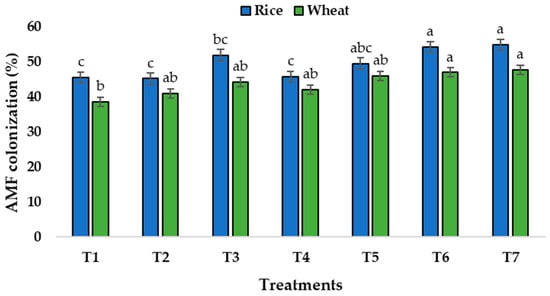
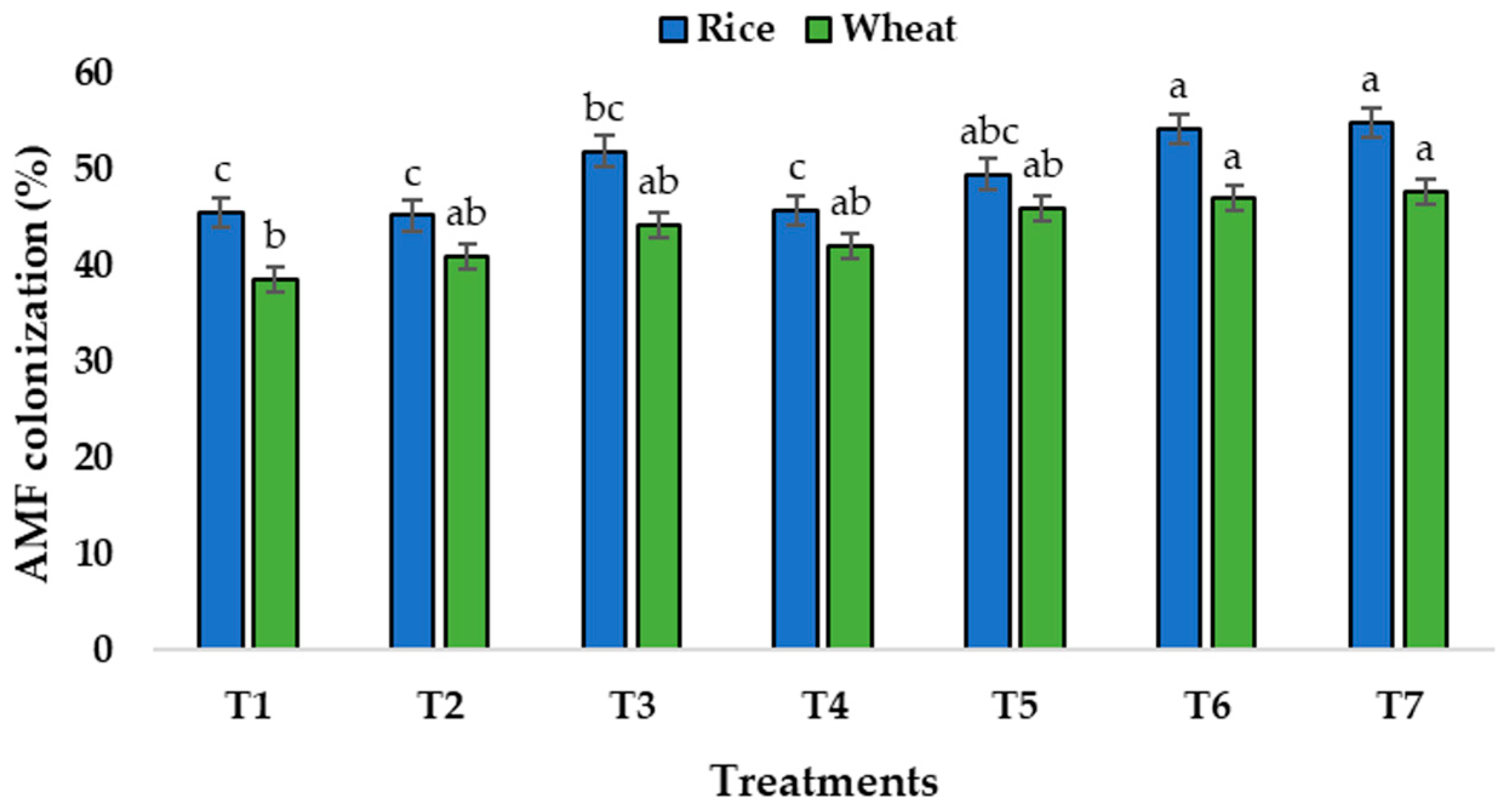
The AMF root colonization was significantly affected by the addition of both compost and microbial inoculants (Figure 1). The maximum root colonization of 54.9% was recorded under T7 treatment in rice, which was 18.7% higher when compared to 100% RDF (45.2%). The maximum root colonization of 60.4% was recorded under T7 treatment after wheat harvest. Mycorrhizal infection was higher under treatments containing AMF as a constituent.
Figure 1.
Influence of treatments on root colonization by arbuscular mycorrhiza fungi (AMF). T1: absolute control; T2: RDF (Recommended dose of Fertilizers) for both the crops; T3: 100% REC (Rock phosphate enriched compost); T4: 50% REC + 50% RDP (Recommended dose of P through chemical fertilizer); T5: T4 + PSB (Phosphate solubilizing bacteria); T6: T4 + AMF; T7: T4 + PSB + AMF. Means followed by the same letter represent the absence of any statistically significant difference at p ≤ 0.05.
3.4. Microbial Activity and MBP over Control After the Harvest of Both Crops
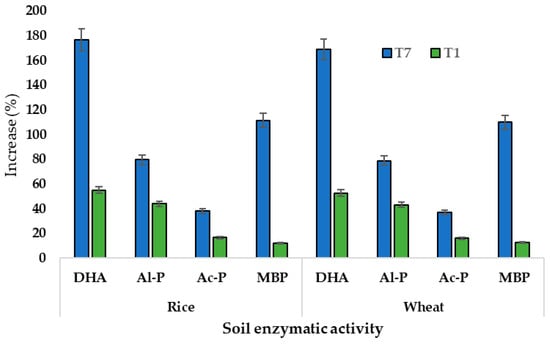
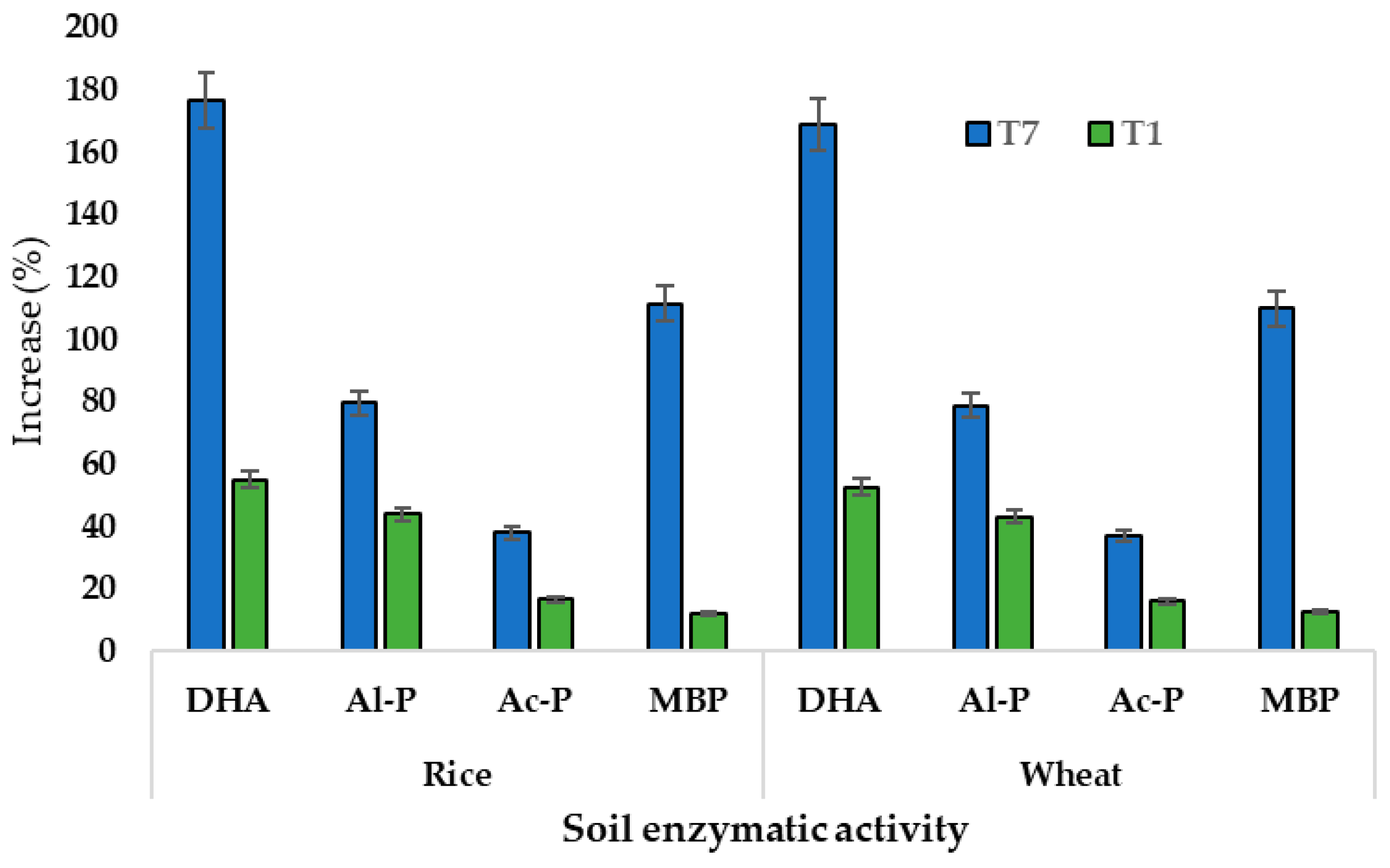
We observed an increase in enzymatic activity and MBP in post-rice and wheat soil under T7 and T2 over the control treatment (Figure 2). The increase in DHA, AlP, AcP and MBP under T7 treatment over control was found to be highest and to the tune of 176.8, 79.5, 38.0 and 111.4%, respectively. On the other hand, the increase in the given parameters was found to be lowest under the T2 plot, which was 55.1, 43.9, 16.7, and 12.3% for DHA, AlP, AcP, and MBP, respectively.
Figure 2.
Increase in activities of dehydrogenase, acid phosphatase, alkaline phosphatase, and microbial biomass P under T7 over control after rice and wheat harvest. DHA: Dehydrogenase activity; Al-P: Alkaline phosphatase activity; Ac-P: Acid phosphatase activity; MBP: Microbial biomass P.
After wheat harvest, the magnitude of increase (%) in enzymatic activity and MBP was highest under T7 treatment and lowest under T2 (Figure 2). The increases in DHA, AlP, AcP, and MBP under T7 than control were 168.9, 78.8, 36.9, and 109.9%, respectively. Under T2 treatment, the increases were 52.6, 43.1, 16.0, and 12.8% for DHA, AlP, AcP, and MBP, respectively. This shows that the integrated application of fertilizers and REC in the presence of P solubilizers and AMF enhanced microbial activity and MBP over the control treatment and performed better than the sole use of fertilizers, even at the recommended dose.
3.5. Crop Yield and P Uptake
The conjoint supply of P sources led to higher straw and grain yields than 100% RDF in both rice and wheat (Table 8). The T7 treatment registered highest grain yields of 48.7 and 50.0 q ha−1 for rice and wheat, respectively, which was statistically significant over control (28.0 and 24.8 q ha−1) and numerically higher than that under 100% RDF treatment for rice (42.0 q ha−1) and wheat (47.3 q ha−1). Straw yields followed a similar trend to that of grain yield.
Table 8.
Influence of treatments on yield and P uptake in grains and straw of rice and wheat.
Similarly, the highest P uptake (13.8 and 11.0 kg ha−1) was observed under T7 treatment which was statistically at par with 100% RDF treatment (11.3 and 9.3 kg ha−1) after rice harvest. Both were statistically superior to absolute control. The uptake of P by rice grain was higher than straw, which might be due to the enhanced mobilization of P from plant parts to grain. The P uptake in case of wheat also followed a similar trend to that in rice.
3.6. Principal Component Analysis
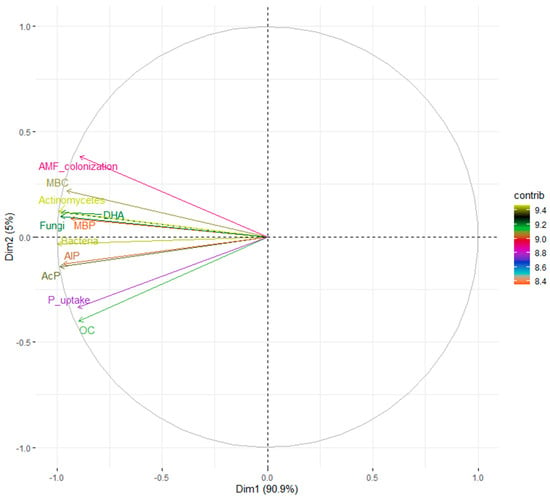
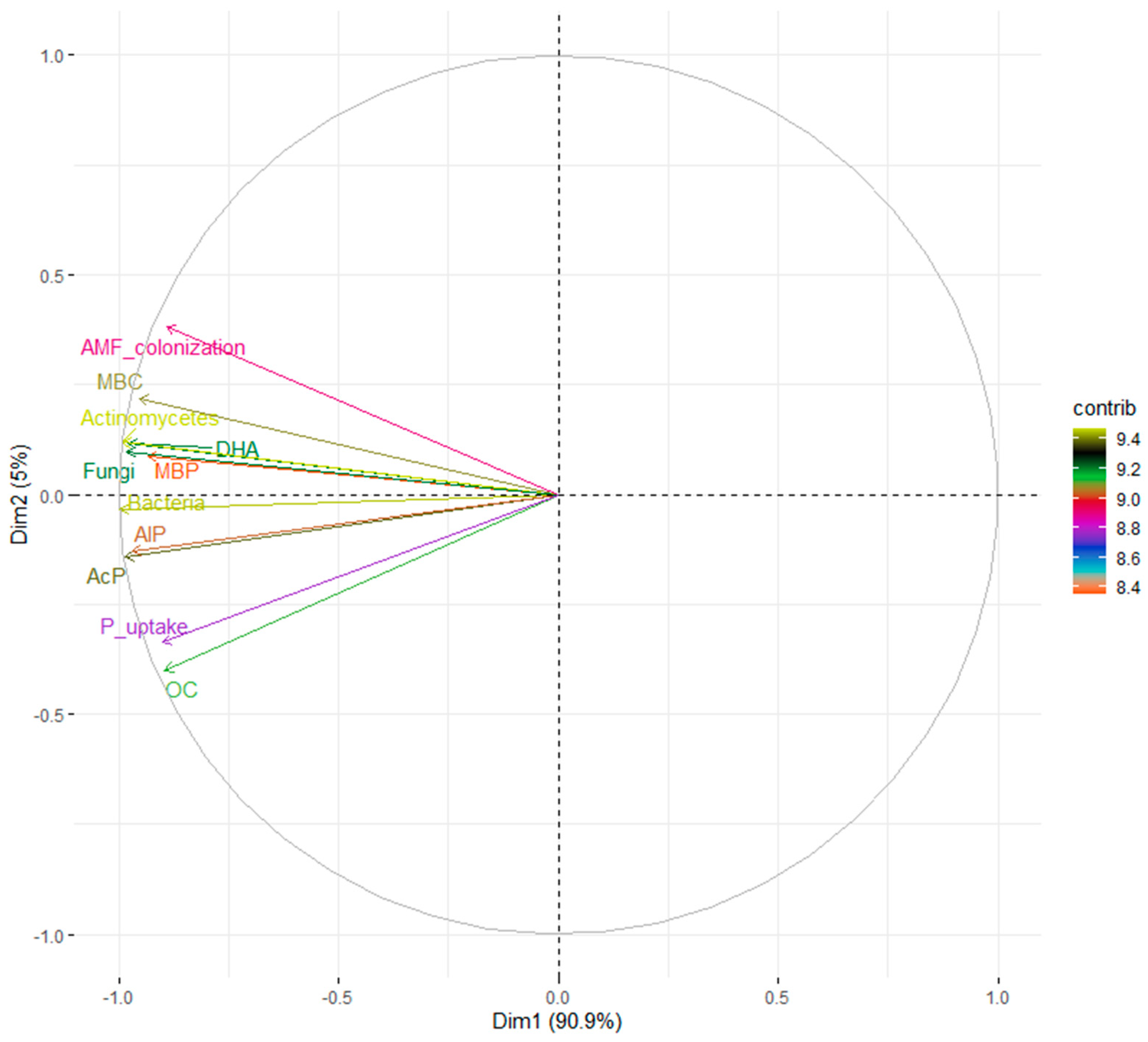
The PCA indicated that Dimension 1 accounted for 90.9% of the total variance and Dimension 2 accounted for 5.0% (Figure 3), showing that most variability among treatments was captured along the first axis. Among the measured variables, bacterial population, acid phosphatase activity, alkaline phosphatase activity, and soil organic C showed the strongest association with P uptake, suggesting these biological and enzymatic indicators were the primary drivers related to P uptake variation in the test crops.
Figure 3.
Relationship between different parameters. (AMF = Arbuscular Mycorrhiza Fungi, DHA = Dehydrogenase activity; Al-P = Alkaline phosphatase activity; Ac-P = Acid phosphatase activity; MBC = Microbial biomass C; MBP = Microbial biomass P; OC: Organic C).
4. Discussion
Enriched compost plays a key role in boosting mineralizable C content in soil. Compared to 100% RDF, the use of compost created favorable conditions for microbial breakdown of organic matter, which contributed to higher C accumulation in soil. Thus, the combined supplementation of P from organic and inorganic sources not only increased the available P in the soil but also boosted biological activity and soil C concentration [32]. Microbial abundance is a crucial parameter in determining the overall health and quality of soil. In our study, the highest microbial count was recorded with the joint application of RP-enriched compost alongside the microbial inoculants, compared to the RDF treatment; this effect may be explained by the greater microbial biomass C in the compost (Table 5). Similar findings were also reported by Meena and Biswas [33] who also attributed the increments in these parameters to higher rhizospheric microbial activity.
Recognized as an essential parameter of soil health, MBC act as a key biological indicator due to its strong association with organic matter decomposition and nutrient recycling. Rock phosphate-enriched compost addition encouraged greater microbial activity, leading to efficient C cycling and thereby contributing to higher MBC. The findings indicated that balanced fertilization through the joint use of mineral fertilizers and organic substrates resulted in increased MBC levels in soils [13,15]. These results are consistent with observations reported by Meena and Biswas [33], who found that soils treated with enriched compost exhibited higher MBC compared with the application of ordinary compost and inorganic fertilizers. Moreover, Dhull et al. [34] demonstrated that compost-treated wheat soils had higher microbial biomass C than those receiving inorganic fertilizers.
In intensive cropping patterns such as rice–wheat, the enhancement of MBP could be attributed to the joint application of organic amendments, inorganic fertilizers, and microbial inoculants. The enhanced MBP with REC and inorganic P fertilizer application can be explained by the microbial activity of compost, which facilitates the transfer of both labile and non-labile inorganic P into the organic pool. After rice harvest, the residual influence of enriched compost combined with chemical fertilizers under wheat was significantly greater than that in absolute control plots and those receiving 100% of the recommended NPK. The results in agreement with the findings reported by Goyal et al. [35], suggests that microbial biomass P increased when farmyard manure, applied at 15–20 t ha−1 annually, was used in semi-arid and sub-tropical climates of India. The rapid cycling of P within the microbial pool provides an important source of plant-available P, since the portion released from microbial biomass is easily absorbed, while immobilization of inorganic P by microbes reduces its fixation [36,37]. Various studies [15,33,38] have reported a notable increase in microbial P accumulation following the joint application of inorganic fertilizers and RPEC, highlighting the positive role of integrated nutrient management in improving microbial P dynamics, which in turn contributes to the available pool of P in soil.
The enhancement in dehydrogenase activity following the application of organic manures may be attributed to the increased availability of substrates that support microbial metabolism in soils. Improved dehydrogenase activity under T7, compared with T2 treatment, highlights the inhibitory influence of mineral fertilizers on soil dehydrogenase activity. This is consistent with the study by Moharana and Biswas [39], who showed that enriched compost fortified with P and K enhanced soil dehydrogenase activity after wheat and soybean harvests compared to ordinary compost.
The use of 100% RDF significantly enhanced alkaline phosphatase activity in rhizospheric soil relative to control plots after harvest of both crops. Moreover, the integrated application of enriched compost combined with chemical fertilizers and microbial inoculants resulted in the highest acid and alkaline phosphatase activities in soil, thereby improving P availability to crops. Higher alkaline phosphatase activity than acid phosphatase activity was observed due to alkaline nature of soil. Meena and Biswas [33] reported that RPEC application resulted in significantly higher phosphatase activity than 100% RDF; such an outcome results from phosphatase enzymes originating from plants and soil microorganisms, which mineralize organic P in compost into plant-available inorganic P and facilitates the hydrolysis of organic P into inorganic P.
Findings from the study revealed that REC enhance arbuscular mycorrhizal root colonization under both rice and wheat. The results agree with previous research showing that compost addition tends to enhance arbuscular mycorrhizal growth and sporulation [40]. The beneficial impact of applying REC jointly with microbial inoculants on AM fungi may be attributed to multiple factors, including acidification of the rhizosphere, which favors mycorrhizal proliferation [41]. Arbuscular mycorrhizal fungal, which mediates nutrient exchange between plants and soils, exhibits measurable responses to applications of various organic and inorganic fertilizers [42]. Their growth and development have been reported to increase under organic fertilization practices [43].
The combined application of phosphate-solubilizing bacteria and mycorrhiza with REC enhanced P availability, resulting in higher yields of both rice and wheat. In addition, the compost material served as a source of essential macro- and micronutrients, thereby promoting enhanced root growth [44]. The findings of this study are consistent with those reported by Refs. [15,44,45]. The use of bio-inoculated RP-enriched compost resulted in superior mung-bean yields, owing to its higher contents of citrate-soluble, water-soluble, and organic P, as well as enhanced microbial biomass C and acid phosphatase activity, relative to un-inoculated composts [46]. A similar trend was reported by Nishanth and Biswas [47]. Enriched composts inoculated and prepared with Aspergillus awamori produced higher wheat biomass yields than composts prepared without microbial inoculation. Microbial inoculants also have plant growth-promoting characteristics and produce vitamins, organic acids, and phytohormones, thereby improving plant root growth and increasing nutrient uptake. Mycorrhiza secrete siderophores and organic acids, leading to strong potential for mobilizing and solubilizing sparingly soluble P forms in the soil–root continuum [48]. The chemistry of P is unique in submerged system (rice ecology), with soil pH converging towards neutral. The availability of solution P is greater for uptake under the submerged condition than that of the aerobic condition, where rabi crops such as wheat are grown. This explains the higher yield improvement in rice than in wheat, owing to nutrients being mineralized into plant available forms.
5. Conclusions
This study showed that integrated application of rock phosphate–enriched compost with phosphate-solubilizing bacteria and arbuscular mycorrhizal fungi significantly improved soil biological health in a rice–wheat system. The combined treatment increased microbial biomass nutrients by 51–107%, enzymatic activities by 18–77%, and microbial populations by 55–83%, along with an 18% increase in mycorrhizal root colonization compared with the recommended dose of chemical fertilizers. The combined effects translated into higher P uptake of 15–17% and improved grain and straw yields by 10% when compared with conventional fertilization. Overall, the results demonstrate that REC fortified with microbial inoculants can effectively enhance soil biological functioning and crop productivity under intensive cereal-based cropping systems.
Author Contributions
K.B.: Investigation, Writing—original draft, and Writing—review and editing. A.K.P.: Data curation, Writing—original draft, and Writing—review and editing. S.N.I.: Validation and Writing—review and editing. A.K.: Supervision, Validation, and Writing—review and editing. G.K.G.: Conceptualization, Supervision, and Writing—review and editing. M.S.: Resources and Writing—review and editing. S.K.B.: Formal analysis and Writing—review and editing. D.P.: Funding acquisition, Validation, and Writing—review and editing. All authors have read and agreed to the published version of the manuscript.
Funding
This research received no external funding.
Data Availability Statement
The data supporting the results of this study are available upon request to the corresponding author.
Acknowledgments
The authors are thankful to the Vice Chancellor, Bihar Agricultural University (BAU), Bhagalpur, Bihar, India, for providing the necessary permission and the Chairman, Department of soil science and agricultural chemistry for his support, critical suggestions and for providing facilities for successful completion of the doctoral research work.
Conflicts of Interest
The authors declare that they have no conflicts of interest.
References
- Pokharel, D.; Jha, R.K.; Tiwari, T.P.; Gathala, M.K.; Shrestha, H.K.; Panday, D. Is conservation agriculture a potential option for cereal-based sustainable farming system in the Eastern Indo-Gangetic Plains of Nepal? Cogent Food Agric. 2018, 4, 1557582. [Google Scholar] [CrossRef] [Scilit]
- Singh, V.K.; Dwivedi, B.S.; Mishra, R.P.; Shukla, A.K.; Timsina, J.; Upadhyay, P.K.; Shekhawat, K.; Majumdar, K.; Panwar, A.S. Yields, soil health and farm profits under a rice-wheat system: Long-term effect of fertilizers and organic manures applied alone and in combination. Agronomy 2018, 9, 1. [Google Scholar] [CrossRef] [Scilit]
- Gao, R.; Duan, Y.; Zhang, J.; Ren, Y.; Li, H.; Liu, X.; Zhao, P.; Jing, Y. Effects of long-term application of organic manure and chemical fertilizer on soil properties and microbial communities in the agro-pastoral ecotone of North China. Front. Environ. Sci. 2022, 10, 993973. [Google Scholar] [CrossRef] [Scilit]
- Kumari, R.; Beura, K.; Pradhan, A.K.; Akhtar, S.; Ingle, S.N.; Das, S.P.; Behera, S.K.; Baranwal, D.K. Seed nutripriming and foliar application of phosphorus for enhanced nutrition in brinjal. J. Plant Nutr. 2025, 48, 1632–1645. [Google Scholar] [CrossRef] [Scilit]
- Mukhopadhya, S.S.; Sharma, S. Nanoscience and nanotechnology: Cracking prodigal farming. J. Bionanosci. 2013, 7, 497–502. [Google Scholar] [CrossRef] [Scilit]
- Beura, K.; Singh, M.; Pradhan, A.K.; Rakshit, R.; Lal, M. Dissolution of dominant soil phosphorus fractions in phosphorus-responsive soils of Bihar, India: Effects of mycorrhiza and fertilizer levels. Commun. Soil Sci. Plant Anal. 2019, 50, 287–294. [Google Scholar] [CrossRef] [Scilit]
- Beura, K.S.; Ghosh, G.K.; Pradhan, A.K.; Kohli, A. Forms of phosphorus and its bioavailability in rice grown in an alluvial soil treated with rock phosphate enriched compost. J. Plant Nutr. 2022, 45, 1682–1693. [Google Scholar] [CrossRef] [Scilit]
- Beura, K.S.; Ghosh, G.K.; Pradhan, A.K.; Kohli, A.; Singh, M.; Shambhavi, S.; Kumar, S. Fractional release kinetics of phosphorus from compost amended with phosphate rock. Commun. Soil Sci. Plant Anal. 2021, 52, 1115–1120. [Google Scholar] [CrossRef] [Scilit]
- Beura, K.; Padbhushan, R.; Pradhan, A.K.; Mandal, N. Partial acidulation of phosphate rock for enhanced phosphorus availability in alluvial soils of Bihar, India. J. Appl. Nat. Sci. 2016, 8, 1393–1397. [Google Scholar] [CrossRef] [Scilit]
- Stark, C.H.; Condron, L.M.; Callaghan, M.O.; Stewart, A.; Di, H.J. Differences in soil enzyme activities, microbial community structure and short-term nitrogen mineralisation resulting from farm management history and organic matter amendments. Soil Biol. Biochem. 2008, 40, 1352–1363. [Google Scholar] [CrossRef] [Scilit]
- Perez-Piqueres, A.; Edel-Hermann, V.; Alabouvette, C.; Steinberg, C. Response of soil microbial communities to compost amendments. Soil Biol. Biochem. 2006, 38, 460–470. [Google Scholar] [CrossRef] [Scilit]
- Chander, K.; Joergensen, R.G. Decomposition of 14C labelled glucose in a Pb-contaminated soil remediated with synthetic zeolite and other amendments. Soil Biol. Biochem. 2002, 34, 643–649. [Google Scholar] [CrossRef] [Scilit]
- Mandal, A.; Patra, A.K.; Singh, D.; Swarup, A.; Masto, R.E. Effect of long-term application of manure and fertilizer on biological and biochemical activities in soil during crop development stages. Bioresour. Technol. 2007, 98, 3585–3592. [Google Scholar] [CrossRef] [Scilit]
- Bhattacharyya, R.; Kundu, S.; Prakash, V.; Gupta, H.S. Sustainability under combined application of mineral and organic fertilizers in a rain-fed soybean–wheat system of the Indian Himalayas. Eur. J. Agron. 2008, 28, 33–46. [Google Scholar] [CrossRef] [Scilit]
- Billah, M.; Khan, M.; Bano, A.; Nisa, S.; Hussain, A.; Dawar, K.M.; Munir, A.; Khan, N. Rock phosphate-enriched compost in combination with rhizobacteria; a cost-effective source for better soil health and wheat (Triticum aestivum) productivity. Agronomy 2020, 10, 1390. [Google Scholar] [CrossRef] [Scilit]
- Bashan, Y.; de-Bashan, L.E. How the plant growth-promoting bacterium Azospirillum promotes plant growth—A critical assessment. Adv. Agron. 2010, 108, 77–136. [Google Scholar]
- Bending, G.D.; Turner, M.K.; Jones, J.E. Interactions between crop residue and soil organic matter quality and the functional diversity of soil microbial communities. Soil Biol. Biochem. 2002, 34, 1073–1082. [Google Scholar] [CrossRef] [Scilit]
- Shenoy, V.V.; Kalagudi, G.M. Enhancing plant phosphorus use efficiency for sustainable cropping. Biotechnol. Adv. 2005, 23, 501–513. [Google Scholar] [CrossRef] [Scilit] [PubMed]
- He, Z.L.; Bian, W.; Zhu, J. Screening and identification of microorganisms capable of utilizing phosphate adsorbed by goethite. Commun. Soil Sci. Plant Anal. 2002, 33, 647–663. [Google Scholar] [CrossRef] [Scilit]
- Mittal, V.; Singh, O.; Nayyar, H.; Kaur, J.; Tewari, R. Stimulatory effect of phosphate-solubilizing fungal strains (Aspergillus awamori and Penicillium citrinum) on the yield of chickpea (Cicer arietinum L. cv. GPF2). Soil Biol. Biochem. 2008, 40, 718–727. [Google Scholar] [CrossRef] [Scilit]
- Jackson, M.L. Soil Chemical Analysis; Prentice Hall of India Pvt., Ltd.: New Delhi, India, 1973; p. 498. [Google Scholar]
- Walkley, A.J.; Black, C.A. An estimation of the Degtjareff method for determining soil organic matter and a proposed modification of the chromic acid titration method. Soil Sci. 1934, 37, 29–38. [Google Scholar] [CrossRef] [Scilit]
- Subbiah, B.V.; Asija, G.L. A rapid procedure for the estimation of available nitrogen in soils. Curr. Sci. 1956, 25, 259–266. [Google Scholar]
- Hanway, J.J.; Heidel, H. Soil analysis methods as used in Iowa State College soil testing laboratory. Iowa State Coll. Agric. Bull. 1952, 57, 1–31. [Google Scholar]
- Olsen, S.R.; Cole, C.V.; Watanabe, F.S.; Dean, L.A. Estimation of Available Phosphorus in Soils by Extraction with Sodium Bicarbonate; United States Department of Agriculture: Washington, DC, USA, 1954.
- Jenkinson, D.S.; Powlson, D.S. The effects of biocidal treatments on metabolism in soil—V: A method for measuring soil biomass. Soil Biol. Biochem. 1976, 8, 209–213. [Google Scholar] [CrossRef] [Scilit]
- Brookes, P.C.; Powlson, D.S.; Jenkinson, D.S. Measurement of microbial biomass phosphorus in soil. Soil Biol. Biochem. 1982, 14, 319–329. [Google Scholar] [CrossRef] [Scilit]
- Klein, D.A.; Loh, T.C.; Goulding, R.L. A rapid procedure to evaluate dehydrogenase activity of soils low in organic matter. Soil Biol. Biochem. 1971, 3, 385–387. [Google Scholar] [CrossRef] [Scilit]
- Tabatabai, M.A.; Bremner, J.M. Use of p-nitrophenyl phosphate for assay of soil phosphatase activity. Soil Biol. Biochem. 1969, 1, 301–307. [Google Scholar] [CrossRef] [Scilit]
- Chhonkar, P.K.; Bhadraray, S.; Patra, A.K.; Purakayastha, T.J. Experiments in Soil Biology and Biochemistry; Westville Publishing House: New Delhi, India, 2007; ISBN 978-8185873329. [Google Scholar]
- Biermann, B.; Linderman, R.G. Quantifying vesicular–arbuscular mycorrhizae: A proposed method towards standardization. New Phytol. 1981, 87, 63–67. [Google Scholar] [CrossRef] [Scilit]
- Kumari, R.; Kundu, M.; Das, A.; Rakshit, R.; Sahay, S.; Sengupta, S.; Ahmad, M.F. Long-term integrated nutrient management improves carbon stock and fruit yield in a subtropical mango (Mangifera indica L.) orchard. J. Soil Sci. Plant Nutr. 2020, 20, 725–737. [Google Scholar] [CrossRef] [Scilit]
- Meena, M.D.; Biswas, D.R. Changes in biological properties in soil amended with rock phosphate and waste mica enriched compost using biological amendments and chemical fertilizers under wheat–soybean rotation. J. Plant Nutr. 2014, 37, 2050–2073. [Google Scholar] [CrossRef] [Scilit]
- Dhull, S.; Goyal, S.; Kapoor, K.; Mundra, M. Microbial biomass carbon and microbial activities of soils receiving chemical fertilizers and organic amendments. Arch. Agron. Soil Sci. 2004, 50, 641–647. [Google Scholar] [CrossRef] [Scilit]
- Goyal, S.; Mishra, M.M.; Hooda, I.S.; Singh, R. Organic matter–microbial biomass relationship in field experiments under tropical conditions: Effects of inorganic fertilization and organic amendments. Soil Biol. Biochem. 1992, 24, 1081–1084. [Google Scholar] [CrossRef] [Scilit]
- Oberson, A.; Friesen, D.K.; Rao, I.M.; Buhler, S.; Frossard, E. Phosphorus transformations in an Oxisol under contrasting land-use systems: The role of the microbial biomass. Plant Soil 2001, 237, 197–210. [Google Scholar] [CrossRef] [Scilit]
- Khan, N.; Bano, A.; Zandi, P. Effects of exogenously applied plant growth regulators in combination with PGPR on the physiology and root growth of chickpea (Cicer arietinum) and their role in drought tolerance. J. Plant Interact. 2018, 13, 239–247. [Google Scholar] [CrossRef] [Scilit]
- Ayaga, G.; Todd, A.; Brookes, P.C. Enhanced biological cycling of phosphorus increases its availability to crops in low-input sub-Saharan farming systems. Soil Biol. Biochem. 2006, 38, 81–90. [Google Scholar] [CrossRef] [Scilit]
- Moharana, P.; Biswas, D. Assessment of maturity indices of rock phosphate enriched composts using variable crop residues. Bioresour. Technol. 2016, 222, 1–13. [Google Scholar] [CrossRef] [Scilit] [PubMed]
- Cavagnaro, T.R.; Bender, S.F.; Asghari, H.R.; van der Heijden, M.G.A. The role of arbuscular mycorrhizas in reducing soil nutrient loss. Trends Plant Sci. 2015, 20, 283–290. [Google Scholar] [CrossRef] [Scilit]
- Beura, K.; Pradhan, A.K.; Ghosh, G.K.; Kohli, A.; Singh, M. Root architecture, yield and phosphorus uptake by rice: Response to rock phosphate enriched compost and microbial inoculants. Int. Res. J. Pure Appl. Chem. 2020, 21, 33–39. [Google Scholar] [CrossRef] [Scilit]
- Yang, W.; Gu, S.; Xin, Y.; Bello, A.; Sun, W.; Xu, X. Compost addition enhanced hyphal growth and sporulation of arbuscular mycorrhizal fungi without affecting their community composition in the soil. Front. Microbiol. 2018, 9, 169. [Google Scholar] [CrossRef] [Scilit]
- Zhu, X.; Song, F.; Liu, S.; Liu, T.; Zhou, X. Arbuscular mycorrhizae improve photosynthesis and water status of Zea mays L. under drought stress. Plant Soil Environ. 2012, 58, 186–191. [Google Scholar] [CrossRef] [Scilit]
- Verma, R.K.; Chauhan, A.; Verma, R.S.; Rahman, L.U.; Bisht, A. Improving production potential and resource use efficiency of peppermint (Mentha piperita L.) intercropped with geranium (Pelargonium graveolens L.) under different plant density. Ind. Crops Prod. 2013, 44, 577–582. [Google Scholar] [CrossRef] [Scilit]
- Nevens, F.; Reheul, D. Permanent grassland and 3-year leys alternating with 3 years of arable land: 31 years of comparison. Eur. J. Agron. 2003, 19, 77–90. [Google Scholar] [CrossRef] [Scilit]
- Achal, V.; Savant, V.V.; Reddy, M.S. Phosphate solubilization by a wild type strain and UV-induced mutants of Aspergillus tubingensis. Soil Biol. Biochem. 2007, 39, 695–699. [Google Scholar] [CrossRef] [Scilit]
- Nishanth, D.; Biswas, D. Kinetics of phosphorus and potassium release from rock phosphate and waste mica enriched compost and their effect on yield and nutrient uptake by wheat (Triticum aestivum). Bioresour. Technol. 2008, 99, 3342–3353. [Google Scholar] [CrossRef] [Scilit] [PubMed]
- Beura, K.; Pradhan, A.; Ingle, S. Role of phosphate solubilizing microorganisms (PSMs) in sustainable crop production. Harit Dhara 2025, 8, 19–22. [Google Scholar]

Disclaimer/Publisher’s Note: The statements, opinions and data contained in all publications are solely those of the individual author(s) and contributor(s) and not of MDPI and/or the editor(s). MDPI and/or the editor(s) disclaim responsibility for any injury to people or property resulting from any ideas, methods, instructions or products referred to in the content. |
© 2025 by the authors. Licensee MDPI, Basel, Switzerland. This article is an open access article distributed under the terms and conditions of the Creative Commons Attribution (CC BY) license (https://creativecommons.org/licenses/by/4.0/).