
Abstract
The antagonistic geochemical behaviors of cadmium (Cd) and arsenic (As) in co-contaminated soils complicate their simultaneous remediation. This study aimed to develop a synergistic immobilization strategy by converting Spirulina residue into a magnetic biochar-layered double hydroxide composite (FSRBL). The composite was applied to both acidic red and calcareous black soils, and its effects on Cd and As, immobilization efficiency, and ecotoxicity were evaluated. The results showed that FSRBL effectively transforms Cd and As from mobile fractions to stable residual forms. At a 2.5% application rate, FSRBL achieved remarkable immobilization efficiencies of 39.2% for Cd and 57.5% for As, representing effectiveness 3.55 and 5.97 times higher than that of unmodified biochar, respectively. A dose–response relationship between the application amount of FSRBL and the immobilization efficiency of As and Cd was observed and further quantified using a logistic model. The results indicate that while increased FSRBL application enhances immobilization efficiency, the marginal benefit of each additional unit diminishes as the application rate increases, demonstrating a significant diminishing marginal effect. According to the ecotoxicity assessment experiment, the soil leachate from FSRBL-amended soil remarkably decreased the ecological toxicity to rice (Oryza sativa L.). Mechanistic investigations employing SEM/TEM-EDS, XRD, and XPS revealed that the synergistic immobilization could be ascribed to the multi-component cooperation within FSRBL, which resolved the conflicting pH/Eh requirements for the immobilization of Cd and As: (1) the LDH phase efficiently immobilized As oxyanions through anion exchange and isomorphic substitution; (2) the magnetic Fe phase concurrently immobilized Cd2+ and As oxyanions via redox transformation and coprecipitation, resulting in the formation of precipitates such as Fe/Ca/Cd–As(V). This work demonstrates a feasible approach to upcycle biomass waste into a value-added material for sustainable remediation of Cd–As co-contaminated soil.
1. Introduction
With the rapid development of industrialization and agriculture, soil contamination with potentially toxic elements (PTEs) has intensified, posing a serious threat to ecosystems and human health [1,2]. Global assessments indicate that 14–17% of farmland (approximately 242 million hectares) has elevated levels of at least one PTE [3]. However, the geochemical behaviors of Cd and As differ significantly. Cd2+ is readily immobilized through precipitation or adsorption under alkaline reducing conditions, while As (such as H2AsO4− or HAsO42−) is more stable in acidic, oxidizing environments [4]. These opposing pH/Eh requirements result in a single passivator often activating the other while immobilizing one element. Based on the published literature, the addition of 3% phosphorus-enriched biochar led to a 35.0% reduction in available Cd, while it caused a 13.9% increase in available As [5]. Conversely, iron-based materials (e.g., goethite, zero-valent iron, and hematite) can effectively immobilize As via specific adsorption; nevertheless, their acidification effect may intensify the activation of Cd [6,7]. Therefore, developing composite materials with dual functional sites is a key approach to simultaneously control Cd–As combined pollution.
Currently, biochar has become an ideal carrier due to its porous structure, high specific surface area, and abundant surface functional groups (such as carboxyl groups and phenolic hydroxyl groups). Using Spirulina processing residue as a precursor for biochar production not only allows for waste recycling, but its high organic nitrogen content (>40%) also facilitates the production of nitrogen-doped biochar, thereby enhancing its ability to bind Cd [8]. Iron modification is also considered an effective strategy for enhancing As immobilization [9]. Iron oxides specifically adsorb As through surface coordination and coprecipitation, and can impart magnetic properties to the material, facilitating its recycling [10,11]. However, iron-modified biochars are generally ineffective for Cd immobilization due to limited hydroxyl sites [12]. Layered double hydroxides (LDH) offer a new approach for Cd immobilization [13]. The lamellae of LDH are rich in hydroxyl groups, enabling them to immobilize Cd through mineralization and coprecipitation. Their interlamellar domains can also immobilize As through anion exchange [14]. Furthermore, the metal cations in the LDH lamellae can modulate the surface charge of the material, reducing the electrostatic repulsion of oxygen-containing anions and thereby improving As adsorption efficiency [15]. Therefore, co-loading iron oxides and LDH onto biochar has the potential to combine the advantages of various aspects. Biochar acts as a carrier, providing structural support and some Cd adsorption sites; iron oxides enhance As immobilization and facilitate magnetic separation; and LDH synergistically enhances the immobilization of Cd and As.
Although certain investigations into the adsorption properties of several composite materials for single elements or pairs of elements such as Cd, Pb, Zn, and Cu have been carried out [16,17,18], the research on carbon-based remediation materials with high efficiency for remediating Cd–As co-contaminated soils is insufficient. In particular, the quantitative dose–effect relationships and the microscopic immobilization mechanisms are scarce to meet the requirements of selecting suitable remediation techniques, as more and more co-existing contamination emerges. For example, when crop residues (Astragalus sinicus L.) remediated Cd-contaminated soil, increasing the addition rate from 0.4% to 1.2% reduced the Cd availability by 56% to 85% compared to the control treatment [19]. In order to achieve higher passivation efficiency, blindly increasing costs depending on excessive input is obviously not feasible, especially for the majority of farmers, which is often unacceptable. Therefore, it is particularly important to find a balance between dosage and benefit, and achieve the unity of economic and environmental benefits. Especially for the selection of soil remediation strategies with different degrees of pollution, it tends to be more rational. Up to now, few studies have focus on the dosage–effect relationship and more less significant results were obtained; in particular, there is a lack of research on using theoretical models to elucidate common patterns based on ecotoxicity assessment and soil health, which severely limits the efficiency assessment and cost optimization of the repair materials in practical applications for farmland remediation. Furthermore, determining key dosage thresholds is crucial for precise remediation, cost control, and prevention of secondary pollution, especially for biochar, where excessive application can alter soil physicochemical properties and inhibit soil microorganisms and plant growth [20]. Of particular note, existing studies are mostly limited to comparing the effects of different addition rates.
In this study, we successfully prepared a magnetic Spirulina residue biochar-loaded CaMgAl–LDH composite (FSRBL) using waste Spirulina residue as raw material through pre-magnetized pyrolysis and hydrothermal co-precipitation methods. Two distinct soil types were separately collected from the southern and northern regions of China. These soils were derived from different parent materials (red soil originated from sandstone; black soil was formed from Quaternary alluvial loess-like clay). They were cultivated into soils with low, medium and high pollution levels for research. The objectives were: (1) to systematically explore the synergistic immobilization efficiency and morphological transformation rules of FSRBL on the bioavailability of Cd and As in soil; (2) to establish a quantitative relationship between material addition amount and remediation effect using the Logistic dose–effect model, and to clarify the key remediation threshold; (3) to evaluate the ecotoxicity changes in soil extracts after remediation through rice germination experiments; (4) to reveal the synergistic immobilization mechanism of FSRBL and soil interface by combining SEM/TEM-EDS, XPS and XRD analysis techniques, and to provide theoretical basis and technical support for the practical application of FSRBL.
2. Materials and Methods
2.1. Contaminated Soil
The experimental soils were collected from two typical agricultural areas in China: acidic red soil (Krasnozem, RS) was collected from Shimen County, Hunan Province (29°38′45″ N, 111°01′52″ E), and calcareous black soil (Phaeozem, BS) was collected from Dalian City, Liaoning Province (38°57′15″ N, 121°38′64″ E). All soil samples were collected from the 0–20 cm surface layer. Both soils are As-contaminated, with arsenic contents of 62.2 and 51.4 mg/kg, respectively. Based on this, we cultivated Cd–As compound contaminated soils with different pollution levels. The supplementary Cd(NO3)2·4H2O and NaAsO2 (with a purity of 99.99%) were procured from Shanghai Macklin Biochemical Co., Ltd. (Shanghai, China). We prepared simulated contaminated soil with different concentrations of arsenic and cadmium and started the experiment. According to the Agricultural Land Soil Pollution Risk Control Standard (GB 15618-2018 [21]), the screening value and control value ranges of Cd pollution risk in agricultural land soil are 0.3–0.8 mg/kg and 1.5–4 mg/kg, respectively. Given that the Cd concentration range in Chinese soils is 0.003–9.57 mg/kg [22], this study set three Cd pollution levels of 1.5 mg/kg (low), 4 mg/kg (medium), and 6 mg/kg (high), corresponding to mild, moderate, and severe pollution, respectively. The screening value and control value ranges for As pollution risk in agricultural land are 25–40 mg/kg and 100–200 mg/kg, respectively. Referring to the As content range in China’s surface agricultural soils (0.4–175.8 mg/kg) [23], this study set three As pollution levels of 50 mg/kg (low), 100 mg/kg (medium), and 400 mg/kg (high), representing mild, moderate, and severe pollution, respectively. Cd(II) and As(III) solutions were prepared with Cd(NO3)2 and NaAsO2 and added to the soil. they were cultured at 25 °C for four weeks to achieve the adsorption equilibrium of Cd and As in the soil solid phase. Thus, a total of six types of test soils were selected, featuring three levels (low, medium, and high) of Cd–As composite pollution, sourced from red soil and black soil (Table S1).
2.2. Material Preparations
The preparation methods of SRB, FSRB and FSRBL are based on the previous work methods of our team. The specific steps are as follows: First, the waste Spirulina residue (Binmei Biotechnology Co., Ltd., Taizhou, China) was selected as the biomass raw material and pyrolyzed at 800 °C for 2 h under oxygen-limited conditions to obtain SRB. At the same time, another batch of Spirulina residue was immersed in a mixed solution containing 0.18 M Fe(NO3)9H2O and 0.09 M FeSO4·7H2O, with a mass ratio of biomass to iron oxide of 1:1 and a solid–liquid ratio of 1:10 g/mL. After thorough shaking and mixing, filter and collect the solid phase [24]. The biomass loaded with iron oxides was treated under the same pyrolysis conditions (800 °C, 2 h, oxygen-limited) to obtain FSRB. Next, 0.12 M AlCl3·6H2O, 0.18 M CaCl2·6H2O and 0.18 M MgCl2·6H2O were dissolved in water, and the pH was adjusted to 10.0 with 5 M NaOH solution to obtain LDH precursor. FSRB powder was mixed with the above LDH precursor in a mass ratio of 1:1, and the resulting suspension was oscillated at 25 °C for 12 h and hydrothermally precipitated in an oven at 90 °C for 24 h. After the reaction was completed, the precipitate was collected, washed with deionized water, and dried to obtain FSRBL. All products were sieved through a 100-mesh sieve for later use. All reagents employed in material preparation were of analytical grade and procured from Shanghai Aladdin Chemistry Co., Ltd. (Shanghai, China). For a comprehensive and detailed analysis of the material characterization, kindly refer to Text S1 and Figure S1.
2.3. Soil Incubation Experiment
Soil incubation experiments were carried out in red soil and black soil with three levels of Cd–As combined pollution: low, medium and high. 100 g of contaminated soil was weighed and mixed with SRB, FSRB and FSRBL at a mass ratio of 0.1%, 0.5% and 2.5% (w/w), respectively, and then placed in a polyethylene culture bottle (Φ8 × 10 cm) with a volume of 200 mL. The contaminated soil without passivation agent was set as the control group, and all treatments (including the control) were repeated 3 times. An appropriate amount of deionized water was added to adjust the soil mass water content to 70% of its field water holding capacity. The bottle mouth was covered with a breathable sealing film to maintain the humidity in the bottle and minimize water evaporation while allowing gas exchange. The culture bottle was placed in a constant temperature and humidity incubator and cultured continuously for 50 days under the conditions of light-proof, 25 °C and 70% relative humidity. The soil was weighed daily during the culture period, and deionized water was added to the initial constant weight to maintain a constant soil moisture content. The position of the culture bottles was randomly adjusted every week to eliminate the influence of microenvironmental differences in the incubator. Soil samples were collected during and after the incubation period, air-dried, ground, and passed through a 0.25 mm sieve for later use. The pH value, electrical conductivity (EC), redox potential (Eh), and organic matter (SOM) content of the treated soil were analyzed. The leaching concentrations of Cd and As were determined using the toxicity characteristic leaching procedure (TCLP). The chemical forms of Cd and As were analyzed according to the Tessier continuous extraction method [25] and the Wenzel continuous extraction method [26], respectively.
2.4. Ecotoxicity Analysis
After 50 days of incubation, air-dried and sieved (0.25 mm) soil samples were taken and deionized water was added at a solid–liquid ratio of 1:10 (g: mL). After 8 h of shaking extraction at 120 r/min, centrifugation was performed at 3500× g for 10 min, and the supernatant was filtered through a 0.45 μm microporous filter membrane. The filtrate obtained was the soil extract for rice seed germination test. Rice seeds with a germination rate of >80% were selected, surface disinfected with 5% calcium hypochlorite solution, and then rinsed with deionized water 3 times. Filter paper was laid in a culture dish, and 10 mL of soil extract of the corresponding treatment group (or distilled water as a negative control) was added to evenly wet the filter paper. 10 pretreated rice seeds (embryos in the same direction) were evenly placed in each culture dish. The culture dish was covered and cultured in the dark at 25 °C. After germination for 3 days, the number of germinated seeds was counted and the germination rate was calculated. The seedlings were then transferred to a light incubator set to a 16 h light/8 h dark cycle and cultured for another 3 days. The root and shoot lengths of the seedlings were measured at the end of the experiment.
2.5. Statistical Methods
After the incubation, the FSRBL was separated and recovered by magnet. The micromorphology, structural characteristics and element distribution of the materials were characterized by field emission scanning electron microscopy-energy spectrometer (FE-SEM-EDS; GeminiSEM 300, ZEISS, Oberkochen, Germany) and transmission electron microscopy-energy spectrometer (TEM-EDS; Talos 200X, FEI, Hillsboro, OR, USA). The crystal phase change of the materials was characterized by scanning in the range of 2θ angle 5° to 80° using X-ray diffractometer (Rigaku Ultima IV, Rigaku, Tokyo, Japan). The chemical state and valence state distribution of the elements on the sample surface were determined by X-ray photoelectron spectrometer (Thermo Scientific ESCALAB 250Xi, Thermo Scientific, Waltham, MA, USA). The high-resolution XPS spectrum peaks were deconvoluted and fitted based on the Gaussian-Lorentzian peak shape function using Avantage (v5.99.31) software. All binding energies were corrected based on the C 1s peak (284.80 eV).
2.6. Dose–Effect Curve Fitting
The logistic dose–effect model is widely used in ecotoxicology and pharmacology to describe the nonlinear relationship between compound dose and biological response [27]. Although this model has been well-established in the toxicity assessment of environmental pollutants, its application in soil remediation to quantify the relationship between passivation material dosage and heavy metal immobilization efficiency remains lacking [28,29]. This study attempted to incorporate the logistic model into the assessment of FSRBL remediation of Cd–As co-contaminated soils, aiming to establish a quantitative relationship between FSRBL dosage and Cd/As immobilization efficiency and identify critical response thresholds. Using the logistic function, dose values in the real domain are mapped to predicted immobilization efficiency values between 0 and 1. This not only accurately estimates the effective effect concentration (e.g., the dosage at which immobilization efficiency reaches 30%, EC30), but also calculates key parameters such as the maximum immobilization efficiency (Emax), providing a quantitative basis for the economic-performance trade-off in practical applications. The logistic function equation is:
In the formula, y represents the Cd/As immobilization efficiency (%); x represents the addition rate of the repair agent (%); x0 is the half-maximum effect concentration; A1 is the maximum immobilization efficiency; and A2 is the minimum repair efficiency.
2.7. Data Analysis
Statistical analysis was performed using SPSS Statistics 20 software. All experiments were conducted with three independent replicates (n = 3). Data are presented as the mean ± standard deviation. One-way analysis of variance (ANOVA) followed by Duncan’s multiple range test was used to examine significant differences among treatment means at the p < 0.05 level. In figures, different lowercase letters above bars or data points indicate statistically significant differences between groups according to this test.
3. Results and Discussion
3.1. Effects of Biochar on Soil pH and Eh
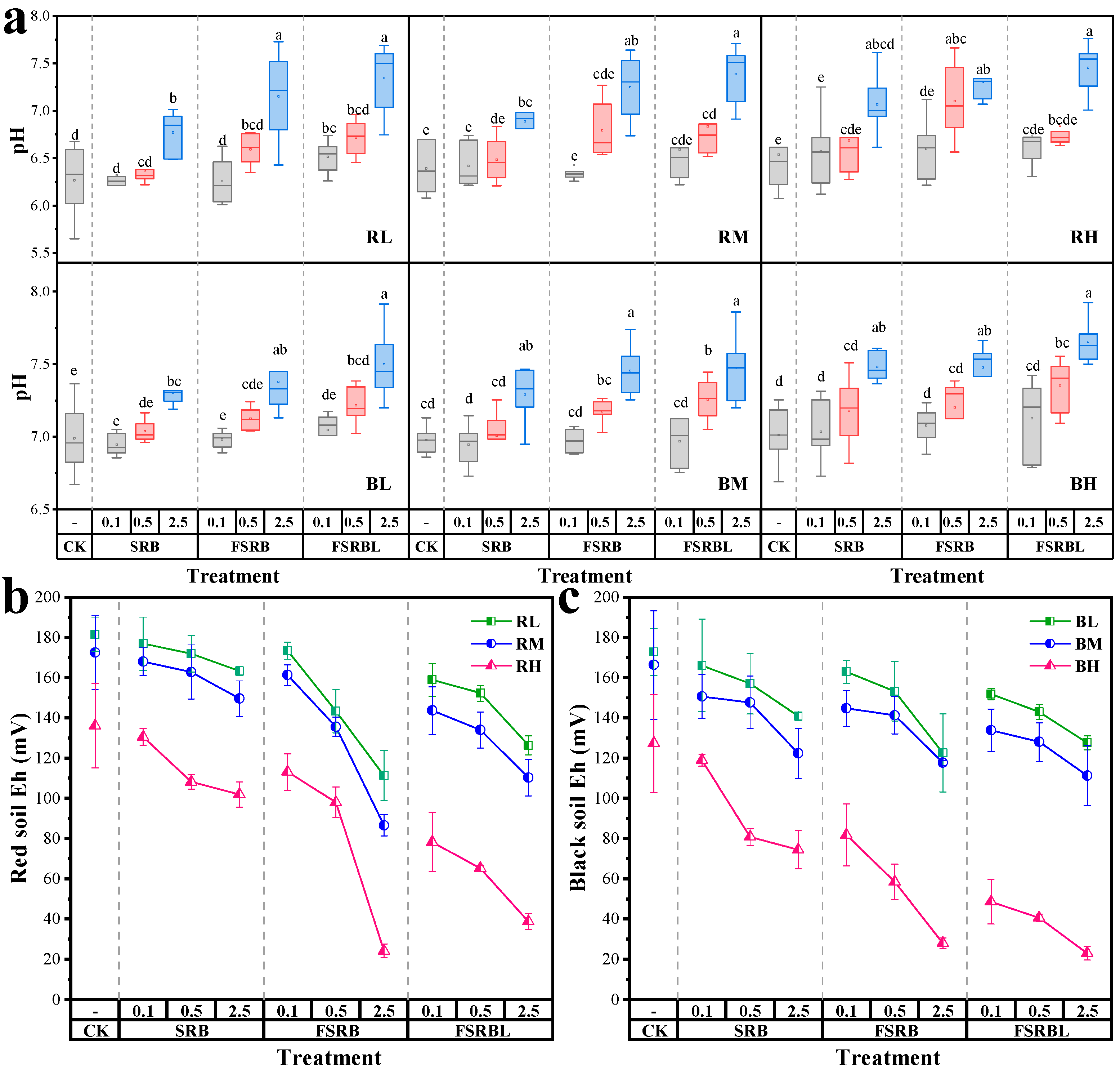
Soil pH and Eh are key environmental factors controlling the form and availability of Cd and As in soil (Figure 1). In this study, all tested soils showed the most significant pH increase after the addition of FSRBL, and the increase was significantly dose-dependent, which is consistent with the mechanism of biochar neutralizing soil H+ by releasing alkaline components (such as oxygen-containing functional groups, soluble bases and inorganic carbonates) in previous studies [30]. The pH increase capacity of the three biochars was ranked as FSRBL > FSRB > SRB, revealing the synergistic effect of iron modification and LDH loading. The iron oxides (such as FeOOH and Fe2O3) formed by the pyrolysis of iron salts in FSRB can release OH− from the abundant hydroxyl groups and alkaline groups on their surface; while the LDH loaded on FSRBL can continuously release alkaline substances through ion exchange by the lamellae cations (such as Ca2+ and Mg2+) and interlayer anions (such as CO32−). These combined effects led to a pronounced increase in soil pH, thereby establishing a geochemical condition favorable for the hydroxylation and precipitation of Cd2+. It is worth noting that the pH increase in red soil is significantly higher than that of black soil, which can be explained by the difference in soil background properties. Red soil is acidic and has a low cation exchange capacity (CEC), weak buffering capacity, and is more sensitive to exogenous alkaline substances; in contrast, near-neutral black soil has a higher CEC and an inherent buffering system, which can effectively resist pH changes. This result is consistent with the findings of Zhang et al. (2025); namely, that biochar has a better effect on improving acidic soil than neutral or alkaline soil [31].
Figure 1.
Overall comparison of soil pH values (a) under different biochar treatments in different contaminated red soils and black soils within the range of 0–50 days (Samples were collected six times on days 5, 10, 20, 30, 40, and 50, with three replicates per collection, resulting in a total sample size of n = 18.), and soil Eh values on the 50th day incubation (n = 3) (b,c). Error bars represent standard deviation, and different lowercase letters indicate statistically significant differences among treatments (p < 0.05, Duncan’s test).
Regarding Eh regulation, all biochar treatments resulted in a dose-dependent decrease in soil Eh. The mechanism was mainly attributed to biochar acting as an electron donor and shuttle, promoting anaerobic microbial processes (such as iron reduction and denitrification), and accelerating dissolved oxygen consumption [32]. The regulatory efficacy of different biochars on Eh was FSRB > FSRBL > SRB. Iron-modified materials (FSRB and FSRBL) contain zero-valent iron (Fe0), which can directly provide electrons during oxidation processes (such as Fe0 → Fe2+ + 2e−), inducing a chain of oxygen-consuming reactions, thereby significantly reducing Eh [33]. However, the steric hindrance effect of the LDH layer in FSRBL on Fe2+ diffusion may make its reduction performance slightly lower than that of FSRB. This phenomenon echoes the conclusion of Li et al. (2023) that LDH can delay iron cycling and increase the Eh of the system [34]. In addition, this study also found that the initial Eh values of both red soil and black soil decreased significantly with the increase in Cd–As pollution level. This indicates that high concentrations of heavy metals can mask the background differences between soil types to some extent by interfering with the microbial reduction/oxidation balance, inhibiting the electron transport process in the respiratory chain, and weakening oxygen consumption metabolism [35].
3.2. Immobilization Remediation of Cd and As in Soil
3.2.1. TCLP Leachabilities of Cd and As
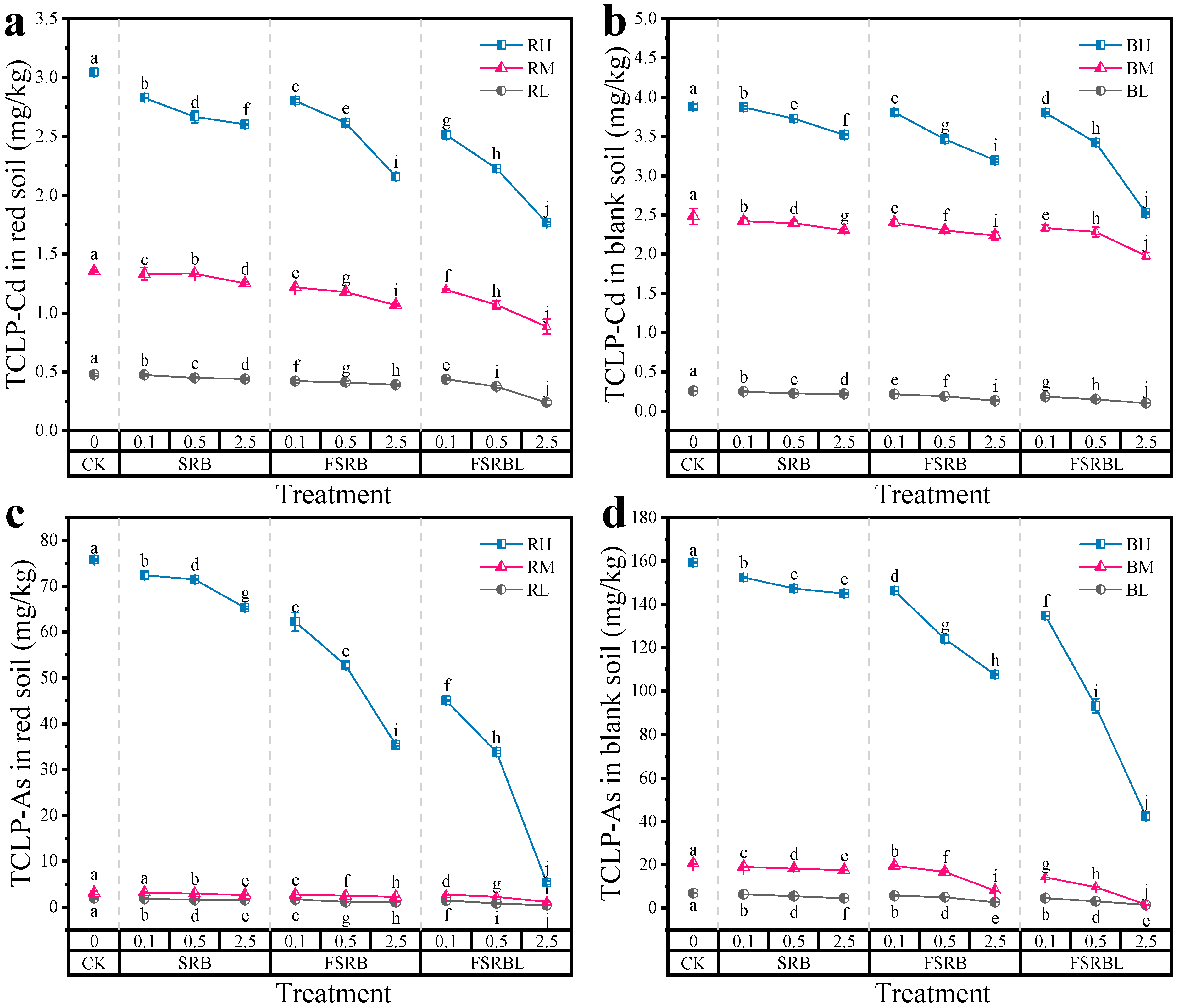
The TCLP test is used to evaluate the inhibitory effect of remediation materials on the leaching of heavy metals. The treatment effects of three Spirulina residue-derived biochars (SRB, FSRB, and FSRBL) on acidic red soil and calcareous black soil are shown in Figure 2. The results show that the contents of TCLP-Cd and TCLP-As in both soils showed a significant downward trend with the increase in biochar addition (p < 0.05). Furthermore, a consistent dose–response relationship was observed in soils with different pollution levels. At the same addition rate, the reduction effect of different biochars on TCLP-Cd/As always showed the following pattern: FSRBL > FSRB > SRB. Taking highly contaminated red soil as an example, at the addition level of 2.5%, SRB, FSRB and FSRBL reduced the TCLP-Cd content by 14.6%, 29.1% and 42.1%, respectively, and reduced the TCLP-As by 13.8%, 53.2% and 93.1%, respectively. This result highlights the key role of iron oxides and LDH in forming a synergistic system in FSRBL. The comparison results with peer studies (Table 1) further show that compared with traditional corn straw biochar, FSRBL not only significantly improves the Cd immobilization efficiency, but more importantly, achieves synergistic remediation of As. This excellent synchronous passivation performance is mainly due to the fact that FSRBL effectively inhibits the activation of As under alkaline conditions through multiple complementary mechanisms [36,37,38]. The relevant molecular mechanisms need to be further characterized and verified.
Figure 2.
Soil leaching amounts of TCLP-Cd and TCLP-As in red soil (a,c) and black soil (b,d) under different treatments. Error bars represent standard deviation (n = 3), and lowercase letters indicate statistically significant differences among treatments (p < 0.05, Duncan’s test).
Table 1.
Comparation of the immobilization efficiencies of Cd and As in contaminated soil by reported biochar-based materials.
3.2.2. Fractionation of Cd and As
The results of the speciation results show that pollution level and soil type jointly regulate the chemical speciation of Cd and As. The fractionation of Cd are ranked from high to low according to mobility: exchangeable state (T-F1), carbonate-bound state (T-F2), iron–manganese oxide-bound state (T-F3), organic-bound state and sulfide-bound state (T-F4), and residual state (T-F5) (Figure S2). The fractionation of As are ranked from high to low according to mobility: non-specific adsorption state (W-F1), specific adsorption state (W-F2), amorphous and weakly crystalline iron–aluminum oxide combined state (W-F3), crystalline iron–aluminum hydrated oxide combined state (W-F4), and residual state (W-F5) (Figure S3).
Under low pollution conditions, black soil has better Cd and As stabilization capacity due to its higher organic matter content, with the residual state of Cd and As reaching 42% and 48%, respectively, which is significantly better than that of red soil. This is consistent with the research conclusion of Zhang et al. (2025) on the important regulatory role of soil organic matter on heavy metal speciation [47]. Specifically, OM can strongly complex Cd2+ via carboxyl and phenolic groups, while promoting the reduction and coprecipitation of As with natural organic matter–Fe complexes. However, under high pollution stress, this advantage is reversed. The residual state of Cd and As in black soil drops to 12% and 15%, respectively, which is lower than that in red soil (17% and 23%). This phenomenon is consistent with the law revealed by the metal immobilization kinetics in sediments; that is, when the pollutant concentration exceeds the soil component loading capacity, the original immobilization mechanism tends to fail [48]. This change reveals the difference in the loading limit of the immobilization capacity of different soil components. For black soil with high organic matter content, the finite binding sites on OM are rapidly saturated under high Cd/As influx, leading to a shift of metals towards more labile exchangeable or specifically adsorbed fractions. Additionally, the competitive sorption between Cd and As oxyanions for limited OM sites may further reduce the overall fixation efficiency. In contrast, the abundant and diverse Fe/Al (hydr)oxides in acidic red soil provide a higher total sorption capacity through specific adsorption and surface precipitation, which are less prone to instantaneous saturation. Of particular note is that the proportion of iron and manganese oxides bound to As in highly contaminated red soil remains at 26%, significantly higher than that in black soil (18%). This result is consistent with reports in typical industrial soil studies that iron and aluminum oxides have a higher potential for As immobilization [49]. The higher content of (hydr)oxides in red soil not only offers more adsorption sites but also may facilitate the formation of more stable inner-sphere complexes and secondary minerals (e.g., Cd/As incorporated into Fe oxide structures) under the prevailing acidic to near-neutral pH conditions, thereby maintaining a relatively higher residual fraction even at high contamination levels. In summary, the initial speciation and its response to pollution pressure are governed by the inherent “carrying capacity” of the dominant reactive phases in each soil. Black soil relies on high-affinity but finite OM sites, excelling at low loads but vulnerable to saturation. Red soil utilizes the higher capacity and chemical resilience of Fe/Al oxides, providing more robust immobilization under high-stress conditions. This change reveals the difference in the loading limit of the immobilization capacity of different soil components. The organic matter binding sites that black soil depends on are easily saturated and deactivated under high pollution conditions, while the abundant iron and aluminum oxides in red soil can maintain the continuous immobilization capacity of heavy metals through specific adsorption and surface precipitation.
Different biochars exhibit significant performance gradients and differentiated action pathways in regulating the chemical speciation of Cd and As. For example, in a low-pollution red soil system, the stabilization efficiency of the three materials for Cd differs significantly: SRB reduces exchangeable Cd (T-F1) from 28% to 19% and residual Cd (T-F5) from 39% to 48%; FSRB further reduces T-F1 to 13% and increases T-F5 to 50% through specific adsorption and co-precipitation of iron oxides; while FSRBL achieves the best immobilization effect by loading LDH, with a T-F1 reduction of 18% and a T-F5 increase of 18%. Notably, under high-pollution conditions, the Cd immobilization mechanism of FSRBL undergoes a strategic shift. Although it still significantly reduced T-F1 in red soil and black soil (by 30% and 50%, respectively), the conversion to residual form was limited (T-F5 increased by only 4% and 9%), while it promoted a significant conversion of Cd to organically bound form (T-F3) (by 21% and 29%, respectively). This phenomenon indicates that under high pollution loads, FSRBL preferentially achieves rapid Cd immobilization through organic complexation pathways rather than directly forming residual forms. Furthermore, FSRBL’s remediation effect in black soil was better than in red soil. The reduction in T-F1 was 20% higher in black soil, the increase in T-F3 was 8% higher, and the increase in T-F4 was 7% higher, highlighting a significant synergistic effect between the organic matter background of black soil and FSRBL.
Regarding the regulation of As speciation, all biochar treatments reduced the proportion of active As, with the effect increasing with the dosage. The 2.5% dosage of FSRBL showed the best effect, similar to the results of the TCLP experiment. For example, in highly contaminated red soil, the 2.5% dosage of SRB resulted in a 6% reduction in the W-F5 proportion, while SRB and FSRBL increased W-F5 by 10% and 20%, respectively. This result further confirms that iron oxides in FSRBL and LDH synergistically enhance As immobilization and stabilization by providing more adsorption sites and enhancing redox regulation (such as promoting the oxidation of As(III) to more easily fixed As(V)). It is noteworthy that the As speciation pathway induced by FSRBL is also regulated by soil type. For example, under the 2.5% dosage of FSRBL treatment, active As in moderately contaminated red soil mainly transformed into W-F3 and W-F5 components, while in moderately contaminated black soil, it mainly transformed into W-F4 and W-F5 components. This may be attributed to the difference between the adsorption mechanism dominated by iron and aluminum oxides in red soil and the role of organic matter-mineral complex in black soil [38]. It is not difficult to find that FSRBL, through the iron-LDH synergistic system, has upgraded its strategy from “precipitation-dominant” to “complexation-precipitation dual pathway” in Cd immobilization, and shows a unique ability of “soil type adaptation” in As immobilization, providing a solid theoretical basis for its precise application in different pollution scenarios.
3.3. Dose–Effect and Response Threshold Analysis
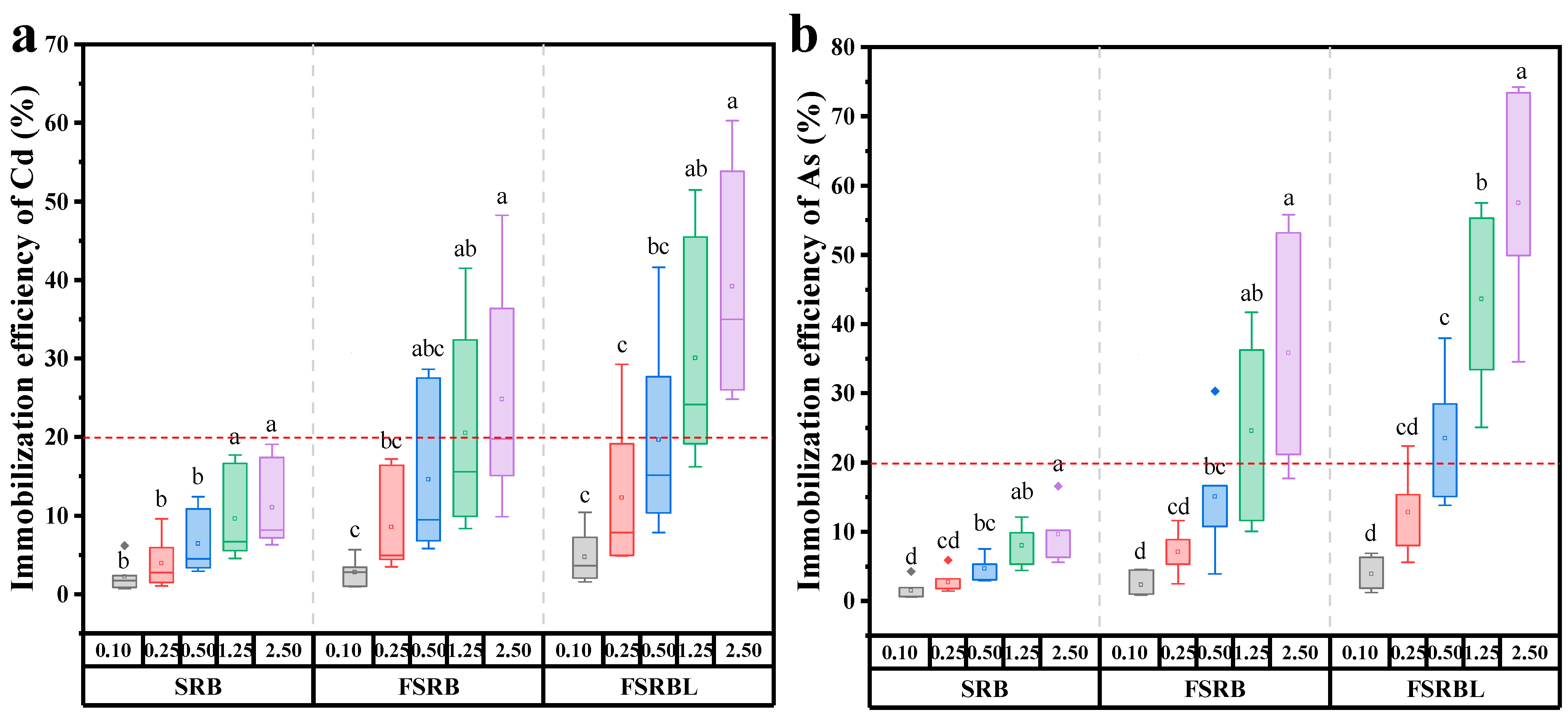
Based on the original addition amount of 0.1%, 0.5% and 2.5%, this study further expanded the addition amount of 0.25% and 1.25%, and systematically evaluated the dose–effect relationship of SRB, FSRB, and FSRBL in the addition amount range of 0.1–2.5% on six Cd–As composite contaminated soils (low, medium and high contaminated RS and BS) (Figure 3). The results showed that the immobilization efficiency of both Cd and As increased with increasing addition amount, but significant differences existed in immobilization efficiency among different materials. At an addition amount of 2.5%, FSRBL exhibited the best immobilization effect, with average immobilization efficiencies of 39.2% and 57.5% for Cd and As, respectively, which were 1.58 and 1.61 times that of FSRB, and 3.55 and 5.97 times that of SRB, highlighting its synergistic remediation advantages. In remediation effectiveness assessment, an immobilization efficiency of 20–30% is typically considered the baseline threshold for a material to possess effective remediation capabilities. This study systematically analyzed the dose–response relationships of FSRBL, FSRB, and SRB on six types of Cd–As co-contaminated soils. The results showed that FSRBL, at a dosage of only 0.5%, enabled both Cd and As immobilization efficiencies to exceed the 20% threshold, while FSRB required a dosage of 1.25%, and SRB failed to achieve the same result even at a dosage of 2.5%. This means that FSRBL reduced the effective remediation dose by more than 60%, demonstrating significant economic efficiency.
Figure 3.
Overall comparison of the immobilization efficiency of SRB, FSRB and FSRBL for Cd (a) and As (b) in six soils at different addition amounts. Error bars represent standard deviation (n = 18), and lowercase letters indicate statistically significant differences among treatments (p < 0.05, Duncan’s test).
The biochar remediation effect observed in this study showed a typical diminishing marginal effect with the change in the amount added. That is to say, the immobilization efficiency corresponding to the unit addition amount gradually decreased with an increase in the addition amount, and the overall trend followed the trend of “rapid increase—slow increase—tending to equilibrium”. In order to accurately quantify the immobilization efficiency law of FSRBL, this study used the Logistic model to fit the dose-effect data [28]. This is because the Logistic model is established in ecotoxicology precisely to describe the responses of such complex systems. Common linear models, which assume a constant proportional effect per unit dose, fail to capture threshold and saturation processes. Saturation models like the Langmuir model, based on single-phase homogeneous adsorption, struggle to describe the overall sigmoidal dynamics in multiphase, heterogeneous soil systems where multiple mechanisms are activated sequentially and act in concert. In contrast, the Logistic model can comprehensively reflect the combined effects of physicochemical and potential biological processes in the complex soil environment. Therefore, it is more suitable than simpler models for quantifying the overall dose-effect relationship of remediation agents in real soil environments. Model validation showed (Figure S4, Tables S4 and S5) that the goodness of fit (R2 > 0.95) confirmed that the Logistic function can strictly characterize the correlation between biochar addition dose and immobilization efficiency. Furthermore, the low Root Mean Square Error (RMSE) values provide statistical support for the applicability and robustness of this model in soil system. Theoretical calculation further revealed the regulation mechanism of soil type and pollution level on remediation efficiency (Table 2). The immobilization efficiency of FSRBL for Cd has a significant soil type dependence. For example, the theoretical addition amount to achieve a 20% immobilization effect in medium-contaminated black soil (BM) is 11.1 times that in low-contaminated black soil (BL). This outlier is directly related to the fact that the proportion of Cd–organic matter complex in BM soil is as high as 48% (BL is only 28%). This phenomenon is consistent with recent research findings on the mechanism by which high organic matter content promotes Cd complexation, but saturated adsorption sites inhibit the immobilization efficiency of exogenous remediation materials [50]. In stark contrast, FSRBL shows stronger universality and efficiency in the remediation of As. The dose requirement for achieving the 20–30% efficiency threshold (EC20–EC30) in all tested soils remained stable in the range of 0.31–1.54%, and showed a negative correlation with the pollution level. Notably, the average dose of As to reach EC30 (0.79%) in different soils was only 51.3% of that of Cd (1.54%). Theoretical calculations confirm that FSRBL only requires a dose of 0.47% to break through the 20% threshold for universal remediation of As, which is highly consistent with the experimental results.
Table 2.
Theoretical addition dosage of FSRBL for Cd and As immobilization efficiency in different soils based on logistic model.
The maximum immobilization potential (peak efficiency A1) of different biochar materials was further identified by the Logistic model. The peak efficiencies of FSRBL for Cd and As reached 28.1–75.7% and 40.5–99.7%, respectively, which were significantly better than those of FSRB (Cd: 9.94–52.7%; As: 18.8–52.8%) and SRB (Cd: 8.38–18.5%; As: 6.62–22.3%). It is worth noting that the peak efficiency of FSRBL for As reached 99.7% and 92.5% in highly contaminated red soil and black soil, respectively, which was 16.8–128.4% higher than that in medium and low pollution conditions, showing a positive response to pollution level. This phenomenon is highly consistent with the conclusion observed in recent studies that iron-based materials are more likely to form stable Fe–O–As precipitates and surface complexes in the context of high arsenic [51]. In contrast, the Cd immobilization efficiency of FSRBL exhibits a synergistic regulatory effect between pollution level and soil type. The peak Cd efficiency in highly contaminated red soil (48.6%) is only slightly higher than under medium- and low-pollution conditions, while in highly contaminated black soil (BH: 40.5%) it is significantly lower than in medium- and low-pollution black soil. This discrepancy may be related to the strong organic matter complexation in highly contaminated black soil inhibiting further FSRBL immobilization. In summary, this study, through a logistic model, clarifies that FSRBL possesses a universally applicable positive concentration response to As, while its Cd remediation is synergistically regulated by pollution level and soil type.
3.4. The Influence on Seed Germination
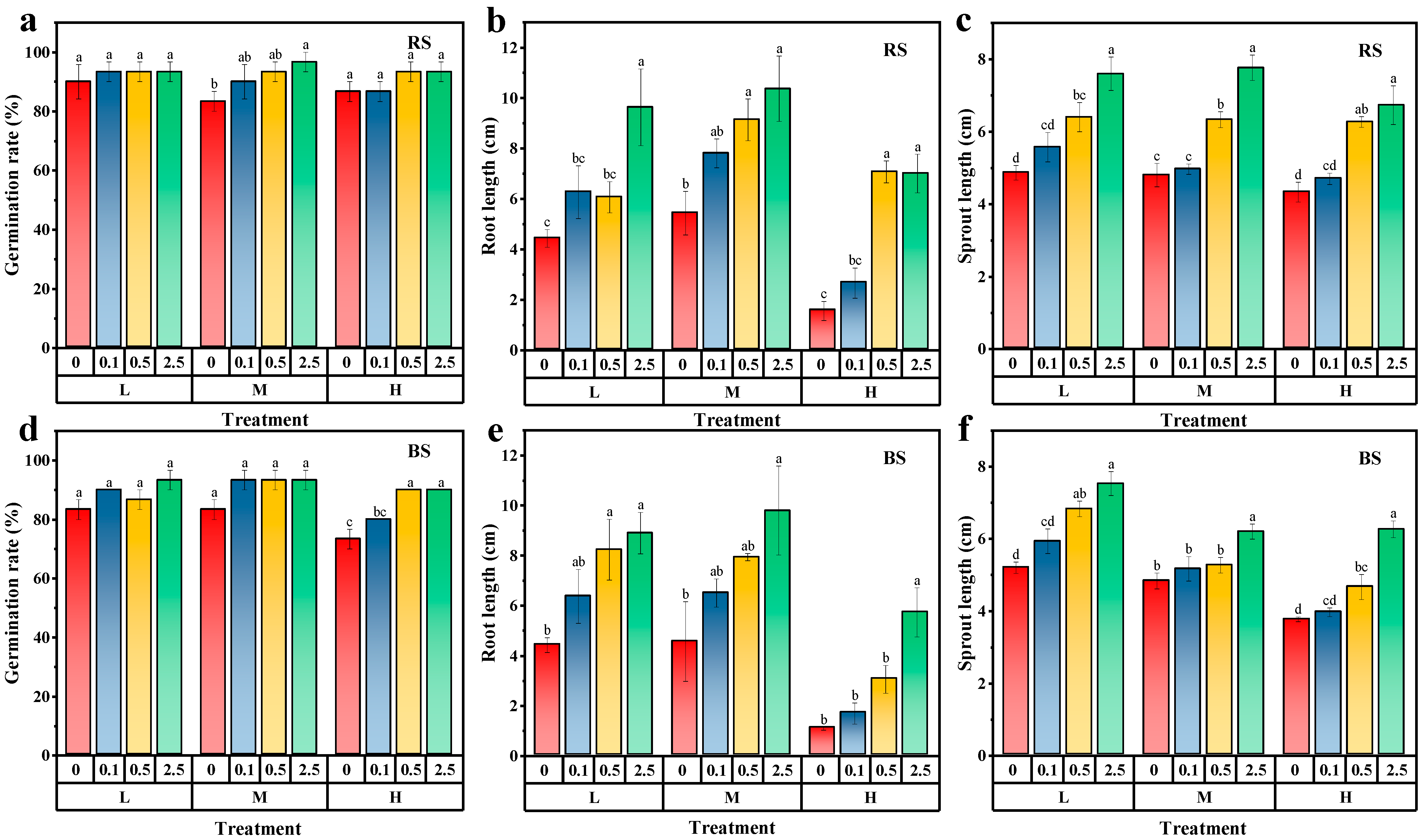
Seed germination tests are a crucial method for assessing the ecological safety and phytotoxicity mitigation effects of remediation materials [52]. The biological impacts of soil leachate after FSRBL remediation were comprehensively evaluated through rice germination experiments. The findings indicated that it exerted a substantial dose-dependent promoting effect on rice growth indicators (Figure 4). In six soil types, the germination rate, shoot length, and root length of rice after FSRBL remediation increased by an average of 11.3%, 31.9%, and 148% compared with the unremediated control group, respectively. In particular, at a dose of 2.5%, the germination rates of highly contaminated red soil and black soil reached 93.3% and 90.0%, respectively, which were 7.14% and 22.7% higher than those of the unremediated control group (p < 0.05). The degree of promotion of FSRBL on different parts of rice varied significantly, and its stimulatory effect on roots was considerably higher than its promotion effect on shoots. Specifically, a 2.5% dose of FSRBL increased stem length by 56.1%, 59.7%, and 55.3% in red soil with low, medium, and high pollution levels, respectively, and by 44.9%, 28.3%, and 66.4% in black soil. The promoting effect on root length was even more significant, increasing by 117%, 90.8%, and 347% in red soil, and by 122%, 146%, and 421% in black soil. This preferential recovery of root growth is directly related to the mechanism of heavy metal toxicity mitigation. Previous studies have confirmed that FSRBL treatment significantly reduced the content of active Cd and As in the soil, leading to a reduction in heavy metal accumulation in rice radicle cells, thereby preferentially relieving the toxic inhibitory effect on root growth. It is worth emphasizing that the promoting effect of FSRBL on plant growth contrasts sharply with the inhibitory effect of biochar reported in some studies. For example, Rogovska et al. found that biochar leachates prepared at high temperatures (732–850 °C) resulted in an average 16% decrease in maize shoot length compared to the control group, indicating that improperly prepared biochar may have an inhibitory effect on plants [53]. Conversely, in this study, FSRBL consistently showed a promoting effect in various soil types even at a relatively high dose of 2.5%, demonstrating that FSRBL successfully transformed heavy metal-stressed environments into a suitable medium for plant growth. From an ecotoxicological perspective, this proves its potential application in multi-scale ecological remediation, ranging from soil chemical remediation to plant physiological recovery.
Figure 4.
Mitigation effect of FSRBL addition on toxicity of contaminated soil leachate ((a,d)—seed germination rate; (b,e)—root length; (c,f)—stem length; soil type: red soil (a–c), black soil (d–f); pollution gradient: low (L), medium (M), high (H)). Error bars represent standard deviation (n = 3), and lowercase letters indicate statistically significant differences among treatments (p < 0.05, Duncan’s test).
3.5. Stabilization Mechanism of FSRBL on Cd and As in Soil
3.5.1. SEM/TEM-EDS Analysis of Micro-Interface Between Soil and FSRBL
SEM microscopic morphology analysis showed that both the original red soil and black soil samples showed a typical dense block structure, with a flat particle surface and no obvious secondary mineral formation (Figure S5). After FSRBL treatment, the surface morphology of the two types of soil particles changed significantly, showing a significant increase in surface roughness and the development of a directional lamellar structure, eventually forming a heterogeneous accumulation with multi-scale hierarchical characteristics, confirming the effective attachment of FSRBL to the surface of the soil matrix and its induced structural reconstruction. It is worth noting that the mass fractions of Cd and As in the soil increased synchronously after treatment, indicating that FSRBL may fix Cd and As on the particle surface through surface adsorption and chemical coordination, thereby enhancing its solidification stability. TEM results showed that the red soil particles after incubation showed regular lattice stripes of 0.661 nm, close to the (003) crystal plane of typical LDH. The black soil particles showed periodic stripes of 0.576 nm, matching the (006) crystal plane of LDH. After FSRBL treatment, both types of soil particles showed surface roughening and formed a heterogeneous coating layer, and the order of their lattice structure was significantly improved, confirming that FSRBL enhanced the synergistic immobilization of Cd–As by coating the surface of soil particles.
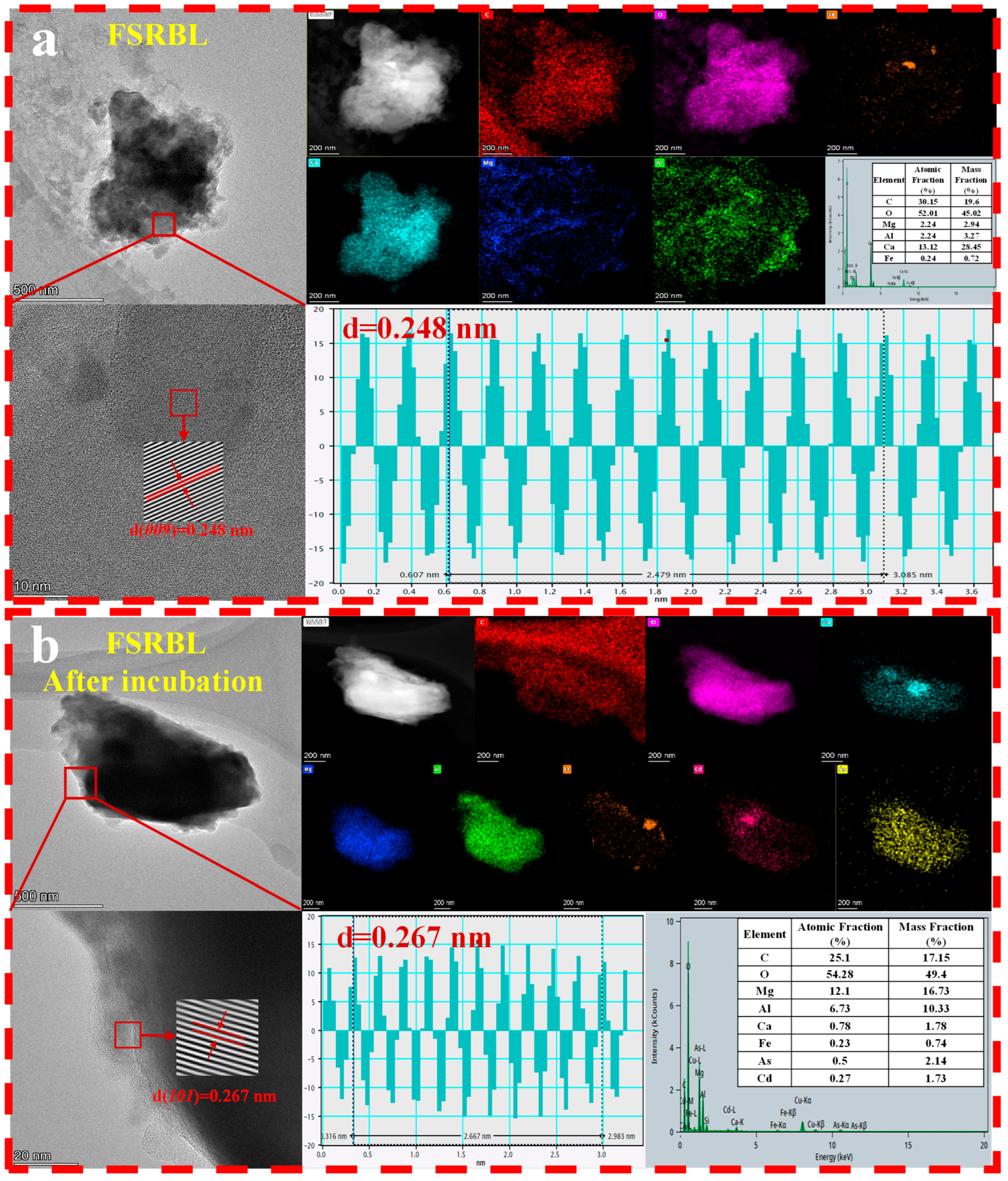
In order to further explore the immobilization mechanism of FSRBL itself, the structural evolution and composition changes in FSRBL before and after cultivation in Cd–As contaminated soil were compared and analyzed by TEM and EDS (Figure 5). High-resolution TEM results showed that the characteristic crystal plane of LDH in FSRBL before cultivation was (009) (d = 0.248 nm), while it was transformed into (101) crystal plane (d = 0.267 nm) after cultivation, indicating that the LDH structure was dynamically reorganized in the soil environment but remained stable as a whole. At the same time, EDS analysis showed that the atomic fraction of Ca element decreased significantly from 13.12% to 0.78% after cultivation, and the immobilization signals of Cd and As were detected. The above phenomenon indicates that Cd2+ in the soil environment may undergo isomorphic substitution with Ca2+ in the LDH layer, resulting in Cd2+ being fixed in the LDH layer. The dissolution of Ca2+ induces an imbalance in the layer charge, which in turn drives the reconstruction of Cd2+ and Mg2+/Al3+ to form a Cd–Mg–Al type LDH phase (corresponding to the (101) crystal plane). In this process, the LDH interlayer anions (such as CO32−) are replaced by AsO43−, and the LDH layer hydroxyl groups (-OH) form a stable complex with Cd2+ through surface coordination. Therefore, FSRBL achieves the simultaneous and efficient immobilization of Cd–As at the soil–material interface through the dynamic reorganization of its LDH components and the adsorption of biochar.
Figure 5.
Surface element distribution and EDS spectrum before (a) and after (b) FSRBL incubation (the red box indicates the corresponding magnified area).
3.5.2. XRD Analysis of Cd/As Species
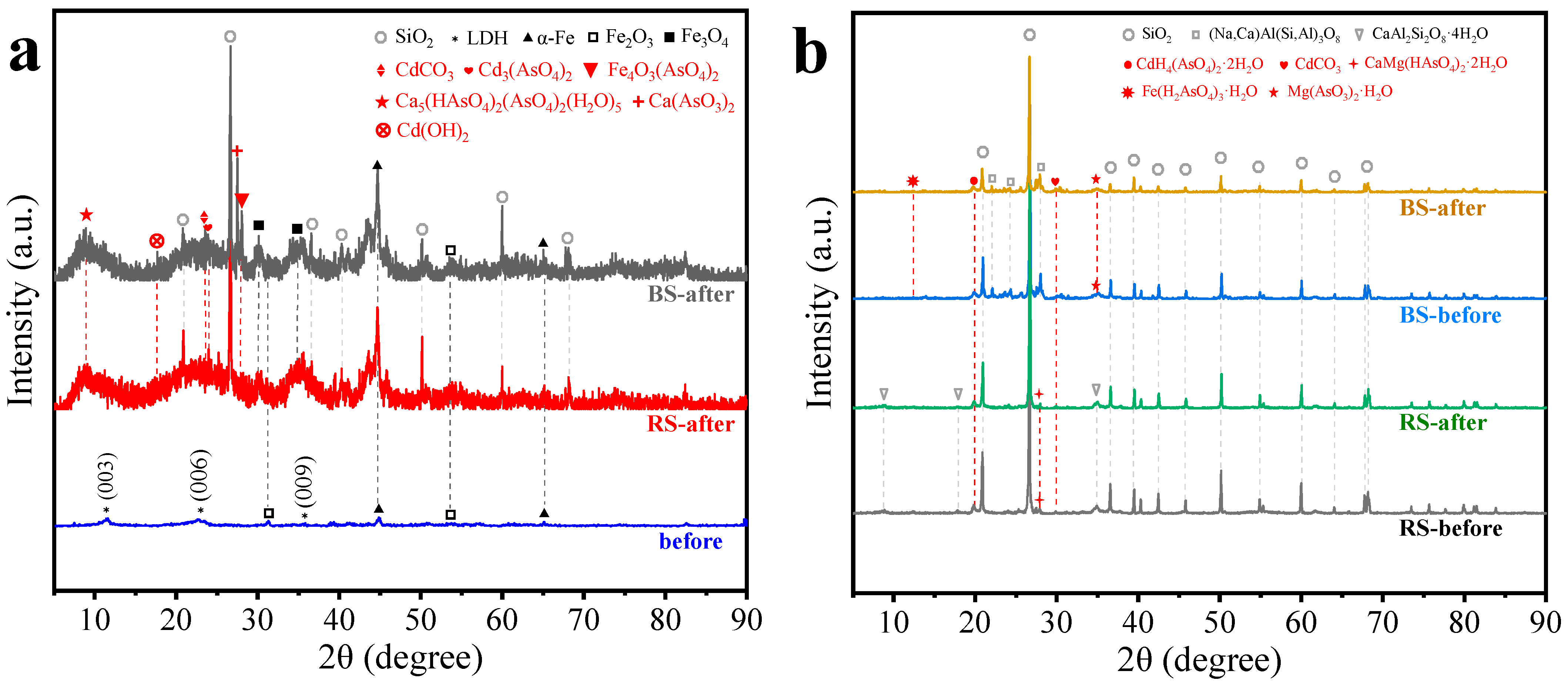
In order to further analyze the structural evolution and immobilization mechanism of the active components of FSRBL during the repair process, the XRD patterns of FSRBL before and after cultivation in red soil and black soil were further compared and analyzed (Figure 6a). The original FSRBL is mainly composed of LDH (PDF-#89-0460), α-Fe (PDF-#06-0696) and Fe2O3 (PDF-#84-0306). The enrichment of SiO2 (PDF-#46-1045) was detected in the FSRBL after cultivation in both types of soil, and the LDH structure was retained. At the same time, the characteristic peaks of the (220) and (311) crystal planes of Fe3O4 (PDF-#76-1849) appeared at 30.076° and 35.426°, indicating that Fe3+ was partially reduced to magnetic Fe3O4, which enhanced the surface redox activity. The immobilization of Cd2+ was evidenced by the formation of multiple crystalline phases. At 23.585°, 17.811°, and 24.361°, characteristic peaks corresponding to the (110), (110) and (130) crystal planes of CdCO3 (PDF-#85-0989), Cd(OH)2 (PDF#84–1767) and Cd3(AsO4)2 (PDF-#71-2080) were identified, respectively. This indicates that cadmium immobilization occurs simultaneously through carbonate precipitation, hydroxide precipitation, and arsenate co-precipitation. The peak of Fe4O3(AsO4)2 (PDF-#83-1554) (011) at 28.278° indicated the formation of Fe-As-O complex, reflecting that the Fe component was bound to As(V) by coordination adsorption. In addition, the appearance of the characteristic peak of the Ca(AsO3)2 (101) crystal plane at 27.622° in the black soil system (PDF-#75-0738) further revealed the soil-specific mechanism of the combination of Ca2+ and As(III) in FSRBL to form calcium arsenite precipitation. The above results indicate that FSRBL synchronously drives the mineralization immobilization of Cd (carbonate/arsenate) and the oxidative immobilization of As (Fe-As-O/Ca-As) by maintaining the structural stability of LDH, regulating the redox activity of Fe components, and synergizing the Ca/Mg/Al multimetallic effects.
Figure 6.
XRD patterns of FSRBL (a) and red/black soils (b) before and after their respective incubation processes.
The XRD patterns of red soil and black soil before and after FSRBL treatment are shown in Figure 6b. The main crystal phase of the soil before and after treatment was SiO2 (PDF-#46-1045). In addition, calcium feldspar (CaAl2Si2O8·4H2O, PDF-#20-0452) was detected in the original red soil, and sodium calcium feldspar ((Na,Ca)Al(Si,Al)3O8, PDF-#41-1480) was identified in the original black soil. After FSRBL incubation, the characteristic peak of the (020) crystal plane of Ca(H2AsO4)2 (PDF-#51-1466) was identified at 25.006° in both types of soil, indicating that As(V) combined with Ca2+ released by FSRBL to form a stable calcium arsenate precipitate. At the same time, the characteristic peak of (104) crystal plane of CdCO3 at 30.275° confirmed that Cd2+ formed low-solubility minerals through carbonate. In addition, the red soil added a new characteristic peak of CaMg(HAsO4)2·2H2O (PDF-#45-1382) at 27.769°, revealing the coordination precipitation path of Ca/Mg synergistic immobilization of As(III). Black soil showed characteristic peaks at 35.022° (Mg(AsO3)2·H2O, PDF-#18-0775) and 12.439° (Fe(H2AsO4)3·H2O, PDF-#26-0784), respectively, indicating that Mg2+ adsorbed and fixed As(III), and Fe3+ fixed As(V) through surface hydroxyl complexation. The above results show that FSRBL drives the polymorphic precipitation and immobilization of Cd and As in soil by inducing the synergistic effect of multiple metal ions such as Ca/Mg/Fe. Its remediation mechanism is both broad-spectrum (generally forming CdCO3 and Ca-As phases) and soil-specific (relying on Ca-Mg synergy in red soil and Fe-Mg coupling in black soil), providing a material design basis for the targeted remediation of composite contaminated soils with multi-mechanism synergy.
3.5.3. XPS Analysis of Key-Metal Complexation
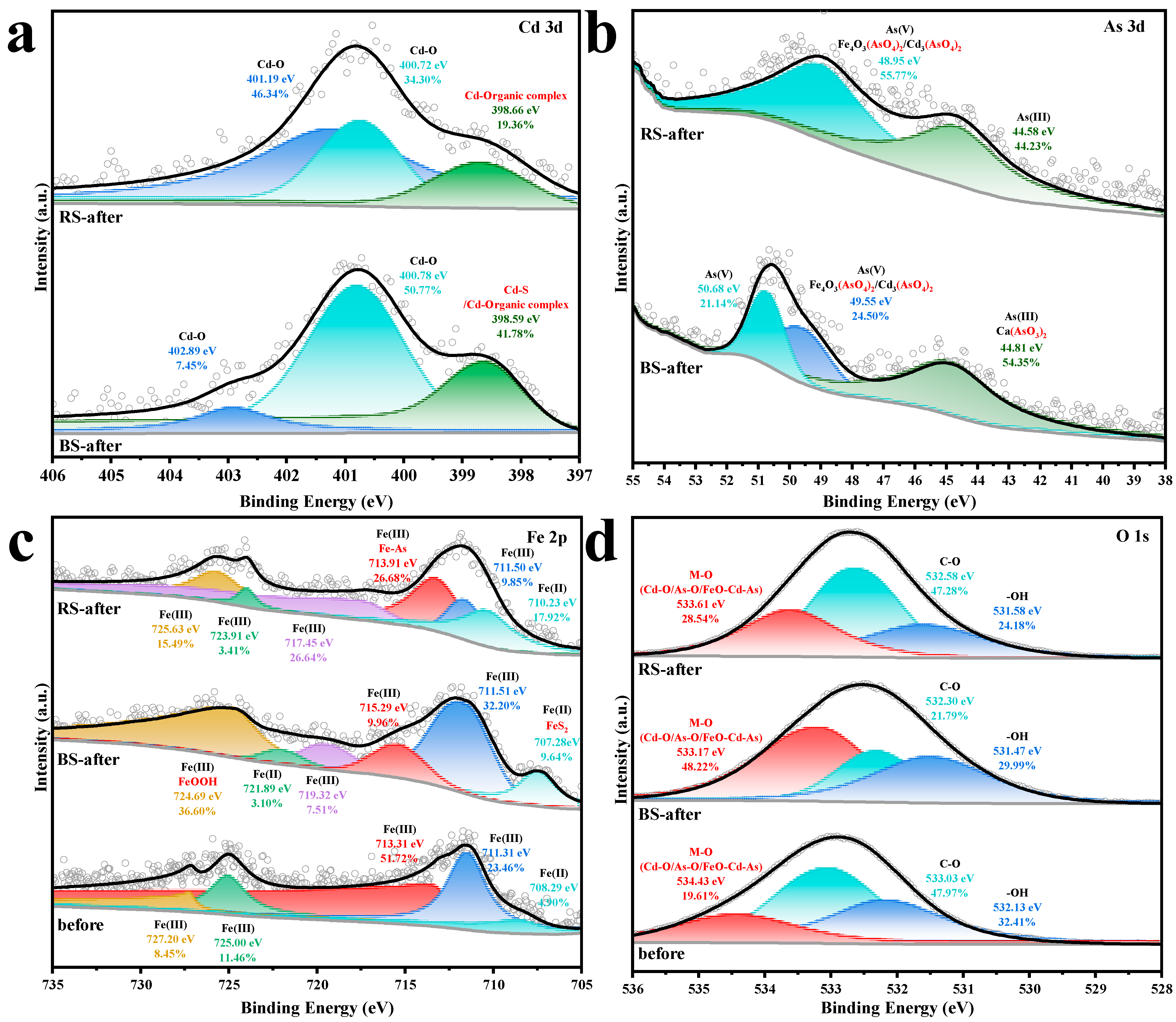
High-resolution XPS analysis systematically elucidated the differential chemical mechanisms of Cd–As immobilization by FSRBL in red soil and black soil environments (Figure 7). The C 1s spectrum after incubation showed new carbonate peaks in the range of 287.6–288.3 eV, which directly corroborated the CdCO3 precipitation widely detected by XRD (PDF-#85-0989), confirming that carbonate precipitation is a common pathway for Cd immobilization. After incubation in red soil, the characteristic peaks of Cd 3d spectrum at 400.72 eV and 401.19 eV were attributed to Cd–O bonding structure (CdCO3). While As 3d showed that As mainly existed in the form of As(V), combined with the mineralogical evidence of Fe4O3(AsO4)2 and Cd3(AsO4)2, they jointly confirmed the iron oxide-driven arsenate precipitation mechanism. At the same time, the increase in the proportion of Fe(II) in the Fe 2p spectrum and the characteristic peak of Fe(III)-AsO4 at 713.91 eV further verified the immobilization mechanism of the dual pathway of oxidation–precipitation on red soil.
Figure 7.
High-resolution XPS spectra of FSRBL before and after incubation (including Cd 3d (a), As 3d (b), Fe 2p (c), and O 1s (d); RS: red soil; BS: black soil).
After incubation in black soil, the peak at 398.59 eV in the Cd 3d spectrum of FSRBL is attributed to the Cd–S bonding state (CdS), which together with the characteristic peak of FeS2 at 707.28 eV in the Fe 2p spectrum constitutes direct evidence for the sulfide immobilization pathway. In this process, FeS2 acts as an electron donor to reduce As(V) to As(III) and provides S2− to generate CdS precipitate; the released As(III) further combines with Ca2+ dissolved from FSRBL to form Ca(AsO3)2 precipitate. In addition, the characteristic peak of FeOOH at 724.69 eV in the Fe 2p spectrum indicates that amorphous iron oxyhydroxide plays a role in immobilization through surface hydroxyl complexation. It is worth noting that the synchronously enhanced low binding energy components in the Ca 2p, Mg 2p and Al 2p spectra after incubation indicate that the LDH layer metal groups participate in the immobilization process through M-O-Cd/As (M = Ca, Mg, Al) complexation.
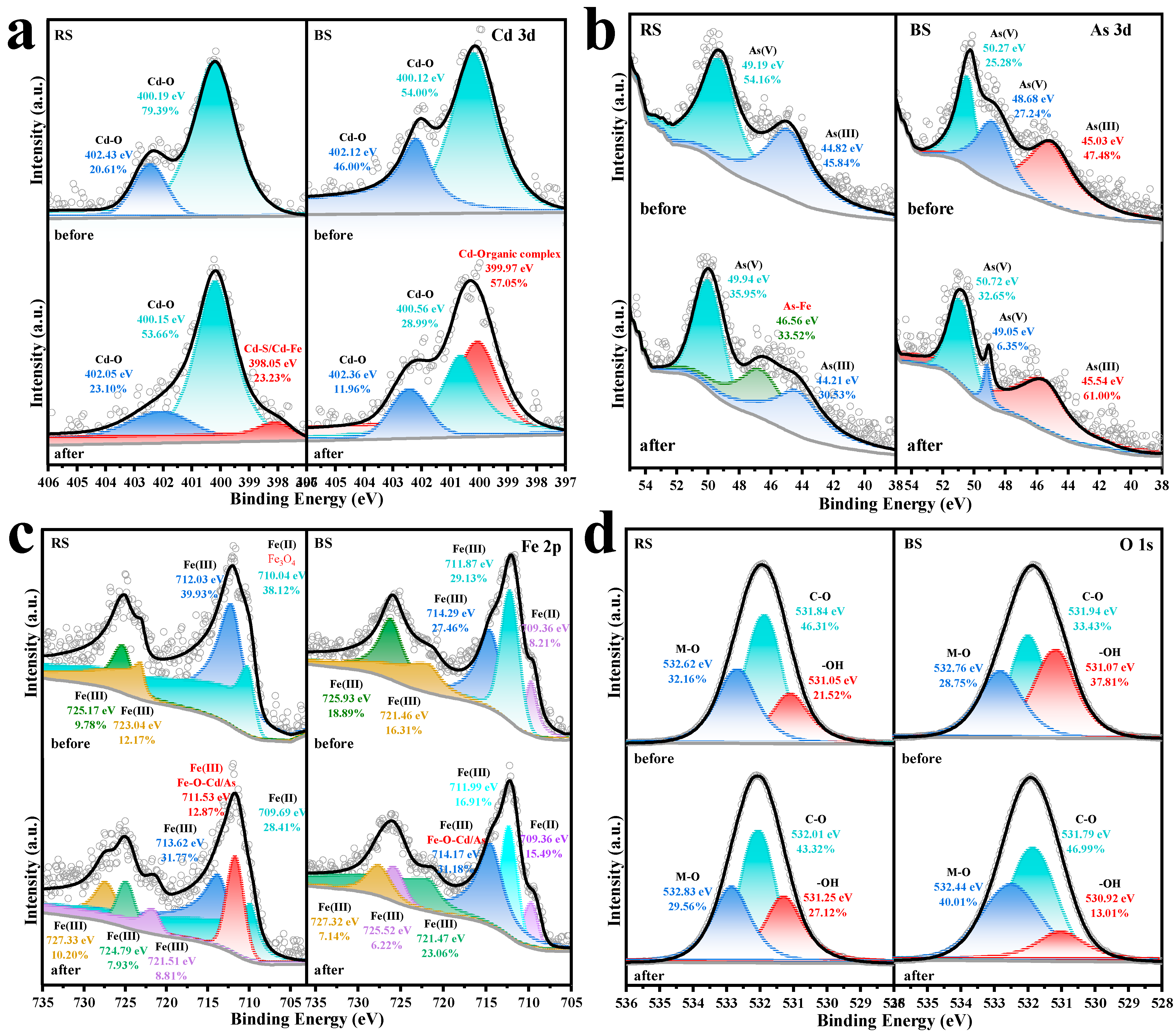
High-resolution XPS analysis further elucidated the synergistic immobilization mechanism of FSRBL and soil interface (Figure 8). In the red soil system, soil XPS detected the FSRBL-induced carbon skeleton oxidation state increase and hydroxyl oxygen enrichment, which was not observed in the FSRBL XPS itself, revealing the oxidative activation effect of FSRBL on the soil matrix. More importantly, the establishment of the As–Fe coordination peak at 46.56 eV in the soil As 3d spectrum and the Cd–Fe oxide binding state at 398.05 eV in the Cd 3d spectrum, as well as the formation of Fe–O–Cd/As at 711.53 eV in the Fe 2p spectrum of FSRBL, confirmed that the precipitation pathway of iron oxides in red soil is dominated by interfacial mineral reorganization. In the black soil system, the significant increase in the proportion of soil As(III) (61.00%) is highly consistent with the 54.35% As(III) data in FSRBL XPS. Combined with the Ca(AsO3)2 precipitation detected by XRD, it is obvious that soil As is fixed in the soil by forming Ca(AsO3)2 with Ca2+ released from the layered double hydroxide sheets. At the same time, the discovery of the characteristic peak of Cd–organic complex at 399.97 eV in the soil Cd 3d spectrum complements the material characterization of the Cd–S component at 398.59 eV in the black soil by FSRBL, jointly revealing the inhibition of mineralization pathways by organic matter-mediated complexation in black soil.
Figure 8.
High-resolution XPS spectra of red soil (RS) and black soil (BS) before and after FSRBL restoration (including Cd 3d (a), As 3d (b), Fe 2p (c), and O 1s (d)).
Here, we have elucidated the mechanism by which FSRBL achieves in situ immobilization of Cd and As in soil through the construction of a complete evidence chain of the “material–soil” interface. Typically, FSRBL achieves efficient synergistic immobilization of Cd–As through multiple actions, including structural reconstruction of the LDH component, regulation of the redox activity of the Fe component, mineral precipitation, and coordination complex formation. Cd undergoes isomorphous replacement with Ca2+ in the LDH layers, leading to the immobilization of Cd2+ within the LDH layers and driving the restructuring to form a Cd–Mg–Al type LDH phase. Meanwhile, As is fixed between the LDH layers through ion exchange with interlayer anions such as CO32−. The metal groups (M = Ca, Mg, Al) in the LDH layers form stable coordination complexes M-O-Cd/As through surface coordination. Concurrently, the reductive action of iron oxides drives the oxidation of As(III) to the less toxic As(V) and promotes the formation of Fe/Ca/Cd–As(V) precipitates. Cd is primarily fixed by forming CdCO3. Notably, iron oxides in red soil dominate As(V) precipitation through interfacial mineral reorganization. In contrast, FeS2 in black soil reduces As(V) to As(III), promoting the formation of Mg/Ca-As(III) and CdS precipitates. Therefore, the synergistic immobilization mechanism of FSRBL for Cd and As exhibits both universality and soil-specific variability.
3.6. Economic Viability, Feasibility and Outlook
In in situ soil remediation, the economic viability of remediation materials is a key factor in determining their practical application potential. The FSRBL composite material prepared in this study has an estimated production cost of approximately $1030 per ton. Compared to widely reported biochar-based remediation agents (which have production costs ranging from approximately $560 to $5490 per ton), FSRBL’s cost is moderately low, demonstrating strong economic competitiveness [54]. Based on this, within an application dosage range of 0.1–2.5%, the material cost per ton of soil treated is approximately $1.03–25.75. In particular, considering that FSRBL can simultaneously and efficiently immobilize Cd and As, two geochemically conflicting elements, its comprehensive environmental benefits, such as reduced additive dosage and reduced secondary pollution, further enhance its application potential.
While the 50-day incubation period in this study was sufficient to reveal the primary immobilization mechanisms, long-term field stability remains to be fully validated. Future work should focus on (i) monitoring the persistence of immobilization effects under real-world climatic cycles (wet–dry, freeze–thaw), (ii) evaluating the impact of root exudates and soil microbial activity on the stability of the sequestered phases, and (iii) assessing the economic and environmental trade-offs of large-scale deployment, including the feasibility of magnetic recovery of spent material for resource recycling. Furthermore, the intrinsic magnetic properties of FSRBL, conferred by iron phases, present a promising avenue for enhancing its long-term feasibility and environmental sustainability. Beyond the mechanistic role of iron in immobilization, this feature enables the potential magnetic recovery of the spent material from remediated soil. Future research should quantitatively evaluate the magnetic separation efficiency under field-relevant conditions and assess the potential for material regeneration and reuse. Successful development of this recovery technology could significantly reduce long-term application costs, minimize material residue in the soil, and enable the centralized treatment of concentrated contaminants, thereby advancing FSRBL towards a more sustainable and circular remediation strategy.
4. Conclusions
This study demonstrates that the Magnetic Spirulina residue biochar crosslinked LDH composite (FSRBL) exhibits highly efficient synergistic remediation capabilities in various Cd–As co-contaminated soils. At a dosage of 2.5%, FSRBL achieved average immobilization rates of 39.2% for Cd and 57.5% for As, exceeding those of FSRB by 1.58/1.61 times and SRB by 3.55/5.97 times, respectively. It effectively overcame the technical bottleneck faced by traditional materials in simultaneously immobilizing contaminants with antagonistic geochemical behaviors. Critically, addressing a key research gap, the scarcity of quantitative dose-effect models for cost optimization and precise application, this study employed a logistic model to quantitatively delineate the dose–response relationship of FSRBL and establish its critical remediation thresholds. The mean EC30 value for As was determined to be 0.79%, showing minimal variation across different soil types and indicating excellent universality. In contrast, the mean EC30 for Cd was 1.54%, demonstrating a degree of soil type dependency. These findings provide a direct reference for the precise application of FSRBL, directly addressing the imperative to balance dosage with cost-effectiveness and to define key thresholds to prevent over-application and potential secondary ecological risks, such as those associated with excessive biochar. Rice seed germination experiments further confirmed the significant ecological restoration effect of FSRBL. Soils remediated with FSRBL showed a substantial reduction in ecotoxicity, evidenced by increased seed germination rates (7.14–22.7%) and significantly enhanced root length (90.8–421%), thereby validating the environmental safety of this strategy from an ecotoxicological perspective. Through advanced characterization techniques (SEM/TEM-EDS, XRD, XPS), the synergistic mechanisms of FSRBL were elucidated. Multiple synergistic effects were identified on FSRBL, including LDH component reconstruction (involving Cd isomorphic substitution and As anion exchange), Fe-mediated redox transformation of As, coprecipitation, and coordination/complexation. These processes effectively reconcile the conflicting environmental conditions required for individual Cd and As immobilization. At the soil colloidal interface, FSRBL synergistically drives the formation of CdCO3 precipitation and promotes the redox transformation of As to form Fe/Ca/Cd–As(V) minerals. Notably, soil type influences the specific mechanistic pathways, as evidenced by the significant formation of Mg/Ca–As(III) complexes and CdS precipitation observed in calcareous black soil.
In summary, this work provides systematic breakthroughs from material design to application strategy. The elucidated dose–response dynamics and multi-scale mechanisms not only offer an innovative technical approach and scientific basis for the precise remediation of Cd–As co-contaminated soils but also, by establishing critical dosage thresholds and quantifying the dosage-benefit relationship, deliver crucial theoretical support and practical guidance for optimizing remediation costs, enhancing efficiency, and preventing secondary ecological risks in real-world farmland remediation, directly addressing central pain points in the field.
Supplementary Materials
The following supporting information can be downloaded at: https://www.mdpi.com/article/10.3390/agronomy15122913/s1. Text S1. Material characterization. Figure S1. The XRD patterns of SRB, FSRB and FSRBL. Figure S2. Distribution characteristics of Cd chemical forms in red soil (a–c) and black soil (d–f) under different restoration treatments. Figure S3. Distribution characteristics of As chemical forms in red soil (a–c) and black soil (d–f) under different restoration treatments. Figure S4. Logistic dose–response relationships of SRB (a,d), FSRB (b,e) and FSRBL (c,f) for Cd and As remediation in soils with multiple pollution levels. Figure S5. SEM images of soil particles in red soil (a,b) and black soil (c,d) before and after FSEBL incubation, as well as the element distribution map of the soil surface and the element energy spectrum (EDS) spectra (i,j) of soil particles in red soil (e,f) and black soil (g,h). Figure S6. High-resolution XPS spectra of FSRBL before and after incubation (including Ca 2p (a), Mg 1s (b), Al 2p (c), and C1s (d); RS: red soil; BS: black soil). Figure S7. High-resolution XPS spectra of red soil (RS) and black soil (BS) before and after FSRBL restoration (including Ca 2p (a), Mg 1s (b), Al 2p (c), and C1s (d). Table S1. Immobilization efficiency of SRB, FSRB and FSRBL in red and black soils with low, medium and high Cd–As contamination levels. Table S2. The main physicochemical properties of SRB, FSRB, and FSRBL. Table S3. Parameters of the Logistic dose–effect model for remediation of Cd by SRB, FSRB and FSRBL in soils with multiple pollution levels. Table S4. Parameters of the Logistic dose–effect model for remediation of As by SRB, FSRB and FSRBL in soils with multiple pollution levels. Table S5. Theoretical addition dosage of FSRBL for Cd and As immobilization efficiency in different soils based on logistic model [55,56,57,58].
Author Contributions
X.Z.: Investigation, Methodology, Formal analysis, Data curation, Writing—original draft. L.L.: Conceptualization, Supervision, Methodology, Funding acquisition, Writing—review and editing. M.K.: Validation, Writing—review and editing. All authors have read and agreed to the published version of the manuscript.
Funding
This work was financed by National Natural Science Foundation of China (No. 42377257).
Data Availability Statement
Data will be made available on request.
Conflicts of Interest
The authors declare no conflicts of interest.
References
- Qin, G.; Niu, Z.; Yu, J.; Li, Z.; Ma, J.; Xiang, P. Soil heavy metal pollution and food safety in China: Effects, sources and removing technology. Chemosphere 2021, 267, 129205. [Google Scholar] [CrossRef]
- Yuan, X.; Xue, N.; Han, Z. A meta-analysis of heavy metals pollution in farmland and urban soils in China over the past 20 years. J. Environ. Sci. 2021, 101, 217–226. [Google Scholar] [CrossRef]
- Hou, D.; Jia, X.; Wang, L.; McGrath, S.P.; Zhu, Y.-G.; Hu, Q.; Zhao, F.-J.; Bank, M.S.; O’Connor, D.; Nriagu, J. Global soil pollution by toxic metals threatens agriculture and human health. Science 2025, 388, 316–321. [Google Scholar] [CrossRef]
- Shen, B.; Wang, X.; Zhang, Y.; Zhang, M.; Wang, K.; Xie, P.; Ji, H. The optimum pH and Eh for simultaneously minimizing bioavailable cadmium and arsenic contents in soils under the organic fertilizer application. Sci. Total Environ. 2020, 711, 135229. [Google Scholar] [CrossRef]
- Yang, X.; Wen, E.; Ge, C.; El-Naggar, A.; Yu, H.; Wang, S.; Kwon, E.E.; Song, H.; Shaheen, S.M.; Wang, H.; et al. Iron-modified phosphorus- and silicon-based biochars exhibited various influences on arsenic, cadmium, and lead accumulation in rice and enzyme activities in a paddy soil. J. Hazard. Mater. 2023, 443, 130203. [Google Scholar] [CrossRef] [PubMed]
- Baragaño, D.; Alonso, J.; Gallego, J.R.; Lobo, M.C.; Gil-Díaz, M. Zero valent iron and goethite nanoparticles as new promising remediation techniques for As-polluted soils. Chemosphere 2020, 238, 124624. [Google Scholar] [CrossRef]
- Kumpiene, J.; Carabante, I.; Kasiuliene, A.; Austruy, A.; Mench, M. LONG-TERM stability of arsenic in iron amended contaminated soil. Environ. Pollut. 2021, 269, 116017. [Google Scholar] [CrossRef] [PubMed]
- Wu, H.; Liu, L.; Sun, J.; He, X.; Li, Z.; Tang, J. Iron-silicon modified biochar for remediation of cadmium/arsenic co-contaminated paddy fields: Is it possible to kill two birds with one stone? J. Hazard. Mater. 2025, 494, 138702. [Google Scholar] [CrossRef] [PubMed]
- Wang, W.; Wu, S.; Huang, J.; Zhang, X.; Xie, J.; Lu, Y.; Li, J.; Wei, J.; Wu, B.; Cheng, S. Microalgae realizes self N-doped biochar for heavy metal polluted sediment remediation. J. Hazard. Mater. 2024, 479, 135746. [Google Scholar] [CrossRef]
- Wu, C.; Cui, M.; Xue, S.; Li, W.; Huang, L.; Jiang, X.; Qian, Z. Remediation of arsenic-contaminated paddy soil by iron-modified biochar. Environ. Sci. Pollut. Res. 2018, 25, 20792–20801. [Google Scholar] [CrossRef]
- Lin, L.; Qiu, W.; Wang, D.; Huang, Q.; Song, Z.; Chau, H.W. Arsenic removal in aqueous solution by a novel Fe-Mn modified biochar composite: Characterization and mechanism. Ecotoxicol. Environ. Saf. 2017, 144, 514–521. [Google Scholar] [CrossRef]
- Feng, Z.; Cao, X.; Zhou, B.; Li, H.; Liu, H.; Yuan, R.; Wang, X.; Chen, Z.; Luo, S.; Chen, H. Influence mechanisms of different stalks on iron species type of magnetic biochar prepared from Fe2O3. Sci. Total Environ. 2023, 903, 166790. [Google Scholar] [CrossRef]
- Cui, S.; Peng, Y.; Yang, X.; Gao, X.; Guan, C.-Y.; Fan, B.; Zhou, X.; Chen, Q. Comprehensive understanding of guest compound intercalated layered double hydroxides: Design and applications in removal of potentially toxic elements. Crit. Rev. Environ. Sci. Technol. 2023, 53, 457–482. [Google Scholar] [CrossRef]
- Jing, Y.; Chen, R.; Zhang, J.; Hu, L.; Qiu, X. Developed Recyclable CaFe-Layered Double Hydroxide for Efficient Cadmium Immobilization in Soil: Performance and Bioavailability. Minerals 2024, 14, 656. [Google Scholar] [CrossRef]
- Kong, X.; Hao, P.; Duan, H. Super-stable mineralization effect of layered double hydroxides for heavy metals: Application in soil remediation and perspective. Exploration 2021, 1, 20210052. [Google Scholar]
- Pan, X.; Kuang, S.; Wang, X.; Ullah, H.; Rao, Z.; Ali, E.F.; Abbas, Q.; Lee, S.S.; Shaheen, S.M. Functionalization of sawdust biochar using Mg-Fe-LDH and sodium dodecyl sulfonate enhanced its stability and immobilization capacity for Cd and Pb in contaminated water and soil. Biochar 2025, 7, 16. [Google Scholar]
- Liang, X.; Su, Y.; Wang, X.; Liang, C.; Tang, C.; Wei, J.; Liu, K.; Ma, J.; Yu, F.; Li, Y. Insights into the heavy metal adsorption and immobilization mechanisms of CaFe-layered double hydroxide corn straw biochar: Synthesis and application in a combined heavy metal-contaminated environment. Chemosphere 2023, 313, 137467. [Google Scholar] [CrossRef] [PubMed]
- Liao, W.; Zhang, X.; Shao, J.; Yang, H.; Zhang, S.; Chen, H. Simultaneous removal of cadmium and lead by biochar modified with layered double hydroxide. Fuel Process. Technol. 2022, 235, 107389. [Google Scholar] [CrossRef]
- Cao, S.; Zhu, J.; Gan, X.; Fu, Q.; Hu, H.; Huang, Q. Synergic impact mechanisms of cover crop residue on Cd and As availability and native organic carbon mineralization in Cd and As co-contaminated paddy soil. J. Hazard. Mater. 2025, 500, 140491. [Google Scholar] [CrossRef]
- Lebrun, M.; Miard, F.; Nandillon, R.; Morabito, D.; Bourgerie, S. Biochar Application Rate: Improving Soil Fertility and Linum usitatissimum Growth on an Arsenic and Lead Contaminated Technosol. Int. J. Environ. Res. 2021, 15, 125–134. [Google Scholar] [CrossRef]
- GB 15618-2018; Soil Environmental Quality—Risk Control Standard for Soil Contamination of Agricultural Land. China Environmental Science Press: Beijing, China, 2018.
- Wang, L.; Cui, X.; Cheng, H.; Chen, F.; Wang, J.; Zhao, X.; Lin, C.; Pu, X. A review of soil cadmium contamination in China including a health risk assessment. Environ. Sci. Pollut. Res. 2015, 22, 16441–16452. [Google Scholar] [CrossRef] [PubMed]
- Gong, Y.; Qu, Y.; Yang, S.; Tao, S.; Shi, T.; Liu, Q.; Chen, Y.; Wu, Y.; Ma, J. Status of arsenic accumulation in agricultural soils across China (1985–2016). Environ. Res. 2020, 186, 109525. [Google Scholar] [CrossRef]
- Wu, J.; Li, Z.; Huang, D.; Liu, X.; Tang, C.; Parikh, S.J.; Xu, J. A novel calcium-based magnetic biochar is effective in stabilization of arsenic and cadmium co-contamination in aerobic soils. J. Hazard. Mater. 2020, 387, 122010. [Google Scholar] [CrossRef]
- Tessier, A.; Campbell, P.G.C.; Bisson, M. Sequential extraction procedure for the speciation of particulate trace metals. Anal. Chem. 1979, 51, 844–851. [Google Scholar] [CrossRef]
- Wenzel, W.W.; Kirchbaumer, N.; Prohaska, T.; Stingeder, G.; Lombi, E.; Adriano, D.C. Arsenic fractionation in soils using an improved sequential extraction procedure. Anal. Chim. Acta 2001, 436, 309–323. [Google Scholar] [CrossRef]
- Yu, L.; Chen, S.; Wang, J.; Qin, L.; Sun, X.; Zhang, X.; Wang, M. Environmental risk thresholds and prediction models of Cd in Chinese agricultural soils. Sci. Total Environ. 2024, 906, 167773. [Google Scholar]
- Yang, B.; Lv, Y.; Zhang, Z.; He, X.; Zhu, Y. Anticorrosion mechanism of natural acidic amino acids on steel in chloride solution: Experimental, theoretical and machine learning approaches. J. Build. Eng. 2023, 79, 107801. [Google Scholar] [CrossRef]
- Sun, X.; Qin, L.; Yu, L.; Wang, J.; Liu, J.; Wang, M.; Chen, S. Ecological risk threshold for chromium in Chinese soils and its prediction models. Environ. Res. 2024, 262, 119935. [Google Scholar] [CrossRef]
- Gao, J.; Zheng, L.; Xu, M.; Sun, N.; Zhang, Q.; Li, R.; Cai, Z. Effects of Biochar Application on Soil pH: A Meta-Analysis. J. Agric. Sci. Technol. 2023, 25, 186–196. [Google Scholar]
- Zhang, N.; Xing, J.; Wei, L.; Liu, C.; Zhao, W.; Liu, Z.; Wang, Y.; Liu, E.; Ren, X.; Jia, Z. The potential of biochar to mitigate soil acidification: A global meta-analysis. Biochar 2025, 7, 49. [Google Scholar] [CrossRef]
- Si, T.; Yuan, R.; Qi, Y.; Zhang, Y.; Wang, Y.; Bian, R.; Liu, X.; Zhang, X.; Joseph, S.; Li, L.; et al. Enhancing soil redox dynamics: Comparative effects of Fe-modified biochar (N–Fe and S–Fe) on Fe oxide transformation and Cd immobilization. Environ. Pollut. 2024, 347, 123636. [Google Scholar] [CrossRef]
- Yang, X.; Shaheen, S.M.; Wang, J.; Hou, D.; Ok, Y.S.; Wang, S.-L.; Wang, H.; Rinklebe, J. Elucidating the redox-driven dynamic interactions between arsenic and iron-impregnated biochar in a paddy soil using geochemical and spectroscopic techniques. J. Hazard. Mater. 2022, 422, 126808. [Google Scholar] [CrossRef]
- Li, Z.; Jing, Y.; Zhang, X.; Zhu, R.; Yu, J.; Chen, J.; Qiu, X. Recyclable and reusable layered double hydroxide beads for soil remediation: Conveying belt recovery model, mechanism, bioavailability and microbial communities. J. Environ. Chem. Eng. 2023, 11, 110693. [Google Scholar] [CrossRef]
- Guagliardi, I. Potentially Toxic Elements Pollution in Urban and Suburban Environments II. Toxics 2025, 13, 920. [Google Scholar] [CrossRef]
- Hong, C.; Dong, Z.; Zhang, J.; Zhu, L.; Che, L.; Mao, F.; Qiu, Y. Effectiveness and mechanism for the simultaneous adsorption of Pb(II), Cd(II) and As(III) by animal-derived biochar/ferrihydrite composite. Chemosphere 2022, 293, 133583. [Google Scholar] [CrossRef]
- Zeng, W.; Lu, Y.; Zhou, J.; Zhang, J.; Duan, Y.; Dong, C.; Wu, W. Simultaneous removal of Cd(II) and As(V) by ferrihydrite-biochar composite: Enhanced effects of As(V) on Cd(II) adsorption. J. Environ. Sci. 2024, 139, 267–280. [Google Scholar] [CrossRef] [PubMed]
- Gao, X.; Peng, Y.; Guo, L.; Wang, Q.; Guan, C.Y.; Yang, F.; Chen, Q. Arsenic adsorption on layered double hydroxides biochars and their amended red and calcareous soils. J. Environ. Manag. 2020, 271, 111045. [Google Scholar] [CrossRef]
- Wang, Y.-M.; Wang, S.-W.; Wang, C.-Q.; Zhang, Z.-Y.; Zhang, J.-Q.; Meng, M.; Li, M.; Uchimiya, M.; Yuan, X.-Y. Simultaneous Immobilization of Soil Cd(II) and As(V) by Fe-Modified Biochar. Int. J. Environ. Res. Public Health 2020, 17, 827. [Google Scholar] [CrossRef] [PubMed]
- Wan, X.; Li, C.; Parikh, S.J. Simultaneous removal of arsenic, cadmium, and lead from soil by iron-modified magnetic biochar. Environ. Pollut. 2020, 261, 114157. [Google Scholar] [CrossRef]
- Rong, Q.; Zhong, K.; Li, F.; Huang, H.; Li, C.; Nong, X.; Zhang, C.J.A.S. Combined effect of ferrous ion and biochar on cadmium and arsenic accumulation in rice. Appl. Sci. 2019, 10, 300. [Google Scholar] [CrossRef]
- Yang, J.; Liang, X.; Jiang, N.; Li, Z.; Zu, Y. Three amendments reduced the bioavailability of heavily contaminated soil with arsenic cadmium increased the relative feeding value of Lolium perenne L. Sci. Total Environ. 2022, 847, 157572. [Google Scholar] [CrossRef]
- Li, Q.; Liang, W.; Liu, F.; Wang, G.; Wan, J.; Zhang, W.; Peng, C.; Yang, J. Simultaneous immobilization of arsenic, lead and cadmium by magnesium-aluminum modified biochar in mining soil. J. Environ. Manag. 2022, 310, 114792. [Google Scholar] [CrossRef]
- Yang, D.; Yang, S.; Wang, L.; Xu, J.; Liu, X. Performance of biochar-supported nanoscale zero-valent iron for cadmium and arsenic co-contaminated soil remediation: Insights on availability, bioaccumulation and health risk. Environ. Pollut. 2021, 290, 118054. [Google Scholar] [CrossRef] [PubMed]
- Wang, H.-Y.; Chen, P.; Zhu, Y.-G.; Cen, K.; Sun, G.-X. Simultaneous adsorption and immobilization of As and Cd by birnessite-loaded biochar in water and soil. Environ. Sci. Pollut. Res. 2019, 26, 8575–8584. [Google Scholar] [CrossRef]
- Zhang, H.; Shao, J.; Zhang, S.; Zhang, X.; Chen, H. Effect of phosphorus-modified biochars on immobilization of Cu (II), Cd (II), and As (V) in paddy soil. J. Hazard. Mater. 2020, 390, 121349. [Google Scholar] [CrossRef] [PubMed]
- Zhang, L.; Xue, W.; Sun, Q.; Liu, B.; Hu, Y.; Sun, H.; Liu, S.; Xu, J.; Zou, G. Decoupling total accumulation from ecological and health risks: Speciation stabilization of heavy metal(loid)s in soil-maize systems under 16-year application of various organic fertilizers. Environ. Int. 2025, 204, 109830. [Google Scholar] [CrossRef] [PubMed]
- Gu, Y.-G.; Gao, Y.; Jordan, R.W.; Jiang, S.-J. Dynamics of metal immobilization in coastal mariculture sediments: Insights from DGT and DIFS modeling. Environ. Pollut. 2025, 383, 126798. [Google Scholar] [CrossRef]
- Ghosh, D.; Pal, S.K.; Acharjee, P.U.; Mahanta, S.; Patra, P.K. Potentiality of iron slime as an amendment for arsenic-contaminated soil. Int. J. Environ. Sci. Technol. 2022, 19, 8743–8750. [Google Scholar] [CrossRef]
- Zhang, D.; Gong, Y.; Qin, R.; Zaib, S.; Shang, K.; Xia, J.; Zhou, L.; Xie, Y. Effect mechanism of Rice-Solanum nigrum, L. rotation system inoculated with sulfate-reducing bacteria (SRB) and sulfur-oxidizing bacteria (SOB) for the remediation of Cd-contaminated paddy soil. J. Hazard. Mater. 2025, 496, 139540. [Google Scholar] [CrossRef]
- Zhao, C.; Yao, J.; Knudsen, T.Š.; Hu, W.; Cao, Y. Combined modified montmorillonite and microbial consortium enhanced the remediation effect of As and Cd-contaminated soil in a smelting area. J. Clean. Prod. 2025, 501, 145329. [Google Scholar] [CrossRef]
- You, R.; Domínguez, C.; Matamoros, V.; Bayona, J.M.; Díez, S. Chemical characterization and phytotoxicity assessment of peri-urban soils using seed germination and root elongation tests. Environ. Sci. Pollut. Res. 2019, 26, 34401–34411. [Google Scholar] [CrossRef]
- Rogovska, N.; Laird, D.; Cruse, R.M.; Trabue, S.; Heaton, E. Germination tests for assessing biochar quality. J. Environ. Qual. 2012, 41, 1014–1022. [Google Scholar] [CrossRef] [PubMed]
- Cai, T.; Liu, X.; Zhang, J.; Tie, B.; Lei, M.; Wei, X.; Peng, O.; Du, H. Silicate-modified oiltea camellia shell-derived biochar: A novel and cost-effective sorbent for cadmium removal. J. Clean. Prod. 2021, 281, 125390. [Google Scholar] [CrossRef]
- Heraldy, E.; Nugrahaningtyas, K.D.; Sanjaya, F.B.; Darojat, A.A.; Handayani, D.S.; Hidayat, Y. Effect of reaction time and (Ca+Mg)/Al molar ratios on crystallinity of Ca-Mg-Al layered double Hydroxide. IOP Conf. Ser. Mater. Sci. Eng. 2016, 107, 012025. [Google Scholar] [CrossRef]
- Ma, W.; Han, R.; Zhang, W.; Zhang, H.; Chen, L.; Zhu, L. Magnetic biochar enhanced copper immobilization in agricultural lands: Insights from adsorption precipitation and redox. J. Environ. Manag. 2024, 352, 120058. [Google Scholar] [CrossRef]
- Bian, H.; Wang, M.; Han, J.; Hu, X.; Xia, H.; Wang, L.; Fang, C.; Shen, C.; Man, Y.B.; Wong, M.H.; et al. MgFe-LDH@biochars for removing ammonia nitrogen and phosphorus from biogas slurry: Synthesis routes, composite performance, and adsorption mechanisms. Chemosphere 2023, 324, 138333. [Google Scholar] [CrossRef]
- Hudcová, B.; Fein, J.B.; Tsang, D.C.W.; Komárek, M. Mg-Fe LDH-coated biochars for metal(loid) removal: Surface complexation modeling and structural change investigations. Chem. Eng. J. 2022, 432, 134360. [Google Scholar] [CrossRef]
Disclaimer/Publisher’s Note: The statements, opinions and data contained in all publications are solely those of the individual author(s) and contributor(s) and not of MDPI and/or the editor(s). MDPI and/or the editor(s) disclaim responsibility for any injury to people or property resulting from any ideas, methods, instructions or products referred to in the content. |
© 2025 by the authors. Licensee MDPI, Basel, Switzerland. This article is an open access article distributed under the terms and conditions of the Creative Commons Attribution (CC BY) license (https://creativecommons.org/licenses/by/4.0/).