

You are currently viewing a new version of our website. To view the old version click .

Agronomy, Volume 10, Issue 8

August 2020 - 161 articles

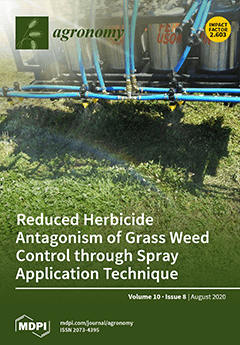
Cover Story: Avoiding the antagonism of glyphosate and clethodim by dicamba or 2,4-D is necessary in order to achieve optimum weed control in row crop applications. Three field studies were conducted to observe grass control with different herbicide combinations using three different application methods. The separate boom application allowed herbicides to be sprayed from two tanks containing separate herbicides, applied through two booms simultaneously. There was a 7–15% increase in efficacy when using the separate boom application method. Antagonism of all the herbicide combinations was observed when applied using the tank mix and mix-in-line methods. In some cases, antagonism was avoided when using the SPB method. The separate boom application method increased efficacy, which allowed herbicides to be used more effectively. View this paper
  • Issues are regarded as officially published after their release is announced to the table of contents alert mailing list .
  • You may sign up for email alerts to receive table of contents of newly released issues.
  • PDF is the official format for papers published in both, html and pdf forms. To view the papers in pdf format, click on the "PDF Full-text" link, and use the free Adobe Reader to open them.

Articles (161)

  • Article
  • Open Access
50 Citations
7,827 Views
13 Pages

18 August 2020

Sweet sorghum bagasse (SSB) and corncob (CC) have been identified as promising feedstocks for the production of second-generation biofuels and other value-added chemicals. In this study, lime (Ca(OH)2) and NaOH pretreatment efficacy for decreasing re...

  • Article
  • Open Access
57 Citations
5,594 Views
19 Pages

Regulation of Agronomic Traits, Nutrient Uptake, Osmolytes and Antioxidants of Maize as Influenced by Exogenous Potassium Silicate under Deficit Irrigation and Semiarid Conditions

  • Mohamed F. M. Ibrahim,
  • Gomaa Abd El-Samad,
  • Hatem Ashour,
  • Ahmed M. El-Sawy,
  • Mohamed Hikal,
  • Amr Elkelish,
  • Hany Abd El-Gawad,
  • Ahmed Abou El-Yazied,
  • Wael N. Hozzein and
  • Reham Farag

18 August 2020

Understanding the link between the protective role of potassium silicate (K2SiO3) against water shortage and the eventual grain yield of maize plants is still limited under semiarid conditions. Therefore, in this study, we provide insights into the u...

  • Article
  • Open Access
17 Citations
4,941 Views
18 Pages

18 August 2020

Surface (0–10 cm) and subsoil (soil layers below 10 cm) acidity and resulting aluminum (Al) toxicity reduce crop grain yields. In South Western Australia (SWA), these constraints affect 14.2 million hectares or 53% of the agricultural area. Bot...

  • Article
  • Open Access
20 Citations
7,643 Views
17 Pages

Effect of Biostimulants on Apple Quality at Harvest and After Storage

  • Sebastian Soppelsa,
  • Markus Kelderer,
  • Raffaele Testolin,
  • Damiano Zanotelli and
  • Carlo Andreotti

18 August 2020

Nutritional unbalances, such as calcium deficiency at the fruit level, are generally the causative agent of post-harvest disorders in apples. Foliar application of Ca as calcium chloride is the current solution to increase Ca concentration in apples,...

  • Article
  • Open Access
39 Citations
5,822 Views
12 Pages

18 August 2020

Three cultivars of Jerusalem artichoke Albik, Rubik and Gute Gelbe were grown under different nitrogen fertilization regimens: 0, 80 and 120 kg N·ha−1. Phenolic compounds were extracted from tubers using 80% (v/v) methanol. The total phe...

  • Article
  • Open Access
10 Citations
4,206 Views
15 Pages

18 August 2020

Carnation (Dianthus caryophyllus L.) is a major floricultural crop, cultivated widely for cut flowers. This study was conducted to determine the optimal supplementary light source for the cutting propagation of carnation ‘Dreambyul’ cutti...

  • Article
  • Open Access
4 Citations
3,536 Views
13 Pages

18 August 2020

Row direction and plant spacing influence crop senescence. An experiment was conducted to analyze the effect of row direction and plant spacing on the husk leaf senescence. Physiological indicators related to husk leaf senescence at days after silkin...

  • Article
  • Open Access
4 Citations
3,666 Views
15 Pages

Identification of Non-Pleiotropic Loci in Flowering and Maturity Control in Soybean

  • Eric J. Sedivy,
  • Abraham Akpertey,
  • Angela Vela,
  • Sandra Abadir,
  • Awais Khan and
  • Yoshie Hanzawa

17 August 2020

Pleiotropy is considered to have a significant impact on multi-trait evolution, but its roles in the evolution of domestication-related traits in crop species have been unclear. In soybean, several known quantitative trait loci (QTL) controlling matu...

  • Article
  • Open Access
14 Citations
4,137 Views
18 Pages

Formosolv Pretreatment to Fractionate Paulownia Wood Following a Biorefinery Approach: Isolation and Characterization of the Lignin Fraction

  • Elena Domínguez,
  • Pablo G. del Río,
  • Aloia Romaní,
  • Gil Garrote,
  • Patricia Gullón and
  • Alberto de Vega

17 August 2020

Paulownia is a rapid-growth tree with a high biomass production rate per year and low demand of water, which make it very suitable for intercropping systems, as it protects the crops from adverse climatic conditions, benefiting the harvest yields. Mo...

  • Article
  • Open Access
3 Citations
4,277 Views
19 Pages

17 August 2020

Perennial ryegrass (Lolium perenne L.) is one of the most important forage grass species in temperate regions of Australia and New Zealand. However, it can have poor persistence due to a low tolerance to both abiotic and biotic stresses. A major chal...

of 17

Get Alerted

Add your email address to receive forthcoming issues of this journal.

XFacebookLinkedIn
Agronomy - ISSN 2073-4395