


Abstract
Polyurethane (PU) grouts are used to reinforce fractured coal and rock, seal water-bearing fractures, and fill underground voids. Their suitability depends on the balance among peak curing temperature, fire performance, cured strength, and injectability. This review compares changes in these properties after the incorporation of mineral fillers or fibers and after reactive hybridization, grafting, or changes in crosslink density. In one laboratory formulation containing nano fly ash and inorganic cooling salts, the peak curing temperature was 82 °C and the compressive strength was 44 MPa. A separate reactive silicate–PU formulation achieved a limiting oxygen index of 34.1% and a compressive strength of 47.2 MPa. The relevance of these results to underground grouting depends on the mixing and injection conditions, the heat-transfer boundaries, and the type of specimen tested. Priorities for further work include measuring the time available for injection into narrow fractures and establishing how groundwater exposure, temperature, and cyclic loading affect the strength and sealing performance of grouted coal and rock.
1. Introduction
Some underground coal mines in China operate at depths greater than 1000 m [1]. At these depths, high in situ stresses and water-bearing fractures can complicate roadway support and water control. Grouting is used to reinforce fractured coal and rock around roadways and to seal water-bearing fractures [2,3].
Organic polyurethane (PU) grouting materials are primarily composed of polyisocyanate and polyol [4]. PU grouting is widely used in crack repair, leakage prevention, reinforcement, and other engineering applications because of its excellent bonding, sealing, chemical corrosion resistance, and injection performance. It is extensively applied in underground coal mine projects such as water blocking in coal and rock fractures, roadway coal and rock reinforcement, and goaf filling [2,3,5]. Managing heat accumulation during curing remains a concern for mine grouts [6,7]. Hence, there is an urgent need to optimize the performance of PU grouting materials to ensure that they provide stable performance in increasingly complex underground geological conditions. Previous reviews have provided valuable insights into the modification and engineering applications of polyurethane (PU) grouting materials. Hou et al. [8] summarized the effects of various modifiers, including mineral fillers, industrial solid wastes, fibers, and organic components, on the performance of PU grouting materials for mining applications. Geng et al. [7] focused on controlling reaction heat and mitigating the associated thermal hazards. Qin et al. [9] systematically reviewed modification technologies, performance characterization methods, and engineering applications of PU-based grouting materials. More recently, Li et al. [10] summarized physical and chemical modification methods for mining PU grouts. This review examines how different formulations address the competing demands of low peak curing temperature, fire performance, cured strength, and injection into coal and rock fractures. To make that comparison, we identify the type of material and specimen tested and distinguish results measured on reactive grouts, grouted coal or rock assemblies, and related polymer systems.
To identify relevant studies, a targeted literature search was conducted using the Web of Science Core Collection and China National Knowledge Infrastructure (CNKI), primarily covering publications from 2015 to 2026. Earlier representative studies were also included where necessary to provide relevant background and methodological insights. The search terms included “polyurethane grouting materials”, “mining”, “rock reinforcement”, “water sealing”, “nanofiller modification”, “fiber reinforcement”, “composite modification”, “grafting”, and “crosslinking”, together with their corresponding Chinese terms. Studies were selected based on their relevance to PU grouting materials, modification mechanisms, and performance evaluation, particularly regarding curing behavior, mechanical properties, flame retardancy, and engineering applicability. Studies involving other PU systems were also considered when their findings provided relevant insights into modification mechanisms or material properties applicable to grouting systems. Publications with limited relevance to the scope of this review or insufficient supporting information were excluded.
The following sections review the chemistry and mining uses of PU grouts, compare formulation strategies, and examine their implications for injection and long-term service.
2. Polymeric Materials Used in Mining Applications
Polymeric materials have attracted increasing attention in mining engineering because of their versatile chemical structures and tunable physical and mechanical properties. In underground mining, these materials are mainly used in grouting reinforcement, water sealing, fracture filling, and surrounding rock stabilization. According to their chemical compositions, reported organic polymer grouting systems include polyurethane, acrylate, acrylamide, epoxy resin, and urea–formaldehyde resin [2,9,11]. These materials exhibit different characteristics in terms of viscosity, curing behavior, mechanical strength, and environmental adaptability, making them suitable for different engineering conditions.
A representative linear polyurethane segment is [–O–R–O–C(=O)–NH–R′–NH–C(=O)–]n, where R and R′ are derived from the polyol and isocyanate, respectively. The repeat units of polyacrylamide and sodium polyacrylate can be written as [–CH2–CH(CONH2)–]n and [–CH2–CH(COONa)–]n. Bisphenol A diglycidyl ether (C21H24O4) is a representative epoxy precursor with two epoxide groups. Urea–formaldehyde resins form through methylolurea intermediates, such as HOCH2–NH–C(=O)–NH2, followed by condensation into networks containing methylene and methylene ether linkages. Lignin is a heterogeneous aromatic polymer built from hydroxyphenyl, guaiacyl, and syringyl units. The structures of the final networks depend on the formulation and curing conditions [12,13,14].
Different polymeric grouts are used in underground engineering. Acrylate- and acrylamide-based systems can be formulated for low viscosity and water sealing, whereas epoxy grouts are used for adhesion and reinforcement. Material selection depends on curing behavior, durability, and the intended ground conditions [2,9].
Reactive PU grouts offer adjustable gelation and expansion, together with adhesion to coal and rock. Low-viscosity formulations can be selected for injection into fractures, while expanding formulations can fill irregular voids. The formulation and water conditions determine the extent of expansion and the properties of the cured grout [2,9,11,15].
Nevertheless, the performance of polyurethane grouting materials is strongly influenced by the underground environment and formulation design. Excessive reaction heat, poor flame retardancy, and insufficient mechanical toughness may restrict their application under complex deep-mining conditions. Therefore, improving the comprehensive properties of polyurethane grouting materials through physical and chemical modification has become an important research direction. The following sections focus on the reaction mechanisms, engineering applications, and modification strategies of polyurethane grouting materials.
3. Reaction Chemistry of Polyurethane Grouts
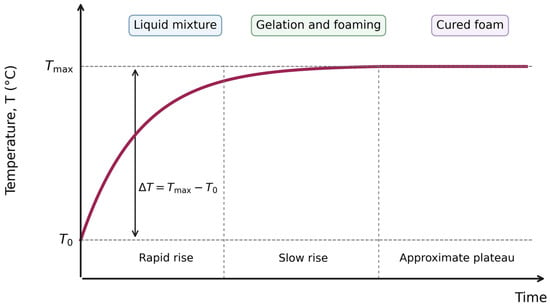
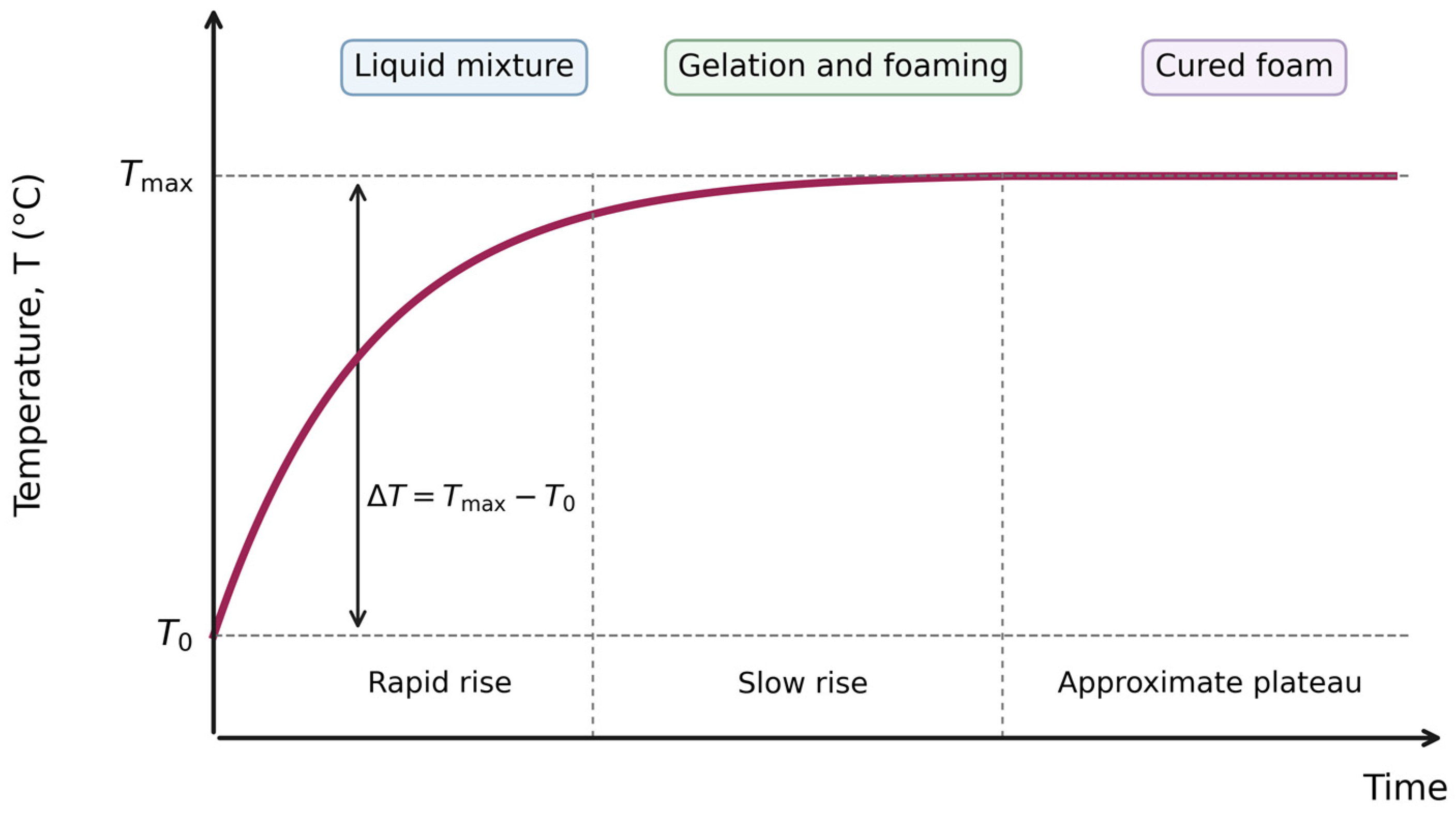
Isocyanate groups react with hydroxyl groups in polyols to form urethane linkages. Their reaction with water releases CO2 and produces amines, which can react further with isocyanates to form urea linkages [16]. Gas expansion can produce a cellular structure as the grout cures. Figure 1 illustrates the stages of the temperature profile observed during curing in the formulation studied by Zhang et al. [17].
Figure 1.
Schematic temperature profile during PU curing. T0 is the initial temperature and Tmax is the peak temperature. Adapted from Zhang et al. [17] under the Creative Commons Attribution license. The labels have been revised.
Isocyanate-derived segments contribute to the hard domains of PU, while polyol-derived segments contribute to the soft domains. Polyol backbone chemistry and the functionality of the components influence flexibility, water sensitivity, and the extent of network formation. These properties are formulation-dependent [9,18,19].
Catalysts can shift the relative rates of gelation and gas generation, and surfactants can stabilize the developing foam structure. In a grout formulation, the balance between these processes affects expansion, viscosity development, and the time available for placement [9,17].
4. Mining Engineering Applications of PU Grouting
4.1. Applications of Polyurethane Foams
Expanding PU foam grouts can fill irregular cavities and larger openings in fractured coal and rock. In fractured roadway roofs, the liquid can enter open fractures before it expands and cures in place [8]. Their expansion and final density depend on the formulation, confinement, and contact with water. Hou et al. studied an expanding PU grout under simulated coal-mine conditions using gangue collected from the Tunlan coal mine. In a separate laboratory series, adding water to the PU mixture altered the foam cell structure and reduced its compressive strength [15]. For underground applications that require load transfer, expansion and filling efficiency should be assessed together with the compressive and bonding properties of the cured grout.
4.2. Applications of Polyurethane Resin Grouts
Reactive PU resin grouts can be formulated for water sealing or structural reinforcement. Initial viscosity and reaction time govern penetration into fine fractures, and the interaction of the resin with water affects its expansion and sealing behavior. Li et al. reported a modified hydrophilic PU grout for coal-mine water sealing. The modification extended gel time from 12 to 33 s in their comparative laboratory tests, and the authors reported its use in a roof water-sealing trial at the Yangzhuang coal mine [3]. The authors reported substantially reduced roof leakage after grouting and no recurrence of seepage in the treated roadway during nearly two years of observation [3]. Where the objective is structural reinforcement, adhesion and cured strength should be assessed on representative coal or rock substrates.
5. Challenges in Mining Applications of PU Materials
Underground PU grouts must meet the requirements of the intended application. For coal and rock reinforcement, the main challenges are managing reaction heat, achieving adequate fire performance, and retaining the required cured mechanical properties [20].
(1) Heat released during curing can accumulate in confined fractures or cavities. The recorded peak depends on the formulation, initial temperature, sample dimensions, grout volume, surface-area-to-volume ratio, heat transfer to the surroundings, and sensor location. In a laboratory study of roadbed repair materials, Zhang et al. measured peaks of approximately 145 °C and 101 °C for the conventional and low-exotherm PU formulations, respectively [17]. A comparison with underground measurements would require the same formulation and a documented grout volume, sensor position, and heat-transfer boundary.
(2) Fire performance varies with formulation, cured density, and test method. The limiting oxygen index (LOI) characterizes sustained burning in an oxygen–nitrogen atmosphere, and UL 94 reports specimen behavior under specified small-flame exposure. Ignition and decomposition temperatures are separate measurements. Hong et al. reported an LOI of 34.1% and a UL 94 V-0 rating for their reactive silicate–PU composite at a reported silicate content of 25 wt% [21].
Unreacted isocyanates can expose workers during handling. Bello et al. documented isocyanate exposure in spray-foam application [22], highlighting the need to consider comparable exposure routes during grout handling. Additives and residual low-molecular-weight constituents should also be considered when assessing the cured grout. Qian et al. used changes in water chemistry to assess chemical grout leaching in water-rich sand [23]. Concentrations in grout leachates should be measured under groundwater conditions representative of the intended site. Environmental assessment of flame retardants should be based on the specific compounds used and their mobility, persistence, and toxicity [24].
(3) KA/T 1089–2020 specifies separate criteria for reaction temperature, fire behavior, and cured mechanical properties for polymer materials used to reinforce coal and rock in underground mines [20]. Where a PU grout reacts with water, foaming can assist void filling. The resulting cell structure and compressive performance depend on formulation and local water conditions, as illustrated by laboratory tests in which water was added to the PU mixture [15]. The intended reinforcement or sealing function should determine which properties are tested.
6. Filler, Fiber, and Composite Modification of PU Grouts
This section reviews particulate fillers, fibers, and multiphase composites. It includes reactive hybrids where chemical interactions contribute to the cured structure.
6.1. Nano-Modification
Nanoparticle modification can change the viscosity, curing behavior, and mechanical properties of PU grouts [25,26,27].
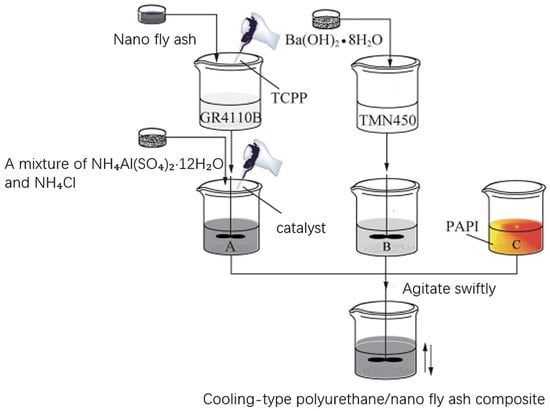
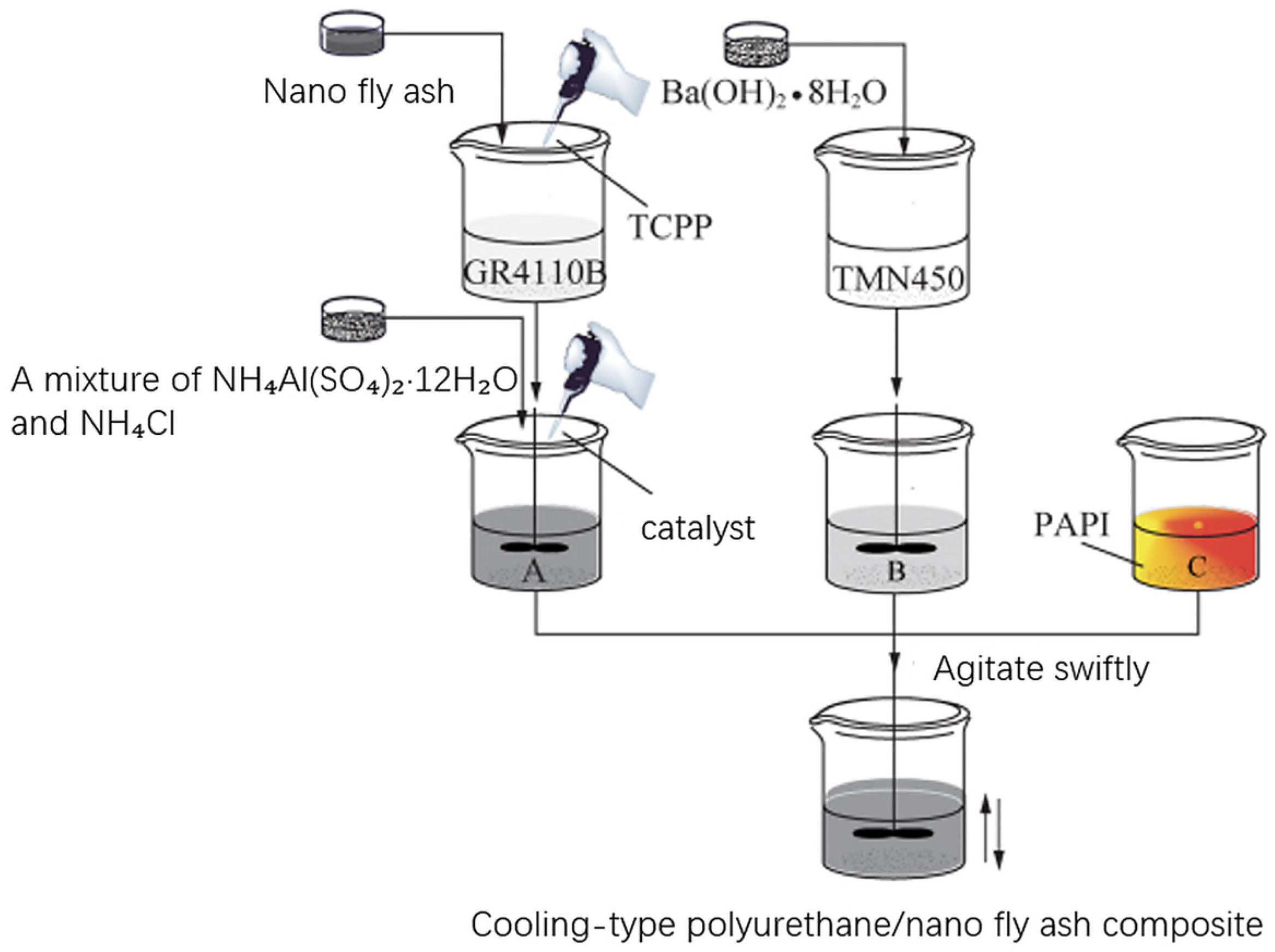
Qin et al. [26] combined nano fly ash with inorganic cooling salts (Figure 2). For formulation No. 17 in their Table 2, nano fly ash accounted for 40 wt% of the composite [26]. The reported cooling-additive amounts were 7% for the blend of ammonium aluminium sulfate dodecahydrate and ammonium chloride, and 3% for barium hydroxide octahydrate, totaling 10% on the basis reported in the study. This formulation reached a peak curing temperature of 82 °C and a compressive strength of 44 MPa. These paired results illustrate the balance between peak curing temperature and strength within the formulation series.
Figure 2.
Preparation sequence for the PU grout containing nano fly ash and inorganic cooling salts. GR4110B and TMN450 are polyether polyols, TCPP is tris(1-chloro-2-propyl) phosphate, and PAPI is polymeric isocyanate. Adapted from Ref. [26].
Xiang et al. [27] found that tensile strength, elongation at break, and adhesive strength reached their maxima at a low nanosilica loading in their two-step PU/SiO2 formulation. The study also measured viscosity as a function of time, which is relevant to the injectability of the modified grout. The available working time should be determined using a viscosity or pumping criterion appropriate to the equipment and fracture conditions.
Kanbur and Tayfun studied melt-blended TPU–CNT composites [28]. The LOI was 19.5% for unfilled TPU and reached 21.3% at 1.0 wt% of surface-treated CNTs. The filled specimens were rated V-2 under UL 94. These tests show how CNTs affect a melt-processed TPU matrix. Reactive PU grouts must flow before they cure in situ, so their selection also requires viscosity, gel-time, and penetration data. Zhou et al. used a TPU/graphene additive in a reactive PU grout formulation designed for pavement repair [29], illustrating how TPU can be incorporated into a reactive grout.
Nanoparticle dispersion depends on surface compatibility, mixing history, and the time between mixing and gelation. Surface treatment and controlled high-shear mixing can assist dispersion. Viscosity measurements track flow behavior after mixing, and microscopy can reveal local agglomeration in samples collected during the anticipated working period. In a reactive hydrophilic PU foam grout, Jia et al. reported higher viscosity and longer gel times with increasing nanosilica loading and observed local agglomeration at higher loading [25]. Particle dispersion and viscosity should therefore be followed over the anticipated mixing and pumping period.
6.2. Fiber Modification
Fiber reinforcement is used to improve the crack resistance of cured grout in fractured coal and rock. Cao et al. separately treated high-strength, high-modulus poly(vinyl alcohol) (PVA) fibers with γ-aminopropyltriethoxysilane and diphenylmethane diisocyanate before incorporating them into PU [30]. The treated fibers showed improved adhesion to the PU matrix, with the best overall performance in that series at a reported fiber mass fraction of 0.1 wt%. For injection into narrow fractures, fiber length, dispersion, and fresh-grout viscosity should be evaluated against the fracture aperture and pumping conditions.
6.3. Composite Modification and Reactive Hybrid Systems
Composite modification can combine particulate reinforcement with reactions during curing. The silicate–PU system studied by Hong et al. is a reactive organic–inorganic hybrid [21]. At a reported silicate content of 25 wt%, the composite reached a tensile strength of 19.3 MPa, a bonding strength of 4.1 MPa, a compressive strength of 47.2 MPa, an LOI of 34.1%, and a UL 94 V-0 rating. The authors also reported a lower peak reaction temperature for the modified system.
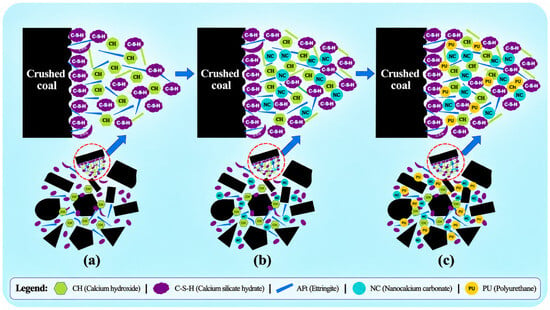
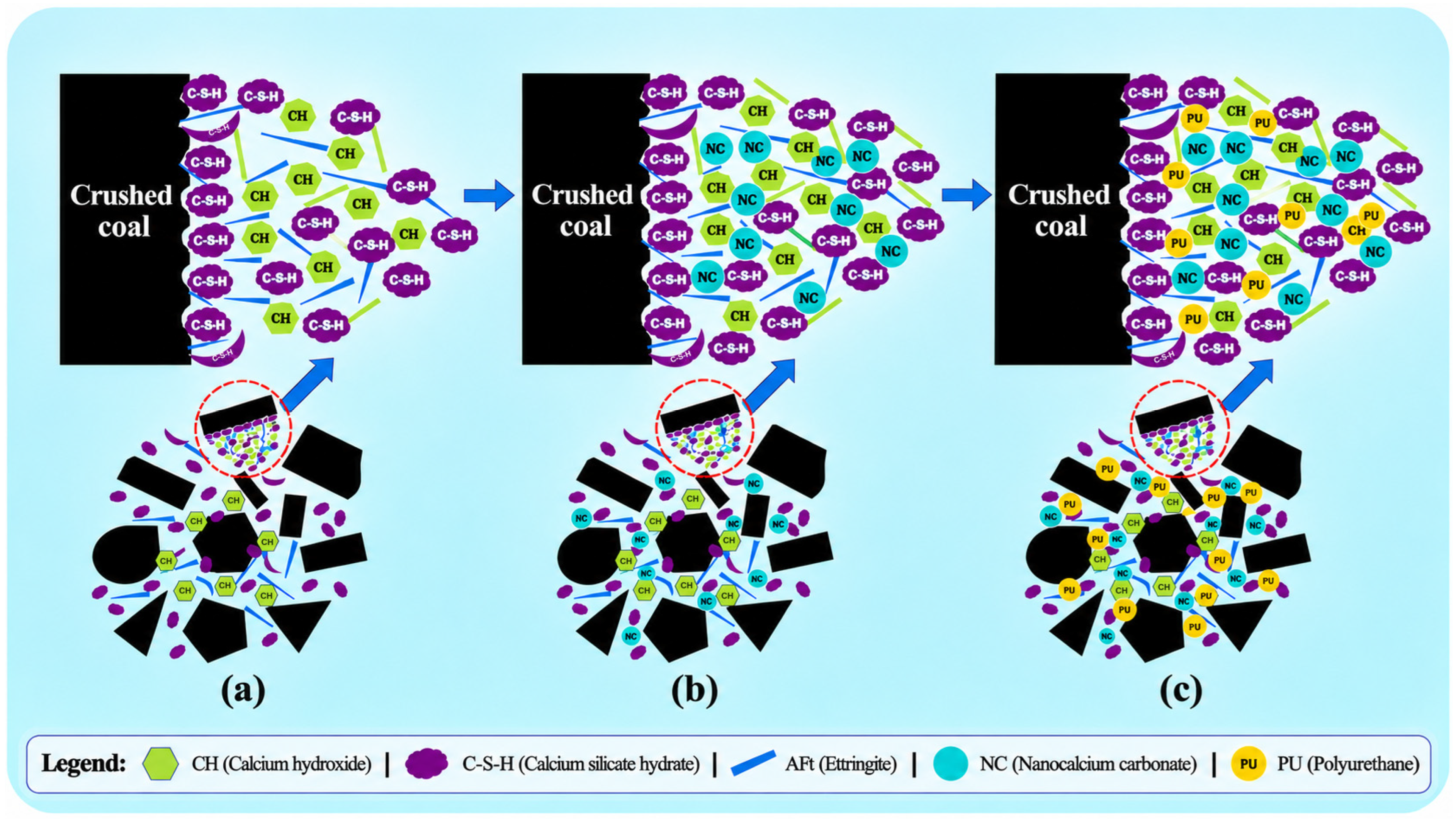
Yu [5] reported that adding Al2O3 to a water glass–PU (WG/PU) grout lowered the peak reaction temperature by 14.9 °C and increased compressive strength by 13.84 MPa relative to the WG/PU reference formulation without added alumina. Tan et al. [31] combined nanocalcium carbonate (NC) and PU in a cement-based grout. The reported optimum in the tested series was a water-to-solids ratio of 0.5 and an NC content of 1%. The authors reported higher compressive strength in broken-coal specimens grouted with the NC/PU-modified cement. Figure 3 illustrates how the cement hydration products and the PU-rich phase were distributed near the coal–grout interface.
Figure 3.
Schematic of the coal–grout interface for (a) unmodified cement, (b) NC-modified cement, and (c) NC/PU-modified cement. The upper panels show enlarged views of the corresponding interfaces in the lower panels. NC, nanocalcium carbonate. PU, polyurethane. Adapted from Ref. [31].
7. Research Progress on Chemical Modification Methods for PU Grouting Materials for Mining Applications
Grafting covalently attaches a chain or functional segment to a polymer backbone. Crosslinking connects chains to form a network. In the IUPAC definition of an interpenetrating polymer network (IPN), two or more networks are interlaced on a molecular scale without covalent bonds between the constituent networks [32]. These terms describe different structural changes and should be assigned according to the evidence reported for each system.
7.1. Grafting and Polyurethane/Epoxy Network Formation
Zhang et al. prepared a PU prepolymer from poly(propylene glycol) and a toluene diisocyanate trimer and then grafted the prepolymer onto the epoxy resin [33]. Cruz et al. attached PU prepolymers to cellulose fiber surfaces for use in a cementitious composite [34], illustrating interfacial modification in a separate material system.
Li et al. described a porous PU/epoxy (EP) grout as an IPN [35]. Its reported initial viscosity was below 200 mPa·s. At a PU/EP mass ratio of 2:8, the reported tensile, compressive, and impact strengths were 87%, 20%, and 50% higher, respectively, than those of neat EP. Bond strength to concrete in a humid environment reached 3.26 MPa. Wang and Jia prepared a glycerol-crosslinked PU/EP IPN by a sequential method [36]. The highest tensile and impact strengths in their test series occurred at a reported glycerol-crosslinked PU content of 10%.
7.2. Crosslinking Modification
The network structure of reactive PU grouts depends on the functionality and stoichiometry of the feed components. A change in crosslink density can change stiffness and deformation. Formulations intended for grouting should be assessed through mechanical tests on cured specimens and fresh-grout measurements of viscosity development and gel time [37,38].
Molecular dynamics models have examined how water participates in PU network formation [39] and how the modeled degree of crosslinking affects network stiffness [38]. In the latter model, stiffness increased as the degree of crosslinking rose from 20% to 80%. Fracture toughness and post-peak deformation measurements would be needed to assess whether the stiffer formulations are more brittle. Peng and Iroh reported well-dispersed clay layers at low loading in solvent-cast, crosslinked PU nanocomposites and observed agglomerates at higher loading [40]. Their observations provide evidence of concentration-dependent dispersion in that material system. Reactive grout formulations require corresponding measurements under their own mixing and curing conditions.
Several studies cited above address specific mechanisms in related materials. The melt-processed TPU composites illustrate CNT dispersion and specimen fire behavior [28], the pavement formulation illustrates the use of TPU as one constituent of a reactive grout [29], and the solvent-cast PU–clay specimens illustrate concentration-dependent dispersion [40]. For underground use, these observations guide the choice of properties to measure in the reactive grout under relevant fracture and curing conditions.
Injectability depends on the viscosity history of the mixed grout, fracture aperture, injection pressure, and the time elapsed after mixing. Li et al. reported an initial viscosity below 200 mPa·s for their PU/EP grout [35]. In a different reactive formulation, Jia et al. found that increasing the nanosilica loading increased viscosity and lengthened gel time [25]. Gel time describes a defined stage of setting. Working time is the interval over which the grout can meet a specified viscosity or pumping-pressure criterion. For narrow fractures, fresh-state measurements should be paired with penetration tests at known apertures and temperatures.
Table 1 summarizes representative formulations, test results, comparators, and limitations. The mechanical results were obtained using different specimens, substrates, and test protocols. Comparisons within the same study provide the clearest indication of the effect of a modification. Specimen geometry, loading rate, conditioning, and the substrate should be considered when comparing results across studies.
Table 1.
Comparison of representative modification approaches and reported properties of polyurethane-based grouting materials.
A lower curing temperature can be accompanied by lower strength. In the roadbed study by Zhang et al., the two PU formulations were compared at a density of 80 kg/m3 [17]. The low-exotherm formulation had a lower peak curing temperature, with compressive and tensile strengths 6.67% and 6.25% lower, respectively, than those of the conventional formulation under those test conditions. For underground reinforcement, a comparison within the same formulation series should therefore report peak temperature together with cured strength, fire performance, and working time. For changes in crosslink density, fracture and post-peak tests are needed to establish the effect on toughness alongside the change in stiffness [38].
Durability studies have used different exposures and endpoints. During hydrothermal aging of a PU-modified water glass grout, Wang et al. observed rapid deterioration early in the test. Between days 5 and 15, compressive strength decreased by 0.50% and peak strain by 1.6%, each relative to day 5 [41]. Temperature and humidity have also been studied in fracture tests [42]. In cyclic compression of foamed grouts, the measured damage depended on specimen size and density [43]. To evaluate combined exposure, tests on grouted coal and rock should report strength and bond retention, permeability, and crack development alongside groundwater chemistry, test temperature, and the loading history.
8. Conclusions
The laboratory evidence supports different formulation choices for different grouting objectives. Nano fly ash with inorganic cooling salts achieved a peak of 82 °C and a compressive strength of 44 MPa in one reported formulation [26]. A reactive silicate–PU hybrid reached an LOI of 34.1%, a UL 94 V-0 rating, and a compressive strength of 47.2 MPa [21]. Alumina lowered the peak reaction temperature by 14.9 °C relative to WG/PU without added alumina in a separate test series [5]. The low initial viscosity reported for the porous PU/EP grout supports evaluating its injectability in narrow fractures [35].
The engineering choice depends on the target fracture geometry and on whether the grout is required to seal water, transfer load, or fill voids. Priorities are to measure working time under injection conditions, characterize peak temperature at representative grout volumes, and establish strength and sealing retention under groundwater exposure and cyclic loading. These tests would provide the evidence needed to select among formulations for underground use.
9. Future Directions
Future work should address three priorities for mine grouts.
- Report the bio-based polyol fraction on a total-polyol mass basis. Compare the formulations at a stated component ratio and measure viscosity, gel time, peak curing temperature, and cured strength. Identify the additives and quantify relevant constituents in leachates under representative groundwater conditions.
- Report compressive-strength and bond-strength retention relative to unaged controls. State the groundwater composition, conditioning temperature and duration, and cyclic loading levels. Measure leakage or permeability through grouted coal or rock specimens to track sealing performance during aging.
- Report the absolute peak reaction temperature and the change relative to a reference formulation at the same grout volume, initial temperature, boundary conditions, and sensor position. For polymer materials used to reinforce coal and rock in coal mines, KA/T 1089–2020 specifies a peak reaction temperature of ≤100 °C, an oxygen index of ≥28%, a compressive strength of ≥40 MPa, and a bonding strength of ≥3.0 MPa [20]. Report viscosity development and working time alongside these safety and strength indicators.
Funding
This research was funded by Tiandi Science and Technology Co., Ltd. Science and Technology Innovation Venture Capital Special Project, grant number 2025-TD-QZ030, and Natural Science Basic Research Program of Shaanxi, grant number 2025JC-QYCX-036.
Data Availability Statement
No new data were created or analyzed in this study. Data sharing is not applicable to this article.
Conflicts of Interest
All authors are employed by CCTEG Xi’an Research Institute (Group) Co., Ltd. The funders had no role in the design of the study, the collection, analysis and interpretation of data, the writing of the manuscript, or the decision to submit the article for publication.
Abbreviations
The following abbreviations are used in this manuscript:
| CNT | Carbon nanotube |
| IPN | Interpenetrating polymer network |
| NC | Nanocalcium carbonate |
| PU | Polyurethane |
| TPU | Thermoplastic polyurethane |
| EP | Epoxy |
| LOI | Limiting oxygen index |
| PVA | Poly(vinyl alcohol) |
| WG | Water glass |
References
- Liu, Z.; Song, Z.; Ji, H.; Liu, S.; Tan, J.; Cheng, S.; Ning, F. Construction mode and key technology of mining shaft engineering for deep mineral resources. J. China Coal Soc. 2021, 46, 826–845. (In Chinese) [Google Scholar] [CrossRef]
- Kang, H.; Li, W.; Gao, F.; Yang, J. Grouting theories and technologies for the reinforcement of fractured rocks surrounding deep roadways. Deep Undergr. Sci. Eng. 2023, 2, 2–19. [Google Scholar] [CrossRef] [Scilit]
- Li, Y.; Li, J.; Chen, D.; Fan, R.; Sang, G.; Ni, J.; Ding, Y. Properties of nanosilica-reinforced polyurethane by in-situ preparation and its application in polyurethane grouting. Chin. J. Geotech. Eng. 2016, 38, 83–86. (In Chinese) [Google Scholar] [CrossRef]
- Zhang, C.; Liu, Z.; Zhang, Z.; Wenjun, Z.; Songsong, Z.; Guojun, W.; Qiang, W.; Teng, M.; Lin, W.; Hao, W. Enhancing the mechanical properties of self-healing polyurethane via chemical crosslinking. J. Appl. Polym. Sci. 2024, 141, e56031. [Google Scholar] [CrossRef] [Scilit]
- Yu, X.F. Preparation and structure analysis of aluminum oxide/water glass/polyurethane composite grouting material for mining. J. Build. Eng. 2023, 76, 107170. [Google Scholar] [CrossRef] [Scilit]
- Wang, H.; Chen, X.; Zou, C.; Fan, C.; Chen, L.; Zhao, M. Preparation and performance study of low heat storage flame retardant polyurethane for coal mines. Case Stud. Therm. Eng. 2024, 64, 105414. [Google Scholar] [CrossRef] [Scilit]
- Geng, Q.; Xu, X.; Li, B. Research progress in control technology for reaction heat of polyurethane grouting materials in mines. Chem. Ind. Eng. Prog. 2025, 44, 319–328. (In Chinese) [Google Scholar] [CrossRef]
- Hou, K.; Wang, S.; Yao, S.; Niu, X.; Li, Z.; Wu, C.; Feng, G. Research progress on modification of polyurethane grouting materials in mines. Coal Sci. Technol. 2022, 50, 28–34. (In Chinese) [Google Scholar] [CrossRef]
- Qin, L.; Kou, D.; Jiang, X.; Yang, S.; Hou, N.; Huang, F. Research Progress on Polyurethane-Based Grouting Materials: Modification Technologies, Performance Characterization, and Engineering Applications. Polymers 2025, 17, 2313. [Google Scholar] [CrossRef] [Scilit] [PubMed]
- Li, Y.; Wang, Y.; Chen, G.; Yu, X. Research progress on modification of polyurethane grouting materials for mining applications. New Chem. Mater. 2026, 54, 61–65. (In Chinese) [Google Scholar] [CrossRef]
- Wei, W.A.N.G. Discussion on the current application situation and development countermeasures of polymer grouting materials used in coal mine. Guangdong Chem. Ind. 2020, 47, 127–128. [Google Scholar]
- National Center for Biotechnology Information. PubChem Compound Summary for CID 2286, Bisphenol A Diglycidyl Ether. Available online: https://pubchem.ncbi.nlm.nih.gov/compound/2286 (accessed on 14 November 2026).
- Minopoulou, E.; Dessipri, E.; Chryssikos, G.D.; Gionis, V.; Paipetis, A.; Panayiotou, C. Use of NIR for structural characterization of urea–formaldehyde resins. Int. J. Adhes. Adhes. 2003, 23, 473–484. [Google Scholar] [CrossRef] [Scilit]
- Ait Benhamou, A.; Abid, L.; Calvez, I.; Cloutier, A.; Nejad, M.; Stevanovic, T.; Landry, V. Advances in lignin chemistry, bonding performance, and formaldehyde emission reduction in lignin-based urea-formaldehyde adhesives: A review. ChemSusChem 2025, 18, e202500491. [Google Scholar] [CrossRef] [Scilit] [PubMed]
- Hou, K.; Wang, S.; Yao, X.; Yao, S.; Zhou, X.; Ma, J.; Wang, P.; Feng, G. Effect of a simulated coal mine environment on polyurethane grouting material and a proposed polyurethane strengthening method. Polymers 2023, 15, 4449. [Google Scholar] [CrossRef] [Scilit] [PubMed]
- Wolf, M.E.; Vandezande, J.E.; Schaefer, H.F. Catalyzed reaction of isocyanates (RNCO) with water. Phys. Chem. Chem. Phys. 2021, 23, 18535–18546. [Google Scholar] [CrossRef] [Scilit] [PubMed]
- Zhang, B.; Wang, B.; Zhong, Y.; Wang, S.; Li, X.; Wang, L. Experimental study on reducing the heat of curing reaction of polyurethane polymer grouting material. Adv. Polym. Technol. 2021, 2021, 9954498. [Google Scholar] [CrossRef] [Scilit]
- Brzoska, J.; Datta, J.; Konefał, R.; Pokorný, V.; Beneš, H. The influence of bio-based monomers on the structure and thermal properties of polyurethanes. Sci. Rep. 2024, 14, 29042. [Google Scholar] [CrossRef] [Scilit] [PubMed]
- Wang, H.; Cao, L.; Wang, X.; Lang, X.; Cong, W.; Han, L.; Zhang, H.; Zhou, H.; Sun, J.; Zong, C. Effects of Isocyanate Structure on the Properties of Polyurethane: Synthesis, Performance, and Self-Healing Characteristics. Polymers 2024, 16, 3045. [Google Scholar] [CrossRef] [Scilit] [PubMed]
- KA/T 1089–2020; Polymer Material for Consolidating Coal and Rock at Coal Mine. Ministry of Emergency Management of the People’s Republic of China: Beijing, China, 2020.
- Hong, X.; Dong, W.; Yang, S.; Mu, B.; Liang, B. Study on structure and performance of reactive silicate reinforced polyurethane composite. Polym. Eng. Sci. 2015, 55, 2322–2327. [Google Scholar] [CrossRef] [Scilit]
- Bello, A.; Xue, Y.; Gore, R.; Woskie, S.; Bello, D. Assessment and control of exposures to polymeric methylene diphenyl diisocyanate (pMDI) in spray polyurethane foam applicators. Int. J. Hyg. Environ. Health 2019, 222, 804–815. [Google Scholar] [CrossRef] [Scilit] [PubMed]
- Qian, Z.; Zheng, H.; Jiang, C.; Zhang, G. Experimental study on patterns and mechanisms of water quality degradation in water-rich sand formations induced by different types of chemical grouts. J. Contam. Hydrol. 2026, 281, 104947. [Google Scholar] [CrossRef] [Scilit] [PubMed]
- Fan, T.; Yan, Z.; Huang, W.; Feng, W.; Bai, Y.; Feng, C.; Wu, F. A comprehensive review of contents, toxic effects, metabolisms, and environmental behaviors of brominated and organophosphorus flame retardants. J. Hazard. Mater. 2025, 496, 139428. [Google Scholar] [CrossRef] [Scilit] [PubMed]
- Jia, X.; Li, S.; Ma, R.; Du, H.; Yao, Y. Preparation and properties of polyurethane grouting material modified by nano-SiO2. J. Funct. Mater. 2022, 53, 7232–7236. Available online: https://www.gncl.cn/EN/10.3969/j.issn.1001-9731.2022.07.034 (accessed on 11 November 2026).
- Qin, C.; Lu, W.; Li, J. Cooling mechanism of cooling polyurethane/nano fly ash grouting material. J. China Coal Soc. 2019, 44, 178–186. [Google Scholar] [CrossRef]
- Xiang, X.; Qian, J.; Yang, W.; Fang, M.; Qian, X. Synthesis and properties of nanosilica-reinforced polyurethane for grouting. J. Appl. Polym. Sci. 2006, 100, 4333–4337. [Google Scholar] [CrossRef] [Scilit]
- Kanbur, Y.; Tayfun, U. Investigating mechanical, thermal, and flammability properties of thermoplastic polyurethane/carbon nanotube composites. J. Thermoplast. Compos. Mater. 2018, 31, 1661–1675. [Google Scholar] [CrossRef] [Scilit]
- Zhou, X.; Zheng, Y.; Chen, C.; Kong, F. Preparation and performance of thermoplastic polyurethane/graphene modified polyurethane grouting material. China Plast. 2023, 37, 54–59. [Google Scholar] [CrossRef]
- Cao, M.; Wang, C.; Xia, R.; Chen, P.; Miao, J.; Yang, B.; Qian, J.; Tang, Y. Preparation and performance of the modified high-strength/high-modulus polyvinyl alcohol fiber/polyurethane grouting materials. Constr. Build. Mater. 2018, 168, 482–489. [Google Scholar] [CrossRef] [Scilit]
- Tan, Y.; Li, Y.; Zhao, G.; Cheng, X.; Meng, X.; Gu, Q.; Li, Q.; Fan, C.; Zhou, B.; Qiao, B.; et al. Research on microstructure and physico-mechanical properties of grouting materials based on nano calcium carbonate-polyurethane composite modification. Results Eng. 2025, 28, 107974. [Google Scholar] [CrossRef] [Scilit]
- International Union of Pure and Applied Chemistry. Interpenetrating Polymer Network. In Compendium of Chemical Terminology, 5th ed.; International Union of Pure and Applied Chemistry: Zurich, Switzerland, 2025. [Google Scholar] [CrossRef] [Scilit]
- Zhang, X.; Qiao, L.; Lu, X.; Jiang, L.; Cao, T. Preparation and properties of toluene-diisocyanate-trimer-modified epoxy resin. Polymers 2019, 11, 416. [Google Scholar] [CrossRef] [Scilit] [PubMed]
- Cruz, E.O.; Vyörykkä, J.T.; Luiz, R.V.; Jhalaria, M.; Vlasak, P.R.; Savastano, H. New method for graphitizing polyurethane (PU) prepolymers over cellulose fiber surface and physical properties assessment on cementitious composites. Constr. Build. Mater. 2023, 364, 129935. [Google Scholar] [CrossRef] [Scilit]
- Li, X.; Wang, F.; Cai, X.; Meng, S.; Hu, X.; Tang, L. A porous IPN-structured polyurethane/epoxy grouting material with low viscosity, high strength and low volume shrinkage. Constr. Build. Mater. 2024, 449, 138312. [Google Scholar] [CrossRef] [Scilit]
- Wang, C.; Jia, J. Damping and mechanical properties of polyol cross-linked polyurethane/epoxy interpenetrating polymer networks. High Perform. Polym. 2014, 26, 240–244. [Google Scholar] [CrossRef] [Scilit]
- Xing, Z.; Ding, C.; Wang, Z.; Yang, L.; Zhao, X.; Yang, X. The strengthening mechanism of mechanical performance for polyurethanes with micro-content crosslinkers. Polymer 2024, 292, 126574. [Google Scholar] [CrossRef] [Scilit]
- Yuan, L.; Zhang, C.; Wang, C.; Wei, N.; Wan, J.; Zhu, C.; Fang, H.; Shi, M. Effect of the crosslinking degree on the microstructure and thermomechanical properties of a polymer grouting material. Polymer 2022, 259, 125342. [Google Scholar] [CrossRef] [Scilit]
- Wang, C.; Wu, Y.; Yuan, L.; Fang, H.; Zhu, P. Simulation of Crosslinking Process and Microstructure Evolution of Polymer Grouting Material in Watery Environments. J. Tongji Univ. (Nat. Sci.) 2025, 53, 462–470. [Google Scholar]
- Peng, S.; Iroh, J.O. Synthesis and characterization of crosslinked polyurethane/clay nanocomposites. J. Appl. Polym. Sci. 2016, 133, 43346. [Google Scholar] [CrossRef] [Scilit]
- Wang, M.; Guo, C.; Yu, J.; Wei, Y.; Jiang, X.; Zeng, W.; Dong, Y.; Tong, M.; Ma, H. Durability performance and evolution mechanism of polyurethane-modified waterglass grouting material under hydrothermal ageing environment. Mater. Lett. 2025, 398, 138902. [Google Scholar] [CrossRef] [Scilit]
- Gao, S.; Wang, J.; Hu, Y. Experimental study on the influence of temperature and humidity on the fracture properties of polyurethane grouting materials. J. Mater. Res. Technol. 2024, 32, 1299–1309. [Google Scholar] [CrossRef] [Scilit]
- Wang, P.; Han, Y.; Wang, Z.; Wang, C.; Zhang, C.; Zhu, P.; Fang, H.; Wang, F.; Qin, Z. Degradation mechanisms of polyurethane grouting materials under quasi-static and cyclic compression loading: Density and size effects. Constr. Build. Mater. 2023, 408, 133795. [Google Scholar] [CrossRef] [Scilit]

Disclaimer/Publisher’s Note: The statements, opinions and data contained in all publications are solely those of the individual author(s) and contributor(s) and not of MDPI and/or the editor(s). MDPI and/or the editor(s) disclaim responsibility for any injury to people or property resulting from any ideas, methods, instructions or products referred to in the content. |
© 2026 by the authors. Licensee MDPI, Basel, Switzerland. This article is an open access article distributed under the terms and conditions of the Creative Commons Attribution (CC BY) license.