


Abstract
In this work, ternary Mo–Ni–X (X = Al, Co, Cr, Cu, Fe, W) thin films with nominal composition Mo80Ni10X10 (at. %) were prepared by magnetron sputtering and evaluated as electrocatalysts for the hydrogen evolution reaction (HER) in alkaline media. The influence of alloy composition, substrate type, and deposition temperature on catalytic performance was systematically investigated. Electrochemical screening revealed a strong dependence of HER activity on both substrate conductivity and ternary alloying, with Al-, Cr-, and W-containing systems showing the best performance on glassy carbon substrates. This highlights the importance of interfacial charge-transfer efficiency in determining catalytic behavior. The Mo80Ni10Cr10/GC system was selected for detailed analysis. Deposition temperatures ≥ 500 °C resulted in enhanced HER activity, reaching an overpotential of η10 = −222 mV at j = −10 mA cm−2. The improved performance is attributed to temperature-induced microstructural optimization and electrochemically driven surface reconstruction, leading to the formation of a Ni-enriched active interface. AFM analysis confirmed surface restructuring during operation, with roughness increasing from ~1 to ~3 nm, indicating the formation of additional electrochemically accessible active sites. XPS results suggest partial depletion of Mo during cycling, while Cr mainly contributes to structural stabilization of the evolving thin film. Overall, the results demonstrate that HER performance is governed by the coupled effects of alloy composition, substrate-dependent charge transport, and in situ surface reconstruction. This work highlights magnetron sputtering as a scalable approach for designing homogeneous noble-metal-free thin-film electrocatalysts with tunable activity.
1. Introduction
In the context of the ongoing global energy transition, the extensive reliance on non-renewable fossil fuels has led to severe environmental challenges, including greenhouse gas emissions and accelerating climate change. Consequently, the development of sustainable and carbon-neutral energy carriers has become a critical scientific and technological priority [1].
Among various emerging solutions, hydrogen production via water electrolysis powered by renewable energy sources represents one of the most promising pathways toward a clean energy economy. In this process, the hydrogen evolution reaction (HER) is a key cathodic half-reaction, in which water molecules or protons are reduced to molecular hydrogen, directly determining the overall efficiency of electrolytic systems [1].
Despite the maturity of alkaline water electrolyzers, their performance is still strongly governed by the catalytic materials used at the cathode. State-of-the-art systems rely on Pt-based catalysts, which exhibit outstanding HER activity but are hindered by high cost and scarcity, limiting large-scale deployment [2]. Therefore, the development of earth-abundant, non-noble metal electrocatalysts remains a central research focus [3,4].
Among transition-metal-based systems, Ni-based catalysts have attracted sustained attention due to their intrinsic activity in alkaline media, stability, and tunable electronic structure. Numerous studies have demonstrated that Ni-based materials can achieve high HER activity through compositional and morphological engineering [5,6,7,8,9,10,11,12,13,14], focusing on mechanistic understanding in alkaline media together with morphology and compositional optimization.
In particular, Ni–Mo systems have emerged as a benchmark class of non-precious electrocatalysts, often exhibiting markedly enhanced performance compared to monometallic counterparts. Recent experimental and theoretical studies have shown that the high activity of NiMo alloys originates from a complex interplay between water dissociation and hydrogen adsorption energetics. For instance, it has been demonstrated that oxidized or reconstructed Ni3Mo-type surfaces can facilitate the Volmer step via Mo-assisted water dissociation, while Ni sites optimize hydrogen binding energy, resulting in a cooperative dual-site mechanism rather than a single active phase interpretation. This insight has helped clarify long-standing controversies regarding the origin of activity in Ni–Mo systems [15,16,17,18,19]. Representative nanoporous Ni–Mo architectures have been reported to achieve ultralow overpotentials (as low as 10–15 mV at 10 mA cm−2), highlighting the exceptional potential of this materials class [20]. Recent theoretical and experimental studies indicate that such performance enhancements originate from electronic structure modulation at the atomic scale rather than from a generic synergistic effect alone [21]. Charge redistribution between neighboring metal atoms, defect-induced electronic perturbations, and optimized adsorption energetics of reaction intermediates have been identified as decisive factors governing HER activity. These findings emphasize that rational catalyst design requires consideration of both composition and local electronic environment [21].
Beyond binary systems, molybdenum-containing catalysts offer additional advantages due to their flexible electronic structure, corrosion resistance, and strong affinity for hydrogen intermediates [22,23,24]. Building upon these properties, the incorporation of a third metallic element (X = Al, Co, Cr, Cu, Fe, W) into Mo–Ni systems has emerged as an effective strategy to further tune electronic structure, optimize adsorption energetics, and stabilize surface intermediates. The choice of Al, Co, Cr, Cu, Fe, and W was primarily guided by available phase-diagram data and alloy-forming tendencies with Ni and Mo. The selected elements enable the formation of stable or metastable alloy structures suitable for thin-film deposition, while simultaneously providing a broad range of chemical and structural effects that may influence HER performance [15,16,22,23].
Such ternary and multicomponent alloying strategies are closely related to recent developments in high-entropy alloys (HEAs), single-atom catalysts (SACs), and multi-site catalytic systems, where synergistic interactions between different metal species enable enhanced control over catalytic pathways [25,26,27,28].
In parallel, recent in situ and operando studies have revealed that HER catalysts often undergo dynamic surface reconstruction under reaction conditions, emphasizing that the true active phase may differ significantly from the as-prepared material. These findings highlight the importance of surface-sensitive characterization and mechanistic understanding at the atomic level [27,28].
Despite these advances, the fundamental role of the third metal in Mo–Ni–X systems remains insufficiently understood, particularly in terms of electronic redistribution, strain effects, and site-specific reaction energetics [16,29].
Many studies [30,31,32,33,34] have focused on powder catalysts through conventional wet-chemical synthesis routes, leading to compositional inhomogeneity and limited structural control.
In contrast, physical vapor deposition (PVD) techniques, particularly plasma-assisted magnetron sputtering, enable the fabrication of homogeneous thin films with precisely controlled composition, thickness, and microstructure [35]. However, systematic investigations of Mo–Ni–X thin films prepared via PVD remain relatively scarce.
Equally, the influence of substrate properties on catalytic performance is often overlooked. Substrate surface roughness and electronic interactions can significantly affect film adhesion, active site distribution, and charge-transfer kinetics [36].
In this work, we employ magnetron sputtering to fabricate a series of Mo–Ni–X (X = Al, Co, Cr, Cu, Fe, W) ternary thin-film catalysts. Special attention is given to the Mo80Ni10Cr10 system, which remains relatively unexplored. The films (~30 nm) are deposited on different substrates, including glassy carbon (GC), nickel foil, and graphite, to systematically evaluate substrate–catalyst interactions. Electrochemical performance is investigated in 1 M NaOH, focusing on HER activity, charge-transfer behavior, and interfacial effects. Furthermore, the Mo80Ni10Cr10 system is studied in detail to elucidate the influence of deposition temperature on morphology evolution, surface reconstruction, catalytic activity, and long-term electrochemical stability, aiming to establish atomic-level structure–property relationships in multicomponent alkaline HER electrocatalysts.
2. Results and Discussion
2.1. Initial Electrochemical Screening for Optimization of Mo80Ni10X10 Thin Film Preparation and Testing Conditions
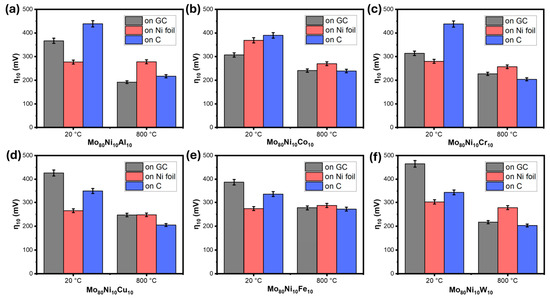
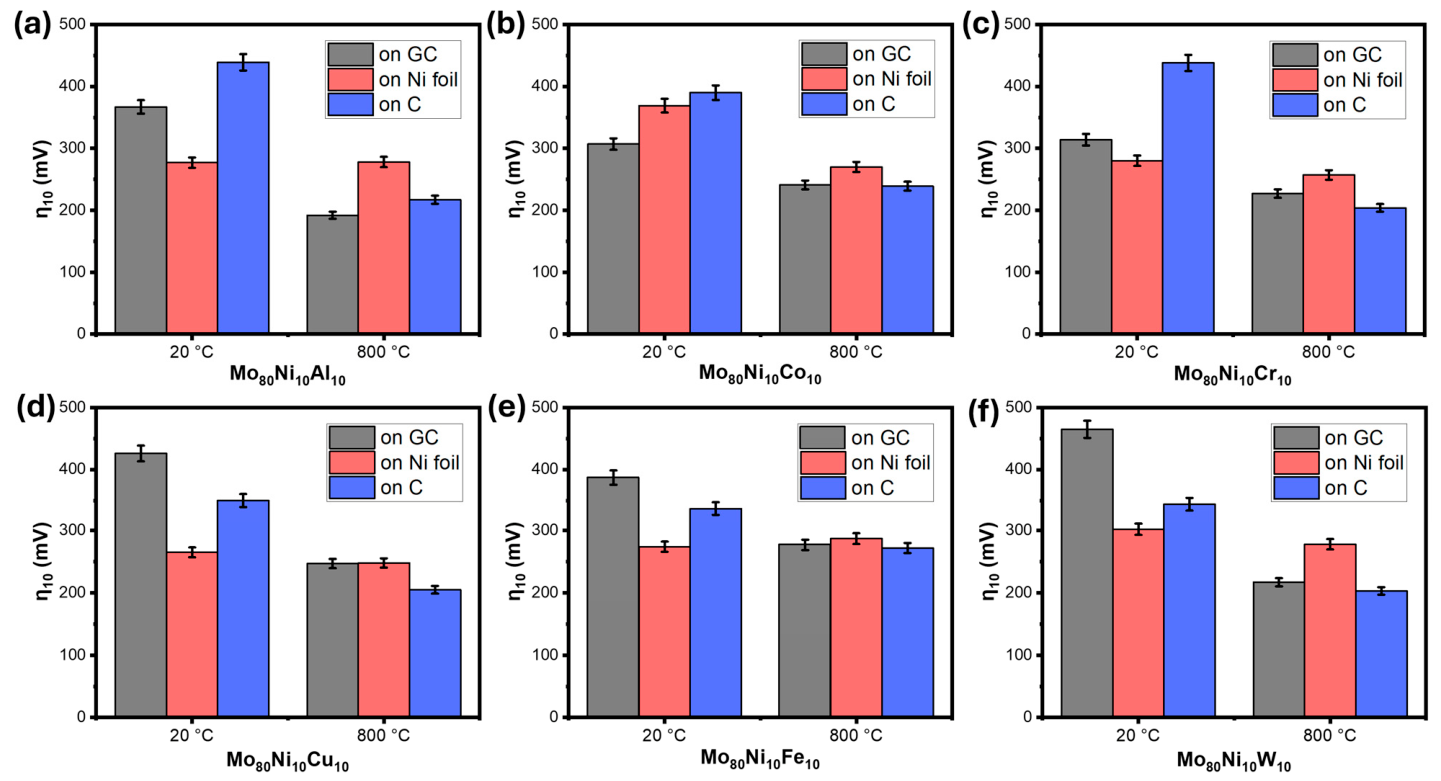
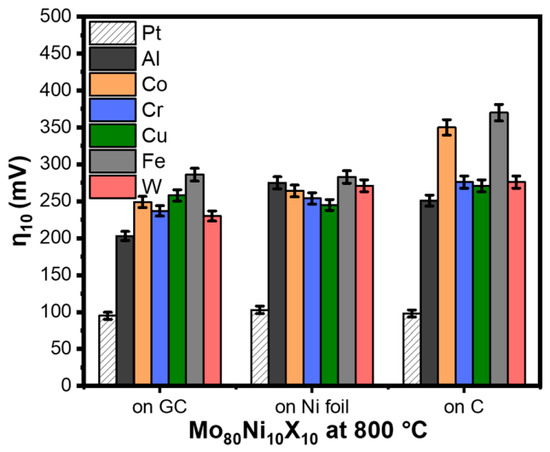
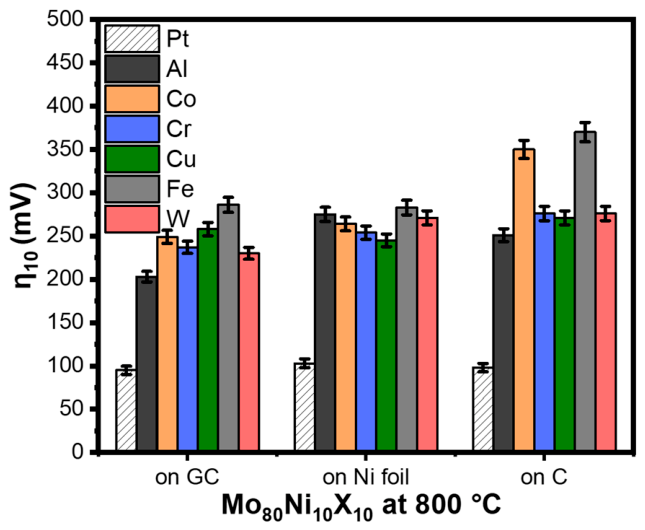
In the initial screening (Figure 1), the hydrogen evolution reaction (HER) activity of Mo80Ni10X10 thin films (X = Al, Co, Cr, Cu, Fe, W) (confirmed by EDX) was evaluated on three substrates (glassy carbon (GC), nickel foil (Ni- foil), and graphite (C)) and at two deposition temperatures (20 °C and 800 °C). The obtained overpotential data (η10) demonstrate that HER performance is governed by three experimentally independent variables: deposition temperature, substrate type, and alloy composition [35,36,37,38,39].
Figure 1.
Overpotential (η10) of Mo80Ni10X10 thin films deposited on GC, Ni foil, and graphite at 20 °C and 800 °C. (a) MoNiAl, (b) MoNiCo, (c) MoNiCr, (d) MoNiCu, (e) MoNiFe, (f) MoNiW. Bar plots with error bars.
Across all investigated compositions and substrates, films deposited at 800 °C consistently exhibit lower overpotentials compared to those prepared at 20 °C (Figure 1). This trend is observed for all Mo–Ni–X systems, indicating that deposition temperature is a universal controlling parameter of catalytic performance. Quantitatively, the improvement is reflected in a systematic shift in η10 toward lower values for high-temperature-deposited films, which is further supported by reduced charge-transfer resistance in subsequent impedance analysis (Figure 2, Figure 3 and Figure 4).
Figure 2.
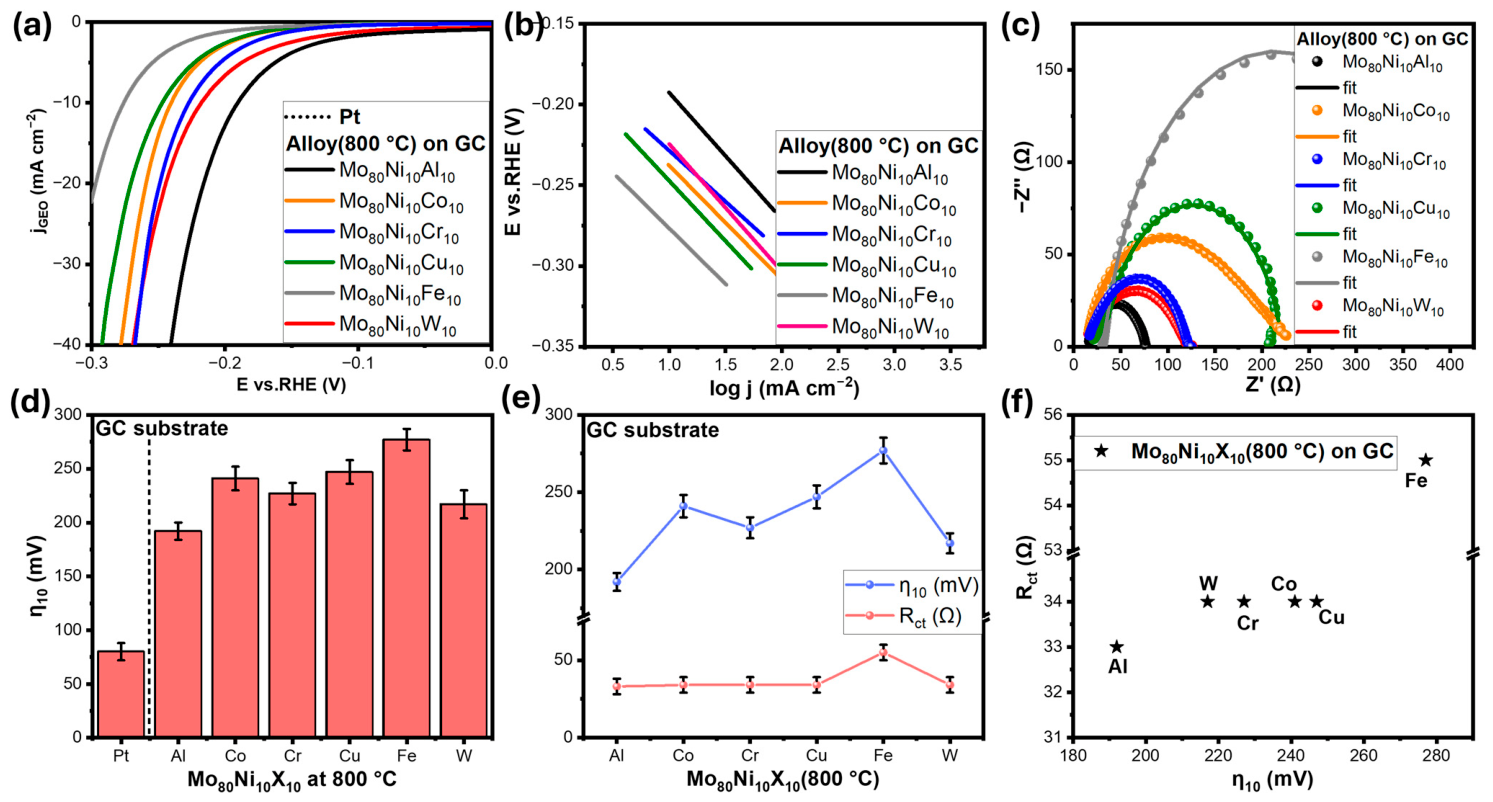
Electrochemical characterization of Mo80Ni10X10 thin films deposited on GC at 800 °C: (a) polarization curves, (b) Tafel plots, (c) Nyquist plots, (d) η10 comparison with error bars, (e) correlation between η10 and Rct, and (f) dependence of Rct on η10.
Figure 3.
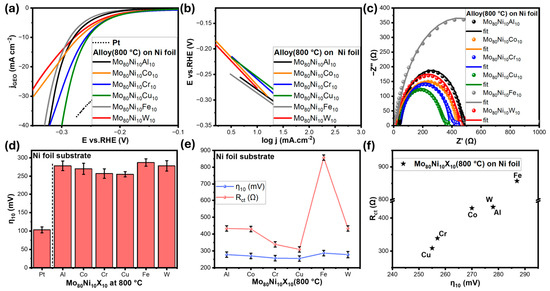
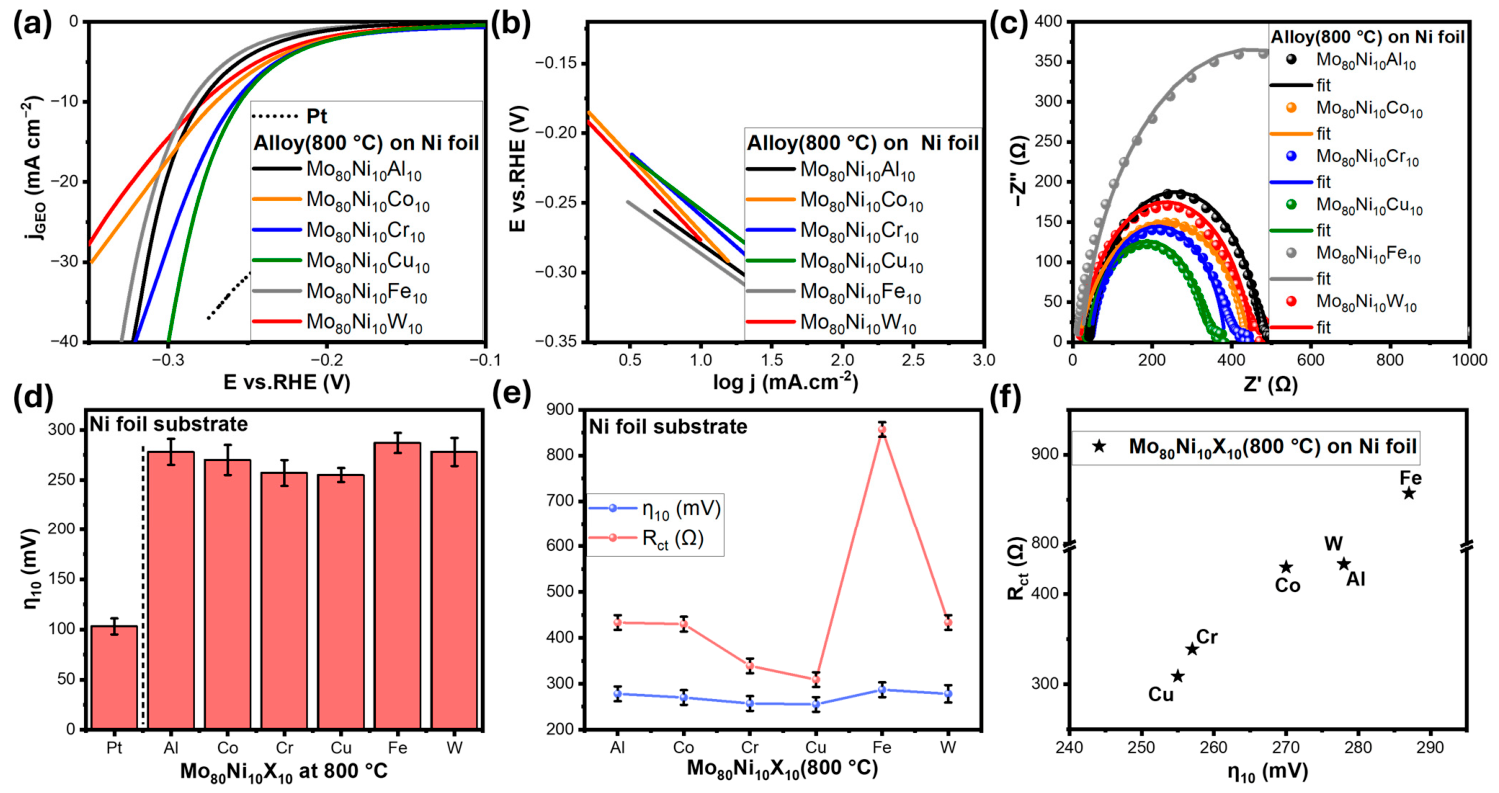
Electrochemical characterization of Mo80Ni10X10 thin films deposited on Ni foil at 800 °C: (a) polarization curves, (b) Tafel plots, (c) Nyquist plots, (d) η10 comparison with error bars, (e) correlation between η10 and Rct, and (f) dependence of Rct on η10.
Figure 4.
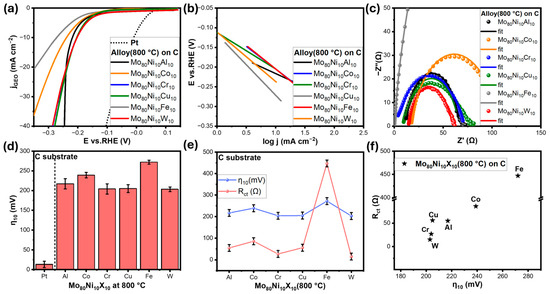
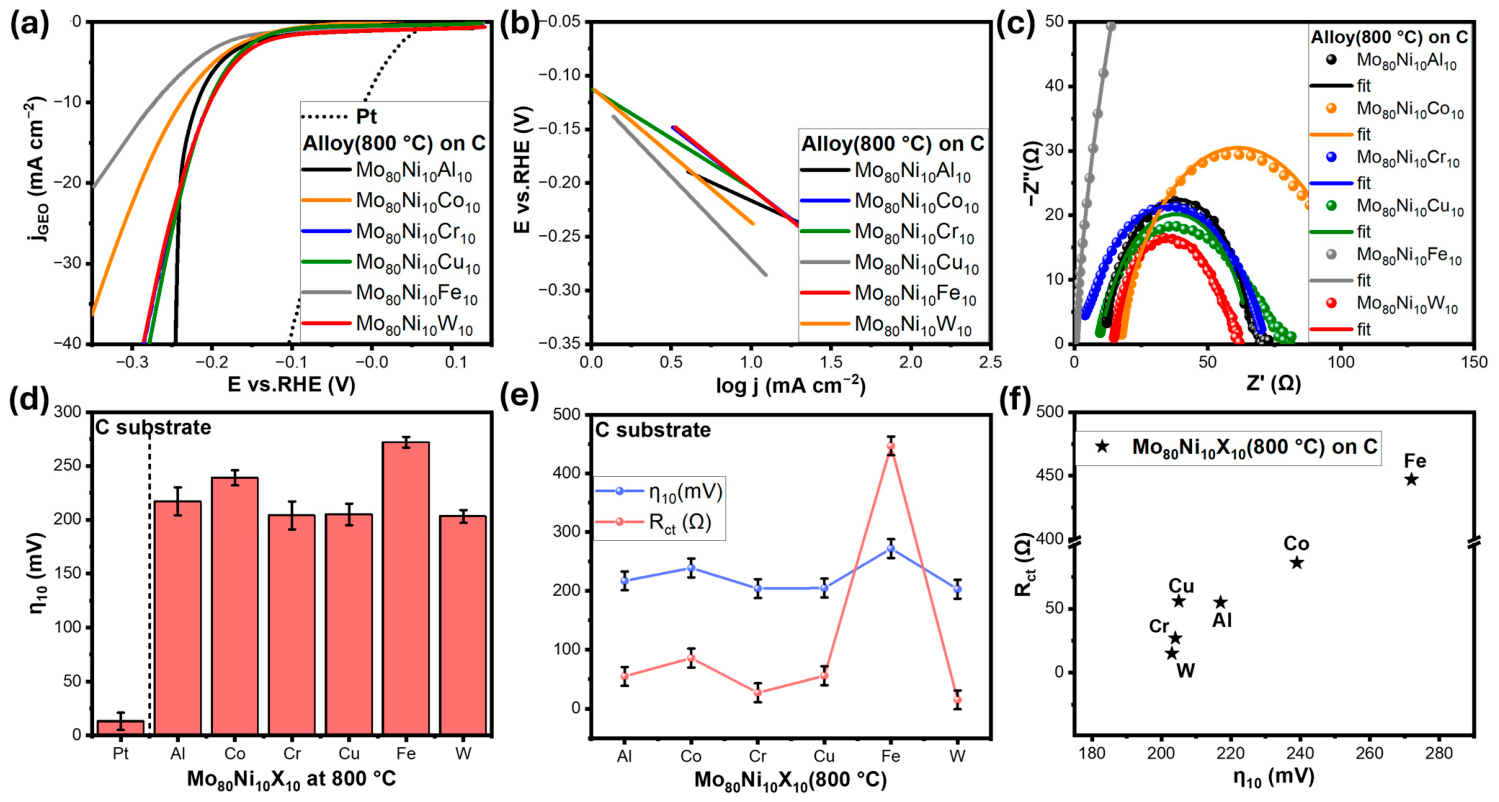
Electrochemical characterization of Mo80Ni10X10 thin films deposited on graphite at 800 °C: (a) polarization curves, (b) Tafel plots, (c) Nyquist plots, (d) overpotential (η10) comparison with error bars, (e) correlation between overpotential and charge transfer resistance (Rct), and (f) dependence of charge transfer resistance on overpotential.
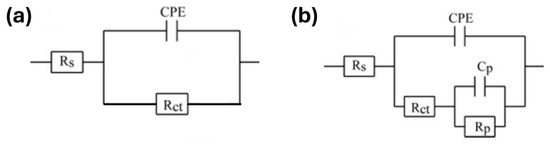
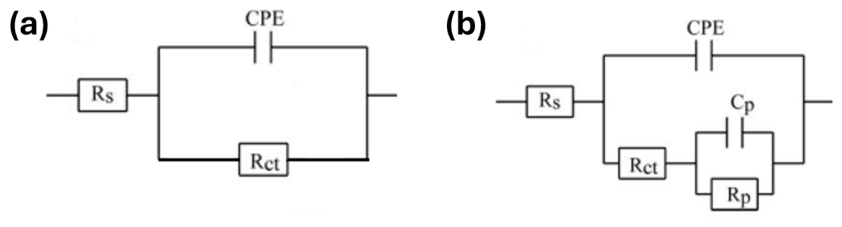
A clear substrate dependence is observed for all compositions (Figure 1, Figure 2, Figure 3 and Figure 4). Among the investigated supports, GC consistently yields the lowest overpotentials and the most favorable electrochemical response. For GC-supported films, η10 values fall in the range −192 to −241 mV (Figure 2a,d), whereas Ni foil-supported samples show significantly higher overpotentials, with most systems exceeding −260 mV (Figure 3d). Graphite exhibits intermediate behavior with η10 values around −203 to −205 mV for the most active compositions (Figure 4a). This trend is further confirmed by electrochemical impedance spectroscopy, where GC-supported catalysts exhibit the lowest charge-transfer resistance (Rct ≈ 14–15 Ω for the most active systems), while Ni foil shows significantly higher values (>300 Ω), indicating strongly hindered interfacial charge transport. The Rct values were extracted from EIS spectra by fitting with Randles and Henderson equivalent circuit models, as shown in Figure 5.
Figure 5.
Randles (a) and Henderson–Armstrong (b) equivalent circuit models used for fitting EIS data and extraction of Rct for Mo80Ni10X10 thin films [15].
The alloying element X also plays a decisive role in determining HER activity. Among all investigated compositions, Mo80Ni10Al10, Mo80Ni10Cr10, and Mo80Ni10W10 consistently show the lowest overpotentials across all substrates. On GC at 800 °C, these systems reach η10 values of −192 mV, −227 mV, and −217 mV, respectively, while Mo80Ni10Fe10 exhibits systematically inferior performance. Tafel analysis (63–78 mV dec−1 for GC-supported systems) indicates a Volmer–Heyrovsky mechanism, with Mo80Ni10Cr10 exhibiting the lowest slope (63 mV dec−1), suggesting faster charge-transfer kinetics.
A direct correlation between η10 and Rct is observed for all systems (Figure 2f, Figure 3f and Figure 4f), confirming that HER activity is primarily governed by interfacial electron-transfer kinetics rather than solely by surface area effects. Ni foil-supported catalysts show systematically suppressed activity despite identical composition and deposition conditions, indicating that the substrate imposes a dominant kinetic limitation on charge transfer. In contrast, graphite provides intermediate behavior, partially preserving intrinsic catalytic trends while still limiting full performance compared to GC.
Overall, the screening results (Table 1 and Table 2) demonstrate that HER activity in Mo80Ni10X10 thin films is governed by a hierarchical structure–property relationship: deposition temperature controls structural activation, substrate determines charge-transfer efficiency, and alloying element tunes intrinsic catalytic behavior. The combined analysis confirms that the observed catalytic performance arises from the interplay between intrinsic alloy properties and extrinsic interfacial transport limitations.
Table 1.
Overpotential (η10), Tafel slope (b), and exchange current density (j0) of Mo80Ni10X10 thin films on glassy carbon, Ni foil, and graphite at 800 °C.
Table 2.
EIS-derived parameters (Rs, Rct, Rp) and equivalent circuit models (Henderson–Armstrong and Randles, see Figure 5) for Mo80Ni10X10 thin films on different substrates.
2.2. Standardized Evaluation of HER Activity Based on ECSA
For a more reliable comparison of catalytic performance, the HER activity of Mo80Ni10X10 thin films was additionally evaluated after normalization to the electrochemically active surface area (ECSA). This approach allows separation of intrinsic catalytic trends from differences arising from surface area variations among substrates [22].
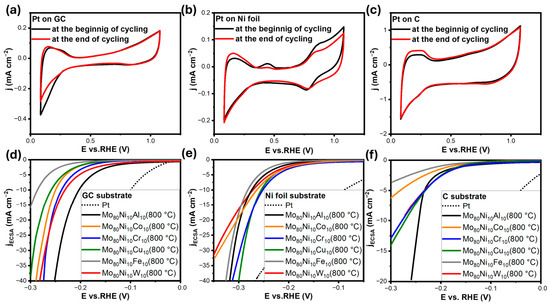
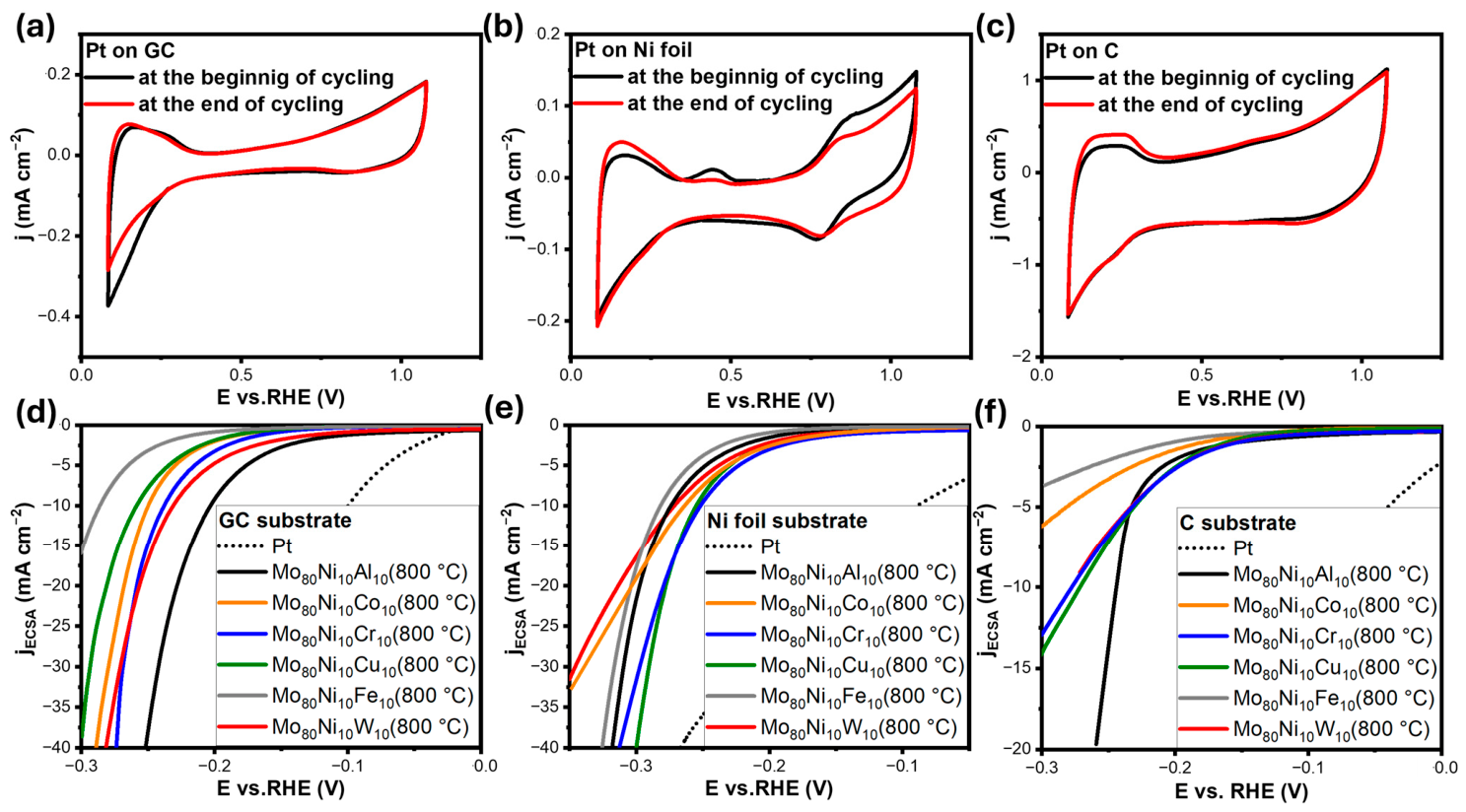
To determine ECSA, a 20 nm Pt thin film was deposited on GC, Ni foil, and C. The electrochemical response was recorded in the potential range from −0.2 to 0.8 V vs. Ag/AgCl (Figure 6a–c). The resulting cyclic voltammograms show that carbon-based substrates (GC and C) exhibit higher capacitive currents compared to Ni foil, indicating a larger electrochemically accessible surface area. In contrast, Ni foil shows a significantly lower capacitive response, suggesting reduced electrochemically active surface development under identical conditions.
Figure 6.
CV-derived ECSA evaluation using Pt reference films (a–c) and ECSA-normalized HER polarization curves of Mo80Ni10X10 thin films on different substrates (d–f).
After normalization of HER polarization curves to ECSA (Equation (2), Figure 6d–f), distinct differences between substrates become evident. On GC, the relative activity trends between individual Mo–Ni–X compositions are preserved, indicating that intrinsic differences between alloys remain detectable after surface-area correction. In contrast, on Ni foil, these differences are strongly attenuated, and all investigated systems converge toward similar apparent activity. This behavior indicates that Ni foil imposes a limitation on the effective utilization of the catalytic surface, which affects the apparent electrochemical response.
C exhibits intermediate behavior, where partial differentiation between alloy compositions is still observable after normalization; however, the separation of catalytic trends remains less pronounced compared to GC.
A direct comparison of overpotentials (η10) after ECSA normalization (Figure 7) confirms the trends observed in the raw polarization data (Figure 2, Figure 3 and Figure 4). GC consistently provides the lowest η10 values across most compositions, while Ni foil shows the highest values. C remains in an intermediate regime between these two extremes.
Figure 7.
Substrate-dependent evaluation of HER activity for Mo80Ni10X10 thin films prepared at 800 °C: overpotential (η10) values for different alloy compositions with error bars.
Importantly, Mo80Ni10Al10, Mo80Ni10Cr10, and Mo80Ni10W10 maintain the highest relative activity after ECSA normalization, confirming that their enhanced performance is not solely related to geometric surface effects. The corresponding η10 values are summarized in Table 3.
Table 3.
Summary of overpotential (η10) values at j = −10 mA cm−2 (ECSA-normalized current density) for Mo80Ni10X10 thin films (800 °C) deposited on different substrates in 1 M NaOH for the hydrogen evolution reaction (HER).
Overall, the ECSA-normalized analysis confirms that the substrate plays a decisive role not only in determining the apparent catalytic performance, but also in controlling the extent to which intrinsic differences between Mo–Ni–X compositions are expressed in electrochemical measurements.
2.3. Investigation of Mo–Ni–Cr-Based Alloys for Alkaline Water Electrolysis
The next part of this study focused on the detailed investigation of Mo–Ni–Cr-based alloys for alkaline HER. The selection of the Mo–Ni–Cr system was based on a combination of electrochemical performance considerations and practical material constraints. Although the Mo80Ni10W10/GC system exhibits a slightly lower overpotential (η10 = −217 mV) compared to Mo80Ni10Cr10/GC (η10 = −227 mV) at 800 °C, this difference lies within the typical experimental variability observed for sputtered thin-film electrocatalysts. Therefore, both systems can be considered comparable in terms of catalytic activity.
From a materials perspective, chromium was selected as a more practically relevant alloying element due to its lower cost compared to tungsten and its well-established contribution to corrosion resistance in alkaline environments. In addition, Mo–Ni–Cr thin-film systems have been significantly less explored in the context of magnetron-sputtered HER catalysts, which provides additional motivation for a detailed investigation of this composition.
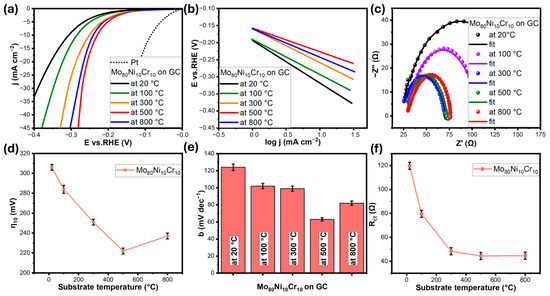
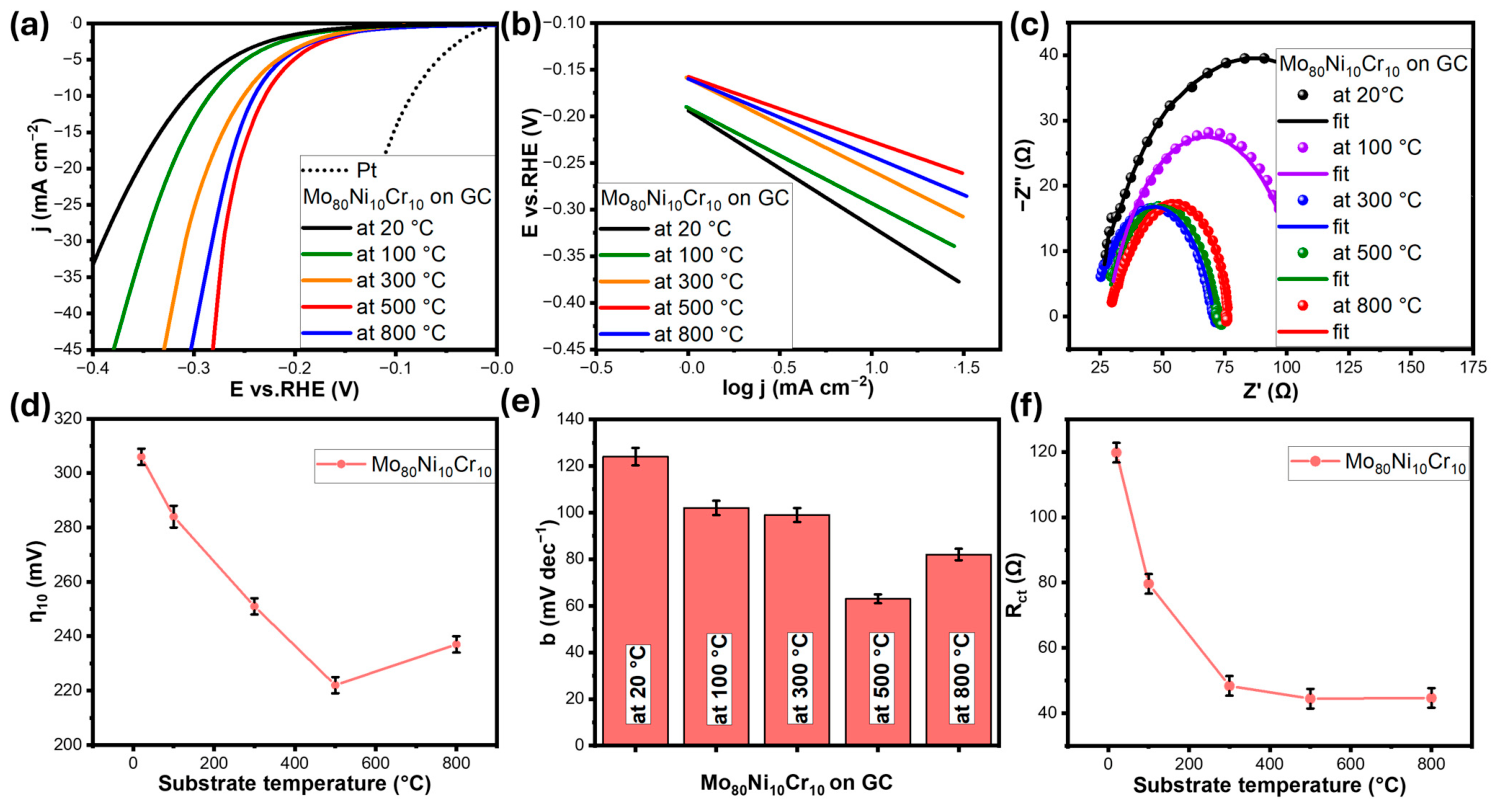
A series of Mo80Ni10Cr10 thin films was therefore prepared on GC substrates at different deposition temperatures (20, 100, 300, 500, and 800 °C), and their electrochemical performance is summarized in Figure 8.
Figure 8.
Electrochemical characterization of Mo80Ni10Cr10 thin films deposited on GC at substrate temperatures ranging from 20 °C to 800 °C: (a) polarization curves, (b) Tafel plots, (c) Nyquist plots, (d) η10 on deposition temperature, (e) Tafel slope values for individual samples, and (f) correlation between η10 and Rct with error bars.
The polarization curves (Figure 8a) demonstrate a clear dependence of HER activity on deposition temperature. A systematic shift toward lower overpotentials is observed with increasing temperature above 300 °C, with η10 values improving from −251 mV (low-temperature samples) to −222 mV (500 °C). The best performance is achieved for the sample prepared at 500 °C, which shows the lowest overpotential among all investigated conditions. The corresponding trend is summarized in Figure 8d, confirming the reproducibility of the temperature-dependent behavior.
Tafel analysis (Figure 8b,e and Table 4) further reveals that all samples follow a Volmer–Heyrovsky mechanism, with Tafel slopes ranging from 69 to 124 mV dec−1. The lowest value (69 mV dec−1), observed for the 500 °C sample, indicates the most favorable reaction kinetics among the investigated conditions.
Table 4.
Summary of electrochemical parameters for Mo80Ni10Cr10 thin films deposited on GC at different substrate temperatures, including η10, b, j0, Rs, and Rct.
EIS (Figure 8c) shows a systematic decrease in Rct with increasing deposition temperature. For samples prepared at ≥300 °C, significantly smaller Nyquist semicircles are observed, corresponding to reduced Rct values. The lowest values are obtained for samples prepared at 300 °C (48.34 Ω), 500 °C (44.43 Ω), and 800 °C (44.62 Ω). This trend is consistent with the polarization and Tafel results, indicating improved interfacial charge-transfer kinetics at elevated deposition temperatures.
The overall electrochemical trends observed across polarization, Tafel, and impedance analyses consistently indicate that deposition temperature is a key parameter governing the kinetic performance of the Mo80Ni10Cr10 system in alkaline HER conditions.
2.4. Surface Chemical Analysis of the Mo80Ni10Cr10 Catalyst
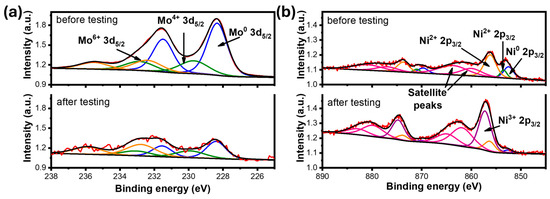
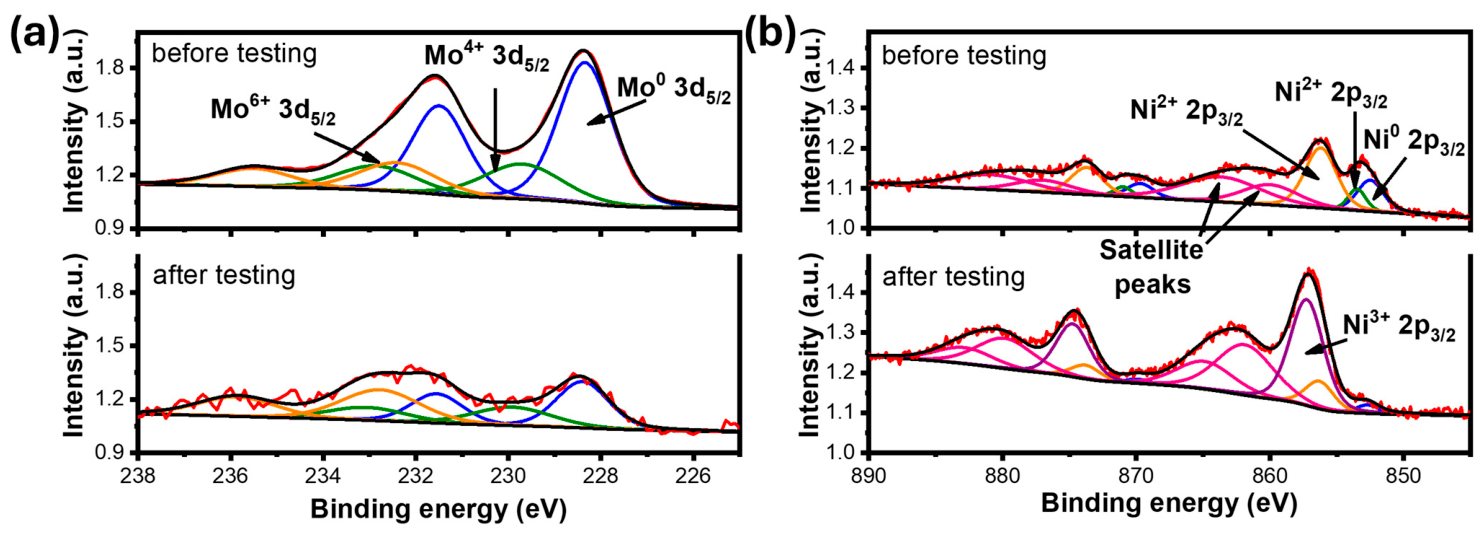
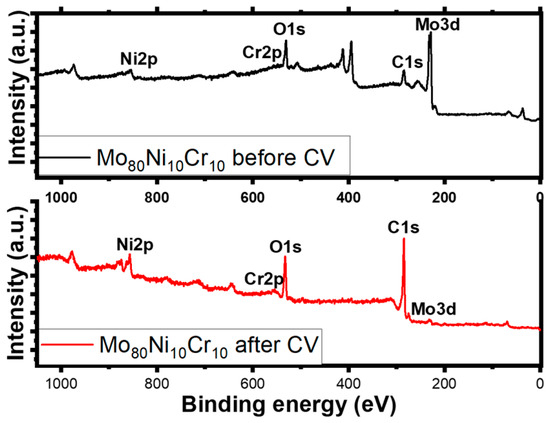
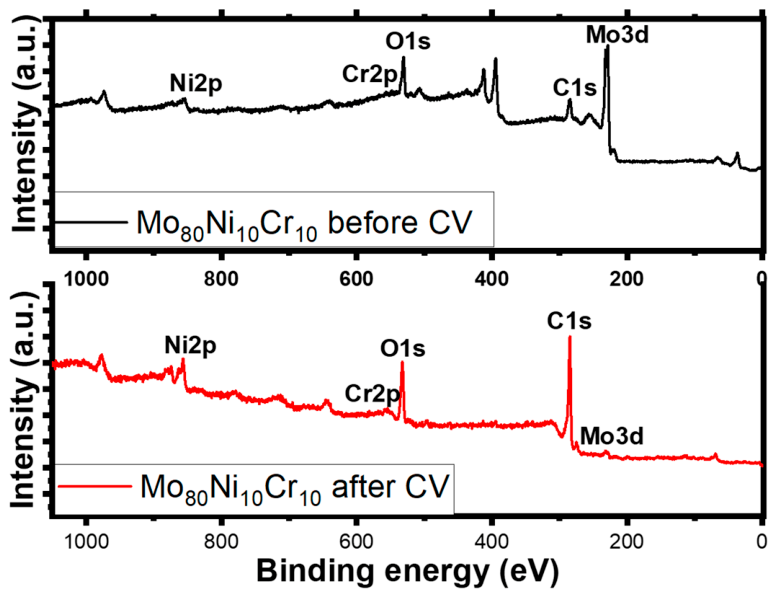
High-resolution X-ray photoelectron spectroscopy (XPS) was employed to investigate the surface chemical states of the Mo80Ni10Cr10 catalyst prepared at 500 °C and to monitor changes induced by electrochemical cycling under alkaline HER conditions. Figure 9 presents the high-resolution Mo 3d, Ni 2p, and Cr 2p spectra, while Figure 10 shows the corresponding survey spectra before and after electrochemical activation.
Figure 9.
High-resolution XPS spectra of Mo 3d (a) and Ni 2p (b) core levels for Mo80Ni10Cr10 thin film.
Figure 10.
XPS survey spectra of Mo80Ni10Cr10 thin film before and after electrochemical cycling.
The Mo 3d spectra exhibit three distinct chemical states of molybdenum, with each Mo 3d5/2 component accompanied by a corresponding 3d3/2 peak, separated by a spin–orbit splitting of approximately 3.1 eV [40,41,42,43]. In the as-prepared state, three components are observed at 228.34, 229.70, and 232.40 eV, assigned to Mo0, Mo4+, and Mo6+, respectively. The presence of metallic Mo indicates a partially reduced surface, while oxidized species originate from surface passivation under ambient conditions. After electrochemical cycling, the oxidation states remain unchanged; however, a pronounced decrease in overall Mo signal intensity is observed in both high-resolution and survey spectra. This confirms a reduction in surface Mo concentration during HER operation, consistent with partial leaching or redistribution of Mo species under alkaline conditions. Importantly, the preservation of binding energies suggests that the remaining Mo species maintain their chemical environment, although at reduced surface coverage.
The Ni 2p spectrum of the as-prepared catalyst consists of contributions from Ni0 (852.5 eV), Ni2+ (NiO, 853.5 eV), and Ni(OH)2 (856.21 eV) [44,45,46], together with characteristic satellite features confirming the presence of Ni2+ species. After electrochemical cycling, a clear redistribution of surface Ni species is observed. The relative contribution of Ni(OH)2 increases, while metallic Ni and NiO components are partially suppressed. A weak high-binding-energy feature (~857.2 eV) is also detected, which may be tentatively associated with NiOOH-like species; however, its presence is more likely related to partial surface oxidation occurring during post-mortem exposure to air, as NiOOH is not thermodynamically stable under cathodic HER conditions [47]. Overall, the Ni 2p results indicate the formation of a hydroxide-enriched Ni surface layer while preserving a fraction of metallic Ni, suggesting the coexistence of metallic and hydroxylated Ni species after activation.
Due to the low signal intensity and strong multiplet splitting of Cr(III) species, reliable quantitative deconvolution of the Cr 2p spectra was not possible. The overlapping nature of Cr 2p3/2 and Cr 2p1/2 signals limits a precise assignment of individual chromium chemical states. Nevertheless, the presence of Cr in oxidized form is confirmed in both survey and high-resolution spectra. These limitations are typical for Cr-containing thin films and have been reported in similar systems [44,48,49], preventing further quantitative interpretation of Cr speciation in the present study.
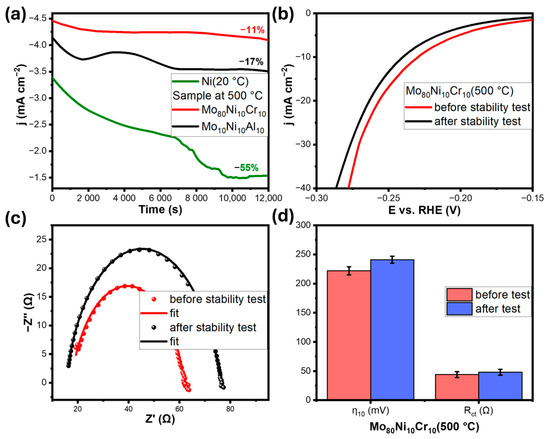
For selected Mo80Ni10Cr10 systems deposited on a GC substrate, stability tests including chronoamperometry, chronopotentiometry, and multicycling were performed, as shown in Figure 8. All measurements were carried out in an alkaline electrolyte.
Survey spectra confirm the presence of Mo, Ni, Cr, O, and C on the catalyst surface in the as-prepared state. The O 1s and C 1s signals are attributed to surface oxidation and adventitious carbon contamination. After HER cycling, a clear change in surface composition is observed, characterized by a decrease in Mo signal intensity and a relative increase in Ni contribution. This trend indicates preferential surface depletion or redistribution of Mo species under alkaline electrochemical conditions, accompanied by the formation of a Ni-enriched surface region [50]. Such behavior is commonly observed in Mo–Ni-based systems exposed to alkaline HER environments and is associated with dynamic surface reconstruction processes.
Overall, the combined XPS results demonstrate that the Mo80Ni10Cr10 catalyst undergoes significant surface reconstruction during HER operation. The post-activation surface consists of a mixed Ni0/Ni(OH)2 matrix with reduced but still detectable Mo content and oxidized Cr species. Rather than forming a completely Ni-dominated surface, the data suggest a dynamically evolving multicomponent interface, where Ni provides the primary hydrogen evolution sites, while residual Mo and Cr likely contribute to electronic and structural modulation of the surface. This dynamic restructuring consists of the observed electrochemical activation behavior and supports the role of surface evolution in governing catalytic performance.
2.5. Durability Test of Mo80Ni10Cr10/GC
For the selected Mo80Ni10Cr10 catalyst deposited on GC substrate, long-term stability was evaluated using chronoamperometric measurements in alkaline electrolyte (Figure 11). The current response was monitored over 12,000 s at a constant potential of −1.3 V vs. Ag/AgCl.
Figure 11.
Electrochemical stability evaluation of Mo80Ni10Cr10/GC catalysts, including (a) chronoamperometric response, (b) polarization curves before and after durability testing, (c) Nyquist plots before and after testing, and (d) comparison of key electrochemical parameters.
The chronoamperometric curve (Figure 11a) shows an initial decrease in current density during the early stage of the measurement. This behavior is commonly attributed to surface stabilization processes, including restructuring of the catalyst surface and the formation of steady-state active sites under cathodic polarization [51]. After this initial activation period, the current stabilizes and remains nearly constant throughout the remainder of the experiment, confirming stable catalytic operation under prolonged HER conditions.
The initial 3 h stability window, used as a comparative benchmark for rapid durability screening, revealed a relatively low degradation of jGEO, with a decrease of approximately 11%. This value is lower than that observed for the Mo–Ni–Al system (≈17%), while significantly outperforming a reference Ni-based catalyst, which exhibited a substantial decline of up to ~55% under identical conditions. These results confirm the improved intrinsic stability of the Mo–Ni–Cr composition compared to both benchmark ternary alloys and monometallic Ni systems.
To further evaluate structural stability, post-stability electrochemical characterization was performed (Figure 11b). A comparison of polarization curves before and after the chronoamperometric test shows only a minor shift in overpotential, from −222 mV to −241 mV at j = −10 mA cm−2. The relatively small change (19 mV) indicates good preservation of catalytic activity after prolonged electrochemical operation. This conclusion is further supported by electrochemical impedance spectroscopy, where only a slight increase in charge-transfer resistance is observed (from ~44 Ω to ~48 Ω), suggesting that the interfacial electron-transfer properties remain largely intact after durability testing.
Overall, these results demonstrate that the Mo80Ni10Cr10/GC catalyst exhibits a favorable combination of high HER activity and good electrochemical stability in alkaline media.
To correlate electrochemical stability with compositional evolution, post-mortem EDX analysis was performed (Table 5). After durability testing, measurable changes in the relative elemental composition of Mo, Ni, and Cr were observed. The most pronounced variation was detected for molybdenum, indicating partial redistribution or leaching of Mo species during prolonged electrochemical operation.
Table 5.
Energy-dispersive X-ray spectroscopy (EDX) results for as-prepared MoxNiγCrz thin films and after electrochemical stability testing.
This behavior suggests that the stability of the multicomponent film is governed not only by its initial stoichiometry but also by the evolution of its microstructure under electrochemical conditions. In particular, higher deposition temperatures appear to promote improved incorporation and retention of Mo within the film matrix, thereby mitigating compositional drift during HER operation [16].
These findings are consistent with the surface reconstruction phenomena identified by XPS (Section 2.4), confirming that the Mo–Ni–Cr catalyst undergoes dynamic but stable restructuring under alkaline HER conditions, while maintaining its overall catalytic performance.
2.6. Morphological and Structural Characterization
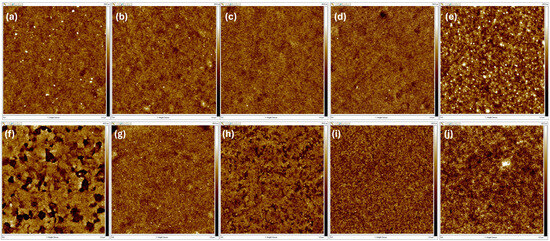
The surface morphology of the prepared Mo80Ni10Cr10 catalysts was investigated using atomic force microscopy (AFM) (Figure 12). The upper row (Figure 12a–e) shows as-prepared films deposited at different substrate temperatures (20–800 °C), while the lower row (Figure 12f–j) presents the corresponding samples after electrochemical testing.
Figure 12.
AFM topography of Mo80Ni10Cr10 thin films deposited at different substrate temperatures (20–800 °C), shown before (a–e) and after cyclic voltammetry (f–j) testing.
The AFM images of the as-prepared films (Figure 12a–e) reveal a relatively smooth and homogeneous surface at lower deposition temperatures. With increasing deposition temperature, particularly at 800 °C (Figure 12e), the formation of larger grains and island-like surface features becomes evident, indicating a transition in the thin-film growth mechanism toward a more pronounced three-dimensional growth mode. This evolution reflects enhanced adatom mobility and increased atomic rearrangement during high-temperature deposition.
After electrochemical cycling, all samples exhibit pronounced morphological changes (Figure 12f–j). The surface becomes significantly rougher, accompanied by the formation of nanoscale defects, local restructuring, and surface fragmentation. These changes are especially evident for samples deposited at higher temperatures [52,53]. Importantly, rather than indicating degradation, these transformations are consistent with electrochemically induced surface reconstruction, which is commonly associated with the formation of newly exposed active sites during HER [53].
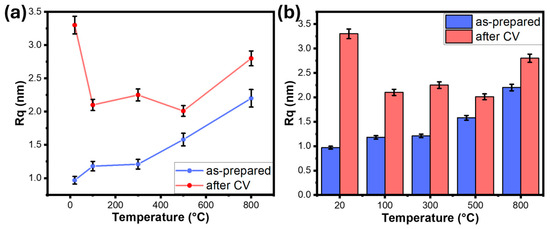
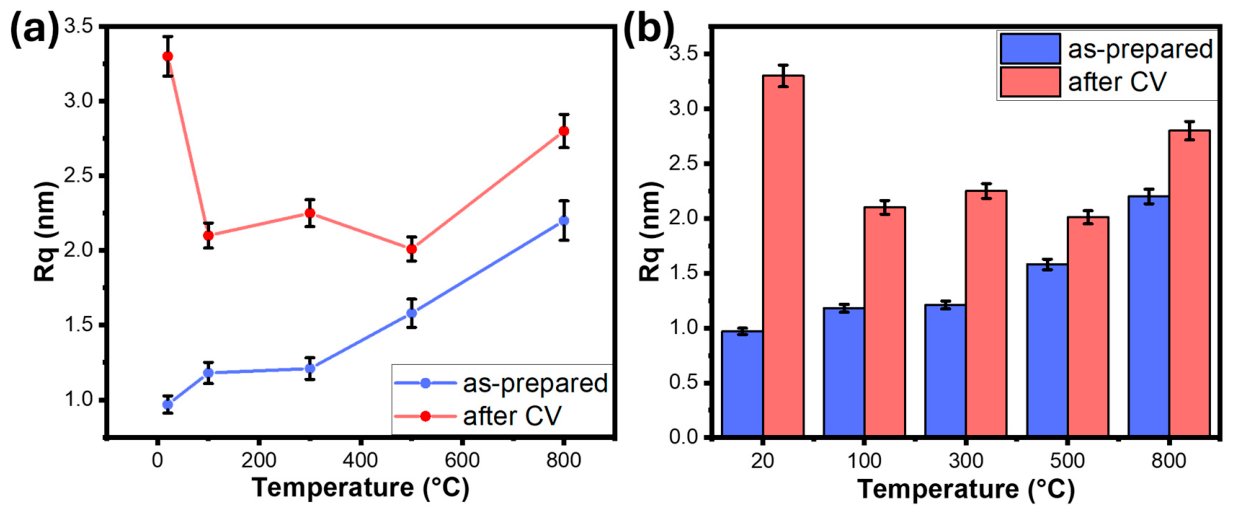
The quantitative evolution of surface roughness (Rq) as a function of deposition temperature is shown in Figure 13. In the as-prepared state, all samples exhibit low roughness values (0.96–2.2 nm), which increase systematically with deposition temperature, reaching the maximum for the 800 °C sample. After electrochemical activation, a substantial increase in roughness is observed for all samples, with values approaching ~3 nm. The increase is most pronounced for films deposited at ≥500 °C, which correlates well with their superior electrocatalytic performance (Figure 8), suggesting a direct relationship between thermally induced microstructure and electrochemically activated surface evolution.
Figure 13.
Dependence of Rq of Mo80Ni10Cr10 thin films on deposition temperature before and after HER, with error bars (a). The corresponding Rq values are shown in a bar graph (b) with error bars.
Overall, the AFM results demonstrate that the catalyst surface undergoes dynamic restructuring under HER conditions. This process can be interpreted as surface activation rather than degradation and is consistent with the reconstruction phenomena identified by XPS (Section 2.4), where preferential Mo depletion and Ni enrichment were observed. The formation of a roughened, defect-rich surface is therefore considered beneficial for enhancing the density of catalytically active sites.
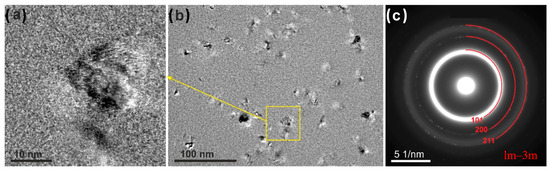
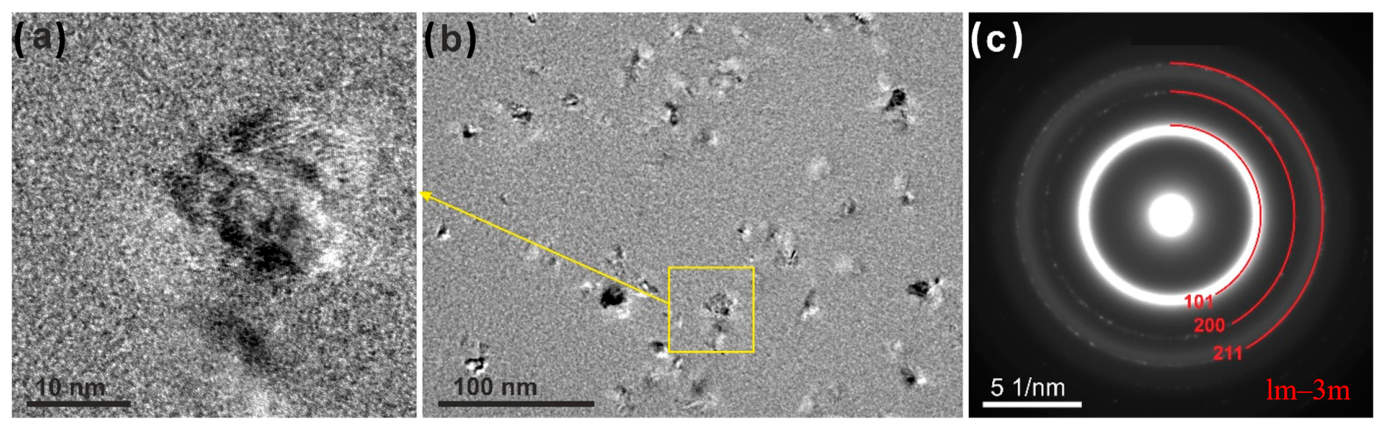
Transmission electron microscopy (TEM) analysis of the Mo80Ni10Cr10 sample deposited at 500 °C further reveals the internal microstructure of the catalyst (Figure 14). A representative high-resolution image (Figure 12a) shows isolated nanocrystalline domains with an average size of approximately 10 nm embedded in a disordered matrix. Low-magnification TEM (Figure 14b) confirms a uniform distribution of these nanostructures within a continuous background.
Figure 14.
TEM and SAED analysis of Mo80Ni10Cr10 (500 °C): (a) isolated nanoparticle (10 nm); (b) low-magnification TEM image showing uniform nanoparticle dispersion (yellow square indicates the region shown in (a)); (c) SAED pattern confirming a nanocrystalline bcc phase embedded in an amorphous matrix. Red markings indicate reflections from crystallographic planes.
Selected area electron diffraction (SAED) (Figure 14c) exhibits a combination of diffuse halo features and distinct Debye–Scherrer rings. The diffuse halo indicates the presence of an amorphous phase, while the indexed diffraction rings correspond to a body-centered cubic (bcc) structure with reflections assigned to the (101), (200), and (211) planes. The calculated lattice parameter is a = 0.31 ± 0.01 nm. These results confirm a dual-phase nanostructure consisting of nanocrystalline bcc grains embedded in an amorphous matrix, which is known to facilitate a high density of structural defects and potentially beneficial electronic heterogeneity for electrocatalysis.
2.7. Comparison with Reported Results in Literature
Due to the limited availability of directly comparable studies on ternary Mo–Ni–Cr thin films prepared by magnetron sputtering, the electrocatalytic performance of the Mo80Ni10Cr10/GC system was benchmarked against representative Ni–Mo-based and multicomponent HER electrocatalysts operating in alkaline media (Table 6).
Table 6.
Comparison of the electrochemical HER performance of the Mo80Ni10Cr10/GC thin film prepared by magnetron sputtering with selected Ni–Mo- and ternary Ni-based electrocatalysts reported in the literature.
The obtained overpotential of η10 = −222 mV at j = −10 mA cm−2 places the prepared catalyst within the typical performance range of conventional Ni–Mo-derived systems. For example, Ni–Mo catalysts exhibit overpotentials of approximately −250 to −300 mV, attributed to synergistic interactions between Ni and Mo active sites [54]. Similarly, Ni–Fe–Cr and Ni–Mo–Fe systems generally operate in the range of −240 to −320 mV, confirming the performance window of multicomponent Ni-based alloys [55,56].
More recent studies, however, indicate that HER activity is governed not only by macroscopic alloy synergy but also by dynamic surface reconstruction and the formation of catalytically relevant interfacial structures. In Ni–Mo systems, for instance, reconstructed alloy–oxide interfaces have been identified as the true active phase, where Mo facilitates water dissociation, and Ni optimizes hydrogen adsorption energetics, forming a cooperative dual-site mechanism [41,57]. These findings highlight the importance of considering operando surface evolution rather than static bulk composition.
Beyond conventional alloy systems, advanced catalyst architectures such as multi-site and interface-engineered materials demonstrate significantly enhanced HER kinetics by spatially separating elementary reaction steps. A representative example is a Mo/Ru-based catalyst containing Ru/Mo2C/MoO2 interfacial sites, which achieves overpotentials as low as 19 mV at 10 mA cm−2 by accelerating both Volmer and Tafel steps through distinct active centers [28]. This illustrates the upper performance limit of deliberately engineered heterointerface catalysts.
Similarly, single-atom and defect-engineered systems further confirm that catalytic activity is highly sensitive to local coordination environments and can evolve under operating conditions. Operando studies show that dynamic reconstruction of metal–oxygen coordination motifs plays a key role in defining the active phase and reaction kinetics [27,58].
In this context, the Mo80Ni10Cr10/GC system (η10 = −222 mV, b = 69 mV dec−1) demonstrates competitive performance among Ni–Mo–X catalysts, particularly considering its compact thin-film morphology without porous architectures or high-surface-area scaffolds. The results suggest that its activity arises from a combination of alloy-induced electronic modulation, efficient substrate-mediated charge transport, and electrochemically induced surface reconstruction.
This is further supported by the experimental observations in this work, including (i) substrate-dependent charge-transfer behavior (Section 2.1 and Section 2.2), (ii) surface reconstruction evidenced by AFM and XPS (Section 2.4, Section 2.5 and Section 2.6), and (iii) stable long-term operation under alkaline HER conditions (Section 2.5). Together, these findings indicate that catalytic performance is governed by a dynamic equilibrium between alloy composition, interfacial electron transfer, and operando surface restructuring.
3. Experimental Section
3.1. Preparation of the Thin Films
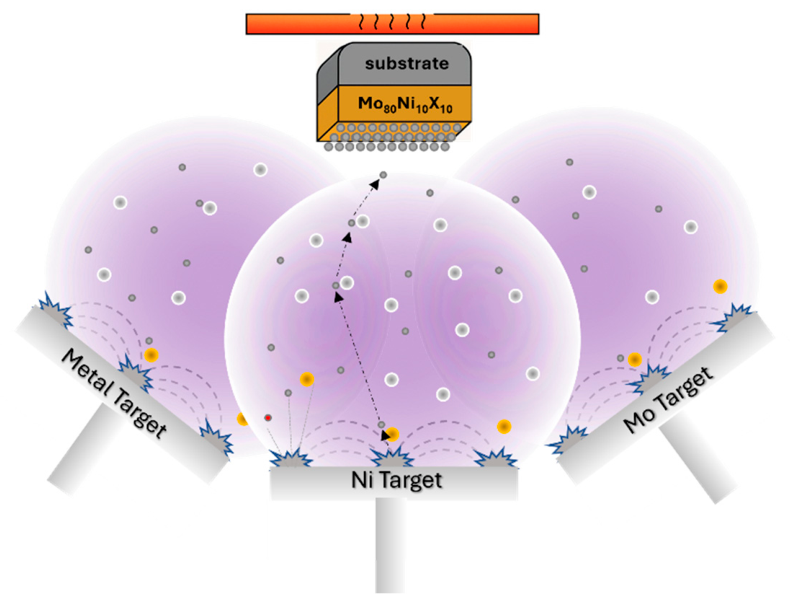
Thin films were prepared by magnetron sputtering using an Orion 8 deposition system (AJA International, Scituate, MA, USA). Alloys with the nominal composition Mo80Ni10X10 (X = Al, Co, Cr, Cu, Fe, and W) were deposited by co-sputtering from metallic targets: Mo (99.99%), Ni (99.99%), and the corresponding alloying element X (99.99%).
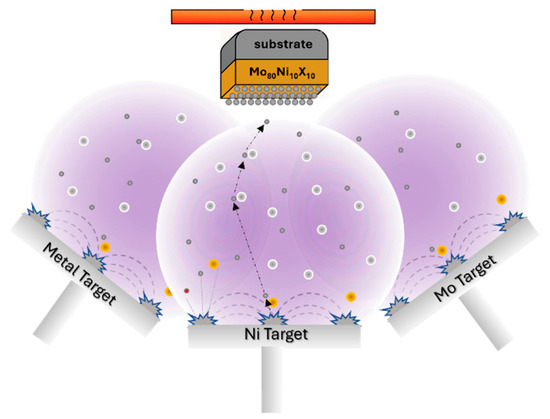
The sputtering process (Figure 15) was carried out in an argon atmosphere at a working pressure of 3 mTorr. High-purity argon (99.999%, Messer, Bad Soden am Taunus, Germany) was supplied at a flow rate of 18 cm3 min−1. The substrate temperature was maintained at either 20 °C or 800 °C during deposition. The deposition time and sputtering power were adjusted to obtain a film thickness of approximately 30 nm. The films were deposited onto three different substrates: glassy carbon (Sigradur G, HTW Hochtemperatur-Werkstoffe GmbH, Thierhaupten, BA, Germany), nickel foil (Alfa Aesar, Haverhill, MA, USA), and graphite plates (Fuel Cell Store, College Station, TX, USA). Prior to deposition, all substrates were ultrasonically cleaned in acetone and ethanol and subsequently dried in air.
Figure 15.
Schematic illustration of the preparation of Mo–Ni–X thin films by magnetron co-sputtering.
3.2. Materials Characterization
The elemental composition of the deposited films was determined using energy-dispersive X-ray spectroscopy (EDX) attached to a TESCAN VEGA scanning electron microscope (SEM, VEGA3, TESCAN, Brno, Czech Republic) operating at an accelerating voltage of 30 kV.
Surface topography and roughness were analyzed by atomic force microscopy (AFM, Dimension Icon, Bruker, Billerica, MA, USA) operating in tapping mode. The root-mean-square roughness (Rq) values were calculated from the acquired AFM images.
The microstructure of selected samples was investigated using transmission electron microscopy (TEM, JEM-2100F UHR, JEOL Ltd., Tokyo, Japan) operated at 200 kV. Crystallographic information was obtained from selected-area electron diffraction (SAED) patterns.
X-ray photoelectron spectroscopy (XPS) measurements were performed using a PHOIBOS 100 hemispherical analyzer (SPECS GmbH, Berlin, Germany) equipped with a Mg Kα X-ray source operated at 200 W. The base pressure during analysis was maintained at approximately 1 × 10⁻⁸ mbar. High-resolution spectra were recorded for the Mo 3d, Ni 2p, Cr 2p, O 1s, and C 1s regions.
3.3. Electrochemical Measurement
Electrochemical measurements were performed using a three-electrode cell connected to a potentiostat/galvanostat (PGSTAT302N, Metrohm Autolab B.V., Utrecht, The Netherlands).
The sputtered thin film deposited on the corresponding substrate served as the working electrode. A gold wire was used as the counter electrode, while an Ag/AgCl electrode (3 M KCl) served as the reference electrode. All measurements were carried out in 1 M NaOH prepared from analytical-grade sodium hydroxide and deionized water.
Prior to each experiment, the electrolyte was purged with argon (99.999%, Messer, Bad Soden am Taunus, Germany) for 30 min.
HER activity was evaluated by cyclic voltammetry in the potential range from −0.9 to −1.7 V vs. Ag/AgCl. All measured potentials were converted to the reversible hydrogen electrode (RHE) scale according to:
where 0.222 V is the standard potential of the Ag/AgCl reference electrode.
Electrochemical impedance spectroscopy (EIS) measurements were performed under HER conditions. The impedance spectra were fitted using equivalent electrical circuits based on the Randles and Henderson–Armstrong models to determine the solution resistance (Rs), charge-transfer resistance (Rct), and polarization resistance (Rp) [16].
In alkaline media, the HER is generally described by the Volmer–Heyrovsky mechanism involving electrochemical water dissociation (Volmer step) followed by electrochemical hydrogen desorption (Heyrovsky step) [15,16].
The electrochemically active surface area (ECSA) was determined using Pt reference films (20 nm) deposited on identical substrates. Cyclic voltammograms were recorded in 0.1 M HClO4 within the potential range −0.2 to 0.8 V vs. Ag/AgCl. ECSA values were calculated according to
where QH is the charge associated with hydrogen adsorption, 210 × 10−4 C m−2 is the charge required for monolayer hydrogen adsorption on Pt, and mPtis the mass of deposited Pt [22].
4. Conclusions
In this work, ternary Mo–Ni–X (X = Al, Co, Cr, Cu, Fe, and W) thin films were prepared by magnetron sputtering and evaluated as electrocatalysts for the hydrogen evolution reaction in alkaline media. The results demonstrate that both deposition temperature and substrate type strongly affect the morphology, electrochemical properties, and catalytic performance. Among the investigated systems, alloys containing Al, Cr, and W showed the highest activity, with the best performance obtained for films deposited on glassy carbon. Detailed analysis of a novel Mo80Ni10Cr10 system revealed that deposition temperatures of 500 °C and above lead to enhanced HER activity and excellent long-term stability, which is associated with electrochemically induced surface reconstruction and an increased density of active sites. These findings highlight the importance of microstructural control and substrate selection in the design of efficient HER catalysts and identify Mo–Ni–Cr thin films as promising candidates for alkaline water electrolysis.
Author Contributions
R.B.: Conceptualization, Data Curation, Formal analysis, Methodology, Funding acquisition, Investigation, Visualization, Writing—Original Draft. S.V.: Investigation. M.K.: Investigation. M.L.: Investigation. E.A.: Investigation. D.V.: Investigation. Formal Analysis. V.K.: Writing—review & editing, Supervision. All authors have read and agreed to the published version of the manuscript.
Funding
This research was funded by the EU NextGenerationEU through the Recovery and Resilience Plan for Slovakia under the project No. 09I03-03-V04-00385. And the APC was funded by the same project.
Data Availability Statement
The original contributions presented in this study are included in the article. Further inquiries can be directed to the corresponding authors.
Conflicts of Interest
The authors declare no conflicts of interest.
References
- Turner, J.A. Sustainable hydrogen production. Science 2004, 305, 972–974. [Google Scholar] [CrossRef] [Scilit] [PubMed]
- Ayers, K.; Danilovic, N.; Ouimet, R.; Carmo, M.; Pivovar, B.; Bornstein, M. Perspectives on low-temperature electrolysis and potential for renewable hydrogen at scale. Annu. Rev. Chem. Biomol. Eng. 2019, 10, 219–239. [Google Scholar] [CrossRef] [Scilit] [PubMed]
- Feidenhans’l, A.A.; Regmi, Y.N.; Wei, C.; Xia, D.; Kibsgaard, J.; King, L.A. Precious metal free hydrogen evolution catalyst design and application. Chem. Rev. 2024, 124, 5617–5667. [Google Scholar] [CrossRef] [Scilit] [PubMed]
- Lawan, B. Non-noble metal catalysts for the alkaline hydrogen evolution reaction: A review. Discov. Chem. 2026, 3, 166. [Google Scholar] [CrossRef] [Scilit]
- Khan, N.A.; Rahman, G.; Nguyen, T.M.; Shah, A.U.H.A.; Pham, C.Q.; Tran, M.X.; Nguyen, D.L.T. Recent development of nanostructured nickel metal-based electrocatalysts for hydrogen evolution reaction: A review. Top. Catal. 2023, 66, 149–181. [Google Scholar] [CrossRef] [Scilit]
- Khan, N.A.; Rahman, G.; Chae, S.Y.; Yoon, N.; Shah, A.U.H.A.; Mian, S.A. Unraveling the electrocatalytic response of Zn-substituted nickel ferrite for overall water splitting. ACS Appl. Energy Mater. 2024, 7, 4960–4974. [Google Scholar] [CrossRef] [Scilit]
- Subbaraman, R.; Tripkovic, D.; Chang, K.C.; Strmcnik, D.; Paulikas, A.P.; Hirunsit, P.; Markovic, N.M. Trends in activity for the water electrolyser reactions on 3 d M (Ni, Co, Fe, Mn)hydr(oxy)oxide catalysts. Nat. Mater. 2012, 11, 550–557. [Google Scholar] [CrossRef] [Scilit] [PubMed]
- Phuan, Y.W.; Ibrahim, E.; Chong, M.N.; Zhu, T.; Lee, B.K.; Ocon, J.D.; Chan, E.S. In situ Ni-doping during cathodic electrodeposition of hematite for excellent photoelectrochemical performance of nanostructured nickel oxide-hematite pn junction photoanode. Appl. Surf. Sci. 2017, 392, 144–152. [Google Scholar] [CrossRef] [Scilit]
- Zhu, D.; Wang, J.; Ling, Q.; Shu, S.; Chen, L.; Li, J.; Yao, Y.; Dou, W.; Fu, Y.; Huang, Q.; et al. Co, Ni-doped MoS2 nanosheet composites for electrocatalytic hydrogen evolution. ACS Appl. Nano Mater. 2024, 7, 28371–28379. [Google Scholar] [CrossRef] [Scilit]
- Li, Q.; Huang, N.; Zhu, W.; Ma, H.; Du, J.; He, X.; Wang, S.; Li, C.; Wang, W.; Weng, Y. Preparation of NiTe-Ni(OH)2/NF active cathode material as an electrocatalyst for hydrogen evolution. J. Alloys Compd. 2024, 990, 174458. [Google Scholar] [CrossRef] [Scilit]
- Garibay-Coria, S.; Velasco-Plascencia, M.; Villalobos, J.C.; Vázquez-Gómez, O.; Molina-Ocampo, A.; Vergara-Hernández, H.J. Chromium Effect Over the Hydrogen Evolution Reaction and Corrosion Behavior on Ni-Cr Porous Electrodes. J. Mater. Eng. Perform. 2025, 34, 11061–11071. [Google Scholar] [CrossRef] [Scilit]
- Carbone, S.; Oliveri, R.L.; Patella, B.; Aiello, G.; Scopelliti, M.; Campagna, N.; Pellitteri, F.; Miceli, R.; Affranchi, A.; Longo, S.; et al. Optimized NiFeP alloy for overall water-splitting. Renew. Energy 2025, 250, 123257. [Google Scholar] [CrossRef] [Scilit]
- Krishna, G.M.; Jeyabharathi, C.; Jayakumar, M. Electrochemical deposition of nickel-samarium coatings from deep eutectic solvent for hydrogen evolution reaction. Ionics 2025, 31, 5951–5963. [Google Scholar] [CrossRef] [Scilit]
- Amelina, N.; Zakharova, D.; Biryukov, A.; Zakharyevich, D.; Ulyanov, M. Alkaline etching of diffusion zinc coatings NiZn and CoZn as promising electrocatalysts for hydrogen evolution reaction. J. Electrochem. Sci. Eng. 2024, 14, 835–843. [Google Scholar] [CrossRef] [Scilit]
- Bodnarova, R.; Kozejova, M.; Latyshev, V.; Vorobiov, S.; Lisnichuk, M.; You, H.; Gregor, M.; Komanicky, V. Study of synergistic effects and compositional dependence of hydrogen evolution reaction on MoxNiy alloy thin films in alkaline media. Mol. Catal. 2022, 528, 112481. [Google Scholar] [CrossRef] [Scilit]
- Bodnarova, R.; Latyshev, V.; Vorobiov, S.; Lisnichuk, M.; You, H.; Komanicky, V. Improved catalytic activity of MoxNiyAlz thin films as electrocatalyst for hydrogen evolution reaction in alkaline media. Int. J. Hydrogen Energy 2024, 49, 506–517. [Google Scholar] [CrossRef] [Scilit]
- Zhang, J.; Wang, T.; Liu, P.; Liao, Z.; Liu, S.; Zhuang, X.; Chen, M.; Zschech, E.; Feng, X. Efficient hydrogen production on MoNi4 electrocatalysts with fast water dissociation kinetics. Nat. Commun. 2017, 8, 15437. [Google Scholar] [CrossRef] [Scilit] [PubMed]
- Zhou, Y.; Lin, T.; Luo, X.; Yan, Z.; Wu, J.; Wang, J.; Shen, Y. Mechanistic study on nickel-molybdenum based electrocatalysts for the hydrogen evolution reaction. J. Catal. 2020, 388, 122–129. [Google Scholar] [CrossRef] [Scilit]
- Bau, J.A.; Kozlov, S.M.; Azofra, L.M.; Ould-Chikh, S.; Emwas, A.H.; Idriss, H.; Cavallo, L.; Takanabe, K. Role of oxidized Mo species on the active surface of Ni–Mo electrocatalysts for hydrogen evolution under alkaline conditions. ACS Catal. 2020, 10, 12858–12866. [Google Scholar] [CrossRef] [Scilit]
- Wang, Y.; Zhang, G.; Xu, W.; Wan, P.; Lu, Z.; Li, Y.; Sun, X. A 3D nanoporous Ni–Mo electrocatalyst with negligible overpotential for alkaline hydrogen evolution. ChemElectroChem 2014, 1, 1138–1144. [Google Scholar] [CrossRef] [Scilit]
- Su, H.; Song, S.; Gao, Y.; Li, N.; Fu, Y.; Ge, L.; Song, W.; Liu, J.; Ma, T. In situ electronic redistribution tuning of NiCo2S4 nanosheets for enhanced electrocatalysis. Adv. Funct. Mater. 2022, 32, 2109731. [Google Scholar] [CrossRef] [Scilit]
- Kozejova, M.; Latyshev, V.; Kavecansky, V.; You, H.; Vorobiov, S.; Kovalcikova, A.; Komanicky, V. Evaluation of hydrogen evolution reaction activity of molybdenum nitride thin films on their nitrogen content. Electrochim. Acta 2019, 315, 9–16. [Google Scholar] [CrossRef] [Scilit]
- Kozejova, M.; Bodnarova, R.; Latyshev, V.; Lisnichuk, M.; Girman, V.; You, H.; Komanicky, V. Structural dependence of hydrogen evolution reaction on transition metal catalysts sputtered at different temperatures in alkaline media. Int. J. Hydrogen Energy 2022, 47, 26987–26999. [Google Scholar] [CrossRef] [Scilit]
- Li, Y.; Wang, H.; Xie, L.; Liang, Y.; Hong, G.; Dai, H. MoS2 nanoparticles grown on graphene: An advanced catalyst for the hydrogen evolution reaction. J. Am. Chem. Soc. 2011, 133, 7296–7299. [Google Scholar] [CrossRef] [Scilit] [PubMed]
- Jung, M.J.; Razazzadeh, A.; Khan, H.; Kwon, S.H. Catalysts design and atomistic reaction modulation by atomic layer deposition for energy conversion and storage applications. Exploration 2025, 5, 20240010. [Google Scholar] [CrossRef] [Scilit] [PubMed]
- Chen, J.; Ren, L.; Chen, X.; Wang, Q.; Chen, C.; Fan, J.; Wang, S.; Binas, V.; Shen, S. Well-defined nanostructures of high entropy alloys for electrocatalysis. Exploration 2024, 5, 20230036. [Google Scholar] [CrossRef] [Scilit] [PubMed]
- Lang, Z.; Wang, X.; Jabeen, S.; Cheng, Y.; Liu, N.; Liu, Z.; Gan, T.; Zhuang, Z.; Li, H.; Wang, D. Destabilization of single-atom catalysts: Characterization, mechanisms, and regeneration strategies. Adv. Mater. 2025, 37, 2418942. [Google Scholar] [CrossRef] [Scilit] [PubMed]
- Hou, L.; Li, C.; Jang, H.; Kim, M.G.; Jiang, J.Z.; Cho, J.; Liu, S.; Liu, X. Rationally designed Mo/Ru-based multi-site heterogeneous electrocatalyst for accelerated alkaline hydrogen evolution reaction. Adv. Mater. 2024, 36, 2410039. [Google Scholar] [CrossRef] [Scilit] [PubMed]
- Domínguez-Crespo, M.A.; Plata-Torres, M.; Torres-Huerta, A.M.; Arce-Estrada, E.M.; Hallen-López, J.M. Kinetic study of hydrogen evolution reaction on Ni30 Mo70, Co30Mo70, Co30Ni70 and Co10Ni20Mo70 alloy electrodes. Mater. Charact. 2005, 55, 83–91. [Google Scholar] [CrossRef] [Scilit]
- Callejas, J.F.; Read, C.G.; Roske, C.W.; Lewis, N.S.; Schaak, R.E. Synthesis, characterization, and properties of metal phosphide catalysts for the hydrogen-evolution reaction. Chem. Mater. 2016, 28, 6017–6044. [Google Scholar] [CrossRef] [Scilit]
- Fiss, B.G.; Vu, N.N.; Douglas, G.; Do, T.O.; Friscic, T.; Moores, A. Solvent-free mechanochemical synthesis of ultrasmall nickel phosphide nanoparticles and their application as a catalyst for the hydrogen evolution reaction (HER). ACS Sustain. Chem. Eng. 2020, 8, 12014–12024. [Google Scholar] [CrossRef] [Scilit]
- Kadam, S.R.; Ghosh, S.; Bar-Ziv, R.; Bar-Sadan, M. Facile synthetic approach to produce optimized molybdenum carbide catalyst for alkaline HER. Appl. Surf. Sci. 2021, 559, 149932. [Google Scholar] [CrossRef] [Scilit]
- Alhashmialameer, D.; Shariq, M.; Fani, I.A.; Alharbi, A.F.; Althikrallah, H.A.; Almashnowi, M.Y.; Azooz, R.E.; Ahmed, I. A facile synthesis strategy of supported g-C3N4 and molybdenum disulfide over Co3O4 spinal composite nanostructure: An excellent catalyst for HER. Energy Fuels 2024, 38, 15771–15779. [Google Scholar] [CrossRef] [Scilit]
- Pradhan, S.; Gurung, P.; Chettri, A.; Chhetri, P.; Sherpa, N.D.; Dutta, T.; Sinha, B. Synthesis of HER-capable cobalt metal organic framework using a straightforward reflux method and a thorough spectroscopic and theoretical analysis. J. Indian. Chem. Soc. 2024, 101, 101166. [Google Scholar] [CrossRef] [Scilit]
- Trasatti, S.; Petrii, O.A. Real surface area measurements in electrochemistry. Pure Appl. Chem. 1991, 63, 711–734. [Google Scholar] [CrossRef] [Scilit]
- Tavallaie, M.M.; Alizadeh, M.; Pashangeh, S. Effects of substrate materials and electrodeposition parameters on hydrogen evolution reaction of Ni–Cu–Fe coatings. Int. J. Hydrogen Energy 2024, 77, 1117–1132. [Google Scholar] [CrossRef] [Scilit]
- Tu, K.N. Electronic Thin-Film Reliability; Cambridge University Press: Cambridge, UK, 2010. [Google Scholar]
- Schmitt, P.; Beladiya, V.; Felde, N.; Paul, P.; Otto, F.; Fritz, T.; Tünnermann, A.; Szeghalmi, A.V. Influence of substrate materials on nucleation and properties of iridium thin films grown by ALD. Coatings 2021, 11, 173. [Google Scholar] [CrossRef] [Scilit]
- Fairhurst, A.R.; Snyder, J.; Wang, C.; Strmcnik, D.; Stamenkovic, V.R. Electrocatalysis: From planar surfaces to nanostructured interfaces. Chem. Rev. 2025, 125, 1332–1419. [Google Scholar] [CrossRef] [Scilit] [PubMed]
- Zuo, P.; Liu, F.; Zhao, F.; Zhang, X.; Li, Y.; Xu, K.; Fang, X.; Zhang, Z.; Shen, Y.; Liu, J.; et al. Precise modulation of nickel-molybdenum alloy (MoNi4)/molybdenum dioxide nanowires via a ternary nickel-cobalt-iron complex for enhanced electrochemical overall water splitting. J. Colloid Interface Sci. 2025, 693, 137560. [Google Scholar] [CrossRef] [Scilit] [PubMed]
- Luo, M.; Yang, J.; Li, X.; Eguchi, M.; Yamauchi, Y.; Wang, Z.-L. Insights into alloy/oxide or hydroxide interfaces in Ni–Mo-based electrocatalysts for hydrogen evolution under alkaline conditions. Chem. Sci. 2023, 14, 3400–3414. [Google Scholar] [CrossRef] [Scilit] [PubMed]
- Szkoda, M.; Roda, D.; Skorupska, M.; Glazer, R.; Ilnicka, A. Molybdenum sulfide modified with nickel or platinum nanoparticles as an effective catalyst for hydrogen evolution reaction. Sci. Rep. 2024, 14, 17255. [Google Scholar] [CrossRef] [Scilit] [PubMed]
- Khademi, A.; Azimirad, R.; Zavarian, A.A.; Moshfegh, A.Z. Growth and field emission study of molybdenum oxide nanostars. J. Phys. Chem. C 2009, 113, 19298–19304. [Google Scholar] [CrossRef] [Scilit]
- Biesinger, M.C.; Payne, B.P.; Grosvenor, A.P.; Lau, L.W.; Gerson, A.R.; Smart, R.S.C. Resolving surface chemical states in XPS analysis of first row transition metals, oxides and hydroxides: Cr, Mn, Fe, Co and Ni. Appl. Surf. Sci. 2011, 257, 2717–2730. [Google Scholar] [CrossRef] [Scilit]
- Pasquali, L.; Doyle, B.P.; Borgatti, F.; Giglia, A.; Mahne, N.; Pedio, M.; Nannarone, S.; Kaveev, A.K.; Balanev, A.S.; Krichevtsov, B.B.; et al. Cobalt on calcium fluoride: Initial stages of growth and magnetic properties. Surf. Sci. 2006, 600, 4170–4175. [Google Scholar] [CrossRef] [Scilit]
- Mahala, C.; Sharma, M.D.; Basu, M. Fe-doped nickel hydroxide/nickel oxyhydroxide function as an efficient catalyst for the oxygen evolution reaction. ChemElectroChem 2019, 6, 3488–3498. [Google Scholar] [CrossRef] [Scilit]
- Brige, A.; Oshchepkov, A.G.; Bosch-Cruz, A.; Bournel, F.; Bonnefont, A.; Yaroslavtsev, A.; Temperton, R.; Shavorskiy, A.; Gallet, J.-J.; Asset, T.; et al. Validating NiOxHy as the HER promoter for Ni electrodes with in-situ Dip-and-Pull XPS. Electrochim. Acta 2026, 554, 148296. [Google Scholar] [CrossRef] [Scilit]
- Yan, S.; Qiu, X.; Zeng, Z.; Wang, S.; Liu, J.; Tian, Q.; Wang, X. Corrosion resistance of tetraborate anion intercalated reinforced cobalt-iron layered double hydroxides in alkaline perchlorine water splitting. Chem. Eng. J. 2026, 497, 175660. [Google Scholar] [CrossRef] [Scilit]
- Aronniemi, M.; Sainio, J.; Lahtinen, J. Chemical state quantification of iron and chromium oxides using XPS: The effect of the background subtraction method. Surf. Sci. 2005, 578, 108–123. [Google Scholar] [CrossRef] [Scilit]
- Minamimoto, H.; Ooka, H.; Ohta, D.; Utsumi, S.; Homma, M.; Murakoshi, K.; Mizuhata, M. Mechanistic Elucidation of the Hydrogen Evolution Reaction on Ni–Mo Alloys via Surface and Data-Driven Kinetic Analyses. J. Phys. Chem. C 2026, 130, 1827–1834. [Google Scholar] [CrossRef] [Scilit]
- Xia, C.; Li, F.M.; He, C.; Zaman, S.; Guo, W.; Xia, B.Y. Structural reconstruction of electrocatalysts. Fundam. Res. 2024, 5, 2537–2552. [Google Scholar] [CrossRef] [Scilit] [PubMed]
- Voiry, D.; Chhowalla, M.; Gogotsi, Y.; Kotov, N.A.; Li, Y.; Penner, R.M.; Schaak, R.E.; Weiss, P.S. Best practices for reporting electrocatalytic performance of nanomaterials. Acs Nano 2018, 12, 9635–9638. [Google Scholar] [CrossRef] [Scilit] [PubMed]
- McCrory, C.C.; Jung, S.; Ferrer, I.M.; Chatman, S.M.; Peters, J.C.; Jaramillo, T.F. Benchmarking hydrogen evolving reaction and oxygen evolving reaction electrocatalysts for solar water splitting devices. J. Am. Chem. Soc. 2015, 137, 4347–4357. [Google Scholar] [CrossRef] [Scilit] [PubMed]
- Subbaraman, R.; Tripkovic, D.; Strmcnik, D.; Chang, K.C.; Uchimura, M.; Paulikas, A.P.; Stamenkovic, V.; Markovic, N.M. Enhancing hydrogen evolution activity in water splitting by tailoring Li+-Ni (OH) 2-Pt interfaces. Science 2011, 334, 1256–1260. [Google Scholar] [CrossRef] [Scilit] [PubMed]
- Rosalbino, F.; Scavino, G.; Grande, M.A. Electrocatalytic activity of Ni–Fe–M (M = Cr, Mn, Cu) sintered electrodes for hydrogen evolution reaction in alkaline solution. J. Electroanal. Chem. 2013, 694, 114–121. [Google Scholar] [CrossRef] [Scilit]
- Badrnezhad, R.; Nasri, F.; Pourfarzad, H.; Jafari, S.K. Effect of iron on Ni–Mo–Fe composite as a low-cost bifunctional electrocatalyst for overall water splitting. Int. J. Hydrogen Energy 2021, 46, 3821–3832. [Google Scholar] [CrossRef] [Scilit]
- Zhang, Y.; Yang, W.; Zeng, Z.; Wu, Z.Y.; Wang, Z. Unraveling the origin of exceptional activity in Ni–Mo alloys for alkaline hydrogen evolution. Adv. Sci. 2026, 13, e18742. [Google Scholar] [CrossRef] [Scilit] [PubMed]
- Yu, J.; Liu, Y.; Fan, C.; Liu, N.; Yin, J.; Li, Y.; Cheng, Y.; Yuan, X.; Zhang, X.; Liu, Y.; et al. A nanoflower-on-nanowire heterogeneous electrocatalyst for enhanced interfacial water activation in nitrate reduction reaction. Nano Res. 2025, 18, 94907135. [Google Scholar] [CrossRef] [Scilit]

Disclaimer/Publisher’s Note: The statements, opinions and data contained in all publications are solely those of the individual author(s) and contributor(s) and not of MDPI and/or the editor(s). MDPI and/or the editor(s) disclaim responsibility for any injury to people or property resulting from any ideas, methods, instructions or products referred to in the content. |
© 2026 by the authors. Licensee MDPI, Basel, Switzerland. This article is an open access article distributed under the terms and conditions of the Creative Commons Attribution (CC BY) license.