


Abstract
Semiconductor–biological hybrid systems (SBHS) have emerged as a disruptive technology for solar-driven chemical manufacturing, effectively bypassing the thermodynamic bottlenecks of natural photosynthesis. However, the aggressive pursuit of record-breaking solar-to-chemical conversion efficiencies has inadvertently fostered an efficiency trap. A profound interdisciplinary schism exists wherein the acute environmental toxicity and long-term interfacial instability of these hybrid architectures are frequently overlooked. This review provides a critical appraisal of the oft-ignored environmental risks inherent in current SBHS designs. We systematically dissect the heavy metal leaching toxicity of first-generation inorganic photosensitizers and unveil the complex, bidirectional degradation mechanisms at the abiotic–biotic interface. Specifically, we highlight the dual threats of photogenerated reactive oxygen species inducing cellular oxidative stress and active, microbially induced material dismantling via reductive dissolution driven by extracellular electron transfer. To navigate beyond this purely performance-driven paradigm, we propose a multidimensional, standardized evaluation matrix that systematically balances catalytic efficiency with biological safety and life-cycle sustainability. Ultimately, this review offers a comprehensive roadmap to transition biohybrid platforms from fragile laboratory concepts into robust, scalable, and ecologically benign negative-emission technologies.
1. Introduction
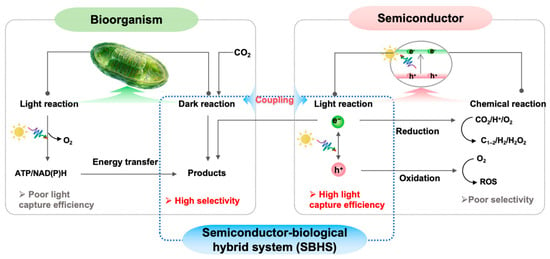
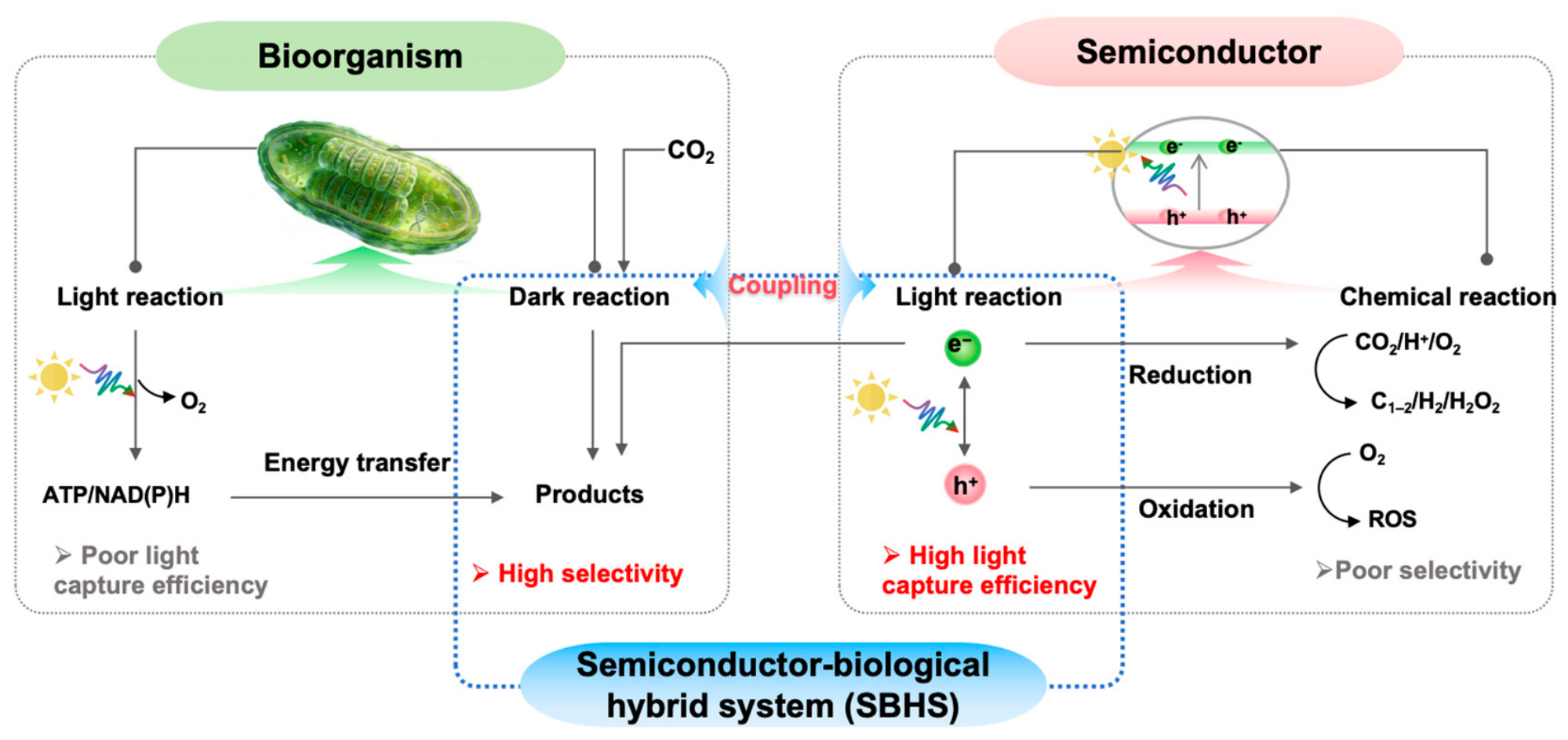
The persistent challenges of anthropogenic climate change and the fossil fuels depletion have created a global imperative to develop sustainable, carbon-neutral technologies for chemical manufacturing [1]. Natural photosynthesis uses solar energy to convert CO2 and H2O into energy-rich compounds, yet its theoretical maximum quantum efficiency is limited to approximately 6.0% [2]. To overcome this biological bottleneck, artificial photosynthesis strategies, particularly semiconductor–biological hybrid systems (SBHS) or semi-artificial photosynthetic systems [2,3,4,5], have been extensively developed over the past decade. These systems rely on a synergistic division of labor: inorganic or organic semiconductors act as highly efficient light-harvesting antennas that generate electron-hole pairs, while whole-cell microorganisms or isolated enzymes function as specific catalytic factories [6]. By coupling the broad-spectrum absorption of synthetic materials with the complex biosynthetic pathways of living cells, these biological components utilize photogenerated electrons to drive intricate multi-electron reductions (Figure 1), such as CO2 fixation into multicarbon (C2+) chemicals [7], with low substrate activation barriers.
Figure 1.
Schematic diagram of semiconductor–biological hybrid systems (SBHS). Adapted with permission form [5]. Copyright 2024 Chemical Reviews.
In 2016, Yang and colleagues reported a key breakthrough by using the non-photosynthetic bacterium M. thermoacetica to biosynthesize CdS nanoparticles directly on its cell surface for self-photosensitization [8]. This biohybrid system became the first to convert CO2 into acetate using solar energy. Following this milestone, the SBHS field has seen rapid growth. Researchers have developed various biohybrid systems in colloidal environments, integrating diverse microorganisms such as autotrophs, heterotrophs, and photosynthetic bacteria, while also building an ever-expanding library of semiconductor nanomaterials tailored for different solar-to-chemical applications [9,10,11]. In 2018, the introduction of genetic engineering became another key milestone in the field. Specifically, a genetically modified S. cerevisiae-InP biohybrid system was successfully constructed [12]. By rationally combining engineered metabolic pathways with the ability of illuminated semiconductors to supply photogenerated electrons, this system achieved efficient carbon and energy biosynthesis of shikimic acid. At the same time, interdisciplinary advances at the intersection of synthetic biology, advanced materials engineering, and energy engineering further improved the catalytic efficiency, operational stability, and scalability of these systems [12,13,14], bringing their internal quantum efficiency close to the absolute stoichiometric limits of the biochemical pathways involved. However, the pursuit of such high conversion metrics has inadvertently fostered what can be termed an efficiency trap. A profound interdisciplinary schism has emerged, as materials scientists predominantly focus on maximizing surface areas, optimizing band structures, and accelerating interfacial charge dynamics [15,16], frequently overlooking the cytotoxicity and long-term environmental fate of the synthesized photocatalysts [17,18,19]. Conversely, microbiologists and biotechnologists prioritize genetic stability and metabolic flux [20,21], often lacking deep insights into the complex photophysics and chemical degradation pathways of the nanomaterials they employ. This fragmentation results in the design of mismatched system components—typically manifesting either as highly efficient photocatalysts with poor biocompatibility, or as engineered bacteria that succumb to toxic photoproducts during extended operation.
Unlike previous reviews that mainly focused on improving energy conversion efficiency or broadly discussing biocompatibility, this review provides a critical appraisal of the often-overlooked environmental and toxicological risks inherent in current SBHS designs. We systematically dissect the leaching toxicity of first-generation inorganic metal semiconductor and the long-term bidirectional degradation mechanisms at the abiotic–biotic interface from two perspectives. Furthermore, to fully realize the potential of SBHS as a scalable negative-emission technology, we further propose a multi-dimensional standardized evaluation matrix and integrate life-cycle assessment (LCA) and techno-economic analysis (TEA) into the safe-by-design framework. This review aims to move the field from laboratory proof-of-concept toward robust, scalable, and ecologically friendly environmental solutions, providing a blueprint and technology roadmap for practical applications of carbon-negative technologies.
2. Leaching Toxicity and Environmental Risks of Photosensitizer
Photosensitive materials serve as the primary light-harvesting units in SBHS. In the pursuit of constructing efficient SBHS, researchers have explored a variety of inorganic semiconductor materials that offer advantages including mature industrial scalability, high crystallinity, tunable electrical and optical properties, and facile surface functionalization [22,23]. Among them, II–VI semiconductors (including metal chalcogenides such as CdS, CdSe, CdTe, ZnS, and MoS2) have become the most widely used first-generation inorganic semiconductor materials due to their precisely tunable composition, structure, morphology, and surface chemistry [8,24,25,26]. For example, Ye and colleagues incorporated Ni into the CdS lattice, which significantly enhanced photoelectron dynamics and improved electron transfer in the biohybrid system [27]. Similarly, other dopants have been shown to boost charge carrier separation, such as Zn in CdS and La and Rh in SrTiO3 [28,29]. However, in the pursuit of high photogenerated charge carrier yields, the environmental risks associated with these materials have long been relegated to a secondary priority [17,19]. Table 1 compares the advantages and disadvantages of typical inorganic metal semiconductors in SBHS from five aspects.
Table 1.
Advantages and disadvantages of inorganic metal semiconductors in SBHS.
2.1. The Cost of Photo-Corrosion and Heavy Metal Leaching
In the aqueous, electrolyte-rich environments conducive to microbial growth, inorganic metal semiconductors such as CdS and CdSe are susceptible to photo-corrosion under the combined action of continuous illumination and microbial metabolic byproducts [26,30,31]. The essence of photo-corrosion lies in the oxidation of lattice S or Se ions by photogenerated holes, leading to the release of metal ions (e.g., Cd2+) [26]. For instance, after 72 h of continuous illumination, the Cd2+ leaching from CdS quantum dots in bacterial culture media can reach 15–30% of the initial loading, with the leaching rate exhibiting a positive correlation with light intensity [32]. In a long-term study of a typical CdS-based biohybrid system, Ye et al. found that even with in situ biomineralization, the Cd2+ concentration in the culture medium rose to 2.5 mg·L−1 after 7 days of operation, exceeding the WHO drinking water standard by two orders of magnitude [33]. Heavy metal leaching not only directly inhibits microbial activity but also induces oxidative stress in bacteria, leading to membrane lipid peroxidation and protein inactivation [34]. Wang et al. reported that in a co-culture system of CdS and E. coli, the leached Cd2+ increased intracellular reactive oxygen species (ROS) levels by approximately 4-fold and reduced bacterial viability by over 50% [34]. Furthermore, in complex biological ecosystems, heavy metals are environmentally persistent and have the potential for biomagnification [35,36]. Even in closed bioreactors, accidental discharge or improper disposal of spent nanomaterial slurries poses long-term threats to aquatic and soil ecosystems [37,38]. Table 2 summarizes representative SBHS systems reported in the literature along with their advantages and disadvantages, from which it can be seen that high photochemical conversion efficiency is often accompanied by risks such as heavy metal leaching or photo-corrosion. Therefore, environmental risk assessment of SBHS must incorporate dynamic leaching profiles as a key monitoring parameter.
Table 2.
Overview of representative SBHS with their advantages and risks.
2.2. Implementing Environmental Risk Assessment (ERA)
Transitioning SBHS from the laboratory to practical applications necessitates the establishment and integration of rigorous ERA frameworks. Traditional chemical risk assessments methods often struggle to fully capture the unique physicochemical behavior and environmental fate of nanoscale semiconductors [52,53,54,55]. To address this, existing studies have recommended adopting a tiered assessment framework for such hybrid systems, systematically examining nanoparticle-specific exposure pathways and environmental transformation processes [33,38]. A review of the current literature indicates that a reasonably comprehensive assessment framework should include at least the following three tiers: (1) Laboratory benchmark assessment. Determination of photo-corrosion rates, heavy metal leaching kinetics, and acute toxicity of the materials to model microorganisms (e.g., half-maximal inhibitory concentration, IC50; minimum inhibitory concentration) under standardized conditions [32,56]. (2) Assessment of behavior in complex matrices. Evaluation of the colloidal stability, aggregation behavior, changes in surface activity, and interactions with natural organic matter of nanomaterials in real or simulated environmental matrices (e.g., natural waters, wastewater, soil leachates) [57,58]. Studies have shown that the presence of humic acid may either promote or inhibit heavy metal leaching, depending on its quenching effect on photogenerated holes [59]; conversely, high ionic strength may lead to nanoparticle aggregation, thereby altering the effective dose to which exposed organisms are subjected [60]. (3) Long-term and dynamic exposure assessment. Continuous monitoring of heavy metal release profiles over extended timescales (weeks to months) under conditions that simulate realistic operational scenarios (e.g., light–dark cycles, temperature fluctuations, microbial metabolic cycles) [54,55].
Based on the above framework, the research community has called for the development of standardized analytical protocols to ensure data comparability across different studies [33,55]. The literature suggests that risk assessment reports should mandatorily include the following data: particle size evolution of nanomaterials during operation, changes in zeta potential, and microstructure characterization results of the material before and after leaching [58,59]. Only through such multitiered, standardized assessments can the leaching flux of heavy metals throughout the entire operational lifetime of biohybrid systems be accurately quantified [33], thereby providing a scientific basis for material optimization, process design, and waste management, and ultimately driving the paradigm shift in this field from efficiency first to one that equally prioritizes safety and sustainability.
2.3. The Shift Toward Green and Biocompatible Photosensitizers
To fundamentally circumvent leaching toxicity, the trajectory of current biohybrid research is pivoting toward inherently safe, biocompatible photosensitizers. Carbon dots (CDs) synthesized from renewable biomass precursors are emerging as robust alternatives [61]. Green CDs exhibit high photoluminescence quantum yields, water solubility, and excellent biocompatibility without the heavy metal burden, successfully demonstrating their utility in biotic–abiotic hybrid systems for the sustainable conversion of microplastics into methane [62]. Similarly, metal–organic frameworks (MOFs) offer tunable porosity and high specific surface areas. By utilizing biologically benign metal centers and organic linkers, MOFs can effectively capture and concentrate substrates like CO2 while providing a non-toxic scaffold for efficient electron transfer and conferring structural cytoprotection to the interfacing microorganisms [63]. Moreover, organic semiconducting polymers offer tunable bioconductivity and an intrinsic softness that mimics biological tissue. These organic materials can securely intercalate with bacterial cell membranes to drive solar-to-chemical conversion entirely without the risk of metal ion leaching [64,65]. For instance, integrated photosynthetic biohybrid systems utilizing biocompatible polymer dots have successfully facilitated transmembrane electron transport, efficiently fixing CO2 into valuable bioplastics such as poly-3-hydroxybutyrate under visible light [65].
3. Long-Term Biocompatibility and Degradation at the Interface
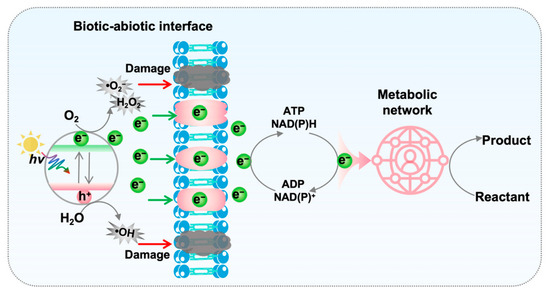
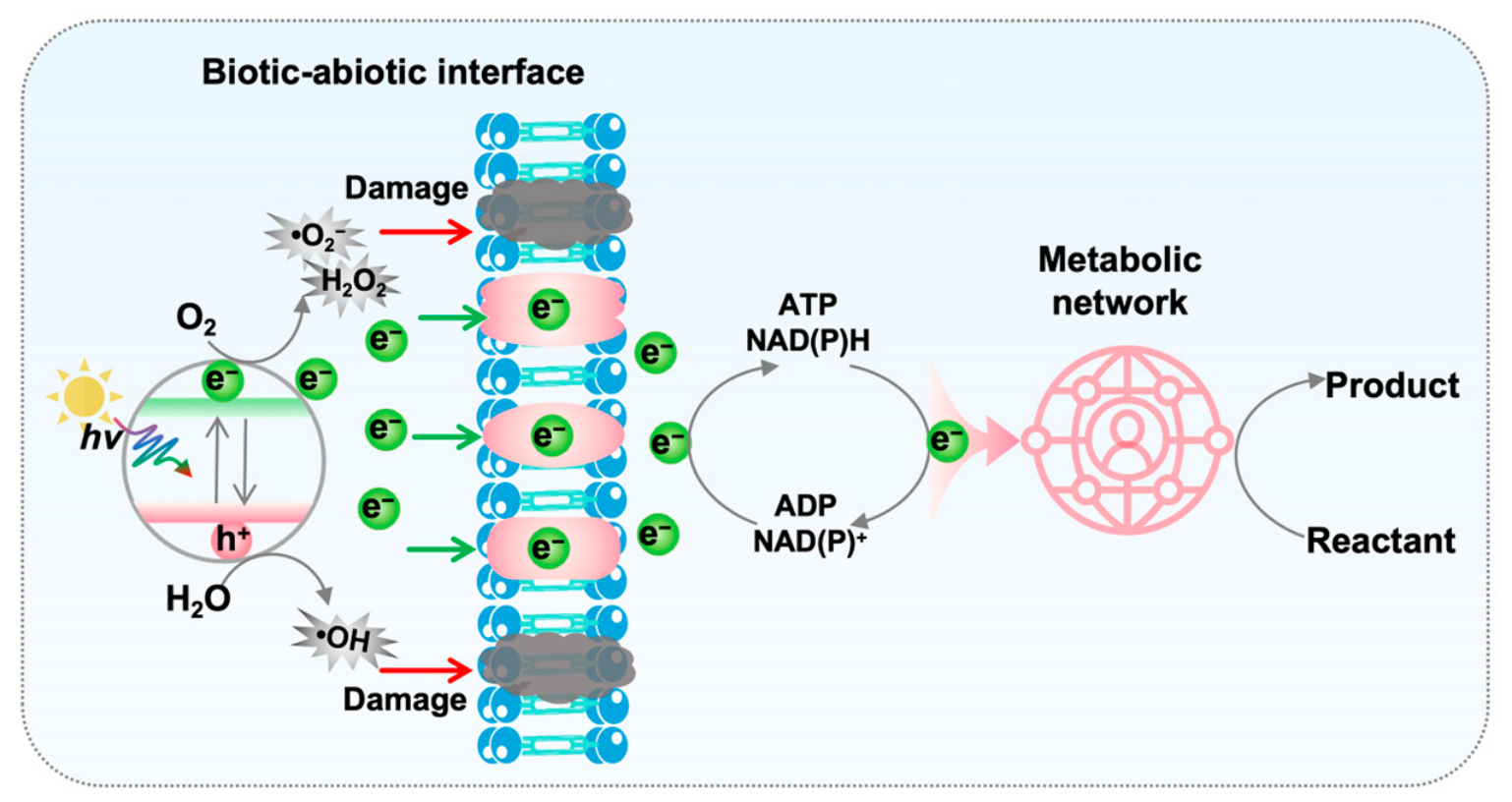
The abiotic–biotic interface constitutes the operational core of SBHS (Figure 2). At the same time, from the perspective of catalysis and materials science, it also represents the system’s most vulnerable point of failure [3]. Among the components, (1) the abiotic module (e.g., semiconductor nanoparticles, quantum dots, or polymer dots) is responsible for light harvesting, charge separation, and photoelectron generation [33]. Its performance dictates the overall energy input to the system, but it is also the primary source of photogenerated ROS and potential heavy metal leachates. (2) The biotic module (e.g., whole-cell bacteria or enzymes) serves as the biocatalytic factory [4], utilizing the incoming photoelectrons to drive reductive synthesis (e.g., CO2 reduction). Its viability, metabolic flux, and stress response determine the long-term productivity of the system. (3) The biotic–abiotic interface is a dynamic region where electron transfer, chemical exchange, and physical contact occur [5,62]. This interface is the most vulnerable point, as it experiences both photochemical attack (ROS from the abiotic side) and biochemical remodeling (e.g., extracellular electron transfer from the biotic side). The complex interfacial microenvironment is subjected to dynamic biochemical redox cycling, energetic fluxes, and intermediate species, which collectively dictate the long-term viability of the biohybrid architecture. Understanding the distinct roles and mutual vulnerabilities of these three modules is essential for interpreting the bidirectional degradation pathways discussed in Section 3.2 and Section 3.3.
Figure 2.
The crucial roles of biotic–abiotic interface in SBHS.
3.1. Oxidative Stress and Photodamage to the Biotic Module
In SBHS, even when heavy metal leaching is entirely circumvented through the utilization of stable inorganic or organic semiconductors, a secondary chemical challenge persists: the generation of ROS [66]. Type and yield of ROS are primarily determined by the band positions of the semiconductor: when the conduction band minimum (CBM) is more negative than the O2/O2− redox couple (−0.33 V vs. NHE) [67], photogenerated electrons can reduce dissolved oxygen to superoxide anion radicals (·O2−); when the valence band maximum (VBM) is more positive than the H2O/·OH couple (+2.34 V vs. NHE) [67], photogenerated holes can oxidize water to hydroxyl radicals (·OH). Taking CdS and TiO2, which are commonly used in SBHS, as examples: CdS has a CBM of approximately −0.9 V (more negative than −0.33 V), thus enabling the generation of ·O2− [68], but its VBM is approximately +1.6 V (lower than +2.34 V), so it cannot generate ·OH. In contrast, the VBM of TiO2 is significantly more positive than +2.34 V [69], thereby allowing efficient ·OH generation. In addition, ·O2− can be further converted into other ROS such as hydrogen peroxide (H2O2) [66]. These photogenerated ROS continuously attack the microorganisms co-cultured at the semiconductor interface: they non-selectively oxidize the lipid bilayers of bacterial cell membranes, triggering lipid peroxidation chain reactions, compromising membrane integrity, increasing membrane permeability, and ultimately leading to cell death [70,71]. Therefore, even in environmentally friendly systems without metal leaching, ROS-mediated oxidative stress remains a core factor limiting the long-term operational stability of SBHS.
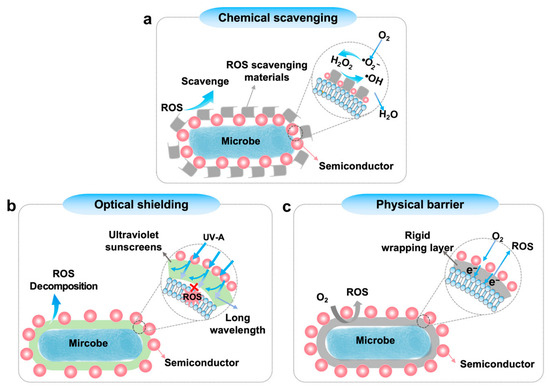
To mitigate oxidative damage to the biotic module caused by ROS, researchers are increasingly employing advanced materials engineering to construct hierarchical cytoprotective shields based on chemical, optical, and physical mechanisms (Figure 3, Table 3). To actively combat oxidative stress, chemical shields leveraging intrinsic catalytic properties have been developed to scavenge ROS. For instance, ultrathin MOF monolayers (e.g., zirconium-based clusters) wrapped around anaerobic bacteria exploit their open-metal sites to efficiently catalyze the decomposition of ROS, significantly reducing bacterial mortality under oxidative conditions [63] (Figure 3a). Similarly, the application of nanozyme coatings, such as Mn3O4 and Fe3O4, serves a chemical function by scavenging ROS [26,72]. This method can directly reduce ROS concentration without compromising the photocatalytic activity of the semiconductor. However, the long-term stability and activity of nanozymes are compromised by fouling with extracellular polysaccharides. Moreover, the introduction of MOFs or nanozymes may alter the interfacial electron transfer pathway between the semiconductor and bacteria, thereby affecting the yield of target products. Beyond reactive chemical scavenging, proactive optical shielding has been engineered by integrating natural luminogens with aggregation-induced emission characteristics (AIEgens) [27,73]. These AIEgens act as an effective ultraviolet sunscreen (Figure 3b), down-converting high-energy short-wavelength photons into lower-energy wavelengths to fundamentally alleviate semiconductor photo-corrosion and minimize localized ROS accumulation at its source. Optical shielding can reduce direct damage to semiconductors and bacteria from high-energy UV light through photon down-conversion. However, AIEgens themselves are prone to photobleaching under strong illumination, with their effective lifetime typically below 100 h, as reported in the literature [74]. In addition, such optical coatings increase optical absorption losses in the system, which may become counterproductive under low-light conditions [75]. Finally, physical shielding is achieved through the use of macroscopic barriers (Figure 3c), such as photocatalyst-mineralized biofilms [76]. These living biotic–abiotic interfaces physically segregate cells, preventing direct high-energy damage and deleterious interfacial contact. Physical barriers achieve the most thorough protection against direct contact damage by physically isolating bacteria within a mineralized layer, but at the cost of significantly increased mass transfer resistance for substrates and products. Studies have shown that a thick mineralized layer can reduce the diffusion rate of CO2 toward bacteria by 30–60%, thereby lowering the overall catalytic efficiency [77]. Furthermore, this strategy is difficult to apply in dynamic systems where bacteria require rapid growth or division [78]. Overall, no single strategy currently exists that can completely eliminate ROS damage without sacrificing system energy efficiency or operational simplicity. Future research may need to develop a hierarchical protection approach or a combination of multiple strategies, and make targeted trade-offs based on specific application scenarios (e.g., required operational duration, light intensity, and value of the target product).
Figure 3.
Strategies for SBHS to alleviate ROS damage: (a) Chemical scavenging, (b) Optical shielding, (c) Physical barrier. Adapted with permission form [33]. Copyright 2025 Chemical Reviews.
Table 3.
Comparison of three strategies for mitigating ROS damage in SBHS.
Furthermore, in SBHS, whether ROS cause irreversible oxidative damage depends critically on whether the steady-state concentration of ROS exceeds the microorganism’s intrinsic antioxidant defense capacity. It has been reported that when the H2O2 concentration exceeds 10–30 μM, non-selective oxidative stress is significantly triggered, leading to severe and irreversible cellular damage (e.g., lipid peroxidation, DNA fragmentation, and loss of membrane integrity) [79]. However, different microbial chassis—ranging from strict anaerobes to facultative anaerobes and aerotolerant species—have very different levels and inducibility of their antioxidant enzyme systems (e.g., superoxide dismutase, SOD; catalase, CAT) [80]. As a result, their tolerance thresholds toward ROS also vary widely. To scientifically assess whether the ROS dose in a given system falls into the range of signaling adaptation (low dose, activating antioxidant defenses) or lethal toxicity (high dose, causing irreversible damage), a comprehensive evaluation can be performed using the following three types of methods: (i) Qualitative and quantitative ROS detection: using electron spin resonance (ESR) with spin traps (DMPO for ·OH and ·O2−,) [69] or fluorometric assays (DCFH-DA for total ROS, NBT for ·O2−, and Amplex Red for H2O2) [81]; (ii) Monitoring of antioxidant system responses: measuring the dynamic changes in key enzyme activities (SOD, CAT, GPx) as well as the consumption and regeneration of small-molecule antioxidants such as glutathione [80]; (iii) Assessment of oxidative damage endpoints: determining cell viability (CFU counts, OD growth curves) [82], membrane integrity (LDH release, PI/SYTO 9 dual staining), and metabolic function (substrate consumption rates, product yields) [83], thereby directly reflecting the actual extent of ROS-induced damage to the biotic module. Therefore, in future studies, integrating these three categories of indicators will enable effective discrimination between the boundary of low-dose signaling and high-dose toxic effects.
3.2. Bacteria-Driven Degradation of the Abiotic Module
Although the toxicological impacts of materials on microorganisms have been extensively studied, there exists another critical degradation pathway in SBHS: the active, biological dismantling of the semiconductor scaffold by the microorganisms themselves—a phenomenon termed microbial backlash. It should be noted, however, that this phenomenon has been rigorously demonstrated only in a limited number of electroactive bacteria, most notably the genus Shewanella (especially S. oneidensis MR-1). These bacteria are widely employed in biohybrid systems precisely because of their highly efficient extracellular electron transfer (EET) capability [84,85,86]. Under the oscillating aerobic–anaerobic conditions common in dynamically operated photoelectrochemical bioreactors, Shewanella can induce a bacteria-driven Fenton reaction [87]. Specifically, during anaerobic phases, the bacteria reduce available iron species to Fe2+. Upon transitioning to aerobic phases, aerobic metabolism naturally produces H2O2. The resulting Fenton reaction between biogenic Fe2+ and H2O2 releases significant quantities of ·OH precisely at the material interface. Studies have shown that such localized radical attack can oxidize and damage materials [88,89,90]. For example, Hentschel et al. found that under alkaline conditions, ·OH radicals generated during photocatalytic hydrogen production by CdSe/CdS/Pt nanorods gradually degraded the semiconductor material into polymeric sulfur and dissolved Cd2+, leading to catalyst deactivation [88]. Meanwhile, Shen et al., in co-culture experiments of Ti3C2Tx MXene nanosheets with E. coli, S. oneidensis MR-1, and B. subtilis, directly demonstrated that extracellular ·O2− and H2O2 produced by bacterial respiration generate ·OH through a Fenton-like reaction, which then oxidizes the nanosheets and forms TiO2 on their surface, compromising structural integrity [89].
Nevertheless, it is important to emphasize that the microbial-driven material degradation described above has so far been confirmed only in a limited set of strains under specific conditions, primarily Shewanella and Geobacter spp. and certain Gram-positive bacteria such as B. subtilis [89,90]. Whether similar behavior occurs in other electroactive genera (e.g., Pseudomonas) or with other semiconductor materials (e.g., MOFs, carbon dots, polymer dots), and the generalizability of this phenomenon across different pH, oxygen concentrations, and light conditions, remain largely unexplored. Therefore, the discussion in this section is confined to the best-documented cases, and the conclusions are limited to the reported experimental systems.
In summary, microbial backlash reveals an important bidirectional degradation mechanism in SBHS: microorganisms actively degrade abiotic materials via EET and Fenton-like reactions, while the degradation byproducts (e.g., metal ions) may in turn poison the microorganisms. Consequently, ensuring the long-term stability of SBHS requires not only intrinsically stable photocatalysts but also stringent microenvironmental regulation (e.g., controlling oxygen concentration, using ROS scavengers, or employing physical barriers) to suppress this destructive metabolic cascade.
3.3. The Need for Biotic–Abiotic Interface Specific Testing Protocols
The complex interplay between localized phototoxicity and microbially induced material degradation reveals a critical methodological gap: the lack of standardized testing protocols for biofilm–biomaterial interfaces [5,11]. Currently, conventional biological evaluation standards often rely on static assays to assess cytotoxicity [11]. These protocols are fundamentally ill-equipped to replicate the unique physicochemical dynamics of a photoelectrochemical bioreactor, where the synergistic effects of cytotoxicity, material photostability, and high-energy interfacial contact are often overlooked. To systematically evaluate SBHS, it is imperative to develop tailored standard operating procedures [33]. These advanced protocols must be capable of quantitatively measuring localized interfacial ROS generation, dynamic continuous material dissolution rates, and intrinsic biofilm viability under simultaneous electrical bias, metabolic turnover, and concentrated photon flux [91].
However, establishing rigorous interfacial testing standards alone is insufficient for transitioning biohybrid platforms from experimental observations to robust, industrially viable catalytic systems. A parallel challenge exists at the system level: the field currently lacks standardized methodologies for performance reporting, with disparate experimental conditions and inconsistent metric definitions obscuring genuine technological benchmarking [92]. Addressing this fragmentation requires a comprehensive evaluation framework that extends beyond interface-specific protocols to encompass system-wide performance standardization. For specific interfacial testing parameters and methods, please refer to Section 4.
4. Standardization of Metrics and Safety Testing Protocols
A critical barrier to the commercialization and scaled deployment of SBHS is the fragmented state of performance reporting within the current literature [5,6]. The absence of standardized testing methodologies renders rigorous cross-study meta-analyses challenging and obscures genuine technological benchmarking.
4.1. Inconsistencies in Performance Reporting
In the fields of abiotic photovoltaics and photoelectrochemistry, rigorous standards are enforced to ensure reproducibility. For instance, standard test conditions mandate an exact AM 1.5G solar spectrum, a defined irradiance of 1000 W·m−2, and a precise cell temperature of 25 °C [93]. Conversely, biohybrid research frequently utilizes divergent experimental setups. Illumination sources range from low-intensity monochromatic light-emitting diodes to concentrated broadband xenon lamps, applied across vastly different bioreactor geometries, from microscopic flow cells to stirred-tank batch reactors [57,58]. Furthermore, the definitions and derivations of key performance indicators, such as solar-to-chemical efficiency, internal quantum efficiency (IQE), and Faradaic efficiency—exhibit significant variance [5,94]. These discrepancies largely stem from inconsistent assumptions regarding light scattering within turbid microbial suspensions, cellular absorption cross-sections, and baseline energy inputs [33].
4.2. Proposing a Multi-Dimensional Evaluation Matrix
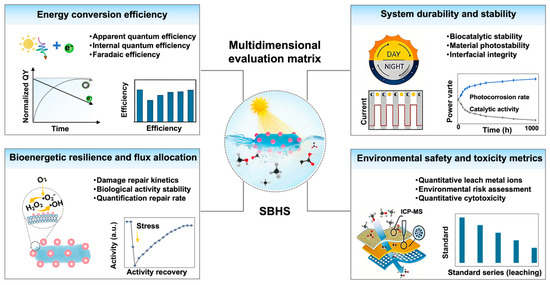
To successfully transition SBHS from isolated academic demonstrations to reliable industrial technologies, the field must adopt a unified, comprehensive evaluation matrix (Figure 4). Future regulatory frameworks and academic reporting should mandate a quaternary criteria set that mathematically balances catalytic efficiency with biological safety and material stability:
Figure 4.
Multidimensional evaluation matrix of SBHS.
- Energy conversion efficiency. Conventional metrics based on standard test conditions (e.g., AM 1.5G, 1000 W·m−2, 25 °C) are widely used in abiotic photovoltaics but are not directly transferable to biohybrid systems, where biological components operate within narrow, system-specific physiological windows [8,93]. Therefore, performance evaluation must be conducted under well-defined and explicitly reported conditions, with careful correction for optical artifacts such as light scattering and spectral mismatch in turbid, cell-containing media. In addition to nominal efficiencies, studies should report complementary metrics including mass-normalized reaction rates and clearly distinguish between apparent quantum efficiency (AQE), based on incident photons, and IQE [33,94], which reflects photon utilization independent of catalytic limitations. Crucially, meaningful assessment of system performance requires decoupled analysis of abiotic and biotic components, with parallel evaluation of photosensitizer stability (e.g., photo-corrosion or photobleaching) and biocatalytic activity (e.g., turnover number and turnover frequency), enabling identification of rate limiting processes and guiding rational optimization.
- System durability and stability. Stability assessment must operate on three distinct timescales to decouple component degradation: (i) biocatalytic stability (aiming for industrial benchmarks of >50 microbial generations), requiring the tracking of genetic drift, mutation rates, and plasmid retention under continuous operational stress [95]; (ii) material photostability (targeting > 1000 h of continuous illumination), quantified via time-resolved or operando elemental analysis (e.g., ICP-MS for heavy metal leaching rates) and surface characterization (e.g., XPS for lattice oxidation states) [96,97]; and (iii) interfacial integrity, evaluated through rigorous bidirectional degradation metrics. This includes quantifying the cumulative ROS dose acting on the cell membrane via in situ electron paramagnetic resonance spectroscopy with spin-trapping agents [33], and monitoring interfacial material mass loss (e.g., via quartz-crystal microbalance). Crucially, mass loss attributable specifically to microbial EET activity must be mathematically decoupled from intrinsic semiconductor photo-corrosion by employing EET-deficient mutant strains as functional controls [98].
- Environmental safety and toxicity metrics. Quantitative, time-resolved metal ion leaching profiles must be continuously reported under functional operational conditions [99], rather than static extraction, to accurately reflect the dynamic photo-corrosion and environmental hazards of the photocatalysts. Furthermore, cellular viability assessments must transcend conventional optical density (OD600) measurements, which suffer from severe optical scattering and interference from nanomaterials [33]. Instead, studies should instead adopt robust, interference-circumventing techniques, such as high-throughput flow cytometry, confocal laser scanning microscopy, and single-cell mass spectrometry [100]. Finally, interfacial ROS generation rates must be rigorously identified and quantified. This should be achieved via in situ EPR spectroscopy coupled with spin-trapping agents, systematically complemented by selective chemical scavenger assays (e.g., utilizing catalase, tert-butyl alcohol, and superoxide dismutase) to specifically distinguish and quantify the accumulation of H2O2, ⋅OH, and O2·− at the biotic-abiotic interface.
- Bioenergetic resilience and flux allocation. The physiological burden imposed by the abiotic–biotic interface, specifically, the ratio of intracellular ATP and NAD (P) H flux to stress responses (such as membrane repair, antioxidant synthesis, and heavy metal efflux) and productive biosynthesis [98]. Rather than relying solely on static metabolomics, this dynamic energy partitioning should be evaluated through metabolic flux analysis using stable isotope tracers under operational illumination [95]. Furthermore, while elevated EET activity indicates highly functional interfacial charge transport, it must be simultaneously flagged as an intrinsic material degradation risk. For electroactive species, robust EET pathways can inadvertently drive the reductive dissolution of the inorganic semiconductor lattice [101], necessitating precise microenvironmental regulation to balance efficient electron uptake with long-term material longevity.
While the establishment of rigorous technical performance standards provides a necessary foundation for reproducible evaluation, these laboratory-centric metrics alone cannot guarantee the sustainable deployment of SBHS at industrial scale. The transition from controlled experimental environments to commercial implementation demands a broader analytical lens—one that scrutinizes the technology not merely by its catalytic efficiency, but by its holistic environmental footprint and economic viability throughout its entire lifespan. Without such comprehensive assessment, even high-performing biohybrid systems risk perpetuating the very environmental harms they seek to mitigate.
5. Life Cycle Assessment (LCA) and Safe-by-Design Strategies
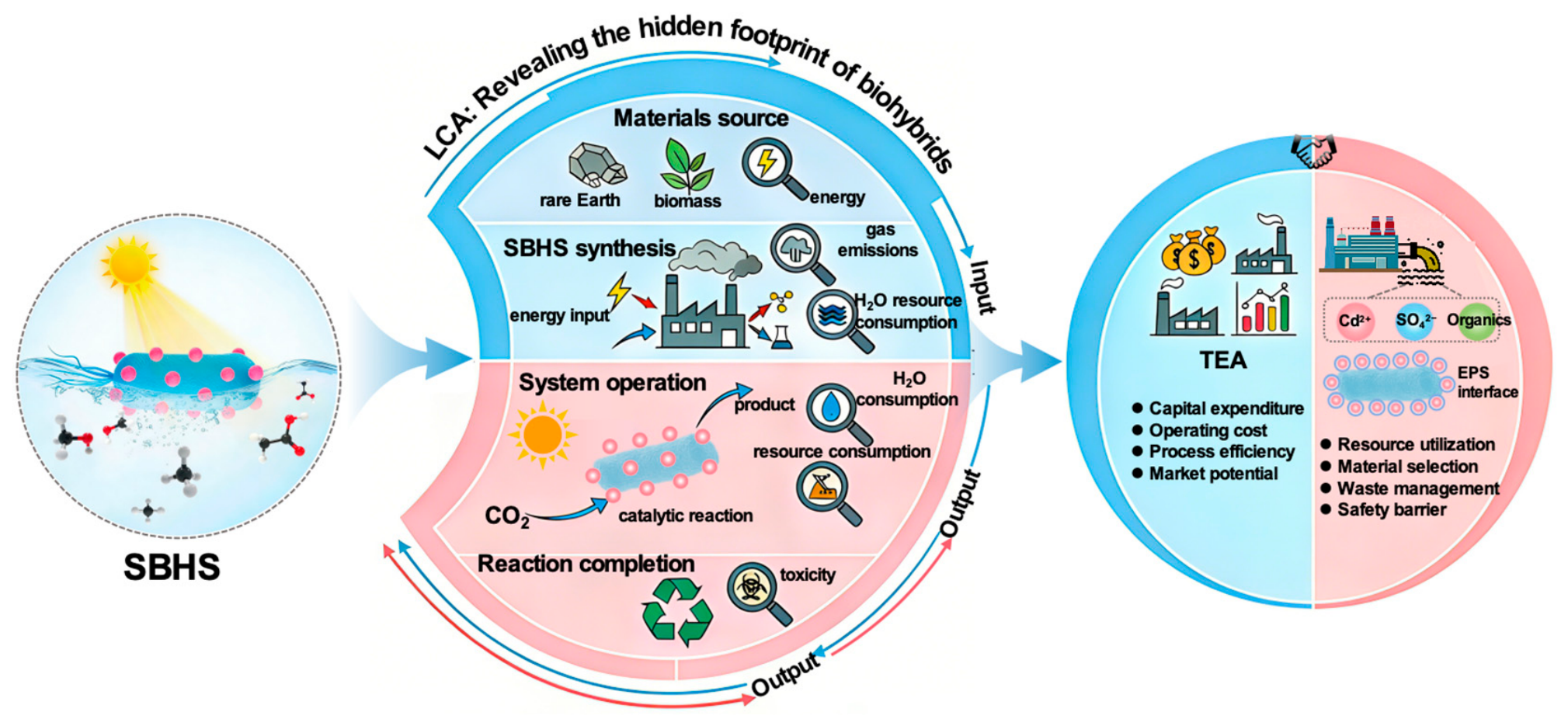
As global initiatives increasingly rely on advanced catalytic technologies to fulfill net-zero climate goals and bridge the emissions gap, SBHS must be rigorously scrutinized under the lens of comprehensive LCA (Figure 5) [1]. From an environmental catalysis perspective, an innovation cannot be legitimately classified as a sustainable technology if the embodied energy and environmental costs of manufacturing its components exceed the total carbon it sequesters during its operational lifetime.
Figure 5.
Life cycle assessment and safe-by-design strategy of SBHS.
5.1. LCA: Revealing the Hidden Footprint of Biohybrids
LCA is a cradle-to-grave environmental impact assessment tool that covers all stages [102]: raw material extraction, material synthesis, device manufacturing, operation and use, and end-of-life disposal (Figure 5). For SBHS, the unique photo-electro-biological coupling characteristics make the definition of system boundaries and the selection of parameters particularly complex. To date, only a limited number of studies have employed hybrid models to conduct prospective assessments of photoelectrode manufacturing processes involving wide-bandgap semiconductors and complex nanostructures, preliminarily revealing the following environmental hotspots [103,104]:
- (1)
- Energy- and chemical-intensive inputs in the manufacturing stage: The synthesis of high-purity semiconductor nanomaterials (e.g., CdS, InP, TiO2) often requires high temperatures, high pressures, and toxic precursors, while the air purification systems needed to maintain cleanroom environments consume enormous amounts of electricity. For example, direct emissions of potent greenhouse gases such as nitrogen trifluoride (NF3), which has a global warming potential approximately 17,000 times that of CO2, render the carbon footprint of traditional inorganic semiconductors far higher than what their functional value might suggest [105].
- (2)
- Material and energy balance in the operational stage: The operation of SBHS requires a continuous supply of electron donors (e.g., lactate, ascorbic acid), maintenance of constant temperature and light intensity, and generates waste biomass containing heavy metals and nanoparticles [33]. These hidden costs are largely overlooked in most laboratory-scale studies, but they become decisive factors when scaling up to pilot or industrial scales.
- (3)
- Environmental leakage in the end-of-life stage: The vast majority of current SBHS studies do not consider the recycling or disposal of spent photocatalysts and biomass. If Cd-, Pb-, or Ag-containing semiconductors enter the natural environment via wastewater, their long-term leaching toxicity will pose new ecological risks [106]. Conversely, if in situ biomineralization or circular safe-by-design materials can be achieved, the environmental burden of the end-of-life stage can be significantly reduced.
Therefore, to advance SBHS from performance-driven proof-of-concept to environmentally and economically viable industrial technologies, future LCA research must go beyond simple energy consumption estimates and focus on the following priorities: (i) Establish SBHS-specific life cycle inventory databases: These should include energy consumption for the synthesis of typical materials, carbon intensity of electron donor/sacrificial agent production, and heavy metal release coefficients under different disposal scenarios. (ii) Develop normalized indicator systems for cross-system comparison: Unify functional units (e.g., net greenhouse gas emissions per tonne of CO2 equivalent converted, or resource depletion intensity per kilowatt-hour of energy output) to enable objective comparisons between different SBHS configurations and with conventional technologies. (iii) Conduct uncertainty analysis and scenario simulation: Employ Monte Carlo methods to assess the sensitivity of LCA results to key parameters such as light intensity fluctuations [107], catalyst cycling numbers, and recovery rates, thereby identifying the most environmentally beneficial optimization directions.
However, if achieving high electron transfer efficiencies relies on toxic heavy metals (e.g., cadmium) or scarce noble metals (e.g., platinum or gold), the toxicity impact categories and resource depletion metrics increase significantly, negating the environmental benefits of the biological carbon fixation process. Therefore, introduce LCA metrics (e.g., ecotoxicity potential, cumulative energy demand) at the material screening stage, and perform parallel optimization together with TEA, so as to avoid shifting environmental burdens to other stages of the life cycle.
5.2. Integrating Techno-Economic Analysis (TEA) with Safe-by-Design
To preemptively address these LCA bottlenecks, future research must integrate the safe-by-design philosophy with TEA at the material screening and system design stages (Figure 5). Specifically, we recommend that researchers prioritize the following four design choices:
- (1)
- Prioritize in situ biological self-assembly over conventional top-down chemical synthesis. Traditional synthesis of semiconductor nanomaterials (e.g., CdS, InP) typically requires high temperatures, high pressures, and toxic solvents, leading to high energy consumption and environmental risks [55,56]. As a preferred alternative, researchers should give priority to bacterial in situ biomineralization strategies [8]. For example, using microorganisms such as Shewanella or M. thermoacetica to mineralize CdS nanoparticles in situ on their outer membranes circumvents the toxicity associated with traditional chemical synthesis [73,105]. The secreted extracellular polymeric substances (EPS) also serve as a natural protective layer, complexing metal ions and mitigating nanotoxicity, thereby enabling a bottom-up, room-temperature construction of a biocompatible bio–nano interface.
- (2)
- Prioritize metal-free or low-toxicity material systems, avoiding scarce or highly toxic metals. When high electron transfer efficiency is pursued at the expense of environmental safety (e.g., reliance on Cd, Pb, Pt, etc.), ecotoxicity potential and resource depletion metrics in LCA rise sharply [106]. Therefore, researchers should prioritize materials such as carbon dots, graphitic carbon nitride (g-C3N4), organic semiconducting polymers (e.g., Pdots, AIEgens) [30,41], or iron-based nanozymes (e.g., Fe3O4, Mn3O4) [26]. These materials maintain reasonable photocatalytic activity while significantly reducing heavy metal leaching risks and resource scarcity pressures.
- (3)
- Prioritize the use of heavy metal pollutants in wastewater as precursor ions for semiconductor mineralization, achieving treating waste with waste. Building on in situ biological self-assembly, researchers should prioritize exploring the use of heavy metal ions (e.g., Cd2+, Pb2+, Ag+) from real wastewater as semiconductor precursors [36]. This strategy not only eliminates the dependence on high-purity chemical reagents in traditional synthetic routes, but also directly couples wastewater treatment with solar-driven synthesis of high-value bioproducts (e.g., polyhydroxybutyrate, PHB), achieving an integrated approach of environmental remediation-resource recovery-green manufacturing [36].
- (4)
- Prioritize the design of recyclable or biodegradable closed-loop material systems. The vast majority of SBHS studies do not consider catalyst recycling or end-of-life disposal. Therefore, researchers should prioritize material systems that meet the following criteria: (i) they can be separated and recovered under mild conditions (e.g., pH, temperature, magnetic field); (ii) they can be completely mineralized or biodegraded into harmless products at the end of their life cycle (e.g., certain degradable MXenes, polydopamine coatings, or natural photosensitizers). By closing the material loop, biologically assembled SBHS can transition from resource-intensive laboratory concepts to economically viable components of the circular economy.
In summary, the four priority design choices outlined above (in situ self-assembly, low-toxicity materials, waste-as-precursor, and closed-loop recycling) provide a translational framework for SBHS researchers, moving from general principles to actionable pathways.
6. Conclusions
The past decade of research in SBHS has unequivocally demonstrated that integrating abiotic light-harvesting materials with cellular biosynthesis can bypass the thermodynamic and kinetic constraints inherent to nature. Current hybrid architectures are capable of funneling photoelectrons across cellular membranes at rates that drive CO2 conversion with specificities and energetic efficiencies often unattainable in purely biological or purely artificial systems.
However, as dissected in this review, a disproportionate focus on peak energy conversion efficiency comes at a severe expense to biological safety and long-term operational stability. This efficiency trap represents a critical decoupling of laboratory performance metrics from environmental reality, fundamentally hindering the industrial translation of biohybrid technologies.
For SBHS to mature into a viable, large-scale sustainable solution, the research paradigm necessitates three fundamental shifts. First, the field must prioritize inherently biocompatible materials and employ low-energy, bio-inspired synthesis routes (e.g., in situ biomineralization) over traditional, heavy metal-based semiconductors. Second, interfacial engineering must address bidirectional stability: constructing cytoprotective shields to defend microorganisms against photogenerated ROS while simultaneously protecting the material scaffolds from microbially induced degradation or passivation. Finally, the community must transition from static cytotoxicity assays toward rigorous, dynamic standard operating procedures that comprehensively evaluate localized interfacial toxicity, accompanied by stringent LCA. By reorienting toward these integrated, safety-driven goals, SBHS research can transcend current performance bottlenecks and realize its immense potential as a sustainable technology for the circular carbon economy.
It must be acknowledged, however, that the majority of studies reviewed here are confined to laboratory-scale reactors operating over hours to days, with synthetic media and controlled illumination. Whether the same interfacial degradation pathways dominate under field-relevant conditions (e.g., variable sunlight, fluctuating temperature, mixed microbial communities, and realistic wastewater matrices) remains largely unexplored. Therefore, while the safe-by-design principles outlined above provide a necessary starting point, their translation into robust industrial technologies will require iterative validation under progressively more complex and less controlled conditions.
Author Contributions
J.Y.: writing—original draft preparation, visualization, writing—review and editing, P.W.: writing—original draft preparation, Y.L.: supervision, S.Z.: conceptualization, writing—review and editing, project administration, funding acquisition. All authors have read and agreed to the published version of the manuscript.
Funding
This research was funded by the National Key R&D Program of China (No. 2025YFE0107600), the National Science Fund for Distinguished Young Scholars (22425603), the Key Programme of the National Natural Science Foundation of China (22336002), and the Basic Research Program of Jiangsu (BK20251238).
Data Availability Statement
Data will be made available on request.
Conflicts of Interest
The authors declare no conflicts of interest.
References
- Campa, M.F.; Zhang, L.; Smith, K.; Delborne, J.; Glavin, N.; Green, C.; Griep, M.; Kaarsberg, T.; Linkov, I.; Miller, J.B.; et al. Nanotechnology solutions for the climate crisis. Nat. Nanotechnol. 2024, 19, 1422–1426. [Google Scholar] [CrossRef] [Scilit] [PubMed]
- Lv, J.; Chen, J.; Kang, Y.; Wang, M. Solar utilization beyond photosynthesis. Nat. Rev. Chem. 2023, 7, 91–105. [Google Scholar] [CrossRef] [Scilit] [PubMed]
- Chen, N.; Li, Y.; Zhang, Y. Beyond natural synthesis via solar-decoupled biohybrid photosynthetic system. Chem 2025, 11, 102381. [Google Scholar] [CrossRef] [Scilit]
- Chen, N.; Li, Y.; Zhang, Y. A photosynthesis-derived bionic system for sustainable biosynthesis. Angew. Chem. Int. Ed. 2025, 64, e202414981. [Google Scholar] [CrossRef] [Scilit] [PubMed]
- Liang, J.; Xiao, K.; Wang, X.; Hou, T.; Zeng, C.; Gao, X.; Wang, B.; Zhong, C. Revisiting solar energy flow in nanomaterial-microorganism hybrid systems. Chem. Rev. 2024, 124, 9081–9112. [Google Scholar] [CrossRef] [Scilit] [PubMed]
- Cestellos-Blanco, S.; Zhang, H.; Kim, J.M.; Shen, Y.X.; Yang, P. Photosynthetic semiconductor biohybrids for solar-driven biocatalysis. Nat. Catal. 2020, 3, 245–255. [Google Scholar] [CrossRef] [Scilit]
- Guo, J.; Suástegui, M.; Sakimoto, K.K.; Moody, V.M.; Shen, G.; Joshi, G.R.; Yang, P. Light-driven fine chemical production in yeast biohybrids. Science 2018, 362, 813–816. [Google Scholar] [CrossRef] [Scilit] [PubMed]
- Sakimoto, K.K.; Wong, A.B.; Yang, P. Self-photosensitization of nonphotosynthetic bacteria for solar-to-chemical production. Science 2016, 351, 74–77. [Google Scholar] [CrossRef] [Scilit] [PubMed]
- Okoro, G.; Husain, S.; Saukani, M.; Mutalik, C.; Yougbaré, S.; Hsiao, Y.C.; Kuo, T.R. Emerging trends in nanomaterials for photosynthetic biohybrid systems. ACS Mater. Lett. 2023, 5, 95–115. [Google Scholar] [CrossRef] [Scilit]
- Shen, J.; Liu, Y.; Qiao, L. Photodriven chemical synthesis by whole-cell-based biohybrid systems: From system construction to mechanism study. ACS Appl. Mater. Interfaces 2023, 15, 6235–6259. [Google Scholar] [CrossRef] [Scilit] [PubMed]
- Fang, X.; Kalathil, S.; Reisner, E. Semi-biological approaches to solar-to-chemical conversion. Chem. Soc. Rev. 2020, 49, 4926–4952. [Google Scholar] [CrossRef] [Scilit] [PubMed]
- Zhang, H.; Liu, H.; Tian, Z.; Lu, D.; Yu, Y.; Cestellos-Blanco, S.; Sakimoto, K.K.; Yang, P. Bacteria photosensitized by intracellular gold nanoclusters for solar fuel production. Nat. Nanotechnol. 2018, 13, 900–905. [Google Scholar] [CrossRef] [Scilit] [PubMed]
- Wei, W.; Sun, P.; Li, Z.; Song, K.; Su, W.; Wang, B.; Liu, Y.; Zhao, J. A surface-display biohybrid approach to light-driven hydrogen production in air. Sci. Adv. 2018, 4, eaap9253. [Google Scholar] [CrossRef] [Scilit] [PubMed]
- Lu, A.; Li, Y.; Ding, H.; Xu, X.; Li, Y.; Ren, G.; Liang, J.; Liu, Y.; Hong, H.; Chen, N.; et al. Photoelectric conversion on Earth’s surface via widespread Fe- and Mn-mineral coatings. Proc. Natl. Acad. Sci. USA 2019, 116, 9741–9746. [Google Scholar] [CrossRef] [Scilit] [PubMed]
- Lian, J.; Li, D.; Jiang, R.; Yan, J.; Liu, S.F.; Zhang, F. Spatial charge separation in photocatalysis: From particle adjacency to atom proximity. Adv. Funct. Mater. 2026, 36, e12007. [Google Scholar]
- Sarkar, D.; Pramanik, J.; Samajdar, S.; Biswas, M.; Ghosh, S. Charge carrier dynamics in semiconductor–cocatalyst interfaces: Influence on photocatalytic activities. RSC Appl. Interfaces 2025, 2, 573–598. [Google Scholar] [CrossRef] [Scilit]
- Thakur, S.; Ojha, A.; Kansal, S.K.; Gupta, N.K.; Swart, H.C.; Cho, J.; Kuznetsov, A.; Sun, S.; Prakash, J. Advances in powder nano-photocatalysts as pollutant removal and as emerging contaminants in water: Analysis of pros and cons on health and environment. Adv. Powder Mater. 2024, 3, 100233. [Google Scholar] [CrossRef] [Scilit]
- Alalm, M.G.; Djellabi, R.; Meroni, D.; Pirola, C.; Bianchi, C.L.; Boffito, D.C. Toward scaling-up photocatalytic process for multiphase environmental applications. Catalysts 2021, 11, 562. [Google Scholar] [CrossRef] [Scilit]
- Bi, J.; Mo, C.; Li, S.; Huang, M.; Lin, Y.; Yuan, P.; Liu, Z.; Jia, B.; Xu, S. Immunotoxicity of metal and metal oxide nanoparticles: From toxic mechanisms to metabolism and outcomes. Biomater. Sci. 2023, 11, 4151–4183. [Google Scholar] [CrossRef] [Scilit] [PubMed]
- Chen, Z.; Zhou, J.; Wang, Y.; Wang, Y. Nano on micro: Tuning microbial metabolisms by nano-based artificial mediators to enhance and expand production of biochemicals. Curr. Opin. Biotechnol. 2020, 64, 161–168. [Google Scholar] [CrossRef] [Scilit] [PubMed]
- Neu, J.; Shipps, C.C.; Guberman-Pfeffer, M.J.; Shen, C.; Srikanth, V.; Spies, J.A.; Kirchhofer, N.D.; Yalcin, S.E.; Brudvig, G.W.; Batista, V.S.; et al. Microbial biofilms as living photoconductors due to ultrafast electron transfer in cytochrome OmcS nanowires. Nat. Commun. 2022, 13, 5150. [Google Scholar] [CrossRef] [Scilit] [PubMed]
- Jiang, Y.; Tian, B. Inorganic semiconductor biointerfaces. Nat. Rev. Mater. 2018, 3, 473–490. [Google Scholar] [CrossRef] [Scilit] [PubMed]
- García de Arquer, F.P.; Talapin, D.V.; Klimov, V.I.; Arakawa, Y.; Bayer, M.; Sargent, E.H. Semiconductor quantum dots: Technological progress and future challenges. Science 2021, 373, eaaz8541. [Google Scholar] [CrossRef] [Scilit] [PubMed]
- Li, X.-B.; Tung, C.-H.; Wu, L.-Z. Semiconducting quantum dots for artificial photosynthesis. Nat. Rev. Chem. 2018, 2, 160–173. [Google Scholar] [CrossRef] [Scilit]
- Edwards, E.H.; Jelušić, J.; Kosko, R.M.; McClelland, K.P.; Ngarnim, S.S.; Chiang, W.; Lampa-Pastirk, S.; Krauss, T.D.; Bren, K.L. Shewanella oneidensis MR-1 respires CdSe quantum dots for photocatalytic hydrogen evolution. Proc. Natl. Acad. Sci. USA 2023, 120, e2206975120. [Google Scholar] [CrossRef] [Scilit] [PubMed]
- Wang, Y.; Li, Y.; Zhang, X.; Liu, J. Fe3O4 nanozyme coating enhances light-driven biohydrogen production in self-photosensitized Shewanella oneidensis-CdS hybrid systems. Biotechnol. J. 2023, 18, 2300084. [Google Scholar] [CrossRef] [Scilit] [PubMed]
- Ye, J.; Ren, G.; Kang, L.; Zhang, Y.; Liu, X.; Zhou, S.; He, Z. Efficient photoelectron capture by Ni decoration in Methanosarcina barkeri-CdS biohybrids for enhanced photocatalytic CO2-to-CH4 conversion. iScience 2020, 23, 101287. [Google Scholar] [CrossRef] [Scilit] [PubMed]
- Hou, T.; Liang, J.; Wang, L.; Zheng, Z.; Wang, J.; Xing, X.; Tang, H.; Zeng, C.; Wang, B. Cd1-xZnxS biomineralized by engineered bacterium for efficient photocatalytic hydrogen production. Mater. Today Energy 2021, 22, 100869. [Google Scholar] [CrossRef] [Scilit]
- Wang, Q.; Kalathil, S.; Pornrungroj, C.; Sahm, C.D.; Reisner, E. Bacteria-photocatalyst sheet for sustainable carbon Dioxide utilization. Nat. Catal. 2022, 5, 633–641. [Google Scholar] [CrossRef] [Scilit]
- Gu, W.; Zhao, Y.; Liu, Y.; Zhang, Z. Natural AIEgens as ultraviolet sunscreens and photosynergists for solar fuel production. Environ. Sci. Technol. 2024, 58, 20434–20443. [Google Scholar] [CrossRef] [Scilit] [PubMed]
- Wang, X.M.; Chen, L.; Liu, T.; Guo, Z.Y.; Wang, Z.Y.; Teng, L.; Fu, X.Z.; Zhang, Z.X.; Chen, R.; Li, W.W. rGO-augmented photosynthetic biohybrid system for biohydrogen production: Regulatory mechanisms and wastewater treatment applications. ACS ES&T Eng. 2025, 5, 932–941. [Google Scholar] [CrossRef] [Scilit]
- Wang, B.; Zeng, C.; Chu, K.H.; Wu, D.; Yip, H.Y.; Ye, L.; Wong, P.K. Enhanced biological hydrogen production from Escherichia coli with surface precipitated cadmium sulfide nanoparticles. Adv. Energy Mater. 2017, 7, 1700611. [Google Scholar] [CrossRef] [Scilit]
- Ye, J.; Gu, W.; Hu, J.; Chen, L.; Yang, C.; Gao, J.; Zhou, S. Toward next-generation semiartificial photosynthesis: Multidisciplinary engineering of biohybrid systems. Chem. Rev. 2025, 125, 12198–12252. [Google Scholar] [CrossRef] [Scilit] [PubMed]
- Anas, A.; Akita, H.; Harashima, H.; Itoh, T.; Ishikawa, M.; Biju, V. Photosensitized breakage and damage of DNA by CdSe-ZnS quantum dots. J. Phys. Chem. B 2008, 112, 10005–10011. [Google Scholar] [CrossRef] [Scilit] [PubMed]
- Liu, Q.; Ding, X.; Pang, Y.; Cao, Y.; Lei, J.; Wu, J.; Zhang, T. New insights into the safety assessment of quantum dots: Potential release pathways, environmental transformations, and health risks. Environ. Sci. Nano 2022, 9, 3277–3311. [Google Scholar] [CrossRef] [Scilit]
- Pi, S.; Yang, W.; Feng, W.; Yang, R.; Chao, W.; Cheng, W.; Cui, L.; Li, Z.; Lin, Y.; Ren, N. Solar-driven waste-to-chemical conversion by wastewater-derived semiconductor biohybrids. Nat. Sustain. 2023, 6, 1673–1684. [Google Scholar] [CrossRef] [Scilit]
- Xu, N.; Li, M.; Wang, P.; Yu, H.; Wang, Q.; Wu, Y. Biological self-protection inspired engineering of nanomaterials to construct a robust bio-nano system for environmental applications. Sci. Adv. 2024, 10, eadp2179. [Google Scholar] [CrossRef] [Scilit] [PubMed]
- Hu, J.; Chen, M.; Gu, W.; Deng, W.; Hong, M.; Hu, A.; Ye, J.; Zhou, S. Biophotoelectrochemistry for the treatment of emerging contaminants. Sci. China Technol. Sci. 2024, 67, 3051–3066. [Google Scholar] [CrossRef] [Scilit]
- Ye, J.; Wang, C.; Gao, C.; Fu, T.; Yang, C.; Ren, G.; Lü, J.; Zhou, S.; Xiong, Y. Solar-driven methanogenesis with ultrahigh selectivity by turning down H2 production at biotic-abiotic interface. Nat. Commun. 2022, 13, 6612. [Google Scholar] [CrossRef] [Scilit] [PubMed]
- Ye, J.; Yu, J.; Zhang, Y.; Chen, M.; Liu, X.; Zhou, S.; He, Z. Light-driven carbon dioxide reduction to methane by Methanosarcina barkeri-CdS biohybrid. Appl. Catal. B 2019, 257, 117916. [Google Scholar] [CrossRef] [Scilit]
- Hu, A.; Fu, T.; Ren, G.; Zhuang, M.; Yuan, W.; Zhong, S.; Zhou, S. Sustained biotic-abiotic hybrids methanogenesis enabled using metal-free black phosphorus/carbon nitride. Front. Microbiol. 2022, 13, 957066. [Google Scholar] [CrossRef] [Scilit] [PubMed]
- Chen, M.; Zhou, X.-F.; Yu, Y.-Q.; Liu, X.; Zeng, R.J.-X.; Zhou, S.-G.; He, Z. Light-driven nitrous oxide production via autotrophic denitrification by self-photosensitized Thiobacillus denitrificans. Environ. Int. 2019, 127, 353–360. [Google Scholar] [CrossRef] [Scilit] [PubMed]
- Xu, M.; Tremblay, P.; Jiang, L.; Zhang, T. Stimulating bioplastic production with light energy by coupling Ralstonia eutropha with the photocatalyst graphitic carbon nitride. Green Chem. 2019, 21, 2392–2400. [Google Scholar] [CrossRef] [Scilit]
- Wang, W.; Zhang, H.; Guo, M.; Dong, H.; Zhang, M.; Chen, L. Photodriven carbon nitride nanosheet-bacterium biohybrid with an encapsulation structure for CO2 to C4 bioplastic conversion. ACS Sustain. Chem. Eng. 2025, 13, 7043–7052. [Google Scholar] [CrossRef] [Scilit]
- Guan, X.; Erşan, S.; Hu, X.; Atallah, T.L.; Xie, Y.; Lu, S.; Cao, B.; Sun, J.; Wu, K.; Huang, Y.; et al. Maximizing light-driven CO2 and N2 fixation efficiency in quantum dot-bacteria hybrids. Nat. Catal. 2022, 5, 1019–1029. [Google Scholar] [CrossRef] [Scilit] [PubMed]
- Luo, B.; Wang, Y.; Li, D.; Shen, H.; Xu, L.; Fang, Z.; Xia, Z.; Ren, J.; Shi, W.; Yong, Y. A periplasmic photosensitized biohybrid system for solar hydrogen production. Adv. Energy Mater. 2021, 11, 2100256. [Google Scholar] [CrossRef] [Scilit]
- Martins, M.; Toste, C.; Pereira, I.A. Enhanced light-driven hydrogen production by self-photosensitized biohybrid systems. Angew. Chem. Int. Ed. 2021, 60, 9055–9062. [Google Scholar] [CrossRef] [Scilit] [PubMed]
- Zhang, K.; Li, R.; Chen, J.; Chai, L.; Lin, Z.; Zou, L.; Shi, Y. Biohybrids of twinning Cd0.8Zn0.2S nanoparticles and Sporomusa ovata for efficient solar-driven reduction of CO2 to acetate. Appl. Catal. B 2024, 342, 123375. [Google Scholar] [CrossRef] [Scilit]
- He, Y.; Wang, S.; Han, X.; Shen, J.; Lu, Y.; Zhao, J.; Shen, C.; Qiao, L. Photosynthesis of acetate by Sporomusa ovata–CdS biohybrid system. ACS Appl. Mater. Interfaces 2022, 14, 23364–23374. [Google Scholar] [CrossRef] [Scilit] [PubMed]
- Gai, P.; Yu, W.; Zhao, H.; Qi, R.; Li, F.; Liu, L.; Lv, F.; Wang, S. Solar-powered organic semiconductor–bacteria biohybrids for CO2 reduction into acetic acid. Angew. Chem. Int. Ed. 2020, 59, 7224–7229. [Google Scholar] [CrossRef] [Scilit] [PubMed]
- Cui, S.; Tian, L.; Li, J.; Wang, X.; Liu, H.; Fu, X.; He, R.; Lam, P.K.; Huang, T.; Li, W. Light-assisted fermentative hydrogen production in an intimately-coupled inorganic-biohybrid with self-assembled nanoparticles. Chem. Eng. J. 2022, 428, 131254. [Google Scholar] [CrossRef] [Scilit]
- Ming, J.; Ni, S.Q.; Guo, Z.; Wang, Z.B.; Xie, L. Photocatalytic material-microorganism hybrid systems in water decontamination. Trends Biotechnol. 2025, 43, 1031–1047. [Google Scholar] [CrossRef] [Scilit] [PubMed]
- Wang, K.; Tao, Y.; Tang, Z.; Zhao, H.; Sun, X.; Rosei, F.; Liu, D.; Xiong, Y. Stability of photoelectrochemical cells based on colloidal quantum dots. Chem. Soc. Rev. 2025, 54, 3513–3534. [Google Scholar] [CrossRef] [Scilit] [PubMed]
- Moon, H.; Lee, C.; Lee, W.; Kim, J.; Chae, H. Stability of quantum dots, quantum dot films, and quantum dot light-emitting diodes for display applications. Adv. Mater. 2019, 31, 1804294. [Google Scholar] [CrossRef] [Scilit] [PubMed]
- Zhi, T.; Fu, T.; Zhan, H.; Zhou, R.; Yang, M.; Gao, C.; Wang, P.; Zhan, S.; Zhou, Q. Photosynthetic biohybrid systems: A promising approach for energy and environmental applications. Environ. Sci. Technol. 2025, 59, 16090–16111. [Google Scholar] [CrossRef] [Scilit] [PubMed]
- Weng, B.; Qi, M.-Y.; Han, C.; Tang, Z.-R.; Xu, Y.-J. Photocorrosion inhibition of semiconductor-based photocatalysts: Basic principle, current development, and future perspective. ACS Catal. 2019, 9, 4642–4687. [Google Scholar] [CrossRef] [Scilit]
- Hoehler, T.M.; Jørgensen, B.B. Microbial life under extreme energy limitation. Nat. Rev. Microbiol. 2013, 11, 83–94. [Google Scholar] [CrossRef] [Scilit] [PubMed]
- Lewis, W.H.; Tahon, G.; Geesink, P.; Sousa, D.Z.; Ettema, T.J.G. Innovations to culturing the uncultured microbial majority. Nat. Rev. Microbiol. 2021, 19, 225–240. [Google Scholar] [CrossRef] [Scilit] [PubMed]
- Shang, E.; Li, Y.; Niu, J.; Zhou, Y.; Wang, T.; Crittenden, J.C. Relative importance of humic and fulvic acid on ROS generation, dissolution, and toxicity of sulfide nanoparticles. Water Res. 2017, 124, 595–604. [Google Scholar] [CrossRef] [Scilit] [PubMed]
- Li, Y.; Niu, J.; Shang, E.; Crittenden, J.C. Influence of dissolved organic matter on photogenerated reactive oxygen species and metal-oxide nanoparticle toxicity. Water Res. 2016, 98, 9–18. [Google Scholar] [CrossRef] [Scilit] [PubMed]
- Kang, C.; Huang, Y.; Yang, H.; Yan, X.F.; Chen, Z.P. A review of carbon dots produced from biomass wastes. Nanomaterials 2020, 10, 2316. [Google Scholar] [CrossRef] [Scilit] [PubMed]
- Ye, J.; Chen, Y.; Gao, C.; Wang, C.; Hu, A.; Dong, G.; Chen, Z.; Zhou, S.; Xiong, Y. Sustainable conversion of microplastics to methane with ultrahigh selectivity by a biotic-abiotic hybrid photocatalytic system. Angew. Chem. Int. Ed. 2022, 61, e202213244. [Google Scholar] [CrossRef] [Scilit] [PubMed]
- Ji, Z.; Zhang, H.; Liu, Y. Cytoprotective metal-organic frameworks for anaerobic bacteria. Proc. Natl. Acad. Sci. USA 2018, 115, 10582–10587. [Google Scholar] [CrossRef] [Scilit] [PubMed]
- Hu, A.D.; Ye, J.; Ren, G.P.; Qi, Y.P.; Chen, Y.P.; Zhou, S.G. Metal-free semiconductor-based bio-nano hybrids for sustainable CO2-to-CH4 conversion with high quantum yield. Angew. Chem. Int. Ed. 2022, 61, e202206508. [Google Scholar] [CrossRef] [Scilit] [PubMed]
- Yu, W.; Pavliuk, M.V.; Liu, A.; Zeng, Y.; Xia, S.; Huang, Y.; Bai, H.; Lv, F.; Tian, H.; Wang, S. Photosynthetic polymer dots-bacteria biohybrid system based on transmembrane electron transport for fixing CO2 into poly-3-hydroxybutyrate. ACS Appl. Mater. Interfaces 2023, 15, 2183–2191. [Google Scholar] [CrossRef] [Scilit] [PubMed]
- Nosaka, Y.; Nosaka, A.Y. Generation and detection of reactive oxygen species in photocatalysis. Chem. Rev. 2017, 117, 11302–11336. [Google Scholar] [CrossRef] [Scilit] [PubMed]
- Yang, J.; Ji, Z.; Zhang, S. Deciphering the roles of diketone-derived defects on graphite carbon nitride in boosted photocatalytic production of H2O2. ACS Appl. Energy Mater. 2023, 6, 3401–3412. [Google Scholar] [CrossRef] [Scilit]
- Prakash, J.; Kumar, P.; Saxena, N.; Pu, Z.; Chen, Z.; Tyagi, A.; Zhang, G.; Sun, S. CdS based 3D nano/micro-architectures: Formation mechanism, tailoring of visible light activities and emerging applications in photocatalytic H2 production, CO2 reduction and organic pollutant degradation. J. Mater. Chem. A 2023, 11, 10015–10064. [Google Scholar] [CrossRef] [Scilit]
- Wanniarachchi, W.A.C.P.; Arunasalam, T.; Ravirajan, P.; Velauthapillai, D.; Vajeeston, P. Hybrid functional study on electronic and optical properties of the dopants in anatase TiO2. ACS Omega 2023, 8, 42275–42289. [Google Scholar] [CrossRef] [Scilit] [PubMed]
- Ezraty, B.; Gennaris, A.; Barras, F.; Collet, J.F. Oxidative stress, protein damage and repair in bacteria. Nat. Rev. Microbiol. 2017, 15, 385–396. [Google Scholar] [CrossRef] [Scilit] [PubMed]
- Fu, H.; Chen, G.; Zhang, J. Microbial oxidative stress response: Novel insights from environmental facultative anaerobic bacteria. Arch. Biochem. Biophys. 2015, 584, 28–35. [Google Scholar] [CrossRef] [Scilit] [PubMed]
- Chen, X.; Sun, Y.; Li, Z.; Zhang, Y. Mn3O4 nanozyme coating accelerates nitrate reduction and decreases N2O emission during photoelectrotrophic denitrification by Thiobacillus denitrificans-CdS. Environ. Sci. Technol. 2020, 54, 10820–10830. [Google Scholar] [CrossRef] [Scilit] [PubMed]
- Wang, X.; Liu, Y.; Zhang, Z. Photocatalyst-mineralized biofilms as living bio-abiotic interfaces for single enzyme to whole-cell photocatalytic applications. Sci. Adv. 2022, 8, eabm7665. [Google Scholar] [CrossRef] [Scilit] [PubMed]
- Zeng, L.; Zhang, L.; Mao, L.; Hu, X.; Wei, Y.; Tan, L.; Chen, Y. AIE molecules UV-filtering effect improves the photostability of organic solar cells. Adv. Opt. Mater. 2022, 10, 2200968. [Google Scholar] [CrossRef] [Scilit]
- Li, X.; Qi, J.; Zhu, J.; Jia, Y.; Liu, Y.; Li, Y.; Liu, H.; Li, G.; Wu, K. Low-loss, high-transparency luminescent solar concentrators with a bioinspired self-cleaning surface. J. Phys. Chem. Lett. 2022, 13, 9177–9185. [Google Scholar] [CrossRef] [Scilit] [PubMed]
- Oh, J.; Kim, H.; Lee, S. Ultrathin silica-tiling on living cells for chemobiotic catalysis. Nat. Commun. 2024, 15, 5773. [Google Scholar] [CrossRef] [Scilit] [PubMed]
- Rybkin, I.; Gorin, D.; Sukhorukov, G.; Lapanje, A. Thickness of polyelectrolyte layers of separately confined bacteria alters key physiological parameters on a single cell level. Front. Bioeng. Biotechnol. 2019, 7, 378. [Google Scholar] [CrossRef] [Scilit] [PubMed]
- de Souza Heidel, B.L.; Benson, J.; O’Keane, S.; Dodge, A.G.; Wackett, L.P.; Aksan, A. A model for mechanical stress limited bacterial growth and resporulation in confinement. ACS Appl. Mater. Interfaces 2024, 16, 41800–41809. [Google Scholar] [CrossRef] [Scilit] [PubMed]
- Sies, H. Hydrogen peroxide as a central redox signaling molecule in physiological oxidative stress: Oxidative eustress. Redox Biol. 2017, 11, 613–619. [Google Scholar] [CrossRef] [Scilit] [PubMed]
- Pan, Q.; Li, Y.; Zhang, J.; Hu, T.; Hou, Y.; Tang, S. Mechanisms of oxidative response during biodegradation of malathion by S. oneidensis MR-1. Environ. Sci. Pollut. Res. 2024, 31, 16832–16845. [Google Scholar] [CrossRef] [Scilit] [PubMed]
- Ariza-Pérez, A.; Martín-Gómez, J.; Herrera-Beurnio, M.C.; López-Tenllado, F.J.; Hidalgo-Carrillo, J.; Marinas, A.; Urbano, F.J. Role of p-benzoquinone in the photocatalytic production of solketal. Molecules 2025, 30, 3339. [Google Scholar] [CrossRef] [Scilit] [PubMed]
- Meyer, C.T.; Lynch, G.K.; Stamo, D.F.; Miller, E.J.; Chatterjee, A.; Kralj, J.M. A high-throughput and low-waste viability assay for microbes. Nat. Microbiol. 2023, 8, 2304–2314. [Google Scholar] [CrossRef] [Scilit] [PubMed]
- Bunthof, C.J.; van Schalkwijk, S.; Meijer, W.; Abee, T.; Hugenholtz, J. Fluorescent method for monitoring cheese starter permeabilization and lysis. Appl. Environ. Microbiol. 2001, 67, 4264–4271. [Google Scholar] [CrossRef] [Scilit] [PubMed]
- Gralnick, J.A.; Bond, D.R. Electron transfer beyond the outer membrane: Putting electrons to rest. Annu. Rev. Microbiol. 2023, 77, 517–539. [Google Scholar] [CrossRef] [Scilit] [PubMed]
- Wang, R.; Yu, Y.; Zhang, L. Nanomaterials facilitating microbial extracellular electron transfer at interfaces. Adv. Mater. 2021, 33, 2004051. [Google Scholar] [CrossRef] [Scilit] [PubMed]
- Wang, Y.Q.; Dai, H.B.; Jin, M.T.; Wang, J.Y.; Song, Z.H.; Liu, Y.J.; Chai, W.Q.; Cheng, L.; Zhao, N.; Cui, D.Z.; et al. Light-driven biodegradation of chloramphenicol by photosensitized Shewanella oneidensis MR-1. Bioresour. Technol. 2024, 413, 131508. [Google Scholar] [CrossRef] [Scilit] [PubMed]
- Gao, T.; Li, Y.; Dai, K.; Meng, F. Electric syntrophy-driven modulation of Fe0-dependent microbial denitrification. Water Res. 2025, 268, 122722. [Google Scholar] [CrossRef] [Scilit] [PubMed]
- Hentschel, S.; Dittmar, M.; Strelow, C.; Ruhmlieb, C.; Hackl, T.; Mews, A. Activation and deactivation of the photocatalytic hydrogen production activity of Pt-tipped CdSe/CdS nanorods. Adv. Sustain. Syst. 2025, 9, 2400782. [Google Scholar] [CrossRef] [Scilit]
- Shen, S.; Sun, W.; Yang, K.; Gao, H.; Lin, D. Biotransformation of 2D nanomaterials through stimulated bacterial respiration-produced extracellular reactive oxygen species: A common but overlooked process. Environ. Sci. Technol. 2022, 56, 5508–5519. [Google Scholar] [CrossRef] [Scilit] [PubMed]
- Jiang, Z.; Shi, M.; Shi, L. Degradation of organic contaminants and steel corrosion by the dissimilatory metal-reducing microorganisms Shewanella and Geobacter spp. Int. Biodeterior. Biodegrad. 2020, 147, 104842. [Google Scholar] [CrossRef] [Scilit]
- Jiang, P.; Dai, Y.; Hou, Y.; Stein, J.; Lin, S.S.; Zhou, C.; Hou, Y.; Zhu, R.; Lee, K.-B.; Yang, L. Artificial intelligence-assisted design, synthesis and analysis of smart biomaterials. BMEMat 2025, 3, e70004. [Google Scholar] [CrossRef] [Scilit]
- Kehe, J.; Kulesa, A.; Ortiz, A.; Ackerman, C.M.; Thakku, S.G.; Sellers, D.; Kuehn, S.; Gore, J.; Friedman, J.; Blainey, P.C. Massively parallel screening of synthetic microbial communities. Proc. Natl. Acad. Sci. USA 2019, 116, 12804–12809. [Google Scholar] [CrossRef] [Scilit] [PubMed]
- Prashanthi, G.P.S.; Nanda, U. Impact of AM1.5G spectrum on photovoltaic (PV) technology: Bridging laboratory testing and real-world solar energy harvesting. In Proceedings of the 2025 Third International Conference on Microwave, Antenna and Communication, Bhopal, India, 27–29 June 2025; pp. 1–5. [Google Scholar] [CrossRef] [Scilit]
- Serpone, N. Relative photonic efficiencies and quantum yields in heterogeneous photocatalysis. J. Photochem. Photobiol. A 1997, 104, 1–12. [Google Scholar] [CrossRef] [Scilit]
- Zhang, M.; Tian, Y.; Xu, D.; Li, W.W.; Cheng, S.; Song, H. Modular design and integrated construction of photosynthetic biohybrids for solar-driven CO2 conversion to chemicals. Coord. Chem. Rev. 2025, 540, 216774. [Google Scholar] [CrossRef] [Scilit]
- Kuang, Y.; Jia, Q.; Ma, G.; Hisatomi, T.; Minegishi, T.; Nishiyama, H.; Nakabayashi, M.; Shibata, N.; Yamada, T.; Kudo, A.; et al. Ultrastable low-bias water splitting photoanodes via photocorrosion inhibition and in situ catalyst regeneration. Nat. Energy 2016, 2, 16191. [Google Scholar] [CrossRef] [Scilit]
- Knöppel, J.; Zhang, S.; Speck, F.D.; Mayrhofer, K.J.; Scheu, C.; Cherevko, S. Time-resolved analysis of dissolution phenomena in photoelectrochemistry—A case study of WO3 photocorrosion. Electrochem. Commun. 2018, 96, 53–56. [Google Scholar]
- Wen, X.; Long, X.; Huang, W.; Kuramochi, M.; Okamoto, A. Cell-surface inter-cytochrome electron transfer limits biofilm electron conduction kinetics in Shewanella oneidensis. J. Am. Chem. Soc. 2025, 147, 46932–46940. [Google Scholar] [CrossRef] [Scilit] [PubMed]
- Guan, X.; Erşan, S.; Xie, Y.; Park, J.; Liu, C. Redox and energy homeostasis enabled by photocatalytic material-microbial interfaces. ACS Nano 2024, 18, 20567–20575. [Google Scholar] [CrossRef] [Scilit] [PubMed]
- Yang, L.; Pijuan-Galito, S.; Rho, H.S.; Vasilevich, A.S.; Eren, A.D.; Ge, L.; Habibović, P.; Alexander, M.R.; de Boer, J.; Carlier, A.; et al. High-throughput methods in the discovery and study of biomaterials and materiobiology. Chem. Rev. 2021, 121, 4561–4677. [Google Scholar] [CrossRef] [Scilit] [PubMed]
- Lu, A.; Liu, J.; Xu, M.; Zhou, S.; Liu, J.; Liu, F.; Nie, Y.; Ding, H.; Li, Y. Novel energy utilization mechanisms of microorganisms in the hydrosphere. Fundam. Res. 2024, 5, 1584–1596. [Google Scholar] [CrossRef] [Scilit] [PubMed]
- Thonemann, N.; Schulte, A.; Maga, D. How to conduct prospective life cycle assessment for emerging technologies? A systematic review and methodological guidance. Sustainability 2020, 12, 1192. [Google Scholar] [CrossRef] [Scilit]
- Dihan, M.R.; Rahman, T.U.; Khan, M.A.J.R.; Banhi, T.S.; Sadaf, S.; Reza, M.S.; Afroze, S.; Islam, S.Z.; Islam, M.S. Photocatalytic and photoelectrochemical H2 generation for sustainable future: Performance improvement, techno-economic analysis, and life cycle assessment for shaping the reality. Fuel 2025, 392, 134356. [Google Scholar] [CrossRef] [Scilit]
- Sharma, P.; Rana, S.; Dhiman, P.; Wang, T.; Mola, G.T.; Sharma, G. Recent advances, materials resources and mechanism insight for designing of renewable photocatalysts and green photocatalytic processes for energy production. J. Environ. Chem. Eng. 2025, 13, 120153. [Google Scholar] [CrossRef] [Scilit]
- Farghali, M.; Osman, A.I.; Mohamed, I.M.A.; Chen, Z.; Chen, L.; Ihara, I.; Yap, P.-S.; Rooney, D.W. Strategies to save energy in the context of the energy crisis: A review. Environ. Chem. Lett. 2023, 21, 2003–2039. [Google Scholar] [CrossRef] [Scilit] [PubMed]
- Yu, Z.; Hao, R.; Zhang, L.; Zhu, Y. Effects of TiO2, SiO2, Ag and CdTe/CdS quantum dots nanoparticles on toxicity of cadmium towards Chlamydomonas reinhardtii. Ecotoxicol. Environ. Saf. 2018, 156, 75–86. [Google Scholar] [CrossRef] [Scilit] [PubMed]
- Beil, S.B.; Bonnet, S.; Casadevall, C.; Detz, R.J.; Eisenreich, F.; Glover, S.D.; Kerzig, C.; Næsborg, L.; Pullen, S.; Storch, G.; et al. Challenges and future perspectives in photocatalysis: Conclusions from an interdisciplinary workshop. JACS Au 2024, 4, 2746–2766. [Google Scholar] [CrossRef] [Scilit] [PubMed]

Disclaimer/Publisher’s Note: The statements, opinions and data contained in all publications are solely those of the individual author(s) and contributor(s) and not of MDPI and/or the editor(s). MDPI and/or the editor(s) disclaim responsibility for any injury to people or property resulting from any ideas, methods, instructions or products referred to in the content. |
© 2026 by the authors. Licensee MDPI, Basel, Switzerland. This article is an open access article distributed under the terms and conditions of the Creative Commons Attribution (CC BY) license.