


Abstract
The needs of night communities and the barriers they face in accessing diverse urban amenities are underexplored in urban planning research. Focus is primarily given to the needs of cultural consumers, frequently overlooking the challenges faced by regular nighttime communities, including night workers. Through a GIS-based analysis, the aim of this research is to shed light on differences in accessibility to core urban services between day and night in the city of Milan. The spatiotemporal analysis was performed using a customized version of the 15-min City Score Toolkit, an open-source, Python-based proprietary tool developed to automate the 15 min access metric estimation. Proprietary Point-Of-Interest (POI) data that were retrieved, sorted and filtered from the Google Places API are used to simulate time-variant walkability maps based on opening hour information contained in the dataset. The research reveals significant differences in walkability potential, both in spatial and temporal terms, and highlights gaps in nighttime service availability. The work presents an innovation on the 15 min city approach that highlights the impact of 24-h urban rhythms on real walkability outcomes. The quality limitations of the Google data are extensively explored in the article, providing further insight into the replicability and scalability of the methodology for future research.
1. Introduction
The night city is a dynamic time–space that has a significant impact on urban life. It offers economic, cultural and social opportunities that have only recently begun to be explored and extensively studied. Yet, despite efforts by cities to enact night-friendly urban policies and to deliver comprehensive plans to boost the nighttime economy (NTE), the state of the night city, or the “24-h City”, as it is often referred to, and its relative performance across a wide range of indicators remains a relatively understudied area in urban, transport and mobility research [1,2]. Research aimed at quantifying nighttime access to services has generally focused on transport provision, urban governance issues and nighttime urban safety narratives [3,4,5,6]. There is a need to gather data on the actual activity patterns of daily urban amenities as a basis to examine variances in spatiotemporal accessibility and their implications on the equity of individual accessibility in cities [7].
This research aims to shed light on the differences in the level of service availability and accessibility of cities between day and night and throughout different hours of the day, specifically in Milan, Italy. It places a specific focus on the impact of these differences on regular nighttime communities, i.e., users who regularly use the city at night and for whom, as a result, the night city landscape has a major impact on their ability to fulfil daily urban life needs and activities. This list includes regular nighttime workers (including essential workers, service industry workers, delivery and logistics industry workers, etc.) and creative communities who tend to adopt nocturnal lifestyles due to the rhythms of creative industries [8]. Despite the variety of both regular and occasional nighttime city users, nighttime economies (NTE) and nighttime urban policies have repeatedly prioritized the needs of recreational nightlife consumers over regular nighttime workers in terms of nighttime service provision [9,10,11].
According to 2023 Eurostat figures, nearly 5% of the EU population are regularly employed at night, whereas up to 13% typically work during evening hours [12,13]. According to a 2024 report on night work in Italy, the sectors with the most significant shares of workers employed at night are the health sector (28%), hotels and restaurants (29.2%), public administration (22.5%) and transport and warehousing at 21.6% [14]. At a territorial level, Lombardy (16.5%) has the highest share of night workers, followed by Lazio (11.6%) and Veneto (8.7%).
Nighttime workers, many of whom are involved in shift work or have irregular and precarious working patterns, face multiple challenges related to the level of service of mobility options and the level of access to proximity services that are essential to ensure the livability of the night city and to instill a higher sense of safety during night travels. Research and guidance on the topic of nighttime strategies highlights that services identified as important for nighttime workers include access to healthy food, groceries and essential items during late nights and early mornings, ensuring they can get to and from work efficiently and safely, and have access to more flexible childcare [14,15,16].
Atypical working patterns tend to vary significantly depending on the type of work, employment contract and local labor laws governing nighttime working conditions. The Italian law follows the definition set by the ILO (International Labor Organization), which defines night work as “all work which is performed during a period of not less than seven consecutive hours, including the interval from midnight to 5 a.m.” [17,18]. Night shifts in the broader sense tend to vary more widely and typically include evening shifts, which span the evening hours up until midnight, and overnight shifts, which tend to extend from midnight to the early morning hours (also known as the graveyard shift).
Walkability is a complex and multi-faceted concept that encompasses both quantitative and qualitative factors. According to Jeff Speck’s Theory of Walkability, for an area to be considered walkable, it has to be useful, safe, comfortable and interesting [19]. In this study, we only address the factor of usefulness through the assessment of proximity and accessibility to useful destinations in different parts of the city. Walkability in terms of neighborhood services proximity has been assessed in many cities by examining the spatial distribution of accessibility in cities to different services based on their physical proximity [20,21,22,23]. The research discussed herein is built on the conceptualization outlined in previous research [24], which presents a framework and methodology to measure the time-centered concept of the 15 min city [25]. However, this study goes beyond the state-of-the-art by considering real access to different amenities following a more accurate, time-based conceptualization of accessibility, where proximity to unavailable amenities and destinations at a given time are excluded from the analysis. Compared to other proximity-based notions of accessibility, the 15 min city idea, which has its origins in previous proximity concepts and which gained considerable global attention during the COVID-19 pandemic, draws attention to the relevance of time as a measure of accessibility [26,27]. Chrono-urbanism, the overarching principle of the 15 min City and similar proximity paradigms, is conceived as the integration of place, time and movement in urban planning, focusing on temporal shifts in conjunction with spatial phenomena [25]. Yet, the 15 min City concept itself is often reduced to a static image of the city, represented as a spatially divergent but temporally uniform phenomenon. This article attempts to address this notion, highlighting the importance of adopting a time-variant and availability-based approach to accessibility analyses that are attuned to the existing diurnal rhythms of the city.
2. Materials and Methods
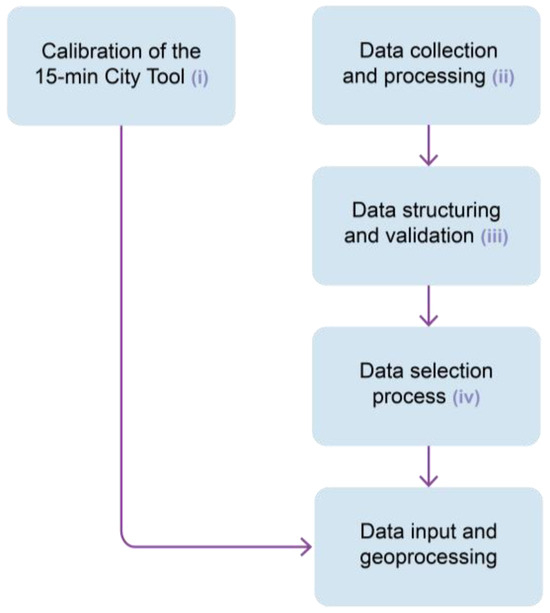
This section is divided into four main parts, outlining (i) the design and calibration of the 15-min City Score toolkit, the main analytical tool that was used to perform the spatiotemporal analysis, (ii) the data collection method and data processing approach to retrieve POI data from the Google Places API, (iii) the data structuring and validation steps to define the main parameters of the study and (iv) the data selection process describing the criteria for sorting and filtering the data to consolidate the final dataset for analysis. The research methodology is based on these four processes, as visualized in Figure 1.
Figure 1.
Flowchart outlining research methodology.
2.1. Main Analytical Tool: The 15-min City Score Toolkit
2.1.1. Design Architecture of the Toolkit
The 15-min City Score is an urban metric that aims to give a comprehensive overview of a city’s walkability as a measure to assess the multiscalar accessibility of cities based on the availability of a variety of services. Given the complexity of the estimation of the metric, the 15-min City Score Toolkit, an open-source Python-based tool for automating the metric estimation, was developed by researchers involved in this study in order to facilitate and streamline the analysis for global use [28,29]. In its original form, the tool streamlines the analysis by using Open Street Map and/or custom data as input, allowing for flexibility and the testing of custom-built scenarios in various cities. To date, the toolkit has been implemented as a QGIS plugin and has been tested on over 112 cities to show its effectiveness and computational efficacy, as well as its potential in supporting and analyzing the 15 min city concept.
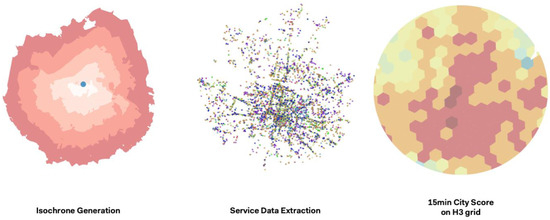
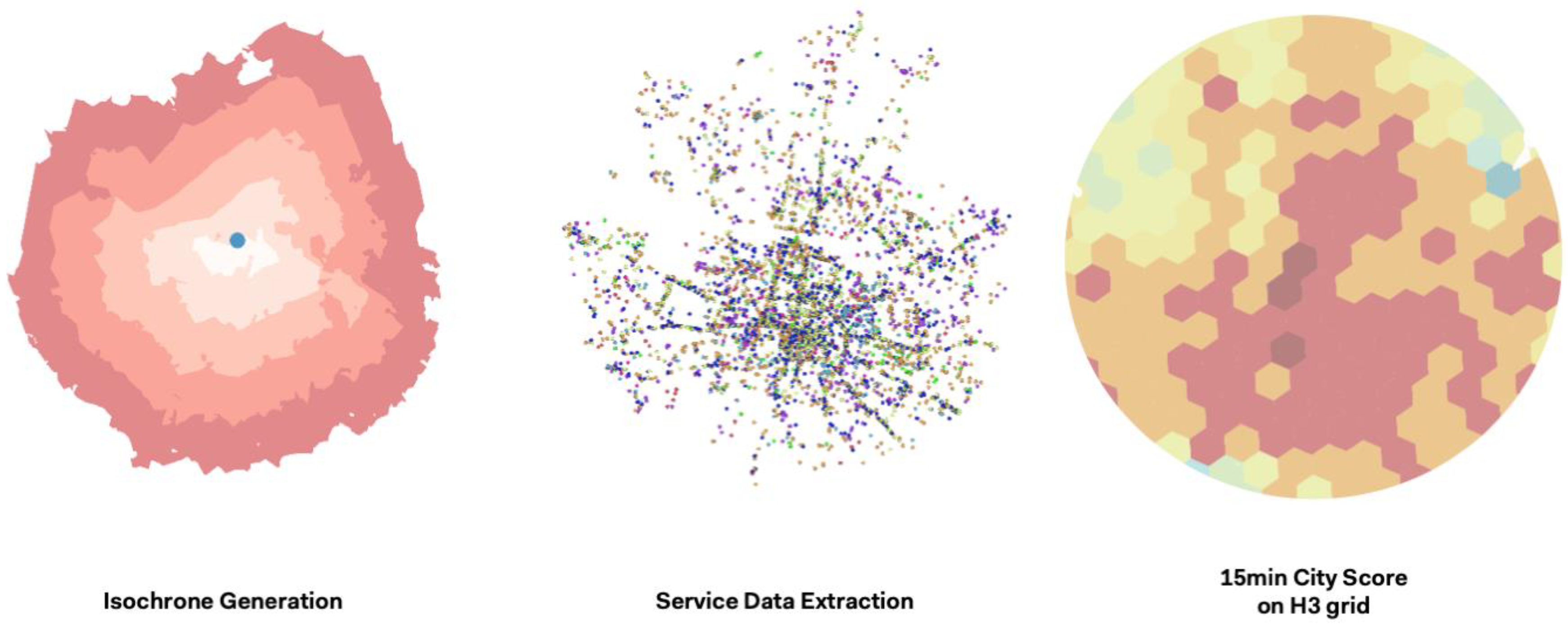
The design and development architecture of the 15-min City Score Toolkit is partially based on the Walk Score (®) metric, a well-recognized tool used in different planning fields ranging from real estate to public health [30,31]. Although both metrics are fundamentally designed as walkability assessment tools, the Walk Score metric considers a wider range of indicators, including population density, block length and intersection density [32], whereas the 15-min City Score metric focuses exclusively on access to amenities. In addition to this, the 15-min City Score allows for the addition of custom POIs (Points-Of-Interest) to the dataset through an alternative function, making it an ideal tool of assessment for the case under study, for which specific data inputs are required to enable the time-variant analysis of service accessibility (see Figure 2).
Figure 2.
The 15-min City Score Tool design schematization.
The specific design architecture of the 15-min City Score toolkit is detailed in previous research [28], including a link to the open-source code [29]. Other notable functions of the 15-min City Score toolkit that optimize proximity services analysis include the ability to reflect actual pedestrian walking behavior through the implementation of an exponential distance decay function, as well as the neutralization of amenity importance through the elimination of the inter-service weighting system native to the Walk Score metric.
2.1.2. Adaptations of the Tool for the Case Study
Several adaptations were implemented to the original design of the 15-min City Score toolkit in order to enable a time-variant analysis of the 15 min concept. In principle, the 4 main modifications are the following:
- (1)
- Input data source for POI data: In the original tool, OpenStreetMap (OSM) was defined as the primary source of data for proximity services. As the biggest openly licensed collection of geospatial data and the largest Volunteered Geographic Information (VGI) source [33], OSM constitutes a worldwide available open data source that allows the replication and scaling up of the analysis to various global contexts. However, in the current application, to enable the time-variant analysis of 15 min service accessibility for the case study of this research, Open Street Map data were replaced with proprietary data from the Google Places API, which included the crucial data field of service operation hours (“opening hours”).
- (2)
- Taxonomical structure of place type classifications: To overcome structural differences between the OSM and Google Places datasets, the POI classification system in the 15-min Score Toolkit was adapted to reflect Google Place taxonomy and conceptual classes, while maintaining consistency with predefined groupings of different place types into service macro-categories (T_L1) of the original method. Table 1 shows the adaptation of Google Place taxonomy of “primary types” (corresponding to T_L1) to the 15-min Score Toolkit macro-categorical classification. For a full list of place types (T_L2) and macro-categories (T_L1), see Appendix A, Table A1.Table 1. Taxonomical reclassification of proximity service groups from source data (Google Places API) to analytical tool classes (15-min City Score toolkit).
- (3)
- Analytical approach and methodology: In its original design, the 15-min City Score toolkit considers the nearest amenity from each macro-category of services (T_L1) in each grid cell, weighting the walking distance to the nearest amenity with an exponential distance decay function. The distance decay function was chosen due to its ability to reflect actual pedestrian walking behavior [32]. The walking time (T) is calculated based on the pedestrian network distance from the cell grid center to the macro category, assuming an average walking speed of 4.5 km/h. The procedure for weighting macro-categories is described by the following relation:
W is the weight assigned for the macro-category.
T is the walking time from the cell grid center to reach the macro-category (in minutes).
This process makes the weighting values of each category range from 0 to 1 based on its closeness to the centroid and, consequently, the 15-min City Score is initially calculated as a sum of the weighted categories. This step keeps the initial values of the 15-min City Score in a range between 0 (reflects no essential service within 15 min) and 8 (fully served zone). An additional process is performed to scale the values of the 15-min City Score to be between 0 and 100, which is the preferred visualization scale.
In this second iteration of the analysis, as the total number of amenities reachable within 15 walking minutes from the cell center are considered, the weights of a category might exceed the value of 1 and the summation of the categories can reach higher values compared with the original 15-min City Score metric.
- (4)
- Zoning and level of detail: Both of the methodologies discussed above require identifying a grid of cells for which the level of accessibility to services is estimated on top of it. Moreover, the definition of the grid enables spatial and temporal variation comparability over different city regions and times. In this study, the authors decided to rely on a well-defined gridding industry standard, which is Uber’s H3 Hexagonal Hierarchical Spatial Index.
The analysis starts from the centroid of each hexagon to generate the 15 min walking catchment areas (i.e., isochrones). As a result, the final analysis resolution is the average distances between two adjacent centroids. Hence, H3 hexagon resolution 9 was selected because of its fine spatial dimension (with an average edge length of 0.02 km), dividing the Milan municipality into 1741 hexagons.
2.2. Data Collection and Processing of POI Data
The proprietary data from Google Places was selected as the main data source for the analysis due to the possibility to input opening hour information for all POIs and the reported comparability with Open Street Map in levels of data completeness and accuracy, with fundamental differences in how the data are collected, organized and validated [34,35,36,37]. Several studies have tested the reliability and validity of Google Maps as a source of business information, particularly through its integration with the Google Places API. The API allows for regular updates on the operational statuses of businesses, which are contributed not only by Google but also by business owners and casual users to maintain up-to-date information [38,39].
The Google Places dataset includes over 46,000 places as of June 2024, with and without opening hour data and with varying levels of thematic accuracy. For that reason, several quantitative and qualitative tests were undertaken to highlight potential biases. Furthermore, the dataset was compared against publicly available datasets for public POIs and in one case (Public Transport) replaced with GTFS (General Transit Feed Specification) data for updated public transportation schedules and geolocations, retrieved for the same time period for consistency.
The Google Maps Platform’s Places API (New) was employed to analyze point-of-interest (POI) data in Milan using the Nearby Search (New) functionality. This approach allowed the retrieval of detailed information about various locations within specified search areas through HTTP POST requests to the API endpoint. The request parameters included FieldMask, which defined the data fields to be returned, and LocationRestriction, specifying the central coordinates and radius of the search area.
To optimize the querying process and avoid exceeding the API’s limit of 20 results per area, the research implemented a zoning algorithm. Using the H3 geospatial indexing library, Milan was divided into hexagonal grids, starting from a coarse resolution (H3 level 7) and iteratively refining to finer levels (up to H3 level 13) as needed. Hexagons containing more than 20 places were further subdivided until all zones fell within the API’s limits or the refinement reached its maximum granularity. Each hexagon’s centroid and radius were then used to query the API, and the 90 selected place types were split into two groups to fit within the API’s 50-type limit per query. This ensured comprehensive coverage of all POIs within the city.
The data retrieved through the API were cleaned and processed to produce a final dataset. JSON files were parsed to extract unique Place_id entries, and duplicates were removed. For each location, key attributes such as name, coordinates, place type and opening hours were included. A structured CSV output was generated, featuring a column for each hour of the week, indicating whether the location was open or closed. This process yielded a detailed and organized dataset, providing a comprehensive view of Milan’s POIs with fine spatial and categorical granularity.
2.3. Data Structuring and Validation
For simplification of the study and to allow aggregation into broad place type classifications consistent with the thematic taxonomy established in the toolkit design [28], secondary level place types (T_L2) are grouped into macro-categories that relate them to broad amenity types in relation to diverse urban activities. To avoid confusion among place type classes, for the purposes of this research we define two conceptual class levels that are relevant to this analysis as shown below.
T_L1 Place type macro-categories (place type groups)
T_L2 Individual place types (place types)
Macro-categorical classification of services (T_L1) is based on “type1” (T_L2) inputs by users on Google Places. Google Places allows up to 15 place type classifications. In the Milan dataset, 70% of places include up to 3 type labels, while fewer than 5% contain more than 6 type labels. Following the taxonomical structure of macro-categories (T_L1) defined in the research, the level of agreement (matching) between type1 to type3 fields in the Google Places dataset ranges from 67% between type1 and type2 to 29% between t2 and t3 (see Table 2). For that reason, it was decided to focus the analysis only on inputs placed in type1 and only use type2 inputs in cases where type1 inputs were classified as “vague” (see Section 2.4).
Table 2.
T_L1 matching between T_L2 inputs in the Google Places dataset for multiple type entries including up to 4 type fields (type1 to type4).
Mixed-use or multi-use facilities (such as malls, parks, hospitals, airports, etc.) tend to be represented via multiple data points in the Google Places dataset, corresponding to multiple pins on Google Maps. This can lead to an inflated number of services under a specific place type with respect to ground truth data. For example, the official Comune di Milano dataset lists 94 parks, of which 34 have specified opening hours and 60 are open 24 h a day. In contrast, Google Places identifies 471 parks, an overestimate caused by the treatment of different zones within parks (e.g., play areas) as separate points of interest (POIs) and the inclusion of other urban green spaces misclassified as parks. Of these, 354 are labeled as open 24 h a day, slightly exceeding the proportion in municipal data (75% vs. 64%). Similar inflation occurs for hospital data, where ontological ambiguity in the classification of medical facilities and the individuation of internal departments result in an overestimation of facilities (326 POIs).
Opening Hour Data Availability
Around 58% of all places on average contain opening hour information. In our dataset, including only selected place types, this figure goes up to 73%. Since the aim of the analysis is to capture diurnal changes rather than try to give a comprehensive view of service availability, data points that do not contain opening hour information are not considered in the study.
The share of places with opening hour data at the individual place type level (T_L2) varies widely from 0 to 100%. Grouped into macro-categories (T_L1), the weighted average of opening hour availability varies from 86% and 81% for Food and Drink and Shopping, respectively, to 42% for Open Leisure. Excluding public-transport-related place types, the Mobility category opening hour availability jumps from 16% to 47%.
Divergence in the availability of opening hour information could be due to multiple factors, including but not limited to the commercial nature of the Google Places database, which incentivizes private business owners to update their information for commercial benefits. Open Leisure and Mobility, both categories that are mostly public and are not commercially viable, might also suffer from a low availability of opening hour data due to their intrinsically “public” nature and the presumption that outdoor facilities are always open. This is supported by further investigation of places listed as open 24 h a day (see Section 3). Table 3 gives an overview of opening hour data coverage by place categories.
Table 3.
Opening hour ratios of places included in the dataset by macro-categories (T_L1).
2.4. Data Selection Process
Places retrieved from the Google Places dataset are filtered by type based on a set of criteria, as shown below:
- Vague or indeterminate place types (T_L2) are excluded from the analysis (e.g., Establishment, Point of Interest) as they do not align with the macro-categorical logic introduced in the study and are likely composed of a mix of place types across predefined macro-categories (T_L1). Places with vague or indeterminate type inputs under type1 were replaced with type2 inputs. To ensure a high level of accuracy, entries that include types classified as vague within the research in both type1 and type2 fields in the Google Places dataset were completely excluded from the dataset (these correspond to roughly 1% of the data). Further studies on type2 and consecutive input fields in the Google Places dataset may prove useful, considering that the predefined macro-categories (T_L1) associated with these T_L2 types change in roughly a third of the cases under study.
- Place types that fit the categorical classification but lack specificity were further analyzed to get a sense of the nature of the establishment. This includes Food, Finance and Health. Upon further investigation, it was decided that places with type1 or type2 entries under these labels should also be excluded from the dataset due to their unspecific and inconsistent nature creating potential for distortion in the data.
- Place types that refer to lodging-related categories, e.g., hotels, private rooms, rv parks, are excluded from the analysis due to their irrelevance to the aims of the research. By nature, lodging facilities are available 24 h a day and their impact on the analysis is superfluous.
- Places that refer to public transport stops and services are excluded from the dataset due to lack of reliability and opening hour availability (0–4%). Data relating to public transit is replaced with official data from the GTFS of Milan, with the opening hours information populated based on GTFS schedules for 15 June (Saturday), 16 June (Sunday), and 19 June (Wednesday) of 2024. This includes ATM transit modes, i.e., bus, tram and metro. POIs in this case refer to individual transit stops, and their opening hour information is determined by the service operation as per the GTFS schedules such that a stop with a minimum frequency of 1 service of any mode at a specific hour is considered “open”. This approach is taken to reflect access to/availability of transport services as opposed to physical access to/availability of public transport stations, which does not reflect service availability.
- Place types with a significant share of mislabeled types have been eliminated (e.g., “Spa”, which when translated to the Italian context is commonly misinterpreted to mean S.p.A, which is an Italian term that stands for Società per azioni, which is a type of corporation, unrelated to the type of commercial establishment offering wellness services).
In all, the data selection process entailed the following steps:
- Categorical selection of relevant, non-ambiguous and representative place types;
- Data triangulation for missing data (Public Transport POIs were replaced with positional and timetable data retrieved from GTFS data);
- Manual review of resulting place types (T_L2) to ensure consistency between places and their assigned types.
This results in a dataset including 160 out of 197 place types (T_L2). In total, 37 place types were categorically excluded from the dataset. A full list of the final place type (T_L2) selections and their corresponding macro-categories (T_L1) is included in Appendix A Table A1, and a list of all omitted types is included in Appendix A, Table A2.
3. Results
Most of the analyses focus on the typical weekday trends observed in the Wednesday data. However, as service provision trends tend to change significantly during weekends, when higher focus is placed on leisure activities compared to work, aggregate counts and opening hour trends are also compared at the macro-categorical level with both Saturday and Sunday data in the dedicated section. Throughout the following section, unless explicitly stated, results correspond to Wednesday (weekday) trends.
3.1. Aggregate Analysis
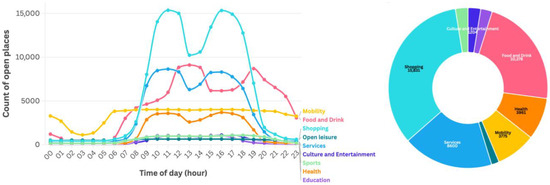
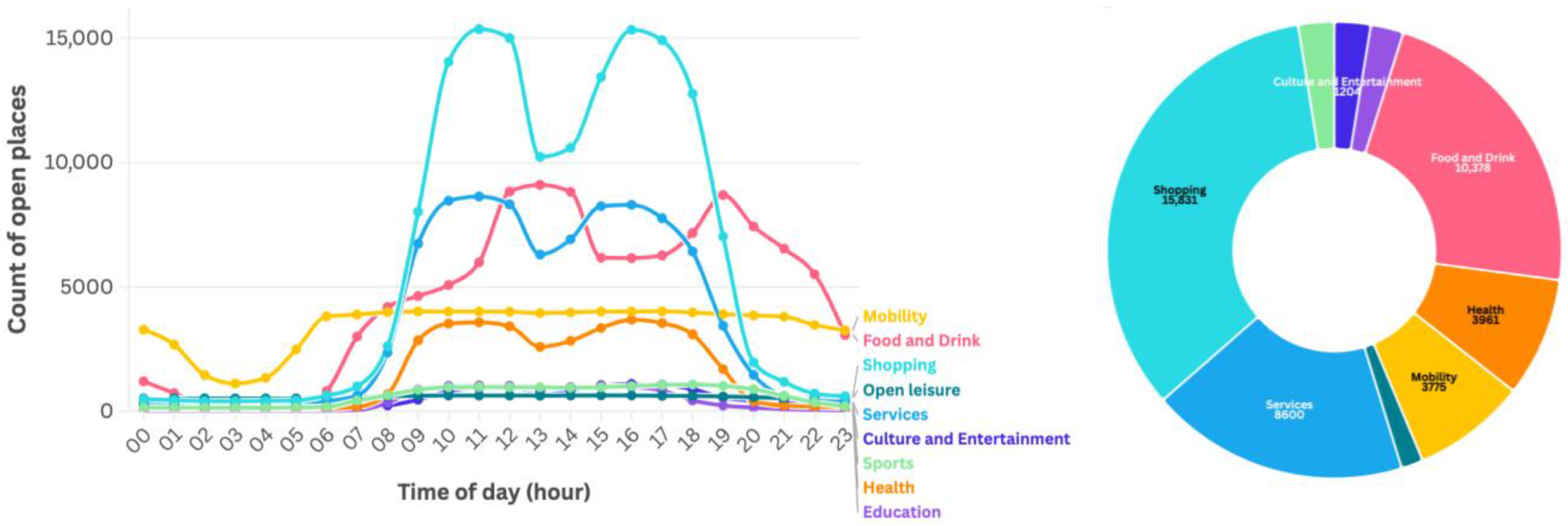
The main focus of the analysis is the typical weekday hourly trend, observing the changes between day and night service extension for all categories. In sum, there are a total of over 46,000 places across the nine predetermined place type categories. Of these, the categories with the highest counts are Shopping, Food and Drink and Services (34%, 22% and 18% of all places), while the categories with the lowest counts are Sports (3%), Culture and Entertainment (3%), Education (2%) and Open Leisure (2%).
In terms of hourly distribution, 12:00 is the hour with the highest overall open place count on a typical weekday, whereas 03:00 is the lowest (see Figure 3). Only 6% of the total number of places open at 12:00 in the city of Milan are open at 03:00. This percentage varies by service group, with public services commonly retaining higher percentages (Open Leisure, 81%; Mobility, 23%; Sports, 14%) than other typically private (and predominantly indoor) categories. It is important to recall that there is a potential overreporting of 24-h-open places that may skew these results.
Figure 3.
Pie chart and line graph showing aggregate counts and hourly distribution of aggregate counts of open places by macro-category on a typical weekday in Milan.
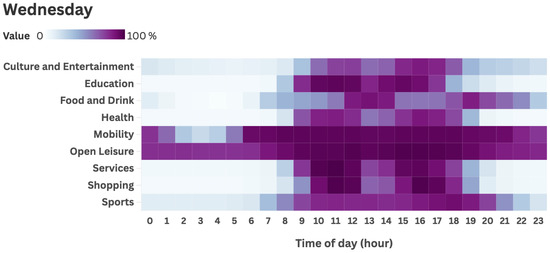
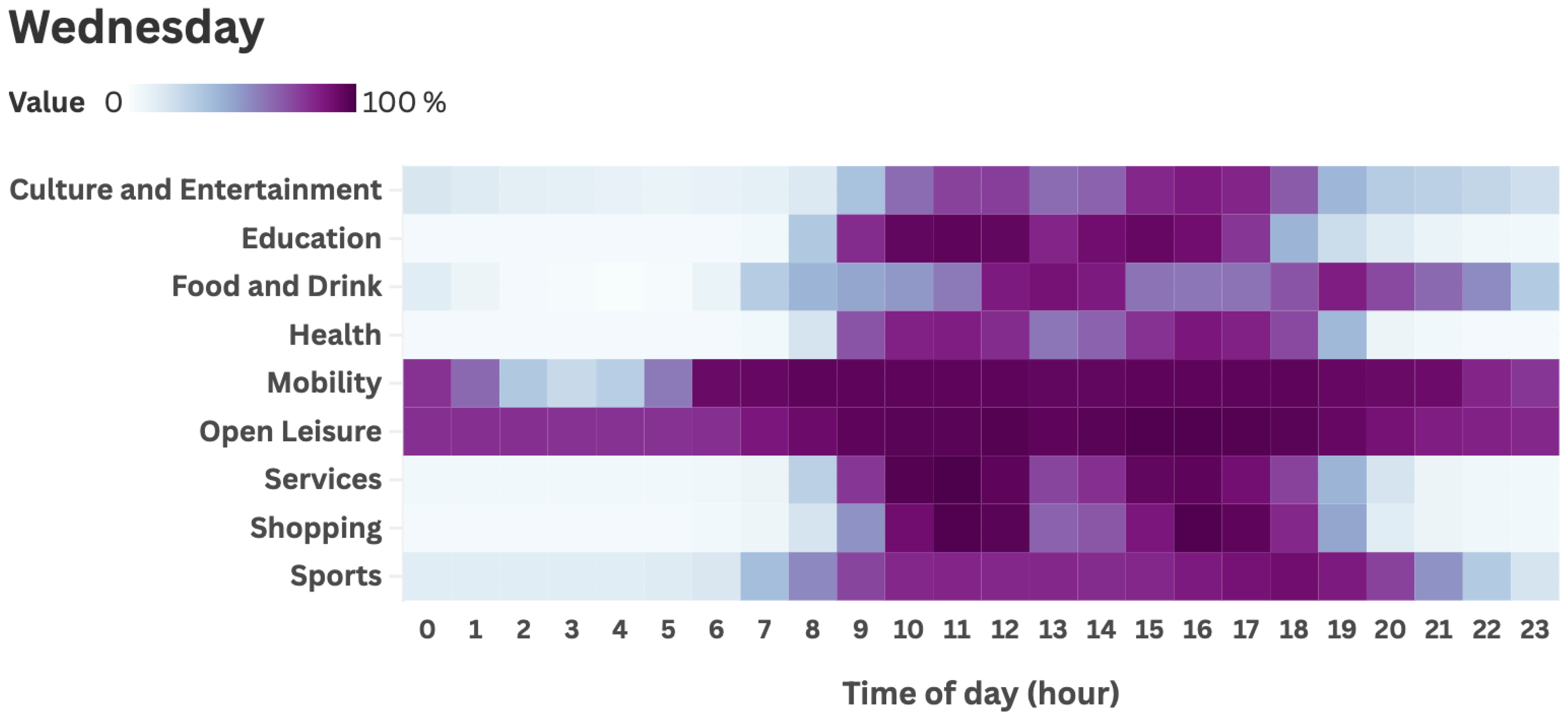
Taking a more conservative approach, comparing 12 p.m. with 12 a.m. values may give a more inclusive indication of nighttime service availability for a broader base of nighttime urban users, including nighttime workers and leisure communities. Compared to 12 p.m., nighttime city users have access to only 14% of food and drink establishments, 23% of mobility options, and 13% and 14% of Sports and Culture and Entertainment opportunities (Figure 4). On the lower end of the spectrum, Education, Health, Services and Shopping facilities operate at only 3–4% of midday capacity. This distribution of common urban activities indicates a clear prioritization for leisure-related activities and leisure nighttime communities, with clear implications for regular night workers and their ability to cluster essential daily activities around working hours.
Figure 4.
Heatmap showing relative hourly distribution of open places by macro-category on a typical weekday in Milan.
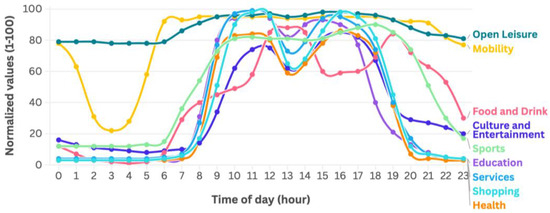
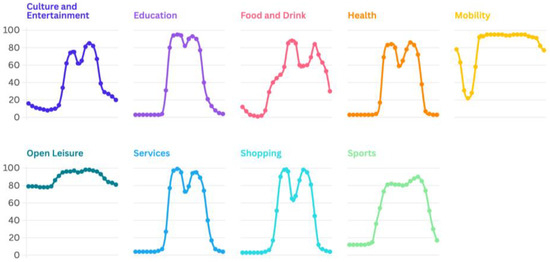
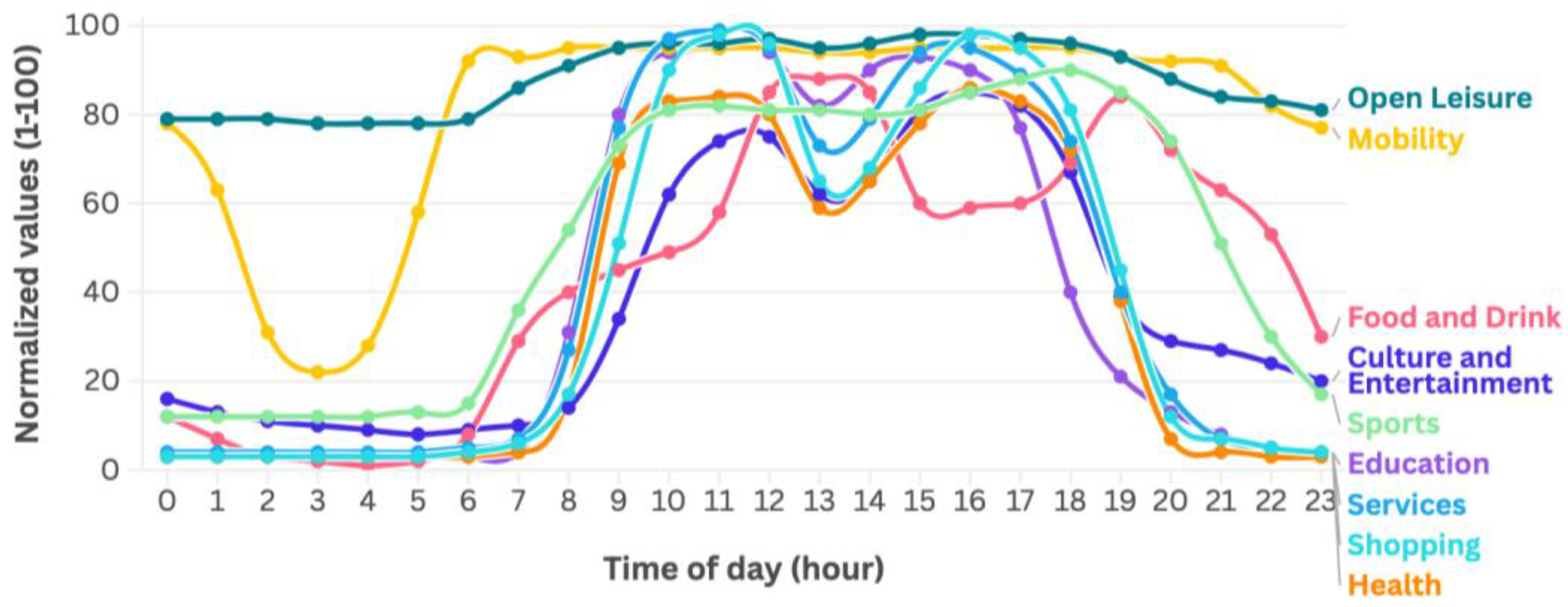
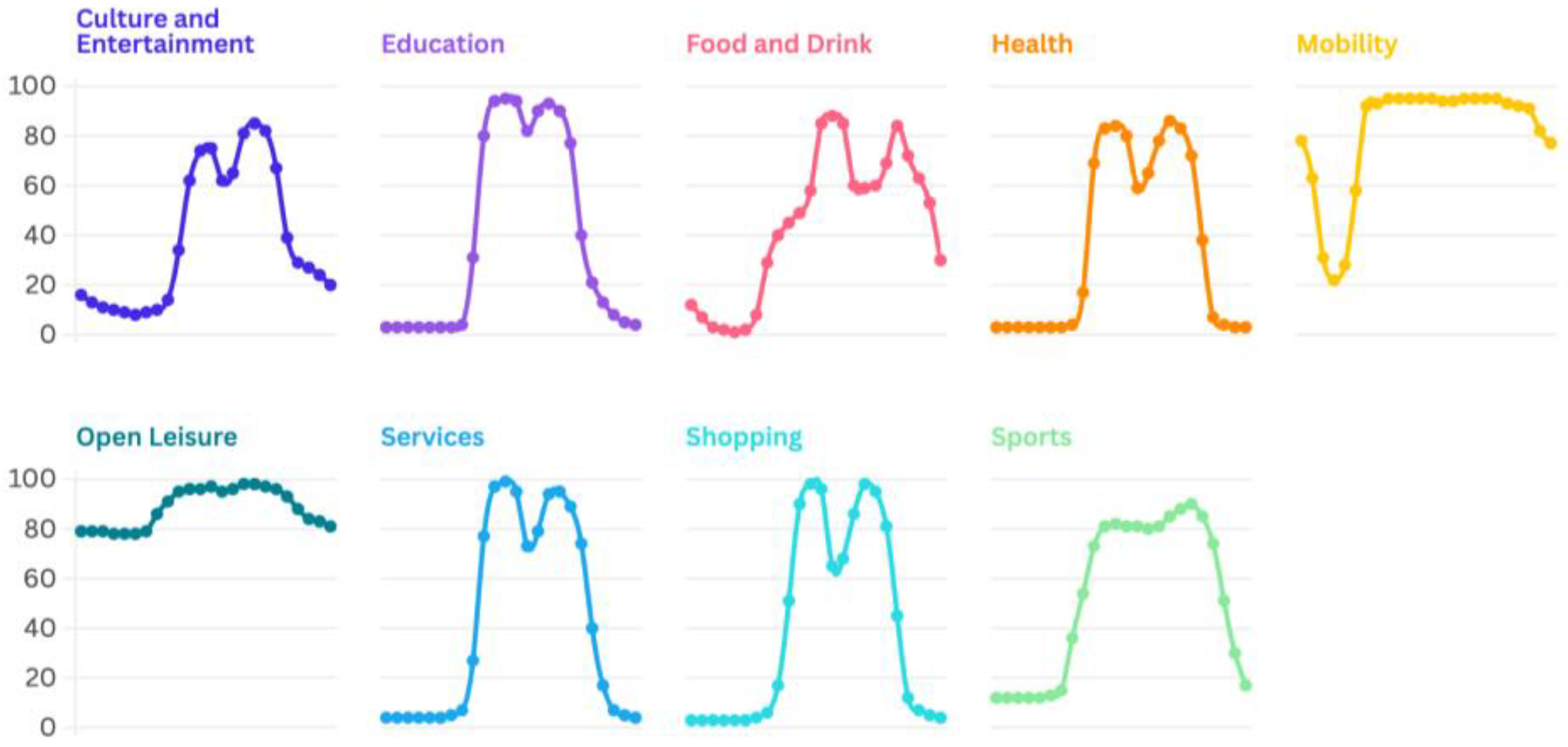
As seen in Figure 5, most service groups exhibit a characteristic double-peak distribution, with peak availability occurring approximately between 09:00–12:00 and 15:00–18:00 and a noticeable decline during the midday hours of 12:00–14:00, often corresponding to the “lunchtime” period, as well as early morning and evening hours. Exceptions to this pattern include the Food and Drink category, which demonstrates an inverse trend, with higher availability during the midday period, and Mobility, which remains relatively consistent throughout the day, apart from a sharp drop during the early morning hours, roughly between 02:00 and 04:00.
Figure 5.
Normalized hourly distribution (min–max) of open places by macro-category on a typical weekday in Milan.
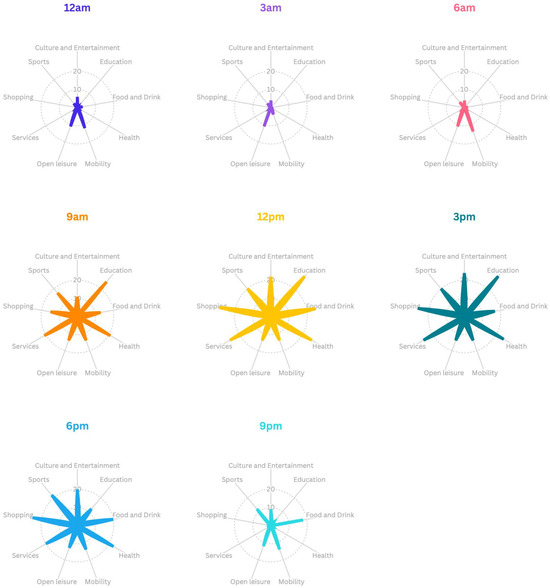
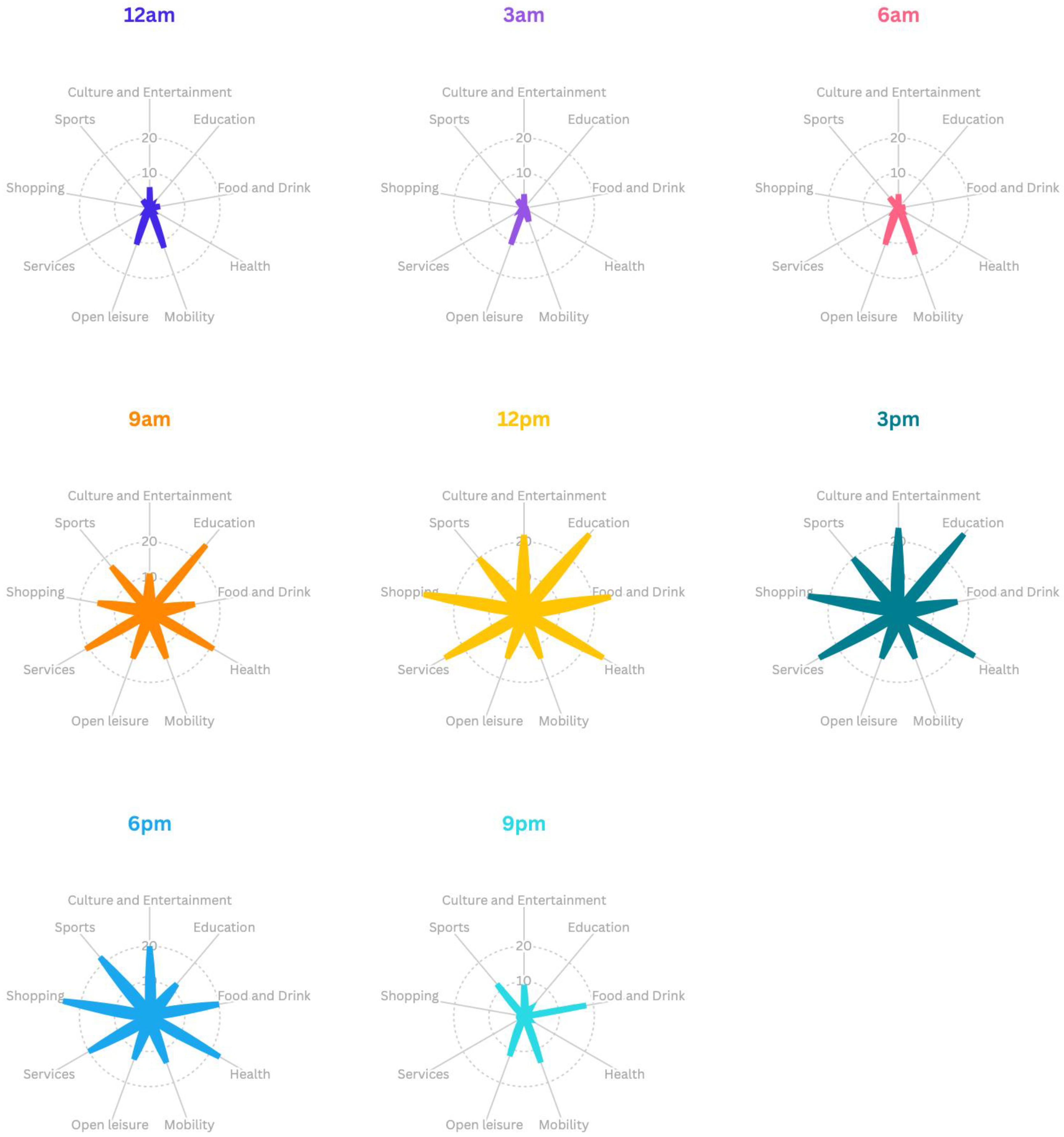
At least 50% of all places within each macro-category group (T_L1) are active between the hours 09:00 and 17:00. Open Leisure, Mobility and Sports facilities all exceed this range, with a minimum of 50% availability achieved over 24, 21 and 14 h of the day, respectively. At the bottom end, Education and Culture and Entertainment achieve this level only during 9 out of 24 h, followed by Health (10 out of 24 h). Compared to standard day hours (06:00–17:00), reductions in open destinations at night (18:00–05:00) vary, with the highest changes occurring in Education (−87%), Services (−80%), Health (−79%) and Shopping facilities (−78%). The remaining categories show higher consistency in levels of activity across the 24-h spectrum, ranging between −12% for Open Leisure and −53% for Culture and Entertainment. Figure 6 shows the relative distribution of open places by macro-category at different hours of the day in Milan.
Figure 6.
Radar chart showing Milan’s relative distribution of open places (%) by macro-category at selected hours of the day.
The Health category has the lowest average share of open facilities across the 24-h period, standing at 36%. This means that, postulating a uniform distribution throughout the day, health-related facilities would only be available at 36% capacity. This is followed by Education and Shopping amenities (39%), Culture and Entertainment and Services (41%) and Sports (52%). At the upper end we find Mobility at 82% and Open Leisure at 90%. Given the importance of health facilities, there might be a need to extend services more uniformly throughout the 24-h period to allow regular night communities and night workers the same level of care as typical daytime city users.
3.1.1. Weekday–Weekend Comparison
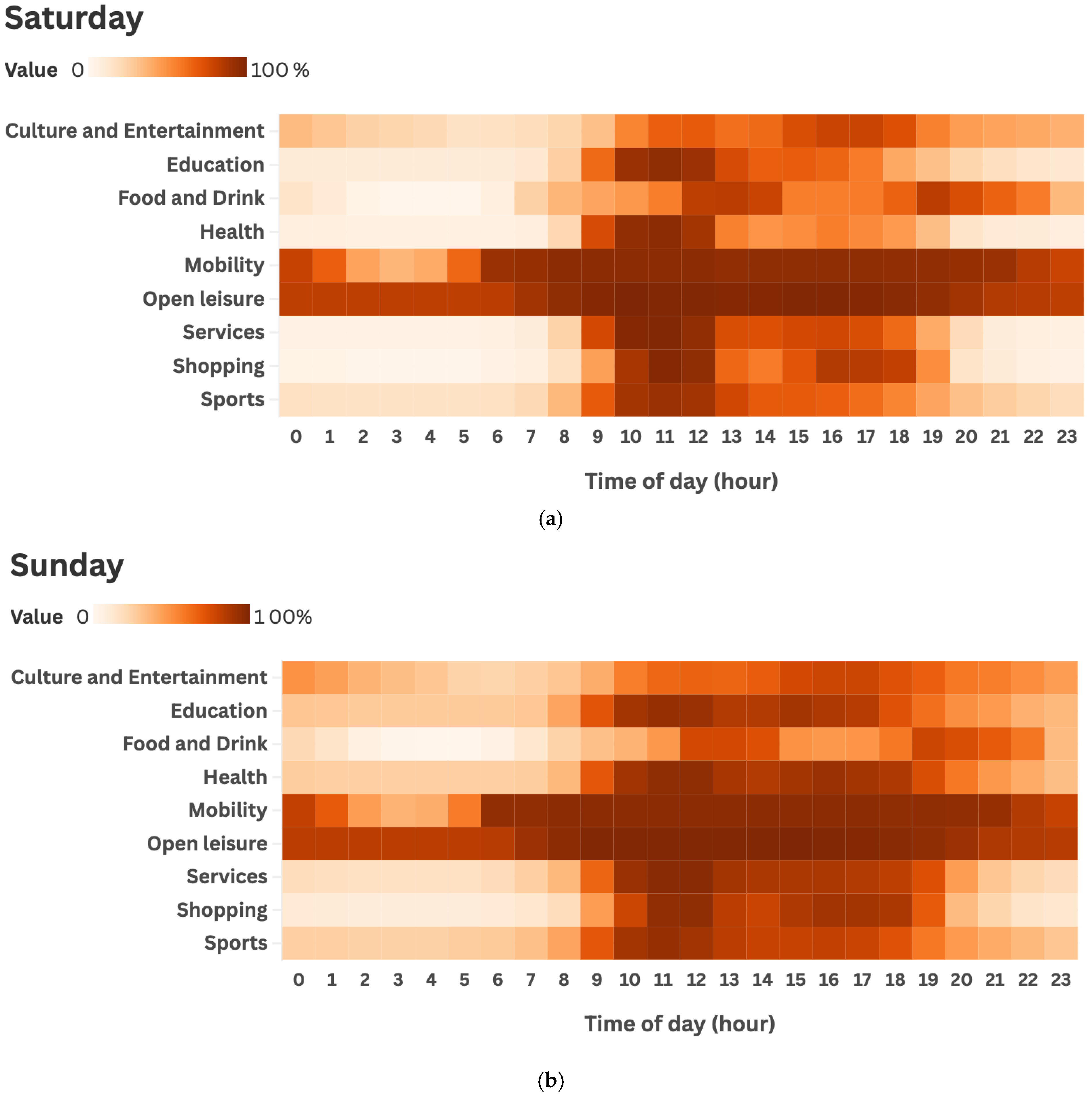
In terms of the total number of open places, the data for Saturday show a total of over 38,000 places, about 80% of the Wednesday count. Places labeled as open on Sunday total at just above 20,000, about 40% of Wednesday count and half of the total number of open places on Saturday. In terms of relative opening hour trends, Wednesday and Saturday also share general trends, with a few exceptions, mainly in the Culture and Entertainment category, which extends further into the night during weekends compared to weekdays, and the Health category, which shows higher morning hour concentrations on Saturdays compared to the double-peak trend of Wednesdays.
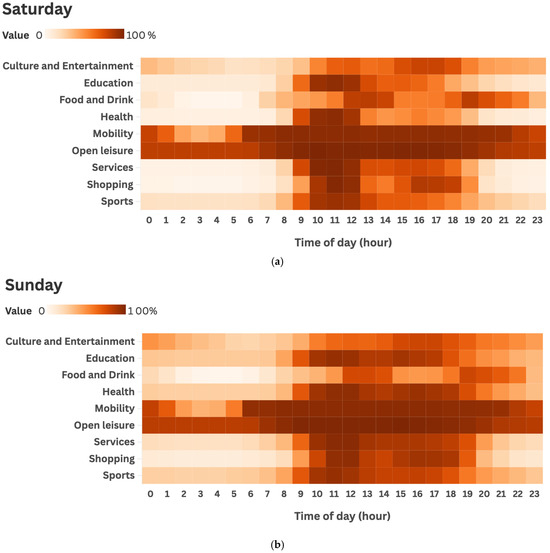
Sunday counts observe a more flattened trend throughout the day compared to Wednesday and Saturday data. This is reflected in the distribution of open places by macro-categories, as shown in the heatmaps in Figure 7. Compared to Saturday data, Health, Services, Shopping and Sports all exhibit more uniform distribution throughout the day. There is also an accentuation of the share of open places during the night hours for several categories, although this might be an anomaly in the data due to places open 24 h a day representing a higher share in the Sunday data, which has lower counts overall compared to the other two days of reference.
Figure 7.
Heatmap showing relative hourly distribution of open places by macro-category on a typical weekend in Milan: (a) Saturday, (b) Sunday.
3.1.2. 24-h-Open Places
In total, there are 2442 places in the final dataset that are listed as open 24 h a day, representing about 5% of all places included in the data set. Of those, 30% are places in the Mobility group and 23% count towards Open Leisure (see Table 4). The Open Leisure category is the one with the highest proportion of places listed as open 24 h a day (77.9%) relative to all places with opening hour information for that category (42%), followed by 19% for Mobility and 11% for Sports. These shares follow expected tendencies for typically “public” (outdoor) amenities.
Table 4.
Relative and global distribution of 24 h open places by place type groups (T_L1).
In terms of hourly distribution, 24-h-open places make up more than 40% of all open places in Milan between the hours 0:00 and 07:00, with a peak of 90% at 03:00. During the rest of the day (08:00–23:00), the share of 24-h-open places remains below the 40% threshold, with an average of 11%. Below is a list of all place types (T_L2) for which at least 50% (and at least 50 places) are open 24 h:
- park (75%, 354 places)
- electric_vehicle_charging_station (94%, 299 places)
- gas_station (62%, 148 places)
- dog_park (94%, 133 places)
- athletic_field (55%, 64 places)
Deeper analysis of the data reveals that typically “public” types of places (T_L2) and place type groups (T_L1) are more likely to show high shares of places open 24 h a day. It is difficult to estimate the level of accuracy in these data. However, we can infer that for several place types, continuous opening hours are overreported (e.g., amusement center: 61%, real estate agency: 25% or plumber: 17%) or underreported in others (e.g., police: 13% and hospitals: 11%). That said, the important thing to note is the differential impact that these places have on temporal service availability distribution, with significant potential for distortion of service availability during late night/early morning hours. According to data supplemented from official GTFS schedules, around 8% of all public transport stops in the city (bus, tram and metro) have services running at all hours of the day (frequency ≥ 1 service/h).
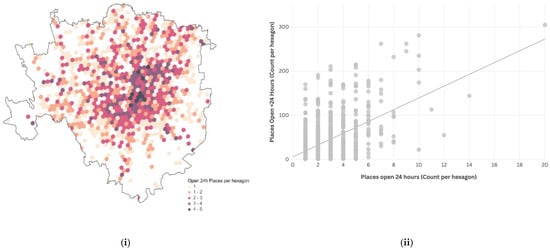
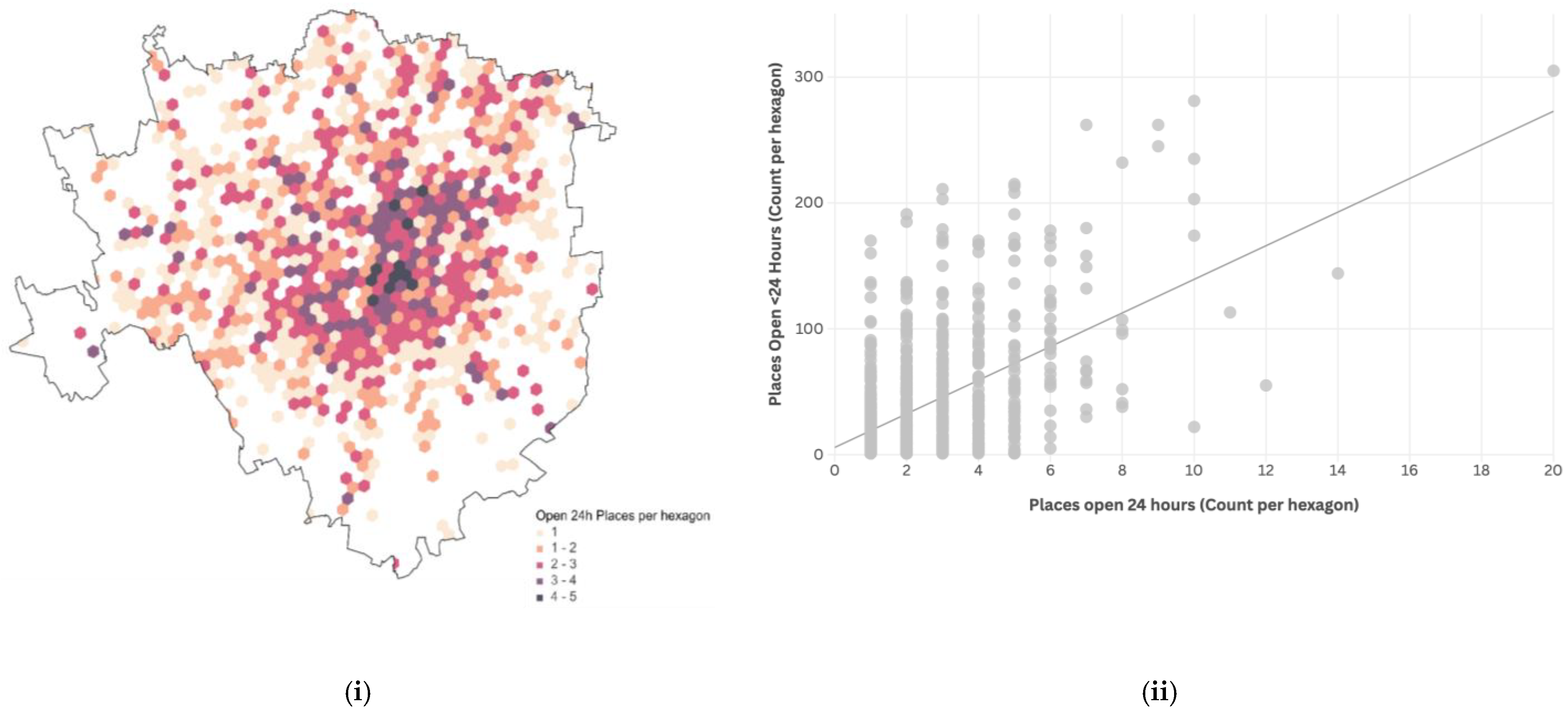
Given the difficulty to sufficiently determine instances of erroneous data in data retrieved from the Google Places dataset, it was decided to keep records of 24-h-open places in the dataset and adapt the calculation method for the 15-min City Score, as previously discussed in Section 2, by introducing a density-based approach with time-weighted scores for comparative analysis against the original methodology. Since the ultimate focus is on delta values in the score between hours with the highest and lowest overall activity, a map showing the spatial distribution of these instances is provided in Figure 8 to highlight areas with potential perceived bias.
Figure 8.
(i) Density distribution of 24-h-open places in Milan by hexagon; (ii) Correlation analysis between counts of 24-h-open places and counts of places with specific opening hours.
3.2. Spatiotemporal Analysis
In order to analyze the spatial distribution trends and observe changes throughout the 24-h period in the city of Milan, the 15-min City Score was calculated to reflect the overall accessibility of open services and amenities within all nine predefined place type groups (T_L1) at the granularity level of the hexagonal grid as well as aggregated at the NIL (Nuclei di Identità Locale) neighborhood level.
As previously mentioned in Section 2, two approaches were applied to calculate the 15-min City Score at different hours of the day: (i) the traditional method, considering access only to the nearest amenity in each of the nine macro-categories and (ii) the adapted density-based method, considering all amenities in all macro-categories. Each approach leads to different score values due to differences in the calculation method. For the purposes of this study, the focus of the results is on the difference between day and night values, specifically the 12 p.m. and 3 a.m. values, which correspond to the hours of highest and lowest active Points of Interest (POIs) across macro-categories.
3.2.1. The 15-min City Score: Traditional Method
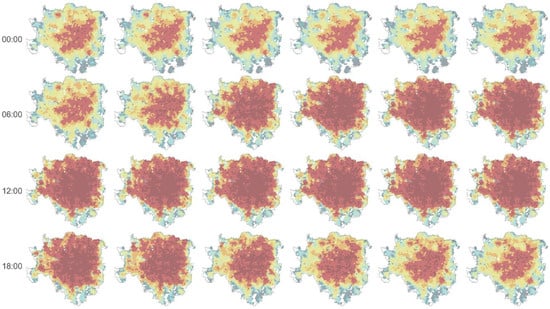
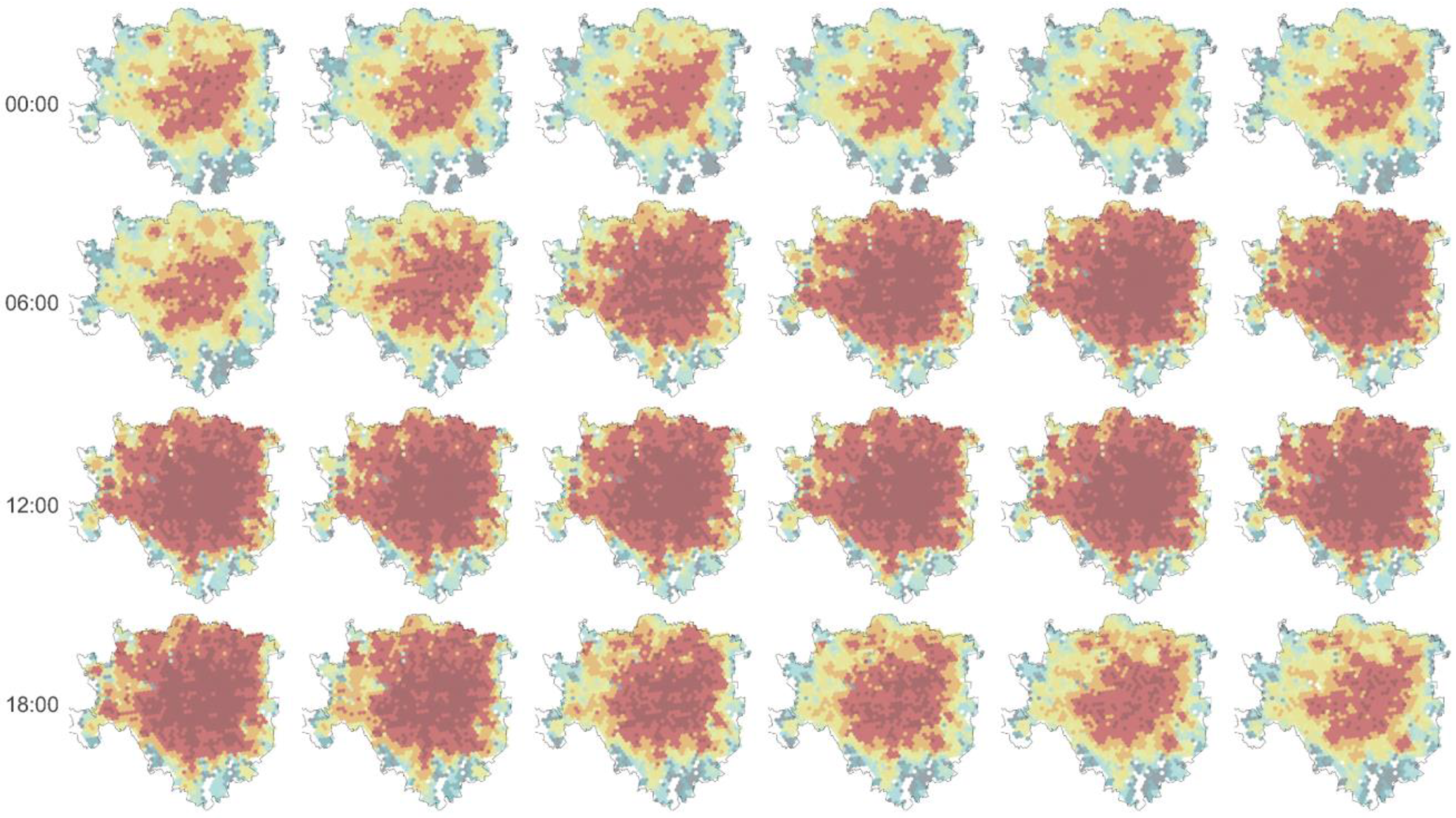
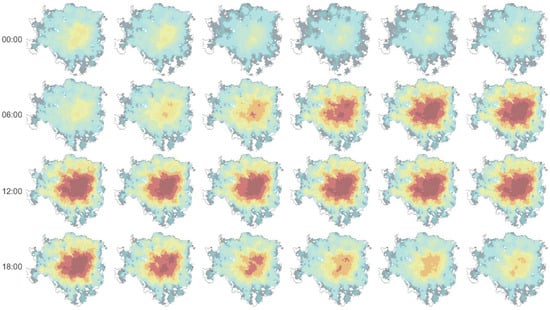
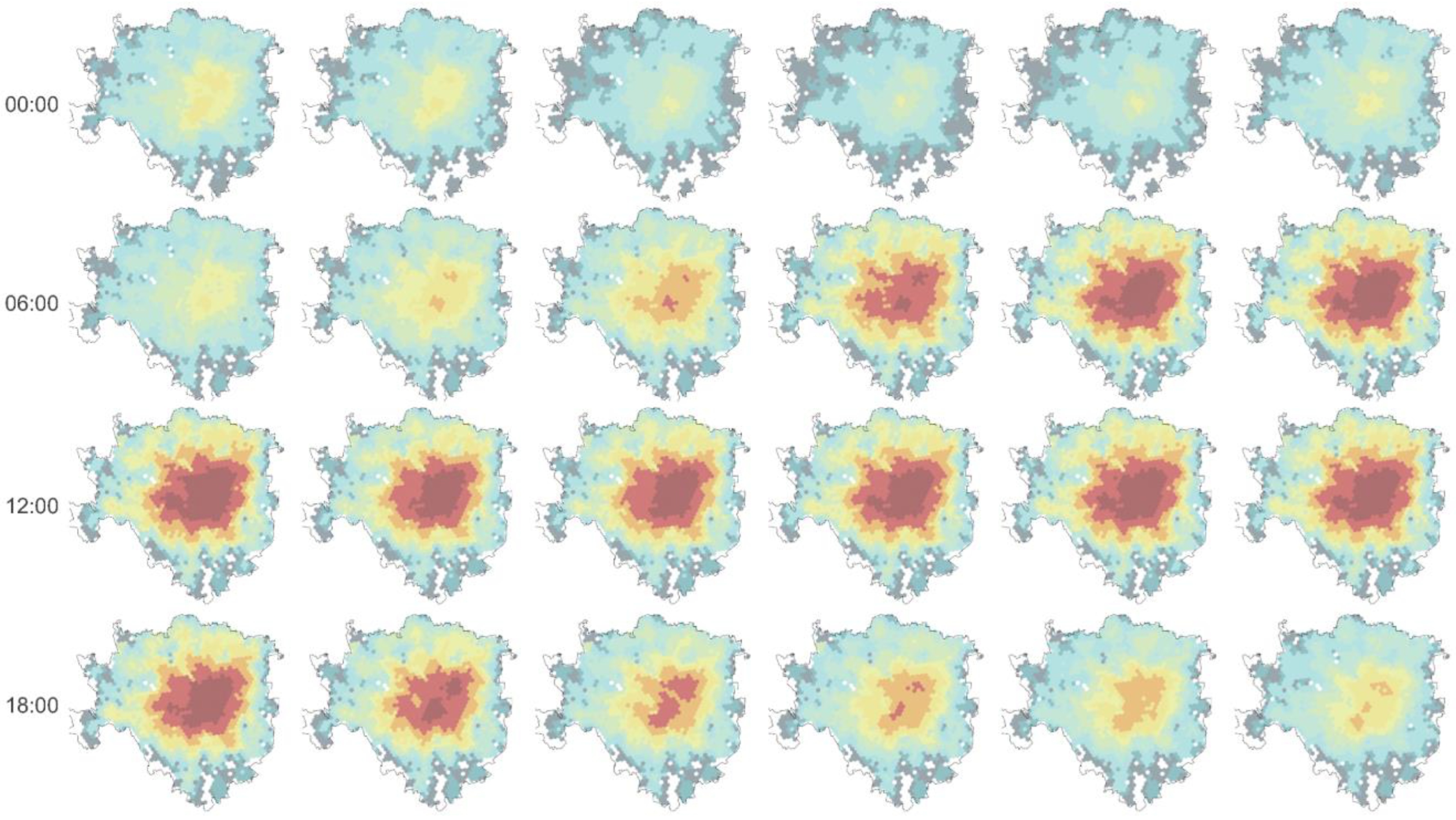
The hourly maps shown in Figure 9 visualize the temporal progression of the score across the city from hour 00:00 to 23:00 of a typical weekday. As can be inferred from the maps, service availability and accessibility by foot during the later hours of the day is significantly lower than that during the typical daytime hours, with marked differences in peripheral neighborhoods. The highest scores are generally maintained in central areas of the city across the 24-h period, extending to most of the city during core daytime hours. Considering the role and distribution of places indicated as open for 24 h a day (see Figure 8), the validity of these results is dependent on the accuracy of the opening hour information for the 24-h-open places, which has a significant impact on accessibility results for nighttime hours as these places represent over 40% of all open places in Milan between the hours 0:00 and 07:00, peaking at 90% at 03:00. The hourly analysis also reveals threshold hours in which sharp changes in the spatial distribution of service accessibility seem to occur between 06:00 and 08:00 and between 19:00 and 21:00, with sharper changes during the morning transitional period.
Figure 9.
Hourly 15-min City Score analysis for the city of Milan (00:00–23:00).
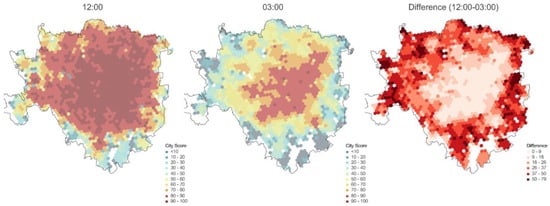
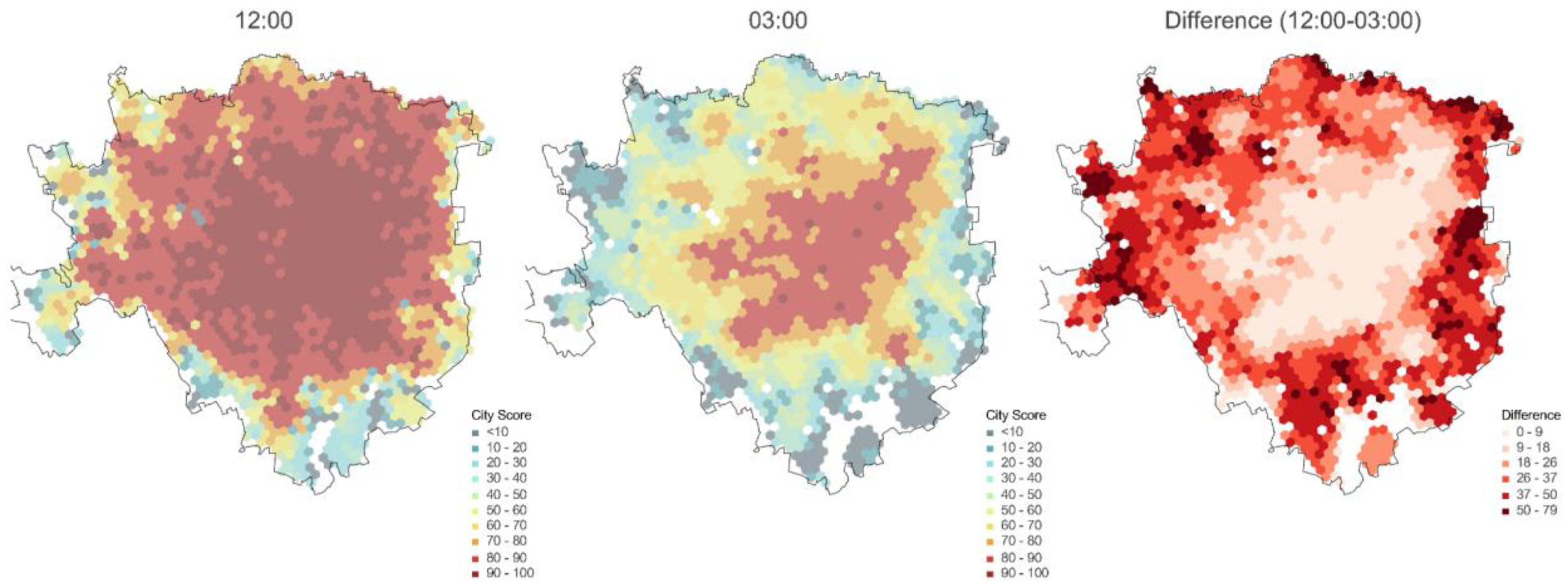
Looking specifically at peak and trough hours (12:00 and 03:00) and comparing the difference in service accessibility between the two, a clear pattern emerges in which peripheral neighborhoods suffer the sharpest drops in service accessibility between the two timeframes, with differences reaching as high as 79 points on the 1–100 15-min City Score (Figure 10). Aggregated at the NIL level, neighborhoods with the largest changes in service accessibility between the two points are Chiaravalle in the south-east, as well as Roserio Baggio–Q.re Degli Olmi–Q.re Valsesia in the north-east, with average score differences above 40. In contrast, the areas of Giardini P.ta Venezia Buenos Aires–Porta Venezia–Porta Monforte and Porta Garibaldi–Porta Nuova, among others, all maintain very low differences between the two data points, indicating an overall high ability for residents and users to easily access at least one amenity from each macro-categorical group on foot across all hours of the day.
Figure 10.
The 15-min City Score at peak hours 12:00 and 03:00 and the difference between the two hours.
3.2.2. The 15-min City Score: Adapted Method
The adapted version of the 15-min City Score considers all places available within a custom timeframe, taking into account density changes to service availability and accessibility by foot throughout the 24-h period. In contrast to the results obtained using the traditional method, the density-based analysis reveals sharper differences in central areas of Milan across the 24-h period and more homogeneous results for late night and early morning hours across the territory (Figure 11). The maps also show higher spatial differentiation in score values during core daytime hours in the central zones of the city, indicating a higher concentration of active destinations in these areas. The threshold hours remain the same, with more notable differences in the evening transition between 19:00 and 21:00 compared to the traditional method.
Figure 11.
Hourly density-based 15-min City Score analysis for the city of Milan (00:00–23:00).
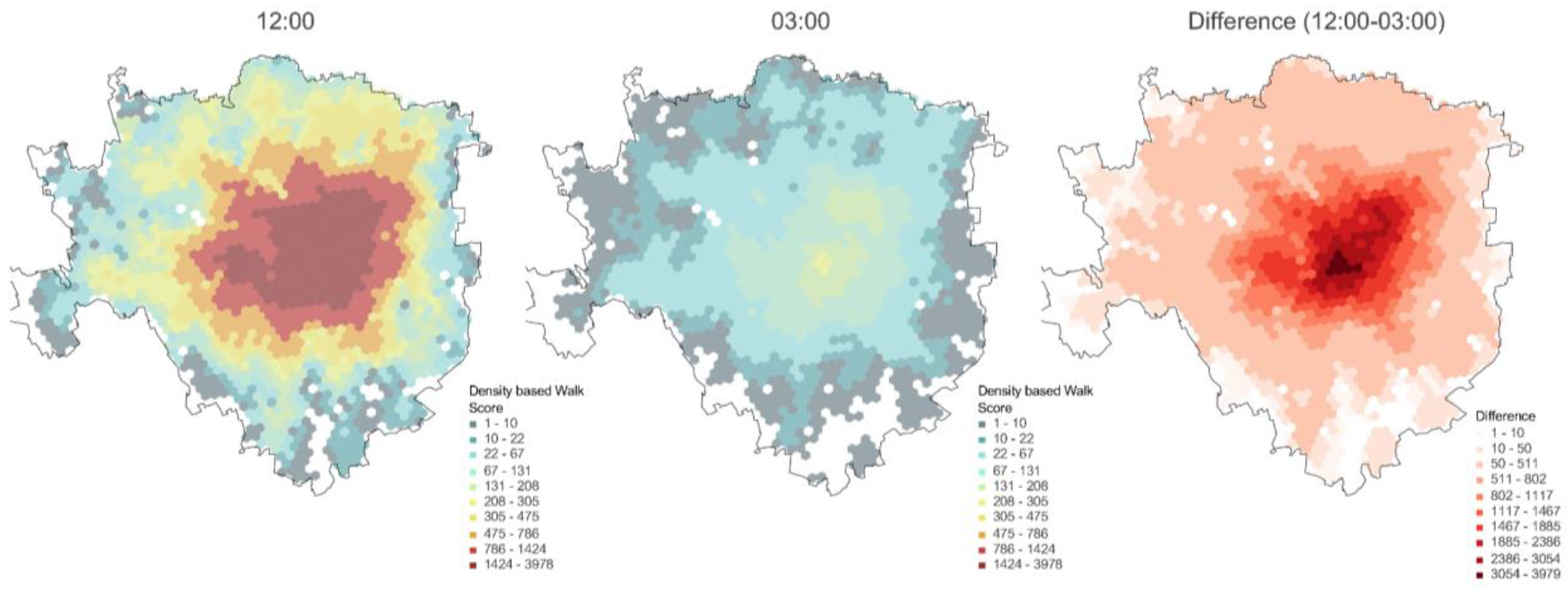
Interestingly, the percentage change between the minimum and maximum activity timeframes (12:00 and 03:00) for the density-based score follows the opposite trend compared to the changes observed with the traditional method (Figure 12). Compared to semi-central and peripheral areas, central areas observe the highest reductions in the density of accessible destinations by foot between 12:00 and 03:00. Here, the differences in the quantity and diversity of available amenities under different sub-groups becomes evident, impacting the choices available to nighttime communities at the hours with the least services available in these areas. Aggregated at the neighborhood level (NIL), the percentage changes between the two timeframes range from 68 to 95% across the territory. Some of the areas with the maximum observed differences include the central areas of Duomo, Giardini P.ta Venezia, Brera and Guastalla. Areas that rank the highest in terms of percentage change from 12:00 to 03:00 are Sarpi, Parco Sempione and Pagano. In contrast, Assiano, Muggiano and Figino show the lowest relative changes.
Figure 12.
Density-based 15-min City Score at peak hours 12:00 and 03:00 and the difference between the two hours.
3.2.3. Public Transport Waiting Time Analysis
Given the importance of public transport and its role in enabling and supporting the nighttime economy, a separate analysis was carried out to map the maximum waiting times at hours of highest and lowest activity, averaged over each hexagon across the city. The waiting time analysis is meant to highlight the fact that reaching a transit stop does not guarantee accessibility. It is a supplementary accessibility analysis that places importance on the hourly difference in time required to access the transit service instead of simply accessing the stop. In addition to this, research has shown that the perceived commuting time at night may be higher due to psychological and emotional factors, especially for those traveling by public transport [40].
To remain consistent with the analytical framework of the research, to evaluate the diurnal differences in public transport accessibility we focused on the peak hours of overall service (12:00 and 03:00) as opposed to the specific peak hours associated with public transport frequency. At each active stop, the maximum waiting time is estimated considering the public transportation means with the least frequency, with the aim to simulate the maximum waiting time one might wait for public transportation at the stop. The average of the maximum waiting time is then calculated over each hexagon, as the hexagon might include more than a single stop.
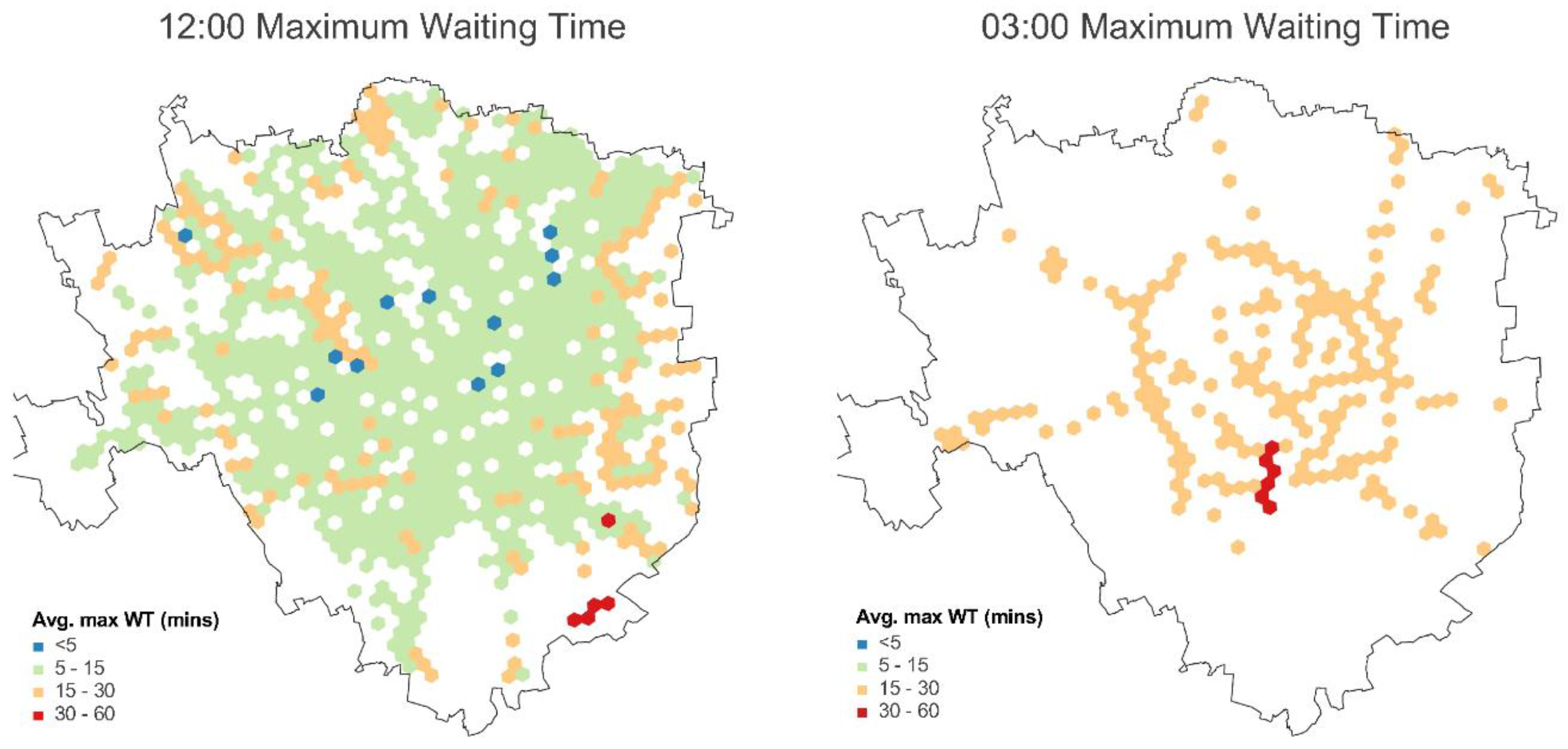
As shown in Figure 13, in just about 1% of areas at noon, people might wait up to 5 min for public transport options. In most regions (80%), people could wait between 5 and 15 min throughout the city. Fewer than 18% of the active hexagons, concentrated at the outer zones of the city, have wait times up to half an hour, while fewer than 0.5% of the active hexagons would require a person to spend up to one hour waiting for a means of public transportation.
Figure 13.
Average maximum waiting time for public transport by hexagon at 12:00 and 03:00.
A different trend is observed at 03:00, where only about 20% of the active hexagons at 12:00 are still operating at 03:00. The concentration of public transportation follows the first ring of the city of Milan, where at most of the active stops (97%) people’s waiting times range between 15 min and half an hour. In less than 3% of the cases, waiting for public transport might reach up to 60 min.
Overall, the average maximum waiting time per active cell at 03:00 is 30 min, compared to 13 min at noon. The figure for noon goes down to 10 min when considering only the cells that are also active at 03:00. This analysis highlights the differences both in the spatial coverage of access to public transit stops at the hours with highest and lowest overall activity in the city, as well as in the maximum time required to access a public transit service during these hours. Given that public transit service availability and frequency are strongly linked to spatial and temporal demand profiles, it is not surprising to see this drastic reduction in service supply between the two timeframes. However, these results emphasize the importance of the system’s adaptability to meet the urban mobility needs of different users of the city, irrespective of demand volumes.
4. Discussion
4.1. Main Findings
Milan hosts over 46,000 places across nine service categories, with Shopping (34%), Food and Drink (22%) and Services (18%) being the most widespread activities. In contrast, Sports, Culture and Entertainment, Education and Open Leisure are far more limited in quantity, comprising less than 5% of the total. While most categories follow a characteristic double-peak pattern, with peaks from 09:00 to 12:00 and 15:00 to 18:00 and reduced availability during “lunchtime” (12:00–14:00) and nighttime hours, exceptions like Food and Drink exhibit an inverse pattern, with higher availability during midday hours. Mobility and Open Leisure maintain relatively flat distributions, showing consistent availability throughout the day. However, in total, only 6% of places open at 12:00 p.m. remain open at 03:00 a.m., with public services like Open Leisure (81%) and Mobility (23%) retaining the highest nighttime availability and other categories like Education and Health dropping to just 3% of their midday values.
Nighttime availability shows significant reductions across macro-categories, with Education (−87%), Services (−80%), Health (−79%) and Shopping (−78%) experiencing the steepest declines between 18:00 and 05:00. Weekend service availability is also reduced, with 20% fewer places open on Saturdays and 60% fewer on Sundays compared to weekdays. The prioritization of leisure-related services at night underscores gaps in essential services like Health and Services, which are critical for nighttime workers. Addressing these disparities could enhance service equity and support nighttime urban communities to organize their daily life activities around their waking hours and nocturnal routines.
The 15-min City analysis highlights significant spatial and temporal differences in service accessibility across Milan. Using two approaches—the traditional nearest-amenity method and the adapted density-based method—key differences between daytime (12:00) and nighttime (03:00) service accessibility emerge. The traditional method reveals lower nighttime accessibility, particularly in peripheral neighborhoods, with the differences in service scores reaching as high as 79 points. Central areas maintain relatively stable accessibility throughout the day but experience the steepest reductions in density, emphasizing the impact of reduced amenity diversity on nighttime communities in these locations.
The public transport waiting time analysis complements the 15-min City Score by revealing additional challenges in nighttime accessibility. At 03:00, only 20% of the public transport stops active at 12:00 remain operational, with average waiting times doubling. Longer wait times are concentrated in peripheral areas in both time periods. The stark reduction in public transport availability at night underscores barriers to mobility for nighttime urban users and highlights the importance of aligning service availability with the needs of the night economy, particularly for night workers who may rely more heavily on public transport.
Together, these analyses reveal pronounced diurnal disparities in urban service accessibility, with significant implications for equitable access for regular night communities, exacerbated for certain categories of urban activities and spatially in peripheral areas. Addressing these gaps through more evenly distributed services and improved nighttime service distribution could enhance livability outcomes for regular night communities. While the authors do not advocate for equal service availability and 24-h operation for all urban activities, changes in specific essential service categories are recognized to have significant potential impact on the livability of regular night communities. Out of all categories under study, health amenities stood out as the category with the most limited availability during nighttime hours, with an average share of open facilities across the 24-h period standing at 36%. During evening and night hours, the share of open places drops by a significant 79% on weekdays and is mostly restricted to the morning hours on Saturdays. Meanwhile, leisure activities including Culture and Entertainment are extended further into the night on Saturdays compared to the typical weekday. Given the centrality of health-related activities in urban users’ lives and their importance, especially for night workers who carry exacerbated health risks due to disruptions in sleep patterns and extended night work shifts [41], there is a need to increase and extend the operational hours of essential and non-urgent health facilities to cater to the needs of a particularly vulnerable population.
4.2. Data Limitations and Further Research
Despite the reported issues of the thematic quality of the Google Places API dataset, it remains a strong reference for spatiotemporal analysis given it contains opening hour information, has high accuracy in positional quality of geospatial data and has comparable thematic quality accuracy to Open Street Maps and other leading Volunteered Geographic Information (VGI) platforms. With respect to Open Street Maps, limitations to public space data completeness and accuracy are relevant given the commercial nature of the Google Maps proprietary data, deeming it more reliable for business information due to regular updates and verifications.
Thematic limitations of the Google Places data influenced the results in three main ways: taxonomical inconsistency, spatial data redundancy and opening hour inaccuracy due to 24-h-open place inflation. Following the taxonomical structure of macro-categories (T_L1) defined in the research, the level of agreement (matching) between alternate “type” fields in the Google Places dataset was found to be low (67% to 29% between the first four types). This requires further investigation and one-to-one manual checks to ensure that the place types used in the type1 field are the most accurate and representative.
Ontological and taxonomical inconsistencies in the classification of some typologies within public municipal datasets posed challenges in validating Google Places data against open government data sources. Additionally, the duplication of multi-purpose and multi-zonal POIs further complicates the analysis. Further analysis and verification steps are required to ensure accurate correspondence between datasets and allow further data triangulation.
To ensure a high level of accuracy in the data quality, multiple checks were conducted and extended analyses were performed to provide sufficient context, explicitly stating biases in the data where present. It is important to note that while the results may be partially skewed due to perceived biases, the main focus of this research remains on a narrative of relative rather than absolute accessibility, with the primary aim of comparing changes in accessibility throughout the 24-h period in the city of Milan.
4.3. Final Reflection
This research highlights significant implications and potential for urban planning and policy development, particularly in the context of nighttime economic activity and accessibility. The findings emphasize the importance of examining land use and urban time policies that enable or restrict daytime and nighttime balance in quality of life potential and their influence on service distribution and urban vibrancy. In Italy, there is a rich history of urban time policies that extends back to the 1980s, with the aim to coordinate daily, weekly and seasonal timetables of services to more accurately reflect citizens’ needs [42,43]. This research supplements ongoing municipal efforts by giving a snapshot of the operating timetables of a wide variety of services and destinations in the city, including both public and private establishments. By comparing operating time schedules with temporal profiles of demand, including peak, off-peak and transition periods, this methodology can guide policymakers to adjust service availability in the public sector and revise the policy measures in place aimed at regulating private services and establishments to ensure sufficient access to essential services for regular nighttime communities. With the municipality of Milan being one of the early adopters of time policies in Italy and the first to write up a “Territorial Timetable Plan” or PTO (Piano territoriale degli orari), this research also aims to persuade the municipality to extend the existing aims of the latest plan (2013) to deliver interventions to consider the specific work–life balance needs of asynchronous city users [44].
From a practical research perspective, this study underscores the significance of incorporating temporal variation into proximity and accessibility analyses. Temporal factors, such as differences in opening hours and typical activity trends, are critical for understanding the dynamics of urban accessibility and supporting evidence-based planning decisions. Furthermore, insights from public transport waiting time analyses reinforce the need for policy interventions that address disparities in service availability and waiting times during nighttime hours, contributing to transport justice and equitable urban access. While this research marks an initial step in measuring the spatiotemporal variation of neighborhood accessibility within the framework of the 15 min city, it opens pathways for further exploration of temporal urban dynamics. The proposed methodology, with its replicable design, has the potential to support cities across the EU in leveraging nighttime opportunities while addressing broader challenges such as transport equity, climate adaptation and gender inequality in mobility. By integrating these considerations, cities can enhance inclusivity and resilience in their planning frameworks, unlocking the untapped potential of nighttime urban life.
Author Contributions
Conceptualization, L.A., A.G., G.C. and A.A.; Methodology, L.A., G.C., A.A., F.M. and A.G.; Software, A.A, F.M., D.P. and A.G.; Validation, L.A., G.C., A.A. and A.G.; Formal Analysis, L.A., G.C. and A.A.; Investigation, L.A., G.C. and A.A.; Resources, G.C., A.A., F.M., D.P. and A.G.; Data Curation, L.A., G.C. and A.A.; Writing—Original Draft Preparation, L.A., G.C. and A.A.; Writing—Review and Editing, L.A., G.C. and A.A.; Visualization, L.A., G.C. and A.A.; Supervision, A.G.; Project Administration, A.G. All authors have read and agreed to the published version of the manuscript.
Funding
This research received no specific grant from any funding agency in the public, commercial, or not-for-profit sectors. Proprietary data acquired were purchased through the internal resources of Fondazione Transform Transport ETS.
Data Availability Statement
GTFS (General Transit Feed Specification) Data for Public Transport geolocations and schedules in Milan: The public access data for geolocations and schedules for public transportation means in Milan is openly available at: https://www.amat-mi.it/it/servizi/pubblicazione-orari-trasporto-pubblico-locale-formato-gtfs/ (accessed on 1 November 2024). Comune di Milano Urban Parks data: geolocations and opening hour information: The public access data for locations and information about public urban parks in Milan is openly available at: https://www.comune.milano.it/aree-tematiche/verde/verde-pubblico/parchi-cittadini (accessed on 1 November 2024). Google Places Point-Of-Interest (POI) data: Restrictions apply to the availability of these data. Data were obtained from the Google Places API and are available via purchase at: https://developers.google.com/maps/documentation/places/web-service/nearby-search (accessed on 1 November 2024). The analyzed data were treated according to the GDPR—General Data Protection Regulation (EU, 2016/679).
Conflicts of Interest
The authors declare no conflict of interest. The funding sponsors had no role in the design of the study; in the collection, analyses or interpretation of data; in the writing of the manuscript or in the decision to publish the results.
Appendix A
Table A1.
Table showing list of all place types (T_L2) and corresponding macro-categories (T_L1) included in the final dataset.
Table A2.
Table showing list of all omitted place types (T_L2).
References
- GLA Economics. London at Night: An Evidence Base for a 24-Hour City; GLA Economics: London, UK, 2018. [Google Scholar]
- Seijas, A.; Barnett, J.; Salihudin, S. Rethinking 24-Hour Cities: Night-Time Strategies to Address Urban Challenges and Thrive. World Economic Forum, 9 January 2024. Available online: https://www.weforum.org/stories/2024/01/24-hour-cities-night-time-strategies-urban-challenges/ (accessed on 1 November 2024).
- Abdelfattah, L.; Scarponi, L.; Messa, F.; Guida, C.; Zucaro, F.; Carpentieri, G.; Andreola, F.; Muzzonigro, A.; Walker, J.; Gorrini, A. A Digital Humanities Approach to Study Women’s Perceptions of Safety in the City of Milan: The Step Up Project. In Computational Science and Its Applications—ICCSA 2024 Workshops; Gervasi, O., Murgante, B., Garau, C., Taniar, D.C., Rocha, A.M.A., Faginas Lago, M.N., Eds.; Lecture Notes in Computer Science; Springer Nature: Cham, Switzerland, 2024; Volume 14823, pp. 49–65. [Google Scholar] [CrossRef] [Scilit]
- Hadfield, P. The Night-Time City. Four Modes of Exclusion: Reflections on the Urban Studies Special Collection. Urban Stud. 2015, 52, 606–616. [Google Scholar] [CrossRef] [Scilit]
- Long, B.; Ferenchak, N.N. Spatial Equity Analysis of Nighttime Pedestrian Safety: Role of Land Use and Alcohol Establishments in Albuquerque, NM. Transp. Res. Rec. J. Transp. Res. Board 2021, 2675, 622–634. [Google Scholar] [CrossRef] [Scilit]
- McArthur, J.; Robin, E.; Smeds, E. Socio-Spatial and Temporal Dimensions of Transport Equity for London’s Night Time Economy. Transp. Res. Part A Policy Pract. 2019, 121, 433–443. [Google Scholar] [CrossRef] [Scilit]
- Delafontaine, M.; Neutens, T.; Schwanen, T.; Weghe, N.V.D. The Impact of Opening Hours on the Equity of Individual Space–Time Accessibility. Comput. Environ. Urban Syst. 2011, 35, 276–288. [Google Scholar] [CrossRef] [Scilit]
- Brabazon, T. Into the Night-Time Economy: Work, Leisure, Urbanity and the Creative Industries. Nebula 2007, 4, 161–178. [Google Scholar]
- Acuto, M.; Seijas, A.; McArthur, J.; Robin, E. Managing Cities at Night: A Practitioner Guide to the Urban Governance of the Night-Time Economy; Bristol University Press: Bristol, UK, 2021. [Google Scholar] [CrossRef] [Scilit]
- Smeds, E.; Robin, E.; McArthur, J. Night-Time Mobilities and (in)Justice in London: Constructing Mobile Subjects and the Politics of Difference in Policy-Making. J. Transp. Geogr. 2020, 82, 102569. [Google Scholar] [CrossRef] [Scilit]
- Furno, A.; El Faouzi, N.-E.; Fiore, M.; Stanica, R. Fusing GPS Probe and Mobile Phone Data for Enhanced Land-Use Detection. In Proceedings of the 2017 5th IEEE International Conference on Models and Technologies for Intelligent Transportation Systems (MT-ITS), Naples, Italy, 26–28 June 2017; IEEE: Piscataway, NJ, USA, 2017; pp. 693–698. [Google Scholar] [CrossRef] [Scilit]
- Eurostat. Employed Persons Working at Nights as a Percentage of the Total Employment, by Sex, Age and Professional Status (%), 2024. Available online: https://ec.europa.eu/eurostat/databrowser/view/lfsa_ewpnig/default/table?lang=en&category=qoe.qoe_woli.qoe_wta (accessed on 1 November 2024).
- Eurostat. Employed Persons Working in the Evenings as a Percentage of the Total Employment, by Sex, Age and Professional Status (%), 2024. Available online: https://ec.europa.eu/eurostat/databrowser/view/lfsa_ewpeve/default/table?lang=en&category=qoe.qoe_woli.qoe_wta (accessed on 1 November 2024).
- Brusco, A.; Bucci, G.; Campea, S.; Filottrano, A.; Marracino, F.; Romualdi, G. Gli Infortuni Sul Lavoro in Orario Notturno in Italia; Inail Consulenza Statistico Attuariale; 2024. Available online: https://www.inail.it/content/dam/inail-hub-site/documenti/catalogo-generale/2024/07/GliInfortuniSulLavoroInOrariNotturnoInItalia.pdf (accessed on 1 November 2024).
- Kolioulis, A.; Siravo, J.; Apostolidis, P.; Kummer-Buléon, C.; Matheou, L.; Campani, C. Working Nights: Municipal Strategies for Nocturnal Workers; Autonomy, 2021. Available online: https://autonomy.work/wp-content/uploads/2021/12/Working_Nights-2.pdf (accessed on 1 November 2024).
- Publica. Developing a Night Time Strategy. Part 1: Guidance on Process; Greater London Authority: London, UK, 2020. Available online: https://www.london.gov.uk/sites/default/files/210317_gla_1_night-time_strategies_part_1.pdf (accessed on 1 November 2024).
- DECRETO LEGISLATIVO 8 Aprile 2003, n. 66 Attuazione delle Direttive 93/104/CE e 2000/34/CE Concernenti Taluni Aspetti dell’Organizzazione dell’Orario di Lavoro. (GU Serie Generale n.87 del 14-04-2003—Suppl. Ordinario n. 61); 2003. Available online: https://www.gazzettaufficiale.it/eli/id/2003/04/14/003G0091/sg (accessed on 1 November 2024).
- International Labor Organization (ILO). C171—Night Work Convention, 1990 (No. 171). 1990. Available online: https://normlex.ilo.org/dyn/normlex/en/f?p=NORMLEXPUB:12100:0::NO::P12100_INSTRUMENT_ID:312316 (accessed on 1 November 2024).
- Speck, J. Walkable City: How Downtown Can Save America, One Step at a Time; Macmillan: New York, NY, USA, 2013. [Google Scholar]
- Chiaradia, F.; Lelo, K.; Monni, S.; Tomassi, F. The 15-Minute City: An Attempt to Measure Proximity to Urban Services in Rome. Sustainability 2024, 16, 9432. [Google Scholar] [CrossRef] [Scilit]
- Carot, J.M.; Villalba, A. A Quantitative Model of the City in 15 Minutes for Decision-Making. J. Sustain. Dev. Energy Water Environ. Syst. 2024, 12, 1–12. [Google Scholar] [CrossRef] [Scilit]
- Ferrer-Ortiz, C.; Marquet, O.; Mojica, L.; Vich, G. Barcelona under the 15-Minute City Lens: Mapping the Accessibility and Proximity Potential Based on Pedestrian Travel Times. Smart Cities 2022, 5, 146–161. [Google Scholar] [CrossRef] [Scilit]
- Hall, C.M.; Ram, Y. Walk Score® and Its Potential Contribution to the Study of Active Transport and Walkability: A Critical and Systematic Review. Transp. Res. Part D Transp. Environ. 2018, 61, 310–324. [Google Scholar] [CrossRef] [Scilit]
- Abdelfattah, L.; Deponte, D.; Fossa, G. The 15-Minute City: Interpreting the Model to Bring out Urban Resiliencies. Transp. Res. Procedia 2022, 60, 330–337. [Google Scholar] [CrossRef] [Scilit]
- Moreno, C.; Allam, Z.; Chabaud, D.; Gall, C.; Pratlong, F. Introducing the “15-Minute City”: Sustainability, Resilience and Place Identity in Future Post-Pandemic Cities. Smart Cities 2021, 4, 93–111. [Google Scholar] [CrossRef] [Scilit]
- Teixeira, J.F.; Silva, C.; Seisenberger, S.; Büttner, B.; McCormick, B.; Papa, E.; Cao, M. Classifying 15-Minute Cities: A Review of Worldwide Practices. Transp. Res. Part A Policy Pract. 2024, 189, 104234. [Google Scholar] [CrossRef] [Scilit]
- Olivari, B.; Cipriano, P.; Napolitano, M.; Giovannini, L. Are Italian Cities Already 15-Minute? Presenting the Next Proximity Index: A Novel and Scalable Way to Measure It, Based on Open Data. J. Urban Mobil. 2023, 4, 100057. [Google Scholar] [CrossRef] [Scilit]
- Albashir, A.; Messa, F.; Presicce, D.; Pedrazzoli, A.; Gorrini, A. 15min City Score Toolkit—Urban Walkability Analytics. Zenodo 2024. [Google Scholar] [CrossRef]
- Albashir, A.; Messa, F.; Presicce, D.; Pedrazzoli, A.; Gorrini, A. 15min City Score Toolkit—Notebook. Zenodo 2024. [Google Scholar] [CrossRef]
- Duncan, D.T.; Aldstadt, J.; Whalen, J.; Melly, S.J.; Gortmaker, S.L. Validation of Walk Score® for Estimating Neighborhood Walkability: An Analysis of Four US Metropolitan Areas. Int. J. Environ. Res. Public Health 2011, 8, 4160–4179. [Google Scholar] [CrossRef] [Scilit]
- Hirsch, J.A.; Moore, K.A.; Evenson, K.R.; Rodriguez, D.A.; Roux, A.V.D. Walk Score® and Transit Score® and Walking in the Multi-Ethnic Study of Atherosclerosis. Am. J. Prev. Med. 2013, 45, 158–166. [Google Scholar] [CrossRef] [Scilit]
- Walk Score. Walk Score Methodology. Available online: https://www.walkscore.com/methodology.shtml (accessed on 1 November 2024).
- Brovelli, M.A.; Minghini, M.; Molinari, M.E.; Zamboni, G. Positional Accuracy Assessment of the OpenStreetMap Buildings Layer through Automatic Homologous Pairs Detection: The Method and a Case Study. Int. Arch. Photogramm. Remote Sens. Spat. Inf. Sci. 2016; XLI-B2, pp. 615–620. [CrossRef] [Scilit]
- Balducci, F. Is OpenStreetMap a Good Source of Information for Cultural Statistics? The Case of Italian Museums. Environ. Plan. B Urban Anal. City Sci. 2021, 48, 503–520. [Google Scholar] [CrossRef] [Scilit]
- Touya, G.; Antoniou, V.; Olteanu-Raimond, A.-M.; Van Damme, M.-D. Assessing Crowdsourced POI Quality: Combining Methods Based on Reference Data, History, and Spatial Relations. ISPRS Int. J. Geo-Inf. 2017, 6, 80. [Google Scholar] [CrossRef] [Scilit]
- Yeow, L.W.; Low, R.; Tan, Y.X.; Cheah, L. Point-of-Interest (POI) Data Validation Methods: An Urban Case Study. ISPRS Int. J. Geo-Inf. 2021, 10, 735. [Google Scholar] [CrossRef] [Scilit]
- Zheng, S.; Zheng, J. Assessing the Completeness and Positional Accuracy of OpenStreetMap in China. In Thematic Cartography for the Society; Bandrova, T., Konecny, M., Zlatanova, S., Eds.; Lecture Notes in Geoinformation and Cartography; Springer International Publishing: Cham, Switzerland, 2014; pp. 171–189. [Google Scholar] [CrossRef] [Scilit]
- Shi, Z.; Silvennoinen, H.; Chadzynski, A.; Von Richthofen, A.; Kraft, M.; Cairns, S.; Herthogs, P. Defining Archetypes of Mixed-Use Developments Using Google Maps API Data. Environ. Plan. B Urban Anal. City Sci. 2023, 50, 1607–1623. [Google Scholar] [CrossRef] [Scilit]
- Rigobon, D.E.; Duprey, T.; Kotlicki, A.; Schnattinger, P.; Baharian, S.; Hurd, T.R. Business Closures and (Re)Openings in Real-Time Using Google Places: Proof of Concept. J. Risk Financ. Manag. 2022, 15, 183. [Google Scholar] [CrossRef] [Scilit]
- Kapitza, J. Commuting at Night: How Time of Day Affects Commuter Perceptions. Travel Behav. Soc. 2024, 35, 100750. [Google Scholar] [CrossRef] [Scilit]
- Costa, G. The Impact of Shift and Night Work on Health. Appl. Ergon. 1996, 27, 9–16. [Google Scholar] [CrossRef] [Scilit]
- Mareggi, M. Innovation in Urban Policy: The Experience of Italian Urban Time Policies. Plan. Theory Pract. 2002, 3, 173–194. [Google Scholar] [CrossRef] [Scilit]
- Bonfiglioli, S. Urban Time Policies in Italy: An Overview of Time-Oriented Research. Transf. Eur. Rev. Labour Res. 1997, 3, 700–722. [Google Scholar] [CrossRef] [Scilit]
- Comune di Milano. I Tempi Della Città: Il Piano Territoriale Degli Orari. Available online: https://www.comune.milano.it/aree-tematiche/lavoro-e-formazione/i-tempi-della-citta-il-piano-territoriale-degli-orari-pto#:~:text=Il%20P.T.O.,alla%20loro%20armonizzazione%20e%20coordinamento (accessed on 18 December 2024).

Disclaimer/Publisher’s Note: The statements, opinions and data contained in all publications are solely those of the individual author(s) and contributor(s) and not of MDPI and/or the editor(s). MDPI and/or the editor(s) disclaim responsibility for any injury to people or property resulting from any ideas, methods, instructions or products referred to in the content. |
© 2025 by the authors. Licensee MDPI, Basel, Switzerland. This article is an open access article distributed under the terms and conditions of the Creative Commons Attribution (CC BY) license (https://creativecommons.org/licenses/by/4.0/).