


Simple Summary
Two immune-based treatments, CAR-T cell therapy and bispecific antibodies, are used to treat relapsed and refractory multiple myeloma, but both are expensive. We compared costs at our center during the first 12 months of care for patients treated with the CAR-T product idecabtagene vicleucel (ide-cel; 31 patients) or with a bispecific T cell engager (30 patients). Average total spending was about USD 733,000 per patient for ide-cel and about USD 324,000 for bispecific antibodies. Ide-cel spending was concentrated in the initial hospital stay and the cost of acquiring the cell product. Bispecific-antibody spending accrued gradually through ongoing outpatient treatment. Time until the disease progressed or the patient died was similar in the two groups, but this small study was not designed to compare effectiveness. The findings describe costs at a single center and may help clinicians, hospitals, and payers anticipate the financial effects of these treatments, including for older patients.
Abstract
Background: Anti-BCMA CAR-T therapies and bispecific T-cell engagers (BiTEs) have transformed outcomes in relapsed/refractory multiple myeloma (RRMM). As they are utilized more in clinical practice, their economic impact on the health-system will increase, and data on their economic impact are limited. Objective(s): To compare real-world 12-month health-system costs of idecabtagene vicleucel (ide-cel) versus BiTE therapy (teclistamab, talquetamab, elranatamab) in patients with RRMM at a single academic center. Methods: Retrospective cohort study of 61 patients with RRMM treated at University Hospitals Seidman Cancer Center (January 2022–September 2024): 31 with ide-cel and 30 with BiTE therapy. Mean and median inpatient, outpatient, and total costs during the first 12 months of therapy were calculated from hospital financial records. Between-group comparisons used the Mann–Whitney U test, percentile bootstrap confidence intervals, and a payer-adjusted gamma generalized linear model. Results: Measured baseline characteristics did not differ significantly between groups, although the cohorts were small. Mean 12-month inpatient cost was USD 673,430 for ide-cel versus USD 93,978 for BiTE (p < 0.0001); outpatient cost was USD 85,419 versus USD 230,127 (p = 0.0005); total cost was USD 733,350 versus USD 324,105, a difference of USD 409,245 (95% CI, USD 293,283–USD 531,433; p < 0.0001). A payer-adjusted gamma generalized linear model estimated a 2.29-fold higher total cost with ide-cel (95% CI, 1.84–2.91). The inpatient and total cost differences were large effects (probability of superiority 0.97 and 0.91) that were reproducible in resampling analyses using substantially smaller subsamples of the cohort. Conclusions: Under the administration pathways used at our center, ide-cel was associated with higher observed 12-month health-system costs than BiTE therapy, driven primarily by upfront product and inpatient delivery costs, while BiTE therapy incurred higher ongoing outpatient costs. Interpretation is limited by nonrandom treatment selection, heterogeneous BiTE exposure, local and evolving practice patterns, incomplete capture of outside supportive care, and differential survival. Additional studies will be needed to formally address comparative cost analysis and the comparative cost of cilta-cel.
1. Introduction
Therapeutic advances have substantially improved outcomes in multiple myeloma (MM) over the past two decades [1,2]. These gains have come at considerable financial cost to both patients and healthcare systems, and despite these advances, a cure remains elusive. Costs are particularly pronounced in later lines of therapy, especially with anti-BCMA CAR-T products (idecabtagene vicleucel [ide-cel] [3] and ciltacabtagene autoleucel [cilta-cel] [4]) and bispecific T-cell engagers (BiTEs): teclistamab [5], talquetamab [6], elranatamab [7], and linvoseltamab [8]. As label indications for these agents expand, increasing numbers of patients will be exposed to these high-cost agents, further intensifying the financial burden on patients and the healthcare system [9]. Accordingly, robust comparative cost models are needed to inform sustainable healthcare utilization [10] and to maximize the clinical value of these therapies in MM care [4].
Here, we compared the real-world cost of ide-cel versus BiTE therapy (teclistamab, talquetamab, and elranatamab) in relapsed/refractory multiple myeloma (RRMM) at our center.
2. Methods
2.1. Retrospective Chart Review and Treatment Assignment
With UH IRB approval, we identified consecutive patients with RRMM treated with ide-cel or a BCMA- or GPRC5D-directed BiTE (teclistamab, talquetamab, or elranatamab) between January 2022 and September 2024 at the Seidman Cancer Center. We determined key clinical characteristics including age, sex, race, MM stage, risk category, and prior treatments. Linvoseltamab was approved after completion of this study, and cilta-cel was not offered at our center at this time. Treatment was not assigned by protocol or randomization; it reflected real-world multidisciplinary decision-making, product availability, eligibility for leukapheresis and cellular therapy, urgency of disease control, prior antigen-directed therapy, performance status and comorbidity, logistical feasibility, and patient preference. Because the retrospective record did not consistently document the relative weight of these factors, a patient-level reason for choosing ide-cel or a specific BiTE could not be assigned reproducibly and was not analyzed. To justify the time horizon, we determined progression-free survival (PFS), defined as time from treatment initiation (date of first BiTE dose or ide-cel infusion) to disease progression or death. Progression was defined by the IMWG criteria [11] as documented by the treating hematologist in the electronic medical record and adjudicated by chart review; the progression date was the earliest documented date of laboratory or clinical progression, or the start of subsequent therapy for progression. Patient-reported outcomes were not collected.
2.2. Comparative Cost Analysis
Using hospital financial data, we calculated the mean and median inpatient and outpatient expenditures per patient during the first 12 months after therapy initiation. Costs included drug acquisition, index hospitalization or step-up dosing, outpatient follow-up, readmissions captured within our health system, and management of complications such as cytokine release syndrome, immune effector cell-associated neurotoxicity syndrome, cytopenias, hypogammaglobulinemia, and infections. Costs of disease progression, relapse evaluation, and subsequent therapy were included when they occurred within the 12-month window and were captured in the hospital financial record; they were not separated as an independent cost category. Likewise, IVIG administered within our health system was included in the observed costs, but IVIG delivered through outside or home-infusion providers was not reliably captured. For patients who died before 12 months, observed costs accrued through death were retained without annualization or imputation of post-death costs. Thus, the analysis estimates observed 12-month health-system expenditure rather than cost conditional on surviving the full year. A small number of patients had unrecoverable cost data for a given component (4 BiTE-treated patients with no recoverable 12-month claims, and 1 CAR-T-treated patient with unrecoverable outpatient data); these patients were excluded from the affected analysis rather than assigned a cost of USD 0.
The dollar amounts reported are internal cost-accounting costs to the health system drawn from University Hospitals finance and revenue-cycle records. Costs are reported in nominal U.S. dollars as recorded in the institutional financial records. No inflation adjustment was applied. Throughout, “product acquisition cost” refers to the expenditure incurred by the health system to acquire the commercial CAR-T product; the manufacturer’s production cost is not observable in our data.
Because costs were extracted from health-system financial records rather than built bottom-up from itemized resource use, any service delivered and billed within our system during the 12-month window was captured in the inpatient or outpatient category. This included tocilizumab treatment, toxicity management, antimicrobial prophylaxis, emergency department visits, intensive care unit stays, and readmissions. These items were not separately itemized and cannot be reported as individual cost categories. Vaccination costs were not included in the analysis. BiTE dosing intervals (weekly, every two weeks, or monthly) were determined by treating clinicians, and BiTE drug costs reflect the doses actually administered and billed. The ide-cel costs did not include bridging as we started to calculate the ide-cel costs from the date of ide-cel infusion. Bridging therapy is common in standard-of-care ide-cel practice and has been associated with outcomes in real-world cohorts [12], so its cost is an additional component not captured here.
2.3. Site Practice Patterns
Ide-cel was administered with hospitalization for lymphodepleting chemotherapy, infusion, and early toxicity monitoring during the study period. BiTE step-up dosing was predominantly inpatient, although three patients completed step-up dosing entirely as outpatients. Maintenance dosing and routine follow-up were generally outpatient. Supportive care, including antimicrobial prophylaxis, transfusion support, growth factors, and IVIG, followed institutional practice. Because these practices evolved with clinician experience and outpatient infrastructure, calendar-time changes in administration and supportive care represent a potential source of cost heterogeneity. The available dataset did not support a reliable patient-level comparison of specific prophylactic regimens, IVIG location, or toxicity-related versus other readmissions.
2.4. Statistical Analysis
Continuous variables are summarized as mean (SD) and median (IQR); categorical variables are summarized as n (%). Between-group cost comparisons used the Mann–Whitney U test and percentile bootstrap 95% confidence intervals (10,000 resamples) for the mean difference [13]. We additionally fit a gamma generalized linear model with a log link [14] to estimate the multiplicative cost ratio between treatment groups, both unadjusted and adjusted for payer category (commercial, Medicare, other/Medicaid). Model-based and bootstrap confidence intervals were compared for consistency. Cost differences across the four BiTE regimens were compared using the Kruskal–Wallis test. Baseline characteristics (Table 1) were compared between groups using Fisher’s exact test for categorical variables and the Mann–Whitney U test for prior therapy lines. Progression-free survival was compared using the log-rank test. To characterize whether the observed cost differences depend on the full cohort size, we calculated the nonparametric probability-of-superiority effect size (nonparametric equivalent of Cliff’s delta) for each cost category, and performed a resampling analysis in which the Mann–Whitney U test was re-run on 3000 random subsamples (without replacement) at each of the several smaller subsample sizes, reporting the percentage reaching p < 0.05 (Table 2). Analyses were performed using Python (version 3.13; Python Software Foundation, Wilmington, DE, USA) with SciPy (version 1.18) and NumPy (version 2.5). Two-sided p < 0.05 was considered statistically significant.
Table 1.
Baseline patient and disease characteristics by treatment group (CAR-T vs. BiTE).
Table 2.
Effect size and resampling-based robustness of the cost differences between ide-cel and BiTE therapy.
Perplexity (Perplexity AI, San Francisco, CA, USA; GPT 6.2 Sol) was used to assist with literature searches, the identification of relevant publications, and reference checking during manuscript revision. It was not used to extract patient-level data, perform statistical analyses, or generate study results. The authors reviewed and edited the AI-assisted output and take responsibility for the manuscript’s content.
3. Results
In this retrospective analysis, we identified 61 patients with RRMM who had received 2 to 9 prior lines of therapy at University Hospitals Seidman Cancer Center between January 2022 and September 2024. Thirty-one patients received ide-cel, and 30 received BiTE therapy. Of the BiTE cohort, 13 received teclistamab only, 7 received talquetamab only, 8 initiated teclistamab before switching to talquetamab, and 2 received elranatamab. No patients initiated talquetamab and then switched to teclistamab, and at the time of analysis, no patients were bridged to CAR-T via talquetamab. Measured baseline characteristics were broadly similar between groups (Table 1). Median age was 69.9 years for ide-cel and 68.3 years for BiTE therapy. Given the small sample, the absence of statistically significant differences does not demonstrate balance, and clinically relevant imbalances in measured or unmeasured characteristics cannot be excluded.
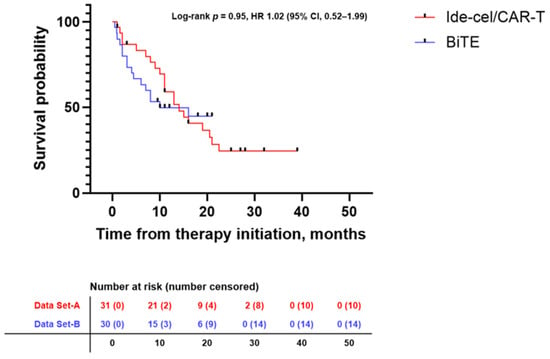
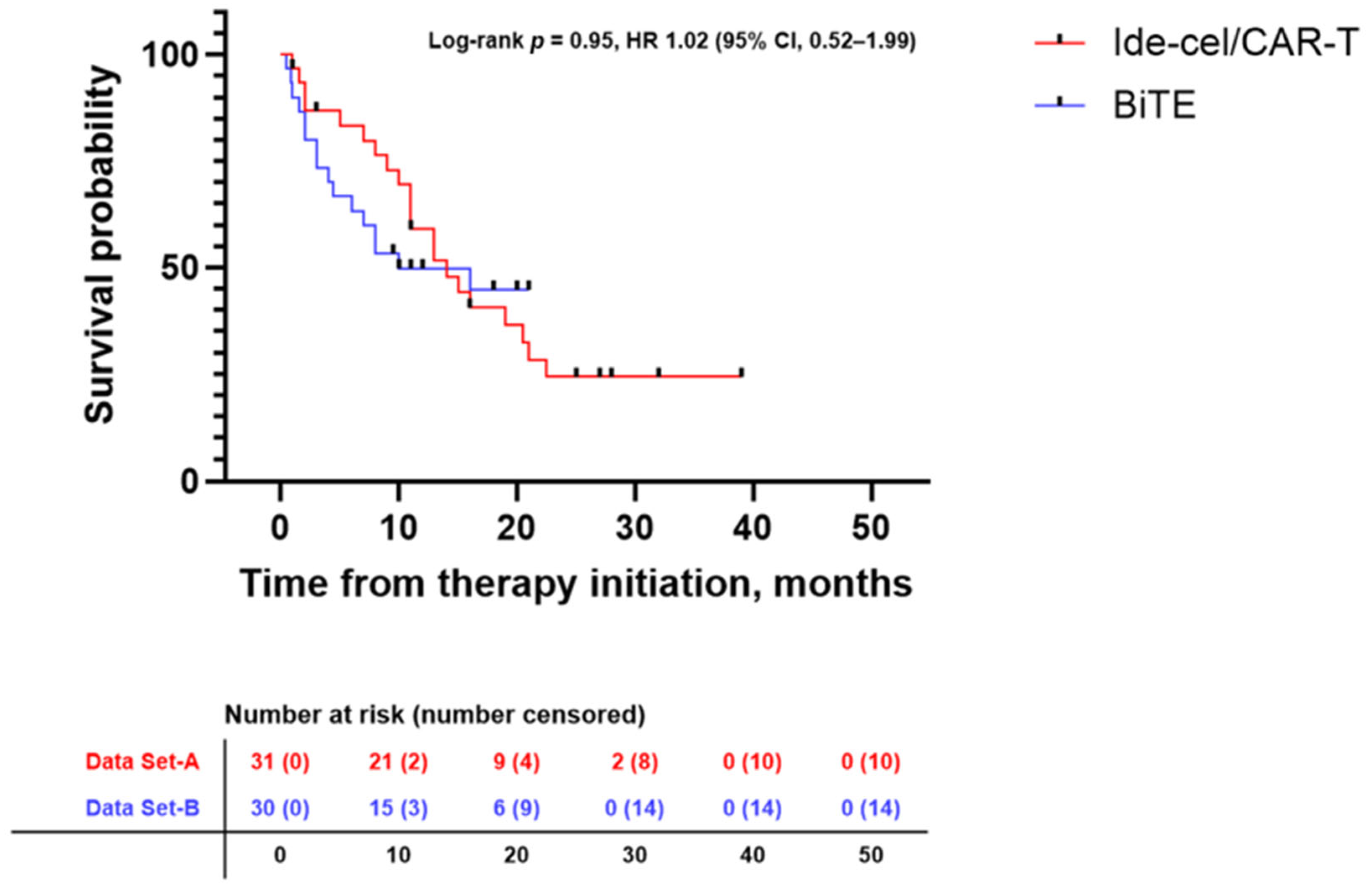
At a median follow-up of 20 months, PFS was similar between groups (14 months for ide-cel vs. 10 months for BiTE; p = 0.95 by log-rank test; hazard ratio 1.02; 95% CI, 0.52–1.99) (Figure 1). We present the PFS to support the 12-month time horizon rather than to imply therapeutic equivalence.
Figure 1.
Kaplan–Meier curves for progression-free survival (PFS) in heavily pretreated patients with relapsed/refractory multiple myeloma (RRMM) treated at a single center (Seidman Cancer Center, University Hospitals Cleveland Medical Center; January 2022–September 2024) with ide-cel versus bispecific T-cell engagers (BiTEs; teclistamab, talquetamab, or elranatamab). PFS was compared using the log-rank test; the hazard ratio (HR) and 95% confidence interval (CI) are shown on the plot.
Progression and death were incorporated as composite PFS events. The PFS analysis itself used a single event date for each patient (the date of documented progression or death, or the date of last follow-up for censored patients). What the source dataset did not support was a verified, patient-level tabulation that separates relapse from death events or lists relapse dates for all participants; this limits descriptive reporting, not the underlying time-to-event data. Accordingly, counts and timing of relapse alone are not presented. Any care delivered within our health system after progression—including evaluation and subsequent treatment—contributed to the observed 12-month costs, but relapse-attributable costs could not be isolated from other care.
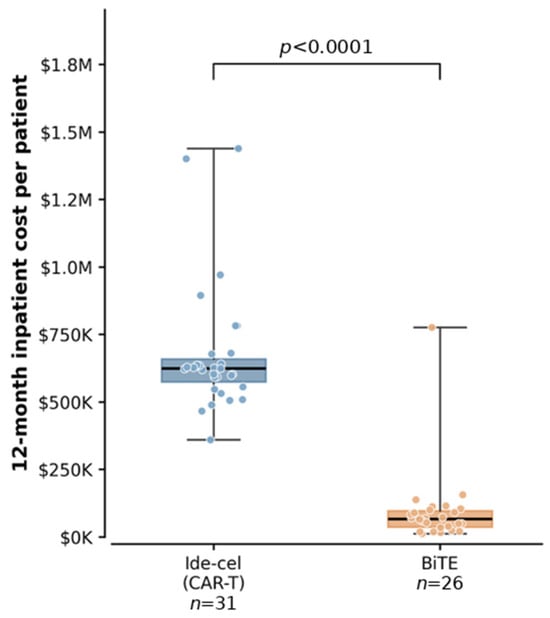
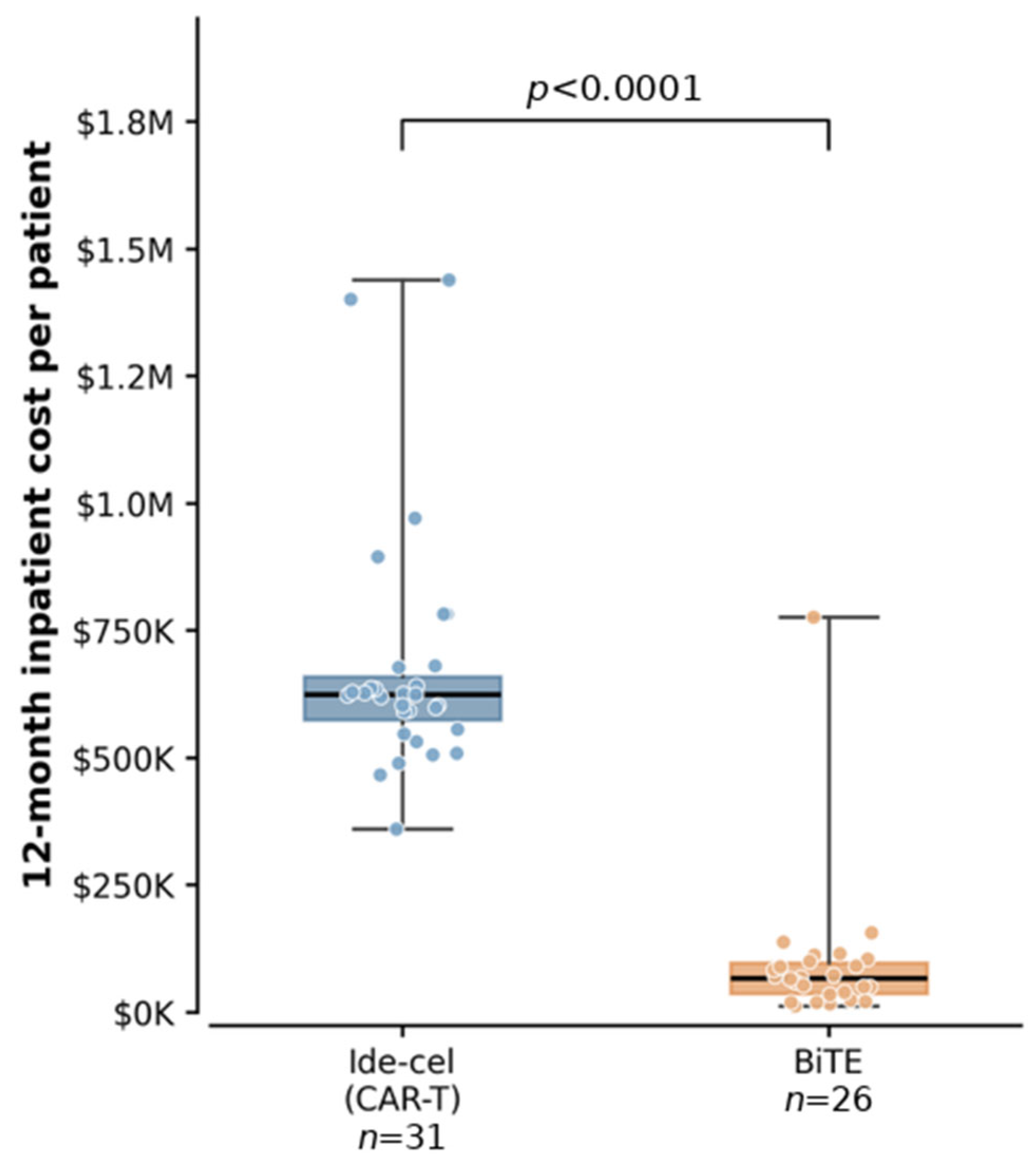
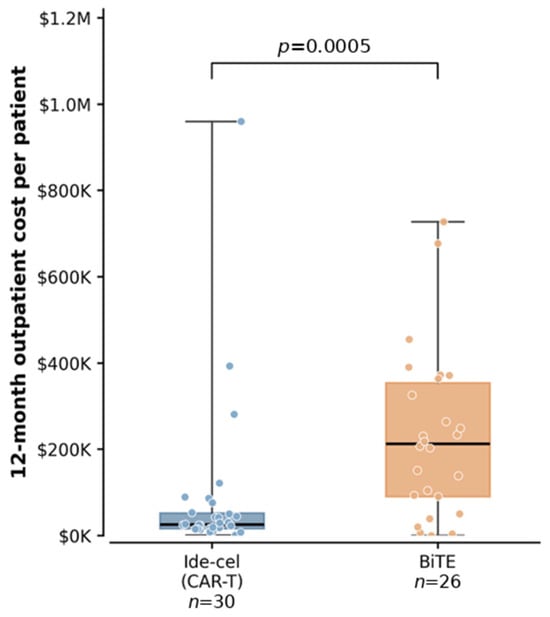
For ide-cel, mean 12-month inpatient costs were USD 673,430 (median USD 624,034; n = 31) and outpatient costs were USD 85,419 (median USD 25,972; n = 30), yielding a mean total cost of USD 733,350 (median USD 650,282; n = 30) per patient (Table 3). For BiTE therapy, mean inpatient costs were USD 93,978 (median USD 66,660; n = 26) and outpatient costs were USD 230,127 (median USD 212,310; n = 26), yielding a mean total cost of USD 324,105 (median USD 276,300; n = 26) per patient. Thus, ide-cel was associated with a mean of USD 409,245 higher total per-patient cost over 12 months than BiTE therapy (95% bootstrap CI, USD 293,283–USD 531,433; Mann–Whitney p < 0.0001).
Table 3.
Mean and median per-patient health-system costs during the first 12 months after therapy initiation, by treatment group.
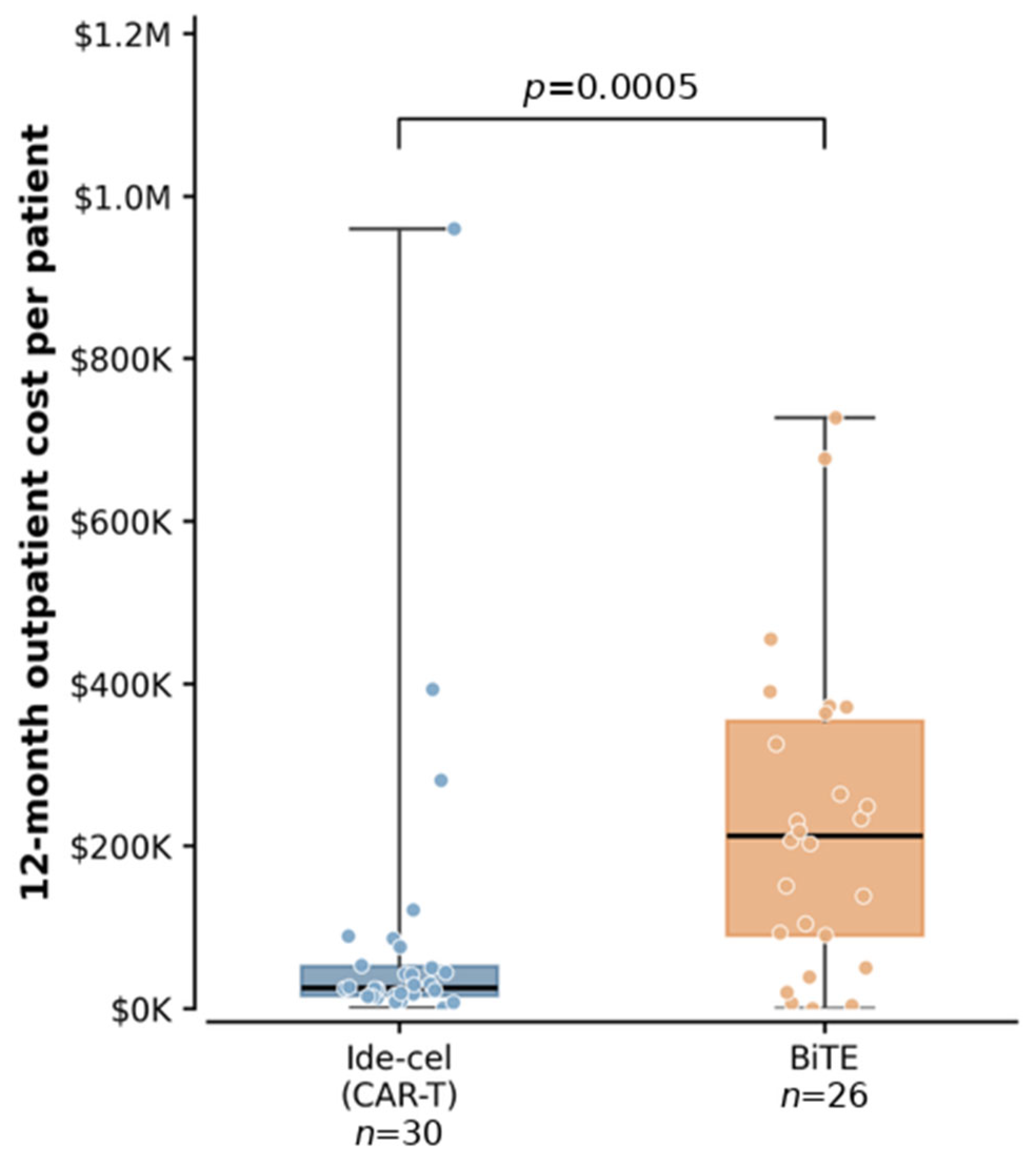
Inpatient costs were substantially higher with ide-cel than with BiTE therapy (USD 673,430 vs. USD 93,978; Mann–Whitney p < 0.0001), whereas outpatient costs were higher with BiTE therapy than with ide-cel (USD 230,127 vs. USD 85,419; Mann–Whitney p = 0.0005) (Figure 2 and Figure 3). In a gamma generalized linear model adjusted for payer category, ide-cel was associated with a 2.29-fold higher total cost than BiTE therapy (95% CI, 1.84–2.91; unadjusted estimate 2.26-fold, 95% CI, 1.75–2.97), indicating that payer mix did not materially confound the treatment–cost association. The cost differential was driven primarily by ide-cel product acquisition costs (approximately USD 600,000).
Figure 2.
Twelve-month inpatient cost per patient for ide-cel (CAR-T) versus BiTE therapy. Boxes show median and interquartile range; whiskers extend to the minimum and maximum observed values. Individual patient values are overlaid. Groups were compared using the Mann–Whitney U test.
Figure 3.
Twelve-month outpatient cost per patient for ide-cel (CAR-T) versus BiTE therapy. Boxes show median and interquartile range; whiskers extend to the minimum and maximum observed values. Individual patient values are overlaid. Groups were compared using the Mann–Whitney U test.
Patients treated with CAR-T had longer initial hospital stays than those receiving BiTE therapy (mean 19.4 vs. 11.1 days; difference 8.3 days; p = 0.0009). Three patients in the BiTE group completed step-up dosing entirely in the outpatient setting. Twelve-month total costs did not differ significantly across different BiTE groups (teclistamab, talquetamab, teclistamab→talquetamab, elranatamab; Kruskal–Wallis p = 0.42). However, this study was not powered to detect differences among agents.
4. Discussion
With two FDA-approved CAR-T products [3,4] and four FDA-approved BiTEs [5,6,7,8], immunotherapies have become commonplace in multiple myeloma care [15]. A complex interplay of medical and social factors will inform patient selection as well as sequencing of these agents, both among modern multiple myeloma immunotherapies and across the broader multiple myeloma treatment landscape [15]. As the use of these agents increases, their impact on healthcare sustainability will grow [10].
To our knowledge, this study represents a distinctive real-world comparative cost analysis of contemporary MM immunotherapies, providing a practical assessment of short-term (12-month) expenditures at our center. Real-world cohorts treated with standard-of-care ide-cel have reported safety and efficacy broadly comparable to the pivotal trial despite many patients being trial-ineligible [16,17], which supports the clinical relevance of a real-world cost comparison. Importantly, despite the small sample size, effect-size and resampling analyses suggest that this finding is unlikely to be a statistical artifact of the modest cohort size (Table 2). Nonparametric effect sizes were large for both the inpatient and total cost differences (probability of superiority 0.97 and 0.91, respectively), and random subsamples of only 10 patients per group reproduced statistical significance (p < 0.05) in 100% (inpatient) and 97.9% (total cost) of resamples. The outpatient cost difference, while still statistically significant and directionally consistent, was a comparatively smaller effect that required larger subsamples to be reliably detected (significant in 52.9% of resamples at 10 patients per group and 100% at 20 per group).
Our study yields several important lessons. First, the cost of ide-cel care is significantly affected by the product acquisition cost (~USD 600,000 in our institutional financial records). This initial investment is followed by reduced ongoing costs, with fewer infusion appointments and no further cell-product acquisition costs after the initial CAR-T episode, although supportive-care costs (e.g., for delayed cytopenias, hypogammaglobulinemia, or infection) may still accrue during outpatient follow-up. Second, over the first year of follow-up, the total health-system costs for BiTE therapy remained substantially lower than for ide-cel, even with ongoing dosing schedules. As CAR-T therapies become more effective and are used earlier in the treatment course, patients may experience a longer treatment-free interval [9], potentially increasing downstream clinical and economic value relative to the initial product acquisition costs [4]. While randomized comparisons between the FDA-approved BCMA CAR-T products ide-cel and cilta-cel do not exist, retrospective multicenter studies comparing the two products have reported a longer PFS with cilta-cel [18,19]. Accordingly, although future comparative cost analyses are needed, a longer PFS could improve the value profile of cilta-cel relative to ide-cel, depending on their respective acquisition and delivery costs [18]. Importantly, cilta-cel-treated patients also demonstrated an overall survival benefit compared with standard-of-care treatment in the updated CARTITUDE-4 analysis [20]. Next-generation manufacturing pipelines that reduce the overall CAR-T production costs may improve the sustainability of these interventions [21]. Indeed, our own academic CAR-T pipeline can manufacture CAR-T cells for approximately USD 25,000 per dose, potentially changing the economic impact of these agents [22].
Our findings should be read alongside recent model-based economic analyses of BCMA-directed bispecifics. A cost-effectiveness model from Italy found lower lifetime cost with elranatamab than with teclistamab (EUR 153,337 vs. EUR 224,610 per patient), driven mainly by lower drug-acquisition costs related to a shorter modelled time on treatment and an earlier switch to every-two-week dosing [23], and a matching-adjusted indirect-comparison model projected lower 1- and 2-year costs of care with linvoseltamab than with teclistamab or elranatamab [24]. A U.S. payer-perspective model comparing teclistamab plus daratumumab with cilta-cel likewise found that the duration of continuous bispecific therapy was the most influential driver of the incremental cost-effectiveness ratio [25], and cost-per-responder analyses of BCMA bispecifics have also been reported [26]. These results are not in conflict with ours. Those analyses compared individual bispecifics using trial-derived efficacy and assumed dosing schedules and unit prices, whereas we compared observed health-system expenditure between CAR-T and BiTE therapy in a BiTE cohort made up largely of teclistamab- and talquetamab-treated patients (two elranatamab patients; no linvoseltamab). Our data cannot support agent-level cost comparisons, but they are consistent with the modelled conclusion that time on treatment and dosing interval are principal determinants of BiTE cost. The observed BiTE expenditures reflect care delivered during the study window rather than expenditure projected under a fixed label-based dosing schedule. Notably, the available financial data do not identify dosing intervals or interval changes, so the contribution of less frequent dosing could not be quantified.
Although comparing costs alone is informative, interpreting these results through a cost-effectiveness lens requires aligning the time horizon for costs and effectiveness and ensuring that any external utility/QALY inputs reflect a population comparable to the University Hospitals Seidman Cancer Center cohort. With these caveats, a threshold (break-even) calculation can illustrate the magnitude of long-term cost offsets needed for ide-cel to be cost-effective relative to BiTE therapy. If the incremental QALY gain of ide-cel versus BiTE is 0.49 QALYs (e.g., 1.75 vs. 1.26), then at a willingness-to-pay threshold of USD 150,000 per QALY [27,28], ide-cel would require a long-term incremental cost no greater than USD 73,500 (0.49 × USD 150,000) to meet this benchmark. Formally assessing cost-effectiveness would require capturing or modeling longer-term costs and outcomes for both interventions, including subsequent therapy, late adverse events, and survival extrapolation, and conducting robust sensitivity analyses. Notably, the incremental cost of ide-cel relative to BiTE therapy could plausibly decrease with longer follow-up because ongoing BiTE drug acquisition, administration, and infection-related resource use may continue beyond 12 months, whereas post-12-month CAR-T-related costs may accrue less consistently after the upfront infusion episode. However, this is less likely with the ~1 year PFS we observed in these cohorts.
To aid interpretation of ongoing BiTE costs, mean 12-month outpatient cost corresponds to approximately USD 19,177 per month for BiTE therapy versus USD 7118 per month for ide-cel (mean outpatient costs of USD 230,127 and USD 85,419 divided by 12). These crude averages blend step-up and maintenance phases and include shortened observation in patients who died, so they do not represent the steady-state maintenance cost. If, purely for illustration, this difference in mean monthly outpatient cost (approximately USD 12,059) persisted unchanged after month 12, the USD 409,245 mean total-cost difference at 12 months would be offset after roughly 34 additional months of treatment, assuming continuous BiTE therapy at the observed average cost and no further CAR-T-related cost.
We did not calculate the cost per quality-adjusted life-year because no utility data were collected, and cost per response could not be calculated because response data were not systematically abstracted. As a descriptive alternative, dividing the mean 12-month total cost by the median PFS yields approximately USD 52,400 per PFS month for ide-cel (14 months) and USD 32,400 for BiTE therapy (10 months). This crude ratio combines the mean 12-month costs with median PFS over a nonaligned outcome interval and is hypothesis-generating only, not a formal cost-effectiveness measure. Formal cost-per-outcome analyses of CAR-T therapy have been reported from trial data [29] and generally require longer horizons and modelled outcomes than are available here.
5. Limitations
This was a small, single-center, nonrandomized cohort, and the groups were clinically heterogeneous despite similar measured baseline characteristics. Treatment selection was individualized, leaving substantial potential for confounding by indication and other unmeasured factors. For example, patients selected for CAR-T must be fit enough to tolerate leukapheresis, lymphodepletion, and manufacturing delay, which may lower toxicity-related and supportive-care use relative to an unselected population, while patients with rapidly progressive disease who need immediate treatment may preferentially receive off-the-shelf BiTEs, which could raise their hospitalization and supportive-care costs. Differential early mortality (6 deaths with ide-cel vs. 9 with BiTE therapy) also truncates the observed costs unequally. The 2.29-fold cost ratio therefore describes the patients actually selected for each pathway at our center, not the difference expected if the same patients had received either treatment. Grouping teclistamab, talquetamab, elranatamab, and sequential BiTE exposure reflects real-world practice but should not be interpreted as clinical equivalence. Costs also reflect local administration patterns, including predominantly inpatient ide-cel delivery and predominantly inpatient BiTE step-up dosing, and may differ at centers using outpatient pathways, different prophylaxis, or different supportive-care practices. Practice patterns evolved over the study period, but the dataset did not support reliable adjustment for calendar-time learning effects, specific prophylactic regimens, toxicity-related readmissions, or IVIG delivered outside our health system. Supportive care delivered outside our system, such as IVIG given at home or by outside infusion providers, outside antimicrobial prescriptions, and emergency care at community hospitals, was not captured. Hypogammaglobulinemia and infection are common with BCMA-directed bispecifics, and IVIG has been associated with fewer severe infections [30], so this omission probably understates the total cost in both groups; whether it understates costs more in one group than the other is unknown. Finally, observed costs were accrued only while patients were alive and receiving care, without annualization after death. Because mortality was numerically higher in the BiTE cohort, differential survival could lower the observed BiTE costs and bias the total-cost comparison in favor of BiTE therapy. Future studies should report costs per patient-month alive, separate progression-related and subsequent-therapy costs, and jointly model cost, survival, and quality-adjusted outcomes.
6. Conclusions
In this single-center cohort, ide-cel generated higher observed 12-month health-system costs than BiTE therapy, largely because of upfront product and inpatient delivery costs, whereas BiTE therapy generated higher ongoing outpatient costs. These results describe local expenditure under the administration pathways used during the study period and do not establish comparative cost-effectiveness or therapeutic superiority. The estimates may be influenced by treatment-selection bias, heterogeneous BiTE exposure, evolving practice patterns, incomplete capture of outside supportive care, and shorter cost observation among patients who died. Cilta-cel was not evaluated, and its longer PFS reported in other settings does not by itself establish lower total cost; that hypothesis requires direct analysis incorporating acquisition, administration, supportive care, subsequent therapy, survival, and patient-reported outcomes. Larger multicenter studies with standardized costing, event-level relapse and readmission data, survival-adjusted analyses, and rigorous methods to address confounding are needed before these findings are used to guide sequencing or policy.
Author Contributions
Conceptualization, J.J.I.-H., H.B.M., J.R., M.K., N.A.; methodology, J.J.I.-H., H.B.M., J.R., M.K.; formal analysis, J.J.I.-H., H.B.M., J.R., M.K.; investigation, H.B.M., J.R., M.K.; resources, M.K.; data curation, H.B.M., M.K.; writing—original draft preparation, J.J.I.-H., H.B.M.; writing—review and editing, J.J.I.-H., H.B.M., O.-K.C., K.v.B., T.E.O., B.W.C.; visualization, J.J.I.-H., H.B.M.; supervision, J.J.I.-H., J.R.; project administration, J.J.I.-H. All authors have read and agreed to the published version of the manuscript.
Funding
This research received no external funding.
Institutional Review Board Statement
This retrospective study was approved by the University Hospitals Institutional Review Board on 8/22/24 under STUDY20240788.
Informed Consent Statement
Patient consent was waived by the IRB because of the retrospective nature of the study.
Data Availability Statement
The data presented in this study are derived from institutional financial and medical records containing patient-level information and are not publicly available. Aggregate, de-identified summary data are available from the corresponding author on reasonable request, subject to institutional approval.
Acknowledgments
During the preparation of this manuscript, the authors used Claude Sonnet 5.5 (Anthropic, San Francisco, CA, USA) and Perplexity (Perplexity AI, GPT 6.2 Sol) for drafting, editing and literature searches; Perplexity was used for literature searching and reference verification. The authors reviewed and edited the output, verified all cited references against the original publications, and take full responsibility for the content of this publication.
Conflicts of Interest
J.J.I.-H. serves on the speakers bureau for Regeneron and Sanofi. The remaining authors declare that the research was conducted in the absence of any commercial or financial relationships that could be construed as a potential conflict of interest.
References
- Kumar, S.K.; Rajkumar, S.V.; Dispenzieri, A.; Lacy, M.Q.; Hayman, S.R.; Buadi, F.K.; Zeldenrust, S.R.; Dingli, D.; Russell, S.J.; Lust, J.A.; et al. Improved survival in multiple myeloma and the impact of novel therapies. Blood 2008, 111, 2516–2520. [Google Scholar] [CrossRef] [Scilit] [PubMed]
- Kumar, S.K.; Dispenzieri, A.; Lacy, M.Q.; Gertz, M.A.; Buadi, F.K.; Pandey, S.; Kapoor, P.; Dingli, D.; Hayman, S.R.; Leung, N.; et al. Continued Improvement in Survival in Multiple Myeloma: Changes in Early Mortality and Outcomes in Older Patients. Leukemia 2014, 28, 1122–1128. [Google Scholar] [CrossRef] [Scilit] [PubMed]
- Rodriguez-Otero, P.; Ailawadhi, S.; Arnulf, B.; Patel, K.; Cavo, M.; Nooka, A.K.; Manier, S.; Callander, N.; Costa, L.J.; Vij, R.; et al. Ide-cel or Standard Regimens in Relapsed and Refractory Multiple Myeloma. N. Engl. J. Med. 2023, 388, 1002–1014. [Google Scholar] [CrossRef] [Scilit] [PubMed]
- San-Miguel, J.; Dhakal, B.; Yong, K.; Spencer, A.; Anguille, S.; Mateos, M.-V.; Fernández de Larrea, C.; Martínez-López, J.; Moreau, P.; Touzeau, C.; et al. Cilta-cel or Standard Care in Lenalidomide-Refractory Multiple Myeloma. N. Engl. J. Med. 2023, 389, 335–347. [Google Scholar] [CrossRef] [Scilit] [PubMed]
- Moreau, P.; Garfall, A.L.; van de Donk, N.W.C.J.; Nahi, H.; San-Miguel, J.F.; Oriol, A.; Nooka, A.K.; Martin, T.; Rosinol, L.; Chari, A.; et al. Teclistamab in Relapsed or Refractory Multiple Myeloma. N. Engl. J. Med. 2022, 387, 495–505. [Google Scholar] [CrossRef] [Scilit] [PubMed]
- Chari, A.; Minnema, M.C.; Berdeja, J.G.; Oriol, A.; van de Donk, N.W.C.J.; Rodríguez-Otero, P.; Askari, E.; Mateos, M.-V.; Costa, L.J.; Caers, J.; et al. Talquetamab, a T-Cell-Redirecting GPRC5D Bispecific Antibody for Multiple Myeloma. N. Engl. J. Med. 2022, 387, 2232–2244. [Google Scholar] [CrossRef] [Scilit] [PubMed]
- Prince, H.M.; Bahlis, N.J.; Rodríguez-Otero, P.; Karlin, L.; Akard, L.; Varshavsky-Yanovsky, A.; Chu, M.P.; Nagai, Y.; Vesole, D.H.; Hickman, A.; et al. MagnetisMM-3: Long-Term Update and Efficacy and Safety of Less Frequent Dosing of Elranatamab in Patients with Relapsed or Refractory Multiple Myeloma. Blood 2024, 144, 4738. [Google Scholar] [CrossRef] [Scilit]
- Bumma, N.; Richter, J.; Jagannath, S.; Lee, H.C.; Hoffman, J.E.; Suvannasankha, A.; Zonder, J.A.; Shah, M.R.; Lentzsch, S.; Baz, R.; et al. Linvoseltamab for Treatment of Relapsed/Refractory Multiple Myeloma. J. Clin. Oncol. 2024, 42, 2702–2712, Erratum in J. Clin. Oncol. 2024, 42, 4001. https://doi.org/10.1200/JCO-24-02169. [Google Scholar] [CrossRef] [Scilit] [PubMed]
- Mina, R.; Mylin, A.K.; Yokoyama, H.; Magen, H.; Alsdorf, W.; Minnema, M.C.; Shune, L.; Isufi, I.; Harrison, S.J.; Shah, U.A.; et al. Patient-reported outcomes following ciltacabtagene autoleucel or standard of care in patients with lenalidomide-refractory multiple myeloma (CARTITUDE-4): Results from a randomised, open-label, phase 3 trial. Lancet Haematol. 2025, 12, e45–e56. [Google Scholar] [CrossRef] [Scilit] [PubMed]
- Robinson, D., Jr.; Orlowski, R.Z.; Stokes, M.; He, J.; Huse, S.; Chitnis, A.; Kranenburg, B.; Lam, A. Economic burden of relapsed or refractory multiple myeloma: Results from an international trial. Eur. J. Haematol. 2017, 99, 119–132. [Google Scholar] [CrossRef] [Scilit] [PubMed]
- Kumar, S.; Paiva, B.; Anderson, K.C.; Durie, B.; Landgren, O.; Moreau, P.; Munshi, N.; Lonial, S.; Bladé, J.; Mateos, M.-V.; et al. International Myeloma Working Group consensus criteria for response and minimal residual disease assessment in multiple myeloma. Lancet Oncol. 2016, 17, e328–e346. [Google Scholar] [CrossRef] [Scilit] [PubMed]
- Afrough, A.; Hashmi, H.; Hansen, D.K.; Sidana, S.; Ahn, C.; Peres, L.C.; Dima, D.; Freeman, C.L.; Puglianini, O.C.; Kocoglu, M.H.; et al. Real-world impact of bridging therapy on outcomes of ide-cel for myeloma in the U.S. Myeloma Immunotherapy Consortium. Blood Cancer J. 2024, 14, 63. [Google Scholar] [CrossRef] [Scilit] [PubMed]
- Efron, B.; Tibshirani, R.J. An Introduction to the Bootstrap; Chapman & Hall/CRC: New York, NY, USA, 1993. [Google Scholar]
- Barber, J.; Thompson, S. Multiple regression of cost data: Use of generalised linear models. J. Health Serv. Res. Policy 2004, 9, 197–204. [Google Scholar] [CrossRef] [Scilit] [PubMed]
- Ohmine, K.; Uchibori, R. Novel immunotherapies in multiple myeloma. Int. J. Hematol. 2022, 115, 799–810. [Google Scholar] [CrossRef] [Scilit] [PubMed]
- Hansen, D.K.; Sidana, S.; Peres, L.C.; Colin Leitzinger, C.; Shune, L.; Shrewsbury, A.; Gonzalez, R.; Sborov, D.W.; Wagner, C.; Dima, D.; et al. Idecabtagene Vicleucel for Relapsed/Refractory Multiple Myeloma: Real-World Experience From the Myeloma CAR T Consortium. J. Clin. Oncol. 2023, 41, 2087–2097. [Google Scholar] [CrossRef] [Scilit] [PubMed]
- Sidana, S.; Ahmed, N.; Akhtar, O.S.; Brazauskas, R.; Oloyede, T.; Bye, M.; Hansen, D.; Ferreri, C.; Freeman, C.L.; Afrough, A.; et al. Standard-of-care idecabtagene vicleucel for relapsed/refractory multiple myeloma. Blood 2025, 146, 167. [Google Scholar] [CrossRef] [Scilit] [PubMed]
- Merz, M.; Albici, A.-M.; von Tresckow, B.; Rathje, K.; Fenk, R.; Holderried, T.; Müller, F.; Tovar, N.; Oliver-Cáldes, A.; Vucinic, V.; et al. Idecabtagene vicleucel or ciltacabtagene autoleucel for relapsed or refractory multiple myeloma: An international multicenter study. HemaSphere 2025, 9, e70070. [Google Scholar] [CrossRef] [Scilit] [PubMed]
- Hansen, D.K.; Peres, L.C.; Dima, D.; Richards, A.; Shune, L.; Afrough, A.; Midha, S.; Dhakal, B.; Kocoglu, M.H.; Atrash, S.; et al. Comparison of Standard-of-Care Idecabtagene Vicleucel and Ciltacabtagene Autoleucel in Relapsed/Refractory Multiple Myeloma. J. Clin. Oncol. 2025, 43, 1597–1609. [Google Scholar] [CrossRef] [Scilit] [PubMed]
- Einsele, H.; San-Miguel, J.; Dhakal, B.; Touzeau, C.; Leleu, X.; van de Donk, N.W.C.J.; Sidana, S.; Oriol, A.; Cohen, Y.C.; Harrison, S.J.; et al. Cilta-cel in lenalidomide-refractory multiple myeloma (CARTITUDE-4): An updated analysis including overall survival from an open-label, multicentre, randomised, phase 3 trial. Lancet Oncol. 2026, 27, 254–268. [Google Scholar] [CrossRef] [Scilit] [PubMed]
- Keesari, P.R.; Samuels, D.; Vegivinti, C.T.R.; Pulakurthi, Y.S.; Kudithi, R.; Dhar, M.; Janakiram, M. Navigating the Economic Burden of Multiple Myeloma: Insights into Cost-effectiveness of CAR-T and Bispecific Antibody Therapies. Curr. Hematol. Malig. Rep. 2025, 20, 3. [Google Scholar] [CrossRef] [Scilit] [PubMed]
- Stadel, R.; Idippily, N.; Giraudo, M.F.; Caimi, P.; Van Besien, K.; Martin, J.; Wu, J.; Deng, C.; Wald, D. Development and Clinical Validation of an Ultra-Fast CAR-T Manufacturing Platform Enabling Production of CAR-T Cells in Less Than 1 Day. Blood 2023, 142, 4848. [Google Scholar] [CrossRef] [Scilit]
- Botta, C.; Colombo, G.L.; Di Matteo, S.; Martinotti, C.; Fogliati, E.L.; Bruno, G.M.; Novelli, G.; Di Virgilio, R.; Veggia, B.; Galimberti, S. Cost-Effectiveness of Elranatamab Versus Teclistamab for the Management of Patients with Triple-Class Exposed Relapsed/Refractory Multiple Myeloma in Italy. Cancers 2026, 18, 1070. [Google Scholar] [CrossRef] [Scilit] [PubMed]
- Portuguese, A.J.; Inocencio, T.J.; Quon, P.; Harnett, J.; Zhou, Z.-Y.; Hazra, N.C.; Xu, M.K.; Eales, J.; Chen, H.; Little, M.; et al. Comparative economic analysis of B-cell maturation antigen-targeted bispecific antibodies in triple-class exposed relapsed/refractory multiple myeloma: Linvoseltamab versus teclistamab and elranatamab. Curr. Med. Res. Opin. 2026, 42, 473–485. [Google Scholar] [CrossRef] [Scilit] [PubMed]
- Irfan, S.; Jamil, M.A.; Abid, M.B. Cost-effective analysis of teclistamab and daratumumab versus ciltacabtagene autoleucel in relapsed multiple myeloma. Br. J. Haematol. 2026, 209, 778–781. [Google Scholar] [CrossRef] [Scilit] [PubMed]
- Gordan, L.N.; Bensimon, A.G.; Mu, F.; Kim, N.; Wu, B.; Lin, D.; Paner, A.; Fowler, J.; Marshall, A.; Van Sanden, S.; et al. Cost per responder for teclistamab and elranatamab in relapsed or refractory multiple myeloma in the United States. J. Med. Econ. 2025, 28, 910–920. [Google Scholar] [CrossRef] [Scilit] [PubMed]
- Sanders, G.D.; Neumann, P.J.; Basu, A.; Brock, D.W.; Feeny, D.; Krahn, M.; Kuntz, K.M.; Meltzer, D.O.; Owens, D.K.; Prosser, L.A.; et al. Recommendations for Conduct, Methodological Practices, and Reporting of Cost-effectiveness Analyses: Second Panel on Cost-Effectiveness in Health and Medicine. JAMA 2016, 316, 1093–1103. [Google Scholar] [PubMed]
- Neumann, P.J.; Cohen, J.T.; Weinstein, M.C. Updating Cost-Effectiveness—The Curious Resilience of the $50,000-per-QALY Threshold. N. Engl. J. Med. 2014, 371, 796–797. [Google Scholar] [CrossRef] [Scilit] [PubMed]
- Hansen, D.K.; Lu, X.; Puglianini, O.C.; Sorensen, S.; Usmani, S.Z.; Zhang, E.; Huo, S.; Zhang, Y.; Qureshi, Z.P.; Jagannath, S. Cost-per-Responder Analysis of Patients with Lenalidomide-Refractory Multiple Myeloma Receiving Ciltacabtagene Autoleucel in CARTITUDE-4. Front. Immunol. 2024, 15, 1408892. [Google Scholar] [CrossRef] [Scilit] [PubMed]
- Cani, L.; Scott, S.A.; Roberts, D.; Joseph, N.S.; Hofmeister, C.C.; Gupta, V.A.; Dhodapkar, M.V.; Lonial, S.; Nooka, A.K.; Kaufman, J.L. Infection Risk in 158 Patients with Relapsed/Refractory Multiple Myeloma Treated with Bispecific Antibodies: A Single-Center Experience. Haematologica 2026, 111, 656–664. [Google Scholar] [CrossRef] [Scilit] [PubMed]

Disclaimer/Publisher’s Note: The statements, opinions and data contained in all publications are solely those of the individual author(s) and contributor(s) and not of MDPI and/or the editor(s). MDPI and/or the editor(s) disclaim responsibility for any injury to people or property resulting from any ideas, methods, instructions or products referred to in the content. |
© 2026 by the authors. Licensee MDPI, Basel, Switzerland. This article is an open access article distributed under the terms and conditions of the Creative Commons Attribution (CC BY) license.