


Simple Summary
Cancer screening programs are changing rapidly due to new screening tests and technologies, such as artificial intelligence. These innovations may help detect cancer earlier, improve how well screening works, and make access to screening more fair. However, it is difficult for decision-makers to quickly and thoroughly judge which new developments are ready to be used in practice. In this study, we designed a clear and practical framework to rapidly assess new developments in existing cancer screening programs from multiple angles, such as clinical benefits, consequences for follow-up care, costs, and accessibility. We tested and refined this framework using several real examples from Dutch cancer screening. Policymakers, researchers, and other stakeholders can use this framework to better decide which innovations to explore further, what research is still needed, and how to improve cancer screening programs, ultimately helping to achieve better health outcomes.
Abstract
Background: Scientific and technological developments, such as new screening tests and artificial intelligence, offer opportunities to improve effectiveness, efficiency, and equity of cancer screening programs. At the same time, these developments pose challenges for timely and well-founded decision-making and implementation. We aimed to create a structured, rapid, and comprehensive approach to support early, multi-dimensional assessment of emerging developments in cancer screening. Methods: Based on published literature, we created a rapid assessment framework for emerging developments in existing population-based cancer screening programs. To demonstrate its potential, the framework was optimized by testing it with four relevant developments for Dutch cancer screening. Results: The final framework comprises ten themes, including test performance, effects on downstream care, cost-effectiveness, and effects on accessibility. For the themes that are applicable to the specific development being assessed, various criteria need to be addressed. This results in an integrated overview regarding the implementation potential, the identified knowledge gaps, and the main implementation barriers or knowledge gaps of the proposed development. Conclusions: This rapid assessment framework provides a practical tool for early, multi-dimensional appraisal of emerging developments in cancer screening programs. It is intended to complement, not replace, existing national and international decision-making processes and can be used by policymakers, researchers, and other stakeholders involved in screening. The framework can help steer discussions, guide (funding for) future research, and support prioritization in program optimization, ultimately contributing to better population-based cancer screening and improved health outcomes.
1. Introduction
Cancer screening programs are widely implemented as public health strategies to reduce cancer disease burden and mortality through early detection and prevention [1,2]. These programs systematically offer validated tests to asymptomatic individuals in defined age groups, in order to detect precancerous lesions or early-stage cancers. At that preclinical stage, treatment is generally less invasive and more effective, and improves the likelihood of full recovery [3,4]. Population-based screening for breast, cervical and colorectal cancer has improved cancer-specific survival, has reduced public expenditures, and has become embedded in national health systems in many countries [5,6,7,8].
There is growing concern that excessive screening can result in overdiagnosis and unnecessary treatment [4,9,10]. Some experts argue that intensive screening increases the detection of abnormalities that would never have caused symptoms during a person’s lifetime. This has prompted calls for more targeted screening strategies and better risk stratification to identify individuals who are most likely to benefit [4]. Greater attention, in communication, research, and evaluation, is also needed for the potential harm screening may cause [10]. The challenge is to find the right balance between saving lives through early detection and avoiding unnecessary medical interventions that pose no benefit.
At the same time, cancer screening programs operate in a quickly changing scientific and technological landscape. This landscape encompasses technological innovations, such as new screening and triage tests, risk-stratification approaches, and minimally invasive sampling. In addition, there are many organizational optimizations or innovations in invitation procedures, counseling, and accessibility. These all offer opportunities to improve effectiveness, efficiency and equity of screening programs [11,12]. Meanwhile, demographic changes, resource constraints, and evolving societal expectations provide a dynamic context, demanding continuous optimization and innovation of existing programs [13].
While the demand for optimization and innovation increases, policy cycles are generally conservative and slow to adapt. The policy cycle framework can help in understanding decision-making about organized cancer screening programs. This framework distinguishes five phases in policy decision-making: agenda setting, policy advice, policy decision, implementation and evaluation [14,15,16,17]. Together, these phases show that decision-making in a public health system, like with cancer screening programs, follows interconnected steps of anticipating and assessing new evidence that may further optimize the organization of screening programs.
Given that screening is offered to predominantly healthy individuals, decision-making processes for organized screening programs are subject to high standards of methodological and ethical quality. As a result, formal assessment and decision-making procedures are often time- and resource-intensive. Furthermore, they differ between jurisdictions and health systems [18,19,20]. To illustrate, in the Netherlands, the Ministry of Health, Welfare and Sport sets the agenda and takes national policy decisions on population-based screening. The Health Council of the Netherlands provides independent scientific policy advice, and the National Institute for Public Health and the Environment (RIVM) is responsible for national coordination of the screening programs, connecting relevant stakeholders across the policy and implementation landscape, and further development of population screening programs [21].
To effectively benefit from the potential of developments such as innovations and optimizations (hereafter: developments) and only implement developments with substantial added value, effective and informative assessment is key [22]. However, evidence supporting the added value of specific developments in cancer screening can be limited, dispersed, acquired through a wide variety of methodologies or context-specific. This complicates the evaluation of whether a proposed development merits formal assessment and implementation, or whether such action would be premature (for example because essential information is missing).
To our knowledge, no structured and comprehensive approach currently exists for early evaluation of emerging developments in cancer screening programs. An instrument that streamlines the evaluation of developments at an early stage could be an invaluable tool to determine whether a development is ready for formal assessment, and if not, which specific knowledge gaps need to be addressed first.
This methodological study responds to that need by creating and piloting a rapid assessment framework for developments in existing cancer screening programs. The aim of this study was to create an exploratory instrument that can be used by policymakers, program coordinators, researchers and research funders, and other stakeholders involved in screening to assess to what extent an emerging development could strengthen or optimize current screening programs and whether sufficient evidence is available for next steps, such as thorough evaluation and implementation. This can be used during the agenda setting step of the policy cycle. It brings together a rapid yet structured appraisal of multiple themes, relevant to implementation in public health systems, on which developments can have an impact, such as clinical performance, cost-effectiveness, and ethical considerations. Furthermore, it supports the classification and quantification of the developments’ promise and readiness for implementation into existing programs, and facilitates the identification of key uncertainties that warrant further research or pilot testing.
2. Materials and Methods
2.1. Study Design
The aim of this methodological study was the creation and pilot application of a rapid assessment framework to assess the implementation potential of emerging developments in cancer screening. The resulting framework is an evidence-informed and transparent tool to support screening policy and provide direction for research through:
- Rapid and structured appraisal of relevant aspects of emerging developments;
- Classification of how promising a development is for implementation within existing screening programs;
- Identification of critical knowledge gaps and implementation barriers.
The rapid assessment framework was created for the three national cancer screening programs of the Netherlands (breast, cervical and colorectal cancer), but was explicitly intended to be generalizable to other organized cancer screening settings. The framework was designed to accommodate all types of developments within a cancer screening program including developments in screening tests, triage methods, participant selection, invitation methods, and accessibility. The created assessment framework was consecutively piloted using four emerging developments in different cancer screening programs.
2.2. Framework Creation
Creation of the rapid assessment framework followed an iterative, literature-informed process. We used existing screening criteria, including the Wilson and Jungner principles and subsequent extensions that address test performance, disease burden, program feasibility and ethical aspects [3,23,24,25,26,27,28,29,30]. In addition, we incorporated other evaluation, assessment, or decision frameworks including national principles and previous implementation assessments in the Netherlands and the evidence review process of the UK National Screening Committee [16,31,32,33,34,35,36]. From these sources, we derived operational themes and criteria relevant to developments in existing cancer screening programs. Themes and criteria were discussed with policy professionals from the Dutch cancer screening programs at the Dutch National Institute for Public Health and the Environment (RIVM). See the Supplementary Information for a table in which our framework is compared with existing tools.
2.3. Pilot Application of the Framework
To test the usability, feasibility and internal face validity of the rapid assessment framework, four developments were purposely selected based on scientific literature, news reports and discussions with policy professionals from the Dutch screening programs. These developments were selected to ensure diversity in type of development (test technology, algorithmic model, organizational optimization), stage of readiness (closer to implementation or early phase), and representation across the three cancer screening programs and the different steps of screening. These developments do therefore not reflect any prioritization of current policy relevance or perceived importance. For each development, an evidence base was compiled using a rapid review approach. Based on the rapid review evidence, the framework was filled out. See the Supplementary Information for a more detailed description of the rapid review approach and the filling out of the framework.
3. Results
3.1. Rapid Assessment Framework
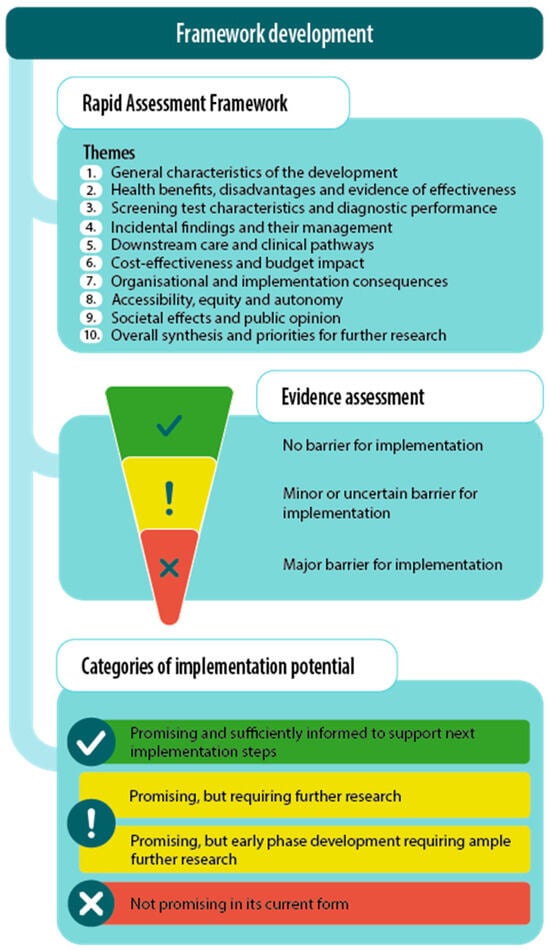
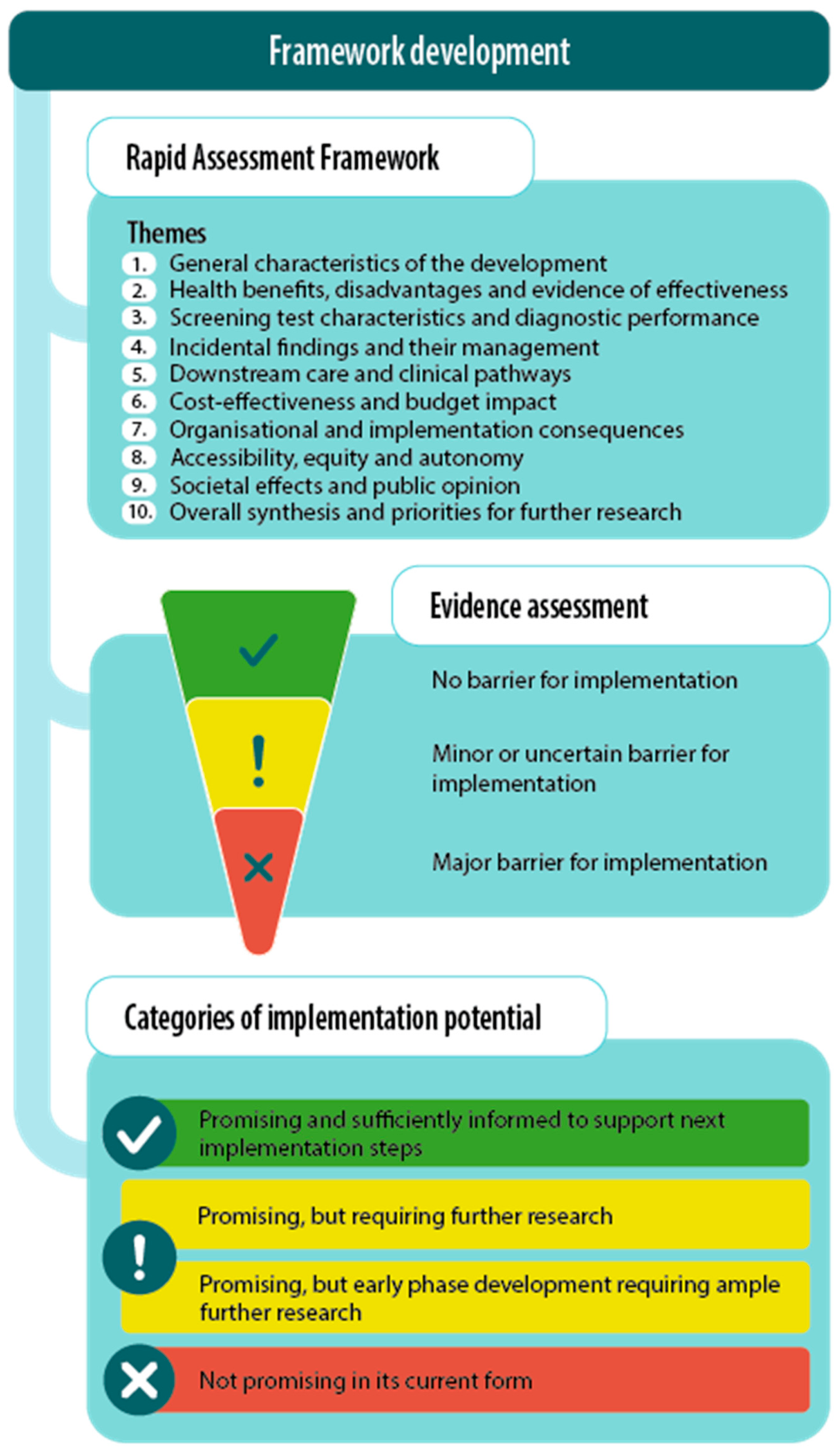
The final rapid assessment framework comprises 10 themes (Figure 1) and 45 criteria (see Supplementary Material for a template of the framework). Except for overarching criteria concerning the general characteristics of the developments and the overall synthesis, criteria only need to be completed if they are applicable for the specific development being assessed. As such, an emerging development can affect all themes or a subset. The themes in the framework are described in Table 1. An empty template of the rapid assessment framework with all criteria and an explanation of the criteria can be found as Supplementary Materials.
Figure 1.
Overview of the rapid assessment framework. In the rapid assessment framework, developments can be assessed according to criteria in 10 themes. For each criterion, the available evidence on that topic can be summarized. Based on this, the magnitude of the barrier for implementing the development within the population-based screening program is estimated for that specific aspect. Ultimately, the results across themes can be combined to assign an implementation potential category.
Table 1.
Themes in the rapid assessment framework.
For each criterion in themes 1 through 9, predefined response categories were specified. These categories were for example “sufficient evidence”, “some evidence”, “conflicting evidence” or “unknown” and “expected improvement”, “expected negative impact” or “no impact”. For theme 10 (the overall synthesis and priorities for further research), four categories of implementation potential were defined, informed by the results from the previous themes (Figure 1):
- Promising and sufficiently informed to support the next implementation steps: when barriers are minor and evidence is broadly adequate across key themes;
- Promising, but requiring further research: when the development shows potential for health or system benefits, but substantial knowledge gaps remain;
- Promising, but early phase development requiring ample further research: when remaining knowledge gaps are substantial and are expected to take a longer time before further implementation steps can be taken;
- Not promising in its current form: when fundamental limitations (e.g., insufficient clinical performance relative to existing screening tests) are evident.
As a general rule, developments with substantial barriers in important domains for that development (such as clinical effectiveness, harms, test performance, feasibility, or ethical acceptability) are not classified as ‘promising’. Among developments with smaller barriers, those with a limited number of clearly addressable uncertainties can be classified as ‘promising, but requiring further research’, whereas developments with multiple or more fundamental evidence gaps, expected to require extensive further research, are classified as ‘promising, but early phase development requiring ample further research’.
The framework is intended as a time-bound representation of the available evidence and the state of knowledge at a given point in time. Any application of the framework should therefore be viewed as a snapshot that requires regular updating as new data and studies emerge.
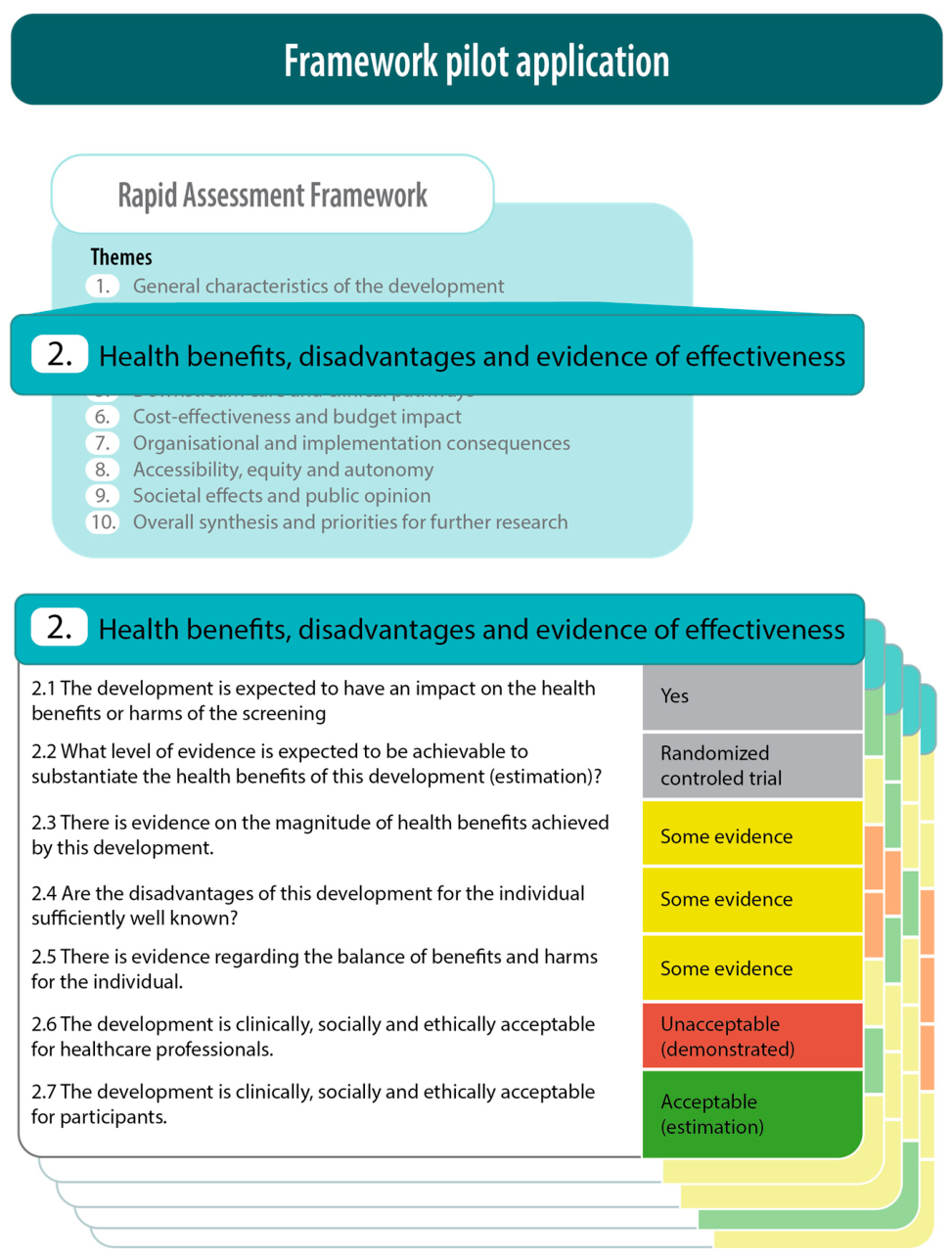
3.2. Visualization of Results in the Framework
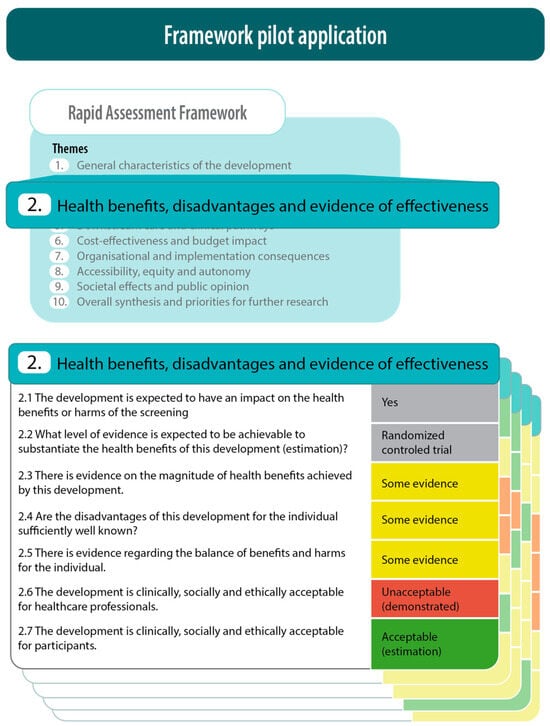
The framework allows for translation of the criterion level ratings into a visual matrix. This is an addition to the methodology described by Jansen et al. [16]. After completing the framework, color coding can be applied to each criterion indicating the magnitude of the expected implementation barrier associated with it (Figure 2). Colors are mapped based on the barrier level: green = no relevant barrier; yellow = minor or uncertain barrier; and red = major barrier. Given the heterogeneity of possible developments, response options are not rigidly linked to specific colors, and the color coding intentionally remains a qualitative judgment. Users are encouraged to document the reasoning behind each rating in the accompanying free-text fields. Gray is used when no estimate needs to be made for the magnitude of the barrier, for example when it is an information criterion. This visualization serves two purposes: (i) enabling a quick overview of strengths and weaknesses, and (ii) highlighting domains where additional evidence generation or preparatory work is most clearly needed. During the creation of the framework, the visualizations of the pilot results were used internally to assess face validity and perceived usefulness of the rapid assessment framework. Both the research teams and policy professionals from the Dutch screening programs considered the framework and its visual output useful, mainly for providing a structured overview of the available evidence and potential barriers. The framework helped to see the key evidence and uncertainties at a glance and to identify which aspects might require further investigation. In future uses, the visualization can, for example, also be used to compare emerging developments within one cancer screening program.
Figure 2.
Pilot application of the rapid assessment framework. This figure shows a fictive example of the answers with color coding for the second theme of the framework. For each of the criteria, an answer category can be chosen, after which the magnitude of the barrier for implementation is estimated and visualized with its corresponding color coding.
3.3. Pilot Application of the Rapid Assessment Framework
To evaluate the rapid assessment framework across different domains of screening policy, we applied it to four different developments: one for each of the three cancer screening programs in the Netherlands and one overarching development. The selected four developments were:
- DNA methylation testing as triage testing for the management of high-risk human papillomavirus (hrHPV)-positive women (cervical cancer);
- Artificial intelligence-based risk prediction to personalize screening intervals for women in the current target age group (breast cancer);
- Blood-based tests as primary screening tests instead of the fecal immunohistochemical test (FIT) test (colorectal cancer);
- Addition of a response deadline to invitation letters (applicable across screening programs).
The Supplementary Information provides a more detailed description of the developments and a summary of the results of the rapid assessment frameworks for the four developments. Depending on the amount of available evidence, completing the framework took approximately 25–120 person-hours per development. On average, 24 references were included (range 7–35).
3.4. Iterative Refinement of the Rapid Assessment Framework
Insights from the pilot, such as criteria that proved ambiguous, insufficiently discriminative, or difficult to apply to certain types of developments, were recorded. Based on these findings, the rapid assessment framework was refined by:
- Clarifying the definitions and scope of selected criteria (e.g., distinguishing health benefits from improvements in accessibility or autonomy);
- Adjusting wording to ensure applicability to both test innovations and organizational/behavioral optimizations;
- Extending answer options so that both negative and positive impacts can be selected;
- Explicitly accommodating program-wide topics (such as invitation strategies) alongside program-specific technologies.
The version of the rapid assessment framework reported in this paper reflects these refinements and constitutes the current tool intended for broad use in assessing emerging developments in cancer screening programs.
4. Discussion
4.1. Rapid Assessment Framework
The present study introduces and pilots a framework for rapid assessment of emerging developments in cancer screening programs. By providing a modular set of themes and criteria that can be selectively applied depending on the type and scope of a development, the framework accommodates a broad range of developments, from new tests and triage strategies to optimizations in invitation procedures. This approach generates a coherent overview of the available evidence and potential contribution of diverse developments to existing screening programs. At the same time, it exposes critical knowledge gaps and practical barriers that need to be addressed before further evaluation or implementation is warranted.
The rapid assessment framework has the potential to support stakeholders involved in population-based screening programs, contributing to improved effectiveness, efficiency and equity of the programs. The framework may complement, not replace, existing national and international decision-making processes. Positioning the framework within the policy cycle helps to clarify its specific added value [17]. In our conceptualization, the framework primarily operates at the interfaces of agenda setting, policy advice, and implementation. By synthesizing fragmented and heterogeneous evidence across multiple themes, it can inform which developments merit inclusion on the policy or research funding agendas. At the same time, the framework explicitly considers feasibility, organizational implications, and downstream care, thereby taking these aspects into account early on. This can also guide researchers of early innovations in including these aspects into their studies. The framework does not deliver a binary recommendation but instead maps uncertainties, trade-offs and potential impacts. Its results can also feed into iterative evaluation and re-evaluation of existing programs, creating a more continuous and transparent link between emerging evidence, policy deliberation and program optimization within the cancer screening policy cycle.
In scientific literature, several evaluation frameworks have been proposed for the assessment of innovations in early cancer detection and related technologies [37]. Examples include the CanTest framework for diagnostic pathways in cancer and the Can.Heal framework for the assessment of genetic technologies [37,38]. These frameworks typically focus on characterizing the stage of development or level of evidence for a test, technology or diagnostic strategy in the healthcare system. Yet, implementation of a new development or technology in a screening program always takes place in an established system. Adaptations will impact the effectiveness and public health benefit of a running screening program. Therefore, our framework was created from the perspective of program policy and implementation to inform policymakers, program coordinators, research funders and researchers what evidence is already available and still required to assess whether an emerging development might strengthen or optimize existing screening programs. It covers which thematic areas (e.g., health impact, feasibility, equity, organizational consequences) are most affected, and where specific additional research or pilot testing is needed before more extensive assessment or decision-making is warranted. In addition, the added value of our framework lies in its ability to rapidly assess a wide range of developments in screening programs, not only including screening and diagnostic tests, but also organizational changes. To compare our framework with existing tools, we have included a comparative table in the Supplementary Information. This table maps our framework against the Wilson and Jungner principles, the UK NSC criteria, and the CanTest and Can.Heal frameworks.
Although our framework includes organizational and implementation consequences (Theme 7), we deliberately did not structure it using established implementation science frameworks such as the Consolidated Framework for Implementation Research (CFIR) or RE-AIM [39,40]. Our aim was to provide an exploratory overview of potential consequences and knowledge gaps related to specific developments in screening programs, rather than to guide or evaluate implementation strategies in depth at multiple levels. Theme 7 therefore focuses on flagging possible implications, as one of the relevant topics, for the current organization of the screening program, involving logistics, capacity and training, for example. It can thus be used to identify areas where more detailed implementation research, for example using frameworks like CFIR or RE-AIM, would be appropriate.
Finally, our framework captures ethical issues such as overdiagnosis, overtreatment, and screening-related harms. For example, the criteria in the second theme cover the effect of the development on the disadvantages for the participants, the balance between benefits and harms of screening, and ethical acceptability. In the eight and nineth theme, the potential impacts on issues such as equity of access, health disparities, and societal opinions are covered.
4.2. Lessons Learned from the Pilot Applications
Applying the rapid assessment framework across the four developments yielded several general insights into its usefulness and limitations.
First, the framework proved particularly valuable for developments with an already substantial evidence base, such as DNA methylation tests for cervical cancer, by structuring a large and heterogeneous body of literature and making explicit which knowledge gaps remain and what type of further research is needed. At the same time, the cervical cancer case highlighted the importance of clearly delineating the development under assessment: a narrow scope (e.g., specific test panels or applications) improves feasibility and focus, but may leave other potentially relevant applications outside the assessment. Furthermore, when a large body of literature is available, clear prioritization (e.g., based on study design and study population as was applied in our pilot) is needed to keep the assessment rapid and feasible. The framework is therefore complementary to, rather than a substitute for, comprehensive systematic reviews.
Second, the artificial intelligence-based personalized screening intervals case for breast cancer screening showed that the framework can also support early-stage, high-profile innovations by providing a transparent overview of the current state of evidence. A key lesson from this case is that, for developments with multiple potential uses, determination of the scope needs to cover not only the technology itself, but also the intended outcome. These choices considerably influence how the criteria in the framework will be assessed and what subsequent knowledge gaps and implementation barriers are identified. For example, a development assessed with the goal of improving efficacy to address constrained screening capacity will lead to different results in the framework than the same development assessed with the goal of maximizing health benefits.
Third, the application of the framework to blood tests instead of the FIT in colorectal cancer screening demonstrated that the framework is equally informative when a development is ultimately judged not to be promising for implementation. In this case, the framework clarified that the primary limitation was not insufficient research, but inadequate test performance for detecting precancerous lesions. It also revealed the need to refine several criteria in the framework so that they are applicable to developments that do not offer clear or additional health gains compared with current practice.
Finally, the case of adding a deadline to the invitation letter illustrated that the framework can be applied to program-wide optimizations, not only to new screening-specific developments. Overall, these lessons suggest that the framework is adaptable across diverse types of developments, but that careful delineation of the scope of the development itself, its intended application within a screening program, and the main intended outcome at the start are important to maximize the relevance and value of the rapid assessment framework.
4.3. Strengths and Limitations
By explicitly spanning the entire screening pathway, the rapid assessment framework provides an integrated view of developments, combining themes such as anticipated health benefits and harms, accessibility, organizational consequences and societal implications. Its modular structure allows criteria to be tailored to the type and scope of a development, making it applicable to both technological innovations and organizational optimizations. Piloting the framework using four diverse developments in breast, cervical and colorectal cancer screening, as well as a cross-cutting optimization, demonstrates its practical feasibility and its ability to differentiate patterns of potential and barriers across developments. Furthermore, by emphasizing a rapid, qualitative synthesis of available evidence, the framework offers a pragmatic tool that can be used in early stages of the policy cycle to structure discussions, inform research prioritization, and support optimization of organized cancer screening programs. Finally, it can help managing developments within these existing programs, in which it can be difficult to integrate new developments.
The current study has several limitations. First, the framework was created and piloted within the context of the Dutch cancer screening programs. Although many criteria are built on international screening principles and literature, their relative importance and interpretation may differ in other health systems with different organizational structures, funding mechanisms and societal preferences [24]. This may limit the generalizability of the results of the specific developments we piloted with the framework. However, the framework is rather independent from national context, as it covers international screening principles and aspects all jurisdictions will consider before implementation (downstream care, cost-effectiveness, accessibility, organizational consequences and societal implications).
Second, piloting was restricted to four case studies. While these were deliberately chosen to represent a wide range of developments, these do not necessarily capture the full range of developments, such as multicancer tests or large-scale organizational reforms. Assessing the evidence on, for example, multicancer tests can be performed using the framework, but only in the context of an existing screening program. The framework was not designed to assess the implementation of potential new cancer screening programs (e.g., lung cancer or prostate cancer). Further development, adjustment and application is therefore needed to explore the framework’s performance in other domains, such as in new screening programs.
Third, the assessment of several criteria is based on qualitative judgments by the review team, drawing on the identified literature rather than on predefined quantitative scoring rules. This choice aligns with the rapid, exploratory purpose of the framework, but this also means that ratings and color codings are not fully objective and may be sensitive to interpretative bias. The framework was explicitly conceived as a rapid approach and therefore cannot replace the depth or formal rigor of full health technology assessments or guideline development processes. Its use should be understood as an initial exploration and prioritization tool rather than a standalone basis for implementation decisions. To minimize potential bias, and depending on the intended application of the results, it may be useful to involve at least two assessors, potentially including external stakeholders, when using the framework.
Finally, the framework was piloted and applied only by the authors’ research team, using a rapid review approach. No formal independent validation or systematic comparison with existing assessment frameworks has yet been conducted. As a result, the consistency of the framework’s outcomes across different teams and its performance relative to other approaches remain to be established.
5. Conclusions
In conclusion, the rapid assessment framework created and piloted in the current study provides a structured exploratory instrument to assess the evidence on emerging developments in existing cancer screening programs. It can support decision-making and prioritization in program implementation and optimization, and it can guide conversations between stakeholders and (funding for) future research. Ultimately, this can contribute to efficient implementation of the most promising innovations or optimizations, thereby improving the effectiveness, efficiency and equity of cancer screening programs.
Supplementary Materials
The following supporting information can be downloaded at https://www.mdpi.com/article/10.3390/cancers18233748/s1. Supplementary—Template of rapid assessment framework and Supplementary Information including supplementary methods, results and references.
Author Contributions
Conceptualization: W.R., L.W.M.v.K.; Data Curation: J.J.d.V., E.D.v.V., I.E.v.K.-d.K., T.v.d.M., R.v.d.B., T.B.W.; Formal Analysis: J.J.d.V., E.D.v.V., I.E.v.K.-d.K., T.v.d.M., R.v.d.B., T.B.W., W.R., L.W.M.v.K.; Funding Acquisition: W.R., L.W.M.v.K.; Investigation: J.J.d.V., E.D.v.V., I.E.v.K.-d.K., T.v.d.M., R.v.d.B., T.B.W., W.R., L.W.M.v.K.; Methodology: J.J.d.V., E.D.v.V., I.E.v.K.-d.K., T.v.d.M., R.v.d.B., T.B.W., S.M.O., W.R., L.W.M.v.K.; Project Administration: L.W.M.v.K.; Resources: S.M.O., L.W.M.v.K.; Supervision: W.R., L.W.M.v.K.; Validation: J.J.d.V., E.D.v.V., I.E.v.K.-d.K., T.v.d.M., R.v.d.B., T.B.W., W.R., L.W.M.v.K.; Visualization: S.M.O.; Writing—Original Draft: J.J.d.V., E.D.v.V., S.M.O., L.W.M.v.K.; Writing—Review and Editing: J.J.d.V., E.D.v.V., I.E.v.K.-d.K., T.v.d.M., R.v.d.B., T.B.W., S.M.O., W.R., L.W.M.v.K. All authors have read and agreed to the published version of the manuscript.
Funding
This research received no external funding.
Institutional Review Board Statement
Ethical approval was not required for this study because it did not involve human participants, animal subjects, or identifiable personal data.
Informed Consent Statement
Informed consent was not required for this study, as it did not involve human participants or any identifiable personal data.
Data Availability Statement
The data that support the findings of this study are available from the corresponding author, L.W.M.v.K., upon reasonable request.
Acknowledgments
The authors gratefully acknowledge the contribution of RIVM-RPO, especially Esther Brouwer and Chava van der Lek, for their input on the framework and selected cases for piloting.
Conflicts of Interest
The authors declare no conflicts of interest. The funders had no role in the design of the study; in the collection, analyses, or interpretation of data; in the writing of the manuscript; or in the decision to publish the results.
Abbreviations
The following abbreviations are used in this manuscript:
| FIT | Fecal immunohistochemical test |
| hr-HPV | High-risk human papillomavirus |
| RIVM | National Institute for Public Health and the Environment |
| RIVM-RPO | Centre ‘Regie op Preventieprogramma’s en Opschaling’ within the RIVM |
References
- de Koning, H.J.; Basu, P.; Segnan, N. Variations in implementation of cancer screening in European countries: Striving for best practice. In World Cancer Report: Cancer Research for Cancer Prevention; Wild, C.P., Weiderpass, E., Stewart, B.W., Eds.; International Agency for Research on Cancer: Lyon, France, 2020. [Google Scholar]
- Dominitz, J.A.; Levin, T.R. What Is Organized Screening and What Is Its Value? Gastrointest. Endosc. Clin. N. Am. 2020, 30, 393–411. [Google Scholar] [CrossRef] [Scilit] [PubMed]
- World Health Organization. A Short Guide to Cancer Screening: Increase Effectiveness, Maximize Benefits and Minimize Harm; WHO Regional Office for Europe: Copenhagen, Denmark, 2022. [Google Scholar]
- Shieh, Y.; Eklund, M.; Sawaya, G.F.; Black, W.C.; Kramer, B.S.; Esserman, L.J. Population-based screening for cancer: Hope and hype. Nat. Rev. Clin. Oncol. 2016, 13, 550–565. [Google Scholar] [CrossRef] [Scilit] [PubMed]
- Landelijke evaluatieteams bevolkingsonderzoek baarmoederhals-, darm- en borstkanker (LEBA, LECO en LETB). Kosteneffectiviteitsanalyse Bevolkingsonderzoeken Naar Kanker; Erasmus MC: Rotterdam, The Netherlands, 2025. [Google Scholar]
- Organisation for Economic Co-operation and Development (OECD). Health at a Glance: OECD Indicators—Cancer Screening; OECD: Paris, France, 2023. [Google Scholar]
- Goddard, K.A.B.; Feuer, E.J.; Mandelblatt, J.S.; Meza, R.; Holford, T.R.; Jeon, J.; Lansdorp-Vogelaar, I.; Gulati, R.; Stout, N.K.; Howlader, N.; et al. Estimation of Cancer Deaths Averted from Prevention, Screening, and Treatment Efforts, 1975–2020. JAMA Oncol. 2025, 11, 162–167. [Google Scholar] [CrossRef] [Scilit] [PubMed]
- Toes-Zoutendijk, E.; Arbyn, M.; Auvinen, A.; Baldwin, D.; Castells, X.; DeCensi, A.; Hofvind, S.; Ivanus, U.; Senore, C.; Thorat, M.; et al. European Code Against Cancer, 5th edition—Organised cancer screening programmes. Mol. Oncol. 2026, 20, 134–153. [Google Scholar] [CrossRef] [Scilit] [PubMed]
- Dunn, B.K.; Woloshin, S.; Xie, H.; Kramer, B.S. Cancer overdiagnosis: A challenge in the era of screening. J. Natl. Cancer Cent. 2022, 2, 235–242. [Google Scholar] [CrossRef] [Scilit] [PubMed]
- Raad voor Volksgezondheid en Samenleving. Iedereen Bijna Ziek—Over de Keerzijden van Diagnose-Expansie; Rvs: Den Haag, The Netherlands, 2024. [Google Scholar]
- Levman, J.; Broza, Y.Y. Cancer screening: Recent developments and future directions. Sci. Rep. 2025, 15, 9436. [Google Scholar] [CrossRef] [Scilit] [PubMed]
- Rizzo, C.E. Rethinking cancer screening in Italy: Equity, performance and innovation. Public Health 2026, 258, 106410. [Google Scholar] [CrossRef] [Scilit] [PubMed]
- Wender, R.C.; Brawley, O.W.; Fedewa, S.A.; Gansler, T.; Smith, R.A. A blueprint for cancer screening and early detection: Advancing screening’s contribution to cancer control. CA Cancer J. Clin. 2019, 69, 50–79. [Google Scholar] [CrossRef] [Scilit] [PubMed]
- Albreht, T.; Kiasuw, R.; Van den Bulcke, M. European Guide on Quality Improvement in Comprehensive Cancer Control; National Institute of Public Health: Ljubljana, Slovenia, 2017.
- Bridgman, P.; Davis, G. What Use is a Policy Cycle? Plenty, if the Aim is Clear. Aust. J. Public Adm. 2003, 62, 98–102. [Google Scholar] [CrossRef] [Scilit]
- Jansen, M.E.; Klein, A.W.; Buitenhuis, E.C.; Rodenburg, W.; Cornel, M.C. Expanded Neonatal Bloodspot Screening Programmes: An Evaluation Framework to Discuss New Conditions With Stakeholders. Front. Pediatr. 2021, 9, 635353. [Google Scholar] [CrossRef] [Scilit] [PubMed]
- Jansen, M.E.; Lister, K.J.; van Kranen, H.J.; Cornel, M.C. Policy Making in Newborn Screening Needs a Structured and Transparent Approach. Front. Public Health 2017, 5, 53. [Google Scholar] [CrossRef] [Scilit] [PubMed]
- Ebell, M.H.; Thai, T.N.; Royalty, K.J. Cancer screening recommendations: An international comparison of high income countries. Public Health Rev. 2018, 39, 7. [Google Scholar] [CrossRef] [Scilit] [PubMed]
- Seedat, F.; Cooper, J.; Cameron, L.; Stranges, S.; Kandala, N.B.; Burton, H.; Taylor-Philips, S. International Comparisons of Screening Policy-Making: A Systematic Review; The University of Warwick: Coventry, UK, 2014. [Google Scholar]
- Kostadinov, K.; Iskrov, G.; Musurlieva, N.; Stefanov, R. An Evaluation of Rare Cancer Policies in Europe: A Survey Among Healthcare Providers. Cancers 2025, 17, 164. [Google Scholar] [CrossRef] [Scilit] [PubMed]
- de Leede, D.J.; van Velzen, R. Beleidskader Bevolkingsonderzoeken Naar Kanker; Rijksinstituut voor Volksgezondheid en Milieu (RIVM): Bilthoven, The Netherlands, 2022.
- Lynge, E.; Törnberg, S.; von Karsa, L.; Segnan, N.; van Delden, J.J.M. Determinants of successful implementation of population-based cancer screening programmes. Eur. J. Cancer 2012, 48, 743–748. [Google Scholar] [CrossRef] [Scilit] [PubMed]
- UK National Screening Committee. Criteria for a Population Screening Programme; GOV.UK: London, UK, 2022.
- Wilson, J.M.G.; Jungner, G. Principles and Practice of Screening for Disease; World Health Organization Public Health Papers; WHO: Geneva, Switzerland, 1968; p. 34. [Google Scholar]
- Sturdy, S.; Miller, F.; Hogarth, S.; Armstrong, N.; Chakraborty, P.; Cressman, C.; Dobrow, M.; Flitcroft, K.; Grossman, D.; Harris, R.; et al. Half a Century of Wilson & Jungner: Reflections on the Governance of Population Screening. Wellcome Open Res. 2020, 5, 158. [Google Scholar] [CrossRef] [Scilit] [PubMed]
- Canadian Task Force on Preventive Health Care. Topic Prioritization, Surveillance, Review and Selection; Canadian Task Force on Preventive Health Care: Ottawa, Canada, 2023; Chapter 2. [Google Scholar]
- American College of Medical Genetics Newborn Screening Expert Group. Newborn screening: Toward a uniform screening panel and system-executive summary. Pediatrics 2006, 117, S296–S307. [Google Scholar] [CrossRef] [Scilit] [PubMed]
- Australian Department of Health Disability and Aging. Population-Based Screening Framework; Australian Department of Health Disability and Aging: Canberra, Australia, 2018.
- Bresalier, R.S.; Senore, C.; Young, G.P.; Allison, J.; Benamouzig, R.; Benton, S.; Bossuyt, P.M.M.; Caro, L.; Carvalho, B.; Chiu, H.-M.; et al. An efficient strategy for evaluating new non-invasive screening tests for colorectal cancer: The guiding principles. Gut 2023, 72, 1904–1918. [Google Scholar] [CrossRef] [Scilit] [PubMed]
- World Health Organization. Cancer—Screening and Early Detection; WHO: Geneva, Switzerland, 2010. [Google Scholar]
- Health Council of the Netherlands. Screening: Tussen Hoop en Hype; Health Council of the Netherlands: Den Haag, The Netherlands, 2008. [Google Scholar]
- Dutch Ministry of Health Welfare and Sport. Ontwikkelagenda Bevolkingsonderzoek; Dutch Ministry of Health Welfare and Sport: Den Haag, The Netherlands, 2025.
- van Veldhuizen-Eshuis, H.; Carpay, M.E.M.; van Delden, J.A.; Grievink, L.; Hoebee, B.; Lock, A.J.J.; Reij, R. Uitvoeringstoets Bevolkingsonderzoek Naar Darmkanker: Opsporing Van Darmkanker in Praktijk Gebracht; Rijksinstituut voor Volksgezondheid en Milieu (RIVM): Bilthoven, The Netherlands, 2011.
- van der Veen, N.; Carpay, M.E.M.; van Delden, J.A.; Brouwer, E.; Grievink, L.; Hoebee, B.; Lock, A.J.J.; Salverda, J.G.W. Uitvoeringstoets Wijziging Bevolkingsonderzoek Baarmoederhalskanker 2013; Rijksinstituut voor Volksgezondheid en Milieu (RIVM): Bilthoven, The Netherlands, 2013.
- van Sonderen, J.F.; van Kerkhof, L.W.M.; van Klink-de Kruijff, I.E.; Jansen, M.E.; Lock, A.J.J.; Klein, A.W.; Kallendorf, B.G. Verkorte Uitvoeringstoets Aanvulling Bevolkingsonderzoek Borstkanker Met MRI Voor Vrouwen Met Zeer Dicht Borstweefsel; Rijksinstituut voor Volksgezondheid en Milieu (RIVM): Bilthoven, The Netherlands, 2020.
- UK National Screening Committee. Guidance—UK NSC: Evidence Review Process 2025. Available online: https://www.gov.uk/government/publications/uk-nsc-evidence-review-process/uk-nsc-evidence-review-process (accessed on 1 April 2026).
- Walter, F.M.; Thompson, M.J.; Wellwood, I.; Abel, G.A.; Hamilton, W.; Johnson, M.; Lyratzopoulos, G.; Messenger, M.P.; Neal, R.D.; Rubin, G.; et al. Evaluating diagnostic strategies for early detection of cancer: The CanTest framework. BMC Cancer 2019, 19, 586. [Google Scholar] [CrossRef] [Scilit] [PubMed]
- Solís-Díez, G.; Prats, C.; Valls-Comamala, V.; Castellano-García, J.M.; Mias, R.; Molina-Barceló, A.; Romeo-Cervera, P.; Pinto-Carbó, M.; Retèl, V.P.; van Schaik, L.F.; et al. A Value-Based Evaluation Framework for Guiding the Adoption and Scale-Up of Cancer Genomics Interventions. Public Health Genom. 2026, 29, 122–139. [Google Scholar] [CrossRef] [Scilit] [PubMed]
- Damschroder, L.J.; Reardon, C.M.; Widerquist, M.A.O.; Lowery, J. The updated Consolidated Framework for Implementation Research based on user feedback. Implement. Sci. 2022, 17, 75. [Google Scholar] [CrossRef] [Scilit] [PubMed]
- Glasgow, R.E.; Vogt, T.M.; Boles, S.M. Evaluating the public health impact of health promotion interventions: The RE-AIM framework. Am. J. Public Health 1999, 89, 1322–1327. [Google Scholar] [CrossRef] [Scilit] [PubMed]

Disclaimer/Publisher’s Note: The statements, opinions and data contained in all publications are solely those of the individual author(s) and contributor(s) and not of MDPI and/or the editor(s). MDPI and/or the editor(s) disclaim responsibility for any injury to people or property resulting from any ideas, methods, instructions or products referred to in the content. |
© 2026 by the authors. Licensee MDPI, Basel, Switzerland. This article is an open access article distributed under the terms and conditions of the Creative Commons Attribution (CC BY) license.