


Simple Summary
Women with advanced ovarian cancer who receive chemotherapy before surgery are at high risk of venous thromboembolism (blood clots in the veins or lungs). When and for whom to start preventive blood thinners is unclear. In this retrospective study of 192 women, we examined whether early prophylactic-dose low-molecular-weight heparin, a blood thinner started before chemotherapy, was associated with fewer clots during this treatment. Clots occurred in 1 of 148 women (0.7%) with early prophylaxis and 6 of 44 (13.6%) without it, mostly in the lungs within weeks of diagnosis. A Khorana (clot-risk) score of 3 or higher was associated with higher, imprecisely estimated odds of clots. No clinically relevant bleeding was identified, although the study was too small to establish safety. Because prophylaxis was not randomized and only seven clots occurred, these findings need confirmation but support clot-risk assessment before chemotherapy and prospective multicenter studies of early, risk-adapted prophylaxis.
Abstract
Background/Objectives: Venous thromboembolism is common during neoadjuvant chemotherapy for advanced ovarian cancer, but when to start thromboprophylaxis is unclear. We evaluated the association between early prophylactic-dose low-molecular-weight heparin, started at diagnosis or before the first cycle, and venous thromboembolism during neoadjuvant chemotherapy. Methods: This retrospective single-center cohort study included all consecutive women with stage III–IV epithelial ovarian cancer diagnosed between September 2012 and January 2025 who received neoadjuvant chemotherapy. Patients with venous thromboembolism at diagnosis were excluded. The primary endpoint was confirmed venous thromboembolism from the first cycle until interval debulking surgery or, without surgery, until completion of planned neoadjuvant chemotherapy or day 120, whichever occurred first. Associations were explored with Firth-penalized logistic regression. Results: Of 201 patients who received neoadjuvant chemotherapy, 192 formed the analytic cohort; 148 (77.1%) received early prophylaxis. Primary endpoint events occurred in 7 patients (3.6%; six pulmonary embolisms) at a median of 3.1 weeks after diagnosis. Events occurred in 1 of 148 patients (0.7%) with early prophylaxis and 6 of 44 (13.6%) without it. In exploratory multivariable analysis, early prophylaxis remained associated with lower odds (adjusted odds ratio [OR] 0.08, 95% confidence interval [CI] 0.01–0.47). A Khorana score of 3 or higher was associated with higher, imprecisely estimated odds (adjusted OR 12.70, 95% CI 1.17–1722). No major or clinically relevant non-major bleeding was identified (0/148 with prophylaxis; 95% CI 0–2.46%). Conclusions: Early prophylactic-dose low-molecular-weight heparin was associated with fewer venous thromboembolic events during neoadjuvant chemotherapy. Because prophylaxis was not randomized and events were few, these hypothesis-generating findings require prospective validation.
1. Introduction
Venous thromboembolism is a frequent complication of advanced epithelial ovarian cancer and is associated with treatment delays, hospitalization, and reduced survival [1,2,3]. The risk is particularly high in patients who receive neoadjuvant chemotherapy, because the clinical features that favor this treatment strategy, such as extensive tumor burden, ascites, impaired performance status, and reduced mobility, are also known risk factors for thrombosis [4,5]. In a meta-analysis of 11 studies, the pooled incidence of venous thromboembolism during neoadjuvant chemotherapy was 10% (95% confidence interval [CI] 7–13%) [6], and two recent large cohorts reported rates of 9.3% and 4.6% [2,7]. Events during this phase are clinically relevant because they have been associated with delayed interval debulking surgery [4,7] and a lower rate of optimal cytoreduction [4].
Despite this risk, evidence to guide thromboprophylaxis during neoadjuvant chemotherapy remains limited. Two nonrandomized quality-improvement studies in ovarian cancer reported fewer thromboembolic events after routine or risk-selected prophylaxis was introduced during first-line treatment, without an increase in bleeding [8,9]. Randomized trials in mixed-cancer populations support risk-adapted prophylaxis with direct oral anticoagulants, at the cost of more major bleeding with apixaban, but did not address low-molecular-weight heparin in advanced ovarian cancer [10,11]. Current guidelines recommend considering prophylaxis for selected high-risk outpatients rather than for all patients and make no specific recommendation for patients starting neoadjuvant chemotherapy [12,13,14,15]. The American Society of Clinical Oncology and the International Initiative on Thrombosis and Cancer use a Khorana score of 2 or higher to identify outpatients who may benefit from prophylaxis [12,13,14].
This risk-based approach is difficult to apply in ovarian cancer. The Khorana score was not associated with venous thromboembolism in several cohorts of patients receiving neoadjuvant chemotherapy [16,17,18], although a score of 3 independently predicted pulmonary embolism in a cohort of patients with advanced high-grade serous carcinoma [19]. Because every patient with ovarian cancer receives 1 point for tumor site and thrombocytosis is common in advanced disease, a threshold of 2 points classifies most patients receiving neoadjuvant chemotherapy as high risk; in a previous cohort, this threshold did not distinguish patients who developed venous thromboembolism from those who did not [17]. More broadly, available risk assessment models, including the Khorana score, lack consistent performance and external validation in ovarian cancer [20].
The optimal timing of prophylaxis is also unresolved. In previous cohorts, many events were diagnosed at presentation or before chemotherapy started, and others occurred during neoadjuvant chemotherapy, a treatment phase in which prophylaxis has traditionally not been used [16,17]. Thrombotic risk is therefore already high when treatment begins, yet few data address prophylaxis started at diagnosis or before the first cycle of neoadjuvant chemotherapy [5,20]. Most of the recent cohorts described patients managed largely without prophylaxis [2,7,16,17,18], and the two quality-improvement studies compared periods before and after a prophylaxis program was introduced [8,9]. Consequently, whether prophylaxis started before chemotherapy is associated with fewer events during neoadjuvant chemotherapy, and in which patients, remains uncertain [17,20].
At our institution, prophylactic-dose low-molecular-weight heparin started at diagnosis or before the first cycle was the predominant, although not universal, practice during the study period, a setting that allowed patients with and without early prophylaxis to be compared within a single institutional cohort. The primary aim was therefore to evaluate the association between early prophylactic-dose low-molecular-weight heparin and venous thromboembolism during neoadjuvant chemotherapy for advanced epithelial ovarian cancer. Secondary aims were to examine other factors associated with venous thromboembolism, including the Khorana score, and to describe bleeding events.
2. Materials and Methods
2.1. Study Design and Population
This retrospective single-center cohort study was conducted at the Division of Gynecologic Oncology, Hacettepe University, and is reported in accordance with the Strengthening the Reporting of Observational Studies in Epidemiology statement [21]. Eligible patients were women with International Federation of Gynecology and Obstetrics (FIGO) 2014 stage III–IV epithelial ovarian cancer [22] diagnosed between September 2012 and January 2025 who received at least one cycle of neoadjuvant chemotherapy before planned interval debulking surgery. We excluded patients who underwent primary cytoreductive surgery, lacked essential clinical data, were seen for consultation only, had a revised diagnosis, or died before chemotherapy. Patients with venous thromboembolism at diagnosis (that is, venous thromboembolism already present when ovarian cancer was diagnosed) were also excluded. All consecutive patients who met these criteria during the study period were included, and no patient was selected on the basis of thromboprophylaxis use or outcome. Treatment decisions were made by the institutional multidisciplinary tumor board.
The study was approved by the Hacettepe University Health Sciences Ethics Committee (approval number 2025/12-38, 3 June 2025; amendment 2025/14-49, 8 July 2025) and was conducted in accordance with the Declaration of Helsinki. Written informed consent for the use of anonymized clinical data in research is routinely obtained at Hacettepe University Hospital, and all included patients had provided such consent.
2.2. Data Collection and Definitions
Demographic, clinical, laboratory, radiologic, pathologic, and treatment data were extracted retrospectively from institutional records. To obtain missing information, all digital medical records were re-reviewed, archived patient files were retrieved and reviewed, and patients who could be reached were contacted by telephone. Missing data are reflected in the variable-specific denominators, and no imputation was performed. Baseline variables included age, body mass index, Eastern Cooperative Oncology Group (ECOG) performance status [23], comorbidities, the Charlson Comorbidity Index [24], FIGO stage, histologic subtype, BRCA1/2 mutation status, ascites, pleural effusion, and cancer antigen 125 (CA125). Laboratory variables measured before neoadjuvant chemotherapy included hemoglobin, leukocyte count, platelet count, the neutrophil-to-lymphocyte ratio, albumin, and creatinine.
These variables were selected because they are established or proposed risk factors for cancer-associated venous thromboembolism or have been examined in previous ovarian cancer cohorts [4,6,7,16,17,18,19,20,25]. Age, body mass index, comorbidity, and performance status reflect patient-related risk; stage, histology, BRCA1/2 mutation status, ascites, pleural effusion, and CA125 reflect tumor burden and biology; and blood counts, albumin, creatinine, and the neutrophil-to-lymphocyte ratio reflect hematologic, nutritional, renal, and inflammatory status. The ECOG performance status grades functional capacity from 0 (fully active) to 5 (dead); a score of 2 or higher, which identifies patients who are unable to carry out any work activities (score 2) or who are confined to a bed or chair for more than half of their waking hours (score 3) or completely (score 4) [23], was used as a marker of reduced mobility. The Charlson Comorbidity Index, a weighted score of 19 comorbid conditions originally developed to predict mortality, was used to quantify comorbidity burden [24]. The Khorana score is the most widely validated risk assessment model for chemotherapy-associated venous thromboembolism and underlies guideline recommendations for outpatient thromboprophylaxis [12,13,14,15,25]. It assigns 2 points for a very high-risk primary site (stomach or pancreas) and 1 point each for a high-risk site (lung, lymphoma, gynecologic, bladder, or testicular cancer), a pre-chemotherapy platelet count ≥ 350 × 103/µL, hemoglobin < 10 g/dL or use of erythropoiesis-stimulating agents, a leukocyte count > 11 × 103/µL, and a body mass index ≥ 35 kg/m2. The Khorana score was calculated as originally described, with ovarian cancer assigned 1 point as a high-risk site, and was analyzed as <3 versus ≥3 [25]. This threshold corresponds to the high-risk category of the original model. As noted in the Introduction, the threshold of ≥2 used by the American Society of Clinical Oncology and the International Initiative on Thrombosis and Cancer to select outpatients for prophylaxis [12,13,14] classifies most patients in this setting as high risk [17]. In our cohort, at least 114 of the 177 patients (64.4%) with an available score had 2 or more points on the basis of tumor site and platelet count alone. We therefore used the original high-risk category to identify a subgroup at higher risk.
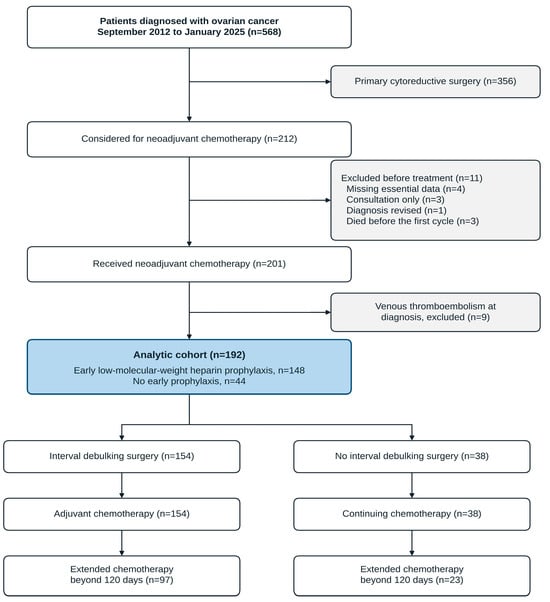
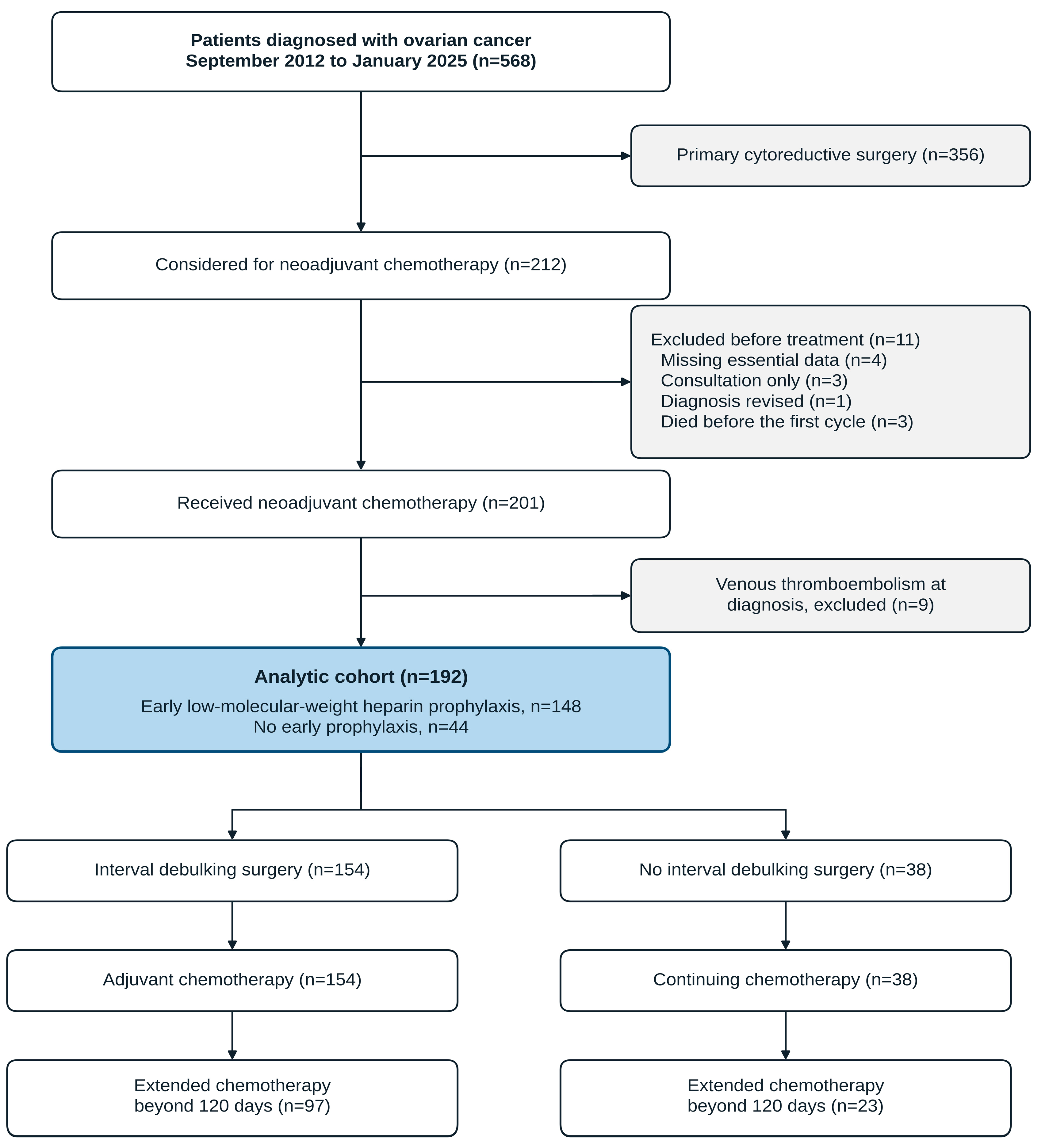
For univariable analyses, continuous variables were dichotomized at conventional clinical cut-offs, including the Khorana score thresholds for platelet count and hemoglobin, as follows: age 70 years, body mass index 25 kg/m2, Charlson Comorbidity Index 5, two comorbidities, CA125 1000 U/mL, hemoglobin 10 g/dL, leukocyte count 11 × 103/µL, platelet count 350 × 103/µL, albumin 3.5 g/dL, creatinine 1.5 mg/dL, and neutrophil-to-lymphocyte ratio 3. Treatment variables included thromboprophylaxis, red blood cell transfusion, fresh frozen plasma and/or cryoprecipitate transfusion, and interval debulking surgery. Transfusions were recorded as potential markers of anemia, coagulopathy, or disease severity. All recorded blood product transfusions were administered before the first cycle of neoadjuvant chemotherapy (index date). For descriptive analyses, treatment was divided into four phases: neoadjuvant chemotherapy, the 30-day postoperative period, adjuvant chemotherapy, and extended chemotherapy, defined as chemotherapy continuing beyond 120 days after the first cycle (Figure 1).
Figure 1.
Study flow diagram. Of 568 patients diagnosed with ovarian cancer between September 2012 and January 2025, 212 were considered for neoadjuvant chemotherapy. After the exclusion of 11 patients before treatment and 9 with venous thromboembolism at diagnosis, 192 patients formed the analytic cohort; 148 received early low-molecular-weight heparin prophylaxis and 44 did not. Interval debulking surgery was performed in 154 patients (120 with and 34 without early prophylaxis), and 38 continued chemotherapy without surgery (28 with and 10 without early prophylaxis). The numbers of patients whose chemotherapy extended beyond 120 days after the first cycle are shown separately for patients with and without interval debulking surgery.
2.3. Thromboprophylaxis Exposure
Early thromboprophylaxis was defined as prophylactic-dose low-molecular-weight heparin started at diagnosis or at any time before the first cycle of neoadjuvant chemotherapy. Because the exact start date of outpatient prophylaxis was not consistently documented, the timing of initiation was categorized into two groups: at or shortly after diagnosis and immediately before the first cycle; however, whether prophylaxis had begun before the first cycle was documented for all patients. Exposure was classified at the first cycle, which served as the index date. No patient started prophylaxis after the first cycle during neoadjuvant chemotherapy; therefore, no patient moved from the unexposed to the exposed group during the primary endpoint window. Prophylaxis generally consisted of enoxaparin 40 mg subcutaneously once daily or an equivalent regimen and was prescribed at the physician’s discretion. No institutional protocol mandated or restricted pre-treatment prophylaxis during the study period; early prophylaxis was the predominant practice of most attending gynecologic oncologists, and the decision for each patient was based on the treating physician’s clinical judgment. Reasons for withholding prophylaxis were not systematically documented and could not be reliably reconstructed from the records. Therapeutic-dose anticoagulation was not considered prophylaxis. All patients who underwent surgery received routine 30-day postoperative prophylaxis; this prophylaxis and any prophylaxis started during adjuvant or extended chemotherapy were recorded separately. Postoperative prophylaxis began after interval debulking surgery, that is, after the end of the primary endpoint window, and therefore could not influence the primary endpoint.
2.4. Outcomes
Venous thromboembolism was defined as proximal deep vein thrombosis of the upper or lower extremities (axillary or more proximal veins of the upper extremities; popliteal or more proximal veins of the lower extremities) and/or pulmonary embolism confirmed by Doppler ultrasonography, contrast-enhanced computed tomography (CT), or CT pulmonary angiography. Events were identified by review of all radiology reports and clinical records from diagnosis onward and were accepted only when confirmed by imaging performed as part of routine care. Deep vein thrombosis required a non-compressible venous segment or an intraluminal thrombus on compression or Doppler ultrasonography, or on contrast-enhanced CT, and pulmonary embolism required an intraluminal filling defect in the pulmonary arterial tree on CT pulmonary angiography or contrast-enhanced chest CT. Clinically suspected events without imaging confirmation were not counted. Events were classified as symptomatic when imaging was prompted by clinical suspicion and as incidental when they were detected on imaging obtained for another indication, such as staging or response assessment. Both symptomatic and incidental events were included; superficial venous, arterial, and splanchnic thromboses were excluded, and only the first qualifying event per patient was counted. The primary endpoint was venous thromboembolism from the first cycle of neoadjuvant chemotherapy until interval debulking surgery or, in patients without surgery, until completion of planned neoadjuvant chemotherapy or day 120 after the first cycle, whichever occurred first. Events after this window were recorded separately by treatment phase and were not part of the primary endpoint. Bleeding was a secondary safety outcome, assessed from diagnosis to the end of the primary endpoint window. Major and clinically relevant non-major bleeding were classified according to International Society on Thrombosis and Haemostasis criteria [26,27], based on review of clinical notes, emergency and inpatient records, serial hemoglobin values, transfusion indications, and documented interruptions of prophylaxis. Major bleeding was defined as fatal bleeding, symptomatic bleeding in a critical area or organ, or bleeding causing a decrease in hemoglobin of 2 g/dL or more or leading to transfusion of two or more units of red blood cells [26]. Clinically relevant non-major bleeding was defined as overt bleeding not meeting these criteria that required medical intervention, led to hospitalization or an increased level of care, or prompted a face-to-face evaluation [27].
2.5. Statistical Analysis
Continuous variables are presented as mean ± standard deviation (SD) or median (interquartile range [IQR]), and categorical variables as numbers and percentages. Bleeding outcomes were summarized descriptively by early prophylaxis status. Associations with the primary endpoint were first estimated with conventional univariable logistic regression and are reported as odds ratios (ORs) with Wald 95% CIs and p values. Because events were few and several categories contained no events, Firth penalized logistic regression was used for univariable and multivariable analyses to reduce small-sample bias and to address separation [28,29]. CIs were obtained by profile penalized likelihood, and p values by penalized likelihood ratio tests. The multivariable model included early thromboprophylaxis as the primary exposure of interest, a Khorana score ≥ 3 as a measure of baseline thrombotic risk, an ECOG performance status ≥ 2 as an indicator of functional status, and red blood cell transfusion before the index date as a potential marker of clinical severity. Covariates were selected on the basis of clinical relevance, published evidence, and univariable findings rather than on statistical significance alone, and their number was limited by the small number of events. Hemoglobin and platelet count were not entered separately because both are components of the Khorana score. Because the complete-case model included only six events, the multivariable analysis was considered exploratory. Although Firth penalization reduces small-sample bias and addresses separation, it cannot compensate for the limited number of outcome events; adjusted ORs, CIs, and p values were therefore interpreted cautiously and were not considered confirmatory evidence. Benjamini–Hochberg q values [30] were calculated separately for the 21 univariable Firth tests and for the four multivariable coefficients. The absolute difference in the primary endpoint between exposure groups is reported with a Newcombe hybrid score 95% CI [31]. Exact Clopper–Pearson 95% CIs were calculated for bleeding proportions, including those with no events [32]. Baseline characteristics of patients with and without early prophylaxis were compared using standardized mean differences (SMDs); an absolute SMD of 0.10 or more was considered to indicate a potentially meaningful imbalance [33] (Table S1). Analyses were performed with IBM SPSS Statistics version 23.0 (IBM Corp., Armonk, NY, USA) and R version 3.6.1 (R Foundation for Statistical Computing, Vienna, Austria). All tests were two-sided, and p < 0.05 was used as a nominal threshold for statistical significance. Given the exploratory nature of the analyses, p values were interpreted together with effect sizes and CIs rather than as confirmatory evidence.
3. Results
Of 568 patients with ovarian cancer assessed for eligibility, 356 underwent primary cytoreductive surgery, and 212 were considered for neoadjuvant chemotherapy. Of these, 11 were excluded before treatment because essential data were unavailable (n = 4), they were seen for consultation only (n = 3), their diagnosis was revised (n = 1), or they died before chemotherapy (n = 3). Of the 201 patients who received neoadjuvant chemotherapy, 9 had venous thromboembolism at diagnosis and were excluded, leaving 192 patients in the analytic cohort (Figure 1). Interval debulking surgery was performed in 154 patients (80.2%).
The mean age was 61.3 ± 10.9 years; 98 patients (51.0%) had stage IV disease, 186 (96.9%) had serous histology, 92 (47.9%) had an ECOG performance status of 2 or higher, and 57 of 177 (32.2%) had a Khorana score of 3 or higher (Table 1).
Table 1.
Baseline clinical, disease, and treatment characteristics of the study cohort (n = 192).
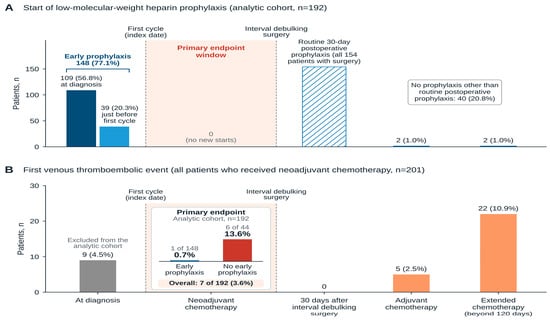
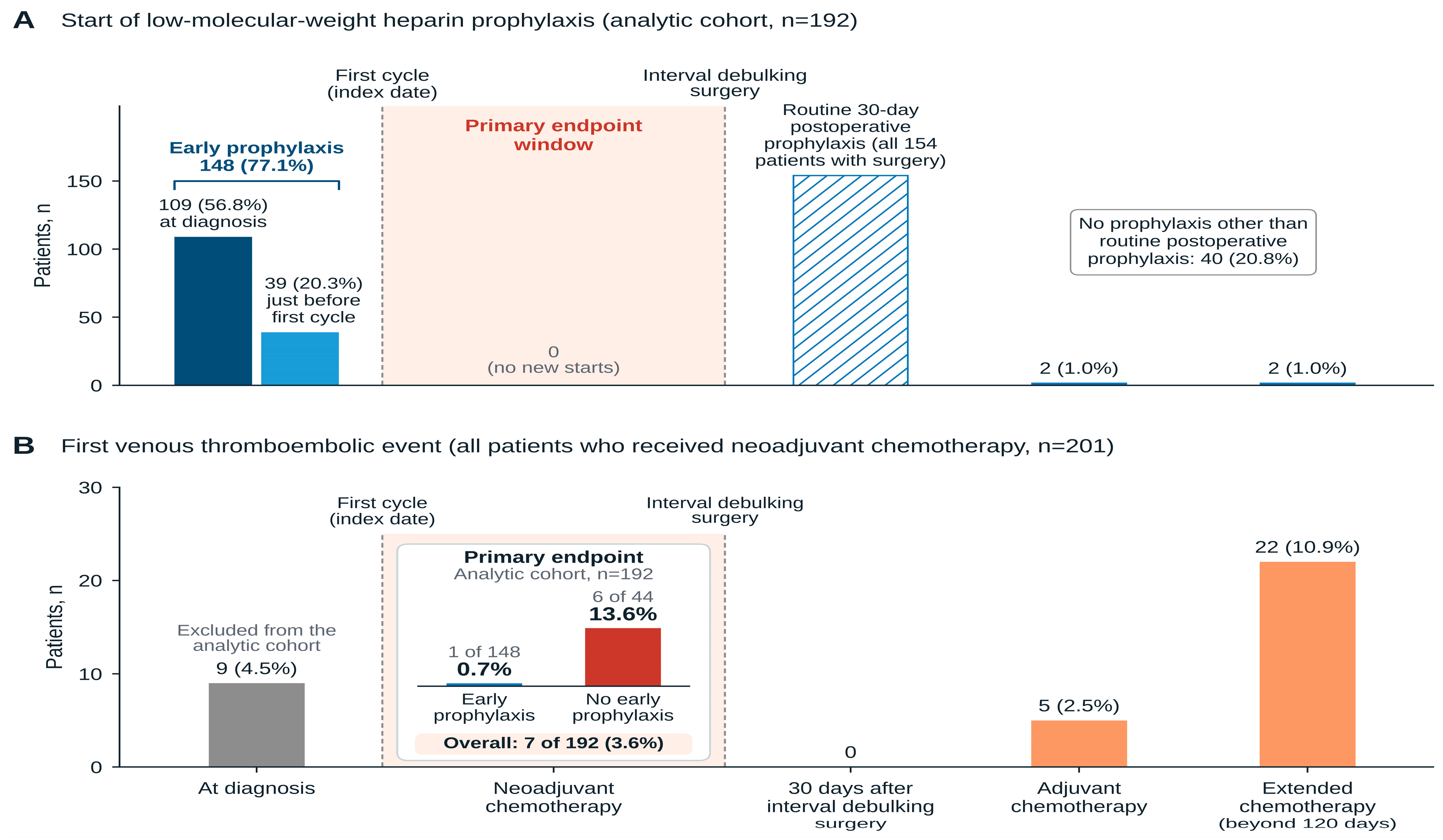
Early thromboprophylaxis was given to 148 patients (77.1%): 109 (56.8%) started it at or shortly after diagnosis and 39 (20.3%) immediately before the first cycle. The median interval from diagnosis to the first cycle was 14 days (IQR 8–23) in patients with and 13 days (IQR 5.8–22) in patients without early prophylaxis. Of the 44 patients (22.9%) without early prophylaxis, 4 started prophylaxis later, during adjuvant or extended chemotherapy (Figure 2A). No patient started prophylaxis after the first cycle during neoadjuvant chemotherapy.
Figure 2.
Timing of low-molecular-weight heparin initiation and venous thromboembolism across treatment phases. (A) Start of low-molecular-weight heparin prophylaxis in the analytic cohort (n = 192). Early prophylaxis was started at or shortly after diagnosis in 109 patients and immediately before the first cycle in 39; no patient started prophylaxis after the first cycle during neoadjuvant chemotherapy. Routine 30-day postoperative prophylaxis, given to all 154 patients who underwent interval debulking surgery (hatched bar), was not part of the study exposure. (B) First venous thromboembolic event per patient among all 201 patients who received neoadjuvant chemotherapy; the 9 patients with an event at diagnosis were excluded from the analytic cohort. Percentages outside the primary endpoint window were calculated with 201 as the denominator. The inset shows the primary endpoint in the analytic cohort by early prophylaxis status: 1 of 148 patients (0.7%) with and 6 of 44 (13.6%) without early prophylaxis, and 7 of 192 (3.6%) overall. The shaded column marks the primary endpoint window, from the first cycle (index date) to interval debulking surgery or, in patients without surgery, to completion of planned neoadjuvant chemotherapy or day 120, whichever occurred first.
Baseline characteristics differed between the exposure groups (Table S1). Compared with patients without early prophylaxis, those who received it were more often aged 70 years or older (27.7% vs. 11.4%; SMD 0.42) and more often had a Charlson Comorbidity Index of 5 or higher (45.9% vs. 27.3%; SMD 0.40) or an ECOG performance status of 2 or higher (49.3% vs. 43.2%; SMD 0.12). Conversely, a Khorana score of 3 or higher (43.2% vs. 29.3%; SMD 0.29), hemoglobin < 10 g/dL (32.4% vs. 10.0%; SMD 0.57), ascites (95.2% vs. 87.7%; SMD 0.27), and a platelet count of 350 × 103/µL or higher (70.3% vs. 62.9%; SMD 0.16) were more frequent among patients without than among those with early prophylaxis. FIGO stage, body mass index, and pleural effusion were balanced (SMD < 0.10). The proportion of patients who did not undergo interval debulking surgery was similar in the two groups (10 of 44 [22.7%] without and 28 of 148 [18.9%] with early prophylaxis; SMD 0.09).
Venous thromboembolism during neoadjuvant chemotherapy occurred in 7 of 192 patients (3.6%); six were pulmonary embolisms (85.7%), and one was a deep vein thrombosis (14.3%). Of the seven events, six were symptomatic, and one was detected incidentally. The median time from diagnosis to the event was 3.1 weeks (IQR 1.4–7.1; range 0.6–11.4), and the median time from the first cycle to the event was 16 days (range 3–66); five of the seven events occurred within 20 days of the first cycle. Apart from the nine patients with venous thromboembolism at diagnosis, no new venous thromboembolism was diagnosed between diagnosis and the first cycle. The timing of each event relative to diagnosis and the first cycle is shown in Table S2.
Events occurred in 6 of 44 patients (13.6%) without early prophylaxis and in 1 of 148 (0.7%) with early prophylaxis (absolute difference, 13.0 percentage points; 95% CI 5.1–26.0) (Table 2 and Figure 2B). Among patients with a Khorana score of 3 or higher, venous thromboembolism occurred in 5 of 16 (31.3%) without and 1 of 41 (2.4%) with early prophylaxis; no events occurred among patients with a score below 3 in either group (0 of 21 and 0 of 99) (Tables S1 and S2). By surgical status, venous thromboembolism occurred in 4 of 154 patients (2.6%) who later underwent interval debulking surgery (4 of 34 without and 0 of 120 with early prophylaxis) and in 3 of 38 (7.9%) who did not (2 of 10 without and 1 of 28 with early prophylaxis). No major or clinically relevant non-major bleeding was identified in patients with (0/148; exact 95% CI 0–2.46%) or without (0/44; exact 95% CI 0–8.04%) early prophylaxis.
Table 2.
Temporal distribution of venous thromboembolism events, LMWH thromboprophylaxis use, and bleeding outcomes.
In univariable Firth analysis, early prophylaxis was associated with lower odds of venous thromboembolism (OR 0.06, 95% CI 0.01–0.30; p < 0.001, q = 0.0058), consistent with conventional logistic regression (OR 0.04, 95% CI 0.005–0.37; p = 0.0041) (Table 3 and Table 4). All six events among patients with an available Khorana score occurred in those with a score of 3 or higher (6 of 57 [10.5%] vs. 0 of 120), and all events among patients with available neutrophil-to-lymphocyte ratio data occurred at a ratio of 3 or higher; these and other zero-event categories made conventional estimates non-estimable or unstable. Factors associated with higher odds at the nominal p < 0.05 threshold were Khorana score ≥ 3 (OR 30.4, 95% CI 3.49–3994; p < 0.001, q = 0.0058), fresh frozen plasma and/or cryoprecipitate transfusion (OR 15.3, 95% CI 1.77–2014; p = 0.0086, q = 0.045), neutrophil-to-lymphocyte ratio ≥ 3 (OR 12.3, 95% CI 1.41–1609; p = 0.018, q = 0.060), hemoglobin < 10 g/dL (OR 12.0, 95% CI 2.50–72.0; p = 0.0023, q = 0.016), red blood cell transfusion (OR 6.31, 95% CI 1.34–37.4; p = 0.020, q = 0.060), and ECOG performance status ≥ 2 (OR 4.98, 95% CI 1.02–48.5; p = 0.047, q = 0.12). A body mass index of 25 kg/m2 or higher was associated with lower odds (OR 0.15, 95% CI 0.03–0.63; p = 0.011, q = 0.047). Confidence intervals were wide for variables with zero-event categories.
Table 3.
Univariable logistic regression analysis of factors associated with venous thromboembolism during neoadjuvant chemotherapy.
Table 4.
Univariable Firth penalized logistic regression analysis of factors associated with venous thromboembolism during neoadjuvant chemotherapy.
The exploratory multivariable analysis included 169 patients with complete covariate data and six events. Early prophylaxis remained associated with lower odds of venous thromboembolism (adjusted OR 0.08, 95% CI 0.01–0.47; p = 0.0045, q = 0.018). A Khorana score of 3 or higher was associated with higher odds at the nominal threshold, although the estimate was imprecise (adjusted OR 12.70, 95% CI 1.17–1722; p = 0.035, q = 0.069). Red blood cell transfusion (adjusted OR 3.46, 95% CI 0.54–26.5; p = 0.19, q = 0.25) and ECOG performance status ≥ 2 (adjusted OR 2.13, 95% CI 0.28–24.8; p = 0.47, q = 0.47) were not associated with the outcome at the nominal threshold (Table 5).
Table 5.
Exploratory multivariable Firth penalized logistic regression analysis of factors associated with venous thromboembolism during neoadjuvant chemotherapy.
Outside the primary endpoint window, no venous thromboembolism occurred during the 30-day postoperative period. Among all 201 patients who received neoadjuvant chemotherapy, 5 (2.5%) had an event during adjuvant chemotherapy and 22 (10.9%) during extended chemotherapy, when prophylaxis was rarely used (Table 2 and Figure 2B).
4. Discussion
4.1. Summary of Main Results
In patients receiving neoadjuvant chemotherapy for advanced epithelial ovarian cancer, early prophylactic-dose low-molecular-weight heparin started before the first cycle was associated with fewer venous thromboembolic events during neoadjuvant chemotherapy. This association remained in an exploratory penalized model adjusted for the Khorana score, ECOG performance status, and red blood cell transfusion. A Khorana score of 3 or higher was associated with higher odds of an event, although the estimate was imprecise. Most events were pulmonary embolisms and occurred within the first weeks after diagnosis. No major or clinically relevant non-major bleeding was identified, although the confidence intervals do not exclude a clinically relevant bleeding risk. These results are based on few events and a nonrandomized exposure and should not be interpreted as evidence of a causal protective effect.
4.2. Results in the Context of Published Literature
Reported rates of venous thromboembolism during neoadjuvant chemotherapy vary widely. A meta-analysis estimated a pooled incidence of 10% (95% CI 7–13%), with individual estimates ranging from 0% to 18.9% [6], and other cohorts reported rates of 9.3% [2], 7.7% and 11.6% [4,17], and 15.1% [34]. The rate among our patients without early prophylaxis (13.6%) falls within this range, whereas the overall rate (3.6%) is lower. The frequent use of early prophylaxis in our cohort may partly explain this difference, although patient characteristics, imaging practices, and outcome windows differ between studies.
Evidence on prophylaxis in this setting comes mainly from nonrandomized quality-improvement studies. McLaughlin et al. reported that the rate of venous thromboembolism during primary treatment decreased from 21.3% to 8.4% after routine thromboprophylaxis was introduced during neoadjuvant chemotherapy; on multivariable analysis, receipt of prophylaxis was associated with lower odds of venous thromboembolism (adjusted OR 0.19, 95% CI 0.07–0.53), without an increase in major bleeding [8]. More recently, a program of Khorana-guided apixaban during first-line chemotherapy for ovarian cancer was followed by a decrease in venous thromboembolism from 16.9% to 12.5% (adjusted OR 0.39, 95% CI 0.17–0.81 for program implementation), with no increase in bleeding [9]. These studies provide supportive context for the direction of our findings rather than causal validation: both compared periods before and after a program was introduced, a design susceptible to secular trends, and they differed from our study in prophylactic agents, patient selection, and observation periods. Similarly, the agreement between our conventional, penalized, and adjusted estimates shows that the direction of the association was not sensitive to the estimation method, but it cannot address unmeasured confounding or establish causality. Moreover, none of these studies, including ours, definitively establishes the safety of early prophylaxis.
A referral-center cohort of 694 patients managed without routine thromboprophylaxis reported an incidence of 4.6% and found no baseline clinical or pathological predictors [7]. That rate is close to our overall incidence despite different prophylaxis practices, which suggests that prophylaxis alone may not explain differences between cohorts. However, that study included only patients who underwent surgery, whereas ours also included patients who did not. In addition, deep vein thrombosis accounted for 71.9% of events in that cohort, whereas pulmonary embolism accounted for 85.7% in ours.
Randomized trials of direct oral anticoagulants enrolled mixed-cancer populations selected by a Khorana score of 2 or higher. In the AVERT trial, apixaban reduced venous thromboembolism from 10.2% to 4.2% (hazard ratio [HR] 0.41, 95% CI 0.26–0.65) but increased major bleeding (HR 2.00, 95% CI 1.01–3.95) [10]. In the CASSINI trial, rivaroxaban did not significantly reduce the primary endpoint over 180 days (HR 0.66, 95% CI 0.40–1.09), although a reduction was observed during the intervention period (HR 0.40, 95% CI 0.20–0.80) [11]. For low-molecular-weight heparin, a Cochrane meta-analysis of randomized trials in ambulatory patients receiving chemotherapy found that prophylaxis reduced symptomatic venous thromboembolism (risk ratio 0.62, 95% CI 0.46–0.83) but increased major bleeding (risk ratio 1.63, 95% CI 1.12–2.35) compared with no prophylaxis [35]. Differences in agents, populations, and timing of prophylaxis limit the extrapolation of these results to early low-molecular-weight heparin in ovarian cancer. Current guidelines favor risk-adapted rather than routine prophylaxis and make no specific recommendation for patients starting neoadjuvant chemotherapy [12,13,14,15].
The absence of major or clinically relevant non-major bleeding should be interpreted descriptively. With 148 patients exposed to early prophylaxis, the upper limit of the exact 95% CI for bleeding was 2.46%; therefore, an absolute major bleeding risk of approximately 2%, as observed during active prophylaxis in randomized trials [10,11], cannot be excluded. In a previous cohort of patients who received therapeutic anticoagulation for venous thromboembolism diagnosed at presentation or during neoadjuvant chemotherapy, 13 of 64 had a bleeding episode, and 4 had major bleeding [36]. These data are not directly comparable with prophylactic dosing, and our study was not powered to establish safety.
The Khorana score has limited sensitivity in mixed-cancer populations and has shown inconsistent predictive performance in ovarian cancer. In a meta-analysis of 34,555 ambulatory patients with cancer, the high-risk group had a 6-month incidence of 11.0%, but only 23.4% of patients who developed venous thromboembolism had been classified as high risk [37]. Ovarian cancer cohorts found no predictive association among patients receiving neoadjuvant chemotherapy [16,17,18] or in recurrent disease [3], whereas a score of 3 independently predicted pulmonary embolism in advanced high-grade serous carcinoma [19]. A recent review also described inconsistent performance and insufficient external validation of available models [20]. In our cohort, all six events with an available Khorana score occurred in patients with a score of 3 or higher, but the adjusted estimate was imprecise. This finding warrants further evaluation but does not support using the score alone to guide prophylaxis. We used the original high-risk threshold of 3 points, whereas the American Society of Clinical Oncology and International Initiative on Thrombosis and Cancer guidelines, the AVERT and CASSINI trials, and a recent ovarian cancer prophylaxis program used a threshold of 2 points [9,10,11,12,13,14]. A threshold of 2 classifies most patients receiving neoadjuvant chemotherapy as high risk, and it did not discriminate risk in a previous cohort [17]. In our cohort, the lower threshold would have classified the same six events as high risk while adding only event-free patients to the high-risk group. In a meta-analysis of randomized trials, the number needed to treat to prevent one event was 17 for a score of 3 or higher and 34 for a score of 2 [38]. Our data do not address whether patients with a score of 2 benefit from prophylaxis, and both thresholds should be evaluated prospectively in ovarian cancer.
In univariable analysis, a body mass index of 25 kg/m2 or higher was associated with lower odds of venous thromboembolism. By contrast, a meta-analysis of neoadjuvant cohorts found that a body mass index of 30 kg/m2 or higher was associated with higher odds (OR 1.76, 95% CI 1.13–2.76) [6]. Our finding was based on four events among patients with a body mass index below 25 kg/m2, was not evaluated in the multivariable model, and does not establish a protective effect of higher body mass index.
Our study differs from recent publications in several respects. Previous cohorts mainly described the incidence and predictors of venous thromboembolism during neoadjuvant chemotherapy in patients managed largely without prophylaxis [2,7,16,17,18], and the two quality-improvement studies used before–after comparisons [8,9]. In contrast, our study compared patients with and without low-molecular-weight heparin started before the first cycle within the same institutional cohort, in which pre-treatment prophylaxis was already the predominant practice. In addition, exposure was fixed at the first cycle, with no new prophylaxis starts during neoadjuvant chemotherapy; the cohort included patients who did not proceed to surgery; and raw event rates and absolute differences are reported alongside conventional and penalized estimates. Our data also come from a referral center in Türkiye, whereas published data on this question come mainly from North American, European, and Israeli centers [2,7,8,9,16,17]. Because neoadjuvant chemotherapy is widely used for advanced ovarian cancer and venous thromboembolism during this phase is associated with treatment delays and reduced survival [1,7], defining when and for whom prophylaxis should start is directly relevant to the delivery of first-line treatment.
4.3. Strengths and Limitations
A strength of this study is the alignment of exposure classification with the start of follow-up at the first cycle of neoadjuvant chemotherapy. Classifying prophylaxis at this point limits the time-related bias that arises when patients are classified as exposed on the basis of prophylaxis started later during treatment. Because venous thromboembolism was ascertained from diagnosis onward and no new event was diagnosed before the first cycle, starting follow-up at this point did not exclude any event. In addition, all consecutive eligible patients were included, patients with venous thromboembolism at diagnosis were excluded, events were objectively confirmed and assigned to treatment phases, and raw event rates are reported together with conventional and penalized estimates.
The retrospective single-center design and physician-directed prophylaxis introduce potential selection bias and confounding by indication. Reasons for prescribing or withholding prophylaxis were not systematically documented. Patients without early prophylaxis more often had a Khorana score of 3 or higher, hemoglobin < 10 g/dL, ascites, and thrombocytosis, whereas those with prophylaxis were older and more often had a Charlson Comorbidity Index of 5 or higher (Table S1). The less favorable hematologic and tumor-related profile of patients without prophylaxis, which may partly reflect reluctance to prescribe anticoagulants to patients with anemia, could exaggerate the observed association, whereas preferential prophylaxis for older and more comorbid patients could attenuate it. Nevertheless, the lower event rate with early prophylaxis was also observed among patients with a Khorana score of 3 or higher (1 of 41 vs. 5 of 16). Because of the limited number of events, the multivariable model was restricted to four clinically selected covariates, and residual confounding by these and other characteristics cannot be excluded.
We also considered whether the timing of the first cycle and the length of the observation window influenced the comparison between exposure groups. Although the median interval from diagnosis to the first cycle was similar between groups, four of the six events among patients without early prophylaxis occurred in patients whose first cycle was given within 5 days of diagnosis, whereas the other two occurred after intervals of 14 and 19 days (Table S2). Because thrombotic risk is high in the first weeks after diagnosis [16,17], the timing of the first cycle relative to diagnosis may have contributed to the difference between groups. Similarly, the primary endpoint window could be longer in patients who did not undergo surgery, but the proportion of such patients was similar in the two exposure groups, and all three events in these patients occurred within 20 days of the first cycle (Table S2). The higher crude rate in this group (7.9% vs. 2.6%) is therefore unlikely to be explained by a longer observation period and may reflect the reasons for not proceeding to surgery, such as disease progression or poor performance status.
Only seven primary events occurred, and the four-covariate model included six events among 169 patients. Firth penalization reduces small-sample bias and handles separation but cannot overcome this limited information, as shown by the wide confidence intervals, particularly for the Khorana score (adjusted OR 12.70, 95% CI 1.17–1722). With approximately 1.5 events per covariate, far fewer than conventionally recommended [39], the adjusted estimates may be unstable and could change materially with one more or one fewer event. Although all recorded transfusions preceded the index date and transfusion has been associated with venous thromboembolism in hospitalized patients with cancer [40], transfusions may be markers of anemia or disease severity rather than independent risk factors, and the estimate for transfusion should not be interpreted causally.
No systematic screening for venous thromboembolism was performed, so the detection of incidental events depended on imaging obtained for clinical reasons. Because systematic perioperative Doppler screening around interval debulking surgery detected asymptomatic deep vein thrombosis in 6.5% of patients in a prospective series [41], asymptomatic events, particularly deep vein thrombosis, may have been underestimated, and differences in the frequency of imaging between groups could have influenced detection. The study period spanned September 2012 to January 2025, during which chemotherapy, imaging, and prophylaxis practices evolved. These temporal changes may have introduced heterogeneity in clinical management and in the detection of venous thromboembolism, and the small number of events precluded adjustment for calendar period. The single-center setting further limits the generalizability of our findings to other institutions and populations.
Incomplete documentation of agents, adherence, interruptions, and duration of prophylaxis may have caused exposure misclassification. Retrospective bleeding assessment may have missed undocumented events, and the study was not powered to establish safety or net clinical benefit. Although no major or clinically relevant non-major bleeding was observed, the upper limit of the exact 95% CI among patients receiving early prophylaxis was 2.46%; therefore, a clinically relevant bleeding risk cannot be excluded. Missing Khorana scores, laboratory values, and transfusion data also reduced the sample available for the adjusted analysis. Finally, because no new venous thromboembolism was diagnosed between diagnosis and the first cycle, our study cannot address whether prophylaxis prevents events during this interval.
4.4. Implications for Practice and Future Research
Most events in this cohort occurred within the first weeks after diagnosis, early in the course of neoadjuvant chemotherapy, and six of the seven occurred in patients who had not received prophylaxis before the first cycle. Because decisions about prophylaxis are made before chemotherapy starts, thrombotic risk assessment at the pre-treatment visit may be appropriate. However, because no new venous thromboembolism was diagnosed between diagnosis and the first cycle in our cohort, our data cannot show whether early prophylaxis prevents events during this interval, in which venous thromboembolism is common in other cohorts [16,17]. These findings support prospective multicenter evaluation of risk-adapted thromboprophylaxis started before the first cycle, with standardized assessment of venous thromboembolism and bleeding. Such studies should also clarify the role of the Khorana score and of disease-specific risk factors [20]. Our results do not justify routine prophylaxis for all patients.
5. Conclusions
In this retrospective cohort, early prophylactic-dose low-molecular-weight heparin, started at diagnosis or before the first cycle of neoadjuvant chemotherapy, was associated with lower odds of venous thromboembolism during neoadjuvant chemotherapy for advanced epithelial ovarian cancer. This association remained in an exploratory penalized multivariable model. A Khorana score of 3 or higher was associated with higher odds, although the estimate was imprecise. No major or clinically relevant non-major bleeding was identified, although the study was not powered to assess safety. Because prophylaxis was not randomly assigned and few events occurred, these hypothesis-generating findings do not establish a causal effect and require prospective multicenter validation.
Supplementary Materials
The following supporting information can be downloaded at: https://www.mdpi.com/article/10.3390/cancers18223702/s1, Table S1: Baseline characteristics according to early low-molecular-weight heparin thromboprophylaxis status; Table S2: Timing and characteristics of venous thromboembolic events during neoadjuvant chemotherapy (n = 7).
Author Contributions
Conceptualization, H.T. and D.B.; methodology, H.T. and D.B.; software, S.E.; validation, H.T., H.V.E. and S.E.; formal analysis, H.T. and S.E.; investigation, H.T. and H.V.E.; data curation, H.T. and S.E.; writing—original draft preparation, H.T.; writing—review and editing, H.T. and D.B.; visualization, H.T. and D.B.; supervision, D.B., Z.S.T. and M.G.; project administration, H.T. and D.B. All authors have read and agreed to the published version of the manuscript.
Funding
This research received no external funding.
Institutional Review Board Statement
The study was conducted in accordance with the Declaration of Helsinki and approved by the Hacettepe University Health Sciences Ethics Committee (protocol code 2025/12-38, approved on 3 June 2025; amendment approval code 2025/14-49, approved on 8 July 2025).
Informed Consent Statement
Written informed consent was obtained from all participants included in this study for the use of their anonymized clinical data for scientific research purposes. Patient data were obtained from Hacettepe University Hospital, where such consent is routinely collected as part of clinical evaluation. The study was conducted retrospectively using existing medical records.
Data Availability Statement
The data supporting the findings of this study are not publicly available due to ethical and privacy restrictions concerning patient confidentiality. Anonymized data may be made available by the corresponding author upon reasonable request, subject to approval by the relevant institutional ethics committee.
Acknowledgments
This article was derived from the medical specialty thesis of Haticegül Tuncer, entitled “Neoadjuvan Kemoterapi Alan Over Kanseri Hastalarında Gelişen Venöz Tromboembolik Olayların Retrospektif Olarak Araştırılması” (Retrospective Investigation of Venous Thromboembolic Events in Patients with Ovarian Cancer Receiving Neoadjuvant Chemotherapy), conducted at Hacettepe University Department of Obstetrics and Gynecology under the supervision of Zafer Selçuk Tuncer.
Conflicts of Interest
The authors declare no conflicts of interest.
Abbreviations
The following abbreviations are used in this manuscript:
| CA125 | Cancer antigen 125 |
| CI | Confidence interval |
| CT | Computed tomography |
| ECOG | Eastern Cooperative Oncology Group |
| FFP | Fresh frozen plasma |
| FIGO | International Federation of Gynecology and Obstetrics |
| HR | Hazard ratio |
| IQR | Interquartile range |
| ISTH | International Society on Thrombosis and Haemostasis |
| LMWH | Low-molecular-weight heparin |
| NACT | Neoadjuvant chemotherapy |
| NE | Not estimable |
| NLR | Neutrophil-to-lymphocyte ratio |
| OR | Odds ratio |
| RBC | Red blood cell |
| SD | Standard deviation |
| SMD | Standardized mean difference |
| VTE | Venous thromboembolism |
| WBC | White blood cell |
References
- Gunderson, C.C.; Thomas, E.D.; Slaughter, K.N.; Farrell, R.; Ding, K.; Farris, R.E.; Lauer, J.K.; Perry, L.J.; McMeekin, D.S.; Moore, K.N. The survival detriment of venous thromboembolism with epithelial ovarian cancer. Gynecol. Oncol. 2014, 134, 73–77. [Google Scholar] [CrossRef] [Scilit] [PubMed]
- Oxley, S.; Ahmed, S.; Baxter, K.; Blake, D.; Braden, V.; Brincat, M.R.; Bryan, S.; Dilley, J.; Dobbs, S.; Durden, A.; et al. Venous thromboembolism during neoadjuvant chemotherapy for ovarian cancer. Int. J. Gynecol. Cancer 2024, 34, 1768–1774. [Google Scholar] [CrossRef] [Scilit] [PubMed]
- Lampert, E.J.; Hansen, J.L.; Tewari, S.; Yao, M.; Chambers, L.M.; Vargas, R.; AlHilli, M.M. Higher incidence of venous thromboembolism associated with increasing lines of treatment in heavily treated ovarian cancer patients. Int. J. Gynecol. Cancer 2024, 34, 1246–1252. [Google Scholar] [CrossRef] [Scilit] [PubMed]
- Salinaro, J.R.; McQuillen, K.; Stemple, M.; Boccaccio, R.; Ehrisman, J.; Lorenzo, A.M.; Havrilesky, L.; Secord, A.A.; Galvan Turner, V.; Moore, K.N.; et al. Incidence of venous thromboembolism among patients receiving neoadjuvant chemotherapy for advanced epithelial ovarian cancer. Int. J. Gynecol. Cancer 2020, 30, 491–497. [Google Scholar] [CrossRef] [Scilit] [PubMed]
- Moufarrij, S.; Sassine, D.; Basaran, D.; Jewell, E.L. Assessing the need for venous thromboembolism prophylaxis at the time of neoadjuvant chemotherapy for ovarian cancer: A literature review. Gynecol. Oncol. 2023, 170, 167–171. [Google Scholar] [CrossRef] [Scilit] [PubMed]
- Black, K.A.; Bowden, S.; Chu, P.; McClurg, C.; Pin, S.; Metcalfe, A. Incidence of venous thromboembolism in patients with ovarian cancer receiving neoadjuvant chemotherapy: Systematic review and meta-analysis. Int. J. Gynecol. Cancer 2024, 34, 855–862. [Google Scholar] [CrossRef] [Scilit] [PubMed]
- Delfrati, S.; Caruso, G.; Bruni, S.; Fumagalli, D.; Agazzi, A.; Peccatori, F.; Betella, I.; Gervaso, L.; Fazio, N.; Cella, C.A.; et al. Rate and risk factors of venous thromboembolism during neoadjuvant chemotherapy for advanced ovarian cancer: A retrospective analysis from a referral center. Int. J. Gynecol. Cancer 2026, 36, 104682. [Google Scholar] [CrossRef] [Scilit] [PubMed]
- McLaughlin, H.D.; Greco, P.; Straubhar, A.M.; Rolston, A.; McCool, K.; Brackmann, M.; Siedel, J.H.; McLean, K.; Reynolds, R.K.; Uppal, S. Implementation of routine venous thromboembolism prophylaxis during neoadjuvant chemotherapy for patients with ovarian cancer. Gynecol. Oncol. 2023, 178, 89–95. [Google Scholar] [CrossRef] [Scilit] [PubMed]
- Helpman, L.; Josephy, D.; Toderis, L.; Tkach, V.; Rotem, N.; Shai, D.; Bar-Adon, S.; Heger, H.; Kadan, Y.; Blecher, A.; et al. Oral anticoagulants reduce venous thromboembolism rates in patients on 1st-line treatment for ovarian Cancer- A quality improvement project. Gynecol. Oncol. 2026, 212, 57–63. [Google Scholar] [CrossRef] [Scilit] [PubMed]
- Carrier, M.; Abou-Nassar, K.; Mallick, R.; Tagalakis, V.; Shivakumar, S.; Schattner, A.; Kuruvilla, P.; Hill, D.; Spadafora, S.; Marquis, K.; et al. Apixaban to Prevent Venous Thromboembolism in Patients with Cancer. N. Engl. J. Med. 2019, 380, 711–719. [Google Scholar] [CrossRef] [Scilit] [PubMed]
- Khorana, A.A.; Soff, G.A.; Kakkar, A.K.; Vadhan-Raj, S.; Riess, H.; Wun, T.; Streiff, M.B.; Garcia, D.A.; Liebman, H.A.; Belani, C.P.; et al. Rivaroxaban for Thromboprophylaxis in High-Risk Ambulatory Patients with Cancer. N. Engl. J. Med. 2019, 380, 720–728. [Google Scholar] [CrossRef] [Scilit] [PubMed]
- Key, N.S.; Khorana, A.A.; Kuderer, N.M.; Bohlke, K.; Lee, A.Y.Y.; Arcelus, J.I.; Wong, S.L.; Balaban, E.P.; Flowers, C.R.; Gates, L.E.; et al. Venous Thromboembolism Prophylaxis and Treatment in Patients with Cancer: ASCO Guideline Update. J. Clin. Oncol. 2023, 41, 3063–3071. [Google Scholar] [CrossRef] [Scilit] [PubMed]
- Farge, D.; Frere, C.; Connors, J.M.; Khorana, A.A.; Kakkar, A.; Ay, C.; Muñoz, A.; Brenner, B.; Prata, P.H.; Brilhante, D.; et al. 2022 international clinical practice guidelines for the treatment and prophylaxis of venous thromboembolism in patients with cancer, including patients with COVID-19. Lancet Oncol. 2022, 23, e334–e347. [Google Scholar] [CrossRef] [Scilit] [PubMed]
- Key, N.S.; Khorana, A.A.; Kuderer, N.M.; Bohlke, K.; Lee, A.Y.Y.; Arcelus, J.I.; Wong, S.L.; Balaban, E.P.; Flowers, C.R.; Francis, C.W.; et al. Venous Thromboembolism Prophylaxis and Treatment in Patients with Cancer: ASCO Clinical Practice Guideline Update. J. Clin. Oncol. 2020, 38, 496–520. [Google Scholar] [CrossRef] [Scilit] [PubMed]
- Falanga, A.; Ay, C.; Di Nisio, M.; Gerotziafas, G.; Jara-Palomares, L.; Langer, F.; Lecumberri, R.; Mandala, M.; Maraveyas, A.; Pabinger, I.; et al. Venous thromboembolism in cancer patients: ESMO Clinical Practice Guideline. Ann. Oncol. 2023, 34, 452–467. [Google Scholar] [CrossRef] [Scilit] [PubMed]
- Shafa, A.; Watkins, A.B.; McGree, M.E.; Weroha, S.J.; Wahner Hendrickson, A.E.; Block, M.S.; Langstraat, C.L.; McBane, R.D.; Bakkum-Gamez, J.N.; Kumar, A. Incidence of venous thromboembolism in patients with advanced stage ovarian cancer undergoing neoadjuvant chemotherapy: Is it time for thromboprophylaxis? Gynecol. Oncol. 2023, 176, 36–42. [Google Scholar] [CrossRef] [Scilit] [PubMed]
- Basaran, D.; Boerner, T.; Suhner, J.; Sassine, D.; Liu, Y.; Grisham, R.N.; Tew, W.P.; Gardner, G.J.; Zivanovic, O.; Sonoda, Y.; et al. Risk of venous thromboembolism in ovarian cancer patients receiving neoadjuvant chemotherapy. Gynecol. Oncol. 2021, 163, 36–40. [Google Scholar] [CrossRef] [Scilit] [PubMed]
- Ward, A.; Dampali, R.; Wang, W.; Bertoni Sclavi, S.; Khalil, H.R.; Touloumis, A.; Devaja, O.; Papadopoulos, A.J.; Attard Montalto, S. Risk factors for venous thromboembolism in patients undergoing neoadjuvant chemotherapy as treatment for ovarian cancer. Eur. J. Obstet. Gynecol. Reprod. Biol. 2025, 305, 292–297. [Google Scholar] [CrossRef] [Scilit] [PubMed]
- Capozzi, V.A.; Gaiano, M.; Rotondella, I.; Leotta, M.; Gallinelli, A.; Roberto, L.; Scarpelli, E.; Merisio, C.; Berretta, R. Incidence and Predictors of Pulmonary Thromboembolism in Patients with Advanced High-Grade Serous Ovarian Cancer Undergoing Surgical Treatment: A Retrospective Cohort Study. J. Pers. Med. 2025, 15, 299. [Google Scholar] [CrossRef] [Scilit] [PubMed]
- Tavares, V.; Medeiros, R. Prevention of Venous Thromboembolism in Patients with Ovarian Cancer: The State of the Research. Int. J. Women’s Health 2026, 18, 568256. [Google Scholar] [CrossRef] [Scilit] [PubMed]
- von Elm, E.; Altman, D.G.; Egger, M.; Pocock, S.J.; Gøtzsche, P.C.; Vandenbroucke, J.P.; STROBE Initiative. The Strengthening the Reporting of Observational Studies in Epidemiology (STROBE) statement: Guidelines for reporting observational studies. Lancet 2007, 370, 1453–1457. [Google Scholar] [CrossRef] [Scilit] [PubMed]
- Prat, J.; on behalf of the FIGO Committee on Gynecologic Oncology. Staging Classification for Cancer of the Ovary, Fallopian Tube, and Peritoneum: Abridged Republication of Guidelines From the International Federation of Gynecology and Obstetrics (FIGO). Obstet. Gynecol. 2015, 126, 171–174. [Google Scholar] [CrossRef] [Scilit] [PubMed]
- Oken, M.M.; Creech, R.H.; Tormey, D.C.; Horton, J.; Davis, T.E.; McFadden, E.T.; Carbone, P.P. Toxicity and response criteria of the Eastern Cooperative Oncology Group. Am. J. Clin. Oncol. 1982, 5, 649–655. [Google Scholar] [CrossRef] [Scilit]
- Charlson, M.E.; Pompei, P.; Ales, K.L.; MacKenzie, C.R. A new method of classifying prognostic comorbidity in longitudinal studies: Development and validation. J. Chronic Dis. 1987, 40, 373–383. [Google Scholar] [CrossRef] [Scilit] [PubMed]
- Khorana, A.A.; Kuderer, N.M.; Culakova, E.; Lyman, G.H.; Francis, C.W. Development and validation of a predictive model for chemotherapy-associated thrombosis. Blood 2008, 111, 4902–4907. [Google Scholar] [CrossRef] [Scilit] [PubMed]
- Schulman, S.; Kearon, C.; Subcommittee on Control of Anticoagulation of the Scientific and Standardization Committee of the International Society on Thrombosis and Haemostasis. Definition of major bleeding in clinical investigations of antihemostatic medicinal products in non-surgical patients. J. Thromb. Haemost. 2005, 3, 692–694. [Google Scholar] [CrossRef] [Scilit] [PubMed]
- Kaatz, S.; Ahmad, D.; Spyropoulos, A.C.; Schulman, S. Subcommittee on Control of Anticoagulation. Definition of clinically relevant non-major bleeding in studies of anticoagulants in atrial fibrillation and venous thromboembolic disease in non-surgical patients: Communication from the SSC of the ISTH. J. Thromb. Haemost. 2015, 13, 2119–2126. [Google Scholar] [CrossRef] [Scilit] [PubMed]
- Firth, D. Bias reduction of maximum likelihood estimates. Biometrika 1993, 80, 27–38. [Google Scholar] [CrossRef]
- Heinze, G.; Schemper, M. A solution to the problem of separation in logistic regression. Stat. Med. 2002, 21, 2409–2419. [Google Scholar] [CrossRef] [Scilit] [PubMed]
- Benjamini, Y.; Hochberg, Y. Controlling the False Discovery Rate: A Practical and Powerful Approach to Multiple Testing. J. R. Stat. Soc. Ser. B Methodol. 1995, 57, 289–300. [Google Scholar] [CrossRef] [Scilit]
- Newcombe, R.G. Interval estimation for the difference between independent proportions: Comparison of eleven methods. Stat. Med. 1998, 17, 873–890. [Google Scholar] [CrossRef] [Scilit]
- Clopper, C.J.; Pearson, E.S. The use of confidence or fiducial limits illustrated in the case of the binomial. Biometrika 1934, 26, 404–413. [Google Scholar] [CrossRef]
- Austin, P.C. Balance diagnostics for comparing the distribution of baseline covariates between treatment groups in propensity-score matched samples. Stat. Med. 2009, 28, 3083–3107. [Google Scholar] [CrossRef] [Scilit] [PubMed]
- Oxley, S.G.; Achampong, Y.A.; Sambandan, N.; Hughes, D.J.; Thomas, M.; Lockley, M.; Olaitan, A. Venous thromboembolism in women with ovarian cancer undergoing neoadjuvant chemotherapy prior to cytoreductive surgery: A retrospective study. Acta Obstet. Gynecol. Scand. 2021, 100, 2091–2096. [Google Scholar] [CrossRef] [Scilit] [PubMed]
- Rutjes, A.W.S.; Porreca, E.; Candeloro, M.; Valeriani, E.; Di Nisio, M. Primary prophylaxis for venous thromboembolism in ambulatory cancer patients receiving chemotherapy. Cochrane Database Syst. Rev. 2020, 12, CD008500. [Google Scholar] [CrossRef] [Scilit] [PubMed]
- Boerner, T.; Lam, C.; Basaran, D.; Liu, Y.L.; Grisham, R.N.; Tew, W.P.; Long Roche, K.; Zivanovic, O.; Abu-Rustum, N.R.; Gardner, G.J.; et al. Safety and feasibility of therapeutic anticoagulation for newly diagnosed venous thromboembolism in women who undergo neoadjuvant chemotherapy for advanced ovarian cancer. Int. J. Gynecol. Cancer 2024, 34, 113–121. [Google Scholar] [CrossRef] [Scilit] [PubMed]
- Mulder, F.I.; Candeloro, M.; Kamphuisen, P.W.; Di Nisio, M.; Bossuyt, P.M.; Guman, N.; Smit, K.; Büller, H.R.; van Es, N. The Khorana score for prediction of venous thromboembolism in cancer patients: A systematic review and meta-analysis. Haematologica 2019, 104, 1277–1287. [Google Scholar] [CrossRef] [Scilit] [PubMed]
- Bosch, F.T.M.; Mulder, F.I.; Kamphuisen, P.W.; Middeldorp, S.; Bossuyt, P.M.; Büller, H.R.; van Es, N. Primary thromboprophylaxis in ambulatory cancer patients with a high Khorana score: A systematic review and meta-analysis. Blood Adv. 2020, 4, 5215–5225. [Google Scholar] [CrossRef] [Scilit] [PubMed]
- Peduzzi, P.; Concato, J.; Kemper, E.; Holford, T.R.; Feinstein, A.R. A simulation study of the number of events per variable in logistic regression analysis. J. Clin. Epidemiol. 1996, 49, 1373–1379. [Google Scholar] [CrossRef] [Scilit] [PubMed]
- Khorana, A.A.; Francis, C.W.; Blumberg, N.; Culakova, E.; Refaai, M.A.; Lyman, G.H. Blood transfusions, thrombosis, and mortality in hospitalized patients with cancer. Arch. Intern. Med. 2008, 168, 2377–2381. [Google Scholar] [CrossRef] [Scilit] [PubMed]
- Abdelkhalek, M.; Refky, B.; Zuhdy, M.; Hamdy, O.; Hamdy, M.; Gaballa, K.; Elalfy, A. Incidence and risk factors of silent deep venous thromboembolism before interval debulking surgery in ovarian cancer patients, a tertiary centre experience. Gynecol. Oncol. Rep. 2024, 56, 101522. [Google Scholar] [CrossRef] [Scilit] [PubMed]

Disclaimer/Publisher’s Note: The statements, opinions and data contained in all publications are solely those of the individual author(s) and contributor(s) and not of MDPI and/or the editor(s). MDPI and/or the editor(s) disclaim responsibility for any injury to people or property resulting from any ideas, methods, instructions or products referred to in the content. |
© 2026 by the authors. Licensee MDPI, Basel, Switzerland. This article is an open access article distributed under the terms and conditions of the Creative Commons Attribution (CC BY) license.