

You are currently viewing a new version of our website. To view the old version click .

Toxins, Volume 8, Issue 9

September 2016 - 23 articles

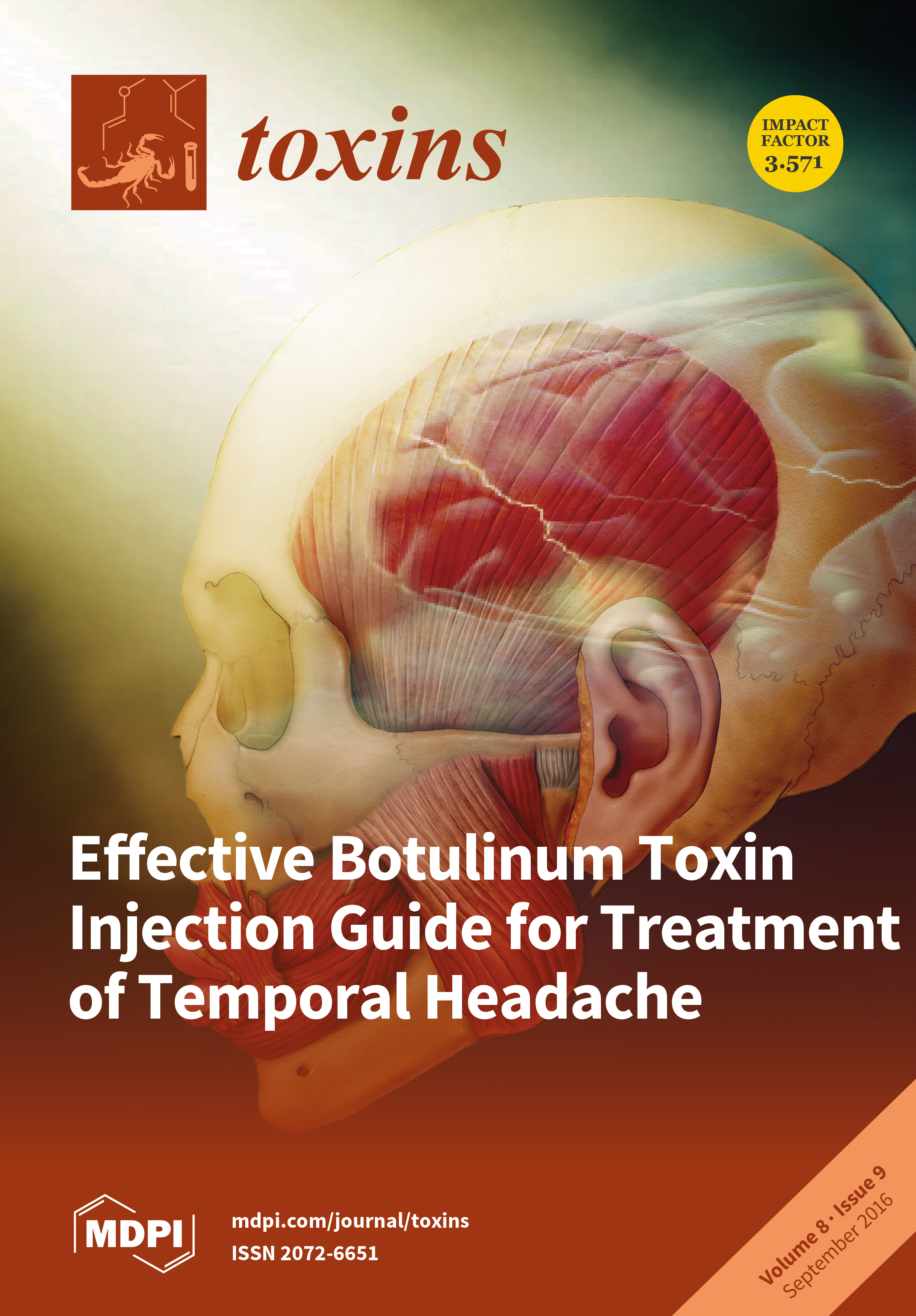
Cover Story: Injection of botulinum toxin type A (BoNT-A) is a popular treatment for temporal headache. Clinicians should have a detailed understanding of the temporalis anatomy before performing BoNT-A. We conducted a cadaveric study to better characterize the anatomy of the temporalis tendon and in turn improve the delivery of BoNT-A into this region. An easily identifiable and effective injection site for BoNT-A on the temporalis muscle has been suggested in this study.View this paper.
  • Issues are regarded as officially published after their release is announced to the table of contents alert mailing list .
  • You may sign up for email alerts to receive table of contents of newly released issues.
  • PDF is the official format for papers published in both, html and pdf forms. To view the papers in pdf format, click on the "PDF Full-text" link, and use the free Adobe Reader to open them.

Articles (23)

  • Article
  • Open Access
23 Citations
7,283 Views
15 Pages

Confirmation and Fine Mapping of a Major QTL for Aflatoxin Resistance in Maize Using a Combination of Linkage and Association Mapping

  • Yu Zhang,
  • Min Cui,
  • Jimin Zhang,
  • Lei Zhang,
  • Chenliu Li,
  • Xin Kan,
  • Qian Sun,
  • Dexiang Deng and
  • Zhitong Yin

2 September 2016

Maize grain contamination with aflatoxin from Aspergillus flavus (A. flavus) is a serious health hazard to animals and humans. To map the quantitative trait loci (QTLs) associated with resistance to A. flavus, we employed a powerful approach that dif...

  • Communication
  • Open Access
12 Citations
5,627 Views
10 Pages

A Novel Zak Knockout Mouse with a Defective Ribotoxic Stress Response

  • Dakshina M. Jandhyala,
  • John Wong,
  • Nicholas J. Mantis,
  • Bruce E. Magun,
  • John M. Leong and
  • Cheleste M. Thorpe

2 September 2016

Ricin activates the proinflammatory ribotoxic stress response through the mitogen activated protein 3 kinase (MAP3K) ZAK, resulting in activation of mitogen activated protein kinases (MAPKs) p38 and JNK1/2. We had a novel zak−/− mouse generated to st...

  • Article
  • Open Access
13 Citations
7,455 Views
17 Pages

Development of Toxicological Risk Assessment Models for Acute and Chronic Exposure to Pollutants

  • Elke S. Reichwaldt,
  • Daniel Stone,
  • Dani J. Barrington,
  • Som C. Sinang and
  • Anas Ghadouani

31 August 2016

Alert level frameworks advise agencies on a sequence of monitoring and management actions, and are implemented so as to reduce the risk of the public coming into contact with hazardous substances. Their effectiveness relies on the detection of the ha...

  • Article
  • Open Access
62 Citations
8,511 Views
11 Pages

Exposure Assessment of Infants to Aflatoxin M1 through Consumption of Breast Milk and Infant Powdered Milk in Brazil

  • Angélica T. Ishikawa,
  • Cássia R. Takabayashi-Yamashita,
  • Elisabete Y. S. Ono,
  • Artur K. Bagatin,
  • Fabiana F. Rigobello,
  • Osamu Kawamura,
  • Elisa Y. Hirooka and
  • Eiko N. Itano

31 August 2016

Aflatoxin M1 (AFM1) is an important biomarker that can be used to evaluate aflatoxin exposure in both humans and animals. The aim of this study was to evaluate the exposure degree of infants to AFM1 through consumption of breast milk and infant powde...

  • Article
  • Open Access
22 Citations
5,956 Views
14 Pages

31 August 2016

Mycotoxins pose a challenge to a safe food supply worldwide, and their threat is expected to worsen with our changing climate. The need for diligence is exemplified by the discovery of fumonisin B2 in wine, which joins ochratoxin A as a mycotoxin of...

  • Communication
  • Open Access
24 Citations
6,240 Views
6 Pages

Presence of the Cyanotoxin Microcystin in Arctic Lakes of Southwestern Greenland

  • Jessica V. Trout-Haney,
  • Zachary T. Wood and
  • Kathryn L. Cottingham

31 August 2016

Cyanobacteria and their toxins have received significant attention in eutrophic temperate and tropical systems where conspicuous blooms of certain planktonic taxa release toxins into fresh water, threatening its potability and safe use for recreation...

  • Article
  • Open Access
9 Citations
6,347 Views
21 Pages

31 August 2016

Phylloseptin (PS) peptides, derived from South American hylid frogs (subfamily Phyllomedusinae), have been found to have broad-spectrum antimicrobial activities and relatively low haemolytic activities. Although PS peptides have been identified from...

  • Review
  • Open Access
29 Citations
10,621 Views
20 Pages

Natural Inhibitors of Snake Venom Metalloendopeptidases: History and Current Challenges

  • Viviane A. Bastos,
  • Francisco Gomes-Neto,
  • Jonas Perales,
  • Ana Gisele C. Neves-Ferreira and
  • Richard H. Valente

26 August 2016

The research on natural snake venom metalloendopeptidase inhibitors (SVMPIs) began in the 18th century with the pioneering work of Fontana on the resistance that vipers exhibited to their own venom. During the past 40 years, SVMPIs have been isolated...

of 3

Get Alerted

Add your email address to receive forthcoming issues of this journal.

XFacebookLinkedIn
Toxins - ISSN 2072-6651