

You are currently viewing a new version of our website. To view the old version click .

Toxins, Volume 8, Issue 10

October 2016 - 36 articles

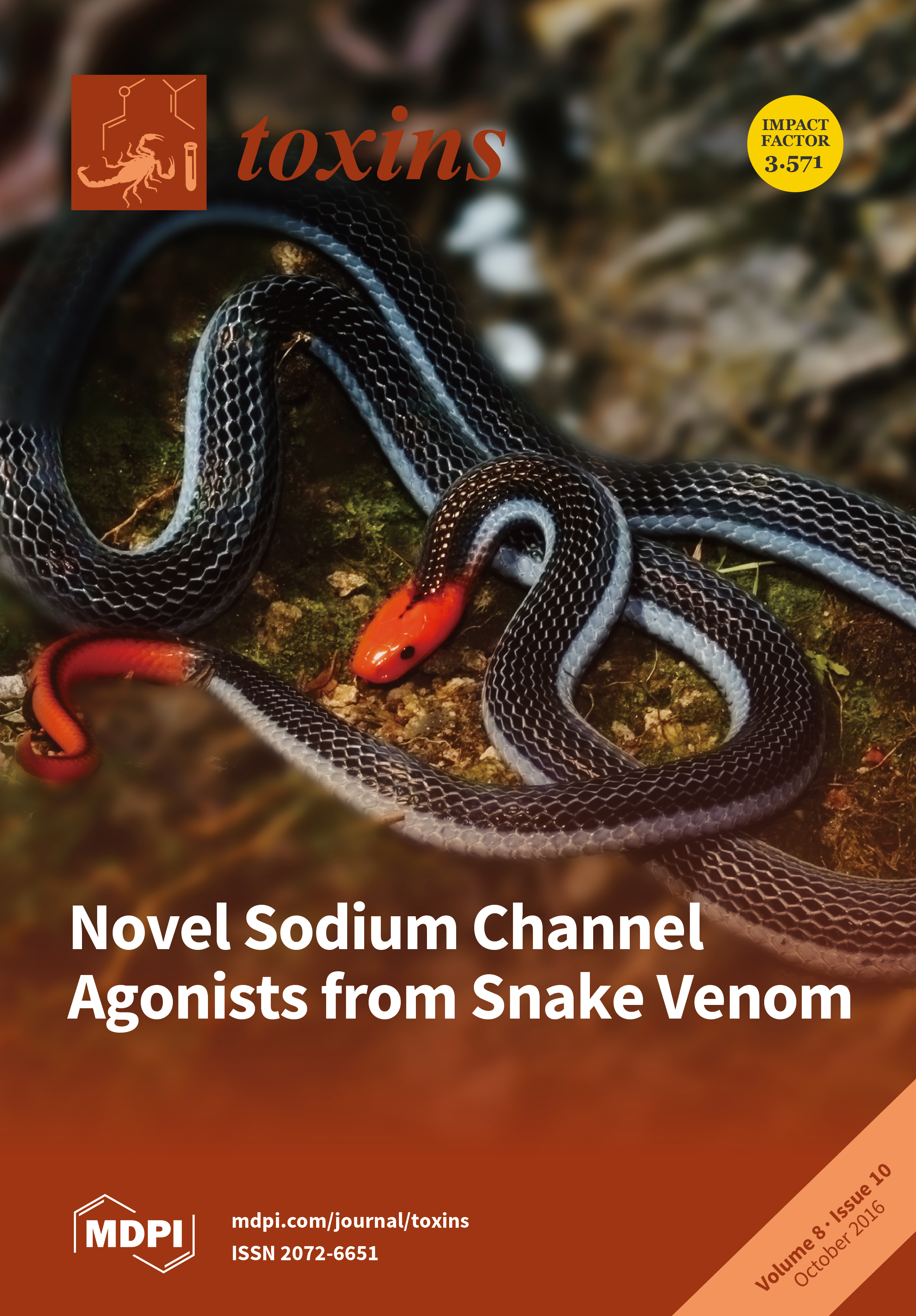
Cover Story: Sodium channels are central to a myriad of diseases and disorders ranging from pain through to neuromuscular disorders. Effects upon the Nav 1.4 sodium channel subtype range from activation, delay of inactivation, and inhibition. Effects therefore range from hyperstimulated muscle contraction producing rigid paralysis (hperkalemic periodic paralysis and myotonia) through to inability to contract muscles (hypokalemic periodic paralysis). This article reports the discovery in the venom of the long-glanded blue coral snake (Calliophis bivirgatus) novel peptides that are the first vertebrate venom peptides selective for Nav 1.4 sodium channel delay of inactivation. These peptides will facilitate further work to probe the mechanism of activation which results in inhibition of channel deactivation.View this paper.
  • Issues are regarded as officially published after their release is announced to the table of contents alert mailing list .
  • You may sign up for email alerts to receive table of contents of newly released issues.
  • PDF is the official format for papers published in both, html and pdf forms. To view the papers in pdf format, click on the "PDF Full-text" link, and use the free Adobe Reader to open them.

Articles (36)

  • Review
  • Open Access
95 Citations
12,035 Views
21 Pages

22 October 2016

Snake venom metalloproteinases (SVMPs) affect the extracellular matrix (ECM) in multiple and complex ways. Previously, the combination of various methodological platforms, including electron microscopy, histochemistry, immunohistochemistry, and Weste...

  • Review
  • Open Access
101 Citations
20,390 Views
33 Pages

22 October 2016

Bacterial toxin–antitoxin (TA) systems have received increasing attention for their diverse identities, structures, and functional implications in cell cycle arrest and survival against environmental stresses such as nutrient deficiency, antibiotic t...

  • Article
  • Open Access
31 Citations
8,582 Views
14 Pages

Proteomic Characterization and Comparison of Malaysian Tropidolaemus wagleri and Cryptelytrops purpureomaculatus Venom Using Shotgun-Proteomics

  • Syafiq Asnawi Zainal Abidin,
  • Pathmanathan Rajadurai,
  • Md Ezharul Hoque Chowdhury,
  • Muhamad Rusdi Ahmad Rusmili,
  • Iekhsan Othman and
  • Rakesh Naidu

18 October 2016

Tropidolaemus wagleri and Cryptelytrops purpureomaculatus are venomous pit viper species commonly found in Malaysia. Tandem mass spectrometry analysis of the crude venoms has detected different proteins in T. wagleri and C. purpureomaculatus. They we...

  • Article
  • Open Access
28 Citations
6,795 Views
18 Pages

18 October 2016

There is limited information on the cross-neutralisation of neurotoxic venoms with antivenoms. Cross-neutralisation of the in vitro neurotoxicity of four Asian and four Australian snake venoms, four post-synaptic neurotoxins (α-bungarotoxin, α-elapit...

  • Article
  • Open Access
19 Citations
6,753 Views
13 Pages

18 October 2016

Resistance to Fusarium head blight in 32 winter triticale and 34 winter wheat accessions was evaluated. Triticale and wheat were sown in field experiments in two locations. At the time of flowering, heads were inoculated with three Fusarium culmorum...

  • Article
  • Open Access
55 Citations
43,121 Views
21 Pages

The Snake with the Scorpion’s Sting: Novel Three-Finger Toxin Sodium Channel Activators from the Venom of the Long-Glanded Blue Coral Snake (Calliophis bivirgatus)

  • Daryl C. Yang,
  • Jennifer R. Deuis,
  • Daniel Dashevsky,
  • James Dobson,
  • Timothy N. W. Jackson,
  • Andreas Brust,
  • Bing Xie,
  • Ivan Koludarov,
  • Jordan Debono and
  • Iwan Hendrikx
  • + 10 authors

18 October 2016

Millions of years of evolution have fine-tuned the ability of venom peptides to rapidly incapacitate both prey and potential predators. Toxicofera reptiles are characterized by serous-secreting mandibular or maxillary glands with heightened levels of...

  • Article
  • Open Access
3 Citations
4,794 Views
10 Pages

Improvement of the Pharmacological Properties of Maize RIP by Cysteine-Specific PEGylation

  • Ka-Yee Au,
  • Wei-Wei Shi,
  • Shuai Qian,
  • Zhong Zuo and
  • Pang-Chui Shaw

17 October 2016

To improve the pharmacological properties of maize ribosome-inactivating protein (maize RIP) for targeting HIV-infected cells, the previously engineered TAT-fused active form of maize RIP (MOD) was further engineered for cysteine-directed PEGylation....

  • Article
  • Open Access
41 Citations
7,891 Views
11 Pages

17 October 2016

Zearalenone (ZEA), an estrogenic mycotoxin, is mainly produced by Fusarium fungi. In this study, Bacillus licheniformis CK1 isolated from soil with the capability of degrading ZEA was evaluated for its efficacy in reducing the adverse effects of ZEA...

  • Article
  • Open Access
67 Citations
10,778 Views
38 Pages

Toxicity and Growth Assessments of Three Thermophilic Benthic Dinoflagellates (Ostreopsis cf. ovata, Prorocentrum lima and Coolia monotis) Developing in the Southern Mediterranean Basin

  • Hela Ben-Gharbia,
  • Ons Kéfi-Daly Yahia,
  • Zouher Amzil,
  • Nicolas Chomérat,
  • Eric Abadie,
  • Estelle Masseret,
  • Manoella Sibat,
  • Habiba Zmerli Triki,
  • Habiba Nouri and
  • Mohamed Laabir

15 October 2016

Harmful benthic dinoflagellates, usually developing in tropical areas, are expanding to temperate ecosystems facing water warming. Reports on harmful benthic species are particularly scarce in the Southern Mediterranean Sea. For the first time, three...

  • Article
  • Open Access
1 Citations
5,038 Views
14 Pages

Pentahydroxyscirpene—Producing Strains, Formation In Planta, and Natural Occurrence

  • Elisabeth Varga,
  • Gerlinde Wiesenberger,
  • Philipp Fruhmann,
  • Alexandra Malachová,
  • Thomas Svoboda,
  • Marc Lemmens,
  • Gerhard Adam and
  • Franz Berthiller

14 October 2016

Trichothecenes are a class of structurally diverse mycotoxins with more than 200 naturally occurring compounds. Previously, a new compound, pentahydroxyscirpene (PHS), was reported as a byproduct of a nivalenol producing Fusarium strain, IFA189. PHS...

of 4

Get Alerted

Add your email address to receive forthcoming issues of this journal.

XFacebookLinkedIn
Toxins - ISSN 2072-6651