


Abstract
Mycotoxin contamination remains an important issue in global food and feed safety. Although regulated mycotoxins have been extensively investigated, emerging counterparts like beauvericin and enniatins are attracting growing attention due to their wide occurrence, frequent co-presence with regulated toxins, and reported cytotoxicity. However, simultaneous multi-mycotoxin methods covering controlled and emerging mycotoxins remain limited. Herein, a rapid and sensitive ultra-performance liquid chromatography–tandem mass spectrometry (UPLC–MS/MS) method was developed to determine 40 controlled and emerging mycotoxins in feeds. The target mycotoxins exhibited excellent linearity (0.01–100 ng/mL, R2 > 0.9953), low limits of detection (0.075–0.75 μg/kg) and quantification (0.25–2.50 μg/kg), and mean recoveries ranging from 70.3% to 117.4%, with intra- and inter-day relative standard deviations below 20.0%. Application to 35 commercial feed samples purchased from Chinese e-commerce platforms revealed widespread and diverse mycotoxin contamination with prevalent co-occurrence. Beauvericin and enniatins were detected at remarkably high frequencies of 94.29% and 60.00%, respectively, with contamination levels of 0.31–284.77 μg/kg, and most samples were co-contaminated with more than two mycotoxins. These results highlight the widespread co-contamination of controlled and emerging mycotoxins in commercial feeds from China, and the proposed method provides a sensitive and efficient tool for routine monitoring and risk assessment of mycotoxin contamination.
Key Contribution:
A validated UPLC-MS/MS platform covering both controlled and emerging mycotoxins was established and applied to commercial feeds, supporting routine monitoring and regulatory prioritization of currently unregulated toxins.
1. Introduction
Mycotoxins are toxic secondary metabolites produced by filamentous fungi, and they represent one of the most widespread and economically important contaminants affecting the global feed and food supply [1,2]. Global climate change and evolving feed storage conditions have made mycotoxin contamination in livestock and poultry farming increasingly complex, with associated risks intensifying notably in recent years [3,4]. Meanwhile, the withdrawal of in-feed antibiotic growth promoters has also been shown to be associated with impaired intestinal health and increased enteric diseases in farm animals [5], further underscoring the importance of mycotoxin monitoring in the post-antibiotic era. These toxins not only directly impair animal health, causing growth retardation, immune dysfunction, and even mortality, but also accumulate in animal-derived foods such as meat and eggs through the food chain, posing a serious threat to food safety [6]. Approximately 60–80% of agricultural commodities worldwide contain detectable concentrations of mycotoxins. Co-contamination by multiple toxins is common, leading to substantial economic losses [7].
More than 500 chemically defined mycotoxins are currently known [8]. The controlled mycotoxins mainly include aflatoxins (AFs), trichothecenes (e.g., T-2 toxin and deoxynivalenol, DON), zearalenone (ZEN), ochratoxin A (OTA), and fumonisins (FBs) [9,10,11]. Beyond these, emerging mycotoxins are being identified at an accelerating pace [12]. These are increasingly detected in feed matrices and may produce combined toxic effects together with controlled mycotoxins, thereby exerting a major impact on feed safety [13,14,15]. Emerging mycotoxins, including nivalenol, enniatins (ENNs), beauvericin (BEA), moniliformin, sterigmatocystin, and fusaric acid, are now among the most prevalent contaminants of cereals and feed commodities worldwide, with pooled mean concentrations reaching several hundred to several thousand μg/kg [14]. These contaminants frequently co-occur with controlled mycotoxins in the same commodity [16,17], and several exhibit notable bioactivities, including cytotoxicity and estrogenic activity. Meanwhile, masked forms of regulated mycotoxins have also been detected in feed matrices and may undergo metabolism in the digestive tract [15,18]. However, they remain largely unregulated, and no tolerable daily intake or maximum levels have been established for ENNs and BEA owing to persistent data gaps [19]. Since emerging mycotoxins have diverse chemical structures and complex toxicological properties, developing suitable analytical methods for their surveillance and regulation remains a major challenge.
Effective hazard assessment depends on comprehensive occurrence data. However, analytical methodology has lagged behind the growing number of toxicologically relevant mycotoxins. Most routine monitoring programs and published studies have targeted a limited set of regulated mycotoxins [3,20], most of which rely on immunoassays or single-class chromatographic methods. These approaches cannot fully capture the range of co-occurring contaminants, particularly the structurally diverse emerging toxins, for which certified reference standards, occurrence data, and regulatory limits are still lacking [14]. Liquid chromatography–tandem mass spectrometry (LC–MS/MS) has transformed multi-mycotoxin analysis, making it possible to detect and quantify tens to hundreds of analytes simultaneously in a single run with high selectivity and sensitivity [21,22]. However, applying this technique to feed matrices presents considerable challenges. Feeds are complex mixtures rich in lipids, proteins, and pigments, all of which can cause significant matrix effects. Emerging mycotoxins further complicate the picture, as they cover a wide range of polarities and are typically present at trace levels. As a result, sample preparation strategies such as QuEChERS-based extraction must strike a balance between broad analyte coverage and acceptable recovery rates [8,23]. Recent LC–MS/MS surveys have begun to fill this gap, quantifying regulated, masked, and emerging toxins simultaneously in finished feeds and maize, with national-scale profiling also reported for Chinese feeds [3,17]. Furthermore, targeted studies have revealed extreme multi-toxin co-contamination in Chinese dairy cow feeds, with over 95% of samples containing three or more co-occurring mycotoxins and nearly 50% containing seven or more [24]. However, systematic investigations integrating feed raw materials, complete feeds, and animal-derived products within actual farming systems remain scarce, and the contamination characteristics and relative contributions of emerging versus controlled mycotoxins under practical farming conditions are still poorly characterized.
In this study, we developed and validated a sensitive UPLC–MS/MS method for the simultaneous determination of controlled and emerging mycotoxins in feed samples. The method was then applied to investigate the occurrence and co-occurrence of these toxins in commercial feed products collected from Chinese e-commerce platforms. Our findings provide a detailed picture of mycotoxin contamination patterns and can serve as a reference for risk monitoring and feed safety management.
2. Results
2.1. Optimization of Sample Preparation
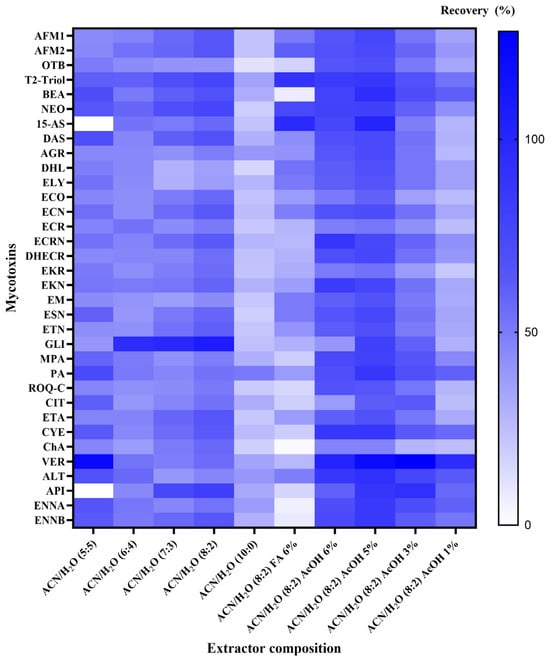
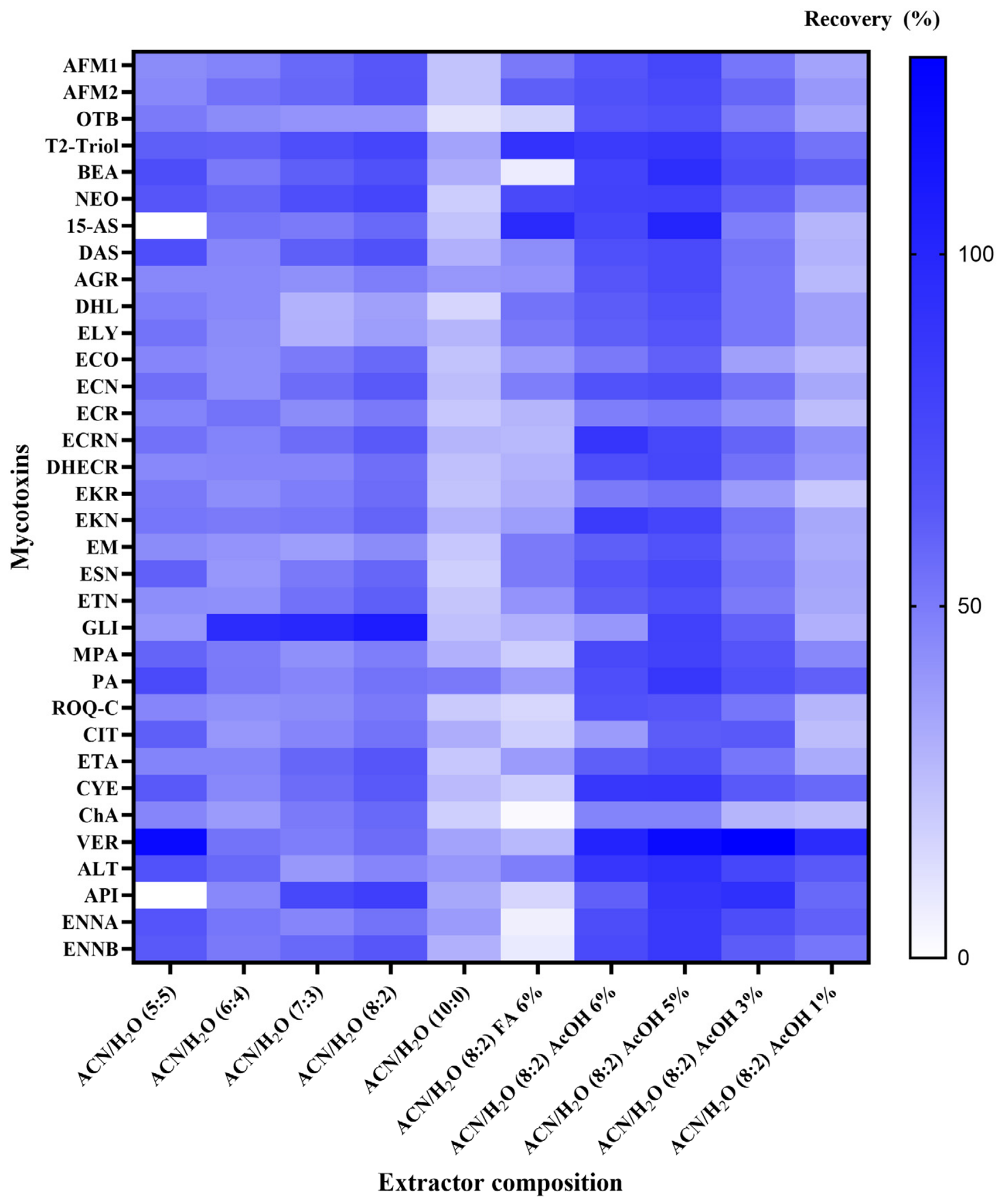
Extraction solvents were first compared. Although methanol–water (8:2, v/v) afforded higher extraction recoveries, acetonitrile–water (8:2, v/v) provided approximately one order of magnitude higher signal intensities for most mycotoxins. Acetonitrile was therefore selected to maximize detection sensitivity. The acetonitrile-to-water ratio was subsequently optimized. Recoveries increased with acetonitrile content up to a plateau at 7:3 (v/v) (e.g., 98% for gliotoxin (GLI) and approximately 50% for most ergot alkaloids), whereas pure acetonitrile markedly reduced extraction efficiency. Among acidifiers, acetic acid outperformed formic acid at an equivalent volume. The final extraction solvent was thus acetonitrile/water/acetic acid (80:20:0.05, v/v/v). The recoveries of Group A mycotoxins under different solvent systems are shown in Figure 1. Full names and abbreviations of the target mycotoxins are listed in Table 1.
Figure 1.
Comparison of extraction efficiency of various mycotoxins in different extraction systems under ESI+ mode. Effect of the acetonitrile/water (ACN/H2O) volume ratio of the extraction solvent on the recoveries of the mycotoxins. Recoveries were determined at ACN/H2O ratios of 5:5, 6:4, 7:3, 8:2, and 10:0 (pure acetonitrile). With ACN/H2O (8:2, v/v) selected as the optimal extraction solvent, the effects of acidifying agents and their concentrations were further evaluated. The tested compositions were ACN/H2O/formic acid (80:20:0.06, v/v/v) and ACN/H2O/acetic acid at ratios of 80:20:0.06, 80:20:0.05, 80:20:0.03, and 80:20:0.01 (v/v/v).
Table 1.
Chemical name, abbreviation, and CAS number of targeted mycotoxins.
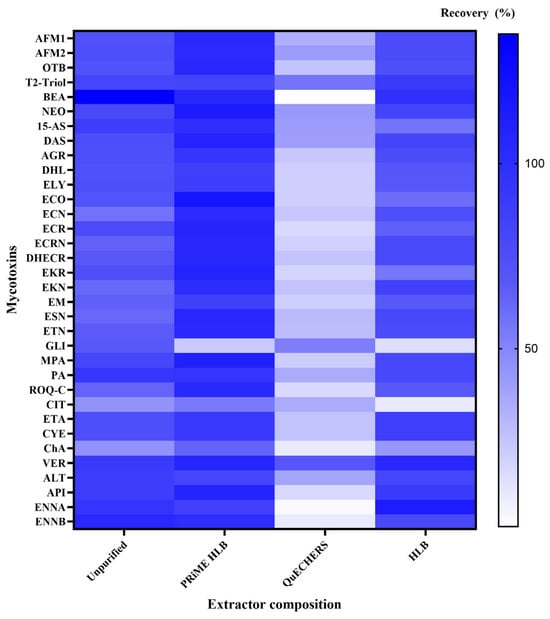
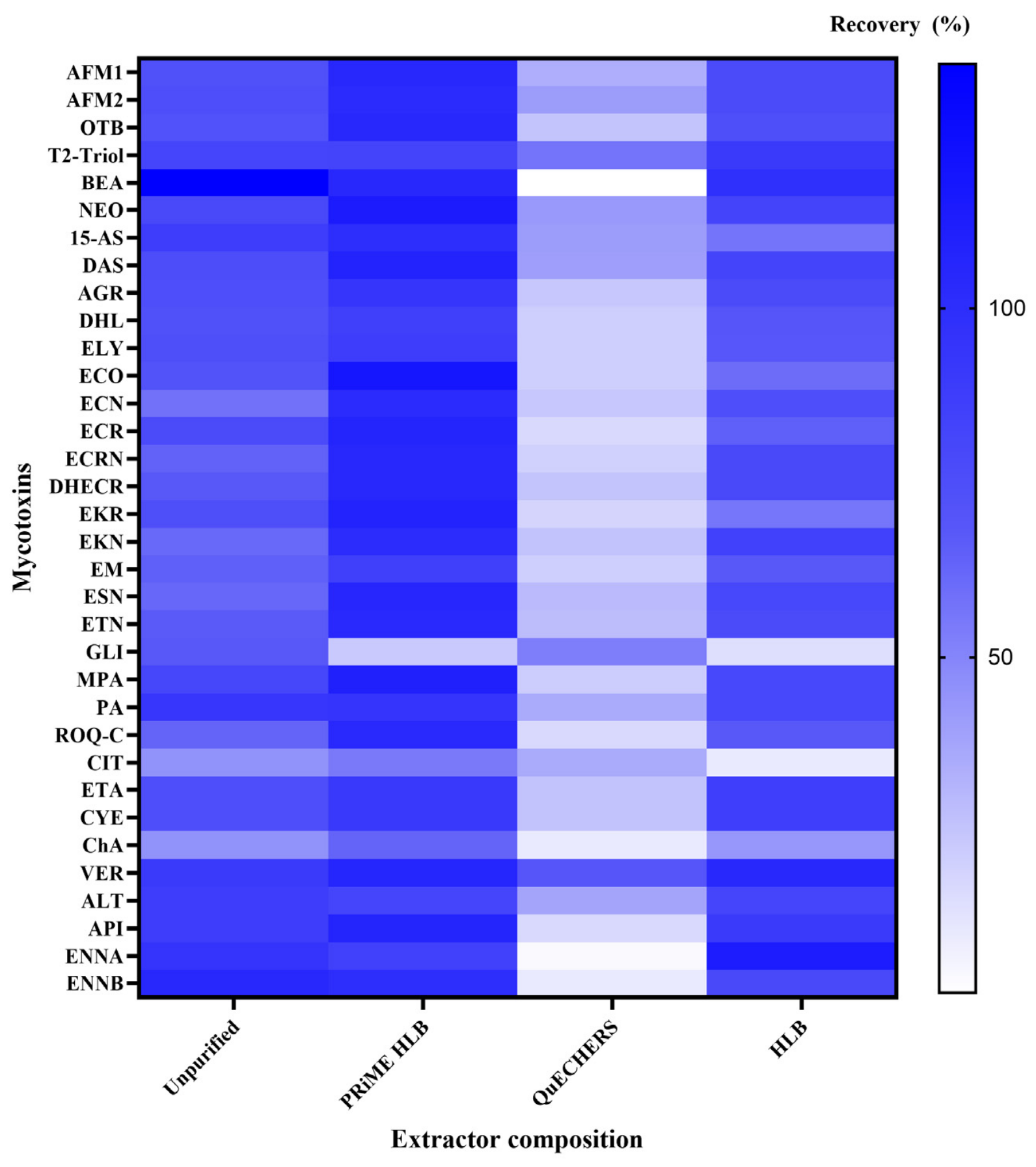
Three cleanup strategies were then compared. Conventional Oasis HLB requires conditioning, washing, and elution steps, in which highly hydrophobic emerging mycotoxins may be irreversibly adsorbed. However, modified QuEChERS involves repeated transfer, concentration, and solvent-exchange steps that risk analyte loss. Oasis PRiME HLB, which operates without conditioning and provided satisfactory recoveries for most analytes, was selected as the cleanup protocol (Figure 2).
Figure 2.
Comparison of recovery rates of various mycotoxins in the ESI+ mode under different purification methods.
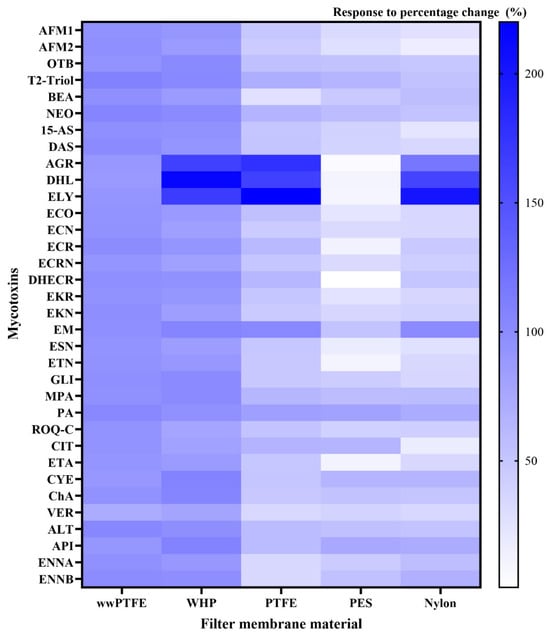
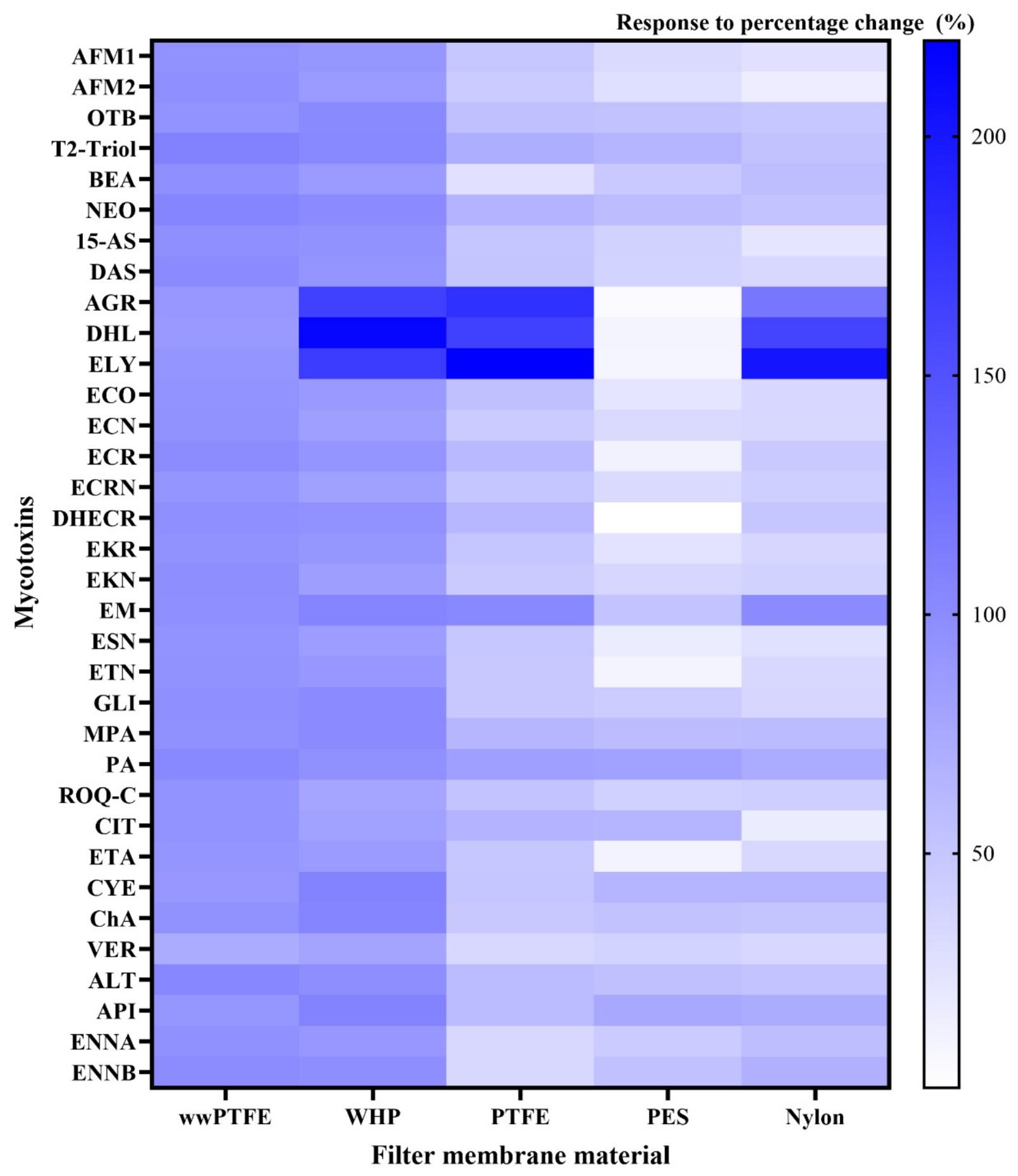
Because filtration may cause analyte adsorption, five 0.2 μm organic-compatible syringe filters (nylon, PTFE, PP, PES, and hydrophilic PTFE) were compared using a 20 ng/mL mixed standard. Nylon, PES, and conventional PTFE absorbed lipophilic or cyclic toxins such as citrinin (CIT) and BEA, whereas response enhancement was observed for a minor subset of analytes (AGR, DHL, and ELY). In contrast, hydrophilic PTFE (wwPTFE) exhibited negligible adsorption for all toxin classes, with recoveries of 90–100% and compatibility across aqueous, acidic, alkaline, and organic media (Figure 3).
Figure 3.
Adsorption and ion response of mycotoxins in ESI+ mode by different material filter membranes. The five filter membranes were the wwPTFE Acrodisc Mini Syringe Filter, 0.2 μm, 13 mm (hydrophilic polytetrafluoroethylene, wwPTFE); WR Hydrophilic Polypro, 0.22 μm (hydrophilic polypropylene, WHP); PTFE membrane, 0.22 μm, 13 mm (polytetrafluoroethylene, PTFE); PES membrane, 0.22 μm, 13 mm (polyethersulfone, PES); and imported nylon 66 membrane, 0.22 μm, 13 mm (Nylon).
2.2. Optimization of UPLC-MS/MS
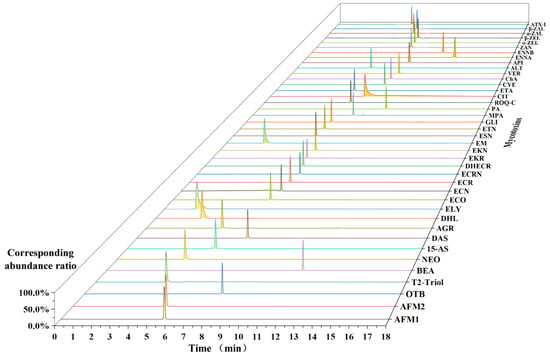
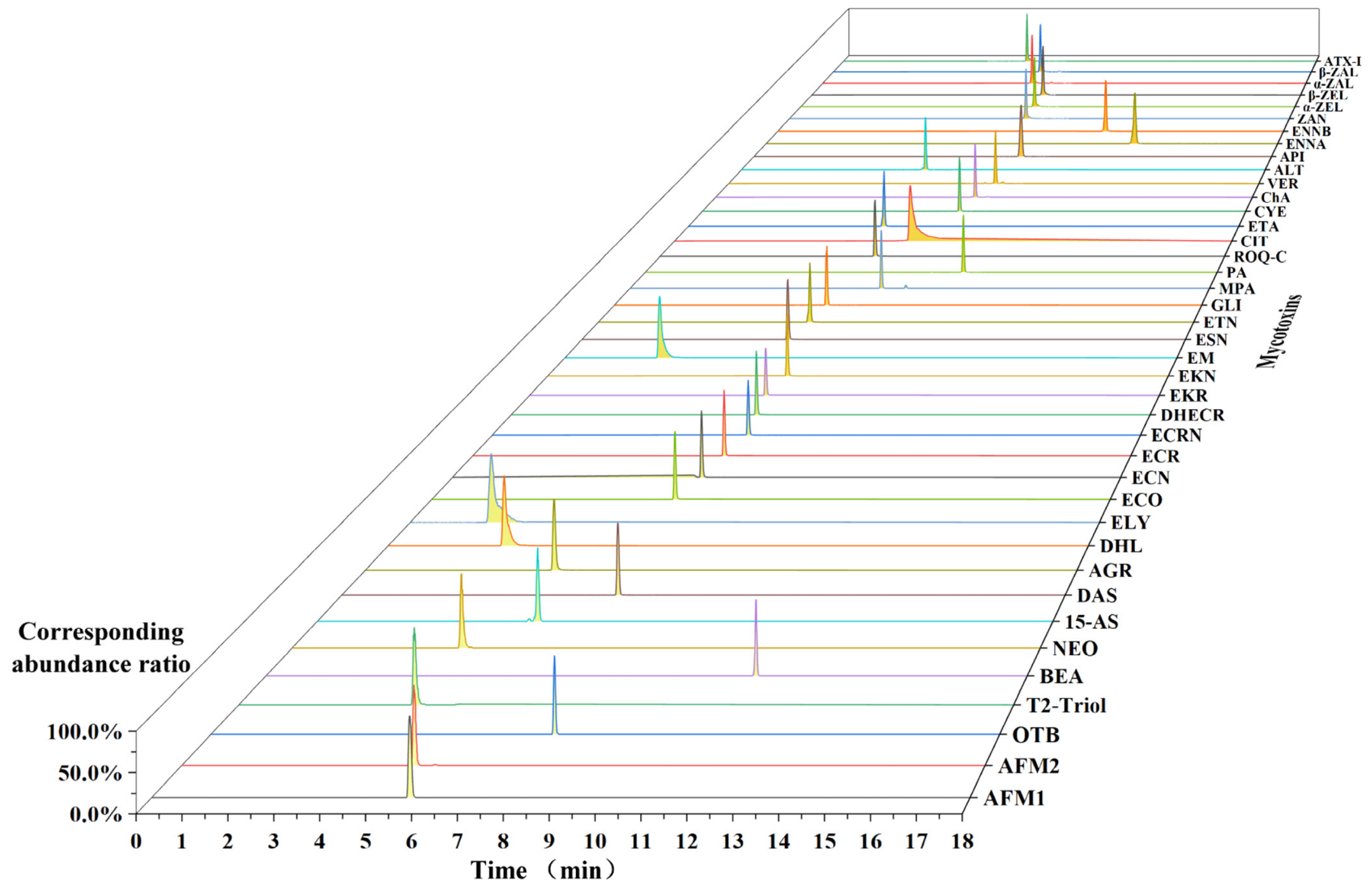
The LC–MS/MS parameters, including the mobile phase gradient, dwell time, declustering potential (DP), and collision energy (CE), were optimized to achieve baseline separation of all 40 target mycotoxins within an 18 min run. The retention times of the analytes are listed in Table S1, and the corresponding extracted ion chromatograms (EICs) are shown in Figure 4.
Figure 4.
Extracted ion chromatograms of 40 controlled and emerging mycotoxins.
2.3. Method Validation Results
2.3.1. Linearity and Matrix Effect
All analytes exhibited excellent linearity over their respective calibration ranges, with R2 of 0.9953–0.9999. MEs varied substantially among the mycotoxins, ranging from −79.06% to +45.26%, with ion suppression predominating (Table S2). Notably, the emerging mycotoxins BEA and the ENNs were only weakly affected (|ME| < 20%), whereas most ergot alkaloids underwent strong ion suppression (ME ≈ −40% to −50%). Matrix-matched calibration was therefore applied for quantification to compensate for these effects.
2.3.2. Specificity
No significant interfering peaks were detected at or near the expected retention times of the target analytes in blank matrices. When analytes were spiked into methanol, sharp and symmetrical peaks with strong signal responses were observed. In spiked feed samples, the target analytes were well separated chromatographically, and their retention times were consistent with those of the reference standards. This indicates that there is no substantial interference from endogenous matrix components during analysis. Chromatograms for the ESI+ group of mycotoxins in blank matrix, methanol solution, and spiked samples are provided in Figure S2.
2.3.3. Limits of Detection (LODs) and Quantification (LOQs)
LODs and LOQs for all target analytes ranged from 0.075 to 0.75 μg/kg and 0.25 to 2.50 μg/kg, respectively. Relatively higher limits were observed for certain analytes characterized by strong polarity or poor ionization efficiency. The LOD and LOQ values for each analyte are presented in detail in Table 2.
Table 2.
LODs and LOQs of 40 controlled and emerging mycotoxins in feeds.
2.3.4. Recovery and Precision
Method validation was performed at three spiking levels (2.5, 12.5, and 25 μg/kg, corresponding to 1, 5, and 10 times the highest LOQ of 2.50 μg/kg). The acceptance criteria were adapted from Commission Implementing Regulation (EU) 2023/2782 [25], which lays down the official methods of sampling and analysis for the control of mycotoxin levels and specifies, for confirmatory methods, an average recovery of 70–120% and relative standard deviations of repeatability (RSDr) and within-laboratory reproducibility (RSDwR) not exceeding 20%. Since this regulation applies to food and no equally detailed mycotoxin-specific performance criteria are currently available for feed at the EU level, these criteria were applied here as a validation benchmark for a feed matrix. The mean recoveries for the different mycotoxins ranged from 70.3% to 117.4% across the three spiking levels, with intra- and inter-day RSDs all below 20%. All 40 analytes fully satisfied the acceptance criteria (70–120% recovery, ≤20% RSD) at all three concentration levels, indicating that the method provides reliable quantitative performance for the entire analyte panel despite their broad chemical diversity. Detailed results are provided in Table 3.
Table 3.
Mean recoveries of 40 controlled and emerging mycotoxins in spiked samples at different concentrations.
2.4. Real Sample Analysis
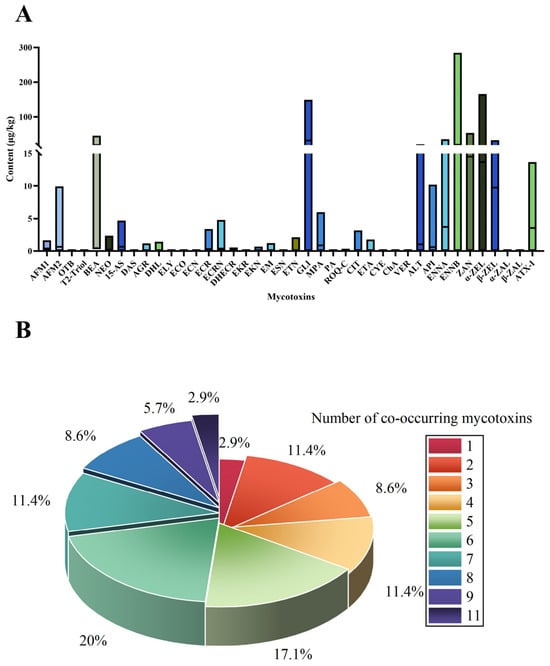
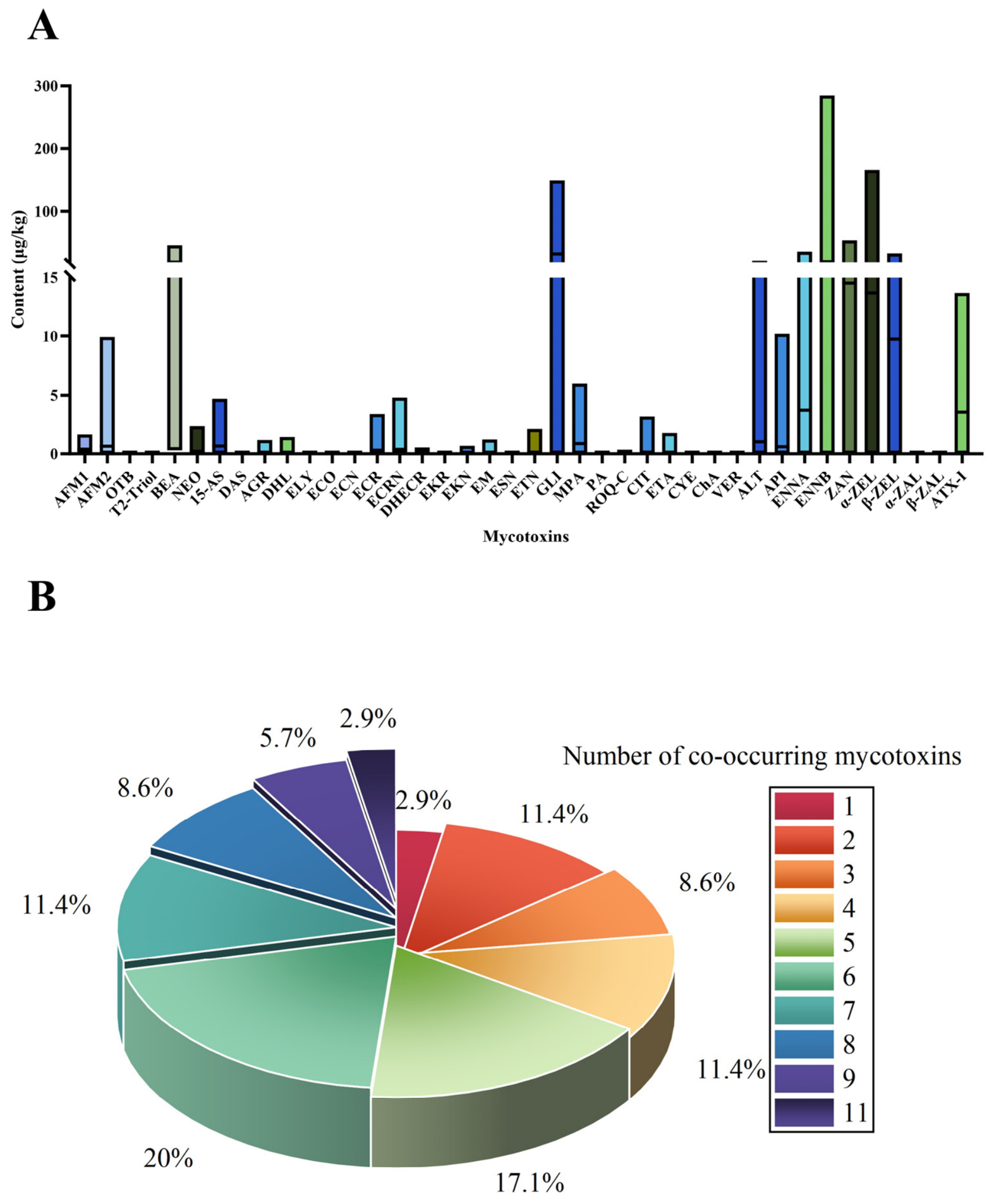
A total of 26 mycotoxins were detected in feed samples, revealing complex contamination profiles. BEA was detected in 94.29% of samples at 0.31–167.85 μg/kg (mean 44.48 μg/kg), the highest mean concentration among all detected toxins, while ENNA and ENNB (ENNA, 82.86%; ENNB, 85.71%) were also widespread, with ENNB reaching the highest single-sample concentration of 284.77 μg/kg. Detailed results are shown in Figure 5A and Table 4. Notably, 97.1% of the samples were found to contain two or more mycotoxins (Figure 5B).
Figure 5.
Occurrence and content levels of 26 mycotoxins in feed samples. (A) Types and content levels of 26 mycotoxins detected in feed samples. (B) Number of co-occurring mycotoxins in feed samples.
Table 4.
Occurrence and contamination levels of 40 controlled and emerging mycotoxins in feed samples.
3. Discussion
The development of methods for simultaneously detecting multiple mycotoxins has become an important area of food safety research. Feed samples are particularly challenging to analyze because they contain a wide range of interfering substances, including lipids, proteins, and pigments. At the same time, the target analytes include many emerging mycotoxins with highly varied chemical structures. For these reasons, developing a sample preparation protocol that works well for multiple mycotoxins is critical for obtaining accurate and reliable analytical results.
Acetonitrile and acidified acetonitrile are commonly used as extraction solvents for mycotoxin analysis by LC–MS/MS. Silva et al. (2023) [26] developed a method for 21 mycotoxins and found that increasing the degree of acidification improved the recovery of some analytes; consequently, 5% formic acid in acetonitrile was selected as the extraction solvent. Woo et al. (2024) [27] established a method for 17 Fusarium toxins and pointed out that, although QuEChERS was operationally simple, it was associated with pronounced matrix effects and insufficient sensitivity; therefore, HLB SPE was employed to reduce interference from complex matrices. In the present study, we used Oasis® PRiME HLB for sample cleanup. Unlike conventional HLB, PRiME HLB does not require activation and equilibration steps, which simplifies the overall procedure and reduces the risk of analyte loss during repeated sample transfers. In particular, for strongly hydrophobic emerging mycotoxins such as ENNs, BEA, and ergot alkaloids, the overall recoveries obtained with PRiME HLB in this study were markedly better than those obtained with conventional HLB and QuEChERS. Whereas most previous studies have used ordinary PTFE or nylon membranes, few have systematically investigated membrane adsorption of emerging mycotoxins. We also compared several types of syringe filter membranes. We found that conventional PTFE, nylon, and PES membranes caused varying degrees of adsorption or signal enhancement for certain lipophilic toxins. In contrast, hydrophilic PTFE (wwPTFE), which is modified to be compatible with acetonitrile–water mixtures, showed more consistent filtration performance and caused less signal loss when working with complex feed matrices.
The present study achieved the simultaneous determination of 40 controlled and emerging mycotoxins, covering not only common targets such as BEA, ENNs, and ZELs but also emerging mycotoxins that have attracted increasing attention in recent years, including ergot alkaloids, Alternaria toxins, and Penicillium toxins. In terms of sensitivity, the LODs obtained in this study for BEA, ENNA, ENNB, NEO, and ZELs were comparable to or even lower than those reported in previous studies. In the study by Woo et al. (2024), the LOD of ENNB was 0.02 μg/kg [27], whereas the corresponding LOD in the present study was 0.425 μg/kg. For ergot alkaloids, García-Juan et al. (2023) [28] reported LOQs mainly in the range of 0.5–1.0 μg/kg, together with significant matrix effects; for example, strong signal suppression was observed for ergocornine, ergocristinine, and ergotamine, with matrix effects of 60%, 72%, and 69%, respectively. In contrast, by optimizing an acetonitrile–water–acetic acid extraction system and combining Oasis® PRiME HLB cartridges with wwPTFE filtration, the present study effectively reduced ion suppression in complex feed matrices. Most of the target analytes showed good linearity, with R2 values above 0.9953. All 40 analytes fully met the performance criteria of Regulation (EU) 2023/2782 [25], namely 70–120% recovery and ≤20% RSD, at all three spiking levels, with recoveries ranging from 70.3% to 117.4% and all intra- and inter-day RSDs below 20%. This robust validation performance, achieved despite the broad chemical diversity of the targeted compounds, demonstrates that the optimized sample preparation and instrumental conditions provide reliable quantitative data for the entire analyte panel.
The occurrence of BEA and ENNs in feed varies considerably among regions and commodities: in corn silage, high contamination frequencies of emerging Fusarium mycotoxins have been reported, with BEA and ENNs detected in the majority of samples at mean concentrations of approximately 4–31 μg/kg dry matter and <1–6 μg/kg dry matter, respectively [29]. In wheat and wheat-based products from Shandong, China, detection frequencies were 56.4%, 37.5%, and 58.1% for BEA, ENA, and ENB, respectively, with generally low mean concentrations (0.41, 0.19, and 1.19 μg/kg, respectively) [30]. The detection frequencies and concentrations of BEA in the present study were markedly higher than these reported values, whereas those of ENNA and ENNB were comparable or only slightly higher, indicating region- and commodity-specific contamination patterns. The ubiquitous co-occurrence of multiple unregulated emerging toxins observed here is consistent with recent reports and highlights potential mixture-related toxicological risks. However, it should be noted that these samples were collected via e-commerce channels using a convenience sampling approach, and the contamination frequencies observed may not be directly extrapolated to the overall Chinese feed market.
4. Conclusions
A sensitive and reliable UPLC–MS/MS method was developed and validated for the simultaneous determination of 40 controlled and emerging mycotoxins in commercial feed products. Systematic optimization selected acidified acetonitrile as the extraction solvent, Oasis PRiME HLB as the cleanup sorbent, and hydrophilic PTFE (wwPTFE) as the filtration membrane. LODs and LOQs for the target analytes ranged from 0.075 to 0.750 μg/kg and 0.25 to 2.50 μg/kg, respectively. Notably, 26 toxins were detected in real feed samples, with BEA (94.29%, up to 168.10 μg/kg) and ENNB (60.00%) predominating, and 97.1% of samples were co-contaminated by at least two toxins. All 26 detected mycotoxins are reported as fully quantitative, since all 40 target analytes met the performance criteria of Regulation (EU) 2023/2782 [25] (70–120% recovery, ≤20% RSD) at all three spiking levels. These findings highlight the widespread occurrence and co-exposure of currently unregulated emerging mycotoxins in commercially available feeds in China and support their prioritization in surveillance, risk assessment, and regulatory control.
5. Materials and Methods
5.1. Chemicals and Reagents
Analytical-grade ammonium formate and formic acid were supplied by J&K Scientific (Beijing, China), and analytical-grade ammonium acetate was acquired from Dikma Technologies (Beijing, China). LC-MS-grade acetonitrile and methanol were purchased from Honeywell Research Chemicals (Morris plains, NJ, USA). Oasis PRiME HLB and Oasis HLB cartridges (both 6 cc, 200 mg), along with the ACQUITY UPLC HSS C18 column (2.1 × 100 mm, 1.8 μm), were acquired from Waters Corporation (Milford, MA, USA). QuEChERS extraction salt packets (comprising 4 g MgSO4, 1 g NaCl, 1 g TSCD, and 0.5 g DHS), the dedicated N-nitrosamine purification tubes (15 mL, containing 1000 mg HMR-Lipid dispersant), and WR Hydrophilic Polypro 0.22 μm syringe filters were supplied by Beijing Naou Technology Co., Ltd. (Beijing, China). Additionally, various other syringe filters were employed, including Acrodisc 13 mm Minispike 0.2 μm wwPTFE and 0.2 μm nylon filters (Pall Corporation, Port Washington, NY, USA), 0.2 μm polyethersulfone (PES) filters (MEMBRANA, Wuppertal, Germany), and 0.2 μm hydrophobic PTFE filters (Stemman Scientific Research Co., Ltd., Shanghai, China).
Certified analytical standards were obtained from Tianjin Alfa Technology Co., Ltd. (Tianjin, China). The chemical names, CAS registry numbers, and abbreviations of these standards are detailed in Table 1, and the chemical structures are shown in Figure S1. ChA and CYE reference standards were supplied as solid powders, whereas the remaining standards were procured as liquid solutions. Primary stock solutions (1 mg/mL) of CYE and ChA were prepared by dissolving accurately weighed amounts (1.20 and 1.15 mg, respectively) in methanol. All initial solutions (1 mg/mL, 100 μg/mL, and 50 μg/mL) were then grouped and diluted with methanol to prepare 10 μg/mL intermediate standard solutions. A multi-analyte mixed working standard was prepared by pipetting a 10 μL aliquot from each intermediate solution. The final concentration was 100 ng/mL for most target analytes, except for ENNs, which were prepared at 50 ng/mL. All standard solutions were stored at −20 °C and protected from light until use.
5.2. Sample Collection
Between March and April 2026, a total of 35 commercial feed samples were purchased from three major Chinese e-commerce platforms, including Taobao, Pinduoduo, and JD.com. The samples were selected to cover 16 provinces across mainland China. We divided these into four geographic regions: Northern Region I (Heilongjiang, Liaoning, Hebei, Beijing, Jilin, Shanxi; 9 samples), Northern Region II (Henan, Shaanxi, Ningxia, Inner Mongolia, Qinghai; 9 samples), Southern Region I (Jiangsu, Zhejiang, Shandong, Sichuan; 11 samples), and Southern Region II (Hunan, Guangxi; 6 samples).
The feed types were categorized as follows: poultry feed (n = 19), swine feed (n = 6), bovine feed (n = 4), ovine feed (n = 2), mixed ruminant feed (n = 2), and forage (n = 2). Each sample was obtained from a different manufacturer or supplier, representing an independent commercial product. Regarding handling and preservation, feeds were maintained at room temperature.
Samples were collected from commercial e-commerce channels, rather than a statistically designed nationwide survey. Therefore, the contamination rates observed here may not be directly extrapolated to the entire Chinese feed market. Nevertheless, the broad geographical coverage across 16 provinces and the inclusion of multiple feed types provide a valuable snapshot of the occurrence and co-occurrence of emerging and less-studied mycotoxins in Chinese commercial feeds.
5.3. Sample Preparation
A 2.0 g (± 0.1 g) sample was precisely weighed and suspended in 10 mL of an extraction solvent consisting of acetonitrile, water, and acetic acid (80:20:0.05, v/v/v). The mixture was agitated at 300 rpm for 20 min, followed by centrifugation at 10,000× g for 10 min at 4 °C (Allegra X-30R, Beckman Coulter, Brea, CA, USA). Subsequently, the supernatant was carefully transferred into a 15 mL centrifuge tube, evaporated to a volume of 5 mL under a gentle nitrogen stream, and thoroughly vortex-mixed (Vortex-Genie 2 mixer, Scientific Industries, Bohemia, NY, USA). To enhance the extraction efficacy, acetonitrile and methanol systems were first compared. Extraction efficiency was then evaluated across different organic-to-aqueous ratios (5:5, 6:4, 7:3, 8:2, 9:1, and 10:0, ACN/H2O, v/v), acid modifiers (formic versus acetic acid), and their supplementation levels. These evaluations led to the final organic–water–acid volumetric ratio.
Next, three sample clean-up strategies, including Oasis HLB, QuEChERS, and Oasis PRiME HLB, were evaluated and compared based on target analyte recoveries and operational simplicity. The procedures were as follows: (a) Solvent dilution: A 0.5 mL aliquot of the initial supernatant was simply combined with 0.5 mL of ultrapure water and thoroughly vortex-mixed prior to analysis. (b) The Oasis HLB cartridge was preconditioned sequentially with 5 mL of methanol and 5 mL of water. A 1 mL aliquot of the initial supernatant was diluted with 15 mL of water, and the entire 16 mL was loaded onto the cartridge. After washing with 3 mL of water, analytes were eluted sequentially with 3 mL of methanol and 3 mL of acidified methanol (0.1% formic acid). The eluate was evaporated to dryness under nitrogen and reconstituted in 1 mL of acetonitrile–water (5:5, v/v) [31]. (c) The supernatant was frozen at −20 °C for 1 h to facilitate preliminary precipitation. An extraction salt packet (4 g MgSO4, 1 g NaCl, 1 g TSCD, and 0.5 g DHS) was then added. The suspension was vortexed at 300 rpm for 30 min and centrifuged at 10,000× g for 5 min. The resulting supernatant was transferred to a fresh 15 mL centrifuge tube and concentrated to 5 mL under nitrogen at 40 °C. This extract was loaded into a 15 mL Bond Elut HMR-Lipid dSPE tube pre-activated by vortexing with 5 mL of water for 30 s. After vortexing for an additional 2 min and centrifugation (10,000× g, 4 °C, 5 min), the clarified layer was evaporated to dryness under nitrogen and redissolved in 1 mL of acetonitrile–water (5:5, v/v) [14,32]. (d) The supernatant was passed directly through an Oasis PRiME HLB pass-through cartridge. The initial 1 mL of effluent was discarded to remove early-eluting interferences, and the subsequent 1 mL was collected for analysis [33,34].
Furthermore, five syringe filters comprising the wwPTFE Acrodisc Mini Syringe Filter, 0.2 μm, 13 mm (hydrophilic polytetrafluoroethylene, wwPTFE); WR Hydrophilic Polypro, 0.22 μm (hydrophilic polypropylene, WHP); PTFE membrane, 0.22 μm, 13 mm (polytetrafluoroethylene, PTFE); PES membrane, 0.22 μm, 13 mm (polyethersulfone, PES); and imported nylon 66 membrane, 0.22 μm, 13 mm (nylon) were compared for analyte adsorption. A 20 ng/mL mixed standard solution was passed through each filter using a 1 mL syringe, and the filtrates were analyzed by LC–MS/MS. The peak-area response of each analyte in the filtrate was compared with that of the same standard solution without filtration, and the relative recovery (response ratio × 100%) was used to evaluate filter-induced analyte loss.
5.4. UPLC-MS/MS Analysis
The optimized LC-MS/MS method was performed on an ACQUITY UPLC chromatographic system (Waters, Milford, MA, USA) coupled to a QTRAP 6500+ triple quadrupole mass spectrometer (SCIEX, Framingham, MA, USA) on an ACQUITY UPLC HSS C18 column (2.1 × 100 mm, 1.8 μm) at 40 °C. Based on their physicochemical properties and adduct formation modes, the target mycotoxins were divided into two groups (A and B). For Group A, mobile phase A was 0.1% formic acid and 1 mM ammonium formate in water. For Group B, it was 0.1 mM aqueous ammonium acetate. In both configurations, acetonitrile served as mobile phase B. Chromatographic separation was conducted at 0.3 mL/min using the following gradient: 0–1.0 min, 10%B; 1.0–5.0 min, 10–30%B; 5.0–11.0 min, 30–95%B; 11.0–13.0 min, 95%B; 13.0–13.5 min, 95–100%B; 13.5–15.0 min, 100%B; then returned to 10%B at 15.1 min and held until 18.0 min for re-equilibration.
Given the diverse chemical structures and properties of these mycotoxins, a single ionization mode is insufficient for simultaneous determination. Both positive (ESI+, Group A) and negative (ESI−, Group B) electrospray ionization modes were therefore used. Constant source parameters were as follows: curtain gas, 35 psi; ion source gas 1, 40 psi; and ion source gas 2, 65 psi. The key MS parameters were set separately for each ionization mode. For ESI+, the spray voltage was 5000 V, the collision-activated dissociation gas pressure was 8 psi, and the source temperature was 500 °C. For ESI−, the corresponding values were 4500 V, 10 psi, and 550 °C, respectively. MRM parameters are listed in Table 5.
Table 5.
MRM parameters of 40 controlled and emerging mycotoxins.
5.5. Method Validation
The method was validated for linearity, matrix effects, LODs and LOQs, recovery, and intra- and inter-day precision. Matrix-matched calibration standards were prepared by serial dilution of a mixed stock solution (100 ng/mL for most analytes; 50 ng/mL for enniatins A and B (ENNA and ENNB)) with blank feed matrix extract, yielding eight-point calibration curves covering 0.1–100 ng/mL (0.1, 0.5, 1.0, 5.0, 10, 25, 50, and 100 ng/mL) for most analytes. The calibration levels for ENNA and ENNB were half of these values (0.05–50 ng/mL). Calibration curves were constructed by plotting peak area (Y) against analyte concentration (X), and linearity was assessed by the coefficient of determination (R2).
Matrix effects (MEs) were evaluated by comparing the slopes of matrix-matched calibration curves with those of solvent-based curves prepared in neat solvent, according to the following equation:
where Sm and Ss are the slopes of the calibration curves prepared in the blank matrix and the neat solvent, respectively. Positive values indicate ion enhancement, and negative values indicate ion suppression; |ME| > 20% (outside 80–120%) was considered a significant matrix effect.
ME (%) = [(Sm/Ss) − 1] × 100
The limits of detection (LODs) and quantification (LOQs) were determined based on the signal-to-noise (S/N) approach using low-concentration mixed standard solutions, with S/N ratios of ≥ 3 for LODs and ≥ 10 for LOQs. The solution-based values (expressed in ng/mL) were converted to matrix-equivalent concentrations (in μg/kg) by taking into account the sample-to-solvent ratio (2 g sample extracted into 10 mL solvent) and any concentration or dilution steps during sample preparation, thereby representing the method sensitivity for the complete analytical workflow. Recovery and precision were assessed by fortifying blank feed samples at three levels (2.5, 12.5, and 25 μg/kg). For each level, six replicates were prepared and analyzed on the same day to evaluate intra-day precision, and the entire procedure was repeated on three consecutive days to evaluate inter-day precision. In line with Regulation (EU) 2023/2782 [25], the intra-day precision (six replicates within one day) was taken as an estimate of repeatability (RSDr), and the inter-day precision (three consecutive days) as an estimate of within-laboratory reproducibility (RSDwR).
5.6. Statistical Analysis
Data processing and statistical analyses were performed using SCIEX OS software (version 3.4.5.828) for the AB SCIEX TripleQuad 6500+ and GraphPad Prism software (version 10.1.2).
Supplementary Materials
The following supporting information can be downloaded at: https://www.mdpi.com/article/10.3390/toxins18120512/s1, Table S1: Retention times (RTs) of 40 mycotoxins in feed and animal-derived foods; Table S2: Matrix effect (ME) and standard curve of 40 mycotoxins in feed samples; Figure S1: Chemical structures of 40 target mycotoxins. Controlled mycotoxin, including aflatoxin M1 and M2 (AFM1 and AFM2), ochratoxin B (OTB), and zearalenone metabolites (ZAN, α-ZEL, β-ZEL, α-ZAL, and β-ZAL); type A trichothecenes, including T2-triol, neosolaniol (NEO), 15-acetoxyscirpenol (15-AS), and diacetoxyscirpenol (DAS); ergot alkaloids (e.g., agroclavine, elymoclavine, ergotamine, ergocristine, ergocryptine, ergocornine, and their isomers); emerging mycotoxins, including enniatins (ENN A and ENN B) and beauvericin (BEA); and other fungal metabolites, including gliotoxin (GLI), mycophenolic acid (MPA), penicillic acid (PA), roquefortine C (ROQ-C), citrinin (CIT), cytochalasin E (CYE), chaetoglobosin A (ChA), verruculogen (VER), altenuene (ALT), apicidin (API), and altertoxin I (ATX-I). Structures were drawn using ChemDraw (22.0.0 64-bit); Figure S2: Specificity chromatograms of mycotoxins in ESI+ mode.
Author Contributions
Conceptualization, H.L.; methodology, R.W. and W.C.; software, R.W.; validation, R.W., W.C., Y.C. and C.L.; formal analysis, R.W. and Y.Q.; investigation, R.C.; resources, H.L.; data curation, R.W.; writing—original draft preparation, R.W. and H.L.; writing—review and editing, H.L.; visualization, R.W.; supervision, H.L.; project administration, H.L.; funding acquisition, H.L. All authors have read and agreed to the published version of the manuscript.
Funding
This work was supported by the Beijing Natural Science Foundation (Grant No. L252139).
Institutional Review Board Statement
Not applicable.
Informed Consent Statement
Not applicable.
Data Availability Statement
The original contributions presented in this study are included in the article; further inquiries can be directed to the corresponding author.
Conflicts of Interest
The authors declare no conflict of interest.
References
- Dey, D.K.; Kang, J.I.; Bajpai, V.K.; Kim, K.; Lee, H.; Sonwal, S.; Simal-Gandara, J.; Xiao, J.; Ali, S.; Huh, Y.S.; et al. Mycotoxins in food and feed: Toxicity, preventive challenges, and advanced detection techniques for associated diseases. Crit. Rev. Food Sci. Nutr. 2023, 63, 8489–8510. [Google Scholar] [CrossRef] [Scilit] [PubMed]
- Huangfu, B.; Chen, Y.; Xu, T.; Huang, K.; Liang, Z.; He, X. Mycotoxins and non-communicable diseases: Exacerbation and susceptibility. Crit. Rev. Food Sci. Nutr. 2026, 66, 3386–3402. [Google Scholar] [CrossRef] [Scilit] [PubMed]
- Hao, W.; Guan, S.; Li, A.; Wang, J.; An, G.; Hofstetter, U.; Schatzmayr, G. Mycotoxin occurrence in feeds and raw materials in China: A five-year investigation. Toxins 2023, 15, 63. [Google Scholar] [CrossRef] [Scilit] [PubMed]
- Perrone, G.; Ferrara, M.; Medina, A.; Pascale, M.; Magan, N. Toxigenic fungi and mycotoxins in a climate change scenario: Ecology, genomics, distribution, prediction and prevention of the risk. Microorganisms 2020, 8, 1496. [Google Scholar] [CrossRef] [Scilit] [PubMed]
- He, L.; Zhao, X.; Li, J.; Yang, C. Post-weaning diarrhea and use of feedstuffs in pigs. Anim. Front. 2022, 12, 41–52. [Google Scholar] [CrossRef] [Scilit] [PubMed]
- Olariu, R.M.; Fiţ, N.I.; Bouari, C.M.; Nadăş, G.C. Mycotoxins in broiler production: Impacts on growth, immunity, vaccine efficacy, and food safety. Toxins 2025, 17, 261. [Google Scholar] [CrossRef] [Scilit] [PubMed]
- Eskola, M.; Kos, G.; Elliott, C.T.; Hajšlová, J.; Mayar, S.; Krska, R. Worldwide contamination of food-crops with mycotoxins: Validity of the widely cited ‘FAO estimate’ of 25%. Crit. Rev. Food Sci. Nutr. 2020, 60, 2773–2789. [Google Scholar] [CrossRef] [Scilit] [PubMed]
- Sulyok, M.; Stadler, D.; Steiner, D.; Krska, R. Validation of an LC-MS/MS-based dilute-and-shoot approach for the quantification of > 500 mycotoxins and other secondary metabolites in food crops: Challenges and solutions. Anal. Bioanal. Chem. 2020, 412, 2607–2620. [Google Scholar] [CrossRef] [Scilit] [PubMed]
- Akinmoladun, O.F.; Fon, F.N.; Nji, Q.; Adeniji, O.O.; Tangni, E.K.; Njobeh, P.B. Multiple mycotoxin contamination in livestock feed: Implications for animal health, productivity, and food safety. Toxins 2025, 17, 365. [Google Scholar] [CrossRef] [Scilit] [PubMed]
- Bennett, J.W.; Klich, M. Mycotoxins. Clin. Microbiol. Rev. 2003, 16, 497–516. [Google Scholar] [CrossRef] [Scilit] [PubMed]
- Marin, S.; Ramos, A.J.; Cano-Sancho, G.; Sanchis, V. Mycotoxins: Occurrence, toxicology, and exposure assessment. Food Chem. Toxicol. 2013, 60, 218–237. [Google Scholar] [CrossRef] [Scilit] [PubMed]
- Adelusi, O.A.; Okechukwu, V.O.; Targuma, S.; Fagbohun, T.R.; Maphaisa, T.C.; Okunola, F.; Akanni, G.; Awafong, P.M.; Okonkwo, O.J.; El-Mesery, H.S.; et al. Emerging mycotoxins in the food chain: Occurrence, biosynthesis, toxicity, detection, and innovative control measures. J. Food Compos. Anal. 2026, 153, 109077. [Google Scholar] [CrossRef] [Scilit]
- Jin, Q.; Zhou, X.; Chen, L.; Zou, H.; Gu, J.; Yuan, Y.; Liu, X.; Liu, Z.; Cai, G.; Bian, J. Coexistence and combined toxic effects of principal emerging and common mycotoxins. Mycotoxin Res. 2026, 42, 61. [Google Scholar] [CrossRef] [Scilit] [PubMed]
- Kolawole, O.; Siri-Anusornsak, W.; Petchkongkaew, A.; Elliott, C. A systematic review of global occurrence of emerging mycotoxins in crops and animal feeds, and their toxicity in livestock. Emerg. Contam. 2024, 10, 100305. [Google Scholar] [CrossRef] [Scilit]
- Gruber-Dorninger, C.; Novak, B.; Nagl, V.; Berthiller, F. Emerging mycotoxins: Beyond traditionally determined food contaminants. J. Agric. Food Chem. 2017, 65, 7052–7070. [Google Scholar] [CrossRef] [Scilit] [PubMed]
- Streit, E.; Schwab, C.; Sulyok, M.; Naehrer, K.; Krska, R.; Schatzmayr, G. Multi-mycotoxin screening reveals the occurrence of 139 different secondary metabolites in feed and feed ingredients. Toxins 2013, 5, 504–523. [Google Scholar] [CrossRef] [Scilit] [PubMed]
- Kovalsky, P.; Kos, G.; Nährer, K.; Schwab, C.; Jenkins, T.; Schatzmayr, G.; Sulyok, M.; Krska, R. Co-occurrence of regulated, masked and emerging mycotoxins and secondary metabolites in finished feed and maize—An extensive survey. Toxins 2016, 8, 363. [Google Scholar] [CrossRef] [Scilit] [PubMed]
- Fraeyman, S.; Croubels, S.; Devreese, M.; Antonissen, G. Emerging fusarium and alternaria mycotoxins: Occurrence, toxicity and toxicokinetics. Toxins 2017, 9, 228. [Google Scholar] [CrossRef] [Scilit] [PubMed]
- Scientific opinion on the risks to human and animal health related to the presence of beauvericin and enniatins in food and feed. EFSA J. 2014, 12, 3802. [Google Scholar] [CrossRef] [Scilit]
- Gruber-Dorninger, C.; Jenkins, T.; Schatzmayr, G. Global mycotoxin occurrence in feed: A ten-year survey. Toxins 2019, 11, 375. [Google Scholar] [CrossRef] [Scilit] [PubMed]
- del Mar Delgado-Povedano, M.; Maris, E.; Kellner, N.; Mulisa, G.; Gámiz-Gracia, L.; García-Campaña, A.M.; De Boevre, M.; De Saeger, S.; Pero-Gascon, R. Liquid chromatography-tandem mass spectrometry for the determination of multiple mycotoxins in serum through suspect screening and targeted approaches: Advancing human mycotoxin biomonitoring. Microchem. J. 2025, 208, 112562. [Google Scholar] [CrossRef] [Scilit]
- De Santis, B.; Debegnach, F.; Gregori, E.; Russo, S.; Marchegiani, F.; Moracci, G.; Brera, C. Development of a LC-MS/MS method for the multi-mycotoxin determination in composite cereal-based samples. Toxins 2017, 9, 169. [Google Scholar] [CrossRef] [Scilit] [PubMed]
- Yogendrarajah, P.; Van Poucke, C.; De Meulenaer, B.; De Saeger, S. Development and validation of a QuEChERS based liquid chromatography tandem mass spectrometry method for the determination of multiple mycotoxins in spices. J. Chromatogr. A 2013, 1297, 1–11. [Google Scholar] [CrossRef] [Scilit] [PubMed]
- Zhu, Z.; Cheng, H.; Wang, J.; Ma, J.; Wang, J.; Wang, H.; Zhou, X.; Yang, J. Occurrence of co-contamination and interaction of multi-mycotoxins in dairy cow feed in China. Toxins 2025, 17, 137. [Google Scholar] [CrossRef] [Scilit] [PubMed]
- European Commission. Commission Implementing Regulation (EU) 2023/2782 of 14 December 2023 laying down the methods of sampling and analysis for the control of the levels of mycotoxins in food and repealing Regulation (EC) No 401/2006. Off. J. Eur. Union 2023. Available online: http://data.europa.eu/eli/reg_impl/2023/2782/oj (accessed on 23 November 2026).
- da Silva, J.L.; Lombardi, S.; Castaldo, L.; Morelli, E.; Garda-Buffon, J.; Izzo, L.; Ritieni, A. Multi-mycotoxin analysis in italian grains using ultra-high-performance chromatography coupled to quadrupole orbitrap mass spectrometry. Toxins 2023, 15, 562. [Google Scholar] [CrossRef] [Scilit] [PubMed]
- Woo, S.Y.; Lee, S.Y.; Park, S.B.; Chun, H.S. Simultaneous determination of 17 regulated and non-regulated fusarium mycotoxins co-occurring in foodstuffs by UPLC-MS/MS with solid-phase extraction. Food Chem. 2024, 438, 137624. [Google Scholar] [CrossRef] [Scilit] [PubMed]
- García-Juan, A.; León, N.; Armenta, S.; Pardo, O. Development and validation of an analytical method for the simultaneous determination of 12 ergot, 2 tropane, and 28 pyrrolizidine alkaloids in cereal-based food by LC-MS/MS. Food Res. Int. 2023, 174, 113614. [Google Scholar] [CrossRef] [Scilit] [PubMed]
- Gallo, A.; Ghilardelli, F.; Atzori, A.S.; Zara, S.; Novak, B.; Faas, J.; Fancello, F. Co-occurrence of regulated and emerging mycotoxins in corn silage: Relationships with fermentation quality and bacterial communities. Toxins 2021, 13, 232. [Google Scholar] [CrossRef] [Scilit] [PubMed]
- Han, X.; Xu, W.; Zhang, J.; Xu, J.; Li, F. Natural occurrence of beauvericin and enniatins in corn- and wheat-based samples harvested in 2017 collected from shandong province, china. Toxins 2019, 11, 9. [Google Scholar] [CrossRef] [Scilit] [PubMed]
- Lee, S.Y.; Woo, S.Y.; Park, S.B.; Zheng, Y.; Chun, H.S. Multi-mycotoxin occurrence and risk assessment in korean foods by validated liquid chromatography–tandem mass spectrometry detection with solid-phase extraction cleanup. Food Res. Int. 2025, 221, 117500. [Google Scholar] [CrossRef] [Scilit] [PubMed]
- Long, Y.; Huang, Y.; Zhu, M.; Ma, Y.; Gan, B.; Wang, Y.; Yu, Q.; Xie, J.; Chen, Y. Development of QuEChERS clean-up based on EMR-lipid for simultaneous analysis of 9 mycotoxins, acaylamide and 5-hydroxymethylfurfural in biscuit by UHPLC-MS/MS. Food Chem. 2023, 409, 135265. [Google Scholar] [CrossRef] [Scilit] [PubMed]
- Hu, J.; Liang, M.; Xian, Y.; Chen, R.; Wang, L.; Hou, X.; Wu, Y. Development and validation of a multianalyte method for quantification of aflatoxins and bongkrekic acid in rice and noodle products using PRiME-UHPLC-MS/MS method. Food Chem. 2022, 395, 133598. [Google Scholar] [CrossRef] [Scilit] [PubMed]
- Lang, H.; Guo, Z.; Wu, Y.; Li, L.; Liu, H.; Jiang, L.; Wang, S.; Ye, J. Development and application of an efficient, accurate, and environmentally friendly liquid chromatography–tandem mass spectrometry method for the determination of five alternaria toxins in wheat. Food Chem. X 2025, 25, 102167. [Google Scholar] [CrossRef] [Scilit] [PubMed]

Disclaimer/Publisher’s Note: The statements, opinions and data contained in all publications are solely those of the individual author(s) and contributor(s) and not of MDPI and/or the editor(s). MDPI and/or the editor(s) disclaim responsibility for any injury to people or property resulting from any ideas, methods, instructions or products referred to in the content. |
© 2026 by the authors. Licensee MDPI, Basel, Switzerland. This article is an open access article distributed under the terms and conditions of the Creative Commons Attribution (CC BY) license.