


Abstract
Cow’s milk allergy (CMA) remains one of the most common food allergies in infancy, requiring the avoidance of cow’s milk and its derivatives. Breast milk is the best source of nutrition for infants. For those infants with CMA whose mothers are unable to breastfeed or choose not to, extensively hydrolysed formulas (eHFs) are widely recommended as first-line milk substitutes, whereas hydrolysed rice formulas (HRFs) are increasingly recognised as a viable alternative. This concept paper provides a healthcare professional (HCP) perspective on HRF, drawing on expert consensus from two meetings convened in 2025. Discussions noted the long history of safe and effective HRF use in Europe, its nutritional adequacy, and the evolving international guidelines supporting HRF as an alternative first-line option. A key meeting outcome was the development of a practical decision tree to help UK clinicians decide when HRF should be the preferred choice. Key considerations for its use in non-breastfed infants include the following: parental/caregiver stress related to persistent symptoms; ongoing symptoms despite multiple interventions; cultural and lifestyle choices; religious dietary requirements; and specialists’ recommendations. Secondary considerations highlighted by HCPs include the following: proven reactions whilst infants are breast-milk-fed together with parental request for formula; faltering growth; multiple symptoms; taste acceptance (older infants); and parental preference based on experience. The role of functional components, such as prebiotics and human milk oligosaccharides (HMOs), was noted in regard to the emerging evidence of benefits to the microbiome and immune development. The experts emphasised the importance of engaging HCPs across all levels of CMA care and addressing challenges in translating current guidance into treatment practice. It was concluded that, overall, HRF represents a nutritionally complete, plant-based alternative that has been shown to be well tolerated (taste, symptoms) in clinical studies. It can be used to broaden therapeutic options for infants with CMA in the UK who are not exclusively fed breast milk.
1. Introduction
The World Health Organization recommends exclusive breast milk feeding for the first 6 months as the gold standard for infant feeding, followed by continued breast milk feeding alongside complementary solid foods, ideally up to 2 years of age and beyond [1]. Cow’s milk allergy (CMA) is one of the most common food allergies in infants, although most children outgrow it by the age of 3–5 years [2,3]. The prevalence of food allergies appears to be rising globally [4,5,6] although recent evidence from the UK suggests that the rate of new food allergy cases may be stabilising, particularly in preschool children [7]. There is an increased awareness among parents of the symptoms of CMA, as well as an overall improved recognition of its prevalence by healthcare professionals (HCPs) [8,9]. CMA presents with diverse symptoms that can significantly affect both children and their caregivers [10]. Effective care requires the avoidance of cow’s milk while ensuring the use of appropriate nutritional substitutes to maintain healthy growth and development [11].
For infants with CMA, maternal exclusion of cow’s milk and its derivatives is only required in a small number of cases [1,12]. For mothers who cannot breastfeed or choose not to, extensively hydrolysed cow’s milk-based formulas (eHFs) or hydrolysed rice formulas (HRFs), where available, are the first-line options for infants with CMA, as endorsed by the European Society for Paediatric Gastroenterology, Hepatology and Nutrition (ESPGHAN) and World Allergy Organization (WAO) Diagnosis and Rationale for Action against Cow’s Milk Allergy (DRACMA) guidelines [13,14]. If symptoms do not improve with eHF or HRF, use of an amino acid formula (AAF) should be considered, because some infants may react to the residual peptides in the eHF, but it is also important in the diagnosis to eliminate other possible causes of symptoms [15]. An AAF as first-line treatment is generally reserved only for severe presentations, such as eosinophilic oesophagitis (EoE) [16].
Recent international guidelines acknowledge that an HRF or eHF is a suitable first-line treatment option for infants with CMA [13,14]. The Australasian Society of Clinical Immunology and Allergy (ASCIA) also suggests the first-line use of HRF for anaphylaxis and food protein-induced enterocolitis syndrome (FPIES) [17]. In contrast, older guidelines (e.g., British Society for Allergy and Clinical Immunology [BSACI] 2014) reflect the formula options available at that time and therefore do not include HRF [18].
This paper reports the outcomes of 2025 UK expert discussions from two meetings, from which a decision tree was developed to determine in which circumstances HRF should be the preferred option for infants with CMA in the UK. This decision tree is not intended as a replacement for current or future published official guidelines on CMA.
2. Background: UK Expert Meetings
Two expert meetings with UK healthcare professionals were convened in 2025. The first (15 May) was a face-to-face meeting with eight HCPs (six paediatric specialty dietitians, a paediatric allergy nurse consultant, and a paediatric gastroenterologist) and was followed by a virtual meeting (9 July) with six HCPs (an allergy/gastrointestinal (GI) specialist paediatric dietitian, a specialist allergy dietitian, a paediatric allergy nurse consultant, a paediatric allergist, and two general practitioners with a special interest in allergy). Both meetings were chaired by a paediatric dietitian (R.M.) specialising in food hypersensitivity. The primary aim of the meetings was to develop a decision tree to support HCPs in selecting a suitable formula, from the multiple options available (including HRF in the UK), for non-breastfed infants with CMA (Box 1).
Box 1. Meeting objectives/goals.
- To discuss current clinical practice and UK guidelines in the context of international guidelines and decision-making around the nutritional management of CMA and other circumstances in which HRF is clinically indicated.
- To discuss the evidence-based science supporting the clinical benefits of using HRF in the management of CMA.
- To explore HCPs’ perceptions, barriers, and awareness of current CMA guidelines, with reference to clinical practice in the use of HRF.
- To explore the increased number of choices of infant food(s) for special medical purposes categories that are now available for infants with CMA and the potential benefits of HRF vs. the current standard of care.
- To develop an HRF decision tree for clinical care to support clinicians during the diagnosis and dietary management of CMA in the UK.
- To identify any additional needs, from an HCP perspective, to ensure the HRF decision tree is comprehensive and reflects clinical practice in the UK.
CMA, cow’s milk allergy; HCP, healthcare professional; HRF, hydrolysed rice formula
3. Summary of Expert Meetings
The first meeting comprised five sections: (1) history of HRF in the EU and an update on international guidelines for CMA (presented by Y.V.); (2) CMA assessment and diagnosis (presented by C.V.); (3) current dietary management of CMA in the UK (presented by R.M.); (4) UK prescribing behaviours (facilitated discussion session); and (5) workshop session dedicated to developing the clinical decision tree.
The second meeting comprised two sections: (1) an overview of current CMA management guidelines and a narrative review of HRF and current evidence (presented by RM); and (2) a workshop session focused on reviewing and refining the HRF decision tree developed initially in the first meeting.
4. Development of HRF Decision Tree
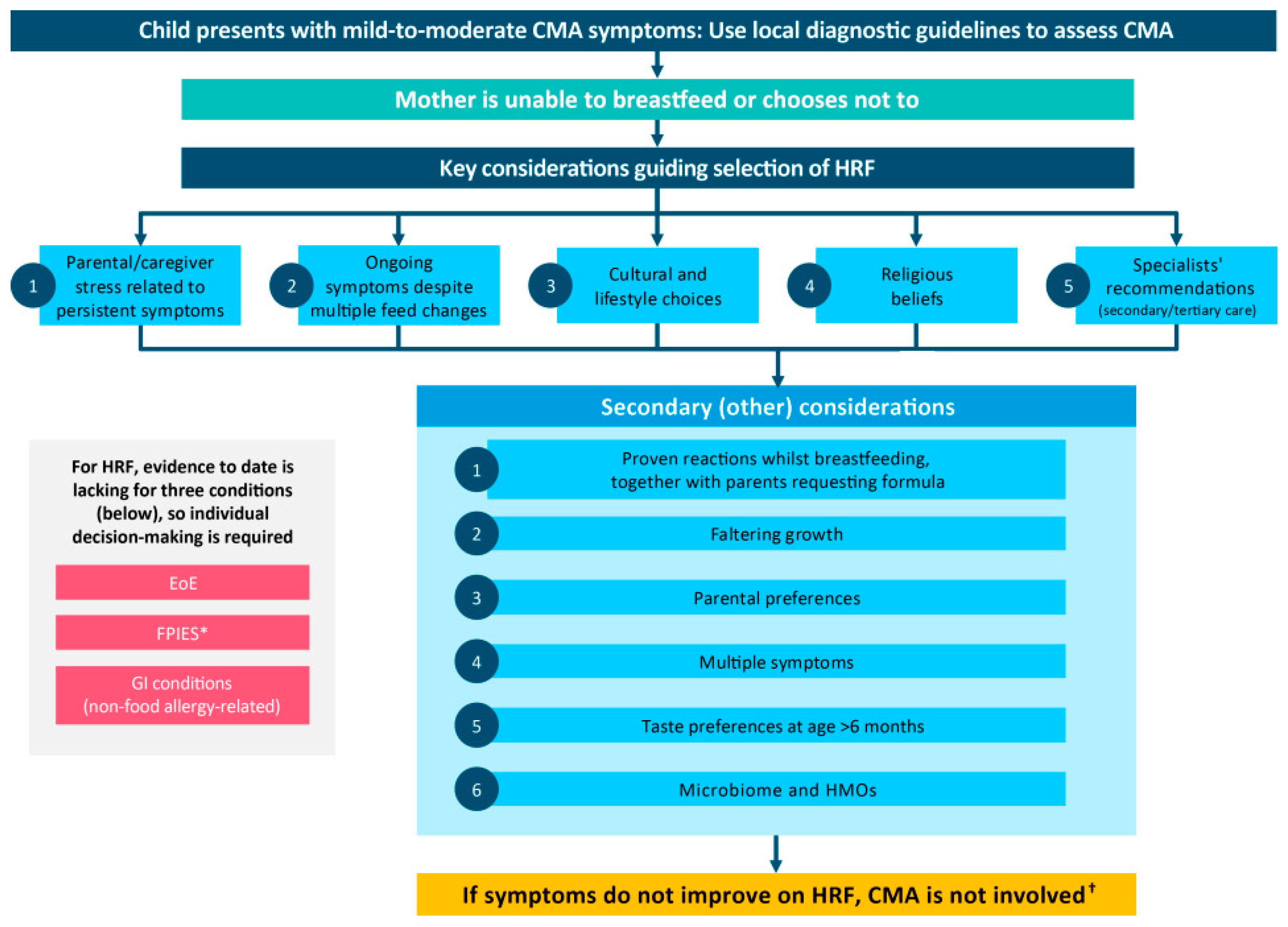
The refined version of the decision tree, developed at the second meeting, was circulated offline to all participants and finalised (Figure 1). The decision tree is not intended as a diagnostic or treatment algorithm but rather as a tool to support clinicians when choosing a specialist formula for infants who are not exclusively breastfed. When children present with symptoms suggestive of CMA, local diagnostic guidelines should be followed to confirm the diagnosis. The decision tree should be interpreted alongside this accompanying article, which outlines its development.
Figure 1.
Decision tree to determine when HRF is the preferred formula for infants with CMA. * DRACMA guidelines state, “In infants with milk- or rice-related FPIES, or in whom tolerance of rice is unknown, it is more beneficial not to use HRF until more evidence is available” [13]. The expert panel noted this reflects limited data and the reported frequency of rice-related FPIES. † As advised in the most recently available (2024) ESPGHAN algorithm at the time of publication [14]. Abbreviations: CMA, cow’s milk allergy; EoE, eosinophilic esophagitis; FPIES, food protein-induced enterocolitis syndrome; GI, gastrointestinal; HMO, human milk oligosaccharide; HRF, hydrolysed rice formula.
Breastfeeding should always be encouraged and supported as the preferred source of nutrition [19,20]. If the mother is unable to breastfeed or chooses not to, or if breast milk is insufficient to meet the infant’s needs, formula will be required for infants with CMA, and eHFs and HRFs (where available) are recommended as first-line options [13,14]. Although HRFs were not historically included in all recommendations, the recent literature and guidelines have increasingly recognised HRF as a valid first-line alternative to eHF. Importantly, HRFs have been used in Europe for more than 20 years without any reported adverse effects on infant health [21].
The five key considerations, discussed during the expert meetings, for determining when an HRF is the preferred choice for an infant with suspected or confirmed CMA are listed and summarised in Table 1.
Table 1.
Key considerations guiding the selection of HRF.
Secondary (other) considerations that were discussed by experts are listed and summarised in Table 2. It should also be noted that HRF also has a low osmolality, which may be better tolerated in children with reflux and gastrointestinal problems, but there is currently no evidence to substantiate this. Additional factors such as the impact on the gut microbiome and the presence of HMOs may also be relevant (Table 2).
Table 2.
Secondary considerations guiding the selection of HRF.
If both eHF and HRF are ineffective (poor relief of symptoms and nutritional inadequacy in terms of growth support) or well tolerated, and CMA is still suspected, guidelines suggest that an AAF should be considered as a second-line option. However, ESPGHAN guidance (2024) suggests that if symptoms do not improve on HRF and cow’s milk is appropriately removed from an infant on complementary foods, then CMA is not involved [14]. For severe presentations, such as EoE, FPIES, and other non-food allergic GI conditions (i.e. short gut syndrome), HRF is not presently recommended in guidelines in the current absence of supporting evidence.
5. Conclusions
The management of CMA in infancy requires access to safe, nutritionally complete, and well-tolerated formula options when breast milk feeding is not possible or chosen. HRFs have demonstrated safety, tolerance, and nutritional adequacy over more than two decades of use in Europe and are increasingly recognised as a viable first-line alternative to eHF. New guidelines recommend either HRF or eHF as first-line feeds for infants with CMA who are not fed breast milk. There is, however, no evidence-based guideline on when an HRF may be preferred. The expert group set out to develop a practical decision tree to support HCPs in determining when an HRF is the preferred option for the dietary management of non-breastfed infants with CMA, reflecting the evolving evidence base and alignment with international practice. The practical decision tree developed by the expert group, which incorporates both clinical and psychosocial considerations, as well as those acknowledging individual family preferences, offers a structured framework to assist HCPs when making such decisions.
Broader awareness, education, and equitable access to HRF are essential to ensure optimal care for infants with CMA in the UK. Future research should continue to investigate long-term outcomes, including the impact of HRF on growth, immunity, and the gut microbiome, to further explore and strengthen the evidence supporting HRF use in non-breastfed infants. Overall, HRF represents an effective, well-tolerated, plant-based alternative that broadens the therapeutic options available to clinicians and supports a more personalised, family-centred approach to CMA management.
Author Contributions
Preparation of the decision tree was led by N.M. and R.M., who contributed significantly to the review and finalisation of the manuscript. L.A., A.I., H.E.-H., C.T., B.V.d.B., J.W., A.W., R.W., C.V. and Y.V. contributed equally to the development and finalisation of the manuscript. All authors have read and agreed to the published version of the manuscript.
Funding
The decision tree and supporting evidence presented in this paper were discussed and formulated at two meetings of UK experts. Some authors received support to attend the meeting from Abbott Nutrition. Acceptance of this support was optional, and not all authors elected to receive it. The views expressed in this paper are purely those of the authors without any influence from Abbott Nutrition. Publication fees were funded by Abbott Nutrition.
Institutional Review Board Statement
Not applicable.
Informed Consent Statement
Not applicable.
Data Availability Statement
No new data were created or analysed in this study. Data sharing is not applicable to this article.
Acknowledgments
FoodMinds and Madano Healthcare compiled the comments of the authors and supported the editorial development of this paper.
Conflicts of Interest
N.M.: clinical investigator/advisory board member/consultant/speaker for Abbott, ALK, DBV, Nestlé, Nutricia, and Thermofisher Scientific; leadership role in BSACI. L.A.: advisory board member/consultant/speaker for Abbott and Nutricia. A.I.: clinical investigator/advisory board member/consultant/speaker for Abbott, Nestlé, and Nutricia/Danone. H.E.-H.: clinical investigator/advisory board member/consultant/speaker for Abbott, ALK, Danone, Mead Johnson, Nestlé, and Nutricia, Thermofisher; trustee Anaphylaxis UK; leadership role in BSACI. C.T.: no conflict. B.V.d.B.: consultant/speaker for Abbott, Nutricia/Danone. J.W.: no industry funding in the previous 5 years; involved with Allergy UK and Anaphylaxis UK. A.W.: advisory board member for Abbott; employed by Allergy UK, which works with multiple corporate partners that provide funding for specific projects; committee member, British Dietetic Association (Food Allergy Specialist Group). R.W.: consultant for Abbott, Mead Johnson, Nestlé Health Science, Nutricia, and Takeda. C.V.: clinical investigator/advisory board member/consultant/speaker for Abbott, Nestlé Nutrition Institute, Reckitt, and Sifter; leadership roles in AAAAI, EACCI, and INDANA. Y.V.: clinical investigator/advisory board member/consultant/speaker for Abbott Nutrition, BioGaia, Danone, Nestlé Health Science, Nestlé Nutrition Institute, Nutricia, and United Pharmaceuticals (Novalac). R.M.: clinical investigator/advisory board member/consultant/speaker for Abbott, Mead Johnson, Nestlé Nutrition Institute, and Nutricia/Danone.
References
- World Health Organization. Infant and Young Child feeding. Available online: https://www.who.int/news-room/fact-sheets/detail/infant-and-young-child-feeding (accessed on 12 September 2025).
- Australian Society of Clinical Immunology and Allergy. Cow’s Milk (Dairy) Allergy. 2019. Available online: https://www.allergy.org.au/patients/food-allergy/cows-milk-dairy-allergy (accessed on 12 September 2025).
- Terracciano, L.; Bouygue, G.R.; Sarratud, T.; Veglia, F.; Martelli, A.; Fiocchi, A. Impact of dietary regimen on the duration of cow’s milk allergy: A random allocation study. Clin. Exp. Allergy 2010, 40, 637–642. [Google Scholar] [CrossRef] [Scilit]
- Dupont, C.; Bocquet, A.; Tome, D.; Bernard, M.; Campeotto, F.; Dumond, P.; Essex, A.; Frelut, M.L.; Guenard-Bilbault, L.; Lack, G.; et al. Hydrolyzed rice protein-based formulas, a vegetal alternative in cow’s milk allergy. Nutrients 2020, 12, 2654. [Google Scholar] [CrossRef] [Scilit] [PubMed]
- Meyer, R.; Groetch, M.; Venter, C. When should infants with cow’s milk protein allergy use an amino acid formula? A practical guide. J. Allergy Clin. Immunol. Pract. 2018, 6, 383–399. [Google Scholar] [CrossRef] [Scilit] [PubMed]
- Venter, C.; Brown, T.; Meyer, R.; Walsh, J.; Shah, N.; Nowak-Wegrzyn, A.; Chen, T.X.; Fleischer, D.M.; Heine, R.G.; Levin, M.; et al. Better recognition, diagnosis and management of non-IgE-mediated cow’s milk allergy in infancy: iMAP-an international interpretation of the MAP (Milk Allergy in Primary Care) guideline. Clin. Transl. Allergy 2017, 7, 26. [Google Scholar] [CrossRef] [Scilit]
- Turner, P.J.; Baseggio Conrado, A.; Kallis, C.; O’Rourke, E.; Haider, S.; Ullah, A.; Custovic, D.; Custovic, A.; Quint, J.K. Time trends in the epidemiology of food allergy in England: An observational analysis of Clinical Practice Research Datalink data. Lancet Public Health 2024, 9, e664–e673. [Google Scholar] [CrossRef] [Scilit] [PubMed]
- Bajerova, K.; Salvatore, S.; Dupont, C.; Eigenmann, P.; Kuitunen, M.; Meyer, R.; Ribes-Koninckx, C.; Shamir, R.; Szajewska, H.; Vandenplas, Y. The cow’s milk-related symptom score (comiss(TM)): A useful awareness tool. Nutrients 2022, 14, 2059. [Google Scholar] [CrossRef] [Scilit]
- Meyer, R.; Vandenplas, Y.; Reese, I.; Vieira, M.C.; Ortiz-Piedrahita, C.; Walsh, J.; Nowak-Wegrzyn, A.; Chebar Lozinsky, A.; Fox, A.; Chakravarti, V.; et al. The role of online symptom questionnaires to support the diagnosis of cow’s milk allergy in children for healthcare professionals—A Delphi consensus study. Pediatr. Allergy Immunol. 2023, 34, e13975. [Google Scholar] [CrossRef] [Scilit]
- Vandenplas, Y.; De Greef, E.; Hauser, B.; Paradice Study Group. Safety and tolerance of a new extensively hydrolyzed rice protein-based formula in the management of infants with cow’s milk protein allergy. Eur. J. Pediatr. 2014, 173, 1209–1216. [Google Scholar] [CrossRef] [Scilit]
- Durban, R.; Groetch, M.; Meyer, R.; Coleman Collins, S.; Elverson, W.; Friebert, A.; Kabourek, J.; Marchand, S.M.; McWilliam, V.; Netting, M.; et al. Dietary management of food allergy. Immunol. Allergy Clin. N. Am. 2021, 41, 233–270. [Google Scholar] [CrossRef] [Scilit]
- World Health Organization. Breastfeeding. Available online: https://www.who.int/health-topics/breastfeeding#tab=tab_1 (accessed on 12 September 2025).
- Bognanni, A.; Fiocchi, A.; Arasi, S.; Chu, D.K.; Ansotegui, I.; Assa’ad, A.H.; Bahna, S.L.; Berni Canani, R.; Bozzola, M.; Dahdah, L.; et al. World Allergy Organization (WAO) Diagnosis and Rationale for Action against Cow’s Milk Allergy (DRACMA) guideline update—XII—Recommendations on milk formula supplements with and without probiotics for infants and toddlers with CMA. World Allergy Organ. J. 2024, 17, 100888. [Google Scholar] [CrossRef] [Scilit]
- Vandenplas, Y.; Broekaert, I.; Domellof, M.; Indrio, F.; Lapillonne, A.; Pienar, C.; Ribes-Koninckx, C.; Shamir, R.; Szajewska, H.; Thapar, N.; et al. An ESPGHAN position paper on the diagnosis, management, and prevention of cow’s milk allergy. J. Pediatr. Gastroenterol. Nutr. 2024, 78, 386–413. [Google Scholar] [CrossRef] [Scilit]
- Vandenplas, Y.; Meyer, R.; Nowak-Wegrzyn, A.; Salvatore, S.; Venter, C.; Vieira, M.C. The remaining challenge to diagnose and manage cow’s milk allergy: An opinion paper to daily clinical practice. Nutrients 2023, 15, 4762. [Google Scholar] [CrossRef] [Scilit]
- Ribes-Koninckx, C.; Amil-Dias, J.; Espin, B.; Molina, M.; Segarra, O.; Diaz-Martin, J.J. The use of amino acid formulas in pediatric patients with allergy to cow’s milk proteins: Recommendations from a group of experts. Front. Pediatr. 2023, 11, 1110380. [Google Scholar] [CrossRef] [Scilit] [PubMed]
- Australian Society of Clinical Immunology and Allergy. Guide for Milk Substitutes in Cow’s Milk Allergy. Available online: https://www.allergy.org.au/images/stories/pospapers/ASCIA_HP_Guide_CMA_Milk_Substitutes_2024.pdf (accessed on 12 September 2025).
- Luyt, D.; Ball, H.; Makwana, N.; Green, M.R.; Bravin, K.; Nasser, S.M.; Clark, A.T.; Standards of Care Committee (SOCC) of the British Society for Allergy and Clinical Immunology (BSACI). BSACI guideline for the diagnosis and management of cow’s milk allergy. Clin. Exp. Allergy 2014, 44, 642–672. [Google Scholar] [CrossRef] [Scilit]
- McWilliam, V.; Netting, M.J.; Volders, E.; Palmer, D.J.; WAO DRACMA Guideline Group. World Allergy Organization (WAO) Diagnosis and Rationale for Action against Cow’s Milk Allergy (DRACMA) guidelines update—X—Breastfeeding a baby with cow’s milk allergy. World Allergy Organ. J. 2023, 16, 100830. [Google Scholar] [CrossRef] [Scilit] [PubMed]
- Meyer, R.; Chebar Lozinsky, A.; Fleischer, D.M.; Vieira, M.C.; Du Toit, G.; Vandenplas, Y.; Dupont, C.; Knibb, R.; Uysal, P.; Cavkaytar, O.; et al. Diagnosis and management of Non-IgE gastrointestinal allergies in breastfed infants-An EAACI Position Paper. Allergy 2020, 75, 14–32. [Google Scholar] [CrossRef] [Scilit] [PubMed]
- Vandenplas, Y.; Dupont, C.; Al-Dekhail, W.; Hashmi, H.A.A.; Khalil, A.F.; El-Hodhod, M.A.; Husain, K.; Singh, A. Exploring the advantages of a hydrolyzed rice formula in the dietary management of infants with cow’s milk allergy in the middle east, north africa, and pakistan region. Nutrients 2021, 13, 3429. [Google Scholar] [CrossRef] [Scilit]
- Venter, C.; Meyer, R.; Groetch, M.; Nowak-Wegrzyn, A.; Mennini, M.; Pawankar, R.; Kamenwa, R.; Assa’ad, A.; Amara, S.; Fiocchi, A.; et al. World Allergy Organization (WAO) Diagnosis and Rationale for Action against Cow’s Milk Allergy (DRACMA) guidelines update—XVI—Nutritional management of cow’s milk allergy. World Allergy Organ. J. 2024, 17, 100931. [Google Scholar] [CrossRef] [Scilit]
- Toca, M.C.; Morais, M.B.; Vazquez-Frias, R.; Becker-Cuevas, D.J.; Boggio-Marzet, C.G.; Delgado-Carbajal, L.; Higuera-Carrillo, M.M.; Ladino, L.; Marchisone, S.; Messere, G.C.; et al. Consensus on the diagnosis and treatment of cow’s milk protein allergy of the Latin American Society for Pediatric Gastroenterology, Hepatology and Nutrition. Rev. Gastroenterol. Mex. (Engl. Ed.) 2022, 87, 235–250. [Google Scholar] [CrossRef]
- Vandenplas, Y.; Brough, H.A.; Fiocchi, A.; Miqdady, M.; Munasir, Z.; Salvatore, S.; Thapar, N.; Venter, C.; Vieira, M.C.; Meyer, R. Current guidelines and future strategies for the management of cow’s milk allergy. J. Asthma Allergy 2021, 14, 1243–1256. [Google Scholar] [CrossRef] [Scilit]
- Venter, C.; Groetch, M.; Netting, M.; Meyer, R. A patient-specific approach to develop an exclusion diet to manage food allergy in infants and children. Clin. Exp. Allergy 2018, 48, 121–137. [Google Scholar] [CrossRef] [Scilit] [PubMed]
- Fiocchi, A.; Barrio-Torres, J.; Dupont, C.; Howells, H.E.; Shamir, R.; Venter, C.; Meyer, R. Hydrolyzed rice formula for dietary management of infants with cow’s milk allergy. World Allergy Organ. J. 2022, 15, 100717. [Google Scholar] [CrossRef] [Scilit] [PubMed]
- Ramirez-Farias, C.; Oliver, J.S.; Schlezinger, J.; Stutts, J.T. Tolerance of infants fed a hydrolyzed rice infant formula with 2’-fucosyllactose (2’-FL) human milk oligosaccharide (HMO). Nutrients 2024, 16, 1863. [Google Scholar] [CrossRef] [Scilit] [PubMed]
- National Institute for Health and Clinical Excellence. Faltering Growth: Recognition and Management of Faltering Growth in Children. NICE Guideline. Reference Number: NG75. 2017. Available online: https://www.nice.org.uk/guidance/ng75/resources/faltering-growth-recognition-and-management-of-faltering-growth-in-children-pdf-1837635907525 (accessed on 12 September 2025).

Disclaimer/Publisher’s Note: The statements, opinions and data contained in all publications are solely those of the individual author(s) and contributor(s) and not of MDPI and/or the editor(s). MDPI and/or the editor(s) disclaim responsibility for any injury to people or property resulting from any ideas, methods, instructions or products referred to in the content. |
© 2026 by the authors. Licensee MDPI, Basel, Switzerland. This article is an open access article distributed under the terms and conditions of the Creative Commons Attribution (CC BY) license.