


Abstract
Background/Objectives: HT074, a standardized mixture of aqueous extracts of Paeoniae Radix and Inulae Flos, has demonstrated gastroprotective effects in preclinical models. This study evaluated its efficacy and safety in adults with dyspeptic symptoms. Methods: This 8-week, randomized, double-blind, placebo-controlled trial was conducted in Seoul, Republic of Korea. A total of 144 adults with dyspeptic symptoms were randomly assigned in a 1:1:1 ratio to receive placebo, low-dose HT074 (350 mg/day), or high-dose HT074 (700 mg/day), administered twice daily for 8 weeks. Changes in the Nepean Dyspepsia Index—Korean version (NDI-K), Gastrointestinal Symptom Rating Scale (GSRS), and Functional Dyspepsia-Related Quality of Life questionnaire (FD-QOL) were assessed at weeks 2, 4, and 8. Primary efficacy analyses used the per-protocol population; safety analyses included all treated participants. Results: Of the 144 randomized participants, 141 received at least one dose of the study product, and 126 comprised the per-protocol population. Changes in NDI-K, GSRS, and FD-QOL total scores did not differ significantly between either HT074 group and placebo. High-dose HT074 showed greater reductions than placebo in the NDI-K upper abdominal discomfort score at week 2 (−3.4 ± 2.2 vs. −1.8 ± 2.6; p = 0.002), the GSRS reflux symptom score at week 2, and the GSRS heartburn item at week 8. High-dose HT074 also showed greater improvement than placebo in the FD-QOL lack-of-energy item at weeks 2, 4, and 8. Two participants in the high-dose group reported mild adverse events; no serious adverse events occurred. Conclusions: These exploratory findings suggest that HT074 at 700 mg/day may improve upper abdominal discomfort and reflux-related symptoms. Its favorable tolerability further supports the potential utility of HT074 as a standardized functional food ingredient for adults with dyspeptic symptoms.
1. Introduction
Dyspepsia is a common upper gastrointestinal symptom complex characterized primarily by epigastric pain or burning, postprandial fullness, and early satiation. Functional dyspepsia (FD) is defined as chronic or recurrent bothersome dyspeptic symptoms in the absence of structural, systemic, or metabolic disease likely to explain them [1]. Proton pump inhibitors and prokinetics are among the principal pharmacological options for FD. However, proton pump inhibitors provide modest overall symptom improvement, with less robust evidence of benefit in Asian populations [2,3]. The efficacy of prokinetics varies among agents, and the supporting evidence is heterogeneous [4]. Symptoms may persist or recur despite treatment, reflecting the chronic and fluctuating course of FD [2,5,6]. Dietary and nutraceutical approaches have therefore been investigated as complementary strategies for symptom management [7]. Randomized controlled trials have reported improvements in dyspeptic symptoms with plant-derived interventions, including curcumin, artichoke leaf extract, and steamed ginger extract [8,9,10].
HT074 is a standardized mixture of extracts from the roots of Paeonia lactiflora Pall. (Paeoniae Radix) and the flowers of Inula britannica L. (Inulae Flos). Paeoniae Radix has traditionally been used for abdominal pain [11] and is also included in health functional food formulations in Korea [12]. Inulae Flos has been used in traditional medicine for gastrointestinal symptoms, including nausea, vomiting, and belching [13], and is consumed as an herbal tea [14].
Preclinical studies of HT074 have demonstrated gastroprotective effects in experimental models of gastric injury induced by HCl/ethanol, water immersion–restraint stress, and indomethacin [15,16]. These effects were associated with antioxidant activity, increased gastric mucus production and PGE2 levels, reduced gastric secretion, and sulfhydryl-dependent mucosal protection [15,16]. HT074 also attenuated esophageal mucosal injury in a rat model of acute reflux esophagitis and was associated with increased antioxidant-related protein expression [17]. Collectively, these findings support the gastroprotective potential of HT074; however, its efficacy for dyspeptic symptoms in humans had not been established.
Therefore, this 8-week, randomized, double-blind, placebo-controlled trial evaluated the efficacy and safety of HT074 supplementation in adults with dyspeptic symptoms, with a primary focus on dyspeptic symptom improvement and secondary assessments of gastrointestinal symptoms and dyspepsia-related quality of life.
2. Materials and Methods
2.1. Trial Design, Setting, and Ethics
This randomized, double-blind, placebo-controlled, three-arm, parallel-group trial was conducted in Seoul, Republic of Korea, at Kyung Hee University Hospital and the Research Institute of Medical Nutrition, Kyung Hee University, from 23 November 2016 (first participant screened), to 22 June 2017 (last participant’s final visit). No important changes were made to the trial protocol after trial commencement.
The study was conducted in accordance with the ethical principles of the Declaration of Helsinki. The study protocol was approved by the Institutional Review Board of Kyung Hee University Hospital (approval no. KHUH 2016-06-204; approval date: 12 July 2016), and all participants provided written informed consent before undergoing any study-related procedures. The trial was retrospectively registered with the Clinical Research Information Service (CRIS), Republic of Korea, on 21 October 2026 (registration number: KCT0012807). Patients and the public were not involved in the design, conduct, reporting, or dissemination plans of this study.
2.2. Participants
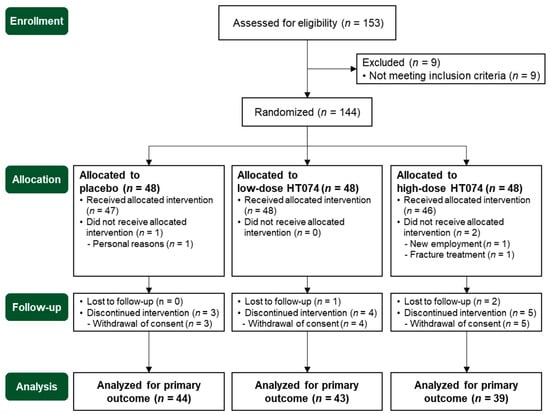
Eligible participants were adults aged 20–65 years with a Nepean Dyspepsia Index—Korean version (NDI-K) total score of 49–136 and a score of ≥2 for at least one of two symptoms—epigastric pain or epigastric burning—on a separate four-point symptom-severity scale (0, absent; 1, mild; 2, moderate; and 3, severe). A score of 2 was defined as a moderate symptom that was clearly perceived but caused little interference with usual daily activities [18]. Individuals who met the Rome III diagnostic criteria for functional dyspepsia were excluded. The Rome III criteria include a chronicity requirement that the diagnostic criteria be fulfilled for the preceding 3 months, with symptom onset at least 6 months before diagnosis [19]. The full eligibility criteria are provided in Table 1. The participant flow diagram is presented in Figure 1.
Table 1.
Eligibility criteria.
Figure 1.
Flow diagram of study participants.
2.3. Randomization and Blinding
A computer-generated randomization schedule was used to assign eligible participants in a 1:1:1 ratio to the placebo, low-dose HT074, or high-dose HT074 group. At baseline, participants were assigned sequential randomization numbers in order of enrollment and were dispensed the coded study product corresponding to the assigned number. Participants and investigators were blinded to treatment allocation. The study products were indistinguishable in appearance and labeled with unique identification codes according to the randomization schedule. The treatment-code allocation list was kept sealed by an independent designee and could be accessed only if emergency unblinding was required for participant safety.
2.4. Procedures
Following a 1-week screening period, eligible participants were randomly assigned in a 1:1:1 ratio to receive placebo, low-dose HT074 (350 mg/day), or high-dose HT074 (700 mg/day) for 8 weeks. The active and placebo products were provided as visually indistinguishable tablets, and participants consumed two tablets daily, one in the morning and one in the evening. Study products were dispensed at baseline and at weeks 2 and 4. Participants attended follow-up visits at weeks 2, 4, and 8 within a visit window of ±5 days, during which unused tablets and containers were returned and scheduled efficacy and safety assessments were performed. Efficacy was assessed using the NDI-K, Gastrointestinal Symptom Rating Scale (GSRS), and Functional Dyspepsia-related Quality of Life questionnaire (FD-QOL) at baseline and weeks 2, 4, and 8. No concomitant care was provided as part of the trial. Adverse events and changes in concomitant medication or therapy use were assessed at each follow-up visit. Adherence was assessed at weeks 2, 4, and 8 by counting unused tablets returned with their containers. Adherence (%) was calculated as [(number of tablets dispensed − number of tablets returned)/number of tablets expected to be taken] × 100. Participants with adherence below 80% at two consecutive visits were considered noncompliant.
2.5. Investigational Products and Intervention
HT074 is a standardized extract mixture composed of aqueous extracts of Paeoniae Radix and Inulae Flos. The botanical materials were purchased as dried roots of P. lactiflora and dried flowers of I. britannica. They were authenticated by Hocheol Kim (College of Korean Medicine, Kyung Hee University), and voucher specimens were deposited in the Department of Herbal Pharmacology at the same institution (voucher numbers: 16031403 for P. lactiflora and 16032502 for I. britannica). HT074 was manufactured by MSC Co., Ltd. (Yangsan, Republic of Korea) under Good Manufacturing Practice conditions according to the method described by Kim et al. (2019) [16]. Each botanical material underwent two 3-h reflux extractions with distilled water at 100 °C. The Paeoniae Radix extract was treated with amylase to facilitate filtration, and the enzyme was subsequently inactivated. After filtration and concentration, the extracts were spray-dried with added dextrin (20% for Paeoniae Radix and 10% for Inulae Flos). The resulting powders were blended at a Paeoniae Radix-to-Inulae Flos ratio of 53:47. Paeoniflorin and 1-O-acetylbritannilactone, the marker compounds of HT074, were quantified by high-performance liquid chromatography as previously described [16]. HT074 is standardized to contain 21.0–31.6 mg/g of paeoniflorin and 1.50–2.26 mg/g of 1-O-acetylbritannilactone. The batch used in this trial met the established specifications.
The low- and high-dose tablets each weighed 500 mg and contained 175 and 350 mg of HT074, respectively. The placebo tablets were formulated primarily with microcrystalline cellulose and maltodextrin and were matched to the active tablets in total mass and appearance. Participants were instructed to store the investigational products in their original, tightly closed containers at room temperature (1–30 °C), protected from direct sunlight.
Participants were instructed to take one assigned tablet in the morning and one in the evening for 8 weeks. The corresponding daily HT074 doses were 350 and 700 mg in the low- and high-dose groups, respectively.
2.6. Efficacy Assessments
2.6.1. NDI-K
The NDI was originally developed as a multidimensional, disease-specific instrument for assessing dyspeptic symptoms and health-related quality of life [20]. In this study, the symptom index of the Korean version of the NDI (NDI-K) was used [21]. The NDI-K assessed the following 15 symptoms experienced during the preceding two weeks: pain in upper abdomen, discomfort in upper abdomen, burning in upper abdomen, heartburn, cramps in upper abdomen, chest pain, inability to finish a regular meal, bitter-tasting fluid in mouth, fullness after eating, pressure in upper abdomen, bloating in upper abdomen, nausea, burping, vomiting, and bad breath. Each symptom was rated in terms of frequency (0–4), intensity (0–5), and burdensomeness (0–4). The three dimension scores were summed for each symptom, and the individual symptom scores were then summed to generate the total score. Possible scores ranged from 0 to 13 per symptom and from 0 to 195 for the total score, with higher scores indicating greater symptom burden.
2.6.2. GSRS
Gastrointestinal symptoms were assessed using a questionnaire based on the 15-item Gastrointestinal Symptom Rating Scale (GSRS) originally developed by Svedlund et al. (1988) [22]. The questionnaire assessed the following 15 symptoms: abdominal pain, heartburn, acid regurgitation, sucking sensations in the epigastrium, nausea and vomiting, borborygmus, abdominal distension, eructation, increased flatus, decreased passage of stools, increased passage of stools, loose stools, hard stools, urgent need for defecation, and feeling of incomplete evacuation. The scores for the 15 items were summed to yield a total GSRS score, with higher scores indicating greater symptom severity. In this study, the GSRS reflux symptom score was calculated as the sum of the heartburn and acid regurgitation item scores [23].
2.6.3. FD-QOL
Functional dyspepsia-related quality of life was assessed using the Korean FD-QOL scale developed by Lee et al. (2006) [24]. The scale comprises 21 items across four domains: eating status (five items), liveliness status (four items), psychological status (six items), and role-functioning status (six items). Lower scores indicate better quality of life.
2.7. Safety Assessments
Safety was assessed based on adverse events, clinical laboratory findings, vital signs, and anthropometric measurements. Adverse events were monitored throughout the study and assessed at weeks 2, 4, and 8. Hematological and serum biochemical tests were performed at screening and at weeks 4 and 8. Vital signs and anthropometric measurements, including body weight and body mass index (BMI), were assessed at screening, baseline, and weeks 2, 4, and 8.
2.8. Sample Size
The sample size was estimated a priori using G*Power version 3.1.9.2 (Heinrich Heine University Düsseldorf, Düsseldorf, Germany). Based on a previous clinical study [18], the mean changes in the NDI-K total score were −22.00 ± 18.32 in the treatment group and −11.21 ± 15.19 in the control group, corresponding to a standardized effect size (Cohen’s d) of 0.641. For a two-sided comparison of two independent means with a significance level of 0.05, a statistical power of 80%, and equal group allocation, 40 participants were required per group. To account for potential dropouts, the target enrollment was set at 48 participants per group, resulting in a total target sample size of 144 participants across the three parallel groups.
2.9. Statistical Analysis
The primary efficacy analyses were performed in the per-protocol (PP) population, which was prespecified as the primary efficacy population in the original study protocol and comprised participants who completed the 8-week study with adequate adherence to the study protocol. Supportive efficacy analyses were conducted in the modified intention-to-treat (mITT) population, defined as all randomized participants who consumed at least one dose of the assigned study product. Analyses of total or individual item scores for the NDI-K, GSRS, and FD-QOL were also prespecified. Missing data were imputed using the last observation carried forward method. Safety analyses were performed in the safety population, which included all participants who consumed at least one dose of the assigned study product.
Continuous variables are presented as means ± standard deviations, and categorical variables as numbers and percentages. The normality of continuous variables was assessed using the Shapiro–Wilk test. Each HT074 dose group was compared with the placebo group using the independent-samples t-test for normally distributed variables or the Mann–Whitney U test otherwise. Within-group changes from baseline were assessed using the paired t-test or Wilcoxon signed-rank test, as appropriate. Categorical variables were compared using the chi-square test or Fisher’s exact test. All statistical tests were two-sided, and a p-value < 0.05 was considered statistically significant. No adjustment for multiple comparisons was applied. Statistical analyses were performed using SAS software, version 8.2 (SAS Institute Inc., Cary, NC, USA).
3. Results
3.1. Participants
Participant flow through the study is summarized in Figure 1. Of the 153 individuals screened for eligibility, nine did not meet the inclusion criteria. The remaining 144 participants were randomly assigned in a 1:1:1 ratio to one of three groups: placebo, low-dose HT074, or high-dose HT074 (n = 48 per group). Of these, one participant in the placebo group and two participants in the high-dose HT074 group did not receive the allocated intervention. Accordingly, 141 participants who received at least one dose of the assigned study product were included in both the mITT and safety populations; of these, 126 completed the 8-week intervention and were included in the PP population. Most discontinuations resulted from withdrawal of consent or loss to follow-up.
In the PP population (n = 126), baseline demographic characteristics and questionnaire scores were generally similar across the three groups (Table 2). The mean ages of the three groups ranged from 39.6 to 44.0 years; women and never-smokers accounted for 86.0–94.9% and 88.4–97.4% of participants, respectively. Across the three groups, mean baseline total scores were 72.4–76.5 for the NDI-K, 13.9–15.6 for the GSRS, and 17.7–18.4 for the FD-QOL. During the 8-week intervention, mean overall treatment compliance was 92.1 ± 8.9% in the placebo group, 92.1 ± 5.7% in the low-dose HT074 group, and 94.6 ± 5.9% in the high-dose HT074 group. Compliance did not differ significantly between the placebo group and either HT074 group.
Table 2.
Baseline characteristics of the per-protocol population.
3.2. NDI-K
NDI-K total scores decreased significantly from baseline at weeks 2, 4, and 8 in all three groups (all p < 0.001). Changes from baseline did not differ significantly between the placebo group and either HT074 group at any time point (Table 3).
Table 3.
Mean changes from baseline in NDI-K total and upper abdominal discomfort item scores.
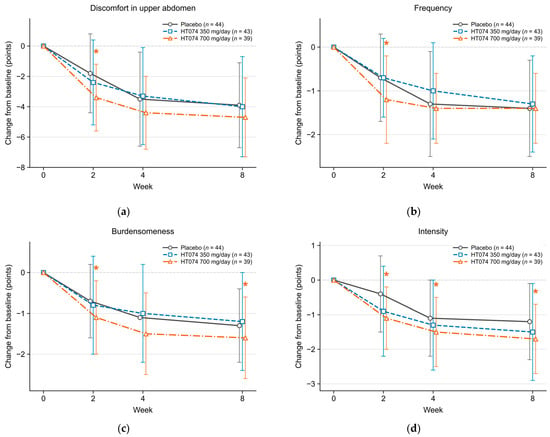
Among the 15 individual NDI-K items, the reduction in the “discomfort in upper abdomen” score at week 2 was significantly greater in the high-dose HT074 group than in the placebo group (−3.4 ± 2.2 vs. −1.8 ± 2.6, p = 0.002; Figure 2a). The reductions remained numerically greater in the high-dose group at weeks 4 and 8, although the between-group differences did not reach statistical significance (p = 0.060 and p = 0.070, respectively). For the remaining individual NDI-K symptoms, changes from baseline did not differ significantly between the placebo group and either HT074 group at weeks 2, 4, or 8 (Supplementary Table S1).
Figure 2.
Mean changes from baseline in NDI-K upper abdominal discomfort and its component scores. (a) Upper abdominal discomfort item score; (b) frequency; (c) burdensomeness; and (d) intensity. The upper abdominal discomfort item score was calculated as the sum of its frequency, intensity, and burdensomeness component scores. Data are presented as mean ± standard deviation for the per-protocol population: placebo (n = 44), HT074 350 mg/day (n = 43), and HT074 700 mg/day (n = 39). Negative changes indicate improvement. * p < 0.05 versus placebo (Mann–Whitney U test). NDI-K, Nepean Dyspepsia Index—Korean version.
Each of the 15 NDI-K item scores was calculated as the sum of its frequency, intensity, and burdensomeness component scores. For the “discomfort in upper abdomen” item, reductions in all three components were significantly greater in the high-dose HT074 group than in the placebo group at week 2 (frequency, p = 0.027; intensity, p = 0.003; burdensomeness, p = 0.043; Figure 2b–d). The reduction in intensity remained significantly greater in the high-dose group at weeks 4 and 8 (p = 0.044 and p = 0.017, respectively). The between-group difference in burdensomeness was significant at week 8 (p = 0.049) but did not reach statistical significance at week 4 (p = 0.058).
3.3. GSRS
GSRS total scores decreased significantly from baseline at weeks 2, 4, and 8 in all three groups (all p < 0.001). Changes from baseline did not differ significantly between the placebo group and either HT074 group at any time point (Table 4).
Table 4.
Mean changes from baseline in GSRS total, reflux symptom, and heartburn and hard stools item scores.
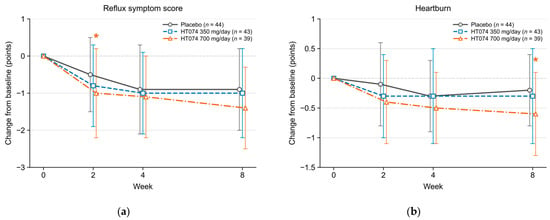
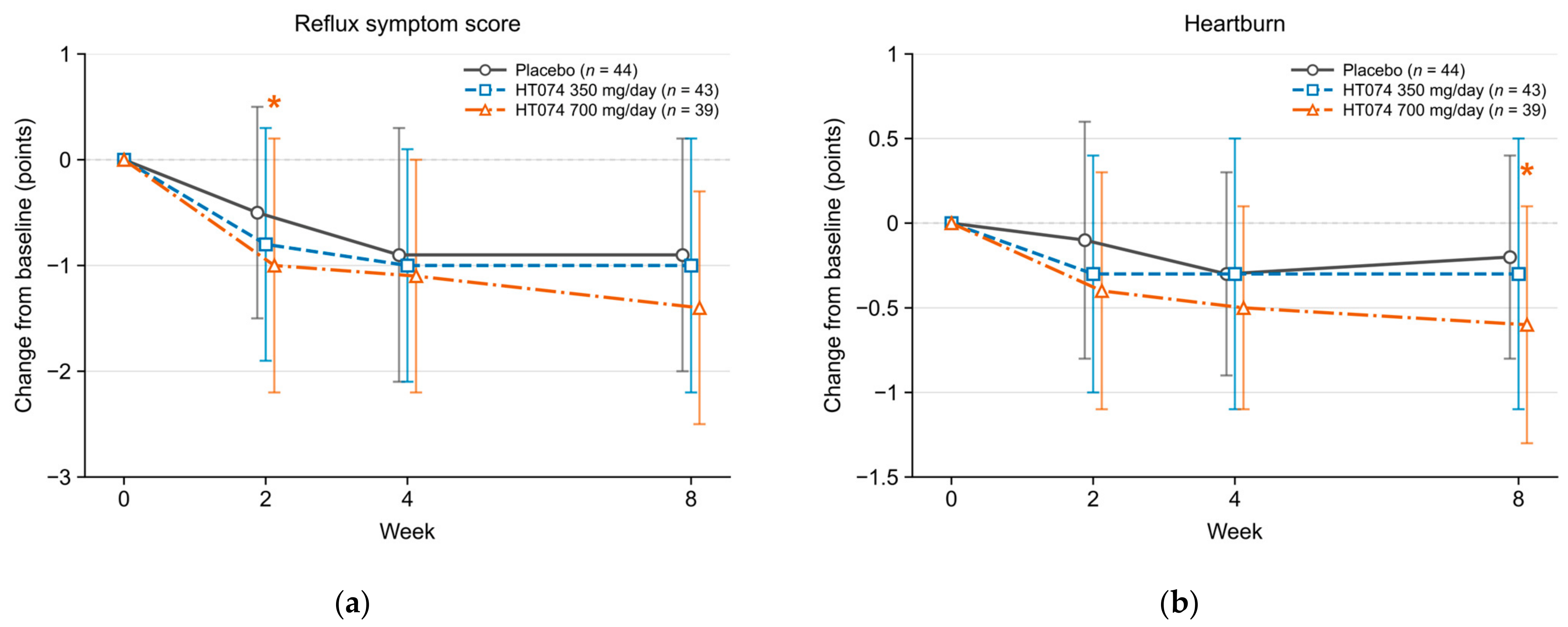
A GSRS reflux symptom score was calculated as the sum of the heartburn and acid regurgitation item scores [23]. At week 2, the reduction in this score was significantly greater in the high-dose HT074 group than in the placebo group (−1.0 ± 1.2 vs. −0.5 ± 1.0, p = 0.037; Figure 3a). The between-group differences did not reach statistical significance at weeks 4 and 8 (p = 0.394 and p = 0.051, respectively).
Figure 3.
Mean changes from baseline in GSRS reflux symptom and heartburn scores. (a) Reflux symptom score and (b) heartburn item score. The reflux symptom score was calculated as the sum of the heartburn and acid regurgitation item scores. Data are presented as mean ± standard deviation for the per-protocol population: placebo (n = 44), HT074 350 mg/day (n = 43), and HT074 700 mg/day (n = 39). Negative changes indicate improvement. * p < 0.05 versus placebo (Mann–Whitney U test). GSRS, Gastrointestinal Symptom Rating Scale.
Among the 15 individual GSRS items, the reduction in the heartburn item score at week 8 was significantly greater in the high-dose HT074 group than in the placebo group (−0.6 ± 0.7 vs. −0.2 ± 0.6, p = 0.012; Figure 3b). At the same time point, the hard-stool item score decreased in the placebo group but increased slightly in the high-dose HT074 group (−0.3 ± 0.8 vs. 0.1 ± 0.8, p = 0.042). For the remaining 13 individual GSRS items, changes from baseline did not differ significantly between the placebo group and either HT074 group at any time point (Supplementary Table S2).
3.4. FD-QOL
FD-QOL total scores decreased significantly from baseline at weeks 2, 4, and 8 in all three groups (all p < 0.001). Changes from baseline did not differ significantly between the placebo group and either HT074 group at any time point. At week 4, the reduction was numerically greater in the low-dose HT074 group than in the placebo group, but the difference did not reach statistical significance (−9.6 ± 9.3 vs. −6.5 ± 9.2, p = 0.056; Table 5). In the supportive mITT analysis, the corresponding between-group difference reached statistical significance (p = 0.034; Supplementary Table S3).
Table 5.
Mean changes from baseline in total, domain, and selected item FD-QOL scores.
At the domain level, significant between-group differences were observed for the eating status domain (Table 5). The low-dose HT074 group showed greater reductions than the placebo group at weeks 4 (−3.1 ± 3.0 vs. −1.8 ± 2.1, p = 0.034) and 8 (−3.4 ± 3.7 vs. −1.7 ± 2.7, p = 0.039). No significant between-group differences were observed in the liveliness, psychological, or role-functioning domain scores.
At the item level, significant between-group differences were observed for two eating status items and the “lack of energy” item within the liveliness domain (Table 5). Within the eating status domain, the low-dose HT074 group showed greater reductions than the placebo group in “avoiding certain foods” at week 8 (p = 0.025) and in “small meals” at weeks 4 and 8 (p = 0.011 and 0.042, respectively). For the “lack of energy” item, the low-dose HT074 group showed greater reductions than the placebo group at weeks 4 and 8 (p = 0.001 and 0.011, respectively), while the high-dose HT074 group showed greater reductions at weeks 2, 4, and 8 (p = 0.021, 0.001, and 0.041, respectively). No other FD-QOL item showed a significant between-group difference (Supplementary Table S4).
3.5. Safety Outcomes
Safety was evaluated in the 141 participants who received at least one dose of the assigned study product. No significant differences in body weight or body mass index were observed between the placebo group and either HT074 group at any time point (Supplementary Table S5). Systolic blood pressure was higher in the low-dose HT074 group than in the placebo group at week 8. At this time point, systolic blood pressure decreased significantly from baseline in the placebo group, whereas no significant change was observed in the low-dose HT074 group. Diastolic blood pressure was higher in the low-dose HT074 group than in the placebo group at baseline, and this between-group difference remained significant at weeks 2 and 4.
Glucose concentrations were higher in the high-dose HT074 group than in the placebo group at baseline and at week 8, whereas changes from baseline did not differ significantly between the groups (Supplementary Table S6). Blood urea nitrogen was higher at week 4 and albumin was lower at week 8 in the high-dose HT074 group, but the corresponding changes from baseline did not differ significantly between the groups. No other significant between-group differences were observed in the laboratory variables.
Adverse events were reported in two participants in the high-dose HT074 group (2/46, 4.3%) and in none of the participants in the placebo (0/47) or low-dose HT074 (0/48) groups. One participant experienced mild epigastric pain, and the other experienced mild headache and nausea. No significant between-group differences in adverse event incidence were observed, and no serious adverse events occurred.
4. Discussion
HT074 has demonstrated gastroprotective effects in preclinical models [15,16,17], whereas its clinical efficacy for dyspeptic symptoms had not been evaluated. This 8-week, randomized, double-blind, placebo-controlled trial is the first clinical evaluation of HT074 in adults with dyspeptic symptoms. Although changes in the total scores of questionnaires did not differ significantly between groups, high-dose HT074 significantly improved upper abdominal discomfort and reflux-related symptoms, including heartburn, relative to placebo. These findings provide initial clinical evidence supporting high-dose HT074 for selected upper gastrointestinal symptoms.
In this study, three patient-reported outcome measures were used to provide complementary assessments of specific dyspeptic symptoms, broader gastrointestinal symptoms, and dyspepsia-related quality of life. The NDI-K is a validated, disease-specific Korean instrument that assesses individual dyspeptic symptoms in terms of frequency, intensity, and burdensomeness [21]. The GSRS complements the NDI-K by providing broader coverage of gastrointestinal symptoms, particularly bowel-related symptoms not included in the NDI-K, and has demonstrated acceptable reliability and validity in patients with gastroesophageal reflux disease and dyspepsia [25,26]. The FD-QOL, developed and validated in Korean patients with functional dyspepsia, assesses dyspepsia-related quality of life across four domains—eating status, liveliness status, psychological status, and role-functioning status—and has demonstrated high internal consistency and validity [24].
High-dose HT074 significantly reduced upper abdominal discomfort on the NDI-K as early as week 2, with improvements in frequency, intensity, and burdensomeness; reductions in intensity and burdensomeness were also significant at week 8. Improvements were also observed with high-dose HT074 in the GSRS reflux symptom score at week 2 and the heartburn item at week 8, together with reductions in the FD-QOL lack-of-energy item score through week 8. These findings suggest potential benefits of high-dose HT074 for selected upper gastrointestinal symptoms and aspects of dyspepsia-related quality of life.
Although no statistically significant between-group differences were observed in total questionnaire scores, the symptom-specific findings may be interpreted in the context of symptom heterogeneity and the scope of the assessment instruments. Dyspepsia encompasses a range of upper gastrointestinal symptoms. Dyspeptic symptom profiles vary among individuals, and the 15 symptoms assessed by the NDI-K may not all be present or equally troublesome [27,28]. The GSRS, which has been widely used to assess dyspeptic symptoms [26], also includes lower gastrointestinal symptoms, such as loose or hard stools, altered stool frequency, urgency, and a sensation of incomplete evacuation. Improvement in a particular troublesome dyspeptic symptom may therefore not be reflected in a statistically significant between-group difference in the total NDI-K or GSRS score. Relief of particularly bothersome symptoms might contribute to daily well-being. Upper abdominal discomfort has been identified as a particularly bothersome symptom in functional dyspepsia [29]. Heartburn and regurgitation have also been associated with sleep disturbance in individuals with functional dyspepsia [30], while frequent reflux symptoms have been associated with impaired health-related quality of life in the general population [31].
The improvement in the placebo group may partly explain the nonsignificant between-group differences in changes in the NDI-K, GSRS, and FD-QOL total scores. High placebo responses are well documented in functional dyspepsia trials, with approximately 40–44% of placebo recipients meeting symptom-response criteria [32,33]. The placebo group also showed substantial reductions in the total scores of all three questionnaires. By week 8, the mean scores had decreased by approximately 68% for the NDI-K (from 73.9 to 23.3), 50% for the GSRS (from 13.9 to 6.9), and 40% for the FD-QOL (from 18.4 to 11.0). HT074 was developed as a health functional food ingredient rather than as a therapeutic agent for functional dyspepsia. Consistent with this intended use, the trial excluded individuals who met the Rome III diagnostic criteria for functional dyspepsia. These criteria must be met for the preceding 3 months, with symptom onset at least 6 months before diagnosis [19]. The inclusion of participants without established chronic functional dyspepsia may have increased the likelihood of spontaneous improvement due to natural symptom fluctuations. Regression to the mean and treatment expectations may also have contributed to the marked improvement in the placebo group, thereby reducing between-group differences in the questionnaire total scores [34].
Although the pathophysiology of FD is multifactorial [1,2], impaired mucosal resistance to acid and other luminal irritants is considered a potential contributor to upper abdominal discomfort and reflux-related symptoms [35,36]. Preclinical studies in rats have shown that HT074 reduces gastric secretion and protects the gastric and esophageal mucosa. In experimental gastric injury models, HT074 reduced gastric secretory output and enhanced gastric mucus and MUC5AC expression, PGE2 levels, endogenous sulfhydryl-dependent cytoprotection, and antioxidant defenses [15,16]. In an acute reflux esophagitis model, HT074 reduced esophageal mucosal injury, upregulated Nrf2/HO-1 signaling, and increased SOD and GPx-1/2 expression without altering gastric pH, indicating that its protective action was not solely dependent on acid suppression [17]. These findings are supported by the gastroprotective and antioxidant activities reported for P. lactiflora and paeoniflorin [37,38] and by the mucus-, PGE2-, and antioxidant-enhancing effects of Inulae Flos [39]. Collectively, these preclinical findings may partly explain the improvements in upper abdominal discomfort and reflux-related symptoms observed with high-dose HT074. These proposed mechanisms were not directly assessed in the present clinical trial.
The doses of HT074 in this study were selected based on pharmacological and traditional-use considerations. DA-9601 (Stillen®, Dong-A ST), a marketed gastric mucosal protective agent, served as a pharmacological reference for HT074 dose selection because both preparations are botanically derived and have demonstrated gastric mucosal protective activity [16,40]. In rats with HCl/ ethanol -induced gastric lesions, oral DA-9601 at 25, 50, 100, 200, and 400 mg/kg produced lesion inhibition rates of 55%, 71%, 83%, 93%, and 99%, respectively [40], whereas its approved dosage is 60 mg three times daily, corresponding to 180 mg/day. In the previous study, oral administration of HT074 at 100 and 300 mg/kg reduced HCl/ethanol-induced gastric lesions in rats by 65.9% and 99.0%, respectively [16]. Dose selection also considered the daily crude-herb doses specified in the Pharmacopoeia: 6–15 g for Paeoniae Radix and 3–9 g for Inulae Flos [41]. After accounting for extraction yields, daily HT074 doses of 350 and 700 mg corresponded to crude-herb amounts within these traditional-use ranges. Accordingly, HT074 was administered twice daily at total daily doses of 350 and 700 mg. Improvements in upper abdominal discomfort and reflux-related symptoms were observed at 700 mg/day, supporting this dose as the functional intake level. Based on these findings, HT074 at 700 mg/day was recognized by the Korean Ministry of Food and Drug Safety as a functional ingredient that may help maintain gastric health by protecting the gastric mucosa.
HT074 was generally well tolerated during the 8-week intervention. Between-group differences were observed in blood pressure, glucose, blood urea nitrogen, and albumin at some time points; however, these largely reflected baseline imbalances or a change in the placebo group, and changes from baseline in laboratory variables did not differ significantly for either HT074 group versus placebo. No consistent dose- or time-related pattern was observed. Mild adverse events were reported by two high-dose participants (4.3%), but adverse-event incidence did not differ significantly between the placebo group and either HT074 group, and no serious adverse events occurred. Available nonclinical evidence provides additional support for this favorable safety profile. Specifically, the European Medicines Agency assessment noted that the limited available data from single- and repeated-dose toxicity studies raised no safety concerns at therapeutic doses of Paeoniae Radix used in traditional Chinese medicine, a range encompassing the crude-drug-equivalent dose of Paeoniae Radix in HT074 [42]. In addition, P. lactiflora root powder and hot-water extract showed no evidence of genotoxicity in vivo [43]. An ethanolic Inulae Flos extract had no-observed-adverse-effect levels of 2000 mg/kg/day in a 13-week rat study and 410 mg/kg/day in a 4-week dog study [44]. Collectively, the clinical findings and available nonclinical data support a favorable safety profile of HT074 at the doses evaluated.
This study had several strengths, including its randomized, double-blind, placebo-controlled design, use of standardized study products, high treatment adherence, and comprehensive assessment of dyspeptic and broader gastrointestinal symptoms and disease-specific quality of life using multiple validated questionnaires. Despite these strengths, several limitations should be considered when interpreting the findings. More women than men were enrolled, which may limit the generalizability of the findings to men. A nationwide multicenter study in Korea identified female sex as an independent risk factor for FD and epigastric pain syndrome [45]. This finding may provide epidemiological context for the predominance of women in the present study. Because individuals meeting the Rome III diagnostic criteria for FD were excluded, generalizability to patients with established FD is limited, and comparisons with trials involving such patients should be interpreted cautiously. Other limitations include the modest sample size, lack of long-term follow-up, and reliance on patient-reported outcomes. Pharmacokinetic assessments and comparisons with standard pharmacological treatments were not performed. Finally, because no adjustment for multiple comparisons was applied, the findings for individual symptoms should be interpreted cautiously.
In conclusion, high-dose HT074 (700 mg/day) resulted in significantly greater improvements than placebo in upper abdominal discomfort, reflux-related symptoms including heartburn, and lack of energy. These symptom-specific findings are exploratory, as adjustment for multiple comparisons was not applied. Although these improvements in specific symptom and quality-of-life measures were not reflected in significant between-group differences in the NDI-K, GSRS, or FD-QOL total scores, these findings, together with favorable tolerability, suggest the potential utility of HT074 as a standardized functional food ingredient for adults with dyspeptic symptoms.
Supplementary Materials
The following supporting information can be downloaded at https://www.mdpi.com/article/10.3390/nu18233979/s1, Table S1: Mean changes from baseline in the remaining individual NDI-K item scores; Table S2: Mean changes from baseline in the remaining individual GSRS item scores; Table S3: Mean changes from baseline in FD-QOL total scores in the modified intention-to-treat population; Table S4: Mean changes from baseline in the remaining individual FD-QOL item scores; Table S5: Body weight, body mass index, and vital signs during the 8-week intervention; Table S6: Clinical laboratory test results during the 8-week intervention.
Author Contributions
Conceptualization, H.L.; methodology, H.L.; investigation, J.-Y.J. and H.L.; writing—original draft preparation, J.S.; writing—review and editing, J.-Y.J. and H.L.; visualization, J.S.; supervision, J.-Y.J.; project administration, H.L.; funding acquisition, H.L. All authors have read and agreed to the published version of the manuscript.
Funding
This research was funded by NeuMed, Inc.
Institutional Review Board Statement
The study was conducted in accordance with the Declaration of Helsinki, and approved by the Institutional Review Board of Kyung Hee University Hospital (approval no. KHUH 2016-06-204; approval date: 12 July 2016). The trial was retrospectively registered with the Clinical Research Information Service (CRIS), Republic of Korea, on 21 October 2026 (registration number: KCT0012807). At study initiation, the study team considered Institutional Review Board approval sufficient to meet the requirements for conducting this intervention study. The requirement for trial registration was recognized during manuscript preparation. CRIS accepts retrospective registration of completed studies.
Informed Consent Statement
Informed consent was obtained from all subjects involved in the study.
Data Availability Statement
The datasets presented in this article are not readily available because ethical restrictions.
Conflicts of Interest
The authors declare no conflicts of interest. The funders had no role in the design of the study; in the collection, analyses, or interpretation of data; in the writing of the manuscript; or in the decision to publish the results.
Abbreviations
The following abbreviations are used in this manuscript:
| BMI | Body mass index |
| FD | Functional dyspepsia |
| FD-QOL | Functional Dyspepsia-Related Quality of Life |
| GPx-1/2 | Glutathione peroxidase 1/2 |
| GSRS | Gastrointestinal Symptom Rating Scale |
| HO-1 | Heme oxygenase-1 |
| Hsp70 | Heat shock protein 70 |
| mITT | Modified intention-to-treat |
| MUC5AC | Mucin 5AC |
| NDI | Nepean Dyspepsia Index |
| NDI-K | Nepean Dyspepsia Index—Korean version |
| Nrf2 | Nuclear factor erythroid 2-related factor 2 |
| PGE2 | Prostaglandin E2 |
| PP | Per-protocol |
| SOD | Superoxide dismutase |
References
- Törnblom, H.; Carbone, F.; Hasler, W.L.; Smout, A.; Suzuki, H.; Tack, J.; Talley, N.J.; Stanghellini, V. Gastroduodenal disorders. Gastroenterology 2026, 170, 1240–1260. [Google Scholar] [CrossRef] [Scilit] [PubMed]
- Mahadeva, S.; Siah, K.T.H.; Ghoshal, U.C.; Suzuki, H.; Lee, Y.Y.; Chuah, K.H.; Chung, V.; Zhong, L.; Tay, B.W.-R.; Ang, B.H.; et al. Second Asian consensus report on functional dyspepsia (2025): Updated recommendations. J. Gastroenterol. Hepatol. 2026, 41, 832–853. [Google Scholar] [CrossRef] [Scilit] [PubMed]
- Pinto-Sanchez, M.I.; Yuan, Y.; Hassan, A.; Bercik, P.; Moayyedi, P. Proton pump inhibitors for functional dyspepsia. Cochrane Database Syst. Rev. 2017, 11, CD011194. [Google Scholar] [CrossRef] [Scilit] [PubMed]
- Qi, Q.; Wang, N.; Liu, H.; Li, Y. Prokinetics for the treatment of functional dyspepsia: An updated systematic review and network meta-analysis. BMC Gastroenterol. 2023, 23, 370. [Google Scholar] [CrossRef] [Scilit] [PubMed]
- Kindt, S.; Van Oudenhove, L.; Mispelon, L.; Caenepeel, P.; Arts, J.; Tack, J. Longitudinal and cross-sectional factors associated with long-term clinical course in functional dyspepsia: A 5-year follow-up study. Am. J. Gastroenterol. 2011, 106, 340–348. [Google Scholar] [CrossRef] [Scilit] [PubMed]
- Talley, N.J.; Meineche-Schmidt, V.; Paré, P.; Duckworth, M.; Räisänen, P.; Pap, A.; Kordecki, H.; Schmid, V. Efficacy of omeprazole in functional dyspepsia: Double-blind, randomized, placebo-controlled trials (the Bond and Opera studies). Aliment. Pharmacol. Ther. 1998, 12, 1055–1065. [Google Scholar] [CrossRef] [Scilit] [PubMed]
- Pasta, A.; Formisano, E.; Calabrese, F.; Navazzotti, G.; Giannini, E.G.; Savarino, V.; Savarino, E.V.; Marabotto, E. Dietary and nutraceutical interventions for functional dyspepsia: A narrative review. Dig. Liver Dis. 2026, 58, 879–888. [Google Scholar] [CrossRef] [Scilit] [PubMed]
- Yongwatana, K.; Harinwan, K.; Chirapongsathorn, S.; Opuchar, K.; Sanpajit, T.; Piyanirun, W.; Puttapitakpong, C. Curcuma longa Linn versus omeprazole in treatment of functional dyspepsia: A randomized, double-blind, placebo-controlled trial. J. Gastroenterol. Hepatol. 2022, 37, 335–341. [Google Scholar] [CrossRef] [Scilit] [PubMed]
- Holtmann, G.; Adam, B.; Haag, S.; Collet, W.; Grünewald, E.; Windeck, T. Efficacy of artichoke leaf extract in the treatment of patients with functional dyspepsia: A six-week placebo-controlled, double-blind, multicentre trial. Aliment. Pharmacol. Ther. 2003, 18, 1099–1105. [Google Scholar] [CrossRef] [Scilit] [PubMed]
- Baek, H.I.; Ha, N.R.; Kim, C.; Im, T.J.; Kim, Y.Y.; Hwang, S.H.; Bae, J.W. Efficacy and safety of steamed ginger extract for gastric health: A randomized, double-blind, placebo-controlled multi-center clinical trial. Food Funct. 2025, 16, 7316–7329. [Google Scholar] [CrossRef] [Scilit] [PubMed]
- Ma, W.; Ren, H.; Meng, X.; Liu, S.; Du, K.; Fang, S.; Chang, Y. A review of the ethnopharmacology, phytochemistry, pharmacology, pharmacokinetics and quality control of Paeonia lactiflora Pall. J. Ethnopharmacol. 2024, 335, 118616. [Google Scholar] [CrossRef] [Scilit] [PubMed]
- Kwon, D.-A.; Kim, Y.S.; Kim, S.-K.; Baek, S.H.; Kim, H.K.; Lee, H.S. Antioxidant and antifatigue effect of a standardized fraction (HemoHIM) from Angelica gigas, Cnidium officinale, and Paeonia lactiflora. Pharm. Biol. 2021, 59, 389–398. [Google Scholar] [CrossRef] [Scilit] [PubMed]
- Yang, L.; Wang, X.; Hou, A.; Zhang, J.; Wang, S.; Man, W.; Yu, H.; Zheng, S.; Wang, Q.; Jiang, H.; et al. A review of the botany, traditional uses, phytochemistry, and pharmacology of the Flos Inulae. J. Ethnopharmacol. 2021, 276, 114125. [Google Scholar] [CrossRef] [Scilit] [PubMed]
- Yoon, H.J.; Lee, N.K.; Paik, H.D. Bioactivities, components, safety, and applications of Inula britannica. Food Sci. Biotechnol. 2026, 35, 2041–2056. [Google Scholar] [CrossRef] [Scilit] [PubMed]
- Kim, Y.S.; Park, H.J.; Song, J.; Lee, D.; Kim, H. Anti-ulcer effects of HT074 on HCl/EtOH-induced gastric injury. Korean J. Herbol. 2018, 33, 9–18. [Google Scholar] [CrossRef]
- Kim, Y.S.; Park, H.J.; Kim, H.; Song, J.; Lee, D. Gastroprotective effects of Paeonia extract mixture HT074 against experimental gastric ulcers in rats. Evid.-Based Complement. Altern. Med. 2019, 2019, 3546258. [Google Scholar] [CrossRef] [Scilit] [PubMed]
- Kim, Y.S.; Park, Y.; Kim, Y.; Son, H.E.; Rhee, J.; Pyun, C.W.; Park, C.; Kim, H. Ameliorative effects of HT074-Inula and Paeonia extract mixture on acute reflux esophagitis in rats via antioxidative activity. Antioxidants 2024, 13, 891. [Google Scholar] [CrossRef] [Scilit] [PubMed]
- Kim, Y.-M.; Park, Y.-C.; Jo, J.-H.; Kang, W.-C.; Son, M.-W.; Hong, K.-E. Effect of herb medicine treatment for functional dyspepsia: A randomized placebo-controlled and compared standard treatment trial. J. Korean Med. 2010, 31, 1–13. [Google Scholar]
- Tack, J.; Talley, N.J.; Camilleri, M.; Holtmann, G.; Hu, P.; Malagelada, J.R.; Stanghellini, V. Functional gastroduodenal disorders. Gastroenterology 2006, 130, 1466–1479. [Google Scholar] [CrossRef] [Scilit] [PubMed]
- Talley, N.J.; Haque, M.; Wyeth, J.W.; Stace, N.H.; Tytgat, G.N.; Stanghellini, V.; Holtmann, G.; Verlinden, M.; Jones, M. Development of a new dyspepsia impact scale: The Nepean Dyspepsia Index. Aliment. Pharmacol. Ther. 1999, 13, 225–235. [Google Scholar] [CrossRef] [Scilit] [PubMed]
- Lee, S.Y.; Choi, S.C.; Cho, Y.K.; Choi, M.G. Validation of the Nepean Dyspepsia Index-Korean version. Korean J. Neurogastroenterol. Motil. 2003, 9, 48S. [Google Scholar]
- Svedlund, J.; Sjödin, I.; Dotevall, G. GSRS—A clinical rating scale for gastrointestinal symptoms in patients with irritable bowel syndrome and peptic ulcer disease. Dig. Dis. Sci. 1988, 33, 129–134. [Google Scholar] [CrossRef] [Scilit] [PubMed]
- Adachi, K.; Furuta, K.; Miwa, H.; Oshima, T.; Miki, M.; Komazawa, Y.; Iwakiri, K.; Furuta, T.; Koike, T.; Shimatani, T.; et al. A study on the efficacy of rebamipide for patients with proton pump inhibitor-refractory non-erosive reflux disease. Dig. Dis. Sci. 2012, 57, 1609–1617. [Google Scholar] [CrossRef] [Scilit] [PubMed]
- Lee, E.H.; Hahm, K.B.; Lee, J.H.; Park, J.J.; Lee, D.H.; Kim, S.K.; Choi, S.R.; Lee, S.T. Development and validation of a functional dyspepsia-related quality of life (FD-QOL) scale in South Korea. J. Gastroenterol. Hepatol. 2006, 21, 268–274. [Google Scholar] [CrossRef] [Scilit] [PubMed]
- Revicki, D.A.; Wood, M.; Wiklund, I.; Crawley, J. Reliability and validity of the Gastrointestinal Symptom Rating Scale in patients with gastroesophageal reflux disease. Qual. Life Res. 1998, 7, 75–83. [Google Scholar] [CrossRef] [Scilit] [PubMed]
- Kulich, K.R.; Madisch, A.; Pacini, F.; Piqué, J.M.; Regula, J.; van Rensburg, C.J.; Ujszászy, L.; Carlsson, J.; Halling, K.; Wiklund, I.K. Reliability and validity of the Gastrointestinal Symptom Rating Scale (GSRS) and Quality of Life in Reflux and Dyspepsia (QOLRAD) questionnaire in dyspepsia: A six-country study. Health Qual. Life Outcomes 2008, 6, 12. [Google Scholar] [CrossRef] [Scilit] [PubMed]
- Talley, N.J.; Locke, G.R., III; Lahr, B.D.; Zinsmeister, A.R.; Tougas, G.; Ligozio, G.; Rojavin, M.A.; Tack, J. Functional dyspepsia, delayed gastric emptying, and impaired quality of life. Gut 2006, 55, 933–939. [Google Scholar] [CrossRef] [Scilit] [PubMed]
- Moon, H.; Yoon, D.-E.; Kim, J.; Choi, Y.; Kim, H.; Lee, I.-S.; Chae, Y. Identifying key features for determining the patterns of patients with functional dyspepsia using machine learning. Front. Physiol. 2025, 16, 1658866. [Google Scholar] [CrossRef] [Scilit] [PubMed]
- Lacy, B.E.; Yu, J.; Crowell, M.D. Medication risk-taking behavior in functional dyspepsia patients. Clin. Transl. Gastroenterol. 2015, 6, e69. [Google Scholar] [CrossRef] [Scilit] [PubMed]
- Vakil, N.; Wernersson, B.; Wissmar, J.; Dent, J. Sleep disturbance due to heartburn and regurgitation is common in patients with functional dyspepsia. United Eur. Gastroenterol. J. 2016, 4, 191–198. [Google Scholar] [CrossRef] [Scilit] [PubMed]
- Ronkainen, J.; Aro, P.; Storskrubb, T.; Lind, T.; Bolling-Sternevald, E.; Junghard, O.; Talley, N.J.; Agréus, L. Gastro-oesophageal reflux symptoms and health-related quality of life in the adult general population—The Kalixanda study. Aliment. Pharmacol. Ther. 2006, 23, 1725–1733. [Google Scholar] [CrossRef] [Scilit] [PubMed]
- Bosman, M.; Smeets, F.G.; Elsenbruch, S.; Tack, J.; Simrén, M.; Talley, N.J.; Winkens, B.; Masclee, A.A.M.; Keszthelyi, D. Placebo response in pharmacological trials in patients with functional dyspepsia—A systematic review and meta-analysis. Neurogastroenterol. Motil. 2023, 35, e14474. [Google Scholar] [CrossRef] [Scilit] [PubMed]
- Huang, X.; Oshima, T.; Tomita, T.; Fukui, H.; Miwa, H. Meta-analysis: Placebo response and its determinants in functional dyspepsia. Am. J. Gastroenterol. 2021, 116, 2184–2196. [Google Scholar] [CrossRef] [Scilit] [PubMed]
- Jones, M.P.; Holtmann, G. Placebo effects in functional dyspepsia: Causes and implications for clinical trials. Neurogastroenterol. Motil. 2023, 35, e14527. [Google Scholar] [CrossRef] [Scilit] [PubMed]
- Laine, L.; Takeuchi, K.; Tarnawski, A. Gastric mucosal defense and cytoprotection: Bench to bedside. Gastroenterology 2008, 135, 41–60. [Google Scholar] [CrossRef] [Scilit] [PubMed]
- Orlando, R.C. The integrity of the esophageal mucosa: Balance between offensive and defensive mechanisms. Best Pract. Res. Clin. Gastroenterol. 2010, 24, 873–882. [Google Scholar] [CrossRef] [Scilit] [PubMed]
- Bae, J.Y.; Kim, C.Y.; Kim, H.J.; Park, J.H.; Ahn, M.J. Differences in the chemical profiles and biological activities of Paeonia lactiflora and Paeonia obovata. J. Med. Food 2015, 18, 224–232. [Google Scholar] [CrossRef] [Scilit] [PubMed]
- Asai, M.; Kawashima, D.; Katagiri, K.; Takeuchi, R.; Tohnai, G.; Ohtsuka, K. Protective effect of a molecular chaperone inducer, paeoniflorin, on the HCl- and ethanol-triggered gastric mucosal injury. Life Sci. 2011, 88, 350–357. [Google Scholar] [CrossRef] [Scilit] [PubMed]
- Kim, Y.S.; Lee, J.H.; Song, J.; Kim, H. Gastroprotective effects of Inulae Flos on HCl/ethanol-induced gastric ulcers in rats. Molecules 2020, 25, 5623. [Google Scholar] [CrossRef] [Scilit] [PubMed]
- Oh, T.Y.; Ryu, B.K.; Park, J.B.; Lee, S.D.; Kim, W.B.; Yang, J.; Lee, E.B. Studies on antiulcer effects of DA-9601, an Artemisia herba extract against experimental gastric ulcers and its mechanism. J. Appl. Pharmacol. 1996, 4, 111–121. [Google Scholar]
- Chinese Pharmacopoeia Commission. Pharmacopoeia of the People’s Republic of China, 2025 ed.; China Medical Science Press: Beijing, China, 2025; Volume I, (In Chinese).
- European Medicines Agency, Committee on Herbal Medicinal Products. Final Assessment Report on Paeonia lactiflora Pall. and/or Paeonia veitchii Lynch, Radix (Paeoniae radix rubra); EMA/HHMP/762953/2015; European Medicines Agency: London, UK, 2017; Available online: https://www.ema.europa.eu/en/medicines/herbal/paeoniae-radix-rubra (accessed on 20 September 2026).
- Bak, S.-M.; Back, S.-M.; Kim, D.Y.; Jeung, N.-Y.; Kim, N.-Y.; Yang, J.-Y.; Han, K.-H.; Kim, Y.-B.; Min, B.S.; Lee, B.-S.; et al. Genotoxicity assessment of root extracts of Paeonia lactiflora Pall. Mutat. Res. Genet. Toxicol. Environ. Mutagen. 2023, 886, 503579. [Google Scholar] [CrossRef] [Scilit] [PubMed]
- Daegu Gyeongbuk Institute for Oriental Medicine Industry. New Drug Development for Asthma Using Inula Flos or Mixed Herbal Medicine Materials Containing Inula Flos; Final Report TRKO201100006348; Ministry of Health and Welfare: Seoul, Republic of Korea, 2011. [Google Scholar] [CrossRef]
- Kim, S.E.; Kim, N.; Lee, J.Y.; Park, K.S.; Shin, J.E.; Nam, K.; Kim, H.J.; Song, H.J.; Joo, Y.E.; Myung, D.S.; et al. Prevalence and risk factors of functional dyspepsia in health check-up population: A nationwide multicenter prospective study. J. Neurogastroenterol. Motil. 2018, 24, 603–613. [Google Scholar] [CrossRef] [Scilit] [PubMed]

Disclaimer/Publisher’s Note: The statements, opinions and data contained in all publications are solely those of the individual author(s) and contributor(s) and not of MDPI and/or the editor(s). MDPI and/or the editor(s) disclaim responsibility for any injury to people or property resulting from any ideas, methods, instructions or products referred to in the content. |
© 2026 by the authors. Licensee MDPI, Basel, Switzerland. This article is an open access article distributed under the terms and conditions of the Creative Commons Attribution (CC BY) license.