Review

Carnivore Diet: A Scoping Review of the Current Evidence, Potential Benefits and Risks

Center for Nutrition and Therapy (NuT), University of Applied Sciences Muenster, Corrensstraße 25, 48149 Muenster, Germany
*
Author to whom correspondence should be addressed.
Nutrients 2026, 18(2), 348; https://doi.org/10.3390/nu18020348
Submission received: 5 January 2026 / Revised: 17 January 2026 / Accepted: 20 January 2026 / Published: 21 January 2026
(This article belongs to the Section Nutrition and Metabolism)

Abstract

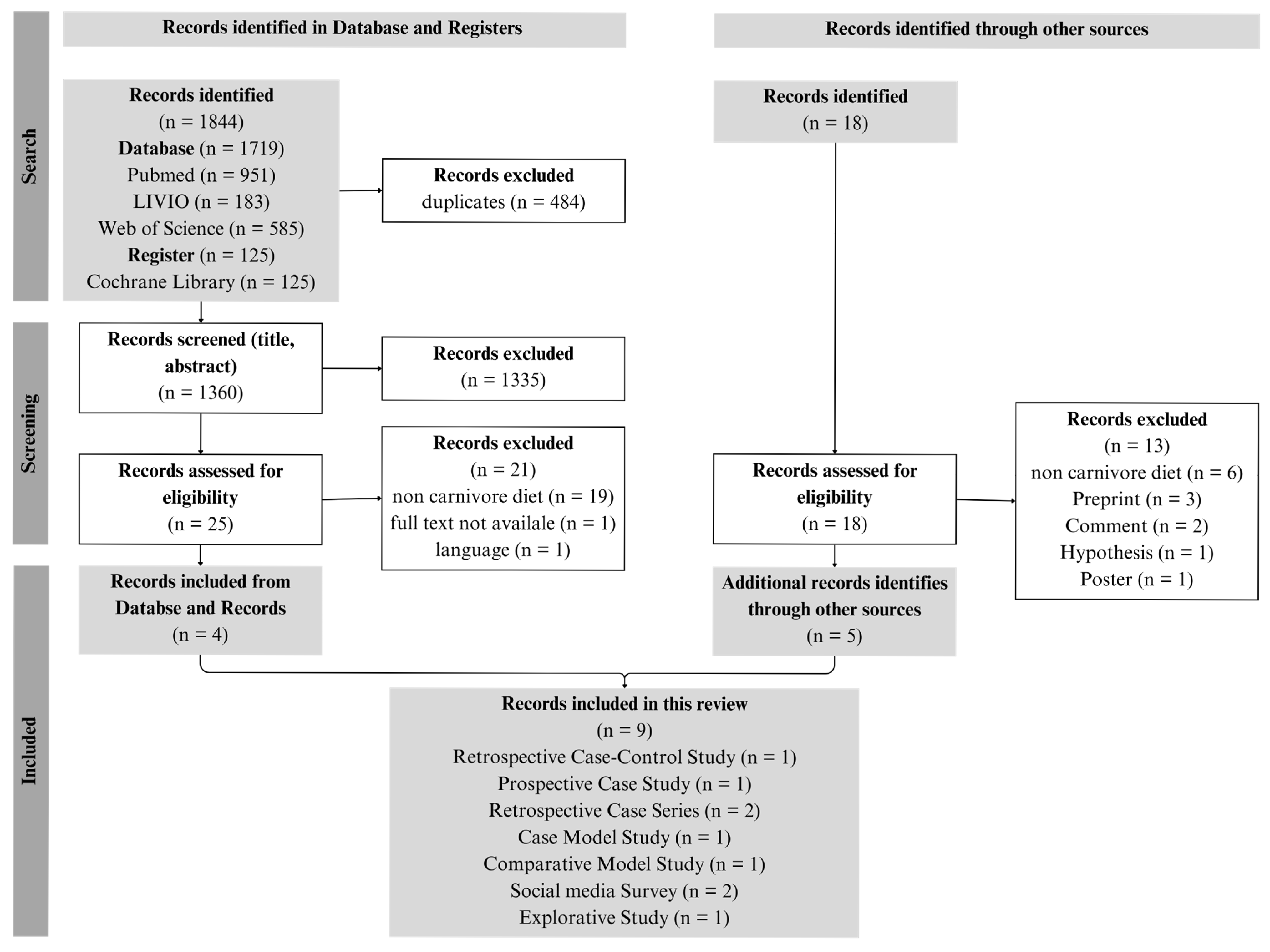
Background: The Carnivore Diet (CD) is an almost exclusively animal-based dietary pattern that has gained increasing popularity on social media. Despite numerous health-related claims, a standardized definition is lacking, and scientific evidence regarding the long-term effects of this diet remains unclear. Methods: The literature search for this scoping review was conducted in accordance with PRISMA guidelines (PRISMA-ScR) using the databases PubMed, LIVIVO, Web of Science, and the Cochrane Library. Results: Nine human studies were included. Individual publications reported positive effects of the CD, such as weight reduction, increased satiety, and potential improvements in inflammatory or metabolic markers. At the same time, potential risks of nutrient deficiencies, particularly in vitamins C and D, calcium, magnesium, iodine, and dietary fiber, as well as elevated low-density-lipoprotein (LDL-) and total cholesterol (TC) levels, were identified, along with one case describing a deterioration in health status. Overall, the quality of evidence is very limited due to small sample sizes, short study durations, and the absence of control groups. Conclusions: The CD may offer short-term health benefits but carries substantial risks of nutrient deficiencies, reduced intake of health-promoting phytochemicals, and the development of cardiovascular disease. At this time, long-term adherence to a CD cannot be recommended.
Keywords: carnivore diet; Lion Diet; plant-free diet; ketogenic diet; nutrient adequacy; cardiovascular risks; microbiome; sustainability; LCHF carnivore diet; Lion Diet; plant-free diet; ketogenic diet; nutrient adequacy; cardiovascular risks; microbiome; sustainability; LCHF