


Abstract
Post-exertional malaise (PEM) and cognitive dysfunction (hereafter “cognitive dysfunction”, including the patient-reported syndrome often described as “brain fog”) are among the most disabling features of Long COVID; yet, approved disease-modifying treatments remain lacking. Emerging evidence implicates interacting disturbances in mitochondrial bioenergetics, redox regulation and neurovascular inflammation, although much of the supporting evidence remains indirect and derives from acute COVID-19, myalgic encephalomyelitis/chronic fatigue syndrome (ME/CFS), primary mitochondrial disease, inflammatory biology and mechanistic pharmacology rather than from direct Long COVID intervention trials. This hypothesis-generating narrative review develops a mechanism-based translational framework: that a pathway-targeted nutraceutical programme may modulate selected elements of these three axes, subject to prior demonstration of formulation quality, pharmacokinetic feasibility, target engagement and safety. Candidate modules comprise coenzyme Q10 and alpha-lipoic acid for bioenergetic/redox support; selenium, sulforaphane and resveratrol for Nrf2–thioredoxin-related redox regulation; and Boswellia serrata, luteolin and eicosapentaenoic acid for putative prostaglandin/resolution-pathway modulation. Sonlicromanol provides a conceptual mechanistic precedent for combined redox and prostaglandin-directed pharmacology, but it is not considered pharmacologically equivalent to an eight-agent nutraceutical combination. We summarise the mechanistic rationale, distinguish direct from indirect evidence, define qualitative evidence-grading criteria, outline safety and interaction considerations, and propose a staged translational research programme. This framework is intended to generate falsifiable hypotheses for future Long COVID studies, not to imply established clinical efficacy.
1. Introduction
Long COVID—formally the post-acute sequelae of SARS-CoV-2 infection (PASC) or post-COVID-19 condition—has been estimated to affect approximately 6–10% of infected individuals in population-level analyses, although estimates vary substantially according to case definition, vaccination/variant era, ascertainment method and duration of follow-up [1,2]. Among its heterogeneous manifestations, post-exertional malaise (PEM) and cognitive dysfunction (including subjective “brain fog” and objectively measurable deficits in attention, processing speed or executive function) are consistently ranked by patients as among the most disabling symptoms and are strongly associated with failure to return to work and reduced quality of life [3]. PEM—a disproportionate and delayed worsening of symptoms after physical, cognitive or emotional exertion—is the cardinal feature shared with myalgic encephalomyelitis/chronic fatigue syndrome (ME/CFS), and its presence constrains fixed-increment graded-exercise rehabilitation approaches [4].
Despite intense investigation, no licenced disease-modifying therapy exists for these symptoms. Symptomatic and pacing-based strategies remain the mainstay; yet, they neither reverse the underlying pathophysiology nor restore exercise tolerance [5]. This therapeutic vacuum, combined with an increasingly coherent but incomplete mechanistic picture, creates a rational opportunity to test interventions that may engage putative downstream pathways associated with PEM and cognitive dysfunction.
Three pathological processes have emerged repeatedly and, importantly, may be mechanistically interconnected rather than independent: (i) mitochondrial dysfunction and bioenergetic insufficiency; (ii) a self-sustaining redox imbalance with impaired endogenous antioxidant defence; and (iii) persistent low-grade neurovascular inflammation [6,7]. Each may be amenable, at least in principle, to modulation by specific nutraceutical agents with plausible molecular targets. The purpose of this hypothesis-generating narrative review is to move beyond the generic framing of nutraceuticals as undifferentiated “antioxidants” and instead articulate a pathway-specific framework: that a rationally selected nutraceutical strategy may modulate these axes and generate testable hypotheses for attenuating PEM and cognitive dysfunction. We develop the pathophysiological framework, describe the search and selection process, map candidate agents to molecular targets, appraise direct and indirect clinical evidence using explicit qualitative criteria, address safety, and propose a staged translational research programme rather than a definitive efficacy trial.
2. Search Strategy, Evidence Selection and Candidate Selection
This narrative review was developed from targeted searches of PubMed/MEDLINE, Scopus and Google Scholar, supplemented by reference-list screening and forward citation tracking of key papers. The final search was completed on 6 July 2026. Searches were restricted to English-language publications. Human Long COVID studies, randomised controlled trials, systematic reviews, clinical pharmacokinetic studies and mechanistic studies were prioritised; animal, cell-culture and non-Long COVID disease literature was included only when direct Long COVID evidence was absent and when the evidence addressed a specific mechanistic link or formulation issue. The review was planned and revised using the transparency domains of SANRA (justification of importance, statement of aims, literature-search description, referencing, scientific reasoning and appropriate presentation of data), while recognising that this was not a systematic review and did not use PRISMA flow counting, formal risk-of-bias scoring or quantitative pooling.
Principal Boolean strings included: (“Long COVID” OR “post-COVID condition” OR PASC OR “post-acute sequelae of SARS-CoV-2”) AND (“post-exertional malaise” OR PEM OR fatigue OR “exercise intolerance” OR “brain fog” OR “cognitive dysfunction”); (“Long COVID” OR PASC) AND (mitochondria* OR “oxidative phosphorylation” OR “electron transport chain” OR “pyruvate dehydrogenase” OR PDH OR lactate OR “oxygen extraction”); (“Long COVID” OR PASC OR COVID-19) AND (“oxidative stress” OR ROS OR Nrf2 OR NRF2 OR Keap1 OR thioredoxin OR “thioredoxin reductase” OR peroxiredoxin OR glutathione); (“Long COVID” OR PASC) AND (endothelial OR neurovascular OR “blood–brain barrier” OR microclot* OR NF-κB OR COX-2 OR mPGES-1 OR “microsomal prostaglandin E synthase” OR PGE2 OR prostaglandin); and (“Long COVID” OR PASC OR fatigue OR “cognitive dysfunction”) AND (“coenzyme Q10” OR ubiquinol OR ubiquinone OR “alpha-lipoic acid” OR selenium OR sulforaphane OR glucoraphanin OR resveratrol OR Boswellia OR AKBA OR luteolin OR EPA OR “eicosapentaenoic acid” OR omega-3).
Candidate compounds were selected through an iterative mechanistic screen rather than a formal systematic-review ranking; the criteria used to retain or deprioritise agents are stated explicitly in Section 4. Agents were retained when they had: (1) a plausible mechanistic link to one of the three axes; (2) at least some human clinical, safety or pharmacokinetic literature; (3) feasible oral delivery or a clearly definable formulation requirement; (4) measurable exposure or target-engagement biomarkers; (5) chronic-administration safety issues that could be protocolised; and (6) a manageable rationale within a staged combination programme. Agents were deprioritised if they lacked human-use data, required parenteral delivery, had poorly standardised preparations, had unacceptable interaction risk for a Long COVID population, or duplicated a mechanism already represented by a better-characterised candidate.
Because search yields overlapped heavily across databases and the review was not registered as a systematic review, records were not counted in PRISMA fashion. For transparency, the working bibliography used for revision contained approximately 300 title/abstract-level records, approximately 90 full-text or full-record evaluations, and 64 references selected for citation after removal of duplicates, non-English records, inaccessible abstracts, low-relevance mechanistic studies and papers not materially informing the proposed framework. These counts should be interpreted as approximate narrative-review audit figures rather than systematic-review screening numbers.
3. A Three-Axis Pathophysiological Framework
3.1. Mitochondrial Dysfunction and Bioenergetic Failure
SARS-CoV-2 interacts intimately with host mitochondria. Viral open reading frame and non-structural proteins localise to mitochondrial membranes, disrupting electron transport chain (ETC) assembly, promoting pathological fission, and provoking calcium dyshomeostasis with opening of the mitochondrial permeability transition pore [7,8]. A plausible downstream consequence, supported by the related post-viral and ME/CFS literature, is functional restriction of pyruvate dehydrogenase (PDH) flux at the irreversible gateway converting pyruvate to acetyl-CoA. Oxidative modification of the PDH lipoyl cofactor, together with upregulation of PDH kinase, is proposed to force cells toward aerobic glycolysis—a Warburg-like shift that yields only two ATP per glucose molecule versus approximately 30–32 through oxidative phosphorylation, with attendant lactate accumulation [8,9,10].
Plasma metabolomic signatures in Long COVID support impaired fatty-acid oxidation, perturbed tricarboxylic-acid-cycle intermediates and reduced Complex I activity [8]. Additional PBMC and tissue/biomarker studies published in 2025 further support persistent mitochondrial abnormalities in Long COVID, including altered mitochondrial ATP-synthase behaviour, ultrastructural changes and disrupted mitophagy markers [11,12]. This bioenergetic insufficiency is present at rest but is unmasked catastrophically by exertion: invasive cardiopulmonary exercise testing demonstrates impaired systemic oxygen extraction rather than a primarily cardiopulmonary limitation [5]. Muscle biopsy studies further show that exercise precipitates mitochondrial and structural myofibre abnormalities specifically in the post-exertional window, providing a direct histological correlate of PEM [4]. The mechanistic congruence with ME/CFS—shared PDH blockade, glycolytic shift and exertional deterioration—strengthens the case for targeting mitochondrial bioenergetics [10].
3.2. Redox Imbalance and the Nrf2–Thioredoxin Axis
Reactive oxygen species (ROS) may be generated in excess through ETC electron leak, NADPH-oxidase activation and uncoupled nitric oxide synthase, producing superoxide, hydrogen peroxide and peroxynitrite [13]. Long COVID cohorts have shown oxidative-damage and redox-imbalance markers, including malondialdehyde/protein-carbonyl-related oxidative toxicity and elevated oxidative-stress index in patients with fatigue and cognitive symptoms [14,15]. Mechanistically, acute or moderate oxidative/electrophilic stress can activate Nrf2 through Keap1 cysteine modification; in contrast, direct SARS-CoV-2 interference with NRF2 signalling has been demonstrated in experimental infection systems [16]. Whether this viral interference persists as genuine Nrf2 suppression in established Long COVID remains unproven. A more cautious interpretation is that chronic Long COVID may involve inadequate, exhausted or dysregulated antioxidant-response capacity relative to ongoing oxidative burden. Under physiological conditions, Nrf2 released from Keap1 drives expression of cytoprotective genes including thioredoxin reductase-1 (TrxR1), NAD(P)H quinone oxidoreductase 1 (NQO1) and glutamate-cysteine ligase (GCL) [17,18].
The thioredoxin reductase–thioredoxin–peroxiredoxin (TrxR–Trx–Prdx) system is one major enzymatic network for maintaining thiol redox status and supporting peroxide detoxification, but it should not be considered the only peroxide-clearing pathway; glutathione peroxidases and catalase also contribute substantially [19,20]. TrxR maintains thioredoxin in its reduced state, thereby supporting peroxiredoxin activity and other thioredoxin-dependent redox reactions. Because TrxR is a selenoenzyme and oxidative stress may impair redox enzymes, selenium status and Nrf2-regulated antioxidant capacity provide a plausible, but not yet proven, interface between redox biology and Long COVID chronicity. The proposed redox–energetic loop should therefore be read as a testable model rather than an established causal sequence [19,21].
3.3. Neurovascular Inflammation and a Hypothesised mPGES-1/PGE2 Contribution
Endothelial injury—via spike–ACE2 interactions, complement activation and neutrophil extracellular-trap formation—may converge on nuclear factor kappa-B (NF-κB) activation in endothelium and macrophages [22,23]. Persistent endothelial dysfunction has been directly documented in Long COVID cohorts using non-invasive vascular assessment, confirming that vascular injury can outlast the acute infectious phase [24]. NF-κB activation can induce pro-inflammatory cytokines and prostaglandin-biosynthetic enzymes such as cyclooxygenase-2 (COX-2) and microsomal prostaglandin E2 synthase-1 (mPGES-1). Persistence of spike protein within CD16+ monocytes for up to fifteen months provides a plausible mechanism for sustained immune activation in a subset of patients, although the degree to which this specifically produces an mPGES-1/PGE2 phenotype in Long COVID remains unknown [25].
mPGES-1 is the terminal, inducible enzyme converting the COX-2 product PGH2 to prostaglandin E2 (PGE2) [26]. Unlike non-selective COX inhibition, selective mPGES-1 modulation is theoretically attractive because it may reduce inducible PGE2 generation while sparing other prostanoids. However, the Long COVID evidence for this pathway is indirect. PGE2 biology is context-, tissue- and EP-receptor-dependent: EP1/EP3 signalling can contribute to nociception, fever and vasomotor effects, EP2/EP4 signalling may be vasodilatory and immunomodulatory, and both pro-inflammatory and resolution-associated effects may occur depending on timing, compartment and receptor expression [26,27]. Peripheral endothelial dysfunction, systemic inflammation and blood–brain-barrier disruption in Long COVID support a neurovascular inflammatory framework [24,28], but they do not demonstrate a PGE2-specific abnormality. Alternative inflammatory and lipid-mediator pathways—including leukotrienes, thromboxanes, prostacyclin, complement, cytokines, mast-cell mediators and specialised pro-resolving mediators—should therefore remain in the differential mechanistic model [27,29]. Central or systemic prostanoid measurements, including plasma/urinary PGE2 metabolites and, where ethically justified, cerebrospinal-fluid prostanoid profiling or neuroimaging markers, should be treated as exploratory hypothesis-testing biomarkers rather than assumed proof of pathway activation.
Recent CSF proteomic data in ME/CFS provide additional indirect support for a central neuroimmune and thrombo-inflammatory component relevant to this framework. Bragée et al. quantified 902 proteins in CSF from 31 ME/CFS patients and reported POTS-associated enrichment of platelet-related, neutrophil-degranulation and acute-phase-response pathways, while severe disease was associated with complement cascade, fibrin-clot formation and IGFBP-mediated insulin-like growth factor transport. Ratio-based analyses further identified severity-associated protein pairs spanning cellular stress, extracellular remodelling and immune-neuronal interaction. These findings do not establish a Long COVID-specific or mPGES-1/PGE2-specific mechanism, nor do they test nutraceutical interventions, but they strengthen the indirect ME/CFS evidence that PEM/cognitive-dysautonomic phenotypes can be accompanied by central immune, vascular/coagulation, metabolic-neurotrophic and neuronal-stress signatures [30].
3.4. Convergence on Post-Exertional Malaise and Brain Fog
These axes are proposed to be interlocking rather than parallel (Figure 1). Mitochondrial dysfunction may increase ROS production; an inadequate or dysregulated antioxidant response may permit oxidative stress to persist; oxidative and inflammatory signalling may amplify NF-κB-related cytokine and lipid-mediator pathways; and neurovascular inflammation may further impair microvascular oxygen delivery and mitochondrial function. PEM may emerge when exertion acutely increases metabolic demand upon a system with limited bioenergetic reserve, precipitating an oxidative–inflammatory flare. Cognitive dysfunction may reflect related processes expressed within a neuroinflamed or barrier-compromised central compartment. A strategy that engages multiple axes is therefore hypothesised to be more informative for translational testing than antioxidant monotherapy, but this remains unproven [6,7,31].
Figure 1.
Three-axis pathophysiological model of post-exertional malaise and brain fog in Long COVID, showing proposed nutraceutical intervention sites. The three pathway panels are annotated with the relative level of direct Long COVID evidence (moderate for the mitochondrial pathway, limited for the redox/antioxidant pathway, with none for the specific claim of persistent Nrf2–thioredoxin suppression, and none for the PGE2-specific inflammatory arm). SARS-CoV-2 is proposed to drive three interlocking cascades—mitochondrial (left), redox/antioxidant (centre) and inflammatory/prostaglandin (right)—that converge on the clinical manifestations (bottom row). Solid grey arrows denote relationships with stronger direct or convergent support; dashed grey arrows denote indirect or extrapolated relationships; and dotted grey arrows denote more speculative, hypothesis-generating links. Coloured tags mark the proposed intervention site of each candidate agent, grouped as the bioenergetic module (blue: CoQ10, alpha-lipoic acid [ALA]), the redox module (green: selenium [Se], sulforaphane [SFN], resveratrol [RSV]) and the prostaglandin module (amber: Boswellia [Bos], luteolin [Lut], eicosapentaenoic acid [EPA]); arrowheads indicate metabolic support/activation and bars indicate enzymatic inhibition. The figure is conceptual and does not imply that each agent acts exclusively, or with proven clinical efficacy, at the indicated node in Long COVID; see Table 1 for the fuller target profile of each agent. COX-2, cyclooxygenase-2; mPGES-1, microsomal prostaglandin E synthase-1; mPTP, mitochondrial permeability transition pore; Nrf2, nuclear factor erythroid 2-related factor 2; PDH, pyruvate dehydrogenase; PGE2, prostaglandin E2; TrxR, thioredoxin reductase.
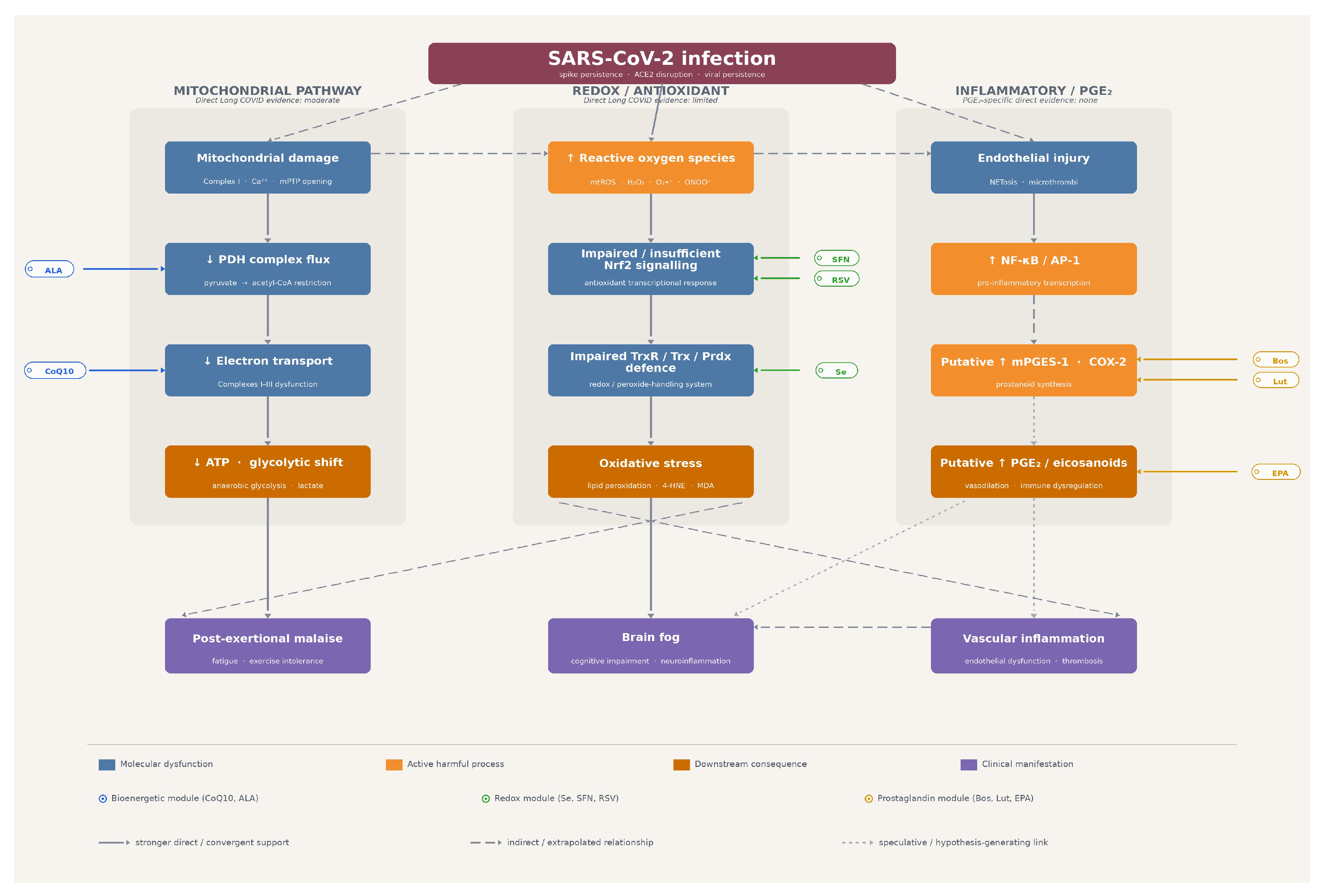
Table 1.
Candidate nutraceuticals proposed molecular targets, selection rationale, formulation/exposure constraints, indicative research-dose ranges and principal safety limitations.
3.5. Relationship to Alternative Pathophysiological Models
The three-axis framework advanced here is not offered as a competitor to, still less a replacement for, the other major pathophysiological models of Long COVID, and it would misrepresent the present evidence to claim that it is better supported than they are. Four alternative models command substantial and, in several respects, stronger direct human evidence. The viral persistence model holds that SARS-CoV-2 RNA, protein or replication-competent virus persists in tissue reservoirs beyond the acute illness and continuously stimulates the immune system; this model has direct tissue-level human support and has advanced far enough to generate antiviral and monoclonal-antibody trials in Long COVID [46]. The autoimmunity model posits that infection triggers functional autoantibodies, notably agonistic autoantibodies against G-protein-coupled receptors including β2-adrenergic, muscarinic M2, angiotensin II AT1 and MAS receptors, which have been detected in patients with persistent post-COVID symptoms [47]. The autonomic dysfunction model attributes exercise intolerance, orthostatic symptoms and cognitive complaints to dysautonomia, including post-COVID POTS and related autonomic syndromes [48]; this partly converges with the autoimmunity model, since several implicated GPCR targets are themselves autonomic receptors [47]. The broader immune-dysregulation model encompasses herpesvirus reactivation, T-cell exhaustion, altered cortisol dynamics and microbiome disturbance, and is supported by cross-sectional immune-profiling studies [49].
Rather than competing with these models, the framework proposed here is best understood as describing a possible downstream convergence point. Viral antigen persistence, autoantibody engagement of GPCRs and chronic immune activation are all plausible upstream initiators of precisely the mitochondrial, redox and prostaglandin disturbances described in Section 3.1, Section 3.2 and Section 3.3; conversely, none of the three axes proposed here offers any account of why the process begins, or why it persists in some individuals and not others, which is what the upstream models supply. This complementarity has consequences that matter for trial design. Because a downstream metabolic intervention would not be expected to eliminate a persistent viral reservoir or to remove pathogenic autoantibodies, the framework predicts at most symptomatic and functional benefit rather than disease resolution, and predicts that benefit would be greatest in patients in whom the upstream driver has subsided but the downstream metabolic disturbance has not. It follows that any trial of the proposed combination should measure, or at minimum stratify for, markers of these alternative mechanisms, since a null result in an unstratified cohort could reflect aetiological heterogeneity rather than failure of the intervention. The framework is also falsifiable against these alternatives: if post-exertional malaise and cognitive dysfunction were shown to track antigen persistence or autoantibody titre independently of bioenergetic and redox markers, the case for a clinically meaningful downstream metabolic contribution would be correspondingly weakened.
4. Nutraceutical Candidates and Their Molecular Targets
Table 1 summarises the eight candidate agents, their principal molecular targets, selection rationale, formulation/exposure constraints, proposed research-dose ranges and safety limitations. The compounds were retained only when they met several explicit translational criteria, applied iteratively during candidate selection: mechanistic relevance to one of the three axes; at least some human use or clinical data; plausible oral pharmacokinetic feasibility or a defined formulation requirement; product standardisation potential; chronic-administration safety constraints that can be protocolised; and compatibility with a staged trial programme. Several agents act across more than one axis, but none should be interpreted as pathway-specific in the pharmacological sense.
4.1. Mitochondrial Support: Coenzyme Q10 and Alpha-Lipoic Acid
Coenzyme Q10 (CoQ10) is an obligatory lipophilic electron carrier shuttling electrons between Complexes I/II and III; supplementation can increase circulating CoQ10 and may support ETC redox cycling, although clinical response depends strongly on formulation, absorption and baseline status [33]. Alpha-lipoic acid (ALA) is best framed here as a redox-active and metabolic modulator rather than as a direct replacement for the covalently attached PDH lipoyl cofactor. The functional lipoyl group of mammalian PDH is generated through mitochondrial lipoylation pathways and should not be assumed to be restored by orally administered free ALA. ALA may still be relevant through antioxidant actions, thiol redox effects and indirect metabolic signalling [34,35]. A prospective, non-randomised comparison of 174 patients reported greater fatigue improvement with CoQ10 plus ALA than in an untreated control group; whereas, a placebo-controlled trial of high-dose CoQ10 monotherapy over six weeks was negative [32,50]. These findings support clinical equipoise, not efficacy.
4.2. Redox Restoration: Selenium, Sulforaphane and Resveratrol
Selenium is incorporated as selenocysteine into the catalytic site of TrxR and glutathione peroxidases; adequate selenium status is a prerequisite for several antioxidant enzymes, but supplementation should be status-guided rather than indiscriminate [36]. Sulforaphane, the isothiocyanate generated by myrosinase-catalysed hydrolysis of glucoraphanin, is a well-characterised dietary Nrf2 activator, but potency and exposure depend on whether the intervention delivers free sulforaphane or glucoraphanin plus active myrosinase [38,39,51]. Any clinical protocol should express dose in free-sulforaphane equivalents or molar glucoraphanin/sulforaphane equivalents and verify exposure using urinary or plasma sulforaphane metabolites. Resveratrol can modulate Nrf2 and NF-κB-related signalling through SIRT1-associated and other mechanisms, but rapid phase-II metabolism and low systemic bioavailability make formulation-specific pharmacokinetic justification essential [40].
4.3. Prostaglandin Modulation: Boswellia, Luteolin and Eicosapentaenoic Acid
Boswellic acids—principally acetyl-11-keto-β-boswellic acid (AKBA) from the gum resin of Boswellia serrata Roxb. ex Colebr.—are among the natural compounds shown in vitro to inhibit mPGES-1, in addition to suppressing NF-κB/AP-1-related transcription [52]. This does not establish that clinical benefit in osteoarthritis or any other condition is mediated by mPGES-1 inhibition in humans [41]. Any trial should specify the botanical name, plant part, extraction procedure, extract ratio, analytical standardisation for AKBA/total boswellic acids, contaminant testing and stability. Luteolin reduces COX-2 and mPGES-1 expression in activated macrophage models and has broader anti-inflammatory effects, but human translation is constrained by rapid glucuronidation/sulfation and limited formulation-specific pharmacokinetic data [42,43]. EPA competitively displaces arachidonic acid in eicosanoid pathways and is a precursor to specialised pro-resolving mediators [45,53]. However, pharmaceutical icosapent ethyl data cannot be assumed to apply directly to generic EPA supplements or to Long COVID; an EPA-dominant intervention should specify EPA content, DHA content or absence, peroxide/anisidine oxidation values, purity, stability and batch certification. Anti-inflammatory and pro-resolving dose ranges are extrapolated from non-Long-COVID literature and require confirmation in target-engagement studies [44].
5. Integrated Hypothesis and Combination Rationale
We propose that because the three axes may be mutually reinforcing, a multi-module intervention could be more mechanistically informative than single-agent antioxidant monotherapy. This should not be read as proof that all three modules are necessary, sufficient or synergistic. A negative CoQ10 monotherapy trial may reflect the compound, formulation, dose, duration, population, endpoint or underlying biology rather than failure to engage enough axes [50]. The proposed combination is therefore conceived as a staged research framework comprising a bioenergetic/redox module (CoQ10 + ALA), a redox-response module (selenium + sulforaphane, with resveratrol as a bridging agent) and a putative prostaglandin/resolution module (Boswellia + luteolin + EPA), each of which requires independent feasibility and target-engagement testing.
Sonlicromanol (KH176) provides an informative conceptual mechanistic analogy, not pharmacological proof-of-concept for the proposed nutraceutical combination. Sonlicromanol is a defined small molecule with specific stereochemistry, pharmacokinetics, tissue distribution and metabolite-dependent target activity; the proposed nutraceutical agents differ markedly in exposure, selectivity, intracellular localisation and regulatory quality control [54,55]. In primary mitochondrial disease, sonlicromanol has progressed through phase 2 evaluation, but the phase 2b programme should be interpreted cautiously: the randomised dose-selection study did not meet its primary cognitive endpoint, although exploratory and open-label extension signals were reported [56,57]. Thus, sonlicromanol supports the plausibility of jointly considering redox and prostaglandin biology, but it does not imply that a food-derived multi-agent regimen can reproduce the drug’s activity.
6. Appraisal of Direct and Indirect Clinical Evidence
Direct clinical evidence in Long COVID remains sparse, and it is important to distinguish direct evidence for individual agents from evidence for the complete combination, which is currently absent. The strongest direct signal is for CoQ10–ALA: a prospective, non-randomised comparison of 174 patients reported fatigue improvement among recipients relative to an untreated control group [32]. This design is susceptible to expectation effects, confounding, differential care-seeking and natural-recovery bias and cannot establish efficacy. Instructively, a rigorously conducted placebo-controlled trial of CoQ10 monotherapy was negative over a six-week exposure in a predominantly overweight cohort [50]. The contrast is compatible with, but does not prove, the hypothesis that combination or multi-axis approaches may be necessary; the results may simply reflect differences in compound selection, dose, duration, baseline phenotype or outcome measurement.
The available Long COVID omega-3 study is best read as a feasibility trial: it primarily supports tolerability and recruitment feasibility while providing insufficient evidence for efficacy, particularly because it did not test a pharmaceutical-grade EPA-dominant anti-inflammatory strategy [58]. Indirect support for the broader framework is stronger but still non-definitive: antioxidant and anti-inflammatory nutritional strategies have a coherent rationale in COVID-19 pathophysiology [31,59]; ALA improves metabolic and oxidative parameters across multiple conditions without proving correction of PDH flux in Long COVID [60]; high-dose EPA has cardiovascular anti-inflammatory and safety data in selected high-risk populations [44]; and mitochondrial-disease literature provides a rationale for combined nutraceutical approaches while not validating this specific Long COVID combination [61]. The strength of evidence underpinning each principal claim is summarised in Table 2. Across the framework, direct human Long COVID evidence ranges from none to moderate, mechanistic and preclinical support varies by pathway, and overall certainty for the complete intervention is very low. Beyond the agents proposed here, the wider nutraceutical trial literature in Long COVID is small but not empty, and it is instructive. In a single-blind randomised placebo-controlled trial in 50 adults with Long COVID and persistent fatigue, 28 days of l-arginine (1.66 g twice daily) plus liposomal vitamin C (500 mg twice daily) improved the primary endpoint of 6 min walk distance, together with handgrip strength, flow-mediated dilation and fatigue persistence, relative to placebo [62]. That trial is relevant to the present framework in three respects: it demonstrates that an adequately powered nutraceutical trial in this population is feasible; its mechanism of action is vascular and nitric-oxide-mediated rather than bioenergetic, redox or prostaglandin-directed, so it tests a different hypothesis from the one advanced here; and its short duration, single-blind design, modest sample size and absence of post-exertional-malaise or objective cognitive endpoints limit what can be concluded from it. It establishes feasibility and provides encouragement for the field, not support for the specific combination proposed in this hypothesis-generating narrative review.
Table 2.
Qualitative evidence grading for principal claims, with explicit criteria distinguishing directness, study design, consistency and risk-of-bias limitations.
7. Safety, Interactions and Translational Considerations
A combination of eight agents raises real-world issues of adherence, tolerability, attribution of adverse effects, supplement contamination, batch variability and cumulative interactions, and these must be addressed explicitly before any trial. EPA at 2–4 g/day should be treated as pharmacologically distinct from low-dose “fish oil”; REDUCE-IT used pharmaceutical icosapent ethyl in a high-risk cardiovascular population and reported higher atrial fibrillation/flutter hospitalisation and numerically higher serious bleeding [44]. EPA, resveratrol and Boswellia may each carry antiplatelet potential, so concurrent anticoagulant use, high-risk NSAID use and bleeding disorders should be exclusion criteria in early trials. Selenium requires baseline-status logic: although many sources cite an adult upper limit near 400 µg/day, European authorities have adopted a lower adult tolerable upper intake level of 255 µg/day, meaning a 100–200 µg/day supplement can approach the European UL once diet is included [36,37]. ALA can lower blood glucose and requires glucose-risk screening in people with diabetes, on glucose-lowering therapy, or prone to hypoglycaemia [34,60]. CoQ10 may attenuate warfarin anticoagulation [33]. The previously suggested clinically relevant sulforaphane–CYP1A2 interaction has been removed because available human evidence is insufficient to support it as a material protocol restriction; nonetheless, narrow-therapeutic-index medication use should be reviewed case by case. Pregnancy, lactation, current anticoagulation and unstable comorbid disease should be explicit exclusions for a first-in-patient trial, and all products should undergo independent identity, purity, potency, oxidation, contaminant and stability testing.
8. Future Directions: A Proposed Trial Framework
Testing this hypothesis should proceed through a staged translational programme rather than immediately through a definitive efficacy trial of the full combination. A phase 0/1 stage should first assess formulation selection, batch-specific chemical characterisation, tolerability, pill burden, adherence, pharmacokinetics, pharmacodynamic target engagement and potential interactions. Exposure biomarkers should include, where feasible, plasma CoQ10, selenium status, urinary or plasma sulforaphane metabolites, omega-3 index, EPA oxidation/purity measures, and formulation-specific markers for polyphenol or boswellic-acid exposure. Only after formulation feasibility and safety are established should efficacy-oriented testing proceed in adults meeting the WHO post-COVID-condition definition—symptoms usually beginning within three months of infection, persisting at least two months and not explained by an alternative diagnosis—with PEM confirmed using a validated instrument and fatigue or cognitive dysfunction above a pre-specified threshold [2,4]. Stable standard care should generally be permitted rather than requiring broad medication and supplement washout, except where safety or mechanistic interpretation requires exclusion.
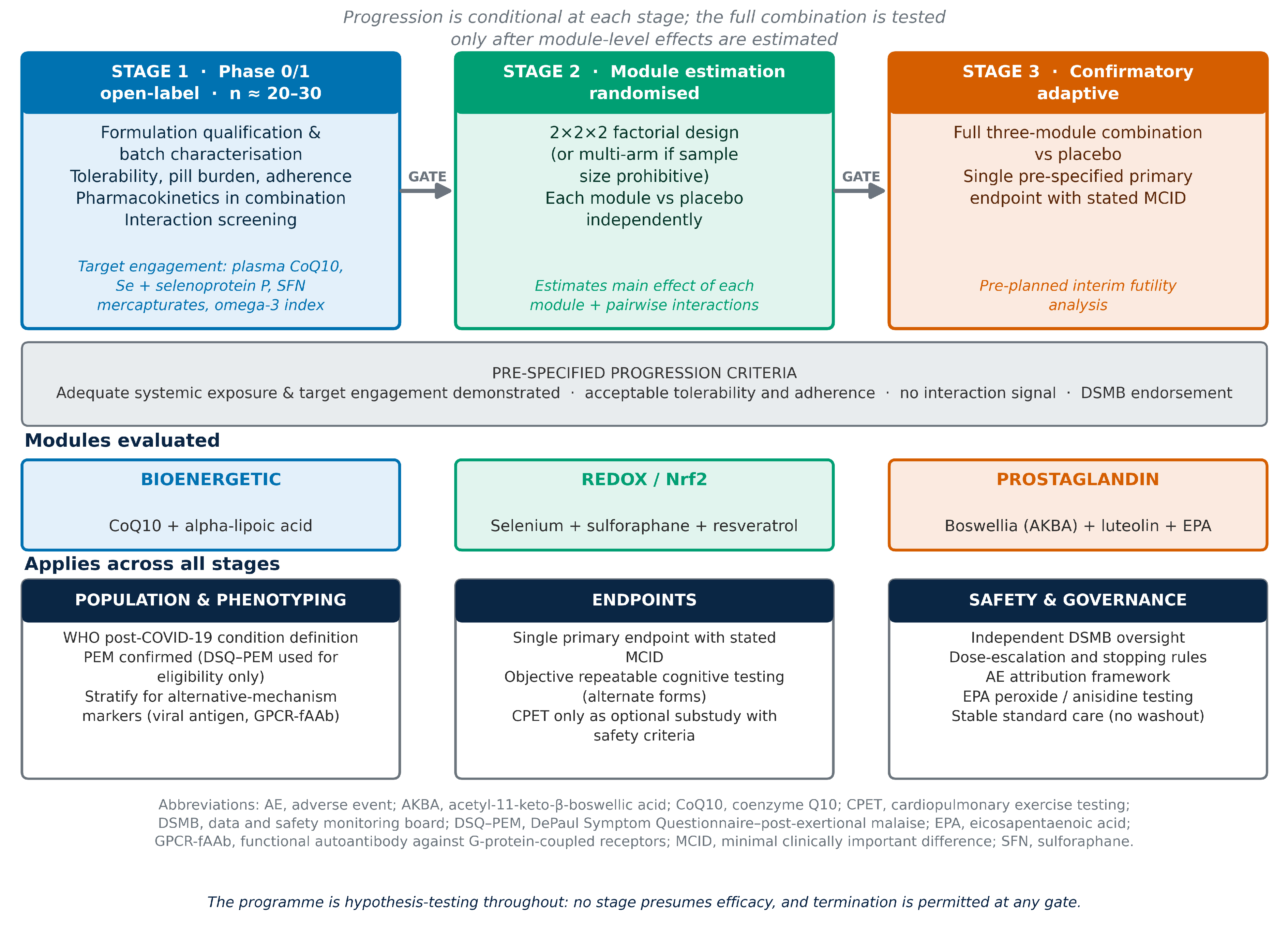
A single primary endpoint should be selected and justified. The DePaul Symptom Questionnaire–PEM may be useful for eligibility and phenotyping, but its responsiveness and minimal clinically important difference should be justified before use as a primary treatment endpoint. Fatigue/PEM outcomes could be supported by symptom diaries, actigraphy, wearable heart rate/HRV data and patient-reported functioning; cognitive dysfunction should be assessed using objective, repeatable tests selected to minimise practice effects. Cardiopulmonary exercise testing or exertional challenges can precipitate prolonged PEM and should therefore be optional mechanistic substudies with explicit safety criteria, dose-limiting stopping rules and post-test monitoring rather than routine requirements for all participants. A subsequent trial could use a factorial, adaptive or multi-arm design to evaluate modules independently before testing the complete combination, rather than relying only on an incremental sequence that cannot estimate redox-only effects, prostaglandin-only effects or module interactions [5,16,26]. The protocol should include predefined dose-escalation rules, adverse-event attribution procedures, adherence thresholds, blinding-integrity testing, independent data and safety monitoring, and stratification by baseline oxidative-stress/inflammatory burden. The staged programme is summarised schematically in Figure 2, which sets out the progression from phase 0/1 feasibility and target-engagement work, through module-level estimation using a factorial or multi-arm design, to confirmatory evaluation of the full combination, together with the decision points and stopping rules governing progression between stages.
Figure 2.
Proposed staged translational programme for evaluating the three-module nutraceutical combination. Stage 1 (phase 0/1, open-label) establishes formulation qualification, tolerability, pill burden, adherence, pharmacokinetics in combination and pharmacodynamic target engagement, using exposure biomarkers including plasma coenzyme Q10, selenium with selenoprotein P, urinary or plasma sulforaphane mercapturic acid metabolites and the erythrocyte omega-3 index. Stage 2 estimates the independent effect of each module against placebo using a 2 × 2 × 2 factorial design, or a multi-arm design where sample size is prohibitive, permitting estimation of main effects and pairwise interactions; this addresses the principal limitation of an incremental add-on ladder, which confounds module identity with position in the sequence. Stage 3 evaluates the full combination against placebo, powered on a single pre-specified primary endpoint with a stated minimal clinically important difference and incorporating pre-planned interim futility analysis. Progression between stages is conditional on pre-specified criteria (grey band). The programme is hypothesis-testing throughout: no stage presumes efficacy, and termination is permitted at any gate. Abbreviations as listed in the figure.
A note on rehabilitation context is warranted. PEM constrains fixed-increment graded-exercise approaches—NICE defines graded-exercise therapy as establishing a baseline and then making fixed incremental increases premised on deconditioning, and nowadays most major health care organisations recommend against it in ME/CFS [63]—and therefore necessitates pacing or symptom-titrated rehabilitation strategies; this does not imply that all carefully monitored rehabilitation is contraindicated in every Long COVID phenotype. Indeed, individually symptom-titrated exercise, delivered with cautious PEM monitoring, has improved fatigue and quality of life in selected post-COVID-condition patients [64]. A nutraceutical trial should be positioned as complementary to, not a replacement for, individualised rehabilitation and standard care.
9. Conclusions
Post-exertional malaise and cognitive dysfunction in Long COVID may involve interacting disturbances in mitochondrial bioenergetics, redox regulation and neurovascular inflammation, with the mPGES-1/PGE2 component representing a particularly speculative but testable sub-hypothesis. Reframing nutraceuticals as pathway-relevant candidate interventions rather than generic antioxidants yields a coherent translational framework, but no component has demonstrated efficacy specifically for both PEM and cognitive dysfunction, no study has evaluated the complete eight-agent combination, pharmacokinetic compatibility and target engagement are unknown, and additive efficacy cannot be inferred from mechanistic complementarity. Combining several agents may add toxicity, pill burden and interpretive complexity without adding benefit. The model is therefore suitable for staged experimental evaluation—beginning with formulation, exposure, safety and biomarker studies—before any adequately powered efficacy trial is attempted.
Funding
This research received no external funding.
Institutional Review Board Statement
Not applicable.
Informed Consent Statement
Not applicable.
Data Availability Statement
No new data were created or analysed in this study. Data sharing is not applicable to this article.
Conflicts of Interest
Stephan F. E. Praet declares that he has no conflicts of interest with respect to any of the nutraceutical products or agents mentioned in this manuscript. He has no patents, planned proprietary formulations, consultancy activities, equity interests, sponsored research agreements, paid advisory roles, speaker fees, product endorsements or commercial relationships relevant to coenzyme Q10, alpha-lipoic acid, selenium, sulforaphane, resveratrol, Boswellia serrata, luteolin, eicosapentaenoic acid or sonlicromanol. No nutraceutical manufacturer had any role in the conception, preparation, writing or revision of this manuscript.
Abbreviations
| ACE2 | angiotensin-converting enzyme 2 |
| AKBA | acetyl-11-keto-β-boswellic acid |
| ALA | alpha-lipoic acid |
| AP-1 | activator protein 1 |
| ATP | adenosine triphosphate |
| Bos | Boswellia serrata |
| CoQ10 | coenzyme Q10 |
| COX-2 | cyclooxygenase-2 |
| CPET | cardiopulmonary exercise testing |
| CSF | cerebrospinal fluid |
| CYP1A2 | cytochrome P450 1A2 |
| DHA | docosahexaenoic acid |
| EPA | eicosapentaenoic acid |
| ETC | electron transport chain |
| GCL | glutamate-cysteine ligase |
| GPCR | G-protein-coupled receptor |
| HRV | heart rate variability |
| Keap1 | Kelch-like ECH-associated protein 1 |
| Lut | luteolin |
| ME/CFS | myalgic encephalomyelitis/chronic fatigue syndrome |
| mPGES-1 | microsomal prostaglandin E2 synthase-1 |
| NF-κB | nuclear factor kappa-B |
| NQO1 | NAD(P)H quinone oxidoreductase 1 |
| Nrf2 | nuclear factor erythroid 2-related factor 2 |
| PASC | post-acute sequelae of SARS-CoV-2 |
| PBMC | peripheral blood mononuclear cell |
| PDH | pyruvate dehydrogenase |
| PEM | post-exertional malaise |
| PGE2 | prostaglandin E2 |
| PGH2 | prostaglandin H2 |
| PK | pharmacokinetic(s) |
| POTS | postural orthostatic tachycardia syndrome |
| Prdx | peroxiredoxin |
| PRISMA | Preferred Reporting Items for Systematic Reviews and Meta-Analyses |
| RCT | randomised controlled trial |
| ROS | reactive oxygen species |
| RSV | resveratrol |
| SANRA | Scale for the Assessment of Narrative Review Articles |
| SARS-CoV-2 | severe acute respiratory syndrome coronavirus 2 |
| Se | selenium |
| SFN | sulforaphane |
| SIRT1 | sirtuin 1 |
| SPMs | specialised pro-resolving mediators |
| Trx | thioredoxin |
| TrxR | thioredoxin reductase |
| TrxR1 | thioredoxin reductase 1 |
| UL | tolerable upper intake level |
| WHO | World Health Organisation |
References
- Davis, H.E.; McCorkell, L.; Vogel, J.M.; Topol, E.J. Long COVID: Major findings, mechanisms and recommendations. Nat. Rev. Microbiol. 2023, 21, 133–146. [Google Scholar] [CrossRef] [Scilit] [PubMed]
- Soriano, J.B.; Murthy, S.; Marshall, J.C.; Relan, P.; Diaz, J.V. WHO Clinical Case Definition Working Group on Post-COVID-19 Condition. A clinical case definition of post-COVID-19 condition by a Delphi consensus. Lancet Infect. Dis. 2022, 22, e102–e107. [Google Scholar] [CrossRef] [Scilit]
- Ceban, F.; Ling, S.; Lui, L.M.; Lee, Y.; Gill, H.; Teopiz, K.M.; Rodrigues, N.B.; Subramaniapillai, M.; Di Vincenzo, J.D.; Cao, B.; et al. Fatigue and cognitive impairment in post-COVID-19 syndrome: A systematic review and meta-analysis. Brain Behav. Immun. 2022, 101, 93–135. [Google Scholar] [CrossRef] [Scilit] [PubMed]
- Appelman, B.; Charlton, B.T.; Goulding, R.P.; Kerkhoff, T.J.; Breedveld, E.A.; Noort, W.; Offringa, C.; Bloemers, F.W.; van Weeghel, M.; Schomakers, B.V.; et al. Muscle abnormalities worsen after post-exertional malaise in long COVID. Nat. Commun. 2024, 15, 17. [Google Scholar] [CrossRef] [Scilit] [PubMed]
- Singh, I.; Joseph, P.; Heerdt, P.M.; Cullinan, M.; Lutchmansingh, D.D.; Gulati, M.; Possick, J.D.; Systrom, D.M.; Waxman, A.B. Persistent exertional intolerance after COVID-19: Insights from invasive cardiopulmonary exercise testing. Chest 2022, 161, 54–63. [Google Scholar] [CrossRef] [Scilit] [PubMed]
- Monje, M.; Iwasaki, A. The neurobiology of long COVID. Neuron 2022, 110, 3484–3496. [Google Scholar] [CrossRef] [Scilit] [PubMed]
- Molnar, T.; Lehoczki, A.; Fekete, M.; Varnai, R.; Zavori, L.; Erdo-Bonyar, S.; Simon, D.; Berki, T.; Csecsei, P.; Ezer, E. Mitochondrial dysfunction in long COVID: Mechanisms, consequences, and potential therapeutic approaches. GeroScience 2024, 46, 5267–5286. [Google Scholar] [CrossRef] [Scilit] [PubMed]
- Guntur, V.P.; Nemkov, T.; de Boer, E.; Mohning, M.P.; Baraghoshi, D.; Cendali, F.I.; San-Millán, I.; Petrache, I.; D’alessandro, A. Signatures of mitochondrial dysfunction and impaired fatty acid metabolism in plasma of patients with post-acute sequelae of COVID-19. Metabolites 2022, 12, 1026. [Google Scholar] [CrossRef] [Scilit] [PubMed]
- Nunn, A.V.W.; Guy, G.W.; Brysch, W.; Bell, J.D. Understanding Long COVID; Mitochondrial Health and Adaptation—Old Pathways, New Problems. Biomedicines 2022, 10, 3113. [Google Scholar] [CrossRef] [Scilit] [PubMed]
- Fluge, Ø.; Mella, O.; Bruland, O.; Risa, K.; Dyrstad, S.E.; Alme, K.; Rekeland, I.G.; Sapkota, D.; Røsland, G.V.; Fosså, A.; et al. Metabolic profiling indicates impaired pyruvate dehydrogenase function in myalgic encephalomyelitis/chronic fatigue syndrome. JCI Insight 2016, 1, e89376. [Google Scholar] [CrossRef] [Scilit] [PubMed]
- Macnaughtan, J.; Chau, K.Y.; Brennan, E.; Toffoli, M.; Spinazzola, A.; Hillman, T.; Heightman, M.; Schapira, A.H.V. Mitochondrial function is impaired in long COVID patients. Ann. Med. 2025, 57, 2528167. [Google Scholar] [CrossRef] [Scilit] [PubMed]
- Szögi, T.; Borsos, B.N.; Masic, D.; Radics, B.; Bella, Z.; Bánfi, A.; Ördög, N.; Zsiros, C.; Kiricsi, Á.; Pankotai-Bodó, G.; et al. Novel biomarkers of mitochondrial dysfunction in Long COVID patients. GeroScience 2025, 47, 2245–2261. [Google Scholar] [CrossRef] [Scilit] [PubMed]
- Paul, B.D.; Lemle, M.D.; Komaroff, A.L.; Snyder, S.H. Redox imbalance links COVID-19 and myalgic encephalomyelitis/chronic fatigue syndrome. Proc. Natl. Acad. Sci. USA 2021, 118, e2024358118. [Google Scholar] [CrossRef] [Scilit] [PubMed]
- Al-Hakeim, H.K.; Al-Rubaye, H.T.; Al-Hadrawi, D.S.; Almulla, A.F.; Maes, M. Long-COVID post-viral chronic fatigue and affective symptoms are associated with oxidative damage, lowered antioxidant defenses and inflammation: A proof of concept and mechanism study. Mol. Psychiatry 2023, 28, 564–578. [Google Scholar] [CrossRef] [Scilit] [PubMed]
- Mese, O.; Otsuka, Y.; Sakurada, Y.; Tokumasu, K.; Soejima, Y.; Morita, S.; Nakano, Y.; Honda, H.; Eguchi, A.; Fukuda, S.; et al. Clinical evaluation of oxidative stress markers in patients with long COVID during the Omicron phase in Japan. Antioxidants 2025, 14, 1068. [Google Scholar] [CrossRef] [Scilit] [PubMed]
- Olagnier, D.; Farahani, E.; Thyrsted, J.; Blay-Cadanet, J.; Herengt, A.; Idorn, M.; Hait, A.; Hernaez, B.; Knudsen, A.; Iversen, M.B.; et al. SARS-CoV-2-mediated suppression of NRF2-signaling reveals potent antiviral and anti-inflammatory activity of 4-octyl-itaconate and dimethyl fumarate. Nat. Commun. 2020, 11, 4938. [Google Scholar] [CrossRef] [Scilit] [PubMed]
- Yamamoto, M.; Kensler, T.W.; Motohashi, H. The KEAP1-NRF2 system: A thiol-based sensor-effector apparatus for maintaining redox homeostasis. Physiol. Rev. 2018, 98, 1169–1203. [Google Scholar] [CrossRef] [Scilit] [PubMed]
- Hayes, J.D.; Dinkova-Kostova, A.T. The Nrf2 regulatory network provides an interface between redox and intermediary metabolism. Trends Biochem. Sci. 2014, 39, 199–218. [Google Scholar] [CrossRef] [Scilit] [PubMed]
- Beltrán-García, J.; Osca-Verdegal, R.; Pallardó, F.V.; Ferreres, J.; Rodríguez, M.; Mulet, S.; Sanchis-Gomar, F.; Carbonell, N.; García-Giménez, J.L. Oxidative stress and inflammation in COVID-19-associated sepsis: The potential role of anti-oxidant therapy in avoiding disease progression. Antioxidants 2020, 9, 936. [Google Scholar] [CrossRef] [Scilit] [PubMed]
- Arnér, E.S.J.; Holmgren, A. Physiological functions of thioredoxin and thioredoxin reductase. Eur. J. Biochem. 2000, 267, 6102–6109. [Google Scholar] [CrossRef] [Scilit] [PubMed]
- Ntyonga-Pono, M.P. COVID-19 infection and oxidative stress: An under-explored approach for prevention and treatment? Pan Afr. Med. J. 2020, 35, 12. [Google Scholar] [CrossRef] [Scilit]
- Nalbandian, A.; Sehgal, K.; Gupta, A.; Madhavan, M.V.; McGroder, C.; Stevens, J.S.; Cook, J.R.; Nordvig, A.S.; Shalev, D.; Sehrawat, T.S.; et al. Post-acute COVID-19 syndrome. Nat. Med. 2021, 27, 601–615. [Google Scholar] [CrossRef] [Scilit] [PubMed]
- Merad, M.; Martin, J.C. Pathological inflammation in patients with COVID-19: A key role for monocytes and macrophages. Nat. Rev. Immunol. 2020, 20, 355–362. [Google Scholar] [CrossRef] [Scilit] [PubMed]
- Charfeddine, S.; Ibn Hadj Amor, H.; Jdidi, J.; Torjmen, S.; Kraiem, S.; Hammami, R.; Bahloul, A.; Kallel, N.; Moussa, N.; Touil, I.; et al. Long COVID-19 syndrome: Is it related to microcirculation and endothelial dysfunction? Insights from TUN-EndCOV study. Front. Cardiovasc. Med. 2021, 8, 745758. [Google Scholar] [CrossRef] [Scilit] [PubMed]
- Patterson, B.K.; Francisco, E.B.; Yogendra, R.; Long, E.; Pise, A.; Rodrigues, H.; Hall, E.; Herrera, M.; Parikh, P.; Guevara-Coto, J.; et al. Persistence of SARS-CoV-2 S1 protein in CD16+ monocytes in post-acute sequelae of COVID-19 (PASC) up to 15 months post-infection. Front. Immunol. 2022, 12, 746021. [Google Scholar] [CrossRef] [Scilit] [PubMed]
- Koeberle, A.; Werz, O. Perspective of microsomal prostaglandin E2 synthase-1 as drug target in inflammation-related disorders. Biochem. Pharmacol. 2015, 98, 1–15. [Google Scholar] [CrossRef] [Scilit] [PubMed]
- Shimizu, T. Lipid Mediators in Health and Disease: Enzymes and Receptors as Therapeutic Targets for the Regulation of Immunity and Inflammation. Annu. Rev. Pharmacol. Toxicol. 2009, 49, 123–150. [Google Scholar] [CrossRef] [Scilit] [PubMed]
- Greene, C.; Connolly, R.; Brennan, D.; Laffan, A.; O’keeffe, E.; Zaporojan, L.; O’callaghan, J.; Thomson, B.; Connolly, E.; Argue, R.; et al. Blood-brain barrier disruption and sustained systemic inflammation in individuals with long COVID-associated cognitive impairment. Nat. Neurosci. 2024, 27, 421–432. [Google Scholar] [CrossRef] [Scilit] [PubMed]
- Pretorius, E.; Vlok, M.; Venter, C.; Bezuidenhout, J.A.; Laubscher, G.J.; Steenkamp, J.; Kell, D.B. Persistent clotting protein pathology in Long COVID/PASC is accompanied by increased levels of antiplasmin. Cardiovasc. Diabetol. 2021, 20, 172. [Google Scholar] [CrossRef] [Scilit] [PubMed]
- Bragée, B.; Li, P.; Meadows, D.; Widgren, A.; Sjögren, P.; Ghatan, P.H.; Bertilson, B.C.; Xiao, W.; Bergquist, J. Proteomic signatures in cerebrospinal fluid and their clinical associations in patients with ME/CFS. Sci. Rep. 2026, 16, 15848. [Google Scholar] [CrossRef] [Scilit] [PubMed]
- Vollbracht, C.; Kraft, K. Oxidative stress and hyper-inflammation as major drivers of severe COVID-19 and Long COVID: Implications for the benefit of high-dose intravenous vitamin C. Front. Pharmacol. 2022, 13, 899198. [Google Scholar] [CrossRef] [Scilit] [PubMed]
- Barletta, M.A.; Marino, G.; Spagnolo, B.; Bianchi, F.P.; Falappone, P.C.F.; Spagnolo, L.; Gatti, P. Coenzyme Q10 + alpha lipoic acid for chronic COVID syndrome. Clin. Exp. Med. 2023, 23, 667–678. [Google Scholar] [CrossRef] [Scilit] [PubMed]
- Hernández-Camacho, J.D.; Bernier, M.; López-Lluch, G.; Navas, P. Coenzyme Q10 supplementation in aging and disease. Front. Physiol. 2018, 9, 44. [Google Scholar] [CrossRef] [Scilit] [PubMed]
- Rochette, L.; Ghibu, S.; Muresan, A.; Vergely, C. Alpha-lipoic acid: Molecular mechanisms and therapeutic potential in diabetes. Can. J. Physiol. Pharmacol. 2015, 93, 1021–1027. [Google Scholar] [CrossRef] [Scilit] [PubMed]
- Packer, L.; Witt, E.H.; Tritschler, H.J. Alpha-lipoic acid as a biological antioxidant. Free Radic. Biol. Med. 1995, 19, 227–250. [Google Scholar] [CrossRef] [Scilit] [PubMed]
- Rayman, M.P. Selenium and human health. Lancet 2012, 379, 1256–1268. [Google Scholar] [CrossRef] [Scilit] [PubMed]
- EFSA Panel on Nutrition; Novel Foods and Food Allergens (NDA); Turck, D.; Bohn, T.; Castenmiller, J.; de Henauw, S.; Hirsch-Ernst, K.I.; Knutsen, H.K.; Maciuk, A.; Mangelsdorf, I.; et al. Scientific opinion on the tolerable upper intake level for selenium. EFSA J. 2023, 21, e07704. [Google Scholar] [CrossRef] [Scilit] [PubMed]
- Fahey, J.W.; Zalcmann, A.T.; Talalay, P. The chemical diversity and distribution of glucosinolates and isothiocyanates among plants. Phytochemistry 2001, 56, 5–51. [Google Scholar] [CrossRef] [Scilit] [PubMed]
- Houghton, C.A. Sulforaphane: Its ‘coming of age’ as a clinically relevant nutraceutical in the prevention and treatment of chronic disease. Oxid. Med. Cell. Longev. 2019, 2019, 2716870. [Google Scholar] [CrossRef] [Scilit] [PubMed]
- Ramírez-Garza, S.L.; Laveriano-Santos, E.P.; Marhuenda-Muñoz, M.; Storniolo, C.E.; Tresserra-Rimbau, A.; Vallverdú-Queralt, A.; Lamuela-Raventós, R.M. Health effects of resveratrol: Results from human intervention trials. Nutrients 2018, 10, 1892. [Google Scholar] [CrossRef] [Scilit] [PubMed]
- Sengupta, K.; Alluri, K.V.; Satish, A.R.; Mishra, S.; Golakoti, T.; Sarma, K.V.; Dey, D.; Raychaudhuri, S.P. A double blind, randomized, placebo controlled study of the efficacy and safety of 5-Loxin for osteoarthritis of the knee. Arthritis Res. Ther. 2008, 10, R85. [Google Scholar] [CrossRef] [Scilit] [PubMed]
- Hämäläinen, M.; Nieminen, R.; Asmawi, M.; Vuorela, P.; Vapaatalo, H.; Moilanen, E. Effects of flavonoids on prostaglandin E2 production and on COX-2 and mPGES-1 expressions in activated macrophages. Planta Med. 2011, 77, 1504–1511. [Google Scholar] [CrossRef] [Scilit] [PubMed]
- Aziz, N.; Kim, M.Y.; Cho, J.Y. Anti-inflammatory effects of luteolin: A review of in vitro, in vivo, and in silico studies. J. Ethnopharmacol. 2018, 225, 342–358. [Google Scholar] [CrossRef] [Scilit] [PubMed]
- Bhatt, D.L.; Steg, P.G.; Miller, M.; Brinton, E.A.; Jacobson, T.A.; Ketchum, S.B.; Doyle, R.T., Jr.; Juliano, R.A.; Jiao, L.; Granowitz, C.; et al. Cardiovascular risk reduction with icosapent ethyl for hypertriglyceridemia (REDUCE-IT). N. Engl. J. Med. 2019, 380, 11–22. [Google Scholar] [CrossRef] [Scilit] [PubMed]
- Calder, P.C. Omega-3 fatty acids and inflammatory processes: From molecules to man. Biochem. Soc. Trans. 2017, 45, 1105–1115. [Google Scholar] [CrossRef] [Scilit] [PubMed]
- Proal, A.D.; Aleman, S.; Bomsel, M.; Brodin, P.; Buggert, M.; Cherry, S.; Chertow, D.S.; Davies, H.E.; Dupont, C.L.; Deeks, S.G.; et al. Targeting the SARS-CoV-2 reservoir in long COVID. Lancet Infect. Dis. 2025, 25, e294–e306. [Google Scholar] [CrossRef] [Scilit] [PubMed]
- Wallukat, G.; Hohberger, B.; Wenzel, K.; Fürst, J.; Schulze-Rothe, S.; Wallukat, A.; Hönicke, A.S.; Müller, J. Functional autoantibodies against G-protein coupled receptors in patients with persistent Long-COVID-19 symptoms. J. Transl. Autoimmun. 2021, 4, 100100. [Google Scholar] [CrossRef] [Scilit] [PubMed]
- Goldstein, D.S. Post-COVID dysautonomias: What we know and (mainly) what we don’t know. Nat. Rev. Neurol. 2024, 20, 99–113. [Google Scholar] [CrossRef] [Scilit] [PubMed]
- Altmann, D.M.; Whettlock, E.M.; Liu, S.; Arachchillage, D.J.; Boyton, R.J. The immunology of long COVID. Nat. Rev. Immunol. 2023, 23, 618–634. [Google Scholar] [CrossRef] [Scilit] [PubMed]
- Hansen, K.S.; Mogensen, T.H.; Agergaard, J.; Schiøttz-Christensen, B.; Østergaard, L.; Vibholm, L.K.; Leth, S. High-dose coenzyme Q10 therapy versus placebo in patients with post COVID-19 condition: A randomized, phase 2, crossover trial. Lancet Reg. Health Eur. 2023, 24, 100539. [Google Scholar] [CrossRef] [Scilit] [PubMed]
- Hu, C.; Eggler, A.L.; Mesecar, A.D.; van Breemen, R.B. Modification of Keap1 cysteine residues by sulforaphane. Chem. Res. Toxicol. 2011, 24, 515–521. [Google Scholar] [CrossRef] [Scilit] [PubMed]
- Verhoff, M.; Seitz, S.; Paul, M.; Noha, S.M.; Jauch, J.; Schuster, D.; Werz, O. Tetra- and pentacyclic triterpene acids from frankincense as inhibitors of microsomal prostaglandin E2 synthase-1. J. Nat. Prod. 2014, 77, 1445–1451. [Google Scholar] [CrossRef] [Scilit] [PubMed]
- Serhan, C.N.; Levy, B.D. Resolvins in inflammation: Emergence of the pro-resolving superfamily of mediators. J. Clin. Invest. 2018, 128, 2657–2669. [Google Scholar] [CrossRef] [Scilit] [PubMed]
- Beyrath, J.; Pellegrini, M.; Renkema, H.; Houben, L.; Pecheritsyna, S.; van Zandvoort, P.; Broek, P.v.D.; Bekel, A.; Eftekhari, P.; Smeitink, J.A.M. KH176 safeguards mitochondrial diseased cells from redox stress-induced cell death by interacting with the thioredoxin system. Sci. Rep. 2018, 8, 6577. [Google Scholar] [CrossRef] [Scilit] [PubMed]
- Jiang, X.; Renkema, H.; Pennings, B.; Pecheritsyna, S.; Schoeman, J.C.; Hankemeier, T.; Smeitink, J.; Beyrath, J. Mechanism of action and potential applications of selective inhibition of microsomal prostaglandin E synthase-1-mediated PGE2 biosynthesis by sonlicromanol’s metabolite KH176m. Sci. Rep. 2021, 11, 880. [Google Scholar] [CrossRef] [Scilit] [PubMed]
- Janssen, M.C.; Koene, S.; de Laat, P.; Hemelaar, P.; Pickkers, P.; Spaans, E.; Beukema, R.; Beyrath, J.; Groothuis, J.; Verhaak, C.; et al. The KHENERGY study: Safety and efficacy of KH176 in mitochondrial m.3243A>G Spectrum Disorders. Clin. Pharmacol. Ther. 2019, 105, 101–111. [Google Scholar] [CrossRef] [Scilit] [PubMed]
- Smeitink, J.; van Es, J.; Bosman, B.; Janssen, M.C.H.; Klopstock, T.; Gorman, G.; Vissing, J.; Ruiterkamp, G.; Edgar, C.J.; Abbink, E.J.; et al. Phase 2b program with sonlicromanol in patients with mitochondrial disease due to. Brain 2025, 148, 896–907. [Google Scholar] [CrossRef] [Scilit] [PubMed]
- Sarkar, A.; Speiser, E.; Dara, S.; Ogedegbe, C.; Chinnery, P.; Estanbouli, M.-T.; Kasselman, L.; Kligler, B.; Paleoudis, E.G.; Parulekar, M. The feasibility of omega-3 supplementation compared to placebo in the management of long COVID symptoms among healthcare workers: A randomized controlled trial. Cureus 2024, 16, e76148. [Google Scholar] [CrossRef] [Scilit] [PubMed]
- Barrea, L.; Grant, W.B.; Frias-Toral, E.; Vetrani, C.; Verde, L.; de Alteriis, G.; Docimo, A.; Savastano, S.; Colao, A.; Muscogiuri, G. Dietary recommendations for post-COVID-19 syndrome. Nutrients 2022, 14, 1305. [Google Scholar] [CrossRef] [Scilit] [PubMed]
- Akbari, M.; Ostadmohammadi, V.; Lankarani, K.B.; Tabrizi, R.; Kolahdooz, F.; Khatibi, S.R.; Asemi, Z. The effects of alpha-lipoic acid supplementation on glucose control and lipid profiles among patients with metabolic diseases: A systematic review and meta-analysis of randomized controlled trials. Metabolism 2018, 87, 56–69. [Google Scholar] [CrossRef] [Scilit] [PubMed]
- Tarnopolsky, M.A. The mitochondrial cocktail: Rationale for combined nutraceutical therapy in mitochondrial cytopathies. Adv. Drug Deliv. Rev. 2008, 60, 1561–1567. [Google Scholar] [CrossRef] [Scilit] [PubMed]
- Tosato, M.; Calvani, R.; Picca, A.; Ciciarello, F.; Galluzzo, V.; Coelho-Júnior, H.J.; Di Giorgio, A.; Di Mario, C.; Gervasoni, J.; Gremese, E.; et al. Effects of l-arginine plus vitamin C supplementation on physical performance, endothelial function, and persistent fatigue in adults with long COVID: A single-blind randomized controlled trial. Nutrients 2022, 14, 4984. [Google Scholar] [CrossRef] [Scilit] [PubMed]
- Bateman, L.; Bested, A.C.; Bonilla, H.F.; Chheda, B.V.; Chu, L.; Curtin, J.M.; Dempsey, T.T.; Dimmock, M.E.; Dowell, T.G.; Felsenstein, D.; et al. Myalgic Encephalomyelitis/Chronic Fatigue Syndrome: Essentials of Diagnosis and Management. Mayo Clin. Proc. 2021, 96, 2861–2878. [Google Scholar] [CrossRef] [Scilit] [PubMed]
- Barz, A.; Berger, J.; Speicher, M.; Morsch, A.; Wanjek, M.; Rissland, J.; Jäger, J. Effects of a symptom-titrated exercise program on fatigue and quality of life in people with post-COVID condition: A randomized controlled trial. Sci. Rep. 2024, 14, 30511. [Google Scholar] [CrossRef] [Scilit] [PubMed]

Disclaimer/Publisher’s Note: The statements, opinions and data contained in all publications are solely those of the individual author(s) and contributor(s) and not of MDPI and/or the editor(s). MDPI and/or the editor(s) disclaim responsibility for any injury to people or property resulting from any ideas, methods, instructions or products referred to in the content. |
© 2026 by the author. Licensee MDPI, Basel, Switzerland. This article is an open access article distributed under the terms and conditions of the Creative Commons Attribution (CC BY) license.