


Abstract
Background: Beetroot-derived nitrate supplementation is a widely studied nutritional strategy to enhance athletic performance. Although ergogenic benefits have been reported in recreational and moderately trained individuals, evidence for highly trained and elite athletes remains inconsistent. Objectives: This scoping review aimed to map and synthesize evidence from randomized controlled trials (RCTs) investigating the effects of beetroot-derived nitrate supplementation on performance, recovery, and physiological outcomes in highly trained and elite athletes. Methods: The review followed the Joanna Briggs Institute methodology and PRISMA-ScR guidelines. Literature searches were conducted in PubMed, Scopus, and Web of Science. Eligible studies included RCTs involving McKay Tier 3–5 athletes and evaluating beetroot-derived nitrate supplementation as a standalone intervention. Results: Thirty-one RCTs met the inclusion criteria, representing athletes from a wide range of sports. Supplementation protocols varied substantially, with nitrate doses ranging from 4 to 19.5 mmol·day−1 (248–1209 mg·day−1) and durations from acute administration to 15 days. Positive effects were most frequently reported for cycling time-trial performance, Yo-Yo intermittent recovery performance, anaerobic power, neuromuscular performance, exercise tolerance, and recovery. In contrast, findings for endurance performance, sport-specific skills, oxygen consumption, and perceptual responses were inconsistent despite marked increases in nitrate and nitrite bioavailability. The outcomes seemed to depend on dosage, duration, sport type, and athletes’ training status. Conclusions: Beetroot-derived nitrate supplementation may enhance performance in highly trained and elite athletes, particularly during high-intensity and anaerobic activities. However, the effects are inconsistent, underscoring the need for further research to establish optimal supplementation strategies and evaluate long-term efficacy in elite sporting populations.
1. Introduction
Beetroot-derived nitrate supplementation has emerged as a prominent nutritional strategy in sport and exercise science for its potential to enhance athletic performance via nitric oxide (NO)-mediated mechanisms. The nitrate–nitrite–NO pathway plays a central role in this process, whereby dietary nitrate is reduced to nitrite and subsequently to nitric oxide, particularly under the hypoxic and acidic conditions typical of exercise [1,2,3]. This increase in NO bioavailability promotes vasodilation, improves blood flow, and enhances oxygen and nutrient delivery to working muscles, thereby improving exercise efficiency and performance. A recent study indicates that both acute and chronic intake of nitrate-rich beetroot juice can enhance endurance performance, with significant improvements in VO2max and reduced oxygen costs during submaximal exercise [4]. Additionally, beetroot juice may offer unique benefits beyond nitrate, such as antioxidant and anti-inflammatory properties, which could further aid recovery and performance adaptations [5]. Recent studies suggest that beetroot juice supplementation may improve muscular endurance, total exercise distance, peak power output, and sprint performance. However, these benefits are not consistent across all exercise outcomes or populations, with responses varying between healthy adults and trained athletes [6,7,8].
Evidence suggests that supplementation with beetroot-derived nitrates may enhance physical performance and cognitive function [1], increase resistance during repeated-sprint exercise [9], and provide ergogenic benefits during team-sport activities [10]. Moreover, benefits have been reported in strength and recovery, with improvements in maximal voluntary contraction and attenuation of force decline following exercise, particularly in combat and strength-based sports [11,12]. Enhancements in cardiorespiratory endurance, including improvements in and exercise efficiency, have also been observed, especially in endurance-based activities such as cycling and running [13,14].
Consequently, dietary nitrate supplementation has received considerable attention as a potential ergogenic aid for enhancing athletic performance across a range of sporting disciplines [15,16,17,18]. Proposed mechanisms include enhanced mitochondrial efficiency and a reduced oxygen cost during submaximal exercise, contributing to greater exercise economy and endurance performance [7,15,19,20]. Additionally, beetroot supplementation has been associated with improved cardiovascular responses and exercise efficiency, supporting athletic performance across a range of exercise modalities [1,14,21]. At the muscular level, nitrate supplementation supports energy production and metabolic efficiency, potentially facilitating training adaptations and recovery by reducing muscle fatigue and soreness [7,10,19,22,23]. However, the ergogenic response to beetroot supplementation is highly variable and influenced by factors such as training status, sex, and dosage, with evidence suggesting diminished effects in highly trained athletes [2,22,24]. Furthermore, although generally considered safe, excessive nitrate intake may raise concerns regarding the formation of potentially harmful compounds, highlighting the need for appropriate dosing strategies [15,23].
Despite growing research interest in beetroot-derived nitrate supplementation among elite athletes, several methodological limitations hinder definitive conclusions about its effects and population-level implications. Although existing studies have investigated beetroot-derived nitrate supplementation, highly trained and elite athletes remain underrepresented, and the optimal dose, timing, supplementation duration, and long-term effects have yet to be established. In this review, athlete classification was based on the Participant Classification Framework proposed by McKay et al., which classifies athletes according to their training status, competitive level, and sporting achievement [25]. Within this framework, highly trained athletes (Tier 3) typically engage in structured, high-volume training, possess substantial sport-specific experience, and compete at the national level. In contrast, elite athletes (Tier 4) are characterized by a higher standard of performance, generally involving international-level competition alongside near-maximal training and advanced sport-specific proficiency [25]. Distinguishing between these populations is important because athletes competing at higher performance tiers typically operate close to their physiological limits, where even small performance improvements may influence competitive success, qualification, or medal outcomes [25,26,27,28,29]. Moreover, repeated exposure to intensive training induces the repeated bout effect, a protective adaptation characterized by reduced exercise-induced muscle damage, inflammation, and perceived soreness following subsequent exercise bouts [30,31,32,33]. These long-term training adaptations may alter recovery kinetics and modify physiological responses to dietary nitrate supplementation, particularly those related to muscle function and recovery [34,35]. As a result, the efficacy of beetroot-derived nitrate in enhancing performance, physiological outcomes, and recovery may differ substantially between elite athletes and less-trained populations [7,8,16]. Given these unique physiological and performance characteristics, a comprehensive synthesis of randomized controlled trials conducted specifically in highly trained and elite athletes is warranted.
Therefore, the present scoping review aims to systematically map and synthesize the available evidence on beetroot-derived nitrate supplementation in highly trained and elite athletes, with particular emphasis on performance, recovery, and physiological outcomes.
2. Methods
This scoping review protocol was developed in accordance with the methodological guidance provided by the Joanna Briggs Institute for scoping reviews [36,37] and is reported following the Preferred Reporting Items for Systematic Reviews and Meta-Analyses extension for Scoping Reviews (PRISMA-ScR) (Supplementary File S1) [38]. This scoping review protocol was preregistered on the Open Science Framework (OSF) under embargo to maintain blinding during peer review (https://osf.io/2xjp7, accessed on 10 April 2026). The review aims to systematically map and synthesize evidence on the effects of beetroot-derived nitrate supplementation in highly trained and elite athletes.
2.1. Eligibility Criteria
Eligibility criteria were defined using the Population–Concept–Context (PCC) framework (Table 1), in accordance with the Joanna Briggs Institute’s guidance. Studies were considered eligible when they included athletes classified from highly trained to world-class (McKay Tier 3–5) [25]. The included studies examined the effects of beetroot-derived nitrate supplementation on performance, recovery, and physiological or biomarker responses within sport, exercise, or related settings. In addition, only randomized controlled trials (RCTs) were considered eligible. Detailed inclusion and exclusion criteria are presented in Table 1.
Table 1.
Inclusion criteria and exclusion criteria.
2.2. Information Sources and Search Strategy
A comprehensive literature search was conducted across multiple electronic databases, including Scopus, Web of Science, and PubMed. Initial database searches were conducted in March 2026, with an updated search completed on 14 May 2026. The search strategy combined keywords and Boolean operators related to beetroot-derived nitrate supplementation and athletic performance. A representative search string was: (“beetroot*” OR “beta vulgaris”) AND (athlete* OR sport* OR player* OR exercise OR “physical activity”) AND (“randomized controlled trial*” OR “randomised controlled trial*” OR “controlled clinical trial*” OR randomized* OR randomised OR RCT). The search strategy was adapted for each database according to its indexing terms and search requirements (Supplementary File S2). In addition, the reference lists of included studies were screened to identify any further relevant articles. Grey literature was not included to ensure the inclusion of peer-reviewed, methodologically robust randomized controlled trials. Restricting the search to peer-reviewed sources also enhanced transparency and reproducibility.
2.3. Study Selection
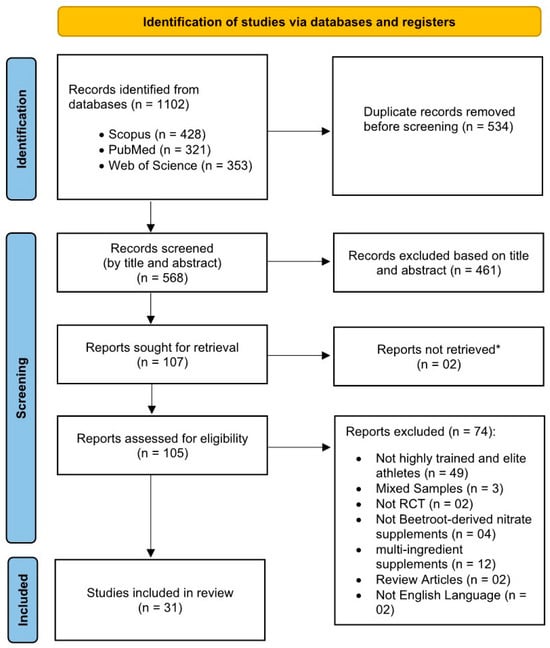
All identified records were imported into Microsoft Excel version 365 (Microsoft Corporation, Redmond, WA, USA), and duplicate records were removed before screening. Study selection was conducted in two stages. First, titles and abstracts were independently screened by two reviewers (N.C. and M.N.) against the predefined eligibility criteria. Second, full-text articles of potentially relevant studies were retrieved and assessed for inclusion. Discrepancies between reviewers were resolved through discussion, and a third reviewer (H.I.C.) was consulted where necessary. The study-selection process was documented using a PRISMA flow diagram (Figure 1).
Figure 1.
PRISMA flow diagram illustrating the study-selection process. * Two reports could not be retrieved despite comprehensive efforts including institutional subscriptions, author correspondence (n = 2, no responses), and searches across databases/platforms.
2.4. Data Extraction and Charting
Data were extracted using a standardized data extraction form. The extracted information included study characteristics (author and year), objective, participant details (sport, sample size, competitive level), study design, supplementation protocol (dose, duration, and form), outcome measures (performance, recovery, and physiological variables), and key findings. Data extraction was performed independently by two reviewers to ensure accuracy and consistency.
3. Results and Discussion
3.1. Search Results
The database search yielded a total of 1102 records, comprising Scopus (n = 428), PubMed (n = 321), and Web of Science (n = 353). After removing 534 duplicate records, 568 unique records remained for title and abstract screening. During the initial screening phase, 461 records were excluded based on title and abstract, primarily due to irrelevance to the study objectives. This resulted in 107 reports being sought for full-text retrieval, of which 105 reports were successfully retrieved. In comparison, 2 reports could not be accessed despite extensive efforts, including searches of institutional databases and attempts to contact the corresponding authors. Full-text assessment led to the exclusion of 74 studies for the following reasons: participants not classified as highly trained or elite (n = 49), mixed samples without extractable data (n = 3), non-randomized study designs (n = 2), interventions not involving beetroot-derived nitrate (n = 4), use of multi-ingredient supplements (n = 12), review articles (n = 2), and non-English publications (n = 2). In the end, 31 studies met the eligibility criteria and were included in the final synthesis of this scoping review (Figure 1).
3.2. Study Characteristics
A total of 31 peer-reviewed articles were included. All the included studies performed beetroot-derived nitrate supplementation in highly trained and elite athletes. Most studies employed rigorous experimental methodologies, predominantly randomized, double-blind designs. In addition, a limited number of studies employed methodological approaches such as placebo-controlled cross-over trials and counterbalanced cross-over studies. These designs were reported in various sports, including water polo, field hockey, football, cycling, swimming, rowing, rugby, tennis, and athletics, demonstrating a strong attempt to mitigate bias and inter-individual variability. The cross-over design is appropriate given the limited number of participants and their highly trained nature.
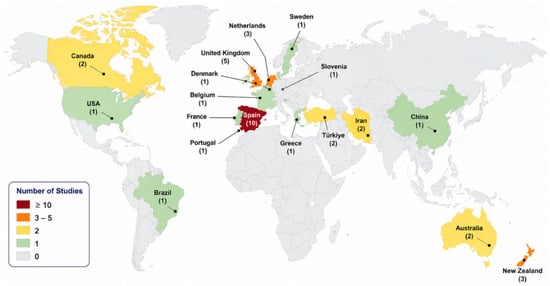
The studies were conducted worldwide, primarily in countries such as Spain, the United Kingdom, the Netherlands, and New Zealand, demonstrating global interest in nitrate supplementation to enhance the performance of highly trained and elite athletes. The geographical distribution of the included studies is presented in Figure 2. The sample size spectrum ranges from 8 to 80 participants, and most studies included fewer than 20 participants. Thus, a lower number of participants might be due to difficulty recruiting elite-level athletes for the study. Among the selected studies, male participants were predominant, accounting for 23 studies, while 3 studies included female participants, particularly in water polo, field hockey, and rugby [39,40,41]. Studies conducted in swimming, winter triathlon, short-track speed skating, and cross-country skiing included participants of both genders. Most participants were young adults with a homogeneous age distribution ranging from 15 to 40 years (Table 2). Most studies focused on analyzing the acute effects of beetroot juice supplementation on exercise performance, physiological responses, neuromuscular function, recovery, and perceptual outcomes in elite athletes.
Figure 2.
Geographical distribution of the included studies (n = 31). Note: countries involved in multiple studies across collaborations are counted individually. Source: prepared by the authors based on data extracted from the included studies.
3.3. Training Characteristics
The included studies represented a diverse range of sports, including endurance sports (cycling, athletics, rowing, triathlon, and cross-country skiing), intermittent team sports (football (soccer), rugby, handball, field hockey, and water polo), racquet sports (tennis), combat sports (taekwondo), aquatic sports (swimming), and winter sports (short-track speed skating, winter triathlon and alpine slalom skiing) (Table 2). Endurance sports such as cycling, rowing, athletics, triathlon, and cross-country skiing were the most extensively investigated across the included studies. Among these, cycling emerged as the predominant sports discipline [3,42,43,44,45,46], accounting for six studies, thereby highlighting the considerable research interest in the effects of beetroot-derived nitrate supplementation on cycling performance and associated physiological outcomes. Several studies have also reported the effects of beetroot supplementation on athletes participating in intermittent team sports such as football (soccer) [47,48,49], rugby [40,50], handball [51], field hockey [41], and water polo [39].
Among the selected studies, substantial deviations were observed in supplementation, dose, timing, and duration. Most studies examined supplementation with concentrated beetroot, while a few used large volumes of beetroot juice. The nitrate dose ranged from 4 to 19.5 mmol (248–1209 mg) NO3− per day. At the same time, many studies used a dose range of 6.4–12.8 mmol (397–794 mg) NO3−. Acute supplementation protocols were most common, with beetroot juice ingested 2–3 h before exercise testing, coinciding with the peak elevation in plasma nitrite concentration and nitric oxide bioavailability. Several investigations also implemented short-term loading strategies lasting 3–15 days, often involving daily supplementation to maintain elevated nitrate stores.
Table 2.
Descriptive and intervention characteristics.
3.4. Performance Outcomes
3.4.1. Endurance
Several studies have reported the impact of beetroot-derived nitrate supplementation on endurance performance in elite athletes. It was noted that beetroot-derived nitrate supplementation yields inconsistent findings across studies (Table 2). A total of five studies reported improvements in time-trial performance [3,43,46,54,68], two studies observed enhanced exercise tolerance [56,63], and one study reported improved exercise efficiency following beetroot-derived nitrate supplementation [46]. A significant improvement in 4-km and 16.1-km cycling time-trial performance, accompanied by increased power output and improved power-to-oxygen consumption ratio, followed by the consumption of 0.5 L of beetroot juice (6.2 mmol NO3−; 384 mg NO3−) [46]. Likewise, 7 days of beetroot-derived nitrate consumption (12.4 mmol NO3−·day−1; 769 mg NO3−·day−1) considerably enhanced 10-km cycling time-trial performance [3]. McQuillan et al. [43] also reported a beneficial effect on 4-km cycling time-trial performance following 8 days of supplementation with approximately 4 mmol NO3−·day−1; 248 mg NO3−·day−1). However, these findings were not consistent across all studies, as four investigations reported no significant ergogenic benefits on time-trial performance following beetroot-derived nitrate supplementation [44,45,52,67].
Positive findings were also observed in intermittent endurance protocols. Nyakayiru et al. [47] found that six days of nitrate-rich beetroot juice (140 mL; ~12.9 mmol NO3−·day−1; 800 mg NO3−·day−1) improved Yo-Yo IR1 performance and reduced mean heart rate, indicating enhanced cardiovascular efficiency during high-intensity intermittent exercise in trained soccer players. Huang et al. [56] found that, following chronic high-dose supplementation (6.5 mmol NO3−; 403 mg NO3−), there was no improvement in skiing time-trial performance.
Contrary to these findings, several studies reported that beetroot supplementation significantly increased plasma nitrate and/or nitrite concentrations without reflecting any considerable improvement in cycling or running performance [45,62,64,67]. This inconsistency in the impact of nitrate supplementation among elite athletes suggests reduced responsiveness, potentially due to their superior baseline aerobic efficiency, higher endogenous nitric oxide production, and well-developed oxidative metabolism. In addition, variations in exercise modalities, environmental conditions, and supplementation protocols may explain variability in endurance-related outcomes.
3.4.2. Sprint and Anaerobic Performance
The beneficial effect of beetroot-derived nitrate supplementation on short-duration, high-intensity exercise performance was postulated by several authors (Table 2). Eroglu et al. [49] postulated that 140 mL of beetroot (12.8 mmol NO3−; 794 mg NO3−) consumption had a considerable positive effect on the peak and mean power output during Wingate testing, accompanied by faster time to peak power and improved post-exercise muscle oxygenation in football players. Likewise, 220 mL of beetroot juice (8.9 mmol NO3−; 552 mg NO3−) significantly enhanced anaerobic performance, including more box-jump repetitions, improved agility, and prolonged wall-sit endurance in alpine skiers at moderate to high altitudes [53]. Interestingly, Dumar et al. [59] observed that consuming 70 mL of concentrated beetroot juice substantially abolished morning-related performance decline, resulting in a higher power output comparable to afternoon performance. Similarly, in highly trained rowers, a higher dose of nitrate (8.4 mmol NO3−; 521 mg NO3−) potentially augmented 2000 m rowing performance, whereas a lower dose (4.2 mmol NO3−; 260 mg NO3−) did not affect any meaningful outcome [68].
While studies conducted in tennis players [58,61], swimmers [55,57], field hockey players [41], and taekwondo [60] athletes reported no significant improvements in sprint speed, agility, repeated sprint ability, or sport-specific anaerobic tasks following an acute dose of nitrate supplementation. The lack of significant performance improvement with beetroot supplementation may be associated with the relatively low nitrate dose used in the intervention [61]. Further, it indicates that nitrate supplementation provides greater benefits in moderately trained individuals or in exercise protocols involving repeated high-intensity efforts rather than in highly specialized, sport-specific tasks.
3.4.3. Neuromuscular Performance
Selected studies showed that beetroot-derived nitrate supplementation had mixed effects on neuromuscular performance in elite athletes, depending on the dose and type of training (Table 2). A 12.8 mmol (794 mg) NO3− consumption significantly augmented neuromuscular performance, such as countermovement jump height in female rugby players [40]. Likewise, 6.4 mmol (397 mg) NO3− supplementation in male handball players resulted in a meaningful improvement in countermovement jump performance, followed by a 3-day supplementation period [51]. Further, Ahmadpour et al. [53] demonstrated improvements in agility and isometric muscular endurance, suggesting enhanced muscle contractile efficiency and fatigue resistance. These findings support the proposed role of nitric oxide in improving calcium handling within skeletal muscle and enhancing type II muscle fiber contractility [69].
In contrast, several studies failed to demonstrate significant improvements in neuromuscular outcomes, such as sprint speed, handgrip strength, agility, or jumping performance, following beetroot-derived nitrate supplementation. Studies conducted on highly competitive tennis athletes [61], female hockey players [41], etc., consistently showed a trivial or negligible impact of acute nitrate supplementation on neuromuscular performance. This discrepancy in the effect of beetroot-derived nitrate supplementation on the neuromuscular performance of elite athletes might be due to variation in dose, training status, exercise specificity, and individual responsiveness to supplementation.
3.4.4. Oxygen Consumption
Beetroot-derived nitrate supplementation elicited a mixed response in oxygen consumption among highly trained elite athletes. Few studies have demonstrated reduced oxygen consumption during submaximal exercise and improvements in exercise efficiency. Huang et al. [56] observed lower VO2, respiratory exchange ratio, and blood lactate during high-speed running after chronic nitrate supplementation (6.5 mmol NO3−; 403 mg NO3−) in winter triathletes. Likewise, Lansley et al. [46] also found improved power output relative to oxygen consumption, indicating enhanced muscular efficiency. However, no significant enhancement in VO2 and exercise economy was observed in runners [66,67] and triathletes [64]. The lack of consistent improvements in elite athletes may result from their already highly efficient aerobic systems, leaving limited scope for nitrate-mediated enhancement.
3.4.5. Recovery and Perceptual Outcomes
Recovery outcomes refer to indicators of post-exercise recovery, such as muscle soreness, muscle oxygenation, and perceived recovery, whereas perceptual outcomes include subjective measures such as ratings of perceived exertion and recovery status [70]. Only a few studies have investigated the effects of beetroot-derived nitrate supplementation on these outcomes in highly trained and elite athletes, and the findings remain inconsistent. Ahmadpour et al. [53] reported that acute ingestion of 220 mL of beetroot juice (8.9 mmol NO3−; 552 mg NO3−) significantly reduced muscle soreness and ratings of perceived exertion in alpine skiers. Similarly, Eroglu et al. [49] observed improved post-exercise muscle oxygenation in elite football players. In contrast, Moreno-Heredero et al. [55] reported no significant effects on recovery-related variables following acute ingestion of 70 mL of beetroot juice (6.4 mmol NO3−; 397 mg NO3−) in competitive swimmers.
3.5. Limitations and Future Directions
The findings of this scoping review should be interpreted in light of several limitations. Considerable heterogeneity was observed across the included studies in terms of sports disciplines, supplementation doses, formulations, timing, duration, and outcome measures, limiting direct comparisons. Furthermore, many studies included relatively small cohorts of highly trained and elite athletes, reflecting the practical challenges of recruiting these populations. Consequently, the findings should be interpreted with caution, as subtle performance effects may not have been consistently detected across studies. In addition, most studies enrolled male athletes, with relatively few studies involving female participants, limiting the ability to draw sex-specific conclusions regarding the effects of beetroot-derived nitrate supplementation. Variations in training status, competitive level, physiological characteristics, and habitual dietary nitrate intake may have further contributed to the inconsistent responses reported across studies. This review was restricted to English-language, peer-reviewed publications, which may have introduced language and publication bias. Furthermore, as a scoping review, the objective was to map and summarize the existing evidence rather than assess methodological quality or generate pooled effect estimates. Consequently, the findings provide an overview of the current evidence base rather than definitive conclusions regarding the effectiveness of beetroot-derived nitrate supplementation in highly trained and elite athletes. Finally, the included studies comprised both acute and repeated beetroot-derived nitrate supplementation protocols, which may produce different physiological and performance responses. Future evidence syntheses should consider evaluating these supplementation strategies separately.
Future research should prioritize adequately powered, multi-center randomized controlled trials with a greater representation of female athletes and standardized supplementation protocols. Further investigation is needed to establish optimal dosing strategies, supplementation duration, and timing across different sporting disciplines. Studies should also explore factors influencing individual responsiveness, including training status, oral microbiome composition, habitual dietary nitrate intake, and baseline nitric oxide availability. Finally, longitudinal and mechanistic research conducted in real-world competitive settings is warranted to clarify the long-term effects of beetroot-derived nitrate supplementation on performance, recovery, and physiological adaptation in elite sporting populations.
4. Conclusions
This scoping review explored the influence of beetroot-derived nitrate supplementation on performance, recovery, and physiological outcomes in elite athletes. A total of 31 studies were included, and their characteristics indicate that they were conducted across a wide range of sports worldwide and that most selected men as subjects. The training characteristics indicate that the selected studies represent a wide spectrum of sports disciplines, including endurance sports and intermittent team sports. The study’s findings highlight that, among the selected elite athletes, beetroot-derived nitrate supplementation may confer a modest ergogenic benefit for certain performance and physiological outcomes. The beneficial effects were more pronounced with intermittent high-intensity exercise, anaerobic power, and certain recovery markers, whereas endurance performance benefits remain inconsistent. The discrepancies in outcomes across studies result from heterogeneity in supplementation doses, training strategies, and the individual characteristics of participating athletes. Future research should focus on individualized supplementation strategies, dose–response relationships, and long-term adaptations in elite sporting populations.
Supplementary Materials
The following supporting information can be downloaded at: https://www.mdpi.com/article/10.3390/nu18152551/s1, File S1: Preferred Reporting Items for Systematic Reviews and Meta-Analyses extension for Scoping Reviews (PRISMA-ScR) Checklist; File S2: Search Strategy.
Author Contributions
Conceptualization, N.C., M.N., M.Y. and H.İ.C.; methodology, N.C., M.N., H.İ.C., M.E., K.V.S. and M.A.T.; software, N.C., M.N., M.P., M.A.T., R.I.M. and V.S.; validation, N.C., M.N., K.V.S., M.A.T. and M.P.; formal analysis, N.C., M.N., K.V.S., M.E. and M.A.T.; investigation, N.C., M.N., M.Y., R.I.M., V.S. and M.P.; resources, N.C., M.N. and H.İ.C.; data curation, N.C., M.N. and H.İ.C.; writing—original draft, N.C., M.N., M.Y. and H.İ.C.; writing—review and editing, N.C., M.N., M.Y., H.İ.C., M.E., R.I.M., V.S. and K.V.S.; supervision, H.İ.C., M.E., R.I.M. and V.S. All authors have read and agreed to the published version of the manuscript.
Funding
This research received no external funding.
Institutional Review Board Statement
Not applicable.
Informed Consent Statement
Not applicable.
Data Availability Statement
No new data were created or analyzed in this study. Data sharing is not applicable to this article.
Conflicts of Interest
The authors declare no conflicts of interest.
References
- Nowak, A.; Szymańska, A.; Kwaśniewska, M.; Kochan, E.; Lipert, A. Beetroot Juice Supplementation as a Healthy Aging Strategy Through Improving Physical Performance and Cognitive Functions: A Systematic Review. Nutrients 2025, 17, 3954. [Google Scholar] [CrossRef] [PubMed]
- Jones, A.M. Influence of Dietary Nitrate on the Physiological Determinants of Exercise Performance: A Critical Review. Appl. Physiol. Nutr. Metab. 2014, 39, 1019–1128. [Google Scholar] [CrossRef] [PubMed]
- Rokkedal-Lausch, T.; Franch, J.; Poulsen, M.K.; Thomsen, L.P.; Weitzberg, E.; Kamavuako, E.N.; Karbing, D.S.; Larsen, R.G. Chronic High-Dose Beetroot Juice Supplementation Improves Time Trial Performance of Well-Trained Cyclists in Normoxia and Hypoxia. Nitric Oxide 2019, 85, 44–52. [Google Scholar] [CrossRef] [PubMed]
- dos Santos Lealab, L.D.; Guimarães, M.P.; Campos, Y.d.A.C.; Abreu, W.C.; Fernandes da Silva, S. Effect of Acute and Chronic Nitrate Supplementation on the Performance of Endurance Athletes: A Systematic Review. Multidiscip. Rev. 2022, 5, 2022009. [Google Scholar] [CrossRef]
- Zoughaib, W.S.; Fry, M.J.; Singhal, A.; Coggan, A.R. Beetroot Juice Supplementation and Exercise Performance: Is There More to the Story than Just Nitrate? Front. Nutr. 2024, 11, 1347242. [Google Scholar] [CrossRef] [PubMed]
- Poon, E.T.C.; Iu, J.C.K.; Sum, W.M.K.; Wong, P.S.; Lo, K.K.H.; Ali, A.; Burns, S.F.; Trexler, E.T. Dietary Nitrate Supplementation and Exercise Performance: An Umbrella Review of 20 Published Systematic Reviews with Meta-Analyses. Sports Med. 2025, 55, 1213–1231. [Google Scholar] [CrossRef] [PubMed]
- Jones, A.M.; Thompson, C.; Wylie, L.J.; Vanhatalo, A. Dietary Nitrate and Physical Performance. Annu. Rev. Nutr. 2018, 38, 303–328. [Google Scholar] [CrossRef] [PubMed]
- Tian, C.; Jiang, Q.; Han, M.; Guo, L.; Huang, R.; Zhao, L.; Mao, S. Effects of Beetroot Juice on Physical Performance in Professional Athletes and Healthy Individuals: An Umbrella Review. Nutrients 2025, 17, 1958. [Google Scholar] [CrossRef] [PubMed]
- Rojas-Valverde, D.; Montoya-Rodríguez, J.; Azofeifa-Mora, C.; Sanchez-Urena, B. Effectiveness of Beetroot Juice Derived Nitrates Supplementation on Fatigue Resistance during Repeated-Sprints: A Systematic Review. Crit. Rev. Food Sci. Nutr. 2021, 61, 3395–3406. [Google Scholar] [CrossRef] [PubMed]
- Dorożyński, B.; Osowski, M.; Balwierz, R.J.; Biernat, P.; Jasicka-Misiak, I. Application of Beetroot’s Nitrates Juice in Team Sports [Application Du Jus de Nitrates de Betterave Dans Les Sports d’équipe]. Sci. Sports 2023, 38, 109–115. [Google Scholar] [CrossRef]
- De Oliveira, G.V.; Do Nascimento, L.A.D.; Volino-Souza, M.; Do Couto Vellozo, O.; Alvares, T.S. A Single Oral Dose of Beetroot-Based Gel Does Not Improve Muscle Oxygenation Parameters, but Speeds up Handgrip Isometric Strength Recovery in Recreational Combat Sports Athletes. Biol. Sport 2020, 37, 93–99. [Google Scholar] [CrossRef] [PubMed]
- de Oliveira, G.V.; do Nascimento, L.A.D.; Volino-Souza, M.; de Souza Mesquita, J.; Alvares, T.S. Beetroot-Based Gel Supplementation Improves Handgrip Strength and Forearm Muscle O2 Saturation but Not Exercise Tolerance and Blood Volume in Jiu-Jitsu Athletes. Appl. Physiol. Nutr. Metab. 2018, 43, 920–927. [Google Scholar] [CrossRef] [PubMed]
- Domínguez, R.; Cuenca, E.; Maté-Muñoz, J.L.; García-Fernández, P.; Serra-Paya, N.; Estevan, M.C.L.; Herreros, P.V.; Garnacho-Castaño, M.V. Effects of Beetroot Juice Supplementation on Cardiorespiratory Endurance in Athletes. A Systematic Review. Nutrients 2017, 9, 43. [Google Scholar] [CrossRef] [PubMed]
- Neteca, J.; Veseta, U.; Liepina, I.; Volgemute, K.; Dzintare, M.; Babarykin, D. Effect of Beetroot Juice Supplementation on Aerobic Capacity in Female Athletes: A Randomized Controlled Study. Nutrients 2025, 17, 63. [Google Scholar] [CrossRef] [PubMed]
- Zamani, H.; de Joode, M.E.J.R.; Hossein, I.J.; Henckens, N.F.T.; Guggeis, M.A.; Berends, J.E.; de Kok, T.M.C.M.; van Breda, S.G.J. The Benefits and Risks of Beetroot Juice Consumption: A Systematic Review. Crit. Rev. Food Sci. Nutr. 2021, 61, 788–804. [Google Scholar] [CrossRef] [PubMed]
- Lee, E.; Park, H.Y.; Sun, Y.; Choi, J.H.; Woo, S.; Cho, S.; Kim, S.; Zheng, Y.; Kim, S.W.; Lim, K. Beetroot Juice and Exercise for Clinical Health and Athletic Performance: A Narrative Review. Nutrients 2026, 18, 151. [Google Scholar] [CrossRef] [PubMed]
- Saleh, M.M.; Dev, R.D.O.; Linoby, A.; Razak, R.A.; Norhamazi, I.; Zubir, S.M.S.; Kamaldeen, T.F.T. Endurance Performance with Acute Ingestion of Dietary Nitrate Supplementation in Trained and Untrained Individuals. J. Phys. Educ. Sport 2023, 23, 2023–2033. [Google Scholar] [CrossRef]
- Arazi, H.; Eghbali, E. Possible Effects of Beetroot Supplementation on Physical Performance Through Metabolic, Neuroendocrine, and Antioxidant Mechanisms: A Narrative Review of the Literature. Front. Nutr. 2021, 8, 660150. [Google Scholar] [CrossRef] [PubMed]
- Domínguez, R.; Maté-Muñoz, J.L.; Cuenca, E.; García-Fernández, P.; Mata-Ordoñez, F.; Lozano-Estevan, M.C.; Veiga-Herreros, P.; da Silva, S.F.; Garnacho-Castaño, M.V. Effects of Beetroot Juice Supplementation on Intermittent High-Intensity Exercise Efforts. J. Int. Soc. Sports Nutr. 2018, 15, 2. [Google Scholar] [CrossRef] [PubMed]
- Kurowska, K.; Antosik, K.; Kobylińska, M.; Decyk, A. Beetroot Juice—Legal Doping for Athletes? Cent. Eur. J. Sport Sci. Med. 2021, 35, 57–70. [Google Scholar] [CrossRef]
- Bibi, J.; Lei, Y.; Ahmad, M.Z.; Kotwica-Mojzych, K.; Głowacka, M.; Mojzych, M. Beetroot Boost: Unlocking the Power of Beta Vulgaris for Peak Athletic Performance. J. Funct. Foods 2026, 138, 107196. [Google Scholar] [CrossRef]
- Baranauskas, M.N.; Coggan, A.R.; Gruber, A.H.; Altherr, C.A.; Raglin, J.S.; Carter, S.J. Dietary Nitrate Supplementation and Exercise-Related Performance. Nutr. Today 2020, 55, 211–217. [Google Scholar] [CrossRef] [PubMed]
- Chen, L.; Zhu, Y.; Hu, Z.; Wu, S.; Jin, C. Beetroot as a Functional Food with Huge Health Benefits: Antioxidant, Antitumor, Physical Function, and Chronic Metabolomics Activity. Food Sci. Nutr. 2021, 9, 6406–6420. [Google Scholar] [CrossRef] [PubMed]
- Wong, T.H.; Sim, A.; Burns, S.F. The Effect of Beetroot Ingestion on High-Intensity Interval Training: A Systematic Review and Meta-Analysis. Nutrients 2021, 13, 3674. [Google Scholar] [CrossRef] [PubMed]
- McKay, A.K.A.; Stellingwerff, T.; Smith, E.S.; Martin, D.T.; Mujika, I.; Goosey-Tolfrey, V.L.; Sheppard, J.; Burke, L.M. Defining Training and Performance Caliber: A Participant Classification Framework. Int. J. Sports Physiol. Perform. 2022, 17, 317–331. [Google Scholar] [CrossRef] [PubMed]
- Aslam, S.; Habyarimana, J.D.D.; Bin, S.Y. Neuromuscular Adaptations to Resistance Training in Elite versus Recreational Athletes. Front. Physiol. 2025, 16, 1598149. [Google Scholar] [CrossRef] [PubMed]
- Antoranz, Y.; Alonso-Pérez-Chao, E.; Tejero-González, C.M.; Salazar, H.; del Campo-Vecino, J.; Jiménez-Sáiz, S.L. Understanding External Peak Demands in Elite vs. Non-Elite Male Basketball Players. Sports 2025, 13, 179. [Google Scholar] [CrossRef] [PubMed]
- Yao, Y.; Niu, X. Physical Fitness Characteristics of Elite Freestyle Skiing Aerials Athletes. PLoS ONE 2024, 19, e0304912. [Google Scholar] [CrossRef] [PubMed]
- Hekiert, B.; Prokopczyk, A.; O’Driscoll, J.; Guzik, P. Physiological Distinctions Between Elite and Non-Elite Fencers: A Comparative Analysis of Endurance, Explosive Power, and Lean Mass Using Sport-Specific Assessments. Life 2025, 15, 1622. [Google Scholar] [CrossRef] [PubMed]
- Deyhle, M.R.; Gier, A.M.; Evans, K.C.; Eggett, D.L.; Nelson, W.B.; Parcell, A.C.; Hyldahl, R.D. Skeletal Muscle Inflammation Following Repeated Bouts of Lengthening Contractions in Humans. Front. Physiol. 2016, 6, 173131. [Google Scholar] [CrossRef] [PubMed]
- Hyldahl, R.D.; Chen, T.C.; Nosaka, K. Mechanisms and Mediators of the Skeletal Muscle Repeated Bout Effect. Exerc. Sport Sci. Rev. 2017, 45, 24–33. [Google Scholar] [CrossRef] [PubMed]
- Hayman, O.; Ansdell, P.; Angius, L.; Thomas, K.; Howatson, G.; Kidgell, D.J.; Škarabot, J.; Martinez-Valdes, E.; Goodall, S. Motor Unit Adaptations Contribute to the Repeated Bout Effect Following Damaging Resistance Exercise. J. Appl. Physiol. 2026, 140, 525–539. [Google Scholar] [CrossRef] [PubMed]
- McHugh, M.P. Recent Advances in the Understanding of the Repeated Bout Effect: The Protective Effect against Muscle Damage from a Single Bout of Eccentric Exercise. Scand. J. Med. Sci. Sports 2003, 13, 88–97. [Google Scholar] [CrossRef] [PubMed]
- Gamonales, J.M.; Rojas-Valverde, D.; Muñoz-Jiménez, J.; Serrano-Moreno, W.; Ibáñez, S.J. Effectiveness of Nitrate Intake on Recovery from Exercise-Related Fatigue: A Systematic Review. Int. J. Environ. Res. Public Health 2022, 19, 12021. [Google Scholar] [CrossRef] [PubMed]
- Mueller, B.J.; Roberts, M.D.; Mobley, C.B.; Judd, R.L.; Kavazis, A.N. Nitric Oxide in Exercise Physiology: Past and Present Perspectives. Front. Physiol. 2024, 15, 1504978. [Google Scholar] [CrossRef] [PubMed]
- Peters, M.D.J.; Marnie, C.; Tricco, A.C.; Pollock, D.; Munn, Z.; Alexander, L.; McInerney, P.; Godfrey, C.M.; Khalil, H. Updated Methodological Guidance for the Conduct of Scoping Reviews. JBI Evid. Synth. 2020, 18, 2119–2126. [Google Scholar] [CrossRef] [PubMed]
- Arksey, H.; O’Malley, L. Scoping Studies: Towards a Methodological Framework. Int. J. Soc. Res. Methodol. Theory Pract. 2005, 8, 19–32. [Google Scholar] [CrossRef]
- Tricco, A.C.; Lillie, E.; Zarin, W.; O’Brien, K.K.; Colquhoun, H.; Levac, D.; Moher, D.; Peters, M.D.J.; Horsley, T.; Weeks, L.; et al. PRISMA Extension for Scoping Reviews (PRISMA-ScR): Checklist and Explanation. Ann. Intern. Med. 2018, 169, 467–473. [Google Scholar] [CrossRef] [PubMed]
- Jonvik, K.L.; van Dijk, J.-W.; Senden, J.M.G.; van Loon, L.J.C.; Verdijk, L.B. The Effect of Beetroot Juice Supplementation on Dynamic Apnea and Intermittent Sprint Performance in Elite Female Water Polo Players. Int. J. Sport Nutr. Exerc. Metab. 2018, 28, 468–473. [Google Scholar] [CrossRef] [PubMed]
- López-Samanes, Á.; Ramos-Álvarez, J.J.; Miguel-Tobal, F.; Gaos, S.; Jodra, P.; Arranz-Muñoz, R.; Domínguez, R.; Montoya, J.J. Influence of Beetroot Juice Ingestion on Neuromuscular Performance on Semi-Professional Female Rugby Players: A Randomized, Double-Blind, Placebo-Controlled Study. Foods 2022, 11, 3614. [Google Scholar] [CrossRef] [PubMed]
- López-Samanes, Á.; Pérez-Lopez, A.; Morencos, E.; Muñoz, A.; Kühn, A.; Sánchez-Migallón, V.; Moreno-Pérez, V.; González-Frutos, P.; Bach-Faig, A.; Roberts, J.; et al. Beetroot Juice Ingestion Does Not Improve Neuromuscular Performance and Match-Play Demands in Elite Female Hockey Players: A Randomized, Double-Blind, Placebo-Controlled Study. Eur. J. Nutr. 2022, 62, 1123–1130. [Google Scholar] [CrossRef] [PubMed]
- McQuillan, J.A.; Casadio, J.R.; Dulson, D.K.; Laursen, P.B.; Kilding, A.E.; McQuillan, J.A.; Casadio, J.R.; Dulson, D.K.; Laursen, P.B.; Kilding, A.E. The Effect of Nitrate Supplementation on Cycling Performance in the Heat in Well-Trained Cyclists. Int. J. Sports Physiol. Perform. 2018, 13, 50–56. [Google Scholar] [CrossRef] [PubMed]
- McQuillan, J.A.; Dulson, D.K.; Laursen, P.B.; Kilding, A.E. The Effect of Dietary Nitrate Supplementation on Physiology and Performance in Trained Cyclists. Int. J. Sports Physiol. Perform. 2017, 12, 684–689. [Google Scholar] [CrossRef] [PubMed]
- Hoon, M.W.; Hopkins, W.G.; Jones, A.M.; Martin, D.T.; Halson, S.L.; West, N.P.; Johnson, N.A.; Burke, L.M. Nitrate Supplementation and High-Intensity Performance in Competitive Cyclists. Appl. Physiol. Nutr. Metab. 2014, 39, 1043–1049. [Google Scholar] [CrossRef] [PubMed]
- Cermak, N.M.; Res, P.; Stinkens, R.; Lundberg, J.O.; Gibala, M.J.; van Loon, L.J.C.; Cermak, N.M.; Res, P.; Stinkens, R.; Lundberg, J.O.; et al. No Improvement in Endurance Performance after a Single Dose of Beetroot Juice. Int. J. Sport Nutr. Exerc. Metab. 2012, 22, 470–478. [Google Scholar] [CrossRef] [PubMed]
- Lansley, K.E.; Winyard, P.G.; Bailey, S.J.; Vanhatalo, A.; Wilkerson, D.P.; Blackwell, J.R.; Gilchrist, M.; Benjamin, N.; Jones, A.M. Acute Dietary Nitrate Supplementation Improves Cycling Time Trial Performance. Med. Sci. Sports Exerc. 2011, 43, 1125–1131. [Google Scholar] [CrossRef] [PubMed]
- Nyakayiru, J.; Jonvik, K.L.; Trommelen, J.; Pinckaers, P.J.M.; Senden, J.M.; van Loon, L.J.C.; Verdijk, L.B. Beetroot Juice Supplementation Improves High-Intensity Intermittent Type Exercise Performance in Trained Soccer Players. Nutrients 2017, 9, 314. [Google Scholar] [CrossRef] [PubMed]
- Macuh, M.; Kojić, N.; Knap, B. The Effects of Nitrate Supplementation on Performance as a Function of Habitual Dietary Intake of Nitrates: A Randomized Controlled Trial of Elite Football Players. Nutrients 2023, 15, 3721. [Google Scholar] [CrossRef] [PubMed]
- Eroglu, M.N.; Kose, B.; Kolayis, İ.E.; Haberal, B. Acute Beetroot Juice Supplementation Enhances Short Duration High-Intensity Exercise Performance and Influences Muscle Oxygenation in Football Players. Sci. Rep. 2026, 16, 15341. [Google Scholar] [CrossRef] [PubMed]
- Esen, O.; Karayigit, R.; Peart, D.J. Acute Beetroot Juice Supplementation Did Not Enhance Intermittent Running Performance in Trained Rugby Players. Eur. J. Sport Sci. 2023, 23, 2321–2328. [Google Scholar] [CrossRef] [PubMed]
- Muñoz, A.; de la Rubia, A.; Lorenzo-Calvo, J.; Karayigit, R.; Garcés-Rimón, M.; López-Moreno, M.; Domínguez, R.; Scanlan, A.T.; López-Samanes, Á.; Muñoz, A.; et al. Multiday Beetroot Juice Ingestion Improves Some Aspects of Neuromuscular Performance in Semi-Professional, Male Handball Players: A Randomized, Double-Blind, Placebo-Controlled, Crossover Study. Int. J. Sport Nutr. Exerc. Metab. 2024, 35, 140–149. [Google Scholar] [CrossRef] [PubMed]
- Arnaoutis, G.; Vallas, G.; Toubekis, A.G.; Nomikos, T.; Arnaoutis, G.; Vallas, G.; Toubekis, A.G.; Nomikos, T. Acute Beetroot Juice Supplementation and Repeated Maximal Effort in Elite Swimmers: A Randomized Double-Blind Study. Int. J. Sport Nutr. Exerc. Metab. 2026, 1–10. [Google Scholar] [CrossRef] [PubMed]
- Ahmadpour, A.; Fashi, M.; Hemmatinafar, M. Consuming Beetroot Juice Improves Slalom Performance and Reduces Muscle Soreness in Alpine Skiers under Hypoxic Conditions. Curr. Dev. Nutr. 2024, 8, 104408. [Google Scholar] [CrossRef] [PubMed]
- Garnacho-Castaño, M.V.; Pleguezuelos-Cobo, E.; Berbel, M.; Irurtia, A.; Carrasco-Marginet, M.; Castizo-Olier, J.; Veiga-Herreros, P.; Faundez-Zanuy, M.; Serra-Payá, N. Effects of Acute Beetroot Juice Intake on Performance, Maximal Oxygen Uptake, and Ventilatory Efficiency in Well-Trained Master Rowers: A Randomized, Double-Blinded Cross-over Study. J. Int. Soc. Sports Nutr. 2024, 21, 2373170. [Google Scholar] [CrossRef] [PubMed]
- Moreno-Heredero, B.; Morencos, E.; Morais, J.E.; Barbosa, T.M.; Veiga, S. A Single Dose of Beetroot Juice Not Enhance Performance during Intervallic Swimming Efforts. J. Sports Sci. Med. 2024, 23, 228–235. [Google Scholar] [CrossRef] [PubMed]
- Huang, X.; Zhang, Z.; Wang, X.; Wang, G.; Wang, Y.; Tang, K.; Gao, B. Influence of Chronic Nitrate-Rich Beetroot Juice Supplementation on the Endurance Performance of Active Winter Triathletes: A Randomized Controlled Trial. J. Am. Nutr. Assoc. 2023, 42, 195–206. [Google Scholar] [CrossRef] [PubMed]
- Moreno, B.; Morencos, E.; Vicente-Campos, D.; Muñoz, A.; González-García, J.; Veiga, S. Effects of Beetroot Juice Intake on Repeated Performance of Competitive Swimmers. Front. Physiol. 2023, 13, 1076295. [Google Scholar] [CrossRef] [PubMed]
- Fernández-Elías, V.E.; Courel-Ibáñez, J.; Pérez-López, A.; Jodra, P.; Moreno-Pérez, V.; Del Coso, J.; López-Samanes, Á. Acute Beetroot Juice Supplementation Does Not Improve Match-Play Activity in Professional Tennis Players. J. Am. Nutr. Assoc. 2022, 41, 30–37. [Google Scholar] [CrossRef] [PubMed]
- Dumar, A.M.; Huntington, A.F.; Rogers, R.R.; Kopec, T.J.; Ballmann, C.G. Acute Beetroot Juice Supplementation Attenuates Morning-Associated Decrements in Supramaximal Exercise Performance in Trained Sprinters. Int. J. Environ. Res. Public Health 2021, 18, 412. [Google Scholar] [CrossRef] [PubMed]
- Miraftabi, H.; Avazpoor, Z.; Berjisian, E.; Sarshin, A.; Rezaei, S.; Domínguez, R.; Reale, R.; Franchini, E.; Samanipour, M.H.; Koozehchian, M.S.; et al. Effects of Beetroot Juice Supplementation on Cognitive Function, Aerobic and Anaerobic Performances of Trained Male Taekwondo Athletes: A Pilot Study. Int. J. Environ. Res. Public Health 2021, 18, 10202. [Google Scholar] [CrossRef] [PubMed]
- López-Samanes, Á.; Pérez-López, A.; Moreno-Pérez, V.; Nakamura, F.Y.; Acebes-Sánchez, J.; Quintana-Milla, I.; Sánchez-Oliver, A.J.; Moreno-Pérez, D.; Fernández-Elías, V.E.; Domínguez, R. Effects of Beetroot Juice Ingestion on Physical Performance in Highly Competitive Tennis Players. Nutrients 2020, 12, 584. [Google Scholar] [CrossRef] [PubMed]
- Pawlak-Chaouch, M.; Boissière, J.; Munyaneza, D.; Gamelin, F.X.; Cuvelier, G.; Berthoin, S.; Aucouturier, J. Beetroot Juice Does Not Enhance Supramaximal Intermittent Exercise Performance in Elite Endurance Athletes. J. Am. Coll. Nutr. 2019, 38, 729–738. [Google Scholar] [CrossRef] [PubMed]
- Balsalobre-Fernández, C.; Romero-Moraleda, B.; Cupeiro, R.; Peinado, A.B.; Butragueño, J.; Benito, P.J. The Effects of Beetroot Juice Supplementation on Exercise Economy, Rating of Perceived Exertion and Running Mechanics in Elite Distance Runners: A Double-Blinded, Randomized Study. PLoS ONE 2018, 13, e0200517. [Google Scholar] [CrossRef] [PubMed]
- Garnacho-Castaño, M.V.; Palau-Salvà, G.; Cuenca, E.; Muñoz-González, A.; García-Fernández, P.; del Carmen Lozano-Estevan, M.; Veiga-Herreros, P.; Maté-Muñoz, J.L.; Domínguez, R. Effects of a Single Dose of Beetroot Juice on Cycling Time Trial Performance at Ventilatory Thresholds Intensity in Male Triathletes. J. Int. Soc. Sports Nutr. 2018, 15, 49. [Google Scholar] [CrossRef] [PubMed]
- Richard, P.; Koziris, L.P.; Charbonneau, M.; Naulleau, C.; Tremblay, J.; Billaut, F.; Richard, P.; Koziris, L.P.; Charbonneau, M.; Naulleau, C.; et al. Time-Trial Performance in World-Class Speed Skaters After Chronic Nitrate Ingestion. Int. J. Sports Physiol. Perform. 2018, 13, 1317–1323. [Google Scholar] [CrossRef] [PubMed]
- Nybäck, L.; Glännerud, C.; Larsson, G.; Weitzberg, E.; Shannon, O.M.; McGawley, K. Physiological and Performance Effects of Nitrate Supplementation during Roller-Skiing in Normoxia and Normobaric Hypoxia. Nitric Oxide 2017, 70, 1–8. [Google Scholar] [CrossRef] [PubMed]
- Boorsma, R.K.; Whitfield, J.; Spriet, L.L. Beetroot Juice Supplementation Does Not Improve Performance of Elite 1500-m Runners. Med. Sci. Sports Exerc. 2014, 46, 2326–2334. [Google Scholar] [CrossRef] [PubMed]
- Hoon, M.W.; Jones, A.M.; Johnson, N.A.; Blackwell, J.R.; Broad, E.M.; Lundy, B.; Rice, A.J.; Burke, L.M.; Hoon, M.W.; Jones, A.M.; et al. The Effect of Variable Doses of Inorganic Nitrate-Rich Beetroot Juice on Simulated 2000-m Rowing Performance in Trained Athletes. Int. J. Sports Physiol. Perform. 2014, 9, 615–620. [Google Scholar] [CrossRef] [PubMed]
- Kumar, R.; Coggan, A.R.; Ferreira, L.F. Nitric Oxide and Skeletal Muscle Contractile Function. Nitric Oxide 2022, 122–123, 54–61. [Google Scholar] [CrossRef] [PubMed]
- Li, S.; Kempe, M.; Brink, M.; Lemmink, K. Effectiveness of Recovery Strategies After Training and Competition in Endurance Athletes: An Umbrella Review. Sports Med.-Open 2024, 10, 55. [Google Scholar] [CrossRef] [PubMed]

Disclaimer/Publisher’s Note: The statements, opinions and data contained in all publications are solely those of the individual author(s) and contributor(s) and not of MDPI and/or the editor(s). MDPI and/or the editor(s) disclaim responsibility for any injury to people or property resulting from any ideas, methods, instructions or products referred to in the content. |
© 2026 by the authors. Licensee MDPI, Basel, Switzerland. This article is an open access article distributed under the terms and conditions of the Creative Commons Attribution (CC BY) license.