


Highlights
What are the main findings?
- We propose the hierarchical frequency and spatial feature attention network (HFS-Net), featuring two dedicated modules: the adaptive frequency-spatial feature attention (AFSA) module to enrich the feature representation, and the attention-based component-wise feature interaction (ACFI) module to enhance semantic interaction.
- Proposed HFS-Net achieves competitive performance on two public benchmarks, with an overall of 94.4% on ISDD and 92.7% on IRSDSS, outperforming existing infrared ship detection methods.
What is the implication of the main finding?
- The framework provides an effective and robust solution for infrared ship detection, with direct applicability to maritime rescue, sea surveillance, and military guidance.
- Its core innovation—adaptive frequency-spatial feature extraction and component-level self-attention semantic interaction—provides a transferable blueprint for improving small-object feature representation in broader remote-sensing target-detection tasks.
Abstract
Spaceborne infrared ship detection holds critical strategic significance in both military and civilian domains. As a crucial data source for ship detection, infrared remote sensing imagery offers the advantages of all-weather detection and strong anti-interference capability. However, existing methods often overlook the detailed features of small ships and fail to effectively suppress interference, leading to missed detections and false alarms in complex backgrounds. To tackle this issue, this study proposes a hierarchical frequency- and spatial-feature attention network (HFS-Net) for fast and accurate ship detection in spaceborne infrared images. The main motivation is to aggregate frequency-spatial information for improved feature extraction, while devising novel hybrid attention-based structures to facilitate interaction among semantic information. Specifically, we design an adaptive frequency-spatial feature attention (AFSA) module to enrich the feature representation. In particular, AFSA integrates information from spatial and frequency domains and introduces channel attention to adaptively extract important features and edge details of ship targets. In addition, we propose an attention-based component-wise feature interaction (ACFI) module that combines multi-head self-attention to capture long-range feature dependencies and component-wise feature aggregation to further enhance the interaction of high-level semantic information. Extensive experiments demonstrate that HFS-Net achieves higher detection accuracy than several representative detectors in maritime infrared scenes with small ships and complex backgrounds, while maintaining real-time efficiency and moderate computational complexity.
1. Introduction
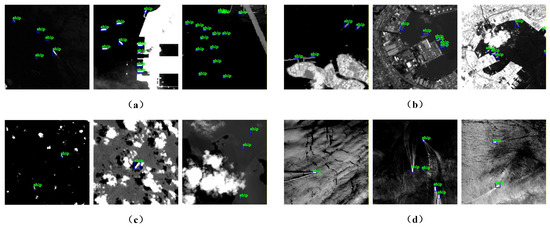
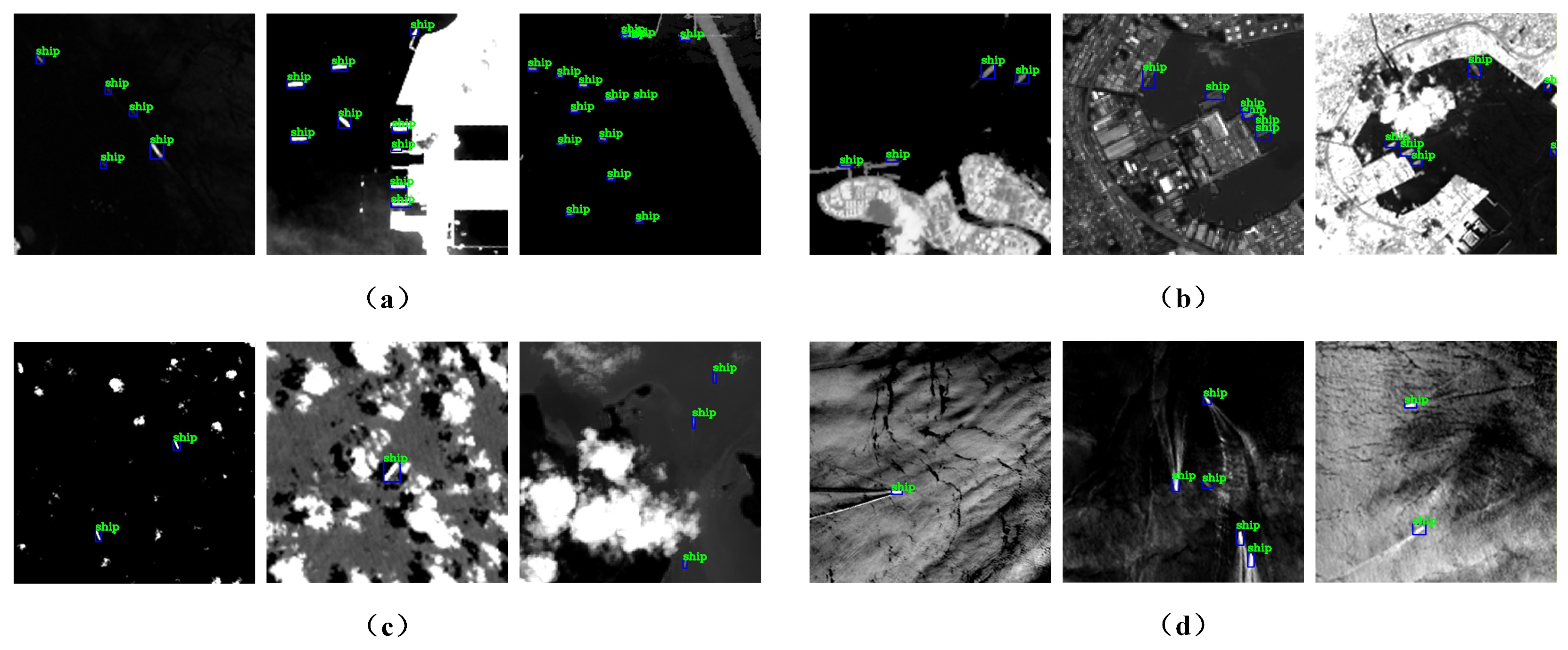
Spaceborne infrared ship detection is a crucial task in national defense and civilian domains, supporting activities such as battlefield monitoring, harbor administration, and rapid maritime incident response [1,2]. Compared to visible imagery and synthetic aperture radar (SAR) imagery, infrared remote sensing imagery offers incomparable advantages in all-day and all-weather detection, temperature sensitivity, and concealment penetration [3,4]. Consequently, infrared remote sensing imagery provides an important foundation of information for maritime vessel identification. Nevertheless, the inherent characteristics of infrared remote sensing data pose challenges for standard detection methods when used for robust ship detection. As presented in Figure 1, ship targets only occupy a small pixel area in infrared images and usually lack detailed texture information, which increases the difficulty of feature extraction [5]. Additionally, complex interference, such as buildings, clouds, and sea waves, may exhibit features similar to ships, making it difficult to suppress effectively [6]. Accordingly, it is important to develop a precise and efficient infrared ship-detection method for complex backgrounds.
Figure 1.
Challenges in infrared ship detection. (a) Small ships; (b) inshore and berthing scenes; (c) thick clouds scenes; (d) ship with trail in sea wave scenes.
Recently, extensive research has been conducted on infrared ship detection. Han et al. [7] were the first to publish an open-access infrared ship detection dataset (ISDD), laying the groundwork for their proposed knowledge-driven context perception network (KCPNet). This network includes a contextual attention module to enhance target detection and integrates prior knowledge to reduce false alarms. Yuan et al. [6] developed the multitype feature perception and refined network (MFPRN), integrating a rapid fast Fourier transform (FFT) module, a wide receptive field, and an efficient multilayer perceptron for comprehensive global context modeling. These approaches have significantly improved infrared ship-detection performance. Nevertheless, due to the region proposal procedure, they tend to have high computational complexity, which limits their wider application.
To improve detection efficiency, many researchers are increasingly focusing on one-stage detection approaches, known for their speed and precision. Li et al. [8] developed a progressive task-based universal network to achieve refined ship detection by learning the latent features of the target and its surrounding background. Hu et al. [9] presented the scene-semantic prior-assisted infrared ship detection multitask perception network (SMPISD-MTPNet), which incorporates a gradient-based module to enhance edge and point features of small vessels and a scene-semantic extractor (SSE) unit to leverage scene semantics to guide the network. Li et al. [10] incorporated dilated convolution and squeeze-and-excitation (SE) attention module into YOLOv5, which achieved real-time and effective ship detection in complex backgrounds. Guo et al. [11] proposed a flexible convolutional network (FCNet) that combined standard and dilated convolutions to enhance feature extraction. Additionally, they introduced a semantic fusion module (SFM) that aggregates features to improve detection accuracy. Li et al. [12] introduced YOLOSR-IST, which integrates coordinate attention to enhance regions of interest and a Swin Transformer head that learns contextual interactions among local features. These methods provide real-time ship detection for practical applications of maritime surveillance and timely rescue. However, they may ignore detailed feature extraction for small and dim ships and fail to effectively suppress interference, thereby causing missed targets and spurious alarms in extremely cluttered scenarios.
To tackle these challenges, we introduce an innovative hierarchical frequency- and spatial-feature attention network (HFS-Net) that enables rapid and precise ship detection in infrared remote-sensing imagery. The main motivation is to combine frequency and spatial information to improve feature extraction, while devising novel hybrid attention-based structures to facilitate semantic information interaction. Specifically, we propose an adaptive frequency-spatial feature attention (AFSA) module to dynamically extract important features and edge details of ship targets. On the one hand, we enrich feature diversity by incorporating frequency-domain information via the Haar wavelet transform. On the other hand, we adopt channel attention to capture important features across different layers, with good adaptability and robustness. To strengthen semantic information, we propose an attention-based component-wise feature interaction (ACFI) module that incorporates multi-head self-attention to capture distant feature correlations and component-wise feature aggregation (CFA) to enhance high-level semantic interaction. The effectiveness of HFS-Net is validated through extensive experiments, which show improved detectability of small infrared ships and reduced background-induced interference, while maintaining real-time inference. The main contributions of this study can be summarized as follows:
- (1)
- This work presents HFS-Net, a hybrid attention-enhanced framework offering fast and reliable infrared ship detection with thorough ship detail extraction and advanced semantic fusion for robust interference suppression.
- (2)
- We design a novel AFSA module that employs the Haar wavelet transform and channel attention to effectively integrate features from the spatial and frequency domains, providing more discriminative feature representation for small ships.
- (3)
- To further eliminate false alarms, we introduce an ACFI module designed to model global feature relationships and enhance high-level semantic information exchange.
The rest of this article is organized as follows. Section 2 describes related ship detection approaches in remote sensing and explains the attention mechanism. Section 3 presents the proposed framework along with its technical structure. Section 4 provides experimental evaluations and analysis. Section 5 discusses the experimental results and provides further analysis. Section 6 concludes with a summary of key findings.
2. Related Work
2.1. Infrared Ship Detection
In remote sensing imagery, ship detection methods generally divide into two categories: conventional techniques that depend on hand-crafted features and modern approaches powered by deep learning. Traditional methods generally depend on manually designed features, such as intensity contrast and morphological structures. Kim and Lee [13] proposed a region-adaptive clutter rejection strategy for sea-based infrared search and track, which suppresses spatially varying sea clutter before a constant false alarm rate (CFAR) decision to highlight dim ship targets. Li et al. [14] developed a thermal infrared small-ship detector based on morphological reconstruction and multi-feature analysis, strengthening weak target responses while reducing wave-induced false alarms. Li et al. [15] further designed an infrared ship detection method that combines temporal fluctuation cues with spatial structure features to enhance target saliency under strong sea-surface highlights and clutter. The above traditional methods perform well in specific scenarios. However, their performance depends on hand-crafted features and is highly sensitive to parameter adjustments, thereby hindering the thorough exploration of deep semantic representations of ship targets in complex scenarios.
Recently, deep learning has demonstrated superior robustness in complex environments and has gradually become a predominant detection method in computer vision. Deep learning detection techniques can be broadly classified into two classes according to whether region proposals are involved: the two-stage paradigm, exemplified by Region-based Convolutional Neural Network (R-CNN) [16], Fast R-CNN [17], Faster R-CNN [18]; and the one-stage paradigm, represented by Single Shot MultiBox Detector (SSD) [19], You Only Look Once (YOLO) variants [20,21,22,23,24], and RetinaNet [25]. Despite traditionally having inferior localization accuracy, one-stage detectors have seen significant performance gains thanks to advances in convolutional neural networks, which now make them well-suited for infrared ship detection tasks that require real-time response. Wang et al. [26] introduced GT-YOLO, which includes an attention-based feature-fusion component designed to reduce false negatives. Guo et al. [27] presented YOLO-IRS for infrared ship detection in complex marine backgrounds by incorporating Swin Transformer-based feature modeling and designing the C3KAN module to improve weak small-target representation and reduce false alarms under dense and cluttered conditions. Tang et al. [28] developed the lightweight detection algorithm Light-YOLO within the YOLOv8 framework by replacing conventional convolutions with snake convolutions and introducing the multi-scale feature enhancement module (MFEB) to strengthen low-level small-ship features while mitigating background and noise interference.
In addition to YOLO-based one-stage pipelines, attention-enhanced CNN detectors have also been explored to further strengthen discriminative features for small and dim infrared ships. Wu et al. [29] proposed the stacked residual coordinate attention network (SRCANet), which stacks residual coordinate attention to enhance location-aware feature modulation and suppress sea-clutter interference for small and dim infrared ships. Wu et al. [30] designed the multi-level TransUNet (MTU-Net), featuring a hybrid encoder that unifies vision transformer and CNN components to learn hierarchical features, and incorporates a multi-level feature extraction module (MVTM) for effective modeling of long-range dependencies. Following this line, Peng et al. [31] introduced the knowledge-driven feature fusion detection transformer(KDFF-DETR), which enhances the real-time detection transformer (RT-DETR) through hybrid Fourier contextual encoding, visual knowledge supervised feature reconstruction, and contribution-balanced feature fusion to improve robustness under complex backgrounds.
In conclusion, the transition from conventional approaches to deep learning-based techniques has enhanced the robustness and efficiency of ship detection in complex maritime environments. However, spaceborne infrared ship detection still faces major challenges, notably in capturing detailed features of small ships and in managing interference from complex backgrounds. Consequently, further research into efficient and precise ship-detection methods for infrared remote-sensing imagery is crucial.
2.2. Attention Mechanism
In object detection tasks, attention mechanisms enhance performance by modeling feature relationships and guiding networks to focus on informative regions. In 2018, Hu et al. [32] proposed the squeeze-and-excitation (SE) module, which enhances crucial feature representations by adaptively reweighting feature channels. Following this, a spatial attention module was used to adjust the weighting of information in the spatial aspect. Woo et al. [33] proposed the convolutional block attention module (CBAM), combining channel and spatial attention mechanisms to improve detection accuracy. Yang et al. [34] incorporated a spatial–channel squeeze-and-excitation (scSE) attention mechanism to guide the backbone network in capturing tiny target features more efficiently. Zhu et al. [35] introduced the non-parametric simple attention module (SimAM) to highlight important spatial regions without extra learnable weights. Su et al. [36] developed the channel location attention mechanism (CLAM), enabling networks to perceive positional cues in both the X and Y directions. Deng et al. [37] developed SAR-ShipNet, a SAR ship detection network based on CenterNet that combines bidirectional coordinate attention (BCA) and multi-resolution feature fusion (MRF) to enhance detection performance. Xiong et al. [38] incorporated both the SE module and CBAM into YOLOv5, enhancing target feature saliency and minimizing the impact of background noise. To mitigate the challenges posed by low-resolution infrared imagery, Zhou et al. [39] introduced a coordinate attention module to enhance target representation and suppress interference from cluttered backgrounds. Ye et al. [40] proposed a combined-attention-augmented YOLO (CAA-YOLO) to suppress noise interference in shallow feature layers. These mechanisms have progressed from single-dimensional weighting to multi-dimensional cooperative attention, thereby boosting detection performance by strengthening the discriminability and stability of feature representations.
Transformers have recently been employed in object detection, exploiting their self-attention capabilities to model long-range feature interactions and guide attention to salient regions in wider spatial contexts. Vision Transformer (ViT) [41] introduced self-attention mechanisms to object detection architectures. Zhao et al. [42] designed RT-DETR to deliver real-time detection performance and eliminate the need for post-processing, using an efficient hybrid encoder and an uncertainty-minimized query selection module. Such a multi-head self-attention (MHSA) mechanism enables the network to learn diverse features and capture global dependencies; however, it may struggle to model complex feature interactions. To overcome this limitation, we design the ACFI module to capture multi-scale correlations and enable stable feature fusion via component-wise feature aggregation (CFA).
2.3. Feature Enhancement
To address spurious responses and the loss of fine details commonly observed in infrared scenarios, feature enhancement—which selectively amplifies salient features while suppressing redundant background—has become a major research focus in recent years. Duan et al. [43] introduced a texture- and edge-reinforcement module into an improved RT-DETR framework, emphasizing the enhancement of small-target boundary sensitivity within the encoder while maintaining inference speed; Lu et al. [44] employed grayscale morphological reconstruction and relative total variation based structural smoothing as a front-end enhancement to suppress sea-surface noise before feeding data into the network; in the frequency domain, Qin et al. [45] proposed FcaNet, which injects DCT spectral components into channel representations to improve feature robustness and can be directly embedded into CNN backbones; Sun et al. [46] designed a hierarchical multi-kernel convolution unit in IRSD-Net to strengthen multi-scale extraction and reduce redundancy and memory usage through parallel kernels and channel partitioning; other studies adopt structural re-parameterization strategies, such as RepVGG [47] and the planned RepConv in YOLOv7 [48], training with multi-branch representations and collapsing them into a single-branch convolution at inference to improve backbone feature quality while preserving real-time performance. In this paper, we focus on feature enhancement and adopt a lightweight mixing strategy across branches to integrate multiple responses in a stable way, maintaining real-time efficiency while achieving a better balance between accuracy and efficiency.
3. Method
3.1. Overview of HFS-Net
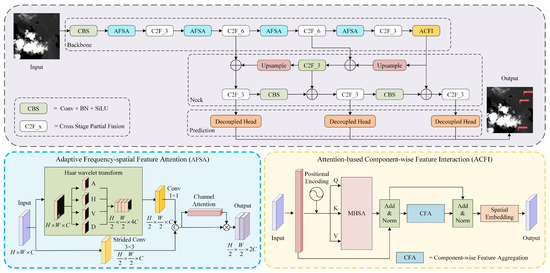
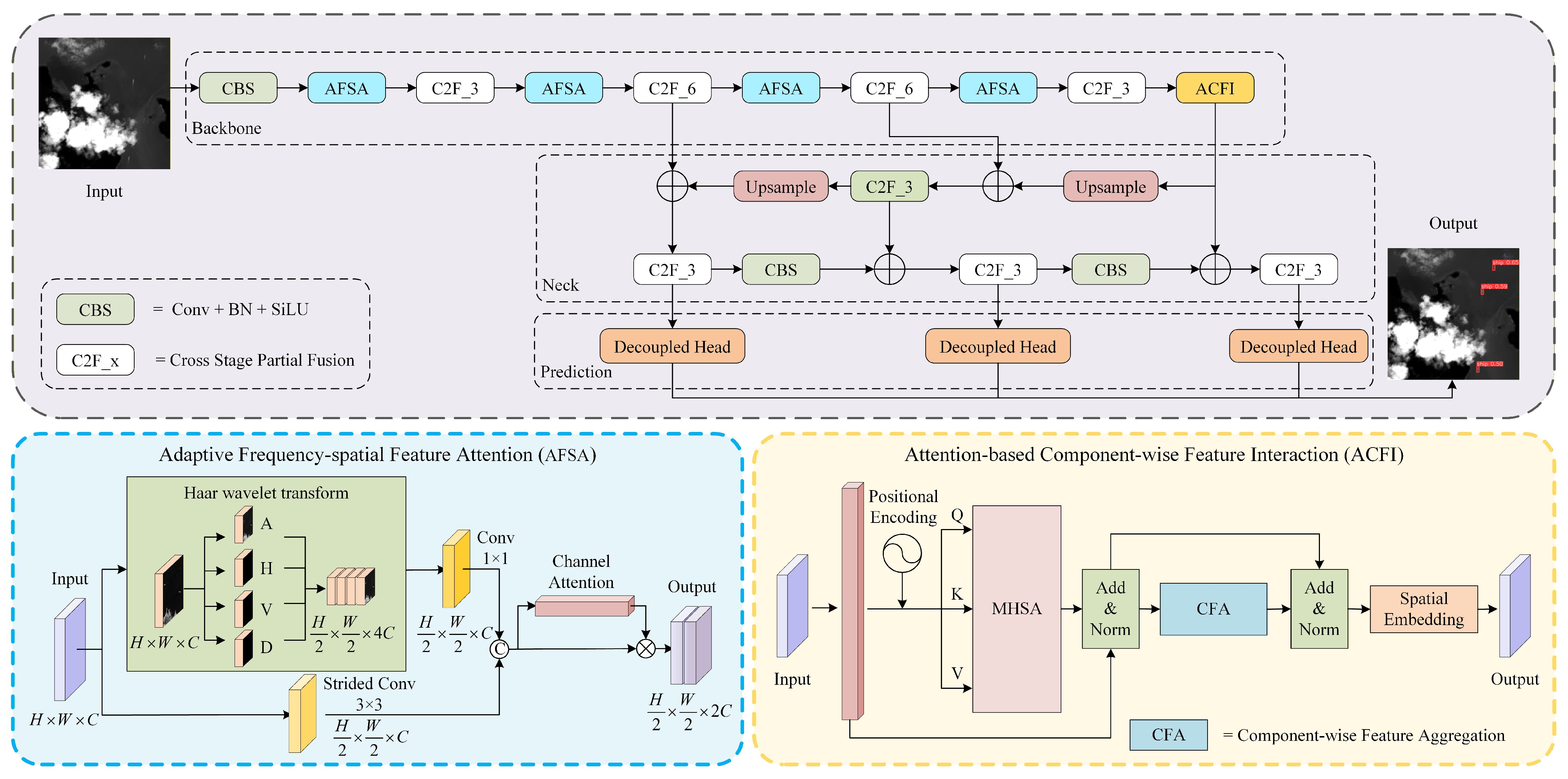
The architecture of the proposed HFS-Net framework is illustrated in Figure 2. Owing to its superior performance and efficiency, YOLOv8 serves as the basis for our infrared ship detection framework. To better address missed detections and false alarms, we design the hybrid attention modules AFSA and ACFI, which enhance small-ship features and highlight the contrast between ships and interfering backgrounds. Figure 2 illustrates that HFS-Net consists of three main components: backbone, neck, and detection heads. Firstly, the input is resized appropriately and processed by the backbone, facilitating efficient feature extraction. In particular, the AFSA module aims to extract frequency and spatial features. Furthermore, the designed ACFI module promotes the integration of advanced semantic information across the deeper network stages. Secondly, representations from various layers are combined in the neck module. Finally, the detection head decouples classification and localization into distinct branches, enhancing accuracy and efficiency by reducing cross-task interference.
Figure 2.
Architecture of the hierarchical frequency and spatial feature attention network (HFS-Net), the frequency-spatial feature attention (AFSA) module, and the attention-based component-wise feature interaction (ACFI) module. There are three components in HFS-Net: (1) a backbone subnetwork that integrates our proposed AFSA and ACFI, enabling efficient feature extraction at each layer and long-range feature interaction; (2) a neck subnetwork that fuses multi-scale features; (3) detection heads that perform target classification and localization to generate the final detection results.
3.2. Adaptive Frequency-Spatial Feature Attention Module
Targets in infrared images often occupy few pixels and exhibit weak textures, so naive down-sampling tends to wash out small ships and hinder fine-grained feature learning. To overcome this challenge, we develop the frequency-spatial feature attention (AFSA) module, which adaptively learns frequency and spatial details to enhance small target features while down-sampling. Unlike approaches that defer frequency–spatial combination to a later fusion stage, AFSA runs a frequency stream and a spatial stream in parallel at the down-sampling stage and fuses them via lightweight channel recalibration, keeping computation controlled and training stable.
As shown in Figure 2, AFSA comprises two parallel branches. The frequency branch employs a separable 2D Haar transform [49], essentially stride-2 low and high-pass filtering along rows and columns. The transform is linear and orthonormal, consists mainly of additions and subtractions, and thus has a small, fixed computational cost. At the down-sampling stage, it decomposes the input into four coefficient maps—the approximation (A) and the horizontal (H), vertical (V), and diagonal (D) detail components—each with spatial size H/2 × W/2. These four maps are then concatenated along the channel dimension to form 4C channels, and the channels are aligned to the target width using a 1 × 1 convolution. In parallel, the spatial branch applies a 3 × 3 convolution with stride-2 to obtain a spatial feature of the same size. The outputs of the two branches are concatenated along the channel dimension and fed into the subsequent fusion step.
In the Haar wavelet transform, the signal is decomposed into detailed and approximate parts at different scales, and the basic process of the transform can be described by the basis and scale functions. In detail, the wavelet and scaling functions for the 1-stage, 1D Haar transform can be expressed as [49]:
Here, is defined as
where j and k denote the level and sequence of the Haar basis function, respectively. For images, these parameters correspond to the image’s scale and position. Furthermore, is defined as
Thus, the 1-stage Haar transform is derived from the 0-stage Haar basis functions, where acts as a low-pass filter and functions as a high-pass filter:
This formula shows how an L-length signal is decomposed into two segments through low- and high-pass filtering. When images or feature maps undergo the two-stage, two-dimensional Haar wavelet transform, they are decomposed into four parts, each retaining half the spatial resolution of the original.
Building on the above interpretation, the four outputs of the 2D Haar transform correspond to one low-frequency approximation component and three high-frequency detail components oriented along different directions. The approximation component A mainly preserves low-frequency energy distribution and coarse-scale structural information. In infrared maritime scenes, such low-frequency cues are relatively stable under weak textures, low contrast, and cloud veiling, which helps maintain the spatial consistency of small targets after down-sampling. The detail components H and V emphasize directional intensity transitions and are sensitive to thin contours and boundary structures, thereby compensating for edge weakening caused by scale compression and improving the separability between ships and the sea background. The diagonal detail component D focuses on local abrupt changes and corner-like discontinuities, which can strengthen the local shape expression of tiny targets, while it may also be activated by wave textures and near-shore structures in cluttered scenes. Overall, these sub-bands provide complementary clues that preserve coarse structural consistency, while H, V, and D enrich discriminative details.
Although the Haar sub-bands provide complementary cues, conventional down-sampling still introduces irreversible information compression and frequency-domain aliasing, which tends to attenuate edge and local-contrast cues that are critical for small-target detection. To address this issue, AFSA moves frequency–spatial modeling into the down-sampling stage itself. Unlike designs that delay frequency–spatial integration to later stages, AFSA performs an orthonormal decomposition into the low-frequency approximation and oriented high-frequency details at the reduced resolution, while a spatial branch simultaneously encodes local geometry and contextual constraints. This front-loaded parallel design is intended as a specialized solution for small infrared ship detection in complex maritime environments, preserving target-related cues while suppressing background-dominant responses during scale reduction with controlled computational overhead.
Furthermore, we fuse the two branches along the channel dimension to jointly retain information from the spatial and frequency domains. Simple channel concatenation cannot adapt to the current input to assess the relative contributions of the A, H, V, and D sub-bands and the spatial features, which may weaken target-related fine details in subsequent convolutions. Therefore, after concatenation, we introduce channel attention (CA) to reweight the fused representation in a data-adaptive manner. Let F denote the fused feature after concatenation. Channel attention uses both global average pooling (GAP) and global max pooling (GMP) to obtain channel descriptors and generates a channel-gating vector via a shared bottleneck mapping g. Specifically, the gating vector is computed as follows:
where g is a two-layer bottleneck mapping with a non-linear activation, and is the sigmoid function. The gating vector is then applied to F in a channel-wise manner to obtain the recalibrated feature:
where w denotes the channel gating vector, and ⊙ indicates channel-wise multiplication, where each channel of F is scaled by the corresponding element in w. This re-calibration enables the network to adaptively emphasize channels dominated by stable low-frequency structure or informative oriented details, while suppressing clutter-prone channels introduced by sea-surface waves and near-shore backgrounds, thereby preserving discriminative cues for small targets during down-sampling.
3.3. Attention-Based Component-Wise Feature Interaction Module
After multiple down-sampling stages, deep feature maps are dominated by low-resolution semantics; enhancing interaction among high-level features helps suppress background interference and improve detection accuracy. To this end, we introduce ACFI, which combines multihead self-attention (MHSA) with component-wise feature aggregation (CFA) to exploit high-level semantics, reduce background noise, and consolidate target representations. Unlike commonly used pooling operations [50], ACFI employs MHSA to establish long-range feature dependencies and uses CFA to strengthen interaction among high-level semantics. Figure 2 presents the design of ACFI, which consists of MHSA and CFA. The details of these components are provided below.
In ACFI, we apply MHSA only to deep, low-resolution representations so that long-range dependencies are modeled within a controlled computational and memory budget. Unlike common practice that introduces attention at high resolutions or stacks heavy attention blocks, we adopt a constrained multi-head configuration with 8 heads, and the embedding dimension C is evenly partitioned across heads. We set the attention dropout to 0.0. We employ fixed 2D sinusoidal positional encoding to provide positional information without additional learnable biases. The temperature in the sinusoidal positional encoding is set to 10,000, and MHSA is applied only on the deepest feature map with spatial size . This configuration keeps complexity under control, maintains low inference cost, and improves training stability on infrared ship data. Furthermore, we decouple MHSA from the conventional feedforward multi-layer perceptron (MLP): subsequent nonlinear mixing is performed by the CFA module, allowing the attention layer to focus on global dependency modeling while feature aggregation is handled by an independent path. This separation of concerns simplifies implementation and enhances the overall robustness of optimization.
In each head, the input feature maps are transformed into one-dimensional data at the beginning:
where is the input feature maps, is the flattened feature, and D equals .
Position encoding is then incorporated to capture the input features’ spatial information by generating distinct position vectors through sine and cosine functions with varying frequencies, as illustrated below:
where is the position of the pixel in , P is the position vector of the pixel, denotes the element of , while and denote even and odd positions, respectively.
Then, encoded features are divided into query (), key (), and value () matrices, enabling the capture of dependencies across high-level features:
where is the flattened feature representation derived from the deepest backbone feature map that is fed into the MHSA module. , , and are learnable weight matrices of size , , and respectively. , , and are the dimensionality of the query, key, and value vectors.
Next, the attention scores are calculated by performing a scaled dot product on and . This attention score constitutes the attention weights, which are then multiplied by the value matrix to obtain the output of each attention head. The formulas are defined as follows:
Finally, the outputs from all heads are merged, producing the MHSA module’s final representation:
where denotes the output of the ith attention head, h is the number of heads, and is the learnable output projection matrix.
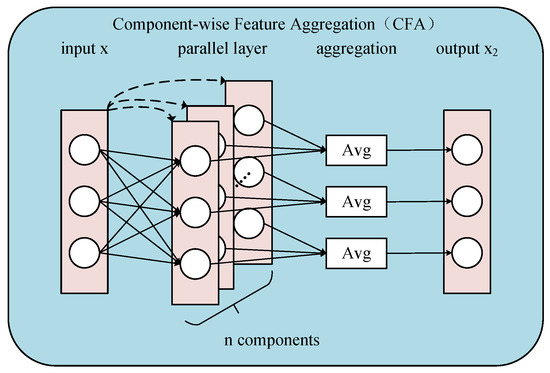
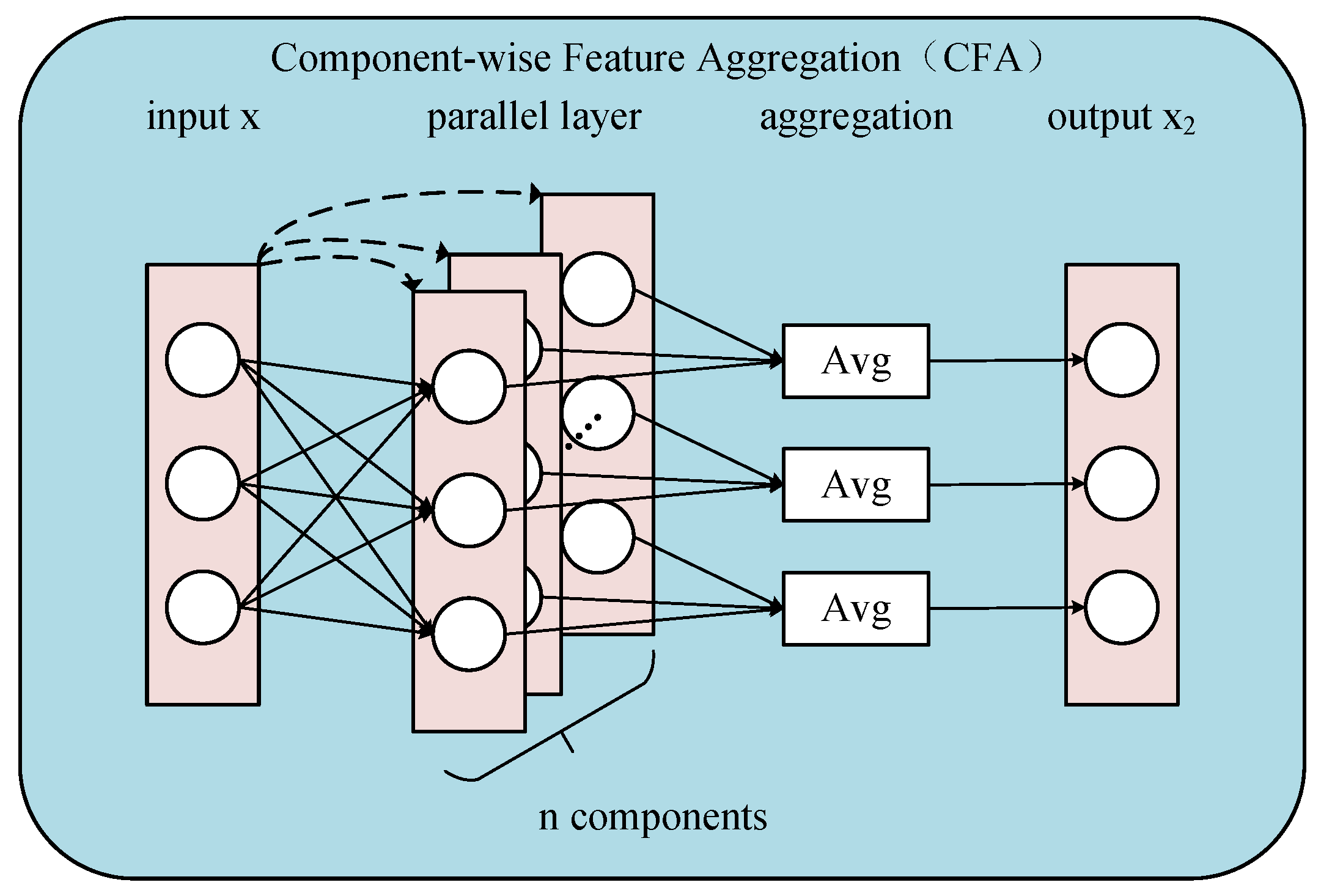
Furthermore, as shown in Figure 3, we introduce the component-wise feature aggregation (CFA) module for position-consistent mixing in the feed-forward stage. Given the same input, CFA instantiates n parallel, parameter-independent linear–nonlinear mappings; each operates on the full channel space via a projection followed by an activation:
where is the output of MHSA, and is the output of component. The outputs are then combined by element-wise, equal-weight averaging along the component dimension to yield an output with the same shape as the input, denoted as follows:
Figure 3.
Architecture of the component-wise feature aggregation (CFA). CFA enables effective interaction of high-level semantic information.
Unlike grouped convolution, CFA does not partition channels or concatenate group-wise outputs; aggregation occurs over components rather than along the channel dimension. Unlike typical gating-based mixture-of-experts variants, CFA introduces neither sample- nor position-level gating, uses no top-k routing, and requires no load-balancing regularization, thereby simplifying implementation and improving training stability. Relative to a standard two-layer feed-forward MLP, CFA functions as a uniform ensemble of multiple single-hidden-layer nonlinear mappings applied to the same input, increasing the functional diversity of feature interactions while controlling activation scale and variance through averaging. Placed after MHSA, CFA provides stable, low-overhead mixing of high-level semantics and complements attention’s role in global dependency modeling, yielding a balanced trade-off among detection performance, efficiency, and training stability.
4. Experiments and Results
4.1. Dataset
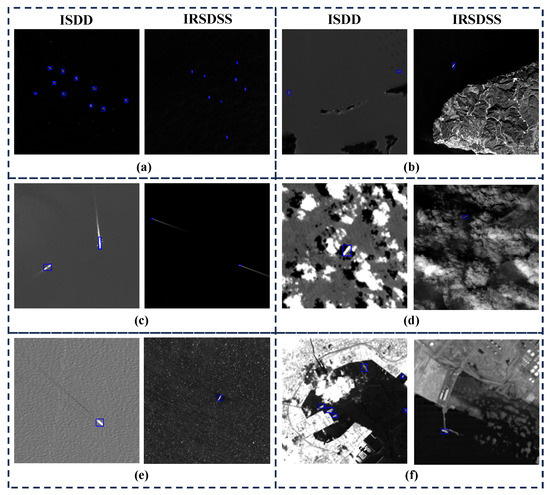
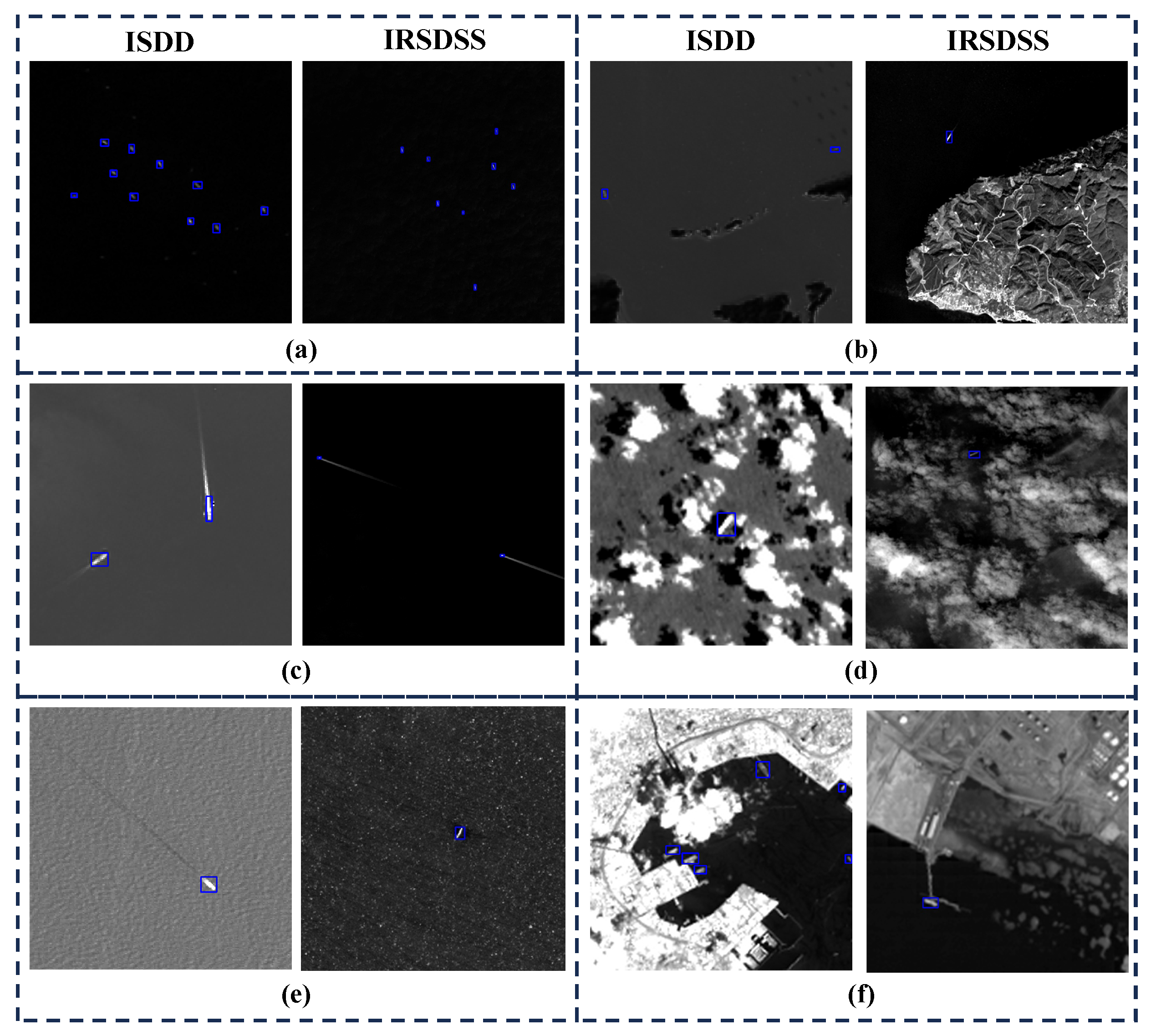
For the following experiments, ISDD [7] and the Infrared Ship Dataset with Scene Segmentation (IRSDSS) [9] are used as benchmarks to validate the proposed method. A total of 1284 and 1491 Landsat 8 images in ISDD and IRSDSS, respectively, are distributed into training, validation, and test partitions in a 6:1:3 proportion. As depicted in Figure 4, the datasets cover a variety of maritime scenarios ranging from nearshore to offshore areas and include imagery acquired under diverse illumination and weather conditions, including daytime, nighttime, and varying cloud cover. The ships in both datasets exhibit significant variation in appearance: both ships with and without wakes are present, and their sizes and shapes differ considerably, further increasing the difficulty of detection. Furthermore, both datasets are biased toward smaller sizes, with no large targets as defined in the COCO dataset. Details of different target size distributions can be found in Table 1. Compared to ISDD, IRSDSS contains a higher proportion of small targets, comprising 3991 small targets and 71 medium-sized targets, whereas ISDD only includes 2863 small targets and 198 medium-sized targets. In addition, IRSDSS provides land and cloud masks alongside ship annotations, enabling a clearer characterization of background composition. To enable a more detailed comparison of detection performance on ships of different sizes, we also report AP metrics for small () and medium () objects in the experiments.
Figure 4.
Scene diversity and weather condition diversity in ISDD and IRSDSS: (a) offshore scenes; (b) inshore scenes; (c) ships with wakes; (d) cloud scenes; (e) sea wave scenes; (f) berthing scenes. The blue box denotes the ship.
Table 1.
The distribution of target sizes within ISDD and IRSDSS.
4.2. Implementation Details
Given YOLOv8’s efficiency and accuracy, we use it as inspiration for HFS-Net and as the baseline for ablation tests and performance comparisons. In our implementation, HFS-Net adopts CSPDarknet53 as the backbone. To maintain fairness, our approach and the comparative methods are tested using the same hardware configuration. For experiments, a system with an Intel Core i5-12500H CPU (12th Gen, 3.10 GHz) and an NVIDIA RTX 3050 Ti Laptop GPU was employed. The training uses a 0.01 learning rate with a stochastic gradient descent (SGD) optimizer, 0.0005 weight decay, and 0.937 momentum, with a warm-up step at the start to ensure gradient stability. All models are trained for 1500 epochs and stopped when no performance improvement is observed for 200 consecutive epochs. The intersection over union (IoU) threshold for non-maximum suppression (NMS) is configured to 0.5. In addition, augmentation methods are used in the training phase. Specifically, the data undergo random variations in hue, saturation, and value (HSV) and transformations such as panning, scaling, and flipping. Additionally, mosaic augmentation aims to strengthen the network’s ability to detect diverse and complex scenarios.
4.3. Evaluation Metrics
To quantitatively evaluate detection, common indicators like Precision (P), Recall (R), F1-score (), and Average Precision () are applied to measure our network’s performance. Precision measures the ratio of true positives to all detected ships, while Recall reflects the percentage of actual ships correctly identified in the ground truth. The formula can be expressed as
where refers to correctly detected ships (true positives), represents false alarms (false positives), and indicates missed ships (false negatives).
measures how well precision and recall are balanced, yielding an integrated performance indicator for the model, which is given by the following:
quantifies overall model performance under varying recall levels and is expressed as
where denotes precision as a function of recall R.
For detection speed, we use FPS (frames per second) to indicate the number of frames the model processes per second. In addition, we report and based on the Common Objects in Context (COCO) definition of object scales, where small objects are defined as those with areas less than pixels, and medium objects are those with areas between and pixels.
4.4. Ablation Experiments
This section presents comprehensive ablation experiments to examine the impact of each component on HFS-Net’s performance. We use the same hyperparameters for all ablation experiments to ensure fair comparison.
4.4.1. Effect of AFSA and ACFI
Table 2 presents the ablation experiments of the AFSA and ACFI modules in HFS-Net, where the baseline (Net1) only achieves of , Precision of , of , and of . After introducing AFSA (Net2), these metrics all get improved, especially Precision (), (), (), and (). Comparing Net3 and Net1, introducing ACFI improves Precision from to and boosts from to . Consequently, both the AFSA and ACFI individually improve the detection performance. When the two modules are integrated (Net4), HFS-Net achieves the best results, with an of () and of (). The results demonstrate that these two modules jointly provide a more comprehensive feature-extraction strategy, with AFSA preserving the fine details of small objects and ACFI enhancing long-range feature interactions within images. This makes HFS-Net a valuable method for real-world applications that require high accuracy and reliability across diverse operational environments.
Table 2.
Ablation studies of AFSA and ACFI modules in HFS-Net. Bold indicates the best performance.
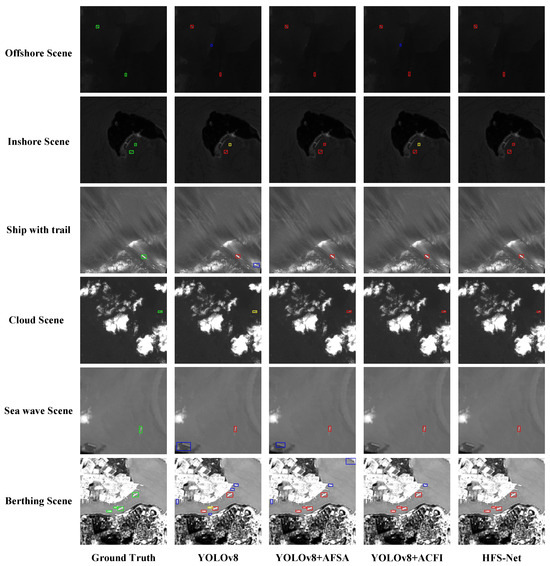
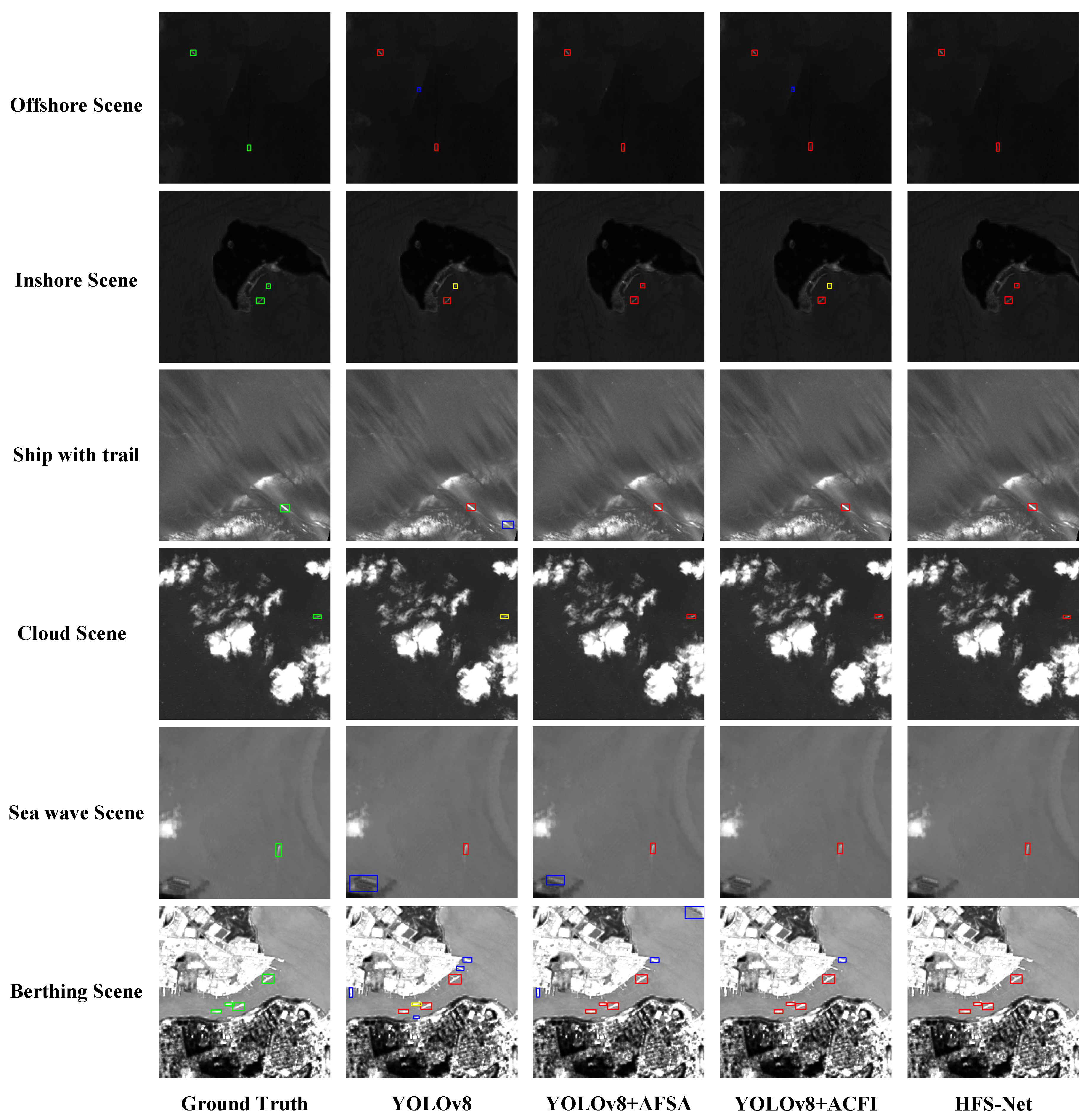
Detection outcomes of the above methods in various settings are shown in Figure 5. One can see that AFSA enhances small-ship detection capability, whereas ACFI helps reduce background interference. Combining the hybrid attention modules leads to further improvements in detection performance, confirming the effectiveness of our approach.
Figure 5.
Performance of four networks in ablation studies on typical ISDD scenes. The green, red, yellow, and blue bounding boxes represent ground truth, correctly detected ships, missing ships, and false alarms.
4.4.2. Effect of AFSA
AFSA can adaptively capture spatial- and frequency-domain cues to enhance feature extraction. To validate the necessity of each branch, we conduct component-wise ablations by comparing the frequency-only and spatial-only variants, and further evaluating the complete frequency–spatial dual-branch design. As shown in Table 3, the frequency-only branch yields slightly higher P and , whereas the spatial-only branch attains marginally higher R, indicating that the two branches exhibit different strengths in infrared maritime scenes. Importantly, combining the frequency and spatial branches consistently improves the overall detection quality compared with using either branch alone, with clear gains in and . Moreover, we ablate the CA applied after feature fusion. Adding CA further improves and and notably increases , suggesting that CA helps suppress clutter-induced false positives and preserves discriminative details for small ships.
Table 3.
Ablation experiments of AFSA components on ISDD. Bold indicates the best performance.
4.4.3. Effect of ACFI
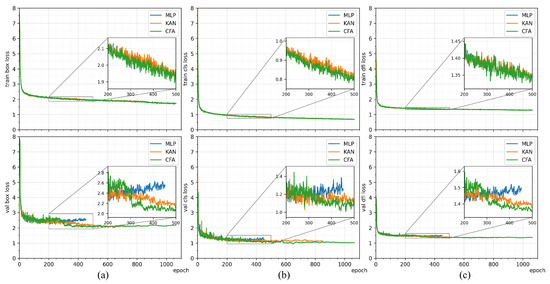
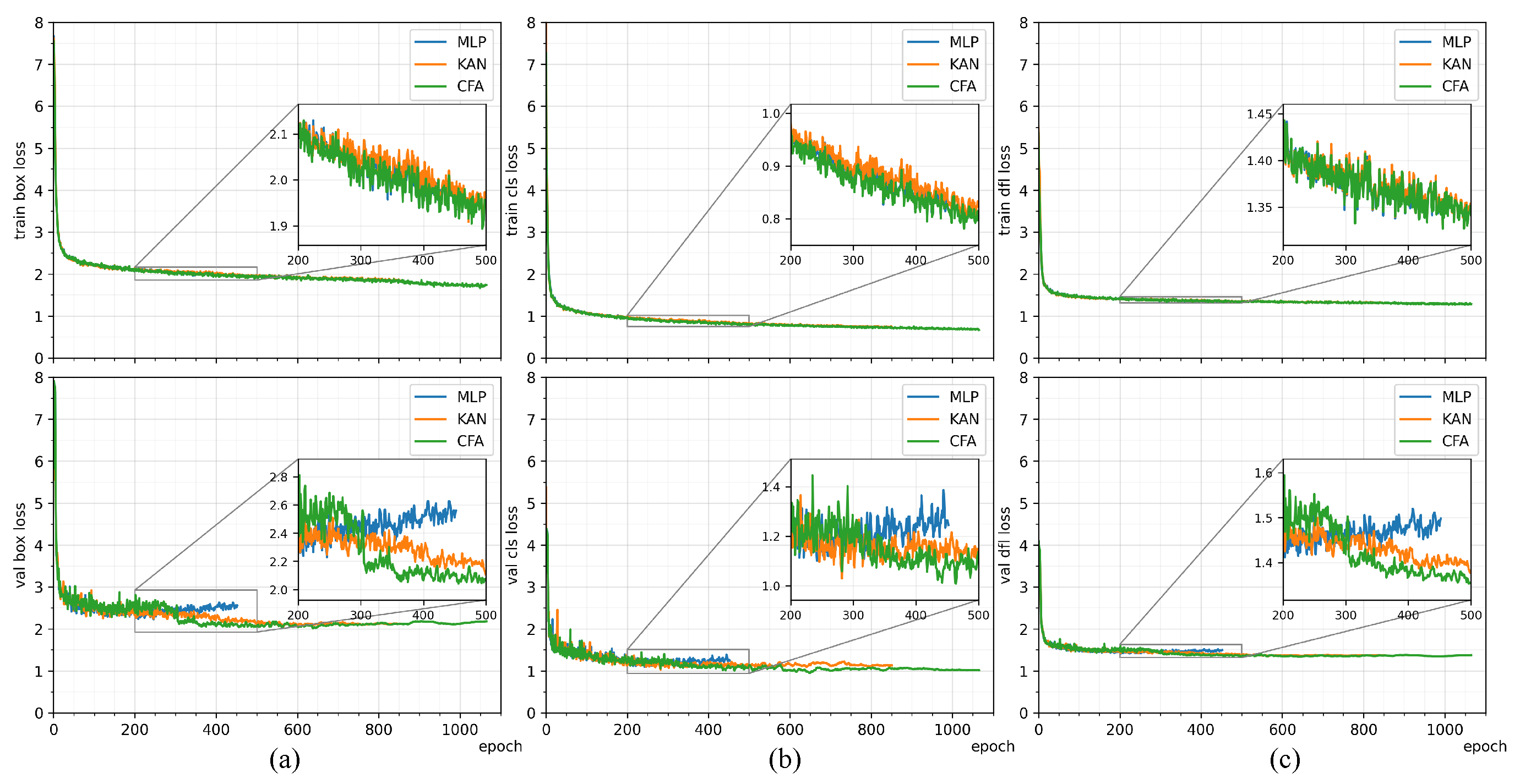
ACFI serves to capture global feature relations using MHSA, helping detect ships effectively under challenging conditions. To evaluate the advantage of ACFI’s internal modules, the proposed CFA is substituted by other common extraction layers, such as MLP and KAN [51]. As depicted in Table 4, our proposed CFA provides a better solution, outperforming both MLP and KAN in precision, recall, and . Experimental findings demonstrate the advantage of CFA for infrared ship detection, with results that surpass those of competing approaches. Beyond detection performance, we also evaluate the convergence stability of different ACFI variants based on the training and validation loss curves shown in Figure 6. Note that the loss curves include the box loss for bounding box regression, cls loss for classification, and dfl loss for distribution focal loss [52]. From the training curves, the three variants exhibit similar overall decreasing trends. The zoomed view from epoch 200 to 500 is provided to better visualize subtle variations among variants. Within this interval, the training loss curves of the three variants remain very similar overall, with only small differences. It can be observed that during training, the MLP and KAN variants show pronounced oscillations in the validation cls loss and tend to get stuck in a local optimum in the middle to late stages, indicating insufficient training stability for infrared ship detection. In contrast, after introducing the proposed CFA, the validation cls loss decreases more smoothly and consistently with smaller late-stage fluctuations, suggesting that CFA helps stabilize optimization and improve the reliability of the training process. In addition, we ablate the two submodules of ACFI by inserting only MHSA or only CFA into YOLOv8, and compare the results with those of the complete ACFI. Table 5 shows that the two single-module settings have different strengths: using only MHSA yields a slight advantage in , whereas using only CFA achieves the highest recall. When combined as ACFI, the model achieves the best performance in terms of F1, , , and , indicating that integrating global dependency modeling with component-wise feature aggregation improves the robustness of infrared ship detection.
Table 4.
Comparison with different feature extraction layers on ISDD. Bold indicates the best performance. FEL denotes feature extraction layer.
Figure 6.
Training and validation loss curves for different ACFI variants on ISDD. The blue, orange, and green lines correspond to MLP, KAN, and CFA, respectively. (a) Box loss; (b) cls loss; (c) dfl loss.
Table 5.
Ablation experiments of ACFI components on ISDD. Bold indicates the best performance.
4.5. Comparison with Representative Methods
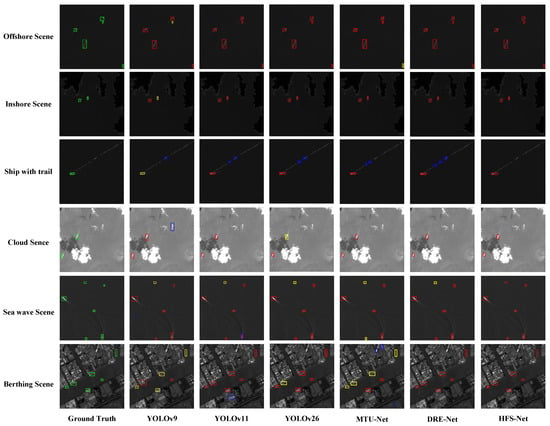
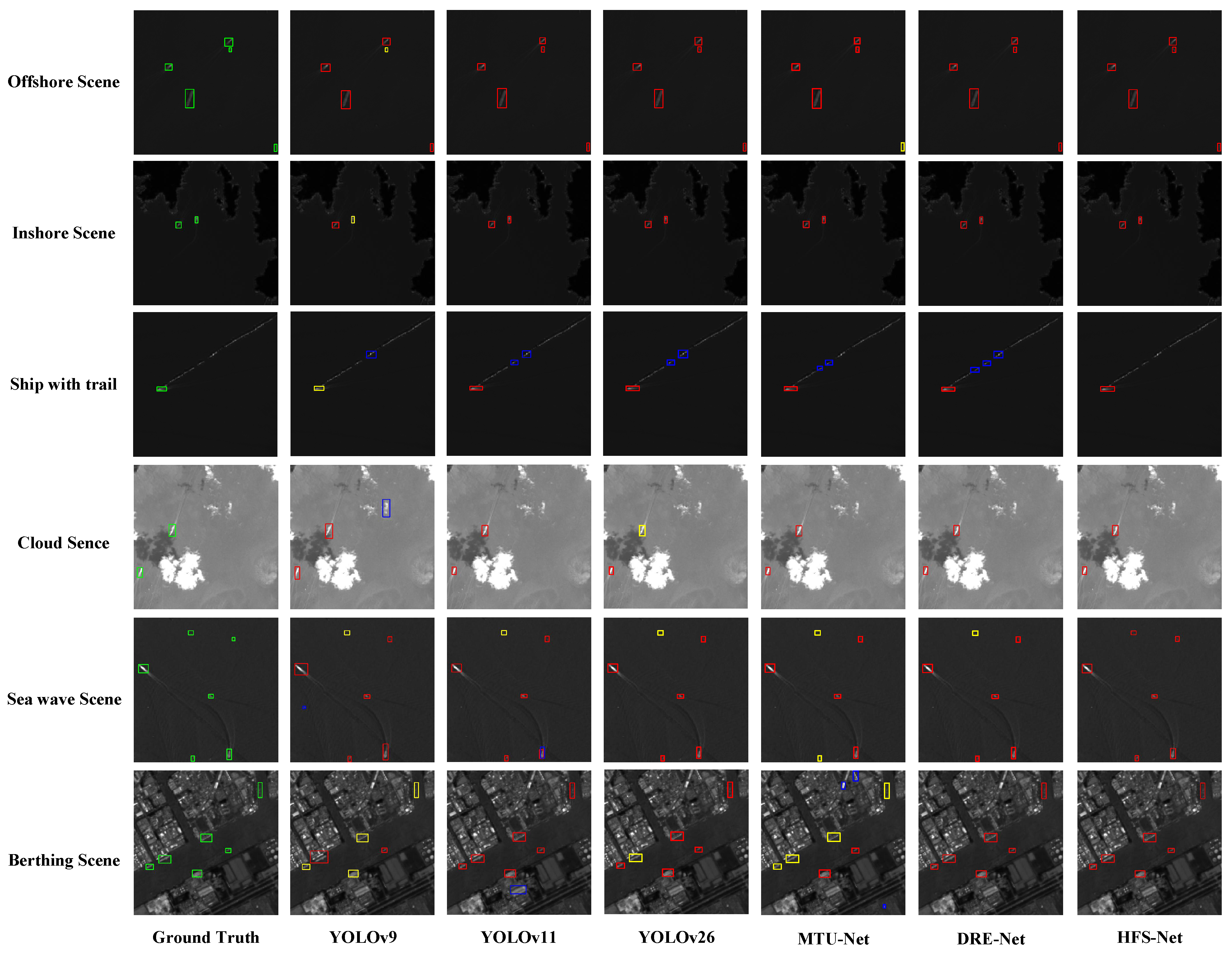
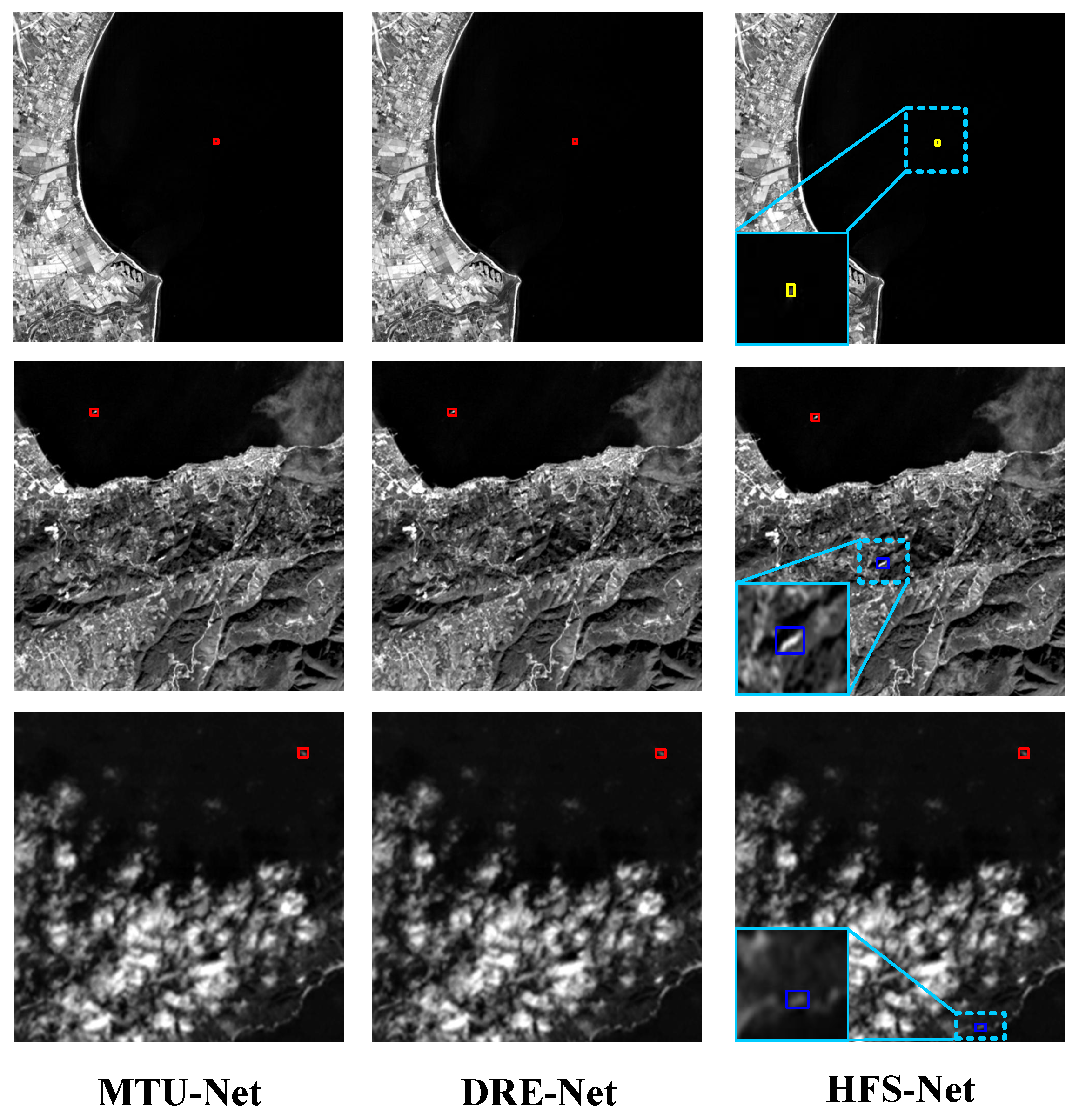
For comprehensive validation of our method, we select various comparison algorithms, including infrared ship-detection approaches such as KCP-Net and MTU-Net, Transformer-based detectors such as RT-DETR, and general-purpose detectors. We cover two-stage frameworks such as Faster R-CNN and Dynamic-RCNN, and one-stage detectors such as SSD and multiple YOLO variants. The detection performance of different methods on the ISDD dataset is reported in Table 6. The results show that HFS-Net achieves a precision of 94.6%, indicating fewer false positives and a stronger ability to suppress background interference from sea clutter and shoreline structures. Meanwhile, HFS-Net achieves an of 94.4%, suggesting that it can stably detect more true targets under a moderate localization constraint. Furthermore, achieving 49.8% at further demonstrates that this method maintains excellent localization accuracy and scale robustness even under stricter multi-threshold criteria. Specifically, our method outperforms YOLO26 by +3.2% in and +3.6% in , and surpasses KCP-Net by +3.4% in and +7.2% in . It also achieves higher accuracy than DRE-Net by +1.4% in and +4.9% in , and MTU-Net by +6.3% in and +9.8% in . As shown by the visualized detection results in Figure 7, HFS-Net effectively suppresses background interference while accurately detecting small ships. To further evaluate the generalization ability, we additionally conduct experiments on the IRSDSS dataset.
Table 6.
Comparison with different methods on ISDD. We indicate the best values in each column in bold and the next best values in underline.
Figure 7.
Comparison of detection results of different methods on ISDD. The green, red, yellow, and blue bounding boxes represent ground truth, correctly detected ships, missing ships, and false alarms.
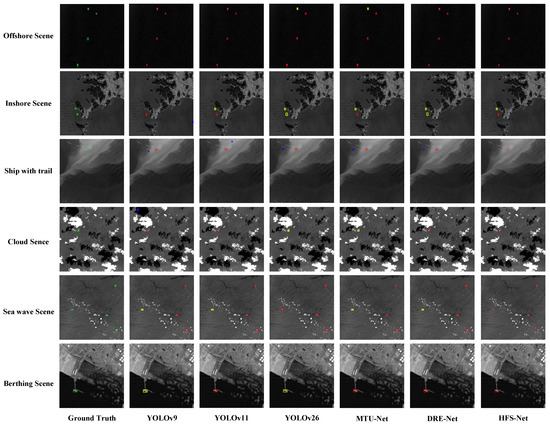
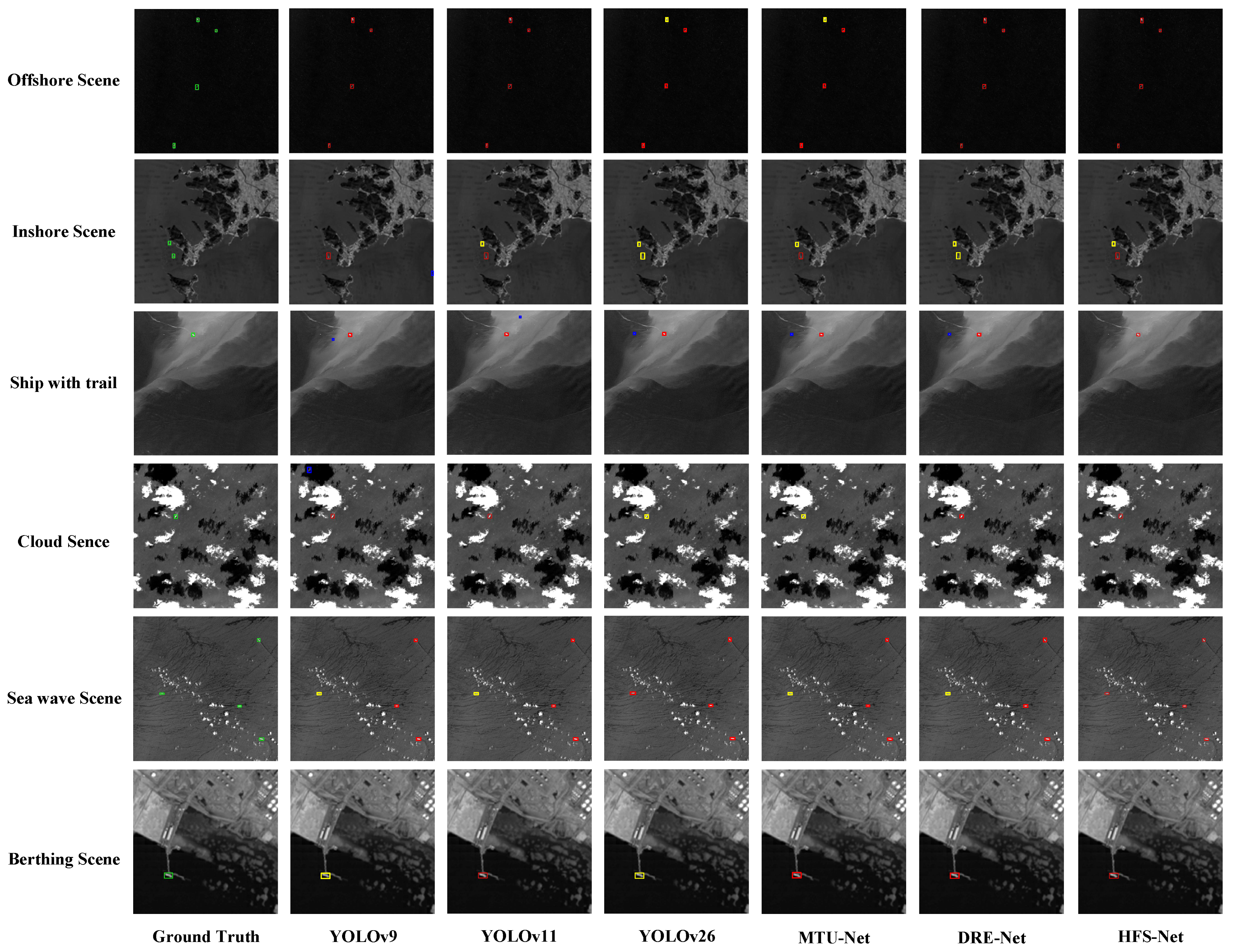
The comparison results on the IRSDSS dataset are reported in Table 7. The results indicate that HFS-Net achieves the best P, , and , with scores of 91.8%, 91.2%, and 92.7%, respectively. This suggests that the proposed method reduces false alarms caused by non-target interference, maintains a more favorable precision-recall balance, and improves target detection and localization consistency under the commonly used localization criterion. For , HFS-Net obtains 42.7%, which remains competitive and is close to the best result. Compared with the strong YOLO baseline YOLO26, HFS-Net improves by 1.1% and by 1.0%. Relative to the infrared ship detection method MTU-Net, HFS-Net achieves gains of 8.5% in , 7.7% in , and 4.4% in . HFS-Net also outperforms DRE-Net, improving by 1.0% and by 2.3%. As shown in Figure 8, these results further support the effectiveness of HFS-Net in complex maritime scenes with small targets and challenging background interference.
Table 7.
Comparison with different methods on IRSDSS. We indicate the best values in each column in bold and the next best values in underline.
Figure 8.
Comparison of detection results of different methods on IRSDSS. The green, red, yellow, and blue bounding boxes represent ground truth, correctly detected ships, missing ships, and false alarms.
Furthermore, as shown in Table 8, we compare the computational efficiency of different methods. Benefiting from the one-stage detection framework, HFS-Net involves fewer computations and parameters than KCP-Net and MTU-Net, which is specifically designed for infrared remote-sensing ship detection, and thus achieves a faster inference speed. Although HFS-Net is not the lightest or fastest among the compared methods, it exhibits higher detection reliability and robustness in maritime infrared scenes, where targets are predominantly small and background interference is pronounced. This enables HFS-Net to deliver better overall detection quality, with notably fewer background-induced false detections, while maintaining an acceptable efficiency level.
Table 8.
Results of GFLOPS, parameter size, and FPS from the representative methods.
5. Discussion
The experimental results establish HFS-Net as a more robust solution than several recent methods for infrared ship detection in maritime scenes characterized by a high proportion of small targets and complex background interference. The advantage stems primarily from the network’s approach to synergistically modeling frequency-domain and spatial-structure information: through its hierarchical design, HFS-Net aggregates complementary clues from both frequency and spatial domains during feature extraction. The multi-scale feature representation enables more thorough preservation of weak edges, slender contours, and local structural details across scales, thereby mitigating the loss of small target representation caused by conventional subsampling.
Furthermore, the performance improvement of HFS-Net is not only reflected in better small-ship detection but, more importantly, in its stronger ability to suppress background interference in cluttered maritime infrared scenes. Unlike strategies that rely on single-feature cues, AFSA integrates frequency- and spatial-domain information at the feature level. It employs channel attention to adaptively relabel feature responses, thereby enhancing critical characteristics such as edge details and visual contours of ship targets. This approach effectively suppresses non-target responses caused by background factors like sea texture and specular reflections. Simultaneously, ACFI combines multi-head self-attention with component feature aggregation to capture long-range dependencies, thereby further enhancing the exchange of high-level semantic information. This approach yields more accurate target feature representations and greater robustness against such disturbances. These two modules jointly contribute to the overall performance gains, enabling HFS-Net to deliver more reliable detection in complex maritime infrared scenes.
This work still has several limitations, which motivate further investigation. As illustrated in Figure 9, HFS-Net may still fail to detect extremely small or low-contrast ships and produce a small number of false detections in cluttered coastal backgrounds or areas with strong boundaries. In future work, we will incorporate scene priors and multi-modal information to better resolve background ambiguities and further suppress interference, thereby improving spaceborne infrared ship detection in complex maritime scenarios.
Figure 9.
Visual analysis of false positive and false negative cases across different models. The red, yellow, and blue bounding boxes represent correctly detected ships, missing ships, and false alarms.
In summary, HFS-Net offers an effective solution for infrared ship detection in complex maritime scenes. Rather than relying on heavy architectural changes or hand-crafted priors, it introduces two dedicated modules, AFSA and ACFI, that enable a one-stage detector to better exploit complementary frequency-domain and spatial-domain cues and to strengthen high-level semantic interaction. As a result, the model retains key details of small ships while suppressing background-induced activations, leading to more stable detections in cluttered infrared environments. Moreover, the underlying idea of combining frequency–spatial enhancement with semantic interaction is broadly applicable and may benefit other infrared remote-sensing detection tasks involving weak targets and strong interference.
6. Conclusions
In this study, we propose HFS-Net to achieve fast and accurate infrared ship detection under challenging background conditions. On the one hand, we propose an AFSA module that combines information from the spatial and frequency domains and leverages channel attention to better capture important features and edge details of ship targets. On the other hand, the ACFI module aims to improve high-level semantic feature interaction and mitigate background interference through capturing multi-scale and global dependencies. Extensive experiments demonstrate that HFS-Net achieves higher detection accuracy than several representative detectors in maritime infrared scenes with small ships and complex backgrounds, while retaining real-time efficiency with moderate computational complexity.
Author Contributions
Conceptualization, G.W. and T.W.; methodology, L.C.; software, G.W.; validation, G.W., T.W. and Z.Q.; formal analysis, H.L.; investigation, S.W.; resources, L.C.; data curation, G.W.; writing—original draft preparation, T.W.; writing—review and editing, G.W.; visualization, Z.Q.; supervision, Z.Q.; project administration, L.C.; funding acquisition, L.C., Z.Q. and F.H. All authors have read and agreed to the published version of the manuscript.
Funding
This work was supported by the National Natural Science Foundation of China (Grant 62405060), Natural Science Foundation of Fujian Province (Grants 2022J05113 and 2024J01245), and the Educational and Scientific Research Program for Young and Middle-aged Teachers of Fujian Province (Grant JAT210035).
Data Availability Statement
Data are contained within the article.
Acknowledgments
The authors would like to thank the pioneer researchers in infrared ship detection and other related fields.
Conflicts of Interest
The authors declare no conflicts of interest.
References
- Soldi, G.; Gaglione, D.; Forti, N.; Di Simone, A.; Daffinà, F.C.; Bottini, G.; Quattrociocchi, D.; Millefiori, L.M.; Braca, P.; Carniel, S.; et al. Space-based global maritime surveillance. Part I: Satellite technologies. IEEE Aerosp. Electron. Syst. Mag. 2021, 36, 8–28. [Google Scholar] [CrossRef] [Scilit]
- Zhang, W.; Zhang, R.; Wang, G.; Li, W.; Liu, X.; Yang, Y.; Hu, D. Physics guided remote sensing image synthesis network for ship detection. IEEE Trans. Geosci. Remote Sens. 2023, 61, 4700814. [Google Scholar] [CrossRef] [Scilit]
- Li, L.; Wang, S.; Wang, H. A Review on The Vessel of Hull and Wake Detection for Infrared Remote Sensing Images. In Proceedings of the 2022 IEEE 24th International Workshop on Multimedia Signal Processing (MMSP), Shanghai, China, 26–28 September 2022; pp. 1–6. [Google Scholar] [CrossRef] [Scilit]
- Wu, F.; Yu, H.; Liu, A.; Luo, J.; Peng, Z. Infrared small target detection using spatiotemporal 4-D tensor train and ring unfolding. IEEE Trans. Geosci. Remote Sens. 2023, 61, 5002922. [Google Scholar] [CrossRef] [Scilit]
- Nie, S.; Cao, J.; Miao, J.; Hou, H.; Hao, Q.; Zhuang, X. Dual-channel feature extraction hybrid attention network for detecting infrared small targets. Meas. Sci. Technol. 2024, 35, 125405. [Google Scholar] [CrossRef] [Scilit]
- Yuan, J.; Cai, Z.; Wang, S.; Kong, X. A Multi-type Feature Perception and Refined Network for Spaceborne Infrared Ship Detection. IEEE Trans. Geosci. Remote Sens. 2023, 62, 4100311. [Google Scholar] [CrossRef] [Scilit]
- Han, Y.; Liao, J.; Lu, T.; Pu, T.; Peng, Z. KCPNet: Knowledge-driven context perception networks for ship detection in infrared imagery. IEEE Trans. Geosci. Remote Sens. 2022, 61, 5000219. [Google Scholar] [CrossRef] [Scilit]
- Li, Y.; Xu, Q.; He, Z.; Li, W. Progressive task-based universal network for raw infrared remote sensing imagery ship detection. IEEE Trans. Geosci. Remote Sens. 2023, 61, 5610013. [Google Scholar] [CrossRef] [Scilit]
- Hu, C.; Dong, X.; Huang, Y.; Wang, L.; Xu, L.; Pu, T.; Peng, Z. SMPISD-MTPNet: Scene Semantic Prior-Assisted Infrared Ship Detection Using Multi-Task Perception Networks. IEEE Trans. Geosci. Remote Sens. 2024, 63, 5000814. [Google Scholar] [CrossRef] [Scilit]
- Li, L.; Jiang, L.; Zhang, J.; Wang, S.; Chen, F. A complete YOLO-based ship detection method for thermal infrared remote sensing images under complex backgrounds. Remote Sens. 2022, 14, 1534. [Google Scholar] [CrossRef] [Scilit]
- Guo, F.; Ma, H.; Li, L.; Lv, M.; Jia, Z. FCNet: Flexible Convolution Network for Infrared Small Ship Detection. Remote Sens. 2024, 16, 2218. [Google Scholar] [CrossRef] [Scilit]
- Li, R.; Shen, Y. YOLOSR-IST: A deep learning method for small target detection in infrared remote sensing images based on super-resolution and YOLO. Signal Process. 2023, 208, 108962. [Google Scholar] [CrossRef] [Scilit]
- Kim, S.; Lee, J. Small infrared target detection by region-adaptive clutter rejection for sea-based infrared search and track. Sensors 2014, 14, 13210–13242. [Google Scholar] [CrossRef] [Scilit]
- Li, Y.; Li, Z.; Zhu, Y.; Li, B.; Xiong, W.; Huang, Y. Thermal infrared small ship detection in sea clutter based on morphological reconstruction and multi-feature analysis. Appl. Sci. 2019, 9, 3786. [Google Scholar] [CrossRef] [Scilit]
- Li, L.; Liu, G.; Li, Z.; Ding, Z.; Qin, T. Infrared ship detection based on time fluctuation feature and space structure feature in sun-glint scene. Infrared Phys. Technol. 2021, 115, 103693. [Google Scholar] [CrossRef] [Scilit]
- Girshick, R.; Donahue, J.; Darrell, T.; Malik, J. Rich feature hierarchies for accurate object detection and semantic segmentation. In Proceedings of the IEEE Conference on Computer Vision and Pattern Recognition (CVPR), Columbus, OH, USA, 23–28 June 2014; pp. 580–587. [Google Scholar] [CrossRef] [Scilit]
- Girshick, R. Fast R-CNN. In Proceedings of the IEEE International Conference on Computer Vision (ICCV), Santiago, Chile, 7–13 December 2015; pp. 1440–1448. [Google Scholar] [CrossRef] [Scilit]
- Ren, S.; He, K.; Girshick, R.; Sun, J. Faster R-CNN: Towards real-time object detection with region proposal networks. IEEE Trans. Pattern Anal. Mach. Intell. 2016, 39, 1137–1149. [Google Scholar] [CrossRef] [Scilit] [PubMed]
- Liu, W.; Anguelov, D.; Erhan, D.; Szegedy, C.; Reed, S.; Fu, C.Y.; Berg, A.C. SSD: Single shot multibox detector. In Proceedings of the European Conference on Computer Vision (ECCV); Springer: Berlin/Heidelberg, Germany, 2016; pp. 21–37. [Google Scholar]
- Redmon, J.; Divvala, S.; Girshick, R.; Farhadi, A. You only look once: Unified, real-time object detection. In Proceedings of the IEEE Conference on Computer Vision and Pattern Recognition (CVPR), Las Vegas, NV, USA, 27–30 June 2016. [Google Scholar] [CrossRef] [Scilit]
- Redmon, J.; Farhadi, A. YOLO9000: Better, faster, stronger. In Proceedings of the IEEE Conference on Computer Vision and Pattern Recognition (CVPR), Honolulu, HI, USA, 21–26 July 2017; pp. 7263–7271. [Google Scholar] [CrossRef] [Scilit]
- Redmon, J. YOLOv3: An incremental improvement. arXiv 2018, arXiv:1804.02767. [Google Scholar] [CrossRef] [Scilit]
- Bochkovskiy, A.; Wang, C.Y.; Liao, H.Y.M. YOLOv4: Optimal speed and accuracy of object detection. arXiv 2020, arXiv:2004.10934. [Google Scholar] [CrossRef] [Scilit]
- Ge, Z. YOLOX: Exceeding YOLO series in 2021. arXiv 2021, arXiv:2107.08430. [Google Scholar] [CrossRef] [Scilit]
- Ross, T.Y.; Dollár, G. Focal loss for dense object detection. In Proceedings of the IEEE Conference on Computer Vision and Pattern Recognition (CVPR), Venice, Italy, 22–29 October 2017; pp. 2980–2988. [Google Scholar] [CrossRef] [Scilit]
- Wang, Y.; Wang, B.; Huo, L.; Fan, Y. GT-YOLO: Nearshore Infrared Ship Detection Based on Infrared Images. J. Mar. Sci. Eng. 2024, 12, 213. [Google Scholar] [CrossRef] [Scilit]
- Guo, L.; Wang, Y.; Guo, M.; Zhou, X. YOLO-IRS: Infrared Ship Detection Algorithm Based on Self-Attention Mechanism and KAN in Complex Marine Background. Remote Sens. 2024, 17, 20. [Google Scholar] [CrossRef] [Scilit]
- Tang, J.; Hu, X.-M.; Jeon, S.-W.; Chen, W.N. Light-YOLO: A lightweight detection algorithm based on multi-scale feature enhancement for infrared small ship target. Complex Intell. Syst. 2025, 11, 130. [Google Scholar] [CrossRef] [Scilit]
- Wu, P.; Huang, H.; Qian, H.; Su, S.; Sun, B.; Zuo, Z. SRCANet: Stacked residual coordinate attention network for infrared ship detection. IEEE Trans. Geosci. Remote Sens. 2022, 60, 5003614. [Google Scholar] [CrossRef] [Scilit]
- Wu, T.; Li, B.; Luo, Y.; Wang, Y.; Xiao, C.; Liu, T.; Yang, J.; An, W.; Guo, Y. MTU-Net: Multilevel TransUNet for space-based infrared tiny ship detection. IEEE Trans. Geosci. Remote Sens. 2023, 61, 5601015. [Google Scholar] [CrossRef] [Scilit]
- Peng, Y.; Tao, Z.; Zhang, J.; Zhao, R.; Liu, C.; Sun, H. KDFF-DETR: Knowledge-driven feature fusion DETR for spaceborne infrared ship detection. IEEE J. Sel. Top. Appl. Earth Obs. Remote Sens. 2025, 18, 17638–17653. [Google Scholar] [CrossRef] [Scilit]
- Hu, J.; Shen, L.; Sun, G. Squeeze-and-excitation networks. In Proceedings of the IEEE Conference on Computer Vision and Pattern Recognition (CVPR), Salt Lake City, UT, USA, 18–23 June 2018; pp. 7132–7141. [Google Scholar] [CrossRef] [Scilit]
- Woo, S.; Park, J.; Lee, J.Y.; Kweon, I.S. CBAM: Convolutional block attention module. In Proceedings of the European Conference on Computer Vision (ECCV), Munich, Germany, 8–14 September 2018; pp. 3–19. [Google Scholar]
- Yang, R.; Li, W.; Shang, X.; Zhu, D.; Man, X. KPE-YOLOv5: An improved small target detection algorithm based on YOLOv5. Electronics 2023, 12, 817. [Google Scholar] [CrossRef] [Scilit]
- Zhu, Q.; Ma, K.; Wang, Z.; Shi, P. YOLOv7-CSAW for maritime target detection. Front. Neurorobotics 2023, 17, 1210470. [Google Scholar] [CrossRef] [Scilit]
- Su, N.; He, J.; Yan, Y.; Zhao, C.; Xing, X. SII-Net: Spatial information integration network for small target detection in SAR images. Remote Sens. 2022, 14, 442. [Google Scholar] [CrossRef] [Scilit]
- Deng, Y.; Guan, D.; Chen, Y.; Yuan, W.; Ji, J.; Wei, M. SAR-ShipNet: SAR-Ship detection neural network via bidirectional coordinate attention and multi-resolution feature fusion. In Proceedings of the ICASSP 2022 IEEE International Conference on Acoustics, Speech and Signal Processing (ICASSP), Singapore, 22–27 May 2022; pp. 3973–3977. [Google Scholar] [CrossRef] [Scilit]
- Xiong, B.; Sun, Z.; Wang, J.; Leng, X.; Ji, K. A lightweight model for ship detection and recognition in complex-scene SAR images. Remote Sens. 2022, 14, 6053. [Google Scholar] [CrossRef] [Scilit]
- Zhou, J.; Zhang, B.; Yuan, X.; Lian, C.; Ji, L.; Zhang, Q.; Yue, J. YOLO-CIR: The network based on YOLO and ConvNeXt for infrared object detection. Infrared Phys. Technol. 2023, 131, 104703. [Google Scholar] [CrossRef] [Scilit]
- Ye, J.; Yuan, Z.; Qian, C.; Li, X. CAA-YOLO: Combined-attention-augmented YOLO for infrared ocean ships detection. Sensors 2022, 22, 3782. [Google Scholar] [CrossRef] [Scilit]
- Dosovitskiy, A. An image is worth 16 × 16 words: Transformers for image recognition at scale. arXiv 2020, arXiv:2010.11929. [Google Scholar]
- Zhao, Y.; Lv, W.; Xu, S.; Wei, J.; Wang, G.; Dang, Q.; Liu, Y.; Chen, J. DETRs Beat YOLOs on Real-time Object Detection. In Proceedings of the IEEE/CVF Conference on Computer Vision and Pattern Recognition (CVPR), Seattle, WA, USA, 16–22 June 2024; pp. 16965–16974. [Google Scholar]
- Duan, H.; Niu, J.; Hao, J.; Hao, P.; Xu, J. A lightweight infrared remote sensing architecture for enhanced small target detection using improved DETR with CST modules. Sci. Rep. 2025, 15, 38319. [Google Scholar] [CrossRef] [Scilit]
- Lu, D.; Teng, L.; Tan, J.; Wang, M.; Tian, Z.; Wang, G. Infrared Bilateral Polarity Ship Detection in Complex Maritime Scenarios. Sensors 2024, 24, 4906. [Google Scholar] [CrossRef] [Scilit] [PubMed]
- Qin, Z.; Zhang, P.; Wu, F.; Li, X. FcaNet: Frequency channel attention networks. In Proceedings of the IEEE/CVF International Conference on Computer Vision (ICCV), Montreal, QC, Canada, 10–17 October 2021; pp. 783–792. [Google Scholar]
- Sun, Y.; Lian, J. IRSD-Net: An Adaptive Infrared Ship Detection Network for Small Targets in Complex Maritime Environments. Remote Sens. 2025, 17, 2643. [Google Scholar] [CrossRef] [Scilit]
- Ding, X.; Zhang, X.; Ma, N.; Han, J.; Ding, G.; Sun, J. RepVGG: Making VGG-style convnets great again. In Proceedings of the IEEE/CVF Conference on Computer Vision and Pattern Recognition (CVPR), Nashville, TN, USA, 20–25 June 2021; pp. 13733–13742. [Google Scholar]
- Wang, C.Y.; Bochkovskiy, A.; Liao, H.Y.M. YOLOv7: Trainable bag-of-freebies sets new state-of-the-art for real-time object detectors. In Proceedings of the IEEE/CVF Conference on Computer Vision and Pattern Recognition (CVPR), Vancouver, BC, Canada, 17–24 June 2023; pp. 7464–7475. [Google Scholar]
- Xu, G.; Liao, W.; Zhang, X.; Li, C.; He, X.; Wu, X. Haar wavelet downsampling: A simple but effective downsampling module for semantic segmentation. Pattern Recognit. 2023, 143, 109819. [Google Scholar] [CrossRef] [Scilit]
- He, K.; Zhang, X.; Ren, S.; Sun, J. Spatial pyramid pooling in deep convolutional networks for visual recognition. IEEE Trans. Pattern Anal. Mach. Intell. 2015, 37, 1904–1916. [Google Scholar] [CrossRef] [Scilit]
- Liu, Z.; Wang, Y.; Vaidya, S.; Ruehle, F.; Halverson, J.; Soljačić, M.; Hou, T.Y.; Tegmark, M. KAN: Kolmogorov-Arnold networks. arXiv 2024, arXiv:2404.19756. [Google Scholar] [CrossRef] [Scilit]
- Li, X.; Wang, W.; Wu, L.; Chen, S.; Hu, X.; Li, J.; Tang, J.; Yang, J. Generalized focal loss: Learning qualified and distributed bounding boxes for dense object detection. Adv. Neural Inf. Process. Syst. 2020, 33, 21002–21012. [Google Scholar]
- Zhang, H.; Chang, H.; Ma, B.; Wang, N.; Chen, X. Dynamic R-CNN: Towards high quality object detection via dynamic training. In Proceedings of the European Conference on Computer Vision (ECCV); Springer: Berlin/Heidelberg, Germany, 2020; pp. 260–275. [Google Scholar] [CrossRef] [Scilit]
- Sun, P.; Zhang, R.; Jiang, Y.; Kong, T.; Xu, C.; Zhan, W.; Tomizuka, M.; Li, L.; Yuan, Z.; Wang, C.; et al. Sparse R-CNN: End-to-end object detection with learnable proposals. In Proceedings of the IEEE/CVF Conference on Computer Vision and Pattern Recognition (CVPR), Nashville, TN, USA, 20–25 June 2021; pp. 14454–14463. [Google Scholar] [CrossRef] [Scilit]
- Chen, J.; Chen, K.; Chen, H.; Zou, Z.; Shi, Z. A degraded reconstruction enhancement-based method for tiny ship detection in remote sensing images with a new large-scale dataset. IEEE Trans. Geosci. Remote Sens. 2022, 60, 5625014. [Google Scholar] [CrossRef] [Scilit]
- Tian, Z.; Shen, C.; Chen, H.; He, T. FCOS: Fully convolutional one-stage object detection. arXiv 2019, arXiv:1904.01355. [Google Scholar] [CrossRef] [Scilit]
- Zhou, X.; Wang, D.; Krähenbühl, P. Objects as points. arXiv 2019, arXiv:1904.07850. [Google Scholar] [CrossRef] [Scilit]
- Tan, M.; Pang, R.; Le, Q.V. EfficientDet: Scalable and efficient object detection. In Proceedings of the IEEE/CVF Conference on Computer Vision and Pattern Recognition (CVPR), Seattle, WA, USA, 13–19 June 2020; pp. 10781–10790. [Google Scholar] [CrossRef] [Scilit]
- Wang, C.Y.; Yeh, I.H.; Liao, H.Y.M. YOLOv9: Learning what you want to learn using programmable gradient information. In Proceedings of the European Conference on Computer Vision (ECCV); Springer: Berlin/Heidelberg, Germany, 2024; pp. 1–21. [Google Scholar] [CrossRef] [Scilit]
- Wang, A.; Chen, H.; Liu, L.; Chen, K.; Lin, Z.; Han, J. YOLOv10: Real-time end-to-end object detection. arXiv 2024, arXiv:2405.14458. [Google Scholar]
- Khanam, R.; Hussain, M. YOLOv11: An Overview of the Key Architectural Enhancements. arXiv 2024, arXiv:2410.17725. [Google Scholar] [CrossRef] [Scilit]
- Tian, Y.; Ye, Q.; Doermann, D. YOLOv12: Attention-centric real-time object detectors. arXiv 2025, arXiv:2502.12524. [Google Scholar]
- Lei, M.; Li, S.; Wu, Y.; Hu, H.; Zhou, Y.; Zheng, X.; Ding, G.; Du, S.; Wu, Z.; Gao, Y. YOLOv13: Real-Time Object Detection with Hypergraph-Enhanced Adaptive Visual Perception. arXiv 2025, arXiv:2506.17733. [Google Scholar]
- Sapkota, R.; Cheppally, R.H.; Sharda, A.; Karkee, M. YOLO26: Key architectural enhancements and performance benchmarking for real-time object detection. arXiv 2025, arXiv:2509.25164. [Google Scholar] [CrossRef] [Scilit]

Disclaimer/Publisher’s Note: The statements, opinions and data contained in all publications are solely those of the individual author(s) and contributor(s) and not of MDPI and/or the editor(s). MDPI and/or the editor(s) disclaim responsibility for any injury to people or property resulting from any ideas, methods, instructions or products referred to in the content. |
© 2026 by the authors. Licensee MDPI, Basel, Switzerland. This article is an open access article distributed under the terms and conditions of the Creative Commons Attribution (CC BY) license.