


Highlights
What are the main findings?
- This work proposes a shape-prior dynamic refinement network (SPDR-Net) for fine-grained ship detection. It integrates Gaussian Mixture Shape Representation, Re-Parameterized Selective Dynamic Kernels, and Diffusion-Supervised Wavelet Refinement to enhance ship morphology perception in complex remote sensing scenes.
- The proposed Gaussian Mixture Shape Representation (GMSR) explicitly models the orientation, shape, and texture distribution of ships, while diffusion-guided wavelet refinement (DSWR) recovers high-frequency boundaries and texture details through diffusion-guided wavelet reconstruction. These designs enable the model to achieve advanced fine-grained detection performance.
What are the implications of the main findings?
- The integration of Gaussian mixture modeling and diffusion-guided wavelet reconstruction in SPDR-Net offers a novel perspective for strengthening fine-grained shape and texture representation in remote sensing object detectors.
- The proposed SPDR-Net provides a robust framework for accurate fine-grained object detection in complex remote sensing scenes, supporting reliable object discrimination across diverse categories and scenarios.
Abstract
Fine-grained ship detection in remote sensing images is important for maritime surveillance and port management. Although deep learning methods have achieved promising results, fine-grained ship detection remains difficult because of complex background interference and difficulty in distinguishing similar objects. To address these limitations, we propose a Shape-Prior Dynamic Refinement Network (SPDR-Net) for fine-grained ship detection. First, we design a Gaussian Mixture Shape Representation (GMSR) mechanism to guide the learning of shapes and texture details by learnable Gaussian mixture models. Second, we develop Re-Parameterized Selective Dynamic Kernels (RSDKs) based on the GMSR shape prior to dynamically adjust the receptive field of each scale to more accurately capture morphological features. Furthermore, a Diffusion-Supervised Wavelet Refinement (DSWR) strategy is developed, which brings diffusion-based noising–denoising adversarial learning mechanism into wavelet reconstruction to recover high-frequency details, strengthening boundaries and fine-grained differential information while suppressing noise. Extensive experiments on public datasets demonstrate that the proposed method achieves state-of-the-art performance with of 79.3% on DOSR, 47.97% on FAIR1M, 98.1% on HRSC2016, and 97.7% on SSDD, respectively. It exhibits that SPDR-Net effectively handles both offshore and complex nearshore scenarios, offering a robust solution for fine-grained ship detection.
1. Introduction
The fine-grained detection and recognition of ships play a pivotal role in maritime surveillance, navigation safety maintenance, traffic environment improvement, and fishery management. With the synergistic integration of high-resolution remote sensing and deep learning technologies, the efficiency and precision of fine-grained ship recognition in aerial imagery have seen significant advancements [1,2,3]. Nevertheless, ship detection based on remote sensing images remains a formidable challenge due to the arbitrary orientations of targets, dense arrangements, and the interference from complex backgrounds [4,5]. In addition, the target in remote sensing images is small, the difference between similar classes is small, and the fine-grained detection effect is poor.
To tackle these issues, numerous deep learning-based detectors, ranging from classical Convolutional Neural Networks (CNNs) [6,7,8] to recent vision Transformers [9,10,11], have been adapted for maritime scenarios. While these methods work well in simple cases, they often struggle when used in real-world, changing sea environments. The performance bottleneck primarily stems from the following two challenges.
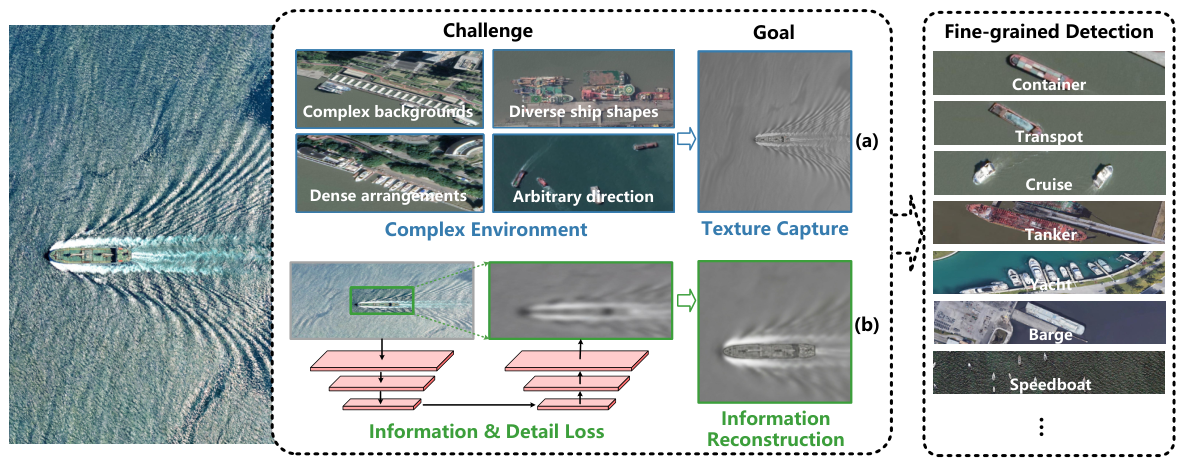
(a) Morphological diversity, fine-grained similarity, and background noise interference. Ships in remote sensing images exhibit significant intra-class shape variations and subtle inter-class fine-grained structural differences, making them highly susceptible to confusion with background clutter and noise, as illustrated in Figure 1a. Existing methods typically rely on fixed feature extraction strategies, lacking explicit shape priors to model the structural and textural distributions of different ship categories. Without such priors, models struggle to distinguish ships from similarly shaped noise patterns and fail to capture discriminative details between subcategories. Furthermore, fixed receptive fields cannot adaptively focus on target regions based on the shape and attitude of ships in complex scenes, often resulting in the missed detection of small objects and a large number of redundant false alarms.
Figure 1.
Ship detection faces two primary challenges: (a) complex background clutter significantly hinders feature extraction, and (b) deep sampling operations in the model inevitably lead to the loss of spatial details.
(b) Information loss and non-selective enhancement during feature reconstruction. Another critical challenge lies in the irreversible information loss caused by successive down-sampling and up-sampling operations inherent in standard neural architectures. Although U-shaped structures are widely employed to capture multi-scale contextual features (as shown in Figure 1b), the continuous down-sampling process inevitably sacrifices fine-grained spatial details in favor of high-level semantic abstraction. Existing methods often restore features without enough selectivity. This means that they strengthen both useful object details and useless background information at the same time. Such an approach fails to specifically highlight the fine-grained features of objects. As a result, the reconstructed feature maps lack the necessary clarity, preventing the precise localization and fine-grained classification of ship objects.
To alleviate the aforementioned challenges, this paper proposes a Shape-Prior Dynamic Refinement Network (SPDR-Net). The thesis of this study is to demonstrate that, by integrating Gaussian-mixture-based ship-shape priors, prior-guided selective dynamic kernels, and Diffusion-Supervised Wavelet Refinement, it is possible to learn noise-robust and discriminative structural representations of ships, which will allow for more accurate fine-grained ship localization and classification in complex remote sensing scenes. The main contributions are summarized as follows.
(1) A Gaussian Mixture Shape Representation (GMSR) mechanism is designed. This captures the ship’s orientation through strip convolutions and uses a learnable Gaussian mixture model to represent the center, orientation, shape, and texture distribution of different ship categories, providing structural priors and discriminative region cues.
(2) Re-Parameterized Selective Dynamic Kernels (RSDKs) are developed. They utilize the shape priors of the GMSR and dynamically adjust the receptive field of different layers of the network, which enables the model to focus on the target ship against complex backgrounds and capture its morphological features more accurately.
(3) A Diffusion-Supervised Wavelet Refinement (DSWR) strategy is proposed. It introduces the noise-denoising adversarial learning strategy from the diffusion model into wavelet reconstruction to recover high-frequency details that are easily lost or disturbed by noise during up-sampling and down-sampling. This effectively enhances ship boundaries and fine-grained discriminative textures while suppressing noise.
(4) The experimental results on several public datasets demonstrate that our method achieves state-of-the-art performance, with detection mAPs reaching 79.30% on DOSR dataset, 97.30% on HRSC2016 dataset, 98.60% on SSDD dataset and 47.97% on FAIR1M dataset, respectively.
2. Related Works
2.1. Remote Sensing Ship Detection
Unlike object detection in natural scenes, remote sensing object detection is characterized by diverse scenarios and broad coverage. Furthermore, these images contain not only the targets but also numerous background objects. To address these challenges, existing methods have proposed various strategies. MLBR-YOLOX [12] and MSEIG-DETR [13] focus on removing vast sea areas and coastal backgrounds in SAR imagery while reducing sea clutter and other background distractions surrounding ships, thereby improving the detection of ships with varying sizes and orientations. CM-YOLO [14] utilizes a dual-path context enhancement neck to extract contextual information, such as location and shape, to improve ship detection and classification in complex environments. To balance feature representation, CTF-Net [15] and CNN-SWin [16] combine Convolutional Neural Networks (CNNs) with Transformer architectures, enhancing the model to balance local feature extraction with global information modeling in SAR ship imagery. DCAPT-Net [17] introduces a densely connected attention pyramid architecture to strengthen multi-layer feature fusion, achieving effective multi-scale ship detection. SASOD [18] incorporates saliency information into the ship detection network to optimize saliency-aware features. Regarding specific scenarios, You et al. [19] proposed a DCNN-based end-to-end system designed for inshore ship detection, which excludes proposals in non-target regions to reduce false alarms on land. Finally, Yang et al. [20] developed a multi-task rotated region CNN model that predicts minimum bounding rectangles with reduced redundancy, making it particularly suitable for detecting dense ships. EFDNet [21] learns a more discriminative fine-grained feature representation for weakly supervised remote sensing object detection by decoupling localization and classification features. DRNet [22] uses dual refinement to learn more discriminative object features and better distinguish similar objects. PDDFormer [23] uses spatial gated differential attention to adaptively adjust the denoising strength at different spatial locations, so that the model suppresses noise while retaining key structural information. DiffBEV [24] utilizes a diffusion model to denoise noisy samples and progressively refine semantic features for object detection under a bird’s-eye view. GDD [25] exploits the strong representation ability of diffusion models to extract robust and domain-invariant features through a progressive denoising process.
2.2. Information Restoration and Reconstruction
CNNs often use pooling and downsampling operations to reduce computation and increase the receptive field. However, these operations also have some limitations. Max pooling and average pooling both lose part of the original information. They can also affect feature consistency and introduce unwanted signals into the feature maps [26]. These problems hinder fine-grained feature extraction. To address these issues, Williams et al. [27] demonstrated that wavelet pooling retains significantly more information compared to max, average, mixed, and stochastic pooling strategies. MWCNN [28] integrates wavelet transforms into neural networks, utilizing multi-level wavelet decomposition for image restoration. WaveCNets [29] incorporate the Discrete Wavelet Transform (DWT) and Inverse Wavelet Transform (IWT) into general network layers for image classification tasks. DWSR [30] combines the information complementarity of the wavelet domain with deep convolutional networks, recovering information lost during the convolution process by processing sub-bands. Wavelet R-CNN [31] utilizes wavelet transforms to assist the detector in capturing frequency-domain information during feature extraction. FSSFFormer [32] utilizes multi-resolution wavelets to enable the model to preserve global spatial information while preserving fine details. FreDNet [33] uses the frequency domain intensity corresponding mapping to adaptively fuse the features of the encoder and decoder. Furthermore, HWANet [34] leverages low-frequency component enhancement and a frequency-domain self-attention mechanism to mitigate information loss during sampling and enhance context-aware modeling capabilities.
3. Proposed Method
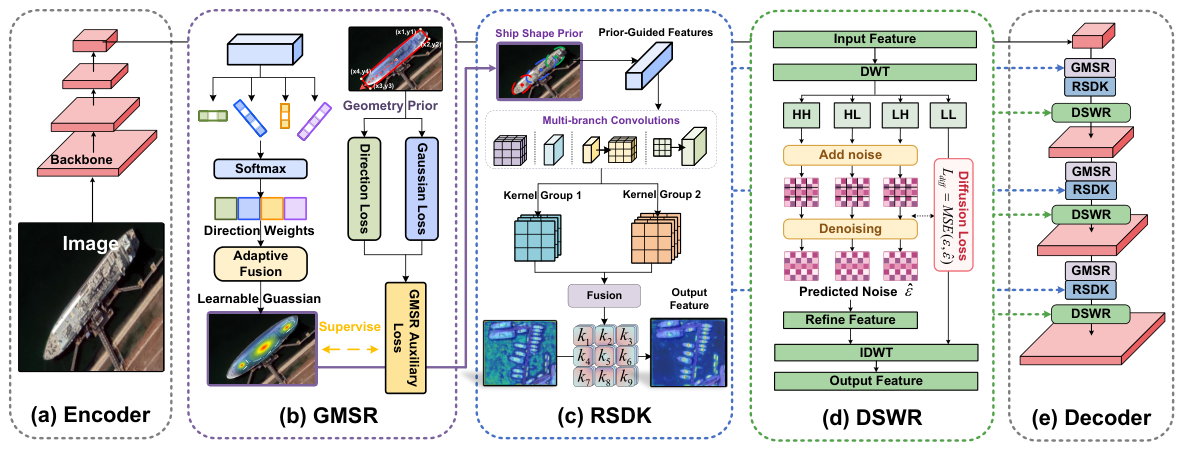
As illustrated in Figure 2, the overall architecture of the proposed SPDR-Net is presented. First, the model adopts a U-shaped pyramidal encoder–decoder architecture, where both the encoder and decoder are constructed using Convolutional Neural Networks (CNNs), as detailed in Figure 2a,e. Second, GMSR uses learnable Gaussian mixture to make the model learn fine-grained features of ships (Figure 2b). Then, RSDKs used the learned ship geometry prior to extract the target ship features (Figure 2c). Finally, DSWR added noise and denoised the extracted features, predicted and filtered high-frequency noise, and realized feature refinement (Figure 2d).
Figure 2.
The SPDR-Net framework comprises (a) the CNN encoder, (b) the GMSR, (c) the RSDKs, (d) the DSWR, (e) the CNN decoder.
3.1. Gaussian Mixture Shape Representation Mechanism
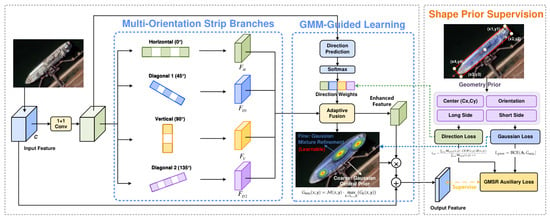
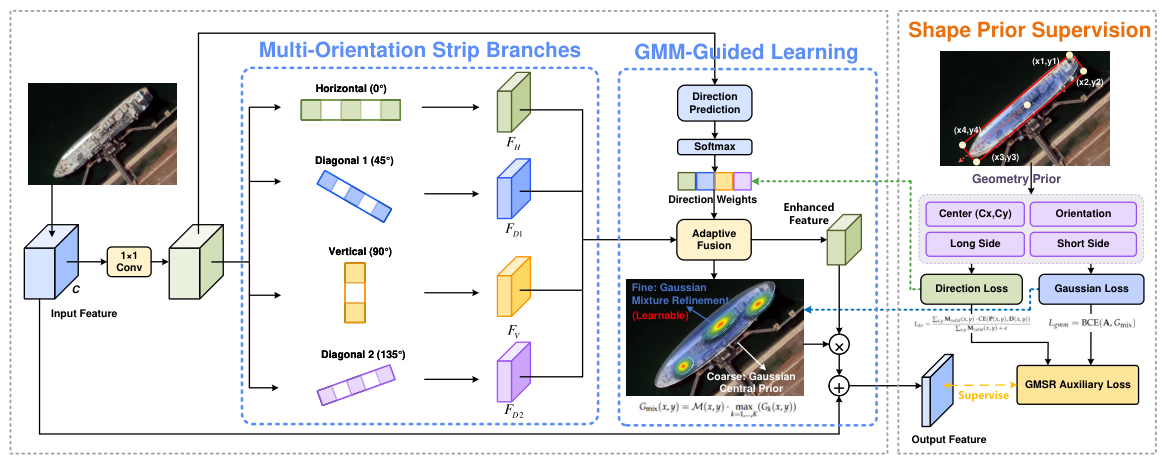
Ship detection interference in remote sensing images easily occurs in complex environments. For example, the containers and objects on the port have similar structures with the buildings and shapes on the ship, and the model will have the situation of false detection. Traditional methods assign weights according to local salient regions. This will cause the model to pay too much attention to the building area on the ship, while ignoring the bow, stern and other information, and the detection box does not contain the whole ship. To alleviate these limitations, a Gaussian Mixture Shape Representation mechanism is proposed, as illustrated in Figure 3. The proposed module explicitly models ship structures from multiple orientations and introduces Gaussian mixture guidance to improve fine-grained feature extraction ability.
Figure 3.
The architecture of the proposed GMSR. The strategy consists of: (1) multi-orientation strip branches; (2) GMM-guided learning; and (3) shape prior supervision.
Given the input feature map , a convolution is first applied to obtain a compact feature representation , where denotes the Conv-BN-SiLU operation. To capture ship structures with arbitrary orientations, four directional structural encoders are employed to extract horizontal, vertical, and diagonal features:
An orientation estimation branch predicts pixel-wise weights for adaptive feature selection:
where . The directional fused feature is then used to generate a structural response map:
where consists of a Conv-BN-SiLU block followed by a convolution, and represents the sigmoid activation function. The response map highlights ship regions and suppresses background interference.
Finally, the fused feature is projected back to the original channel dimension and combined with the input through a residual connection:
where denotes the fused feature map, and represents the channel index, denotes a Conv-BN-SiLU operation, and is a learnable scaling factor.
To provide explicit geometric guidance, a Gaussian mixture supervision strategy is introduced. For each rotated ship, the rotated box is converted into a parametric geometric representation , where denotes the ship center, l and s represent the lengths of the long and short axes, and is the orientation angle of the long axis. For any pixel in the feature map scale, its rotated coordinate relative to the ship center is defined as
where and denote the stride factors of the feature map relative to the original image in the horizontal and vertical directions, respectively.
Unlike conventional single-peak Gaussian labels, we construct a multi-component Gaussian mixture prior along the ship’s long axis to capture fine-grained structural details (such as the bow, center, and stern). For a Gaussian mixture target with K components, each component has a learnable offset along the long axis and learnable standard deviation scales:
where is the learnable relative displacement, and are learnable scaling factors. The baseline standard deviations are computed as and , where is the minimum variance boundary. The k-th anisotropic Gaussian component is formulated as
To restrict the supervision target strictly within the physical boundaries of the ship, the GMM components are aggregated and filtered by a hard boundary mask :
where is an indicator function reflecting whether the pixel falls inside the rotated box:
In addition, an auxiliary orientation consistency loss is introduced to improve orientation awareness. The orientation labels are divided into four categories corresponding to , , , and . Let denote the predicted orientation logits, and let represent the target category map. To focus optimization on the target regions, we define a binary validity mask , where if falls inside any ground-truth ship box, and 0 otherwise.
The structural guidance loss is defined using Binary Cross-Entropy (BCE):
while the masked orientation consistency loss is formulated as
where represents the standard cross-entropy loss and is a small constant to prevent division by zero. The overall optimization objective of the GMSR module is therefore given by
where and denote the balancing coefficients of the Gaussian mixture supervision and orientation consistency supervision, respectively.
Through the above processing, the model can perceive the ship area, and use the Gaussian mixture to model the target area, learn the structural fine-grained features of different types of ships, improve the fine-grained discrimination ability of the model ship and provide ship type prior for the subsequent model positioning features.
3.2. Re-Parameterized Selective Dynamic Kernels
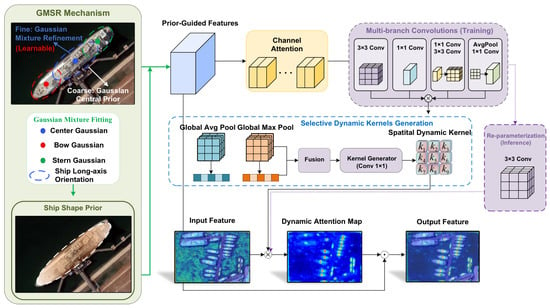
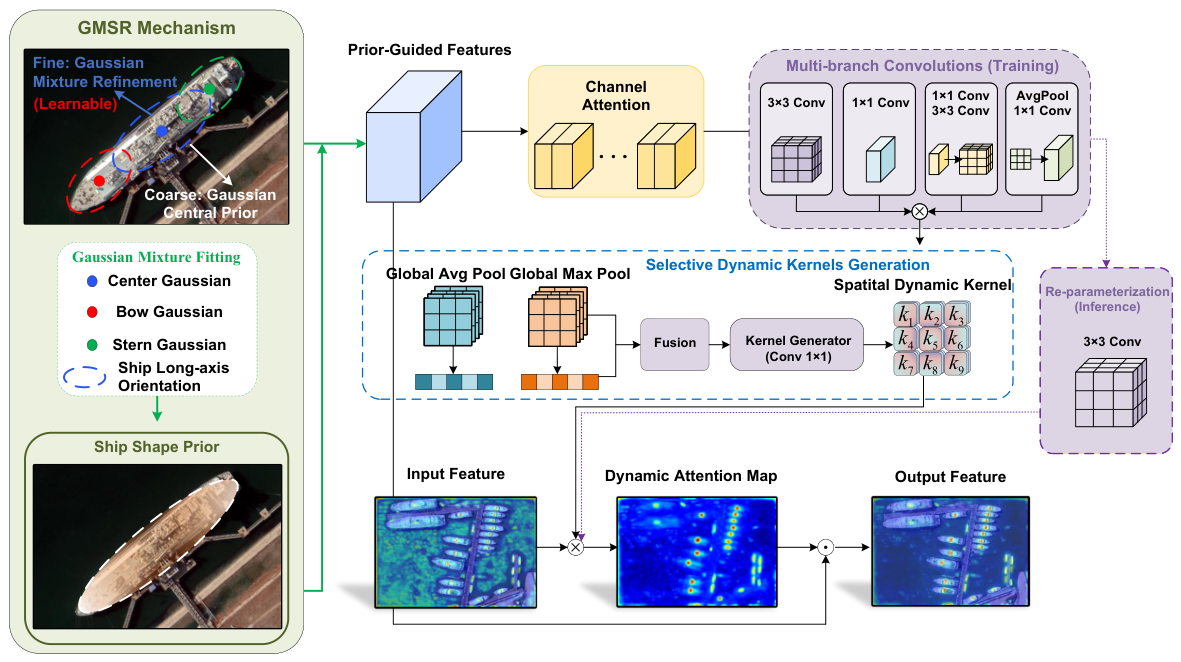
After obtaining the prior and structural features of the ship type, the model also needs to be able to extract the ship features in the target area. Conventional convolutions use fixed kernels and cannot adapt to different ship structures. Existing attention mechanisms highlight important regions but do not change the feature extraction process. Dynamic convolution methods improve adaptability, but they often generate kernels without explicit structural guidance. To address these challenges, we propose the Re-Parameterized Selective Dynamic Kernels (RSDKs), as illustrated in Figure 4.
Figure 4.
The architecture of the proposed RSDKs. The strategy consists of three stages: (1) channel attention for feature calibration; (2) re-parameterized convolutions which simplify to a single convolution during inference; and (3) dynamic spatial attention, where a dynamic kernel is generated under the guidance of the anisotropic Gaussian shape to capture ship-specific structures. The residual connection preserves the original information.
Instead of using standard static convolutions, RSDKs adaptively generates a selective dynamic kernel for each image. The shape and orientation of this generated kernel are guided by the ship’s anisotropic Gaussian, allowing the model to select appropriate structural features and remove background noise. Furthermore, we use structural re-parameterization to keep the inference computationally efficient.
Let be the input feature map, where and C define the height, width, and channel dimensions. The processing flow is formulated as follows:
First, we prioritize informative channels using a squeeze-and-excitation mechanism. The channel-enhanced feature is processed to obtain the baseline representation :
where ⊙ represents channel-wise multiplication, is the sigmoid activation function, and captures cross-channel interactions.
During inference, these convolutions are simplified into a single convolutional layer through structural re-parameterization to keep the model fast:
where and denote the effective weight kernel and bias vector for inference, respectively. Consequently, the inference-time output is computed as
where * denotes the standard convolution operator.
Unlike standard spatial attention mechanisms that use fixed, isotropic kernels, RSDKs focuses on generating a sample-specific dynamic kernel that adapts to the ship’s geometric shape. To achieve this, the kernel generator is optimized under the guidance of the anisotropic Gaussian mixture target () from the previous module.
We first fuse the global average-pooled and max-pooled features of to capture the scale and orientation of the target:
where represents concatenation along the channel dimension. The generator (implemented as a convolution layer) projects these pooled features to generate the weights of the dynamic kernel .
The spatial attention map is then generated by convolving the channel-averaged feature map with the dynamic kernel :
where is the spatial attention map, and the symbol ⊛ denotes the dynamic convolution using .
Because is supervised by the Gaussian mixture target during training, the generator is forced to shape to match the ship’s physical geometry. Specifically, the generated kernel stretches along the ship’s long axis to aggregate structural features, while shrinking along the short axis to block background noise.
Finally, the output feature is obtained via a residual connection:
where is the final refined feature map. This strategy enables the network to focus on key spatial regions using the Gaussian-aligned dynamic kernel while preserving original details.
3.3. Diffusion-Supervised Wavelet Refinement Strategy
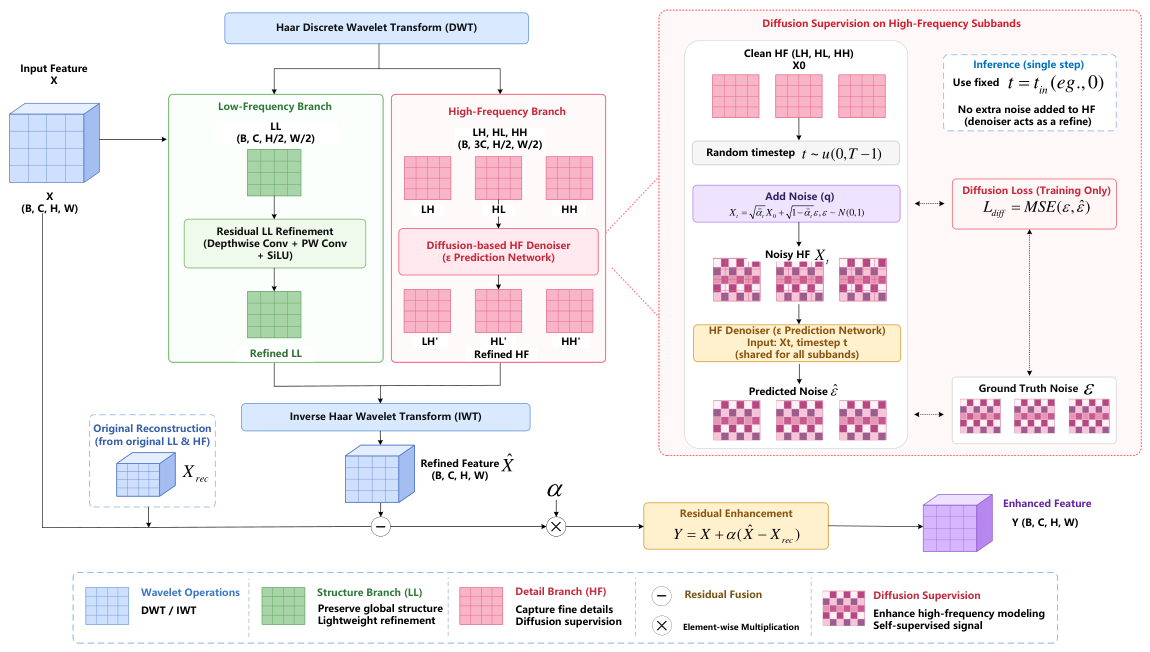
After accurately extracting the features of the ship, the features include high-frequency features such as ship edges and detailed textures, as well as high-frequency noise. Traditional denoising methods weaken the edge details while filtering the noise. To separately enhance low-frequency structural features and high-frequency detailed textures, we introduce the Diffusion-Supervised Wavelet Refinement mechanism, as illustrated in Figure 5. Let denote the input feature map, where B is the batch size, C represents the channel dimension, and H and W represent the spatial height and width, respectively. We first apply the Haar Discrete Wavelet Transform (DWT) to decompose X into its low-frequency subband and high-frequency subbands :
where preserves the structural outline, and contains the concatenated high-frequency details.
Figure 5.
The architecture of the proposed DSWR. The strategy consists of: (1) 2D discrete wavelet decomposition and reconstruction; (2) diffusion-based detail restoration and enhancement.
For the low-frequency component , we apply a lightweight residual block using depthwise separable convolutions to refine the structural features:
where is the refined low-frequency feature, DWConv is a depthwise convolution with a kernel, PWConv is a pointwise convolution with a kernel, and denotes the SiLU activation function. The weights of PWConv are initialized to zero, which preserves the original features at the beginning of training.
Meanwhile, we employ a diffusion-based denoiser to reconstruct clean detail features from the high-frequency component . Unlike conventional generative diffusion models, the denoiser is inspired by diffusion models and is designed to predict noise through a noise-adding and denoising process. Let T be the total diffusion timesteps. We establish a noise schedule with cumulative variance parameters for . During training, we randomly sample a timestep and generate a noisy high-frequency subband by adding Gaussian noise :
The timestep t is mapped to a continuous embedding using a sinusoidal function followed by a multi-layer perceptron (MLP), such that . A high-frequency denoiser network is then trained to predict the injected noise:
where represents the denoiser network, and is the predicted noise. The output layer of is initialized to zero to guarantee stable training trajectories.
During inference or forward denoising, model has already learned adaptive denoising and its parameters are fixed, additional iterative denoising provides no substantial benefit but increases inference time. Therefore, we reconstruct the refined high-frequency features using a single-step denoising formulation:
In our implementation, we set a fixed step (by default, ) during evaluation to directly refine the clean high-frequency input features without iterative loops.
Following the refinement of both subbands, we reconstruct the spatial feature maps using the Haar Inverse Wavelet Transform (IWT). To maintain strict feature consistency, we compute a baseline feature map and a refined feature map . The final output feature map is formulated as a scaled residual modification added to the original input :
where is a learnable scalar parameter initialized to zero. This formulation mathematically guarantees that the module acts as an identity mapping at the start of training.
To train the entire framework end-to-end, the auxiliary diffusion loss is calculated as the mean squared error (MSE) of the noise prediction:
The total loss objective of the network combines the primary task loss and the auxiliary diffusion loss:
where represents a scaling hyperparameter that balances the contribution of the diffusion loss. This module can filters the noise while recovering the high-frequency features by fitting the learning noise through a diffusion model.
Specifically, GMSR learns fine-grained structural features of ships and captures geometric information through Gaussian mixture. Furthermore, RSDKs uses the extracted geometric prior to dynamically adjust the receptive field to capture features. Finally, DSWR uses the diffusion model to further refine the extracted features from the frequency domain perspective. Thus, the fine-grained feature extraction ability of SPDR-Net is enhanced, and the accuracy of ship detection and recognition is improved.
4. Experiment and Discussion
In this section, extensive experiments are conducted on several datasets to evaluate the performance of SPDR-Net comprehensively. First, the experimental conditions, including datasets, evaluation metrics, implementation details, etc., are introduced. Then, ablation experiments are designed to validate the effectiveness of each component of the SPDR-Net model and to evaluate their performance quantitatively. We discuss in detail the key issues in ship detection. Based on this, we compare the proposed model with several representative object detection methods proposed in recent years and provide a comprehensive evaluation. Finally, we further evaluate the generalization capability of the proposed model on the public datasets.
4.1. Experimental Conditions
(1) Experimental platforms. The experiments are performed on a server with four NVIDIA GeForce RTX 4090 GPU (24 GB). We used an Auto optimizer with learning rate set to and weight decay set to 0.01 via grid search. The maximum training epoch is 100 to accommodate the full convergence potential of models. To ensure fairness, identical hyperparameters were applied to all baseline methods and eliminated tuning biases.
(2) Datasets. To evaluate the performance of the SPDR-Net model more comprehensively, several public datasets are used, which cover different scenes, different shapes and categories of objects, and different data sources.
- The DOSR [35] dataset provides a widely used benchmark to evaluate the performance of ship object detection methods in remote sensing scenes. It has more than 6127 ship objects covering 20 categories in 1066 images.
- HRSC2016 [36] is a ship detection dataset consisting of 436 training images, 181 validation images, and 444 testing images from 300 × 300 pixels to 1500 × 900 pixels.
- SSDD [37] is a Synthetic Aperture Radar (SAR) remote sensing image dataset. It contains a total of 1160 SAR images of ships under various sea conditions, acquired by RadarSat-2, TerraSAR-X, and Sentinel-1 sensors, with a total of 2456 annotated ship targets.
- The DOTAv1.0 [38] dataset has more than 188,000 objects covering 15 categories in 2806 images from 800 × 800 pixels to 4000 × 4000 pixels. Due to the huge size of remote sensing images, they are usually cropped into sub-images of 800 × 800 pixels with an overlap of 200 pixels on each dimension after being scaled to different sizes with the ratios of 0.5, 1.0, and 1.5.
- The FAIR1M [39] dataset provides a large-scale benchmark for fine-grained object detection and recognition in high-resolution remote sensing imagery. It contains more than 1.02 million object instances covering 37 fine-grained categories (under five coarse categories) in 15,266 images with widths ranging from 1000 to 10,000 pixels. The dataset is divided into three subsets, where 1/2 of the images are used for training, 1/6 are used for validation, and 1/3 are used for testing.
(3) Evaluation metrics. The mean Average Precision (mAP) is adopted to evaluate the detection accuracy. The mAP with an IoU threshold of 50% is represented as mAP50. The mAP50:95 means calculating the mAP when the IoU threshold is 50% to 95% at every 5% interval and then taking their mean as mAP50:95. The speed is evaluated by frames per second (fps).
4.2. Ablation Experiments
The study uses YOLO v8 as the baseline model. To systematically evaluate the contribution of each component, a series of ablation experiments were conducted. The results of these experiments for different modules of SPDR-Net are summarized in Table 1. The proposed RSDKs, GMSR, and DSWR improved the model’s . The complete SPDR-Net model achieved gains of 9.9% in compared to the baseline, demonstrating consistently strong performance. Furthermore, we compared the Gaussian Guided Structural Representation module (GGSR) with GMSR, Diffusion Wavelet Guided Refinement module (DWGR) with DSWR, and our own module with the single component, respectively. Unlike DSWR, DWGR is not supervised by loss. GMSR achieved superior performance over GGSR with increased by 2.3%. Similarly, DSWR outperformed DWGR with by 2.71%, which shows that provides effective auxiliary supervision for adaptive feature denoising, enabling the model to suppress high-frequency noise while preserving discriminative boundary and texture details. SPDR-Net improves the by 6.57%, 4.5%, and 6.09% compared with RSDKs, GMSR, and DSWR, respectively. Table 1 also reports the parameters, GFLOPs, and inference speed of each configuration. The complete SPDR-Net contains 89.6 M parameters and requires 247.5 GFLOPs, while achieving an inference speed of 83.6 fps. Although the multi-orientation feature extraction and shape-guided refinement modules increase the theoretical computational complexity, RSDKs merge their multi-branch structure into a single convolutional branch through structural re-parameterization during inference. In addition, is used only during training, and DSWR adopts fixed single-step denoising during inference, avoiding the overhead of iterative reverse diffusion. Therefore, SPDR-Net maintains real-time inference performance while substantially improving detection accuracy, demonstrating a favorable balance between accuracy and computational efficiency.
Table 1.
Ablation study of each component on the DOSR dataset.
The proposed modules significantly enhance the model’s capabilities for ship detection. Specifically, the GMSR uses Gaussian mixture to model the hull and edge structural features, which effectively improves the learning ability of the model for the fine-grained structural features of the ship. Further, the RSDKs uses the Gaussian mixture geometric prior learned by the model to accurately locate the ship area and capture the ship characteristics through a selective dynamic kernel. Finally, DSWR uses the diffusion model to refine the high-frequency part of the extracted features. Finally, through the synergy of these three modules, the proposed SPDR-Net achieves superior detection performance in ship target detection in remote sensing scenes (69.4% vs. 79.3%), which improves the classification performance of the model and eliminates false alarms. Next, we further analyze the GMSR, RSDKs and DSWR.
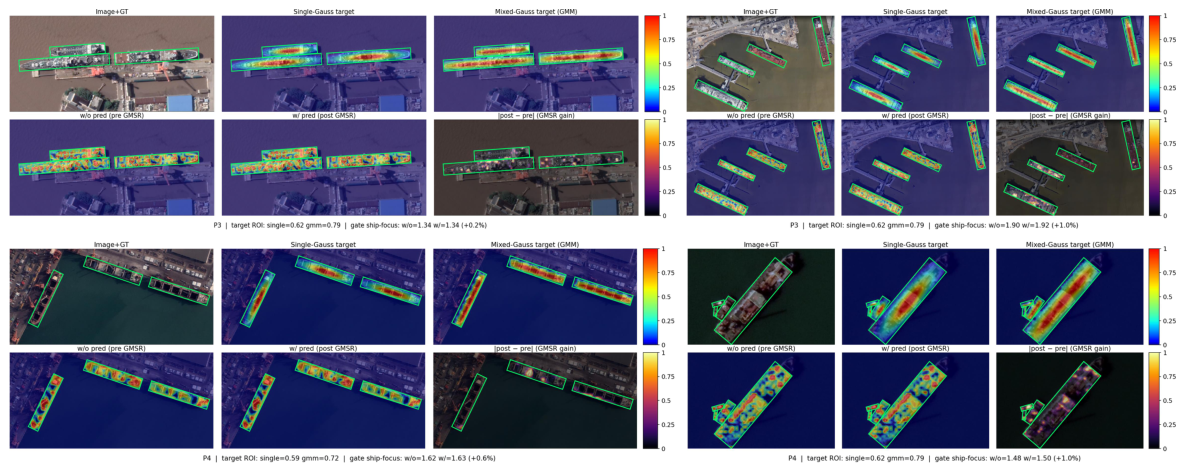
(1) Analysis of the GMSR. The GMSR mechanism predicts the direction of the ship through the strip convolution group and uses the Gaussian mixture to model along the main axis of the ship, and supervised by Groud Truth to make the model learn the fine-grained structural features of the ship. To further verify the effectiveness of the GMSR, we present a comparative visualization of feature maps with and without its integration, as illustrated in Figure 6. “Single” stands for using only one Gaussian for fitting ship structure features, and “GMM” stands for using mixture Gaussians for fitting. We compute the single Gaussian and mixed Gaussian target ROI, target ROI represents the overlap ratio between the region of interest and the target region. It can be clearly found that using mixture Gaussian can focus on more detailed features such as the bow and stern of the ship. Furthermore, we compare the differences between “single” and “gmm”, which can reflect that GMSR can learn more detailed and complete structural features by using Gaussian mixture model than the traditional single Gaussian model. GMSR makes the model pay attention to the details such as the masts on the ship, and enhances the ability of the network to capture the characteristics of the ship and learn the characteristics of fine-grained structural differences. It not only prevents the model from misdetection caused by similar characteristic buildings on the shore, but also enhances the integrity of the representation of the ship structure, which effectively alleviates the problem of classification ambiguity of different ships.
Figure 6.
Visualization of the feature maps. “GMSR gain” represents the fine-grained features that the GMSR module emphasizes for model learning.
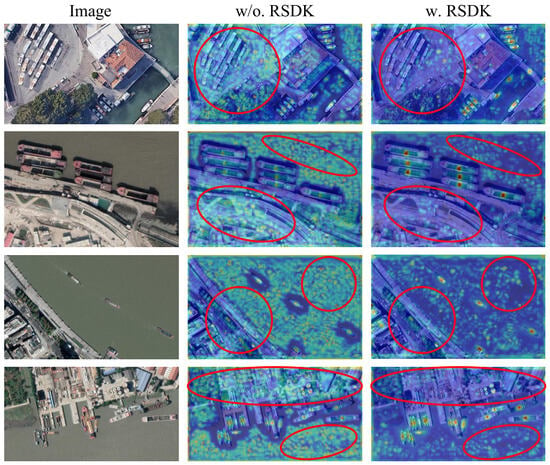
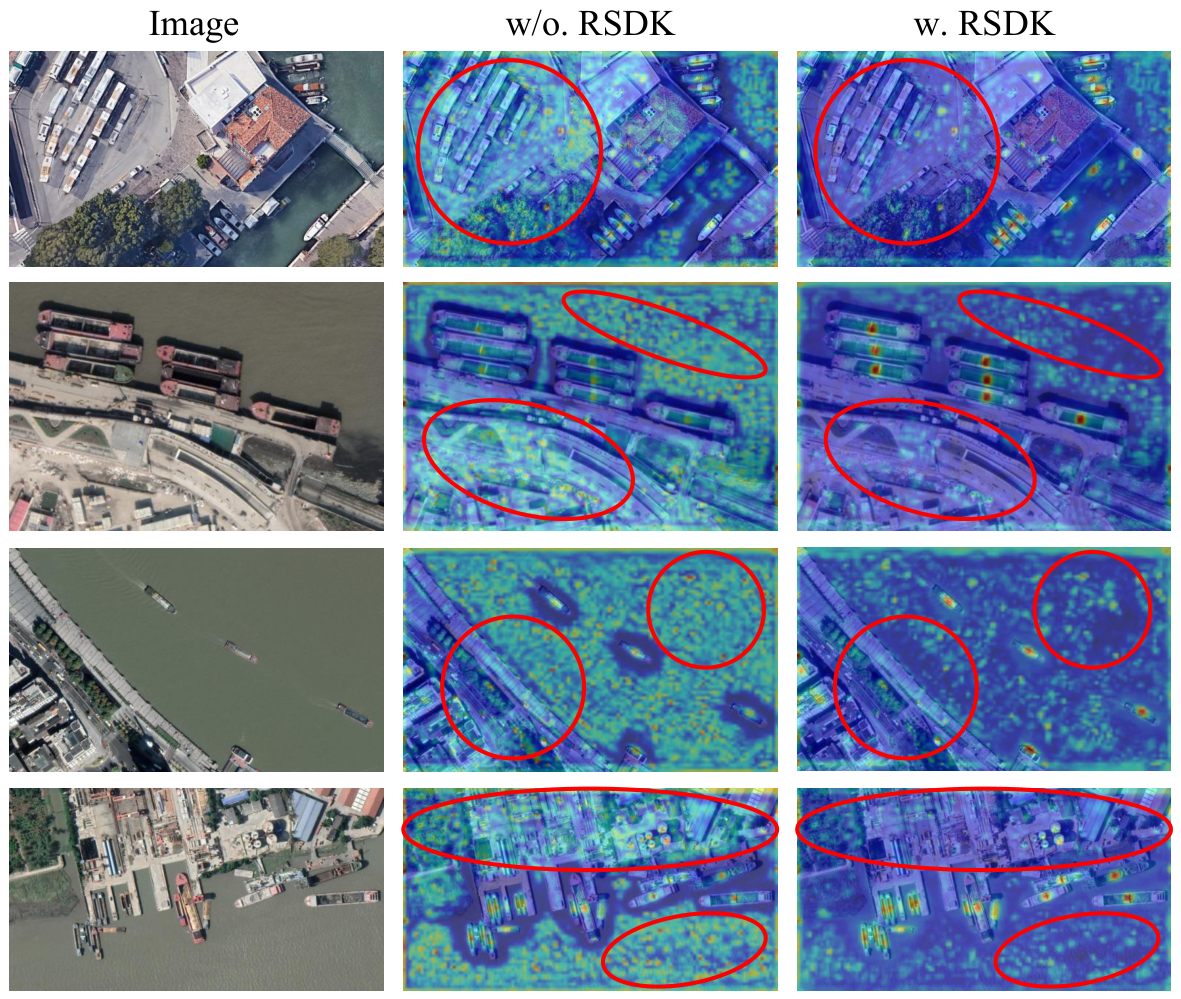
(2) Analysis of the RSDKs. The RSDKs use the geometric prior of the hull structure learned by the GMSR module as a guide, use the multi-branch convolution architecture to capture the context features, and localize the ship target by dynamic denoising to enhance the ability of the model to extract cross-scale features. To further validate the efficacy of the RSDKs, we present a comparative visualization of feature maps with and without its integration, as illustrated in Figure 7. The results demonstrate that the RSDKs enhances the adaptive feature extraction ability of the target ship under the guidance of ship geometry prior. It not only improves the detection ability of small and medium-sized ships in complex environments, but also enhances the ability to dynamically capture features, and effectively reduces the positioning error of the model.
Figure 7.
Visualization of the RSDKs feature maps. The red circles mark some key feature regions for comparison.
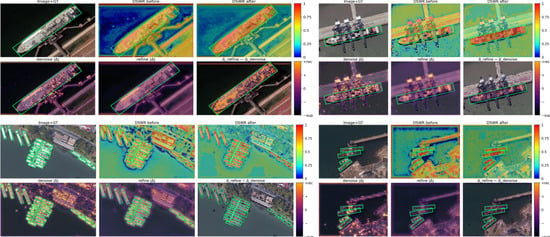
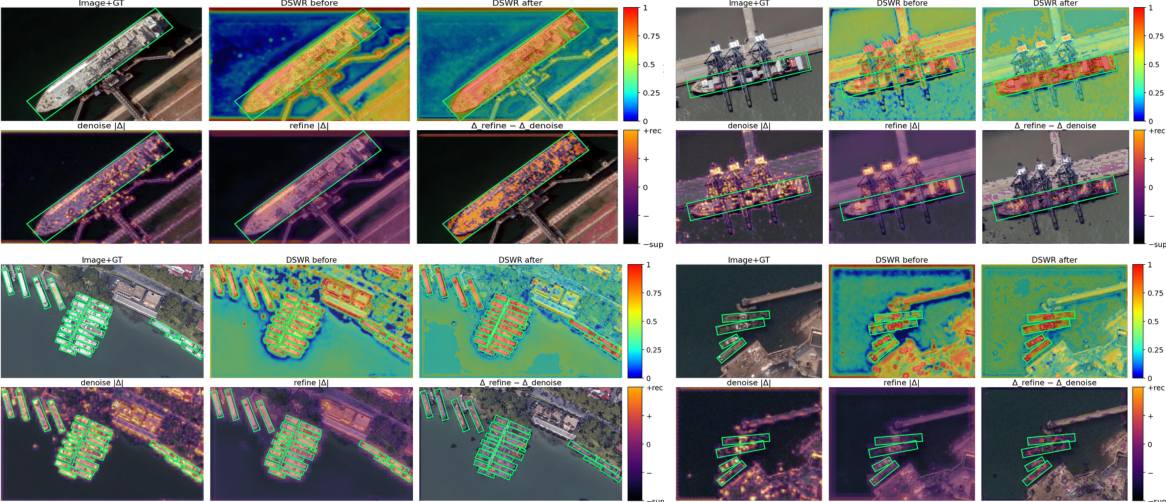
(3) Analysis of the DSWR. The DSWR strategy decomposes the located ship features into frequency domain for feature refinement by discrete wavelet transform. The diffusion model is used to add noise and denoise high-frequency features while retaining low-frequency features of the ship body, so that the network can further learn to predict noise. Then, the fine frequency domain features are reconstructed. The model can filter high-frequency noise while retaining high-frequency features such as ship edges and corners, which improves the feature expression ability. To evaluate the efficacy of the DSWR, we compare the feature maps before and after its integration, as illustrated in Figure 8. We can clearly find that by adding noise and denoising, the model focuses more on the refined features of the ship, and by calculating the interpolation of the refined features and the denoised features, the red represents the enhanced area of the model, and the black represents the suppressed area of the model. Obviously, DWSR suppresses noise interference and enhances fine-grained features when reconstructing features, which improves the recognition ability of the model.
Figure 8.
Visualization of the feature maps. “” shows DWSR refined features (red region) and suppressed noise (black region). “rec” indicates that this area should be reconstructed, “sup” indicates that this area should be suppression.
4.3. Comparison Experiments
To evaluate the effectiveness of the proposed SPDR-Net, we compared it with the popular methods on several public datasets, including DOSR, HRSC2016, SSDD, DIOR, DOTA and FAIR1M.
(1) Comparison experiments of ship detection. The performance comparison of DOSR is shown in Table 2. We compare the performance of the proposed SPDR-Net with the eight existing approaches, including R2CNN (+19.3%) [40], RRPN (+14.3%) [41], SCRDet (+10.6%) [42], RetinaNet-O (+28.2%) [43], R3Det (+12.2%) [44], RSDet (+19.7%) [45], SCRDet++ (+8.6%) [46], and ReDet (+7.6%) [47]. Among them, FR-FPN-O [48], R2CNN [40], RRPN [41], and RetinaNet-O [43] are general-oriented object recognition networks, and the rest five approaches, i.e., SCRDet [42], R3Det [44], RSDet [45], SCRDet++ [46], and ReDet [47], are all designed for remote sensing object recognition. In more detail, R2CNN [40], RRPN [41], SCRDet [42], and ReDet [47] adopt the two-stage strategy, and the single-stage networks involve RetinaNet-O [43], R3Det [44], RSDet [45], and SCRDet++ [46]. It is obvious that our SPDR-Net achieves the superior performance on the DOSR dataset. For example, it demonstrates high detection accuracy across various vessel categories, including nearshore vessels (such as warships and deck ships), small-target vessels (such as fishing boats and yachts), and various cargo ships.
Table 2.
Comparison of performance (AP) on DOSR.
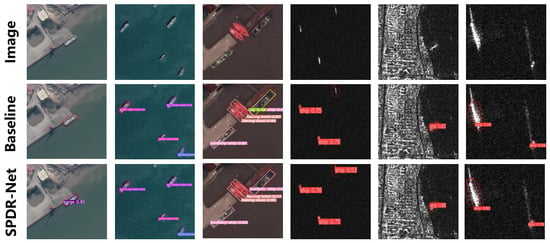
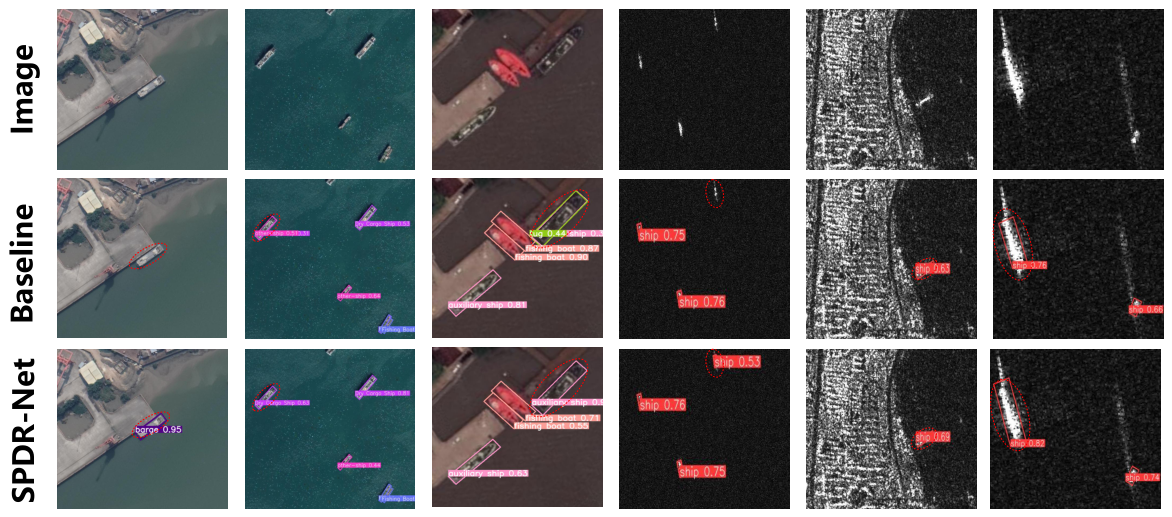
Furthermore, we compared the performance of the proposed method with existing advanced methods using the HRSC2016 and SSDD datasets, which are shown in Table 3 and Table 4. HRSC2016 is a visible-light remote sensing image dataset, while SSDD is a Synthetic Aperture Radar (SAR) dataset. Experiments conducted on datasets of different modalities demonstrate that the proposed method outperforms latest methods. On the HRSC2016 dataset, SPDR-Net achieved , , and scores of 98.1%, 88.1%, and 79.0%, respectively, improving of 6.7%, 15.6%, and 17.5% over the latest method CM-YOLO [14]. Compared to existing detectors, SPDR-Net outperformed DDQ, Deformable DETR, and FCOS by 7.3%, 8.0%, and 9.6% at . The significant gains in and demonstrate that RSDKs and DSWR not only improved recall but also optimized localization accuracy under stricter IoU criteria (such as and ). It is crucial to distinguish between densely moored ships and those with extreme orientations. On the SAR-based SSDD dataset, SPDR-Net achieved an of 97.7%, outperforming YOLOv3 (+2.7%), CenterNet (+4.2%), DAPN (+7.6%), and CLAFANet (+6.4%). These results indicate that DSWR’s frequency-aware denoising mechanism effectively suppressed SAR speckle noise and sea clutter interference, while RSDKs’s dynamic receptive field enhanced responsiveness to small and low-contrast ships. These progresses on optical and SAR benchmarks shown in Figure 9. It confirms that SPDR-Net generalizes well to detect objects on different modalities, which remains robust under complex backgrounds and scale variations.
Table 3.
Comparison of performance (AP) on HRSC2016.
Table 4.
Comparison of performance (AP) on SSDD.
Figure 9.
Detection results of fine-grained ships.
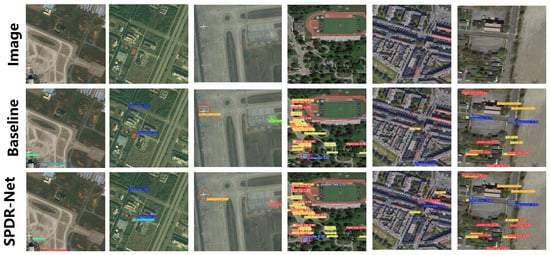
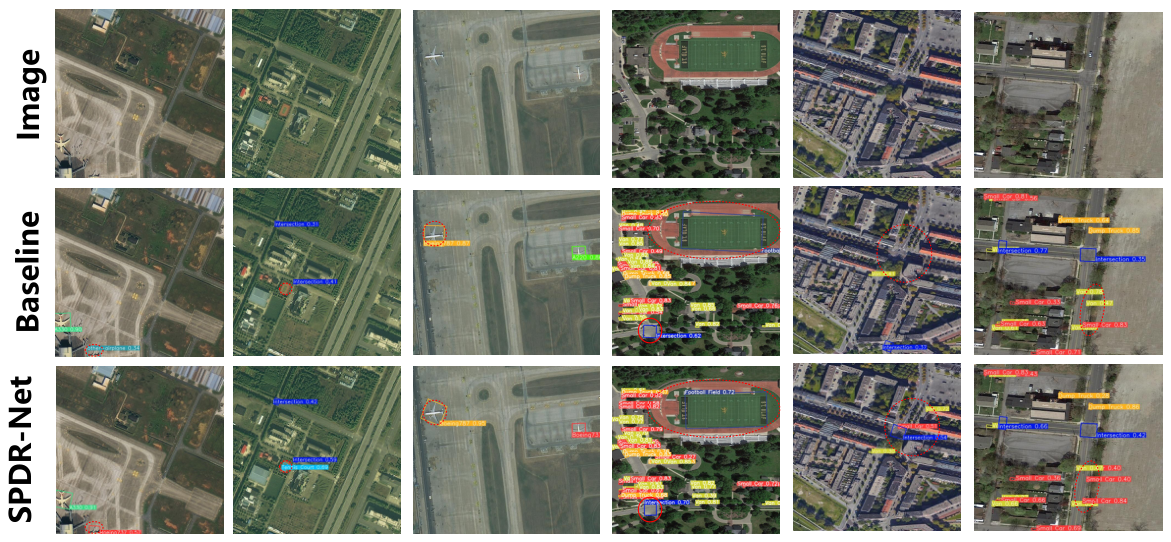
In addition, to conduct a more in-depth comparative analysis of the proposed method’s fine-grained detection performance, we performed additional comparative experiments on FAIR1M, a larger remote sensing dataset with broader category coverage as shown in Figure 10, with the results presented in Table 5. Overall, SPDR-Net achieved the best mAP of 47.97% with a 3.61% improvement over the latest method PFA-C2FI (44.36%). Regarding fine-grained ship categories, SPDR-Net demonstrated superior performance across most sub-categories, securing the best AP results for speedboats (73.37%), fishing boats (17.48%), liquid cargo ships (31.47%), and warships (44.61%). Notably, compared to the second-best methods, SPDR-Net improved detection performance for speedboats and warships by +10.06% and +9.45%, respectively. It indicates that our method has robustness in fine-grained ship recognition within complex offshore and near-shore environments. GMSR uses Gaussian mixture to learn the structural details such as the bow, mast, corner of the warship and the fuselage, craft, tail of the aircraft. Then RSDKs takes advantage of the different structural features obtained and adjusts the receptive field to better fit the target shape.
Figure 10.
Detection results of other category objects.
Table 5.
Comparison of performance (AP) on FAIR1Mv1.0 dataset.
Beyond ships, SPDR-Net also achieved leading or highly competitive detection accuracy across other coarse-grained categories, including aircraft (e.g., B777 at 55.39%, B787 at 62.61%, A350 at 78.59%), vehicles (e.g., buses at 43.11%, vans at 67.39%), sports venues (tennis courts at 90.60%), and road infrastructure (intersections at 65.65%). These cross-category performance gains demonstrate that the proposed method is not limited to ships but effectively enhance discriminative feature learning and detail texture preservation for various fine-grained objects, which validates the general effectiveness of the proposed method in fine-grained detection tasks.
(2) Comparison experiments on other remote sensing scenarios. To further verify the generality of the proposed method, we conducted comparative experiments on large public remote sensing datasets that contain richer scenes and target categories. The performance of our method on the DIOR dataset is listed in Table 6. The proposed SPDR-Net achieves the highest of 85.04% on the DIOR dataset, significantly outperforming all other advanced methods, e.g., YOLO-PKFF [76], GLEF-YOLO [77], CI-DERT [78] and EMS-Net [79]. Table 7 provides a detailed quantitative comparison on the most widely used dataset DOTAv1.0. Experimental results demonstrate that the proposed SPDR-Net surpasses the most of existing object detection methods, e.g., Oriented RepPoints [80], KFIoU [81], etc., in both accuracy and inference speed. Although our mAP is marginally lower than that of Oriented R-CNN [82], our approach surpasses all other methods in terms of inference speed and detection performance. As shown in Figure 10, SPDR-Net shows good fine-grained classification performance on Airplane category, for example, Boeing787 shows higher confidence and Boeing737 is correctly identified and identified to the intersection, which proves its effectiveness in other remote sensing scenarios.
Table 6.
Comparison of performance (AP) on DIOR.
Table 7.
Comparison of performance (AP) on DOTAv1.0.
5. Conclusions
This paper proposes SPDR-Net for fine-grained ship detection in remote sensing images. Addressing the challenges of diverse ship shapes and subtle fine-grained differences, the proposed SPDR-Net utilizes GMSR to provide explicit shape and texture distribution priors for different ship categories. Furthermore, it develops RSDKs, in which the receptive field is dynamically adjusted with the help of GMSR shape prior, to achieve precise focusing of the object region in the spatial domain. To address the issues of high-frequency discrimination information loss and interference from background noise during up-sampling and down-sampling, DSWR is designed to recover edge and texture details in the frequency domain through diffusion-supervised wavelet reconstruction. Specifically, GMSR models distinctive shape distributions, RSDK adaptively enhances discriminative regions, and DSWR preserves subtle boundary and texture details, jointly reducing ambiguity among visually similar ship categories. Through this collaborative design in the spatial and frequency domains, SPDR-Net effectively improves fine-grained detection accuracy and robustness under complex sea conditions. Experimental results on several public datasets show that the proposed SPDR-Net outperforms current mainstream object detection models in both detection accuracy and speed, achieving an of 79.3% on the DOSR dataset, 9.9% higher than existing methods. It also achieves state-of-the-art performance on datasets with various scenes and modalities, validating its versatility.
Nevertheless, the current method offers limited improvement in fine-grained classification and requires optimization for lightweight deployment. Future work will focus on improving efficiency and generalization capabilities to achieve more refined ship category recognition.
Author Contributions
Conceptualization, Z.H. and W.G.; methodology, Z.H. and W.G.; software, W.G.; validation, W.G., W.H. and J.Z.; formal analysis, Z.H.; investigation, W.G.; resources, Z.H.; data curation, J.Z.; writing—original draft preparation, Z.H. and W.G.; writing—review and editing, Z.H. and H.S.; visualization, W.H.; supervision, Z.H. and H.S.; project administration, Z.H.; funding acquisition, Z.H. All authors have read and agreed to the published version of the manuscript.
Funding
This work was supported by the National Natural Science Foundation of China (Grant No. 62501163), the Fujian Province Young and Middle-aged Teachers Education and Research Project (Grant No. JAT231007), the Fujian Provincial Natural Science Foundation of China (Grant No. 2024J01277), and the China Postdoctoral Science Foundation (2024M762192).
Data Availability Statement
The data presented in this study are derived from publicly available benchmark datasets, including DOSR, HRSC2016, SSDD, DOTA, FAIR1M, and DIOR. These datasets are available from the public sources cited in the manuscript. The original contributions presented in this study are included in the article. Further inquiries can be directed to the corresponding author.
Conflicts of Interest
The authors declare no conflicts of interest.
References
- Cheng, G.; Han, J. A Survey on Object Detection in Optical Remote Sensing Images. ISPRS J. Photogramm. Remote Sens. 2016, 117, 11–28. [Google Scholar] [CrossRef] [Scilit]
- Lv, M.; Song, S.; Jia, Z.; Li, L.; Ma, H. Multi-Focus Image Fusion Based on Dual-Channel Rybak Neural Network and Consistency Verification in NSCT Domain. Fractal Fract. 2025, 9, 432. [Google Scholar] [CrossRef] [Scilit]
- Li, L.; Song, S.; Lv, M.; Jia, Z.; Ma, H. Multi-Focus Image Fusion Based on Fractal Dimension and Parameter Adaptive Unit-Linking Dual-Channel PCNN in Curvelet Transform Domain. Fractal Fract. 2025, 9, 157. [Google Scholar] [CrossRef] [Scilit]
- Xiao, X.; Zhou, Z.; Wang, B.; Li, L.; Miao, L. Ship Detection under Complex Backgrounds Based on Accurate Rotated Anchor Boxes from Paired Semantic Segmentation. Remote Sens. 2019, 11, 2506. [Google Scholar] [CrossRef] [Scilit]
- Li, L.; Shi, Y.; Lv, M.; Jia, Z.; Liu, M.; Zhao, X.; Zhang, X.; Ma, H. Infrared and Visible Image Fusion via Sparse Representation and Guided Filtering in Laplacian Pyramid Domain. Remote Sens. 2024, 16, 3804. [Google Scholar] [CrossRef] [Scilit]
- Yang, X.; Shao, S.; Liu, W.; Xiang, Z.; Zhang, B. TAD-YOLO: A lightweight nearshore ship detection method for small USVs in maritime trade surveillance. Ocean. Eng. 2025, 341, 122618. [Google Scholar] [CrossRef] [Scilit]
- Lv, M.; Jia, Z.; Li, L.; Ma, H. Fractal Dimension-Based Multi-Focus Image Fusion via AGPCNN and Consistency Verification in NSCT Domain. Fractal Fract. 2026, 10, 1. [Google Scholar] [CrossRef] [Scilit]
- Yin, J.; Zhen, T.; Xiong, G.; Yu, W. Fractal-domain Vision Graph Neural Network for Remote Sensing Ground Target Classification. IEEE Trans. Pattern Anal. Mach. Intell. 2026, 48, 1–13. [Google Scholar] [CrossRef] [Scilit] [PubMed]
- Liu, F.; Wei, H.; Zhao, W.; Li, G.; Peng, J.; Li, Z. WB-DETR: Transformer-Based Detector without Backbone. In Proceedings of the 2021 IEEE/CVF International Conference on Computer Vision (ICCV), Montreal, QC, Canada, 11–17 October 2021; pp. 2959–2967. [Google Scholar] [CrossRef] [Scilit]
- Li, L.; Ma, H.; Zhang, X.; Zhao, X.; Lv, M.; Jia, Z. Synthetic Aperture Radar Image Change Detection Based on Principal Component Analysis and Two-Level Clustering. Remote Sens. 2024, 16, 1861. [Google Scholar] [CrossRef] [Scilit]
- Xiong, G.; Zhen, T.; Huang, W.; Min, B.; Yu, W. Fractal-domain deep learning with Transformer architecture for SAR ship classification. ISPRS J. Photogramm. Remote Sens. 2025, 230, 208–226. [Google Scholar] [CrossRef] [Scilit]
- Zhang, J.; Sheng, W.; Zhu, H.; Guo, S.; Han, Y. MLBR-YOLOX: An Efficient SAR Ship Detection Network With Multilevel Background Removing Modules. IEEE J. Sel. Top. Appl. Earth Obs. Remote Sens. 2023, 16, 5331–5343. [Google Scholar] [CrossRef] [Scilit]
- Gou, Z.; Wang, J.; Wang, Z.; Ma, L.; Liu, Q. SAR Ship Target Detection Algorithm Based on MSEIG-DETR. In Proceedings of the 2025 IEEE 8th International Conference on Electronic Information and Communication Technology (ICEICT), Weihai, China, 26–28 July 2025; pp. 421–426. [Google Scholar] [CrossRef] [Scilit]
- Min, L.; Dou, F.; Zhang, Y.; Shao, D.; Li, L.; Wang, B. CM-YOLO: Context Modulated Representation Learning for Ship Detection. IEEE Trans. Geosci. Remote Sens. 2025, 63, 4202414. [Google Scholar] [CrossRef] [Scilit]
- Wu, H.; Yu, L.; Li, X.; Zhou, L.; Zhang, W.; Bai, G. CTF-Net: A Convolutional and Transformer Fusion Network for SAR Ship Detection. IEEE Geosci. Remote Sens. Lett. 2023, 20, 4010005. [Google Scholar] [CrossRef] [Scilit]
- Huang, L.; Wang, F.; Zhang, Y.; Xu, Q. Fine-Grained Ship Classification by Combining CNN and Swin Transformer. Remote Sens. 2022, 14, 3087. [Google Scholar] [CrossRef] [Scilit]
- Song, H.; Wang, L.; Mi, L.; Yu, H.; Gan, J. DCAPT-Net: A Multi-Scale Ship Detection Algorithm for SAR Images. In Proceedings of the 2024 10th International Conference on Big Data and Information Analytics (BigDIA), Chiang Mai, Thailand, 25–28 October 2024; pp. 441–446. [Google Scholar] [CrossRef] [Scilit]
- Ren, Z.; Tang, Y.; Yang, Y.; Zhang, W. SASOD: Saliency-Aware Ship Object Detection in High-Resolution Optical Images. IEEE Trans. Geosci. Remote Sens. 2024, 62, 5611115. [Google Scholar] [CrossRef] [Scilit]
- You, Y.; Cao, J.; Zhang, Y.; Liu, F.; Zhou, W. Nearshore Ship Detection on High-Resolution Remote Sensing Image via Scene-Mask R-CNN. IEEE Access 2019, 7, 128431–128444. [Google Scholar] [CrossRef] [Scilit]
- Yang, X.; Zhang, X.; Wang, N.; Gao, X. A Robust One-Stage Detector for Multiscale Ship Detection With Complex Background in Massive SAR Images. IEEE Trans. Geosci. Remote Sens. 2022, 60, 5217712. [Google Scholar] [CrossRef] [Scilit]
- Yang, X.; Zhou, Z.; Yang, D. Elaborate Feature Decoupling for Weakly Supervised Fine-Grained Object Detection in Remote Sensing Images. IEEE Trans. Geosci. Remote Sens. 2026, 64, 5602114. [Google Scholar] [CrossRef] [Scilit]
- Xie, X.; Cheng, G.; Li, W.; Lang, C.; Zhang, P.; Yao, Y.; Han, J. Learning Discriminative Representation for Fine-Grained Object Detection in Remote Sensing Images. IEEE Trans. Circuits Syst. Video Technol. 2025, 35, 8197–8208. [Google Scholar] [CrossRef] [Scilit]
- Li, X.; Shi, C.; Xu, N.; Su, Y.; Kaup, A.; Liu, D.; Li, X. Position-Aware Differential Denoising Transformer for Semantic Segmentation of Remote Sensing Images. IEEE Geosci. Remote Sens. Lett. 2026, 23, 5000405. [Google Scholar] [CrossRef] [Scilit]
- Zou, J.; Zhu, Z.; Ye, Y.; Wang, X. DiffBEV: Conditional Diffusion Model for Bird’s Eye View Perception. arXiv 2023, arXiv:2303.08333. Available online: http://arxiv.org/abs/2303.08333 (accessed on 28 July 2026).
- He, B.; Ji, Y.; Ye, Q.; Tan, Z.; Wu, L. Generalized Diffusion Detector: Mining Robust Features from Diffusion Models for Domain-Generalized Detection. In Proceedings of the 2025 IEEE/CVF Conference on Computer Vision and Pattern Recognition (CVPR), Nashville, TN, USA, 11–15 June 2025; pp. 9921–9932. [Google Scholar] [CrossRef] [Scilit]
- Zhang, R. Making Convolutional Networks Shift-Invariant Again. arXiv 2019, arXiv:1904.11486. [Google Scholar]
- Williams, T.; Li, R. Wavelet pooling for convolutional neural networks. In Proceedings of the International Conference on Learning Representations, Vancouver, BC, Canada, 30 April–3 May 2018. [Google Scholar]
- Liu, P.; Zhang, H.; Zhang, K.; Lin, L.; Zuo, W. Multi-level wavelet-CNN for image restoration. In Proceedings of the IEEE Conference on Computer Vision and Pattern Recognition Workshops, Salt Lake City, UT, USA, 18–22 June 2018; pp. 773–782. [Google Scholar] [CrossRef] [Scilit]
- Li, Q.; Shen, L.; Guo, S.; Lai, Z. Wavelet integrated CNNs for noise-robust image classification. In Proceedings of the IEEE/CVF Conference on Computer Vision and Pattern Recognition, Virtually, 14–19 June 2020; pp. 7245–7254. [Google Scholar]
- Guo, T.; Seyed Mousavi, H.; Huu Vu, T.; Monga, V. Deep wavelet prediction for image super-resolution. In Proceedings of the IEEE Conference on Computer Vision and Pattern Recognition Workshops, Honolulu, HI, USA, 21–26 July 2017; pp. 104–113. [Google Scholar]
- Nigam, S.; Verma, S.; Nagabhushan, P. Wavelet RCNN: Enhancing Object detection accuracy through Spectral Information. In Proceedings of the 2023 IEEE 20th India Council International Conference (INDICON), Warangal, India, 14–17 December 2023; pp. 1323–1329. [Google Scholar]
- Li, X.; Xu, F.; Li, J.; Su, Y.; Li, L.; Lyu, X.; Xu, Z.; Kaup, A. Frequency domain-enhanced spectral-spatial fusion transformer for semantic segmentation of remote sensing images. Inf. Fusion 2026, 132, 104248. [Google Scholar] [CrossRef] [Scilit]
- Li, X.; Xu, F.; Zhang, J.; Zhang, H.; Lyu, X.; Liu, F.; Gao, H.; Kaup, A. Frequency-Guided Denoising Network for Semantic Segmentation of Remote Sensing Images. IEEE Trans. Geosci. Remote Sens. 2026, 64, 5400217. [Google Scholar] [CrossRef] [Scilit]
- Jin, B.; Yin, F.; Cai, W.; Li, H.; Zhu, H.; Huang, W.; Wu, Q.; Chen, H.; Sun, Z. HWANet: A Haar Wavelet-based Attention Network for remote sensing object detection. PLoS ONE 2025, 20, e0330759. [Google Scholar] [CrossRef] [Scilit] [PubMed]
- Han, Y.; Yang, X.; Pu, T.; Peng, Z. Fine-Grained Recognition for Oriented Ship Against Complex Scenes in Optical Remote Sensing Images. IEEE Trans. Geosci. Remote Sens. 2022, 60, 5612318. [Google Scholar] [CrossRef] [Scilit]
- Liu, Z.; Yuan, L.; Weng, L.; Yang, Y. A High Resolution Optical Satellite Image Dataset for Ship Recognition and Some New Baselines. In Proceedings of the International Conference on Pattern Recognition Applications and Methods, Porto, Portugal, 24–26 February 2017. [Google Scholar]
- Li, J.; Qu, C.; Shao, J. Ship detection in SAR images based on an improved faster R-CNN. In Proceedings of the 2017 SAR in Big Data Era: Models, Methods and Applications (BIGSARDATA), Beijing, China, 13–14 November 2017; pp. 1–6. [Google Scholar] [CrossRef] [Scilit]
- Xia, G.S.; Bai, X.; Ding, J.; Zhu, Z.; Belongie, S.; Luo, J.; Datcu, M.; Pelillo, M.; Zhang, L. DOTA: A Large-Scale Dataset for Object Detection in Aerial Images. In Proceedings of the 2018 IEEE/CVF Conference on Computer Vision and Pattern Recognition, Salt Lake City, UT, USA, 18–22 June 2018; pp. 3974–3983. [Google Scholar] [CrossRef] [Scilit]
- Sun, X.; Wang, P.; Yan, Z.; Xu, F.; Wang, R.; Diao, W.; Chen, J.; Li, J.; Feng, Y.; Xu, T.; et al. FAIR1M: A benchmark dataset for fine-grained object recognition in high-resolution remote sensing imagery. ISPRS J. Photogramm. Remote Sens. 2022, 184, 116–130. [Google Scholar] [CrossRef] [Scilit]
- Zhang, Z.; Guo, W.; Zhu, S.; Yu, W. Toward Arbitrary-Oriented Ship Detection With Rotated Region Proposal and Discrimination Networks. IEEE Geosci. Remote Sens. Lett. 2018, 15, 1745–1749. [Google Scholar] [CrossRef] [Scilit]
- Ma, J.; Shao, W.; Ye, H.; Wang, L.; Wang, H.; Zheng, Y.; Xue, X. Arbitrary-Oriented Scene Text Detection via Rotation Proposals. IEEE Trans. Multimed. 2018, 20, 3111–3122. [Google Scholar] [CrossRef] [Scilit]
- Yang, X.; Yang, J.; Yan, J.; Zhang, Y.; Zhang, T.; Guo, Z.; Sun, X.; Fu, K. SCRDet: Towards More Robust Detection for Small, Cluttered and Rotated Objects. In Proceedings of the 2019 IEEE/CVF International Conference on Computer Vision (ICCV), Seoul, Republic of Korea, 27 October–2 November 2019; pp. 8231–8240. [Google Scholar] [CrossRef] [Scilit]
- Lin, T.Y.; Goyal, P.; Girshick, R.; He, K.; Dollár, P. Focal Loss for Dense Object Detection. In Proceedings of the 2017 IEEE International Conference on Computer Vision (ICCV), Venice, Italy, 22–29 October 2017; pp. 2999–3007. [Google Scholar] [CrossRef] [Scilit]
- Yang, X.; Yan, J.; Feng, Z.; He, T. R3Det: Refined Single-Stage Detector with Feature Refinement for Rotating Object. arXiv 2020, arXiv:1908.05612. Available online: http://arxiv.org/abs/1908.05612 (accessed on 28 July 2026).
- Qian, W.; Yang, X.; Peng, S.; Yan, J.; Guo, Y. Learning modulated loss for rotated object detection. In Proceedings of the AAAI Conference on Artificial Intelligence, Virtually, 2–9 February 2021; Volume 35, pp. 2458–2466. [Google Scholar] [CrossRef] [Scilit]
- Yang, X.; Yan, J.; Liao, W.; Yang, X.; Tang, J.; He, T. SCRDet++: Detecting Small, Cluttered and Rotated Objects via Instance-Level Feature Denoising and Rotation Loss Smoothing. IEEE Trans. Pattern Anal. Mach. Intell. 2023, 45, 2384–2399. [Google Scholar] [CrossRef] [Scilit] [PubMed]
- Han, J.; Ding, J.; Xue, N.; Xia, G.S. ReDet: A Rotation-equivariant Detector for Aerial Object Detection. arXiv 2021, arXiv:2103.07733. Available online: http://arxiv.org/abs/2103.07733 (accessed on 28 July 2026).
- Ren, S.; He, K.; Girshick, R.; Sun, J. Faster R-CNN: Towards Real-Time Object Detection with Region Proposal Networks. IEEE Trans. Pattern Anal. Mach. Intell. 2017, 39, 1137–1149. [Google Scholar] [CrossRef] [Scilit] [PubMed]
- Pang, J.; Chen, K.; Shi, J.; Feng, H.; Ouyang, W.; Lin, D. Libra R-CNN: Towards Balanced Learning for Object Detection. arXiv 2019, arXiv:1904.02701. Available online: http://arxiv.org/abs/1904.02701 (accessed on 28 July 2026).
- Liu, W.; Anguelov, D.; Erhan, D.; Szegedy, C.; Reed, S.; Fu, C.Y.; Berg, A.C. SSD: Single Shot MultiBox Detector. In Computer Vision—ECCV 2016; Springer International Publishing: Cham, Switzerland, 2016; pp. 21–37. [Google Scholar] [CrossRef] [Scilit]
- Redmon, J.; Farhadi, A. YOLOv3: An Incremental Improvement. arXiv 2018, arXiv:1804.02767. [Google Scholar]
- Wang, C.Y.; Liao, H.Y.M. YOLOv9: Learning What You Want to Learn Using Programmable Gradient Information. arXiv 2024, arXiv:2402.13616. [Google Scholar]
- Wang, A.; Chen, H.; Liu, L.; Chen, K.; Lin, Z.; Han, J.; Ding, G. YOLOv10: Real-Time End-to-End Object Detection. arXiv 2024, arXiv:2405.14458. [Google Scholar]
- Tian, Z.; Shen, C.; Chen, H.; He, T. FCOS: A simple and strong anchor-free object detector. IEEE Trans. Pattern Anal. Mach. Intell. 2020, 44, 1922–1933. [Google Scholar] [CrossRef] [Scilit] [PubMed]
- Ge, Z.; Liu, S.; Wang, F.; Li, Z.; Sun, J. YOLOX: Exceeding YOLO Series in 2021. arXiv 2021, arXiv:2107.08430. Available online: http://arxiv.org/abs/2107.08430 (accessed on 28 July 2026).
- Liu, S.; Li, F.; Zhang, H.; Yang, X.; Qi, X.; Su, H.; Zhu, J.; Zhang, L. DAB-DETR: Dynamic Anchor Boxes are Better Queries for DETR. arXiv 2022, arXiv:2201.12329. Available online: http://arxiv.org/abs/2201.12329 (accessed on 28 July 2026).
- Zhu, X.; Su, W.; Lu, L.; Li, B.; Wang, X.; Dai, J. Deformable DETR: Deformable Transformers for End-to-End Object Detection. arXiv 2021, arXiv:2010.04159. Available online: http://arxiv.org/abs/2010.04159 (accessed on 28 July 2026).
- Zhang, S.; Wang, X.; Wang, J.; Pang, J.; Lyu, C.; Zhang, W.; Luo, P.; Chen, K. Dense Distinct Query for End-to-End Object Detection. In Proceedings of the 2023 IEEE/CVF Conference on Computer Vision and Pattern Recognition (CVPR), Vancouver, BC, Canada, 18–22 June 2023; pp. 7329–7338. [Google Scholar] [CrossRef] [Scilit]
- Zhang, H.; Li, F.; Liu, S.; Zhang, L.; Su, H.; Zhu, J.; Ni, L.M.; Shum, H.Y. DINO: DETR with Improved DeNoising Anchor Boxes for End-to-End Object Detection. arXiv 2022, arXiv:2203.03605. Available online: http://arxiv.org/abs/2203.03605 (accessed on 28 July 2026).
- Cai, Z.; Vasconcelos, N. Cascade R-CNN: High Quality Object Detection and Instance Segmentation. IEEE Trans. Pattern Anal. Mach. Intell. 2021, 43, 1483–1498. [Google Scholar] [CrossRef] [Scilit] [PubMed]
- Zhou, X.; Wang, D.; Krähenbühl, P. Objects as Points. arXiv 2019, arXiv:1904.07850. Available online: http://arxiv.org/abs/1904.07850 (accessed on 28 July 2026).
- Cui, Z.; Li, Q.; Cao, Z.; Liu, N. Dense Attention Pyramid Networks for Multi-Scale Ship Detection in SAR Images. IEEE Trans. Geosci. Remote Sens. 2019, 57, 8983–8997. [Google Scholar] [CrossRef] [Scilit]
- Zhao, Y.; Zhao, L.; Xiong, B.; Kuang, G. Attention Receptive Pyramid Network for Ship Detection in SAR Images. IEEE J. Sel. Top. Appl. Earth Obs. Remote Sens. 2020, 13, 2738–2756. [Google Scholar] [CrossRef] [Scilit]
- Wang, C.Y.; Bochkovskiy, A.; Liao, H.Y.M. YOLOv7: Trainable bag-of-freebies sets new state-of-the-art for real-time object detectors. arXiv 2022, arXiv:2207.02696. [Google Scholar]
- Zhao, J.; Ding, Z.; Zhou, Y.; Zhu, H.; Du, W.L.; Yao, R.; El Saddik, A. OrientedFormer: An End-to-End Transformer-Based Oriented Object Detector in Remote Sensing Images. IEEE Trans. Geosci. Remote Sens. 2024, 62, 5640816. [Google Scholar] [CrossRef] [Scilit]
- Qian, L.; Hu, J.; Ren, H.; Lin, J.; Luo, X.; Zou, L.; Zhou, Y. Cross-Level Adaptive Feature Aggregation Network for Arbitrary-Oriented SAR Ship Detection. Remote Sens. 2025, 17, 1770. [Google Scholar] [CrossRef] [Scilit]
- Ding, J.; Xue, N.; Long, Y.; Xia, G.S.; Lu, Q. Learning RoI Transformer for Detecting Oriented Objects in Aerial Images. arXiv 2018, arXiv:1812.00155. [Google Scholar]
- Xu, Y.; Fu, M.; Wang, Q.; Wang, Y.; Chen, K.; Xia, G.S.; Bai, X. Gliding Vertex on the Horizontal Bounding Box for Multi-Oriented Object Detection. IEEE Trans. Pattern Anal. Mach. Intell. 2021, 43, 1452–1459. [Google Scholar] [CrossRef] [Scilit] [PubMed]
- Zhang, F.; Wang, X.; Zhou, S.; Wang, Y.; Hou, Y. Arbitrary-Oriented Ship Detection Through Center-Head Point Extraction. IEEE Trans. Geosci. Remoter Sens. 2022, 60, 14. [Google Scholar] [CrossRef] [Scilit]
- Ouyang, L.; Guo, G.; Fang, L.; Ghamisi, P.; Yue, J. PCLDet: Prototypical Contrastive Learning for Fine-Grained Object Detection in Remote Sensing Images. IEEE Trans. Geosci. Remote Sens. 2023, 61, 5613911. [Google Scholar] [CrossRef] [Scilit]
- Li, W.; Zhao, D.; Yuan, B.; Gao, Y.; Shi, Z. PETDet: Proposal Enhancement for Two-Stage Fine-Grained Object Detection. IEEE Trans. Geosci. Remote Sens. 2024, 62, 5602214. [Google Scholar] [CrossRef] [Scilit]
- Cheng, G.; Li, Q.; Wang, G.; Xie, X.; Min, L.; Han, J. SFRNet: Fine-Grained Oriented Object Recognition via Separate Feature Refinement. IEEE Trans. Geosci. Remote Sens. 2023, 61, 5610510. [Google Scholar] [CrossRef] [Scilit]
- Yuan, X.; Zheng, Z.; Li, Y.; Liu, X.; Liu, L.; Li, X.; Hou, Q.; Cheng, M.M. Strip R-CNN: Large Strip Convolution for Remote Sensing Object Detection. arXiv 2025, arXiv:2501.03775. Available online: http://arxiv.org/abs/2501.03775 (accessed on 28 July 2026).
- Qian, X.; Jian, Q.; Wang, W.; Yao, X.; Cheng, G. Incorporating Multiscale Context and Task-Consistent Focal Loss into Oriented Object Detection. IEEE Trans. Geosci. Remote Sens. 2025, 63, 5628411. [Google Scholar] [CrossRef] [Scilit]
- Qian, X.; Li, X.; Wang, W.; Yao, X.; Cheng, G. Pointwise Frequency Attention and Coarse-to-Fine Learning With Image-to-Instance Level Supervision for Fine-Grained Object Detection in Remote Sensing Images. IEEE Trans. Geosci. Remote Sens. 2026, 64, 5619812. [Google Scholar] [CrossRef] [Scilit]
- Liu, J.; Huang, B.; Lv, J. YOLO-PKFF: Remote Sensing Object Detection Enhanced With Poly Kernel Inception and Attentional Cross-Level Feature Fusion. IEEE Geosci. Remote Sens. Lett. 2025, 22, 6010805. [Google Scholar] [CrossRef] [Scilit]
- Gu, Q.; Huang, H.; Han, Z.; Fan, Q.; Li, Y. GLFE-YOLOX: Global and Local Feature Enhanced YOLOX for Remote Sensing Images. IEEE Trans. Instrum. Meas. 2024, 73, 2516112. [Google Scholar] [CrossRef] [Scilit]
- Han, Y.; Meng, W.; Tang, W. Capsule-inferenced Object Detection for Remote Sensing Images. IEEE J. Sel. Top. Appl. Earth Obs. Remote Sens. 2023, 16, 5260–5270. [Google Scholar] [CrossRef] [Scilit]
- Chen, P.; Lyu, W.; Guo, Q.; Deng, Z.; Xu, W. EMS-Net: Efficient Multiscale Perceptual Enhancement Tiny Object Detector for Remote Sensing Images. IEEE Geosci. Remote Sens. Lett. 2025, 22, 6007805. [Google Scholar] [CrossRef] [Scilit]
- Li, W.; Chen, Y.; Hu, K.; Zhu, J. Oriented RepPoints for Aerial Object Detection. In Proceedings of the 2022 IEEE/CVF Conference on Computer Vision and Pattern Recognition (CVPR), New Orleans, LA, USA, 18–24 June 2022; pp. 1819–1828. [Google Scholar]
- Yang, X.; Zhou, Y.; Zhang, G.; Yang, J.; Wang, W.; Yan, J.; Zhang, X.; Tian, Q. The KFIoU Loss for Rotated Object Detection. arXiv 2023, arXiv:2201.12558. Available online: http://arxiv.org/abs/2201.12558 (accessed on 28 July 2026).
- Xie, X.; Cheng, G.; Wang, J.; Yao, X.; Han, J. Oriented R-CNN for Object Detection. arXiv 2021, arXiv:2108.05699. Available online: http://arxiv.org/abs/2108.05699 (accessed on 28 July 2026).
- Cheng, G.; Wang, J.; Li, K.; Xie, X.; Lang, C.; Yao, Y.; Han, J. Anchor-Free Oriented Proposal Generator for Object Detection. IEEE Trans. Geosci. Remote Sens. 2022, 60, 5625411. [Google Scholar] [CrossRef] [Scilit]
- Khanam, R.; Hussain, M. YOLOv11: An Overview of the Key Architectural Enhancements. arXiv 2024, arXiv:2410.17725. Available online: http://arxiv.org/abs/2410.17725 (accessed on 28 July 2026).
- Lin, J.; Zhao, Y.; Wang, S.; Tang, Y. YOLO-DA: An Efficient YOLO-Based Detector for Remote Sensing Object Detection. IEEE Geosci. Remote Sens. Lett. 2023, 20, 6008705. [Google Scholar] [CrossRef] [Scilit]
- Yang, X.; Yan, J. On the Arbitrary-Oriented Object Detection: Classification based Approaches Revisited. arXiv 2022, arXiv:2003.05597. Available online: http://arxiv.org/abs/2003.05597 (accessed on 28 July 2026).
- Wang, Y.; Zou, X.; Zhang, Z.; Xu, W.; Chen, L.; Zhong, S.; Yan, L.; Wang, G. Learning Oriented Remote Sensing Object Detection via Naive Geometric Computing. arXiv 2021, arXiv:2112.00504. Available online: http://arxiv.org/abs/2112.00504 (accessed on 28 July 2026).
- Cheng, G.; Yao, Y.; Li, S.; Li, K.; Xie, X.; Wang, J.; Yao, X.; Han, J. Dual-Aligned Oriented Detector. IEEE Trans. Geosci. Remote Sens. 2022, 60, 5618111. [Google Scholar] [CrossRef] [Scilit]
- Zhao, P.; Qu, Z.; Bu, Y.; Tan, W.; Guan, Q. PolarDet: A fast, more precise detector for rotated target in aerial images. Int. J. Remote Sens. 2021, 42, 5831–5861. [Google Scholar] [CrossRef] [Scilit]
- Yang, X.; Yan, J.; Ming, Q.; Wang, W.; Tian, Q. Rethinking Rotated Object Detection with Gaussian Wasserstein Distance Loss. arXiv 2022, arXiv:2101.11952. Available online: http://arxiv.org/abs/2101.11952 (accessed on 28 July 2026).

Disclaimer/Publisher’s Note: The statements, opinions and data contained in all publications are solely those of the individual author(s) and contributor(s) and not of MDPI and/or the editor(s). MDPI and/or the editor(s) disclaim responsibility for any injury to people or property resulting from any ideas, methods, instructions or products referred to in the content. |
© 2026 by the authors. Licensee MDPI, Basel, Switzerland. This article is an open access article distributed under the terms and conditions of the Creative Commons Attribution (CC BY) license.