


Abstract
Native soils host diverse symbiotic microflora that contribute to sustainable agricultural practices and plant establishment. This study aims to investigate the benefits of rhizosphere soil microbiota associated with four Mediterranean native plants, Rhus pentaphylla (NS1), Drimia maritima (NS2), Pistacia lentiscus (NS3), and Withania frutescens (NS4), growing in proximity to the local Moroccan almond variety Prunus dulcis (Mill.) (NS5). Native soils were applied directly as living substrates to evaluate their effects on the germination and early development of almond, with particular emphasis on the potential of arbuscular mycorrhizal fungi (AMFs). Root analysis revealed high mycorrhizal colonization intensity (M% = 87.5–95%) and infectivity (F% = 100%). Under the tested soil conditions, three native soils (NS1, NS3, and NS5) achieved germination rates exceeding 70% after 28 days. Moreover, NS5 and NS1 soils showed the strongest effects on almond germination and seedling growth, respectively. Overall, the use of native soils enhanced almond germination and early development, highlighting the role of AMFs as natural biofertilizers. The associated native plant species may also function as nurse plants that facilitate almond establishment. These findings support the use of the rhizosphere microbiome as a bio-based strategy to promote sustainable almond cultivation in local and Mediterranean agroecosystems.
1. Introduction
Almond (Prunus dulcis (Mill.)), a member of the Rosaceae family, is one of the most economically valuable nut crops worldwide. Originating from Central Asia, it is among the earliest domesticated fruit trees [1]. Today, global production is dominated by the United States (≈50% of total supply), with Mediterranean countries such as Spain, Italy, Morocco, and Turkey also contributing significantly [2]. However, almond cultivation in the southern Mediterranean is challenged by arid and semi-arid climates [3,4], which limit the success of introduced high-yield cultivars [5]. Furthermore, the expansion of commercial almond varieties has contributed to the erosion of biodiversity and the decline of local genetic resources [6]. In contrast, traditional almond varieties frequently exhibit distinctive sensory and nutritional qualities and hold value for cosmetic and pharmaceutical applications [7,8]. The use of autochthonous varieties may provide an opportunity to conserve native genetic resources [9] while supporting resilient and sustainable agricultural systems in Mediterranean environments [10].
In southern Mediterranean countries, particularly in Morocco, local farming systems often remain traditional and depend on irregular rainfall [11]. This climatic variability increases the vulnerability of farming systems and partly explains the limited success of almond expansion and reforestation programs implemented in several regions of the country [12]. The introduction of high-yielding foreign cultivars may also contribute to these limitations, as they are often poorly adapted to local environmental conditions [13]. In this context, the adoption of regenerative agricultural practices that prioritize local varieties establish an advantageous approach to improve the sustainability of almond production systems [14]. In Morocco, local almond trees (“Beldi”) often grow wild in mountainous areas, adapted to erratic rainfall [15]. They coexist with diverse native Mediterranean vegetation that varies from well-conserved to severely degraded, depending on the degree of afforestation activities that have disturbed or replaced the plant communities [16,17]. Such vegetation assemblages form characteristic grassland, steppe, and pre-forest ecosystems dominated by a diversity of plant species [17].
Although this native vegetation is frequently used by local populations for domestic purposes [18,19], its ecological potential is often overlooked. In particular, several plant species may function as nurse plants, providing important benefits for seed germination, seedling establishment, soil fertility, and overall agricultural productivity [20,21]. This potential is closely related to their capacity to sustain diverse communities of beneficial microorganisms in the rhizosphere [22,23]. Such indigenous symbiotic microflora consists of various bacterial and fungal groups capable of enhancing plant growth. Plant growth-promoting microorganisms (PGPMs) mediate plants’ accessibility to nutrients, regulate phytohormone secretion, improve plant adaptability to external stresses, and enhance overall plant health [22,24]. Among these microorganisms, arbuscular mycorrhizal fungi (AMFs) establish symbiotic associations with plant roots, which promote the assimilation of water and nutrients and play a significant role in maintaining soil and plant health [25,26]. Previous research has demonstrated that AMFs boost the drought resilience of almond by improving their water intake [6,27] and nutrient absorption, which supports overall plant growth [28]. These findings raise the question of whether native plant rhizospheric soils can be used to sustainably improve the regeneration and cultivation of local almond varieties.
Therefore, the focus of this work is to assess the effects of selected rhizosphere soils of indigenous plant species (Rhus pentaphylla, Drimia maritima, Pistacia lentiscus, and Withania frutescens), with particular emphasis on the potential role of AMFs in the germination and seedling growth improvement of almond (Prunus dulcis (Mill.)).
2. Materials and Methods
2.1. Soil Sampling
Six types of rhizospheric soils were obtained from the Azilal region, Morocco (31° 57′ 51″ N, 6° 34′ 27″ O), and used as substrates. Four indigenous plant species were used (Rhus pentaphylla (NS1), Drimia maritima (NS2), Pistacia lentiscus (NS3) and Withania frutescens (NS4)). Prunus dulcis (Mill.) tree soil (NS5) and a bare soil (NS0) were selected for comparison and negative control, respectively. Soils were collected along the soil profile, extending from the topsoil down to a depth of 25–35 cm, including the main zone of root–microbe interactions, in order to include the biologically active rhizospheric layer while also capturing deeper soil fractions, where a considerable diversity of AMF species can still be present [29]. During sampling, fine roots were intentionally included, and the collected material was not subjected to separation between root-adhering and loosely associated soil fractions. Consequently, the samples represent intact plant-associated soil, integrating rhizosphere soil, surrounding bulk soil, and root fragments. This approach was adopted to preserve the native structure and functional integrity of the natural system.
Samples were collected using sterilized tools according to Manaut et al.’s (2023) method [30], with slight modifications. In each homogeneous and undisturbed area, five shrubs spaced approximately 20 m apart were randomly chosen for sampling. All collected soils were homogenized to obtain a composite sample for the experimental replicates.
2.2. Selection and Preparation of Seeds
In December 2022, almond seeds were collected from a local farmer in Ait Atab, Azilal, Morocco (32° 6′ 36″ N, 6° 40′ 48″ W). These seeds correspond to the wild local almond variety “Beldi”, which has been traditionally cultivated, harvested, and conserved by the local population for decades. After collection, seeds were maintained under cool, dry conditions before being sorted to select high-quality ones based on weight, size, and integrity. Exocarps were discarded, and endocarps were sterilized on the surface using 5% sodium hypochlorite for 10 min, and rinsed well using sterile distilled water [31]. Prior to sowing, the endocarps were carefully cracked without damaging the kernel, and the seeds were sown immediately thereafter.
2.3. Experimental Design and Culture Conditions
The experiment followed a completely randomized design. Standard polyethylene nursery bags, provided by a local agricultural supplier (diameter = 10 cm; height = 20 cm), were used as a growing support in this experiment. In each bag, two seeds of uniform size were sown. The experiment was carried out in an open greenhouse at an average temperature of 20–38 °C. Direct seeding was applied, following traditional practices used by local farmers in the Azilal region. There were four treatments containing 100% of soil samples from each of the four associated native plants; one treatment with 100% soil sample from local almond trees; and one control treatment with 100% of bare soil, which had been previously sterilized at 180 °C for 4 h. Each treatment included 24 replicates for germination assays and 12 replicates for seedling growth measurements. The plants were irrigated regularly to avoid water stress.
Germination was monitored during the early establishment phase and stabilized within 28 days after sowing, at which point final germination rates were recorded. Seedling growth parameters were monitored periodically throughout the experiment to follow plant development; however, only the final measurements taken at 70 days after sowing were used for statistical analysis, as they best represent the cumulative effect of the different soil treatments.
2.4. Spore Extraction and Identification
Spore extraction was performed using the method described by Gerdemann and Nicolson (1963) [32]. Briefly, a soil–water suspension of 100 g of homogenized soil was sieved through 315 μm and 50 μm meshes with low pressure flow. Spores retained on the sieves were concentrated with a sucrose solution and enumerated using a binocular stereomicroscope at ×40 magnification (Nikon co., Tokyo, Japan). Distinct morphotypes were identified based on the descriptions provided by The International Collection of (Vesicular) Arbuscular Mycorrhizal Fungi database [33].
2.5. Mycorrhization Assessment: Most Probable Number Test (MPN)
The assessment of the mycorrhization potential was carried out by the most probable number of propagules test (MPN) [34]. The MPN test was used as a first test to assess the potentialities of the frequency and intensity of mycorrhization. The experimental setup consists of 6 dilutions (1, 1/4, 1/16, 1/64, 1/256 and 1/1024) with 5 repetitions per dilution. A total of 30 plastic pots (⌀ 6 cm × 8 cm) for each soil sample were filled with 100 g of soil. The soil samples were diluted with sterile sand, which was sterilized at 180 °C for 4 h to destroy potential existing microbiota. Zea mays (maize, corn) is used as a model of mycotrophic plant. The maize seeds received a 10 min sterilization step in a 2% sodium hypochlorite solution; then, they were thoroughly washed using distilled water and placed directly in the soil samples for germination and seedling growth. The test was taken under greenhouse conditions, with daily regular irrigation for 8 weeks.
To visualize the mycorrhizal structures, the seedlings were carefully uprooted and their root systems were meticulously cleared with 10% KOH at 90 °C for 30 min, followed by a 10 min acidification step in 1% HCl; then, they were stained with Trypan blue at 90 °C for 20 min [35]. Subsequently, the roots were cut into 1 cm segments and prepared for observation under microscope. The presence of at least one point of infection in a root system was sufficient for it to be classified as mycorrhizal [36]. The most probable number of propagules (MPN) was calculated using the formula:
where x represents the average of mycorrhizal pots; a represents the dilution factor; y is necessary to determine K in the Fisher and Yates table [37], which equals to s − x (s is the number of dilutions).
2.6. AMF Root Colonization
Fragments of lateral roots from the MPN test were used to assess AMF colonization. The roots were cleaned and colored as previously described (see Section 2.5.). AMF infectivity (F%) and colonization intensity (M%) were assessed on root fragments following the approach outlined by Trovelot et al. (1986) [38], using the equations below:
where N is the total number of examined fragments; n0: number of fragments showing no evidence of mycorrhizal colonization.
where n5, n4, … n1 represent the counts of fragments assigned to classes 5 through 1, respectively; class 5: >91% colonized; class 4: 51–90%; class 3: 11–50%; class 2: <10%; class 1: trace only; class 0: no mycorrhizal presence.
2.7. Soil Physicochemical Assessment
Soil physicochemical characteristics, such as total organic carbon (TOC), total nitrogen (N), available phosphorus (AP), pH and electrical conductivity (EC), were determined. pH and EC were measured in a 1:5 (v/v) soil-to-water suspension (NF ISO 10390, 2021) [39], while air-dried samples sieved to 2 mm were used to determine TOC and organic matter via the Anne method [40,41], AP by the Olsen method [42], and total nitrogen according to the procedure described by Kjeldahl (1883) [43].
2.8. Germination Parameters
After 19 days from sowing under different treatments, the appearance of dicotyledonous leaves was considered a sign of emergence following successful germination. Several germination parameters were then calculated. The First Day of Germination (FDG) corresponds to the day when the first seed germinated, with lower FDG values reflecting quicker germination [44]. The germination percentage (GP %) was determined according to Kader (2005) [45] using the following equation:
The Mean Germination Time (MGT) was determined according to Orchard (1977) [46]:
where f represents the number of seeds germinated on day x.
A small MGT value indicates rapid seed germination. The speed of germination across the population was further quantified using the Germination Rate Index (GRI) as described by Kader (2005) [45].
where G1 represents the germination percentage on the first day after sowing and Gx denotes the germination percentage on day x.
The GRI (% d−1) indicates germination progression on each day, with higher values indicating more rapid germination.
2.9. Seedling Growth Parameters
After germination, seedling growth was assessed using parameters including Total Number of Leaves (TNL), Whole Seedling Length (WSL, cm), Growth Speed of Seedlings (GSS, cm d−1), and Seedling Vigor Index (SVI).
Growth Speed of Seedlings (GSS, cm d−1) was calculated as the increase in Whole Seedling Length per day, following the equation provided by El-Saifi et al. (2010) [47]:
where H1 is the seedling height (cm) recorded on the first day of observation; H2 is the seedling height (cm) at the final day of the experiment (day 70); t is the number of days between the two measurements (t2-t1).
Seedling vigor was quantified by calculating the Seedling Vigor Index (SVI) using the adapted formula originally described by Abdul-Baki and Anderson (1973) [48]:
Seed lots with higher SVI values are considered more vigorous.
2.10. Statistical Analysis
An ANOVA test was used for data analysis. Average values were statistically compared using Tukey’s post hoc test after confirming data normality, with significance set at p ≤ 0.05. Results are presented as mean ± standard deviation. Principal component analysis (PCA) was performed to evaluate the relationships between soil physicochemical properties and germination and seedling growth parameters. All data analyses were performed with IBM SPSS Statistics, version 26.0. PCA plot was generated by R software (version 4.5.0). Hierarchical Clustering Analysis was performed for all physicochemical and biological variables of the studied soils using Past software (Past 4.11 version). Also, based on the same software, the biological parametric data were converted into score ranks from 6 to 1 depending on the power of each parameter. The highest score of the parameter indicates a high-power level of the related soil sample.
3. Results
3.1. Soil Physicochemical Characterization
The physicochemical properties of the soil samples prior to direct sowing are summarized in Table 1. Differences in pH and electrical conductivity (EC) were detected among the five soil samples compared with the control. Soil pH ranged from neutral to slightly alkaline (7.7–8.12), while EC values indicated non-saline soil samples (0.12–0.69 mS/cm). Soil samples NS1 and NS5 had EC values similar to the control, whereas NS4 recorded the highest EC (0.69 mS/cm). For total nitrogen (N), available phosphorus (AP), and total organic carbon (TOC), all five soil samples differed significantly from the control, though differences among the soil samples themselves were minimal. Among the treatments, the control soil sample recorded the lowest values for TOC, N, and AP. TOC levels were highest in NS1, NS2, and NS4, showing similar values of approximately 2.35%. Available phosphorus content was moderate to slightly higher in all soil samples compared with the control, with the highest concentrations observed in NS1 (34.68 mg g−1) and NS5 (48.27 mg g−1). All soil samples displayed very low nitrogen contents, ranging from 0.02 to 0.03%. Overall, the soil samples exhibited alkaline pH values, intermediate electrical conductivity, elevated TOC and AP contents, and low nitrogen levels.
Table 1.
Physicochemical parameters at the initial state of all soil samples.
3.2. Morphological Identification and Quantification of AMF Spores
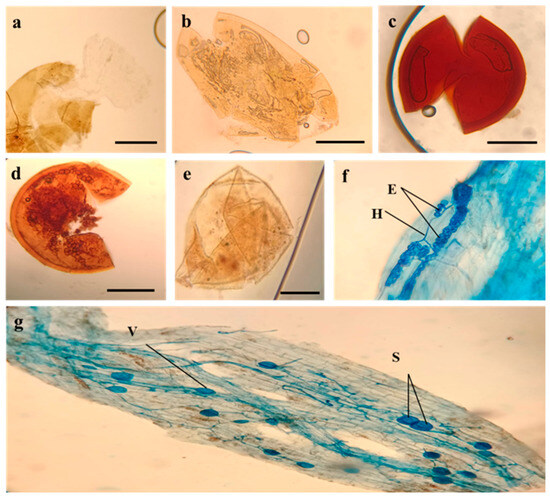
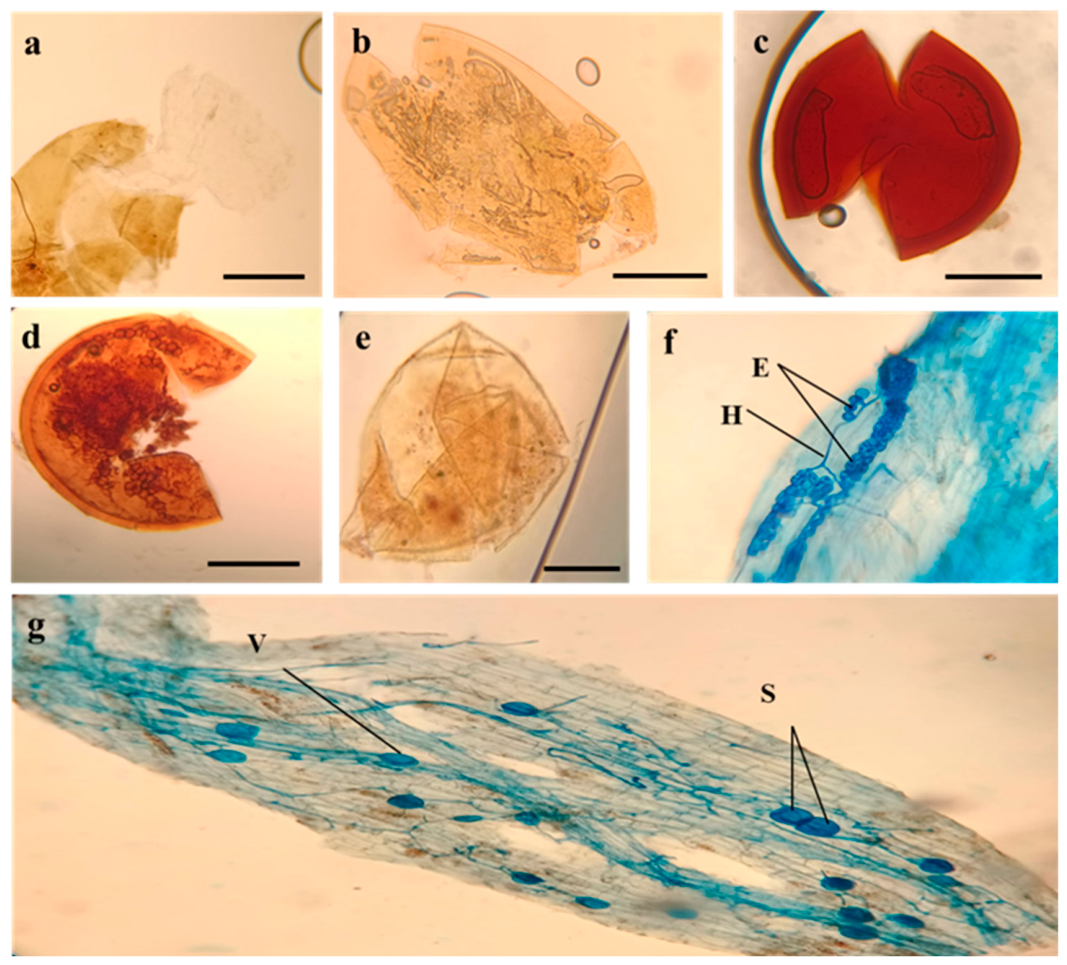
A total of 21 taxa were identified across the tested soils, representing seven genera: Rhizophagus, Septoglomus, Glomus, Dentiscutata, Scutellospora, Acaulospora, and Cetraspora (Figure 1).
Figure 1.
Morphological characterization of AMF spores presents in the studied indigenous soils (a–e) ((a) Scutellospora sp.; (b) Cetraspora sp.; (c) Glomus sp.; (d) Glomus maculosum; (e) Acaulospora sp.) and different AMF colonization structural patterns in maize roots (f,g) (inter- and intraradical hyphae (H); vesicles (V); spores (S); and endophytes (E)). Scale bar 100 µm (40× magnification).
In all soil samples, the first four AMF genera (Dentiscutata, Septoglomus, Glomus, and Rhizophagus) accounted for over 85% of the total spore population. Significant differences were detected among the soil samples (p < 0.05), with spore densities ranging between 935 and 1977 spores for 100 g of soil. The highest density was observed in the rhizospheric soil of Prunus dulcis (Mill.) (NS5), whereas the lowest density was assessed in Pistacia lentiscus soil (NS3) (Table 2).
Table 2.
Density of AMF spores in the tested soils and their frequency and intensity assessed by the MPN test.
3.3. Intensity and Frequency of Mycorrhization
Root colonization was assessed by staining the roots of a mycotrophic plant (Zea mays) used in the MPN test. Soil samples from the five target plant species exhibited comparable numbers of mycorrhizal propagules, with an estimated most probable number (MPN) of 1149.11 propagules per 100 g of rhizosphere soil.
Microscopy confirmed the presence of all the structures related to AMF infection (hyphae, vesicles, and spores) (Figure 1). All five soil samples showed maximum infectivity, with colonization frequency (F%) reaching 100% compared to the control. Regarding the intensity of mycorrhization (M%), roots grown in the five soil samples exhibited high and significant colonization (p < 0.05), ranging from 87.5% to 95%. NS3 and NS4 remained statistically comparable, while the highest intensity was observed in the Prunus dulcis (Mill.) soil (NS5), and the lowest in the Pistacia lentiscus soil (NS3).
3.4. Germination and Seedling Assessment
3.4.1. Assessment of Germination Parameters
As presented in Table 3, the use of these soil samples as living substrates had a significant influence on germination after 28 days (p < 0.05), with three treatments (NS1, NS3, and NS5) exceeding 70%. This effect became more pronounced by day 35, when all treatments recorded germination rates above 83.33%. By day 49, maximum germination levels were reached in all soil samples, with all treatments except NS3 showing significant differences compared to the control (NS0). No further increase was observed thereafter, and germination remained stable until day 70.
Table 3.
Germination rate under the tested soils for 70 days.
To assess the effect of native rhizospheric soils on germination, three parameters were determined and combined (FDG, MGT, and GRI). Each indicator was assigned a numerical rating on a scale from 1 to 6, reflecting its relative strength (Table 4).
Table 4.
Classification of the target soils based on the hierarchical strength of germination indicators * on day 28.
The average germination ranking revealed that NS1 and NS5 soil samples exhibited the strongest effects on almond seed germination, followed by NS3, NS2, and NS4, as reflected by the germination indicators, whereas the control soil sample (NS0) ranked lowest. Accordingly, the rhizospheric soils can be classified by their progressively decreasing effects on germination in the following order: NS1 = NS5 > NS3 > NS2 > NS4 > NS0 (Table 4).
3.4.2. Assessment of Seedling Growth Parameters
Seedling growth parameters measured at day 70 and mean values of WSL-70, TNL-70, SVI-70, and GSS-70 were calculated (Table 5). Each seedling growth parameter was assigned a numerical rating from 1 to 6, reflecting its relative hierarchical effect. The combined evaluation of these parameters allowed the soil samples to be arranged by their impact on seedling growth, resulting in the decreasing order NS1 > NS4 > NS3 > NS2 > NS5 = NS0 (Table 5). This classification identifies NS1 as the soil sample most conducive to almond seedling growth, followed by NS4, NS3, and NS2, whereas NS5 and the control soil sample (NS0) exhibited similar and lowest scores.
Table 5.
Seedling growth parameters * at day 70 under the tested soil treatments.
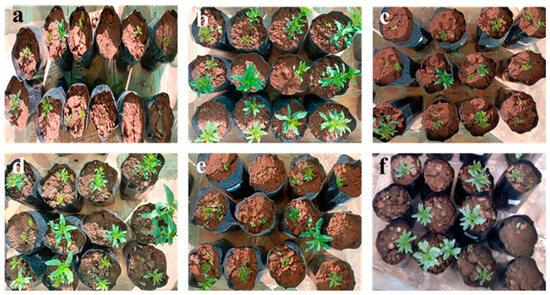
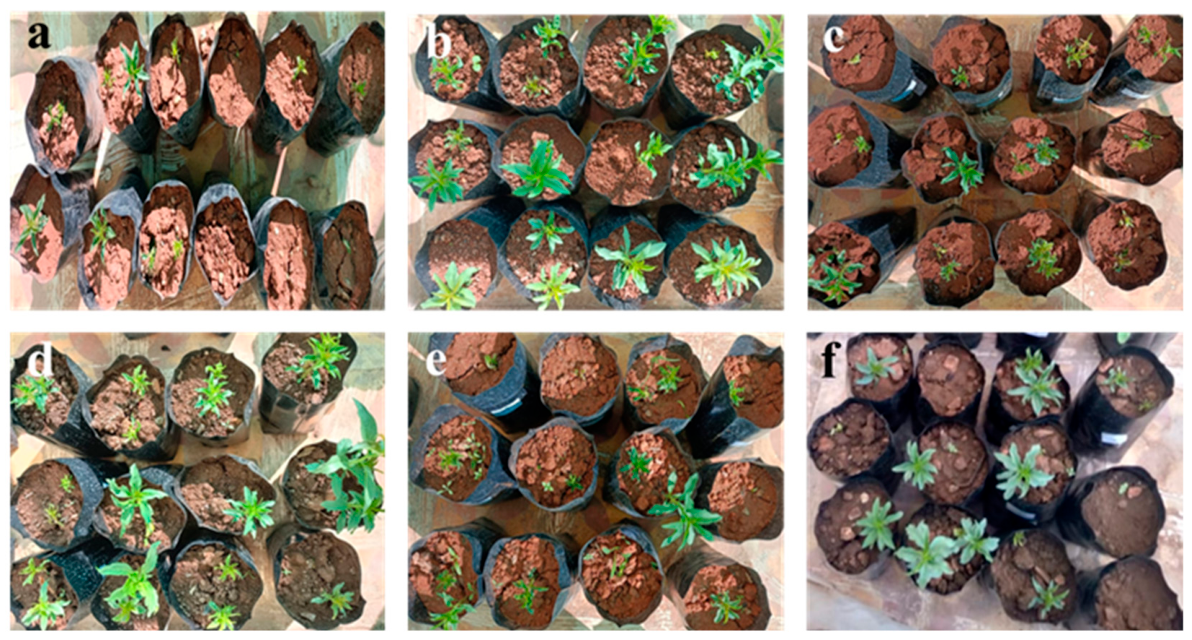
The soil samples exhibited distinct germination and seedling growth effects (Figure 2). NS1 and NS5 were the most effective in promoting germination. However, the impact on seedling growth differed; NS1 had the strongest effect, while NS5 this time showed the lowest performance. These results suggest that soil samples that favor germination do not necessarily ensure the highest seedling growth.
Figure 2.
Experimentation at day 28 of almond seedlings in different soil treatments ((a) bare soil (NS0); (b) Rhus pentaphylla (NS1); (c) Drimia maritima (NS2); (d) Pistacia lentiscus (NS3); (e) Withania frutescens (NS4); (f) Prunus dulcis (Mill.) (NS5)).
3.5. Potential of Interdependencies of All Quantified Parameters
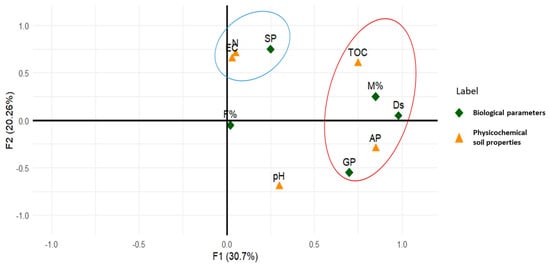
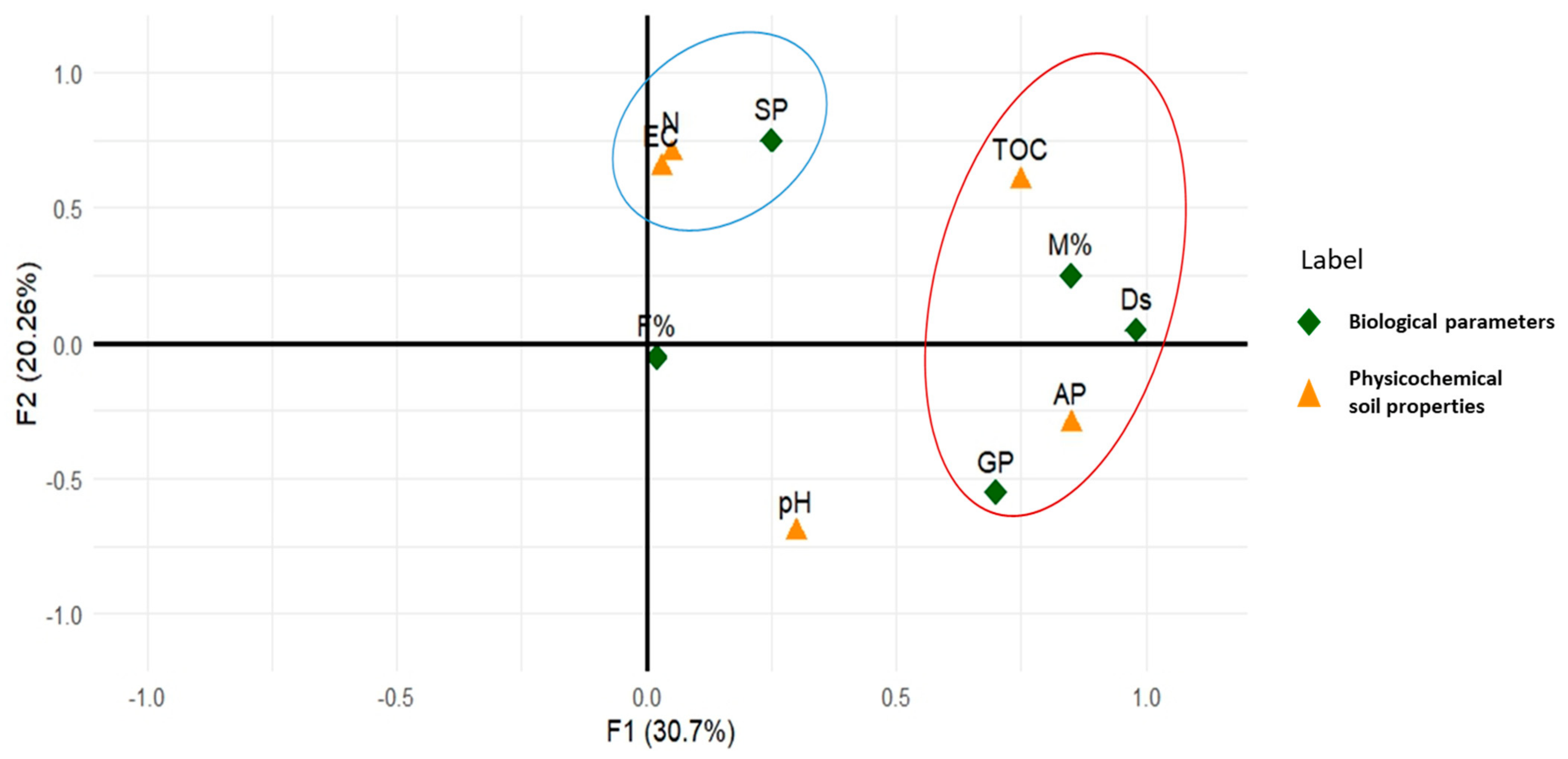
To examine the interrelationships among germination and seedling growth responses in relation to initial soil physicochemical properties, arbuscular mycorrhizal fungus (AMF) spore density, and mycorrhizal infectivity and intensity derived from the MPN test, a principal component analysis (PCA) was carried out. This multivariate approach allowed the reduction of a large set of measured variables into a limited number of factors, grouping variables according to their underlying correlation structures. The PCA indicated that most variables were explained by two principal components, accounting for a cumulative variance of 50.96% (Figure 3). The first axis (F1) accounted for 30.7% of the overall variance and was mainly related to spore density, mycorrhizal intensity (M%), available phosphorus (AP), total organic carbon (TOC), and germination rank, exhibiting correlation coefficients between 0.62 and 0.98. These results indicate that almond germination is strongly linked to AMF spore density, mycorrhizal intensity, and soil organic carbon and phosphorus contents. The second axis (F2) captured 20.26% of the overall variability, reflecting the influence of soil electrical conductivity, nitrogen content, and seedling growth rank, with correlation coefficients exceeding 0.63. These results indicate that almond seedling growth is primarily influenced by initial soil conductivity and nitrogen availability.
Figure 3.
Principal component analysis of germination parameters and seedling growth, in response to the initial physicochemical parameters of soil samples. (M%) Intensity of infection; (F%) frequency of mycorrhization; (Ds) density of AMF spores; (AP) available phosphorus; (N) total nitrogen; (TCO) total organic carbon; (pH) potential hydrogen; (EC) electrical conductivity; (GP) germination parameters; (SP) seedling parameters.
4. Discussion
The transition toward sustainable agricultural systems requires reducing dependence on synthetic inputs while maintaining crop performance. This study suggests that native rhizospheric soils, through their rich microbial communities, can contribute to promoting almond germination and early growth, supporting low-input and ecologically based farming practices. However, these results, obtained under open greenhouse conditions, may not fully reflect field conditions, due to the complexity of the natural environment. Nevertheless, similar studies have shown that native soils enhance seedling growth compared to sterilized or artificial substrates, emphasizing the key role of soil microbial communities and plant–soil interactions in early plant development [49]. Marked differences (p < 0.05) were detected among soil samples in terms of arbuscular mycorrhizal fungus (AMF) spore density and root colonization. Across all treatments, mycorrhizal colonization was consistently high, with intensity values between 87.5% and 95% and full colonization frequency (F% = 100%), supporting a potential role of indigenous AMF communities.
A positive association between AMF spore density and colonization intensity suggests that higher propagule abundance enhances root–fungus symbiosis. The almond-associated soil sample (NS5) exhibited the greatest spore density and colonization levels, while Pistacia lentiscus (NS3) showed the lowest values (Table 2). Spore density is widely considered a reliable indicator of mycorrhizal inoculum potential and ecological persistence, particularly under variable environmental conditions [50,51]. These results support the role of native soils as reservoirs of functional microbial diversity capable of sustaining plant–soil interactions [52].
The beneficial effects observed can be attributed not only to AMFs but also to the broader rhizosphere microbiome, which is closely linked to AMF spores and extraradical mycelium [53]. These interactions stimulate spore germination and enhance root colonization [54]. This complex microbial network contributes to various plant growth-promoting activities, such as phosphorus solubilization, nitrogen fixation, as well as the production of biocontrol metabolites [55,56]. Notably, numerous studies have demonstrated that seeds inoculated with AMFs improve germination performance and plant vigor through these mutualistic interactions [26,57].
Accordingly, the soil samples classification based on germination parameters revealed that NS1 and NS5 had the strongest and statistically comparable effects at early stages, followed by NS3, NS2, and NS4 (Table 4). In contrast, seedling growth was most pronounced in NS1, followed by NS4, NS3, NS2, and NS5, with the control consistently showing the lowest performance (Table 5; Figure 2). This divergence indicates that soil samples favorable for germination are not necessarily optimal for subsequent growth, reflecting differences in nutrient availability and microbial functionality. While certain rhizospheric soils enhance early germination through active microbial signaling, others appear more effective in sustaining plant growth over time. This suggests complementary ecological roles among native plant–soil systems, reinforcing their potential contribution to sustainable and resilient agroecosystems.
The strong effect on germination response observed in the soil of the almond tree (NS5) and the soil of Rhus pentaphylla (NS1) may be explained by the presence of well-adapted indigenous microbial communities, particularly AMFs [58]. In particular, the high spore density and colonization levels recorded in NS5 indicate a favorable rhizospheric environment that supports early plant establishment (AMF density (spores per 100 g of soil) was 1977; M%= 95%; F%= 100%). Similar colonization levels have been reported in arid Moroccan systems, such as date palm rhizospheres in the Figuig oasis, where mycorrhization rates reached 91–93% in soils with high propagule abundance, despite low soil fertility and harsh environmental conditions [59]. This effect can be attributed to indigenous soil of the mother plant providing a favorable rhizosphere condition that promotes both seed germination and natural regeneration [60,61]. The plant engages in chemical signaling that regulates phytohormones, fatty acids, and phenolic compounds, which promote germination [24].
The principal component analysis further provided an exploratory overview of these relationships and separated the studied variables into two main groups (Figure 3). The first group includes spore density, mycorrhization intensity (M%), seed germination parameters, TOC, and available phosphorus (AP), suggesting a possible association with soil biological activity and organic matter dynamics. The second group comprising seedling growth parameters, soil nitrogen (N), and electrical conductivity showed a different distribution pattern. Overall, the initial soil conditions can be described as poor to moderately fertile, characterized by an alkaline pH, intermediate conductivity (EC), relatively elevated TOC and AP, and low N content (Table 1). These relationships may be explained by intense beneficial microbial activity, which promotes strong AMF spore germination under nutrient-poor soil conditions. Indeed, higher AMF infectivity and spore activity are frequently observed in low-fertility soils compared to fertilized ones [50,62,63]. This enhanced mycorrhizal activity subsequently facilitates nutrient mobilization, ultimately benefiting plant development and promoting seedling growth. However, these interpretations should be considered as indicative patterns rather than direct relationships.
In the present study, the classification of the soil samples identifies NS1 as the most effective soil in promoting both almond germination and seedling growth. The associated plant Rhus pentaphylla can therefore be considered a potential nurse plant for sustainable almond growth, facilitating its establishment through both biotic and abiotic mechanisms. These results shed light on new perspectives for Rhus pentaphylla as a source of beneficial microbial inoculum from the rhizosphere, particularly arbuscular mycorrhizal fungi (AMFs). This observation is consistent with studies showing that native plant communities can enhance AMF abundance and propagation, particularly in Mediterranean environments, where vegetation structure plays a key role in maintaining symbiotic fungal networks [64]. However, further studies are needed to confirm this role and elucidate the underlying mechanisms. To our knowledge, Rhus pentaphylla has not previously been reported as a nurse plant or as a reservoir of beneficial AMFs, unlike other plants species such as Pistacia lentiscus [65] and Withania frutescens [66].
The PCA suggests that almond seedling growth tends to be associated with abiotic factors, particularly soil nitrogen content and electrical conductivity. However, this analysis reflects patterns of association rather than direct causality. Although almond cultivation typically requires neutral to alkaline soils, the species can also adapt to moderately acidic conditions [67]. In the present study, AMFs, as a symbiotic component of the soil microflora, may therefore also contribute to seedling development [26,56]. Both nearby nurse plants and more distant native species can positively influence germination and early growth [52]. Despite the global presence of almond trees in non-native habitats, field data on their naturalization and associated wild flora remain limited.
Overall, this study highlights the potential of native plant-associated soils as a resource for sustainable agriculture. Using locally adapted plant–microbe interactions may contribute to improve crop establishment, reduce reliance on synthetic inputs, and promote the conservation of native biodiversity. Such approaches align with sustainable agriculture and offer a foundational framework to enhance the resilience of agroecosystems under changing environmental conditions.
The development of targeted bioinoculants derived from native soils, particularly those associated with Rhus pentaphylla, represents a promising direction for sustainable almond production. However, the findings of this study have to be seen in light of some limitations. First, future studies should incorporate the assessment of other soil nutrient and abiotic environmental parameters to better understand nutrient dynamics and optimize plant growth and nutrition strategies.
The second limitation concerns validation under field conditions to evaluate the consistency and applicability of these results in more complex and variable agroecosystems. Furthermore, long-term investigations are needed to assess the persistence of these effects on mature plant performance, yield, and soil health. In addition, future studies should incorporate molecular approaches to achieve species-level identification and better characterize the functional composition of AMFs and associated microbial communities.
5. Conclusions
Native soils associated with the surrounding flora, under the conditions of this study, enhanced almond germination and early seedling development, highlighting the potential role of rhizosphere microbial communities in early plant establishment. The results suggest that inocula based on locally adapted microbial communities can support crop establishment and reduce reliance on synthetic inputs, which offer promising perspectives for sustainable almond cultivation. This study therefore mentions the promising potential of AMFs as a sustainable strategy to facilitate the naturalization of almonds through direct sowing, particularly in poor or moderately fertile soils. However, future research under field conditions is required to assess the persistence of these effects in productive almond trees, where environmental variability and multiple stress factors may influence plant–soil–microbe interactions.
Author Contributions
Conceptualization, Z.B., N.M., and M.D.; methodology, Z.B., N.M., and M.D.; formal analysis, Z.B., N.M., and M.D.; investigation, Z.B., N.M., and M.D.; resources: N.M. and M.D.; writing—original draft preparation, Z.B.; writing—review and editing, Z.B., N.M., and M.D.; visualization, Z.B., N.M., and M.D.; supervision, N.M. and M.D. All authors have read and agreed to the published version of the manuscript.
Funding
This research received no external funding.
Institutional Review Board Statement
Not applicable.
Informed Consent Statement
Not applicable.
Data Availability Statement
The original contributions presented in this study are included in the article. Further inquiries can be directed to the corresponding author.
Acknowledgments
The authors express their gratitude to the Multidisciplinary Research and Innovation Laboratory, Polydisciplinary Faculty of Khouribga (FPK), Sultan Moulay Slimane University, Beni Mellal, Morocco, and Faculty of Sciences Semlalia, Cadi Ayyad University, Marrakesh, Morocco.
Conflicts of Interest
The authors declare no conflicts of interest.
References
- Vinceti, B.; Elias, M.; Azimov, R.; Turdieva, M.; Aaliev, S.; Bobokalonov, F.; Butkov, E.; Kaparova, E.; Mukhsimov, N.; Shamuradova, S.; et al. Home Gardens of Central Asia: Reservoirs of Diversity of Fruit and Nut Tree Species. PLoS ONE 2022, 17, e0271398. [Google Scholar] [CrossRef] [Scilit] [PubMed]
- Food and Agriculture Organization of the United Nations (FAO). Statistics. Available online: https://www.fao.org/statistics/en (accessed on 18 October 2024).
- Noto, L.V.; Cipolla, G.; Pumo, D.; Francipane, A. Climate Change in the Mediterranean Basin (Part II): A Review of Challenges and Uncertainties in Climate Change Modeling and Impact Analyses. Water Resour. Manag. 2023, 37, 2307–2323. [Google Scholar] [CrossRef] [Scilit]
- Cabello, J.; Escudero-Clares, M.; Martos-Rosillo, S.; Casas, J.J.; Cintas, J.; Zakaluk, T.; Salinas-Bonillo, M.J. Groundwater-Dependent Vegetation in Semi-Arid Mediterranean Mountains: The Hidden Role of Weathered Hard-Rock Aquifers. J. Hydrol. 2026, 664, 134407. [Google Scholar] [CrossRef] [Scilit]
- Fernandes De Oliveira, A.; Mameli, M.G.; De Pau, L.; Satta, D. Almond Tree Adaptation to Water Stress: Differences in Physiological Performance and Yield Responses among Four Cultivar Grown in Mediterranean Environment. Plants 2023, 12, 1131. [Google Scholar] [CrossRef] [Scilit]
- Vasilikiotis, C.; Li, M.; Schmidt, J.E.; Azimi, A.; Garcia, J.; Volder, A.; Lampinen, B.; Gaudin, A.C. Orchard Management Practices Affect Arbuscular Mycorrhizal Fungal Root Colonisation of Almond. Biol. Agric. Hortic. 2020, 36, 230–248. [Google Scholar] [CrossRef] [Scilit]
- Kodad, O.; Estopañán, G.; Juan, T.; Socias I Company, R. Protein Content and Oil Composition of Almond from Moroccan Seedlings: Genetic Diversity, Oil Quality and Geographical Origin. J. Am. Oil Chem. Soc. 2013, 90, 243–252. [Google Scholar] [CrossRef] [Scilit]
- Melhaoui, R.; Abid, M.; Mihamou, A.; Sindic, M.; Caid, H.S.; Elamrani, A. Flowering, a Critical Phenological Stage as a Limiting Factor for Almond Native Ecotypes Cultivation in Eastern Morocco. Appl. Microsc. 2017, 47, 157–159. [Google Scholar] [CrossRef] [Scilit]
- Savoia, M.A.; Del Faro, L.; Venerito, P.; Gaeta, L.; Palasciano, M.; Montemurro, C.; Sabetta, W. The Relevance of Discovering and Recovering the Biodiversity of Apulian Almond Germplasm by Means of Molecular and Phenotypic Markers. Plants 2022, 11, 574. [Google Scholar] [CrossRef] [Scilit]
- Lipan, L.; Romero, A.; Echeverria, G.; Maldonado, M.; Company, T.; Escalona, J.M.; Ruiz, J.; Miarnau, X. Native versus Modern Almond Cultivars of Mallorca Island: From Biodiversity to Industrial Aptitude and Fruit Quality. Agronomy 2022, 12, 1933. [Google Scholar] [CrossRef] [Scilit]
- Achli, S.; Ongoma, V.; Epule, T.E.; Dhiba, D.; Salih, W.; Ousayd, L.; Chehbouni, A. Exploring the Key Drivers of Crop Yields in Morocco—A Systematic Review. Front. Agron. 2025, 7, 1515938. [Google Scholar] [CrossRef] [Scilit]
- Kodad, S.; Melhaoui, R.; Addi, M.; Hano, C.; Sahib, N.; Elamrani, A.; Abid, M.; Mihamou, A. Micropropagation of Zygotic Embryos from Genetically Diverse Almond Seedling Orchards in Eastern Morocco. E3S Web Conf. 2021, 298, 03008. [Google Scholar] [CrossRef] [Scilit]
- Melhaoui, R.; Addi, M.; Houmy, N.; Abid, M.; Mihamou, A.; Serghini-Caid, H.; Sindic, M.; Elamrani, A. Pomological Characterization of Main Almond Cultivars from the North Eastern Morocco. Int. J. Fruit Sci. 2019, 19, 413–422. [Google Scholar] [CrossRef] [Scilit]
- Freitas, T.R.; Santos, J.A.; Silva, A.P.; Fraga, H. Reviewing the Adverse Climate Change Impacts and Adaptation Measures on Almond Trees (Prunus Dulcis). Agriculture 2023, 13, 1423. [Google Scholar] [CrossRef] [Scilit]
- Kodad, O.; Socias I Company, R. Erratic Fruit Set in Almond under Warm Climates. Int. J. Hortic. Sci. 2014, 20, 59–64. [Google Scholar] [CrossRef] [Scilit]
- Moyano, J.; Dimarco, R.D.; Paritsis, J.; Peterson, T.; Peltzer, D.A.; Crawford, K.M.; McCary, M.A.; Davis, K.T.; Pauchard, A.; Nuñez, M.A. Unintended Consequences of Planting Native and Non-native Trees in Treeless Ecosystems to Mitigate Climate Change. J. Ecol. 2024, 112, 2480–2491. [Google Scholar] [CrossRef] [Scilit]
- Enescu, C.M.; Mihalache, M.; Ilie, L.; Dincă, L.; Timofte, A.I.; Murariu, G. Afforestation of Degraded Lands: A Global Review of Practices, Species, and Ecological Outcomes. Forests 2025, 16, 1743. [Google Scholar] [CrossRef] [Scilit]
- Benítez, G.; Molero-Mesa, J.; González-Tejero, M.R. Wild Edible Plants of Andalusia: Traditional Uses and Potential of Eating Wild in a Highly Diverse Region. Plants 2023, 12, 1218. [Google Scholar] [CrossRef] [Scilit]
- Hamrouni, H.; Idoudi, S.; Romdhane, M.; Elfalleh, W. Ethnobotanical Study of Medicinal Plants Used in Southern Tunisia. Euro-Mediterr. J. Environ. Integr. 2023, 8, 807–821. [Google Scholar] [CrossRef] [Scilit]
- Ruiz-Núñez, N.D.C.; Vásquez-Dávila, M.A.; Manzanero-Medina, G.I.; Flores-Manzanero, A. Nurse Plants, Soil Nutrients, and Avian Seed Dispersal of Wild Chile Peppers in a Semiarid Valley of Southern Mexico. J. Arid Environ. 2025, 227, 105297. [Google Scholar] [CrossRef] [Scilit]
- Mohamed, O.-Z.; Sarah, S.; Said, E.K.; Larbi, A.; Mustapha, F.; Ali, A.; Paul, M.; El Hassan, A.; Abdellatif, H.; Rania, E.H.; et al. Effect of Biofertilizer and Nurse Plants on Mycorrhizal Status, Soil Fertility, and Date Palm Productivity under Organic Farming System. Org. Agric. 2026, 16, 13. [Google Scholar] [CrossRef] [Scilit]
- Lopes, M.J.D.S.; Dias-Filho, M.B.; Gurgel, E.S.C. Successful Plant Growth-Promoting Microbes: Inoculation Methods and Abiotic Factors. Front. Sustain. Food Syst. 2021, 5, 606454. [Google Scholar] [CrossRef] [Scilit]
- Duponnois, R.; Ouahmane, L.; Kane, A.; Thioulouse, J.; Hafidi, M.; Boumezzough, A.; Prin, Y.; Baudoin, E.; Galiana, A.; Dreyfus, B. Nurse Shrubs Increased the Early Growth of Cupressus Seedlings by Enhancing Belowground Mutualism and Soil Microbial Activity. Soil Biol. Biochem. 2011, 43, 2160–2168. [Google Scholar] [CrossRef] [Scilit]
- Jhanji, S.; Goyal, E.; Chumber, M.; Kaur, G. Exploring Fine Tuning between Phytohormones and ROS Signaling Cascade in Regulation of Seed Dormancy, Germination and Seedling Development. Plant Physiol. Biochem. 2024, 207, 108352. [Google Scholar] [CrossRef] [Scilit] [PubMed]
- Napoli, C.; Mello, A.; Bonfante, P. Dissecting the Rhizosphere Complexity: The Truffle-Ground Study Case. Rend. Lincei 2008, 19, 241–259. [Google Scholar] [CrossRef] [Scilit]
- El-Beltagi, H.S.; El-Waraky, E.A.; El-Mogy, M.M.; El-Nady, M.F.; Ismail, A.M.; Belal, E.B.; Al-Daej, M.I.; El-Khateeb, N.M.; Hamed, L.; Metwaly, M.M.S. Microbial-Priming of Seeds with Plant Growth-Promoting Rhizobacteria and Arbuscular Mycorrhizal Fungi for Improving Cotton (Gossypium barbadense L.) Growth, Yield and Water Productivity under Drought Stress. Biologia 2025, 80, 779–803. [Google Scholar] [CrossRef] [Scilit]
- Devin, S.R.; Prudencio, Á.S.; Mahdavi, S.M.E.; Rubio, M.; Martínez-García, P.J.; Martínez-Gómez, P. Orchard Management and Incorporation of Biochemical and Molecular Strategies for Improving Drought Tolerance in Fruit Tree Crops. Plants 2023, 12, 773. [Google Scholar] [CrossRef] [Scilit]
- Roldan-Fajardo, B.E.; Barea, J.M.; Ocampo, J.A.; Azcon-Aguilar, C. The Effect of Season on VA Mycorrhiza of the Almond Tree and of Phosphate Fertilization and Species of Endophyte on Its Mycorrhizal Dependency. Plant Soil 1982, 68, 361–367. [Google Scholar] [CrossRef] [Scilit]
- Oehl, F.; Sieverding, E.; Ineichen, K.; Ris, E.; Boller, T.; Wiemken, A. Community Structure of Arbuscular Mycorrhizal Fungi at Different Soil Depths in Extensively and Intensively Managed Agroecosystems. New Phytol. 2005, 165, 273–283. [Google Scholar] [CrossRef] [Scilit] [PubMed]
- Manaut, N.; El Bzar, Z.; El-Bachri, C.; Bouabidi, Z.; Hafidi, M.; Douma, M. Exploring the Potentialities of Chamaerops humilis L. Soil to Improve Growth and Quality of Saffron. Appl. Ecol. Environ. Res. 2023, 21, 5977–5988. [Google Scholar] [CrossRef] [Scilit]
- Rahemi, A.; Taghavi, T.; Fatahi, R.; Ebadi, A.; Hassani, D.; Chaparro, J.; Gradziel, T. Seed Germination and Seedling Establishment of Some Wild Almond Species. Afr. J. Biotechnol. 2011, 10, 7780–7786. [Google Scholar] [CrossRef] [Scilit]
- Gerdemann, J.W.; Nicolson, T.H. Spores of Mycorrhizal Endogone Species Extracted from Soil by Wet Sieving and Decanting. Trans. Br. Mycol. Soc. 1963, 46, 235–244. [Google Scholar] [CrossRef] [Scilit]
- The International Collection of (Vesicular) Arbuscular Mycorrhizal Fungi (INVAM). Species Descriptions. Available online: https://invam.ku.edu/species-descriptions (accessed on 15 February 2025).
- Plenchette, C.; Perrin, R.; Duvert, P. The Concept of Soil Infectivity and a Method for Its Determination as Applied to Endomycorrhizas. Can. J. Bot. 1989, 67, 112–115. [Google Scholar] [CrossRef] [Scilit]
- Phillips, J.M.; Hayman, D.S. Improved Procedures for Clearing Roots and Staining Parasitic and Vesicular-Arbuscular Mycorrhizal Fungi for Rapid Assessment of Infection. Trans. Br. Mycol. Soc. 1970, 55, 158–161, IN16–IN18. [Google Scholar] [CrossRef] [Scilit]
- Duponnois, R.; Plenchette, C.; Thioulouse, J.; Cadet, P. The Mycorrhizal Soil Infectivity and Arbuscular Mycorrhizal Fungal Spore Communities in Soils of Different Aged Fallows in Senegal. Appl. Soil Ecol. 2001, 17, 239–251. [Google Scholar] [CrossRef] [Scilit]
- Fisher, R.A.; Yates, F. Statistical Tables for Biological, Agricultural and Medical Research; Oliver and Boyd: Edinburgh, UK, 1963. [Google Scholar]
- Trovelot, A.; Kough, J.L.; Gianinazzi-Pearson, V. Mesure Du Taux de Mycorrhization VA d’un Systeme Radiculaire. Recherche Des Methodes d’estimation Ayant Une Signification Fonctionnelle. In The Mycorrhizae: Physiology and Genetic; INRA Press: Paris, France, 1986; pp. 217–221. [Google Scholar]
- NF ISO 10390; Soil, Treated Biowaste and Sludge—Determination of pH. Association Française de Normalisation (AFNOR): Paris, France, 2021.
- Aubert, G. Methodes D’analyses Des Sols: Documents de Travail Tous Droits Reserves; Centre Régional de Documentation Pédagogique: Bordeaux, France, 1978. [Google Scholar]
- Nelson, D.W.; Sommers, L.E. Total Carbon, Organic Carbon, and Organic Matter. In Agronomy Monographs; Page, A.L., Ed.; American Society of Agronomy, Soil Science Society of America: Madison, WI, USA, 1983; pp. 539–579. [Google Scholar]
- Olsen, S.R. Estimation of Available Phosphorus in Soils by Extraction with Sodium Bicarbonate; Department of Agriculture: Washington, DC, USA, 1954.
- Kjeldahl, J. Neue Methode zur Bestimmung des Stickstoffs in organischen Körpern. Fresenius Z. Anal. Chem. 1883, 22, 366–382. [Google Scholar] [CrossRef] [Scilit]
- Yang, C.; Shi, D.; Wang, D. Comparative Effects of Salt and Alkali Stresses on Growth, Osmotic Adjustment and Ionic Balance of an Alkali-Resistant Halophyte Suaeda Glauca (Bge.). Plant Growth Regul. 2008, 56, 179–190. [Google Scholar] [CrossRef] [Scilit]
- Kader, M.A. A Comparison of Seed Germination Calculation Formulae and the Associated Interpretation of Resulting Data. J. Proc. R. Soc. N. S. W. 2005, 138, 65–75. [Google Scholar] [CrossRef] [Scilit]
- Orchard, T.J. Estimating the Parameters of Plant Seedling Emergence. Seed Sci. Technol. 1977, 5, 61–69. [Google Scholar]
- El-Saifi, S.; Ahmed, H.; Hasan, S.; Morsi, M.; El-Shatoury, R. Seed Priming Influences Seed Germination and Seedling Growth of Tomato Under Different Salinity Levels. J. Plant Prod. 2010, 1, 159–170. [Google Scholar] [CrossRef] [Scilit]
- Abdul-Baki, A.A.; Anderson, J.D. Relationship Between Decarboxylation of Glutamic Acid and Vigor in Soybean Seed. Crop Sci. 1973, 13, 227–232. [Google Scholar] [CrossRef] [Scilit]
- Mesquita Mota, N.; Santos Souza Sales, B.E.; Zonzini Borin, J.C.; De Lima E Borges, E.E.; Fortini, E.A. Using Native Soil to Cultivate Seedlings of the Threatened Melanoxylon Brauna Schott (Fabaceae): A Path for Ex-Situ Conservation. J. Nat. Conserv. 2025, 84, 126861. [Google Scholar] [CrossRef] [Scilit]
- Antunes, P.M.; Stürmer, S.L.; Bever, J.D.; Chagnon, P.-L.; Chaudhary, V.B.; Deveautour, C.; Fahey, C.; Kokkoris, V.; Lekberg, Y.; Powell, J.R.; et al. Enhancing Consistency in Arbuscular Mycorrhizal Trait-Based Research to Improve Predictions of Function. Mycorrhiza 2025, 35, 14. [Google Scholar] [CrossRef] [Scilit]
- Brito Filho, E.G.D.; Carneiro, M.A.C.; Rodrigues, L.D.S.; Sousa Neto, A.T.D.; Botelho, S.A.; Silva, L.C.V.; Silva, A.O.; Reis, T.R.D.; Barbosa, J.M.D.S. Inoculum Potential of Arbuscular Mycorrhizal Fungi in Iron Ore Tailings Areas under Rehabilitation. Ciênc. Agrotecnologia 2026, 50, e014625. [Google Scholar] [CrossRef] [Scilit]
- Wang, Z.; Fu, X.; Kuramae, E.E. Insight into Farming Native Microbiome by Bioinoculant in Soil-Plant System. Microbiol. Res. 2024, 285, 127776. [Google Scholar] [CrossRef] [Scilit] [PubMed]
- Faghihinia, M.; Jansa, J.; Halverson, L.J.; Staddon, P.L. Hyphosphere Microbiome of Arbuscular Mycorrhizal Fungi: A Realm of Unknowns. Biol. Fertil. Soils 2023, 59, 17–34. [Google Scholar] [CrossRef] [Scilit]
- Artursson, V.; Finlay, R.D.; Jansson, J.K. Interactions between Arbuscular Mycorrhizal Fungi and Bacteria and Their Potential for Stimulating Plant Growth. Environ. Microbiol. 2006, 8, 1–10. [Google Scholar] [CrossRef] [Scilit]
- Giovannini, L.; Palla, M.; Agnolucci, M.; Avio, L.; Sbrana, C.; Turrini, A.; Giovannetti, M. Arbuscular Mycorrhizal Fungi and Associated Microbiota as Plant Biostimulants: Research Strategies for the Selection of the Best Performing Inocula. Agronomy 2020, 10, 106. [Google Scholar] [CrossRef] [Scilit]
- Maciel-Rodríguez, M.; Moreno-Valencia, F.D.; Plascencia-Espinosa, M. The Role of Plant Growth-Promoting Bacteria in Soil Restoration: A Strategy to Promote Agricultural Sustainability. Microorganisms 2025, 13, 1799. [Google Scholar] [CrossRef] [Scilit]
- Shiran, K.; Santhoshkumar, A.V.; Binu, N.K.; Kunhamu, T.; Ashwath, M.N. Influence of AMF Inoculation on Germination Dynamics and Seedling Traits of Swietenia Macrophylla. J. Adv. Biol. Biotechnol. 2025, 28, 1846–1855. [Google Scholar] [CrossRef] [Scilit]
- Requena, N.; Perez-Solis, E.; Azcón-Aguilar, C.; Jeffries, P.; Barea, J.-M. Management of Indigenous Plant-Microbe Symbioses Aids Restoration of Desertified Ecosystems. Appl. Environ. Microbiol. 2001, 67, 495–498. [Google Scholar] [CrossRef] [Scilit]
- Gagou, E.; Chakroune, K.; Abbas, M.; Lamkami, T.; Hakkou, A. Evaluation of the Mycorrhizal Potential of Date Palm (Phoenix Dactylifera L.) Rhizosphere Soils in the Figuig Oasis (Southeastern Morocco). J. Fungi 2023, 9, 931. [Google Scholar] [CrossRef] [Scilit]
- Kong, H.G.; Song, G.C.; Ryu, C. Inheritance of Seed and Rhizosphere Microbial Communities through Plant–Soil Feedback and Soil Memory. Environ. Microbiol. Rep. 2019, 11, 479–486. [Google Scholar] [CrossRef] [Scilit]
- Kong, Z.; Liu, H. Modification of Rhizosphere Microbial Communities: A Possible Mechanism of Plant Growth Promoting Rhizobacteria Enhancing Plant Growth and Fitness. Front. Plant Sci. 2022, 13, 920813. [Google Scholar] [CrossRef] [Scilit]
- Wahab, A.; Muhammad, M.; Munir, A.; Abdi, G.; Zaman, W.; Ayaz, A.; Khizar, C.; Reddy, S.P.P. Role of Arbuscular Mycorrhizal Fungi in Regulating Growth, Enhancing Productivity, and Potentially Influencing Ecosystems under Abiotic and Biotic Stresses. Plants 2023, 12, 3102. [Google Scholar] [CrossRef] [Scilit]
- Yu, L.; Zhang, Z.; Liu, P.; Zhou, L.; Tan, S.; Kuang, S. Arbuscular Mycorrhizal Fungi Diversity in Sophora Japonica Rhizosphere at Different Altitudes and Lithologies. J. Fungi 2024, 10, 340. [Google Scholar] [CrossRef] [Scilit]
- Pérez-Redondo, M.; Jaizme-Vega, M.D.C.; González-Rodríguez, Á.M.; Reyes-Betancort, A.; Montesinos-Navarro, A. Arbuscular Mycorrhizal Density and Propagation Are Driven by Vegetation Cover and Plant Phylogenetic Diversity. Plant Soil 2025, 1–15. [Google Scholar] [CrossRef] [Scilit]
- Bouabidi, Z.; Manaut, N.; Douma, M. Enhancing Almond Seed Germination and Growth Through Microbial Priming: A Biostimulation Strategy for Sustainable Agriculture. Agronomy 2025, 15, 2434. [Google Scholar] [CrossRef] [Scilit]
- Abbas, Y.; Bakkali-Yakhlef, S.; Prin, Y.; Arahou, M.; Abourouh, M.; Duponnois, R. Growth and Nutrition of Tetraclinis Articulata (Vahl) Mast. Cultivated in Different Rhizosphere Soils Collected from Tetraclinis Stand. Biotechnol. Agron. Soc. Environ. 2013, 17, 3–11. [Google Scholar]
- Cortijos-López, M.; Sánchez-Navarrete, P.; Lasanta, T.; Nadal-Romero, E. How Do Acid or Alkaline Soil Environments Affect Soil Organic Carbon Stocks in a Post-Abandonment Secondary Succession Process in Mediterranean Mountain Areas? CATENA 2023, 232, 107384. [Google Scholar] [CrossRef] [Scilit]

Disclaimer/Publisher’s Note: The statements, opinions and data contained in all publications are solely those of the individual author(s) and contributor(s) and not of MDPI and/or the editor(s). MDPI and/or the editor(s) disclaim responsibility for any injury to people or property resulting from any ideas, methods, instructions or products referred to in the content. |
© 2026 by the authors. Licensee MDPI, Basel, Switzerland. This article is an open access article distributed under the terms and conditions of the Creative Commons Attribution (CC BY) license.