


Abstract
Potentially toxic elements (PTEs) in mining-impacted wetlands can transfer from soil and water to forage and grazing livestock, resulting in dietary exposure for nearby communities. In this study, arsenic (As), lead (Pb), and cadmium (Cd) were quantified in key environmental matrices (soil, surface water, and forage) and in sheep tissues (liver, kidney, and muscle) from six georeferenced grazing sites in the Ite coastal wetland (Tacna, Peru) during the dry season. Samples were acid-digested following U.S. EPA protocols and analyzed by atomic absorption spectrometry (AAS) under QA/QC procedures (certified reference materials, blanks, duplicates, and matrix spikes); matrix-specific detection and quantification limits are reported. Arsenic dominated the contamination profile (forage: 428.6 mg kg−1, dry weight; soil: 48.61 mg kg−1; water: 0.97 mg L−1) and was detected in sheep tissues (kidney: 0.1577 mg kg−1; muscle: 0.1538 mg kg−1; liver: 0.0644 mg kg−1). Lead and cadmium were <LOQ in muscle and liver but were measurable in kidney (Pb: 0.0415 mg kg−1; Cd: 0.0011 mg kg−1). To support the interpretation of trophic transfer, screening transfer/bioaccumulation metrics (soil-to-forage, forage-to-tissue, and water-to-tissue) were calculated. Human dietary exposure was screened using estimated daily intake (EDI), hazard quotient (HQ), and margin of exposure (MOE). Because arsenic speciation was not measured, inorganic arsenic (iAs) risk was evaluated as a conservative upper bound (100% iAs) and through sensitivity scenarios (10–50% iAs). Under a high-meat-consumption scenario (300 g day−1), the upper-bound assumption yielded HQ = 2.2 and MOE = 0.46; however, scenario analyses indicate that risk conclusions are highly dependent on the assumed iAs fraction. Overall, the results identify arsenic as a priority contaminant and support targeted grazing management, the provision of low-arsenic water sources, and remediation and monitoring actions to reduce exposure in vulnerable rural communities.
1. Introduction
Pollution by potentially toxic elements (PTEs)—an inclusive term covering toxicologically relevant metals (e.g., Pb and Cd) and metalloids (e.g., As)—is a persistent global environmental threat because these elements are nonbiodegradable and chemically stable and can accumulate along food webs [1,2]. Cadmium (Cd), lead (Pb), and arsenic (As) are among the most relevant PTEs because of their well-documented adverse effects on human and animal health, even at low exposure levels [3,4]. Anthropogenic activities such as mining and ore processing, industrial emissions, and irrigation with contaminated water are major drivers of PTE dispersion in rural and peri-urban environments [5,6,7].
Mining-impacted landscapes are repeatedly reported as hotspots for PTE contamination in soils, water, crops, and animal-derived foods. Recent evidence from artisanal and industrial mining contexts shows that elevated PTE levels in environmental matrices can translate into measurable burdens in edible crops and livestock products, motivating integrated monitoring and policy-relevant risk characterization (e.g., case studies and syn-theses from Ghana and Nigeria) [8,9].
One of the main exposure pathways is the accumulation of PTEs in environmental matrices such as soil, water, and vegetation, which act as reservoirs and transport vectors, particularly in areas affected by chronic contamination sources [1,2,8,9]. PTE behavior in the environment is controlled by physicochemical variables, including pH, cation exchange capacity, organic matter content, salinity, and redox conditions, which modulate mobility and bioavailability. Once retained in soil or sediment, PTEs can be taken up by plant roots and accumulate in forage, thereby transferring them to higher trophic levels, such as grazing livestock [5,9,10,11].
Sheep are particularly susceptible to this pathway because of their reliance on grazing and, in many semiarid systems, surface water resources [12,13,14,15,16,17]. In ruminants, PTEs often accumulate preferentially in organs with filtration and detoxification roles (especially liver and kidney), which are widely used as biomarkers of chronic exposure [10,18,19,20,21]. Chronic exposure to Cd, Pb, and As has been associated with hepatic dysfunction, oxidative stress, immunotoxicity, and reproductive effects, potentially reducing animal productivity and increasing dietary risk for human consumers [22,23,24].
The Ite wetland (Tacna) is an artificial coastal wetland developed over the former coastal tailings deposit of Ite Bay. Tailings generated from the Toquepala and Cuajone copper mining operations were discharged into Ite Bay until December 1996, when the Quebrada Honda tailings impoundment became operational. Geochemical and hydrogeochemical studies have documented the retention and redistribution of potentially toxic elements within the sediments of the system. However, in the case of arsenic, available evidence indicates that a significant fraction of the arsenic present in the water feeding the wetland originates from the Locumba River and is of natural origin; therefore, its exclusive attribution to historical tailings should be made with caution [25,26]. This has contributed to the persistent enrichment of sediments, water bodies, and vegetation with potentially toxic elements (PTEs), particularly arsenic [12,13,14,15,16,17]. Furthermore, the use of potentially contaminated surface and groundwater for the irrigation of natural pastures and livestock watering may increase the inputs of PTEs into forage biomass available to grazing animals, promoting processes of bioaccumulation and trophic transfer within local agro-pastoral systems [20,21].
This contamination pathway threatens local biodiversity and compromises food security and public health in rural communities that depend on sheep farming as a livelihood [12,27]. International health agencies have reported that chronic dietary exposure to Cd, Pb, and As through contaminated food can contribute to adverse outcomes, including kidney damage, neurological effects, and increased cancer risk, particularly in vulnerable groups such as children and pregnant women [23,24,28].
Accordingly, documenting PTE levels in environmental matrices and edible tissues should be accompanied by screening-level human health risk assessment. Tools such as estimated daily intake (EDI), hazard quotient (HQ), and margin of exposure (MOE) link measured concentrations to health-based guidance values and are widely used to prioritize risk-management actions in contaminated food systems [29,30].
In this study, As, Pb, and Cd in soil, surface water, and forage from six georeferenced sites in the Ite coastal wetland were evaluated, and their transfer to sheep tissues (liver, kidney, and muscle) was quantified, while potential sex-related differences (males vs. fe-males) were assessed. We further conducted a screening-level dietary risk assessment (EDI, HQ, and MOE) for meat and offal consumption to support evidence-based management of livestock grazing in mining-impacted coastal wetlands.
2. Materials and Methods
2.1. Study Area
The present study was conducted in the Ite coastal wetland (Tacna region, Peru), a coastal ecosystem characterized by high ecological sensitivity and prolonged exposure to contamination sources associated with legacy mining liabilities. The study area covers approximately 7 hectares and includes active sheep grazing zones where animals have direct contact with soils, forage, and surface water bodies potentially contaminated with potentially toxic elements (PTEs), including arsenic (a metalloid) and the metals cadmium and lead (As, Cd, Pb).
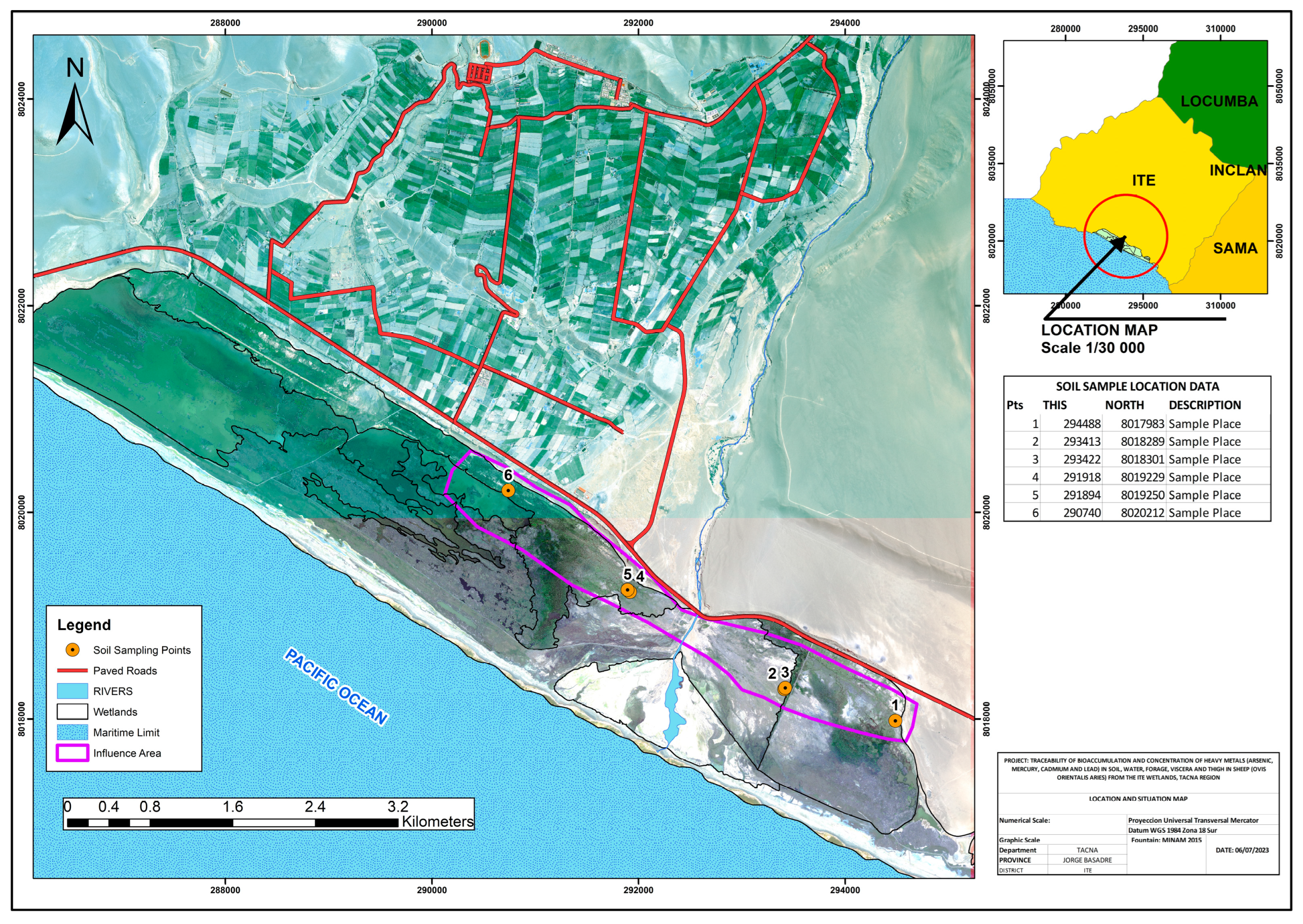
Six sampling sites were strategically selected and georeferenced within the wetland; their spatial distribution is shown in Figure 1 together with contextual information on the relief, surface-water bodies, and livestock-use areas.
Figure 1.
Location of the Ite coastal wetland (Tacna region, Peru) and the six georeferenced sampling sites used for environmental and livestock sampling.
Ite Bay has an arid coastal climate, with altitudes between 0 and 50 m a.s.l., annual average temperatures of 17.5 °C, and annual precipitation below 210 mm. During the dry season (May to September), rainfall is practically nonexistent (<1 mm/month), the relative humidity ranges from 68% to 79%, marine temperatures are typically 17–18 °C, and solar radiation ranges from 5.2 to 5.7 kWh/m2/day. These conditions can promote persistence and, in some cases, the concentration of dissolved and particulate-associated PTEs in wetland environmental matrices.
2.2. Sampling Design
The sampling design included environmental matrices (soil, surface water, and forage) and biological matrices (sheep tissues). For the environmental component, samples were collected at six georeferenced sites within active grazing areas selected on the basis of proximity to suspected mining influence zones and livestock use.
For the biological component, three adult sheep were sampled per site (total n = 18), with the animals grazing in the corresponding site area. The sampled population included both females and males (females: n = 7; males: n = 11) to explore potential sex-related variability. From each animal, liver, kidney, and skeletal muscle (biceps femoris) were collected. Because multiple organs obtained from the same animal and animals were clustered within sites, the statistical analysis accounted for within-animal and within-site dependence (see Section 2.3).
Samples were collected during the dry season (July 2022). Therefore, the dataset represents a seasonal snapshot and does not capture potential rainy-season changes in wetland hydrology and PTE mobility.
Ethical approval was obtained for the use and laboratory analysis of the sheep tissues and associated data (protocol code 2023-041-CEIUNJBG; approval date: 15 September 2023). Samples were obtained during routine slaughter by local producers, and no animals were euthanized exclusively for this research; therefore, no additional animal procedures beyond standard practices were performed. The approval covers the use of preexisting specimens collected as part of routine husbandry/slaughter activities.
2.2.1. Environmental Sample Collection
(a) Soil:
Composite surface soil samples (0–20 cm) were collected at the six previously georeferenced points in accordance with the technical guidelines of the Ministry of the Environment of Peru [31] for the evaluation of potentially contaminated soils. At each point, 1 m2 subplots were delineated, within which five subsamplings were conducted in a cross pattern (four corners and a center) using stainless steel augers previously decontaminated with a 10% nitric acid solution and rinsed with distilled water. The subsamples were mixed in the field to form a composite sample per point, with an approximate volume of 1 kg of soil.
The samples were placed in high-density polyethylene bags, labeled with a unique identification code, and stored in insulated boxes at 4 °C during transportation to the laboratory. They were then air-dried at room temperature, sieved through a 2 mm stainless steel mesh, and mechanically homogenized for subsequent chemical analysis.
(b) Water:
Surface-water samples were collected at the same six georeferenced sites using 1 L acid-cleaned HDPE bottles, following the National Protocol for Monitoring Surface Water Quality of the Autoridad Nacional del Agua (ANA) [32]. A representative mid-water grab sample was taken at each site.
Before sampling, the bottles were washed with neutral detergent, rinsed with distilled water, and decontaminated with 10% nitric acid (HNO3) following the ANA protocol. Immediately after collection, the samples were acidified in the field with concentrated HNO3 to a pH < 2 to preserve the metals. The samples were not filtered prior to preservation; therefore, the reported concentrations represent total recoverable metals (dissolved plus fine particulate-associated fractions) after laboratory digestion.
The samples were transported to the laboratory within 6 h under refrigeration (4 ± 1 °C) and stored at 4 °C. Digestion and analysis were performed within 48 h to minimize changes in metal partitioning.
(c) Forage:
The predominant forage species (Cynodon dactylon, Paspalum vaginatum, and Distichlis spicata) were collected at each site. Approximately 500 g of composite aboveground biomass was obtained per site by cutting 2–3 cm above the soil surface using acid-washed stainless-steel scissors, following the FAO and AOAC guidelines for plant sampling [33,34]. The samples were placed in labeled paper bags and transported to the laboratory within 4 h. In the laboratory, the samples were gently rinsed with distilled/deionized water to remove adhered soil and dust, oven-dried at 60 °C to a constant weight (~48 h), milled (1 mm mesh), and homogenized. Concentrations in forage are reported on a dry-weight basis; despite washing, some residual dust/soil adherence cannot be fully excluded in field-collected forage.
2.2.2. Biological Sample Collection
Biological samples were collected under veterinary supervision in accordance with the SENASA guidelines for the slaughter and sampling of livestock animals [35]. Sheep were sampled during routine planned slaughter carried out by local producers; no animals were euthanized specifically for research purposes. The sanitary status of each animal was recorded prior to sampling, and sterile instruments were used for each procedure to minimize cross-contamination. Approximately 50 g of liver, kidney, and skeletal muscle (biceps femoris) was collected per animal, placed in labeled polypropylene containers, frozen at −20 °C, and transported to the laboratory under a cold chain (≤−18 °C) until analysis. The handling and analysis of animal tissues were conducted under the institutional ethical framework described in the Institutional Review Board Statement (protocol 2023-041-CEIUNJBG).
2.2.3. Preparation and Digestion of Biological Samples
The tissues were thawed at 4 °C, rinsed with deionized water to remove residual blood, gently blotted dry, and homogenized using acid-washed stainless-steel equipment. The moisture content was determined gravimetrically by oven drying an aliquot at 60 °C to obtain a constant weight (~48 h) following AOAC guidance [34]. Moisture data were used to support consistent reporting (dry-weight basis) and, where needed, conversion to wet-weight equivalents for dietary exposure assessment (Section 2.5). For metal determination, a 0.50 g (±0.01 g) aliquot of the homogenized, dried sample was used for acid digestion.
Digestion was carried out in acid-resistant vessels under controlled heating using 8 mL of concentrated HNO3 and 2 mL of concentrated HClO4. To ensure safe handling, the perchloric acid step was performed exclusively in a dedicated perchloric acid fume hood in accordance with institutional safety procedures. The samples were subjected to a stepwise temperature program consisting of initial heating at 120 °C for 60 min, followed by a gradual increase to 150–160 °C and maintenance until a clear and colorless digest was obtained (approximately 90–120 min). The digests were then allowed to cool to room temperature, quantitatively transferred, and diluted to a known final volume of 25 mL with ultrapure water prior to metal determination by flame atomic absorption spectrometry (AAS). Care was taken to avoid complete drying of the digest, and HClO4 was not used in the sealed microwave systems.
2.2.4. Determination of Metals in Environmental and Biological Samples
Arsenic (As), cadmium (Cd), and lead (Pb) concentrations in all the matrices (soil, surface water, forage, and sheep tissues) were determined by atomic absorption spectrometry (AAS) using a PerkinElmer PinAAcle 900T spectrometer (PerkinElmer Inc., Shelton, CT, USA). Element-specific conditions (lamp, slit, and atomization modes) were optimized according to the manufacturer’s recommendations. The analytical wavelengths were 193.7 nm for As, 228.8 nm for Cd, and 217.0 nm for Pb.
Soil and forage samples were digested using an acid digestion protocol based on U.S. EPA SW-846 Method 3050B [36]. Surface-water samples were acidified in the field (pH < 2) and digested using microwave-assisted acid following U.S. EPA SW-846 Method 3015A [37]. Biological tissues were digested as described in Section 2.2.3.
External calibration curves were prepared using NIST-traceable multielement standard solutions (Certipur®/TraceCERT®, Merck KGaA, Darmstadt, Germany). Trace-metal grade reagents were used throughout, and ultrapure water (18.2 MΩ·cm) was obtained from a Milli-Q® IQ 7000 purification system (Merck Millipore, Burlington, MA, USA). QA/QC procedures included reagent and procedural blanks, laboratory duplicates, matrix spikes, and certified reference materials within each analytical batch. For animal tissues, DORM-4 (fish protein CRM; National Research Council Canada, Ottawa, ON, Canada) was used as the biological reference material. Calibration was accepted when r2 was ≥0.995 and the within-batch precision was ≤10% CV. The LOD and LOQ were calculated as 3 × SD and 10 × SD, respectively, for the procedural blanks, and values were established separately for each element and matrix. The results below the LOQ are reported as <LOQ.
The concentrations were compared with relevant national and international guideline values for soils, water, animal feed, and food products where such benchmarks are available.
2.3. Statistical Analysis
Environmental concentrations were analyzed by one-way analysis of variance (ANOVA) considering matrix type (soil, water, or forage) as the main factor (n = 6 sampling sites per matrix). Tissue concentrations were evaluated using two-way ANOVA with organ (kidney, liver, and muscle) and sex as fixed effects (total n = 18 animals). Data normality and homoscedasticity were assessed prior to analysis; when needed, the arsenic data were square-root transformed (sqrt(x)), and the lead and cadmium data were transformed into sqrt(x + 0.5). When the means differed, Tukey’s test was applied for multiple comparisons (alpha = 0.05). Associations among elements were explored using correlation analyses; given that several Pb and Cd values were close to or below the LOQ, correlations were interpreted cautiously and checked using nonparametric Spearman correlations as a sensitivity analysis. Because the animals were sampled in clusters (three sheep per site) and three organs were collected per animal, a mixed-effects approach with site as a random factor is recommended for confirmatory inference; this is explicitly considered a limitation where appropriate. All analyses were performed using RBio v166 for Windows [38].
2.4. Quality Assurance and Method Validation
Method validation followed AOAC International guidance and U.S. EPA SW-846 recommendations for sample digestion and analytical quality control [34,36]. Analytical accuracy was verified through routine quality assurance procedures, including the use of matrix-matched certified reference materials (CRMs), procedural blanks, laboratory duplicates, and matrix spike recoveries. Certified reference materials such as DORM-4 (fish protein CRM; National Research Council Canada), NIST SRM 1573a (tomato leaves) for plant matrices, and NIST SRM 2711a (Montana II soil) were employed where applicable according to matrix suitability. Recoveries obtained from CRM analyses and spike tests were within generally accepted ranges for trace-metal environmental analysis (typically 80–120%), with relative standard deviations below 10%. Instrument performance was routinely verified through calibration checks and drift monitoring. Analytical batches not meeting predefined quality control criteria were reprocessed and reanalyzed.
2.5. Assessment of Human Health Risk
The estimated daily intake (EDI) represents the chronic intake of each potentially toxic element (PTE) through the consumption of sheep edible tissues (muscle and offal), normalized to body weight. This metric is widely used for dietary exposure screening in food safety frameworks proposed by the U.S. Environmental Protection Agency (U.S. EPA) and the European Food Safety Authority (EFSA) [39,40].
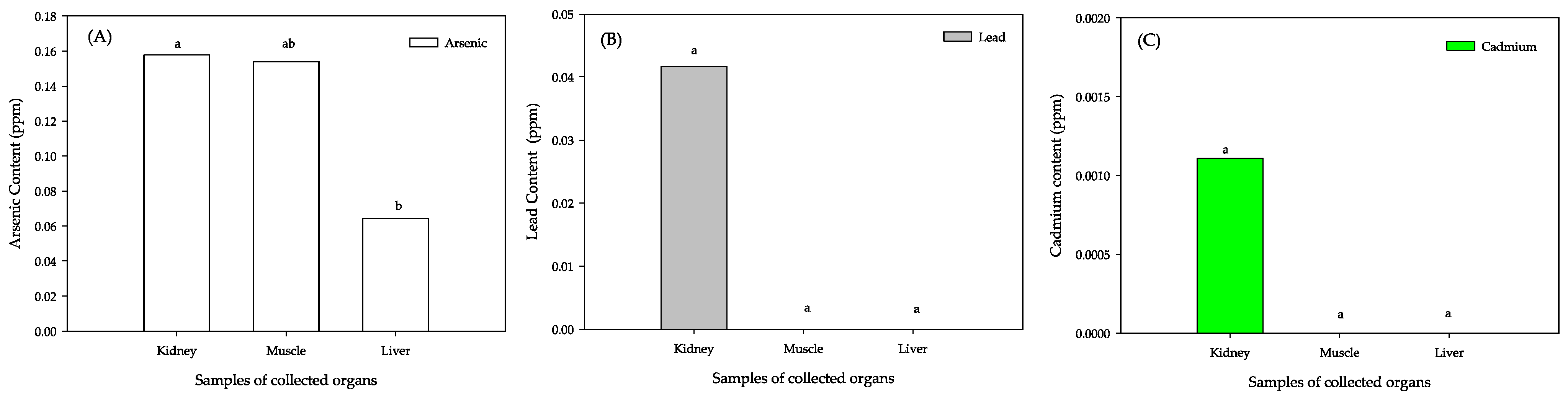
For risk calculations, mean element concentrations measured in edible tissues were used (Figure 2). The tissue concentrations are presented on a wet-weight basis (ww; as consumed) after correction using the measured tissue moisture content. The mean arsenic concentrations were as follows: muscle = 0.1538 mg kg−1, kidney = 0.1577 mg kg−1, and liver = 0.0644 mg kg−1 (Figure 2A). Lead and cadmium were <LOQ in muscle (Figure 2B,C) and were treated as nondetects using both a lower-bound approach (LB; C = 0) and an upper-bound approach (UB; C = LOQ/2 and C = LOQ) to account for uncertainty associated with censored data. For offal, the kidney contained measurable lead (0.0415 mg kg−1) and cadmium (0.0011 mg kg−1), which were included in the offal exposure estimates, whereas the liver Pb and Cd concentrations were <LOQ and were handled using LB/UB scenarios.
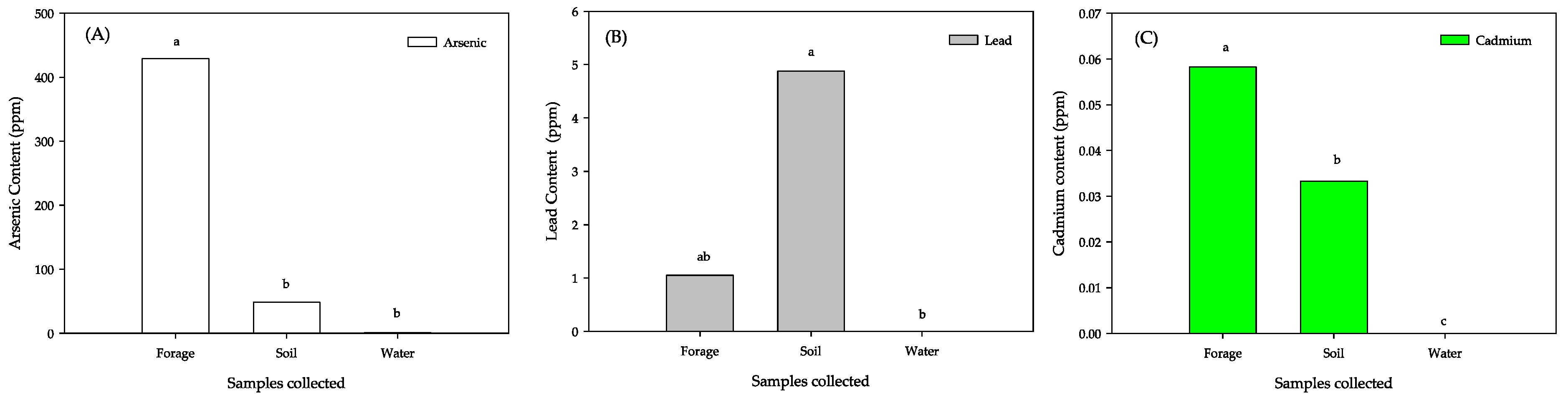
Figure 2.
Mean concentrations of arsenic (A), lead (B), and cadmium (C) in environmental matrices (forage, soil, and surface water) from the Ite coastal wetland (Tacna, Peru). Soil and forage concentrations are expressed as mg kg−1 (dry weight), whereas water concentrations are expressed as mg L−1. Bars with different letters indicate significant differences according to Tukey’s test (p < 0.05).
For dietary intake, a high-meat-consumption scenario (IR = 0.30 kg day−1 of muscle) and a central scenario (IR = 0.10 kg day−1 of muscle) were evaluated for adult body weight (BW = 70 kg) on the basis of rural dietary patterns and food-consumption studies [41,42]. Given that the liver and kidney (offal) are also consumed in Peru, an additional reference offal scenario was computed, assuming that IR = 0.10 kg day−1 for the liver or kidney; the EDI, HQ, and MOE scale are linearly related to the assumed intake rate.
The applied formula was as follows:
where
EDI = (C × IR)/BW
C is the PTE concentration in the edible tissue (mg kg−1, wet weight unless stated otherwise);
IR is the daily intake rate of the evaluated tissue (kg day−1);
BW is the body weight (kg).
The hazard quotient (HQ) is used to screen for potential noncarcinogenic risk by comparing the estimated exposure (EDI) with the chronic oral reference dose (RfD) [39]. HQ values > 1 suggest potential concern and warrant risk-management attention.
where
HQ = EDI/RfD
RfD is the chronic oral reference dosage (mg/kg/day) [39].
The margin of exposure (MOE) is recommended by the EFSA for the risk characterization of genotoxic and carcinogenic substances. MOE is calculated as the ratio between a benchmark dose lower confidence limit (BMDL) and the estimated daily intake (EDI). Because arsenic speciation was not performed (only total As was quantified), the MOE for inorganic arsenic (iAs) was estimated using total As as an upper-bound proxy and through sensitivity scenarios for the iAs fraction in tissues (fiAs = 0.10, 0.25, 0.50, and 1.00). This approach reflects EFSA discussions indicating that the inorganic fraction in animal-derived foods is typically well below 100% but can vary by context; therefore, 100% of iAs is retained as a conservative screening case [29,40]. For inorganic arsenic, EFSA has reported BMDL values in the range of 0.0003–0.008 mg kg−1 day−1 derived from epidemiological studies; in this study, the lower bound (BMDL0.5 = 0.0003 mg kg−1 day−1) was adopted for conservative screening [29].
The MOE was calculated as follows: MOE = BMDL0.5/EDI.
3. Results
3.1. Potentially Toxic Element Concentrations in Environmental Matrices
The mean concentrations of As, Pb, and Cd were quantified in forage, soil, and surface water collected from six georeferenced grazing sites in the Ite coastal wetland. One-way ANOVA indicated significant differences among the matrices for all three elements (Table 1).
Table 1.
One-way analysis of variance (ANOVA) for arsenic, lead, and cadmium concentrations among environmental matrices (soil, water, and forage) in the Ite coastal wetland, Tacna region, Peru (n = 6 sampling points).
Overall variability was high for arsenic and lead (CV > 50%), which is consistent with heterogeneous spatial contamination within the wetland system. This dispersion suggests the presence of contamination hotspots and warrants site-resolved interpretation in addition to overall means.
To support the interpretation of spatial heterogeneity, site-specific concentrations for soil, water, and forage (As, Pb, and Cd) are summarized and ranked across the six sites, allowing the identification of potential contamination hotspots within the wetland. These rankings are intended as descriptive support and should be interpreted alongside local hydrology and land use information.
The mean element concentrations by matrix (soil and forage in mg kg−1 dry weight; water in mg L−1) are summarized in Figure 2. Arsenic concentrations were highest in forage (428.6 mg kg−1), followed by soil (48.61 mg kg−1) and surface water (0.97 mg L−1). The lead concentration was highest in the soil (4.88 mg kg−1) relative to that in the forage (1.05 mg kg−1), whereas the lead concentration in the water was below the reporting limit (<LOQ). Cadmium concentrations were low in all the matrices, with the highest mean in the forage treatment (0.0583 mg kg−1), followed by the soil treatment (0.0333 mg kg−1), and the cadmium concentration in the water was <LOQ. Overall, the magnitude of contamination was As >> Pb > Cd.
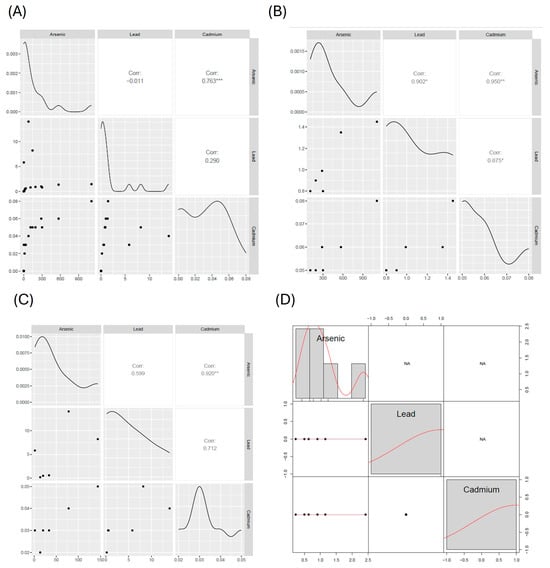
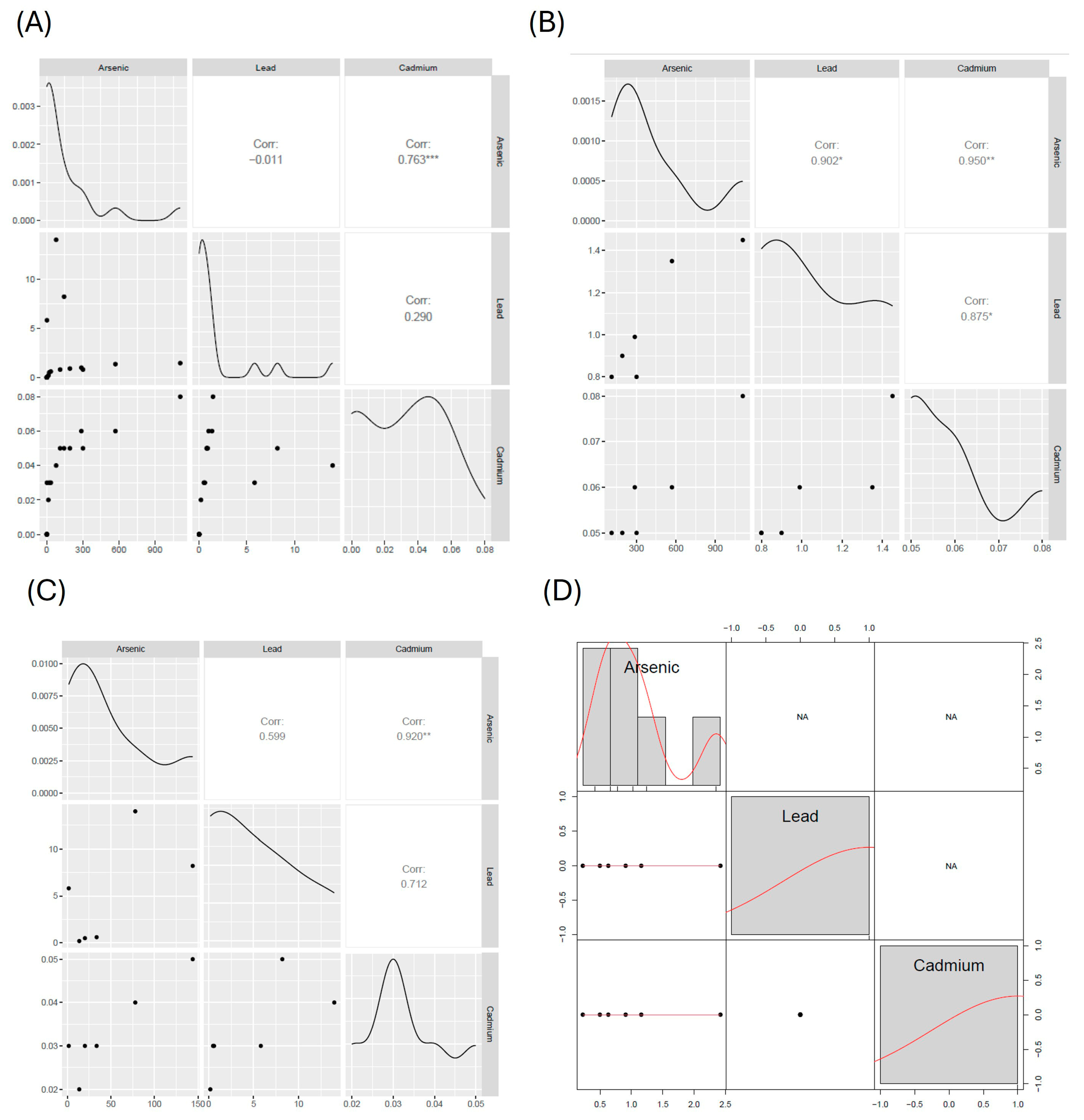
Element associations were explored using Pearson correlations (Figure 3A–D) and were cross-checked using nonparametric Spearman correlations as a sensitivity analysis because some values were close to or below the LOQ. Across all the environmental data, As and Cd were positively correlated (Pearson r = 0.763, p < 0.01). Strong positive correlations were observed for As × Pb (r = 0.902, p < 0.05), As × Cd (r = 0.950, p < 0.01), and Pb × Cd (r = 0.875, p < 0.05) within the forage. Within the soil, As and Cd were also strongly correlated (r = 0.92, p < 0.01), whereas the correlations for the other pairs were not significant. Within water, Pb and Cd were <LOQ, and only As was quantified; therefore, within-water correlations were not informative.
Figure 3.
Pearson correlation analysis of arsenic, lead, and cadmium concentrations in environmental matrices: all samples combined (A), forage only (B), soil only (C), and water only (D) from the Ite coastal wetland, Tacna region, Peru. The correlation values with the symbols *, **, *** and NA represent significant differences at 0.5, 0.1, 0.01% and absence of correlation, respectively. The diagonal of the figure represents the frequency of the data, and the curve is associated with the distribution of the data. Below the diagonal, the circles with a white background represent the combination of the data for each pair of variables, and the red line represents the curve associated with the distribution of these values.
Screening Transfer Factors and Bioaccumulation Ratios
To support the interpretation of trophic transfer, screening transfer factors were calculated as simple ratios of mean concentrations. Using dry-weight means for soil and forage, the soil-to-forage transfer factor (TFsoil->forage = Cforage/Csoil) was 8.82 for As, 0.22 for Pb, and 1.75 for Cd. When forage was used as the immediate exposure medium, the forage-to-tissue ratios (Ctissue/Cforage) for As were 3.68 × 10⁻⁴ (kidney), 3.59 × 10⁻⁴ (muscle), and 1.50 × 10⁻⁴ (liver). For Pb and Cd, the kidney forage-to-tissue ratios were 3.95 × 10⁻² and 1.89 × 10⁻², respectively, whereas the muscle and liver ratios could not be computed because Pb and Cd were <LOQ. With respect to water, when mg L−1 was treated at approximately mg kg−1 (water density ≈ 1), the water-to-tissue ratios for As were 0.163 (kidney), 0.159 (muscle), and 0.066 (liver). Because forage concentrations are reported on a dry-weight basis whereas tissue concentrations are reported on a wet-weight basis, these ratios should be interpreted as screening indicators rather than formal bioaccumulation factors; site-specific calculations using consistent concentration bases are recommended.
3.2. Potentially Toxic Element Concentrations in Sheep Tissues
The tissue concentrations of As, Pb, and Cd were evaluated according to organ (liver, kidney, and muscle) and sex (female and male). The dataset included [n = 7] females and [n = 11] males (total n = 18 sheep) sampled as three animals per site. Two-way ANOVA indicated no organ × sex interaction for any element (Table 2). Because the animals were clustered within sites, organ and sex effects should be interpreted with attention to potential within-site dependence (Section 2.3).
Table 2.
Two-way ANOVA for arsenic, lead, and cadmium concentrations in sheep tissues considering organ (liver, kidney, muscle) and sex (female, male) for sheep from the Ite coastal wetland, Tacna region, Peru.
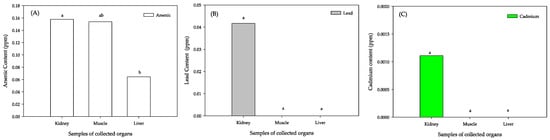
The mean concentrations of As, Pb, and Cd among the sheep organs are compared in Figure 4. Ar-extractable As showed an organ-dependent distribution, with the highest mean in the kidney (0.1577 mg kg−1), followed closely by that in the muscle (0.1538 mg kg−1) and then that in the liver (0.0644 mg kg−1), with significant differences among organs (p < 0.05). In contrast, the levels of lead and cadmium did not differ among organs (p > 0.05). Lead was quantifiable in the kidney (0.0415 mg kg−1) but was <LOQ in the muscle and liver (Figure 4B). Cadmium was quantifiable only in the kidney (0.0011 mg kg−1), while it was <LOQ in the muscle and liver (Figure 4C). The near-equal kidney and muscle arsenic concentrations are discussed in Section 4 in terms of exposure patterns and analytical/processing considerations.
Figure 4.
Mean concentrations of arsenic (A), lead (B), and cadmium (C) in sheep organs (liver, kidney, muscle) from sheep raised in the Ite coastal wetland (Tacna, Peru). Bars with different letters indicate significant differences according to Tukey’s test (p < 0.05).
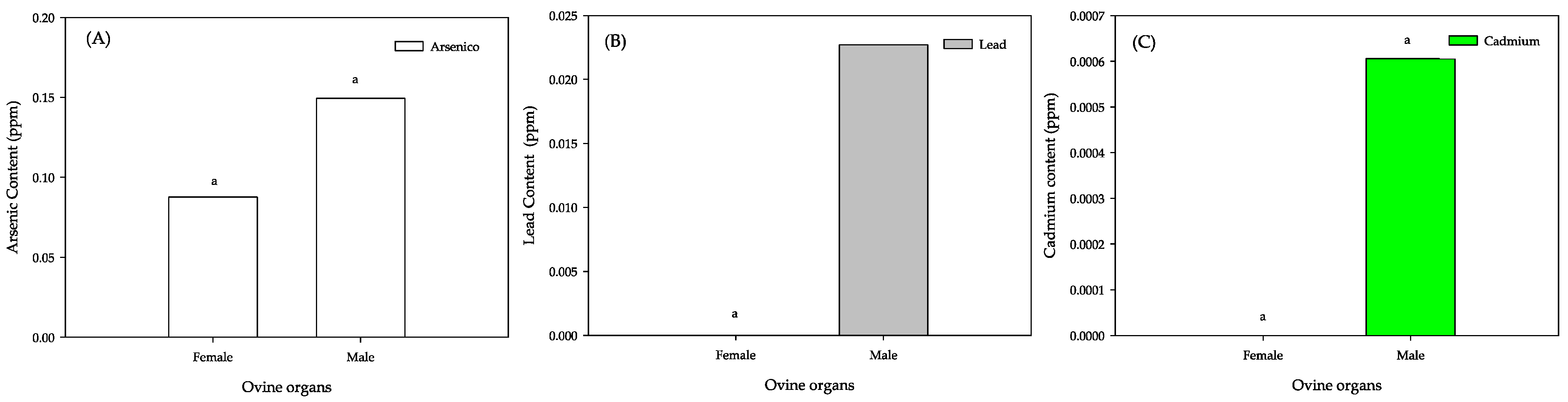
When the sexes were compared, no significant differences were detected for the arsenic, lead, or cadmium concentrations (Figure 5A–C; p > 0.05). Although the mean values tended to be slightly higher in males for some elements, the effect size was small and not statistically supported.
Figure 5.
Mean concentrations of arsenic (A), lead (B), and cadmium (C) in sheep tissues by sex (female vs. male) for sheep raised in the Ite coastal wetland (Tacna, Peru). Bars with different letters indicate significant differences according to Tukey’s test (p < 0.05).
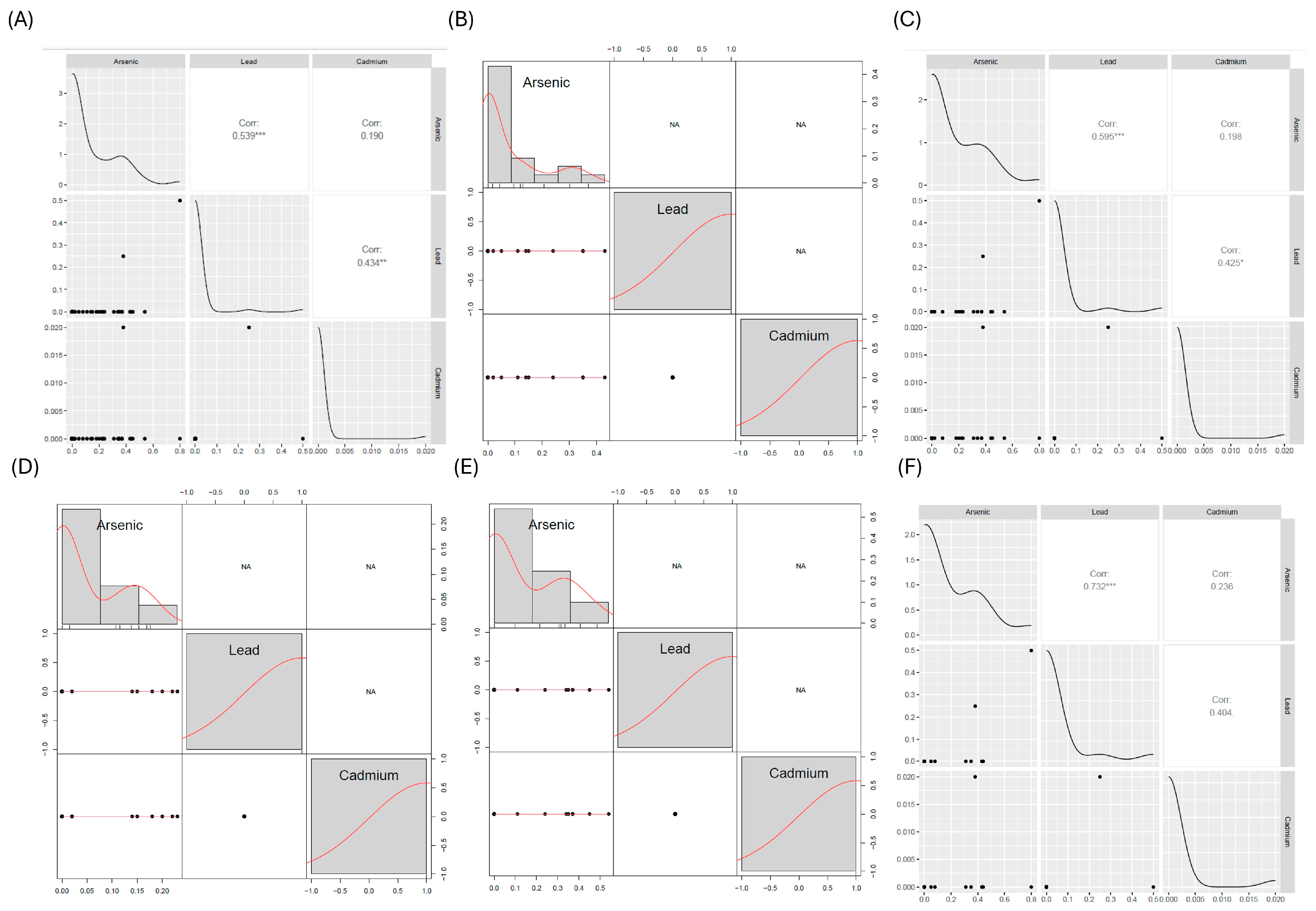
Element associations in tissues are shown in Figure 6. Pearson correlations were computed and cross-checked using Spearman correlations because the Pb and Cd concentrations were close to the LOQ in several tissues. Considering all tissue samples together (Figure 6A), arsenic was positively correlated with lead (r = 0.539, p < 0.001), and lead was positively correlated with cadmium (r = 0.434, p < 0.01).
Figure 6.
Pearson correlation analysis of arsenic, lead, and cadmium concentrations in sheep tis-sues: all samples combined (A), females only (B), males only (C), and stratified by organ (liver (D), muscle (E), and kidney (F)) for sheep from the Ite coastal wetland (Tacna, Peru). The correlation values with the symbols *, **, *** and NA represent significant differences at 0.5, 0.1, 0.01% and absence of correlation, respectively. The diagonal of the figure represents the frequency of the data, and the curve is associated with the distribution of the data. Below the diagonal, the circles with a white background represent the combination of the data for each pair of variables, and the red line represents the curve associated with the distribution of these values.
In males (Figure 6C), the correlation pattern was similar to that observed in the overall dataset, with positive correlations for As × Pb (r = 0.595, p < 0.001) and Pb × Cd (r = 0.425, p < 0.05). Among organs, only kidney samples (Figure 6F) showed a significant As × Pb correlation (r = 0.732, p < 0.001). No significant correlations were detected in females or within liver and muscle subsets, likely because of reduced variability and/or values close to the reporting limit.
3.3. Human Health Risk Assessment
On the basis of potentially toxic element (PTE) concentrations measured in the edible tissues of sheep from the Ite coastal wetland, human dietary risk was screened using the estimated daily intake (EDI), hazard quotient (HQ), and margin of exposure (MOE) approaches following international guidance (U.S. EPA and EFSA). Screening was performed for muscle (meat) under central- and high-consumption scenarios and for liver and kidney (offal) using a reference offal-serving scenario. Uncertainty from nondetects (<LOQ) was addressed using lower-bound (LB) and upper-bound (UB) approaches, and uncertainty in arsenic speciation was addressed through sensitivity scenarios for the inorganic arsenic fraction (fiAs).
3.4. Estimated Daily Intake (EDI)
For an adult with a body weight of 70 kg, the estimated daily intake (EDI) of arsenic from sheep muscle was 0.00066 mg kg−1 day−1 under the high-consumption scenario (IR = 0.30 kg day−1) and 0.00022 mg kg−1 day−1 under the central-consumption scenario (IR = 0.10 kg day−1) (Table 3). The lead and cadmium concentrations in muscle were below the limit of quantification (<LOQ); therefore, their EDIs were assumed to be zero under the lower-bound (LB) scenario, whereas upper-bound (UB) EDIs were conservatively estimated by considering concentrations close to the analytical quantification limit.
Table 3.
Element concentrations in sheep muscle and estimated daily intake (EDI) for adult human consumption under central (IR = 0.10 kg day−1) and high-meat-consumption (IR = 0.30 kg day−1; BW = 70 kg) scenarios. For Pb and Cd, the muscle concentrations were <LOQ; the lower bound (LB) scenario assumed C = 0, and the upper bound (UB) scenario used C = LOQ/2 and C = LOQ.
Under the reference offal-consumption scenario (IR = 0.10 kg day−1 of kidney or liver), the arsenic EDIs were 0.00023 mg kg−1 day−1 for kidney and 0.000092 mg kg−1 day−1 for liver. In addition, the kidney Pb and Cd EDIs were 0.000059 mg kg−1 day−1 and 0.000002 mg kg−1 day−1, respectively, whereas the Pb and Cd concentrations in the liver were <LOQ and were evaluated using lower- and upper-bound (LB/UB) approaches (Table 4).
Table 4.
Hazard quotient (HQ) estimates for the consumption of sheep meat (muscle) contaminated with As, Pb, and Cd under high (IR = 0.30 kg day−1) and moderate (IR = 0.10 kg day−1) meat consumption scenarios (body weight, BW = 70 kg). For Pb and Cd, the muscle concentrations were <LOQ; the lower-bound (LB) estimates assume C = 0, whereas the upper-bound (UB) scenarios assume C = LOQ/2 and C = LOQ.
3.5. Risk Quotient (Hazard Quotient, HQ)
In the HQ screening for sheep meat (muscle), arsenic exceeded the unity threshold only under the high-consumption scenario (HQ = 2.20), whereas the central-consumption scenario yielded HQ = 0.73 (Table 4). These results indicate that noncarcinogenic concern for arsenic is sensitive to the assumed intake rate. The lead and cadmium concentrations in muscle were below the limit of quantification (<LOQ); therefore, their HQ values were considered to be zero under the lower-bound (LB) scenario, whereas the potential risk under the upper-bound (UB) scenario was conservatively estimated by assuming concentrations close to the analytical quantification limit.
3.6. Margin of Exposure (MOE) for Arsenic
When the selected BMDL0.5 value for inorganic arsenic was used, the MOE for sheep muscle was 0.46 under the high-consumption scenario and 1.37 under the central-consumption scenario under the conservative upper-bound assumption of 100% iAs (i.e., total As was used as a proxy for iAs). MOE values close to or below 1 indicate a limited margin of safety under the selected benchmark dose. With respect to the offal-consumption scenario, the MOE values under the same upper-bound assumption were 1.33 for the kidney and 3.26 for the liver (Table 5). Because the true inorganic fraction in edible tissues is likely less than 100% and variable, Table 6 provides scenario-based sensitivity analyses for fiAs.
Table 5.
Screening-level EDI, HQ, and MOE estimates for As, Pb, and Cd based on kidney and liver (offal) under a reference offal-consumption scenario (IR = 0.10 kg day−1; BW = 70 kg). For liver Pb and Cd (<LOQ), values are shown as LB/UB(LOQ/2)/UB(LOQ) to bracket nondetectable uncertainty. For arsenic, the MOE values correspond to the conservative upper-bound assumption of 100% inorganic As unless otherwise stated.
Table 6.
Sensitivity analysis for the inorganic arsenic (iAs) fraction (fiAs) in sheep tissues under different consumption scenarios. HQ and MOE are shown for fiAs = 0.10, 0.25, 0.50, and 1.00 (100% iAs as a conservative upper bound).
3.7. Public Health Implications
Taken together, the EDI, HQ, and MOE results identify arsenic as the principal element of concern for dietary exposure through sheep products in the study area. Under the high-meat-consumption scenario (300 g day−1), the HQ > 1 and MOE < 1 did not meet the conservative 100% iAs assumption; however, the central-consumption scenario (100 g day−1) yielded HQ < 1 and MOE > 1 (Table 3 and Table 4). Under the reference of offal-consumption scenario (100 g day−1 of kidney or liver), the HQ was <1 and the MOE was >1 under the same conservative assumption (Table 5). Lead and cadmium were <LOQ in muscle (and liver) and therefore yielded EDI and HQ values of zero under the LB scenario, whereas the kidney contained measurable Pb and Cd, resulting in HQ values of 0.017 and 0.0016, respectively (Table 5). Because offal is consumed in Peru, the liver and kidney provide a more complete screening of exposure beyond muscle alone. Importantly, screening-level risk estimates are sensitive to assumptions about intake rates, body weight, analytical censoring (<LOQ), and (for arsenic) chemical speciation; thus, the scenario analyses in Table 6 should be used to guide risk-management prioritization and to motivate arsenic speciation and expanded exposure characterization.
From a risk-management perspective, the results support strengthening food surveillance in local markets, implementing grazing restrictions or rotational grazing in the most contaminated zones, and prioritizing remediation measures in the wetland (e.g., phytoremediation and soil amendments) to reduce bioavailable arsenic. To reduce uncertainty in MOE-based characterization, future work should incorporate arsenic speciation (inorganic fraction) in water, forage, and tissues and refine dietary exposure estimates using locally representative consumption data for both meat and offal (portion size and frequency).
4. Discussion
Overall, the results indicate pronounced contamination by arsenic (As) in the Ite coastal wetland and evidence of transfer from environmental matrices (soil, water, and forage) to sheep tissues. The levels of lead (Pb) and cadmium (Cd) were generally lower than those of arsenic in both environmental matrices and tissues; nevertheless, Pb and Cd were quantifiable in the kidney and therefore remained relevant from a food safety perspective in settings where offal is consumed.
The As concentrations in soil (48.61 mg kg−1) exceeded the Peruvian guideline value for agricultural soils (17 mg kg−1; Supreme Decree No. 011-2017-MINAM [43]) by nearly threefold, indicating substantial enrichment. Although the EU Directive 86/278/EEC [44] does not specify a limit for arsenic, background concentrations in agricultural soils are often reported in the range of 6–20 mg kg−1, and values above ~20 mg kg−1 are typically considered elevated. The soil concentration in Ite also slightly exceeded the ecological screening level proposed for mammals (46 mg kg−1) [45], suggesting potential relevance for grazing fauna. In contrast, soil lead (4.88 mg kg−1) and cadmium (0.0333 mg kg−1) concentrations were below national guideline values (70 and 1.4 mg kg−1, respectively) [43], which is consistent with a contamination profile dominated by arsenic.
The surface water contained 0.97 mg L−1 arsenic, nearly 100-fold higher than the Peruvian limit for irrigation water (0.01 mg L−1) [43] and the WHO guideline value for drinking water (0.01 mg L−1) [28]. Because the water samples were preserved without filtration, the measured concentrations represent the total recoverable arsenic (dissolved plus fine particulate-associated fractions). Given the arid climate and high evaporation during the dry season, wetland hydrochemistry may further concentrate on arsenic [25,26]. The National Research Council [46] recommends a maximum tolerable arsenic concentration of 0.2 mg L−1 for livestock; therefore, the levels measured in this wetland represent a plausible exposure source for grazing animals and a potential driver of arsenic loading to soils and vegetation [47]. A simple intake-based mass balance illustrates plausibility: if an adult sheep consumes approximately 2–6 L day−1 of water, the arsenic intake from water alone would be ~1.9–5.8 mg day−1 at 0.97 mg L−1, in addition to forage ingestion. The screening water-to-tissue ratios for As (water-to-kidney ≈ 0.163; Section Screening Transfer Factors and Bioaccumulation Ratios) support the interpretation that water contributes meaningfully to chronic exposure, although site-specific modeling and arsenic speciation would be needed to quantify this pathway more accurately.
Forage species consumed by sheep (Cynodon dactylon, Paspalum vaginatum, and Distichlis spicata) presented extremely high arsenic concentrations (428.6 mg kg−1, dry weight), exceeding the maximum level of 2 mg kg−1 for arsenic in feeding stuffs established in the EU Directive 2002/32/EC [48] by more than two orders of magnitude. Such levels indicate that forage is a primary exposure vector for sheep in the system. Given the extraordinary magnitude, stringent QA/QC documentation is essential, including plant-matrix CRM recoveries, matrix-specific LOD/LOQ, and confirmation that concentrations are reported on a dry-weight basis. In addition, even after washing, the external deposition of arsenic-rich dust or adhered soil particles can increase the apparent forage concentrations; thus, future work could compare washed vs. unwashed subsamples, apply standardized sequential washing protocols, and/or confirm the results with an independent technique (e.g., ICP–MS) to increase the credibility of the results. In contrast, forage lead (1.05 mg kg−1) and cadmium (0.0583 mg kg−1) remained below typical European feed limits (10 mg kg−1 for Pb and 1 mg kg−1 for Cd), suggesting that the dominant feed-related risk is driven by arsenic.
Although legacy mining liabilities are a plausible dominant source of arsenic in the Ite wetland, other anthropogenic sources can also contribute to elevated arsenic in soils and vegetation. Historically, arsenical pesticides (e.g., lead arsenate and other arsenite/arsenate formulations) and some wood preservatives have been used in agriculture and can leave persistent soil arsenic residues that may be taken up by plants or transferred via soil/dust adherence. No site-specific information on pesticide application was collected in this study; therefore, source attribution remains uncertain and should be investigated by compiling local land use history, interviewing producers, and applying source-tracing approaches (e.g., arsenic speciation and co-occurrence patterns with mining-associated elements) [49].
Arsenic was quantified in sheep kidney (0.1577 mg kg−1), muscle (0.1538 mg kg−1), and liver (0.0644 mg kg−1), whereas Pb and Cd occurred at substantially lower concentrations. Both Pb and Cd were below the limit of quantification (<LOQ) in muscle and liver but remained quantifiable in kidney (Pb: 0.0415 mg kg−1; Cd: 0.0011 mg kg−1), supporting the interpretation that kidney is a more informative sentinel tissue than skeletal muscle for low-level metal exposure under the environmental conditions evaluated [3,5,10]. Because liver and kidney are consumed in Peru, inclusion of offal in the dietary assessment materially strengthens the public-health relevance of the study and reduces the risk of underestimating exposure when evaluation is based on muscle alone [3,23].
From a human-health perspective, arsenic clearly emerged as the priority contaminant in the present screening assessment. Under the conservative upper-bound assumption that total As represented 100% inorganic arsenic (iAs), muscle consumption exceeded the non-carcinogenic screening benchmark only under the high-consumption scenario (HQ = 2.20), whereas the central-consumption scenario remained below the unity threshold (HQ = 0.73). Likewise, MOE was <1 under the high-consumption scenario (0.46) but >1 under the central scenario (1.37). By contrast, reference offal consumption (100 g day−1) yielded HQ < 1 and MOE > 1 for both kidney (HQ = 0.75; MOE = 1.33) and liver (HQ = 0.31; MOE = 3.26) under the same conservative assumption. Pb and Cd in muscle remained <LOQ, so their baseline risk estimates should be interpreted as lower-bound screening values rather than definitive evidence of absence of risk [29,39,40].
The scenario-based sensitivity analysis further indicates that risk characterization is strongly dependent on arsenic speciation. In particular, when the assumed inorganic fraction in tissue (fiAs) is 0.25 or lower, the HQ for muscle remains <1 even under the high-consumption scenario, underscoring that arsenic speciation is now a critical analytical priority for reducing uncertainty in the health assessment [29,40]. Accordingly, the present HQ and MOE results should be interpreted as protective, screening-level indicators rather than definitive estimates of consumer risk, and future work should quantify inorganic arsenic in water, forage, and tissues while refining exposure estimates with locally derived data on portion size, intake frequency, and offal consumption patterns [23,29,40].
The observed tissue distribution (kidney ≈ muscle > liver) is compatible with sustained environmental exposure; however, the near-equivalence between kidney and muscle arsenic warrants cautious interpretation. In ruminants and other food-producing animals, liver and kidney generally are expected to accumulate higher metal (loid) burdens than skeletal muscle because of their roles in filtration, biotransformation, and detoxification [3,5,10]. The present pattern should therefore be regarded as suggestive rather than definitive until supported by expanded QA/QC documentation, including matrix-matched CRM recoveries, replicate analyses, and, where feasible, orthogonal confirmation using an independent analytical platform. Potential non-exclusive explanations include quasi-steady-state accumulation in muscle under chronic exposure, residual exogenous contamination during slaughter or sample handling, matrix-related analytical bias, dry-to-wet weight conversion uncertainty, and biological heterogeneity associated with the limited sample size.
The high coefficients of variation observed for arsenic and lead in environmental matrices support the presence of marked spatial heterogeneity and possible contamination hotspots within the wetland. This has important scientific implications because hotspot-driven exposure can generate uneven livestock burdens even within the same grazing system, thereby complicating inference from pooled means alone. A site-resolved evaluation of the six georeferenced grazing areas, coupled with mixed-effects models that account for clustering of three sheep per site, would substantially strengthen both the ecological interpretation and the management relevance of the study. Overall, the data support a contamination pathway linking wetland soil, water, and forage to sheep tissues in a mining-impacted coastal ecosystem, with arsenic clearly emerging as the dominant contaminant across matrices. These findings support permanent monitoring of arsenic in watering sources and forage, grazing restriction or rotation in the most contaminated sectors, and the implementation of sustainable remediation measures aimed at reducing arsenic bioavailability and trophic transfer [14,15,27].
Across the current dataset, Pb and Cd behaved as secondary contaminants relative to arsenic: they were substantially lower across environmental matrices and remained <LOQ in sheep muscle, yet measurable kidney concentrations indicate that offal can still constitute an additional exposure pathway even when muscle is non-detect for these metals [3,23]. Collectively, these findings reinforce the need for an integrated One Health framework that links environmental surveillance, veterinary biomonitoring, and food-safety oversight to protect both ecosystem integrity and public health in the Ite wetland and similar mining-impacted coastal systems [3,15,27].
5. Conclusions
This study revealed that the Ite coastal wetland is markedly contaminated with arsenic, as evidenced by concentrations in soil, surface water, and forage that exceed the relevant guideline values. Arsenic was detected in the edible tissues of the sheep (kidney, liver, and muscle), indicating that it was transferred into the livestock food chain. Lead and cadmium were <LOQ in muscle (primary meat tissue), but the kidney contained measurable Pb and Cd (Pb: 0.0415 mg kg−1; Cd: 0.0011 mg kg−1), indicating that offal can contribute to dietary exposure for consumers who frequently eat organ meat.
According to the screening-level human health risk assessment, arsenic in sheep muscle exceeded the HQ unity threshold and produced a MOE < 1 only under the high-meat-consumption scenario (300 g day−1) when total arsenic was conservatively treated as inorganic arsenic (100% iAs). In contrast, the central-consumption scenario (100 g day−1) yielded HQ < 1 and MOE > 1. For offal (100 g day−1 of kidney or liver), the HQ was <1 and the MOE was >1 under the same conservative assumption, whereas kidney Pb and Cd yielded HQ values well below 1 (Table 5). Sensitivity analyses (Table 6) reveal that risk interpretation strongly depends on both consumption patterns and the inorganic fraction of arsenic in tissues, highlighting the need for arsenic speciation and locally representative consumption data. These findings support proactive risk-management actions, including targeted grazing management, the provision of low-arsenic water sources, remediation measures to reduce bioavailable arsenic, and the permanent monitoring of arsenic in forage and water.
Overall, the findings provide actionable evidence to inform environmental remediation, veterinary surveillance, and food safety monitoring in mining-impacted coastal wet lands and highlight the need for integrated interventions aligned with sustainable development and public health protection.
Author Contributions
Conceptualization, A.E.A.-C., D.E.K., W.S.A.Q., M.E.R.R., C.G.M.-A. and L.M.-A.; Methodology, A.E.A.-C., D.E.K., W.S.A.Q., M.E.R.R., N.M.L.-G., C.G.M.-A., Á.H.V., J.G.A., A.M.Z. and L.M.-A.; Software, A.E.A.-C., D.E.K., W.S.A.Q., M.E.R.R., N.M.L.-G., C.G.M.-A., Á.H.V., J.G.A., A.M.Z. and L.M.-A.; Validation, A.E.A.-C., D.E.K., W.S.A.Q., M.E.R.R., N.M.L.-G., C.G.M.-A., Á.H.V., J.G.A., A.M.Z. and L.M.-A.; Formal analysis, A.E.A.-C., D.E.K., W.S.A.Q., M.E.R.R., N.M.L.-G., C.G.M.-A., Á.H.V., J.G.A., A.M.Z. and L.M.-A.; Investigation, A.E.A.-C., D.E.K., W.S.A.Q., M.E.R.R., N.M.L.-G., C.G.M.-A., Á.H.V., J.G.A., A.M.Z. and L.M.-A.; Resources, A.E.A.-C., D.E.K., W.S.A.Q., M.E.R.R., N.M.L.-G., C.G.M.-A., Á.H.V., J.G.A., A.M.Z. and L.M.-A.; Data curation, A.E.A.-C., D.E.K., W.S.A.Q., M.E.R.R., N.M.L.-G., C.G.M.-A., Á.H.V., J.G.A., A.M.Z. and L.M.-A.; Writing—original draft, A.E.A.-C., D.E.K., W.S.A.Q., M.E.R.R., N.M.L.-G., C.G.M.-A., Á.H.V., J.G.A., A.M.Z. and L.M.-A.; Writing—review and editing, A.E.A.-C., D.E.K., W.S.A.Q., M.E.R.R., N.M.L.-G., C.G.M.-A., Á.H.V., J.G.A., A.M.Z. and L.M.-A.; Visualization, A.E.A.-C., D.E.K., W.S.A.Q., M.E.R.R., N.M.L.-G., C.G.M.-A., Á.H.V., J.G.A., A.M.Z. and L.M.-A.; Supervision, A.E.A.-C., D.E.K., A.M.Z. and L.M.-A.; Project administration, A.E.A.-C., D.E.K., W.S.A.Q., M.E.R.R., C.G.M.-A., Á.H.V., J.G.A., A.M.Z. and L.M.-A.; Funding acquisition, A.E.A.-C., D.E.K., W.S.A.Q., M.E.R.R., C.G.M.-A., Á.H.V. and L.M.-A. All authors have read and agreed to the published version of the manuscript.
Funding
The principal investigator expresses sincere gratitude for the funding provided through Mining Canon and Overcanon resources, administered by the Vice-Rectorate for Research of the National Jorge Basadre Grohmann University, under Rectoral Resolution No. 11174-2023-UNJBG, which supported the execution of the research project entitled “Traceability of Bioaccumulation and Concentration of Heavy Metals (Arsenic, Cadmium, and Lead) in Soil, Water, Forage, Viscera, and Muscle in Sheep (Ovis aries) from the Wetlands of Ite, Tacna Region.”.
Institutional Review Board Statement
The experimental protocol was approved by the Institutional Ethics Committee (Comité de Ética Institucional, CEI) of the National Jorge Basadre Grohmann University (UNJBG), Tacna, Peru (protocol code 2023-041-CEIUNJBG, approval date: 15 September 2023) and all animal experiments were performed according with the Directive 2010/63/EU. The written consent for inclusion in the study has been obtained from the owners.
Informed Consent Statement
Not applicable.
Data Availability Statement
The datasets generated and analyzed during the present study are not publicly available because of institutional and ethical restrictions but are available from the corresponding author upon reasonable request.
Acknowledgments
The authors gratefully acknowledge the valuable scientific support provided by the Biological Chemistry and Pharmacology area of the Catholic University of Cuyo (Argentina). Without these contributions, this research would not have been possible.
Conflicts of Interest
The authors declare that they have no conflicts of interest.
References
- Tchounwou, P.B.; Yedjou, C.G.; Patlolla, A.K.; Sutton, D.J. Heavy metal toxicity and the environment. Exp. Suppl. 2012, 101, 133–164. [Google Scholar] [PubMed]
- Das, S.; Sultana, K.W.; Ndhlala, A.R.; Mondal, M.; Chandra, I. Heavy metal pollution in the environment and its impact on health: Exploring green technology for remediation. Environ. Health Insights 2023, 17, 11786302231201259. [Google Scholar] [CrossRef] [Scilit] [PubMed]
- EFSA Panel on Biological Hazards (BIOHAZ). Scientific opinion on the public health hazards to be covered by inspection of meat from sheep and goats. EFSA J. 2013, 11, 3265. [Google Scholar] [CrossRef] [Scilit]
- Khan, Z.I.; Muhammad, F.G.; Ahmad, K.; Alwahibi, M.S.; Yang, H.-H.; Ishfaq, M.; Anjum, S.; Ali, K.; Iqbal, K.; Radicetti, E.; et al. Nickel toxicology testing in alternative specimen from farm ruminants in an urban polluted environment. J. King Saud Univ. Sci. 2024, 36, 103520. [Google Scholar] [CrossRef] [Scilit]
- Fechete, F.I.; Popescu, M.; Mârza, S.M.; Olar, L.E.; Papuc, I.; Beteg, F.I.; Purdoiu, R.C.; Codea, A.R.; Lăcătuș, C.M.; Matei, I.R.; et al. Spatial and bioaccumulation of heavy metals in a sheep-based food system: Implications for human health. Toxics 2024, 12, 752. [Google Scholar] [CrossRef] [Scilit]
- Hussain, M.I.; Naeem, M.; Khan, Z.I.; Akhtar, S.; Nadeem, M.; Alnuwaiser, M.A.; Ahmad, K.; Vicente, O.; Yang, H.-H. Cadmium (Cd) and copper (Cu) exposure and bioaccumulation arrays in farm ruminants. Sustainability 2022, 14, 12595. [Google Scholar] [CrossRef] [Scilit]
- Ebrahimi, M.; Khalili, N.; Razi, S.; Keshavarz-Fathi, M.; Khalili, N.; Rezaei, N. Effects of lead and cadmium on the immune system and cancer progression. J. Environ. Health Sci. Eng. 2020, 18, 335–343. [Google Scholar] [CrossRef] [Scilit]
- Shetty, B.R.; Jagadeesha, P.B.; Salmataj, S.A. Heavy metal contamination and its impact on the food chain. CyTA J. Food 2025, 23, e2438726. [Google Scholar] [CrossRef] [Scilit]
- Scutarașu, E.C.; Trincă, L.C. Metales pesados en alimentos y bebidas. Foods 2023, 12, 3340. [Google Scholar] [CrossRef] [Scilit]
- Afzal, A.; Mahreen, N. Emerging insights into the impacts of heavy metals exposure on livestock. Front. Pharmacol. 2024, 15, 1375137. [Google Scholar] [CrossRef] [Scilit]
- Aladesanmi, O.T.; Oroboade, J.G.; Osisiogu, C.P.; Osewole, A.O. Bioaccumulation factor of selected heavy metals in Zea mays. J. Health Pollut. 2019, 9, 191207. [Google Scholar] [CrossRef] [Scilit]
- El-Sharkawy, M.; Alotaibi, M.O.; Li, J.; Du, D.; Mahmoud, E. Contaminación por metales pesados en entornos costeros: Implicaciones ecológicas y estrategias de gestión: Una revisión. Sustainability 2025, 17, 701. [Google Scholar] [CrossRef] [Scilit]
- Jezycki, K.E.; Rodriguez, E.; Craft, C.B.; Neubauer, S.C.; Morris, J.T.; Goldsmith, S.T.; Kremer, P.; Weston, N.B. Metal accumulation in salt marsh soils along the East Coast of the United States. Sci. Total Environ. 2024, 922, 171025. [Google Scholar] [CrossRef] [Scilit] [PubMed]
- Cacciuttolo, C.; Cano, D.; Custodio, M. Socioenvironmental risks linked with mine tailings chemical composition. Toxics 2023, 11, 462. [Google Scholar] [CrossRef] [Scilit] [PubMed]
- Panda, B.P.; Mohanta, Y.K.; Paul, R.; Prusty, B.A.K.; Parida, S.P.; Pradhan, A.; Saravanan, M.; Patowary, K.; Jiang, G.; Joshi, S.J.; et al. Environmental and carcinogenic health hazards from heavy metal contamination in wetlands. Sci. Rep. 2023, 13, 16314. [Google Scholar] [CrossRef] [Scilit]
- Pandiyan, J.; Mahboob, S.; Govindarajan, M.; Al-Ghanim, K.A.; Ahmed, Z.; Al-Mulhm, N.; Jagadheesan, R.; Krishnappa, K. Heavy metals in water, sediment and aquatic organisms. Saudi J. Biol. Sci. 2021, 28, 1218–1225. [Google Scholar] [CrossRef] [Scilit]
- Toledo, S.; Aponte, H.; Gil, F. La conservación de los humedales peruanos: Un análisis de su legislación, sanciones y consecuencias. Rev. Kawsaypacha Soc. Medio Ambiente 2023, 11, A-004. [Google Scholar] [CrossRef] [Scilit]
- Ullah, W.; Ahmad, K.; Rehman, G.; Ullah, K.; Kebaili, I.; Majeed, A.; Subhanullah, M.; Rawan, B.; Hussain, S. Impactos de los metales pesados en los antioxidantes de la sangre de vaca de áreas irrigadas con aguas residuales. Sci. Rep. 2024, 14, 16918. [Google Scholar] [CrossRef] [Scilit] [PubMed]
- Shen, X.; Chi, Y.; Xiong, K. Effect of heavy metal contamination near zinc smelting. PLoS ONE 2019, 14, e0207423. [Google Scholar] [CrossRef] [Scilit]
- Orosun, M.M.; Nwabachili, S.; Alshehri, R.F.; Omeje, M.; Alshdoukhi, I.F.; Okoro, H.K.; Ogunkunle, C.O.; Louis, H.; Abdulhamid, F.A.; Osahon, S.E.; et al. Toxic metals in irrigation systems. Sci. Rep. 2023, 13, 21220. [Google Scholar] [CrossRef] [Scilit]
- Nag, R.; Cummins, E. Human health risk assessment of lead. Sci. Total Environ. 2022, 810, 151168. [Google Scholar] [CrossRef] [Scilit]
- Comisión Europea. Directiva 2002/32/CE del Parlamento Europeo y del Consejo, de 7 de Mayo de 2002, Sobre Sustancias Indeseables en los Piensos; Diario Oficial de las Comunidades Europeas: Brussels, Belgium, 2002; Volume L140, pp. 10–22. Available online: https://eur-lex.europa.eu/legal-content/ES/TXT/?uri=celex%3A32002L0032 (accessed on 20 January 2025).
- Abd-Elghany, S.M.; Mohammed, M.A.; Abdelkhalek, A.; Saad, F.S.S.; Sallam, K.I. Health risk assessment from sheep meat. J. Food Prot. 2020, 83, 503–510. [Google Scholar] [CrossRef] [Scilit]
- Johnsen, I.V.; Aaneby, J. Soil intake in ruminants grazing contaminated ranges. Sci. Total Environ. 2019, 687, 41–49. [Google Scholar] [CrossRef] [Scilit] [PubMed]
- Dold, B.; Diaby, N.; Spangenberg, J.E. Remediation of a marine shore tailings deposit and the importance of water-rock interaction on element cycling in the coastal aquifer. Environ. Sci. Technol. 2011, 45, 4876–4883. [Google Scholar] [CrossRef] [Scilit] [PubMed]
- Diaby, N.; Dold, B. Evolution of Geochemical and Mineralogical Parameters during In Situ Remediation of a Marine Shore Tailings Deposit by the Implementation of a Wetland Cover. Minerals 2014, 4, 578–602. [Google Scholar] [CrossRef] [Scilit]
- Gaur, V.K.; Sharma, P.; Gaur, P.; Varjani, S.; Ngo, H.H.; Guo, W.; Chaturvedi, P.; Singhania, R.R. Sustainable mitigation of heavy metals. Bioengineered 2021, 12, 7297–7313. [Google Scholar] [CrossRef] [Scilit]
- World Health Organization. Guidelines for Drinking-Water Quality, 4th ed.; WHO Press: Geneva, Switzerland, 2021; Available online: https://www.who.int/publications/i/item/9789241548151 (accessed on 10 January 2025).
- European Food Safety Authority (EFSA). Scientific opinion on arsenic in food: Dietary exposure, health effects and risk characterization. EFSA J. 2023, 21, 8133. [Google Scholar] [CrossRef] [Scilit]
- U.S. Environmental Protection Agency. Risk Assessment Guidance for Superfund: Volume I—Human Health Evaluation Manual (RAGS Part A); Office of Emergency and Remedial Response: Washington, DC, USA, 1989. Available online: https://www.epa.gov/risk/risk-assessment-guidance-superfund-rags-part (accessed on 20 January 2025).
- Ministerio del Ambiente del Perú (MINAM). Guía para el Muestreo de Suelos Contaminados (Resolución N° 085-2014-MINAM); MINAM: Lima, Peru, 2014. Available online: https://www.minam.gob.pe/wp-content/uploads/2014/04/GUIA-MUESTREO-SUELO_MINAM1.pdf (accessed on 15 January 2025).
- Autoridad Nacional del Agua (ANA). Protocolo Nacional para el Monitoreo de la Calidad de los Recursos Hídricos Superficiales; ANA: Lima, Peru, 2016. Available online: https://www.ana.gob.pe/publicaciones/protocolo-nacional-para-el-monitoreo-de-la-calidad-de-los-recursos-hidricos-0 (accessed on 20 January 2025).
- Food and Agriculture Organization of the United Nations (FAO). Guidelines for Sampling and Analysis of Animal Feed Materials; FAO: Rome, Italy, 2017; Available online: https://www.fao.org/4/i1379e/i1379e05.pdf (accessed on 20 January 2025).
- Latimer, G.W., Jr. (Ed.) Official Methods of Analysis of AOAC INTERNATIONAL, 22nd ed.; AOAC Publications: New York, NY, USA, 2023. [Google Scholar] [CrossRef] [Scilit]
- Servicio Nacional de Sanidad Agraria (SENASA). Reglamento Sanitario del Faenado de Animales de Abasto; Ministerio de Agricultura y Riego: Lima, Peru, 2015. Available online: https://www.senasa.gob.pe/senasa/descargasarchivos/2015/03/Reglamento-Sanitario-del-Faenado2.pdf (accessed on 25 January 2025).
- U.S. Environmental Protection Agency. Method 3015A (SW-846): Microwave Assisted Acid Digestion of Aqueous Samples and Extracts; U.S. EPA: Washington, DC, USA, 2007. Available online: https://www.epa.gov/sites/default/files/2015-12/documents/3015a.pdf (accessed on 25 January 2025).
- U.S. Environmental Protection Agency. Method 3050B: Acid Digestion of Sediments, Sludges, and Soils; U.S. EPA: Washington, DC, USA, 1996. Available online: https://www.epa.gov/sites/default/files/2015-06/documents/epa-3050b.pdf (accessed on 25 January 2025).
- Bhering, L.L. Rbio: A tool for biometric and statistical analysis using the R platform. Crop Breed. Appl. Biotechnol. 2017, 17, 187–190. [Google Scholar] [CrossRef] [Scilit]
- U.S. Environmental Protection Agency. Risk Assessment Guidance for Superfund: Volume I—Human Health Evaluation Manual (Part F); Office of Superfund Remediation and Technology Innovation: Washington, DC, USA, 2012. Available online: https://www.epa.gov/risk/risk-assessment-guidance-superfund-rags-part-f (accessed on 25 January 2025).
- EFSA Panel on Contaminants in the Food Chain (CONTAM). Update of the risk assessment of inorganic arsenic in food. EFSA J. 2024, 22, 8488. [CrossRef] [Scilit]
- FAO/WHO. Safety Evaluation of Certain Food Additives and Contaminants: Arsenic; WHO Food Additives Series No. 63; World Health Organization: Geneva, Switzerland, 2011; Available online: https://www.who.int/publications/i/item/9789241660631 (accessed on 25 January 2025).
- EFSA Panel on Contaminants in the Food Chain (CONTAM). Risk assessment of heavy metals in food. EFSA J. 2018, 16, 4972.
- Ministerio del Ambiente del Perú (MINAM). Decreto Supremo N.° 004-2017-MINAM: Estándares de Calidad Ambiental para Agua; MINAM: Lima, Peru, 2017. Available online: https://www.gob.pe/institucion/minam/normas-legales/3671-004-2017-minam (accessed on 25 January 2025).
- Council of the European Communities. Council Directive 86/278/EEC of 12 June 1986 on the Protection of the Environment, and in Particular of the Soil, When Sewage Sludge Is Used in Agriculture; Official Journal of the European Communities: Brussels, Belgium, 1986; Available online: https://eur-lex.europa.eu/legal-content/EN/TXT/?uri=CELEX:31986L0278 (accessed on 25 January 2025).
- U.S. Environmental Protection Agency. Guidance for Developing Ecological Soil Screening Levels (Eco-SSLs); Office of Solid Waste and Emergency Response: Washington, DC, USA, 2005. Available online: https://www.epa.gov/risk/ecological-soil-screening-level-eco-ssl-guidance-and-documents (accessed on 25 January 2025).
- National Research Council. Toxicological Profile for Arsenic; National Academies Press: Washington, DC, USA, 2005. [Google Scholar] [CrossRef] [Scilit]
- Mollah, F.H.; Alam, M.M. Arsenic contamination in rice irrigation water in Bangladesh. Ann. Int. Med. Dent. Res. 2021, 7, 294–301. [Google Scholar]
- European Food Safety Authority (EFSA), Panel on Contaminants in the Food Chain (CONTAM). Scientific opinion on arsenic in food. EFSA J. 2009, 7, 1351. [Google Scholar] [CrossRef] [Scilit]
- Mandal, B.K.; Suzuki, K.T. Arsenic round the world: A review. Talanta 2002, 58, 201–235. [Google Scholar] [CrossRef] [Scilit] [PubMed]

Disclaimer/Publisher’s Note: The statements, opinions and data contained in all publications are solely those of the individual author(s) and contributor(s) and not of MDPI and/or the editor(s). MDPI and/or the editor(s) disclaim responsibility for any injury to people or property resulting from any ideas, methods, instructions or products referred to in the content. |
© 2026 by the authors. Licensee MDPI, Basel, Switzerland. This article is an open access article distributed under the terms and conditions of the Creative Commons Attribution (CC BY) license.