


Abstract
Despite the growing interest in organic personal care products (OPCPs), their repurchase remains challenging, as product quality may be difficult to verify even after use. Integrating the theory of consumption values (TCV) with reference dependence theory (RDT), this study conceptualizes post-use loyalty as a comparative benchmarking process and positions comparative perceived quality (CPQ) as a mechanism linking realized values to repurchase intention (RPI). Using survey data from 298 OPCP consumers, we employed partial least squares structural equation modeling (PLS-SEM), necessary condition analysis (NCA), and importance–performance map analysis (IPMA). The results indicate that efficacy, hedonic, and health values are positively associated with RPI, whereas environmental value is associated with CPQ rather than directly with RPI. CPQ mediates the effects of efficacy and hedonic value on RPI, lending support to comparative evaluation in post-use loyalty formation. Consumer expertise also conditions these relationships, with environmental value more salient among higher-expertise consumers and hedonic cues more influential among lower-expertise consumers. NCA suggests threshold effects for stronger repurchase outcomes, while IPMA highlights consumer expertise as an important but underperforming lever. Overall, the study provides a diagnostic account of the trial–repurchase gap in OPCPs and offers insights into retention in sustainability-oriented credence-based categories.
1. Introduction
Despite rising consumer interest in sustainable alternative products in many situations, the organic personal care product sector faces a persistent trial-to-repurchase gap, whereby initial trial does not reliably translate into continued repurchase [1]. Although the global market is projected to reach USD 49.06 billion by 2033 [2], continued growth does not necessarily imply stable retention. A substantial portion of this potential may remain unrealized because the transition from adoption to continuance is often fragile once consumers evaluate products after their actual use [3]. This gap becomes particularly visible when green products fail to meet consumers’ performance expectations or justify their higher prices, prompting many users to revert to conventional alternatives, and raising questions about whether existing value-based frameworks can adequately explain post-use retention [3,4,5].
Among the dominant frameworks used to explain green consumption, the theory of consumption values (TCV) has long served as a foundational lens for explaining green adoption [6,7]. However, empirical applications of TCV to retention have produced mixed findings. For example, while some research identified health and environmental values as robust drivers of loyalty [8], others found these effects to be weak or insignificant post-adoption [9,10]. These mixed results imply that value-based models alone may not adequately capture why trial-stage positivity frequently weakens in the post-use stage [5].
We argue that these limitations may stem from two underexamined premises. First, much prior research operationalized consumption values primarily as pre-purchase, relatively stable evaluations, overlooking how these evaluations evolve through actual experience [7,11,12]. In credence-based categories such as OPCPs, where core benefits are difficult to verify directly, realized value may diverge sharply from expectations after use [13]. Second, value judgments are rarely absolute, especially in markets where consumers evaluate green products against familiar conventional alternatives [5]. This issue may be especially salient in competitive markets where consumers face abundant conventional alternatives and remain cautious about green claims, as in the case of China [3,14]. Under these conditions, post-use evaluations are likely to be anchored to salient conventional reference products because consumers rely on familiar alternatives to judge whether experienced performance justifies the price premium and perceived risk associated with switching to organic options [15,16].
To address these gaps, this study integrates TCV with reference dependence theory (RDT) and conceptualizes post-use loyalty as a comparative benchmarking process. Specifically, we introduce comparative perceived quality (CPQ) as the post-use mechanism that links realized value perceptions to repurchase intention (RPI). Unlike satisfaction or confirmation, which compare outcomes to internal expectations [17], CPQ captures comparative judgments anchored in salient external alternatives. Furthermore, we examine consumer expertise (CE) as a boundary condition shaping how post-use value perceptions translate into repurchase, as expertise influences consumers’ confidence in interpreting product cues [18,19].
Accordingly, this study investigates the following research questions:
RQ1: To what extent do different post-use consumption values exert average effects on repurchase intention, and which values act as binding prerequisites for achieving high repurchase targets?
RQ2: Does comparative perceived quality function as a selective mediating mechanism that differentiates the impact of various consumption values on repurchase intention?
RQ3: In what ways does consumer expertise interact with consumption values to redefine the boundary conditions of the trial-to-repurchase transition?
This study contributes to the sustainable consumption literature by reframing loyalty as a dynamic, comparative post-use process. First, it extends TCV beyond adoption by testing whether post-use loyalty is governed by non-compensatory constraints rather than additive value reinforcement [7,11]. This shift matters for sustainability because many green markets lose impact after trial, when functional shortfalls trigger a return to conventional alternatives [4]. Second, it positions CPQ as the comparative mechanism that clarifies when and why sustainability-related values fail to translate into retention [17]. By theorizing CPQ as a benchmarked judgment against conventional products, we explain why symbolic green value can be present yet behaviorally ineffective when comparative performance cues are unfavorable [14,17]. Third, following the recent trend in sustainability research of integrating predictive and necessity logic [20], we apply a hybrid PLS-SEM, NCA, and IPMA approach to examine which conditions may function as bottleneck-like constraints in the trial-to-repurchase transition period. Practically, the findings provide a welcome diagnostic roadmap for retention-oriented sustainability strategies. Managers of production companies should prioritize the elimination of the most restrictive functional thresholds, especially efficacy and health, so that symbolic sustainability cues can operate on a credible post-use foundation to support long-term loyalty.
2. Theoretical Background and Hypotheses
2.1. Prior Research and the Trial–Repurchase Gap
Prior research has extensively examined consumer adoption of green and organic products. The studies included in Table 1 were identified through systematic searches of Web of Science using the following keyword combinations: (“organic” OR “natural” OR “green”) AND (“personal care” OR “cosmetics” OR “beauty products”) AND (“purchase intention” OR “repurchase intention” OR “consumption values” OR “loyalty”). The search covered publications up to December 2025 and was restricted to peer-reviewed empirical studies indexed in the Social Sciences Citation Index (SSCI). Studies were included if they: (1) examined at least one value-related driver of green or OPCP purchase or repurchase outcomes; and (2) reported quantitative empirical findings. Studies were excluded if they focused exclusively on food, fashion, or non-personal care categories, or if they examined only attitudinal outcomes without behavioral intention measures. The resulting table is selective rather than exhaustive, designed to map the theoretical landscape and identify gaps that motivate the present study.
Table 1.
Selected empirical evidence on value-related drivers of purchase and repurchase outcomes in organic/green personal care research.
As summarized in Table 1, existing studies identify a wide range of drivers, including functional performance, health benefits, environmental concern, and trust. Despite this growing body of work, empirical evidence on post-adoption retention remains fragmented. While some studies reported positive effects of environmental and health-related values on PI or RPI, others found these effects to be weak, unstable, or non-significant after the products had been experienced.
Recent meta-analytic evidence reinforces this inconsistency. For example, Leonidou et al. [32] synthesizing 149 studies, documented substantial heterogeneity in the effects of value-based drivers across contexts and research designs. Related evidence in organic consumption also points to mixed roles of economic considerations (e.g., price sensitivity), suggesting that purely linear and compensatory models may not fully capture post-adoption decision processes [33].
A closer inspection of Table 1 highlights two recurring patterns. First, the literature shows a pronounced pre-use bias: most empirical studies focus on adoption intentions, whereas post-use evaluation processes and retention mechanisms remain comparatively underexplored. Second, much of the evidence is drawn from fast-growing markets where credibility concerns and information asymmetry are salient in credence-based categories. Under such conditions, value-based explanations grounded only in pre-purchase motivations may be insufficient to explain why trial often fails to translate into sustained use [5].
2.2. Theoretical Integration: Post-Use Evaluation as a Comparative Process
To address these inconsistencies, we integrated TCV with RDT. RDT posits that outcomes are evaluated relative to salient reference points rather than in absolute terms [16]. In the context of OPCPs, consumers’ prior experience with conventional brands typically serves as the category-typical anchor [34]. Consequently, post-use quality judgments reflect comparative assessments of whether the organic alternative performs better or worse than familiar standards [5].
This comparative logic is particularly salient for credence-based products. Because benefits such as long-term health or environmental impact remain difficult to verify even after use, consumers often rely on familiar benchmarks to interpret ambiguous performance signals and reduce perceived risk [4,34]. Combining TCV (value content) with RDT (evaluation process) enables a reference-dependent account of post-use loyalty.
Building on this logic, we define CPQ as the evaluation of a product’s post-use performance relative to familiar alternatives. CPQ is conceptually distinct from satisfaction (see Table 2). Whereas satisfaction reflects confirmation relative to internal expectations [17], CPQ captures external benchmarking against competing options. This distinction is managerially consequential: a consumer may be satisfied yet still defect if the organic product is not perceived as comparatively superior. CPQ therefore provides a more precise diagnostic mechanism for explaining brand switching in competitive credence-based markets.
Table 2.
Conceptual distinctions between CPQ and related constructs.
It is worth elaborating how CPQ advances beyond three closely related constructs. First, unlike satisfaction, which reflects confirmation or disconfirmation relative to internal pre-purchase expectations [17], CPQ anchors post-use judgments in explicit comparisons against salient external alternatives. A consumer may be satisfied with an OPCP yet still switch back to conventional products if the organic option is not perceived as comparatively superior—a distinction that satisfaction alone cannot capture. Second, unlike perceived quality, which typically reflects a global, unanchored assessment of product performance [35] CPQ is inherently relational and diagnostic: it captures whether the OPCP outperforms a specific conventional reference product on attributes that matter to the consumer. Third, unlike relative advantage, which is primarily a pre-adoption construct reflecting anticipated superiority based on heuristic or symbolic cues [5,36] CPQ is grounded in realized post-use experience. This distinction is particularly consequential in credence-based categories, where pre-adoption expectations frequently diverge from post-use realities, making experienced comparative performance a more reliable predictor of retention than anticipated advantage.
2.3. Consumption Values and Their Effects on CPQ and RPI
In this study, environmental value reflects consumers’ perceptions of the extent to which product use contributes to environmental sustainability [38]. Hedonic value captures the sensory and experiential enjoyment derived from product use [39]. Efficacy value represents consumers’ perceptions of how effectively organic personal care products deliver the intended functional outcomes [7]. Health value refers to perceived benefits related to personal well-being associated with product use, independent of direct verifiability [38].
Grounded in value learning theory [11] and expectation-confirmation logic [17], post-use evaluations depend on the verifiability of product attributes. Experience-based attributes such as efficacy and hedonic value generate immediate functional or sensory feedback. Because these outcomes are readily verifiable, consumers can benchmark product performance against prior alternatives and form comparative evaluations [21,40,41].
In contrast, credence-based attributes, including environmental and health value, are difficult to verify even after product use [24,38]. Under such conditions, consumers rely more heavily on indirect cues and internalized norms to infer value realization [42]. Despite this limitation, perceived fulfillment of both value types is expected to contribute to favorable post-use evaluations and strengthen repurchase intention [26,27,29].
Taken together, both experience-based and credence-based consumption values are expected to contribute positively to CPQ and RPI in the post-use stage. Accordingly, we propose the following hypotheses:
H1a–d.
(a) Environmental value, (b) Hedonic value, (c) Efficacy value, and (d) Health value positively influence CPQ for OPCPs.
H2a–d.
(a) Environmental value, (b) Hedonic value, (c) Efficacy value, and (d) Health value positively influence RPI for OPCPs.
2.4. CPQ as a Diagnostic Mechanism
In credence-based markets where key attributes are opaque, CPQ serves as a diagnostic anchor that reduces post-use ambiguity by benchmarking the organic option against conventional alternatives [16,43]. Unlike satisfaction, which may reflect meeting low expectations, CPQ captures a calibrated judgment of relative superiority: when an OPCP outperforms familiar conventional products, the outcome is coded as a gain, strengthening differentiation from undifferentiated green claims [44].
This mechanism is particularly consequential in emerging markets characterized by a trust deficit, where consumers may discount external sustainability signals and rely more on post-use comparative verification [15,45]. A high level of CPQ implies that switching back to conventional products would entail a perceived performance loss, increasing the psychological cost of switching; consistent with loss aversion, this anticipated loss strengthens repurchase intention [4,28,29]. Accordingly, we hypothesize:
H3.
CPQ positively influences RPI for OPCPs.
2.5. Mediating Role of CPQ
CPQ functions as a diagnostic bridge through which realized post-use value perceptions translate into RPI. By anchoring evaluations to familiar benchmarks, CPQ reflects the reference-dependent nature of post-use assessment and helps reduce cognitive complexity under performance ambiguity [16,46]. This mechanism applies across value dimensions but draws on different informational bases. For more tangible dimensions (efficacy and hedonic value), CPQ consolidates direct functional and sensory feedback into an overall judgment of relative performance superiority [27,47].
For credence-based dimensions (environmental and health value), CPQ translates inferred value realization, often supported by cues such as labels or personal norms into a comparative judgment of whether perceived benefits are sufficiently superior to conventional alternatives to justify continued use [29,42,48]. In this way, CPQ acts as a unified cognitive gatekeeper that determines whether specific value perceptions are strong enough to sustain post-use loyalty. Accordingly, we propose:
H4a–d.
CPQ mediates the effect of (a) Environmental value, (b) Hedonic value, (c) Efficacy value, and (d) Health value on RPI for OPCPs.
2.6. Moderating Role of CE
CE influences how consumers acquire, interpret, and utilize product-related information [18]. Consistent with the TCV, which posits that perceived value shapes behavioral outcomes [7], we conceptualize CE as a boundary condition that affects the extent to which realized post-use consumption values translate into RPI. More expert consumers typically possess stronger category knowledge and greater diagnostic capability, enabling them to interpret value cues with higher confidence and attribution clarity, and thus act more decisively on their post-use evaluations [17,19]. In contrast, less expert consumers may perceive similar value yet remain uncertain about its implications, weakening the conversion of perceived value into behavioral commitment [26,49]. Accordingly, we propose:
H5a–d.
CE moderates the relationship between (a) Environmental value, (b) Hedonic value, (c) Efficacy value, and (d) Health value and RPI, such that these effects differ across levels of expertise.
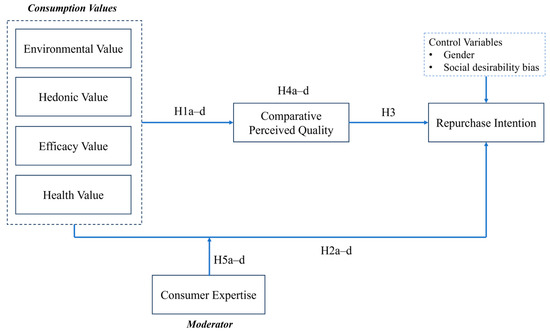
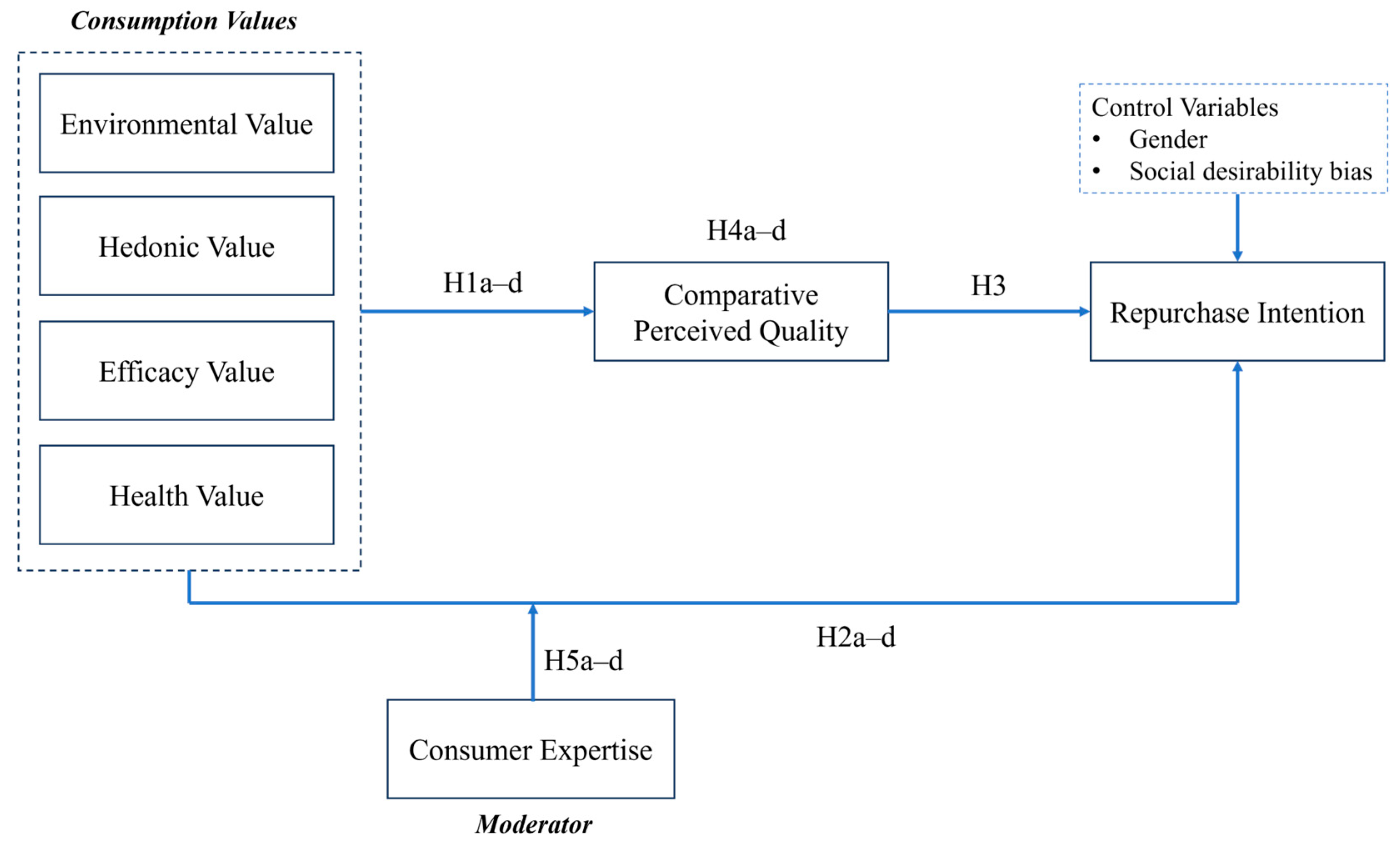
The hypothesized relationships are visualized in the research model presented in Figure 1. Given the information asymmetry inherent in credence attributes, CE is expected to primarily shape how post-use value cues are interpreted and weighted when forming repurchase intentions. In contrast, CPQ is more directly grounded in experienced performance cues and is therefore modeled without moderation [5].
Figure 1.
Research model.
2.7. Control Variables
Gender and social desirability needed to be controlled given the category’s female-dominated context and potential response bias [21,50]. Other demographics were excluded on theoretical grounds. Prior research indicates that psychographic values serve as more robust, proximal predictors of green loyalty than distal demographic factors, which often yield inconsistent effects [23,29]. This approach aligns with the modeling of parsimony precedents in OPCP research [27].
3. Data and Methodology
3.1. Sample and Data Collection
Data were collected from adult consumers (18+) in China who had purchased OPCPs within the previous six months. An online survey was administered via Wenjuanxing’s consumer panel using purposive eligibility screening. To strengthen verification of recent product use, respondents were required to report a specific OPCP brand purchased; only cases with identifiable brand information were retained. To mitigate potential biases and common method variance (CMV) inherent in online self-report surveys and panel-based nonprobability sampling, the questionnaire used clear instructions and neutral wording, was pretested with academic peers and students to refine ambiguous or potentially leading items, and presented key constructs in separate sections to reduce the respondents’ ability to infer hypothesized relationships.
A total of 400 responses were collected. Prior to analysis, standard data-quality screening was applied: inattentive responses (e.g., straight-lining across all items) were removed, and responses completed in less than one-third of the median survey completion time were excluded as implausibly fast, a criterion commonly applied in online panel research. After screening, 298 valid responses remained. This final sample exceeded the 10-times rule and the minimum sample sizes recommended by Hair et al. [51] for achieving 80% statistical power in models of this complexity. It also provides sufficient dispersion in CE (SD = 1.02) to support the assessment of interaction effects. In addition, PLSpredict indicates strong out-of-sample predictive performance, supporting stable estimation within the OPCP category (see Supplementary Table S3).
As shown in Supplementary Table S1, the sample was predominantly female (83.9%), aged 26–40 (84.5%), and university educated (72.8%), which is consistent with prior research on OPCP consumers and supports the external validity of the sample [23,27]. Consistent with prior studies, the analysis focused on skin-care and hair-care categories of OPCPs [52].
3.2. Measures
All constructs were measured using multi-item scales adapted from established instruments in the marketing literature (see Table 3) and assessed on seven-point Likert scales (1 = strongly disagree, 7 = strongly agree). The questionnaire was administered in Chinese. Following standard translation procedures, the items were translated and back-translated by bilingual researchers, and discrepancies were discussed and resolved to ensure semantic equivalence.
To contextualize consumption values for OPCPs and inform construct specification, we conducted a small-scale qualitative elicitation prior to the survey. Six adult consumers in China who had purchased OPCPs within the previous six months were recruited using purposive sampling and interviewed using a semi-structured protocol focusing on post-use evaluations and reasons for continuing or discontinuing OPCP use. This elicitation was not intended as a standalone qualitative study, but rather as a pilot exploration to verify the contextual salience of value dimensions already established in the TCV literature [7]. Consistent with the TCV, the interviews confirmed the relevance of four value dimensions in this setting: efficacy value (perceived performance effectiveness), hedonic value (sensory and experiential enjoyment), health value (perceived safety and wellness-related benefits), and environmental value (perceived sustainability-related benefits). Social value did not emerge as a salient driver of post-use repurchase decisions and was therefore excluded from the core model.
Insights from the interviews informed the study design in two ways. First, participants repeatedly described their post-use evaluations in comparative terms, often judging organic products against familiar conventional alternatives; this recurring pattern motivated our conceptualization of CPQ as a post-use benchmarking mechanism. Second, the interviews were used to refine construct definitions and adapt measurement items. CPQ items were specifically adapted to capture post-use benchmarking against conventional alternatives. Content validity for all adapted items was assessed through expert review (five domain experts) using an Index of Item-Objective Congruence (IOC) evaluation; all items exceeded the recommended threshold of 0.78 [53], confirming adequate congruence between the adapted items and their intended constructs. A pilot test (N = 30) further confirmed item clarity and contextual suitability for the OPCP settings.
Table 3.
Construct validity.
4. Results
The analysis began with descriptive statistics and an examination of the respondents’ demographic characteristics using SPSS 29. Partial least squares structural equation modeling (PLS-SEM) was conducted in SmartPLS 4.0, appropriate for predictive and complex models with latent constructs, moderate sample sizes, and non-normal data [51]. Following Anderson and Gerbing’s [57] two-step procedure, we first assessed the measurement model for reliability and validity and then evaluated the structural model using bootstrapping with 5000 subsamples. Finally, a post hoc necessary condition analysis (NCA) was performed using the SmartPLS NCA module to examine the necessity of antecedent conditions [58].
4.1. Common Method Bias
Common method bias was assessed using both Harman’s single-factor test and Kock’s [59] full collinearity test. The first unrotated factor accounted for 42.89% of the variance, below the 50% threshold [60]. For the full collinearity assessment, a random dummy variable was regressed on all latent constructs, yielding variance inflation factor (VIF) values ranging from 1.423 to 2.735, well below the recommended cutoff of 3.3, indicating that common method variance is unlikely to be a serious concern [59].
4.2. Measurement Model Assessment
The measurement model was evaluated following established PLS-SEM guidelines [51]. As reported in Table 3, all constructs demonstrated adequate reliability (Cronbach’s alpha and composite reliability > 0.70) and convergent validity (indicator loadings > 0.70; AVE > 0.50). Items with inadequate loadings or cross-loadings were removed. Item refinement was conservative and theory-driven. Discriminant validity was supported. All HTMT values were below 0.90 [61] (Table 4), and the bootstrapped 95% confidence intervals for HTMT had upper bounds below 1.00, indicating adequate construct distinctiveness [61]. This conclusion is further reinforced by the cross-loadings, with each indicator loading highest on its intended construct (Supplementary Table S2).
Table 4.
Assessment of discriminant validity using heterotrait–monotrait (HTMT) ratio of correlations.
4.3. Structural Model Evaluation
As shown in Table 5, hedonic and efficacy values significantly predicted CPQ (β = 0.276, p < 0.001; β = 0.399, p < 0.001), and both exerted positive effects on RPI (β = 0.164, p < 0.01; β = 0.154, p < 0.01), supporting H1b–H1c and H2b–H2c. Health value positively influenced CPQ (β = 0.127, p < 0.05) and RPI (β = 0.193, p < 0.01), supporting H1d and H2d. Environmental value showed significant effects on CPQ (β = 0.117, p < 0.05) but not RPI (β = −0.043, p > 0.05), supporting H1a but rejecting H2a. CPQ positively predicted RPI (β = 0.216, p < 0.01), supporting H3.
Table 5.
Structural model results.
While the structural model confirms the drivers of RPI, the value–behavior gap in sustainable consumption warrants a further examination of behavioral manifestation. Accordingly, a post hoc analysis was conducted to assess whether psychological inclination (RPI) was reflected in reported purchase frequency and to explore the functional thresholds required for such translation.
In this study, purchase frequency served as a behavioral proxy for actual repurchase. This choice was justified by the typical consumption cycle of personal care products, which provides multiple replenishment opportunities within a six-month recall window. Purchase frequency was measured using a single ordinal item with six categories ranging from “once per year” to “once per week.” For analysis, these categories were recoded into approximate monthly purchase-rate scores. This transformation approximates relative behavioral intensity and is not intended to imply equal spacing across categories. RPI was specified as the predictor. As shown in Table 6, RPI significantly predicted purchase frequency (β = 0.243, p < 0.001).
Table 6.
NCA effect size.
Importantly, purchase frequency is also shaped by situational constraints such as price promotions, channel availability, inventory depletion cycles, and the convenience of conventional substitutes; therefore, psychological variables alone are unlikely to explain substantial variance. We thus treated purchase frequency as a proxy consistency check for directional validity rather than as a definitive behavioral prediction model.
The model explained 60.6% of the variance in CPQ, 58.9% in RPI, and 5.9% in purchase frequency. Effect size (f2) estimates indicated a medium effect of efficacy value on CPQ, while other significant paths showed small effects. Predictive relevance was supported by Q2 values above zero (CPQ = 0.421; RPI = 0.402; Frequency = 0.055) [51]. Control variables (gender and social desirability) were non-significant (p > 0.05).
4.4. Mediation Analysis
The mediating effects of CPQ were examined using bootstrapping with 5000 resamples. As shown in Table 5, CPQ significantly mediated the effects of hedonic value (β = 0.056, p < 0.01; 95% CI [0.025, 0.110]) and efficacy value (β = 0.081, p < 0.01; 95% CI [0.033, 0.158]) on RPI, supporting H4b and H4c. In contrast, the indirect effects of environmental value and health value were nonsignificant, rejecting H4a and H4d. These results indicate that CPQ selectively mediates the effects of experience-based, but not credence-based, values on post-use loyalty.
4.5. Moderation Analysis
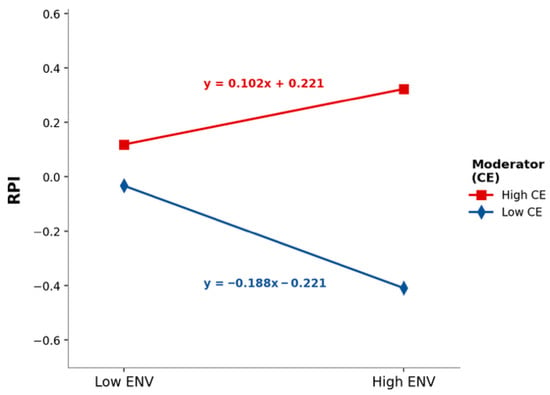
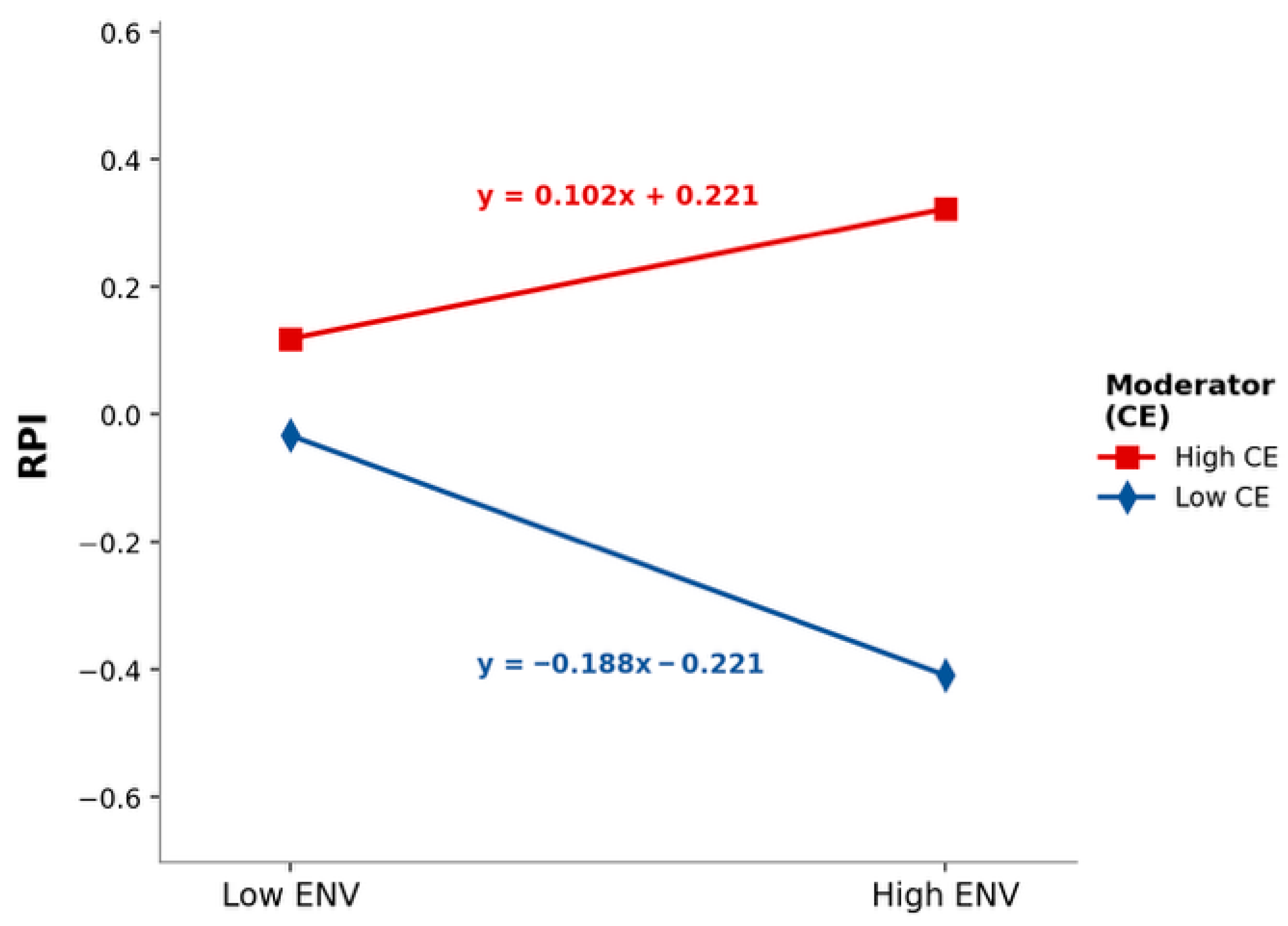
Moderating effects were assessed using a two-stage PLS-SEM approach. As shown in Table 5, CE significantly moderated the effects of environmental value (β = 0.145, p < 0.05) and hedonic value (β = −0.155, p < 0.05) on RPI, supporting H5a and H5b; H5c and H5d were not supported.
To facilitate interpretation, simple slope analyses were conducted, with interaction plots reported in the Supplementary Materials (Figure 2 and Figure 3) [62]. Out-of-sample predictive validity was further assessed using PLSpredict (see Supplementary Table S3).
Figure 2.
Conditional effect of CE on the environmental value → RPI pathway. Note: ENV = Environmental value.
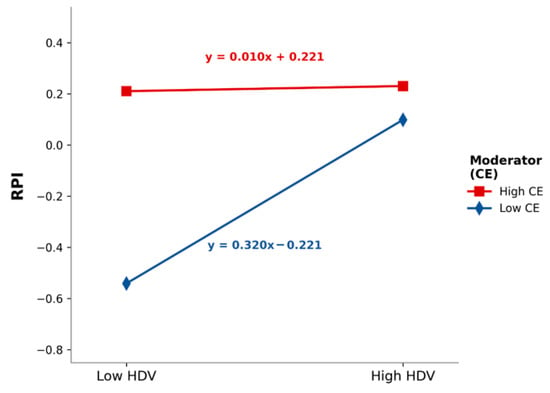
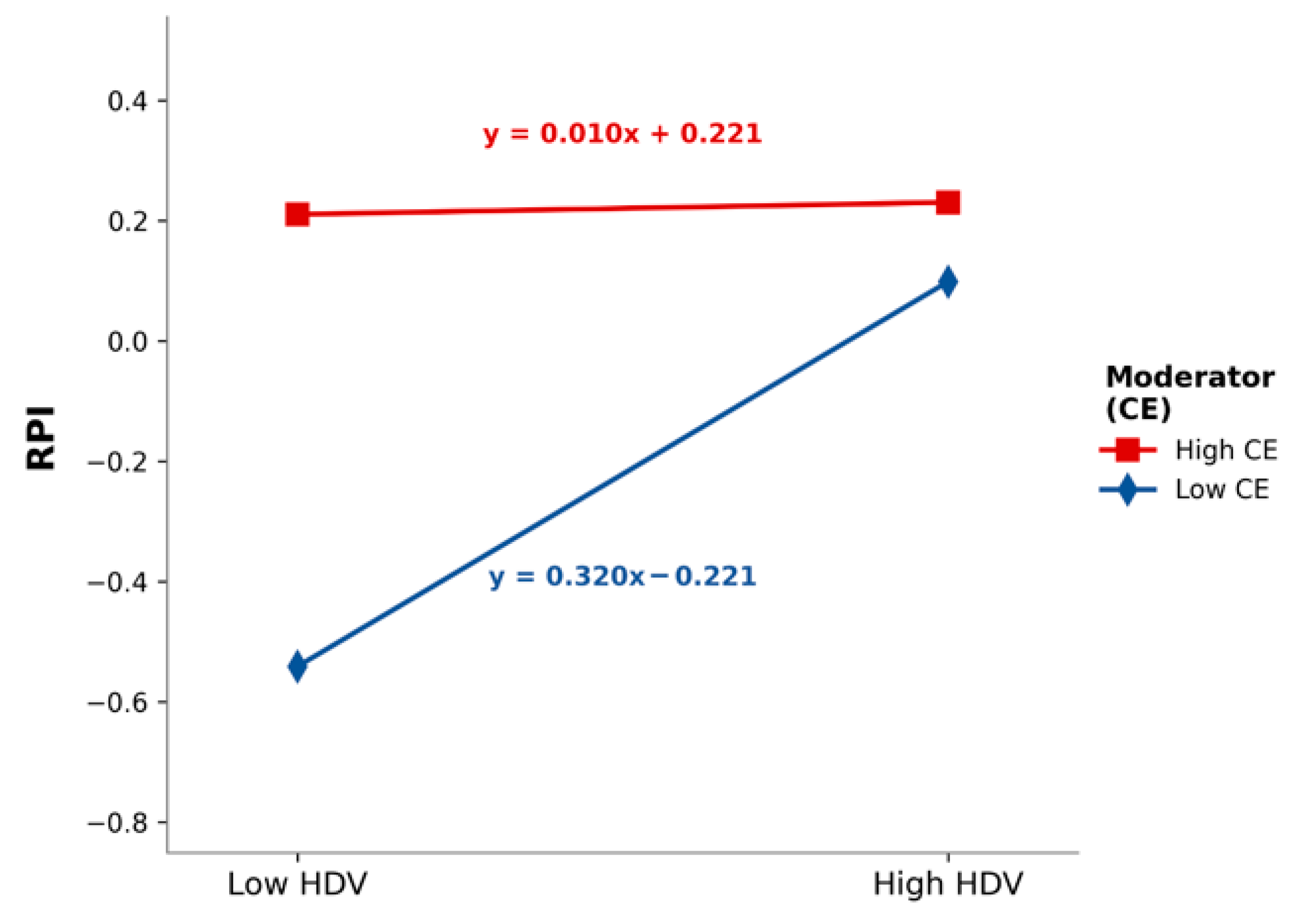
Figure 3.
Conditional effect of CE on the hedonic value → RPI pathway. Note: HDV = Hedonic value.
Conversely, Figure 3 showed a negative interaction pattern for hedonic value. At low expertise (–1 SD), hedonic value had a strong positive effect on RPI, whereas at high expertise (+1 SD), the slope flattened and became nonsignificant, indicating that the influence of hedonic cues diminishes as consumers gain expertise. This pattern supports the selective attribution mechanism, whereby experts prioritize diagnostic over affective cues.
4.6. Necessary Condition Analysis
To complement the sufficiency-oriented PLS-SEM results, an NCA was conducted following established guidelines [58,63]. The CE-FDH estimator was employed because it is well-suited for Likert-scale data and does not impose distributional or functional form assumptions on the ceiling line [64]. Statistical significance was assessed using permutation tests with 10,000 resamples.
As reported in Table 6, efficacy value emerged as the strongest necessary condition for CPQ (d = 0.295, p < 0.001), while hedonic, health, and environmental values exhibited statistically significant medium necessity effects. CE showed only a marginal necessity effect, indicating that it does not constitute a structural prerequisite for CPQ.
Regarding RPI, efficacy (d = 0.234, p < 0.001) and health values (d = 0.234, p < 0.01) represented the most binding necessary conditions, followed by CPQ (d = 0.184, p < 0.001) and hedonic value (d = 0.163, p < 0.001), whereas environmental value did not function as a necessary condition.
Crucially, when extending the analysis to actual behavior, the NCA revealed a distinct asymmetric relationship: both RPI (d = 0.214, p = 0.032) and efficacy value (d = 0.239, p = 0.021) emerged as significant necessary conditions for purchase frequency, whereas environmental value, hedonic value and health value failed to reach significance. This pattern is consistent with a hierarchical bottleneck structure: while various values may motivate the trial phase, sustained behavior may be tentatively constrained by both a psychological prerequisite (the formation of a minimum level of intention) and a functional threshold (product efficacy). Given the proxy nature of the purchase frequency measure, however, this interpretation should be treated as indicative rather than definitive.
The bottleneck analyses (Supplementary Tables S4–S6) revealed a non-compensatory hierarchical structure in the formation of post-use loyalty. For the psychological outcomes, achieving high levels of CPQ (Supplementary Table S4) and RPI (Supplementary Table S5) requires that key experience-based prerequisites be met at sufficiently high levels, particularly efficacy and health value. This pattern is consistent with a bottleneck logic in which improvements in other values cannot offset shortfalls in these binding conditions at high outcome targets. For example, reaching the 80% RPI target requires the efficacy and health values to be approximately in the mid-to-high range (around 5 on the 7-point scale), indicating that sustainability perceptions alone are unlikely to compensate for functional or health-related deficiencies when RPI is high. Consistent with the discrete nature of the underlying Likert measures, these numerical values should be read as indicative threshold regions rather than exact cut-offs; the substantive pattern of interest is the presence of a binding lower bound in the mid-to-high range of the scale, not the precise point estimate.
Crucially, the bottleneck structure for purchase frequency (Supplementary Table S6) is even more restrictive. At high behavioral targets (e.g., 80%), the binding conditions concentrate on efficacy value and RPI, both needing to be at approximately mid-to-high levels (around 5/7) for high-frequency repurchase to be feasible. Given the proxy nature of the behavioral measure and the discrete Likert scaling, we interpreted these numerical values as indicative threshold regions rather than exact cutoffs. Taken together, the results are consistent with efficacy serving as a primary gatekeeping condition for behavioral conversion: while multiple values may support intention formation, sustained purchase frequency appears to require sufficient levels of functional performance and repurchase commitment, though this inference remains subject to the limitations of the single-item behavioral proxy.
4.7. Importance-Performance Map Analysis (IPMA)
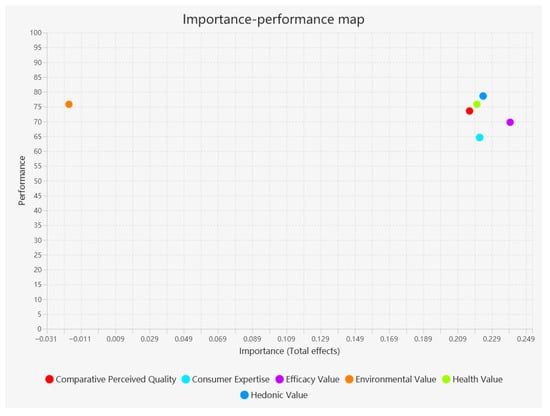
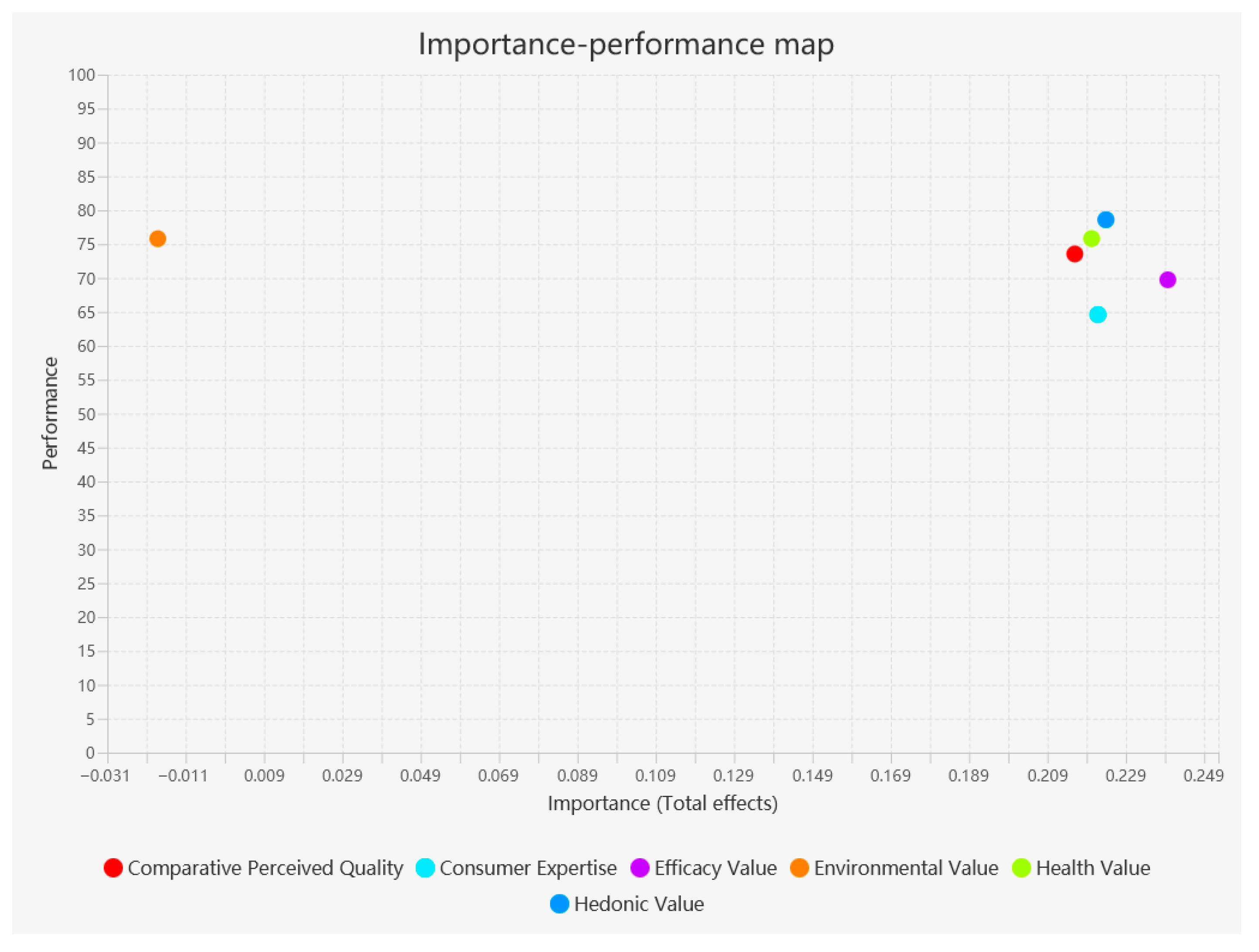
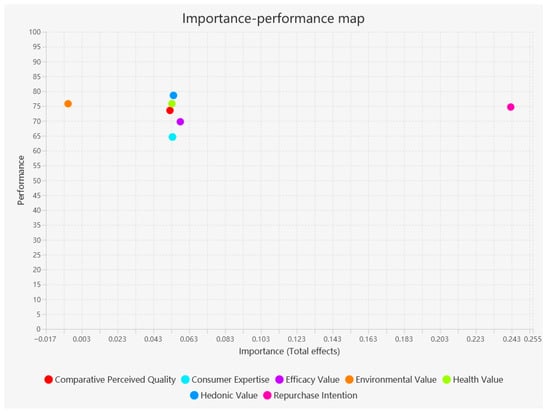
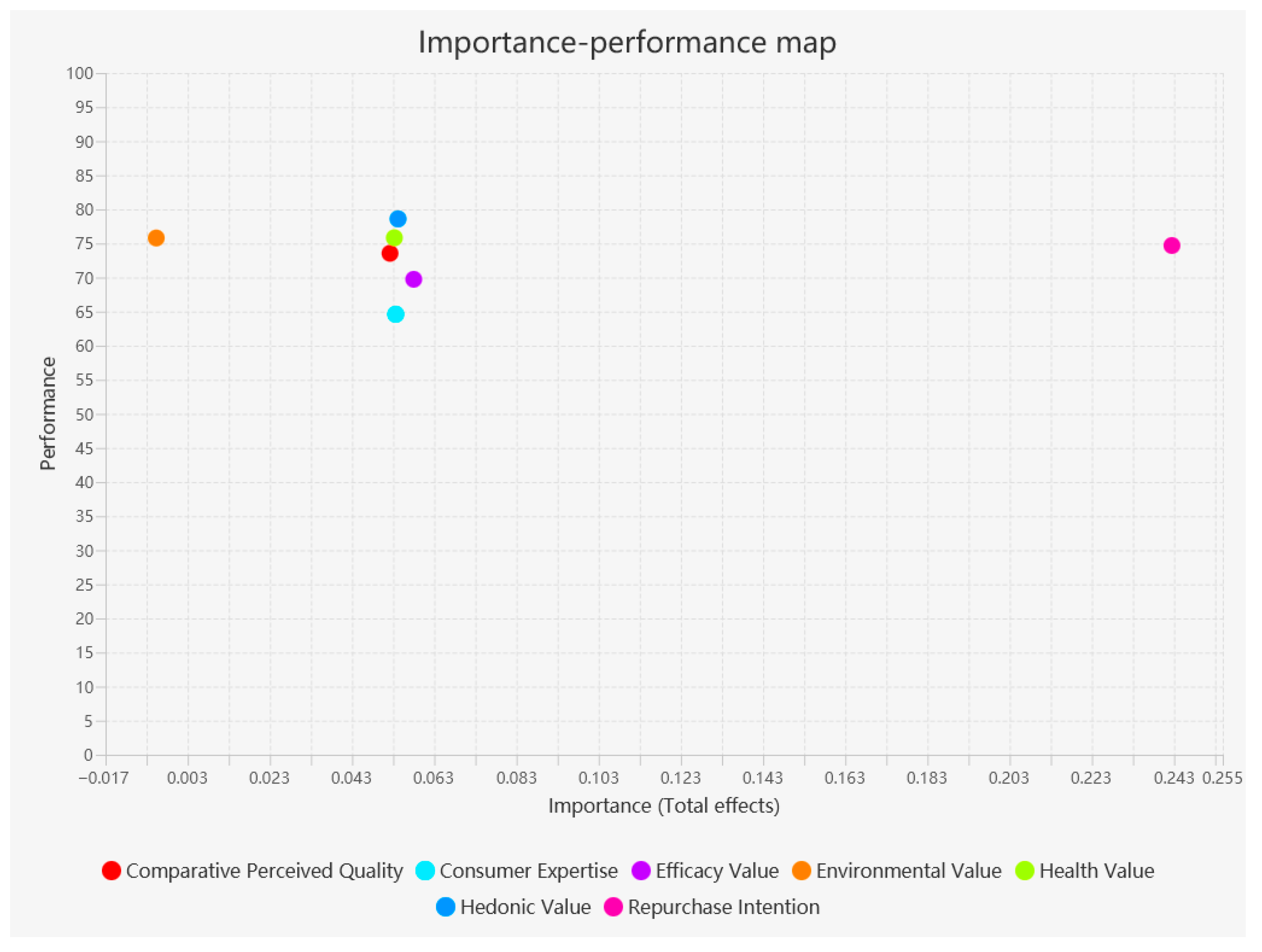
To complement the structural and necessity results, an IPMA was conducted for RPI and purchase frequency to identify actionable priorities. For RPI (Figure 4; Supplementary Table S7), the importance (total effects on RPI) of the key constructs was similar (0.216–0.240). Performance levels, however, differentiate priorities: CE showed the lowest performance (64.610) despite relatively high importance (0.222), making it the clearest improvement lever. In contrast, environmental value exhibited high performance (75.800) but negligible aggregate importance for RPI (−0.018, close to zero), consistent with its role as a qualifying cue rather than a universal repurchase driver.
Figure 4.
Importance-performance map (RPI).
When targeting purchase frequency (Figure 5), the map suggests a more concentrated set of behavioral anchors, with efficacy and RPI appearing among the most influential predictors. Given the proxy nature of the behavioral measure, we treated this pattern as indicative rather than definitive.
Figure 5.
Importance-performance map (purchase frequency).
4.8. Robustness Check: Nonlinear Model
To assess potential nonlinearity, we added squared terms for each consumption value construct and re-estimated the model using the two-stage procedure in SmartPLS 4.0 [51] (Supplementary Table S8). Most quadratic terms were nonsignificant, including the environmental value2 → RPI effect, indicating that the weak net effect of environmental value is unlikely to reflect unmodeled curvature. The only significant quadratic effect was efficacy value2 → CPQ (negative), suggesting diminishing marginal returns: efficacy enhances CPQ strongly at low-to-moderate levels, but incremental gains taper at higher levels. Overall, the substantive conclusions remain unchanged.
4.9. Robustness Check: Endogeneity (Gaussian Copula Test)
Given the cross-sectional, self-reported design, reverse causality cannot be fully ruled out. We therefore assessed potential endogeneity in the CPQ → RPI relationship using the Gaussian copula approach [65]. The copula term for CPQ was nonsignificant (β = −0.023, t = 0.138, p = 0.890), indicating that endogeneity is unlikely to bias the estimated relationship between CPQ and RPI. We interpreted this test as an endogeneity diagnostic; the substantive conclusions are based on the baseline structural estimates.
5. Discussions and Conclusions
This study offers evidence consistent with the view that post-use loyalty in credence-based sustainable categories may be shaped by constraint-like conditions rather than purely additive value accumulation. While PLS-SEM captures the average net effects, the NCA results suggest that some conditions appear to operate as bottleneck-like prerequisites for favorable repurchase outcomes, though the cross-sectional design limits causal inference. In this sense, the central challenge for sustainable brands is not to amplify their values broadly, but to remove the post-use constraints that prevent loyalty from becoming attainable. This extends sustainable consumption research from whether green motives exist to when and under what constraints they can translate into repeat purchase.
RPI is primarily shaped by a comparative benchmarking pathway in which CPQ functions as the central post-use mechanism. Because repurchase is anchored in comparative evaluation against conventional alternatives, CPQ functions as the proximate channel through which experienced benefits are translated into RPI. Consistent with this role, environmental value remains positively associated with CPQ even when it does not translate into a robust average net effect on RPI. More broadly, CPQ transmits the effects of experience-based values, especially efficacy and hedonic value, into RPI, consistent with a reference-dependent account in which loyalty reflects perceived gains relative to conventional options rather than expectation confirmation alone [17,40,43,66]. In contrast, the absence of mediation for the health and environmental values suggests that comparative quality judgments are shaped primarily by tangible performance feedback, while credence-based values may exert influence through other post-use routes. Accordingly, improving retention requires managing CPQ as a post-use translation mechanism rather than treating it as an automatic by-product of trial. This challenges the implicit assumption that pro-environmental meaning generalizes from trial to retention without a post-use translation into comparative advantage.
Retention is anchored in a stable functional baseline, with health and efficacy operating as the most diagnostic and binding elements. Health value operates as both a strong retention driver and a necessary baseline condition: the necessity evidence indicates that insufficient perceived healthfulness can constrain favorable repurchase outcomes even when other benefits are present [21,46,67]. Efficacy value plays a similarly diagnostic role and remains comparatively stable across expertise levels, consistent with the view that tangible performance cues dominate post-use evaluation in credence-based categories [49,68]. CE further differentiates cue weighting: environmental value becomes more influential as expertise increases, whereas hedonic cues matter more for lower expertise consumers. Overall, the evidence supports a practical hierarchy for closing the trial-to-repurchase gap: efficacy, health value, and CPQ constitute the most binding conditions, while environmental value becomes behaviorally consequential mainly when these prerequisites are secured and consumers can interpret credence claims. By specifying non-substitutable prerequisites, the results refine prior credence verification arguments by showing where retention can be blocked even when favorable values are present.
Environmental value is best understood as a conditional retention qualifier whose relevance emerges only at high repurchase targets. Prior work often focuses on pre-use intention, where consumers rely on anticipated benefits and ideals. Repurchase decisions, in contrast, are grounded in realized outcomes and explicit benchmarking against conventional alternatives, making experienced performance cues more diagnostic than abstract credence cues [17,40,43,66]. In attribute–weighting terms, environmental value carries low diagnosticity at the point of post-use evaluation because it cannot be verified through routine consumption; it is therefore down-weighted relative to experience-based attributes when consumers form repurchase judgments. This positions environmental value as a qualifying condition that gates retention at the upper tail of outcomes, rather than as a primary driver that operates uniformly across the full distribution of repurchase decisions. Importantly, NCA provides convergent evidence for a conditional role: environmental value is not necessary for achieving low to moderate repurchase targets, but it becomes relevant at high outcome targets, with a bottleneck threshold emerging from the 80% repurchase target onward [63]. This pattern is consistent with the view that sustainability cues can motivate trial yet lose behavioral salience after usage when the core benefits remain difficult to verify [14,24,69,70]. This aligns with the value–action gap literature, which documents a persistent divergence between pro-environmental attitudes and actual behavioral outcomes [69,70], and with the sustainability liability argument suggesting that strong environmental positioning may crowd out functional quality signals in post-use evaluation [68]. Taken together, the results offer a structural explanation for why environmental value effects appear strong in intention studies but unstable in retention studies. Thus, environmental value should be positioned to qualify and amplify retention once the performance-based prerequisites are met, rather than expected to compensate for them in the post-use stage. The credence-based nature of environmental benefits—inherently opaque after use and unverifiable through routine consumption—further reduces their diagnostic weight relative to functional cues when consumers benchmark against conventional alternatives [14,24]. In other words, mixed findings may partly reflect a stage mismatch: adoption studies capture aspirational motives, whereas retention is governed by constraint-driven post-use evaluation.
Behavioral repetition also shows a bottleneck consistent pattern, suggesting that efficacy and intention may jointly condition the feasibility of high purchase frequency. RPI predicts purchase frequency, although the explained variance is modest, consistent with the presence of additional situational constraints on behavior. NCA further suggests that purchase frequency may be bottleneck constrained: only efficacy value and RPI emerged as significant necessary conditions, and achieving high behavioral targets (e.g., 80%) appears to require both EFV and RPI to exceed a mid-to-high threshold (approximately 5 on the scale). Given the single-item, self-reported nature of the purchase frequency measure, however, these threshold values should be interpreted as indicative regions rather than precise cutoffs. This is consistent with a performance-first interpretation in which efficacy may serve not only as a driver of perceived quality and intention, but also as a functional prerequisite for behavioral conversion when paired with sufficient RPI. Because the frequency measure is a retrospective self-report rather than an observed behavioral record, the inferred prerequisite role of efficacy should be regarded as tentative and warrants confirmation with objective purchase data (e.g., transaction logs or loyalty-program records) in future research.
The model further yields actionable levers by translating explanatory effects into diagnostic priorities and performance gaps. IPMA turns the model into a diagnostic roadmap by showing not only what matters, but where current market performance is most misaligned with what drives retention. In particular, CE appears as a high-importance, low-performance lever, implying that education and claim-interpretation support may be critical for activating sustainability value in the repurchase stage. Therefore, post-use education should be treated as a retention investment that enables consumers to translate credence claims into behaviorally relevant reasons to stay. This responds to calls for actionable sustainability interventions by identifying not only influential constructs but also underperforming levers that managers can improve.
Robustness checks indicate that the core inferences are not driven by modeling artifacts or response biases. The nonlinear check suggests that the conclusions are not driven by unmodeled curvature, with evidence consistent with diminishing returns for efficacy value predicting CPQ. Control analyses further indicate that social desirability does not materially affect focal relationships, reducing concerns about impression management in responses. Overall, the convergent evidence supports a constraint-focused roadmap for improving sustainable product retention that is robust across complementary methods. Taken together, the discussion reframes sustainable loyalty as a post-use, benchmark-based process in which aspirational values matter most once functional prerequisites make retention attainable.
6. Contributions
6.1. Theoretical Contributions
This study advances the theory of consumption values by specifying when and why value-based explanations of sustainable consumption fail to account for post-use retention [7]. Rather than treating values as additive trade-offs, we theorize post-use loyalty as potentially governed by prerequisite logic in which certain attributes may function as constraint-like conditions that shape the feasible set of repurchase outcomes [63], subject to replication with stronger research designs. First, we propose a post-use extension of TCV in credence-based categories: functional performance and perceived healthfulness act as foundational prerequisites, while symbolic sustainability value operates as a conditional qualifier [63]. This shifts the theoretical focus from value accumulation at adoption to constraint satisfaction at retention, offering a clearer explanation for why positive green attitudes at trial may not translate into sustained loyalty. More specifically, CPQ enables a theoretical insight that satisfaction, perceived quality, and relative advantage cannot jointly capture: it reframes the post-use evaluation mechanism from an internally-referenced confirmation process to an externally-anchored benchmarking process. A consumer may be satisfied with an OPCP, perceive its absolute quality as high, and acknowledge its relative advantage in principle, yet still disengage when the organic option is not judged as comparatively superior to the specific conventional alternative available for switching back. By anchoring the unit of analysis in competitive displacement rather than expectation confirmation, CPQ changes how repurchase mechanisms are understood in credence-based sustainable categories and clarifies why favorable post-use evaluations can nevertheless fail to convert into retention.
Second, integrating reference dependence theory, we theorize CPQ as the mechanism that links realized value to continued use by anchoring post-use judgments in comparisons to conventional alternatives [16]. This positions loyalty as comparative advantage seeking rather than expectation confirmation alone, and it clarifies why experience-based values are more likely to translate into repurchase through quality benchmarking. Third, we theorize CE as a boundary condition that changes how credence cues enter post-use decision weighting. Expertise increases the diagnostic value of sustainability cues while reducing reliance on affective heuristics, which helps reconcile mixed findings on environmental value by explaining heterogeneity in post-use responsiveness [18]. Together, these propositions reposition TCV as a more diagnostic framework for post-use discontinuation by jointly modeling constraints, comparative evaluation, and expertise contingent cue weighting.
It should be noted that the theoretical contributions outlined above are grounded in data from educated, young-to-middle-aged female consumers in China. While this demographic profile is representative of the core OPCP consumer segment [23,27], the proposed mechanisms—including the constraint hierarchy, expertise-contingent cue weighting, and the conditional role of environmental value—should be understood as most directly applicable to this specific population. Cross-demographic replication is needed before these contributions can be claimed as broadly generalizable.
6.2. Practical Implications
Managers should shift from broad value accumulation to constraint-focused retention management. The results suggest that repeat purchase is not secured by adding more sustainability claims; it is secured by meeting the most binding post-use prerequisites at acceptable levels, as indicated by the bottleneck and importance analyses. In a credence-based category, consumers evaluate organic options relative to conventional alternatives after use, so managerial priority should be to remove functional constraints that can trigger fallback to conventional products [4].
First, managers should explicitly manage CPQ as the key post-use driver of comparative advantage rather than assuming it will emerge naturally. Because repurchase is anchored in comparative evaluation, post-purchase communication should help consumers translate routine use into clear, benchmarkable gains over conventional alternatives [5]. This can be achieved by framing performance outcomes in interpretable comparison terms (e.g., comparable cleansing power with less irritation; visible results with fewer harsh ingredients), providing usage guidance that makes outcomes easier to observe, and offering credible comparison anchors that consumers can readily understand. This becomes especially important when the goal is to move from moderate to high repurchase levels rather than merely preventing churn.
Second, health-related assurances should be treated as a non-negotiable baseline for credibility and retention [3]. Because health and safety benefits are difficult to verify even through routine use, managers should reduce post-purchase ambiguity through ingredient transparency, safety-oriented explanations, and interpretable proof points that remain meaningful beyond the trial moment. The necessity evidence implies that weak perceived healthfulness can constrain repurchase even when other benefits are present; therefore, firms should operationalize health as a consistent post-use reassurance system rather than a check-the-box claim.
Third, efficacy should remain the primary lever for improving both CPQ and repurchase outcomes. The importance-performance evidence indicates that efficacy is highly influential while its performance is not at the ceiling level, suggesting meaningful room for improvement. Practically, this implies prioritizing demonstrable outcome cues, performance communication tied to observable usage episodes, and routine-formation supports that help consumers experience and recognize effectiveness early, thereby preventing post-trial fallback to conventional products [4].
Fourth, environmental value should be deployed as a conditional qualifier rather than a universal retention driver. Generic sustainability narratives are unlikely to produce repeat purchase unless functional and health prerequisites are secured and translated into comparative advantage. Sustainability positioning should therefore be coupled with credible performance evidence and communicated through diagnostic cues (e.g., traceability, certification logic, and concrete impact information) rather than broad green slogans [20,71]. This aligns with the bottleneck pattern in which environmental value becomes more relevant at higher repurchase targets and is amplified among higher-expertise consumers.
Finally, retention communication should be tailored to CE. For less experienced consumers, messaging should emphasize immediate experience-based cues that facilitate positive use episodes (comfort, sensory enjoyment, ease of use) and reduce evaluation burden. For more knowledgeable consumers, firms should shift their emphasis toward diagnostic sustainability proof and deeper product knowledge that strengthens the behavioral relevance of environmental value [72]. This segmentation can be implemented through life cycle-based touchpoints, such as onboarding messages for novices and member content or community education for experts, without altering the core product proposition.
To translate RPI into higher purchase frequency, brands should pair early efficacy proof with repurchase triggers once intention is established, such as replenishment reminders, subscriptions, and routine-based follow-ups. Given that purchase frequency is bottleneck constrained by efficacy and RPI, such triggers are more likely to be effective when they build on credible post-use performance rather than substituting for it.
7. Limitations and Directions for Future Research
This study has several limitations that suggest directions for future research. First, the cross-sectional design restricts inference about how realized value, CPQ, and prerequisite thresholds evolve with accumulated usage experience. Longitudinal, panel, or repeated-measures designs could examine whether the identified constraint hierarchy and expertise-contingent effects remain stable over time. Second, as noted in the theoretical contributions section, the sample was predominantly female (83.9%), aged 26–40 (84.5%), and university-educated (72.8%), which constrains the demographic scope of the findings. Future research should employ purposive or stratified sampling to test whether the identified bottleneck structure and moderation patterns generalize to male consumers, older demographics, or consumers with lower educational attainment.
In addition, because the sample is concentrated in skincare and haircare OPCPs, the relative salience of functional, health-related, and sustainability cues may differ in male-oriented markets or adjacent credence categories (e.g., household cleaners) where quality is difficult to verify prior to use [4,25]. Purposeful sampling of low-frequency and more demographically balanced consumers is also warranted to test the boundary conditions of the proposed model.
Beyond demographic and category scope, the China-specific context introduces additional boundary conditions. China represents a unique marketplace characterized by rapid growth in green consumption alongside persistent green skepticism and information asymmetry [14,71]. The constraint hierarchy identified in this study—particularly the conditional role of environmental value and the primacy of efficacy—may operate differently in markets where institutional trust in organic certification is higher, green labeling is more standardized, or consumers are more accustomed to credence-based quality signals. For instance, in Western European markets where organic personal care has a longer history and certification frameworks are more established, environmental value may carry greater diagnostic weight in post-use evaluation than observed here. Cross-national and cross-category replications are therefore warranted to assess whether the proposed bottleneck structure and expertise-contingent pathways generalize across cultural, institutional, and product contexts.
Although purchase frequency was included as a behavioral proxy, it is still a retrospective self-report measure and may be affected by recall or reporting bias. Future research could strengthen behavioral validity by linking the model to objective purchase records (e.g., e-commerce transaction logs or loyalty-program data) or by tracking repeat purchases longitudinally. Future research should also directly validate CPQ against related constructs such as satisfaction and perceived quality by including all three constructs simultaneously in a single study design. Such a study would provide more conclusive empirical evidence of CPQ’s distinctiveness and further establish its contribution as a novel post-use evaluation mechanism.
Finally, the proposed model integrates four exogenous value constructs, a mediator, a moderator, and three complementary analytical techniques. While each component is theoretically motivated and empirically supported, the overall architecture is relatively demanding for a sample of this size and demographic concentration. The moderation by consumer expertise, in particular, would benefit from replication with larger and more demographically diverse samples to establish the robustness and generalizability of the interaction effects identified here.
Supplementary Materials
The following supporting information can be downloaded at: https://www.mdpi.com/article/10.3390/su18094331/s1, Table S1: Demographic Profile of the Respondents; Table S2: Indicator Cross-Loadings (Reflective Constructs); Table S3: Assessment of Out-of-sample Predictive Performance Using PLSpredict; Table S4: Bottleneck Table for CPQ; Table S5: Bottleneck Table for RPI; Table S6: Bottleneck Table for Purchase Frequency; Table S7: IPMA results for RPI; Table S8: Nonlinear Model Results.
Author Contributions
Conceptualization, Y.C.; Methodology, Y.C.; Formal analysis, Y.C. and C.W.; Writing, original draft preparation, Y.C.; Writing, review and editing, C.W. and T.L.; Project administration, C.W. and T.L.; Funding acquisition, C.W. All authors have read and agreed to the published version of the manuscript.
Funding
This research received no external funding.
Institutional Review Board Statement
This study was approved by the Ethics Committee of the National Institute of Development Administration Thailand (ECNIDA 2025/0211, approved on 10 December 2025).
Informed Consent Statement
Informed consent was obtained electronically from all subjects involved in the study prior to participation.
Data Availability Statement
The data supporting the findings of this study are available from the corresponding author upon reasonable request. The dataset is not publicly available due to participant privacy restrictions.
Conflicts of Interest
The authors declare no conflicts of interest.
References
- McKinsey. How Much Will Consumers Really Pay for Green Products? Available online: https://www.mckinsey.com/capabilities/growth-marketing-and-sales/our-insights/talk-is-cheap-how-much-will-consumers-really-pay-for-green-products (accessed on 14 December 2025).
- Straits Research. Organic Personal Care Market Size, Share and Forecast|Industry Report by 2033. Available online: https://straitsresearch.com/report/organic-personal-care-market (accessed on 14 December 2025).
- Tong, X.; Wang, K.; Feng, S. Beyond the first purchase: Unpacking the continuance intentions behind sustainable consumption. Front. Psychol. 2025, 16, 1627728. [Google Scholar] [CrossRef] [Scilit]
- Chen, Y.; Chang, C. Towards green trust: The influences of green perceived quality, green perceived risk, and green satisfaction. Manag. Decis. 2013, 51, 63–82. [Google Scholar] [CrossRef] [Scilit]
- Liu, H.; Meng-Lewis, Y.; Ibrahim, F.; Zhu, X. Superfoods, super healthy: Myth or reality? Examining consumers’ repurchase and WOM intention regarding superfoods: A theory of consumption values perspective. J. Bus. Res. 2021, 137, 69–88. [Google Scholar] [CrossRef] [Scilit]
- Aly, A.S.; Al-Salfiti, A. Linking consumption values to green purchase intention: Evidence from emerging economies. Sustainability 2025, 17, 10109. [Google Scholar] [CrossRef] [Scilit]
- Sheth, J.N.; Newman, B.I.; Gross, B.L. Why we buy what we buy: A theory of consumption values. J. Bus. Res. 1991, 22, 159–170. [Google Scholar] [CrossRef] [Scilit]
- Bairrada, C.M.; Coelho, A.F.M.; Moreira, J.M. Attitudes toward ethical consumption in clothing: Comparing Peruvian and Portuguese consumers. J. Int. Consum. Mark. 2024, 36, 180–196. [Google Scholar] [CrossRef] [Scilit]
- Bakr, Y.; Al-Bloushi, H.; Mostafa, M. Consumer intention to buy plant-based meat alternatives: A cross-cultural analysis. J. Int. Consum. Mark. 2023, 35, 420–435. [Google Scholar] [CrossRef] [Scilit]
- Moslehpour, M.; Chaiyapruk, P.; Faez, S.; Wong, W.-K. Generation Y’s sustainable purchasing intention of green personal care products. Sustainability 2021, 13, 13385. [Google Scholar] [CrossRef] [Scilit]
- Woodruff, R.B. Customer value: The next source for competitive advantage. J. Acad. Mark. Sci. 1997, 25, 139–153. [Google Scholar] [CrossRef] [Scilit]
- Zheng, C.; Ling, S.; Cho, D. How social identity affects green food purchase intention: The serial mediation effect of green perceived value and psychological distance. Behav. Sci. 2023, 13, 664. [Google Scholar] [CrossRef] [Scilit]
- Gupta, A.; Yousaf, A.; Mishra, A. How pre-adoption expectancies shape post-adoption continuance intentions: An extended expectation-confirmation model. Int. J. Inf. Manag. 2020, 52, 102094. [Google Scholar] [CrossRef] [Scilit]
- Zhou, S.; Seo, E. How green skepticism undermines green purchase intention: The roles of information seeking and anticipated guilt. Sustainability 2026, 18, 1539. [Google Scholar] [CrossRef] [Scilit]
- Kirmani, A.; Rao, A.R. No pain, no gain: A critical review of the literature on signaling unobservable product quality. J. Mark. 2000, 64, 66–79. [Google Scholar] [CrossRef] [Scilit]
- Tversky, A.; Kahneman, D. Loss aversion in riskless choice: A reference-dependent model. Q. J. Econ. 1991, 106, 1039–1061. [Google Scholar] [CrossRef] [Scilit]
- Oliver, R.L. A cognitive model of the antecedents and consequences of satisfaction decisions. J. Mark. Res. 1980, 17, 460–469. [Google Scholar] [CrossRef] [Scilit]
- Alba, J.W.; Hutchinson, J.W. Dimensions of consumer expertise. J. Consum. Res. 1987, 13, 411–454. [Google Scholar] [CrossRef] [Scilit]
- Stanton, J.V.; Cook, L.A. Product knowledge and information processing of organic foods. J. Consum. Mark. 2019, 36, 240–252. [Google Scholar] [CrossRef] [Scilit]
- Aydin, G. Thresholds of sustainability: Necessary and sufficient conditions for green buying behavior. Sustainability 2025, 17, 4965. [Google Scholar] [CrossRef] [Scilit]
- Ghazali, E.; Soon, P.C.; Mutum, D.S.; Nguyen, B. Health and cosmetics: Investigating consumers’ values for buying organic personal care products. J. Retail. Consum. Serv. 2017, 39, 154–163. [Google Scholar] [CrossRef] [Scilit]
- Quoquab, F.; Jaini, A.; Mohammad, J. Does it matter who exhibits more green purchase behavior of cosmetic products in Asian culture? A multi-group analysis approach. Int. J. Environ. Res. Public Health 2020, 17, 5258. [Google Scholar] [CrossRef] [Scilit]
- Shimul, A.S.; Cheah, I.; Khan, B.B. Investigating female shoppers’ attitude and purchase intention toward green cosmetics in South Africa. J. Glob. Mark. 2022, 35, 37–56. [Google Scholar] [CrossRef] [Scilit]
- Zollo, L.; Carranza, R.; Faraoni, M.; Díaz, E.; Martín-Consuegra, D. What influences consumers’ intention to purchase organic personal care products? The role of social reassurance. J. Retail. Consum. Serv. 2021, 60, 102432. [Google Scholar] [CrossRef] [Scilit]
- Ali, S.; Javed, H.M.U.; Ali, W.; Zahid, H. Decoding men’s behavioral responses toward green cosmetics: An investigation based on the belief decomposition approach. J. Environ. Plan. Manag. 2022, 1–28. [Google Scholar] [CrossRef] [Scilit]
- Chakraborty, D.; Siddiqui, M.; Siddiqui, A. Can initial trust boost intention to purchase Ayurveda products? A theory of consumption value (TCV) perspective. Int. J. Consum. Stud. 2022, 46, 2521–2541. [Google Scholar] [CrossRef] [Scilit]
- Suphasomboon, T.; Vassanadumrongdee, S. Toward sustainable consumption of green cosmetics and personal care products: The role of perceived value and ethical concern. Sustain. Prod. Consum. 2022, 33, 230–243. [Google Scholar] [CrossRef] [Scilit]
- Hu, T.-L.; Chao, C.-M.; Lin, C.-H. The role of social media marketing in green product repurchase intention. Sustainability 2024, 16, 5916. [Google Scholar] [CrossRef] [Scilit]
- Lupindo, M.; Madinga, N.W.; Dlamini, S. Green beauty: Examining factors shaping millennials’ attitudes toward organic personal care products in South Africa. Eur. J. Manag. Stud. 2024, 29, 271–291. [Google Scholar] [CrossRef] [Scilit]
- Testa, R.; Vella, F.; Rizzo, G.; Schifani, G.; Migliore, G. What drives and obstacles the intention to purchase green skincare products? A study of the Italian market of green skincare products. J. Clean. Prod. 2024, 484, 144358. [Google Scholar] [CrossRef] [Scilit]
- Halan, D.; Aashish, K.; Thaichon, P. Continuous purchase intention of organic personal care products: Evidence from India. J. Int. Consum. Mark. 2025, 37, 23–40. [Google Scholar] [CrossRef] [Scilit]
- Leonidou, L.C.; Eteokleous, P.P.; Christofi, A.-M.; Korfiatis, N. Drivers, outcomes, and moderators of consumer intention to buy organic goods: Meta-analysis, implications, and future agenda. J. Bus. Res. 2022, 151, 339–354. [Google Scholar] [CrossRef] [Scilit]
- Massey, M.; O’Cass, A.; Otahal, P. A meta-analytic study of the factors driving the purchase of organic food. Appetite 2018, 125, 418–427. [Google Scholar] [CrossRef] [Scilit]
- Costa, C.S.R.; Costa, M.F.; Maciel, R.G.; Aguiar, E.C.; Wanderley, L.O. Consumer antecedents towards green product purchase intentions. J. Clean. Prod. 2021, 313, 127964. [Google Scholar] [CrossRef] [Scilit]
- Zeithaml, V.A. Consumer perceptions of price, quality, and value: A means-end model and synthesis of evidence. J. Mark. 1988, 52, 2–22. [Google Scholar] [CrossRef] [Scilit]
- Rogers, E.M. Diffusion of Innovations, 5th ed.; Free Press: New York, NY, USA, 2003. [Google Scholar]
- Ajzen, I. The theory of planned behavior. Organ. Behav. Hum. Decis. Process. 1991, 50, 179–211. [Google Scholar] [CrossRef] [Scilit]
- Bauer, H.H.; Heinrich, D.; Schäfer, D.B. The effects of organic labels on global, local, and private brands. J. Bus. Res. 2013, 66, 1035–1043. [Google Scholar] [CrossRef] [Scilit]
- Holbrook, M.B.; Hirschman, E.C. The experiential aspects of consumption: Consumer fantasies, feelings, and fun. J. Consum. Res. 1982, 9, 132–140. [Google Scholar] [CrossRef] [Scilit]
- Holbrook, M.B. Consumption experience, customer value, and subjective personal introspection: An illustrative photographic essay. J. Bus. Res. 2006, 59, 714–725. [Google Scholar] [CrossRef] [Scilit]
- Lin, Y.-C.; Chang, C.A. Double standard: The role of environmental consciousness in green product usage. J. Mark. 2012, 76, 125–134. [Google Scholar] [CrossRef] [Scilit]
- Lee, D.; Iyer, R.; Lee, Y.-K. Investigating the antecedents of pro-environmental customer behavior: The role of gender in the food industry. J. Consum. Mark. 2025. [Google Scholar] [CrossRef] [Scilit]
- Woodall, T. Conceptualising “value for the customer”: An attributional, structural and dispositional analysis. Acad. Mark. Sci. Rev. 2003, 12, 1–42. [Google Scholar]
- Wang, P.; Sun, L.; Zhang, L.; Niraj, R. Reference points in consumer choice models: A review and future research agenda. Int. J. Consum. Stud. 2021, 45, 985–1006. [Google Scholar] [CrossRef] [Scilit]
- Tong, X.; Su, J. Exploring young consumers’ trust and purchase intention of organic cotton apparel. J. Consum. Mark. 2018, 35, 522–532. [Google Scholar] [CrossRef] [Scilit]
- Kim, R.B.; Matsui, T.; Uehara, W. From confusion to trust: How cognitive factors shape green consumption in different market contexts. J. Int. Consum. Mark. 2025, 37, 479–496. [Google Scholar] [CrossRef] [Scilit]
- Tan, C.N.-L.; Fauzi, M.A.; Harun, S.A. How does the rise of eco-consciousness shape consumers’ buying intent? Exploring the moderated mediation model of NAM-ELM. Asia Pac. J. Mark. Logist. 2025. [Google Scholar] [CrossRef] [Scilit]
- Luan, C.-C.; PhamThi, H.; Ulysses, N. A company-CSR fit as antecedents of organic cosmetic product purchase intention, the buffering effect of CSR belief: A moderating role of health consciousness. Int. Rev. Retail Distrib. Consum. Res. 2024, 34, 285–309. [Google Scholar] [CrossRef] [Scilit]
- Zhang, G.; Wang, L.; Meng, H. Environmental knowledge level and consumer behavior regarding green fashion: A moderated mediation model. Asia Pac. J. Mark. Logist. 2024, 36, 977–992. [Google Scholar] [CrossRef] [Scilit]
- Fisher, R.J. Social desirability bias and the validity of indirect questioning. J. Consum. Res. 1993, 20, 303–315. [Google Scholar] [CrossRef] [Scilit]
- Hair, J.F.; Hult, G.T.M.; Ringle, C.M.; Sarstedt, M. A Primer on Partial Least Squares Structural Equation Modeling (PLS-SEM), 3rd ed.; SAGE Publications: Thousand Oaks, CA, USA, 2022. [Google Scholar]
- Kim, H.Y.; Chung, J.-E.; Chung, J.E. Consumer purchase intention for organic personal care products. J. Consum. Mark. 2011, 28, 40–47. [Google Scholar] [CrossRef] [Scilit]
- Rovinelli, R.J.; Hambleton, R.K. On the use of content specialists in the assessment of criterion-referenced test item validity. Dutch J. Educ. Res. 1977, 2, 49–60. [Google Scholar]
- Purohit, D.; Srivastava, J. Effect of manufacturer reputation, retailer reputation, and product warranty on consumer judgments of product quality: A cue diagnosticity framework. J. Consum. Psychol. 2001, 10, 123–134. [Google Scholar] [CrossRef] [Scilit]
- Chiou, J.-S. Service quality, trust, specific asset investment, and expertise: Direct and indirect effects in a satisfaction-loyalty framework. J. Acad. Mark. Sci. 2006, 34, 613–627. [Google Scholar] [CrossRef] [Scilit]
- Dodds, W.B.; Monroe, K.B.; Grewal, D. Effects of price, brand, and store information on buyers’ product evaluations. J. Mark. Res. 1991, 28, 307–319. [Google Scholar] [CrossRef] [Scilit]
- Anderson, J.C.; Gerbing, D.W. Structural equation modeling in practice: A review and recommended two-step approach. Psychol. Bull. 1988, 103, 411–423. [Google Scholar] [CrossRef]
- Richter, N.F.; Schubring, S.; Hauff, S.; Ringle, C.M.; Sarstedt, M. When predictors of outcomes are necessary: Guidelines for the combined use of PLS-SEM and NCA. Ind. Manag. Data Syst. 2020, 120, 2243–2267. [Google Scholar] [CrossRef] [Scilit]
- Kock, N. Common method bias in PLS-SEM: A full collinearity assessment approach. Int. J. E-Collab. 2015, 11, 1–10. [Google Scholar] [CrossRef] [Scilit]
- Podsakoff, P.M.; MacKenzie, S.B.; Lee, J.-Y.; Podsakoff, N.P. Common method biases in behavioral research: A critical review of the literature and recommended remedies. J. Appl. Psychol. 2003, 88, 879–903. [Google Scholar] [CrossRef] [Scilit]
- Henseler, J.; Ringle, C.M.; Sarstedt, M. A new criterion for assessing discriminant validity in variance-based structural equation modeling. J. Acad. Mark. Sci. 2015, 43, 115–135. [Google Scholar] [CrossRef] [Scilit]
- Aiken, L.S.; West, S.G.; Reno, R.R. Multiple Regression: Testing and Interpreting Interactions; SAGE: Newbury Park, CA, USA, 2010. [Google Scholar]
- Dul, J. Necessary condition analysis (NCA): Logic and methodology of “necessary but not sufficient” causality. Organ. Res. Methods 2016, 19, 10–52. [Google Scholar] [CrossRef] [Scilit]
- Vis, B.; Dul, J. Analyzing relationships of necessity not just in kind but also in degree: Complementing fsQCA with NCA. Sociol. Methods Res. 2018, 47, 872–899. [Google Scholar] [CrossRef] [Scilit]
- Park, S.; Gupta, S. Handling endogenous regressors by joint estimation using copulas. Mark. Sci. 2012, 31, 567–586. [Google Scholar] [CrossRef] [Scilit]
- Bhattacherjee, A. Understanding information systems continuance: An expectation-confirmation model. MIS Q. 2001, 25, 351–370. [Google Scholar] [CrossRef] [Scilit]
- Mondelaers, K.; Verbeke, W.; Van Huylenbroeck, G. Importance of health and environment as quality traits in the buying decision of organic products. Br. Food J. 2009, 111, 1120–1139. [Google Scholar] [CrossRef] [Scilit]
- Luchs, M.G.; Naylor, R.W.; Irwin, J.R.; Raghunathan, R. The sustainability liability: Potential negative effects of ethicality on product preference. J. Mark. 2010, 74, 18–31. [Google Scholar] [CrossRef] [Scilit]
- Rahman, S.U.; Luomala, H. Demystifying horizontal/vertical cultural difference in green consumption: A cross-cultural comparative study. J. Int. Consum. Mark. 2021, 33, 543–558. [Google Scholar] [CrossRef] [Scilit]
- Tariq, A.; Wang, C.; Tanveer, Y.; Akram, U.; Akram, Z. Organic food consumerism through social commerce in China. Asia Pac. J. Mark. Logist. 2019, 31, 202–222. [Google Scholar] [CrossRef] [Scilit]
- Chen, Y.-S.; Chang, C.-H. Greenwash and green trust: The mediation effects of green consumer confusion and green perceived risk. J. Bus. Ethics 2013, 114, 489–500. [Google Scholar] [CrossRef] [Scilit]
- Truong, V.A.; Lang, B.; Conroy, D.M. Are trust and consumption values important for buyers of organic food? A comparison of regular buyers, occasional buyers, and non-buyers. Appetite 2021, 161, 105123. [Google Scholar] [CrossRef] [Scilit] [PubMed]

Disclaimer/Publisher’s Note: The statements, opinions and data contained in all publications are solely those of the individual author(s) and contributor(s) and not of MDPI and/or the editor(s). MDPI and/or the editor(s) disclaim responsibility for any injury to people or property resulting from any ideas, methods, instructions or products referred to in the content. |
© 2026 by the authors. Licensee MDPI, Basel, Switzerland. This article is an open access article distributed under the terms and conditions of the Creative Commons Attribution (CC BY) license.