


Abstract
Urban stormwater runoff often contains toxic metals that threaten aquatic environments. Meanwhile, the large quantities of drinking water treatment residuals (DWTRs) generated worldwide offer opportunities for sustainable reuse as pollutant removal materials. In this study, a manganese sand-modified drinking water treatment residual particle (RDP-M) was prepared from DWTRs and manganese sand for Pb(II) removal from water. Characterization by scanning electron microscopy (SEM), Fourier transform infrared spectroscopy (FTIR), and X-ray photoelectron spectroscopy (XPS) showed that RDP-M had a rough surface morphology and abundant oxygen-containing functional groups, which provided adsorption sites. Batch experiments showed that the maximum Pb(II) adsorption capacity of RDP-M reached 2.79 mg g−1 at 298 K and pH 7.0, which was about 48% higher than that of the unmodified particles (RDP). The adsorption process followed the pseudo-second-order kinetic model and the Langmuir isotherm model, indicating a chemisorption-dominated process. Thermodynamic analysis further showed that the process was spontaneous and exothermic. RDP-M maintained stable Pb(II) removal over a wide pH range, showed low sensitivity to coexisting ions, and retained high efficiency during repeated use. These results demonstrate that RDP-M has potential as a sustainable granular material for stormwater treatment and waste resource valorization.
1. Introduction
Traffic-related toxic metals, such as Pb, Cu, Zn, and Cr, are widely present in urban road runoff during rainfall events and are mainly released from brake pads, tire wear, and vehicle exhausts [1]. The transport of these metals through surface runoff increases metal loading in receiving water bodies [2] and promotes their long-term accumulation in aquatic environments [3], thereby posing potential risks to ecosystems and human health [4]. Among these metals, Pb(II) is frequently identified as a dominant contaminant in urban runoff [5]. Its ecological risk was often particularly high because of its elevated toxicity coefficient. Specifically, in urban runoff systems, the Er values of Cu, Zn, and Cr were generally below 40. However, at sites with higher traffic density, the Er of Pb exceeded 80, indicating a risk level at least twice as high under those conditions [6]. Owing to its persistence and bioaccumulative characteristics [7], Pb exposure can lead to neurological impairment and other adverse health effects, including hypertension and renal damage [8]. Therefore, it is essential to develop efficient, cost-effective, and environmentally sustainable technologies for removing toxic metals from urban runoff to improve urban water quality and support sustainable stormwater management in rapidly urbanizing environments.
Drinking water treatment residuals (DWTRs) are solid byproducts generated in large quantities during drinking water purification and are rich in iron and aluminum oxides as well as oxygen-containing organic components [9]. Owing to their strong affinity for toxic metals, DWTRs have attracted increasing attention as functional media for stormwater treatment in green infrastructure systems such as bioretention facilities, with potential for both pollutant removal and waste valorization [10]. For instance, Steuer et al. evaluated iron-based water treatment residuals from a groundwater treatment plant and showed their potential for the removal of Pb and other metals from water [11]. Elkhatib et al. developed a zeolite–nano drinking water treatment residual composite and demonstrated its applicability for Pb(II) removal, further supporting the potential of DWTR-derived materials in water treatment [12]. Despite these promising applications, several limitations remain when DWTRs are used as filtration media. First, DWTR particles tend to agglomerate and harden during long-term operation. This increases the risk of media clogging and reduces the hydraulic stability of treatment systems [13]. Second, the adsorption-active components of DWTRs are mainly iron and aluminum oxides. This results in relatively limited active-site diversity and may reduce adsorption performance under complex environmental conditions [14]. Consequently, structural modification and the introduction of additional functional components are needed to improve the stability and adsorption capacity of DWTR-based materials and to mitigate agglomeration and clogging. Recent studies and reviews have further shown that granulation, thermal treatment, and composite modification are effective approaches for improving the physicochemical properties of DWTR-based materials [15]. These approaches can also enhance their permeability and heavy metal adsorption performance, especially in stormwater-related applications.
Manganese sand is a widely used filtration medium in drinking water and groundwater treatment systems due to its stable availability, low cost [16], high mechanical strength, and extensive engineering application experience [17]. Its surface is enriched with Mn–O and Mn–O–Mn structural units, which can act as stable metal–oxygen active sites and exhibit strong chemical reactivity toward toxic metals [18]. Incorporating manganese sand into DWTR-based materials may therefore introduce additional adsorption-active sites while improving structural stability. This strategy may enhance the performance of residual-based filtration media and promote the sustainable reuse of DWTRs. This rationale is further supported by recent studies showing that Mn-containing granular adsorbents can enhance toxic metal removal from urban stormwater runoff and often exhibit strong affinity for Pb(II) [19].
In this study, manganese sand-loaded drinking water treatment residual particles (RDP-M) were synthesized through high-temperature sintering and applied to Pb(II) adsorption. The adsorption behavior was evaluated through kinetic, isotherm, and thermodynamic analyses. The robustness of RDP-M was further assessed under different pH conditions, in the presence of competing ions, and during repeated adsorption–desorption cycles. In addition, the surface characteristics and adsorption mechanisms were investigated using scanning electron microscopy (SEM), X-ray photoelectron spectroscopy (XPS), and Fourier transform infrared spectroscopy (FTIR). This study aimed to explore a feasible strategy for valorizing DWTRs and developing effective granular adsorbents for Pb(II) removal from contaminated water, with potential applications in sustainable stormwater management facilities.
2. Materials and Methods
2.1. Chemicals
All chemicals were of analytical reagent grade. Lead nitrate (Pb(NO3)2), zinc nitrate (Zn(NO3)2), copper sulfate pentahydrate (CuSO4·5H2O), sodium hydroxide (NaOH), and hydrochloric acid (HCl) were purchased from Beijing Tong Guang Fine Chemical Company (Beijing, China). All solutions were prepared with deionized water. The Pb(II), Zn(II), and Cu(II) stock solutions used in the adsorption experiments were prepared by dissolving Pb(NO3)2, Zn(NO3)2, and CuSO4·5H2O, respectively. The solution pH was adjusted using 0.1 mol/L NaOH and 0.1 mol/L HCl.
2.2. Adsorbents
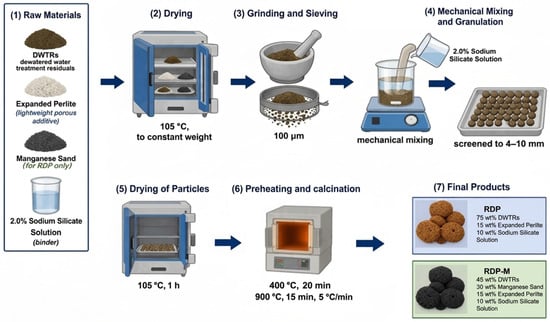
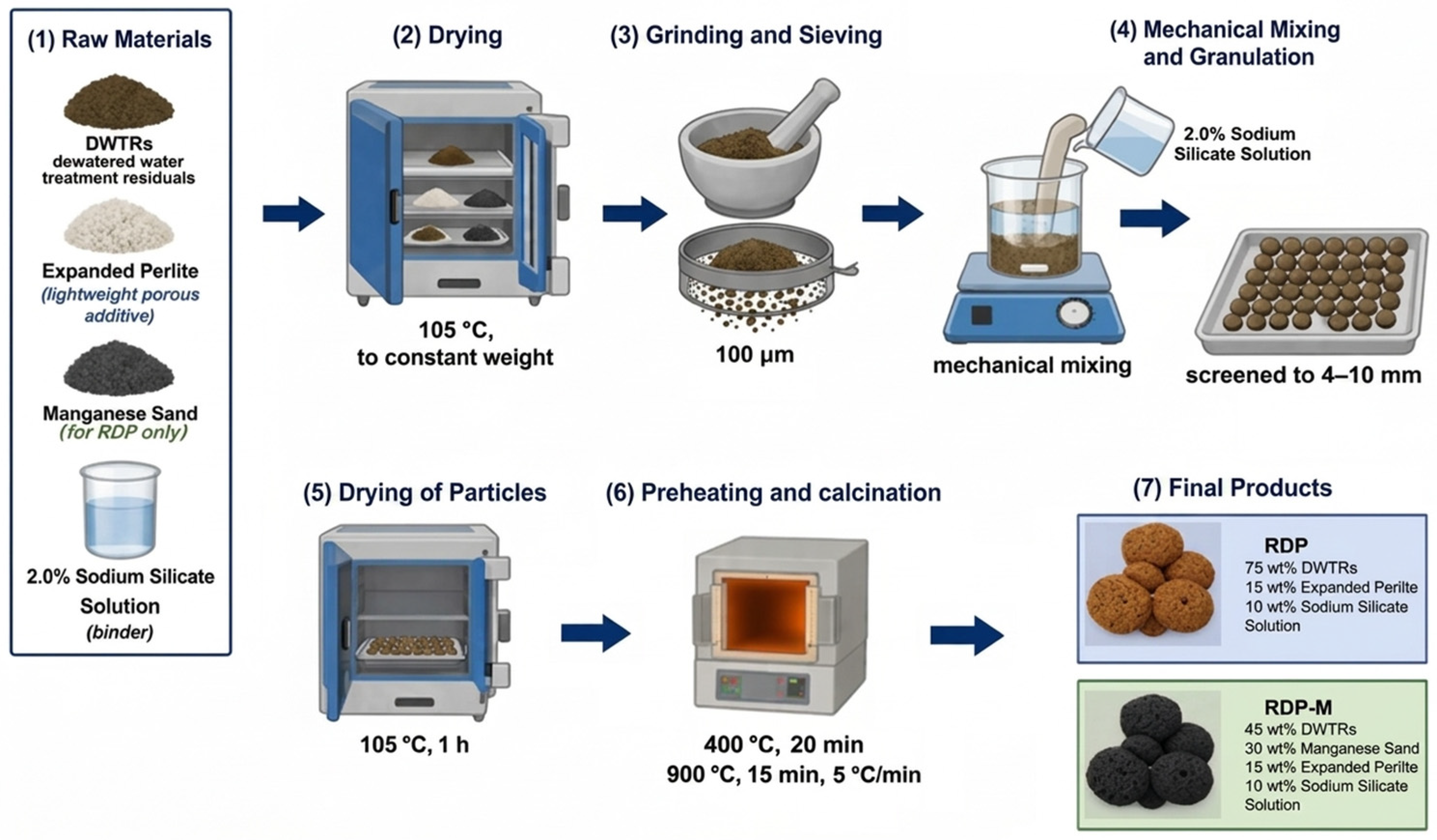
DWTRs were collected from the No. 3 Water Purification Plant in Beijing, China. The plant had a treatment capacity of approximately 40,000 m3/d and generated about 20 t/d of residuals. Two types of residual-derived particles were prepared, with and without the incorporation of manganese sand, and were denoted as RDP-M and RDP, respectively, to evaluate the effect of manganese sand on the adsorption performance of the particles. The detailed preparation procedure of RDP and RDP-M is schematically illustrated in Figure 1. DWTRs, expanded perlite, and manganese sand were dried at 105 °C to a constant weight, ground, and sieved through a 100 μm mesh. Expanded perlite was added as a lightweight porous additive to regulate the internal structure and bulk density of the particles and to facilitate granulation and calcination. A 2.0% sodium silicate solution was used as the binder. The particles were formed by mechanical mixing and screened to obtain diameters of 4–10 mm. They were dried at 105 °C for 1 h, preheated at 400 °C for 20 min in a muffle furnace, and then calcined at 900 °C for 15 min at a heating rate of 5 °C/min. RDP consisted mainly of DWTRs at 75 wt%, with expanded perlite and sodium silicate solution added at 15 wt% and 10 wt%, respectively. For RDP-M, 30 wt% of DWTRs was replaced by manganese sand, resulting in a formulation containing 45 wt% DWTRs, 30 wt% manganese sand, 15 wt% expanded perlite, and 10 wt% sodium silicate solution.
Figure 1.
Schematic illustration of the preparation procedure for RDP and RDP-M.
2.3. Characterization of Adsorbents
SEM (SU 8020, Hitachi, Tokyo, Japan) was used to examine the surface microstructure and pore morphology of RDP and RDP-M. The pore structure of RDP-M was characterized by N2 adsorption–desorption analysis at 77 K using an ASAP 2460 surface area analyzer (Micromeritics, Norcross, GA, USA). The elemental composition and chemical states of RDP and RDP-M were analyzed by XPS (ESCALAB Xi+, Thermo Fisher Scientific, Waltham, MA, USA). The powders obtained by grinding RDP and RDP-M were mixed with spectrally pure KBr at a mass ratio of 1:100, and pellets were prepared by the KBr pellet method. Fourier transform infrared spectroscopy (IS10 FT-IR, Nicolet, Madison, WI, USA) was used to record the spectra in the wavenumber range of 4000–400 cm−1.
2.4. Batch Adsorption Experiments
2.4.1. Effect of pH
2 g of RDP or RDP-M were separately added to 40 mL of Pb(NO3)2 solution with a concentration of 10 mg/L, with the initial pH adjusted to 4–10 using 0.1 mol/L NaOH or HCl. The suspensions were shaken in a constant temperature shaker at 120 rpm and 298 K for 1440 min. After equilibration, 20 mL of the supernatant was collected and filtered through a 0.22 μm water-compatible polyethersulfone (PES) membrane. The residual Pb(II) concentration was determined by inductively coupled plasma mass spectrometry (ICP-MS). To evaluate the variation in surface charge with pH, the zeta potentials of RDP and RDP-M were also measured at different pH values. Briefly, 0.05 g of each adsorbent were dispersed in 50 mL of deionized water, and the initial pH was adjusted to 4–10 using 0.1 mol/L NaOH or HCl. The suspensions were equilibrated for 30 min, and the zeta potential was then determined using a zeta potential analyzer.
2.4.2. Adsorption Kinetics
RDP or RDP-M at a dosage of 1 g was added to 40 mL of 10 mg/L Pb(NO3)2 solution. All samples were placed in a constant temperature shaker set at 298 K and shaken continuously at 120 rpm for a specified period. At predetermined time intervals from 5 to 1440 min, 20 mL of supernatant was withdrawn, filtered through a 0.22 μm water-compatible PES membrane, and the residual Pb(II) concentration was measured by ICP-MS. The adsorption capacity (mg/g) was calculated from the change in Pb(II) concentration in solution using the following Equation (1) [20]:
where and (mg/L) are the initial and equilibrium Pb(II) concentrations, respectively, V (L) is the solution volume, and m (g) is the mass of the adsorbent. The resulting values were then fitted using the pseudo-first-order and pseudo-second-order kinetic models (Equations (2) and (3)) to obtain the corresponding rate constants and model parameters.
The kinetic data for Pb(II) adsorption onto the two adsorbents were analyzed using the pseudo-first-order and pseudo-second-order kinetic models, as represented by Equations (2) and (3) [18].
In Equations (2) and (3), t (min) represents the contact time, qe (mg·g−1) and qt (mg·g−1) denote the amounts of Pb(II) adsorbed onto the adsorbents at equilibrium and at time t, respectively, while k1 (min−1) and k2 (g·mg−1·min−1) are the pseudo-first-order and pseudo-second-order adsorption rate constants, respectively.
2.4.3. Adsorption Isotherms and Thermodynamics
1 g of RDP or RDP-M was introduced into 40 mL of Pb(NO3)2 solution with initial Pb(II) concentrations ranging from 5 to 100 mg/L. The samples were shaken at 120 rpm under constant temperature for 1440 min at 298, 308, and 318 K, respectively. Then, 20 mL of supernatant was collected from each sample and filtered through a 0.22 μm water-compatible PES membrane filter to determine the concentration of Pb(II) using ICP-MS. The Langmuir isotherm (4), the Freundlich isotherm (5), the Temkin isotherm (6), and the Dubinin–Radushkevich isotherm (7) were used to fit the experimental isotherm data [20].
In Equations (4)–(7), qe (mg·g−1) is the amount of adsorbate adsorbed per unit mass of adsorbent at equilibrium; Ce (mg·L−1) is the equilibrium concentration; KL (L·mg−1) is the constant of the Langmuir equation; qm (mg·g−1) is the maximum adsorption capacity; KF (mg⋅g−1)·(L⋅mg−1)1/n is the constant of the Freundlich equation; n is the constant related to adsorption intensity; T (K) is the absolute temperature; R (8.314 J·mol−1·K−1) is the ideal gas constant; KT (L·mg−1) is the Temkin equilibrium adsorption constant; b (J·mol−1) is the Temkin constant related to the heat of adsorption; and KD-R (mol2·kJ−2) is a constant related to the adsorption energy in the Dubinin–Radushkevich model.
The van’t Hoff equation was used to calculate thermodynamic parameters (Equations (8)–(10)) [21]. For the thermodynamic study, the initial Pb(II) concentration was fixed at 10 mg/L, and all other conditions were kept consistent with the adsorption isotherm experiments.
In Equations (8)–(10), ΔG (kJ·mol−1) is the Gibbs free energy; Kd is the thermodynamic equilibrium constant; ΔS (J·mol−1·K−1) is the entropy change; ΔH (kJ·mol−1) is the enthalpy change; R (8.314 J·mol−1·K−1) is the ideal gas constant; and T (K) is the thermodynamic temperature.
2.4.4. Effect of Coexisting Cations
A total of 1.0 g of RDP or RDP-M was added to 40 mL of single-metal Pb(II), bimetal Pb(II)–Zn(II) or Pb(II)–Cu(II), and trimetal Pb(II)–Zn(II)–Cu(II) mixed solutions, in which the initial concentration of each metal ion was 10 mg/L. The mixture was agitated in a thermostatic shaker at 298 K and 120 rpm for 24 h. After equilibration, 20 mL of the solution was filtered through a 0.22 μm water-compatible PES membrane, and the residual Pb(II) concentration was determined by ICP-MS.
2.4.5. Regeneration and Reusability
A total of 2 g of RDP or RDP-M was added to 40 mL of a 10 mg/L Pb(NO3)2 solution. The mixture was shaken at 120 rpm and 298 K for 24 h. After adsorption, 20 mL of the suspension was collected and filtered through a 0.22 μm membrane. The residual Pb(II) concentration in the filtrate was determined by ICP-MS. The Pb(II)-loaded adsorbents were then regenerated with 0.1 mol/L HCl for 120 min, followed by thorough washing with deionized water until a neutral pH was reached. The regenerated adsorbents were dried at 60 °C to constant weight, aged for 24 h, and reused in the next adsorption cycle under the same conditions. This adsorption–regeneration procedure was repeated for five cycles to evaluate the reusability of the adsorbents.
3. Results and Discussion
3.1. Characterization
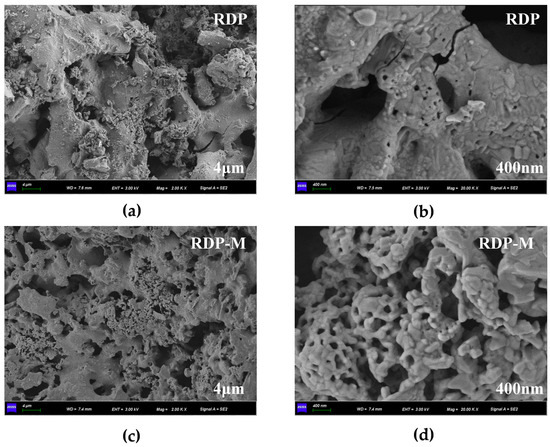
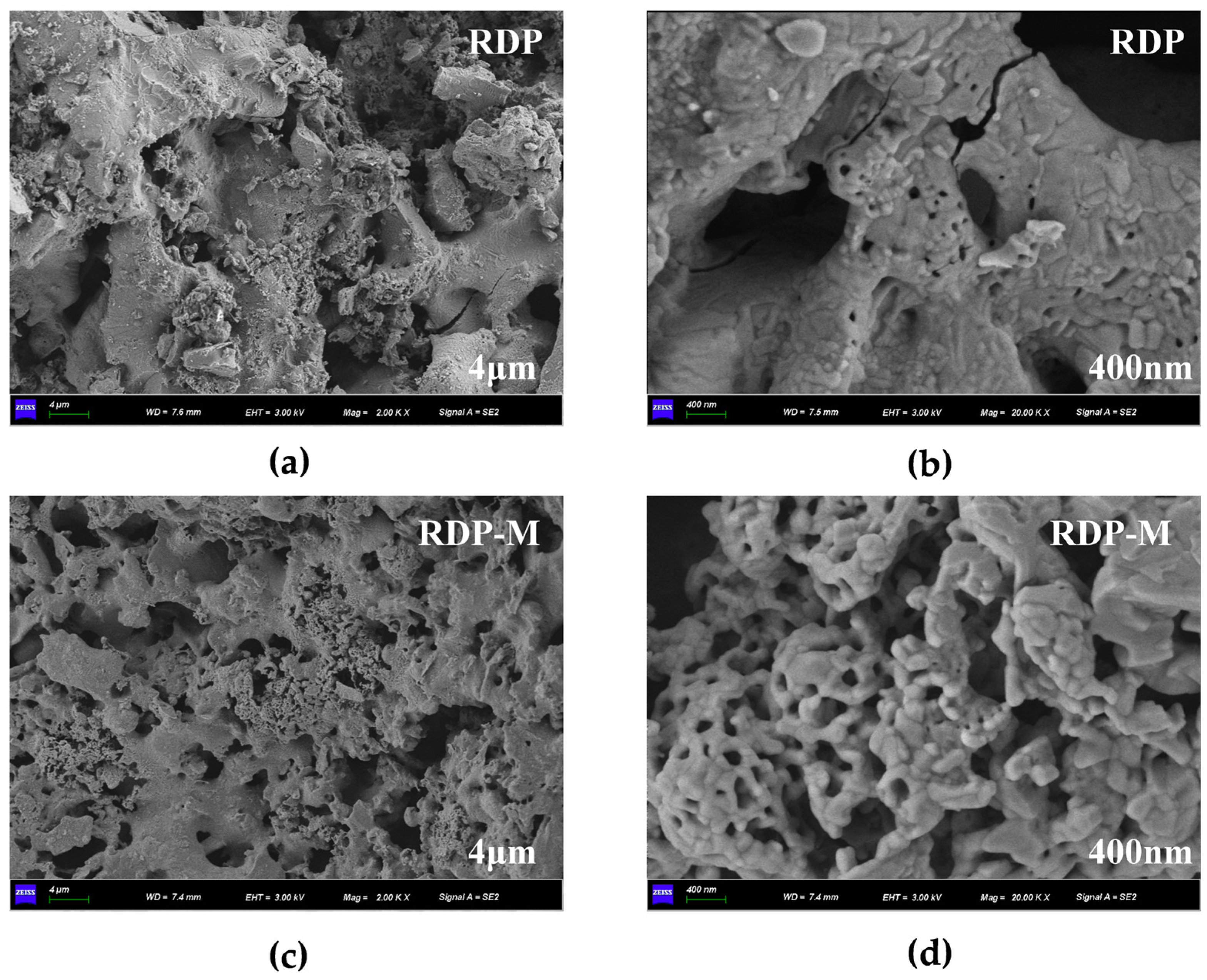
As shown in Figure 2, RDP and RDP-M showed some differences in surface morphology. In the low-magnification images (Figure 2a,c), both adsorbents appeared as irregular granular aggregates. However, the surface of RDP was relatively dense, and its pores mainly appeared as uneven cracks and large voids. In contrast, RDP-M showed a looser structure, higher surface roughness, and more visible pore features. The high-magnification images (Figure 2b,d) further revealed clear microstructural differences between the two materials. RDP retained a compact and agglomerated morphology without a well-developed porous texture, whereas RDP-M exhibited a more open honeycomb-like porous structure with numerous small pore openings and a sponge-like appearance after manganese sand incorporation [22]. These pore characteristics suggested that manganese sand incorporation altered the microstructure of RDP and formed a more accessible porous framework, which was favorable for Pb(II) diffusion into the particles and for mass transfer during adsorption [23]. This result was consistent with the N2 adsorption–desorption results of RDP-M. The BJH desorption pore size distribution was mainly centered at about 9.23 nm, suggesting that mesopores dominated the pore structure. Correspondingly, RDP-M exhibited a BET-specific surface area of 26.73 m2/g and a pore volume of 0.03 cm3/g. These structural features could provide accessible adsorption interfaces and facilitate Pb(II) diffusion and mass transfer within the pores [24].
Figure 2.
SEM images of RDP and RDP-M: (a,b): 4 µm and 400 nm SEM images of RDP; (c,d): 4 µm and 400 nm SEM images of RDP-M.
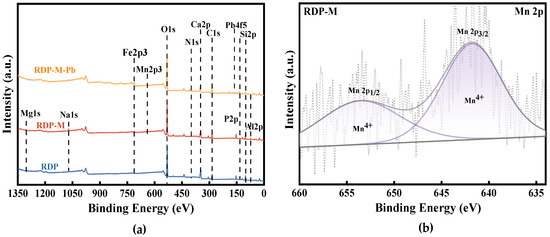
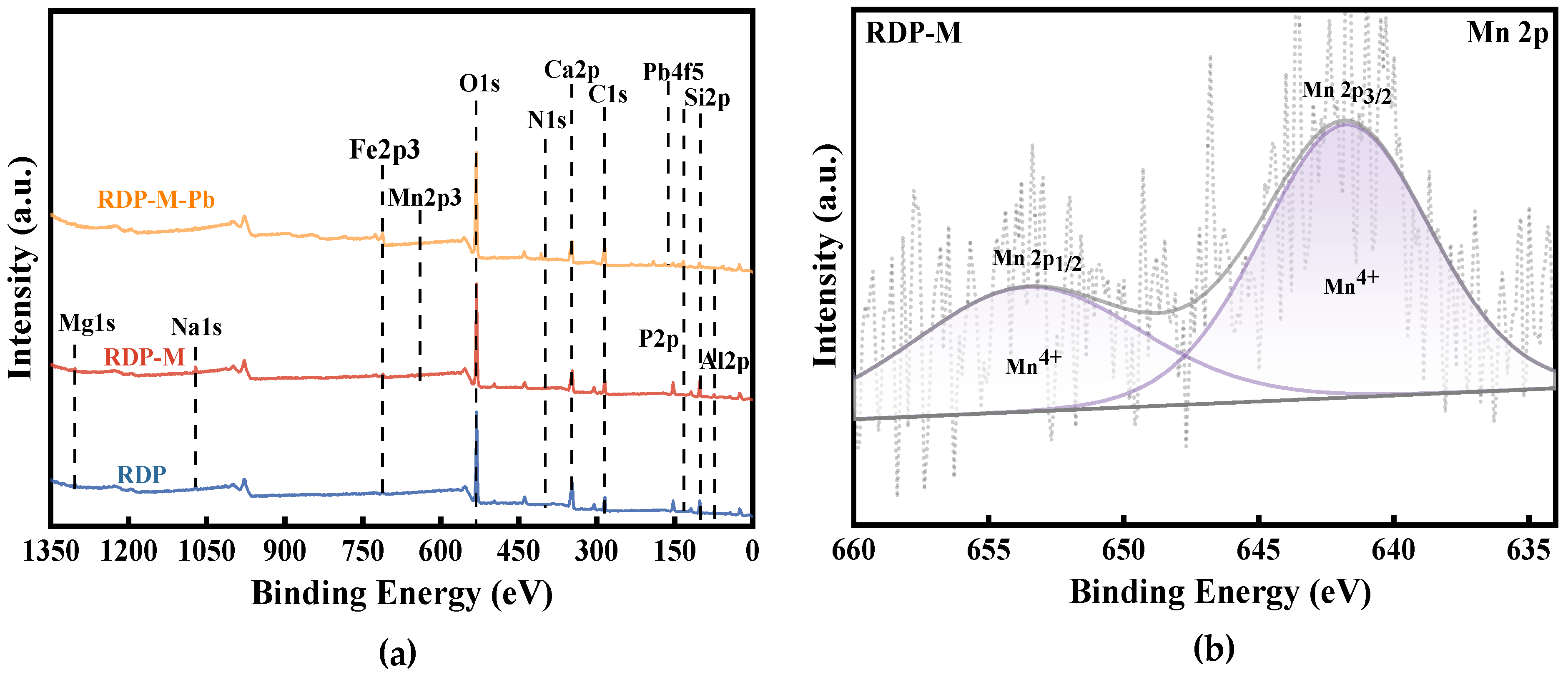
As shown in Figure 3, the surface chemical compositions of RDP and RDP-M were analyzed by XPS. The survey spectrum of RDP mainly showed the presence of C, O, Si, Al, Ca, Mg, Na, and Fe. The characteristic peaks of C 1s, O 1s, Si 2p, and Al 2p indicated the coexistence of organic components and a silicoaluminate mineral framework, suggesting that the RDP surface was primarily composed of silicoaluminate structures with dispersed alkaline earth metal phases. In contrast, the XPS spectrum of RDP-M retained the elemental features of RDP but displayed a distinct Mn 2p3/2 peak at approximately 641.3 eV [25], confirming the successful introduction of manganese onto the particle surface through manganese sand incorporation. This result was consistent with the Mn–O and Mn–O–Mn vibrational features identified in the FTIR analysis in Section 3.3, indicating that Mn mainly existed as manganese oxides on the RDP-M surface [26]. Combined with the SEM observations, these findings demonstrated that manganese sand incorporation not only modified the particle microstructure but also introduced Mn-related active components at the chemical level, thereby providing a solid basis for the enhanced adsorption performance.
Figure 3.
XPS Characterization of RDP and RDP-M: (a) Full XPS spectra of RDP, RDP-M, and RDP-M-Pb; (b) XPS Mn 2p spectrum of RDP-M. In subfigure (b), the purple solid lines represent the fitted component peaks of Mn 2p, the gray solid line represents the overall fitted curve, the gray sloping solid line represents the background, and the gray dotted line represents the original XPS spectrum.
3.2. Adsorption Performance
3.2.1. Effect of pH
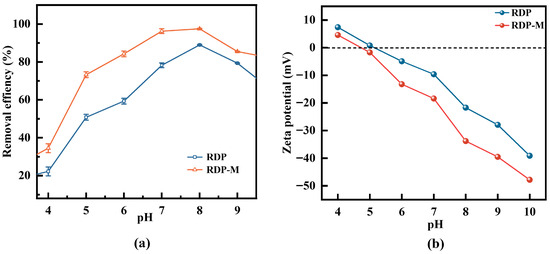
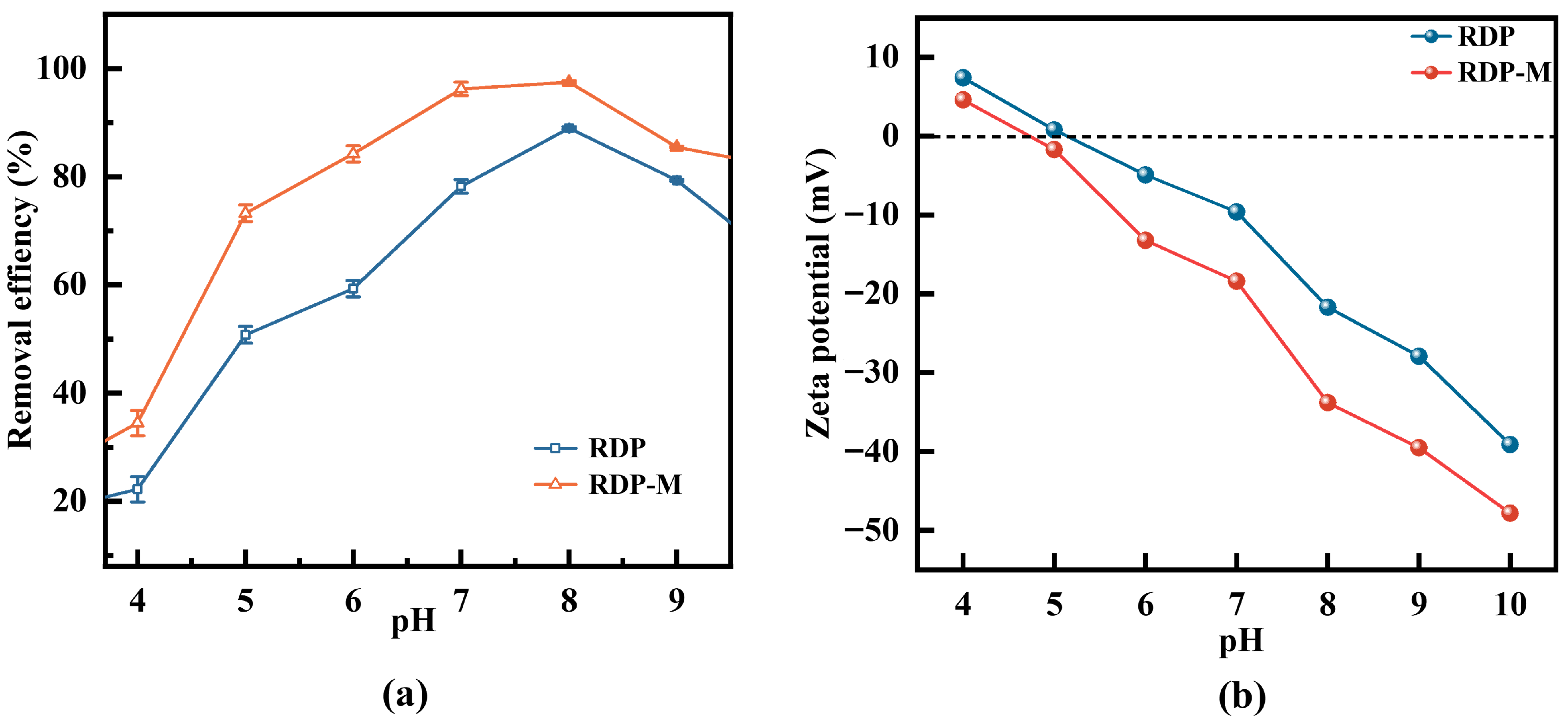
As shown in Figure 4a, the removal efficiencies of Pb(II) by both adsorbents increased as pH rose from 4 to 8. RDP-M consistently exhibited higher Pb(II) removal than RDP over the entire pH range, indicating that manganese sand improved the Pb(II) removal performance of DWTR-derived particles under different acid–base conditions. The difference between the two adsorbents became more pronounced with increasing pH and was greatest at pH 6–8. When pH was further increased to 10, the removal efficiencies of both adsorbents decreased slightly, but RDP-M still maintained better performance than RDP.
Figure 4.
Effect of pH on Pb(II) adsorption by RDP and RDP-M and variation in zeta potential with pH (a) Effect of pH on Pb(II) adsorption by RDP and RDP-M; (b) Zeta potential of RDP and RDP-M at different pH values. Experimental conditions for Pb(II) adsorption: pH 4–10, Pb(II) concentration 10 mg L−1, adsorbent dosage 2 g/40 mL, contact time 1440 min, temperature 298 K.
The zeta potential results further revealed the pH-dependent variation in surface charge. As shown in Figure 4b, the zeta potentials of both RDP and RDP-M gradually decreased with increasing pH, shifting from positive values under acidic conditions to negative values under alkaline conditions. This trend indicated the progressive deprotonation of surface functional groups. Across the tested pH range, RDP-M generally showed a lower zeta potential than RDP and crossed the zero-potential region earlier, suggesting that manganese sand modification reduced the electrostatic hindrance to Pb(II) and facilitated its approach to the adsorbent surface [27]. As the pH increased from 5 to 8, the decrease in zeta potential indicated weaker electrostatic hindrance. Surface deprotonation also increased the availability of oxygen-containing sites for complexation. Under alkaline conditions (pH > 8), further deprotonation made the surface more negatively charged, which favored the electrostatic attraction and surface enrichment of Pb(II).
Under acidic conditions (pH < 5), both adsorbents showed low Pb(II) removal and only minor differences. This was mainly because protonation of hydroxyl and other oxygen-containing groups increased the positive surface charge [28], while H+ also competed with Pb(II) for adsorption sites [29]. As the pH increased from 5 to 8, Pb(II) removal by both adsorbents increased markedly, and the increase was more pronounced for RDP-M. In addition to the weakened electrostatic hindrance, RDP-M provided extra Mn–O and Mn–O–Mn coordination sites, which promoted stronger Pb(II) binding under near-neutral conditions [30]. Under alkaline conditions, the more negatively charged surface and the greater availability of coordination-capable sites together contributed to the high removal efficiencies of both adsorbents, although the slight decrease at pH 10 may be related to changes in Pb(II) speciation under strongly alkaline conditions. Notably, the pH range of 6–8 is close to that of typical urban road runoff and stormwater [31]. This indicates that RDP-M can achieve efficient and stable Pb(II) removal under environmentally relevant conditions without pH adjustment. These results further support the potential application of RDP-M in urban stormwater treatment and sustainable stormwater management.
3.2.2. Adsorption Kinetics
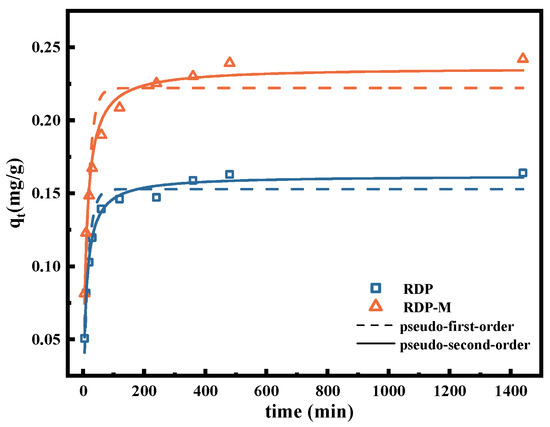
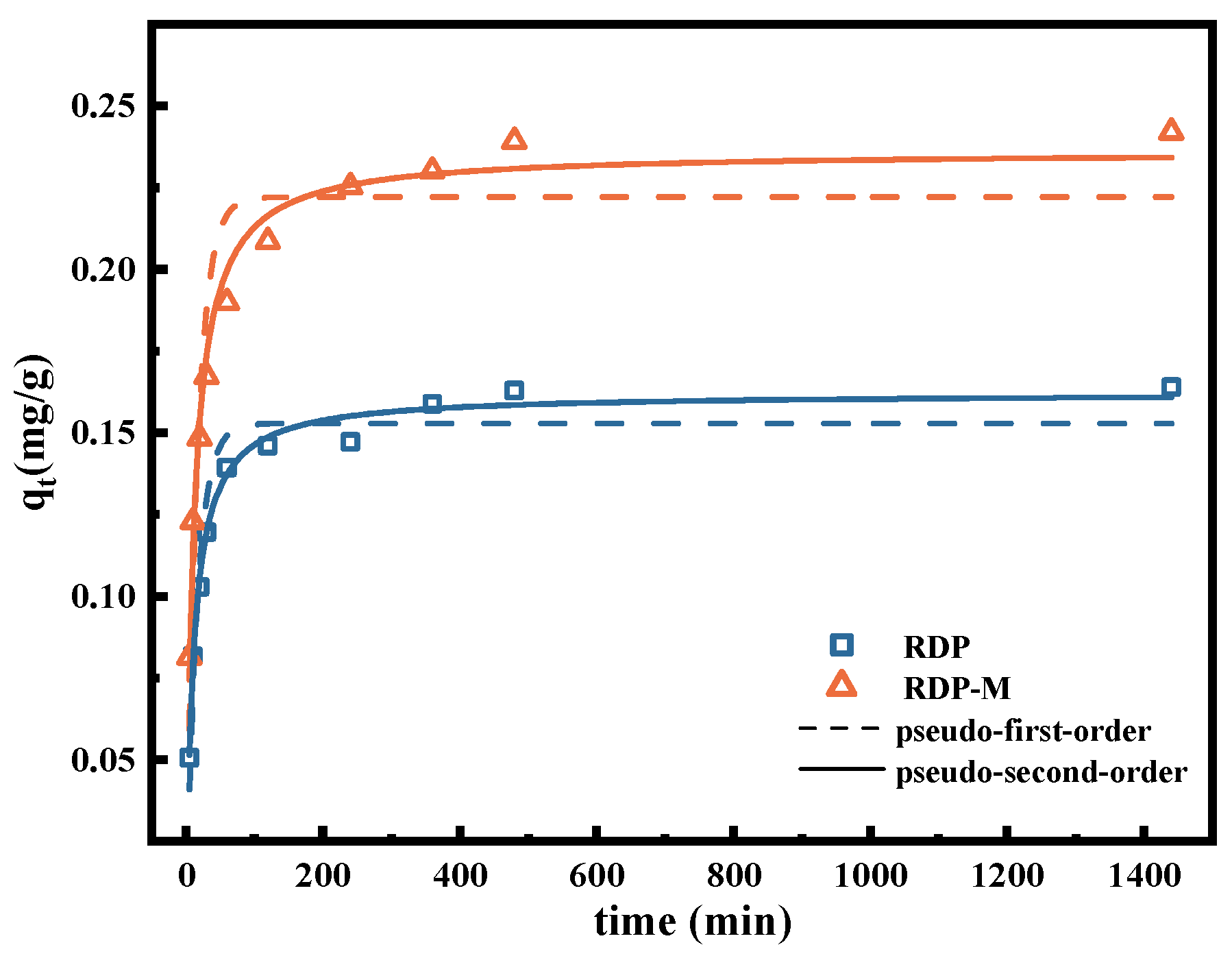
Two kinetic models, namely the pseudo-first-order and pseudo-second-order models, were applied to describe the Pb(II) adsorption behavior of the two adsorbents. The fitted curves and kinetic parameters are shown in Figure 5 and Table 1, respectively. For both RDP and RDP-M, the pseudo-second-order model yielded R2 values closer to unity and higher than those of the pseudo-first-order model, indicating that it provided a more accurate description of the adsorption process. These results suggested that chemical interaction played an important role in Pb(II) adsorption [32].
Figure 5.
Kinetic adsorption of Pb(II) by RDP and RDP-M (Pb(II) concentration 10 mg L−1, adsorbent dosage 1 g/40 mL of each adsorbent, pH 7, temperature 298 K, contact time 5–1440 min).
Table 1.
Pseudo-first-order and pseudo-second-order kinetic parameters for RDP and RDP-M.
Based on the kinetic fitting results, the temporal evolution of Pb(II) adsorption on both adsorbents exhibited a typical three-stage pattern. In the first stage (0–30 min), rapid adsorption was observed, during which approximately 70% of the equilibrium adsorption was achieved. In the second stage (30–120 min), the adsorption rate gradually decreased, indicating a slower adsorption process. In the final stage (after 120 min), the adsorption curves approached a plateau, suggesting that adsorption equilibrium had nearly been reached. The rapid adsorption in the initial stage was mainly attributed to the high Pb(II) concentration in the aqueous solution and the abundance of available adsorption sites on the adsorbent surface. As adsorption proceeded, these active sites were progressively occupied and approached saturation, which limited further interaction between Pb(II) and the adsorbents and reduced the adsorption rate at later stages.
The kinetic parameters summarized in Table 1 revealed that manganese sand loading significantly enhanced the adsorption performance of RDP. After manganese sand incorporation, the adsorption rate constant (k2) increased, indicating improved adsorption kinetics. Meanwhile, the equilibrium adsorption capacity (qe) of RDP-M reached 0.25 mg/g, representing a 51% increase compared with that of RDP. This enhancement was attributed to the introduction of manganese sand, which strengthened chemical interactions such as surface complexation and electrostatic attraction between Pb(II) and Mn–O groups [32], while the manganese sand framework further improved particle stability and facilitated mass transfer [33]. These combined effects accelerated the adsorption process and increased the equilibrium adsorption capacity, thereby confirming the superior Pb(II) removal efficiency of RDP-M. Owing to its rapid adsorption behavior, RDP-M may be suitable for on-site stormwater treatment systems such as bioretention cells and rain gardens, where runoff typically exhibits short hydraulic residence times and high instantaneous pollutant loads [34].
3.2.3. Adsorption Isotherms and Thermodynamics
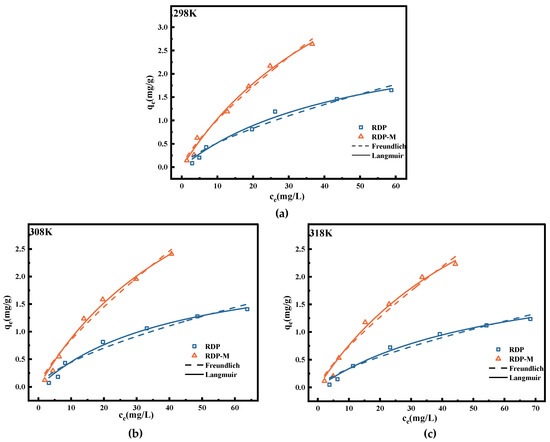
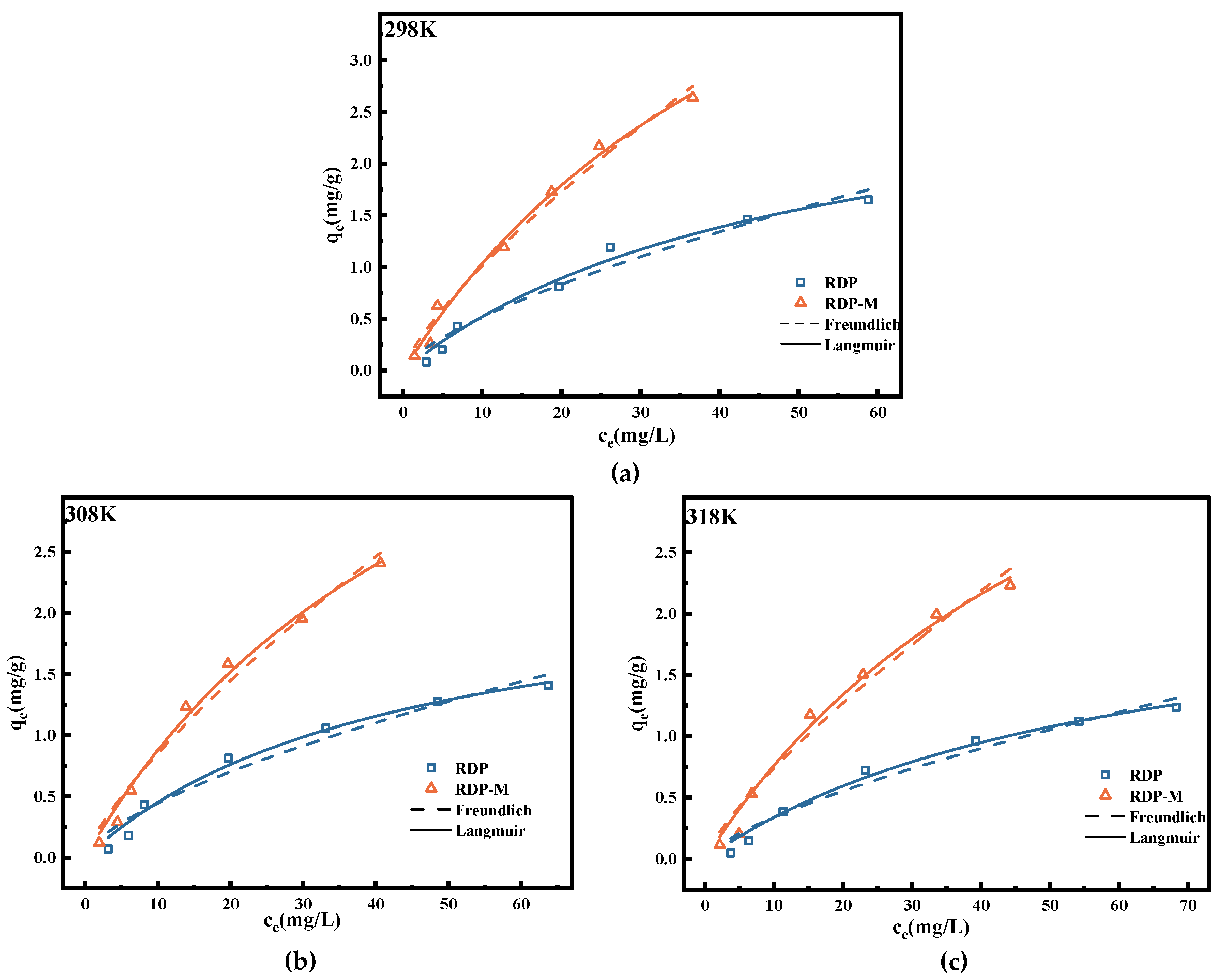
As shown in Figure 6, the adsorption capacities of both adsorbents increased with increasing initial Pb(II) concentration. This trend can be attributed to the enhanced concentration gradient, which increased the mass transfer driving force and facilitated Pb(II) diffusion from the solution to the adsorbent surface. Throughout the investigated concentration range, RDP-M consistently exhibited higher Pb(II) adsorption capacity than RDP, suggesting that manganese sand loading optimized the surface chemical environment of RDP and provided more energetically favorable adsorption sites for Pb(II) at equilibrium [35].
Figure 6.
Pb(II) adsorption isotherms of RDP and RDP-M at different temperatures: (a) 298 K; (b) 308 K; (c) 318 K (Pb(II) concentration 5–100 mg L−1, adsorbent dosage 1 g/40 mL of each adsorbent, pH 7, contact time 1440 min).
The fitting parameters of four isothermal models (Langmuir, Freundlich, Temkin, and Dubinin–Radushkevich) are summarized in Table 2. At all tested temperatures, the Langmuir model showed the highest correlation coefficients (R2 > 0.97), indicating that it provided the best fit to the adsorption data among the tested models [36]. At 298 K, the maximum adsorption capacity (qₘ) of RDP-M (2.79 mg/g) was significantly higher than that of RDP (1.89 mg/g), suggesting that the incorporation of manganese sand increased the availability of adsorption sites and enhanced the interaction with Pb(II) [37]. At 298 K, the qm from the D-R model for RDP-M (1.44 mg/g) was notably lower than the Langmuir qm (2.79 mg/g), because the Langmuir model estimates a theoretical maximum adsorption capacity on relatively homogeneous sites, whereas the D-R model reflects adsorption behavior associated with surface energy distribution [20]. Therefore, the qm values obtained from the two models are not directly comparable. When the temperature increased from 298 K to 318 K, the maximum adsorption capacities of RDP and RDP-M decreased by 0.62 and 0.39 mg/g, respectively, indicating an exothermic adsorption tendency. Notably, RDP-M exhibited a smaller reduction in adsorption capacity with increasing temperature, suggesting relatively better thermal stability of Pb(II) adsorption on RDP-M. The enhanced stability may be attributed to stronger metal–oxygen interactions associated with Mn-containing functional groups [38].
Table 2.
Isotherm parameters for Pb(II) adsorption by RDP and RDP-M.
To further quantify the effect of temperature on the adsorption process, thermodynamic parameters including ΔG, ΔH, and ΔS were calculated at different temperatures (Table 3). The negative ΔH values for both adsorbents confirmed that the adsorption process was exothermic, likely because of the formation of chemical bonds between Pb(II) ions and functional groups on the adsorbent surfaces. The negative ΔS values indicated a decrease in randomness at the solid–liquid interface, implying that the system became more ordered during Pb(II) adsorption. The negative ΔG values at all tested temperatures suggested that Pb(II) adsorption was spontaneous. However, as the temperature increased, the ΔG values became less negative, implying that higher temperatures reduced the spontaneity of the process. Therefore, the adsorption of Pb(II) by RDP-M can be described as an exothermic and entropy-reducing reaction [21], and lower temperatures were more favorable for achieving higher adsorption efficiency. Importantly, the negative ΔG value at 298 K, which was close to the typical temperature of urban surface runoff, indicated that Pb(II) adsorption proceeded spontaneously under ambient environmental conditions, thereby supporting the applicability of RDP-M for runoff treatment.
Table 3.
Thermodynamic parameters for Pb(II) adsorption by RDP and RDP-M.
3.2.4. Competitive Adsorption
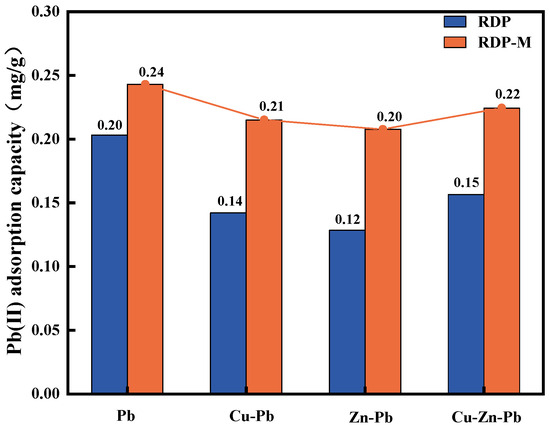
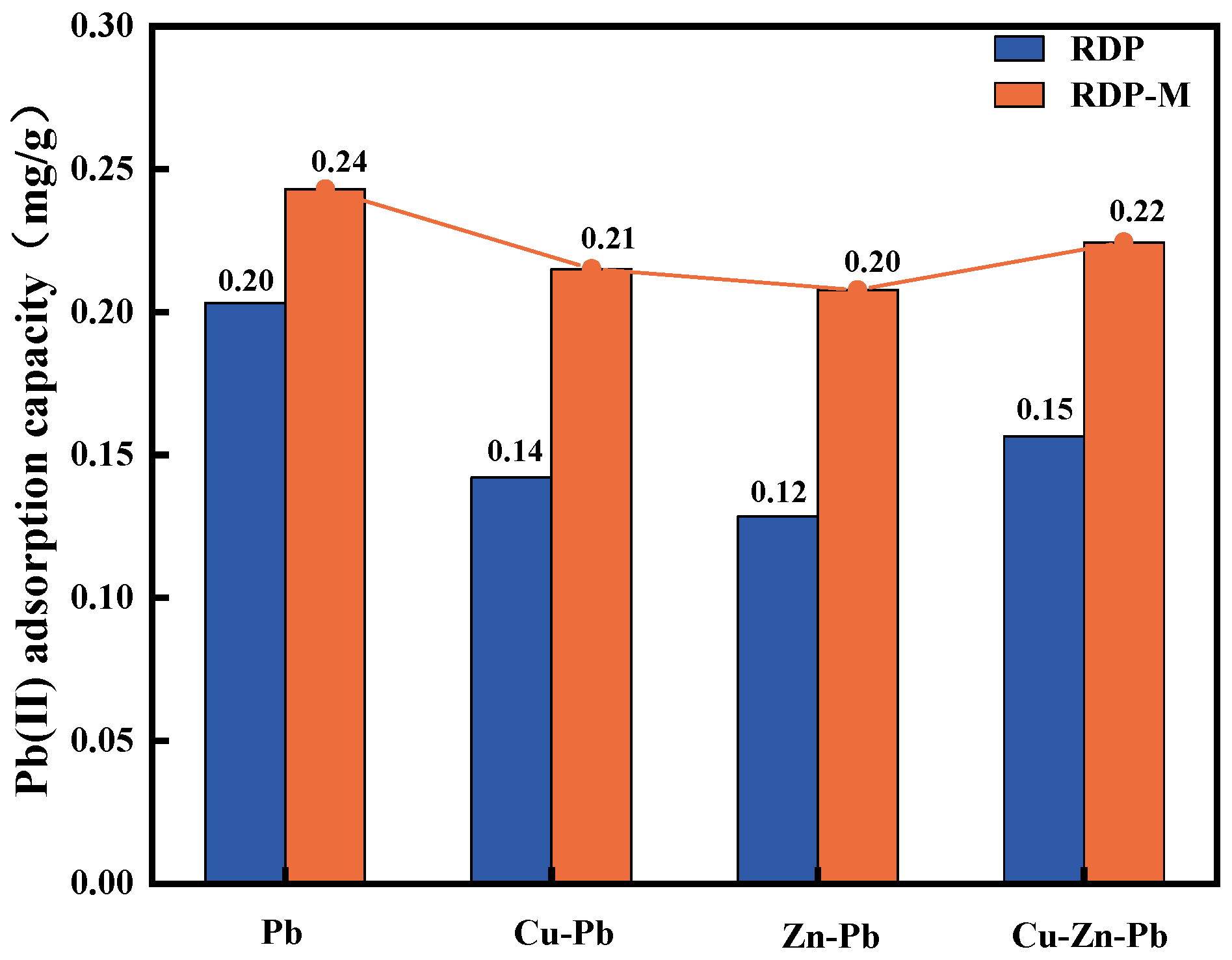
Figure 7 showed the effects of coexisting cations on Pb(II) adsorption by RDP and RDP-M. Cu(II) and Zn(II), selected as representative traffic-related toxic metals commonly present in urban stormwater runoff [39], reduced Pb(II) adsorption for both adsorbents. For RDP-M, the Pb(II) adsorption capacity decreased by 12.5% and 16.6% in the presence of Cu(II) and Zn(II), respectively, whereas much more pronounced reductions of approximately 30% and 40% were observed for RDP. In trimetal systems, the total reduction in Pb(II) adsorption capacity was 8.3% for RDP-M, compared with 25% for RDP, indicating that RDP-M exhibited stronger resistance to competitive interference. This improved tolerance was attributed to the incorporation of manganese sand, which provided additional Mn–O-based adsorption sites and mitigated competitive occupation by coexisting metal ions [40].
Figure 7.
Effect of coexisting cations on the adsorption of Pb(II) by RDP and RDP-M (Pb(II) concentration 10 mg L−1, coexisting ions 10 mg L−1 each, adsorbent dosage 1 g/40 mL of each adsorbent, pH 7, contact time 24 h, temperature 298 K.
The preferential adsorption of Pb(II) in multi-component systems may be attributed to two main factors. First, under neutral to slightly alkaline conditions (pH 7–8), differences in the hydrolysis behavior and adsorption affinity of Pb(II), Cu(II), and Zn(II) may affect their competition for available adsorption sites. Compared with Cu(II) and Zn(II), Pb(II) showed a stronger tendency to remain associated with the adsorbent, which favored its uptake in competitive systems. Second, according to the thermodynamic analysis in Section 3.2.2, the adsorption of Pb(II) by RDP-M was spontaneous (ΔG < 0). This favorable thermodynamic tendency contributed to the preferential uptake of Pb(II) in the presence of competing ions. Even in the Cu(II)/Zn(II)-containing systems, Pb(II) could still occupy favorable sites through stronger interaction with Mn-related and oxygen-containing active sites. Furthermore, because Pb(II) was bound to RDP-M through relatively strong chemical interactions, the adsorbed Pb(II) was less likely to be displaced by competing ions [41]. When multiple ions coexisted, Pb(II) preferentially occupied high-affinity sites on RDP-M, leading to a smaller decrease in Pb(II) adsorption than that observed for RDP or in binary systems. In complex waters such as urban stormwater runoff, the tolerance of RDP-M to coexisting ions suggests relatively stable operation and lower maintenance demand, which supports its engineering applicability.
3.2.5. Cyclic Adsorption Performance
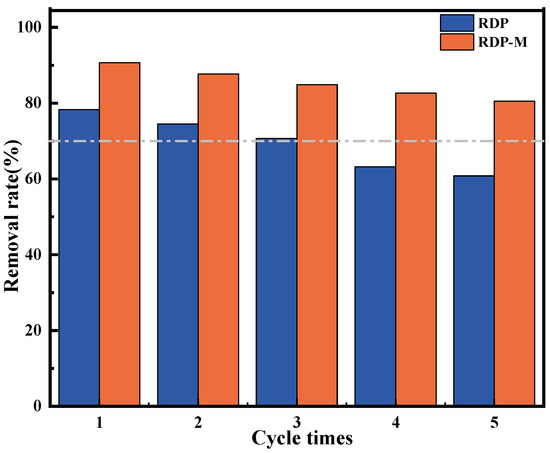
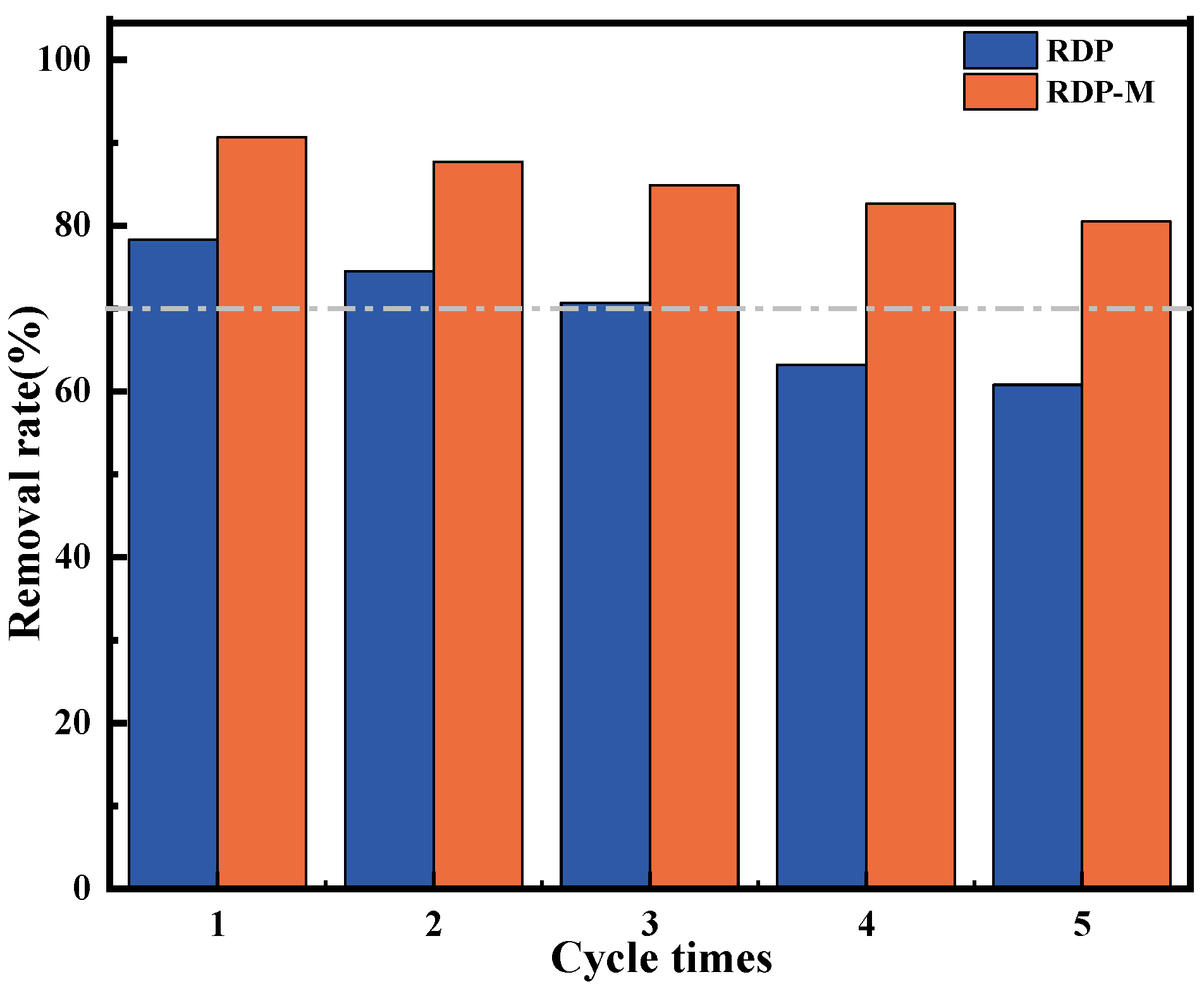
As illustrated in Figure 8, both RDP and RDP-M exhibited good cyclic adsorption performance for Pb(II) removal, although a gradual decline in adsorption efficiency was observed with increasing cycle number. During the first three adsorption–desorption cycles, the removal efficiencies of both adsorbents remained relatively stable and exceeded 70%, indicating good reusability. The slight decrease in adsorption capacity after repeated cycles may be attributed to the partial occupation of high-affinity sites and incomplete desorption of Pb(II), which reduced the number of available active sites. Notably, RDP-M showed a smaller reduction in adsorption efficiency than RDP over successive cycles, suggesting that manganese sand loading improved the structural integrity and chemical stability of the adsorbent. The presence of Mn-containing components may have provided more robust binding sites and reduced irreversible site loss during regeneration, thereby contributing to the better reusability of RDP-M [42]. The relatively stable performance over repeated cycles suggests that RDP-M has potential for reuse in water treatment applications.
Figure 8.
Adsorption–desorption cycles of Pb(II) using RDP and RDP-M adsorbents.
Meanwhile, no obvious particle disintegration or noticeable fine generation was observed during repeated adsorption–desorption cycles or routine handling, indicating that RDP-M could maintain a relatively stable particle structure under laboratory conditions. In addition, under the leaching test conditions after the cyclic adsorption–desorption experiments, the maximum Mn concentration detected in the leachate remained below the reference limit of 0.1 mg/L specified in GB 5749-2022 [43] and GB 3838-2002 [44] in China, suggesting no obvious Mn leaching risk under the tested conditions. A rough estimate based on the Pb adsorption capacity suggested a theoretical service life of about 5–7 years under the assumed stormwater runoff conditions, indicating the potential of RDP-M for long-term service in practical applications. However, this estimate was based only on Pb adsorption capacity and did not consider practical factors such as clogging caused by suspended solids and sediment accumulation, competitive adsorption in multi-pollutant systems, hydraulic variation, and maintenance requirements. Therefore, the actual service life still requires further validation under long-term dynamic or field conditions.
3.3. Adsorption Mechanisms
The combined FTIR and XPS results indicated that Pb(II) adsorption onto RDP-M involved multiple synergistic mechanisms. Surface complexation, particularly inner-sphere complexation, played the dominant role, while electrostatic interaction also contributed to Pb(II) uptake.
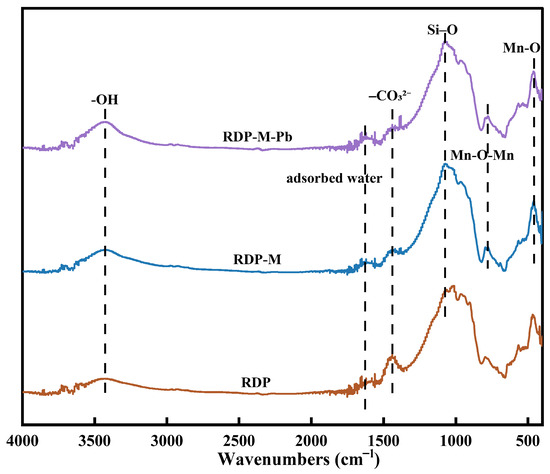
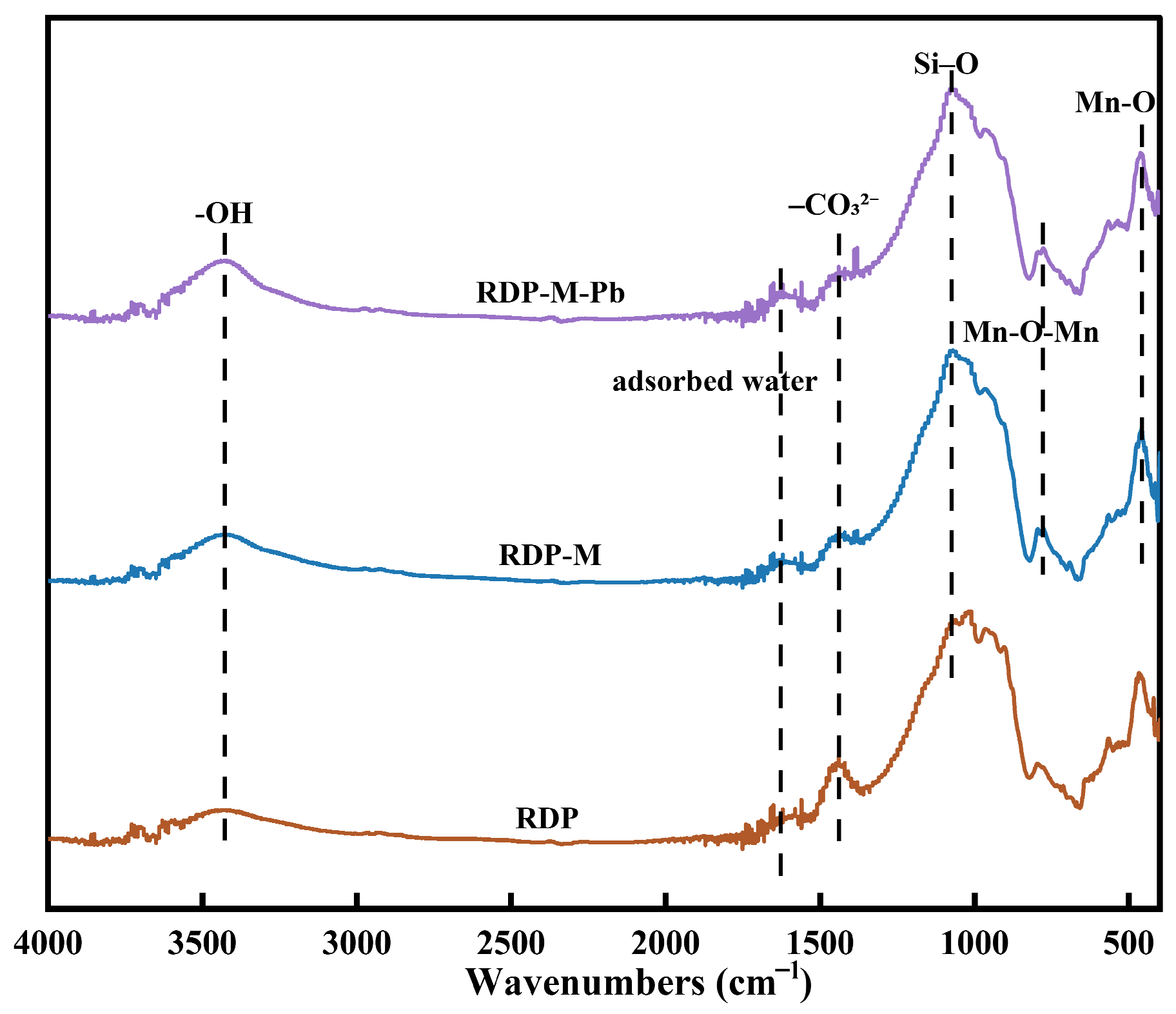
As shown in Figure 9, the FTIR spectra of RDP, RDP-M, and Pb(II)-loaded RDP-M all exhibited broad absorption bands at 3420–3440 cm−1 [45], which were attributed to the stretching vibrations of surface hydroxyl (–OH) groups, indicating the presence of abundant hydroxyl groups and hydrogen-bonding structures. The strong band observed near 1080 cm−1 corresponded to the stretching vibrations of Si–O–Si and Si–O–Al [46], suggesting that the silicoaluminate framework remained intact during the modification and adsorption processes. Compared with RDP, RDP-M showed two additional bands at 455.8 and 662 cm−1, which were assigned to Mn–O and Mn–O–Mn stretching vibrations [47,48], respectively, indicating the incorporation of manganese-related metal–oxygen bonds. After Pb(II) adsorption, these Mn–O-related bands exhibited slight shifts and changes in intensity or shape, implying interactions between Pb(II) and Mn–O active sites, accompanied by local structural rearrangement [49]. Meanwhile, the –OH band became relatively sharper after Pb(II) adsorption, suggesting a change in the hydrogen-bonding environment and the involvement of surface hydroxyl groups in Pb(II) coordination [50].
Figure 9.
FTIR images of RDP and RDP-M before and after adsorption of Pb(II).
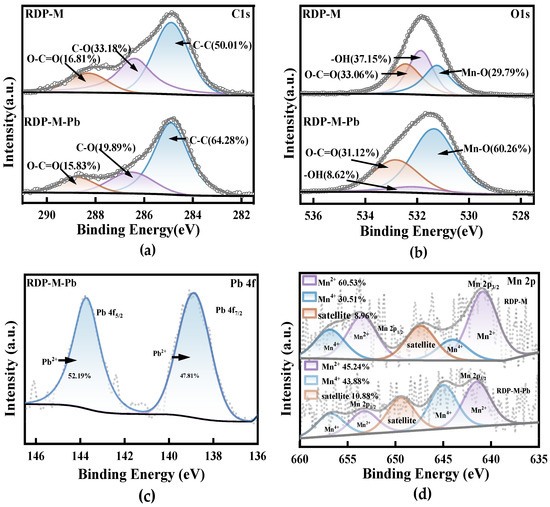
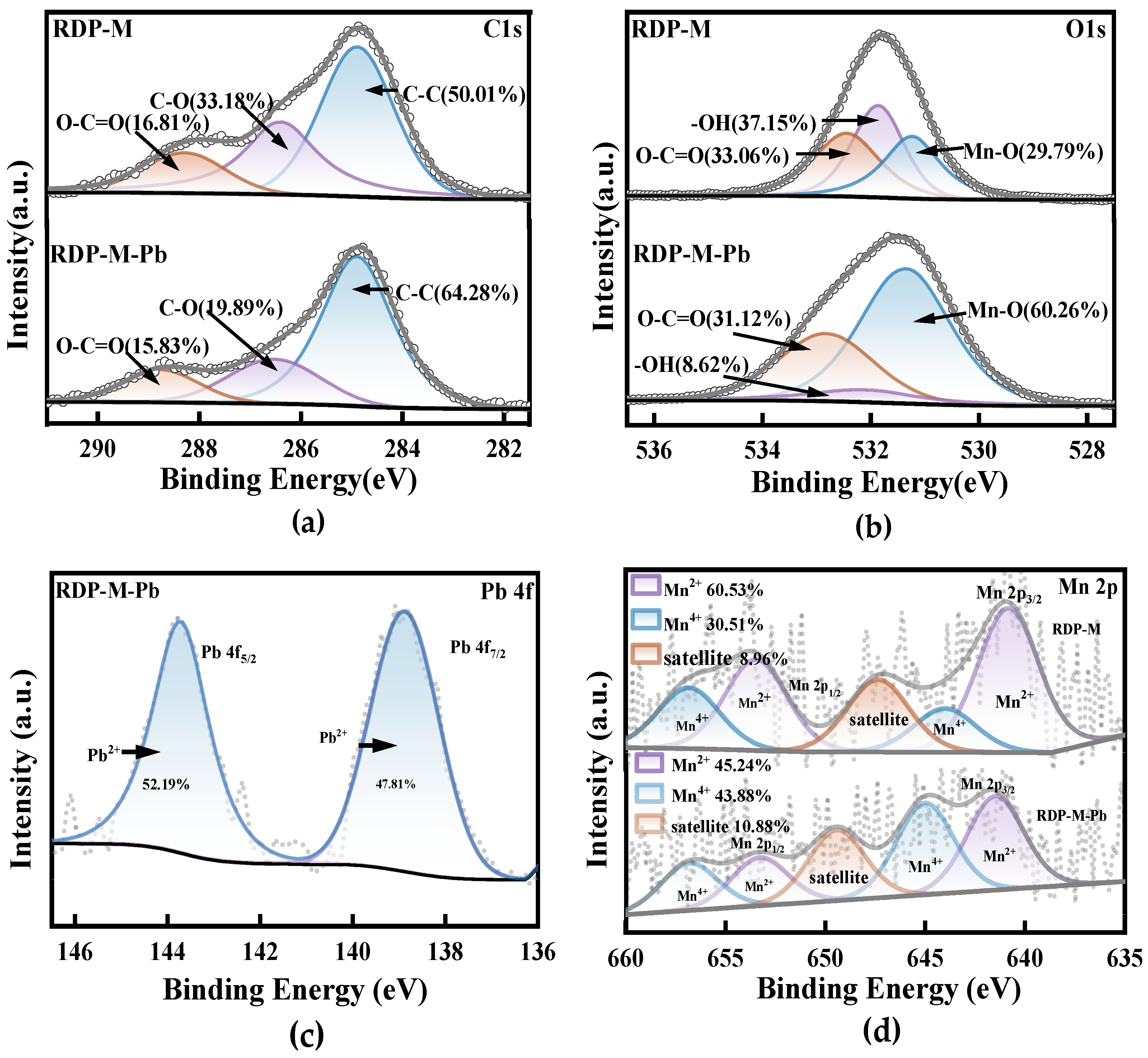
The XPS results (Figure 10) further supported the proposed Pb(II) adsorption mechanism on RDP-M. Distinct Pb 4f7/2 and Pb 4f5/2 peaks (Figure 10c) appeared on the RDP-M surface after adsorption, confirming the successful immobilization of Pb(II). The binding energy positions of the Pb 4f doublet suggested that Pb was retained in its divalent chemical state throughout the adsorption process, indicating that Pb(II) uptake occurred without redox reactions [51]. As shown in Figure 10b, the O 1s spectrum showed a decrease in hydroxyl-related components and an increase in metal–oxygen-related species. This result indicated that surface hydroxyl groups were involved in Pb(II) binding and were transformed into more stable Pb–O or metal–O–Pb coordination structures [52]. The Mn 2p spectrum (Figure 10d) showed a decrease in the relative contribution of Mn2+ species and an apparent increase in higher-valent Mn-related components after adsorption. This change was attributed to the preferential involvement of low-valent Mn-associated oxygen sites in Pb(II) surface complexation and local coordination rearrangement [41], which altered their surface detectability rather than inducing a redox transformation. Meanwhile, the attenuation of the C–O and O–C=O signals in the C 1s spectrum (Figure 10a) suggested the possible involvement of oxygen-containing functional groups in Pb(II) binding through coordination-induced changes in their surface chemical environments [53].
Figure 10.
XPS spectrum scans of RDP-M and RDP-M-Pb: (a) C1s, (b) O1s (Metal–O includes lattice oxygen and metal–oxygen bonds related to MnOx and newly formed Pb–O species after adsorption), (c) Pb4f and (d) Mn2p. The purple solid lines represent the fitted component peaks of Mn 2p, the gray solid line represents the overall fitted curve, the gray sloping solid line represents the background, and the gray dotted line represents the original XPS spectrum.
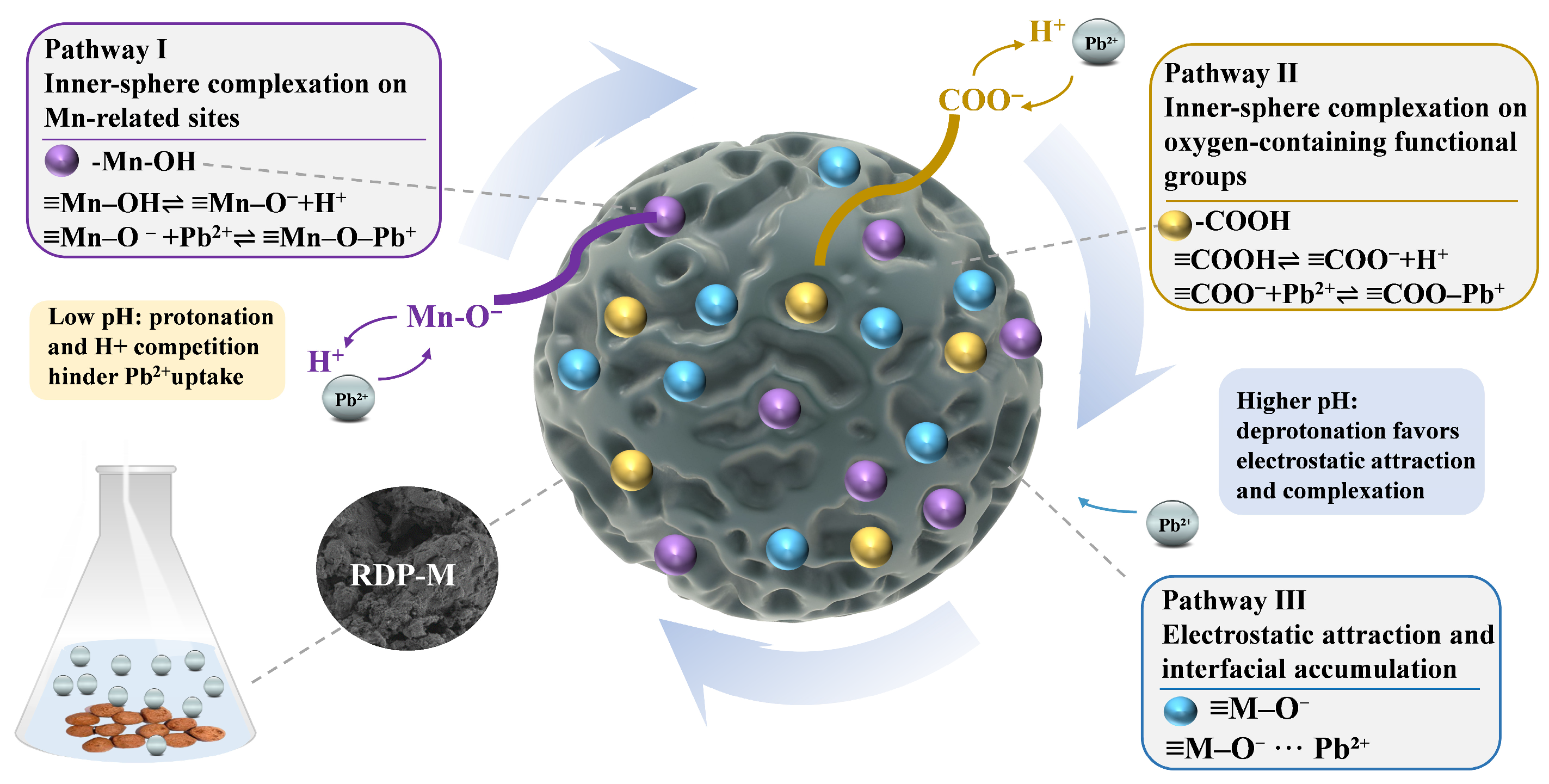
Based on the combined FTIR, XPS, pH-dependent adsorption, and zeta potential results, Pb(II) uptake by RDP-M was governed by the combined action of inner-sphere surface complexation and electrostatic interaction, while the former was considered dominant for stable Pb(II) immobilization. The FTIR and XPS results showed that Mn–O, Mn–O–Mn, and oxygen-containing functional groups participated in the formation of relatively stable Pb–O or metal–O–Pb coordination structures, indicating that Pb(II) was mainly retained through surface complexation. In contrast, electrostatic interaction likely facilitated the approach of Pb(II) to the adsorbent surface and favored its accumulation near the interface [54]. As discussed in Section 3.2.1, the zeta potential of RDP-M decreased progressively with increasing pH and shifted from positive to negative values, indicating the gradual deprotonation of surface functional groups. Under acidic conditions, protonation of surface sites and competition from H+ hindered the access of Pb(II) to the adsorbent surface and also suppressed subsequent complexation [55]. As pH increased, the reduced electrostatic hindrance and the increased availability of coordination-capable sites made Pb(II) uptake more favorable. Under near-neutral to alkaline conditions, especially when the surface became more negatively charged, electrostatic attraction became more effective in promoting Pb(II) accumulation near the surface, which further facilitated inner-sphere complexation. Although the relative contributions of these two mechanisms could not be quantitatively separated based on the present data, the available results support that electrostatic interaction played a supplementary but pH-dependent role, whereas inner-sphere surface complexation dominated the final stable binding of Pb(II). The proposed adsorption mechanism is schematically illustrated in Figure 11.
Figure 11.
Schematic diagram of the adsorption mechanism of Pb(II) onto RDP-M.
3.4. Comparative Discussion of RDP-M and Other Pb(II) Adsorbents
This comparison focused on granular and application-oriented Pb(II) adsorbents rather than on all batch adsorbents reported in the literature. Recent studies have shown that, for stormwater treatment media, practical factors such as hydraulic applicability, structural stability [56], adsorption performance, and reusability are all important [57]. Granulation, composite modification, and the incorporation of functional components [58] into filter media have been regarded as effective ways to improve practical performance. In contrast, many recently reported Pb(II) adsorbents were mainly designed for batch systems and often emphasized either high adsorption capacity [59] or convenient separation [60]. As shown in Table 4, representative Pb(II) adsorbents differed markedly in material form, modification strategy, and practical application characteristics.
Table 4.
Comparison of RDP-M with representative Pb(II) adsorbents.
In this context, RDP-M showed several practical advantages. It converted DWTRs into a granular adsorbent and was therefore more suitable for filtration-based stormwater treatment. Manganese sand was low-cost and readily available, and its incorporation introduced additional Mn-related active sites. The preparation process also avoided the use of excessive chemical reagents. In addition, RDP-M exhibited effective Pb(II) removal under environmentally relevant pH conditions, stronger tolerance to competing ions, and acceptable cyclic performance. Therefore, the main strength of RDP-M lies in combining a practically acceptable adsorption capacity with waste valorization, granular structure, low-cost modification, and effective adsorption under environmentally relevant conditions.
4. Conclusions
This study demonstrated that the RDP-M composite, prepared from drinking water treatment plant residuals (DWTRs) and manganese sand, was an effective adsorbent for Pb(II) removal. The incorporation of manganese sand improved the surface structure and chemical properties of the residual-based adsorbent, leading to a rougher and more porous morphology with abundant metal–oxygen active sites. RDP-M achieved a maximum Pb(II) adsorption capacity of 2.79 mg g−1 at 298 K and pH 7, which was about 48% higher than that of RDP. The adsorption process was dominated by chemisorption and was spontaneous and exothermic. In addition, RDP-M maintained stable Pb(II) removal over a relatively wide pH range, showed tolerance to coexisting ions, and retained acceptable performance during regeneration cycles.
From a sustainability perspective, the preparation of RDP-M provided a useful route for the valorization of DWTRs and helped reduce the disposal burden of these byproducts. Overall, RDP-M showed potential as a granular adsorbent for Pb(II) removal from contaminated water and may be applicable in stormwater treatment systems, especially green infrastructure facilities such as bioretention systems and rain gardens. Nevertheless, further work is needed before practical application. Future studies should evaluate the permeability and mechanical strength of the particles in column systems and further characterize adsorption-related interfacial properties.
Author Contributions
Conceptualization, X.D.; methodology, X.D.; software, S.C.; validation, S.C.; formal analysis, H.S.; investigation, H.S. and X.Y.; data curation, X.D., S.C., H.S. and X.Y.; writing—original draft preparation, X.D.; writing—review and editing, X.D., S.C. and Y.S.; visualization, S.C.; supervision, X.D.; project administration, X.D. All authors have read and agreed to the published version of the manuscript.
Funding
This research was funded by the National Key R & D Program of the Science and Technology of China (2021YFC3200700).
Institutional Review Board Statement
Not applicable.
Informed Consent Statement
Not applicable.
Data Availability Statement
Data will be made available on request.
Acknowledgments
The authors gratefully acknowledge the financial support by the National Key R & D Program of the Science and Technology of China (2021YFC3200700).
Conflicts of Interest
The authors declare no conflicts of interest.
References
- Kumar, A.; Kumar, A.; Chaturvedi, A.K.; Shabnam, A.A.; Subrahmanyam, G.; Mondal, R.; Gupta, D.K.; Malyan, S.K.; Kumar, S.S.; Khan, S.A.; et al. Lead toxicity: Health hazards, influence on food chain, and sustainable remediation approaches. Int. J. Environ. Res. Public Health 2020, 17, 2179. [Google Scholar] [CrossRef] [Scilit]
- Chen, T.; Wen, X.; Zhou, J.; Lu, Z.; Li, X.; Yan, B. A critical review on the migration and transformation processes of heavy metal contamination in lead-zinc tailings of China. Environ. Pollut. 2023, 338, 122667. [Google Scholar] [CrossRef] [Scilit] [PubMed]
- Du, X.; Liu, F.; Jiang, R.; Tian, D.; Zheng, Z.; Sheng, H. The accumulation process of pollutants in deposited particles of different sizes on different roads in Beijing, China. Environ. Geochem. Health 2025, 47, 19. [Google Scholar] [CrossRef] [Scilit]
- Parida, L.; Patel, T.N. Systemic impact of toxic metals and their role in cancer development: A review. Environ. Monit. Assess. 2023, 195, 766. [Google Scholar] [CrossRef] [Scilit]
- Lye, X.Y.; Nakayama, A. Assessing quality and distribution of surface runoff and soil from a mixed-use catchment, Teluk Intan in Malaysia. E3S Web Conf. 2025, 603, 01025. [Google Scholar] [CrossRef] [Scilit]
- Du, X.; Zhu, Y.; Han, Q.; Yu, Z. The influence of traffic density on toxic metals distribution in urban road runoff in Beijing, China. Environ. Sci. Pollut. Res. 2019, 26, 886–895. [Google Scholar] [CrossRef] [Scilit]
- Fang, H.; Gao, J.; Tong, Y.; Liu, Q.; Cheng, S.; Li, G.; Yue, T. Advances in the sources, chemical behaviour, and whole process distribution of Hg, As, and Pb in the iron and steel smelting industry. J. Hazard. Mater. 2024, 480, 135912. [Google Scholar] [CrossRef] [Scilit] [PubMed]
- Raj, K.; Das, A.P. Lead pollution: Impact on environment and human health and approach for a sustainable solution. Environ. Chem. Ecotoxicol. 2023, 5, 79–85. [Google Scholar] [CrossRef] [Scilit]
- Huang, P.; Liang, Z.; Zhao, Z.; Cui, F. Synthesis of hydrotalcite-like compounds with drinking water treatment residuals for phosphorus recovery from wastewater. J. Clean. Prod. 2021, 301, 126976. [Google Scholar] [CrossRef] [Scilit]
- Huang, C.; Li, H.; Liu, R.; Yuan, N.; Wang, C. Porosity of green body: A potential essential factor regulating the making of sintered ceramsite from aluminum-based drinking water treatment residuals. Colloids Surf. A Physicochem. Eng. Asp. 2025, 704, 135452. [Google Scholar] [CrossRef] [Scilit]
- Steuer, A.; Sperling, K.; Mahringer, D.; Ruhl, A.S. Influence of Adsorbent Composition and Solution pH on Heavy Metal Removal from Aqueous Solution using Water Treatment Residuals from a Groundwater Treatment Plant. J. Environ. Chem. Eng. 2026, 14, 121630. [Google Scholar] [CrossRef] [Scilit]
- Elkhatib, E.A.; Moharem, M.L.; Saad, A.F.; Abdelhamed, S. Effective elimination of lead from polluted wastewater utilizing a novel nanocomposite derived from byproducts of drinking water industry. BMC Chem. 2025, 19, 188. [Google Scholar] [CrossRef] [Scilit]
- Li, X.; Cui, J.; Pei, Y. Granulation of drinking water treatment residuals as applicable media for phosphorus removal. J. Environ. Manag. 2018, 213, 36–46. [Google Scholar] [CrossRef] [Scilit] [PubMed]
- Benis, K.Z. Transforming drinking water treatment residuals into efficient adsorbents: A review of activation and modification methods. Environ. Res. 2024, 262, 119893. [Google Scholar] [CrossRef] [Scilit]
- Qu, M.; Xiong, J.; Zhou, J.; Wang, L.; Hu, T.; Liu, F.; Zhang, Q. Modified water treatment residual serves as an adsorbent for the removal of heavy metals from water: A review. J. Ind. Eng. Chem. 2025, 146, 122–135. [Google Scholar] [CrossRef] [Scilit]
- Tebo, B.M.; Bargar, J.R.; Clement, B.G.; Dick, G.J.; Murray, K.J.; Parker, D.; Verity, R.; Webb, S.M. Biogenic manganese oxides: Properties and mechanisms of formation. Annu. Rev. Earth Planet. Sci. 2004, 32, 287–328. [Google Scholar] [CrossRef] [Scilit]
- Najafpour, M.M.; Renger, G.; Hołynska, M.; Moghaddam, A.N.; Aro, E.-M.; Carpentier, R.; Nishihara, H.; Eaton-Rye, J.J.; Shen, J.-R.; Allakhverdiev, S.I. Manganese compounds as water-oxidizing catalysts: From the natural water-oxidizing complex to nanosized manganese oxide structures. Chem. Rev. 2016, 116, 2886–2936. [Google Scholar] [CrossRef] [Scilit] [PubMed]
- Tong, M.; Sun, F.; Xing, G.; Tian, C.; Wang, L.; Fu, H. Potential dominates structural recombination of single atom Mn sites for promoting oxygen reduction reaction. Angew. Chem. Int. Ed. 2023, 62, e202314933. [Google Scholar] [CrossRef] [Scilit] [PubMed]
- Wang, J.; Zhu, H.; Hu, Y.; Hu, L.; Wei, Z.; Li, Y.Y.; Hu, X. Mn oxide-modified biochars with high adsorption capacity for Pb (II) in wastewater: Preparation and adsorption mechanisms. Environ. Res. 2025, 266, 120553. [Google Scholar] [CrossRef] [Scilit]
- Al-Ghouti, M.A.; Da’ana, D.A. Guidelines for the use and interpretation of adsorption isotherm models: A review. J. Hazard. Mater. 2020, 393, 122383. [Google Scholar] [CrossRef] [Scilit]
- Foo, K.Y.; Hameed, B.H. Insights into the modeling of adsorption isotherm systems. Chem. Eng. J. 2010, 156, 2–10. [Google Scholar] [CrossRef] [Scilit]
- Zhang, X.; Hua, J.; Zhu, Y.; Ding, X.; Zhang, Q.; Zhang, T.; Yang, D.; Qiu, F. Birnessite-type MnO2 modified sustainable biomass fiber toward adsorption removal heavy metal ion from actual river aquatic environment. Langmuir 2024, 40, 8738–8750. [Google Scholar] [CrossRef] [Scilit] [PubMed]
- Liang, J.; Li, X.; Yu, Z.; Zeng, G.; Luo, Y.; Jiang, L.; Yang, Z.; Qian, Y.; Wu, H. Amorphous MnO2 modified biochar derived from aerobically composted swine manure for adsorption of Pb(II) and Cd(II). ACS Sustain. Chem. Eng. 2017, 5, 5049–5058. [Google Scholar] [CrossRef] [Scilit]
- Be, S.; Vinitnantharat, S.; Pinisakul, A. Effect of mangrove biochar residue amended shrimp pond sediment on nitrogen adsorption and leaching. Sustainability 2021, 13, 7230. [Google Scholar] [CrossRef] [Scilit]
- Zhang, L.; Yang, Y.; Xu, X.; Deng, S.; Xiao, H.; Han, X.; Xia, F.; Jiang, Y. Efficient utilization of biogenic manganese oxides in bioaugmentation columns for remediation of thallium(I) contaminated groundwater. J. Hazard. Mater. 2023, 452, 131225. [Google Scholar] [CrossRef] [Scilit] [PubMed]
- Pang, Y.; Zhao, C.; Li, Y.; Li, Q.; Bayongzhong, X.; Peng, D.; Huang, T. Cadmium adsorption performance and mechanism from aqueous solution using red mud modified with amorphous MnO2. Sci. Rep. 2022, 12, 4424. [Google Scholar] [CrossRef] [Scilit]
- da Silva, F.P.; Pereira, A.C.; Pinheiro, J.C.; Casellato, A.; Borges, C.P.; da Fonseca, F.V. Copper (II) Complex Decorated PVDF Membranes for Enhanced Removal of Organic Pollutants from Textile and Oily Wastewater. Water 2025, 17, 2988. [Google Scholar] [CrossRef] [Scilit]
- Pan, J.; Zhu, J.; Cheng, F. Preparation of sodium lignosulfonate/chitosan adsorbent and application of Pb2+ treatment in water. Sustainability 2021, 13, 2997. [Google Scholar] [CrossRef] [Scilit]
- Guo, T.; Bulin, C.; Li, C.N.; Xin, G.X.; Bao, J.X.; Song, J.L. Experimental and statistical physics illumination of Pb(II) adsorption on magnetic chitosan-graphene oxide surface. Sep. Purif. Technol. 2025, 354, 128867. [Google Scholar] [CrossRef] [Scilit]
- Wang, Y.P.; Wang, K.; Wang, X.C.; Zhao, Q.L.; Jiang, J.Q.; Xue, R.Y.; Yuan, L.Z. Mn-embedded biochar for enhanced removal of Cd(II), Pb(II) and Ni(II): Physicochemical properties, high-efficiency adsorption capacities and quantitative mechanism analysis. J. Environ. Chem. Eng. 2024, 12, 112691. [Google Scholar] [CrossRef] [Scilit]
- Razguliaev, N.; Flanagan, K.; Muthanna, T.; Viklander, M. Urban stormwater quality: A review of methods for continuous field monitoring. Water Res. 2024, 249, 120929. [Google Scholar] [CrossRef] [Scilit]
- Yang, R.; Fan, Y.; Ye, R.; Tang, Y.; Cao, X.; Yin, Z.; Zeng, Z. MnO2-based materials for environmental applications. Adv. Mater. 2021, 33, 2004862. [Google Scholar] [CrossRef] [Scilit]
- Zhang, H.; Chen, S.; Shan, Y.; Qian, X.; Yang, Y.; Wang, J. Highly effective lead ion adsorption by manganese-dioxide-supported core-shell structured magnetite. Front. Environ. Sci. 2022, 10, 925205. [Google Scholar] [CrossRef] [Scilit]
- Du, X.; Yu, X.; Liang, H.; Cui, S.; Chi, Z. Binding capacity and co-migration potential of Pb(II), Cu(II), and Cd(II) on colloids in road runoff. Environ. Technol. 2024, 45, 5700–5711. [Google Scholar] [CrossRef] [Scilit]
- Tang, S.-F.; Zhou, H.; Tan, W.-T.; Huang, J.-G.; Zeng, P.; Gu, J.-F.; Liao, B.-H. Adsorption characteristics and mechanisms of Fe-Mn oxide modified biochar for Pb(II) in wastewater. Int. J. Environ. Res. Public Health 2022, 19, 8420. [Google Scholar] [CrossRef] [Scilit]
- Wang, D.; Chen, H.S.; Xin, C.Y.; Yuan, Y.; Sun, Q.; Cao, C.R.; Chao, H.R.; Wu, T.; Zheng, S.C. Insight into adsorption of Pb(II) with wild resistant bacteria TJ6 immobilized on biochar composite: Roles of bacterial cell and biochar. Sep. Purif. Technol. 2024, 331, 125660. [Google Scholar] [CrossRef] [Scilit]
- Yan, H.; Hu, W.; Cheng, S.; Xia, H.; Chen, Q.; Zhang, L.; Zhang, Q. Microwave-assisted preparation of manganese dioxide modified activated carbon for adsorption of lead ions. Water Sci. Technol. 2020, 82, 170–184. [Google Scholar] [CrossRef] [Scilit] [PubMed]
- Huang, Y.; Luo, X.; Liu, C.; You, S.; Rad, S.; Qin, L. Effective adsorption of Pb (II) from wastewater using MnO2 loaded MgFe-LD(H)O composites: Adsorption behavior and mechanism. RSC Adv. 2023, 13, 19288–19300. [Google Scholar] [CrossRef] [Scilit] [PubMed]
- Stinshoff, P.; Henn, Y.; Rommel, S.H.; Helmreich, B. Heavy metal leaching from stormwater control measures–insights into field and lab prestressed media and road-deposited sediments. Environ. Sci. Water Res. Technol. 2025, 11, 328–340. [Google Scholar] [CrossRef] [Scilit]
- Yu, P.F.; Song, Y.H.; Jin, X.; Fu, J.X.; Zhang, S. Study on the efficiency of manganese oxide-bearing manganese sand for removing Mn2+ from aqueous solution. Microporous Mesoporous Mater. 2024, 364, 112859. [Google Scholar] [CrossRef] [Scilit]
- Huang, F.Y.; Lin, J.; Wang, B.; Long, Q.; Tu, W.G. Adsorption of Pb(II) from aqueous environment on artificially synthesized mordenite and its biochar composite. Chem. Eng. J. 2024, 497, 154700. [Google Scholar] [CrossRef] [Scilit]
- Wang, H.; Xia, H.; Chen, Q.; Liu, R.; Zhang, Y. Enhanced removal capacities and mechanisms of Mn/Fe-loaded biochar composites functionalized with chitosan Schiff-base or hydroxyl toward Pb(II) and Cd(II) from aqueous solutions. J. Environ. Chem. Eng. 2023, 11, 111132. [Google Scholar] [CrossRef] [Scilit]
- GB 5749-2022; Standards for Drinking Water Quality. China Quality and Standards Publishing and Media Company Limited: Beijing, China, 2022.
- GB 3838-2002; Environmental Quality Standards for Surface Water. China Environmental Publishing Group: Beijing, China, 2002.
- Yang, K.P.; Shen, K.; Zhang, B.; Hua, Y.X.; Guo, B.Y.; Zhang, Y.P. Amino/MnO2 combined modified biochar for enhancing Pb2+ and Cd2+ removal and mechanisms from aqueous solution. J. Environ. Chem. Eng. 2024, 12, 113645. [Google Scholar] [CrossRef] [Scilit]
- Lopez, A.R.; Judy, J.D. Extraction and Quantification of Microplastics Contained Within Al, Fe and Ca Drinking Water Treatment Residuals. Bull. Environ. Contam. Toxicol. 2025, 115, 30. [Google Scholar] [CrossRef] [Scilit]
- Ahmed, W.; Mehmood, S.; Mahmood, M.; Ali, S.; Shakoor, A.; Núñez-Delgado, A.; Li, W. Adsorption of Pb(II) from wastewater using a red mud modified rice-straw biochar: Influencing factors and reusability. Environ. Pollut. 2023, 326, 121405. [Google Scholar] [CrossRef] [Scilit]
- Ganji, H.; Taghavijeloudar, M. Efficient adsorption of lead and copper from water by modification of sand filter with a green plant-based adsorbent: Adsorption kinetics and regeneration. Environ. Res. 2024, 259, 119529. [Google Scholar] [CrossRef] [Scilit] [PubMed]
- Manceau, A.; Lanson, B.; Drits, V.A. Structure of heavy metal sorbed birnessite. Part III: Results from powder and polarized extended X-ray absorption fine structure spectroscopy. Geochim. Cosmochim. Acta 2002, 66, 2639–2663. [Google Scholar] [CrossRef] [Scilit]
- Ma, C.; Li, J.; Wang, G.; Li, Z.; Su, W.; Zhou, Y. Microscopic Kinetics of Water Adsorption in Metal–Organic Frameworks. Nano Lett. 2025, 25, 5778–5783. [Google Scholar] [CrossRef] [Scilit]
- Bhatia, M.; Rose, C.M.; Yun, T.S.; Foss, A.J.; Kang, D.W.; Seo, Y. Optimization of extraction methods for quantification of microcystin in drinking water treatment residuals: Implications for safe land application. J. Hazard. Mater. 2025, 494, 138572. [Google Scholar] [CrossRef] [Scilit] [PubMed]
- Zhang, H.; Wu, A.; Fu, H.; Zhang, L.; Liu, H.; Zheng, S.; Wan, H.; Xu, Z.J. Efficient removal of Pb(II) ions using manganese oxides: The role of crystal structure. RSC Adv. 2017, 7, 41228–41240. [Google Scholar] [CrossRef] [Scilit]
- Fu, W.; Li, M.; Chen, H.; Qu, J.; Zhang, L.; Qiu, S.; Feng, M.; Yuan, M.; Guo, C.; Zhou, J. Novel utilization exploration for the dephosphorization waste of Ca–modified biochar: Enhanced removal of heavy metal ions from water. Biochar 2024, 6, 77. [Google Scholar] [CrossRef] [Scilit]
- Piasecki, W.; Lament, K. Application of Surface Complexation Modeling to Investigate the Mechanism of Cu2+ Adsorption on TiO2, Al2O3, and SiO2 Under High Surface Coverage. Molecules 2024, 29, 5595. [Google Scholar] [CrossRef] [Scilit] [PubMed]
- Tasić, Ž.; Nujkić, M.; Savić Gajić, I.; Medić, D.; Milić, S. Sustainable Processes of Biosorption of Pb (II) Ions from Synthetic Wastewater Using Waste Biomass from Mullein Leaves. Sustainability 2024, 16, 5982. [Google Scholar] [CrossRef] [Scilit]
- Loganathan, P.; Kandasamy, J.; Ratnaweera, H.; Vigneswaran, S. The Incorporation of Adsorbents with Contrasting Properties into the Soil Substrate for the Removal of Multiple Pollutants in Stormwater Treatment for the Reuse of Water—A Review. Water 2025, 17, 2007. [Google Scholar] [CrossRef] [Scilit]
- Vigneswaran, S.; Kandasamy, J.; Ratnaweera, H. High rate stormwater treatment for water reuse and conservation. Appl. Sci. 2025, 15, 590. [Google Scholar] [CrossRef] [Scilit]
- Abd El-wahaab, B.; El-Shwiniy, W.H.; Alrowais, R.; Nasef, B.M.; Said, N. Adsorption of lead (Pb(II)) from contaminated water onto activated carbon: Kinetics, isotherms, thermodynamics, and modeling by artificial intelligence. Sustainability 2025, 17, 2131. [Google Scholar] [CrossRef] [Scilit]
- Smagulova, G.; Imash, A.; Baltabay, A.; Keneshbekova, A.; Abdisattar, A.; Kazhdanbekov, R.; Lesbayev, A.; Mansurov, Z. Mechanistic Evaluation of Pb (II) Adsorption on Magnetic Activated Carbon/Fe3O4 Composites: Influence of Hydrothermal and Ultrasonic Synthesis Routes. C 2025, 11, 83. [Google Scholar] [CrossRef] [Scilit]
- Preota, S.A.; Cheng, C.-L.; Hwangbo, M.; Kim, J. Optimized filtrations for stormwater quality improvement by porous media–biochar applications: Column experiments and inverse modeling. Water 2025, 17, 1372. [Google Scholar] [CrossRef] [Scilit]

Disclaimer/Publisher’s Note: The statements, opinions and data contained in all publications are solely those of the individual author(s) and contributor(s) and not of MDPI and/or the editor(s). MDPI and/or the editor(s) disclaim responsibility for any injury to people or property resulting from any ideas, methods, instructions or products referred to in the content. |
© 2026 by the authors. Licensee MDPI, Basel, Switzerland. This article is an open access article distributed under the terms and conditions of the Creative Commons Attribution (CC BY) license.