Article

Top Management Teams’ Environmental Attention and ESG Rating Divergence: Evidence from China

Business School, Southern University of Science and Technology, Shenzhen 518055, China
*
Author to whom correspondence should be addressed.
Sustainability 2026, 18(8), 4131; https://doi.org/10.3390/su18084131
Submission received: 12 March 2026 / Revised: 11 April 2026 / Accepted: 15 April 2026 / Published: 21 April 2026

Abstract

While Environmental, Social, and Governance (ESG) rating divergence poses a barrier to accurate sustainability measurement and sustainable investment, how internal managerial cognition addresses this external market misalignment remains underexplored. To address the research question of how executive focus shapes market consensus on corporate sustainability, this study integrates the Attention-Based View and Signaling Theory to examine the potential mitigating role of Top Management Team (TMT) environmental attention on ESG rating divergence. Utilizing high-dimensional fixed-effects regressions and textual analysis, we analyze a sample of Chinese A-share non-financial listed firms from 2015 to 2023. Empirical results indicate that a transparent and forthcoming managerial environmental focus helps reduce rating divergence, thereby partially aligning informational baselines. This cognitive alignment can act as an information calibrator, particularly when environmental issues match the firm’s core industry materiality, and this association appears more pronounced in regions with stringent environmental regulations. Robustness checks support the notion that substantive, quantitative sustainability disclosures driven by executive attention assist in alleviating informational misalignment among external rating agencies. These findings offer socio-economic and policy insights for advancing sustainable development, suggesting that regulators could consider encouraging structured sustainability reporting to support the role of executive cognition in standardizing ESG measurements.

1. Introduction

Amid the global wave of sustainable development, ESG performance has become a core benchmark for risk pricing in capital markets. However, the emergence of diverse domestic and international rating agencies has triggered a severe issue of ESG rating divergence. Existing literature largely attributes this phenomenon to exogenous technical differences in the underlying algorithms and indicator weights of rating agencies. From a signaling perspective, however, rating divergence represents an endogenous managerial outcome. This manifests in ambiguous corporate non-financial disclosures and severe information friction. When underlying data quality is low or fragmented, external rating agencies must rely on subjective deductions for black-box scoring. Consequently, this generates substantial valuation noise in capital markets. Therefore, resolving rating divergence requires more than simply unifying external agency algorithms. Researchers must urgently shift their analytical focus to the source of the signal: corporate management.
As the strategic decision-making hub of a firm, the top management team (TMT) directs organizational resources and determines signal fidelity through its attention allocation. Drawing on the attention-based view (ABV) and signaling theory, TMT environmental attention exerts powerful information calibration and value-anchoring functions. First, executives with high environmental attention strictly standardize non-financial disclosures. They translate ambiguous strategic statements into verifiable hard data, which substantially reduces the subjective interpretative space for external rating agencies. Second, management establishes an objective value foundation for the firm through substantive green innovation and environmental investments. Translating subjective cognition into substantive action acts as a filter. This filter effectively eliminates noise caused by information asymmetry within external evaluation systems, ultimately driving divergent ratings toward consensus.
To illustrate this logic, consider two firms in the same manufacturing industry. When Firm A’s executives lack substantive attention to environmental issues, their public reports often contain qualitative rhetoric such as “committed to green development.” Facing this information vacuum, one rating agency might assign an extremely low score, suspecting greenwashing, while another might grant a passing grade based solely on literal declarations. This creates substantial rating divergence. Conversely, if Firm B’s TMT is highly focused on environmental risks, it drives substantive investments, such as introducing pollution control equipment. Furthermore, they proactively disclose precisely quantified data, such as a 15.2% annual reduction in carbon emissions. Facing irrefutable hard data, rating agencies must evaluate the firm against the same factual baseline, despite differences in their underlying weighting algorithms. This severely restricts subjective deduction and naturally aligns the rating results.
Based on this theoretical logic, we sample Chinese A-share listed companies from 2015 to 2023 and employ text mining to quantify top management team (TMT) environmental attention. We systematically demonstrate the causal pathway from internal managerial cognition to external rating consensus. Specifically, we address three core research questions:
Research Question 1. 
Can TMT environmental attention act as an effective internal governance mechanism to significantly mitigate corporate ESG rating divergence?
Research Question 2. 
Does this mitigating effect operate through two core mechanisms: improving information disclosure quality and enhancing substantive green performance?
Research Question 3. 
How do varying industry competition, corporate technological attributes, and macro-environmental regulations bound the impact of executive cognition on external rating consensus?

2. Literature Review

2.1. Literature Review on ESG Ratings and Rating Divergence

A comprehensive review of domestic and international literature reveals a clear evolution in academic research. Studies have gradually shifted from an early focus on the drivers of single ESG ratings to the disruptive emerging topic of ESG rating divergence.

2.1.1. Traditional Perspective: Macro and Micro Drivers of Single ESG Ratings

Before rating divergence attracted widespread attention, scholars systematically explored the drivers of single ESG ratings. On a macroeconomic level, coercive and mimetic institutional isomorphic pressures drive firms to improve ESG ratings (Zhang and Huang, 2022) [1]. The reverse-pressure effect of green taxes effectively stimulates environmental investments (Wang et al., 2021; Wang et al., 2022) [2,3]. Simultaneously, digital finance proliferation and corporate digital transformation break information silos and empower green practices (Yang et al., 2022; Hu et al., 2022; Wang et al., 2022) [4,5,6]. Furthermore, the healthy evolution of regional financial markets (Paltrinieri et al., 2020) [7] and risk perception triggered by extreme physical climate shocks (Huang et al., 2022) [8] prompt firms to substantially increase ESG disclosure willingness. At the micro-level of internal governance, executive and board characteristics (e.g., independence, female director ratio) provide core guarantees for improving ESG ratings (Tamimi and Sebastianelli, 2017; Velte, 2016; Arayssi et al., 2019; Khemakhem et al., 2022; Menicucci and Paolucci, 2022; Bamahros et al., 2022) [9,10,11,12,13,14]. Abundant financial slack provides the material basis for implementing ESG strategies (Sharma et al., 2022; DasGupta, 2022) [15,16]. High-quality green technological innovation constitutes the core engine empowering overall ESG performance (Zheng et al., 2022) [17]. However, alongside severe inconsistencies emerging in global rating markets, this static research paradigm based on single ratings faces a profound methodological crisis. Consequently, academia has shifted towards systematically dissecting the complex phenomenon of rating divergence (Xiao and Ding, 2024) [18].

2.1.2. Supply Side Perspective: Methodological Differences and “Disagreement Quality”

Third-party rating agencies act as information integrators and referees. Their inherent differences in philosophical concepts and technical architectures constitute the primary external drivers of rating divergence. First, a fundamental divergence in cognitive philosophy exists. Because ESG lacks a globally unified legal definition (Dimson et al., 2020) [19], Berg et al. (2022) [20] note that some agencies adhere to “values-driven” moral fundamentalism. Conversely, mainstream agencies adopt “value-driven” financial risk logics (Li et al., 2024) [21]. When confronting qualitative issues, this philosophical conflict inevitably incorporates analysts’ subjective cultural biases (Charlin et al., 2022; Chatterji et al., 2016) [22,23]. Second, evaluation system architectures exhibit high heterogeneity. This specifically manifests across three core nodes: scope definition, measurement metrics, and weight allocation (Dorfleitner et al., 2015) [24]. Unstandardized underlying data processing and closed-box algorithms (Eccles et al., 2016; Abhayawansa and Tyagi, 2021) [25,26], combined with mismatched industry evaluation benchmarks (Kotsantonis and Serafeim, 2019) [27], mechanically amplify rating dispersion. We must emphasize that divergence stemming from the aforementioned supply side methodological and algorithmic differences constitutes “disagreement quality.” It reflects capital markets’ reasonable accommodation of multidimensional sustainable development and embodies market diversity.

2.1.3. Subject-Side Perspective: Firm Endowments, Textual Characteristics, and “Valuation Noise”

Analyzing rating divergence must not stop at the agency level. As the information source, a micro-level firm’s own resource endowments and disclosure strategies serve as core subject-side factors. On one hand, inherent corporate operational characteristics profoundly impact information clarity. Property rights differences lead to asymmetric evaluations between domestic and foreign agencies (Ma and Yu, 2023) [28]. Similarly, firm profitability, market capitalization, and market attention play decisive roles (Gibson et al., 2021; Rubino et al., 2024) [29,30]. On the other hand, information disclosure strategies and soft-text quality directly dictate divergence trajectories. Fragmented disclosure pathways (Marquis et al., 2016) [31] and superficial compliance disclosures (Christensen et al., 2022) [32] directly compromise signal fidelity. More profoundly, Feng et al. (2024) [33] reveal an “information overload paradox.” Simply piling up soft text fails to clarify facts and instead exacerbates analysts’ cognitive load. Furthermore, ESG report text complexity (e.g., obscure terminology, reading barriers) correlates significantly and positively with rating divergence (Caglio et al., 2020; Zhao et al., 2024) [34,35]. Synthesizing subject-side literature reveals that after stripping away agency-level disagreement quality, a large portion of standard deviation in capital markets actually represents valuation “noise” derived from poor data quality and obscure text. Therefore, ESG rating divergence represents an “endogenous managerial outcome” deeply rooted in internal corporate governance defects.

2.2. Information Asymmetry Theory

Information Asymmetry Theory reveals the natural imbalance of information distribution among market participants. In the context of corporate governance, internal management controls true profitability and strategic bottom lines, while external creditors and independent auditors face severe “information thirst.” To compensate for the resulting adverse selection and moral hazard, capital markets necessarily demand higher risk premiums. This drives up corporate external financing and monitoring costs. Recently, ESG ratings—originally intended to mitigate non-financial information asymmetry—have triggered severe ESG rating divergence due to heterogeneous underlying algorithms across agencies. This divergence has mutated into a destructive source of information friction, exacerbating “secondary information asymmetry” in capital markets. Confronting conflicting ESG signals, capital providers (e.g., banks) cannot accurately falsify “greenwashing” risks and must raise debt interest rates to hedge against uncertainty. Similarly, to avoid material misstatement risks, independent auditors expand substantive testing scopes and drive up audit fees. Therefore, this theory provides a solid underlying logic for analyzing how ESG rating divergence inflates corporate financing and contracting costs.

2.3. Upper Echelons Theory

Upper Echelons Theory breaks the black box of absolute corporate rationality. It posits that under bounded rationality constraints, corporate strategic choices and performance outcomes are macro-level reflections of the top management team’s (TMT) cognitive bases and values. Their selective perception ultimately determines organizational resource allocation. Consequently, this study views TMT environmental attention as the key micro-level mechanism to resolve ESG rating divergence. As Al-Matari et al. (2026) [36] recently highlight, TMT characteristics not only drive corporate environmental strategy but also directly determine information manipulation motives and external transparency. When executives assign high strategic weight to environmental issues, their cognition rapidly translates into two substantive actions. On the operational end, they establish a “value anchor” through green technology and environmental investments, weakening greenwashing motives. On the disclosure end, they implement “information calibration” by directing the establishment of standardized, quantified data supply systems. These high-fidelity non-financial signals, driven directly by managerial cognition, drastically compress the subjective guessing space for external rating agencies. This effectively converges ESG rating divergence in capital markets at the source.

2.4. Literature and Theoretical Summary

Synthesizing existing literature reveals that prior research overly focuses on the external technical aspects of rating agencies, neglecting how internal corporate governance shapes these ratings. Grounded in Upper Echelons Theory and the Attention-Based View (ABV), this study advances the literature across three core dimensions:
First, we redefine rating divergence as an “endogenous managerial outcome.” Breaking away from the traditional view that broadly labels rating standard deviation as an “exogenous measurement error,” we explicitly isolate its dual attributes: meaningful “disagreement quality” versus valuation “noise.” We posit that widespread rating divergence is not merely an agency-level technical issue, but fundamentally an endogenous outcome driven by micro-level managerial cognitive absence.
Second, we elevate “information calibration” and “value anchoring” to formal theoretical constructs. Moving beyond incremental empirical explanations (e.g., how disclosure length affects ratings), we rigorously theorize the mechanisms of executive cognition. TMT environmental attention drives firms to transmit high-fidelity data (information calibration) and reallocate substantive green resources (value anchoring). These constructs act as powerful “information filters.” They precisely squeeze out valuation “noise” caused by information friction, without erasing legitimate “methodological disagreement” among agencies, thereby substantially expanding the theoretical boundaries of non-financial disclosure.
Third, we rigorously define external validity boundaries based on information friction contexts. Recognizing that institutional contexts disrupt the nature of divergence, we sample the Chinese A-share market. In this maturing environment characterized by severe “noise-driven divergence,” the alternative governance role of executive cognition is highly prominent. However, we strictly limit this claim: our conclusions may not apply to non-listed, foreign-listed, or highly mature capital markets. In transparent, rigorously regulated environments, institutional rules already compress “noise,” inevitably reverting divergence to underlying “methodological differences.” This rigorous contingency analysis based on institutional development stages drastically elevates the scientific rigor of our claims.

3. Theoretical Mechanisms and Hypotheses

3.1. Main Effect: TMT Environmental Attention and ESG Rating Divergence

Based on Upper Echelons Theory, executive strategic cognition acts as the logical starting point for organizational signal fidelity. Crucially, a TMT’s environmental attention is not merely a reactive “state” triggered by short-term market pressures, but a deeply ingrained cognitive “trait” shaped by executives’ cumulative experiences. Furthermore, a distinct “target asymmetry” exists in managerial motivation: while executives may reactively adjust strategies to improve their absolute ESG scores, they rarely target the reduction of “rating divergence” as a direct KPI.
This motivational asymmetry and temporal precedence theoretically establish TMT attention as an exogenous driver rather than a passive response. Management with high environmental attention proactively breaks internal information barriers to provide coherent, substantive non-financial information to capital markets. This high-quality supply mitigates information asymmetry, drastically compresses external rating agencies’ subjective deduction space, and naturally squeezes out valuation “noise” at the source. Therefore, we propose the following:
Hypothesis 1 (H1). 
Top management team (TMT) environmental attention significantly reduces ESG rating divergence.

3.2. Mediating Mechanisms: Information Calibration and Value Anchoring

Drawing on signaling theory, we establish a rigorous causal chain—Managerial Cognition-Strategic Action-Market Consensus—to explore how executive cognition mitigates rating divergence. We posit that executive cognition translates into two synergistic pathways: disclosure quality and substantive performance.
First, highly attentive management transforms ambiguous qualitative statements into verifiable quantitative hard data. This structured incremental information functions as an “information calibration” mechanism. It acts as a powerful signal amplifier that effectively reduces analyst cognitive load and drives divergent model outputs toward convergence. Therefore, we propose the following:
Hypothesis 2 (H2). 
TMT environmental attention mitigates ESG rating divergence by improving information disclosure quality (information calibration).
Second, executive cognition extends beyond textual reporting to drive substantive green resource reallocation, such as physical environmental investments. These undeniable objective assets construct a robust “value anchor.” This provides a factual foundation that forces agencies with varying weight preferences to evaluate the firm against the same baseline, constraining subjective evaluation divergence and preventing high-quality disclosures from being dismissed as “greenwashing.” Therefore, we propose the following:
Hypothesis 3 (H3). 
TMT environmental attention mitigates ESG rating divergence by enhancing substantive green performance (value anchoring).

3.3. Moderating Mechanisms: Contingency Effects of Internal and External Contexts

Internal and external environmental frictions inevitably disrupt the translation of executive cognition into external evaluation consensus. The mitigating effect of TMT attention exhibits significant contingency characteristics under varying competitive pressures, technological attributes, and institutional regulations. Therefore, we propose the following:
Hypothesis 4a (H4a). 
Industry competition intensity positively moderates this mitigating effect. Specifically, intense industry competition amplifies the mitigating effect of TMT environmental attention on ESG rating divergence.
Hypothesis 4b (H4b). 
Corporate technological attributes significantly moderate this mitigating effect. Compared to high-tech firms, TMT environmental attention more prominently reduces ESG rating divergence in traditional firms.
Hypothesis 4c (H4c). 
Macro-environmental regulation positively moderates this mitigating effect. Specifically, strong environmental regulation amplifies the mitigating effect of TMT environmental attention on ESG rating divergence.

4. Materials and Methods

4.1. Sample Selection and Data Collection

This study selects Chinese A-share companies listed on the Shanghai and Shenzhen stock exchanges from 2015 to 2023 as the initial sample. The sample construction follows a rigorous multi-step filtration process. We began with 5357 A-share companies that received ESG ratings and published sustainability reports during the study period. To ensure data comparability and results robustness, we applied the following exclusion criteria: (1) firms designated as ST and *ST due to financial distress; (2) firms in the financial industry, given their unique accounting standards; and (3) observations with missing core variables. Consequently, the final unbalanced panel comprises 26,143 firm-year observations. To mitigate the influence of extreme outliers, we winsorized all continuous variables at the 1st and 99th percentiles.
This sample is highly representative of the Chinese capital market for several reasons:
Strategic Relevance: These 5357 companies constitute the core entities under institutional ESG scrutiny in China. Focusing on firms with established ratings ensures that our analysis of TMT environmental attention and ESG rating divergence captures substantive market interactions rather than noise from non-reporting firms.
Economic Scale: Although the sample size is smaller than the total A-share population, these firms represent the vast majority of China’s market capitalization and environmental footprint, spanning critical industries such as manufacturing, utilities, and construction.
Statistical Power: A panel of 26,143 observations over nine years provides sufficient statistical power to smooth short-term fluctuations and support robust causal inference across complete strategic cycles.
Furthermore, we specifically selected the 2015–2023 period based on three critical academic considerations:
Data Integrity and Reliability: Measuring ESG rating divergence requires synchronized data from multiple independent agencies (e.g., Huazheng, Wind, FTSE Russell). Given the time lag inherent in ESG report auditing, third-party assessments, and database cleaning, 2023 is the most recent fiscal year providing a stable, fully audited multi-agency panel. Including subsequent years would risk measurement errors due to incomplete data or retroactive adjustments.
Avoidance of Structural Regulatory Breaks: In early 2024, China’s major exchanges (SSE, SZSE, and BSE) implemented mandatory sustainability reporting guidelines, transitioning the market from voluntary to mandatory disclosure. During the 2015–2023 window, ESG disclosure remained largely discretionary, providing a “quasi-natural experiment” to isolate the endogenous impact of managerial cognition. Extending the sample into 2024 would confound TMT cognitive effects with exogenous policy shocks, compromising internal validity.
Panel Sufficiency: Starting with the 2015 implementation of China’s new Environmental Protection Law, this nine-year panel covers complete macroeconomic and strategic cycles, ensuring the robustness of our long-term causal mechanism tests.
The research data were obtained from highly credible and accessible databases. The six core ESG rating datasets (Huazheng, Wind, SusallWave, and FTSE Russell) were sourced from the WIND database; SynTao Green Finance and Bloomberg ESG ratings were retrieved from their respective official data platforms. Corporate financial and governance data were extracted from the CSMAR database. The raw text data for measuring Top Management Team (TMT) environmental attention and regional environmental regulation were collected from publicly available Corporate Social Responsibility (CSR)/ESG reports and provincial government work reports, analyzed using Natural Language Processing (NLP) techniques via the Wingo financial text database and Python 3.12.

4.2. Variable Definitions and Measurements

4.2.1. Dependent Variable: ESG Rating Divergence (ESGdif)

Following He et al. (2022) [37], we integrate ESG ratings from six major agencies: Huazheng, Wind, SynTao, SusallWave, Bloomberg, and FTSE Russell. To eliminate dimensional differences across distinct rating architectures (e.g., letter grades vs. 100-point scales), we first standardize the data. Specifically, we proportionally map categorical ratings (e.g., C to AAA) to a 1–9 (or 0–9) continuous numerical scale and convert continuous scores accordingly. Subsequently, we calculate the standard deviation of all standardized scores for a given firm-year to serve as our primary proxy for ESG rating divergence (ESGdif6). Finally, to address the limited coverage of foreign agencies (Bloomberg and FTSE) in the Chinese A-share market, we construct a robustness variable (ESGdif4) by calculating the standard deviation across only the four domestic agencies.

4.2.2. Independent Variable: TMT Environmental Attention (TMTattn)

Based on the text-mining paradigm by Wu et al. (2021) [38], TMT environmental attention was quantified using corporate CSR/ESG reports. An exclusive environmental dictionary containing 75 core keywords (e.g., “low-carbon,” “emission reduction”) was constructed. Python 3.12’s Jieba library was used to compute keyword frequencies, yielding two dimensions:
Absolute Intensity (TMTattn1): The natural logarithm of (total keyword frequency + 1).
Relative Weight (TMTattn2): The total keyword frequency divided by the total word count of the report.

4.2.3. Mechanism Variables

To deconstruct the “black box” of how managerial cognition translates into evaluation consensus, the following mediating variables were constructed:
Disclosure completeness (Eid_2): Following the research design of Huang et al. (2023) [39], we extract 30 specific indicators across seven core dimensions, including environmental management, environmental regulation and certification, and environmental performance and governance. We calculate a comprehensive score, add one, and apply a natural logarithm. This extensive indicator system evaluates the systematic nature and completeness of corporate environmental information disclosure.
Disclosure quality (Eidq): Adopting the quantification logic of Kong et al. (2021) [40], Liao (2023) [41], and Zhang (2023) [42], we score 25 key environmental indicators and apply a logarithmic transformation. This metric strictly focuses on substantive quantitative data disclosure and serves as a classic proxy for evaluating the substantive quality of environmental information disclosure.
Disclosure breadth (Edi): Based on the framework of Zhang (2023) [43], we select 27 indicators to calculate an arithmetic score. This measure assesses the coverage and horizontal breadth of corporate environmental disclosures.
Substantive performance: For this dimension, this study directly selects the comprehensive ESG rating score (ESG) as the dependent variable. This metric reflects actual corporate performance implementation across environmental, social, and governance dimensions.

4.2.4. Heterogeneity Variables

Industry Market Competition (lern): Measured using the industry Lerner Index. Firms with a Lerner Index below the industry median were classified as the high-competition group, while those above were classified as the low-competition (high-monopoly) group.
Regional Environmental Regulation Strength: NLP techniques were applied to the full texts of government work reports from 31 provinces (2015–2023). The ratio of the frequency of core environmental keywords (e.g., “environmental protection,” “pollution prevention”) to the total word count of the report was used as the proxy [44].

4.2.5. Control Variables

The model controls for firm size (Size), leverage (Lev), return on assets (ROA), operating cash flow (Cashflow), top 5 ownership concentration (TOP5), firm age (Age), growth (Growth), independent director ratio (Indep), and CEO duality (Dual). Detailed calculation methods are provided in Appendix A.

4.3. Empirical Model

To test the inhibitory effect of TMT environmental attention on ESG rating divergence, the following two-way fixed-effects model was constructed:
E S G d i f 6 / 4 i t = β 0 + β 1 T M T T a t t n + γ C V s i t + j i n d u s t r y j + t y e a r t + ε i t
where i denotes the firm and t denotes the year. The model strictly controls for industry (Industryj) and year (Yeart) fixed effects to absorb unobservable heterogeneity. To address potential heteroscedasticity and serial correlation, cluster-robust standard errors were applied at the firm level.

5. Results

5.1. Descriptive Statistics and Correlation Analysis

Table 1 shows that thehe total sample comprises 26,143 observations. However, the count for variables related to TMT environmental attention is slightly lower at 25,894. This minor data attrition stems from certain firms failing to publish complete social responsibility reports.
Dependent Variable: The mean of ESGdif6 is 0.9555 with a maximum of 2.8284. This confirms a significant perceptual misalignment in the capital market; the lack of unified standards leads to vast discrepancies in how different agencies evaluate the same firm.
Independent Variable: The absolute intensity of TMT environmental attention (MTattn1) has a mean of 1.9770. The variable TMTTattn2, which measures the proportion of environmental word frequency, has a mean value of only 0.0014. This extremely low absolute figure highlights a critical pain point in corporate strategy: within lengthy social responsibility reports, environmental issues still occupy a negligible proportion of space. This suggests that there remains significant room to enhance the cognitive depth of top management teams regarding green transformation.
Correlation Analysis (Table 2) shows that both TMTattn1 and TMTattn2 are significantly negatively correlated with ESGdif6, providing preliminary support for H1. Additionally, all correlation coefficients between control variables are well below the 0.8 threshold, ruling out serious multicollinearity issues.

5.2. Benchmark Regression: Confirming the Mitigation Effect

Table 3 reports the benchmark results. After controlling for both Industry and Year Fixed Effects, the coefficients for TMTattn1 (−0.0345, t = −3.5064) and TMTattn2 (−24.3346, t = −4.1315) are both significantly negative at the 1% level.
Interpretation: The data confirm that an executive team’s focus on environmental issues effectively mitigates ESG rating divergence among different agencies.
Control Variables: Larger firms (Size) tend to see higher divergence due to the complexity of their operations. Conversely, profitable (ROA) and growing firms (Growth) reduce divergence, likely because they possess the resources to maintain higher-quality disclosures.
These highly consistent, negative, and significant results strongly support our research hypothesis. As TMT environmental attention increases, corporate ESG rating divergence exhibits a significant downward trend. Empirical data thus confirm Hypothesis 1 (H1).
Executive focus on environmental issues extends beyond mere rhetoric; it translates into substantive, high-quality green information disclosure. By proactively disclosing standardized, detailed data and expanding private communication channels with rating agencies, executives achieve a leap in corporate transparency. This enhanced clarity narrows the error margins of subjective analyst deductions, thereby driving the convergence of institutional rating outcomes.

5.3. Mechanism Analysis: Unpacking the Path from Cognition to Consensus

To understand how executive mindset translates into market consensus, we analyzed two complementary pathways: disclosure strategies (the ‘Words’ pathway) and substantive environmental performance (the ‘Actions’ pathway).

5.3.1. The “Words” Pathway: Information Disclosure Effect

Drawing on the frameworks of Kong et al. (2021) [40] and Huang et al. (2023) [39], we explore the “information calibration” mechanism through which TMT environmental attention mitigates ESG rating divergence. Fundamentally, rating divergence stems from information asymmetry—specifically, the contradiction between rating agencies’ data demands and corporate information concealment. When executive attention is relatively limited, fragmented disclosures often force analysts to rely on subjective deductions or alternative data, which tends to widen evaluation differences. Therefore, we utilize metrics for disclosure completeness (Eid_2), quality (Eidq), and breadth (Edi) to measure the “signal clarity” sent to the market.
Table 4 and Table 5 reveal that TMT environmental attention (both TMTTattn1 and TMTTattn2) exhibits highly significant positive coefficients across all three disclosure metrics. This confirms the proposed “Information Calibration Logic”: higher environmental focus drives firms to actively output high-quality, standardized reports containing granular quantitative data, clear governance structures, and third-party certifications.
It is worth noting that in this mechanism analysis, the number of observations for the disclosure-related models (ranging from 21,627 to 23,208) is slightly lower than that of the baseline regression. This natural data attrition stems from the stringent measurement criteria applied to the variables. Specifically, while the ‘disclosure breadth (Edi)’ metric primarily assesses topic coverage and thereby retains the largest sample, the metrics for ‘disclosure quality (Eidq) and disclosure completeness (Eid_2) strictly necessitate substantive quantitative data and systematic, cross-dimensional information. In practice, firms favoring qualitative rhetoric over quantitative substance are naturally excluded due to missing hard data. This variation in sample size realistically reflects the disclosure landscape in the Chinese capital market and further corroborates the precision and rigor of our selected metrics in capturing substantive green practices.
To further verify the robustness of these mediating pathways, we conducted a Bootstrap test. Table 6 demonstrate that the indirect effects across all three models—using disclosure completeness (boot1), disclosure quality (boot2), and disclosure breadth (boot3) as mediators—are highly significant at the 1% level (p < 0.01). Their confidence intervals strictly exclude zero, providing robust statistical evidence that TMT environmental attention effectively mitigates ESG rating divergence through enhanced information disclosure.
In summary, the release of detailed, standardized data fills the underlying data gaps for rating agencies. These public disclosures provide an objective reference for institutional evaluation models, transitioning the rating process from “subjective estimation” to “objective modeling.” This further compresses the space for subjective deduction caused by missing information, guiding multi-party assessments toward actual corporate environmental performance and thereby alleviating evaluation conflicts among rating agencies.

5.3.2. The “Actions” Pathway: Substantive Performance Effect

Before empirical verification, it is essential to clarify the causal priority and the synergistic interplay of our proposed mechanisms. First, we establish the logical precedence of managerial cognition. To address potential endogeneity regarding a “feedback loop,” we highlight a “target asymmetry” in managerial motivation: executives actively target higher absolute ESG scores, but rarely target the reduction of second-order evaluation variance (rating divergence) as a direct KPI. Thus, the convergence of ratings is a natural consequence of a proactively improved information environment, rather than a reverse-driver of executive attention. To empirically rule out reverse causality, our robustness checks employ a lagged independent variable (t − 1), locking in the unidirectional relationship where ex-ante cognition dictates ex-post rating consensus.
Second, “value anchoring” and “information calibration” operate synergistically. Substantive environmental performance (value anchoring) serves as the factual “foundation” for disclosures, preempting “greenwashing” risks. Conversely, high-quality disclosure (information calibration) acts as a “signal amplifier,” overcoming the technical invisibility of physical green investments. Operating in tandem, these mechanisms compress the space for subjective analyst deduction.
Enhancing substantive ESG performance provides important support for mitigating market evaluation divergence. Evaluation discrepancies often arise when firms operate in the “gray areas” of green transition. Faced with uncertain environmental outcomes, analysts tend to rely on subjective deductions, which broadens evaluation gaps. Based on signaling theory, robust substantive ESG performance acts as a hard-to-forge “strong signal.” To ensure the focus is not merely “greenwashing” PR, we use the aggregate ESG score as a proxy for real-world governance. When executive environmental attention translates into actual actions—such as green innovation, R&D investment, and facility upgrades—these objective fundamentals establish a solid “Value Anchor” in the market.
Our empirical results (Table 7) verify this “value anchoring” pathway. The coefficient for TMT environmental attention on ESG performance is highly significant (0.1611, p < 0.01). This confirms that managerial environmental cognition translates into actual operational improvements rather than remaining merely as textual rhetoric. To further verify the robustness of this mechanism, we conducted a Bootstrap test. Table 8 demonstrate that the indirect effect, using substantive green performance (ESG score) as the mediator, is highly significant at the 1% level. Its confidence interval strictly excludes zero, providing robust statistical evidence for this mediating pathway.
Ultimately, this substantive performance enhancement provides an objective baseline for external rating agencies, which helps reduce ambiguity and expectation gaps during evaluation processes. Faced with robust green fundamentals, different rating models are encouraged to evaluate the firm against a consistent factual baseline, forcing agency ratings to converge toward a “high-performance” consensus and thereby reducing overall rating dispersion.

5.4. Heterogeneity Analysis: Identifying Boundary Conditions

The “penetration power” of executive signals is significantly moderated by the firm’s environment and attributes.

5.4.1. Market Competition

Within the industrial economics framework, market competition determines operational error tolerance and resource slack, acting as an “invisible filter” for cognitive signal transmission. To quantify this external pressure, we use the Industry Lerner Index [45] as a proxy variable, dividing the sample at the median into low market competition (high market power) and high market competition groups.
Grouped regression results (Table 9) exhibit significant asymmetry. In the low market competition group, TMT environmental attention significantly mitigates ESG rating divergence (coefficient = −40.8773, p < 0.01). This suggests that stronger market bargaining power and abundant resources enable firms to efficiently translate textual “green commitments” into substantive environmental investments, projecting high-fidelity signals to capital markets. Conversely, in the high market competition group, the coefficient shrinks to −10.0921 and becomes statistically insignificant. Amid fierce red-ocean competition, “survival anxiety” severely squeezes environmental investment space, causing executive environmental focus to often devolve into low-cost compliance rhetoric. Rating agencies astutely capture this decoupling of words and actions and tend to pivot toward subjective deductions, ultimately rendering the attention signal ineffective in this context. Thus, the mitigating efficacy of executive cognition highly depends on a firm’s market power foundation.
To formally test these between-group differences, we employ a full-sample interaction term model (an empirical Chow test). Results show the interaction term (interact) coefficient is −32.4753 and highly significant (p < 0.01). This statistical evidence confirms the asymmetric moderating effect of industry competition; stronger market power significantly amplifies the mitigating efficacy of executive cognition on rating divergence. Finally, it is worth noting that the sum of the grouped sample sizes (25,889) experiences a minor attrition of 5 observations compared to the full sample (25,894). This occurs because a few observations lack the underlying financial data necessary to calculate the annual Lerner Index and are naturally excluded, which does not affect the overall robustness of the findings.

5.4.2. Technical Attributes

Firms with varying technological intensities face fundamentally different risk exposures along their green transition pathways. Non-high-tech firms are mostly resource-intensive, making environmental compliance a rigid constraint for survival. In contrast, high-tech firms primarily operate asset-light models, where core ESG issues focus more on social and governance dimensions, such as data privacy and algorithmic ethics. Following Peng and Mao (2017) [46] and CSRC industry classification guidelines, we divide the sample into high-tech and non-high-tech firm groups.
Grouped regression results (Table 10) reveal a “technological boundary” in cognitive signal transmission. In the non-high-tech firm group, TMT environmental attention exhibits a highly significant mitigating effect on rating divergence (coefficient = −31.3537, p < 0.01). Because environmental issues highly align with the “core materiality” of these firms, executive green cognition rapidly translates into verifiable emission reduction data, effectively breaking down information asymmetry. Conversely, in the high-tech firm group, this mitigating effect is insignificant (coefficient = −11.4991). Since environmental pollution is not their primary risk constraint, excessive promotion of environmental efforts by the TMT may be perceived by capital markets as “greenwashing” PR or redundant noise detached from core operations. Faced with textual signals disconnected from business materiality, external evaluation agencies tend to struggle to form a valid consensus.
To formally test these between-group differences, we employ a full-sample interaction term model (an empirical Chow test). Results show the interaction term (interact_hightech) coefficient is −22.9924 and significant at the 5% level (p < 0.05). This statistical evidence strongly supports our earlier inferences, confirming that both the operation of external evaluation systems and the penetrative power of executive cognitive signals highly depend on the core anchor of “industry materiality.”

5.4.3. Environmental Regulation

Exploring the mitigating effect of TMT environmental attention requires contextualizing it within China’s unique institutional and information ecosystem. Currently, China’s ESG data system remains in a transitional phase, where non-mandatory and fragmented disclosure standards generate significant “information noise” in capital markets. In this highly uncertain environment, macro-institutions deeply shape corporate micro-strategy transmission. Following Chen et al. (2021) [44], we construct an environmental regulation intensity index, dividing the sample into strong and weak regulation groups.
Regression results (Table 11) show that macro-institutional pressure exerts a “strong amplification effect” on micro-attention signals. In the strong regulation group, TMT environmental attention exhibits a more robust mitigating effect on rating divergence (coefficient = −25.3941, p < 0.01). This aligns with legitimacy theory: within China’s specific context of government-business interactions, stringent regulatory scrutiny and high violation costs provide an “implicit institutional endorsement” for corporate green data. This endorsement effectively compensates for the current credibility deficit in underlying ESG data, significantly enhancing signal fidelity and encouraging rating agencies to reach consensus more rapidly. In the weak regulation group, the coefficient remains significant (−21.7823, p < 0.01), but the mitigating strength is relatively weaker. Here, executive environmental cognition performs a vital “substitutive internal governance” function, proactively transmitting transition signals. However, lacking rigid regulatory constraints within a fragmented ESG information ecosystem, potential market suspicions of “greenwashing” inevitably limit the penetrative power of these cognitive signals.
A full-sample interaction model (interact_ifer) formally verifies this between-group difference, showing a coefficient of 12.846, significant at the 10% level (p < 0.1). This statistical evidence confirms that a strong regulatory environment acts as an amplifier for micro-cognitive efficacy. This suggests that, within a noisy ESG data ecosystem, firms should actively align with local regulatory baselines to maximize the external spillover effects of executive cognition. Finally, it is worth noting that the sum of the grouped sample sizes (25,892) experiences a negligible attrition of 2 observations compared to the full sample. This minor exclusion occurs because missing underlying text data for specific provincial reports prevented the calculation of regulation intensity, which does not affect the overall robustness of the findings.

5.5. Robustness Tests: Stress-Testing the Logic

5.5.1. Local Perspective

The baseline regression utilized a comprehensive divergence index (ESGdif6) that includes six agencies. However, the inclusion of international agencies like Bloomberg and FTSE Russell may introduce potential statistical noise. On one hand, international rating models, rooted in developed markets, often struggle to accurately capture China-specific ESG practices such as rural revitalization and common prosperity. On the other hand, foreign agencies have limited coverage of small and medium-sized A-share enterprises, and incorporating them into the variance calculation may trigger sample selection bias.
To eliminate interference from cross-national institutional differences and coverage blind spots, we reconstruct the dependent variable. By excluding foreign data, we retain only four authoritative domestic agencies (Huazheng, Wind, SynTao Green Finance, and SusallWave) and recalculate the standardized dispersion of rating scores (ESGdif4). This localized approach effectively isolates the systematic divergence caused by ideological differences, allowing for a purer test of the technical divergence driven by information asymmetry. Subsequently, we re-estimate the fixed-effects regressions using this alternative dependent variable.
Robustness check models (Table 12) using the alternative dependent variable retain 25,894 observations, and their adjusted R-squared values (approximately 0.395) noticeably exceed those of the baseline regression (0.29). This improved model fit indicates that after stripping away cross-national noise, domestic rating divergence is better explained by executive cognition and corporate fundamentals.
Within these models, regression coefficients for TMT environmental attention remain significantly negative, which effectively alleviates concerns regarding potential measurement bias. These results further corroborate our core logic: executive focus on environmental issues drives firms to release high-quality green signals, effectively filling underlying data gaps within domestic rating systems. Based on more transparent information sources, domestic agencies calibrate their evaluation scales, encouraging a highly stable evaluation consensus.

5.5.2. Industry-Year Interaction

Environmental governance in China often exhibits dual “industry-time” characteristics, such as specific environmental inspections targeting particular industries in certain years. Without controlling for these dynamics, regression coefficients for TMT environmental attention might absorb time-varying industry policy noise. Therefore, this section introduces Industry-Year interactive fixed effects [47] to completely absorb all time-varying, unobservable industry factors, thereby purifying the true driving effect of executive cognition on rating divergence.
During the high-dimensional fixed-effects estimation, the model automatically drops single “industry-year” observations (singletons), resulting in a natural sample size adjustment to 21,159. Results (Table 13) indicate that after controlling for these interactive effects, the core explanatory variables not only remain highly significant, but their absolute coefficients noticeably expand (TMTTattn1 increases from the baseline −0.0345 to −0.0494, and TMTTattn2 jumps from −24.3346 to−34.2093). This suggests that unobserved dynamic industry policy noise in the baseline model had previously masked the true efficacy of executive cognition to some extent.
This rigorous test effectively rules out the competing hypothesis that rating convergence simply results from industry cycles or specific annual policy dividends. Empirical evidence confirms that executive focus on environmental issues is not merely passive compliance with external industrial policies, but a powerful endogenous driver that mitigates information asymmetry and facilitates evaluation consensus in capital markets.

5.5.3. Sample Purification

Descriptive statistics reveal a minimum value of zero for ESG rating divergence. This value typically arises from single-agency coverage rather than absolute consensus among multiple agencies. Including these “evaluation island” samples introduces “false consensus” noise, which weakens causal identification accuracy. To eliminate this measurement bias, we exclude observations where single ratings result in zero divergence. Consequently, the sample size naturally adjusts from 26,143 to 25,863, ensuring the analysis focuses strictly on firms facing actual external evaluation conflicts.
Re-estimated fixed-effects regressions (Table 14) demonstrate that core explanatory variables remain highly significant (p < 0.01) in mitigating rating divergence, and the model exhibits improved explanatory power (adjusted R2) over the baseline. This confirms that after removing measurement noise, executive environmental cognition exerts a purer corrective force in realistic multi-agency scenarios. High-quality substantive disclosures act effectively as “information calibrators,” drastically reducing speculative scoring by analysts. This robustness check not only verifies our core causal logic but also clearly delineates the primary market context where this cognitive effect operates.

5.5.4. One-Period Lagged

To alleviate endogeneity concerns arising from potential reverse causality—specifically, the possibility that superior ESG performance retrospectively drives firms to strategically increase environmental disclosures—this section introduces a lagged-variable robustness check for the “value anchoring” mechanism. By regressing substantive ESG performance on a one-period lagged measure of TMT environmental attention (L_TMTTattn1 and L_TMTTattn2), we strictly test the causal logic that ex-ante cognition drives ex-post action across a temporal dimension.
Regression results (Table 15) indicate that coefficients for lagged word frequency proportion (L_TMTTattn2) and logged word frequency (L_TMTTattn1) are 3.0246 and 0.0011, respectively. Both remain significantly positive at the 10% statistical level (p < 0.1). This empirical evidence demonstrates that, after locking in temporal precedence, early executive environmental focus robustly translates into subsequent substantive green performance. This test effectively rules out the competing hypothesis of a reverse feedback loop, further validating the reliability of the value anchoring mechanism from a dynamic perspective.

5.6. Endogeneity: Correcting Causal Bias

5.6.1. Instrumental Variable Approach (2SLS)

To alleviate endogeneity issues arising from reverse causality and omitted variables, we employ a Two-Stage Least Squares (2SLS) approach. We select one-period lagged TMT environmental attention (L_TMTTattn1) and industry-year average TMT environmental attention excluding the focal firm (TMTTattn1_i) as instrumental variables.
This selection satisfies both relevance and exogeneity requirements. Regarding relevance, the attention-based view (Ocasio, 1997) [48] suggests that executive attention exhibits temporal persistence, tightly linking lagged attention to current attention. Furthermore, strong peer effects exist within industries, rendering industry averages highly correlated with individual firm attention. Regarding exogeneity, lagged variables represent historical data, and industry averages capture macro-level trends. Neither is susceptible to reverse influence from a single firm’s concurrent ESG rating divergence, thereby satisfying the exogeneity assumption.
Diagnostic tests (Table 16) confirm instrumental validity. The Kleibergen-Paap rk LM statistic is 7.974 (p = 0.0047), significantly rejecting the null hypothesis of under-identification at the 1% level. The Cragg-Donald Wald F statistic is 10.347, which exceeds the Stock-Yogo 15% maximal IV size critical value (8.96), indicating the absence of severe weak instrument problems.
Second-stage regression results demonstrate that the coefficient for TMT environmental attention is −2.6491, remaining significantly negative at the 10% level. This indicates that even after addressing endogeneity, heightened executive attention continues to significantly mitigate ESG rating divergence, perfectly aligning with baseline conclusions. Control variable behaviors remain highly consistent, confirming reliable model estimation.
Finally, 2SLS estimation (Table 17) utilizes 25,620 observations, experiencing a minor attrition compared to the baseline. This reduction primarily stems from three necessary data processing steps: constructing lagged variables requires consecutive two-year observations (dropping isolated single-year data); calculating industry averages requires grouping by industry-year (excluding singleton industry-years); and ensuring strict data completeness drops any remaining missing values, yielding the final effective sample.

5.6.2. Propensity Score Matching (PSM)

Executive environmental attention is not strictly exogenous; firms with specific endowments (e.g., large size, high profitability) often exhibit stronger motivations for environmental disclosure. To alleviate self-selection bias arising from these firm characteristics, we employ Propensity Score Matching (PSM) as a robustness check. Specifically, using median executive environmental attention as a threshold, we divide the sample into treatment and control groups. Selecting all baseline control variables as covariates, we estimate propensity scores via a Logit model and execute strict 1:1 nearest neighbor matching with a caliper to construct a highly similar counterfactual control group.
Importantly, under these stringent matching criteria—specifically, matching without replacement, tight caliper restrictions, and the common support requirement—redundant and extreme samples lacking optimal matches are naturally discarded. Consequently, effective observations for the regression model experience reasonable attrition, dropping to 14,009. This rigorous data cleaning, while sacrificing sample size, substantially purifies the homogeneity of the matched subset.
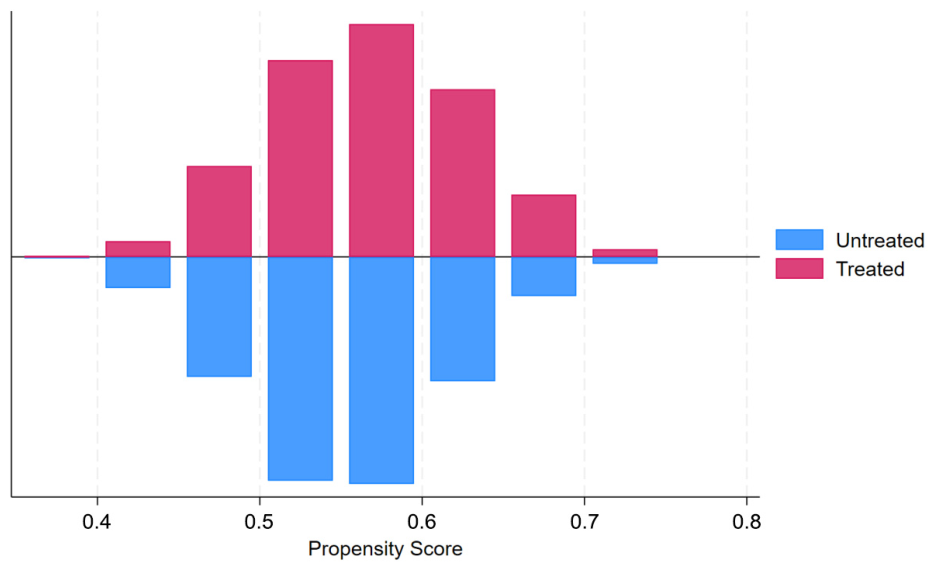
Balancing test results (Figure 1) confirm matching quality: post-matching standardized biases for all covariates drop well below 5%, t-tests show no statistical differences in group means, and kernel density distributions of propensity scores highly overlap.
Re-estimating fixed-effects regressions (Table 18) on this high-fidelity matched subsample reveals that the mitigating effect of executive environmental attention on ESG rating divergence remains highly significant. This evidence clearly indicates that after isolating self-selection interference caused by financial and governance endowments, executive environmental cognition continues to exert an independent, substantive causal effect in mitigating external evaluation divergence, firmly confirming baseline robustness.

6. Discussion

6.1. Theoretical Implications

Exploring the causes and resolution mechanisms of ESG rating divergence is not only a frontier topic in sustainable finance but also a critical bottleneck in accurately measuring authentic corporate sustainability. Previous research largely attributes this divergence to objective differences among rating agencies in scope, measurement, and weight (e.g., Berg et al., 2022) [20], viewing it as a product of the institutional environment. However, rooting our findings in the “cognitive micro-foundations” of firms, we demonstrate that TMT environmental attention acts as an important “information calibrator” that helps mitigate rating noise in capital markets.
This finding meaningfully engages with existing literature. Some prior studies warn that firms in emerging markets often exhibit “greenwashing” tendencies (Marquis & Qian, 2014) [49], leading to disclosures that exacerbate market divergence. Conversely, our results indicate that when textual signals possess sufficient “industry materiality” and stem from deep executive cognition, they can overcome “greenwashing” suspicions and facilitate external rating consensus. This deepens the integration of the Attention-Based View and Signaling Theory within the sustainable development context, providing empirical support for the “internal governance” explanation of rating divergence.

6.2. Practical Implications

Our findings offer guidance for corporate governance, external evaluation, and policy design, assisting various stakeholders in advancing high-quality green and low-carbon transitions:
For Corporate Boards and Management: Firms need to transition environmental attention from soft “qualitative declarations” to hard “quantitative constraints.” We recommend including environmental attention metrics in CEO performance scorecards. When drafting CSR/ESG and sustainability reports, firms should provide more granular, quantitative data. Substantive environmental data is a prerequisite for cognitive signals to serve as tools for mitigating divergence.
For ESG Rating Agencies: We recommend assigning corresponding explicit weights to the “granularity” and “quantitative content” of corporate disclosures when constructing ESG scores. This filters out noise detached from business materiality, improving evaluation reliability and inter-agency consensus.
For Regulators and Policymakers: Regulators could accelerate the standardization of ESG disclosures by exploring unified quantitative templates. Standardized templates improve cross-firm data comparability, providing an institutional infrastructure that helps direct capital flows toward firms demonstrating authentic sustainability.

6.3. Boundary Conditions and Limitations

Scientific research approaches truth through continuous falsification. While we adhere to rigorous causal identification standards, interpreting the core conclusions requires acknowledging contextual boundaries and external validity constraints:
First, our empirical evidence is bounded by the specific institutional soil of the Chinese A-share market. As an emerging and transitioning economy, China’s ESG framework is in an exploratory phase of semi-mandatory disclosures, where market participants are driven by macro-level sustainable development strategies (e.g., the “Dual Carbon” goals). In this green-policy-sensitive context, executive environmental rhetoric often carries an implicit endorsement of “political legitimacy,” potentially making agency consensus easier to achieve. Extrapolating these conclusions to developed capital markets—characterized by mandatory ESG regulations and fully market-driven operations—may reveal heterogeneity in the transmission logic.
Furthermore, A-share listed firms are typically industry leaders; the strategic logic for SMEs may differ. Second, regarding measurement, this study relies on textual analysis of sustainability reporting, which may fail to capture the “unspoken” implicit environmental cognition of executives in daily operations. Regarding divergence, the standard deviation metric struggles to isolate whether measurement, scope, or weight divergence dominates. Finally, despite employing PSM and IV-2SLS to mitigate endogeneity, unobserved omitted variable bias may still reside within complex strategic decisions, and the relatively short time window may not fully capture the long-term dynamic effects of corporate sustainable transitions.

6.4. Future Research Directions

These limitations highlight areas for further exploration:
Cross-Country Comparisons and Global Sustainability Governance: Future studies could expand globally, conducting cross-country comparisons between China and developed markets to explore how different macro-legal constraints (mandatory vs. voluntary) reshape the transmission mechanism among executive attention, rating divergence, and long-term sustainable performance.
Executive Psychological Traits and TMT Dynamics: Future research should further unpack the TMT “black box” through longitudinal studies on member turnover or by introducing individual CEO psychological traits (e.g., narcissism, humility) to explore potential moderating mechanisms.
Dynamic Cognitive Measurement Empowered by Machine Learning: We encourage future research to combine machine learning and Natural Language Processing. Deep semantic mining on unstructured data (earnings calls, social media) could enable a transition from “static report extraction” to “real-time dynamic cognitive capture,” providing granular micro-evidence for the underlying logic of rating convergence.

7. Conclusions

While ESG rating divergence is recognized as a relevant friction in sustainable finance, posing a challenge to accurately evaluating genuine corporate sustainability, prior literature has predominantly attributed this divergence to technical disparities (e.g., scope and weighting) among external rating agencies. This leaves the role of internal managerial cognition in shaping external consensus relatively underexplored. Addressing this research gap, this study utilizes data from Chinese A-share listed firms to investigate how internal cognitive drivers shape market consensus. Our empirical findings demonstrate that TMT strategic attention to environmental issues acts as an “information calibrator” that helps reduce ESG rating divergence in capital markets, thereby providing a clearer baseline for measuring corporate sustainable development.
The added value and contribution of this research lie in shifting the analytical lens from external evaluation mechanics to internal corporate governance. By integrating the Attention-Based View with Signaling Theory, we indicate that managerial environmental focus represents more than a symbolic compliance gesture; it serves as a substantive force capable of navigating market noise and encouraging evaluation convergence. This suggests that internal cognitive alignment is a critical engine for high-quality sustainable transitions, thereby contributing to and broadening the literature on the antecedents of rating divergence.
Regarding its applied nature, this study offers practical pathways for market participants to advance Sustainable Development Goals (SDGs). To bridge the valuation gap and demonstrate authentic sustainable business value, management should consider moving beyond symbolic “greenwashing” to integrate substantive environmental focus into core strategic activities, utilizing more granular, quantitative data to build market consensus. For policymakers, we recommend that regulators encourage structured sustainability (ESG) disclosure templates, which can support the effect of executive attention on rating consensus by improving data comparability across firms.
Nevertheless, this study has limitations to acknowledge. Our focus on the Chinese A-share market limits the external validity to specific institutional contexts with unique ownership structures; our text-based measurement from annual reports may not fully capture unspoken managerial attention; and the relatively short time window may miss longer-term dynamics. Consequently, future research could pursue cross-country comparisons between China and developed markets with mandatory ESG disclosures to test institutional boundary conditions within the context of global sustainability governance. Additionally, scholars could examine how specific CEO psychological traits (e.g., narcissism or humility) moderate this cognitive transmission, and explore machine learning approaches to dynamically measure TMT attention to sustainability issues from communications such as earnings calls, rather than relying solely on static annual reports.

Author Contributions

Conceptualization, Y.Q. and S.W.; methodology, Y.Q.; software, Y.Q.; validation, Y.Q. and S.W.; formal analysis, Y.Q.; investigation, Y.Q.; resources, S.W.; data curation, Y.Q.; writing—original draft preparation, Y.Q.; writing—review and editing, S.W.; visualization, Y.Q.; supervision, S.W.; project administration, S.W.; funding acquisition, S.W. All authors have read and agreed to the published version of the manuscript.

Funding

This research received no external funding.

Institutional Review Board Statement

Not applicable.

Informed Consent Statement

Not applicable.

Data Availability Statement

Restrictions apply to the datasets. The datasets presented in this article are not readily available because the data are part of an ongoing study. Requests to access the datasets should be directed to Yishi Qiu at 12131285@mail.sustech.edu.cn.

Conflicts of Interest

The authors declare no conflicts of interest.

Appendix A

Table A1. Control Variables.
VariableSymbolDescription
SizeSizeNatural logarithm of the firm’s total assets
LeverageLevRatio of total liabilities to total assets
Return on assetsROANet profit divided by total assets.
Operating cash flow CashflowRatio of net operating cash flow to total assets.
Top 5 ownership concentrationTOP5Total ownership percentage held by the top five shareholders
Firm ageAgeNatural logarithm of the number of years since the firm’s inception.
GrowthGrowthAnnual growth rate of operating revenue
Independent director ratio IndepRatio of independent directors to the total number of board members
CEO dualityDualDummy variable: 1 if the Chairman and CEO are the same person; 0 otherwise

References

  1. Zhang, H.; Huang, Q. Institutional pressure, dominant CEOs, and ESG responsibility fulfillment of listed companies. J. Shanxi Univ. Financ. Econ. 2022, 44, 74–86. (In Chinese) [Google Scholar] [CrossRef]
  2. Wang, P.; Yang, S.; Huang, S. The impact of environmental protection tax on corporate environmental, social and governance performance: Based on the mediating effect of green technology innovation. Tax. Res. 2021, 48, 50–56. (In Chinese) [Google Scholar] [CrossRef]
  3. Wang, Y.; Wang, H.; Xue, S. Greening of the tax system and corporate ESG performance: A quasi-natural experiment based on the Environmental Protection Tax Law. J. Financ. Econ. 2022, 48, 47–62. (In Chinese) [Google Scholar] [CrossRef]
  4. Yang, J.; Zhang, Y.; Chen, L. Digital finance and corporate ESG performance: Evidence from Chinese listed companies. J. Harbin Univ. Commer. (Soc. Sci. Ed.) 2022, 72, 3–18. Available online: https://kns.cnki.net/kcms2/article/abstract?v=Omth-A4cfW8DPhpAKzGyouFwTlE6MIsXA5Swi34n8dU1SwGUPRlaF0p2vT_OGgzikzEGrBaMeNQticRslWQFjFKRiVJo3NoNv9LYqkXU65webUJ3vKHsy2BD4TtESzYViSlM2MeMErSYNrC-IpKD0X8xtMb-lJa29aJBGzsLnOGZlWgqtJMyeg==&uniplatform=NZKPT&language=CHS (accessed on 11 April 2026). (In Chinese)
  5. Hu, J.; Han, Y.; Zhong, Y. How does corporate digital transformation affect corporate ESG performance? Evidence from Chinese listed companies. Rev. Ind. Econ. 2023, 105–123. (In Chinese) [Google Scholar] [CrossRef]
  6. Wang, H.; Wang, S.; Zhang, C.; Guo, L. Does digital transformation improve corporate ESG responsibility performance? An empirical study based on the MSCI index. Foreign Econ. Manag. 2023, 45, 1–17. (In Chinese) [Google Scholar] [CrossRef]
  7. Paltrinieri, A.; Dreassi, A.; Migliavacca, M.; Piserà, S. Islamic finance development and banking ESG scores: Evidence from a cross-country analysis. Res. Int. Bus. Financ. 2020, 51, 101100. [Google Scholar] [CrossRef]
  8. Huang, Q.; Li, Y.; Lin, M.; McBrayer, G.A. Natural disasters, risk salience, and corporate ESG disclosure. J. Corp. Financ. 2022, 72, 102152. [Google Scholar] [CrossRef]
  9. Tamimi, N.; Sebastianelli, R. Transparency among S&P 500 companies: An analysis of ESG disclosure scores. Manag. Decis. 2017, 55, 1660–1680. [Google Scholar] [CrossRef]
  10. Velte, P. Women on management board and ESG performance. J. Glob. Responsib. 2016, 7, 98–109. [Google Scholar] [CrossRef]
  11. Arayssi, M.; Jizi, M.; Tabaja, H.H. The impact of board composition on the level of ESG disclosures in GCC countries. Sustain. Account. Manag. Policy J. 2019, 11, 137–161. [Google Scholar] [CrossRef]
  12. Khemakhem, H.; Arroyo, P.; Montecinos, J. Gender diversity on board committees and ESG disclosure: Evidence from Canada. J. Manag. Gov. 2022, 27, 1397–1422. [Google Scholar] [CrossRef]
  13. Menicucci, E.; Paolucci, G. Board Diversity and ESG Performance: Evidence from the Italian Banking Sector. Sustainability 2022, 14, 13447. [Google Scholar] [CrossRef]
  14. Bamahros, H.M.; Alquhaif, A.; Qasem, A.; Wan-Hussin, W.N.; Thomran, M.; Al-Duais, S.D.; Shukeri, S.N.; Khojally, H.M.A. Corporate governance mechanisms and ESG reporting: Evidence from the Saudi Stock Market. Sustainability 2022, 14, 6202. [Google Scholar] [CrossRef]
  15. Sharma, P.; Panday, P.; Dangwal, R.C. Determinants of environmental, social and corporate governance (ESG) disclosure: A study of Indian companies. Int. J. Discl. Gov. 2020, 17, 208–217. [Google Scholar] [CrossRef]
  16. DasGupta, R. Financial performance shortfall, ESG controversies, and ESG performance: Evidence from firms around the world. Financ. Res. Lett. 2022, 46, 102487. [Google Scholar] [CrossRef]
  17. Zheng, J.; Khurram, M.U.; Chen, L. Can Green Innovation Affect ESG Ratings and Financial Performance? Evidence from Chinese GEM Listed Companies. Sustainability 2022, 14, 8677. [Google Scholar] [CrossRef]
  18. Xiao, H.; Ding, F. Review and prospect of research on ESG rating divergence. J. Dongbei Univ. Financ. Econ. 2024, 6, 40–57. (In Chinese) [Google Scholar] [CrossRef]
  19. Dimson, E.; Marsh, P.; Staunton, M. Divergent ESG ratings. J. Portf. Manag. 2020, 47, 75–87. [Google Scholar] [CrossRef]
  20. Berg, F.; Koelbel, J.F.; Pavlova, A.; Rigobon, R. ESG confusion and stock returns: Tackling the problem of noise. Rev. Financ. 2022, 26, 1315–1344. [Google Scholar] [CrossRef]
  21. Li, H.; Liu, Q.; Zheng, H.; Zhang, Y. Are ESG ratings the same? A comparative study of ESG ratings based on achievement orientation and risk orientation. Account. Res. 2024, 66–82. Available online: https://kns.cnki.net/kcms2/article/abstract?v=Omth-A4cfW8t0sEdHe82aPKpAs0A2Olgk0o-1hxZmYDW3L3lHX2jiXYy2ydJNGfiTjZnje47UpyfkQVUsxRFAKDVvZwbILeUiMX6TIXLsaSGJGBZa-QOEVMilB2oZbLPkruHBK-A1aRQBv9ebggr8R9NziHyCANNs8IEv8rAwlqiw1wYAieVSQ==&uniplatform=NZKPT&language=CHS (accessed on 11 April 2026). (In Chinese)
  22. Charlin, V.; Cifuentes, A.; Alfaro, J. ESG ratings: An industry in need of a major overhaul. J. Sustain. Financ. Invest. 2022, 14, 1037–1055. [Google Scholar] [CrossRef]
  23. Chatterji, A.K.; Durand, R.; Levine, D.I.; Touboul, S. Do ratings of firms converge? Implications for managers, investors and strategy researchers. Strateg. Manag. J. 2016, 37, 1597–1614. [Google Scholar] [CrossRef]
  24. Dorfleitner, G.; Halbritter, G.; Nguyen, M. Measuring the level and risk of corporate responsibility: An empirical comparison of different ESG rating approaches. J. Asset Manag. 2015, 16, 450–466. [Google Scholar] [CrossRef]
  25. Eccles, R.G.; Stroehle, J.C. Exploring Social Origins in the Construction of ESG Measures Working Paper. Soc. Sci. Electron. Publ. 2018, 3212685. [Google Scholar] [CrossRef]
  26. Abhayawansa, S.; Tyagi, S. Sustainable Investing: The Black Box of Environmental, Social and Governance (ESG) Ratings. J. Wealth Manag. 2021, 24, 49–54. [Google Scholar] [CrossRef]
  27. Kotsantonis, S.; Serafeim, G. Four Things No One Will Tell You About ESG Data. J. Appl. Corp. Financ. 2019, 31, 50–58. [Google Scholar] [CrossRef]
  28. Ma, W.; Yu, B. Corporate ownership attributes and divergence in domestic and foreign ESG ratings. J. Financ. Econ. 2023, 49, 124–136. (In Chinese) [Google Scholar] [CrossRef]
  29. Gibson Brandon, R.; Krueger, P.; Schmidt, P.S. ESG rating disagreement and stock returns. Financ. Anal. J. 2021, 77, 104–127. [Google Scholar] [CrossRef]
  30. Rubino, M.; Mastrorocco, I.; Garegnani, G.M. The influence of market and institutional factors on ESG rating disagreement. Corp. Soc. Responsib. Environ. Manag. 2024, 31, 3916–3926. [Google Scholar] [CrossRef]
  31. Marquis, C.; Toffel, M.W.; Zhou, Y. Scrutiny, Norms, and Selective Disclosure: A Global Study of Greenwashing. Organ. Sci. 2016, 27, 1039. [Google Scholar] [CrossRef]
  32. Christensen, D.M.; Serafeim, G.; Sikochi, A. Why is corporate virtue in the eye of the beholder? The case of ESG ratings. Account. Rev. 2022, 97, 147–175. [Google Scholar] [CrossRef]
  33. Feng, Y.; Guo, X.; Zeng, X. ESG information disclosure and ESG rating divergence: Unanimous or divided? Concurrently on the institutional norms of ESG in China. Account. Res. 2024, 1, 49–63. Available online: https://kns.cnki.net/kcms2/article/abstract?v=Omth-A4cfW8yROmPc1rGk13x5sGhAQ-2gYHQzlsgyWVC1d4Gr9SHPtVdjzG_mO71L9D2ElR0scSEmo9N68vQrkmjxeunfUIOF8gcabgzl_c672YxOdggI9aGZb34Lplz-dYhN7juhIXyxaN8NFqFcvEZZVftPF9ZatAgUzBR0PRKYK3QK1y7XQ==&uniplatform=NZKPT&language=CHS (accessed on 11 April 2026). (In Chinese)
  34. Caglio, A.; Melloni, G.; Perego, P. Informational content and assurance of textual disclosures: Evidence on integrated reporting. Eur. Account. Rev. 2020, 29, 55–83. [Google Scholar] [CrossRef]
  35. Zhao, J.; Lin, Z.; Zhang, C. ESG report readability and ESG rating divergence. Secur. Mark. Her. 2024, 68–77. Available online: https://link.cnki.net/urlid/44.1343.F.20241205.1038.002 (accessed on 11 April 2026). (In Chinese)
  36. Al-Matari, E.M.; Turki, H.; Alnor, N.H.A.; Eltahir, I.A.E.; Ali, Z.T.A.; Misbah, H.M. Top management team characteristics, corporate environmental sustainability, and earnings management strategy: An empirical investigation. Corp. Bus. Strategy Rev. 2026, 7, 271–283. [Google Scholar] [CrossRef]
  37. He, T.; Li, Y.; Wang, Z.; Tan, Z.D. Does ESG rating divergence improve voluntary information disclosure of listed companies? J. Account. Econ. 2023, 37, 54–70. (In Chinese) [Google Scholar] [CrossRef]
  38. Wu, J.; Hua, X. Top Management Team Attention and Firm Green Innovation Strategy: Empirical Evidence from Listed Chinese Manufacturing Companies. Sci. Sci. Manag. S. & T 2021, 42, 122–142. (In Chinese) [Google Scholar] [CrossRef]
  39. Huang, J.; Zhu, J.; Li, Y.; Tong, L. Can environmental information disclosure alleviate asset mispricing? Financ. Regul. Res. 2023, 22–41. (In Chinese) [Google Scholar] [CrossRef]
  40. Kong, D.; Wei, Y.; Ji, M. The impact of environmental protection fee-to-tax on corporate green information disclosure. Secur. Mark. Her. 2021, 8, 2–14. Available online: https://kns.cnki.net/kcms2/article/abstract?v=Omth-A4cfW9ZkvWgn6HLI-qBmS4fxCVcs1Zu7Gp8GhFrS12eV620O6L7mvhHom2-8oz3na2lq54gxhCvtzSUOxp0j1ftr35pemR8tUsxSVZ_3vFv2mrRVeOJMySTHGIPMomCg0zXZcRzRtXScaUjcE0ba2U7mRTGjGSQbwGNEnuUOxervF22bA==&uniplatform=NZKPT&language=CHS (accessed on 11 April 2026). (In Chinese)
  41. Liao, G.; Qin, J.; Wang, W. Fiscal decentralization and corporate green technology innovation in the context of modernization of national governance: A test based on micro-moderating mechanisms. Commun. Financ. Account. 2023, 21–27. (In Chinese) [Google Scholar] [CrossRef]
  42. Zhang, X.; Dong, Z. The green innovation incentive effect of environmental information disclosure. Financ. Econ. 2023, 41–53. Available online: https://kns.cnki.net/kcms2/article/abstract?v=Omth-A4cfW9RSto7GHPPqQFBclHPOyiTNUfp2Z7ra97NpiA6ZflxJErSMtGxTRR_0-FK99OUP5aHMl8K2sENkpupbUluGvCRiX81G0vVtAlHJCPJt68cImNWw-mFKgKGnRG2ASx9c-Ze8PK_noWZ8ohjLdVlWFK1FPyyBkPgyXL8VIbUSyp_-g==&uniplatform=NZKPT&language=CHS (accessed on 11 April 2026). (In Chinese)
  43. Zhang, Z.; Huang, F.; Song, M. Network centrality of institutional investors and corporate environmental information disclosure. Secur. Mark. Her. 2023, 3–13. Available online: https://link.cnki.net/urlid/44.1343.F.20230529.1729.004 (accessed on 11 April 2026). (In Chinese)
  44. Chen, S.; Zhang, J.; Liu, Z. Environmental regulation, financing constraints, and corporate pollution emission reduction: Evidence from the adjustment of emission fee standards. J. Financ. Res. 2021, 289, 51–71. Available online: https://kns.cnki.net/kcms2/article/abstract?v=Omth-A4cfW8ggOvdb-kwPKy4W2525NVv5ATFot80vM73lEWu1-ggEGwnRoIPxHQ010MjM6sV4Ef1IKx40Qutw9oqH99tnWOuvi_6tjVB1zFxPfPNDO5bfip3zVqgYpufsCHinUjQkD6PLI8Kh9sV2MGrFmoZlpNQCAiRNLPuRT-3ciWx22rhvQ==&uniplatform=NZKPT&language=CHS (accessed on 11 April 2026). (In Chinese)
  45. Peng, L.; Xiong, W. Investor attention, overconfidence and category learning. J. Financ. Econ. 2006, 80, 563–602. [Google Scholar] [CrossRef]
  46. Peng, H.; Mao, X. Government innovation subsidies, corporate executive background, and R&D investment: Empirical evidence from China’s high-tech industries. Financ. Trade Econ. 2017, 38, 147–161. (In Chinese) [Google Scholar] [CrossRef]
  47. Kreps, D.M.; Wilson, R. Reputation and imperfect information. J. Econ. Theory 1982, 27, 253–279. [Google Scholar] [CrossRef]
  48. Ocasio, W. Towards an attention-based view of the firm. Strateg. Manag. J. 1997, 18, 187–206. [Google Scholar] [CrossRef]
  49. Marquis, C.; Qian, C. Corporate social responsibility reporting in China: Symbol or substance? Organ. Sci. 2014, 25, 127–148. [Google Scholar] [CrossRef]
Figure 1. Propensity Score.
Sustainability 18 04131 g001
Table 1. Descriptive statistics results.
CountMeanSdMinp50Max
ESGdif626,1430.95550.72110.00001.00002.8284
TMTTattn125,8941.97700.68940.00001.94593.4012
TMTTattn225,8940.00140.00110.00000.00100.0056
Size26,14322.34241.298019.997222.152626.3635
Lev26,1430.42230.20120.05810.41330.9015
ROA26,1430.03690.0701−0.26070.03750.2271
Cashflow26,1430.04870.0676−0.15420.04720.2479
Growth26,1430.16050.4020−0.58090.09902.4140
TOP526,1430.52830.15160.20390.52710.8851
Age26,1432.18680.82760.00002.30263.3673
Indep26,1430.37860.05380.33330.36360.5714
Dual26,1430.30190.45910.00000.00001.0000
Table 2. Correlation.
ESGdif6EU1EU2TMTTattn1TMTTattn2SizeLevROACashflowGrowthTOP5AgeIndepDual
ESGdif61.000
EU10.250 ***1.000
(0.000)
EU2−0.077 ***−0.064 ***1.000
(0.000)(0.000)
TMTTattn10.044 ***−0.024 ***−0.076 ***1.000
(0.000)(0.001)(0.000)
TMTTattn2−0.066 ***−0.153 ***−0.014 **0.749 ***1.000
(0.000)(0.000)(0.047)(0.000)
Size0.175 ***−0.248 ***−0.520 ***0.115 ***0.068 ***1.000
(0.000)(0.000)(0.000)(0.000)(0.000)
Lev0.059 ***−0.176 ***−0.276 ***0.087 ***0.095 ***0.491 ***1.000
(0.000)(0.000)(0.000)(0.000)(0.000)(0.000)
ROA−0.038 ***−0.055 ***−0.144 ***0.006−0.013 **0.037 ***−0.351 ***1.000
(0.000)(0.000)(0.000)(0.343)(0.039)(0.000)(0.000)
Cashflow0.072 ***−0.012 *−0.152 ***0.034 ***0.062 ***0.080 ***−0.166 ***0.430 ***1.000
(0.000)(0.092)(0.000)(0.000)(0.000)(0.000)(0.000)(0.000)
Growth−0.071 ***−0.060 ***0.019 ***−0.014 **−0.044 ***0.050 ***0.023 ***0.281 ***0.040 ***1.000
(0.000)(0.000)(0.009)(0.024)(0.000)(0.000)(0.000)(0.000)(0.000)
TOP5−0.005−0.144 ***−0.101 ***0.0080.023 ***0.157 ***−0.041 ***0.225 ***0.149 ***0.048 ***1.000
(0.410)(0.000)(0.000)(0.218)(0.000)(0.000)(0.000)(0.000)(0.000)(0.000)
Age0.106 ***−0.174 ***−0.096 ***0.052 ***0.139 ***0.417 ***0.327 ***−0.203 ***−0.025 ***−0.078 ***−0.293 ***1.000
(0.000)(0.000)(0.000)(0.000)(0.000)(0.000)(0.000)(0.000)(0.000)(0.000)(0.000)
Indep0.026 ***0.048 ***0.058 ***−0.044 ***−0.056 ***−0.019 ***−0.006−0.016 **−0.003−0.0050.034 ***−0.027 ***1.000
(0.000)(0.000)(0.000)(0.000)(0.000)(0.003)(0.359)(0.011)(0.649)(0.446)(0.000)(0.000)
Dual0.0000.095 ***0.079 ***−0.073 ***−0.127 ***−0.182 ***−0.117 ***0.033 ***−0.011 *0.028 ***−0.004−0.247 ***0.113 ***1.000
(0.950)(0.000)(0.000)(0.000)(0.000)(0.000)(0.000)(0.000)(0.081)(0.000)(0.501)(0.000)(0.000)
Robust t-statistics in parentheses. *** p < 0.01, ** p < 0.05, * p < 0.1.
Table 3. Benchmark Regression.
A1A2
VariablesESGdif6ESGdif6
Size0.1010 ***0.0981 ***
(16.6475)(16.1925)
Lev−0.0424−0.0393
(−1.1066)(−1.0264)
ROA−0.3827 ***−0.3817 ***
(−4.2376)(−4.2215)
Cashflow0.4534 ***0.4660 ***
(5.7507)(5.9156)
Growth−0.0433 ***−0.0449 ***
(−4.1143)(−4.2490)
TOP50.01030.0170
(0.2283)(0.3780)
Age0.0520 ***0.0556 ***
(6.1385)(6.5335)
Indep0.16110.1601
(1.4879)(1.4798)
Dual0.00770.0062
(0.6139)(0.4976)
TMTTattn1−0.0345 ***
(−3.5064)
TMTTattn2 −24.3346 ***
(−4.1315)
Constant−1.4000 ***−1.3811 ***
(−10.9238)(−10.7860)
Observations25,89425,894
Adjusted R-squared0.29330.2936
industry FEYESYES
Year FEYESYES
Robust t-statistics in parentheses. *** p < 0.01.
Table 4. Information Disclosure Effect 1.
(1)(2)(3)
A1A2A3
VariablesEid_2EidqEdi
TMTTattn266.6182 ***83.6820 ***28.5406 ***
(9.9178)(9.4951)(8.6572)
Size0.2012 ***0.2532 ***0.0899 ***
(28.7454)(27.0922)(26.4503)
Lev−0.0078−0.01250.0030
(−0.1757)(−0.2118)(0.1484)
ROA0.3177 ***0.4442 ***0.1203 ***
(3.5311)(3.6448)(3.0363)
Cashflow0.4161 ***0.4960 ***0.2052 ***
(5.5163)(4.8386)(6.1417)
Growth−0.0867 ***−0.1256 ***−0.0265 ***
(−9.0223)(−9.3467)(−6.1421)
TOP50.1242 **0.1550 **0.0922 ***
(2.2615)(2.1077)(3.5818)
Age−0.0208 *−0.0383 ***−0.0078
(−1.9125)(−2.6187)(−1.5471)
Indep−0.2769 **−0.3618 **−0.1166 **
(−2.3256)(−2.2934)(−2.0649)
Dual−0.0503 ***−0.0624 ***−0.0223 ***
(−3.6285)(−3.3930)(−3.4543)
Constant−2.1176 ***−3.5756 ***−1.6389 ***
(−14.5687)(−18.5355)(−22.4422)
Observations21,62721,64723,208
Adjusted R-squared0.39610.35940.4285
industry FEYESYESYES
Year FEYESYESYES
Robust t-statistics in parentheses. *** p < 0.01, ** p < 0.05, * p < 0.1.
Table 5. Information Disclosure Effect 2.
A1A2A3
VariablesEid_2EidqEdi
TMTTattn10.1715 ***0.2216 ***0.0710 ***
(14.9120)(14.5090)(13.4756)
Size0.1907 ***0.2398 ***0.0854 ***
(27.5914)(26.0078)(25.2111)
Lev−0.0018−0.00530.0051
(−0.0414)(−0.0902)(0.2545)
ROA0.3209 ***0.4483 ***0.1211 ***
(3.6178)(3.7289)(3.0883)
Cashflow0.4512 ***0.5401 ***0.2194 ***
(6.0445)(5.3199)(6.6215)
Growth−0.0867 ***−0.1252 ***−0.0269 ***
(−9.0924)(−9.3861)(−6.2701)
TOP50.1452 ***0.1817 **0.1020 ***
(2.6644)(2.4886)(3.9894)
Age−0.0136−0.0294 **−0.0045
(−1.2616)(−2.0370)(−0.8993)
Indep−0.2609 **−0.3395 **−0.1104 **
(−2.2283)(−2.1874)(−1.9805)
Dual−0.0513 ***−0.0634 ***−0.0228 ***
(−3.7507)(−3.4954)(−3.5671)
Constant−2.1571 ***−3.6331 ***−1.6541 ***
(−15.1167)(−19.2001)(−22.7469)
Observations21,62721,64723,208
Adjusted R-squared0.40560.36910.4350
industry FEYESYESYES
Year FEYESYESYES
Robust t-statistics in parenthese. *** p < 0.01, ** p < 0.05.
Table 6. Bootstrap test 1.
(1)(2)(3)
boot1boot2boot3
VariablesEid_2EidqEdi
indirect−4.5895 ***62.0000 ***62.0000 ***
(0.6858)(15.4196)(15.7113)
direct−33.4243 ***−33.0885 ***−29.3350 ***
(4.4667)(4.4133)(4.3714)
total−38.0138 ***28.9115 *32.6650 **
(5.1014)(16.0277)(16.1081)
ratio0.1207 ***2.14451.8981
(0.0063)(124.8180)(48.0707)
Observations21,62721,64723,208
Robust t-statistics in parentheses. *** p < 0.01, ** p < 0.05, * p < 0.1.
Table 7. Substantive Performance Effect Result.
(1)(2)
A1A2
VariablesESGESG
TMTTattn231.5951 ***
(2.8440)
TMTTattn1 0.1611 ***
(9.1879)
Size0.3127 ***0.3051 ***
(27.0894)(26.4965)
Lev−0.9374 ***−0.9428 ***
(−13.4257)(−13.6161)
ROA2.4219 ***2.4224 ***
(15.2948)(15.3815)
Cashflow−0.0795−0.0669
(−0.6134)(−0.5182)
Growth−0.1262 ***−0.1227 ***
(−7.0395)(−6.8531)
TOP50.13380.1488 *
(1.5763)(1.7613)
Age−0.2160 ***−0.2134 ***
(−13.3403)(−13.3398)
Indep1.1978 ***1.2211 ***
(6.4709)(6.6521)
Dual−0.0618 ***−0.0583 ***
(−2.8457)(−2.7067)
Constant−2.6375 ***−2.7646 ***
(−11.0389)(−11.6345)
Observations25,89425,894
Adjusted R-squared0.20270.2080
industry FEYESYES
Year FEYESYES
Robust t-statistics in parentheses. *** p < 0.01, * p < 0.1.
Table 8. Bootstrap test 2.
(1)
boot4
VariablesESG
indirect62.0000 ***
(15.5366)
direct−20.1974 ***
(4.1180)
total41.8026 ***
(16.0866)
ratio1.4832
(9110.2204)
Observations25,894
Robust t-statistics in parentheses. *** p < 0.01.
Table 9. Market Competition Result.
(1)(2)(3)
highlowchow
VariablesESGdif6ESGdif6ESGdif6
TMTTattn2−40.8773 ***−10.0921−9.1893
(8.7623)(7.5579)(7.0666)
iflern 0.1164 ***
(0.0199)
interact −32.4753 ***
(9.6090)
Size0.0803 ***0.1176 ***0.0980 ***
(0.0087)(0.0078)(0.0061)
Lev−0.0422−0.0604−0.0416
(0.0538)(0.0502)(0.0383)
ROA−0.6136 ***−0.1596−0.4036 ***
(0.1255)(0.1255)(0.0905)
Cashflow0.5367 ***0.4248 ***0.4717 ***
(0.1138)(0.1061)(0.0787)
Growth−0.0316 **−0.0570 ***−0.0441 ***
(0.0155)(0.0141)(0.0105)
TOP5−0.02140.06340.0220
(0.0606)(0.0590)(0.0450)
Age0.0473 ***0.0652 ***0.0563 ***
(0.0117)(0.0112)(0.0085)
Indep0.21940.10820.1643
(0.1516)(0.1370)(0.1081)
Dual0.0203−0.01130.0060
(0.0171)(0.0162)(0.0125)
Constant−0.8068 ***−1.9899 ***−1.4406 ***
(0.1846)(0.1665)(0.1281)
Observations13,03312,85625,894
R-squared0.1990.3440.297
Robust t-statistics in parentheses. *** p < 0.01, ** p < 0.05.
Table 10. Technical Attributes Result.
(1)(2)(3)
A3A4chow
VariablesESGdif6ESGdif6ESGdif6
TMTTattn2−31.3537 ***−11.4991−11.0662
(7.7863)(8.9768)(8.9610)
interact_hightech −22.9924 **
(11.7264)
Size0.0687 ***0.1351 ***0.0982 ***
(0.0081)(0.0091)(0.0061)
Lev0.0148−0.1205 **−0.0376
(0.0488)(0.0605)(0.0382)
ROA−0.3135 ***−0.5197 ***−0.3815 ***
(0.1100)(0.1549)(0.0904)
Cashflow0.5205 ***0.3655 ***0.4655 ***
(0.1019)(0.1219)(0.0787)
Growth−0.0328 **−0.0554 ***−0.0453 ***
(0.0145)(0.0149)(0.0105)
TOP5−0.00310.03630.0170
(0.0584)(0.0703)(0.0449)
Age0.0697 ***0.0496 ***0.0559 ***
(0.0111)(0.0132)(0.0085)
Indep0.16180.13490.1602
(0.1397)(0.1665)(0.1081)
Dual0.0126−0.00710.0059
(0.0158)(0.0201)(0.0126)
Constant−0.7195 ***−2.2525 ***−1.3852 ***
(0.1712)(0.1915)(0.1280)
Observations15,55310,34125,894
R-squared0.3270.2640.296
Robust t-statistics in parentheses. *** p < 0.01, ** p < 0.05.
Table 11. Environmental Regulation Result.
(1)(2)(3)
A3A4chow
VariablesESGdif6ESGdif6ESGdif6
TMTTattn2−21.78 ***−25.39 ***−27.79 ***
(7.188)(7.774)(7.104)
ifer −0.0328 ***
(0.0140)
interact_ifer 12.846 *
(7.392)
Size0.105 ***0.0905 ***0.0981 ***
(0.00748)(0.00746)(0.00606)
Lev−0.0364−0.0421−0.0397
(0.0452)(0.0499)(0.0383)
ROA−0.319 ***−0.449 ***−0.383 ***
(0.114)(0.123)(0.0904)
Cashflow0.388 ***0.533 ***0.465 ***
(0.100)(0.109)(0.0788)
Growth−0.0699 ***−0.0210−0.0448 ***
(0.0142)(0.0151)(0.0106)
TOP5−0.02360.06740.0169
(0.0553)(0.0560)(0.0450)
Age0.0554 ***0.0582 ***0.0557 ***
(0.0104)(0.0111)(0.00852)
Indep0.05930.271 **0.160
(0.132)(0.138)(0.108)
Dual0.0005070.01420.00620
(0.0153)(0.0164)(0.0126)
Constant−1.483 ***−1.281 ***−1.380 ***
(0.160)(0.156)(0.128)
Observations13,52712,36525,894
R-squared0.3110.2870.296
Robust t-statistics in parentheses. *** p < 0.01, ** p < 0.05, * p < 0.1.
Table 12. Local Perspective Result.
(1)(2)
A1A2
VariablesESGdif4ESGdif4
Size0.0740 ***0.0708 ***
(10.4430)(9.9702)
Lev−0.0197−0.0174
(−0.5521)(−0.4878)
ROA−0.6524 ***−0.6515 ***
(−7.3228)(−7.2984)
Cashflow0.2870 ***0.2990 ***
(3.9204)(4.0769)
Growth−0.0311 ***−0.0321 ***
(−3.1739)(−3.2714)
TOP5−0.0250−0.0178
(−0.6028)(−0.4306)
Age0.0140 *0.0174 **
(1.7129)(2.1095)
Indep0.14950.1505
(1.4930)(1.5029)
Dual0.01710.0161
(1.4644)(1.3788)
TMTTattn1−0.0432 ***
(−4.5519)
TMTTattn2 −23.7993 ***
(−4.2934)
Constant−0.7932 ***−0.7870 ***
(−5.2573)(−5.2168)
Observations25,89425,894
Adjusted R-squared0.39500.3949
industry FEYESYES
Year FEYESYES
Robust t-statistics in parentheses. *** p < 0.01, ** p < 0.05, * p < 0.1.
Table 13. Industry-Year Interaction Result.
(1)(2)
A1A2
VariablesESGdif6ESGdif6
Size0.1048 ***0.1018 ***
(17.1580)(16.6780)
Lev−0.0558−0.0532
(−1.4478)(−1.3818)
ROA−0.3978 ***−0.3952 ***
(−4.3563)(−4.3221)
Cashflow0.4399 ***0.4517 ***
(5.5208)(5.6751)
Growth−0.0442 ***−0.0454 ***
(−4.1392)(−4.2437)
TOP50.01800.0247
(0.3953)(0.5428)
Age0.0544 ***0.0579 ***
(6.3659)(6.7392)
Indep0.15610.1553
(1.4316)(1.4262)
Dual0.00570.0045
(0.4566)(0.3604)
TMTTattn1−0.0373 ***
(−3.7564)
TMTTattn2 −23.7936 ***
(−3.9625)
Constant−1.4793 ***−1.4651 ***
(−11.4495)(−11.3566)
Observations25,86325,863
Adjusted R-squared0.31240.3126
industry FEYESYES
Year FEYESYES
Robust t-statistics in parentheses. *** p < 0.01.
Table 14. Sample Purification Result.
(1)(2)
A1A2
VariablesESGdif6_ESGdif6_
Size0.0442 ***0.0403 ***
(6.6494)(6.0596)
Lev−0.0329−0.0301
(−0.7660)(−0.7021)
ROA−0.5028 ***−0.5030 ***
(−5.1027)(−5.0976)
Cashflow0.3270 ***0.3456 ***
(3.8216)(4.0408)
Growth−0.0304 **−0.0324 **
(−2.3695)(−2.5148)
TOP5−0.0678−0.0581
(−1.4271)(−1.2230)
Age0.0349 ***0.0399 ***
(3.7428)(4.2548)
Indep0.2025 *0.1992 *
(1.7643)(1.7372)
Dual−0.0008−0.0026
(−0.0552)(−0.1855)
TMTTattn1−0.0494 ***
(−4.5085)
TMTTattn2 −34.2093 ***
(−5.1276)
Constant0.17450.1946
(1.2446)(1.3911)
Observations21,15921,159
Adjusted R-squared0.05540.0560
industry FEYESYES
Year FEYESYES
Robust t-statistics in parentheses. *** p < 0.01, ** p < 0.05, * p < 0.1.
Table 15. One-period lagged Result.
(1)(2)
A1A2
VariablesESGESG
L_TMTTattn23.0246 *
(1.8781)
L_TMTTattn1 0.0011 *
(1.7235)
Size0.3112 ***0.3112 ***
(27.0643)(27.0655)
Lev−0.9323 ***−0.9325 ***
(−13.3131)(−13.3145)
ROA2.4131 ***2.4132 ***
(15.2713)(15.2753)
Cashflow−0.0800−0.0804
(−0.6199)(−0.6231)
Growth−0.1295 ***−0.1295 ***
(−7.2399)(−7.2414)
TOP50.1448 *0.1449 *
(1.7009)(1.7023)
Age−0.2098 ***−0.2098 ***
(−13.0591)(−13.0576)
Indep1.1806 ***1.1805 ***
(6.3562)(6.3550)
Dual−0.0633 ***−0.0632 ***
(−2.9047)(−2.9042)
Constant−2.5767 ***−2.5752 ***
(−10.8406)(−10.8105)
Observations25,89325,893
Adjusted R-squared0.20290.2029
industry FEYESYES
Year FEYESYES
Robust t-statistics in parentheses. *** p < 0.01, * p < 0.1.
Table 16. Diagnostic tests.
TestResult
Under-identification test(Kleibergen-Paap rk LM statistic) 7.974
Chi-sq (1) p-val 0.0047
Weak identification test(Cragg-Donald Wald F statistic) 10.347
(Kleibergen-Paap rk Wald F statistic) 10.094
Stock-Yogo weak ID test critical values10% maximal IV size 16.38
15% maximal IV size 8.96
20% maximal IV size 6.66
25% maximal IV size 5.53
Table 17. Instrumental Variable Approach.
(1)
VariablesESGdif6
TMTTattn1−2.6491 *
(−1.765)
Size0.1211 ***
(7.308)
Lev0.0093
(0.159)
ROA−0.3691 ***
(−3.607)
Cashflow0.4767 ***
(5.205)
Growth−0.0729 ***
(−2.948)
TOP5−0.0239
(−0.410)
Age0.0618 ***
(4.941)
Indep0.0295
(0.190)
Dual−0.0209
(−0.790)
Constant−1.0489 *
(−1.824)
Observations25,620
R-squared0.091
Robust t-statistics in parentheses. *** p < 0.01, * p < 0.1.
Table 18. PSM result.
(1)
VariablesESGdif6
TMTTattn1−0.0337 ***
(−2.8924)
Size0.0982 ***
(13.7132)
Lev−0.0085
(−0.1930)
ROA−0.3015 ***
(−2.7176)
Cashflow0.4857 ***
(5.0192)
Growth−0.0487 ***
(−3.5008)
TOP50.0535
(1.0297)
Age0.0664 ***
(6.6132)
Indep0.2235 *
(1.7780)
Dual0.0174
(1.1992)
Constant−1.4453 ***
(−9.5339)
Observations14,009
Adjusted R-squared0.3011
industry FEYES
Year FEYES
Robust t-statistics in parentheses. *** p < 0.01, * p < 0.1.
Disclaimer/Publisher’s Note: The statements, opinions and data contained in all publications are solely those of the individual author(s) and contributor(s) and not of MDPI and/or the editor(s). MDPI and/or the editor(s) disclaim responsibility for any injury to people or property resulting from any ideas, methods, instructions or products referred to in the content.