


Abstract
Children’s playground design has increasingly emphasized physical safety and equipment provision, yet often lacks a systematic understanding of children’s situated play activities and their experiential needs. Existing behavior-oriented approaches mainly rely on observation or post-use feedback, with limited integration of structured activity modeling and subjective experience evaluation. To address these limitations, this study applies Context-Based Activity Modeling (CBAM) to analyze children’s situated play activities and their associated affordances and affordance features, proposing an integrated activity and space design approach for playground design. Representative play activities have been analyzed using CBAM to identify activity structures, space elements, situated conditions, and interaction patterns. Based on the modeling results, corresponding space structure design guidelines have been developed to support children’s play activities. To complete the proposed approach in representing children’s psychological states, subjective experience evaluations framework using the Context-specific Experience Sampling and Analysis (CESA) method has been developed. This study contributes a novel space structure design methodology integrating activity modeling and experience evaluation, offering a methodological contribution for sustainable activity-centered playground and children’s space design.
1. Introduction
1.1. The Imbalance Between Children’s Play Activity and Insufficient Play Space Design
With ongoing urban development, growing attention has been directed toward children’s spaces, alongside increasing scholarly interest in children’s participation in urban environments. Creating child-friendly communities is widely recognized as a key approach to fostering strong and vibrant neighborhoods, cities, and regions [1]. In addition, broader social and environmental changes have significantly reshaped children’s everyday play contexts.
Play serves as an important mechanism for children’s cognitive growth [2,3]. Through play, children actively explore their environment, develop problem-solving abilities, and gradually move from concrete thinking toward more abstract and logical reasoning. Moreover, children’s play behaviors are inherently situated, dynamic, and strongly influenced by spatial and environmental conditions [4], while they often demonstrate a wide range of situational behaviors and spontaneous play patterns in public spaces [5,6]. Rather than following fixed rules or predefined tasks, children continuously adapt their play behaviors in response to spatial elements [6], sensory feedback [7], and peer interactions. Such dynamic and exploratory behaviors may also introduce potential risks and safety concerns.
The physical environment plays a significant role in shaping children’s behaviors, interactions, and play experiences [8]. As argued by Pitsikali et al. [9], playgrounds should not be examined in isolation but should instead be understood within the broader system of urban public spaces in order to better support the development of child-friendly cities. However, many existing playground designs primarily focus on basic standards, equipment provision, and functional zoning, while paying limited attention to how children’s play activities actually unfold within space. As a result, playgrounds often support only a narrow range of expected activities, leaving little room for behavioral variation, emergence, or experiential richness [10]. In particular, sensory-driven and interaction-based play activities—such as those involving light, movement, and real-time feedback—are frequently underexplored, despite their potential to stimulate engagement and sustained play [11].
In playground environments, multiple different play and game activities usually occur simultaneously [12], and play behaviors often emerge through repeated cycles of exploration, action, feedback, and adjustment, forming complex behavioral patterns over time. For example, the sandbag game includes at least five activities in one game [13]. These patterns cannot be sufficiently understood as isolated activities, but should instead be examined as contextualized behavioral tasks composed of multiple interrelated activities. To better support children’s play, it is necessary to shift from function-centered or form-driven design toward an activity-centered perspective that recognizes play as a sequence of situated activities [13], tightly coupled with space and environmental design.
1.2. Methodological Progress and Limitations: From Activity to Space
In recent years, behavior-oriented approaches have been increasingly adopted in children’s space design research, emphasizing observation of play and the derivation of design strategies based on behavioral patterns. Methods such as behavioral mapping [14], activity observation, and post-use interviews have contributed to a more grounded understanding of how children interact with playground environments [15]. However, these approaches often remain descriptive and fragmented, lacking a structured framework for connecting observed activities to space design elements in a systematic manner.
Simoff and Maher [16] contributed significantly with their Activity-Space Ontology, which employs hierarchical representations to explicate the relationship between functional activities and space support structures. For example, in a patient room, for activities such as sleep, lie down, read and eat, some space structures such as space volume and a set of equipment would be needed. However, more detailed relations between an activity and corresponding space elements cannot be addressed by this ontology. This limitation has been properly overcome in Wang and Kim [13], where detailed space structure information has been addressed using the Context-Based Activity Modeling (CBAM) method [15] through its rich and structured space elements representations for specific activities.
Yet, existing studies tend to prioritize externally observable activities while overlooking children’s subjective play experiences. Although behavior frequency, movement paths, and interaction patterns can be recorded, the experiential qualities of play—such as enjoyment, engagement, curiosity, and emotional response—are rarely examined in depth. As a result, design decisions are often derived from behavioral interpretation alone, without empirical validation of how children actually experience the designed space. This limitation was not fully overcome in the previous activity modeling research, where the CBAM was applied to analyze children’s play activities and derive space design strategies [11]. While the activity-centered analysis effectively revealed relationships between activities and space structures with rich context information including a set of psychological contexts that would serve as placeholders of actor experiences including emotional state, the absence of systematic subjective evaluation conducted during children’s play activities constrained the ability to validate whether the proposed designs would truly enhance children’s play experiences. Consequently, a methodological gap remains between behavioral analysis and experiential verification in activity-centered playground design research. Thus, the research question addressed in this paper is to propose an integrated play activity and space design framework, including structured information on space structure elements critical to specific play activities and effective experience evaluation capability suitable for children actors.
1.3. Integrated Activity and Space Design Approach That Combines Children’s Subjective Experience Evaluation
To address the limitations identified above, this study proposes an integrated activity-centered design approach that combines CBAM with subjective experience evaluation. Children’s play is modeled at two levels using the task-activity structure: tasks, representing goal-oriented play tasks, and activities, referring to observable specific activities conducted in a play task. Based on field observation, representative play activities are selected as case studies. Through CBAM, each activity is represented with Action verb, Actor, Object, Tool and Context elements [17], enabling a systematic interrogation of how space and interactive elements support or constrain play activities. Building on this analysis, design interventions could be developed and implemented in the playground environment. Also, this study uses the Context-Specific Experience Sampling and Analysis (CESA) method [18] to evaluate children’s subjective play experiences. By combining observation with experience sampling, the proposed approach enables real-time assessment of how space structures influence both play activities and experiential qualities. The contribution of this study lies in establishing an activity-centered and experience-validated design framework for children’s playgrounds, offering methodological insights for integrating activity and space design with subjective experience evaluation. While this paper validates the effective use of CESA for children’s subjective experience evaluation as integrated with the CBAM framework, with some space design guidelines, immediate future work will include implementing such space design guidelines and subjective experience evaluation to assess the influences of design interventions through empirical research.
In Section 2, an overview of the proposed integrated activity and space design method is explained. In Section 3, specific children’s play activities in the task-activity hierarchy with diverse behavioral characteristics, ranging from static to dynamic, individual to social, and exploratory to goal-oriented activities, are represented using the CBAM method. Also, space design strategies derived from CBAM analysis of these activities are presented. In Section 4, children’s subjective experience evaluation framework using the CESA method is explained. In Section 5, the contributions of the proposed framework as well as its implications that address safety issues in a sustainable manner for evolving community spaces and dynamic play emergence possibilities are discussed. The paper is concluded with remarks on future work.
2. Integrated Activity and Space Design Method
2.1. Overview of the Integrated Activity and Space Design Method
Conventional children’s playground design has largely relied on a function-oriented approach, in which space elements are predefined according to assumed functions. While this approach provides basic usability, it often fails to capture the situated, emergent, and adaptive nature of children’s activities especially in informal community spaces where play is not strictly programmed. In contrast, this study adopts an activity-centered design perspective, emphasizing what children actually do in space rather than what designers intend them to do. Children’s play activities are observable, contextual, and frequently reinterpreted through interaction with space structures. To address the complexity of children’s activity, the study introduces a task-activity hierarchical framework. At a higher level, a task represents a meaningful behavioral episode (e.g., activity around a football game), while at a lower level, activities describe specific bodily or goal-directed activity (e.g., kick, shoot). This distinction enables fine-grained behavioral analysis without losing the holistic understanding of play situations. Based on this perspective, the research proposes an integrated activity and space design method, combining structured activity modeling with subjective experience evaluation.
The critical notion that relates activities and space structures is affordance [19,20]. While affordance is a message that an artifact or environment provides to humans so that a specific activity can be smoothly induced when it is properly perceived by humans, affordance features [21] are the structure elements of the artifact or environment that provide affordance [22]. This method aims to reveal how activities are induced from affordances perceived from corresponding affordance features [21,22] composed of space structures and how such affordances can be systematically supported through design.
2.2. Context-Based Activity Modeling Framework
To systematically model children’s activities, this study employs CBAM as the core framework. CBAM enables the structured description of activities by explicitly relating human activities to objects, tools and context elements [17,23]. Within CBAM, each activity is described through the following sets of elements: (1) Actor, Object and Tool, identifying the child as the primary actor and external objects and tools involved; (2) Goal Context, describing the intention or purpose driving the activity; (3) Relevant Structure Context, referring to structural elements that critically support or constrain the activity; (4) Physical and Psychological Contexts, encompassing environmental conditions and subjective cognitive, affective and social states of the actor, respectively [17].
In this research, CBAM is extended through a task-activity decomposition. Rather than treating an activity as a single undifferentiated unit, complex play situations are broken down into sequential or parallel activities. For example, a football-related high-level task may include activities such as kick and shoot, each interacting with space structures in distinct ways. Through this hierarchy, relevant structures are not predefined but extracted inductively from observed activity. Space elements are identified as relevant only when they actively participate in enabling, shaping, or constraining specific activities. This process allows affordances to be regarded as emergent relationships between activity and structure elements, rather than as fixed properties of structure elements.
2.3. Subjective Experience Evaluation
Although CBAM provides a framework for describing observable activities, the analysis alone is insufficient to evaluate whether a space genuinely supports children’s play experiences. Observable activities do not fully reveal children’s emotional states, perceived safety, or motivational engagement.
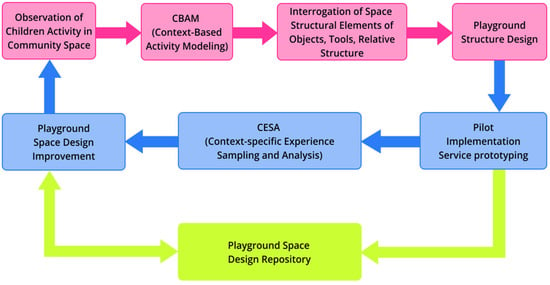
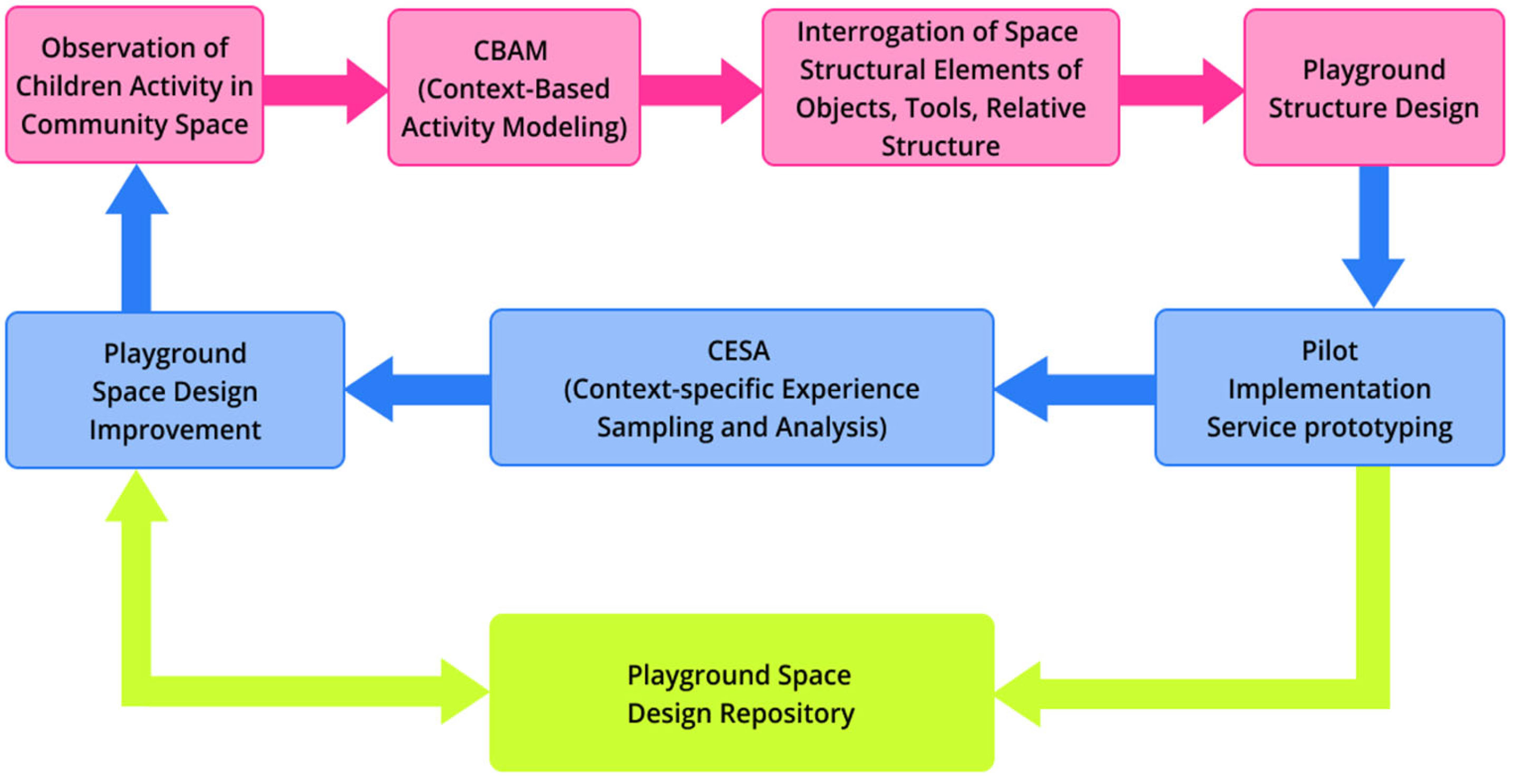
To address this limitation, this study integrates the CESA method as a complementary subjective evaluation method into the playground space design framework, as illustrated in Figure 1 [13]. The proposed process diagram adapts the methodological process, which commences with the observation of children’s activities in community spaces. Then, guided by the CBAM method, designers can conduct an interrogation of space structural elements of objects, tools, and the relevant structure and come up with the playground structure design. After that, the designer can conduct pilot implementation and service prototyping in space with their design insights. The CESA method serves as the validation mechanism within this sequence. In this paper, the evaluation framework for CESA is preliminarily validated.
Figure 1.
Design process diagram from observation to analysis [13].
Experiences are such that they are elucidated as they occur and thus, after-the-fact surveys cannot match the real experiences [24]. The experience sampling method [25] refers to a method of data collection in which participants respond to assessments at moments over the course of time while functioning within their natural settings [26]. By associating specific context information with experience sampling, CESA has been developed as a significant improvement ofexperience sampling [18]. In this paper, CESA focuses on children’s experiential dimensions, including emotional comfort, perceived safety, and engagement intensity during play activities. CESA was selected as the subjective evaluation method in this study to complement the CBAM-based activity modeling approach. While CBAM effectively structures observable activities and relevant space elements, it does not directly capture children’s internal psychological responses during play. CESA enables the systematic collection of subjective experience data within specific behavioral contexts, making it particularly suitable for filling in the psychological dimension of activity modeling.
Compared with traditional post-use questionnaires or retrospective interviews, CESA emphasizes in situ, context-aware experience sampling, allowing children’s immediate emotional and perceptual states to be recorded during or immediately after specific activities. These characteristics align with the dynamic and transient nature of children’s play experiences, where emotions and perceptions change rapidly across different activities and spatial conditions.
3. Children Play Activities Represented Using the CBAM Method
Based on the proposed method, four types of task-level activities are selected for analysis: Play task around the Slab Base, Play task around the lighting projection, Play task around the Skateboard Sliding Game, and Play task around the Football Game. These cases represent a spectrum of behavioral characteristics, ranging from static to dynamic, individual to social, and exploratory to goal-oriented activities. In each case, CBAM is first applied to model Task–Activity structures and extract relevant space affordances. Subsequently, CESA is used to evaluate children’s subjective experiences, enabling cross-validation between observed behavior and perceived experience. This application strategy ensures consistency across cases while allowing activity differences to emerge, providing a comprehensive foundation for the detailed analyses presented in the following section.
3.1. Play Task Around the Slab Base
In this study, we conducted a focused observation of children’s activity around a concrete slab base, which was originally designed as the foundation for a parasol, in a community courtyard. Through the lens of the CBAM framework, we analyze and compare three distinct activities exhibited by children on this structure: sitting, placing objects, and standing. The availability of the slab base has been expanded in various activities. This slab base, which has been suspended from the original function as a parasol is no longer used, has created a wide variety of usage methods for the users of this space, providing them with different kinds of roles and meanings in terms of physical structure elements.
3.1.1. Activity Sit (On the Slab Base)
- Actor and Tool
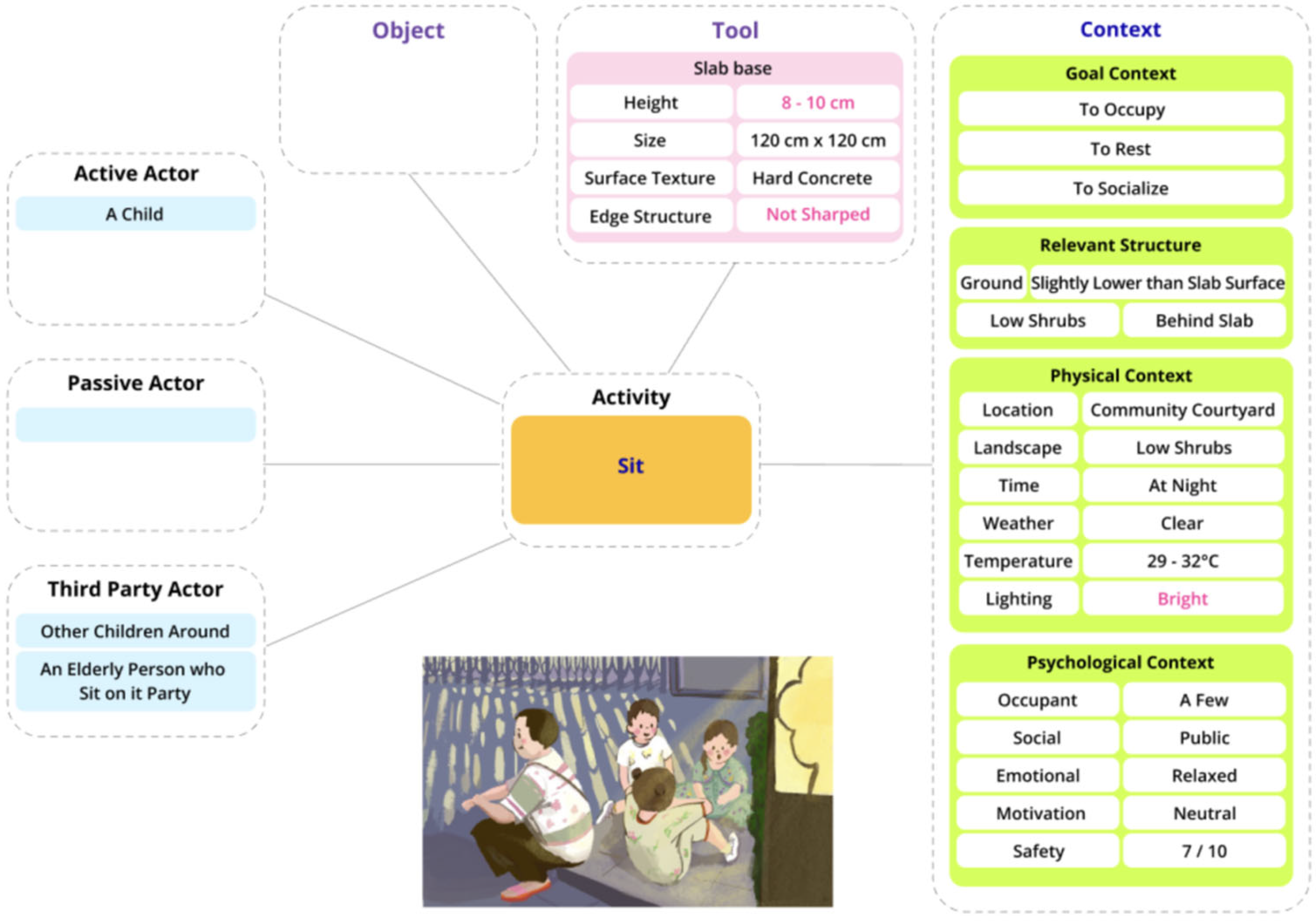
In the CBAM description of the activity sit (on the slab base) shown in Figure 2 together with an illustration, the child sitting on the slab base is the active actor, while other children and an elderly person sitting partly on it act as the third-party actors. Their presence enhances the social atmosphere and supports the child’s behavior. The slab base is a tool of this activity sit, used to support physical rest and to socialize. Structurally, it is 8–10 cm in height, approximately 120 × 120 cm in size, with a flat, hard concrete surface and edges that are not sharp as described in the feature property parts of the tool description in Figure 2.
- 2.
- Goal Context
The goal context includes intentions to occupy space, to rest, and to socialize.
- 3.
- Relevant Structure Context
- Ground: The ground is typical, but what is particularly special is the height difference it forms with the slab base, making it slightly lower than the slab surface, which enables the activities and contact postures of the child.
- Low Shrubs: The trees consisting mainly of low shrubs are located behind the slab. That is, the low shrubs behind the slab allow approach directions toward it from any direction other than from behind.
- 4.
- Physical Context and Psychological Context
Physically, the activity takes place in the community courtyard at night. Warm temperatures of 29–32 °C and clear weather support a relatively relaxed and communal experience. The lighting context is bright due to spot lighting in the space. Psychologically, the occupant context fields are few and the social context field is public. The emotional status of the child is relaxed and his motivation is neutral. However, due to the hard texture of the slab, accidental contact and friction may occur, posing potential safety risks. As a result, the safety rating is 7 out of 10. This shows that the dual needs of physical safety and behavioral support need to be taken into account in the design of any structures in community spaces.
Note that the sit-ability affordance is provided by the affordance features composed of the tool of the slab base and the relevant structure context of the ground that is slightly lower than the slab base surface as represented in the CBAM description of the activity sit.
Figure 2.
CBAM description of the activity sit (on the slab base) and a supporting illustration.
3.1.2. Activity Place (On the Slab Base)
- Actor, Object and Tool
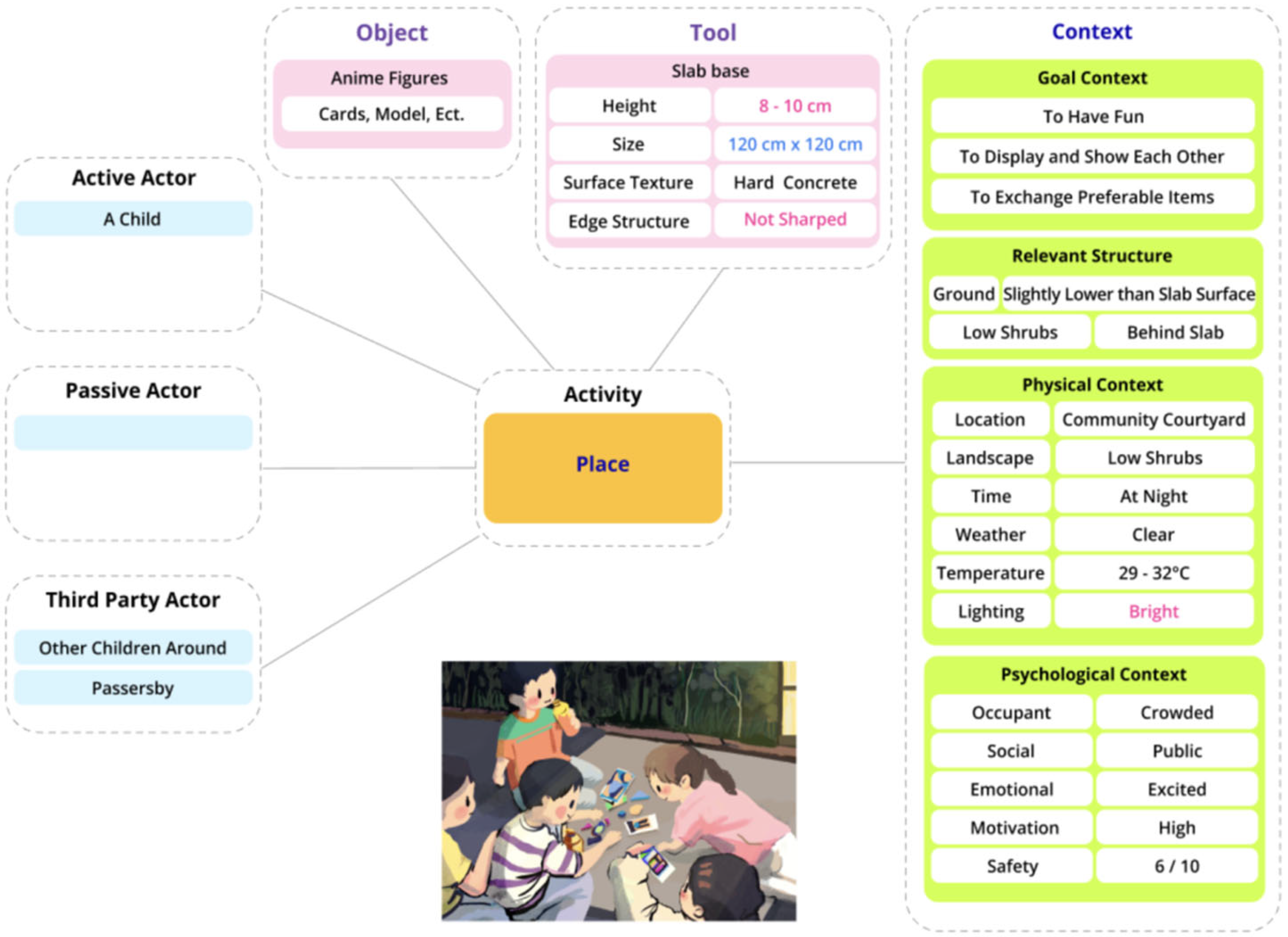
By decomposing the CBAM of the activity place shown in Figure 3, it can be seen that the actor is a child, while the third-party actors are other children around, elderly people who take care of children, and passersby who might be observers. Children use the slab base as a tool to place figures, cards, models, and other objects, and they form new interactive relationships through display and communication. The tool, the slab base, is the same as in Figure 2, and has expanded functions in this activity. Its flat and hard concrete surface provides a stable foundation for placing items, while the height difference of around 8–10 cm makes the goal context of “to display” more obvious. The structure originally used as a parasol base has been interpreted by children as a display stand and a game table.
- 2.
- Goal Context
The goal is to have fun, which also includes to display items and to show each other, to exchange preferable items, and even to play games. This activity strengthens social connections among children and endows the space with new social functions.
- 3.
- Relevant Structure
- Ground: The same ground as that described in the activity sit, introducing a subtle elevation (8–10 cm) that transforms it into a table-like structure for children. Thus, this activity and contact postures of the actor have been enabled. In CBAM terms, “Ground” not only refers to the physical surface but also to the underlying space structures to enable the activity. The child perceives the height difference and reinterprets the slab as a platform for display and performance, using various postures such as leaning, squatting, or lying down.
- Low Shrubs: Same as that described in the activity sit.
- 4.
- Physical Context and Psychological Context
Physically, the same as in the activity sit in Figure 2. Psychologically, the child displays a high degree of excitement and motivation. The safety is reaching 6 out of 10, higher than the activity sit. This shows that physical safety and behavioral support need to be taken into account in designing community spaces.
Note that the place-ability affordance is provided by the affordance features composed of the tool of the slab base and the relevant structure context of the ground that is slightly lower than the slab base surface and composed of the object of anime figures and the tool of the slab base as represented in the CBAM description of the activity place.
Figure 3.
CBAM description of the activity place (on the slab base) and a supporting illustration.
3.1.3. Activity Stand (On the Slab Base)
- Actor, Object and Tool
In the activity stand (on the slab base) shown in Figure 4, the active actor is a child standing on a slab base. The third-party actors are boys standing next to her and elderly people who take care of children, and passersby. The tool is the slab base, the same as the tool used for the activity sit shown in Figure 2.
- 2.
- Goal Context
The goal context is to have fun, to talk with friends and to socialize.
- 3.
- Relevant Structure
- Ground: The ground is slightly lower than the slab surface. The feeling of being a little bit elevated enabled by the slab base would provide children with a stage-like space.
- Low Shrubs: The trees consisting mainly of low shrubs are located behind the slab. That is, the low shrubs behind the slab allow approach directions toward the slab from any direction other than from behind. Low shrubs form a part of the boundary behind the child and her peers standing together, creating a semi-enclosed social atmosphere.
- 4.
- Physical Context and Psychological Context
Figure 4.
CBAM description of the activity stand (on the slab base) and a supporting illustration.
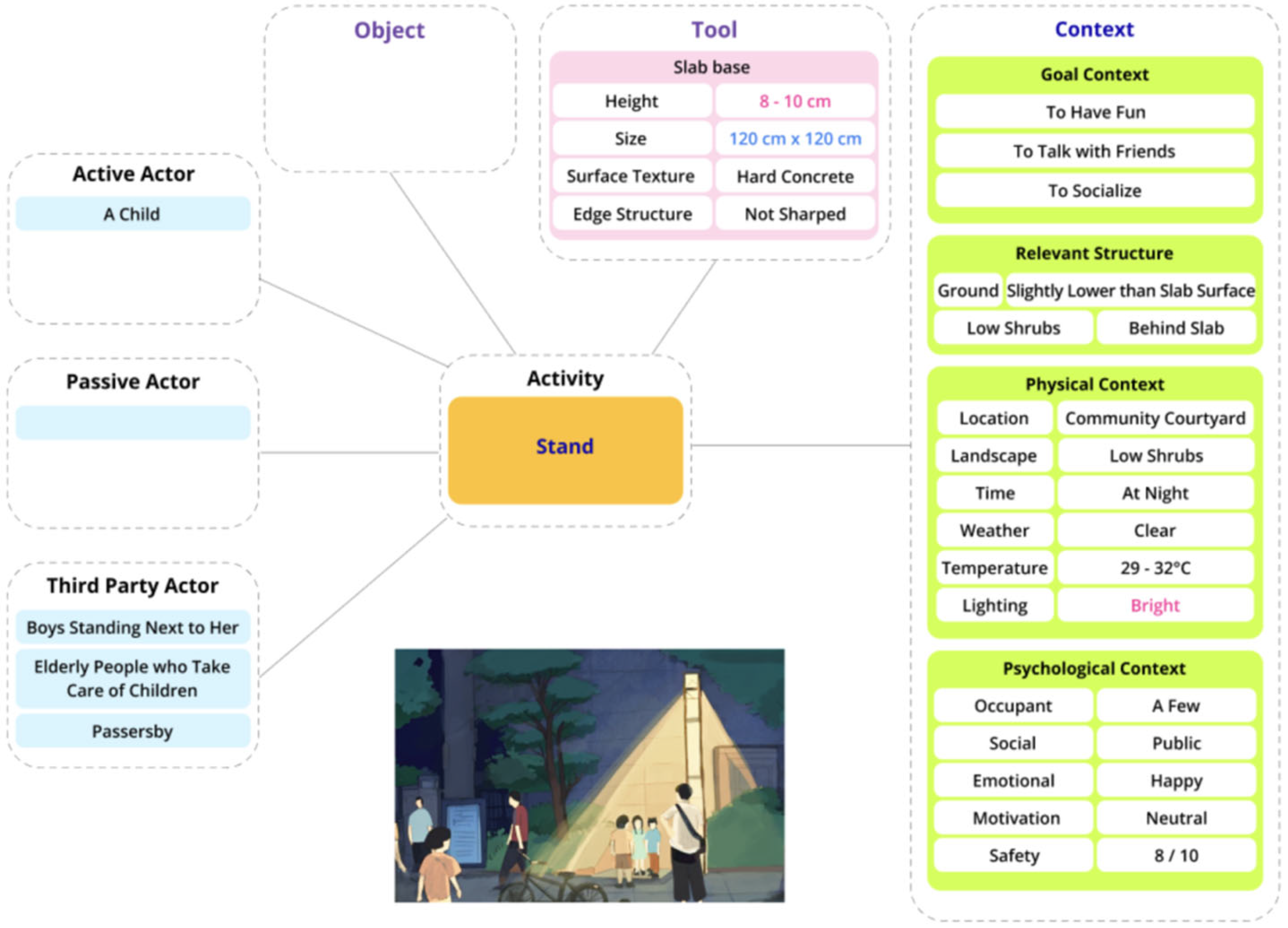
Physical contexts are the same as the activity stand (on slab base), characterized by the same courtyard setting and environmental conditions. The psychological context shows that the number of occupants is relatively small and the activity takes place in a public environment. The child displays a happy emotional state, while their motivation remains neutral, oriented more toward casual engagement than competitive interaction. The safety level is evaluated at 8 out of 10, a relatively safe condition.
Note that the stand-ability affordance is provided by the affordance features composed of the tool of the slab base and the relevant structure context of the ground that is slightly lower than the slab base surface as represented in the CBAM description of the activity stand.
3.2. Play Task Around Lighting Projection
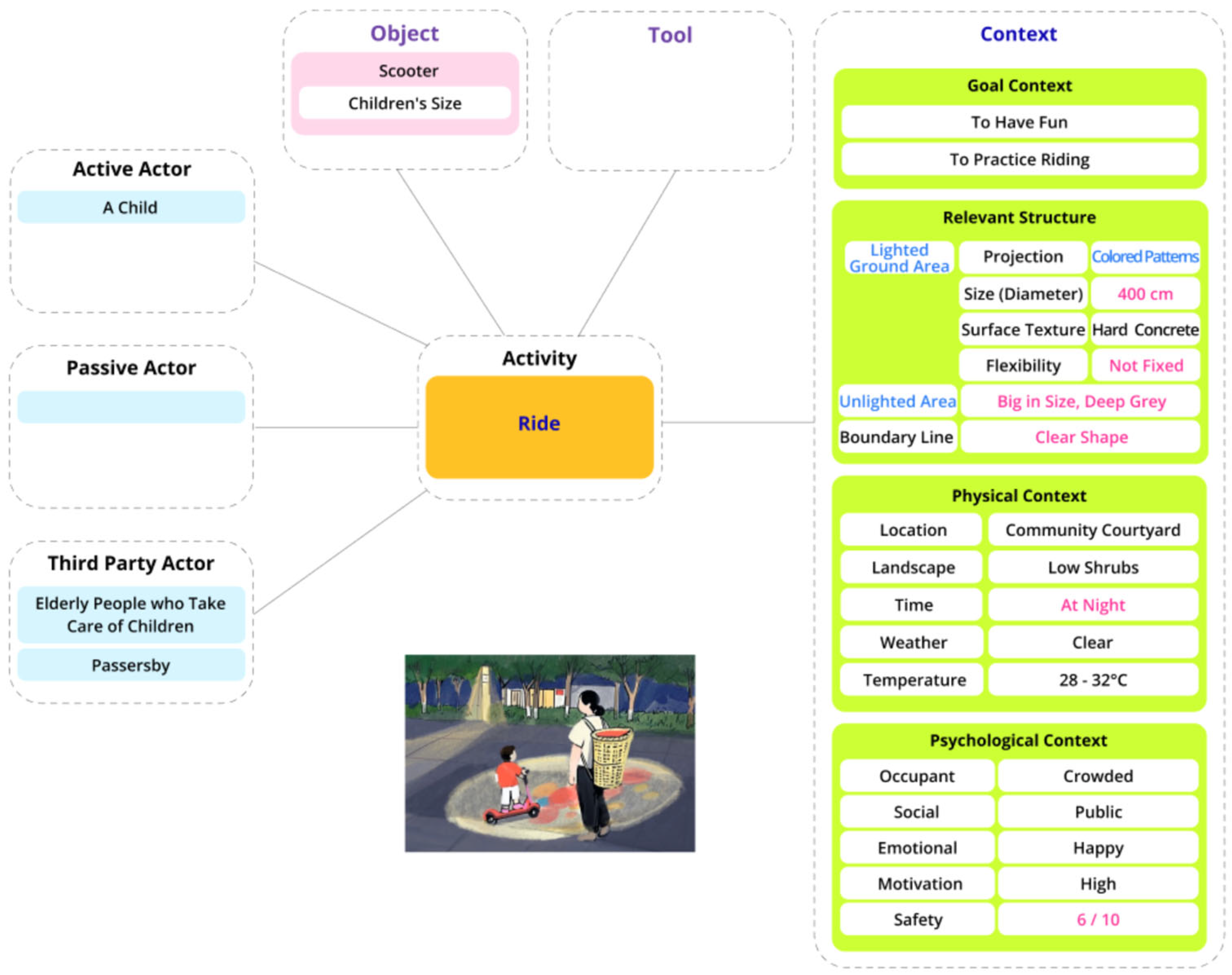
There was a lighting projection in the community space observed in this study, and children’s activities in this area are more frequent. In the Play task around lighting projection, activity sit and activity ride are the two main activity types, reflecting children’s interest in lighting elements and their different ways of using the same lighting structure.
3.2.1. Activity Sit (Around Lighting Projection)
- Actor, Object and Tool
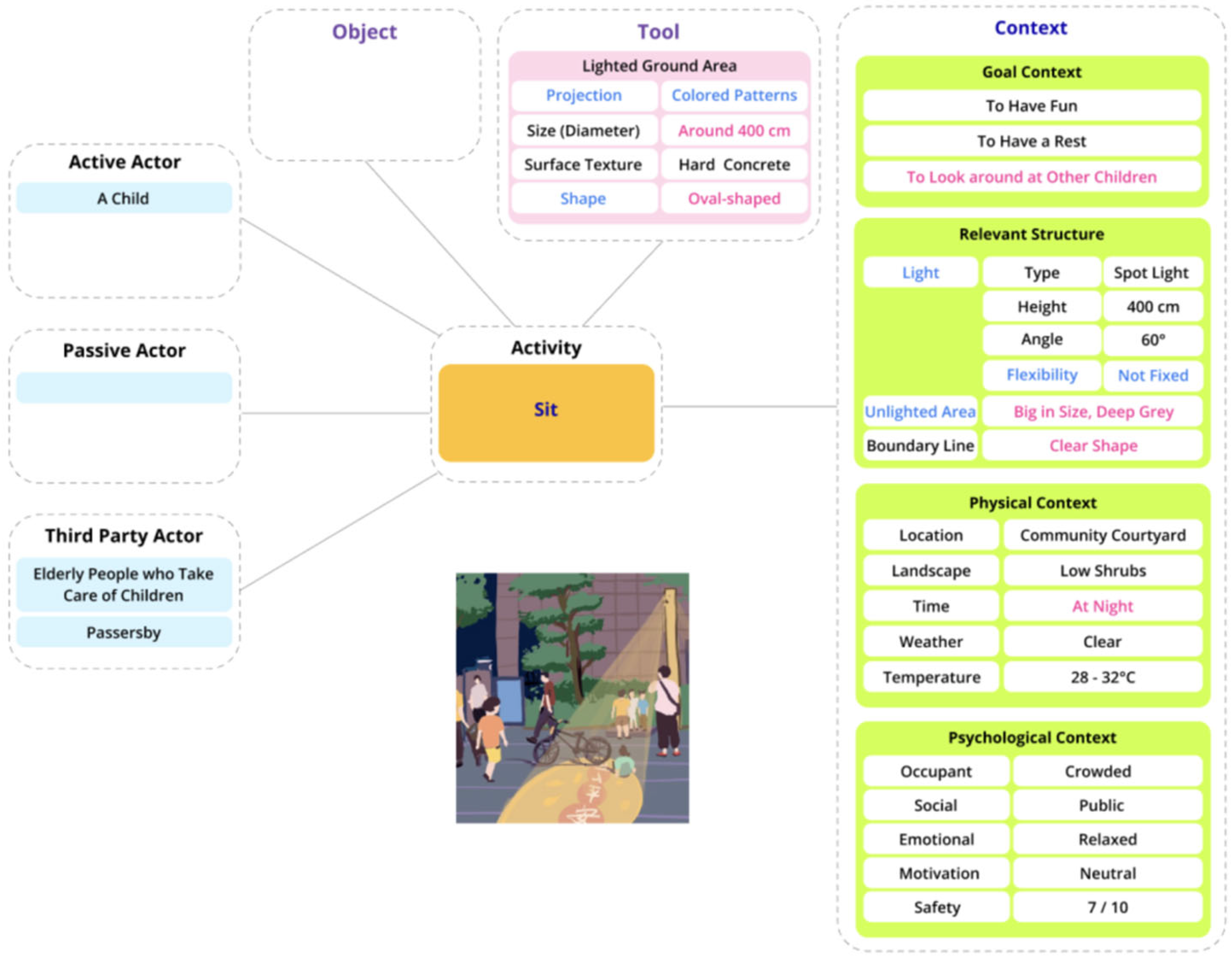
In the CBAM description of the activity sit (around the lighting projection) shown in Figure 5, the active actor is a child sitting within the lighted ground area, while third-party actors include elderly people who take care of children and passersby. The tool is the lighted ground area, which the child interprets as a visually appealing, clearly bounded temporary “game stage.” The lighting projection produces colored patterns, with a circular shape of approximately 400 cm in diameter, a flat, hard concrete surface, and distinct edges created by light and shadow.
- 2.
- Goal Context
The goal context includes resting, observing, and engaging in playful or performative behavior within this temporary stage.
- 3.
- Relevant Structure
- Light: The spotlight, positioned at a height of approximately 400 cm and angled at around 60°, produces a strong contrast between the brightly lit central circle and the surrounding dark-gray unlit areas. The lighted ground acts as a natural focal point, while the unlit areas create implicit boundaries.
- Unlighted Area: Big in size and deep gray in color.
- Boundary Line: The boundary line is oval with a clear shape, which limits the range of children’s sitting.
- 4.
- Physical Context and Psychological Context
Physically, the activity sit (around the lighting projection) occurs together with the above activities, thus its location, landscape, and time are the same as the activity sit (on the slab base) in Figure 1. As the temperature is 28–32 °C, which is relatively high, the ground surface consequently remains warm. Psychologically, the space is relatively crowded and public. The actor’s emotional state is relaxed, with neutral motivation primarily oriented toward rest and observation. Safety is rated 7 out of 10, and the main risks stem from potential bumps against hard surfaces and insufficient lighting in the peripheral areas at night.
Figure 5.
CBAM description of the activity sit (around the lighting projection) and a supporting illustration.
3.2.2. Activity Ride (Along Lighting Projection)
- Actor and Tool
The child riding the scooter is the active actor, while the third-party actors include elderly people who take care of children and passersby, as shown in Figure 6. The scooter is designed for children’s size, functions as a core riding tool, providing the child with mobility and entertainment functions, and its small size is suitable for activities in limited spaces.
- 2.
- Goal Context
In the activity ride, the goal contexts are to have fun and to practice riding.
- 3.
- Relevant Structure
- Lighted Ground Area: Functioning as the primary activity interface, the projection of colored patterns creates a dynamic and visually engaging path, where shifting light and shadow simulate a playful “riding track.” It has good flexibility because the spotlight is not fixed.
- Unlighted Area: Big in size and deep grey in color.
- Boundary Line: The distinction between the lighted and unlighted areas produces a visible boundary line with a clear shape. This demarcation provides orientation in the community space and creates a gamified sense of challenge, stimulating activities such as detouring and path-following.
- 4.
- Physical Context and Psychological Context
The physical context of the activity ride is the same as the activity sit. The overall environment provides suitable conditions for outdoor activities at night, but lighting mainly relies on artificial projection sources. For psychological context, the occupant of this space is crowded, and the social context field is public, with children showing a happy emotional state and high motivation. Safety is rated 6 out of 10, with the main risks coming from possible collisions and loss of control during night riding, as well as interference caused by high pedestrian traffic in public spaces.
Figure 6.
CBAM description of the activity ride (around the lighting projection) and a supporting illustration.
3.3. Play Task Around Skateboard Sliding Game
The skateboard sliding game encompasses three primary forms of activity: push, slide, and trace. Across these variations, children reconceptualize the skateboard not merely as a tool for mobility but as a medium for competition, exploration, and creative play. Through the dynamic interaction between the tool (skateboard), the relevant structure, and the context, children actively expand the affordances of space.
3.3.1. Activity Push
- Actor, Object and Tool
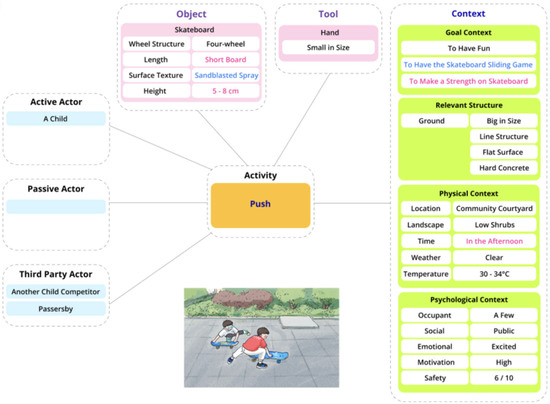
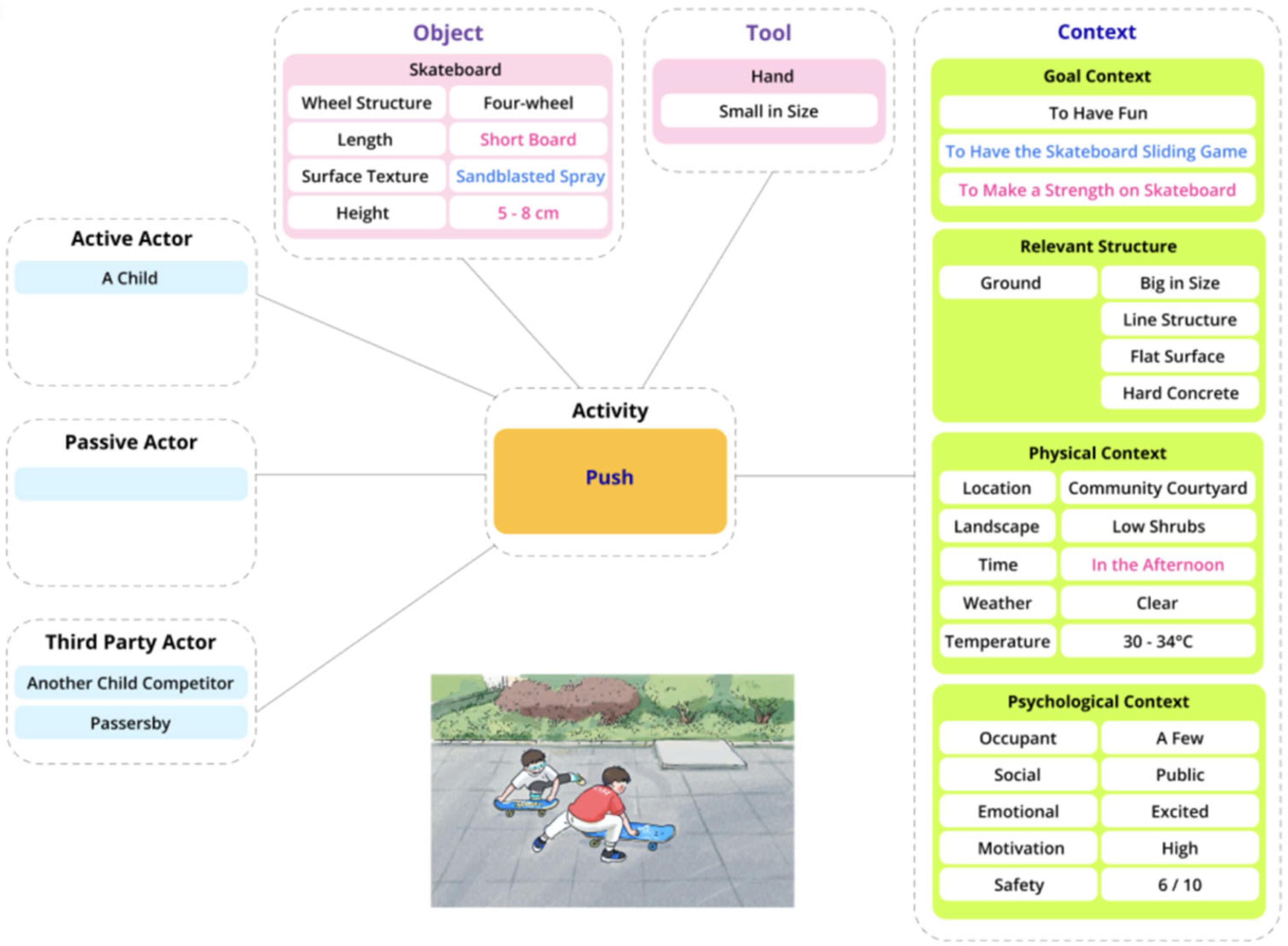
The active actor is a child engaging in a competitive activity by pushing a skateboard shown in Figure 7. The third-party actors include other child competitors and passersby. Unlike the static activities sit or stand, the activity push is highly dynamic, combining elements of strength and speed. From the tool perspective, the child primarily uses his small hand to exert force. The object is the skateboard, a short four-wheeled board with a sandblasted surface that enhances grip and stability.
Figure 7.
CBAM description of the activity push (a skateboard) and a supporting illustration.
- 2.
- Goal Context
The goal context is to have fun, to compete with peers, and to explore speed and strength.
- 3.
- Relevant Structure
The relevant structure is the ground, which is big in size, and has a line structure on it. Due to the hard concrete texture and its flat surface, it provides both stability and sufficient friction during the activity slide.
- 4.
- Physical Context and Psychological Context
Physically, the activity push occurs in the afternoon under clear weather conditions, with temperatures ranging from 30 to 34 °C. The environment is public, open, and equipped with low shrubs as landscape elements, providing children with ample space to engage in sliding activities. Psychologically, the social state is public, with children showing excitement and high motivation. The safety level is rated at 6 out of 10, since risks may arise from falling, skin abrasions due to friction, or collisions with peers.
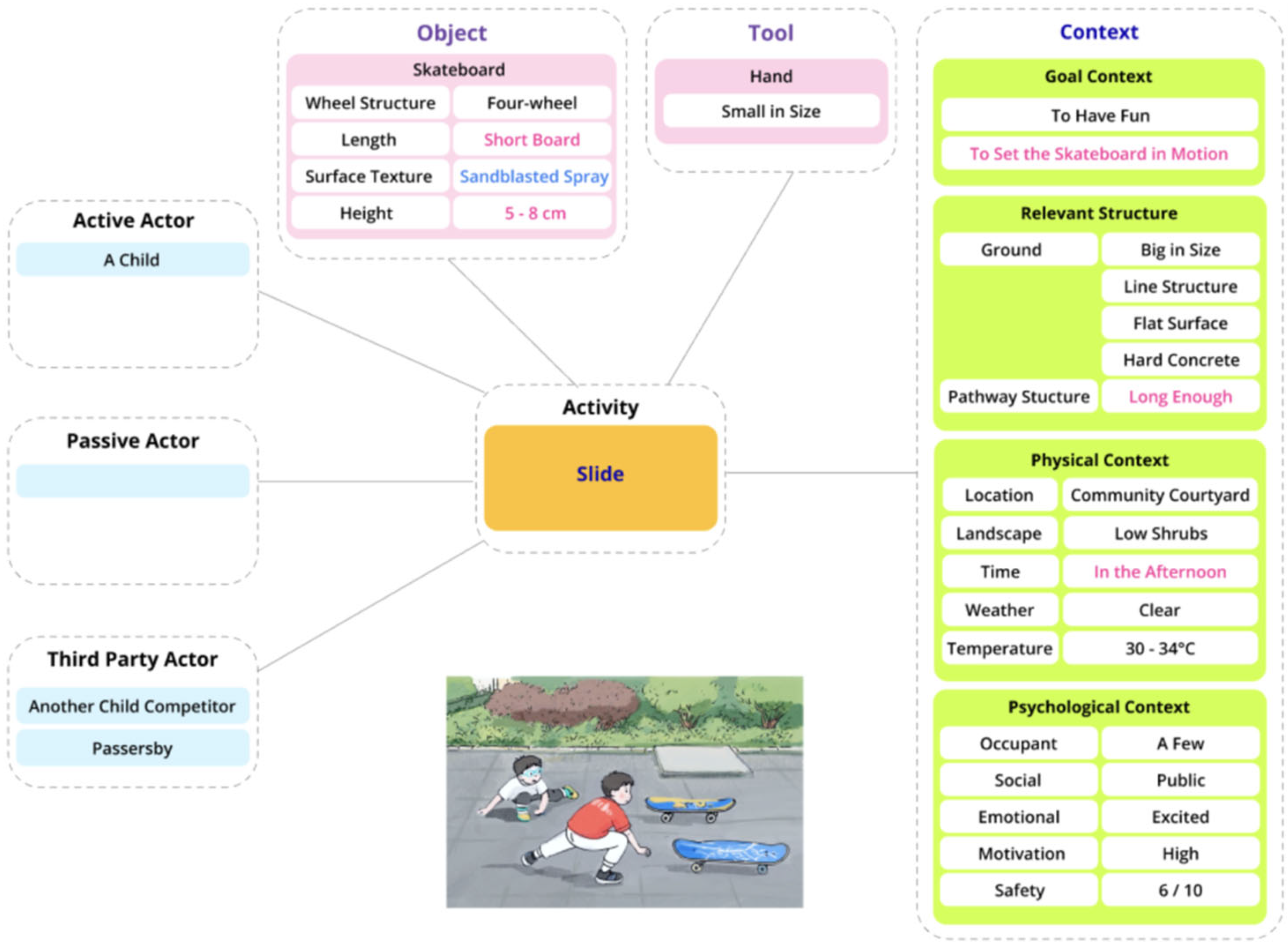
3.3.2. Activity Slide
- Actor, Object and Tool
In the activity slide shown in Figure 8, the active actor is a child, while third-party actors include another child competitor and passersby. The tool is the child’s hand, which is used to push and to release the skateboard. The skateboard serves as the object, with a four-wheel structure, short-board type, and a sandblasted surface.
- 2.
- Goal Context
The goal contexts are to have fun and to set the skateboard in motion.
- 3.
- Relevant Structure
- Ground: The ground is big in size with a line structure on it. Due to the hard concrete texture and its flat surface, it provides both stability and sufficient friction during the activity slide.
- Pathway Structure: Long enough to allow the skateboard a continuous sliding distance, which supports sustained play. The activity slide differs from the activity push in that the skateboard is no longer controlled directly by the child’s body but instead moves freely across space. This creates new affordances of speed, distance, and competition.
- 4.
- Physical Context and Psychological Context
The activity slide takes place after the push and shares the same physical contexts as the activity push. The community courtyard includes low shrubs, adding a more enclosed element, but still leaving open paths for sliding. In terms of psychological context, the activity is public, and children experience excitement and high motivation. The safety level is moderate (6 out of 10) due to risks of falling, collisions, or skin abrasions caused by friction with the concrete ground.
Figure 8.
CBAM description of the activity slide (a skateboard) and a supporting illustration.
3.3.3. Activity Trace
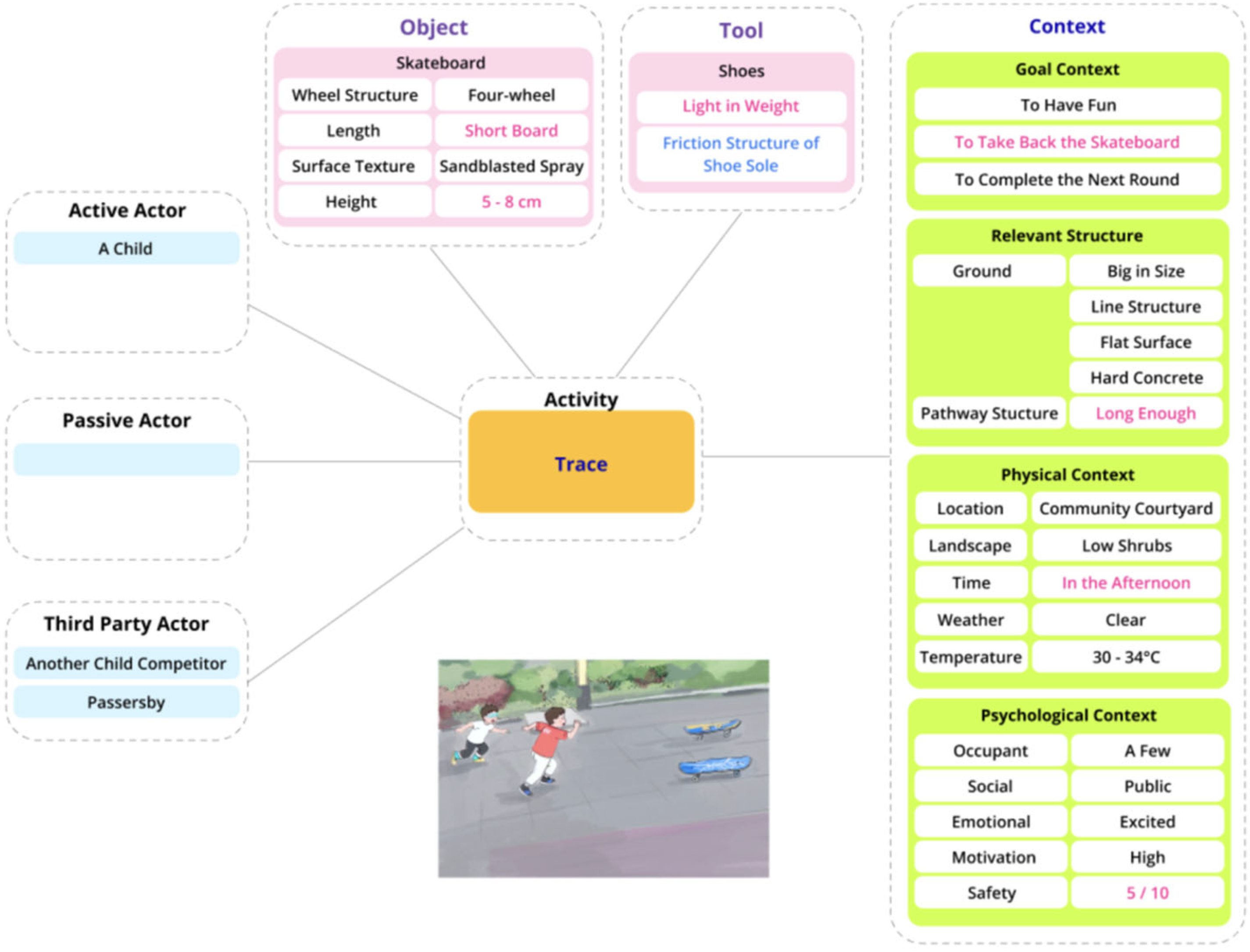
The activity trace shown in Figure 9 happens right after the slide as the actor needs to catch up with the skateboarder and continue the race, forming the third stage of the skateboard play sequence, following the activity push and activity slide.
- Actor, Object and Tool
The active actor is a child, while the third-party actors include another child competitor and passersby. Unlike the prior activities where the skateboard is manipulated or released, here the skateboard becomes the object of pursuit, and the child’s body—especially through the shoes, which are lightweight and equipped with frictional sole structures that support running and quick movement—becomes the tool. This transformation highlights the dynamic relationship between actor and object: the skateboard shifts from a controllable tool to a moving target, generating cycles of anticipation, chase and recovery.
- 2.
- Goal Context
The goal context is to have fun, to take back the skateboard and to complete the next game round.
- 3.
- Relevant Structure
- Ground: The ground is characterized by a large-scale linear structure with a flat, hard concrete surface, providing both stability and sufficient friction. Its linear patterns ensure friction for running while maintaining stability.
- Pathway Structure: The pathway on the rough ground is long enough for continuous chasing, thereby extending the cycle of the game. While it serves as a critical environmental element sustaining the activity trace, it simultaneously increases safety risks. This indicates that the design of children’s play spaces should integrate both dynamic circulation paths and protective ground surfaces to balance freedom of movement with accident prevention.
- 4.
- Physical Context and Psychological Context
Physical contexts of the activity trace are the same as the activity push and slide. The courtyard contains low shrubs that form boundaries but leave pathways accessible. Psychologically, the activity occurs in a public social setting, where children feel excited and demonstrate high motivation. The safety level is rated at 5 out of 10, as tracing on rough concrete surfaces increases the risk of tripping, falling, or colliding with others.
Figure 9.
CBAM description of the activity trace (a skateboard) and a supporting illustration.
3.4. Play Task Around Football Game
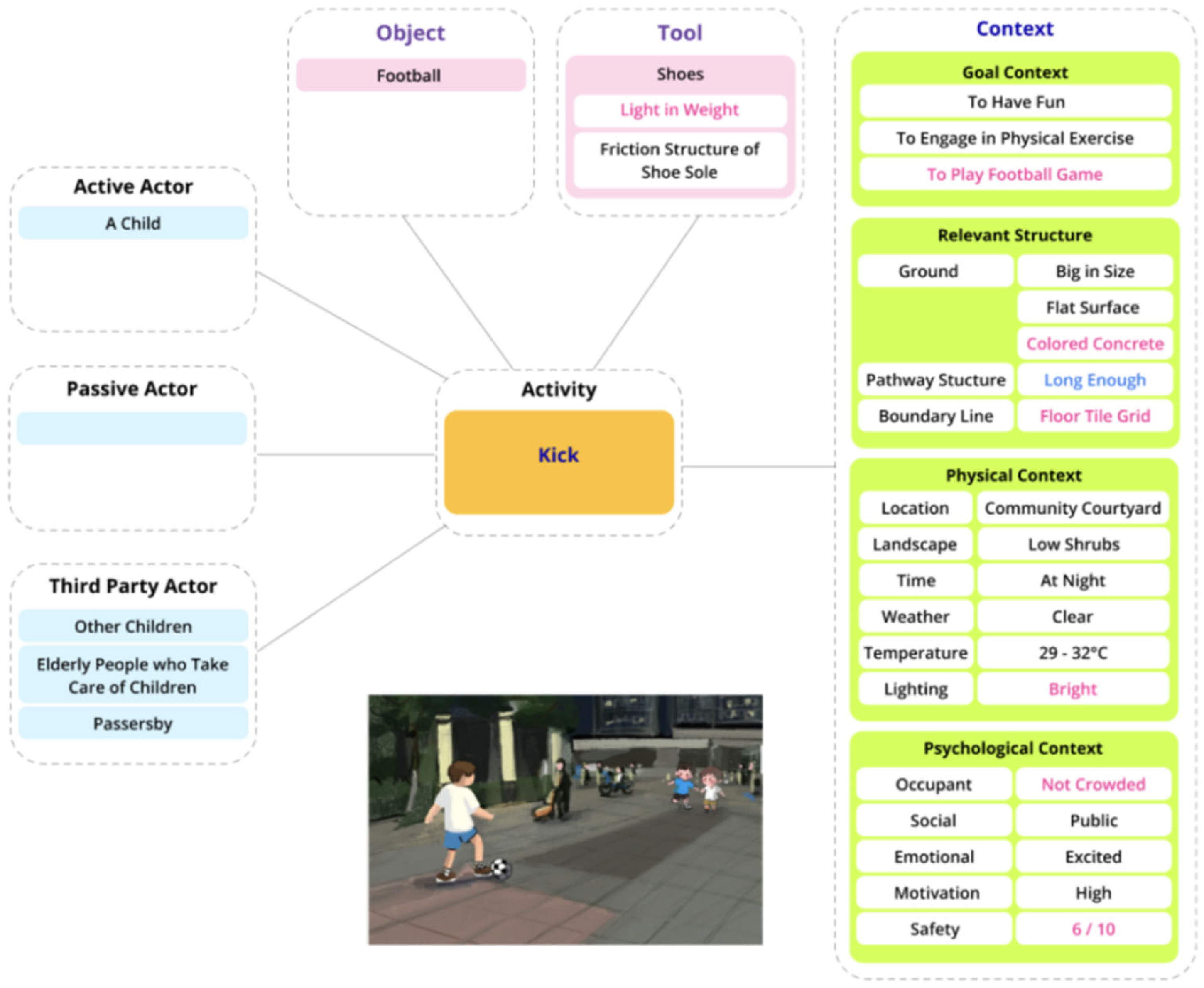
In the task of playing football, children’s activities mainly include the activity kick and the activity shoot.
3.4.1. Activity Kick
- Actor, Object and Tool
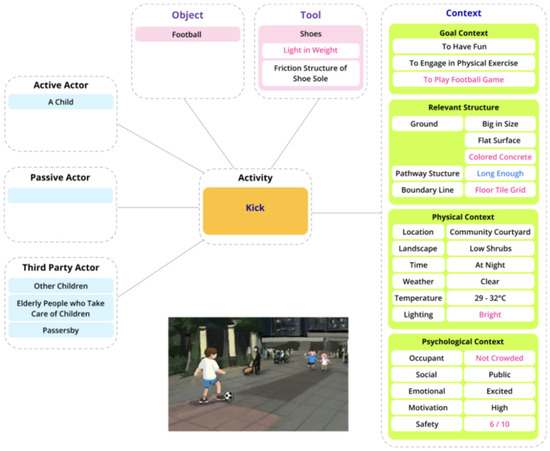
The active actor is a child, while the third-party actors include other children, elderly people who take care of children, and passersby, as shown in Figure 10. The football serves as the central object, requiring continuous engagement through kicking and movement. The tool consists of shoes with lightweight, frictional soles, facilitating kicking and ball control.
Figure 10.
CBAM description of the activity kick (a football) and a supporting illustration.
- 2.
- Goal Context
The goal context is to have fun, to engage in physical exercise, and to play football game.
- 3.
- Relevant Structure
- Ground: The same big and flat ground, but the colored concrete is related to the activity of kicking soccer balls because the colored concrete distinguishes the pink and gray rectangular shapes on the ground, dividing the scale of the activity space for kicking soccer balls, and better conveys the routes and rules of kicking, which is beneficial for the other players of this child to convey information and cooperate.
- Pathway Structure: The pathway is long enough to accommodate dynamic movements and interactions across multiple players. This extended linear space is particularly conducive to activities such as kicking a ball over long distances, allowing players to develop and experience full momentum—achieving powerful kicks, sustained ball movement, and enhanced kinetic play.
- Boundary Line: Informal boundaries shaped by the visible floor tile grids on the ground, which extend play routes.
- 4.
- Physical Context and Psychological Context
As for physical context, the football activity occurs in the same community space at night, under bright artificial lighting that supports visibility. The weather is clear, with temperatures between 29 and 32 °C. The presence of low shrubs forms a semi-enclosed space but does not restrict the activity. Psychologically, the context is public yet not crowded, enabling children to focus on the game without excessive interference. The child experience excitement and display high motivation, while the safety level is 6 out of 10, due to the potential risks of falling on the hard concrete surface or collisions between players.
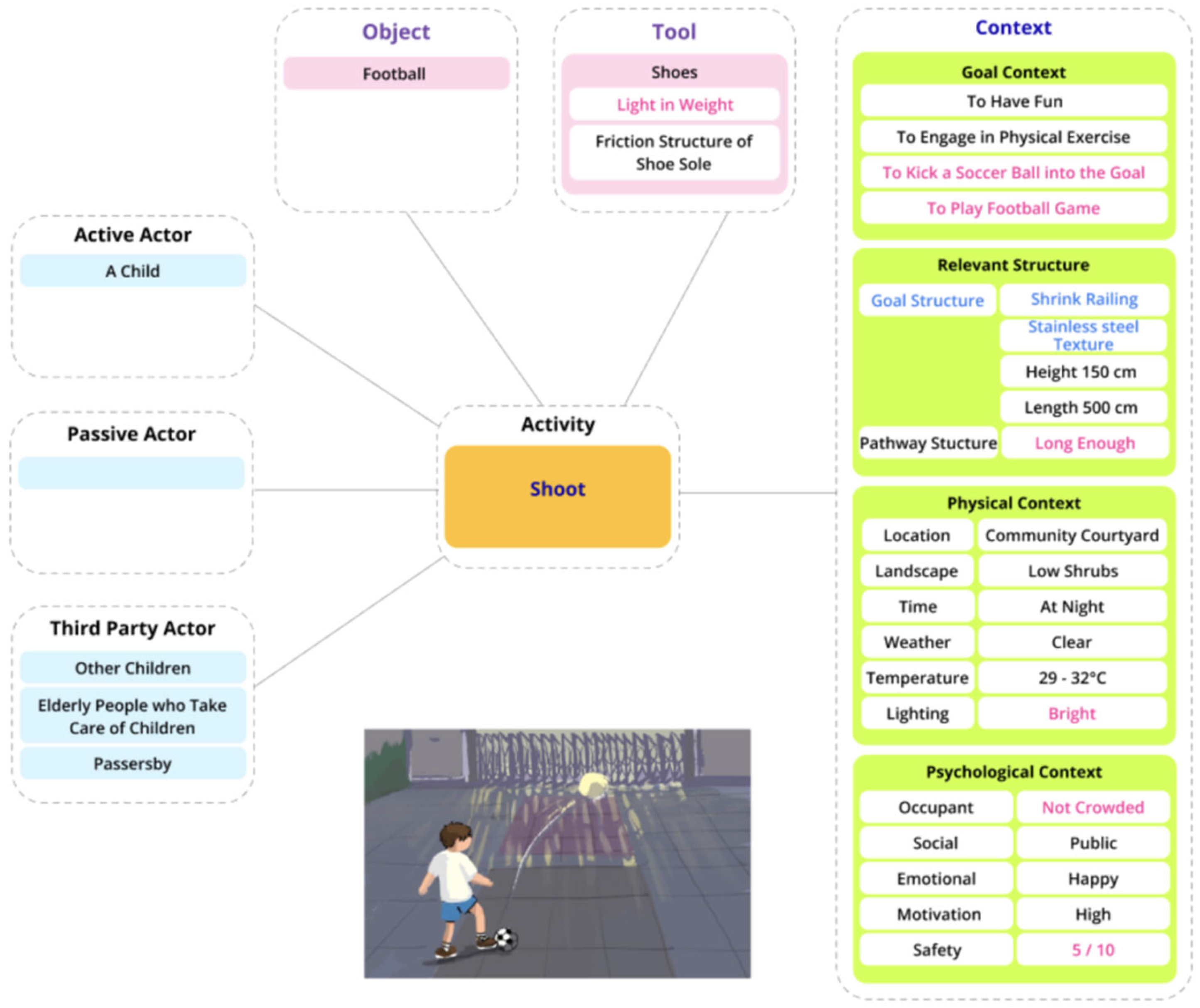
3.4.2. Activity Shoot
- Actor, Object and Tool
The active actor is a child engaged in shooting the football, while third-party actors include other children, elderly people who take care of children, and passersby who observe or occasionally participate, as shown in Figure 11. A football works as the object, and the tool is the shoes of the child, lightweight with frictional soles, enabling children to control the football effectively.
Figure 11.
CBAM description of the activity shoot (a football) and a supporting illustration.
- 2.
- Goal Context
This activity differs from the activity kick in that its main goal contexts are to shoot the ball into a goal and engage in goal-oriented play, emphasizing precision and target-directed activities.
- 3.
- Relevant Structure
- Goal Structure: Instead of a standard goalpost, children creatively adapt the stainless-steel railing (150 cm high and 500 cm long) as an improvised goal. This substitution reflects children’s ability to reinterpret ordinary infrastructural elements into meaningful play equipment. The activity shoot highlights how children creatively repurpose existing community infrastructure—in this case, the stainless-steel railing—into functional elements of play. By treating the railing as a football goal, children expand the affordances of everyday structures, demonstrating adaptability and resourcefulness in urban environments where dedicated sports facilities may be lacking.
- Pathway Structure: The pathway being long enough may help a child shoot more accurately towards the goal, with better positioning, making it easier for a child to kick the ball and run.
- 4.
- Physical Context and Psychological Context
The physical context of the activity shoot is the same as the activity kick. Psychologically, the courtyard is not crowded with occupation, allowing children to focus on their play without excessive interference. The activity generates a happy emotional state, with high motivation among participants. However, the safety rating is 5 out of 10, as the hard concrete ground and proximity to the iron railing may cause potential injuries if collisions or falls occur.
3.5. Space Design Strategy from CBAM Descriptions of Activities
Specific space design strategies have been derived following the comprehensive CBAM analysis of 10 activities of four play tasks.
3.5.1. Using Supporting Platforms with Different Heights to Support Children’s Diverse Activities
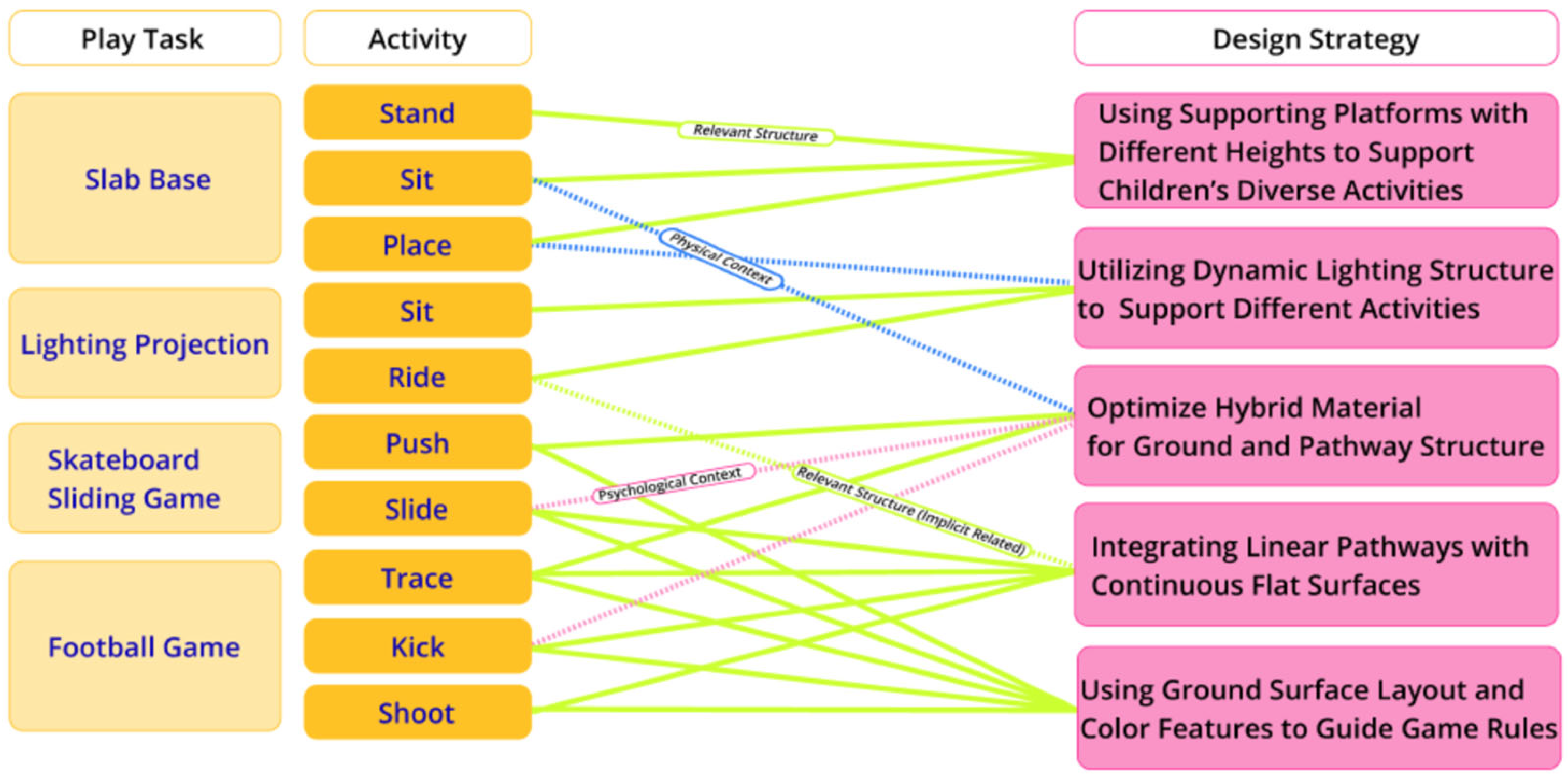
The comparison of sit, place and stand activities on the slab base reveals how a single space structure element can be transformed into multiple affordance features supporting different children’s spontaneous activities: as a “seat” for sitting, as a “table” for placing objects, and as a “stage” for standing. Ground characteristics—flatness, hardness, and the height difference with the slab—are interpreted by children in each activity, transforming physical features into features that enable different social and symbolic roles. Especially in the case of the activity place, the slab base is used by children as a temporary display and play platform. The structure, originally designed to provide a supporting function for a parasol, provides the transformed functions that enable social interaction and game communication through its use, and greatly enhanced affordances can be provided by the slab base with children’s creative perceptions and interpretations. It should be noted that this addresses an important sustainability issue of community spaces.
3.5.2. Utilizing Dynamic Lighting Structure to Support Different Activities
Dynamic lighting projection establishes a striking, temporary interactive focus within the courtyard. Beyond its fundamental function as a physical context element providing visibility for display-oriented activities such as activity place, it actively shapes the play experience. For static activities like sit, it satisfies children’s needs for exploration and rest, while simultaneously providing caregivers and passersby with favorable conditions for observation and supervision. The interaction between the projected light area and children’s ride activity transforms the community courtyard into a temporary yet engaging playground. The light-shadow boundary not only directs children’s riding paths but also gamifies the activity ride.
3.5.3. Optimize Hybrid Material for Ground and Pathway Structure
The CBAM analysis reveals a critical tension between the physical requirements for high-intensity activities and the resulting safety concerns. While the hard concrete and flat ground surfaces are essential for providing the stability required in the activity slide and the activity kick, they significantly compromise safety ratings due to risks of abrasions and falling, creating a conflict with the children’s observed high motivation. To resolve this, a hybrid material zoning strategy is proposed for the ground and pathway structure. This approach retains hard paving in the central core zone to support kinetic movement, while integrating impact-absorbing materials (e.g., EPDM rubber) in the peripheral buffer zones to mitigate injury risks during such an activity as trace. Furthermore, given the warm temperatures (29–34 °C) noted in the physical context, surface materials must be selected for low thermal retention to ensure thermal comfort during static activities like activity sit.
3.5.4. Integrating Linear Pathways with Continuous Flat Surfaces
The CBAM analysis reveals a strong correlation between dynamic activities—specifically push, slide, trace, kick, and shoot—and the pathway structure. Given the spatial scale and safety requirements of these high-mobility activities, the design necessitates a large-scale linear structure featuring a flat, hard concrete surface to provide requisite stability and sufficient friction. The ground’s flatness and pathway length become key space elements supporting this activity, showing how environmental structures extend the possibilities of play.
3.5.5. Using Ground Surface Layout and Color Features to Guide Game Rules
While physical texture supports movement, the visual layout of the ground surface plays a distinct role in structuring play. For dynamic activities like push and slide, linear ground structures serve as visual reference or direction lines, supporting competitive directionality. Similarly, in collaborative games like kick and shoot, colored concrete patterns and floor tile grids function as implicit guides and constraints. By visually differentiating zones, these features enhance children’s cognitive understanding of the play space, fostering social interaction and clarifying game rules without physical barriers.
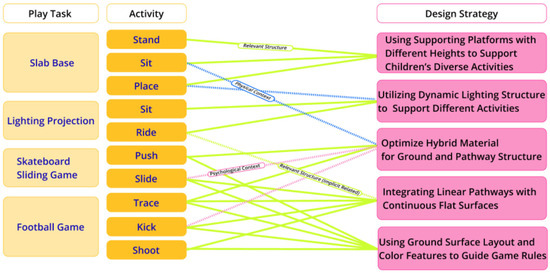
For 10 activities across the four play tasks and their corresponding space design strategies, how these strategies are systematically derived from the interrogation of relevant structures, physical contexts, and psychological contexts, is shown in Figure 12. For 10 different activities of stand, sit, place, sit, ride, push, slide, trace, kick and shoot, each one reflects a certain design structure strategy inspiration on the Relevant Structure as indicated by green connection. Activities sit and place in play around the slab base contribute to the design strategies needed from the perspective of physical context as indicated by blue connections. Activity slide (in skateboard sliding game task) and activity kick (in football game task) are connected to strategies from psychological context.
Figure 12.
Task–activity and design strategy derivation relationship.
4. Subjective Experience Evaluation Framework Using CESA
4.1. Voice-Based Interface of CESA
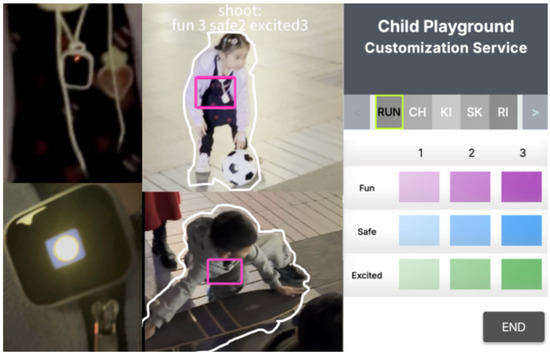
To support context-specific subjective experience sampling during children’s play activities, this study designed and implemented a voice-based interface integrated with the CESA method. Note that children’s hands would have to be involved in their play activities. The interface follows principles of low cognitive load and direct evaluation, enabling children to report their emotional and perceptual experiences without interrupting ongoing play activities. Subjective experience evaluation is organized around task-activities as the fundamental units. Based on key activities identified through CBAM analysis, experience sampling is conducted for each specific activity.
The emotional states of Fun, Safe, and Excited are rated on a scale ranging from 1 to 3 (1: Low, 2: Moderate, 3: High). This aligns with the child’s natural cognitive capacity to distinguish between “Positive (3),” “Neutral (2),” and “Negative (1)” states, thereby minimizing cognitive overtaxing and ensuring higher data fidelity and content validity compared to more complex abstract scales [27]. During the activities, children wear lightweight voice-based devices and verbally provide three-level evaluations for specific emotional states of each activity. Within the same play task, different activities are evaluated in sequence. For instance, in the football task, kick and shoot are treated as discrete units and assessed separately. This would allow the study to compare how different activities distinctively influence children’s psychological states.
4.2. Evaluation Process Determined
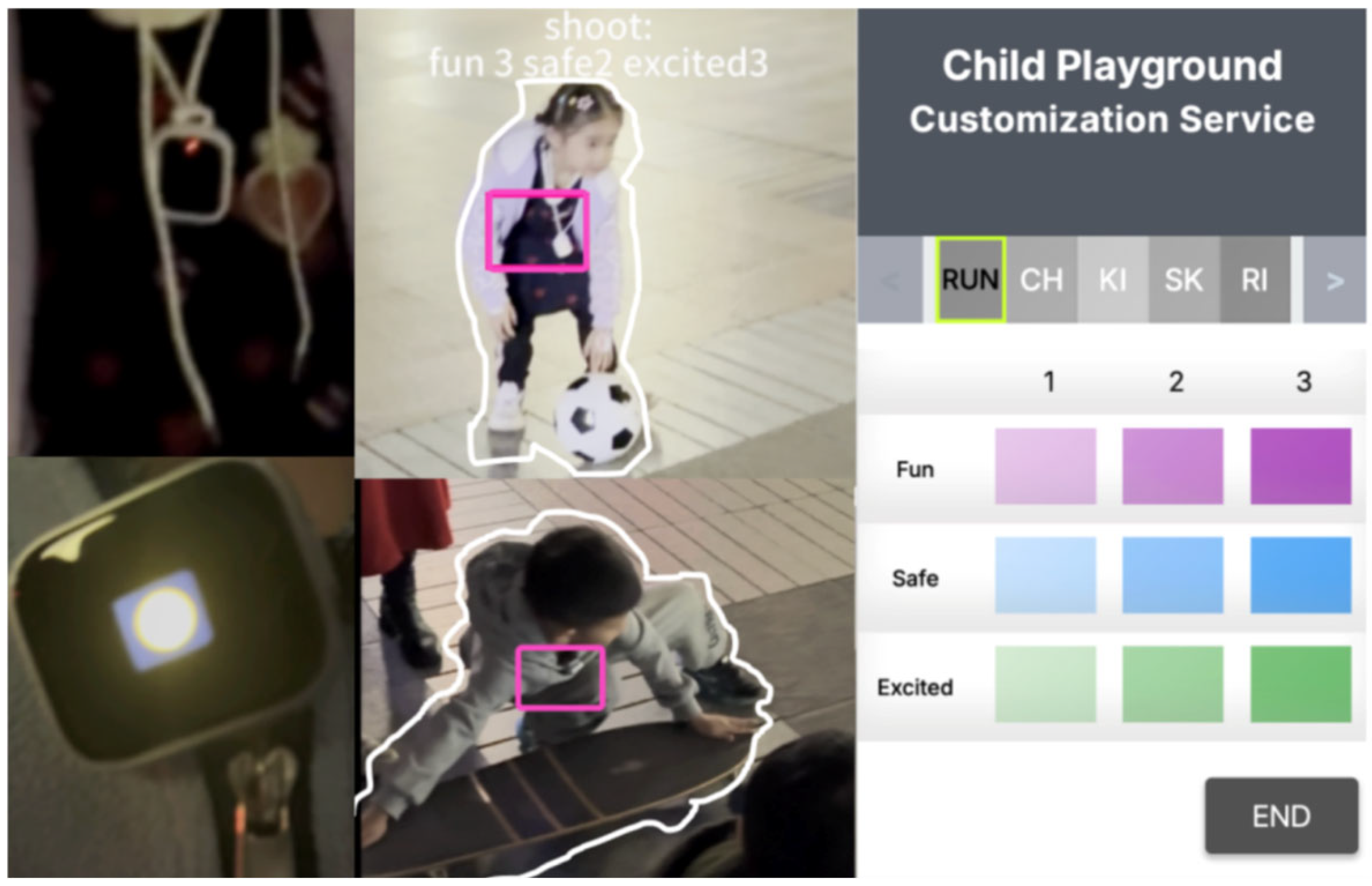
As illustrated in the upper section of Figure 13, a voice device has been devised. In response to voice prompts from researchers, a child user would verbally evaluated her experience immediately following specific activities. These evaluation results will be later stored by the researcher using the interface in the right part of Figure 13. Note that this process of involving researchers in the prompting and storing the ratings of children is to be used while children provided subjective evaluation ratings verbally using the voice-based interface.
Figure 13.
Voice-based device to evaluate play activities using three-point scale.
5. Discussion
5.1. An Integrated Analytical and Evaluative System for Children’s Play Experience
By integrating CBAM with CESA, this research establishes a more comprehensive analytical and evaluative system for children’s playground studies. This system extends beyond observable activity and space structure to explicitly incorporate children’s psychological experience as a core analytical component.
In existing playground research, children’s psychological experience is often inferred indirectly through observation or interviews, resulting in limited alignment between experience and specific activity. By introducing CESA, the psychological context dimension within CBAM becomes directly measurable and empirically verifiable. Children provide real-time feedback on emotional states—such as enjoyment, excitement, and perceived safety—through a voice-based interface while performing specific activities, enabling precise correspondence between subjective experience and activities. Through this integration, CBAM evolves from a primarily activity–space modeling approach into a comprehensive framework that encompasses activities, space structures and psychological experience.
This integrated system allows children’s play activity and experience to be examined in real-world settings without relying on idealized assumptions or purely observational interpretations. It provides a more robust analytical foundation for deriving design strategies that are grounded in both activity patterns and experiential evidence.
5.2. Affordance Feature Information Through CBAM
This paper demonstrates that the CBAM representation of activities provides structured information for affordance features for the corresponding activity. As shown in Section 3.1, affordance features for three activities of around the slab base, sit, place and stand are respectively composed of the tool and a relevant structure, composed of the object, the tool and a relevant structure, and composed of the tool and a relevant structure. Rich affordance feature information provided in CBAM can also be integrated with psychological features affecting proper perception of such affordances reflecting individual actor characteristics.
Note that the same structure of the slab base constitutes providing three different affordances of sit-ability, place-ability and stand-ability depending on actors and play task characteristics as affordances are interactive and emergent relationships between actors and structure elements. Considering that the original function of the slab base is not at all related to these affordances, the merits of CBAM-based activity and space design in supporting sustainable play space design are noticeable.
5.3. Safety and Design Constraints in Public Children’s Play Spaces
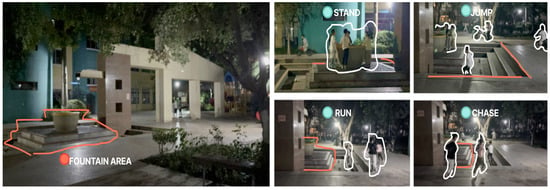
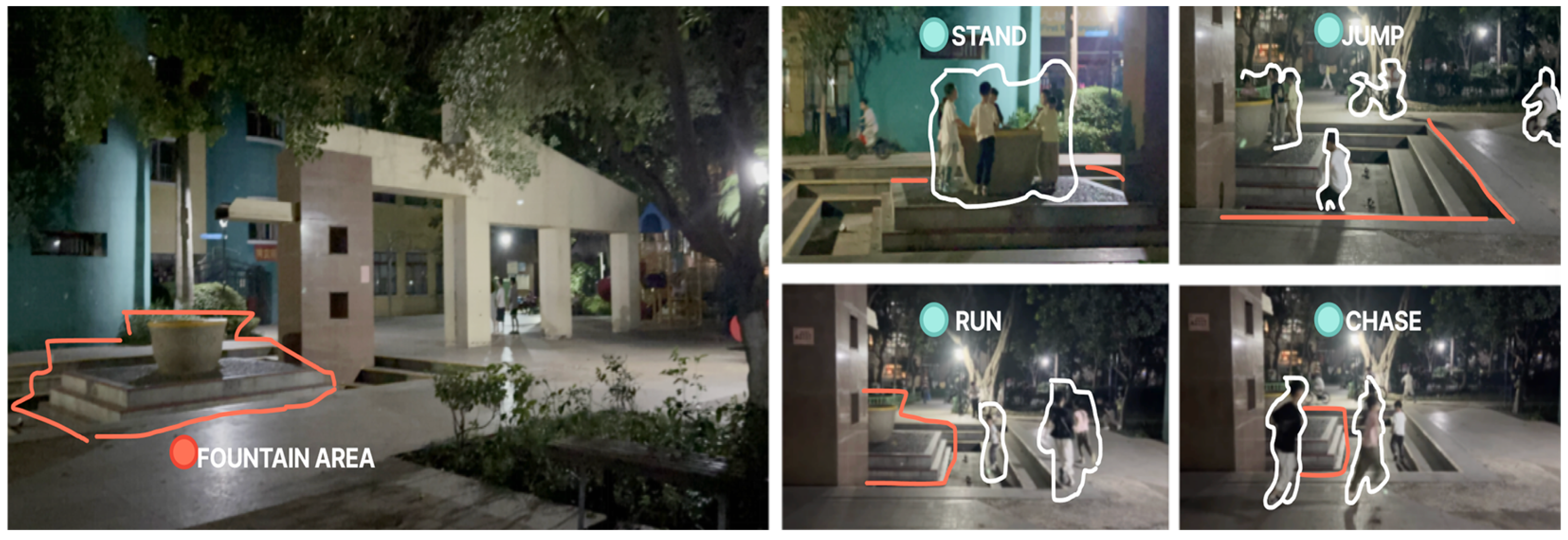
Safety remains an indispensable and non-idealized concern in children’s playground design. Field observations conducted in multiple urban contexts, including Chongqing and Shanghai, reveal that public play spaces often contain latent safety risks that emerge only through children’s actual activities. For example, in a community space in Chongqing shown in Figure 14, a non-operational fountain area, originally designed as a water feature, became accessible to children after water usage ceased. Children reinterpreted this space as a play zone, assigning it new activity roles such as running, jumping, and chasing. While these activities increased fun and engagement, they simultaneously introduced safety concerns related to slippery surfaces, height differences, and a lack of protective boundaries.
Figure 14.
Children’s activities in the fountain area in a community in Chongqing City.
This case indicates that children may report high enjoyment and excitement even in environments with compromised safety conditions. This finding underscores the necessity of activity-centered safety evaluation rather than relying solely on predefined functional zoning or static safety standards. By combining CBAM and CESA, designers can identify not only where unsafe elements exist, but which activities may activate those risks. This activity–risk coupling allows safety constraints to be addressed without suppressing children’s exploratory and playful activities, supporting more nuanced and responsive playground design strategies. This observation underscores the importance of developing design strategies that not only support dynamic bodily engagement but also ensure safety and foster diverse modes of interaction.
5.4. Emergence of New Play Activities and Design Implications
With the interaction between the space structure and children’s activity, previously unexpected game forms and gameplay can be stimulated, and even new game systems can be designed and proposed.
One of the most significant findings of this study is the emergence of new play activities resulting from interactions between physical lighting structures and children’s activities. In particular, the integration of shooting activities with dynamic space structures created by lighting—used not just as a physical context, but as an active element of space—reveals the potential for novel forms of play, such as a lighting-based football game. While design guidelines typically suggest using lighting to enhance space structures, this study highlights that dynamic space structures can be effectively generated through lighting, transforming it from a passive condition into an active activity trigger.
Additionally, the case of the slab base revealed that children’s spontaneous activities can be supported by their novel perceptions of affordances from space elements. Originally idle slab bases, due to their structural characteristics, have been converted into core spaces for diverse activities and interactions. This observation emphasizes that in the design of children’s spaces, more attention should be paid to structural elements and their relations with other structures that may function as relevant structures for certain activities. With the CBAM framework, more structured space design can be achieved with support by various context elements. The emergence of new activities provides valuable insight into children’s engagement patterns and suggests opportunities for adaptive and intelligent playground space that respond to dynamic activities.
6. Conclusions
By focusing on structured activity modeling with rich context information through CBAM and integrating subjective experience evaluation using CESA, this study contributes a structured framework for the integrated design of children’s play activity and space.
First, at the methodological level, the research extends CBAM by incorporating subjective experience evaluation, enabling psychological context elements of CBAM to be filled in and aligned with activity models. A voice-based CESA interface with three-point scale has been devised for real-time experience evaluation in children’s play environments. Second, at the practical level, the study highlights the importance of activity-centered space design. Rather than treating playground spaces as fixed functional zones, the findings show that children’s task-activities are dynamically induced by different affordances from space structures, generating diverse play activities and experiential outcomes.
Immediate future work would be space structure improvements reflecting design guidelines derived from CBAM analysis and conducting pilot implementation service prototyping with the CESA experience evaluation method for empirical validation. Possibly, lighting-based space structure improvements would be implemented. Further research may also explore how CBAM-based activity repositories and intelligent lighting or sensing systems can support scalable and responsive playground design. By leveraging these repositories, designers can ensure that playgrounds grow and evolve in response to changing needs and contexts. Note that this is critical for the sustainability of playgrounds and community spaces as it is inevitable that these go through continuous evolution but their roles in supporting children’s play activities must improve rather than causing safety hazards. Additionally, incorporating intelligent lighting or sensing systems can further enhance the playground’s responsiveness, allowing it to dynamically adjust to children’s activities and interactions in real time. Thus, designers should integrate activity and space design approach combined with children’s subjective experience evaluation. This means that the design process should not only focus on the space structures and activities but also incorporate feedback from children’s perspectives, ensuring that the playground is engaging, meaningful, safe and responsive to their needs.
Author Contributions
Conceptualization, Y.S.K. and Y.W.; methodology, Y.S.K.; validation, Y.S.K. and Y.W.; formal analysis, Y.S.K. and Y.W.; investigation, Y.S.K. and Y.W.; resources, Y.S.K.; data curation, Y.W.; writing—original draft preparation, Y.W.; writing—review and editing, Y.S.K. and Y.W.; visualization, Y.W.; supervision, Y.S.K.; project administration, Y.S.K.; funding acquisition, Y.S.K. All authors have read and agreed to the published version of the manuscript.
Funding
This research was supported by the Fundamental Research Funds for the Central university.
Institutional Review Board Statement
Not applicable.
Informed Consent Statement
Not applicable.
Data Availability Statement
No new data were created or analyzed in this study. Data sharing is not applicable to this article.
Conflicts of Interest
The authors declare no conflicts of interest.
Abbreviations
The following abbreviations are used in this manuscript:
| CBAM | Context-Based Activity Modeling |
| CESA | Context-Specific Experience Sampling and Analysis |
References
- Krishnamurthy, S. Reclaiming spaces: Child inclusive urban design. Cities Health 2019, 3, 86–98. [Google Scholar] [CrossRef] [Scilit]
- Ahmad, S.; Ch, A.H.; Batool, A.; Sittar, K.; Malik, M. Play and cognitive development: Formal operational perspective of Piaget’s theory. J. Educ. Pract. 2016, 7, 72–79. [Google Scholar]
- Lundman, R. Coping with standards: Integrating art and safety into the design of a creative playground. J. Plan. Educ. Res. 2024, 44, 431–440. [Google Scholar] [CrossRef] [Scilit]
- Bao, Y.; Gao, M.; Luo, D.; Zhou, X.D. Effects of children’s outdoor physical activity in the urban neighborhood activity space environment. Front. Public Health 2021, 9, 631492. [Google Scholar] [CrossRef] [Scilit] [PubMed]
- Shaffer, D.R. Developmental Psychology: Childhood and Adolescence; Thomson Brooks/Cole Publishing Co.: Eagle River, WI, USA, 1996; pp. 79–85. [Google Scholar]
- Gehl, J. Life Between Buildings: Using Public Space, 6th ed.; Koch, J., Translator; Island Press: Washington, DC, USA, 2011. [Google Scholar]
- Liu, Y.; Liu, J.; Xue, W. Design and implementation of interactive systems for intelligent architectures based on Piaget’s cognitive development model. Archit. Tech. 2025, 31, 10–13. [Google Scholar]
- Johnson, J.E.; Christie, J.F.; Yawkey, T.D.; Wardle, F.P. Play and Early Childhood Development; Scott, Foresman & Co.: Glenview, IL, USA, 1987. [Google Scholar]
- Pitsikali, A.; Parnell, R.; McIntyre, L. The public value of child-friendly space: Reconceptualising the playground. Archnet-IJAR Int. J. Archit. Res. 2020, 14, 149–165. [Google Scholar] [CrossRef] [Scilit]
- Katsavounidou, G. Child, play, and urban space: A historical overview and a holistic paradigm for child-centered urbanism. J. Urban. Int. Res. Placemaking Urban Sustain. 2023, 16, 430–446. [Google Scholar] [CrossRef] [Scilit]
- Hui, Y.; Liao, J.; Zhang, X.; Liu, Z. Child-friendly street design based on behavioral patterns. Urban Plan. Forum 2021, 6, 92–99. [Google Scholar] [CrossRef]
- Wang, Y. A Study on Design Elements of Interactive Facilities in Public Spaces Based on Children’s Play Behavior. In DS 136: Proceedings of the Asia Design and Innovation Conference (ADIC), Shanghai, China, 5–6 December 2024; Design Society: Copenhagen, Denmark, 2024; pp. 467–476. [Google Scholar]
- Wang, Y.; Kim, Y.S. Child Play Activity Modeling for Playground Space Design Using the Context-Based Activity Modeling Method. Sustainability 2025, 17, 6244. [Google Scholar] [CrossRef] [Scilit]
- Zhang, X.; Cheng, Z.; Tang, L.; Xi, J. Research and Application of Apace-time Behavior Maps: A review. J. Asian Archit. Build. Eng. 2021, 20, 581–595. [Google Scholar] [CrossRef] [Scilit]
- Xiao, W.; Yoon, J.E. A Post Occupancy Evaluation of the Space Utilization of Cultural Heritage in Children’s Education: A Case Study of Wuhan’s Historical Districts, China. Buildings 2024, 14, 2682. [Google Scholar] [CrossRef] [Scilit]
- Simoff, S.J.; Maher, M.L. Designing with the Activity/Space Ontology. In Artificial Intelligence in Design’98; Gero, J.S., Sudweeks, F., Eds.; Springer: Dordrecht, The Netherlands, 1998; pp. 23–43. [Google Scholar]
- Kim, Y.S.; Lee, S.W. Service Design for Product-Service Systems Using Context-Based Activity Modeling. In Proceedings of the International Association of Societies of Design Research (IASDR) Conference, Delft, The Netherlands, 31 October–4 November 2011. [Google Scholar]
- Kim, Y.S.; Hong, Y.K.; Kim, J.H.; Kim, Y.M. Context-Specific Experience Sampling for Experience Design Research. In Proceedings of the 18th International Conference on Engineering Design (ICED11), Lyngby/Copenhagen, Denmark, 15–18 August 2011; pp. 448–457. [Google Scholar]
- Gibson, J.J. The theory of affordances: (1979). In The People, Place, and Space Reader; Routledge: London, UK, 2014; pp. 56–60. [Google Scholar]
- Norman, D. The Design of Everyday Things, revised and expanded ed.; Basic Books: New York, NY, USA, 2013. [Google Scholar]
- Murakami, T.; Higuchi, M.; Yanagisawa, H. Trial of Formulating Affordance Features for Product Design. In International Conference on Virtual and Mixed Reality; Springer: Berlin/Heidelberg, Germany, 2009; pp. 586–595. [Google Scholar]
- Kim, Y.S. A methodology of design for affordances using affordance feature repositories. Artif. Intell. Eng. Des. Anal. Manuf. 2015, 29, 307–323. [Google Scholar] [CrossRef] [Scilit]
- Kim, Y.S.; Jeong, J.; Hong, Y.; Hong, S. A schema for systematic service imagining: Context-based activity modeling. Sustainability 2020, 12, 9558. [Google Scholar] [CrossRef] [Scilit]
- Kim, Y.S.; Hong, Y.K. A systematic method to design product-service systems using personalisation services based on experience evaluations. Int. J. Prod. Dev. 2019, 23, 353–386. [Google Scholar] [CrossRef] [Scilit]
- Csikszentmihalyi, M.; Larson, R.; Prescott, S. The ecology of adolescent activity and experience. J. Youth Adolesc. 1997, 6, 281–294. [Google Scholar] [CrossRef] [Scilit]
- Scollon, C.N.; Kim-Prieto, C.; Diener, E. Experience Sampling: Promises and Pitfalls, Strengths and Weaknesses. J. Happiness Stud. 2003, 4, 5–34. [Google Scholar] [CrossRef] [Scilit]
- Chambers, C.T.; Johnston, C. Developmental differences in children’s use of rating scales. J. Pediatr. Psychol. 2002, 27, 27–36. [Google Scholar] [CrossRef] [Scilit]
Disclaimer/Publisher’s Note: The statements, opinions and data contained in all publications are solely those of the individual author(s) and contributor(s) and not of MDPI and/or the editor(s). MDPI and/or the editor(s) disclaim responsibility for any injury to people or property resulting from any ideas, methods, instructions or products referred to in the content. |
© 2026 by the authors. Licensee MDPI, Basel, Switzerland. This article is an open access article distributed under the terms and conditions of the Creative Commons Attribution (CC BY) license.