


Abstract
Achieving societal goals of sustainability will require businesses to leverage scientific results and advanced technologies and thereby promote the distribution of new solutions in society. Therefore, a key recommendation from the sustainability transition literature is to promote direct collaboration between industry and academia. However, existing research suggests that successful collaboration is difficult to achieve due to institutional complexity. This paper applies a set of theoretical concepts regarding institutional complexity—namely hybrid organizations, academic engagement, and institutional logics—to a case study of a university–industry centre for sustainability. The longitudinal process of collaboration from initiating to dismantling a centre is first described. This process understanding enables an analysis of the management challenges with regard to the different institutional logics held by stakeholders including financiers, firms and research institutions, as they attempt to work together to achieve desired sustainable innovation outcomes. The conclusions point out a novel capability—latent flexibility—that we have identified in hybrid organizations. This refers to where institutional and task complexity are dynamically resolved by managers preserving the ability to reconfigure a project’s assets and hence determine how logics should recede or advance depending on interpretations of achieved outputs and shifting expectations for collaborative research.
1. Introduction
Collaborative research between different types of stakeholders can help promote and diffuse new scientific knowledge, technology, and innovation in society, according to the literature in both innovation studies and innovation management [1]. Yet management literature has also indicated why such collaboration between academia and firms can be difficult to achieve, because each actor has different incentives and objectives when developing technology [2]. More theoretically, institutional complexity arises, due to the diversity of institutional logics, which are defined as taken-for-granted rules, practices and belief systems within a field [3]. Management challenges during collaborative research arise due to factors in the operating environment of the different stakeholders in collaborations, concurrently coupled to the institutional complexity of science and the market, where universities are primarily interested in science, whereas companies are primarily interested in making profits through innovation [2,4,5,6,7]. One solution to the problems of institutional complexity at a general level is to develop hybrid organizations, which have been studied in relation to how universities are promoting the development of technology transfer offices [8]; balancing the relationship between scientific and technological goals in general [9]; leading to the softening of bureaucracy at the entrepreneurial university level in terms of less transparency and lower predictability of operations [10]; and pushing universities as increasingly political institutions in knowledge and technology transfer [11]. Even when the management of different actors want to leverage hybrid organizations to achieve long-term aims of sustainability, they must consider how to implement responsible practices and decision-making in this context, and the literature has suggested different strategies. These strategies consequently draw on more general higher-level concepts and on large organizational actors or sectors of society, but rather speculatively translate these to suggest strategies in individual micro-level situations of hybrid organization, such as collaborative research projects. This paper addresses the temporal and micro-level dimensions that in practice may be as important in explaining the success or failure of collaborative research centres, and that research must address. Hence, this paper applies and refines a set of theoretical concepts regarding institutional complexity—namely institutional logics and hybrid organizations—and academic engagement, and adapts them to the level of collaborative research centres to develop a conceptual framework for overcoming management challenges of collaborative research. The research question is as follows: How can general concepts from the institutional complexity literature be adapted to develop a model providing specific insights for the management of collaborative research?
The rationale for this purpose is that understanding how different innovation management approaches to institutional complexity co-evolve with the environmental factors and innovation outcomes in a broad sense during temporary collaborations, is an understudied but important topic for the vast literature on academic engagement, defined as knowledge-based interactions between universities and external organizations [12,13].
Because institutional complexity gives rise to tensions in this type of hybrid organization, the research literature provides different interpretations and prescriptions for how to act with regard to the management challenges arising from such tensions [2,14,15,16]. These somewhat disagreeing interpretations range from those concerned with allowing the co-existence of different logics in hybrid organizations, to more dynamic views about the conflict, dominance, and collapse of logics in hybrid organizations, alternatively, the blending of logics in hybrid organizations [9,17,18,19,20,21]. Yet the process of combining the perspectives of both practitioners and academics in collaborative research has proven to be more elusive [22].
Our reading of this literature is that these interpretations are mainly concerned with conflicts between incompatible logics, and therefore, the interpretations are biassed towards mutually exclusive end-states where one logic prevails, to the detriment of another. Consequently, one should expect that proposed management solutions to institutional complexity would also affect the innovation outcomes of research collaboration, and this occurs when the hybrid organization exclusively focuses on one type of outcome to the possible detriment of the priorities of other partners. Yet other outcomes are possible, and so more analysis of both the formal organizational structure and practice inside hybrid organizations is needed. Specifically, collaborative research involves inherent uncertainty about whether, and how, ongoing research and innovation will lead to new technologies, and later, positive societal outcomes. This suggests that extant knowledge about hybrid organizations—especially in our context of university–industry research centres—is still inadequate, especially when addressing more dynamic situations.
Addressing such dynamic situations can provide useful insights into overcoming the management challenges of collaborative research. This appears to be particularly urgent, especially with regard to developing new knowledge relevant for sustainability and grand societal challenges like climate change and social inequality [23,24,25,26,27]. The transition literature for governing societal transitions focuses on selective participatory processes involving multiple stakeholders [28]. Two seminal pieces address, respectively, how management research [29] and science policy literature [26,27] can help society transition towards sustainability and solve grand societal challenges. These two pieces are similar in the sense that both stress that new solutions will require processes of co-developing technological, scientific and societal knowledge between academia, business, and multiple stakeholders. More specifically, in relation to collaborative research for technology to achieve sustainability goals, ref. [30] analyzed the transition innovation studies literature, and found that recommendations share these design principles: inclusive, collaborative, public–private partnerships and multi-disciplinary research. The literature examining university–industry centres for sustainability suggests that the development of strategic technologies and innovation depend upon a series of contextual factors and partnerships [31]. Therefore, the case study chosen here involves academic engagement institutionalized as a university–industry centre for sustainability.
The next section provides the theoretical foundation for this paper, using a set of theoretical concepts regarding institutional complexity—namely institutional logics and hybrid organizations—and academic engagement. These theoretical approaches are used to portray the intersection of the academic and commercial domains, in relation to the expected outcomes of collaborative research. The third section explains the research design and methodology, as well as introducing the case study, namely the Sustainable Materials Science Centre. The fourth section contains the case study, describing the evolving process. The process description emphasizes processes, specifically where characteristics of different logics are not fixed but evolve within a hybrid organization, which enables multiple stakeholders to recognize a mutually beneficial outcome in the wider sense, even where significant tensions exist. The fifth section interprets the results, which are visualized in the sixth section in terms of an updated conceptual framework, which adds the notion of flexible latency, as well as highlighting multiple outcomes.
2. Management Challenges in University–Industry Centres
2.1. Management Challenges Due to Institutional Complexity in Hybrid Organizations
The current article adopts an institutional logics perspective, whereby “logics provide societal rationales that guide individuals and organizations” [32]. Battilana, Besharov [32] argue that hybrid organizations are particularly interesting to study—and a puzzle—because they go against the core notion of neo-institutional theory, namely that “organizations must conform to institutionalized templates in order to be regarded legitimate.” In their extensive systematic review, the authors go on to identify distinct theoretical perspectives, which cluster around theoretical perspectives of organizational identity, distinct organizational forms, and multiple logics. Mair, Mayer [33] review the literature to suggest that hybrid organizations should have three characteristics: “(1) involve a variety of stakeholders, (2) pursue multiple and often conflicting goals, and (3) engage in divergent or inconsistent activities.”
At least two streams of research exist to provide insights relevant to how to manage the tensions created by institutional complexity in hybrid organizations: one that analyses the overlap of institutional logics in hybrid organizations; another that theorizes further and introduces the concept of institutional work [16]. The former stream of research on overlap is mainly concerned with formal organizational structure. Specifically, there are typologies of structural solutions for maintaining organizational hybrids in general, regardless of whether they occur in the organizational field or within an organization [9]. Research in the latter stream on institutional work is concerned with practice. This stream distinguishes between the institutional logics and institutional complexity operating at the higher level of organizational fields and the institutional work, which refers to the day-to-day practices of managers dynamically dealing with tensions caused by institutional complexity at the boundaries between institutional logics [34].
Based on both streams of literature, we have identified the following directions for managing institutional complexity to alleviate the resulting tensions in hybrid organizations:
- (1)
- Allow but confine the blending of logics to separate organizational entities or to the realm of day-to-day practices, e.g., [17,19,20];
- (2)
- Maintain distinctions of institutional logics at the level of organizational fields by continuously adapting the micro-level meaning of logics or co-opting either logic to maintain the hybrid organization at the micro-level, e.g., [9,21];
- (3)
- Allow one logic to dominate or collapse in the organizational hybrid, e.g., [18].
Common to all of these is the assumption that institutional logics, as they are taken for granted at the level of organizational fields, seem temporally stable and unambiguous to actors at the micro-level in a hybrid organization, and that any tensions are similarly assumed to be confined to alleviating institutional complexity as initially established in a hybrid organization, which downplays the importance of the process of also running a hybrid organization where the initial assumption may be mistaken and unfit for the task at hand. Also, other external factors such as complex stakeholder demands for resource acquisition and the competitive environment of research may dynamically provide micro-level feedback to actors in academic engagement according to their respective institutional logics. Our approach recognizes the three related directions for governing institutional complexity, namely confine, maintain and dominate, but will additionally focus on exploring the possible analytical gap in the previous institutional work and complexity literature as regards to the temporal dynamics of (a) actors’, e.g., managers’, responses to micro-level ambiguity in running a centre over time; and (b) the specific responses to different innovation outcomes in terms of the managers’ choices of directions.
2.2. Academic Engagement Institutionalized as a University–Industry Centre
The form of academic engagement examined here involves university–industry centres, which are temporary organizations, developed to facilitate collaborative research of interest to both parties. Following [35], university–industry centres are here conceptualized as institutionalized interactions to solve institutional complexity, exhibited through both formal micro-level organizational structures and specific micro-level practices specific to each such centre.
Within the literature about managing universities in their involvement in hybrid organizations, some studies focus more explicitly upon how and why conflicting logics may be resolved, or not [14,15,19]. Ref. [36] analyzes tensions between academic and commercial activities at the individual and organizational level within the university. They find that at the individual level, specialized individuals conduct different tasks, whereas at the organizational level, the universities create dual structures at a higher level of organization, such as technology transfer offices. Ref. [37] investigates a case study of scientific fraud in regenerative medicine, finding asymmetries, where market-oriented logic was more powerful than medical and academic logic, and moreover, academic logic had a problem of fragmented control, enabling fraud.
Yet the question remains: how does complexity express itself in this context, given the overlapping institutional logics and overlapping stakeholder task environments? Fundamentally, the institutional complexity in this specific setting has to do with the differing institutional logics of academia, focusing on developing science, and firms, focusing on developing products and services for markets. Sauermann and Stephan [2] identify the following four main differences between academic and commercial logics: “(1) Academic research tends to be more basic as compared to commercial research, which aims for practically oriented research; (2) Academics have more freedom as compared to industry’s large-scale projects; (3) Academics focus upon challenging received wisdom whereas industry should focus upon developing profitable technologies; and (4) Academics wish to widely disseminate their knowledge whereas secrecy and intellectual property rights are more important in firms.”
Yet by developing a hybrid organization to promote collaborative research, both parties expect to get some value out of the resulting technological and scientific knowledge. Collaborative research conducted in university–industry centres aims to develop future technology, but given the nature of research, the future benefits and outcomes may be relatively unclear, or at least uncertain, to each.
According to recent research, a more comprehensive understanding of innovation outcomes from research collaboration should include not only direct and tangible innovations but also indirect and intangible effects, especially the increased capability of firms and universities to do research and to innovate in general [38,39,40,41,42]. Specifically for collaborative research, McKelvey and Ljungberg [40,43] find that some of the main outcomes affecting technology are the indirect innovation outcomes in businesses, including new capabilities. Therefore, when outcomes in this study are conceptualized and analyzed, outcomes are divided into direct out-comes in terms of product or process innovations, and into indirect outcomes such as the development of firm ca-pabilities and new technologies.
In doing so, we explore whether and how external factors such as complex stakeholder demands for resource acquisition and the competitive environment of research may dynamically provide micro-level feedback to actors in academic engagement according to their respective institutional logics, e.g., [7,44].
2.3. Conceptual Framework
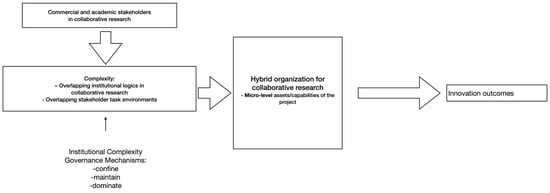
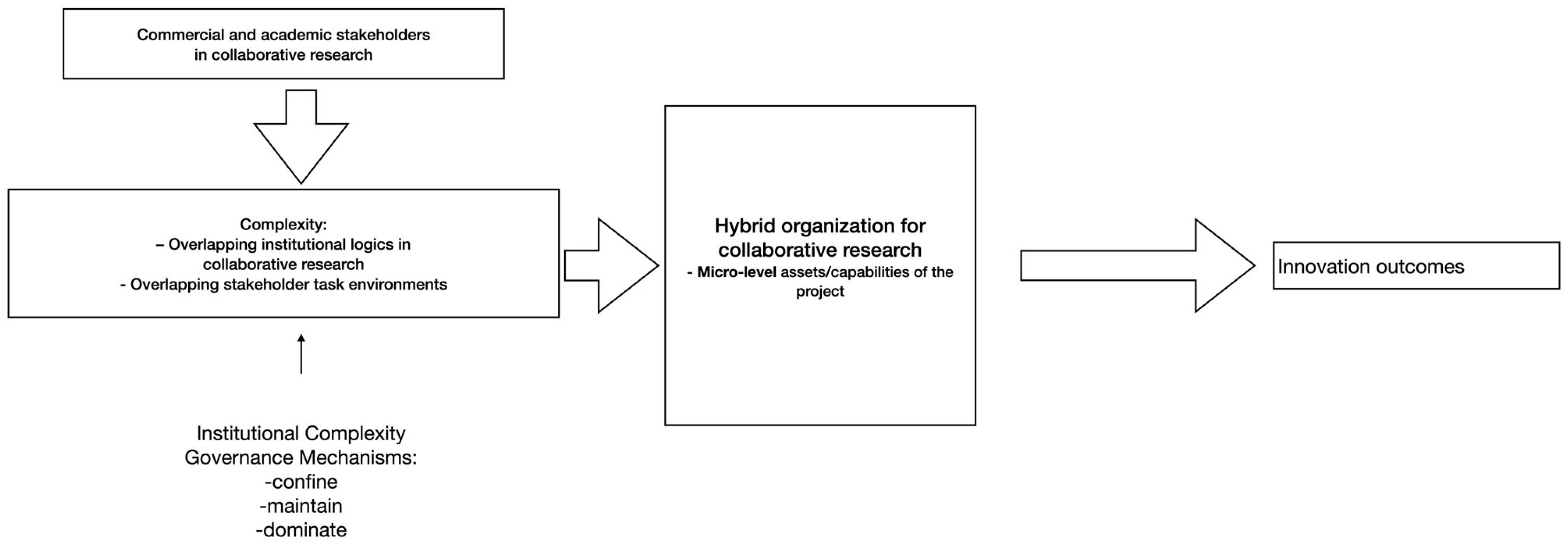
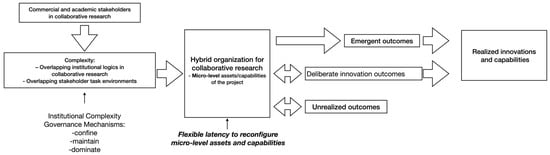
Figure 1 summarizes our initial conceptual framework, which builds upon the preceding theoretical discussion, which is the point of departure for the analysis of how to overcome micro-level management challenges of collaborative research in the case described in this paper.
Figure 1.
Theoretical presumption of the initial state in a single organizational hybrid in collaborative research. The wide arrows denote the direction of the process flow. The narrow arrows denote influences on specific parts of the process.
The left-hand side represents the theoretically expected initial conditions for academic engagement at the micro-level, that is, in one university–industry centre for sustainability. At the top of this left-hand side, the box represents commercial and academic stakeholders deciding to engage in collaborative research. This has been defined as one form of academic engagement, where their knowledge-based interactions help to promote and diffuse science, technology, and innovation. In the middle of the left-hand side, we see both formal organizational structures and practices, which can be used to address the institutional complexity. This complexity consists of overlapping institutional logics, as well as overlapping stakeholder task environments. Finally, the bottom of the left-hand side represents the initial theoretically anticipated three main directions of institutional complexity governance mechanisms found in the existing literature, namely confine, maintain and dominate.
The middle section of Figure 1 represents the hybrid organization for collaborative research. Based on the specific conditions such as financing and organizational structure, the hybrid organization will hold micro-level assets and capabilities specific to the project.
The right-hand side of Figure 1 represents the theoretically anticipated outcomes, which may be realized as innovations as well as capabilities. We acknowledge that due to the nature of research into new technologies, these are not given at the time when collaborative research starts, but instead are often uncertain and unclear, as they will happen in the future.
This conceptual framework is useful to explore the temporal dynamics in the case study. We do so explicitly to uncover two issues: (a) how managers in the centre respond to micro-level ambiguity in the university–industry centre; and (b) how managers’ choices of approaches for managing institutional complexity were related to differing interpretations of how the collaborative research would, or would not, lead to new science–technology–innovation. The resulting analysis of the case study should provide a further refined conceptual framework.
3. Materials and Methods
3.1. Research Design and Setting
The data collection and analysis described below was built upon specified and partly concurrent activities, in an abductive approach, linking our empirically derived constructs and mechanisms to the initial constructs described in the second section [45,46,47]. Based upon this approach, our research has been active between theory and empirical material, using a theory-developing approach [48,49]. We argue that our approach is also similar to process studies on organizational change in general [50,51]. Hence, the research design led us to collect empirical data, which originates in a longitudinal case study of institutional complexity.
The Sustainable Materials Science Centre was selected as the case study because it represents a temporary hybrid organization, in that stakeholders from both academia and industry participated and its funding came both from industry and the public sector for a specified time period [35,52]. This approach to research centres as hybrid organizations being the units of study has previously been used in studying the relationships between science and commercialization alongside activities of academic engagement [11,53,54,55,56,57]. Digital transformation is an inherent part of their process of collaboration, due to the need to share data, biological material, digital results, visualization and more in this university–industry centre.
The three authors were granted permission to study the Sustainable Materials Science Centre, following the national best-practice research guidelines at the time of the study. The authors have followed this university–industry centre during its entire lifespan of six years, that is, initiation meeting, four years of operation and the subsequent two years of closing. Formal permission, as well as individual consent for interviews, provided us with access so that we could follow the longitudinal process from its initiation through a successful joint research grant application, through to the running and closing of the centre.
The empirical focus for data collection and analysis was chosen to trace relevant phenomena in the centre, and inform the establishment of new constructs relative to our emerging theory [58]. The empirical phenomena required an initial contextual understanding through secondary data and pilot discussions, to ask why these companies, which were mostly in traditional industries, chose to interact with engineering researchers at universities. Resulting in the conceptual framework reported above, our specific focus was on how and why this hybrid organization dynamically manages micro-level ambiguity in collaborative research involving firms and university researchers and how it is connected to the desired innovation outcomes.
3.2. Data Collection
The first activity was the collection of relevant theoretical material, to frame our understanding of institutional complexity and academic engagement and to help identify our conceptual contributions relative to the literature. This return to the theoretical construct step was repeated abductively through the process. Following Ketokivi and Choi [59], we use a general theory as a starting point—about the management of overlapping institutional logics—augmented by contextual considerations, and we added to the theory by identifying potential additional constructs and mechanisms to develop an expanded model for managing institutional complexity.
The second activity was the data collection, which was carried out annually during the Sustainable Materials Science Centre’s operation. We initially concluded that the perspectives of the project leader, the steering committee, research group leaders and partner representatives were best suited to provide data on the management responses to micro-level ambiguity and innovation outcomes. This sampling strategy fits our goal of exploring the mechanisms involved in managing different institutional logics, environmental factors and innovation outcomes in organizational hybrids: how they emerged, developed, changed, and terminated over time, building and expanding on the theoretical constructs that we identified and described in our theory section; see, e.g., [50,51].
Our data collection included a combination of interviews, observations, and secondary data, carried out by all three authors. We performed interviews (21 in total), collected documentation from 12 project management meetings of different types, and made field notes from participant observation of those meetings, which were selected to allow us to follow the development of management responses to deal with institutional complexity and innovation outcomes for six years.
For interviews, this includes repeated annual interviews with both university and industry research managers active in the centre. We iteratively interviewed the main university project manager, as well as relevant managers at the companies who were involved in the centre. One of the authors and a Ph.D. student conducted a total of 21 semi-structured interview with managers of the Sustainable Materials Science Centre, with repeat interviews conducted while the centre was active. We have anonymized the names of those interviewed, as well as their firms and universities, in order to maintain confidentiality. The interviews were in person through meetings or else through zoom links and telephone. Transcribing and analyzing the interviews were facilitated by recording. The material was organized partly by archiving by name and date. The authors did an initial case write-up that was continually revised based on new data, emerging patterns and themes from original transcribed interviews, and documentary, as well as observational data. In the identifying tags below, “A” stands for academic, “R” for representative of a firm, “MNC” or “SME” for industrial partner type, and “N” for centre or network. An overview of field data is provided in Table 1 and Table 2.
Table 1.
Interviews, Year 1 to Year 6 of the centre.
Table 2.
Data collection: attendance and observations at project meetings, as well as collected documentation, Year 1 to Year 4 of the centre.
For observations of the centre, the authors also alternatingly participated in the annual meetings, as well as smaller management meetings, for the four years when the centre was active. The authors all participated in centre meetings, in a rotating order. Notes were taken on main topics and interactions. In addition, being present at meetings enabled us to schedule additional interviews and obtain secondary material more easily.
For the secondary material, we gathered a large amount of archival material generated by the centre. We collected a series of documents (written and electronic material) over the years. This includes grant applications, PowerPoint presentations from meetings, master’s student theses, Ph.D. student theses, contractual agreements, and decision-making policies; see Table 2.
3.3. Data Analysis
We chose an iterative, abductive process of sense-making, and chose not to structure our data according to currently popular visualizations, given the dynamic foci.
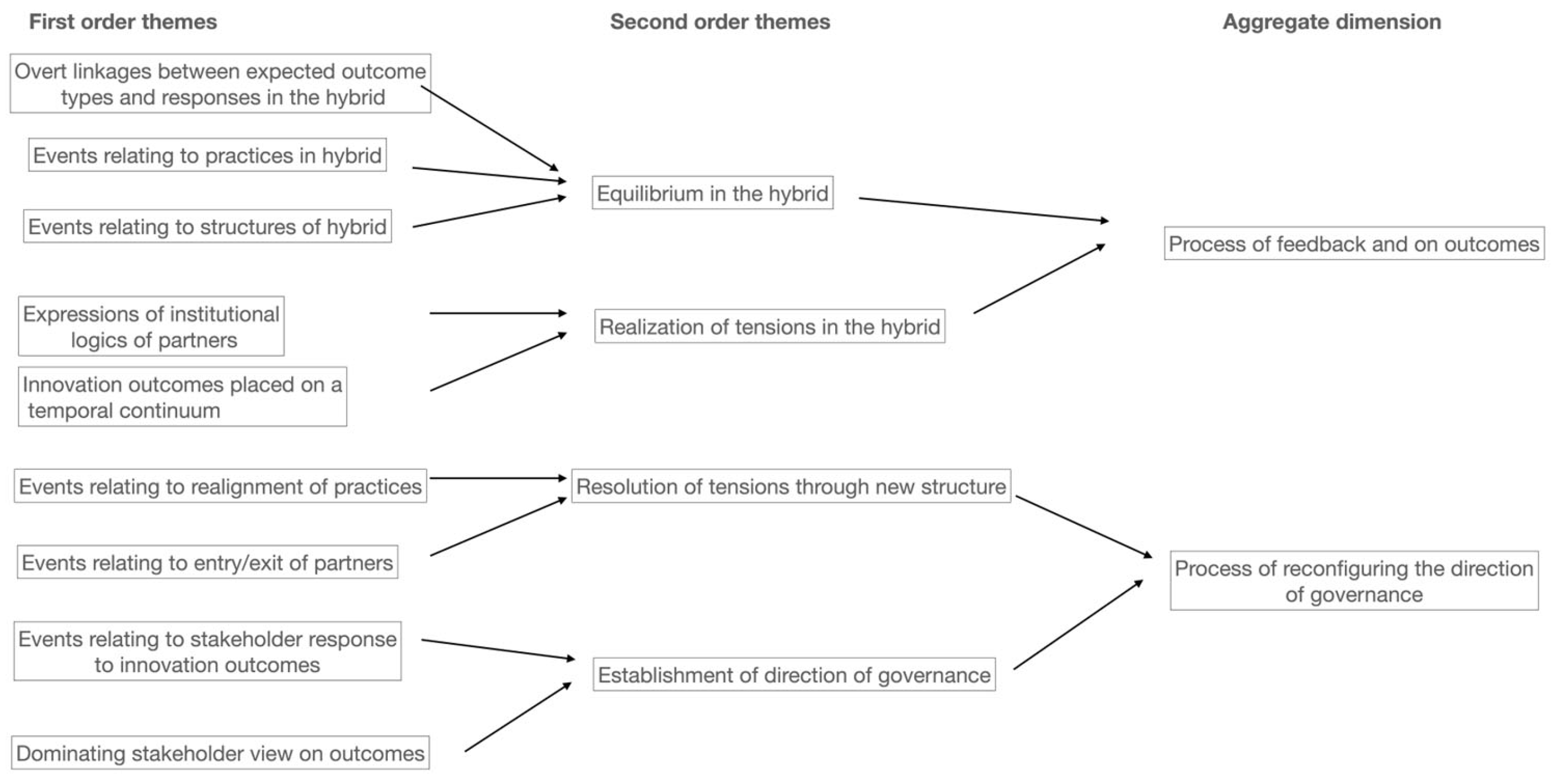
Our third activity was to abductively organize and analyze the data [47]. This step has been done iteratively, throughout the process. One author started by organizing our initial write-ups and coding the data on finer micro-level constructs and mechanisms for managing institutional complexity in the centre, relative to our initial constructs from our conceptual framework, and the two additional authors discussed the results, leading to new interpretations; see Figure 2.
Figure 2.
Coding scheme for the micro-level data on overlapping logics and task environments of the university–industry centre.
The initial first order coding categorizations used narrower concepts of events, such as innovation outcomes and stakeholder and management responses in terms of new practices and expressions of institutional logics, micro-level ambiguity and external factors. As we worked with the empirical study, we agreed upon a second level coding of broader level of themes and created aggregated dimensions specifically related to these topics: structures and practices of the centre, outcomes of collaborative research, management practices to accommodate the needs of actors, market and technological opportunities, and tensions between actors. Our secondary data was used to triangulate our analysis of interviews and observation.
In the fourth activity, running concurrently throughout the data collection process, we wrote up a chronological description of the interactions first, and then used finer grain constructs and mechanisms. We then performed multiple revisions. In doing so, we returned to our initial theoretical constructs and updated them as needed, which led to the addition of factors and the generation of a new model of the management of institutional complexity, with additional constructs and mechanisms.
4. Contextualizing the Longitudinal Case Study of a University–Industry Centre
This section contextualizes the case study, using the conceptual framework visualized in Figure 1 to structure the process description.
4.1. Establishment Phase
The hybrid organization for collaborative research is a temporary university–industry centre, named the Sustainable Materials Science Centre. It was started as a requirement of a national science policy instrument for collaborative research in new sustainable technologies, where funding for research was made available for consortia of academic and government actors. The national public policy instrument which funded the centre had specific criteria on how to organize the centre at a university in collaboration with industry, specific sustainability goals to be achieved through developing new technologies, and how to positively impact society through leading research, new technologies, and business innovations. Governance of the centre was intended to be organized around openness, collaborative research and sharing among all stakeholders.
4.1.1. Application Based on Shared Previous Experiences
Thirty individuals from stakeholders, working at two university departments and 15 companies, were active in the writing of the grant application. The disciplines included were primarily from engineering but also included many related experimental and practically oriented research areas in natural science fields, such as chemistry, physics, and material sciences. The academic scientists were from departments in natural sciences and engineering from the university hosting the centre. The commercial partners included large multinational industrial corporations and small entrepreneurial firms, from a variety of different but often related industries. Their collaborative research was intended to replace fossil-based materials with renewable natural material alternatives to lower CO2 emissions. This new scientific knowledge was expected to have an additional positive societal impact by reducing waste and pollution.
Some participants suggested that the complexity in writing the application was somewhat reduced due to previous experience with collaboration. Of the 30 individuals active in the writing, 22 had shared both postgraduate education and previous experience of collaborative research projects. Of these 22 with shared backgrounds, 12 of them had been members of one specific earlier university–industry centre, with illustrative quotes in Table 3.
Table 3.
Quotes about influence of a previous centre.
These quotes suggest that individuals who had previously collaborated, but worked in different types of organizations, placed a high value upon pre-existing networks between individuals. The approach in the previous centre was to have a strong emphasis upon communication, shared values, and how to combine exploration through scientific excellence with exploitation through industrial relevance. In practice, this meant that the Director needed to have ongoing conversations with all partners.
The initial rationale for creating the centre had to bridge the tensions between conflicting institutional logics of basic versus practically oriented research, as well as of challenging received wisdom vs. developing profitable technologies. The firm managers referred to the long-term development of science, technology, and innovation as necessary for the future profitability of the firm. The most important partners for co-financing the centre were a few large manufacturing–industrial firms, occupying different positions in their respective value chains. Their motivations for being involved in collaborative research were related to the need to innovate for the future, due to changing industrial conditions:
We have a long history of good profits, stable finances, and high productivity. However, in the last decade, some of our products are no longer used in the same way as before and the demand is changing in form and degree with a decreasing demand for our principal product. What the industry has witnessed for some years, and what is now accelerating is a migration to digital solutions.(A4)
Even so, the firm managers also acknowledged that individuals working in academia and industry would be working in different ways, which may affect the outcomes:
You start with an idea, and you get into crossroads. Then you find different options. In universities, you take both options—then you get to new crossroads and find new options, and you explore the new options. Whereas in the industry we start with a problem and use different options to solve the problem. You need to converge to a solution. This project is very much an example of idea leading to different opportunities. I would be very pleased if we find an opportunity that we could use and put into product development projects. Nevertheless, those are two totally different approaches.(R4)
The application was successful, and the partners obtained more than 2.5 million Euros from a European research council, to be administered by the host university, as well as co-financing from both the university and partner firms.
4.1.2. Designing a Formal Organizational Structure
The partners set up a formal organizational structure to govern the university–industry centre. The host university demanded that this centre use a standardized format of their consortium agreement, to formalize the structure; thereafter, partners could add minor amendments. This involved a series of contracts and formal agreements with companies, including regulating issues related to invention, secrecy, publications, and intellectual property.
One key point for potential tension was between widely disseminated results vs. secrecy and intellectual property. Therefore, the consortium agreement included specific clauses regulating these issues. The consortium agreement specified how to regulate intellectual property rights and to divide shares of the returns from them, including stipulations that “patents shall be communally owned in equal parts by all the Parties to the Centre” and “licensing of all results requires the consent of all joint owners”. Moreover, the researchers in both academia and industry were to formally ask for approval to release results, prior to publication and public communication. Specifically, partner companies could under some conditions define research results as confidential (to protect future patents).
The reason why companies might not appreciate the diffusion of results by academics as scientific publications was described as follows:
It is not necessarily positive to have signalling effect. If you are tracing what the company is involved with you can draw conclusions on the long-term strategy of the company. So, it is not necessarily a positive thing from the perspective of large companies.(R4)
In general, though, the intention of the governance structure was for publications to be allowed and even encouraged. However, each researcher must agree to send their papers through a screening process, with submission at least 45 days before the deadline of submission to a conference or journal.
Moreover, the host university demanded that the agreement was signed by each partner organization, as well as by all individual researchers at the partner universities. Individual academics needed to sign too, to waive their so-called teacher’s exemptions, whereby in this country, they as individual academics hold all intellectual property rights to their research. Hence, in this case, the host university supported agreements established for a hybrid organization, curtailing certain individual rights of their researchers.
Another key point for tensions involves academic freedom vs. large-scale projects. This centre did not allocate all the money in advance at the time of the grant writing but instead wanted to develop an interactive decision-making structure to determine which of the proposed research activities to finance in the coming years. The application did have a general definition of relevant topics. However, there remained considerable flexibility for the centre’s management to later decide which activities to finance and how to run the centre. Therefore, the consortium agreement included an organizational chart and a formal decision-making structure, including specification as to the roles of involved representatives, who should take which types of decisions, and a schedule for annual meetings required within the centre.
In terms of reporting, the public policy agency financing the centres specified that the partners needed to specify indicators for collaboration, as well as for commercialization and research results. The stakeholders in this specific centre therefore agreed that their key performance indicators would include fairly standard variables: financing by participants, company involvements, patents, product innovations, publications, conference papers, and theses by master’s and PhD students. There was thus a recognition of different types of outcomes.
A final issue to agree upon was the size of the partners’ annual financial contributions to the centre. As a condition for receiving public funding, all partners had to partially finance the centre. Based on a template provided by the host university when the funding application was made, the partners decided on a differentiated set fee structure per year depending on company size. They then also had to agree whether each partner’s contribution should be direct cash or in-kind. The large companies paid more to the centre, but in practice, this meant they usually did not contribute cash but instead counted their employee’s time working on the project as an in-kind contribution.
4.2. Maintaining and Closing the Sustainable Materials Science Centre
This section therefore describes a few key points of tensions arising in our analysis temporal dynamics in the case study, specifically: (a) how managers in the centre responded to micro-level ambiguity in the university–industry centre; and (b) how managers’ choices of approaches for managing institutional complexity were related to differing interpretations of how the collaborative research would, or would not, lead to new science–technology innovation.
4.2.1. Unresolved Tensions
The formal organizational structure developed for this hybrid organization for collaborative research did not, however, lead to a stable solution to overcoming management challenges due to tensions from institutional complexity.
Almost immediately after the formal start of the centre, less than a year, the partners revised the formal decision-making structure. Informants stated that this change was in response to tensions created by limited transparency and limited information about on-going research caused by the imposition of routines preserving the commercial interests of non-academic partners. The stated aim of the reform was to ensure more communication amongst members of the centre, but it also gave more power to the Supervisory Board, e.g., primarily large industrial companies. New types of meetings were also introduced: mainly to debrief about the progression of research and about all partner companies’ perception of the progression.
In later years, two researchers at the university vocalized the tensions which they felt arose when the centre decided upon the direction of research in the following way:
The set up should be such that you are not endangering the results by competition. This non-competitive environment contributes to that. But the outcome may not be equally beneficial depending on the orientation chosen for the material.(A3)
I am interested to create a bridge between industry and research, but today it is still not clear what they want and if it is not clear I cannot make a bridge. I can discuss with them and that is probably important but the two days meeting that we have known it is impossible. To reach goals, we need to have goals. In the past two days we didn’t specify any goals. It is very important to work openly, and as a team whatever the team might be—academic or industry. The essential is to have a goal and specified timeline. I do not think that we are there yet.(A3)
Indeed, rather than solving the tensions between commercial and academic logics and resolving the needs of different types of industry partners, these various attempts to manage institutional complexity seemed to create even more disgruntlement, particularly when the largest companies benefitted disproportionally. Several companies left the centre during the 4 years.
During the four years of the centre’s operation, the formal structure for decision-making also reflected the increased power of the larger companies to influence the direction of research undertaken. The large companies on the Supervisory Board argued in different types of meetings that they should influence the direction of research, as well as help decide which research results could be widely disseminated (or not). Moreover, they decided which projects should remain in the centre. They sometimes removed projects out of the centre and brought them into individual firms to focus upon product development processes for innovations internally.
4.2.2. Competing Demands from Firms
One key issue for the centre’s management to resolve was deciding on the direction of research, because different firm partners had differing opinions.
Key decisions included choices about which raw-material samples should be used, as well as the specific properties of the material. One of the early workshops with brainstorming sessions revealed that there was no consensus among partners on the desired properties of the renewable material. During this specific workshop, at least ten different industrial application areas were discussed, but each one of these would require a different set of material properties to be developed. Each firm partner was interested in, had knowledge about, and came up with quite diverse uses for different underlying materials.
The following quotes are illustrative of the tensions:
It is kind of fuzzy because we have several industrial partners with their expectations. For example, IP9 has some requirements for their applications; we have the transportation industry and health care, which have other requirements. I think it is important as a company to be clear with our expectations concerning the properties of the material quite early. The rest of the project members should know which company wants what and then make an agreement on properties that we all want or do not want. Then it will be easier to see a clear way forward or maybe several ways forward.(R1)
We have several companies that took part to this open brainstorming and defined the need for materials but from different points of view.(A1)
The automobile industry needs a renewable material that would be emission free, for lasers it must be compatible with skin, for packaging it should be harder and so on.(A4)
Indeed, some commercial partners decided that because their preferences for materials were not chosen, they would exit the centre: SME3 exited after 1 month, and SME4 exited after 3 months following the start of operations of the centre.
However, the observations and interviews also revealed several different types of longer-term outcomes and potential benefits from collaborative research, from the firms’ perspective:
I expect that we will stop on a generic level, and it is up to the partners to develop the applications for themselves depending on the characteristics of the materials that we are able to produce. That would be the way to go forward. We are noncompeting companies from different segments of the industry. I don’t think that any of the partners has the intention to go outside their current business. They would rather expect to use the characteristics within their current activities… We as a company have a two-fold interest—we might use the material for our own products or we might be a potential producer extracting material from organic matter, for example. If there are other applications than the ones we could embed in our own products, that gives us another opportunity that might be interesting.(R3)
This quote suggests that research should lead to clear commercial results in a product application in their specific company, as well as begin a longer-term search for new knowledge.
Moreover, the development of new materials and method based upon renewables was perceived as an opportunity to update the companies’ own range of products.
I would like to get at the end of the project are the characteristics of the organic source with potential to form new materials… The prime result would be how to achieve them… We are scouting rather widely but if they match the criteria of being applicable within other sectors too, then that is a clear advantage… We need to take a multi-dimensional approach. We are trying to develop something from the raw material of plants or from nature directly and we shouldn’t rule out possibilities. If we narrow to just one application, then we are missing potential usages.(R3)
An interesting aspect is perceived benefits (or lack thereof) for partners who were small entrepreneurial firms. An example is the case of SME2, which is a start-up company providing full-scale industrial solutions for simultaneous material utilization and wastewater treatment at competitive prices. Although this start-up company felt that their innovative solution had a clear added value and market potential, they had difficulties developing the market. They argued that by participating in centre activities, they were able to integrate the renewable materials more explicitly into their strategy. Specifically, by interacting with the larger firms through the centre, this small firm perceived that their solution could be sold within a niche sub-market, and they also identified how that fit into a complex product–service value-chain.
5. Results
Our analysis of the case study indicates that the three institutional complexity governance mechanisms identified in Figure 1—confirm, maintain and dominate—also exist in this case. More specifically, our interpretation of this case study provides insights into how the diverging logics of academic and commercial actors were managed through an initial set of routines for science and diffusion. Consequently, the resulting hybrid organization aimed to ensure that the different types of actors—academic, large firms, and entrepreneurial firms—could collaborate to create the expected sustainable innovation outcomes.
However, difficulties in prioritizing the direction of the centre’s research, coupled with a failure to achieve early research discoveries, resulted in tensions stemming from stakeholders’ strategic requirements on specific outcomes vis-à-vis their competitive and resource-related positions. A perceived inadequacy of the initial organizational priorities eventually led to decisions to shift the balance between the latent institutional logics and in expected outcomes [44,60].
This reorganization resulted in a recession in the academic logic due to its even weaker standing, giving the hybrid an increased emphasis towards a large-firm logic and associated decision-making practices, and some industry partners (small entrepreneurial firms) also exited the centre. Even so, the subsequent realized innovation outcomes shifted towards indirect outcomes in terms of increased organizational capabilities for conducting collaborative research among partners, such as collaboration skills across institutional boundaries.
During the first phase, the management of the university–industry centre was occupied with setting up a formal organizational structure, decision-making rules, management routines for producing scientific research, and routines for allocating innovations among partners and diffusing the results. Our interpretation is that the centre’s collaborative research for new materials required the active management of institutional complexity as one dimension, and concurrently of complex stakeholder task requirements from the outset as another dimension; see, e.g., [33,61]. The scientists at the university clearly represent an academic approach to collaborative research, while the scientists and managers at firms represent a partly incompatible commercial approach to research in the university–industry centre. Consequently, establishment of the centre encompassed the creation of a set of management routines to regulate tensions regarding the creation and diffusion of expected innovation outcomes in the form of scientific publications and innovations.
Moreover, the initial expectations were that this solution would suffice and ensure successful innovation outcomes; see [19,60]. The managers chose to organize the centre as a hybrid organization for research and innovation, where the partners rely upon pre-existing knowledge networks and formal innovation management routines to constitute a temporary organizational structure, which mainly employs hybridizing practices to adjust to the different interests of industrial and university partners. Our interpretation is that the shared graduate education background and pre-existing knowledge networks from the centre were vital for mobilizing these individuals—and their organizations—to overcome competing academic and commercial logics enough to write the grant application.
However, in a second phase that involved maintaining and operating the day-to-day research in the Sustainable Materials Science Centre, the management team applied the structure and routines created initially but had to change them iteratively. We have identified in the case study description that the detection, interpretation, management, and re-interpretation of institutional complexity, stakeholder responses, and innovation outcomes were the main issues involved in maintaining this centre in this phase. On a few occasions, the Centre Director and Supervisory Board used an argument about the desirability of new solutions for sustainability in terms of reducing pollution as their rationale for focusing only upon two specific materials and industrial applications.
Our interpretation of the second phase is that tensions between the institutional logics of business and academia, and their resolution, in combination with the feedback to Sustainable Materials Science Centre managers on expected innovation outcomes and their reinterpretations as required by resource and market position over time, actively influenced the eventual innovation outcomes of the centre, i.e., the production of science and innovation in collaborative research. In relation to the predictions inherent in the literature regarding managing institutional complexity, we identify that the centre succeeded in containing the complexity and in keeping separate the initial distinctions between the academic and commercial logic in the centre.
Moreover, our interpretation is also that the commercial logic later came to be prioritized as the centre received feedback in terms of unrealized innovation outcomes. We further found that the management team of the Sustainable Materials Science Centre also considered the task-oriented needs of partners to secure the knowledge and innovation needed to improve the short-term competitive positions of partner firms [33,61]. The implications for the innovation outcomes of such considerations in the hybrid space were awkward for other commercial partner firms of the centre, and they felt compelled to leave the centre. We interpret that the effect of these actions and the inherent capacity to re-interpret and evolve the meaning of the hybrid space compelled the stakeholders, representing different logics and task environments, to settle for indirect innovation outcomes—improved research and innovation capabilities rather than innovations per se—for the centre and accept the lack of direct outcomes [40].
We deem this inherent capacity to respond to feedback on research and innovation processes in a university–industry centre and re-align the centre’s management routines while still satisfying requirements from stakeholders to be crucial for the management of the centre. This capacity of the management team increased the chances of the university–industry centre of surviving unfavourable innovation and sustainability outcomes, managing stakeholder pressure, and satisfying the demands of multiple institutional logics by modifying its goals and practices.
Finally, we add to the literature and propose that the signalling effects and interpretations of (1) unexpected project outcomes and their correspondence with initial external stakeholder expectations, and (2) the potential inadequacy of initial management structures and priorities as revealed by project outcomes may cause a re-alignment of the latter. Such a process is then repeated, as subsequent research outcomes may also be interpreted as a mismatch according to stakeholder requirements.
Hence, if the outcomes are unsatisfactory, the management structures may have to be re-aligned to allow the hybrid organization to promote the desired outcomes by balancing the logics and complex stakeholder requirements. Then, one logic may be allowed to temporarily recede at the expense of another, but it remains latent in the hybrid. Another subsequent outcome may trigger another shift. Thus, the management of hybridity and path dependency embed institutional complexity and complex stakeholder requirements at the very core of a temporary organization.
6. Conclusions
This paper has focused upon how to manage overlapping institutional logics over time at the micro-level—while aiming for achieving sustainable innovation outcomes—in a university–industry centre organized as a hybrid organization.
Our approach, combining related literatures, namely institutional logics and hybrid organizations, with academic engagement through a university–industry centre, recognizes and adds to the contributions of previous research on the governance of institutional complexity that focuses on organizational hybrids at a more general level. There, theoretical contributions have proposed that institutional complexity is best managed when collaborative research centres are established through either the confinement of research centres, avoiding tensions through internal barriers that maintain each institutional logic, or by allowing one logic to dominate in a hybrid [9,17,18,19,20,21]. On the other hand, we propose that the evolving environments and feedback in the terms of research and innovation outcomes in collaborative research, involving universities and firms, must be successfully managed at the micro-level [6,7,33,60,61].
In contrast to Jay [62] we have consequently found that managers of hybrid organizations may overcome ambiguity through a comprehensive management approach that takes into account institutional logics, stakeholder demands and innovation outcomes. Compared to Ambos, Makela [36], we do not find a division of labour within the university, whereby separate and different organizational units in the university are engaged in commercialization. However, in line with [63], a dynamic perspective is relevant, as it indicates the switching between the dictates of different logics and attempts to align industry and university incentives over time. Moreover, we found multiple commercial logics, in that each company partner appeared to have different preferences regarding quite specific issues, such as the choice of raw material and properties to study. Here, commercial logic does not only mean profit-seeking in an abstract way, but in line with Rosenberg and Steinmueller [64], the commercial logic was to develop the engineering capabilities of firms focused upon useful and applied technology for problem solving. Moreover, we found that in this shift to become more entrepreneurial, this university has also attempted to become more strategic and sensitive to measures regarding the successfulness of innovation outcomes in business, as identified by [65].
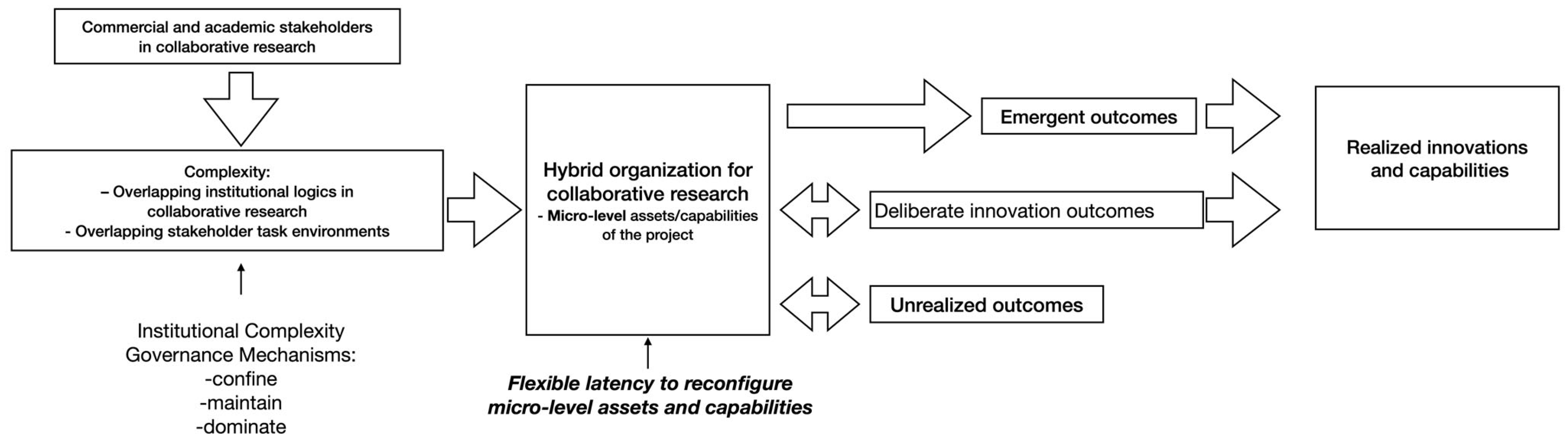
In our contribution we identify an additional factor that may come into play—together with institutional complexity—to explain managers’ responses to micro-level ambiguity present in a centre. Specifically, we propose calling this “flexible latency”, indicating management’s capacity to continuously reconfigure micro-level assets and capabilities to achieve common goals. We also found multiple types of possible innovation outcomes to be important in triggering the flexible latency in collaborative research projects. We found that innovation outcomes may be:
- Deliberate. In our case, these were the outcomes expected initially in the form of a new material to replace older materials and reduce emissions.
- Emergent. In this case, these were the initially unplanned capabilities to do research and collaborate that were developed amongst the actors.
- Unrealized. In this case, the failure to develop the new material.
- Realized innovation and capabilities. The emergent capabilities referred to above.
Therefore, we have refined our conceptual framework, as visualized in Figure 3.
Figure 3.
Initial state and micro-level reconfiguration of organizational hybrid through flexible latency in collaborative research. The wide arrows denote the direction of the process flow. The narrow arrows denote influences on specific parts of the process.
Figure 3 also includes the new concept of flexible latency, which affects the temporary hybrid organization for collaborative research at the micro-level of management practices, as well as multiple outcomes in feedback loops. Analyzed through the two phases, the case study shows path dependency in managing the structure as a formal organizational structure, as well as multiple possible business innovation outcomes. Given feedback loops, some of this collaboration leads to emergent or unrealized innovation outcomes, and a smaller proportion leads to realized innovations and capabilities in firms, which are essential to tackle sustainability challenges. Thus, as suggested by our case study, the evolving innovation outcomes, task requirements, and institutional complexity put pressure on decision-makers to respond to sequential outcomes of research during long-term collaborations to achieve successful innovations.
More specifically, we propose that latent flexibility is the capability to reconfigure a project’s assets (resources and capabilities) to account for the imposed and evolving external tensions created by innovation outcomes and complex institutional and task environments typical for organizational hybrids for collaborative research, cf. [66,67,68]. We propose that latent flexibility describes a micro-level, bottom-up, preparedness of actors in a hybrid organization to switch the asset composition of a project in response to future needs. An organizational hybrid’s latent flexibility is delimited by the intrinsic adaptability of its resources and capabilities (assets) and the hybrid’s ability in applying it.
6.1. Implications
The implications for policy makers and managers involved are that the combined mission of collaborative research is a complex one and it must balance and provide for public, business, and academic interests in its internal organization and must provide leeway to research managers to be flexible and independent of any one of those interests. Even so, success cannot be guaranteed, and it is not sufficient to initially mobilize and establish a university–industry research centre that balances the mentioned interests in its practices and structures, it also depends on successful innovation and an adequate flexibility to respond to the success or failure of research and innovation.
For future research on iterative process models for managing university–industry centres, we suggest that later quantitative research could validate and extend our understanding of these switches between logics, including investigating the frequency of occurrence across many centres. Hence, we suggest that if the host university places too much focus on ‘becoming an entrepreneurial university’, Etzkowitz and Leydesdorff [69,70], by developing innovation management practices for science, which are too de-coupled from the dominant academic logic, this will not only take too much attention away from the research per se but also lead to a failure of the hybrid organization (as suggested in the model). Moreover, further theoretical work on the interactions between practices at an individual level and the formal structure at the organizational level is needed [71].
6.2. Limitations
This study is limited to one university–industry centre in sustainability. Even though access by authors enables the opportunity for a detailed, longitudinal study, our results are limited to one area of technology, one geographical location, and one time-period. Additionally, our data source, the university–industry centre of this paper, never did achieve its most important goals and may be viewed as somewhat skewed as a failure. This could arguably introduce a potential empirical bias for the applicability of our model, which might not be based on sufficiently varied data on the management of institutional complexity and the effects on innovation or other outcomes of hybrid organizations.
Author Contributions
Conceptualization, O.Z. and M.M.; investigation, R.J.D., O.Z. and M.M.; writing—original draft preparation, R.J.D., O.Z. and M.M.; writing—review and editing, O.Z. and M.M.; supervision, O.Z. and M.M. All authors have read and agreed to the published version of the manuscript.
Funding
This work was supported by the Department of Economy and Society (Olof Zaring and Maureen McKelvey); the Broman Foundation (Rani Dang); and the Swedish Research Council Distinguished Professor’s Programme (Maureen McKelvey) under Grant VR 2017-03360.
Institutional Review Board Statement
This study is waived for ethical review due to the fact that the study was performed before the requirements for Institutional Review Board statements were required in Sweden by the Departmental Research Ethics Committee, Department of Economy and Society, University of Gothenburg.
Informed Consent Statement
Informed consent was obtained from all subjects involved in the study.
Data Availability Statement
The datasets presented in this article are not readily available, due to considerations of protecting data through ethical guidelines.
Conflicts of Interest
The authors declare no conflicts of interest.
References
- Dodgson, M.; Gann, D.M.; Pillips, N. The Oxford Handbook of Innovation Management; Oxford University Press: Oxford, UK, 2015. [Google Scholar]
- Sauermann, H.; Stephan, P. Conflicting Logics? A Multidimensional View of Industrial and Academic Science. Organ. Sci. 2013, 24, 889–909. [Google Scholar] [CrossRef] [Scilit]
- Thornton, P.H.; Ocasio, W. Institutional logics. In The SAGE Handbook of Organizational Institutionalism; Greenwood, R., Oliver, C., Lawrence, T.B., Meyer, R.E., Eds.; SAGE: Thousand Oaks, CA, USA, 2008; pp. 99–129. [Google Scholar]
- McKelvey, M.; Zaring, O.; Szucs, S. Conceptualizing evolutionary governance routines: Governance at the interface of science and technology with knowledge-intensive innovative entrepreneurship. J. Evol. Econ. 2020, 30, 591–608. [Google Scholar] [CrossRef] [Scilit]
- Dasputha, P.; David, P. Towards a New Economics of Science. Res. Policy 1994, 23, 487–521. [Google Scholar] [CrossRef] [Scilit]
- Oliver, C. Strategic responses to institutional processes. Acad. Manag. Rev. 1991, 16, 145–179. [Google Scholar] [CrossRef] [Scilit]
- Oliver, C. The influence of institutional and task environment relationships on organizational performance: The Canadian construction industry. J. Manag. Stud. 1997, 34, 99–124. [Google Scholar] [CrossRef] [Scilit]
- Tseng, A.A.; Raudensky, M. Assessments of technology transfer activities of US universities and associated impact of Bayh-Dole Act. Scientometrics 2014, 101, 1851–1869. [Google Scholar] [CrossRef] [Scilit]
- Murray, F. The Oncomouse That Roared: Hybrid Exchange Strategies as a Source of Distinction at the Boundary of Overlapping Institutions. Am. J. Sociol. 2010, 116, 341–388. [Google Scholar] [CrossRef] [Scilit]
- Styhre, A.; Lind, F. The softening bureaucracy: Accommodating new research opportunities in the entrepreneurial university. Scand. J. Manag. 2010, 26, 107–120. [Google Scholar] [CrossRef] [Scilit]
- Sala, I.; Sobrero, M. Games of policy and practice: Multi-level dynamics and the role of universities in knowledge transfer processes. J. Technol. Transfer. 2021, 46, 866–906. [Google Scholar] [CrossRef] [Scilit]
- Perkmann, M.; Salandra, R.; Tartari, V.; McKelvey, M.; Hughes, A. Academic engagement: A review of the literature 2011–2019. Res. Policy 2021, 50, 104114. [Google Scholar] [CrossRef] [Scilit]
- Perkmann, M.; Tartari, V.; McKelvey, M.; Autio, E.; Brostrom, A.; D’Este, P.; Fini, R.; Geuna, A.; Grimaldi, R.; Hughes, A.; et al. Academic engagement and commercialisation: A review of the literature on university-industry relations. Res. Policy 2013, 42, 423–442. [Google Scholar] [CrossRef] [Scilit]
- Berman, E.P. Creating the Market University: How Academic Science Became an Economic Engine; Princeton University Press: Princeton, NJ, USA, 2011. [Google Scholar]
- Bjerregaard, T.; Jonasson, C. Managing Unstable Institutional Contradictions: The Work of Becoming. Organ. Stud. 2014, 35, 1507–1536. [Google Scholar] [CrossRef] [Scilit]
- Lawrence, T.; Suddaby, R.; Leca, B. Institutional Work: Refocusing Institutional Studies of Organization. J. Manag. Inq. 2011, 20, 52–58. [Google Scholar] [CrossRef] [Scilit]
- Dahlmann, F.; Grosvold, J. Environmental Managers and Institutional Work: Reconciling Tensions of Competing Institutional Logics. Bus. Ethics Q. 2017, 27, 263–291. [Google Scholar] [CrossRef] [Scilit]
- Haveman, H.A.; Rao, H. Hybrid Forms and the Evolution of Thrifts. Am. Behav. Sci. 2006, 49, 974–986. [Google Scholar] [CrossRef] [Scilit]
- Perkmann, M.; McKelvey, M.; Phillips, N. Protecting Scientists from Gordon Gekko: How Organizations Use Hybrid Spaces to Engage with Multiple Institutional Logics. Organ. Sci. 2019, 30, 298–318. [Google Scholar] [CrossRef] [Scilit]
- Smets, M.; Jarzabkowski, P. Reconstructing institutional complexity in practice: A relational model of institutional work and complexity. Hum. Relat. 2013, 66, 1279–1309. [Google Scholar] [CrossRef] [Scilit]
- Smith, W.K.; Besharov, M.L. Bowing before Dual Gods: How Structured Flexibility Sustains Organizational Hybridity *. Admin Sci. Quart. 2019, 64, 1–44. [Google Scholar] [CrossRef] [Scilit]
- De Silva, M.; Wright, M. Entrepreneurial co-creation: Societal impact through open innovation. RD Manag. 2019, 49, 318–342. [Google Scholar] [CrossRef] [Scilit]
- Geels, F.W.; Schot, J. Typology of sociotechnical transition pathways. Res. Policy 2007, 36, 399–417. [Google Scholar] [CrossRef] [Scilit]
- Mazzucato, M. From market fixing to market-creating: A new framework for innovation policy. Ind. Innov. 2016, 23, 140–156. [Google Scholar] [CrossRef] [Scilit]
- Mazzucato, M. Mission-oriented innovation policies: Challenges and opportunities. Ind. Corp. Change 2018, 27, 803–815. [Google Scholar] [CrossRef] [Scilit]
- Schot, J.; Steinmueller, W.E. Three frames for innovation policy: R&D, systems of innovation and transformative change. Res. Policy 2018, 47, 1554–1567. [Google Scholar] [PubMed]
- Schot, J.; Steinmueller, W.E. New directions for innovation studies: Missions and transformations. Res. Policy 2018, 47, 1583–1584. [Google Scholar] [CrossRef] [Scilit]
- Frantzeskaki, N.; Loorbach, D.; Meadowcroft, J. Governing societal transitions to sustainability. Int. J. Sustain. Dev. 2012, 15, 19–36. [Google Scholar] [CrossRef] [Scilit]
- George, G.; Howard-Grenville, J.; Joshi, A.; Tihanyi, L. Understanding and Tackling Societal Grand Challenges through Management Research. Acad. Manag. J. 2016, 59, 1880–1895. [Google Scholar] [CrossRef] [Scilit]
- Gifford, E.; McKelvey, M. Knowledge-intensive Entrepreneurship and S3: Conceptualizing Strategies for Sustainability. Sustainability 2019, 11, 4824. [Google Scholar] [CrossRef] [Scilit]
- Shrivastava, P.; Ivanaj, S.; Ivanaj, V. Strategic technological innovation for sustainable development. Int. J. Technol. Manag. 2016, 70, 76–107. [Google Scholar] [CrossRef] [Scilit]
- Battilana, J.; Besharov, M.; Mitzineck, B. On Hybrids and Hybrid Organizing. In The SAGE Handbook of Organizational Institutionalism; Greenwood, R., Oliver, C., Lawrence, T.B., Meyer, R.E., Eds.; SAGE: Thousand Oaks, CA, USA, 2017. [Google Scholar]
- Mair, J.; Mayer, J.; Lutz, E. Navigating Institutional Plurality: Organizational Governance in Hybrid Organizations. Organ. Stud. 2015, 36, 713–739. [Google Scholar] [CrossRef] [Scilit]
- Reay, T.; Hinings, C.R. Managing the rivalry of competing institutional logics. Organ. Stud. 2009, 30, 263–291. [Google Scholar] [CrossRef] [Scilit]
- Thune, T.; Gulbrandsen, M. Institutionalization of university-industry interaction: An empirical study of the impact of formal structures on collaboration patterns. Sci. Publ. Policy 2011, 38, 99–107. [Google Scholar] [CrossRef] [Scilit]
- Ambos, T.C.; Makela, K.; Birkinshaw, J.; D’Este, P. When Does University Research Get Commercialized? Creating Ambidexterity in Research Institutions. J. Manag. Stud. 2008, 45, 1424–1447. [Google Scholar] [CrossRef] [Scilit]
- Berggren, C.; Karabag, S.F. Scientific misconduct at an elite medical institute: The role of competing institutional logics and fragmented control. Res. Policy 2019, 48, 428–443. [Google Scholar] [CrossRef] [Scilit]
- Georghiou, L. Effective Innovation Policies for Europe—The Missing Demand-Side; Report for the Prime Minister’s Office of Finland; Prime Minister’s Office Publications: Helsinki, Finland, 2006.
- Hine, D.; Parker, R.; Pregelj, L. Deconstructing and reconstructing the capability hierarchy. Ind. Corp. Change 2014, 23, 1299–1325. [Google Scholar] [CrossRef] [Scilit]
- McKelvey, M.; Ljungberg, D. How public policy can stimulate the capabilities of firms to innovate in a traditional industry through academic engagement: The case of the Swedish food industry. RD Manag. 2017, 47, 534–544. [Google Scholar] [CrossRef] [Scilit]
- Yang, J.; Zhang, J.; Zeng, D. Scientific collaboration networks and firm innovation: The contingent impact of a dynamic environment. Manag. Decis. 2022, 60, 278–296. [Google Scholar] [CrossRef] [Scilit]
- Iacobucci, D.; Perugini, F. Innovation performance in traditional industries: Does proximity to universities matter. Technol. Forecast. Soc. Change 2023, 189, 122340. [Google Scholar] [CrossRef] [Scilit]
- Berg, K.; McKelvey, M. Researching together in academic engagement in engineering: A study of dual affiliated graduate students in Sweden. Int. J. Technol. Manag. 2024, 96, 261–278. [Google Scholar] [CrossRef] [Scilit]
- Onufrey, K.; Bergek, A. Transformation in a mature industry: The role of business and innovation strategies. Technovation 2021, 105, 102190. [Google Scholar] [CrossRef] [Scilit]
- Eisenhardt, K.M.; Graebner, M.E. Theory building from cases: Opportunities and challenges. Acad. Manag. J. 2007, 50, 25–32. [Google Scholar] [CrossRef] [Scilit]
- Gehman, J.; Glaser, V.L.; Eisenhardt, K.M.; Gioia, D.; Langley, A.; Corley, K.G. Finding Theory-Method Fit: A Comparison of Three Qualitative Approaches to Theory Building. J. Manag. Inq. 2018, 27, 284–300. [Google Scholar] [CrossRef] [Scilit]
- Gioia, D.A.; Corley, K.G.; Hamilton, A.L. Seeking Qualitative Rigor in Inductive Research: Notes on the Gioia Methodology. Organ. Res. Methods 2013, 16, 15–31. [Google Scholar] [CrossRef] [Scilit]
- Elsahn, Z.; Callagher, L.; Husted, K.; Korber, S.; Siedlok, F. Are rigor and transparency enough? Review and future directions for case studies in technology and innovation Management. RD Manag. 2020, 50, 309–328. [Google Scholar] [CrossRef] [Scilit]
- Goffin, K.; Ahlstrom, P.; Bianchi, M.; Richtner, A. Perspective: State-of-the-Art: The Quality of Case Study Research in Innovation Management. J. Prod. Innovat. Manag. 2019, 36, 586–615. [Google Scholar] [CrossRef] [Scilit]
- Langley, A. Strategies for theorizing from process data. Acad. Manag. Rev. 1999, 24, 691–710. [Google Scholar] [CrossRef] [Scilit]
- Langley, A.; Smallman, C.; Tsoukas, H.; Van de Ven, A.H. Process Studies of Change in Organization and Management: Unveiling Temporality, Activity, and Flow. Acad. Manag. J. 2013, 56, 1–13. [Google Scholar] [CrossRef] [Scilit]
- McKelvey, M.; Zaring, O.; Ljungberg, D. Creating innovative opportunities through research collaboration: An evolutionary framework and empirical illustration in engineering. Technovation 2015, 39–40, 26–36. [Google Scholar] [CrossRef] [Scilit]
- Beaudry, C.; Kananian, R. Follow the (Industry) Money—The Impact of Science Networks and Industry-to-University Contracts on Academic Patenting in Nanotechnology and Biotechnology. Ind. Innov. 2013, 20, 241–260. [Google Scholar] [CrossRef] [Scilit]
- Tartari, V.; Perkmann, M.; Salter, A. In good company: The influence of peers on industry engagement by academic scientists. Res. Policy 2014, 43, 1189–1203. [Google Scholar] [CrossRef] [Scilit]
- Fini, R.; Jourdan, J.; Perkmann, M. Social Valuation Across Multiple Audiences: The Interplay of Ability and Identity Judgments. Acad. Manag. J. 2018, 61, 2230–2264. [Google Scholar] [CrossRef] [Scilit]
- Azagra-Caro, J.M.; Barbera-Tomas, D.; Edwards-Schachter, M.; Tur, E.M. Dynamic interactions between university-industry knowledge transfer channels: A case study of the most highly cited academic patent. Res. Policy 2017, 46, 463–474. [Google Scholar] [CrossRef] [Scilit]
- Hermanson, I.; McKelvey, M.; Zaring, O. Organising an early phase of academic engagement: A case study of interactions between engineering and equestrian sports. Innov.-Organ. Manag. 2021, 23, 266–286. [Google Scholar] [CrossRef] [Scilit]
- Berends, H.; Deken, F. Composing qualitative process research. Strateg. Organ. 2021, 19, 134–146. [Google Scholar] [CrossRef] [Scilit]
- Ketokivi, M.; Choi, T. Renaissance of case research as a scientific method. J. Oper. Manag. 2014, 32, 232–240. [Google Scholar] [CrossRef] [Scilit]
- Oliver, C. Sustainable competitive advantage: Combining institutional and resource-based views. Strateg. Manag. J. 1997, 18, 697–713. [Google Scholar] [CrossRef] [Scilit]
- Zucker, L.G. Institutional theories of organization. Annu. Rev. Sociol. 1987, 13, 443–464. [Google Scholar] [CrossRef]
- Jay, J. Navigating paradox as a mechanism of change and innovation in hybrid organizations. Acad. Manag. J. 2013, 56, 137–159. [Google Scholar] [CrossRef] [Scilit]
- Freitas, I.M.B.; Verspagen, B. The motivations, institutions and organization of university-industry collaborations in the Netherlands. J. Evol. Econ. 2017, 27, 379–412. [Google Scholar] [CrossRef] [Scilit]
- Rosenberg, N.; Steinmueller, W.E. Engineering knowledge. Ind. Corp. Change 2013, 22, 1129–1158. [Google Scholar] [CrossRef] [Scilit]
- Deiaco, E.; Hughes, A.; McKelvey, M. Universities as strategic actors in the knowledge economy. Camb. J. Econ. 2012, 36, 525–541. [Google Scholar] [CrossRef] [Scilit]
- Sanchez, R.; Mahoney, J.T. Modularity, flexibility, and knowledge management in product and organization design. Strateg. Manag. J. 1996, 17, 63–76. [Google Scholar] [CrossRef] [Scilit]
- Zaring, O. Investment Decisions and the Environment: A Study of Strategies for Project Planning; BAS Publisher: Athens, OH, USA, 1999. [Google Scholar]
- Garud, R.P.T.; Van de Ven, A.H. Perspectives on Innovation Processes. Acad. Manag. Ann. 2013, 7, 775–819. [Google Scholar] [CrossRef]
- Etzkowitz, H.; Leydesdorff, L. The dynamics of innovation: From National Systems and “Mode 2” to a Triple Helix of university-industry-government relations. Res. Policy 2000, 29, 109–123. [Google Scholar] [CrossRef] [Scilit]
- Etzkowitz, H.; Webster, A.; Gebhardt, C.; Terra, B.R.C. The future of the university and the university of the future: Evolution of ivory tower to entrepreneurial paradigm. Res. Policy 2000, 29, 313–330. [Google Scholar] [CrossRef] [Scilit]
- Garud, R.; Gehman, J.; Kumaraswamy, A. Complexity arrangements for sustained innovation: Lessons from 3M Corporation. Organ. Stud. 2011, 32, 737–767. [Google Scholar] [CrossRef] [Scilit]

Disclaimer/Publisher’s Note: The statements, opinions and data contained in all publications are solely those of the individual author(s) and contributor(s) and not of MDPI and/or the editor(s). MDPI and/or the editor(s) disclaim responsibility for any injury to people or property resulting from any ideas, methods, instructions or products referred to in the content. |
© 2026 by the authors. Licensee MDPI, Basel, Switzerland. This article is an open access article distributed under the terms and conditions of the Creative Commons Attribution (CC BY) license.