1. Introduction
Ecologically susceptible regions in China are primarily situated in ecological transition zones and vegetation ecotones, marked by intricate interwoven boundaries of agriculture, livestock, and forestry. These regions encounter significant ecological challenges, economic underdevelopment, and diminished living standards, which align with the global dilemma of reconciling social–ecological sustainability and livelihood security in peripheral areas [
1]. Addressing this dilemma requires a foundational perspective on integrated socio-environmental development to ensure long-term sustainability [
2]. The vulnerability of the ecological environment is intrinsically connected to the economic welfare of farmers, evidenced by a considerable geographical intersection between ecologically sensitive areas and impoverished regions, where external disaster-inducing conditions interact with internal factors that perpetuate poverty, a phenomenon extensively recorded in global studies on social–ecological systems (SES). The No. 1 Central Document of 2025 explicitly articulates, “An overall assessment of the effective linkage between consolidating and expanding the achievements of poverty alleviation and rural revitalization will be conducted, and a policy system for the post-transition period will be researched and formulated” [
3], which aligns with the United Nations Sustainable Development Goals (SDGs) 1 (no poverty) and 15 (life on land). This alignment resonates with recent decision-support frameworks that prioritize renewable and sustainable strategies to achieve SDGs [
4], underscoring that rural revitalization is essential to global sustainable development [
5].
From a theoretical development standpoint, global livelihood resilience research has transitioned from two paradigms to a more cohesive social–ecological framework. The initial aspect is the vulnerability research paradigm, where resilience, alongside exposure and sensitivity, forms an essential element. The second framework is the sustainable livelihoods research framework, which asserts that enhanced livelihood resilience more effectively facilitates the attainment of sustainable livelihoods. Tang et al. suggested that livelihood resilience and vulnerability exist in a symbiotic relationship [
6]. Wandel argued that the UK’s Department for International Development (DFID) developed a sustainable livelihoods framework that intrinsically incorporates adaptive capacity, asserting that the attainment of sustainable livelihoods is contingent upon robust adaptive capacity, the capability to effectively endure, manage, or adapt to precarious situations such as climate change and associated risks, thereby facilitating sustainable development [
7].
How can forest farmers augment their livelihood resilience through agency? The Capability Approach, introduced by Amartya Sen, offers a significant perspective. This theory asserts that economic situations, knowledge acquisition skills, and societal social conditions shape an individual’s capabilities for attaining diverse functioning [
8]. Economic conditions are broadly recognized as a primary indicator of capabilities [
9]. Elevated income levels in forest farmers are significantly associated with an enhanced ability to endure shocks [
10]. The ability to acquire information pertains to the transparency assurances afforded to individuals, specifically the capacity of farmers to make production decisions through access to essential agricultural information [
11]. This capability not only alleviates the adverse impacts of information asymmetry but also assists farmers in circumventing dangers during agricultural production [
12].
Therefore, the improvement of forest farmers’ economic status, information acquisition skills, and social opportunities should contribute to strengthening their livelihood resilience in vulnerable circumstances. This raises a crucial inquiry: Do the capabilities of forest farmers, encompassing their economic condition, information acquisition ability, and social opportunities, influence their livelihood resilience by shaping their risk perception of vulnerable environments such as those affected by climate change and other potential risks? Current research has devoted scant attention to this specific pathway. Neglecting the exploration of this process risks underestimating the role of human agency in fostering livelihood resilience.
This study examines the impact of capabilities and risk perception on the livelihood resilience of forest farmers in the Songshan District in Chifeng City. As a representative area characterizing the northern agroforestry ecotone, this case study offers valuable empirical insights. We seek to address the gap in international research by integrating Sen’s Capability Approach with the SES resilience framework to examine the mediating function of risk perception in a typical ecological transition zone. This enhances the empirical foundation of global livelihood resilience research and offers context-specific insights for sustainable development in comparable ecologically sensitive areas globally.
2. Theoretical Analysis and Research Hypotheses
2.1. The Influence of Capabilities on Forest Farmers’ Livelihood Resilience
Farm household behavior theory posits that farmers make rational judgments by thoroughly evaluating their conditions in agricultural productivity and behavioral choices. This indicates that a farmer’s intrinsic capabilities affect their livelihood resilience, which is manifested primarily in the following three aspects: improving livelihood resilience requires that forest farmers invest adequate capital [
13]; agricultural cooperatives enhance the resilience of farmer groups against market uncertainties and instabilities by consolidating resources, including capital; capital investment in stages such as agricultural product sales enables market expansion, achieves economies of scale, and helps farmers compete with larger firms. This rationale can be applied to forest farmers, indicating that capital investment is crucial for enhancing livelihood resilience. Enhancing the livelihood resilience of forest farmers requires sufficient information support. Huang Jianwei et al. [
14] assert that enhanced network coverage can facilitate linkages between farmers and government entities, improve communication conditions for farmers, deliver real-time and pertinent agricultural information, and eventually cultivate a more conducive atmosphere for development. Agricultural technical training, offered as a governmental social initiative, can strengthen farmers’ skills and thereby improve their livelihood resilience. Government-initiated assistance measures are found to modify livelihood resilience by directly or indirectly affecting the availability of diverse forms of capital [
15].
Based on this theoretical framework, the following hypothesis is posited:
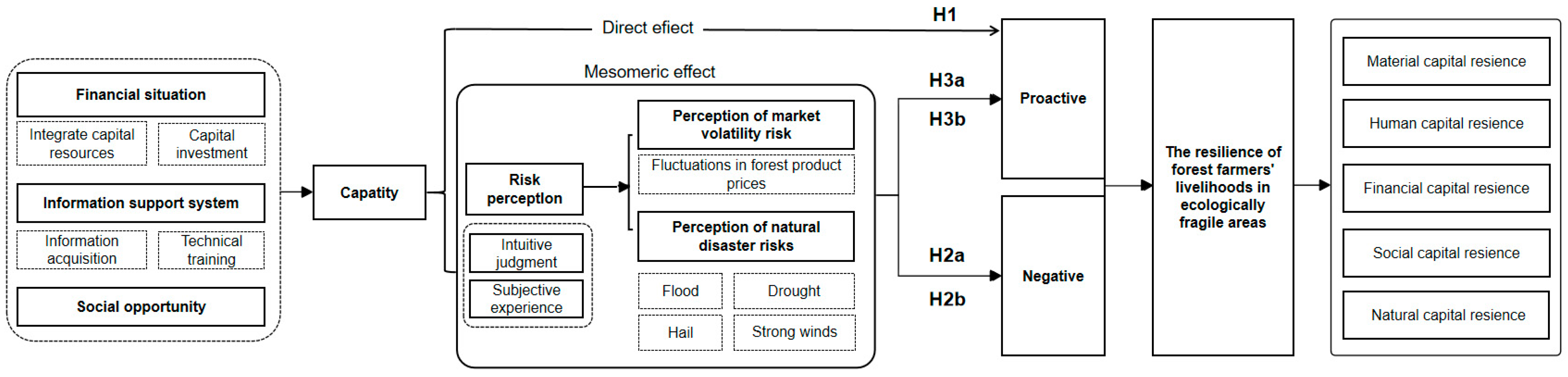
H1. Capabilities exert a substantial positive impact on the livelihood resilience of forest farmers.
2.2. The Influence of Risk Perception on Forest Farmers’ Livelihood Resilience
Risk perception denotes an individual’s awareness and comprehension of diverse objective threats in the external environment, highlighting the influence of experience gained from intuitive assessments and subjective emotions [
16,
17]. According to risk perception theory, the level of risk perception among forest farmers directly affects their behavioral activities [
18]. Using the livelihood resilience of forest farmers as an example, sensible farmers, when deliberating on the enhancement of their livelihood resilience, generally examine factors such as price and yield, which relate to market volatility risks and natural disaster risks, respectively [
5].
Forest farmers in ecologically sensitive areas exhibit distinct vulnerabilities, with their livelihood capital intricately linked to their quality of life [
19,
20]. Natural disasters, including droughts, floods, hail, and strong winds, coupled with variations in forest product prices, constitute the primary livelihood risks encountered by these farmers. These dangers not only intensify livelihood vulnerability but also diminish their ability to respond effectively. Shi et al. assessed the livelihood conditions of reservoir migrants in two previously impoverished counties in Shaanxi Province within a “Risk–Adaptive Capacity–Sensitivity” framework. They found that migrants with heightened livelihood vulnerability encountered increased livelihood risks, demonstrated lower livelihood resilience, and were more susceptible to reverting to poverty [
11,
21].
Based on this existing research, the following hypotheses are proposed:
H2a. The perception of market volatility risk significantly undermines the livelihood resilience of forest farmers.
H2b. The perception of natural disaster risk significantly undermines the livelihood resilience of forest farmers.
2.3. The Mediating Role of Risk Perception Between Capabilities and Forest Farmers’ Livelihood Resilience
Capabilities are a vital factor influencing households’ adaptive capacity within SES, as highlighted by the SES resilience framework. This corresponds with Sen’s Capability Approach, which asserts that capabilities enable individuals to exercise agency in managing shocks. Farmers with more capabilities have access to more substantial economic resources and enhanced information acquisition skills. Consequently, individuals demonstrate diminished hesitance in their efforts to improve their livelihood resilience. Furthermore, enhanced access to market information mitigates the detrimental impacts of information asymmetry, exemplified by the lemons market effect [
11], thereby effectively diminishing their perception of market volatility concerns. Conversely, farmers with diminished competencies encounter greater difficulties in managing losses resulting from natural calamities. They are increasingly concerned about their inadequate ability to properly endure such natural hazards, resulting in a heightened perception of disaster risks.
Conversely, farmers with enhanced capabilities possess superior access to information pertaining to catastrophe prevention and mitigation. This facilitates their ability to efficiently enhance their experience and strategies for managing natural disasters promptly. As a result, they are more adept at maintaining production stability and alleviating the effects of natural disasters, which diminishes their perception of the associated risks. In contrast, farmers with diminished capabilities find it challenging to fulfill the skill requirements essential for addressing natural disasters. The prevention procedure becomes increasingly challenging, and they may encounter heightened risks of losses due to a lack of knowledge with preventative methods. Such an outcome leads to a heightened awareness of natural disaster hazards and diminishes their motivation to handle them proactively (
Figure 1).
This analysis, which combines the Capability Approach with SES resilience theory, proposes the following hypotheses:
H3a. Capabilities enhance the livelihood resilience of forest farmers by mitigating their perception of market volatility concerns.
H3b. Capabilities enhance the livelihood resilience of forest farmers by diminishing their perception of natural disaster risks.
3. Research Data and Methods
3.1. Data Source
Songshan District, located in southern Chifeng City within the Inner Mongolia Autonomous Region, contains the upper portions of the Xiliao River system. Spanning 5629 square kilometers, it is a quintessential ecologically sensitive forest-farming zone in China. Due to inadequate natural environmental conditions and limited livelihood capacities among forest farmers, there is an urgent necessity to improve their livelihood resilience, foster sustainable livelihood capabilities, and direct local forest farmers toward a mutually beneficial trajectory of “green and economic” development [
22]. Consequently, Songshan District was chosen as the study region to examine the impact of capabilities and risk perception on the livelihood resilience of forest farmers, due to its typicality and representativeness.
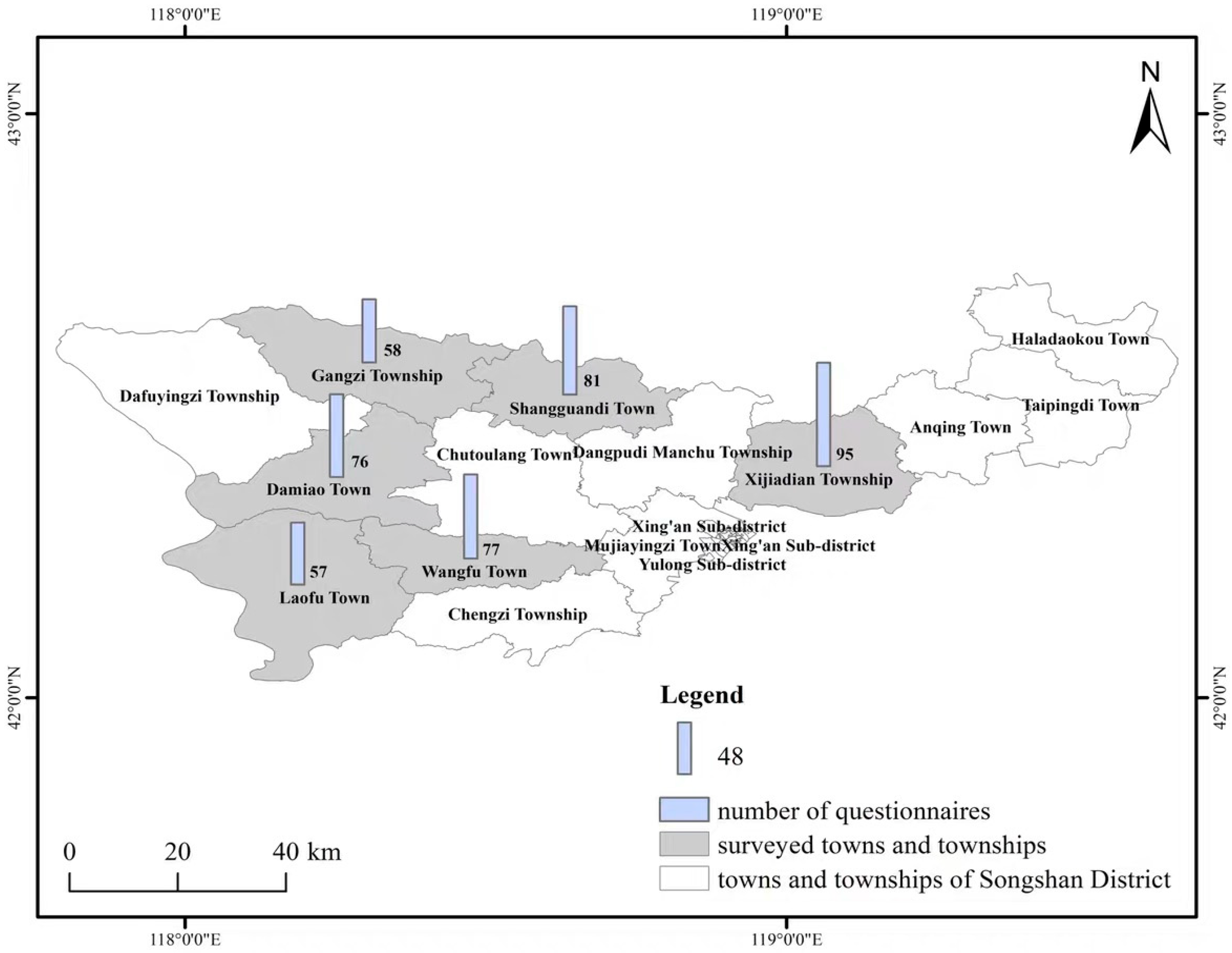
A field survey was executed in Songshan District from 18 September to 25 September 2024. To ensure the sample accurately represents forest farmers in Songshan, a three-stage stratified random sampling method was employed: initially, 11 towns were categorized into high- (forest coverage >40%, forest farmer households >60%), medium- (20–40% coverage, 30–60% households), and low-dependence (coverage <20%, households <30%) strata, with 8 towns (3 high-, 3 medium-, 2 low-dependence) selected using proportional probability sampling (PPS); secondly, 3–4 villages were randomly sampled from each selected town (based on forest farmer proportion), resulting in a total of 27 villages; thirdly, village leaders assisted in compiling lists of forest farmer household, from which 15–20 households per village were chosen through systematic random sampling (interval = villages total forest farmer households/target sample size) to encompass households with diverse resource dependence and sizes. A total of 500 questionnaires were disseminated and collected using a combination of survey questions and in-depth interviews. After data cleaning, 31 invalid questions were discarded, resulting in 469 valid samples and a valid questionnaire rate of 93.80%.
It should be noted that the survey respondents are not general rural residents, but primarily household members who are directly involved in forest production and livelihood decision-making. According to the Seventh National Population Census of Songshan District, the overall gender and age structure of the population is more balanced (male: 51.17%; aged > 60: 17.67%). In contrast, the surveyed sample exhibits a significantly higher proportion of males and older individuals. This difference reflects the reality of labor out-migration and rural hollowing, whereby younger laborers tend to shift to urban employment, while middle-aged and elderly males remain the main actors in forest-based livelihood activities.
Table 1 presents the individual and household characteristics of the survey respondents. Males constituted 78.15% of the sample, and females represented 21.85%. This high proportion of males aligns with the household division of labor in the study area, where males typically serve as household heads and are the primary decision-makers in forestry management activities. The predominant age group among respondents consisted of 270 individuals (60.81%) aged between 50 and 70 years. Conversely, only 22 individuals (4.95%) were below 40 years old. Regarding the household working population, households with two or fewer able-bodied workers were 57.88% of the total, a proportion markedly greater than other categories. This age distribution reflects the current reality of the rural forestry workforce in Northern China, which is characterized by an aging population due to the out-migration of younger labor.
The majority of respondents attained an education level of junior high school or lower. Individuals with a junior high school education comprised the predominant group (56.98%), succeeded by those with a primary school education (24.32%). Individuals possessing a bachelor’s degree or higher constituted the lowest category, accounting for only 4.06% of the sample. These statistics indicate the predominantly low educational attainment of farmers in the study region and the paucity of highly educated individuals in rural environments.
3.2. Indicator System and Model Construction
3.2.1. Construction of the Indicator System
Livelihood resilience denotes the ability of forest farmers to return to their original livelihood status or attain advancement when confronted with external risk shocks [
23,
24]. The commonly understood meaning of livelihood capacity derives from the sustainable livelihoods analytical framework proposed by DFID, which is founded on the Capability Approach developed by Sen and others. This theory asserts that human, social, physical, natural, and financial capital form an asset system that demonstrates interconvertible and “primary-derived” linkages. This research asserts that livelihood resilience is indicative of the levels of these five forms of capital.
Consequently, an evaluation indicator system for the livelihood resilience of forest farmers in environmentally fragile locations was developed, incorporating the livelihood features of these farmers and the geographical specificity of Songshan District. The selection of specific indicators was guided by two main principles: (1) a thorough examination of existing research findings and (2) the integration of the development status and planning of Songshan District. A rigorous solicitation procedure was employed, engaging scholars and specialists in forest farmer livelihoods and rural ecological development. After several rounds of input, the definitive evaluation indicators were established. This set includes five dimensions, physical capital resilience, human capital resilience, financial capital resilience, social capital resilience, and natural capital resilience, covered by a total of 16 underlying variables (
Table 2).
3.2.2. Model Construction
Owing to considerable discrepancies in the type, unit, and magnitude of the evaluation indicators, the extreme value method was utilized to homogenize and normalize the data, converting the indicator values to a range of 0 to 1. The procedure was as follows [
25]:
where
signifies the raw data of the
j-th indicator for the
i-th sample, and
indicates the normalized evaluation coefficient of
. Positive indicators are standardized according to the initial equation presented, whereas negative indicators are standardized using the subsequent equation. The indicator weight
Pi is calculated using the following formula:
Calculate the entropy value:
The entropy coefficient Gj for the j-th indicator, which indicates the level of disparity among its sub-indicators, is computed. A larger difference among the variation coefficients results in a lower entropy value, indicating a greater quantity of specific information conveyed. The formula is presented as follows:
The weight W
j for each indicator was subsequently calculated using the following formula:
The dependent variable in this study, forest farmers’ livelihood resilience, is a categorical variable with values spanning from 1 to 4. Consequently, an ordered logit model was chosen for regression analysis. The regression model was developed as follows [
24]:
where
denotes the livelihood resilience of forest farmers;
indicates risk perception;
represents feasible capability;
Control refers to the control variables;
,
, and
are the regression coefficients for the aforementioned independent variables;
is the constant term; and
is the error term, which is assumed to follow a normal distribution.
Explained Variable: The explained variable was the livelihood resilience of forest farmers. The approach developed by Zhang et al. [
24] was employed to thoroughly assess resilience in ecologically fragile regions. The unprocessed survey data from forest farmers in the study area underwent dimensionless processing, subsequently followed by hierarchical aggregation to calculate assessment scores for their resilience levels. Methodologically, the original survey data were first synthesized into a continuous resilience index (ranging from 0 to 1) using the Entropy Method to capture the holistic state of the household’s livelihood system. Subsequently, K-means clustering was employed to statistically categorize these continuous scores into four distinct hierarchical levels (1 to 4). This approach allows for the identification of the heterogeneous “resilience states” of households, rather than merely averaging their responses. Consequently, resilience was classified as follows: 1 = Weak, 2 = Moderately Weak, 3 = Moderately Strong, and 4 = Strong.
Fundamental Explanatory Variables: Based on previous research, feasible competence was assessed across three dimensions: the economic situation of farmers, the ability to acquire information, and social opportunities. The economic position of the household, which underpins feasible capability [
25], was assessed by the inquiry, “What is your household’s annual per capita income?” with response categories: 1 = Below ¥7000; 2 = ¥7001–¥11,000; 3 = ¥11,001–¥15,000; 4 = ¥15,001–¥19,000; 5 = ¥19,001 and above. The capacity for information acquisition, which allows farmers to enhance their technical expertise [
26], was assessed using the question, “How often do you watch TV, listen to the radio, or use the internet?” (1 = Never; 2 = Low; 3 = Moderate; 4 = High; 5 = Very High). Social opportunities, defined as access to agricultural technical training that enhances knowledge and skills [
27], were evaluated by the question, “Have you participated in agricultural technical training?” (0 = No; 1 = Yes). Factor analysis was performed utilizing SPSS 24. The Kaiser–Meyer–Olkin (KMO) score surpassed the threshold of 0.5, and Bartlett’s test of sphericity was significant, validating the suitability for principal component analysis. Ultimately, households were classified according to the calculated mean of feasible capability: those over the mean received a designation of 1 (High Feasible Capability), and those below it were awarded a designation of 0 (Low Feasible Capability). Although feasible capability is inherently multi-dimensional and continuous, this study adopts a “threshold identification” approach. We posit that a critical minimum level of capability is required to activate effective risk-coping mechanisms. Therefore, the mean value serves as the identifying threshold to distinguish between households that have attained this basic agency and those that have not.
Risk perception included farmers’ assessments of market volatility and natural calamities. In accordance with the methodology of He and Huang [
5], two variables were established: market fluctuation risk perception and natural disaster risk perception. The perception of market fluctuation risk was assessed using the inquiry, “Do you believe that fluctuations in agricultural product prices affect your livelihood resilience?” (Yes = 1; No = 0). Natural disaster risk perception was assessed by the question, “Do you believe the severity of encountered disasters can reduce your livelihood resilience?” (Yes = 1; No = 0).
Control Variables: The production and lives of forest farmers are influenced by individual, household, and production management features in their decision-making processes. Consequently, control factors pertaining to the respondents’ personal qualities, household characteristics, and operational features were identified. The factors included gender, age, health status, village cadre status, cultivated land area, total household population, and number of household laborers.
Table 3 presents the definitions and descriptive data for these control variables.
3.3. Descriptive Statistical Analysis
Prior to the econometric analysis, descriptive statistical analysis was conducted to obtain an overall understanding of the sample characteristics and the distribution of key variables. This step helps to identify potential outliers, assess data variability, and ensure the rationality of subsequent model estimation.
Table 3 reports the mean values and variances of the main variables. The average livelihood resilience score is 2.645, indicating that most forest farmers are positioned between moderately weak and moderately strong resilience levels. The mean value of feasible capability is relatively low, suggesting that only a limited proportion of households have surpassed the basic capability threshold required for effective risk coping. Regarding risk perception, the mean values indicate that forest farmers are more sensitive to market fluctuation risks than to natural disaster risks. Additionally, the descriptive statistics for control variables reflect the socio-economic characteristics of the sample. The average household has approximately 3.965 mu of cultivated land and 2.658 laborers, indicating a moderate scale of agricultural operation. The variation in variables such as age, health status, and regional distribution further highlights the heterogeneity among forest farmers, necessitating their inclusion as controls in the regression models.
Overall, the descriptive statistics reveal substantial heterogeneity among forest farmers in terms of livelihood resources, capabilities, and risk perception. This heterogeneity provides a reasonable empirical basis for examining the differential impacts of feasible capability and risk perception on livelihood resilience using ordered logit models.
4. Results and Analysis
4.1. Livelihood Resilience Measurement Results
Prior to analyzing the distribution of resilience, it is essential to examine the specific contributions of various indicators.
Table 4 details the entropy weights assigned to the 16 livelihood indicators along with their aggregated dimensions. The calculation results reveal a distinct structural hierarchy regarding the sources of resilience. Specifically, natural capital resilience makes the most substantial contribution at 31.71%, a figure driven primarily by the high weight of cultivated land area at 12.69%. Financial capital resilience ranks second at 23.81% and is followed closely by social capital resilience at 22.55%. In contrast, human capital resilience accounts for the smallest proportion of the total weight at only 4.17%. This distribution suggests that the livelihood resilience of forest farmers in the study region is currently resource dependent. It relies heavily on land assets and financial accumulation rather than being driven by human capital factors such as education or labor quantity. Regarding sensitivity, although natural capital holds the highest aggregated weight, the distribution at the individual indicator level remains relatively balanced. No single indicator possesses a dominant weight exceeding 20%. This indicates that the calculated Livelihood Resilience Index is a comprehensive reflection of the five capitals rather than a proxy for a single variable. Consequently, the index demonstrates structural stability. This ensures that subsequent regression results are robust and not driven by the sensitivity of any specific outlier indicator. Accordingly, although the subsequent empirical analysis employs a composite resilience index, the estimated effects can be meaningfully interpreted as operating through the five underlying capital dimensions, consistent with the conceptual framework. It is important to clarify the logical relationship between the tables.
Table 2 details the construction of the resilience indicator system based on survey data. Through the Entropy Method, we calculated the specific contribution (weight) of each of the five capital dimensions, which are explicitly presented in
Table 4 to illustrate their relative impact. These dimensions were then aggregated into a composite Livelihood Resilience Index and subsequently classified into four ordered levels based on the distribution of the index values (as shown in the “Explained Variable” in
Table 3), which serves as the dependent variable in the ordered logit model. This approach allows us to assess the overall resilience hierarchy of the forest farmers.
The unprocessed survey data from forest farmers in the study area were standardized, and assessment scores for their resilience levels in the environmentally sensitive region were computed via hierarchical aggregation. The resilience levels of the forest farmers were classified into four distinct categories utilizing the K-means clustering method [
24]: weak resilience (0.2367, 0.4387), moderately weak resilience (0.4388, 0.5987), moderately strong resilience (0.5988, 0.7677), and strong resilience (0.7678, 0.9479). The conclusive results are illustrated in
Figure 2.
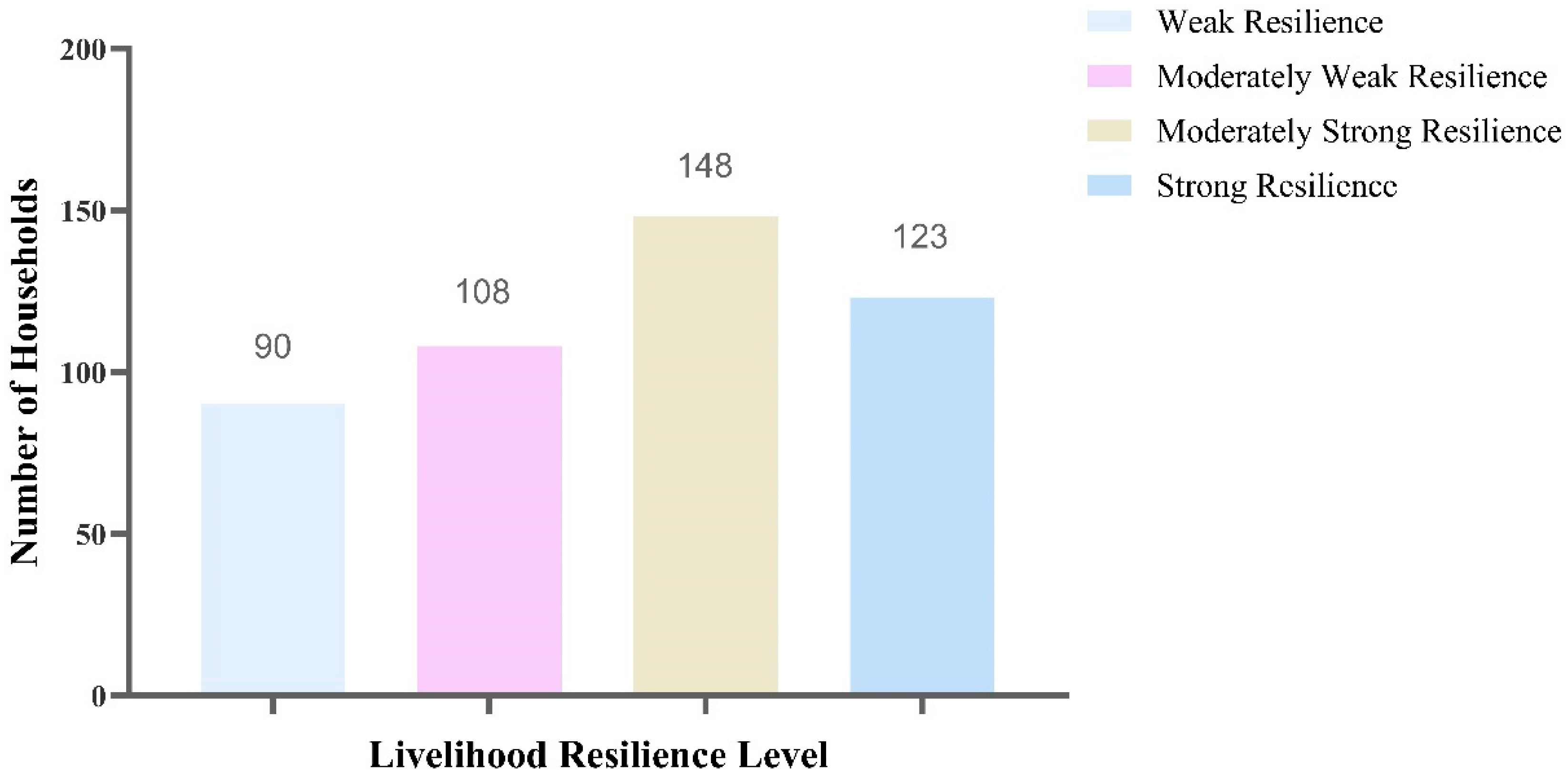
The livelihood resilience of forest farmers in the Songshan District of Chifeng City exhibited a multi-tiered distribution (
Figure 3). The population distribution among the four resilience tiers is as follows: 90 individuals with weak resilience, 108 with moderately weak resilience, 148 with moderately strong resilience, and 123 with strong resilience. The significantly larger cohort in the moderately strong category indicates that a portion of the forest farmers has attained a substantial level of livelihood resilience. The aggregate of approximately 200 individuals in the weak and moderately weak levels signifies considerable potential for enhancement. A discernible upward trend was noted from the “Weak” to the “Moderately Strong” resilience levels, indicating favorable results from resilience-building measures in the ecologically fragile region. Nevertheless, the quantity of individuals in the “Strong Resilience” tier did not sustain this rising trajectory and was inferior to that of the “Moderately Strong” group. This pattern indicates that the advancement of higher-level resilience is limited by elements such as resource capacity (e.g., forest land productivity, water availability) and the inherent abilities of farmers. Concurrently, forest farmers with weak or moderately weak resilience, owing to their precarious baseline, are more subject to shocks from ecological risks (e.g., drought, sandstorms) and market volatility (e.g., falling prices of forest products). This unequal vulnerability further shapes the observed hierarchical resilience framework. Consequently, this status analysis further examines the mechanisms by which feasible capability and risk perception affect livelihood resilience in the following sections.
4.2. Step 1: Testing Direct Effects of Capabilities (H1) and Risk Perception (H2)
Before interpreting the regression estimates, we verified the validity of the ordered logit model by testing the parallel lines assumption (proportional odds assumption). The results of the Brant test indicated that the assumption was not violated (
p > 0.05). This confirms that the relationship between the independent variables and the logits is consistent across all thresholds. Consequently, the ordered logit model is deemed appropriate for this analysis. Following this validation, a multicollinearity test was initially performed on all variables in the model utilizing StataMP 16 software. The findings demonstrated that all Variance Inflation Factor (VIF) values were under 2, indicating a little likelihood of multicollinearity among the variables. The regression results from the ordered logit model are displayed in
Table 5. Model 1 specifically denotes the baseline regression that includes solely the control variables. Models 2, 3, and 4 expand upon Model 1 by progressively incorporating feasible capability, market fluctuation risk perception, and natural disaster risk perception for analysis. Ultimately, Model 5 encompasses all variables in the comprehensive regression.
Feasible Capability: An ordered logit regression was conducted to assess the influence of feasible capability on the livelihood resilience of forest farmers, utilizing the feasible capability indicator obtained from factor analysis in SPSS 24 against the livelihood resilience measure. The estimation findings from Model 2 in
Table 5 indicate that forest farmers with more feasible capability exhibited significantly enhanced livelihood resilience, thereby validating hypothesis H1. Farmers with robust feasible capabilities can more easily obtain funding and economically diversify income streams, be aware of market dynamics and danger alerts via information channels, and utilize social networks for support and collaboration. These capacities allow them to mobilize material resources (e.g., supplies for forest land rehabilitation), leverage human capital (e.g., personal skills and assistance from others), obtain financial resources (e.g., fund circulation and subsidy acquisition), depend on social resources (e.g., mutual aid networks), and adapt to changes in natural resources (e.g., modifying cultivation practices in response to environmental fluctuations) more effectively when facing risks. Consequently, they bolster their livelihood resilience across material, human, financial, social, and natural dimensions, allowing for more stable sustenance and recovery of their livelihoods.
Risk Perception: The results from Model 3 in
Table 5 demonstrate that the impression of market fluctuation risk was significantly negative at the 1% level, thereby confirming hypothesis H2a. Enhanced perceptions of market fluctuation risk correlated with diminished levels of livelihood resilience among forest farmers. This negative association can be ascribed to a complicated interaction of factors: when farmers perceive price volatility as a threat to their livelihoods, uncertainty about future returns may result in decreased investment in physical capital (e.g., enhancing forest land or acquiring equipment) and diminish their incentive to develop human capital (e.g., engaging in forestry technical training to improve management skills), primarily due to the elevated perceived risk associated with investment returns. Concerning social capital, apprehensions about price volatility may lead farmers to disengage from social networks, thereby diminishing cooperation and mutual assistance with fellow farmers or market participants, as they fear unequal benefit distribution amidst market instability. Expected income volatility might impede loan access and dissuade savings, leading to inadequate financial reserves to manage hazards. While natural capital is significantly affected by environmental conditions, the operational pressures resulting from price volatility may prompt farmers to engage in short-term strategies regarding forest management and ecological conservation, thereby indirectly compromising the sustainability of natural capital and diminishing overall livelihood resilience.
The Model 4 results in
Table 5 indicate that natural disaster risk perception was adversely significant at the 10% level, hence validating hypothesis H2b. This research suggests that heightened perceptions of natural disaster risk, particularly the perception that severe disasters undermine livelihood resilience, weaken overall resilience through multiple pathways. The apprehension of disasters ravaging forest land and infrastructure deters long-term investments in land enhancement and equipment, as farmers aim to mitigate prospective losses. The expectation of disaster-related losses diminishes the motivation to pursue skill training or improve managerial capabilities, as it is believed that these endeavors provide minimal safeguard against catastrophic occurrences. Pertaining to social capital, apprehension over disaster risks may result in the constriction of social networks and diminished mutual cooperation, motivated by fears of resource scarcity or inequitable allocation during emergencies. The anticipation of significant income reductions after disasters deters savings and heightens credit aversion, undermining the financial buffer essential for risk management. While natural capital depends on healthy ecological conditions, the fear of disasters can lead people to neglect sustainable practices, such as forest conservation and ecological restoration, in favor of short-term, extractive management. Such behavior degrades the long-term sustainability of natural capital and ultimately undermines overall livelihood resilience.
Regulatory Variables: Model 5 presents the regression results that include all variables. Among the control factors, three were identified as exerting a substantial beneficial impact on the livelihood resilience of forest farmers: the number of household laborers, the area of cultivated land, and health status. An adequate quantity of domestic laborers indicates enhanced human resource allocation to forest land management. This improves the efficiency of critical tasks such as forest upkeep, harvesting, and transportation, while also promoting involvement in skill development activities, thereby fortifying human capital. Moreover, accessible labor facilitates the expansion of social networks and the sustenance of cooperative connections; hence, it enhances the accumulation of social capital. An expanded amount of cultivated land offers a more reliable basis for material production. It augments financial capital via the sale of agricultural products and generates incentives for investments in land enhancement and agricultural machinery, thereby improving physical capital. Furthermore, expanded operational scales frequently motivate farmers to emphasize the ecological preservation of forest areas, which enhances the sustainability of natural resources. By ensuring good health, forest farmers can maintain consistent productive labor. This not only prevents income disruption but also reduces financial burdens from medical expenses, thereby safeguarding the stable utilization of human capital. Concurrently, optimal physical health improves their ability to engage in social activities and obtain market information. Consequently, consistent and reliable production operations boost capital accumulation in multiple aspects, jointly promoting improved livelihood resilience.
4.3. Step 2: Testing Mediation Effects of Risk Perception (H3)
A mediation effect model was utilized for empirical testing to comprehensively validate the existence of an indirect pathway through which market fluctuation risk perception and natural disaster risk perception affect the relationship between feasible capability and the enhancement of forest farmers’ livelihood resilience [
28]. In accordance with established methodological guidelines [
29], the subsequent regression models were developed:
where
signifies the dependent variable, livelihood resilience of forest farmers;
indicates the explanatory variable, feasible capability; and
Riski represents the mediating variables, specifically market fluctuation risk perception and natural disaster risk perception. The coefficient
ignifies the influence of feasible capability on the two risk perception variables; coefficient
b quantifies the impact of risk perceptions on livelihood resilience; and coefficient
c′ denotes the direct effect of the explanatory variable on the dependent variable after accounting for the mediating variables. The term
i represents the intercept, whereas
e1,
e2,
e3 denote the regression residuals.
Table 6 illustrates that feasible capability exerted a substantial positive direct impact on livelihood resilience, market fluctuation risk perception, and natural disaster risk perception. Specifically, Model 6 displays the regression results derived from the ordered logit model, demonstrating the influence of feasible capability on livelihood resilience. Models 7 and 8 present the findings from logit models, analyzing the impact of feasible capability on perceptions of market fluctuation risk and natural disaster risk, respectively. The findings indicate that feasible capability substantially and negatively affected farmers’ perceptions of market fluctuation risk and natural disaster risk. As farmers’ feasible capacities enhanced, their perceived levels of market volatility risk and natural disaster risk were significantly mitigated.
Models 9 and 10 present the results of ordered logit regressions, examining the impact of feasible capability on livelihood resilience via the mediating effects of market fluctuation risk perception and natural disaster risk perception, respectively. The findings demonstrate that feasible capability improves the livelihood resilience of forest farmers by mitigating their perceptions of market fluctuation and natural disaster risks, thereby motivating behaviors that bolster their overall resilience.
4.4. Robustness Checks
To validate the robustness of the baseline regression findings, three alternative methodologies were utilized, in accordance with the strategy of [
26]: substituting the primary explanatory variables, modifying the estimation technique, and revising the sample. First, the primary explanatory variables were replaced. Specifically, the composite risk perception variable, calculated as the weighted average of market fluctuation perception and natural disaster risk perception, was utilized to substitute the two separate risk perception variables. Second, the estimation procedure was modified. The research was repeated utilizing an ordered probit model to investigate the links among feasible capability, the two risk perception variables, and the livelihood resilience of forest farmers. Third, the sample was modified. Considering the potential decline in physical strength and learning capacity among older rural residents and the associated risk that this reduces their proactive initiative to build livelihood resilience, the age variable was winsorized at the 1st and 99th percentiles. The model was subsequently re-estimated with this modified sample. The regression results in
Table 7 indicate that the findings were substantially consistent across all three robustness assessments; hence, they affirm the robustness of the estimated results provided in this study.
5. Discussion
Songshan District in Chifeng City, an environmentally fragile region in Inner Mongolia, confronts the complex issues of improving the livelihood resilience of forest farmers, safeguarding the ecological environment, and augmenting farmer income. This study analyzed the effects of feasible capability and risk perception on the livelihood resilience of forest farmers, based on survey data, which has important implications for advancing sustainable development in environmentally fragile areas. This work enhances prior research by developing an indicator system to assess livelihood resilience across five capital dimensions: physical, human, financial, social, and natural [
22]. Moreover, current research indicates that risk perception serves as a crucial intermediary in linking individual capability and livelihood resilience. This perception can be further categorized into two dimensions: market volatility risk perception and natural disaster risk perception, allowing for a more precise analysis of their distinct pathways of influence. This research offers a comprehensive examination of the relationship between feasible capability, risk perception, and livelihood resilience, emphasizing how feasible capability affects resilience.
The results indicate a varied distribution of livelihood resilience among forest farmers in the Songshan District. Farmers in the low resilience category predominantly encounter twin limitations stemming from ecological and economic concerns. Individuals in the moderately weak category, despite demonstrating some progress, are hindered by particular capital deficiencies—they may have strengths in one capital dimension but display considerable weaknesses in others. Farmers exhibiting moderate resilience typically uphold a balanced capital structure and possess a degree of risk management capability. Individuals possessing robust resilience demonstrate considerable benefits in wealth accumulation, resource capacity, and social backing. The identified stratification of livelihood resilience within the region fundamentally illustrates inequalities among farmers regarding resource acquisition capacity, risk response ability, and availability of social support. These differences are intricately connected to the overarching developmental environment of the ecologically susceptible region, the degree of governmental support, and personal effort.
The findings of this study correspond with and enhance international research on livelihood resilience. The beneficial impact of capabilities on livelihood resilience substantiates the fundamental assertion of the Capability Approach and the SES resilience framework: adaptive capacity is a crucial determinant of resilience in SES [
6,
22]. Our findings indicate that economic position, access to information, and social opportunities bolster resilience, aligning with Campbell’s research on Jamaica coffee producers, which showed that livelihood capacities alleviate the effects of environmental change on resilience [
11]. In contrast to Campbell’s emphasis on cash crop farmers in middle-income nations, our research centers on forest farmers within an ecological transition zone of a developing country, underscoring that capabilities are pivotal for resilience enhancement in areas facing significant ecological and economic vulnerabilities—this contributes to the global evidence base on resilience determinants in marginal lands.
The adverse effect of risk perception on resilience aligns with prior findings that risk perception modulates the relationship between adaptive ability and resilience [
23,
24]. Our finding that the perception of market volatility risk exerts a more pronounced negative impact than the perception of natural disaster risk may be indicative of the distinct circumstances faced by forest-dependent households: in contrast to staple crop farmers, forest farmers are more susceptible to market price fluctuations for non-staple forest products, a phenomenon that is less frequently addressed in international research (which predominantly concentrates on climate-related risk perception [
27]). This indicates that the influence of risk perception on resilience is contingent upon context, and forthcoming international research should focus more on the diversity of risk types across various livelihood systems.
The mediating influence of risk perception between capabilities and resilience offers new empirical validation for the “capability–perception–action–resilience” sequence posited by the SES paradigm. Folke et al. contended that transformative resilience necessitates robust adaptive capacity and favorable risk perception [
22]. Our research expands on this idea by demonstrating that capabilities can mitigate negative risk perception to bolster resilience, especially pertinent for ecologically vulnerable areas where households frequently encounter “double exposure” to ecological and market risks. In contrast to research conducted in Europe and North America that prioritizes institutional support, our study illustrates the importance of individual competencies in regulating risk perception in areas with deficient institutional risk management frameworks, thereby enhancing the global comprehension of resilience-building strategies in developing nations.
6. Conclusions
This study utilized survey data from 469 forest farmers in Songshan District, Chifeng City, and applied the entropy approach to assess the livelihood resilience of forest farmers. Subsequently, these measurements were utilized to apply an ordered logistic model to empirically assess the effects of feasible capability and risk perception on the livelihood resilience of forest farmers in the environmentally vulnerable region. The process by which feasible capability affects livelihood resilience was clarified, and robustness checks along with mediation effects were examined and tested. The principal conclusions are as follows:
- (1)
The livelihood resilience of forest farmers demonstrates a multi-tiered distribution.
- (2)
Feasible capability significantly enhances their livelihood resilience.
- (3)
Risk perception exerts a considerable adverse effect on their livelihood resilience.
- (4)
Specific control factors, including the number of household laborers, cultivated land size, and health status, demonstrated significant beneficial impacts on livelihood resilience.
- (5)
Feasible capability affects livelihood resilience by diminishing risk perception: The mediation effect studies indicate that feasible capability considerably and negatively influences both market fluctuation risk perception and natural disaster risk perception. This suggests that augmenting the possible capacity of forest farmers diminishes their risk perception, thereby fostering the enhancement of livelihood resilience. Risk perception mediates the relationship between feasible capability and livelihood resilience. Moreover, the robustness assessments validate the dependability of these results.
While this study elucidates the mechanism linking feasible capability and risk perception to livelihood resilience in ecologically vulnerable regions, several limitations must be acknowledged. First, regarding the generalization of findings, our research concentrated exclusively on the Songshan District, a typical northern agroforestry ecotone in Inner Mongolia. While this region is highly representative of similar transition zones, the findings may not be immediately extrapolatable to ecologically vulnerable regions with vastly different biophysical characteristics, such as the southern karst areas or the western transition zone between steppe and forest. Second, regarding sample demographics, the survey respondents were predominantly male and older household heads. While this demographic profile accurately reflects the primary decision-making units in local forestry management and aligns with the reality of the aging rural workforce, it may not fully capture the perspectives of other household members (e.g., women or younger individuals) who might participate in auxiliary forestry activities. Third, concerning causal inference, the analysis relies on data collected at a single point in time in September 2024. This temporal snapshot limits our ability to capture the dynamic fluctuations of resilience before and after shocks. Moreover, while we theoretically posit that risk perception influences resilience, we acknowledge the potential for reverse causality. A household’s existing resilience level might conversely shape their perception of risks. The current design cannot fully rule out this endogeneity. Fourth, regarding variable operationalization, two specific constraints exist. (1) Feasible Capability: Although the binary treatment of high versus low successfully identified the threshold effect of agency required for resilience, this simplification inevitably limited the observation of marginal effects within groups. Future research should consider continuous measures to capture finer gradations of capability. (2) Risk Perception: This was assessed through binary variables. While these variables captured the presence of perceived threats, they did not measure the intensity or psychological magnitude of these perceptions. Finally, regarding omitted variables, the analysis did not fully investigate the regulatory influence of external macro factors, such as specific government policy supports and community collective action. This led to a focus primarily on household-level mechanisms.
Future research may be conducted in three areas to address these gaps. The initial step is to broaden both the spatial and demographic scope. In addition to including diverse ecologically sensitive regions for comparative analysis, future surveys should aim to capture intra-household dynamics by interviewing diverse family members (e.g., women and youth). This will enhance the understanding of both regional and intra-household heterogeneity. Secondly, longitudinal panel data, such as a 3 to 5 year follow up, should be utilized to elucidate the dynamic evolution of resilience and strictly test causal relationships. This would help address potential endogeneity issues. The third objective is to refine the measurement system. For instance, future studies could employ Likert scales to gauge risk perception intensity and retain continuous variables for capabilities. Additionally, incorporating moderation variables such as social capital and policy instruments will facilitate the development of a more comprehensive assessment tool for forestry livelihood resilience.
7. Policy Recommendations
This section distills generalizable theoretical implications and specific policy recommendations based on empirical data concerning the mechanisms of feasible competence, risk perception, and livelihood resilience among forest farmers in environmentally fragile places.
Advance Capability Development as a Fundamental Strategy for Resilience Improvement.
Emphasize the development of forest farmers’ feasible competencies through the integration of specialized skills and knowledge training (e.g., sustainable forest management, value-added processing of forest products), enhancement of information service systems (e.g., digital platforms for real-time market analysis and disaster warnings), and the creation of collaborative social platforms involving multiple stakeholders (e.g., farmer cooperatives, industry–university–research partnerships). This comprehensive strategy enables forest farmers to transform resources into adaptive measures, tackling the fundamental issues of low livelihood resilience in ecologically sensitive areas.
- (1)
Develop a Synergistic Risk Governance Framework for Market and Ecological Risks
Enhance science-based risk education and guidance to refine forest farmers’ risk perception (e.g., workshops on market trend analysis and catastrophe mitigation). Enhance risk protection measures by broadening index-based forest insurance coverage and instituting government-administered risk compensation funds. Furthermore, establish robust market linkages to alleviate the effects of forest product price fluctuations, creating a comprehensive “pre-warning–guidance–compensation” risk response system.
- (2)
Consolidate Foundational Support to Enhance Multi-Dimensional Capital Resilience
Enhance production infrastructure (e.g., irrigation systems, forest road networks) to bolster the stability of livelihood production. Promote suitably sized operations (e.g., centralized forest management, collaborative cultivation of high-value tree species) to improve economic efficiency. Concurrently, prioritize the health security of forest farmers by enhancing access to rural medical services and advancing health literacy initiatives, since strong human capital is essential for maintaining adaptive capacity.
- (3)
Implement Tailored Policy Interventions Informed by Resilience Diversity
Utilize governmental directives to build customized support strategies for forest farmer collectives exhibiting varying degrees of resilience. For groups exhibiting low resilience, emphasize enhancing supplementary human capital and ensuring basic living security; for those with moderate resilience, prioritize the expansion of market access and support for technological innovation; for high-resilience groups, promote engagement in ecological governance to achieve the synergy of “ecological protection and livelihood enhancement.”
Author Contributions
Conceptualization, H.Z.; Methodology, H.Z.; Software, H.Z. and Q.B.; Validation, Q.B.; Formal analysis, Q.B.; Investigation, H.Z.; Data curation, H.Z. and Q.B.; Writing–original draft, H.Z. and Q.B.; Writing–review & editing, Q.B.; Visualization, H.Z. All authors have read and agreed to the published version of the manuscript.
Funding
This research was funded by Natural Science Foundation of Inner Mongolia Autonomous Region OF FUNDER, grant number 2023MS07004; Science and Technology Innovation Team Construction Special Project of the Basic Scientific Research Business Expenses of Universities Directly under Inner Mongolia Autonomous Region OF FUNDER, grant number BR231301; Revealing the List and Taking Command Project of Inner Mongolia Autonomous Region OF FUNDER, grant number 2024JBGS0005-5 and The APC was funded by Science and Technology Innovation Team Construction Special Project of the Basic Scientific Research Business Expenses of Universities Directly under Inner Mongolia Autonomous Region OF FUNDER, grant number BR231301.
Institutional Review Board Statement
The study was conducted in accordance with the Declaration of Helsinki, and the protocol was approved by the Ethics Committee of Inner Mongolia Agricultural University (Approval No.: NNDKY2025004) on 1 December 2025.
Informed Consent Statement
Informed consent was obtained from all subjects involved in the study.
Data Availability Statement
The data presented in this study are available on request from the corresponding author. The data are not publicly available due to ongoing related research projects within the research group. Premature disclosure of the data may lead to overlaps in research progress and could compromise the integrity of subsequent in-depth studies.
Conflicts of Interest
The authors declare no conflict of interest.
References
- Meng, Y.; Chen, W. Livelihood development of farmers in ecologically fragile areas from the perspective of resilience: A case study of the Tibetan area in Sichuan. Sci. Dev. 2019, 15, 1164–1171. (In Chinese) [Google Scholar]
- Wang, Z. Laying the foundation for a sustainable future: Reflections on the inaugural issues of Energy & Environmental Sustainability. Energy Environ. Sustain. 2025, 1, 100032. [Google Scholar] [CrossRef]
- The State Council of the People’s Republic of China. Opinions of the Central Committee of the Communist Party of China and the State Council on Promoting the Key Work of Comprehensive Rural Revitalization in 2025. 1 January 2025. Available online: https://www.gov.cn (accessed on 1 January 2025). (In Chinese)
- Seran, K.; Rotimi, J.; Le, A. Decision making support tool for renewable energy prioritization to achieve sustainable development goals (SDGs): Conceptual framework. Energy Environ. Sustain. 2025, 1, 100044. [Google Scholar] [CrossRef]
- He, J.; Huang, Z.; Zhao, Y.; Zhang, T.; Luo, J. Enhancing the livelihood resilience of reservoir resettlers in the Chongqing Three Gorges Reservoir Area. Yangtze River 2025, 56, 234–239. (In Chinese) [Google Scholar]
- Tang, Y.; Zhang, H.; He, Y.; Zhu, L. Poverty-causing risk inspection and resilience enhancement of rural marginal poor groups: A case study of Tibetan areas in Sichuan and Gansu. Financ. Educ. Res. 2022, 35, 30–37. (In Chinese) [Google Scholar]
- Wandels, J.; Smit, B. Adaptation, adaptive capacity and vulnerability. Glob. Environ. Change 2006, 16, 282–292. [Google Scholar]
- Sen, A. Development as Freedom; Ren, Y.; Yu, Z., Translators; China Renmin University Press: Beijing, China, 2002. Original work published 1999. (In Chinese) [Google Scholar]
- Gao, J.; Qiao, R.; Zhang, A. A fuzzy evaluation of farmers’ welfare changes before and after farmland conversion: Based on Sen’s capability theory. Manag. World 2007, 23, 45–55. (In Chinese) [Google Scholar]
- Hou, X.; Liu, T.; Huang, T.; Yuan, X. Farmers’ adoption behavior of green agricultural technology and its income effect. J. Northwest AF Univ. (Soc. Sci. Ed.) 2019, 19, 121–131. (In Chinese) [Google Scholar]
- Zhang, X. Types, measurement, influencing factors, and improvement paths of migrant workers’ capabilities: Based on a literature review. Seeker 2016, 5, 109–113. (In Chinese) [Google Scholar]
- Xiong, C.; Yao, J.; Zhao, X.; Chen, H. How does capital endowment affect herders’ willingness to accept compensation for grazing withdrawal? An investigation of herders in the Tianshan Tianchi World Natural Heritage Site. Reg. Res. Dev. 2019, 9, 116–123. (In Chinese) [Google Scholar]
- Liu, F. The anti-fragility of farmers’ cooperatives and their capacity for poverty governance. China Agric. Univ. J. Soc. Sci. 2018, 35, 90–98. (In Chinese) [Google Scholar]
- Huang, J.; Ye, L. Can network coverage promote the transfer of idle homesteads? An empirical study based on four provinces: Jiangsu, Zhejiang, Anhui, and Jiangxi. J. Agro-For. Econ. Manag. 2022, 21, 198–206. (In Chinese) [Google Scholar]
- Li, Y.; Lu, M.; Zhu, B. Implementation of targeted poverty alleviation policies and the livelihood vulnerability of out-of-poverty farmers: An empirical analysis of adjacent ethnic areas in Hunan, Hubei, Chongqing, and Guizhou. Chin. Rural. Econ. 2021, 5, 60–82. (In Chinese) [Google Scholar]
- Slovic, P. Perception of risk. Science 1987, 236, 280–285. [Google Scholar] [CrossRef]
- Shang, Y.; Xiong, T.; Li, C. Risk perception, risk attitude, and farmers’ willingness to adopt risk management tools: Examples of agricultural insurance and ‘insurance + futures’. China Rural Surv. 2020, 5, 52–72. (In Chinese) [Google Scholar]
- Wang, B.; He, S.; Min, Q.; Sun, Y. Guarding the farming civilization: How farmers’ value perception of traditional agricultural systems affects their willingness to inherit them. Chin. Rural Econ. 2024, 11, 125–146. (In Chinese) [Google Scholar]
- Wang, F.; Yao, K.; Liu, B. Research on livelihood strategies of reservoir resettlement families. Yangtze River 2023, 54, 245–250. (In Chinese) [Google Scholar]
- Shi, G.; Fu, S. Livelihood vulnerability of reservoir resettlers and countermeasures for preventing return to poverty during the transition period. Stat. Decis. 2023, 39, 98–103. (In Chinese) [Google Scholar]
- Su, F.; Wang, K.; Liu, Y. Impact of ecosystem services on livelihood capital: The moderating effect of ecological compensation policies. Resour. Dev. Mark. 2023, 39, 1607–1618. (In Chinese) [Google Scholar]
- Campbell, D. Environmental change and the livelihood resilience of coffee farmers in Jamaica: A case study of the Cedar Valley farming region. J. Rural Stud. 2021, 81, 220–234. [Google Scholar] [CrossRef]
- Ina, D.; Chang-Richard, S.; Wilkinson, S.; Potangaroa, R. A conceptual framework for measuring livelihood resilience: Relocation experience from Aceh, Indonesia. World Dev. 2019, 117, 253–265. [Google Scholar] [CrossRef]
- Zhang, Q.; Xue, Y.; Yang, M. Measurement and difference analysis of the resilience of out-of-poverty households: A case study of Yanshan-Taihang Mountain area. J. Northwest AF Univ. (Soc. Sci. Ed.) 2021, 21, 105–114. (In Chinese) [Google Scholar]
- Zhu, X. Institutional innovation and theoretical explanation of rural homesteads: An empirical study of Jiangdu City, Jiangsu Province. China Popul. Resour. Environ. 2012, 22, 19–25. (In Chinese) [Google Scholar]
- Li, J.; Duan, K. Elderly information poverty from the perspective of capability approach: Conceptual construction and structural relationships. J. Northwest Univ. (Philos. Soc. Sci. Ed.) 2024, 54, 115–127. (In Chinese) [Google Scholar]
- Zhang, F.; Song, X.; Huo, M. Farmers’ cognition of over-fertilization and factors influencing their adoption of soil testing and formulated fertilization technology: Based on a survey of apple growers in 9 counties (districts, cities) of Shandong Province. China Rural Surv. 2017, 3, 117–130. (In Chinese) [Google Scholar]
- Jiang, M.; Luo, X.; Li, Y.; Sang, X.; Du, X. Feasible capability, risk perception, and farmers’ adoption behavior of fertilizer reduction technology. Chin. J. Eco-Agric. 2025, 33, 1207–1218. (In Chinese) [Google Scholar]
- Wen, Z.; Ye, B. Mediation effect analysis: Methods and model development. Adv. Psychol. Sci. 2014, 22, 731–745. (In Chinese) [Google Scholar] [CrossRef]
| Disclaimer/Publisher’s Note: The statements, opinions and data contained in all publications are solely those of the individual author(s) and contributor(s) and not of MDPI and/or the editor(s). MDPI and/or the editor(s) disclaim responsibility for any injury to people or property resulting from any ideas, methods, instructions or products referred to in the content. |