


Abstract
Electric vehicles (EVs) represent a key pathway toward reducing greenhouse gas emissions and fossil fuel dependence. Although significant advances have been achieved in energy storage technologies for EVs, a structured comparative assessment that jointly evaluates batteries, supercapacitors, and their hybridisation remains lacking. This review addresses that gap by systematically comparing lithium-ion, lead-acid, and nickel-based batteries with electrochemical double-layer capacitors (EDLCs), pseudocapacitors, and hybrid capacitors across ten performance and sustainability criteria. A literature-informed scoring framework, supplemented by sensitivity analysis under alternative weighting scenarios, is employed to rank the technologies. Particular attention is given to Hybrid Energy Storage Systems (HESS), which combine the high energy density of lithium-ion batteries with the high power density and long cycle life of supercapacitors. The review synthesises evidence that HESS can improve overall energy efficiency by up to 20% and extend battery lifetime by 30–50%, thereby reducing raw-material extraction, electronic waste, and lifecycle cost. Second-life pathways and circular-economy implications are discussed in depth. The findings demonstrate that neither batteries nor supercapacitors alone can satisfy the full spectrum of EV energy demands; instead, their integration within HESS offers the most balanced, sustainable, and economically viable solution. This work provides actionable insights for engineers, policymakers, and stakeholders engaged in next-generation sustainable mobility.
1. Introduction
The evolution of electric vehicles (EVs) has accelerated dramatically since the early 19th century. Key advancements in energy storage technologies—from lead-acid to lithium-ion batteries and the recent integration of supercapacitors—have significantly enhanced the performance and feasibility of EVs. Batteries convert chemical energy into electrical energy through Faradaic (charge-transfer) reactions and are therefore characterised by high energy density but relatively limited power density and cycle life. Supercapacitors, by contrast, store energy electrostatically at electrode–electrolyte interfaces, yielding exceptionally high power density and cycle life (>1,000,000 cycles) at the expense of lower energy density [1,2]. Understanding these complementary characteristics is essential for the rational design of energy storage architectures for EVs.
Each type of battery has unique characteristics tailored to specific applications. Lithium-ion batteries (LIBs) are highly favoured for EVs due to their exceptional energy-to-weight ratio, which can reach up to 401.5 Wh/kg at the cell level [3], giving them a clear performance advantage over traditional technologies such as lead-acid and nickel-based batteries. The balance of energy density and power delivery makes Li-ion batteries versatile [4]; however, they face challenges such as capacity fade and impedance rise over time [5,6,7].
Lead-acid batteries remain valued for their low initial cost, high energy efficiency (>80%), rapid response times, and minimal self-discharge (≈2%/month at 25 °C). However, their low specific energy density (30–50 Wh/kg) and limited cycle life (≤1500 cycles) present significant drawbacks [8,9,10,11]. The hazardous nature of lead also raises environmental concerns [12].
Nickel-based batteries—including Nickel–Cadmium (NiCd), Nickel–Metal Hydride (NiMH), and Nickel–Zinc (NiZn)—offer higher energy densities (50–95 Wh/kg) and longer cycle lives (up to 10,000 cycles for NiCd) [13]. Nevertheless, cadmium toxicity has led to EU restrictions, and these chemistries exhibit faster self-discharge and greater heat generation at elevated temperatures [14,15,16].
Supercapacitors are another promising technology, excelling in applications requiring high power density and rapid charging. Various types include EDLCs, which use nanoporous materials for high capacitance; pseudocapacitors, which enhance energy density through Faradaic processes such as electrosorption and redox reactions; and hybrid capacitors, which combine battery-type and supercapacitor-type electrodes for improved energy density [17,18,19,20]. Despite their high power density, supercapacitors store less energy than batteries, making them ideal for quick bursts of power but less suitable for long-duration storage [21].
Research Gap and Novelty Statement
Previous reviews predominantly address battery technologies in isolation [22,23,24] or focus on supercapacitor materials without linking findings to vehicle-level system design. While the concept of hybrid battery–supercapacitor systems is established, the literature lacks a structured comparative assessment that:
- (i)
- Benchmarks batteries and supercapacitors across multiple performance and sustainability criteria using a transparent scoring framework;
- (ii)
- Evaluates the sensitivity of rankings to alternative weighting assumptions;
- (iii)
- Synthesises evidence on HESS topology trade-offs including control strategies and power-split algorithms; and
- (iv)
- Explicitly connects HESS-enabled battery life extension to circular-economy outcomes such as second-life applications, reduced raw-material extraction, and lifecycle cost savings.
This review fills those gaps by integrating technical, environmental, and economic dimensions into a single analytical framework, providing actionable guidance for engineers, policymakers, and stakeholders involved in next-generation sustainable mobility solutions.
Notable research that motivates the present hybridisation focus includes the development of a low-cost fast-charging station using a micro gas turbine and supercapacitor [25], scalable fabrication methods for improving supercapacitor energy density [26], and the demonstration of benefits when replacing a 48 V lithium battery with a 48 V supercapacitor in a micro-hybrid vehicle [27]. These studies illustrate specific advantages of supercapacitors, yet none provides the holistic multi-criteria comparison attempted here.
Integrating batteries and supercapacitors in EVs can optimise performance: supercapacitors handle peak power demands and rapid charging needs while batteries provide sustained energy storage. In HESS, supercapacitors manage peak power demands and rapid energy needs, reducing stress on Li-ion batteries, which then focus on delivering steady, long-term energy. This synergy improves overall energy efficiency and extends battery lifespan by 30–50% [28], reducing replacement frequency and minimising electronic waste.
The remainder of this paper is organised as follows. Section 2 describes the systematic review methodology. Section 3 discusses the operating principles of EDLCs and batteries. Section 4 examines supercapacitor types and their EV applications. Section 5 analyses HESS architectures, control strategies, and circularity implications. Section 6 presents the scoring results and sensitivity analysis. Section 7 provides an in-depth discussion with lifecycle cost analysis and comparison to competing studies. Section 8 draws conclusions and identifies future research directions.
2. Methodology
2.1. Systematic Review Protocol
This review follows the Scientific Procedures and Rationales for Systematic Literature Reviews (SPAR-4-SLR) protocol [29]. The review process was conducted in four stages: identification, screening, eligibility assessment, and structured synthesis.
2.1.1. Identification
Literature searches were performed in Scopus, Web of Science, and Google Scholar for the period 2000–2024. The following Boolean keyword combinations were used:
- (“lithium-ion battery” OR “lead-acid battery” OR “nickel-based battery”) AND “electric vehicle”;
- “supercapacitor” AND (“electric vehicle” OR “EDLC” OR “pseudocapacitor” OR “hybrid capacitor”);
- “hybrid energy storage system” AND (“battery” AND “supercapacitor”);
- (“battery recycling” OR “second-life battery” OR “circular economy”) AND “electric vehicle”.
2.1.2. Screening and Eligibility
The selection process is summarised in Table 1.
Table 1.
Literature screening summary.
- Inclusion criteria:
- (i)
- Peer-reviewed journal articles, conference papers, or authoritative reports;
- (ii)
- Direct relevance to energy storage technologies in EVs (batteries, supercapacitors, HESS);
- (iii)
- Availability in English;
- (iv)
- Publication date between 2000 and 2024.
- Exclusion criteria:
- (i)
- Studies focused solely on grid-scale stationary storage without EV context;
- (ii)
- Editorial or opinion pieces without original data or synthesis;
- (iii)
- Duplicated datasets already captured through other included studies.
2.1.3. Structured Synthesis
The 94 retained studies were analysed through qualitative thematic coding (identifying key themes, findings, and gaps) and quantitative extraction (specific energy values, power densities, cycle lives, costs, and efficiency gains). A comparative analysis was then conducted to directly compare performance metrics using the critical criteria described below.
2.2. Evaluation Metrics and Criteria Justification
Ten evaluation criteria were identified as essential for comparing batteries and supercapacitors in EVs:
- 1.
- Specific Energy (Wh/kg): Li-ion batteries offer values up to ≈285 Wh/kg [30], providing longer operational times per unit mass.
- 2.
- Power Density (W/kg): Supercapacitors reach up to 10,000 W/kg [2], enabling rapid energy discharge in regenerative braking and acceleration.
- 3.
- Cycle Life (cycles): Supercapacitors exceed 1,000,000 cycles, far surpassing the typical 500–2000 cycles of Li-ion batteries [1].
- 4.
- Charge/Discharge Rate: Supercapacitors charge and discharge within seconds via electrostatic mechanisms. Li-ion batteries typically operate at 0.5–2 C for standard cycling and 3–5 C under fast-charging conditions, achieving 20–40 min to reach 80% state-of-charge (SOC) in modern EV fast-charging protocols [31,32].
- 5.
- Cost ($/Wh): Lead-acid batteries remain the least expensive (≈$50–150/kWh at pack level). Li-ion pack costs have declined to ≈$130–160/kWh (2023 average) but vary by chemistry, region, and scale [33,34]. Supercapacitor costs remain higher per Wh but must be evaluated on a lifecycle basis (see Section 7.3).
- 6.
- Environmental Impact: Li-ion batteries pose challenges due to lithium and cobalt extraction; supercapacitors, often based on carbon-derived materials, tend to have a lower cradle-to-gate footprint [35].
- 7.
- Safety: Li-ion batteries are susceptible to thermal runaway; supercapacitors are inherently safer due to their electrostatic storage mechanism [36].
- 8.
- Maintenance: Lead-acid batteries require the most frequent maintenance; Li-ion and supercapacitors require minimal upkeep.
- 9.
- Recyclability: Lead-acid batteries achieve >95% recycling rates. Li-ion recycling remains challenging (50–70% overall recovery). Supercapacitors, particularly carbon-based EDLCs, offer relatively straightforward end-of-life processing.
- 10.
- Temperature Range: Supercapacitors operate effectively from −40 °C to +70 °C; Li-ion batteries have a narrower optimal range [2].
2.3. Scoring Framework
A 1–5 ordinal scoring scale was applied to each technology–criterion pair. Scores were assigned based on relative positioning within literature-derived performance ranges (Table 2), not arbitrary judgement. For quantitative criteria, the technology achieving the highest reported value received a score of 5, and others were scaled proportionally in quintile bins. For qualitative criteria (safety, environmental impact, maintenance), scores were determined by the frequency and consistency of evidence patterns across the reviewed literature. Section 6.2 presents a sensitivity analysis under alternative weighting scenarios to verify ranking robustness.
Table 2.
Representative literature-derived performance ranges used for score assignment.
3. Operation Principles of EDLC Supercapacitors and Batteries
3.1. Electrochemical Double-Layer Capacitors (EDLCs)
EDLC supercapacitors store energy by utilising the physical separation of charges within an electric double layer at the electrode–electrolyte interface [37]. Unlike batteries, EDLCs operate through a purely physical (non-Faradaic) process: ions from the electrolyte accumulate on the surface of high-surface-area electrodes (typically activated carbon, >1000 m2/g) when a voltage is applied, forming the electric double layer where energy is stored electrostatically.
A key advantage of EDLCs is their high power density [38], enabling exceptionally rapid energy delivery. In EVs, EDLCs are used in regenerative braking systems to capture kinetic energy that would otherwise be lost as heat, and in power stabilisation circuits. However, their lower energy density compared to batteries limits their use to scenarios where rapid discharge/recharge cycles are more critical than long-term energy storage [39].
3.2. Battery Chemistries for EVs
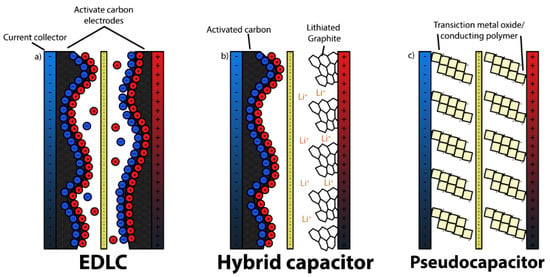
Figure 1 presents a comparative analysis of lead-acid, nickel-based, and lithium-ion batteries across key performance metrics from the reviewed literature. The data reveal that lithium-based batteries achieve the highest specific energy (90–190 Wh/kg) and efficiency (80–95%), whereas nickel-based batteries offer the widest cycle-life range (100–40,000 cycles) and lead-acid batteries provide the lowest cost ($50–200/kWh). These trade-offs motivate the hybridisation strategy discussed in Section 5.
Figure 1.
Comparison of supercapacitor architectures: (a) Electric double-layer capacitor (EDLC) with symmetric activated carbon electrodes storing charge electrostatically; (b) Hybrid capacitor combining capacitive (activated carbon) and battery-type (lithiated graphite) electrodes; (c) Pseudocapacitor employing transition metal oxide/conducting polymer electrodes for Faradaic charge storage.
The same data are also summarised in tabular form in Table 3 for quantitative reference.
Table 3.
Quantitative comparison of battery technologies.
3.2.1. Lead-Acid Batteries
Lead-acid batteries are among the earliest and most widely utilised rechargeable electrochemical devices, valued for low initial cost, high energy efficiency (>80%), and low self-discharge (≈2%/month at 25 °C). However, their low specific energy density (30–50 Wh/kg) and limited cycle life (≤1500 cycles) constrain their suitability for modern EVs. The toxic nature of lead necessitates careful recycling and disposal [8,40].
3.2.2. Nickel-Based Batteries
Nickel-based batteries encompass NiFe, NiCd, NiMH, and NiZn types. All use nickel hydroxide as the positive electrode with a KOH/LiOH electrolyte. They generally offer 50–95 Wh/kg. NiCd batteries endure up to 10,000 cycles but pose environmental risks due to cadmium toxicity, leading to EU usage restrictions [13]. NiMH batteries provide a high energy density and wide operating temperature range and are environmentally benign if disposed of properly [15].
3.2.3. Lithium-Ion Batteries
Lithium-ion batteries have become the preferred choice for EVs thanks to high specific energy (up to ≈285 Wh/kg at the cell level) and power densities of 250–1500 W/kg at pack level (high-power cells can reach 3000–4000 W/kg under short-duration pulse conditions) [30,36]. LIBs shuttle lithium ions between a graphite anode and a lithium metal oxide cathode (e.g., LiCoO2, LiMn2O4, LiFePO4) through an organic electrolyte. Despite their advantages, LIBs face capacity fade from SEI layer growth and safety concerns (thermal runaway), necessitating robust battery management systems (BMS) [41,42].
3.3. Hybrid Integration Rationale
By integrating EDLCs with lithium-ion batteries, hybrid systems leverage the strengths of both technologies. Supercapacitors handle peak power demands and regenerative braking while LIBs provide stable energy over extended periods. This combination enhances system efficiency, improves energy management, and extends the LIB lifespan by reducing stress on lithium-ion cells [27,43].
3.4. Global Battery Production and Regional Strategies
The EU, US, and China each have distinct approaches to battery production. The EU Battery Regulation promotes a circular economy with high recycling targets [44]. The US Inflation Reduction Act incentivises domestic manufacturing, while China dominates through subsidies and infrastructure investments.
Europe concentrates on high-energy-density NMC and NCA batteries, with research advancing toward solid-state cells [45]. China leads in LFP production, offering safety and cost advantages [46]. Geopolitical factors continue to shape the global supply chain, with EU and US efforts to diversify raw-material sources.
All three regions invest in next-generation technologies: the EU in solid-state batteries and improved recycling; the US in cost reduction via public–private partnerships; China in LFP/NMC expansion and sodium-ion exploration.
3.5. Recycling of Batteries and Second-Life Applications
The growing use of batteries has led to projections of over 500,000 metric tons of spent batteries annually by 2030 [47]. These contain hazardous materials (lithium, cobalt, nickel, lead) requiring careful management.
Lead-acid batteries are predominantly recycled via pyrometallurgical and hydrometallurgical methods with >95% lead recovery [48]. Li-ion recycling is more complex: pyrometallurgical methods recover Co, Ni, and Cu but achieve <50% lithium recovery [49]; hydrometallurgical processes exceed 90% for Co and Ni [50]. Overall Li-ion recycling efficiency is currently 50–70% [51,52].
The EU Battery Directive mandates minimum recycling efficiencies of 65% (by weight) for lead-acid and 50% for Li-ion batteries [53]. Mining lithium can consume up to 500,000 L of water per metric ton extracted [54]; recycling dramatically reduces water and energy consumption. Battery recycling can reduce greenhouse gas emissions by up to 50% compared to virgin material production [55]. The EU estimates that recycling could meet up to 30% of Europe’s demand for critical raw materials by 2030 [56].
Second-Life Applications
A critical element of circularity that extends beyond recycling is the repurposing of EV batteries for second-life applications. When LIBs degrade to approximately 70–80% of their original capacity, they are no longer optimal for automotive use but remain viable for less demanding stationary applications such as residential energy storage, grid peak shaving, and renewable-energy buffering [57,58]. Second-life use can extend the functional lifespan of a battery pack by 5–10 additional years, deferring recycling costs and further reducing raw-material extraction. Studies estimate that second-life deployment could offset 10–25% of new battery demand by 2035 [59]. Furthermore, HESS configurations that reduce high-stress cycling can slow degradation rates, thereby increasing the proportion of battery packs that qualify for second-life use.
Standardising battery components, developing universal recycling technologies, harmonising global regulations, and implementing producer responsibility schemes are essential strategies for overcoming current barriers [60]. Emerging technologies such as direct recycling (recovering cathode materials in their original form) and design-for-disassembly approaches promise to further improve efficiency and sustainability.
4. Supercapacitors for Electric Vehicles
Supercapacitors utilise a layered structure of two solid conductors with an electrolyte solution, resulting in energy storage capacities up to 20 times higher than traditional capacitors. They are increasingly utilised in transportation and industrial applications as high-power buffers. Compared to batteries, supercapacitors deliver 100–1000 times higher power density but store 3–30 times less energy [2,21].
Three main supercapacitor technologies are employed in EVs (Figure 2):
Figure 2.
Overview of supercapacitor types and their charge storage mechanisms. EDLCs store charge non-Faradaically via the electric double layer; pseudocapacitors employ Faradaic processes (redox, electrosorption); hybrid capacitors combine both mechanisms.
- 1.
- Electric Double-Layer Capacitors (EDLCs): Store charge via the electric double-layer capacitance at electrode/electrolyte interfaces. Nanoporous materials with high specific surface areas serve as active electrodes. EDLCs use a non-Faradaic process, offering high power density and very long cycle life [18,20].
- 2.
- Pseudocapacitors: Enhance energy density and specific capacitance beyond EDLCs by employing Faradaic processes—electrosorption, redox reactions, and intercalation. The pseudocapacitance effect depends on electrode pore structure and the chemical affinity of electrode materials to adsorbed ions. Charge stored increases approximately linearly with applied voltage [17,19,61].
- 3.
- Hybrid Supercapacitors: Combine battery-type and supercapacitor-type electrodes to achieve higher voltages and improved energy density. Often referred to as “asymmetric” systems, they utilise both Faradaic and non-Faradaic mechanisms. Sharma et al. demonstrated an asymmetric hybrid supercapacitor achieving enhanced energy density through optimised electrode pairing [62,63]. An illustration of hybrid capacitor application is the LIFE2M (Long LIFE to Micromobility) project, an EU-funded initiative developing innovative energy storage for micromobility vehicles. LIFE2M conducts pilot actions in Palermo, L’Aquila, and Florence, demonstrating hybrid capacitors’ potential to improve energy efficiency, extend vehicle lifespan, and reduce environmental impact [64].
Table 4 provides a comparative overview of the three supercapacitor types, including their architecture and key characteristics.
Table 4.
Comparison of EDLC, pseudocapacitor, and hybrid capacitor characteristics.
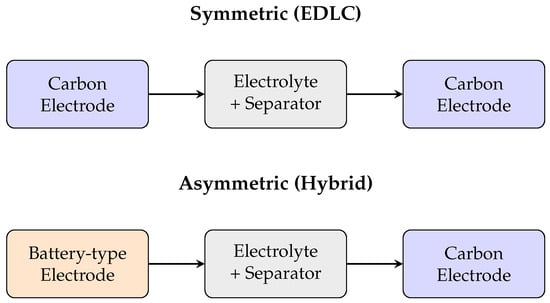
Figure 3 illustrates the electrode configurations for symmetric and asymmetric hybrid supercapacitor systems.
Figure 3.
Schematic illustration of symmetric (EDLC) and asymmetric (hybrid) supercapacitor electrode configurations.
5. Hybrid Energy Storage Systems
5.1. Rationale and Performance Benefits
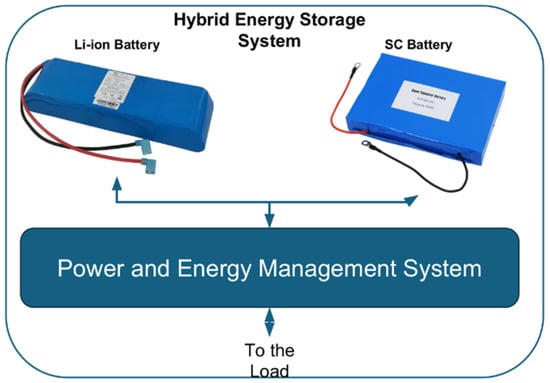
Hybrid Energy Storage Systems (HESS) integrate supercapacitors and batteries to leverage the complementary strengths of each technology [65,66]. In a HESS, supercapacitors handle short-duration, high-power events (acceleration, regenerative braking), while batteries provide sustained energy for long-distance travel. This separation of roles reduces electrical and thermal stress on the battery, extending its operational life by 30–50% and improving overall energy efficiency by up to 20% [28,43].
Table 5 summarises a comparative analysis of standalone battery systems versus HESS, drawing on simulation and modelling evidence from the reviewed literature.
Table 5.
Comparative performance: standalone battery vs. HESS configurations.
5.2. HESS Topologies and Trade-Offs
Figure 4.
HESS system architecture illustrating the integration of battery and supercapacitor subsystems with the vehicle powertrain.
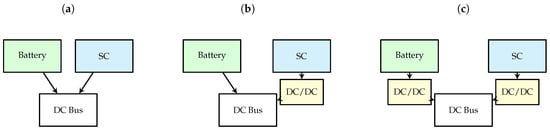
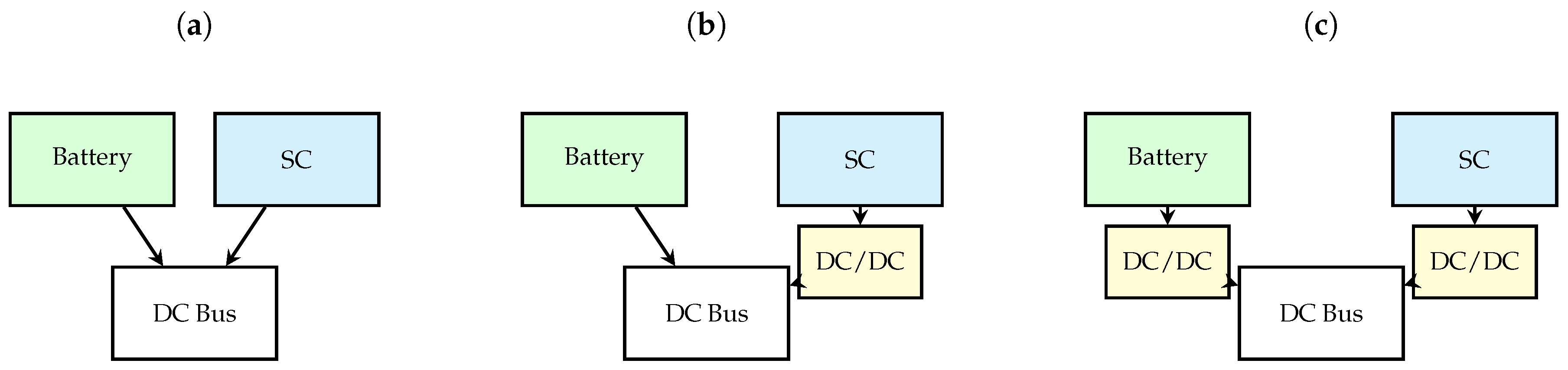
Passive topology: Battery and supercapacitor are connected directly in parallel without power electronics. This is the simplest and lowest-cost configuration but provides no independent control over power distribution; the voltage of both sources must be matched, and the supercapacitor’s energy utilisation is limited to approximately 25–35%.
Semi-active topology: A DC/DC converter is placed on either the supercapacitor branch (SC semi-active) or the battery branch (battery semi-active). The SC semi-active variant is more common because it allows full utilisation of the supercapacitor’s voltage range while keeping the battery on the DC bus directly. This provides moderate control flexibility at moderate cost and complexity.
Full-active topology: Both the supercapacitor and battery are interfaced through independent DC/DC converters, enabling full decoupling of voltage levels and independent power management. This topology maximises system performance and energy utilisation but incurs the highest cost and complexity.
Figure 5 provides detailed schematics of the three HESS topologies.
Figure 5.
HESS topology configurations: (a) passive, (b) semi-active, and (c) full-active.
Table 6 summarises the trade-offs among these topologies based on simulation and modelling evidence.
Table 6.
HESS topology comparison.
5.3. Control Strategies and Power-Split Algorithms
The effectiveness of HESS depends critically on the control strategy that governs power distribution between battery and supercapacitor. Key approaches identified in the literature include:
Rule-based strategies: Deterministic rules allocate high-frequency power transients to the supercapacitor and steady-state loads to the battery. Low-pass filtering of the load demand is a common implementation: the battery responds to the filtered (low-frequency) component while the supercapacitor handles the residual high-frequency component [65]. These strategies are simple to implement and computationally inexpensive but do not guarantee global optimality.
Optimisation-based strategies: Model predictive control (MPC) and dynamic programming (DP) optimise the power split over a prediction horizon, minimising battery degradation or energy consumption subject to SOC constraints. Simulation studies report 8–15% additional battery life extension compared to rule-based methods, albeit at higher computational cost [69].
Machine-learning approaches: Reinforcement learning and neural network controllers adapt the power split in real time based on learned driving patterns. Early results indicate efficiency comparable to DP-based solutions with significantly reduced online computation [70].
Without a well-designed control strategy, the theoretical benefits of HESS cannot be fully realised. The choice of strategy involves trade-offs among computational complexity, real-time feasibility, and optimality guarantees. Table 7 provides a structured comparison.
Table 7.
Comparison of HESS control strategies.
5.4. Circularity Implications of HESS
By buffering high-power transients, HESS configurations reduce the depth-of-discharge (DOD) variability and peak current stress experienced by the battery. This directly slows capacity fade and internal resistance growth, the two primary aging mechanisms in Li-ion cells. Quantitatively, studies have shown that limiting peak C-rate from 3 C to 1 C via SC buffering can reduce capacity fade by approximately 30% over 2000 equivalent full cycles [27].
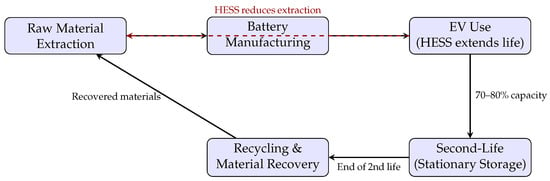
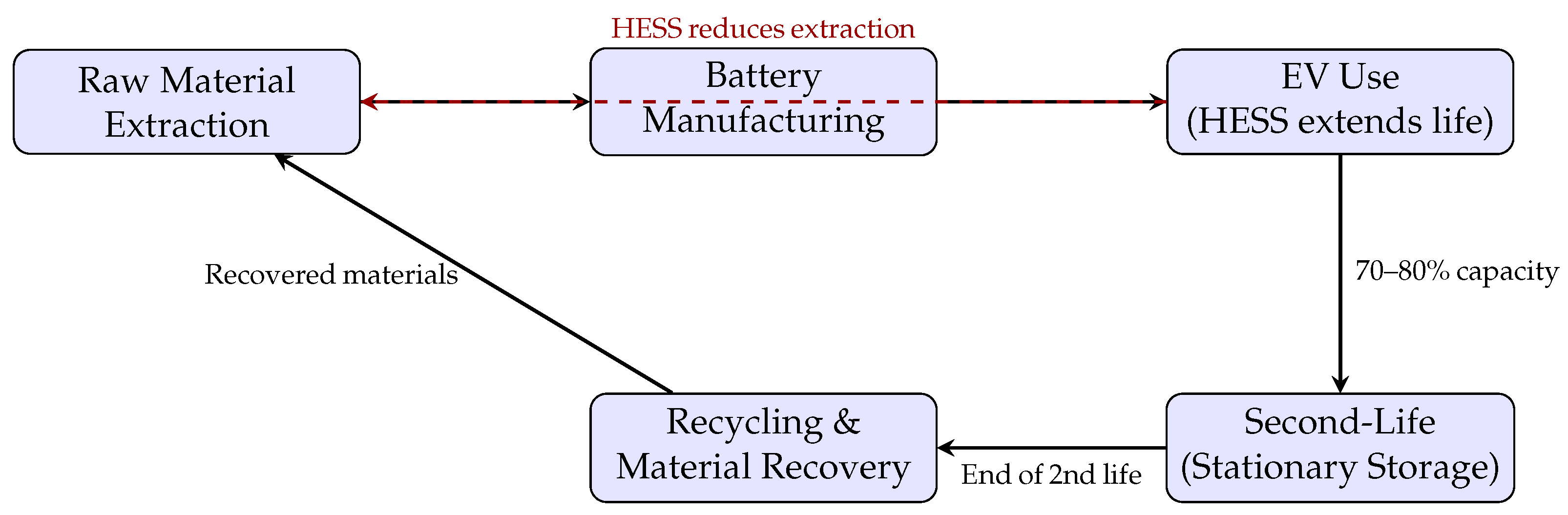
This life extension has concrete circular-economy implications (Figure 6):
Figure 6.
Circular-economy pathway for EV batteries enabled by HESS, illustrating battery life extension, second-life applications, and recycling.
- Reduced raw-material extraction: A 30–50% life extension implies that approximately 20–33% fewer battery packs are manufactured over a given vehicle fleet’s lifetime, directly reducing demand for lithium, cobalt, nickel, and graphite.
- Increased second-life eligibility: Batteries retired from HESS-equipped vehicles retain higher residual capacity (typically 75–80% vs. 65–70% for battery-only vehicles at the same mileage), making a larger fraction suitable for second-life stationary storage applications [57].
- Deferred recycling burden: Extended first and second lives defer the recycling processing load, allowing time for recycling technologies to mature and improve recovery rates.
- Reduced electronic waste: Fewer battery replacements translate to less hazardous waste entering the waste stream during the vehicle’s service life.
5.5. LIFE2M Project: Practical Relevance
The LIFE2M (Long LIFE to Micromobility) project [64] is an EU Horizon 2020 initiative that demonstrates the practical application of hybrid energy storage in micromobility vehicles. The project conducts pilot actions in Palermo, L’Aquila, and Florence to validate hybrid capacitor integration, measuring improvements in energy efficiency, vehicle lifespan, and environmental footprint. LIFE2M provides a concrete case study illustrating how HESS concepts translate from laboratory research to real-world deployment, particularly in urban micromobility contexts where frequent acceleration and braking cycles maximise the benefit of supercapacitor buffering.
5.6. Broader Applications
Advancements in materials and control technologies are expanding HESS use beyond EVs into renewable energy integration, grid stabilisation, and hybrid electric aircraft [71]. Regulatory frameworks, such as the EU’s stringent emissions regulations and green technology incentives, have accelerated HESS deployment in public transportation [72]. While initial investment is higher, long-term savings from reduced maintenance, extended battery life, and improved efficiency offset these costs, supporting sustainable development goals.
6. Results
6.1. Scoring Results
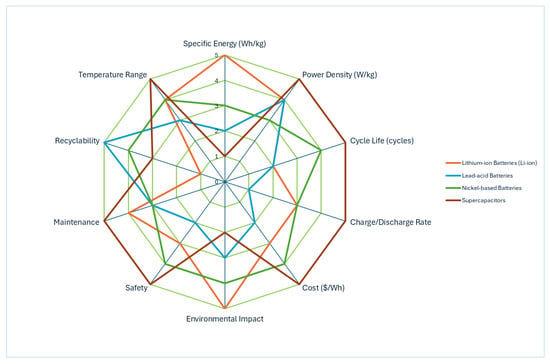
Based on the systematic literature review and the scoring framework described in Section 2.3, each technology was evaluated across ten criteria. Scores were assigned using the literature-derived performance ranges in Table 2. Table 8 presents the resulting comparative scoring matrix.
Table 8.
Comparative scoring of energy storage technologies (1 = least favourable, 5 = most favourable). Scores are derived from relative positioning within literature-reported ranges (Table 2).
- Key observations:
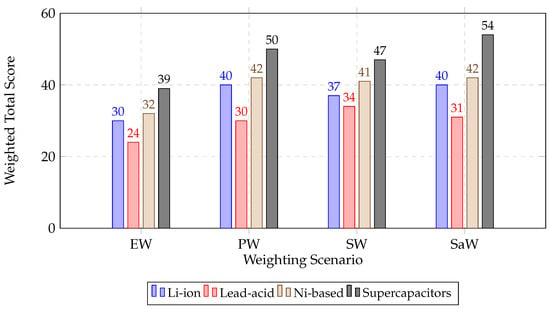
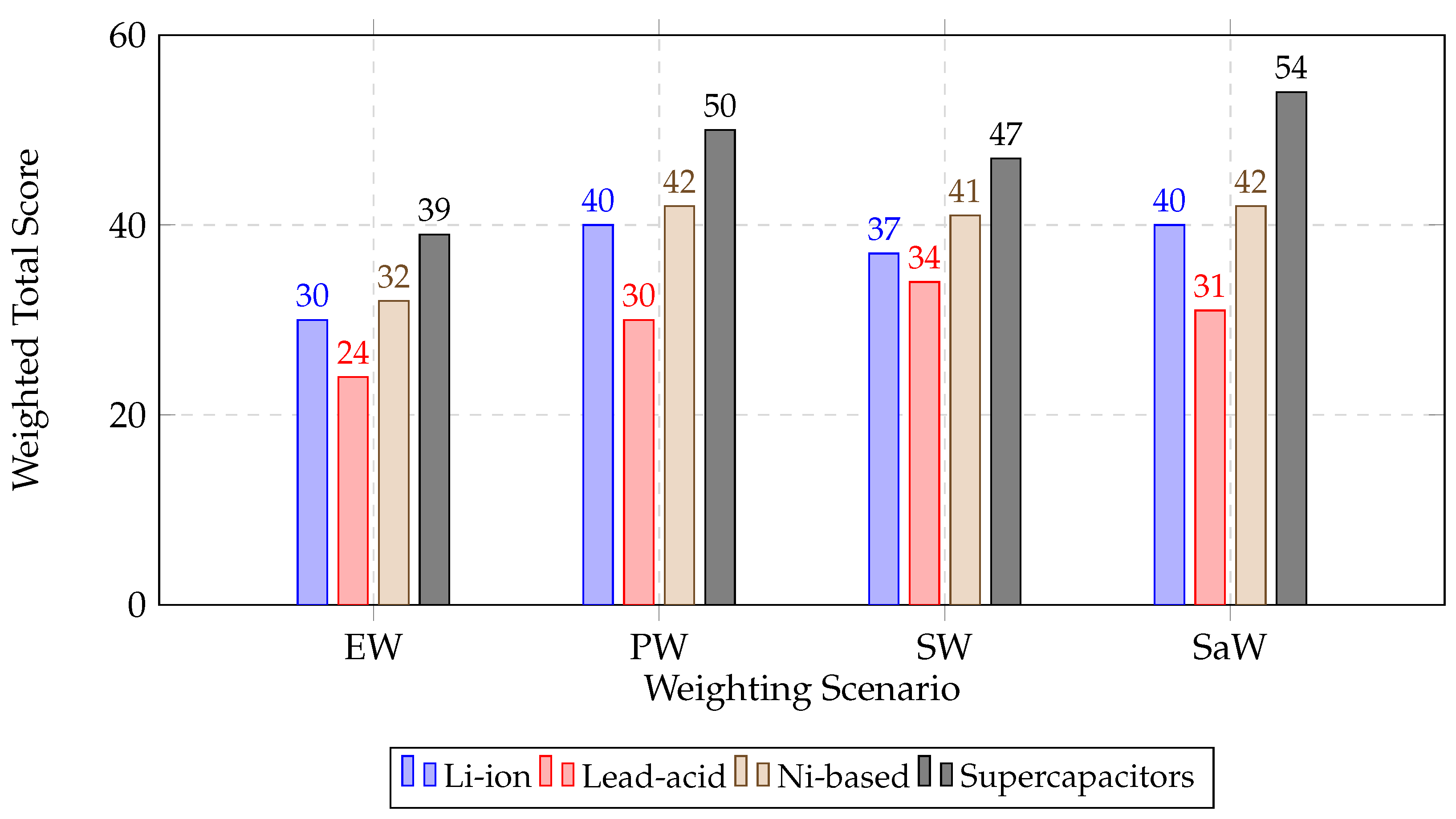
- Supercapacitors achieve the highest aggregate score (39/50) under equal weighting, driven by superior power density, cycle life, charge/discharge rate, safety, maintenance, and temperature range.
- Their lowest scores are in specific energy (1) and cost per Wh (1), confirming that they cannot serve as standalone propulsion storage.
- Lithium-ion batteries lead in specific energy (5) but score lower in cycle life (2), recyclability (2), and environmental impact (2).
- Lead-acid batteries rank highest in recyclability (5) and cost (4) but lowest in most other criteria.
- Nickel-based batteries offer balanced mid-range performance (total 32).
6.2. Sensitivity Analysis
To assess the robustness of the rankings, three alternative weighting scenarios were evaluated:
- 1.
- Performance-weighted (PW): Double weight on specific energy, power density, and cycle life; single weight on all others.
- 2.
- Sustainability-weighted (SW): Double weight on environmental impact, recyclability, and cost; single weight on all others.
- 3.
- Safety-weighted (SaW): Double weight on safety, temperature range, and maintenance; single weight on all others.
Table 9 summarises the weighted totals and resulting ranks.
Table 9.
Sensitivity analysis under alternative weighting scenarios.
Supercapacitors maintain the top rank across all scenarios, confirming that the conclusion is robust to weighting assumptions. Critically, this ranking reflects multi-criteria suitability across the ten selected dimensions. It does not imply that supercapacitors can replace batteries as the primary energy source in EVs. Their low specific energy precludes standalone use for vehicle propulsion. Instead, the ranking confirms their value as a complementary technology within HESS, where their strengths compensate for battery limitations (Figure 7).
Figure 7.
Weighted total scores under equal-weight (EW), performance-weighted (PW), sustainability-weighted (SW), and safety-weighted (SaW) scenarios.
7. Discussion
7.1. Interpretation of Scoring Results
The scoring results confirm the well-established complementarity between batteries and supercapacitors. Lithium-ion batteries dominate in specific energy—the single most critical parameter for driving range—scoring 5 compared to supercapacitors’ 1. This explains why every current commercial EV relies on lithium-ion (or, in legacy markets, lead-acid) batteries as the primary propulsion energy source. Supercapacitors, despite their top aggregate score, cannot replace batteries for this function.
Conversely, supercapacitors’ superior scores in power density (5), cycle life (5), charge/discharge rate (5), and safety (5) position them as the optimal technology for handling transient high-power events. In a HESS architecture, assigning these roles to the supercapacitor allows the battery to operate within a narrower, less stressful SOC window, thereby extending its useful life and improving system-level round-trip efficiency by 5–22% depending on topology (Table 6).
The sensitivity analysis demonstrates that the ordinal ranking (SC > Ni-based > Li-ion > Lead-acid) remains stable across performance-weighted, sustainability-weighted, and safety-weighted configurations. This stability arises because supercapacitors score highest on 6 of 10 criteria and are penalised only on two (specific energy and cost/Wh). Even when those two criteria receive double weighting, the advantage on the remaining criteria is sufficient to maintain the top rank.
7.2. Comparison with Existing Studies
The findings of this review align with and extend existing studies. Liu et al. [73] reported supercapacitor energy densities of 5–10 Wh/kg, reinforcing the complementary (rather than replacement) role relative to LIBs (100–265 Wh/kg). Qiu et al. [67] demonstrated up to 20% improvement in regenerative braking energy recovery with HESS, consistent with the 60–75% recovery rate in Table 5. Khalid [65] reviewed battery–supercapacitor hybrid systems for microgrids and confirmed the balanced power–energy delivery that HESS enables. Kularatna and Gunawardane [66] provided a comprehensive overview of rechargeable batteries and supercapacitors for renewable-energy systems, corroborating the complementary performance profiles identified here.
Where this review differs from prior work is in
- (i)
- The explicit multi-criteria scoring with sensitivity analysis, demonstrating ranking robustness;
- (ii)
- The integration of circularity and second-life considerations into the assessment framework;
- (iii)
- The critical comparison of HESS topologies and control strategies with quantified trade-offs;
- (iv)
- The lifecycle cost analysis that connects technical benefits to economic outcomes.
7.3. Lifecycle Cost Analysis
A critical dimension often missing from technology comparisons is lifecycle cost, which accounts for acquisition, operation, maintenance, replacement, and end-of-life processing over the vehicle’s service life. Table 10 presents an indicative lifecycle cost comparison for a representative mid-size EV over a 10-year/200,000 km service life.
Table 10.
Indicative lifecycle cost comparison for a mid-size EV (10-year, 200,000 km).
The analysis indicates that HESS can achieve 10–25% lifecycle cost savings relative to battery-only configurations, primarily through deferred or avoided battery replacement. These savings increase in applications with high-frequency power transients (e.g., urban stop-and-go driving, micromobility).
7.4. Quantifying the Link Between Life Extension and Raw-Material Savings
To move beyond qualitative assertions, a quantitative estimation is provided of how HESS-enabled battery life extension translates into reduced raw-material extraction. Consider a fleet of 1 million EVs, each with a 60 kWh NMC811 battery pack. Under battery-only operation, approximately 40% of packs require replacement within 10 years. Under HESS operation (30–50% life extension), this replacement rate drops to approximately 15–25%. Table 11 estimates the resulting material savings.
Table 11.
Estimated raw-material savings from HESS-enabled battery life extension (1 million EV fleet, 60 kWh NMC811 packs).
These savings directly reduce mining activity, water consumption, and associated ecological disruption, providing a quantifiable link between HESS technical performance and environmental sustainability.
7.5. Challenges and Limitations
Despite its advantages, HESS adoption faces several challenges:
- System complexity: Advanced power management systems are required for seamless operation and efficient energy distribution, increasing development costs.
- Weight and space: The inclusion of supercapacitors, control electronics, and cooling mechanisms adds to vehicle weight and volume, potentially affecting aerodynamics and range.
- Initial cost: The upfront investment for HESS is higher than for single-storage systems, which may hinder consumer adoption in price-sensitive markets.
- Standardisation gaps: Lack of standardised interfaces and form factors for supercapacitor modules in automotive applications creates integration barriers.
- Methodological limitations: The scoring framework, while informed by literature-derived ranges and subjected to sensitivity analysis, remains an ordinal comparative tool rather than a formal multi-criteria decision analysis (MCDA) with cardinal utility functions. Future work should apply MCDA methods such as TOPSIS or ELECTRE with stakeholder-derived preference weights to further strengthen the analytical rigour.
7.6. Future Outlook
Key innovations expected to transform HESS include
- Solid-state batteries: Higher energy densities, enhanced safety (no flammable liquid electrolyte), and longer lifespans.
- Graphene-based supercapacitors: Even higher power densities, faster charge–discharge cycles, and lightweight flexible form factors.
- Advanced thermal management: Phase-change materials and liquid cooling technologies to maintain optimal temperatures for both batteries and supercapacitors.
- AI-driven energy management: Reinforcement learning and neural network controllers for real-time adaptive power splitting, validated under standardised drive cycles (WLTP, US06, UDDS).
- Design for circularity: Modular battery packs designed for easy disassembly, second-life deployment, and material recovery, aligned with the EU Battery Regulation’s forthcoming requirements.
8. Conclusions
This review has provided a systematic comparative assessment of batteries (lithium-ion, lead-acid, nickel-based) and supercapacitors (EDLC, pseudocapacitor, hybrid) for electric vehicle applications, evaluated across ten performance and sustainability criteria. The principal conclusions are as follows:
- Complementarity, not substitution: Supercapacitors exhibit superior performance in power density, cycle life, charge/discharge rate, safety, and temperature range. However, their low specific energy (5–15 Wh/kg) precludes their use as a standalone replacement for lithium-ion batteries in EV propulsion. The two technologies are fundamentally complementary.
- HESS as the optimal architecture: Hybrid Energy Storage Systems that combine lithium-ion batteries with supercapacitors offer the most balanced solution, improving energy efficiency by up to 20%, extending battery life by 30–50%, and achieving 10–25% lifecycle cost savings through deferred or avoided battery replacement.
- Topology and control matter: Full-active HESS topologies with optimisation-based or machine-learning control strategies yield the greatest efficiency gains (18–22% over battery-only systems) but at higher cost and complexity. Semi-active topologies offer a practical compromise for mass-market applications.
- Circular-economy benefits: HESS-enabled battery life extension directly reduces raw-material extraction by 20–33% per fleet lifetime, increases the proportion of battery packs eligible for second-life applications, and defers recycling burden. Combined with advancing recycling technologies (targeting >90% recovery rates for key metals) and design-for-disassembly approaches, HESS contributes meaningfully to a circular economy for the EV sector.
- Robustness of findings: Sensitivity analysis under performance-weighted, sustainability-weighted, and safety-weighted scenarios confirms that the principal conclusions are stable across alternative weighting assumptions.
Future research should focus on:
- (i)
- solid-state battery and graphene supercapacitor integration within HESS;
- (ii)
- AI-driven adaptive energy management strategies validated under real-world drive cycles;
- (iii)
- standardised lifecycle assessment (LCA) methodologies that capture second-life and end-of-life value recovery;
- (iv)
- techno-economic modelling of HESS deployment at fleet scale under different regulatory regimes; and
- (v)
- formal MCDA with stakeholder-derived weighting to complement the ordinal scoring presented here.
Author Contributions
The manuscript was written through contributions of all authors. M.-S.G.: conceptualization, methodology, investigation, data curation, writing—original draft; M.L.: methodology, data curation, validation; S.A.: conceptualization, methodology, data curation, writing—review and editing; P.S.: writing—review and editing, supervision, project administration; D.V.: conceptualization, investigation, writing—review and editing, supervision, funding acquisition; D.B.: supervision, writing—review and editing. All authors have read and agreed to the published version of the manuscript.
Funding
This research was funded by the European Commission, LIFE Programme Grant no. 101074307.
Institutional Review Board Statement
Not applicable.
Informed Consent Statement
Not applicable.
Data Availability Statement
The data presented in this study are available on request from the corresponding author.
Acknowledgments
The authors sincerely acknowledge the valuable contributions of Marco Ciro Liscio for his careful review and refinement of the manuscript, and Martina Giurato for her support in data analysis and sustainability assessment. Their insightful input significantly strengthened the scientific quality and clarity of the final version of the manuscript. The authors also thank the European Commission for funding the LIFE2M project (LIFE Programme, Grant no. 101074307). The LIFE2M project develops hybrid energy storage solutions for micromobility vehicles and provided the practical context that motivated the comparative framework of this review. Readers interested in real-world pilot demonstrations of hybrid capacitor applications in micromobility may consult the project website [64].
Conflicts of Interest
The authors declare no conflict of interest.
References
- Conway, B.E. Electrochemical Supercapacitors: Scientific Fundamentals and Technological Applications; Springer: New York, NY, USA, 1999. [Google Scholar]
- Simon, P.; Gogotsi, Y. Materials for electrochemical capacitors. Nat. Mater. 2008, 7, 845–854. [Google Scholar] [CrossRef] [Scilit]
- Yang, C.; Xia, J.; Cui, C.; Pollard, T.P.; Vatamanu, J.; Faber, A.; Borodin, O.; Xu, K. Roll-to-roll prelithiation of lithium-ion battery anodes by transfer printing. Nat. Energy 2023, 8, 703–713. [Google Scholar] [CrossRef] [Scilit]
- Han, C.; He, Y.-B.; Li, B.; Li, H.; Ma, J.; Du, H.; Qin, X.; Yang, Q.-H.; Kang, F. Nanostructured anode materials for non-aqueous lithium ion hybrid capacitors. Energy Environ. Mater. 2018, 1, 75–87. [Google Scholar] [CrossRef] [Scilit]
- Orangi, S.; Manjong, N.B.; Cai, H.; Strömman, A.H. A bottom-up framework to investigate environmental and techno-economic aspects of lithium-ion batteries. J. Clean. Prod. 2024, 478, 143934. [Google Scholar] [CrossRef] [Scilit]
- Robin, R.J.; Isakovic, A.F. Viability and eco-consequences of synthetic and natural graphite for Li-ion battery anodes in the US. IEEE Eng. Manag. Rev. 2024, 52, 131–147. [Google Scholar]
- Rahmani, A.; Dibaj, M.; Akrami, M. Recent advancements in battery thermal management systems for enhanced performance of Li-ion batteries: A comprehensive review. Batteries 2024, 10, 265. [Google Scholar] [CrossRef] [Scilit]
- Pavlov, D. Lead-Acid Batteries: Science and Technology; Elsevier: Amsterdam, The Netherlands, 2011. [Google Scholar]
- Juanico, D.E.O. Revitalizing lead-acid battery technology: A comprehensive review. Front. Batter. Electrochem. 2024, 2, 1268412. [Google Scholar] [CrossRef] [Scilit]
- Njema, G.G.; Ouma, R.B.O.; Kibet, J.K. A review on the recent advances in battery development and energy storage technologies. J. Renew. Energy 2024, 2024, 2329261. [Google Scholar] [CrossRef] [Scilit]
- Garche, J. Advanced battery systems—The end of the lead-acid battery? Phys. Chem. Chem. Phys. 2001, 3, 356–367. [Google Scholar] [CrossRef] [Scilit]
- Singh, A.; Karandikar, P.B.; Kulkarni, N.R. Mitigation of sulfation in lead acid battery towards life time extension using ultra capacitor in hybrid electric vehicle. J. Energy Storage 2021, 34, 102219. [Google Scholar] [CrossRef] [Scilit]
- Shukla, A.K.; Venugopalan, S.; Hariprakash, B. Nickel-based rechargeable batteries. J. Power Sources 2001, 100, 125–148. [Google Scholar] [CrossRef] [Scilit]
- Sujitha, N.; Krithiga, S. RES based EV battery charging system: A review. Renew. Sustain. Energy Rev. 2017, 75, 978–988. [Google Scholar] [CrossRef] [Scilit]
- Ross, S.R.; Plichta, E.J. A nickel metal hydride battery for electric vehicles. Science 1993, 260, 176–181. [Google Scholar] [CrossRef] [Scilit]
- Hadjipaschalis, I.; Poullikkas, A.; Efthimiou, V. Overview of current and future energy storage technologies for electric power applications. Renew. Sustain. Energy Rev. 2009, 13, 1513–1522. [Google Scholar] [CrossRef] [Scilit]
- Saini, P.; Garg, A.; Saha, D. A historical review of electrode materials and electrolytes for electrochemical double layer supercapacitors and pseudocapacitors. Indian J. Pure Appl. Phys. 2023, 61, 268–290. [Google Scholar] [CrossRef] [Scilit]
- Minakshi, M.; Wickramaarachchi, K. Electrochemical aspects of supercapacitors in perspective: From electrochemical double-layer capacitors to hybrid systems. In Supercapacitors for the Next Generation; IntechOpen: London, UK, 2021. [Google Scholar]
- Minakshi, M.; Samayamanthry, A.; Whale, J.; Aughterson, R.; Shende, R. Phosphorous-containing activated carbon derived from natural honeydew for pseudocapacitor electrode. J. Energy Storage 2023, 73, 108902. [Google Scholar]
- Wickramaarachchi, K.; Minakshi, M. Consequences of electrodeposition parameters on the microstructure and electrochemical behavior of electrolytic manganese dioxide (EMD) for supercapacitor. Ceram. Int. 2022, 48, 19913–19924. [Google Scholar] [CrossRef] [Scilit]
- Zorpette, G. Super charged [ultracapacitors]. IEEE Spectr. 2005, 42, 32–37. [Google Scholar] [CrossRef] [Scilit]
- Almadani, M.; Oni, O.E.; Longe, O.M.; Olatomiwa, L. Comparison of battery chemistries for electric vehicle applications. In Proceedings of the 5th African International Conference on Industrial Engineering and Operations Management, Johannesburg, South Africa, 23–25 April 2024. [Google Scholar]
- Kumar, A. A comprehensive review of an electric vehicle based on the existing technologies and challenges. Energy Storage 2024, 6, e70000. [Google Scholar] [CrossRef] [Scilit]
- Malik, G.R.; Reddy, K.V.T.; Reddy, Y.P.K.; Vinod, A.; Krishna, S.; KH, V.; VC, J.S. Future of energy storage: Advancements in lithium-ion batteries and hybrid vehicle technologies. In Proceedings of the 2024 7th International Conference on Circuit Power and Computing Technologies (ICCPCT); IEEE: Piscataway, NJ, USA, 2024. [Google Scholar]
- Gilev, B.; Andreev, M.; Hinov, N.; Angelov, G. Modeling and simulation of a low-cost fast charging station based on a micro gas turbine and a supercapacitor. Energies 2022, 15, 8020. [Google Scholar] [CrossRef] [Scilit]
- Liu, L.; Yu, Y.; Yan, C.; Li, K.; Zheng, Z. Wearable energy-dense and power-dense supercapacitor yarns enabled by scalable graphene–metallic textile composite electrodes. Nat. Commun. 2015, 6, 7260. [Google Scholar] [CrossRef] [Scilit]
- Wasim, M.S.; Habib, S.; Amjad, M.; Bhatti, A.R.; Ahmed, E.M.; Qureshi, M.A. Battery-ultracapacitor hybrid energy storage system to increase battery life under pulse loads. IEEE Access 2022, 10, 20793–20803. [Google Scholar] [CrossRef] [Scilit]
- Yang, Z.; Huang, H.; Lin, F. Sustainable electric vehicle batteries for a sustainable world: Perspectives on battery cathodes, environment, supply chain, manufacturing, life cycle, and policy. Adv. Energy Mater. 2022, 12, 2200383. [Google Scholar] [CrossRef] [Scilit]
- Paul, J.; Lim, W.M.; O’Cass, A.; Hao, A.W.; Bresciani, S. Scientific procedures and rationales for systematic literature reviews (SPAR-4-SLR). Int. J. Consum. Stud. 2021, 45, O1–O16. [Google Scholar] [CrossRef] [Scilit]
- Nitta, N.; Wu, F.; Lee, J.T.; Yushin, G. Li-ion battery materials: Present and future. Mater. Today 2015, 18, 252–264. [Google Scholar] [CrossRef] [Scilit]
- Béguin, F.; Frackowiak, E. Carbon materials for the electrochemical storage of energy in capacitors. Carbon 2001, 39, 937–950. [Google Scholar] [CrossRef] [Scilit]
- Tomaszewska, A.; Chu, Z.; Feng, X.; O’Kane, S.; Liu, X.; Chen, J.; Ji, C.; Endber, E.; Li, R.; Liu, L.; et al. Lithium-ion battery fast charging: A review. eTransportation 2019, 1, 100011. [Google Scholar] [CrossRef] [Scilit]
- Armand, M.; Tarascon, J.-M. Building better batteries. Nature 2008, 451, 652–657. [Google Scholar] [CrossRef] [Scilit] [PubMed]
- BloombergNEF. Lithium-Ion Battery Pack Prices See Largest Drop Since 2017. BloombergNEF, 10 December 2024. Available online: https://about.bnef.com/insights/commodities/lithium-ion-battery-pack-prices-see-largest-drop-since-2017-falling-to-115-per-kilowatt-hour-bloombergnef/ (accessed on 15 January 2025).
- Gaines, L. The future of automotive lithium-ion battery recycling: Charting a sustainable course. Sustain. Mater. Technol. 2014, 1–2, 2–7. [Google Scholar] [CrossRef] [Scilit]
- Goodenough, J.B.; Park, K.-S. The Li-ion rechargeable battery: A perspective. J. Am. Chem. Soc. 2013, 135, 1167–1176. [Google Scholar] [CrossRef] [Scilit]
- Sharma, P.; Bhatti, T.S. A review on electrochemical double-layer capacitors. Energy Convers. Manag. 2010, 51, 2901–2912. [Google Scholar] [CrossRef] [Scilit]
- Dong, W.; Xie, M.; Zhao, S.; Qin, Q.; Huang, F. Materials design and preparation for high energy density and high power density electrochemical supercapacitors. Mater. Sci. Eng. R 2023, 152, 100713. [Google Scholar] [CrossRef] [Scilit]
- Libich, J.; Sedlaříková, M.; Máca, J.; Čudek, P.; Kazda, T.; Fafilek, G.; Rodríguez, J.J.S. Supercapacitors vs. lithium-ion batteries: Properties and applications. Chem. Ing. Tech. 2024, 96, 279–285. [Google Scholar] [CrossRef] [Scilit]
- Spanos, C.; Turney, D.E.; Fthenakis, V. Life-cycle analysis of flow-assisted nickel zinc-, manganese dioxide-, and valve-regulated lead-acid batteries designed for demand-charge reduction. Renew. Sustain. Energy Rev. 2015, 43, 478–494. [Google Scholar] [CrossRef] [Scilit]
- Scrosati, B. History of lithium batteries. J. Solid State Electrochem. 2011, 15, 1623–1630. [Google Scholar] [CrossRef] [Scilit]
- Crabtree, G.; Kócs, E.; Trahey, L. The energy-storage frontier: Lithium-ion batteries and beyond. MRS Bull. 2015, 40, 1067–1078. [Google Scholar] [CrossRef] [Scilit]
- He, X.; Xiao, G.; Hu, B.; Tan, L.; Tang, H.; He, S.; He, Z. The applications of energy regeneration and conversion technologies based on hydraulic transmission systems: A review. Energy Convers. Manag. 2020, 205, 112413. [Google Scholar] [CrossRef] [Scilit]
- Baars, J.; Domenech, T.; Bleischwitz, R.; Melin, H.E.; Heidrich, O. Circular economy strategies for electric vehicle batteries reduce reliance on raw materials. Nat. Sustain. 2021, 4, 71–79. [Google Scholar] [CrossRef] [Scilit]
- Schade, W.; Haug, I.; Berthold, D. The Future of the Automotive Sector: Emerging Battery Value Chains in Europe; ETUI Research Paper—Report; European Trade Union Institute (ETUI): Brussels, Belgium, 2022. [Google Scholar]
- Feng, Y.; Zhou, L.; Ma, H.; Wu, Z.; Zhao, Q.; Li, H.; Zhang, K.; Chen, J. Challenges and advances in wide-temperature rechargeable lithium batteries. Energy Environ. Sci. 2022, 15, 1711–1759. [Google Scholar] [CrossRef] [Scilit]
- Noudeng, V.; Van Quan, N.; Xuan, T.D. A future perspective on waste management of lithium-ion batteries for electric vehicles in Lao PDR: Current status and challenges. Int. J. Environ. Res. Public Health 2022, 19, 16592. [Google Scholar] [CrossRef] [Scilit]
- Neumann, J.; Petranikova, M.; Meeus, M.; Gamarra, J.D.; Younesi, R.; Winter, M.; Nowak, S. Recycling of lithium-ion batteries—Current state of the art, circular economy, and next generation recycling. Adv. Energy Mater. 2022, 12, 2102917. [Google Scholar] [CrossRef] [Scilit]
- Makuza, B.; Tian, Q.; Guo, X.; Chattopadhyay, K.; Yu, D. Pyrometallurgical options for recycling spent lithium-ion batteries: A comprehensive review. J. Power Sources 2021, 491, 229622. [Google Scholar] [CrossRef] [Scilit]
- He, M.; Jin, X.; Zhang, X.; Duan, X.; Zhang, P.; Teng, L.; Liu, Q.; Liu, W. Combined pyro-hydrometallurgical technology for recovering valuable metal elements from spent lithium-ion batteries: A review. Green Chem. 2023, 25, 6561–6580. [Google Scholar] [CrossRef] [Scilit]
- Jin, S.; Mu, D.; Lu, Z.; Li, R.; Liu, Z.; Wang, Y.; Tian, S.; Dai, C. A comprehensive review on the recycling of spent lithium-ion batteries: Urgent status and technology advances. J. Clean. Prod. 2022, 340, 130535. [Google Scholar] [CrossRef] [Scilit]
- Golmohammadzadeh, R.; Faraji, F.; Jong, B.; Pozo-Gonzalo, C.; Banerjee, P.C. Current challenges and future opportunities toward recycling of spent lithium-ion batteries. Renew. Sustain. Energy Rev. 2022, 159, 112202. [Google Scholar] [CrossRef] [Scilit]
- Ciez, R.E.; Whitacre, J.F. Examining different recycling processes for lithium-ion batteries. Nat. Sustain. 2019, 2, 148–156. [Google Scholar] [CrossRef] [Scilit]
- Luong, J.H.T.; Tran, C.; Ton-That, D. A paradox over electric vehicles, mining of lithium for car batteries. Energies 2022, 15, 7997. [Google Scholar] [CrossRef] [Scilit]
- Lima, M.; Mendes, L.F.R.; Mothé, G.A.; Linhares, F.G.; De Castro, M.P.P.; Da Silva, M.G.; Sthel, M.S. Renewable energy in reducing greenhouse gas emissions: Reaching the goals of the Paris agreement in Brazil. Environ. Dev. 2020, 33, 100504. [Google Scholar] [CrossRef] [Scilit]
- Yi, C.L. Impact of the EU Battery Regulation on Circular Economy of EV Batteries—Barriers and Opportunities for Battery Repurposing. Master’s Thesis, KTH School of Electrical Engineering and Computer Science, Stockholm, Sweden, 2023. [Google Scholar]
- Martínez-Laserna, E.; Gandiaga, I.; Sarasketa-Zabala, E.; Badeda, J.; Stroe, D.-I.; Swierczynski, M.; Goikoetxea, A. Battery second life: Hype, hope or reality? A critical review of the state of the art. Renew. Sustain. Energy Rev. 2018, 93, 701–718. [Google Scholar] [CrossRef] [Scilit]
- Casals, L.C.; García, B.A.; Canal, C. Second life batteries lifespan: Rest of useful life and environmental analysis. J. Environ. Manag. 2019, 232, 354–363. [Google Scholar] [CrossRef] [Scilit] [PubMed]
- Engel, H.; Hertzke, P.; Siccardo, G. Second-Life EV Batteries: The Newest Value Pool in Energy Storage; McKinsey & Company: New York, NY, USA, 2019. [Google Scholar]
- Barkhausen, R.; Fick, K.; Durand, A.; Rohde, C. Analysing policy change towards the circular economy at the example of EU battery legislation. Renew. Sustain. Energy Rev. 2023, 169, 112920. [Google Scholar] [CrossRef] [Scilit]
- Chidembo, A.T. Advanced Graphene-Metal Oxide Nanostructured Composites for Supercapacitors. Doctoral Dissertation, University of Wollongong, Wollongong, Australia, 2014. [Google Scholar]
- Minakshi, M.; Higley, S.; Baur, C.; Mitchell, D.R.G.; Jones, R.T.; Fichtner, M. Calcined chicken eggshell electrode for battery and supercapacitor applications. RSC Adv. 2021, 9, 26981–26990. [Google Scholar] [CrossRef] [Scilit]
- Sharma, R.; Kumar, H.; Kumar, G.; Sharma, S.; Aneja, R.; Sharma, A.K.; Kumar, P. Progress in electrode and electrolyte materials: Path to all-solid-state Li-ion batteries. J. Energy Storage 2025, 120, 120116. [Google Scholar] [CrossRef] [Scilit]
- LIFE2M. Long LIFE to Micromobility. Available online: https://www.life2m.eu/ (accessed on 10 December 2024).
- Khalid, M. A review on the selected applications of battery-supercapacitor hybrid energy storage systems for microgrids. Energies 2019, 12, 4559. [Google Scholar] [CrossRef] [Scilit]
- Kularatna, N.; Gunawardane, K. Energy Storage Devices for Renewable Energy-Based Systems: Rechargeable Batteries and Supercapacitors; Academic Press: Cambridge, MA, USA, 2021. [Google Scholar]
- Qiu, C.; Wang, G.; Meng, M.; Shen, Y. New evaluation methodology of regenerative braking contribution to energy efficiency improvement of electric vehicles. Energy Convers. Manag. 2016, 119, 389–398. [Google Scholar] [CrossRef] [Scilit]
- Mayingi, B.A.; Puati Zau, A.T.; Chowdhury, S.P.D.; Ngoma, L.J. Design of an improved hybrid lithium-ion-ultracapacitor energy storage system for transport vehicles. Electr. Power Compon. Syst. 2023, 51, 1283–1297. [Google Scholar] [CrossRef] [Scilit]
- Song, Z.; Li, J.; Hou, J.; Hofmann, H.; Ouyang, M.; Du, J. The battery-supercapacitor hybrid energy storage system in electric vehicle applications: A case study. Energy 2020, 154, 433–441. [Google Scholar]
- Hussain, S.; Ali, M.U.; Park, G.-S.; Nengroo, S.H.; Khan, M.A.; Kim, H.-J. A real-time bi-adaptive controller-based energy management system for battery–supercapacitor hybrid electric vehicles. Energies 2024, 12, 4662. [Google Scholar]
- Nadeem, F.; Hussain, S.S.; Tiwari, P.K.; Goswami, A.K.; Ustun, T.S. Comparative review of energy storage systems, their roles, and impacts on future power systems. IEEE Access 2018, 6, 68985–69004. [Google Scholar]
- Hess, D.J. Conservative political parties and energy transitions in Europe: Opposition to climate mitigation policies. Renew. Sustain. Energy Rev. 2019, 104, 419–428. [Google Scholar] [CrossRef] [Scilit]
- Liu, C.; Yu, Z.; Neff, D.; Zhamu, A.; Jang, B.Z. Graphene-based supercapacitor with an ultrahigh energy density. Nano Lett. 2010, 10, 4863–4868. [Google Scholar] [CrossRef] [Scilit] [PubMed]

Disclaimer/Publisher’s Note: The statements, opinions and data contained in all publications are solely those of the individual author(s) and contributor(s) and not of MDPI and/or the editor(s). MDPI and/or the editor(s) disclaim responsibility for any injury to people or property resulting from any ideas, methods, instructions or products referred to in the content. |
© 2026 by the authors. Licensee MDPI, Basel, Switzerland. This article is an open access article distributed under the terms and conditions of the Creative Commons Attribution (CC BY) license.