1. Introduction
Rapid urbanization has powered economic growth in China, yet it has also concentrated environmental risks in ways that raise concerns about environmental inequality. Air pollution remains a salient public health hazard, and sustained exposure can translate into large welfare and longevity losses [
1]. At the same time, China has experienced meaningful improvements in urban environmental quality, alongside persistent disparities across places and groups [
2]. In this paper, we use the term pollution inequality to refer to dispersion in pollution outcomes across cities within the same metropolitan area, i.e., inequality across jurisdictions rather than inequality in individual exposure or disparities across socioeconomic groups. Empirically, we operationalize this concept by constructing within-metropolitan entropy-based indices (Theil-type measures) computed across member cities for both city-level total emissions (pollution scale) and emissions per unit of economic output (pollution intensity). From a sustainability perspective, the question is no longer only whether cities become cleaner on average, but also whether the benefits of cleaner growth are shared more evenly within integrated urban systems. Uneven pollution burdens within the same metropolitan system can become a governance constraint. When pollution is concentrated in a subset of member cities, incentives for joint prevention and control may weaken, disputes over responsibility and compensation become more salient, and pollution leakage across borders becomes more likely. As a result, sustainability gains can be less durable and less inclusive even if average concentrations decline.
This distributional perspective aligns closely with the United Nations Sustainable Development Goals (SDGs) framework, which underscores that the quality of economic and environmental progress is as important as its magnitude. Specifically, our focus on narrowing inter-city pollution gaps directly speaks to SDG 10 (Reduced Inequalities), which aims to empower and promote the social, economic, and political inclusion of all, irrespective of their geographic or developmental status [
3]. Persistent environmental disparities suggest that peripheral jurisdictions may be excluded from the benefits of green growth, turning into “pollution havens” that undermine the principle of “leaving no one behind” [
4]. Furthermore, this study contributes to SDG 11 (Sustainable Cities and Communities), which calls for supporting positive economic, social, and environmental links through strengthened national and regional development planning. By examining whether metropolitan integration acts as a catalyst for environmental equalization, we address a critical dimension of sustainable urban development: ensuring that the transition toward a low-carbon economy is inclusive and that environmental gains are not spatially polarized [
5,
6].
A central tension is that agglomeration economies can plausibly push distributional outcomes in opposite directions. On one hand, denser markets and specialization may concentrate polluting activity in particular jurisdictions, especially when regulation and enforcement differ across local governments [
7]. Infrastructure connectivity can also reshape the geography of emissions by reallocating production and mobility, with measurable spillovers across cities [
8]. On the other hand, integration can create conditions for coordinated environmental governance, technology diffusion, and more uniform standards, thereby narrowing internal gaps [
9]. Recent evidence from national clean air actions further suggests that policy efforts can reduce not only pollution levels but also pollution inequality [
10]. Whether metropolitan integration tilts the balance toward divergence or convergence is therefore an open empirical question.
Existing research has made important progress on urban pollution dynamics and policy evaluation, yet most studies emphasize average concentration changes at the city or regional level rather than the dispersion of environmental burdens within multi-city metropolitan systems. This gap matters because environmental justice concerns are inherently distributional, and unequal exposure can persist even when aggregate pollution falls [
5]. In China, metropolitan development planning has become a prominent policy instrument aimed at strengthening regional integration, factor mobility, and coordinated development [
11]. However, evidence remains limited on whether integration initiatives reshape within-agglomeration pollution inequality across constituent cities, and through which channels such equalization might occur.
This study addresses the gap by examining how metropolitan integration intensity relates to within-agglomeration pollution inequality in Chinese urban agglomerations from 2005 to 2023. We focus on this window for a data-and-institutions reason. National industrial emissions statistics, including industrial SO
2, are publicly reported from 2003 onward, but the coverage and consistency needed to construct comparable within-metropolitan inequality measures become substantially more complete after 2005. The end year is determined by the most recent year available in our assembled metropolitan panel. We construct measures of pollution inequality at the metropolitan area–year level using entropy-based dispersion indices for both emission scale and emission intensity. Integration intensity is captured by a policy-attention measure interacted with exposure time since integration onset. Empirically, we estimate two-way fixed-effects models and dynamic event-study specifications to trace outcome trajectories around integration initiation, while remaining mindful of recent guidance on event-study identification under heterogeneous effects [
12]. To further mitigate endogeneity concerns, we complement the panel strategy with an instrumental-variables design that leverages predetermined historical connectivity interacted with exposure time. This approach is aligned with a growing literature that uses quasi-natural experiments to evaluate the environmental consequences of large-scale urban integration policies [
13].
Our results consistently show that higher integration intensity is associated with lower within-agglomeration pollution inequality for both emission scale and emission intensity. Dynamic estimates show no evidence of differential pre-trends and indicate persistent declines after integration onset. Instrumented estimates corroborate the negative relationship and suggest that endogeneity is unlikely to fully explain the baseline pattern. The inequality-reducing relationship is most evident in metropolitan areas featuring high-primacy and high-ranking core cities, and it varies systematically with local economic conditions: fiscal capacity and factor market integration strengthen the relationship, whereas industrial lock-in dampens it.
The paper contributes to the sustainability-oriented urban economics literature in three ways. First, it shifts attention from average pollution outcomes to within-metropolitan distribution, providing evidence on whether integration can improve environmental equity inside urban agglomerations. Second, it links metropolitan integration policies to environmental inequality, clarifying when integration translates into shared environmental benefits across member cities. Third, by combining dynamic panel evidence with a historically grounded instrument, it strengthens the credibility of causal interpretation in a setting where policy timing and intensity vary across metropolitan areas. This paper is structured as follows.
Section 2 reviews the related literature and develops the hypotheses.
Section 3 describes the institutional background, data sources, variable construction, and the empirical strategy.
Section 4 presents the main findings, including baseline estimates, dynamic evidence, instrumental-variables results, robustness checks, and heterogeneity analyses.
Section 5 concludes and discusses implications.
2. Literature Review and Hypothesis Development
2.1. Pollution Inequality Within Metropolitan Systems
A growing body of research emphasizes that the distribution of environmental burdens is an integral part of evaluating environmental performance, because reductions in average pollution can coexist with persistent or even widening disparities across space and groups. Recent work emphasizes that inequality in exposure and emissions often reflects uneven industrial location, heterogeneous regulatory capacity, and differences in public demand for environmental quality across jurisdictions, especially in rapidly urbanizing economies [
14,
15]. In this study, pollution inequality refers to dispersion in pollution outcomes across cities within the same metropolitan area, rather than disparities in individual exposure or differences across socioeconomic groups. This jurisdiction-level perspective is closely tied to environmental governance in practice because enforcement capacity, regulatory coordination, and inter-city bargaining operate through local governments. When burdens are uneven across member cities, coordination can be harder to sustain and leakage incentives can be stronger, making within-metropolitan dispersion directly relevant for sustainable and equitable urban development. In China, metropolitan areas provide a particularly relevant context for studying distributional outcomes because they bundle multiple prefecture-level cities with distinct development profiles under a shared functional region, while administrative boundaries continue to shape fiscal incentives and policy implementation.
Within a metropolitan area, pollution inequality can emerge through several channels. First, the relocation of pollution-intensive activity toward peripheral jurisdictions can reduce average pollution in core cities but increase within-region dispersion [
7]. Second, differences in labor and capital mobility can amplify spatial sorting as firms respond to heterogeneous enforcement and factor costs [
16]. Third, unequal access to cleaner technologies and abatement inputs can generate persistent gaps in emissions intensity even when production scales converge [
17]. These mechanisms motivate examining not only whether environmental conditions improve, but also whether environmental burdens become more evenly shared across cities within an integrated metropolitan system.
2.2. Metropolitan Integration and Environmental Outcomes
Metropolitan integration is commonly framed as a process that strengthens economic linkages and spatial connectivity within a functional urban region, often supported by policy coordination and investments in transport and governance platforms. A related empirical literature evaluates how region-building initiatives, transport integration, and market integration influence environmental outcomes. Evidence from China suggests that integrated infrastructure and connectivity can reduce air pollution by improving allocation efficiency, facilitating technology diffusion, and enabling coordinated regulation [
9,
18,
19]. Studies focusing on collaborative governance further show that cross-jurisdictional coordination can strengthen environmental policy implementation and reduce pollution by mitigating enforcement gaps across neighboring cities [
20,
21,
22].
At the same time, integration can also intensify economic activity and reshape industrial organization, creating ambiguous effects on pollution if expansion dominates abatement. This ambiguity parallels the broader literature on growth, structural change, and environmental quality, which highlights that institutional capacity and policy design shape whether development leads to cleaner outcomes [
17]. For metropolitan areas, the key question is therefore not only whether integration affects average pollution, but whether it changes the internal distribution of pollution burdens among member cities.
Recent studies further enrich this governance-oriented perspective by documenting sustainability-relevant patterns within China’s major urban agglomerations. For example, evidence from the three leading urban agglomerations highlights how agglomeration-wide spatial structure and planning-related features are systematically associated with fine-particulate pollution outcomes, underscoring the policy relevance of region-scale coordination beyond single-city interventions [
23,
24]. Complementary work emphasizes that urban agglomerations are also the operational arena where coordinated carbon reduction and pollution control can generate measurable synergy, thereby motivating governance designs that align cross-city targets, monitoring capacity, and implementation incentives [
25,
26]. Together, these recent contributions support the view that environmental governance in urban agglomerations is increasingly evaluated through a sustainability lens that combines effectiveness, coordination, and region-wide consistency.
2.3. Why Integration May Reduce Within-Metropolitan Pollution Inequality
Our focus is not only whether metropolitan systems become cleaner on average, but whether pollution burdens become more evenly shared across member cities. The mechanisms discussed below therefore emphasize how integration can compress the dispersion of pollution outcomes across jurisdictions within the same metropolitan area, rather than only shifting the metropolitan mean.
A central reason to expect integration to reduce within-metropolitan pollution inequality is that it can narrow inter-city differences in regulatory stringency and enforcement. When environmental externalities cross administrative borders, decentralized jurisdictions may underinvest in control, and disparities can persist because enforcement capacity varies across cities [
27]. Integration initiatives can partly offset this problem by building coordination mechanisms, strengthening information sharing, and promoting joint prevention and control, which reduces incentives for pollution leakage from stricter to laxer jurisdictions [
9,
20,
22]. These institutional changes have a distributional implication: more credible joint action can limit relocation and regulatory arbitrage, thereby compressing differences in emissions across member cities rather than only lowering metropolitan averages. Joint monitoring and joint enforcement also make it harder for a subset of cities to sustain persistently higher emissions without scrutiny, which can reduce the weight of the upper tail of the within-metropolitan emissions distribution. In this way, integration-related coordination can limit relocation and regulatory arbitrage, thereby compressing differences in emissions across member cities rather than only lowering metropolitan averages. If leakage and uneven enforcement are key drivers of within-region dispersion, tighter coordination should translate into a more compressed distribution of pollution burdens across cities.
A second mechanism operates through factor mobility and market integration. As markets integrate, barriers to the movement of labor, capital, and intermediate inputs fall, and production reorganizes toward more efficient locations. When accompanied by common standards and stronger regional planning, this can foster convergence in industrial composition and abatement practices across member cities, thereby reducing dispersion in both emissions scale and emissions intensity [
18,
19]. The urban agglomeration policy literature provides complementary evidence that region building can improve air quality, consistent with stronger coordination and resource reallocation within urban clusters [
13]. For our distributional question, the key implication is that integration can reduce cross-city gaps by weakening segmentation in input and product markets, facilitating the diffusion of cleaner practices, and narrowing systematic differences in industrial structure that would otherwise sustain persistent high-emission cities inside the same metropolitan system.
These channels also map naturally to our two empirical inequality measures. Coordination, joint control, and activity reallocation can compress disparities in total emissions relatively quickly by constraining leakage and regulatory arbitrage, which is reflected in lower inequality in pollution scale. By contrast, convergence in emissions per unit of output depends more on the diffusion of cleaner equipment, process upgrading, and managerial practices, which typically requires time for investment, learning, and absorptive capacity to accumulate. As a result, integration may generate faster equalization in scale than in intensity, even when both measures move in the same direction.
A third mechanism concerns structural characteristics and local economic conditions that shape how integration translates into distributional convergence. Integration is more likely to equalize outcomes where the core city possesses strong economic primacy and administrative authority to implement joint policies in a consistent way across member cities. Conversely, in regions facing severe industrial lock-in, adjustment costs and reliance on resource-intensive sectors can slow restructuring and weaken the compression of within-metropolitan disparities, especially when high-emission activities remain geographically concentrated [
28,
29]. Factor market integration—including labor mobility—may work in the opposite direction by accelerating resource reallocation and diffusing norms and practices across cities, which can strengthen convergence in pollution outcomes [
15,
30]. Fiscal capacity and institutional embeddedness may also matter insofar as they provide the resources and social capital that support cooperation and compliance in regional governance, thereby making integration more effective in reducing dispersion [
31].
2.4. Hypothesis Development
The mechanisms discussed above motivate testable predictions about how metropolitan integration relates to the dispersion of pollution burdens across cities within the same metropolitan area. Throughout the paper, pollution inequality is understood as a jurisdiction-level concept that captures how unevenly pollution outcomes are distributed across member cities, rather than differences in individual exposure or disparities across socioeconomic groups.
A key distinction in our empirical analysis is between pollution scale inequality and pollution intensity inequality. Pollution scale inequality describes dispersion in total city-level emissions within a metropolitan area, asking whether a small subset of cities accounts for a disproportionate share of total emissions. Pollution intensity inequality describes dispersion in emissions per unit of economic output within the same metropolitan area, asking whether cities differ markedly in how emission-intensive their production is. We operationalize these concepts using metropolitan area–year entropy-based indices,
ejq for scale inequality and
eji for intensity inequality. The formal Theil-index constructions are presented in
Section 3.2.1. Lower values of these indices indicate a more even distribution across member cities.
Hypothesis 1 (H1). Metropolitan integration reduces within-metropolitan pollution scale inequality.
This prediction reflects the idea that integration can compress differences in total emissions across cities through coordination and joint control. When cross-city governance arrangements become more credible, incentives for leakage and regulatory arbitrage weaken, and disproportionate emission’s concentration in a small number of jurisdictions becomes less likely.
Hypothesis 2 (H2). Metropolitan integration reduces within-metropolitan pollution intensity inequality, with a smaller magnitude than its effect on pollution scale inequality.
Compared with convergence in total emissions, convergence in emissions per unit of output typically depends more on gradual upgrading and diffusion of cleaner technologies and practices. These adjustment margins often require time for investment and learning, so intensity convergence may lag behind the equalization of total emissions across member cities.
Integration effects should also vary with structural metropolitan characteristics. Metropolitan systems featuring strong core cities and integrated regional markets tend to have stronger coordination capacity and more institutionalized governance arrangements, which can make integration more consequential for equalizing outcomes [
20,
21].
Hypothesis 3 (H3). The inequality-reducing effect of metropolitan integration is stronger in metropolitan areas featuring high-primacy core cities and integrated regional markets.
Finally, local economic conditions can strengthen or weaken the equalizing role of integration. Regions with greater fiscal capacity may be better positioned to sustain cross-city cooperation and joint abatement, while industrial lock-in can inhibit structural adjustment. Higher factor market integration can facilitate convergence by speeding reallocations and diffusing cleaner technologies across cities.
Hypothesis 4a (H4a). The inequality-reducing effect of metropolitan integration is stronger in metropolitan areas with greater fiscal capacity.
Hypothesis 4b (H4b). The inequality-reducing effect of metropolitan integration is weaker in metropolitan areas facing severe industrial lock-in.
Hypothesis 4c (H4c). The inequality-reducing effect of metropolitan integration is stronger in metropolitan areas with higher factor market integration.
We evaluate Hypotheses 1 and 2 using our baseline panel specifications in which the dependent variable
is set to
ejqmt or
ejimt, and the key regressor is the metropolitan integration exposure term
trtmt, as defined in
Section 3.2.2. The empirical framework is introduced in
Section 3.3, with baseline two-way fixed-effects estimates reported in
Section 3.3.1. Hypothesis 3 is assessed by allowing the association between
trtmt and pollution inequality to differ by structural metropolitan characteristics using group-specific estimates. Hypotheses 4a to 4c are examined by interacting
trtmt with the corresponding moderators.
3. Materials and Methods
3.1. Data and Sample
The empirical analysis is conducted on a metropolitan area by year panel covering the period from 2005 to 2023. The unit of observation is a metropolitan agglomeration (metropolitan area) in year t. The final estimation sample contains 528 observations, reflecting an unbalanced panel after aligning metropolitan identifiers across data modules and removing observations with missing values in core variables. All outcome variables and covariates are defined at the metropolitan–year level. Outcome measures summarize the dispersion of pollution outcomes across constituent cities within each metropolitan area, while the integration variable captures the intensity of cross-city economic and spatial integration within the metropolitan area over time. Time-varying controls are included to account for demographic scale, land endowment, development level, industrial structure, urbanization, labor market conditions, industrial land use, household structure, and cultural endowments.
3.2. Measures
3.2.1. Within-Agglomeration Pollution Inequality
Our main outcomes measure within-agglomeration inequality in pollution using the Theil
T index, an entropy-based measure that is additively decomposable and well suited to within-group distributional comparisons [
32,
33,
34]. We use the Theil
T index as our baseline measure because it is designed for within-group distributional comparisons and is additively decomposable, which makes it well suited for studying how pollution burdens are distributed across member cities inside the same metropolitan system. This feature is especially relevant in our context because metropolitan areas differ in the number and size of constituent cities, and we focus on within-metropolitan dispersion rather than only on average pollution levels. The Theil index also accommodates alternative weighting schemes in a transparent way, which allows us to test whether the results are sensitive to emphasizing economically larger cities. As an additional robustness check, we replicate the main analysis using the Gini coefficient for pollution scale inequality.
Pollution Scale Inequality
For each metropolitan area
m in year
t, let
index the constituent cities. Let
denote total emissions in city
i within metropolitan area
m at year
t, and let
be the unweighted mean across cities. Pollution scale inequality is defined as
A larger value indicates that emissions are more unevenly distributed across cities within the same metropolitan area.
Pollution Intensity Inequality
To capture inequality in emissions relative to economic activity, we define city-level pollution intensity as
, where
denotes city economic output. Let
be the unweighted mean intensity. Pollution intensity inequality is then
Our baseline Theil indices are constructed without population or GDP weights, so each member city receives equal weight within a metropolitan area–year. As a result,
ejq and
eji should be interpreted as jurisdiction-level dispersion measures, capturing how unevenly pollution outcomes are distributed across administrative units inside the same metropolitan system. This choice matches our governance perspective because metropolitan integration policies operate through intergovernmental coordination, enforcement, and responsibility-sharing across local jurisdictions. At the same time, equal weighting does not represent inequality in population exposure. As a robustness check, we also construct GDP-weighted versions of the scale and intensity inequality indices (
ejqgd and
ejigd) to reflect dispersion from the perspective of economic activity. For brevity, the formal definitions are reported in
Appendix A.1. We treat the unweighted indices as our baseline because they align most directly with the jurisdictional structure of metropolitan governance, and we use the GDP-weighted measures as robustness checks that speak to a complementary interpretation.
Across our specifications, the inequality measures are constructed so that higher values indicate greater dispersion in pollution outcomes across member cities within the same metropolitan area. Accordingly, a decrease in ejq implies that total emissions become less concentrated in a subset of cities and that the distribution of emission scale is more even across the metropolitan system. A decrease in eji implies that cities become more similar in emissions per unit of economic output, reflecting convergence in emission intensity that is typically linked to the diffusion of cleaner technologies, upgrades in production processes, and more consistent abatement practices across jurisdictions.
3.2.2. Metropolitan Integration Intensity
Our key explanatory variable captures the intensity of metropolitan integration, denoted as trt. Following the dataset definition and the original study, the underlying integration measure is based on policy attention. Specifically, is defined as the number of policy documents related to metropolitan integration in metropolitan area m up to year t. A larger value of therefore reflects stronger and more sustained policy emphasis on integration. For ease of interpretation and to keep the magnitude tractable in estimation, the dataset rescales this count by a factor of , so that one unit of corresponds to 100 policy documents.
To incorporate policy timing and exposure, we interact the policy-based intensity with an exposure-time term. Let
denote the first year in which a metropolitan integration arrangement is initiated for metropolitan area
m. We define exposure time as
The baseline treatment variable is then constructed as
By construction,
prior to the initiation year, and it increases with both the accumulation of integration-related policy documents and the length of time since initiation. In practice, metropolitan integration policies often involve more than transport connectivity. They typically include institutional arrangements that support cross-city coordination, such as joint planning frameworks, regular intergovernmental coordination meetings, shared information and monitoring platforms, and joint prevention and control mechanisms for cross-boundary pollution. Policy documents are also used to formalize harmonized standards, clarify implementation responsibilities, and mobilize resources for integrated governance. For this reason, the cumulative number of integration-related policy documents provides a useful proxy for the depth and institutionalization of integration efforts, while the exposure-time component captures the duration over which these arrangements can influence coordination capacity and compliance within the metropolitan system. To ensure that our results are not sensitive to the scale of metropolitan jurisdictions or to the number of constituent cities, we also construct alternative integration exposure measures that normalize policy attention by metropolitan area size and by the number of prefecture-level cities. The corresponding definitions are provided in
Appendix A.2.
A practical challenge in measuring metropolitan integration is that there is no single, unified national policy document that standardizes integration arrangements across metropolitan areas. Our policy-attention proxy therefore trades off transparency against potential measurement noise. In particular, policy documents may differ in substantive content and enforcement relevance, and local documentation practices may vary across regions and over time. Such mismeasurement would tend to bias the estimated relationship toward zero if it is largely classical, because noise in the integration proxy weakens the link between the observed measure and the latent integration process. We therefore complement the baseline definition with alternative functional forms and codings of policy attention in the robustness analysis, and we interpret our estimates as reflecting the average association between integration as proxied by policy institutionalization and within-metropolitan pollution inequality.
3.2.3. Covariates
The baseline specifications include a common set of time-varying controls that capture heterogeneity in metropolitan size and socioeconomic structure. For clarity, we group these covariates into two dimensions.
First, we control for metropolitan scale. Population size is measured by pop. Jurisdictional land area is captured by land. Overall economic scale is proxied by eco. These scale characteristics matter because larger metropolitan regions and economically more intensive areas often exhibit stronger internal spatial differentiation, which may translate into greater dispersion in environmental outcomes across constituent cities. Second, we control for metropolitan structural characteristics. Industrial structure is measured by sec and ter, defined as the output shares of the secondary and tertiary sectors, respectively. Urbanization is measured by urb, defined as the ratio of resident urban population to total population. Labor-market exposure to pollution-intensive activities is captured by emp, defined as the employment share in pollution-related industries, including mining, manufacturing, and the production and supply of electricity, heat, gas, and water. We further include induse to proxy industrial land-use intensity, hhidx to capture household structure, and culden to reflect cultural endowment density. All covariates enter the regressions in the same form as used in the empirical analysis.
3.3. Empirical Strategy
3.3.1. Baseline Two-Way Fixed-Effects Specification
We begin with a two-way fixed-effects specification that relates within-agglomeration pollution inequality to metropolitan integration intensity:
where
is an inequality outcome for metropolitan area
m in year
t (either
ejq or
eji),
denotes the vector of controls,
are metropolitan fixed effects, and
are year fixed effects. The metropolitan fixed effects absorb time-invariant differences across metropolitan areas, while year fixed effects capture common macroshocks and nationwide policy changes.
Standard errors are clustered at the metropolitan level to account for serial correlation and within-cluster dependence over time [
35,
36].
3.3.2. Dynamic Effects and Pre-Trend Assessment
To examine dynamic responses and assess whether outcomes exhibit differential pre trends, we estimate an event-study specification with leads and lags relative to an integration onset year that is defined for each metropolitan area based on the data construction used to produce the event time indicators. The regression takes the form:
where
are event time indicators (three leads, a contemporaneous indicator, and up to five lags). The coefficient path
traces how pollution inequality evolves around the integration event, with the
period omitted as the reference category. In settings with variation in timing and dynamic treatment effects, two-way fixed-effects event-study estimates can be sensitive to treatment effect heterogeneity. We interpret pre-event coefficients primarily as a diagnostic for parallel trends and discuss results in light of recent guidance in the event-study and staggered-timing literature [
12,
37,
38].
3.3.3. Addressing Endogeneity with Instrumental Variables
Integration intensity may be endogenous if unobserved shocks jointly affect metropolitan integration and the within-metropolitan distribution of pollution. Integration initiatives and the extent to which they are formalized through policy documents may be shaped by where coordination is most needed or most feasible. Metropolitan areas facing rising environmental pressure, unusual within-area dispersion, particular industrial legacies, or stronger administrative capacity may be more likely to receive deeper integration efforts. Policy effort can also respond to changes in pollution outcomes. For instance, widening within-metropolitan disparities, episodic pollution shocks, or stronger performance scrutiny from higher levels of government may prompt local governments to intensify integration-related documentation and coordination practices. In addition, unobserved factors that evolve over time, such as gradual improvements in regulatory capability, shifts in enforcement intensity, or restructuring dynamics, may jointly influence both integration intensity and the within-metropolitan distribution of pollution. Recent empirical evaluations of China’s urban agglomeration policies emphasize these selectivity and endogeneity concerns, which motivates research designs that go beyond simple comparisons [
39,
40]. Against this backdrop, our instrumental-variables approach exploits predetermined historical transport connectivity interacted with exposure time to obtain variation in integration intensity that is less likely to be driven by contemporaneous shocks to pollution inequality.
To mitigate this concern, we estimate a two-stage least-squares specification with metropolitan and year fixed effects:
where
denotes within-agglomeration pollution inequality measured by
ejq or
eji, and
is our baseline integration exposure term constructed as integration intensity interacted with the time indicator.
We employ two alternative excluded instruments that combine a predetermined historical transport connectivity proxy with a spatial friction measure, and then interact the resulting index with the same time indicator. See
Appendix A.3 for the detailed construction of the historical transport connectivity instruments and the distance measures used to operationalize spatial frictions within metropolitan areas. Identification strength is evaluated using the Kleibergen–Paap rk Wald
F statistic for weak identification, and instrument relevance is assessed using the Kleibergen–Paap rk LM underidentification test [
41]. As a complementary benchmark, we also compare the first-stage strength with commonly used weak instrument thresholds [
42]. Standard errors are clustered at the metropolitan level throughout [
43,
44].
3.4. Robustness, Heterogeneity, and Conditional Effects
We conduct three sets of additional analyses to examine robustness, heterogeneity, and conditional effects. First, we replace the baseline inequality measures with their GDP-weighted counterparts, namely ejqgd and ejigd. This check verifies that the baseline results are not driven by economically small cities within a metropolitan area, because the GDP weighted indices assign greater importance to dispersion associated with larger economic activity. Second, we replace trt with alternative integration measures trone and trtwo.
Third, we examine heterogeneity by structural metropolitan characteristics. Metropolitan integration is expected to generate stronger coordination gains in systems with more capable core cities and integrated markets. When the core city has strong economic and administrative authority, and when regional markets are more integrated, economic and transport linkages across member cities tend to be tighter, and policy coordination is more likely to operate smoothly. These forces can make the distribution of emission scale, the composition of polluting activities, and abatement technologies more similar across cities, thereby lowering within-agglomeration pollution inequality. To operationalize these dimensions, we split the sample based on the economic primacy of the core city, the administrative rank of the core city, and macrogeographic location. We then estimate the baseline specification separately for these subsamples.
Finally, we examine conditional effects linked to fiscal capacity, industrial lock-in, and factor market integration. For each metropolitan area m, we construct three conditioning measures.
Fiscal capacity. Let denote the local fiscal capacity within the metropolitan area, defined as the relative scale of the core city’s fiscal revenues.
Industrial lock-in. Let denote the degree of industrial lock-in within the metropolitan area, defined as the number of resource-based and heavy-industrial cities divided by the number of prefecture-level cities in m.
Factor market integration. Let denote the level of factor market integration, measured by the degree of factor mobility within the metropolitan area in year t using the dataset construction.
Using these measures, we create interaction-type exposure terms by scaling the baseline integration exposure:
In the regressions, we include
trt together with one of the interaction-type terms. This specification allows the marginal association between integration and pollution inequality to vary with the conditioning dimension while maintaining the same metropolitan fixed effects and year fixed effects structure. The implied marginal effect of integration is
, where
denotes the corresponding conditioning measure.
4. Results
4.1. Descriptive Statistics
Table 1 reports the descriptive statistics for the metropolitan-area panel used in the main analysis. The two outcome variables, pollution scale inequality (
ejq) and pollution intensity inequality (
eji), display substantial cross-sectional and intertemporal variation. In particular,
ejq ranges from 0.028 to 1.544 with a mean of 0.581, while
eji ranges from 0.045 to 1.541 with a mean of 0.544, suggesting that inequality in environmental burdens within metropolitan areas is both prevalent and heterogeneous in magnitude.
Metropolitan integration, measured by trt, also varies widely across observations, with an average value of 0.838 and a standard deviation of 1.288. This dispersion provides the empirical basis for identifying how integration is associated with within-agglomeration pollution inequality. The set of metropolitan characteristics used as controls exhibits meaningful variation as well. For example, the indicators related to economic size and industrial composition show nontrivial spread across metropolitan areas and years, reflecting differences in development levels and structural features that may shape local pollution patterns.
Overall, the descriptive evidence indicates that the sample contains sufficient variability in both integration intensity and inequality outcomes to support the subsequent fixed-effects and event-study analyses. To mitigate concerns that time-invariant metropolitan attributes drive the results, all regressions in the following subsections include metropolitan fixed effects and year fixed effects, and standard errors are clustered at the metropolitan level.
4.2. Baseline Estimates of Metropolitan Integration and Pollution Inequality
Table 2 presents the baseline two-way fixed-effects estimates linking metropolitan integration to within-agglomeration pollution inequality. Columns (1) and (3) report parsimonious specifications that include only metropolitan and year fixed effects, while columns (2) and (4) additionally control for time-varying metropolitan characteristics.
Across all specifications, the coefficient on metropolitan integration (trt) is negative, indicating that deeper integration is associated with a decrease in within-agglomeration pollution inequality. In other words, the results suggest convergence in pollution burdens across member cities rather than a pattern in which improvements are concentrated in only a few jurisdictions. In the preferred specifications with controls, a one-unit increase in trt is associated with a 0.045 decrease in pollution-scale inequality (ejq) and a 0.029 decrease in pollution intensity inequality (eji). The larger reduction for scale inequality is consistent with the idea that coordinated regulation and joint control can compress differences in total emissions relatively quickly, whereas convergence in intensity is more closely tied to gradual technological upgrading and diffusion across cities. A further pattern is that the estimated reduction is larger for scale inequality than for intensity inequality. This difference is also visible when moving from the parsimonious to the controlled specifications, where the point estimates remain close in size and retain statistical significance. We next examine whether this association is preceded by differential pre-trends and how within-metropolitan pollution inequality evolves around the onset of metropolitan integration using an event-study design.
This difference is economically plausible because dispersion in total emissions can fall through relatively fast governance and allocation margins, even when production techniques change slowly. Integration can strengthen joint enforcement and reduce cross-border leakage, while improved connectivity and coordinated planning may also reallocate pollution-intensive activities across member cities, compressing gaps in emission scale in the short run [
8]. By contrast, inequality in emission intensity is more tightly linked to the diffusion of cleaner equipment, process upgrading, and managerial practices, which typically requires time for investment, learning, and local absorptive capacity to accumulate. As a result, intensity convergence is often gradual and may lag behind the equalization of total emissions, even when integration deepens over time [
13]. This interpretation is consistent with recent evidence that large-scale environmental governance and urban integration policies can generate relatively quick reductions in pollution dispersion, while technology-driven efficiency convergence tends to be slower moving [
10].
4.3. Event-Study Evidence on Dynamic Effects and Parallel Trends
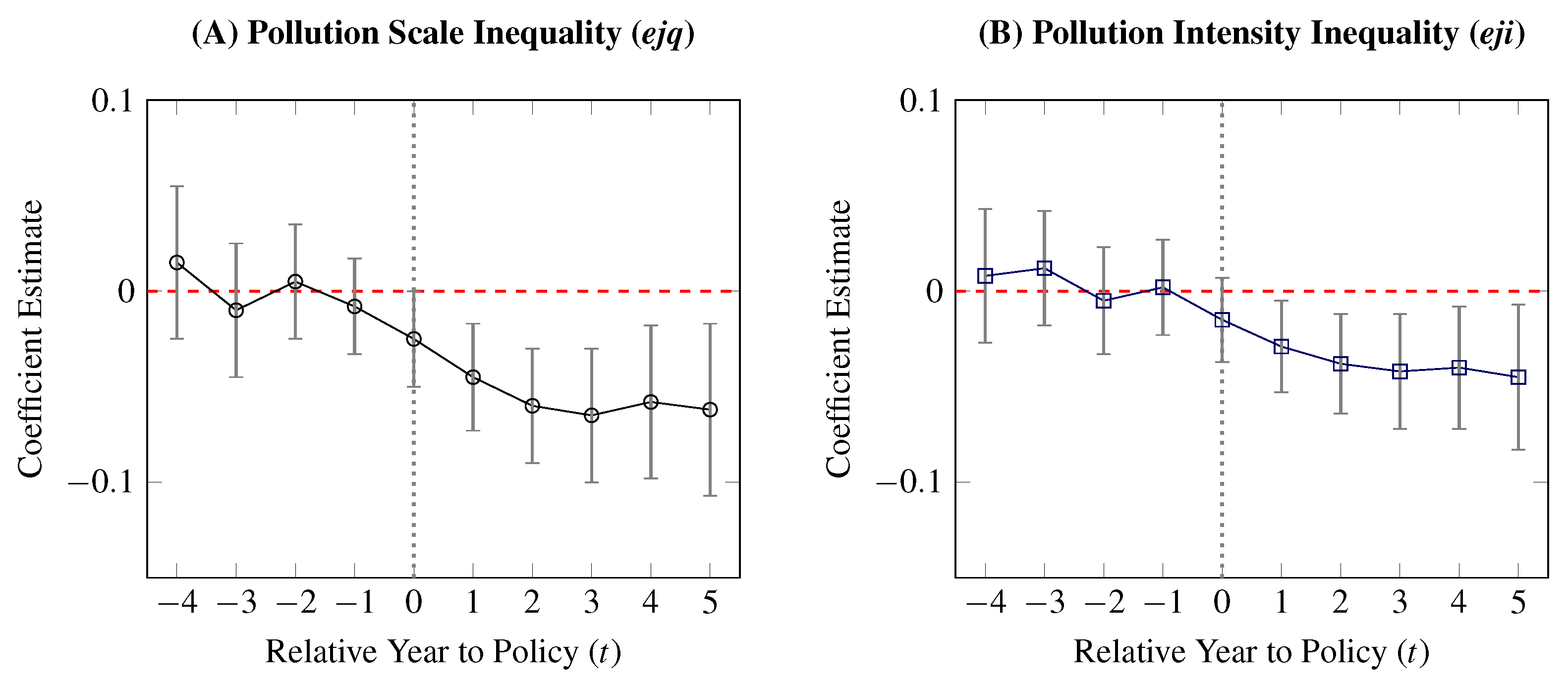
Figure 1 reports the dynamic responses of within-agglomeration pollution inequality to metropolitan integration using an event-study design. The event time is defined relative to each metropolitan area’s integration start year, so
denotes the first year in which the integration measure becomes positive for that metropolitan area, and the coefficients trace the evolution of outcomes in the years before and after this start. The estimates before implementation provide supportive evidence for the parallel trends assumption. In both panels, the coefficients in the pre-period fluctuate closely around zero and their confidence intervals generally overlap zero, suggesting no detectable divergence in inequality trends prior to the onset of integration. This pattern reduces concerns that the baseline results are driven by anticipatory behavior or differential pre-trends. After
, the coefficients turn negative and remain below zero for several subsequent years. For pollution scale inequality (
ejq), the decline becomes more pronounced in the first few post years and then stays persistently negative. For pollution intensity inequality (
eji), the reduction is also sustained, though the magnitude appears somewhat smaller. We then address the possibility that integration intensity responds to unobserved metropolitan shocks by complementing the fixed-effects design with an instrumental-variables approach.
4.4. Endogeneity and Instrumental Variable Estimates
A remaining concern is that metropolitan integration may be endogenous. For example, local governments could intensify integration efforts in response to pre-existing inequality pressures, or unobserved shocks might jointly affect integration and the within-agglomeration distribution of pollution. To address these concerns, we re-estimate the baseline relationship using two-stage least squares, instrumenting trt with alternative excluded instruments.
Table 3 reports the 2SLS estimates for both inequality outcomes. The estimated coefficients on
trt remain negative across all specifications, reinforcing the baseline conclusion that integration is associated with a reduction in within-agglomeration pollution inequality. The implied magnitudes are larger than in the fixed-effects estimates, with point estimates clustered around
for both
ejq and
eji. Given the wider standard errors typical of IV estimation, the coefficients are statistically significant at conventional levels in most specifications, and the pattern is stable when switching between
ivone and
ivtwo as the excluded instrument.
The first-stage diagnostics are reassuring. The Kleibergen–Paap rk Wald F statistics range from 21.091 to 26.748, exceeding common rules of thumb for weak-instrument concerns. The Kleibergen–Paap rk LM underidentification test rejects the null of underidentification in all cases, with p-values between 0.015 and 0.030. Overall, these diagnostics suggest that the instruments provide meaningful identifying variation in metropolitan integration.
Overall, the IV results support the interpretation that the negative association documented in the baseline estimates is not driven solely by reverse causality or omitted time-varying confounders. While IV magnitudes should be interpreted as local effects tied to the variation induced by the excluded instruments, the direction and persistence of the estimates align closely with the event-study evidence and point to an equalizing impact of metropolitan integration on environmental burdens within metropolitan areas.
4.5. Robustness Checks
We conduct a set of robustness exercises that vary the weighting of the inequality indices and the construction of integration exposure. The purpose is to verify that the results are not driven by a specific measurement choice.
4.5.1. Alternative Inequality Indices and Weighting Schemes
Table 4 examines whether the baseline findings are sensitive to the specific functional form or weighting scheme used to construct the inequality indices. First, we replace the baseline Theil indices with GDP-weighted measures that assign greater influence to economically larger units. As shown in columns (1) and (2), the coefficient on
trt remains negative and statistically significant for both the GDP-weighted scale (
ejqgd) and intensity (
ejigd) measures. The consistency across weighting schemes indicates that the equalizing association is not driven by the baseline equal-weight construction. At the same time, because these indices represent different concepts, we interpret our main findings as convergence in jurisdiction-level pollution burdens, while the GDP-weighted robustness results suggest that a similar convergence pattern holds when pollution outcomes are viewed through the lens of economic size. Second, we further verify that the baseline conclusions are not specific to the entropy-based properties of the Theil index by re-estimating the baseline model using the Gini coefficient to measure pollution scale inequality. The Gini measure is computed within each metropolitan area–year across constituent cities using city-level total emissions, with each city receiving equal weight to mirror the unweighted baseline construction. The estimated coefficient on metropolitan integration remains negative and statistically significant, confirming that the main pattern is robust to alternative inequality indices.
4.5.2. Alternative Treatment Measures
Table 5 evaluates whether the results depend on the specific operationalization of integration intensity by substituting the baseline treatment variable with two alternative measures,
tr1 and
trt2. The estimates remain negative across both outcomes. Using
tr1, the coefficients are statistically significant for
ejq and
eji. Using
tr2, the coefficients are also negative and statistically significant at conventional levels. The stability of sign and significance across these alternative measures indicates that the baseline findings reflect a broader relationship between metropolitan integration and the distribution of environmental burdens within metropolitan areas, rather than an artifact of a single measure.
4.5.3. Robustness to Measurement Error and Functional Form
A practical challenge in quantifying metropolitan integration is that there is no single, unified national document that standardizes integration policies across all metropolitan areas. In this context, counting policy documents provides a transparent proxy for policy attention and institutionalization, but it may also carry measurement noise if documents differ in substantive content, if reporting intensity varies across regions, or if integration deepens in nonlinear ways over time. To ensure that our baseline results are not an artifact of this measurement uncertainty, we implement four complementary robustness exercises for our primary outcome, pollution scale inequality (
ejq). The results are summarized in
Table 6.
Column (1) replaces the linear policy count with a logarithmic transformation, , which down-weights extreme values and reduces sensitivity to unusually large document counts. Column (2) relies only on whether integration-related policies are present and on the length of exposure by using , thereby minimizing reliance on the exact number of documents. Column (3) separates policy depth from policy duration by entering and as distinct components, which helps clarify whether the estimated association reflects policy intensity, cumulative exposure, or both. Finally, column (4) repeats the baseline specification after excluding the early transition period (2005–2008), when metropolitan integration initiatives were less institutionalized and policy documentation was more uneven.
Across these alternative constructions, the estimated association between metropolitan integration and pollution scale inequality remains negative and statistically significant at conventional levels. The consistency of direction and significance suggests that the main finding is not driven by a particular functional form of the policy proxy, nor by potential measurement noise arising from heterogeneous policy documentation.
4.5.4. Accounting for Concurrent Vertical Environmental Regulations
A potential concern for our identification strategy is the overlapping implementation of stringent nationwide environmental campaigns during our sample period. The most prominent example is the Central Environmental Protection Inspection (CEPI) piloted in 2015 and scaled up nationwide from 2016. Because the CEPI exerts intense vertical pressure on local officials to enforce environmental standards, it could simultaneously reduce pollution across constituent cities, potentially confounding the effect of horizontal metropolitan integration.
To explicitly isolate the integration effect from this concurrent vertical shock, we construct a CEPI exposure indicator (
cepimt). Following the rollout schedule of the inspections, this dummy variable takes the value of 1 for a metropolitan area if its province is undergoing a central inspection in year
t or was inspected in year
(capturing the window of maximum administrative deterrence), and 0 otherwise. We then re-estimate the baseline specification by including
cepimt as an additional control variable. As reported in
Table 7, controlling for the CEPI shock does not meaningfully alter our core findings. The coefficient on
trt remains negative and statistically significant at the 1% level for pollution scale inequality, and at the 5% level for intensity inequality. The estimate of
trt is stable after controlling for CEPI exposure, suggesting that the main association is not driven by this concurrent vertical campaign.
4.5.5. City Coverage, Treatment Decomposition, and IV Exclusion
A practical concern is that dispersion indices may be sensitive to the set of included cities. Even when metropolitan boundaries are treated as fixed in the data construction, effective city coverage can vary if some city–year observations are missing. Let
denote the number of constituent cities with non-missing pollution outcomes in metropolitan area
m at year
t. We implement two targeted checks. First, we augment the baseline specification by including
as an additional control to absorb any residual variation in effective city coverage. Second, we restrict the sample to metropolitan areas with stable city counts over time and re-estimate the baseline model on this restricted sample. As summarized in
Table 8, the coefficient on metropolitan integration remains negative and statistically significant, suggesting that the main findings are not mechanically driven by changes in effective city coverage or by shifts in city composition.
Our baseline treatment term is intended to proxy cumulative institutionalization and exposure. However, the product form can mask whether the estimated association is primarily related to deeper policy institutionalization or simply to longer exposure since integration onset. To make this distinction explicit, we estimate a decomposition that enters and separately. In our data, is a rescaled cumulative count of integration-related policy documents, where one unit corresponds to 100 documents, while counts the number of years since integration began. The decomposition therefore separates a policy-depth margin from an exposure-duration margin. The estimated coefficients indicate that the equalizing association is not explained solely by elapsed time and is consistent with the interpretation that deeper institutionalization and longer exposure both contribute to reductions in within-metropolitan dispersion.
A further concern is that historical connectivity may be correlated with modern spatial economic structure, industrial sorting, or urban primacy, which could in turn affect within-metropolitan pollution dispersion independently of metropolitan integration. Two features of our empirical design mitigate this risk. First, historical connectivity is time-invariant, and metropolitan fixed effects absorb any level differences in pollution inequality that are associated with persistent historical or geographic characteristics. Second, the excluded variation in the first stage comes from interacting predetermined historical connectivity with exposure time since integration onset, which focuses identification on differential capacity for sustained integration and coordination after integration begins rather than on static historical differences. With these considerations in mind, we interpret the IV estimates as local effects tied to the variation in integration intensity induced by historical connectivity interacted with exposure time.
4.5.6. Standardized Magnitudes, Heterogeneity-Robust Dynamics, and LATE Interpretation
To make magnitudes comparable across inequality measures, we report standardized effects that scale the baseline estimate by within-metropolitan variation. Concretely, we compute
, where tildes denote residualized variables after removing metropolitan fixed effects. The resulting standardized magnitudes are reported in
Table 9 and indicate that a one-standard-deviation increase in integration exposure is associated with a meaningful reduction in pollution inequality relative to typical within-metropolitan fluctuations.
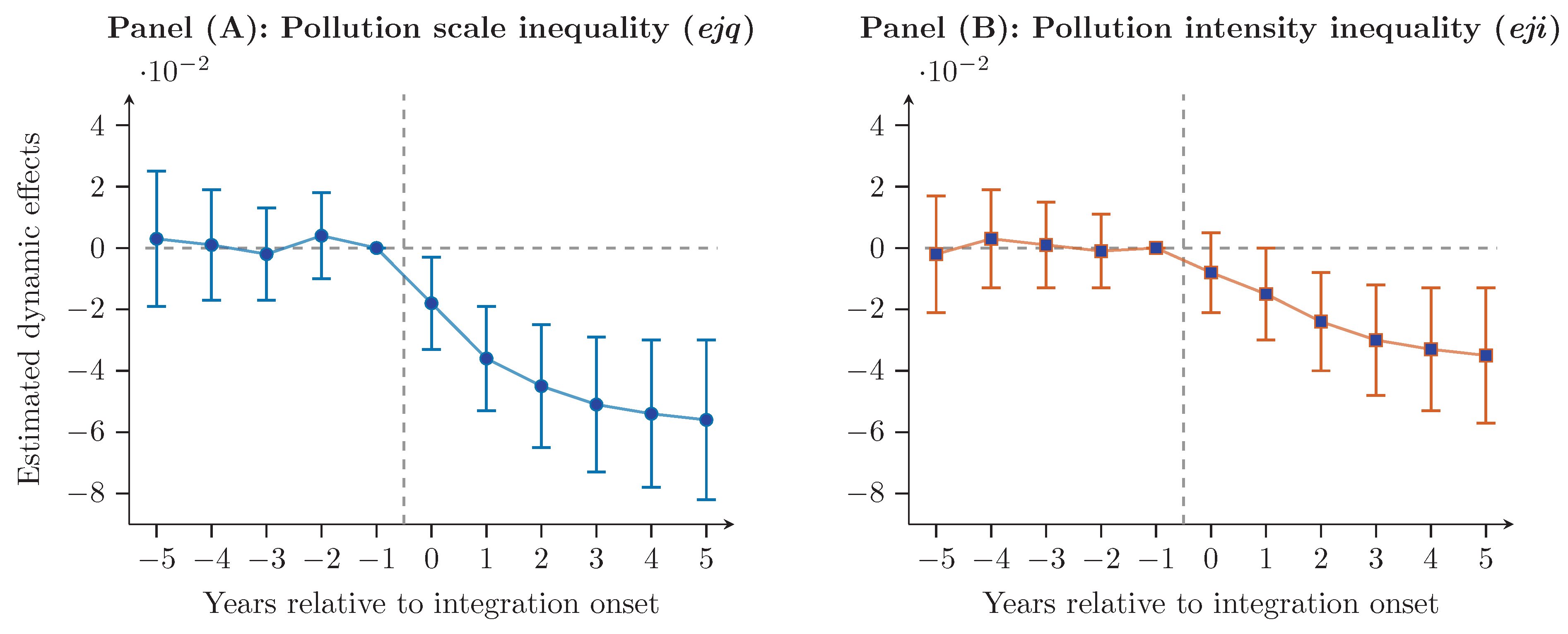
We use the TWFE event study primarily to assess whether the baseline association is preceded by differential pre-trends and to provide a transparent description of the timing of responses. Because staggered adoption coupled with effect heterogeneity can affect the implicit weighting in TWFE event-time coefficients, we additionally report dynamics from a heterogeneity-robust estimator that aggregates group-time average treatment effects into an event-time profile.
Figure 2 shows that estimates in the pre-period remain close to zero, while post-onset coefficients are negative for both pollution scale inequality and pollution intensity inequality. The figure plots event-time coefficients from a heterogeneity-robust estimator for staggered adoption, constructed from group-time average treatment effects. Panel (A) reports results for pollution scale inequality (
ejq), and panel (B) reports results for pollution intensity inequality (
eji).
Table 9 summarizes this pattern using the average post-onset ATT, which closely tracks the baseline TWFE magnitude.
For the instrumental-variables analysis, we emphasize that the 2SLS coefficients should be interpreted as local effects associated with the variation in integration exposure induced by the historical-connectivity instruments interacted with exposure time. Accordingly, we describe the IV estimates as local average treatment effects and avoid interpreting them as population-wide impacts. To further probe credibility, we implement a placebo timing exercise in which we assign pseudo-onset years that precede the true integration start and re-estimate the baseline specification. The placebo estimates reported in
Table 9 are small and statistically indistinguishable from zero, consistent with the view that the main findings are unlikely to be driven by spurious pre-trends.
4.5.7. Robustness to Excluding the COVID-19 Period
The COVID-19 shock may have temporarily altered mobility, industrial activity, and emissions patterns, which could affect both pollution outcomes and their spatial distribution within metropolitan areas. To ensure that our baseline results are not driven by these exceptional conditions, we re-estimate the preferred specification after excluding 2020–2023.
Table 10 shows that the estimated association between metropolitan integration and pollution inequality remains negative and statistically significant for both pollution scale inequality (
ejq) and pollution intensity inequality (
eji). The magnitudes are slightly smaller than in the full-sample estimates but remain close in size, indicating that the main findings are not sensitive to the inclusion of the pandemic years.
4.6. Heterogeneity by Metropolitan Characteristics
The capacity to implement coordinated environmental governance and facilitate cleaner technology diffusion is unlikely to be uniform across metropolitan areas. It depends heavily on the economic dominance and administrative authority of the core city, as well as the broader regional market environment. To explore these dimensions, we conduct three subsample splits based on structural metropolitan characteristics.
Table 11 reports the results, with all baseline controls and fixed effects included.
First, we stratify the sample by the economic primacy of the core city. A core city with a dominant economic scale possesses stronger bargaining power and fiscal capacity to internalize cross-boundary externalities, compensate peripheral jurisdictions, and enforce unified environmental standards. We compute the core city’s share of the total metropolitan GDP and split the sample at the median into low-primacy and high-primacy groups. As shown in Panel A, the inequality-reducing association is statistically significant only in high-primacy metropolitan areas (columns 2 and 4), suggesting that a strong economic core is crucial for overcoming jurisdictional fragmentation and driving regional environmental convergence.
Second, we examine the administrative rank of the core city. In China’s spatial governance system, high-ranking core cities (municipalities, sub-provincial cities, and provincial capitals) hold superior political and resource-allocation authority compared to ordinary prefecture-level cities. This administrative advantage lowers the transaction costs of aligning multi-city policies. Panel B confirms that the equalizing effect on both pollution scale and intensity is concentrated in metropolitan areas led by high-ranking core cities.
Third, we divide the sample by geographic location to capture differences in regional marketization and environmental regulatory pressure. Eastern coastal metropolitan areas generally feature more integrated regional markets, lower barriers to factor mobility, and stricter environmental scrutiny, which facilitate the diffusion of cleaner technologies. In contrast, inland (Central and Western) metropolitan areas often face stronger economic growth pressures and may prioritize scale expansion over structural upgrading in their early integration phases. Consistent with this view, panel C shows that the equalizing association of integration is highly significant primarily in Eastern metropolitan areas.
4.7. Effects Conditional on Fiscal Capacity, Industrial Lock-In, and Factor Market Integration
The effect of metropolitan integration on within-agglomeration pollution inequality may vary with local economic conditions that shape coordination capacity and adjustment frictions. We focus on three dimensions that are central to spatial environmental governance: fiscal capacity, industrial lock-in, and factor market integration. Following the data construction, we operationalize these dimensions using time-invariant metropolitan characteristics and interact them with the integration exposure measure. Because metropolitan fixed effects absorb the level differences in these characteristics,
Table 12 reports the coefficient on
trt together with the coefficient on the corresponding interaction term.
The baseline association between integration and pollution inequality remains negative across all specifications. For pollution scale inequality, the estimated coefficient on trt is negative and statistically significant in columns (1) to (3). For pollution intensity inequality, the coefficient on trt is also negative and significant in columns (4) and (5). In the specification with the factor market integration interaction (column 6), the baseline term becomes less precisely estimated, consistent with stronger differentiation of integration effects by local market conditions.
The interaction terms highlight systematic heterogeneity driven by urban economic fundamentals. The coefficient on the fiscal capacity interaction (trtfis) is negative and statistically significant for both outcomes (columns 1 and 4). This indicates a stronger inequality-reducing association in metropolitan areas with greater fiscal resources, which facilitate cross-city ecological compensation and joint abatement investments. The coefficient on the industrial lock-in interaction (trtlock) is positive and highly significant (columns 2 and 5), suggesting that reliance on heavy and resource-based sectors creates adjustment frictions that severely dampen the equalizing role of integration. Finally, the coefficient on the factor market integration interaction (trtfmi) is negative and statistically significant for both outcomes (columns 3 and 6), implying that frictionless reallocation of labor and capital accelerates the diffusion of cleaner technologies and strengthens environmental convergence.
Overall, the conditional-effect results indicate that metropolitan integration is more consistently linked to improved environmental equity in settings with ample fiscal capacity and integrated factor markets, while industrial lock-in systematically constrains the convergence process.
4.8. Summary of Findings
Across the baseline fixed-effects estimates, the event-study diagnostics, and the instrumental-variable specifications, metropolitan integration is consistently associated with lower within-agglomeration dispersion in both pollution scale and pollution intensity. The dynamic profiles show no detectable differential pre-trends and indicate persistent post-onset declines, supporting the interpretation that the equalizing association emerges as integration deepens over time. Robustness exercises that alter the weighting of inequality measures and the construction of integration exposure yield the same qualitative conclusion. Heterogeneity and conditional-effect results further clarify where integration matters most: the equalizing association is concentrated in mature metropolitan areas, is stronger when core-city primacy and administrative authority support coordination and when fiscal capacity and factor market integration ease implementation and reallocation, and is weaker where industrial lock-in and resource dependence intensify adjustment frictions.
5. Conclusions
This study examines whether metropolitan integration reshapes the within-agglomeration distribution of pollution burdens in China. We find that deeper integration is associated with a more even distribution of environmental burdens among member cities, with a larger reduction in inequality for pollution scale than for pollution intensity. The distributional benefits of integration are not uniform: they are most evident in metropolitan areas featuring high-primacy, high-ranking core cities, and in the Eastern coastal regions. We also find systematic heterogeneity with local economic conditions. Fiscal capacity and factor market integration strengthen the equalizing role of integration, whereas industrial lock-in dampens it, consistent with adjustment frictions as constraints on convergence. From a sustainability perspective, these findings suggest that metropolitan integration can contribute not only to cleaner development but also to fairer environmental outcomes within urban systems. Policies that institutionalize cross-city coordination, improve information sharing and joint monitoring, and support transition pathways in regions facing industrial lock-in may help translate integration into more broadly shared environmental gains.
Sustainability-oriented metropolitan governance should treat within-metropolitan environmental equity as a core objective alongside improvements in average air quality. This requires institutionalized cross-city coordination that limits regulatory fragmentation and discourages pollution shifting across jurisdictions. Practical priorities include harmonized emissions accounting, shared monitoring and public disclosure, and routine joint enforcement arrangements that align standards and implementation. Governance should also distinguish between managing the distribution of total emissions and narrowing differences in emissions per unit of output, since the latter depends more on sustained upgrading and diffusion of cleaner production practices. Region-wide support for technology adoption and targeted assistance to lagging jurisdictions can help close these gaps. Where coordination capacity is still developing, building stable platforms for data sharing and joint decision-making is a near-term priority. In resource-dependent areas, transition-oriented measures such as industrial upgrading support and workforce reskilling can help sustain environmental progress while easing adjustment costs.
In resource-dependent metropolitan systems, integration-oriented environmental governance is more likely to require explicit compensation and transition support so that coordination does not collapse under fiscal and employment pressures. A first priority is to institutionalize cross-city ecological compensation or rules-based fiscal transfers that recognize asymmetric abatement burdens and reduce disputes over responsibility. Linking a portion of these transfers to verifiable progress in emissions control and industrial upgrading can strengthen credibility and implementation incentives. A second priority is to prioritize retrofit and efficiency improvements in incumbent industries, including ultra-low-emission upgrades, process optimization, and cleaner input substitution, so that emissions intensity can decline even when scale adjustment is gradual. Complementary industrial support can facilitate diversification through green industrial parks, circular-economy supply chains, and clean-energy equipment manufacturing that offer realistic local substitutes for resource-based activity. Finally, a just-transition package, including workforce reskilling, job-matching support, and targeted social protection, can lower political resistance to restructuring and help ensure that sustainability gains from integration are durable and broadly shared.
Our integration measure is based on policy attention and thus does not rely on a single nationwide policy document with uniform content and enforcement. Although we show that the main findings are robust to alternative codings and functional forms of the policy proxy, measurement noise may remain if documents differ substantially in substantive weight or if policy attention maps imperfectly into realized integration. Future work could complement policy-document proxies with more direct indicators of metropolitan integration, such as cross-city commuting and migration flows, freight and logistics linkages, inter-city firm-network connections, and administrative coordination platforms or joint monitoring systems. Combining these behavioral and institutional measures with pollution outcomes would help sharpen inference on the channels through which metropolitan integration shapes environmental equity within urban systems.