


Abstract
Education for Sustainable Development places increasing demands on teachers’ ability to integrate technology into STEM teaching in meaningful and sustainable ways. However, many STEM pre-service teachers struggle to develop transferable technology integration competencies. To address this challenge, this study designed and evaluated a project-based learning and graphical programming training module aimed at enhancing STEM pre-service teachers’ technology integration competencies. Grounded in the Technological Pedagogical Content Knowledge framework, the training module supports practice-oriented learning in authentic instructional contexts. A mixed-methods research design combining design-based research and a quasi-experimental approach was employed. Following the iterative development of the training module, a quasi-experimental study involving 114 STEM pre-service teachers was conducted to examine its effectiveness. The results of independent-samples and paired-samples t-tests indicate statistically significant improvements in most dimensions of technology integration competencies, including pedagogical knowledge, technological knowledge, and overall TPACK. Effect size analysis revealed a moderate effect on technology integration competencies. These findings suggest that embedding graphical programming within project-based learning can effectively support the development of transferable and sustainable technology integration competencies among STEM pre-service teachers, thereby contributing to sustainable STEM teacher education.
1. Introduction
Against the backdrop of the ongoing advancement of the Sustainable Development Goals (SDGs), education is widely recognized as a key lever for achieving social, economic, and environmental sustainability [1,2]. Education for Sustainable Development (ESD) places emphasis on cultivating learners’ capacities to understand complex systems, address real-world problems, and make responsible decisions, the realisation of which depends largely on fundamental changes in educational practices [3]. With the rapid development of artificial intelligence and digital technologies, educational contexts, instructional tools, and learning modes are being continuously reconfigured, posing significant challenges to education systems in sustaining educational quality and ensuring continuity of development amid ongoing technological change [4,5].
Within this context of technological transformation, the role of teachers is undergoing profound change. Teachers are no longer merely passive users of existing technological tools. Rather, they are required to exercise professional judgement in dynamically evolving technological environments and to integrate emerging technologies coherently with instructional objectives, disciplinary content, and pedagogical approaches [6,7]. From a sustainability perspective, educational sustainability is reflected not only in the continuity of educational philosophies and developmental goals, but also in whether teachers’ professional competencies demonstrate the adaptability and developmental capacity required to respond to continuous technological change [8]. Compared with discrete technical operational skills, teachers’ capacity to integrate technology into teaching demonstrates stronger cross-contextual transferability and longer-term developmental value, and is therefore regarded as a key professional competence underpinning the sustainable development of education systems amid rapidly evolving technological landscapes [6,9].
STEM education, characterized by its emphasis on interdisciplinary integration and real-world problem solving, has been widely recognized as an important pathway for translating the principles of ESD into educational practice [10,11]. By integrating knowledge from science, technology, engineering, and mathematics, STEM education engages learners in inquiry, design, and hands-on practice situated in authentic problem contexts [12]. Such instructional processes rely heavily on the support of digital technologies, computational tools, and intelligent systems [13,14,15]. However, the potential of STEM education to foster complex problem-solving abilities and support sustainable development is shaped by instructional conditions. In particular, it largely depends on teachers’ professional capacity to integrate technology into instructional design and classroom practice. In the absence of systematic technology integration competencies, STEM teaching practices are prone to becoming superficial, with technology use remaining at an instrumental level, thereby limiting opportunities for genuine interdisciplinary collaboration and deep learning [6,10].
Existing research indicates that many STEM pre-service teachers, defined as students enrolled in teacher education programs who have not yet entered professional teaching practice, continue to experience substantial challenges in integrating technology with teaching practice [16]. Current teacher education programmes often place emphasis on learning isolated technological tools or treat technology, pedagogy, and subject content as separate components, resulting in a lack of systematic training modules grounded in authentic teaching contexts [17]. Such fragmented approaches are not conducive to the development of stable and transferable technology integration competencies and may, to some extent, constrain the effectiveness of STEM education in contributing to education for sustainable development [16]. Consequently, from a sustainability-oriented perspective, the identification of training modules capable of systematically enhancing STEM pre-service teachers’ technology integration competencies has become a pressing issue in contemporary teacher education research.
Against this backdrop, the present study focuses on STEM pre-service teachers and seeks to design and validate a teacher training module centered on Project-Based Learning (PBL) and supported by Graphical Programming tools (GP), referred to as the PBL-GP training module, with the aim of promoting the development of technology integration competencies. A design-based research (DBR) approach was adopted to construct and iteratively refine the training module, and a quasi-experimental design was employed to examine its effectiveness. Grounded in the Technological Pedagogical Content Knowledge (TPACK) framework, this study assesses teachers’ technology integration competencies and places particular emphasis on evaluating the impact of the PBL-GP training module on the overall technology integration competencies of STEM pre-service teachers. Through this approach, the study aims to both support the sustainable development of teachers’ professional competencies and inform efforts to enable STEM education to more effectively serve the goals of education for sustainable development.
2. Theoretical Background
2.1. Education for Sustainable Development and STEM Education
The conceptual relationship between education for sustainable development (ESD) and STEM education forms an important foundation for sustainability-oriented STEM teacher education. ESD aims to foster learners’ understanding of complex social, economic, environmental systems through education, while cultivating systems thinking, problem-solving capacities, and a sense of responsible action [18]. This educational orientation has been widely incorporated into global educational reform initiatives and is closely associated with efforts in enhancing educational quality and developing future-oriented competencies. Systemic learning, active participation in practice, and interdisciplinary inquiry are widely regarded as core pedagogical features for achieving the goals of ESD, as they enable learners to engage with the multidimensional challenges and opportunities of sustainable development within authentic contexts [19,20,21].
STEM education, characterised by its interdisciplinary integration and real-world problem orientation, is widely recognised as an important instructional pathway for enacting the principles of ESD [22]. Systematic reviews indicate that integrating sustainable development goals into STEM education can foster learners’ critical thinking, systems thinking, and capacities for engaging with socio-ecological issues, thereby strengthening the contribution of education to sustainable development [10].
Although STEM education is widely recognised as an important instructional pathway for enacting the principles of ESD, its potential to advance ESD goals depends on the quality of instructional design and implementation. Research indicates that when STEM teaching remains at the level of superficial disciplinary integration or lacks the deliberate construction of authentic problem contexts, its capacity to cultivate sustainability-related competencies is substantially constrained [23,24]. By contrast, STEM learning activities can effectively support the realisation of ESD goals only when they are grounded in intentional curriculum design, systematic development of real-world problem contexts, and learners’ deep engagement [10,25,26]. In this regard, teachers’ technology integration competencies play a decisive role in enabling high-quality instructional design, as the effective integration of technology into STEM teaching requires the ability to align technological tools with pedagogical intentions and disciplinary content in a context-sensitive manner [27]. Accordingly, supporting the development of technology integration competencies among STEM pre-service teachers has become a central focus of current research aimed at improving the quality of STEM instructional design and enabling the effective enactment of education for sustainable development goals.
2.2. Teachers’ Technology Integration Competencies in STEM Education
In contemporary digital learning environments, teachers’ ability to integrate technology effectively has been widely recognised as a central factor in instructional innovation and the enhancement of educational quality, rather than a matter of proficiency in isolated technical operations [28,29]. The TPACK framework provides a theoretical foundation for understanding this complex competence, emphasising that teachers need to comprehend the dynamic interactions among technology, pedagogy, and subject content in order to make sound technology integration decisions in specific instructional contexts [28].
TPACK has been shown across numerous empirical studies and systematic reviews to play a guiding role in the development of technology integration competencies among both pre-service and in-service teachers [29,30]. A systematic review and meta-analysis by Fabian et al. indicate that TPACK-oriented training supports the development of pre-service teachers’ integrated professional knowledge, particularly in relation to designing, implementing, and adapting technology-supported learning tasks. Such competencies extend beyond discrete tool-related skills and constitute an integrated and transferable form of professional knowledge across technologies and disciplinary contexts [31]. From this perspective, strengthening teachers’ technology integration competencies is essential for supporting long-term professional adaptability. It also enables teachers to respond effectively to emerging tools and learning environments. Such integrative competence is widely regarded as a key component of sustainable teacher professional development [28,29,32].
Accordingly, the present study draws on the TPACK framework to conceptualize and examine STEM pre-service teachers’ technology integration competencies, with particular attention to their sustainability and transferability across rapidly evolving technological environments.
2.3. Design-Based Research and Sustainable Teacher Professional Development
Design-Based Research (DBR) is a research approach that emphasizes the systematic design and refinement of educational interventions through iterative cycles of design, implementation, evaluation, and revision within authentic educational settings [33]. In research on teacher professional development, DBR focuses not only on intervention outcomes. It also emphasizes the learning mechanisms, contextual adaptability, and long-term changes in teachers’ professional practice that emerge throughout the intervention process. As a result, findings generated through DBR typically exhibit practical utility, scalability, and theoretical relevance [34].
Building on this perspective, the application of DBR in studies of teacher development modules has increased steadily. A growing body of research employing DBR to design teacher professional development programmes indicates that this approach supports the creation of contextualised and collaborative teacher learning ecosystems, thereby enhancing teachers’ integrative competencies and improving professional practice [35]. The iterative nature of DBR aligns closely with the principles of sustainable teacher professional development. The enhancement of teachers’ professional competencies therefore requires iterative cycles of practice, feedback, reflection, and refinement rather than isolated interventions.
Within STEM teacher education research, DBR has been widely adopted to inform the design and refinement of instructional interventions, particularly those oriented towards authentic problems and practice-based activities [36,37]. By integrating PBL, technological tools, and structured instructional reflection, DBR focuses not only on the outcomes of teachers’ competency development but also on the underlying processes through which these competencies develop. This methodological orientation provides a conceptual and methodological foundation by supporting the enhancement of STEM pre-service teachers’ technology integration competencies and enhancing their ability to contribute effectively to the goals of education for sustainable development.
3. Design of the PBL-GP Training Module
3.1. Design Rationale and Principles
From the perspective of ESD, this study develops a STEM pre-service teacher training module that integrates project-based learning with graphical programming, referred to as PBL-GP training module. The central aim of this module is to systematically enhance teachers’ technology integration competencies, thereby establishing a solid professional foundation for their future engagement in STEM teaching with a focus on sustainable development. Rather than focusing on the short-term use of specific technological tools, the design of the PBL-GP training module emphasizes structured learning experiences that support the development of transferable and sustainable technology integration competencies. Conceptually, the PBL-GP training module is guided by three core design principles.
First, it adopts a PBL principle grounded in authentic problem contexts. Training activities are organised around real or practice-oriented instructional scenarios, encouraging pre-service teachers to integrate disciplinary knowledge, pedagogical strategies, and technological tools within project tasks, and thereby fostering a holistic understanding of the structure and logic of STEM teaching.
Second, the module follows a competency development principle centered on technology integration. Graphical programming tools are not treated as isolated objects of technical instruction. Instead, they are embedded within the project implementation process to serve instructional goals and inform pedagogical design decisions. Through this process, pre-service teachers develop a practical understanding of the relationships among technology, pedagogy, and subject content.
Third, the module is guided by a design principle focused on sustainable professional development. The training process foregrounds reflection and iteration, incorporating continuous feedback and refinement mechanisms to support the development of professional judgement applicable to future teaching contexts, rather than limiting learning outcomes to the mastery of specific instructional solutions.
3.2. Conceptual Framework of the PBL-GP Training Module
Building on the above design principles, this study develops a PBL-GP training module. The overall framework of the module places the development of teachers’ technology integration competencies at its core, adopts PBL as the primary instructional organisation, and employs graphical programming tools (Mixly) as the key technological support. At the conceptual level, the module is grounded in the TPACK framework as the theoretical foundation for teacher competency development. Through a systematic training process, it seeks to promote the coordinated development of technology, pedagogy, and subject content as teachers engage with authentic instructional tasks.
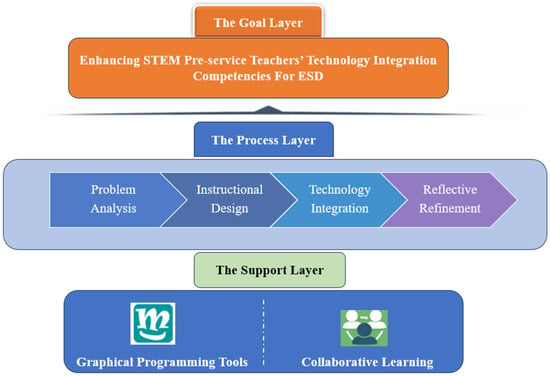
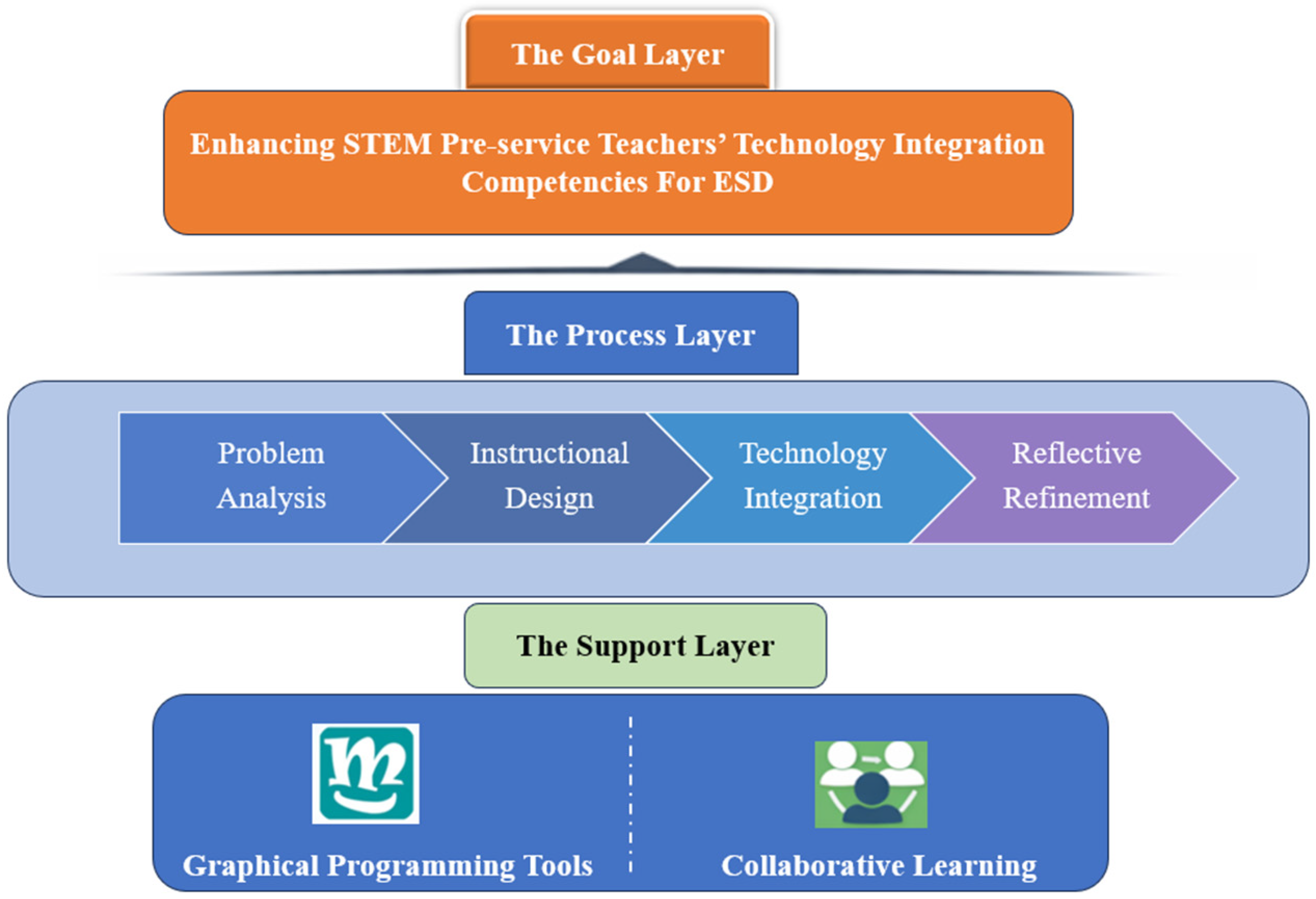
Structurally, the PBL-GP training module comprises three interrelated layers. As shown in Figure 1.
Figure 1.
Three-layer structure of the PBL-GP training module.
- (1)
- The goal layer, which focuses directly on enhancing STEM pre-service teachers’ technology integration competencies, supporting their future instructional practices oriented towards education for sustainable development.
- (2)
- The process layer, which guides teachers through key stages of a project-driven learning trajectory, including problem analysis, instructional design, technology integration, and reflective refinement.
- (3)
- The support layer, which offers technological and instructional support through graphical programming tools and collaborative learning environments, thereby lowering barriers to technology use and enhancing the practicability of implementation.
The module emphasises that teachers’ technology integration competencies are not developed through isolated instructional episodes but are progressively cultivated through sustained project-based practice and reflective engagement. In this way, the PBL-GP module highlights the process-oriented and sustainable nature of teachers’ professional competency development.
3.3. Training Process and Learning Activities
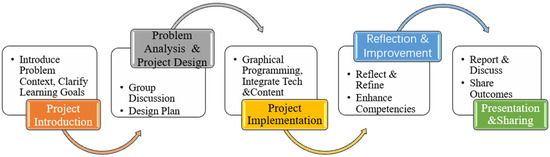
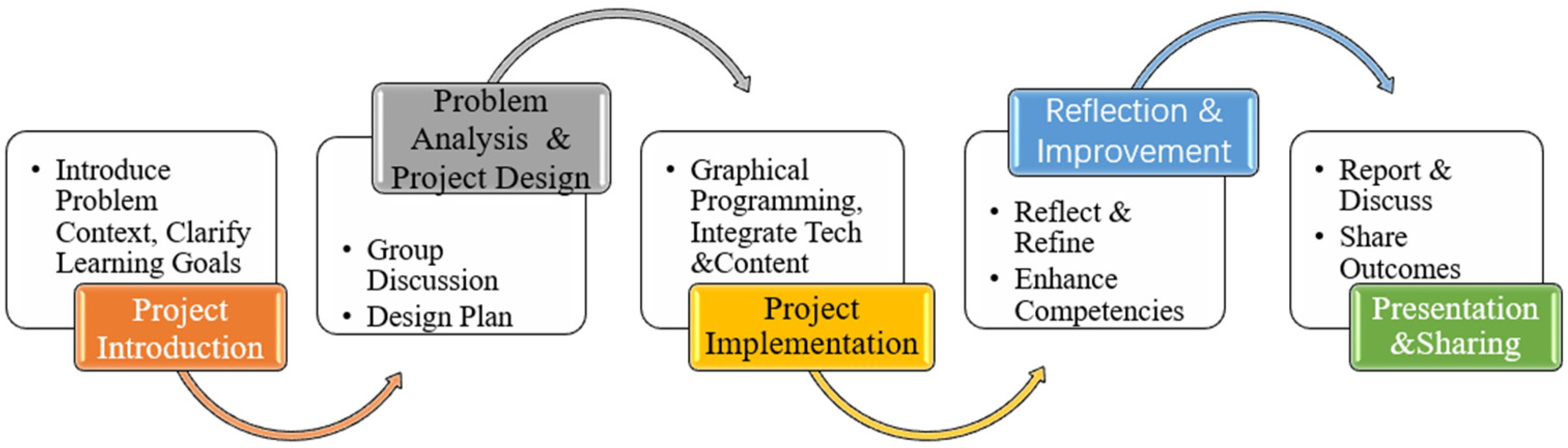
At the level of implementation, the PBL-GP training module is structured around a PBL sequence, through which STEM pre-service teachers are guided to progress through a series of interconnected learning phases. The overall training process typically comprises several key stages, as illustrated in Figure 2.
Figure 2.
Implementation process of the PBL-GP training module. Arrows denote the sequence of stages, and colors distinguish phases.
First, during the project introduction phase, the training begins learning by introducing problem contexts that are closely aligned with STEM teaching practice. This phase is designed to guide pre-service teachers in understanding the educational objectives and instructional context of the project tasks. The primary focus is to support teachers in aligning instructional goals with problem scenarios, thereby establishing a clear direction for the subsequent integration of technology.
Second, in the problem analysis and instructional design phase, STEM pre-service teachers engage in collaborative group discussions centered on the project tasks. They analyse instructional objectives, learning content, and students’ needs, and begin to formulate preliminary instructional plans. During this process, teachers are encouraged to consider the potential pedagogical roles of technology in supporting teaching and learning, rather than simply selecting technological tools in isolation.
The training then proceeds to the technology integration and project implementation phase. At this stage, graphical programming tools are introduced as technological resources to support both instructional design and classroom implementation. Through graphical programming, STEM pre-service teachers can engage in computational thinking and technological design processes with a low barrier to technical entry, while integrating technological functions with instructional objectives and disciplinary content.
In the reflection and refinement phase, pre-service teachers engage in systematic reflection on the entire project-based learning process, with a specific focus on examining how technology integration supports the achievement of instructional goals. Through guided reflective activities, the training supports teachers in abstracting transferable instructional strategies from concrete project experiences and in refining their instructional design decisions, thereby facilitating the internalisation and further development of technology integration competencies.
Finally, during the presentation and exchange phase, each group reports on and presents its project outcomes, with particular emphasis on instructional design rationales and approaches to technology integration. Through peer discussion and feedback, pre-service teachers are able to compare different technology integration strategies and deepen their understanding of the diversity of STEM instructional design.
3.4. Iterative Refinement and Sustainability Orientation
In the PBL-GP training module, this study draws on the iterative principles of DBR as a guiding design perspective. Insights from prior implementations and formative feedback were used to refine the instructional design, to better align the module with STEM pre-service teachers’ learning needs and instructional contexts. This DBR-informed training design is intended to address limitations commonly associated with one-off professional development interventions by foregrounding reflective engagement with project experiences and the transfer of learning. While the present study primarily aims to evaluate the short-term effects of the PBL-GP module through a quasi-experimental approach, the design orientation is also aligned with the principles of sustainable teacher professional development by supporting pre-service teachers’ capacity to integrate technology into future instructional practice.
4. Research Design and Method
4.1. Research Design
This study employed a mixed-methods research design in which a quasi-experimental approach served as the primary method for evaluating the effectiveness of an instructional intervention, while DBR was adopted as a guiding design perspective during the preparatory stage. The study focused on examining the effectiveness of the PBL-GP training module to support education for sustainable development.
Prior to the quasi-experimental implementation, DBR principles informed the design and refinement of the PBL-GP training module to enhance its practical relevance and contextual fit within authentic educational settings. During this preparatory phase, formative feedback was collected using group feedback forms to elicit STEM pre-service teachers’ perceptions of the training activities, perceived challenges, and suggestions for improvement. Insights derived from this feedback were used to guide the refinement of the training content and instructional arrangements.
Following this preparatory process, a quasi-experimental design was implemented to evaluate the effectiveness of the refined PBL-GP training module. Quasi-experimental designs are widely recognized in educational research as a robust and appropriate approach [38]. They are particularly suited to examining the effects of instructional interventions under authentic learning conditions, especially in teacher education contexts [39]. Accordingly, the impact of the intervention on STEM pre-service teachers’ technology integration competencies was assessed by comparing pre-test and post-test measures between an experimental group and a control group.
By integrating DBR and quasi-experimental methods, this study addresses both the soundness of the training module’s design and its effectiveness in real instructional settings. This combined research design strengthens the explanatory power of the findings and enhances the practical relevance of the findings for teacher education and sustainable professional development.
4.2. Participants
Participants in this study were selected using purposive sampling to align with the focus on STEM pre-service teacher training. Two distinct participant cohorts were involved across the design and validation phases of the study, corresponding to the DBR-informed preparatory stage and the quasi-experimental implementation stage of the PBL-GP training module. All participants were third-year STEM pre-service teachers enrolled in a teacher education programme at Ankang University, China, with cohort compositions reflecting the demographic characteristics of the programme (design phase: n = 57, 3 males; validation phase: n = 114, 9 males). Although participants in both phases were drawn from the same institutional context, the two samples represented separate cohorts with a one-year interval between the preparatory design stage and the quasi-experimental validation stage. The characteristics of each participant group are described in the following subsections. This study involved human participants and was conducted in accordance with relevant institutional ethical guidelines for educational research. Participants were informed about the purpose of the study and participated on a voluntary basis.
4.2.1. Participants Involved in the DBR-Informed Design Process
A total of 57 STEM pre-service teachers participated in the DBR-informed preparatory phase of the study, including 3 males and 54 females. All participants were third-year STEM pre-service teachers from Ankang University in Shaanxi Province, China. As purposive sampling was employed, the gender distribution reflects the demographic characteristics of the STEM pre-service teacher cohort in the selected teacher education program, where female students constitute the majority. This imbalance was therefore not the result of selective sampling but rather a characteristic of the target population. During this phase, participants were involved not only in the implementation of the PBL-GP training activities, but also in providing feedback on the training process, instructional design, and technology integration experiences. Their participation supported the iterative refinement of the training module in alignment with the design-based research approach.
Nevertheless, the gender composition of the sample may limit the generalizability of the findings to more gender-balanced STEM pre-service teacher populations, and future studies could further examine whether similar effects are observed across more diverse participant groups.
4.2.2. Participants in the Validation Phase (Quasi-Experimental Study)
To examine the effectiveness of the PBL-GP teacher training module, a quasi-experimental design was employed. Participants in this phase were drawn from two intact classes of STEM pre-service teachers, resulting in a total sample of 114 participants, including 9 males and 105 females. All participants were third-year STEM pre-service teachers and had not been involved in the earlier design and development phase of the study.
The two classes were assigned to either the experimental group or the control group, with each group consisting of 57 participants. The experimental group participated in the PBL-GP training programme, while the control group followed the regular curriculum without additional intervention. Prior to the intervention, pre-test analyses indicated no statistically significant differences between the two groups in terms of their technology integration competencies, suggesting that the groups were comparable at baseline.
4.3. The PBL-GP Training Intervention
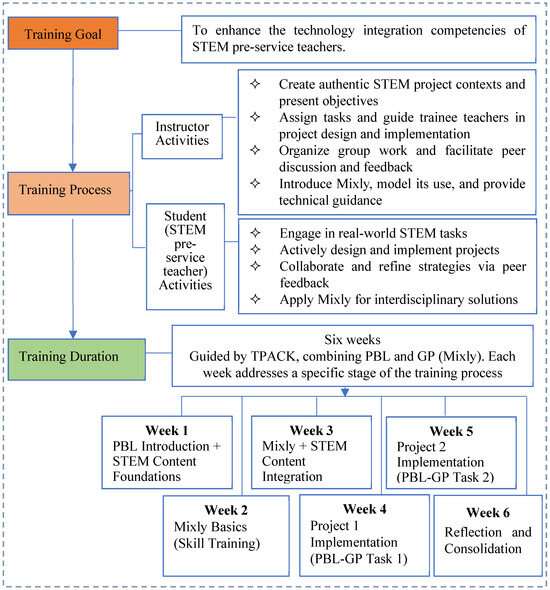
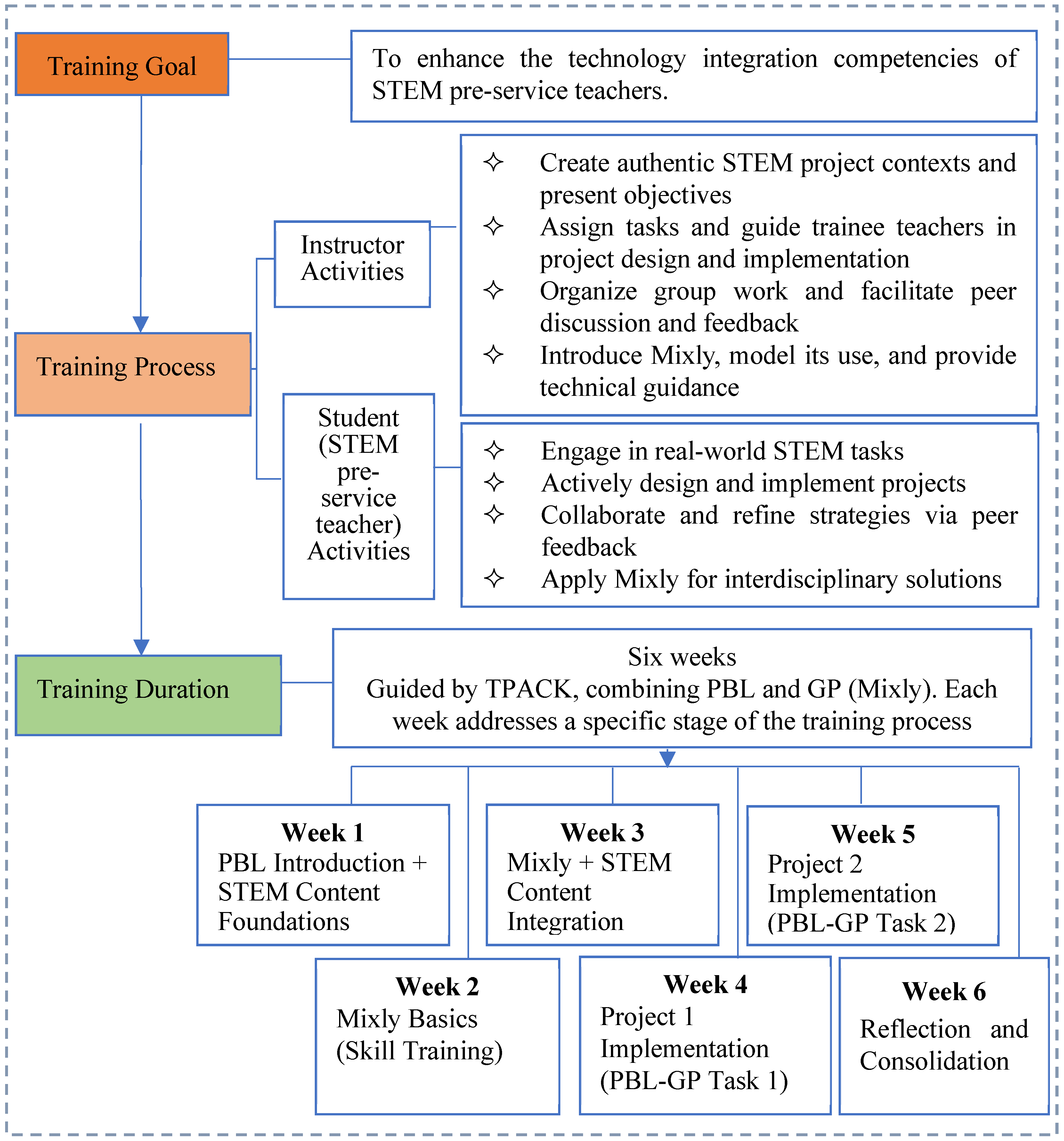
The present study implemented a PBL-GP teacher training intervention to examine its effectiveness in enhancing STEM pre-service teachers’ technology integration competencies. Grounded in the TPACK framework, the PBL-GP module integrated PBL with the graphical programming tool Mixly and served as the instructional intervention in the quasi-experimental study. Through structured learning experiences, the intervention aimed to support the development of transferable and sustainable technology integration competencies among STEM pre-service teachers. The components and timeline of the PBL-GP training intervention are illustrated in Figure 3.
Figure 3.
Components and timeline of the PBL-GP training intervention. Arrows indicate the hierarchical relationships among components and the temporal sequence of the training stages.
As shown in Figure 3, the training module comprises key components including the training goal, training process, and training duration. These components are organised around PBL tasks supported by graphical programming (Mixly), forming a coherent learning sequence that links technological, pedagogical, and content considerations.
During the implementation of the training, the learning activities of the instructor and the STEM pre-service teachers were closely aligned. The instructor was responsible for designing authentic problem contexts related to STEM teaching practice, clarifying instructional objectives, and assigning project tasks. Throughout the project implementation process, the instructor provided necessary pedagogical and technical support, guiding the pre-service teachers in completing instructional design tasks and project-based activities.
Pre-service teachers participated actively in a series of project-based STEM learning tasks centered on real-world problems. Their learning activities included engaging in the analysis of project requirements, collaboratively designing and implementing instructional plans, and applying graphical programming to support the achievement of instructional objectives in project practice. During this process, pre-service teachers were continuously encouraged to reflect on the role of technology in teaching and its contribution to the attainment of pedagogical goals, thereby gradually deepening their understanding of technology-integrated instruction.
The PBL-GP training intervention was conducted over a six-week period, with each week corresponding to a specific stage of the training process. The pre-test was administered one week prior to the intervention, and the post-test was conducted within one week after its completion. No additional instructional activities related to technology integration were implemented between the two testing points. During the initial stage, pre-service teachers were introduced to the principles of project-based learning and foundational STEM content. This was followed by training in basic graphical programming skills to support familiarity with the technological tool. Subsequent stages focused on integrating graphical programming with STEM content and instructional design. In the later stages of the intervention, participants completed two project tasks. The final stage focused on systematic reflection and consolidation, supporting the abstraction of transferable instructional strategies from project experiences.
For the control group, a STEM-focused PBL approach was implemented without the use of graphical programming tools. Participants engaged in comparable instructional design tasks, including the analysis of curriculum objectives, designing STEM learning activities, and developing teaching plans based on real-world problems. Technological support in the control condition was limited to commonly used instructional resources, such as presentation software and static digital materials. No programming-based artefact design or computational modelling activities were involved. This design ensured that both groups experienced comparable PBL structures, with graphical programming serving as the primary distinguishing feature of the PBL-GP intervention.
4.4. Instruments
To assess STEM pre-service teachers’ technology integration competencies, this study employed a TPACK-based questionnaire. The instrument was adapted from the widely used TPACK survey developed by Schmidt et al. [40], whose reliability and validity have been extensively supported in prior research [27,41]. In line with the original TPACK framework, the questionnaire conceptualizes teachers’ technology integration competencies across seven interrelated dimensions: technological knowledge (TK), pedagogical knowledge (PK), content knowledge (CK), technological pedagogical knowledge (TPK), technological content knowledge (TCK), pedagogical content knowledge (PCK), and overall technological pedagogical content knowledge (TPACK).
Consistent with the content-dependent nature of the TPACK framework, the questionnaire was contextualized for STEM education. While all items related to PK, TK, and TPK were retained from the original instrument, the content-related dimensions—CK, PCK, TCK, and TPACK—were revised to align with STEM teaching contexts. Specifically, these items were adapted from the “STEM Teacher Competency Level Standards (Trial)” issued by the China STEM Education Research Centre, ensuring consistency with the subject knowledge and instructional practices expected of STEM teachers.
The initial version of the questionnaire comprised 50 items across seven dimensions. Content validity was examined by three experts in STEM teacher education, educational technology, and computer science, who evaluated the relevance of each item using a five-point Likert scale. Based on expert feedback, minor revisions were made to improve clarity and alignment with the intended constructs. The final questionnaire consisted of 43 items distributed across seven dimensions of the TPACK framework. Specifically, the instrument included 7 items for pedagogical knowledge (PK), 7 items for technological knowledge (TK), 11 items for content knowledge (CK), 5 items for technological pedagogical knowledge (TPK), 4 items for technological content knowledge (TCK), 4 items for pedagogical content knowledge (PCK), and 5 items for overall TPACK. All items were rated on a five-point Likert scale, ranging from 1 (strongly disagree) to 5 (strongly agree).
The internal consistency reliability of the questionnaire was examined using Cronbach’s alpha. As shown in Table 1, all seven dimensions demonstrated high internal consistency (α = 0.907–0.960), indicating satisfactory reliability. In addition to internal consistency reliability, preliminary checks were conducted during the instrument preparation phase to ensure the suitability of the adapted questionnaire for use in the present study. The seven dimensions of the TPACK framework were retained as the theoretical measurement structure guiding the analysis and interpretation of the results.
Table 1.
Internal Consistency Reliability of the TPACK Measurement Scale.
4.5. Data Collection Procedure
Data collection followed a pre-test–post-test quasi-experimental procedure. Prior to the intervention, a pre-test questionnaire was administered to both the experimental and control groups to assess participants’ baseline technology integration competencies.
Following the pre-test, the PBL-GP training intervention was implemented exclusively with the experimental group over a six-week period. During this time, the experimental group participated in the PBL-GP training module, which integrated project-based learning with graphical programming. In contrast, the control group continued with the regular curriculum and participated in STEM-focused project-based learning activities without the use of graphical programming tools (Mixly).
After the completion of the intervention, a post-test questionnaire was administered to both groups using the same instrument as the pre-test. The post-test aimed to examine changes in technology integration competencies associated with participation in the PBL-GP training, as well as outcomes under the regular instructional condition.
Pre-test and post-test data were carefully screened before analysis to ensure data completeness and accuracy. The dataset was complete, with no missing responses across questionnaire items. The final dataset was used for subsequent statistical analyses.
4.6. Data Analysis
Data analysis was conducted using SPSS (Version 26). Prior to statistical analysis, data were screened to ensure completeness and suitability for analysis. Statistical significance was set at 0.05 level. The internal consistency reliability of the questionnaire was examined using Cronbach’s alpha.
To evaluate the effectiveness of the PBL-GP training module, independent-samples t-tests were conducted to examine baseline equivalence between the experimental and control groups. Paired-samples t-tests were used to analyse pre-test and post-test changes within each group, and post-test comparisons between groups were performed to assess intervention effects. In addition, effect sizes (Cohen’s d [42]) were calculated to estimate the magnitude of the observed changes.
5. Results
5.1. Descriptive Statistics of STEM Pre-Service Teachers’ Technology Integration Competencies
This section presents the descriptive statistics of STEM pre-service teachers’ technology integration competencies prior to the intervention. Descriptive analyses were conducted to examine the overall levels and distribution characteristics of the seven TPACK dimensions for both the experimental and control groups at the pre-test stage.
As shown in Table 2, the mean scores for the seven TPACK dimensions were generally comparable between the experimental and control groups. Across all dimensions, mean values ranged approximately from 3.54 to 3.65, reflecting comparable levels of self-reported technology integration competencies among participants prior to the intervention. No substantial differences in mean scores were observed between the two groups across the TPACK dimensions.
Table 2.
Descriptive Statistics of Pre-Test Results for TPACK Dimensions.
In addition, the standard deviations for corresponding dimensions were similar across the experimental and control groups, suggesting comparable variability in participants’ responses at the pre-test stage. Taken together, these descriptive results indicate that the two groups exhibited similar baseline profiles in terms of technology integration competencies prior to the implementation of the PBL-GP training intervention, providing an appropriate basis for subsequent independent-samples and paired-samples t-tests.
5.2. Baseline Equivalence Between Experimental and Control Groups
The baseline comparability of the experimental and control groups prior to the intervention was examined using independent-samples t-tests on the pre-test scores across all TPACK dimensions. This analysis aimed to determine whether any statistically significant differences existed in baseline technology integration competencies between the two groups before the implementation of the PBL-GP training intervention. As presented in Table 3.
Table 3.
Independent-samples t-test results for pre-test TPACK scores.
The results indicated no statistically significant differences between the experimental and control groups across any of the seven TPACK dimensions, including PK, TK, TPK, CK, PCK, TCK, and overall TPACK (all p > 0.05). In addition, the 95% confidence intervals for the mean differences all included zero, indicating the absence of statistically meaningful baseline differences between the two groups.
These findings indicate that the experimental and control groups were comparable in terms of their technology integration competencies prior to the intervention, thereby providing a sound basis for subsequent analyses examining the effects of the PBL-GP training module.
5.3. Effects of the PBL-GP Training on Technology Integration Competencies
This section reports the effects of the PBL-GP training intervention on STEM pre-service teachers’ technology integration competencies. The effects were examined through between-group comparisons at the post-test stage, within-group comparisons for the experimental group, and effect size analyses to assess the magnitude of the observed changes.
5.3.1. Post-Test Differences Between Experimental and Control Groups
Independent-samples t-tests were conducted to compare post-test scores between the experimental and control groups across all TPACK dimensions, in order to evaluate the effectiveness of the PBL-GP training intervention. The results are presented in Table 4.
Table 4.
Independent-samples t-test results for post-test TPACK scores.
The findings indicate that statistically significant differences were observed between the two groups in most dimensions of technology integration competencies. Specifically, the experimental group demonstrated significantly higher post-test scores than the control group in pedagogical knowledge, technological knowledge, technological pedagogical knowledge, pedagogical content knowledge, technological content knowledge, and overall TPACK (p < 0.05). Among these, the largest difference was observed for the overall TPACK dimension (t = 5.070, p < 0.001).
No statistically significant difference was found between the experimental and control groups in content knowledge (CK) at the post-test stage (p > 0.05). This finding suggests that the intervention had a stronger impact on competencies related to the integration of technology and pedagogy rather than on subject content knowledge alone.
Overall, the post-test comparisons indicate that participation in the PBL-GP training intervention was associated with significantly higher levels of technology integration competencies for the experimental group compared with the control group.
5.3.2. Within-Group Changes in the Experimental Group
Paired-samples t-tests were conducted to compare pre-test and post-test scores within the experimental group. The results are shown in Table 5.
Table 5.
Paired-samples t-test results for pre-test and post-test scores.
The analysis revealed statistically significant improvements in multiple dimensions following the intervention. Significant increases were observed in PK, TK, TPK, PCK, TCK, and overall TPACK (p < 0.05). These results indicate that participants in the experimental group experienced notable growth in their ability to integrate technology with pedagogy and content over the course of the training.
In contrast to the other dimensions, no statistically significant improvement was found in CK (p > 0.05), suggesting that the intervention primarily influenced teachers’ technology-related pedagogical competencies rather than their subject matter knowledge.
Collectively, the within-group comparisons provide additional evidence that the PBL-GP training intervention led to significant improvements in STEM pre-service teachers’ technology integration competencies.
5.4. Effect Sizes of the PBL-GP Training Intervention
Effect sizes were calculated using Cohen’s d to quantify the magnitude of pre-test and post-test differences within the experimental group. Cohen’s d was computed based on the standard deviation of the difference scores, consistent with paired-samples designs [43]. The results are presented in Table 6.
Table 6.
Effect size (Cohen’s d) for pre- and post-test differences in TPACK dimensions.
The effect size estimates indicate small to moderate effects across most TPACK dimensions. Specifically, Cohen’s d values ranged from 0.25 to 0.47 for PK, TK, CK, PCK, TCK, and TPK. Notably, the overall TPACK dimension exhibited a moderate effect size (d = 0.62), indicating a meaningful improvement in participants’ comprehensive technology integration competencies following the intervention.
These effect size results complement the statistical significance findings and provide further evidence that the PBL-GP training intervention had a substantive impact on STEM pre-service teachers’ technology integration competencies.
6. Discussion
The discussion below interprets the main findings in relation to the research objectives and relevant literature.
6.1. Effectiveness of the PBL-GP Training Module in Enhancing Technology Integration Competencies
The results of the post-test comparisons and within-group analyses consistently indicate that the PBL-GP training intervention had a positive impact on STEM pre-service teachers’ technology integration competencies. Significant improvements were observed in most TPACK-related dimensions, including PK, TK, TPK, PCK, TCK, and overall TPACK. These findings suggest that the training module was effective in enhancing teachers’ ability to meaningfully integrate technology into pedagogical design and instructional practice.
Notably, the largest effect was found in the overall TPACK dimension. The magnitude of this effect suggests that the intervention supported meaningful growth in integrated professional knowledge, which is particularly important in teacher education contexts where incremental changes can have substantial implications for future instructional practice. This finding indicates that the intervention contributed not merely to isolated skill development, but to the formation of an integrated understanding of the relationships among technology, pedagogy, and content. This aligns with the core premise of the TPACK framework, which emphasizes that effective technology integration emerges from the dynamic interaction of these knowledge domains rather than from the acquisition of technical skills alone [6,44]. The results therefore reinforce previous research suggesting that teacher education programs grounded in authentic pedagogical contexts are more likely to foster transferable and sustainable technology integration competencies [45].
From the perspective of education for sustainable development, these findings are particularly significant. Sustainable teaching competencies require teachers to adapt to evolving technologies and educational contexts over time [46]. The observed improvements in integrated competencies suggest that the PBL-GP training module may help pre-service teachers develop adaptive professional capacities that extend beyond the immediate training context.
6.2. Differential Effects on Technology-Related and Content Knowledge Domains
An important finding of this study is that, while significant gains were observed in technology- and pedagogy-related dimensions, no statistically significant improvement was found in content knowledge (CK). This pattern was consistent across both between-group and within-group analyses.
Rather than indicating a limitation of the training module, this result can be interpreted as evidence of its targeted design. The PBL-GP training intervention was intentionally structured to enhance teachers’ abilities to integrate technology into teaching, rather than to deliver direct instruction in STEM subject content. Given that content knowledge is typically developed through sustained disciplinary study, its relative stability over a short intervention period is plausible. Similar patterns have been reported in prior TPACK-based intervention studies, where short-term professional development programs produced stronger effects on integrative knowledge domains than on subject matter knowledge itself [27,40].
This finding supports the view that effective STEM teacher training should differentiate between content acquisition and pedagogical integration. In the context of ESD, the ability to apply existing content knowledge flexibly within technology-rich, problem-based learning environments may be more critical than short-term gains in content knowledge itself. This differentiation underscores that technology integration interventions should be evaluated in relation to their intended instructional focus. The results thus highlight the importance of designing teacher education interventions that prioritize integrative competencies aligned with instructional practice and sustainability goals.
6.3. Role of PBL and Graphical Programming in Supporting Integrated Competency Development
The significant improvements observed in TPK, TCK, and overall TPACK highlight the pedagogical value of combining PBL with graphical programming tools. Prior research has consistently shown that PBL supports active engagement, collaborative problem solving, and the application of knowledge in authentic contexts, particularly in STEM education [47]. These pedagogical characteristics provide a plausible explanation for the statistically significant gains observed in integrative TPACK domains.
In the present study, PBL provided a pedagogical structure that required pre-service teachers to design instructional solutions to realistic teaching problems. The use of graphical programming tools further supported this process by reducing technical barriers and allowing participants to focus on pedagogical reasoning rather than programming syntax. Research on block-based and visual programming environments suggests that these tools can serve as cognitive scaffolds, particularly for novice learners, by rendering computational processes more transparent and readily understandable [48,49].
By integrating graphical programming into project-based teaching tasks, the PBL-GP training module enabled STEM pre-service teachers to explore how technology can meaningfully support inquiry, experimentation, and representation in STEM classrooms. From an ESD perspective, such learning experiences are particularly valuable because they promote systems thinking, collaboration, and problem-oriented pedagogy, all of which are central to sustainability-oriented education [21].
6.4. Magnitude and Practical Significance of the Intervention Effects
Although the effect sizes observed in this study were generally small to moderate, the moderate effect found for overall TPACK indicates a practically meaningful impact of the intervention in supporting technology integration competency development. According to Cohen’s [42] conventional benchmarks, d values of 0.2, 0.5, and 0.8 are typically interpreted as small, medium, and large effects, respectively. Moreover, Kraft (2020) emphasizes that even relatively small effect sizes (e.g., d ≈ 0.2) can reflect meaningful gains in educational settings, particularly in complex areas such as teacher professional development [50]. In the field of teacher professional development, effect sizes of this magnitude are commonly reported and are considered indicative of substantive learning gains, particularly when the outcomes involve complex professional competencies rather than specific, narrowly scoped skills [50,51].
The distribution of effect sizes across dimensions further suggests that the intervention supported cumulative growth across multiple knowledge domains. Rather than producing isolated improvements, the PBL-GP training appears to have contributed to a more coherent and integrated understanding of technology-supported teaching. From a sustainability perspective, such cumulative gains may be particularly valuable, as they have the potential to inform teachers’ instructional practices over extended periods of professional practice.
6.5. Implications for Sustainable STEM Teacher Education
The findings of this study highlight the potential of structured, project-based, and technology-integrated training modules to support the sustainable development of STEM pre-service teachers’ professional competencies. By focusing on transferable technology integration competencies rather than short-term technical skills, the PBL-GP module is well aligned with the overarching objectives of education for sustainable development.
The study also demonstrates the value of combining DBR with experimental validation in teacher education research. Such an approach enables the development of context-sensitive training modules while providing empirical evidence of their effectiveness, thereby bridging the gap between educational theory and practice [52]. In addition to these broader implications, the findings of this study identify several key conditions for the effective implementation of the PBL-GP training module in teacher education contexts. First, the module requires PBL to function as the core instructional structure rather than as a supplementary activity. Second, graphical programming tools need to be embedded within instructional design processes, serving pedagogical purposes instead of being treated as isolated technical skills. Finally, sustained instructional guidance and structured reflection are essential to support pre-service teachers in developing transferable technology integration competencies.
7. Conclusions and Recommendations
This study designed and empirically examined a PBL-GP training module aimed at enhancing STEM pre-service teachers’ technology integration competencies from an ESD perspective. By integrating DBR with a quasi-experimental approach, the study contributes a structured training module and offers empirical evidence of its effectiveness.
The findings indicate that the PBL-GP training intervention led to significant improvements in most dimensions of technology integration competencies, particularly in integrative knowledge domains such as TPK, TCK, and overall TPACK. The strongest effect observed in overall TPACK suggests that the intervention supported the development of integrated professional knowledge rather than isolated technical skills, while the relative stability observed in content knowledge reflects the targeted focus of the training module.
Overall, this study highlights the potential of a STEM pre-service teacher training module that integrates graphical programming and project-based learning to foster transferable and sustainable technology integration competencies. Methodologically, the findings highlight the value of combining DBR with experimental validation to bridge instructional design and effectiveness evaluation. The PBL-GP module thus offers a useful reference for the design of sustainability-oriented STEM teacher education initiatives.
Despite these encouraging findings, several limitations should be acknowledged, which also suggest directions for future research. First, this study was conducted within a single institutional context using a quasi-experimental design. Although baseline equivalence between groups was established, the contextual specificity may limit the generalizability of the findings. Future research could replicate the PBL-GP training module across multiple institutions or regions to further examine its robustness and applicability. Second, the assessment of technology integration competencies relied primarily on self-reported questionnaire data. While the instrument demonstrated high internal consistency, future studies may benefit from incorporating additional data sources, such as classroom observations or performance-based measures, to provide a more comprehensive evaluation of teachers’ enacted technology integration competencies and the sustainability of intervention effects.
Although qualitative feedback was collected during the DBR phase to inform the iterative refinement of the training module, the present article focuses primarily on the quasi-experimental evaluation of the module’s effectiveness. A more detailed qualitative analysis of participants’ feedback and the module development process will be explored in future work.
Author Contributions
Conceptualization, N.Y. and N.D.A.H.; methodology, N.Y. and N.D.A.H.; formal analysis, N.Y.; investigation, N.Y.; data curation, N.Y.; writing—original draft preparation, N.Y.; writing—review and editing, N.Y. and N.D.A.H.; supervision, N.D.A.H.; project administration, N.D.A.H.; funding acquisition, N.Y. All authors have read and agreed to the published version of the manuscript.
Funding
This research was supported by the Shaanxi Provincial Education Science Planning Leading Group Office under the 2024 Annual Project of the “14th Five-Year Plan” for Education Science in Shaanxi Province (Project No. SGH24Y2105), and by the 2024 Education and Teaching Reform Research Project of Ankang University, “Exploration of Interdisciplinary Teaching Competency Cultivation Module and Practice Path for Normal Students Based on Deep Learning Theory” (Project No. JG202434).
Institutional Review Board Statement
Ethical review and approval were waived for this study because it involved voluntary participation and anonymous data collection from adult participants.
Informed Consent Statement
Informed consent was obtained from all participants involved in the study.
Data Availability Statement
The data presented in this study are available from the first author upon reasonable request.
Conflicts of Interest
The authors declare no conflict of interest.
References
- Assembly, U.G. Transforming Our World: The 2030 Agenda for Sustainable Development; United Nations: New York, NY, USA, 2015. [Google Scholar]
- Rieckmann, M. Education for Sustainable Development Goals: Learning Objectives; UNESCO Publishing: Paris, France, 2017; Available online: https://books.google.com/books?hl=en&lr=&id=Fku8DgAAQBAJ&oi=fnd&pg=PP4&dq=UNESCO.+Education+for+Sustainable+Development+Goals:+Learning+Objectives%3B+UNESCO:+Paris,+France,+2017.&ots=ZOLylG39ke&sig=5IaZnVO41p-yEn2lF8CSNRFMFsM (accessed on 21 December 2025).
- UNESCO. Education for sustainable development: A roadmap. In Transforming Our World: The 2030 Agenda for Sustainable Development A/RES/70/1; UNESCO: Paris, France, 2020. [Google Scholar]
- OECD. OECD Digital Education Outlook 2021: Pushing the Frontiers with Artificial Intelligence, Blockchain and Robots; OECD: Paris, France, 2021. [Google Scholar]
- Miao, F.; Holmes, W.; Huang, R.; Zhang, H. AI and Education: Guidance for Policy-Makers; UNESCO: Paris, France, 2021. [Google Scholar]
- Mishra, P.; Koehler, M.J. Technological Pedagogical Content Knowledge: A Framework for Teacher Knowledge. Teach. Coll. Rec. 2006, 108, 1017–1054. [Google Scholar] [CrossRef] [Scilit]
- Punie, Y.; Redecker, C. European Framework for the Digital Competence of Educators: DigCompEdu; Publications Office of the European Union: Luxembourg, 2017. [Google Scholar]
- Markauskaite, L.; Carvalho, L.; Fawns, T. The role of teachers in a sustainable university: From digital competencies to postdigital capabilites. Educ. Technol. Res. Dev. 2023, 71, 181–198. [Google Scholar] [CrossRef] [Scilit] [PubMed]
- Falloon, G. From digital literacy to digital competence: The teacher digital competency (TDC) framework. Educ. Technol. Res. Dev. 2020, 68, 2449–2472. [Google Scholar] [CrossRef] [Scilit]
- Kopbossyn, A.; Laiskhanov, S.; Aksoy, B.; Tokbergenova, A.; Nametkulov, M.; Kozybakova, A. Integrated STEM for sustainability in school and early teacher education: A systematic review (2019–2025). In Frontiers in Education; Frontiers: Lausanne, Switzerland, 2025; p. 1697058. Available online: https://www.frontiersin.org/journals/education/articles/10.3389/feduc.2025.1697058/abstract (accessed on 21 December 2025).
- Cordaro, J.A.; Murphy, C.; Redman, E. Bridging STEM education and sustainability: Insights from pennsylvania educators. Educ. Sci. 2025, 15, 282. [Google Scholar] [CrossRef] [Scilit]
- Han, J.; Kelley, T.; Knowles, J.G. Building a sustainable model of integrated stem education: Investigating secondary school STEM classes after an integrated STEM project. Int. J. Technol. Des. Educ. 2023, 33, 1499–1523. [Google Scholar] [CrossRef] [Scilit] [PubMed]
- Dare, E.A.; Keratithamkul, K.; Hiwatig, B.M.; Li, F. Beyond content: The role of STEM disciplines, real-world problems, 21st century skills, and STEM careers within science teachers’ conceptions of integrated STEM education. Educ. Sci. 2021, 11, 737. [Google Scholar] [CrossRef] [Scilit]
- Fitzpatrick, M.; Leavy, A. Reciprocal interplays in becoming STEM learners and teachers: Preservice teachers’ evolving understandings of integrated STEM education. Int. J. Math. Educ. Sci. Technol. 2025, 1–30. [Google Scholar] [CrossRef] [Scilit]
- Tassilova, N.A.; Shashayeva, G.K.; Yernazarova, Z.S.; Akhmetova, A.I.; Arynov, Z.M.; Karimova, Z.K. Communication technologies in STEM education: A systematic review. Eurasia J. Math. Sci. Technol. Educ. 2025, 21, em2719. [Google Scholar] [CrossRef] [Scilit]
- Anwar, K.; Musa, J.; Salleh, S. A systematic literature review of pre-service teacher technology integration during teaching practice: Trends, frameworks, practices and recommendations for future research. Technol. Pedagog. Educ. 2025, 34, 515–535. [Google Scholar] [CrossRef] [Scilit]
- Smith, R. Preservice Teacher Perspectives on Learning with Technology: Moduleing Vulnerability and Embracing Innovation. Issues Trends Learn. Technol. 2021, 9, 3–18. [Google Scholar]
- Cebrian, G.; Junyent, M.; Mula, I. Competencies in Education for Sustainable Development: Emerging Teaching and Research Developments. Sustainability 2020, 12, 579. [Google Scholar] [CrossRef] [Scilit]
- Fathurohman, I.; Amri, M.F.; Septiyanto, A. Integrating STEM based Education for Sustainable Development (ESD) to Promote Quality Education: A Systematic Literature Review. J. Penelit. Pendidik. IPA 2023, 9, 1052–1059. [Google Scholar] [CrossRef] [Scilit]
- Gamage, K.A.; Ekanayake, S.Y.; Dehideniya, S.C. Embedding sustainability in learning and teaching: Lessons learned and moving forward—Approaches in STEM higher education programmes. Educ. Sci. 2022, 12, 225. [Google Scholar] [CrossRef] [Scilit]
- Pitt, J. Blurring the boundaries–STEM education and education for sustainable development. Des. Technol. Educ. Int. J. 2009, 14, 37–48. [Google Scholar]
- Habibaturrohmah, Z.; Kaniawati, I.; Solihat, R.; Nirbayati, W.F. How to Integrate ESD (Education for Sustainable Development) into STEM Educatioin?: A Systematic Literature Review. J. Nat. Sci. Integr. 2023, 6, 270–282. [Google Scholar]
- Wiek, A.; Withycombe, L.; Redman, C.L. Key competencies in sustainability: A reference framework for academic program development. Sustain. Sci. 2011, 6, 203–218. [Google Scholar] [CrossRef] [Scilit]
- Bybee, R.W. The Case for STEM Education: Challenges and Opportunities; National Science Teachers Association: Richmond, VA, USA, 2013. [Google Scholar]
- d’Escoffier, L.N.; Guerra, A.; Braga, M. Problem-Based Learning and Engineering Education for Sustainability: Where we are and where could we go? J. Probl. Based Learn. High. Educ. 2024, 12, 18–45. [Google Scholar] [CrossRef] [Scilit]
- Nguyen, L.T.V.; Cleveland, D.; Nguyen, C.T.M.; Joyce, C. Problem-based learning and the integration of sustainable development goals. J. Work Appl. Manag. 2024, 16, 218–234. [Google Scholar] [CrossRef] [Scilit]
- Angeli, C.; Valanides, N. Epistemological and methodological issues for the conceptualization, development, and assessment of ICT-TPCK: Advances in technological pedagogical content knowledge (TPCK). Comput. Educ. 2009, 52, 154–168. [Google Scholar]
- Koehler, M.J.; Mishra, P.; Cain, W. What is Technological Pedagogical Content Knowledge (TPACK)? J. Educ. 2013, 193, 13–19. [Google Scholar] [CrossRef] [Scilit]
- Voogt, J.; Fisser, P.; Pareja Roblin, N.; Tondeur, J.; Van Braak, J. Technological pedagogical content knowledge—A review of the literature. J. Comput. Assist. Learn. 2013, 29, 109–121. [Google Scholar] [CrossRef] [Scilit]
- Willermark, S. Technological Pedagogical and Content Knowledge: A Review of Empirical Studies Published From 2011 to 2016. J. Educ. Comput. Res. 2018, 56, 315–343. [Google Scholar] [CrossRef] [Scilit]
- Fabian, A.; Backfisch, I.; Kirchner, K.; Lachner, A. A systematic review and meta-analysis on TPACK-based interventions from a perspective of knowledge integration. Comput. Educ. Open 2024, 7, 100200. [Google Scholar]
- Caena, F.; Redecker, C. Aligning teacher competence frameworks to 21st century challenges: The case for the European Digital Competence Framework for Educators (Digcompedu). Eur. J. Educ. 2019, 54, 356–369. [Google Scholar] [CrossRef] [Scilit]
- Tinoca, L.; Piedade, J.; Santos, S.; Pedro, A.; Gomes, S. Design-Based Research in the Educational Field: A Systematic Literature Review. Educ. Sci. 2022, 12, 410. [Google Scholar] [CrossRef] [Scilit]
- Vanegas, H.D.O.; Cifuentes, Y.d.M.S.; Morrás, A.S. Educational technology in teacher training: A systematic review of competencies, skills, modules, and methods. Educ. Sci. 2025, 15, 1036. [Google Scholar] [CrossRef] [Scilit]
- Arispe, K.; Hoye, A.; Haynes, M. The Impact of Professional Development on K–12 Teacher Awareness, Use, and Perceptions of OER. Int. Rev. Res. Open Distrib. Learn. 2025, 26, 41–60. [Google Scholar] [CrossRef] [Scilit]
- Scott, E.E.; Wenderoth, M.P.; Doherty, J.H. Design-Based Research: A Methodology to Extend and Enrich Biology Education Research. CBE Life Sci. Educ. 2020, 19, es11. [Google Scholar] [CrossRef] [Scilit] [PubMed]
- Cela-Ranilla, J.; Esteve-Mon, F.M.; Sánchez-Caballé, A. Design-based research in higher education: A systematic literature review between 2019 and 2023. Australas. J. Educ. Technol. 2025, 41, 67–83. [Google Scholar] [CrossRef] [Scilit]
- Shadish, W.R.; Cook, T.D.; Campbell, D.T. Experimental and Quasi-Experimental Designs for Generalized Causal Inference; Houghton Mifflin: Boston, MA, USA, 2002. [Google Scholar]
- Creswell, J.W. Educational Research: Planning, Conducting, and Evaluating Quantitative and Qualitative Research; Pearson Education: London, UK, 2012. [Google Scholar]
- Schmidt, D.A.; Baran, E.; Thompson, A.D.; Mishra, P.; Koehler, M.J.; Shin, T.S. Technological pedagogical content knowledge (TPACK) the development and validation of an assessment instrument for preservice teachers. J. Res. Technol. Educ. 2009, 42, 123–149. [Google Scholar]
- Lee, M.-H.; Tsai, C.-C. Exploring teachers’ perceived self efficacy and technological pedagogical content knowledge with respect to educational use of the World Wide Web. Instr. Sci. 2010, 38, 1–21. [Google Scholar]
- Cohen, J. Statistical Power Analysis for the Behavioral Sciences, 2nd ed.; Lawrence Erlbaum Associates: Hillsdale, NJ, USA, 1988. [Google Scholar]
- Lakens, D. Calculating and reporting effect sizes to facilitate cumulative science: A practical primer for t-tests and ANOVAs. Front. Psychol. 2013, 4, 863. [Google Scholar]
- Karaduman, T.; Akman, B. A Comprehensive Review of Technological Pedagogical Content Knowledge (TPACK). E-Kafkas J. Educ. Res. 2024, 11, 141–159. [Google Scholar] [CrossRef] [Scilit]
- Tondeur, J.; Aesaert, K.; Pynoo, B.; Van Braak, J.; Fraeyman, N.; Erstad, O. Developing a validated instrument to measure preservice teachers’ ICT competencies: Meeting the demands of the 21st century. Br. J. Educ. Technol. 2017, 48, 462–472. [Google Scholar] [CrossRef] [Scilit]
- Imara, K.; Altinay, F. Integrating Education for Sustainable Development Competencies in Teacher Education. Sustainability 2021, 13, 12555. [Google Scholar] [CrossRef] [Scilit]
- Bell, S. Project-Based Learning for the 21st Century: Skills for the Future. Clear. House A J. Educ. Strateg. Issues Ideas 2010, 83, 39–43. [Google Scholar] [CrossRef] [Scilit]
- Grover, S.; Pea, R. Computational Thinking in K–12: A Review of the State of the Field. Educ. Res. 2013, 42, 38–43. [Google Scholar] [CrossRef] [Scilit]
- Weintrop, D.; Beheshti, E.; Horn, M.; Orton, K.; Jona, K.; Trouille, L.; Wilensky, U. Defining Computational Thinking for Mathematics and Science Classrooms. J. Sci. Educ. Technol. 2016, 25, 127–147. [Google Scholar] [CrossRef] [Scilit]
- Kraft, M.A. Interpreting Effect Sizes of Education Interventions; (EdWorkingPaper: 19-10); Annenberg Institute at Brown University: Providence, RI, USA, 2019; Available online: http://www.edworkingpapers.com/ai19-10 (accessed on 15 November 2025).
- Sims, S.; Fletcher-Wood, H.; O’Mara-Eves, A.; Cottingham, S.; Stansfield, C.; Goodrich, J.; Van Herwegen, J.; Anders, J. Effective Teacher Professional Development: New Theory and a Meta-Analytic Test. Rev. Educ. Res. 2025, 95, 213–254. [Google Scholar] [CrossRef] [Scilit]
- Anderson, T.; Shattuck, J. Design-Based Research: A Decade of Progress in Education Research? Educ. Res. 2012, 41, 16–25. [Google Scholar] [CrossRef] [Scilit]

Disclaimer/Publisher’s Note: The statements, opinions and data contained in all publications are solely those of the individual author(s) and contributor(s) and not of MDPI and/or the editor(s). MDPI and/or the editor(s) disclaim responsibility for any injury to people or property resulting from any ideas, methods, instructions or products referred to in the content. |
© 2026 by the authors. Licensee MDPI, Basel, Switzerland. This article is an open access article distributed under the terms and conditions of the Creative Commons Attribution (CC BY) license.