Exploring Barriers and Needs: Secondary Teachers’ Perspectives on Climate Change Education Within an International Environmental Campus

Abstract
1. Introduction
Secondary Education Teachers and the Climate Emergency
2. Materials and Methods
2.1. Aim of the Study
2.2. Methodological Design
2.3. Analytical Approach
2.4. Participants and Sampling
2.5. Procedure and Ethical Considerations
2.6. Data Analysis
- (1)
- Import of the audio file and transcription into speaking turns;
- (2)
- Definition of analytical dimensions;
- (3)
- Coding of speaking turns according to the analytical dimensions;
- (4)
- Extraction of excerpts corresponding to each dimension into Excel spreadsheets;
- (5)
- Quantification of code frequencies in structured tables;
- (6)
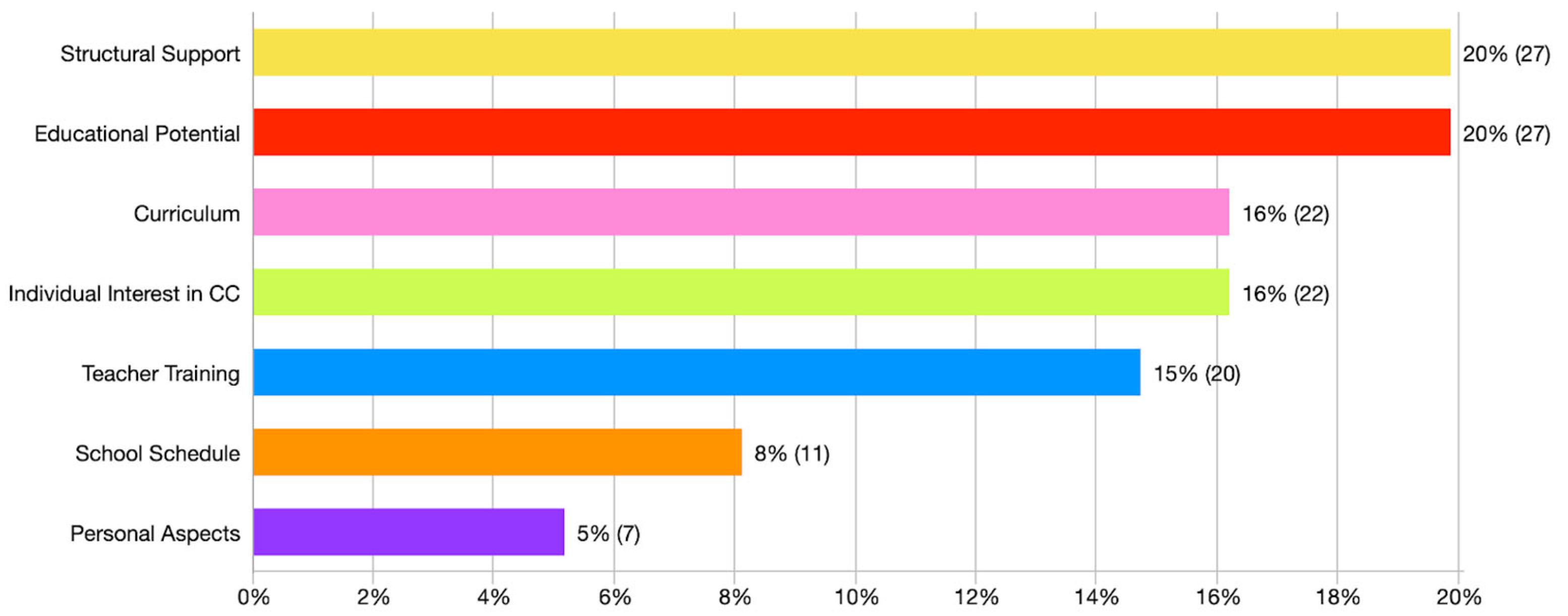
- Generation of frequency charts;
- (7)
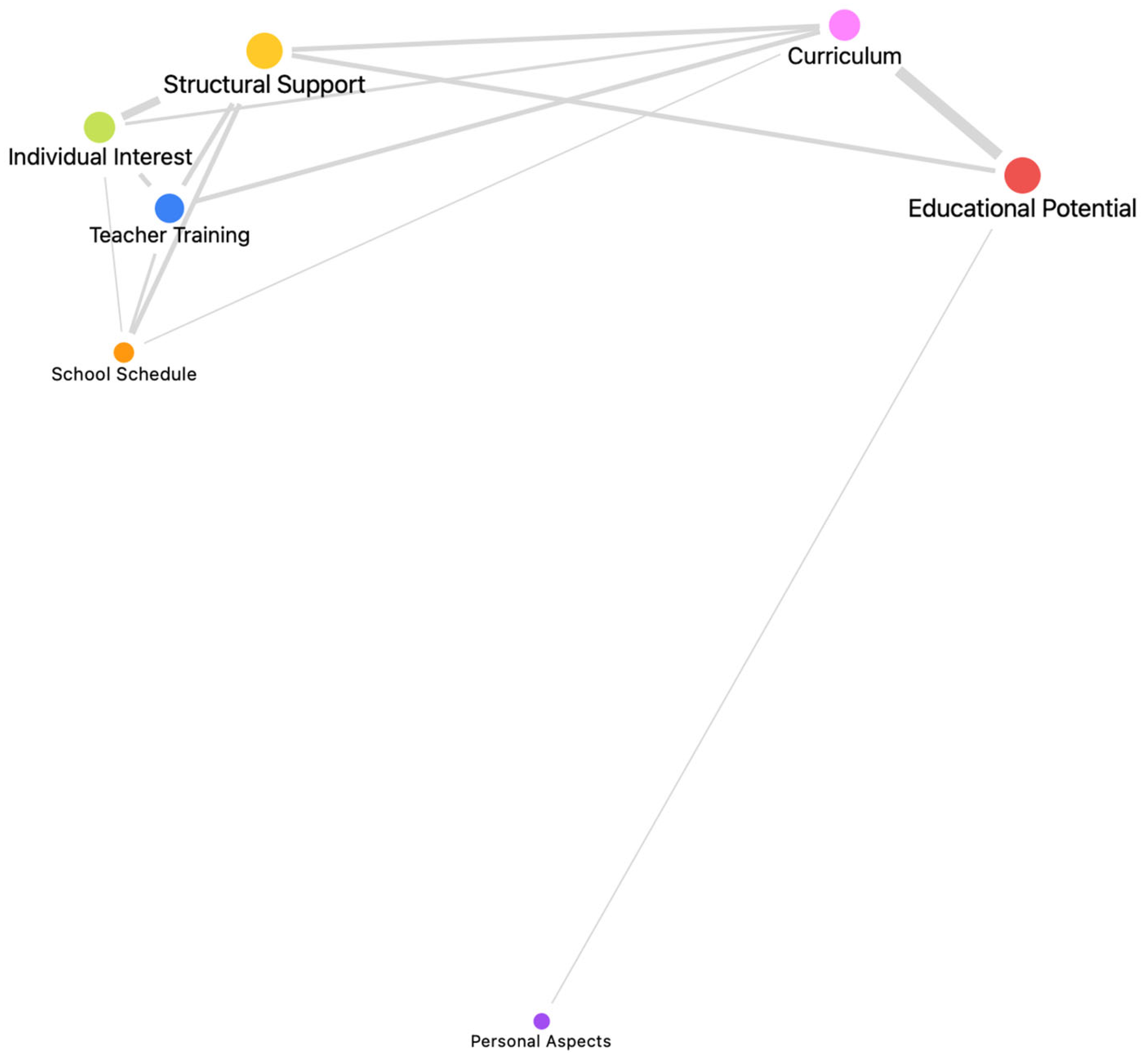
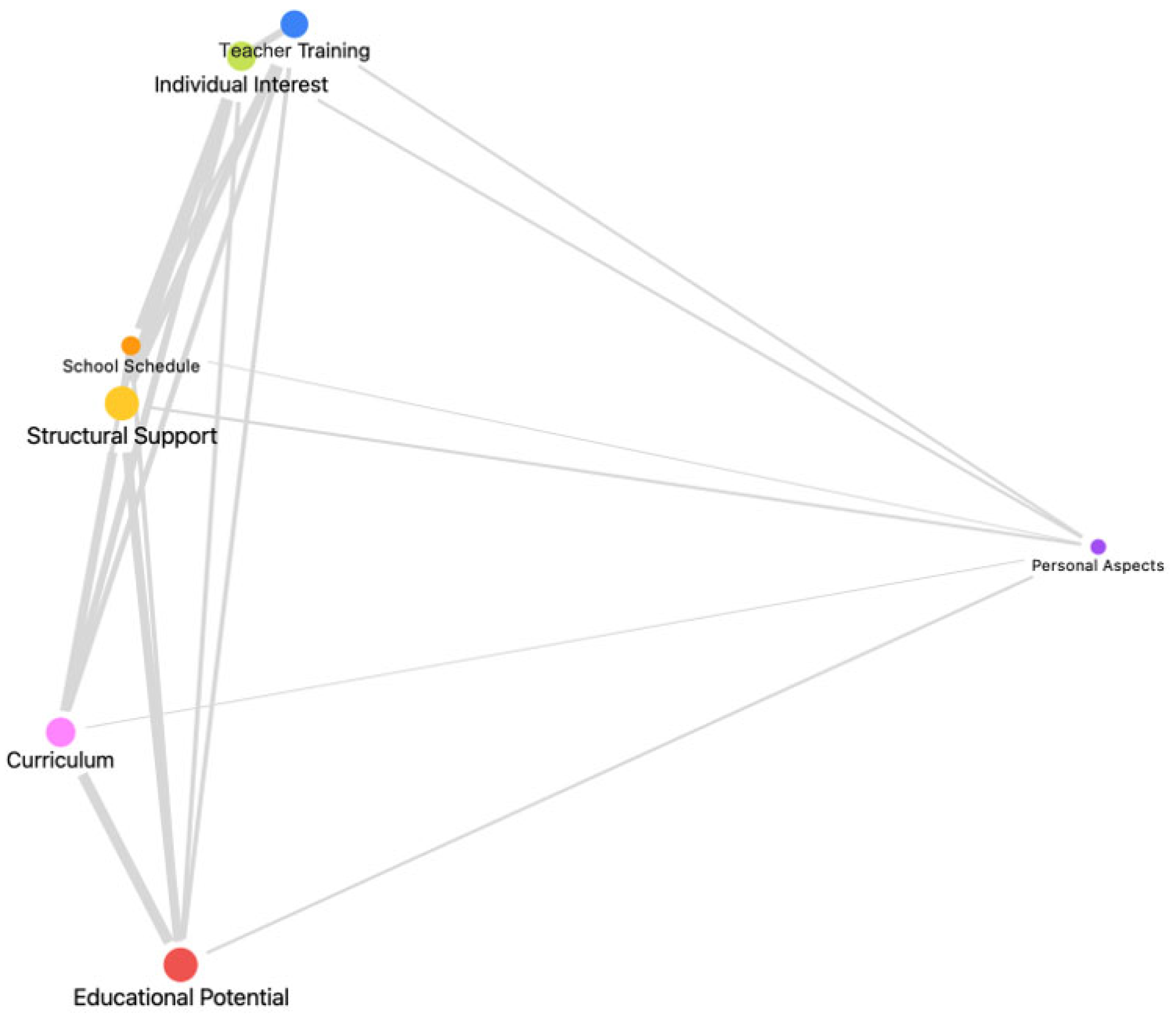
- Creation of network maps.
3. Findings and Analysis
3.1. Descriptive Findings of the Content Analysis
3.1.1. Structural Support
“[…] in the end, that system ends up running us over, it comes with I don’t know what, it drags us along, if this comes now, and then assessment period arrives, then Christmas, and in the end it ends up dragging us, overwhelm us, doesn’t it? So there are certain moments when one is saturated, tired, and gives in a little and it seems as if that’s the end of it. Then you pick it up again, right?”.[T8]
“So it’s complicated, sometimes you need your colleagues. You can’t run a school garden like that. We, for example, in our case, started it last year with a very good biology teacher who got very involved. This teacher went on leave and the school garden ended, and departments were involved, each one.”.[T1]
3.1.2. Educational Potential
“Sorry, but I don’t care about a number [mark]. What matters to me is that these students learn. So yes, I gave them a seven or an eight or a nine or whatever grading system you want. Well, it’s not relevant to me. What I want is for them to learn, and if they learn, I am happy.”.[T9]
“I believe that climate change must be a seed that has to grow in everyone, right? So for me, it has to radiate to the whole world.” [T8] [and also] “Solving the problem is not that, it’s solving a problem, it’s not a subject area. So the kids have a great time, right? They propose solutions, they test them themselves, they critique them themselves, and so then we stop. Maybe, right?”.[T9]
3.1.3. Curriculum
“For example, the interdisciplinary project for 4th year of ESO (Mandatory Secondary Education in Spain) has to do with the issue of clothing consumption, of the current fashion, all this cheap clothing that is so in fashion… in art class, for example, they design clothes, they recycle clothes. The math study, well, that of production, cost… of geography, of the distribution of…”.[T6]
“Going back a bit to climate change, I think part of the problem of teaching climate change is that it’s a very big and multidisciplinary problem, right? So, I from Chemistry address the little piece that falls to me. So, the little piece that falls to you is related to everything else, right? With biology, with history, with economics, everything. It’s that everything basically is, of course, part of the issue. So, addressing it I think also. Well, I’m going to say something somewhat controversial too, but I think that when we decided to separate knowledge into very specific areas, well, we shot ourselves in the foot because then I know about chemistry, and I only address chemistry and everything else becomes irrelevant. Well of course not, because everything else is connected, right?”.[T9]
3.1.4. Individual Interest
“[…] but above all, you do it because you like it. So of course, if you like it, the problem of self-limiting you’re going to handle worse, because of course, when you like something, it’s hard to cut back.”.[T4]
“[…] but I prefer to spend my energy on other things. That is, the audiovisual theme, is something that motivates me more than the environmental theme.”.[T6]
3.1.5. Teacher Training
“[…] I would like to contribute an idea here, she conveys this insecurity, and she is from sciences, right? Imagine us, for example, me from French, right? That already, well, sciences were maybe not my favorite sector, right? That’s why I leaned more towards languages. So, at first glance, when you are presented with a project of this type, the first thing you think is, ‘Ugh, I’m just not qualified, I don’t have the knowledge’, right? Because even having it sometimes, you can imagine, well, you don’t?”.[T5]
“The other one is teacher training, right? Because indeed, well, no one knows everything, right? None of us know everything. So? Well, we need to be learning new things all the time. Of course, learning new things, well, requires time, right? It requires effort, it requires many other things that also, that also make it difficult.”.[T9]
3.1.6. School Schedule
“It doesn’t seem to me that it makes you a less interested teacher or ‘Oh, look, he doesn’t want to work’. No, no, it’s that sometimes what you want is to work well, to work under good conditions, to have time to develop your creativity and not be rushed all the time.”.[T4]
“We held meetings but, in the end, everything remained unconcretized. Time passed. Sometimes, sometimes education is a machine. It’s a machine that runs and functions on its own, day after day. And when this was over, the first assessment period arrived. And then you lose the momentum for the first assessment exams. Then the Christmas holidays and time passes…”.[T2]
3.1.7. Personal Aspects
“So, of course, we are a generation that teaches another, and we insert ourselves into that, into that problem. Behavioral problems are increasingly greater between parents and children and between teachers and students. Okay. And there we have to tell them ‘We changed the climate in our generation, and you deal with it’. We are going to say ‘you fix it’. Of course, it’s a tough role.”.[T11]
3.2. Network Content Analysis of Dimensional Relationships
3.2.1. Cluster 1: Structural Support, Individual Interest, Teacher Training, and School Schedule
“A few years ago, we set up a makerspace with a laser cutter, machines for working with wood, etc. The idea was for that space to be used by all teachers, right? Which, sadly, isn’t so easy to make happen because, well, planning a ten-hour sequence and investing the time required to learn how to use the machines and so on is hardly viable, right?”.[T9]
3.2.2. Cluster 2: Educational Potential and Curriculum
“I believe it has to be teaching for everyone, right? Because it could happen that those you call the needy will become manual laborers, and those with high capacities, let’s say greater knowledge, might be the politicians or those leading us without that awareness.”.[T8]
3.2.3. Cluster 3: Personal Aspects
3.3. Overall Code Proximity Map

3.3.1. Cluster 1: Teacher Training and Individual Interest
“Look, don’t worry. The very fact that you are here on a Sunday taking a course surely means you are one of the best teachers in your school. In the end, what it means to be a good teacher, to do things well in class, is something each person decides. But the fact that you question it already means you want to be better, and that’s great.”.[T6]
3.3.2. Cluster 2: School Schedule and Structural Support
“But of course, the Science Club does not come with any associated reduction in hours. So, what are we asking for? We want to ask that, from our supervision duties, they schedule one during the lunch hour—which is when we are with those students. If they don’t grant it, will we keep doing it anyway? Yes, probably. But how? How does that make you feel?”.[T4]
3.3.3. Cluster 3: Curriculum and Educational Potential
“Look, all these kinds of policies are very difficult, right? Because, well, how do I manage to cover the curriculum? But also teach in a multidisciplinary way, but also include STEM. But also take them to the Makerspace. But also. Also. Also. Also. So, you can’t do all that, right? So, well, you have to prioritize what’s worthwhile. And I think sometimes the policies don’t allow us to prioritize the things that we teachers know are worthwhile, right?”.[T9]
3.3.4. Cluster 4: Personal Aspects
“But starting from the initial fact of the problem, from the continuous intergenerational struggle we have gotten into, and from the fact that we have caused this problem for those who come after us.” .[11]
4. Discussion
“So it’s like everything in Spain is exactly the same as with Brazilian teachers—they all say the same things”.[T14]
Limitations and Further Research
5. Conclusions
Supplementary Materials
Author Contributions
Funding
Institutional Review Board Statement
Informed Consent Statement
Data Availability Statement
Acknowledgments
Conflicts of Interest
References
- de Gusmão Pedrini, A. A Educação Ambiental no Enfrentamento da Emergência Climática Editorial. Int. J. Environ. Resil. Res. Sci. 2024, 6, 1–14. Available online: https://e-revista.unioeste.br/index.php/ijerrs/article/view/33644/23374 (accessed on 16 November 2025). [CrossRef]
- United Nations. The UN Confirms 2024 as the Hottest Year on Record, with Temperatures Approximately 1.55 °C Above Pre-Industrial Levels. Available online: https://brasil.un.org/pt-br/287173-onu-confirma-2024-como-o-ano-mais-quente-j%C3%A1-registrado-com-cerca-de-155%C2%B0c-acima-dos-n%C3%ADveis (accessed on 30 November 2025).
- Planetary Health Check. A Scientific Assessment of the State of the Planet. Available online: https://www.planetaryhealthcheck.org/wp-content/uploads/PlanetaryHealthCheck2025_ExecutiveSummary.pdf (accessed on 30 November 2025).
- Intergovermental Panel on Climate Change. Climate Change 2021: The Physical Science Basis; Cambridge University Press: Cambridge, UK, 2021. [Google Scholar] [CrossRef]
- Palmieri, M. Perspectivas de Educação Ambiental nos Documentos do Brasil e da Espanha: Um Estudo Comparado [Perspectives on Environmental Education in Documents from Brazil and Spain: A Comparative Study]. Ph.D. Thesis, Universidade de São Paulo, São Paulo, Brazil, September 2025. [Google Scholar]
- Arroyo, M. Currículo [Curriculum], Território em Disputa, 5th ed.; Vozes: Petrópolis, Brazil, 2013. [Google Scholar]
- García-Vinuesa, A.; Conde, J.; Palmieri, M.; Correa-Chica, A. Secondary education teachers’ perception on climate change: A bibliometric overview. Metrics 2026, 3, 1. [Google Scholar] [CrossRef]
- García Vinuesa, A.; Rui Mucova, S.A.; Azeiteiro, U.M.; Meira Cartea, P.Á.; Pereira, M. Mozambican students’ knowledge and perceptions about climate change: An exploratory study in Pemba City. Int. Res. Geogr. Environ. Educ. 2022, 31, 5–21. [Google Scholar] [CrossRef]
- Kahan, D.M.; Peters, E.; Wittlin, M.; Slovic, P.; Ouellette, L.L.; Braman, D.; Mandel, G. The polarizing impact of science literacy and numeracy on perceived climate change risks. Nat. Clim. Change 2012, 2, 732–735. [Google Scholar] [CrossRef]
- Wise, S.B. Climate Change in the Classroom: Patterns, Motivations, and Barriers to Instruction among Colorado Science Teachers. J. Geosci. Educ. 2010, 58, 297–309. [Google Scholar] [CrossRef]
- Ho, L.-C.; Seow, T. Teaching Controversial Issues in Geography: Climate Change Education in Singaporean Schools. Theory Res. Soc. Educ. 2015, 43, 314–344. [Google Scholar] [CrossRef]
- Khalidi, R.; Ramsey, J. A Comparison of California and Texas Secondary Science Teachers’ Perceptions of Climate Change. Environ. Educ. Res. 2021, 27, 669–686. [Google Scholar] [CrossRef]
- Kunkle, K.A.; Monroe, M.C. Cultural Cognition and Climate Change Education in the U.S.: Why Consensus Is Not Enough. Environ. Educ. Res. 2019, 25, 633–655. [Google Scholar] [CrossRef]
- Plutzer, E.; Hannah, A.L. Teaching Climate Change in Middle Schools and High Schools: Investigating STEM Education’s Deficit Model. Clim. Change 2018, 149, 305–317. [Google Scholar] [CrossRef]
- Opuni-Frimpong, N.Y.; Essel, H.B.; Opuni-Frimpong, E.; Obeng, E.A. Sustainable Development Goal for Education: Teachers’ Perspectives on Climate Change Education in Senior High Schools (SHS). Sustainability 2022, 14, 8086. [Google Scholar] [CrossRef]
- Wang, H.-H.; Bhattacharya, D.; Nelson, B.J. Secondary Agriculture Teachers’ Knowledge, Beliefs and, Teaching Practices of Climate Change. J. Agric. Educ. Ext. 2020, 26, 5–17. [Google Scholar] [CrossRef]
- Walshe, R.A.; Chang Seng, D.; Bumpus, A.; Auffray, J. Perceptions of Adaptation, Resilience and Climate Knowledge in the Pacific: The Cases of Samoa, Fiji and Vanuatu. Int. J. Clim. Change Strateg. Manag. 2018, 10, 303–322. [Google Scholar] [CrossRef]
- McNeal, P.; Petcovic, H.; Reeves, P. What Is Motivating Middle-School Science Teachers to Teach Climate Change? Int. J. Sci. Educ. 2017, 39, 1069–1088. [Google Scholar] [CrossRef]
- Colston, N.M.; Vadjunec, J.M. A Critical Political Ecology of Consensus: On “Teaching Both Sides” of Climate Change Controversies. Geoforum 2015, 65, 255–265. [Google Scholar] [CrossRef]
- Howard-Jones, P.; Sands, D.; Dillon, J.; Fenton-Jones, F. The Views of Teachers in England on an Action-Oriented Climate Change Curriculum. Environ. Educ. Res. 2021, 27, 1660–1680. [Google Scholar] [CrossRef]
- Zummo, L.M.; Dozier, S.J. Using Epistemic Instructional Activities to Support Secondary Science Teachers’ Social Construction of Knowledge of Anthropogenic Climate Change during a Professional Learning Experience. J. Geosci. Educ. 2022, 70, 530–545. [Google Scholar] [CrossRef]
- Gayford, C. Controversial Environmental Issues: A Case Study for the Professional Development of Science Teachers. Int. J. Sci. Educ. 2002, 24, 1191–1200. [Google Scholar] [CrossRef]
- Hannah, A.L.; Rhubart, D.C. Teacher Perceptions of State Standards and Climate Change Pedagogy: Opportunities and Barriers for Implementing Consensus-Informed Instruction on Climate Change. Clim. Change 2020, 158, 377–392. [Google Scholar] [CrossRef]
- Monroe, M.C.; Oxarart, A.; Plate, R.R. A Role for Environmental Education in Climate Change for Secondary Science Educators. Appl. Environ. Educ. Commun. 2013, 12, 4–18. [Google Scholar] [CrossRef]
- White, P.T.; Wolf, K.J.; Johnson-Maynard, J.L.; Velez, J.J.; Eigenbrode, S.D. Secondary Climate Change Education in the Pacific Northwest. Nat. Sci. Educ. 2014, 43, 85–93. [Google Scholar] [CrossRef]
- Segade-Vázquez, M.; García-Vinuesa, A.; Rodríguez-Groba, A.; Conde, J.J. Characterizing educational research on climate change in the era of climate emergency (2017–2024). Rev. Esp. Pedagog. 2025, 83, 179–198. [Google Scholar] [CrossRef]
- Krueger, R.; Casey, M.A. Focus Group. A Practical Guide for Applied Research, 5th ed.; Sage: London, UK, 2014. [Google Scholar]
- Flick, U. An Introduction to Qualitative Research, 7th ed.; Sage: London, UK, 2022. [Google Scholar]
- Creswell, J.W.; Creswell, J.D. Research Design: Qualitative, Quantitative and Mixed Methods Approaches, 5th ed; Sage: London, UK, 2022. [Google Scholar]
- Pérez Diez, A. La Inclusión de la Crisis Climática en Educación Secundaria Obligatoria. Un Estudio Comparado del Marco Normativo y Curricular en España [The Inclusion of the Climate Crisis in Mandatory Secondary Education. A Comparative Study of the Normative and Curricular Framework in Spain]. Ph.D. Thesis, Universidade de Santiago de Compostela, Santiago de Compostela, Spain, 2022. [Google Scholar]
- Colle, R. El Análisis de las Comunicaciones: 2. Técnicas de Análisis [The Analysis of Communications: 2. Analysis Techniques]; Sociedad Latina de Comunicación Social: Tenerife, Spain, 2011. [Google Scholar]
- Sóñora-Luna, F.; García-Vinuesa, A. Climántica: A Social, Pedagogical and Environmental Project to Face Climate Change. Pedagog. Soc. Rev. Interuniv. 2020, 36, 63–79. [Google Scholar] [CrossRef]
- García-Vinuesa, A. Empowering Secondary Education Teachers for Sustainable Climate Action. Sustainability 2024, 16, 7941. [Google Scholar] [CrossRef]
- Hargreaves, A.; Fullan, M. Professional Capital: Transforming Teaching in Every School; Teachers College Press: New York, NY, USA, 2012. [Google Scholar]
- Vygotsky, L.S. A Formação Social da Mente [The Social Formation of the Mind]; Martins Fontes: São Paulo, Brazil, 2007. [Google Scholar]
- Tardif, M. Saberes Docentes e Formação Profissional [Teaching Knowledge and Professional Training]; Vozes: Petrópolis, Brazil, 2011. [Google Scholar]
- Silva, A.F.L. A Representação das Dimensões Espaço e Tempo Docente [Representation of the Spatial and Temporal Dimensions of Teaching]. Rev. Eletrônica Pesqui. 2011, 2, 35–47. [Google Scholar]
- Hornsey, M.J.; Harris, E.; Bain, P.; Fielding, K. Meta-Analyses of the Determinants and Outcomes of Belief in Climate Change. Nat. Clim. Change 2016, 6, 622–626. [Google Scholar] [CrossRef]
- Stern, P.C. Impacts on Climate Change Views. Nat. Clim. Change 2016, 6, 341–342. [Google Scholar] [CrossRef]
- Sacristán, J.G. O Currículo [The Curriculum]: Uma Reflexão Sobre A Prática, 3rd ed.; Artmed: Porto Alegre, Brazil, 2000. [Google Scholar]
- Apple, M.W. Ideologia e Currículo [Ideology and Curriculum], 3rd ed.; Artmed: Porto Alegre, Brazil, 2008. [Google Scholar]
- Ball, S.J. The teacher’s soul and the terrors of performativity. J. Educ. Policy 2003, 18, 215–228. [Google Scholar] [CrossRef]
- Evans, R.S.; McGregor, H.E.; Reed, B. Pedagogical principles for encouraging (socially just) youth climate action: A schema for citizenship education curriculum analysis. Educ. Citizsh. Soc. Justice 2025, 20, 450–468. [Google Scholar] [CrossRef]



| Informant | Genre | Country | Discipline | Teacher Experience |
|---|---|---|---|---|
| T1 | Female | Spain | Arts | >20 years |
| T2 | Male | Spain | Biology | >30 years |
| T3 | Female | Spain | School Counselor | Retired |
| T4 | Female | Spain | Biology | <5 years |
| T5 | Female | Spain | French | >20 years |
| T6 | Male | Spain | Mathematics | >20 years |
| T7 | Female | Spain | Biology | >30 years |
| T8 | Female | Spain | Arts | >20 years |
| T9 | Male | Mexico | Chemistry | >20 years |
| T10 | Female | Mexico | Biology | >20 years |
| T11 | Male | Spain | Biology | >20 years |
| T12 | Male | Portugal | Arts | >20 years |
| T13 | Male | Poland | Spanish/English | >20 years |
| T14 | Female | Brazil | Arts | >20 years |
| Analytical Dimension | Definition | Representative Quotations |
|---|---|---|
| Structural Support | Structural conditions (material, policy, support) enabling or constraining teaching | “At my center this year, it is going to be implemented that all project coordinators, regardless of the type of project, will have one fewer hour of duty supervision. (…) It’s the only way. The only way to acknowledge a little bit of the extra work. But there’s nothing more than that.” [T7] |
| Educational Potential | Meaningful potential of content to foster development through mediated and critical learning | “I believe that the family plays a very important role, naturally […]. “I want my child to become an engineer, an architect, or a doctor, and what matters to me is that grade. Don’t come to me with this or that—what matters is that in the exam they got an eight, they got a ten.” And how on earth do you dismantle the argument when you are addressing a different set of considerations altogether?” [T12] |
| Personal Aspects | Personal factors (experiences, beliefs, identity) shaping teachers’ perceptions, engagement, and pedagogical decisions | “From my point of view, every time there is a change in legislation or in the educational focus, it places us in an even greater contradiction. I observe that this is happening at an international level. As a result of this contradiction, when we later have to explain ourselves, we feel guilty for not doing things properly, when in reality we cannot, because we are in a constant state of contradiction.” [T11] |
| Teacher Training | Body of teacher knowledge (formal training, disciplinary, curricular, experiential) that constitutes professional competency | “As a result of the visit by the representative from the University of Santiago, who came to Poland in 2018 and met with me, we were offered something that changed everything for us. Because of this, in our school, students are now able to put into practice the words and phrases we provide them with during each unit. That is, when we work on a particular unit—such as the environment—we provide them with the relevant vocabulary, and then they go to Aveiro or to Galicia and put all of this into practice.” [T13] |
| School Schedule | Temporal organization and teacher time as a factor that enables or constrains pedagogical practices | “We try to carry out projects, we try to develop multidisciplinary projects, but it is very difficult because organizing the logistics when they take place, how many hours are allocated, and who is responsible for delivering them. Is extremely challenging.” [T9] |
| Individual Interest | Teachers’ personal interest, attitudes, and motivation (beyond content knowledge) for addressing climate change in class | “We have received awards for documentary-related projects, which shows that, in the end, this is very important: it is essential to build on what truly motivates you, because that is the only way for something to be sustained over time. If you ultimately become involved in something you may like but that does not genuinely inspire you, it is difficult for it to endure. In this regard, environmental issues are something that concern us all.” [T6] |
| Curriculum | Selection, organization, and legitimization of school content, reflecting values and ideologies | “The same thing happens to us within the educational system, doesn’t it? We all tend to prioritize differently and interpret the curriculum content in different ways, and we forget that if it is not a shared objective, we will not reach where we want to go.” [T10] |
| SS | EP | PA | TT | SSch | II | C | |
|---|---|---|---|---|---|---|---|
| Structural Support (SS) | - | 9 | 0 | 3 | 4 | 6 | 4 |
| Educational Potential (EP) | 9 | - | 1 | 0 | 0 | 0 | 9 |
| Personal Aspects (PA) | 0 | 1 | - | 0 | 0 | 0 | 0 |
| Teacher Training (TT) | 3 | 0 | 0 | - | 2 | 3 | 3 |
| School Schedule (SSch) | 4 | 0 | 0 | 2 | - | 1 | 1 |
| Individual Interest (II) | 6 | 0 | 0 | 3 | 1 | - | 2 |
| Curriculum (C) | 4 | 9 | 0 | 3 | 1 | 2 | - |
| SS | EP | PA | TT | SSch | II | C | |
|---|---|---|---|---|---|---|---|
| Structural Support (SS) | - | 44 | 21 | 42 | 36 | 47 | 45 |
| Educational Potential (EP) | 44 | - | 21 | 26 | 28 | 27 | 47 |
| Personal Aspects (PA) | 21 | 21 | - | 20 | 13 | 21 | 16 |
| Teacher Training (TT) | 42 | 26 | 20 | - | 25 | 41 | 33 |
| School Schedule (SSch) | 36 | 28 | 13 | 25 | - | 31 | 45 |
| Individual Interest (II) | 47 | 27 | 21 | 41 | 31 | - | 33 |
| Curriculum (C) | 45 | 47 | 16 | 33 | 45 | 33 | - |
Disclaimer/Publisher’s Note: The statements, opinions and data contained in all publications are solely those of the individual author(s) and contributor(s) and not of MDPI and/or the editor(s). MDPI and/or the editor(s) disclaim responsibility for any injury to people or property resulting from any ideas, methods, instructions or products referred to in the content. |
© 2026 by the authors. Licensee MDPI, Basel, Switzerland. This article is an open access article distributed under the terms and conditions of the Creative Commons Attribution (CC BY) license.
Share and Cite
García-Vinuesa, A.; Palmieri, M.; Sóñora-Luna, F. Exploring Barriers and Needs: Secondary Teachers’ Perspectives on Climate Change Education Within an International Environmental Campus. Sustainability 2026, 18, 2519. https://doi.org/10.3390/su18052519
García-Vinuesa A, Palmieri M, Sóñora-Luna F. Exploring Barriers and Needs: Secondary Teachers’ Perspectives on Climate Change Education Within an International Environmental Campus. Sustainability. 2026; 18(5):2519. https://doi.org/10.3390/su18052519
Chicago/Turabian StyleGarcía-Vinuesa, Antonio, Mayara Palmieri, and Francisco Sóñora-Luna. 2026. "Exploring Barriers and Needs: Secondary Teachers’ Perspectives on Climate Change Education Within an International Environmental Campus" Sustainability 18, no. 5: 2519. https://doi.org/10.3390/su18052519
APA StyleGarcía-Vinuesa, A., Palmieri, M., & Sóñora-Luna, F. (2026). Exploring Barriers and Needs: Secondary Teachers’ Perspectives on Climate Change Education Within an International Environmental Campus. Sustainability, 18(5), 2519. https://doi.org/10.3390/su18052519