


Abstract
As countries confront rapid population ageing alongside escalating climate hazards, long-term care (LTC) systems are increasingly exposed to climate-related risks yet remain under-recognised within climate adaptation policy. This study aims to bridge the gap between climate and health adaptation frameworks and LTC system planning by developing a climate-tailored integrated LTC framework. A horizon scanning and theory-informed synthesis approach was employed, drawing on peer-reviewed and grey literature published between 2010 and 2025 to identify climate hazards affecting LTC users and systems. Evidence was organised by hazard type and analysed in relation to system-level disruption mechanisms and adaptation functions. Findings demonstrate that major climate hazards, including heatwaves, flooding, storms, droughts, wildfires, and air pollution, disproportionately affect LTC users, leading to increased morbidity, cognitive decline, and functional deterioration. At the same time, LTC systems are vulnerable to cascading infrastructure failures, workforce strain, supply chain disruptions, and service discontinuities. Despite these risks, the WHO Operational Framework for Climate-Resilient and Low-Carbon Health Systems does not explicitly address LTC, while the WHO Integrated LTC Framework does not incorporate climate-related risks. In response, this paper proposes a climate-tailored LTC framework that systematically embeds climate risk, adaptation, and mitigation within the four core LTC domains of needs, governance, service delivery, and system enablers. Equity, user participation, and decarbonisation are integrated as cross-cutting principles. The framework provides a policy-oriented architecture to strengthen climate-resilient LTC systems and align long-term care reform with broader climate and sustainable development strategies.
1. Background
Long-term care (LTC) systems encompass a diverse range of services that provide sustained support to individuals who require assistance over extended periods due to chronic illness, disability, frailty, or reduced physical or cognitive capacity [1,2]. These systems include residential care homes, nursing facilities, and formal home- and community-based services, delivered through a combination of medical, social, and personal care. Increasingly, LTC systems operate at the interface of health and social care, with policy reforms in many countries shifting complex care tasks from hospitals into community and residential LTC settings [3]. Alongside formal services, LTC systems also rely heavily on informal caregiving networks provided by families and communities.
LTC systems have developed unevenly across regions. While many high-income countries, particularly in Europe and other OECD states, have established formal LTC systems, these remain fragmented, with persistent reliance on informal caregiving and substantial variation in coverage, quality, governance, and financing [4,5,6]. In contrast, in many low- and middle-income countries (LMICs), LTC systems remain limited, emerging, or largely absent [7,8]. Despite these differences, the development of integrated LTC systems is widely recognised as a necessary response to population ageing, with demonstrated benefits in enhancing functional independence, reducing avoidable hospital admissions, and containing healthcare costs [9].
Globally, LTC systems are now situated at the intersection of two powerful and interacting megatrends: rapid population ageing and accelerating climate change [10,11]. Older adults and people living with long-term conditions or disabilities constitute the majority of LTC users and are among the populations most sensitive to climate-related hazards. Across most OECD countries, the proportion of the population aged 65 years and over now exceeds that of children and young people. Although life expectancy continues to rise, healthy life expectancy (HALE) has not increased at the same pace, widening the gap between years lived and years lived in good health [12,13]. This demographic shift has resulted in a growing prevalence of functional limitations, multimorbidity, and cognitive impairment among older populations, substantially increasing demand for LTC services.
Population ageing is occurring alongside profound changes in family structures and labour markets, which are reducing the availability and capacity of informal caregivers [14]. As a result, formal LTC systems are increasingly required to absorb rising care demands while operating under workforce constraints, funding pressures, and structural fragmentation. These pressures are now being compounded by climate change, which introduces new and intensifying risks across all components of LTC systems, from governance and financing to service delivery, infrastructure, and workforce deployment [15].
According to the Intergovernmental Panel on Climate Change (IPCC), climate hazards, including heatwaves, floods, droughts, storms, and air pollution, are increasing in frequency, intensity, and geographic spread [11]. The health consequences of these hazards, particularly extreme heat, are well established [16,17,18]. Evidence consistently shows that older adults and people with disabilities experience disproportionate risks of mortality, morbidity, and functional decline during extreme climate events [19,20,21]. These impacts are further shaped by socioeconomic disadvantage, housing quality, social isolation, and limited adaptive capacity [22,23], producing highly uneven patterns of vulnerability.
However, climate risks extend beyond individual-level vulnerability to encompass the functioning and resilience of LTC systems themselves. Climate hazards disrupt essential care infrastructures, including electricity, water, transport, and digital connectivity, while also affecting workforce availability, supply chains, facility safety, and service continuity. For example, during floods, storms, and wildfires, LTC users with limited mobility may be unable to evacuate without external assistance [24]. At the same time, power outages compromise life-sustaining medical devices and indoor temperature regulation in residential care settings, leading to increased emergency admissions and hospitalisations [25]. Case studies from Canada demonstrate that LTC facility residents are particularly sensitive to extreme heat, flooding, infectious disease outbreaks, and wildfire smoke due to their high burden of chronic disease, advanced age, and dependence on institutional infrastructure [26]. Post-disaster recovery is often prolonged in LTC contexts, as infrastructure damage and workforce disruption reduce access to care and delay service restoration.
At the global policy level, significant advances have been made in the development of climate–health adaptation frameworks. The WHO Operational Framework for Climate-Resilient and Low-Carbon Health Systems provides comprehensive guidance for strengthening climate resilience across health systems through leadership and governance, health workforce, information systems, essential medical products, service delivery, financing, and infrastructure [27]. However, this framework focuses primarily on health systems and facilities. It does not explicitly address LTC as a distinct sector, despite clear differences between the two systems in structure, governance, delivery, and funding. Conversely, the WHO Integrated LTC Framework provides detailed guidance for countries on strengthening LTC governance, service delivery, financing, and system enablers across the life course [28], yet it does not consider climate-related hazards, environmental risks, or adaptation requirements. This dual policy blind spot leaves LTC systems positioned at the margins of both climate adaptation and health system resilience strategies.
This gap is increasingly recognised in national and international policy analyses. The European Climate and Health Observatory’s review of climate and health strategies in 38 European countries found that LTC systems are rarely recognised as key enablers of climate adaptation for older adults and people with disabilities [29]. Globally, disability-inclusive climate policy remains limited, with only a minority of countries explicitly referencing persons with disabilities or care-dependent populations in climate adaptation strategies.
The convergence of rapid population ageing, rising demand for long-term care (LTC), and intensifying climate hazards presents a structural challenge for health and care systems. Although this analysis primarily draws on evidence from high-income countries, the vulnerabilities and system pressures identified are increasingly relevant to LMICs undergoing rapid demographic transitions. Addressing these intersecting pressures requires a framework that integrates climate adaptation into LTC governance, service delivery, and system enablers, while explicitly addressing equity and system fragmentation.
Strengthening climate-resilient LTC systems is also aligned with the United Nations Sustainable Development Goals (SDGs). LTC systems directly support SDG 3 (Good Health and Well-being) by maintaining functional ability and continuity of care for older adults and people with disabilities. Integrating climate resilience within LTC further contributes to SDG 13 (Climate Action), SDG 10 (Reduced Inequalities), SDG 11 (Sustainable Cities and Communities), and SDG 5 (Gender Equality), reflecting LTC’s role in protecting vulnerable populations and sustaining social infrastructure.
This study responds to the gap between climate–health and LTC policy frameworks by developing an integrated, climate-tailored LTC model. The framework synthesises empirical evidence on climate hazards affecting LTC users and systems, identifies structural blind spots across existing global instruments, and embeds climate adaptation, mitigation, and equity within the core domains of LTC governance, service delivery, and system enablers. Specifically, this paper aims to (1) systematically synthesise climate hazard evidence in relation to LTC users and LTC system components; (2) identify the structural policy blind spot between the WHO climate–health and WHO LTC frameworks; and (3) propose an integrated, climate-tailored LTC framework that operationalises climate adaptation, resilience, and mitigation within LTC governance, service delivery, and system enablers.
2. Methods
2.1. Literature Identification and Horizon Scanning
A horizon scanning approach was employed to identify key evidence and emerging insights at the intersection of climate hazards, LTC, and the vulnerabilities of older adults and individuals with disabilities. This approach supports anticipatory systems thinking and integration of complex, evolving risks and has been increasingly used in health policy and environmental health research [30]. In this paper, a climate hazard is defined as any weather or environmental condition associated with contemporary climate change that has the potential to cause illness, injury, or death, either directly or indirectly, through its effects on the physical and social environment.
The evidence base was assembled in two main phases. First, a scoping review was conducted, between February and July 2025, to identify peer-reviewed and grey literature across global and regional contexts relevant to LTC and climate hazards. Academic databases searched included MEDLINE, EMBASE, PsycINFO, Global Health, and CINAHL, allowing for the inclusion of diverse disciplinary perspectives and methodologies.
For grey literature, a four-pronged strategy was applied: (1) doctoral theses were reviewed via the EThOS database; (2) targeted Google searches were conducted using the core research question, with titles and snippets screened in a manner analogous to title/abstract screening; (3) key institutional websites (including the World Health Organization (WHO), the European Climate and Health Observatory, the US Centers for Disease Control and Prevention (CDC), the UK National Health Service (NHS), and the European Observatory on Health Systems and Policies) were examined for relevant reports, policy documents, and frameworks using concept-driven queries; and (4) backward citation tracking and direct outreach to researchers and stakeholders were used to access unpublished reports or non-indexed policy documents related to climate adaptation in LTC, ageing, or disability sectors. Table 1 summarises the search terms used.
Table 1.
Population, Context, Intervention (PCI) Search Terms and Eligibility Criteria (compound terms).
Documents were screened for relevance using three criteria: (1) impacts of climate hazards on vulnerable populations, particularly older adults and people with disabilities or long-term conditions; (2) implications for LTC services and systems, including facilities, workforce, financing, and governance; and (3) policy or operational recommendations related to climate adaptation or resilience. Given that most of the documented evidence on formal LTC systems and climate change currently originates from high-income countries, the review was restricted to these settings. Findings related to criteria (1) and (2) were organised and synthesised by climate hazard and event (e.g., heatwaves, floods, wildfires, air pollution episodes). Findings relevant to adaptation and resilience criterion (3) informed the subsequent development and refinement of the proposed framework.
The search process yielded approximately 259 records across academic and grey literature sources. Following title and abstract screening, 98 records were retained for full-text review. Of these, approximately 56 sources were included in the final synthesis, informing hazard analysis and framework development. Screening and synthesis were conducted by the author, with iterative refinement of inclusion decisions based on relevance to LTC systems and climate adaptation.
2.2. Analytical Approach and Framework Development
The climate-tailored LTC framework was developed using a theory-informed synthesis approach. The starting point was the WHO Integrated LTC Framework, which provides a comprehensive structure for understanding LTC systems through four core domains: LTC needs, governance, service delivery, and system enablers [28]. In parallel, we drew on the WHO Operational Framework for Climate-Resilient and Low-Carbon Health Systems, which outlines key components for strengthening climate resilience across health systems, including leadership and governance, health workforce, information systems, essential medical products and technologies, service delivery, financing, and climate-resilient infrastructure [27].
Analytically, these two WHO frameworks were treated as complementary but incomplete with respect to LTC and climate change: the climate–health framework provides limited explicit attention to LTC, whereas the LTC framework does not address climate hazards or adaptation. The proposed climate-tailored LTC framework, therefore, seeks to bridge these two global policy frameworks by integrating LTC-specific structures and functions with climate risk and adaptation requirements.
Framework adaptation followed a multi-source triangulation process. First, empirical evidence from case studies on climate hazards and LTC outcomes (e.g., [26,31,32]) informed the identification of climate-sensitive risks and mechanisms of disruption affecting both LTC users and LTC systems. Second, conceptual models such as the Social Identity Model of Post-Disaster Action [33] and the complexity-based framework for climate risk assessment developed by [34] were used to map dynamic risks, system interdependencies, and user- and community-level resilience capacities. Third, health systems integration theory and social infrastructure models (e.g., [18,31]) guided the embedding of climate-sensitive functions across LTC governance, service delivery, and system enablers.
The framework development process involved synthesising themes across the four domains of the WHO Integrated LTC Framework [28] (LTC needs, governance, service delivery, and system enablers), overlaying them with climate-related risks and adaptation requirements highlighted in the WHO climate–health framework, and mapping vulnerabilities and leverage points for policy and operational adaptation. Particular attention was paid to the physical, institutional, and social infrastructures that underpin LTC systems, and to how these infrastructures are affected by climate hazards. Equity and user empowerment were integrated as cross-cutting values, reflecting evidence that climate hazards disproportionately affect socioeconomically disadvantaged, socially isolated, and care-dependent populations. The resulting framework is intended as a policy-oriented tool to support LTC and health system decision-makers in explicitly incorporating climate resilience into LTC planning and reform.
3. Results
3.1. The Impact of Different Climate Hazards on LTC Users
3.1.1. Heatwaves
Heatwaves are among the most extensively documented climate hazards affecting older adults and individuals with LTC needs. Numerous studies report significant increases in morbidity and hospital admissions among older populations during heat events [35,36,37,38,39,40]. Elevated risks are closely associated with pre-existing cardiovascular, respiratory, renal, and neurological conditions that impair thermoregulation [35,36,37]. Medication use, particularly diuretics, beta-blockers, and antipsychotics, further increases vulnerability by elevating the risk of dehydration, hypotension, and heat stroke [41]. Neurological conditions such as spinal cord injuries, multiple sclerosis, and Parkinson’s disease impair the body’s ability to regulate temperature, substantially increasing hyperthermia risk [42]. Individuals with cognitive impairments, including dementia and intellectual disabilities, may not recognise heat-related danger or initiate protective behaviours [38,43]. Emerging evidence further links heat exposure to accelerated cognitive decline and increased dementia risk [44].
Heatwaves also place severe strain on LTC systems and infrastructure. Residential care facilities often lack adequate cooling systems, thermal insulation, and emergency heat protocols, particularly in temperate regions historically unaccustomed to extreme heat. Power surges and outages during peak cooling demand disrupt temperature regulation, refrigeration of medications, and operation of medical devices [45]. Workforce capacity is also affected, as staff experience heat-related illness, increased workloads due to intensified care demands, and elevated occupational risks. During extreme heat events, LTC facilities experience surges in dehydration-related complications, falls, delirium, and emergency transfers, amplifying pressure on already constrained health and social care systems [31,46].
3.1.2. Flooding
The health consequences of flooding extend well beyond physical injuries and drowning, with older adults identified as a particularly high-risk group across multiple phases of flood impact. Du et al. [47] described immediate health effects (injuries, hypothermia, toxin exposure), medium-term outcomes (infectious diseases, mental health disorders, food insecurity), and long-term consequences, including chronic illness, disability, and malnutrition. Meta-analytic evidence confirms elevated risks of gastrointestinal illness following floods [48], alongside substantial mental health impacts among older populations [49]. Flooding also disrupts healthcare access by damaging transport networks, power supply, and medical infrastructure, restricting access to medications, assistive devices, and routine care [32].
Research consistently demonstrates that LTC needs rise significantly following flooding events. Analysing Japanese LTC insurance claims after the 2018 floods, a marked increase in care dependency among older flood survivors compared with unaffected controls was observed [50]. There was also significantly greater cognitive deterioration among home-dwelling older adults affected by the same disaster [32]. While detailed LTC administrative analyses are limited outside Japan, international evidence demonstrates consistent post-flood increases in morbidity, mental health burden, and functional vulnerability among older adults [47,48,49], suggesting that the underlying mechanisms of service disruption and decline are not geographically confined.
Flooding directly damages LTC facilities, residential buildings, care equipment, and transport infrastructure, frequently forcing evacuations, service closures, and relocation of highly dependent residents. Water contamination compromises hygiene standards, dialysis services, wound care, and infection prevention. Supply chains for medications, food, oxygen, and incontinence products are often disrupted for extended periods. Workforce displacement, staff shortages, and prolonged facility downtime severely impair care continuity and increase institutional costs [51].
3.1.3. Cyclones, Hurricanes, and Typhoons
Older adults face elevated risks during all stages of cyclones, hurricanes, and typhoons. Despite perceived preparedness, many older residents lack comprehensive evacuation plans, secure shelters, and access to transportation [52]. Wang and Yarnal [53] identified significant social gradients in hurricane vulnerability, with coastal residents facing greater physical exposure and inland residents experiencing higher socioeconomic vulnerability, thereby limiting recovery capacity. Evidence shows that during and after Hurricane Sandy, older adults relied heavily on informal support networks, and peer-to-peer social support played a critical role in maintaining psychological well-being [54].
Severe storms and cyclones frequently cause prolonged power outages, structural damage to LTC facilities, flooding of care environments, loss of electronic health records, and breakdowns in transport and supply chains. Evacuation of residents with complex needs is logistically difficult, medically risky, and resource-intensive. Staff shortages following disasters further compromise care quality. Post-event recovery often requires extensive rebuilding, regulatory waivers, and emergency financing to restore LTC operations [55,56].
3.1.4. Drought and Dust Storms
Stanke et al. [20] identified multiple drought-related health risks disproportionately affecting older adults, including waterborne disease, economic instability, displacement, and elevated mental health disorders. Large U.S.-based studies show that severe and prolonged droughts are associated with increased cardiovascular admissions and mortality among older adults [57]. Similarly, heightened mortality during drought periods in Lisbon has been reported, with older populations facing the most significant risk [58].
Drought threatens water-dependent care practices, sanitation, infection control, food preparation, cooling systems, and dialysis services. Water rationing, infrastructure degradation, and the compounding effects of heat–drought increase operational risks for LTC providers [19].
3.1.5. Wildfires and Smoke Pollution
Wildfire smoke causes widespread respiratory and cardiovascular illness, with older adults and individuals with pre-existing conditions particularly vulnerable [59]. Wildfire smoke exposure was found to increase hospitalisations among adults aged 65 and older by 49.6% for respiratory disease and 64.9% for cardiovascular disease. PM2.5 exposure was identified as the primary driver of harm. Notably, populations distant from fire sites experienced adverse health effects thousands of kilometres away [60].
A substantial proportion of residential care facilities in California were assessed to have urgent preparedness gaps in evacuation planning, smoke filtration, and emergency sheltering [61]. Furthermore, wildfires disrupt transport networks, contaminate air and water supplies, and precipitate mass evacuations of fragile populations. Smoke infiltration into poorly sealed LTC buildings exposes residents and staff to prolonged hazardous air conditions that often exceed safe occupational limits.
3.1.6. Air Pollution
Existing evidence demonstrates that climate change intensifies pollen production and prolongs allergy seasons, compounding respiratory morbidity [62,63]. Individuals with LTC needs are particularly susceptible due to compromised respiratory and cardiovascular function [21].
Institutional LTC residents are highly exposed to indoor and ambient air pollution. Growing evidence links long-term exposure to air pollution (especially fine particulate matter and NO2) to accelerated cognitive decline, increased dementia incidence, and impairments in memory, executive function, and language, which are risks of particular concern for older adults with LTC needs [64,65].
To synthesise these findings and highlight recurring patterns across hazards, Table 2 summarises the principal direct health impacts on LTC users, system-level disruptions, and cross-cutting structural mechanisms. This comparative overview makes explicit the common pathways, particularly infrastructure dependence, workforce strain, and care continuity risks, through which diverse climate hazards affect LTC systems.
Table 2.
Cross-cutting impacts of major climate hazards on LTC users and systems.
Although much of the formal LTC-specific evidence originates from high-income countries, the mechanisms identified across hazards, such as infrastructure dependency, workforce strain, evacuation complexity, supply chain disruption, and care continuity risks, reflect structural characteristics common to LTC systems internationally. In contexts where LTC provision is more informal or community-based, these vulnerabilities may manifest differently, for example, through heightened reliance on household caregivers, weaker institutional preparedness, or limited infrastructure redundancy. Nevertheless, the core interaction between climate hazards and care-dependent populations is not confined to a single national model, suggesting broader applicability of the identified risk pathways.
3.2. Developing a Climate-Tailored LTC Framework
Although both the WHO Integrated LTC Framework and the WHO Operational Framework for Climate-Resilient and Low-Carbon Health Systems provide comprehensive guidance within their respective domains, neither explicitly addresses the intersection of LTC and climate adaptation. The former strengthens LTC governance and service integration but omits climate-related hazards, whereas the latter advances climate resilience across health systems without treating LTC as a distinct, structurally vulnerable sector [27,28].
This study addresses this policy gap by proposing a climate-tailored LTC framework developed through a structured, iterative process rather than a linear descriptive synthesis. First, empirical findings from Section 3.1 were categorised by hazard type and analysed to identify recurring system-level disruption mechanisms, including infrastructure dependency, workforce fragility, care continuity risks, and financing constraints. Second, these mechanisms were mapped onto the four domains of the WHO Integrated LTC Framework to assess where climate-related functions were absent or under-specified. Third, components of the WHO Climate-Resilient and Low-Carbon Health Systems Framework were transposed into LTC contexts to operationalise adaptation, preparedness, and mitigation functions within each domain. Finally, relevant conceptual models, including complex climate risk analysis and disaster preparedness theory, were used to refine cross-domain linkages and cascading risk dynamics. This staged process ensured that the proposed framework is empirically grounded, theoretically informed, and structurally aligned with existing global policy instruments.
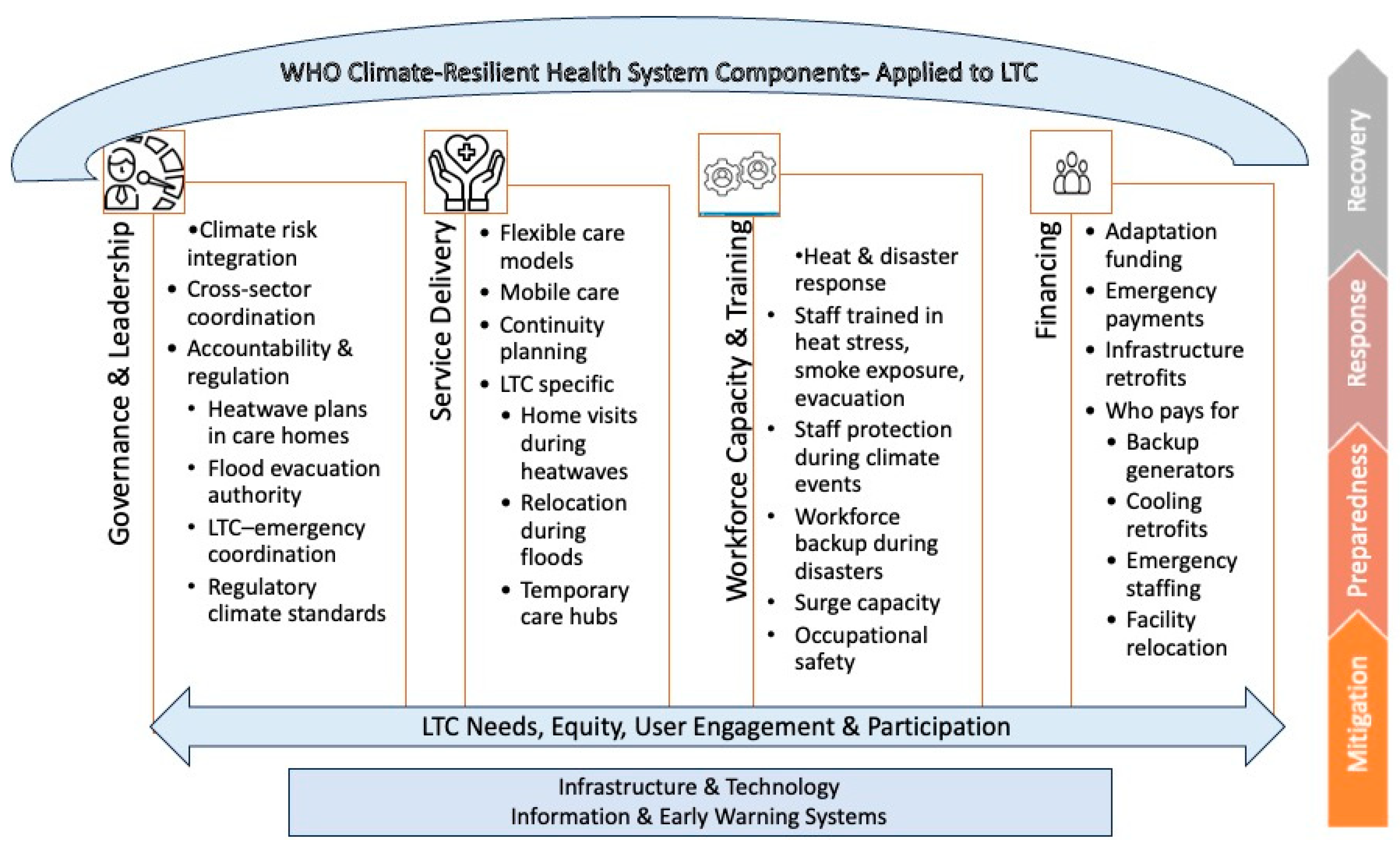
Figure 1 synthesises multiple strands of empirical and conceptual evidence into a unified climate-tailored LTC framework. The framework is explicitly aligned with the WHO Operational Framework for Climate-Resilient and Low-Carbon Health Systems, whose core system functions are operationalised for LTC contexts. Physical, institutional, and social infrastructures form the foundation of the system. Equity, user engagement, and participation operate as cross-cutting principles, while decarbonisation is integrated as a co-benefit, strengthening both climate mitigation and adaptation. The framework provides a policy-actionable tool for embedding climate resilience into LTC systems. In doing so, it operationalises LTC as a cross-sectoral platform contributing to SDG 3, SDG 13, and SDG 10, while supporting broader sustainable development objectives in ageing societies. In adapting the WHO Integrated LTC Framework, the System Enablers domain is disaggregated to foreground Workforce Capacity and Financing as distinct components. Evidence from Section 3.1 shows that climate hazards place acute pressure on workforce sustainability and funding mechanisms, both of which directly determine system resilience. Infrastructure, technology, and information systems remain foundational enablers across domains. This refinement reflects the empirical finding that workforce stability and financing flexibility are central to climate-resilient LTC systems.
Figure 1.
Proposed climate-tailored integrated long-term care (LTC) framework aligned with the WHO climate-resilient health system functions.
3.2.1. Underlying WHO Integrated LTC Systems Framework
As a starting point, we draw on the WHO Integrated LTC Framework [28], which incorporates key principles such as systems thinking, people-centred care, integrated care, a life-course approach, healthy ageing, human rights, and a gender perspective. The framework is structured around four main domains: LTC Needs, Governance, Service Delivery, and System Enablers.
The LTC Needs domain focuses on demographic and epidemiological trends, risk factors (including lifestyle and social determinants), and the health and social needs of LTC users, primarily individuals aged 65 and older, as well as younger people with disabilities. It covers disability rates, health outcomes, and caregiver profiles.
The Governance domain involves legislation and coordination across multiple sectors, ministries, and levels of government, as well as quality assurance mechanisms and accountability across public, private, for-profit, and non-profit providers.
The Service Delivery domain assesses the coverage, range, and quality of LTC services, including care settings, eligibility and needs assessment processes, coverage gaps, and monitoring and evaluation.
The System Enablers domain encompasses integration of services, financial mechanisms, resource allocation, workforce development, information systems, and technological innovations that support effective LTC delivery.
While the WHO Integrated LTC Framework provides a comprehensive guide to systems thinking in LTC, it substantially overlooks the implications of climate change and associated hazards. Climate-related risks are not explicitly included among determinants of LTC needs, nor are climate adaptation, emergency preparedness, or resilience specified as core governance and service-delivery functions.
The proposed climate-tailored framework therefore builds on the four domains of the WHO Integrated LTC Framework and systematically incorporates climate-related risks, adaptation requirements, and resilience-building measures within each domain, informed by the WHO climate–health framework and the broader literature.
The proposed framework presented in Figure 1 should be read as a dynamic, layered system rather than a linear sequence of domains. At its core are the four WHO Integrated LTC domains, which remain structurally intact but are explicitly overlaid with climate risk and adaptation functions. The LTC Needs domain is perceived as cross-cutting and encompasses climate-sensitive trajectories, including heat-related morbidity, pollution-associated cognitive decline, and post-disaster functional deterioration, as identified in Section 3.1. The Governance domain embeds leadership, intersectoral coordination, regulatory oversight, and climate risk assessment, aligning with the WHO climate–health functions of leadership and emergency preparedness. The Service Delivery domain operationalises resilient care pathways, continuity planning, and climate-responsive models of home- and facility-based care. The System Enablers domain has been split to highlight two integrated components: workforce capacity and LTC financing.
These domains are underpinned by physical, institutional, and social infrastructures, which form the system’s structural foundation. Climate hazards interact with these infrastructures, creating cascading risks that reverberate across domains, for example, infrastructure failure affecting service delivery, or workforce strain influencing governance capacity. Equity, user participation, and decarbonisation operate horizontally across all domains, reinforcing adaptive capacity while mitigating long-term climate risk. Hence, the proposed framework represents an interconnected system in which adaptation functions are embedded within, rather than appended to, core LTC structures.
3.2.2. Incorporating the Who Operational Framework for Climate-Resilient and Low-Carbon Health Systems
The WHO Operational Framework for Climate-Resilient and Low-Carbon Health Systems provides a comprehensive framework for integrating climate considerations into health-sector planning and delivery [27]. However, LTC systems are not explicitly operationalised within this framework.
In the proposed climate-tailored LTC framework, the WHO climate–health domains are explicitly transposed into LTC contexts. Leadership and governance inform the roles of ministries, municipalities, and LTC regulators in climate risk preparedness. Workforce, service delivery, and information systems guide the integration of climate-sensitive care models, early warning systems, and staff training. Infrastructure and technologies inform requirements for climate-resilient LTC buildings, ventilation, backup power, and digital continuity systems. Financing components highlight the need to align LTC funding with national climate adaptation strategies.
3.2.3. Integrating Climate Risk, Brain Health, and Disaster Preparedness
The framework is further informed by conceptual literature on complex climate risk, disaster preparedness, and the climate–brain health nexus. Climate hazards act as risk multipliers for dementia and cognitive decline through direct exposures, such as heat and air pollution, and indirect social disruption [66]. Complex risk frameworks emphasise cascading and compounding hazards, while disaster preparedness literature highlights the importance of leadership, trust, coordinated response, and recovery cycles [34,35,67,68].
At the community and system levels, access to healthcare, resilient local infrastructure, and neighbourhood socioeconomic conditions shape both dementia risk and continuity of care during climate hazards [32,34]. Housing quality, transport, and access to green space further mediate exposure and protective behaviours, with people living with dementia particularly sensitive to displacement, power outages, and environmental disruption [18,26,31].
The framework is further informed by conceptual work on complex climate risk and disaster preparedness. Simpson et al. [34] emphasise that climate risks emerge through dynamic interactions among hazards, exposure, vulnerability, and adaptation, including hazard–vulnerability interactions, cascading and compounding events, and unintended consequences of response measures.
Within the proposed framework, these insights are integrated primarily in the LTC Needs domain (by explicitly including climate-sensitive cognitive and functional decline and integrating multi-hazard risk assessment) and in the Service Delivery and Workforce Training domains (by embedding dependencies on built and social environments into climate-resilient care planning). Disaster preparedness literature reinforces this systems view, which is captured in the Governance domain, highlighting the importance of leadership, trust, coordinated response, crisis standards of care, and mitigation–preparedness–response–recovery cycles tailored to care-dependent populations [33,67,68].
3.3. Whole System Thinking and Implementing the Proposed Climate-Resilient LTC
3.3.1. Infrastructure as the Foundation of Climate-Resilient LTC Systems
The proposed framework situates physical, institutional, and social infrastructures as foundational to climate-resilient LTC systems [31]. Physical infrastructure includes LTC buildings, energy systems, water and sanitation, transport, and digital connectivity. These are directly exposed to heat, flooding, wildfires, and power outages. Institutional infrastructure encompasses governance arrangements, regulations, workforce structures, financing mechanisms, and accountability systems that determine how LTC systems prepare for and respond to climate hazards. Workforce sustainability is a central component of institutional infrastructure. Climate hazards expose care workers to direct occupational risks, including heat stress, smoke exposure, infectious disease outbreaks following floods, and psychological strain during evacuation and recovery phases. These exposures compound pre-existing sectoral challenges of low pay, high turnover, and workforce shortages. Repeated climate-related crises may intensify burnout, sickness absence, and attrition, thereby weakening care continuity and adaptive capacity. Embedding workforce protection, climate-informed training, psychosocial support, and retention strategies within institutional planning is therefore critical to sustaining climate-resilient LTC systems. Social infrastructure refers to community networks, informal caregiving, volunteerism, and peer support, which are critical for sustaining care during and after climate shocks.
3.3.2. Integrating Complex Climate Risks into LTC Needs and Planning
To reflect real-world climate dynamics, the framework explicitly incorporates the concept of complex climate risks [34], recognising that climate hazards rarely act in isolation and often produce cascading, compounding, and interacting risks across LTC systems. These include Hazard–vulnerability interactions (e.g., heat exposure in poorly insulated housing); Sequential and compounding risks (e.g., floods followed by prolonged power outages); and Unintended consequences of adaptation or mitigation actions.
These complex risks are integrated directly into the LTC Needs and Governance domains through dynamic vulnerability assessment, scenario planning, stress testing of LTC infrastructure, and adaptive regulatory oversight. This aligns with the WHO climate–health framework’s emphasis on climate risk assessment, surveillance, and preparedness planning across health systems.
3.3.3. Climate Impacts on Brain Health and LTC Demand
The framework explicitly integrates the climate–brain health nexus within the LTC Needs domain [66]. Climate change is conceptualised as a risk multiplier for dementia and cognitive decline through direct exposures (heat, air pollution), indirect social disruptions, and compounded health stressors. These pathways increase future LTC demand, intensify care complexity, and place additional strain on both formal and informal care systems.
By embedding climate-sensitive cognitive vulnerability within LTC needs assessment and planning, the framework extends the WHO LTC model beyond static demographic projections. It incorporates dynamic, climate-driven changes in functional and cognitive capacity.
3.3.4. Built and Social Environments, User Empowerment, and Equity
The framework explicitly incorporates the built and social environments within the Service Delivery [18]. Housing quality, neighbourhood safety, access to green space, transport connectivity, and social participation directly shape exposure to climate hazards and the capacity for adaptive behaviour among LTC users.
User empowerment is positioned as a central mechanism for resilience. Empowering older adults and people with disabilities through climate literacy, participatory planning, and co-production enhances adaptive capacity, strengthens trust in institutions, and improves care continuity during crises. This aligns with the person-centred ethos of the WHO Integrated LTC Framework and the community engagement emphasis of the WHO climate–health framework.
3.3.5. Governance, Leadership, and Coordinated Climate Response in LTC
Governance is conceptualised as a transformative domain within the proposed framework. Leadership and collective identity are recognised as key drivers of preparedness, coordinated response, and post-disaster recovery in LTC systems [33]. Governance arrangements must therefore enable proactive leadership, cross-sectoral coordination, transparent communication, and community engagement.
The framework further integrates: Climate crisis standards of care [68] into LTC regulatory and quality assurance mechanisms and the mitigation–preparedness–response–recovery cycle into LTC emergency planning and operational continuity [69].
These elements operationalise the WHO climate–health framework’s emphasis on emergency preparedness, coordinated response, and adaptive governance within the specific context of LTC.
3.3.6. Decarbonisation as a Co-Benefit of Climate-Resilient LTC Systems
To address the dual imperatives of adaptation and mitigation, the framework explicitly integrates decarbonisation strategies within the System Enablers domain. LTC facilities are significant contributors to healthcare-related carbon emissions due to energy-intensive heating, cooling, catering, and waste management [52,70].
Decarbonisation measures, including renewable energy adoption, building retrofitting, energy-efficient ventilation, low-carbon procurement, and sustainable waste systems, reduce emissions while also strengthening resilience to climate hazards by lowering operational costs and dependence on vulnerable energy grids [71]. Complementary interventions such as green spaces, natural ventilation, and active transport access further improve air quality and physical and mental wellbeing of residents and staff [69].
3.3.7. Equity as a Cross-Cutting Structural Principle
Equity is embedded as a cross-cutting structural principle across all four domains. Evidence throughout this review confirms that climate hazards magnify existing social, economic, and health inequalities [18,34]. Socioeconomically disadvantaged older adults, particularly those living alone, in substandard housing, or in underserved rural or peri-urban areas, face disproportionate exposure to climate risks alongside reduced adaptive capacity.
Accordingly, the framework requires that: LTC Needs assessments incorporate disaggregated vulnerability metrics reflecting income, housing quality, digital exclusion, social isolation, and comorbidity burden; Governance structures establish accountability mechanisms to ensure that marginalised groups are actively prioritised in adaptation planning; Service Delivery includes targeted outreach and culturally tailored emergency support (e.g., heatwave home-visiting programmes); and System Enablers ensure an equipped workforce and equitable financing and resource allocation to high-risk populations and under-resourced regions.
3.3.8. Summary Contribution of the Framework
By explicitly integrating the WHO Integrated LTC Framework [28] with the WHO Climate-Resilient and Low-Carbon Health Systems Framework [27], and operationalising this integration through infrastructure theory, complex climate risk analysis, brain health, disaster preparedness, user empowerment, decarbonisation, and equity, the proposed framework offers a comprehensive, flexible and policy-actionable model for climate-resilient LTC systems. It provides decision-makers with a structured tool to anticipate climate risks, protect highly vulnerable care-dependent populations, and align LTC reform with national climate adaptation and mitigation strategies.
4. Discussion
This study identified significant vulnerabilities of LTC users to major climate hazards, including heatwaves, flooding, storms, droughts, wildfires, and deteriorating air quality. The findings confirm that older adults and people with disabilities or cognitive impairments, who are the majority of LTC users, experience disproportionate health impacts from these hazards. Conditions such as dementia, cardiovascular disease, and chronic respiratory illness are exacerbated by extreme weather events, translating into heightened morbidity, mortality, and escalating care needs. These impacts are not evenly distributed: vulnerability is strongly shaped by pre-existing health conditions, socioeconomic status, housing quality, digital access, and the readiness of local infrastructure, reinforcing systematic disadvantage among socioeconomically marginalised groups with limited adaptive capacity [18,34].
Consistent with the broader climate–health literature, the findings demonstrate that climate hazards exacerbate existing inequalities across LTC populations. Low-income, socially isolated, and digitally excluded older adults face heightened exposure and reduced ability to prepare for, respond to, and recover from climate shocks. This reinforces the need for equity-centred climate adaptation strategies in LTC, with explicit attention to social determinants of health, access to services, and differential exposure to climate risks [18,66]. Without targeted, inclusive adaptation approaches, climate change is likely to widen already entrenched disparities in functional ability, cognitive health, and quality of life.
Despite growing evidence on climate impacts on older populations, important research gaps persist at the interface between climate change and LTC systems. Most studies continue to focus on acute mortality and hospital admissions, with far less attention to longer-term outcomes such as functional decline, dementia progression, caregiver strain, service disruption, and quality of life. The implications of climate hazards for informal caregiving networks, workforce sustainability, and continuity of care remain underexplored. At the policy level, LTC continues to occupy a peripheral position in national and regional climate strategies. Within Europe in particular, explicit recognition of LTC facilities, home-based care services, and care-dependent populations remains limited in climate adaptation planning, constraining system-level resilience [29]. Climate resilience requires integrated planning across health, housing, transport, and social care [31], yet LTC remains insufficiently embedded within these cross-sectoral strategies.
To address this gap, this study advances a climate-tailored integrated LTC framework that explicitly bridges the WHO Integrated LTC Framework with the WHO Operational Framework for Climate-Resilient and Low-Carbon Health Systems. While the WHO LTC framework provides a robust architecture for people-centred, integrated LTC, it does not account for climate-related risks. Conversely, the WHO climate–health framework offers comprehensive guidance for climate adaptation across health systems but gives limited attention to LTC as a distinct and structurally vulnerable sector. By bringing these two global policy frameworks into dialogue, the proposed model operationalises climate resilience specifically for LTC systems, addressing a critical gap in international guidance. This alignment also strengthens coherence between LTC reform and the UN Sustainable Development Goals, particularly those focused on health, inequality reduction, gender equity, and climate action.
The framework retains the four core WHO LTC pillars. It systematically embeds climate-specific functions derived from the WHO climate–health building blocks, including leadership and governance, workforce capacity, climate–health information systems, essential products and technologies, resilient service delivery, financing, and infrastructure. This alignment strengthens LTC systems’ ability to anticipate, absorb, adapt to, and recover from climate shocks while ensuring coherence with national climate adaptation strategies.
Central to the framework is the recognition that physical, institutional, and social infrastructures underpin climate-resilient LTC systems. Physical infrastructure, such as buildings, energy, water, ventilation, and transport systems, determines exposure to heat, floods, wildfires, and power outages. Institutional infrastructure, including governance arrangements, regulations, financing, and workforce systems, shapes preparedness, coordination, and accountability. Social infrastructure, including families, community networks, peer support, and informal caregiving, underpins continuity of care during crises. Disruption of any of these layers can cascade across the entire LTC system, amplifying harm for care-dependent populations.
The framework further incorporates complex climate risk dynamics, acknowledging that climate hazards rarely occur in isolation but interact through cascading and compounding processes [34]. Sequential hazards such as flooding followed by infrastructure failure, or heatwaves occurring alongside power outages, create nonlinear risks that conventional single-hazard planning fails to capture. Embedding complex risk assessment within LTC needs analysis and governance functions strengthens anticipatory planning, stress testing, and adaptive regulation.
A novel contribution of this study is the explicit integration of the climate–brain health nexus within LTC system planning. Climate change acts as a risk multiplier for dementia and cognitive decline through heat exposure, air pollution, psychosocial stress, and social disruption [66]. These pathways accelerate demand for LTC while simultaneously destabilising the very systems on which people with cognitive impairment depend. Incorporating climate-sensitive cognitive vulnerability into LTC needs assessment represents a critical extension beyond static demographic projections.
The framework also positions user empowerment, participation, and equity as cross-cutting structural principles. Strengthening climate literacy among older adults, enabling co-production of adaptation strategies, and embedding participatory planning mechanisms enhance individual and community adaptive capacity. At the same time, equity-focused governance is essential to ensure that climate adaptation does not reinforce social gradients in care access, digital inclusion, and service continuity. Social environments and community infrastructure are particularly important: disruptions to transport, digital connectivity, and social services disproportionately affect isolated older adults and people with disabilities, increasing functional decline and undermining recovery [18]. Social infrastructure must therefore be recognised not merely as supportive but as a core enabler of climate-resilient LTC systems.
An intersectional perspective further strengthens this equity framing. Climate vulnerability in LTC is rarely shaped by age alone; rather, it emerges at the intersection of advanced age, disability status, multimorbidity, socioeconomic disadvantage, gender, housing precarity, and digital exclusion. These overlapping structural factors compound exposure to climate hazards and constrain adaptive capacity. For example, low-income older adults living with disabilities in poorly insulated housing may face disproportionate heat exposure while lacking financial resources for cooling or relocation. Similarly, women, who constitute the majority of both LTC users and informal caregivers, experience gendered vulnerabilities linked to income inequality, labour precarity, and caregiving burdens. Addressing climate resilience in LTC, therefore, requires not only technical adaptation measures but also attention to structural inequities in care access, infrastructure distribution, and policy prioritisation. Integrating principles of climate justice ensures that adaptation strategies actively reduce, rather than reproduce, existing social gradients in health and care.
Governance acts as a key lever for transformation. Leadership, collective identity, and coordinated decision-making determine whether climate shocks lead to fragmentation or systemic adaptation [33]. The integration of crisis standards of care, multi-agency coordination, and adaptable emergency planning cycles covering mitigation, preparedness, response, and recovery enhances operational resilience and service continuity [67,68]. These governance mechanisms directly implement the WHO climate–health framework within LTC contexts.
Despite the conceptual maturity of this framework, significant barriers to implementation remain. Weak policy enforcement, financial constraints, limited political commitment, low perception of climate risk, and fragmented data infrastructure continue to undermine adaptation efforts across health and care systems [72,73]. Mental health services and workforce wellbeing are often insufficiently prioritised within adaptation planning, despite their centrality to sustained system functioning. More fundamentally, climate change has historically been framed as an environmental rather than a public health emergency, delaying the integration of climate resilience into health and LTC governance [19].
Institutional fragmentation between health and social care systems further constrains coordinated climate resilience. Adaptation initiatives are frequently siloed within individual ministries or sectors, excluding LTC from integrated planning and weakening communication during climate crises [19,72]. Overcoming this fragmentation requires deliberate intersectoral governance arrangements, shared data systems, and joint financing mechanisms that explicitly include LTC.
From a practical perspective, the framework suggests several immediate priorities for policy and practice. These include integrating climate risk assessment into LTC regulatory oversight; embedding continuity planning and multi-hazard scenario testing within service delivery models; strengthening workforce protection, retention, and climate-informed training; investing in resilient infrastructure, including backup power, cooling, ventilation, and digital continuity systems; and aligning LTC financing mechanisms with national climate adaptation and emergency preparedness strategies. While specific implementation pathways will vary by jurisdiction, these actions illustrate how the framework can guide operational decision-making within existing LTC governance structures.
While this paper draws particularly on evidence from high-income countries, the vulnerabilities and system dynamics it identifies are increasingly relevant to many LMICs undergoing rapid demographic transitions. However, the predominance of evidence from high-income countries introduces important limitations. Formal LTC systems are more established, regulated, and documented in these settings, which partly explains their overrepresentation in the literature. In many LMICs, LTC provision remains fragmented, informal, family-based, or weakly institutionalised, and climate resilience may therefore depend more heavily on household capacity, community networks, and local governance structures. Resource constraints, infrastructure deficits, limited insurance coverage, and weaker regulatory oversight may alter both exposure and adaptive capacity. Consequently, while the structural vulnerabilities identified in this study, such as infrastructure dependence, workforce fragility, and care continuity risks, are likely to be relevant across contexts, the mechanisms and feasible adaptation pathways may differ substantially. Future research should prioritise context-sensitive analyses in LMIC settings to avoid reinforcing high-income policy models as universal templates and to ensure that climate-resilient LTC strategies are appropriately tailored to varying institutional and socioeconomic conditions.
In settings where formal LTC infrastructure is less developed, adaptation priorities may differ. Rather than beginning with facility-level retrofitting or regulatory reform, the initial focus may need to centre on strengthening community-based care networks, integrating climate risk awareness into primary health and social protection systems, and supporting informal caregivers through targeted training and early-warning communication. Basic resilience measures, such as mapping care-dependent populations, establishing registries for high-risk households, ensuring continuity of essential medications, and coordinating with local disaster management authorities, may provide higher marginal benefit than capital-intensive infrastructure investments. The framework is therefore intended to serve as a flexible architecture within which countries can prioritise domain-specific actions based on institutional maturity, fiscal capacity, and hazard profile.
This study demonstrates that climate change is no longer a peripheral concern for LTC systems but a structural determinant of their future sustainability. By integrating the WHO Integrated LTC Framework with the WHO Climate-Resilient and Low-Carbon Health Systems Framework, the proposed climate-tailored LTC model provides a policy-actionable roadmap to strengthen resilience, reduce inequalities, and safeguard care-dependent populations amid accelerating climate risks. Its implementation will require political commitment, dedicated financing, cross-sectoral governance, and sustained engagement with LTC users, caregivers, and communities.
5. Conclusions
This study advances a novel climate-tailored integrated LTC framework that explicitly bridges the WHO Integrated LTC Framework with the WHO Operational Framework for Climate-Resilient and Low-Carbon Health Systems. By embedding climate adaptation, mitigation, and emergency response within the four core LTC system domains of LTC Needs, Governance, Service Delivery, and System Enablers, the framework addresses a critical gap in global policy guidance, where climate and health strategies and LTC reforms have remained largely disconnected. This integrative approach represents the paper’s central conceptual and policy contribution.
The findings confirm that climate change is already amplifying morbidity, care dependency, cognitive decline, and service disruption among LTC users, with disproportionate impacts on people living with disability, dementia, multimorbidity, and socioeconomic disadvantage. At the same time, LTC systems themselves are highly exposed to climate risks due to their dependence on physical infrastructure, workforce stability, social support networks, and digital and energy systems. Despite these vulnerabilities, LTC remains underrepresented in climate adaptation and mitigation planning at national and international levels.
The proposed framework addresses this gap by integrating insights from climate and brain health research, complex climate risk theory, disaster preparedness, social infrastructure, and user empowerment within a unified, WHO-aligned systems architecture. It moves beyond reactive emergency response toward proactive, equity-centred, and resilience-oriented LTC system transformation. Importantly, it also integrates decarbonisation as a co-benefit, positioning LTC systems not only as recipients of climate risk but also as contributors to climate mitigation through sustainable infrastructure, energy use, procurement, and service design.
This study further highlights persistent research and policy blind spots, particularly regarding functional outcomes, caregiver wellbeing, workforce sustainability, continuity of care, and the lived experiences of LTC users during and after climate events. Addressing these gaps will require interdisciplinary research, improved data systems, and meaningful engagement with older people, people with disabilities, caregivers, and community organisations as active partners in climate adaptation planning.
Ultimately, safeguarding LTC users in an era of accelerating climate change requires the systemic integration of climate adaptation, mitigation, and response across LTC governance, financing, infrastructure, and service delivery. Without such integration, climate change threatens to undermine decades of progress in healthy ageing, social protection, and person-centred care. By offering a policy-actionable, WHO-aligned framework, this paper provides a foundation for strengthening climate-resilient LTC systems globally and for ensuring that the most care-dependent populations are no longer left at the margins of climate policy.
Funding
This study was partially funded by the NIHR Policy Research Programme, NIHR206128. The views expressed are those of the author and not necessarily those of the NIHR or the Department of Health and Social Care.
Institutional Review Board Statement
Not applicable.
Informed Consent Statement
Not applicable.
Data Availability Statement
No new data were created or analysed in this study. Data sharing is not applicable to this article.
Conflicts of Interest
The author declares no competing interest.
References
- World Health Organization (WHO). World Report on Ageing and Health; WHO: Geneva, Switzerland, 2015; Available online: https://www.who.int/publications/i/item/9789241565042 (accessed on 9 December 2025).
- Organisation for Economic Co-operation and Development (OECD). Long-Term Care and Health Care Insurance in OECD and Other Countries; OECD Publishing: Paris, France, 2020; Available online: https://www.oecd.org/content/dam/oecd/en/publications/reports/2020/02/long-term-care-and-health-care-insurance-in-oecd-and-other-countries_67c12fc9/3eabc286-en.pdf (accessed on 9 December 2025).
- World Health Organization (WHO). Working for Health 2022–2030 Action Plan; WHO: Geneva, Switzerland, 2022. [Google Scholar]
- Spasova, S.; Baeten, R.; Coster, S.; Ghailani, D.; Peña-Casas, R.; Vanhercke, B. Challenges in long-term care in Europe. Eurohealth 2018, 24, 7–12. [Google Scholar]
- Ariaans, M.; Linden, P.; Wendt, C. Worlds of long-term care: A typology of OECD countries. Health Policy 2021, 125, 609–617. [Google Scholar] [CrossRef] [Scilit] [PubMed]
- Österle, A. Long-term care. In Research Handbook on Health Care Policy; Edward Elgar Publishing: Cheltenham, UK, 2024; pp. 191–207. [Google Scholar]
- Ismail, M.; Hussein, S. An evidence review of ageing, long-term care provision and funding mechanisms in Turkey: Using existing evidence to estimate long-term care cost. Sustainability 2021, 13, 6306. [Google Scholar] [CrossRef] [Scilit]
- Kraus, M.; Riedel, M. Three dimensions of long-term care provision in middle-income countries: A view across Africa, Latin America and Asia. Int. J. Soc. Welf. 2022, 31, 506–519. [Google Scholar] [CrossRef] [Scilit]
- Barber, S.L.; Ong, P.; Han, Z.A. Long-term care in ageing populations. In Handbook of Global Health; Springer International Publishing: Cham, Switzerland, 2021; pp. 1–34. [Google Scholar]
- United Nations. Global Issues: Ageing; United Nations: New York, NY, USA, 2024; Available online: https://www.un.org/en/global-issues/ageing (accessed on 9 December 2025).
- IPCC. Climate Change 2023: Synthesis Report. Contribution of Working Groups I, II and III to the Sixth Assessment Report of the Intergovernmental Panel on Climate Change; Core Writing Team, Lee, H., Romero, J., Eds.; IPCC: Geneva, Switzerland, 2023; pp. 35–115. [Google Scholar] [CrossRef] [Scilit]
- Wang, H.; Abbas, K.M.; Abbasifard, M.; Abbasi-Kangevari, M.; Abbastabar, H.; Abd-Allah, F.; Damiani, G. Global age-sex-specific fertility, mortality, healthy life expectancy (HALE), and population estimates in 204 countries and territories, 1950–2019: A comprehensive demographic analysis for the Global Burden of Disease Study 2019. Lancet 2020, 396, 1160–1203. [Google Scholar] [CrossRef] [Scilit] [PubMed]
- Tanizawa, Y.; Ito, K.; Takashima, R. Bridging the gap between longevity and vitality: The value of extending healthy life expectancy. SSRN Electron. J. 2025, 5147106. [Google Scholar] [CrossRef] [Scilit] [PubMed]
- Alburez-Gutierrez, D.; Williams, I.; Caswell, H. Projections of human kinship for all countries. Proc. Natl. Acad. Sci. USA 2023, 120, e2315722120. [Google Scholar] [CrossRef] [Scilit] [PubMed]
- Tipaldo, J.F.; Balk, D.; Hunter, L.M. A framework for ageing and health vulnerabilities in a changing climate. Nat. Clim. Change 2024, 14, 1125–1135. [Google Scholar] [CrossRef] [Scilit]
- Wanka, A.; Arnberger, A.; Allex, B.; Eder, R.; Hutter, H.P.; Wallner, P. The challenges posed by climate change to successful ageing. Z. Gerontol. Geriatr. 2014, 47, 468–474. [Google Scholar] [CrossRef] [Scilit]
- Adélaïde, L.; Chanel, O.; Pascal, M. Health effects from heat waves in France: An economic evaluation. Eur. J. Health Econ. 2022, 23, 1153–1166. [Google Scholar] [CrossRef] [Scilit]
- Prina, M.; Khan, N.; Khan, S.A.; Caicedo, J.C.; Peycheva, A.; Seo, V.; Sadana, R. Climate change and healthy ageing: An assessment of the impact of climate hazards on older people. J. Glob. Health 2024, 14, 04101. [Google Scholar] [CrossRef] [Scilit]
- Ebi, K.L.; Ogden, N.H.; Semenza, J.C.; Woodward, A. Detecting and attributing health burdens to climate change. Environ. Health Perspect. 2017, 125, 085004. [Google Scholar] [CrossRef] [Scilit] [PubMed]
- Stanke, C.; Kerac, M.; Prudhomme, C.; Medlock, J.; Murray, V. Health effects of drought: A systematic review of the evidence. PLoS Curr. 2013, 5, ecurrents.dis.7a2cee9e980f91ad7697b570bcc4b004. [Google Scholar] [CrossRef] [Scilit] [PubMed]
- Gamble, J.L.; Balbus, J.; Berger, M.; Bouye, K.; Campbell, V.; Chief, K.; Whyte, K.P. Climate change and older Americans: State of the science. Environ. Health Perspect. 2013, 121, 15–22. [Google Scholar] [CrossRef] [Scilit] [PubMed]
- Figueiredo, T.; Midão, L.; Rocha, P.; Cruz, S.; Lameira, G.; Conceição, P.; Costa, E. The interplay between climate change and ageing: A systematic review of health indicators. PLoS ONE 2024, 19, e0297116. [Google Scholar] [CrossRef] [Scilit]
- Moriah, D.J. Climate change and its effects on environmental health: Challenges and solutions for vulnerable populations. Soc. Sci. 2025, 11, 34–47. [Google Scholar]
- Oven, K.J.; Curtis, S.E.; Reaney, S.; Riva, M.; Stewart, M.G.; Ohlemüller, R.; Dunn, C.E.; Nodwell, S.; Dominelli, L.; Holden, R. Climate change and health and social care: Defining future hazard, vulnerability and risk for infrastructure systems supporting older people’s health care in England. Appl. Geogr. 2012, 33, 16–24. [Google Scholar] [CrossRef] [Scilit]
- Gotanda, H.; Fogel, J.; Husk, G.; Levine, J.M.; Peterson, M.; Baumlin, K.; Habboushe, J. Hurricane Sandy: Impact on emergency department and hospital utilization by older adults in lower Manhattan, New York. Prehospital Disaster Med. 2015, 30, 496–502. [Google Scholar] [CrossRef] [Scilit]
- Wollschlaeger, S.; Sadhu, A.; Ebrahimi, G.; Woo, A. Investigation of climate change impacts on long-term care facility occupants. City Environ. Interact. 2022, 13, 100077. [Google Scholar] [CrossRef] [Scilit]
- World Health Organization (WHO). Operational Framework for Building Climate-Resilient and Low-Carbon Health Systems; WHO: Geneva, Switzerland, 2023; Available online: https://www.who.int/publications/i/item/9789240081888 (accessed on 9 December 2025).
- World Health Organization (WHO). Framework for Countries to Achieve an Integrated Continuum of Long-Term Care; WHO: Geneva, Switzerland, 2021; ISBN 9789240038844. [Google Scholar]
- European Climate and Health Observatory (ECHO). Climate Change and Health: National Policy Overview in Europe; ECHO: Copenhagen, Denmark, 2022; Available online: https://climate-adapt.eea.europa.eu (accessed on 9 December 2025).
- Sutherland, W.J.; Fleishman, E.; Mascia, M.B.; Pretty, J.; Rudd, M.; Wright, J. Methods for collaboratively identifying research priorities and emerging issues in science and policy. Methods Ecol. Evol. 2011, 2, 238–247. [Google Scholar] [CrossRef] [Scilit]
- Curtis, S.; Fair, A.; Wistow, J.; Val, D.V.; Oven, K. Impact of extreme weather events and climate change for health and social care systems. Environ. Health 2017, 16, 128. [Google Scholar] [CrossRef] [Scilit] [PubMed]
- Yoshida, S.; Kashima, S.; Matsumoto, M. The effect of the 2018 Japan floods on cognitive decline among long-term care insurance users: A retrospective cohort study. Environ. Health Prev. Med. 2021, 26, 113. [Google Scholar] [CrossRef] [Scilit] [PubMed]
- Jetten, J.; Fielding, K.S.; Crimston, C.R.; Nadler, A.; Haslam, S.A. A social identity model of post-disaster action (SIMPDA). J. Appl. Soc. Psychol. 2021, 51, 702–720. [Google Scholar]
- Simpson, N.P.; Mach, K.J.; Constable, A.; Hess, J.; Hogarth, R.; Howden, M.; Trisos, C.H. A framework for complex climate change risk assessment. One Earth 2021, 4, 489–501. [Google Scholar] [CrossRef] [Scilit]
- Heal, G.; Park, J. Temperature stress and the direct impact of climate change: A review. Rev. Environ. Econ. Policy 2016, 10, 347–362. [Google Scholar] [CrossRef] [Scilit]
- Ugg, M.M.; Konrad, C.E.; Fuhrmann, C.M. Relationships between maximum temperature and heat-related illness across North Carolina. Int. J. Biometeorol. 2016, 60, 663–675. [Google Scholar]
- White, C. The dynamic relationship between temperature and morbidity. J. Assoc. Environ. Resour. Econ. 2017, 4, 1155–1198. [Google Scholar] [CrossRef] [Scilit]
- Bobb, J.F.; Obermeyer, Z.; Wang, Y.; Dominici, F. Cause-specific risk of hospital admission related to extreme heat in older adults. JAMA 2014, 312, 2659–2667. [Google Scholar] [CrossRef] [Scilit]
- Rizmie, D.; de Preux, L.; Miraldo, M.; Atun, R. Impact of extreme temperatures on emergency hospital admissions. Soc. Sci. Med. 2022, 308, 115193. [Google Scholar] [CrossRef] [Scilit]
- Xu, Z.; Yi, W.; Bach, A.; Tong, S.; Ebi, K.L.; Su, H.; Cheng, J.; Rutherford, S. Multimorbidity and emergency hospitalisations during hot weather. EBioMedicine 2024, 104, 105148. [Google Scholar] [CrossRef] [Scilit]
- Layton, J.B.; Li, W.; Yuan, J.; Gilman, J.P.; Horton, D.B.; Setoguchi, S. Heatwaves, medications, and heat-related hospitalization in older Medicare beneficiaries. PLoS ONE 2020, 15, e0243665. [Google Scholar] [CrossRef] [Scilit] [PubMed]
- Hunt, A.P.; Pagnussat, A.S.; Lehn, A.; Moore, D.; Schweitzer, D.; Laakso, E.L.; Stewart, I. Evidence of heat sensitivity in people with Parkinson’s disease. Int. J. Biometeorol. 2024, 68, 1169–1178. [Google Scholar] [CrossRef] [Scilit] [PubMed]
- Ratwatte, P.; Wehling, H.; Kovats, S.; Landeg, O.; Weston, D. Older adults’ perception of health risks of extreme temperatures: A scoping review. Front. Public Health 2022, 10, 939859. [Google Scholar] [CrossRef] [Scilit] [PubMed]
- Thompson, J.; Vasefi, M. Natural disaster-induced dementia and cognitive decline: A meta-analysis. Soc. Sci. Med. 2025, 371, 117898. [Google Scholar] [CrossRef] [Scilit]
- Rau, R.; Tarazona-Santabalbina, F.J.; Monschke, M.; Schmitt, T.; Stein, J.; Wirth, R. Heat stress in nursing homes. Int. J. Environ. Res. Public Health 2020, 17, 5126. [Google Scholar]
- Vandentorren, S.; Bretin, P.; Zeghnoun, A.; Mandereau-Bruno, L.; Croisier, A.; Cochet, C.; Ribéron, J.; Siberan, I.; Declercq, B.; Ledrans, M. August 2003 heat wave in France. Eur. J. Public Health 2006, 16, 583–591. [Google Scholar] [CrossRef] [Scilit]
- Du, W.; FitzGerald, G.J.; Clark, M.; Hou, X.Y. Health impacts of floods. Prehospital Disaster Med. 2010, 25, 265–272. [Google Scholar] [CrossRef] [Scilit]
- Yang, Z.; Huang, W.; McKenzie, J.E.; Yu, P.; Ju, K.; Wu, Y.; Li, S. Mortality and morbidity risks associated with floods: A meta-analysis. Environ. Res. 2024, 263, 120263. [Google Scholar] [CrossRef] [Scilit]
- Bei, B.; Bryant, C.; Gilson, K.M.; Koh, J.; Gibson, P.; Komiti, A. Impact of floods on older adults’ health. Aging Ment. Health 2013, 17, 992–1002. [Google Scholar] [CrossRef] [Scilit]
- Ikeda, K.; Yoshida, S.; Okazaki, Y.; Miyamori, D.; Kashima, S.; Ishii, S.; Koike, S.; Kanno, K.; Ito, M.; Matsumoto, M. Increased care-need in older long-term care insurance users after the 2018 Japan Floods: A retrospective cohort study based on the Japanese long-term care insurance claims. Environ. Health Prev. Med. 2023, 28, 31. [Google Scholar] [CrossRef] [Scilit]
- Klinger, C.; Landeg, O.; Murray, V. Power outages, extreme events, and health. PLoS Curr. 2014, 6, ecurrents.dis.04eb1dc5e73dd1377e05a10e9edde673. [Google Scholar] [CrossRef] [Scilit] [PubMed]
- Karliner, J.; Slotterback, S.; Boyd, R.; Ashby, B.; Steele, K.; Wang, J. Health care’s climate footprint. Eur. J. Public Health 2020, 30, ckaa165–ckaa843. [Google Scholar] [CrossRef] [Scilit]
- Wang, C.; Yarnal, B. The vulnerability of the elderly to hurricane hazards in Sarasota, Florida. Nat. Hazards 2012, 63, 349–373. [Google Scholar] [CrossRef] [Scilit]
- Heid, A.R.; Schug, S.; Cartwright, F.P.; Pruchno, R. Older adults’ perceptions of Hurricane Sandy. Disaster Med. Public Health Prep. 2017, 11, 39–47. [Google Scholar] [CrossRef] [Scilit]
- Brown, L.M.; Dosa, D.M.; Thomas, K.; Hyer, K.; Feng, Z.; Mor, V. Effects of Hurricane Katrina on nursing facility residents. Disaster Med. Public Health Prep. 2012, 6, 93–102. [Google Scholar]
- Dosa, D.M.; Hyer, K.; Brown, L.M.; Artenstein, A.W.; Polivka-West, L.; Mor, V. Managing frail residents during Katrina. J. Am. Med. Dir. Assoc. 2010, 11, 65–72. [Google Scholar]
- Berman, J.D.; Ebisu, K.; Peng, R.D.; Dominici, F.; Bell, M.L. Drought and hospital admissions and mortality. Lancet Planet. Health 2017, 1, e17–e25. [Google Scholar] [CrossRef] [Scilit]
- Salvador, C.; Nieto, R.; Linares, C.; Díaz, J.; Alves, C.A.; Gimeno, L. Drought effects on mortality in Lisbon. Sci. Total Environ. 2021, 751, 142332. [Google Scholar] [CrossRef] [Scilit]
- Liu, J.C.; Pereira, G.; Uhl, S.A.; Bravo, M.A.; Bell, M.L. A systematic review of the physical health impacts from non-occupational exposure to wildfire smoke. Environ. Res. 2015, 136, 120–132. [Google Scholar] [CrossRef] [Scilit]
- Le, G.E.; Breysse, P.N.; McDermott, A.; Eftim, S.E.; Geyh, A.; Berman, J.D.; Curriero, F.C. Canadian forest fires and the effects of long-range transboundary air pollution on hospitalizations among the elderly. SPRS Int. J. Geo-Inf. 2014, 3, 713–731. [Google Scholar] [CrossRef] [Scilit]
- Bedi, N.S.; Dresser, C.; Yadav, A.; Schroeder, A.; Balsari, S. Wildfire threat to inpatient health care facilities in California. Am. J. Public Health 2023, 113, 555–558. [Google Scholar] [CrossRef] [Scilit]
- Oh, J.W. Pollen Allergy in a Changing Planetary Environment. Allergy Asthma Immunol. Res. 2022, 14, 168–176. [Google Scholar] [CrossRef] [Scilit] [PubMed]
- Ziska, L.H.; Makra, L.; Harry, S.K.; Bruffaerts, N.; Hendrickx, M.; Coates, F.; Saarto, A.; Thibaudon, M.; Oliver, G.; Damialis, A.; et al. Temperature-related changes in airborne allergenic pollen abundance and seasonality across the northern hemisphere: A retrospective data analysis. Lancet Planet. Health 2019, 3, e124–e131. [Google Scholar] [CrossRef] [Scilit] [PubMed]
- Hernandez, H.; Santamaria-Garcia, H.; Moguilner, S.; Farina, F.R.; Legaz, A.; Prado, P.; Ibanez, A. The exposome of healthy and accelerated aging. Nat. Med. 2025, in press. [Google Scholar] [CrossRef] [Scilit] [PubMed]
- Duchesne, J.; Gutierrez, L.A.; Chen, J.; Vienneau, D.; de Hoogh, K.; Helmer, C.; Mortamais, M. Exposure to ambient air pollution and cognitive decline: Results of the prospective Three-City study. Alzheimers Dement. 2021, 17, e053039. [Google Scholar] [CrossRef] [Scilit]
- Zuelsdorff, M.; Limaye, V.S. A framework for assessing the effects of climate change on dementia risk and burden. Gerontologist 2024, 64, gnad082. [Google Scholar] [CrossRef] [Scilit]
- Hanfling, D.; Altevogt, B.M.; Gostin, L.O. A framework for catastrophic disaster response. JAMA 2012, 308, 675–676. [Google Scholar] [CrossRef] [Scilit]
- Ross, K.L.; Bing, C.M. Emergency management: Expanding the disaster plan. Home Healthc. Now 2007, 25, 370–377. [Google Scholar] [CrossRef] [Scilit]
- Watts, N.; Amann, M.; Ayeb-Karlsson, S.; Belesova, K.; Bouley, T.; Boykoff, M. The Lancet Countdown on health and climate change: From 25 years of inaction to a global transformation for public health. Lancet 2017, 390, 1151–1166. [Google Scholar] [CrossRef] [Scilit]
- Lenzen, M.; Malik, A.; Li, M.; Fry, J.; Weisz, H.; Pichler, P.P.; Pencheon, D. The environmental footprint of health care: A global assessment. Lancet Planet. Health 2020, 4, e271–e279. [Google Scholar] [CrossRef] [Scilit]
- Pichler, P.P.; Jaccard, I.S.; Weisz, U.; Weisz, H. International comparison of health care carbon footprints. Environ. Res. Lett. 2019, 14, 064004. [Google Scholar] [CrossRef] [Scilit]
- Ansah, E.W.; Amoadu, M.; Obeng, P.; Sarfo, J.O. Health systems response to climate change adaptation: A scoping review of global evidence. BMC Public Health 2024, 24, 2015. [Google Scholar] [CrossRef] [Scilit]
- Neta, G.; Pan, W.; Ebi, K.; Buss, D.F.; Castranio, T.; Lowe, R.; Balbus, J. Advancing climate change health adaptation through implementation science. Lancet Planet. Health 2022, 6, e909–e918. [Google Scholar] [CrossRef] [Scilit]

Disclaimer/Publisher’s Note: The statements, opinions and data contained in all publications are solely those of the individual author(s) and contributor(s) and not of MDPI and/or the editor(s). MDPI and/or the editor(s) disclaim responsibility for any injury to people or property resulting from any ideas, methods, instructions or products referred to in the content. |
© 2026 by the author. Licensee MDPI, Basel, Switzerland. This article is an open access article distributed under the terms and conditions of the Creative Commons Attribution (CC BY) license.