


Abstract
Harbour sedimentation represents a major challenge to the environmental sustainability and operational efficiency of coastal infrastructure, as frequent dredging activities increase maintenance costs, ecological disturbance, and carbon emissions. Conventional physical and numerical sediment transport models, while widely applied, are computationally intensive and often unsuitable for early-stage, sustainability-oriented design optimisation. To address these limitations, this study proposes a hybrid artificial intelligence-based optimisation framework integrating Artificial Neural Networks (ANNs), Genetic Algorithms (GAs), and Particle Swarm Optimisation (PSO) for sustainable breakwater and harbour layout design. Hydrodynamic simulations using the Coastal Modelling System (CMS) were conducted to generate a comprehensive dataset describing sediment transport behaviour under varying geometric and structural configurations. An ANN surrogate model was trained to capture nonlinear relationships between breakwater parameters and accumulated sedimentation volume, while GA-based global optimisation and PSO-based validation and local refinement were employed to identify optimal design solutions. Comparative assessment demonstrated consistent convergence of ANN–GA and ANN–PSO solutions within the same design region, with a maximum deviation of 8.46% between design variables and a sedimentation difference of 2.4%. The hybrid ANN–GA–PSO framework achieved the lowest predicted sedimentation volume, representing an improvement of approximately 2.3% relative to the ANN–GA baseline. The proposed framework supports Integrated Coastal Structures Management (ICSM) by enabling proactive, design-stage reduction in long-term sediment accumulation and dredging requirements, offering a scalable pathway toward sustainable and digital-twin-enabled harbour planning.
1. Introduction
1.1. Research Background
Sedimentation in harbour basins represents a critical challenge to navigational safety, operational efficiency, and long-term asset management. Uncontrolled sediment accumulation can obstruct access channels, reduce navigable depths, and necessitate frequent dredging, leading to increased operational costs and adverse environmental impacts [1,2]. From a preventive sustainability perspective, the early prediction and proactive control of sedimentation during the conceptual and planning stages of harbour development are essential to minimise future maintenance interventions, reduce resource consumption, limit ecological disturbance, and enhance the long-term sustainability and resilience of coastal infrastructure [3]. The magnitude and distribution of sedimentation are strongly influenced by harbour geometry and breakwater configuration. The layout, entrance orientation, and basin width determine internal flow circulation and sediment transport patterns. Among structural variables, the characteristics of rubble mound breakwaters, particularly porosity and rock size, have a significant influence on sediment transport processes. Breakwaters with higher internal void ratios permit partial infiltration of water and suspended sediments, which modifies local flow velocity fields and increases the likelihood of sediment deposition within the harbour basin. Consequently, accurate representation of these hydraulic and structural interactions is essential for the reliable prediction of annual sedimentation volumes and for supporting sustainable harbour design and management [4].
On the other hand, coastal features like rubble mound breakwaters, typically considered solid and impermeable, can vary significantly in porosity due to design differences. Designs incorporating more riprap in their core can lead to considerable porosity, allowing water and sediment to infiltrate the structure. This infiltration can weaken the breakwaters, cause sediment accumulation in navigation channels, and increase dredging maintenance costs. Furthermore, the permeability of breakwaters affects flow and sediment seepage, with wave energy transmission and currents pushing sediments into the harbour. Properly representing these structural characteristics is crucial for accurately predicting annual sediment rates and optimising sediment management strategies [5]. Therefore, it is essential to incorporate breakwater structural features into coastal numerical modelling (such as riprap diameter, porosity, etc.) to forecast their impact on siltation inside harbour basins.
Previous research on harbour sedimentation has primarily addressed sediment dynamics, layout configuration, and mitigation strategies using field observations and numerical modelling. Zikra et al. [2] analysed sediment dynamics at Nagan Raya Port, Indonesia, combining hydrodynamic understanding with maintenance dredging requirements, and highlighted the importance of accurately characterising sediment transport mechanisms as a basis for sustainable dredging strategies. Similarly, Mahmoodi et al. [6] integrated numerical modelling with field measurements to investigate current- and wave-induced sediment transport at the Nowshahr Port entrance channel, demonstrating how combined modelling–measurement approaches can improve understanding of sediment pathways and deposition patterns. Earlier numerical investigations by Mojabi et al. [4] focused on the influence of harbour geometry parameters on sedimentation within square basins, revealing that entrance positioning and basin configuration significantly affect sediment accumulation. These studies collectively emphasise the role of hydrodynamic conditions and geometric design in governing harbour sedimentation while remaining largely focused on assessment and diagnosis rather than systematic design optimisation.
Complementary research has examined sedimentation control through harbour layout modification and integrated management perspectives. Kuijper et al. [7] investigated sediment reduction strategies in the Parkhafen harbour in Hamburg, demonstrating how circulation enhancement and spatial modifications can effectively mitigate siltation. Li et al. [5] further advanced this approach by numerically analysing littoral sediment transport around a semi-permeable breakwater at Dana Point Harbour, validating the capability of process-based models to evaluate structural mitigation measures. Beyond purely physical processes, recent sustainability-oriented studies have expanded the scope of harbour and coastal management. Boqué-Ciurana et al. [8] highlighted the role of integrated, stakeholder-driven management frameworks in fostering climate-resilient coastal systems, while Maya-Jariego et al. [3] examined the socio-environmental implications of port transformation in fishing communities, underscoring the need for sustainable and context-sensitive port development strategies. Despite these advances, existing studies generally treat sedimentation analysis, structural mitigation, and sustainability considerations as separate domains, leaving a gap for integrated, optimisation-driven approaches that support early-stage, sustainability-oriented harbour design decisions.
Against this background, there is a clear need for integrated approaches that combine physical process understanding with data-driven optimisation to support early-stage, sustainability-oriented harbour design decisions. To address this gap, the present study develops a hybrid artificial intelligence (AI) framework integrating Artificial Neural Networks (ANNs), Genetic Algorithms (GAs), and Particle Swarm Optimisation (PSO). The ANN is trained on hydrodynamic simulation data to capture nonlinear relationships between breakwater parameters and sediment deposition, while the GA enables global exploration of the design space to identify configurations that minimise sediment accumulation. PSO is subsequently employed for independent validation and local refinement, resulting in a hybrid ANN–GA–PSO framework that enhances robustness and optimisation performance and supports data-driven decision-making in harbour layout design.
1.2. Literature Review
Harbour sedimentation has long been recognised as a critical challenge in coastal infrastructure planning due to its implications for navigational safety, maintenance dredging, and environmental sustainability [3]. Accordingly, a substantial body of literature has investigated sediment transport processes, harbour layout configurations, and mitigation measures using both physical and numerical approaches [3]. This section synthesises these studies to provide a structured overview of current knowledge and to clarify the research gaps that underpin the development of integrated, sustainability-focused harbour design methodologies.
Within this body of research, existing studies can broadly be categorised according to the modelling approach adopted, namely physical modelling and numerical simulation. Several studies have focused on sediment transport management in coastal areas and harbour basins using both physical and numerical models [2,6,7]. Özölçer et al. [9] investigated the effects of groin parameters on sediment accretion in protected areas, highlighting the influence of parameters like length and head length on sediment deposition. Yüksek [10] conducted physical model experiments showing that breakwater geometry significantly influences shoaling in fishery harbour basins. Aligning the main breakwater within approximately ±15° of the dominant wave direction reduced sediment accumulation by about 10–25% compared to misaligned configurations. Increasing breakwater length improved sediment control, though orientation had a stronger effect than length alone. The study also demonstrated that optimised placement of secondary breakwaters further reduced basin deposition volumes, providing quantitative geometric design guidance.
On the other hand, numerical models such as the Coastal Modelling System (CMS), MIKE21, and Delft3D have become increasingly popular for studying sedimentation issues in harbours due to their efficiency and versatility [2,5,11]. Additionally, these models are generally less expensive than physical models because they eliminate the need for constructing physical prototypes and conducting extensive field experiments [12]. Li et al. [5] utilised CMS to analyse sediment transport around Dana Point Harbour’s porous breakwater, demonstrating how breakwater permeability impacts sediment accumulation and validating their model against historical dredging data. Similarly, Cáceres et al. [1] applied the MIKE 21/3 Coupled Model Flexible Mesh to address sedimentation challenges at Mar del Plata Fishing Harbour. Their study involved calibrating the model with bathymetric data and conducting simulations to evaluate dredging effectiveness in maintaining access channel depths, thus enhancing understanding of sedimentological processes crucial for harbour maintenance.
AI techniques have recently emerged as a viable alternative to physical and numerical methods for solving complex and dynamic problems such as sedimentation. Numerous AI techniques have been used for modelling, identification, optimisation, prediction, and control of complex systems in civil engineering fields [13]. Furthermore, AI was also used in the ocean engineering field for different issues (e.g., predicting significant wave heights, sea level rise, modelling sediment transport…, etc.) to verify the results of time-consuming, expensive physical and numerical research [14,15]. For instance, Kabiri-Samani et al. [16] investigated the potential of using fuzzy logic (FL) and ANN for estimating long-shore sediment transport rate (LSTR) at coasts based on beach slope, grain size, and wave characteristics. Comparison between the results of FL and ANN approaches with theoretical formulas confirms their capability for predicting LSTR. Also, Shafaghat et al. [17] utilised SVR for predicting coastal sediment transport rates. In the context of sedimentation management issues, extensive literature demonstrates that ANNs are widely employed as AI-based models for sedimentation modelling. The studies presented in Table 1 were selected to represent key applications of artificial intelligence in sediment management, with emphasis on relevance to coastal and harbour environments, diversity of AI techniques employed, and alignment with optimisation or prediction objectives similar to those addressed in this study.
Table 1.
Examples of some AI applications of sediment management.
Recent years have witnessed a growing interest in applying AI and hybrid optimisation techniques to coastal and harbour engineering problems, driven by the increasing complexity of sedimentation processes and the need for sustainability-oriented decision support. Comprehensive reviews in ocean and maritime engineering highlight that hybrid AI frameworks, which combine machine learning models with optimisation algorithms, are particularly effective in addressing nonlinear hydrodynamic and sediment transport phenomena that are difficult to capture using conventional approaches alone [23]. Several recent studies have explored AI-based prediction models for coastal and port-related processes [23,24]. Data-driven techniques such as ANNs, support vector machines, and hybrid neural models have been applied to predict water levels, wave characteristics, and sediment transport indicators in harbour and coastal environments, demonstrating improved efficiency compared with traditional numerical simulations [24]. These studies confirm the potential of AI to complement process-based models, particularly in scenarios where rapid prediction and evaluation of multiple design alternatives are required [25].
Furthermore, hybrid machine-learning models have been increasingly utilised across a wide range of coastal engineering applications. For example, Patil et al. [24] forecasted the wave transmission coefficient across floating breakwaters using a hybrid support vector machine–Genetic Algorithm (SVM–GA) model trained on experimental wave-flume data, achieving improved predictive performance compared with standalone models. Similarly, Yassen et al. [26] employed hybrid machine-learning approaches coupled with metaheuristic optimisation algorithms to predict heavy-metal concentrations in coastal marine sediments, highlighting the ability of hybrid AI frameworks to capture complex environmental interactions in coastal systems. These studies demonstrate the versatility of hybrid AI techniques for addressing diverse coastal and marine challenges [27].
Parallel to these developments, recent advances in evolutionary optimisation have led to the emergence of hybrid algorithms that combine genetic operators with swarm intelligence and other metaheuristic strategies to enhance convergence behaviour and search performance. Examples include Hybrid Multi-Swarm Particle Swarm Optimisation (HMSPSO), real-coded Genetic Algorithm–Particle Swarm Optimisation (RCGA–PSO), and Particle Swarm Optimisation variants incorporating mutation and crossover operators [28]. These approaches have been shown to improve convergence characteristics for specific classes of complex optimisation problems. Nevertheless, Genetic Algorithm-based frameworks remain widely adopted in engineering design applications due to their robustness, flexibility in handling constrained design spaces, and ease of integration with data-driven surrogate models.
In the specific context of harbour sedimentation, the application of AI-based methods remains extremely limited in the existing literature. While data-driven and machine-learning approaches have been increasingly applied to coastal sediment transport, shoreline evolution, and related hydrodynamic processes, their use has largely focused on open-coast environments rather than sedimentation within enclosed harbour basins. As a result, harbour sedimentation studies continue to rely predominantly on physical experiments and process-based numerical models for assessment and maintenance planning. The lack of AI-driven optimisation frameworks specifically targeting harbour layout and breakwater design highlights a clear methodological gap in sustainability-oriented, early-stage harbour planning research.
1.3. Research Gaps and Objectives
Existing studies on harbour sedimentation predominantly rely on physical experiments and process-based numerical models to analyse sediment transport and support dredging and maintenance planning. Although these approaches have improved understanding of sedimentary processes within harbour basins, they are computationally intensive, require extensive calibration, and are typically applied after key design decisions have been finalised. As a result, they offer limited capability for proactive, sustainability-oriented optimisation at the early planning stage. While artificial intelligence and data-driven methods have been increasingly applied in broader coastal engineering contexts, their use as optimisation tools for harbour sedimentation, particularly for layout and breakwater design, remains extremely limited. Consequently, the integration of numerical simulation outputs, AI-based surrogate modelling, and evolutionary optimisation within a unified framework for early-stage, sustainable harbour planning remains largely unexplored. Based on the reviewed literature, the following research gaps are identified:
- Harbour sedimentation assessment remains largely reactive, with limited support for early-stage optimisation-driven design.
- Existing AI-based studies in coastal engineering focus primarily on prediction rather than optimisation of harbour layouts and breakwater configurations.
- Integrated frameworks combining numerical modelling, AI-based surrogate models, and hybrid evolutionary optimisation for sustainable harbour design are scarce.
- Explicit consideration of sediment reduction, dredging minimisation, and associated environmental impacts at the design stage is largely absent.
To address these gaps, this study aims to:
- Develop a hybrid ANN–GA–PSO framework for sustainability-oriented optimisation of harbour and breakwater design.
- Integrate CMS-based hydrodynamic simulations with AI-driven surrogate modelling and evolutionary optimisation within an Integrated Coastal Structures Management (ICSM) context.
- Demonstrate the applicability of the proposed framework through a real-world harbour case study.
2. Study Area
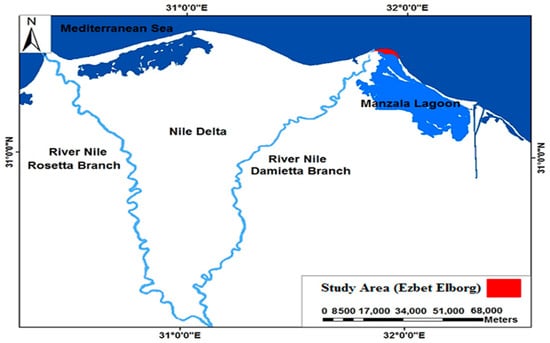
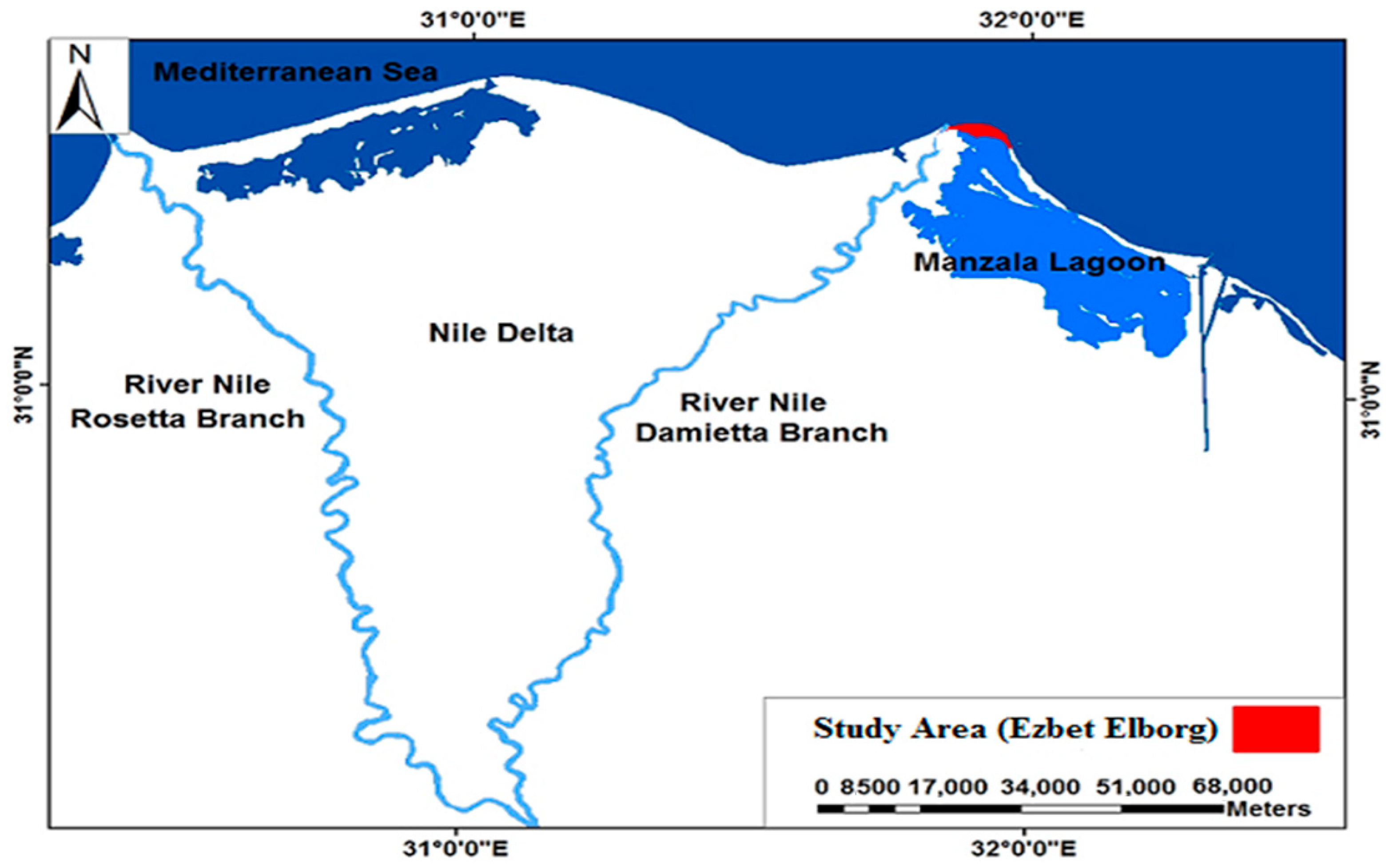
The study focuses on Ezbet Elborg, a coastal town located at the junction of the eastern Nile branch and the Mediterranean Sea in northern Egypt. The area represents one of the country’s most important fishing centres, accommodating more than 60% of Egypt’s fishing fleet. Despite its strategic role, Ezbet Elborg currently lacks a dedicated harbour facility, forcing fishing vessels to moor irregularly along the Damietta branch. This situation hampers navigation efficiency, raises safety concerns, and complicates fleet management. To address these operational limitations, the Damietta Governorate has proposed the development of a new fishing harbour in Ezbet Elborg (Figure 1). The proposed facility is intended to provide organised berthing areas and improved navigational access. It should be noted that the investigated harbour represents a planned development project, and construction activities have not yet commenced at the time of this study. Consequently, photographs of existing harbour infrastructure affected by sedimentation are not available. The present research supports this planned development by applying hydrodynamic simulations and hybrid artificial intelligence-based optimisation at the design stage, with the objective of minimising future sediment accumulation within the proposed harbour basin. By adopting a preventive and sustainability-oriented approach, the study aims to assist decision-makers in selecting optimal harbour layouts and breakwater parameters that enhance long-term operational efficiency, reduce dredging requirements, and support environmentally sustainable harbour development.
Figure 1.
The location of the study area [29].
3. Materials and Methods
3.1. Methodological Framework
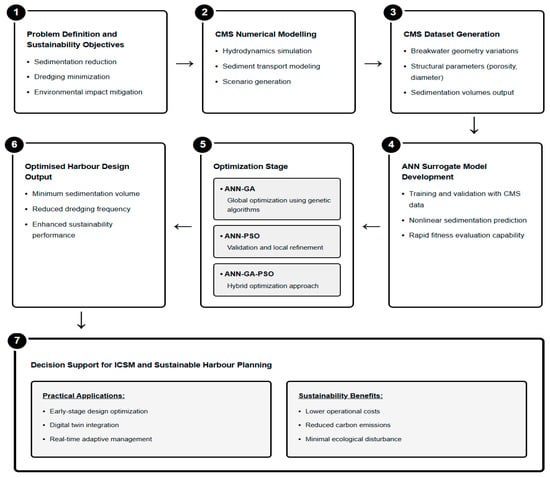
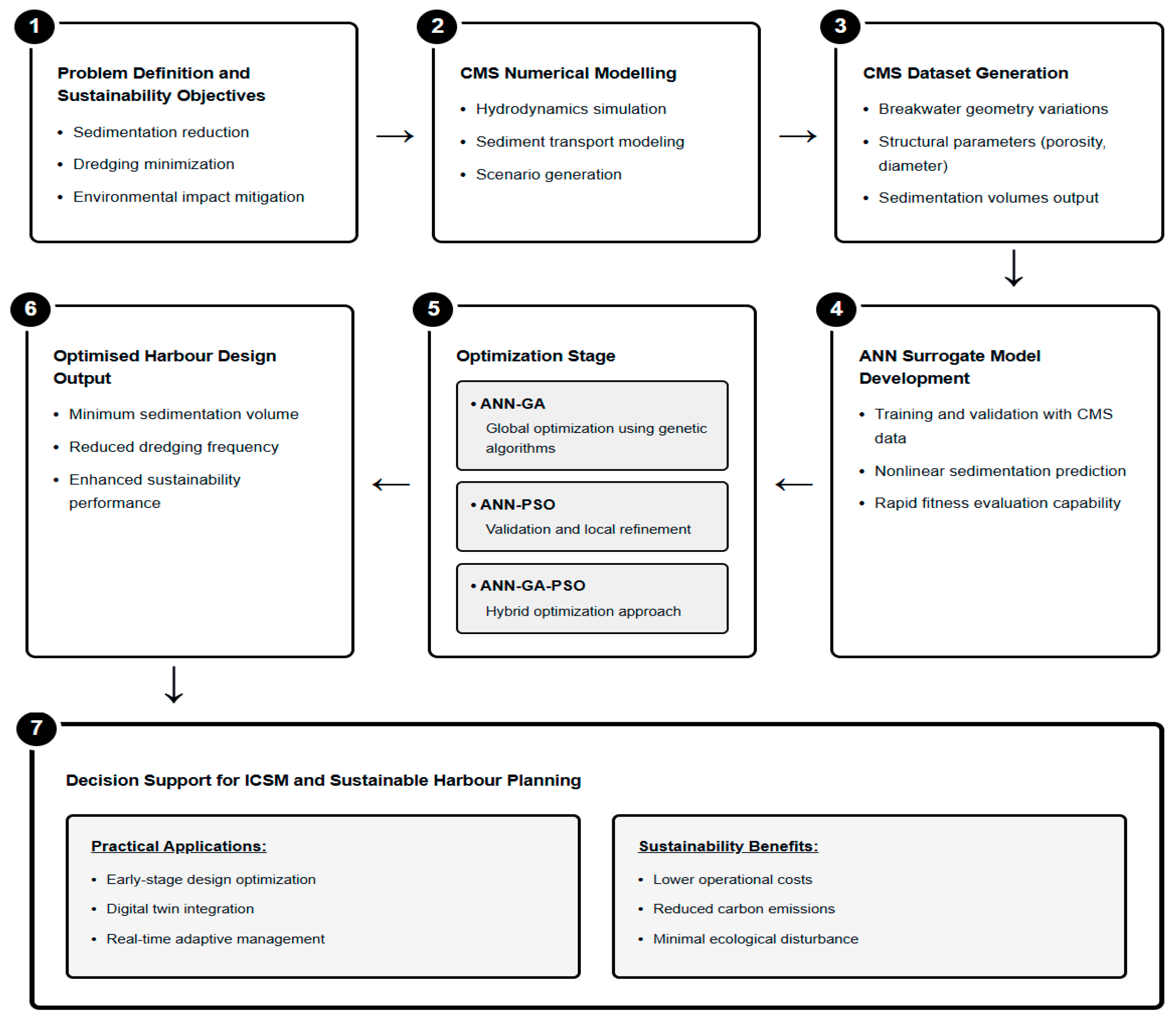
The overall methodological framework adopted in this study is illustrated in Figure 2. The framework integrates numerical hydrodynamic modelling, data-driven prediction, and hybrid evolutionary optimisation within a unified workflow aimed at sustainability-oriented harbour design and sedimentation management.
Figure 2.
Methodological framework of the proposed hybrid ANN–GA–PSO approach.
As shown in Figure 2, the process begins with the development and calibration of a CMS model to simulate hydrodynamic conditions and sediment transport processes under varying harbour layouts and breakwater configurations. A series of numerical simulation scenarios is generated by systematically varying key geometric and structural parameters, resulting in a comprehensive dataset that captures the relationships between design variables and accumulated sedimentation volumes within the harbour basin. In the second stage, an Artificial Neural Network (ANN) surrogate model is trained using the CMS-generated dataset to represent the nonlinear relationship between harbour and breakwater design parameters and sedimentation volume. Once trained and validated, the ANN provides rapid and reliable sedimentation predictions and serves as the fitness evaluation engine for subsequent optimisation procedures. In the third stage, evolutionary optimisation techniques are applied. A Genetic Algorithm (GA) is employed to perform global exploration of the feasible design space and identify promising harbour configurations that minimise sediment accumulation. Particle Swarm Optimisation (PSO) is then used for validation and local refinement of the obtained solutions. By combining GA-based global search with PSO-based convergence efficiency, the hybrid ANN–GA–PSO framework enhances optimisation robustness and stability. The final output of the framework is an optimised harbour and breakwater configuration that minimises sediment accumulation while supporting ICSM objectives, including dredging reduction, improved operational efficiency, and enhanced environmental sustainability. The following subsections describe each component of the methodological framework in detail, including the numerical modelling setup, problem formulation, ANN development, and the implementation of the GA, PSO, and hybrid ANN–GA–PSO strategies.
3.2. Numerical Collection of Data
This study utilises a powerful numerical tool, CMS, developed by CIRP in 2006, to investigate the intricate relationship between harbour layout and sedimentation within the basin. Through 100 simulated scenarios, varying breakwater parameters are explored to determine their impact on sedimentation patterns [30]. The CMS model acts as a virtual laboratory, simulating how coastlines behave under the influence of tides, waves, currents, and sediment movement. By analysing real-world data like wind patterns and seabed depths (bathymetry), CMS predicts storm surges, erosion risks, and potential impacts on coastal infrastructure [5].
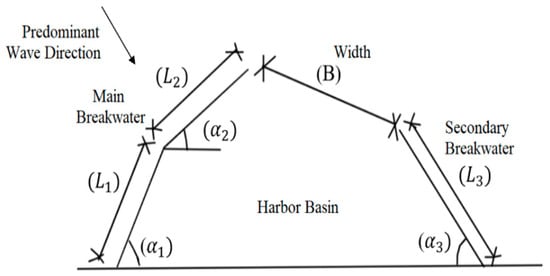
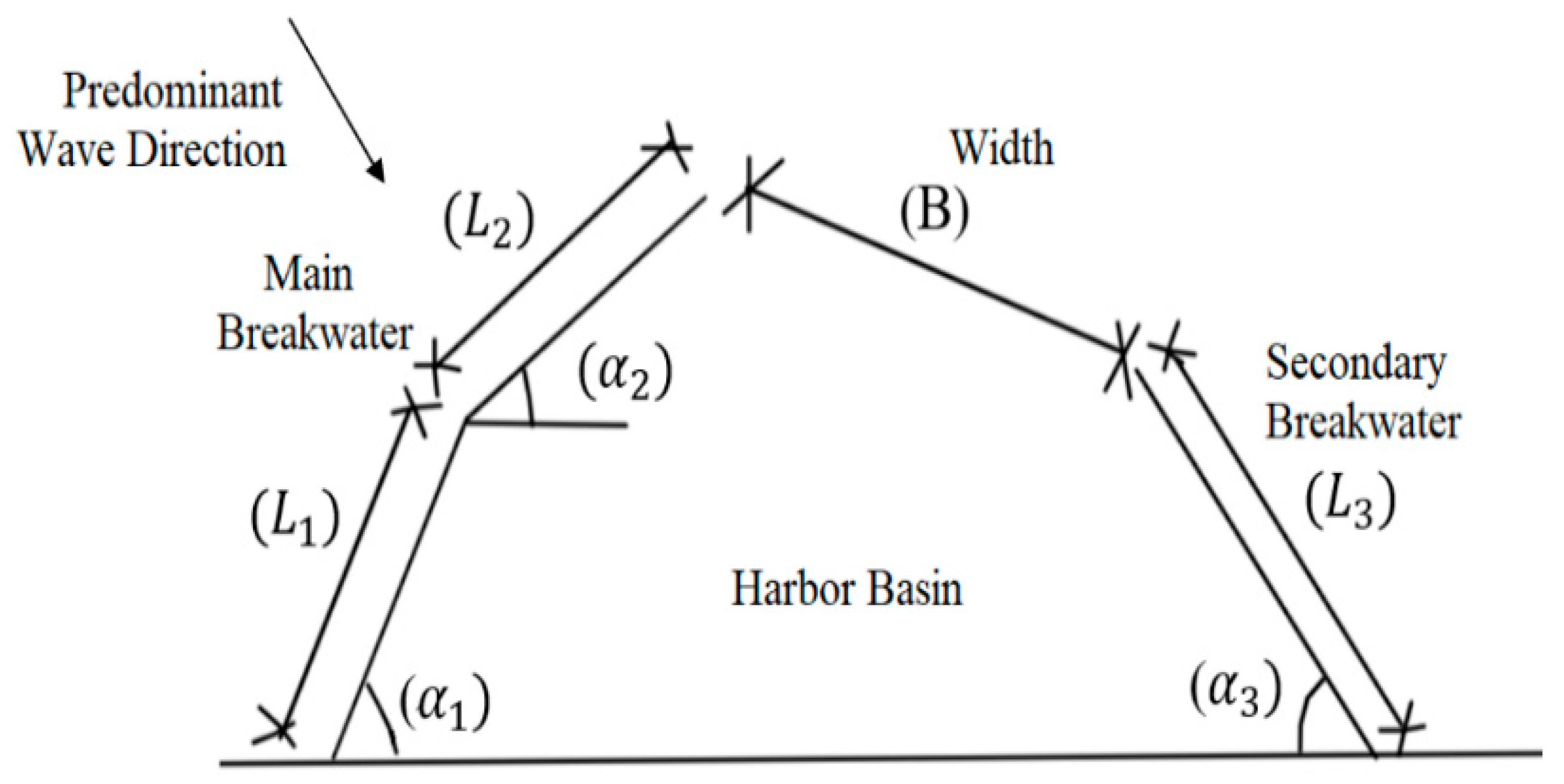
Before using CMS for specific issues, it needs calibration. This involves comparing model predictions with actual observations, ensuring accuracy. Bathymetry data collected in 2014 were used for model setup, and those collected in 2015 for the calibration process. The CMS is driven by a rich tapestry of environmental data, including measured wave heights from the S4DW gauge, water surface elevation, current velocities, and detailed sediment characteristics. CMS then runs a simulation using the combined CMS-Flow and CMS-Wave models, predicting how the seabed will evolve over a year starting from October 2014. The explanation of every process involved in developing the CMS model, including model setup and calibration, is presented in [12]. Moreover, rubble-mound breakwaters are used for a calm and protected area within the proposed harbour. While numerical models typically treat rubble-mound breakwaters as solid, impermeable structures, their porosity plays a crucial role in real-world scenarios. Water and sediment transport through these porous barriers can alter flow patterns, trigger morphological changes, and even cause beach erosion in protected areas. Therefore, this study will enhance the CMS model by integrating a comprehensive permeability mechanism for breakwaters, acknowledging its significant impact on hydrodynamics and sediment transport. The lengths and the inclination angles of the main and secondary breakwaters , , rock diameter (D), porosity (n), and harbour basin width (B), among other design factors, are continuously changed to simulate various harbour scenarios as shown in Figure 3, and the scenarios’ results are summarised in Table 2.
Figure 3.
Harbour geometry parameters [12].
Table 2.
Scenarios’ results of the harbour sedimentation study [12].
3.3. Problem Statement and Optimisation Formulation
Harbour basin sedimentation represents a critical sustainability challenge in coastal infrastructure, as excessive sediment accumulation reduces navigational safety, increases dredging frequency, elevates maintenance costs, and leads to significant environmental disturbance and carbon emissions. From a sustainable harbour design perspective, it is therefore essential to optimise harbour layout and breakwater configuration at the early planning stage in order to minimise long-term sedimentation within the basin. In this study, the sedimentation management problem is formulated as a constrained optimisation problem in which the objective is to minimise the accumulated sedimentation volume within the harbour basin by optimally selecting key geometric and structural design parameters. Let X denote the vector of decision variables governing harbour and breakwater design:
where Lᵢ and θᵢ represent the lengths and orientation angles of the main and secondary breakwaters, B is the harbour basin width, n denotes breakwater porosity, and D represents the characteristic rock diameter of the rubble-mound structure.
X = {L1, θ1, L2, θ2, L3, θ3, B, n, D}
min F(X) = Vs(X)
The sedimentation volume vs. is obtained through hydrodynamic and sediment transport interactions captured by CMS simulations and subsequently approximated using a trained ANN surrogate model.
where Xmin and Xmax represent the lower and upper bounds of the design variables, respectively, as defined in Table 3. These bounds ensure compliance with hydrodynamic stability, navigational requirements, and established coastal engineering guidelines. Given the highly nonlinear and computationally intensive nature of directly coupling numerical simulations with optimisation, a hybrid optimisation framework is adopted. The ANN serves as a surrogate model to efficiently approximate the functional relationship between design variables and sedimentation volume, while the GA is employed to explore the constrained design space and identify near-optimal solutions. The formal definition of the optimisation problem presented here precedes the description of the optimisation algorithms and provides a clear and rigorous foundation for the proposed methodology.
Xmin ≤ X ≤ Xmax
Table 3.
Optimisation variables and their limits (Figure 2).
3.4. Artificial Neural Network (ANN)
With a limited understanding of highly complicated and nonlinear systems such as the sedimentation process, constructing an accurate model for optimisation issues is extremely demanding and challenging. The ANN is one of the most successful ways for dealing with these challenges [31]. The research uses the Levenberg–Marquardt-Backpropagation (LM-BP) algorithm to train a Multilayer Perceptron (MLP) network, set up as a feed-forward back propagation neural network (FFBPNN). This algorithm is preferred for its efficiency and effectiveness in training medium-sized neural networks, particularly for non-linear least squares problems, as it balances the speed of gradient descent with the robustness of the Gauss-Newton method [32,33]. Supported by numerous studies for similar applications, the Levenberg–Marquardt algorithm is especially suitable for our study, addressing complex, non-linear relationships in sedimentation data.
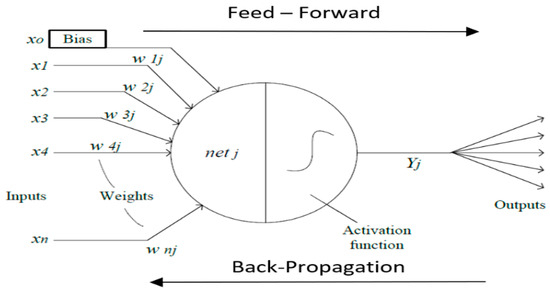
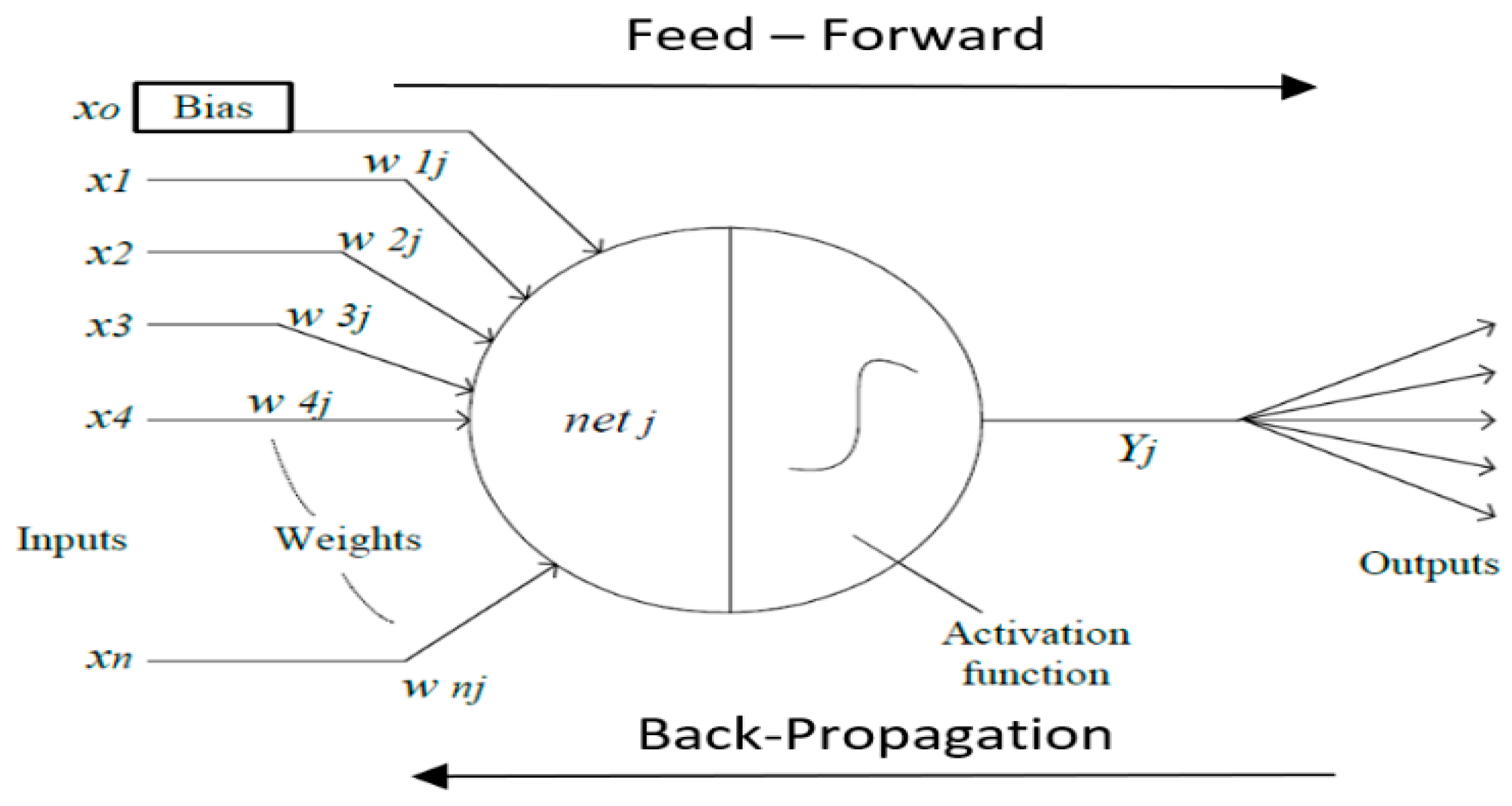
ANNs elegantly orchestrate information processing through a three-layered structure: an input layer for data reception, an output layer for prediction formulation, and a network of hidden layers that interweave their connections (Figure 4). The cornerstone of this architecture is the neuron, a computational unit that meticulously integrates inputs, applies weighted summation, and invokes transfer functions to generate outputs. This can be expressed as follows:
where Y is the output from the neuron; x1, x2, …, xn are the input values; w1, w2, …, wn are the connection weights; b is the bias value; and f is the activation function, which could be chosen as tansig, logsig, and purelin in MATLAB R2020a.
Figure 4.
Architecture of an individual neuron.
The back-propagation (BP) algorithm guides the network towards optimal performance by minimising the mean square error (MSE) between its predictions and the training data labels. This iterative process balances error reduction with the network’s ability to generalise effectively to unseen data as presented in Equation (2).
where ) and ( is the observed and predicted outputs for any n output node. The BP process initiates a cascade of weight adjustments, beginning at the output layer and gracefully flowing back through the hidden layers to the input nodes (Figure 3). This orchestrated wave of modifications adheres to the principle of steepest gradient descent, ensuring each weight change aligns with the negative direction of the error gradient, i.e.,
where w is the weight between any two nodes; and are the weight changes at n and n − 1 iterations; is the momentum factor; and is the learning rate. With training complete, the network stands poised, its connection weights now meticulously calibrated. It confidently awaits new input patterns, prepared to generate outputs that faithfully align with its internalised understanding of the input–output relationship (Rojas 2013) [34].
Evaluating several architectures and activation functions was done during the ANN training process in order to achieve the smallest error target, which was set at 0.001. Since there is currently no theory that can be used to calculate the number of hidden layers and neurons needed for the proper modelling procedure, the optimum design was selected after evaluating a variety of topologies. This decision was made by assessing each model’s commitment to predict outcomes quickly and accurately.
3.5. Genetic Algorithms
To model the nonlinear relationship between breakwater design parameters and sedimentation processes, an ANN was employed in this study. A Multilayer Perceptron (MLP) architecture was adopted and implemented as a feed-forward backpropagation neural network (FFBPNN). Supported by previous studies, the Levenberg–Marquardt algorithm has been widely applied for training neural networks in engineering and environmental modelling due to its efficiency and strong convergence properties when addressing complex, nonlinear relationships [31,35].
Optimisation seeks the optimal solution within a set of possibilities, constrained by specific conditions and requirements. In this study, we address complex sedimentation optimisation problems, characterised by design variables exhibiting nonlinear and discontinuous behaviour. Formulating the optimisation problem necessitates the precise identification of the objective function, design variables, and governing constraints [36]. This study’s optimisation problem is single-objective, discontinuous, hard-combinatorial, and involves structured variables, necessitating sophisticated solution techniques.
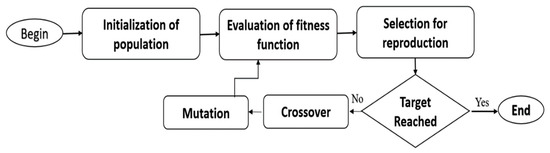
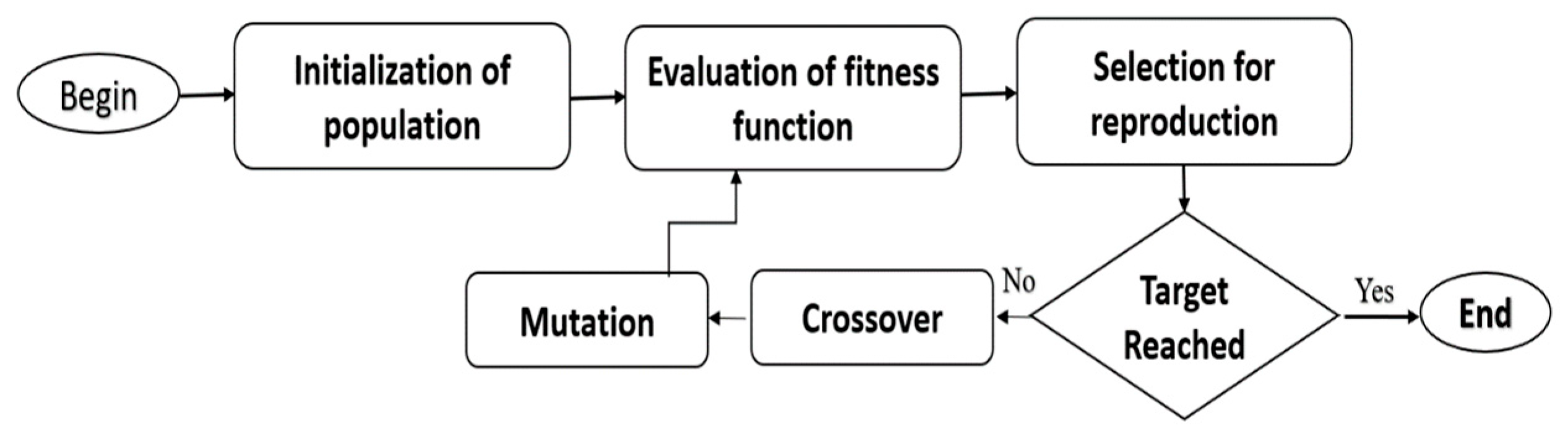
GAs offer a stochastic, general-purpose approach to optimisation problems. Their ability to handle discrete variables, navigate discontinuous objective functions, and efficiently explore large design spaces makes them particularly adept at finding optimal or near-optimal solutions. Furthermore, when compared to conventional optimisation techniques, GAs often provide comparable levels of accuracy while exhibiting superior efficiency. Ever since the dawn of the 1990s, civil engineers have embraced GAs as a go-to tool for optimisation, leveraging their prowess to tackle intricate problems like designing structures and transportation networks [37]. Figure 5 depicts the structure of a traditional GA, consisting of five primary steps:
Figure 5.
The structure of traditional GAs.
- Initialisation of population: This step introduces an initial set of solutions (population of chromosomes) to the problem at hand. The population size, denoted as N, is crucial, as a balance must be struck to avoid excessive computational time or inadequate exploration of the solution space. Additionally, a fitness function is defined in this step to evaluate the quality of solutions.
- Evaluation of fitness function value: In this phase, each chromosome in the population is assessed to determine its fitness function value, reflecting its suitability for reproduction. This function, acting as the objective function, evaluates solutions (sedimentation volumes (Vs)) based on preset criteria. GAs initiate with a randomised population, assigning higher fitness to individuals with lower energy consumption. Equation (4) computes the fitness value for each chromosome, representing an optimal solution, with superior performance indicated by higher fitness scores. In this study, solutions are encoded as sequences of values matching the input vector of the developed ANN model , . The fitness function, facilitated by the ANN, assesses each individual, ranking them by relative merit, calculated by dividing their fitness by the total fitness of the population, as shown in Equation (5).
Fitness (i) = 1/Sedimentation volumes (Vs)
- 3.
- Selection for reproduction: Based on the fitness function values, the best-performing chromosomes are selected for reproduction. Those with higher fitness values have a greater chance of being chosen.
- 4.
- Crossover: This step involves pairing two chromosomes and exchanging genetic material to create offspring. A random crossover point is chosen within each chromosome, and genes are swapped between parents to generate new solutions. For example, consider two chromosomes, S1 and S2, defined as the following:
S1 = [1 1 1 1 1]
S2 = [0 0 0 0 0]
Given the crossover point i = 2, we have the new offspring of and , such as the following:
- 5.
- Mutation: Following crossover, individual offspring may undergo mutation, where their genes are randomly altered to introduce further diversity and potentially improve solutions.
- 6.
- Stopping (termination) criteria: Several termination conditions are utilised to conclude the GA process. These include reaching a fixed number of generations, achieving a predefined fitness level, or observing no improvement in the best fitness value over successive generations.
The optimisation model’s framework is meticulously constructed with its objective function, constraints, and variables. This study introduces a novel optimisation framework, consisting of an objective function focused on minimising monthly accumulated sedimentation volume as shown in Equation (10) and a set of constraints derived from comprehensive CMS simulations as presented in Table 2. Notably, the constraints of the variables align with the specifications outlined by the US Army Corps of Engineers’ specifications and previously performed studies within the same context.
Min. ∮ Monthly accumulated sedimentation volume (Vs)
This framework empowers harbour designers with a decision-support tool for the conceptual design phase, enabling them to identify the critical influence of specific layout and breakwater parameters on sediment buildup within the harbour basin as outlined in Table 3.
3.6. Particle Swarm Optimisation
To independently verify the robustness of the GA-based optimisation results, a Particle Swarm Optimisation (PSO) framework was additionally implemented. In the PSO framework, each particle represents a candidate harbour design solution defined by the same set of decision variables used in the ANN–GA model. Particle positions were iteratively updated based on individual and global best solutions, with the ANN surrogate model used to evaluate fitness in terms of predicted sedimentation volume. This implementation enabled an independent verification of the optimisation outcomes and supported the assessment of solution stability across different evolutionary search strategies.
PSO procedure is a stochastic search method inspired by the collective behaviour of flocking birds. In this algorithm, each “particle” represents a potential solution within the search space. The velocity of these particles guides their movement direction within the space while also enabling them to retain information about both local and global best solutions. To determine the most effective outcome, particles continually update their coordinates and velocities based on their individual experiences and the experiences of other particles within the search space. The following equations govern the updating of each particle’s velocity and position as it moves towards its best position (pbest) and the global best position (gbest) [38]:
Here, where i ranges from 1 to N, with N representing the population size and . In this context, Vi,jk denotes the velocity of particle i at iteration k, while Xi,jk denotes the position of particle i at iteration k. Additionally, Pbesti,jk denotes the personal best of particle i, and Gbestj signifies the best position in the neighbourhood. The variables w, c1, and c2 represent the momentum inertia weight and acceleration coefficients, respectively, while r1 and r2 denote random numbers uniformly distributed within the range (0, 1). The new location of a given bird is determined as follows:
The new bird, Xik+1, must replace the old one, Xik, and only if it has better fitness. Once the preceding process has been iterated across the entire bird population, the most fit bird is identified and potentially replaced with the if it exhibits superior fitness. This process continues iteratively until a termination criterion is met [38]. This collective behaviour allows the swarm to efficiently navigate towards promising regions of the solution space.
3.7. Hybrid ANN–GA–PSO
To enhance the comparative evaluation of optimisation strategies, a hybrid Artificial Neural Network–Genetic Algorithm–Particle Swarm Optimisation (ANN–GA–PSO) framework is implemented. The objective of this hybrid approach is to combine the strong global exploration capability of GA with the fast local convergence characteristics of PSO, while consistently using the pre-trained ANN as a surrogate model for sedimentation prediction.
The hybrid framework adopts the same problem formulation, objective function, decision variables, and constraints defined in Section 3.2. The accumulated sedimentation volume predicted by the ANN surrogate model is used as the fitness function throughout the optimisation process, ensuring full methodological consistency with the standalone ANN–GA and ANN–PSO approaches.
The optimisation procedure is carried out in two sequential stages. In the first stage, GA is applied to perform a global search within the feasible design space defined by the variable bounds listed in Table 3. Standard genetic operators are employed to evolve a population of candidate solutions over successive generations, with fitness evaluation performed using the ANN surrogate model. This stage aims to identify a set of high-quality candidate solutions located in promising regions of the design space.
In the second stage, PSO is employed as a local refinement mechanism. Rather than random initialisation, the PSO swarm is seeded using the best-performing solutions obtained from the final GA population. This information transfer strategy enables PSO to exploit regions already identified as promising by GA, thereby improving convergence efficiency. Particle position and velocity updates follow the PSO formulation presented in Section 3.5, and the refinement process continues until the predefined convergence criteria are satisfied.
The final optimised harbour configuration is selected as the global best solution identified by the PSO stage. By integrating GA-based global exploration with PSO-based local refinement, the hybrid ANN–GA–PSO framework provides a balanced optimisation strategy that improves robustness and convergence behaviour while maintaining computational efficiency. The use of identical ANN architecture, objective function, constraints, and validation procedures across all optimisation approaches enables a fair and direct comparison of performance, as will be presented in Section 4.
4. Results and Discussion
4.1. ANN Model Results
During this stage, the training process of the ANN involved experimentation with various architectures and activation functions. Identifying the optimal ANN architecture, including the appropriate number of hidden layers, neurons per hidden layer, and connection functions, presents a universally challenging task. We conducted training over 100 epochs, utilising a batch size of 32 for each iteration. To mitigate overfitting, we implemented early stopping, a strategy that monitors the validation loss and halts training if there is no improvement after 10 consecutive epochs. Extensive research has been conducted, and ongoing discussions persist regarding this matter. Given the multitude of possibilities for constructing the final network structure within the ANN algorithm, selecting the most suitable combination of parameters poses significant difficulties. This comprehensive approach allowed us to determine the optimal model structure, denoted as (9-16-14-1), which comprises nine input variables, sixteen neurons for the first hidden layer, fourteen neurons for the second hidden layer, and a single output. The ANN training, architecture selection, and validation processes were previously developed and published in an earlier study [12]. In the present research, this pre-trained ANN model was employed as the predictive core within a hybrid Artificial Neural Network–Genetic Algorithm (ANN–GA) optimisation framework. The ANN provided rapid and accurate predictions, while the GA systematically optimised harbour and breakwater design parameters to minimise sediment accumulation. Accordingly, only a concise summary of the ANN’s key parameters and performance metrics is presented here for continuity, as the primary focus of this study lies in the optimisation phase.
4.2. Optimisation Model Implementation
Appropriate GA parameter values are essential for the effective implementation of GAs. Thus, before starting the optimisation process, GA optimisation parameters should be investigated. For each test condition, the GA solver should be run several times under the same conditions. Due to the stochastic nature of the GA technique, one single result will not be representative of the system behaviour. However, if the same conditions are used over a number of runs, it is possible to average the results to determine the trends in the recorded data. Consequently, the performance of the GA solver is examined in this research using an iterative process employing eight MATLAB GA control parameters, with options listed in Table 4.
Table 4.
GA parameters and their options.
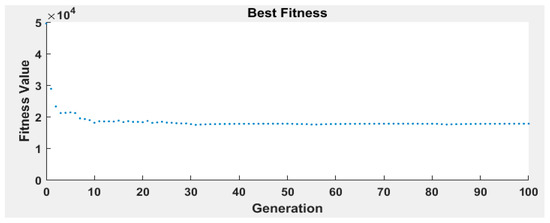
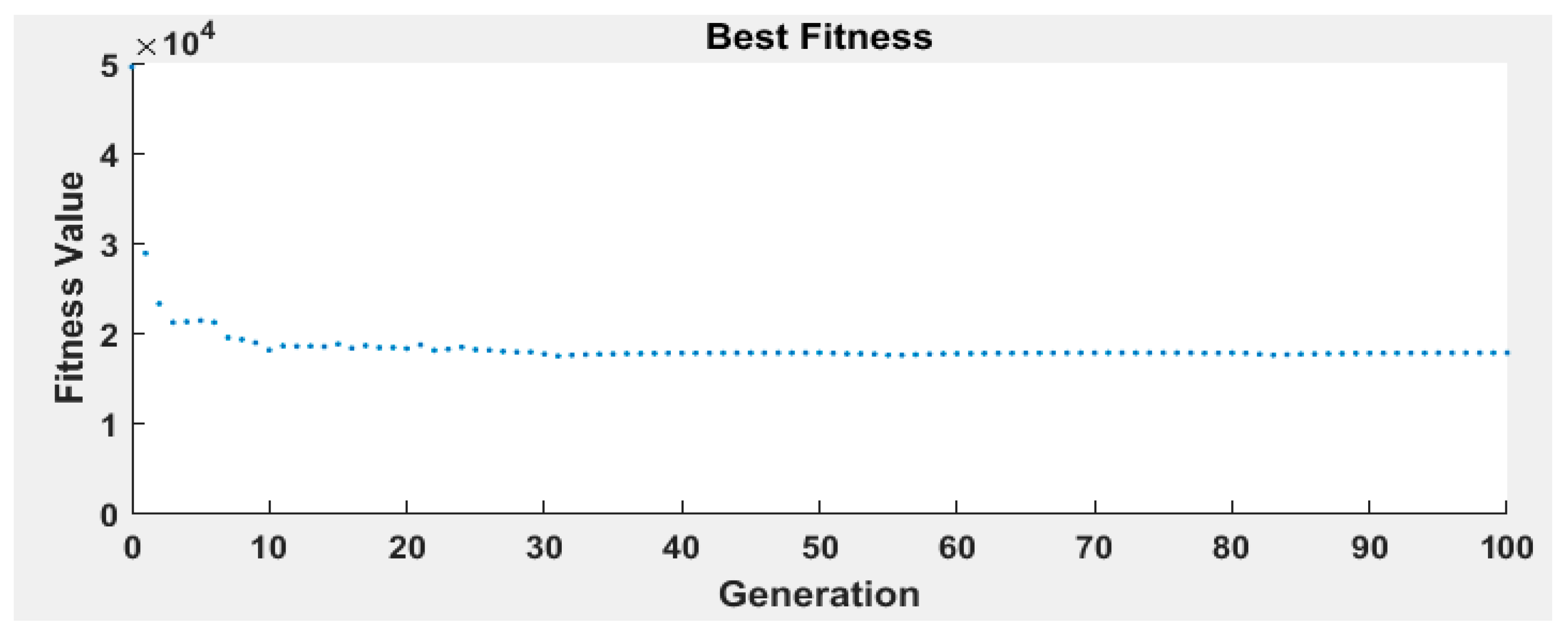
To identify the optimal GA control parameters, the optimisation engine was executed 20 times under consistent conditions, exploring various parameter combinations. Table A1 in Appendix A presents the best-performing parameter sets and their corresponding solutions. Moreover, the range of skewness for the tested parameters of the GAs falls between −0.05 and 0.027, nearing zero, which suggests a distribution close to normality. This statistically robust result underscores the normal distribution of the tested parameters and the stability of the proposed ANN-GAs model’s parameters. Furthermore, the GA solver terminates upon reaching convergence, defined as either exceeding the maximum generation count or achieving a fitness change tolerance of 1 × 10⁻³ as recommended before by previous studies [39]. Specifically, these criteria are used to ensure that the optimisation process reaches a satisfactory level of convergence while avoiding unnecessary computational costs. This approach helps streamline the optimisation process and ensures that the model achieves the desired performance within defined constraints. An illustration of the convergence of the GA solver used in the current study is provided in Figure 6. As shown in Figure 6, the rapid reduction in the fitness value during the early generations, followed by a stable plateau, indicates effective global exploration and reliable convergence of the GA solver.
Figure 6.
Sample of GA solver convergence for one of the optimum solutions.
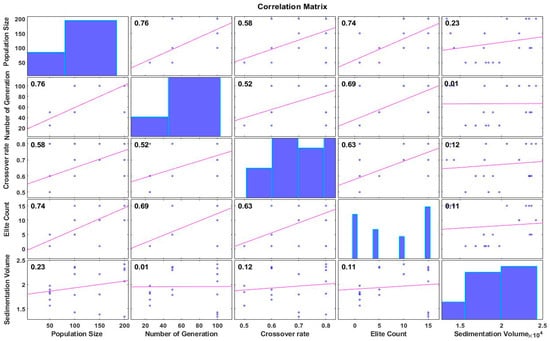
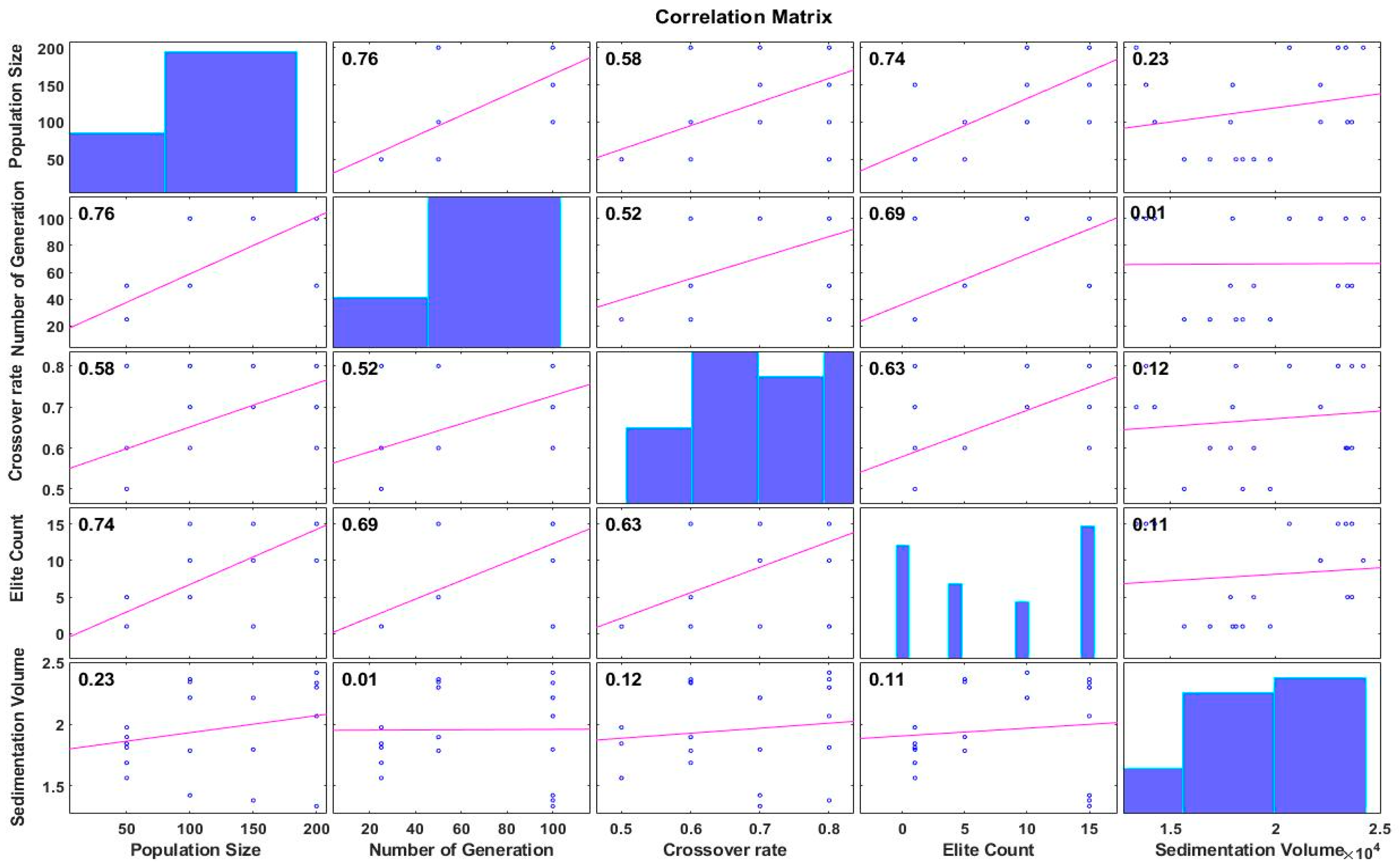
Figure 7 presents a comprehensive correlation matrix illustrating the relationships between various GA parameters and sedimentation volume (Vs), with each cell indicating the Pearson correlation coefficient, elucidating the strength and direction of these associations. Analysis of the matrix reveals that certain parameters exert more pronounced influences on sedimentation volume than others. Specifically, the correlation coefficient of 0.23 for population size suggests a moderate to strong positive correlation with Vs, indicating that larger populations enhance solution diversity and lead to higher sedimentation volumes. In contrast, the crossover rate shows a moderate positive correlation (coefficient of 0.12) with Vs, suggesting its influence on sedimentation outcomes, though less significantly than population size. Meanwhile, parameters like mutation rate and others exhibit lower correlations with Vs, implying weaker linear relationships. This detailed matrix provides insights into how specific GA parameters, particularly population size and crossover rate, impact sedimentation volume. Higher correlation coefficients highlight their critical roles in GA optimisation for sedimentation management, guiding strategies to enhance algorithm performance in harbour basin applications. These findings demonstrate that population size and crossover rate play a dominant role in controlling the optimisation landscape, providing practical guidance for tuning GA parameters in sedimentation-related design problems.
Figure 7.
Correlation matrix between GA parameters and response (Vs).
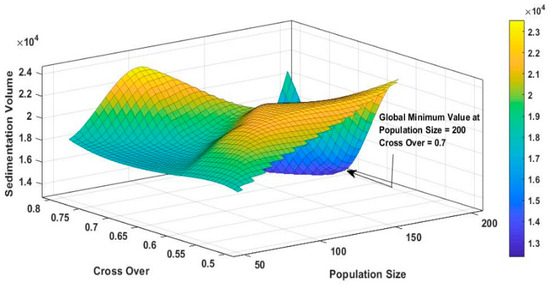
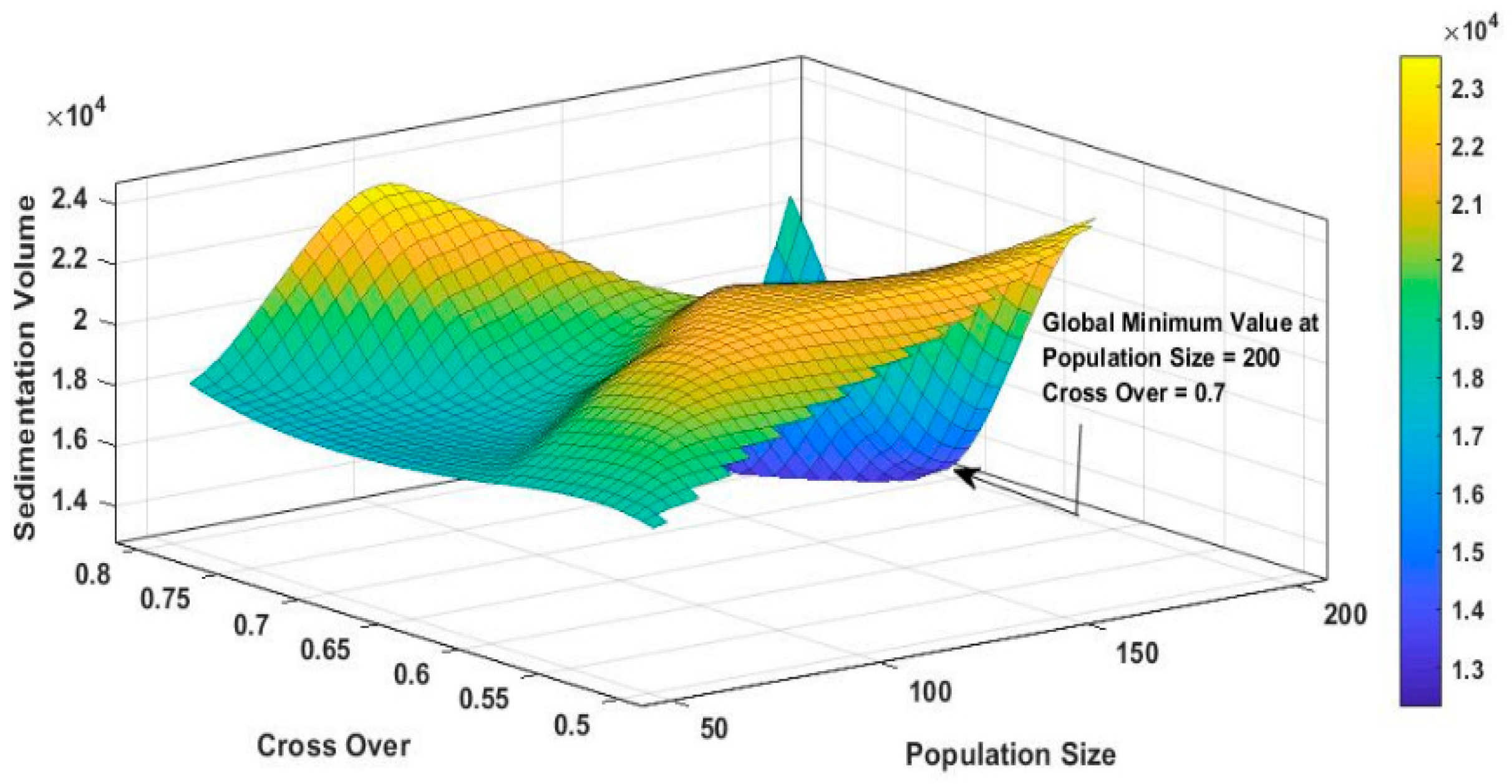
In addition to the correlation matrix, a 3D plot is constructed to further elucidate the influence of population size and crossover rate on the accumulated sedimentation volume, as depicted in Figure 8. This visualisation aids in identifying optimal parameter settings that lead to desirable outcomes. Despite the presence of multiple local minima, the distinct global optimum value observed at crossover value = 0.7 and population size = 200 underscores the critical importance of these parameters in optimising the algorithm’s performance. The identification of a clear global optimum further supports the suitability of the selected GA configuration for design-stage optimisation, despite the presence of multiple local minima.
Figure 8.
3D view of optimum population size and crossover rate for experiment.
Overall, the correlation matrix and 3D plot together provide a detailed understanding of how population size and crossover rate significantly influence the performance of Genetic Algorithms in predicting sedimentation volume. These insights offer valuable guidance for fine-tuning GA parameters to achieve optimal results in practical applications.
4.3. Assessing the Stability of the ANN-GA Model
To investigate the generalisation and stability characteristics of the obtained ANN-GA optimised model, the obtained twenty optimum solutions were collected from experiment no. (12) discussed previously in the last section, as shown in Table A2, are assessed by using their relative deviation percentage (RDP) from the average solution proposed by Shahsavar et al. [40] as follows:
As Table A2 reveals, the statistical analysis paints a positive picture of the GA’s performance. The average RDP of 7.48% indicates acceptable dispersion of optimised solutions around the mean value, confirming convergence stability without excessive variability. Furthermore, the skewness value of 0.013, close to zero, indicates a near-normal distribution of RDP values, suggesting that the GA consistently converges towards the global optimum solution and avoids getting trapped in local optima. This statistically robust outcome demonstrates the effectiveness of the proposed optimisation approach.
4.4. Validation and Comparative Assessment of ANN-Based Optimisation Models
To validate the optimisation results obtained from the proposed ANN–GA model, an independent ANN–PSO framework was developed and implemented using MATLAB 2021a. The PSO algorithm underwent systematic hyperparameter tuning, and the optimal parameter configuration was identified after 100 iterations. The investigated parameter ranges and selected optimal values are presented in Table 5.
Table 5.
PSO parameters and their options.
The optimal harbour design parameters obtained using the ANN–GA and ANN–PSO models, together with the corresponding accumulated sedimentation volumes, are summarised in Table 6. The comparison indicates that both optimisation approaches converged within a similar region of the feasible design space. The maximum deviation between corresponding design parameters remained within acceptable limits, with ANN–PSO exhibiting a maximum deviation of 8.46% relative to the ANN–GA baseline. In terms of optimisation performance, the ANN–PSO model achieved a predicted sedimentation volume of 13,685 m3, corresponding to a positive deviation of 2.4% relative to the ANN–GA result of 13,355 m3. Given the nonlinear and high-dimensional nature of the sedimentation optimisation problem, this deviation is considered acceptable and confirms the reliability of the ANN–GA framework.
Table 6.
The optimal breakwater design factors by ANN-GAs and ANN-PSO.
To further extend the comparative assessment, a hybrid ANN–GA–PSO framework was introduced by integrating GA-based global exploration with PSO-based local refinement. As shown in Table 6, the hybrid model achieved a minimum predicted sedimentation volume of 13,051 m3, representing an improvement of approximately 2.3% relative to the ANN–GA baseline. The corresponding optimal design parameters remained within the same region identified by the standalone models, indicating consistent convergence behaviour across all optimisation strategies.
The comparative findings highlight clear methodological trade-offs among the three approaches. The ANN–GA model demonstrates strong global exploration capability but requires greater computational effort due to larger population sizes and extended generational evolution. In contrast, ANN–PSO provides faster convergence and lower computational demand, although it may be more susceptible to premature convergence in complex search landscapes. The hybrid ANN–GA–PSO framework effectively balances these characteristics by combining global exploration with local refinement, thereby improving optimisation performance while preserving solution stability.
To assess robustness and repeatability, the hybrid ANN–GA–PSO was executed 20 times under identical parameter settings. All runs converged to solutions located within the same feasible design region. The best-performing run achieved a sedimentation volume of 13,051 m3, while statistical analysis of the 20 independent runs yielded a mean sedimentation volume of 13,095 m3 with a standard deviation of 29.6 m3 (coefficient of variation = 0.23%). The low dispersion of results confirms stable convergence behaviour and demonstrates that the GA-seeded PSO refinement enhances optimisation reliability without introducing significant variability. Detailed numerical results of the 20 independent runs are provided in Appendix A (Table A3).
The hybrid framework employs the optimal parameter configurations independently identified for the standalone GA and PSO algorithms to ensure methodological consistency across all comparative analyses. Specifically, the GA stage adopts the parameter set yielding the best performance in Table A1, while the PSO stage applies the optimal configuration reported in Table 5. This parameter inheritance strategy eliminates redundant hyperparameter tuning and ensures a fair basis for comparison. Both optimisation stages apply identical convergence criteria and utilise the same pre-trained ANN surrogate model for fitness evaluation.
Beyond numerical performance, these findings should be interpreted within the broader context of harbour design practice. Conventional sedimentation assessment typically relies on physical or process-based numerical modelling applied after layout definition, limiting its capacity for systematic optimisation. In contrast, the proposed hybrid ANN–GA–PSO framework enables proactive, design-stage optimisation by integrating simulation outputs with surrogate modelling and evolutionary search. Unlike many previous AI-based sedimentation studies that focus primarily on predictive accuracy, the present work embeds artificial intelligence within an explicit optimisation structure, thereby advancing methodological integration and supporting sustainability-oriented harbour planning.
5. Managerial, Practical, and Sustainable Contribution
Sedimentation within harbour basins presents significant managerial challenges by reducing operational efficiency, increasing maintenance and dredging costs, and exerting adverse impacts on marine ecosystems and water quality. From a management perspective, harbour infrastructure decisions, those related to breakwater configuration geometry and material characteristics, play a decisive role in governing sediment transport behaviour and long-term maintenance requirements. Conventional physical and numerical modelling approaches, although technically robust, are often costly, time-consuming, and difficult to deploy at early planning stages, which limits their effectiveness as routine decision support tools.
Within this context, the proposed AI-based framework provides a practical alternative for supporting sustainability-oriented harbour planning and management. Rather than replacing physical or numerical models, the framework complements them by integrating CMS simulation outputs with data-driven surrogate modelling and evolutionary optimisation. ANN models are used to capture nonlinear relationships between breakwater design parameters and sediment accumulation, while GA and PSO algorithms enable systematic exploration and refinement of design solutions. The combined ANN–GA–PSO approach supports optimisation-driven decision-making while significantly reducing computational and calibration demands compared with repeated numerical simulations.
From a managerial standpoint, the proposed framework enables proactive sediment management by supporting informed design decisions at the early planning stage, where sustainability interventions are most effective. By identifying harbour layouts and breakwater configurations that minimise long-term sediment accumulation, the framework contributes to reduced dredging frequency, lower operational costs, and decreased environmental disturbance and associated carbon emissions. The application to the Ezbet El Borg fishing harbour in Egypt demonstrates how the framework can be implemented in a real-world planning context to support ecosystem protection, improved water quality, and alignment with sustainability objectives.
By integrating hydrodynamic simulation outputs with optimisation-oriented AI techniques, the proposed approach provides harbour authorities and planners with a cost-effective, transparent, and data-driven decision support tool that enhances long-term resilience and sustainability. Looking forward to embedding this framework within digital twin environments, which could enable scenario testing, adaptive planning, and dynamic responses to climate-driven changes in sedimentation patterns, supporting a strategic transition toward sustainable, resilient, and environmentally responsible harbour infrastructure development.
6. Limitations and Future Research Directions
While the proposed hybrid ANN–GA–PSO framework demonstrates strong performance for design-stage optimisation of harbour sedimentation, several limitations should be acknowledged. First, the reliability of the optimisation outcomes depends on the quality and representativeness of the numerical dataset generated using the CMS. Uncertainties associated with boundary conditions, sediment properties, and hydrodynamic forcing may influence the predictive accuracy of the ANN surrogate model.
Second, although the ANN-based surrogate modelling approach significantly reduces computational demand compared with direct numerical simulations, the framework remains sensitive to the selection of training data, network architecture, and optimisation parameter settings. While systematic calibration was conducted in this study, different site conditions or sediment regimes may require retraining and parameter adjustment to maintain prediction accuracy.
In addition, the current implementation focuses on early-stage design optimisation and does not explicitly account for long-term morphological evolution, climate-driven variability, or post-construction operational changes. Future research could extend the proposed framework by incorporating time-dependent datasets, uncertainty quantification, and real-time monitoring capabilities. The integration of the optimisation framework within digital twin environments represents a promising direction for enabling adaptive and resilient sedimentation management.
These limitations define the present scope of the study and do not detract from the validity of the proposed methodology. Instead, they highlight opportunities for further development toward more comprehensive, data-driven, and sustainable harbour planning and management solutions.
7. Conclusions
This study proposed and validated a hybrid artificial intelligence-based framework for sustainability-oriented optimisation of harbour sedimentation at the design stage. By integrating numerical hydrodynamic simulations with data-driven surrogate modelling and evolutionary optimisation techniques, the research contributes to both scientific advancement and practical decision-making in sustainable port development.
From a scientific and methodological perspective, the study demonstrates that the integration of process-based numerical modelling with ANNs and evolutionary optimisation algorithms provides an effective and computationally efficient approach for addressing complex, nonlinear sedimentation problems in harbour environments at the early design stage. In addition, the proposed hybrid ANN–GA–PSO framework advances existing research by moving beyond prediction-focused AI applications and embedding surrogate models within an explicit optimisation structure, enabling systematic exploration of the harbour design space. Comparative evaluation further confirms that the hybrid ANN–GA–PSO approach achieves improved optimisation performance relative to standalone ANN–GA and ANN–PSO models, resulting in lower predicted sedimentation volumes while maintaining stable convergence behaviour and methodological consistency. Overall, from a sustainable development science perspective, the framework supports a shift from reactive, post-design sedimentation assessment toward proactive, predictive, and optimisation-driven design strategies.
From an engineering and sustainability application perspective, the findings offer clear implications for port planning and design practice. The proposed framework provides engineers and planners with a practical decision-support tool for evaluating alternative harbour layouts and breakwater configurations during the conceptual and early design phases, when sustainability interventions are most effective. By enabling predictive sediment control and reducing anticipated dredging requirements, the framework contributes to lower operational costs, reduced environmental disturbance, and decreased carbon emissions associated with maintenance activities. The application to the proposed Ezbet Elborg fishing harbour illustrates how hybrid AI-based optimisation can be effectively implemented in real-world planning contexts to enhance long-term functionality and environmental performance of harbour infrastructure. Owing to its modular and transferable structure, the proposed methodology can be adapted to other harbour and coastal infrastructure projects and further extended through integration with digital twin platforms to support adaptive, data-driven, and resilient sedimentation management.
Author Contributions
Conceptualization, M.T.E., E.E., M.E. and H.W.; methodology, M.T.E., H.W. and M.M.E.B.; software, M.T.E., M.E., E.A.M. and H.W.; validation, E.E., M.E. and E.A.M.; formal analysis, M.T.E. and H.W.; investigation E.E., M.M.E.B. and E.A.M.; resources E.A.M.; data curation, M.T.E. and H.W.; writing—original draft preparation, M.T.E., E.E. and H.W.; writing—review and editing, M.T.E., M.E., M.M.E.B., E.A.M. and H.W.; visualisation, M.T.E. and H.W.; supervision, E.E., M.M.E.B. and E.A.M.; project administration, M.E. All authors have read and agreed to the published version of the manuscript.
Funding
The research did not receive any external funding.
Institutional Review Board Statement
Not applicable.
Informed Consent Statement
Not applicable.
Data Availability Statement
No new data were created; all data used are included in the manuscript.
Conflicts of Interest
The authors have no relevant financial or non-financial interests to disclose. This manuscript has not been published or submitted to, nor is it under review at, another journal or other publishing venue.
Appendix A
Appendix A provides detailed parameter tuning experiments and robustness analysis to ensure reproducibility and statistical transparency.
Table A1.
Selected parameter set of the GA solver and the corresponding optimum solution.
Table A2.
Optimum solutions of experiment no. (12) with their statistical analysis.
Table A3.
Detailed results of 20 independent ANN–GA–PSO optimisation runs.
References
- Cáceres, R.A.; Zyserman, J.A.; Perillo, G.M.E. Analysis of Sedimentation Problems at the Entrance to Mar Del Plata Harbor. J. Coast. Res. 2016, 318, 301–314. [Google Scholar] [CrossRef] [Scilit]
- Zikra, M.; Salsabila, S.; Sambodho, K. Toward a Better Understanding of Sediment Dynamics as a Basis for Maintenance Dredging in Nagan Raya Port, Indonesia. Fluids 2021, 6, 397. [Google Scholar] [CrossRef] [Scilit]
- Maya-Jariego, I.; Florido-del-Corral, D.; Uchoa-Dantas, M.R. Port Transformation and Community Decline in a Fishing Neighborhood: The Case of El Varadero in the Port of Motril (Spain). Sustainability 2025, 17, 10140. [Google Scholar] [CrossRef] [Scilit]
- Mojabi, M.; Hejazi, K.; Karimi, M. Numerical Investigation of Effective Harbor Geometry Parameters on Sedimentation inside Square Harbors. J. Mar. Sci. Eng. 2013, 3, 57–68. [Google Scholar]
- Li, H.; Lin, L.; Lu, C.C.; Reed, C.W.; Shak, A.T. Modelling Study of Dana Point Harbor, California: Littoral Sediment Transport around a Semi-Permeable Breakwater. J. Ocean Eng. Mar. Energy 2015, 1, 181–192. [Google Scholar] [CrossRef] [Scilit]
- Mahmoodi, A.; Neshaei, M.A.L.; Mansouri, A.; Bejestan, M.S. Study of Current- and Wave-Induced Sediment Transport in the Nowshahr Port Entrance Channel by Using Numerical Modeling and Field Measurements. J. Mar. Sci. Eng. 2020, 8, 284. [Google Scholar] [CrossRef] [Scilit]
- Kuijper, C.; Christiansen, H.; Cornelisse, J.M.; Winterwerp, J.C. Reducing Harbor Siltation. II: Case Study of Parkhafen in Hamburg. J. Waterw. Port Coast. Ocean Eng. 2005, 131, 267–276. [Google Scholar] [CrossRef] [Scilit]
- Boqué-Ciurana, A.; Saladié, Ò.; Rovira-Soto, M.T.; Garcia-Lozano, C.; Martí, C.; Tonda, M.; Borràs, G.; Aguilar, E. How Can Stakeholder Co-Creation Foster Climate-Resilient Coastal Tourism Through Integrated Management of Climate, Water-Energy, and Beach-Dune Systems? Sustainability 2025, 17, 10163. [Google Scholar] [CrossRef] [Scilit]
- Özölçer, I.H.; Kömürcü, M.I.; Birben, A.R.; Yüksek, Ö.; Karasu, S. Effects of T-Shape Groin Parameters on Beach Accretion. Ocean Eng. 2006, 33, 382–403. [Google Scholar] [CrossRef] [Scilit]
- Yüksek, Ö. Effects of Breakwater Parameters on Shoaling of Fishery Harbors. J. Waterw. Port Coast. Ocean Eng. 1995, 121, 13–22. [Google Scholar] [CrossRef] [Scilit]
- Sakhaee, F.; Khalili, F. Sediment Pattern & Rate of Bathymetric Changes Due to Construction of Breakwater Extension at Nowshahr Port. J. Ocean Eng. Sci. 2021, 6, 70–84. [Google Scholar] [CrossRef] [Scilit]
- Elnabwy, M.T.; Elbeltagi, E.; El Banna, M.M.; Elsheikh, M.Y.; Motawa, I.; Hu, J.W.; Kaloop, M.R. Conceptual Prediction of Harbor Sedimentation Quantities Using AI Approaches to Support Integrated Coastal Structures Management. J. Ocean Eng. Sci. 2022, 10, 11–21. [Google Scholar] [CrossRef] [Scilit]
- Nourani, V.; Sattari, M.T.; Molajou, A. Threshold-Based Hybrid Data Mining Method for Long-Term Maximum Precipitation Forecasting. Water Resour. Manag. Int. J. Publ. Eur. Water Resour. Assoc. (EWRA) 2017, 31, 2645–2658. [Google Scholar] [CrossRef] [Scilit]
- Meena, B.L.; Agrawal, J.D. Tidal Level Forecasting Using ANN. Procedia Eng. 2015, 116, 607–614. [Google Scholar] [CrossRef] [Scilit]
- Goldstein, E.B.; Coco, G.; Plant, N.G. A Review of Machine Learning Applications to Coastal Sediment Transport and Morphodynamics. Earth Sci. Rev. 2019, 194, 97–108. [Google Scholar] [CrossRef] [Scilit]
- Kabiri-Samani, A.R.; Aghaee-Tarazjani, J.; Borghei, S.M.; Jeng, D.S. Application of Neural Networks and Fuzzy Logic Models to Long-Shore Sediment Transport. Appl. Soft Comput. 2011, 11, 2880–2887. [Google Scholar] [CrossRef] [Scilit]
- Shafaghat, M.; Dezvareh, R. Support Vector Machine for Classification and Regression of Coastal Sediment Transport. Arab. J. Geosci. 2021, 14, 2009. [Google Scholar] [CrossRef] [Scilit]
- López, I.; Aragonés, L.; Villacampa, Y.; Serra, J.C. Neural Network for Determining the Characteristic Points of the Bars. Ocean Eng. 2017, 136, 141–151. [Google Scholar] [CrossRef] [Scilit]
- Kömürcü, M.I.; Kömür, M.A.; Akpinar, A.; Özölçer, I.H.; Yüksek, Ö. Prediction of Offshore Bar-Shape Parameters Resulted by Cross-Shore Sediment Transport Using Neural Network. Appl. Ocean Res. 2013, 40, 74–82. [Google Scholar] [CrossRef] [Scilit]
- Meshram, S.G.; Hasan, M.A.; Nouraki, A.; Alavi, M.; Albaji, M.; Meshram, C. Machine Learning Prediction of Sediment Yield Index. Soft Comput. 2023, 27, 16111–16124. [Google Scholar] [CrossRef] [Scilit]
- Darabi, H.; Mohamadi, S.; Karimidastenaei, Z.; Kisi, O.; Ehteram, M.; ELShafie, A.; Torabi Haghighi, A. Prediction of Daily Suspended Sediment Load (SSL) Using New Optimisation Algorithms and Soft Computing Models. Soft Comput. 2021, 25, 7609–7626. [Google Scholar] [CrossRef] [Scilit]
- Dehghan-Souraki, D.; López-Gómez, D.; Bladé-Castellet, E.; Larese, A.; Sanz-Ramos, M. Optimizing Sediment Transport Models by Using the Monte Carlo Simulation and Deep Neural Network (DNN): A Case Study of the Riba-Roja Reservoir. Environ. Model. Softw. 2024, 175, 105979. [Google Scholar] [CrossRef] [Scilit]
- Juan, N.P.; Valdecantos, V.N.; Troch, P. Advancing Artificial Intelligence in Ocean and Maritime Engineering: Trends, Progress, and Future Directions. Ocean Eng. 2025, 339, 122077. [Google Scholar] [CrossRef] [Scilit]
- Wang, L.; Liao, S.; Wang, S.; Yin, J.; Li, R.; Guan, J. Real-Time Prediction of Port Water Levels Based on EMD-PSO-RBFNN. Front. Mar. Sci. 2025, 12, 1537696. [Google Scholar] [CrossRef] [Scilit]
- Anuoluwapo Emmanuel, I.; Elizabeth Ojewumi, M.; Huang, W. A Comprehensive Review of AI and ML Applications in Coastal Engineering. Preprints 2025. [Google Scholar] [CrossRef] [Scilit]
- Yaseen, Z.M.; Melini Wan Mohtar, W.H.; Homod, R.Z.; Alawi, O.A.; Abba, S.I.; Oudah, A.Y.; Togun, H.; Goliatt, L.; Ul Hassan Kazmi, S.S.; Tao, H. Heavy Metals Prediction in Coastal Marine Sediments Using Hybridised Machine Learning Models with Metaheuristic Optimisation Algorithm. Chemosphere 2024, 352, 141329. [Google Scholar] [CrossRef] [Scilit]
- Htein, N.M.; Louvros, P.; Stefanou, E.; Aung, M.; Hifi, N.; Boulougouris, E. AI-Based Optimisation Techniques for Hydrodynamic and Structural Design in Ships: A Review. J. Mar. Sci. Eng. 2025, 13, 1719. [Google Scholar] [CrossRef] [Scilit]
- Akopov, A.S. A Hybrid Multi-Swarm Particle Swarm Optimisation Algorithm for Solving Agent-Based Epidemiological Model. Cybern. Inf. Technol. 2025, 25, 59–77. [Google Scholar] [CrossRef] [Scilit]
- Elnabwy, M.T.; Elbeltagi, E.; El Banna, M.M.; Elshikh, M.M.Y.; Motawa, I.; Kaloop, M.R. An Approach Based on Landsat Images for Shoreline Monitoring to Support Integrated Coastal Management—A Case Study, Ezbet Elborg, Nile Delta, Egypt. ISPRS Int. J. Geo-Inf. 2020, 9, 199. [Google Scholar] [CrossRef] [Scilit]
- Styles, R.; Brown, M.E.; Brutsché, K.E.; Li, H.; Beck, T.M.; Sánchez, A. Long-Term Morphological Modelling of Barrier Island Tidal Inlets. J. Mar. Sci. Eng. 2016, 4, 65. [Google Scholar] [CrossRef] [Scilit]
- Haykin, S. Neural Networks: A Comprehensive Foundation, 2nd ed.; Prentice Hall: Upper Saddle River, NJ, USA, 1999; pp. 1–24. [Google Scholar]
- Mammadli, S. Financial Time Series Prediction Using Artificial Neural Network Based on Levenberg-Marquardt Algorithm. Procedia Comput. Sci. 2017, 120, 602–607. [Google Scholar] [CrossRef] [Scilit]
- Santosh Kumar, G.; Rajasekhar, K. Performance Analysis of Levenberg-Marquardt and Steepest Descent Algorithms Based ANN to Predict Compressive Strength of SIFCON Using Manufactured Sand. Eng. Sci. Technol. Int. J. 2017, 20, 1396–1405. [Google Scholar] [CrossRef] [Scilit]
- Rojas, R. Neural Networks: A Systematic Introduction; Springer: Berlin/Heidelberg, Germany, 2013; pp. 149–172. [Google Scholar]
- Adounkpe, J.Y.P.; Wendling, V.; Dezetter, A.; Arfib, B.; Artigue, G.; Pistre, S.; Johannet, A. A Comparison Between Adam and Levenberg–Marquardt Optimizers for the Prediction of Extremes: Case Study for Flood Prediction with Artificial Neural Networks. Eng. Proc. 2025, 101, 12. [Google Scholar] [CrossRef] [Scilit]
- Velasco-Lozano, M.; Ma, Z.; Chen, B.; Pawar, R. Optimising Large-Scale CO2 Pipeline Networks Using a Geospatial Splitting Approach. J. Environ. Manag. 2024, 370, 122522. [Google Scholar] [CrossRef] [Scilit]
- Toklu, Y.C. Application of Genetic Algorithms to Construction Scheduling with or without Resource Constraints. Can. J. Civ. Eng. 2011, 29, 421–429. [Google Scholar] [CrossRef] [Scilit]
- Robinson, J.; Rahmat-Samii, Y. Particle Swarm Optimisation in Electromagnetics. IEEE Trans. Antennas Propag. 2004, 52, 397–407. [Google Scholar] [CrossRef] [Scilit]
- Aldallal, A.S. Avoiding Premature Convergence of Genetic Algorithm in Informational Retrieval Systems. Int. J. Intell. Syst. Appl. Eng. 2015, 2, 80–85. [Google Scholar] [CrossRef] [Scilit]
- Shahsavar, M.; Najafi, A.A.; Akhavan Niaki, S.T. Statistical design of genetic algorithms for combinatorial optimization problems. Adv. Oper. Res. 2011, 2011, 872415. [Google Scholar] [CrossRef] [Scilit]

Disclaimer/Publisher’s Note: The statements, opinions and data contained in all publications are solely those of the individual author(s) and contributor(s) and not of MDPI and/or the editor(s). MDPI and/or the editor(s) disclaim responsibility for any injury to people or property resulting from any ideas, methods, instructions or products referred to in the content. |
© 2026 by the authors. Licensee MDPI, Basel, Switzerland. This article is an open access article distributed under the terms and conditions of the Creative Commons Attribution (CC BY) license.