


Abstract
This study explores the reasons why, despite ambitious national strategies, the deployment of renewable energy in Arab countries has persistently lagged behind global trends. It investigates the drivers of this disparity by analyzing the impact of fiscal capacity, energy market size, and energy dependence on renewable energy development. To control for country heterogeneity, this paper divides Arab countries into three groups based on their degree of energy dependence: energy-importing countries, energy-exporting countries, and energy trade reversal countries. Using a panel dataset of 17 Arab countries from 1990 to 2022, this study employs a dynamic common correlated effects (DCCE) estimator, which uniquely accounts for cross-sectional dependence and distinguishes between short-run dynamics and long-run equilibrium. The results reveal three key findings. First, in energy-importing and energy trade reversal countries, improvements in government fiscal balance significantly promote renewable energy development. Second, higher energy consumption exerts a persistent negative effect on renewable energy development, suggesting that demand expansion reinforces carbon lock-in rather than facilitating transition. Third, energy dependence exhibits a temporal asymmetry: it hinders renewable deployment in the short run, but becomes a strong positive driver in the long run, reflecting a shift from immediate supply security to strategic energy security. However, for energy-exporting countries, those drivers are statistically insignificant, highlighting strong path dependence. These findings partly validate the “developmental state”, “carbon lock-in”, and “energy security” theories within the Arab context. The study concludes that fiscal buffers and the pursuit of energy security facilitate the deployment of renewable energy in specific country contexts, while growth in energy consumption reinforces carbon lock-in. These findings contribute to SDG 7 and SDG 13, with particular relevance to Arab countries grappling with the dual challenges of economic diversification and the climate commitments outlined in the Paris Agreement.
1. Introduction
The 2030 Agenda for Sustainable Development, adopted by all United Nations Member States in 2015, provides a shared blueprint for peace and prosperity for people and the planet [1]. Sustainable Development Goal 7.2 proposes to substantially increase the share of renewable energy in the global energy mix by 2030 [2]. However, there are still serious challenges to the achievement of SDG 7.2. Current trends indicate that progress has been insufficient to accomplish international climate and development objectives, including the pledge to triple global renewables-based power capacity by 2030 [3].
However, this global momentum masks substantial regional heterogeneity. Among the most notable outliers are Arab countries, where renewable energy development has persistently lagged behind global trends despite strong policy rhetoric and abundant natural potential. From 1990 to 2022, the share of modern renewables in total final energy consumption (TFEC) increased to varying degrees in all regions of the world, except for West Asia and North Africa, whose share of modern renewables in TFEC actually declined [3].
Since the late 2000s, most Arab countries have announced ambitious national strategies to expand renewable energy, often setting targets exceeding 20% or even 40% of electricity generation within a few decades. In 2008, the Egyptian government announced an ambitious plan to generate 20% of total electricity generation from renewable energy by 2020 [4]. Kuwait announced that installed renewable energy capacity would account for 5% of the country’s total electricity generation by 2020. Jordan planned to generate 10% of the country’s electricity from renewable sources by 2020. In October 2009, Tunisia adopted a “solar energy development plan for the period 2010–2016”, which aimed to achieve a 22% share of solar energy in the energy supply by 2016 [5]. Meanwhile, Saudi Arabia planned to get half of its electricity from renewable sources by 2020 [6]. Morocco planned to increase the share of electricity generated from renewable sources to 42% by 2020 and to 52% by 2030 [7]. As renewable energy construction advances, more countries have proposed new renewable energy plans. According to the strategic plan for energy development of the UAE around 2020, the share of renewable energy power generation in the total power generation of the UAE was projected to exceed 10% by 2030, and increase to 44% by 2050 [8].
In practice, however, only a small number of countries have approached these goals, while the majority exhibit limited progress or significant delays. As shown in Table 1, according to the IEA data, by 2022, only three countries had renewable energy shares in electricity generation exceeding 20–45.2% in Lebanon, 23.1% in Jordan, and 71.4% in Sudan—and three countries had shares ranging between 10% and 20–19.7% in Yemen, 12.1% in Egypt, and 16.9% in Morocco. Kuwait planned to reach 5% in 2020, but actually only reached 0.2% in 2022. Tunisia planned to reach 22% in 2016, but actually reached 2.9%. Saudi Arabia planned to reach 50% in 2020, but actually reached 0.6%. The UAE plans to reach 10% in 2030, but has only realized 5% by 2022. In summary, among the Arab countries with available plans, only one country, Jordan, has completed its own renewable energy development goals on time. This persistent gap between strategic planning and actual outcomes reveals a structural paradox: countries that appear well-positioned for renewable energy development due to fiscal capacity, energy and economic resources, or political will, often perform worse than less advantaged peers. Understanding the drivers of this paradox is critical not only for the regional energy transition but also for the global achievement of SDG 7.
Table 1.
Share of electricity generation from renewable energy development in Arab countries.
The performance of Arab countries in deploying renewable energy has created not only policy challenges but also academic perplexity. Early studies placed much emphasis on the financial capabilities of Arab countries, leading to a systematic overestimation of their renewable energy development. Mohammed A. Al-Yousif’s predictions, based on energy consumption and fiscal capacity, led to an overestimation of the expected energy transition in Saudi Arabia [9]. Faris Al-Sulayman, whilst pointing out that the rentier economic model has led to a delay in the deployment of renewable energy in GCC countries, still has high expectations for countries like the UAE and Saudi Arabia [10]. Another source of overestimation was Arab governments’ high-profile political stance. Gawdat Bahgat believes that Saudi Arabia’s energy transition plan is one of the most proactive plans in the Middle East region [6]. Ahmed Aldhalaan has high expectations for Crown Prince Abdullah bin Salman’s transformational leadership style and strong political will embodied in “Saudi Vision 2030” [11]. Faris Al-Sulayman and Jon B. Alterman overestimated the effect of Gulf states’ political will to strive for regional and international leadership on the deployment of renewable energy [12]. The energy transition processes in other Arab countries have also been overestimated to varying degrees. Michael Hochberg believes that the main risk to Egypt’s energy transition is that its pace may exceeds the current economic and social capacity [13]. In contrast, only a few studies offer a relatively realistic assessment of renewable energy deployment in Arab countries. Kim Noach and Yoel Guzansky were skeptical about the prospects of Saudi Arabia’s energy transition [14]. Robin Mills argues that Iraq’s energy transition has made little progress [15]. Xu Xiaofeng et al. also believe that the development of renewable energy in the Middle East requires further planning [16].
The performance of renewable energy deployment in Arab countries also challenges the explanatory framework of global renewable energy economics. While the dominant strand of research argues that stronger fiscal capacity and higher income levels facilitate renewable energy deployment [17,18,19,20,21], its role in Arab countries is not only manifested as a de facto failure in high-income Arab countries such as the GCC, but has also been subject to academic scrutiny [10,22,23]. Similarly, when research on global renewable energy deployment emphasizes that energy demand and market size create opportunities for renewable energy expansion [18,19,20,24], the explanatory power of this approach for the Arab world has been challenged by both factual evidence and academic dispute [25,26,27].
These contradictory explanations will be discussed in detail in the literature review below. Nevertheless, the existing explanatory frameworks are inadequate for explaining why renewable energy deployment in Arab countries lags behind others. This study contributes to the literature in three ways: First, this paper draws upon the theories of the developmental states, carbon lock-in, and energy security to propose an explanatory framework for the deployment of renewable energy in Arab countries. Second, it explicitly distinguishes short-run adjustment dynamics from long-run equilibrium effects using a dynamic common correlated effects (DCCE) framework, thereby accounting for cross-sectional dependence and global energy shocks. Third, by classifying Arab countries into energy-exporting, energy-importing, and energy trade reversal groups, this study explores the different logics behind renewable energy deployment in heterogeneous countries.
2. Literature Review
The economic and social implications of the renewable energy transition have been widely examined in the empirical literature. Through research on the BRICS countries, Nyiko Worship Hlongwane et al. found that hydropower and wind power have significant positive impacts on economic growth [28]. The development of renewable energy also contributes to innovation. Jun Wen et al. proved that a one percent increase in renewable energy will lead to about a 0.437% increase in trademarks and a 0.114% increase in patent applications, respectively [29]. As for Arab countries, Jorge Blazquez et al. conclude that renewable energy can bring about economic growth and improved household welfare, as well as an increase in oil exports. A decline in international oil prices could offset renewable energy gains, but a reduction in oil subsidies could, to some extent, enhance household welfare in Saudi Arabia [30]. Gawdat Bahgat argues that Egypt faces a number of challenges, including rapid growth in energy demand, declining oil production, limited natural gas resources, and uncertainties in renewable energy and nuclear energy development. Egypt needs to take more effective measures in energy efficiency, subsidy reform and renewable energy development [4]. It has also been argued that renewable energy can slow down economic development in Arab countries. Kamel Almutairi argued that while renewable and nuclear energy can provide environmental benefits, they also pose economic challenges, especially for oil-dependent economies like Saudi Arabia [31]. Robert Springborg analyzes the impact of changes in global energy supply on Arab countries, arguing that oil price volatility, reduced demand, and changes in supply as a result of the energy revolution could lead to high unemployment, slower GDP growth, political instability, reduced international competitiveness, and other challenges for Arab countries [32].
2.1. Funding and Economic Factors and Development of Renewable Energy
A large body of literature identifies fiscal capacity and broader economic conditions as key determinants of renewable energy development. From a macroeconomic perspective, higher economic development levels and stronger fiscal positions are often assumed to facilitate renewable energy deployment by easing financing constraints, increasing investment, and enabling governments to provide long-term policy support. Empirical evidence from both developed and developing economies generally supports this view. For instance, José Antonio Camacho Ballesta et al. found that funding and economic factors such as gross domestic product (GDP) per capita, foreign direct investment and trade openness have a negative effect on renewable energy consumption, while social factors like education exert a positive effect [17]. Similarly, Monika Papież et al., in their research on EU countries, found that GDP per capita is an important driver of the development of renewable energy [18]. Research by Nousheen Fatima et al. found that the investment environment for renewable energy projects and economic returns of renewable energy projects can promote Pakistan’s renewable energy generation development [19]. Research by Magdalena Osińska et al. shows that economic factors such as GDP per capita, trade openness, and foreign direct investment have a significant positive impact on the development of renewable energy in different countries [20]. Nora Yusma Mohamed Yusoff et al. found that economic development and urbanization will increase the proportion of renewable energy, but foreign investment, trade liberalization, and carbon emissions could reduce the use of these clean energies [21]. Through a comparative study of 24 oil-importing and oil-exporting countries, Mohammad Makki revealed a significant but inverse relationship between oil rents and renewable energy consumption, and a notable negative correlation between GDP growth and renewable energy consumption for both groups of countries [33].
However, the role of fiscal and economic factors becomes far more ambiguous in the context of Arab countries. On the one hand, several studies argue that strong fiscal buffers and government capacity positively contribute to renewable energy development in Arab countries, especially in oil-rich nations. Ibrahim Alnafrah and Sulaiman Mouselli argue that fiscal buffers have a significant positive impact on the green energy transition of GCC countries [34]. Biqing Li et al. found that the level of financial globalization and GDP significantly impact the total amount of renewable energy in Middle Eastern and North African countries [35]. Hamdy Ahmad Aly Alhendawy et al., using machine learning, found that the most important determinant of Egypt’s renewable energy output is governance indicators, followed by GDP per capita growth and population growth [27]. Hadi Esmaeilpour Moghadam and Arezu Karami found that carbon dioxide emissions, economic growth, and urbanization positively influence Egypt’s renewable energy transition [36].
On the other hand, an alternative strand of literature challenges the assumption that fiscal abundance necessarily accelerates renewable energy transition in Arab countries. Instead, it argues that economic pressure—rather than fiscal comfort—is a stronger motivation for diversification into renewable energy. Tingxuan Sun believes that the driving force behind the Gulf countries’ development of renewable energy lies in reducing their dependence on oil revenue and mitigating the risks of oil price volatility [22]. Similarly, Hilal M.S. Al-Maamary et al. also believe that fluctuations in oil prices prompt GCC countries realize the importance of alternative energy sources [23]. Furthermore, Faris Al-Sulayman argues that oil revenues are not the cause of the differences in energy transition among Gulf states; rather, the real reasons are economic ambition and dynamism, pressure from energy users, and the pursuit of soft power by nations [10].
For non-oil or less resource-rich Arab countries, the literature largely converges on the opposite constraint: insufficient fiscal capacity. For example, Sharlissa Moore believes that the lack of funding has hindered Morocco’s energy transition, while financial and technological assistance from Gulf countries and the European Union has alleviated this predicament [37]. Fatma O. Osman et al., through a questionnaire survey, found that economic constraints and a lack of awareness are the main obstacles preventing Egypt from achieving decarbonization and improving energy efficiency [38]. Anna Gibson et al. argue that one of the three major obstacles to Egypt’s clean energy transition is the lack of sufficient climate funding from the international community [39]. Michail Michailidis et al. discovered that economic vulnerabilities and the need for deeper industrial integration of clean energy remain ongoing challenges for Morocco’s renewable energy transition [26].
Taken together, the existing literature reveals a fundamental paradox in the Arab context. While fiscal capacity is generally expected to promote renewable energy development, countries with the strongest fiscal positions often exhibit slower progress, particularly oil-exporting economies, whereas fiscally constrained countries appear more motivated but face binding financial limitations. This paradox suggests that the relationship between fiscal resources and renewable energy development is not uniform across Arab countries, and may critically depend on underlying energy structures and development incentives.
2.2. Energy Consumption and Dependence and the Development of Renewable Energy
Beyond fiscal capacity, the structure and scale of energy demand itself may fundamentally shape renewable energy trajectories. Energy consumption and energy dependence are widely studied in relation to carbon emissions, economic growth, and energy security, yet their role as drivers of renewable energy development remains comparatively underexplored.
A substantial body of literature documents that higher energy consumption and reliance on fossil fuels exacerbate environmental degradation and carbon emissions. Fengsheng Chien et al.’s research on the E7 countries indicates that energy usage, industrialization, energy import, and urbanization are positively correlated with CO2 emissions [40]. Amir Imtiaz et al. confirmed that energy imports and renewable energy show a significant positive relationship with CO2 emissions in Pakistan [41]. Kui Meng et al.’s research across 127 countries reveals that energy imports negatively influence sustainable development in both the short and long run [42]. Oluwasegun B. Adekoya et al. found that non-renewable energy consumption significantly contributes to environmental degradation in both net oil-exporting and net oil-importing countries, while renewable energy consumption is found to be significant for reduction in environmental degradation only for the net oil-importing countries [43]. The research of Muhammad Shahbaza et al., based on 15 energy-importing countries, shows that both renewable energy consumption and non-renewable energy consumption positively impact economic growth, while energy imports negatively affect economic growth [44].
Existing research largely focuses on how renewable energy affects energy demand or import dependence, rather than examining the reverse causal pathway. Ehsan Rasoulinezhad’s research across 20 developing economies confirms that renewable energy consumption significantly drives green energy imports [45]. Hasan Dinçer et al.’s research about E7 countries shows a long-term relationship between energy imports and renewable energy usage, but finds no causal relationship between them [46]. Fazıl Gökgöz and Mustafa Taylan Güvercin’s study on the EU confirms that renewable energy deployment has a negative and statistically meaningful relationship with imports of fossil fuel and direct electricity, underlining the leverage effect of renewable energy in energy security [47]. İbrahim Ürkmez and Mete Cüneyt Okyar found that renewable energy production reduced Turkey’s energy import dependency, while the most important determinant is GDP per capita [48]. Nikolaus Supersberger and Laura Führer proved that renewable energy is a much more effective response to the energy challenges of rapid growth in energy demand that North African countries face [49].
Empirical studies directly linking energy dependence to renewable energy development yield mixed results. Globally, research findings largely indicate that higher energy import dependence and energy consumption stimulate renewable energy deployment as countries seek to enhance energy security. In their study on EU countries, Monika Papież et al. proposed that concentration of energy supply, and the costs of consumption of energy obtained from fossil fuels in relation to GDP, are important factors boosting renewable energy [18]. Nousheen Fatima et al.’s research on Pakistan also suggests that renewable energy demand is one of the crucial drivers of renewable energy generation development [19]. Magdalena Osi’nska discovered that energy consumption has a significant impact on the development of renewable energy in highly and moderately developed countries [20]. Ishaya Jonah Tegina Tambari et al. found that higher oil prices and exchange rates positively affect the development of renewable energy in oil-importing countries, while high interest rates have a negative effect, with opposite impacts on oil-exporting countries [24]. Mohammad Makki also conducted a group study of 24 oil-exporting and oil-importing countries, finding that net energy imports significantly affect REC (renewable energy consumption), with a much stronger inverse relationship in oil-importing countries compared with oil-exporting ones [33].
However, in Arab countries, the impact of energy consumption and security on renewable energy has become complex and unclear. Generally, increased energy consumption and the resulting energy security challenges are considered to stimulate the deployment of renewable energy. For example, Konstantinos D. Patlitzianas and Alexandros Flamos considered fuel risk as one of the main driving forces toward GCC countries’ renewable energy development [50]. Xu Xiaofeng et al. believe that the rapid economic development and increasing electricity demand in the Middle East have provided opportunities for the development of renewable energy [16]. But in energy-exporting Arab countries, the dependence on fossil fuels is considered an obstacle to the development of renewable energy in Arab countries. For example, Nasir K. Al-Otaibi’s research on Saudi Arabia found that oil dependence is one of the key factors hindering the transfer of renewable energy technologies in Saudi Arabia [25]. Michail Michailidis et al. found that Oman remains heavily dependent on hydrocarbons, contributing to high CO2 emissions and a delayed transition to renewable energy; while Egypt’s reliance on fossil fuels remains a critical barrier to sustainability [26]. A third group of studies finds no substantial impact on the energy transition in Arab countries. Hamdy Ahmad Aly Alhendawy et al. argue that oil prices, carbon dioxide emissions, renewable energy technology innovation, renewable energy adaptability, and energy imports have no impact on Egypt’s renewable energy production [27].
In summary, within the Arab context, these divergent findings reflect deep structural heterogeneity. Generally, rising energy demand and increasing import dependence may elevate energy security concerns, thereby encouraging renewable energy development. However, in energy-exporting countries, an abundant domestic energy supply may weaken incentives to invest in renewable energy, thereby reinforcing fossil fuel lock-in. Grouping studies based on energy dependence is a well-established practice, yet it has not yet been applied to Arab countries. Equally important, few studies explicitly distinguish between short-run adjustment dynamics and long-run structural responses, despite the likelihood that energy dependence exerts different effects across time horizons.
2.3. Research Gap
The literature reviewed above highlights three critical gaps. First, although fiscal and economic factors are widely recognized as important drivers of renewable energy transition, their effects in Arab countries remain highly contested. Existing studies offer conflicting conclusions regarding whether fiscal abundance facilitates renewable energy development or, paradoxically, dampens incentives for structural energy transformation.
Second, while energy consumption and energy dependence are central to discussions of energy security and sustainability, their role as determinants of renewable energy development—particularly in the Arab region—has received limited and fragmented attention. Most studies emphasize the impact of renewable energy on energy dependence, rather than examining how dependence itself shapes renewable energy trajectories.
Third, the existing literature rarely accounts for the heterogeneity among Arab countries in terms of energy endowments and dependency structures. Treating Arab countries as a homogeneous group risks obscuring fundamentally different transition logics between energy-exporting, energy-importing, and energy trade reversal economies. Moreover, few studies explicitly incorporate dynamic adjustment processes and cross-sectional dependence, despite the presence of common shocks such as oil price fluctuations and global energy market changes.
Against this background, this study seeks to reconcile the contradictory findings in the literature by explicitly examining how fiscal capacity, energy consumption, and energy dependence influence renewable energy development across different groups of Arab countries and over different time horizons. By adopting a panel DCCE framework and distinguishing between energy-exporting, energy-importing, and energy trade reversal countries, this paper aims to mitigate cross-sectional dependence and heterogeneity issues, thereby providing a more nuanced understanding of the drivers of renewable energy transition in the Arab world.
Accordingly, the following hypotheses are proposed:
H0.
The development of renewable energy in Arab countries is not influenced by fiscal resources, energy consumption, or energy dependence.
H1.
Financial resources have an impact on renewable energy development in Arab countries.
H2.
Energy consumption has an impact on renewable energy development in Arab countries.
H3.
Energy dependence has an impact on renewable energy development in Arab countries.
3. Data and Methods
3.1. Theoretical Background
Drawing on political economy and energy transition theories, this study conceptualizes renewable energy deployment as being constrained by three fundamental structural forces: state capacity, demand-side carbon lock-in, and energy security pressure. These forces are operationalized through fiscal capacity, energy market size, and energy dependence, respectively. Together, they provide a coherent theoretical framework for understanding renewable energy development in Arab countries, where energy systems are deeply embedded in state-led development strategies and fossil fuel–based infrastructures.
3.1.1. Fiscal Capacity and the Developmental State Perspective
The phrase “developmental state” was first introduced in Chalmers Johnson’s research on Japan’s postwar industrialization [51]. Such states are dominated by strongly nationalist developmental elites and concentrate considerable power, authority, autonomy and competence in the central political and bureaucratic institutions of the state, notably their economic bureaucracies, while generating pervasive infrastructural capacity. They have established and maintained close co-ordinating links with key economic interests in the private sector. State-determined incentives have ensured that such domestic and foreign interests have been harnessed both to pursue their own advantage and serve national developmental goals [52].
From a developmental state perspective, the state plays a central role in coordinating long-term economic transformation, particularly in sectors characterized by high capital intensity and strategic importance. Renewable energy deployment exhibits many of the characteristics that necessitate a developmental state approach. Large upfront investments, long payback periods, grid integration challenges, and policy-induced market formation require sustained fiscal commitments and coordinated public intervention. According to the developmental state perspective, governments with stronger fiscal capacity are better positioned to provide long-term subsidies, absorb investment risks, and coordinate large-scale infrastructure transitions.
This mechanism is particularly salient in Arab countries. Firstly, renewable energy deployment in the region is predominantly state-led rather than market-driven, relying heavily on top-down planning frameworks such as Saudi Vision 2030 [53], UAE Energy Strategy 2050 [54], and Jordan Energy Strategy for 2020–2030 [55]. Secondly, the energy sector in Arab countries is highly nationalized, with major energy companies controlled by the state, such as Saudi Aramco in Saudi Arabia, Abu Dhabi National Oil Company (ADNOC) in the UAE, and Qatar Energy in Qatar. Finally, renewable energy projects in Arab countries are frequently implemented through state-owned or state-backed entities, such as ACWA Power, controlled by Saudi Arabia’s Public Investment Fund (PIF) [56]; the NEOM project, fully owned by the PIF [57]; the Mohammed bin Rashid Al Maktoum Solar Park, developed by the Dubai Electricity and Water Authority (DEWA), formerly the largest single-site solar park in the world [58]; and the Benban Solar Park supported by Egypt’s New and Renewable Energy Authority (NREA) [59].
These institutional characteristics imply that renewable energy deployment in Arab countries depends critically on sustained fiscal support and long-term policy commitment by the state. Fiscal capacity therefore serves as a more theoretically grounded determinant of renewable energy development than overall economic conditions. In this study, fiscal balance measured by General Government Net Lending/Borrowing (GLB) is employed as a proxy for fiscal capacity, capturing the government’s financial space to support renewable energy deployment.
3.1.2. Energy Market Size and Demand-Side Carbon Lock-In
While energy demand growth is often assumed to create opportunities for renewable energy expansion, energy transition theory highlights the risk of carbon lock-in arising from demand-side dynamics. The term “carbon lock-in” refers to a condition that arises through a combination of systematic forces that perpetuate fossil fuel-based infrastructures in spite of their known environmental externalities and the apparent existence of cost-neutral, or even cost-effective, remedies [60].
Karen C. Seto et al. identify three main types of carbon lock-in, namely infrastructural and technological, institutional, and behavioral [61]. In Arab countries, all three dimensions are particularly pronounced. From an infrastructural perspective, the region possesses extensive and long-lived capital stock dedicated to fossil fuel extraction, refining, and power generation. Continuous expansion of energy demand is often met through incremental investment in existing fossil fuel-based systems, reinforcing their dominance and delaying renewable substitution. Institutionally, many Arab governments have historically relied on energy subsidies as part of the social contract, making energy consumption politically sensitive. Rising energy demand increases fiscal pressure to maintain subsidies, potentially crowding out funds that could otherwise support renewable energy deployment. Behavioral lock-in further compounds these effects. Rapid urbanization, industrialization, and rising living standards have led to increased reliance on private vehicles, energy-intensive buildings, and air conditioning. These consumption patterns deepen dependence on fossil fuels and raise the economic and political costs of transition. Under such conditions, expanding energy demand may strengthen path dependence rather than stimulate renewable energy development.
Consequently, energy market size measured by energy use (EU), is employed to capture demand-side pressures that may hinder renewable energy deployment through carbon lock-in mechanisms. Rather than acting as a purely enabling factor, rising energy consumption can reinforce existing fossil fuel infrastructures and delay structural change. Energy consumption is therefore included as a key determinant, reflecting demand-induced constraints on renewable energy development.
3.1.3. Energy Dependence and Energy Security Considerations
Energy security is the uninterrupted availability of energy sources at an affordable price [62]. It was often defined by the “4As” framework proposed by Asia Pacific Energy Research Centre (APERC): availability, accessibility, affordability, and acceptability [63].
Renewable energy has the potential to alleviate multiple dimensions of energy insecurity. The geographical dispersion of solar and wind resources reduces reliance on finite fossil fuel reserves and mitigates vulnerabilities associated with transboundary supply chains. Domestic renewable energy generation can enhance availability and accessibility. In addition, renewable energy contributes to affordability by stabilizing long-term energy costs and to acceptability by reducing carbon emissions and environmental externalities.
For energy-importing countries, higher energy dependence increases exposure to external supply shocks and international energy price fluctuations, thereby strengthening long-term incentives for diversification through domestic renewable energy development. However, in the short run, heightened energy dependence may lead governments to prioritize immediate supply security over structural transition, potentially delaying renewable investment. This temporal asymmetry highlights the complex role of energy dependence in shaping renewable energy outcomes.
Energy dependence is therefore included as a determinant capturing energy security pressure and strategic incentives. By measuring net energy imports (EI), this study reflects a country’s exposure to external energy risks and its motivation to pursue renewable energy as a long-term security strategy.
3.1.4. Conceptual Integration
Taken together, fiscal capacity, energy market size, and energy dependence represent three fundamental structural constraints shaping renewable energy deployment in Arab countries. Fiscal capacity reflects the state’s ability to finance and coordinate long-term energy transitions; energy market size captures demand-side lock-in pressures embedded in existing fossil fuel systems; and energy dependence represents external vulnerability and energy security incentives. By integrating these dimensions within a unified theoretical framework, this study moves beyond income-based explanations and provides a more comprehensive account of the political economy and structural forces governing renewable energy development.
3.2. Data
This study constructs a panel dataset covering 17 Arab countries over the period 1990–2022, determined by the availability of consistent and long-term energy statistics. Arab countries refer to the 22 countries where Arabs constitute the majority of the population and Arabic is the primary spoken language. However, due to data availability constraints, particularly for statistics in the International Energy Agency (IEA) Energy Statistics Data Browser, only 17 countries are included in the final sample: Algeria, Bahrain, Egypt, Iraq, Jordan, Kuwait, Lebanon, Libya, Morocco, Oman, Qatar, Saudi Arabia, Sudan, Syria, Tunisia, the United Arab Emirates, and Yemen. Five Arab countries, namely Comoros, Djibouti, Mauritania, Palestine, and Somalia, are excluded because of the lack of data.
Following existing literature such as Jonah Tegina Tambari et al. [24] which demonstrated that the effects of fiscal and energy-related factors differ across countries with varying energy dependence structures, the 17 Arab countries are classified into three groups based on the behavior of net energy imports (EI) over the sample period. Energy-importing countries refer to those whose net energy imports are greater than zero for more than 80% of the observation period; these are Jordan, Lebanon, Morocco, and Tunisia. Energy-exporting countries refer to those whose net energy imports are less than zero for more than 80% of the observation period; these are Algeria, Bahrain, Iraq, Kuwait, Libya, Oman, Qatar, Saudi Arabia, and the UAE. Energy trade reversal countries are those whose net energy imports are less than zero in the earlier part of the observation period but rise above zero during the later period; these are Egypt, Sudan, Syria, and Yemen.
Table 2 summarizes all variables, their definitions, units of measurement, and data sources. The dataset integrates annual data from multiple authoritative international sources to capture renewable energy development, fiscal capacity, and energy system characteristics. Total energy supply (TES) includes all the energy produced in or imported to a country, minus that which is exported or stored. It represents the total energy required to supply end users in the country. Some of these energy sources are used directly, while most are transformed into fuels or electricity for final consumption [64]. This paper uses energy supply from hydropower, solar, wind, biofuels, waste and other renewables as the indicator of renewable energy development. The data were collected from the IEA.
Table 2.
Data collection and sources.
General Government Net Lending/Borrowing measures the extent to which the government either allocates financial resources to other economic sectors or utilizes resources generated by them. Thus, it can be seen as an indicator of the financial impact of government activities on the broader economy. The data were sourced from the IMF.
Energy use refers to use of primary energy before transformation into other end-use fuels, which is equal to indigenous production plus imports and stock changes, minus exports and fuels supplied to ships and aircraft engaged in international transport [65]; the data were provided by the World Bank. Net energy imports are estimated as gross imports less gross exports, and a negative value indicates that the country is a net exporter; these data were provided by the IEA.
According to the United Nations Sustainable Development Goals (SDGs) framework, the key variables employed in this study can be interpreted as quantitative proxies for specific SDG indicators. Renewable energy supply (Ren), measured as energy supply from renewable sources, corresponds to SDG indicator 7.2.1. Energy use per capita (EU) reflects the energy intensity dimension of SDG indicator 7.3.1, capturing demand-side efficiency pressures and the scale of energy consumption. Furthermore, in addition to SDG 7, energy use also strongly impacts SDG 13, as demonstrated by FengSheng Chien [40], Amir Imtiaz [41], Kui Meng [42], Oluwasegun B. Adekoya [43], and others. Net energy imports (EI) represent a country’s degree of energy dependence and exposure to external supply risks, which are closely related to the “affordable” and “reliable” dimension embedded in SDG 7 targets.
This study focuses on three core structural variables in model construction: fiscal capacity, energy consumption scale, and energy security pressure. While numerous other factors may influence renewable energy deployment, such as domestic energy pricing mechanisms or subsidy levels, they were not included as independent variables primarily based on considerations from the following three perspectives:
Firstly, from the perspective of empirical feasibility, obtaining consistent and complete quantitative data on domestic energy prices and energy subsidies across 17 countries over a 33-year periods presents significant practical difficulties. For example, the IEA’s Fossil Fuel Subsidies Database only provides data for specific countries from 2010 to 2022, covering only 10 Arab countries [66]. The End-Use Prices Data Explorer database of the IEA only provides data for Egypt after 2015, for the UAE and Oman from 2016, Qatar from 2017, Tunisia from 2011, Jordan from 2008, Saudi Arabia from 2005, Libya before 2015, and Morocco from 2004 to 2015. Data for the other eight countries is completely missing [67]. The large amount of missing country-specific data and the discontinuity over time prevent alignment with the panel data used in this paper; therefore, introducing them would drastically reduce the sample size and the observation period duration, making the entire analysis impossible.
Secondly, in terms of methodology, the DCCE estimator used in this study, by introducing a cross-sectional mean term, can effectively capture unobserved common shocks within the region, such as fluctuations in domestic energy prices caused by international oil price shocks. It also controls for common policy changes, such as the synchronous change of energy subsidies in Arab countries from 2011 to 2024 [66].
Lastly, the existing variables theoretically and logically have a significant “proxy” effect on prices and subsidies. Per capita energy consumption (EU) directly reflects the high energy consumption resulting from high subsidies and low energy prices. Meanwhile, changes in fiscal capacity (GLB) indirectly capture the crowding-out effect of subsidy spending on renewable energy investment.
3.3. Methodology
This paper applies a log-linear model to renewable energy development in Arab countries. The relationship between renewable energy and other variables is expressed by Equation (1):
Equation (2) presents the logarithmic econometric specification of Equation (1). Here, Ren represents renewable energy supplement (Terajoule); GLB represents general government net lending/borrowing (% of GDP); EU represents energy use (kg of oil equivalent per capita); EI represents net energy imports (Petajoule); β1~β3 represent the coefficients of independent variables; α represents Individual effect; ε represents the error term; i represents country and t represents time (year).
To linearize relationships, stabilize variance, and facilitate the economic interpretation, this paper utilizes the logarithm form of all scale variables, namely Ren, EU, and EI, but the percentage variable, GLB, is not log-transformed.
3.3.1. Cross-Section Dependence Tests
In macroeconomic and energy-related panels, countries or regions are often exposed to common shocks, such as global economic fluctuations, technological progress, or international policy spillovers. Therefore, before conducting panel unit root tests and estimating the long-run relationships, it is essential to examine whether cross-sectional dependence exists among the panel units. For this purpose, this paper employs the Pesaran cross-sectional dependence (CD) test, Breusch–Pagan LM test and Frees test.
The equation may be written as follows:
where denotes the dependent variable for cross-sectional unit at time . The vector contains the observed explanatory variables, while is the corresponding vector of slope coefficients measuring their marginal effects on . represents the unobserved, time-invariant individual-specific effects, and is the error term, representing all unobserved factors and random shocks affecting that are not explained by the included regressors.
The Breusch and Pagan test [68] statistic is expressed as follows:
where denotes the number of cross-sectional units and is the time dimension of the panel. is the sample estimate of the pair-wise correlation of the residuals. Specifically,
while is the residuals obtained through Ordinary Least Squares (OLS) estimation of Equation (3). Squaring the correlation coefficients ensures that both positive and negative correlations contribute to the test statistic, and the double summation aggregates the squared correlations over all distinct cross-sectional pairs.
To address the issue that the Breusch–Pagan LM test becomes valid when N→∞, Pesaran modified it in 2004. The Pesaran Scaled LM test [69] statistic is as follows:
where , , and have the same meaning as in Formula (4). The factor , serves as a standardization term, normalizing the sum of pairwise residual correlations across the cross-sectional pairs and preventing the test statistic from mechanically increasing as grows. The term measures the deviation of each pairwise residual correlation from its expected value under cross-sectional independence. Under the null hypothesis, , so subtracting 1 centers the contribution of each pair around zero. allowing the test to capture systematic cross-sectional dependence rather than random fluctuations.
The Pesaran CD test provides a simple alternative which is based on the pair-wise correlation coefficients rather than their squares. The Pesaran CD test [69] statistic is expressed as follows:
where , , and have the same meaning as in Formulas (4) and (6).
The Frees test [70] statistic is expressed as follows:
where and have the same meaning as in Formulas (4), (6) and (7), and is the Spearman rank correlation coefficient between the and units.
3.3.2. Unit Root Tests
To account for possible cross-sectional dependence, this study employs the cross-sectionally augmented IPS (CIPS) panel unit root test proposed by Pesaran [71]. The test augments standard ADF regressions with cross-sectional averages of the level and first differences of the series, thereby controlling for unobserved common factors. The CADF equation is expressed as follows:
where , is the first-order lagged term of , and is the unit root parameter, which indicates the presence of a unit root if equals 0. is the cross-sectional mean of , used to capture unobserved common factors, and is its coefficient. is the ()th order lagged differences of the cross-sectional mean, with coefficients , representing the short-term dynamics of common factors. is the ()th order lagged differences of the individual series, with coefficients , used to eliminate residual autocorrelation. is an individual-specific intercept and is the idiosyncratic error. The CIPS statistic is the mean of the CADF t-statistics for all cross-sections.
3.3.3. Estimation Methods
To investigate both the long-run equilibrium relationship and the short-run dynamic adjustments between renewable energy development and its key determinants, this study employs a DCCE estimator, following Chudik and Pesaran [72]. This framework is particularly suitable for panels characterized by cross-sectional dependence, parameter heterogeneity, and dynamic adjustment processes. The empirical model is specified as follows:
The parameter φi is the country-specific error correction coefficient, representing the speed of adjustment toward long-run equilibrium. The coefficients , , and capture the long-run effects of general government net lending/borrowing, energy use, and energy net imports on renewable energy development. , , and are short-run coefficients. denotes a vector consisting of the cross-sectional means of the dependent and independent variables, used to control for unobserved common factors such as global energy price shocks, international policy synchronization, technology diffusion, and financial cycles, and denotes a vector of coefficients associated with the exogenous control variables . and represent the lag order of the dependent variable and the explanatory variables, respectively. is the idiosyncratic disturbance term.
The DCCE framework offers several advantages. Firstly, it simultaneously captures both long-term relationships and short-term dynamics, making it suitable for problems like renewable energy development, which exhibit path dependence and adjustment processes. Secondly, compared to traditional panel ARDL models, the inclusion of , controls for common shocks across Arab countries caused by global energy prices, technological diffusion, and macroeconomic cycles, thus reducing the risk of spurious significance. However, the model also has several limitations. Firstly, the assumption of long-term homogeneity may be too strong, as the model assumes that is the same for all countries, potentially ignoring the differences between countries in reality; therefore, this study uses a grouped estimation method to address the heterogeneity of the sample. Secondly, while this model effectively controls for unobserved common factors, it does not identify the structural sources of these shocks. highlighting an area for further research.
3.3.4. Robustness Test
Phillips and Hansen [73] proposed fully modified ordinary least squares (FMOLS) as a unified and practical solution to hypothesis testing in cointegrated systems by introducing a semiparametric fully modified correction based on long-run covariance estimation which effectively solved the endogeneity problem and sequence correlation problem; this is a commonly used robustness testing method in the literature. This study will implement FMOLS as a robustness test method.
4. Results
This section presents the empirical results, proceeding from preliminary diagnostics to long-run and short-run estimates. Table 3 presents the descriptive statistics for the main variables. The mean value of lnRen is 8.603 with a standard deviation of 3.528, highlighting significant variation across countries and over time. GLB has a mean of −1.467 and a substantial standard deviation of 13.052, indicating considerable volatility in fiscal imbalances among countries. The negative mean suggests that, on average, countries in the sample tend to experience fiscal deficits rather than surpluses. lnEU has a mean of 8.210 with a smaller standard deviation of 1.321, suggesting that overall energy consumption levels are relatively stable across the sample. lnEI shows a mean value of −3.837 with a standard deviation of 6.634, reflecting notable variation in countries’ reliance on external energy sources. The negative average indicates that many countries were net energy exporters during the sample period.
Table 3.
Descriptive statistics.
Table 4 displays the correlation matrix for the main variables. There is a weak negative correlation between lnRen and GLB. A relatively strong negative correlation exists between lnRen and lnEU, suggesting that economies with higher energy consumption often have lower levels of renewable energy development. Conversely, lnRen shows a moderate positive correlation with energy net imports (lnEI), indicating that countries more reliant on imported energy might have greater incentives to develop renewable energy. All correlations among the explanatory variables are below 0.8, suggesting that multicollinearity is unlikely to pose a significant issue in the subsequent analysis.
Table 4.
Matrix of correlations.
4.1. Cross-Section Dependence Test Results
Table 5 presents the outcomes of various cross-sectional dependence tests, including the Breusch–Pagan LM test, the Pesaran scaled LM test, the Pesaran CD test, and the Frees test. All tests strongly reject the null hypothesis of cross-sectional independence. Specifically, the Breusch–Pagan LM statistic (4699.25), the Pesaran scaled LM statistic (23.304), and the Pesaran CD statistic (15.316) are statistically significant at the 1% level. Additionally, the Frees test statistic (2.674) surpasses the critical values at the 1% significance level. These findings robustly indicate significant cross-sectional dependence among the panel units.
Table 5.
Cross-sectional dependence tests.
Accordingly, the study employs the second-generation unit root tests, the CADF test and the CIPS test.
4.2. Unit Root Test Results
To address cross-sectional dependence, the Pesaran CIPS and CADF panel unit root tests are utilized. The CIPS test results in Table 6 reveal that lnRen and GLB are non-stationary at levels but achieve stationarity after first differencing. In contrast, LnEU and lnEI are stationary at levels. Similarly, the CADF results indicate that lnRen is non-stationary at levels but becomes stationary after first differencing, suggesting it is integrated of order one. Meanwhile, GLB, LnEU, and lnEI are stationary at levels. Overall, the variables display a mixed order of integration, I(0) and I(1), supporting the application of the DCCE framework.
Table 6.
Cross-sectional dependence unit root tests.
4.3. Panel DCCE Estimation Results
Table 7 presents the results of the DCCE estimation. When Arab countries are treated as a homogeneous group, the long-run coefficients of the explanatory variables are mostly statistically insignificant. Given the pronounced structural differences among Arab countries, particularly regarding energy endowments and production structures, the paper re-estimates the DCCE by classifying Arab countries into three economically meaningful groups: energy-exporting, energy-importing, and energy trade reversal countries. This classification allows the estimated coefficients to vary across groups, better reflecting differences in energy structures and development incentives. The subgroup estimations reveal markedly different results. Once heterogeneity is considered, the key explanatory variables become statistically significant in two out of the three groups, although the magnitude and direction of the estimated effects differ across energy-exporting, energy-importing, and energy trade reversal countries.
Table 7.
DCCE estimation results.
Table 7 illustrates that the reported F-statistics confirm the joint significance of the estimated models across all samples. While the conventional R2 values are modest, the Mean Group R2 values are relatively high, particularly for energy trade reversal countries, indicating good explanatory power at the country-specific level. Furthermore, the cross-sectional dependence (CD) statistics are statistically insignificant across all specifications, suggesting that the unobserved common shocks have been adequately controlled in the estimation framework.
4.3.1. Full Sample
In Arab countries collectively, the lagged differences of lnRen are not statistically significant, suggesting minimal short-term persistence in renewable energy dynamics at the aggregate level. Likewise, variations in GLB, lnEU, and lnEI do not have significant short-term impacts on the renewable energy supply for the pooled sample. In contrast, the long-run coefficients demonstrate clearer and more robust relationships. In all country groups, except for energy-importing countries, the coefficient on the lagged dependent variable is negative and statistically significant, indicating adjustment toward the long-run equilibrium. This finding confirms a stable long-run equilibrium relationship and suggests relatively fast convergence toward the long-run equilibrium, especially in energy-exporting countries. But in the complete sample, the long-run coefficients for GLB, lnEU, and lnEI are not statistically significant either, indicating that combining data from diverse countries obscures the underlying structural relationships.
4.3.2. Energy-Importing Countries
For energy-importing countries, several short-run coefficients are statistically significant. Specifically, the second lag of lnRen has a negative effect, indicating short-term adjustment dynamics. Changes in GLB are consistently positive and significant across both contemporaneous and lagged terms, suggesting that improvements in fiscal conditions immediately translate into higher renewable energy supply. This highlights the strong reliance of renewable energy deployment on public financial support.
Additionally, lnEI negatively affects lnRen in the short run, implying that a higher reliance on imported energy may crowd out renewable energy, as governments may prioritize immediate energy supply security. But in the long run, lnEI exhibits a significant statistical effect, indicating that increased net energy imports encourage renewable energy deployment. This suggests that in Arab energy-importing nations, persistent exposure to external energy dependence strengthens incentives for structural diversification toward domestic renewable energy sources.
Meanwhile, lnEU exhibits significant long-term statistical effects, suggesting that higher energy consumption impedes the development of renewable energy over time. This indicates that rising energy consumption reinforces demand-side carbon lock-in, ultimately impeding the expansion of renewable energy capacity over time.
4.3.3. Energy-Exporting Countries
For energy-exporting countries, all short-run coefficients are statistically insignificant. In the long run, only the impact of lnRen adjustment is both strong and significant, whereas GLB, lnEU, and lnEI remain insignificant. This indicates that in resource-rich Arab economies, the development of renewable energy is primarily influenced by internal adjustment mechanisms rather than by macro-fiscal, energy market, or energy security factors.
4.3.4. Energy Trade Reversal Countries
In energy trade reversal countries, short-term dynamics vary considerably. The lagged change in lnRen is both negative and significant, indicating a swift adjustment process. Additionally, lnEU shows a significant negative contemporaneous effect, suggesting that short-term demand pressures directly hinder renewable energy expansion. It underscores the sensitivity of renewable energy deployment to short-term energy demand pressures.
Although the impact of GLB is limited, it remains significant in both the short and long term, implying that an improved fiscal balance supports renewable energy development continuously. This indicates that the renewable energy deployment in energy trade reversal countries also exhibits the characteristics of developmental countries.
Additionally, lnEI shows positive and statistically significant long-term effects. This suggests that, similar to energy-importing Arab countries, energy security concerns are the primary motivator for renewable energy development in these nations over the long term.
4.3.5. Summary of Key Findings
It can be seen that increased energy consumption has a negative impact on renewable energy deployment in various scenarios. This phenomenon can be understood through the physical properties of the two energy sources. Conventional power plants offer greater flexibility, including shorter start-up times and lower start-up costs, lower minimum load and improved part-load efficiency, higher ramp rates, and shorter minimum uptime and runtime, enabling them to respond quickly to electricity demand [74]. By contrast, renewable energy has different characteristics, such as the main resource being variable, non-synchronous, and unpredictable [75]. Consequently, in the short to medium term, additional load is most readily met by existing thermal generation capacity, especially gas- and oil-fired power plants, which are widely used in Arab countries. Therefore, rising energy consumption delays the retirement of fossil fuel assets and slows the pace of renewable penetration, resulting in carbon lock-in.
The empirical results reveal a clear asymmetry in the effects of net energy imports: a negative impact on renewable energy development in the short run, but a positive and significant impact in the long run for both energy-importing and energy trade reversal countries. This pattern can be directly explained by the physical constraints and time horizons of energy infrastructure development. In the short run, governments facing rising import dependence tend to prioritize rapid solutions, such as utilizing existing thermal power generation facilities. Renewable energy projects, by contrast, involve long construction lead times [76], grid connection requirements, and intermittency management challenges [75], making them unsuitable as short-term responses to supply shocks. Consequently, higher import dependence may temporarily crowd out renewable investment. Over the long run, however, persistent exposure to external energy risks fundamentally alters system-level incentives. As renewable capacity accumulates, it gradually replaces imported fossil fuels in the generation mix, improving long-term energy security.
The results indicate that improvements in government fiscal balance positively affect renewable energy development in energy-importing countries in the short run and in energy trade reversal countries in both the short and long run. This finding reflects the capital-intensive and infrastructure-heavy nature of renewable energy systems. Renewable energy deployment requires substantial upfront investment in generation facilities, transmission infrastructure, grid reinforcement, and energy storage. Therefore, in many Arab countries, renewable energy projects are predominantly state-led or state-backed, indicating that energy deployment in Arab countries exhibits the characteristics of a developmental state.
Taken together, in energy-importing and energy trade reversal countries, rising energy consumption reinforces carbon lock-in through demand-driven expansion of conventional capacity, while energy import dependence generates opposing short-run and long-run incentives due to differences in response time and substitution potential, and fiscal capacity facilitates renewable deployment by enabling investment in capital-intensive infrastructure, while energy-exporting countries exhibit strong inertia.
4.4. Robustness Test Results
Table 8 presents FMOLS estimates for the same country groups to evaluate the robustness of the long-run relationships. These FMOLS results largely support the long-run findings from the DCCE estimation. Notably, the positive effects of energy imports in energy-importing and energy trade reversal countries, along with the positive impact of governmental fiscal balance in energy trade reversal countries and the negative effects of energy use in energy-importing countries, remain statistically significant and consistent in sign. Although some coefficients show increased significance under FMOLS, these variations reflect the static nature of the FMOLS estimator compared to the dynamic DCCE framework, rather than any inconsistencies in the underlying relationships. Overall, this robustness check confirms that the study’s main long-run conclusions are not sensitive to the choice of estimation technique.
Table 8.
FMOLS robustness check.
5. Discussion and Recommendations
This study analyzes data from 17 Arab countries between 1990 and 2022 to assess how government fiscal balance, energy consumption levels, and national energy security influence renewable energy development. These countries are categorized into energy exporters, importers, and energy trade reversal nations based on their energy self-sufficiency levels. Separate analyses are conducted for the overall sample and each group. The study employs the DCCE framework for estimation and uses the FMOLS model to ensure robustness.
The key findings of this paper are as follows: Firstly, renewable energy development in Arab countries shows significant heterogeneity, with distinct patterns emerging in countries based on their energy self-sufficiency levels. In particular, renewable energy development in energy-importing and energy trade reversal countries is primarily influenced by external factors such as fiscal policy, energy consumption, and energy security. However, the study did not identify any factors driving renewable energy development in energy-exporting countries. This supports the findings of Ishaya Jonah Tegina Tambari et al. [24], who show that some factors have completely different effects on energy-importing and energy-exporting countries. This also supports the approach taken by Oluwasegun B. Adekoya [43] and Muhammad Shahbaza et al. [44], who studied energy-importing and exporting countries separately.
Secondly, adequate government fiscal resources have a significant positive impact on renewable energy development in energy-importing countries in the short term and in energy trade reversal countries in the short and long term. This confirms the role of governments in the development of renewable energy in Arab countries. This finding confirms the views of Mohammed A. Al-Yousif [9], Ibrahim Alnafrah [34], Hamdy Ahmad Aly Alhendawy [27], Hadi Esmaeilpour Moghadam [36] and others, who emphasize that economic development and financial resources can drive the development of renewable energy. But paradoxically, this driving force did not appear in the most economically developed and financially abundant Gulf countries, contrary to the expectations of Mohammed A. Al-Yousif et al. Instead, it appeared primarily in energy-importing and energy trade reversal countries with insufficient funds. As shown in Figure 1, the GLB of the four energy-importing countries and four energy trade reversal countries have consistently remained below the horizontal axis, indicating persistent fiscal deficits. In countries such as Jordan, Egypt, Morocco, and Tunisia, trends of a continuously worsening fiscal deficit are observed. This suggests that while fiscal funds are beneficial to the energy development of relevant Arab countries, they are all in reality facing a shortage of finances. This finding aligns with Sharlissa Moore’s [37] and Michailidis’s [26] findings in Morocco, as well as Fatma O. Osman’s [38] and Anna Gibson’s [39] findings in Egypt, where renewable energy development is severely constrained by insufficient funding and economic vulnerabilities. This also suggests that other countries in Figure 1 may be facing similar dilemmas to Morocco and Egypt.
Figure 1.
Time series graphs of General Government Net Lending/Borrowing in Arab energy-importing and energy trade reversal countries.
Thirdly, energy use per capita has a significant negative impact on renewable energy development in Arab energy-importing countries in the short term and in energy trade reversal countries in the long term. This indicates that rising energy consumption is a potential challenge to renewable energy development. This finding aligns with the discoveries of FengSheng Chien [40], Oluwasegun B. Adekoya [43], and others, who show that increased energy use is detrimental to sustainable development. Figure 2 shows the energy use per capita of Arab energy-importing and energy trade reversal countries from 1990 to 2022. Only Jordan and Sudan have effectively curbed the growth of energy consumption, while most other countries show a long-term trend of growth over time. In Syria and Yemen, growth in energy consumption was interrupted by the Syrian civil war in 2011 and the Yemeni civil war in 2014, respectively. Therefore, the continuous increase in energy consumption poses another major challenge to the renewable energy development of Arab countries. Improving energy efficiency can reduce energy consumption [77] while also lowering CO2 emissions [78] and enhancing energy security [79]. The role of energy efficiency is widely recognized globally, often referred to as the fifth fuel [80,81]. This serves as a reminder to Arab countries that SDG 7 and SDG 13 promote and complement each other; while investing in new renewable energy capacity, they must simultaneously improve energy efficiency to ensure the achievement of renewable energy development goals.
Figure 2.
Time series graphs of energy use in Arab energy-importing and energy trade reversal countries.
Fourthly, net energy imports negatively affect the short-term development of renewable energy in Arab countries, as observed in energy-importing nations, but have a positive effect in the long term, evident in both energy-importing and energy trade reversal countries. In the short term, increased energy imports or decreased exports reduce fiscal resources available for renewable energy development. Additionally, under significant energy security pressures, countries often prioritize immediate energy supply over the long-term benefits of renewable energy. In the long run, however, high import dependence compels countries to gradually develop domestic renewable energy sources to enhance energy security. The short-term relationship identified in this study aligns with the findings of Amir Imtiaz [41], Kui Meng [42], and others, who argue that energy imports are detrimental to sustainable development. However, the long-term relationship is inconsistent with Kui Meng’s findings, likely because the findings in this study are more based on energy-importing and energy trade reversal countries, rather than the overall sample. The findings of this study also differ from the view of Hamdy Ahmad Aly Alhendawy et al. [27], who argued that energy imports have no significant impact on Egypt’s renewable energy production. This difference may be because Alhendawy only used energy import volume as an explanatory variable, which is insufficient to fully reflect changes in Egypt’s energy dependence and its energy security predicament.
6. Conclusions
6.1. Problems, Findings, Novelty, and Parameter Ranges
This study aims to decode a core paradox in the renewable energy transition of Arab countries: why do many countries with superior financial resources, solar conditions, and political commitment lag behind their resource-poor neighbors in their transition progress? Through a heterogeneous analysis of three key drivers—financial capacity (GLB), energy consumption (EU), and energy dependence (EI)—we attempt to uncover the root causes of this structural contradiction. This study examines renewable energy development in 17 Arab countries from 1990 to 2022. The DCCE and FMOLS results reveal heterogeneity in renewable energy progress among these nations. In energy-importing and energy trade reversal countries, government finances, energy consumption, and energy security significantly influence renewable energy development, unlike in energy-exporting countries. Generally, government fiscal surpluses promote renewable energy development in both the short- and long-term, whereas increased energy consumption presents a potential challenge. While reliance on imported energy hinders short-term energy development, it ultimately compels Arab countries to pursue renewable energy for long-term national energy security.
This paper contributes to the literature in several novel ways. Theoretically, it combines the theories of the developmental state, carbon lock-in, and energy security to construct a political economy framework for understanding the energy transition of resource-dependent economies. Methodologically, this study applies the DCCE estimator, which controls for cross-sectional dependence, and conducts a heterogeneity analysis by classifying Arab countries into three categories: energy-exporting, importing, and trade reversal countries, thereby capturing complex driving mechanisms that are obscured by full-sample analysis. Empirically, it affirms the government’s role in advancing renewable energy development and highlights the variability in renewable energy progress among countries with varying levels of energy dependence. Additionally, it links SDG 7 and SDG 13, demonstrating their mutually reinforcing effects and supporting the development of coordinated energy and climate policies.
The findings are conditional on specific structural and parameter ranges. The results of this study are primarily applicable to the 17 Arab countries studied during the period of 1990–2022, with the core explanatory variables focusing on macroeconomic structural factors, namely fiscal capacity, energy consumption, and energy security. Micro-level policy variables, such as domestic energy prices and fuel subsidies were not included. Therefore, caution should be exercised when extrapolating the results beyond the context of Arab countries or economies with similar energy and institutional structures.
6.2. Policy Implications
Based on the empirical findings, policy recommendations should primarily target energy-importing and energy trade reversal Arab countries, while also offering broader insights for other country types with different structural conditions.
The influence of fiscal factors suggests that renewable energy development in energy-importing and energy trade reversal Arab countries is heavily reliant on policy. Therefore, governments should prioritize stable and predictable fiscal support frameworks, such as multi-year subsidy schemes, long-term feed-in tariffs (FiT), or contracts for difference, to mitigate stop-and-go investment cycles. Jordan, the first Arab country to implement FiT for renewable energy in 2012 [82], a nearly fourfold increase in renewable energy supply over the subsequent decade. In 2014, Egypt introduced itsFiT scheme over two rounds, which garnered significant interest from investors, and the FiT program was instrumental in advancing ventures such as the Benban Solar Park [83].
The negative impact of energy consumption on renewable energy development in energy-importing and energy trade reversal Arab countries indicates that these countries must focus on energy conservation and aim to reduce energy consumption while advancing renewable energy. Energy efficiency and conservation policies should be integral to renewable energy strategies rather than separate policy areas. Enhancing energy efficiency in key sectors like industry, transport, and residential buildings can ease short-term pressure on energy systems and create fiscal space for renewable energy investment. The government of Jordan approved the National Energy Efficiency Action Plan (NEEAP) in April 2018, which aimed to improve energy efficiency, and achieve a 20% reduction in energy consumption by 2020 [55]. Such policies have proven effective, even outside of energy-importing and trade reversal countries. For instance, Saudi Arabia established the Saudi Energy Efficiency Center (SEEC) in 2010 [84]. From 2011 to 2019, the energy intensity of Saudi Arabia’s iron industry decreased by 2%, and that of the petrochemicals industry decreased by 2.8%, while the minimum energy performance standard (MEPS) for split AC units increased by 57% [85].
For energy-importing and energy trade reversal countries, energy dependence promotes renewable energy deployment in the long run but constrains it in the short run, particularly for the latter group. Policies should focus on mitigating short-term energy security risks while maintaining consistent long-term renewable energy incentives. Governments of these countries should diversify their energy import sources to mitigate risks and establish strategic energy reserves to alleviate short-term supply shocks. The commercial operation of Sheikh Sabah LNG Port in Jordan’s Aqaba commenced in July 2015, which significantly bolstered Jordan’s energy security and diversified its energy sources [55]. Regional power grid interconnection is an effective way to improve energy security and integrate large-scale renewable energy sources. The GCC Interconnection Grid, operational since 2009, has successfully helped avoid power interruptions, and savings from the grid over the next 23 years are estimated to be around USD 30 billion [86]. They should maintain consistent incentive policies to prevent undermining renewable energy support due to short-term price fluctuations in traditional energy sources. Beyond existing policies, phased subsidies and counter-cyclical renewable energy investment frameworks could be implemented for renewable energy projects to offset investment uncertainty during periods of high import volumes.
Given that fossil fuel subsidies hinder renewable energy deployment in terms of both financial burden and carbon lock-in, it is necessary to gradually remove such subsidies, in order to discourage excessive energy use and shift consumption toward cleaner alternatives. This is particularly crucial for energy-importing and trade reversal countries, where renewable energy deployment is hindered by both energy consumption and limited financial capacity. In recent years, several Arab countries have undertaken efforts to reform subsidies, leading to improvements in social welfare and a sustained increase in investment in renewable energy [87]. For example, Morocco eliminated subsidies for gasoline and diesel in 2015, followed by butane gas in 2018 [37]. As a result, the government reduced fossil fuel subsidy spending from approximately MAD 42 billion to 10.7 billion in 2016 [88], with 10 percent of the savings from the fuel subsidy reform allocated to social assistance programs [87]. Egypt embarked on a program to eliminate energy subsidies in 2014; however, due to rising fuel prices and the depreciation of the Egyptian pound, the energy subsidy bill did not decrease as hoped [89].
6.3. Limitations and Future Research
Despite the findings, this study is subject to several data and methodological limitations that require careful consideration.
6.3.1. Data Constraints
Several constraints exist at the data level. Despite the construction of panel data extending over a 33-year period across 17 Arab countries, five Arab countries were excluded due to systematic data gaps. These countries are typically less developed economies with less transparent energy data. Therefore, the conclusions of this study may be more applicable to Arab countries with established regular statistical systems and may have limited representativeness for the least developed countries.
As outlined in the data section, the absence of long-term, continuous cross-country data prevented the incorporation of domestic energy prices and fossil fuel subsidy levels as core explanatory variables within the model, which have been demonstrated to exert a significant influence on consumption and investment. This study indirectly captures some of these effects through energy consumption and fiscal balance. However, the availability of more detailed subsidy and domestic price data in the future will enable a more direct testing of this mechanism.
6.3.2. Methodological Constraints
Firstly, although the DCCE estimator effectively controls for unobserved common shocks, its assumption of long-run homogeneity may still be too strong. While this study mitigates this issue through group estimation, differences in long-term transition paths among countries within each group may still exist. Future research may reveal deeper individual heterogeneity through more in-depth case studies.
Secondly, although the DCCE estimator effectively addresses heterogeneity and cross-sectional dependence, they remain linear approximations of complex processes. Potential non-linearities or threshold effects in renewable energy deployment are therefore beyond the scope of the present analysis. Future research may yield greater insights into individual heterogeneity through the implementation of more detailed case studies.
Finally, while the model controls for unobserved common shocks through cross-sectional means, it acts as a black box that does not explicitly identify the structural sources of these shocks. In future research, the integration of a more comprehensive set of indicators may facilitate a more thorough investigation into the mechanisms that affect renewable energy.
Author Contributions
Conceptualization, methodology, software, validation, formal analysis, data curation, writing—original draft preparation, visualization, J.Z.; Conceptualization, Methodology, Formal analysis, Resources, writing—review and editing, supervision, project administration, funding acquisition, X.Q. All authors have read and agreed to the published version of the manuscript.
Funding
The research is funded by the Innovation Program of Shanghai Municipal Education Commission (2023SKZD10), Major Projects Funded by the Ministry of Education’s Post-Project Support Program (23JHQ024).
Institutional Review Board Statement
Not applicable.
Informed Consent Statement
Not applicable.
Data Availability Statement
The data presented in this study are available on request from the corresponding author.
Conflicts of Interest
The authors declare no conflicts of interest.
References
- History. United Nations Department of Economic and Social Affairs. Available online: https://sdgs.un.org/goals#history (accessed on 25 December 2025).
- UN. Goals 7: Ensure Access to Affordable, Reliable, Sustainable and Modern Energy for All. United Nations Department of Economic and Social Affairs. Available online: https://sdgs.un.org/goals/goal7#targets_and_indicators (accessed on 25 December 2025).
- IEA; IRENA; UNSD; World Bank; WHO. Tracking SDG 7: The Energy Progress Report; World Bank: Washington, DC, USA, 2025; pp. 5, 58. [Google Scholar]
- Bahgat, G. Egypt’s Energy Outlook: Opportunities and Challenges. Mediterr. Q. 2013, 24, 12–37. [Google Scholar] [CrossRef] [Scilit]
- Li, R. Prospects for the Development of the Arab New Energy Industry and Sino-Arab Cooperation. In China-Arab States Economic and Trade Forum Theory Seminar Proceedings 2012 Third Series; Ningxia People’s Publishing House: Yinchuan, China, 2012; pp. 164–165. [Google Scholar]
- Bahgat, G. The Changing Saudi Energy Outlook: Strategic Implications. Middle East J. 2013, 67, 567–579. [Google Scholar] [CrossRef] [Scilit]
- Ben-Meir, Y.; Opfer, K.; Akhezzane, I. Mobilizing Decentralized, Participatory Energy Transition in Morocco. Georget. J. Int. Aff. 2021, 22, 80–89. [Google Scholar] [CrossRef] [Scilit]
- Sun, D.G.; Zou, Z.Q.; Zhang, C.C.; Miu, J.; Zhang, Q.F.; Yin, Z.G.; Wang, X.S.; Zhang, J.D.; Xu, Y.H.; Qiu, Z.H.; et al. A Study of China’s Overall Diplomacy Toward Arab Countries in the Framework of the China-Arab States Cooperation Forum; Xinxing Publishing House: Goyang, Republic of Korea, 2024; p. 524. [Google Scholar]
- Al-Yousif, M.A. Enhancing Development in the Saudi Renewable Energy Sector: A Promising Strategy for Job Creation and Economic Diversification. Ph.D. Thesis, University of Missouri-Kansas City, Kansas City, MO, USA, 2018; p. 3. [Google Scholar]
- Al-Sulayman, F. The Rise of Renewables in the Gulf States: Is the “Rentier Effect” Still Holding Back the Energy Transition? In Low Carbon Energy in the Middle East and North Africa; Springer Nature Switzerland AG: Cham, Switzerland, 2021; p. 115. [Google Scholar]
- Aldhalaan, A. Implementing and Sustaining a Solar Energy Project in Saudi Arabia: A Case Study. Ph.D. Thesis, Pepperdine University, Malibu, CA, USA, 2013; pp. 126–127. [Google Scholar]
- Al-Sulayman, F.; Alterman, J.B. China’s Essential Role in the Gulf States’ Energy Transitions; Center for Strategic and International Studies: Washington, DC, USA, 2023; p. 2. [Google Scholar]
- Hochberg, M. Electricity Sector Developments in Egypt: Toward an Increasingly Clean and Independent Future. In Low Carbon Energy in the Middle East and North Africa; Springer Nature Switzerland AG: Cham, Switzerland, 2021; p. 205. [Google Scholar]
- Noach, K.; Guzansky, Y. The Saudi Drive to Lead the Green Revolution in the Middle East; Institute for National Security Studies: Tel Aviv, Isreal, 2021. [Google Scholar]
- Mills, R. The Politics of Low-Carbon Energy in Iran and Iraq. In Low Carbon Energy in the Middle East and North Africa; Springer Nature Switzerland AG: Cham, Switzerland, 2021; p. 42. [Google Scholar]
- Xu, X.F.; Wei, Z.F.; Ji, Q.; Wang, C.L.; Gao, G.W. Global Renewable Energy Development: Influencing Factors, Trend Predictions and Countermeasures. Resour. Policy 2019, 63, 101470. [Google Scholar] [CrossRef] [Scilit]
- Ballesta, J.A.C.; Almeida, L.S.; Rodríguez, M. An Analysis of the Main Driving Factors of Renewable Energy Consumption in the European Union. Environ. Sci. Pollut. Res. 2022, 29, 35110–35123. [Google Scholar] [CrossRef] [Scilit]
- Papież, M.; Śmiech, S.; Frodyma, K. Determinants of Renewable Energy Development in the EU Countries: A 20-Year Perspective. Renew. Sustain. Energy Rev. 2018, 91, 918–934. [Google Scholar] [CrossRef] [Scilit]
- Fatima, N.; Li, Y.; Ahmad, M.; Jabeen, G.; Li, X.Y. Factors Influencing Renewable Energy Generation Development: A Way to Environmental Sustainability. Environ. Sci. Pollut. Res. 2021, 28, 51714–51732. [Google Scholar] [CrossRef] [Scilit]
- Osińska, M.; Khan, A.M.; Kwiatkowski, J. Identifying Economic Factors of Renewable Energy Consumption: A Global Perspective. Energies 2024, 17, 3715. [Google Scholar] [CrossRef] [Scilit]
- Yusoff, N.Y.M.; Ridzuan, A.R.; Soseco, T.; Wahjoedi; Narmaditya, B.S.; Ann, L.C. Comprehensive Outlook on Macroeconomic Determinants for Renewable Energy in Malaysia. Sustainability 2023, 15, 3891. [Google Scholar] [CrossRef] [Scilit]
- Sun, T.X. Role of Inclusive Finance on Oil Resource Production Targets: How Fiscal Pressures Influence Natural Resources Policy and Green Recovery in Gulf Countries? Resour. Policy 2024, 88, 104337. [Google Scholar] [CrossRef] [Scilit]
- Al-Maamary, H.M.S.; Kazem, H.A.; Chaichan, M.T. The Impact of Oil Price Fluctuations on Common Renewable Energies in GCC Countries. Renew. Sustain. Energy Rev. 2017, 75, 989–1007. [Google Scholar] [CrossRef] [Scilit]
- Tambari, I.J.T.; Failler, P.; Jaffry, S. The Differential Effects of Oil Prices on the Development of Renewable Energy in Oil-Importing and Oil-Exporting Countries in Africa. Energies 2023, 16, 3803. [Google Scholar] [CrossRef] [Scilit]
- Al-Otaibi, N.K. Incorporating the Delphi Technique to Investigate Renewable Energy Technology Transfer in Saudi Arabia. Ph.D. Thesis, University of Northern Iowa, Cedar Falls, IA, USA, 2012; p. 61. [Google Scholar]
- Michailidis, M.; Zafeiriou, E.; Kantartzis, A.; Galatsidas, S.; Arabatzis, G. Governance, Energy Policy, and Sustainable Development: Renewable Energy Infrastructure Transition in Developing MENA Countries. Energies 2025, 18, 2759. [Google Scholar] [CrossRef] [Scilit]
- Alhendawy, H.A.A.; Mostafa, M.G.A.; Elgohari, M.I.; Mohamed, I.A.A.; Mahmoud, N.M.A.; Mater, M.A.M. Determinants of Renewable Energy Production in Egypt New Approach: Machine Learning Algorithms. Int. J. Energy Econ. Policy 2023, 13, 679–689. [Google Scholar] [CrossRef] [Scilit]
- Hlongwane, N.W.; Khobai, H. The Impact of the Renewable Energy Transition on Economic Growth in BRICS Nations. Energies 2025, 18, 4318. [Google Scholar] [CrossRef] [Scilit]
- Wen, J.; Okolo, C.V.; Ugwuoke, I.C.; Kolani, K. Research on Influencing Factors of Renewable Energy, Energy Efficiency, on Technological Innovation: Does Trade, Investment and Human Capital Development Matter? Energy Policy 2022, 160, 112718, 1. [Google Scholar] [CrossRef] [Scilit]
- Blazquez, J.; Hunt, L.C.; Manzano, B. Oil Subsidies and Renewable Energy in Saudi Arabia: A General Equilibrium Approach. Energy J. 2017, 38, 29–45. [Google Scholar] [CrossRef] [Scilit]
- Almutairi, K. Sustainability of Utilizing Renewable and Nuclear Energy in Saudi Arabia Using Different Types of Life Cycle Assessment. Ph.D. Thesis, University of Arkansas, Fayetteville, AR, USA, 2018. [Google Scholar]
- Springborg, R. The Energy Revolution’s Impacts on the Arab World; Middle East Institute: Wahington, DC, USA, 2014. [Google Scholar]
- Makki, M.; Kaspard, J.; Khalil, F.; Mawad, J.L. Renewable Energy Consumption Determinants: Do They Differ between Oil-Exporting Countries and Oil-Importing Ones? Sustainability 2024, 16, 7295. [Google Scholar] [CrossRef] [Scilit]
- Alnafrah, I.; Mouselli, S. From Petrodollars to Green Power: Fiscal Stability and Green Transition in GCC Economies. J. Environ. Manag. 2024, 370, 122784. [Google Scholar] [CrossRef] [Scilit]
- Li, B.Q.; Amin, A.; Nureen, N.; Saqib, N.; Wang, L.Y.; Rehman, M.A. Assessing Factors Influencing Renewable Energy Deployment and the Role of Natural Resources in MENA Countries. Resour. Policy 2024, 88, 104417. [Google Scholar] [CrossRef] [Scilit]
- Moghadam, H.E.; Karami, A. Does Energy Innovation Heterogeneously Affect Renewable Energy Production? Discov. Sustain. 2024, 5, 162. [Google Scholar] [CrossRef] [Scilit]
- Moore, S. From Fuel-Poor to Radiant: Morocco’s Energy Geopolitics and Renewable Energy Strategy. In Low Carbon Energy in the Middle East and North Africa; Springer Nature Switzerland AG: Cham, Switzerland, 2021; pp. 121–154. [Google Scholar]
- Osman, F.O.; Ibrahim, Y.; Mahmoud, E.H.; Mahdy, M.M. Investigating the Socio-Environmental Aspects of Decarbonization and Energy Efficiency in Egypt. Discov. Environ. 2025, 3, 137. [Google Scholar] [CrossRef] [Scilit]
- Gibson, A.; Makuch, Z.; Yeganyan, R.; Tan, N.; Cannone, C.; Howells, M. Long-Term Energy System Modelling for a Clean Energy Transition in Egypt’s Energy Sector. Energies 2024, 17, 2397. [Google Scholar] [CrossRef] [Scilit]
- Chien, F.S.; Chau, K.Y.; Sadiq, M.; Diep, G.L.; Tran, T.K.; Pham, T.H.A. What Role Renewable Energy Consumption, Renewable Electricity, Energy Use and Import Play in Environmental Quality? Energy Rep. 2023, 10, 3826–3834. [Google Scholar] [CrossRef] [Scilit]
- Imtiaz, A.; Chandel, R.B.S.; Shahbaz, M.; Mamadiyarov, Z. Leapfrogging toward Sustainability: The Role of Renewable Energy, Energy Imports, and Debt on Pakistan’s Carbon Emissions. J. Environ. Manag. 2025, 396, 127987. [Google Scholar] [CrossRef] [Scilit]
- Meng, K.; Zhong, K.Y.; Abbas, S.; Sofuoğlu, E.; Olawunmi, I.K.; Sinha, A. To Import or Not to Import: A Global Comparative Study of Energy and Natural Resource Policies for Sustainable Development. J. Clean. Prod. 2023, 421, 138490. [Google Scholar] [CrossRef] [Scilit]
- Adekoya, O.B.; Oliyide, J.A.; Fasanya, I.O. Renewable and Non-Renewable Energy Consumption—Ecological Footprint Nexus in Net-Oil Exporting and Net-Oil Importing Countries: Policy Implications for a Sustainable Environment. Renew. Energy 2022, 189, 524–534. [Google Scholar] [CrossRef] [Scilit]
- Shahbaz, M.; Topcu, B.A.; Sarıgül, S.S.; Doğan, M. Energy Imports as Inhibitor of Economic Growth: The Role of Impact of Renewable and Non-Renewable Energy Consumption. J. Int. Trade Econ. Dev. 2024, 33, 497–522. [Google Scholar] [CrossRef] [Scilit]
- Rasoulinezhad, E. Green Taxes Innovation and Energy Imports in Advancing Renewable Transitions in Developing Countries. Resour. Policy 2025, 102, 105517. [Google Scholar] [CrossRef] [Scilit]
- Dinçer, H.; Yüksel, S.; Canbolat, Z.N. A Strategic Approach to Reduce Energy Imports of E7 Countries: Use of Renewable Energy. In Research Anthology on Clean Energy Management and Solutions; IGI Global: Hershey, PA, USA, 2021; pp. 1796–1816. [Google Scholar]
- Gökgöz, F.; Güvercin, M.T. Energy Security and Renewable Energy Efficiency in EU. Renew. Sustain. Energy Rev. 2018, 96, 226–239. [Google Scholar] [CrossRef] [Scilit]
- Ürkmez, İ.; Okyar, M.C. The Effect of Renewable Energy on Energy Import Dependence: An Empirical Analysis in Turkey. Siyasal J. Political Sci. 2022, 31, 443–462. [Google Scholar] [CrossRef] [Scilit]
- Supersberger, N.; Führer, L. Integration of Renewable Energies and Nuclear Power into North African Energy Systems: An Analysis of Energy Import and Export effects. Energy Policy 2011, 39, 4458–4465. [Google Scholar] [CrossRef] [Scilit]
- Patlitzianas, K.D.; Flamos, A. Driving Forces for Renewable Development in GCC Countries. Energy Sources Part B Econ. Plan. Policy 2016, 3, 244–250. [Google Scholar] [CrossRef] [Scilit]
- Johnson, C. MITI and the Japanese Miracle; Stanford University Press: Stanford, CA, USA, 1982. [Google Scholar]
- Leftwich, A. Bringing Politics Back in: Towards a Model of the Developmental State. J. Dev. Stud. 1995, 31, 400–427. [Google Scholar] [CrossRef] [Scilit]
- Kingdom of Saudi Arabia Vision 2030. Saudi Vision 2030. Available online: https://www.vision2030.gov.sa/media/rc0b5oy1/saudi_vision203.pdf (accessed on 1 February 2026).
- United Arab Emirates Ministry of Energy and Industry. UAE National Energy Strategy 2050. International Renewable Energy Agency. Available online: https://www.irena.org/-/media/Files/IRENA/Agency/Webinars/UAE-Presentation_LTES.pdf?la=en&hash=7AB6DF56E17BE7CE5841CF5015DA9BE55F10C919 (accessed on 1 February 2026).
- MEMR. Summary of the Jordan Energy Strategy for 2020–2030. Ministry of Energy and Mineral Resources. Available online: https://www.memr.gov.jo/EBV4.0/Root_Storage/EN/EB_Info_Page/Summery_of_the_Comprehensive_Strategy_of_the_Energy_Sector_2020_2030.pdf (accessed on 1 February 2026).
- Reuters. Saudi Fund Raises Ownership Stake in ACWA Power to 50%. Arab News. 19 November 2020. Available online: https://www.arabnews.com/node/1765606/business-economy (accessed on 1 February 2026).
- UN. NEOM. UN Tourism. Available online: https://www.untourism.int/affiliate-member-organization/526883 (accessed on 1 February 2026).
- Government of Dubai. Mohammed bin Rashid Al Maktoum Solar Park. Government of Dubai. Available online: https://www.mbrsic.ae/en/about/mohammed-bin-rashid-al-maktoum-solar-park/ (accessed on 1 February 2026).
- The Arab Republic of Egypt Presidency. “Benban”, the Largest Solar Power Plant in Aswan. The Arab Republic of Egypt Presidency. Available online: https://www.presidency.eg/en/المشاريع-القومية/بنبان-أكبر-محطة-لإنتاج-الطاقة-الشمسية-في-أسوان/ (accessed on 1 February 2026).
- Unruh, G.C. Understanding Carbon Lock-in. Energy Policy 2000, 28, 817–830. [Google Scholar] [CrossRef] [Scilit]
- Seto, K.C.; Davis, S.J.; Mitchell, R.B.; Stokes, E.C.; Unruh, G.; Urge-Vorsatz, D. Carbon Lock-In: Types, Causes, and Policy Implications. Annu. Rev. Environ. Resour. 2016, 41, 425–452. [Google Scholar] [CrossRef] [Scilit]
- Kim, J.; Jaumotte, F.; Panton, A.J.; Schwerhoff, G. Energy Security and the Green Transition. Energy Policy 2025, 198, 114409. [Google Scholar] [CrossRef] [Scilit]
- APERC. A Quest for Energy Security in the 21st Century; Asia Pacific Energy Research Centre: Tokyo, Japan, 2007; pp. 7–43. [Google Scholar]
- IEA. Energy Supply. International Energy Agency. Available online: https://www.iea.org/world/energy-mix (accessed on 11 December 2025).
- World Bank Group. Energy Use (Kg of Oil Equivalent Per Capita). World Bank. Available online: https://data.worldbank.org/indicator/EG.USE.PCAP.KG.OE (accessed on 20 August 2025).
- IEA. Fossil Fuel Subsidies Database: Fossil Fuel Consumption Subsidies for Selected Countries, 2010–2022. International Energy Agency. Available online: https://www.iea.org/data-and-statistics/data-product/fossil-fuel-subsidies-database (accessed on 3 February 2026).
- IEA. End-Use Prices Data Explorer: Explore High-Quality Data on End-Use Energy Prices and Taxes. International Energy Agency. Available online: https://www.iea.org/data-and-statistics/data-tools/end-use-prices-data-explorer?tab=Yearly+prices (accessed on 3 February 2026).
- Breusch, T.S.; Pagan, A.R. The Lagrange Multiplier Test and its Applications to Model Specification in Econometrics. Rev. Econ. Stud. 1980, 47, 239–253. [Google Scholar] [CrossRef] [Scilit]
- Pesaran, M.H. General Diagnostic Tests for Cross Section Dependence in Panels; Cambridge Working Papers in Economics 0435; Faculty of Economics, University of Cambridge: Cambridge, UK, 2004. [Google Scholar]
- Frees, E.W. Assessing Cross-Sectional Correlation in Panel Data. J. Econom. 1995, 69, 393–414. [Google Scholar] [CrossRef] [Scilit]
- Pesaran, M.H. A Simple Panel Unit Root Test in the Presence of Cross-Section Dependence. J. Appl. Econom. 2007, 22, 265–312. [Google Scholar] [CrossRef] [Scilit]
- Chudik, A.; Pesaran, M.H. Common Correlated Effects Estimation of Heterogeneous Dynamic Panel Data Models with Weakly Exogenous Regressors. J. Econom. 2015, 188, 393–420. [Google Scholar] [CrossRef] [Scilit]
- Phillips, P.C.B.; Hansen, B.E. Statistical Inference in Instrumental Variables Regression with I(1) Processes. Rev. Econ. Stud. 1990, 57, 99–125. [Google Scholar] [CrossRef] [Scilit]
- IRENA. Innovation Landscape Brief: Flexibility in Conventional Power Plants; International Renewable Energy Agency: Abu Dhabi, United Arab Emirates, 2019; p. 6. [Google Scholar]
- Erdiwansyah; Mahidin; Husin, H.; Nasaruddin; Zaki, M.; Muhibbuddin. A Critical Review of the Integration of Renewable Energy Sources with Various Technologies. Prot. Control Mod. Power Syst. 2021, 6, 3. [Google Scholar] [CrossRef] [Scilit]
- Clapin, L.; Longden, T. Waiting to Generate: An Analysis of Onshore Wind and Solar PV Project Development Lead-Times in Australia. Energy Econ. 2024, 131, 107337. [Google Scholar] [CrossRef] [Scilit]
- Taylor, P.G.; d’Ortigue, O.L.; Francoeur, M.; Trudeau, N. Final Energy Use in IEA Countries: The Role of Energy Efficiency. Energy Policy 2010, 38, 6463–6474. [Google Scholar] [CrossRef] [Scilit]
- Mirza, F.M.; Sinha, A.; Khan, J.R.; Kalugina, O.A.; Zafar, M.W. Impact of Energy Efficiency on CO2 Emissions: Empirical Evidence from Developing Countries. Gondwana Res. 2022, 106, 64–77. [Google Scholar] [CrossRef] [Scilit]
- Ozturk, I. Energy Dependency and Energy Security: The Role of Energy Efficiency and Renewable Energy Sources. Pak. Dev. Rev. 2013, 52, 309–330. [Google Scholar] [CrossRef] [Scilit]
- Rogers, J.E. Energy Efficiency: The Fifth Fuel. Electr. Perspect. 2007, 32, 88. [Google Scholar]
- Duke Energy’s Rogers to Speak at Inaugural Platts Lecture: CEO to Advocate Energy Efficiency as “Fifth Fuel”; PR Newswire: New York, NY, USA, 2007; p. 1.
- Laylin, T. Jordan’s Feed-in-Tariff for Renewable Energy Is an Arab World First. Global Energy Network Institute. 10 December 2012. Available online: https://www.geni.org/globalenergy/library/technical-articles/generation/greenprophet.com/Jordans_Feed_in_Tariff_for_Renewable_Energy_is_an_Arab_World_First/index.shtml (accessed on 5 February 2026).
- WEF. Feed-in-Tariff (FiT). World Economic Forum. Available online: https://initiatives.weforum.org/playbook-of-solutions/case-study-details/feed-in-tariff-%28fit%29/aJYTG0000000BsjR4AU (accessed on 5 February 2026).
- SEEC. About the Saudi Energy Efficiency Center. Saudi Energy Efficiency Center. Available online: https://www.moenergy.gov.sa/en/eco-system/programs/seec/about (accessed on 5 February 2026).
- SEEC. Initiatives. Saudi Energy Efficiency Center. Available online: https://www.moenergy.gov.sa/en/eco-system/programs/seec/initiatives (accessed on 5 February 2026).
- El-Katiri, L. Regional Electricity Cooperation in the GCC; Emirates Diplomatic Academy: Abu Dhabi, United Arab Emirates, 2018; pp. 1–4. [Google Scholar]
- Lee, J.D.; Nashin, J.T.; Tabti, B.; Troug, H. Reforming Energy Subsidies in the Arab Region. IMF Notes 2025, 3, 6–8. [Google Scholar] [CrossRef] [Scilit]
- WRI. Morocco: Fuel Subsidy Reform Designed to Support a Just Transition to Renewable Energy. World Resources Institute. 1 April 2021. Available online: https://www.wri.org/snapshots/morocco-fuel-subsidy-reform-designed-support-just-transition-renewable-energy (accessed on 1 February 2026).
- ANND. A Spill of Flaws: Egypt’s IMF-Backed Energy Subsidy Plan; Arab NGO Network for Development: Beirut, Lebanon, 2018; p. 6. [Google Scholar]
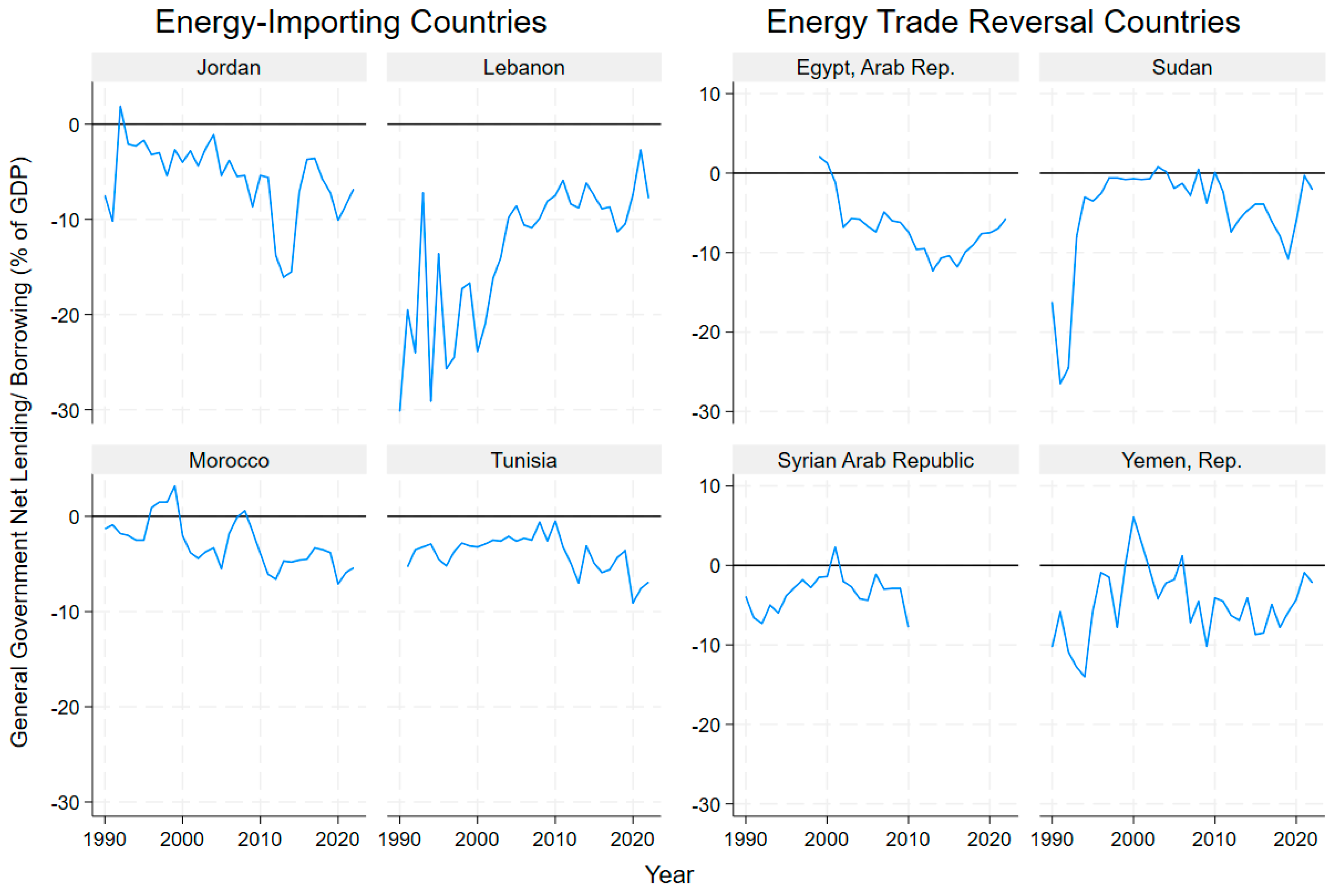
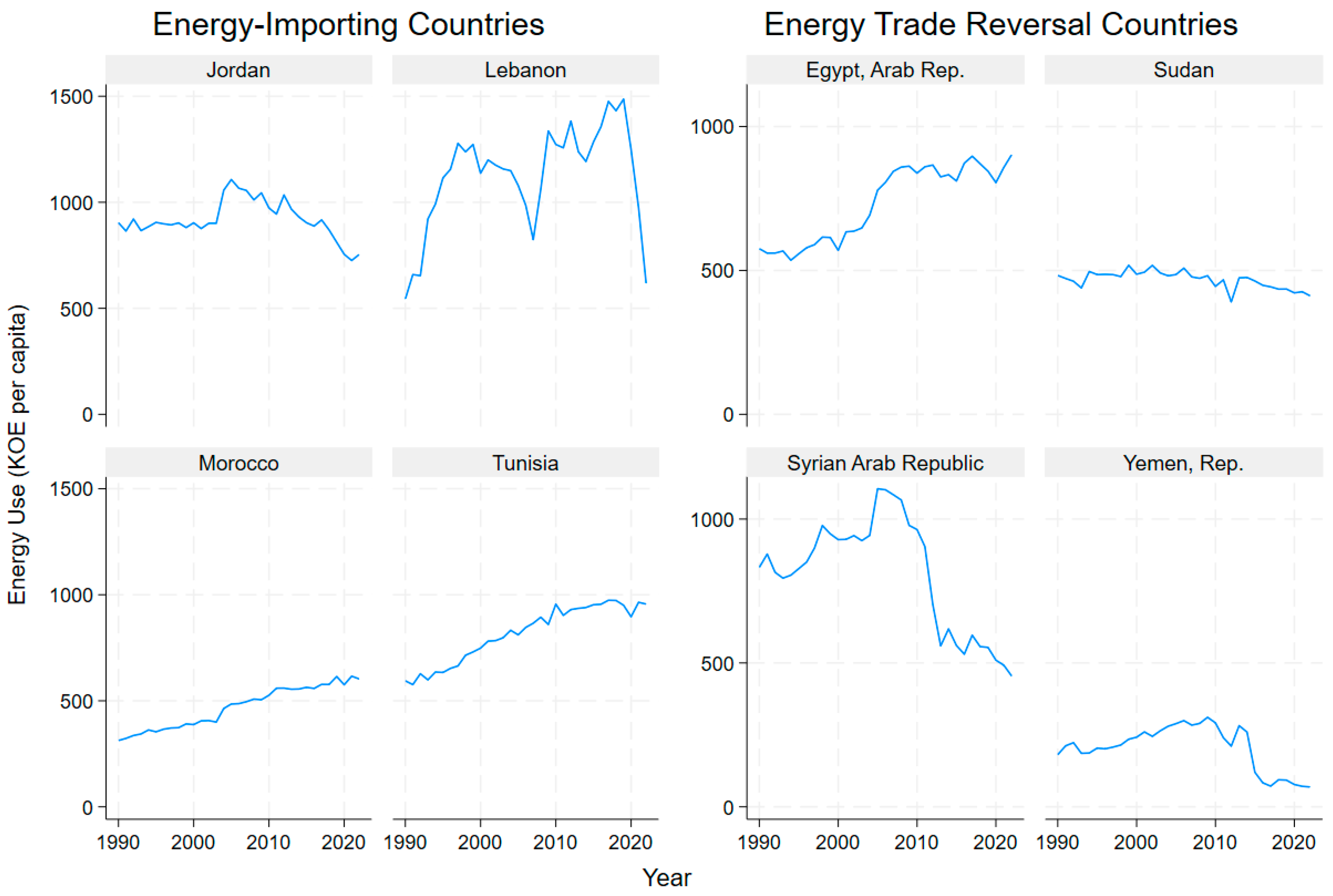

Disclaimer/Publisher’s Note: The statements, opinions and data contained in all publications are solely those of the individual author(s) and contributor(s) and not of MDPI and/or the editor(s). MDPI and/or the editor(s) disclaim responsibility for any injury to people or property resulting from any ideas, methods, instructions or products referred to in the content. |
© 2026 by the authors. Licensee MDPI, Basel, Switzerland. This article is an open access article distributed under the terms and conditions of the Creative Commons Attribution (CC BY) license.