


Abstract
It is widely accepted that preserving biodiversity requires transformative change and, perhaps foremost, demands a paradigm shift in economic scholarship. The prevailing neoclassical growth-based status quo is too often detached from nature and, as a result, ill-equipped to offer insights on how to halt biodiversity loss. This perspective paper builds on the famous cowboy–spaceman economy distinction by presenting an analogy from the natural world. Proposals from post-growth schools of economic thought on how to induce metamorphosis of the growth-based caterpillar economy are described. Thereafter, an exploration is undertaken of a butterfly economy based on three propositions: embed economics in ecosystems, in systems thinking, and in human–nature relationships. Herein, examples are provided of nature-literate economics, policy implications are discussed, and an actionable research agenda is outlined. The perspective closes by drawing on discussions from conservation sciences to inspire the design of an economic framework conducive to healthy human–nature relationships.
1. Introduction
The biodiversity crisis is arguably the grandest of grand challenges. At present, roughly a third of species assessed by the International Union for the Conservation of Nature face elevated extinction risks [1]. Rather than “curators of wildlife” [2], conservationists now act as firemen trying to save books from a burning library [3,4], with the flames being fanned by complex, interrelated problems (e.g., climate change [5], poverty [6], and pandemic threat [7]). Notwithstanding certain successes [8], the conservation movement has been unable to “bend the curve” of biodiversity loss [9]. In this context of polycrisis, leading conservation institutions are calling for transformative change [10,11], defined by the Intergovernmental Science–Policy Platform on Biodiversity and Ecosystem Services as “a fundamental, system-wide reorganization across technological, economic and social factors, including paradigms, goals and values.” [12] (p. 889).
The need for such transformative change is perhaps most pressing in the field of economic scholarship, due to its influence over both business strategy and policymaking [13,14]. The prevailing neoclassical economic paradigm is ill-equipped to resolve the biodiversity crisis due to its disconnect of economic activity from the biosphere [15,16]. A prominent example is Solow’s growth model, which uses a production function that does not distinguish natural capital from other types of capital and assumes that “there is no scarce nonaugmentable resource like land” [17] (p. 67). Solow argued that the relative scarcity of natural resources mitigates concerns over their absolute scarcity, since higher prices provide a balancing feedback loop through innovation and substitution [18]. Yet, this argument overlooks that natural resources deserve consideration as a distinct form of capital due to their susceptibility to ecological tipping points, potentially irreversible collapse, and incommensurable values [16,19,20,21]. Other caveats to Solow’s argument are that services from natural capital in many ecosystems lack prices and, where markets exist, there is no guarantee that this balancing force keeps consumption within sustainable levels.
Boulding famously described such growth models as the ‘cowboy economy’, involving a cowboy who perceives no limits to colonizing new lands, thereby promoting expansion [15]. Using an analogy from the natural world, one could describe this growth-oriented economy as its caterpillar stage. By contrast, Boulding portrayed economic activity embedded in the biosphere as the ‘spaceman economy’, in which growth is no longer desirable because all stocks are finite. Rather than being motivated by limited stocks, the butterfly stage of the economy replaces growth with sustainability and resilience as desiderata in response to abundant fossil fuel stocks. To root butterfly economics in biodiversity conservation and eudaimonia, it interprets “sustainability as the possibility of all forms of life to flourish forever” [22] (p. 24). Following such a strong sustainability criterion [23], the objective to promote flourishing of current and future generations is best served by pursuing resilience [24].
Neoclassical economics has so far remained the dominant economic paradigm, despite behavioral and ecological economists’ efforts to challenge its foundational assumptions for decades [25,26,27]. This persistence may be in part owed to disciplinary dominance in editorial boards [28] and in part to the lack of a unified alternative paradigm [29]. However, the building blocks for a new economics are becoming increasingly clear: economic theory needs to recognize limits to growth, limits to the substitutability of natural resources, and should aim for regenerative design [29]. Such a heterodox ‘butterfly economics’ can include neoclassical analyses, provided these efforts follow said principles.
Embedding contemporary economics in the biosphere is of vital importance because (i) the direct drivers underlying the biodiversity crisis (i.e., habitat loss, direct use, climate change, pollution, and invasive species) are the result of unsustainable consumption and production patterns [10,12], (ii) more than half of global GDP depends directly on nature [30], (iii) the global value of (non-marketed) ecosystems services outweighs global GDP [31,32], and (iv) biodiversity promotes ecosystem efficiency [33], ecosystem stability [34], and mitigates the transmission of infectious diseases [7,35]. There is also mounting quasi-experimental evidence on the social costs of species collapse in terms of both human health and livelihoods [36,37,38,39].
Contrary to the neoclassical assumption of stable preferences, it has become increasingly evident that human–nature relationships are conditional on environment and experience [40,41,42,43,44,45,46,47,48,49,50]. A growing disconnection with nature, also known as the extinction of experience feedback loop [40,41], environmental generational amnesia [42,43], or a nature-deficit disorder [44,45], poses a fundamental challenge to long-term sustainability [46]. This gradual erosion of human–nature relations is driven by trends such as urbanization [47,48], increasingly indoor lifestyles [49,50], and nature disappearing from cultural products such as books, song texts, and film scripts [51]. The loss of opportunity to experience nature undermines nature appreciation and conservation efforts, creating a reinforcing feedback loop that leads to further loss of possibilities to enjoy nature. Beyond public support for conservation, healthy human–nature relations promote both physical and mental well-being [35,52,53].
This perspective paper is structured as follows: In Section 2, post-growth perspectives on how to activate pupation of the caterpillar economy are explored, highlighting conditions for a desirable butterfly economy. In Section 3, examples are provided of economics informed by natural sciences that support three propositions, followed by policy implications and suggestions for future research. Lastly, in Section 4, the paper concludes with discussions from conservation sciences, with the proposal that a biodiversity-centered economy provides the best prospects for human survival.
2. Inducing Metamorphosis of the Caterpillar Economy
2.1. Steady-State Economics
Advocacy of a steady-state economy dates back to the mid-nineteenth century, when John Stuart Mill expressed hopes that humanity would find prosperity without growth before limits become binding [54,55]. Mill recognized that economic growth must have natural limits, that a stationary state does not prevent human development, and that protecting nature from unabated growth encourages human flourishing [54]. Yet, critiques on the relentless pursuit of economic growth intensified around the time of the 1970s oil crisis [15,25,56,57]. Motivated by the second law of thermodynamics, these early post-growth perspectives focused on the logical impossibility of sustaining endless growth. Herman Daly argued that neoclassical economics’ focus on relative scarcity and its dismissal of relative human wants gives rise to ‘growthmania’ and ‘uneconomic’ growth, whereby the social costs from economic expansion outweigh the social benefits [57,58].
Daly was first to imagine a post-growth economy, formulating both policy objectives and institutional design principles for such a zero-growth steady state [57,59]. Policy objectives include population stabilization, maintaining productive capacity, and reducing inequality. Allocative efficiency could be considered as a fourth stretch goal (instead of the primary objective, as is the case in neoclassical models). Regarding institutional design principles, the transition to this steady-state economy should start from current conditions and balance gradually tightening constraints with maintaining personal freedoms (rather than supplanting existing institutions to achieve imaginary conditions overnight). Policy design should leave slack between environmental pressure and absorptive capacity, with it benefiting from near-term planning cycles with regular evaluation, i.e., it should put minimum faith in planning abilities and maximum confidence in nature’s regenerative capacity.
Regarding specific policies, Daly favored cap-auction-and-trade to stabilize resource use and advocated controlling throughput at the input stage [57]. Since a steady-state economy cannot appeal to ‘trickle down’ arguments that growth benefits all, Daly proposed to address inequality by establishing both maximum and minimum incomes [57]. In his later works, he also suggested curtailment of the money-creating abilities of private banks by establishing full-reserve requirements [59,60]. Simulations suggest that the growth imperative of financial capital can be reconciled with zero-growth in the aggregate and that a steady state can reduce inequality [61,62].
It is important to note that steady-state economics differs fundamentally from steady-state growth paths [17]. The zero-growth objective of the steady-state economy is sometimes mistakenly confused with the end of progress [63,64]. However, in this context, discussion benefits from distinguishing between growth and development: growth is best understood as the quantitative increase in material flows, whereas development refers to qualitative increases in the service derived from these material flows. To clarify, the zero-growth objective does not rule out technological advances nor does it prevent the pursuit of happiness. Schumpeterian endogenous growth models—in which production functions consist of labor, intermediate goods and a fixed amount of land—can arguably be aligned with steady-state economics, if the endogenous growth consists entirely of development [65]. Notably, the rate of development can become uneconomic due to negative externalities from obsolescence [65].
Some of the principles established by steady-state economics can be recognized in other post-growth schools of thought; however, it has also been critiqued “that steady-state economics consists in an attempt to squeeze neoclassical economics into a biophysical and ethical corset” [66] (p. 52). In addition, while the transition to a steady state may have been a feasible strategy for sustainability in the 1970s, current ecological footprints require an estimated regenerative capacity of 1.8 Earths [67]. It has also been questioned to what degree ‘macro level’ theorizing on a desirable steady-state level of the economy is sufficiently sensitive to economic realities such as unsustainable lock-ins [66].
2.2. Degrowth
As no high-income countries maintain per capita ecological footprints within Earth’s regenerative capacity [67], sources in the degrowth literature promote scaling down economic activity to return within safe planetary boundaries [34,58,68,69,70,71,72,73,74]. It challenges the notion that economic growth eventually benefits the environment beyond a certain income level. This hypothesized inverted U-shaped relation between income and environmental degradation is also known as the Environmental Kuznets Curve (EKC) [75,76], or by its ‘green growth’ modern equivalent [72]. Excluding some pollutants with localized negative human health impacts [76,77], empirical evidence generally does not align with the EKC hypothesis [72,76,78,79,80,81].
Green growth proponents usually trust in technological advances to offset ecological impacts from rising affluence [82]. While the IPAT-identity that separates Impact by People times Affluences times Technology illustrates how this is theoretically possible [83], growth proponents usually omit that such compensation requires absolute decoupling of economic growth from ecological footprints at a rate that exceeds historical rates manifold [72,84,85]. Moreover, technological advance is often accompanied by behavioral rebounds that negate the engineering savings, either completely or in part [72,86,87].
Combined with increasing ecological footprints since the 1970s, global income gaps have only widened [88,89,90,91]. Reducing inequality is central to the degrowth literature, both in terms of reducing claims on absorptive capacity by high-income regions to create space for low-income regions where growth may still be desirable [69], and by theorizing how to reduce the (ecological) unequal exchange that exacerbates global inequality [92,93]. Degrowth policy proposals aimed at reducing inequality include the cancellation of public debts of low-income and middle-income countries, reductions in hours in typical work weeks, ‘green’ job guarantees, and provision of universal basic incomes, financed through wealth taxes and other forms of progressive taxation [73].
Other degrowth policy proposals comprise investments in public services, targeted phase-out of fossil fuels, and reducing production in ‘non-vital’ industries [73]. While it is debatable what qualifies as less-necessary production, various governments imposed restrictions on non-vital professions during the COVID-19 pandemic. Degrowth emphasizes exnovation of fossil fuels as part of the energy transition rather than innovation and expansion of renewable energy production, since the latter often only adds to existing production capacity (rather than displacing polluting production) [84,94,95]. Exnovation policy can help soften the negative externalities from the creative destruction that renders old technologies obsolete [65,96]. Sufficiency measures, aimed at reducing emission-intensive consumption (e.g., flights, meat, or private cars), provide another complementary strategy to innovation [97]. Improvements in public services likely enhance the palatability of such sufficiency strategies, which, combined, have substantial potential for decarbonization [98].
Degrowth is sometimes equated with recession [82]. However, unlike unplanned and socially destructive recessions, degrowth is an intentional strategy to achieve social and ecological objectives [73,84]; rather, degrowth aims to alleviate the disruption caused by boom–bust cycles [99]. A critique of the degrowth literature is that it presents more opinion than analysis [100], yet policy evaluation is difficult when there exist few degrowth experiments. A notable exception can be found in Bhutan, which “put in place a number of original policies limiting GDP growth and seeking to enhance wellbeing and sustainability. One can cite: free education and healthcare for all; severe restrictions on foreign investments; no WTO membership; no outdoor advertising; heavy taxes on car imports; severe limits on mass tourism (and ban on alpinism); limits on mining; half of the country under protected areas; constitutional 60% of forest cover; declared willingness to shift to 100% organic agriculture.” [101] (p. 356).
2.3. Complex System Analysis
A third strand of literature that can be considered under the post-growth header is the analysis of complex systems [25,46,102,103]. Complex system scholars conjecture that growth is usually the result of a reinforcing positive feedback loop and that growth can only be sustained temporarily in a closed system. At some point, a counteracting negative feedback loop provides a balancing force, or the system will destroy itself [102]. A popular notion in complex systems analysis is the idea of leverage points, defined by Donella Meadows as “places within a complex system (a corporation, an economy, a living body, a city, an ecosystem) where a small shift in one thing can produce big changes in everything.” [102] (p. 1). Meadows’ list of leverage points with increasing effectiveness was later grouped into four levels of system characteristics: parameters, feedbacks, design, and intent [103].
The related literature on complex systems includes the work of Elinor Ostrom on socio-ecological systems, which was inspired by the tragedy of the commons by Garrett Hardin [104,105,106,107,108,109,110]. Hardin described a tragedy with common-pool resources, where open access would lead self-interested individuals to deplete the commons, since any individual resource-saving behavior would be offset through increased consumption by another individual [104]. Ostrom questioned both the inevitability and generality of the tragedy of the commons by describing examples where self-organization of group ownership had protected the sustainability of local commons [105], sometimes for centuries [32]. She later proposed a general framework for commons regulation to aid socio-ecological systems in achieving sustainable outcomes [106], where the importance of polycentric governance is echoed in the recent literature [13,107]. There seems to be fading support for the management principle of graduated sanctions: self-governing commons that survived more than 200 years made little use of sanctions [108,109], possibly due to sanctions being difficult to enforce in tight-knit communities [110].
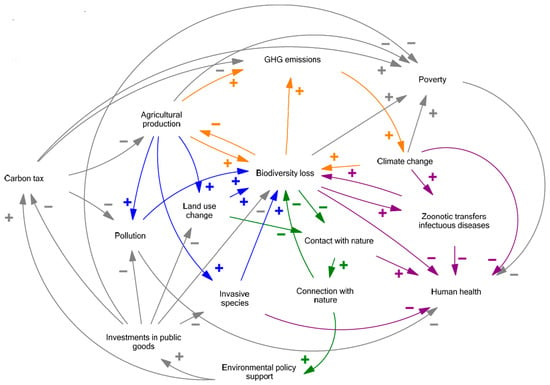
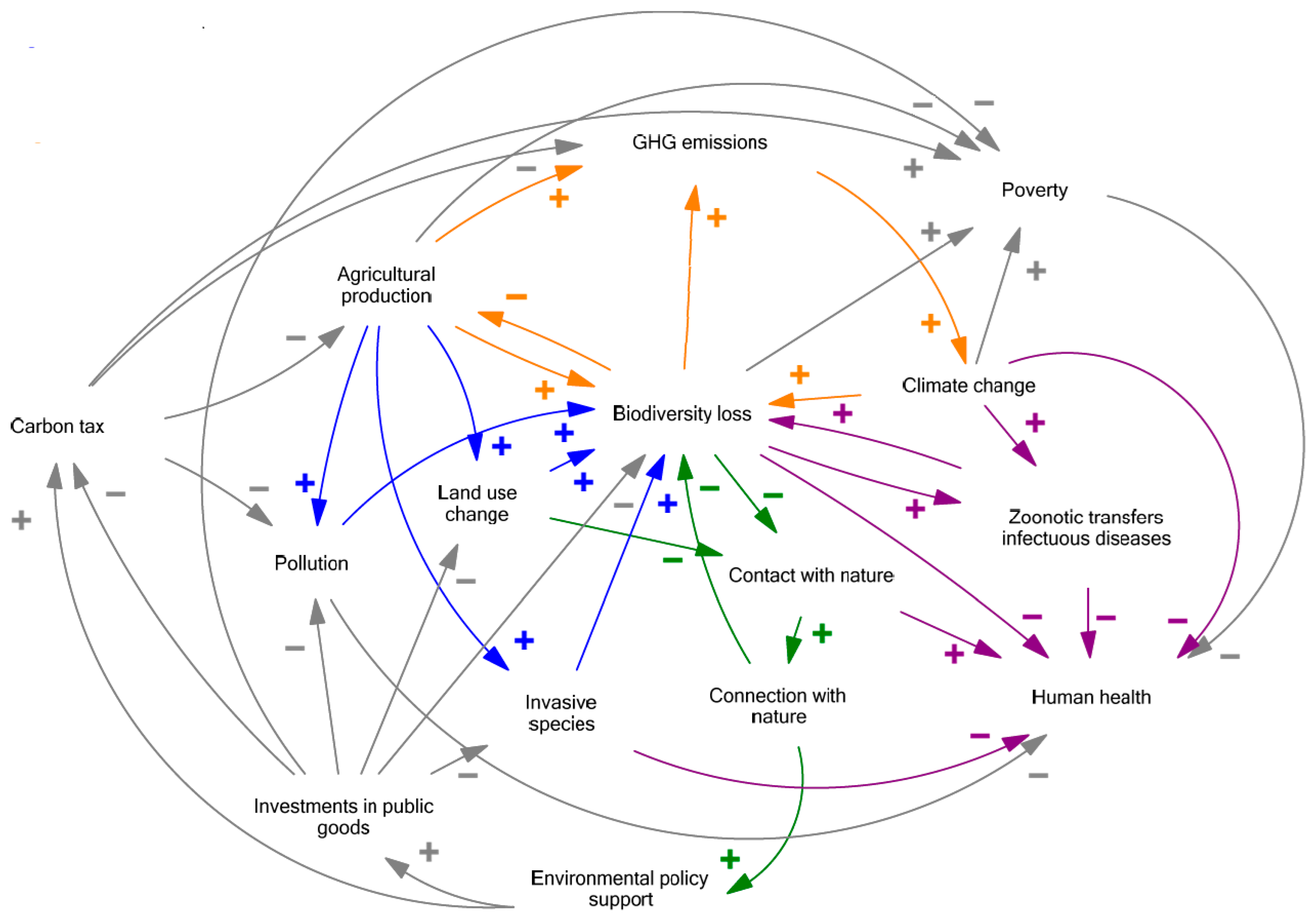
The proposition that minuscule differences at one place in a system can soon induce dramatic differences elsewhere is akin to the suggestion of a butterfly effect, whereby Edward Lorenz’s butterfly metaphor illustrates the limited prediction horizons in complex systems [111]. A challenge with the leverage points concept is to identify where one can find such levers to intervene. Yet, in such cases, causal loop diagrams can offer a helpful visual tool (e.g., [112]), especially for difficult-to-observe telecoupled impacts from international trade [113,114,115,116]. Figure 1 presents such a causal loop diagram for butterfly economics, placing biodiversity conservation at its center. It summarizes the relations described in the introduction while acknowledging that exceptions to these stylized relations exist.
Figure 1.
Causal loop diagram with the main drivers of biodiversity loss.
Legend to Figure 1: Interactions with agricultural production based on [112] in orange, complemented with the main drivers of biodiversity loss according to [12] in blue, extinction of experience as described in [41] in green, with human health feedbacks based on [7,35,53,116] in purple, and more speculatively with poverty and policy in grey. Direct use as a main driver of biodiversity loss is subsumed under the effect of agricultural production on biodiversity loss. The arrows depict direct drivers, where the plus and minus signs indicate a positive and negative relations, respectively. The diagram illustrates several reinforcing feedback loops, such as between biodiversity loss and climate change through reduced carbon sequestration or between biodiversity loss and zoonotic disease transfer. The diagram describes a balancing feedback loop between agricultural production and biodiversity loss, where increased agricultural production induces biodiversity loss (either directly or indirectly through land use change, pollution, or invasive species) and biodiversity loss in turn decreases agricultural output.
3. Imagining a Butterfly Economy
3.1. Embed Economics in Ecosystems
It is the abundance of fossil fuels rather than their pending scarcity that poses the most urgent threat to sustainability: The embedded emissions in known fossil fuel resources are roughly an order of magnitude greater than the carbon budget corresponding to a 50% probability of limiting global warming to two degrees Celsius [117,118,119]. Even when only considering the subset of fuel reserves—the resources where exploitation is profitable given present-day conditions—the embedded emissions are easily thrice a Paris Agreement-consistent carbon budget [117]. The finding that a majority share of fossil reserves should remain untapped implies that a carbon bubble of stranded assets inflates global stock markets [120].
To expedite the phasing out of fossil fuels, the status quo in economics is to price carbon emissions at estimated social costs through taxation or emission markets [121]. Giving weight to natural capital in integrated assessment modeling exercises raises the social costs of carbon estimates [122,123]; however, the practice of equating marginal consumption benefits and ecological damage remains one of weak sustainability. When adopting strong sustainability criteria, carbon pricing should be based on cost-effectiveness analysis [124,125]. Figure 1 depicts how investment in public goods is a complementary policy towards decarbonization and, hence, could lower cost-effective carbon taxes.
Valuation of natural capital through ecosystem services value estimates has found application in payment for ecosystem services (PES) policies [126]. In order to safeguard social benefits from healthy ecosystems, such programs compensate private landowners for the opportunity costs of environmental stewardship [127]. PES is most common for watershed management, where downstream users compensate for upstream conservation practices, and private actor involvement raises chances of success [128]. Among publicly funded PES programs, a full land enrollment requirement can improve cost-effectiveness by reducing infra-marginal payments [129]. Compliance-based programs (e.g., ‘no net loss’) benefit from following the impact mitigation hierarchy (i.e., avoid, reduce, restore, offset) and using an offset multiplier [130].
Scarcity has been so fundamental to economics that it features in the most popular definition of the discipline [131]. Yet, it is questionable whether this focus on scarcity remains warranted. Abundance often provides a more appropriate description of the natural world than scarcity and may offer a more fruitful starting point for further exploration of the butterfly economy. In the words of Giorgos Kallis: “it is only when we begin to accept the world as abundant that we can contemplate limiting our wants and delimiting a safe space for our freedom.” [132] (p. 4) Such a reorientation that considers sources of abundance alongside scarcity opens up new possibilities for economic inquiry [133,134].
3.2. Embed Economics in Systems Thinking
This perspective article is not the first work in which the term butterfly economy is used: Kate Raworth contrasted a linear take–make–waste caterpillar economy with a circular butterfly economy, whereby two wings recycle biological and technological nutrients from waste back into the make stage [135]. Butterfly economics, conceptualized in this perspective, builds on such a circular economy [136,137], yet the dual objective of biodiversity conservation and human well-being is distinct from achieving a circular economy [138]. The circular economy can be considered a necessary but insufficient condition for sustainability [139], as one of several material management strategies that present trade-offs with sustainability [140], or as one of at least six other relations to sustainability [141].
The circular economy is grounded in industrial ecology [141,142], which in turn is rooted in biology and system analysis [142,143,144,145]. Industrial ecology examines the industrial metabolism more broadly, also heeding attention to non-recyclable flows and dematerialization [144,145]. Beyond closing material loops, industrial ecology has infused the circular economy with concepts such as industrial symbiosis, cradle to cradle design, and biomimicry [141,146,147,148,149,150,151]. Together with other closely related concepts such as the performance economy [152], the sharing economy [153], and related sustainable business models [154], business perceived from a systems perspective involves more than only competition [13]. Although Charles Darwin recognized the importance of cooperation [155,156], Tim Jackson describes how the excessive focus on limits and competition in economics is the inheritance from a popular understanding of Darwin’s theory of evolution, which has long overshadowed the importance of synergies from cooperation: “Nature as struggle; profit as a competition; consumption as insatiability: this is the unholy trinity of a Darwinian capitalism.” [157] (p. 92).
Economics also has a rich history in cooperative and evolutionary game theory [158,159,160,161]. Agent-based models combined with behavioral experiments show that a committed minority can influence social norms [162,163] and hold promise to help identify leverage points in socio-ecological systems, especially when combined with system and group-level frames [164,165]. Embedding business in ecosystems, systems thinking and healthy human–nature relationships also seems a sensible direction, and the previous paragraph illustrates that there can be profit from cooperation, but butterfly economics focuses less on business practices. In other literature sources, one can find more detailed investigations of applying systems thinking to strategy [13], regenerative organizations [166], impact entrepreneurship [167], entrepreneurship for the public good [168], or conservation entrepreneurship [169,170].
3.3. Embed Economics in Healthy Human–Nature Relationships
Building on the theory of island biogeography [171,172,173], Martin Weitzman recognized a tragedy of the commons in monoculture farming, where open access to different crop varieties drives a wedge between the individually rational and socially optimal cropping decisions [174]. Similar to the fisherman who ignores the social costs of stock depletion (or fishery-induced evolution [175]), the farmer ignores the social costs of increasing risks of stock collapse. Since a larger island can maintain more species, the risk of catastrophic disease also increases with monoculture farming. Moreover, feedback on these risks is deceptively slow due to the small probabilities of disastrous events and lagged impacts [175]. Examples that appear to align closely with Weitzman’s monoculture tragedy include the extinction of the Gros Michel banana [176], famine from potato blight [177], and the Waldsterben (i.e., forest dying) of monoculture production forests [178].
A more common consequence of the monoculture tragedy is pesticide lock-in [179,180,181,182]. Since monoculture farming is more sensitive to ‘pests’ that specialize in eating the monoculture in question, there are large short-run returns to investment in pesticide adoption during a crop boom [99,183]. Roughly two-thirds of global agricultural lands contain pesticide residues that exceed safe concentrations, of which half exceed such levels by at least three orders of magnitude, and a third of this latter high-risk category is located in biodiversity hotspots [184]. Pesticide use triggers a reinforcing feedback loop of dependency, whereby pesticide application leads to resistance in target species and reduces biological control services from natural predators through collateral damage to non-target species [182]. The pesticide treadmill reduces long-run profit margins of farmers and entails associated social and ecological costs [38,182]. This pesticide trap is not only ecological; there also exist socio-technical lock-in mechanisms through the influences of suppliers and regulations [185]. While the monoculture problem was introduced in the previous paragraph using the commons metaphor, policy solutions likely benefit from a fractal lens, which recognizes recurring, self-organizing, and interdependent lock-in patterns [186].
While monoculture farming and associated practices are exemplary of unsustainable relationships to nature, traditional farming systems often maintain biodiversity-friendly practices [187]. Such reconnection with nature stretches beyond agriculture and can be pursued through equitable access to green spaces and environmental education [188,189]. Progress towards forming healthier human–nature relationships can be monitored through validated measures (e.g., [190,191,192,193]) and novel animal quality-adjusted life year measures [194].
4. A Butterfly Paradox
As I move towards my closing statement in response to the special issue and its call to reimagine human–nature relationships for biodiversity conservation, I argue that the proverb “Give a man a fish and you feed him for a day; teach a man to fish and you feed him for a lifetime” has become an incomplete advice in the Anthropocene without the addition of “preserve the fish stock and feed generations”.
Biodiversity conservation is complex and full of paradoxes [45,195,196,197]. For example, the preservation of a species may be best served by focusing conservation efforts on another species. Butterfly conservation can benefit from attention to plants and ants, since several butterfly species have obligate relations to host plants [198], whereas others are obligate myrmecophiles or ant parasites [155,198]. Such a butterfly paradox provides a valuable perspective for the human prospect as well. The Anthropocene characteristic of human dominance over natural processes has increased the urgency to shift away from anthropocentrism. A heterodox economics of biodiversity conservation seems most suitable to incorporate the plural values of nature [199,200,201].
Rebranding the spaceman economy to the butterfly economy adds consideration of abundance and has the aspiration to direct economics towards biodiversity conservation, in line with Mill’s motivation for a stationary state, “… solitude in the presence of natural beauty and grandeur, is the cradle of thoughts and aspirations which are not only good for the individual, but which society could ill do without.” [54] (p. 756). Butterfly economics meets boundaries of inquiry when it comes to value frames such as ‘living with nature’ and ‘living as nature’ [201]. Intrinsic values of nature relate to rights of nature and raise legal questions [126,202,203].
The predominant biodiversity conservation strategy through protected areas has delivered mixed success [204,205]; unsuccessful protection can be due to siting choices that are concentrated toward lands with low opportunity costs and little development pressure [206,207], protected area downgrading, downsizing, and degazettement [208], underfunding [209], and possibly a green paradox [210,211]. While protected areas surely continue to play an important role in biodiversity conservation, proposals to extend protected status to half of the Earth may not deliver the envisioned conservation benefits [212,213,214]: Such proposals do little to address systemic threats, may lead to the displacements of marginalized communities, provide no guidance on implementation, and offer no measures for conservation on the human half [215]. Instead, a Whole Earth approach to conservation advocates co-existence with other species, guided by degrowth, decolonization, decommodification, and convivial conservation [216,217].
Butterflies have been a source of inspiration for centuries, and their study has led to numerous innovations [218]. For example, the structural color from the nanostructures of its wing scales has inspired anti-counterfeiting technology, light-reflective coatings, and waterproof materials [218,219]. Butterflies are also a textbook example of charismatic flagship species for conservation [220,221,222], which may be leveraged to benefit broader biodiversity objectives through place-based conservation [223] or to overcome plant blindness and garner support for plant conservation [224,225,226]. Similarly, fascination with metamorphosis could possibly be harnessed to incite excitement about less charismatic insects [227,228,229]. Lastly, I believe butterfly metamorphosis provides an apt analogy for the transformative change advocated by conservation institutions and hope that the above exploration inspires further research in pursuit of healthy human–nature relations towards a just and sustainable butterfly economy.
Funding
This research received no external funding.
Institutional Review Board Statement
Not applicable.
Informed Consent Statement
Not applicable.
Data Availability Statement
No new data were created or analyzed in this study.
Conflicts of Interest
The author declares no conflict of interest.
References
- IUCN. The IUCN Red List of Threatened Species. Version 2025-2. 2025. Available online: https://www.iucnredlist.org/search (accessed on 30 December 2025).
- Verma, A.; van der Wal, R.; Fischer, A. Imagining wildlife: New technologies and animal censuses, maps and museums. Geoforum 2016, 75, 75–86. [Google Scholar] [CrossRef] [Scilit]
- Weitzman, M.L. The Noah’s ark problem. Econometrica 1998, 66, 1279–1298. [Google Scholar] [CrossRef] [Scilit]
- Perry, N. The ecological importance of species and the Noah’s Ark problem. Ecol. Econ. 2010, 69, 478–485. [Google Scholar] [CrossRef] [Scilit]
- Bellard, C.; Bertelsmeier, C.; Leadley, P.; Thuiller, W.; Courchamp, F. Impacts of climate change on the future of biodiversity. Ecol. Lett. 2012, 15, 365–377. [Google Scholar] [CrossRef] [Scilit] [PubMed]
- Adams, W.M.; Aveling, R.; Brockington, D.; Dickson, B.; Elliott, J.; Hutton, J.; Roe, D.; Vira, B.; Wolmer, W. Biodiversity conservation and the eradication of poverty. Science 2004, 306, 1146–1149. [Google Scholar] [CrossRef] [Scilit]
- Carlson, C.J.; Albery, G.F.; Merow, C.; Trisos, C.H.; Zipfel, C.M.; Eskew, E.A.; Olival, K.J.; Ross, N.; Bansal, S. Climate change increases cross-species viral transmission risk. Nature 2022, 607, 555–562. [Google Scholar] [CrossRef] [Scilit]
- Hoffmann, M.; Hilton-Taylor, C.; Angulo, A.; Böhm, M.; Brooks, T.M.; Butchart, S.H.; Carpenter, K.E.; Chanson, J.; Collen, B.; Cox, N.A.; et al. The impact of conservation on the status of the world’s vertebrates. Science 2010, 330, 1503–1509. [Google Scholar] [CrossRef] [Scilit]
- Mace, G.M.; Barrett, M.; Burgess, N.D.; Cornell, S.E.; Freeman, R.; Grooten, M.; Purvis, A. Aiming higher to bend the curve of biodiversity loss. Nat. Sustain. 2018, 1, 448–451. [Google Scholar] [CrossRef] [Scilit]
- O’Brien, K.; Garibaldi, L.A.; Agrawal, A.; Bennett, E.; Biggs, R.; Calderón Contreras, R.; Carr, E.R.; Frantzeskaki, N.; Gosnell, H.; Gurung, J.; et al. IPBES Transformative Change Assessment: Summary for Policymakers. In Summary for Policymakers of the Thematic Assessment Report on the Underlying Causes of Biodiversity Loss and the Determinants of Transformative Change and Options for Achieving the 2050 Vision for Biodiversity; Version 10.2.0. Zenodo; IPBES Secretariat: Bonn, Germany, 2025. [Google Scholar] [CrossRef]
- WWF. Living Planet Report 2024—A System in Peril; WWF: Gland, Switzerland, 2024. [Google Scholar]
- IPBES. The Global Assessment Report on Biodiversity and Ecosystem Services of the Intergovernmental Science-Policy Platform on Biodiversity and Ecosystem Services; IPBES secretariat: Bonn, Germany, 2019. [Google Scholar] [CrossRef]
- Bansal, P.; Durand, R.; Kreutzer, M.; Kunisch, S.; McGahan, A.M. Strategy can no Longer Ignore Planetary Boundaries: A Call for Tackling Strategy’s Ecological Fallacy. J. Manag. Stud. 2025, 62, 965–985. [Google Scholar] [CrossRef] [Scilit]
- Arrow, K.J.; Cropper, M.L.; Eads, G.C.; Hahn, R.W.; Lave, L.B.; Noll, R.G.; Portney, P.R.; Russell, M.; Schmalensee, R.; Smith, V.K.; et al. Is there a role for benefit-cost analysis in environmental, health, and safety regulation? Science 1996, 272, 221–222. [Google Scholar] [CrossRef] [Scilit] [PubMed]
- Boulding, K.E. The economics of coming spaceship earth. In Environmental Quality in a Growing Economy; Jarret, H., Ed.; Johns Hopkins University Press: Baltimore, MD, USA, 1966. [Google Scholar]
- Barbier, E.B. The evolution of economic views on natural resource scarcity. Rev. Environ. Econ. Policy 2021, 15, 24–44. [Google Scholar] [CrossRef] [Scilit]
- Solow, R.M. A contribution to the theory of economic growth. Q. J. Econ. 1956, 70, 65–94. [Google Scholar] [CrossRef] [Scilit]
- Solow, R.M. Is the End of the World at Hand? Challenge 1973, 16, 39–50. [Google Scholar] [CrossRef] [Scilit]
- Dasgupta, P. The Economics of Biodiversity: The Dasgupta Review; HM Treasury: London, UK, 2021.
- Dasgupta, P.; Levin, S. Economic factors underlying biodiversity loss. Philos. Trans. R. Soc. Lond. B Biol. Sci. 2023, 378, 20220197. [Google Scholar] [CrossRef] [Scilit] [PubMed]
- Martins, N.O. The economics of biodiversity: Accounting for human impact in the biosphere. Ecol. Econ. 2021, 189, 107150. [Google Scholar] [CrossRef] [Scilit]
- Ehrenfeld, J.R. The Roots of Sustainability. Sloan Manage. Rev. 2005, 46, 23–25. [Google Scholar]
- Costanza, R.; Daly, H. Natural Capital and Sustainable Development. Conserv. Biol. 1992, 6, 37–46. [Google Scholar] [CrossRef] [Scilit]
- Holling, C.S. Resilience and Stability of Ecological Systems. Annu. Rev. Ecol. Syst. 1973, 4, 1–23. [Google Scholar] [CrossRef] [Scilit]
- Meadows, D.H.; Meadows, D.L.; Randers, J.; Behrens, W.W. The Limits to Growth; Universe Books: New York, NY, USA, 1972. [Google Scholar]
- Simon, H.A. Theories of bounded rationality. In Decision and Organization; Elsevier: Amsterdam, The Netherlands, 1972; Volume 1, pp. 161–176. [Google Scholar]
- Diesendorf, M.; Davies, G.; Wiedmann, T.; Spangenberg, J.H.; Hail, S. Sustainability scientists’ critique of neoclassical economics. Glob. Sustain. 2024, 7, e33. [Google Scholar] [CrossRef] [Scilit]
- Hodgson, G.M.; Rothman, H. The editors and authors of economics journals: A case of institutional oligopoly? Econ. J. 1999, 109, 165–186. [Google Scholar] [CrossRef] [Scilit]
- Kenter, J.O.; Martino, S.; Buckton, S.J.; Waddock, S.; Agarwal, B.; Anger-Kraavi, A.; Costanza, R.; Hejnowicz, A.P.; Jones, P.; Lafayette, J.O.; et al. Ten principles for transforming economics in a time of global crises. Nat. Sustain. 2025, 8, 837–847. [Google Scholar] [CrossRef] [Scilit]
- World Economic Forum. New Nature Economy Report II: The Future of Nature and Business; World Economic Forum: Cologny, Switzerland, 2020. [Google Scholar]
- Costanza, R.; D’Arge, R.; De Groot, R.; Farber, S.; Grasso, M.; Hannon, B.; Limburg, K.; Naeem, S.; O’Neill, R.V.; Paruelo, J.; et al. The value of the world’s ecosystem services and natural capital. Nature 1997, 387, 253–260. [Google Scholar] [CrossRef] [Scilit]
- Costanza, R.; de Groot, R.; Sutton, P.; van der Ploeg, S.; Anderson, S.J.; Kubiszewski, I.; Farber, S.; Turner, R.K. Changes in the Global Value of Ecosystem Services. Glob. Environ. Change 2014, 26, 152–158. [Google Scholar] [CrossRef] [Scilit]
- Cardinale, B.; Duffy, J.; Gonzalez, A.; Hooper, D.; Perrings, C.; Venail, P.; Narwani, A.; Tilman, D.; Wardle, D.; Kinzig, A.; et al. Corrigendum: Biodiversity Loss and Its Impact on Humanity. Nature 2012, 486, 59–67. [Google Scholar] [CrossRef] [Scilit] [PubMed]
- Rockström, J.; Steffen, W.; Noone, K.; Persson, Å.; Chapin, F.S., III; Lambin, E.F.; Lenton, T.M.; Scheffer, M.; Folke, C.; Schellnhuber, H.J.; et al. A safe operating space for humanity. Nature 2009, 461, 472–475. [Google Scholar] [CrossRef] [Scilit]
- Keesing, F.; Belden, L.K.; Daszak, P.; Dobson, A.; Harvell, C.D.; Holt, R.D.; Hudson, P.; Jolles, A.; Jones, K.E.; Mitchell, C.E.; et al. Impacts of biodiversity on the emergence and transmission of infectious diseases. Nature 2010, 468, 647–652. [Google Scholar] [CrossRef] [Scilit]
- Feir, D.L.; Gillezeau, R.; Jones, M.E. The slaughter of the bison and reversal of fortunes on the Great Plains. Rev. Econ. Stud. 2024, 91, 1634–1670. [Google Scholar] [CrossRef]
- Frank, E.; Sudarshan, A. The social costs of keystone species collapse: Evidence from the decline of vultures in India. Am. Econ. Rev. 2024, 114, 3007–3040. [Google Scholar] [CrossRef] [Scilit]
- Frank, E.G. The economic impacts of ecosystem disruptions: Costs from substituting biological pest control. Science 2024, 385, eadg0344. [Google Scholar] [CrossRef] [Scilit]
- Frank, E.G.; Wang, Q.; Wang, S.; Wang, X.; You, Y. Campaigning for Extinction: Eradication of Sparrows and the Great Famine in China; NBER Working Paper No. w34087; National Bureau of Economic Research: Cambridge, MA, USA, 2025. [Google Scholar]
- Pyle, R.M. Nature matrix: Reconnecting people and nature. Oryx 2003, 37, 206–214. [Google Scholar] [CrossRef] [Scilit]
- Soga, M.; Gaston, K.J. Extinction of experience: The loss of human-nature interactions. Front. Ecol. Environ. 2016, 14, 94–101. [Google Scholar] [CrossRef] [Scilit]
- Kahn, P.H. Children’s affiliations with nature: Structure, development, and the problem of environmental generational amnesia. In Children and Nature: Psychological, Sociocultural, and Evolutionary Investigations; MIT Press: Cambridge, MA, USA, 2002; pp. 92–115. [Google Scholar]
- Soga, M.; Gaston, K.J. Shifting baseline syndrome: Causes, consequences, and implications. Front. Ecol. Environ. 2018, 16, 222–230. [Google Scholar] [CrossRef] [Scilit]
- Louv, R. Last Child in the Woods: Saving Our Children from Nature-Deficit Disorder; Algonquin Books: New York, NY, USA, 2005. [Google Scholar]
- Soga, M.; Gaston, K.J. Towards a Unified Understanding of Human–Nature Interactions. Nat. Sustain. 2021, 5, 374–383. [Google Scholar] [CrossRef] [Scilit]
- Ives, C.D.; Abson, D.J.; Von Wehrden, H.; Dorninger, C.; Klaniecki, K.; Fischer, J. Reconnecting with nature for sustainability. Sustain. Sci. 2018, 13, 1389–1397. [Google Scholar] [CrossRef] [Scilit]
- Miller, J.R. Biodiversity conservation and the extinction of experience. Trends Ecol. Evol. 2005, 20, 430–434. [Google Scholar] [CrossRef] [Scilit]
- Fukano, Y.; Soga, M. Why do so many modern people hate insects? The urbanization–Disgust hypothesis. Sci. Total Environ. 2021, 777, 146229. [Google Scholar] [CrossRef] [Scilit]
- Pergams, O.R.W.; Zaradic, P.A. Is love of nature in the US becoming love of electronic media? 16-year downtrend in national park visits explained by watching movies, playing video games, internet use, and oil prices. J. Environ. Manag. 2006, 80, 387–393. [Google Scholar] [CrossRef] [Scilit]
- Sprague, N.L.; Sachs, A.L.; Ekenga, C.C. Green vs. screen: Exploring the outcomes of an in-person and virtual nature-based environmental education intervention for low-income children. Sustainability 2022, 14, 12600. [Google Scholar] [CrossRef] [Scilit] [PubMed]
- Kesebir, S.; Kesebir, P. A growing disconnection from nature is evident in cultural products. Perspect. Psychol. Sci. 2017, 12, 258–269. [Google Scholar] [CrossRef] [Scilit] [PubMed]
- Ulrich, R.S. View through a window may influence recovery from surgery. Science 1984, 224, 420–421. [Google Scholar] [CrossRef] [Scilit]
- Bratman, G.N.; Anderson, C.B.; Berman, M.G.; Cochran, B.; de Vries, S.; Flanders, J.; Folke, C.; Frumkin, H.; Gross, J.J.; Hartig, T.; et al. Nature and mental health: An ecosystem service perspective. Sci. Adv. 2019, 5, eaax0903. [Google Scholar] [CrossRef] [Scilit]
- Mill, J.S. Principles of Political Economy; A. M. Kelley Publishers: New York, NY, USA, 1965. [Google Scholar]
- Jackson, T. Prosperity Without Growth: Economics for a Finite Planet; Routledge: London, UK, 2009. [Google Scholar]
- Georgescu-Roegen, N. The Entropy Law and the Economic Process; Harvard University Press: Cambridge, MA, USA, 1971. [Google Scholar]
- Daly, H.E. The economics of the steady state. Am. Econ. Rev. 1974, 64, 15–21. [Google Scholar]
- Kallis, G.; Hickel, J.; O’Neill, D.; Jackson, T.; Victor, P.; Raworth, K.; Schor, J.; Steinberger, J.; Ürge-Vorsat, D. Post-growth: The science of wellbeing within planetary boundaries. Lancet Planet. Health 2025, 9, e62–e78. [Google Scholar] [CrossRef] [Scilit]
- Daly, H.E. Beyond Growth: The Economics of Sustainable Development; Beacon Press: Boston, MA, USA, 1996. [Google Scholar]
- Dittmer, K. 100 percent reserve banking: A critical review of green perspectives. Ecol. Econ. 2015, 109, 9–16. [Google Scholar] [CrossRef] [Scilit]
- Jackson, T.; Victor, P.A. Does credit create a ‘growth imperative’? A quasi-stationary economy with interest-bearing debt. Ecol. Econ. 2015, 120, 32–48. [Google Scholar] [CrossRef] [Scilit]
- Jackson, T.; Victor, P.A. Does slow growth lead to rising inequality? Some theoretical reflections and numerical simulations. Ecol. Econ. 2016, 121, 206–219. [Google Scholar] [CrossRef] [Scilit]
- Daly, H. A further critique of growth economics. Ecol. Econ. 2013, 88, 20–24. [Google Scholar] [CrossRef] [Scilit]
- Georgescu-Roegen, N. Energy and economic myths. South. Econ. J. 1975, 41, 347–381. [Google Scholar] [CrossRef] [Scilit]
- Aghion, P.; Howitt, P. A Model of Growth Through Creative Destruction. Econometrica 1992, 60, 323–351. [Google Scholar] [CrossRef] [Scilit]
- Pirgmaier, E. The Neoclassical Trojan Horse of Steady-State Economics. Ecol. Econ. 2017, 133, 52–61. [Google Scholar] [CrossRef] [Scilit]
- Global Footprint Network. Available online: https://data.footprintnetwork.org/ (accessed on 30 December 2025).
- Kallis, G.; Kerschner, C.; Martinez-Alier, J. The economics of degrowth. Ecol. Econ. 2012, 84, 172–180. [Google Scholar] [CrossRef] [Scilit]
- D’Alisa, G.; Demaria, F.; Kalli, G. Degrowth: A Vocabulary for a New Era; Routledge: London, UK, 2014. [Google Scholar]
- Kallis, G.; Kostakis, V.; Lange, S.; Muraca, B.; Paulson, S.; Schmelzer, M. Research on degrowth. Annu. Rev. Environ. Resour. 2018, 43, 291–316. [Google Scholar] [CrossRef] [Scilit]
- Wiedmann, T.; Lenzen, M.; Lorenz, T.; Keyßer, L.T.; Steinberger, J.K. Scientists’ warning on affluence. Nat. Commun. 2020, 11, 3107. [Google Scholar] [CrossRef] [Scilit]
- Hickel, J.; Kallis, G. Is Green Growth Possible? New Political Econ. 2020, 25, 469–486. [Google Scholar] [CrossRef] [Scilit]
- Hickel, J.; Kallis, G.; Jackson, T.; O’Neill, D.W.; Schor, J.B.; Steinberger, J.K.; Victor, P.A.; Ürge-Vorsatz, D. Degrowth can work—Here’s how science can help. Nature 2022, 612, 400–403. [Google Scholar] [CrossRef] [Scilit] [PubMed]
- Richardson, K.; Steffen, W.; Lucht, W.; Bendtsen, J.; Cornell, S.E.; Donges, J.F.; Drüke, M.; Fetzer, I.; Bala, G.; von Bloh, W.; et al. Earth beyond six of nine planetary boundaries. Sci. Adv. 2023, 9, eadh2458. [Google Scholar] [CrossRef] [Scilit]
- Grossman, G.M.; Krueger, A.B. Economic growth and the environment. Q. J. Econ. 1995, 110, 353–377. [Google Scholar] [CrossRef] [Scilit]
- Stern, D.I. The rise and fall of the environmental Kuznets curve. World Dev. 2004, 32, 1419–1439. [Google Scholar] [CrossRef] [Scilit]
- Wen, H.; Dai, J. The Change of Sources of Growth and Sustainable Development in China: Based on the Extended EKC Explanation. Sustainability 2021, 13, 2803. [Google Scholar] [CrossRef] [Scilit]
- Copeland, B.R.; Taylor, M.S. Trade, growth, and the environment. J. Econ. Lit. 2004, 42, 7–71. [Google Scholar] [CrossRef]
- Mills, J.H.; Waite, T.A. Economic prosperity, biodiversity conservation, and the environmental Kuznets curve. Ecol. Econ. 2009, 68, 2087–2095. [Google Scholar] [CrossRef] [Scilit]
- Choumert, J.; Combes Motel, P.; Dakpo, H.K. Is the Environmental Kuznets Curve for deforestation a threatened theory? A meta-analysis of the literature. Ecol. Econ. 2013, 90, 19–28. [Google Scholar] [CrossRef] [Scilit]
- Sol, J. Economics in the Anthropocene: Species Extinction or Steady State Economics. Ecol. Econ. 2019, 165, 106392. [Google Scholar] [CrossRef] [Scilit]
- Warlenius, R.H. The limits to degrowth: Economic and climatic consequences of pessimist assumptions on decoupling. Ecol. Econ. 2023, 213, 107937. [Google Scholar] [CrossRef] [Scilit]
- Ehrlich, P.R.; Holdren, J.P. Impact of population growth. Science 1971, 171, 1212–1217. [Google Scholar] [CrossRef] [Scilit] [PubMed]
- Jackson, T.; Hickel, J.; Kallis, G. Confronting the dilemma of growth. A response to. Ecol. Econ. 2024, 220, 108089. [Google Scholar] [CrossRef] [Scilit]
- Vogel, J.; Hickel, J. Is green growth happening? An empirical analysis of achieved versus Paris-compliant CO2–GDP decoupling in high-income countries. Lancet Planet. Health 2023, 7, e759–e769. [Google Scholar] [CrossRef] [Scilit]
- Jevons, W.S. The Coal Question; Macmillan and Co.: London, UK, 1865. [Google Scholar]
- Alcott, B. Jevons’ paradox. Ecol. Econ. 2005, 54, 9–21. [Google Scholar] [CrossRef] [Scilit]
- Piketty, T. Capital in the Twenty-First Century; Harvard University Press: London, UK, 2014. [Google Scholar]
- Fanning, A.L.; O’Neill, D.W.; Hickel, J.; Roux, N. The social shortfall and ecological overshoot of nations. Nat. Sustain. 2022, 5, 26–36. [Google Scholar] [CrossRef] [Scilit]
- Rammelt, C.F.; Gupta, J.; Liverman, D.; Scholtens, J.; Ciobanu, D.; Abrams, J.F.; Bai, X.; Gifford, L.; Gordon, C.; Hurlbert, M.; et al. Impacts of meeting minimum access on critical earth systems amidst the Great Inequality. Nat. Sustain. 2023, 6, 212–221. [Google Scholar] [CrossRef] [Scilit]
- Fanning, A.L.; Raworth, K. Doughnut of social and planetary boundaries monitors a world out of balance. Nature 2025, 646, 47–56. [Google Scholar] [CrossRef] [Scilit]
- Dorninger, C.; Hornborg, A.; Abson, D.J.; von Wehrden, H.; Schaffartzik, A.; Giljum, S.; Engler, J.-O.; Feller, R.L.; Hubacek, K.; Wieland, H. Global Patterns of Ecologically Unequal Exchange: Implications for Sustainability in the 21st Century. Ecol. Econ. 2021, 179, 106824. [Google Scholar] [CrossRef] [Scilit]
- Hickel, J.; Dorninger, C.; Wieland, H.; Suwandi, I. Imperialist appropriation in the world economy: Drain from the global South through unequal exchange, 1990–2015. Glob. Environ. Change 2022, 73, 102467. [Google Scholar] [CrossRef] [Scilit]
- Tsagkari, M.; Roca, J.; Kallis, G. From local island energy to degrowth? Exploring democracy, self-sufficiency, and renewable energy production in Greece and Spain. Energy Res. Soc. Sci. 2021, 81, 102288. [Google Scholar] [CrossRef] [Scilit]
- Davidson, D.J. Exnovating for a Renewable Energy Transition. Nat. Energy 2019, 4, 254–256. [Google Scholar] [CrossRef] [Scilit]
- Heyen, D.A.; Hermwille, L.; Wehnert, T. Out of the Comfort Zone! Governing the Exnovation of Unsustainable Technologies and Practices. Gaia Ecol. Perspect. Sci. Soc. 2017, 46, 326–331. [Google Scholar]
- Dablander, F.; Hickey, C.; Sandberg, M.; Zell-Ziegler, C.; Grin, J. Embracing Sufficiency to Accelerate the Energy Transition. Energy Res. Soc. Sci. 2025, 120, 103907. [Google Scholar] [CrossRef] [Scilit]
- Wiese, F.; Taillard, N.; Balembois, E.; Best, B.; Bourgeois, S.; Campos, J.; Cordroch, L.; Djelali, M.; Gabert, A.; Jacob, A.; et al. The key role of sufficiency for low demand-based carbon neutrality and energy security across Europe. Nat. Commun. 2024, 15, 9043. [Google Scholar] [CrossRef] [Scilit]
- Castella, J.C.; Lu, J.; Friis, C.; Bruun, T.B.; Cole, R.; Junquera, V.; Kenney-Lazar, M.; Mahanty, S.; Ornetsmüller, C.; Pravalprukskul, P.; et al. Beyond the boom-bust cycle: An interdisciplinary framework for analysing crop booms. Glob. Environ. Change 2023, 80, 102651. [Google Scholar] [CrossRef] [Scilit]
- Savin, I.; van den Bergh, J. Reviewing studies of degrowth: Are claims matched by data, methods and policy analysis? Ecol. Econ. 2024, 226, 108324. [Google Scholar] [CrossRef] [Scilit]
- Gerber, J.-F.; Raina, R.S. Post-Growth in the Global South? Some Reflections from India and Bhutan. Ecol. Econ. 2018, 150, 353–358. [Google Scholar] [CrossRef] [Scilit]
- Meadows, D.H. Leverage Points: Places to Intervene in a System; The Sustainability Institute: Hartland, VT, USA, 1999. [Google Scholar]
- Abson, D.J.; Fischer, J.; Leventon, J.; Newig, J.; Schomerus, T.; Vilsmaier, U.; von Wehrden, H.; Abernethy, P.; Ives, C.D.; Jager, N.W.; et al. Leverage points for sustainability transformation. Ambio 2017, 46, 30–39. [Google Scholar] [CrossRef] [Scilit]
- Hardin, G. Tragedy of the commons. Science 1968, 162, 1243–1248. [Google Scholar] [CrossRef] [Scilit] [PubMed]
- Ostrom, E.; Burger, J.; Field, C.B.; Norgaard, R.B.; Policansky, D. Revisiting the commons: Local lessons, global challenges. Science 1999, 284, 278–282. [Google Scholar] [CrossRef] [Scilit] [PubMed]
- Ostrom, E. A general framework for analyzing sustainability of social-ecological systems. Science 2009, 325, 419–422. [Google Scholar] [CrossRef] [Scilit] [PubMed]
- Rockström, J.; Kotzé, L.; Milutinovic, S.; Biermann, F.; Brovkin, V.; Donges, J.; Ebbesson, J.; French, D.; Gupta, J.; Kim, R.; et al. The planetary commons: A new paradigm for safeguarding Earth-regulating systems in the Anthropocene. Proc. Natl. Acad. Sci. USA 2024, 121, e2301531121. [Google Scholar] [CrossRef] [Scilit]
- Van Weeren, R.; De Moor, T. Controlling the commoners: Methods to prevent, detect, and punish free-riding on Dutch commons in the early modern period. Agric. Hist. Rev. 2014, 62, 256–277. [Google Scholar]
- Boyd, R.; Richerson, P.J.; Meinzen-Dick, R.; De Moor, T.; Jackson, M.O.; Gjerde, K.M.; Harden-Davies, H.; Frischmann, B.M.; Madison, M.J.; Strandburg, K.J.; et al. Tragedy revisited. Science 2018, 362, 1236–1241. [Google Scholar] [CrossRef] [Scilit]
- Kamdar, A.; Baishya, H.K.; Nagendra, H.; Ratnam, J.; Smith, D.; Sekar, N. Human-Elephant Conflict Mitigation as a Public Good: What Determines Fence Maintenance? Ecol. Soc. 2022, 27, 24. [Google Scholar] [CrossRef] [Scilit]
- Lorenz, E.N. Predictability; Does the Flap of a Butterfly’s Wings in Brazil Set Off a Tornado in Texas? Available online: https://web.archive.org/web/20220105132833/https://eapsweb.mit.edu/sites/default/files/Butterfly_1972.pdf (accessed on 30 December 2025).
- Ortiz, A.M.D.; Outhwaite, C.L.; Dalin, C.; Newbold, T. A review of the interactions between biodiversity, agriculture, climate change, and international trade: Research and policy priorities. One Earth 2021, 4, 88–101. [Google Scholar] [CrossRef] [Scilit]
- Liu, J.; Hull, V.; Batistella, M.; DeFries, R.; Dietz, T.; Fu, F.; Hertel, T.W.; Izaurralde, R.C.; Lambin, E.F.; Li, S.; et al. Framing Sustainability in a Telecoupled World. Ecol. Soc. 2013, 18, 26. [Google Scholar] [CrossRef] [Scilit]
- Lenzen, M.; Moran, D.; Kanemoto, K.; Foran, B.; Lobefaro, L.; Geschke, A. International trade drives biodiversity threats in developing nations. Nature 2012, 486, 109–112. [Google Scholar] [CrossRef] [Scilit]
- Irwin, A.; Geschke, A.; Brooks, T.M.; Siikamaki, J.; Mair, L.; Strassburg, B.B.N. Quantifying and categorising national extinction-risk footprints. Sci. Rep. 2022, 12, 5861. [Google Scholar] [CrossRef] [Scilit]
- Pyšek, P.; Hulme, P.E.; Simberloff, D.; Bacher, S.; Blackburn, T.M.; Carlton, J.T.; Dawson, W.; Essl, F.; Foxcroft, L.C.; Genovesi, P.; et al. Scientists’ warning on invasive alien species. Biol. Rev. 2020, 95, 1511–1534. [Google Scholar] [CrossRef] [Scilit] [PubMed]
- McGlade, C.; Ekins, P. The geographical distribution of fossil fuels unused when limiting global warming to 2 °C. Nature 2015, 517, 187–190. [Google Scholar] [CrossRef] [Scilit] [PubMed]
- Forster, P.M.; Smith, C.J.; Walsh, T.; Lamb, W.F.; Lamboll, R.; Hauser, M.; Ribes, A.; Rosen, D.; Gillett, N.; Palmer, M.D.; et al. Indicators of Global Climate Change 2022: Annual update of large-scale indicators of the state of the climate system and human influence. Earth Syst. Sci. Data 2023, 15, 2295–2327. [Google Scholar] [CrossRef] [Scilit]
- Ritchie, H. How Much CO2 Can the World Emit While Keeping Warming Below 1.5 °C and 2 °C? Available online: https://ourworldindata.org/how-much-co2-can-the-world-emit-while-keeping-warming-below-15c-and-2c (accessed on 30 December 2025).
- Van der Ploeg, F.; Rezai, A. Stranded assets in the transition to a carbon-free economy. Annu. Rev. Resour. 2020, 12, 281–298. [Google Scholar] [CrossRef] [Scilit]
- Aldy, J.E.; Kotchen, M.J.; Stavins, R.N.; Stock, J.H. Keep climate policy focused on the social cost of carbon. Science 2021, 373, 850–852. [Google Scholar] [CrossRef] [Scilit]
- Sterner, T.; Persson, U. An Even Sterner Review: Introducing Relative Prices into the Discounting Debate. Rev. Environ. Econ. Policy 2008, 2, 61–76. [Google Scholar] [CrossRef] [Scilit]
- Cai, Y.; Lenton, T.; Lontzek, T. Risk of multiple interacting tipping points should encourage rapid CO2 emission reduction. Nat. Clim. Change 2016, 6, 520–525. [Google Scholar] [CrossRef] [Scilit]
- Stiglitz, J.E.; Stern, N.; Duan, M.; Edenhofer, O.; Giraud, G.; Heal, G.; Lèbre la Rovere, E.; Morris, A.; Moyer, E.; Pangestu, M.; et al. Report of the High-Level Commission on Carbon Prices; World Bank: Washington, DC, USA, 2017. [Google Scholar]
- Kaufman, N.; Barron, A.R.; Krawczyk, W.; Marsters, P.; McJeon, H. A Near-Term to Net Zero Alternative to the Social Cost of Carbon for Setting Carbon Prices. Nat. Clim. Change 2020, 10, 1010–1014. [Google Scholar] [CrossRef] [Scilit]
- Costanza, R. Misconceptions about the valuation of ecosystem services. Ecosyst. Serv. 2024, 70, 101667. [Google Scholar] [CrossRef] [Scilit]
- Salzman, J.; Bennett, G.; Carroll, N.; Goldstein, A.; Jenkins, M. The global status and trends of Payments for Ecosystem Services. Nat. Sustain. 2018, 1, 136–144. [Google Scholar] [CrossRef] [Scilit]
- Grima, N.; Singh, S.J.; Smetschka, B.; Ringhofer, L. Payment for Ecosystem Services (PES) in Latin America: Analysing the performance of 40 case studies. Ecosyst. Serv. 2016, 17, 24–32. [Google Scholar] [CrossRef] [Scilit]
- Izquierdo-Tort, S.; Jayachandran, S.; Saavedra, S. Redesigning payments for ecosystem services to increase cost-effectiveness. Nat. Commun. 2024, 15, 9252. [Google Scholar] [CrossRef] [Scilit] [PubMed]
- zu Ermgassen, S.O.; Baker, J.; Griffiths, R.A.; Strange, N.; Struebig, M.J.; Bull, J.W. The ecological outcomes of biodiversity offsets under “no net loss” policies: A global review. Conserv. Lett. 2019, 12, e12664. [Google Scholar] [CrossRef] [Scilit]
- Robbins, L. An Essay on the Nature and Significance of Economic Science; Macmillan &, Co.: London, UK, 1932. [Google Scholar]
- Kallis, G. Limits: Why Malthus Was Wrong and Why Environmentalists Should Care; Stanford University Press: Stanford, CA, USA, 2019. [Google Scholar]
- Abbott, A. The problem of excess. Sociol. Theory 2014, 32, 1–26. [Google Scholar] [CrossRef] [Scilit]
- Daoud, A. Unifying Studies of Scarcity, Abundance, and Sufficiency. Ecol. Econ. 2018, 147, 208–217. [Google Scholar] [CrossRef] [Scilit]
- Raworth, K. Doughnut Economics: Seven Ways to Think Like a 21st-Century Economist; Random House: London, UK, 2017. [Google Scholar]
- Ellen MacArthur Foundation. Towards the Circular Economy, Economic and Business Rationale for an Accelerated Transition; Ellen MacArthur Foundation: Cowes, UK, 2013. [Google Scholar]
- Pearce, D.W.; Turner, R.K. Economics of Natural Resources and the Environment; Johns Hopkins University Press: Baltiomre, MD, USA, 1989. [Google Scholar]
- Friant, M.C.; Vermeulen, W.J.; Salomone, R. A typology of circular economy discourses: Navigating the diverse visions of a contested paradigm. Resour. Conserv. Recycl. 2020, 161, 104917. [Google Scholar] [CrossRef] [Scilit]
- Nakajima, N. A Vision of Industrial Ecology: State-of-the-Art Practices for a Circular and Service-Based Economy. Bull. Sci. Technol. Soc. 2000, 20, 54–69. [Google Scholar] [CrossRef] [Scilit]
- Allwood, J.M. Squaring the Circular Economy: The Role of Recycling within a Hierarchy of Material Management Strategies. In Handbook of Recycling: State-of-the-Art for Practitioners, Analysts, and Scientists; Elsevier: Amsterdam, The Netherlands, 2014; pp. 445–477. [Google Scholar]
- Geissdoerfer, M.; Savaget, P.; Bocken, N.M.; Hultink, E.J. The circular economy—A new sustainability paradigm? J. Clean. Prod. 2017, 143, 757–768. [Google Scholar] [CrossRef] [Scilit]
- Saavedra, Y.M.B.; Iritani, D.R.; Pavan, A.L.R.; Ometto, A.R. Theoretical contribution of industrial ecology to circular economy. J. Clean. Prod. 2017, 170, 1514–1522. [Google Scholar] [CrossRef] [Scilit]
- Frosch, R.; Gallopoulos, N. Strategies for manufacturing. Sci. Am. 1989, 261, 144–152. [Google Scholar] [CrossRef] [Scilit]
- Graedel, T.E.; Allenby, B.R. Industrial Ecology, 1st ed.; Prentice Hall: Englewood Cliffs, NJ, USA, 2015. [Google Scholar]
- Ayres, R.U. On the Life Cycle Metaphor: Where Ecology and Economics Diverge. Ecol. Econ. 2004, 48, 425–438. [Google Scholar] [CrossRef] [Scilit]
- Chertow, M. Industrial symbiosis: Literature and taxonomy. Ann. Rev. Energy Environ. 2000, 25, 313–337. [Google Scholar] [CrossRef] [Scilit]
- McDonough, W.; Braungart, M. Cradle to Cradle: Remaking the Way We Make Things; North Point Press: New York, NY, USA, 2002. [Google Scholar]
- Chertow, M.; Ehrenfeld, J. Organizing Self-Organizing Systems. J. Ind. Ecol. 2012, 16, 13–27. [Google Scholar] [CrossRef] [Scilit]
- Korhonen, J.; Honkasalo, A.; Seppälä, J. Circular economy: The concept and its limitations. Ecol. Econ. 2018, 143, 37–46. [Google Scholar] [CrossRef] [Scilit]
- Benyus, J.M. Biomimicry; Harper Perennial: New York, NY, USA, 2002. [Google Scholar]
- Fernhaber, S.A.; Stark, A.Y. Biomimicry: New insights for entrepreneurship scholarship. J. Bus. Ventur. Insights 2019, 12, e00137. [Google Scholar] [CrossRef] [Scilit]
- Stahel, W.R. The circular economy. Nature 2016, 531, 435–438. [Google Scholar] [CrossRef] [Scilit]
- Benkler, Y. Sharing nicely: On shareable goods and the emergence of sharing as a modality of economic production. Yale Law J. 2004, 114, 273–358. [Google Scholar] [CrossRef] [Scilit]
- Bocken, N.M.P.; Short, S.W.; Rana, P.; Evans, S. A literature and practice review to develop sustainable business model archetypes. J. Clean. Prod. 2014, 65, 42–56. [Google Scholar] [CrossRef] [Scilit]
- Schilthuizen, M. Darwin Comes to Town: How the Urban Jungle Drives Evolution; Picador: London, UK, 2019. [Google Scholar]
- Brown, V.A.; Bryant, C. Cooperative Evolution: Reclaiming Darwin’s Vision; ANU Press: Canberra, Australia, 2021. [Google Scholar]
- Jackson, T. Post Growth: Life After Capitalism; Polity Press: Cambridge, UK, 2021. [Google Scholar]
- Shapley, L.S. A Value for n-person Games. In Contributions to the Theory of Games (AM-28), Volume II; Kuhn, H., Tucker, A., Eds.; Princeton University Press: Princeton, NJ, USA, 1953; pp. 307–318. [Google Scholar]
- Axelrod, R.; Hamilton, W.D. The evolution of cooperation. Science 1981, 211, 1390–1396. [Google Scholar] [CrossRef] [Scilit] [PubMed]
- Young, H.P. The Evolution of Conventions. Econometrica 1993, 61, 57–84. [Google Scholar] [CrossRef] [Scilit]
- Peleg, B.; Sudhölter, P. Introduction to the Theory of Cooperative Games; Springer Science & Business Media: New York, NY, USA, 2007; Volume 34. [Google Scholar]
- Centola, D.; Becker, J.; Brackbill, D.; Baronchelli, A. Experimental evidence for tipping points in social convention. Science 2018, 360, 1116–1119. [Google Scholar] [CrossRef] [Scilit] [PubMed]
- Bolderdijk, J.W.; Jans, L. Minority influence in climate change mitigation. Curr. Opin. Psychol. 2021, 42, 25–30. [Google Scholar] [CrossRef] [Scilit]
- Chater, N.; Loewenstein, G. The i-frame and the s-frame: How focusing on individual-level solutions has led behavioral public policy astray. Behav. Brain Sci. 2023, 46, e147. [Google Scholar] [CrossRef] [Scilit] [PubMed]
- Grinstein, A.; Bolderdijk, J.W.; Risselada, H. From i-level to g-level to s-level change: New methods for a new mindset for consumer researchers. J. Bus. Res. 2025, 198, 115492. [Google Scholar] [CrossRef] [Scilit]
- Muñoz, P.; Branzei, O. Regenerative organizations: Introduction to the special issue. Organ. Environ. 2021, 34, 507–516. [Google Scholar] [CrossRef] [Scilit]
- Markman, G.D.; Waldron, T.L.; Gianiodis, P.T.; Espina, M.I. E pluribus unum: Impact entrepreneurship as a solution to grand challenges. Acad. Manag. Perspect. 2019, 33, 371–382. [Google Scholar] [CrossRef] [Scilit]
- Vedula, S.; Doblinger, C.; Pacheco, D.; York, J.G.; Bacq, S.; Russo, M.V.; Dean, T.J. Entrepreneurship for the Public Good: A Review, Critique, and Path Forward for Social and Environmental Entrepreneurship Research. Acad. Manag. Ann. 2022, 16, 391–425. [Google Scholar] [CrossRef] [Scilit]
- Lobo, D.; Reich, P.B.; Ardichvili, A.A. Conservation entrepreneurship: A new frontier in conservation science. Biol. Conserv. 2023, 282, 110078. [Google Scholar] [CrossRef] [Scilit]
- Matevich, S.; Sol, J. Discarding old paradigms: Finding fertile ground at the nexus of conservation and entrepreneurship. Policy Matters 2025, 24, 263–267. [Google Scholar]
- MacArthur, R.H.; Wilson, E.O. The Theory of Island Biogeography; Princeton University Press: Princeton, NJ, USA, 1967. [Google Scholar]
- Simberloff, D.S.; Wilson, E.O. Experimental zoogeography of islands: The colonization of empty islands. Ecology 1969, 50, 278–296. [Google Scholar] [CrossRef] [Scilit]
- Whittaker, R.J.; Fernández-Palacios, J.M.; Matthews, T.J.; Borregaard, M.K.; Triantis, K.A. Island biogeography: Taking the long view of nature’s laboratories. Science 2017, 357, eaam8326. [Google Scholar] [CrossRef] [Scilit] [PubMed]
- Weitzman, M.L. Economic profitability versus ecological entropy. Q. J. Econ. 2000, 115, 237–263. [Google Scholar] [CrossRef] [Scilit]
- Schenk, H.; Zimmermann, F.; Quaas, M. The economics of reversing fisheries-induced evolution. Nat. Sustain. 2023, 6, 706–711. [Google Scholar] [CrossRef] [Scilit]
- Ordonez, N.; Seidl, M.F.; Waalwijk, C.; Drenth, A.; Kilian, A.; Thomma, B.P.; Ploetz, R.C.; Kema, G.H.J. Worse comes to worst: Bananas and Panama disease—When plant and pathogen clones meet. PLoS Pathog. 2015, 11, e1005197. [Google Scholar] [CrossRef] [Scilit]
- Fry, W.E.; Goodwin, S.B. Resurgence of the Irish Potato Famine Fungus. BioScience 1997, 47, 363–371. [Google Scholar] [CrossRef] [Scilit]
- Buller, A. The Value of a Whale: On the Illusions of Green Capitalism; Manchester University Press: Manchester, UK, 2022. [Google Scholar]
- Arthur, W.B. Competing technologies, increasing returns, and lock-in by historical events. Econ. J. 1989, 99, 116–131. [Google Scholar] [CrossRef] [Scilit]
- Cowan, R.; Gunby, P. Sprayed to Death: Path Dependence, Lock-in and Pest Control Strategies. Econ. J. 1996, 106, 521–542. [Google Scholar] [CrossRef] [Scilit]
- Kallis, G.; Norgaard, R.B. Coevolutionary ecological economics. Ecol. Econ. 2010, 69, 690–699. [Google Scholar] [CrossRef] [Scilit]
- Bakker, L.; van der Werf, W.; Tittonell, P.A.; Wyckhuys, K.A.G.; Bianchi, F.J.J.A. Neonicotinoids in global agriculture: Evidence for a new pesticide threadmill? Ecol. Soc. 2020, 25, 26. [Google Scholar] [CrossRef] [Scilit]
- Pimentel, D.; Acquay, H.; Biltonen, M.; Rice, P.; Silva, M.; Nelson, J.; Lipner, V.; Giordano, S.; Horowitz, A.; D’Amore, M. Environmental and economic costs of pesticide use. BioScience 1992, 42, 750–760. [Google Scholar] [CrossRef] [Scilit]
- Tang, F.H.; Lenzen, M.; McBratney, A.; Maggi, F. Risk of Pesticide Pollution at the Global Scale. Nat. Geosci. 2021, 14, 206–210. [Google Scholar] [CrossRef] [Scilit]
- Vanloqueren, G.; Baret, P.V. Why are ecological, low-input, multi-resistant wheat cultivars slow to develop commercially? A Belgian agricultural “lock-in” case study. Ecol. Econ. 2008, 66, 436–446. [Google Scholar] [CrossRef] [Scilit]
- Bernstein, S.; Hoffmann, M. Climate politics, metaphors and the fractal carbon trap. Nat. Clim. Change 2019, 9, 919–925. [Google Scholar] [CrossRef] [Scilit]
- Liu, Y.; Duan, M.; Yu, Z. Agricultural landscapes and biodiversity in China. Agric. Ecosyst. Environ. 2013, 166, 46–54. [Google Scholar] [CrossRef] [Scilit]
- Wolch, J.R.; Byrne, J.; Newell, J.P. Urban green space, public health, and environmental justice: The challenge of making cities “just green enough”. Landsc. Urban Plan. 2014, 125, 234–244. [Google Scholar] [CrossRef] [Scilit]
- Alix-García, J.; Knittel, C.R. Growing Awareness: Evaluating the Impact of Environmental Education on Attitudes, Knowledge, and Behavior; NBER Working Paper No. w33675; National Bureau of Economic Research: Cambridge, MA, USA, 2025. [Google Scholar]
- Mayer, F.S.; Frantz, C.M. The connectedness to nature scale: A measure of individuals’ feeling in community with nature. J. Environ. Psychol. 2004, 24, 503–515. [Google Scholar] [CrossRef] [Scilit]
- Nisbet, E.K.; Zelenski, J.M.; Murphy, S.A. The nature relatedness scale: Linking individuals’ connection with nature to environmental concern and behavior. Environ. Behav. 2009, 41, 715–740. [Google Scholar] [CrossRef] [Scilit]
- Nisbet, E.K.; Zelenski, J.M. The NR-6: A new brief measure of nature relatedness. Front. Psychol. 2013, 4, 813. [Google Scholar] [CrossRef] [Scilit] [PubMed]
- Sheffield, D.; Butler, C.W.; Richardson, M. Improving Nature Connectedness in Adults: A Meta-Analysis, Review and Agenda. Sustainability 2022, 14, 12494. [Google Scholar] [CrossRef] [Scilit]
- Budolfson, M.; Espinosa, R.; Fischer, B.; Treich, N. Monetizing animal welfare impacts for benefit–cost analysis. J. Benefit-Cost Anal. 2024, 15, 206–223. [Google Scholar] [CrossRef] [Scilit]
- Game, E.T.; Meijaard, E.; Sheil, D.; McDonald-Madden, E. Conservation in a Wicked Complex World; Challenges and Solutions. Conserv. Lett. 2014, 7, 271–277. [Google Scholar] [CrossRef] [Scilit]
- Lyver, P.O.B.; Tylianakis, J.M. Indigenous peoples: Conservation paradox. Science 2017, 357, 142–143. [Google Scholar] [CrossRef] [Scilit] [PubMed]
- Vellend, M. The Biodiversity Conservation Paradox. Am. Sci. 2017, 105, 94–101. [Google Scholar] [CrossRef] [Scilit]
- Thomas, J.A.; Simcox, D.J.; Hovestadt, T. Evidence based conservation of butterflies. J. Insect Conserv. 2011, 15, 241–258. [Google Scholar] [CrossRef] [Scilit]
- Chan, K.M.; Balvanera, P.; Benessaiah, K.; Chapman, M.; Diaz, S.; Gómez-Baggethun, E.; Gould, R.; Hannahs, N.; Jax, K.; Klain, S.; et al. Opinion: Why protect nature? Rethinking values and the environment. Proc. Natl. Acad. Sci. USA 2016, 113, 1462–1465. [Google Scholar] [CrossRef] [Scilit]
- Pereira, L.M.; Davies, K.K.; den Belder, E.; Ferrier, S.; Karlsson-Vinkhuyzen, S.; Kim, H.; Kuiper, J.J.; Okayasu, S.; Palomo, M.G.; Pereira, H.M.; et al. Developing Multiscale and Integrative Nature–People Scenarios Using the Nature Futures Framework. People Nat. 2020, 2, 1172–1195. [Google Scholar] [CrossRef] [Scilit]
- Pascual, U.; Balvanera, P.; Anderson, C.B.; Chaplin-Kramer, R.; Christie, M.; González-Jiménez, D.; Martin, A.; Raymond, C.M.; Termansen, M.; Vatn, A.; et al. Diverse values of nature for sustainability. Nature 2023, 620, 813–823. [Google Scholar] [CrossRef] [Scilit]
- Stone, C.D. Should Trees Have Standing?—Towards Legal Rights for Natural Objects. South. Calif. Law Rev. 1972, 45, 450–501. [Google Scholar]
- Pecharroman, L.C. Rights of nature: Rivers that can stand in court. Resources 2018, 7, 13. [Google Scholar] [CrossRef] [Scilit]
- Amano, T.; Székely, T.; Sandel, B.; Nagy, S.; Mundkur, T.; Langendoen, T.; Blanco, D.; Soykan, C.U.; Sutherland, W.J. Successful conservation of global waterbird populations depends on effective governance. Nature 2018, 553, 199–202. [Google Scholar] [CrossRef] [Scilit]
- Wauchope, H.S.; Jones, J.P.G.; Geldmann, J.; Simmons, B.I.; Amano, T.; Blanco, D.E.; Fuller, R.A.; Johnston, A.; Langendoen, T.; Mundkur, T.; et al. Protected areas have a mixed impact on waterbirds, but management helps. Nature 2022, 605, 103–107. [Google Scholar] [CrossRef] [Scilit]
- Joppa, L.N.; Pfaff, A. High and far: Biases in the location of protected areas. PLoS ONE 2009, 4, e8273. [Google Scholar] [CrossRef] [Scilit]
- Grupp, T.; Mishra, P.; Reynaert, M.; van Benthem, A.A. An Evaluation of Protected Area Policies in the European Union; NBER Working Paper No. w31934; National Bureau of Economic Research: Cambridge, MA, USA, 2023. [Google Scholar]
- Golden Kroner, R.E.; Qin, S.; Cook, C.N.; Krithivasan, R.; Pack, S.M.; Bonilla, O.D.; Cort-Kansinally, K.A.; Coutinho, B.; Feng, M.; Garcia, M.I.M.; et al. The uncertain future of protected lands and waters. Science 2019, 364, 881–886. [Google Scholar] [CrossRef] [Scilit]
- Watson, J.E.M.; Dudley, N.; Segan, D.B.; Hockings, M. The performance and potential of protected areas. Nature 2014, 515, 67–73. [Google Scholar] [CrossRef] [Scilit] [PubMed]
- Sinn, H.-W. The Green Paradox: A Supply-Side Approach to Global Warming; MIT Press: Massachusetts, UK, 2012. [Google Scholar]
- Llopis, J.C.; Harimalala, P.C.; Bär, R.; Heinimann, A.; Rabemananjara, Z.H.; Zaehringer, J.G. Effects of protected area establishment and cash crop price dynamics on land use transitions 1990–2017 in north-eastern Madagascar. J. Land Use Sci. 2019, 14, 52–80. [Google Scholar] [CrossRef] [Scilit]
- Wilson, E.O. Half Earth: Our Planet’s Fight for Life; WW Norton and Company: New York, NY, USA, 2016. [Google Scholar]
- Dinerstein, E.; Vynne, C.; Sala, E.; Joshi, A.R.; Fernando, S.; Lovejoy, T.E.; Mayorga, J.; Olson, D.; Asner, G.P.; Baillie, J.E.M.; et al. A Global Deal for Nature: Guiding principles, milestones, and targets. Sci. Adv. 2019, 5, eaaw2869. [Google Scholar] [CrossRef] [Scilit] [PubMed]
- Büscher, B.; Fletcher, R.; Brockington, D.; Sandbrook, C.; Adams, W.M.; Campbell, L.; Corson, C.; Dressler, W.; Duffy, R.; Gray, N.; et al. Half-Earth or Whole Earth? Radical ideas for conservation, and their implications. Oryx 2017, 51, 407–410. [Google Scholar] [CrossRef] [Scilit]
- Van Dyke, F.; Lamb, R.L. The Anthropocene: Conservation in a Human-Dominated Nature. In Conservation Biology; Springer: Cham, Switzerland, 2020. [Google Scholar]
- Büscher, B.; Fletcher, R. Towards Convivial Conservation. Conserv. Soc. 2019, 17, 283–296. [Google Scholar] [CrossRef] [Scilit]
- Convivial Conservation Centre. Convivial Conservation Manifesto. Available online: https://www.convivialconservation.com/convivial-conservation-manifesto/ (accessed on 30 December 2025).
- Snell-Rood, E.C. The value of basic research: Tracing how the wonder of a blue butterfly inspired modern innovation. J. Exp. Biol. 2025, 228, jeb250118. [Google Scholar] [CrossRef] [Scilit] [PubMed]
- AskNature. Available online: https://asknature.org/ (accessed on 30 December 2025).
- Clucas, B.; McHugh, K.; Caro, T. Flagship species on covers of US conservation and nature magazines. Biodivers. Conserv. 2008, 17, 1217–1528. [Google Scholar] [CrossRef] [Scilit]
- Habel, J.C.; Gossner, M.M.; Schmitt, T. Just beautiful?! What determines butterfly species for nature conservation. Biodivers. Conserv. 2021, 30, 2481–2493. [Google Scholar] [CrossRef] [Scilit]
- Preston, S.D.; Liao, J.D.; Toombs, T.P.; Romero-Canyas, R.; Speiser, J.; Seifert, C.M. A case study of a conservation flagship species: The monarch butterfly. Biodivers. Conserv. 2021, 30, 2057–2207. [Google Scholar] [CrossRef] [Scilit]
- McGowan, J.; Beaumont, L.J.; Smith, R.J.; Chauvenet, A.L.M.; Harcourt, R.; Atkinson, S.C.; Mittermeier, J.C.; Esperon-Rodriguez, M.; Baumgartner, J.B.; Beattie, A.; et al. Conservation Prioritization Can Resolve the Flagship Species Conundrum. Nat. Commun. 2020, 11, 994. [Google Scholar] [CrossRef] [Scilit]
- Havens, K.; Kramer, A.T.; Guerrant, E.O. Getting plant conservation right (or not): The case of the United States. Int. J. Plant Sci. 2014, 175, 3–10. [Google Scholar] [CrossRef] [Scilit]
- Balding, M.; Williams, K. Plant Blindness and the Implications for Plant Conservation. Conserv. Biol. 2016, 30, 1192–1199. [Google Scholar] [CrossRef] [Scilit]
- Jose, S.B.; Wu, C.-H.; Kamoun, S. Overcoming plant blindness in science, education, and society. Plants People Planet 2019, 1, 169–172. [Google Scholar] [CrossRef] [Scilit]
- Hallmann, C.A.; Sorg, M.; Jongejans, E.; Siepel, H.; Hofland, N.; Schwan, H.; Stenmans, W.; Müller, A.; Sumser, H.; Hörren, T.; et al. More than 75 percent decline over 27 years in total flying insect biomass in protected areas. PLoS ONE 2017, 12, e0185809. [Google Scholar] [CrossRef] [Scilit]
- Cardoso, P.; Barton, P.S.; Birkhofer, K.; Chichorro, F.; Deacon, C.; Fartmann, T.; Fukushima, C.S.; Gaigher, R.; Habel, J.C.; Hallmann, C.A.; et al. Scientists’ warning to humanity on insect extinctions. Biol. Conserv. 2020, 242, 108426. [Google Scholar] [CrossRef] [Scilit]
- Wagner, D.L.; Grames, E.M.; Forister, M.L.; Berenbaum, M.R.; Stopak, D. Insect decline in the Anthropocene: Death by a thousand cuts. Proc. Natl. Acad. Sci. USA 2021, 118, e2023989118. [Google Scholar] [CrossRef] [Scilit] [PubMed]
Disclaimer/Publisher’s Note: The statements, opinions and data contained in all publications are solely those of the individual author(s) and contributor(s) and not of MDPI and/or the editor(s). MDPI and/or the editor(s) disclaim responsibility for any injury to people or property resulting from any ideas, methods, instructions or products referred to in the content. |
© 2026 by the author. Licensee MDPI, Basel, Switzerland. This article is an open access article distributed under the terms and conditions of the Creative Commons Attribution (CC BY) license.